
Introduction
Guru Nanak placed truthful living above truth. I wanted to ask him about the distance between the two. I can tell the facts of an argument accurately and still leave out the part that would help somebody see why the other person was hurt. What would Guru Nanak ask me to do with the part I’d left out?
In this fictional conversation, I meet him at Kartarpur, the community he founded by the Ravi River. I’m about to sit across from him when he moves a folded cloth and makes a place beside him. I’d planned to begin by asking about God. From where I was sitting, it felt more natural to ask about Bhai Mardana, the Muslim musician who traveled with him and played the rabab when he sang. Their companionship is part of the early Sikh tradition about Guru Nanak’s life.
I wanted to know what Nanak received from Mardana. I’d pictured what the people gathered around them might have heard. I’d given very little thought to what a man singing could hear differently when another person was paying close attention. That question led me to ask what Nanak hoped people would hear when he sang of the One, the starting point of Japji Sahib.
From there I asked about the minstrel in Nanak’s own verse, a man summoned into the Divine presence and given something to sing. Nanak had worked at Sultanpur and had a family. I wanted to know how a calling enters the life of someone other people already count on. That led to a question I’ve had in my own life. When I want something badly and events seem to favor me, how do I tell what I want from what I take to be God’s will?
Then we come to Babur’s invasions. Nanak wrote about women whose hair had been parted and marked with vermilion before their lives were torn apart. He asked God about the cries of the afflicted. He addressed someone by name, Lalo, and gave him an image of conquest that drew on the familiar sight of a wedding procession. I wanted to ask why he spoke to God so directly and why he chose to describe the invasion that way in the Babarvani hymns.
The people preparing food nearby give us a way back into the life of Kartarpur. I ask what Nanak hoped would become possible when families stayed, worked, worshipped, and ate together. I’d thought about how hard it might be to accept bread from someone your family had taught you to avoid. Nanak made me spend a little longer with the person standing there holding the bread.
Before I leave, I ask about Lehna, the disciple Nanak chose to carry on as Guru. I came to that question hoping for one decisive incident that would explain the choice. Our conversation ended up with a woman arriving years later, bringing something she could hardly put into words. I began to see what Nanak was asking of the person who would receive her.
Fictional Conversation Disclaimer
Nick Sasaki’s visit to Kartarpur, the scenes, and the spoken dialogue are fictional. Guru Nanak’s life, Sikh tradition, and compositions preserved in the Guru Granth Sahib informed the piece. The dialogue should be read as original fiction, distinct from authentic scriptural quotations, and implies no endorsement by any Sikh institution or community.
Topic 1. The Man Who Sat Beside Him
Opening
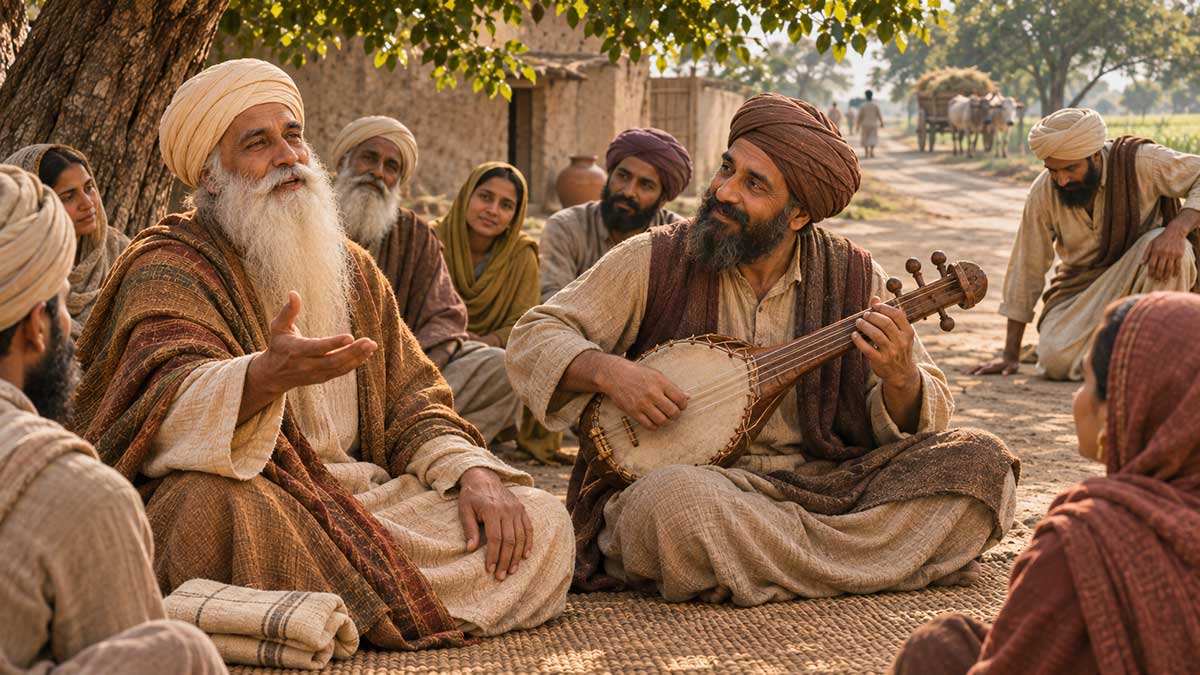
At Kartarpur, Nick could hear water being poured into a vessel somewhere behind him. He was about to sit across from Guru Nanak when Nanak moved a folded cloth and rested his hand on the mat beside him. Nick took the place he had made and looked out at the yard from where Nanak was sitting.
Nick: I thought I’d begin by asking you about God. Then I kept coming back to the man who sat beside you when you sang.
Guru Nanak: Bhai Mardana.
Nick: Yes. I knew your name before I knew his. Then I learned that he traveled with you and played the rabab when you sang. I started to wonder how much of the story I’d missed by hearing about only one of you.
Guru Nanak: What did you think when you first heard about him?
Nick: I pictured you saying, “Play, Mardana,” and him picking up the rabab. Then I realized I’d pictured him waiting for you to tell him what to do.
Nanak laughed, and Nick looked over at him.
Guru Nanak: That would have made for a very long walk.
Question 1. What did Mardana bring that you couldn’t bring by yourself?
Nick: When you sang and Mardana played, what did he bring that you couldn’t bring by yourself?
Guru Nanak: He brought the ear of a man who had spent years listening. A player can hear you draw breath and know a word is coming before anyone else has heard it. He can hear you bear down on the wrong word, too. There would be room for me to hurry ahead, and there would be a good reason to wait. Mardana heard both.
Nick: Did you talk about that before you sang?
Guru Nanak: Sometimes you are in a place where there is time to speak before people gather. Sometimes people are already there when you arrive. A man has come in from the road. Someone is still talking to his neighbor. If I was busy thinking about the verse I was about to sing, Mardana might already have heard what sort of attention the people had to give us.
Nick: How do you hear that?
Guru Nanak: By hearing them before you begin. You may be ready and the people may still be finding a place to sit. Some will have come to hear a teacher. Others will have followed someone they know and will be wondering how soon they can go home. You have to begin among the people who are there.
Nick: It sounds as though he knew things about the gathering that you needed to know.
Guru Nanak: Yes. And once I began to sing, I could pay attention to what he was giving me. If he left a space after a line, I could hear the line again in that space. So could the people. A verse you have sung many times can reach your own ear differently when another person has listened to it.
Nick looked out at the yard. Two people had been talking since he sat down. One had stopped to listen to the other, and Nick could suddenly make out the sound of their voices separately.
Nick: I’d been thinking of the rabab as something the people heard. I hadn’t thought about what it let you hear.
Guru Nanak: I had ears, too.
Nick laughed. This time Nanak let him laugh for a moment before going on.
Guru Nanak: And when we set out again, he still had to carry the rabab. There were stretches of road where no one heard us do anything. I knew the man who carried it then, too.
Question 2. What did you hope people would hear?
Nick: Someone could stop just to hear Mardana play. What did you hope they’d hear once they stayed?
Guru Nanak: The praise of the One. A man may come from a market where he has heard prices called out all morning. Someone told him what his grain was worth. Someone else told him what he owed. Then he hears words that ask him to attend to the One whose gifts he has been using from the moment he woke. He has been taking breath through the whole morning. When did it occur to him to give thanks for it?
Nick: Is that what you mean by remembering the Name?
Guru Nanak: It may begin in gratitude. The tongue says the Name, the ear hears it, and the mind goes off to settle a debt from three days ago. You bring your attention back. It goes off again. You begin to learn what holds you. You may have thought you were free to give your attention wherever you pleased.
Nick: I know that feeling. I can sit down to pray and discover I’ve spent five minutes rehearsing something I’m going to say to someone later. Then I catch myself and start over.
Guru Nanak: What do you do when you catch yourself?
Nick: Usually I get impatient.
Guru Nanak: And is impatience what you sat down to give your attention to?
Nick looked at him. Nanak had asked it so plainly that he found himself smiling.
Nick: No. But I can spend a fair amount of time on it.
Guru Nanak: Then come back to the Name when you can. Listen when others are singing. There may be a day when a line you have heard a hundred times reaches you, and you find yourself glad to have been alive to hear it. You can make time to sing. You can make time to listen. When the words reach you in that way, receive it as grace.
Nick: So the person who stopped for the rabab might leave with one line and carry it all the way home.
Guru Nanak: He might. And on the way home he may meet the man he has been rehearsing a quarrel with. He will find out what attention he has left for the words then.
Question 3. What did you hope people would hear about the One?
Nick: When you sang of the One beside a man who had grown up with different prayers, what did you hope the people listening would hear?
Nanak considered that. Near the place where the water had been poured, someone set an empty vessel down to be filled.
Guru Nanak: They would hear that the One was already there before any of us opened his mouth. Before a child learns the prayers of his house, he has been given breath. Before any man knows what name his neighbors call him, the One knows him.
Nick: Were people surprised to see the two of you together?
Guru Nanak: A man may hear where you come from and think he knows how to greet you. He may hear where the man beside you comes from and be less sure what to say. Let him sit and listen for a time. He has two men in front of him now. He may have arrived with very little idea of either one.
Nick: I think I’d be tempted to make it all very agreeable. I’d say, “We’re praying to the same God,” and expect that to settle whatever differences we’d brought with us.
Guru Nanak: Would you still care what the other man had come to say?
Nick: I’d like to think so. I can see how I might stop listening once he’d agreed with me.
Guru Nanak: Then allow him to finish before you tell him what you share. He may speak of something you have passed over all your life. When I sing of the One, I sing of the Creator without enmity. A man can give thanks to that One in the morning and take pleasure in despising his neighbor before noon. He still has something to hear in the words he sang that morning.
Nick let that settle. He had come hoping to ask Nanak about the conviction that people belonged to one human family. It occurred to him that one place to begin was with his eagerness to have Nanak agree with him.
Nick: What if I can hear all that clearly today and still forget it by tomorrow?
Guru Nanak: What do you suppose the singing is for tomorrow?
Closing
For a little time they listened to the voices nearby. One called out a question. From farther away, someone answered.
Nick: There’s a verse of yours I kept coming back to. You speak of yourself as a minstrel who was summoned. We’ve talked about what you hoped people would hear when you sang. I’d like to ask what you heard when you were the one being called.
Nanak turned back to him. Nick waited.
Topic 2. What Makes a Person Truthful?
Opening
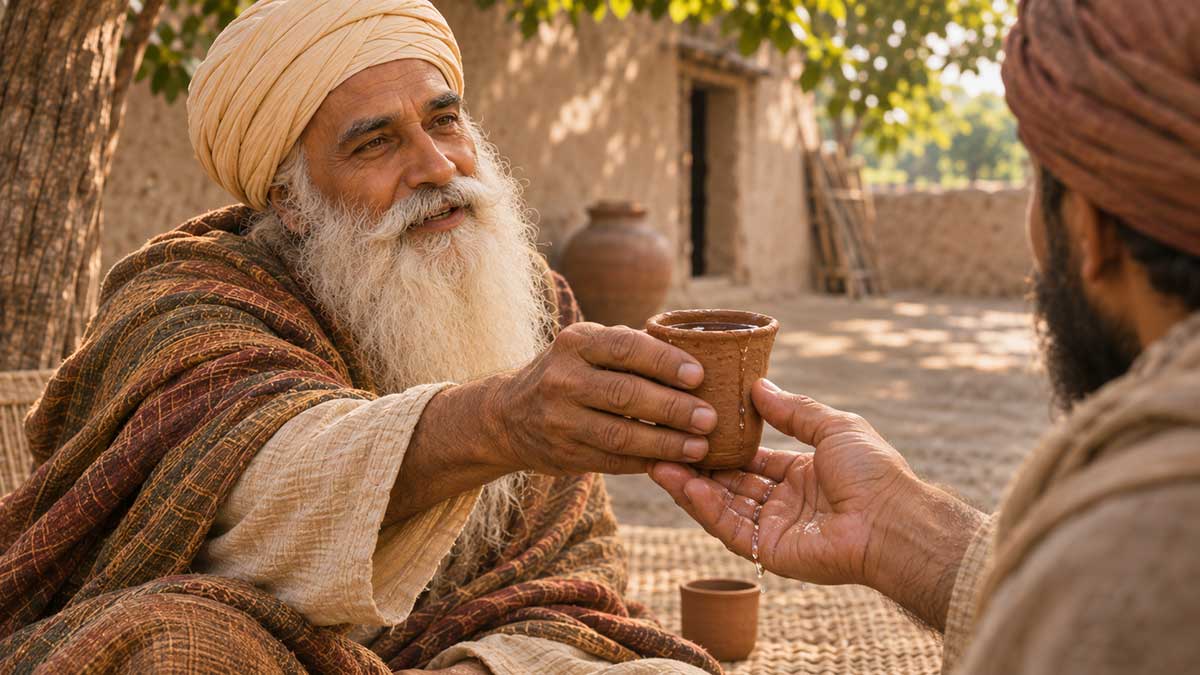
Someone brought two cups of water and set them near the edge of the mat. Nanak passed one to Nick, and a little water ran down the side onto Nick’s fingers. Out in the yard, the person who had brought the cups held the empty vessel under one arm and stopped to listen to someone calling from across the way.
Nick: I’ve heard the account people tell about you going to bathe in the Kali Bein. You disappeared, and for three days no one could find you. There’s so much I’d want to ask about that story. But when I came to your own verse about being called, the part that stayed with me was how you described yourself. A minstrel.
Guru Nanak: A minstrel knows what it is to be sent for. He may go some time without anyone coming to his door. And then a man comes and says he is wanted somewhere.
Nick: Did it feel like being wanted?
Nanak took a drink. He held his cup between his palms when he answered.
Guru Nanak: It felt like being given work.
Question 1. What did you feel you were being asked to do?
Nick: In that verse, you speak of being summoned into the presence of the One. What did you feel you were being asked to do?
Guru Nanak: To sing the praise of the One by day and by night. I speak of receiving the Name. Think what that means for a minstrel. He goes out with something he has been given. If people come to hear him, he has a duty to remember what he was given to sing about.
Nick: Before all of this you had work at Sultanpur. You had a family. What happens the next morning when you feel you’ve been given different work and there are people who’ve been counting on you to do the work you already had?
Guru Nanak: The people are still there when you wake. It is worth sitting down with that fact. A child has the same appetite he had the day before. If a man is waiting for you to tell him how much grain he can take from a store, he will want an answer he can carry away with him. There are people in any house who can tell you better than you can tell yourself whether you have heard something worth hearing.
Nick: Yet you did leave Sultanpur and travel. Did you know what the rest of your life would look like?
Guru Nanak: I knew I had been called to speak. On a day when I went somewhere new, I had to find out who was there and what people were prepared to hear. There might be a man who wanted to take issue with the first thing I said. I might learn more about what he cared for in the argument than I would if he sat quietly the whole time.
Nick: Could he ever make you go home and look at the way you were living?
Guru Nanak: Of course. A man may ask you to tell him about contentment, and you will find you have a great deal to tell him. Later, when you sit down to eat, you hear what another man has been given and spend the meal looking into his bowl. If you are fortunate, someone at the meal knows you well enough to ask what you are looking at.
Nick laughed. The picture took him away from the river and put him at a supper table. He could think of several people who knew him well enough to ask.
Question 2. How can I tell whether I’m living truthfully?
Nick: You place truthful living higher than truth. How can I tell when I’m living it and when I’m just talking about it?
Guru Nanak: Tell me something a man might say about himself that he would be glad to hear repeated.
Nick: “I’m fair to the people who work for me.”
Guru Nanak: What would he tell you as proof?
Nick: He’d probably tell me what he pays and how it compares with what other people pay.
Guru Nanak: Then ask the people who work for him when they receive it. A man may say truthfully what he pays and keep someone waiting for weeks to be paid. Ask what the person owed the money has to do to get it. Can he go straight to the man who owes him, or must he ask somebody else to speak for him? If he does go himself, does he get to finish his sentence?
Nick turned the cup in his hand.
Nick: He might get his money and still go home wishing he’d never had to ask.
Guru Nanak: Yes. The man who paid him may remember only that he paid.
Nick: I’ve had arguments where I remembered exactly what I’d promised. I could repeat the words and be sure I was technically right. I had a much harder time saying what the other person had been led to expect.
Guru Nanak: Did you know at the time what he had expected?
Nick: Sometimes. I knew just enough to change the subject.
Nanak smiled.
Guru Nanak: Go back to the part you were quick to leave behind. Ask the man what he thought you were going to do. You may find you owe him something. You may find he heard a promise you had no intention of making. Stay long enough to hear him tell you how he heard it.
Nick: And if I’ve already told everybody how fair I was?
Guru Nanak: Then you may have more people to speak to. Begin with the one who had to come and ask.
Nick looked down at his cup again. It was easier to talk about that man in the third person. He let himself sit for a moment with the thought that the man might be coming to see him.
Question 3. How do I tell my own wishes from hukam?
Nick: If I want something badly and I’m sure God wants it for me too, how do I tell my own wishes from what you call hukam?
Guru Nanak: When you say you are sure, what has made you sure?
Nick: I pray about it. Then somebody turns up and tells me something that fits what I was hoping. A door opens. After two or three things like that, I start telling myself I’ve been shown where to go.
Guru Nanak: And what became of the man who told you something that did not fit?
Nick: I probably thought he didn’t see the whole picture.
Guru Nanak: He may have seen the corner you had put your foot on.
Nick grinned. Nanak waited until he looked up again.
Guru Nanak: Everyone is within hukam. The man who encourages you and the man who troubles you are both within it. A door opens for you, and you are glad. You can give thanks for that. Then you may look through the door and see who is already in the room and what your coming in will mean for them. Give their lives some room in the account you tell yourself about your own.
Nick: Is that where haumai comes in?
Guru Nanak: A man says “I” so often that it begins to sound as though the whole day happened for him. Rain comes and he says it came for his crop. His neighbor has laid something out to dry and makes quite another account of the same rain. Both can speak about what happened to them. Neither can stand outside it and tell you all that the rain was for.
Nick: I can see how easy it is to do that with something good. When something terrible happens, the question feels different. But let me stay with the smaller one for a second. If I still don’t know what God wants me to do, how do I make a choice?
Guru Nanak: Find out what can be found out. If you have given your word to someone, count that among the facts. If someone else will carry the cost, go and hear what the cost is to them. Then you may have to decide before you feel certain. You can pray for the grace to see plainly. You can go back and put something right if you learn that you saw it poorly.
Nick: That leaves a lot of room for me to be wrong.
Guru Nanak: Leave room for the other man to tell you so.
Closing
Nick drank the last of his water. The question he had brought was about reading God’s will in the changes of his own life. His next question concerned people whose lives had changed in ways none of them would have chosen.
Nick: In the hymns you wrote about Babur’s invasions, there’s a place where you speak about people crying out and then ask God about their pain. I’d read it several times before I came. I still don’t quite know what I expected you to say next.
Nanak set his cup down.
Guru Nanak: What did you hear before the question?
Nick thought back to the line. This time he let his attention rest with the people in it.
Topic 3. What He Dared to Ask God
Opening
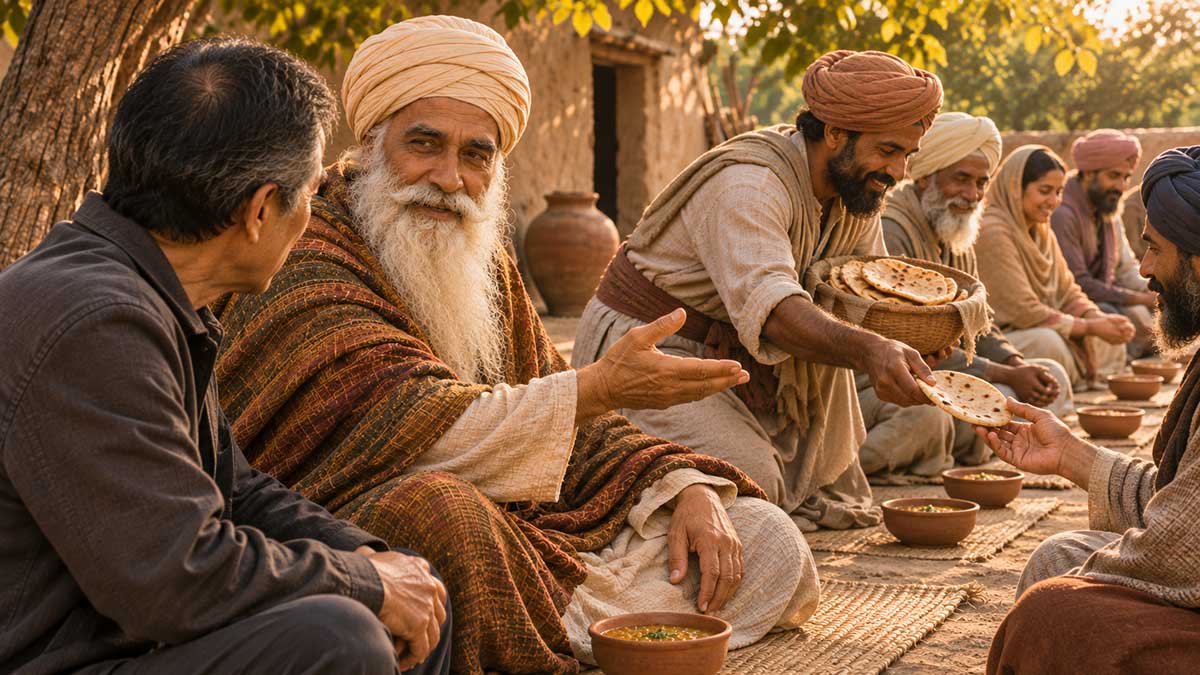
The cup Nanak had set down left a dark ring on the ground beside the mat. Across the yard, someone dragged a vessel a little way and stopped to shift his grip. Nick had read the hymn several times before coming, but now that Nanak had asked what he heard before the question to God, he found himself taking longer than he expected.
Nick: People crying out. I went straight to what you said to God the first time I read it. I wanted to know where you got the nerve.
Guru Nanak: And the second time?
Nick: I tried to think about who was crying. Then I read the verses about the women.
Nanak waited for him to go on.
Question 1. Why did you write about the women’s hair?
Nick: You wrote about women whose hair had been parted and marked with vermilion. Why did that detail belong in a hymn about an invasion?
Guru Nanak: When someone tells you that a city has fallen, how much do you see?
Nick: I see the army coming in. Maybe the people at the gates trying to get out.
Guru Nanak: Go into one of the houses before that day. A woman sits down and has her hair parted. She knows whose hands are doing it. There are things she expects to do when she gets up. A person who has never seen that house can still think of a morning like hers. Now tell him what happened to her hair when the soldiers came. He may spend a little longer with her than he would if you told him how many people were taken.
Nick: That’s what bothered me when I read it again. I could picture somebody helping her get ready. Then I had to picture the scissors. I wanted to stop before I got to them.
Guru Nanak: You could stop reading. She still had to live through the day.
Nick looked down. He had been about to ask how Nanak could bear to put such things into a hymn. He let the question go.
Nick: You speak of women from Hindu and Muslim homes. Did the people who heard you expect you to care more about one household than another?
Guru Nanak: A man asks for news of his own street first. I can see why he does it. His family may be there. Then someone brings him word of the next street. What does he do with that news? A woman there may have spent the whole day asking whether anybody has seen her daughter. Her question is still waiting when he gets the answer to his.
Nick: It’s hard to hear the poem the same way once you’ve pictured the two houses.
Guru Nanak: Yes. A man may have heard the news and gone home relieved. The next time he hears it, he may ask what became of the woman across the road.
Question 2. Why did you take the cries of the afflicted to God?
Nick: You make a distinction in the hymn. Two strong sides can fight each other. Then there’s the strong falling on people who have little chance of defending themselves. Why did you take that to God?
Nanak looked down at his hands. Somewhere beyond them someone called for water, and a reply came from nearer the cooking place. Nick had another question ready. He waited.
Guru Nanak: There is a difference between the man who can answer a blow and the one who sees it coming and has nowhere to go. The men who fight have their own words for what happened. What should the woman driven out of her house say when someone tells her that a battle was won? Who is waiting to hear her account?
Nick: And you asked the One whether those cries stirred any pain.
Guru Nanak: I did. I had words, and I could bring the cries into those words. What sort of praise would I have offered that day if I had kept them out? The One to whom I had sung on a morning when my house stood safe was the One I could speak to when other houses were brought down.
For a time Nick could hear the people working and nothing from the man beside him. He let the silence stand.
Nick: A little earlier you said that everyone lives within hukam. If I’d lost someone and you said that to me, I think I’d ask what you expected me to do with it.
Guru Nanak: You might ask me to help you look for him. I hope I would have the sense to go with you.
Nick looked up. Nanak was looking at him now.
Nick: And if we came back without him and I asked you why the One let it happen?
Guru Nanak: What could I tell you that would let you eat a meal without looking at the place where he used to sit? I have asked the One about the pain of people who cried out. I can sit with you when you ask. You may have to ask more than once.
Nick: Some people would hear a question like that and think you’d stopped trusting God.
Guru Nanak: I was speaking to the One. To whom else could I have brought the whole of what I had heard? A ruler could tell me what his men had done. A man who escaped could tell me what he saw from the road he took. The people whose cries never reached either of those men were known to the One, too.
Nick took his hand off the cup. He had come prepared to ask how a person could trust God after a thing like this. He was still interested in the answer. For now, he found himself thinking of someone being able to ask the question a second time and finding the same person there to hear it.
Question 3. Why did you speak directly to Lalo?
Nick: In another hymn you speak directly to Lalo. I hear his name, and suddenly it feels as though I’m close enough to overhear you telling one person what’s happened. Why speak to him?
Guru Nanak: A man can speak about what is happening in the land and spend very little time thinking about who will have to hear him. Say Lalo’s name and there is somebody to speak to. He can hear what you are saying. He can ask you what you mean.
Nick: In the hymn you say you’re telling Lalo what comes to you from the One. Then you use the image of a wedding procession to speak about the invading army. How did those two things come together for you?
Guru Nanak: When you hear a wedding party is coming, you know why people might go out to see it. You think of a house where people have been preparing to receive guests. I used that picture for men who came demanding what they meant to take. Anyone who had ever waited for a wedding party could hear the cruelty in calling this one by the same name.
Nick: It makes the army sound worse than if you’d just called it an army. You know what ought to happen when those people reach the door.
Guru Nanak: You know what kind of welcome has been taken from the people inside. And when I say Lalo’s name again, I have to think what it is to tell him that. He has neighbors. He knows houses where people are waiting for word. I can speak plainly enough for him to take the words with him when he goes to see them.
Nick: Did you expect him to repeat what you’d said?
Guru Nanak: He might hear a better account from somebody who had been there. I would want him to hear it through. A person who comes to tell you what he saw may take some time to get to the part he came to tell. If you have already decided how the story goes, he may spare you the trouble and go home.
Nick: Then there’s a difference between being able to say what happened and being someone people will come to with what happened.
Guru Nanak: Yes. If Lalo came to me the next day with something I had missed, I would hope he knew there was a place for him to sit.
Closing
Across the yard, someone called for a second pair of hands. A man who had been sitting got up, wiped his palms on his knees, and went over. The two men carried the vessel the rest of the way together, stopping once to let someone pass.
Nick: Would that man have known who was calling him?
Guru Nanak: I expect so. They’ve done that work together before.
Nick watched them set the vessel down. One of the men went straight back for something else. The other stayed and waited for him to return.
Nick: You could have gone on traveling and teaching. What did you want people to learn by living here together?
Topic 4. Who Will Sit Beside You?
Opening
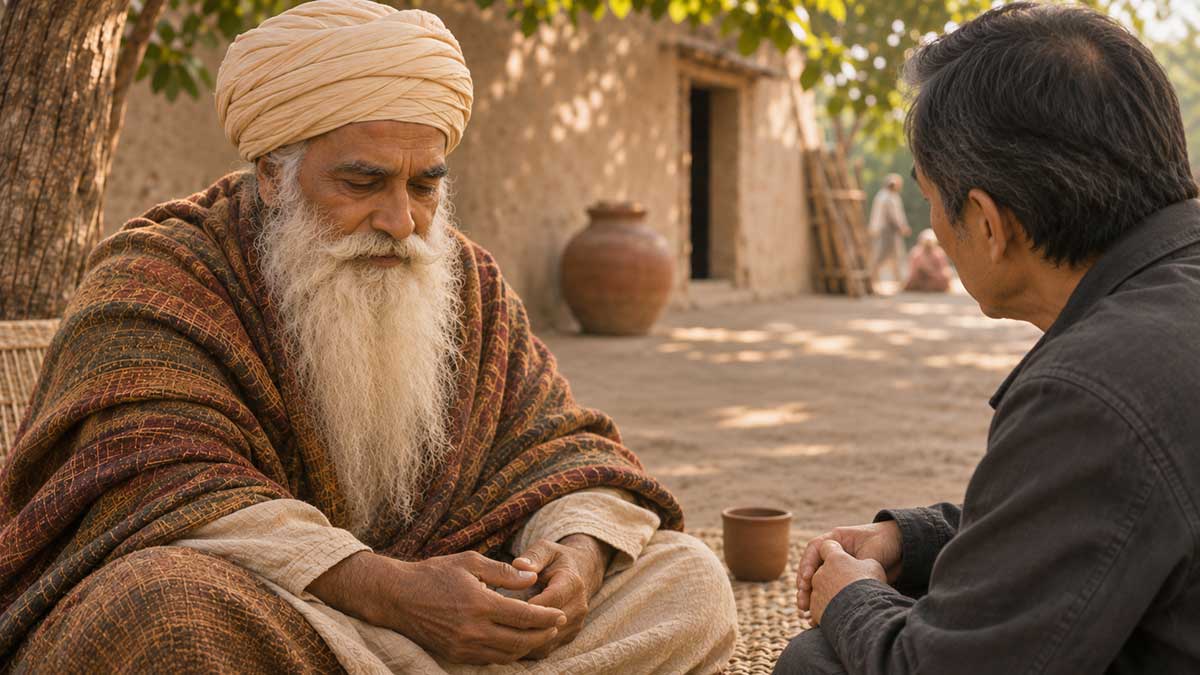
People were beginning to sit down for the meal at Kartarpur. A man lowered himself to the ground, saw how little space he had left for the next person, and got up to move farther along. Guru Nanak waited until both men had settled before answering Nick’s question.
Guru Nanak: You asked what I wanted people to learn by living here. Do you see the man who moved?
Nick: The one who got up twice?
Guru Nanak: Yes. He has found a place where both of them can reach their bowls.
Nick had expected Nanak to point out the people preparing the food. He looked again at the two men. The one who had moved was already talking to somebody on his other side.
Question 1. What did you want people to learn by living at Kartarpur?
Nick: You could have gone on traveling and teaching. What did you want people to learn by living here together?
Guru Nanak: When you pass through a place, you may spend an evening with people. Someone asks you a question near the end, just as the others are getting ready to go. You can hear enough in his question to wish you had another evening with him. By morning you are on the road. Here he can come back and tell me I answered him poorly.
Nick: Does that happen?
Guru Nanak: Sometimes he sends his brother.
Nick laughed. Nanak looked pleased that he’d caught it.
Guru Nanak: A family can come here and find a place to live. They still have a field to tend or a trade to practice. The children still need to eat. We can gather to sing before the work of the day takes people in different directions. The following morning we see one another again. I wanted people to be able to give their attention to the One and to have work they could do with their own hands.
Nick: Did you want them to come here already knowing how to live that way?
Guru Nanak: How would they have learned it? A man may have grain to give this week. Next week he may come and need some himself. He learns something about the place by seeing how people receive him the second time. We learn something about ourselves by seeing whether we greet him as readily when he comes with empty hands.
Nick: Did the people who brought grain ever feel they ought to have more of a say?
Guru Nanak: A person may have a good deal to tell you about grain. Listen to him when you are deciding how much to grind. Then listen to the woman who cooks when she tells you how many people it will feed. She may know how many came yesterday, which is something the man who brought the grain had no reason to count.
Nick: I can see what you could learn by staying. Did staying change what you had to pay attention to?
Guru Nanak: Very much. A visitor can tell me the meal was good and go away thinking kindly of us. The woman who made it knows there was almost no flour left at the end. If I am going to be here tomorrow, I had better find out what she needs.
Question 2. What did sharing a meal ask of people?
Nick: What did sitting down to eat together ask of people that listening to you teach didn’t?
Guru Nanak: A man can stand near someone during the singing and think little of it. He hears the words. He may join in. Then he sits down to eat, and that same person brings him bread. Now he has a choice he could get through the whole morning without making.
Nick: Suppose he was taught at home that he must refuse food prepared by someone of a certain caste. He might take the bread and spend the rest of the day wondering what he’ll say if his family hears about it.
Guru Nanak: Yes. He may have learned it from people he loves. He may have watched them set food apart for certain visitors before he was old enough to ask why. Now he knows how it feels to have a man waiting for him to take a piece of bread. He has time to look at the man’s face. That is something his family’s instruction never asked him to do.
Nick: And the man with the bread has to stand there waiting.
Nanak turned to him.
Guru Nanak: Yes. We can give a great deal of thought to how hard it is for the first man to change. The man holding the bread may have been refused in houses all his life. He knows what the silence means. Here he has a place to sit and eat. If the first man needs another year to decide what to do with his hands, the bread can go on to the next person.
Nick: What if the first man says, “I’m willing to eat here. Could you have somebody else serve me?”
Guru Nanak: I would ask him what he expected us to say to the person he had just sent away.
Nick looked toward the people serving. A bowl had been set down just beyond someone’s reach. Before the person serving could turn back, a hand reached out from farther along and drew it closer.
Nick: From here it looks easy.
Guru Nanak: For some of the people you are looking at, it is easy now. You would have to ask them what it was like the first time.
Question 3. What happens when people go home?
Nick: What happens when a man serves someone here, then goes home and treats the person who works his field as beneath him?
Guru Nanak: Tell me how he treats him in the field.
Nick: Say he sees him stop to drink, calls out some remark, and the other men laugh. He’d bring him water himself here. In the field he can make him feel small for taking a drink.
Guru Nanak: Then the man drinking knows something about the owner of the field that a guest at this meal may never hear. The owner can stand beside him here and speak kindly to him. He has another chance out there, where he knows the other man needs the work and will probably let the remark pass.
Nick: Would you ask him to stop serving here until he’s dealt with what he does there?
Guru Nanak: I would ask him to go back to the field and speak to the man. If he made the others laugh at him, he can speak where they can hear him. The next day he can see whether the man takes a drink when he needs one or waits until the owner goes home.
Nick watched one of the people eating reach for water. He had done much the same thing at the start of the visit. It hadn’t occurred to him to see who was looking.
Nick: You speak about earning by your own labor and sharing from what you earn. How does a man start to think differently about what he calls his, when he owns the field and other people do much of the work?
Guru Nanak: Ask him what it took to bring the grain in. He will know what he spent. Ask him who was there when the work began and who was still there when it was time to go home. Let him name them. He may have passed some of those people on the road for years and never asked what they took home after a day working in his field.
Nick: And bringing some of that grain here is a good thing?
Guru Nanak: It can feed somebody who came hungry. Tomorrow the people who helped grow it will go back to his field. They will know better than we do what he has learned from bringing it.
Closing
The man who had shifted to make room at the start of the meal leaned forward to steady a bowl for someone walking past. A few places farther along, someone was already gathering the empty vessels. Nanak had spent much of the conversation looking at Nick. The work had gone on around him.
Nick: I thought people would keep turning to see what you wanted them to do.
Guru Nanak: They know who needs another bowl.
Nick watched someone take one from the stack and bring it down the row. He thought about how long it must have taken for people to learn to notice those things, and about the man Nanak had chosen to care for the community.
Nick: When you were deciding who could carry this on, what did you see in Lehna?
Topic 5. The Person He Trusted to Carry It On
Opening
The first people to finish eating were getting up, and others were still coming in from the road. A man had taken several steps away when someone called his name, and he turned back to help. Nick watched him for a moment, his question about Lehna still between him and Guru Nanak.
Guru Nanak: You have been watching the people who turn back.
Nick: I have. When I read that you chose Lehna, I pictured a moment when he did something that made the whole decision clear to you. Sitting here, I’m starting to wonder if there was a moment like that at all.
Guru Nanak: You would like me to give you one thing to look for.
Nick: It would make the question easier to ask.
Nanak smiled and shifted a little so he could see Nick more plainly.
Question 1. What did you see in Lehna?
Nick: What did you see in Lehna, in the way he treated people here, that made you trust him with them?
Guru Nanak: I saw a man who could be taught. I had to see it more than once. You can tell somebody something in the morning and see him take it to heart. By evening he may be pleased with himself for having taken it to heart. The next day you find out how much of the teaching is still there when he has forgotten who was watching him.
Nick: What would you look for the next day?
Guru Nanak: I would listen to him when someone came to ask about a verse he already knew. A man who knows the words may be eager to show how long he has known them. An hour later the person who asked can scarcely recall what he had wanted to know. Lehna could give his attention to the question. He knew what it was to hear something for the first time.
Nick: Is that a quality you can see in a man before people start coming to him for answers? I’d think the praise would change things.
Guru Nanak: It changes what a man hears when he enters a room. People make room for him sooner. They laugh more readily when he tells a story. There may be one person there who knows he has spoken carelessly. That person used to tell him so. Now he has to decide whether he still can.
Nick: Was there anything you could do about that for Lehna?
Guru Nanak: I could ask him what he listened for when people praised him. I could ask myself the same question. He had come to hear the Word. I had reason to hope that when people came to hear him, he would still know what he had come for.
Nick had wanted an instance he could picture by itself. Instead he was picturing Lehna hearing the same words in two rooms, one where he had taken his place as a learner and another where the people had left the place of honor for him.
Nick: It sounds as though you were choosing somebody you believed could go on being a disciple once he became Guru.
Guru Nanak: I trusted him to keep listening.
Question 2. What were you entrusting to him when you made him Guru?
Nick: You had two sons, and you chose Lehna. What were you entrusting to him when you made him Guru?
Nanak took a breath before he answered. Behind them someone set down a stack of bowls, a little harder than he meant to.
Guru Nanak: A man who has sons knows there are duties that are his from the day they are born. Those duties were mine. The people who had gathered here had come to hear the teaching and to live by it together. I had to give thought to what would happen to them, and to those who would come after them. Some would arrive when nobody here could tell them what my face looked like.
Nick: Would it matter to you whether they knew your name?
Guru Nanak: They may hear my name when they hear a verse. What I want to know is whether the verse can reach them. Suppose a woman comes after a long absence. She has something on her mind that she can hardly put into words. She hears a line she has heard since childhood, and that morning she hears something in it she can answer. What has helped her is still there for her, years after the mouth that first sang it has gone quiet.
Nick: And what does Lehna have to do with what happens to her in that moment?
Guru Nanak: He has to hear the Word himself, and he has to teach it. People will bring him questions he has never heard before. Some will bring grief they have told to nobody else. The people who gather around him will take some of their manner from his. When that woman comes through the door, a great deal may depend on the kind of gathering she finds.
Nick: You’ve spoken of the Shabad, the Word, as Guru. Help me with something there. When you give Lehna the place of Guru, what do you expect people to find in him?
Guru Nanak: A Guru to whom they can come for guidance. I expect him to speak the teaching and give himself to living it. People will know his voice. They will know how he receives them when they arrive. Through him they can learn to attend to the Word that called him here. He can spend the rest of his days in that work.
Nick let the answer sit. He had been thinking of two men and the moment one took the other’s place. Nanak kept bringing up people neither man had met.
Nick: When you chose, you were thinking of the woman who might arrive years later.
Guru Nanak: Of her, too.
Question 3. What would you hope changes for the people at home?
Nick: Years from now, when someone hears your words for the first time, what would you hope changes for the people who live with them?
Guru Nanak: Think of a house where a child has broken something. He knows it will be found before night. He spends the day putting off the moment when he must tell his father. By the time he hears footsteps at the door he has thought of three ways to say it and given up on every one.
Nick waited. He had a picture of the child now, trying to judge from the sound of the door what sort of evening lay ahead.
Guru Nanak: Suppose his father has heard the words that morning. He remembers the One without enmity. That evening he still has a broken thing to reckon with. He may need to know how it happened. Let him see that the child has come to tell him, and receive him in a way that leaves him able to come again.
Nick: And the child may never know what his father heard that morning.
Guru Nanak: He will know what happened when he told him.
For a little time Nick could hear a bowl being rinsed. He had been wondering how much of a teaching could survive the death of the person who gave it. He found himself thinking of a child coming to a door a second time, with something harder to say.
Nick: Would that be enough for you?
Guru Nanak: It would be enough for that evening. The father can get up in the morning and remember the One again.
Closing
The row of people eating had thinned. Someone asked for water, and the request passed from one person to the next until it reached a man who had just stood up.
Nick: Thank you for making room for me.
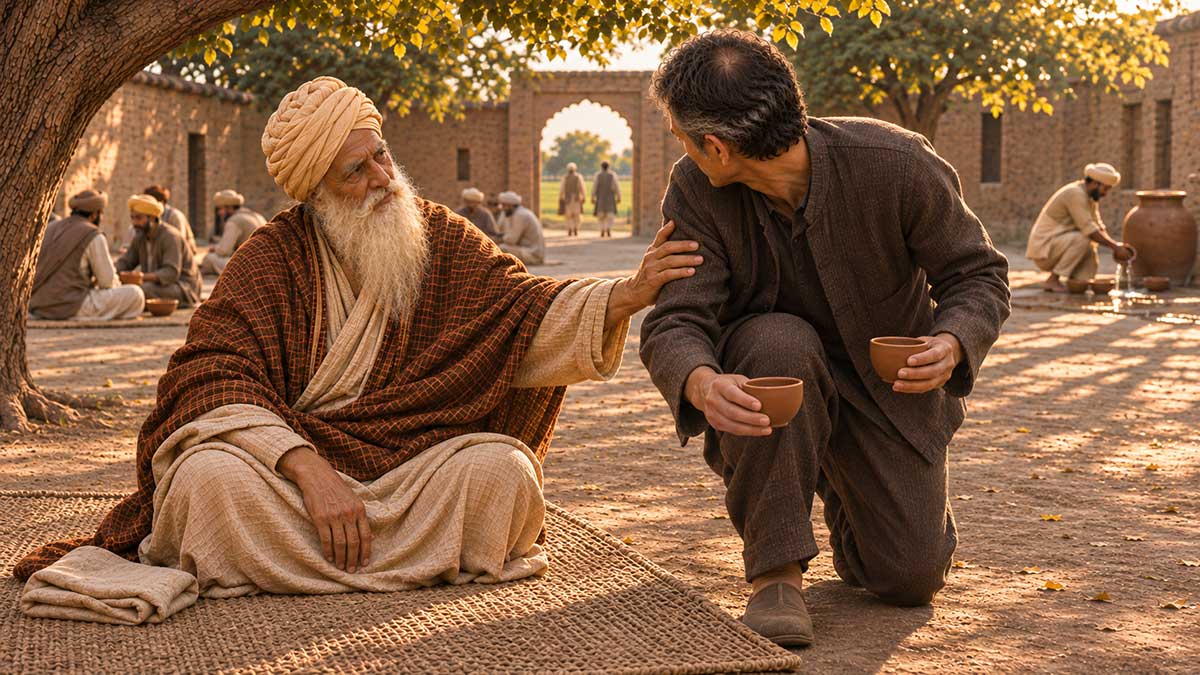
Nanak rested a hand on his arm as Nick rose. Nick picked up the two cups from beside the mat. At the start of the visit he would have looked for someone to hand them to. Now he knew where they went.
Final Thoughts
I’d expected Guru Nanak’s answer about truthful living to stay with me as a line I could remember. What stayed was a child listening for his father at the door. He’s broken something and spent the day deciding how to tell him. A father may feel he handled the matter well. The child will learn from it whether he can bring him something harder the next time. That is where I keep returning when I read Nanak’s verse on truthful living.
I kept thinking about Mardana, too. I’d come wanting to know what the people heard when Nanak sang. I left thinking about what Nanak could hear with Mardana beside him. I care about that distinction in an interview. I can spend so much time trying to get a question right that I miss the moment when somebody gives me a better one in their answer.
The hardest silence came after we spoke about the cries in the hymns on Babur’s invasions. I’d been ready to ask whether suffering could shake a person’s faith. What I wanted to know by then was whether a person could bring the same painful question to God a second time. In our conversation, Nanak leaves room for that. I think I would find it easier to sit with another person’s grief if I gave up trying to know in advance how long they should need to speak about it.
At Kartarpur, I’d put most of my attention on the person deciding whether to accept the bread and very little on the one offering it. I wanted to know whether the first man would change his mind. The second man might already have spent years waiting for people to make up their minds about him. What stayed with me was Nanak’s confidence that this man had a place to sit and eat in the Sikh practice of langar.
With Lehna, I went looking for a moment that would explain why Nanak chose him. I came away thinking about what would happen when a person who had never seen Nanak came to hear the teaching. The bards Satta and Balwand remember the succession in the Ramkali Ki Var. In the interview, the woman arriving with something she can barely say gave me a way to think about what it means for the Guruship to continue through another person.
By the time I got up, people had already begun clearing the bowls. I picked up the two cups from beside the mat and knew where to take them. I’d learned that by sitting there long enough to see who brought the water and where people returned what they’d used. At the beginning of the afternoon, I would have set them down and assumed somebody knew what to do.
That was the part of the visit I could carry home. The people at home will have had a whole day of their own by the time I get to the door. Someone may have good news and be waiting to tell it. Someone may have had a harder day than I can guess from the sound of the house. I’d like to come in slowly enough to find out.
Fictional Conversation Disclaimer
The exchanges and closing scene are literary reconstructions. Guru Nanak’s authentic compositions can be read in the Guru Granth Sahib. The fictional replies are distinct from his recorded words and imply no endorsement by any Sikh institution or community.
Short Bios:
Guru Nanak (1469–1539) was the first Sikh Guru and the founder of the Sikh tradition. Born in Talwandi, now Nankana Sahib in Pakistan, he taught remembrance of the One, truthful living, and sharing what one earns. His compositions, including Japji Sahib, are preserved in the Guru Granth Sahib. In his later years he founded the community at Kartarpur and chose Lehna, known as Guru Angad, to succeed him. Read more in the Sikh Coalition’s history of the Sikh tradition.
Nick Sasaki is the creator of ImaginaryTalks. He writes fictional conversations with historical figures, drawing on their lives and writings to ask the questions he would bring if he could sit down with them. Read more about Nick and ImaginaryTalks.
Leave a Reply