

Introduction
What do children owe the parents who sacrificed for them?
Who should decide the future of a gifted child?
Can someone keep living when a loved one is missing, without feeling that moving forward means betrayal?
Why do wealth, class, migration status, and social connections affect whose suffering receives attention?
And after years of separation, can two people truly return home?
Sophie Chen Keller’s Little Wonder raises these questions through Song and River, but the novel does not have to answer them alone.
In this fictional scholarly discussion, Keller joins experts in attachment, ambiguous loss, gifted children, music psychology, philosophy of childhood, Chinese migration, labor, and Confucian ethics.
Their goal is not to judge Song as a good or bad mother, or River as grateful or ungrateful.
Instead, they examine the deeper questions hidden inside the story.
Can parental sacrifice create an invisible emotional debt?
Does extraordinary talent give adults the right to shape a child’s future?
Can found family become real family without replacing biological family?
Does society value people equally, or does it pay more attention once someone becomes exceptional, productive, wealthy, or connected?
And perhaps the hardest question:
Can love remain deep without becoming ownership, obligation, or destiny?
(Note: This is an imaginary conversation, a creative exploration of an idea, and not a real speech or event.)
Topic 1: When Does Parental Love Become Too Much?
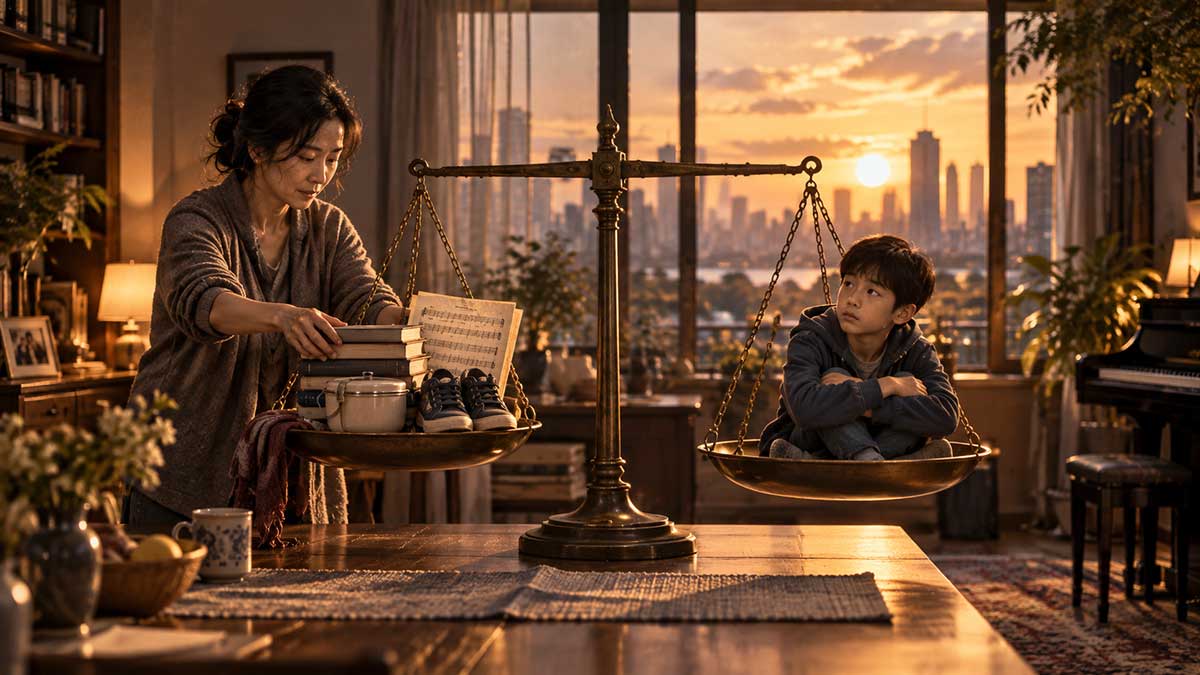
The moderator waits until everyone has settled.
Sophie Chen Keller sits beside Jude Cassidy. Across from them are Harry Brighouse and Amy Olberding.
The atmosphere is different from the character conversation.
No one here has to defend Song as a mother or River as a son.
Their task is harder in another way.
They must ask whether love itself can sometimes create obligations nobody intended.
Moderator: Let me begin with the question that seems to sit underneath almost everything Song does.
If a parent sacrifices nearly everything for a child, does the child owe that parent anything in return?
Harry smiles slightly.
Harry Brighouse: You chose the hardest version first.
Moderator: We have five topics.
Amy Olberding: Efficient.
Sophie laughs.
Jude smiles.
Then Harry becomes serious.
Harry Brighouse: My first answer would be that we need to separate several things people often put together.
Gratitude.
Love.
Respect.
Care.
Obedience.
Achievement.
Debt.
Those are not interchangeable.
Moderator: Start with debt.
Harry: I would resist saying that a child owes repayment for ordinary parental care.
Parents make a decision to bring a child into a relationship of dependency.
The child did not negotiate that arrangement.
The child did not say, "If you feed me, educate me, protect me, and sacrifice for me, I promise to repay you later."
Sophie Chen Keller: Yet families often feel exactly like that.
Harry: Yes.
That is why the distinction matters.
A child may feel profound gratitude.
A grown child may freely choose to care for a parent.
A loving relationship can generate real responsibilities.
But that is different from saying, "I paid this much for your childhood, so now your life belongs partly to me."
Amy: I agree with the danger in that formulation.
But I want to complicate the idea that there is no debt at all.
Harry turns toward her.
Amy: Not debt in the commercial sense.
Not repayment.
But relationships form us.
A parent may give time, labor, memory, language, food, stories, protection, identity.
A child becomes a person partly inside those relationships.
So when we say, "The child owes nothing," I become uneasy.
Harry: Why?
Amy: It can make the relationship sound thinner than it is.
A human being is not assembled privately and then placed into a family.
We become ourselves through other people.
Jude Cassidy: That is very close to what attachment research suggests too.
Early relationships become part of how children organize safety, emotion, trust, exploration, and expectations about other people.
Moderator: So River does owe Song something?
Amy: I would phrase it differently.
River has reasons to respond to Song with gratitude, care, and attention.
But those reasons come from the relationship itself.
They do not give Song authority over River's adult life.
Harry: That distinction I can accept.
Sophie: I think Song would accept it too, at least eventually.
The problem is that she may not know how to separate love from purpose.
Moderator: Say more.
Sophie takes a moment.
Sophie: Song does not sit down and decide, "I will make my son responsible for the meaning of my life."
She is trying to survive.
Her husband is gone.
Money is scarce.
River has extraordinary musical ability.
She sees a possible future for him that she did not expect.
So she keeps doing the next necessary thing.
Then another.
Then another.
Eventually, her life becomes organized around his future.
Jude: That is psychologically very believable.
Moderator: Is it unhealthy?
Jude pauses.
Jude: That word can become too blunt.
A parent can be deeply devoted and still support autonomy.
A parent can spend enormous amounts of time, money, and emotional energy on a child without making the child responsible for the parent's identity.
The issue is not simply how much the parent gives.
It is what happens emotionally when the child begins to separate.
Moderator: So sacrifice is not the problem?
Jude: Not by itself.
I would ask:
Can the parent tolerate the child's difference?
Can the parent tolerate disagreement?
Can the child fail without feeling that the parent's life collapses?
Can the child succeed in a direction the parent did not choose?
Can the child leave?
Can the child love other people?
Can the parent remain a person when the child becomes less dependent?
Those questions tell us much more.
Amy: That last one matters greatly for Song.
Sophie: Yes.
Amy: We often praise maternal sacrifice with very little interest in the mother's life outside it.
Then years later, when the child becomes independent, people tell the mother she should rediscover herself.
Harry: After rewarding her for disappearing into the role.
Amy: Exactly.
Sophie: That is part of what interested me.
There is a luxury hidden inside some modern conversations about balance.
Moderator: Meaning?
Sophie: "Keep your own interests."
"Make time for yourself."
"Maintain your identity."
Those can be good ideas.
But Song cannot simply schedule a weekend retreat.
She cannot outsource childcare easily.
She cannot buy time.
She cannot turn poverty off for two hours.
Jude: That point is essential.
A psychological ideal can become unfair when we ignore material conditions.
Harry: Still, limited choices do not make every consequence healthy.
Sophie: No.
Harry: We can say Song had very little room to choose and still ask whether River experiences her sacrifice as pressure.
Those statements can coexist.
Amy: I agree.
Moderator: Then let me sharpen it.
Suppose River grows up knowing that his mother worked until exhaustion, spent money she did not have, built her hopes around his talent, and gave up much of her personal life.
Can he really feel free?
Jude leans back.
Jude: He can.
But freedom is not created simply by telling him, "You are free."
Moderator: What else does he need?
Jude: He needs to experience that freedom.
If River says, "I do not want this future," Song's reaction teaches him whether the freedom was real.
If he fails, her reaction teaches him.
If he chooses a modest life, her reaction teaches him.
If he loves something she does not value, her reaction teaches him.
Children learn the emotional rules of a family from responses far more than declarations.
Harry: This is where parental expectations become morally interesting.
A parent can say, "I want what is best for you."
That sounds generous.
But who defines "best"?
Sophie: Song thinks she knows.
Harry: Most parents do.
Amy: And sometimes they actually know more.
Harry: Of course.
A six-year-old should not run every major life decision.
Parents have legitimate authority.
Moderator: Then where is the line?
Harry: There is no single line.
Authority should change as the child develops.
A young child's preferences matter, but they do not always decide.
An adolescent's reasons deserve greater weight.
A mature young adult's direction should belong primarily to that person.
Parenting should contain a gradual transfer of authorship.
Sophie: I love that phrase.
Moderator: Transfer of authorship.
Harry: Yes.
At the beginning, the parent writes nearly everything.
Where the child lives.
What the child eats.
Which school the child attends.
What medical care the child receives.
Over time, the child should become the author of more and more of the life.
The tragedy occurs when a parent loves the child deeply but cannot surrender the pen.
Amy looks at him thoughtfully.
Amy: I like the image, but I want to add something.
A person's life is never written entirely alone.
Harry: Agreed.
Amy: A Confucian approach would resist the fantasy of complete self-authorship.
We remain sons, daughters, parents, friends, neighbors.
Our choices affect people.
Our identities are relational.
River does not become free by pretending Song had nothing to do with who he became.
Harry: Nor should he.
Amy: The question is whether gratitude can coexist with self-direction.
Moderator: Can it?
Amy: It must.
If gratitude requires surrender, it stops being gratitude.
It becomes obedience under emotional pressure.
Sophie: That may be exactly River's danger.
He loves his mother.
He knows what she gave.
He sees her exhaustion.
He sees how deeply she believes in him.
So he may begin thinking:
"I have to make this worth it."
Jude nods.
Jude: That sentence is psychologically heavy for a child.
Moderator: Why?
Jude: A child can begin taking responsibility for the parent's emotional state.
That can happen quietly.
The parent does not need to say, "Make me happy."
The child watches.
The child notices when the parent brightens after success.
The child notices anxiety after failure.
The child learns which version of himself produces relief.
Harry: So success becomes relational regulation.
Jude: Yes.
Not necessarily consciously.
River may learn that playing well makes the emotional atmosphere safer.
That is very different from simply enjoying music.
Sophie: Which makes his gift more complicated.
Moderator: We will get deeply into giftedness in Topic 2.
For now, I want to stay with the mother-child relationship.
Jude, can a parent make a child the center of life without harming the child?
Jude: Yes.
But I would change the wording.
A child can be central without being responsible for everything.
A parent may say, "You matter more to me than almost anything."
That is different from communicating, "Without you, I have no reason to exist."
The first can feel secure.
The second can feel terrifying.
Sophie becomes quiet.
Sophie: That difference is very close to Song.
Moderator: Which side is she on?
Sophie: At different times, both.
She loves River in a way that gives him enormous security.
But River may also feel how much of her future has been placed inside him.
Amy: There is another cultural problem here.
The modern language of independence often assumes that emotional separation is the main sign of maturity.
Many family traditions do not see adulthood that way.
Harry: True.
Amy: A grown child may remain deeply involved with parents.
That does not automatically signal unhealthy dependence.
A person can have strong duties to family and still possess agency.
Moderator: So what would a healthy version of River's obligation look like?
Amy thinks.
Amy: Perhaps something like this:
He recognizes that Song's sacrifices matter.
He listens seriously to her concerns.
He does not treat her history as irrelevant.
He may choose to care for her later.
He may remain emotionally close.
Yet none of those require him to become the pianist she hoped for.
Harry: Exactly.
Amy: His gratitude should shape how he treats her.
It should not dictate what profession he chooses.
Jude: Or whom he loves.
Or where he lives.
Or whether he becomes exceptional.
Moderator: Sophie, did you think of River as carrying that kind of burden?
Sophie: I thought of him as carrying many things he could not yet name.
He is gifted.
He is loved intensely.
He comes from hardship.
Adults see possibility in him.
All of that can feel beautiful from the outside.
Inside a child, it can become pressure.
Moderator: Could Song have done something differently?
Sophie gives a small smile.
Sophie: That is a dangerous question for novelists.
Moderator: Why?
Sophie: We sometimes treat characters like badly managed projects.
"If only Song had done this."
"If only River had said that."
But people act from limited information, history, fear, money, grief, personality.
Song is not reading a parenting manual.
She is living.
Harry: Yet moral evaluation still matters.
Sophie: Yes.
I am not trying to protect her from it.
I am saying we should evaluate her from inside her conditions, not from an ideal life she never had.
Amy: That matters.
Jude: Very much.
Moderator: Then let me offer a scenario.
River turns eighteen.
He tells Song:
"I do not want to become a concert pianist. I want a quiet job. I want a small apartment. I may never be famous. I may never make much money. I am happy."
What does Song owe him?
Harry answers first.
Harry: Respect for the decision.
Jude: Emotional acceptance, eventually.
Amy: Serious listening before judgment.
Sophie: And Song is allowed to be disappointed.
The others look toward her.
Sophie: I think that matters too.
We sometimes demand emotional perfection from parents.
Song can think River is making a terrible mistake.
She can feel grief.
She can feel fear.
She can wish he chose differently.
The ethical problem is not having those feelings.
It is making River responsible for resolving them by changing his life.
Jude smiles.
Jude: Yes.
That distinction is excellent.
Harry: Parents are not required to approve every decision.
They are required to recognize when the decision is no longer theirs.
Amy: And River is not required to become emotionally indifferent to Song's disappointment.
He may care deeply.
He may reconsider.
He may explain himself.
That is relational maturity.
Moderator: Then independence does not mean "I do not care what my mother thinks."
Amy: No.
It means "What my mother thinks matters, but it does not automatically decide."
Harry: Exactly.
The moderator looks at Jude.
Moderator: What happens when a child feels responsible for a parent's happiness?
Jude: The child may become highly attentive to emotional cues.
He may avoid disappointing the parent.
He may suppress preferences.
He may become very successful.
People often miss the problem when the outcome looks impressive.
Moderator: Say more.
Jude: Suppose River becomes disciplined, high-achieving, polite, and devoted.
Adults may say, "What a wonderful child."
But we still need to ask:
Does he know what he wants?
Can he tolerate disappointing someone he loves?
Can he fail without shame?
Can he say no?
Can he make a choice nobody applauds?
Harry: That is a much harder test of autonomy than success.
Sophie: And a much less visible one.
Amy: There is something poignant here.
A parent may sacrifice to give a child freedom.
Then the sacrifice itself can become the thing that makes freedom emotionally difficult.
The room becomes quiet.
Moderator: That may be the heart of Topic 1.
Sophie nods slowly.
Sophie: Yes.
Song is trying to open River's future.
She may accidentally make him feel that he has only one acceptable future.
Harry: Which is why love needs limits.
Amy looks at him.
Amy: I would say love needs forms.
Harry smiles.
Harry: Explain.
Amy: "Limit" can sound like love must become smaller.
I do not think Song needs to love River less.
She needs a form of love that permits his separateness.
Jude: I like that.
Amy: A mother can remain devoted.
She can worry.
She can advise.
She can remain woven into his life.
But she must leave room for him to become someone she did not predict.
Moderator: Sophie, is that where Song eventually needs to go?
Sophie: Yes.
And I think it is frightening for her.
River's dependence gave her role clarity.
Feed him.
Protect him.
Find lessons.
Make money.
Keep him moving forward.
Adult independence is much less clear.
What does a mother do when the child no longer needs the same kind of mothering?
Jude: Many parents struggle with that transition.
Moderator: Is that partly why empty nest experiences can be so painful?
Jude nods.
Jude: For some parents, yes.
The practical caregiving tasks decline.
The child's world expands.
If a parent's identity has been built mainly around being needed, the change can feel like loss.
Amy: Which makes Song's case extreme.
She loses River physically first.
Then, after reunion, she must confront another form of separation.
The normal developmental one.
Sophie: Yes.
That is beautifully put.
She gets him back, then still has to let him go.
Harry: In some ways, that second letting go may be morally harder.
Moderator: Why?
Harry: The first separation is imposed on her.
She fights it.
The second asks her to participate.
She must choose not to control.
She must choose to respect decisions she may dislike.
She must choose to accept a future that may not include her at the center.
That requires something different from perseverance.
It requires restraint.
Amy looks toward him.
Amy: And trust.
Harry: Yes.
Jude: Trust in the relationship.
Not trust that River will always stay close.
Trust that distance does not automatically destroy attachment.
Sophie: Which connects directly to what we discovered in Part 1.
Distance is not the station.
Everyone becomes quiet.
Moderator: That sentence keeps returning.
Sophie: It should.
For Song, any separation can become contaminated by the original disappearance.
River leaving the house is not simply River leaving the house.
It can wake the earlier fear.
Jude: That is psychologically plausible.
Past threat can shape present expectations.
The body can react before the person has fully interpreted what is happening.
Moderator: Then when River asks for freedom, Song may hear danger.
Jude: Exactly.
Amy: Which complicates moral judgment again.
Her fear is real.
But River should not have to surrender his adulthood to keep her fear quiet.
Harry: That is where moral responsibility shifts back to the parent.
Pain can explain control.
It does not automatically justify control.
Sophie nods.
Sophie: I agree.
Moderator: Amy, how would you frame filial responsibility here?
Amy: I would ask what River owes Song as a person rather than as an authority.
He owes her attention appropriate to their relationship.
He may owe care.
He may owe respect.
He may owe presence at meaningful moments.
But filial responsibility should not erase moral agency.
A good son is not simply an obedient son.
He should become someone capable of acting well.
Sometimes that includes disagreeing with a parent.
Harry: That point is often lost.
Amy: Yes.
Respect does not require pretending a parent is always right.
In fact, mature respect can involve honest disagreement.
Moderator: Then perhaps River saying no could be part of loving Song.
Amy: Certainly.
Jude: Especially if saying yes would make him resent her.
Sophie: That is powerful.
Moderator: Explain.
Jude: A child may comply for years.
From the outside, the relationship looks close.
Inside, resentment grows.
Healthy attachment is not measured by how rarely people disagree.
It is measured partly by whether the relationship can survive disagreement.
Harry: That is true of political freedom too, in a very different setting.
A right that disappears when you use it is not much of a right.
Amy: So River's freedom is tested when he chooses something Song dislikes.
Harry: Exactly.
Moderator: And Song's love?
Jude: Tested at the same moment.
Sophie looks thoughtful.
Sophie: That may be the most painful version of parental love.
Not "I sacrificed everything for you."
But:
"I sacrificed so you could become free, and now your freedom may lead you somewhere I would never have chosen."
No one speaks for several seconds.
Moderator: That sounds like the closing thought.
Harry shakes his head slightly.
Harry: Almost.
Moderator: What is missing?
Harry: River's side.
We have talked extensively about what Song must release.
We should ask what River must retain.
Moderator: Go ahead.
Harry turns toward Sophie, then Jude and Amy.
Harry: Freedom can become another simplistic story.
River does not need to prove independence by rejecting Song.
He does not need to minimize what she gave.
He does not need to act as though he created himself.
He can carry her influence.
He can honor her sacrifices.
He can remain close.
He can care for her later.
The point is that those things should be part of a life he authors, not the price of having one.
Amy smiles.
Amy: Yes.
That is much better.
Jude: Very much.
Sophie: And emotionally, River may need years to learn that.
Moderator: So what would you each say to him?
Jude goes first.
Jude: I would say:
You are allowed to love your mother deeply without becoming responsible for every feeling she has.
Harry follows.
Harry: I would say:
What your mother gave you matters.
It does not give anyone permanent authority over your future.
Amy thinks for a moment.
Amy: I would say:
Gratitude is not surrender.
Carry the relationship with you.
Do not mistake freedom for forgetting where you came from.
The moderator looks toward Sophie.
Sophie is quiet for several seconds.
Sophie: I think I would say:
Your mother's sacrifices do not need to be repaid by becoming extraordinary.
Let what she gave you become part of your life.
Then make the life your own.
The room settles.
The moderator looks from one speaker to the next.
Moderator: Then perhaps parental love becomes too much at the point where the child can no longer tell whether a life choice belongs to him or to the love surrounding him.
Jude nods.
Harry nods.
Amy looks thoughtful.
Sophie speaks last.
Sophie: And perhaps the answer is not less love.
The moderator waits.
Sophie: It is love brave enough to stop deciding what the loved person must become.
No one rushes to answer.
The silence feels less like agreement than recognition.
Topic 1 has not solved the problem.
It has made the next one unavoidable.
If River's future belongs to him, then what happens to the extraordinary gift everyone believes could shape that future?
Topic 2: Does a Gift Belong to the Child?
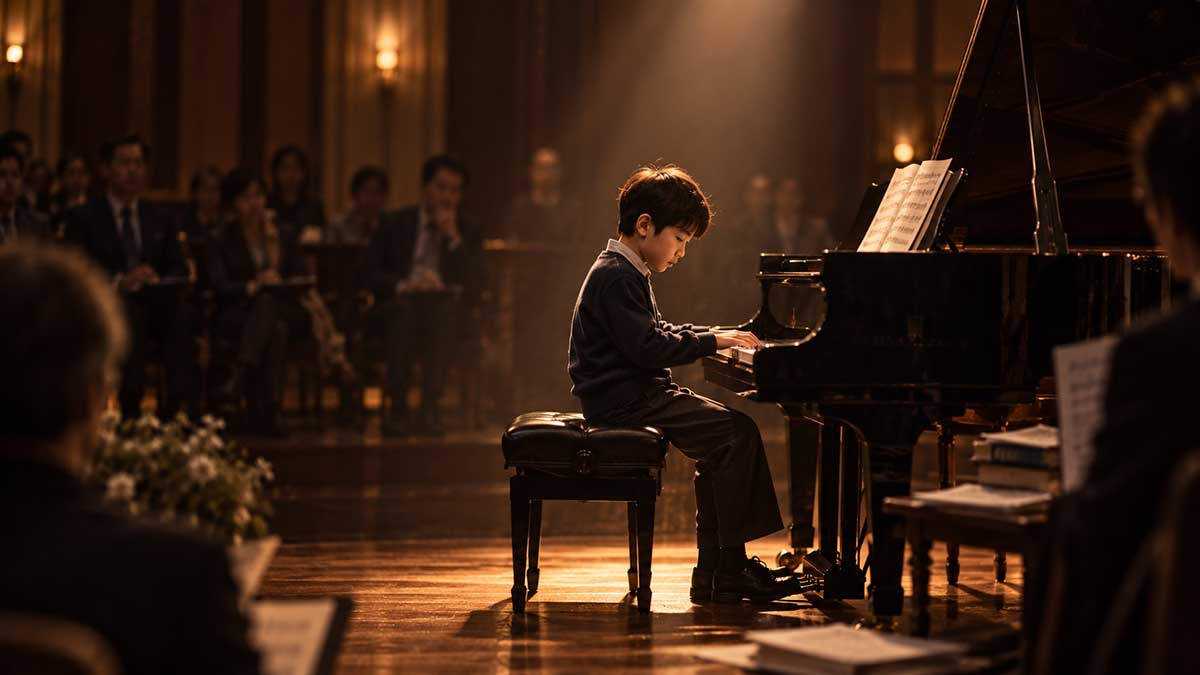
The moderator looks around the table.
Sophie Chen Keller remains in her seat.
Jude Cassidy and Amy Olberding have stepped away for this discussion. Joining Sophie are Ellen Winner, whose research has focused on gifted children and the psychology of the arts, Dianna Kenny, whose work examines music performance anxiety, and Harry Brighouse, returning from Topic 1 to consider children’s autonomy and education.
A photograph of a grand piano appears on the screen behind them.
No one looks at it for very long.
The moderator begins.
Moderator: In Topic 1, we ended with the idea that River’s life ultimately has to become his own.
Now I want to make that difficult.
What if the child possesses an ability that almost everyone agrees is extraordinary?
Does that change anything?
Ellen leans forward.
Ellen Winner: It changes many practical things.
I am less convinced that it changes the fundamental moral question.
Moderator: Explain.
Ellen: Gifted children often require opportunities ordinary environments may not provide.
Advanced instruction.
Access to mentors.
Appropriate challenge.
Time to develop unusually high ability.
If River’s musical capacity is genuinely exceptional, treating him exactly like every other child could actually fail him.
Harry Brighouse: So equality does not always mean identical treatment.
Ellen: Exactly.
If one child can comfortably learn material intended for someone several years older, forcing that child to remain perpetually underchallenged is not fairness.
Likewise in music.
A child with River’s ear and potential may need a teacher capable of taking him somewhere an ordinary music class cannot.
Moderator: Sophie, is that how you saw Professor Li?
Sophie Chen Keller: Partly.
Professor Li sees something real.
I did not want him to be a caricature of the demanding teacher who simply pushes too hard.
He recognizes River’s ability accurately.
That matters.
Dianna Kenny: Which makes the situation far more interesting.
The teacher can be right about the talent and still wrong about what the child needs emotionally.
Sophie nods.
Moderator: Let us begin there.
River has rare ability.
Adults recognize it.
At what point does nurturing that ability become pressure?
Ellen smiles slightly.
Ellen: Parents and teachers often want a clean answer to that.
There is not one.
Moderator: What should they watch for?
Ellen: Whether the child still experiences ownership.
Does the child feel, “This is something I do”?
Or does it begin to feel like, “This is who everyone needs me to be”?
That difference matters enormously.
Harry: Ownership is a good word.
We spoke earlier about transferring authorship of a child’s life.
Giftedness can interfere with that transfer.
Moderator: Why?
Harry: Since adults can construct a compelling argument for continued control.
“We know what you could become.”
“You will regret quitting.”
“You do not yet appreciate your own ability.”
“People would give anything to have your opportunity.”
Each statement may contain some truth.
Taken together, they can make it nearly impossible for the child to say no.
Sophie: River would hear all of them.
Ellen: Most gifted children do, in one form or another.
Moderator: Are those statements always harmful?
Ellen: No.
A ten-year-old may want to quit violin on Tuesday simply since practicing is difficult.
Parents should not interpret every moment of frustration as a final declaration of identity.
Serious skill requires persistence.
Mastery is repetitive.
Children sometimes need adults to help them continue through discomfort.
Dianna: But we need to distinguish discomfort from distress.
Ellen turns toward her.
Dianna: Those are often treated as if they are the same.
They are not.
Being nervous before performing can be ordinary.
Feeling challenged can be productive.
Temporary frustration is normal.
Yet severe performance anxiety can become intense enough to disrupt concentration, memory, physical control, confidence, and the person’s relationship with performing.
Moderator: River experiences stage fright.
Dianna: Yes.
That should matter.
Sophie: It mattered greatly to me.
I knew piano well enough to know that performance can feel completely different from playing privately.
River can love music and still fear performance.
Those are not contradictory.
Moderator: Professor Li might argue that the only way through performance fear is to perform.
Dianna: Sometimes exposure helps.
But “push through it” is too simple.
We need to ask what kind of fear is present.
What thoughts accompany it?
What does the child expect will happen?
Is the fear about making a mistake?
Humiliation?
Disappointing a parent?
Disappointing a teacher?
Losing status?
Proving everyone wrong about the child’s talent?
Those produce different psychological dynamics.
Ellen: A gifted child may carry unusual expectations.
Dianna: Exactly.
Imagine River walking onto a stage.
He is not merely thinking:
“I hope I remember the piece.”
He may be thinking:
“My mother sacrificed for this.”
“My teacher believes I am exceptional.”
“Everyone expects me to prove it.”
“If I fail, what does that say about me?”
That is much heavier.
Sophie looks thoughtful.
Sophie: And perhaps:
“If I fail, what does that say about everyone who believed in me?”
Dianna nods.
Dianna: Yes.
Now performance is no longer just music.
It becomes a referendum on identity.
The room grows quiet.
Moderator: Ellen, do gifted children sometimes become identified too strongly with the gift?
Ellen: Very much so.
A child hears:
“You are the pianist.”
“You are the mathematician.”
“You are the brilliant one.”
“You are the artist.”
At first, this can feel wonderful.
It brings praise and belonging.
Then the identity narrows.
Harry: What happens if the child starts losing interest?
Ellen: That can become frightening.
Not only for adults.
For the child.
If I am “the pianist” and I stop playing, who am I?
Sophie: That question sits underneath River.
Moderator: So giftedness can create opportunity and identity foreclosure at the same time?
Ellen: It can.
The gift itself is not the problem.
The danger comes when everyone organizes the child’s worth around it.
Harry: Which returns us to something from Topic 1.
Does River matter if he becomes ordinary?
Sophie: Song would say yes.
Harry: Emotionally, yes.
But behavior can communicate something more complicated.
If every sacrifice, every lesson, every dream, every conversation points toward greatness, River may hear:
“Your ordinary life would be a disappointment.”
Sophie pauses.
Sophie: Yes.
That is painful, but fair.
Moderator: Let me make the question concrete.
River is fourteen.
He sits down with Song and Professor Li and says:
“I know I am good enough to continue. I know I might become exceptional. I do not want this anymore.”
What should happen?
Ellen answers first.
Ellen: First, nobody should panic.
The adults should become curious.
Moderator: Curious about what?
Ellen: What does “I do not want this” mean?
Does he hate piano?
Does he hate performing?
Does he hate competition?
Does he hate Professor Li?
Is he exhausted?
Does he want a break?
Does he want another teacher?
Does he love composing but hate concert performance?
Does he enjoy music privately?
Does he resent the expectations surrounding it?
Those are completely different situations.
Dianna: I would want to know whether anxiety is driving the decision.
Harry: And if it is?
Dianna: Then quitting may not be the only answer.
Neither is forcing him onward.
He may need a different relationship with performance.
Different preparation.
Different expectations.
A period away.
Psychological support.
A less threatening performance environment.
Moderator: So “quit or continue” may be a false binary.
Dianna: Very often.
Sophie: That feels right for River.
He may not want to abandon music.
He may want to abandon the version of music other people built around him.
Ellen smiles.
Ellen: That is an excellent distinction.
Moderator: Harry, suppose none of those things apply.
River simply says:
“I understand my ability. I know the possible future. I still choose something else.”
Harry: At fourteen?
Moderator: Fourteen.
Harry thinks.
Harry: His decision should carry serious weight, but I might not treat it as absolutely final.
Parents retain some authority.
They can ask for a cooling-off period.
They can make sure the decision is informed.
They can ask him to finish a term or complete a commitment already made.
What they should not do is treat his talent as giving them indefinite ownership over the decision.
Moderator: What changes at sixteen?
Harry: More weight to River.
Moderator: Eighteen?
Harry: It is his decision.
Ellen: Even if everyone thinks it is tragic.
Harry: Yes.
Sophie: That word matters.
Tragic.
Moderator: Why?
Sophie: If River walks away, people may say:
“What a waste.”
We used that word in Part 1.
It is very powerful.
Ellen: Gifted children hear it constantly.
“Do not waste your talent.”
Harry: But waste according to whom?
Ellen turns toward him.
Harry: Suppose River studies piano for twelve years.
He becomes disciplined.
He learns concentration.
He experiences beauty.
He gains confidence.
He develops an emotional language through music.
Then he becomes a teacher.
Or a carpenter.
Or a nurse.
Or runs a small restaurant.
Were those twelve years wasted?
Ellen: No.
Dianna: Certainly not.
Harry: We often treat talent as valuable only if it produces the highest possible achievement.
That is a very narrow account of human development.
Moderator: Ellen, would you agree?
Ellen: Completely.
One of the myths surrounding giftedness is that extraordinary ability creates an obligation to maximize it.
It does not.
Ability is a capacity.
It is not a command.
Sophie looks at her.
Sophie: That may be the central sentence of this topic.
Ellen: A person can possess unusual potential and still legitimately choose a life that does not maximize it.
Moderator: Then let me challenge you.
Imagine River is thirty-five.
He quit piano at sixteen.
He works an ordinary job.
One evening he attends a concert.
He hears a pianist his age performing at Carnegie Hall.
He suddenly realizes:
“I could have done that.”
He regrets quitting.
Should the adults have protected him from that future regret?
Harry laughs quietly.
Harry: Parents would love that ability.
Ellen: Every life contains unrealized selves.
Moderator: Meaning?
Ellen: If River becomes a pianist, perhaps at thirty-five he sits backstage exhausted and thinks:
“I could have had a quiet family life.”
If he becomes a doctor, perhaps he wonders about music.
If he becomes a teacher, perhaps he wonders about performance.
Choosing one life closes doors to others.
Gifted people are not exempt from that.
Dianna: Sometimes having many possible futures creates more difficulty, not less.
Harry: Adults cannot guarantee a regret-free life.
Their task is to help the child become capable of making meaningful choices.
Sophie: Song would struggle with that.
Moderator: Since she sees River’s talent as an escape from poverty?
Sophie: Yes.
For her, piano is not merely artistic fulfillment.
It can become security.
Access.
Mobility.
A different life.
If River says, “I do not want it,” she may hear:
“I am throwing away the door you fought to open.”
Harry: Which gives us a class dimension.
A wealthy child can experiment more safely.
Ellen: Exactly.
If an affluent child quits piano, there may be ten other pathways.
For River, extraordinary musical ability may appear to be the rare path that could transform his circumstances.
Moderator: Does that give Song more moral authority to push?
Harry takes a breath.
Harry: More reason to persuade.
Not unlimited authority.
That distinction matters.
Sophie: She can say:
“You may not understand how difficult life can become without opportunities.”
Harry: Yes.
She can present evidence.
She can tell her story.
She can ask him to think carefully.
What she cannot say forever is:
“My hardship gives me permanent control over your future.”
Ellen: There is another issue.
Sometimes adults assume gifted children need less protection since they seem advanced.
Moderator: Explain.
Ellen: A child may play Chopin at a level far beyond peers and still be emotionally eleven.
Advanced ability in one domain does not make every part of development advanced.
River can produce sophisticated music and still need reassurance.
Still fear disappointing adults.
Still misunderstand consequences.
Still crave approval.
Dianna: This becomes very relevant in performance environments.
A child can look extraordinarily composed onstage.
Adults may interpret that as emotional strength.
The internal experience may be completely different.
Sophie: That gap interests me.
River can look remarkable from the outside and feel frightened inside.
Moderator: Do adults romanticize suffering in artists?
Dianna gives a small laugh.
Dianna: Constantly.
Moderator: How?
Dianna: We have inherited stories about great art emerging through pain.
Strict teachers.
Relentless practice.
Sacrifice.
Humiliation transformed into excellence.
Fear conquered through force.
Some difficulty is unavoidable in serious artistic development.
But the romantic story can make adults dismiss signs that something is wrong.
Ellen: “He is suffering for his art.”
Dianna: Exactly.
But he is a child.
That should change the sentence.
Harry: It should.
Moderator: Professor Li might reply:
“If I stop every time River is frightened, I deny him the chance to discover that he can do difficult things.”
Dianna nods.
Dianna: That is a valid concern.
Avoidance can strengthen anxiety.
But treatment is not the same as coercion.
A thoughtful teacher can help a student approach fear gradually.
Prepare differently.
Reduce catastrophic thinking.
Create smaller performance steps.
Teach regulation skills.
Ask what the student is experiencing.
The important part is that the child's fear becomes information.
Not merely an obstacle.
Sophie: “Fear as information.”
I like that.
Moderator: Ellen, what about practice itself?
At what point does parental structure become excessive?
Ellen: Again, context matters.
Gifted children often need structure.
A child may love violin and still dislike practicing scales.
Adults can require effort without controlling identity.
The question becomes whether practice serves the child’s chosen engagement or whether the child serves the adult’s dream.
Harry: That distinction seems simple, but it is difficult to detect.
Ellen: Very.
Parents can convince themselves that every demand is “for the child.”
Moderator: How can they test themselves?
Ellen thinks.
Ellen: Ask:
If my child never becomes famous, will I still believe these years mattered?
If my child chooses a different career, will I feel personally betrayed?
If another teacher recommends reducing pressure, can I listen?
If my child’s joy decreases as achievement rises, do I care?
If my child says, “This is your dream, not mine,” can I tolerate hearing it?
The room becomes quiet.
Sophie nods slowly.
Sophie: Song would struggle with several of those.
Moderator: Would Professor Li?
Sophie: Perhaps even more.
Professor Li’s identity becomes connected to River’s potential.
Harry: That introduces another form of ownership.
Not parental ownership.
Professional ownership.
Moderator: Meaning teachers can begin seeing students as extensions of themselves?
Harry: Yes.
The successful student validates the teacher.
Ellen: That is very real in elite training environments.
A teacher may sincerely care about the student and still benefit from the student's success.
Prestige.
Reputation.
Professional satisfaction.
Evidence that the teacher’s method works.
Dianna: Which can make it harder to hear the student’s distress objectively.
Moderator: Since the teacher has something at stake.
Dianna: Exactly.
Sophie: Professor Li can say:
“I am pushing River for River.”
Yet part of him may be pushing River for the future he sees, for music itself, perhaps for his own sense of purpose.
Harry: Adults often have mixed motives.
That does not make them villains.
It makes self-examination necessary.
Moderator: Then let me ask each of you this.
Does River’s gift belong to River?
Ellen answers first.
Ellen: Yes, in the sense that River’s life belongs to River.
But I would avoid speaking of talent like private property.
A gift develops in relationship.
Teachers shape it.
Parents support it.
Culture gives it language.
Audiences give performance meaning.
River does not create his ability in isolation.
Still, those relationships do not acquire ownership of him.
Dianna: I agree.
The music can be relational.
The decision about what level of distress he is willing to endure for it must increasingly become his.
Harry: I would say River has the strongest claim over the purposes to which his talent is put.
That claim grows as his agency matures.
Moderator: Sophie?
Sophie thinks for several seconds.
Sophie: I think the gift belongs to River less than River belongs to himself.
The moderator pauses.
Sophie: That distinction matters.
If we say, “Your talent belongs to you,” we may still keep staring at the talent.
I want to keep staring at River.
Ellen smiles.
Ellen: Yes.
That is very good.
Sophie: Maybe the real danger is that everyone becomes so concerned about whether the gift is being used properly that they forget the person carrying it.
Dianna: Which is common in high achievement environments.
Moderator: Let us stay with that.
Can adults become so fascinated by a child's future potential that they stop seeing the child who exists now?
Ellen: Absolutely.
Potential is seductive.
It creates a future story.
Adults love future stories.
“This child could become...”
Then the present child becomes raw material for that future.
Harry: That phrase is troubling.
Ellen: It should be.
The child's fatigue becomes something to overcome.
The child's friendships become distractions.
The child's alternative interests become threats.
The child's resistance becomes immaturity.
Everything gets interpreted through the future goal.
Dianna: Anxiety can be interpreted the same way.
“He is nervous since this matters.”
“Pressure will make him stronger.”
“Great performers learn to handle it.”
Those statements may contain truth, yet they can conceal the individual experience.
Sophie: River's present self can disappear under everyone's future tense.
The room goes quiet.
Moderator: Everyone’s future tense.
Sophie: Yes.
“You will become.”
“You could become.”
“You are going to.”
“What if you become?”
People keep talking about the person River may be.
At some point somebody needs to ask:
“How are you?”
Now.
Ellen nods.
Ellen: Exactly.
Moderator: Suppose River answers:
“I still love music. I hate the life everyone attached to it.”
What then?
Dianna answers.
Dianna: Believe him.
Then separate the components.
Music.
Performance.
Competition.
Training.
Career.
Identity.
Approval.
Those are not one thing.
He may keep one and reject another.
Ellen: A gifted child does not have to choose between concert career and complete abandonment.
There are many ways to live with a gift.
Harry: That matters philosophically too.
Adults often present choices in ways that preserve their preferred outcome.
“You either commit seriously or waste your talent.”
That is manipulative framing.
Sophie: River could compose.
Teach.
Play privately.
Perform occasionally.
Return later.
Ellen: Exactly.
Or leave music for ten years and discover it again.
Moderator: Can extraordinary ability survive that?
Ellen smiles.
Ellen: Perhaps not at the same technical level.
That is part of choice.
Every choice has costs.
River cannot preserve every possible future indefinitely.
The important point is that the loss of one possible future does not make the chosen life illegitimate.
Harry: Freedom includes the freedom to close doors.
Moderator: That sounds almost uncomfortable.
Harry: It is.
People sometimes speak about autonomy as if it means keeping options open.
Eventually, autonomy means choosing.
And choosing means relinquishing some possibilities.
Sophie looks toward him.
Sophie: Song's fear is that River will close the one door she spent years trying to open.
Harry: Yes.
Moderator: Is she allowed to grieve that?
Harry: Completely.
Dianna: She may need to.
Ellen: She may see a future she believed was beautiful disappear.
That is real grief.
Moderator: But River does not have to reopen the door to stop her grieving.
Harry: Exactly.
Sophie sits quietly for a moment.
Sophie: That is difficult.
Moderator: For Song?
Sophie: For almost any parent.
You see something in your child.
You build hope around it.
Then the child says:
“No.”
Parents often hear:
“You were wrong.”
But perhaps the child is saying:
“You helped me get far enough to choose.”
The room becomes quiet again.
Ellen: That is a much healthier interpretation.
Moderator: Dianna, if River chooses to continue, what would you want Professor Li to change?
Dianna: I would want him to ask more questions.
Not only:
“How many hours did you practice?”
“What happened in the difficult passage?”
“Are you prepared for the recital?”
Ask:
“What happens in your body before you perform?”
“What are you afraid will happen?”
“What do you tell yourself after a mistake?”
“When does music feel alive to you?”
“When does it feel like punishment?”
“What kind of performer do you want to become?”
Ellen: That last question is excellent.
Dianna: The goal should not simply be less fear.
The goal should be a sustainable relationship with music.
Moderator: Sustainable psychologically.
Dianna: Yes.
A brilliant career that destroys the person's relationship with music is not obviously a success.
Sophie: Nor is a successful child who no longer knows what he wants.
Harry nods.
Moderator: Ellen, how should parents praise gifted children?
Ellen: Carefully.
Praise effort when it is real.
Praise curiosity.
Persistence.
Interpretation.
Risk-taking.
Growth.
Do not make the child feel loved mainly for being exceptional.
Moderator: Is telling River “you are extraordinary” dangerous?
Ellen: Not inherently.
Children enjoy recognition.
The problem comes when exceptional becomes a condition of belonging.
Can River have a terrible performance and still feel secure?
Can he disappoint adults and still feel valued?
Can he be average at something and enjoy it?
Can he meet someone more talented without his identity collapsing?
Those are important indicators.
Harry: River needs the right to be mediocre somewhere.
Everyone laughs.
Sophie: That is wonderful.
Moderator: Why?
Harry smiles.
Harry: High-achieving children can begin to avoid activities where they are not immediately good.
If your identity is built around exceptional performance, being a beginner can feel humiliating.
Human beings need spaces where achievement does not determine worth.
Ellen: Completely.
Dianna: Play matters too.
Music can become only practice, evaluation, competition, preparation.
River needs moments where piano becomes sound again.
Not proof.
Sophie looks at the photograph behind them.
Sophie: That may be what River loved before everyone named the gift.
Moderator: Sound.
Sophie: Yes.
Before career.
Before achievement.
Before escape from poverty.
Before Professor Li.
Before everyone asked what River might become.
There was simply a boy hearing music.
The table becomes still.
Moderator: Maybe we should go back there.
If River could speak to Professor Li now, what would he need the teacher to hear?
Ellen answers first.
Ellen: “Do not confuse my ability with my consent.”
Dianna follows.
Dianna: “My fear is information. Listen before deciding what it means.”
Harry thinks.
Harry: “Your belief in my future does not give you ownership of it.”
The moderator looks toward Sophie.
Sophie takes longer.
Sophie: I think River might say:
“Help me become good enough to choose.”
The others look toward her.
Sophie: Not:
“Choose for me since you know what I could become.”
Help me develop enough skill, discipline, knowledge, confidence, and self-awareness that one day I can decide what music means in my life.
Ellen nods slowly.
Ellen: That is excellent.
Harry: It captures education at its best.
Moderator: Education should increase agency.
Harry: Yes.
If education permanently increases dependence on the authority of the educator, something has gone wrong.
Dianna: The same applies psychologically.
A teacher should help River interpret his own internal experience, not teach him to distrust it automatically.
Moderator: Then is Professor Li’s task eventually to become less necessary?
Ellen smiles.
Ellen: Every great teacher faces that.
Harry looks toward Sophie.
Harry: Much like every parent.
Sophie nods.
Sophie: That seems to be one of the hidden themes connecting Topics 1 and 2.
Love and teaching both begin with guidance.
At their best, both eventually create more freedom.
Moderator: Even when freedom leads somewhere the guide did not expect.
Sophie: Especially then.
A long silence follows.
The moderator looks at the piano behind them.
Moderator: We began by asking whether River’s gift belongs to him.
Perhaps that was not quite the right question.
Ellen waits.
Moderator: Maybe the harder question is whether River belongs to the gift.
Dianna nods.
Harry’s expression changes.
Sophie looks toward the screen.
Moderator: Does extraordinary ability create an obligation to become extraordinary?
Ellen answers quietly.
Ellen: No.
Moderator: Even if the talent is rare?
Ellen: No.
Moderator: Even if other people sacrificed?
Ellen: No.
Moderator: Even if he may regret leaving?
Ellen: Still no.
She pauses.
Ellen: Talent gives River possibilities.
It does not issue commands.
Dianna follows.
Dianna: And fear should neither automatically decide his future nor automatically be ignored.
It deserves attention.
Harry leans forward.
Harry: River needs the freedom to make a meaningful decision, not merely the freedom to repeat what adults want.
Moderator: Sophie?
Sophie looks at the piano for a few seconds.
Sophie: I think River’s gift is beautiful.
But the gift is not the miracle.
The child is.
Nobody speaks.
Sophie continues.
Sophie: If everyone remembers that, then perhaps they can develop the music without losing the boy.
The moderator nods.
Moderator: Then we leave Topic 2 with a distinction.
A gifted child may need unusual opportunities.
Serious discipline.
Excellent teachers.
Years of work.
Sometimes encouragement through difficulty.
Yet none of those things change the central fact:
The purpose of developing a gift is not to make the child belong to the gift.
The purpose is to give the child enough ability, experience, and freedom to decide what place that gift will have in a life that remains his own.
The table falls silent.
Then Dianna looks toward Sophie.
Dianna: And if River continues playing?
Sophie smiles.
Sophie: I hope someday he sits at the piano and hears music again before he hears everyone’s expectations.
Ellen smiles.
Harry nods.
The moderator looks around the table.
Moderator: Then perhaps we are ready for the next question.
What happens when the people who gave our lives shape are no longer there at all?
The piano disappears from the screen.
In its place appears an empty train platform.
Topic 3 waits.
Topic 3: Can You Move Forward When Someone Is Missing?
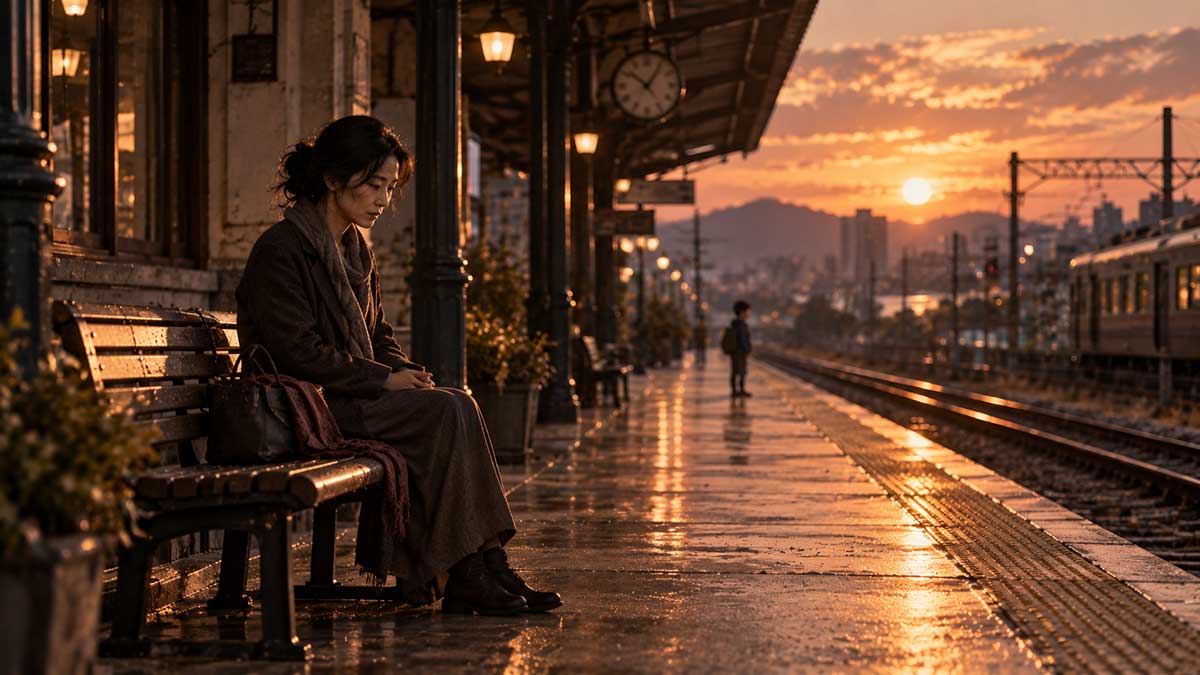
A photograph fills the screen behind the panel.
An empty platform.
A bench with no one sitting on it.
Tracks stretching beyond the frame.
Nothing in the image tells us whether someone has just left or might return.
Sophie Chen Keller studies it quietly.
Beside her sits Pauline Boss, joined by Jude Cassidy and Amy Olberding.
The moderator waits before speaking.
Moderator: We have spent two topics talking about relationships that are physically present.
Song and River.
River and his teachers.
Parents trying to guide children.
Children trying to become separate people.
Now everything changes.
River disappears.
Song does not know whether he is safe.
She does not know whether he is suffering.
She does not know whether she will see him tomorrow, ten years from now, or never again.
Pauline, there is a name for this kind of experience.
Pauline Boss: Ambiguous loss.
Moderator: What makes it different from bereavement after a confirmed death?
Pauline: The absence is physical, but the relationship remains psychologically active.
River is gone from Song's sight.
He is not gone from her inner life.
She cannot say goodbye.
She cannot reunite.
She cannot settle into either reality.
Sophie Chen Keller: She remains River's mother every day.
Pauline: Exactly.
The role continues.
The attachment continues.
The uncertainty continues.
Jude Cassidy: And that uncertainty keeps the attachment system activated.
Moderator: What does that mean for Song?
Jude: When someone we are deeply attached to disappears, the mind and body look for that person.
Parents search for children.
Children search for caregivers.
Normally, reunion provides information.
The person returns.
Safety becomes possible again.
Song never receives that signal.
Her mind has good reason to keep searching.
Moderator: For years.
Jude: Yes.
That changes the emotional experience profoundly.
Amy Olberding: It changes the moral experience too.
Song cannot easily tell herself what a loving mother should do.
If she searches constantly, she may destroy herself.
If she rests, she may accuse herself of giving up.
If she smiles, she may feel disloyal.
If she begins building another part of her life, she may wonder whether she is leaving River behind.
Moderator: So there is no action that feels completely innocent.
Amy: Precisely.
Pauline: That is one reason ambiguous loss can freeze people.
They wait for certainty before permitting themselves to live again.
But certainty may not arrive.
Moderator: What can Song do if she cannot solve the uncertainty?
Pauline: She has to begin holding two truths at once.
River may return.
Song still has to live today.
Sophie looks toward Pauline.
Sophie: Those truths can feel almost impossible to hold together.
Pauline: They can.
People often think they must choose.
Either:
"I remain hopeful."
Or:
"I rebuild my life."
I would challenge that split.
Song can continue loving River and still eat.
She can search and still sleep.
She can hope and still laugh.
She can make plans without declaring the search over.
Moderator: Would you tell her to "move on"?
Pauline: No.
I rarely find that language helpful here.
It suggests movement away from the person.
Song does not need to move away from River.
She needs to find some way of moving forward with uncertainty still present.
Sophie: That feels much closer to her.
Moderator: What about "closure"?
Pauline shakes her head.
Pauline: I am cautious with that word too.
Many relationships do not close neatly.
Love may continue.
Memory may continue.
Questions may continue.
Sometimes people need less pressure to close something and more permission to carry what remains unresolved.
Amy: There is an ethical generosity in that.
We often admire visible suffering as proof of devotion.
A mother who keeps grieving looks loyal.
A mother who begins enjoying life may judge herself harshly.
Moderator: Song does that.
Sophie: Very much.
Her suffering can start feeling like evidence.
If she hurts badly enough, then perhaps she is still being faithful to River.
Pauline: That is a painful trap.
Pain is not the same as love.
The room grows quiet.
Pauline: Love can remain after the form of suffering changes.
Song does not need to hurt at maximum intensity forever in order to remain River's mother.
Moderator: Yet telling her that intellectually may not change how she feels.
Pauline: Correct.
This is not a slogan someone hears once and then feels better.
People often have to practice living beside uncertainty.
Jude: And practice trusting life again.
Moderator: River faces a different challenge.
He cannot remain frozen.
He needs food.
Safety.
Care.
Guidance.
Relationships.
What happens when another adult begins meeting those needs?
Jude: River can form new attachment relationships.
Human attachment is not limited to one person.
A child can love Song and become deeply attached to Phyllis.
Moderator: Does that weaken his bond with Song?
Jude: No, not inherently.
The psychological problem is that River may experience it as disloyalty.
He may think:
"If I feel safe here, am I forgetting my mother?"
Or:
"If Phyllis matters to me, does that mean Song matters less?"
Amy: Which places an unfair moral task on a child.
Jude: Yes.
A child should not have to remain emotionally unsafe to prove loyalty.
Sophie nods slowly.
Sophie: That is very close to what I wanted around River.
Phyllis does not erase Song.
She gives River something he needs when Song cannot physically be there.
Moderator: Amy, when does care become family?
Amy: There is no simple threshold.
But repeated care has moral weight.
Someone feeds you.
Protects you.
Notices your moods.
Learns your fears.
Makes room for you.
Remembers what matters to you.
Those acts create relationship.
Biology matters.
Shared history matters.
Care matters too.
Moderator: So Phyllis can become real family.
Amy: Yes.
The mistake comes when people assume that one true relationship requires another to become false.
Pauline: That becomes especially difficult when the missing person returns.
Moderator: Why?
Pauline: Families adapt during absence.
Roles shift.
People develop routines.
New relationships form.
Then reunion occurs, and everyone may expect the old structure to simply return.
It cannot.
Sophie: Since nobody is the same.
Pauline: Exactly.
Moderator: We tend to picture reunion as the happy ending.
Jude: Reunion can be joyful.
It can still be psychologically demanding.
Moderator: Let's make that concrete.
Song finally finds River.
What might River feel besides joy?
Jude: Relief.
Fear.
Confusion.
Guilt.
Loyalty conflict.
Anger.
Grief.
Moderator: Anger toward Song?
Jude: Possibly.
A child may know intellectually that a parent searched desperately and still carry the emotional question:
"Why were you not there?"
Those two realities can coexist.
Sophie: Just as Song can understand that River needed new relationships and still feel pain when she discovers how much life happened without her.
Amy: Reunion brings people face to face with years they did not share.
Pauline: And that means the loss does not simply vanish.
The ambiguity may end physically.
Another grief begins.
Moderator: The grief of lost time.
Pauline: Yes.
Song gets River back.
She does not get the missing years back.
River gets Song back.
He does not regain the childhood he might have had with her.
Sophie: That is one of the deepest emotional truths in the story.
Moderator: Then should they grieve after reunion?
Pauline: I think they need room to.
Jude: Very much.
Amy: They may need to grieve several things.
The people they remembered.
The experiences they missed.
The futures they once expected.
Perhaps the fantasy that finding one another would return everything to its previous place.
Sophie: That fantasy may have helped them survive.
Moderator: Yet reality asks something harder.
Sophie: Yes.
They must meet the person who exists now.
Moderator: Not recover the person from memory.
Sophie: Exactly.
Pauline: That is why reunion should not be confused with restoration.
Amy: Restoration suggests that what was broken can be returned to its former state.
Sometimes that is impossible.
Then the task becomes building something honest from what remains.
Moderator: Does that require finding meaning in the separation?
Pauline pauses.
Pauline: Meaning can help.
I would never require Song to say the separation happened for some good reason.
Amy: Nor should growth afterward be used to justify suffering.
Jude: River may become resilient.
That does not mean losing his mother was beneficial.
Sophie: Song may become stronger.
That does not mean she needed this experience.
Moderator: So growth afterward does not redeem what happened.
Amy: Correct.
People can create meaning after pain without declaring the pain necessary.
The image behind them remains unchanged.
The empty platform seems quieter now.
Moderator: Suppose Song is three years into the search.
A friend tells her:
"You need to start living again."
Helpful or hurtful?
Pauline: It depends on what follows.
If the friend means:
"Stop searching."
"Accept that he is gone."
"Enough."
That can be deeply harmful.
If the friend means:
"You are allowed to have a good hour today without betraying River."
That is very different.
Sophie: Song might resist both at first.
Pauline: Of course.
Moderator: What could someone say that she might eventually accept?
Pauline thinks.
Pauline: Perhaps:
"Resting does not mean giving up."
Amy nods.
Amy: That changes the moral frame.
Song no longer has to choose between being loyal to River and caring for herself.
Jude: I would still be careful with language such as self-care.
For someone in Song's situation, it can sound like another responsibility she is failing to perform.
Sophie: Especially when she has almost no time or money.
Moderator: So surviving a day may be enough.
Jude: Yes.
Sometimes people need permission for ordinary survival, not another ideal.
Moderator: Pauline, can hope itself become a problem?
Pauline: Hope can sustain people.
Rigid hope can imprison them.
Moderator: What is rigid hope?
Pauline: Hope that insists only one future is acceptable.
For example:
"I can only live if River returns exactly as I remember him."
More flexible hope might sound like:
"I hope River is alive."
"I hope we meet again."
"I hope I can survive this uncertainty."
"I hope meaningful life remains possible no matter how long this takes."
Moderator: So hope does not disappear.
It becomes broader.
Pauline: Yes.
Amy: That may connect with loving someone without possessing an outcome.
Moderator: We will return to that in Topic 5.
For now, Jude, I want to stay with River.
If he begins calling Phyllis family, could that wound Song?
Jude: Very easily.
Moderator: Should River avoid using the word?
Jude: I would not say that.
I would say everyone needs room to explain what "family" means.
Song may hear replacement.
River may mean:
"This person cared for me."
Those are very different interpretations.
Amy: Human relationships are rarely as neat as our labels.
People want clean categories.
Mother.
Not mother.
Family.
Not family.
But care can create bonds that do not fit perfectly inside those boxes.
Sophie: River's life becomes richer through those bonds.
It becomes more emotionally complicated too.
Moderator: Since every new bond creates another loyalty.
Sophie: Yes.
Another person who matters.
Another person who can be lost.
Another person whose feelings River may care about.
Pauline: Connection always brings vulnerability.
The answer is not less connection.
Moderator: Could River's new attachments actually help him when Song returns?
Jude: Yes.
If River has experienced dependable care, he may have more emotional resources.
He may know that relationships can take different forms.
He may not need Song to instantly repair every wound.
Pauline: Song needs supportive relationships too.
Waiting alone can become unbearable.
People around her can keep her connected to ordinary life.
Amy: White Dragon becomes meaningful here.
Sophie: Very.
He keeps Song inside daily human contact.
Work.
Food.
Arguments.
Humor.
Someone noticing when she is exhausted.
Moderator: Ordinary life keeps interrupting grief.
Sophie: Yes.
And that can be merciful.
Grief wants everything to become the missing person.
Other relationships remind Song that she is still part of a living human network.
Pauline: That does not reduce her love for River.
It helps keep her alive enough to carry it.
Moderator: Then found family develops on both sides.
Sophie: Exactly.
River has people.
Song has people.
Their bond continues through absence.
Amy: Which means reunion is not only Song meeting River again.
It is two changed relational worlds meeting.
Moderator: That sounds messy.
Amy: Very.
And very human.
Moderator: Sophie, what would Song need to accept about Phyllis?
Sophie: That Phyllis mattered.
That River's love for her does not diminish Song.
That someone else caring for River during those years is not evidence that Song failed as a mother.
Moderator: And what would Phyllis need to accept?
Sophie: That River and Song have a history she cannot reproduce.
She does not need to compete with it.
Amy: So nobody needs to prove whose love is more legitimate.
Sophie: Yes.
That competition would injure River most.
The moderator looks toward Pauline.
Moderator: Does ambiguous loss disappear once River is physically present again?
Pauline: The original uncertainty may end.
Its effects may remain.
Moderator: Such as?
Pauline: Fear.
Hypervigilance.
Difficulty trusting separation.
Changed roles.
Lost time.
A tendency to expect disappearance again.
Jude: River can say, "I'm going out."
Most parents hear an ordinary sentence.
Song's body may hear the station.
Sophie becomes quiet.
Sophie: Yes.
Moderator: So after reunion, River leaving the house can activate the earlier fear.
Jude: It can.
Intellectual knowledge and emotional reaction do not always move at the same speed.
Song may know River is coming back and still experience panic.
Moderator: What does River owe her then?
Jude takes a moment.
Jude: Compassion.
Not captivity.
The table falls silent.
Moderator: That's a strong distinction.
Jude: River can understand her fear.
He can communicate.
He can send a message.
He can recognize that certain situations are difficult for her.
But he should not have to shrink his adult life indefinitely so that Song never feels afraid.
Amy: Support without surrender.
Pauline: Yes.
Sophie: This is where the sentence from Part 1 matters.
"Distance is not the station."
Moderator: Song has to relearn what distance means.
Sophie: Exactly.
River walking away is not the same event as River disappearing.
Jude: River may need relearning too.
Children who experience separation can adapt in very different ways.
Some become clingy.
Some distance themselves.
Some become intensely self-reliant.
Moderator: Self-reliance can look impressive.
Jude: It often gets praised.
"This child is so mature."
"This child never needs anything."
But extreme self-reliance can sometimes mean:
"Depending on people feels unsafe."
Amy: Then River's independence may contain strength and injury at once.
Jude: Yes.
Pauline: That is common with adaptations to loss.
A behavior can save someone during crisis and create difficulty later.
Song's searching helps her endure uncertainty.
Later, she may need to stop treating every temporary absence as another disappearance.
River's self-reliance helps him survive.
Later, he may need to trust dependence again.
Sophie: That feels like the emotional work after reunion.
Moderator: So let me ask the core question directly.
Can Song move forward without abandoning River?
Pauline: Yes.
She has to discover that forward movement is not betrayal.
Jude: She can carry the relationship internally and still engage with life.
Amy: She can honor River without turning permanent suffering into a moral obligation.
The moderator turns toward Sophie.
Sophie: And she can let River remain part of her identity without allowing his absence to become the whole identity.
Moderator: Can River build a new life without abandoning Song?
Jude: Yes.
New attachment does not erase older attachment.
Amy: Care is not diminished simply since it is shared across relationships.
Pauline: Living is not abandonment.
Sophie: River can experience happiness during those years and still love his mother completely.
The moderator looks again at the empty platform.
Moderator: Then why can reunion still hurt so much?
Pauline answers first.
Pauline: Since finding someone does not return lost time.
Jude: Since the people who reunite have changed.
Amy: Since love must now make room for experiences it did not witness.
Sophie waits before speaking.
Sophie: And since sometimes we spend years searching for someone, then discover that finding them is only the beginning of learning who they have become.
The room is silent.
The moderator lets the silence remain.
Moderator: Maybe the problem with "moving on" is that nobody here wants to move away from anyone.
Pauline nods.
Moderator: Song needs to continue living with River still emotionally present.
River needs to continue living with Song still emotionally present.
New people enter.
Old relationships remain.
Nothing stays simple.
Amy: That is relational life.
Moderator: Pauline, if you could sit beside Song during the hardest year of her search, what would you tell her?
Pauline looks at the empty platform for several seconds.
Pauline: I would tell her:
"You do not have to choose between hoping for your son and remaining alive inside your own life."
The moderator looks toward Jude.
Jude: I would tell her:
"River can love other people and still love you."
Amy takes her turn.
Amy: I would say:
"Your grief proves that the relationship matters, but your suffering does not have to become the price of remembering him."
The moderator turns toward Sophie.
Sophie speaks more softly than before.
Sophie: I would tell Song:
"If River could see you, he would not ask you to disappear just since he did."
No one moves.
Sophie looks at the empty platform.
Sophie: And I would tell River:
"If you find kindness somewhere else, take it.
Your mother would rather have someone love you than have you remain alone to prove you remembered her."
Pauline lowers her eyes.
Jude gives a small nod.
Amy remains quiet.
The moderator speaks after several seconds.
Moderator: Perhaps ambiguous loss asks people to do something that feels impossible.
Keep a place for someone without turning the rest of life into an empty room.
Hope without demanding one exact future.
Accept new love without calling it betrayal.
And if reunion comes, recognize that return does not erase everything that happened in between.
Sophie looks toward Pauline.
Sophie: It asks people to meet again after both lives have continued.
The screen changes.
The empty platform fades.
A dense city fills the image.
Apartment towers.
Traffic.
Delivery riders.
Thousands of people crossing streets and entering buildings.
People everywhere.
Most of them unseen by one another.
The moderator looks toward the new image.
Moderator: Topic 3 asked what happens when someone disappears from the life of a family.
Topic 4 asks something colder.
What happens when people never disappear at all, yet society learns not to see them?
Topic 4: Why Are Some Lives Easier for Society to Ignore?

The screen behind the panel shows Beijing at rush hour.
Apartment towers.
Motorbikes.
Food couriers waiting at intersections.
Commuters flowing through subway entrances.
Office workers looking at phones.
Parents holding children's hands.
Thousands of people crossing one another's paths.
Sophie Chen Keller remains at the table.
Joining her are Kam Wing Chan, whose research has examined China's hukou system and rural-to-urban migration, Jenny Chan, whose work studies labor and platform economies in China, and Harry Brighouse, returning to discuss fairness, opportunity, and children's interests.
The moderator looks at the image.
Moderator: Topic 3 was about disappearance.
This topic begins with a stranger idea.
Song is not invisible.
People can see her.
They can hear her.
She works.
She delivers food.
She moves through the city every day.
Yet she repeatedly experiences herself as someone the larger system barely notices.
What does it mean to be socially visible and still feel invisible?
Kam speaks first.
Kam Wing Chan: It means physical presence and social standing are very different things.
Large Chinese cities have depended heavily on migrant labor.
People arrive, work, build, deliver, clean, manufacture, care for others, and participate in urban life.
Yet historically, household registration status affected access to many forms of welfare, education, housing, health care, and other public services.
A person may be essential to the city's functioning without receiving the same benefits as someone officially rooted there.
Moderator: So Song can help the city function without feeling that the city fully belongs to her.
Kam: Exactly.
Sophie Chen Keller: That contradiction mattered to me.
Song moves constantly through Beijing.
She knows streets.
Buildings.
Neighborhoods.
Customers.
Routes.
She is everywhere.
Yet she still feels like someone standing outside the center of things.
Jenny Chan: That experience is common in precarious labor.
A worker can be highly visible as labor and nearly invisible as a person.
Moderator: Explain that distinction.
Jenny: The customer sees the delivery.
The platform sees the completion time.
The algorithm sees the route.
The employer sees productivity.
Few of those systems ask what happened to the worker that day.
Is she exhausted?
Is she grieving?
Is her child missing?
Is she injured?
Does she have somewhere safe to sleep?
The worker is very visible as a function.
Less visible as a human life.
Sophie nods slowly.
Sophie: That is exactly Song.
She may be experiencing the worst event of her life and still have to bring someone's lunch on time.
Moderator: Harry, does that create an issue of fairness or merely hardship?
Harry Brighouse: Fairness.
Hardship can happen to anyone.
A wealthy parent can lose a child.
A person with status can experience grief.
The fairness question is what resources exist around that suffering.
Who can stop working?
Who can hire help?
Who knows whom to call?
Who expects institutions to respond?
Who has enough financial security to spend months searching without risking homelessness?
Those differences matter enormously.
Moderator: Then tragedy may be universal, but the ability to respond to tragedy is not.
Harry: Precisely.
Jenny: Money can buy time.
That sounds simple, but it is enormous.
Moderator: Time to search.
Jenny: Time to search.
Time to rest.
Time to wait at an office.
Time to contact people.
Time to travel.
Time to make mistakes.
Poor workers often have less control over time.
Their hours are constrained by income.
Platforms.
Schedules.
Deadlines.
Family obligations.
Sophie: Song's tragedy does not cancel her need to earn money.
That felt deeply unfair to me.
Moderator: The world does not pause.
Sophie: No.
That may be one of the cruelest parts.
River is missing.
Song's inner world has stopped.
The city continues.
People order food.
Traffic moves.
Rent is due.
Customers complain.
She has to participate in ordinary life when nothing feels ordinary.
Jenny: That is where labor can become emotionally violent without anyone intending violence.
The platform does not know Song's story.
The customer may not know.
The dispatch system certainly does not know.
Yet Song's grief still has to fit inside those demands.
Moderator: Harry, we talked in Part 1 about a phrase:
"Poor people suffer inside a schedule."
Harry: Yes.
That captures it very well.
Affluent people suffer too.
The difference is that wealth can create space around suffering.
Kam: Migration status can shape that space further.
A migrant worker may lack local networks.
Family support may be far away.
Administrative systems may be unfamiliar.
Housing may be insecure.
The person may feel replaceable.
Moderator: Does feeling replaceable affect how one asks for help?
Kam nods.
Kam: Very much.
If someone has spent years learning that institutions do not center people like them, that person may approach authority differently.
With hesitation.
With caution.
Perhaps with lower expectations.
Sophie: Phyllis enters a room differently from Song.
Moderator: How?
Sophie: Phyllis expects to be heard.
Song hopes she might be heard.
The emotional difference is enormous.
Jenny nods.
Jenny: Confidence often looks individual, yet much of it is socially produced.
If institutions have usually responded to you, you approach them expecting response.
If you have often been ignored or dismissed, you may begin negotiating against yourself before you speak.
Harry: That has consequences for justice.
We sometimes say everyone has the same right to ask.
But rights are not equally usable when people possess very different resources, confidence, knowledge, time, and social status.
Moderator: So formal equality may hide practical inequality.
Harry: Yes.
Suppose two mothers have the legal right to seek help.
One has money, a lawyer, influential friends, fluency in institutional language, free time, and confidence.
The other has none of those.
Their formal right may be identical.
Their real ability to use it is not.
Sophie: Song feels that difference in her body.
Moderator: Meaning?
Sophie: She knows when she enters a room that she has less leverage.
She may not have the vocabulary.
She may not know which person matters.
She may not know how hard she is allowed to push before someone labels her difficult.
Jenny: That last point matters.
People with less status often face a narrower range of acceptable behavior.
A wealthy person can insist and be called determined.
A poor worker may insist and be called troublesome.
Moderator: So even urgency is interpreted differently depending on who expresses it.
Jenny: Yes.
Harry: Which means dignity cannot depend only on treating everyone "the same."
Sometimes equal dignity requires paying attention to unequal starting positions.
The moderator looks toward Kam.
Moderator: River complicates this picture.
He is poor.
He comes from the same family.
Yet once adults recognize his extraordinary musical ability, doors begin opening.
What changes?
Kam: Social value becomes attached to him in a new way.
Moderator: Is that too harsh?
Kam thinks.
Kam: No.
River's human worth does not change.
Society's perception of his potential changes.
That is different.
Once a child is seen as exceptional, institutions may imagine a future return.
Prestige.
Achievement.
Cultural value.
Perhaps national or professional recognition.
The child becomes legible to systems that reward excellence.
Sophie: River's talent becomes a kind of passport.
Harry: A very unstable one.
Moderator: Why unstable?
Harry: It depends on continued performance.
If River becomes known as the prodigy, attention follows the prodigy.
What happens if he stops performing?
If he becomes average?
If he chooses a quiet life?
Does the attention remain?
Jenny: This happens in labor too.
People are valued for productivity.
Once productivity falls, social attention can disappear quickly.
Moderator: That sounds bleak.
Jenny: It can be.
Many modern systems are very good at measuring output.
They are much worse at measuring human worth.
The room becomes quiet.
Sophie: That contrast sits at the center of River.
People can hear him play and immediately recognize value.
Song can work herself to exhaustion and remain almost invisible.
Moderator: Does that mean River's musical talent becomes a form of social mobility?
Kam nods.
Kam: Yes.
A rare talent can provide access to institutions, teachers, networks, and places that poverty might otherwise make difficult to reach.
Harry: But we should be careful.
Moderator: With what?
Harry: With turning exceptional talent into a moral solution to poverty.
Sophie: Explain.
Harry: River's story can tempt readers into thinking:
"Here is the way out."
Work hard.
Discover a gift.
Become extraordinary.
Escape.
But most children do not possess a highly visible exceptional talent.
They should still have good schools.
Safety.
Opportunity.
Health care.
Dignity.
A meaningful future.
Kam: Exactly.
A just society cannot require poor children to become extraordinary before they receive serious investment.
Moderator: So River is fortunate in one sense.
Kam: Yes.
Moderator: Yet that fortune creates new pressure.
Harry: Yes.
Once the gift becomes a pathway out, walking away from it becomes harder.
Sophie: That connects directly to Topic 2.
For Song, River's piano is not simply music.
It is possibility.
Jenny: That is why class changes the emotional meaning of talent.
For an affluent family, a gifted child's piano training may be one opportunity among many.
For Song, it may feel like the opportunity.
The difference is enormous.
Moderator: Does that make Song's pressure more understandable?
Harry: More understandable, yes.
Not automatically right.
Sophie: That distinction keeps returning.
Harry: It has to.
Context explains behavior.
Context does not remove every moral question.
The moderator looks at Sophie.
Moderator: Let me ask something uncomfortable.
Does Little Wonder risk reinforcing the idea that River deserves attention since he is exceptional?
Sophie does not answer immediately.
Sophie: Yes.
That risk exists.
Moderator: How did you think about it?
Sophie: I wanted River's talent to create contrast.
He is extraordinary in a way society knows how to recognize.
Song is extraordinary in ways society does not measure.
Her endurance.
Her devotion.
Her capacity to keep moving.
Her willingness to search.
Those qualities do not come with a certificate.
There is no competition for them.
No prestigious stage.
Jenny: Care work has this problem constantly.
Many forms of labor that keep human life functioning are poorly rewarded since their value is difficult to convert into prestige.
Moderator: Motherhood.
Jenny: Motherhood.
Caregiving.
Cleaning.
Delivery work.
Elder care.
Food preparation.
Much of what keeps life going is ordinary, repetitive, and low status.
Harry: Yet society could not function without it.
Sophie: Exactly.
River's talent attracts attention.
Song's labor sustains life.
One is glamorous.
One is nearly invisible.
Moderator: Which matters more?
Sophie smiles faintly.
Sophie: That is the wrong question.
Moderator: Why?
Sophie: They should not have to compete.
The problem begins when visibility becomes confused with worth.
Kam nods.
Kam: Very important.
Moderator: Then let us ask the hardest version.
Would society treat River differently if he were an ordinary eleven-year-old boy with no remarkable musical ability?
Nobody answers immediately.
Harry looks toward Kam.
Jenny looks down.
Sophie exhales.
Sophie: Yes.
Moderator: More honestly than comfortably.
Sophie: Yes.
Kam: I agree.
Jenny: Yes.
Harry: Yes.
The moderator waits.
Moderator: Why?
Harry begins.
Harry: Human beings and institutions are drawn to stories with recognizable value.
Prodigy.
Star athlete.
Future scientist.
Survivor.
Genius.
We can quickly understand why these lives are "special."
The moral failure comes when we let "special" become "more deserving."
Moderator: Is that what happens?
Harry: Sometimes.
A gifted child attracts mentors.
Donors.
Media attention.
Institutional investment.
That can be wonderful.
But the ordinary child standing beside him may have equal moral worth and far less access.
Jenny: We should question the word ordinary too.
Moderator: Go ahead.
Jenny: Ordinary according to what measure?
A child may not play piano.
Perhaps she cares for younger siblings every day.
Perhaps he translates for parents.
Perhaps she is emotionally perceptive.
Perhaps he survives conditions most adults would find unbearable.
We measure certain abilities and ignore others.
Kam: Societies decide what counts as visible achievement.
Sophie: River's gift can be displayed.
Song's strength cannot.
Moderator: Then perhaps "gifted" tells us something about society too.
Harry: Very much.
It tells us which capacities we know how to reward.
Moderator: Ellen Winner is not at the table now, but Topic 2 raised a related point.
A child can be gifted in one domain and still be an ordinary child emotionally.
Harry: Yes.
Now we can reverse it.
A child who appears ordinary by institutional standards may still possess qualities of enormous human value.
Jenny: Kindness.
Reliability.
Humor.
Care.
Moral courage.
The ability to endure.
The ability to make another person feel less alone.
Sophie: White Dragon would like this topic.
Moderator: Why?
Sophie: He would say everyone here is using too many words to explain that ordinary people matter.
The table laughs.
Jenny: He might be right.
Harry: Philosophers have made careers doing that.
More laughter.
The moderator waits for it to settle.
Moderator: Jenny, I want to return to Song's delivery work.
Why is that job so effective symbolically?
Jenny: She moves through a city that depends on workers like her and rarely stops to see them.
Every delivery proves she exists.
Yet each delivery can erase her individuality.
She becomes the person bringing the package.
The meal.
The service.
Moderator: She enters people's lives for minutes.
Jenny: Yes.
Then disappears.
The irony is painful.
She spends years searching for River.
At the same time, thousands of customers may barely register her face.
Sophie: I wanted that contradiction.
She is looking at everyone.
Very few people are looking at her.
Kam: That captures migration too.
Migrants can be highly mobile yet socially peripheral.
They cross the city constantly.
Movement does not guarantee belonging.
Moderator: Does work give Song access to the city or trap her inside it?
Jenny: Both.
She needs the income.
The job keeps her moving.
Movement may support the search.
Yet the work consumes time, energy, and emotional capacity.
Harry: Another case where one thing helps and harms at once.
Sophie: Song's life is full of those.
Moderator: Does platform work intensify this?
Jenny: Yes.
Modern delivery systems often organize work through time targets, ratings, routing systems, and customer feedback.
Efficiency becomes central.
A worker's personal situation can become irrelevant to the metric.
Moderator: So Song may be grieving and still be late.
Jenny: Exactly.
The system sees late.
Not grief.
Sophie: That may be one of the coldest sentences in this discussion.
Jenny: It is.
Moderator: Can systems be unjust without anyone inside them intending harm?
Harry: Absolutely.
That is one of the most difficult forms of injustice.
If there is one obviously cruel person, moral judgment is easy.
Structural injustice is different.
Many people make ordinary decisions inside an arrangement that produces unequal outcomes.
Kam: A clerk may follow procedure.
A customer may simply expect delivery.
An administrator may handle hundreds of cases.
A teacher may prioritize students with visible potential.
No single act looks monstrous.
The accumulation can still be devastating.
Sophie: That was important to me.
Song does not live in a city full of villains.
She lives in a city full of people who are busy.
Jenny: Busyness can produce indifference without hatred.
Moderator: Is that worse?
Jenny: Different.
Hatred notices you.
Indifference may not.
The room becomes silent.
Harry: That is one reason institutions need design, not just good intentions.
We cannot rely on every individual noticing every vulnerable person.
Systems need rules, resources, and procedures that protect people who lack influence.
Moderator: So kindness is not enough.
Harry: No.
Kindness matters.
Justice requires more.
Sophie: That connects beautifully with the novel.
Strangers help Song and River.
Those acts matter enormously.
Yet we should not build a society where survival depends on meeting the right kind stranger.
Kam nods.
Kam: Exactly.
Moderator: That may be one of our strongest questions.
Should people have to be lucky enough to encounter kindness?
Jenny: No.
Kindness should supplement justice, not replace it.
Harry: Very important.
If a child needs education, safety, or health care, we should not say, "Perhaps a generous stranger will appear."
Sophie: Yet literature loves generous strangers.
Moderator: Why?
Sophie: They create emotional relief.
Grace.
Surprise.
Hope.
But real life needs institutions too.
Kam: A humane society needs both.
Reliable structures and human responsiveness.
Moderator: Let us talk about confidence.
Phyllis expects rooms to respond differently than Song does.
Where does that confidence come from?
Harry answers first.
Harry: Experience.
Kam: Social position.
Jenny: Education.
Networks.
Language.
Class.
Past treatment.
Moderator: Is confidence itself a form of privilege?
Jenny: Often.
Not all confidence.
But institutional confidence can be inherited.
If your parents knew how to deal with schools, hospitals, lawyers, government offices, banks, you learn that behavior.
You learn how long to wait.
When to insist.
What documents matter.
Who can be called.
Kam: Migrants may learn those systems later, often through painful experience.
Sophie: Song's intelligence is never the problem.
She is resourceful.
She learns constantly.
But she starts with less access.
Moderator: That matters.
A reader might mistake lack of institutional familiarity for lack of ability.
Sophie: Exactly.
Song is extremely capable.
The environment does not reward the forms of capability she has.
Harry: Which returns us to equality of opportunity.
People often use that phrase loosely.
A genuine opportunity requires more than opening a door and saying everyone may enter.
You have to ask who can realistically reach the door.
Moderator: River can reach one door through music.
Harry: Yes.
His talent moves him closer.
Song may still be standing outside another door entirely.
Moderator: Then the same family can occupy different social positions depending on which trait society notices.
Kam: Certainly.
Jenny: This happens constantly.
A child may gain institutional access that parents never had.
That can create pride.
Hope.
Tension.
Distance.
Sophie: And guilt.
Moderator: For River?
Sophie: Yes.
Imagine entering rooms your mother could not enter.
Being praised by people who would never notice her.
Receiving opportunities built partly on sacrifices she made.
That can produce gratitude and discomfort at the same time.
Harry: Social mobility can carry survivor guilt.
Jenny: Very much.
Moderator: Does River owe it to Song to use those opportunities?
Harry pauses.
Harry: He owes her serious consideration.
He does not owe her a particular life.
We reached that in Topic 2.
Moderator: What if he rejects the opportunity and returns to the same economic insecurity Song tried to escape?
Harry: She may reasonably be terrified.
She may argue strongly.
She may tell him he does not know what poverty costs.
Yet at some point the adult River still chooses.
Kam: Social structure makes that choice harder, but does not make it unreal.
Sophie: That is the tragedy.
Freedom exists.
Its price is uneven.
The room grows quiet.
Moderator: Freedom has a price.
Sophie: For River, choosing an ordinary life may cost security.
For a wealthy child, an ordinary life may still be comfortable.
That difference matters.
Jenny: Very much.
Choice is shaped by what happens after the choice.
Moderator: Then we need to be careful when we tell poor children, "Follow your heart."
Harry: Yes.
That advice can be irresponsible if we refuse to talk about material consequences.
Kam: Yet telling them, "Take whatever path promises money," can erase agency too.
Sophie: Song lives inside that tension.
Love wants River safe.
Love wants River free.
Those desires do not always point in the same direction.
The moderator lets that sit.
Moderator: Let us return to the question of attention.
Why are human beings drawn so strongly to exceptional stories?
Jenny smiles slightly.
Jenny: Stories need contrast.
Sophie: I am guilty already.
The table laughs.
Moderator: Sophie, defend yourself.
Sophie: River's gift creates dramatic possibility.
Readers understand immediately that something unusual is at stake.
But the novel works only if readers eventually realize Song's life is equally worthy of attention.
Harry: Perhaps more ordinary stories require more moral imagination.
Moderator: Why?
Harry: We know how to admire heroes.
Prodigies.
Victims of spectacular tragedy.
People who achieve remarkable things.
It can be harder to sustain attention toward a person whose life is repetitive.
Work.
Bills.
Caregiving.
Fatigue.
Ordinary love.
Yet most human life looks much closer to Song's daily labor than River's exceptional talent.
Kam: That is a profound point.
Jenny: Modern economies depend on ordinary repetition.
Food arrives.
Buildings stay clean.
Children are cared for.
Packages move.
Elderly people are bathed.
Machines are maintained.
Very little of it becomes a story.
Sophie: Yet without it, everything stops.
Moderator: Then perhaps invisibility is partly a storytelling problem.
Sophie: Yes.
Who gets called interesting?
Who gets called important?
Who becomes the center?
Harry: Philosophy has a similar problem.
We construct dramatic moral dilemmas.
Yet daily justice often appears in boring systems.
Forms.
Schedules.
Access.
Transportation.
Childcare.
Jenny: Exactly.
A missing child case may become dramatic.
The conditions shaping which mother can keep searching are ordinary.
Work hours.
Income.
Housing.
Connections.
Those ordinary conditions can decide the outcome.
Moderator: So the dramatic event sits on top of quiet inequality.
Jenny: Yes.
Kam: And quiet inequality often existed long before the crisis.
The moderator looks at Sophie.
Moderator: Is Song's greatest disadvantage poverty?
Sophie thinks.
Sophie: Poverty is part of it.
But I think her greater disadvantage is the accumulation.
Widowhood.
Class.
Migration.
Work.
Lack of connections.
Fear.
The need to keep earning.
Each thing removes a little room.
Harry: That is how disadvantage often works.
Not one wall.
Many small walls.
Moderator: Then what would justice look like for Song?
Kam answers first.
Kam: Institutions she can access without needing special connections.
Jenny: Work conditions that do not force her to choose constantly between income and human emergencies.
Harry: Social systems that give vulnerable people real capacity to act, not only formal permission.
Sophie looks down.
Moderator: What would dignity look like?
Sophie raises her eyes.
Sophie: Someone listening before asking whether she is important enough.
Nobody speaks for several seconds.
The moderator turns to Jenny.
Moderator: If you could redesign one thing around workers like Song, what would you change?
Jenny: I would begin with time.
Moderator: Time again.
Jenny: Yes.
Control over time is one of the most unequal resources in modern labor.
A person needs time to care for children.
Attend appointments.
Deal with emergencies.
Rest.
Learn.
Search.
Grieve.
If every hour is economically dangerous, freedom becomes very narrow.
Kam: Housing stability matters too.
Harry: Public services.
Education.
Legal access.
Childcare.
Reliable safety nets.
Moderator: None of those sound dramatic.
Harry: Justice often isn't.
Sophie smiles.
Sophie: That line should stay.
Moderator: Let us turn the question around.
What does River receive once people recognize his gift?
Ellen called it unusual opportunity.
What else?
Kam answers.
Kam: Legibility.
Moderator: Explain.
Kam: Institutions understand what to do with him.
A gifted pianist fits an existing category.
There are teachers.
Competitions.
Conservatories.
Scholarships.
Mentors.
People can imagine a pathway.
Jenny: Song's suffering does not fit such a neat pathway.
Sophie: Neither does her strength.
Harry: Society often responds better to people when it knows which box to put them in.
Moderator: Then being exceptional can make River easier to interpret.
Kam: Yes.
Moderator: And being poor can make Song easier to ignore.
Kam nods.
Moderator: That is uncomfortable.
Harry: It should be.
The moderator pauses.
Moderator: I want to ask each of you one final question before we close.
What is one thing society should never require a person to prove before granting dignity?
Kam answers first.
Kam: Belonging.
A person should not need the correct birthplace, registration, or social position to be treated as fully human.
Jenny follows.
Jenny: Productivity.
A person should not need to prove economic usefulness before deserving safety and care.
Harry thinks.
Harry: Exceptional ability.
A child should not need to be gifted before adults take that child's future seriously.
The moderator looks toward Sophie.
Sophie takes longer.
Sophie: Suffering.
Moderator: Meaning?
Sophie: People should not have to suffer visibly enough before someone believes they need help.
The table becomes silent.
Sophie continues.
Sophie: Song should not have to look destroyed before somebody listens.
River should not have to perform beautifully before somebody sees the child.
White Dragon should not have to become important.
Phyllis should not have to rescue anyone to justify her privilege.
People should not need a dramatic story before we decide they matter.
Jenny nods.
Harry looks down.
Kam sits quietly.
The moderator looks again at the city on the screen.
Thousands of people.
Most of them anonymous.
Moderator: Perhaps that is the deepest problem with invisibility.
People are not truly invisible.
We become trained not to look.
The room remains quiet.
Moderator: River's gift makes people look.
Song's work makes people look only long enough to receive what she brings.
Justice asks something harder.
To keep looking after usefulness ends.
To keep listening when a person has no prestige.
To recognize worth before achievement.
Sophie turns toward the image.
Sophie: In Part 1, Song said:
"If somebody looks ordinary, look again."
The moderator nods.
Moderator: Maybe that sentence belongs here too.
Kam smiles faintly.
Kam: Very much.
Moderator: Then Topic 4 leaves us with a principle.
A fair society should not require extraordinary talent, money, status, productivity, or the right connections before a person becomes difficult to ignore.
River deserves opportunity.
Song deserves attention.
The ordinary child deserves investment.
The exhausted worker deserves dignity.
None of those claims cancel the others.
The image behind them changes.
The traffic fades.
The apartment towers disappear.
A piano keyboard appears.
One note is marked near the center.
Then another far away.
Then a line gradually finds its way back.
The moderator looks toward Sophie.
Moderator: We have talked about who gets seen.
Now we return to the question that has followed the novel from the beginning.
After love, separation, strangers, class, fear, and change, what does it actually mean to come home?
Topic 5: What Does It Mean to Come Home?
The image behind the panel is simple.
A piano keyboard.
A line begins on one note, travels far across the keys, then curves back.
Not to the exact place where it started.
Close.
But changed.
Sophie Chen Keller looks at the image for several seconds.
Pauline Boss sits beside her. Jude Cassidy and Amy Olberding complete the panel.
The moderator begins quietly.
Moderator: We have reached the word that seems to follow Little Wonder everywhere.
Home.
Song wants River home.
River remembers home.
Strangers create temporary homes.
Music leaves one tonal center and finds its way back.
But after everything we have discussed, I am no longer sure we know what home means.
Pauline?
Pauline Boss: Neither am I.
The table laughs softly.
Moderator: That's reassuring.
Pauline: I mean it seriously.
People speak about home as if it were obvious.
A house.
A town.
A family.
A person.
But for people who experience separation, migration, displacement, or ambiguous loss, home can become psychologically complicated.
You may return to the physical place and no longer feel at home.
You may feel at home with someone in a place you have never lived.
You may lose the person who made a place feel like home.
Jude Cassidy: From an attachment perspective, home often carries the idea of safety.
A secure place from which we can explore and to which we can return.
That does not have to mean a building.
For a child, a caregiver can function that way.
Moderator: Then Song is home for River.
Jude: In an important sense, yes.
But that can become dangerous if we interpret it too literally.
No single person should have to carry another person's entire sense of safety forever.
Amy Olberding: I would add relationship and recognition.
Home may be where people know who you are and where you know what is expected of you.
That can feel comforting.
It can feel restrictive too.
Sophie Chen Keller: River's experience keeps shifting.
At first, home is very closely tied to Song.
Then he has to survive without her.
Other people enter.
Other routines begin.
He learns that safety can exist in more than one place.
Moderator: Does that threaten Song's position?
Sophie: Emotionally, yes.
Morally, it should not.
Moderator: Why emotionally?
Sophie: If Song has spent years thinking, "I need to bring my son home," and then discovers that River has built forms of home elsewhere, that can hurt.
She may feel relieved that he was cared for.
She may still feel grief that someone else knew parts of him she missed.
Pauline: Reunion often contains that tension.
People imagine return as recovery.
Yet return can reveal how much happened during the absence.
Moderator: Then reunion can intensify grief.
Pauline: Yes.
Before reunion, Song can imagine River.
After reunion, she meets evidence of everything she missed.
His habits.
His memories.
His relationships.
His changed voice.
His changed body.
His changed sense of self.
She gets her son back and confronts the lost years at the same time.
Jude: River faces the same experience in reverse.
He may have carried an internal image of Song.
That image helped preserve the bond.
Then the real Song appears.
The real person may not match the preserved image.
Moderator: Is that disappointing?
Jude: Sometimes.
It can be relieving too.
But psychologically, the person has to update the relationship.
The attachment remains.
The representation changes.
Amy: Which is why I hesitate when people describe reunion as "going back."
There may be no going back.
There may only be going forward together.
Sophie nods.
Sophie: That is very close to how I see the novel.
Moderator: Then what does the musical idea of returning home mean?
Sophie: Music can move far from where it began.
Different harmonies appear.
Tension develops.
You may feel distance from the original center.
Then something returns.
But when the original sound comes back, you hear it differently.
Everything that happened in between changes the return.
Amy: That may be the best metaphor for Song and River.
They do not return unchanged.
Sophie: Yes.
Home sounds different after absence.
The moderator looks toward Pauline.
Moderator: Pauline, does that mean Song should stop hoping for restoration?
Pauline: I would say she may need to replace restoration with integration.
Moderator: Explain.
Pauline: Restoration says:
"Put everything back."
Integration says:
"Make room for what happened."
River's years apart remain part of him.
Song's years of searching remain part of her.
Phyllis matters.
White Dragon matters.
Professor Li matters.
Fear matters.
Growth matters.
New attachments matter.
Integration does not erase the original family.
It makes the later relationship large enough to contain everything that happened.
Moderator: That sounds emotionally demanding.
Pauline: It is.
People often prefer the fantasy of restoration.
It is cleaner.
Jude: Integration asks each person to accept versions of the other that developed outside the relationship.
Amy: And that can challenge possession.
The moderator turns toward her.
Moderator: Possession brings us to one of our central questions.
Can we love someone deeply without treating that person as something that belongs to us?
Amy takes her time.
Amy: We need to distinguish belonging with from belonging to.
Moderator: Say more.
Amy: "You belong with us" can express welcome.
"You belong to me" can express possession.
Family language constantly moves between those meanings.
"My son."
"My mother."
"My husband."
"My family."
Possessive grammar can hide relational tenderness.
It can hide control too.
Jude: Attachment needs connection.
It does not require ownership.
Moderator: Is there a point where attachment becomes possession?
Jude: Yes.
When the other person's independent choices are experienced primarily as threats to the relationship.
If River chooses another city and Song experiences that choice as abandonment, she may try to keep him close.
Her fear makes sense.
Control is still control.
Pauline: Song's history makes this especially difficult.
She has already experienced catastrophic separation.
For her nervous system, distance may not feel neutral.
Moderator: We heard this earlier.
Distance is not the station.
Sophie: Yes.
That sentence matters enormously.
Pauline: Song has to learn that River can leave and still exist.
River can be late and still return.
River can build another life and still love her.
Jude: Healthy attachment permits exploration.
That begins in childhood and continues in adulthood.
A secure bond is not one where nobody leaves.
It is one where leaving does not automatically destroy connection.
Amy: That gives home an interesting meaning.
Home may not be the place you never leave.
Home may be the relationship that can survive departure.
The moderator smiles.
Moderator: That may be our best definition yet.
Sophie looks toward Amy.
Sophie: I like that very much.
Moderator: But what about River?
Does he owe Song return?
Amy thinks.
Amy: Not permanent physical return.
Relationships can carry responsibilities.
A grown child may have reasons to remain connected.
To call.
To visit.
To care.
To show gratitude.
Yet none of that means River must live where Song wants him to live.
Moderator: So home cannot become a command.
Amy: Exactly.
"Come home" can mean love.
It can become control.
The difference depends on whether return remains a choice.
Jude: And whether River is allowed to leave again.
Pauline: That point is very important.
Sometimes reunion is treated as the end.
Real life continues.
After reunion, River will leave for school.
Work.
Friends.
Relationships.
Travel.
Song cannot ask reunion to become permanent proximity.
Sophie: Which may be harder than the original search in a strange way.
Moderator: Harder?
Sophie: The original separation was something done to her.
Now she has to participate in letting River go.
The moderator looks toward Jude.
Jude: That is a major developmental task in parenting.
Children move outward.
Parents remain connected without controlling the movement.
Song has an added burden.
Ordinary developmental separation carries echoes of traumatic separation.
Moderator: So when River leaves for college, Song may not simply feel empty-nest sadness.
Jude: She may experience old fear.
Pauline: The past can enter the present very quickly.
Amy: Yet River cannot become responsible for preventing every echo.
Jude: Right.
Compassion, yes.
Permanent restriction, no.
The moderator pauses.
Moderator: Suppose River tells Song:
"I love you. I am moving across the country."
What would healthy love look like?
Jude answers first.
Jude: Song can feel afraid.
She can say she is afraid.
She can ask for contact.
She can negotiate realistic ways to stay connected.
She should still recognize River's right to build a life.
Amy: River can acknowledge what the move means emotionally for Song without treating her emotion as veto power.
Pauline: Song can work on separating present distance from past disappearance.
Sophie: And River can keep returning in ways that reassure without surrendering his life.
Moderator: Then both people carry part of the work.
Jude: Yes.
Healthy relationships are rarely one-sided.
Moderator: Let's complicate the idea of home further.
What happens to Phyllis?
If River comes home to Song, does found family move to the margins?
Pauline shakes her head.
Pauline: It does not have to.
Amy: We tend to imagine family as a fixed number of chairs.
If one person sits down, someone else must stand.
Human relationships need not work that way.
Moderator: So Song does not regain River by displacing Phyllis.
Amy: Correct.
Jude: Forcing River to choose would place him in a terrible loyalty conflict.
Sophie: And it would deny the truth of his life.
Phyllis mattered.
The years happened.
The relationship happened.
Song may wish she had been there.
She was not.
Erasing Phyllis would not restore those years.
It would erase another part of River.
Moderator: Then accepting found family becomes part of accepting River.
Sophie: Yes.
Amy: That is a beautiful way to put it.
Moderator: Could Song feel jealous?
Jude: Of course.
Moderator: Is that wrong?
Jude: Feelings are not moral verdicts.
What matters is what people do with them.
Song can feel jealous and still behave generously.
She can feel threatened and still refrain from demanding a choice.
Pauline: She may need to grieve the role someone else played.
Amy: And then recognize that someone caring for River during her absence is not theft.
It is care.
Sophie grows quiet.
Sophie: If I were Song, I think that realization would be painful and comforting at once.
Moderator: Painful since someone else knew him.
Sophie: Yes.
Comforting since he was not alone.
The room becomes silent.
Sophie: A mother searching for a missing child probably imagines danger constantly.
To discover that somewhere in those years someone fed him, listened to him, worried about him, laughed with him, gave him somewhere to sleep...
She pauses.
Sophie: How could you not be grateful?
Pauline: Gratitude and grief can exist together.
Moderator: That seems to be one of the recurring lessons in this book.
Two emotions can be true at once.
Jude: Human relationships are full of that.
Love and anger.
Relief and grief.
Closeness and fear.
Gratitude and resentment.
Amy: The desire for simple emotional categories often creates more suffering than the mixed emotion itself.
Moderator: Meaning Song can say:
"I am glad Phyllis loved you."
and
"I hate that I was not there."
Amy: Exactly.
Neither statement cancels the other.
The moderator looks at the keyboard behind them.
Moderator: Let's talk about chance.
A hand separates in a crowded station.
A stranger notices someone.
A teacher hears a child play.
A delivery route crosses a street.
How much of Little Wonder is really about chance?
Sophie smiles faintly.
Sophie: A lot.
Lives can turn on very small moments.
Moderator: Does that trouble you philosophically?
Sophie: Yes.
We want life to make sense.
We want effort to produce predictable outcomes.
The novel keeps reminding us that tiny events can redirect everything.
Pauline: People who experience loss often search for causality.
"If only I had held tighter."
"If only we had taken a different route."
"If only I had looked left."
Those thoughts create an illusion that the event could have been fully controlled.
Jude: Counterfactual thinking can become relentless after trauma.
Moderator: Is it harmful?
Jude: It can be.
People replay alternative versions of the event.
They may search for one moment that explains everything.
Sometimes that produces guilt far beyond what the person reasonably deserves.
Amy: There is a moral hunger behind it.
If I caused this, then the universe remains somewhat orderly.
If nobody caused it, then something terrible can happen without a satisfying reason.
That is harder to accept.
Moderator: So guilt can feel safer than randomness.
Amy: Sometimes.
Guilt says:
"I could have prevented this."
Chance says:
"Control is limited."
Human beings often prefer painful control to terrifying uncertainty.
Sophie looks toward Amy.
Sophie: That fits Song beautifully.
Pauline: Yet we should not swing to the opposite extreme and say everything is chance.
People make choices.
Systems matter.
Class matters.
Opportunity matters.
Kindness matters.
Moderator: Then the novel sits between agency and contingency.
Amy: Yes.
We act inside conditions we did not choose.
Then chance enters.
Then we act again.
Sophie: That is life.
The moderator looks toward Jude.
Moderator: If chance plays such a large role, what creates continuity?
Jude: Relationships.
Memory.
Patterns of care.
The meanings people construct.
River cannot control the station.
He can still carry Song internally.
Song cannot control when she finds River.
She can still remain connected to him psychologically.
Pauline: This is where resilience becomes relational.
People often imagine resilience as individual toughness.
"I survived since I was strong."
Many people survive since someone helped.
Moderator: A stranger.
Pauline: A stranger.
A friend.
A teacher.
A neighbor.
Someone making one small decision.
Sophie: Oprah responded strongly to that part of the novel.
The way ordinary people change lives.
Moderator: Why do small acts matter so much during suffering?
Pauline thinks.
Pauline: Suffering narrows the world.
A small act can reopen it.
Someone brings food.
Answers a phone.
Offers a ride.
Listens.
Sits beside you.
The action may be small objectively.
Subjectively, it can mean:
"You are not alone."
Jude: And that message can regulate fear.
Human beings calm through other human beings.
Amy: There is a spiritual dimension too.
Moderator: Without requiring religion?
Amy: Certainly.
A person in crisis may experience unexpected kindness as grace.
Not necessarily supernatural grace.
Grace in the sense of receiving something unearned at the moment it is needed.
Sophie: That is very close to how those moments feel in the book.
Moderator: Could kindness from strangers matter as much as love from family?
Amy pauses.
Amy: That is difficult to measure.
I would avoid ranking them.
A stranger may perform one act that changes the course of a life.
Family may provide thousands of acts over years.
Both matter differently.
Pauline: Sometimes a stranger can do what family cannot since the stranger enters at one exact moment.
Jude: And the stranger may see a need the family never sees.
Moderator: Then the novel gives us a broader concept of human interdependence.
Sophie: Yes.
No one survives entirely through one relationship.
That may be another reason I resist making Song and River's bond the only meaningful relationship in the story.
Their love is central.
It is not sufficient for every need they will ever have.
Moderator: That sounds almost radical in a mother-son story.
Sophie: Maybe.
But I think it makes their relationship healthier.
If River's entire emotional life belongs to Song, he cannot fully grow.
If Song's entire emotional life belongs to River, neither can she.
They need other people.
Jude: Strong attachment does not require relational exclusivity.
Amy: Nor does loyalty.
The moderator turns toward Pauline.
Moderator: We began Topic 3 with ambiguous loss.
At the end of Topic 5, what replaces ambiguity after reunion?
Pauline smiles gently.
Pauline: More ambiguity.
Everyone laughs.
Moderator: That seems unfair.
Pauline: Human life is unfair that way.
The old ambiguity may end.
"Is River alive?"
"Will Song find him?"
Those questions may finally receive answers.
New ones begin.
"Who are we now?"
"How close should we be?"
"How do we include the people who entered during the separation?"
"What does independence look like?"
"Can we trust ordinary distance?"
There is no final state where every relationship becomes certain.
Amy: That is deeply true.
Jude: Security does not mean certainty.
Moderator: Explain.
Jude: Secure relationships still contain absence.
Disagreement.
Change.
Aging.
Distance.
Death.
Security comes from trusting the bond enough to live despite those realities.
Moderator: So Song cannot make River permanently safe.
Jude: No parent can.
Moderator: River cannot guarantee that Song will never feel fear.
Jude: Correct.
Moderator: Then what can they give each other?
Jude thinks.
Jude: Reliability.
Communication.
Care.
Permission to change.
Room to return.
Amy smiles.
Amy: Room to return.
That sounds like home.
The moderator looks toward Sophie.
Moderator: Is that your definition?
Sophie thinks for a long moment.
Sophie: Maybe home is not the place where nothing changes.
Maybe it is the relationship that still has room for you after you change.
The panel becomes quiet.
Pauline: That is very good.
Moderator: Amy?
Amy: I would add that home should not require you to become smaller in order to remain welcome.
Sophie nods.
Jude: Nor should it require you to stay physically close every moment in order to prove love.
Moderator: Pauline?
Pauline: Home may be where absence is survivable.
The moderator pauses.
Moderator: That is interesting.
Pauline: Think about it.
If River leaves for a week, Song can miss him without collapsing into the station.
If Song is not immediately available, River can trust she still exists emotionally.
A secure home is not one where separation never happens.
It is one where separation does not annihilate the relationship.
Sophie looks deeply moved.
Sophie: I think Song needs years to learn that.
Moderator: Does River?
Sophie: Yes.
He may need to learn that dependence is not weakness.
That he can leave and return.
That being cared for by someone new does not erase Song.
That becoming an adult does not require emotional exile.
Amy leans forward.
Amy: Then perhaps both characters move from possession to relation.
Moderator: Explain.
Amy: At first, "my mother" and "my son" can feel like identities built around belonging to one another.
By the end, perhaps they become two people who choose relationship repeatedly.
That is more fragile.
Yet it is more free.
Jude: Chosen connection after separation can become very meaningful.
Pauline: Especially after people discover that love alone cannot prevent loss.
The moderator looks toward Sophie.
Moderator: That sounds like a difficult message.
Sophie: It is.
Love cannot guarantee safety.
Song loves River and still loses him.
River loves Song and still has to live without her.
Love is not protection from every terrible event.
Moderator: Then what is it?
Sophie looks at the keyboard behind them.
Sophie: Maybe love is what keeps making return possible.
No one speaks.
Sophie continues.
Sophie: Not return to the same place.
Not return to the same people.
Return to relationship.
Return to recognition.
Return to the willingness to say:
"You changed."
"So did I."
"I still want to know you."
Pauline nods.
Amy looks down.
Jude smiles faintly.
The moderator waits.
Moderator: Then let me ask the question we have been circling for five topics.
Can love remain deep without becoming ownership, debt, or destiny?
Harry is no longer at the table.
Ellen is gone.
Dianna is gone.
Kam and Jenny are gone.
Only Sophie, Pauline, Jude, and Amy remain.
They look at one another.
Jude speaks first.
Jude: Yes.
If love permits development.
If connection does not require emotional captivity.
If people can leave, change, and return without losing their place entirely.
Amy follows.
Amy: Yes.
If gratitude does not become surrender.
If duty remains reciprocal.
If family roles help people become more fully human rather than trapping them inside fixed identities.
Pauline takes her turn.
Pauline: Yes.
If love can tolerate uncertainty.
If it can survive absence.
If it does not demand closure before life continues.
If it allows hope to change shape.
The moderator looks toward Sophie.
Sophie is quiet.
Then she smiles.
Sophie: Yes.
But I think people have to learn how.
The moderator waits.
Sophie: Song has to learn that loving River does not mean living entirely through River.
River has to learn that becoming himself does not require abandoning Song.
Professor Li has to learn that seeing potential does not give him ownership of the future.
Phyllis has to learn that caring deeply does not guarantee a permanent role.
Everyone has to learn that love is not proven by how tightly we hold.
The room becomes still.
Moderator: Then how is it proven?
Sophie looks at the screen.
The line across the keyboard has returned near its opening note.
Near.
Not exactly.
Sophie: Maybe by whether the other person can still breathe inside it.
No one answers immediately.
The moderator lets the sentence remain.
Then Amy speaks.
Amy: I would add one thing.
Moderator: Please.
Amy: We have spent much of this discussion talking about letting go.
That phrase can sound cold.
Perhaps what Song needs is not to let River go.
Perhaps she needs to let go of the idea that love requires preventing every departure.
Jude nods.
Jude: Yes.
Pauline: Very much.
Sophie: I like that better.
Moderator: Then what remains?
Amy looks toward Sophie.
Amy: Relationship.
Not possession.
Connection.
Not control.
Care.
Not debt.
Memory.
Not imprisonment.
Home.
Not captivity.
The moderator smiles slightly.
Moderator: And River?
Jude answers.
Jude: A person.
Not a project.
Pauline follows.
Pauline: A son.
Not a missing child forever.
Amy adds:
Amy: Someone formed through relationships.
Not owned by them.
The moderator looks at Sophie one final time.
Moderator: And Song?
Sophie takes a breath.
Sophie: A mother.
But not only a mother.
The room falls completely silent.
Sophie looks down for a moment.
Then back at the panel.
Sophie: That may matter as much as anything else.
River needs the freedom to become more than Song's son.
Song needs the freedom to become more than River's mother.
Their bond does not become weaker when both lives become larger.
Maybe it finally becomes strong enough to survive without either person disappearing inside it.
Pauline smiles.
Pauline: That sounds like home too.
Sophie nods.
The moderator turns toward the screen.
The keyboard fades.
A simple doorway appears.
Open.
Nothing beyond it is visible.
Moderator: We began with a mother trying to bring her son home.
After five topics, perhaps the question has changed.
Maybe the deepest form of home is not a place someone is required to stay.
Maybe it is a relationship spacious enough that someone can leave, become different, and still find an open door.
No one speaks.
There is no perfect answer.
There is no return to the beginning.
There is only the possibility of meeting again.
Changed.
Separate.
Still connected.
And choosing, once more, to make room for one another.
Final Thoughts
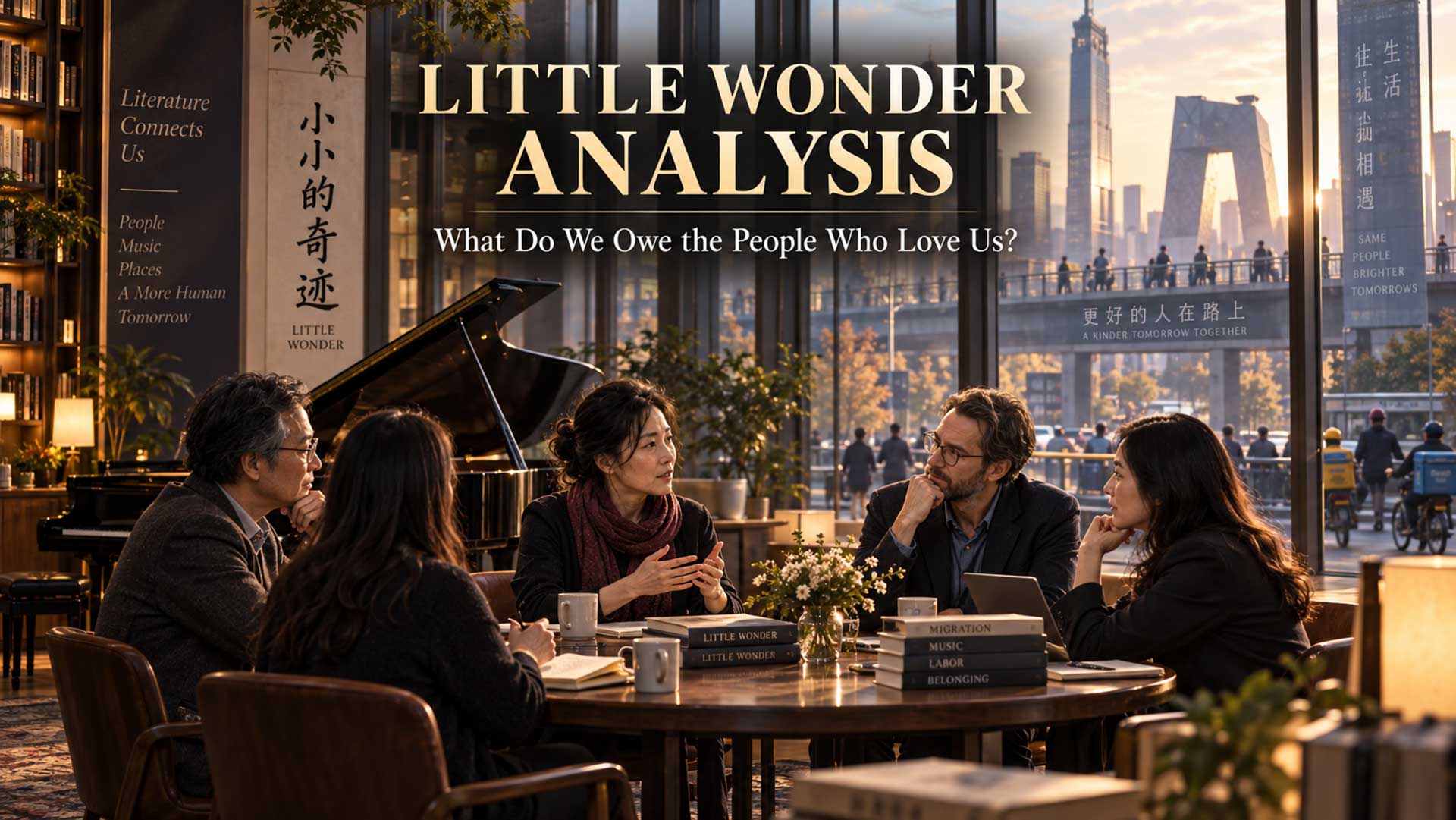
Across five discussions, one idea keeps returning.
Love alone is not enough.
Love needs room.
Song’s devotion to River is genuine, but River still needs the freedom to decide what kind of life he wants.
River’s musical talent is extraordinary, but extraordinary ability does not create an obligation to build an extraordinary career.
Song’s years of searching show the psychological cost of ambiguous loss, yet continuing to live does not mean abandoning the missing person.
River’s relationships with people outside his biological family show that new bonds do not erase old ones.
And the social world around Song reminds us that personal tragedy never happens outside class, labor, money, migration, and access.
A poor mother searching for her child does not possess the same resources as a wealthy parent.
A gifted child may receive attention that an equally worthy ordinary child never receives.
A delivery worker can keep a city functioning and still remain almost invisible to the people she serves.
The scholars repeatedly return to the difference between being noticed and being valued.
River should matter if he becomes a celebrated pianist.
He should matter if he never performs again.
Song should matter whether she possesses influence or not.
Human dignity cannot depend on achievement.
The discussion of reunion brings all of these questions together.
Song cannot recover the River she lost.
River cannot recover the mother preserved in his childhood memory.
Both have changed.
The years apart cannot be erased.
The people who cared for them during those years cannot simply disappear from the story.
Home, then, may not mean returning to the past.
It may mean creating a relationship large enough to contain everything that happened afterward.
River needs the freedom to become more than Song’s son.
Song needs the freedom to become more than River’s mother.
Their bond does not become weaker when both lives become larger.
Perhaps it becomes healthier.
The final lesson may be simple, but difficult to live:
Love does not need to hold someone tightly forever in order to remain real.
Sometimes the deepest form of love is making room for another person to leave, change, return, and still be welcomed as who they have become.
Short Bios:
Sophie Chen Keller
Author of Little Wonder. Keller brings the literary perspective to all five discussions, speaking about motherhood, music, giftedness, class, separation, found family, and the emotional questions behind Song and River’s story.
Pauline Boss
Family scholar known for developing the concept of ambiguous loss. Her work helps explain Song’s psychological experience of loving someone who is physically absent but emotionally present, and why reunion does not instantly erase the effects of prolonged uncertainty.
Jude Cassidy
Psychologist whose research focuses on attachment, family relationships, emotional development, and close relationships. She helps explore River’s bond with Song, new attachments formed during separation, and the challenge of remaining connected without restricting independence.
Ellen Winner
Psychologist known for her research on gifted children, artistic development, and the psychology of the arts. She examines River’s musical ability, adult expectations, gifted identity, and the difference between developing talent and allowing talent to define the child.
Dianna Kenny
Researcher known for her work on music performance anxiety. She brings psychological insight into River’s stage fright and asks whether fear should always be pushed through, or whether it can provide meaningful information about a young performer’s needs.
Harry Brighouse
Philosopher whose work examines childhood, education, autonomy, and children’s rights. He explores when parental authority should give way to a child’s developing agency and whether parental sacrifice creates any claim over a child’s future.
Kam Wing Chan
Scholar known for research on China’s hukou system, rural migration, and urban inequality. He provides historical and social context for Song’s position as a migrant worker and the unequal access many rural migrants have faced in Chinese cities.
Jenny Chan
Labor scholar whose work examines migrant workers, platform labor, logistics, and employment conditions in China. She helps explain the significance of Song’s delivery work and how modern labor systems can make workers highly visible as labor yet nearly invisible as people.
Amy Olberding
Philosopher whose work focuses on early Chinese philosophy, Confucian ethics, grief, family roles, and everyday moral life. She brings a culturally grounded perspective to questions of filial responsibility, gratitude, relational identity, and what parents and children may owe one another.
Leave a Reply