
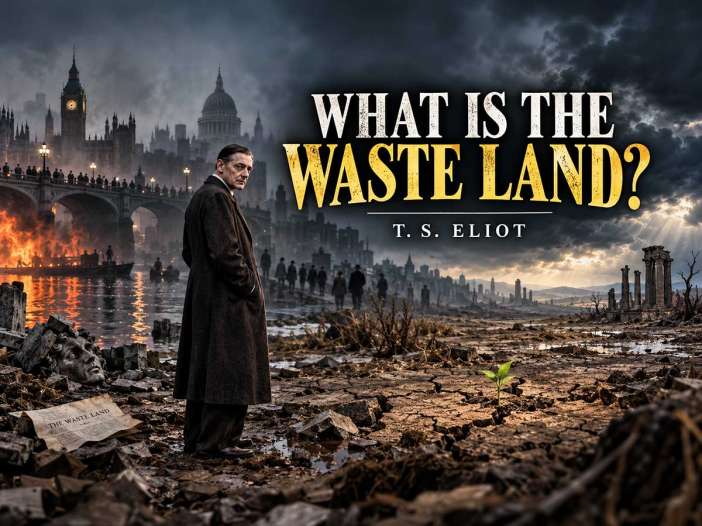
Introduction
What was T. S. Eliot really trying to say in The Waste Land?
Nearly a century of interpretation has produced familiar answers: postwar disillusionment, spiritual collapse, sexual alienation, cultural fragmentation, loss of faith, and the breakdown of modern civilization.
But Eliot himself complicated those explanations. He resisted reducing the poem to the disillusionment of a generation, and the surviving drafts reveal something stranger and more personal: a poem assembled from private distress, ancient mythology, ordinary London life, religious traditions, literary memory, and voices separated by centuries.
So instead of asking scholars to explain Eliot from a distance, this conversation does something different.
We place Eliot face-to-face with the voices behind his poem.
Ezra Pound remembers the manuscript before he helped cut it into its published form. Jessie Weston brings the wounded Fisher King. Shakespeare asks whether modern humanity is really more broken than humanity has always been. Dante recognizes spiritually lost crowds. Buddha examines craving and the fire of desire. Jesus asks what kind of thirst material things cannot satisfy. An Upanishadic Sage listens for the thunder's mysterious "DA." Vivien Eliot keeps returning the discussion from mythology to the suffering human being behind the poem. Tiresias watches them all.
Across five conversations, one question gradually changes into another.
At first:
What exactly is the Waste Land?
Then:
Why can't people truly reach one another?
Why does getting what we want fail to satisfy us?
Who has been wounded?
And finally:
If we recognize what makes human life barren, are we willing to live differently?
The goal is not to decode The Waste Land into one hidden message.
It is to enter Eliot's fragments and ask why, after all the dryness, fire, broken relationships, death, and spiritual confusion, the poem ends by listening to thunder.
(Note: This is an imaginary conversation, a creative exploration of an idea, and not a real speech or event.)
Topic 1: What Exactly Is the Waste Land?
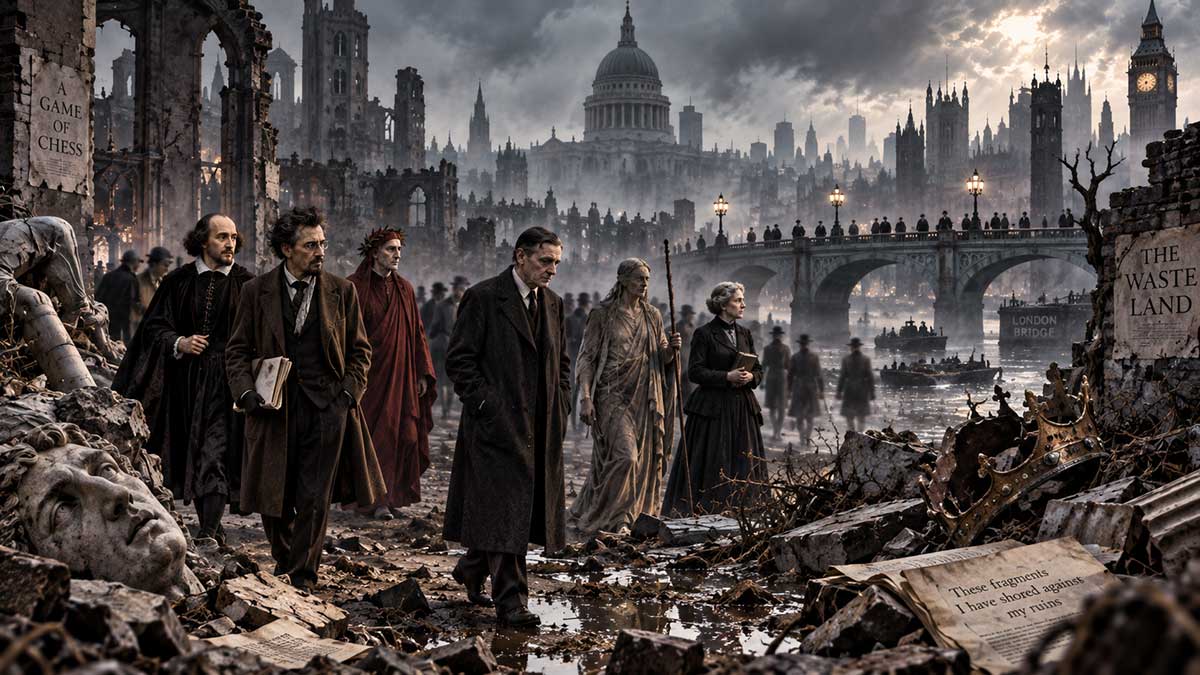
The room is difficult to locate in either geography or time.
Behind T. S. Eliot stretches London beneath a gray sky. Commuters cross London Bridge, their faces indistinct. Yet beyond them stands Dante's medieval city. Further away, Shakespeare's London appears through mist. A dry riverbed cuts across all three landscapes.
At its edge sits the Fisher King.
No one has yet asked why he is wounded.
Tiresias stands apart from everyone else.
He has been here before.
T. S. Eliot: Perhaps we should begin by correcting something before it becomes the premise of everything that follows.
Shakespeare: Writers rarely get that privilege.
Eliot: Precisely my concern.
Ezra Pound: Then say it, Tom.
Eliot: People will look at the date. 1922. They will look backward toward the war, see Europe wounded, and conclude that the Waste Land is Europe after the Great War.
Dante: Is that interpretation false?
Eliot: Too convenient.
Pound: That's different from false.
Eliot turns toward him.
Eliot: You would begin that way.
Pound: I cut your poem, Tom. I didn't take an oath never to disagree with you afterward.
Shakespeare laughs.
Shakespeare: Keep him close.
Eliot: I did.
Dante: Then what would you have us see?
Eliot looks across the river.
Eliot: I am not certain that I want you to "see" one thing.
Shakespeare: Now we are getting somewhere.
Eliot: Why?
Shakespeare: A lesser poet would have answered the question.
Eliot: And you wouldn't?
Shakespeare: Hamlet has survived rather well without my explaining him.
Pound smiles.
Pound: Tom, you've invited the wrong dead men if you wanted obedience.
Eliot: Apparently.
Tiresias speaks without moving.
Tiresias: You are already making the first mistake.
Everyone turns.
Eliot: Which mistake?
Tiresias: You are discussing what the Waste Land means before deciding whether the Waste Land is a place.
Silence.
Dante: That is a useful distinction.
Shakespeare: London certainly seems a candidate.
Eliot: "Unreal City."
Dante: Your people crossing London Bridge interested me.
Eliot: I suspected they might.
Dante: They reminded you of my dead.
Eliot: Yes.
Dante: Yet your people aren't dead.
Eliot: Biologically, no.
Dante: That qualification contains half your poem.
The others look toward the bridge.
Men and women continue crossing.
Nobody looks at anyone else.
Dante: When I walked among the dead, I knew I was among the dead. Your London is more disturbing. These people wake, dress themselves, travel to work, earn money, return home, eat, sleep, wake again.
Shakespeare: That sounds suspiciously like ordinary life.
Dante: Exactly.
Shakespeare: Then perhaps Eliot has confused routine with damnation.
Dante: I didn't say they were damned.
Shakespeare: You compared them with the dead.
Dante: Eliot did first.
Eliot: Fair.
Shakespeare: Thomas, let me ask the question directly. What have you discovered about modern human beings that I didn't encounter centuries before you?
Eliot says nothing.
Shakespeare: I knew men who murdered for ambition. Women consumed by jealousy. Children destroyed by their parents. Parents destroyed by their children. Kings terrified of death. Lovers incapable of trust. Men who confused possession with love. People who spoke beautifully while lying to themselves.
Pound: That's quite a résumé.
Shakespeare: And I haven't reached King Lear yet.
Eliot: Your point?
Shakespeare: Perhaps the Waste Land isn't modern.
Eliot: I never claimed that human misery began in 1914.
Shakespeare: Yet readers smell smoke from Europe and assume they have found your fire.
A voice enters quietly.
Buddha: Fire existed before Europe.
Shakespeare turns.
Shakespeare: I was wondering when you would speak.
Buddha: Desire existed before London.
Eliot: Yes.
Buddha: Dissatisfaction existed before machines.
Dante: Sin existed before machines too.
Buddha looks at him.
Buddha: We may describe the condition differently.
Dante: Very differently.
Buddha: Yet we have both watched human beings become prisoners of what they cannot release.
Shakespeare: Now that I recognize.
Eliot: So perhaps Shakespeare is right. Perhaps nothing happened to modern humanity.
Pound: That's going too far.
Eliot: Why?
Pound: The disease may be ancient. The environment isn't.
Shakespeare: Explain.
Pound: Your characters had ambition. So do ours. Your characters had lust. So do ours. Your characters lied. So do ours. But modern life can industrialize distraction.
Eliot looks interested.
Pound: More people. Bigger cities. Faster movement. Mass communication. Advertising. Mechanization. Repetition. A person can be surrounded by thousands of people and remain unknown to every one of them.
Dante: An enormous crowd of isolated souls.
Pound: Exactly.
Shakespeare: So modernity did not invent the wound.
Pound: Perhaps it found new ways of keeping people from noticing it.
That lands heavily.
Jesus, who has remained silent, looks toward the dry river.
Jesus: Or new ways of mistaking thirst for hunger.
Buddha looks toward him.
Buddha: Explain.
Jesus: A person thirsts for one thing and consumes another.
Buddha: Then thirst remains.
Jesus: Yes.
Buddha: And he consumes again.
Jesus: Yes.
Buddha: Then we may have found something we can discuss.
Shakespeare: Careful. If the two of you agree this early, Eliot will lose half his article.
Eliot smiles faintly.
Eliot: I doubt agreement will survive long.
A woman approaches.
Jessie Weston.
Behind her, the Fisher King remains seated beside the barren earth.
Jessie Weston: You are all looking in the wrong direction.
Pound: Another one.
Weston: You are looking at the city.
Dante: Shouldn't we?
Weston: Look at the land.
They do.
Nothing grows.
Weston: Before Eliot's London, before your arguments about modernity, before psychology, before sociology, there was an older story.
A king is wounded.
His land becomes barren.
Shakespeare: Cause and effect?
Weston: Myth does not always answer in those terms.
Buddha: Yet the relationship matters.
Weston: Completely.
She gestures toward the Fisher King.
Weston: Everyone asks, "Why is the land dead?"
Perhaps the better question is:
Who is wounded?
The Fisher King raises his head but does not speak.
Eliot watches him.
Eliot: That question is dangerous.
Weston: Why?
Eliot: Everyone will immediately decide what the King represents.
Pound: Europe.
Dante: Christianity.
Buddha: The desiring self.
Shakespeare: Civilization.
Weston: Eliot.
Everyone becomes quiet.
Eliot looks at her.
Eliot: There it is.
Weston: I knew you wouldn't like that one.
Eliot: A poem is not a medical chart of its author.
Another voice comes from behind him.
Vivien Eliot: No.
Eliot turns.
Vivien stands several feet away.
Vivien: But neither is a poem written by nobody.
The atmosphere changes.
Pound looks down.
Shakespeare stops smiling.
Eliot: Vivien.
Vivien: Tom.
Eliot: We should be careful.
Vivien: I agree.
Eliot: People have an appetite for turning suffering into biography.
Vivien: And writers sometimes have an appetite for turning biography into mythology.
No one interrupts.
Vivien: I am not saying the Waste Land is you.
Eliot: Good.
Vivien: I'm asking whether part of it passed through you.
Eliot considers this.
Eliot: Of course it passed through me.
Vivien: That's different.
Eliot: From what?
Vivien: From saying it came entirely from civilization.
Pound finally speaks.
Pound: She's right, Tom.
Eliot: You too?
Pound: I saw the pages.
Eliot's expression changes.
Pound: Everyone else here knows The Waste Land.
He taps the manuscript beside him.
Pound: I knew what existed before The Waste Land became The Waste Land.
Shakespeare: Now that is interesting.
Dante: What disappeared?
Pound: A great deal.
Eliot: Ezra.
Pound: I'm not betraying you.
Eliot: It has the atmosphere of betrayal.
Pound: No. I'm defending the poem.
Pound picks up several pages.
Pound: People see fragments and assume fragmentation was simply your subject. They forget that the finished fragmentation was crafted.
Shakespeare: Meaning?
Pound: Selection.
Removal.
Compression.
Juxtaposition.
The poem looks shattered.
But someone arranged the shards.
Tiresias turns toward Pound.
Tiresias: Now you have said something important.
Pound: I occasionally do.
Tiresias: A broken mirror and a mosaic can contain the same pieces.
Silence.
Eliot looks at Tiresias.
Eliot: And which is my poem?
Tiresias: That is precisely the question.
Dante: Perhaps both.
Shakespeare: Convenient answer.
Dante: True answers occasionally are.
Buddha: Perhaps everyone is assuming that fragmentation itself is the problem.
Weston: Isn't it?
Buddha: A person suffers partly from insisting that changing things must remain permanent.
Jesus: Yet there are forms of brokenness that should be healed.
Buddha: Certainly.
Jesus: Then we must distinguish between accepting impermanence and accepting lovelessness.
Buddha nods.
Buddha: Yes.
Shakespeare: There's the disagreement Eliot was hoping for.
Eliot: Much better.
Vivien looks again at the Fisher King.
Vivien: I still want an answer.
Weston: To which question?
Vivien: Who is wounded?
Nobody answers.
Then the Fisher King speaks for the first time.
Fisher King: Why do you assume there is only one wound?
Eliot slowly turns.
Fisher King: A man can be wounded.
A marriage can be wounded.
A city can be wounded.
A faith can be wounded.
A civilization can be wounded.
Dante: A soul can be wounded.
Buddha: A mind can cling to the causes of its suffering.
Jesus: A heart can close itself to another.
Shakespeare: A family can pass its wound from parent to child.
Weston: And the land?
The Fisher King looks at the dry earth beneath his feet.
Fisher King: The land remembers all of them.
No one speaks for several moments.
Then Eliot walks toward the river.
It contains almost no water.
Eliot: Perhaps this is why I object when people tell me what the poem means.
Pound: Here we go.
Eliot: No, listen.
He turns to them.
Eliot: Suppose I had written an argument.
Modern civilization is spiritually empty.
Desire is destructive.
Religion has declined.
Europe has been traumatized.
People cannot communicate.
Then I could have written an essay.
Shakespeare: Much shorter.
Eliot: And considerably worse.
Dante: So you wanted something else.
Eliot: Perhaps I wanted the reader to experience the condition before naming it.
Tiresias watches him closely.
Eliot: Voices appear and disappear.
Memories interrupt the present.
Ancient texts enter modern streets.
Religions collide.
Languages change.
People speak without answering one another.
Desire appears without fulfillment.
Water is desperately needed, then water kills Phlebas.
Spring should bring happiness, yet April becomes cruel.
Nothing remains stable long enough to become an explanation.
Pound: Now you're finally talking about your poem.
Eliot: Perhaps the question isn't simply "What does the Waste Land mean?"
Buddha: Then what is the question?
Eliot looks again at the people crossing London Bridge.
Eliot: What does it feel like to live there?
Dante's face changes.
Dante: That I understand.
Eliot: Of course you do.
Dante: Hell must be walked through before it can be comprehended.
Shakespeare: And tragedy must be experienced before its lesson becomes obvious.
Buddha: Suffering must be recognized before its cause can be examined.
Jesus: Thirst must be felt before someone searches seriously for water.
The Upanishadic Sage, silent until now, opens his eyes.
Upanishadic Sage: And silence must sometimes come before the answer.
Everyone turns.
Pound: You have been sitting there for quite some time.
Upanishadic Sage: Yes.
Shakespeare: You could have helped.
Upanishadic Sage: You were not asking the right question.
Tiresias smiles.
Tiresias: Neither are they now.
Eliot: Then perhaps you should give us one.
Tiresias walks slowly into the dry riverbed.
He picks up a handful of earth.
It falls through his fingers.
Tiresias: You have asked whether the Waste Land is Europe.
Whether it is modernity.
Whether it is Eliot.
Whether it is civilization.
Whether it is desire.
Whether it is spiritual emptiness.
Whether it is humanity itself.
He lets the last dust fall.
Tiresias: But all of those questions begin too late.
Weston: What comes before them?
Tiresias looks first at the Fisher King.
Then Vivien.
Then Eliot.
Then the endless crowd crossing the bridge.
Tiresias: Do not ask where the Waste Land is.
He looks at the barren earth.
Tiresias: Ask what makes living things become barren.
The commuters continue crossing London Bridge.
One man brushes another man's shoulder.
Neither looks up.
A woman walks beside her husband.
Neither speaks.
Thousands of people are together.
Almost everyone appears alone.
Jesus watches them.
Buddha watches them.
Vivien watches Eliot.
Eliot watches the crowd.
And Topic 1's question quietly transforms into the question waiting for them next:
What happened to human connection?
Topic 2: What Happened to Human Connection?
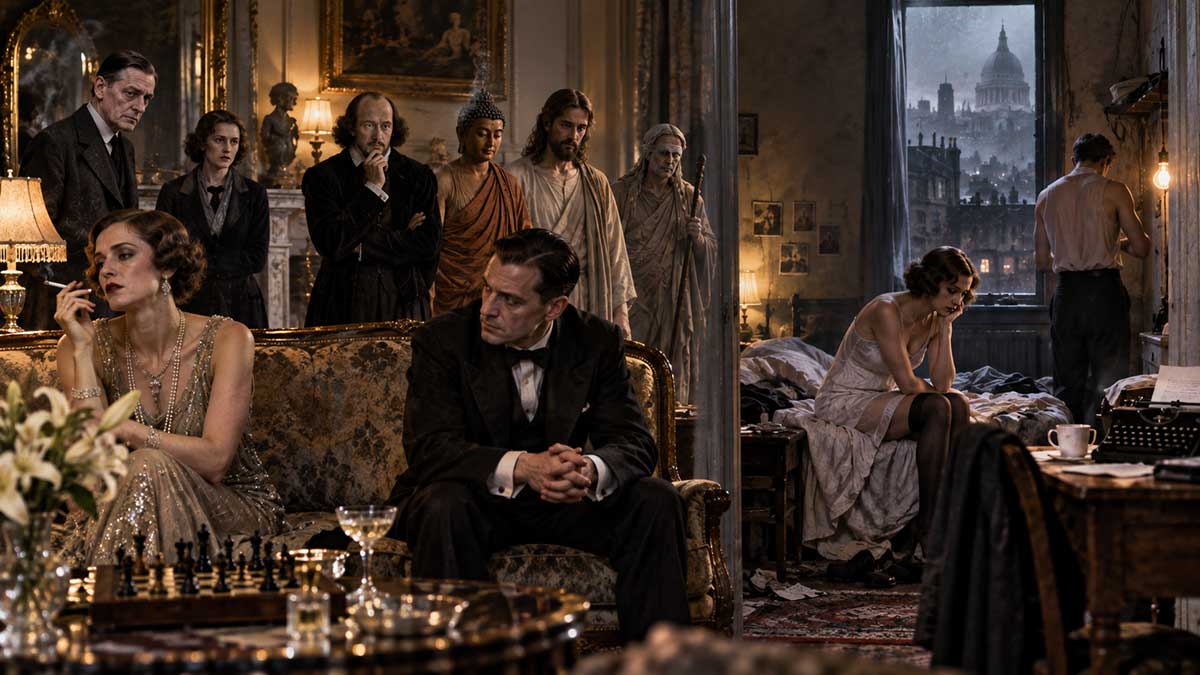
London has changed since the first conversation.
The crowd that Tiresias watched crossing London Bridge has disappeared into buildings, bedrooms, pubs, offices, and narrow streets.
Yet the loneliness has followed them indoors.
A room slowly emerges from the darkness.
It is beautiful, almost oppressively so. Light reflects from polished surfaces. Perfume hangs in the air. Everything seems arranged to create comfort.
A woman sits before a mirror.
She turns suddenly.
The Woman: "My nerves are bad tonight."
No one answers immediately.
T. S. Eliot stands near the doorway.
Shakespeare studies the room.
Buddha watches the woman's face rather than her surroundings.
Jesus notices the empty chair beside her.
Tiresias seems to recognize everything.
Vivien Eliot looks uncomfortable.
Shakespeare: There is enough beauty in this room to stage a queen.
The Woman: Then why do I feel like screaming?
Shakespeare's expression changes.
The Woman: Look at everything.
She gestures around her.
The Woman: Beautiful furniture. Light. Perfume. Pictures. Objects people would envy.
She touches her hair.
The Woman: And still I want someone to speak to me.
Eliot: Someone does.
The Woman: Do they?
She looks directly at Eliot.
The Woman: Or do they merely answer?
That distinction silences the room.
Jesus: What would you like someone to say?
The Woman: Anything real.
Buddha: What would make something real?
The Woman: Something that proves I am not alone.
Buddha: Can another person prove that?
The Woman: If another person cannot, what is the point of love?
Shakespeare moves closer.
Shakespeare: Now we have reached dangerous territory.
Vivien: Why dangerous?
Shakespeare: She has asked another human being to remove something inside her that may not belong entirely to him.
The Woman: You think I am demanding too much.
Shakespeare: I think lovers have been making that demand for thousands of years.
The Woman: And what do you know about it?
Shakespeare almost laughs.
Shakespeare: Quite a bit.
Vivien: Let her finish.
The Woman turns toward Vivien.
The Woman: Sometimes someone can be sitting three feet away from you and you can feel further from him than if he were dead.
Vivien doesn't respond.
Eliot looks toward the window.
Tiresias: I have seen that distance.
The Woman: Where?
Tiresias: Everywhere.
The room dissolves.
A modest London pub takes its place.
Voices fill the air.
Glasses strike tables.
A woman named Lil sits with another woman.
Her face looks older than her years.
Lil: Albert's coming back.
Shakespeare: From war?
Lil: Yes.
Shakespeare: Then surely there is happiness.
Lil looks at him.
Lil: Is there?
The confidence disappears from Shakespeare's face.
Lil: Everyone thinks the story is simple. Husband returns. Wife waits. Family reunited.
Vivien: But?
Lil: He wants me looking good.
She gives a tired laugh.
Lil: I've had five children.
Nobody speaks.
Lil: Five.
She looks toward the men.
Lil: Do you know what five children do to a woman's body?
Eliot lowers his eyes.
Lil: People tell me Albert gave me money for teeth. They tell me if I don't make myself attractive, another woman might.
The Woman from the Room: So you are lonely too.
Lil looks surprised.
Lil: I've got a husband.
The Woman: I didn't ask whether you had a husband.
Lil studies her.
Lil: Yes.
A pause.
Lil: I'm lonely too.
Tiresias watches the two women.
One surrounded by luxury.
One surrounded by domestic hardship.
Their circumstances could hardly be more different.
Yet for a moment they recognize each other completely.
Tiresias: There.
Eliot: What?
Tiresias: Your Waste Land.
Eliot: Again you name it too quickly.
Tiresias: I didn't say it was the whole Waste Land.
He gestures toward the women.
Tiresias: I said it is here.
Buddha looks toward Lil.
Buddha: What does Albert want from you?
Lil: His wife back.
Buddha: You are his wife.
Lil: Not the wife he remembers.
Buddha: Then perhaps he desires a memory.
Lil: That doesn't make living with it easier.
Jesus: Does he see what happened to you?
Lil thinks.
Lil: I don't know.
Jesus: That may be part of the wound.
Shakespeare: We have seen this before.
Vivien: Have we?
Shakespeare: Constantly.
He looks around the pub.
Shakespeare: People rarely love another person without creating an image of that person.
Beautiful.
Faithful.
Young.
Strong.
Desirable.
Dependable.
Pure.
Successful.
Then the real human being changes.
Vivien: And the image doesn't.
Shakespeare: Precisely.
The Woman: So which one do we love?
Shakespeare: That is one of the questions I spent my life asking.
Eliot: And your answer?
Shakespeare: Often, ourselves.
That lands hard.
Buddha: Or what the other person provides for the self.
Jesus: Which is different from loving the person.
Buddha: Yes.
Vivien: Yet this is becoming too easy.
Everyone looks toward her.
Vivien: We are turning relationships into philosophy.
She looks at Eliot.
Vivien: That's safer.
Eliot: Safer than what?
Vivien: Than admitting how ugly two people's inability to reach one another can become.
Pound, who has remained near the bar, finally speaks.
Pound: She's right.
Eliot: Ezra.
Pound: Tom, the poem knows it.
Eliot: Meaning?
Pound: You didn't write a treatise called On Alienation.
You put us in rooms.
Bedrooms.
Pubs.
Streets.
You let people speak past each other.
Vivien: Exactly.
Pound: Which means perhaps the failure isn't silence.
Dante: What is it?
Pound: Speech without encounter.
Dante repeats the phrase quietly.
Dante: Speech without encounter.
The Woman: That's exactly it.
The pub disappears.
Now a small apartment.
Evening.
A young typist has returned home.
There are clothes around the room.
Food waits.
She is tired.
Tiresias stiffens.
He knows what comes next.
Tiresias: We should leave.
Eliot: No.
Tiresias: I have already witnessed this.
Eliot: Then witness it again.
Tiresias: You make witnessing sound harmless.
The Typist looks toward them.
The Typist: Let them stay.
Tiresias turns.
The Typist: Everyone always talks about me when I'm not in the room.
That stops Eliot.
The Typist: So let me be in the room this time.
She sits.
A young man appears near the doorway.
The Young Man Carbuncular.
He carries himself with confidence unsupported by much self-awareness.
Shakespeare looks at him and immediately understands the type.
Shakespeare: I knew several of you.
Young Man: Several of me?
Shakespeare: Thousands.
Young Man: You don't know me.
Shakespeare: That has never prevented a young man from being predictable.
The Typist almost smiles.
Young Man: She wanted me here.
The Typist looks at him.
The Typist: Did I?
He hesitates.
Young Man: You didn't tell me to leave.
The room becomes very still.
Jesus looks toward him.
Jesus: Is that the same thing?
The young man doesn't answer.
Buddha: What did you want?
Young Man: Her.
Buddha: That wasn't my question.
Young Man: What do you mean?
Buddha: You obtained access to her body.
He pauses.
Buddha: What were you seeking?
Young Man: Sex.
Buddha: Why?
Young Man: Why does anyone want sex?
Shakespeare: Excellent question.
Young Man: You're making something complicated that isn't complicated.
The Typist: That's what I thought too.
Everyone turns toward her.
The Typist: That's the part nobody understands.
She looks at Buddha.
The Typist: You want me to tell you that I was devastated.
She looks toward Jesus.
The Typist: You want me to tell you that I felt violated.
She turns toward Shakespeare.
The Typist: You want tragedy.
Then Eliot.
The Typist: And perhaps you want emptiness.
Eliot says nothing.
The Typist: But what frightened me wasn't that I felt terrible.
She pauses.
The Typist: I barely felt anything.
Tiresias closes his eyes.
The Typist: He left.
I fixed my hair.
Life continued.
Vivien: And that doesn't disturb you?
The Typist: It disturbs me now.
Vivien: Why?
The Typist: Since I wonder when I learned not to expect more.
No one has an answer.
The young man looks less comfortable.
Young Man: You're making me sound horrible.
The Typist: I'm not talking about you.
Young Man: You clearly are.
The Typist: That's the strange thing.
She looks at him.
The Typist: You're almost irrelevant.
The sentence wounds him more than accusation would have.
The Typist: That's what makes it so empty.
Tiresias opens his eyes.
Tiresias: I have seen this before.
Shakespeare: So have I.
Tiresias: No.
He turns toward Shakespeare.
Tiresias: You have seen lust.
Adultery.
Seduction.
Jealousy.
Betrayal.
Obsession.
Shakespeare: Certainly.
Tiresias: But look carefully.
He gestures toward the Typist and Young Man.
Tiresias: Where is the passion?
Shakespeare studies them.
There is none.
Tiresias: That is what makes this different.
Eliot: Yes.
Tiresias: They don't destroy themselves for desire.
They don't kill for it.
They don't cross kingdoms for it.
They don't even suffer greatly for it.
They simply...
He searches for the word.
The Typist: Continue.
Tiresias: Consume it.
Silence.
Buddha looks sharply toward Tiresias.
Buddha: Now we are approaching the fire.
Jesus: And the thirst.
Shakespeare: Wait.
He walks between them.
Shakespeare: We must be careful.
Eliot: About what?
Shakespeare: Romanticizing destructive passion.
Othello's jealousy was not superior to this man's indifference simply since it was more dramatic.
Tiresias: Agreed.
Shakespeare: Romeo's willingness to die doesn't automatically make his love wiser.
Jesus: Agreed.
Shakespeare: Then what exactly has been lost?
That question changes the conversation.
Vivien answers first.
Vivien: Recognition.
Shakespeare: Explain.
Vivien: Seeing another person as another person.
Jesus looks at her.
Vivien: Not as your wife.
Not your husband.
Not your lover.
Not the body you want.
Not the person who should make you happy.
Not the person who disappointed you.
Just...
She struggles.
Vivien: Another consciousness standing beside yours.
The Woman from the beautiful room looks at her.
The Woman: That's what I wanted.
Lil: Me too.
The Typist: I stopped expecting it.
The Young Man says nothing.
Buddha: Much suffering begins when we attach ourselves to what another person must become for us.
Jesus: Yet love cannot simply mean detachment from the person.
Buddha turns toward him.
Here, finally, their paths separate.
Buddha: I did not say indifference.
Jesus: I know.
Buddha: Compassion can become deeper when possession loosens.
Jesus: Then we agree there.
Buddha: Perhaps.
Jesus: But I would go further.
He looks at the Typist.
Jesus: Love requires seeing the person whom everyone else has stopped seeing.
The Typist meets his eyes.
Buddha: And I would ask why the self requires another person's attention before it can possess peace.
Jesus: A fair question.
Buddha: Then perhaps loneliness contains two problems.
Dante: Which are?
Buddha: The inability to be peacefully alone.
He looks at the others.
Buddha: And the inability to genuinely be with another.
Dante considers this.
Dante: That distinction matters.
Eliot: Very much.
Pound looks toward Eliot.
Pound: Tom, there's something else.
Eliot: What?
Pound: Look at the structure.
Eliot: You're editing again.
Pound: Habit.
He gestures across the three spaces they have visited.
The luxurious room.
The pub.
The Typist's apartment.
Pound: Different classes.
Different relationships.
Different kinds of desire.
Same failure.
Weston: Which means?
Pound: Perhaps the Waste Land isn't created by loneliness.
He pauses.
Pound: Perhaps loneliness is one of the plants that grows there.
Weston: Interesting.
Tiresias: Then what poisoned the soil?
Nobody answers.
From somewhere beyond the room comes the sound of water.
Very faint.
The Thames.
Tiresias walks toward it.
Tiresias: I have watched human beings touch one another for thousands of years.
Everyone follows.
Tiresias: Lovers.
Spouses.
Strangers.
Parents.
Children.
Friends.
Enemies.
He looks back at the Typist.
Tiresias: Physical distance has never been the true measure of separation.
Then toward Lil.
Tiresias: Marriage does not abolish loneliness.
Toward the Woman.
Tiresias: Conversation does not guarantee communication.
Toward the Young Man.
Tiresias: Sex does not guarantee intimacy.
Then toward Eliot.
Tiresias: And poetry does not guarantee that the poet can say what he cannot say to another human being.
Eliot looks at him sharply.
Vivien says nothing.
Tiresias turns toward Buddha.
Tiresias: You say attachment makes us suffer.
Buddha: Craving and clinging do.
Tiresias turns toward Jesus.
Tiresias: You speak of love.
Jesus: Yes.
Tiresias: Shakespeare says we frequently love our image of another person.
Shakespeare: Yes.
Tiresias: Vivien says we fail to recognize the consciousness standing beside us.
Vivien: Yes.
Tiresias: Then perhaps our next question is obvious.
Eliot: Which question?
Tiresias looks toward the river.
For the first time, a small flame appears reflected upon its surface.
Tiresias: If human beings want connection so badly...
He turns toward the Typist, Lil, the Woman, and the Young Man.
Tiresias: why do we keep reaching for things that leave us more alone?
Buddha watches the flame.
Buddha: Now we can speak about desire.
And somewhere inside Eliot's Waste Land, the fire begins to burn.
Topic 3: Why Doesn't Getting What We Want Satisfy Us?
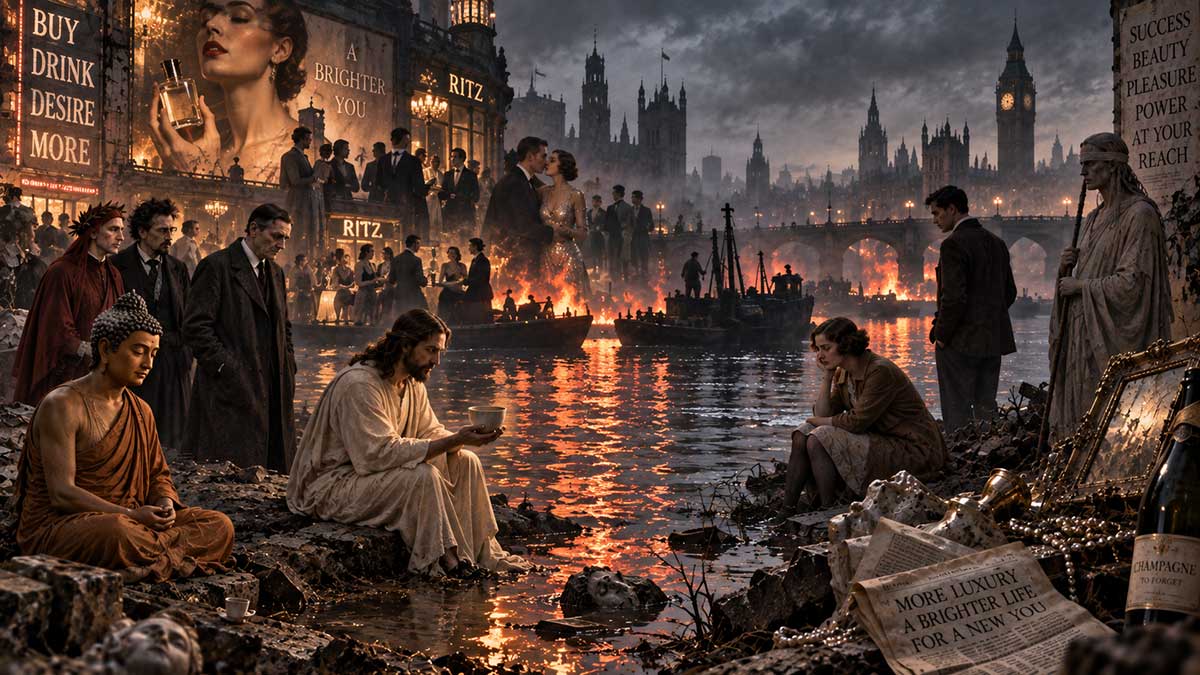
The flame Tiresias noticed upon the Thames does not disappear.
It spreads.
Not across buildings.
Not across trees.
Across people.
A businessman walks beside the river staring at numbers on a page.
A young couple disappear into a doorway.
Someone drinks alone.
Someone purchases something expensive and immediately begins wanting something better.
The fire burns invisibly through all of them.
Buddha watches.
Buddha: Now you can see it.
Eliot: The fire?
Buddha: Yes.
Shakespeare: I see no flames.
Buddha: That has never stopped people from burning.
Tiresias looks across the Thames.
Tiresias: I have seen this fire before.
Buddha: Of course.
Tiresias: Different cities.
Different centuries.
Same heat.
The Typist has followed them from the previous conversation.
The Young Man Carbuncular remains several steps behind her.
Neither has spoken to the other.
Jesus stands near the water.
Dante looks from the river to the city.
Pound watches Eliot.
Pound: You knew exactly what you were doing with the title.
Eliot: "The Fire Sermon."
Pound: Buddha beside Augustine.
Dante: That combination interests me.
Buddha: It should.
Dante: We would describe the problem differently.
Buddha: Yes.
Dante: Yet both traditions recognize a human being consumed by desires he cannot govern.
Buddha: There is common ground there.
Shakespeare: I suspect I qualify too.
Eliot: You practically built a career from it.
Shakespeare: Lust, ambition, jealousy, status, possession, revenge.
He smiles.
Shakespeare: I had material.
Buddha: Then perhaps you can answer the question Tiresias left us with.
Shakespeare: Which one?
Buddha: Why do human beings repeatedly reach for things that leave them more alone?
Shakespeare looks at the flame reflected in the Thames.
Shakespeare: Since sometimes they work.
Buddha turns.
Buddha: Explain.
Shakespeare: You are philosophers.
I was a dramatist.
People don't continue pursuing pleasure since pleasure never feels good.
They pursue it since it does.
The Typist looks at Shakespeare.
Shakespeare: Wine can taste wonderful.
Sex can feel wonderful.
Applause can feel wonderful.
Money can make life easier.
Beauty can delight us.
Winning can exhilarate us.
Jesus: None of those statements is inherently false.
Shakespeare: Exactly.
He turns toward Buddha.
Shakespeare: So perhaps the mystery isn't why people want these things.
The mystery is:
Why do they expect them to do more than they can?
Buddha smiles slightly.
Buddha: That is much closer.
The First Question: What Happens After Desire Gets What It Wants?
The Typist speaks.
The Typist: I can answer that.
Everyone turns.
The Typist: Sometimes nothing.
The Young Man looks uncomfortable.
The Typist: That's what everyone keeps missing about what happened in my room.
Jesus: Tell us.
The Typist: There was anticipation.
Then there was the thing itself.
Then he left.
Then I fixed my hair.
She pauses.
The Typist: Desire promised an event.
It delivered an event.
Buddha: But not what you were truly seeking.
The Typist: I'm not sure I was seeking anything.
Buddha: Are you certain?
The Typist: No.
That answer interests him.
Buddha: Good.
The Typist: Good?
Buddha: Certainty would end the inquiry too early.
The Young Man finally steps forward.
Young Man: Everyone keeps using me as an example of what's wrong with humanity.
Shakespeare: You've noticed.
Young Man: I wanted her.
Buddha: Yes.
Young Man: I got what I wanted.
Buddha: Did you?
Young Man: Obviously.
Buddha: Then why did you leave?
Young Man: What was I supposed to do?
Buddha: I am asking you.
The Young Man cannot answer.
Buddha: When desire says, "If I obtain this, I will be satisfied," we tend to believe the sentence ends there.
He draws a line in the dust.
Buddha: But frequently the sentence continues.
I obtain it.
I experience pleasure.
The pleasure changes.
The pleasure passes.
Then another desire arises.
Shakespeare: And another.
Buddha: Yes.
Pound: And modern commerce has discovered this.
Eliot turns toward him.
Pound: Think about it, Tom.
A civilization built around permanent satisfaction would be terrible for sales.
Shakespeare laughs.
Shakespeare: Now that is a modern innovation.
Pound: You don't simply sell someone an object.
You sell the feeling that their present condition is inadequate.
Dante: Then dissatisfaction itself becomes commercially valuable.
Pound: Precisely.
Buddha: Which means an ancient human tendency can be cultivated.
Pound: At scale.
Eliot looks back at London.
Eliot: So Shakespeare was right earlier.
Modernity didn't invent the wound.
Pound: It learned how to monetize scratching it.
No one laughs this time.
The Second Question: Are All Desires the Same?
Jesus walks closer to Buddha.
Jesus: Here is where I think we must be careful.
Buddha: I agree.
Jesus: A hungry child desires food.
A lonely person desires companionship.
A mother desires the safety of her child.
A person suffering injustice desires justice.
Are all these simply cravings to be overcome?
Buddha: No.
Jesus: Then desire itself cannot be the entire problem.
Buddha: Correct.
Shakespeare: This is becoming more interesting.
Buddha: Hunger arises.
Love arises.
Grief arises.
Pleasure arises.
Pain arises.
The problem is not merely that experience occurs.
The suffering deepens when we cling.
Jesus: To what?
Buddha: To the demand that what changes must not change.
That what pleases us must continue pleasing us.
That another person must remain what we need them to be.
That the self must obtain what it believes will complete it.
Jesus considers this.
Jesus: Then let me approach it differently.
He picks up a dry cup lying beside the river.
Jesus: Suppose this cup is empty.
A person fills it with money.
Still empty.
So he concludes:
"I need more money."
He fills it with admiration.
Still empty.
He fills it with sex.
Achievement.
Status.
Possessions.
Attention.
Still empty.
Buddha: And what do you believe the cup requires?
Jesus looks at him.
Jesus: Perhaps the mistake is believing the cup is meant to be filled by possessions at all.
Buddha studies him.
Buddha: There our languages begin to separate.
Jesus: Yes.
Buddha: You speak as though there is a deeper fulfillment.
Jesus: I do.
Buddha: I would question the self that insists it must be completed.
Jesus: And I would question what the self has mistaken for its deepest good.
Dante steps between them.
Dante: Those differences matter.
Eliot: Very much.
Dante: Yet both of you are describing misdirected desire.
Buddha: In different ways.
Jesus: Yes.
Shakespeare: Good. Don't resolve it.
Everyone looks toward him.
Shakespeare: People have spent centuries flattening profound disagreements into pleasant sayings.
He points at Buddha and Jesus.
Shakespeare: Let them disagree.
Eliot smiles.
Eliot: For once, Shakespeare is moderating responsibly.
Shakespeare: Don't become accustomed to it.
Dante's Challenge
Dante has been listening.
Now he speaks.
Dante: I think everyone is being too gentle with desire.
Buddha turns.
Dante: Desire does more than disappoint.
It can reorder a human being.
The Typist: Meaning?
Dante: What you repeatedly love changes what you become.
That quiets everyone.
Dante: A person who worships wealth does not merely possess wealth.
Eventually wealth possesses his imagination.
A person consumed by status begins interpreting every room according to who stands above and below him.
A jealous lover interprets everything through jealousy.
A person obsessed with pleasure begins evaluating life according to stimulation.
Shakespeare: Now you are speaking my language.
Dante: Desire creates direction.
Jesus: "Where your treasure is..."
Dante looks toward him.
Dante: Yes.
Buddha: Habitual craving shapes perception.
Dante: Then perhaps the question isn't simply:
"Did getting what I wanted satisfy me?"
Perhaps it is:
"What is wanting this turning me into?"
The Young Man looks away.
The Typist notices.
The Typist: You don't like that question.
Young Man: Do you?
The Typist: No.
Young Man: Why?
The Typist: Since I have desires too.
That surprises him.
The Typist: Everyone keeps treating me as the empty woman and you as the desiring man.
But I want things.
Comfort.
Attention.
Escape.
To feel attractive.
To feel wanted.
Sometimes to feel nothing.
Buddha looks at her.
The Typist: Perhaps numbness can become something you desire too.
Buddha: Yes.
The Typist: That's frightening.
Buddha: Recognition frequently is.
Shakespeare's Experiment
Shakespeare suddenly walks toward the center.
Shakespeare: Let us test something.
Eliot: I dislike that expression coming from you.
Shakespeare: Everyone answer one question.
He looks at Pound.
Shakespeare: What do you want?
Pound: Recognition.
Pound pauses.
Pound: More than I should.
Shakespeare looks at Dante.
Dante: To see rightly.
Buddha.
Buddha: Liberation from suffering.
Jesus.
Jesus: That people love God and one another.
The Typist.
She hesitates.
The Typist: To feel that my life matters to someone.
The Young Man.
Young Man: To matter.
The similarity surprises both of them.
Shakespeare turns toward Vivien.
Vivien: To be seen as a person rather than as somebody else's difficulty.
Then Shakespeare looks at Eliot.
Shakespeare: Thomas?
Eliot doesn't answer.
Shakespeare: What do you want?
Eliot: Order.
Pound raises an eyebrow.
Pound: Interesting.
Eliot: Why?
Pound: You wrote The Waste Land.
Eliot: Exactly.
Pound: Out of fragments.
Eliot: Exactly.
Pound: Perhaps you were trying to create order from them.
Eliot looks uncomfortable.
Eliot: Perhaps.
Tiresias has been listening.
Tiresias: And what happens when order fails?
Eliot turns.
Eliot: We collect fragments.
Tiresias: Why?
Eliot looks across the ruined city.
Eliot: So something survives.
Pound understands immediately.
Shakespeare does too.
The Third Question: What Are We Actually Thirsty For?
The flame disappears.
Suddenly the river disappears with it.
The Thames becomes rock.
Dry earth stretches outward.
No water.
Only heat.
The Upanishadic Sage opens his eyes.
Jesus looks across the barren ground.
Buddha touches the earth.
Tiresias: Now remove everything.
Money.
Sex.
Possessions.
Status.
Applause.
Entertainment.
Distraction.
What remains?
The Typist: Me.
Buddha: Precisely.
The Typist: I don't know whether I like that.
Buddha: That is partly why distraction is attractive.
Pound looks across the dry landscape.
Pound: Suppose we had everything we wanted.
Shakespeare: Everything?
Pound: Wealth.
Beautiful homes.
Endless entertainment.
Food whenever we wanted it.
Sex without much difficulty.
Information instantly.
Thousands of people able to speak to us from anywhere.
Eliot: Sounds exhausting.
Pound: Yet suppose we had it.
Would the Waste Land disappear?
No one answers.
Dante: Perhaps it would become harder to see.
Jesus: Yes.
Buddha: Desire can hide suffering temporarily.
Vivien: So can work.
Eliot looks at her.
Vivien: So can writing.
Another silence.
Eliot: Yes.
She wasn't expecting him to agree.
Eliot: It can.
Tiresias walks deeper into the dry landscape.
Tiresias: Then perhaps we have been asking the wrong question again.
Shakespeare: You enjoy saying that.
Tiresias: Humanity enjoys asking it.
Eliot: What is wrong with our question?
Tiresias: "Why doesn't getting what we want satisfy us?"
Buddha: And your replacement?
Tiresias: Before asking why satisfaction disappears...
He looks toward the Typist.
Then the Young Man.
Pound.
Vivien.
Eliot.
Finally everyone.
Tiresias: Ask who taught us what to want.
Nobody moves.
That question seems to disturb Eliot more than anything yet said.
Eliot: Family.
Shakespeare: Culture.
Pound: Commerce.
Dante: Habit.
Buddha: Craving.
Vivien: Fear.
The Typist: Loneliness.
Young Man: Other people.
Jesus looks at the empty cup still in his hand.
Jesus: And sometimes we want substitutes.
Buddha: For what?
Jesus looks across the land without water.
Jesus: For whatever thirst we have never learned to name.
The Upanishadic Sage finally stands.
He has said almost nothing throughout the discussion.
Upanishadic Sage: Then perhaps thirst is not our next question.
Everyone turns toward him.
Eliot: What is?
The Sage points into the distance.
The Fisher King sits alone upon the barren earth.
For the first time they notice something they overlooked earlier.
His wound is still open.
Upanishadic Sage: You have discussed what people desire.
You have discussed why satisfaction fades.
You have discussed what they consume.
You have discussed what they cannot name.
He looks toward the wounded King.
Upanishadic Sage: But thirsty land may not merely need water.
Weston steps forward.
She understands where he is going.
Weston: It may need healing.
The Fisher King slowly raises his head.
Tiresias looks from the King to Eliot.
Tiresias: Then we have finally reached the question beneath the others.
The wind moves across the barren ground.
No rain comes.
Tiresias: Who has been wounded?
And far beyond them, the Waste Land waits.
Topic 4: Who Has Been Wounded?
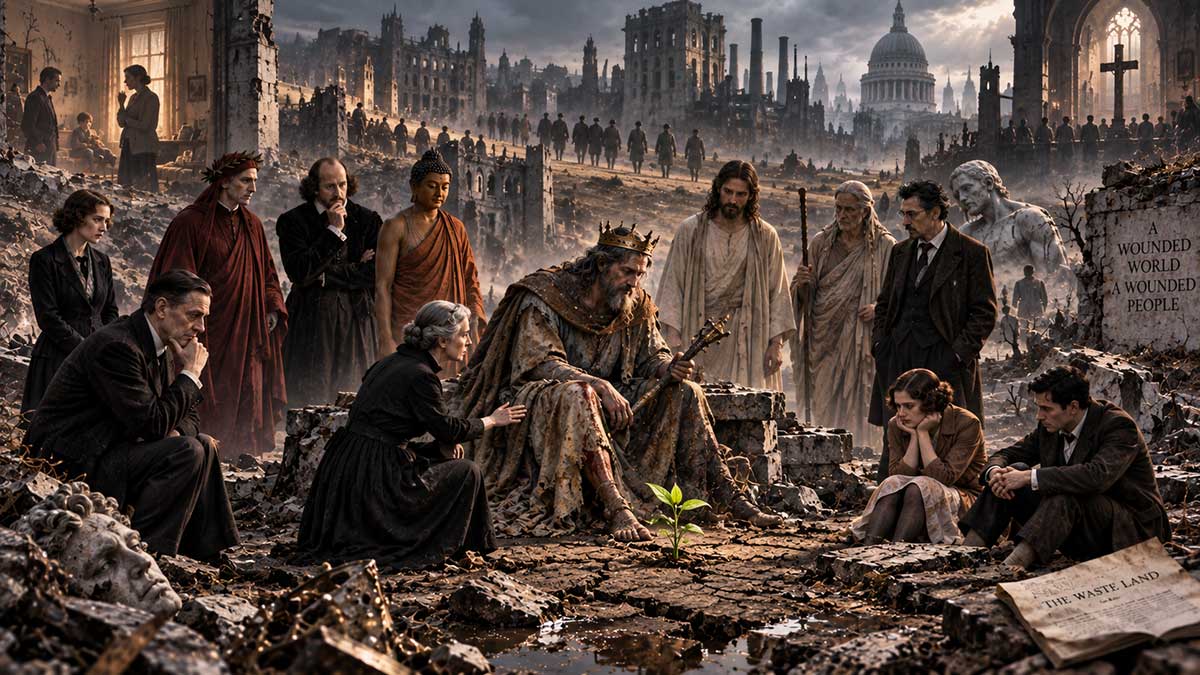
The Waste Land is quieter now.
The fire of the previous conversation has disappeared. So has the Thames.
There is only dry earth.
At the center sits the Fisher King.
Until now, everyone has spoken about him.
Nobody has really spoken to him.
Jessie Weston notices this first.
Weston: We have made a rather revealing mistake.
Eliot: Which one?
Weston: We turned a wounded person into a symbol before asking him whether he was in pain.
The Fisher King raises his eyes.
Fisher King: Scholars are efficient that way.
Pound laughs.
Pound: I like him.
Fisher King: You wouldn't if you were the footnote.
Eliot almost smiles.
Weston approaches him.
Weston: May I ask you something?
Fisher King: Everyone else has.
Weston: What hurts?
The King looks at her for a long time.
Fisher King: That is a better question.
Tiresias stands behind him.
Buddha sits upon the dry ground.
Jesus remains near a dead tree.
Dante and Shakespeare stand beside Eliot.
Vivien stays further away.
The Typist has returned.
So has Lil.
None of them quite knows why.
The First Question: Is the Wound Inside the Individual?
Weston: People reading Eliot will want to know what you represent.
Fisher King: Of course.
Weston: Spiritual illness?
Fisher King: Perhaps.
Weston: Sexual impotence?
Fisher King: Perhaps.
Weston: Civilization?
Fisher King: Perhaps.
Weston: Europe?
Fisher King: Perhaps.
Weston: Eliot himself?
The King looks toward Eliot.
Fisher King: Ask him.
Everyone turns.
Eliot sighs.
Eliot: We knew this was coming.
Vivien: Yes.
Eliot: Then say it.
Vivien: I don't think you are the Fisher King.
Eliot appears surprised.
Vivien: I think that interpretation is too easy.
Eliot: Thank you.
Vivien: I haven't finished.
Pound looks away, hiding a smile.
Vivien: I think you recognized something in him.
Eliot's expression changes.
Eliot: What?
Vivien: The strange experience of feeling that something inside you has become damaged and then seeing the whole world through that damage.
Nobody interrupts.
Vivien: When someone is exhausted, everything looks exhausting.
When someone is frightened, the world fills with threats.
When someone is lonely, every happy couple can feel like an accusation.
When someone loses faith, silence can begin to look like evidence that nobody is listening.
Buddha watches her carefully.
Vivien: The land may not actually be dead.
The wounded person may experience it as dead.
Buddha: Perception matters.
Dante: Yet perception cannot explain everything.
Buddha: No.
Dante: If a city is unjust, telling the suffering person that his perception contributes to his suffering would be inadequate.
Buddha: Completely inadequate.
Jesus: A wounded person can misperceive the world.
A wounded world can injure the person.
Shakespeare: And usually they meet somewhere in the middle.
Eliot: That is closer.
Weston: Closer to what?
Eliot: To why I resist the demand for one interpretation.
He walks across the dry earth.
Eliot: Suppose the Waste Land is psychological.
Then someone points to history.
Suppose it is historical.
Someone points to sex.
Suppose it is sexual.
Someone points to religion.
Suppose it is religious.
Someone points to loneliness.
Pound: And you point to Dante.
Eliot: Frequently.
Shakespeare: Sensible man.
Dante ignores him.
Eliot: Perhaps the mistake is assuming these wounds remain separate.
The Fisher King looks at him.
Fisher King: Now you are beginning to understand me.
Can One Person's Wound Spread?
A house appears in the distance.
Inside, a husband and wife sit at opposite ends of a table.
Neither speaks.
Further away, another house appears.
A child hears an argument through a wall.
Another.
An elderly man eats alone.
Another.
A woman lies beside someone who has stopped asking how she feels.
The images multiply.
Shakespeare: There.
Tiresias: What?
Shakespeare: Transmission.
Weston: Of what?
Shakespeare: Wounds.
He walks among the houses.
Shakespeare: A father is humiliated.
He becomes harsh with his son.
The son grows up swearing never to resemble him.
Then one evening he hears his father's voice coming from his own mouth.
Vivien looks toward Shakespeare.
Shakespeare: A woman is betrayed.
She decides never to trust completely again.
Years later, someone who never betrayed her pays the price.
Buddha: Suffering generating suffering.
Shakespeare: Precisely.
Dante: Sin generating consequences.
Jesus: Hurt producing hurt.
Tiresias: Different vocabularies again.
Eliot: Same houses.
Lil steps forward.
Lil: What about us?
Everyone looks at her.
Lil: You keep talking about wounds people pass deliberately.
Shakespeare: Not deliberately.
Lil: Some aren't passed at all.
She touches her mouth.
Lil: Sometimes life simply takes something.
Children.
Illness.
War.
Age.
Poverty.
Exhaustion.
Vivien: Yes.
Lil: Who do I blame for getting older?
Who do I blame for what childbirth did to me?
Who do I blame for Albert coming home wanting the woman he remembers?
Nobody answers.
Lil: Perhaps some wounds don't have villains.
That thought settles heavily over the group.
Jesus: Yes.
Buddha: Suffering does not require a villain.
Dante: Nor does mortality.
Fisher King: Nor does barrenness.
The Second Question: Can a Relationship Become Wounded?
The beautiful room from Topic 2 reappears.
The Woman sits alone.
Across from her is the empty chair.
Weston: We have spoken about wounded individuals.
What about two people?
Vivien: A relationship can certainly become wounded.
Eliot: How?
Vivien looks at him.
Vivien: One conversation at a time.
The answer is so simple that Eliot seems unsettled by it.
Vivien: People expect relationships to break through enormous events.
Affairs.
Betrayals.
Violence.
Abandonment.
She touches the empty chair.
Vivien: Sometimes they erode through tiny failures of recognition.
You stop asking.
You stop listening.
You assume.
You interpret.
You defend.
You remember the last argument before the new one has begun.
The Woman: Eventually you're no longer speaking to the person.
Vivien: You're speaking to your history with the person.
Buddha: Memory becomes part of perception.
Shakespeare: And expectation writes tomorrow before tomorrow arrives.
The Typist: What happens when you expect nothing?
Vivien looks at her.
Vivien: That may be another kind of wound.
The Typist: That's where I was.
Jesus: Then perhaps indifference isn't the opposite of suffering.
The Typist: What is it?
Jesus: Sometimes it is suffering after hope has become too expensive.
The Typist says nothing.
Tiresias watches her.
Tiresias: I have seen that too.
The Third Question: Can a Civilization Become Wounded?
Dante turns toward London.
The city returns.
London Bridge.
Buildings.
Factories.
Crowds.
Newspapers.
Trains.
Thousands upon thousands of people.
Dante: Now we reach the dangerous question.
Eliot: Civilization.
Dante: Yes.
Shakespeare: We should remember what Eliot told us earlier.
Eliot: I did not intend some simple contrast between a glorious past and a horrible present.
Shakespeare: And rightly so.
My England was hardly Eden.
Dante: Florence wasn't either.
Buddha: Ancient India knew suffering.
Jesus: So did Judea.
Weston: Then what changes?
Pound answers.
Pound: Scale.
Everyone turns.
Pound: A wounded person can damage a household.
A wounded institution can damage thousands.
A wounded idea can damage millions.
Dante: Now define "wounded."
Pound: Fair challenge.
He thinks.
Pound: Perhaps a civilization becomes wounded when the systems it creates begin producing conditions that contradict the human needs those systems were meant to serve.
Eliot: Give an example.
Pound: A city connects millions geographically and leaves them socially isolated.
The Typist looks toward London.
Pound: Commerce produces abundance yet depends upon dissatisfaction.
Buddha nods.
Pound: Communication increases, but meaningful communication can decline.
Shakespeare: More words, less encounter.
Pound: Precisely.
Dante: Yet we mustn't romanticize poverty, ignorance, or premodern life merely to criticize modernity.
Pound: Agreed.
Eliot: Good.
Dante: Civilization can solve old suffering and generate new suffering simultaneously.
Buddha: Human beings can change circumstances without eliminating the mechanisms of suffering.
Jesus: Which returns us to the human heart.
Pound: And institutions.
Jesus: Yes.
Pound: Good.
Jessie Weston Returns to the King
Weston kneels before the Fisher King.
Weston: We have discussed psychology.
Relationships.
Families.
Civilization.
Religion.
Desire.
History.
But your land remains barren.
Fisher King: Yes.
Weston: What heals you?
Fisher King: You want the answer too soon.
Weston: Perhaps.
Fisher King: Everyone does.
Weston: Then give us the wrong answer.
The King laughs for the first time.
Fisher King: Clever.
He looks across his kingdom.
Fisher King: People see barren land and immediately bring water.
Jesus: Reasonable.
Fisher King: Unless lack of water isn't the first cause.
Buddha looks at him.
Fisher King: People see loneliness and bring company.
They see sadness and bring entertainment.
They see anxiety and bring distraction.
They see spiritual emptiness and bring doctrines.
They see marital pain and bring advice.
They see grief and bring explanations.
Vivien closes her eyes.
Fisher King: Human beings are remarkably uncomfortable sitting beside wounds they cannot immediately repair.
Jesus looks toward him.
Jesus: Yes.
Fisher King: Sometimes the first act of healing is not fixing.
Buddha: Seeing.
Fisher King: Yes.
Jesus: Remaining.
The King looks at him.
Fisher King: Yes.
The Typist whispers:
The Typist: Someone staying.
Jesus turns toward her.
She doesn't look back.
Eliot Is Challenged
Tiresias approaches Eliot.
Tiresias: You have been unusually quiet.
Eliot: I am listening.
Tiresias: Convenient.
Eliot: You think I should confess something.
Tiresias: No.
Eliot: Then what?
Tiresias: I want to know why you collected so many wounds.
Eliot looks around.
Lil.
The Typist.
The Woman.
Phlebas beneath the sea.
The Fisher King.
London.
Fragments of relationships.
Fragments of religions.
Fragments of literature.
Eliot: Perhaps since one vocabulary wasn't enough.
Tiresias: Explain.
Eliot: Suppose I say loneliness.
That misses desire.
Suppose I say desire.
That misses mortality.
Suppose I say mortality.
That misses spiritual thirst.
Suppose I say spiritual thirst.
That misses failed relationships.
Suppose I say failed relationships.
That misses civilization.
Suppose I say civilization.
That misses the individual sitting alone at night.
He looks at the Typist.
Eliot: No single language contains the entire wound.
Pound looks at him.
Pound: So you borrowed many.
Eliot: Shakespeare.
Dante.
Buddha.
Christian scripture.
The Upanishads.
Myth.
Popular songs.
Pub conversation.
Ordinary people.
Dante: Fragments.
Eliot: Yes.
Pound: "These fragments..."
Eliot looks at him.
Eliot: Don't finish it for me.
Pound smiles.
The Spiritual Wound
Jesus walks to the dead tree.
Jesus: We have avoided one possibility.
Eliot: Religion.
Jesus: Yes.
Buddha: We haven't avoided it entirely.
Jesus: No, but we have avoided asking whether spiritual separation itself contributes to the Waste Land.
Dante steps closer.
Dante: Now we reach my territory.
Buddha: And perhaps mine, though I would describe the premise differently.
Jesus: Which is why we should not collapse our answers together.
He turns toward Eliot.
Jesus: Your poem reaches repeatedly into religious traditions.
Why?
Eliot: Since those traditions contain languages humanity developed for questions ordinary language struggles to hold.
Jesus: Such as?
Eliot: Death.
Meaning.
Guilt.
Suffering.
Renewal.
Sacrifice.
Desire.
Transcendence.
Buddha: Liberation.
Dante: Judgment.
Upanishadic Sage: The relation between self, action, restraint, giving, and what lies beyond ordinary appetite.
Eliot nods.
Jesus: Then perhaps the spiritual wound is not simply "people stopped believing."
Eliot: Certainly not that simple.
Jesus: Perhaps it is that people continue asking spiritual-sized questions while increasingly seeking answers from things too small to contain them.
Silence.
Buddha considers the wording carefully.
Buddha: I would change the framework, but I recognize the human behavior.
Shakespeare: Give us examples.
Jesus looks toward the city.
Jesus: Asking money to answer, "Am I valuable?"
Asking sex to answer, "Am I loved?"
Asking status to answer, "Does my life matter?"
Asking entertainment to answer, "Why am I here?"
Asking another human being to answer, "Can you make me whole?"
The Woman looks down.
The Young Man looks away.
The Typist stares across the barren land.
Buddha: And I would ask whether the demand to become "whole" in that sense is itself another form of grasping.
Jesus: There we differ.
Buddha: Yes.
Jesus: Good.
Eliot watches them both.
Eliot: Perhaps that disagreement belongs inside the Waste Land too.
The Question Changes
The Fisher King stands.
Everyone becomes silent.
He has remained seated through every previous conversation.
Now, painfully, he rises.
The land does not change.
No flowers appear.
No rain falls.
Fisher King: Look carefully.
They do.
Fisher King: I stood.
Weston: Yes.
Fisher King: Did the land heal?
Weston: No.
Fisher King: Then healing one person may not instantly heal everything surrounding him.
Dante: Important.
Fisher King: Yet look again.
Near his foot, something tiny breaks through the dry soil.
Not a flower.
A green shoot.
Barely visible.
The Typist sees it first.
The Typist: There.
Everyone gathers closer.
Pound: Is that supposed to mean hope?
Eliot: Don't ruin it.
Pound: Fair.
The Fisher King looks at the tiny shoot.
Fisher King: You keep asking what has been wounded.
Perhaps you now understand why there is no single answer.
The individual.
The relationship.
The family.
The community.
The civilization.
The spiritual life.
They touch one another.
Weston: Then how do we heal something so interconnected?
The King looks toward the Upanishadic Sage.
The Sage has been waiting.
Thunder sounds far away.
Once.
Everyone looks upward.
No rain.
The Sage speaks.
Upanishadic Sage: Perhaps you have spent enough time diagnosing the Waste Land.
Eliot: And now?
Another sound of thunder.
Upanishadic Sage: Now we ask what the Waste Land asks of us.
Buddha: What must change?
Jesus: What must be restored?
Dante: What direction must we travel?
Shakespeare: What must we learn about ourselves?
Tiresias looks at the tiny green shoot.
Then at the wounded King standing beside it.
Tiresias: And perhaps the hardest question of all:
If we know what is making the land barren, are we actually willing to live differently?
Thunder rolls across the Waste Land again.
This time everyone hears something within it.
Not yet a word.
But almost.
DA.
Topic 5: Can the Waste Land Bloom Again?
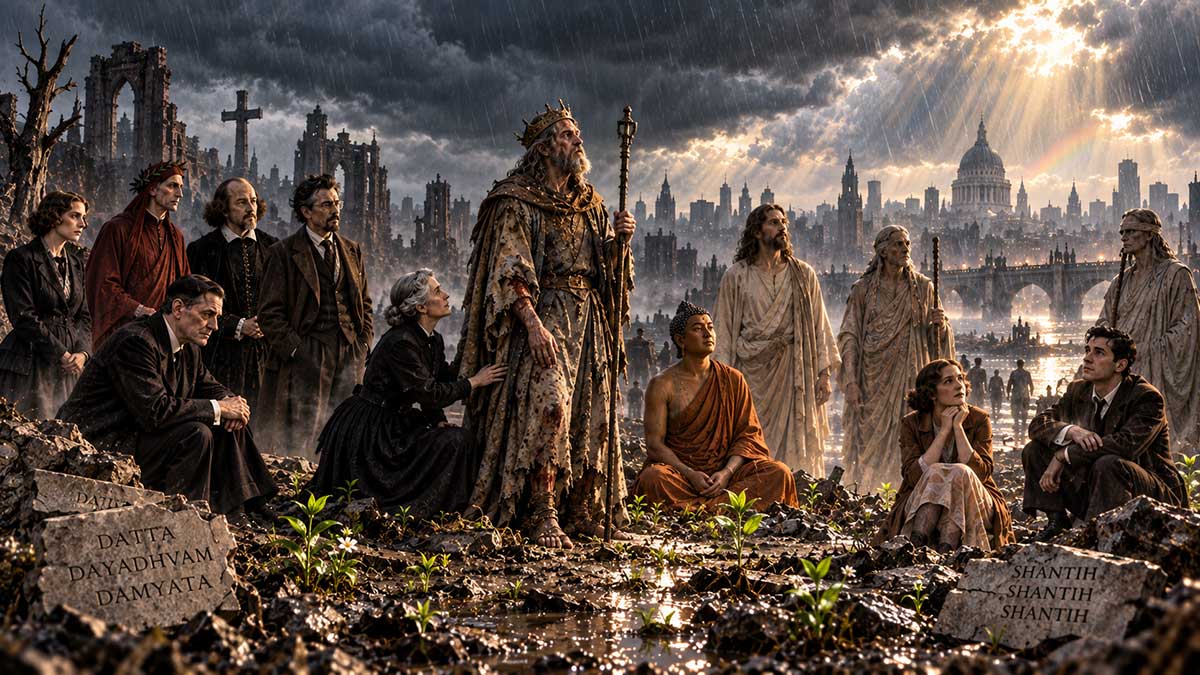
The thunder comes again.
This time there is no mistaking it.
DA.
Everyone looks upward.
The sky remains dry.
No rain follows.
The tiny green shoot beside the Fisher King's foot trembles in the wind.
The Upanishadic Sage steps forward.
Pound: We've waited four conversations for you to explain that.
Upanishadic Sage: Perhaps you needed four conversations before explanation would matter.
Shakespeare: I like him less every time he speaks.
Dante: Which may be evidence that you should listen.
Shakespeare: I like you less too.
Eliot smiles, but his attention remains on the sky.
Eliot: DA.
Upanishadic Sage: Yes.
Eliot: One sound.
Upanishadic Sage: And more than one response.
Buddha rises.
Jesus moves closer.
Jessie Weston stands beside the Fisher King.
Vivien and Pound remain near Eliot.
The Typist, Lil, the Woman, and the Young Man Carbuncular have returned.
Tiresias watches them all.
For the first time, almost every voice that has passed through their conversations occupies the same Waste Land.
The First Question: What Does the Thunder Ask Us to Do?
Upanishadic Sage: You have spent considerable time asking what is wrong.
Loneliness.
Craving.
Failed intimacy.
Fear.
Mortality.
Loss of meaning.
Wounded relationships.
Wounded societies.
Spiritual thirst.
Shakespeare: We were thorough.
Upanishadic Sage: Humans frequently are thorough when diagnosing what other people should change.
Shakespeare glances at Eliot.
Shakespeare: I definitely like him less.
Upanishadic Sage: Now the thunder answers differently.
He looks across the group.
Upanishadic Sage: Not with another diagnosis.
With a demand.
Datta.
Give.
The Typist looks puzzled.
The Typist: Give what?
Upanishadic Sage: An excellent question.
Pound: Money?
Upanishadic Sage: Perhaps.
Lil: Time?
Upanishadic Sage: Perhaps.
Vivien: Attention?
The Sage looks at her.
Upanishadic Sage: Perhaps that is rarer.
Jesus watches Vivien.
Vivien: We talked about recognition.
Seeing the person standing beside you.
Jesus: Yes.
Vivien: Then perhaps giving begins there.
Young Man: How?
Vivien looks at him.
Vivien: By allowing another person to exist without immediately asking what that person can provide for you.
The Young Man looks toward the Typist.
She notices but says nothing.
Buddha: That requires loosening attachment to the self's demands.
Jesus: And turning attention outward.
Dante: Love moves us beyond self-enclosure.
Shakespeare: Yet giving can become selfish too.
Everyone turns toward him.
Upanishadic Sage: Explain.
Shakespeare: People give to be admired.
They give so others owe them.
They give affection expecting affection returned.
They sacrifice and then keep an invisible ledger.
Pound: You've met humanity.
Shakespeare: Frequently.
Buddha: Then intention matters.
Jesus: Very much.
Shakespeare: So "give" isn't as simple as handing something away.
Upanishadic Sage: No.
He looks at the dry earth.
Upanishadic Sage: Sometimes what must be surrendered is the insistence that everything return to you.
That quiets them.
Datta: What Would You Give?
The Sage turns toward Pound.
Upanishadic Sage: Ezra.
Pound: Why me first?
Upanishadic Sage: What would you give?
Pound thinks.
Pound: My judgment.
Shakespeare: That's not giving. You distribute it freely.
Pound laughs.
Pound: Fair.
He looks toward Eliot.
Pound: Perhaps my ability to see what another person has made and help it become what it could be.
Eliot meets his eyes.
Eliot: You did.
Pound shrugs.
Pound: Occasionally.
The Sage turns toward Vivien.
Vivien: Attention.
Upanishadic Sage: Why?
Vivien: Since I know what it feels like when two people stop giving it to one another.
Then Lil.
Lil: Patience.
She pauses.
Lil: But I would like someone to give some back.
Upanishadic Sage: Giving does not forbid receiving.
Lil nods.
The Typist is next.
The Typist: I don't know.
Upanishadic Sage: Then don't manufacture an answer.
She thinks longer.
The Typist: Maybe honesty.
Upanishadic Sage: About what?
The Typist: About what I actually want.
Buddha watches her.
The Typist: I spent so long pretending I didn't care that eventually I couldn't tell the difference between independence and giving up.
Vivien looks at her.
Vivien: That's a very expensive form of protection.
The Typist nods.
The Sage turns toward the Young Man.
Young Man: I suppose everyone expects me to say respect.
Shakespeare: Do you mean it?
Young Man: I don't know yet.
Upanishadic Sage: Then keep the question.
Finally, Eliot.
Upanishadic Sage: Thomas?
Eliot looks across his Waste Land.
Eliot: Fragments.
Pound: That's very poetic of you.
Eliot: I mean it.
He looks at the people around him.
Eliot: Perhaps the poem itself was something given.
Not an answer.
Not a doctrine.
Fragments of things I had received from other people.
Dante.
Shakespeare.
Scripture.
Buddhist teaching.
The Upanishads.
Myth.
Ordinary conversation.
Songs.
Voices.
Dante: You inherited them.
Eliot: And rearranged them.
Pound: With assistance.
Eliot: Considerable assistance.
Pound smiles.
Dayadhvam: Can We Enter Another Person's Suffering?
Thunder.
DA.
The Sage continues.
Upanishadic Sage: Dayadhvam.
Compassion.
The Waste Land changes.
Doors appear everywhere.
Behind one is the Typist's apartment.
Behind another, Lil's home.
Another contains the Woman's beautiful room.
Another opens onto Eliot's private suffering.
Another onto Vivien's.
Another onto the Fisher King's barren kingdom.
Each door is closed.
Dante: What are these?
Upanishadic Sage: Other people.
Shakespeare: Rather inconvenient architecture.
Upanishadic Sage: Appropriate architecture.
He walks to one door.
Upanishadic Sage: Every human being you meet contains rooms you have never entered.
Memories you did not witness.
Fear you cannot see.
Grief they cannot explain.
Desires they may not understand themselves.
Jesus: Which is why judgment can be so easy.
Buddha: And compassion difficult.
Dante: Yet compassion cannot mean pretending harmful actions are harmless.
Jesus: No.
Buddha: No.
Shakespeare: Good.
Dante: A person can be wounded and still wound others.
Vivien: Yes.
Her answer comes quickly.
Everyone hears it.
Vivien: We need that sentence.
She looks around.
Vivien: Otherwise suffering becomes an excuse for everything.
Jesus: Compassion can recognize a person's wound without approving every action arising from it.
Buddha: Compassion without discernment can become confusion.
Dante: Then compassion requires truth.
Jesus: Yes.
The Typist looks toward the Young Man.
The Typist: I can understand him without saying what happened was meaningful.
Young Man: And I can admit that I barely thought about what you experienced.
The Typist looks surprised.
Young Man: I'm not asking you to forgive me.
The Typist: Good.
Young Man: I'm just saying...
He struggles.
Young Man: I didn't see you.
Vivien closes her eyes briefly.
There it is again.
Recognition.
The Typist: No.
A pause.
The Typist: You didn't.
She does not embrace him.
She does not forgive him dramatically.
Nothing sentimental happens.
But something has changed.
For perhaps the first time, they are actually speaking to one another.
Tiresias notices.
Damyata: What Must We Control?
The thunder sounds a third time.
DA.
Upanishadic Sage: Damyata.
Self-control.
Shakespeare immediately turns toward Buddha.
Shakespeare: Your turn.
Buddha: Why mine?
Shakespeare: We have been discussing desire for three topics.
Buddha: Fair.
He looks at the city.
Buddha: People often hear self-control and think it means suppressing every desire.
That is too crude.
The more interesting question is whether you can experience desire without automatically obeying it.
Young Man: Sex?
Buddha: Certainly.
Pound: Money?
Buddha: Yes.
Shakespeare: Anger?
Buddha: Yes.
Vivien: The desire to win an argument?
Buddha smiles.
Buddha: Very much.
Eliot looks toward her.
Vivien notices.
Neither comments.
Jesus: Restraint creates space between impulse and action.
Dante: And character is often formed within that space.
Buddha: Yes.
Shakespeare: Yet I want to complicate this again.
Pound: Naturally.
Shakespeare: Can too much control create another Waste Land?
Eliot looks sharply toward him.
Shakespeare: A person controls anger.
Controls sexuality.
Controls grief.
Controls vulnerability.
Controls affection.
Controls every dangerous feeling.
Eventually nothing moves.
He turns toward Eliot.
Shakespeare: Is that health?
Eliot doesn't answer immediately.
Buddha: Suppression and discipline are not identical.
Jesus: Nor are restraint and emotional death.
Shakespeare: Good.
Vivien: Sometimes people call something self-control when they are actually afraid to feel.
Eliot looks toward the barren ground.
Eliot: Yes.
The answer is barely audible.
The Harder Question: Are These Three Enough?
Pound steps forward.
Pound: I have a problem.
Upanishadic Sage: Good.
Pound: Give.
Compassion.
Self-control.
Beautiful.
But wars continue.
Poverty continues.
People betray each other.
Institutions fail.
People die.
Children suffer.
Civilizations collapse.
He gestures across the Waste Land.
Pound: Are three words supposed to fix this?
Upanishadic Sage: No.
Pound looks surprised.
Upanishadic Sage: Thunder does not govern civilizations for you.
It addresses the listener.
Pound: That's convenient.
Upanishadic Sage: It is demanding.
Pound: Why?
Upanishadic Sage: Since blaming civilization allows you to remain unchanged.
Pound becomes silent.
Upanishadic Sage: You cannot personally repair every institution.
You cannot eliminate mortality.
You cannot prevent every betrayal.
You cannot make every wounded person whole.
He looks across them.
Upanishadic Sage: But you can ask:
What do I give?
Where do I lack compassion?
What desire governs me?
What am I doing to the people beside me?
Jesus: Transformation beginning close to the person.
Dante: Yet extending beyond the person.
Buddha: Action matters.
Upanishadic Sage: Yes.
Can Religion Heal the Waste Land?
Eliot finally asks the question that has hovered over every conversation.
Eliot: What about God?
Everyone becomes quiet.
Buddha looks toward him.
Dante does too.
Jesus waits.
Eliot: We have spoken carefully around this.
But readers will ask.
Is the Waste Land ultimately a world separated from God?
Dante answers first.
Dante: From my tradition, separation from the highest good is fundamental.
Jesus: I would speak of reconciliation, love, repentance, grace, and renewed relationship with God and neighbor.
Buddha speaks next.
Buddha: My account does not begin from separation from a creator God. Suffering is approached through craving, ignorance, impermanence, ethical conduct, mental discipline, and awakening.
Eliot nods.
Eliot: So these cannot simply be merged.
Buddha: They should not be.
Jesus: Agreement purchased by erasing difference isn't genuine agreement.
Upanishadic Sage: Nor should the Upanishadic tradition be reduced to three English moral slogans detached from its larger philosophical setting.
Pound: Then why put all these traditions in one poem?
Everyone looks toward Eliot.
He takes his time.
Eliot: Perhaps since I wasn't building a new religion from fragments.
Dante: Then what?
Eliot: Listening.
Pound: To what?
Eliot: Humanity.
He looks around.
Eliot: What have human beings said across centuries when confronting death?
Desire?
Emptiness?
Suffering?
Love?
Meaning?
The possibility of renewal?
Shakespeare: And you found no single voice sufficient.
Eliot: No.
Buddha: Nor should difference itself frighten us.
Jesus: No.
Dante: Provided we don't pretend differences mean nothing.
Eliot: Exactly.
Phlebas Returns
Water appears.
At first everyone celebrates.
Then Tiresias looks worried.
Tiresias: Wait.
Something floats beneath the surface.
Phlebas.
The Phoenician.
He rises from the water, no longer young, no longer old, belonging to neither category.
Phlebas: You wanted rain.
Nobody speaks.
Phlebas: Be careful with symbols.
Weston: Water gives life.
Phlebas: Water killed me.
The green shoot beside the Fisher King bends beneath the first drops.
Phlebas: You keep asking whether the Waste Land can bloom again.
Perhaps.
But renewal isn't the same as escaping death.
Dante: No.
Buddha: Everything conditioned changes.
Jesus: Death remains central to the question of renewal.
Phlebas: Then remember me.
He looks at Pound.
Then Eliot.
Then everyone.
Phlebas: Wealth disappears.
Youth disappears.
Beauty disappears.
Status disappears.
Eventually even the body disappears.
He sinks slowly.
Phlebas: Decide what matters before the water decides for you.
The river becomes still.
Will the Rain Come?
The first drop falls.
Then another.
Everyone looks upward.
The Typist holds out her hand.
A drop lands upon it.
The Typist: Rain.
Weston looks toward the Fisher King.
Weston: Are you healed?
The King touches his wound.
Fisher King: Not completely.
Weston: Is the land healed?
He looks outward.
Fisher King: Look.
The rain remains light.
Much of the earth is still barren.
Yet here and there, tiny green shoots appear.
Not everywhere.
Not dramatically.
No miraculous garden erupts.
Pound: That's it?
Eliot: What did you expect?
Pound: Something more decisive.
Shakespeare: Audiences always do.
Dante: Real transformation is rarely a final scene.
Buddha: Nor does one moment end every pattern of craving.
Jesus: Nor does one act of love remove every wound.
Vivien looks at Eliot.
Vivien: Some things remain broken.
Eliot looks back.
Eliot: Yes.
Vivien: And we live anyway.
Eliot: Yes.
There is no reconciliation scene.
No explanation.
Yet they are finally looking directly at each other.
Tiresias' Final Question
Tiresias walks through the rain.
He looks younger for a moment.
Then older.
Male.
Female.
Neither.
Both.
Witness.
He looks at London.
At the Fisher King.
At the Typist.
At Lil.
At Vivien and Eliot.
At Pound.
At Shakespeare and Dante.
At Buddha.
At Jesus.
At the Upanishadic Sage.
Tiresias: I have watched humanity ask for rain for thousands of years.
He kneels beside one of the tiny shoots.
Tiresias: You ask for civilizations to heal.
For marriages to heal.
For loneliness to disappear.
For desire to stop tormenting you.
For faith to return.
For suffering to make sense.
For someone to tell you what the Waste Land means.
He touches the wet earth.
Tiresias: Perhaps Eliot cannot tell you.
Eliot nods.
Tiresias: Perhaps none of us can.
He stands.
Tiresias: But the thunder did not ask whether you understood the Waste Land.
It asked something harder.
The Sage closes his eyes.
Datta.
What will you give?
Dayadhvam.
Whose suffering will you truly see?
Damyata.
What within yourself must you learn not to obey?
The rain becomes slightly stronger.
Tiresias looks directly at Eliot.
Tiresias: Thomas, after everything we have said, what exactly is the Waste Land?
Eliot looks across the wet earth.
For four topics he has resisted answering.
Now he smiles faintly.
Eliot: I think you are still asking the wrong question.
Tiresias smiles too.
Tiresias: Good.
Eliot: Perhaps the question is not whether we live in the Waste Land.
He watches the tiny shoots moving beneath the rain.
Eliot: Perhaps the question is what we do once we recognize that part of it lives within us.
Nobody answers.
They don't need to.
The Fisher King remains wounded.
The Typist remains uncertain.
Vivien and Eliot remain complicated.
Human desire has not disappeared.
London remains London.
Death remains.
The Waste Land has not become Paradise.
But it is raining.
And somewhere beyond the voices, beyond Shakespeare and Dante, beyond Buddha and Jesus, beyond Eliot's fragments and Pound's cuts, thunder fades into a final word:
Shantih.
Shantih.
Shantih.
Final Thoughts
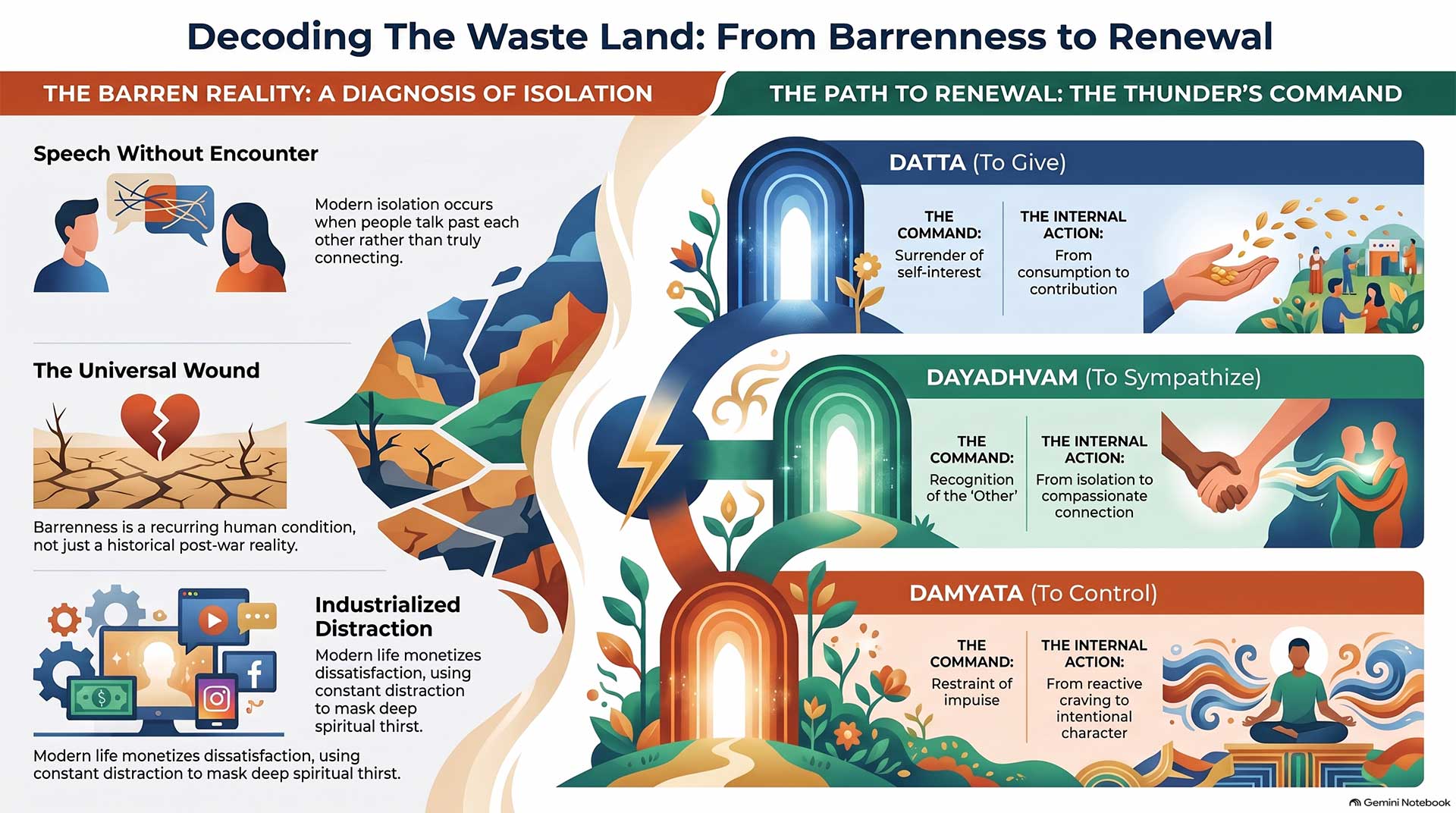
Perhaps the most surprising discovery in this conversation is that The Waste Land may become less mysterious when we stop demanding that every symbol mean exactly one thing.
The Fisher King's wound can suggest personal suffering without being only psychological.
The barren land can suggest civilization without being only political or historical.
The failed relationships can reveal sexual and emotional alienation without reducing the entire poem to sexuality.
The religious fragments can express spiritual hunger without turning Eliot's poem into a simple sermon.
These wounds overlap.
A wounded person can wound a relationship. Wounded relationships can affect families. Families shape communities. Cultures shape individual desires. People then carry those desires back into their relationships.
The Waste Land becomes less like a location and more like a recurring human condition.
Our conversation uncovered another important distinction.
Humanity's problem may not be desire itself.
Food, companionship, love, security, achievement, beauty, pleasure, and recognition can genuinely matter. The problem begins when we demand that limited things answer unlimited questions:
Am I valuable?
Am I loved?
Does my life matter?
Why am I here?
Can someone make me whole?
This helps explain why Eliot's encounter with Buddhist thought matters. Craving promises satisfaction, satisfaction passes, and another desire appears.
Christian language introduces a different question: what if some forms of human thirst are being directed at things incapable of satisfying them?
Dante asks what our repeated desires are turning us into.
Shakespeare reminds us that destructive desire is hardly unique to modernity.
Then Eliot reaches the Upanishads.
Datta. Dayadhvam. Damyata.
Give.
Show compassion.
Practice self-control.
These are striking responses to the failures we have witnessed.
People take from one another. The thunder says: give.
People fail to recognize the suffering of the person beside them. The thunder calls for compassion.
People become governed by appetite and impulse. The thunder calls for self-control.
Yet Eliot does not finish by transforming the Waste Land into Paradise.
That may be one of the poem's greatest strengths.
People remain wounded.
Death remains.
Desire remains.
Human relationships remain difficult.
The different religious traditions remain genuinely different.
The Fisher King's wound does not need to vanish completely for the first green shoot to appear.
Perhaps renewal begins much more quietly.
Someone finally sees another person.
Someone gives without demanding repayment.
Someone feels desire without automatically obeying it.
Someone admits a wound instead of passing it to someone else.
Someone remains beside another person's suffering without immediately trying to explain it away.
And perhaps this is why the final Shantih, Shantih, Shantih feels so different from a conventional happy ending.
The Waste Land has not disappeared.
But somewhere within it, rain may finally be possible.
Short Bios:
T. S. Eliot (1888-1965)
American-born British poet, critic, and playwright whose The Waste Land became one of the defining works of literary modernism. Eliot combined contemporary voices with literature, mythology, religion, and multiple languages to create the poem's fragmented structure.
Ezra Pound (1885-1972)
American poet and major modernist figure who performed extensive editorial work on Eliot's manuscript. Eliot acknowledged Pound's contribution by dedicating The Waste Land to him as "il miglior fabbro," the better craftsman.
Vivien Haigh-Wood Eliot (1888-1947)
Eliot's first wife. Their troubled marriage coincided with the period surrounding the creation of The Waste Land. Her comments appear on surviving manuscript material, giving her a direct connection to the poem's development.
William Shakespeare (1564-1616)
English playwright and poet whose works Eliot repeatedly references. Shakespeare brings an older literary witness to love, jealousy, ambition, betrayal, mortality, family conflict, and destructive desire.
Dante Alighieri (c. 1265-1321)
Italian poet and author of The Divine Comedy. Eliot drew extensively from Dante, particularly imagery of spiritually lost humanity and crowds of the dead.
Gautama Buddha
Teacher whose teachings became the foundation of Buddhism. Eliot invokes the Buddhist Fire Sermon while exploring desire, craving, suffering, and the possibility of liberation from attachment.
Jesus
Central figure of Christianity. Christian imagery, scripture, death, resurrection, spiritual thirst, suffering, and renewal run throughout Eliot's poem and become increasingly prominent near its conclusion.
Upanishadic Sage
A representative voice for the ancient Indian philosophical tradition Eliot invokes near the poem's ending. The thunder's "DA" draws from the Brihadaranyaka Upanishad and its teachings concerning giving, compassion, and self-control.
Tiresias
The blind prophet of Greek mythology who occupies an unusually important position within The Waste Land. Eliot described Tiresias as the figure who connects the poem's different characters and experiences.
Jessie L. Weston (1850-1928)
British scholar whose From Ritual to Romance explored Grail traditions and the wounded Fisher King. Eliot credited Weston's work with influencing the title, plan, and symbolism of The Waste Land.
The Fisher King
A wounded ruler associated with Grail tradition whose injury is mysteriously connected to the barrenness of his kingdom. Within Eliot's symbolic structure, he becomes one of the strongest images connecting personal wounds with a sterile land.
The Typist
An unnamed young working woman in "The Fire Sermon." Her emotionally empty encounter with the Young Man Carbuncular becomes one of Eliot's starkest portrayals of physical intimacy separated from meaningful human connection.
Lil
A working-class married woman discussed during the pub scene of "A Game of Chess." Her experiences of childbirth, aging, marriage, physical exhaustion, and social expectations bring the poem's questions into ordinary domestic life.
Phlebas the Phoenician
The drowned sailor of "Death by Water." His brief appearance strips away distinctions of youth, commerce, status, and worldly ambition through the universality of mortality.
Leave a Reply