


Introduction
What would The Waste Land look like if T. S. Eliot were observing ordinary people living today?
Not characters wandering through 1920s London, but a technology executive surrounded by screens, a Seoul attorney who keeps postponing his life, a social media star who gets almost everything she wants, a Chicago restaurant owner suddenly confronted by mortality, and a mother and son in Tokyo who have spent seven years waiting for the other person to make the first move.
These five stories do not retell Eliot's poem.
Instead, they take the questions we uncovered in Parts 1 and 2 and magnify them inside modern life.
Why can people surrounded by communication still feel unseen?
How much life can disappear into the words "after this"?
Why does getting what we want so often create another thing to want?
What becomes important when time is suddenly limited?
And can something broken begin healing even when it can never return to what it was before?
Across these stories, the modern Waste Land appears in different forms: loneliness, ambition, endless desire, distraction, mortality, pride, estrangement, and the habit of waiting for life to become different before we fully enter it.
But Eliot's poem does not end only with barrenness.
There is thunder.
There is the possibility of giving, compassion, and self-control.
There is water.
And finally, there is "Shantih."
These stories therefore follow the same deeper movement:
Connection → Waiting → Desire → Mortality → Renewal
The question is no longer simply, "What did T. S. Eliot mean?"
It becomes much more personal:
Where does the Waste Land exist in modern life, and what might allow something within it to become fertile again?
(Note: This is an imaginary conversation, a creative exploration of an idea, and not a real speech or event.)
Story 1: The House With Six Screens

At 6:12 every morning, Daniel Mercer woke to six different versions of the world.
The television mounted across from his bed showed financial news with the sound muted.
His phone displayed overnight messages from New York, London, Singapore, and San Francisco.
A tablet on the nightstand refreshed his calendar.
The monitor on the far wall showed company metrics.
His laptop blinked with unanswered email.
And the small screen built into the kitchen refrigerator reminded him that he was running low on almond milk.
Before Daniel had spoken a word to another human being, more than three hundred people had already reached him.
He liked that.
It made the apartment feel less empty.
"Morning."
The apartment answered.
"Good morning, Daniel. Today's first meeting begins at 7:30 a.m."
Daniel walked barefoot across the polished floor toward the windows.
Manhattan stretched beneath him.
Tiny yellow taxis.
Tiny people.
Tiny lives.
From the forty-third floor, the city looked manageable.
That was one reason he liked living so high.
Everything messy became geometry.
He opened his messages.
Twenty-seven from work.
Six from friends.
Three from women he had dated.
One from his ex-wife.
None from Sophie.
Daniel opened the message thread with his daughter anyway.
Monday
How was chemistry?
No answer.
Tuesday
Your mom says applications are coming up. Happy to review anything.
No answer.
Wednesday
Saw this article about engineering programs. Thought you'd like it.
No answer.
Thursday
Dinner Sunday?
No answer.
Daniel stared at the screen.
"Typical."
He put the phone down.
Then picked it up again.
He typed:
You alive?
He stared at the message.
Deleted it.
Typed:
Hope you're having a good week.
Deleted that too.
Finally he locked the phone.
At 7:29, his face appeared across seventeen screens in seventeen homes.
"Morning, everyone."
"Morning, Daniel."
"Good morning."
"Morning."
"Hey, Dan."
Daniel smiled.
"Let's get right into it."
For the next four hours, he spoke continuously.
Revenue projections.
Product delays.
Employee retention.
Artificial intelligence.
Acquisitions.
Expansion.
Risk.
By noon, he had communicated with forty-three people.
At 12:08, his assistant entered the office.
"Your lunch is here."
"Great."
"And the architect confirmed for tonight."
Daniel looked up.
"What architect?"
"Maya Chen."
He stared.
"Who?"
His assistant smiled.
"Your date."
"Oh."
Daniel remembered.
"Right."
"You asked me to book Lenoir."
"Did I?"
"Two weeks ago."
Daniel rubbed his forehead.
"How do you know more about my personal life than I do?"
"Because you calendar it."
He laughed.
"Fair."
His assistant put the lunch on the desk.
"Anything else?"
Daniel glanced at his phone.
Still nothing from Sophie.
"No."
Then:
"Actually."
His assistant stopped.
"Do teenagers just stop answering people?"
"Some do."
"For how long?"
"Are we discussing teenagers generally?"
Daniel smiled.
"Never mind."
She closed the door.
Daniel ate while answering emails.
He barely tasted lunch.
By seven that evening, he had forgotten what it was.
Maya was already sitting at the table when he arrived.
Daniel immediately noticed that she was not checking her phone.
Most people did.
He usually did.
But Maya was looking around the restaurant.
Not impatiently.
Curiously.
Daniel approached.
"Sorry I'm late."
She looked at the clock on the wall.
"Two minutes."
"Still late."
"I'll survive."
Daniel smiled.
"I like your optimism."
"You don't know me yet."
"That's what dinner is for."
He sat.
The waiter appeared.
Daniel ordered wine before Maya opened the menu.
"You drink red?"
"Sometimes."
"This one is good."
She closed the wine list.
"Then we'll trust you."
Daniel was good at first dates.
Extremely good.
He knew how much to ask.
How much to reveal.
How to make confidence feel relaxed.
How to turn business stories into funny stories.
How to mention success without appearing to mention success.
He asked Maya about architecture.
She told him she designed public spaces.
Parks.
Libraries.
Transit stations.
"You're responsible for places people hate waiting in."
"Sometimes."
"What makes a good station?"
"People understanding where they are."
Daniel laughed.
"That's philosophical."
"No. It's signage."
He liked her.
She was not trying to impress him.
That was unusual.
They talked for almost two hours.
Daniel mentioned his divorce at exactly the right point.
Not too early.
Not too late.
"We were good for a long time."
"What happened?"
Daniel took a sip of wine.
"We grew apart."
Maya nodded.
Daniel continued.
"No drama. No betrayal. Nothing like that."
"That's almost harder."
He looked at her.
"Why?"
"Because then you can't blame one event."
Daniel smiled.
"You're dangerous."
"Why?"
"You ask follow-ups."
"You don't like follow-ups?"
"Depends."
"On?"
"Whether I have a good answer."
She smiled.
Dessert arrived.
Maya tasted hers.
Then she asked:
"Do you have children?"
"One daughter."
"How old?"
"Sixteen."
"What's she like?"
Daniel answered immediately.
"Brilliant."
Maya waited.
"Very independent."
She waited again.
"Good student."
Another pause.
Daniel smiled.
"What?"
"Nothing."
"That's not nothing."
Maya put her spoon down.
"You described her like an admissions counselor."
Daniel laughed.
"That's harsh."
"Maybe."
"She's funny."
"What makes her laugh?"
Daniel opened his mouth.
Stopped.
Maya noticed.
Daniel looked down at the table.
"Stupid videos."
"What kind?"
"I don't know."
"Music?"
"Yes."
"What does she listen to?"
He laughed nervously.
"You're interviewing me about my daughter now?"
"No."
She took another bite.
"I'm trying to figure out whether you know her."
Daniel's smile disappeared.
"Of course I know her."
Maya nodded.
"Okay."
The conversation moved on.
But something had changed.
On the ride home, Daniel opened Sophie's social media page.
He told himself he was simply curious.
He scrolled.
Concert photographs.
Friends.
A school event.
A drawing.
A video of Sophie laughing so hard she could barely speak.
Daniel watched it twice.
He did not know what was funny.
His second date with Maya was better.
So was the third.
By the fifth, Daniel had already begun imagining where she might fit.
That was how his mind worked.
Maya in the apartment.
Maya meeting Sophie.
Maya at Christmas.
Maya beside him on vacation.
He was good at projecting futures.
Less good at inhabiting presents.
One Friday evening, Maya came to his apartment for the first time.
She walked into the living room and stopped.
"Wow."
Daniel smiled.
"Too much?"
She counted.
"One."
"What?"
"Two."
She turned.
"Three."
Then toward the kitchen.
"Four."
The tablet.
"Five."
His phone.
"Six."
Daniel laughed.
"You counting screens?"
"Yes."
"Why?"
"I've never seen this many in one apartment."
"Occupational hazard."
"For a tech executive?"
"For an information addict."
She walked toward the windows.
The city glittered below.
"This view is incredible."
Daniel came beside her.
"Best thing about the apartment."
Maya looked at him.
"Really?"
"What?"
"Nothing."
Daniel groaned.
"You do that a lot."
"Do what?"
"Say nothing while clearly saying something."
"Maybe I'm learning from you."
He laughed.
"Okay. What were you going to say?"
She looked around the apartment.
"It feels like nobody lives here."
Daniel's expression changed.
"That's dramatic."
"I'm not insulting it."
"Sounds like an insult."
"It's beautiful."
"Thank you."
"That's not the same thing."
Daniel walked toward the kitchen.
"Wine?"
"Sure."
He opened a bottle.
Maya followed.
She looked at the refrigerator screen.
Weather.
Calendar.
Stock market.
Dinner reservations.
"Do you ever turn any of this off?"
"Why would I?"
"Quiet."
"I have quiet."
"No."
He looked at her.
"What do you mean?"
She gestured around.
"You have silence."
He frowned.
"What's the difference?"
Maya leaned against the counter.
"Silence is when nothing is making sound."
She looked toward the six screens.
"Quiet is when nothing is demanding you become someone."
Daniel stared at her.
"Architecture again?"
She smiled.
"No."
They drank.
Later, sitting on the couch, Maya asked:
"When was the last time you were scared?"
Daniel laughed.
"That's sudden."
"Answer."
"Company acquisition last year."
"That wasn't what I meant."
"I was scared."
"Of losing money?"
"Of making the wrong call."
"Still not what I mean."
Daniel leaned back.
"Okay, therapist."
"I'm not a therapist."
"Clearly."
She nudged him with her foot.
"I'm serious."
"So am I."
Maya looked at him.
"When was the last time you told someone something you couldn't control their reaction to?"
Daniel stopped smiling.
"What kind of question is that?"
"A question."
"Give me an example."
"No."
"Why not?"
"Because then you'll answer the example instead of the question."
Daniel laughed.
"You know, you're very manipulative."
"Daniel."
He looked away.
His television displayed a silent market report.
Graphs moved across the screen.
His phone buzzed.
He picked it up automatically.
Maya looked at him.
Daniel glanced at the notification.
Work.
He put the phone facedown.
"See?"
Maya smiled.
"Progress."
Daniel stared at his hands.
"I don't know."
"You don't know the last time?"
"No."
"Really?"
He thought.
He had told investors things they did not want to hear.
He had fired people.
He had asked Rachel for a divorce.
He had negotiated contracts worth hundreds of millions of dollars.
He had announced layoffs.
But Maya was asking something else.
Something without leverage.
Something without preparation.
Something that could not be recovered through competence.
He shook his head.
"I don't know."
Maya nodded.
She did not push.
That made it worse.
Sunday morning, Rachel called.
Daniel was in the gym.
"Hey."
"Are you seeing Sophie today?"
"I invited her."
"That's not what I asked."
Daniel stopped running.
"She didn't answer."
Rachel sighed.
"Daniel."
"What?"
"Call her."
"I've messaged her."
"Call her."
"If she wanted to talk, she'd respond."
There was a silence.
Daniel immediately became defensive.
"What?"
"Nothing."
"Don't do that."
"Do what?"
"That judgmental silence."
Rachel laughed softly.
"That's interesting."
"What is?"
"You hate silence now?"
Daniel lowered the treadmill speed.
"What does that mean?"
"Call your daughter."
The line went dead.
Daniel stared at the phone.
Then called Sophie.
Straight to voicemail.
He hung up.
Called again.
Voicemail.
He typed:
Your mom says I should call.
He stopped.
Deleted it.
He tried again.
Want lunch?
Deleted that too.
Then he opened the entire message history.
Months of messages.
Maybe years.
Appointments.
Links.
Reminders.
Congratulations.
Advice.
Schedules.
Questions about school.
Questions about applications.
Questions about her future.
Daniel scrolled faster.
He searched for one question.
How are you?
There were several.
But almost always followed by something.
How are you doing with chemistry?
How are you feeling about applications?
How are you doing with your mom?
How are you managing your schedule?
He kept scrolling.
He could not find:
How are you?
Full stop.
Nothing after it.
No objective.
No problem to solve.
No answer required.
Daniel sat down on the gym floor.
The phone rang.
Sophie.
He answered instantly.
"Hey."
"What?"
Daniel blinked.
"What?"
"You called twice."
"Oh."
"Is something wrong?"
"No."
"Then what?"
Daniel stood.
"I thought maybe we could have lunch."
"I can't."
"Why?"
"I'm with Emma."
"Who's Emma?"
Silence.
Daniel knew immediately.
He should not have asked it like that.
"Never mind."
Sophie sighed.
"I told you about her."
"When?"
"Like three times."
Daniel tried to recover.
"Right. Emma."
"You don't remember."
"I do."
"No, you don't."
"Sophie."
"What?"
Something in her voice sounded older than sixteen.
Daniel hated it.
He tried another approach.
"How's school?"
Silence again.
Then:
"Seriously?"
"What?"
"You called me to ask about school?"
"I was just asking."
"You always ask."
Daniel felt irritated.
"What am I supposed to ask?"
"I don't know."
"Then why are you angry?"
"I'm not angry."
"You sound angry."
"Okay."
"That's not an answer."
"Neither are your questions."
Daniel froze.
"What does that mean?"
Sophie said:
"You don't talk to me."
"Excuse me?"
"You manage me."
Daniel stood completely still.
"I manage you?"
"You send me stuff. You ask about grades. You remind me about applications. You tell me what to do."
"Because I'm your father."
"I know."
"Then what do you want?"
"I don't know."
"That's helpful."
Immediately:
"Forget it."
"Sophie."
"No."
"Sophie, wait."
"You asked me what I want like it's another thing you're supposed to solve."
Daniel felt something rising inside him.
Frustration.
Fear.
The instinct to explain.
"I am trying to help you."
"I know."
"Then what's the problem?"
She was quiet.
When she spoke again, her voice had changed.
"I don't think you know me."
Daniel almost laughed.
Not because it was funny.
Because the alternative was panic.
"Of course I know you."
"What's my favorite song?"
"What?"
"What's my favorite song?"
"That's ridiculous."
"Who's Emma?"
Daniel said nothing.
"What class do I hate?"
Silence.
"What did I draw last week?"
He remembered the social media post.
"A building."
"It wasn't a building."
"What was it?"
"Doesn't matter."
"Sophie."
She was crying now.
Daniel heard it.
His entire body tightened.
"Soph."
"You know what schools I'm applying to."
She tried to steady her voice.
"You know my GPA."
"Sophie..."
"You know what time I have practice."
"I..."
"You know everything about me that can go on a spreadsheet."
Daniel closed his eyes.
"I'm your father. I'm trying to make sure you're okay."
"You don't know if I'm okay."
"I ask you."
"No."
She paused.
"You ask whether I'm performing okay."
Daniel had no answer.
Then she said:
"I have to go."
"Sophie, don't hang up."
But she did.
Daniel stared at the phone.
His reflection stared back from the black screen.
Behind him, every television in the gym showed something different.
News.
Sports.
Markets.
Weather.
People talking everywhere.
Daniel heard none of it.
That night, he sent Maya a message.
Are you awake?
She replied:
Yes.
He called.
She answered.
"What happened?"
"Why do you assume something happened?"
"Because you never call. You schedule."
Despite himself, he laughed.
Then he told her about Sophie.
Not the edited version.
Not the funny version.
Not the version where Daniel was the concerned father struggling with a difficult teenager.
He told her what Sophie had said.
Maya listened.
When he finished, Daniel asked:
"So what do I do?"
"Why are you asking me?"
"Because you're good at this."
"At daughters?"
"At people."
Maya was quiet.
Daniel hated the silence.
"Say something."
"You want advice."
"Yes."
"I don't think you need advice."
"Great."
"You need to decide whether you're willing to let her be right."
Daniel's jaw tightened.
"About everything?"
"No."
"Then what?"
"About how she feels."
Daniel stood at the windows.
The city below was alive.
"That's not the same thing as what happened."
"It doesn't have to be."
Daniel looked at his reflection.
"You think I'm a bad father."
"I didn't say that."
"You don't have to."
"Daniel."
He almost interrupted.
Stopped.
Maya continued.
"You keep listening for whether people are correct."
He said nothing.
"Maybe listen for what they are trying to tell you."
He remembered her earlier question.
When was the last time you told someone something you couldn't control their reaction to?
Daniel asked:
"What if I say the wrong thing?"
"You probably will."
"Helpful."
"You're welcome."
"What if she doesn't forgive me?"
Maya was silent for a moment.
Then:
"Maybe that's what you can't control."
Daniel looked down.
There it was.
The thing he hated.
No strategy.
No guaranteed response.
No leverage.
No optimization.
He whispered:
"I don't know how to do that."
Maya's voice softened.
"Then maybe that's the honest thing."
Daniel did not text Sophie.
That was the first difficult thing.
He drove to Rachel's house the following afternoon.
Sophie opened the door.
Her face hardened immediately.
"What are you doing here?"
"I wanted to see you."
"You could've texted."
"I know."
She looked past him.
"Mom isn't home."
"I know."
"So?"
Daniel's prepared speech vanished.
He had rehearsed it in the car.
A good speech.
Clear.
Accountable.
Balanced.
He hated it now.
"Sophie..."
She waited.
He had spoken to thousands of employees.
Boards.
Journalists.
Investors.
He had walked into rooms where a single sentence could move millions of dollars.
He could not speak.
Sophie crossed her arms.
"What?"
Daniel looked at her.
"I'm scared of you."
Her expression changed.
"What?"
"That came out wrong."
"Obviously."
"No."
He took a breath.
"Maybe not."
Sophie stared.
Daniel continued.
"I'm scared that you're going to stop loving me."
She looked completely confused.
"What?"
"When your mom and I divorced..."
He stopped.
The words felt dangerous.
Good.
He continued.
"I kept thinking you'd decide I was the one who left."
"You did leave."
Daniel flinched.
There.
The reaction he could not control.
He nodded.
"Yes."
Sophie looked surprised.
Daniel continued.
"And I think I started trying to be useful."
"What?"
"I thought if I helped enough..."
He laughed nervously.
"School. Money. Applications. Advice. Whatever."
He looked directly at her.
"...then you'd still need me."
Sophie said nothing.
Daniel's eyes filled.
He hated that too.
He kept going.
"And then I think I got so afraid you would stop loving me..."
He swallowed.
"...that I pretended I didn't need you."
Sophie stared at him.
Daniel waited.
Nothing.
No hug.
No forgiveness.
No music.
No perfect ending.
His instinct screamed at him to explain more.
To fill the silence.
To make sure she understood.
He did not.
Finally Sophie said:
"I didn't know that."
Daniel nodded.
"I know."
Another silence.
Then she stepped aside.
"You want to come in?"
"Yes."
He entered.
They sat in the living room.
Sophie picked at the sleeve of her sweater.
Daniel looked at the walls.
Photographs.
Books.
Things he had seen hundreds of times.
Things he suddenly realized he had never really looked at.
After several minutes, Sophie said:
"Emma's my best friend."
Daniel smiled.
"Okay."
"She transferred last year."
"Okay."
"She hates everyone."
Daniel laughed.
"Sounds promising."
Sophie smiled slightly.
"She doesn't actually."
Daniel almost asked about school.
Stopped.
Instead:
"What do you like about her?"
Sophie looked at him.
The question surprised her.
Then she started talking.
At first, cautiously.
Then faster.
Emma was funny.
Emma drew comics.
Emma's parents were strange.
Emma could do impossible impressions of teachers.
Daniel listened.
His phone vibrated.
He ignored it.
It vibrated again.
Sophie glanced at his pocket.
"You can get that."
"No."
"Could be work."
"It is."
"How do you know?"
"It's always work."
She smiled.
The phone vibrated a third time.
Daniel pulled it out.
Sophie stopped talking.
He turned the phone completely off.
She stared.
"Did you just turn your phone off?"
"Yes."
"Are you sick?"
"Possibly."
She laughed.
Daniel laughed too.
Then Sophie became serious.
"Do you really think I'm going to stop loving you?"
Daniel looked at her.
The old instinct returned.
Reassure her.
Make it light.
Say no.
Say he was being dramatic.
Say everything was fine.
Instead:
"Sometimes."
Sophie nodded.
"That's kind of stupid."
"I know."
"But..."
She looked down.
"I thought maybe you didn't care that much."
Daniel felt the sentence physically.
"I do."
"I know now."
He looked at her.
"That's different from before?"
"A little."
Daniel nodded.
He wanted more.
More reassurance.
More forgiveness.
More proof.
He recognized the wanting.
And for once, he did not demand that she satisfy it.
Sophie began talking again.
About Emma.
About a drawing.
Not a building.
Daniel finally learned what it had been.
A train station.
"Why a train station?"
Sophie shrugged.
"I like places where people are leaving and arriving at the same time."
Daniel smiled.
"That's actually beautiful."
She rolled her eyes.
"Don't make it weird."
"Sorry."
"You always make things sound like a TED Talk."
"That's hurtful."
"It's true."
They both laughed.
Outside, the afternoon faded.
Daniel's phone remained dark.
For the first time in years, nobody could reach him.
And for the first time in a long time, somebody had.
Footnote: Connection to The Waste Land
Daniel's story magnifies the emotional distance running through The Waste Land, especially "A Game of Chess" and the Typist episode, where people can be physically close yet remain profoundly unknown to one another. His six screens modernize Eliot's fragmented world: endless communication without genuine encounter. The story's central lesson is that connection requires risk. Daniel only begins reaching Sophie when he stops managing the conversation and says something whose emotional outcome he cannot control.
Story 2: When I Finally Get There
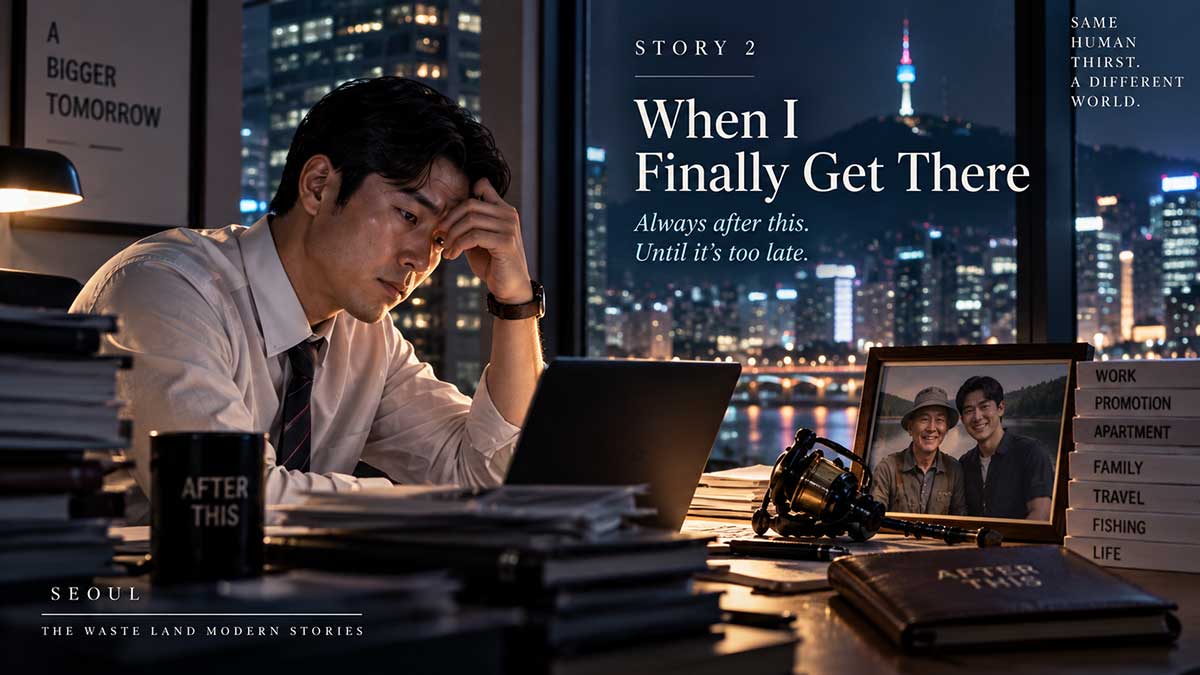
At 2:13 in the morning, Ji-hoon Park's office was still brighter than the street below.
Thirty-six floors above Seoul, the city looked like an electrical map.
Red taillights.
White headlights.
Apartment windows.
Office towers.
Signs that never slept.
Ji-hoon sat alone beneath fluorescent light, reading the same paragraph of a contract for the fourth time.
His phone buzzed.
He glanced at it.
Dad
Ji-hoon sighed.
Not because he did not love his father.
Because he knew what the message would say.
He opened it.
Fishing this weekend? Weather looks good.
Ji-hoon stared at the screen.
Then at the contract.
Then back at the message.
He typed:
Can't. Big case. Maybe after this one.
He stopped.
Deleted "maybe."
Typed:
After this one.
Send.
His father replied almost immediately.
Okay. Next time.
Ji-hoon placed the phone face down.
Then turned it over again.
For some reason, he looked at the message longer than necessary.
Next time.
He smiled faintly.
There was always next time.
Then he returned to work.
Ji-hoon had been living "after this" for most of his life.
As a boy:
After entrance exams.
Then he could relax.
In high school:
After university acceptance.
Then life would become easier.
At university:
After graduation.
Then everything would begin.
In law school:
After the bar exam.
Then he would finally breathe.
At his first firm:
After he became senior associate.
Then he would have control.
After promotion:
Partner.
After partner:
A better apartment.
After the apartment:
Marriage.
After marriage:
Children.
After children:
Maybe fewer hours.
After enough money:
Travel.
Fishing.
Piano.
Sleep.
Life.
The phrase changed shape, but never disappeared.
After this.
Ji-hoon did not think of himself as unhappy.
He thought of himself as unfinished.
That was different.
Unhappy people wanted escape.
Ji-hoon wanted arrival.
He was simply not there yet.
His father, Min-soo, did not understand ambition.
At least that was how Ji-hoon explained him to colleagues.
Min-soo had run a small electrical repair shop in Incheon for thirty-seven years.
Same neighborhood.
Same customers.
Same lunch counter.
Same fishing rod.
He repaired televisions, fans, lamps, rice cookers, radios, whatever people carried through the door.
Ji-hoon remembered sitting behind the counter as a child.
His father would open some broken machine, stare at the inside, and say:
"Everything tells you why it stopped if you look long enough."
Ji-hoon used to believe him.
Then he became older.
The world became more complicated.
People did not open cleanly.
Neither did careers.
Neither did marriages.
Neither did fathers and sons.
Min-soo closed the shop at six every evening.
Ji-hoon found this almost offensive.
"What if there's more work?"
"Then it waits."
"What if the customer needs it?"
"Then they come tomorrow."
"What if they go somewhere else?"
"Then someone else makes money."
Ji-hoon would laugh.
"You have no ambition."
His father usually answered:
"I had enough."
Ji-hoon hated that phrase when he was twenty-four.
Enough.
It sounded like surrender.
Now, at thirty-four, he still disliked it.
But less confidently.
Friday evening, Min-soo called.
Ji-hoon was stepping into an elevator with three partners.
He answered quietly.
"Dad."
"You ate?"
"Yes."
He had not.
"What?"
"Yes."
"What did you eat?"
Ji-hoon looked at the closing elevator doors.
"Food."
His father laughed.
"That bad?"
"I'm busy."
"I know."
Ji-hoon waited.
Min-soo did not speak.
"Dad?"
"Nothing."
"What?"
"I was just thinking."
"About?"
"Fishing."
Ji-hoon closed his eyes.
"We talked about this."
"I know."
"I can't this weekend."
"I know."
"I have the merger."
"I know."
"So why are we talking about fishing?"
His father laughed again.
"Because I like fishing."
One of Ji-hoon's colleagues glanced at him.
Ji-hoon lowered his voice.
"Dad, I'll go after this case."
"You always say that."
Ji-hoon became irritated.
"Because I'm always working."
"Yes."
"So?"
"So nothing."
"Dad."
"It's okay."
Ji-hoon hated that.
"It's okay" from his father usually meant the conversation was over before Ji-hoon had won it.
"Are you angry?"
"No."
"Then what?"
"I miss you."
The elevator doors opened.
Ji-hoon froze.
His colleagues stepped out around him.
One held the door.
"You coming?"
Ji-hoon raised a hand.
"One second."
The doors closed again.
Ji-hoon stood alone.
"Dad?"
"Yes?"
"You can't just say things like that."
"Why?"
Ji-hoon laughed nervously.
"I don't know."
Min-soo chuckled.
"I'll try to be less dangerous."
Ji-hoon leaned against the elevator wall.
"I miss you too."
"Good."
"I'll come after this case."
"Okay."
"Really."
"Okay."
"Maybe two weeks."
"Okay."
Ji-hoon smiled.
"Why do you keep saying okay?"
"Because you keep promising."
The elevator reached the lobby.
Before hanging up, his father said:
"Go eat something."
Ji-hoon did.
At 11:45 p.m.
At his desk.
The case lasted twenty-three more days.
Then another matter arrived.
Then a client crisis.
Then an emergency hearing.
Then a partner left unexpectedly.
Then Ji-hoon was offered leadership on a major account.
The fishing trip moved quietly from one weekend to the next.
Neither father nor son mentioned it every time.
That would have been unbearable.
Instead Min-soo sent small messages.
A photograph of the lake.
A badly tied fishing line.
A meal.
A sunset.
A fish.
One message simply said:
Too windy today. You would have complained.
Ji-hoon laughed when he read it.
He typed:
I don't complain.
His father replied:
You are a lawyer. Complaining professionally is your job.
Ji-hoon showed the message to a junior associate.
"Your dad's funny," she said.
"He thinks he is."
"You two close?"
Ji-hoon opened his mouth.
"Yeah."
Then paused.
"Pretty close."
The answer felt accurate.
Mostly.
In early May, Ji-hoon bought an apartment.
Thirty-two pyeong.
New development.
River view.
Excellent investment.
He sent photos to his father.
Min-soo replied:
Beautiful.
Then:
Where do I sleep when I visit?
Ji-hoon wrote:
Guest room.
His father:
Good. I was worried you'd make me sleep in your office.
Ji-hoon smiled.
That evening, he stood alone in the new apartment.
No furniture yet.
No curtains.
Nothing on the walls.
His footsteps echoed.
He imagined the future.
Dining table there.
Bookshelves.
Television.
Maybe wife.
Maybe children.
His father sleeping in the guest room.
Perhaps bringing fish nobody wanted.
Maybe criticizing the appliances.
Ji-hoon smiled.
Later.
It would all happen later.
For now, he had work.
The call came at 6:41 on a Tuesday morning.
Ji-hoon had slept three hours.
His mother's voice did not sound like his mother's.
"Ji-hoon."
He sat upright.
"What happened?"
There was breathing.
Nothing else.
"Mom?"
"Your father collapsed."
Ji-hoon was already standing.
"Where?"
"He..."
Her voice broke.
"Mom. Which hospital?"
Silence.
Then:
"Don't come to the hospital."
Ji-hoon stopped moving.
"What?"
"Come home."
He knew.
Before she said it.
He knew.
But the mind is strange.
It can understand something and still refuse it.
"What hospital?"
"Ji-hoon."
"What hospital?"
"Your father is gone."
No.
The word arrived before thought.
"No."
His mother cried.
Ji-hoon stood in the middle of the apartment.
The new apartment.
The river view.
The guest room.
No bed yet.
No father.
"Mom."
His voice sounded like someone else's.
"What happened?"
"Heart."
"Was he sick?"
"No."
"Did he know?"
"No."
"Was he alone?"
"No."
"Who was with him?"
"I was."
"Did he say anything?"
She cried harder.
"Mom."
He hated himself for asking.
"What did he say?"
"Nothing."
That hurt more than if she had invented something.
No final message.
No wisdom.
No goodbye.
Just a body stopping.
Ji-hoon sat on the floor.
The city outside was beginning another workday.
His phone buzzed.
Calendar reminder:
8:00 AM CLIENT CALL
Another:
9:30 STRATEGY MEETING
Another:
11:00 PARTNER REVIEW
Ji-hoon looked at the notifications.
Then turned the phone off.
For the first time in years, his schedule continued without him.
At the funeral hall, people kept telling Ji-hoon what a good son he was.
That was the strange part.
"You made him proud."
"You worked so hard."
"He talked about you all the time."
"He was so proud you became a lawyer."
Each compliment felt like an accusation nobody intended.
Ji-hoon bowed.
Thanked them.
Accepted condolences.
Managed logistics.
Signed forms.
Called relatives.
Ordered food.
Organized photographs.
Even grief became a project.
At one point his mother disappeared into a side room.
Ji-hoon found her sitting alone.
She was holding Min-soo's fishing hat.
He stood in the doorway.
"You okay?"
She looked at him.
He immediately hated the question.
She laughed bitterly.
"No."
He sat beside her.
Neither spoke.
After a while she said:
"He kept waiting for you."
Ji-hoon's chest tightened.
"I know."
"No."
She looked at him.
"Not like that."
He waited.
"He wasn't angry."
"I know."
"He never blamed you."
"I know."
"He understood."
Ji-hoon looked down.
"Mom."
"He did."
"I said I know."
She stopped.
He had snapped.
The old Ji-hoon.
Efficient.
Controlled.
Defensive.
He immediately softened.
"Sorry."
His mother ran her thumb along the hat brim.
"He just kept saying you'd come when things settled down."
Ji-hoon closed his eyes.
Things settled down.
That phrase.
He had said it too.
After the case.
After promotion.
After enough money.
After life became manageable.
His mother whispered:
"They never did, did they?"
Ji-hoon looked at her.
"No."
Three days later, Ji-hoon went through his father's phone.
Not because he wanted to.
Because somebody had to cancel accounts, contact people, save photographs.
The phone was old.
Cracked screen.
Battery terrible.
The message app took several seconds to load.
Ji-hoon found their thread.
He scrolled.
Photos of fish.
Weather.
Meals.
Jokes.
Questions about whether Ji-hoon had eaten.
Links to articles Min-soo probably had not read.
Birthday messages.
Fishing?
Not this weekend.
Next week?
Maybe after this.
Okay.
Again.
Again.
Again.
Ji-hoon kept scrolling.
Then he found a draft.
Unsent.
The message field contained:
When you finally have time, I hope I'm still here.
Ji-hoon stopped breathing.
He read it again.
Then again.
He checked the time stamp.
Three weeks earlier.
Why had his father not sent it?
Maybe it sounded too dramatic.
Maybe he deleted part of it.
Maybe he thought better of making his son feel guilty.
Maybe he intended to send it later.
Ji-hoon stared at the sentence.
When you finally have time, I hope I'm still here.
The room blurred.
He put the phone down.
Then picked it up again.
Read it again.
The entire architecture of his life seemed contained in that one sentence.
When you finally have time.
Ji-hoon had always imagined time as something waiting for him.
A reserve.
A future account.
He spent the present freely because more was coming.
Later was guaranteed.
His father had apparently known something Ji-hoon did not.
Or perhaps everyone knew it.
They simply behaved as if they didn't.
Ji-hoon bent forward until his forehead touched the table.
For the first time since the death, he cried without trying to stop.
For two weeks, Ji-hoon did almost nothing.
Then he began doing something dangerous.
He started making dramatic plans.
Quit the firm.
Sell the apartment.
Travel for a year.
Go fishing every day.
Move somewhere quieter.
Learn piano.
Open a restaurant.
Anything except return to the life that now seemed responsible for his father's absence.
One evening he told his mother:
"I'm quitting."
She looked up from the television.
"What?"
"My job."
"Why?"
"I wasted everything."
She frowned.
"You wasted what?"
"Time."
"With your father?"
"Yes."
She said nothing.
"Don't defend me."
"I wasn't going to."
"I should have been there."
"Yes."
Ji-hoon froze.
He had expected comfort.
His mother continued.
"You should have gone fishing."
The words hurt.
But somehow less than reassurance.
"You should have come more."
He nodded.
"You should have answered some of his calls."
Ji-hoon's eyes filled.
"I know."
"Good."
She looked back at the television.
"So now what?"
"I'm quitting."
His mother sighed.
"Your father would hate that."
Ji-hoon stared.
"What?"
"He was proud of your work."
"Work is why I wasn't there."
"No."
Ji-hoon's voice sharpened.
"Yes."
His mother shook her head.
"Your job didn't answer your phone."
He said nothing.
"Your job didn't tell your father 'after this.'"
"Mom."
"You did."
He stood.
"So this is my fault?"
She looked at him.
"Some of it."
That was difficult to hear.
Then she continued.
"But don't make another stupid decision just because you're hurting."
Ji-hoon stared at her.
"You think quitting is stupid?"
"I think you want to punish your old life."
She turned the television off.
"That doesn't mean your new life would be wise."
Ji-hoon sat down again.
His mother took his hand.
"Your father didn't want you to become him."
"I know."
"He wanted you to come fishing."
A long silence.
"Those are different things."
Ji-hoon's anger collapsed.
He started crying again.
His mother squeezed his hand.
"Don't waste your life feeling guilty for wasting your life."
He laughed through tears.
"That sounds like something Dad would say."
"No."
She smiled faintly.
"He would have said it worse."
Ji-hoon returned to the firm.
People were kind.
Too kind.
They spoke softly around him.
Canceled meetings.
Told him to take more time.
He didn't want more time.
That phrase had become suspicious.
He wanted to understand what to do with the time that existed.
The first day back, he opened his calendar.
Every hour was filled.
Client call.
Briefing.
Lunch meeting.
Document review.
Team sync.
Dinner.
He stared.
The calendar looked exactly as it had before his father died.
That offended him.
How could the world look the same after losing a person?
Then he understood something equally painful.
Because the calendar had never known his father was alive.
He began deleting things.
Not everything.
Some meetings mattered.
Some did not.
He asked his assistant:
"Why am I in this meeting?"
She looked surprised.
"You've always attended."
"That's not a reason."
She smiled slowly.
"No."
"What happens if I don't?"
"Probably nothing."
"Cancel it."
He pointed to another.
"This?"
"Could be an email."
"Cancel."
Another.
"That one you probably need."
"Keep it."
This became his new discipline.
Not escaping work.
Choosing it.
Months passed.
Ji-hoon still worked long hours.
Sometimes too long.
He still cared about becoming partner.
He still wanted the apartment.
Money.
Respect.
Achievement.
He did not become a monk.
He did not suddenly hate ambition.
Instead he began asking one question.
What deserves my next hour?
Sometimes the answer was work.
Sometimes sleep.
Sometimes his mother.
Sometimes nothing productive at all.
He called people before needing something.
He ate lunch away from his desk.
Badly at first.
He took one afternoon off and went fishing alone.
He hated it.
The bait smelled.
He tangled the line.
He caught nothing.
He laughed so hard at one point that another fisherman stared.
Ji-hoon held his father's old fishing reel.
"I don't understand why you liked this."
The lake did not answer.
He stayed until sunset.
One Thursday at 10:47 p.m., Ji-hoon walked through the office.
Most desks were empty.
One light remained on.
A junior associate named Jun-seok was working alone.
Ji-hoon stopped.
"You still here?"
Jun-seok looked up.
"Almost done."
"With what?"
"The Han file."
"That's due Monday."
"I know."
Ji-hoon looked at the clock.
"Go home."
Jun-seok laughed.
"I want to finish this."
"You can finish tomorrow."
Jun-seok hesitated.
"My mother keeps asking me to come over."
Something moved inside Ji-hoon.
"What for?"
"Nothing."
"What do you mean, nothing?"
"Dinner."
Ji-hoon stared at him.
Jun-seok looked confused.
"What?"
"When?"
"Tonight."
"And you're here?"
"I'll go this weekend."
Ji-hoon said nothing.
Jun-seok returned to the screen.
"After this file."
There it was.
Two words.
Small.
Ordinary.
Deadly.
Ji-hoon looked at the young man.
For one irrational second, he saw himself ten years earlier.
Then his father's message appeared in his mind.
When you finally have time, I hope I'm still here.
Jun-seok noticed the silence.
"Are you okay?"
Ji-hoon pulled out a chair and sat.
"Go to your mother's."
Jun-seok laughed.
"Seriously?"
"Yes."
"I can finish first."
"No."
"But..."
"I'll finish it."
Jun-seok stared.
"You?"
"Don't sound so surprised."
"No, I mean..."
"Go."
Jun-seok began gathering his things.
Then stopped.
"You sure?"
Ji-hoon nodded.
"Go tonight."
Jun-seok smiled.
"Thank you."
He hurried toward the elevator.
Then turned.
"Why?"
Ji-hoon looked at the file.
He thought about explaining everything.
The fishing trips.
The funeral.
The unsent message.
Instead he said:
"Because tonight is available."
Jun-seok stared for a second.
Then nodded.
"Good night."
"Good night."
The elevator doors closed.
Ji-hoon sat alone.
The office was quiet.
He opened the file.
Beside his laptop sat his father's old fishing reel.
Ji-hoon had started keeping it there.
Not as punishment.
Not as a shrine.
As a question.
He looked at it.
Then at the empty office.
Then at the clock.
10:53.
Seven minutes had passed.
Nothing dramatic.
No revelation.
No miracle.
But one young man was on his way to have dinner with his mother.
Ji-hoon smiled.
He opened the document.
For once, working late did not feel like life postponed.
It felt chosen.
And the difference was everything.
Footnote: Connection to The Waste Land
Ji-hoon's life magnifies the pattern of waiting we explored through Madame Sosostris, the Fisher King, and the poem's tension between memory and expectation. In our Part 1 conversation, the characters discovered how easily life can be surrendered to the word "when." Ji-hoon's tragedy is not ambition itself. It is treating the present as a waiting room for a future life. His change begins when he stops asking when life will finally start and begins asking what deserves the hour already in his hands.
Story 3: Everything She Wanted

At 6:47 in the morning, Sofia Reyes woke up looking beautiful.
At 6:49, she woke up again.
"Let's do one more."
Sofia closed her eyes.
Her assistant, Chloe, moved back toward the bedroom door.
The camera operator adjusted his position beside the window.
"Ready?"
Sofia nodded.
"Rolling."
Morning sunlight spilled across white linen sheets.
Sofia opened her eyes slowly.
She stretched.
Smiled.
Turned toward the window.
For three seconds, she appeared to be a woman waking naturally into an extraordinary life.
"Cut."
Her smile disappeared.
"Was that better?"
Chloe checked the monitor.
"Much."
"Did my hair look weird?"
"No."
"The left side?"
"Looks good."
Sofia got out of bed.
"Coffee?"
"Kitchen's ready."
She walked downstairs.
The coffee was already there.
Not to drink.
To film.
The first cup had gone cold during lighting.
A second cup waited beside the espresso machine.
Steam rose perfectly.
Sofia entered the kitchen.
"Rolling."
She picked up the cup with both hands.
Closed her eyes.
Breathed in.
Took a small sip.
"Perfect mornings."
She smiled toward the window.
"Cut."
Sofia put the cup down.
"That's awful."
Chloe tasted it.
"Cold?"
"No. The oat milk."
"You wanted almond?"
"Yesterday."
Chloe checked her notes.
"Right."
Sofia walked away.
"Can someone make a real coffee?"
By 7:15, 2.4 million people had watched Sofia wake up.
She still had not begun her morning.
At twenty-nine, Sofia had almost everything her seventeen-year-old self had written in a notebook beneath the heading:
MY DREAM LIFE
She had found the notebook recently while visiting her mother.
The list made her laugh.
Live in Los Angeles.
Done.
Beautiful house.
Done.
Travel the world.
Thirty-eight countries.
Work for myself.
Done.
Be famous.
Eight-point-seven million followers.
Make enough money so Mom never worries.
Done.
Find love.
Complicated.
Be happy.
Sofia had stopped reading there.
Her mother, Elena, had been standing behind her.
"You got almost everything."
Sofia closed the notebook.
"Almost."
Elena smiled.
"Maybe seventeen-year-old you should have asked for better things."
Sofia laughed.
"Like what?"
"I don't know."
Elena shrugged.
"Good knees."
"Mom."
"Trust me. You'll understand."
Sofia's business was not fake.
She hated when people said that.
The revenue was real.
The employees were real.
The products were real.
The contracts were very real.
She had built something remarkable.
At twenty-two, she had been posting beauty tutorials from a bedroom she shared with her younger sister.
At twenty-four, she reached one million followers.
She cried.
At twenty-five, three million.
Champagne.
At twenty-six, five million.
Brand launch.
At twenty-seven, seven million.
New house.
At twenty-eight, eight million.
Sofia remembered looking at the number.
8,000,000.
She had expected something.
She did not know what.
A sensation, perhaps.
Arrival.
Instead Chloe had said:
"We should start planning the ten-million campaign."
Sofia had nodded.
"Absolutely."
That evening, she lay in bed thinking:
Ten million.
Eight million had lasted approximately six hours.
The machinery of Sofia's life was efficient.
Breakfast became wellness content.
Exercise became fitness content.
Clothing became affiliate content.
Vacations became travel content.
Her house became design content.
Her dog became pet content.
Relationships became couple content.
Arguments became opportunities for "real conversations."
Breakups became vulnerability.
Healing became a series.
Nothing had to be wasted.
That was one of the advantages of her profession.
Even pain could perform.
Especially pain.
After her last relationship ended, Sofia disappeared from social media for four days.
Her team panicked.
On the fifth day, she returned.
No makeup.
Hair tied back.
Camera close.
"I wasn't sure whether I wanted to talk about this..."
That part was true.
"...but I think pretending everything is perfect helps no one."
Also true.
She spoke for eleven minutes.
She cried during minute seven.
That was true too.
The video became one of the most successful things she had ever posted.
Three million views in an hour.
Eight million by evening.
Thousands of comments:
We love you Sofia.
You're so brave.
This healed something in me.
Thank you for being real.
Sofia read them in bed.
Her face was swollen from crying.
For several minutes, the messages helped.
Then she refreshed.
More appeared.
She refreshed again.
More.
Again.
At 2:16 a.m., she was still refreshing.
She suddenly realized something she did not want to think about.
Her heartbreak had performed extremely well.
The next morning, her manager called.
"We should discuss the follow-up."
Sofia closed her eyes.
"Not yet."
"Of course."
A pause.
"Whenever you're ready."
Sofia knew what that meant.
She also knew her manager was not a bad person.
That was the problem.
Nobody was doing anything obviously wrong.
The machine did not require villains.
Only participation.
Six months later, Sofia traveled alone to the Amalfi Coast.
"Alone" required six people.
Chloe.
Photographer.
Videographer.
Hair and makeup.
Local producer.
Driver.
The trip was sponsored by a luxury hotel group.
On the second morning, Sofia stood on a terrace overlooking the Mediterranean.
"Beautiful," Chloe said.
Sofia looked at the monitor.
"Can we move the flowers?"
"What?"
"They're blocking the water."
The producer moved them.
Sofia stepped into position.
"Better?"
"Much."
They filmed breakfast.
Then Sofia walking down stone steps.
Then Sofia looking over the sea.
Then Sofia laughing while nobody had said anything funny.
Then Sofia reading a book she had not opened.
At 1:00 p.m., the team finished.
"You have the afternoon free," Chloe said.
Sofia blinked.
"Free?"
"Until dinner."
"What are we shooting at dinner?"
"Nothing."
"Nothing?"
Chloe laughed.
"You asked for one night off."
"Oh."
Sofia had forgotten.
"Right."
Everyone left.
For the first time in four days, Sofia was actually alone.
She stood in the hotel room.
No camera.
No questions.
No schedule.
She picked up her phone.
Twenty-three notifications.
Then forty-one.
Then sixty.
She sat on the bed and began answering.
At 4:38, the phone died.
Sofia stared at the black screen.
"No."
She pressed the button.
Nothing.
She plugged it in.
Nothing.
Changed outlets.
Nothing.
Another cable.
Nothing.
She called reception from the room phone.
"Do you have an iPhone charger?"
One arrived.
Still nothing.
The concierge apologized.
"There is a repair shop in town, but it may already be closed."
"How far?"
"About twenty minutes."
"Can someone go?"
"We can check."
Sofia sat on the bed.
Suddenly the room felt too quiet.
She reached for the phone.
Remembered.
Put it down.
Thirty seconds later she reached for it again.
She laughed.
"This is ridiculous."
She walked to the balcony.
Beautiful.
She went back inside.
Opened the minibar.
Closed it.
Picked up the book from that morning.
Read half a page.
Put it down.
Reached for the phone.
Nothing.
She stared at herself in the mirror.
"What do normal people do?"
Nobody answered.
Eventually she walked outside.
No makeup artist.
No photographer.
No Chloe.
No phone.
The town felt strangely uncontrolled.
People moved through narrow streets without caring whether Sofia was there.
An old man smoked beside a doorway.
Children kicked a ball.
A woman hung laundry from a balcony.
A couple argued.
A dog slept beneath a chair.
Nobody asked Sofia to stand in better light.
She bought gelato.
The man behind the counter did not recognize her.
That bothered her.
Then she was embarrassed that it bothered her.
She walked toward the water.
Her first instinct was to photograph the gelato.
She reached into her bag.
Nothing.
She laughed at herself.
Then ate it.
It melted too quickly.
She got some on her hand.
No one knew.
She kept walking.
Near sunset, Sofia climbed a path above the town.
She had not planned to.
She simply saw people walking upward and followed them.
At the top was a small overlook.
Maybe twelve people stood there.
No private terrace.
No styling.
No lighting crew.
Nothing exclusive.
The Mediterranean stretched toward the horizon.
The sun began descending.
Orange.
Gold.
Pink.
Sofia had seen thousands of sunsets.
She had photographed hundreds.
She knew how to capture them.
Lower exposure.
Keep the horizon straight.
Silhouette if necessary.
She reached for her phone.
Her hand touched empty space.
She remembered.
For a second, genuine panic moved through her.
Not because she needed the phone.
Because the sunset was happening without documentation.
The light changed quickly.
She looked around.
Everyone else had phones raised.
Sofia suddenly wanted to borrow one.
She almost asked the woman beside her.
Then stopped.
Why?
Because this was beautiful.
Obviously.
But why did beauty create an immediate need to preserve it?
Or share it?
Or prove she had seen it?
The sun touched the horizon.
Sofia stood completely still.
A strange thought came:
If nobody knows I saw this, did it happen to me?
The question frightened her.
She looked around.
Nobody was watching her.
For perhaps the first time in years, Sofia was somewhere beautiful without being visible.
Her eyes filled.
She did not know why.
The woman beside her noticed.
"Beautiful, isn't it?"
Sofia nodded.
"Yes."
The woman smiled.
Then returned to the sunset.
That was all.
She did not ask Sofia's name.
She did not compliment her.
She did not follow her.
She did not photograph her crying.
Sofia watched the sun disappear.
Then something unexpected happened.
Nothing.
No applause.
No comments.
No likes.
No analytics.
The sunset did not care whether it performed well.
It simply ended.
Sofia stood in the fading light.
And felt something she had not felt in a very long time.
She missed it.
Not the sunset.
Herself.
The phone was repaired the next morning.
Sofia turned it on.
Notifications flooded the screen.
She felt relief.
Then embarrassment about the relief.
Chloe knocked.
"You alive?"
"Apparently."
"Phone?"
"Working."
"Thank God."
Chloe entered.
"We were worried."
"I'm sorry."
"It's fine."
She opened her laptop.
"Yesterday's terrace clip is doing amazing."
Sofia nodded.
"Great."
"People love the dress."
"Good."
"And we need one sunset shot before we leave."
Sofia looked up.
"Why?"
"For the campaign."
"Oh."
Chloe looked at her.
"You okay?"
Sofia almost said yes.
Then stopped.
"I don't know."
Chloe closed the laptop.
"What happened?"
Sofia looked toward the sea.
"I saw something beautiful yesterday."
Chloe waited.
"And?"
"I couldn't photograph it."
"That's terrible."
Sofia laughed.
Chloe laughed too.
Then Sofia stopped.
"No. It was."
Chloe's smile faded.
"Why?"
Sofia tried to explain.
"I didn't know what to do with it."
"The sunset?"
"Beauty."
Chloe stared.
Sofia laughed nervously.
"That sounds insane."
"A little."
"I kept thinking..."
She looked toward the window.
"...if I can't show anyone, what's it for?"
Chloe said nothing.
Sofia continued.
"And then I realized that's how I think about almost everything."
"What do you mean?"
"Food."
"Trips."
"Clothes."
"My house."
She paused.
"My relationships."
Chloe sat down.
"Your life is your business."
"I know."
"You built it that way."
"I know."
"That's not necessarily bad."
Sofia looked at her.
"I know."
And she meant it.
She did not want an easy villain.
She loved parts of her work.
It had given her independence.
Creativity.
Friendships.
Money.
Opportunities her mother could never have imagined.
The problem was subtler.
"I think I forgot there was supposed to be a part that wasn't the business."
When Sofia returned to Los Angeles, she made a list.
Not publicly.
On paper.
THINGS THAT DO NOT BECOME CONTENT
She stared at the blank page.
Then wrote:
Therapy.
She laughed.
Too obvious.
Arguments with Mom.
First dates.
She stopped.
Crossed that out.
Maybe.
Wrote:
Some first dates.
Then:
Books I actually love.
Certain trips.
Grief before I understand it.
She thought.
Then wrote:
Anything I haven't experienced yet.
She underlined that one.
Her new rule became simple.
Experience first.
Decide later whether it belonged to the public.
Sometimes it did.
Sometimes it didn't.
At first, this was surprisingly difficult.
She would eat something extraordinary and immediately think:
People would love this.
She would hear a beautiful sentence and mentally turn it into a caption.
She would cry and wonder whether the feeling was relatable.
She hated herself for that.
Then she realized hatred was simply another performance.
So she practiced.
Again.
Again.
Again.
Three months later, Sofia had dinner at her mother's house.
No team.
No camera.
No makeup.
Her mother had cooked too much food.
As always.
"You look thin."
"I'm not thin."
"You're thinner."
"I'm exactly the same."
"You don't eat."
"I literally make food videos."
"That's not eating."
Sofia laughed.
"Mom."
Elena put more rice on her plate.
"Eat."
Sofia obeyed.
Her phone was in her bag.
It buzzed.
She ignored it.
Elena noticed.
"You're not going to check?"
"No."
"Are you sick?"
"Why does everyone say that?"
Her mother smiled.
They ate.
Then Elena began telling a story.
"When you were seven, you remember the yellow dress?"
Sofia groaned.
"Mom."
"You loved that dress."
"I know."
"You wouldn't take it off."
"I know."
"Even when it got dirty."
"I've heard this story."
Elena ignored her.
"You wore it to your cousin's birthday and spilled chocolate..."
Sofia had heard the story perhaps twenty times.
Usually she would smile while checking her phone.
Or interrupt.
Or finish it for her mother.
This time she listened.
Elena described the dress.
The chocolate.
Sofia crying.
Her father trying to wash it in the sink.
Everyone laughing.
Then Elena stopped.
"You've heard this before."
"Yes."
"Why didn't you stop me?"
Sofia looked at her mother.
The question surprised her.
She smiled.
"Because you're still telling it."
Elena looked at her.
For a moment neither spoke.
Then her mother reached across the table and touched Sofia's hand.
No camera captured it.
Sofia felt no urge to change that.
Dessert was ridiculous.
A small pastry from a bakery Elena loved.
Perfect glaze.
Fresh berries.
Beautiful plating.
Sofia looked at it.
Immediately, automatically, her hand moved toward the table.
No phone.
She had left it in the other room.
She stopped.
Elena noticed.
"What?"
"Nothing."
"You want your phone?"
Sofia looked at the dessert.
For years she had believed photographing something beautiful honored it.
Sometimes it did.
But not always.
Sometimes the camera was a bridge.
Sometimes it was a wall.
"No."
She picked up the fork.
Her mother looked suspicious.
"You're not taking a picture?"
"No."
"Why?"
Sofia cut into the pastry.
"Because I'm going to eat it."
Elena laughed.
"Very revolutionary."
Sofia took a bite.
It was excellent.
She closed her eyes.
Not for the camera.
Not because someone had told her to.
Simply because it tasted good.
Her mother continued talking.
Sofia listened.
Somewhere in another room, the phone buzzed.
Eight-point-seven million people could reach her.
For the next hour, they didn't.
And nothing disappeared.
The dinner still happened.
Her mother still laughed.
The dessert still tasted sweet.
Sofia was still there.
Perhaps that was what she had forgotten.
An experience did not need an audience to become real.
Sometimes the moment became hers precisely because nobody else received it.
Footnote: Connection to The Waste Land
Sofia's story magnifies the restless desire running through The Waste Land, particularly "The Fire Sermon," where appetite, intimacy and repetition often fail to produce genuine fulfillment. Our Part 2 conversation asked a crucial question: Who taught us what to want? Sofia receives attention, beauty, money and recognition, yet wanting continually regenerates. Her problem is not social media itself. It is asking attention to provide significance. Her renewal begins when she rediscovers the difference between performing an experience and actually inhabiting it.
Story 4: The Last Ordinary Tuesday
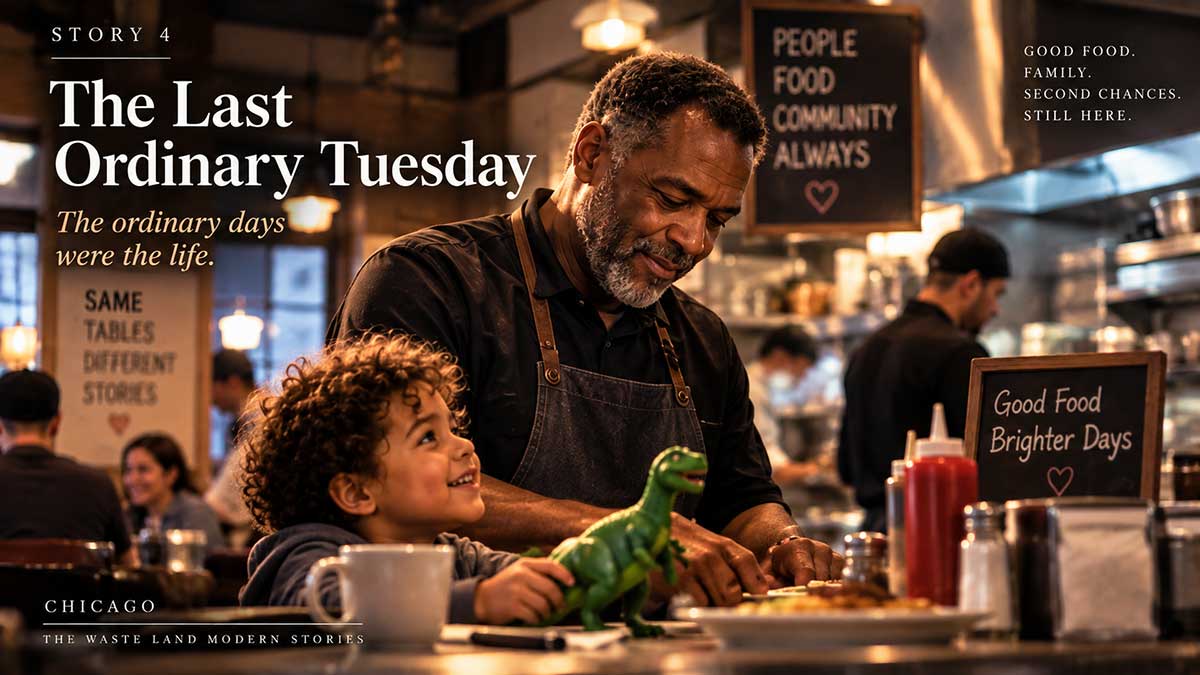
Marcus Bennett hated Tuesdays.
Mondays had an excuse.
Everybody hated Mondays.
Fridays had momentum.
Saturdays were busy enough that nobody had time to complain.
Sundays ended early.
But Tuesdays?
Tuesdays were just there.
At 6:14 on one particular Tuesday morning, Marcus stepped on a plastic dinosaur.
"AVA!"
His granddaughter's Tyrannosaurus rex flew across the kitchen.
Marcus grabbed the counter.
"Jesus Christ."
Denise looked up from her coffee.
"Don't take the Lord's name because you stepped on a dinosaur."
"It almost killed me."
"You're being dramatic."
"I'm fifty-eight years old. Things can kill me now."
Denise took another sip.
"You've been saying that since forty."
Marcus picked up the dinosaur.
"Why is this here?"
"Because Ava was here."
"She has a room."
"She doesn't live here."
"Then why does she have more stuff here than I do?"
Denise smiled.
"Because we like her better."
Marcus threw the dinosaur onto the table.
His knee hurt.
It always hurt in the morning now.
He poured coffee.
Tasted it.
Made a face.
"This is terrible."
"You made it."
"Exactly."
Denise looked at the clock.
"Garbage."
"What?"
"You forgot."
Marcus closed his eyes.
"I'll do it tonight."
"Collection is this morning."
"Of course it is."
"Tuesday."
Marcus stared at her.
"See?"
"See what?"
"Nothing good happens Tuesday."
At 7:03, Marcus unlocked Bennett's Kitchen.
He had owned the Chicago neighborhood restaurant for twenty-three years.
It wasn't famous.
Marcus liked telling people that.
"We've successfully avoided becoming important."
But it was busy.
People knew it.
Families had celebrated birthdays there.
Couples had gone on first dates there and returned years later with children.
People had eaten there after funerals.
After graduations.
After divorces.
After church.
After bad days.
After good days.
Marcus knew many customers by name.
He also complained about most of them.
At 7:11, Luis arrived.
"You're late."
Luis looked at the clock.
"Eleven minutes."
"That's late."
"Good morning to you too."
"Morning started an hour ago."
Luis tied his apron.
"Maybe for old people."
Marcus pointed toward him.
"That's why you're never getting a raise."
"You said I'm getting one next month."
"I've reconsidered."
Luis laughed.
The produce delivery arrived.
Wrong onions.
Marcus argued with the driver.
The dishwasher began making a grinding noise.
Marcus kicked it.
Denise walked in.
"Did you just kick the dishwasher?"
"It understands consequences."
"It's a machine."
"Exactly. Employees have lawyers."
Luis shouted from the kitchen:
"I heard that."
"Good."
At 8:32, a customer complained that her eggs were too firm.
At 8:41, another complained that his eggs were too soft.
Marcus stood between the two plates.
"Somewhere in this restaurant is the perfect egg."
Denise whispered:
"Don't."
"I want to introduce these two people. Maybe they can exchange eggs."
"Marcus."
He carried the plates back.
By ten o'clock, his knee hurt.
His back hurt.
The coffee was still bad.
A child spilled orange juice.
Someone called in sick.
The dishwasher stopped completely.
Marcus stood in the kitchen staring at water spreading across the floor.
He closed his eyes.
"Can everybody just leave me alone for five minutes?"
Nobody did.
At 2:30, Marcus left for a doctor's appointment.
Routine.
That was the word.
Routine blood work had led to another test.
Then another.
Nothing urgent, they had said.
Probably nothing.
He sat in the examination room scrolling through restaurant invoices.
The doctor entered.
She closed the door.
Marcus noticed that.
Doctors closed doors differently when they had something to say.
"Mr. Bennett."
"Marcus."
She sat.
He put the phone down.
"What?"
She opened the file.
The first thirty seconds contained words Marcus understood individually but not together.
Scan.
Mass.
Biopsy.
Malignant.
Advanced.
Treatment.
Options.
Oncology.
Then one word arrived clearly.
Cancer.
Marcus stared at her.
"Okay."
The doctor continued.
Marcus nodded.
He was very good at nodding.
Restaurant owners learned to absorb bad information quickly.
Freezer broke.
Okay.
Cook quit.
Okay.
Pipe burst.
Okay.
Cancer.
Okay.
"What do we do?"
She explained.
He listened.
Then asked:
"How long?"
The doctor hesitated.
That hesitation frightened him more than the answer.
"We don't know yet."
"Ballpark."
"Marcus..."
"I own a restaurant. Give me the estimate."
She gave him one.
Not a date.
A range.
Possibilities.
Treatment could change it.
People responded differently.
Nothing certain.
Marcus heard enough.
For fifty-eight years, time had been something he assumed would continue unless informed otherwise.
Now he had been informed otherwise.
He sat in his car for forty minutes.
The parking garage was ugly.
Concrete.
Fluorescent lights.
Oil stains.
A shopping cart abandoned near a pillar.
Marcus stared at it.
He thought death would make him think profound things.
Instead:
Did I order chicken for Thursday?
Then:
Denise.
Then:
Ava.
Then:
I don't want to die.
The sentence arrived so simply that he said it aloud.
"I don't want to die."
Nobody answered.
He cried.
Not elegantly.
Not quietly.
When it stopped, he wiped his face with fast-food napkins from the glove compartment.
Then drove back to the restaurant.
Denise knew immediately.
She was counting receipts in the office.
Marcus entered.
She looked up.
"What?"
He closed the door.
"What?"
She stood.
He could not say it.
He had repeated the word in the car.
Cancer.
Cancer.
Cancer.
Now it would not leave his mouth.
Denise came closer.
"Marcus."
He handed her the papers.
She read.
Her face changed.
"No."
Marcus sat.
Denise read again.
"No."
He watched his wife experience the same impossible transition he had experienced an hour earlier.
There was the world before the sentence.
Then the world after.
She sat beside him.
"What did she say?"
Marcus explained.
Denise cried.
Then stopped.
Then asked questions.
Then became angry.
Then cried again.
Finally:
"We'll fight."
Marcus nodded.
"Yes."
"We'll get another opinion."
"Yes."
"Treatment."
"Yes."
"We're not giving up."
"No."
She held his face.
"Do you hear me?"
"Yes."
He kissed her hand.
Then, absurdly, she said:
"You still forgot the garbage."
Marcus stared.
Denise stared back.
For half a second they were both horrified.
Then Marcus started laughing.
Denise did too.
They laughed until both were crying again.
People became strange when they learned.
"You have to stay positive."
"Everything happens for a reason."
"My cousin had cancer twenty years ago."
"You should eliminate sugar."
"Have you tried meditation?"
"Go to Italy."
"Make a bucket list."
That phrase appeared repeatedly.
Bucket list.
Marcus's daughter bought him a notebook.
On the cover:
LIVE YOUR DREAMS
Marcus hated it.
But one night he opened it.
He wrote:
Paris.
Then:
Grand Canyon.
Then:
See a Cubs World Series game.
He crossed that out.
Already happened.
"Good timing," he muttered.
He wrote:
Hawaii.
Drive across America.
Eat at a three-Michelin-star restaurant.
Then he stopped.
Denise looked over.
"What?"
"I don't know what I want."
"That's okay."
"I'm dying and I can't even make a bucket list correctly."
"You're not dying tonight."
"You don't know that."
"Neither do you."
Marcus stared at the page.
"What would you put?"
Denise thought.
"Nothing."
"Nothing?"
"I've traveled."
"Not enough."
"I've eaten."
"Not Michelin."
"I've seen things."
"Not the Grand Canyon."
She looked at him.
"Marcus, I don't need the Grand Canyon to prove I loved my life."
He looked down.
That irritated him.
Probably because it sounded true.
They went to Paris anyway.
It was beautiful.
Marcus loved the bread.
Hated the flight.
Complained about the hotel pillow.
Denise threatened to leave him beside the Seine.
They laughed.
They went to the Grand Canyon.
Marcus stood at the edge.
Magnificent.
Truly magnificent.
He took photographs.
He tried to feel what people were supposed to feel when confronting geological eternity.
He felt something.
Awe.
Fear.
Beauty.
Then his knee hurt.
"Can we sit?"
Denise laughed.
They sat.
Marcus looked at the canyon.
"It's beautiful."
"Yes."
"Do you feel transformed?"
Denise thought.
"No."
"Thank God."
They laughed.
On the flight home, Marcus wondered why that relieved him.
Treatment began.
Some days were bad.
Some were surprisingly ordinary.
That surprised him most.
He had imagined serious illness would make every day feel important.
It didn't.
There were still bills.
Traffic.
Laundry.
Television.
Arguments.
Spam calls.
Dentist appointments.
Bad moods.
He still became annoyed when Luis arrived late.
He still hated weak coffee.
He still forgot the garbage.
Sometimes he forgot he had cancer for twenty minutes.
Then remembered.
Those twenty minutes became precious.
Several months after the diagnosis, Marcus arrived at the restaurant early.
Tuesday.
6:38 a.m.
Nobody else was there yet.
He unlocked the door.
The restaurant smelled like the previous night.
Coffee.
Grease.
Bread.
Cleaning solution.
He turned on the lights.
One flickered.
"Of course."
He walked into the kitchen.
The replacement dishwasher hummed.
He started coffee.
Too much grounds this time.
Probably terrible.
He sat alone at a table.
Then Luis entered through the back.
6:51.
"You're early."
Luis looked at the clock.
"So are you."
"Owner."
"Old."
Marcus raised a finger.
"I can still fire you."
Luis laughed and disappeared into the kitchen.
Soon came the sounds.
Knife against cutting board.
Onions.
The dishwasher.
Metal pans.
A delivery truck backing outside.
Beep.
Beep.
Beep.
Someone turned on the radio.
Too loud.
Marcus shouted:
"Turn that down!"
Luis shouted:
"You turn it down!"
Marcus stood.
Then stopped.
His phone rang.
Denise.
He answered.
"What?"
"Good morning to you too."
"What's wrong?"
"Nothing."
"Then why are you calling?"
"You left your medication."
Marcus closed his eyes.
"Damn it."
"I'll bring it."
"No, I'll come."
"You're already there."
"I know."
"Stay."
"Fine."
"And Ava's coming after school."
Marcus groaned.
"Why?"
"Because she's your granddaughter."
"She has parents."
"Apparently they need a break."
"From her?"
"From you."
Marcus smiled.
"Love you."
There was a pause.
They did not always say it in the middle of ordinary phone calls.
"Love you too."
She hung up.
Marcus sat.
The radio.
The onions.
The dishwasher.
Luis complaining.
The delivery truck.
Bad coffee.
His knee.
The flickering light.
Nothing extraordinary was happening.
And suddenly Marcus could not breathe.
Luis came through the kitchen door.
"You okay?"
Marcus nodded.
But tears were running down his face.
Luis froze.
"Marcus?"
"I'm fine."
"You're crying."
"I know."
"Do I call Denise?"
"No."
"Doctor?"
"No."
"Then what's wrong?"
Marcus looked around.
The cheap chairs.
The scratched tables.
The ketchup bottles.
The light that needed replacing.
The menu he had redesigned eleven times and still disliked.
Twenty-three years of ordinary Tuesdays.
"Nothing."
Luis stared.
Marcus laughed through the tears.
"That's what's so beautiful."
Luis looked genuinely concerned.
"I'm calling Denise."
"Don't."
"You're crying about furniture."
"I'm not crying about furniture."
"What are you crying about?"
Marcus listened.
The restaurant was waking up.
"I thought the important parts would feel more important."
Luis frowned.
"What?"
Marcus looked toward the kitchen.
"I thought I'd know."
"Know what?"
"When life was happening."
Luis said nothing.
Marcus wiped his face.
"I kept thinking life was the vacations."
"The birthdays."
"The big nights."
"The restaurant anniversary."
"Graduations."
"Christmas."
He pointed toward the kitchen.
"But most of it was this."
Luis followed his hand.
"Onions?"
Marcus laughed.
"Yes."
Luis nodded.
"Very profound."
"Shut up."
After that morning, Marcus became intolerable in a new way.
He noticed everything.
But he refused to pretend everything was wonderful.
Luis arrived late.
"You're late."
"Be grateful I'm alive."
"I'm grateful you're alive somewhere else before seven."
A customer complained.
Marcus still complained about the customer afterward.
Denise asked:
"Shouldn't cancer have made you nicer?"
"No."
"Disappointing."
"It made me observant."
"Of what?"
"How annoying everybody is."
She kissed him.
"Good. I was worried we'd lost you."
Marcus laughed.
That mattered.
He did not want illness to transform him into a saint.
He wanted to remain himself.
Only awake.
One Tuesday afternoon, Ava came running through the restaurant.
"Grandpa!"
"Walking!"
She ignored him.
Six years old.
Wild hair.
Backpack half open.
She hugged him.
Then immediately disappeared under a table.
"What are you doing?"
"Playing."
"At my restaurant?"
"Yes."
"Why?"
She looked confused.
"Because I'm here."
Marcus could not argue with the logic.
Twenty minutes later he walked toward the register.
Crunch.
Pain shot through his foot.
"AVA!"
The restaurant went silent.
Marcus looked down.
The dinosaur.
Green.
Plastic.
Smiling stupidly.
Ava froze beneath the table.
Marcus picked it up.
"You."
She emerged slowly.
"Sorry."
"How many times have I told you?"
Her lip trembled.
Marcus stopped.
He looked at the dinosaur.
He remembered that morning months earlier.
Kitchen.
Bad coffee.
Garbage.
Denise.
His life before he knew it had an edge.
Ava whispered:
"I'm sorry, Grandpa."
Marcus looked at her.
Something broke open.
Not sadness exactly.
Not gratitude exactly.
Both.
He crouched.
His knee protested.
"Come here."
She approached cautiously.
He handed her the dinosaur.
"One day..."
His voice failed.
Ava waited.
Marcus tried again.
"One day I'm going to miss this stupid dinosaur."
Ava looked at it.
Then at him.
"Why?"
"Because you won't always leave dinosaurs everywhere."
She thought.
"I can."
Marcus laughed.
"No."
"I can leave more."
"Absolutely not."
"I have lots."
"I know."
"I can bring them tomorrow."
"Ava."
She smiled.
"Everywhere."
He pulled her into his arms.
She laughed.
"Grandpa!"
He held her slightly longer than usual.
Then let go.
That part mattered too.
Treatment continued.
The scans were mixed.
Some good news.
Some bad.
No miracle.
Marcus learned to stop asking doctors to promise what they could not promise.
He learned that hope and certainty were not the same thing.
He made plans.
But differently.
He planned a summer trip with Denise.
He also planned Thursday dinner.
Both mattered.
He stopped saving expensive wine for an important occasion.
Then discovered he didn't actually like expensive wine.
"That's hundreds of dollars wasted," he complained.
Denise laughed.
"Good thing you're enlightened."
"I'm furious."
They drank it anyway.
One evening, Marcus sat with Ava after closing.
She colored at a table.
Marcus counted receipts.
"Grandpa?"
"Yeah?"
"Are you going to die?"
His hand stopped.
Nobody had told her directly.
Children discovered truths through cracks adults imagined were sealed.
"Eventually."
"When?"
"I don't know."
"Tomorrow?"
"I hope not."
"Next Tuesday?"
Marcus smiled.
"I hope not."
She continued coloring.
Then:
"Are you scared?"
Marcus considered lying.
"Yes."
Ava looked up.
"Why?"
"Because I like being here."
She nodded as if that made perfect sense.
Then returned to coloring.
After a while she pushed a picture toward him.
Three people.
A restaurant.
A giant green dinosaur.
Marcus pointed.
"Why is the dinosaur bigger than me?"
"Because he's important."
Marcus laughed.
He looked at the drawing.
"Can I keep this?"
Ava shrugged.
"Sure."
He put it beside the register.
Not framed.
Not preserved.
Just there.
Another Tuesday came.
6:43 a.m.
Marcus unlocked the restaurant.
His knee hurt.
Coffee would probably be bad.
Luis would probably be late.
Someone would complain about eggs.
Denise would call about something Marcus had forgotten.
Ava might leave another dinosaur somewhere designed to injure him.
Marcus stood in the doorway.
For a few seconds, he listened.
The refrigerator humming.
Traffic outside.
A bus braking.
Someone sweeping the sidewalk.
Luis approaching from down the block.
Late.
Marcus checked his watch.
Of course.
Luis entered.
"Morning."
"You're late."
"Two minutes."
"Late."
Luis smiled.
"You happy to see me?"
Marcus considered.
"No."
Luis laughed.
Marcus turned on the lights.
The same flickering bulb blinked.
He had still not replaced it.
He shook his head.
"Unbelievable."
Then he walked inside.
No orchestra.
No revelation.
No spectacular sunrise.
Just Tuesday.
Marcus smiled.
Not because Tuesday had become extraordinary.
Because it hadn't.
That was the point.
For most of his life, Marcus had believed ordinary days were the empty spaces between the important ones.
Now he understood.
There were no empty spaces.
The ordinary days had been carrying his life all along.
Footnote: Connection to The Waste Land
Marcus's story magnifies "Death by Water" and Phlebas, whose worldly identity, beauty, commerce and ambition disappear beneath the sea. In our Part 1 conversation, Phlebas unexpectedly longed for ordinary embodied experiences: food, tiredness, inconvenience and another day. Marcus receives that perspective while still alive. His diagnosis does not make everything beautiful or erase suffering. Instead, mortality changes his attention. He discovers that the ordinary Tuesday he once treated as disposable was never the space between his life. It was his life.
Story 5: Three Drops of Rain
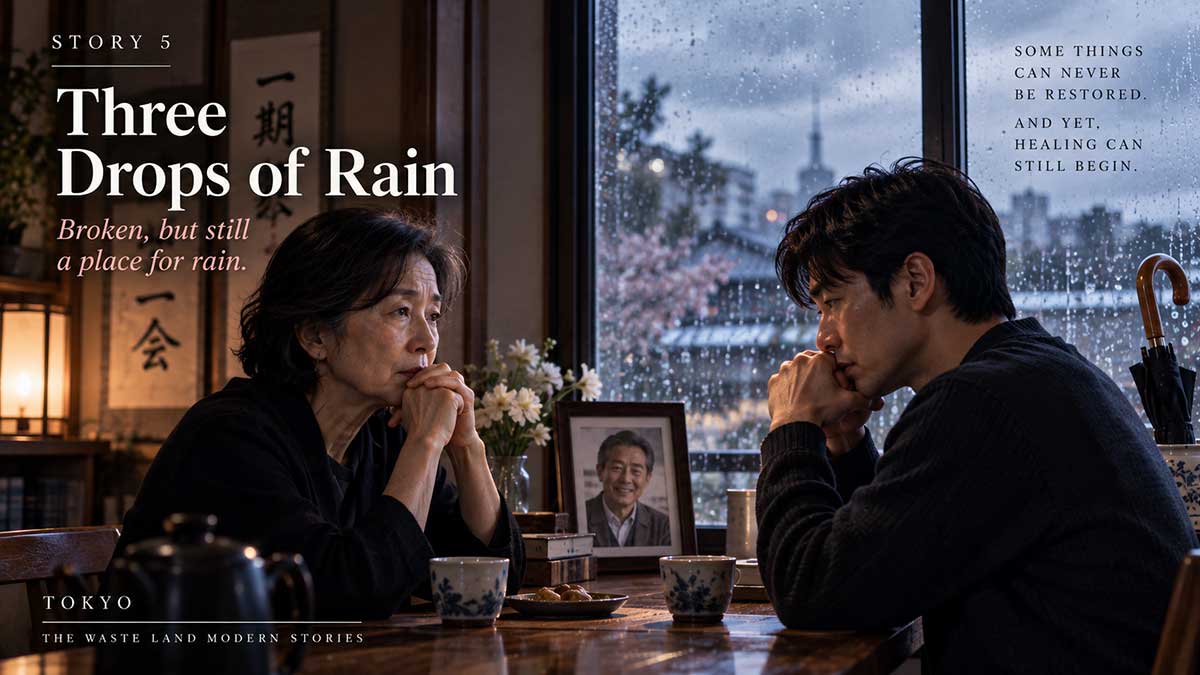
It was supposed to rain in Tokyo by noon.
At eleven, the sky was gray.
At twelve, darker.
At one, the weather app said ninety percent.
But nothing fell.
Emi Tanaka stood beneath the awning of the funeral hall and looked at the sky.
"Still nothing," her sister said.
Emi nodded.
Her sister touched her arm.
"You should go inside."
"In a minute."
"You've been standing here ten minutes."
"I know."
"You'll get cold."
Emi almost laughed.
For forty-six years, her husband Hiroshi had said exactly the same thing.
Put on a sweater.
Take an umbrella.
Don't sit near the window.
Eat before you leave.
Call when you arrive.
Small sentences.
Unimportant sentences.
The kind people stop hearing because they assume there will always be another one.
Now there wouldn't be.
Emi looked at the sky again.
"Maybe later."
Her sister followed her eyes.
"The rain?"
"Yes."
Then Emi saw him.
Across the street.
Black suit.
Black tie.
Umbrella folded in one hand despite the absence of rain.
Her son.
Kenji.
Emi's body reacted before her mind did.
Her chest tightened.
Her hand closed around the edge of her coat.
She had imagined this moment many times.
For seven years.
In some versions, Kenji apologized.
In others, she refused to forgive him.
Sometimes she slapped him.
Sometimes she hugged him.
Sometimes Hiroshi stood between them and somehow said the exact words that repaired everything.
But Hiroshi was inside the funeral hall.
And he would never stand between them again.
Kenji crossed the street.
He saw her.
Stopped.
For one second, mother and son simply looked at each other.
Seven years stood between them.
Then Kenji bowed.
Deeply.
"I'm sorry for your loss."
Emi stared at him.
Your loss.
Not our loss.
She wanted to say:
He was your father.
Instead she bowed.
"Thank you for coming."
Kenji's face changed slightly.
Perhaps he heard it too.
The terrible politeness.
"Of course."
Emi nodded.
Neither moved.
Finally her sister appeared behind her.
"Kenji."
His face softened.
"Auntie."
She hugged him.
Kenji hesitated, then returned it.
Emi watched.
Something ugly moved inside her.
Jealousy.
She hated herself for it.
Her sister stepped back.
"You've gotten thin."
Kenji smiled.
"You always say that."
"Because you always get thinner."
For a few seconds, they sounded like family.
Emi looked toward the doors.
"We should go inside."
Kenji nodded.
"Yes."
They entered separately.
The funeral was beautiful.
Emi hated that word.
People kept using it.
Beautiful flowers.
Beautiful photograph.
Beautiful service.
Beautiful words.
Beautiful life.
She wanted to ask what beauty had to do with the empty side of her bed.
Hiroshi's photograph stood surrounded by white flowers.
He was smiling.
The picture had been taken eleven years earlier in Kamakura.
Emi remembered the day.
Hiroshi had complained that she took too many photographs.
Now she wished she had taken more.
Kenji sat three rows behind her.
Emi knew exactly where he was without turning around.
She could feel him.
For seven years, she had trained herself not to think about where her son was.
Now every cell in her body seemed to know.
After the service, people approached.
They bowed.
They remembered Hiroshi.
"He was so kind."
"He helped me when..."
"He always..."
"I remember..."
A person became stories very quickly after death.
Emi listened.
Thanked them.
Bowed.
Kenji remained near the back.
Some relatives greeted him warmly.
Others awkwardly.
Everyone knew.
Families pretend secrets are secret long after everyone knows them.
Seven years earlier, the argument had begun over something small.
Emi could no longer remember exactly what.
That bothered her.
She remembered everything said afterward.
Kenji had wanted to move overseas for work.
Maybe Singapore.
Maybe London.
Hiroshi had been worried but supportive.
Emi had not.
She had told Kenji he was selfish.
Kenji said she controlled everyone she loved.
Emi said he only remembered his family when he needed something.
Kenji said:
"Maybe that's because being around you always costs something."
She remembered that sentence perfectly.
She had answered:
"Then don't come."
Kenji had stared at her.
"Fine."
He left.
Neither understood they were beginning seven years.
At first, Emi expected a call.
Then an apology.
Then New Year's.
Then her birthday.
Then his father's birthday.
Nothing.
Hiroshi called him.
Sometimes Kenji answered.
Sometimes they met secretly.
Emi knew.
She pretended she didn't.
Hiroshi repeatedly said:
"Call him."
Emi always answered:
"He knows our number."
Kenji apparently said the same thing.
"She knows mine."
Two people stood on opposite sides of seven years, each insisting the bridge must be built from the other shore.
After the funeral, Kenji approached.
"I'm leaving."
Emi nodded.
"Thank you for coming."
Again.
He looked at her.
"Mom."
It was the first time he had called her that.
Emi felt the word enter somewhere she had carefully closed.
"Yes?"
Kenji seemed about to say something.
Instead:
"I'll go."
Emi nodded.
"Take care."
He bowed.
Then her sister interrupted.
"Where are you going?"
"Hotel."
"What hotel?"
"Shinjuku."
"Tonight?"
"Yes."
Her sister looked at Emi.
Then back at Kenji.
"Your father's things are still at the house."
Kenji's expression changed.
"I know."
"Don't you want anything?"
He looked toward Emi.
"I don't know."
Emi heard herself say:
"You can come."
Her sister became very still.
Kenji stared.
Emi immediately regretted it.
But the sentence was already outside her.
"If you want."
Kenji looked down.
"Okay."
The taxi ride took forty-two minutes.
Mother and son sat in the back.
Emi near one window.
Kenji near the other.
Between them was enough empty seat for another person.
Emi thought about Hiroshi.
Of course.
He had spent seven years occupying that space.
Calling Kenji.
Defending Emi.
Defending Kenji.
Explaining one to the other.
"Your mother doesn't mean..."
"Your son is just..."
He had translated them.
Now the translator was gone.
The taxi driver spoke more than either of them.
"Rain coming."
Emi looked outside.
"Yes."
"Big storm tonight."
"So they say."
Kenji looked at his phone.
Emi noticed.
She immediately thought:
Always looking at that thing.
Then stopped herself.
Seven years, and she had already found something to criticize.
She looked out her own window.
The house smelled like Hiroshi.
Emi had not noticed until she entered with someone who had not been there recently.
Shoes.
Wood.
Tea.
His aftershave.
Old paper.
Kenji stopped in the entryway.
He removed his shoes.
For several seconds he did not move.
Emi pretended not to notice.
"Tea?"
"No, thank you."
"Coffee?"
"No."
"Have you eaten?"
"At the funeral."
"That wasn't food."
"I'm fine."
Emi almost said:
You've gotten thin.
She stopped.
Her sister had already said it.
Instead:
"Your father's room is the same."
Kenji nodded.
"I'll look."
He walked down the hallway.
Emi went to the kitchen.
She filled the kettle anyway.
Kenji stood at the doorway of his father's room.
Nothing had changed.
That was impossible.
The same desk.
Same chair.
Same ridiculous collection of pens.
Same reading glasses.
Same old radio.
Same calendar.
Except the calendar had stopped.
September.
Kenji stepped inside.
On the desk was a photograph.
He picked it up.
Three people.
Emi.
Hiroshi.
Kenji.
He was seventeen.
They were standing near Lake Kawaguchi.
Mount Fuji behind them.
Kenji remembered complaining the entire trip.
Too early.
Too cold.
Too many photographs.
His father had forced a stranger to take this one.
Kenji sat.
There were dozens of messages from his father on his phone.
He had not deleted them.
The last one:
Your mother made too much curry again. Some things never change.
Kenji had replied with a laughing face.
That was all.
Three days later, Hiroshi was dead.
Kenji covered his face.
He had spent years believing there would be time.
Not necessarily for reconciliation.
Just time.
His father would remain available.
His mother would remain angry.
Kenji would remain justified.
Everything would wait until he was ready.
Then one person stopped waiting.
Emi placed tea on the kitchen table.
Two cups.
She looked at them.
Almost removed one.
Didn't.
Kenji returned carrying the photograph.
"Can I have this?"
Emi looked.
"You already have photographs."
"I want this one."
"Why?"
Kenji's face tightened.
"Because I want it."
"I can make a copy."
"I don't want a copy."
There it was.
The old rhythm.
Emi felt it immediately.
Demand.
Resistance.
Counterattack.
"You haven't been here for seven years and now you come and start taking things?"
Silence.
The second the sentence left her mouth, she wanted it back.
Kenji's face closed.
"Forget it."
He put the photograph down.
"Take it."
"I don't want it now."
"Kenji."
"No."
"I said take it."
"You always do this."
Emi froze.
"Do what?"
"Make everything cost something."
The sentence.
Seven years collapsed.
Emi stood.
"And you think you can walk in after seven years and..."
Kenji laughed bitterly.
"Here we go."
"What does that mean?"
"Nothing."
"No. Say it."
"I shouldn't have come."
"You were invited."
"By Auntie."
"I said you could come."
"Yes. Like you're allowing a stranger into your house."
"You behaved like one."
Kenji stared at her.
Emi's heart was pounding.
She knew what came next.
They both did.
The same argument.
The same roles.
The same injuries polished through repetition.
Kenji picked up his coat.
"Goodbye."
Emi wanted to say:
Go.
The word reached her throat.
Then she saw Hiroshi's empty chair.
Not symbolically.
Just a chair.
A cheap wooden chair with a worn cushion.
He had sat there every morning.
Coffee.
Newspaper.
Glasses sliding down his nose.
For seven years, he had asked them both to stop.
And now he was gone.
Emi swallowed the word.
Kenji waited.
"You're not going to say it?"
Emi looked at him.
"What?"
"Tell me to leave."
She almost did.
Instead:
"I don't want to."
Kenji's expression changed.
Neither moved.
The kettle clicked as it cooled.
Kenji slowly removed his coat.
Not completely.
He held it.
Emi sat.
After a moment, Kenji sat too.
The photograph remained between them.
Emi looked at it.
"You hated that trip."
Kenji almost smiled.
"Dad woke me at five."
"He wanted sunrise."
"It was freezing."
"You complained all morning."
"You complained about me complaining."
"You ruined breakfast."
"You ordered natto for me."
"You liked natto."
"I was seventeen."
"What happened at seventeen?"
"I developed standards."
Emi laughed.
It escaped before she could stop it.
Kenji smiled.
For perhaps five seconds, they were mother and son again.
Then both remembered.
The smile disappeared.
But something had shifted.
A crack.
Small.
Dangerous.
Kenji looked at his tea.
"Did Dad talk about me?"
Emi felt anger.
Of course he did.
Constantly.
But beneath the anger was something else.
Pain.
"Yes."
"What did he say?"
Emi could have punished him.
She had seven years of material.
He worried about you.
You hurt him.
He wished you would come home.
He defended you even when you didn't deserve it.
All true.
Instead she said:
"He was proud of you."
Kenji looked up.
His eyes filled immediately.
Emi continued.
"He worried."
"I know."
"He wanted you to call more."
"I know."
"He wanted us to..."
She stopped.
Kenji stared at the tea.
"I know."
Emi wanted to ask:
Then why didn't you?
She felt the question.
Hot.
Ready.
Justified.
She did not ask it.
For once, being justified seemed less important than what the question would destroy.
Kenji noticed the silence.
"What?"
"Nothing."
"No. What?"
Emi shook her head.
"I was going to say something."
"What?"
"It wouldn't help."
Kenji almost laughed.
"That's new."
Emi looked at him sharply.
Then she laughed too.
"A little."
Outside, thunder rolled.
Still no rain.
Kenji looked toward the window.
"I should go before it starts."
Emi nodded.
The old fear returned.
If he left now, what happened tomorrow?
Would another seven years begin?
Would they both decide this afternoon had been enough?
Would pride return overnight?
She wanted reassurance.
A promise.
Call tomorrow.
Come next week.
Don't disappear again.
But she remembered how often love became instruction in her mouth.
So she said nothing.
Kenji stood.
Emi walked him to the entryway.
He put on his shoes.
She looked at the folded umbrella in his hand.
Broken.
One rib bent outward.
"That won't work."
Kenji looked at it.
"It's fine."
"It's broken."
"It still opens."
"It won't if the wind..."
"Mom."
There it was again.
Not angry.
Just tired.
Emi stopped.
"Sorry."
Kenji looked surprised.
She walked toward the closet.
Hiroshi's umbrellas remained there.
Three of them.
She reached for the black one he used most often.
Her hand stopped.
For a moment, giving it away felt unbearable.
Hiroshi's hand had held this.
His fingers had wrapped around the curved wooden handle.
It was an ordinary umbrella.
That was why it mattered.
Emi removed it.
She handed it to Kenji.
"Take your father's."
Kenji stared.
"No."
"Take it."
"I can't."
"He doesn't need it."
The sentence almost broke her.
Kenji looked down.
Emi placed the umbrella in his hand.
Their fingers touched.
"Take it."
Kenji closed his hand around the handle.
"Thank you."
Emi nodded.
He opened the door.
The air smelled like rain.
Still nothing.
Kenji stepped outside.
One step.
Two.
Emi stood behind him.
He stopped.
She waited.
He turned.
"Mom."
"Yes?"
Kenji's face looked different.
Not like the thirty-nine-year-old man who had spent seven years away.
For one second she saw the boy who used to stand in this same doorway.
Schoolbag.
Untied shoes.
Always forgetting something.
"I don't know how to fix this."
Emi's first instinct was immediate.
Then apologize.
The sentence formed perfectly.
She almost said it.
Then something quieter arrived.
She looked at her son.
Not the man from the argument.
Not the person who had refused to call.
Not the person who had hurt Hiroshi.
Not the person who had hurt her.
A son who had just buried his father.
A man who had lost seven years too.
She wondered, perhaps for the first time:
What did those seven years feel like for him?
Her anger did not disappear.
Neither did the hurt.
Compassion did not erase either.
It simply made room beside them.
"I don't know either," she said.
Kenji nodded.
He looked toward the street.
Then back at her.
"So what do we do?"
Emi did not know.
That was strangely liberating.
For seven years she had known exactly what had to happen.
Kenji had to apologize.
Kenji had to understand.
Kenji had to come back.
Kenji had to admit she was right.
Now she knew nothing.
She looked toward the kitchen.
"Sit?"
Kenji stared.
"Sit?"
"Tea is getting cold."
He looked at his father's umbrella.
Then at his mother.
"Okay."
He stepped back inside.
Emi closed the door.
They sat at the kitchen table.
No dramatic confession followed.
That would have been easier.
Instead there were silences.
Long ones.
Awkward ones.
Kenji drank his tea.
Emi reheated hers.
Eventually he said:
"I was angry at Dad too."
Emi looked up.
"Why?"
"Because he kept telling me to call you."
"He was right."
Kenji smiled sadly.
"There you are."
Emi almost defended herself.
Stopped.
"Sorry."
Kenji looked surprised again.
"I wasn't expecting that."
"Don't get used to it."
He laughed.
Then became serious.
"I kept thinking if I called first..."
He stopped.
"What?"
"It would mean you were right."
Emi stared at him.
Kenji continued.
"About everything."
"I thought the same thing."
"What?"
"If I called you, I thought it meant what you said to me was acceptable."
Kenji looked down.
"It wasn't."
"No."
"Neither was what you said."
Emi nodded.
"No."
There.
Not forgiveness.
Truth.
Small enough to survive.
Kenji rubbed the wooden handle of his father's umbrella.
"I missed you."
Emi's throat tightened.
She looked toward the window.
"Don't."
"What?"
"If you say that, I'll cry."
Kenji smiled through his own tears.
"Okay."
Silence.
Then Emi whispered:
"I missed you too."
Neither reached across the table.
Not yet.
They simply sat with it.
A sound touched the window.
Kenji looked up.
Another.
Emi turned.
A drop slid down the glass.
Then another.
Then a third.
They waited.
Nothing.
Kenji laughed softly.
"That's it?"
Emi looked outside.
"Maybe."
"Weather app said ninety percent."
"They're often wrong."
"Not much of a storm."
"No."
Emi poured more tea.
Kenji watched the window.
Three wet trails remained on the glass.
"But it's rain," she said.
Kenji looked at her.
"Yeah."
"It's rain."
The city outside remained gray.
The street was mostly dry.
Nothing bloomed.
Nothing was restored.
Seven years had not disappeared.
Hiroshi was still dead.
There would be difficult conversations.
Old accusations would return.
There would be days when one of them would wonder whether reconciliation had been a mistake.
Healing would not travel in a straight line.
But Kenji had taken off his coat.
His father's umbrella rested beside the door.
Two cups sat on the table.
And mother and son were still there.
Outside, another drop struck the window.
Then another.
Emi did not count them.
Footnote: Connection to The Waste Land
The Waste Land ends not with a fully restored paradise but with thunder, fragments, the Upanishadic Datta, Dayadhvam, Damyata, and finally "Shantih." Emi and Kenji embody those movements through giving, compassion, and restraint: an umbrella is offered, each begins seeing the other's suffering, and both resist the familiar impulse to win the old argument. Their seven lost years remain lost. Like Eliot's barren landscape, the wound is not magically erased. The rain simply means that renewal has become possible.
Final Thoughts
Daniel, Ji-hoon, Sofia, Marcus, Emi, and Kenji live completely different lives.
Yet each makes a similar mistake.
Daniel believes communication can substitute for vulnerability.
Ji-hoon believes achievement can justify postponing life.
Sofia asks attention to provide significance.
Marcus treats ordinary days as the space between important ones.
Emi and Kenji each wait for the other person's surrender before allowing reconciliation to begin.
None of these desires is inherently wrong.
Work is not wrong.
Technology is not wrong.
Success is not wrong.
Wanting to be seen is not wrong.
Protecting ourselves after being hurt is not wrong.
The danger begins when these things are asked to carry more than they can carry.
That may be one of the most enduring insights we can take from The Waste Land.
Human beings become thirsty, and then sometimes mistake almost anything for water.
The five stories gradually move toward smaller answers.
Daniel turns off his phone and listens.
Ji-hoon gives another man an evening with his mother.
Sofia allows a beautiful experience to remain unseen.
Marcus discovers that an irritating Tuesday was never an interruption to his life. It was his life.
And finally, Emi gives Kenji an umbrella.
Nothing spectacular happens.
Seven years are not restored.
Hiroshi does not return.
Nobody proves who was right.
Three drops of rain fall.
And perhaps that is precisely why the ending matters.
Renewal does not always arrive as transformation.
Sometimes it begins when one person gives.
When another person is finally seen.
When an old impulse is felt but not obeyed.
When somebody stops saying "after this."
When two people who have every reason to walk away choose instead to sit down.
The Waste Land may still exist.
But that does not mean nothing can grow there.
Perhaps the opposite of the Waste Land was never paradise.
Perhaps it is simply this:
a place that has become capable of receiving water again.
Short Bios:
T. S. Eliot
Thomas Stearns Eliot (1888–1965) was an American-born British poet, essayist, editor, and playwright and one of the central figures of literary modernism. Published in 1922, The Waste Land became his most famous poem, exploring fragmentation, desire, memory, death, spiritual barrenness, and the difficult possibility of renewal.
Daniel Mercer
A 42-year-old New York technology executive surrounded by communication yet increasingly disconnected from his teenage daughter. Daniel discovers that genuine intimacy requires saying things whose consequences he cannot control.
Ji-hoon Park
A 34-year-old Seoul corporate attorney who has spent his life believing happiness will begin after the next achievement. His father's unexpected death forces him to confront the enormous cost of continually postponing the present.
Sofia Reyes
A 29-year-old Los Angeles lifestyle creator with millions of followers and nearly everything her younger self wanted. She begins questioning whether constant attention has allowed her to be witnessed while preventing her from fully experiencing her own life.
Marcus Bennett
A 58-year-old Chicago restaurant owner whose serious diagnosis transforms his understanding of time. Marcus discovers that life's value was hidden not only in extraordinary experiences but in bad coffee, noisy kitchens, family interruptions, and ordinary Tuesdays.
Emi Tanaka
A 67-year-old Tokyo widow estranged from her son for seven years. Her husband's death forces her to confront the difference between being justified in her pain and allowing that pain to determine the future.
Kenji Tanaka
Emi's 39-year-old son, who has spent seven years believing that contacting his mother first would mean surrendering the old argument. At his father's funeral, he begins discovering that reconciliation does not require deciding who won.
Hiroshi Tanaka
Emi's late husband and Kenji's father. Although absent from the central action, his ordinary possessions, memories, messages, and empty chair become the quiet presence connecting mother and son after his death.
Leave a Reply