
Introduction
What if the best way to understand T. S. Eliot's The Waste Land is not to explain its symbols first, but to listen to the people trapped inside them?
Published in 1922, The Waste Land is famous for its fragmentation. Voices appear and disappear. Memories collide with the present. A wealthy woman desperately asks someone to speak to her. Lil worries about her marriage and changing body. A tired Typist experiences intimacy without genuine connection. Marie remembers freedom. Madame Sosostris predicts danger. Phlebas drowns. The wounded Fisher King waits for rain. And Tiresias somehow witnesses them all.
In this imagined conversation, these scattered figures are allowed to meet.
They do not know they are literary symbols. They have not read Eliot's notes or the generations of scholarship surrounding the poem. They simply know that something in their world feels barren.
Across five conversations, they confront five deceptively simple questions:
Why is April cruel?
Why can't we reach each other?
What are we all waiting for?
What does death take away?
Is there any water?
Slowly, they discover that the Waste Land may not be one geographical place at all.
It can appear wherever memory becomes more alive than the present, where people touch without truly meeting, where life is postponed until "someday," where desire becomes command, or where someone becomes so numb that avoiding pain begins to resemble avoiding life itself.
Tiresias does not moderate the conversation or provide easy answers. Instead, Tiresias watches as apparently unrelated lives begin revealing different forms of the same human thirst.
And somewhere beyond them all, thunder waits.
(Note: This is an imaginary conversation, a creative exploration of an idea, and not a real speech or event.)
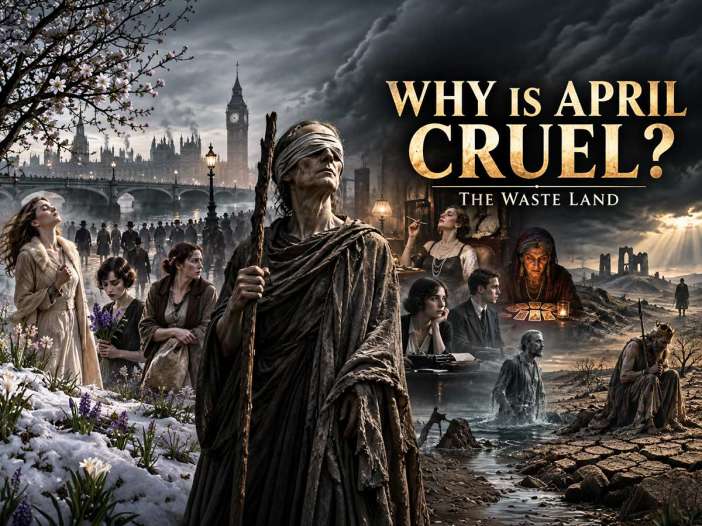
Topic 1: Why Is April Cruel?

The snow was disappearing.
Not dramatically.
There was no sudden flood, no triumphant arrival of spring.
It simply withdrew.
Water dripped from the edge of a roof somewhere beyond the garden. Beneath the thinning white surface, dark soil appeared in irregular patches. Tiny green stems pushed upward through mud that had been frozen only days before.
Marie stood at the edge of the garden watching them.
Far beyond her, mountains rose into a pale sky.
Or perhaps she only remembered mountains.
In this place, memory and landscape had begun to overlap.
A girl carrying hyacinths walked slowly through the wet grass.
At an upstairs window, another woman stood behind heavy curtains.
Farther away, London was beginning to wake.
A tram bell sounded.
A door slammed.
Someone coughed.
Thousands of people were preparing to leave their rooms and enter another day.
Marie looked again at the flowers emerging through the earth.
"Why does everyone assume spring is good?"
The Hyacinth Girl stopped.
She looked down at the flowers in her arms.
"Because things come back."
Marie smiled faintly.
"That's exactly what worries me."
The girl frowned.
"What worries you?"
"Things coming back."
For a moment neither spoke.
Then a voice came from behind them.
"Winter kept us warm."
The two women turned.
Tiresias stood beneath a bare tree.
Neither had seen Tiresias arrive.
Marie studied the old prophet.
"That sounds impossible."
"Does it?"
"Winter kills things."
Tiresias looked at the remaining snow.
"Sometimes."
The Hyacinth Girl asked, "And sometimes?"
"Sometimes it covers them."
Marie understood before the other woman did.
"Memory."
Tiresias said nothing.
Marie walked toward the edge of the garden.
"I remember mountains."
The landscape seemed to shift.
For an instant the gray London sky opened into brilliant alpine blue.
Snow.
A sled.
A frightened child.
Laughter.
Speed.
Someone calling her name.
Then London returned.
"I was frightened," Marie said. "But I was free."
The Hyacinth Girl watched her.
"Would you go back?"
Marie almost answered immediately.
Then she stopped.
"I don't know."
"Why not?"
"Because I don't know whether I miss the place or the person I was there."
The Hyacinth Girl lowered her flowers.
Marie looked at her.
"You understand."
The girl did not answer.
"You remember someone."
Still nothing.
Marie glanced at the hyacinths.
"Someone gave you those?"
"No."
"You gave them to someone?"
"No."
"Then why are you carrying them?"
The girl looked toward the wet earth.
"Because I remember."
The garden changed again.
Now it was warmer.
A different garden.
Another year.
Hyacinths everywhere.
The girl was younger.
Someone stood beside her.
For one impossible moment, the entire world seemed concentrated into another person's presence.
Then the memory broke.
The Hyacinth Girl whispered, "I couldn't speak."
Marie waited.
"Afterward?"
The girl shook her head.
"During it."
"What happened?"
"I don't know."
"You must remember."
"I remember everything."
She touched one of the flowers.
"That's the problem."
A window opened above them.
"Why don't you say something?"
Marie and the Hyacinth Girl looked upward.
The Woman stood at the window.
Her room behind her glittered with beautiful things.
Metal.
Glass.
Perfume bottles.
Jewelry.
A carved chair.
A mirror.
Flowers.
Paintings.
A fire burning even though winter was ending.
She wasn't speaking to either of them.
"Speak to me."
No response came from inside the room.
The Woman's voice became sharper.
"What are you thinking?"
Nothing.
"What thinking?"
Still nothing.
She closed the window violently.
Marie stared upward.
"Who is she talking to?"
Tiresias answered.
"Someone very close to her."
Marie looked puzzled.
"Then why does she sound so far away?"
Tiresias looked toward the window.
"That is a question for another day."
The garden shifted again.
A woman carrying groceries walked across it.
Lil.
She looked tired.
Not simply tired from that morning.
Her exhaustion seemed older.
Children's voices followed somewhere behind her.
She stopped when she saw the others.
"What are you staring at?"
Marie pointed toward the flowers.
"Spring."
Lil looked.
"So?"
"We were wondering whether it's good."
Lil laughed.
"You people have time on your hands."
She started walking again.
Marie followed.
"Do you like spring?"
"I like when the children can go outside."
"That's not what I asked."
Lil stopped.
"Then what are you asking?"
"Does spring make you happy?"
Lil stared at her.
"What kind of question is that?"
"A simple one."
"No, it isn't."
Lil adjusted the bag against her hip.
"Simple questions are things like whether we've got enough bread."
She continued walking.
Marie remained beside her.
"What do you remember when spring comes?"
Lil's face changed.
Only slightly.
But Tiresias saw it.
"Nothing."
Marie waited.
Lil sighed.
"Being younger, I suppose."
"Was life better?"
"I looked better."
"That's different."
"Not always."
Lil looked away.
"People notice when a woman changes."
The Hyacinth Girl joined them.
"Who notices?"
Lil gave her a tired smile.
"Everyone."
She hesitated.
"Especially the person you're afraid will notice."
"Your husband?"
"Albert's coming back."
Something in the way she said it made Marie understand that his return was not purely happy.
"You don't want him home?"
"Of course I do."
"But you're afraid."
Lil tightened her grip on the bag.
"Those things can both be true."
The garden fell silent.
The snow continued melting.
Tiresias finally spoke.
"What did winter allow you not to think about?"
Lil looked irritated.
"What?"
"What did winter cover?"
"I don't know what you're talking about."
Tiresias said nothing.
Lil looked toward the ground.
Then, very quietly:
"Time."
Nobody answered.
Lil continued.
"You don't notice it every day."
She touched her face.
"Then suddenly you see yourself somewhere. A mirror. A shop window."
Her hand dropped.
"And you wonder when it happened."
"When what happened?" Marie asked.
Lil looked at her.
"When you became the person you're looking at."
Across London, an alarm clock rang.
The sound seemed strangely loud.
Then another.
Another.
Hundreds.
Thousands.
In a small room, the Typist opened her eyes.
She stared at the ceiling.
The others could somehow see her.
Perhaps Tiresias was seeing her and they were seeing through Tiresias.
She remained motionless.
Marie whispered, "Is she awake?"
Tiresias answered, "Her eyes are open."
"That's not what I asked."
Tiresias looked at Marie.
"No."
The Typist eventually sat up.
She put her feet on the floor.
She dressed.
She brushed her hair.
She prepared herself for another day with the mechanical efficiency of someone repeating movements she had performed too many times.
The Hyacinth Girl watched her.
"She looks sad."
Tiresias said, "Does she?"
"Don't you think so?"
"I think sadness might require wanting something to be different."
The Typist suddenly looked toward them.
"I can hear you."
Everyone froze.
She stood in her small room looking directly at Tiresias.
"And I wish people would stop deciding how I feel."
Tiresias inclined their head.
"Then tell us."
"Tell you what?"
"How you feel."
The Typist considered the question.
"I don't know."
The Hyacinth Girl asked, "Nothing?"
"I didn't say nothing."
"What did you say?"
"I said I don't know."
She picked up her handbag.
"There's a difference."
Marie stepped closer.
"What do you want?"
The Typist laughed once.
Not cruelly.
Almost incredulously.
"At this hour?"
"In general."
"Coffee."
Marie smiled.
"After coffee?"
"To get through work."
"And after work?"
The Typist stopped.
Something passed across her face.
"Why do you keep asking?"
"Because I'm curious."
"Curiosity is expensive."
"What does that mean?"
"It means if you keep asking yourself what you want, eventually you might have to admit you're not getting it."
That silenced Marie.
The Typist looked toward the melting snow.
"Some mornings are easier when you don't ask."
Tiresias spoke.
"Winter."
The Typist looked at them.
"What about it?"
"Winter kept us warm."
She almost smiled.
"Maybe."
The Hyacinth Girl looked horrified.
"How can you say that?"
"Because I understand it."
"But winter is dead."
The Typist picked up her coat.
"Dead things don't disappoint you."
The Hyacinth Girl flinched.
Marie noticed.
"So that's why April is cruel."
Everyone turned toward her.
Marie looked at the small green shoots emerging through the mud.
"It makes things want again."
Tiresias watched her carefully.
Marie continued.
"Winter says nothing will happen."
She pointed toward the flowers.
"Spring says maybe."
Lil stared at the ground.
The Woman had reopened her upstairs window.
The Typist stood in her doorway.
The Hyacinth Girl clutched her flowers.
Marie whispered:
"Maybe is harder."
The Hyacinth Girl suddenly said, "Sometimes I wish it had never happened."
Marie knew immediately what she meant.
"The garden?"
The girl nodded.
"The person?"
Another nod.
"Why?"
The Hyacinth Girl's eyes filled.
"Because then I wouldn't know."
"Know what?"
"What it felt like."
Marie stepped closer.
The girl continued.
"If you've never had something, you can imagine it however you like."
She looked down at the flowers.
"But once you've had it..."
Her voice weakened.
"...you know exactly what's missing."
Lil turned toward her.
For the first time, the exhaustion disappeared from Lil's expression.
Not because she felt better.
Because she recognized something.
"Yes."
The Hyacinth Girl looked at her.
Lil nodded.
"That's exactly it."
The Woman upstairs whispered:
"Yes."
Three women.
Three completely different lives.
The same recognition.
The Typist remained silent.
Marie looked at her.
"You too?"
"No."
"Never?"
The Typist looked toward the street.
"I think mine is the opposite."
"What do you mean?"
"You remember something wonderful and wish you could forget it."
She buttoned her coat.
"I don't remember enough wonderful things."
Nobody knew what to say.
Then the Woman upstairs spoke again.
"That might be worse."
The Typist looked up.
"Maybe."
The Woman leaned against the window frame.
"You still want something?"
The Typist shrugged.
"Sometimes."
"What?"
"I don't know."
"Love?"
The Typist's expression hardened.
"Don't make it pretty."
The Woman fell silent.
"Maybe I want somebody to notice when I'm in the room."
That landed differently.
Lil looked at her.
The Hyacinth Girl looked at her.
Even Marie did not immediately speak.
The Typist continued.
"Not desire me."
"Not need something."
"Not decide what I am."
"Just notice."
From somewhere inside the Woman's beautiful room came the sound of movement.
She turned quickly.
For one instant hope crossed her face.
Then nothing.
She looked back down.
"Yes."
The Typist met her eyes.
They had never met.
Yet something passed between them.
Tiresias saw it.
Spring continued.
The snow retreated farther.
More flowers appeared.
The Hyacinth Girl suddenly looked angry.
"Why should memory have this much power?"
Tiresias answered.
"Because memory doesn't remain in the past."
"Where does it go?"
"Into what you expect from the future."
The Hyacinth Girl considered that.
"So because I remember..."
"You compare."
Marie finished the thought.
"The present with what was."
Lil added:
"Yourself with who you were."
The Woman:
"The person beside you with who they used to be."
The Typist said:
"Or with someone who never existed."
Everyone looked at her.
She shrugged.
"People remember things better than they were."
Marie smiled sadly.
"The mountains?"
"Maybe."
Marie looked toward them.
They seemed impossibly beautiful now.
Snow glittering.
Blue sky.
Childhood.
Freedom.
Perhaps too beautiful.
Marie whispered:
"I can't remember being unhappy there."
Tiresias asked:
"Were you?"
Marie thought.
"I must have been sometimes."
"But you don't remember."
"No."
Tiresias looked toward the mountains.
"Memory edits."
Marie smiled.
"Then memory is a liar."
"No."
"A storyteller?"
"Closer."
A wind passed through the garden.
The Hyacinth Girl's flowers moved.
The Woman's curtains lifted.
Lil pulled her coat tighter.
The Typist stepped outside.
For the first time, all five women occupied the same landscape.
Marie looked at them.
"So what are we supposed to do?"
Nobody answered.
"Forget?"
The Hyacinth Girl immediately said, "No."
"Remember?"
Lil laughed.
"As if we have a choice."
"Then what?"
Tiresias walked toward the place where snow and earth met.
"Perhaps neither remembering nor forgetting is the question."
"What is?"
Tiresias knelt.
A tiny plant had broken through the soil.
"If something has been buried all winter and begins growing again, what should it become?"
Marie frowned.
"Itself."
"Are you sure?"
"What else?"
Tiresias touched the soil.
"Something new."
Lil looked skeptical.
"That's a nice thought."
"You don't believe it?"
"I believe flowers do it."
"And people?"
Lil looked toward the children's voices in the distance.
"I don't know."
The Typist said:
"People carry too much."
The Hyacinth Girl added:
"Memory."
The Woman said:
"Fear."
Lil:
"Consequences."
Marie:
"Time."
Tiresias stood.
"Yes."
The Typist gave a small, bitter laugh.
"So we're worse at spring than flowers."
For the first time, Tiresias smiled.
"Perhaps."
A bell sounded.
London appeared around them.
The garden dissolved into streets.
The mountains faded.
Buildings rose.
London Bridge stretched through fog.
People emerged from doorways.
Men in coats.
Women carrying bags.
Workers.
Clerks.
Shopkeepers.
Thousands of them.
The crowd began flowing across the bridge.
Marie watched.
Something about it frightened her.
"So many people."
The Hyacinth Girl moved closer to her.
Lil disappeared into the crowd.
The Typist joined it.
The Woman vanished behind a window somewhere high above.
Marie watched people pass.
No one looked at anyone.
Shoes against pavement.
Breath in cold air.
Faces downward.
Bodies moving together.
Tiresias stood beside her.
Marie whispered:
"Are they all awake?"
"Yes."
She watched longer.
"Then why do they look like that?"
Tiresias did not answer.
A man passed Marie without seeing her.
Then another.
And another.
Thousands together.
Each moving inside some invisible enclosure.
Marie suddenly remembered what she had said earlier.
Spring wakes things.
Spring makes things want again.
But now another possibility occurred to her.
Perhaps people could wake physically without awakening anywhere else.
Marie looked at Tiresias.
"I think I understand why April is cruel."
Tiresias waited.
"It wakes you before you're ready."
"Yes."
"And then?"
Tiresias looked across London Bridge.
"Then you discover what survived the winter."
Marie watched the enormous crowd.
"And what if what survived is lonely?"
Tiresias turned toward her.
The city seemed to grow quieter despite the thousands of footsteps.
Across the bridge walked the Typist.
Somewhere behind a window waited the Woman.
Lil was going home.
The Hyacinth Girl was still carrying flowers from a memory she could not release.
People touched shoulders as they passed.
Almost nobody looked up.
Tiresias finally answered.
"Then we must ask why so many people can live this close together..."
A pause.
"...and remain so far apart."
The crowd flowed onward.
And somewhere inside it, a woman was waiting for someone to speak.
Topic 2: Why Can't We Reach Each Other?
The crowd continued across London Bridge.
Thousands of shoulders.
Thousands of faces.
Thousands of private lives moving inches apart.
The Typist walked among them.
A man's coat brushed against hers.
Neither looked back.
Someone stepped on another person's shoe.
An apology was muttered without eye contact.
Two men discussed business.
A woman laughed at something her companion had said.
A child pulled at his mother's hand.
Everyone was speaking.
Yet after what Marie had asked, Tiresias could hear something beneath all that noise.
Distance.
Marie stood beside Tiresias watching the crowd.
"Maybe I was wrong."
"About what?"
"Maybe they're not asleep."
Tiresias waited.
"Maybe they're hiding."
"From whom?"
Marie watched another hundred people pass.
"Each other."
The city shifted.
London Bridge disappeared.
The crowd became wallpaper.
Footsteps became the ticking of a clock.
Streetlamps became candles.
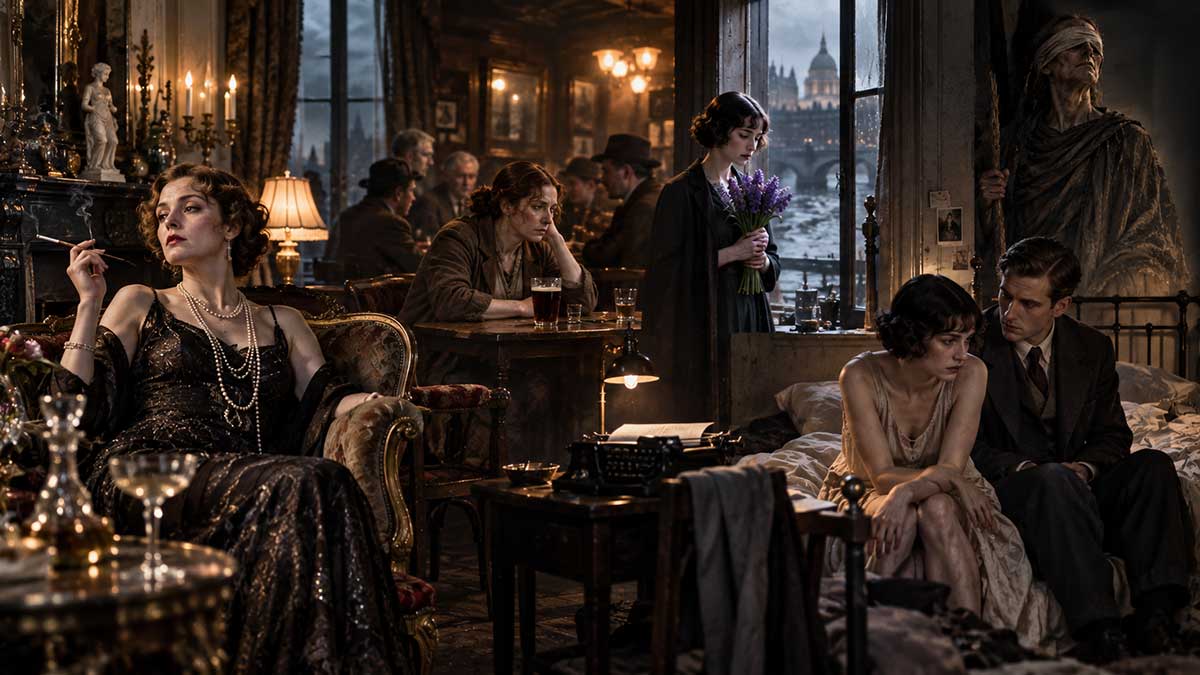
And suddenly they were inside the beautiful room.
The Woman sat beneath the enormous mirror.
Everything around her seemed designed to impress someone.
Perfume.
Jewelry.
Carved furniture.
Paintings.
Flowers.
Silver.
Firelight.
The room was almost violently beautiful.
But the Woman was not looking at any of it.
She was staring at the man opposite her.
"Speak to me."
The man did not answer.
Her fingers tightened around the arm of the chair.
"Why do you never speak?"
Silence.
"What are you thinking?"
Still nothing.
"What thinking?"
Nothing.
She stood.
"Do you know what the worst part is?"
The man finally looked at her.
"You think I'm angry because you won't talk."
He said nothing.
"I'm angry because I don't know where you are."
"I'm here."
The Woman laughed.
"No."
She pointed at the chair.
"Your body is there."
The room became very quiet.
"That's not what I asked."
Marie appeared near the doorway.
The Woman noticed her.
"What are you doing here?"
"I don't know."
"Then leave."
Marie hesitated.
"Do you want him to speak?"
"Yes."
"What do you want him to say?"
The Woman opened her mouth.
Nothing came.
Marie asked again.
"What do you want him to say?"
"I don't know."
"Then how will he know?"
The Woman's expression changed.
"That's not fair."
"Why?"
"Because he should know."
Marie looked toward Tiresias.
Tiresias remained silent.
The Woman noticed.
"Don't look at the prophet. Answer me."
Marie turned back.
"I don't think people always know."
"They should."
"Why?"
"Because if I have to tell him..."
She stopped.
Marie waited.
The Woman's voice dropped.
"...then maybe it doesn't count."
The Typist was suddenly standing beside the fireplace.
She had heard enough.
"That's ridiculous."
The Woman turned sharply.
"Excuse me?"
"If you want something, say it."
"You think it's that simple?"
"Usually."
The Woman looked at her clothing.
Her tired face.
Her practical shoes.
"And what exactly has that philosophy given you?"
The Typist's expression hardened.
Tiresias watched the wound land.
The Woman immediately realized what she had done.
But pride arrived before apology.
The Typist turned toward the door.
"That's what I thought."
"Wait."
The Typist stopped.
The Woman swallowed.
"I'm sorry."
The Typist looked back.
"Are you?"
"Yes."
"Or are you uncomfortable because everyone heard you?"
The Woman had no answer.
The Typist nodded.
"Exactly."
She started walking again.
"Please."
The Typist stopped.
The Woman looked almost frightened.
"Stay."
"Why?"
"Because you said something I didn't like."
The Typist raised an eyebrow.
"That's usually a reason people ask me to leave."
"Maybe that's why I want you to stay."
The Typist returned slowly.
The Woman sat again.
"What would you say?"
"If I were you?"
"Yes."
The Typist thought.
"I'd say what I actually want."
The Woman looked toward the silent man.
Her anger weakened.
"I want you to tell me that you're still here."
The man looked confused.
"I told you I'm here."
"No."
Her voice cracked.
"I mean with me."
Something in the room changed.
The Typist looked away.
Marie looked toward Tiresias.
Tiresias was watching the Woman.
She continued.
"I want to know that when you look at me, you don't see some mistake you've been living beside."
The man's face changed.
"I never said that."
"I know."
"Then why do you think it?"
"Because you don't say anything else."
The silence that followed was different from the earlier silence.
It contained information.
The Typist spoke softly.
"That's the problem."
The Woman turned toward her.
"What?"
"When people don't tell us what's inside them..."
She looked toward the silent man.
"...we fill the empty space ourselves."
Marie whispered:
"With what?"
The Typist answered without looking at her.
"Usually the worst thing we can imagine."
The room changed again.
The expensive carpet became worn floorboards.
The chandeliers became a pub lamp.
Someone shouted from somewhere behind them:
"HURRY UP PLEASE IT'S TIME."
Lil sat at a table.
A glass stood in front of her.
She looked exhausted.
The Woman stared at the room.
"Where are we?"
"Somewhere people talk," Lil said.
She drank.
"Whether they say anything is another matter."
The Typist sat across from her.
Marie remained standing.
The Woman looked uncomfortable.
Lil noticed.
"Don't worry. Poverty isn't contagious."
The Woman flushed.
"I wasn't thinking that."
"Of course not."
The Typist almost smiled.
Marie sat beside Lil.
"Albert's coming home?"
Lil's face tightened.
"Yes."
"You must be excited."
Lil gave her a look.
Marie corrected herself.
"Sorry."
"No. I am."
Lil stared into her glass.
"That's the irritating part."
"What do you mean?"
"You lot keep wanting things to be one thing."
"Happy or unhappy."
"Love him or don't."
"Want him home or don't."
She shook her head.
"Real life isn't that tidy."
The Woman quietly said:
"No."
Lil looked at her.
For the first time, the two women regarded each other without hostility.
Lil continued.
"I want him home."
She paused.
"And I'm frightened of him coming home."
"Why?" Marie asked.
Lil touched her mouth.
Her face.
Her body.
"Because I'm not the woman who was here when he left."
The Woman leaned forward.
"Does he expect you to be?"
"I don't know."
"Have you asked?"
Lil laughed.
"Listen to her."
The Woman stiffened.
Lil softened.
"No. I haven't."
"Why?"
Lil looked at the Woman.
"Maybe for the same reason you don't tell him what you need."
The Woman said nothing.
Lil continued.
"If I ask Albert whether he still wants me..."
She stared into her glass.
"...he gets to answer."
The Typist looked at her.
"And if you don't ask?"
"I can still hope."
The Woman whispered:
"Yes."
Again, recognition passed between people who should have had almost nothing in common.
Marie looked from one to the other.
"So you're both afraid of the answer."
Lil nodded.
The Woman nodded.
The Typist did not.
Marie noticed.
"You're not?"
The Typist shrugged.
"You have to expect an answer before you can be afraid of it."
Lil studied her.
"You're young."
"So?"
"You shouldn't sound that old."
The Typist laughed.
"Maybe you shouldn't look that tired."
The words escaped before she could stop them.
Lil's face changed.
The Typist immediately regretted it.
"I'm sorry."
Lil looked down.
"Don't be."
"I shouldn't have said that."
"No."
Lil touched her face again.
"But you saw it."
The Typist leaned forward.
"I saw that you're tired."
"Same thing."
"No."
Lil looked at her.
"No," the Typist repeated. "It isn't."
The pub grew quieter.
"You want to know something?"
Lil waited.
"You look like somebody who's been carrying too much."
Lil's eyes filled unexpectedly.
She looked away.
Nobody moved.
The Typist continued.
"That's different from ugly."
Lil wiped at her eye angrily.
"Damn you."
The Typist smiled faintly.
"Sorry."
"No, you're not."
"No."
"HURRY UP PLEASE IT'S TIME."
The voice echoed again.
But no one left.
The Woman looked at Lil.
"Does Albert know?"
"Know what?"
"That you're afraid."
Lil laughed.
"Albert knows I've got five children."
"That's not what I asked."
Lil looked at her.
"No."
The Woman nodded.
"My husband doesn't know either."
"Know what?"
"That I'm afraid."
Lil studied her beautiful dress, jewelry, perfect hair.
"Of what?"
The Woman looked around the luxurious room that seemed to exist somewhere beyond the pub walls.
"That I could disappear while sitting three feet away from him."
The Typist stopped breathing for a moment.
Lil said:
"I know that feeling."
The Woman looked surprised.
"You do?"
"Course I do."
"How?"
Lil shrugged.
"You think loneliness checks your bank account first?"
The Woman laughed.
It was the first genuine laugh anyone had heard from her.
Then another room appeared.
Smaller.
Much smaller.
A bed.
A chair.
A table.
A typewriter.
A few clothes.
The Typist stopped smiling.
"No."
Tiresias turned toward her.
"No what?"
"We're not doing this."
The Young Man stood near the doorway.
The Typist immediately became rigid.
Marie looked between them.
"Who is he?"
"No one."
The Young Man reacted.
The Typist saw it.
"What?"
"Nothing."
"No. Say it."
"You called me no one."
"Would you prefer something else?"
He stepped farther into the room.
"I thought we were..."
He stopped.
The Typist waited.
"What?"
He searched for a word.
"Together."
She stared at him.
"When?"
He looked genuinely confused.
The Woman and Lil remained silent.
The Typist stood.
"When were we together?"
"You know what I mean."
"No."
Her voice remained calm.
"Tell me."
He glanced at Tiresias.
"Why are all these people here?"
The Typist gave a humorless laugh.
"Now you're embarrassed?"
"I'm not embarrassed."
"Then answer."
He looked at her.
"We were intimate."
The Typist's expression changed.
"Intimate."
"Yes."
She repeated the word as though testing whether it belonged to the event.
"That's what you think happened?"
The Young Man's confidence weakened.
"Didn't it?"
The Typist looked toward Tiresias.
"Tell him."
Tiresias shook their head.
"No."
"Why not?"
"Because he asked you."
The Typist looked back at the Young Man.
"You touched me."
He waited.
"That's true."
"Yes."
"You wanted me."
"Yes."
"You got what you wanted."
He became uncomfortable.
"I wouldn't put it like that."
"How would you put it?"
"I thought you wanted it too."
The room tightened.
The Typist did not answer immediately.
Finally:
"I didn't tell you to stop."
The Young Man nodded.
"Exactly."
She stared at him.
"Exactly what?"
He realized the mistake.
The Woman closed her eyes.
Lil looked down.
Marie watched the Typist.
The Typist stepped closer to him.
"Is not telling you to stop the same thing as wanting you?"
"No."
He said it quietly.
She seemed surprised.
Perhaps she had expected resistance.
"Then why did you act as though it was?"
"I don't know."
"Try."
The Young Man looked genuinely uncomfortable now.
"I thought..."
"What?"
"I thought if you really didn't want me there, you'd make me leave."
The Typist nodded slowly.
"So I had to protect both of us from what you wanted."
"No."
"That's what you just said."
He rubbed his face.
"I didn't think about it like that."
The Typist looked at him for a long time.
Then she said:
"I know."
That was worse than anger.
The Young Man looked away.
Tiresias spoke.
"May I ask you something?"
The Young Man nodded.
"When you entered this room, what did you see?"
"A woman."
"Which woman?"
He frowned.
"The Typist."
"That's her occupation."
The Young Man looked at her.
Tiresias continued.
"What did she want?"
"I don't know."
"What was she afraid of?"
"I don't know."
"What had happened to her that day?"
"I don't know."
"What was she hoping would happen tomorrow?"
"I don't know."
Tiresias paused.
"What makes her laugh?"
The Young Man said nothing.
"What makes her cry?"
Nothing.
"What does she remember when April comes?"
Nothing.
Tiresias looked at him.
"You knew where her body was."
A long silence.
"Did you know where she was?"
The Young Man sat down.
The Typist looked away.
Nobody celebrated the point.
There was nothing triumphant about it.
After a while, the Young Man asked:
"Why didn't you say anything?"
The Typist turned.
"What?"
"If you didn't want..."
He struggled.
"...if you didn't want what happened."
She considered him.
"I don't know."
"You must know."
"No."
He looked frustrated.
"That's not an answer."
The Woman suddenly spoke.
"Yes, it is."
Everyone turned toward her.
She looked at the Young Man.
"Sometimes you don't know what you want until you realize what you didn't want."
The Typist looked at her.
The Woman continued.
"And sometimes you know exactly what you want but you're terrified to say it."
Lil added:
"Because then someone can refuse."
Marie whispered:
"Or leave."
The Hyacinth Girl appeared near the window.
"Or say nothing."
The Typist looked at all of them.
Different rooms.
Different relationships.
Different kinds of silence.
The Young Man asked:
"Then how is anyone supposed to know anything?"
Tiresias answered:
"Ask."
"That's it?"
"No."
"What else?"
"Listen."
"I listened."
The Typist looked at him.
"No."
He turned toward her.
"You waited for your turn."
The Young Man said nothing.
Tiresias continued.
"Listening is not remaining silent while another person speaks."
"What is it?"
"Allowing what they say to change what you thought you knew."
The room dissolved.
They were standing beside the Thames.
Evening.
Water moved beneath them.
London glittered on the opposite bank.
Couples walked together.
Some held hands.
Some argued.
Some laughed.
Some stared at their phones? No.
The image flickered strangely.
Not yet.
Wrong century.
Tiresias noticed the mistake in time and smiled faintly.
Instead, newspapers.
Cigarettes.
Shop windows.
Music drifting from somewhere.
The city was full of opportunities to meet people.
Yet the loneliness remained.
A Thames Daughter's voice came from the river.
"I can connect nothing with nothing."
Everyone turned.
Nobody could see her.
Only the water.
The Typist whispered:
"Who said that?"
Another voice drifted downstream.
A woman's memory.
A man.
A journey.
An encounter.
Then distance.
Lil looked toward the river.
"Are there more of us?"
Tiresias answered:
"Many."
The Woman stepped toward the water.
"People who can't reach each other?"
"Yes."
"How many?"
Tiresias looked toward London.
Lights appeared in thousands of windows.
"How many windows can you see?"
The Woman stopped asking.
The Young Man stood beside the Typist.
Not touching her.
After a long time he said:
"I didn't see you."
She looked at the river.
"No."
"I'm sorry."
She said nothing.
He waited.
Perhaps for forgiveness.
Perhaps for relief.
She noticed.
"Don't do that."
"What?"
"Don't apologize so I'll make you feel better."
He looked ashamed.
"What am I supposed to do?"
"Let it be uncomfortable."
He nodded.
They stood there.
The discomfort remained.
After a while, she looked at him.
"That's better."
He seemed confused.
"What is?"
"You didn't run away from it."
He nodded again.
Nothing was repaired.
But something had happened.
Lil watched them.
Then she looked toward the imagined direction of home.
"Maybe I should tell Albert."
The Woman asked:
"Tell him what?"
"That I'm frightened."
The Woman nodded.
Then Lil asked:
"Will you?"
"Will I what?"
"Tell yours."
The Woman looked back toward the beautiful room somewhere behind London.
"I don't know."
Lil smiled.
"Fair enough."
The Hyacinth Girl sat near the river.
Marie joined her.
"Do you still wish it never happened?"
The girl looked at the flowers.
"Sometimes."
"And now?"
"Now I think maybe I wish we'd spoken afterward."
"What would you have said?"
The Hyacinth Girl thought for a long time.
Finally:
"Was it real for you too?"
Marie took her hand.
The girl looked down at their hands.
Then toward the Typist.
Then Lil.
Then the Woman.
Then the Young Man.
"I thought I was the only one."
Tiresias heard her.
"Everyone does."
The Typist turned.
"Everyone does what?"
"Believes their loneliness is private."
The Thames moved beneath them.
The Woman looked toward the city.
"Maybe that's why we're lonely."
"Because we think we're the only ones?"
"Because we're ashamed of needing each other."
Nobody answered.
The Typist considered this.
"We spend half our lives pretending we don't need anyone."
Lil added:
"And the other half angry because nobody noticed we did."
Marie laughed softly.
Even the Woman smiled.
The Young Man looked toward Tiresias.
"So what does it mean to actually see somebody?"
Tiresias did not answer immediately.
The Young Man waited.
Finally Tiresias pointed toward the Typist.
"Ask her."
He looked at her.
She looked back.
"What do you need?"
The question sounded awkward in his mouth.
Almost rehearsed.
But it was a beginning.
The Typist thought.
"Right now?"
"Right now."
She looked toward the river.
"Nothing from you."
His face fell.
She noticed.
"But that's an honest answer."
He nodded.
"And tomorrow?"
"I don't know."
He accepted that too.
The Typist looked surprised.
The Woman watched them.
"Is that all?"
Tiresias turned.
"All what?"
"Seeing someone."
"No."
"What else?"
"Remembering that they continue to exist when they are not giving you what you want."
That silenced everyone.
Lil thought of Albert.
The Woman thought of the silent man.
The Young Man looked at the Typist.
The Hyacinth Girl thought of someone long absent.
Marie thought of childhood figures who existed now only in memory.
The Woman approached Tiresias.
"Do you see me?"
"Yes."
"All of me?"
Tiresias looked at her carefully.
"No."
She seemed disappointed.
"No one does."
"Then what's the point?"
Tiresias looked toward the thousands of illuminated windows.
"The point is not to see everything."
The Woman waited.
"The point is to remember there is always more to see."
The Thames Daughter's voice returned.
Softer now.
"I can connect..."
The river carried the rest away.
The Typist looked toward Tiresias.
"If everyone wants connection so badly, why do we keep doing things that make us more alone?"
Nobody answered.
The Young Man stared into the water.
Lil looked toward home.
The Woman looked toward the room she feared returning to.
The Hyacinth Girl held memories that could not answer her.
Marie watched London.
Then cards began appearing on the ground.
One.
Another.
Another.
Madame Sosostris sat beneath a streetlamp.
Nobody had seen her arrive.
She turned over a card.
Then another.
She looked at the people gathered beside the Thames.
"Because you are all waiting."
The Typist frowned.
"For what?"
Madame Sosostris smiled.
"That's the interesting question."
Behind her, somewhere far beyond London, the Fisher King sat beside barren land.
Waiting.
Next: Topic 3, What Are We All Waiting For?
Topic 3: What Are We All Waiting For?
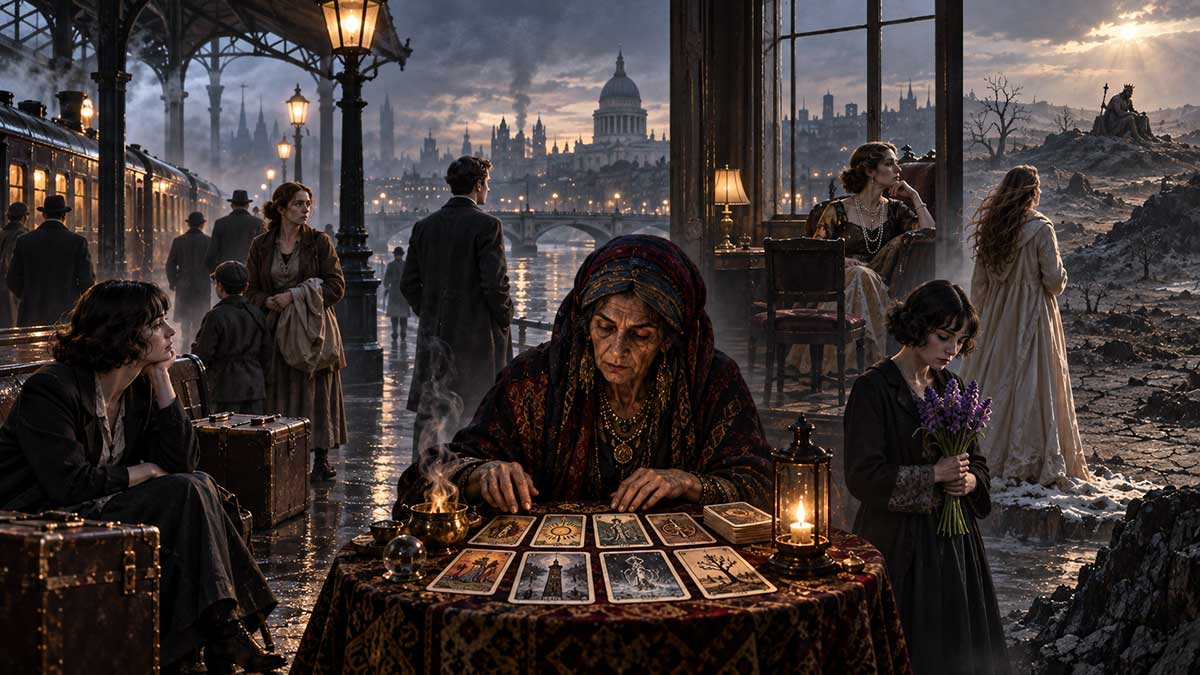
Madame Sosostris turned over another card.
Nobody recognized it.
Or perhaps everyone did.
The picture seemed to change depending on who looked.
Lil saw a man returning home.
The Woman saw an empty chair.
The Hyacinth Girl saw a garden.
The Young Man saw a doorway opening.
The Typist saw nothing she wanted to name.
Marie saw mountains.
Tiresias saw water.
Madame Sosostris gathered the cards together.
"Well?"
The Typist frowned.
"Well what?"
"You wanted to know what you're waiting for."
"I never asked you."
"No."
Madame Sosostris smiled.
"People rarely do with words."
The Thames flowed behind her.
The city had become strangely unstable.
A railway platform appeared beyond the river.
Then a pub.
Then the Typist's room.
Then a garden.
Then a dry landscape beneath an enormous sky.
All of them seemed to exist at once.
Madame Sosostris looked around.
"Waiting rooms."
Marie followed her gaze.
"Those aren't waiting rooms."
"Of course they are."
She pointed toward the railway platform.
"Obvious."
Then toward the pub.
"People waiting to forget."
The Typist's room.
"Waiting for evening to become tomorrow."
The garden.
"Waiting for something to return."
Finally the barren landscape.
There, barely visible in the distance, sat the Fisher King.
"Waiting for rain."
The Typist crossed her arms.
"You make everything sound miserable."
Madame Sosostris laughed.
"I'm a fortune teller. Happiness is terrible for business."
Even Tiresias smiled.
Then Madame Sosostris became serious.
"Tell me."
She looked at Lil.
"What are you waiting for?"
Lil immediately answered.
"Albert."
"That's who. I asked what."
Lil frowned.
"What's the difference?"
"A considerable one."
Lil looked toward the railway platform.
"He's coming home."
"And when he does?"
Lil hesitated.
"We'll be a family again."
"You already have a family."
"You know what I mean."
"No."
Madame Sosostris leaned forward.
"That's why I'm asking."
Lil became irritated.
"Fine."
She thought.
"I want things to settle down."
"Meaning?"
"I want to stop worrying."
"About Albert?"
"About money."
She touched her face.
"My health."
A pause.
"Whether he still wants me."
Another.
"The children."
Another.
"Everything."
Madame Sosostris nodded.
"So you're not waiting for Albert."
Lil looked annoyed.
"What am I waiting for, then?"
"Security."
Lil said nothing.
Madame Sosostris turned toward the Woman.
"And you?"
The Woman looked back toward the distant window of her beautiful room.
"For him to speak."
"Why?"
"Because I want to know what he's thinking."
"Why?"
The Woman sighed.
"Because then I'll know."
"Know what?"
The Woman stopped.
Madame Sosostris waited.
Finally:
"Whether I'm alone."
The fortune teller nodded.
"So you're not waiting for conversation."
The Woman looked toward her.
"You're waiting for reassurance."
The Woman did not argue.
Madame Sosostris turned toward the Hyacinth Girl.
"You?"
The girl tightened her hands around the flowers.
"I don't know."
"Excellent."
"Why is that excellent?"
"People who say they know are usually much more difficult."
The Hyacinth Girl almost smiled.
Madame Sosostris gestured toward the flowers.
"Are you waiting for him?"
"No."
"Would you see him again?"
The girl hesitated.
"Maybe."
"Would you want what happened to happen again?"
Another pause.
"I don't know."
"Then what are you waiting for?"
The Hyacinth Girl looked at the flowers.
"I think..."
Everyone waited.
"...I want to know whether it meant the same thing to him."
The Woman looked toward her.
Madame Sosostris nodded.
"Recognition."
The girl whispered:
"Maybe."
Marie was next.
Madame Sosostris did not even ask.
Marie said:
"The mountains."
"No."
"Freedom."
"Better."
Marie looked toward the distant peaks.
"I want to feel like that again."
Madame Sosostris raised an eyebrow.
"Then you're waiting for a feeling."
Marie nodded slowly.
"Yes."
Madame Sosostris turned toward the Young Man.
He looked uncomfortable.
"What?"
"What are you waiting for?"
"Nothing."
The Typist laughed.
Madame Sosostris looked delighted.
"Wonderful."
"What?"
"Nothing is one of the most popular things people wait for."
"I don't understand."
"You will."
She leaned toward him.
"What do you want?"
"I don't know."
The Typist muttered:
"Convenient."
He ignored her.
"Success, I suppose."
"What does success look like?"
"Money."
"And then?"
"A good life."
"What does that look like?"
He hesitated.
"Freedom."
Marie looked at him.
Madame Sosostris continued.
"And what would you do with freedom?"
"Whatever I want."
"And what do you want?"
He stopped.
Madame Sosostris smiled.
"We're back where we started."
The Typist looked at him differently.
Not sympathetically exactly.
But perhaps with a little more understanding.
The Young Man noticed.
"What?"
"Nothing."
"No. Say it."
She shrugged.
"I thought you were more certain."
"About what?"
"Everything."
He laughed.
"I thought you were."
The Typist looked genuinely surprised.
"Me?"
"You always act like you don't need anything."
The surprise vanished.
"That's not certainty."
"What is it?"
"Practice."
The Young Man did not understand.
Tiresias did.
Madame Sosostris turned toward the Typist.
"And you?"
"No."
"Everyone else answered."
"Good for them."
"What are you waiting for?"
"Tomorrow."
"What happens tomorrow?"
"Work."
"And after work?"
The Typist glared at Marie.
Marie raised both hands.
"I didn't say anything."
Madame Sosostris waited.
The Typist finally sighed.
"I don't know."
The fortune teller said nothing.
"Why are you looking at me like that?"
"Because I think you do."
The Typist stared at the Thames.
"I want something to happen."
"What?"
"Something."
"What kind of something?"
"I don't know."
"Love?"
"Maybe."
"Marriage?"
"I don't know."
"Children?"
"I don't know."
"Money?"
"Wouldn't hurt."
"Adventure?"
"Maybe."
"Someone to notice you?"
The Typist looked at her.
Madame Sosostris remembered Topic 1.
The Typist looked away.
"Yes."
The Woman watched her.
The Typist continued.
"But even that isn't quite it."
"What is?"
She struggled.
"I want..."
A train whistle sounded.
The platform appeared more clearly.
People boarded.
Others arrived.
Doors opened.
Doors closed.
Life moving somewhere.
The Typist watched.
"I want to feel like I'm going somewhere."
Madame Sosostris nodded.
"Ah."
"What?"
"Now we're getting closer."
"To what?"
"Hope."
The Typist looked almost embarrassed by the word.
"Don't make it sentimental."
"I wouldn't dare."
Madame Sosostris turned toward Tiresias.
"And you?"
Tiresias smiled.
"You know better than that."
"Indulge me."
"What am I waiting for?"
"Yes."
Tiresias looked at all of them.
"To see whether they learn anything."
The Typist rolled her eyes.
"Prophets."
Madame Sosostris laughed.
"Quite."
Then the laughter stopped.
Everyone gradually became aware of the figure sitting far away.
The Fisher King.
He had been visible all along.
Nobody had approached him.
Perhaps because he looked as though he belonged to the landscape rather than among people.
A wounded man.
A broken crown.
Dry earth.
A river that no longer reached him.
Madame Sosostris called across the distance.
"And you?"
The Fisher King did not move.
"What are you waiting for?"
His voice came from very far away.
"Rain."
Madame Sosostris nodded.
"How long?"
The King looked toward the empty sky.
"I don't remember."
The simplicity of the answer silenced everyone.
Lil asked:
"Doesn't it ever rain?"
"It has."
"When?"
"Long ago."
Marie looked toward the barren land.
"Do you remember it?"
"Yes."
The Hyacinth Girl asked:
"Does remembering make it better?"
The Fisher King looked at her flowers.
"No."
She understood.
The King continued.
"It makes the dryness more precise."
The Hyacinth Girl lowered her eyes.
Madame Sosostris shuffled her cards.
"So."
She looked at everyone.
"Security."
She nodded toward Lil.
"Reassurance."
The Woman.
"Recognition."
The Hyacinth Girl.
"Freedom."
Marie.
"Success, whatever that means."
The Young Man.
"Movement."
The Typist.
Then the Fisher King.
"Rain."
She spread the cards across the table.
"An impressive collection."
Lil crossed her arms.
"Now tell us what happens."
Madame Sosostris looked up.
"What?"
"You heard me."
Lil stepped closer.
"Albert comes home. What happens?"
The Woman immediately joined her.
"Yes."
Madame Sosostris frowned.
"Yes what?"
"Tell us."
The Hyacinth Girl looked at her cards.
"Can you see him?"
Marie asked:
"Can you see whether I go back?"
The Young Man stepped closer.
"Can you tell whether I become successful?"
The Typist remained behind them.
But she was listening.
Questions came faster.
"Will he stay?"
"Will I be happy?"
"Will I have money?"
"Will things change?"
"Will the land recover?"
The Fisher King finally looked toward Madame Sosostris.
"Will it rain?"
Madame Sosostris stared at them.
Then she burst out laughing.
Nobody else did.
Lil looked offended.
"What's funny?"
"You."
"Why?"
"All of you."
The Woman became impatient.
"You're supposed to tell fortunes."
"Yes."
"Then tell us."
Madame Sosostris gathered the cards.
"No."
The Woman stared.
"No?"
"No."
"Why?"
"Because none of you want the future."
Lil scoffed.
"Of course we do."
"No."
Madame Sosostris placed the deck down.
"You want reassurance."
The Typist stepped forward.
"What's the difference?"
Madame Sosostris looked at her.
"The future tells you what happens."
She pointed toward Lil.
"Albert returns."
Toward the Woman.
"Someone speaks."
Toward Marie.
"You travel."
Toward the Young Man.
"You earn money."
Toward the Fisher King.
"Rain falls."
Then she spread her hands.
"Reassurance tells you that afterward..."
She paused.
"...you will be all right."
Nobody spoke.
The Woman looked frightened.
"Can't you tell us that?"
"No."
"Why not?"
"Because I don't know."
The Woman laughed nervously.
"You're a fortune teller."
"Exactly."
The Woman waited.
Madame Sosostris continued.
"I can tell you what might happen."
She looked around the group.
"I cannot tell you what it will mean to you."
The Typist stared at her.
"Then what's the point?"
"Of fortune telling?"
"Yes."
Madame Sosostris smiled.
"People pay remarkably well for uncertainty wearing jewelry."
Marie laughed.
Even Lil smiled.
But the Fisher King did not.
"What if you knew?"
Everyone turned toward him.
Madame Sosostris asked:
"Knew what?"
"Everything."
The King stood slowly.
"What if every person here knew exactly what tomorrow would bring?"
He looked toward Lil.
"You knew exactly what Albert would say."
Toward the Woman.
"You knew what the person beside you truly thought."
Toward the Hyacinth Girl.
"You knew whether that moment meant anything to him."
Toward Marie.
"You knew whether you would ever feel free again."
Toward the Young Man.
"You knew whether you would succeed."
Toward the Typist.
"You knew whether your life would change."
Then he looked toward the empty sky.
"And I knew exactly when the rain would come."
The King stepped from the barren landscape toward them.
"Would that save any of us?"
Nobody answered.
The Typist finally said:
"It would help."
"Perhaps."
The King came closer.
"But you would still have to live until then."
The Typist's expression changed.
The Fisher King looked at Madame Sosostris.
"Knowing the future does not shorten the road."
Madame Sosostris nodded.
"No."
"Then perhaps the future is not what we're waiting for."
Marie asked:
"What are we waiting for?"
The Fisher King looked at her.
"Permission to begin living."
The words seemed to move through everyone differently.
The Young Man frowned.
"That's easy for you to say."
The King looked at the barren land.
"Is it?"
The Young Man immediately regretted it.
But the King continued.
"I have spent years waiting for rain."
He looked toward the sky.
"Every morning I tell myself that when the rain comes, the land will live again."
He touched his wound.
"When the wound heals, I will live again."
He looked toward the ruined kingdom.
"When everything is restored, I will live again."
He turned toward them.
"And meanwhile?"
Nobody spoke.
The King answered himself.
"I wait."
The Typist looked toward the railway platform.
Trains continued arriving.
People got on.
People got off.
She whispered:
"I do that."
The King looked at her.
"What?"
"I keep thinking something will happen."
"What?"
"I don't know."
"A person?"
"Maybe."
"A job?"
"Maybe."
"Money?"
"Maybe."
"Love?"
She hesitated.
"Maybe."
The King asked:
"And until then?"
The Typist looked at the small room behind her.
"Work."
"Eat."
"Sleep."
"Repeat."
She said it lightly.
But nobody heard it lightly.
The Woman spoke.
"I keep thinking when he finally talks to me, everything will make sense."
Lil said:
"When Albert comes home."
Marie:
"When I go somewhere else."
The Hyacinth Girl:
"When I know what it meant."
The Young Man stared at his hands.
"When I have enough money."
Madame Sosostris looked around.
"There it is."
"What?" Marie asked.
"The most dangerous word in the Waste Land."
They waited.
Madame Sosostris smiled.
"When."
The Typist laughed softly.
"That's dramatic."
"Is it wrong?"
The Typist stopped laughing.
Madame Sosostris continued.
"When I meet someone.
When I get married.
When I leave.
When he returns.
When she forgives me.
When I have money.
When I feel better.
When someone finally understands me.
When the rain comes."
The Fisher King looked toward the sky.
The fortune teller lowered her voice.
"Human beings can sacrifice entire lives to the word when."
Lil looked troubled.
"What are we supposed to do, then? Stop hoping?"
"No."
The answer came from Tiresias.
Everyone turned.
Tiresias had been silent for so long that several had forgotten they were there.
Lil asked:
"What's the difference between hope and waiting?"
Tiresias walked toward the railway platform.
"A person waiting says: my life begins when something happens."
"And hope?"
Tiresias looked back.
"Hope says: something may happen, but my life has already begun."
The Typist looked down.
The Young Man asked:
"What if your present life is terrible?"
Tiresias did not answer quickly.
"Then change what can be changed."
"And what can't?"
"Grieve."
"That's it?"
"No."
"What else?"
"Live beside it."
The Young Man frowned.
"That doesn't sound very inspiring."
"It isn't meant to."
The Fisher King smiled faintly.
For the first time, he seemed to like Tiresias.
Lil looked toward the railway platform.
"What if Albert comes back and everything is still difficult?"
"Then everything is still difficult," Tiresias said.
The Woman asked:
"What if he speaks and I still feel alone?"
"Then you have learned something."
The Hyacinth Girl asked:
"What if I find him and discover it meant nothing?"
Tiresias looked at her.
"Then you will grieve something real instead of waiting for an imaginary answer."
She clutched the flowers.
Marie asked:
"What if I return to the mountains and don't feel free?"
"Then perhaps freedom was never in the mountains."
Marie looked toward them.
That hurt.
But she knew it might be true.
The Young Man asked:
"What if I become successful and I'm still unhappy?"
The Typist looked at him.
"Then at least you'll be unhappy with money."
He laughed.
So did she.
It surprised both of them.
The Woman noticed.
For one moment the Waste Land seemed almost ordinary.
People talking.
Laughing.
Not healed.
Simply present.
Then Madame Sosostris froze.
Her hand was resting on one card.
Tiresias noticed.
"What is it?"
She did not answer.
The smile disappeared from her face.
The Typist stepped closer.
"What?"
Madame Sosostris slowly turned the card.
A drowned sailor.
Marie whispered:
"Who is that?"
Madame Sosostris stared toward the Thames.
"Someone who stopped waiting."
The river had changed.
The water was darker.
The wind stopped.
The Thames Daughters fell silent.
The Fisher King stood.
Tiresias walked toward the bank.
Something moved beneath the surface.
The Typist came beside them.
"What do you see?"
Tiresias did not answer.
A shape passed beneath the water.
Then disappeared.
The Young Man approached.
"Was that a person?"
Nobody answered.
The shape returned.
Closer.
A hand.
A sleeve.
A face beneath the water.
Lil stepped backward.
"Oh God."
The body rose slowly.
Water poured from his clothes.
Seaweed clung to him.
Yet when he opened his eyes, there was something almost peaceful about his face.
Madame Sosostris whispered:
"Phlebas."
The drowned man looked at the group.
Then at the railway station.
The pub.
The garden.
The bedroom.
The fortune teller's cards.
Finally, the barren kingdom.
He seemed confused.
"Where am I?"
Tiresias answered:
"The Waste Land."
Phlebas looked at the people gathered before him.
"What are you doing?"
Nobody knew how to answer.
The Typist finally said:
"Waiting."
"For what?"
She looked around.
"Different things."
Phlebas stared at her.
Then he began to laugh.
It was not cruel laughter.
It was almost astonishment.
Lil frowned.
"What's funny?"
Phlebas looked down at his drowned body.
"I was waiting too."
The Young Man asked:
"For what?"
Phlebas tried to remember.
"Profit."
"Another journey."
"Another deal."
"Another year."
He looked at Madame Sosostris.
"More time."
The fortune teller said nothing.
Phlebas touched his face as though remembering what it once looked like.
"I thought there would always be another thing after the next thing."
The Typist stared at him.
"Was there?"
Phlebas looked toward the water.
"No."
Silence.
The railway station vanished.
The pub disappeared.
The garden faded.
Even London seemed farther away.
Only the river remained.
Phlebas looked at the Fisher King.
"You are waiting for rain?"
"Yes."
"How long?"
"I don't remember."
Phlebas nodded.
Then he looked at everyone else.
"What are you waiting for?"
Nobody answered this time.
He looked at Lil.
The Woman.
Marie.
The Hyacinth Girl.
The Young Man.
The Typist.
Finally Tiresias.
His voice became very quiet.
"Whatever it is..."
Water began dripping from his sleeves.
"...are you sure you have time?"
The river moved behind him.
For the first time since the conversation began, nobody looked toward tomorrow.
Next: Topic 4, What Does Death Take Away?
Topic 4: What Does Death Take Away?
The river swallowed the sound of the city.
London remained somewhere behind them, but distant now.
No carts.
No bells.
No voices from the streets.
Only water.
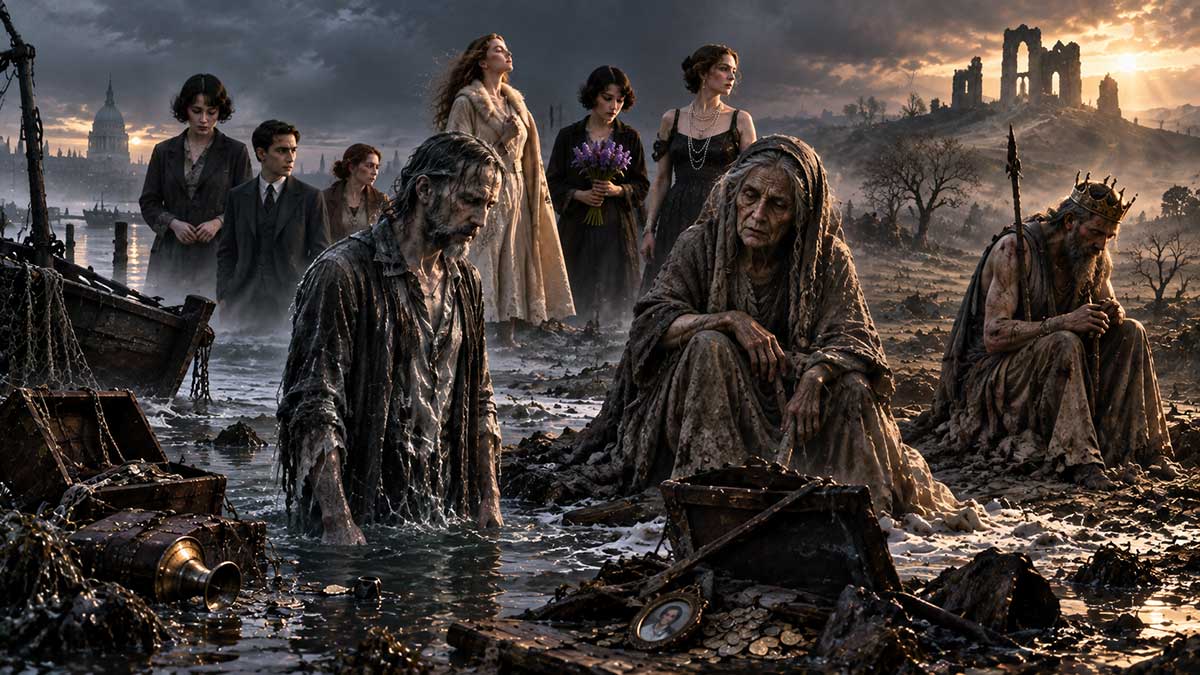
Phlebas stood at the edge of the Thames, wet clothing clinging to his body.
The others watched him carefully.
Not because he looked frightening.
Because he didn't.
He looked ordinary.
That was worse.
The Young Man was the first to speak.
"Were you afraid?"
Phlebas looked at him.
"When?"
"When you died."
Phlebas considered the question.
"I was busy."
The Young Man frowned.
"Busy?"
"Trying not to."
Nobody smiled.
Phlebas looked toward the water.
"There wasn't much time for philosophy."
The Typist stepped closer.
"What did you think about?"
"My body."
"That's all?"
"Breathing."
He touched his throat.
"Air."
He looked at the group.
"You'd be surprised how quickly the universe becomes very small."
The Fisher King watched him closely.
Phlebas continued.
"Not money."
"Not business."
"Not whether anyone admired me."
"Not whether I had chosen the right clothes."
"Not whether someone remembered my name."
He smiled faintly.
"Just air."
Marie asked softly:
"And after?"
Phlebas looked toward her.
"After what?"
"After you knew you were dying."
The smile disappeared.
"I didn't know."
"What do you mean?"
"People imagine death as a moment when everything becomes clear."
He shook his head.
"It wasn't like that."
"What was it like?"
"Confusion."
He looked down at his hands.
"Then less confusion."
"Then less of everything."
The Hyacinth Girl tightened her grip around her flowers.
"Did your memories come back?"
Phlebas looked toward her.
"Some."
"Which ones?"
He tried to remember.
"My mother."
The answer surprised him.
"I hadn't thought about her in years."
Marie asked:
"Anything else?"
"A harbor."
"A meal."
"A woman laughing."
He paused.
"I don't remember her name."
The Woman looked disturbed.
"You loved her?"
"I don't know."
"You don't know?"
"I wanted her."
The Woman said nothing.
Phlebas glanced at the Young Man.
The Young Man looked away.
Phlebas continued.
"I remembered sunlight on water."
"Someone pouring wine."
"My father's hands."
"A room I hated as a boy."
"A dog."
He laughed quietly.
"A ridiculous dog."
Lil asked:
"Your business?"
Phlebas thought.
"No."
"Money?"
"No."
"Your accomplishments?"
He shook his head.
"No."
Lil looked toward the others.
"So all the things people spend their whole lives worrying about..."
Phlebas finished the sentence.
"...can become very unimportant very quickly."
The Fisher King spoke from behind them.
"But not everything."
Phlebas turned.
"No."
"What remained?"
Phlebas looked back toward the river.
"People."
The Typist watched him.
"Even people you forgot?"
"Especially them."
Silence returned.
Then Marie asked:
"What mattered to you before you died?"
Phlebas laughed softly.
"Before?"
"Yes."
"Profit."
"Travel."
"Being respected."
"Being handsome."
The Young Man looked at him.
"You knew you were handsome?"
"Of course."
"That's modest."
"I was dead, not dishonest."
A few of them laughed.
Even the Typist.
Phlebas smiled.
"I liked being noticed."
The Woman looked at him.
"That sounds familiar."
Phlebas nodded.
"I liked entering a room and knowing people saw me."
The Typist asked:
"And now?"
Phlebas looked down at his drowned clothes.
"Now people notice for different reasons."
She almost smiled.
Then his face became serious.
"I thought attention meant importance."
The Typist stopped smiling.
Phlebas continued.
"I thought if enough people knew my name, that meant my life was large."
The Fisher King asked:
"Was it?"
Phlebas looked at him.
"I don't know."
"Who missed you?"
Phlebas did not answer.
The question seemed to hurt more than any question about dying.
"I don't know."
"Who loved you?"
Phlebas looked away.
"I don't know."
"Who knew you?"
Long silence.
Phlebas finally said:
"Less than I thought."
The Young Man looked uncomfortable.
Maybe because he understood too well.
Lil sat on a broken stone.
"If I died, my children would remember me."
The Woman turned toward her.
"Of course."
Lil shook her head.
"No. That's not what I mean."
She looked at her hands.
"They'd remember different versions."
"What versions?"
"One would remember me shouting."
"One would remember me cooking."
"One would remember me sick."
"One might remember being held."
Her voice softened.
"Albert would remember someone else entirely."
Marie sat beside her.
"Which one is you?"
Lil looked almost amused.
"All of them, I suppose."
Phlebas nodded.
"That's the strange thing."
Everyone looked toward him.
"You spend your life trying to become one person."
He paused.
"But everyone else carries a different version of you."
The Typist asked:
"And when you die?"
Phlebas looked at her.
"You lose control of the story."
The Woman shivered.
"I don't like that."
"Neither did I."
"What can you do about it?"
"Very little."
The Young Man asked:
"Then what's the point of trying to be anything?"
Tiresias answered.
"Because losing control of how you are remembered is not the same as losing responsibility for how you lived."
The Young Man turned.
"What does that mean?"
Tiresias pointed toward Lil.
"Her children may remember different mothers."
Lil looked up.
"But she still chooses what kind of mother she is today."
Lil stared at Tiresias.
The Woman asked:
"And if you've already hurt people?"
Tiresias did not answer immediately.
"Then death does not excuse the living from repair."
The Woman looked toward the distant image of her room.
"Some things can't be repaired."
"No."
Tiresias nodded.
"Some can't."
She seemed surprised by the answer.
"You agree?"
"Truth does not become kinder because we dislike it."
The Woman looked down.
Phlebas watched Tiresias.
"You sound very alive."
Tiresias almost smiled.
"I've had complicated arrangements with death."
The river darkened.
Something moved in the distance.
A small figure.
Very old.
Very thin.
Almost transparent.
The Hyacinth Girl noticed first.
"Who's that?"
No one answered.
The figure approached slowly.
A woman.
Ancient beyond ordinary age.
Her body seemed exhausted by the fact of continuing.
Marie whispered:
"The Sibyl."
The old woman looked toward Phlebas.
He stared back.
Neither spoke.
Finally the Sibyl said:
"So."
Her voice was dry.
"You died."
Phlebas nodded.
"And you?"
She smiled without humor.
"I did not."
The answer made everyone uneasy.
Phlebas stepped toward her.
"How old are you?"
"Too old."
"That's not a number."
"Numbers stopped helping."
The Typist studied her.
"Are you ill?"
"No."
"Then why do you look..."
She stopped.
The Sibyl finished:
"Finished?"
The Typist looked ashamed.
"I'm sorry."
"Don't be."
The Sibyl stared toward the horizon.
"I am finished."
Phlebas frowned.
"But you're alive."
The Sibyl turned toward him.
"Those are not the same thing."
Nobody moved.
The Fisher King looked more closely at her.
"You want to die?"
"Yes."
Phlebas stared.
"Why?"
The Sibyl laughed.
It sounded almost like paper tearing.
"You ask that because you lost what I cannot escape."
Phlebas stepped closer.
"I would give anything to have another day."
"And I would give anything not to have one."
The words hung between them.
Marie whispered:
"How can both be true?"
Tiresias answered softly.
"Because life is not measured only by duration."
The Sibyl looked at Tiresias.
"No."
The Hyacinth Girl asked:
"What happened to you?"
"I received what people think they want."
"What?"
"More."
"More what?"
"Time."
The Sibyl looked at the Young Man.
"You want more money?"
He nodded cautiously.
"More success?"
Another nod.
She looked at the Woman.
"More reassurance?"
The Woman said nothing.
Lil.
"More security?"
The Typist.
"More possibilities?"
Then Marie.
"More freedom?"
Finally Phlebas.
"More life?"
Phlebas answered immediately.
"Yes."
The Sibyl smiled sadly.
"Humans rarely ask what more is for."
The Young Man frowned.
"More gives you options."
"Yes."
"And options are good."
"Sometimes."
"What makes them bad?"
The Sibyl looked at him.
"When nothing matters enough to choose."
That silenced him.
Phlebas stepped closer to her.
"If you could give me your years..."
She laughed again.
"I would."
"And if I could give you my death..."
"I would take it."
They stared at each other.
One had lost life.
One could not lose it.
The Typist whispered:
"This is horrible."
The Fisher King answered:
"Yes."
She turned.
"Which one?"
He looked at Phlebas.
Then the Sibyl.
"Both."
The Woman asked:
"Then what are we supposed to want?"
Nobody answered.
The Fisher King stood.
His wound seemed deeper now.
"Perhaps that's the problem."
"What?"
"We keep asking what we should want."
The Typist frowned.
"What else are we supposed to ask?"
The King looked at her.
"What is worth wanting?"
The Young Man rolled his eyes slightly.
"That sounds like the same question."
"No."
The King stepped closer.
"One asks what desire points toward."
He paused.
"The other asks whether the destination deserves your life."
Phlebas looked at him carefully.
"That's different."
"Yes."
The Young Man became defensive.
"So success isn't worth wanting?"
The King shrugged.
"I didn't say that."
"Money?"
"I didn't say that either."
"Pleasure?"
"No."
"Then what's your point?"
The Fisher King looked directly at him.
"How much of yourself are you willing to spend to obtain them?"
The Young Man stopped.
The King continued.
"That is the part desire rarely tells you."
Lil nodded slowly.
"Cost."
"Yes."
The Woman looked toward her distant room.
"Can a relationship cost too much?"
Lil looked at her.
"Of course."
The Woman asked:
"Even love?"
The Fisher King answered:
"Especially things we call love without examining them."
The Hyacinth Girl looked down at the flowers.
Phlebas walked toward the river.
"I spent years like currency."
The Typist followed him.
"What do you mean?"
"I kept exchanging pieces of life for things."
"Everyone does that."
"Yes."
"Work."
"Yes."
"Money."
"Yes."
"Relationships."
"Yes."
"Experience."
"Yes."
She looked irritated.
"Then what's wrong with it?"
"Nothing."
Phlebas turned.
"Unless you never ask whether the exchange is worth the price."
The Typist looked toward her hands.
Phlebas continued.
"You think money is expensive because it is limited."
He looked at the others.
"Time is more expensive."
Marie whispered:
"Because you can't earn it back."
Phlebas nodded.
The Young Man crossed his arms.
"But if you think like that constantly, you'll never do anything."
Phlebas smiled.
"Correct."
The Young Man blinked.
"What?"
"If every second becomes sacred, you become afraid to spend any of them."
He laughed softly.
"That's another trap."
Tiresias nodded.
"Mortality can sharpen life."
The Sibyl added:
"Or poison it with fear."
The Typist asked:
"So death doesn't give us the answer either."
"No," Tiresias said.
"Then what does it give us?"
Tiresias looked at Phlebas.
"A deadline."
That landed heavily.
The Young Man stared at the ground.
Lil rubbed her hands together.
Marie looked toward the mountains.
The Hyacinth Girl smelled one of the flowers.
The Woman closed her eyes.
The Typist finally asked:
"Is dying the worst thing that can happen?"
The Sibyl laughed softly.
Phlebas looked at her.
"Ask her."
The Typist did.
"Is it?"
The Sibyl stared into the distance.
"No."
"What is?"
The Sibyl did not answer quickly.
"Living so long that nothing can surprise you."
She paused.
"Living so long that memory outweighs expectation."
Another pause.
"Living when you no longer desire tomorrow but tomorrow insists."
Phlebas whispered:
"That sounds like death."
The Sibyl looked at him.
"It isn't."
"That's why it's worse."
Nobody argued.
The Fisher King looked at her.
"I know something of that."
She turned.
"You want healing."
"Yes."
"Because you want to live?"
"Yes."
"Or because you don't know what else to want?"
The King stiffened.
The question had found its mark.
The Typist watched him.
"You don't know?"
The Fisher King looked toward the cracked land.
"I have wanted healing for so long that I don't remember who I was before wanting it."
Lil said softly:
"That's frightening."
"Yes."
The King touched his wound.
"What happens if the wound becomes your identity?"
Tiresias answered:
"Then healing can feel like another kind of death."
The King looked at them sharply.
The Woman whispered:
"Because you'd have to become someone else."
Tiresias nodded.
The Typist thought of herself.
Lil thought of motherhood.
The Hyacinth Girl thought of memory.
The Young Man thought of ambition.
Phlebas thought of life.
The Sibyl thought of death.
Marie asked:
"Do we become attached even to our pain?"
Tiresias said:
"Sometimes pain is terrible."
A pause.
"But familiar."
The Woman whispered:
"And the unfamiliar might be worse."
"Or better."
"How do you know?"
"You don't."
Silence again.
The river continued.
The Fisher King finally looked toward Phlebas.
"What do you miss most?"
Phlebas answered immediately.
"Taste."
The others seemed surprised.
"Taste?" Lil asked.
"Yes."
"Not love?"
"I said what I miss most, not what sounds noblest."
He smiled.
"Bread."
"Salt."
"Wine."
"Fruit."
"Cold water."
He looked toward Marie.
"Sunlight."
Toward Lil.
"Noise from another room."
Toward the Woman.
"Someone interrupting me."
Toward the Young Man.
"Wanting something."
Then the Typist.
"Being tired."
She laughed.
"You miss being tired?"
"Very much."
"Why?"
"Because tired means you have a body that's done something."
She stopped laughing.
Phlebas looked around.
"I miss inconvenience."
The Young Man stared.
"That's absurd."
"Wait until you have none."
Phlebas smiled.
"I miss doors that stick."
"Rain when I didn't want rain."
"People talking too loudly."
"Waiting for food."
"Being late."
Lil looked at him.
"You miss ordinary life."
"Exactly."
The Typist looked toward her small apartment.
The same one she had complained about.
The bed.
The chair.
The typewriter.
The badly arranged clothes.
The dim light.
For the first time, she saw it differently.
Not beautifully.
But temporarily.
The realization frightened her.
She turned away.
Phlebas noticed.
"Don't romanticize it."
She looked at him.
"What?"
"Your life."
He pointed toward the room.
"If something is wrong, change it if you can."
He smiled.
"Being alive doesn't make every situation good."
The Typist nodded.
"Thank you."
"For what?"
"For not telling me to appreciate everything because I could die."
Phlebas laughed.
"That would be unbearable."
Even Lil laughed.
The Young Man asked:
"Then what should we appreciate?"
Phlebas looked toward him.
"The fact that you can choose."
"Choose what?"
"What deserves your next hour."
The Young Man said nothing.
Phlebas looked toward the Woman.
"Your next conversation."
Lil.
"Your next act of patience."
The Hyacinth Girl.
"Your next memory."
Marie.
"Your next journey."
The Typist.
"Your next refusal."
She looked at him.
"Refusal?"
"Yes."
"Why that?"
"Because living also means being able to say no."
The Young Man heard it.
So did the Typist.
Neither looked at the other.
Phlebas then turned toward the Fisher King.
"And you."
The King raised his head.
"Your next day before the rain."
The Fisher King looked toward the empty sky.
"What am I supposed to do with it?"
Phlebas smiled sadly.
"That's your problem."
The King laughed.
It surprised everyone.
Maybe him most of all.
The Hyacinth Girl looked toward the Sibyl.
"What about her?"
Phlebas stopped smiling.
The Sibyl stood apart.
Her endless life had no obvious next choice.
The girl approached her.
"Is there anything you still want?"
The Sibyl thought for a very long time.
Finally:
"To want."
The Hyacinth Girl's eyes filled.
The Sibyl touched one of the flowers.
"That's what people misunderstand."
She looked at everyone.
"Wanting can hurt."
The Hyacinth Girl nodded.
"But losing the capacity to want..."
The Sibyl's hand dropped.
"...is colder."
The Typist looked down.
That frightened her more than death.
Perhaps because she had already felt a little of it.
Tiresias saw this.
"So April is cruel again."
Marie looked over.
"What do you mean?"
Tiresias looked toward the Sibyl.
"Spring wakes desire."
Then toward Phlebas.
"Death ends desire."
Then toward the Typist.
"And numbness can imitate death before the body dies."
The Typist whispered:
"That's cheerful."
"No."
Tiresias shook their head.
"It's a warning."
The Woman asked:
"Against what?"
"Against confusing the absence of pain with being alive."
The river began receding.
Not naturally.
Water withdrew as though pulled by an invisible force.
Mud appeared.
Then stones.
Then dry ground.
Phlebas stared.
"No."
The Thames kept disappearing.
The others stepped backward.
The riverbed cracked.
Fish vanished.
The damp air became dry.
The sky brightened into a merciless white.
Within moments, the water was gone.
All of it.
The group stood in a landscape of rock.
Dust.
Heat.
Phlebas looked terrified.
The Typist had never seen fear on the dead man's face before.
"What's wrong?"
Phlebas stared at the empty riverbed.
"Water."
"What about it?"
He swallowed instinctively, though he no longer needed to.
"There isn't any."
The Fisher King stepped forward.
His face changed.
He knew this place.
Far beyond them rose mountains.
No trees.
No clouds.
No shade.
Marie whispered:
"Where are we?"
The King answered:
"Where I've been."
The Sibyl looked toward the sky.
The Hyacinth Girl's flowers began to wilt.
Lil covered her face against the dust.
The Woman's beautiful clothing became dirty.
The Young Man wiped sweat from his forehead.
The Typist looked toward Tiresias.
"What happens now?"
No answer.
A sound came from somewhere in the mountains.
Very faint.
Perhaps thunder.
Perhaps only stone shifting.
Then Marie noticed something.
"Who's that?"
Everyone turned.
Far behind them, someone was walking.
A figure.
Then another?
No.
One figure.
Maybe.
The Typist counted the group.
Then counted again.
Her face changed.
"Tiresias."
"Yes?"
"How many of us are there?"
Tiresias looked behind them.
The mysterious figure continued walking at the same distance.
Never approaching.
Never falling behind.
Tiresias did not answer.
The Fisher King looked toward the dry mountains.
The Hyacinth Girl whispered:
"Is there any water?"
Nobody knew.
Phlebas, who had drowned in too much of it, stared at the barren horizon.
For the first time, he understood another form of death.
And somewhere beyond the mountains, the sky spoke again.
Not rain.
Not yet.
Only thunder.
Next: Topic 5, Is There Any Water?
Topic 5: Is There Any Water?
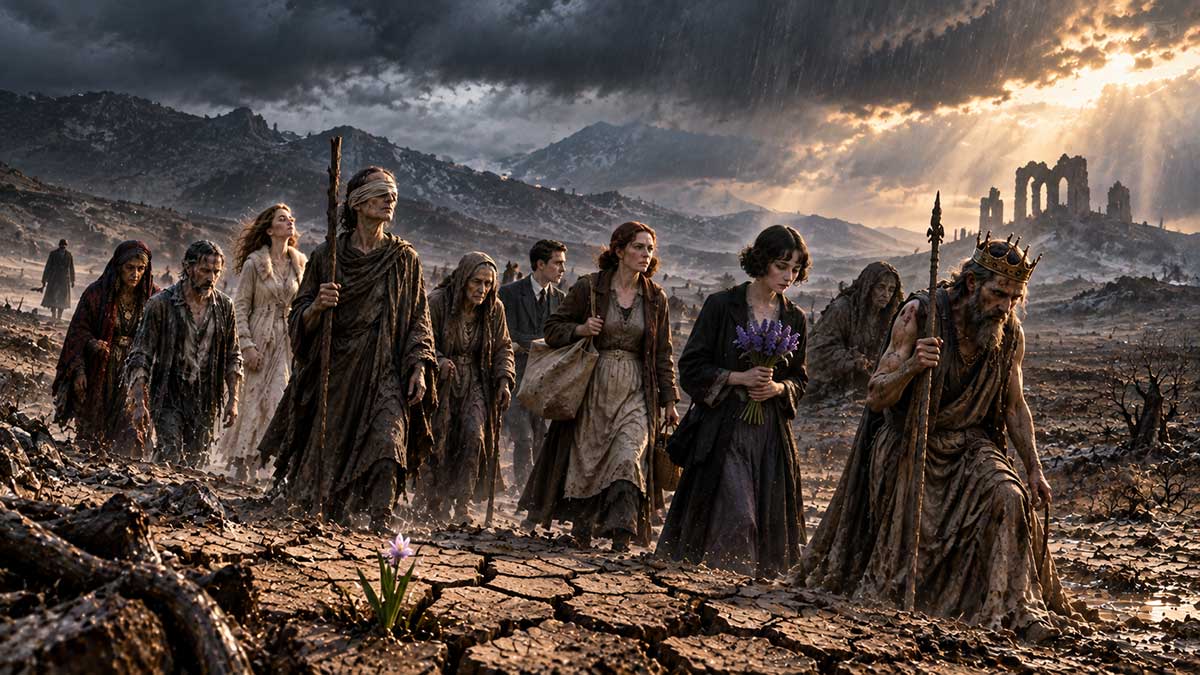
The sound came again.
Thunder.
Or something close enough to thunder that everyone stopped walking.
The Typist looked toward the mountains.
"No clouds."
The Fisher King shaded his eyes.
"There don't have to be."
"For thunder?"
"For hope."
Phlebas laughed once.
Dryly.
"That's exactly the sort of thing people say before nothing happens."
The Fisher King looked at him.
"You've become cynical."
"I drowned."
"Fair."
The Hyacinth Girl's flowers hung limp in her hands now.
Their color was fading.
She touched one petal.
"How long can they survive like this?"
Tiresias looked at the flowers.
"Not long."
The girl looked suddenly frightened.
Marie moved beside her.
"They're only flowers."
The Hyacinth Girl stared at her.
"No."
Marie understood.
They were never only flowers.
Lil wiped dust from her face.
"My mouth is dry."
The Young Man nodded.
"So is mine."
The Woman looked around.
"Mine too."
The Typist gave them a tired look.
"We're in a desert."
"Thank you," Lil said. "Very useful."
The Typist almost smiled.
Then the smile disappeared.
Because she realized she was thirsty too.
Not metaphorically.
Not spiritually.
Actually thirsty.
The kind that makes every other thought less important.
The Fisher King began walking again.
The others followed.
The landscape offered almost nothing.
Rock.
Dust.
More rock.
A path that seemed to lead nowhere.
Marie looked toward the peaks.
"This reminds me of the mountains."
The Typist glanced at her.
"You said the mountains made you feel free."
"These don't."
"Why?"
Marie thought.
"My mountains had snow."
Phlebas said:
"Water."
Marie nodded.
"Yes."
She looked toward the dry stone.
"I suppose freedom looks different when you're thirsty."
The Fisher King turned toward her.
"Everything does."
They kept walking.
The mysterious figure remained behind them.
Never closer.
Never farther away.
The Woman looked back again.
"Who is that?"
No one answered.
She counted.
Then counted again.
"I keep thinking there are more of us than there should be."
Lil looked over her shoulder.
"I don't see anyone."
"There."
"Where?"
The Woman pointed.
Lil squinted.
For a moment her face changed.
"I..."
Then the figure was gone.
"What?" the Typist asked.
Lil turned forward.
"Nothing."
The Woman stared at her.
"You saw it."
"I thought I did."
"What did it look like?"
Lil hesitated.
"Someone walking with us."
The Young Man turned.
"Who?"
"I don't know."
Phlebas looked too.
Nothing.
The Hyacinth Girl whispered:
"Maybe we're imagining things."
Tiresias said:
"People imagine many things when they're thirsty."
The Typist looked at them.
"Is that supposed to help?"
"No."
They continued.
The sun climbed higher.
Conversation became more difficult.
Eventually the Typist stopped.
"I can't."
Lil turned.
"Can't what?"
"Keep walking."
The Young Man moved instinctively toward her.
She held up a hand.
"I'm fine."
He stopped.
The Fisher King looked back.
"If you stop here, nothing changes."
The Typist glared.
"If I keep walking, nothing may change either."
The King nodded.
"True."
She seemed surprised.
"You're not very good at encouragement."
"I've been waiting for rain for years. I'm trying a new method."
Lil laughed despite herself.
The Typist sat on a rock.
The others gradually stopped too.
For a while no one spoke.
Then the Fisher King asked:
"What would you give for water?"
The Young Man answered immediately.
"Money."
"How much?"
"Whatever it costs."
Phlebas laughed.
The Young Man looked irritated.
"What?"
Phlebas shook his head.
"Nothing."
"No. Say it."
"You still think like a merchant."
"You were one."
"Exactly."
The King looked toward the Young Man.
"What if there were no one to buy it from?"
The Young Man shrugged.
"Then I'd find it."
"What if there were none?"
"Then..."
He stopped.
The King continued.
"What would money mean then?"
The Young Man looked toward the barren horizon.
"Nothing."
Phlebas nodded.
"Welcome."
The Woman asked:
"Welcome where?"
"The place where value changes."
The Typist looked up.
"What does that mean?"
Phlebas gestured around them.
"In the city, you value what is scarce there."
"Money."
"Attention."
"Status."
"Time."
"Privacy."
He looked toward the rocks.
"Here, you value water."
Marie whispered:
"So what we want depends on what we're missing."
"Often."
The Hyacinth Girl looked at her wilted flowers.
"Then perhaps we don't know what we want."
Tiresias turned toward her.
"Explain."
"We know what we lack."
She looked around.
"But maybe that's not the same thing."
The Woman frowned.
"I don't understand."
The girl tried again.
"If you're lonely, you think you need a person."
The Typist looked at her.
"Maybe you do."
"Maybe."
The Hyacinth Girl nodded.
"But which person?"
The Woman looked away.
The girl continued.
"If you're afraid, you think you need certainty."
Madame Sosostris appeared several paces behind them.
Nobody had heard her arrive.
"Usually disappointing."
The Hyacinth Girl looked toward the Young Man.
"If you feel insignificant, maybe you think you need success."
He did not argue.
She looked toward Lil.
"If you're exhausted, maybe you think you need everything to stop."
Lil whispered:
"Sometimes."
Then the girl looked at the Fisher King.
"And if you're wounded, you think you need healing."
The King stared at her.
"Yes."
She hesitated.
"But what if healing isn't the same thing as returning to who you were before?"
The Fisher King said nothing.
The Typist studied the girl.
"What do you think you need?"
The Hyacinth Girl looked at the dead flowers.
"I used to think I needed an answer."
"About him?"
"Yes."
"And now?"
The girl shook her head.
"I don't know."
Madame Sosostris smiled.
"Progress."
The Typist laughed.
"You really enjoy uncertainty."
"It keeps me employed."
The Woman wiped sweat from her forehead.
"Can we stop being philosophical and find water?"
Phlebas looked toward the horizon.
"That's the first sensible thing anyone has said."
They stood again.
Hours seemed to pass.
Or minutes.
Time behaved strangely in the Waste Land.
At one point Marie heard water.
She stopped abruptly.
"Listen."
Everyone froze.
A trickle.
Clear.
Close.
Lil's face lit up.
"There."
They hurried toward the sound.
The rocks narrowed into a small gorge.
The sound became louder.
The Typist almost ran.
They turned a corner.
Nothing.
Dry stone.
No stream.
The sound continued.
Water without water.
Phlebas closed his eyes.
"Don't."
Marie looked at him.
"What?"
"Don't make that sound."
"Nobody is."
The sound continued anyway.
The Fisher King stared at the rock.
"I've heard it before."
The Woman looked almost furious.
"How can there be the sound of water without water?"
Tiresias answered:
"Because thirst has an imagination too."
The Young Man kicked a stone.
"This place is cruel."
Marie looked at him.
"So was April."
He frowned.
"That's different."
"Is it?"
Marie looked toward the rock.
"April wakes desire before fulfilling it."
She listened to the impossible water.
"This place does the same thing."
The Typist leaned against the wall.
"I'm beginning to hate metaphors."
Phlebas smiled.
"Another sign of life."
The sound faded.
Silence again.
Then thunder.
Closer.
Everyone looked upward.
Still no clouds.
The Woman whispered:
"Is someone doing that?"
Madame Sosostris looked at her cards.
"Not anyone I know."
Tiresias said:
"Keep walking."
The path narrowed.
The mysterious third figure appeared again.
Closer this time.
The Typist saw it first.
"There."
Everyone turned.
A person walking behind them.
Indistinct.
No clear face.
No obvious age.
No obvious sex.
A presence more than an identity.
The Young Man took a step toward it.
"Who are you?"
The figure did not answer.
He walked faster.
The figure remained the same distance away.
He stopped.
So did it.
Or perhaps it had never been moving at all.
The Young Man looked toward Tiresias.
"You know who that is."
"No."
"You know everything."
"No."
Madame Sosostris laughed quietly.
"Finally somebody understands prophets."
The Woman watched the figure.
"Is it following us?"
Tiresias said:
"Perhaps."
Lil asked:
"Why?"
"No idea."
Phlebas stared at it.
"Is it dead?"
The Sibyl answered from somewhere nearby:
"That would simplify things."
They turned.
She stood beside a rock, looking even older beneath the merciless sun.
Phlebas looked at her.
"You followed us?"
"I have nowhere else to go."
The mysterious figure remained behind them.
Marie whispered:
"Maybe it's protecting us."
The Woman said:
"Or waiting for us."
The Typist looked at the figure.
"Or maybe we're seeing what we need to see."
Tiresias turned toward her.
"What do you need to see?"
She immediately regretted speaking.
"I don't know."
"Try."
The Typist looked back at the figure.
Something in her expression softened.
"Someone who stayed."
Nobody spoke.
The Young Man looked at her.
She noticed.
"Don't."
"I didn't say anything."
"I know."
He looked away.
Lil stared at the mysterious figure.
"What do I see?"
Marie asked.
Lil thought.
"Someone walking beside me when I thought I was carrying everything alone."
The Woman's eyes filled unexpectedly.
She turned away.
Marie looked at her.
"What about you?"
The Woman shook her head.
"I don't want to."
"Why?"
"Because if I say it, it will sound pathetic."
The Typist said:
"Most honest things do."
The Woman gave her a look.
Then turned toward the distant figure.
"I see someone who knows I'm here."
The words came out barely above a whisper.
The Hyacinth Girl stared at it.
"I see someone I can't identify."
Marie waited.
"Is that frightening?"
"No."
The girl surprised herself.
"It's almost comforting."
The Young Man crossed his arms.
"I don't see anything."
Phlebas asked:
"Nothing?"
"Just a shape."
Tiresias said:
"Perhaps a shape is enough for now."
They resumed walking.
This time nobody tried to approach the figure.
It simply remained with them.
The landscape became steeper.
The Fisher King began to struggle.
His wound was worsening.
Lil noticed.
"Sit down."
"No."
"You're bleeding."
"I know."
"Then stop."
He kept moving.
Lil caught his arm.
"Why are men like this?"
The King looked at her.
"Like what?"
"Bleeding while insisting they're fine."
"I didn't say I was fine."
"Good. Sit."
He actually obeyed.
The group gathered around him.
Lil examined the wound.
"I'm not a doctor."
The King laughed.
"That may be fortunate."
She tore fabric from the edge of her clothing and bound the wound.
The Fisher King watched her.
"You need that."
"So do you."
"You'll ruin your dress."
Lil stared at him.
"Do you really think I care?"
The Typist watched.
The Woman did too.
The King touched the bandage.
"Thank you."
Lil shrugged.
"Don't make a speech."
Thunder.
Louder.
The air changed.
Not rain.
But pressure.
Something coming.
The Fisher King looked toward the sky.
"DA."
Everyone froze.
The sound had not come from any human mouth.
The Young Man looked around.
"What was that?"
Madame Sosostris stopped shuffling her cards.
The Sibyl lifted her head.
Tiresias said nothing.
Again:
DA.
The sound rolled through the rocks.
The Woman stepped closer to Lil.
"What does it mean?"
No one answered.
A third time:
DA.
Then silence.
The Young Man looked toward Tiresias.
"Well?"
Tiresias shook their head.
"You tell me."
"What?"
"What did you hear?"
"A noise."
"Only that?"
He listened inwardly.
"I don't know."
Tiresias turned toward Lil.
"What did you hear?"
Lil looked at the strip of clothing wrapped around the King's wound.
"Give."
The Woman turned.
Lil shrugged.
"I don't know why."
The Fisher King looked at her.
"You gave me something."
"Cloth."
"Time."
She looked embarrassed.
"Don't romanticize it."
Phlebas smiled.
"Apparently nobody is allowed to romanticize anything today."
The thunder sounded again.
DA.
The Typist whispered:
"Give."
The Young Man looked at her.
"Give what?"
She thought.
"Attention."
The Woman watched her.
The Typist continued.
"Maybe that's what I've been angry about."
She looked toward the Young Man.
"People wanting something from me without giving attention."
He absorbed this.
Then reached into his pocket.
Everyone watched.
He pulled out a flask.
A very small one.
The Typist stared.
"You had water?"
He looked ashamed.
"Not much."
Lil's eyes widened.
"You've had that the entire time?"
"I forgot."
Phlebas burst out laughing.
"That's almost too perfect."
The Young Man looked around.
"I didn't know how long we'd be out here."
"So you were saving it," the Typist said.
"Yes."
"For yourself."
He did not answer.
The Fisher King said:
"Drink it."
Everyone turned.
The Young Man looked at him.
"What?"
"It's yours."
The King nodded.
"Drink."
The Young Man looked at the tiny amount of water.
Then at the group.
The Typist's lips were dry.
Lil looked exhausted.
The Hyacinth Girl's flowers were nearly dead.
Even Marie seemed weak.
He unscrewed the cap.
Nobody spoke.
He lifted it.
Then stopped.
He handed it to Lil.
She stared at him.
"Why me?"
"You have children."
"What does that have to do with anything?"
"I don't know."
She almost refused.
Then took a tiny sip.
She passed it to the Woman.
The Woman stared.
"I don't need..."
"Drink."
She did.
A little.
Then Marie.
Marie wet her lips and passed it to the Hyacinth Girl.
The girl hesitated.
Then tipped a few drops onto the roots of the hyacinths instead.
The Typist watched.
"Why did you do that?"
The girl looked at the flowers.
"I don't know."
The Typist smiled faintly.
"Fair."
The flask reached Phlebas.
He handed it on without drinking.
The Young Man looked confused.
"You need..."
Phlebas held up a hand.
"Not anymore."
The flask reached the Typist.
She looked at the Young Man.
He avoided her eyes.
She drank a small amount.
Then handed it back.
He looked inside.
Almost nothing remained.
"Drink," she said.
He did.
One mouthful.
The flask was empty.
Nothing had been solved.
Yet everyone stood differently afterward.
The Woman looked toward the sky.
"Was that what it meant?"
Tiresias asked:
"What?"
"Give."
"I don't know."
She frowned.
"You're very irritating."
"Frequently."
Thunder again.
DA.
This time the Woman flinched.
Then her expression changed.
Lil noticed.
"What?"
The Woman looked at her.
"I heard something else."
"What?"
"Compassion."
The Typist looked skeptical.
"Thunder said all that?"
"No."
The Woman pressed a hand to her chest.
"I did."
She looked toward Lil.
"I judged you when I first saw you."
Lil nodded.
"I know."
"I thought your life was small."
Lil raised an eyebrow.
"And now?"
The Woman looked embarrassed.
"Now I think mine might be."
Lil laughed.
"That's not compassion. That's self-insult."
Even the Fisher King smiled.
The Woman laughed too.
"All right."
She tried again.
"I thought because your problems looked different from mine, they weren't the same kind of pain."
Lil's expression softened.
"That's better."
The Woman looked toward the Typist.
"And I thought your life was careless."
The Typist shrugged.
"It isn't."
"I know."
Then the Woman looked at the Young Man.
"And I thought you were simply awful."
He raised an eyebrow.
"Past tense?"
She considered.
"Undecided."
Everyone laughed.
Even him.
Then she became serious.
"I think I keep deciding who people are before they get a chance to be anything else."
The Typist said:
"Everyone does."
The Woman looked at her.
"Is that an excuse?"
"No."
"Good."
She turned toward the mysterious third figure.
"Maybe compassion begins with admitting we don't know everything happening inside another person."
Tiresias watched her.
The thunder answered:
DA.
The Young Man looked uneasy.
"Now what?"
The Fisher King turned toward him.
"What did you hear?"
He shook his head.
"Nothing."
The Typist watched him.
"Really?"
He became irritated.
"Why does everyone think I need a lesson?"
Lil replied:
"Because you keep volunteering."
The Young Man glared at her.
Then laughed despite himself.
He looked toward the empty flask.
"I heard restraint."
The Typist's expression changed.
He continued before she could speak.
"Self-control."
No one interrupted.
He looked at her.
"I've spent most of my life thinking wanting something was a reason to move toward it."
The Typist stared at him.
"And now?"
"Now I think wanting something might just mean I want it."
He looked down.
"Nothing more."
Tiresias asked:
"Does desire command you?"
The Young Man shook his head.
"It shouldn't."
The Fisher King asked:
"Does anger?"
The Woman looked at him.
The King continued.
"Fear?"
Lil looked down.
"Loneliness?"
The Typist went still.
"Hope?"
Marie looked toward the mountains.
"Memory?"
The Hyacinth Girl touched the flowers.
"Pain?"
The Fisher King touched his wound.
The Sibyl whispered:
"Even despair."
They all stood beneath the silent sky.
The Young Man looked toward Tiresias.
"So self-control means saying no?"
"Sometimes."
"To pleasure?"
"Sometimes."
"To anger?"
"Sometimes."
"To desire?"
"Sometimes."
He became frustrated.
"That's vague."
Tiresias smiled.
"Because discipline is not the same thing as refusing everything."
The Typist said:
"Then what is it?"
Tiresias looked at her.
"The ability to experience an impulse without automatically becoming its servant."
Nobody spoke.
Lil looked toward the King.
"So we have giving."
The Woman added:
"Compassion."
The Young Man:
"Self-control."
Marie frowned.
"And that's supposed to fix this?"
She gestured toward the Waste Land.
"All of it?"
War.
Loneliness.
Bad marriages.
Death.
Poverty.
Fear.
The wounded King.
The barren earth.
Madame Sosostris answered:
"No."
Marie looked surprised.
"No?"
"Three words will not repair civilization."
Phlebas nodded.
"Or defeat death."
The Sibyl added:
"Or make eternity bearable."
The Fisher King looked toward the cracked earth.
"Or heal every wound."
The Woman asked:
"Then what good are they?"
Tiresias looked at the group.
"Perhaps the thunder is not speaking to civilization."
The Typist frowned.
"Then who?"
"You."
One word.
That was enough.
Tiresias continued.
"You cannot decide whether the entire world gives."
They looked at Lil.
"You can decide whether you do."
"You cannot force humanity to become compassionate."
The Woman lowered her eyes.
"You can decide whether the person in front of you becomes visible."
"You cannot eliminate desire."
The Young Man listened.
"You can decide whether every desire becomes an order."
The Fisher King looked at Tiresias.
"And the land?"
"What about it?"
"What if I do all of that and the land still does not heal?"
Tiresias looked toward the barren horizon.
"It may not."
The King stared.
"Then what is the point?"
Tiresias answered quietly.
"Perhaps living rightly is not a bargain with the weather."
The Fisher King looked almost angry.
"I have spent years waiting for rain."
"Yes."
"And now you're telling me it may never come?"
"Yes."
"What kind of hope is that?"
Tiresias stepped closer.
"The kind that does not require the universe to sign a contract."
The King looked away.
For a long time nobody spoke.
Then Phlebas approached him.
"I think I understand."
The Fisher King looked at the drowned man.
"Do you?"
"I spent my life assuming there would be another voyage."
Phlebas looked toward the dry riverbed.
"Another transaction."
"Another year."
"Another chance."
He looked back.
"Life never signed that contract either."
The King sat on a stone.
His anger was gone.
Only exhaustion remained.
"What am I supposed to do tomorrow if it doesn't rain?"
Lil answered before Tiresias could.
"Get up."
The King looked at her.
She shrugged.
"That's what the rest of us do."
The Typist smiled.
Lil continued.
"Then do whatever the day requires."
"With no guarantee?"
Lil laughed.
"Welcome to marriage."
The Woman laughed too.
The King slowly smiled.
Something in him loosened.
Not healed.
Loosened.
The Hyacinth Girl suddenly gasped.
Everyone turned.
One hyacinth stood slightly straighter.
Marie stepped closer.
"Water?"
The girl shook her head.
"No."
Then she remembered.
A few drops from the flask.
The flower had taken them.
Not much.
But enough.
The Fisher King stared at it.
His face changed.
The Woman noticed.
"Don't."
He looked at her.
"Don't what?"
"Turn it into a prophecy."
Madame Sosostris laughed loudly.
"She's learning."
The King smiled.
"Fine."
He looked at the tiny flower.
"It's a flower."
The Hyacinth Girl nodded.
"Yes."
The King stared at it.
"And it is alive."
Nobody argued.
Then something touched the Typist's cheek.
She wiped it away.
Sweat?
No.
She looked at her fingers.
Water.
She stared upward.
The sky remained dark but almost cloudless.
Another drop landed on the rock beside her.
Lil looked up.
"Did you feel that?"
The Woman held out her hand.
Nothing.
Then:
one drop.
The Young Man laughed.
"It's raining."
Phlebas immediately said:
"No."
Everyone looked at him.
He smiled.
"It's dropping."
The Typist laughed.
"What's the difference?"
"Ask me after you've drowned."
More drops.
Still sparse.
Not enough to soften the ground.
Not enough to fill a river.
Not enough to heal the Fisher King.
But real.
The King stood.
For years, perhaps he had imagined this moment differently.
He had expected the heavens to split.
Floodwater.
Green fields.
Miraculous restoration.
Instead:
a few drops.
Dust darkening into tiny circles.
He looked almost disappointed.
Marie noticed.
"Not enough?"
The King looked at her.
Then at the ground.
"No."
A pause.
"But more than yesterday."
Marie smiled.
The Sibyl held out her hand.
A drop landed on ancient skin.
She looked at it for a very long time.
Phlebas watched her.
"Does it help?"
She smiled sadly.
"No."
Then she added:
"But I remembered what rain feels like."
Phlebas nodded.
That mattered.
The mysterious third figure appeared again.
Closer than before.
The Woman saw it.
"So you're still here."
The figure did not answer.
Lil turned.
This time everyone could see it.
Not clearly.
But enough.
Marie whispered:
"Who are you?"
Silence.
The Young Man started forward.
The Typist stopped him.
"Don't."
He looked at her.
"Why?"
"Maybe we don't need to know."
He frowned.
"Aren't you curious?"
"Yes."
She looked at the figure.
"But maybe not everything has to become an answer."
Tiresias watched her carefully.
The Typist noticed.
"What?"
"Nothing."
"No. Say it."
"You've changed."
She immediately became defensive.
"Don't make it dramatic."
"I wasn't."
"Good."
Tiresias smiled.
Another drop.
Then another.
The group began walking again.
Not because the land was healed.
It wasn't.
Not because they knew where they were going.
They didn't.
They simply moved.
The Typist walked beside Tiresias.
After a while she asked:
"Can I ask you something?"
"Yes."
"Is this really going to become green?"
Tiresias looked across the cracked earth.
"I don't know."
She stared.
"You keep saying that."
"Because I keep not knowing."
"You're a prophet."
"Prophecy is badly advertised."
She laughed.
Then became serious.
"Will it rain properly?"
"I don't know."
"Will the King heal?"
"I don't know."
"Will Lil be all right?"
Lil shouted from ahead:
"I can hear you."
The Typist smiled.
"Will the Woman stop being afraid?"
The Woman answered:
"Also here."
"Will he..."
She glanced toward the Young Man.
"...become better?"
He raised his hands.
"I've apparently become a public project."
Tiresias laughed.
The Typist continued.
"Will any of us actually be all right?"
Tiresias walked several more steps.
"I don't know."
The Typist sighed.
"You're useless."
"Often."
They walked.
Then she looked upward.
Another raindrop landed in her palm.
She stopped.
Tiresias stopped too.
The Typist stared at the water.
"So what do you know?"
Tiresias looked at her hand.
"I know you're holding water."
She smiled faintly.
"That's it?"
"At this moment."
She closed her fingers around the drop.
Then opened them again.
The water was almost gone.
But her hand was still wet.
The thunder sounded once more.
Far away now.
The Fisher King looked toward the horizon.
Lil walked beside him.
The Woman walked with Marie.
The Hyacinth Girl carried the surviving flowers.
The Young Man kept a little distance from the Typist, not because he had lost interest, but because for once he was not assuming proximity belonged to him.
Madame Sosostris put her cards away.
Phlebas walked near the dry riverbed, listening for water.
The Sibyl moved slowly behind him.
And the mysterious third figure remained with them all.
The Typist looked toward Tiresias.
"Do you think the Waste Land ends?"
Tiresias considered the question.
"No."
Her face fell.
Then Tiresias continued.
"But perhaps neither does renewal."
She looked toward the dark circles forming in the dust.
Tiny.
Scattered.
Temporary.
Real.
The Typist asked:
"Is that enough?"
"For what?"
"To keep going."
Tiresias looked at the group ahead.
At Lil.
At the Woman.
At Marie.
At the Hyacinth Girl.
At the Young Man.
At the Fisher King.
At the dead sailor.
At the woman who could not die.
At the unknown figure walking beside them.
Then back at the Typist.
"Today?"
A drop struck the ground between them.
"Yes."
They continued walking.
Behind them, one small hyacinth stood upright against the rain.
Ahead, the Waste Land remained vast.
No paradise appeared.
No wound vanished.
No voice explained everything.
But somewhere beneath the cracked earth, water had begun moving.
And for now, that was enough.
Shantih.
Shantih.
Shantih.
Final Thoughts
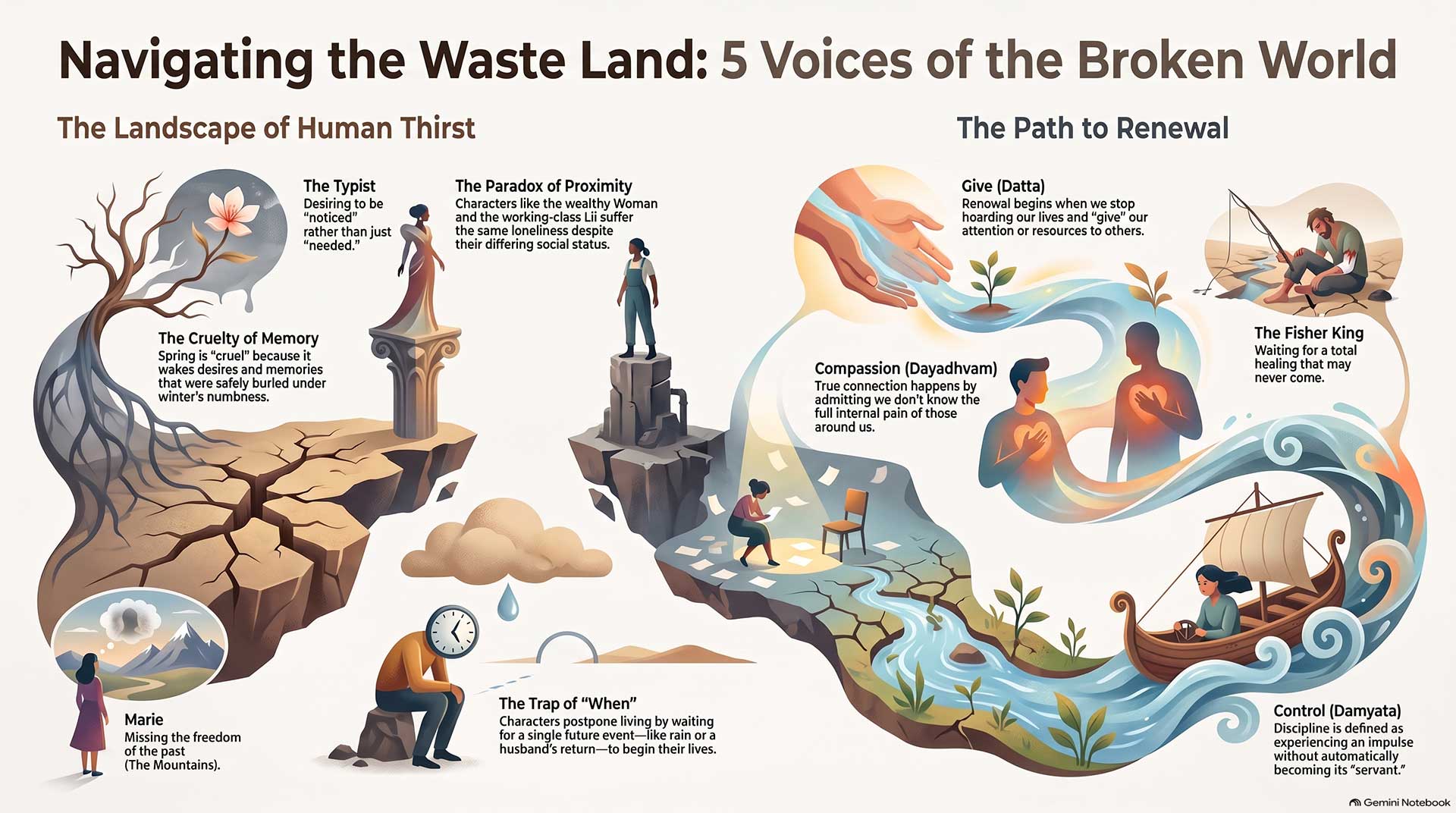
At the beginning, everyone seems to suffer from a different problem.
Marie cannot separate memory from freedom.
The Hyacinth Girl cannot escape something beautiful that has been lost.
The Woman desperately wants another person to speak.
Lil fears what marriage, motherhood, exhaustion, and time have changed.
The Typist has learned not to expect very much.
The Young Man mistakes wanting someone for seeing them.
The Fisher King waits for healing.
Phlebas discovers too late how temporary ambition, beauty, money, and even time can be.
The Sibyl possesses what Phlebas lost, more life, yet experiences endless existence as another form of barrenness.
Their stories seem unrelated.
Until they begin listening to one another.
That may be one of the deepest experiences hidden inside The Waste Land: human beings can inhabit completely different lives while suffering from remarkably similar forms of thirst.
The final movement therefore does not give them paradise.
The King remains wounded.
The dead remain dead.
The past cannot be recovered.
Broken relationships do not magically repair themselves.
Instead, the thunder introduces something smaller and perhaps more demanding: giving, compassion, and self-control.
The Young Man shares his water.
Lil tends another person's wound.
The Woman begins seeing suffering outside her own experience.
The Typist begins recognizing that numbness is not the same as peace.
None of these acts saves civilization.
But perhaps renewal does not always begin with civilization.
Perhaps it begins when one person gives something, another person becomes visible, and one destructive desire is no longer automatically obeyed.
Then comes rain.
Not enough.
Only drops.
That distinction matters.
Eliot does not give us a lush garden at the end of The Waste Land. Our imagined conversation should not either.
The Waste Land remains.
But so does the possibility that something buried beneath it is still alive.
Short Bios:
Tiresias
The blind prophet from Greek mythology who has experienced life as both male and female. Eliot identifies Tiresias as an especially important unifying consciousness within The Waste Land. Here, Tiresias becomes the witness connecting otherwise fragmented lives.
Marie
An aristocratic European voice appearing near the beginning of the poem. Her memories of childhood, sledding, mountains, and freedom introduce the powerful relationship between memory and the present.
The Hyacinth Girl
A mysterious figure associated with flowers, memory, desire, and an intense encounter followed by an inability to speak. She represents the painful persistence of beautiful memories.
The Woman from "A Game of Chess"
An unnamed woman surrounded by luxury yet desperate for communication. Her repeated demands for another person to speak expose the enormous distance that can exist inside physical closeness.
Lil
A working-class married woman whose story emerges through pub conversation. Motherhood, physical exhaustion, economic pressure, aging, marriage, and fear of losing her husband's desire make her one of the poem's most painfully human figures.
The Typist
A young working woman whose emotionally empty encounter with the Young Man Carbuncular is witnessed by Tiresias. In this conversation, she becomes a central voice for loneliness, diminished expectations, personal boundaries, and the desire simply to be recognized as a person.
The Young Man Carbuncular
The young man involved in the Typist episode. Here, he is allowed to confront the difference between wanting another person's body and actually seeing the person before him.
Madame Sosostris
The poem's famous fortune teller. Her cards introduce images of danger, transformation, and the drowned sailor. In this conversation, she also challenges the characters' desire to use knowledge of the future as reassurance against uncertainty.
Phlebas the Phoenician
The drowned sailor of "Death by Water." Once concerned with ordinary human pursuits, Phlebas becomes a powerful reminder that wealth, beauty, ambition, and identity exist within the limits of mortality.
The Fisher King
The wounded ruler associated with the Grail and wasteland traditions that influenced Eliot. His injury and the barren land surrounding him raise a question that remains unresolved: Is the wounded King causing the Waste Land, or has the Waste Land wounded the King?
The Sibyl
An ancient prophetic figure associated with extraordinarily prolonged life. Placed beside the drowned Phlebas, she creates a disturbing contrast between losing life too soon and continuing to live after the desire for life itself has disappeared.
The Thames Daughters
Fragmented female voices associated with the Thames and memories of relationships and sexual encounters. Their presence expands the poem's recurring theme of failed connection.
The Mysterious Third Figure
A presence appearing during the final journey through the barren landscape. Eliot connected the image to accounts of explorers sensing an additional companion and also to biblical imagery. Here, the figure remains deliberately unidentified, allowing mystery itself to accompany the travelers.
Leave a Reply