

Introduction
What does it really mean to see another person?
In Part 1, Theo of Golden gave us a beautiful answer through Theo's relationships with Asher, Ellen, Kendrick, Mateo, and the people of Golden. But some of the novel's most powerful ideas become more complicated when we examine them closely.
Is Theo's ability to see people something psychology supports? Is "good sadness" a healthy way to understand grief? Can we recognize the humanity of someone who caused terrible harm without excusing them? Did Theo have the right to hide the truth from Asher? And is Theo's later life a realistic model for meaning, or an ideal few people could actually follow?
To explore these questions, we brought together psychologists, grief researchers, ethicists, scholars, and author Allen Levi.
Their discussion reveals something deeper than simply "be kind."
Seeing another person requires curiosity, humility, boundaries, honesty, and the willingness to admit that the first story we tell ourselves about someone may be incomplete.
(Note: This is an imaginary conversation, a creative exploration of an idea, and not a real speech or event.)
Topic 1: Do We Really See Other People, or Do We Mostly See Our Assumptions?
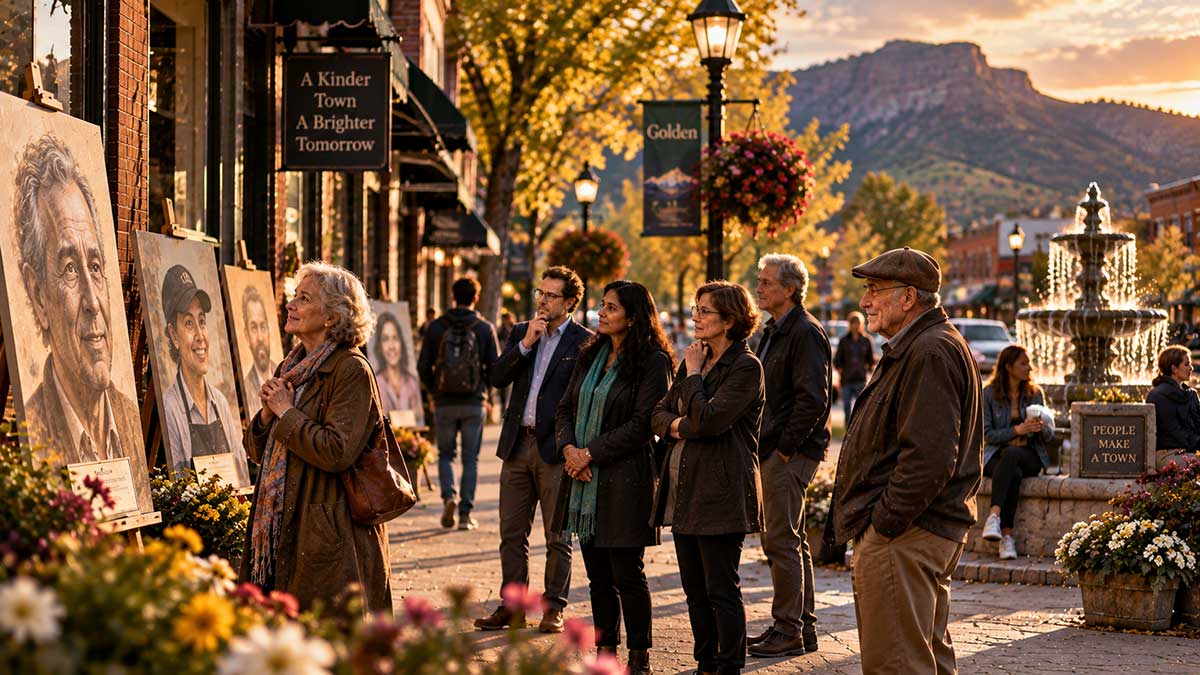
Late afternoon settled over Golden.
The Fedder fountain moved steadily behind the group, its water catching pieces of sunlight as people crossed the square.
No stage had been built.
No chairs had been arranged in rows.
Nicholas Epley stood near one of Asher’s portraits, studying it from several feet away.
Amishi Jha watched a child trying to balance along the fountain ledge.
Sherry Turkle had noticed something else entirely.
Almost everyone passing through the square carried a phone.
Dacher Keltner stood beneath a tree watching a small flock of birds move from one branch to another.
Allen Levi walked slowly beside Krista Tippett.
The scholars were not discussing Golden from outside.
They were standing inside it.
The faces Theo once noticed were moving around them.
Krista stopped near one of the portraits.
It showed a middle-aged woman with tired eyes and a restrained smile.
She looked at Nicholas.
Krista: "You study how people think about other minds."
Nicholas nodded.
Krista: "Theo seems to believe the first mistake we make is thinking we already know what another person is."
Nicholas looked at the portrait.
Nicholas: "That mistake is very human."
Allen smiled.
Allen: "That does not sound encouraging."
Nicholas: "It isn't entirely discouraging."
He turned toward the square.
Nicholas: "People are constantly making guesses about one another."
He pointed gently toward a man hurrying across the street.
Nicholas: "We might decide he's impatient."
Then toward a woman sitting alone.
Nicholas: "We might decide she's lonely."
Then toward the portrait.
Nicholas: "We might look at this face and decide she is sad."
Allen studied it.
Nicholas: "The problem is not that we make interpretations."
He paused.
Nicholas: "The problem is how quickly interpretations become conclusions."
Krista nodded.
Krista: "So we look once and think we know."
Nicholas: "Exactly."
Amishi joined them.
Amishi: "And often we are not even looking as carefully as we think."
Nicholas smiled.
Nicholas: "Now you are making my problem worse."
Amishi: "I intend to."
They laughed.
Krista looked at Amishi.
Krista: "What do you mean?"
Amishi pointed toward the fountain.
Amishi: "Watch."
A boy was tossing a coin into the water.
His mother stood nearby.
Her phone vibrated.
She glanced down.
The boy pointed excitedly at something inside the fountain.
The mother nodded without looking up.
A few seconds later, she put the phone away.
The moment had passed.
Amishi looked at the group.
Amishi: "Nothing dramatic happened."
Sherry: "That's exactly why it matters."
Everyone turned.
Sherry had been watching too.
Sherry: "Most disconnection does not announce itself dramatically."
She looked toward the mother and child.
Sherry: "A person says something."
Sherry: "We half-hear it."
Sherry: "Someone shows us something."
Sherry: "We glance."
She lifted one hand.
Sherry: "We are technically present."
Then lowered it.
Sherry: "But psychologically somewhere else."
Allen looked toward the child.
Allen: "Theo would have noticed the coin."
Sherry smiled.
Sherry: "Theo would probably ask where the boy hoped it would land."
Allen laughed.
Nicholas: "Then ask a second question."
Krista: "And a third."
Allen nodded.
Allen: "That was the point."
Nicholas turned toward him.
Nicholas: "Was Theo written as someone who understands people unusually well?"
Allen considered it.
Allen: "Not exactly."
Nicholas: "Interesting."
Allen: "I thought of him more as someone willing to stay curious."
Nicholas smiled.
Nicholas: "That is psychologically much more plausible."
Krista turned toward him.
Krista: "Why?"
Nicholas looked again at the portrait.
Nicholas: "No human being gets perfect access to another mind."
He tapped his temple.
Nicholas: "We infer."
Nicholas: "We guess."
Nicholas: "We interpret."
He looked at Allen.
Nicholas: "Theo's strength may not be that he reads people correctly."
Nicholas: "It may be that he keeps checking his assumptions."
Allen nodded slowly.
Allen: "That feels right."
Krista looked toward the passing crowd.
Krista: "Then perhaps the first question is not, 'Can I see you?'"
Nicholas waited.
Krista: "Perhaps it is, 'Am I willing to discover that I was wrong about you?'"
Nicholas smiled.
Nicholas: "That's much better."
Dacher approached from beneath the tree.
Dacher: "And that requires humility."
Krista turned toward him.
Dacher: "Awe does something interesting to people."
Allen looked amused.
Allen: "You managed to bring awe into the town square."
Dacher smiled.
Dacher: "Give me a minute."
They laughed.
Dacher pointed toward the mountain line beyond Golden.
Dacher: "When people encounter something larger than their ordinary frame of reference, they sometimes become less centered on themselves."
Krista listened.
Dacher: "Beauty can do that."
Dacher: "Nature can."
Dacher: "Music can."
He looked at Asher’s portraits.
Dacher: "Art can."
Then toward Allen.
Dacher: "Perhaps Theo's attention works similarly."
Allen tilted his head.
Dacher: "He approaches another person almost as though that person is larger than the category he first sees."
Krista smiled faintly.
Krista: "A kind of human awe."
Dacher nodded.
Dacher: "Possibly."
Nicholas crossed his arms.
Nicholas: "I like that, but I want to make it harder."
Dacher smiled.
Dacher: "Please."
Nicholas pointed toward the portrait.
Nicholas: "We can become moved by our own interpretation of someone."
He looked at Allen.
Nicholas: "That does not mean we have accurately perceived them."
Dacher nodded.
Nicholas: "A stranger can look lonely."
He shrugged.
Nicholas: "Maybe she isn't."
Nicholas: "A face can look sad."
Nicholas: "Maybe the person was simply tired."
Amishi added:
Amishi: "Attention does not automatically produce truth."
Krista looked at her.
Amishi: "Attention gives you more information."
She paused.
Amishi: "It does not make your interpretation infallible."
Allen laughed softly.
Allen: "Theo would probably enjoy hearing that."
Krista: "Would he?"
Allen: "I think so."
He looked at the portrait.
Allen: "He was comfortable with mystery."
Nicholas nodded.
Nicholas: "That helps."
Krista turned toward Sherry.
Krista: "The novel is filled with long conversations."
Sherry smiled.
Krista: "Handwritten notes."
Sherry nodded.
Krista: "Meeting in person."
Krista: "Sitting."
Krista: "Waiting."
She gestured toward the square.
Krista: "If Theo had arrived today carrying a smartphone and sent every portrait recipient a message, what changes?"
Sherry laughed.
Sherry: "Almost everything."
Allen looked at her.
Sherry: "Not since digital communication is inherently bad."
She pointed toward the fountain.
Sherry: "But Theo's method creates friction."
Krista raised an eyebrow.
Krista: "Friction?"
Sherry: "Yes."
She counted lightly on her fingers.
Sherry: "You receive a handwritten invitation."
Sherry: "You wonder who sent it."
Sherry: "You travel somewhere."
Sherry: "You meet an older man."
Sherry: "You sit."
Sherry: "You cannot instantly exit by closing a window."
Nicholas smiled.
Sherry: "You experience pauses."
She looked toward Krista.
Sherry: "And pauses matter."
Amishi nodded.
Amishi: "Very much."
Sherry continued.
Sherry: "Modern communication removes many pauses."
Sherry: "We fill them."
She mimed checking a phone.
Sherry: "We escape."
Sherry: "We edit."
Sherry: "We prepare the next response instead of listening."
Allen looked toward the Chalice.
Allen: "Theo waits."
Sherry: "Yes."
Allen: "Sometimes long enough to make people uncomfortable."
Sherry: "That may be one of his greatest social skills."
Nicholas laughed.
Nicholas: "Making people uncomfortable?"
Sherry: "Not rushing to rescue them from it."
Krista smiled.
Krista: "That sounds very much like Tony's observation in Part 1."
Allen turned toward her.
Krista: "Most people rescue us from silence."
Allen: "Theo doesn't."
Sherry nodded.
Sherry: "Silence creates room for the second answer."
Amishi looked intrigued.
Amishi: "The second answer?"
Sherry turned toward her.
Sherry: "Someone asks how you are."
She smiled.
Sherry: "You say, 'Fine.'"
Nicholas nodded.
Sherry: "Most conversations end there."
She held up one finger.
Sherry: "That's answer one."
Then a second.
Sherry: "Someone stays."
Sherry: "They look at you."
Sherry: "They do not rush."
Her voice softened.
Sherry: "Then sometimes you say what is actually happening."
Krista looked toward the fountain.
Krista: "Answer two."
Sherry nodded.
Allen smiled.
Allen: "Theo lived in answer two."
For several seconds, no one spoke.
Amishi looked around the square.
Amishi: "But I want to complicate the romance of attention."
Allen turned toward her.
Amishi: "People cannot give perfect attention indefinitely."
Krista: "Meaning?"
Amishi: "Attention is limited."
She touched her forehead.
Amishi: "The mind wanders."
Amishi: "We become tired."
Amishi: "We miss things."
Amishi: "Even someone deeply trained in attention loses focus."
She looked at Allen.
Amishi: "Theo cannot be fully present to everyone all the time."
Allen nodded.
Amishi: "So the lesson cannot be, 'Pay perfect attention.'"
Krista smiled.
Krista: "What should it be?"
Amishi looked toward the mother and child again.
Amishi: "Notice when your attention has left."
She paused.
Amishi: "Then return."
Dacher nodded.
Dacher: "That is beautiful."
Amishi laughed.
Amishi: "And very ordinary."
Krista looked at Allen.
Krista: "Does that change Theo?"
Allen thought for a moment.
Allen: "It makes him more reachable."
Nicholas nodded immediately.
Allen: "If Theo has a mysterious gift, readers admire him."
He looked at Amishi.
Allen: "If Theo practices returning his attention, readers can practice it too."
Krista smiled.
Krista: "That may matter more."
A woman crossed the square carrying two shopping bags.
Nicholas watched her.
She looked vaguely familiar.
Allen noticed.
Allen: "You're doing it."
Nicholas laughed.
Nicholas: "Doing what?"
Allen: "Trying to guess her story."
Nicholas raised both hands.
Nicholas: "Occupational hazard."
The woman passed without noticing them.
Dacher smiled.
Dacher: "What did you guess?"
Nicholas shook his head.
Nicholas: "Nothing I would trust."
Krista turned toward Allen.
Krista: "Theo gives people portraits."
Allen nodded.
Krista: "Let's talk about that."
Allen's expression changed slightly.
Krista: "A portrait is a claim."
Nicholas looked interested.
Krista: "It says, 'This is how I see you.'"
Allen nodded.
Krista: "What if the person does not want to be seen that way?"
Sherry looked at Asher’s drawing.
Sherry: "Now we're getting somewhere."
Allen folded his arms.
Allen: "Yes."
Krista turned to Nicholas.
Krista: "When does seeing become projection?"
Nicholas thought.
Nicholas: "Very easily."
Allen laughed.
Nicholas: "That is not a criticism of artists."
Nicholas: "It's a human problem."
He pointed toward the portrait.
Nicholas: "The moment I say, 'She looks lonely,' I have added something."
Dacher nodded.
Nicholas: "Maybe I'm right."
Nicholas: "Maybe I'm wrong."
Nicholas: "The respectful move is not to pretend I know."
He looked at Allen.
Nicholas: "It's to remain open to correction."
Allen nodded.
Allen: "That was important to Theo."
Sherry turned toward him.
Sherry: "Yet he still buys these portraits and seeks people out."
Allen nodded.
Sherry: "That is an intrusion."
The word hung there.
Allen did not resist it.
Allen: "It can be."
Krista watched him.
Allen: "Theo's intentions do not give him automatic permission."
Sherry smiled faintly.
Sherry: "Good."
Allen laughed.
Sherry: "Too many stories treat good intention as ethical permission."
Nicholas nodded.
Sherry: "I see you."
She paused.
Sherry: "Fine."
Sherry: "But did I ask to be seen?"
Krista looked toward the portrait.
Krista: "That's much harder."
Dacher stepped closer.
Dacher: "Maybe the issue is how Theo responds when the other person pushes back."
Sherry turned.
Dacher: "If Ellen says, 'No, that's not who I am,' does Theo correct her?"
Allen shook his head.
Allen: "No."
Dacher: "Then his attention remains relational."
Nicholas nodded.
Dacher: "He is not saying, 'I have discovered you.'"
Allen smiled.
Allen: "That would be very un-Theo."
Dacher: "He is saying, 'Tell me more.'"
Krista looked toward Sherry.
Krista: "Does that solve your concern?"
Sherry smiled.
Sherry: "It helps."
She looked at Allen.
Sherry: "Yet I would still want Theo to ask himself whether his curiosity feels generous to the other person."
Allen nodded.
Sherry: "We can enjoy learning another person's story."
Her expression became serious.
Sherry: "That enjoyment can tempt us to forget the story belongs to them."
Krista looked at Nicholas.
Krista: "When does curiosity become voyeurism?"
Nicholas answered quickly.
Nicholas: "When the information becomes more important than the person."
Allen stared at him.
Then smiled.
Allen: "Theo said almost exactly that."
Nicholas laughed.
Nicholas: "Then Theo can join my lab."
Allen shook his head.
Allen: "He would never fill out the paperwork."
They laughed.
The sound reached Ellen, who was sitting several yards away near the fountain with a wooden object in her hands.
Krista noticed her.
Krista: "There she is."
Allen turned.
Ellen looked up.
Ellen: "I heard my name."
Sherry smiled.
Sherry: "We were discussing you."
Ellen narrowed her eyes.
Ellen: "That sounds suspicious."
Nicholas laughed.
Allen gestured for her to join them.
She stayed where she was.
Ellen: "No."
Krista smiled.
Krista: "May we come to you?"
Ellen considered it.
Ellen: "That's better."
The group moved over.
No one stood over her.
Allen noticed that.
He smiled.
Ellen held a piece of carved wood with small feathers fitted into it.
Dacher looked at it.
Dacher: "That's beautiful."
Ellen glanced at him.
Ellen: "You say that fast."
Dacher laughed.
Dacher: "Fair."
She handed it to him.
Ellen: "Now look."
Dacher examined it more closely.
The feathers were arranged around thin carved branches.
There were tiny irregularities in the wood.
One feather had a torn edge.
Another caught the light.
Dacher looked up.
Dacher: "Now I like it more."
Ellen smiled.
Ellen: "Better."
Krista sat on the stone ledge.
The others followed.
Ellen looked around at them.
Ellen: "So what's the big question?"
Krista answered.
Krista: "Whether seeing someone can become intrusive."
Ellen laughed.
Ellen: "Of course it can."
Sherry smiled.
Ellen: "People ask stupid questions all the time."
Nicholas leaned in.
Nicholas: "What makes a question stupid?"
Ellen pointed at him.
Ellen: "That one could be dangerous."
They laughed.
Then she became serious.
Ellen: "People ask what happened to me."
Krista listened.
Ellen: "They ask where I sleep."
Ellen: "They ask if I'm safe."
Ellen: "They ask if I need food."
She pointed toward her carving.
Ellen: "Almost nobody asks what I'm making."
Allen lowered his eyes.
Ellen noticed.
Ellen: "That's why Theo was different."
Sherry leaned forward.
Sherry: "Not due to the amount of attention?"
Ellen shook her head.
Ellen: "The kind."
Amishi looked interested.
Ellen: "He didn't start with the broken part."
Silence.
Nicholas looked at her.
Ellen: "That's what people do."
She touched her chest.
Ellen: "They find the broken part first."
Her hand moved to the carving.
Ellen: "Theo found this."
Krista's face softened.
Ellen: "Then later he learned the broken part."
Nicholas nodded slowly.
Nicholas: "That is a profound distinction."
Ellen shrugged.
Ellen: "It's just manners."
Sherry laughed.
Sherry: "Maybe manners need more respect."
Ellen looked at Nicholas.
Ellen: "You study people seeing people?"
Nicholas smiled.
Nicholas: "Something like that."
Ellen: "Then here's your study."
Nicholas waited.
Ellen: "Ask what somebody loves before you ask what's wrong with them."
Nicholas became very still.
Allen smiled.
Krista looked at him.
Krista: "That's going into your next paper."
Nicholas laughed.
Nicholas: "It may."
Ellen pointed again.
Ellen: "Credit me."
More laughter.
Dacher still held the carving.
He looked at Ellen.
Dacher: "May I ask something?"
She nodded.
Dacher: "Did Theo make you feel seen?"
Ellen thought for a long moment.
Then:
Ellen: "Sometimes."
Dacher looked surprised.
Dacher: "Only sometimes?"
Ellen: "He's not magic."
Allen laughed.
Ellen continued.
Ellen: "Sometimes he got me wrong."
Krista turned toward Allen.
Allen looked delighted.
Allen: "Good."
Ellen stared at him.
Ellen: "Why is that good?"
Allen: "Since I don't want Theo becoming magic."
She nodded.
Ellen: "He thought I was sad one day."
Nicholas listened.
Ellen: "I wasn't."
Nicholas: "What were you?"
Ellen: "Hungry."
Everyone laughed.
Ellen: "He brought me a whole conversation about sadness."
Allen covered his face.
Allen: "That sounds like him."
Ellen: "I wanted a sandwich."
Nicholas was laughing now.
Ellen: "So I told him."
Krista smiled.
Krista: "What did he do?"
Ellen shrugged.
Ellen: "Got me a sandwich."
Nicholas pointed toward her.
Nicholas: "That's it."
Krista looked at him.
Nicholas: "That's the whole lesson."
He turned toward Allen.
Nicholas: "Theo guessed wrong."
Allen nodded.
Nicholas: "Ellen corrected him."
Ellen nodded.
Nicholas: "Theo updated."
Amishi smiled.
Nicholas: "Seeing people well does not mean never making mistakes."
He looked at Ellen.
Nicholas: "It means being willing to revise."
Ellen considered that.
Ellen: "Fine."
Nicholas laughed.
Ellen: "You can use that."
Krista looked toward Amishi.
Krista: "Where does attention fit now?"
Amishi watched Ellen turning the carving in her hands.
Amishi: "Attention is what makes revision possible."
Ellen looked up.
Amishi: "If I am distracted, I may never notice that my interpretation is wrong."
She paused.
Amishi: "If I am present, I can detect new information."
Nicholas nodded.
Amishi: "A change in expression."
Amishi: "A correction."
Amishi: "Silence."
Amishi: "A joke."
Ellen smiled.
Amishi: "The goal is not perfect focus."
She looked around the group.
Amishi: "The goal is noticing enough to come back."
Sherry looked toward the phones moving through the square.
Sherry: "That may be what technology changes most."
Krista turned.
Sherry: "Not that phones make people uncaring."
She watched a young couple walking side by side, each looking down at a screen.
Sherry: "They make leaving easier."
Krista: "Leaving the conversation?"
Sherry: "Leaving the moment."
She looked back.
Sherry: "The slightest discomfort."
Sherry: "The slightest boredom."
Sherry: "The slightest silence."
She lifted her hand as though holding a phone.
Sherry: "There is somewhere else to go."
Ellen frowned.
Ellen: "People used to stare out windows."
Sherry laughed.
Sherry: "True."
Ellen: "Don't blame everything on phones."
Sherry: "I won't."
Allen smiled.
Ellen: "People ignored each other before electricity."
Nicholas laughed.
Sherry nodded.
Sherry: "Point taken."
Ellen looked pleased.
Krista turned toward Allen.
Krista: "Would Theo use a phone?"
Allen laughed.
Allen: "Reluctantly."
Ellen: "He'd lose it."
Allen nodded.
Allen: "Almost certainly."
Dacher handed Ellen her carving back.
Dacher: "Can I return to something?"
She nodded.
Dacher: "You said Theo asked what you were making."
Ellen: "Yes."
Dacher: "That question directed attention toward possibility."
Ellen considered it.
Dacher: "Not deficiency."
She looked at him.
Dacher: "Maybe that's part of why it mattered."
Ellen nodded slowly.
Ellen: "Maybe."
Krista looked toward Dacher.
Krista: "Do we tend to notice deficits first?"
Dacher sighed.
Dacher: "Often."
Nicholas added:
Nicholas: "Especially when a category is already available."
Krista looked at him.
Nicholas: "If I know someone is homeless, ill, grieving, wealthy, old, successful, guilty, famous..."
He gestured toward the portraits.
Nicholas: "That information becomes mentally convenient."
Krista: "Convenient?"
Nicholas: "It organizes the person."
Ellen frowned.
Nicholas: "The danger is that the label starts doing too much work."
Allen nodded.
Nicholas: "You stop asking."
Ellen pointed at him.
Ellen: "That's it."
Nicholas looked at her.
Ellen: "A label is the end of the questions."
The group went silent.
Krista repeated it quietly.
Krista: "A label is the end of the questions."
Ellen shrugged.
Ellen: "Usually."
Allen looked toward Asher’s portraits around the square.
Allen: "And perhaps a portrait is meant to reopen them."
Nicholas turned toward him.
Nicholas: "If it works."
Allen nodded.
Allen: "If it works."
Krista looked at the portrait nearest them.
Krista: "Allen, did you intend Asher's portraits to reveal people?"
Allen thought.
Allen: "Not completely."
Krista: "What then?"
Allen looked at Ellen.
Allen: "To invite curiosity."
Ellen smiled faintly.
Allen: "The drawing cannot tell you the whole person."
He looked at Nicholas.
Allen: "Perhaps it can make you wonder."
Nicholas nodded.
Allen: "Who is she?"
Allen: "What has she lived?"
Allen: "What does she love?"
Allen: "What have I missed?"
Dacher smiled.
Dacher: "That is a very different function for art."
Krista turned toward him.
Dacher: "The portrait does not answer."
He looked at the drawing.
Dacher: "It interrupts indifference."
Allen smiled.
Allen: "I like that."
Ellen looked suspicious.
Ellen: "Don't make it too pretty."
Allen laughed.
Allen: "Fair."
She lifted her carving.
Ellen: "Sometimes a drawing is just a drawing."
Dacher nodded.
Dacher: "And sometimes a sandwich is just a sandwich."
Ellen pointed at him.
Ellen: "You're learning."
The group laughed again.
Then a man approached the fountain.
He wore work clothes and carried a lunch container.
He stopped to look at one of the portraits.
He leaned closer.
Then stepped back.
Krista noticed.
Krista: "Should we ask him what he sees?"
Nicholas immediately shook his head.
Nicholas: "No."
Krista smiled.
Krista: "Why not?"
Nicholas looked at Ellen.
Nicholas: "Maybe he just wants to look."
Ellen grinned.
Ellen: "Now you're learning too."
The man moved on.
The group stayed where they were.
No one chased him.
No one collected his story.
No one converted him into an example.
Amishi watched him disappear down the street.
Amishi: "That matters too."
Krista turned.
Amishi: "Attention is not possession."
Sherry nodded.
Sherry: "Nor is conversation an entitlement."
Allen looked toward Ellen.
Allen: "Theo would need to hear that."
Ellen laughed.
Ellen: "Theo needed to hear a lot of things."
Krista smiled.
Krista: "That may be why people love him."
Ellen tilted her head.
Krista: "He teaches something."
She looked toward Allen.
Krista: "But he still needs teaching."
Allen nodded.
Allen: "Yes."
Nicholas glanced toward the portraits.
Nicholas: "Then perhaps we have our first answer."
Krista looked at him.
Nicholas: "We do not truly see people by becoming unusually accurate mind readers."
He shook his head.
Nicholas: "We see them better by holding our assumptions lightly."
Amishi continued:
Amishi: "By returning our attention when it wanders."
Sherry added:
Sherry: "By staying through a little discomfort."
Dacher looked toward Ellen.
Dacher: "By remaining open to wonder without pretending wonder equals knowledge."
Ellen lifted her carving.
Ellen: "And maybe ask what they're making."
Everyone smiled.
Krista looked toward Allen.
Krista: "What would Theo add?"
Allen considered it.
He looked across Golden.
A child ran after a pigeon.
A woman laughed outside the Chalice.
Someone opened the bookstore door.
A man sat alone on a bench.
Theo was nowhere in sight.
Yet his way of looking seemed to hover over the square.
Allen finally answered.
Allen: "He might say, 'Ask one more question.'"
Nicholas nodded.
Then Ellen looked at Allen.
Ellen: "I don't think that's enough."
Allen turned.
Allen: "No?"
She shook her head.
Ellen: "Some people don't need another question."
Everyone waited.
Ellen: "Sometimes they need someone to sit there."
Krista's expression softened.
Ellen: "No fixing."
Ellen: "No interpreting."
Ellen: "No research."
She looked directly at Nicholas.
He smiled.
Ellen: "No lesson."
Then at Allen.
Ellen: "Just stay."
Allen became quiet.
The fountain moved behind them.
A cello could be heard faintly from somewhere down the street.
Dacher turned his head.
Dacher: "Simone?"
Allen listened.
Allen: "Probably."
The music carried across the square.
Ellen looked toward the sound.
Her face changed.
Not dramatically.
A small sadness entered it.
Krista noticed.
Then she noticed Allen noticing.
Allen did not ask what was wrong.
He did not explain the expression.
He did not make a story.
He sat beside Ellen.
The others followed.
For several moments, no one spoke.
The music continued.
Then Allen said quietly:
Allen: "Theo had a word for moments like this."
Kate Bowler was not there yet.
Robert Neimeyer was not there yet.
George Bonanno was not there yet.
But their topic had already arrived.
Krista looked toward him.
Krista: "Good sadness?"
Allen nodded.
Ellen looked at the fountain.
Ellen: "I still don't know if I like that phrase."
Allen smiled faintly.
Allen: "Neither do some readers."
Ellen glanced at him.
Ellen: "Good."
She listened to the cello.
Ellen: "Then maybe they should come talk about it."
Allen looked toward the recital hall.
Krista followed his gaze.
And the conversation began moving from the question of how we see another person's face to something much harder:
What do we see when the face is carrying grief?
Topic 2: Is Theo’s “Good Sadness” Psychologically Real?
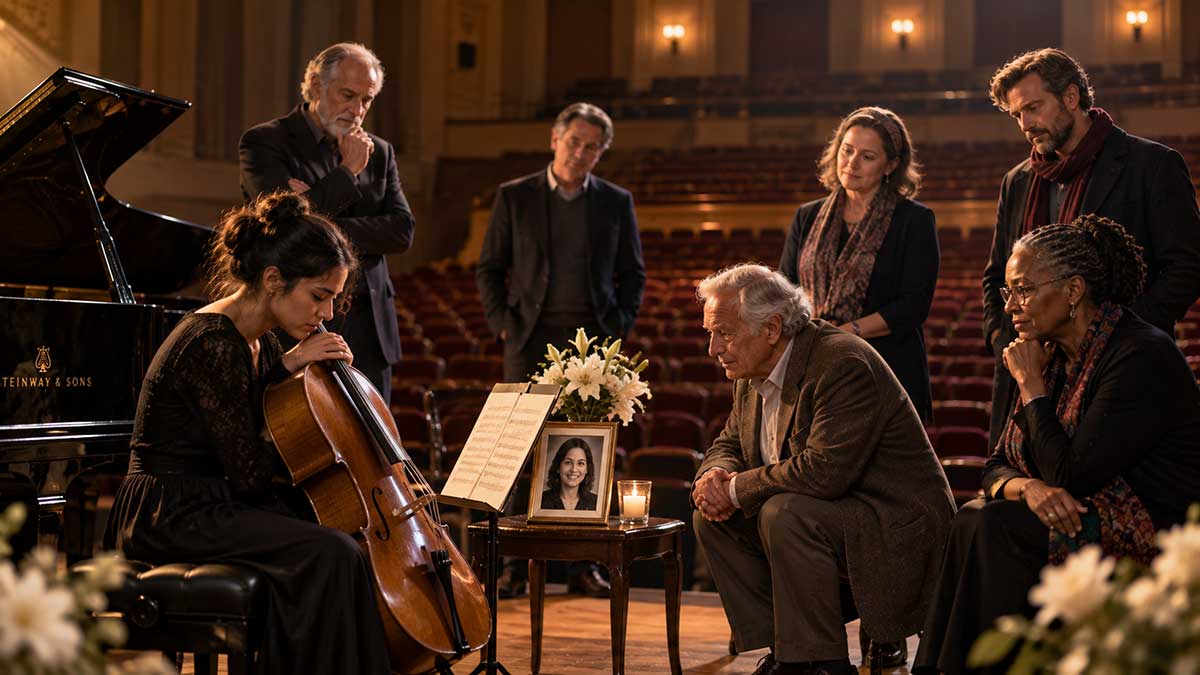
The cello carried across Golden in a thin, aching line.
Nobody at the fountain moved at first.
Ellen looked in the direction of the recital hall.
Allen listened.
Krista Tippett watched both of them.
Then Ellen said:
Ellen: "I still don't know if I like that phrase."
Allen turned toward her.
Allen: "Good sadness."
She nodded.
Ellen: "Sadness is sadness."
Dacher Keltner looked toward the hall.
Dacher: "Maybe that's where we should begin."
Krista stood.
Krista: "Inside?"
Ellen remained seated.
Ellen: "You people go."
Allen smiled.
Ellen: "I have had enough experts for one afternoon."
Nicholas Epley laughed.
Nicholas: "That's probably healthy."
Ellen pointed at him.
Ellen: "Especially you."
He bowed slightly.
Nicholas: "Fair."
The group gradually separated.
Nicholas and Sherry walked back toward the Chalice.
Amishi remained near the fountain for another few minutes.
Dacher, Allen, and Krista followed the cello.
The recital hall was nearly empty.
Simone was rehearsing alone onstage.
She stopped when she noticed them entering.
Simone: "Am I interrupting something?"
Krista smiled.
Krista: "You may have started something."
Simone lowered the bow.
Simone: "That's rarely a good sign."
Allen laughed.
Three people were waiting near the back of the hall.
Robert Neimeyer stood studying the stage.
George Bonanno had taken a seat several rows back.
Kate Bowler stood beside an empty chair on which someone had placed a small photograph of Tita.
She noticed Allen looking at it.
Kate: "Was this yours?"
Allen nodded.
Allen: "Theo's."
Kate lifted the photograph carefully.
A little girl smiled from it.
She replaced it exactly where it had been.
Kate: "Then I suspect this conversation is going to be difficult."
George looked over.
George: "Good."
Kate smiled.
Kate: "You say that now."
Robert walked closer.
Robert: "Perhaps difficult is the right place to start."
Allen sat near the aisle.
Krista remained standing for a moment.
The cello rested quietly beside Simone.
The empty room seemed to invite voices to soften.
Krista looked at Allen.
Krista: "You gave Theo a phrase readers remember."
Allen nodded.
Krista: "Good sadness."
Allen looked toward Tita's photograph.
Allen: "Yes."
Krista turned toward the others.
Krista: "Some readers hear wisdom in it."
She paused.
Krista: "Others hear something dangerous."
Kate nodded immediately.
Kate: "I understand both reactions."
Allen looked at her.
Kate: "There is something very true about grief changing shape."
She looked toward the photograph.
Kate: "But there is something risky about placing the word good too close to suffering."
The room became still.
Allen did not defend himself.
Allen: "Say more."
Kate sat in the aisle seat across from him.
Kate: "People who suffer are constantly asked to turn pain into something."
She counted lightly on her fingers.
Kate: "Meaning."
Kate: "Wisdom."
Kate: "Character."
Kate: "Purpose."
She looked directly at Allen.
Kate: "Sometimes people simply need permission to say, 'This was terrible, and I wish it had never happened.'"
Allen nodded.
Allen: "Theo would say that."
Kate tilted her head.
Kate: "Would he?"
Allen paused.
Allen: "Yes."
He looked toward Tita's photograph.
Allen: "He would never say losing her was good."
Kate nodded.
Allen: "He was trying to describe what sadness could become."
Robert leaned forward.
Robert: "That distinction matters."
Krista turned toward him.
Robert: "Grief and loss are not identical."
He looked at the photograph.
Robert: "The loss is what happened."
Then toward Allen.
Robert: "Grief is the relationship we develop with what happened."
George shifted slightly in his chair.
George: "And there isn't one relationship."
Robert nodded.
George: "That's where I want to be careful."
Krista sat.
George: "When people read a story like Theo's, they may quietly create a standard."
He looked around the hall.
George: "'This is how wise grief looks.'"
He shook his head.
George: "Human beings are much more variable."
Allen listened.
George: "Some people suffer an enormous loss and recover functioning relatively quickly."
George: "Some struggle for a long time."
George: "Some move back and forth."
He looked toward Tita's picture.
George: "None of those responses automatically tells us how much they loved."
Kate nodded.
Kate: "That is very important."
Krista looked toward Allen.
Krista: "Do you think readers might interpret Theo as a model they are supposed to imitate?"
Allen considered it.
Allen: "That would concern me."
Krista: "Why?"
Allen: "Theo's grief belongs to Theo."
He looked toward George.
Allen: "If someone reads him and thinks, 'I should be this generous after loss,' I think we have made grief into another performance."
Kate's face softened.
Kate: "Yes."
She leaned back.
Kate: "There is an exhausting idea in culture that pain must improve us."
Allen nodded.
Kate: "You suffer."
She gestured with one hand.
Kate: "Then people wait."
Kate: "Will you become kinder?"
Kate: "More spiritual?"
Kate: "More grateful?"
She smiled sadly.
Kate: "Sometimes you become tired."
A small laugh moved through the room.
Kate: "Sometimes you become angry."
She looked at George.
Kate: "Sometimes you become less interesting for a while."
George smiled.
Kate: "That should be allowed."
Robert nodded.
Robert: "Grief can reorganize identity."
Krista turned toward him.
Robert: "When someone central to your life dies, you do not simply lose that person."
He looked at Allen.
Robert: "You may lose the version of yourself that existed in relationship with them."
Allen's expression changed.
Robert: "Husband."
Robert: "Father."
Robert: "Daughter."
Robert: "Friend."
He paused.
Robert: "The question becomes: who am I now that this relationship cannot continue in the same form?"
Allen looked at Tita's photograph.
Allen: "That's very close to Theo."
Robert nodded.
Robert: "Which is why his continuing relationship with Tita interests me."
Krista leaned forward.
Krista: "Continuing relationship."
Robert smiled.
Robert: "People sometimes think grief requires detachment."
He shook his head.
Robert: "Often, the bond continues."
Kate: "You mean talking to someone who died."
Robert: "That can be part of it."
He gestured toward the photograph.
Robert: "Keeping photographs."
Robert: "Telling stories."
Robert: "Doing something because you know what the person would have loved."
Robert: "Hearing their voice in memory."
Allen nodded slowly.
Robert: "The relationship changes form."
Krista: "But does not necessarily disappear."
Robert: "Exactly."
Simone had been listening from the stage.
She finally spoke.
Simone: "Then Theo reading to Lamisha would not mean he was replacing Tita."
Robert looked up at her.
Robert: "Not necessarily."
Simone rested the cello against her shoulder.
Simone: "That's what I wondered when I first heard about it."
Allen turned toward her.
Simone: "People sometimes become nervous when someone who lost a child becomes attached to another child."
Robert nodded.
Simone: "Like the second child is being asked to carry the first."
Kate looked toward her.
Kate: "That can happen."
Simone's expression became serious.
Kate: "Which is why the distinction matters."
Robert continued.
Robert: "If Lamisha becomes a substitute for Tita, that could place a burden on her."
He paused.
Robert: "If loving Lamisha becomes one way Theo's capacity for love remains alive, that is different."
Allen nodded.
Allen: "That was my intention."
George looked toward him.
George: "Intentions are useful here, but behavior matters more."
Allen smiled faintly.
Allen: "Go on."
George: "Does Theo allow Lamisha to be Lamisha?"
Allen nodded.
George: "Does he let her have her own personality?"
Allen: "Yes."
George: "Does he expect her to heal him?"
Allen shook his head.
Allen: "No."
George spread his hands.
George: "Then that tells us more than whether he sometimes sees Tita in her."
Kate looked toward Allen.
Kate: "That is a generous distinction."
A moment passed.
Simone raised her bow.
Simone: "Can I play something?"
No one objected.
She began.
The piece was quiet.
No dramatic crescendo.
No cinematic swell.
Just a long, restrained melody that seemed unwilling to tell the listener what emotion to feel.
Dacher closed his eyes.
Allen watched Simone.
Kate watched Allen.
When the final note disappeared, nobody spoke immediately.
Dacher finally opened his eyes.
Dacher: "This is why beauty complicates grief."
Kate smiled.
Kate: "I knew you were waiting."
Dacher laughed.
Dacher: "I was."
Krista looked at him.
Dacher: "Beauty can hold mixed emotion unusually well."
He glanced toward Simone.
Dacher: "That music was not simply happy."
Dacher: "Not simply sad."
Simone nodded.
Dacher: "It created room for both."
Krista looked at the photograph.
Krista: "Is that what Theo means by good sadness?"
Allen exhaled.
Allen: "Maybe."
Kate turned toward him.
Kate: "You sound less certain."
Allen smiled.
Allen: "I am becoming less certain in good company."
Robert laughed softly.
Dacher leaned forward.
Dacher: "There is something about beauty that can make grief feel bearable without making it disappear."
Kate nodded cautiously.
Kate: "I like bearable more than beautiful."
Dacher looked at her.
Kate: "I worry when we say grief becomes beautiful."
Dacher: "Fair."
Kate: "A sunset can be beautiful."
She glanced toward the photograph.
Kate: "A child's death does not become beautiful since the parent later appreciates sunsets."
Allen's expression tightened.
Allen: "Yes."
Kate continued.
Kate: "The beauty is adjacent to the grief."
She paused.
Kate: "It does not redeem the event."
Robert nodded.
Robert: "Meaning can emerge after loss without becoming an explanation for the loss."
Krista looked at him.
Robert: "Those are different processes."
Krista: "Meaning without explanation."
Robert: "Yes."
Allen repeated it quietly.
Allen: "Meaning without explanation."
George leaned back.
George: "That may fit human adaptation better too."
Krista looked at him.
George: "People often adapt without discovering some grand lesson."
He shrugged.
George: "They build routines."
George: "They maintain relationships."
George: "They laugh again."
George: "They work."
George: "They keep going."
Kate smiled.
Kate: "An underrated form of courage."
George nodded.
George: "Very much."
Allen looked at him.
Allen: "Then do you dislike Theo's transformation?"
George shook his head.
George: "No."
Allen: "You think it is plausible?"
George: "Certainly."
Then he raised one finger.
George: "I resist making it normative."
Allen nodded.
George: "Theo becomes more attentive after loss."
He gestured toward the hall.
George: "Someone else might survive by returning to work."
George: "Someone else might become more private."
George: "Someone else might never want to speak publicly about the dead."
He paused.
George: "All can be legitimate."
Krista looked at Robert.
Krista: "Then where does continuing bonds fit if someone does not want photographs or rituals?"
Robert nodded.
Robert: "A bond can be internal."
He touched his chest.
Robert: "A value."
Robert: "A habit."
Robert: "A sentence you remember."
Robert: "A way you raise your children."
He looked at Allen.
Robert: "It does not require visible mourning."
Allen nodded.
Simone sat down on the stage.
Simone: "I have a question."
Krista smiled.
Krista: "Please."
Simone looked toward George.
Simone: "If people recover quickly, do they sometimes feel guilty?"
George nodded immediately.
George: "Yes."
Kate's expression changed.
George: "People can worry that functioning means they did not love enough."
Simone looked down.
George: "That is a painful misconception."
Robert nodded.
George: "A person's grief intensity is not a reliable measurement of the depth of love."
Kate sighed.
Kate: "We are very good at turning suffering into evidence."
Krista turned.
Kate: "'If I hurt this much, I must have loved deeply.'"
She paused.
Kate: "'If I stop hurting, maybe I have betrayed them.'"
Allen looked at the photograph.
Kate: "That can imprison people."
Robert nodded.
Robert: "Continuing bonds should support life."
Robert: "Not prevent it."
Krista looked at Allen.
Krista: "Did Theo ever fear happiness?"
Allen smiled sadly.
Allen: "Yes."
Krista: "Why?"
Allen looked toward the empty stage.
Allen: "For a time, joy felt disloyal."
Kate nodded.
Allen: "If his wife and daughter were gone, how could he laugh?"
He paused.
Allen: "How could he enjoy food?"
Allen: "Music?"
Allen: "Beauty?"
Dacher listened closely.
Allen: "There was a period when the fact that the world remained beautiful made him angry."
Dacher nodded.
Dacher: "That makes sense emotionally."
Kate looked at him.
Dacher: "Awe and grief can coexist."
He turned toward Allen.
Dacher: "But the return of awe after loss can be disorienting."
Krista: "Why?"
Dacher: "Since it reminds you the world is larger than your suffering."
Kate gave him a careful look.
Dacher: "That can feel comforting."
He paused.
Dacher: "Or offensive."
Allen smiled faintly.
Allen: "Theo experienced the offensive part first."
Dacher nodded.
Allen: "Then one day the world being beautiful no longer felt like betrayal."
Kate looked toward the photograph.
Kate: "That feels different from saying beauty healed him."
Allen turned toward her.
Allen: "Yes."
Kate: "Good."
She smiled.
Kate: "I am policing your verbs."
Allen laughed.
Allen: "Apparently."
Krista looked around the room.
Krista: "Let me push the phrase itself."
She spoke slowly.
Krista: "Good sadness."
Nobody answered.
Krista: "Robert, would you use that phrase?"
Robert thought for a long moment.
Robert: "I might use it if the grieving person used it first."
Kate smiled.
Krista: "Why does that matter?"
Robert: "Language in grief should belong partly to the mourner."
He looked at Allen.
Robert: "If Theo says, 'This sadness has become good for me,' that may be meaningful."
He paused.
Robert: "If I tell someone else, 'Your sadness should become good,' that is something else."
Kate nodded strongly.
Kate: "Yes."
George added:
George: "That distinction protects variation."
Krista turned toward Kate.
Krista: "Would you ever use it?"
Kate smiled.
Kate: "Very carefully."
She looked toward Tita.
Kate: "I might say there are sorrows we would never choose, yet over time they become woven into a life we still love."
Allen looked at her.
Kate continued.
Kate: "I would not call the loss good."
She touched the edge of the chair.
Kate: "I might call the life still good."
Silence.
Allen lowered his head.
Allen: "That may be closer."
Krista watched him.
Allen: "A good life containing sadness."
Kate smiled.
Allen: "Rather than sadness requiring goodness."
Robert nodded.
Robert: "That is psychologically generous."
George smiled.
George: "And less demanding."
The side door opened.
Tony entered carrying two coffees.
He stopped when he saw the group.
Tony: "Oh no."
Allen laughed.
Tony: "More experts."
Kate smiled.
Tony: "I thought we finished this."
Krista: "Apparently not."
Tony handed one coffee to Simone.
Simone: "Thank you."
Tony looked toward Tita's photograph.
His expression changed.
Tony: "Good sadness?"
Allen nodded.
Tony groaned.
Tony: "I knew it."
He sat several seats away.
Kate looked at him.
Kate: "You don't like the phrase?"
Tony shrugged.
Tony: "Some days."
Robert looked interested.
Tony: "Other days I do."
Krista smiled.
Krista: "What makes the difference?"
Tony took a sip of coffee.
Tony: "Whether somebody is trying to teach it to me."
Kate laughed.
Kate: "I like you."
Tony nodded.
Tony: "Good."
He looked at Allen.
Tony: "Theo could talk about good sadness all he wanted."
He pointed toward himself.
Tony: "Mine was not his."
Robert leaned forward.
Tony: "His was grief."
Tony looked down.
Tony: "Mine was guilt."
The atmosphere shifted.
Kate's smile faded.
George sat forward.
Tony continued.
Tony: "I don't think all sadness belongs in the same basket."
Robert nodded.
Robert: "I agree."
Tony looked at him.
Tony: "Theo lost people he loved."
He swallowed.
Tony: "I remember someone who died due to something I did."
Nobody interrupted.
Tony: "That isn't the same."
Kate spoke softly.
Kate: "No."
Tony stared at the floor.
Tony: "People sometimes want every kind of suffering to become healing."
He shook his head.
Tony: "I don't know what healing means for me."
Robert waited.
Tony: "Forget?"
Robert shook his head.
Tony: "Forgive myself?"
He looked almost angry.
Tony: "Why?"
George remained quiet.
Tony looked toward Allen.
Tony: "This is what worries me about good sadness."
Allen nodded.
Tony: "Some sadness needs to bother us."
Robert leaned forward.
Robert: "Yes."
Tony looked surprised.
Robert: "Moral pain can carry information."
Tony listened.
Robert: "Regret can tell us something about values."
He paused.
Robert: "The goal may not be to eliminate it."
Tony frowned.
Tony: "Then what?"
Robert answered carefully.
Robert: "To change its function."
Tony stared at him.
Robert: "If guilt only punishes you endlessly, it may become psychologically destructive."
Tony nodded slightly.
Robert: "If it helps you live differently, remember responsibly, repair what can be repaired, and refuse to repeat harm..."
Tony looked away.
Robert: "Then the memory can remain painful without remaining useless."
Tony was silent.
Kate looked toward him.
Kate: "And none of that pays a debt."
Tony looked at her quickly.
Kate: "I think that matters."
Tony nodded.
Kate: "We sometimes turn goodness into a repayment scheme."
She shook her head.
Kate: "It doesn't work."
Tony stared at his coffee.
Kate: "You may do good later."
Kate: "That does not purchase innocence."
Tony looked at her.
Kate: "Maybe the aim is not innocence."
Tony's eyes filled slightly.
Tony: "What is it?"
Kate thought.
Kate: "Truthfulness."
The word remained between them.
Tony nodded once.
Dacher looked toward him.
Dacher: "And perhaps tenderness."
Tony gave him a skeptical look.
Dacher: "Not toward the act."
Tony waited.
Dacher: "Toward the human being who must live after it."
Tony looked away.
Tony: "I don't know if I deserve tenderness."
Kate responded immediately.
Kate: "Deserve is doing a lot of work there."
Tony almost smiled.
Robert looked toward him.
Robert: "Self-forgiveness does not have to mean self-exoneration."
Tony looked back.
Robert: "You can accept responsibility and still refuse to reduce yourself to one moment."
Tony let out a long breath.
Tony: "Theo would like you."
Robert smiled.
Tony: "That's not necessarily a compliment."
A soft laugh moved through the hall.
The tension loosened.
Then George spoke.
George: "This is exactly why I resist one grief model."
Krista turned.
George: "Theo."
He pointed toward Tita's photograph.
George: "Bereavement."
Then Tony.
George: "Moral injury."
He gestured toward an empty seat.
George: "Kendrick."
George: "Anger after traumatic loss."
He looked toward the back of the hall.
George: "Ellen."
George: "Attachment, loss, social marginalization."
He looked around.
George: "Different experiences."
George: "Different tasks."
Allen nodded.
George: "The novel becomes stronger when those differences remain different."
Allen smiled.
Allen: "I agree."
Krista looked at him.
Krista: "Then why give Theo such a memorable phrase?"
Allen laughed softly.
Allen: "Writers make trouble for themselves."
Kate smiled.
Allen looked toward the photograph.
Allen: "I wanted him to discover that sadness no longer meant his life was ruined."
He paused.
Allen: "That he could miss Tita and still love being alive."
The room became quiet.
Allen continued.
Allen: "That laughter did not betray her."
Allen: "That caring about Lamisha did not replace her."
Allen: "That beauty could return without making his love smaller."
Kate nodded.
Allen: "Maybe good sadness was Theo's language for that."
Robert smiled.
Robert: "Then it belongs to him."
Allen looked at him.
Robert: "That's where I would leave it."
Krista nodded.
Krista: "Not a theory."
Robert: "A personal vocabulary."
Kate smiled.
Kate: "I like that much better."
Tony lifted his coffee.
Tony: "Me too."
Simone picked up her cello.
Simone: "Then perhaps music works the same way."
Krista turned.
Simone: "I can play something that feels sad to me."
She looked at Dacher.
Simone: "You may hear peace."
Dacher nodded.
Simone: "Tony may hear regret."
Tony smiled faintly.
Simone: "Allen may hear Tita."
Allen's face changed.
Simone continued.
Simone: "The music doesn't tell us which emotion is correct."
Dacher smiled.
Dacher: "Exactly."
Simone: "It gives us somewhere to put it."
Robert looked toward her.
Robert: "That may be one of art's most important roles in grief."
Allen nodded.
Allen: "Somewhere to put it."
Kate looked around the hall.
Kate: "Maybe that's the phrase I trust most."
Krista turned.
Kate: "Pain needs somewhere to go."
Tony looked at her.
Kate: "Not somewhere useful."
Kate: "Not somewhere productive."
She shook her head.
Kate: "Just somewhere it can exist without swallowing everything."
Robert nodded.
Robert: "Story can do that."
Dacher: "Music."
Simone: "Yes."
Allen: "People."
Kate smiled.
Krista: "People?"
Allen looked toward Tony.
Then at Kate.
Then Robert.
Allen: "Someone who sits there."
Tony gave a tired smile.
Tony: "We're back to sitting."
Allen laughed.
Allen: "Apparently."
The room fell quiet again.
Simone began another piece.
This one was lighter.
Not cheerful.
Just lighter.
George listened for a while.
Then he whispered to Krista:
George: "This is another thing grief research teaches us."
Krista leaned closer.
George: "People oscillate."
Krista: "Between what?"
George: "Loss and life."
He gestured toward the music.
George: "One moment you are crying."
George: "Then someone makes you laugh."
George: "Then you feel guilty for laughing."
He shook his head.
George: "Human beings move."
Krista watched Simone.
George: "That movement can be healthy."
Allen overheard.
Allen: "Theo does that."
George nodded.
Allen: "He grieves."
Allen: "Then gets excited about a bird."
A few people laughed.
Allen: "Then he remembers Tita."
Allen: "Then he argues with Tony."
Tony raised his coffee.
Tony: "A therapeutic service I provide."
More laughter.
George smiled.
George: "Exactly."
Kate looked around.
Kate: "Perhaps grief becomes dangerous when we think every emotional change means betrayal."
Allen turned.
Kate: "Joy isn't betrayal."
Kate: "Distraction isn't betrayal."
Kate: "Having a normal afternoon isn't betrayal."
Tony lowered his eyes.
Kate: "And having a terrible afternoon years later isn't failure."
Robert nodded.
Robert: "Grief is not linear."
Krista smiled.
Krista: "We say that so often that it risks becoming a slogan."
Robert laughed.
Krista: "What does it actually mean?"
Robert thought.
Robert: "It means there is no emotional staircase."
He raised his hand step by step.
Robert: "Sad."
Robert: "Less sad."
Robert: "Almost healed."
He lowered his hand.
Robert: "People revisit."
Robert: "Anniversaries."
Robert: "Songs."
Robert: "Smells."
Robert: "Places."
Allen touched the photograph.
Robert: "A grief response returning does not mean you have gone backward."
Allen looked relieved by that sentence, almost as though hearing it on Theo's behalf.
Kate noticed.
Kate: "Did Theo ever think he was going backward?"
Allen nodded.
Allen: "Many times."
Kate: "That may be one of the cruelest ideas people carry."
Allen looked at her.
Kate: "That if sorrow returns, healing failed."
Robert nodded.
Kate: "Sometimes sorrow returns since love has memory."
The hall became very quiet.
Tony looked toward Tita's photograph.
Tony: "That sounds like something Theo would steal."
Allen laughed softly.
Allen: "Absolutely."
Kate smiled.
Simone's piece ended.
Krista stood and walked toward the chair holding the photograph.
She did not touch it.
Krista: "Let me ask the hardest version."
Everyone looked toward her.
Krista: "Suppose Theo never became more generous."
Allen listened.
Krista: "Suppose he never discovered good sadness."
Krista: "Suppose he simply remained an old man who missed his daughter every day."
She paused.
Krista: "Would his grief have been less worthy?"
Allen shook his head immediately.
Allen: "No."
Kate watched him.
Allen: "No."
His voice grew firmer.
Allen: "Tita's life did not require Theo to become remarkable."
Kate nodded.
Allen: "His suffering did not owe the world a gift."
Silence.
Robert leaned back.
George looked satisfied.
Kate's expression softened.
Kate: "Then I think you have protected the phrase."
Allen smiled faintly.
Krista: "How?"
Kate looked around the room.
Kate: "By refusing to turn it into a requirement."
She glanced at the photograph.
Kate: "Theo found a way of living with sadness that felt good to him."
She paused.
Kate: "Someone else may never use that language."
Kate: "Someone else may recover differently."
Kate: "Someone else may never find meaning."
She looked at Allen.
Kate: "Their life still counts."
Allen nodded.
Robert looked toward Krista.
Robert: "That may be the most compassionate grief theory available."
Krista: "Which is?"
Robert smiled.
Robert: "There is more than one way to love the dead and keep living."
The room became silent.
Tony stood.
He placed his empty coffee cup on a nearby seat.
Tony: "That's enough grief for me."
Kate smiled.
Tony: "I'm going back to books."
He started toward the door.
Then stopped.
He looked over his shoulder.
Tony: "For what it's worth..."
Everyone waited.
Tony: "I still don't like good sadness."
Allen grinned.
Allen: "Understood."
Tony nodded.
Tony: "But I like a good life with sadness in it."
Kate smiled.
Kate: "Me too."
Tony left.
Simone returned her cello to its case.
George stood.
Robert looked toward Allen.
Robert: "Do you know where this conversation goes next?"
Allen glanced toward the empty seat where Kendrick might have been.
His expression changed.
Allen: "Yes."
Krista followed his gaze.
Krista: "Kendrick."
Allen nodded.
Kate looked toward the photograph of Tita.
Then toward the empty chair.
Kate: "Grief after losing someone is difficult enough."
She paused.
Kate: "Grief when someone else caused the loss becomes something else."
George nodded.
Robert grew quiet.
Krista looked toward the door.
Beyond it was the road leading toward the courthouse.
Krista: "Then we have reached Mateo."
Allen exhaled.
Allen: "And the point where seeing another person becomes much harder."
The hall lights dimmed one row at a time.
Tita's photograph remained on the chair.
Not as a lesson.
Not as an explanation.
Not as proof that tragedy makes people better.
Simply as evidence that someone had been loved.
And that love still had somewhere to live.
Topic 3: Can We See the Humanity of Someone Who Hurt Us Without Excusing Them?
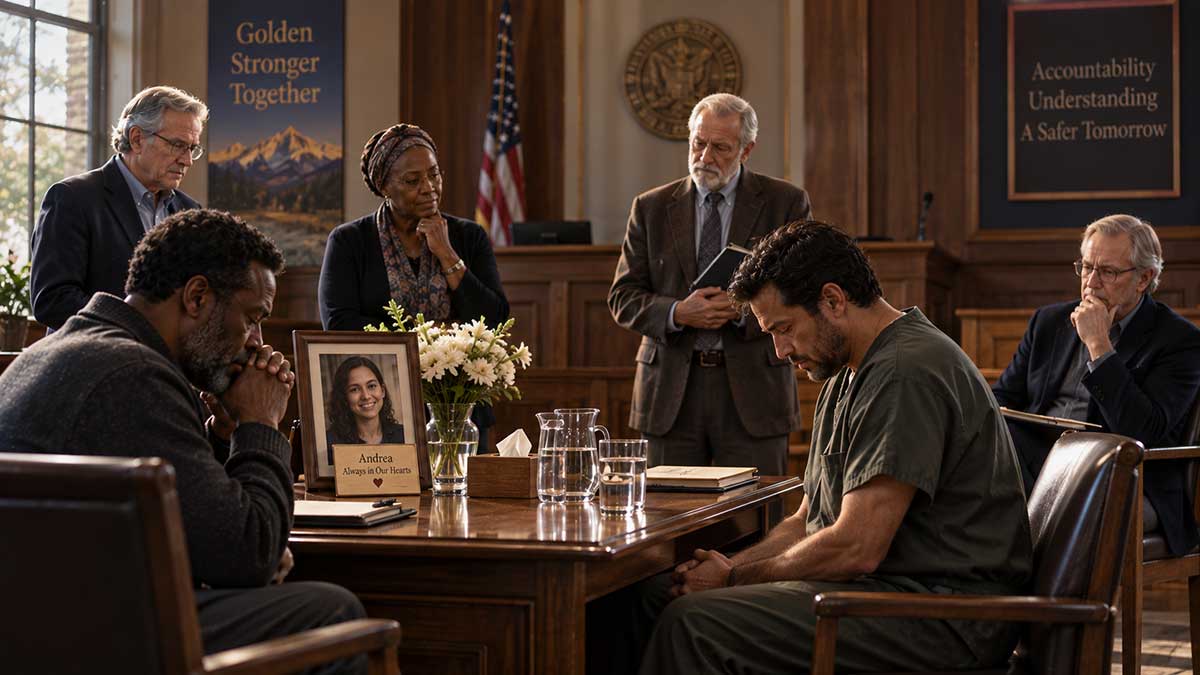
The courthouse room was smaller than Krista expected.
No elevated bench.
No flags.
No audience.
Just a rectangular table, several chairs, a window looking onto a narrow street, and a framed photograph placed carefully at the center.
Andrea.
Kendrick’s wife.
Lamisha’s mother.
The photograph changed the room.
Howard Zehr noticed it first.
He walked closer, but did not touch it.
Pumla Gobodo-Madikizela stood several feet away.
Everett Worthington remained near the window.
Robert Neimeyer took a seat near the end of the table.
Allen Levi entered last.
He stopped when he saw Andrea’s face.
Krista Tippett followed him.
Two chairs remained empty.
One for Kendrick.
One for Mateo.
Krista looked at them.
Krista: "Before either man enters, I want to ask something uncomfortable."
Pumla nodded.
Krista: "The moment we learn Mateo’s story, something happens."
She looked around the room.
Krista: "He becomes more understandable."
Howard nodded.
Krista: "He has a daughter."
Krista: "He was frightened."
Krista: "He was exhausted."
Krista: "He regrets what happened."
She looked toward Andrea’s photograph.
Krista: "But every detail that makes Mateo more human can pull emotional attention in his direction."
No one spoke.
Krista: "How do we humanize the person who caused harm without making the person harmed disappear?"
Pumla looked at the photograph.
Pumla: "By refusing the idea that compassion is a limited resource."
Krista waited.
Pumla: "Seeing Mateo does not require seeing Andrea less."
She stepped closer to the photograph.
Pumla: "The danger begins when the person who caused harm becomes psychologically interesting and the person who died becomes merely the event that made his remorse possible."
Allen’s expression changed.
Allen: "That is one of the dangers of the story."
Pumla turned toward him.
Allen: "Mateo can speak."
He pointed gently toward the photograph.
Allen: "Andrea cannot."
Robert nodded slowly.
Allen: "Readers can hear his fear."
Allen: "His regret."
Allen: "His daughter."
He looked at Andrea.
Allen: "Andrea risks becoming 'Kendrick’s wife.'"
Pumla nodded.
Pumla: "Exactly."
Howard moved toward the table.
Howard: "Any conversation about repair has to keep the harm visible."
Krista turned.
Howard: "The first question cannot be, 'How do we help Mateo feel forgiven?'"
Everett nodded.
Howard: "The first question is, 'Who was harmed, what was lost, and what does responsibility require now?'"
Allen looked toward him.
Howard: "Humanizing the person responsible should deepen accountability."
Krista raised an eyebrow.
Krista: "Deepen it?"
Howard: "Yes."
He sat down.
Howard: "A flat villain can be punished."
He pointed to the empty chair.
Howard: "A human being can be asked to understand."
Pumla nodded.
Howard: "To listen."
Howard: "To acknowledge."
Howard: "To live with the consequences."
He looked toward Andrea’s photograph.
Howard: "Sometimes seeing the other person’s humanity makes responsibility more serious, not less."
Everett stepped away from the window.
Everett: "This is where people often confuse forgiveness with excusing."
Krista turned toward him.
Everett: "They are not the same."
Krista: "What is the difference?"
Everett thought for a moment.
Everett: "Excusing changes the judgment of the action."
He looked toward the empty chair.
Everett: "'You really could not help it.'"
He shook his head.
Everett: "'It was not truly your responsibility.'"
Then he looked toward Andrea.
Everett: "Forgiveness does not require saying either of those things."
Krista nodded.
Everett: "You may say, 'What you did was wrong. It harmed me. It changed my life. I am still angry.'"
He paused.
Everett: "And forgiveness, if someone chooses it, can still begin from there."
Pumla looked toward him.
Pumla: "I want to protect one phrase."
Everett smiled.
Everett: "Please."
Pumla: "If someone chooses it."
Everett nodded immediately.
Pumla: "Forgiveness becomes morally dangerous when it is turned into an obligation imposed on the injured person."
Krista looked toward her.
Pumla: "People love clean endings."
She glanced at Allen.
Pumla: "Stories love them too."
Allen smiled faintly.
Pumla: "The person apologizes."
She lifted one hand.
Pumla: "The victim forgives."
She brought her hands together.
Pumla: "Everyone cries."
Her hands dropped.
Pumla: "Life rarely behaves so neatly."
Robert nodded.
Robert: "Grief certainly does not."
Pumla looked at Andrea’s photograph.
Pumla: "Kendrick may forgive Mateo one day."
She paused.
Pumla: "He may never use that word."
Pumla: "He may reach some other form of peace."
She looked at the group.
Pumla: "Our job is not to decide which response makes him a better person."
Allen nodded slowly.
The door opened.
Everyone turned.
Kendrick stood there.
He had heard the last sentence.
Kendrick: "Good."
Pumla smiled gently.
Kendrick: "I’m tired of people measuring me by whether I can forgive."
He entered.
Krista stood.
Krista: "Thank you for coming."
Kendrick looked at Andrea’s photograph.
He walked directly to it.
He adjusted the frame slightly.
No one spoke.
Then he sat in the chair meant for him.
The chair opposite remained empty.
Kendrick looked at it.
Kendrick: "He’s coming?"
Allen nodded.
Allen: "If you still want him to."
Kendrick stared at the empty seat.
Kendrick: "I don’t know what I want."
Pumla spoke softly.
Pumla: "That is allowed."
Kendrick looked at her.
Kendrick: "People keep saying things like that to me."
Pumla: "Does it help?"
He considered it.
Kendrick: "More than telling me what I should want."
She nodded.
Krista sat near him.
Krista: "Kendrick, what bothers you most about people asking whether you forgive Mateo?"
He looked toward Andrea.
Kendrick: "It skips her."
The room went still.
Krista: "Tell me."
Kendrick: "Someone asks, 'Do you forgive him?'"
He pointed toward Mateo’s empty chair.
Kendrick: "Suddenly the story is about him."
He looked at Andrea’s photograph.
Kendrick: "What about her?"
Pumla closed her eyes briefly.
Kendrick: "Do you know what Andrea liked?"
No one answered.
Kendrick: "Do you know what annoyed her?"
He smiled faintly.
Kendrick: "She hated when people left cabinet doors open."
Allen laughed softly.
Kendrick’s smile stayed.
Kendrick: "She loved terrible reality television."
He shook his head.
Kendrick: "She could fall asleep anywhere."
He looked at the photograph.
Kendrick: "She sang when she cooked."
His face tightened.
Kendrick: "Badly."
A few people smiled.
Then his eyes filled.
Kendrick: "That’s my wife."
Silence.
Kendrick: "Not 'the woman who died in Mateo’s accident.'"
Howard nodded slowly.
Kendrick: "When people talk about forgiveness too fast, she becomes scenery."
Pumla leaned forward.
Pumla: "That is precisely what must not happen."
Kendrick looked at her.
Pumla: "Your wife does not exist to make Mateo’s remorse meaningful."
Kendrick’s face softened.
Pumla: "Her life is not a moral lesson for him."
Kendrick looked down.
Pumla: "She had a life before the harm."
She glanced toward the photograph.
Pumla: "That life has to remain visible."
Robert added quietly:
Robert: "Grief often asks us to protect the personhood of the dead."
Kendrick turned.
Robert: "People begin speaking about how someone died."
He paused.
Robert: "The mourner wants to keep speaking about how they lived."
Kendrick nodded.
Kendrick: "Yes."
Robert looked at Andrea’s picture.
Robert: "That may be part of your anger."
Kendrick: "Part."
He looked toward Mateo’s chair.
Kendrick: "The other part is simpler."
Krista waited.
Kendrick: "He could have stopped."
Howard nodded.
Kendrick: "He knew he was tired."
Kendrick: "He kept driving."
His jaw tightened.
Kendrick: "That part matters."
Everett spoke gently.
Everett: "It should."
Kendrick looked at him.
Everett: "Forgiveness does not require weakening responsibility."
Kendrick: "Then what does it require?"
Everett paused.
Everett: "If you choose forgiveness, it may require changing what you want your anger to do."
Kendrick frowned.
Kendrick: "What does that mean?"
Everett leaned forward.
Everett: "Anger can say, 'What happened mattered.'"
Kendrick nodded.
Everett: "Anger can protect boundaries."
He paused.
Everett: "Anger can seek accountability."
Kendrick kept listening.
Everett: "But anger can start asking for something else."
Kendrick: "What?"
Everett: "That the other person suffer forever."
The room became very quiet.
Kendrick looked toward the window.
Everett: "Forgiveness sometimes means deciding you no longer want your life organized around that wish."
Kendrick turned back.
Kendrick: "That sounds like what Theo told me."
Allen smiled faintly.
Kendrick: "He said he didn’t want hatred making all my decisions."
Everett nodded.
Kendrick: "But what if hatred is the only thing that feels loyal to Andrea?"
Robert looked at him.
Robert: "That is a grief question."
Kendrick waited.
Robert: "Sometimes anger becomes a continuing bond."
Kendrick frowned.
Robert: "If I stop being angry, am I abandoning the person who died?"
Kendrick stared.
Robert nodded.
Robert: "It can feel that way."
Kendrick looked toward Andrea.
Kendrick: "Yes."
Robert continued.
Robert: "Then one task may be finding other ways to remain connected to her."
Kendrick’s face changed.
Robert: "Stories."
Robert: "Rituals."
Robert: "The way you raise Lamisha."
He looked toward the photograph.
Robert: "Keeping Andrea alive as more than the reason for your anger."
Kendrick swallowed.
Robert: "Then releasing some anger would not mean releasing her."
Kendrick remained silent.
Pumla watched him carefully.
Pumla: "May I ask you something?"
Kendrick nodded.
Pumla: "When you picture Mateo, what do you see?"
Kendrick looked at the empty chair.
Kendrick: "At first?"
Pumla: "At first."
Kendrick: "A man behind a steering wheel."
His voice hardened.
Kendrick: "Then Andrea’s car."
Pumla: "And now?"
Kendrick exhaled.
Kendrick: "That’s the problem."
Pumla waited.
Kendrick: "Now I see his daughter too."
He shook his head.
Kendrick: "I hate that."
Pumla nodded.
Kendrick: "I see him scared."
His hands tightened.
Kendrick: "I see him exhausted."
He looked up.
Kendrick: "I still see Andrea."
Pumla leaned closer.
Pumla: "Good."
Kendrick looked surprised.
Pumla: "Keep both."
He stared at her.
Pumla: "The goal is not to replace one story with another."
She gestured toward the two chairs.
Pumla: "It is to become capable of holding more than one truth."
Kendrick looked down.
Pumla: "Mateo’s desperation matters."
She pointed toward Andrea.
Pumla: "Andrea’s death matters."
Pumla: "Mateo’s remorse matters."
Pumla: "Your anger matters."
She paused.
Pumla: "None erases the others."
Kendrick nodded slowly.
The door opened again.
Mateo entered.
He stopped immediately when he saw Andrea’s photograph.
His face changed.
He remained near the door.
Kendrick did not look at him.
Krista did not introduce anyone.
No one needed introduction.
Mateo finally spoke.
Mateo: "May I sit?"
Kendrick stared at the photograph.
After several seconds:
Kendrick: "Yes."
Mateo sat.
He looked at Andrea.
Then at Kendrick.
Mateo: "Thank you."
Kendrick’s expression hardened.
Kendrick: "Don’t thank me yet."
Mateo nodded.
The experts became quieter.
The conversation no longer belonged primarily to them.
Krista looked at Mateo.
Krista: "Mateo, before we discuss forgiveness, I want to ask about remorse."
Mateo nodded.
Krista: "What do you think you owe Kendrick?"
Mateo looked startled.
He looked at Kendrick.
Then down.
Mateo: "I don’t know if I can give him anything he needs."
Kendrick looked toward him.
Mateo continued.
Mateo: "I owe him the truth."
Howard nodded faintly.
Mateo: "I owe him not to make excuses."
He looked toward Andrea.
Mateo: "I owe her name."
Kendrick’s face changed.
Mateo swallowed.
Mateo: "Andrea."
The room became still.
Mateo: "I owe Lamisha’s name too."
Kendrick closed his eyes.
Mateo: "I owe them memory."
Pumla looked toward Howard.
Howard spoke.
Howard: "That is part of accountability."
Mateo turned toward him.
Howard: "The person who caused harm must resist making the event primarily about his own guilt."
Mateo nodded.
Howard: "Your remorse matters."
He pointed gently toward Andrea.
Howard: "But remorse becomes ethically meaningful when it keeps the harmed person at the center."
Mateo looked at the photograph.
Mateo: "I think about her every day."
Kendrick’s head lifted.
Kendrick: "Do you?"
Mateo nodded.
Kendrick: "What do you think about?"
Mateo hesitated.
Mateo: "The road."
Kendrick’s jaw tightened.
Mateo: "Her face from the photographs."
Mateo looked toward Andrea.
Mateo: "Your daughter."
Kendrick interrupted.
Kendrick: "You never met Andrea."
Mateo shook his head.
Mateo: "No."
Kendrick: "Then don’t pretend you knew her."
Mateo’s eyes filled.
Mateo: "I won’t."
Kendrick stared at him.
Mateo: "I know only what I took from the world."
Kendrick’s face tightened.
Pumla looked at Mateo.
Pumla: "That sentence may be important."
Mateo turned.
Pumla: "Remorse is often strongest when a person stops making himself the main character in his own guilt."
Mateo listened.
Pumla: "You can become fascinated by your own suffering."
Mateo lowered his gaze.
Pumla: "Your shame."
Pumla: "Your sleeplessness."
Pumla: "Your desire for forgiveness."
She looked toward Andrea.
Pumla: "And the person harmed disappears again."
Mateo’s eyes closed.
Mateo: "I don’t want that."
Pumla nodded.
Pumla: "Then tell us about her."
Mateo opened his eyes.
He looked confused.
Mateo: "I don’t know her."
Kendrick looked toward Pumla.
Pumla turned to him.
Pumla: "Would you want him to?"
The question surprised Kendrick.
He looked at Mateo.
Then Andrea.
Kendrick: "I don’t know."
Pumla nodded.
Kendrick: "Part of me does."
He looked at Mateo.
Kendrick: "Part of me thinks he lost the right."
Mateo lowered his head.
Pumla nodded.
Pumla: "Both make sense."
Kendrick stared at Andrea’s photograph.
Then he spoke.
Kendrick: "She hated mushrooms."
Mateo looked up.
Kendrick still did not look at him.
Kendrick: "Wouldn’t eat them."
He smiled faintly.
Kendrick: "Would pick them out of everything."
Mateo listened.
Kendrick: "She sang when she cooked."
His voice softened.
Kendrick: "Badly."
Allen smiled.
Kendrick continued.
Kendrick: "She loved Lamisha before Lamisha was even born."
His voice cracked.
Mateo’s eyes filled.
Kendrick: "She bought baby clothes too early."
He laughed once.
Kendrick: "I told her not to."
Mateo remained completely still.
Kendrick: "She said she didn’t care."
A tear moved down Kendrick’s face.
Kendrick: "That’s Andrea."
Mateo whispered:
Mateo: "Thank you."
Kendrick looked at him sharply.
Mateo corrected himself.
Mateo: "I mean..."
He stopped.
Kendrick watched.
Mateo: "I will remember."
Kendrick looked back at the photograph.
Howard let the silence continue.
After a long time, Krista turned toward Everett.
Krista: "Is something like this forgiveness?"
Everett shook his head.
Everett: "Not necessarily."
Kendrick looked relieved.
Everett: "It is contact."
He paused.
Everett: "Recognition."
Everett: "Perhaps humanization."
He looked toward Kendrick.
Everett: "Forgiveness is not required for this moment to matter."
Pumla nodded.
Pumla: "That distinction is vital."
Krista looked toward Mateo.
Krista: "Do you want Kendrick’s forgiveness?"
Mateo’s face tightened.
He looked at Kendrick.
Mateo: "Yes."
Kendrick stiffened slightly.
Mateo continued.
Mateo: "But I do not think I have the right to ask him for it."
Pumla watched him.
Mateo: "I want it since I am tired of living with this."
He looked down.
Mateo: "That is selfish."
Everett spoke softly.
Everett: "Human."
Mateo looked at him.
Everett: "Wanting relief does not make you monstrous."
He paused.
Everett: "Demanding that Kendrick provide it would be different."
Mateo nodded.
Kendrick looked toward Everett.
Kendrick: "What happens if I never forgive him?"
Everett took his time.
Everett: "Then I would ask a different question."
Kendrick waited.
Everett: "Can you live without being consumed by what happened?"
Kendrick frowned.
Everett: "Forgiveness is one pathway some people use."
He gestured lightly.
Everett: "It is not the only human pathway out of consuming hatred."
Pumla nodded.
Everett: "You may reach acceptance."
Everett: "Compassion."
Everett: "Indifference."
He paused.
Everett: "A decision simply not to organize your life around revenge."
Kendrick looked at Andrea.
Everett: "The word matters less than what happens to you."
Kendrick sat with that.
Robert turned toward him.
Robert: "And grief will still remain."
Kendrick nodded.
Robert: "Forgiving Mateo would not solve missing Andrea."
Kendrick looked at him.
Robert: "That is another trap."
Kendrick: "People think forgiveness heals everything."
Robert nodded.
Robert: "It cannot bring back the person."
He pointed toward the photograph.
Robert: "Your grief has its own work."
Kendrick’s eyes filled again.
Robert: "Separate from Mateo."
Kendrick breathed deeply.
Kendrick: "I think I’ve mixed them together."
Robert waited.
Kendrick: "Missing her."
He pointed toward Mateo.
Kendrick: "Hating him."
He looked at the table.
Kendrick: "Sometimes they feel like the same thing."
Robert nodded.
Robert: "That is understandable."
Kendrick looked toward Andrea.
Robert: "But one day you may discover you can miss Andrea without thinking about Mateo at all."
Kendrick stared at him.
Robert: "That could be a form of freedom."
Mateo lowered his eyes.
Kendrick did not speak.
Howard finally leaned forward.
Howard: "May I complicate this?"
Krista smiled faintly.
Krista: "Please."
Howard: "We have spoken a great deal about emotion."
He looked toward Mateo.
Howard: "What about responsibility?"
Mateo nodded.
Howard continued.
Howard: "Remorse is not merely feeling terrible."
He paused.
Howard: "What are you willing to do?"
Mateo looked confused.
Howard: "You cannot restore Andrea."
Mateo swallowed.
Howard: "What can responsibility look like now?"
Mateo stared at the table.
Mateo: "I don’t know."
Howard nodded.
Howard: "That may be the right answer today."
Kendrick looked at him.
Howard: "Accountability is larger than punishment."
He glanced toward Allen.
Howard: "It asks what obligations remain after harm."
Kendrick listened.
Howard: "Listening."
Howard: "Truth."
Howard: "Repair where possible."
Howard: "Accepting consequences."
Howard: "Changing behavior."
Howard: "Making sure the same kind of harm is less likely to happen again."
Mateo nodded slowly.
Howard: "And sometimes the person harmed wants none of your participation."
Mateo looked toward Kendrick.
Howard: "That boundary becomes part of accountability too."
Mateo nodded again.
Kendrick turned toward Howard.
Kendrick: "So mercy doesn't mean he gets less responsibility."
Howard: "No."
Kendrick looked at Mateo.
Howard: "Mercy without accountability can become avoidance."
Pumla added:
Pumla: "And accountability without humanity can become vengeance."
The room went silent.
Allen looked between them.
Allen: "That may be the tension I wanted Kendrick to inhabit."
Krista turned toward him.
Allen: "Not choosing between justice and mercy."
He looked at Kendrick.
Allen: "Trying to remain human inside both."
Kendrick considered that.
Kendrick: "I don't feel merciful."
Pumla smiled gently.
Pumla: "You do not have to feel anything on command."
Kendrick nodded.
Kendrick: "But I don't want him destroyed."
Mateo looked up.
Kendrick continued.
Kendrick: "That's new."
He looked at Allen.
Kendrick: "I used to."
Allen nodded.
Kendrick: "Then I learned about his daughter."
He shook his head.
Kendrick: "I hated learning that."
Pumla smiled faintly.
Kendrick: "I still hate it."
He looked at Mateo.
Kendrick: "It made you difficult."
Mateo gave a small, sad laugh.
Mateo: "I am sorry."
Kendrick almost smiled.
Kendrick: "You're always sorry."
A little laughter moved through the room.
The tension loosened.
Then Kendrick became serious again.
Kendrick: "I can see you now."
Mateo held his gaze.
Kendrick: "I don't like everything I see."
Mateo nodded.
Kendrick: "I don't forgive everything."
Mateo's eyes filled.
Kendrick: "But you are not just the man in the car anymore."
Mateo looked down.
Kendrick continued.
Kendrick: "And Andrea is not just the woman you killed."
Mateo nodded.
Kendrick: "That's the part I need you to remember."
Mateo looked toward her photograph.
Mateo: "I will."
Kendrick's expression hardened slightly.
Kendrick: "Don't promise too easily."
Mateo stopped.
Kendrick looked at him.
Kendrick: "Remembering should cost you something."
Pumla's expression changed.
Mateo nodded.
Mateo: "Yes."
Krista let the silence stretch.
Then she looked at Pumla.
Krista: "Can humanization go too far?"
Pumla thought carefully.
Pumla: "Yes."
Kendrick turned.
Pumla: "If we become so fascinated with the perpetrator's humanity that we forget the asymmetry of what happened."
Mateo lowered his eyes.
Pumla: "These two men are equally human."
She looked at Kendrick.
Then Mateo.
Pumla: "They are not equally situated in the harm."
Howard nodded.
Pumla: "One caused it."
She looked toward Andrea.
Pumla: "One family lives with its consequences."
Her voice softened.
Pumla: "Human equality does not erase moral asymmetry."
Allen nodded.
Krista turned toward Howard.
Krista: "Is that why restorative conversations can be misunderstood?"
Howard nodded.
Howard: "People sometimes imagine restoration means everyone sits in a circle and leaves feeling healed."
He shook his head.
Howard: "No."
Howard: "Sometimes there is no restoration of relationship."
Howard: "Sometimes there is only greater truth."
Krista: "Greater truth."
Howard nodded.
Howard: "The harmed person is heard."
Howard: "The responsible person understands more fully."
Howard: "The obligations become clearer."
He paused.
Howard: "That may be enough."
Kendrick looked toward Mateo.
Kendrick: "I think that's where I am."
Everett asked:
Everett: "Where?"
Kendrick thought.
Kendrick: "I don't want revenge running my life."
He looked at Andrea.
Kendrick: "I don't want forgiveness running it either."
Everett smiled.
Kendrick: "I want Andrea running more of it."
Robert's eyes softened.
Kendrick: "What she loved."
Kendrick: "How she treated Lamisha."
He smiled.
Kendrick: "Her terrible singing."
A few people laughed.
Kendrick: "I want more of that in my daughter's life."
Robert nodded.
Kendrick: "Maybe that's what I owe Andrea."
The room became very quiet.
Mateo looked toward the photograph.
He did not speak.
Pumla noticed.
Pumla: "Mateo?"
He looked up.
Pumla: "What are you thinking?"
Mateo's voice was low.
Mateo: "That maybe Kendrick's healing cannot be about me."
No one moved.
He looked at Kendrick.
Mateo: "I think part of me wanted it to be."
Kendrick stared.
Mateo: "If you forgave me..."
He stopped.
Mateo: "Then I could believe I had become something better."
Pumla nodded.
Mateo continued.
Mateo: "But maybe your life does not exist to tell me who I am."
Kendrick's expression shifted.
Mateo: "Maybe I have to live with not knowing whether you forgive me."
Everett watched him.
Mateo: "And still become responsible."
Howard nodded.
Howard: "That is an important shift."
Mateo looked toward Andrea.
Mateo: "I cannot ask her to make me good."
The room went silent.
Kendrick stared at him for a long time.
Then:
Kendrick: "That's the first thing you've said today that made me trust you a little."
Mateo's eyes filled.
Kendrick immediately lifted one hand.
Kendrick: "A little."
A soft laugh moved through the room.
Mateo nodded.
Mateo: "A little."
Krista looked toward Allen.
Krista: "Does this change how you think about the story?"
Allen smiled slowly.
Allen: "Yes."
Krista: "How?"
Allen looked toward Andrea.
Allen: "I think I spent a long time thinking the central question was whether Kendrick could see Mateo as human."
He paused.
Allen: "Now I think there is another question."
Krista waited.
Allen: "Can Mateo see Andrea as fully human?"
Pumla nodded immediately.
Allen continued.
Allen: "Not victim."
Allen: "Not consequence."
Allen: "Not the person whose death defines his guilt."
He looked at Kendrick.
Allen: "Andrea."
Kendrick's eyes filled.
Allen looked toward Mateo.
Allen: "If seeing matters, it has to work both directions."
Mateo nodded.
Krista looked around the room.
Krista: "Then perhaps Theo's philosophy becomes more demanding here."
Everett turned toward her.
Krista: "Seeing another person's humanity is easy to praise when the person is sympathetic."
Pumla nodded.
Krista: "The test comes when seeing creates discomfort."
She looked at Kendrick.
Krista: "Mateo becomes harder to hate."
Then at Mateo.
Krista: "Andrea becomes harder to reduce to the person you harmed."
She looked toward everyone.
Krista: "Neither discomfort erases responsibility."
Howard nodded.
Howard: "It clarifies it."
A long silence followed.
Kendrick stood.
He picked up Andrea's photograph.
Mateo stood too.
Kendrick looked at him.
For a moment, nobody knew what he would do.
Then Kendrick held out the photograph.
Not giving it away.
Letting Mateo look.
Mateo stepped closer.
Andrea was laughing in the picture.
Head slightly turned.
Eyes half-closed.
Alive.
Mateo stared.
His face collapsed.
Kendrick did not comfort him.
He did not need to.
Mateo looked for several seconds.
Then stepped back.
Kendrick returned the photograph to the table.
Kendrick: "That's Andrea."
Mateo nodded.
Mateo: "Andrea."
Kendrick sat.
Mateo sat.
There was no embrace.
No declaration of forgiveness.
No clean ending.
Krista looked toward Pumla.
Krista: "Is this mercy?"
Pumla watched the two men.
Pumla: "Perhaps."
Krista waited.
Pumla: "But I would not rush to name it."
She looked toward Kendrick.
Pumla: "Sometimes naming a moment too quickly makes it smaller."
Kendrick smiled faintly.
Kendrick: "Theo would hate that."
Allen laughed.
Allen: "He would ask another question."
Kendrick shook his head.
Kendrick: "Of course he would."
The group laughed softly.
Then Kendrick looked toward the empty hallway.
Kendrick: "There is someone else Theo owes questions to."
Allen's expression changed.
Krista: "Asher."
Kendrick nodded.
Pumla looked toward Allen.
Pumla: "The person who teaches everyone to see others."
Allen exhaled.
Pumla: "But hides the most important truth from his own son."
Anita Allen was waiting farther down the corridor.
Beside her stood Vardit Ravitsky and Susan Golombok.
On a small table between them rested a stack of unsent letters and a heart-shaped opal.
Kendrick looked toward Allen.
Kendrick: "Good luck."
Allen laughed nervously.
Allen: "I may need it."
Krista looked toward the letters.
The question waiting in the next room was different from forgiveness.
No one had died from Theo's secret.
No crime had been committed.
Theo believed he was protecting people.
Yet Asher had lived for decades without knowing a truth that belonged, in some sense, to his own identity.
Krista picked up none of the letters.
She simply looked at them.
Then at Allen.
Krista: "Now we ask whether love can still become unfair."
And the conversation moved from the morality of seeing someone who caused harm to the morality of deciding what another person is allowed to know.
Topic 4: Did Theo Have the Right to Keep the Truth From Asher?
The next room was quieter.
No courthouse table.
No photograph of Andrea.
No empty chairs carrying the memory of violence.
This room held something different.
Letters.
Dozens of them.
Some yellowed at the edges.
Some still inside envelopes.
Some folded so many times the creases had begun to weaken.
Beside them rested the heart-shaped opal.
Vardit Ravitsky stood closest to the table.
Susan Golombok remained near the window.
Anita Allen studied the letters without touching them.
Krista Tippett entered with Allen Levi.
Allen stopped at the doorway.
Allen: "This feels worse somehow."
Krista looked at him.
Krista: "Worse than the courthouse?"
Allen gave a nervous smile.
Allen: "At the courthouse, Mateo knew what he had done."
Anita looked toward him.
Anita: "And Theo?"
Allen walked slowly toward the letters.
Allen: "Theo spent years convincing himself he had done the right thing."
Vardit nodded.
Vardit: "That may make this more interesting."
Allen looked at her.
Vardit: "The hardest ethical questions rarely involve people who believe they are doing harm."
She glanced at the letters.
Vardit: "They involve people who sincerely believe they are protecting someone."
Krista sat near the table.
Krista: "Then maybe that's where we begin."
She looked at Allen.
Krista: "Theo loves Asher."
Allen nodded.
Krista: "He loved Asher's mother."
Allen nodded again.
Krista: "He respects a promise."
Allen: "Yes."
Krista: "He fears disrupting Asher's life."
Allen: "Yes."
Krista looked toward Vardit.
Krista: "Can all of those motives be loving and the decision still be wrong?"
Vardit answered immediately.
Vardit: "Yes."
Allen looked down.
Susan stepped closer.
Susan: "Love does not remove the consequences of secrecy."
Allen nodded.
Susan: "Parents often make decisions for children."
She paused.
Susan: "That is unavoidable when children are young."
Krista listened.
Susan: "But Asher becomes an adult."
She looked at the letters.
Susan: "At some point, the question changes."
Krista: "From what?"
Susan: "From 'What should adults decide for this child?'"
She paused.
Susan: "To 'What information belongs to this adult's own life story?'"
Allen's expression tightened.
Anita sat across from him.
Anita: "And that creates a collision."
Krista turned.
Anita: "Privacy matters."
She gestured toward the opal.
Anita: "Theo's relationship with Asher's mother involved private promises, private history, and private choices."
She looked toward the letters.
Anita: "But privacy is not unlimited."
Allen listened.
Anita: "One person's privacy may overlap with another person's identity."
Krista leaned forward.
Krista: "So whose information is this?"
Anita smiled slightly.
Anita: "Exactly."
She pointed toward the letters.
Anita: "Theo may think, 'This is my past.'"
Then she gestured toward the empty chair opposite him.
Anita: "Asher may say, 'This is part of my past too.'"
Vardit nodded.
Vardit: "That is central."
Krista turned toward her.
Vardit: "Information about biological origins can carry different weight for different people."
She paused.
Vardit: "Some people care deeply."
Vardit: "Some care very little."
Vardit: "Some experience it as medically relevant."
Vardit: "Some experience it as emotionally important."
She looked toward Allen.
Vardit: "The difficulty is that Asher never gets to decide how important it is to him until someone else reveals it."
Allen looked at the floor.
Allen: "That's the part Theo underestimated."
Susan nodded.
Susan: "He made the decision before Asher could."
Krista looked at Allen.
Krista: "Did Theo think Asher was better off not knowing?"
Allen took a breath.
Allen: "Partly."
Krista: "Did he think he was honoring Asher's mother?"
Allen: "Yes."
Krista: "Was he afraid?"
Allen smiled sadly.
Allen: "Very."
Anita looked at him.
Anita: "Then we should separate those."
Allen turned.
Anita: "Protection."
She raised one finger.
Anita: "Loyalty."
A second.
Anita: "Fear."
A third.
Anita: "Self-protection."
A fourth.
Allen nodded slowly.
Anita: "People often wrap all four in one word."
Krista looked toward her.
Krista: "Love."
Anita nodded.
Anita: "Yes."
The room grew quiet.
Vardit picked up none of the letters.
She simply studied the stack.
Vardit: "I want to ask Allen something."
Allen looked at her.
Vardit: "When Theo learns about Asher, does he ever consider that Asher may someday want to know him?"
Allen hesitated.
Allen: "Yes."
Vardit: "Then why stay away?"
Allen looked toward the opal.
Allen: "The promise."
Vardit waited.
Allen continued.
Allen: "And fear."
Krista watched him.
Allen: "I think Theo tells himself the promise is the reason."
He looked up.
Allen: "But over time, fear becomes mixed into it."
Susan nodded.
Allen: "If he appears, what does he say?"
He opened his hands.
Allen: "'I knew about you and stayed away?'"
No one answered.
Allen: "Every year makes the explanation harder."
Anita nodded.
Anita: "Secrecy compounds."
Krista turned.
Anita: "A secret held for one year is one thing."
She glanced toward the stack of letters.
Anita: "A secret held for decades begins creating its own moral weight."
Allen nodded.
Anita: "The longer you wait, the more disclosure threatens to reveal not only the original truth, but years of withholding."
Krista looked toward Allen.
Krista: "So delay creates the reason for further delay."
Anita: "Exactly."
Susan looked at Allen.
Susan: "That happens in families."
She paused.
Susan: "Someone says, 'We will tell them when they're older.'"
She looked toward the letters.
Susan: "Then older arrives."
Susan: "And the secret has become harder."
Vardit nodded.
Susan: "Then someone says, 'Not now.'"
She paused.
Susan: "Then years pass."
Susan: "Eventually the disclosure carries two shocks."
Krista waited.
Susan: "The truth itself."
She raised one finger.
Susan: "And the realization that others knew."
The room went silent.
Allen looked toward the empty chair.
Allen: "That's Asher."
Susan nodded gently.
Susan: "Yes."
Krista turned toward Vardit.
Krista: "Let's make the question direct."
Vardit nodded.
Krista: "Does Asher have a moral right to know who his biological father is?"
Vardit took her time.
Vardit: "I would say he has a very strong interest in knowing."
Krista listened.
Vardit: "Identity-related information can be deeply personal."
She paused.
Vardit: "It can shape someone's sense of continuity, family history, and self."
Allen watched her.
Vardit: "That does not mean biology defines a person."
Susan nodded.
Vardit: "It does not mean the parent who raised you matters less."
She looked toward Allen.
Vardit: "It means information about origins may belong to the person whose origins they are."
Allen lowered his gaze.
Krista: "So Theo's promise to Asher's mother?"
Vardit looked at Anita.
Vardit: "Serious."
Anita nodded.
Vardit: "But perhaps not absolute."
Anita leaned forward.
Anita: "Promises exist within moral context."
Allen looked toward her.
Anita: "We tend to speak of promises as sacred."
She paused.
Anita: "Yet promises can conflict with later obligations."
Krista looked at the opal.
Krista: "Theo promised her silence."
Anita: "Yes."
Krista: "Does keeping that promise honor her?"
Anita considered it.
Anita: "Possibly."
She glanced toward the empty chair.
Anita: "Does it honor Asher?"
No one answered.
Allen sighed.
Allen: "Not necessarily."
Anita nodded.
Anita: "Then the promise creates a conflict, not an automatic answer."
Susan stepped toward the table.
Susan: "We should remember another person too."
Krista turned.
Susan: "Asher's mother."
Allen looked toward her.
Susan: "We are discussing her decision after she is gone."
Krista nodded.
Susan: "She had reasons."
Allen's face softened.
Susan: "We should not flatten her either."
Vardit agreed.
Susan: "Perhaps she feared disrupting a family."
Susan: "Perhaps she believed secrecy protected Asher."
Susan: "Perhaps she feared losing something."
She looked at Allen.
Susan: "Perhaps several motives existed together."
Allen nodded.
Susan: "If Part 2 is about seeing the whole person, that standard must apply to her too."
Krista smiled faintly.
Krista: "Good correction."
Allen nodded.
Allen: "Yes."
The door opened.
Asher entered.
He carried one of the letters in his hand.
Everyone went quiet.
Allen looked toward him.
Allen: "We were discussing you."
Asher gave him a tired smile.
Asher: "Apparently I am very discussable."
Krista stood.
Krista: "Would you join us?"
Asher looked at the experts.
Then at the letters.
Asher: "If I can interrupt."
Anita smiled.
Anita: "Please."
Asher sat in the empty chair opposite Allen.
He placed the letter on the table.
Asher: "I read this again."
Allen looked at it.
Asher: "Theo wrote it when I was twenty-seven."
Allen nodded.
Asher: "He asks what kind of man I had become."
The room grew still.
Asher: "He asks if I paint."
Allen looked down.
Asher: "He wonders if I'm happy."
Susan watched him.
Asher: "Do you know what makes me angry?"
Krista waited.
Asher: "I could have answered."
Allen closed his eyes.
The same pain from Part 1 returned.
Asher looked toward Vardit.
Asher: "Everyone keeps talking about my right to know who my father was."
Vardit nodded.
Asher: "That's part of it."
He tapped the letter.
Asher: "But I lost the right to answer him too."
Silence.
Susan's expression changed.
Asher continued.
Asher: "He got to wonder."
He looked at Allen.
Asher: "I could have told him."
His voice tightened.
Asher: "Maybe I would have rejected him."
Asher: "Maybe I wouldn't."
He spread his hands.
Asher: "But that would have been mine."
Vardit nodded slowly.
Asher: "Everyone focuses on the information he kept from me."
He tapped the letter again.
Asher: "He kept my response from himself too."
Krista looked at Susan.
Susan spoke softly.
Susan: "Secrets deprive both sides of relationship."
Asher turned toward her.
Susan: "That is often overlooked."
Asher nodded.
Susan: "Theo protected himself from rejection."
She paused.
Susan: "He also protected himself from acceptance."
Allen looked up.
That sentence hit him.
Asher stared at the letters.
Asher: "Yes."
He swallowed.
Asher: "That's exactly it."
Anita watched him.
Asher: "He never gave me the chance to disappoint him."
He paused.
Asher: "He never gave me the chance to love him either."
Allen lowered his head.
Krista let the silence remain.
Then Asher looked toward Anita.
Asher: "You study privacy?"
Anita: "Yes."
Asher: "Did Theo have a right to keep this private?"
Anita did not answer quickly.
Anita: "He had a right to some privacy."
Asher nodded.
Anita: "His memories."
She gestured toward the opal.
Anita: "His feelings."
Anita: "Parts of his relationship with your mother."
She paused.
Anita: "But privacy becomes more complicated when the information defines another person's biological history."
Asher watched her.
Anita: "You do not automatically own every detail of your father's past."
Asher nodded.
Anita: "He does not automatically own every detail of your origins."
Asher looked toward the letters.
Asher: "That makes sense."
Krista turned toward him.
Krista: "Do you think you needed every detail?"
Asher shook his head.
Asher: "No."
He looked at Allen.
Asher: "I needed the sentence."
Krista waited.
Asher: "'I'm your father.'"
The room became silent.
Asher's voice softened.
Asher: "Everything else could come later."
Allen nodded.
Vardit looked toward Asher.
Vardit: "That is an important distinction."
Asher turned.
Vardit: "Disclosure does not require total exposure."
She gestured toward the letters.
Vardit: "Theo could have revealed the identity-shaping fact without immediately revealing every private detail."
Anita nodded.
Vardit: "People sometimes treat disclosure as all or nothing."
Vardit: "It rarely has to be."
Allen rubbed his forehead.
Allen: "Theo would have benefited from this meeting thirty years earlier."
Asher laughed despite himself.
Asher: "He probably would have ignored all of you."
Susan smiled.
Susan: "Possibly."
Asher looked toward her.
Asher: "You study families."
Susan: "Yes."
Asher: "What happens when someone finds something like this out late?"
Susan took a breath.
Susan: "Different things."
Asher nodded.
Susan: "Some people feel curiosity."
Susan: "Some relief."
Susan: "Some anger."
She paused.
Susan: "Some begin reinterpreting memories."
Asher looked at her.
Susan: "That may be one of the hardest parts."
Asher: "Yes."
Susan waited.
Asher: "Everything changes."
He leaned back.
Asher: "A conversation I thought was ordinary becomes something else."
He looked at Allen.
Asher: "The way Theo stared at my paintings."
His eyes filled.
Asher: "The questions."
He laughed faintly.
Asher: "The ridiculous amount of interest he had in my life."
A small laugh moved through the room.
Asher: "Now every memory has another layer."
Susan nodded.
Susan: "Late disclosure can reorganize the past."
Asher looked toward the letters.
Susan: "The events did not change."
She paused.
Susan: "Their meaning did."
Asher nodded.
Asher: "That's exactly what happened."
Krista leaned forward.
Krista: "Do you wish he had told you immediately?"
Asher answered without hesitation.
Asher: "Yes."
Then he stopped.
Everyone waited.
Asher: "I think."
Krista smiled faintly.
Asher: "See?"
He laughed.
Asher: "This is why I hate these conversations."
Allen smiled.
Asher: "I want a clean answer."
He looked toward Vardit.
Asher: "I want to say he should have told me the first day."
Vardit listened.
Asher: "But if an old stranger had walked into my studio and said, 'I'm your father,' I might have thrown him out."
Allen laughed softly.
Asher: "I might not have believed him."
Susan nodded.
Asher: "Maybe knowing him first helped."
Anita leaned forward.
Anita: "That creates the most difficult version of the problem."
Asher looked at her.
Anita: "The secrecy may have made closeness possible."
She paused.
Anita: "The same secrecy may have made the closeness ethically incomplete."
Asher stared at her.
Asher: "Yes."
Krista turned toward Anita.
Krista: "Say more."
Anita looked at Asher.
Anita: "You consented to a friendship with Theo."
Asher nodded.
Anita: "You did not consent to a relationship with your biological father under the belief that he was merely a stranger."
Allen looked uncomfortable.
Anita: "Those are not identical relationships."
Asher slowly nodded.
Anita: "The emotional experience may be real."
She glanced at Allen.
Anita: "The context was incomplete."
Krista looked toward Susan.
Krista: "Does incomplete context invalidate the relationship?"
Susan shook her head.
Susan: "No."
She looked at Asher.
Susan: "Your affection was real."
Susan: "His affection was real."
She paused.
Susan: "But the information imbalance matters."
Asher nodded.
Susan: "The question is not whether the relationship was fake."
She looked toward Allen.
Susan: "The question is whether one person had enough information to choose it on equal terms."
Vardit added:
Vardit: "Autonomy depends partly on relevant information."
Asher leaned back.
Asher: "So Theo loved me and still limited my choice."
Vardit: "Yes."
Asher smiled sadly.
Asher: "I hate how often two things can be true in this book."
Allen laughed.
Allen: "So do I."
Krista looked toward Allen.
Krista: "Did you intend Theo's secrecy to be ethically questionable?"
Allen thought for several seconds.
Allen: "I intended it to be understandable."
Anita raised an eyebrow.
Allen smiled.
Allen: "That is not the same as defensible."
Anita smiled back.
Allen: "Theo is not a moral instruction manual."
He looked at Asher.
Allen: "He loves deeply."
Allen: "He sees people."
He paused.
Allen: "He is still afraid."
Asher listened.
Allen: "I wanted that fear to matter."
Krista nodded.
Allen: "If Theo always made the right decision, then seeing people would become easy."
He looked toward the letters.
Allen: "But sometimes we understand another person and still hurt them."
Asher nodded slowly.
Allen: "Sometimes love and cowardice share the same decision."
The room became quiet.
Anita looked toward Allen.
Anita: "That is ethically very plausible."
Allen smiled.
Anita: "People rarely act from one motive."
Vardit nodded.
Anita: "We like clean categories."
She counted them.
Anita: "Love."
Anita: "Fear."
Anita: "Duty."
Anita: "Selfishness."
She shook her head.
Anita: "Human action is often mixed."
Krista looked at Asher.
Krista: "Does mixed motivation change your anger?"
Asher thought.
Asher: "It changes its shape."
Krista waited.
Asher: "At first I thought, 'He lied to me.'"
He paused.
Asher: "Then I thought, 'He was scared.'"
He shook his head.
Asher: "That did not make me less angry immediately."
Susan smiled faintly.
Asher: "It made it harder to keep him simple."
Allen looked at him.
Asher: "Which is exactly what he kept doing to everybody else."
A few people smiled.
Asher: "He made people complicated."
He pointed at the letters.
Asher: "Then he made himself complicated too."
Krista looked toward Vardit.
Krista: "Is that enough?"
Vardit shook her head.
Vardit: "Explanation is not resolution."
Asher nodded.
Vardit: "Knowing why Theo withheld the truth may help Asher interpret the decision."
She looked at Allen.
Vardit: "It does not erase what was taken from him."
Allen nodded.
Krista: "What was taken?"
Vardit turned toward Asher.
She did not answer for him.
Asher noticed.
He thought.
Asher: "Time."
The word came quietly.
Asher: "Choice."
He looked at the letters.
Asher: "Questions."
He swallowed.
Asher: "Ordinary days."
Krista waited.
Asher: "That's the one I think about most."
Susan's expression softened.
Asher: "Not dramatic father-son moments."
He looked down.
Asher: "Ordinary days."
Asher: "Coffee."
Asher: "Calling him when something stupid happened."
His voice broke slightly.
Asher: "Arguing."
He laughed through tears.
Asher: "Getting annoyed with him."
Allen looked away.
Asher: "You cannot return ordinary time."
Nobody spoke.
Susan finally said:
Susan: "No."
Asher nodded.
Susan: "That may be the deepest cost of delayed truth."
Asher wiped his face.
Susan: "People often focus on the dramatic revelation."
She paused.
Susan: "But what is lost may be mundane relationship."
Asher nodded.
Asher: "Exactly."
Vardit looked toward Allen.
Vardit: "This is why identity information has temporal value."
Krista turned.
Vardit: "Knowing at fifty is not the same as knowing at twenty."
She looked at Asher.
Vardit: "The information can still matter deeply."
She paused.
Vardit: "But some possibilities disappear with time."
Allen looked toward the letters.
Allen: "Theo knows that."
Krista turned.
Allen: "That is why he writes."
Krista: "Letters he never sends."
Allen nodded.
Allen: "He is trying to have the relationship privately."
Asher stared at him.
Allen realized how it sounded.
Allen: "Which is unfair."
Asher smiled sadly.
Asher: "Yes."
Allen continued.
Allen: "But emotionally, I think that's what the letters are."
He looked at the stack.
Allen: "A father practicing fatherhood in a room where his son cannot answer."
Susan nodded.
Susan: "A one-sided relationship."
Allen looked toward her.
Susan: "Real to Theo."
She turned toward Asher.
Susan: "Unavailable to you."
Asher nodded.
Anita studied the letters.
Anita: "That raises another question."
Krista turned.
Anita: "Who are the letters for?"
Allen paused.
Anita: "Asher?"
She gestured toward the stack.
Anita: "Or Theo?"
Allen smiled faintly.
Allen: "Both."
Anita nodded.
Anita: "That is my suspicion."
Asher looked at the letters.
Anita: "Writing them may have helped Theo maintain a sense of connection."
Asher nodded.
Anita: "But unsent love can comfort the person writing it much more than the person who never receives it."
The sentence sat heavily.
Asher looked at Allen.
Asher: "That's brutal."
Anita smiled gently.
Anita: "Ethics can be."
Allen laughed quietly.
Krista looked toward Asher.
Krista: "Do the letters matter to you now?"
Asher nodded.
Asher: "Very much."
Krista: "Why?"
He picked up the letter.
Asher: "They prove I wasn't forgotten."
His eyes filled.
Asher: "That matters."
He paused.
Asher: "But they also prove he could have written."
The room became silent.
Asher: "That's the contradiction."
Susan nodded.
Asher: "Every letter comforts me."
He swallowed.
Asher: "Every letter hurts me."
Vardit looked toward him.
Vardit: "That may be a powerful example of how disclosure rarely produces one emotion."
Asher nodded.
Vardit: "Relief can coexist with betrayal."
Vardit: "Love with anger."
Vardit: "Curiosity with grief."
Asher smiled faintly.
Asher: "Welcome to Theo."
A little laughter moved through the room.
Krista looked toward Anita.
Krista: "Let's address the promise directly."
Anita nodded.
Krista: "Suppose Theo had promised Asher's mother never to reveal the truth."
Anita waited.
Krista: "Should he break it?"
Anita took a long breath.
Anita: "I would ask several questions."
Allen smiled.
Allen: "Theo would approve."
Anita ignored him playfully.
Anita: "What was the purpose of the promise?"
She looked at Allen.
Anita: "Protection?"
He nodded.
Anita: "What conditions existed when it was made?"
Allen listened.
Anita: "Are those conditions still present?"
She looked toward Asher.
Anita: "Who bears the cost of keeping it?"
She paused.
Anita: "Who bears the cost of breaking it?"
Krista nodded.
Anita: "Then I would ask whether the promise still serves the values that created it."
Asher looked intrigued.
Asher: "Meaning?"
Anita turned toward him.
Anita: "Suppose your mother wanted to protect you."
Asher nodded.
Anita: "If keeping the promise decades later harms your autonomy, would strict obedience still honor her protective intention?"
Asher stared.
Allen looked toward Anita.
Allen: "Theo never frames it that way."
Anita: "Most people don't."
She looked at him.
Anita: "They confuse fidelity to words with fidelity to values."
The room became quiet.
Vardit nodded slowly.
Vardit: "That is very important."
Susan added:
Susan: "The needs of a child and the needs of an adult may differ."
Asher looked at Allen.
Asher: "So he could have honored her and told me."
Allen sighed.
Allen: "Perhaps."
Asher smiled sadly.
Asher: "I wish he had met all of you."
Krista laughed softly.
Asher: "Actually, no."
The others laughed.
Asher: "He would have turned this into a six-hour conversation."
Allen nodded.
Allen: "Absolutely."
The tension softened.
Then Susan looked toward Asher.
Susan: "Can I ask something very personal?"
Asher nodded.
Susan: "If Theo had told you immediately, do you think you would have become closer?"
Asher stared at the letter.
Long silence.
Asher: "I don't know."
Susan nodded.
Asher: "Maybe I would have run."
Susan: "Possible."
Asher: "Maybe knowing him first made the truth survivable."
Susan nodded.
Asher: "Does that justify it?"
Susan shook her head.
Susan: "Not automatically."
Asher waited.
Susan: "A beneficial outcome does not prove the method was ethically sound."
Anita nodded.
Susan: "People sometimes say, 'It worked out.'"
She paused.
Susan: "That can hide the risks someone else was forced to take without choosing them."
Asher looked at Allen.
Asher: "That's exactly it."
Krista turned toward Allen.
Krista: "Would Theo have told Asher eventually if he had lived longer?"
Allen paused.
Allen: "Yes."
Asher looked at him.
Asher: "When?"
Allen smiled sadly.
Allen: "That's the problem."
Asher leaned back.
Asher: "He always thought there was another day."
Allen nodded.
The phrase changed the room.
Time.
Again.
The same force that shaped grief now shaped secrecy.
Vardit looked toward the letters.
Vardit: "Delayed disclosure often relies on an assumption that time remains available."
Krista nodded.
Vardit: "But time is part of the ethical equation."
Asher looked at her.
Vardit: "Waiting is not neutral."
She paused.
Vardit: "Every day of silence becomes another day the other person cannot act on the truth."
Asher nodded slowly.
Allen looked down.
Krista turned toward Asher.
Krista: "Do you forgive him?"
Asher laughed unexpectedly.
Asher: "Wrong topic."
The room laughed.
Krista smiled.
Krista: "Fair."
Asher thought.
Asher: "I don't know if forgiveness is what I need."
Anita nodded.
Asher: "I need to understand him."
He looked toward Allen.
Asher: "Then decide what I want to carry."
Susan smiled faintly.
Asher: "Maybe that is enough."
The door opened quietly.
Ellen entered.
Everyone turned.
She looked around.
Ellen: "This looks depressing."
Asher laughed.
Asher: "Perfect timing."
She noticed the opal.
Then the letters.
Ellen: "Still talking about secrets?"
Asher nodded.
Ellen sat beside him.
Ellen: "I have an opinion."
Anita smiled.
Anita: "I suspected you might."
Ellen pointed toward Asher.
Ellen: "He should have known."
Allen laughed.
Allen: "Concise."
Ellen: "You people use too many words."
Asher smiled.
Ellen: "But."
Everyone looked toward her.
Ellen: "Theo was scared."
Asher's expression softened.
Ellen: "Scared people do strange things."
She looked toward the letters.
Ellen: "Sometimes they hide."
Ellen: "Sometimes they run."
She paused.
Ellen: "Sometimes they call hiding love."
Anita watched her carefully.
Ellen: "Doesn't make it right."
She looked at Asher.
Ellen: "Makes it human."
Asher nodded.
Ellen: "You don't have to choose."
Asher: "Choose what?"
Ellen: "Whether he loved you or hurt you."
Asher stared at her.
Ellen: "He did both."
Silence.
Susan nodded slowly.
Vardit looked toward Allen.
Anita sat back.
Asher's eyes filled.
Asher: "That's probably the whole conversation."
Ellen shrugged.
Ellen: "I told you."
A small laugh moved through the room.
Krista looked at Asher.
Krista: "Can love remain loving when it withholds the truth?"
Asher thought.
Asher: "Maybe love can remain real."
He paused.
Asher: "But the relationship becomes unequal."
Anita nodded.
Asher: "Theo loved me."
He looked toward the letters.
Asher: "He did not trust me with the same truth he trusted himself with."
That sentence silenced everyone.
Vardit leaned forward.
Vardit: "That may be the ethical center."
Asher looked at her.
Vardit: "Love without shared truth can remain love."
She paused.
Vardit: "But autonomy requires room to respond."
Asher nodded.
Susan added:
Susan: "And family relationships grow through mutual discovery."
She looked toward the letters.
Susan: "Theo discovered you."
Then toward Asher.
Susan: "You did not get the same opportunity."
Asher swallowed.
Asher: "Until the end."
Allen looked down.
Anita turned toward the opal.
Anita: "Perhaps the deepest problem is not secrecy alone."
Krista looked toward her.
Anita: "It is asymmetry."
She gestured toward Theo's side of the imaginary relationship.
Anita: "One person knows what the relationship means."
Then toward Asher.
Anita: "The other person does not."
She paused.
Anita: "That gives the knowing person more control than they may realize."
Allen nodded.
Allen: "Theo does not think of himself as controlling."
Anita looked at him.
Anita: "Many controlling decisions are experienced internally as protection."
Allen absorbed that.
Ellen looked toward Allen.
Ellen: "He's getting beat up today."
Allen laughed.
Allen: "I noticed."
Asher smiled.
Ellen: "Good."
More laughter.
Krista let it settle.
Then she looked toward Allen.
Krista: "If Theo were sitting here, what would you want him to hear?"
Allen did not answer immediately.
He looked at the letters.
The opal.
Asher.
Ellen.
Then:
Allen: "That love is not enough if fear keeps making the decisions."
Asher's expression changed.
Krista waited.
Allen continued.
Allen: "That protecting someone can become a way of protecting yourself."
He looked toward Asher.
Allen: "That silence has a cost even when it begins in love."
His voice softened.
Allen: "And that time does not wait for us to become brave."
The room became still.
Asher looked at him.
Asher: "I think Theo learned that."
Allen nodded.
Asher: "Too late."
Allen's face tightened.
Asher paused.
Asher: "But he learned."
Allen looked toward him.
Asher picked up the heart-shaped opal.
He held it in his palm.
Asher: "I used to think this proved he loved my mother."
Allen nodded.
Asher: "Now I think the letters prove he loved me."
His eyes moved to the stack.
Asher: "Poorly."
A faint smile.
Asher: "Imperfectly."
He looked toward Ellen.
She nodded.
Asher: "But genuinely."
Asher closed his fingers around the stone.
Asher: "I wish genuine love had been braver."
No one answered.
There was nothing to correct.
Nothing to solve.
Susan looked toward the window.
Outside, Golden was beginning to turn gold again.
People were crossing the square.
Older couples.
Children.
Workers heading home.
Ellen noticed.
Ellen: "We're back to time."
Krista turned.
Ellen: "Everything keeps coming back to time."
Asher looked toward her.
Ellen: "Grief."
She counted.
Ellen: "Secrets."
Another finger.
Ellen: "Forgiveness."
Another.
Ellen: "Love."
She looked toward Allen.
Ellen: "Everybody thinks they'll do it later."
The room fell silent.
Vardit looked toward Krista.
Vardit: "That may take us directly to Theo's age."
Krista nodded.
Susan looked toward the letters.
Susan: "He arrives in Golden late."
Anita added:
Anita: "After decades of waiting."
Asher stood.
He gathered several letters.
Asher: "And then he behaves like a man trying to fit years into months."
Allen looked toward him.
Asher smiled sadly.
Asher: "Maybe that's why he notices everything."
Krista looked toward the door.
Beyond it, the Fedder fountain could be heard faintly.
Flowers from Theo's memorial would soon surround it.
The next question waited there.
Not whether Theo had been right.
Not whether his secrecy could be forgiven.
Something larger.
If a person suddenly understands that time is limited, what changes?
What becomes worth doing?
What becomes worth giving away?
What becomes too late to postpone?
Ellen stood.
Ellen: "Are we going back to the fountain?"
Krista nodded.
Ellen: "Good."
She looked at Allen.
Ellen: "And this time, no depressing room."
Allen laughed.
Asher tucked the letters under his arm.
Asher: "What are we talking about next?"
Krista looked at him.
Then at the opal in his hand.
Then toward the late sunlight outside.
Krista: "Whether Theo's way of living was something extraordinary."
She paused.
Krista: "Or something the rest of us could actually practice."
Asher smiled faintly.
Asher: "That may be harder than all of this."
Ellen opened the door.
Ellen: "Of course it is."
She stepped into the light.
And the conversation moved from what Theo should have told his son to the final question of what his life was trying to tell everyone else.
Topic 5: Is Theo's Life a Realistic Model for Meaning, or an Ideal We Can Only Partly Reach?
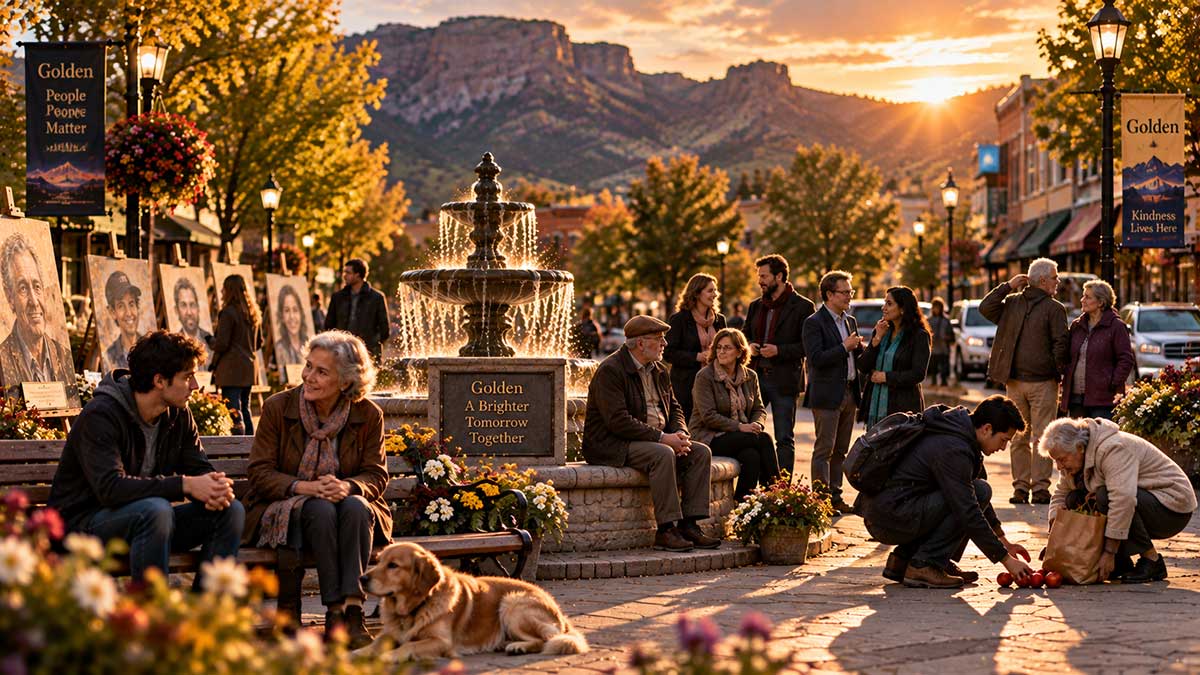
Setting
The Fedder fountain in Golden.
It is late afternoon, several days after Theo's memorial.
Most of the flowers have been removed.
A few remain.
Asher's portraits can still be seen around town.
People pass the fountain carrying groceries, coffee, shopping bags, children.
Golden has returned to ordinary life.
That feels important.
Theo is gone.
The town continues.
Sitting near the fountain are:
Laura Carstensen, psychologist and researcher on aging, time, and emotional priorities.
Becca Levy, psychologist known for research on beliefs about aging.
Elizabeth Dunn, psychologist whose work explores generosity, money, and happiness.
Kate Bowler, writer and scholar of suffering, meaning, and the danger of turning life into a tidy lesson.
Dacher Keltner, psychologist whose work examines awe, compassion, beauty, and human connection.
Allen Levi, author of Theo of Golden.
Krista Tippett guides the conversation.
Asher sits nearby.
Ellen has returned too.
For a while, nobody speaks.
People simply watch Golden move around them.
A child circles the fountain twice.
A delivery driver parks illegally.
An older couple argues about where they left their car.
Ellen watches them.
Ellen: They're both wrong.
Asher smiles.
Asher: How do you know?
Ellen: Their car is over there.
She points.
Everyone laughs.
The older couple continues walking in the opposite direction.
Ellen shakes her head.
Ellen: Should we tell them?
Kate Bowler: That seems like an ethical question.
Ellen: No, that's a parking question.
More laughter.
Krista watches the couple disappear around the corner.
Then she looks toward the fountain.
Krista Tippett: We have spent four conversations asking what Theo teaches us about seeing people, grief, mercy, and truth.
She pauses.
Krista: But there is another question underneath all of them.
Why Theo?
Why now?
Why does this man begin living this particular way at this particular point in his life?
Laura looks toward the fountain.
Laura Carstensen: His age matters enormously.
Krista: Why?
Laura: Since our perception of time changes what we value.
When people experience time as expansive, when the future feels very large, they often prioritize exploration, information, achievement, building, preparation.
What might I become?
What might I learn?
Where might I go?
What can I accumulate?
She gestures gently toward the town.
Laura: When time begins to feel more limited, emotional priorities often change.
Not for everyone.
Not in exactly the same way.
But relationships can become more important.
Emotionally meaningful experiences can become more important.
The question shifts.
Not simply:
What can I build?
But:
What deserves the time I have left?
Asher looks at her.
Asher: So Theo did what he did since he was old?
Laura: I would be careful with "because."
Age does not automatically produce wisdom.
Ellen: Thank God.
Laura laughs.
Laura: Exactly.
There are foolish young people and foolish old people.
There are generous young people and selfish old people.
Age does not make someone Theo.
But awareness of limited time can change the structure of attention.
Theo no longer behaves as if life is an unlimited resource.
That matters.
Krista: Becca, there is something interesting here.
Our culture often talks about old age as a period of loss.
Less strength.
Less independence.
Less productivity.
Less future.
Yet Theo's most meaningful chapter appears very late.
Becca Levy: And that challenges a deeply embedded assumption.
We often imagine life almost like a mountain.
You climb.
You peak.
Then you decline.
The metaphor itself shapes what we expect from aging.
Asher looks toward her.
Becca: What if later life is not simply the shrinking remainder of the important part?
What if new forms of purpose become possible precisely when some earlier ambitions become less dominant?
Ellen raises her hand slightly.
Ellen: I don't like "purpose."
Everyone turns.
Krista: Why?
Ellen: Everybody wants old people to have a purpose.
She looks toward Becca.
Ellen: Can't they just have lunch?
Becca smiles.
Becca: Absolutely.
Ellen: Or watch television?
Becca: Yes.
Ellen: Or complain about their knees?
Becca: Certainly.
Ellen: Good.
Kate laughs.
Kate: Ellen has just saved us from turning aging into another self-improvement program.
Ellen: You're welcome.
Kate turns toward Krista.
Kate: This matters.
We have to be careful.
Theo's life is beautiful.
That can create a hidden demand.
If you are old, perhaps you should become wise.
Generous.
Peaceful.
Reconciled.
Useful.
Maybe you should transform your grief into compassion and your money into generosity and your remaining years into a beautiful legacy.
She pauses.
Kate: That's a lot to ask of a person who might simply be tired.
Allen nods.
Allen Levi: I agree.
Kate: Theo's life cannot become a standard by which we judge ordinary people.
An eighty-year-old who spends Tuesday afternoon watching baseball has not failed at aging.
A grieving person who never starts a foundation has not failed at grief.
Someone who has very little money has not failed at generosity.
Ellen: Good.
Kate: Theo is one life.
Not the required life.
Allen looks at the fountain.
Allen: I never wanted Theo to become an instruction manual.
Asher glances at him.
Allen: He's not saying, "Live exactly like me."
If anything, I think he asks readers to notice what is already available in their own lives.
Not his money.
Not his particular circumstances.
Attention.
Curiosity.
Time.
The willingness to stop.
Dacher leans forward.
Dacher Keltner: That may be why the small moments matter so much.
If Theo were simply writing large checks, the story would be much less interesting.
Money matters.
It can change lives.
But many of Theo's most consequential moments begin before money enters the picture.
He notices.
He asks.
He listens.
He becomes interested.
Elizabeth Dunn: And that distinction matters when we talk about generosity.
People sometimes think generosity is primarily about resources.
How much did you give?
How much did it cost?
Those questions can matter.
But generosity also has a relational dimension.
What does the gift communicate?
Does it say:
I noticed you.
I remembered.
I understand something about what matters to you.
I want something good for you.
Asher looks toward one of his portraits visible through a shop window.
Asher: That's what the portraits did.
Elizabeth turns toward him.
Asher: They weren't expensive in the way some of Theo's other gifts were.
But they told people somebody had looked at them long enough to see something.
He pauses.
Asher: Or at least tried to.
Ellen nods.
Ellen: Tried to.
Asher smiles.
Asher: Right.
Tried to.
Dacher watches a little girl leaning over the fountain.
Dacher: There is another form of generosity here.
Attention can temporarily make another person feel larger.
Not larger than they are.
Larger than the category they have been placed inside.
The waitress.
The old woman.
The difficult man.
The person sleeping outside.
The widow.
The criminal.
The stranger.
Ellen: The problem.
Dacher looks at her.
Ellen: People like that one.
"The problem."
Dacher nods.
Dacher: Yes.
Theo repeatedly encounters people who could easily become one-word descriptions.
His gift is not that he always understands them correctly.
We established that earlier.
His gift is that he seems reluctant to stop at the first description.
Krista looks toward Allen.
Krista: Is that the real model, then?
Not Theo's generosity.
His reluctance to stop at the first description?
Allen thinks for a moment.
Allen: That's very close.
He watches people passing the fountain.
Allen: I think Theo remains interested.
That may sound small.
But sustained interest in another human being can be surprisingly rare.
Laura nods.
Laura: Especially when we become more selective with time.
There is an interesting tension here.
As people perceive time as limited, they may become more selective about relationships.
That can mean investing more deeply in emotionally meaningful connections rather than constantly expanding social networks.
Theo does something slightly unusual.
He becomes selective about meaning, but not necessarily about familiarity.
He can find emotional significance in people he barely knows.
Krista: That's fascinating.
Laura: He behaves almost as if strangers can become emotionally meaningful very quickly if he gives them enough attention.
Ellen looks skeptical.
Ellen: That sounds dangerous.
Laura smiles.
Laura: It can be.
Ellen: Good.
Krista: What is the danger?
Ellen answers first.
Ellen: Thinking everybody wants you in their life.
The group becomes quiet.
Ellen: Theo was good at showing up.
But sometimes people don't want you showing up.
Sometimes they want privacy.
Sometimes they don't want your help.
Sometimes they don't want to tell you their story.
An older man walks past them carrying a grocery bag.
Ellen watches him.
Ellen: We don't know anything about that guy.
Nobody turns to stare at him.
Ellen: Good.
She looks around the group.
Ellen: Maybe seeing people sometimes means leaving them alone.
Anita Allen is not present, but the privacy discussion from Topic 4 seems to echo through the group.
Dacher nods.
Dacher: That's an important correction.
Attention can become intrusive when curiosity serves the observer rather than the observed.
Elizabeth: Generosity has the same problem.
A gift can become about the giver.
Look how generous I am.
Look how much I understand you.
Look what I did for you.
Kate: Which turns the person receiving the gift into evidence of our goodness.
Allen looks uncomfortable.
Allen: Theo is vulnerable to that criticism.
Krista turns toward him.
Krista: Say more.
Allen: A character like Theo can become dangerous for a writer since readers may start admiring him faster than questioning him.
He is generous.
Attentive.
Grieving but loving.
Comfortable with people.
He has resources.
He moves through the story creating moments of connection.
Allen pauses.
Allen: At some point the reader can reasonably ask:
Is this a human being?
Or is this an ideal?
Asher looks toward Allen.
Asher: What would you answer?
Allen smiles.
Allen: Both.
Kate laughs softly.
Allen: I think he's human enough to fail.
Topic 4 matters here.
His relationship with you matters.
He can see strangers with remarkable openness and still become frightened when seeing requires revealing himself.
Asher's expression changes.
Allen: Theo is much better at asking questions than answering one particular question.
Who are you to me?
Asher looks toward the fountain.
Asher: That's what makes him feel more real to me.
Krista: His failure?
Asher: His fear.
He pauses.
Asher: If he had walked through Golden understanding everyone perfectly, giving exactly the right gift, grieving beautifully, forgiving everyone, telling every truth at the perfect moment...
Ellen interrupts.
Ellen: I would've hated him.
Everyone laughs.
Asher smiles.
Asher: I think I would have too.
Allen laughs.
Asher: But he didn't.
He was brave with people he barely knew and terrified with his own son.
That doesn't erase what he did for everyone else.
It makes me understand that courage isn't transferable.
You can be courageous in one room and cowardly in another.
Kate nods.
Kate: That's profoundly human.
We often imagine virtues as permanent possessions.
You're brave.
You're generous.
You're honest.
You're compassionate.
But people are inconsistent.
A person can be extraordinarily generous and still emotionally avoidant.
Deeply compassionate and still frightened.
Wise about grief and foolish about family.
Ellen: Finally.
She points toward Asher.
Ellen: That's Theo.
Asher looks at her.
Ellen: Wonderful man.
Terrible timing.
Asher laughs.
Asher: That's going on his tombstone.
Even Allen laughs.
The laughter fades naturally.
Krista lets the silence remain.
Then she turns toward Elizabeth.
Krista: Let's talk about money.
We keep saying Theo's deepest gift isn't money.
But Theo has money.
That matters.
Elizabeth: Absolutely.
We should not romanticize this.
Resources create options.
If you have financial security, you can solve certain problems that attention alone cannot solve.
You can pay a bill.
Fund an opportunity.
Purchase something meaningful.
Remove a practical burden.
Pretending money doesn't matter would be dishonest.
Krista: Then can someone without Theo's resources actually live the central idea of this novel?
Elizabeth answers immediately.
Elizabeth: Yes.
But not by pretending every form of generosity is equivalent.
Listening to someone cannot pay their rent.
A kind conversation cannot replace medical care.
Attention does not solve every material problem.
She pauses.
Elizabeth: Yet material limitations do not make relational generosity meaningless.
There are forms of giving available across income levels.
Time.
Information.
Introductions.
Encouragement.
Food.
Transportation.
Skill.
Care.
Remembering.
Showing up.
Letting someone help you.
Ellen raises an eyebrow.
Ellen: Letting someone help you is generosity?
Elizabeth smiles.
Elizabeth: Sometimes.
Ellen: Explain.
Elizabeth: People often think generosity means being the giver.
But relationships become strange if one person is always giving and the other is always receiving.
Receiving graciously can allow another person to experience usefulness, connection, reciprocity.
Ellen considers this.
Ellen: I don't know if I like that.
Elizabeth: You don't have to.
Ellen: Good answer.
Asher smiles.
Elizabeth: The larger point is that generosity isn't a performance of superiority.
Healthy generosity recognizes dignity.
Sometimes the person you think you're helping has something to give you too.
Ellen looks toward Asher.
Ellen: Theo understood that sometimes.
Asher: Sometimes?
Ellen: He liked helping.
She thinks.
Ellen: But he also liked people.
That's different.
Dacher nods.
Dacher: Very different.
If I help you since I need to feel like a good person, you become part of my self-image.
If I become genuinely interested in you, reciprocity becomes possible.
You may surprise me.
Teach me.
Correct me.
Annoy me.
Make me laugh.
Change me.
Ellen smiles.
Ellen: That's closer.
A little boy near the fountain drops his ice cream.
He stares at it in horror.
His father kneels.
The boy begins crying.
Ellen watches.
Ellen: That's real grief.
Kate laughs.
The father promises another ice cream.
The boy recovers almost immediately.
Laura watches them walk away.
Laura: There's something else Theo's age gives the novel.
He knows that many things cannot be postponed forever.
Krista looks at her.
Laura: Younger people know intellectually that life is finite.
But finite time can feel abstract.
Later in life, it may become more concrete.
There are fewer hypothetical decades.
Certain conversations acquire urgency.
Certain relationships cannot be indefinitely deferred.
Certain experiences become now or never.
Asher looks down.
The mood changes.
Asher: Unless you defer them anyway.
Laura looks at him gently.
Laura: Yes.
Asher rubs the heart-shaped opal between his fingers.
He has carried it again.
Asher: That's the strange thing about Theo.
He seems to understand time everywhere except with me.
Nobody answers quickly.
Asher continues.
Asher: He gives things away.
Travels.
Meets people.
Talks to strangers.
Acts like every moment matters.
Then with the biggest truth in his life...
He closes his hand around the stone.
"...he waits."
Kate speaks softly.
Kate: Maybe knowing time is limited doesn't automatically make us brave.
Sometimes it makes fear stronger.
Asher looks at her.
Kate: If you believe you have twenty years to repair something, risk may feel manageable.
If you believe you have one year, the possibility of rejection may feel enormous.
Asher: So limited time can make us act.
Kate: Or freeze.
Laura nods.
Laura: Exactly.
There is no single psychological response.
Awareness of mortality can clarify priorities.
It can also produce avoidance.
The important point is not that aging automatically teaches us what matters.
It is that time becomes harder to ignore.
Allen looks toward Asher.
Allen: Theo knows he's running out of time.
But knowledge and courage are not the same thing.
Asher nods.
Asher: I wish they were.
Ellen looks at him.
Ellen: Everybody does.
Silence.
The fountain continues.
People continue.
A dog pulls hard against its leash.
A teenager photographs the sunset.
A woman carrying takeout pauses near one of Asher's portraits.
She looks at it for perhaps ten seconds.
Then continues walking.
Dacher notices.
Dacher: That's enough.
Krista turns.
Dacher: We keep wanting transformation.
Maybe that's another danger of a story like this.
We expect everyone Theo meets to be permanently changed.
But perhaps some encounters are smaller.
Someone looks.
Pauses.
Feels something.
Continues.
Not every meaningful moment needs to redirect a life.
Kate smiles.
Kate: Thank you.
Dacher: For what?
Kate: For allowing a moment to remain a moment.
She looks around.
Kate: We are culturally obsessed with turning everything into lessons.
A conversation becomes a breakthrough.
A loss becomes transformation.
A stranger becomes destiny.
An old age becomes legacy.
Maybe sometimes a good afternoon is just a good afternoon.
Ellen points at her.
Ellen: That's what I was saying about lunch.
Kate laughs.
Kate: You were ahead of us.
Ellen: Usually am.
Krista smiles.
Then turns toward Becca.
Krista: If we remove the requirement that later life must become extraordinary, what remains valuable about Theo as a model?
Becca thinks.
Becca: Possibility.
Not obligation.
She looks toward the older couple from earlier.
They have reappeared.
Apparently they found their car and then forgot where they were going.
Becca: Theo challenges the assumption that the meaningful part of life must already have happened.
That's very different from saying every older person must reinvent themselves.
He simply keeps possibility open.
New friendship.
New generosity.
New understanding.
New mistakes.
New repair.
New beauty.
New love.
New courage.
Ellen adds:
Ellen: New stupidity.
Becca laughs.
Becca: Yes.
New stupidity too.
Ellen: Important category.
Becca: Very.
Laura smiles.
Becca: A life does not become less human as it gets closer to its end.
That sounds obvious.
But many social messages suggest otherwise.
Older people can become invisible.
Their desires are treated as less important.
Their future as less significant.
Their capacity for change as smaller.
Theo refuses that assumption simply by continuing to become.
Asher repeats the phrase.
Asher: Continuing to become.
Becca: Yes.
We often talk about older adults primarily in terms of what they were.
Former teacher.
Retired lawyer.
Widow.
Grandfather.
Veteran.
Former business owner.
The grammar itself points backward.
Theo's story keeps asking:
Who is he becoming now?
Krista looks toward Allen.
Krista: Was that intentional?
Allen smiles.
Allen: Very much.
I wanted his age to create freedom.
Not freedom from loss.
Not freedom from consequence.
But perhaps freedom from some of the ambitions that once organized life.
He has less need to impress.
Less need to accumulate.
Less need to prove.
That creates room.
Laura: And room is an interesting word.
When future time feels limited, people often become more selective.
Theo seems to create emotional room by removing things he no longer needs to carry.
Some possessions.
Some status.
Some distance.
Not all fear, clearly.
She glances toward Asher.
Asher smiles faintly.
Allen: Clearly.
Krista turns toward Elizabeth.
Krista: Is giving things away partly about freeing himself?
Elizabeth: Possibly.
Generosity often affects giver as well as receiver.
That doesn't make it selfish.
We sometimes create an impossible moral standard where a generous act only counts if the giver receives absolutely nothing emotionally.
But people often feel joy, connection, meaning, gratitude when giving.
That can be healthy.
The question is whether the recipient remains a person rather than becoming a tool for the giver's emotional needs.
Ellen nods.
Ellen: There it is again.
Krista: What?
Ellen: Seeing.
Everyone looks at her.
Ellen shrugs.
Ellen: We keep leaving the topic and coming back to it.
Money.
Grief.
Forgiveness.
Secrets.
Getting old.
It's the same thing.
She points toward the street.
Ellen: Are you actually looking at the person?
Or are you looking at what they can do for your story?
The group becomes very quiet.
Allen looks at Ellen.
Allen: That's better than anything I was going to say.
Ellen: I know.
Laughter breaks the intensity.
Krista waits.
Then:
Krista: Let's take the hardest question.
She looks at Allen.
Krista: Is Theo too good?
Allen smiles.
Allen: Probably.
Everyone laughs.
Krista: I'm serious.
Allen: So am I.
He looks toward the fountain.
Allen: Fiction sometimes gives us characters who are slightly larger than ordinary life.
Not since the author expects readers to reproduce them exactly.
They can create a direction of attention.
A possibility.
A question.
Kate: But idealized characters carry risks.
Allen: Yes.
Kate: Readers can compare themselves and feel inadequate.
Or admire the character instead of examining themselves.
Theo gave away so much.
Theo listened so well.
Theo turned grief into generosity.
I'm nothing like Theo.
She pauses.
Kate: Admiration can become distance.
Dacher: Or inspiration.
Kate: It can.
Dacher: Those aren't mutually exclusive.
Kate nods.
Dacher: Awe sometimes arises when we encounter moral beauty.
Someone does something generous or courageous beyond what we expect.
That can widen our sense of what humans are capable of.
The danger comes when admiration becomes passive.
Krista: Meaning?
Dacher: "What an extraordinary person."
End of thought.
He smiles.
Dacher: The more interesting response is:
"What exactly moved me?"
Was it the money?
Probably not.
Was it the portrait?
Maybe.
Was it the fact that someone stopped long enough to notice another person?
Now we have something transferable.
Kate nods.
Kate: That's the distinction I like.
Don't imitate the biography.
Examine the orientation.
Asher looks at her.
Kate: You don't need Theo's life.
You can ask what direction he was facing.
Asher looks toward the street.
Asher: Toward people.
Kate: Often.
Ellen interrupts.
Ellen: Except when the person was his son.
Asher laughs.
Asher: Thank you, Ellen.
Ellen: Keeping it honest.
Allen nods.
Allen: She should.
Krista turns toward Asher.
Krista: Can Theo still be a model for you after what you learned?
Asher takes a long time.
He looks at the opal.
Then the portraits.
Then the fountain.
Asher: I don't want to become him.
Allen watches.
Asher: For a while, I thought that was what I was supposed to do.
Carry something forward.
Continue the work.
Become more generous.
More attentive.
Make his life mean something.
He shakes his head.
Asher: That's too much.
Kate smiles slightly.
Asher: His life already meant something.
It doesn't need me to prove it.
He turns the opal in his hand.
Asher: What I want to keep is smaller.
Krista waits.
Asher: I want to notice when I've already decided who someone is.
Ellen looks at him.
Asher: That's it.
If I think someone is difficult...
Pause.
Maybe ask another question.
If I think someone is fine...
Maybe ask another question.
If I think I understand somebody since I've known them twenty years...
He smiles sadly.
Maybe especially then.
Laura nods.
Asher: I don't need to become Theo.
I just don't want certainty to make me stop looking.
Nobody speaks for several seconds.
Dacher finally says:
Dacher: That's a beautiful distinction.
Asher: Don't make it too beautiful.
Ellen laughs.
Ellen: He's learning.
The afternoon light is fading.
Shadows stretch across the pavement.
The older couple finally reaches their car.
Ellen watches them unlock it.
Ellen: See?
Krista: What?
Ellen: They found it without us.
Krista smiles.
Ellen: Sometimes people don't need rescuing.
Elizabeth nods.
Ellen: That's part of seeing too.
Knowing when you're not necessary.
Allen looks at her.
Allen: Theo might have needed to learn that.
Ellen: Everybody does.
The group falls quiet again.
Krista looks toward the fountain.
Krista: I want to end with one question for everyone.
Not about Theo.
About us.
She pauses.
Krista: Suppose we accept that most of us will never live like Theo.
We will not give away fortunes.
We will not transform a town.
We will not become unusually wise in old age.
We will remain distracted.
Impatient.
Afraid.
Sometimes selfish.
Sometimes generous.
Often inconsistent.
What is the smallest part of Theo's way of living that an ordinary person could realistically practice tomorrow?
Laura answers first.
Laura: Treat time as valuable before you are forced to.
Becca: Refuse to assume someone's most meaningful chapter is already behind them.
Elizabeth: Give in a way that preserves the other person's dignity.
Dacher: Allow yourself to be surprised by another human being.
Kate: Don't demand that suffering become useful before you permit someone to keep living.
Allen thinks.
Allen: Stay curious a little longer.
Krista looks toward Ellen.
Krista: Ellen?
Ellen rolls her eyes.
Ellen: Why do I always have to go last?
Asher: Since you're going to say the best thing.
She looks suspiciously at him.
Then toward the people walking past.
A teenager.
A mother with a stroller.
A man carrying groceries.
A woman speaking into her phone.
A delivery driver.
The older couple finally driving away.
Ellen says:
Ellen: Ask what somebody loves before you ask what's wrong with them.
The group becomes still.
It is the same thought she offered in Topic 1.
But now it sounds different.
After grief.
After harm.
After secrecy.
After all the ways human beings become reduced to what happened to them.
Krista turns toward Asher.
Krista: And you?
Asher looks across Golden.
At the portraits.
At strangers.
At a town Theo once walked through.
Then he says:
Asher: Don't wait until someone is gone to become interested in who they are.
Ellen turns toward him.
She does not joke this time.
Ellen: Yeah.
The fountain continues behind them.
People keep walking.
Some notice the portraits.
Some don't.
Some stop.
Some hurry past.
Nobody is transformed in front of us.
No music rises.
No final revelation settles every question.
Golden simply continues.
And perhaps that is the final answer.
Theo's life does not ask us to become extraordinary.
It asks something smaller.
And perhaps harder.
To notice the life already happening in front of us.
To remain curious when a label would be easier.
To tell the truth before time makes the decision for us.
To let grief and joy occupy the same life.
To recognize humanity without surrendering responsibility.
To give without making ourselves the hero.
And to remember that attention costs something.
It costs time.
A portion of the only life we know we have.
Krista watches a young man walk past the fountain without looking at anyone.
Then he suddenly stops.
He turns back.
An elderly woman behind him has dropped a paper bag.
Apples have rolled across the sidewalk.
He bends down.
The woman bends too.
They gather the apples together.
They exchange a few words.
We cannot hear them.
Then they walk in opposite directions.
Ellen smiles.
Ellen: There.
Asher looks at her.
Asher: There what?
Ellen shrugs.
Ellen: Nothing.
She starts walking.
After a few steps, she turns.
Ellen: That's the point.
Asher smiles and follows her.
The others begin leaving too.
The fountain remains.
And Golden goes on.
Final Thoughts
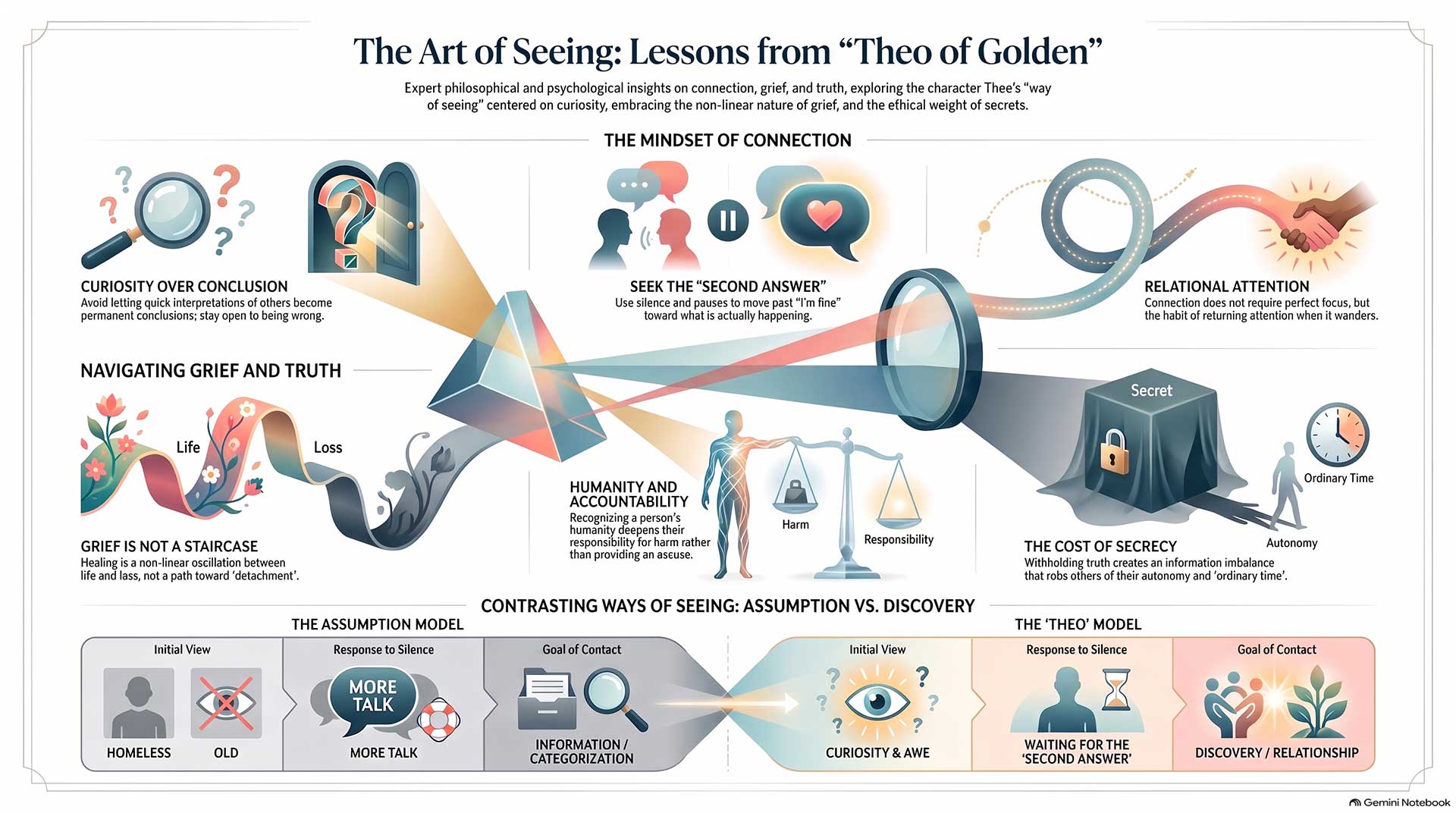
After five conversations, Theo's greatest gift may not be his generosity or even his ability to notice people.
It may be his invitation to remain curious.
Nicholas Epley and Amishi Jha helped us see how easily assumptions and distracted attention distort our understanding of others.
Robert Neimeyer, George Bonanno, and Kate Bowler showed us that grief does not need to disappear or become inspirational. A good life can still contain deep sadness.
Everett Worthington, Pumla Gobodo-Madikizela, and Howard Zehr showed that recognizing someone's humanity does not erase accountability. Forgiveness cannot be demanded, and understanding is not the same as excusing.
Vardit Ravitsky, Susan Golombok, and Anita Allen made Theo's secrecy with Asher more difficult to defend. Theo's love may have been genuine, but love does not automatically give one person the right to decide what truth another person can handle.
Our final conversation brought everything back to time.
Laura Carstensen and Becca Levy helped us see why Theo's age matters. Later life does not have to be merely an epilogue. New friendship, purpose, courage, generosity, mistakes, and change can still begin.
Theo does not need to become a model we perfectly imitate.
As Kate Bowler suggested, we can admire a life without turning it into another standard we must achieve.
Perhaps Asher gives us the best conclusion:
"I don't need to become Theo. I just don't want certainty to make me stop looking."
That may be the deepest lesson of Theo of Golden.
Seeing another person does not mean understanding them completely.
It means refusing to believe that one label, one mistake, one loss, one secret, or one chapter tells us everything.
And that leaves us with one final question:
Who have I already decided I understand?
Short Bios:
Allen Levi
Author of Theo of Golden. His novel explores grief, generosity, human connection, aging, family secrets, and what can happen when one person chooses to truly notice another.
Nicholas Epley
Psychologist and scholar of social cognition whose research examines how people understand, and frequently misunderstand, the minds of others.
Amishi Jha
Psychologist and neuroscientist known for research on attention, distraction, and our ability to return attention to what is happening in front of us.
Sherry Turkle
Psychologist and author whose work explores technology, conversation, attention, and the importance of genuine face-to-face human connection.
Robert Neimeyer
Psychologist known for research on grief, meaning reconstruction, and continuing bonds with people who have died.
George Bonanno
Psychologist whose research shows that people respond to grief and adversity in many different ways rather than following one universal path.
Kate Bowler
Writer and scholar whose work explores suffering, meaning, faith, and the pressure people often feel to turn painful experiences into inspiring lessons.
Everett Worthington
Psychologist known for research on forgiveness, reconciliation, self-forgiveness, and emotional responses to serious harm.
Pumla Gobodo-Madikizela
Psychologist and scholar whose work examines trauma, remorse, forgiveness, dialogue, and recognizing humanity after profound harm.
Howard Zehr
Scholar widely associated with restorative justice, emphasizing harm, responsibility, accountability, and repair.
Vardit Ravitsky
Bioethicist whose work examines identity, family relationships, genetic origins, and questions surrounding a person's interest in knowing where they come from.
Susan Golombok
Psychologist and family researcher whose work explores family relationships, disclosure, parenthood, and the meaning of biological and social relationships.
Anita Allen
Scholar of privacy and ethics whose work helps illuminate the tension between protecting private information and respecting another person's autonomy.
Laura Carstensen
Psychologist known for research on aging, time perception, and how awareness of limited time can change emotional priorities.
Becca Levy
Psychologist whose research explores beliefs about aging and how those beliefs can influence health, behavior, purpose, and later life.
Elizabeth Dunn
Psychologist whose research examines happiness, generosity, social connection, and how giving can affect both giver and receiver.
Dacher Keltner
Psychologist whose research explores compassion, awe, emotion, beauty, and human connection.
Krista Tippett
Interviewer and conversation host known for thoughtful discussions about meaning, humanity, spirituality, relationships, and the inner life.
Leave a Reply