
Introduction
Modern life has given us extraordinary freedom, convenience, mobility, and access to people across distance. Yet many people still feel strangely alone.
Kasley Killam, Robert Putnam, Sherry Turkle, and Priya Parker approach this problem from different directions. Killam looks at social health. Putnam studies the decline of civic life and social capital. Turkle examines how technology changes human presence. Parker studies gathering, ritual, and the conditions that make people feel they truly belong.
Their conversation raises a difficult possibility: perhaps some modern unhappiness does not begin inside the individual. Perhaps people are reacting to the gradual disappearance of neighborhood life, repeated gatherings, extended family networks, local institutions, shared rituals, and everyday human contact.
The question is not whether society should return to the past. The deeper question is whether we can preserve modern freedom while rebuilding the forms of connection human beings still seem to need.
(Note: This is an imaginary conversation, a creative exploration of an idea, and not a real speech or event.)
Topic 1: When Did We Start Losing Each Other?
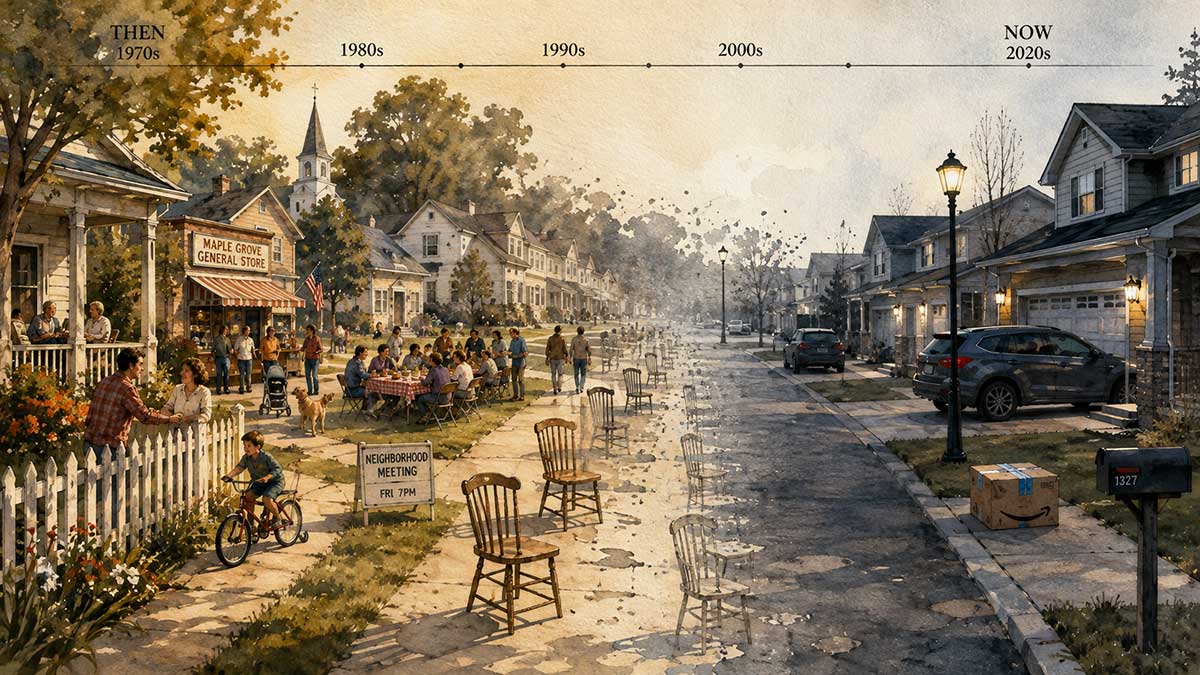
Robert Putnam: There is something strange about social decline. When a factory closes, people notice. When a bridge collapses, people notice. When a bank fails, people notice.
But when a neighborhood stops knowing itself, there is no sound.
Kasley Killam: No moment when everyone says, “There. That's when we lost it.”
Putnam: Exactly. Nobody wakes up on Tuesday morning and announces, “Our community disappeared yesterday.”
The losses are tiny.
A family moves away.
A local organization stops meeting.
The neighborhood store closes.
Someone stops attending church.
The annual picnic doesn't happen this year.
The children grow up and leave.
The elderly couple down the street dies.
A new family moves in, but nobody introduces themselves.
And each event seems insignificant.
Priya Parker: Until you realize the picnic wasn't really about the picnic.
Putnam: Yes.
Parker: That's something I think we misunderstand about gathering. We tend to evaluate gatherings by their visible purpose.
A birthday party celebrates a birthday.
A funeral mourns a death.
A neighborhood cookout serves food.
A religious service practices faith.
But those events are doing something underneath their stated purpose.
They're repeatedly putting the same human beings in one another's presence.
Sherry Turkle: And repetition matters enormously.
Parker: It does. You don't become part of someone's life simply through one extraordinary conversation. Often you become part of someone's life through twenty completely ordinary encounters.
Killam: Which is interesting from a social-health perspective, since people often assume the relationships that matter are their deepest ones.
Who would you call at three in the morning?
Who knows your secrets?
Who would come to the hospital?
Those relationships matter enormously.
But they're not your entire social ecosystem.
Putnam: That's precisely what we've forgotten.
Think about the people who once populated an ordinary person's life.
Not their closest friends.
The man who cut their hair for fifteen years.
The woman at church whose name they knew but whose house they'd never visited.
The neighbor who borrowed their ladder.
The parents standing beside them at their children's baseball games.
The librarian.
The mail carrier.
The shopkeeper.
The retired man who walked his dog at seven every morning.
These weren't intimate relationships.
But collectively, they created something.
Turkle: Recognition.
Putnam: Yes.
Recognition.
You walked through your community and people knew that you existed.
Killam: That's a beautiful distinction. We talk constantly about being loved. Perhaps we don't talk enough about being recognized.
Parker: Or expected.
Killam: What do you mean?
Parker: There is a particular feeling when you walk into a place and someone says, “We were wondering where you were.”
That sentence contains an extraordinary amount of belonging.
Turkle: Your absence registered.
Parker: Exactly.
Someone noticed the empty chair.
Killam: Robert, when you wrote Bowling Alone, the title itself captured something people could immediately recognize. Americans weren't necessarily stopping bowling. They were increasingly bowling without leagues.
Putnam: That's right. And the bowling wasn't the point.
The league was.
You showed up every Thursday.
The same people showed up every Thursday.
Perhaps you didn't particularly like everyone there.
Parker: That's important.
Putnam: Very important.
Modern people sometimes assume community means finding people perfectly compatible with themselves.
That wasn't how many older civic institutions worked.
The bowling league might contain a plumber, an accountant, a schoolteacher, a mechanic, a salesman, and a retired factory worker.
Different politics.
Different incomes.
Different personalities.
But every Thursday, they bowled together.
Turkle: And they couldn't mute one another.
Putnam: Exactly.
Parker: Or unfollow one another.
Killam: Or optimize the group.
Putnam: They had to negotiate difference.
And that's where what I call bridging social capital becomes so important. Close relationships with people like ourselves give us bonding social capital. Those relationships can sustain us personally.
But societies need bridges too.
Relationships across occupations, generations, classes, religions, political beliefs, neighborhoods.
Those weaker connections teach us something very basic:
People who aren't like me are still people I know.
Turkle: That last part feels particularly significant now.
Someone can become an abstraction much more easily when you've never actually shared a room with them.
Putnam: Precisely.
It's easier to hate a category than someone who helped you move a couch.
Killam: But I want to challenge something before we become nostalgic.
Robert, were people truly more connected, or were they simply more obligated?
Putnam: Both.
Killam: That's an important answer.
Putnam: I don't want to romanticize the America of fifty or seventy years ago. Many communities excluded people. Race mattered enormously. Gender mattered. Religion mattered. Sexual orientation mattered. Social conformity could be oppressive.
There were people for whom leaving their hometown was liberation.
Turkle: Technology itself has been liberating in similar ways.
A teenager who feels completely alone in a small town can discover that there are people elsewhere who understand them.
An immigrant can speak with family across an ocean.
Grandparents can see grandchildren who live thousands of miles away.
We shouldn't tell a fairy tale where everything was wonderful until the smartphone arrived.
Parker: Yet we can acknowledge what was lost without asking to restore everything that came with it.
Killam: That's where I think social health gives us useful language.
The question isn't, “How many people are around you?”
It's closer to: Are your relationships giving you the amount and quality of connection that you need?
Someone can live in a crowded multigenerational household and feel profoundly lonely.
Someone else can live alone and feel deeply connected.
Putnam: Yes, but there is another dimension.
A person can have three wonderful intimate relationships and still lack community.
Killam: I agree.
Putnam: That's something I worry we're losing sight of.
Suppose you have a wonderful marriage.
Two excellent friends.
You speak with your children frequently.
By many measures, you're socially fortunate.
But when you walk outside your house, nobody knows you.
You don't know the neighbors.
You belong to no local organizations.
There is no café where anyone recognizes you.
No congregation.
No club.
No volunteer group.
No place where people expect you on Thursday night.
Are you socially connected?
Yes.
Do you belong somewhere?
I'm not sure those are identical questions.
There was a short silence.
Parker: I don't think they are.
Turkle: There's another change we haven't mentioned.
Many of the tiny encounters Robert described once occurred partly through inconvenience.
Killam: Explain that.
Turkle: Human beings used to need one another for mundane things.
You needed directions.
You asked someone.
You needed to know when the store closed.
You called.
You needed a recommendation.
You asked a neighbor.
You needed entertainment.
You went somewhere.
You needed to buy something.
You interacted with a person.
Many of those encounters weren't meaningful in themselves.
But they created little openings through which something meaningful occasionally emerged.
Parker: That's fascinating.
Turkle: We've become remarkably efficient at eliminating those openings.
You don't ask for directions. Your phone tells you.
You don't ask a clerk where something is. An app tells you.
You don't need to visit the bank.
You don't need to visit the bookstore.
You don't necessarily need to visit an office.
You can order dinner without speaking to anyone.
You can watch a movie without going anywhere.
You can buy almost anything without leaving your home.
We call this convenience.
And much of it genuinely is wonderful.
But convenience has a social price that rarely appears on the receipt.
Putnam: That's very well put.
Killam: So perhaps some social contact was once a byproduct of inefficiency.
Turkle: Exactly.
And we've become extraordinarily good at eliminating inefficiency.
Parker: Which means we've eliminated some encounters without deciding that we didn't want the encounters.
Turkle: Yes.
We wanted to remove the waiting.
We didn't necessarily intend to remove the person.
Killam: I'm thinking about someone working from home.
They wake up.
Coffee from the kitchen.
Laptop.
Meetings through a screen.
Lunch delivered.
Groceries delivered.
Exercise through an app.
Entertainment streamed.
Messages throughout the day.
Perhaps twenty or thirty interactions.
Technically, they're connected almost continuously.
Yet they might go an entire day without another human body entering the room.
Turkle: And we don't yet have very good cultural language for distinguishing those experiences.
Putnam: Here's what troubles me.
If you asked that person, “Why are you lonely?” they might think something is wrong with them.
Maybe I need to be more outgoing.
Maybe I need therapy.
Maybe I need to work on myself.
Maybe I should download a friendship app.
Killam: That's exactly where the idea of social health changes the diagnosis.
Loneliness can contain personal factors, certainly.
But sometimes an individual is having a perfectly understandable response to an impoverished social environment.
Parker: That changes the moral meaning of the feeling.
Killam: Completely.
Perhaps your loneliness isn't always saying:
“You are failing at relationships.”
Sometimes it may be saying:
“There aren't enough places in your life where relationships can naturally happen.”
Putnam: Let me give you a very ordinary picture.
A man comes home from work.
He presses a button and his garage door rises.
He drives inside.
He presses another button and the door closes.
He enters his house without ever stepping onto the street.
Fifty years ago, perhaps he parked outside.
Perhaps his neighbor was watering the lawn.
Perhaps somebody's children were playing nearby.
Perhaps he stood there talking for eight minutes.
Nothing important happened.
They discussed the weather.
The Browns.
A broken fence.
Then one day, his neighbor's wife became ill.
And suddenly those eight-minute conversations had somewhere deeper to go.
Parker: That's it.
We keep looking for meaningful connection.
But meaningful connection often grows from meaningless connection.
Killam: I love that.
Turkle: And technology tends to ask us to begin with intention.
Who do you want to contact?
What do you want to say?
Which group do you want to join?
What content interests you?
Human community has historically contained much more accident.
Putnam: And inconvenience.
Parker: And repetition.
Killam: And people we didn't choose.
They all stopped for a moment at that.
Putnam: That may be the part we've underestimated most.
People we didn't choose.
Parker: Think about childhood.
You rarely chose the entire cast.
Your cousins simply existed.
Your neighbors existed.
Your classmates existed.
Your parents' friends appeared at dinner.
The elderly woman next door talked too long.
Your uncle told the same story every Thanksgiving.
Somebody brought a terrible casserole every Christmas.
You didn't curate these people.
Turkle: And now curation has become one of the organizing principles of life.
We curate information.
Entertainment.
News.
Music.
Friends.
Dating.
Communities.
People whose opinions we hear.
People whose photographs we see.
Putnam: Curation feels like freedom.
And often it is.
But perhaps a society consisting entirely of curated relationships loses something.
Killam: Friction?
Putnam: More than friction.
Obligation.
Parker: That's a dangerous word in modern culture.
Putnam: I know.
But consider its gentler meaning.
You visit someone not because tonight is the perfect night to visit them.
You visit because it's Sunday.
You help someone not because they're your favorite person.
You help because they're your neighbor.
You attend the funeral not because you were intimate with the deceased.
You attend because their family is part of your community.
Those actions say:
My relationship with you isn't entirely dependent upon how I feel today.
Killam: That's profound.
Social health discussions frequently focus on what relationships give us.
Support.
Happiness.
Longevity.
Meaning.
But healthy relationships require something from us too.
Parker: Presence.
Killam: Yes.
Sometimes inconvenient presence.
Turkle: And now we are approaching something technology cannot easily solve.
Technology is extraordinarily good at giving us access.
It can connect two people across the planet in seconds.
But access isn't the same as obligation.
Putnam: Nor belonging.
Parker: Nor ritual.
Killam: Nor being missed.
Another silence.
This one lasted longer.
Parker: Maybe that's the question we should carry forward.
Not simply:
“How many people do you talk to?”
But:
Where are you expected?
Turkle: And where would someone notice if you didn't come?
Putnam: That's belonging.
Killam looked at the others.
Killam: Then perhaps we've discovered something uncomfortable already.
We began by asking when people started losing one another.
Maybe there wasn't one moment.
Maybe we removed one unnecessary interaction at a time.
One inconvenient obligation.
One local institution.
One recurring gathering.
One person we didn't particularly choose.
And every individual decision made sense.
Putnam: That's how social capital disappears.
Not usually through catastrophe.
Through millions of reasonable decisions.
Turkle: Which brings us to an even stranger paradox.
We may now possess the greatest communication system human beings have ever created.
Billions of people are reachable almost instantly.
Parker: Yet being reachable isn't the same as being held in someone's life.
Turkle: Exactly.
And perhaps that is where we need to go next.
What happens when a civilization becomes extraordinarily good at connection, yet increasingly uncertain about closeness?
Topic 2: How Did We Become Connected to Everyone and Close to So Few?
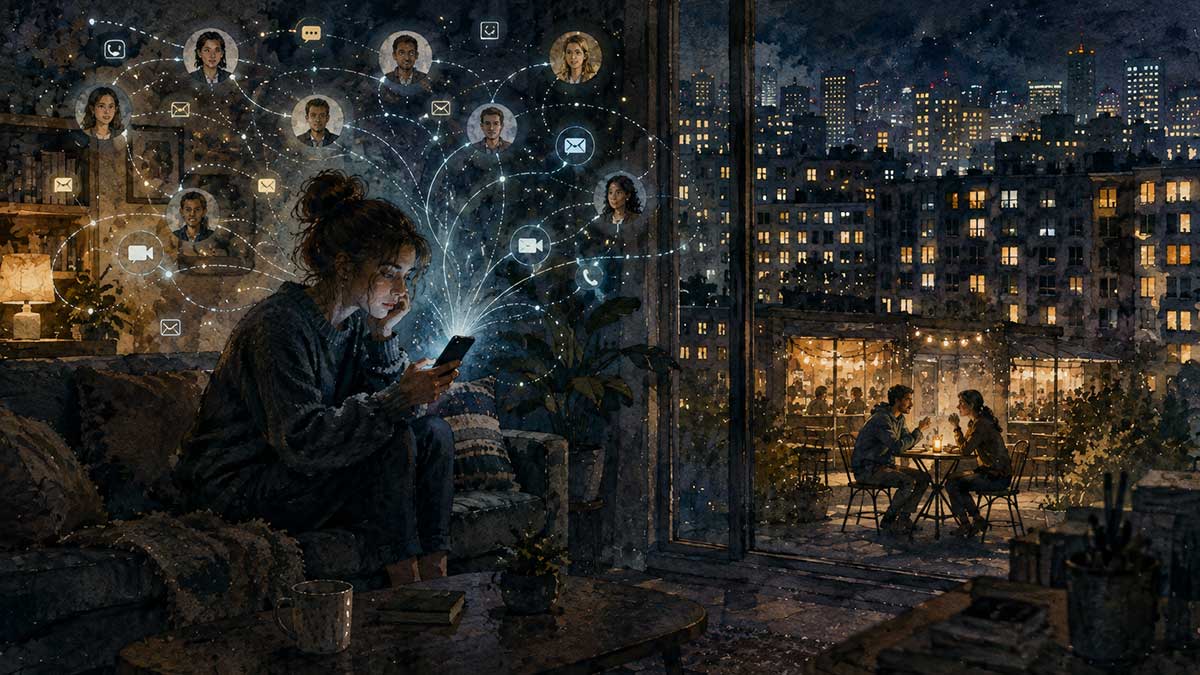
Sherry Turkle: I think the mistake begins with a word.
We use connection to describe too many different things.
A message is connection.
A video call is connection.
A social-media comment is connection.
A shared meal is connection.
Holding someone's hand in a hospital is connection.
Sitting beside a grieving friend without knowing what to say is connection.
But these experiences are not interchangeable.
Kasley Killam: And socially, the body seems to know that.
People can have hundreds of interactions and still finish the day feeling strangely untouched.
Robert Putnam: Which sounds paradoxical until we separate access from attachment.
Priya Parker: Or contact from consequence.
Turkle: Yes.
If I disappear from your feed, perhaps the feed keeps moving.
If I disappear from your dinner table, something changes.
That difference matters.
Killam: This is where I think people can become confused by their own loneliness.
They look at their phones and think, “I talked to people all day.”
Texts.
Slack messages.
Emails.
Comments.
Video meetings.
Voice notes.
And yet some part of them says, “I haven't really been with anyone.”
Turkle: The technology gives us many opportunities to communicate, but communication is often highly controlled.
We decide when to respond.
We edit.
We delete.
We delay.
We choose the photograph.
We choose the sentence.
We can leave the conversation without physically standing up and walking away.
Human presence is less controllable.
Parker: Which is one reason gathering can feel exhausting.
Turkle: Exactly.
Another person's presence makes demands.
They may interrupt you.
Misread you.
Become emotional.
Change the subject.
Notice something you hoped they wouldn't notice.
Need you at an inconvenient moment.
Putnam: Real community has always contained that kind of inconvenience.
Killam: So perhaps convenience isn't merely reducing encounters. It may be changing our tolerance for relationships themselves.
Turkle: I think that's possible.
Once we become accustomed to communication on our preferred terms, ordinary human unpredictability can begin to feel like poor design.
Parker: That phrase bothers me in a useful way.
“Poor design.”
A person is not an interface.
Turkle: Right.
Yet much of modern life trains us to expect personalization.
Your news.
Your music.
Your recommendations.
Your entertainment.
Your route.
Your shopping.
Your feed.
Eventually the question becomes:
Why shouldn't my relationships feel equally frictionless?
Killam: But a relationship in which nothing is demanded of you may feel pleasant without becoming deep.
Putnam: Communities certainly can't work that way.
A civic organization where everybody leaves whenever they feel mildly uncomfortable isn't much of an organization.
Parker: Neither is a family dinner.
Turkle: Nor a friendship.
Killam: Let me push this from another angle.
Digital communication has done something genuinely valuable. Someone who lives far from family can now remain connected every day.
An immigrant can speak with parents across an ocean.
Grandparents can watch grandchildren grow.
Someone with an unusual condition or experience can find others who finally understand.
Those aren't trivial benefits.
Turkle: I agree completely.
The question isn't whether technology connects us.
It does.
The question is what kinds of connection it strengthens and what kinds it may quietly displace.
Putnam: Displacement is the key word.
If I spend an hour speaking with my daughter who lives across the country, technology has enriched my social life.
If I spend an hour scrolling through people I barely know instead of walking next door to speak with someone, the effect may be very different.
Parker: So perhaps the medium matters less than what it replaces.
Turkle: Exactly.
Parker: I keep returning to physical presence.
There is something strange about being in a room with people.
You can't entirely control what happens.
Someone arrives early.
Someone stays late.
Two guests who weren't meant to talk begin talking.
A child interrupts.
Someone tells a story nobody planned.
The meal runs long.
Much of what makes a gathering memorable is not the part the host designed.
Killam: The unplanned edges.
Parker: Yes.
And digital communication tends to compress those edges.
A meeting begins at 2:00 and ends at 2:30.
A call is scheduled.
A message has a purpose.
We become efficient.
But intimacy often grows in inefficient time.
Putnam: The fifteen minutes after the meeting.
Parker: Exactly.
The walk to the parking lot.
The washing of dishes.
The person who lingers at the door.
The drive home together.
Those are strangely fertile social moments.
Turkle: Which is why I worry when people say virtual communication is “basically the same.”
Sometimes it is enough.
Sometimes it is wonderful.
But when every interaction becomes purpose-driven, we lose the moments where nothing is supposed to happen.
And human beings often reveal themselves when nothing is supposed to happen.
Killam: That's beautiful.
Putnam: It reminds me of weak ties again.
The person you sit beside every week may eventually tell you something profound, but only after months of discussing completely ordinary things.
Parker: Trust accumulates quietly.
Killam: Sherry, let's move to the part that feels newer.
We now have systems capable of responding conversationally.
Not merely displaying information.
They can listen.
They can remember preferences.
They can respond warmly.
They can remain available at two in the morning.
For someone who is deeply lonely, that can feel extraordinary.
Turkle: Yes.
And that is precisely why the question deserves seriousness rather than mockery.
People who form attachments to conversational AI aren't necessarily foolish.
They may be responding to something the system offers very effectively:
attention without much risk.
Parker: No fear of being rejected.
Turkle: Less fear.
No need to worry that you're boring it.
No need to wonder whether you called at a bad time.
No awkward pause that means something.
No resentment that builds over years.
No child who refuses to speak to you.
No spouse whose needs conflict with yours.
Killam: Which sounds almost irresistible when you're lonely.
Turkle: It can.
But then we need to ask:
What exactly are we practicing?
Putnam: Practicing?
Turkle: Relationships shape capacities.
Patience.
Repair.
Compromise.
Interpretation.
Forgiveness.
Waiting.
The ability to live with another consciousness that doesn't exist for your convenience.
If companionship becomes increasingly customizable, are we still practicing those capacities?
Killam: That's a much deeper concern than “people spend too much time on screens.”
Turkle: Much deeper.
A machine can simulate attentive companionship without possessing needs of its own.
That changes the moral structure of the interaction.
Parker: Human gathering is reciprocal.
I come with my needs.
You come with yours.
Neither of us controls the entire encounter.
Turkle: Exactly.
Killam: But suppose someone is eighty-five, lives alone, has lost a spouse, children live far away, mobility is limited, and an AI companion makes evenings less painful.
Would you take that away?
Turkle: No.
That would be cruel.
The ethical question isn't whether people should ever use such systems.
The question is whether we begin designing society around substitutes rather than repairing the absence.
Putnam: That's where this becomes structural again.
If someone is isolated because transportation disappeared, the neighborhood became inaccessible, family moved away, civic organizations vanished, and public space shrank, giving them an AI companion may soothe the consequence without touching the cause.
Parker: We might become very good at treating the feeling produced by social abandonment.
Killam: Without reducing the abandonment.
They sat with that.
Parker: There's another possibility that frightens me slightly.
What if substitutes become satisfying enough that people stop asking for the original?
Turkle: That's precisely the concern.
Not that artificial companionship becomes terrible.
That it becomes good.
Good enough to remove urgency.
Good enough to dull loneliness.
Good enough to keep you home tonight.
Then tomorrow.
Then next week.
Putnam: Much like convenience removing small interactions.
Turkle: Yes.
We keep encountering the same pattern.
The technology solves a genuine problem.
Then, gradually, we reorganize life around the solution.
Killam: But I want to defend technology for a moment.
Suppose AI notices that I haven't spoken to anyone in three days and says, “Would you like to call your sister?”
Suppose it helps organize a neighborhood dinner.
Suppose it identifies a nearby walking group.
Suppose it reminds someone to visit an elderly neighbor.
Then technology isn't replacing connection.
It's directing us back to people.
Turkle: I would draw exactly that distinction.
Does the technology become the destination?
Or does it act as a bridge?
Parker: That's a very useful test.
Putnam: A bridge should lead somewhere.
Turkle: Precisely.
Parker: And perhaps gathering gives us another test.
After the interaction, is your social world larger?
Do you know someone better?
Are you more likely to show up somewhere?
Did you become responsible to anybody?
Did somebody become responsible to you?
Killam: Responsibility keeps appearing.
Putnam: It has to.
Belonging isn't merely the pleasure of being included.
It's the knowledge that other people's lives place some claim on yours.
Turkle: Which is why perfect companionship is suspicious.
A relationship that never makes a claim on you might eventually become difficult to distinguish from a service.
Killam: That sentence is uncomfortable.
Turkle: It should be.
Many modern systems are built around serving us.
Human beings are not.
Parker: Nor should they be.
Putnam: And democratic communities certainly aren't.
Killam: Let me ask each of you something.
What do you think we're actually hungry for when we say we're lonely?
Parker: I think many people are hungry to be included in repetition.
Not one invitation.
A place in something that happens again.
Putnam: I think they're hungry to be needed.
Modern discussion focuses heavily on support: Who supports me?
But belonging deepens when somebody else depends on you too.
Turkle: I think people are hungry for undivided attention from another human being who is free to withhold it.
That freedom matters.
If you choose to listen to me, your listening means something.
Killam: I think people are hungry for different kinds of connection at once.
Intimacy.
Companionship.
Recognition.
Community.
Casual contact.
Belonging.
One relationship cannot carry all of that.
Putnam: That may explain why people sometimes say, “But I have a wonderful spouse. Why am I lonely?”
Their spouse is being asked to function as lover, best friend, therapist, social world, family, entertainment, confidant, and community.
No single person can replace a village.
Parker: Nor should they have to.
Killam: Exactly.
Social health is an ecosystem.
You can have one magnificent tree and still have a damaged forest.
Turkle: Which brings us back to technology in a different way.
Digital life encourages us to think in terms of individual nodes.
You and me.
One conversation.
One message.
One connection.
But belonging is often networked.
You know someone who knows someone.
You encounter the same people repeatedly.
You share history.
The relationships overlap.
Putnam: That's what communities do.
Parker: And rituals hold those networks together.
Killam: Which means perhaps we're asking the wrong question when we ask whether technology connects us.
Turkle: What would the better question be?
Killam: Maybe:
Does this technology help create a social world around me, or does it merely keep me occupied while that social world disappears?
No one answered immediately.
Putnam: There's another way of saying it.
If technology vanished tomorrow, who would still knock on your door?
Parker: Robert.
Putnam: I know. It's harsh.
But I think it's worth asking.
Who knows where you live?
Who knows your ordinary routines?
Who has eaten at your table?
Whose children know your name?
Who would bring soup?
Who would notice that the curtains haven't opened?
Turkle: Those are profoundly physical questions.
Putnam: Community usually is.
Killam: And yet millions of people now have very real relationships with people they've never met physically.
We shouldn't erase those.
Putnam: No.
Turkle: Agreed.
The question isn't physical versus digital in some absolute sense.
It's whether our lives contain enough forms of relationship that can bear weight when life becomes difficult.
Parker: That's the phrase.
Bear weight.
A gathering can be pleasant.
A friendship can be pleasant.
A community can be pleasant.
But eventually something happens.
Cancer.
Divorce.
A parent's death.
Job loss.
A child in trouble.
Old age.
Then we discover whether the social structure around us can carry anything heavier than entertainment.
Killam: And perhaps that's where modern loneliness becomes most visible.
Not when nothing is happening.
When something happens and a person realizes there is nobody nearby to call.
Turkle: Or nobody they feel permitted to inconvenience.
Parker: That's devastating.
Putnam: Yes.
Because belonging gives you permission to become inconvenient.
Everyone became quiet again.
Killam: Maybe that's our bridge to the next question.
We've talked about communication.
We've talked about technology.
We've talked about AI.
But perhaps what we're describing is bigger.
Human beings didn't historically get belonging from friendship alone.
They got it from families.
Congregations.
Neighborhoods.
Rituals.
Institutions.
Traditions.
Repeated places.
Parker: Places where you didn't need to create the gathering from scratch every time.
Putnam: And relationships you didn't need to initiate from zero.
Turkle: Which means the disappearance of belonging may not simply be the story of screens replacing conversation.
Killam: Right.
Maybe we lost an entire social architecture.
And if that's true, the next question isn't merely how we should communicate better.
It's much larger:
What were those old structures doing for us that we didn't recognize until they began to disappear?
Topic 3: Did We Lose More Than Friendship?
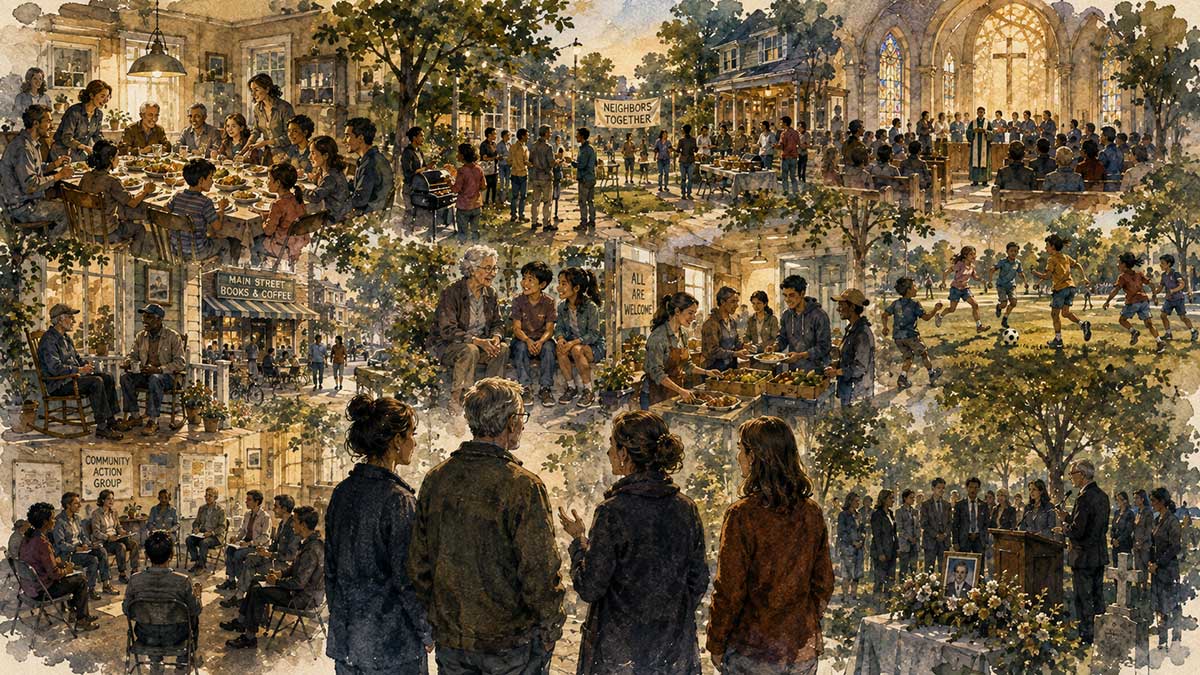
Priya Parker: I keep thinking about the phrase Kasley just used.
“Social architecture.”
A building can look empty after the furniture is removed, but sometimes what matters is harder to see. Doorways. Hallways. Stairs. Places that determine who meets whom.
Human life has those structures too.
Kasley Killam: Family.
Parker: Family. Religion. Neighborhoods. Schools. Clubs. Rituals. Repeated meals. Shared calendars. Places people return to without having to negotiate every encounter from scratch.
Robert Putnam: And when those structures weaken, the burden shifts to the individual.
You have to make the call.
You have to arrange the dinner.
You have to drive farther.
You have to remember the birthday.
You have to keep the friendship alive.
Sherry Turkle: Which sounds manageable until you realize that every relationship now requires active maintenance.
Killam: That's a very modern condition.
Connection becomes another task.
Parker: Think about a weekly family dinner.
The value is not that every dinner is profound.
Most aren't.
Someone is tired.
Someone arrives late.
Someone complains.
Someone repeats a story.
Someone checks the oven.
A child wants to leave.
But the dinner keeps happening.
And repetition itself creates trust.
Putnam: You don't need to send a group message asking whether everyone is free three weeks from Thursday.
Parker: Exactly.
The ritual answers the question before it is asked.
Sunday at six.
Christmas Eve.
Friday prayers.
Saturday morning coffee.
The first Sunday of every month.
Every summer at the lake.
These structures reduce the effort required to stay connected.
Killam: That's fascinating from a social-health perspective.
We often tell people to be more intentional about relationships.
Call someone.
Schedule dinner.
Join something.
All useful.
But perhaps older social structures did some of that intentionality for us.
Parker: Yes.
The calendar carried part of the relationship.
Turkle: And ritual creates something technology struggles to reproduce: anticipation.
You know people will be there.
Parker: And memory.
You remember last year.
You compare this year.
Someone is missing.
Someone has grown.
Someone has aged.
A new child is at the table.
A chair that used to be occupied is empty.
Repeated gathering gives time a social shape.
Putnam: Which is one reason funerals matter.
Not simply as ceremonies for the dead.
They bring a network together and remind everyone that the network exists.
Killam: Weddings too.
Parker: Births. Coming-of-age ceremonies. Religious holidays.
Every culture has built rituals around transitions.
Modern people often preserve the event but weaken the surrounding community.
We may still have the wedding, but many of the guests live far apart and rarely meet again.
We have the funeral, but the community disperses the following morning.
Turkle: So the ceremony remains, but the social continuity underneath it is thinner.
Parker: Yes.
Putnam: Religion is worth discussing carefully here.
Killam: Agreed.
Putnam: Religious institutions have obviously been about belief and worship. But socially, they have done many other things.
They gather people across generations.
They create obligations.
They organize meals.
They visit the sick.
They help with funerals.
They teach children.
They create volunteer roles.
They put wealthy and poor people, old and young people, married and unmarried people in the same place repeatedly.
Turkle: And repetition matters again.
Putnam: Always.
A person may attend for faith, but over twenty years they accumulate hundreds of weak and strong ties without consciously deciding to build a social network.
Killam: Which raises a difficult modern question.
If religious participation declines, what replaces those functions?
Parker: That's exactly the question.
Not: “How do we force people back into religion?”
But: “What else can create recurring, intergenerational, meaningful gathering?”
Turkle: Work used to do some of that.
Putnam: It still does for many people.
Turkle: Yes, but work has changed.
More mobility.
More remote work.
More career switching.
Less expectation that you will spend thirty years in one institution.
That can be liberating.
But it weakens continuity.
Killam: And if work, religion, neighborhood, and extended family all become less stable at once, the losses compound.
Putnam: Precisely.
No single change explains isolation.
The accumulation does.
Parker: I want to bring family into this carefully, since people can hear that conversation as moral judgment.
Killam: Yes.
Parker: Smaller families are not inherently worse.
Living alone is not failure.
Not having children is not failure.
Leaving an unhealthy family can be necessary.
But from a structural perspective, family size changes the number of relationships a person receives without having to create them.
Putnam: That's the key distinction.
Parker: A child with four siblings may eventually have many nieces, nephews, in-laws, cousins through marriage, overlapping holiday networks.
A child with no siblings may have a much smaller inherited network.
Neither life is morally superior.
But socially, they're different architectures.
Killam: And geographic distance adds another layer.
Families may love one another deeply and still see each other twice a year.
Turkle: Technology softens that distance.
Killam: It does. But it doesn't fully replace physical help.
Someone can video-call their mother every evening and still be unable to drive her to an appointment tomorrow morning.
Putnam: Which brings us back to proximity.
Love and proximity are different resources.
Parker: That's an important sentence.
Killam: I think so.
We tend to measure relationship strength emotionally.
“How much do you love each other?”
But practical belonging includes another question:
“How available are you to one another?”
Putnam: Exactly.
A cousin three thousand miles away may love you.
A neighbor you barely know may be the person who notices smoke coming from your house.
Turkle: Or who sees that you haven't collected your mail.
Parker: Which means weak local ties can do things strong distant ties cannot.
Killam: Robert, I keep thinking about your distinction between bonding and bridging social capital.
Family often gives bonding.
But neighborhoods, congregations, schools, civic groups give bridging.
Putnam: Yes.
And bridging ties can protect against a different kind of loneliness.
You may have people who understand you deeply.
But do you have contact with people outside your immediate circle?
Do you feel part of a larger “we”?
Turkle: That word has become harder.
“We.”
Putnam: It has.
Modern life is excellent at helping us construct “me.”
Less clear at sustaining “we.”
Parker: There is another hidden function of ritual.
It teaches people how to be together.
Killam: What do you mean?
Parker: Consider a holiday meal.
Someone hosts.
Someone brings food.
Someone welcomes.
Someone cleans.
Someone tells the story.
Someone remembers the dead.
Children observe.
Eventually they become the adults doing those things.
Ritual transmits social behavior.
Turkle: So gathering is not simply social contact. It's apprenticeship.
Parker: Exactly.
People learn how to host, mourn, celebrate, welcome, disagree, serve, and remain.
When rituals disappear, we lose some of that practice.
Killam: That could explain why people sometimes want community but feel strangely unsure how to create it.
Parker: Yes.
They know they want belonging.
They don't necessarily know how to host it.
Putnam: That's a very important distinction.
People often say, “Nobody invites me anywhere.”
But community requires someone to invite.
Someone to organize.
Someone to maintain the roster.
Someone to reserve the room.
Someone to bring extra chairs.
Those tasks look mundane.
Yet social life depends on them.
Turkle: And digital platforms create the illusion that organization is effortless.
You can create a group in seconds.
Parker: But creating a group isn't creating a community.
Killam: What makes the difference?
Parker: Repetition, responsibility, shared experience, and some reason to return.
A chat can exist for years and still not become a community.
A group of people meeting every Wednesday for six months may become one without ever calling themselves one.
Turkle: This connects to something from our earlier discussion.
Digital systems are very good at helping us find people we choose.
But family, neighborhood, school, religion, and local institutions give us many people we don't choose.
Putnam: And I think those relationships deserve more attention.
Killam: Why?
Putnam: They train us for social life.
If everyone around you has been selected for compatibility, you encounter less difference.
A neighborhood gives you the loud neighbor.
The eccentric retiree.
The teenager who parks badly.
The family with different politics.
The person who talks too much.
The person who barely talks.
Parker: Which can be irritating.
Putnam: Deeply.
Everyone laughed.
Putnam: But civic life depends on learning that irritation does not cancel obligation.
Killam: That may be one of the sharpest differences between friendship and community.
Friendship often begins with affinity.
Community often begins with proximity.
Parker: Beautiful.
Turkle: And modern life has given us much greater ability to escape proximity.
Putnam: Yes.
If your local environment frustrates you, you can increasingly move your attention elsewhere.
Your entertainment is elsewhere.
Your friends may be elsewhere.
Your work may be elsewhere.
Your shopping is elsewhere.
You can physically live in a neighborhood and socially reside somewhere else.
Killam: That's almost a new condition.
Turkle: Very much so.
Parker: Then perhaps we need to ask what a neighborhood actually is.
Is it a collection of houses near one another?
Or a pattern of repeated mutual recognition?
Putnam: The second.
Killam: I agree.
Turkle: Which means density alone doesn't create community.
You can live in a high-rise with hundreds of people and know none of them.
Parker: And a tiny rural town can be socially fragmented too.
The architecture is human, not merely physical.
Killam: I want to return to family.
There is something emotionally difficult here.
Many people move away for very good reasons.
Education.
Work.
Love.
Safety.
Opportunity.
Independence.
Then twenty years later they may discover that something was lost that they didn't notice when they left.
Putnam: That's common.
The benefits are immediate.
The costs may arrive slowly.
Turkle: Your career expands.
Your social world can shrink.
Parker: Or become highly scheduled.
You fly home twice a year.
You video-call.
You send gifts.
You love everyone.
But you no longer participate in ordinary life.
Killam: That's the difference.
Ordinary life.
Not the holiday version.
Putnam: Community is mostly ordinary life.
Parker: Yes.
Belonging isn't created only by important moments.
It's created by being around for unimportant ones.
Turkle: Picking someone up.
Waiting for the repairman together.
Watching a child after school.
Bringing back the borrowed dish.
Killam: Which suggests that proximity creates opportunities for care before care becomes an emergency.
Parker: And perhaps this is why ritual matters so much.
Ritual prevents relationship from depending entirely on mood.
You gather because it is time to gather.
Putnam: That's obligation again.
Parker: Yes, but obligation can be tender.
“I come because this is what we do.”
There's love in that sentence.
Killam: Especially when you don't feel like coming.
Turkle: Perhaps that's where the depth begins.
Killam: I want to introduce a phrase.
Inherited belonging.
Putnam: Go on.
Killam: We talk a great deal about chosen family, chosen communities, chosen identities.
Those can be lifesaving.
But human beings historically received large amounts of belonging before making choices.
You were born into a family.
A language.
A neighborhood.
A village.
Traditions.
Seasonal rituals.
People knew you before you accomplished anything.
Parker: That's powerful.
Killam: Modern life gives us unprecedented freedom to choose who we become.
That is a tremendous achievement.
But perhaps we haven't fully reckoned with what happens when belonging itself becomes something each person must construct.
Turkle: So freedom can create a social burden.
Killam: Sometimes.
If belonging must be continuously earned, scheduled, curated, and maintained, the lonely person may eventually conclude:
“Everyone else figured this out. Something must be wrong with me.”
Putnam: When in fact the surrounding structures may have weakened.
Parker: And inherited belonging had a shadow side.
Killam: Absolutely.
Parker: You could inherit a community that rejected who you were.
You could inherit expectations you could not live inside.
You could inherit prejudice.
Silence.
Gender roles.
Religious pressure.
Family dysfunction.
Turkle: Which is why “go back” cannot be the answer.
Putnam: Agreed.
Killam: The challenge is to recover the gift without restoring the cage.
Everyone went quiet.
Parker: That may be our next topic already.
Turkle: It is.
Putnam: We have spent a long time describing what traditional structures gave people.
But they did not give those things equally.
Killam: And if we want belonging now, we have to ask a harder question.
Can we create communities that are strong enough to matter, but free enough to leave?
Parker: Ritual without coercion.
Putnam: Obligation without oppression.
Turkle: Connection without captivity.
Killam: Belonging without requiring people to disappear inside the group.
A longer silence followed.
Parker: Then maybe the real question isn't whether the past was better.
It's whether we can build something the past often failed to build:
a form of belonging that gives people roots without taking away their freedom.
Topic 4: Was the Past Really Better?
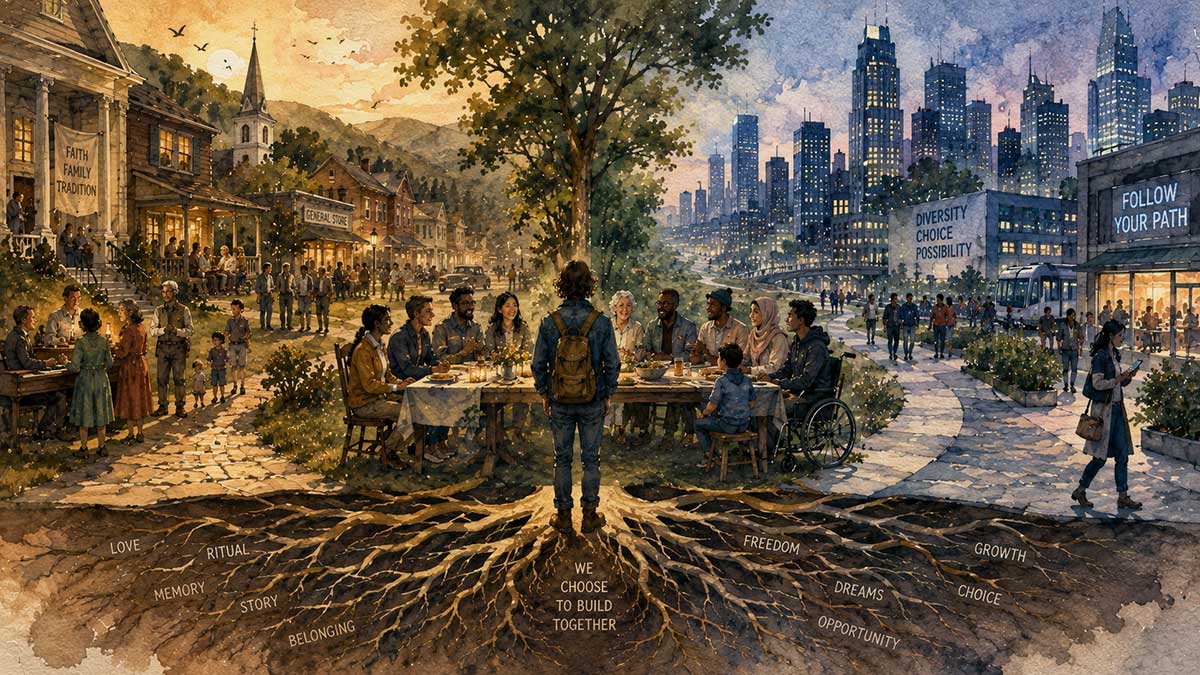
Robert Putnam: I think this is where nostalgia becomes dangerous.
Once people begin recognizing what has been lost, they often romanticize what came before.
They remember porches.
Church suppers.
Neighbors who knew one another.
Large families.
Children playing outside.
Civic clubs.
And some of that memory is real.
But memory edits.
Kasley Killam: It preserves warmth and forgets the cost.
Putnam: Often, yes.
A tightly connected community can support you.
It can feed you.
Visit you.
Protect you.
Raise your children with you.
But the same community can watch you.
Judge you.
Exclude you.
Tell you who you are allowed to become.
Priya Parker: So perhaps we need to separate belonging from conformity.
Sherry Turkle: That distinction may determine whether community becomes nourishing or suffocating.
Killam: Imagine a young person growing up fifty years ago in a town where everyone knows everyone.
At first glance, that's exactly the kind of social environment we've been praising.
Putnam: Yes.
Killam: But suppose that young person feels fundamentally different from the expectations surrounding them.
Now everyone knowing you may not feel comforting.
It may feel like surveillance.
Parker: You can't disappear.
Killam: You can't experiment privately.
You can't easily find people unlike those around you.
You may not even have language for what you're experiencing.
Turkle: And this is where technology changed lives.
For someone trapped inside an intolerant local environment, the internet could reveal:
“There are people like me.”
That can be psychologically profound.
Putnam: Absolutely.
Any serious discussion of social decline has to acknowledge that liberation.
Parker: So when people say, “We need community again,” I sometimes want to ask:
“What kind?”
A community organized around care?
Or a community organized around sameness?
Putnam: Good question.
Parker: Communities often become cohesive by drawing boundaries.
We are this.
We are not that.
We behave this way.
We believe these things.
That's part of how groups become coherent.
But boundaries can become walls.
Killam: Which means belonging can come at somebody else's expense.
Putnam: Historically, that certainly happened.
Turkle: Digital life creates the opposite problem.
Traditional communities could give you too little choice.
Digital communities can give you almost unlimited choice.
Killam: And neither extreme may be healthy.
Turkle: That's what interests me.
Suppose every community becomes optional.
Every conversation can be exited.
Every person can be blocked.
Every disagreement can be avoided.
Every environment can be customized.
You gain freedom.
But you lose endurance.
Parker: Endurance is an interesting word.
Turkle: Relationships sometimes require remaining present after the moment when leaving would be easier.
Putnam: That's true civically too.
Democracy assumes that we will continue sharing a society with people who annoy us.
Parker: More than annoy us.
People who may see the world very differently.
Putnam: Exactly.
If every disagreement results in withdrawal into a more compatible group, bridging social capital collapses.
Killam: So perhaps the old community problem was:
“You cannot leave.”
And the modern community problem is:
“You never have to stay.”
Parker: That's very good.
Turkle: And technology makes leaving nearly frictionless.
A difficult conversation starts.
You close the app.
Someone challenges you.
You mute them.
A group becomes uncomfortable.
You leave.
That can be necessary and healthy in harmful situations.
But when exit becomes our first social reflex, we lose something.
Killam: The ability to repair?
Turkle: Repair, yes.
And tolerance for imperfect people.
Parker: We don't talk enough about repair.
Modern conversations about relationships often focus on compatibility.
Find your people.
Find your tribe.
Find people who share your values.
That can be wonderful.
But no group remains compatible forever.
Eventually someone disappoints you.
Someone changes.
Someone votes differently.
Someone says the wrong thing.
Someone doesn't show up when you needed them.
Then the real question begins:
What does this relationship do with disappointment?
Putnam: Older communities often survived disappointment partly because people had nowhere else to go.
Parker: Which sounds terrible.
Putnam: Sometimes it was.
But there was an unintended benefit.
People developed mechanisms for coexistence.
Turkle: Today we have more freedom to leave harmful relationships, which is good.
The challenge is learning when leaving is liberation and when leaving is avoidance.
Killam: That may be one of the hardest judgments in social health.
If a relationship repeatedly harms you, distance may be necessary.
If a relationship merely frustrates you, distance may prevent growth.
Parker: And no formula can perfectly distinguish the two.
Killam: Right.
Putnam: Let me introduce another tension.
Mobility.
We talk about geographic mobility as an economic opportunity.
Move where the job is.
Move where housing is better.
Move where schools are better.
Move where you want to live.
All reasonable.
But mobility creates social consequences.
Turkle: The person who moves may gain opportunity.
The community may lose continuity.
Putnam: Exactly.
And the person may lose continuity too, without realizing it at first.
Killam: I think of people in their twenties and thirties who move several times.
College.
First job.
Better job.
Marriage.
Another city.
Maybe another country.
Each move can be exciting.
But every move resets part of the social system.
Parker: New dentist.
New neighbor.
New grocery store.
New routines.
New school.
New congregation, if you have one.
New friends.
New people who might someday know enough about you to notice something is wrong.
Turkle: Which means mobility can increase freedom and reduce accumulated recognition.
Putnam: Yes.
Community compounds over time.
You don't create twenty years of familiarity in twenty weeks.
Parker: That may explain why people sometimes become unexpectedly lonely after a successful move.
Everything improved on paper.
Better salary.
Better house.
Better weather.
Better school district.
But the old woman who had known their children since birth is gone.
The friend who had a spare key is gone.
The mechanic they trusted is gone.
The neighbor who knew their mother is gone.
None of those things appeared in the spreadsheet.
Killam: Social wealth is difficult to measure.
Putnam: Very difficult.
Turkle: Modern culture measures what can be quantified easily.
Income.
Square footage.
Commute time.
Followers.
Productivity.
Steps.
Sleep.
Killam: But not:
How many people would notice if you were missing for three days?
Parker: Or how many homes could you enter without needing to explain why you were there?
Putnam: Or how many people know your history well enough to understand the sentence before you finish it?
Killam: That is a form of wealth.
Parker: Deep wealth.
Turkle: And perhaps one people only recognize when it disappears.
Putnam: Yet again, we should resist romanticizing rootedness.
Some people need to leave.
Parker: Absolutely.
Putnam: People have escaped violence, discrimination, poverty, family control, persecution, rigid expectations.
Movement can save lives.
Killam: Which means the answer cannot be “stay where you were born.”
Turkle: Nor “return to traditional roles.”
Parker: Nor “everyone should join the same institutions again.”
Killam: Then what are we actually trying to recover?
Putnam: Continuity.
Parker: Repetition.
Turkle: Presence.
Killam: Reciprocity.
Putnam: Obligation.
Parker: Ritual.
Turkle: Attention.
Killam: Recognition.
They paused.
Parker: None of those requires returning to 1955.
Killam: That's important.
We may be asking the wrong historical question.
Not:
“Was life better then?”
But:
“Which human needs were met more reliably then, and how can we meet them now without restoring the injustices that came with those structures?”
Putnam: Exactly.
That is the useful question.
Turkle: Let me complicate it further.
Modern individualism did something beautiful.
It told people:
Your life belongs to you.
You may choose your work.
Your relationships.
Your beliefs.
Your identity.
Your location.
Your future.
That freedom has enormous moral value.
Parker: But if every person becomes responsible for constructing an entire life alone, freedom can become exhausting.
Killam: That's the paradox.
Putnam: Older societies often gave people a script.
Sometimes far too rigid a script.
Modern societies give us a blank page.
Parker: Which sounds liberating until you're expected to write everything yourself.
Turkle: Career.
Marriage.
Friendship.
Community.
Identity.
Purpose.
Ritual.
Meaning.
Killam: And if any of it fails, you may feel personally responsible.
Parker: This connects directly to gathering.
People sometimes tell me:
“I wish my family had traditions.”
And I ask, “Who will create one?”
There's often a pause.
They thought traditions were something families simply possessed.
But every tradition began when somebody did something twice.
Putnam: That's wonderful.
Parker: Someone cooked the same meal.
Someone invited the same people.
Someone told the same story.
Someone lit the same candles.
Someone said, “Let's do this again next year.”
Then eventually nobody remembered who started it.
It became:
“This is what we do.”
Killam: That suggests modern people may need to become conscious creators of things previous generations inherited.
Parker: Yes.
And that is both exciting and tiring.
We have freedom to invent better rituals.
More inclusive ones.
More meaningful ones.
But someone has to begin.
Turkle: And perhaps technology could help here without becoming the center.
Putnam: How?
Turkle: Help coordinate.
Help remind.
Help translate.
Help connect people with local opportunities.
Help distant family maintain continuity between physical gatherings.
Help someone discover neighbors with shared interests.
Killam: But then return people to one another.
Turkle: Exactly.
Technology as scaffolding.
Not habitat.
Parker: I like that distinction.
A calendar can help us gather.
It cannot gather for us.
A group chat can help organize dinner.
It cannot eat dinner for us.
A video call can keep a relationship alive across distance.
It cannot bring soup to the door.
Putnam: Nor shovel the driveway.
Killam: Nor sit beside someone at a funeral.
Turkle: AI makes that line especially interesting.
An AI can remind you that your friend is grieving.
It can help you think of what to say.
It can help you write a message.
But eventually, perhaps, you have to become the person who calls.
Parker: Or goes.
Turkle: Yes.
Goes.
Killam: I want to return to another word we used earlier.
Obligation.
People often hear obligation as the enemy of freedom.
But are they necessarily opposites?
Putnam: No.
Some obligations are chosen.
Parker: That's the bridge.
Killam: Explain.
Parker: Perhaps mature freedom isn't having no obligations.
Perhaps it's having meaningful obligations that you have freely accepted.
You choose the group.
Then you show up when showing up is inconvenient.
You choose friendship.
Then friendship acquires claims on you.
You choose community.
Then community occasionally interrupts your plans.
Turkle: Freedom creates the relationship.
Commitment gives it depth.
Putnam: That's very close to what healthy civic life requires.
Voluntary association.
You aren't forced to join.
But once you join, your participation matters.
Killam: Which gives us a possible model for modern belonging.
Not compulsory community.
Not disposable community.
Parker: Voluntary commitment.
Turkle: And perhaps that is what digital culture struggles with.
We have built extraordinary mechanisms for entry.
Join.
Subscribe.
Follow.
Connect.
But weaker rituals for remaining.
Putnam: Yes.
Parker: And almost no rituals for repair.
Killam: That's important.
How do two people return after conflict?
How does a community apologize?
How does someone re-enter after absence?
How do people disagree without destroying the group?
Those are social-health skills too.
Putnam: Older institutions sometimes had those mechanisms embedded.
Not always fairly.
But they existed.
You might see the person again next Sunday whether you had resolved the argument or not.
Turkle: Repetition forced another encounter.
Parker: Which gave repair a chance.
Killam: So perhaps what we need isn't simply more connection.
We need structures that make return possible.
Parker: Yes.
That may be one of the deepest functions of ritual.
It gives people another Tuesday.
Another Sunday.
Another dinner.
Another meeting.
Another holiday.
Another chance.
Turkle: That's different from the digital logic of rupture.
Block.
Delete.
Leave.
Start over.
Putnam: Human societies can't constantly start over.
Killam: Neither can human beings.
Parker: Then perhaps we can finally answer the question.
Was the past better?
Putnam: In some ways, yes.
In other ways, clearly no.
Turkle: Which is why the question itself may be misleading.
Killam: Maybe the goal isn't restoration.
It's integration.
Take modern freedom seriously.
Take human social needs seriously.
Refuse to sacrifice either.
Parker: Roots without captivity.
Putnam: Community without exclusion.
Turkle: Technology without substitution.
Killam: Relationships without coercion.
Parker: Ritual without rigid conformity.
Putnam: Obligation chosen freely.
A quiet moment settled over the conversation.
Killam: Then perhaps we've arrived at the question that matters most.
If we don't want to return to the old structures exactly as they were, and if individual freedom alone isn't giving everyone enough belonging, what do we build now?
Putnam: That's the difficult part.
Diagnosis is easier than construction.
Parker: But construction begins somewhere.
Turkle: Usually with behavior.
Killam: And perhaps with one person deciding that connection deserves the same attention they give physical and mental health.
Putnam: Yet one person cannot rebuild social capital alone.
Parker: No.
But one person can create a table.
Turkle: One person can put away a phone.
Putnam: One person can join something and keep showing up.
Killam: One person can call someone they have been meaning to call.
They looked at one another.
Parker: Perhaps that's where the final part has to go.
Not back.
Forward.
Toward a form of belonging we haven't fully built yet.
Killam: Then the final question becomes unavoidable:
If modern life dismantled some of our old social structures, how do we deliberately create new ones that people will actually want to stay inside?
Topic 5: How Do We Belong Again?
Kasley Killam: We've spent a lot of time talking about enormous things.
Declining civic participation.
Changing families.
Technology.
Mobility.
Religion.
Neighborhoods.
AI.
Individualism.
If I'm listening to this conversation alone at home, I might agree with everything we've said and still think:
“What exactly am I supposed to do about any of it?”
Robert Putnam: That's the danger.
Once a problem becomes structural, individuals can feel powerless.
Priya Parker: Or they wait for somebody else to create community for them.
Sherry Turkle: Government.
Schools.
Churches.
Technology companies.
Employers.
Someone.
Killam: Yet nobody experiences “society” directly.
We experience particular people.
Particular rooms.
Particular meals.
Particular conversations.
Maybe that's where rebuilding has to become personal.
Putnam: Kasley, this seems like the right moment to ask about your 5-3-1 idea.
Killam: Yes.
But I want to say something before describing it.
5-3-1 isn't a magic formula.
Human beings differ.
An introvert may need less interaction than an extrovert.
Someone caring for young children has a different social life from someone who has just retired.
A widow has different needs from a college student.
So I don't want someone counting interactions at 10:00 Sunday night and thinking they've failed social health.
Parker: Good.
We don't need another thing to fail at.
They laughed.
Killam: Exactly.
Think of it more as a prompt.
Five.
Three.
One.
Interact with roughly five different people across the week.
Invest in at least three close relationships.
Aim for about an hour of meaningful social connection across the day.
It's a way of asking:
Am I getting enough breadth?
Enough depth?
Enough time?
Putnam: I'm going to challenge you.
Killam: Please.
Putnam: Suppose everything we've discussed is true.
The bowling league disappeared.
The church membership declined.
The extended family scattered.
The neighborhood became anonymous.
Work went remote.
Third places disappeared.
Then we tell the lonely individual:
“Here is your 5-3-1 plan.”
Aren't we asking individuals to compensate for institutions that society dismantled?
Killam: Yes, if we present 5-3-1 as the solution.
I don't.
Putnam: Good.
Killam: Social health has an individual dimension and a collective dimension.
You can take responsibility for your own relationships.
But we can simultaneously ask whether workplaces, neighborhoods, cities, schools, technology companies, health systems, and communities are creating conditions where connection is possible.
Those aren't contradictory ideas.
Turkle: That's important.
Otherwise loneliness becomes another self-improvement industry.
Parker: Exactly.
“Optimize your friendships.”
“Track your social minutes.”
“Complete your weekly connection goals.”
Killam: Which would completely miss the point.
Turkle: And perhaps make people feel worse.
Killam: Yes.
The goal isn't to turn friendship into exercise repetitions.
It's to become conscious of something modern life makes easy to neglect.
Parker: I'd like to add something to Kasley's framework.
Someone has to create the occasion.
Killam: Yes.
Parker: We talk about wanting invitations.
But what happens when we become the inviter?
A simple message:
“I'm making dinner Sunday. Come.”
Not:
“Let's find a mutually convenient evening sometime next month.”
Sunday.
Six o'clock.
Come.
Putnam: Structure.
Parker: Structure is kind.
It removes negotiation.
Turkle: But what if nobody comes?
Parker: Then you invite again.
Turkle: That's harder than it sounds.
Parker: Much harder.
Creating community involves rejection.
People are busy.
They cancel.
They forget.
You cook too much food.
You wonder whether anyone likes you.
The first gathering may feel awkward.
That's why we can't romanticize community-building either.
Killam: That's an important point.
Social health requires vulnerability.
Parker: And repetition.
Suppose three people come.
Don't ask:
“Was this gathering successful?”
Ask:
“Should we do it again?”
That is a different question.
Putnam: Because community compounds.
Parker: Exactly.
The first dinner is dinner.
The tenth dinner might be a tradition.
The fiftieth dinner may be part of someone's identity.
“This is what we do on Sunday.”
Killam: That's where 5-3-1 becomes more interesting to me.
It shouldn't simply mean:
“I need five people.”
It might mean:
“How can my social habits create connection for other people too?”
Putnam: Now we're getting somewhere.
Turkle: That shifts the question from consumption to contribution.
Killam: Exactly.
Instead of:
“Do I have enough friends?”
Ask:
“Whose friend am I?”
Instead of:
“Does anyone invite me?”
Ask:
“Whom have I invited?”
Instead of:
“Does anyone check on me?”
Ask:
“Whom do I check on?”
Parker: That is how belonging becomes reciprocal.
Putnam: I would add another question.
“Where do I show up repeatedly?”
Not once.
Repeatedly.
Join the volunteer organization.
Join the religious community if faith matters to you.
Join the neighborhood association.
Coach.
Sing.
Garden with other people.
Play pickleball.
Attend the library group.
Help at the school.
The activity almost doesn't matter.
Turkle: Provided other people are there.
Putnam: Precisely.
And you keep going.
Parker: That's where many people give up too quickly.
They attend something once.
Nobody speaks to them.
They don't feel immediate chemistry.
They conclude:
“These aren't my people.”
But belonging often doesn't arrive dramatically.
Killam: It accumulates.
Parker: Yes.
First week:
“What's your name?”
Fourth week:
“Good to see you again.”
Tenth week:
“You weren't here last week. Everything okay?”
There.
That's the transition.
Killam: From recognition to expectation.
Putnam: Exactly.
Turkle: And that sentence from Topic 1 returns.
“We noticed you weren't here.”
Parker: That may be one of the simplest measurements of community we have.
Killam: Robert, what about people who say:
“There aren't any good communities around me”?
Putnam: Sometimes they're right.
That's where institutions matter.
We need physical and social spaces that permit repeated encounter.
Libraries.
Parks.
Community centers.
Religious institutions.
Schools.
Sports facilities.
Local businesses.
Public squares.
Places where people can spend time without every minute being monetized.
Parker: And places where different generations can meet.
Putnam: Very important.
Modern life often sorts people by age.
Children with children.
Young adults with young adults.
Parents with parents.
Older adults with older adults.
Healthy communities mix generations.
Turkle: I think technology has a role here, but we need to become disciplined about what role.
Killam: The bridge rather than the destination.
Turkle: Yes.
Suppose technology tells me:
“There's a community garden twelve minutes away looking for volunteers Saturday.”
Wonderful.
Suppose AI helps me organize a monthly dinner.
Wonderful.
Suppose a group chat keeps twenty neighbors coordinated.
Wonderful.
The digital tool has increased physical human connection.
Parker: And when does it become problematic?
Turkle: When the tool satisfies enough of the social impulse that we stop crossing the bridge.
Killam: Let's return to AI companionship.
Suppose someone tells an AI:
“I'm lonely.”
What would we want a socially healthy AI to do?
Turkle: Perhaps listen first.
Parker: Certainly.
Turkle: But eventually it might ask:
“Is there someone you would feel comfortable contacting?”
Killam: Or:
“Would you like help finding something nearby?”
Putnam: Or:
“When did you last speak with your brother?”
Parker: Or simply:
“Who haven't you seen lately?”
Turkle: The goal shouldn't always be to end the conversation with the machine.
But the system should recognize that it cannot become the entirety of someone's social world.
Killam: That's a powerful design principle.
Putnam: The technology should strengthen social capital rather than consume it.
Parker: There's something else we haven't talked about enough.
Food.
Putnam: Food?
Parker: Yes.
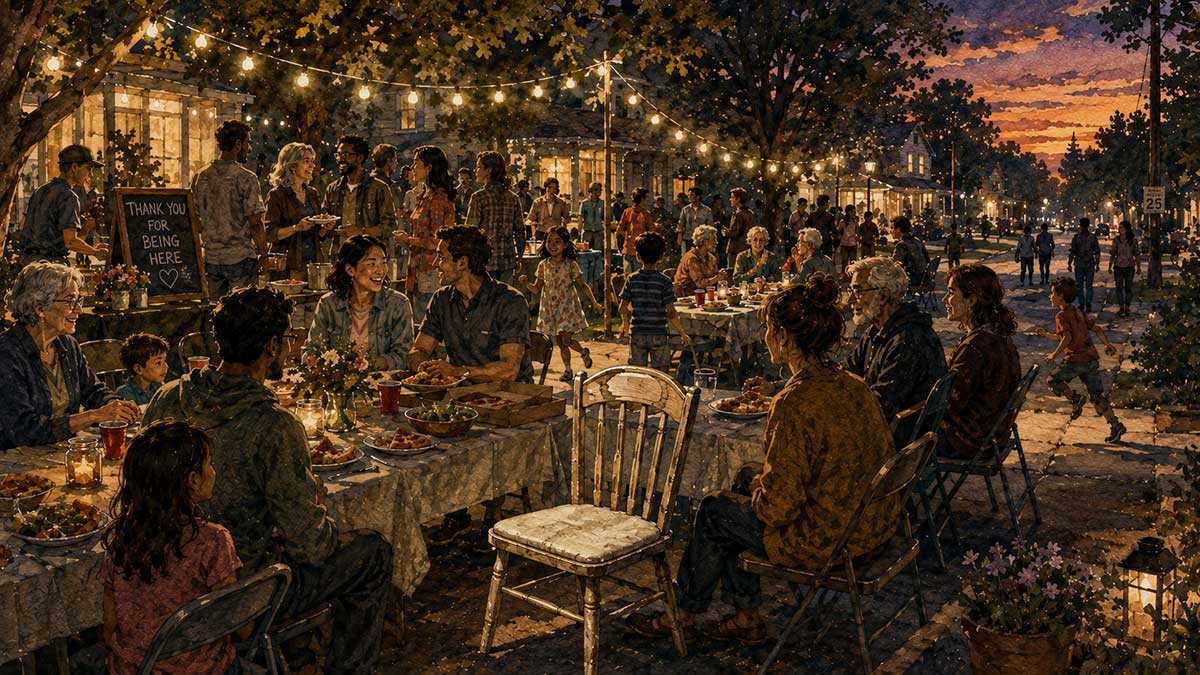
Humans have been gathering around food for an extraordinarily long time.
And I think modern people sometimes make gathering too elaborate.
They think hosting means a beautiful home.
Perfect cooking.
Matching plates.
Everything clean.
Killam: Which makes people reluctant to invite anyone.
Parker: Exactly.
Order pizza.
Make soup.
Bring sandwiches.
The point is not performance.
The point is recurrence.
Turkle: That's interesting in the age of social media.
Hosting can become something displayed rather than experienced.
Parker: Yes.
A gathering doesn't need to photograph beautifully.
It needs to feel human.
Putnam: Perhaps imperfect gatherings are socially useful precisely because they're imperfect.
Parker: They signal:
“You don't have to perform here.”
Killam: That's another dimension of social health we haven't named.
Being known without performing.
Turkle: Very important.
Killam: Many people have enormous audiences now.
Followers.
Subscribers.
Professional networks.
But an audience knows your presentation.
A friend knows what you're like when you're tired.
Putnam: Community may know something even stranger.
Your history.
Parker: Yes.
They remember previous versions of you.
Turkle: That can be uncomfortable.
Parker: And beautiful.
Someone who can say:
“You always do this when you're scared.”
Or:
“You said the same thing ten years ago.”
Or:
“Your father used to laugh exactly like that.”
That's a kind of knowledge no profile can manufacture quickly.
Killam: It requires time.
Putnam: Which is one resource we cannot accelerate.
Killam: Maybe that's another modern mistake.
We want instant belonging.
Parker: Yes.
Killam: We meet someone and ask:
“Do we connect?”
Perhaps that's too much pressure for one encounter.
Putnam: Many people I came to care deeply about weren't immediately fascinating to me.
Turkle: That's almost heretical in an age of matching algorithms.
They laughed.
Parker: Algorithms ask:
“Who fits you?”
Community sometimes asks:
“Who is here?”
Those are very different questions.
Putnam: And democracy depends heavily on the second.
Killam: Families do too.
Turkle: So do neighborhoods.
Killam: Let's make this harder.
Suppose someone listening is truly lonely.
Not philosophically lonely.
Tonight lonely.
They eat alone.
Nobody calls.
They don't have three close relationships.
They don't have five people.
An hour of daily connection sounds impossible.
What do we say to that person?
The room became quieter.
Parker: Start smaller than your loneliness tells you is meaningful.
Killam: What does that mean?
Parker: Go somewhere twice.
Not once.
Twice.
The same café.
The same library event.
The same volunteer shift.
The same walking group.
The same religious service.
The same park at the same time.
Give recognition a chance to begin.
Putnam: That's excellent.
Don't begin with:
“I need a best friend.”
Begin with:
“I need somewhere to return.”
Turkle: And don't dismiss weak contact.
A conversation with a cashier won't replace intimacy.
But it can remind your nervous system:
“I exist among other people.”
Killam: Social health doesn't begin only with deep disclosure.
Sometimes it begins with familiarity.
Parker: Then eventually someone says your name.
Putnam: Then someone remembers something you told them.
Turkle: Then someone expects you.
Killam: Then perhaps someone misses you.
Silence.
Putnam: That's how community grows.
Not through a grand announcement.
Through accumulation.
Interestingly, that's also how we lost much of it.
Parker: One repeated gathering disappears.
Then another.
Putnam: Which means perhaps rebuilding can work in reverse.
One repeated gathering returns.
Then another.
Turkle: That's hopeful without being sentimental.
Killam: And it takes us beyond personal wellness.
If I improve my social health, the benefits don't stop with me.
When I invite someone, their social world changes.
When I introduce two people, something new becomes possible.
When I check on an elderly neighbor, they become less isolated.
When I join an organization and keep attending, the organization becomes slightly stronger.
Putnam: That's social capital being created.
Parker: So perhaps belonging has a peculiar property.
You cannot create it entirely for yourself.
Killam: Yes.
Parker: You can create conditions.
You can show up.
You can invite.
But belonging exists between people.
Turkle: Which makes it fundamentally different from many self-improvement goals.
You can exercise alone.
Meditate alone.
Read alone.
Build skills alone.
Putnam: But you cannot belong alone.
Nobody spoke for several seconds.
Killam: Maybe that's where our original question finally changes.
We began by asking:
“What if modern people are unhappy not because they've failed to improve themselves, but because modern life removed some of the relationships and communities they needed?”
I still believe that's worth asking.
But now I think there's another danger.
We could hear that argument and simply blame modern life.
Putnam: Which accomplishes nothing.
Killam: Right.
Perhaps the more useful question is:
What can we begin creating for one another now?
Parker: A table.
Putnam: A group.
Turkle: An uninterrupted conversation.
Killam: A friendship.
Parker: A ritual.
Putnam: A place where people return.
Turkle: A few hours in which technology helps us reach one another and then gets out of the way.
Killam: And perhaps 5-3-1 can evolve from being merely a personal guideline.
Five people.
Three close relationships.
One hour.
But beneath the numbers lies something more important.
Don't merely count the people who contribute to your social health.
Ask whether you contribute to theirs.
Putnam: That changes everything.
Parker: It changes belonging from something we search for into something we practice.
Turkle: And from something we consume into something reciprocal.
Killam: Then maybe the person we described at the very beginning, sitting alone and wondering what is wrong with them, doesn't need another message telling them to become a better version of themselves.
Maybe they need an invitation.
Parker: Yes.
Putnam: And somewhere, another lonely person may be waiting for exactly the same invitation.
Turkle: Which means the tragedy is sometimes almost absurd.
Two people sit in separate houses.
Both feel lonely.
Both assume everybody else is busy.
Neither wants to bother the other.
Both reach for their phones.
Both scroll through hundreds of people.
Neither makes the call.
Parker: Someone has to go first.
Killam: Yes.
Someone has to go first.
Putnam: And perhaps that is how communities have always begun.
Not with the word community.
With an invitation.
“Come over.”
“Sit here.”
“Want to join us?”
“See you next Sunday?”
Parker: And then the most important part.
Do it again.
The room became quiet.
Not the uncomfortable quiet of strangers who had run out of things to say.
The quieter kind that sometimes appears after people recognize something they already knew but had never put into words.
Killam: I think I understand social health a little differently after this conversation.
I often ask people to think about whether they have enough connection.
But perhaps there is another question worth carrying with us:
Whose life becomes more connected because I am in it?
Putnam: That's a question a society could ask too.
Turkle: So could a technology company.
Parker: So could a family.
Killam: Maybe that is where belonging begins.
Not with finding the perfect community.
Not with returning to an idealized past.
Not with collecting more contacts.
With human beings making a small promise to one another:
I will keep showing up.
Parker: And if you don't show up...
Putnam: ...someone will notice.
Turkle: Perhaps that's what we've been trying to name all along.
Killam nodded.
Killam: Maybe the opposite of loneliness isn't simply having people around us.
Maybe it's living somewhere, physically or emotionally, where our absence would be noticed.
Final Thoughts
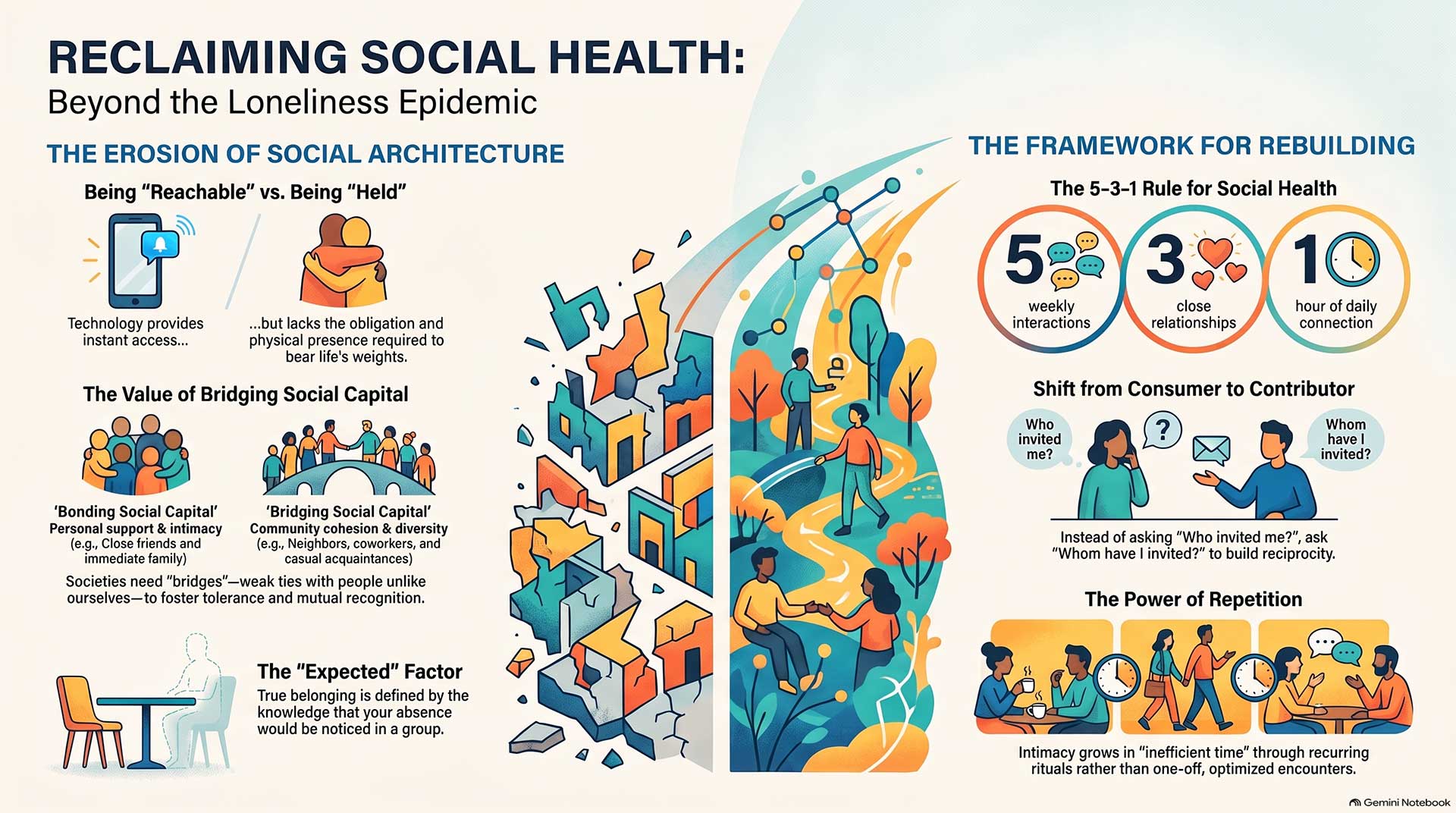
One of the most powerful ideas to emerge from this conversation is that belonging may depend less on the number of people we know than on whether we are woven into repeated human life.
A close friend matters.
A loving spouse matters.
Family matters.
Yet so do the weaker relationships that quietly tell us we exist somewhere: the neighbor who notices our car has not moved, the person at church who asks where we were last Sunday, the regular group that saves us a chair, the friend who expects us at dinner.
Modern life has made it easier to choose whom we interact with and easier to leave relationships that harm us. That freedom has immense value. Yet complete social choice can carry a hidden burden. If every relationship must be found, scheduled, maintained, and curated by the individual, belonging itself begins to resemble another personal project.
That is why Kasley Killam's social-health framework matters. Her 5-3-1 idea offers a practical starting point, but this conversation pushes the idea further.
The question is not simply:
Do I have enough people in my life?
It may be:
Whose life becomes less lonely because I am in it?
Priya Parker's contribution makes the answer surprisingly practical. Someone has to make the invitation. Someone has to create the dinner, the walk, the weekly gathering, the tradition, the place where people return.
Robert Putnam reminds us that community grows through repeated participation.
Sherry Turkle reminds us that technology is most valuable when it brings people back to people rather than becoming a permanent substitute for them.
Kasley Killam reminds us that relationships deserve to be treated as part of health itself.
Perhaps rebuilding belonging does not begin with a grand social program.
It begins when somebody says:
“Come over.”
Then says it again next week.
Over time, a gathering becomes a habit.
A habit becomes a ritual.
Strangers become familiar.
Familiar people begin to care.
And eventually someone reaches the point that may define belonging better than almost anything else:
If you were not there, somebody would notice.
Short Bios:
Kasley Killam, MPH is a social scientist and author focused on social health, human connection, loneliness, and relationships. Her book The Art and Science of Connection argues that social health should be treated alongside physical and mental health.
Robert D. Putnam is a political scientist and longtime Harvard professor best known for Bowling Alone. His work examines social capital, civic participation, trust, community life, and the decline of many institutions that once connected people across American society.
Sherry Turkle is an MIT professor, psychologist, and author whose research explores the relationship between people and technology. Her books include Alone Together and Reclaiming Conversation, examining how digital communication can affect intimacy, attention, conversation, and human presence.
Priya Parker is a facilitator and author of The Art of Gathering. Her work examines why people gather, what makes gatherings meaningful, and how intentional structure, ritual, hospitality, and repeated participation can create deeper human connection.
Leave a Reply