
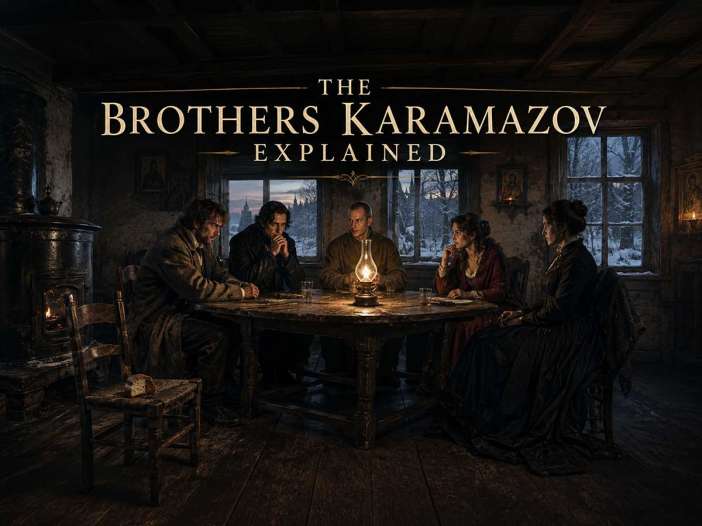
What if the person who committed the murder was not the only one responsible for it?
A father has been murdered.
One son threatened to kill him.
Another secretly wished for his death.
A third may have given the killer the ideas he needed.
The man who committed the murder is dead, and the brother who did not commit it has been convicted.
So who is truly guilty?
Fyodor Dostoevsky’s The Brothers Karamazov is often described as a murder mystery, a family tragedy, a religious novel, and a philosophical masterpiece. It is all of those things, yet its deepest subject is responsibility.
The novel asks whether guilt belongs only to the person who performs an act, or whether it can spread through desire, silence, neglect, resentment, and ideas.
Dmitri did not murder his father, but he wanted him dead.
Ivan did not command the murder, but he suspected it might happen and chose to leave.
Smerdyakov carried out the act, yet he believed Ivan’s philosophy had granted him permission.
Alyosha loved everyone, but he sometimes mistook kindness for sufficient action.
Grushenka and Katerina each loved passionately, yet both discovered that love can become control, pride, punishment, and emotional debt.
Fyodor Pavlovich created the poisoned family in which all of this became possible.
In this imaginary conversation, the characters gather in a monastery guesthouse after Dmitri’s conviction.
Morning is approaching.
The guards will soon return.
There is no judge, jury, prosecutor, or defense attorney in the room.
Each person must examine not merely what happened, but what part they played in making it possible.
Their discussion moves through five questions at the heart of the novel:
Who truly killed Fyodor Karamazov?
Can morality survive without God?
Why must innocent children suffer?
Is freedom too heavy for human beings?
Can love redeem a family that has already destroyed itself?
Ivan brings the strongest challenge to faith.
He refuses to accept any moral order built upon the suffering of innocent children. His rebellion does not come from indifference. It comes from moral outrage.
Alyosha does not defeat Ivan through a perfect theological explanation. He admits that no future harmony can make a child’s suffering acceptable. His response is active love: truth, presence, protection, repentance, and responsibility.
Dmitri discovers that legal innocence does not erase moral guilt. He did not kill his father, yet hatred had created a home for murder within him.
Smerdyakov forces the family to confront a more disturbing possibility. A person can be responsible for his own act and still be shaped by years of humiliation, abandonment, and contempt.
The conversation does not end with every character reconciled.
Ivan does not suddenly surrender his doubt.
Katerina does not instantly forgive Dmitri.
Dmitri does not become pure through suffering.
Grushenka does not promise unconditional devotion.
Alyosha does not save everyone.
What changes is smaller and more believable.
Each person accepts a more truthful portion of responsibility.
Katerina agrees to correct her testimony.
Ivan agrees to speak publicly about Smerdyakov’s confession.
Grushenka chooses to walk beside Dmitri without becoming his excuse.
Dmitri begins to see redemption as a daily practice rather than a dramatic punishment.
Alyosha accepts that love must sometimes confront, restrain, leave, and risk being misunderstood.
The final question is no longer whether love can erase the past.
It cannot.
The question is whether love can prevent the past from deciding every future action.
That is where the conversation begins.
(Note: This is an imaginary conversation, a creative exploration of an idea, and not a real speech or event.)
Topic 1: Who Really Killed Fyodor Karamazov?
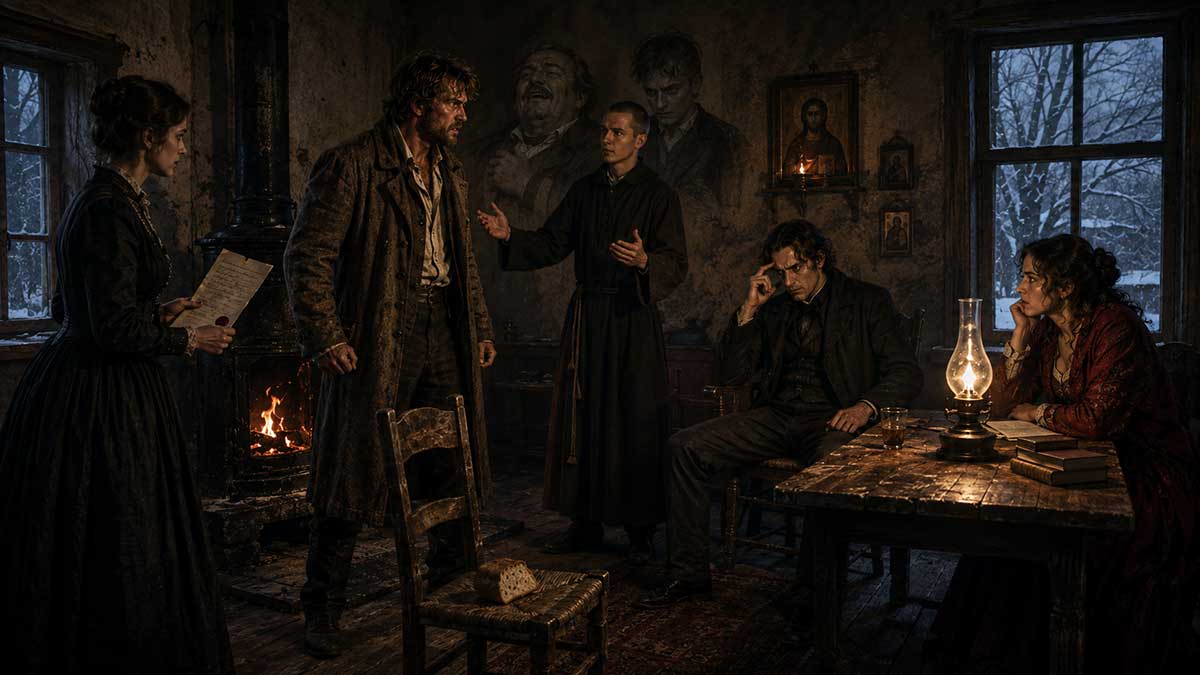
The monastery guesthouse had once been used for pilgrims who arrived too late to enter the main grounds before nightfall. It was a plain room, built of dark timber, with a narrow stove against one wall and a long table scarred by years of bowls, cups, elbows, and prayer books.
Outside, snow covered the road leading away from town.
The verdict had been delivered only hours earlier.
Dmitri Fyodorovich Karamazov had been found guilty of murdering his father.
By morning, the guards would return for him.
For one night, through an arrangement no one fully explained, he had been allowed to sit with his family.
No judge was present.
No jury.
No lawyer.
Only those who had wanted the dead man’s money, feared his cruelty, suffered his neglect, desired his death, or failed to prevent it.
Alyosha sat near the end of the table, his hands resting together. Dmitri paced beside the stove. Ivan remained in the darkest corner, pale and trembling beneath his coat. Grushenka sat close enough to Dmitri to watch him, yet far enough away that she did not seem to be restraining him. Katerina Ivanovna sat straight-backed, her face drained of nearly all expression.
An empty chair stood opposite Ivan.
No one had placed it there.
No one asked that it be removed.
Dmitri: Say it.
No one answered.
Dmitri: Someone say it. The court said it. The prosecutor said it. The witnesses said it. Half the town has been saying it for months. Why should this room pretend to be kinder than the world outside?
Grushenka: Mitya—
Dmitri: Say that I killed him.
Alyosha: You did not kill him.
Dmitri: That is not the same as saying I am innocent.
Ivan lifted his head.
Ivan: At last, something honest.
Dmitri stopped pacing.
Dmitri: You want honesty from me?
Ivan: I want nothing from you.
Dmitri: No. You want what you have always wanted. You want everyone else to become evidence in the trial inside your own head.
Katerina: This is pointless.
Grushenka: Then leave.
Katerina turned slowly.
Katerina: I did not come here for you.
Grushenka: None of us came here for the right reason.
Alyosha looked toward the empty chair.
Alyosha: That may be why we must speak.
The stove gave a low metallic crack.
For a moment, the room seemed to shrink around them.
Is the murderer only the person who performs the act?
Alyosha: The court answered one question today. It decided who it believed struck our father and stole the money.
Dmitri: It decided badly.
Alyosha: Yes.
Dmitri’s eyes narrowed, as though the word wounded him more than accusation would have.
Alyosha: Yet there is another question the court could not answer.
Ivan: Then do not pretend this room can.
Alyosha: Who caused the murder?
Katerina: Smerdyakov caused it.
The name entered the room like a cold draft.
Ivan looked toward the empty chair.
Katerina: He committed the act. Whatever else may be said, the responsibility begins there.
Dmitri: Begins there?
Katerina: Yes.
Dmitri: Not ends there?
Katerina: I did not say that.
Dmitri: You said enough at the trial.
Katerina’s mouth tightened.
Katerina: I gave them your letter.
Dmitri: My drunken letter.
Katerina: Your written threat.
Dmitri: Written by a fool who wanted to frighten himself with his own rage.
Katerina: The court did not know which version of you to believe.
Dmitri: Neither did you.
Katerina: I believed the version that hurt me most.
Silence followed.
Grushenka studied her with fresh attention.
Grushenka: That may be the first true thing you have said tonight.
Katerina did not turn away.
Katerina: I wanted him condemned.
Dmitri stared at her.
Katerina: Not because I believed he killed his father. I no longer know what I believed. I wanted him punished for humiliating me. I wanted my suffering to become evidence of his wickedness. I gave the court what it needed, and I called it truth.
Dmitri: Katya—
Katerina: Do not forgive me yet. You will make it another performance.
Dmitri lowered his head.
Alyosha: Then the court’s error did not come from one lie.
Ivan: Courts rarely need one lie. They prefer many partial truths.
Grushenka: Mitya threatened the old man. Katya gave them the letter. I drew father and son into the same filthy rivalry. The servants heard enough to fear blood. The town expected blood. Everyone saw the road, and no one stepped into it.
Dmitri: You did not kill him.
Grushenka: I know what my hands did not do. I am less certain about what my pride did.
Ivan: How moving. Soon the entire province will confess, and the murderer will disappear beneath a mountain of shared emotion.
Alyosha: You think shared responsibility excuses the one who acted?
Ivan: It often does. People say, “We are all guilty,” when they cannot bear to say, “He is guilty.”
Alyosha: That is not what I mean.
Ivan: Then say what you mean.
Alyosha: Smerdyakov killed our father. That must not be hidden. Yet he did not rise from the ground on the night of the murder without a history. He had been mocked since childhood. Treated as a servant. Treated as shame made flesh. Our father used him, despised him, and laughed at the circumstances of his birth. We saw his bitterness. We spoke around it. Sometimes we fed it.
Ivan: I did more than feed it.
No one moved.
Dmitri: Vanya—
Ivan: Let him finish. He has brought us here to say what the court could not. Let him hear it.
Ivan leaned forward, placing both hands on the table to steady them.
Ivan: Smerdyakov believed I wanted our father dead.
Alyosha: Did you?
Ivan gave a thin smile.
Ivan: Which answer do you want? The answer of the respectable son? The philosopher? The coward? The brother who left town at the most useful moment?
Dmitri: I asked you before. I ask you again. Did you know?
Ivan: I knew enough to leave.
Grushenka: That is not an answer.
Ivan: It is the only answer that matters.
Dmitri: Did he tell you he would do it?
Ivan: Not plainly.
Dmitri: Did he suggest it?
Ivan: Yes.
Dmitri crossed the room in two strides, but Alyosha rose before he reached Ivan.
Dmitri: And you left?
Ivan: Yes.
Dmitri: Knowing he might kill him?
Ivan: Yes.
Dmitri raised his fist.
Alyosha: Mitya.
Dmitri: Move.
Alyosha: No.
Dmitri: He left me to hang.
Ivan: I left our father to die.
The raised fist remained in the air.
Dmitri’s anger broke first. His hand lowered.
Ivan: Do not make me nobler than I was. I did not think first of you. I did not think of justice. I thought that if something happened while I was away, I would remain clean.
Katerina: You believed absence would become innocence.
Ivan: Yes.
Alyosha: Yet you did not command Smerdyakov.
Ivan: No. I merely gave him everything except the command.
The empty chair seemed suddenly occupied.
Not by a body.
By memory.
By a lowered voice in a servant’s room.
By questions asked in such a way that the desired answer did not need to be spoken.
Ivan: He asked whether I would go to Moscow. He spoke of Father being alone. He spoke of Dmitri’s threats. He watched me. I watched him. We both understood that we were speaking about murder, and we both protected ourselves with unfinished sentences.
Dmitri: Then you are guilty.
Ivan: Yes.
Alyosha: Not of murder.
Ivan struck the table with his palm.
Ivan: Stop protecting me with categories.
The lamp flame trembled.
Ivan: I did not lift the weapon. I did not open the envelope. I did not wipe the blood. Is that what saves me? The distance between an idea and a hand?
Alyosha: No.
Ivan stared at him.
Alyosha: It does not save you. It does not make you the murderer either.
Ivan: Then what am I?
Alyosha: Responsible for what you knew, what you desired, what you refused to prevent, and what you allowed another man to believe.
Ivan laughed once, without humor.
Ivan: A carefully measured damnation.
Alyosha: A truthful one.
Can a person be innocent under the law yet guilty in conscience?
Dmitri returned to the stove.
Dmitri: I wanted him dead.
Grushenka stood.
Grushenka: Mitya, do not begin condemning yourself for everyone’s comfort.
Dmitri: I wanted him dead.
Grushenka: Wanting is not doing.
Dmitri: Tell that to the nights when I saw his face and planned how I would break it. Tell that to the letter. Tell it to the money I believed he had stolen from me. Tell it to the way I ran through the streets shouting that I would spill his blood.
He turned toward Alyosha.
Dmitri: When they told me he was dead, do you know what I felt first?
Alyosha said nothing.
Dmitri: Relief.
Grushenka closed her eyes.
Dmitri: One breath. One shameful breath in which I thought: it is over. He cannot taunt me. He cannot buy her. He cannot hold the money over me. He cannot stand between me and the life I think I deserve.
His voice dropped.
Dmitri: Then terror came. Then grief, perhaps. Yet relief came first.
Katerina: That does not make you a murderer.
Dmitri: No. It makes me a son who had made a home for murder inside himself.
Ivan: You see, Alyosha? He understands better than you.
Alyosha: He understands one part.
Dmitri: Do not soften it.
Alyosha: I will not. You hated him. You threatened him. You prepared yourself inwardly for violence.
Dmitri: Yes.
Alyosha: Yet you stopped.
Dmitri: By accident.
Alyosha: You stopped.
Dmitri: I struck another man nearly to death.
Alyosha: You stopped before killing our father.
Dmitri: And another man completed what I had imagined.
Alyosha: That should humble you. It should not make you claim his act as your own.
Ivan: Why are you so determined to divide guilt into neat portions?
Alyosha: I am determined not to confuse confession with self-destruction.
Ivan became quiet.
Alyosha: There is a kind of pride that says, “I am innocent.” There is another kind that says, “I am guilty of everything.” Both can keep a person from facing the exact truth.
Katerina: You believe excessive guilt can be pride?
Alyosha: Yes. It can make suffering feel grand. It can allow a person to become the center of every tragedy.
Dmitri looked offended, then slowly unsettled.
Grushenka: He is speaking to all of us.
Alyosha: Mitya did not murder our father. He must not accept a false legal guilt merely to prove that he has a conscience. Yet he must face the hatred he carried. Ivan did not commit the murder. Yet he must face the permission he communicated. Katya did not create the false verdict alone. Yet she must face the wound she turned into testimony. You did not create the rivalry alone, Agrafena Alexandrovna. Yet you must face the pleasure you once took in making men suffer for desiring you.
Grushenka’s eyes flashed.
Grushenka: Once?
Alyosha met her gaze.
She gave a bitter smile.
Grushenka: Fair enough.
Alyosha: Each truth has its proper weight. We cannot heal by making it lighter. We cannot heal by making it heavier.
Ivan: Heal.
He repeated the word as though it belonged to another language.
Ivan: Father is dead. Smerdyakov is dead. Dmitri is condemned. You speak of healing as though we have suffered an illness.
Alyosha: What would you call it?
Ivan: Revelation.
Alyosha: Of what?
Ivan: Of what we are when consequences finally catch up with desire.
Did Fyodor help create the conditions of his own murder?
Katerina looked toward the empty chair.
Katerina: We have spoken of everyone except the dead man.
Dmitri: Speak carefully.
Katerina: Why? You spent half your life speaking carelessly about him.
Dmitri: He is dead.
Katerina: Death does not turn cruelty into goodness.
Alyosha: No.
The agreement surprised them.
Alyosha: We should not lie about him.
Grushenka: He would have laughed at us for trying.
Ivan: He would have made a joke about his own funeral, then searched the room for whoever looked most uncomfortable.
Dmitri’s face twisted between anger and memory.
Dmitri: He abandoned us.
Ivan: He abandoned you loudly. Alyosha quietly. Me carelessly. Smerdyakov completely.
Alyosha: He failed us all.
Dmitri: Failed?
He struck his chest.
Dmitri: He stole from me.
Ivan: Perhaps.
Dmitri: He mocked my mother.
Ivan: Certainly.
Dmitri: He turned everything sacred into filth.
Ivan: Whenever possible.
Dmitri: He made every room feel like a tavern after midnight.
Grushenka: He treated people as appetites with names.
Katerina: Then are we saying he caused his own death?
Alyosha answered slowly.
Alyosha: No one deserves murder.
Ivan: That is a sentence people use when they fear the next sentence.
Alyosha: The next sentence is that some people create fear, hatred, and humiliation around themselves for years. That does not make their murder just. It means the crime did not begin on the night they died.
Ivan: Better.
Alyosha: Our father helped build the conditions in which someone could wish to kill him. He trained each of us to expect betrayal. He taught Smerdyakov that human beings were divided into masters and objects. He made affection into competition. He made money into a weapon. He made shame into entertainment.
Dmitri: Then he shares the guilt.
Alyosha: He shares responsibility for the family he created.
Dmitri: Is that different?
Alyosha: Yes.
Dmitri: How?
Alyosha: Responsibility for making hatred likely is not responsibility for another person’s final choice.
Ivan: You insist on preserving choice.
Alyosha: I must.
Ivan: Why?
Alyosha: Without it, no one can repent.
The words settled uneasily.
Ivan: You preserve freedom so that you may preserve judgment.
Alyosha: And mercy.
Ivan: Mercy comes after judgment.
Alyosha: Real mercy sees clearly first.
Dmitri turned from the stove.
Dmitri: I hated him. Vanya left knowing what might happen. Smerdyakov acted. Katya helped condemn me. Grushenka played with our jealousy. Father created the whole poisoned house. Alyosha watched us and loved us.
He looked at his younger brother.
Dmitri: Does that make you the only innocent one?
Alyosha’s face changed.
Alyosha: No.
Dmitri: What did you do?
Alyosha: Too little.
Ivan: There it is. The favorite confession of good men.
Alyosha accepted the blow.
Alyosha: I saw Mitya’s rage and believed affection would calm it. I saw your despair and believed listening was enough. I saw our father’s fear beneath his mockery and did not remain with him. I saw Smerdyakov’s contempt and avoided him because being near him made me uneasy.
Ivan: You could not have saved them all.
Alyosha: Perhaps not.
Ivan: Then this is vanity.
Alyosha: Perhaps part of it is.
Ivan studied him.
Alyosha: Yet I did believe that loving each person separately was enough. I did not see how their wounds were joining together.
Grushenka: None of us saw the whole house burning. We only complained about the smoke in our own room.
Ivan looked again at the empty chair.
Ivan: He saw it.
No one needed to ask whom he meant.
Ivan: Smerdyakov saw every weakness. Mitya’s threats. Father’s lust. My disbelief. Alyosha’s trust. The servants’ fear. The town’s gossip. He saw the entire mechanism.
Katerina: And used it.
Ivan: Yes.
Dmitri: Then he is the murderer.
Ivan: Yes.
Dmitri: Say it without turning it into philosophy.
Ivan’s voice became flat.
Ivan: Smerdyakov killed Fyodor Pavlovich Karamazov.
Dmitri breathed heavily.
Ivan: He chose the hour. He deceived the household. He took the money. He struck our father. He let suspicion fall upon you. He later told me because he wanted me to understand that he considered me his accomplice.
Dmitri: Were you?
Ivan did not answer at once.
Ivan: In intention? I do not know.
Dmitri: Liar.
Ivan: In knowledge? Partly.
Dmitri: Coward.
Ivan: In action? No.
Dmitri: Then why did he choose you?
Ivan looked at Alyosha.
Ivan: Because I gave him a universe in which the act could be explained.
The room became still.
Alyosha: Explained or permitted?
Ivan: Is there always a difference?
Alyosha: Yes.
Ivan: You say that now.
Alyosha: I say it because the difference is the next question.
Ivan’s eyes sharpened.
Ivan: No. The next question is whether I believed the same thing he believed.
Dmitri: That everything is allowed?
Ivan: I never said it so simply.
Grushenka: People hear simple permission inside complicated words.
Ivan: Then must every thinker answer for every fool?
Katerina: He was not a fool.
Ivan: No.
Katerina: That is why you fear him.
Ivan rose suddenly.
The chair scraped the floor.
Ivan: I fear no dead servant.
Alyosha: You fear that he understood you.
Ivan turned on him.
Ivan: Do you?
Alyosha: I fear that he understood one part of you and treated it as the whole.
Ivan’s expression shifted.
Not relief.
Something more dangerous.
Hope.
Ivan: And what is the whole?
Alyosha: The man who rejected God because he could not accept the suffering of children. The man who hated cruelty so much that he built an argument against heaven. The man who wanted moral purity, yet allowed contempt to enter his heart. The man who believed ideas could remain separate from life.
Ivan: You intend to rescue me by saying my rebellion was moral.
Alyosha: I intend to ask whether a moral rebellion can remain moral once it frees itself from responsibility for what follows.
Ivan’s hand tightened around the back of his chair.
Dmitri: There. That is it.
Ivan: What?
Dmitri: We began with Father’s blood. Now we are standing inside your ideas.
Grushenka: Perhaps the blood was already there.
Katerina glanced toward the window. Snow pressed against the glass, erasing the road beyond it.
Katerina: Then the court asked the easiest question.
Alyosha: Which man held the weapon?
Katerina: Yes.
Ivan: And this room asks the more dishonest one.
Alyosha: Which idea held his hand?
Ivan’s fevered face hardened.
Ivan: Be careful, Alyosha. You may find that faith has killed as many men as disbelief.
Alyosha: Then we should speak of both.
The lamp flickered.
The empty chair remained between them.
No longer merely the place of the absent murderer.
It had become the place where an idea might sit before it becomes an act.
Ivan slowly lowered himself back into his chair.
Ivan: Very well.
He looked first at Alyosha, then at Dmitri, then at the empty seat.
Ivan: Let us ask whether morality needs God.
No one reached for the door.
Outside, the snow kept falling.
Topic 2 can begin from Ivan’s final challenge: Can morality survive without God?
Topic 2: Can Morality Survive Without God?
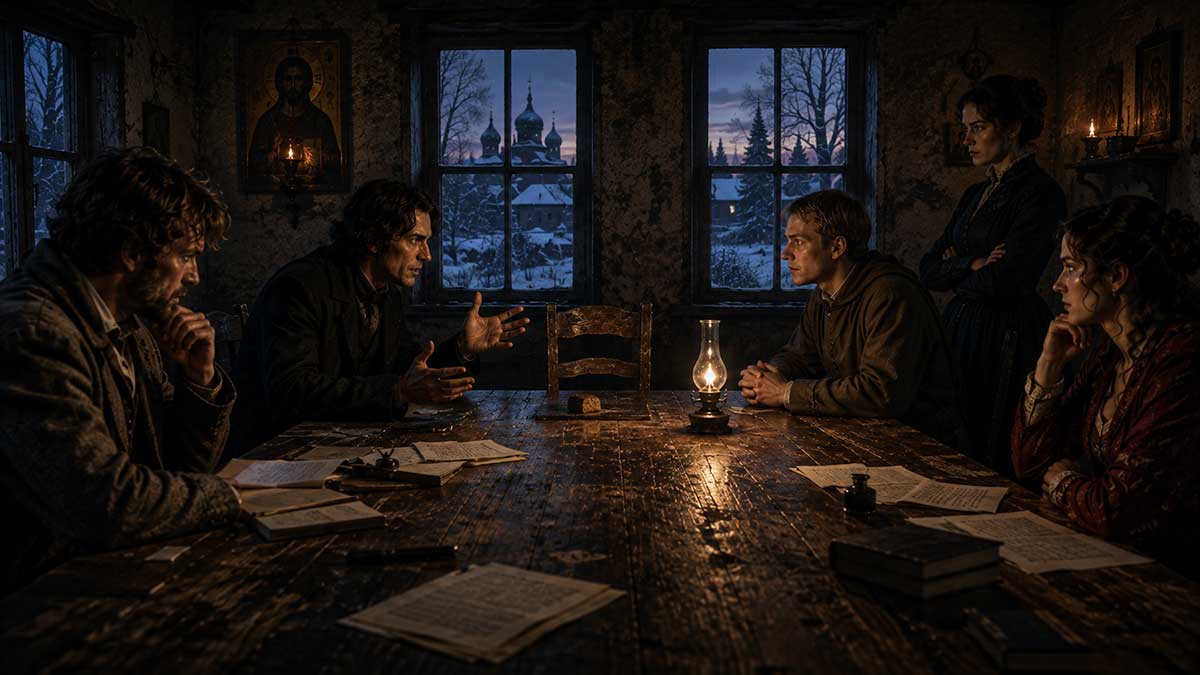
No one spoke for several moments.
The question remained in the center of the room, heavier than the empty chair.
Can morality survive without God?
Ivan had asked it without raising his voice.
That made it more dangerous.
Dmitri returned to his place near the stove. Grushenka folded her hands in her lap. Katerina watched Ivan with the guarded attention of someone who had once admired his intellect and now feared what it might demand of him.
Alyosha remained standing.
The lamp above the table made the shadows beneath his eyes appear deeper.
Ivan: Sit down.
Alyosha: Why?
Ivan: You look like a priest preparing to pronounce judgment.
Alyosha: I am not a priest.
Ivan: You have inherited the posture.
Alyosha sat.
Ivan: Let us begin honestly. Smerdyakov claimed that my ideas gave him permission to murder Father. You believe ideas carry responsibility. Mitya believes hatred carries responsibility. Katya believes wounded pride can distort truth. Agrafena Alexandrovna believes desire can turn people into weapons.
He glanced around the table.
Ivan: Yet every one of you still assumes there is some fixed moral law by which these things may be judged.
Dmitri: Murder is wrong. Does that require a lecture?
Ivan: No. It requires a foundation.
Dmitri: A dead man is foundation enough.
Ivan: Is he? Animals kill. Empires kill. Governments kill and call it duty. Churches have killed and called it obedience. Families destroy one another and call it love. Human beings rarely struggle to justify violence after they desire it.
Grushenka: Then what are you asking?
Ivan: I am asking why murder is wrong in a universe without God.
Katerina: Human suffering makes it wrong.
Ivan: Suffering makes an act painful. It does not automatically make it morally wrong.
Katerina: That sounds like wordplay.
Ivan: It is the opposite. I am refusing to hide the problem beneath a feeling.
Dmitri: I do not need God to know I should not crush a child’s skull.
Ivan turned toward him.
Ivan: You are certain?
Dmitri: Yes.
Ivan: Why?
Dmitri: Since the child is innocent.
Ivan: What makes innocence sacred?
Dmitri: It simply is.
Ivan: “Simply” is where people bury what they cannot explain.
Dmitri struck the side of the stove with his boot.
Dmitri: Then explain it yourself.
Ivan: I cannot.
Dmitri: That has never stopped you before.
Ivan: I can explain why societies prohibit murder. I can explain cooperation, sympathy, fear of punishment, evolutionary advantage, mutual dependence, and the need for trust. None of those creates an eternal law. They create useful agreements.
Alyosha: You think morality without God becomes preference?
Ivan: At best, collective preference.
Katerina: A society can still decide what is right.
Ivan: Societies have decided slavery was right. They have decided conquest was right. They have decided certain children were unworthy of life. Does agreement make them right?
Katerina: No.
Ivan: Then morality must stand above agreement.
Grushenka: And you think only God can place it there.
Ivan: I think that is the believer’s claim.
Alyosha: Is it yours?
Ivan looked toward the window.
Ivan: My claim is that people often reject God yet continue living on moral beliefs inherited from faith. They deny the source and keep the language.
Dmitri: So you do believe in God.
Ivan: No.
Dmitri: You just argued that goodness needs Him.
Ivan: Needing an idea to preserve morality does not prove the idea true.
Alyosha: Then you are trapped between two fears.
Ivan’s eyes returned to him.
Alyosha: You fear a universe ruled by a God who permits innocent suffering. You fear a universe without God in which no moral truth can stand above human desire.
Ivan: Yes.
The answer came without resistance.
Ivan: That is the prison.
Does moral outrage against God depend on belief in objective good?
Alyosha: When you reject God over the suffering of children, what gives you the right to reject Him?
Ivan: Compassion.
Alyosha: Is compassion a feeling or a truth?
Ivan: Both.
Alyosha: Feelings differ. Truth does not depend on who feels it.
Ivan: Are you trying to prove God through my anger?
Alyosha: No. I am asking what your anger points toward.
Ivan: It points toward a child in pain.
Alyosha: And says what?
Ivan: This should not happen.
Alyosha: Not merely, “I dislike this.”
Ivan: No.
Alyosha: Not merely, “Our society has prohibited this.”
Ivan: No.
Alyosha: It says the suffering is wrong, no matter who approves of it.
Ivan’s face tightened.
Ivan: Yes.
Alyosha: Then your rebellion depends on a moral truth you believe stands above society, appetite, survival, and force.
Ivan: You are trying to smuggle God into the word “wrong.”
Alyosha: I am asking where the word comes from.
Ivan: Perhaps from human consciousness.
Alyosha: Then consciousness creates morality?
Ivan: Perhaps it recognizes it.
Alyosha: Recognizes what?
Ivan leaned back.
Ivan: You have learned the old methods well. Ask enough questions and the other man eventually appears to confess your conclusion.
Alyosha: I have offered no conclusion.
Ivan: Your conclusion is waiting behind every question.
Alyosha: Then name it.
Ivan: That my moral outrage is evidence of God.
Alyosha: No.
Ivan looked surprised.
Alyosha: Your moral outrage may be evidence that you cannot live as though good and evil are inventions. That is not the same as proving God exists.
Ivan: Better.
Alyosha: Yet it means your rebellion is directed at Someone, or at least at a universe you believe has betrayed a true moral order.
Ivan: I reject the order.
Alyosha: You reject what happens within it.
Ivan: I reject any final harmony that asks me to forgive the suffering of a tortured child.
Alyosha: I would never ask you to call that suffering good.
Ivan: Then what do you ask?
Alyosha: That you do not confuse refusing evil with refusing every possibility of meaning.
Ivan: Meaning built from suffering is obscene.
Alyosha: Meaning that excuses suffering is obscene.
Ivan studied him.
Alyosha: They are not the same.
Ivan: Tell that to the theologians who explain pain from comfortable rooms.
Alyosha: I would rather tell it to the person sitting beside the suffering child.
Ivan: That is not an argument.
Alyosha: No. It is a responsibility.
Ivan’s fingers began tapping the table.
Ivan: You keep returning to action when the question is truth.
Alyosha: Perhaps truth that never becomes action is incomplete.
Ivan: There. That is where faith becomes dangerous. A man becomes certain that truth must act through him.
Dmitri: Smerdyakov acted without faith.
Ivan: He acted with certainty.
Katerina: Certainty may be the greater danger.
Grushenka: People rarely hurt others in the name of a question. They hurt them in the name of an answer.
Ivan gave her a long look.
Ivan: That may be the wisest thing said tonight.
Dmitri: Do not flatter her merely to avoid Alyosha.
Grushenka: Let him. I have been insulted by better men and praised by worse.
What prevents desire from becoming permission?
Dmitri: I still do not accept it.
Ivan: Accept what?
Dmitri: That without God, everything becomes permitted.
Ivan: I did not say it as a commandment.
Dmitri: Smerdyakov heard it that way.
Ivan: Smerdyakov heard what suited him.
Dmitri: Then what did you mean?
Ivan’s tapping stopped.
Ivan: I meant that if there is no immortality, no God, no eternal moral order, then human beings may have no final reason to place duty above desire.
Katerina: Fear of punishment is not morality.
Ivan: I agree.
Katerina: Then eternal punishment cannot be the foundation either.
Ivan: I agree again.
Alyosha: Goodness chosen only from fear is not goodness.
Dmitri: Then God changes nothing.
Alyosha: God is not merely a jailer.
Dmitri: Many believers treat Him as one.
Alyosha: Yes.
Ivan: So let us remove punishment. Why should I sacrifice myself for another person?
Grushenka: Love.
Ivan: Why should love command me?
Grushenka: Since without it you become unbearable.
Dmitri laughed.
Ivan did not.
Ivan: Suppose I do not care whether I am unbearable.
Grushenka: Then you become lonely.
Ivan: Suppose I prefer loneliness.
Grushenka: Then you become Smerdyakov.
The room fell silent.
Ivan’s face hardened.
Grushenka: You asked.
Ivan: No. You accused.
Grushenka: Smerdyakov wanted the privilege of despising everyone without needing anyone. Yet he still watched you. He still wanted your respect. He still wanted someone to tell him he was more than a servant born from shame.
Ivan: You know little about him.
Grushenka: I know what it is to turn humiliation into a throne.
Her voice softened.
Grushenka: You sit above everyone so they cannot look down on you.
Ivan looked away.
Dmitri: Answer the question, Vanya. What prevents desire from becoming permission?
Ivan: Law.
Dmitri: Law condemned me.
Ivan: Conscience.
Dmitri: Conscience can be drunk.
Ivan: Sympathy.
Dmitri: Sympathy disappears in rage.
Ivan: Reason.
Dmitri: Reason helped Smerdyakov plan the murder.
Ivan: Then perhaps nothing prevents it permanently.
Alyosha: A person can.
Ivan: Meaning?
Alyosha: Morality does not survive through theories alone. It survives when one person refuses to use another.
Ivan: That is sentiment.
Alyosha: Is it?
Ivan: Yes. You have replaced God with kindness.
Alyosha: I have said that love is how belief becomes visible.
Ivan: And what of the unbeliever who loves better than the believer?
Alyosha: I would trust the love.
Ivan stared at him.
Ivan: Over the doctrine?
Alyosha: Yes.
Dmitri: Careful, little monk.
Alyosha: A man may speak correctly about God and still destroy everyone near him. Another may doubt God and still feed the hungry, protect the weak, and refuse cruelty. Which one is closer to truth?
Ivan: You are admitting morality can survive without belief.
Alyosha: Without declared belief, yes.
Ivan: Then your argument collapses.
Alyosha: I have not argued that atheists cannot be good.
Ivan: Many believers do.
Alyosha: They are wrong.
Ivan: Then what does God add?
Alyosha paused.
Alyosha: The claim that love is not merely a temporary human preference in an indifferent universe. That each person possesses value no government, majority, family, or powerful man may erase. That goodness is more real than success. That death does not make sacrifice meaningless. That the hidden act of mercy matters, though no one sees it.
Ivan: Beautiful claims.
Alyosha: Yes.
Ivan: Beauty does not make them true.
Alyosha: No.
Ivan: Then we return to the beginning.
Alyosha: Perhaps we never left it.
Is Ivan responsible for Smerdyakov’s interpretation?
Katerina shifted in her chair.
Katerina: We are allowing Ivan to turn his own trial into a debate about civilization.
Ivan: You prefer personal humiliation. It is your native language.
Dmitri moved, but Katerina raised one hand.
Katerina: Let him.
She faced Ivan.
Katerina: Did you believe your father’s death would make life easier?
Ivan: Yes.
Katerina: Did you suspect Smerdyakov might act?
Ivan: Yes.
Katerina: Did you leave partly so you would not need to stop him?
Ivan’s jaw tightened.
Ivan: Yes.
Katerina: Then this is not mainly about whether morality can survive without God. It is about whether you used philosophy to hide a wish.
Ivan rose again.
Ivan: You think my thought was merely a mask for hatred?
Katerina: I think a person can use the highest question to avoid the lowest truth.
Ivan: Which truth?
Katerina: You wanted your father gone.
Ivan: We all did.
Katerina: Yet you wanted to remain innocent.
Ivan: Yes.
Katerina: Smerdyakov offered you both.
Ivan: I did not accept.
Katerina: You left.
Ivan: I left.
Katerina: That was your acceptance.
Ivan stepped away from the table. He stood near the window, facing the snow.
Ivan: You make action sound simple after it is finished.
Katerina: I know it is not simple.
Ivan: No. You know how to reconstruct motives from ruins.
Katerina: That is what I did at the trial.
Her voice broke slightly.
Katerina: I took fragments of Mitya’s rage and built a murderer. I took fragments of my humiliation and built justice. I know what it means to make a conclusion first and recruit every fact afterward.
Ivan turned back.
Katerina: I may be doing that to you now.
Ivan: Then stop.
Katerina: I cannot.
Ivan: Why?
Katerina: Since I think Smerdyakov did the same thing with your ideas.
Ivan remained still.
Katerina: He had resentment first. He had contempt first. He had the desire to strike back first. Then he found in your words a system that made his hatred appear intelligent.
Grushenka: That sounds true.
Dmitri: Too true.
Ivan: Then I am absolved?
Katerina: No.
Ivan: Of course not.
Katerina: You saw that he admired your disbelief. You knew he treated your questions as permission. You continued speaking to him with contempt. You enjoyed being the superior mind. You did not care what your ideas became inside a man you considered beneath you.
Ivan slowly returned to the table.
Ivan: That is closer.
Alyosha: To what?
Ivan: To my guilt.
Dmitri: Say it plainly.
Ivan: I believed Smerdyakov was intelligent enough to understand me and insignificant enough not to matter.
No one answered.
Ivan: That was the contradiction. I wanted him as an audience, not as a moral equal.
Alyosha lowered his gaze.
Ivan: He listened to me speak about God, freedom, and permission. I never asked what those ideas meant to a man who had spent his life being humiliated. I treated thought as clean since my hands remained clean.
Grushenka: And he dirtied them for you.
Ivan: He wanted me to believe that.
Dmitri: Did you?
Ivan: I do now.
Alyosha: Do you believe he had no will of his own?
Ivan: No.
Alyosha: Then he was not your instrument.
Ivan: He made himself my instrument.
Alyosha: That was his final revenge.
Ivan looked toward the empty chair.
Alyosha: He killed our father, then tried to place the murder inside you. He wanted you to carry him after his death.
Ivan: Perhaps he belonged there before the murder.
Alyosha: Partly.
Ivan: Always these portions.
Alyosha: Since truth has portions.
Ivan: Truth is whole.
Alyosha: Our access to it is not.
Ivan’s fever seemed to deepen. Sweat appeared along his hairline.
Dmitri: Sit back.
Ivan: Do not command me.
Dmitri: You look ready to fall.
Ivan: Perhaps falling is the only honest conclusion.
Grushenka: There you go again.
Ivan: What?
Grushenka: Making collapse sound noble.
Ivan turned sharply.
Grushenka: Alyosha said it to Mitya earlier. I say it to you now. There is pride in declaring yourself damned.
Ivan: You think this is pride?
Grushenka: Partly.
Ivan: What would humility look like?
Grushenka: Living.
Ivan laughed bitterly.
Grushenka: Not explaining. Not punishing yourself until everyone must gather around your suffering. Living long enough to repair one thing you helped break.
Ivan: Dmitri is condemned.
Grushenka: Then help him.
Ivan: Smerdyakov is dead.
Grushenka: Then tell the truth about him.
Ivan: Father is dead.
Grushenka: Then stop using the dead to avoid the living.
Dmitri looked at her with something close to awe.
Dmitri: Grusha—
Grushenka: Do not begin.
Is goodness still goodness without belief?
Ivan lowered himself into his chair.
Ivan: Let us suppose an unbeliever protects a child, forgives an enemy, and sacrifices his life for a stranger. Is he moral?
Alyosha: Yes.
Ivan: Is his goodness incomplete?
Alyosha: I do not know his heart.
Ivan: That answer protects you.
Alyosha: It protects him from my judgment.
Ivan: Suppose a believer prays daily, speaks of salvation, and terrorizes his family.
Alyosha: His faith is contradicted by his life.
Ivan: Then conduct matters more than belief.
Alyosha: Faith without love becomes accusation.
Ivan: You are moving dangerously close to me.
Alyosha: Perhaps you have spent years standing close to faith without admitting it.
Ivan’s eyes narrowed.
Alyosha: You believe children possess inviolable worth. You believe suffering creates a moral claim upon us. You believe no future happiness can erase cruelty. You believe a person must never be used as material for someone else’s salvation.
Ivan: Yes.
Alyosha: Those are not the convictions of a man who thinks nothing matters.
Ivan: I have never said nothing matters.
Alyosha: Smerdyakov acted as though you had.
Ivan: Then he misunderstood me.
Alyosha: Yes.
Ivan: Yet I let him.
Alyosha: Yes.
Ivan looked almost angry at the agreement.
Ivan: You grant both too easily.
Alyosha: They are both true.
Katerina: Then perhaps morality can survive without belief, but ideas cannot survive without responsibility.
Ivan glanced at her.
Katerina: A person may doubt God and remain good. A person may believe in God and remain cruel. Yet neither may claim innocence when words become shelter for another person’s evil.
Dmitri: So the question is not whether morality survives without God.
Grushenka: It is whether morality survives without love.
Alyosha looked at her.
Grushenka: Do not look surprised. I can learn one thing in a lifetime.
Ivan: Love is unstable.
Grushenka: So is reason.
Ivan: Love becomes jealousy, possession, vanity.
Grushenka: Reason becomes contempt, permission, distance.
Dmitri: Faith becomes fear.
Katerina: Sacrifice becomes control.
They looked at one another.
Each statement had named someone in the room.
Alyosha: Then no single human capacity saves us by itself.
Ivan: What does?
Alyosha: Nothing that removes freedom.
Ivan’s expression sharpened.
Ivan: You have returned to freedom.
Alyosha: We never left it.
Ivan: God creates people free, knowing what they will do, then judges them for doing it.
Alyosha: That is how you see it.
Ivan: Is it false?
Alyosha: I do not know how divine knowledge and human freedom meet.
Ivan: Convenient.
Alyosha: Painful.
Ivan: Your faith survives through mystery.
Alyosha: Your rebellion survives through mystery too.
Ivan froze.
Alyosha: You do not know why moral truth exists. You do not know why consciousness recognizes suffering as wrong. You do not know why love can command sacrifice. You do not know why a human life seems to possess value beyond usefulness.
Ivan: I admit what I do not know.
Alyosha: So do I.
Ivan: No. You place a name over it.
Alyosha: Yes.
Ivan: God.
Alyosha: God.
The word did not settle the room.
It opened it further.
The man behind the idea
Dmitri leaned forward.
Dmitri: Vanya, tell me one thing.
Ivan: What?
Dmitri: When you told Smerdyakov that everything might be permitted, did you want him to believe you?
Ivan: I never used those exact words in that exact form.
Dmitri: Do not escape into accuracy.
Ivan rubbed his forehead.
Dmitri: Did you enjoy frightening him?
Ivan looked up.
Dmitri: Did you enjoy showing him that all the commandments he had heard might rest on nothing?
Ivan: Perhaps.
Dmitri: Did you enjoy feeling braver than the believers?
Ivan: Yes.
Dmitri: Did you enjoy watching him lose the ground beneath his feet?
Ivan’s answer took longer.
Ivan: Yes.
Dmitri: Then you were not merely searching for truth.
Ivan: No.
Dmitri: You were showing strength.
Ivan: Yes.
Dmitri: That I understand.
Dmitri’s anger softened into sorrow.
Dmitri: I did it with my fists. You did it with thought.
Ivan looked at him.
For the first time that night, neither brother seemed superior to the other.
Dmitri: I wanted people to feel the storm inside me. You wanted people to feel the emptiness beneath them.
Ivan: And Alyosha?
Dmitri: He wants everyone to feel loved until they confess.
Alyosha almost smiled.
Dmitri: Do not look pleased. It is another form of pressure.
Alyosha: I know.
Katerina: We all turn our gifts into weapons.
Grushenka: Then call them weapons before calling them gifts.
The wind struck the side of the guesthouse.
Snow slipped from the roof in a heavy sheet.
Ivan: Suppose I accept all of this. Suppose I admit vanity, contempt, cowardice, and indirect responsibility. The larger question remains.
Alyosha: Yes.
Ivan: Can morality survive without God?
Alyosha: In a person, yes.
Ivan waited.
Alyosha: In a civilization, perhaps for a long time.
Ivan: And forever?
Alyosha: I do not know.
Ivan: At last.
Alyosha: Yet I fear what happens when people cease believing that any human being has value beyond usefulness.
Ivan: Religion has often failed to protect that value.
Alyosha: Yes.
Ivan: Then belief offers no guarantee.
Alyosha: No guarantee.
Ivan: No proof.
Alyosha: No proof that compels love.
Ivan: No escape from doubt.
Alyosha: No.
Ivan sat back.
Ivan: Then why believe?
Alyosha looked at the empty chair, then at Dmitri, Katerina, Grushenka, and finally Ivan.
Alyosha: Since I have seen what happens when a person is treated as worthless. Since I have seen forgiveness restore what judgment could not. Since Father Zosima taught me that no person exists alone. Since love sometimes asks more of us than survival. Since I cannot believe that such love is merely a temporary accident in a meaningless universe.
Ivan: You believe from experience.
Alyosha: Partly.
Ivan: Not certainty.
Alyosha: No.
Ivan: Then faith is a choice.
Alyosha: Yes.
Ivan: That is weaker than knowledge.
Alyosha: It is more dangerous than knowledge.
Ivan: How?
Alyosha: Knowledge does not always require the whole person.
Ivan stared at him.
Alyosha: Faith can be wrong. It can become cruel. It can protect pride. It must be tested by love, humility, and what it produces in other people.
Ivan: You would judge faith by its fruits.
Alyosha: What else can we see?
Ivan: Then Smerdyakov judged my disbelief by its fruit.
Alyosha: He judged one fruit that grew from several roots.
Ivan: You refuse to let me own the whole crime.
Alyosha: Yes.
Ivan: Why?
Alyosha: Since taking the whole crime would let you avoid your real portion.
Ivan closed his eyes.
For a moment, his face lost its severity. He looked younger, almost like the abandoned child he had once been.
Ivan: My real portion.
Alyosha: You left when you believed someone might die. You treated Smerdyakov as a mind without a soul. You used doubt to display superiority. You wished Father gone. You wanted innocence without intervention.
Ivan opened his eyes.
Ivan: Enough.
Alyosha: Yes.
The word was gentle, not obedient.
The question beneath the question
Katerina drew her coat tighter around her shoulders.
Katerina: Perhaps people do not ask whether morality can survive without God from pure philosophical interest.
Ivan: What do they ask?
Katerina: Whether anyone sees them when they choose goodness and receive nothing for it.
No one interrupted.
Katerina: Whether sacrifice matters when it is misunderstood. Whether betrayal has the final word. Whether hidden cruelty disappears if no court discovers it. Whether love given to an ungrateful person is wasted.
Grushenka watched her carefully.
Katerina: Perhaps people want God to exist since they cannot bear the thought that every unrecognized act of goodness vanishes.
Ivan: Or they want God to exist so their enemies will be punished.
Katerina: Yes.
Dmitri: Both can be true.
Grushenka: They usually are.
Alyosha: Faith may begin in fear, need, wonder, gratitude, grief, or longing. It does not remain pure merely by calling itself faith.
Ivan: Then what purifies it?
Alyosha: Love that refuses domination.
Ivan glanced at him.
Ivan: You have prepared that answer for the Grand Inquisitor.
Alyosha: I have feared that question since you told me the poem.
Dmitri: What poem?
Ivan looked at Alyosha.
A faint, strained smile appeared.
Ivan: A story about Christ returning to the world.
Grushenka: And?
Ivan: The Church arrests Him.
Dmitri: Naturally.
Katerina: Why?
Ivan: Since He gave people freedom, and the Church learned that people would rather have bread, certainty, and authority.
The room changed.
The murder, the trial, and Smerdyakov’s confession remained present, yet a wider shadow now entered beside them.
Ivan: The old cardinal tells Christ that freedom was too heavy for humanity. People do not want to choose between good and evil. They want someone to feed them, command them, forgive them in advance, and remove the burden of conscience.
Dmitri: He may be right.
Grushenka: You would surrender freedom by breakfast.
Dmitri: Only after using it badly all night.
Katerina: What does Christ say?
Ivan’s eyes moved to Alyosha.
Ivan: Nothing.
Katerina: Nothing?
Ivan: He kisses the old man.
Grushenka frowned.
Grushenka: That sounds either holy or infuriating.
Ivan: It is both.
Alyosha: The kiss does not answer every argument.
Ivan: It answers none of them.
Alyosha: Yet it refuses to answer coercion with coercion.
Ivan: And leaves humanity with the burden.
Alyosha: Freedom.
Ivan: The burden.
Alyosha: Yes.
The brothers held each other’s gaze.
One called it freedom.
The other called it burden.
Neither denied the weight.
Dmitri: Then that is where we go next.
Katerina: To the Church?
Ivan: No.
He looked toward the empty chair.
Ivan: To the question of whether human beings can bear freedom without destroying one another.
The lamp flame leaned beneath a draft.
For one moment, the empty chair appeared to cast a shadow shaped like a man.
Then the flame steadied.
No one mentioned it.
Outside, the road remained hidden beneath snow.
Topic 3: Why Must Innocent Children Suffer?
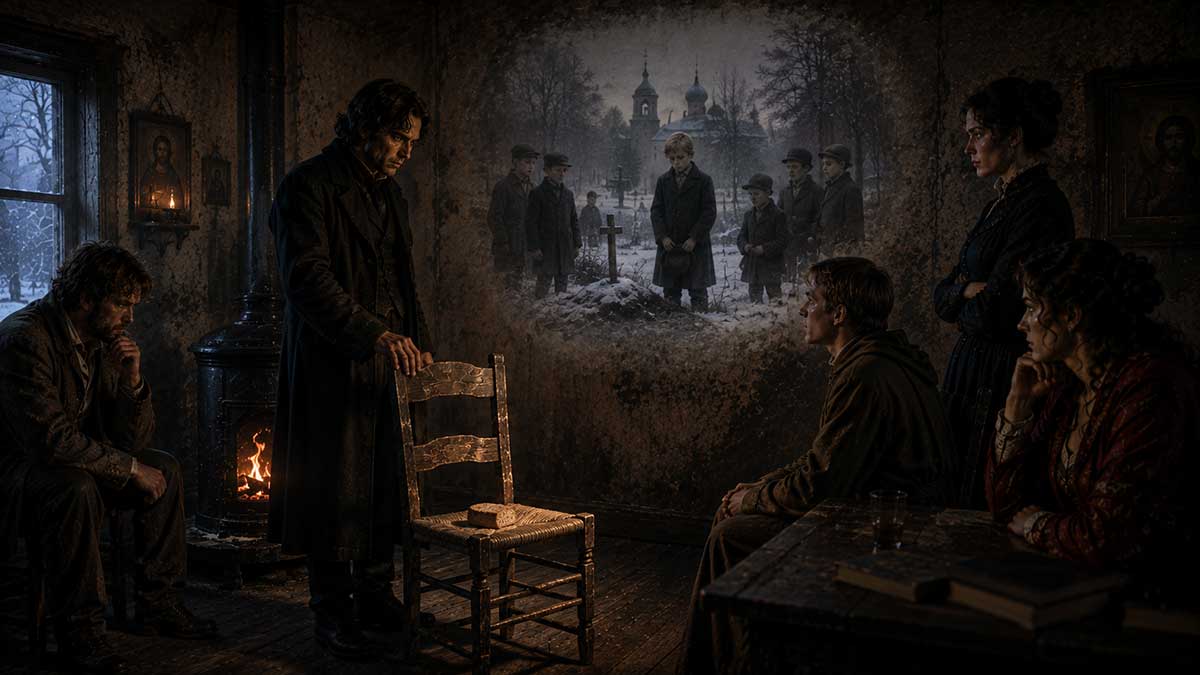
The room had grown colder.
No one had added wood to the stove.
The fire had settled into a red, breathing bed of coals, and the lamp above the table now seemed too small for the darkness pressing against the windows.
Ivan remained seated, one hand covering his eyes.
His question about freedom had opened another door, one he had been approaching since the beginning of the night.
Alyosha knew it.
He had known it before Ivan spoke.
Ivan: Before we discuss whether human beings can bear freedom, we must ask what freedom has already cost.
Dmitri looked up.
Dmitri: Whose freedom?
Ivan: God’s. Man’s. The freedom of fathers. The freedom of soldiers. The freedom of men who enter a room where a child is helpless and discover no hand descending from heaven to stop them.
No one answered.
Ivan: You speak of moral responsibility as though suffering comes mainly from poor choices that can later be confessed. Yet some suffering falls upon those who made no choice at all.
Grushenka: Children.
Ivan: Yes.
The word changed the room.
It stripped away philosophy’s distance.
Katerina looked down at her hands.
Dmitri moved away from the stove and took his chair again.
Alyosha waited.
Ivan: Let us not speak in symbols. Let us not say “innocence” as though it were an idea. Let us speak of actual children.
A child beaten by the people who should protect him.
A child locked outside in winter.
A child calling for his mother.
A child punished for wetting a bed.
A child torn apart by dogs for a rich man’s amusement.
A child praying to a God who does not arrive.
His voice remained calm.
That calm frightened them more than anger.
Ivan: I do not ask why adults suffer. Adults have eaten the fruit. Adults lie, betray, exploit, and wound one another. We may invent explanations for them.
Children have not entered the bargain.
Why are they made to pay?
Can any future redemption justify the suffering of a child?
Alyosha: It cannot be justified.
Ivan lowered his hand.
Ivan: Do not answer too quickly.
Alyosha: I have no answer that makes it acceptable.
Ivan: Then your faith has reached its limit.
Alyosha: Yes.
Dmitri turned toward him.
Dmitri: Alyosha—
Alyosha: I will not call the suffering of a child necessary. I will not say it becomes good when placed inside a larger plan. I will not tell a grieving mother that her child’s pain was required for someone else’s salvation.
Ivan’s eyes narrowed.
Ivan: Then you reject the harmony.
Alyosha: I reject any explanation that asks the victim to approve the wound.
Ivan: Yet you believe all things will be reconciled.
Alyosha: I hope they will.
Ivan: Hope is not an argument.
Alyosha: No.
Ivan: Suppose, at the end of history, every tear is wiped away. Suppose the child forgives the man who tortured him. Suppose all suffering is gathered into some final joy beyond our comprehension.
Would you accept the price?
Alyosha: No person has the right to accept it on the child’s behalf.
Ivan leaned forward.
Ivan: Then we agree.
Alyosha: On that, yes.
Ivan: Yet you remain with God.
Alyosha: Yes.
Ivan: How?
Alyosha: I do not know fully.
Ivan laughed softly.
Ivan: There is the refuge again.
Alyosha: It does not feel like refuge.
Ivan: You keep faith after admitting that you cannot defend the world your God permits.
Alyosha: I do not defend the world.
Ivan: You defend its Creator.
Alyosha: I hold to the belief that the Creator is not identical with the cruelty committed within creation.
Ivan: He allows it.
Alyosha: Yes.
Ivan: He could stop it.
Alyosha: I believe so.
Ivan: Then the distinction collapses.
Dmitri placed both hands on the table.
Dmitri: You speak as though God stands in every room where evil happens and chooses silence.
Ivan: Does He not?
Dmitri: I do not know.
Ivan: None of you know. Yet you ask the wounded to trust.
Grushenka: Sometimes trust is all a wounded person has left.
Ivan turned toward her.
Ivan: That does not make the object of trust real.
Grushenka: No. It makes the need real.
Ivan: Need creates many false gods.
Grushenka: So does pride.
Ivan flinched.
Grushenka: You think the believer invents God to survive. Perhaps the rebel invents a universe without God so he will never need to kneel.
Ivan: You believe my argument comes from pride?
Grushenka: Not all of it.
She looked into the low fire.
Grushenka: Part of it comes from love.
Ivan said nothing.
Grushenka: You are angry since the child matters to you.
Ivan: Of course the child matters.
Grushenka: More than your argument?
Ivan’s face hardened.
Ivan: The argument exists for the child.
Grushenka: Then do not let the child disappear inside it.
Is Ivan defending children, or using their suffering against God?
Katerina raised her head.
Katerina: That is the danger.
Ivan looked at her.
Katerina: You speak for suffering children with great force. Yet they cannot answer whether they wish to be used in your case against heaven.
Ivan: Used?
Katerina: You accuse believers of turning pain into theology. You may be turning it into rebellion.
Ivan: I am refusing to forgive what was done to them.
Katerina: Were you asked to forgive it?
Ivan: Every doctrine of final reconciliation asks me to.
Alyosha: Not forgiveness without the victim.
Ivan: Then who forgives?
Alyosha: The victim, if the victim ever can.
Ivan: And if the victim cannot?
Alyosha: Then no one should demand it.
Dmitri: What of justice?
Alyosha: Justice must name the wrong.
Ivan: Punish the wrongdoer?
Alyosha: Yes.
Ivan: Eternally?
Alyosha paused.
Alyosha: I do not know.
Ivan: You believe in mercy.
Alyosha: Yes.
Ivan: For the man who hurts a child?
Alyosha: Mercy is not pretending he did nothing.
Ivan: That is not my question.
Alyosha: I know.
The silence deepened.
Alyosha: I believe no person should be reduced forever to the worst act he committed. I say that with fear.
Ivan: Fear for whom?
Alyosha: For the child, lest mercy become another betrayal. For the wrongdoer, lest hatred become the final truth about a human soul. For myself, lest I speak about either person as though I see what God sees.
Ivan: Again, you preserve everyone.
Alyosha: No. I refuse to erase anyone.
Ivan: The child and the torturer remain in the same moral universe.
Alyosha: Yes.
Ivan: That is intolerable.
Alyosha: It is.
Ivan: Then why accept it?
Alyosha: Since separating human beings into those worthy of existence and those unworthy of it has produced its own horrors.
Ivan leaned back.
Ivan: You answer evil by warning me against becoming evil in response.
Alyosha: Partly.
Ivan: That is morally neat.
Alyosha: It is not neat at all.
Alyosha’s voice changed.
Alyosha: I would want to strike the man.
The room became still.
Alyosha: I would want him stopped. Restrained. Judged. I might hate him. I might fail to forgive him. I might never trust him again.
Ivan watched him closely.
Alyosha: Faith does not remove that anger.
Ivan: What does it do?
Alyosha: It prevents me from calling my anger holy too quickly.
Dmitri looked down.
Dmitri: That would have saved me from much.
Does faith explain suffering, or respond to it?
Ivan: You keep changing the task. I ask why children suffer. You answer by describing how we should behave after they suffer.
Alyosha: Since I do not possess the answer you demand.
Ivan: Then say faith fails.
Alyosha: Faith fails as an explanation that makes suffering reasonable.
Ivan’s expression sharpened.
Alyosha: Yet perhaps faith was never given to make cruelty reasonable.
Ivan: Then what is it for?
Alyosha: To keep us from abandoning the person in pain.
Ivan: An unbeliever can do that.
Alyosha: Yes.
Ivan: Then faith is unnecessary.
Alyosha: Not to every act of goodness.
Ivan: You retreat every time I approach the center.
Alyosha: No. I am trying not to claim more than I know.
Ivan stood.
Ivan: Then I will claim what I know.
He began walking slowly behind the chairs.
Ivan: I know that children suffer.
I know that many suffer in secret.
I know their cries often end without rescue.
I know adults later place words over those cries: purpose, growth, providence, mystery, free will.
I know the words come after the blood.
He stopped behind Alyosha.
Ivan: I know that any heaven built upon one child’s terror is not worth entering.
Alyosha remained still.
Ivan: Answer that.
Alyosha: I do not believe heaven is built upon terror.
Ivan: It permits the terror within the road leading there.
Alyosha: Yes.
Ivan: Then the road condemns the destination.
Alyosha: Unless God enters the suffering Himself.
Ivan’s face changed.
Ivan: There it is.
Alyosha: Yes.
Ivan: The crucified Christ.
Alyosha: Yes.
Ivan: God suffers with humanity, and that is supposed to answer the child?
Alyosha: Not answer.
Ivan: Then what?
Alyosha: Reveal that God is not watching from safety.
Ivan: The child still suffers.
Alyosha: Yes.
Ivan: The mother still buries him.
Alyosha: Yes.
Ivan: Nothing has been explained.
Alyosha: No.
Ivan stared at him with open frustration.
Ivan: Then what has changed?
Alyosha: The meaning of divine silence, perhaps.
Ivan: Perhaps.
Alyosha: If God remains distant, suffering becomes abandonment. If God enters it, suffering may still be terrible, yet it is not faced alone.
Ivan: Tell that to the child who felt alone.
Alyosha: I would not tell him what he felt.
Ivan: You would tell him Christ was there.
Alyosha: I would sit with him first.
Ivan: And later?
Alyosha: Only what he was able to hear.
Ivan returned to his chair.
Ivan: You reduce theology to presence.
Alyosha: Presence may be where theology is tested.
The suffering child in the room
Dmitri stared at the coals.
Dmitri: We speak as though the child is outside this room.
No one responded.
Dmitri: He is not.
He looked at Ivan.
Dmitri: You were abandoned.
Ivan’s face closed.
Dmitri: So was I.
He looked at Alyosha.
Dmitri: So were you.
Then at the empty chair.
Dmitri: So was Smerdyakov.
Ivan: Do not turn us into children to excuse what we became.
Dmitri: I am not excusing it.
Ivan: You are nearing it.
Dmitri: No. I am saying the child does not vanish when the body grows.
Our father neglected us, mocked our mothers, forgot us, then laughed when we returned carrying wounds he had helped make.
Katerina: Many wounded children grow into adults who wound others.
Dmitri: Yes.
Grushenka: Some become cruel.
Dmitri: Yes.
Ivan: Then innocence ends.
Alyosha: It changes.
Ivan: Meaning?
Alyosha: The adult becomes responsible for what he does with the wound.
Ivan: Yet remains shaped by what was done to him.
Alyosha: Yes.
Ivan: Then where does responsibility begin?
Alyosha: I do not know the exact line.
Dmitri: Perhaps there is no single line.
He pressed his fists into his knees.
Dmitri: I have blamed Father for my rage. Often rightly. Yet there came a day when the rage became mine.
No one gave it to me that morning.
I carried it.
Fed it.
Displayed it.
Used it to frighten people.
The wounded child inside me did not raise my fist. The man did.
Ivan watched him.
Dmitri: Smerdyakov was humiliated from birth. That matters.
He chose murder. That matters too.
Grushenka: Two truths can stand beside each other without one killing the other.
Katerina: The child explains the wound. The adult answers for the weapon.
Ivan: Convenient for those who survived their childhood without becoming murderers.
Katerina: Nothing about it is convenient.
Ivan: You say that from safety.
Katerina’s face paled.
Katerina: You know very little of my safety.
Ivan opened his mouth, then stopped.
Katerina: Every person in this room has learned to turn pain into something others must endure.
Mitya turned it into violence.
I turned it into sacrifice and accusation.
Grushenka turned it into seduction and revenge.
You turned it into contempt.
Alyosha turned it into the need to save everyone.
Alyosha looked at her.
Katerina: Yes, you too.
Alyosha: I know.
Katerina: Smerdyakov turned it into murder.
She looked at the empty chair.
Katerina: The wound deserves compassion.
The weapon demands judgment.
Can a wounded child ever be restored?
Grushenka’s voice softened.
Grushenka: What happens when no one reaches the child in time?
Alyosha: Sometimes another person reaches the adult.
Grushenka: Is that enough?
Alyosha: Sometimes it begins something.
Ivan: You place great faith in small gestures.
Alyosha: Father Zosima did.
Ivan: A remembered kindness saves a life?
Alyosha: It can.
Ivan: And what of the child who received none?
Alyosha did not answer at once.
Alyosha: Then someone must become the first kindness.
Ivan looked away.
Grushenka: That sounds beautiful.
Alyosha: It can be painful.
Grushenka: Since the person may reject it.
Alyosha: Yes.
Dmitri: Or use it.
Alyosha: Yes.
Katerina: Or punish the one who offers it.
Alyosha: Yes.
Ivan: Then why continue?
Alyosha looked directly at him.
Alyosha: Since someone did not continue with Smerdyakov.
Ivan’s breathing changed.
Alyosha: I do not say love would certainly have prevented the murder. I say he lived among people who noticed his usefulness, intelligence, sickness, bitterness, and strange habits.
Few asked what had happened to his soul.
Ivan: I spoke with him.
Alyosha: You studied him.
Ivan: I treated him as an equal mind.
Alyosha: Not as an equal person.
Ivan’s face tightened.
Alyosha: You admired his intelligence when it reflected yours. You despised his need. You gave him ideas without fellowship.
Ivan: And you avoided him.
Alyosha: Yes.
Ivan: Then do not place him entirely in my hands.
Alyosha: I do not.
Alyosha looked around the room.
Alyosha: That is the terrible point.
No one person abandoned him.
Everyone did a little.
The words entered the silence without drama.
Dmitri: Father first.
Alyosha: Yes.
Katerina: The household.
Alyosha: Yes.
Grushenka: The town.
Alyosha: Yes.
Ivan: Himself.
Alyosha turned toward him.
Alyosha: In the end, yes.
Can suffering produce goodness?
Dmitri leaned back.
Dmitri: People say suffering purifies.
Ivan’s mouth twisted.
Ivan: People who say that should be assigned someone else’s suffering.
Dmitri: I used to believe pain would make me noble.
Grushenka: You still do, at times.
Dmitri: Yes.
He looked at her without anger.
Dmitri: I imagined prison, exile, hardship. I thought suffering might burn the filth from me.
Alyosha: It may deepen it.
Dmitri: What?
Alyosha: Pain does not purify automatically.
Ivan turned toward him.
Alyosha: Suffering can make a person compassionate. It can make him cruel. It can make him humble. It can make him obsessed with himself. It can open the heart or close it.
Katerina: Then suffering has no moral value by itself.
Alyosha: I do not think it does.
Ivan: Another doctrine removed.
Alyosha: A false one, perhaps.
Dmitri: Then what gives suffering meaning?
Alyosha: What we choose within it. What others do beside us. What love refuses to let it become.
Ivan: You are very close to saying suffering becomes meaningful through human response.
Alyosha: Often, yes.
Ivan: Not through God.
Alyosha: I believe God may act through that response.
Ivan: Of course.
Grushenka: Why does that anger you?
Ivan: Since it gives God credit for human courage after failing to stop the cruelty.
No one answered quickly.
Alyosha: That accusation is fair.
Ivan looked startled.
Alyosha: It is one reason believers must speak carefully. We often praise God for rescue and say little when rescue does not come.
Katerina: Then faith can become cruel through language alone.
Alyosha: Yes.
Ivan: You concede so much that I no longer know what remains.
Alyosha: Christ remains.
Ivan: A suffering figure.
Alyosha: A person who does not explain pain from outside it.
Ivan: Still no answer.
Alyosha: No complete answer.
Ivan: Then perhaps there is none.
Alyosha: Perhaps none we can possess without becoming less human.
Ivan frowned.
Ivan: What does that mean?
Alyosha: A complete explanation of suffering might turn the sufferer into part of a system. A reason. A necessary cost. A piece in someone else’s design.
Ivan: Yes.
Alyosha: Refusing that explanation may protect the person.
Ivan became quiet.
The kiss and the unanswered child
Ivan: When I told you the poem of the Grand Inquisitor, you kissed me.
Dmitri looked from one brother to the other.
Dmitri: You kissed him?
Grushenka: Let them finish.
Ivan: You copied Christ’s answer.
Alyosha: Yes.
Ivan: I hated you for it.
Alyosha: I know.
Ivan: It felt like affection used to silence thought.
Alyosha: I feared that afterward.
Ivan: Did you regret it?
Alyosha considered.
Alyosha: I regretted that it might have seemed like an answer.
Ivan: It was not one.
Alyosha: No.
Ivan: Then why do it?
Alyosha: Since I loved you and had no words that did not sound smaller than your pain.
Ivan looked down.
Alyosha: You were speaking about children, yet part of you was asking whether your own suffering made you unlovable.
Ivan’s head rose sharply.
Ivan: Do not interpret me.
Alyosha: Then reject it.
Ivan: I do.
Alyosha: Very well.
No one believed him.
Ivan: You think every philosophy hides a wounded child.
Alyosha: Not every one.
Ivan: Mine?
Alyosha: Partly.
Ivan stood again, then seemed to lose the reason for standing.
He gripped the chair.
Ivan: Suppose that is true. Suppose I am still the boy whose father did not come. Does that weaken the argument?
Alyosha: No.
Ivan: Good.
Alyosha: It may explain why you cannot tolerate a God who seems like our father.
Ivan’s face went white.
The room seemed to disappear around the brothers.
Ivan: Say that again.
Alyosha: You cannot worship a Father who watches children suffer and calls Himself good.
Ivan: Nor should anyone.
Alyosha: No.
Ivan released the chair.
Alyosha: Perhaps the God you reject is partly Fyodor Pavlovich enlarged to heaven.
Ivan: Be careful.
Alyosha: A powerful father who abandons his children, demands respect, permits cruelty, then expects gratitude.
Ivan: That is the God many preach.
Alyosha: Yes.
Ivan: Then I reject Him rightly.
Alyosha: I reject that image too.
The words struck Ivan harder than opposition.
Ivan: Then what Father remains?
Alyosha looked at the dying coals.
Alyosha: One who kneels before His children.
Ivan stared.
Alyosha: One who washes feet. One who enters grief. One who receives violence rather than sending it outward. One who does not ask the child to suffer alone.
Ivan: Yet does not prevent it.
Alyosha: I know.
The answer held no defense.
Only grief.
Ilyusha
The wind quieted.
For the first time that night, distant bells could be heard from the monastery chapel.
Alyosha turned slightly, listening.
Alyosha: Ilyusha died believing his friends had returned to him.
Dmitri looked confused.
Dmitri: The boy?
Alyosha: Yes.
Ivan: What does his death prove?
Alyosha: Nothing.
Ivan: Then why mention him?
Alyosha: Since he suffered.
His father was humiliated.
He carried shame that was not his.
He became ill.
He feared being forgotten.
The boys had once mocked him. Then they gathered around his bed.
Ivan: And he still died.
Alyosha: Yes.
Ivan: Their kindness did not save him.
Alyosha: Not from death.
Ivan: Then what did it save?
Alyosha’s eyes filled, though his voice remained steady.
Alyosha: His final days from being empty of love.
Ivan looked away.
Alyosha: It saved the boys from allowing cruelty to become the final memory between them.
It saved his father from standing alone at the grave.
It may save those boys years from now when they are tempted to become hard.
Ivan: May.
Alyosha: Yes.
Ivan: You build hope from uncertain effects.
Alyosha: What else is hope?
Ivan had no answer ready.
Grushenka: The child died.
Alyosha: Yes.
Grushenka: Yet the love mattered.
Alyosha: Yes.
Grushenka: Both remain true.
Alyosha: Yes.
Grushenka wiped her face angrily.
Grushenka: I dislike truths that do not defeat each other.
What can be said beside the grave?
Katerina spoke quietly.
Katerina: What would each of us say to a mother whose child had been murdered?
Dmitri shook his head.
Dmitri: Nothing.
Grushenka: I would sit with her.
Ivan: I would tell her she owes forgiveness to no one.
Alyosha: Good.
Ivan glanced at him.
Katerina: I would be tempted to tell her she must survive.
Grushenka: She might hate you.
Katerina: Yes.
Dmitri: I would promise revenge.
Alyosha: And make her carry your rage too.
Dmitri nodded slowly.
Dmitri: Yes.
Ivan: What would you say, Alyosha?
Alyosha looked at the lamp.
Alyosha: I do not know.
Ivan: You must know something.
Alyosha: I would ask the child’s name.
No one moved.
Alyosha: I would ask what he loved. What made him laugh. What frightened him. Whether he had a favorite story. I would not let the manner of his death become his entire identity.
Katerina covered her mouth.
Alyosha: Evil tries to reduce a person to what was done to them.
Love remembers who they were.
Ivan’s eyes remained fixed on him.
Ivan: That does not answer God’s silence.
Alyosha: No.
Ivan: It does not restore the child.
Alyosha: No.
Ivan: It does not defeat death.
Alyosha: Not by itself.
Ivan: Yet you would begin there.
Alyosha: Yes.
Ivan returns his ticket
Ivan walked toward the empty chair.
He placed one hand on its back.
Ivan: I do not deny love.
I deny the structure that permits the need for such love.
I deny a creation where a child can be tortured and later offered compensation.
I deny any final celebration attended by the mother and the murderer together, with everyone commanded to declare that the suffering has been made right.
He looked at Alyosha.
Ivan: I do not reject God.
I return the ticket.
Alyosha: I know.
Ivan: Do you?
Alyosha: You are not saying nothing matters. You are saying the child matters too much for any explanation that absorbs him.
Ivan’s fingers tightened around the chair.
Ivan: Yes.
Alyosha: I honor that refusal.
Dmitri looked stunned.
Dmitri: Alyosha—
Alyosha: Ivan’s rebellion protects something sacred.
Ivan stared at him.
Alyosha: Yet I fear it may leave him alone beside the grave forever.
Ivan: Better alone than reconciled through a lie.
Alyosha: Yes.
Ivan: You agree again.
Alyosha: I will not ask you to accept a false peace.
Ivan: Then what do you ask?
Alyosha: Leave the possibility that love may answer without explaining.
Ivan: That is very little.
Alyosha: It may be all we can carry honestly.
Ivan looked at the empty chair.
For a moment, it no longer seemed to belong to Smerdyakov.
It seemed to belong to every absent child whose suffering had been discussed by adults after the fact.
Ivan slowly pulled the chair away from the table.
No one asked why.
He moved it beside the stove, nearer the remaining warmth.
Grushenka: What are you doing?
Ivan kept one hand on its back.
Ivan: I do not know.
Alyosha watched him.
He did not smile.
He did not name the gesture.
The bells outside stopped.
The question that follows suffering
Dmitri broke the silence.
Dmitri: If we cannot explain suffering, and we cannot remove freedom, what are we left with?
Ivan: A failed world.
Alyosha: A choice.
Ivan: Again.
Alyosha: Yes.
Ivan: The child’s suffering becomes a test for the rest of us.
Alyosha: I would not say it was given as a test.
Ivan: Yet it tests us.
Alyosha: Yes.
Katerina: Whether we look away.
Grushenka: Whether we use the pain.
Dmitri: Whether we become like the one who caused it.
Ivan: Whether we surrender freedom to someone who promises to prevent it.
Alyosha looked at him.
Alyosha: That is the next danger.
Ivan: The Grand Inquisitor.
Alyosha: Yes.
Ivan returned to his chair.
The fever in his face had not lessened, yet something in his expression had changed.
He no longer looked like a man trying to win.
He looked like a man who had placed an unbearable object on the table and discovered that no one could carry it away.
Ivan: People will surrender freedom if someone promises that no child will suffer.
Katerina: Would that be wrong?
Ivan: What if the promise is a lie?
Dmitri: Most promises are.
Ivan: What if the price is obedience?
Grushenka: Many would pay it.
Ivan: What if the authority offering bread, safety, and certainty becomes the next father who cannot be questioned?
Alyosha glanced at the chair Ivan had moved beside the stove.
Alyosha: Then the attempt to end suffering may create another form of it.
Ivan: Now we are ready.
He looked around the room.
Ivan: Can human beings bear freedom when freedom allows them to harm the innocent?
No one answered.
The final coals shifted inward, glowing briefly before darkening again.
Outside, the snow continued to bury the road.
Topic 4 will move directly into The Grand Inquisitor and whether human beings would trade freedom for bread, security, and certainty.
Topic 4: Is Freedom Too Heavy for Human Beings?
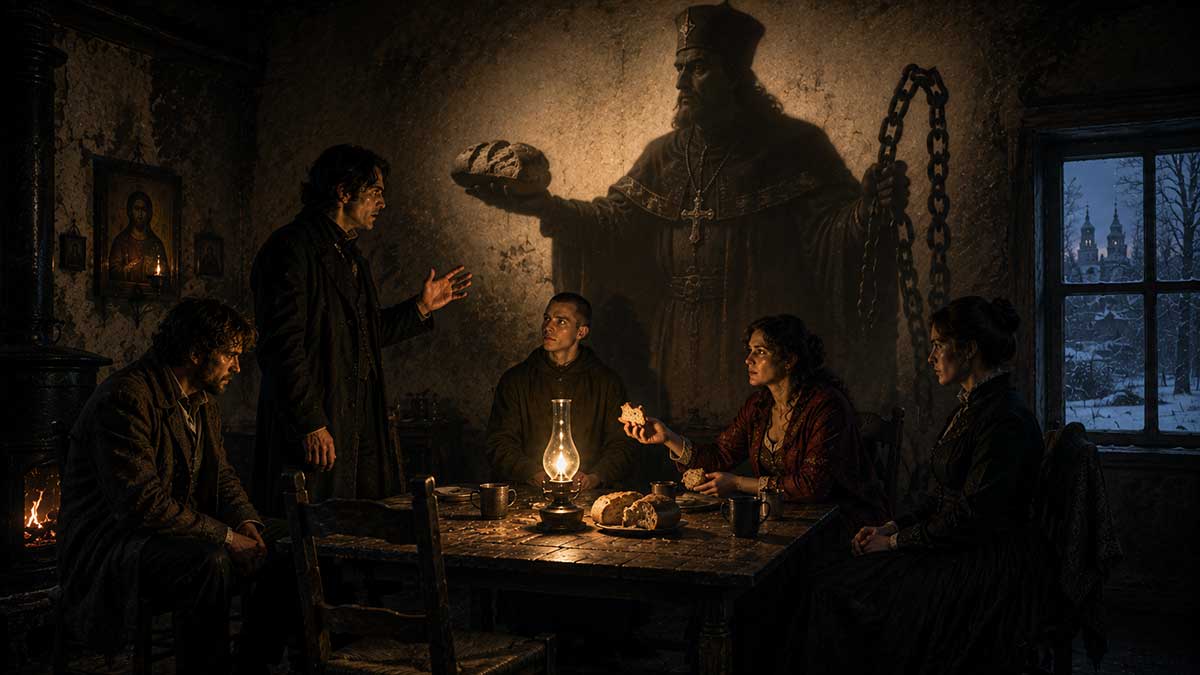
The fire had nearly gone out.
Only a thin line of red remained beneath the blackened wood, like an answer refusing to disappear.
The chair Ivan had moved beside the stove stood empty.
No one returned it to the table.
Outside, the snow had stopped falling, yet the road remained buried. The world beyond the windows looked clean, silent, and unreachable.
Ivan leaned back, exhausted from speaking, but his eyes remained alert.
Ivan: Let us suppose a ruler makes a promise.
No child will go hungry.
No family will sleep without shelter.
No one will be left alone in sickness.
No one will need to carry the uncertainty of choosing between good and evil.
The ruler will decide.
In exchange, the people must obey.
Dmitri rubbed his hands together near the dying fire.
Dmitri: They would accept.
Katerina: Many would.
Grushenka: Most would ask how soon the food arrives.
Alyosha: And what would you do?
Grushenka looked at him.
Grushenka: I would ask what happens to the person who refuses the bread.
Ivan nodded.
Ivan: That is the correct question.
Would people trade freedom for bread and certainty?
Dmitri: A hungry man does not care about freedom.
Ivan: Precisely.
Dmitri: Do not sound pleased. Hunger is not philosophy.
Ivan: No. It is stronger.
Dmitri: A man with an empty stomach will promise anything.
Katerina: Then freedom belongs mainly to those who can afford it.
Alyosha: It should not.
Katerina: Yet often it does.
She looked around the plain room.
Katerina: People praise independence when they have money, health, education, and someone to help them if they fail. A poor mother may choose security without being weak.
Ivan: The Grand Inquisitor would agree.
Grushenka: He would use her need against her.
Ivan: He would say he is relieving her burden.
Dmitri: Perhaps he is.
Alyosha turned toward him.
Dmitri: Do not look at me that way. You ask people to make noble choices in conditions that make nobility expensive.
A starving man steals bread.
A frightened man obeys.
A lonely man follows whoever gives him a place to stand.
A desperate man kneels before the first authority that says, “I know what to do.”
Ivan: Exactly.
Alyosha: Then the answer is to remove the desperation, not the freedom.
Ivan smiled faintly.
Ivan: Beautiful. Who removes it?
Alyosha: We do.
Ivan: Through what? Charity? Government? Church? Revolution? Family?
Alyosha: Any means that does not turn the person into property.
Ivan: That is where every noble plan begins.
Katerina: And where does it end?
Ivan: With someone deciding that people cannot be trusted with their own lives.
The lamp flame lowered, then rose again.
Ivan: The Grand Inquisitor tells Christ that humanity does not want freedom. People want miracle, mystery, and authority.
They want someone to prove truth for them.
Someone to remove doubt.
Someone to take responsibility for their choices.
Someone to say, “Obey, and you will be safe.”
Grushenka: People say they want truth. Often they want relief.
Ivan: Yes.
Dmitri: Relief is not shameful.
Ivan: No. That is why control works.
What does the Grand Inquisitor believe?
Katerina: Tell us the whole argument.
Ivan studied her, as though deciding how much strength remained in him.
Ivan: Christ returns to Seville during the Inquisition.
The people recognize Him.
He heals the sick.
He raises a dead child.
The crowd gathers.
Then the cardinal orders His arrest.
Dmitri: A brave church.
Ivan: A successful one.
Alyosha: Those are not the same.
Ivan: The cardinal visits Christ in prison and tells Him that He made a terrible mistake.
Christ gave humanity freedom.
He refused to turn stones into bread.
He refused to prove Himself through spectacle.
He refused political domination.
He asked human beings to love freely.
The cardinal says this demand was too great.
People are weak.
They cannot live with uncertainty.
They cannot govern desire.
They cannot endure the responsibility of choosing faith without proof.
So the Church corrected Christ’s work.
Grushenka: By taking freedom away.
Ivan: By managing it.
Katerina: That is the word authorities prefer.
Ivan: The cardinal offers bread, miracle, and command.
People obey.
In return, they are relieved of conscience.
Dmitri: And the cardinal believes he is helping them?
Ivan: Yes.
Dmitri: That makes him worse.
Ivan: Or more dangerous.
Alyosha: He does not merely desire domination. He believes domination is merciful.
Ivan: Exactly.
The greatest tyrant is rarely the man who says, “I hate humanity.”
It is the man who says, “Humanity is too weak to be free.”
Is freedom a gift or a punishment?
Dmitri: Perhaps humanity is too weak.
Alyosha: You do not believe that.
Dmitri: Look at me.
He opened his arms.
Dmitri: Give me freedom, and I drink, gamble, threaten, fall in love with two women, assault a servant, ruin my honor, and nearly kill my father.
Grushenka: That is a selective account.
Dmitri: It is an accurate one.
Alyosha: You have used freedom badly.
Dmitri: Then what proves I should keep it?
Alyosha: No one becomes good by having goodness forced upon him.
Dmitri: He may become less dangerous.
Ivan: There.
Dmitri turned.
Ivan: That is the cardinal’s argument.
People may never become virtuous, but they can become manageable.
Katerina: Is manageable always worse than violent?
No one answered immediately.
Katerina: Suppose an authority prevents murder, hunger, exploitation, and war, yet restricts speech, choice, movement, and belief.
Which loss is greater?
Ivan: The question assumes the authority keeps its promise.
Katerina: Suppose it does.
Ivan: It will not.
Katerina: That avoids the dilemma.
Ivan: No authority powerful enough to remove human freedom remains innocent.
Grushenka: Nor does every free person.
Ivan: True.
Katerina: Then perhaps the choice is between dangerous freedom and dangerous control.
Alyosha: It often is.
Dmitri: Which would you choose?
Alyosha: Freedom.
Dmitri: Knowing what people do with it?
Alyosha: Yes.
Ivan: Knowing children suffer under it?
Alyosha’s face tightened.
Alyosha: Yes.
Ivan: Then you accept the price you refused to accept earlier.
Alyosha: No.
Ivan: Explain the difference.
Alyosha: I do not accept suffering as justified. I accept that removing the possibility of evil may require removing the possibility of love.
Ivan: A familiar answer.
Alyosha: It remains difficult.
Ivan: Does a child care that the man who hurt him possessed the freedom to love instead?
Alyosha: No.
Ivan: Then freedom is defended by the person who was not destroyed by it.
Alyosha: That is a fair accusation.
Dmitri looked at Alyosha with concern.
Alyosha: Yet control does not remove evil. It gathers it into fewer hands.
Ivan’s expression shifted.
Alyosha: A free man may abuse one person. A ruler who claims authority over conscience may abuse a nation.
Katerina: Families can do the same in smaller form.
Grushenka: So can lovers.
Dmitri glanced at her.
Grushenka: Do not pretend surprise.
Can love exist without freedom?
Alyosha: Love must be chosen.
Ivan: Must it?
Alyosha: Yes.
Ivan: A child does not choose dependence on a mother.
Alyosha: Dependence is not the whole of love.
Ivan: A person may remain loyal through duty.
Alyosha: Duty can carry love when feeling is weak.
Katerina: It can carry resentment too.
Alyosha: Yes.
Ivan: Suppose a husband remains faithful only since law, family, and religion give him no other option. Is he virtuous?
Grushenka: No. He is supervised.
Dmitri: Supervision would improve many husbands.
Grushenka: Including you.
Dmitri: Especially me.
A faint warmth passed through the room, then vanished.
Alyosha: An act may still protect others, though the heart is not free.
Ivan: Then forced goodness has value.
Alyosha: The protected person benefits from the act. The person performing it has not necessarily become good.
Ivan: Society may care more about behavior than the soul.
Katerina: It usually does.
Alyosha: A society must restrain harm. It cannot manufacture love.
Ivan: Religion has often tried.
Alyosha: Yes.
Ivan: Through fear.
Alyosha: Yes.
Ivan: Through shame.
Alyosha: Yes.
Ivan: Through promises of paradise and threats of hell.
Alyosha: Yes.
Ivan: Then the Church has often served the Grand Inquisitor.
Alyosha did not look away.
Alyosha: Yes.
The answer disturbed Dmitri more than resistance would have.
Dmitri: You agree too easily.
Alyosha: I agree where the accusation is true.
Dmitri: Then what remains of the Church?
Alyosha: Whatever still resembles Christ.
Ivan: Very little, at times.
Alyosha: At times.
Has religion protected freedom or betrayed it?
Katerina: Can a religious institution hold authority without becoming controlling?
Ivan: Eventually, no.
Alyosha: I do not accept that.
Ivan: Every institution protects itself.
Alyosha: Often.
Ivan: It begins by serving truth, then confuses itself with truth.
Alyosha: Yes.
Ivan: It teaches people to obey leaders as though obeying God.
Alyosha: That is idolatry.
Ivan: Yet religious leaders benefit from it.
Alyosha: Some do.
Ivan: More than some.
Alyosha: Yes.
Ivan leaned forward.
Ivan: Then why trust an institution that claims access to eternal truth?
Alyosha: I do not trust it without examination.
Ivan: By what standard do you examine it?
Alyosha: Whether it protects the weak.
Whether it tells the truth about its own failures.
Whether leaders can be questioned.
Whether repentance is demanded from those with authority, not merely from those beneath them.
Whether love is practiced without coercion.
Whether the person remains a person rather than becoming a number, sinner, enemy, donor, or obedient body.
Grushenka: Few institutions would survive that test.
Alyosha: Then they should fail it openly.
Ivan: You would reform the Church by making it less certain of itself.
Alyosha: By making it more honest.
Ivan: Institutions do not confess unless forced.
Katerina: Neither do families.
Dmitri: Nor individuals.
Grushenka: We have spent the entire night proving that.
Is certainty more dangerous than doubt?
Katerina: Earlier, I said certainty may be more dangerous than disbelief.
Ivan looked toward her.
Katerina: I believed I knew Mitya.
I believed my suffering revealed his whole character.
I believed the letter proved what I wanted it to prove.
Certainty allowed me to injure him without feeling cruel.
Dmitri: Katya—
Katerina: No. Let me keep the sentence.
She folded her hands more tightly.
Katerina: Doubt might have stopped me.
Ivan: Doubt can paralyze.
Katerina: It can.
Ivan: It left me inactive when action was needed.
Katerina: Then neither certainty nor doubt saves us.
Alyosha: Humility may help.
Ivan gave him a tired look.
Ivan: The believer’s favorite word when evidence is missing.
Alyosha: The skeptic needs it too.
Ivan: Explain.
Alyosha: A believer may say, “God agrees with me.”
A skeptic may say, “Anyone who believes is a fool.”
Both can use certainty to stop seeing the person before them.
Grushenka: Pride wears religious and intelligent clothing equally well.
Dmitri: Mine rarely wears clothing at all.
No one laughed this time, yet Ivan’s mouth almost moved.
Ivan: What kind of humility would have stopped Smerdyakov?
Alyosha: Yours, perhaps.
Ivan: Meaning?
Alyosha: The humility to ask what your ideas were doing inside another man.
Ivan: And his?
Alyosha: The humility to admit that resentment had become desire.
Dmitri: Father’s?
Alyosha: The humility to see his sons as people rather than entertainment.
Katerina: Mine?
Alyosha: The humility to separate love from possession.
Grushenka: Mitya’s?
Alyosha: The humility to leave a room before rage became action.
Dmitri: Yours?
Alyosha paused.
Alyosha: The humility to understand that love without confrontation may become avoidance.
Dmitri nodded slowly.
Ivan: Humility sounds remarkably like seeing oneself accurately.
Alyosha: Perhaps that is what it is.
Why does Christ remain silent?
Grushenka looked toward Ivan.
Grushenka: The cardinal speaks for a long time.
Christ says nothing.
Why?
Ivan: Since Dostoevsky could not answer the argument.
Alyosha glanced at him.
Ivan: Do not object. The silence protects Christ from losing the debate.
Katerina: Or words would place Him inside the cardinal’s terms.
Ivan: Which terms?
Katerina: Control or chaos. Bread or freedom. obedience or suffering.
Perhaps silence refuses the choice.
Ivan studied her.
Grushenka: Then He kisses him.
Dmitri: Which seems insufficient.
Ivan: It is insufficient.
Alyosha: It may be deliberately insufficient.
Ivan: That is convenient poetry.
Alyosha: The cardinal wants Christ to defeat him through authority.
Christ refuses.
Ivan: He could answer through reason.
Alyosha: The cardinal does not lack reasons.
Katerina: He lacks trust in humanity.
Alyosha: Yes.
Katerina: Then the kiss says people are still worthy of freedom.
Ivan: The cardinal would call that cruelty.
Alyosha: Since freedom permits failure.
Ivan: And atrocity.
Alyosha: Yes.
Ivan: Stop agreeing with the worst part.
Alyosha: I cannot make the cost smaller.
Ivan stood and began walking again.
Ivan: Suppose a physician possesses a medicine that removes violence from the human mind.
No rage.
No murder.
No cruelty.
It removes certain desires, memories, ambitions, and forms of imagination too.
Would you give it to everyone?
Dmitri: Give me two doses.
Grushenka: You would find a way to become troublesome without rage.
Katerina: Would people consent?
Ivan: Some would. Others would refuse.
Alyosha: Then it cannot be forced upon them.
Ivan: Knowing their refusal may lead to murder?
Alyosha: Restrain the murderer.
Ivan: After the victim is dead.
Alyosha: Prevent where possible.
Ivan: Without controlling thought?
Alyosha: Yes.
Ivan: You want safety without domination.
Alyosha: Yes.
Ivan: Bread without obedience.
Alyosha: Yes.
Ivan: Community without conformity.
Alyosha: Yes.
Ivan: Faith without coercion.
Alyosha: Yes.
Ivan: You want what history rarely gives.
Alyosha: That does not make it unworthy of pursuit.
The family as a small empire
Dmitri looked toward the empty chair by the stove.
Dmitri: Father was our Grand Inquisitor.
Ivan stopped walking.
Dmitri: Not a very competent one.
Yet he controlled through money, shame, uncertainty, and appetite.
He made us compete for what should have been freely given.
Affection.
Recognition.
Inheritance.
A place in the family.
Katerina: He offered no security.
Dmitri: He offered the possibility of favor. That can control a person more strongly.
Grushenka: He kept everyone guessing.
Ivan: Unpredictability creates obedience.
Alyosha: Or rebellion.
Ivan: Both serve the ruler. The obedient remain near him. The rebels remain defined by him.
Dmitri became quiet.
Dmitri: I thought resisting him made me free.
Ivan: You built your life around opposition to him.
Dmitri: Then I remained his son in every choice.
Grushenka: You are his son whether you obey or resist.
Dmitri: That is not comforting.
Grushenka: Truth rarely asks whether it comforts you.
Katerina: Parents may control children through approval long after childhood ends.
Ivan: Governments do the same through belonging.
Churches through salvation.
Lovers through withdrawal.
Societies through shame.
Alyosha: Then freedom begins with recognizing the control.
Ivan: Recognition is not escape.
Alyosha: No.
Dmitri: What is?
Alyosha: Choosing something that is not merely reaction.
Dmitri: Such as?
Alyosha: You may refuse to become Father without pretending he did not shape you.
Dmitri looked toward the dead fire.
Alyosha: Ivan may refuse both belief forced by fear and disbelief used as superiority.
Ivan raised an eyebrow.
Alyosha: Katya may love without requiring suffering as proof.
Katerina lowered her eyes.
Alyosha: Grushenka may receive love without testing how much pain it can survive.
Grushenka’s expression hardened, then softened.
Alyosha: I may help without needing to be the person who saves everyone.
Ivan: That last freedom may be the hardest for you.
Alyosha: Yes.
Do people truly want to be free?
Katerina: Perhaps the Grand Inquisitor is right about one thing.
Ivan: Only one?
Katerina: People often ask someone else to choose, then blame that person for the result.
Grushenka: A person wants control when the outcome is good and innocence when it is bad.
Dmitri: That describes marriage, politics, religion, and gambling.
Ivan: It describes humanity.
Alyosha: It describes fear.
Ivan: Fear is part of humanity.
Alyosha: Not the whole.
Ivan: What else?
Alyosha: Courage.
Ivan: Rare.
Alyosha: Still real.
Ivan: Love.
Alyosha: Yes.
Ivan: Unstable.
Alyosha: Still real.
Ivan: Sacrifice.
Alyosha: Yes.
Ivan: Often mixed with pride.
Alyosha: Still real.
Ivan shook his head.
Ivan: You keep rescuing human beings with exceptions.
Alyosha: You condemn them with patterns.
Ivan: Patterns govern history.
Alyosha: People live one life at a time.
The sentence stopped Ivan.
Alyosha: The Grand Inquisitor looks at humanity as a mass.
Weak.
Hungry.
Frightened.
Easily led.
Christ looks at persons.
Ivan: That distinction may be sentimental.
Alyosha: It may be the entire difference.
Katerina: A ruler feeds populations.
A person feeds a hungry neighbor.
Ivan: Populations cannot survive through neighborly kindness alone.
Alyosha: No.
Ivan: Then institutions remain necessary.
Alyosha: Yes.
Ivan: Authority remains necessary.
Alyosha: Yes.
Ivan: Laws remain necessary.
Alyosha: Yes.
Ivan: Yet each contains the seed of control.
Alyosha: Which is why authority must remain answerable.
Katerina: To whom?
Alyosha: To those most vulnerable beneath it.
Ivan: Authorities rarely accept judgment from below.
Grushenka: Then those below must speak together.
Dmitri: Until they become the new authority.
Ivan: And repeat the pattern.
Alyosha: Perhaps freedom is not a condition achieved once.
Ivan: What is it?
Alyosha: A responsibility renewed every time someone gains influence over another person.
Bread without chains
Grushenka rose and walked to the shelf near the wall. A small loaf of dark bread sat beneath a cloth.
She brought it to the table.
Grushenka: We have spoken of bread long enough.
She broke the loaf into uneven pieces.
One piece for Alyosha.
One for Ivan.
One for Katerina.
One for Dmitri.
One for herself.
Then she carried the final piece to the empty chair beside the stove and placed it on the seat.
Dmitri: That is strange.
Grushenka: So is this night.
She sat down.
Ivan: What does the gesture mean?
Grushenka: Must everything be explained to you?
Ivan: Preferably.
Grushenka: The cardinal gives bread in exchange for obedience.
I give it since we are hungry.
Ivan: No price?
Grushenka: You may insult me later.
Dmitri: He will.
They began to eat.
For a few moments, the debate gave way to chewing, breathing, and the quiet breaking of crust.
Ivan held his piece without eating.
Alyosha: What is it?
Ivan: People cannot live by symbols.
Grushenka: Nor without food.
Ivan: This loaf does not answer political hunger.
Grushenka: No. It answers this room.
Ivan looked at the bread.
Then he ate.
The temptation to surrender
Dmitri wiped crumbs from his hands.
Dmitri: I would surrender freedom tonight.
Alyosha looked at him.
Dmitri: Let someone else decide whether I escape, go to Siberia, confess, resist, suffer, repent, marry Grusha, release her, or begin again.
Let someone command me.
Then if everything fails, the failure belongs to him.
Grushenka: No.
Dmitri turned.
Grushenka: I will not become your command.
Dmitri: I did not ask you.
Grushenka: You were preparing to.
She leaned closer.
Grushenka: I will walk with you.
I will argue.
I will warn you.
I may leave if you become cruel.
I may stay when you think you deserve abandonment.
Yet I will not carry your conscience.
Dmitri’s face tightened.
Dmitri: That sounds less romantic than what I hoped.
Grushenka: Good.
Katerina: Freedom may mean that no one can love us enough to choose for us.
Alyosha: Yes.
Ivan: That sounds like loneliness.
Alyosha: It can feel like it.
Ivan: Then the Grand Inquisitor offers companionship.
Katerina: No. He offers supervision.
Ivan: Many cannot tell the difference.
Grushenka: Some do not want to.
Can freedom survive fear?
The wind returned, pressing softly against the windows.
Ivan: People surrender freedom most willingly when they are afraid.
Fear of hunger.
Fear of invasion.
Fear of disorder.
Fear of disease.
Fear of outsiders.
Fear of God.
Fear of death.
Give people an enemy, then promise protection.
They will bring their freedom to you themselves.
Katerina: What should a leader do when the danger is real?
Ivan: Never waste a real danger.
Alyosha: That is what a corrupt leader does.
Ivan: A capable one too.
Alyosha: There is the temptation.
Ivan: You think restraint is possible during crisis?
Alyosha: It must be.
Ivan: History disagrees.
Alyosha: History records failures more loudly than quiet acts of restraint.
Ivan: Another hopeful exception.
Alyosha: Another real person.
Ivan sighed.
Katerina: How can people know when protection has become domination?
Grushenka: When questions become betrayal.
Dmitri: When leaders demand gratitude for what belongs to everyone.
Alyosha: When fear is kept alive after the danger passes.
Ivan: When obedience becomes a moral virtue by itself.
Katerina: When the authority cannot admit error.
They paused.
The answers had come too easily.
Each person recognized some version of the pattern.
The final temptation
Ivan: The Grand Inquisitor’s deepest accusation is not that Christ misunderstood politics.
It is that He loved humanity too highly.
He asked too much.
He believed people could choose love freely.
The cardinal claims to love them more realistically.
He lowers the demand.
He gives them order.
He permits secret sin.
He carries the burden of knowledge for them.
They live and die as obedient children.
Dmitri: And the cardinal suffers for them?
Ivan: He says he does.
Katerina: That is how control disguises itself as sacrifice.
Grushenka: “I have given everything for you, so you owe me your life.”
Katerina flinched.
Grushenka saw it.
Grushenka: I was not speaking only of you.
Katerina: Yet you were speaking of me.
Grushenka: Partly.
Katerina nodded.
Ivan: The cardinal believes only a small number can bear freedom. Those few must rule the rest.
Alyosha: Every controlling system begins by dividing humanity into the enlightened and the incapable.
Ivan: Your monastery has elders and disciples.
Alyosha: Spiritual guidance becomes corrupt when obedience replaces conscience.
Ivan: Did you never obey Zosima?
Alyosha: Yes.
Ivan: Then what is the difference?
Alyosha thought carefully.
Alyosha: He wanted me to become responsible, not dependent.
He sent me out of the monastery.
He did not ask me to remain beneath him.
Ivan: A true teacher makes himself unnecessary.
Alyosha: Perhaps.
Katerina: A false one calls dependence loyalty.
The kiss reconsidered
Ivan’s strength seemed to be fading. His voice lowered.
Ivan: At the end of the poem, Christ kisses the cardinal.
The old man opens the prison door.
He tells Christ to leave and never return.
Dmitri: Does the kiss change him?
Ivan: It burns in his heart.
He does not change his beliefs.
Grushenka: Then love fails.
Alyosha: Not entirely.
Ivan: He continues the system.
Alyosha: Yes.
Ivan: Then what does the kiss accomplish?
Alyosha: It leaves him unable to claim he was never seen.
Ivan looked at him.
Alyosha: Christ does not defeat him, obey him, or become him.
He sees the fear beneath the authority.
He loves the person without approving the system.
Ivan: And then leaves the people under his control.
Alyosha: That remains difficult.
Ivan: You mean indefensible.
Alyosha: Perhaps the poem ends before the real answer.
Ivan: There is no answer.
Alyosha: Or the answer must be lived by those outside the prison.
Katerina: Meaning?
Alyosha: People must learn to give bread without demanding souls.
To offer faith without force.
To build order without worshipping authority.
To protect the vulnerable without treating them as helpless forever.
To lead without needing obedience as proof of love.
Ivan: You make freedom sound like endless vigilance.
Alyosha: It may be.
Dmitri: Exhausting.
Grushenka: Better than being owned.
What are human beings free for?
Ivan rested both arms on the table.
Ivan: We have spoken about freedom from authority.
What are people free for?
Dmitri: Pleasure.
Grushenka: That answer has served you poorly.
Katerina: Achievement.
Ivan: And when achievement becomes identity?
Katerina: Then failure becomes annihilation.
Grushenka: Love.
Ivan: Love becomes possession.
Grushenka: It can.
Alyosha: Responsibility.
Ivan looked at him.
Ivan: Freedom exists so that we may become responsible?
Alyosha: Partly.
Ivan: That sounds like replacing one burden with another.
Alyosha: It is.
Dmitri: Then the cardinal is right. Freedom is heavy.
Alyosha: Yes.
Ivan: Too heavy?
Alyosha looked toward the empty chair, the piece of bread still resting upon it.
Alyosha: Too heavy to carry alone.
The answer quieted the room.
Ivan: Then community is necessary.
Alyosha: Yes.
Ivan: Yet community threatens freedom.
Alyosha: It can.
Ivan: Authority is necessary.
Alyosha: Yes.
Ivan: Yet authority threatens dignity.
Alyosha: It can.
Ivan: Love is necessary.
Alyosha: Yes.
Ivan: Yet love threatens possession.
Alyosha: It can.
Ivan gave a tired, almost peaceful smile.
Ivan: Your entire faith has become “it can.”
Alyosha: Human beings can corrupt every good thing.
Ivan: Then what hope remains?
Alyosha: That we can confess it, correct it, and choose again.
The freedom to begin again
Dmitri looked toward the window.
The sky had begun to lighten slightly, though dawn remained distant.
Dmitri: By morning, others will choose for me.
Guards.
Judges.
Officials.
Perhaps an escape plan.
Perhaps chains.
Where is my freedom then?
Alyosha: In what kind of man enters the chains.
Dmitri: That sounds like something said by a man without chains.
Alyosha: Yes.
Dmitri looked at him sharply.
Alyosha: I cannot know what your suffering will demand.
I should not romanticize it.
Your freedom will be limited by injustice.
Yet no court can fully decide whether you become cruel, truthful, bitter, compassionate, or false.
Ivan: Circumstances can break a person.
Alyosha: Yes.
Ivan: Then do not make inner freedom invincible.
Alyosha: I will not.
Grushenka: We will help him carry it.
Dmitri looked at her.
Grushenka: Not choose for him.
Carry it.
Katerina: There is a difference.
Ivan: Perhaps that is what the cardinal refuses to believe.
Alyosha: What?
Ivan: That weak people may need support without needing masters.
Alyosha nodded.
Ivan: Bread without chains.
Guidance without ownership.
Faith without terror.
Love without captivity.
He looked toward the empty chair.
Ivan: It sounds impossible.
Grushenka: Many necessary things do.
The final question
Katerina rose and placed another piece of wood into the stove.
For a moment, nothing happened.
Then a small flame caught along one edge.
Katerina: If freedom is so easily corrupted, what prevents a family from destroying itself again?
No one answered at once.
Dmitri looked at Grushenka.
Katerina looked at Dmitri.
Ivan looked at Alyosha.
Alyosha looked at them all.
Alyosha: Love.
Ivan closed his eyes.
Ivan: We have already established that love becomes possession, pride, jealousy, sacrifice, punishment, and control.
Alyosha: Then we must ask what love is when it refuses those things.
Dmitri: And whether any of us has ever practiced it.
Grushenka: Not for long.
Katerina: Perhaps long enough to recognize the difference.
Ivan opened his eyes.
Ivan: The murder began in a family where everyone wanted love and nearly everyone turned it into a weapon.
Alyosha: Yes.
Ivan: Then the final question is not whether love feels strong.
Grushenka: It is whether love stops destroying the person it claims to need.
The new flame climbed slowly through the wood.
Outside, the first pale line of morning appeared behind the trees.
The road was still buried.
Yet it could now be seen.
Ivan: Very well.
Let us ask whether love can redeem a family that has already destroyed itself.
Topic 5: Can Love Redeem a Family That Destroyed Itself?
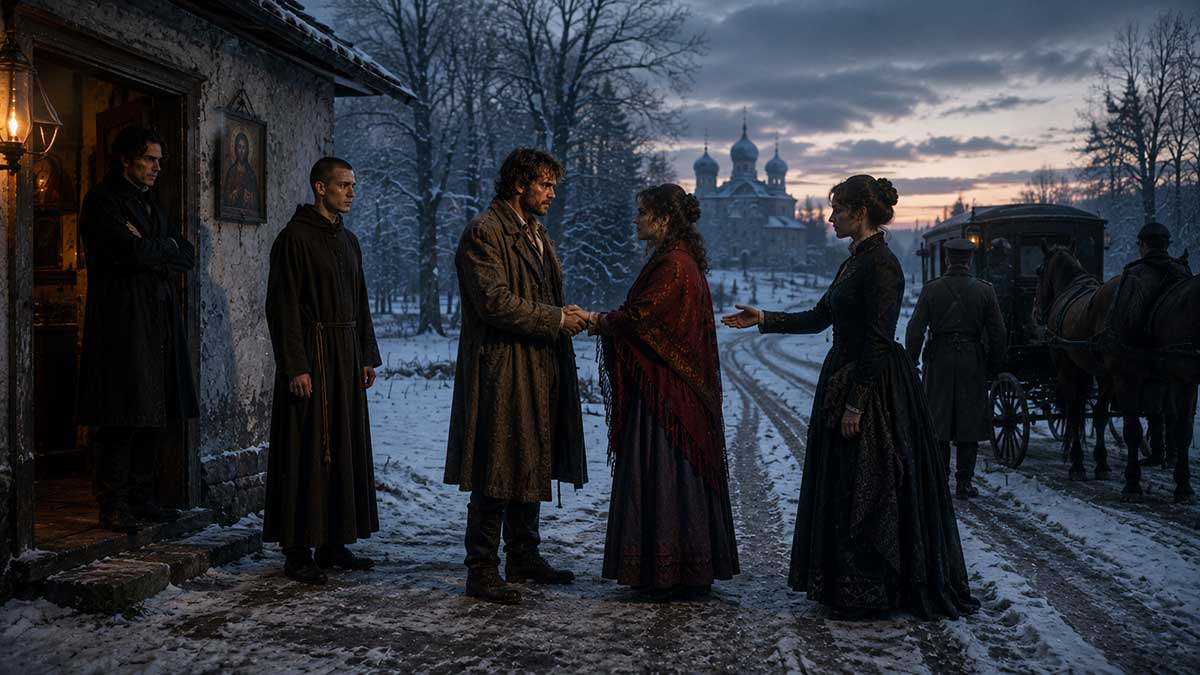
Morning had begun to enter the room.
It did not arrive warmly.
A pale gray light gathered at the windows, revealing what the lamp had hidden: wax hardened on the table, ash around the stove, crumbs from the loaf, exhaustion on every face.
The road outside was visible now, though still buried beneath snow.
Soon the guards would come for Dmitri.
No one mentioned it.
The final question had already entered the room.
Could love redeem a family that had spent years turning love into rivalry, dependence, accusation, control, and hatred?
Ivan watched the new flame in the stove.
Ivan: Before Alyosha answers, let us define the word.
Dmitri: Which word?
Ivan: Love.
Dmitri sighed.
Dmitri: Must everything be placed on trial?
Ivan: This word more than most.
People say they love when they desire.
They say they love when they fear abandonment.
They say they love when they need obedience.
They say they love when they sacrifice in hopes of creating a debt.
They say they love God when they fear punishment.
They say they love humanity when they cannot tolerate actual people.
He looked around the table.
Ivan: What exactly are we asking to save us?
What is the difference between love and possession?
Grushenka answered first.
Grushenka: Love does not make another person pay for being loved.
Dmitri looked at her.
Dmitri: Have I made you pay?
Grushenka: Many times.
Dmitri: How?
Grushenka: You love with your entire body, then expect the other person to survive the force of it.
Your love says, “I would die for you.”
It rarely asks, “Can you live peacefully beside me?”
Dmitri’s face tightened.
Dmitri: I meant every word I said.
Grushenka: That is part of the trouble.
You believe sincerity makes intensity harmless.
It does not.
Dmitri: Then what would harmless love look like? Sitting quietly? Speaking politely? Feeling nothing strongly enough to wound anyone?
Grushenka: No.
It would mean not turning your fear into my duty.
Dmitri: What fear?
Grushenka: That I will leave.
That I will choose another man.
That you are unworthy.
That happiness will disappear the moment you touch it.
You place those fears in my hands and call them devotion.
Dmitri looked toward the window.
Dmitri: I do fear all of that.
Grushenka: I know.
Dmitri: What should I do with it?
Grushenka: Tell me the fear without making me responsible for curing it.
He remained silent.
Katerina watched them with an expression that was difficult to read.
Katerina: You make it sound simple.
Grushenka: It is not.
Katerina: A person may understand all of this and still fail the moment fear returns.
Grushenka: Then the person admits the failure and tries again.
Katerina: How ordinary.
Grushenka: Redemption may be ordinary.
Katerina looked almost offended by the thought.
Katerina: Love should demand something greater.
Ivan: There is the old temptation.
Katerina: Which one?
Ivan: To make suffering proof of sincerity.
Katerina turned toward him.
Ivan: You have always preferred love when it arrives with humiliation, sacrifice, impossibility, and witnesses.
Katerina: You know nothing of what I prefer.
Ivan: I know what you perform.
Dmitri: Enough.
Katerina: No. Let him continue.
Ivan’s voice lost some of its sharpness.
Ivan: You did not merely love Dmitri.
You wanted your love to prove that you were nobler than he was.
You offered forgiveness before he asked for it.
You offered sacrifice before he changed.
You wanted him beneath your mercy.
Katerina’s face became rigid.
Katerina: I helped him when he was desperate.
Ivan: Yes.
Katerina: I defended him when others despised him.
Ivan: Yes.
Katerina: I was prepared to ruin my life for him.
Ivan: Yes.
Katerina: And this was not love?
Ivan: Partly.
The word cut through her defenses.
Katerina: Partly.
Ivan: Love mixed with pride is still love.
It is simply dangerous.
Katerina looked down.
Katerina: I wanted him grateful.
Dmitri: Katya—
Katerina: Let me speak without rescue.
She placed her palms flat against the table.
Katerina: I wanted him to become the man my sacrifice declared him capable of becoming.
When he failed, I felt cheated.
When he chose Grushenka, I did not merely lose him.
I lost the meaning I had given my suffering.
No one answered.
Katerina: So I punished him.
First with nobility.
Then with truth.
Then with evidence.
Grushenka’s face softened.
Grushenka: You loved the future version of him.
Katerina: Yes.
Grushenka: Not the man sitting before you.
Katerina: I do not know whether I ever saw the man sitting before me.
Dmitri lowered his head.
Can forgiveness exist without denying the damage?
Dmitri: Then forgive me.
Katerina looked at him.
Dmitri: Not the man you expected.
The man here.
Forgive me.
Katerina: For what?
Dmitri: Everything.
Ivan made a tired sound.
Ivan: There is Alyosha’s grand confession again.
Dmitri: Stay out of it.
Ivan: No. “Forgive me for everything” is often the plea of a man who does not want to name anything.
Dmitri’s eyes flared.
Ivan: Ask forgiveness for what you did.
Not for being alive.
Not for being flawed.
Not for every sorrow in the room.
Alyosha: Ivan is right.
Dmitri turned toward him.
Dmitri: You too?
Alyosha: Yes.
Specific repentance respects the person who was harmed.
A vague confession can make the injured person comfort the confessor.
Dmitri sat slowly.
His anger faded into concentration.
Dmitri: Katya, forgive me for taking your help while resenting the debt it created.
Forgive me for promising myself to you when I was divided.
Forgive me for using my shame as an excuse to behave shamelessly.
Forgive me for humiliating you publicly.
Forgive me for loving your sacrifice more than I loved you.
Katerina’s breathing changed.
Dmitri: I do not ask you to excuse me.
I do not ask you to love me.
I do not ask you to say that what happened was necessary.
I ask whether, one day, you may choose not to carry me as an enemy.
Katerina did not answer immediately.
The room remained quiet around her.
Katerina: I do not know.
Dmitri nodded.
Dmitri: That is fair.
Katerina: I want to forgive you.
Part of me still wants you to suffer enough that my pain feels recognized.
Dmitri: That is fair too.
Alyosha: Pain may deserve recognition without requiring another wound.
Katerina looked at him.
Katerina: What does forgiveness require, then?
Alyosha: Truth.
Boundaries.
Time.
The refusal to seek revenge.
Perhaps compassion.
Not always reunion.
Grushenka: Not trust without evidence.
Alyosha: No.
Ivan: Not forgetting.
Alyosha: No.
Katerina: Not reconciliation?
Alyosha: Reconciliation requires two people and changed behavior.
Forgiveness may begin in one heart.
Katerina turned back to Dmitri.
Katerina: Then I cannot reconcile with you.
Dmitri: I know.
Katerina: I may not be able to forgive you today.
Dmitri: I know.
Katerina: Yet I do not want your punishment to become the center of my life.
Dmitri’s eyes filled.
Katerina: That is all I can say.
Dmitri: It is more than I deserve.
Alyosha: Do not turn her honesty into another reason to condemn yourself.
Dmitri almost laughed.
Dmitri: You watch every doorway.
Alyosha: Only the ones you use repeatedly.
Does suffering redeem anyone?
Ivan leaned his head against the wall.
Ivan: Dmitri still believes suffering will transform him.
Dmitri: I believe it may.
Ivan: We have established that pain may make a person worse.
Dmitri: Yes.
Ivan: Then why speak of Siberia as rebirth?
Dmitri: Since I need to believe something may come from it.
Ivan: Need again.
Dmitri: Yes, need.
I have no clean philosophy for you.
I have a sentence.
Chains.
Years removed from my life.
A name that will remain guilty in the eyes of the world.
Must I face that with no hope that I may become more than I am now?
Ivan: Hope is permitted.
My objection is to calling punishment sacred.
Alyosha: Then do not call it sacred.
Dmitri: What should I call it?
Alyosha: Injustice.
Loss.
Danger.
A place where you may still choose how to live.
Dmitri looked disappointed.
Dmitri: That sounds smaller than redemption.
Alyosha: Redemption does not come from the chains.
It comes from what you choose in relation to others.
Grushenka: Whether you remain honest when no one praises you.
Katerina: Whether you stop using pain to demand loyalty.
Ivan: Whether you resist becoming cruel merely since cruelty was done to you.
Alyosha: Whether you take responsibility for your real sins without claiming the sins of others.
Dmitri looked at each of them.
Dmitri: You all expect a great deal from a condemned man.
Grushenka: We expected too little before.
Can a person change without becoming someone else?
Dmitri: What if the man you ask me to become is no longer me?
Ivan: You have spent years claiming that your passions are your true self.
Dmitri: They are.
Grushenka: They are one part.
Dmitri: My rage, desire, generosity, jealousy, hunger, shame—remove them and what remains?
Alyosha: No one asks you to become bloodless.
Dmitri: It sounds that way.
Alyosha: Your passion can become courage.
Your generosity can become steadiness.
Your shame can become honesty.
Your desire can become care.
Ivan: This sounds like a sermon written by an optimist.
Alyosha: Each strength carries a possible corruption.
Each corruption may reveal a strength that lost its direction.
Ivan: And Smerdyakov?
Alyosha’s face grew still.
Ivan: What strength hid beneath his corruption?
Alyosha: Intelligence.
Perception.
Patience.
The ability to see what others concealed.
Ivan: Used for murder.
Alyosha: Yes.
Ivan: Then potential means very little.
Alyosha: Without love and responsibility, yes.
Ivan glanced toward the empty chair by the stove.
The bread remained untouched upon it.
Ivan: We speak of redemption in a room with two dead men.
One murdered.
One dead by his own hand.
Neither changed in time.
Alyosha: That is true.
Ivan: Then love does not always save.
Alyosha: No.
The answer seemed to pain Grushenka.
Grushenka: No?
Alyosha: Love can be refused.
It can arrive too late.
It can be offered poorly.
It can fail to prevent death.
We should not speak as though loving someone grants control over the ending.
Grushenka: Then what good is it?
Alyosha: It keeps us from becoming indifferent.
Ivan: That may comfort the one who loves.
Alyosha: Sometimes it does not.
Ivan: It may change nothing.
Alyosha: Sometimes we cannot see what it changes.
Ivan: Hope again.
Alyosha: Yes.
Ivan: You rely on it heavily.
Alyosha: I have little else that does not become control.
Active love
Katerina turned toward Alyosha.
Katerina: Father Zosima spoke of active love.
What did he mean?
Alyosha looked toward the brightening windows.
Alyosha: He warned that love in dreams is easy.
A person dreams of serving humanity, forgiving enemies, suffering nobly, saving the lost.
Real love asks whether you will remain kind when the other person is irritating, ungrateful, dishonest, repetitive, or unchanged.
Dmitri: That seems deliberately unromantic.
Alyosha: It is.
Grushenka: Good.
Alyosha: Active love prepares food.
Keeps a promise.
Returns after an argument.
Speaks truth before resentment hardens.
Protects a child.
Visits the sick.
Refuses humiliation.
Apologizes without demanding immediate forgiveness.
Stops another person from doing harm.
Leaves when staying would support cruelty.
Returns when returning is safe and honest.
Ivan: It sounds less like love than a collection of duties.
Alyosha: Feeling alone cannot carry a life.
Ivan: Duty without feeling can become cold.
Alyosha: Yes.
Ivan: Feeling without duty becomes unstable.
Alyosha: Yes.
Grushenka: Then perhaps love is feeling given a practice.
Alyosha looked at her.
Alyosha: Yes.
Dmitri: And when the feeling disappears?
Grushenka: The practice tells you whether anything remains.
Dmitri studied her.
Dmitri: Will you come with me?
No one needed to ask where.
Grushenka: I intend to.
Dmitri: Out of love?
Grushenka: Yes.
Dmitri: Duty?
Grushenka: Partly.
Dmitri: Pity?
Grushenka: Some days, perhaps.
Dmitri’s face fell.
Grushenka: Do you want truth or worship?
He looked at her for a long moment.
Dmitri: Truth.
Grushenka: Then hear all of it.
I love you.
I fear you.
I believe you may change.
I know you may fail.
I will not promise that love will make every day beautiful.
I will not promise never to regret following you.
I will not call your suffering noble when it makes you cruel.
I will not stay silent to prove loyalty.
Dmitri’s eyes did not leave hers.
Grushenka: I will walk beside you as a person, not as the reward for your redemption.
Dmitri: That is harder to receive than devotion.
Grushenka: Good.
Can a family begin again without pretending the past is gone?
Katerina: What does beginning again mean for this family?
Fyodor is dead.
Smerdyakov is dead.
Dmitri is condemned.
Ivan is ill.
Alyosha continues trying to hold together what cannot be held.
There is no house to return to.
Ivan: Perhaps that is fortunate.
Dmitri: You want the family erased?
Ivan: The family we had, yes.
Alyosha: A new beginning does not require recreating the old structure.
Katerina: Then what remains of the Karamazovs?
Ivan gave a faint smile.
Ivan: A criminal reputation.
Dmitri: A talent for excess.
Grushenka: Several unpaid emotional debts.
Alyosha: Brothers.
Ivan looked at him.
Ivan: Are we?
Alyosha: Yes.
Ivan: Biology is not redemption.
Alyosha: No.
Ivan: Shared pain is not love.
Alyosha: No.
Ivan: Then what makes us brothers now?
Alyosha considered.
Alyosha: Whether we choose to remain responsible for one another without trying to own one another.
Ivan’s expression hardened slightly.
Ivan: I may not be capable of that.
Alyosha: You told the truth tonight.
Ivan: Part of it.
Alyosha: You remained in the room.
Ivan: Barely.
Alyosha: You challenged lies, including your own.
Ivan looked away.
Alyosha: Brotherhood may begin there.
Dmitri: Will you help me escape?
Katerina looked sharply at Ivan.
Ivan did not answer at once.
Ivan: I had planned to.
Dmitri: Had?
Ivan: Before tonight, I thought helping you escape might repay my guilt.
Dmitri: And now?
Ivan: Now I do not know whether I would be helping you or helping myself feel less responsible.
Dmitri: The result matters more than your purity.
Ivan: Does it?
Dmitri: I am innocent of murder.
Ivan: Yes.
Dmitri: The court failed.
Ivan: Yes.
Dmitri: Then escape may be justice.
Alyosha: Or another falsehood upon which the rest of your life must be built.
Dmitri turned toward him.
Dmitri: You would have me accept a false sentence?
Alyosha: I would have you decide without romanticizing either choice.
Prison is not automatically noble.
Escape is not automatically cowardly.
Grushenka: We need facts, not visions.
Katerina: There may be legal avenues left.
Ivan looked doubtful.
Katerina: Do not dismiss them merely since the trial is over.
Ivan: You would help?
Katerina’s face changed.
Katerina: I helped condemn him.
I must tell the truth about why I gave the letter.
Dmitri: The court may not care.
Katerina: Then I will say it where it can be heard.
Ivan: That may destroy your reputation.
Katerina: Perhaps my reputation has directed enough lives.
Dmitri looked at her with gratitude, but did not speak.
She noticed.
Katerina: Do not turn this into reconciliation.
Dmitri: I will not.
Katerina: Good.
Is confession enough?
Ivan pressed his fingers to his temple.
Ivan: We have all confessed beautifully.
What changes when we leave this room?
Grushenka: You distrust any truth that cannot survive daylight.
Ivan: Correctly.
Katerina: I will correct my testimony.
Dmitri: I will stop asking suffering to make me pure.
Ivan: That is a sentence, not behavior.
Dmitri’s jaw tightened.
Dmitri: Then I will begin by listening when Grusha says my fear has become control.
Grushenka: Better.
Katerina: I will stop offering help that secretly demands gratitude.
Ivan: How will you know?
Katerina: I will ask whether I would still help if no one learned of it and the person never loved me.
Ivan nodded faintly.
Grushenka: I will stop testing love by creating jealousy.
Dmitri looked at her.
Grushenka: Do not look too grateful. I may fail by noon.
Alyosha: Failure admitted early causes less damage.
Ivan: And you?
Alyosha became quiet.
Ivan: What will active love require from the saint of the family?
Alyosha: I must stop believing that listening kindly is always enough.
Dmitri: Meaning?
Alyosha: I must confront harm earlier.
Ask harder questions.
Risk being disliked.
Stop protecting peace when the peace is false.
Ivan: You may become almost useful.
Alyosha smiled slightly.
Alyosha: And you?
Ivan’s smile vanished.
Ivan: I will tell the truth about Smerdyakov.
Dmitri: Publicly?
Ivan: Yes.
Katerina: They may call you unstable.
Ivan: They already do.
Alyosha: What truth will you tell?
Ivan: That he confessed.
That I suspected him.
That I left knowing danger existed.
That my words were used by him, though they did not command him.
That Dmitri did not kill Father.
Dmitri stared at him.
Dmitri: You would do that?
Ivan: Do not make it noble.
I should have done it sooner.
Dmitri: Still—
Ivan: No gratitude.
Dmitri stopped.
Ivan looked almost startled by his own request.
Ivan: I understand Katya better now.
What does redemption demand from the guilty?
The light outside strengthened.
The outlines of trees appeared beyond the glass.
Katerina: What of Smerdyakov?
He cannot confess further.
He cannot repair anything.
Is he beyond redemption now?
Ivan’s face tightened.
Ivan: He chose death.
Alyosha: We do not know his final inner state.
Ivan: Do not give him a secret repentance.
Alyosha: I do not.
Ivan: He murdered Father, condemned Dmitri, and placed the guilt in me.
Alyosha: Yes.
Ivan: Then let the judgment stand.
Alyosha: The judgment may stand without pretending we know the whole soul.
Ivan: Why defend him?
Alyosha: I am not defending his act.
Ivan: You preserve some untouched part of every person.
Alyosha: I hope one exists.
Ivan: Why?
Alyosha: Since without it, repentance would mean creating a new person from nothing.
Perhaps redemption means calling forth the part that has not completely died.
Dmitri: And when that part is gone?
Alyosha: I do not know whether it is ever entirely gone.
Ivan: That belief may endanger victims.
Alyosha: It can, when used to demand trust.
A wrongdoer may possess human worth and still require restraint.
He may be forgiven and still never regain access to the person he harmed.
He may repent and still owe restitution.
He may change and still live with consequences.
Katerina: Then redemption does not cancel justice.
Alyosha: No.
Grushenka: It changes what justice is for.
Ivan: From punishment to restoration?
Grushenka: When restoration is possible.
Ivan: And when it is not?
Grushenka: Protection.
Truth.
Memory.
A refusal to repeat the harm.
No one spoke for a moment.
Can the dead be forgiven?
Dmitri stared at the bread on the empty chair.
Dmitri: Can we forgive Father?
Ivan’s expression closed.
Ivan: No.
Alyosha: You do not have to.
Ivan: Do you?
Alyosha: Partly.
Ivan: What does partial forgiveness mean?
Alyosha: I no longer wish him destroyed.
Ivan: Convenient. He already is.
Alyosha: I try to see his fear without calling his cruelty harmless.
I remember moments when he seemed almost capable of shame.
I grieve what he became.
I grieve what he made of us.
Dmitri: Do you love him?
Alyosha’s eyes moved toward the growing daylight.
Alyosha: I do not know what word to use.
Ivan: Then say no.
Alyosha: I feel sorrow for him.
Ivan: Sorrow is safer.
Alyosha: Perhaps.
Dmitri: I still hate him.
Grushenka: Then hate him honestly until something else becomes possible.
Dmitri: You do not tell me to forgive?
Grushenka: Forced forgiveness becomes another lie.
Katerina: Yet hatred keeps the dead alive inside us.
Ivan: Some dead people deserve to remain as warnings.
Alyosha: A warning need not remain a ruler.
Ivan looked at him.
Alyosha: We may remember what Father did without allowing every future choice to be made in reaction to him.
Dmitri: How?
Alyosha: Ask whether the decision serves the living or merely continues the argument with the dead.
Dmitri looked toward Grushenka.
Dmitri: Much of my life has been an argument with him.
Ivan: Mine too.
Alyosha: Mine has been an attempt to love what he refused to love.
Ivan: Still an argument.
Alyosha nodded.
Alyosha: Yes.
The danger of becoming the family’s savior
Ivan turned fully toward Alyosha.
Ivan: You said love does not control endings.
Do you believe that?
Alyosha: I try to.
Ivan: You have spent the night placing yourself between every person and collapse.
Alyosha: At times.
Ivan: You believe the family may be redeemed through your love.
Alyosha did not answer.
Ivan: Is that humility?
Alyosha: No.
Ivan: Then say it.
Alyosha looked around the table.
Alyosha: I cannot save this family.
Dmitri shifted uncomfortably.
Alyosha: I cannot make Ivan believe.
I cannot make Mitya change.
I cannot make Katya forgive.
I cannot make Grushenka stay.
I could not make Father repent.
I did not reach Smerdyakov.
The words seemed to age him.
Alyosha: I can love each of you.
Speak truth.
Remain present.
Act where action is possible.
Leave the result outside my control.
Ivan’s face softened.
Ivan: That may be the first mature thing you have said.
Dmitri: He has said many mature things.
Ivan: You are easily impressed by anyone who prevents you from striking me.
Dmitri: Fair.
Grushenka: Alyosha, what happens when love requires leaving?
Alyosha: Then leaving may be the loving act.
Grushenka: And staying?
Alyosha: Staying may be the loving act.
Ivan: A flexible doctrine.
Alyosha: Which is why rules cannot replace discernment.
Ivan: We have returned to freedom again.
Alyosha: Yes.
Ivan: Love does not remove the burden of choice.
Alyosha: No.
Ivan: It makes the choice heavier.
Alyosha: At times.
Can love answer Ivan’s rebellion?
Ivan looked suddenly tired.
More tired than ill.
Ivan: You have said that love may answer suffering without explaining it.
Has anything tonight answered me?
Alyosha did not speak quickly.
Alyosha: No.
Ivan nodded as though receiving a verdict he expected.
Alyosha: Yet perhaps you were not asking for one answer.
Ivan: I asked why children suffer.
Alyosha: Yes.
Ivan: No one answered.
Alyosha: No.
Ivan: I asked whether morality survives without God.
Alyosha: We found no final agreement.
Ivan: I asked whether freedom is worth its cost.
Alyosha: We did not settle it.
Ivan: Then what have we done?
Grushenka answered.
Grushenka: We stopped hiding behind the questions.
Ivan turned to her.
Grushenka: You used the suffering of children to challenge God.
Rightly, perhaps.
Yet tonight you admitted the abandoned child in yourself.
You used morality to examine the universe.
Then you examined what your ideas did to Smerdyakov.
You used freedom to challenge faith.
Then you admitted that you left town so another person might choose what you would not.
Ivan stared at her.
Grushenka: The questions remain.
You are standing inside them now.
Ivan: Is that progress?
Katerina: It is less comfortable than philosophy.
Dmitri: Which suggests it may be.
Alyosha leaned forward.
Alyosha: Love does not answer Ivan by defeating his argument.
It answers by refusing to let the argument become permission for indifference.
Ivan: That is not enough.
Alyosha: No.
Ivan: You agree too easily.
Alyosha: I do not know what else honesty allows.
Ivan looked toward the empty chair.
Ivan: Smerdyakov would mock this room.
Dmitri: Father would mock it louder.
Katerina: Yet neither is speaking now.
Grushenka: For once, the living may finish a sentence.
The memory that may save us
A sound came from outside.
Distant at first.
Then clearer.
Hooves.
Dmitri heard it before the others.
His face changed.
Dmitri: They are coming.
Grushenka reached for his hand.
He took hers.
Not desperately.
Not as though holding tightly could stop the morning.
Katerina stood, then sat again.
Ivan closed his eyes.
Alyosha looked toward the road.
The carriage had not yet appeared through the trees.
There were still a few minutes.
Dmitri: Is this where you give us hope?
Alyosha: No.
Dmitri looked surprised.
Alyosha: I will give you a memory.
Ivan opened his eyes.
Alyosha: Ilyusha’s friends stood together after his funeral.
They were young.
Ashamed of how they had treated him.
Afraid they would forget.
I asked them to remember one moment when they had been good together.
One true memory.
Not since it would erase cruelty.
Not since childhood innocence lasts forever.
Since a good memory may return years later, at the moment a person is about to become cruel.
Ivan: Memory as conscience.
Alyosha: Perhaps.
Dmitri: What memory do we have?
No one answered.
They had memories of neglect.
Arguments.
Money.
Jealousy.
Threats.
A trial.
A murder.
Then Grushenka looked at the broken loaf.
Grushenka: We shared bread.
Ivan glanced toward the piece resting on the empty chair.
Grushenka: No one asked for obedience.
No one owned the loaf.
No one decided who deserved more.
It is not much.
Alyosha: It does not need to be much.
Katerina looked toward Dmitri.
Katerina: We told the truth without making reconciliation a condition.
Dmitri: Vanya said he would speak for me.
Ivan: I said I would tell the truth.
Dmitri: That is what I meant.
Ivan did not object.
Alyosha: Then remember this room accurately.
Not as the night everything was healed.
It was not.
Not as the night everyone forgave.
We did not.
Not as the night faith defeated doubt.
It did not.
Remember it as the night each person stopped asking another to carry the whole guilt.
Ivan: A modest miracle.
Alyosha: The safest kind.
What must continue after the conversation?
The carriage appeared between the trees.
Two guards sat at the front.
A third rode beside it.
Dmitri stood.
Grushenka rose with him.
Dmitri: What happens now?
Katerina: I correct my testimony.
Ivan: I give mine.
Grushenka: I remain beside you without becoming your excuse.
Alyosha: I help where I can.
Dmitri: And I?
Ivan answered.
Ivan: You stop performing redemption and begin practicing it.
Dmitri looked at him.
Then laughed once.
A full laugh.
Brief, tired, and real.
Dmitri: That may take years.
Ivan: You have been given them.
The laugh disappeared.
Yet the sentence did not feel entirely cruel.
Dmitri walked to the chair beside the stove.
He picked up the untouched piece of bread.
Dmitri: Was this for Smerdyakov?
Grushenka: Perhaps.
Dmitri: Or Father?
Grushenka: Perhaps.
Ivan: Or the child no one fed.
No one moved.
Dmitri broke the piece into two.
He placed one half back on the chair.
He ate the other.
Dmitri: I will not pretend I forgive them.
Alyosha: Do not.
Dmitri: I will carry them.
Ivan: Carefully.
Dmitri: Yes.
The final exchange
The carriage stopped outside.
Boots pressed into the snow.
A knock sounded at the outer door.
Dmitri looked around the room.
At Katerina.
At Ivan.
At Alyosha.
Then Grushenka.
Dmitri: Did love redeem us?
Ivan answered first.
Ivan: No.
Grushenka looked at him, but he continued.
Ivan: Not yet.
Dmitri turned toward Alyosha.
Alyosha: Redemption is not what happened in this room.
Dmitri: Then what happened?
Alyosha: We became responsible for what happens after it.
The knock came again.
Louder.
Dmitri nodded.
Dmitri: That sounds less beautiful.
Grushenka: It may be more useful.
Katerina stepped forward.
For one moment, she seemed ready to embrace him.
She did not.
Instead, she held out her hand.
Dmitri took it.
No promise passed between them.
No future was invented.
They released one another.
Ivan stood with difficulty.
Dmitri moved toward him.
The brothers faced each other.
Dmitri: You are not my murderer.
Ivan’s face tightened.
Ivan: Do not absolve me.
Dmitri: I am not.
I am giving you your portion back.
Ivan looked at him for a long moment.
Ivan: Then take yours.
Dmitri: I will.
They did not embrace.
Yet neither looked away.
Dmitri turned to Alyosha.
Dmitri: Little brother.
Alyosha: Mitya.
Dmitri: Keep us from becoming legends.
Alyosha: What do you mean?
Dmitri: Do not tell the story as though Ivan was only doubt, I was only passion, Smerdyakov was only evil, Father was only corruption, and you were only goodness.
People become dangerous when they are reduced to one truth.
Alyosha’s eyes filled.
Alyosha: I will remember.
Dmitri: Remember badly at first.
Then correct it.
Alyosha embraced him.
Dmitri held him tightly, then released him before the embrace became an attempt to stop time.
The door opened.
Cold air moved through the hallway.
A guard appeared.
Guard: Dmitri Fyodorovich.
Dmitri: I am ready.
He looked at Grushenka.
She stepped beside him.
Not in front.
Not behind.
Beside.
They moved toward the door.
At the threshold, Dmitri turned once more.
Dmitri: Vanya.
Ivan raised his head.
Dmitri: Everything is not permitted.
Ivan’s expression did not change.
Yet his voice was clear.
Ivan: I know.
Dmitri looked toward Alyosha.
Dmitri: And love does not make everything right.
Alyosha: No.
Dmitri: Good.
He stepped into the morning.
Grushenka followed.
The guards closed around them, and the sound of boots moved across the snow.
Katerina stood at the window.
Ivan lowered himself into his chair.
Alyosha remained beside the open doorway until the carriage disappeared beyond the trees.
The room was quiet again.
The lamp had gone out.
Daylight now revealed the empty chair beside the stove.
Half a piece of bread still rested upon it.
Ivan: Will you remove that?
Alyosha: No.
Ivan: Why?
Alyosha looked at the chair.
Alyosha: Since every family has someone it failed to seat at the table in time.
Ivan closed his eyes.
Ivan: That sounds like something Zosima would say.
Alyosha: Perhaps.
Ivan: Do you believe this family can begin again?
Alyosha looked through the window at the road cut open by the carriage wheels.
Alyosha: It already has.
Ivan: That is too hopeful.
Alyosha: Beginning is not succeeding.
Ivan opened his eyes.
For once, he had no objection.
Outside, the carriage tracks divided the white road into two dark lines.
They did not reveal where the road ended.
They showed only that someone had passed through the snow, and that others might follow.
This completes the five-topic character conversation, leaving the theological questions open while giving the family a believable first step toward change.
Final Thoughts
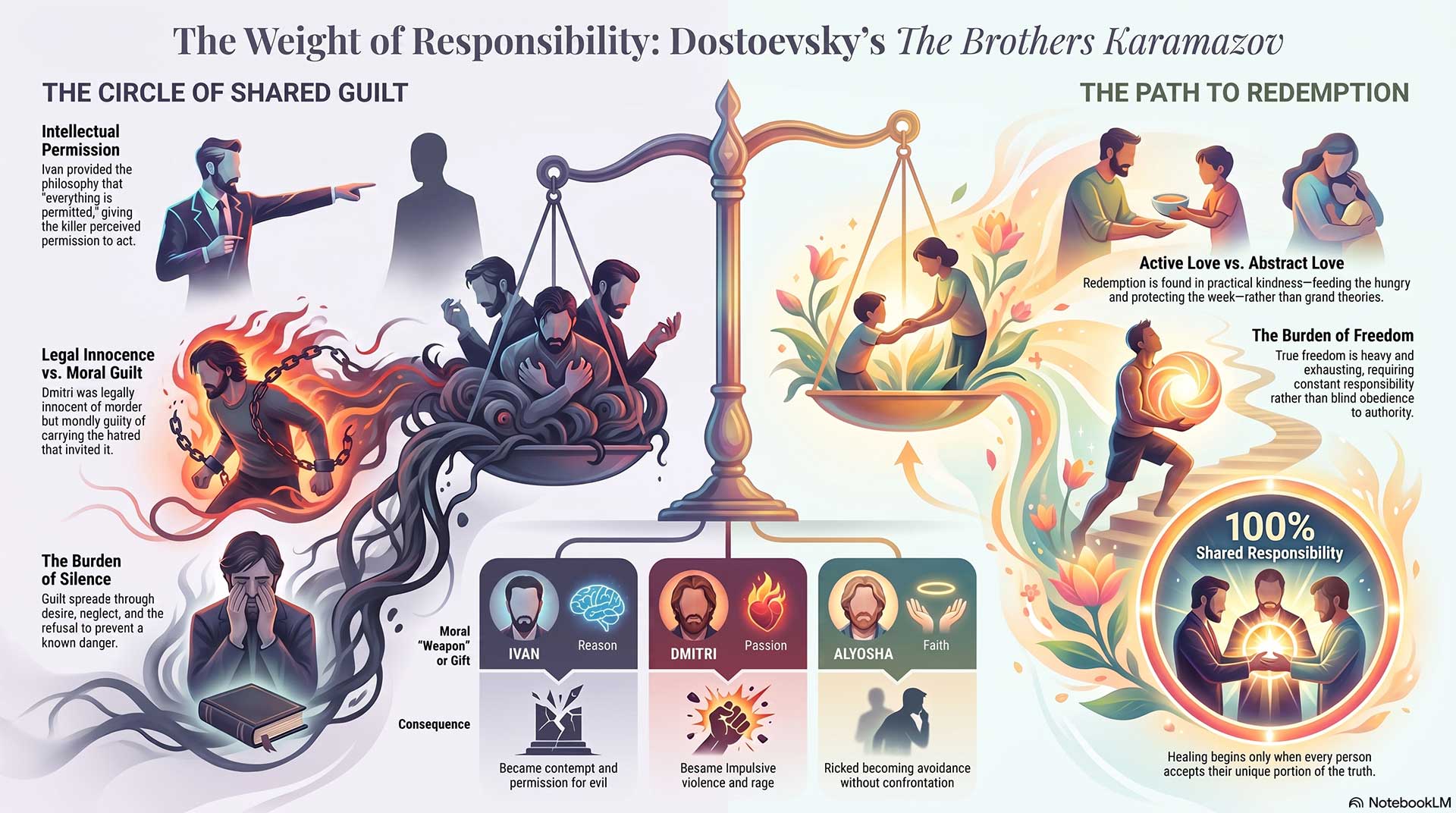
The Brothers Karamazov offers no easy victory for faith, reason, justice, freedom, or love.
Every human strength in the novel carries a danger.
Reason can become contempt.
Faith can become coercion.
Passion can become violence.
Sacrifice can become control.
Compassion can become avoidance.
Freedom can become permission.
Love can become possession.
Dostoevsky’s insight is that no idea remains morally safe when separated from responsibility for actual people.
Ivan’s questions remain among the strongest ever written against religious faith.
Why does God permit children to suffer?
Can any final redemption justify innocent pain?
Can people be morally good without belief in God?
Would human beings surrender freedom in exchange for bread, certainty, and security?
The novel refuses to make Ivan foolish or heartless. His rebellion protects something sacred: the absolute value of the innocent child.
Alyosha’s response is powerful precisely since it does not pretend to solve the problem.
He does not explain suffering from a comfortable distance.
He refuses to call suffering necessary.
He refuses to demand forgiveness from victims.
He refuses to treat future happiness as compensation for present cruelty.
His answer is not a system.
It is a way of living.
Feed the hungry without demanding obedience.
Protect the weak without treating them as helpless forever.
Offer faith without fear.
Speak truth without humiliation.
Forgive without denying damage.
Restrain wrongdoing without declaring any person less than human.
Remain present without trying to control the ending.
This is Father Zosima’s idea of active love.
It is far less dramatic than dying for humanity in the abstract.
It asks whether we can remain truthful and compassionate with the irritating, wounded, ungrateful, frightened people directly in front of us.
Dmitri’s story reveals another central truth.
Suffering does not automatically redeem anyone.
Prison, shame, loss, and hardship may deepen compassion, or they may deepen bitterness. Pain becomes morally meaningful only through the choices made within it and the relationships formed around it.
Katerina shows that sacrifice is not always selfless. A person may help another partly to create gratitude, dependence, or proof of moral superiority.
Grushenka shows that emotional honesty may be more loving than romantic promises. She does not tell Dmitri that she will save him. She agrees to walk beside him without carrying his conscience.
Ivan discovers that ideas do not remain confined to the mind. A thinker cannot control every interpretation, yet he cannot ignore what his words may become inside a wounded person.
Smerdyakov remains responsible for murder. His humiliation explains his resentment, but it does not erase his choice.
This balance is one of the novel’s greatest achievements.
The wound deserves compassion.
The weapon demands judgment.
A person may retain human worth and still require restraint.
Forgiveness does not always mean restored trust.
Redemption does not cancel consequences.
Love does not make everything right.
At the end of the conversation, Dmitri asks whether love has redeemed the family.
Ivan answers, “No. Not yet.”
That answer captures the moral vision of the entire novel.
Redemption is not a moment of emotional release.
It is what people choose after confession.
The family has not been healed.
It has become responsible for what happens next.
Perhaps that is the most honest hope Dostoevsky offers.
We may not receive answers large enough to explain every tragedy.
We may still refuse to add further suffering.
We may tell the truth.
We may interrupt inherited cruelty.
We may stop asking others to carry our guilt.
We may remember the person who was excluded from the table.
We may begin again without pretending that beginning guarantees success.
The road ahead remains uncertain.
Yet someone has passed through the snow, leaving tracks that others may follow.
Short Bios:
Fyodor Dostoevsky
Fyodor Dostoevsky was a Russian novelist, journalist, and philosophical writer born in 1821. After becoming involved with a group discussing political and social reform, he was arrested and sentenced to death. His execution was stopped at the final moment, and he was sent to forced labor in Siberia.
His experiences with imprisonment, illness, poverty, faith, political radicalism, and human suffering shaped his major novels. His best-known works include Crime and Punishment, The Idiot, Demons, Notes from Underground, and The Brothers Karamazov.
He completed The Brothers Karamazov in 1880 and died in 1881.
Dmitri Karamazov
Dmitri is the eldest legitimate son of Fyodor Pavlovich.
He is emotional, impulsive, generous, violent, romantic, jealous, and deeply divided. He openly threatens his father during their dispute over money and Grushenka.
Dmitri is convicted of his father’s murder despite being innocent of the act. His story explores the difference between legal innocence and moral responsibility.
Ivan Karamazov
Ivan is the intellectual middle brother.
He struggles with God, morality, freedom, innocent suffering, and the possibility that human beings may use ideas to justify cruelty.
His rebellion against God is driven by moral outrage rather than apathy. His conversations with Alyosha contain many of the novel’s most famous philosophical passages, including “Rebellion” and “The Grand Inquisitor.”
Alexei “Alyosha” Karamazov
Alyosha is the youngest Karamazov brother and a disciple of Father Zosima.
He represents compassion, spiritual hope, humility, and active love. He does not remain separated from ordinary life. Zosima sends him into the world, where he attempts to reconcile wounded people and protect children.
His greatest lesson is that love must become action rather than sentiment alone.
Pavel Smerdyakov
Smerdyakov is widely believed to be Fyodor Pavlovich’s illegitimate son.
Raised as a servant in the Karamazov household, he is intelligent, observant, resentful, and deeply humiliated by his social position and origins.
He murders Fyodor and later claims that Ivan’s ideas helped authorize the act. His character raises difficult questions about personal choice, social neglect, resentment, and intellectual responsibility.
Agrafena “Grushenka” Svetlova
Grushenka is desired by both Fyodor Pavlovich and Dmitri.
She first appears proud, seductive, and emotionally manipulative, but gradually reveals compassion, vulnerability, and the capacity for change.
Her relationship with Dmitri becomes one of the novel’s strongest examples of love moving away from possession and toward shared responsibility.
Katerina Ivanovna
Katerina is Dmitri’s former fiancée.
She is intelligent, proud, devoted, self-sacrificing, and emotionally conflicted. Her love for Dmitri becomes mixed with humiliation, moral superiority, and the desire to control how their story is understood.
Her testimony plays a major role in Dmitri’s conviction.
Father Zosima
Father Zosima is Alyosha’s spiritual mentor and one of the novel’s principal religious voices.
He teaches confession, humility, forgiveness, active love, and the belief that every person carries responsibility for others.
His teachings reject abstract love for humanity when it is disconnected from patience and care for real individuals.
Fyodor Pavlovich Karamazov
Fyodor Pavlovich is the father of Dmitri, Ivan, and Alyosha, and the probable father of Smerdyakov.
He is wealthy, vulgar, neglectful, manipulative, and driven by appetite. He abandons his parental responsibilities and turns affection, inheritance, and desire into tools of rivalry.
His murder is the central crime of the novel, yet the deeper tragedy is the family structure he created long before his death.
Leave a Reply