
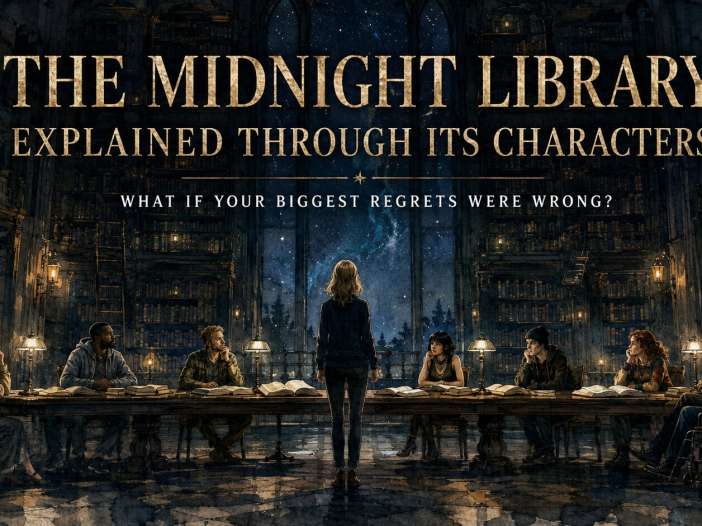
Matt Haig’s The Midnight Library begins with a fantasy many people have had in quieter moments:
What if I could go back and see what would have happened if I had chosen differently?
What if I had married that person?
Taken that job?
Moved to that city?
Stayed in the band?
Kept swimming?
Called someone back?
Nora Seed enters the Midnight Library believing her life has been damaged by a series of wrong decisions. The shelves offer her what regret normally cannot: access to the roads not taken.
Yet the deeper she travels, the less useful the question “Which life was best?” becomes.
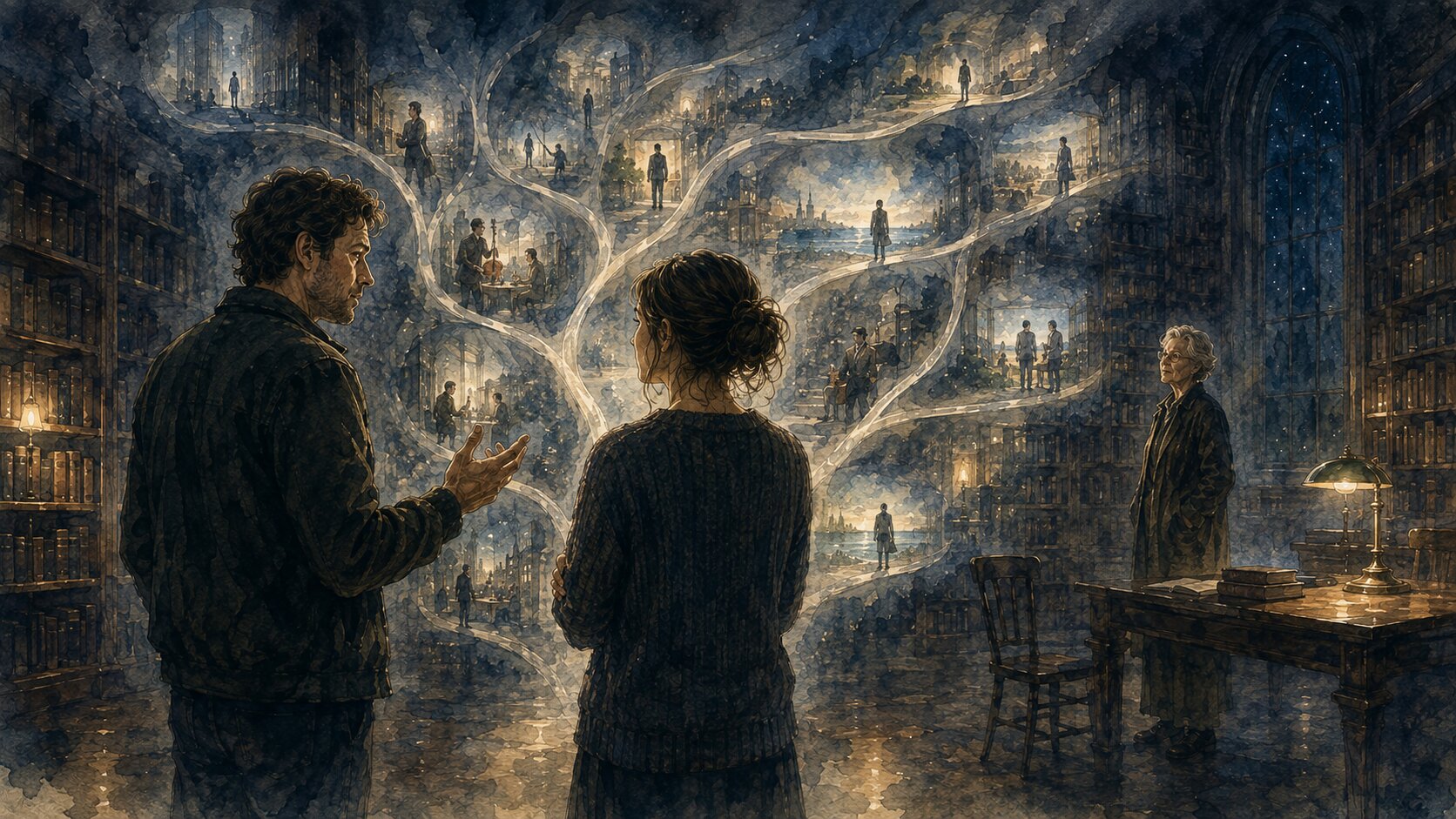
In this imagined character conversation, Nora is confronted not merely by alternate versions of herself, but by the people she turned into symbols of those lives.
Joe challenges her belief that she was responsible for his happiness.
Dan asks whether she missed him or the stability she imagined he represented.
Izzy questions whether Australia became a fantasy of courage and escape.
Ash forces Nora to admit that one alternate life really was loving and good.
And Molly asks the question no philosophy can easily answer:
If you loved me, why couldn’t you stay?
Hugo then exposes another danger. Nora thought infinite possibilities might free her from regret. Hugo reveals that unlimited choice can become its own prison.
The conversation gradually shifts from:
“Which life should Nora have chosen?”
to something far more difficult:
“How do we choose a life when no choice comes with proof?”
(Note: This is an imaginary conversation, a creative exploration of an idea, and not a real speech or event.)
Topic 1 — Which Regrets Were Actually Yours?
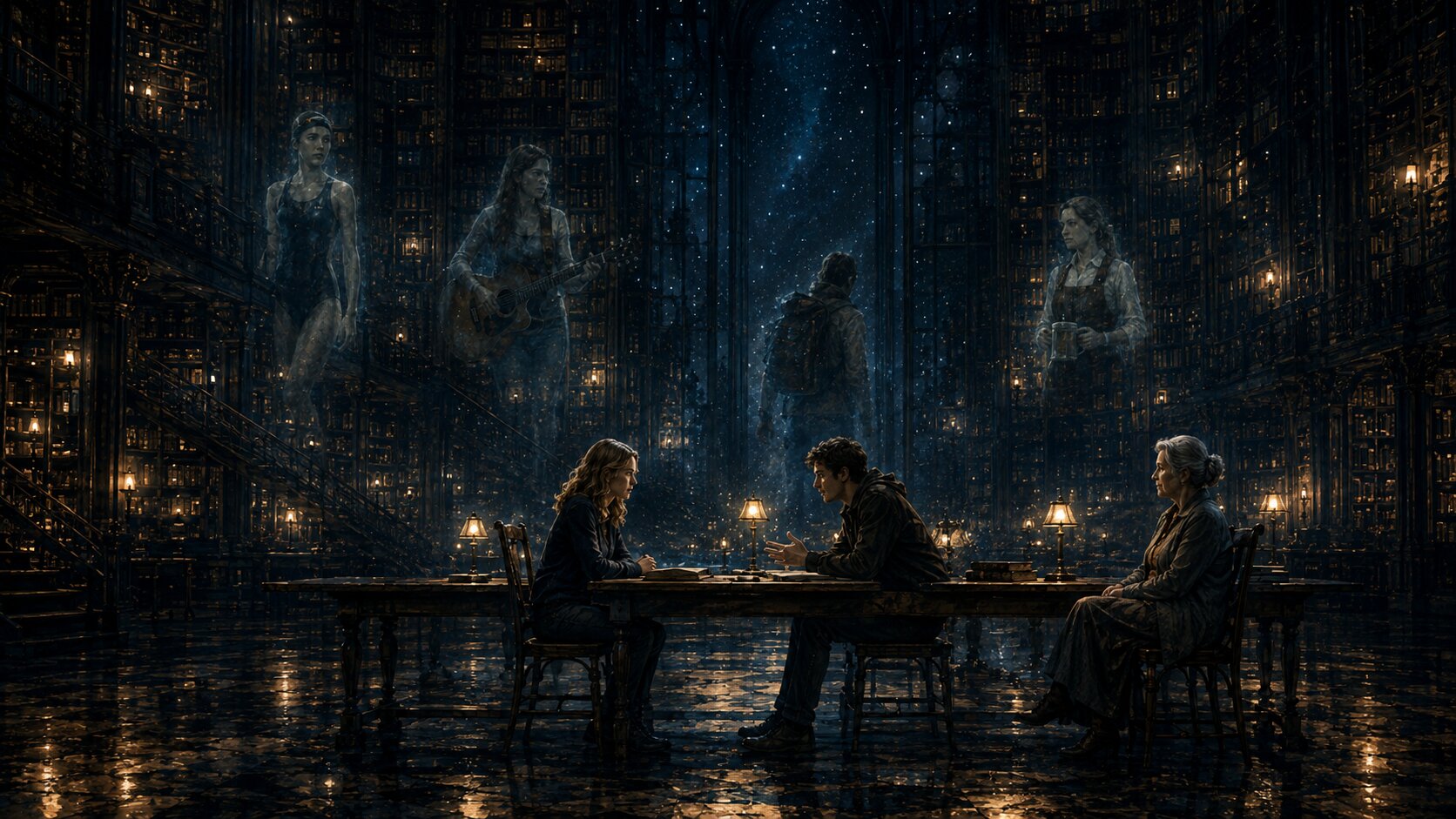
The Midnight Library was quieter than Nora remembered.
Not empty.
Not yet.
But quieter.
The shelves stretched farther than she could see, each one holding lives she had once believed might have rescued her.
Mrs. Elm stood behind the desk.
Joe sat near one of the long tables.
Dan was farther away, leaning back in a chair with his arms folded.
Izzy stood near the shelves, running one finger along the spines without pulling any book free.
Nora remained standing.
She looked uncomfortable.
Nora: I thought this was over.
Mrs. Elm: So did you.
Nora glanced at Joe.
He gave her a small smile.
Joe: Hi.
Her face changed.
Nora: Hi.
For a moment, she seemed younger.
Not the woman who had traveled through impossible lives.
Just his sister.
Nora: Why are you here?
Joe: Apparently you have some things to say about my life.
Nora frowned.
Nora: What does that mean?
Joe leaned back.
Joe: You tell yourself you ruined it.
Nora looked toward Mrs. Elm.
Nora: I don't.
Joe raised an eyebrow.
Nora: Not anymore.
Joe: Really?
Nora hesitated.
Joe nodded.
Joe: That's what I thought.
She sat across from him.
Nora: I know things were more complicated than I believed.
Joe: Good.
Nora: I know leaving the band wasn't the only thing that changed everything.
Joe: Good.
Nora: I know you had your own choices.
Joe watched her.
Nora: What?
Joe: You sound like you're reciting something.
Nora looked irritated.
Nora: I'm trying.
Joe: I know.
He softened.
Joe: But I want to know whether you actually believe it.
Nora looked down at her hands.
The library clock did not move.
Nothing in that place ever seemed to hurry.
Nora: I believed I let you down.
Joe: You did.
Nora looked up sharply.
Mrs. Elm remained still.
Joe continued.
Joe: You did let me down.
You left.
I was angry.
I felt abandoned.
I thought the band mattered to you the way it mattered to me.
Then you walked away.
Nora's eyes filled.
Nora: I know.
Joe: No.
He shook his head.
Joe: Don't say that yet.
Nora stopped.
Joe: That's one of your habits.
Someone tells you they were hurt, and you immediately turn it into proof that you were terrible.
Nora: What am I supposed to do? Pretend I didn't hurt you?
Joe: No.
You're supposed to hear that I was hurt without making yourself the entire story.
Nora stared at him.
Joe: I was angry with you.
I also had my own problems.
I made my own choices.
I said things I shouldn't have said.
I blamed you for things that were easier to blame on you than on myself.
Nora looked confused.
Nora: Like what?
Joe looked toward the shelves.
Joe: The band.
My drinking.
How lost I felt after it all changed.
It was very convenient to say:
“Nora left.”
That gave everything a beginning.
A cause.
One person to point at.
Nora swallowed.
Joe: You did something similar.
Nora: How?
Joe looked back.
Joe: You took every bad thing that happened to me and added it to your Book of Regrets.
As if my life were one long consequence of your decision.
Nora was silent.
Joe: That's an enormous amount of influence to give yourself.
Nora frowned.
Nora: I didn't think I was important.
Joe: That's the strange part.
You thought you were worthless and all-powerful at the same time.
The line hit her hard.
Mrs. Elm looked toward Nora but said nothing.
Nora: That doesn't make sense.
Joe: It does.
You thought:
“I'm useless.”
Then:
“Everyone would have been happier if I'd chosen differently.”
Do you hear it?
Nora did.
She hated that she did.
Joe: You made yourself the failure at the center of everyone else's life.
Nora's eyes lowered.
Nora: I thought I was taking responsibility.
Joe: Sometimes you were.
Sometimes you were taking ownership.
Those aren't the same.
Silence.
Then Mrs. Elm spoke.
Mrs. Elm: Responsibility has edges.
Nora turned.
Mrs. Elm: Regret often does not.
Nora: What does that mean?
Mrs. Elm: Responsibility says:
“I did this.”
Regret often says:
“And from that, I know everything that followed.”
Nora looked toward Joe.
Joe: Exactly.
Mrs. Elm came around from behind the desk.
Mrs. Elm: What did your father want for you?
Nora's face changed immediately.
Nora: Swimming.
Mrs. Elm: Did you want it?
Nora: Sometimes.
Mrs. Elm: That's not an answer.
Nora gave a tired laugh.
Nora: I don't know.
Mrs. Elm: Better.
Nora looked irritated.
Mrs. Elm: You were good at it.
Your father valued it.
You received approval through it.
You imagined what success might have looked like.
Those things became tangled.
Nora: I regretted quitting.
Mrs. Elm: Yes.
But did you regret losing swimming?
Or losing the version of yourself your father admired?
Nora looked away.
Joe did not move.
Nora: That's unfair.
Mrs. Elm: Probably.
Nora almost smiled.
Mrs. Elm: But answer anyway.
Nora looked at the floor.
Nora: I think part of me wanted him to be proud.
Joe: Of course.
Nora: He was disappointed.
Joe: He was disappointed by lots of things.
Nora looked toward him.
Joe: That doesn't mean you were required to become all of them.
Nora: Easy for you to say.
Joe: Is it?
Nora stopped.
Joe leaned forward.
Joe: Dad had ideas about me too.
About what I should do.
What kind of man I should be.
What success should look like.
I didn't spend my whole life calling myself a failure every time I ignored him.
Nora: Maybe you should have.
Joe laughed.
Nora smiled despite herself.
Then the smile faded.
Nora: I always felt like everybody had a version of me they wanted.
Mrs. Elm nodded.
Nora: Dad wanted the swimmer.
Dan wanted the pub.
Joe wanted the band.
Izzy wanted Australia.
Izzy: Excuse me.
Everyone turned.
Izzy had left the shelves and was walking toward them.
Izzy: I did not “want Australia” from you like some evil travel brochure.
Nora gave a small smile.
Nora: That's not what I meant.
Izzy: Good.
Because I wanted my friend.
Australia was the plan.
Not the whole friendship.
She sat beside Joe.
Izzy: You do this thing where every person becomes a life path.
Dan equals pub life.
I equal Australia.
Joe equals band.
Your dad equals swimming.
Then you look at yourself and say:
“I failed all four lives.”
Nora: Didn't I disappoint all four of you?
Izzy looked at Joe.
Joe shrugged.
Izzy: Sure.
Sometimes.
Welcome to being a person.
Nora stared at her.
Izzy: You disappointed me.
I disappointed you.
Joe disappointed you.
Dan disappointed you.
People are very efficient at this.
Joe: It's one of our strongest skills.
Nora laughed softly.
Izzy did not.
Izzy: But you turned disappointment into destiny.
That is different.
Nora's expression changed.
Izzy: You thought every time someone was disappointed in you, it proved you had stepped away from the correct life.
Nora looked at Mrs. Elm.
Nora: Isn't regret partly knowing you should have done something differently?
Mrs. Elm: Sometimes.
Nora: Then what's wrong with it?
Mrs. Elm: Nothing inherently.
But regret becomes dangerous when it stops being about a decision and becomes a verdict on your existence.
Nora looked toward the shelves.
Thousands of books.
Thousands of verdicts.
Mrs. Elm: Tell me something.
If you had remained a swimmer, would Joe have been happy?
Nora hesitated.
Nora: I don't know.
Mrs. Elm: If you had stayed in the band, would your father have been satisfied?
Nora: Probably not about swimming.
Mrs. Elm: If you had married Dan, would Izzy have felt you chose the right life?
Nora looked toward Izzy.
Izzy: I probably would have told you to leave Bedford.
Nora: Of course you would.
Izzy: I was insufferable about Australia.
Joe: True.
Izzy: Thank you.
A small laugh moved around the table.
Mrs. Elm waited until it passed.
Mrs. Elm: How many Noras were required?
Nora looked at her.
Mrs. Elm: One for your father.
One for Joe.
One for Dan.
One for Izzy.
One for every teacher.
Every friend.
Every younger version of yourself.
Every stranger whose life looked better from a distance.
Nora's eyes filled.
Mrs. Elm: How many people did you believe you had to become before you were allowed to stop calling yourself a disappointment?
Nora did not answer.
A book slipped from one of the distant shelves.
It fell flat onto the floor.
Everyone heard it.
Nora turned.
Nora: Did that happen before?
Mrs. Elm looked toward the fallen book.
Mrs. Elm: Perhaps you weren't listening.
Nora watched the shelf.
Something about it looked different.
A gap.
One book gone.
She turned back.
Nora: I wanted people to be proud of me.
Joe's expression softened.
Joe: We know.
Nora: I wanted Dad to think I hadn't wasted everything.
I wanted you to think I hadn't abandoned you.
I wanted Izzy to think I was brave.
I wanted Dan to think I could build something.
Izzy: And what did you want?
Nora opened her mouth.
Nothing came.
Izzy waited.
Nora: I don't know.
Izzy: There it is again.
Nora looked frustrated.
Izzy: No, I'm not mocking you.
Maybe “I don't know” is where you should have started years ago.
Nora looked down.
Joe: You were so busy trying to figure out which choice had ruined your life that you never asked whether some of the lives you regretted losing were lives you genuinely wanted.
Nora looked toward him.
Nora: The band mattered.
Joe: I know.
Nora: Australia mattered.
Izzy: I know.
Nora: Swimming mattered.
Mrs. Elm nodded.
Nora: Dan mattered.
Dan looked up from across the room.
He had been listening.
Dan: Careful.
Nora almost laughed.
Nora: I'm not saying I should have married you.
Dan: That's progress.
Joe smiled.
Dan stood and walked closer.
Dan: But I think you're missing something.
Nora looked at him.
Dan: Things can matter without becoming obligations.
The band mattered.
You still could leave.
Swimming mattered.
You still could stop.
I mattered.
You still could decide not to marry me.
Izzy mattered.
You still could stay in England.
Nora stared at him.
Dan: You seem to think if something mattered, leaving it must have been betrayal.
Nora: It felt like betrayal.
Dan: To whom?
Nora looked around.
Nobody answered for her.
Nora: Everyone.
Mrs. Elm shook her head gently.
Mrs. Elm: That word again.
Everyone.
Nora's face tightened.
Mrs. Elm: It is a useful word when you do not want to examine individuals.
Nora looked toward Joe.
Joe: I was hurt.
That belongs to me.
Nora turned toward Izzy.
Izzy: I missed you.
That belongs to me.
Dan shrugged.
Dan: I was angry.
That belongs to me.
Mrs. Elm looked at Nora.
Mrs. Elm: Their feelings are real.
They do not automatically become instructions for your life.
Nora's eyes filled.
Nora: Then what was I supposed to do with them?
Joe: Let us have them.
The answer was so simple that Nora looked confused.
Joe: You didn't have to fix my disappointment by becoming the person I wanted.
Izzy: You didn't have to repair my sadness by moving across the world.
Dan: You didn't have to marry me to prove our relationship mattered.
Nora's breathing changed.
Nora: But if I hurt people—
Mrs. Elm: Apologize when you should.
Repair what can be repaired.
Accept consequences.
Learn.
Those are responsibilities.
Becoming every person anyone ever wanted you to become is not.
Nora covered her face with both hands.
For a while, no one spoke.
Then:
Nora: I thought if people were disappointed in me, it meant I had made the wrong decision.
Joe: Sometimes it just means they wanted something different.
Nora lowered her hands.
Nora: That sounds obvious.
Joe: Most painful things do after somebody finally says them plainly.
Nora smiled weakly.
Another book slid from a shelf.
Then another.
Not dramatic.
Quiet.
The spaces between books widened.
Nora watched.
Nora: What's happening?
Mrs. Elm walked toward the nearest shelf.
She touched one of the empty spaces.
Mrs. Elm: You spent a long time using these lives as evidence.
Nora: Evidence of what?
Mrs. Elm turned.
Mrs. Elm: That somewhere there existed a version of you who managed not to disappoint anyone.
Nora stared at her.
Mrs. Elm: There isn't.
Nora's eyes filled again.
Mrs. Elm: Not because every Nora fails.
Because every life eventually asks you to choose between things that matter.
And whenever you choose, something else remains unlived.
Someone may be disappointed.
Something may be lost.
Nora looked toward the endless shelves.
For the first time, they seemed less like possibilities.
More like accusations she had been preserving.
Nora: So what am I supposed to regret?
Mrs. Elm smiled faintly.
Mrs. Elm: Regret what deserves regret.
Nora waited.
Mrs. Elm: But do not confuse regret with a requirement to rewrite your entire existence.
Joe reached across the table.
Nora looked at his hand.
Then took it.
Joe: You did fail me sometimes.
Nora nodded through tears.
Joe: I failed you too.
Nora: I know.
He smiled.
Joe: Do you?
She laughed through the tears.
Nora: I'm trying.
Joe squeezed her hand.
Joe: Good.
Nora looked at him.
Nora: I think I made your life too much my responsibility.
Joe: Yes.
Nora: Because if everything was my fault—
She stopped.
Mrs. Elm waited.
Nora finished quietly.
Nora: Then maybe everything had once been in my control.
No one spoke.
That was the deeper thing.
Self-blame had been painful.
But control had been hidden inside it.
If Nora caused everything, then perhaps there had once been a correct sequence of decisions that could have saved everyone.
Joe.
Her father.
Dan.
Izzy.
Herself.
Mrs. Elm nodded.
Mrs. Elm: Sometimes guilt feels safer than uncertainty.
Nora looked around the library.
Another shelf faded into shadow.
Nora: Because guilt gives you a reason.
Mrs. Elm: Yes.
Nora: Even if the reason is you.
Mrs. Elm: Especially then.
Nora let go of Joe's hand.
She stood.
Walked toward the shelves.
Her fingers passed over the spines.
Olympian Nora.
Musician Nora.
Australia Nora.
Married Nora.
Lives built partly from love.
Partly from expectation.
Partly from fantasy.
Partly from fear.
She turned back.
Nora: I spent years punishing myself for not becoming people who couldn't all exist at the same time.
Mrs. Elm smiled.
Mrs. Elm: That is closer.
Nora looked toward Dan.
Then Izzy.
Then Joe.
Nora: I think I need to know something.
Dan raised an eyebrow.
Nora: When I regretted losing each of you—
She paused.
Nora: Was I missing you?
Or was I missing the person I thought I would become if I had stayed?
Dan's expression changed.
Izzy looked toward him.
Joe leaned back.
Mrs. Elm returned quietly to her desk.
The first regret had begun to loosen.
Now they were ready to ask what Nora had actually loved.
Topic 2 — Did You Love the Person, or the Life They Represented?
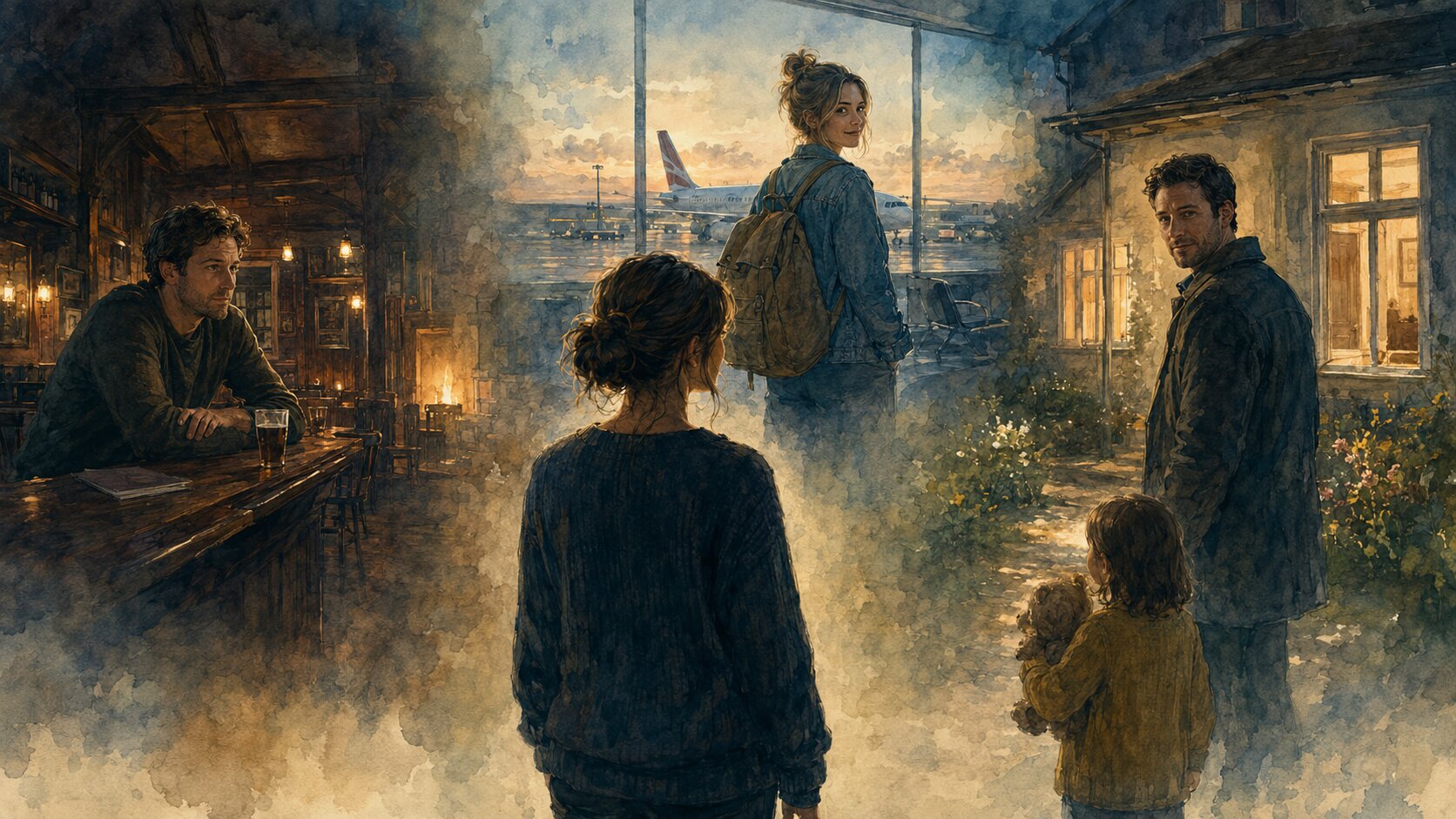
The library had changed again.
Nora noticed it before anyone spoke.
There were fewer shelves now.
Not dramatically fewer.
Just enough that she could see farther across the room than before.
The emptiness made the people inside it seem more distinct.
Dan.
Izzy.
Ash.
Three people.
Three possible lives.
Three versions of Nora she had once imagined might have made everything different.
Dan was the first to speak.
Dan: So.
Nora looked at him.
Dan: Was it me?
She gave a tired smile.
Nora: You're enjoying this.
Dan: A little.
Izzy: He absolutely is.
Dan ignored her.
Dan: You said something before.
When you regretted losing us, were you missing us—or the person you thought you'd become if you'd stayed?
Nora: I don't know yet.
Dan: Good.
Nora: Mrs. Elm is going to be very pleased with me.
From behind the desk, Mrs. Elm looked up.
Mrs. Elm: Excessively.
Nora almost laughed.
Dan didn't.
Dan: When you thought about marrying me, what did you see?
Nora looked at him.
Nora: Us.
Dan: That's vague.
Nora: Fine.
The pub.
The countryside.
A home.
You behind the bar pretending you weren't worried about money.
Me pretending I enjoyed talking to strangers about local ales.
Dan smiled despite himself.
Nora: Maybe a dog.
Dan: We never discussed a dog.
Nora: Every imaginary life gets a dog eventually.
Izzy: That's true.
Dan: What else?
Nora thought.
Nora: Stability.
That word changed the room.
Dan leaned back.
Dan: There it is.
Nora: What's wrong with stability?
Dan: Nothing.
But you didn't say love.
Nora's face tightened.
Nora: I loved you.
Dan: I know you did.
Nora: Then why are you doing this?
Dan: Because loving me and wanting the life around me are not the same thing.
Nora looked away.
Dan: When you were miserable, you didn't think, “I wish Dan were here.”
You thought, “If I'd married Dan, I'd have a home. I'd have a husband. I'd have a business. I'd have a direction.”
Nora said nothing.
Dan: You turned me into architecture.
Izzy let out a small laugh.
Izzy: That's quite good.
Dan: Thank you.
Nora wasn't laughing.
Nora: That's unfair.
Dan: Probably.
Nora: I missed you.
Dan: I believe you.
He softened.
Dan: But I think sometimes you missed what being with me seemed to prove.
Nora looked at him.
Dan: Married.
Settled.
Chosen.
Useful.
Not alone.
Nora's eyes lowered.
Dan: That's a lot to ask one person to symbolize.
Silence.
Then Izzy shifted in her chair.
Izzy: My turn?
Nora sighed.
Nora: Apparently.
Izzy: Australia.
Nora looked at her.
Izzy: What did Australia mean?
Nora: You know.
Izzy: Pretend I don't.
Nora: Freedom.
Izzy: From what?
Nora: Bedford.
My parents.
Everything I was supposed to be.
Myself, probably.
Izzy nodded slowly.
Izzy: Better.
Nora: You wanted me to come.
Izzy: I did.
Nora: And when I didn't, our friendship—
Izzy: Changed.
Nora: Fell apart.
Izzy: It didn't fall apart because of one plane ticket, Nora.
Nora looked hurt.
Izzy continued gently.
Izzy: We drifted.
We failed to say things.
We both got wrapped up in our own lives.
You turned Australia into this giant fork in the road where one Nora became adventurous and the other became trapped.
Nora: Wasn't it?
Izzy: No.
It was a country.
Nora stared at her.
Izzy: A beautiful country.
A difficult country.
A place where people get lonely, screw up relationships, hate their jobs, and cry in supermarkets.
Nora smiled faintly.
Izzy: You made Australia carry more meaning than any continent should have to carry.
Nora: I thought I might have been happier.
Izzy: You might have been.
Nora looked surprised.
Izzy: I'm not going to lie to make the lesson easier.
You might have loved it.
You might have stayed.
You might have hated it.
You might have gone home after six months.
You might have met someone.
You might have become even lonelier.
You don't know.
Nora: I know.
Izzy: No, you know that now.
Back then, you treated it like evidence.
Australia became the place where the brave Nora lived.
Nora: And Bedford was—
Izzy: Where you punished the coward.
Nora flinched.
Izzy's expression softened immediately.
Izzy: I'm sorry.
Nora: No.
You're right.
She looked toward the shelves.
Nora: I made places into personalities.
Dan was stability.
You were freedom.
Izzy: Exactly.
Dan: Which was very flattering until you realize you're no longer a person.
Nora turned toward him.
Dan: You're a life option.
Nora breathed out.
Then someone spoke from farther down the room.
Ash: And what was I?
Nora froze.
Ash had been quiet until now.
He sat near the end of the table, hands loosely folded.
Not accusing.
That made it worse.
Nora looked at him.
Nora: Different.
Ash: Everyone says that right before saying something extremely specific.
Izzy smiled.
Nora didn't.
Nora: You were different.
Ash waited.
Nora: With you...
She stopped.
Dan glanced at Izzy.
No one interrupted.
Nora: I didn't just see a better career.
Or a different city.
Or some fantasy about escaping.
I saw—
She swallowed.
Nora: A home.
Dan: You saw that with me.
Nora: Not like that.
Dan went still.
Nora looked apologetic.
Dan: It's fine.
It clearly wasn't.
Ash looked at Nora.
Ash: What was different?
Nora: Molly.
The name changed everything.
Even Mrs. Elm looked up.
Nora: You.
Molly.
The house.
The way we spoke to each other.
The ordinary things.
Breakfast.
School runs.
Books on the floor.
The garden.
It didn't feel like a fantasy.
It felt—
She searched for the word.
Nora: Lived.
Ash nodded slowly.
Ash: But not by you.
Nora's eyes filled.
Nora: No.
Ash: That's the problem, isn't it?
Nora looked at him.
Ash: You arrived at the end of thousands of choices you never made.
Thousands of mornings you didn't wake up for.
Arguments you didn't have.
Apologies you didn't give.
Birthdays you didn't remember.
Illnesses you didn't sit through.
Private jokes you didn't understand.
Nora's mouth tightened.
Ash: You loved the life.
Nora: I loved you.
Ash didn't answer immediately.
Nora: I did.
Ash: Which me?
Nora stared at him.
Ash: The man you met briefly in your original life?
Or the husband whose history with you already existed when you arrived?
Nora was silent.
Ash: Those aren't quite the same person.
Nora: Neither was I.
Ash nodded.
Ash: Exactly.
The library seemed to become quieter.
Nora: I don't know what that means for the love.
Ash: Neither do I.
That answer surprised her.
Ash: I don't think love becomes fake just because its circumstances are strange.
But I do think you entered a relationship whose roots were underground where you couldn't see them.
You were standing under the tree.
You hadn't planted it.
Nora looked down.
Nora: Does that make what I felt less real?
Ash: No.
It makes it more complicated.
Dan leaned forward.
Dan: There's something irritating about this.
Izzy: Only one thing?
Dan: Nora romanticized my life because she didn't know it.
Then she actually entered it and discovered the problems.
With Ash, she entered a life that was genuinely good.
So now what?
We can't say every regret was an illusion.
Mrs. Elm nodded.
Mrs. Elm: We shouldn't.
Nora turned.
Mrs. Elm: That would be another form of dishonesty.
Some unlived lives may indeed have contained things you would have loved.
Some choices might have led to less pain.
Some relationships might have worked.
Some opportunities truly were lost.
Nora looked surprised.
Nora: That's not very comforting.
Mrs. Elm: Comfort is not the same as truth.
Ash looked at Nora.
Ash: The question isn't whether that life was good.
It was.
Nora: Then why couldn't I stay?
Ash's expression shifted.
Ash: Because “good” isn't the same as “mine.”
Nora's eyes filled.
No one spoke.
Ash: You kept looking at me like you were trying to memorize a life that belonged to someone else.
Nora: She was me.
Ash: Yes.
But she had become herself through years you hadn't lived.
Nora looked toward Mrs. Elm.
Nora: Then what makes a life yours?
Mrs. Elm smiled faintly.
Mrs. Elm: Perhaps that is not a question a librarian should answer.
Nora: Convenient.
Mrs. Elm: Occupational survival.
Izzy laughed softly.
Ash continued.
Ash: Maybe part of it is history.
Not just who you're with.
How you got there.
Nora nodded slowly.
Ash: You loved Molly.
I could see that.
You loved her almost immediately.
Nora: I did.
Ash: But she had memories of you that you didn't have of her.
That matters.
Nora's face crumpled slightly.
Nora: I know.
Ash softened.
Ash: And you had something she couldn't understand.
You knew another life existed.
You knew there was another Nora.
Another set of people.
Another unfinished story.
Nora looked at him.
Ash: You weren't choosing between a bad life and a good one.
You were choosing whether to occupy someone else's continuity.
Dan frowned.
Dan: “Someone else's” is a strange way to put it when they're all Nora.
Ash: That's the strange part.
Dan nodded.
Dan: Fair.
Izzy looked at Nora.
Izzy: Can I ask you something awful?
Nora: You've been doing that all night.
Izzy: Did you want Ash?
Or did you want proof that someone like Ash could love someone like you?
Nora went still.
Ash looked toward Izzy, then back to Nora.
Nora: I don't know.
Izzy: Think.
Nora breathed slowly.
Nora: When I saw that life...
She paused.
Nora: I felt shocked.
Not by him.
By me.
Ash: What do you mean?
Nora: That version of me had built something.
She had a family.
She had work she cared about.
She seemed...
Nora struggled.
Nora: Worth staying for.
Ash's face changed.
Nora: I think I looked at that life and thought, “There. There's the evidence. I was capable of becoming someone lovable.”
Ash leaned back.
Ash: Nora.
She looked at him.
Ash: You just made me evidence too.
That landed gently, but it landed.
Nora closed her eyes.
Nora: You're right.
Ash: I don't say it to hurt you.
Nora: I know.
Ash: You used Dan as evidence for one life.
Izzy as evidence for another.
Me as evidence that you could become a different kind of person.
Nora nodded.
Ash: What happens to us when we're all evidence?
Nora looked around the table.
Dan.
Izzy.
Ash.
People she had turned into doors.
Nora: You stop being people.
Dan: Exactly.
Izzy: Or you become symbols with inconvenient personalities.
Dan looked at her.
Dan: That should be on a mug.
Nora laughed, then wiped her eyes.
Nora: So what am I supposed to do with the fact that there were lives I might genuinely have loved?
Mrs. Elm answered.
Mrs. Elm: Mourn them.
Nora stared at her.
Mrs. Elm: You need not prove they would have been terrible.
You need not diminish them.
You need not tell yourself every closed door hid disaster.
Some closed doors may have hidden beauty.
Nora looked toward Ash.
Mrs. Elm: But mourning an unlived life is different from using it to condemn the one you have.
Nora let the words settle.
Nora: That's harder.
Mrs. Elm: Yes.
Nora: It's easier to say it wouldn't have worked anyway.
Ash: Much easier.
Dan: I recommend that approach personally.
Nora smiled.
Dan: Makes rejection much less complicated.
Izzy: You're ruining the moment.
Dan: I'm improving it.
Nora looked again toward Ash.
Nora: Was that life happy?
Ash considered the question.
Ash: Sometimes.
Nora: Just sometimes?
Ash: That's how lives work.
Nora laughed quietly through tears.
Ash: There were hard days.
There were arguments.
There were worries about Molly.
Money.
Work.
Your tendency to overthink everything.
Nora: That survived?
Ash: Heroically.
She smiled.
Ash: But yes.
There was love.
There was real happiness.
Nora's eyes filled again.
Nora: I wish I had those memories.
Ash nodded.
Ash: I know.
That was the kindest thing anyone had said all evening.
No lesson hidden inside it.
No correction.
Just acknowledgment.
Nora looked down.
Nora: Maybe that's what hurts.
Izzy: What?
Nora: I kept thinking regret had to be solved.
Either the other life was better, which meant I failed—
or it was worse, which meant I could stop regretting it.
But maybe some regrets don't get solved.
Mrs. Elm's expression warmed.
Nora: Maybe sometimes you can say, “That might have been beautiful.”
And still not live there.
No one spoke for a moment.
Then Dan nodded.
Dan: That's probably the first kind thing you've said about an unlived life without turning it into a weapon against yourself.
Nora looked toward him.
Nora: I did love you.
Dan: I know.
Nora: And I also loved what I thought being with you would make me.
Dan smiled faintly.
Dan: I know that too.
She turned toward Izzy.
Nora: I loved you.
And Australia became a symbol for all the courage I thought I didn't have.
Izzy nodded.
Izzy: Better.
Nora turned toward Ash.
She found it hardest to speak.
Nora: And with you—
Ash waited.
Nora: I loved you.
I loved Molly.
I loved that life.
Ash's eyes softened.
Nora: But maybe I loved discovering that such a Nora could exist too.
Ash nodded.
Ash: Yes.
Nora looked around.
One of the shelves behind Ash faded.
Not vanished.
Faded.
As if it no longer needed to demand her attention.
Nora: A life can be good and still not be mine.
Mrs. Elm didn't congratulate her.
She simply let the sentence remain where it was.
Then a small voice came from behind Nora.
Molly: But I was yours.
Nora stopped breathing.
No one moved.
She turned slowly.
Molly stood between two shelves.
Small.
Watching her.
Not philosophical.
Not symbolic.
A child.
Molly: Wasn't I?
Nora's face broke.
Ash lowered his eyes.
Dan and Izzy became completely still.
Mrs. Elm said nothing.
Molly walked closer.
Molly: You said you loved me.
Nora could barely speak.
Nora: I did.
Molly: Then why did you leave?
And suddenly every argument about alternate lives, identity, regret, and possibility became useless.
There was only Nora.
And the daughter she remembered loving.
Topic 3 — If Molly Was Real to You, Why Couldn’t You Stay?
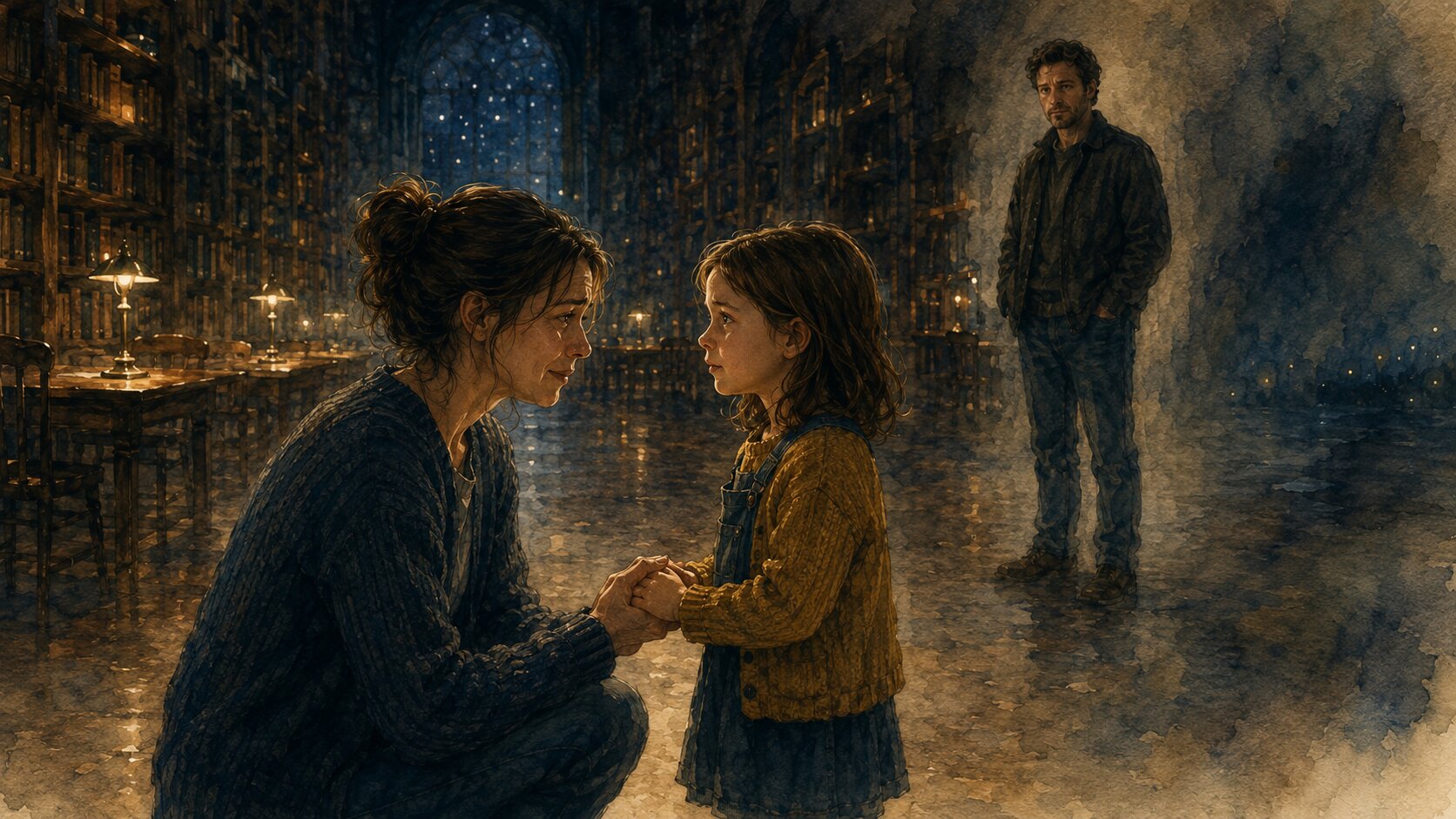
Molly stood between the shelves.
She looked smaller than Nora remembered.
That was the first thing that hurt.
Not fragile.
Not unreal.
Just small.
A child who did not know she had become a philosophical problem.
Molly: You said you loved me.
Nora nodded.
Nora: I did.
Molly: Then why did you leave?
Nora opened her mouth.
Nothing came.
Ash shifted in his chair, but Molly did not look at him.
She was looking only at Nora.
Nora: I didn't want to leave you.
Molly: But you did.
Nora: Yes.
Molly: Why?
Nora looked toward Mrs. Elm.
Mrs. Elm lowered her eyes.
No rescue.
Nora looked back at Molly.
Nora: I didn't belong there.
Molly frowned.
Molly: You lived in our house.
Nora: I know.
Molly: You were my mum.
Nora's face tightened.
Nora: A version of me was.
Molly stared at her.
Molly: What does that mean?
Nora swallowed.
Nora: It means...
She stopped.
Everything she wanted to say suddenly sounded ridiculous.
Parallel lives.
Quantum possibility.
Continuity.
Identity.
None of it belonged in the mouth of a mother speaking to a child.
Nora: It means there was another me who had been your mum your whole life.
Molly: But you looked like her.
Nora: Yes.
Molly: You sounded like her.
Nora: I think so.
Molly: You knew my name.
Nora: Yes.
Molly: You hugged me.
Nora's eyes filled.
Nora: Yes.
Molly: So how wasn't it you?
Nora looked helplessly at Ash.
Ash did not answer for her.
Nora: Because you remembered things I didn't.
Molly waited.
Nora: You remembered birthdays.
Days at school.
Things we had done together.
Little arguments.
Stories.
Maybe nights when you were sick and I stayed up with you.
Maybe mornings when we were late.
Maybe things I said that made you laugh.
Things I said that hurt you.
You had a whole life with me.
I arrived inside it.
Molly looked puzzled.
Molly: Did you remember me at all?
Nora's voice broke.
Nora: No.
Molly's face changed.
Just slightly.
That was worse.
Molly: Not even when I was a baby?
Nora shook her head.
Nora: No.
Molly: My first day at school?
Nora: No.
Molly: When I lost my tooth?
Nora: No.
Nora was crying now.
Nora: I'm sorry.
Molly looked down at her shoes.
Molly: But I remembered you.
Nora covered her mouth.
Ash looked away.
Dan stood and quietly moved farther from the table.
Izzy wiped at one eye and pretended she hadn't.
Molly: So if I remembered you, and you loved me...
She looked up again.
Molly: Why wasn't that enough?
Nora knelt.
Not because anyone told her to.
She needed to be closer to Molly's height.
Nora: I don't know how to explain it without making it sound like I didn't love you enough.
Molly's eyes were wet now.
Molly: Did you?
Nora: Yes.
The answer came instantly.
Nora: Yes.
I loved you.
Molly: A lot?
Nora laughed once through her tears.
Nora: More than I knew I could love someone.
Molly considered that.
Molly: Then you should have stayed.
Nora closed her eyes.
No one in the library moved.
Nora: Maybe.
Ash looked up.
Mrs. Elm did too.
Molly's face softened slightly.
She had expected an argument.
Nora didn't give her one.
Nora: Maybe from where you were standing, I should have.
Molly: Where were you standing?
Nora looked at her.
Nora: In a life I had not lived.
Molly frowned again.
Nora: I was surrounded by people I loved...
She looked toward Ash.
Then back.
Nora: But I was missing the years that made us belong to one another.
Molly: You belonged to me.
Nora began crying harder.
Nora: I know.
Molly stepped closer.
Molly: Did I belong to you?
Nora stared at her.
There it was.
The question she had been avoiding.
Not whether Molly was real.
Not whether the alternate life was legitimate.
Not whether identity could cross timelines.
Did this child belong inside Nora's heart?
Nora: Yes.
Molly waited.
Nora: Yes, you did.
Molly's voice became smaller.
Molly: Then I don't understand.
Nora: Neither do I completely.
Mrs. Elm spoke quietly.
Mrs. Elm: Perhaps you shouldn't.
Molly turned toward her.
Molly: Why?
Mrs. Elm: Some things become less truthful when adults make them too neat.
Molly thought about this.
Molly: That's annoying.
A tiny laugh escaped Nora.
Mrs. Elm smiled.
Mrs. Elm: Very.
Molly looked back at Nora.
Molly: Were you sad with us?
Nora: No.
Molly: Were Dad and I bad?
Nora: Never.
Molly: Did you want another family?
Nora: No.
Molly's brow furrowed.
Molly: Then I really don't understand.
Nora sat on the floor now.
Nora: I think I wanted something impossible.
Molly: What?
Nora: I wanted that life...
She looked around.
Nora: And I wanted it to feel as though I had actually lived it.
Molly sat across from her.
Nora: I wanted to know why you liked certain foods.
Why you hated others.
Who your friends were.
What scared you.
What made you laugh before I arrived.
I wanted to remember the first time I held you.
I wanted to remember becoming your mother.
Molly listened.
Nora: And I couldn't.
Molly: Couldn't you make new memories?
Nora froze.
Ash looked sharply at Molly.
Nora gave a helpless little laugh.
Nora: Yes.
I could have.
Molly shrugged in the blunt way only children can.
Molly: Then why didn't you?
Nora looked down.
That question cut deeper than everything else.
Mrs. Elm did not intervene.
Nora: I was afraid.
Molly: Of me?
Nora: No.
Of choosing that life because it looked perfect.
Of staying because I was terrified I would never find anything that good again.
Molly looked confused.
Molly: But if it was good, isn't that okay?
Nora: Maybe.
Ash finally spoke.
Ash: Nora.
She turned.
Ash: Don't make perfection the excuse.
Nora stared at him.
Ash: It wasn't perfect.
You knew that.
Nora: I know.
Ash: We argued.
You felt disoriented.
You didn't know your own work properly.
You forgot things.
You felt like an impostor.
That life wasn't perfect.
Nora nodded.
Ash: So what were you really afraid of?
Nora looked at Molly.
Then at him.
Nora: Taking something that wasn't mine.
Ash's expression changed.
Ash: Taking?
Nora: Your wife had a history with you.
Molly had a mother.
I arrived and occupied her place.
Ash leaned forward.
Ash: But she was you.
Nora: Not entirely.
Ash: How much difference makes a person someone else?
Nora shook her head.
Nora: I don't know.
Ash: Neither do I.
He looked toward Mrs. Elm.
Ash: But I wonder whether Nora sometimes uses philosophy to avoid saying something simpler.
Nora frowned.
Nora: Such as?
Ash: You couldn't trust happiness.
Nora went still.
Ash continued.
Ash: You spent so long expecting your life to hurt that when you entered one that contained love, stability, work, family...
You immediately began looking for the reason you weren't allowed to have it.
Nora stared at him.
Nora: That's not fair.
Ash: No?
Nora: I was literally in someone else's life.
Ash: Your own alternate life.
Nora: Exactly.
Ash: And what did you do the moment you discovered it was good?
Nora didn't answer.
Ash: You started looking for the exit.
Molly looked between them.
Molly: Mum does that.
Everyone turned.
Nora blinked.
Nora: What?
Molly: When things are nice.
Ash smiled sadly.
Molly: Sometimes you say, “This can't last.”
Nora looked at Ash.
He nodded.
Ash: She did.
Nora's face fell.
Molly: I don't like when you say it.
Nora: Why?
Molly: Because then even when something nice is happening, it feels like you're already sad about when it stops.
Nora closed her eyes.
Izzy whispered from across the room:
Izzy: Oh God.
Joe, who had been standing quietly near a shelf, lowered his head.
Molly kept going.
Molly: Like when we went to the beach.
You said it was perfect.
Then you got sad.
Nora: I don't remember that.
Molly: I do.
That sentence nearly destroyed her.
Molly: You said, “I wish I could keep this.”
Nora's lips trembled.
Molly: I told you we could come back next year.
Nora cried openly.
Molly: You laughed.
Then you hugged me.
Molly looked down.
Molly: I thought you were happy.
Nora: I was.
Molly: Then why were you sad?
Nora took a long breath.
Nora: Maybe I had spent so much of my life losing things before they were gone...
She wiped her face.
Nora: ...that I didn't know how to just have them.
Mrs. Elm's expression softened.
Molly moved closer.
Molly: You could learn.
Nora looked at her.
The simplicity of it.
No cosmic philosophy.
No alternate universe.
You could learn.
Nora: Maybe I could.
Molly stared at her.
Molly: Could you have learned with me?
Nora's voice almost disappeared.
Nora: Yes.
Molly's eyes filled.
Molly: Then you could have stayed.
Nora bowed her head.
There was no answer that could defeat that sentence.
Ash stood and walked toward them.
He crouched beside Molly.
Ash: Can I say something?
Molly nodded.
Ash looked at Nora.
Ash: I don't think leaving means you didn't love us.
Nora looked up.
Ash: And I don't think staying would automatically have meant you were stealing someone else's life.
Maybe both of those ideas are too clean.
Nora listened.
Ash: Maybe you left because something in you knew you couldn't make peace with starting in the middle.
Maybe you were afraid.
Maybe you still felt connected to the life you came from.
Maybe all of those things were true.
He looked at Molly.
Ash: Adults sometimes make choices with several reasons inside them.
Molly: That's stupid.
Ash smiled.
Ash: Often.
Nora laughed weakly.
Molly leaned against Ash.
Molly: If she stayed, would the other Nora come back?
No one answered.
Mrs. Elm finally spoke.
Mrs. Elm: That is a question the library never explained.
Molly: You work here.
Mrs. Elm: Libraries contain unanswered questions too.
Molly seemed unimpressed.
Molly: Bad library.
Mrs. Elm nodded solemnly.
Mrs. Elm: Fair criticism.
A little laughter broke the tension.
Then Molly looked back at Nora.
Molly: Are you my mum?
Nora's breath caught.
Nora: In the life I lived with you...
She stopped.
That sounded too careful.
She tried again.
Nora: I loved you like your mum.
Molly shook her head.
Molly: That's not what I asked.
Nora looked at Ash.
Ash looked away.
This belonged to Nora.
Nora: I don't know what word I'm allowed to use.
Molly frowned.
Molly: Who decides?
Nora stared at her.
A child had just dismantled the question.
Who decides?
Mrs. Elm smiled almost imperceptibly.
Nora reached toward Molly's hand but stopped before touching it.
Nora: Would you let me say yes?
Molly looked at her for a long moment.
Then she put her small hand into Nora's.
Molly: Yes.
Nora broke.
She pulled Molly toward her.
Molly wrapped her arms around Nora's neck.
And for a little while there was no Midnight Library.
No alternate Nora.
No metaphysics.
No regret.
Only the strange fact that love had occurred.
Whatever timeline had produced it.
Nora held her tightly.
Nora: I'm sorry.
Molly whispered into her shoulder.
Molly: I know.
Nora: I wish I remembered everything.
Molly: I can tell you.
Nora pulled back.
Nora: What?
Molly: The things you forgot.
Nora stared at her.
Molly: I can tell you.
Nora began crying again.
Molly: You're crying a lot.
Nora: I'm having a difficult evening.
Molly nodded seriously.
Molly: Dad does that sometimes.
Ash raised an eyebrow.
Ash: Thank you.
Molly smiled.
Then Nora asked:
Nora: Would you tell me one?
Molly: One what?
Nora: One memory.
Molly thought.
Molly: There was a night when I had a bad dream.
Nora listened.
Molly: I came into your room.
Dad was asleep.
You came back to my room with me.
You said monsters don't like boring stories.
Nora laughed through tears.
Molly: So you read me the instructions for the washing machine.
Ash covered his face.
Ash: That sounds like you.
Molly: I fell asleep before the spin cycle.
Nora laughed harder.
Molly smiled.
Molly: See?
Now you remember.
Nora stopped laughing.
Nora: Not the same way you do.
Molly: No.
Then Molly shrugged.
Molly: But now you have it too.
Nora looked at her.
Something shifted inside the library.
Far away, a row of books gently disappeared.
No crash.
No light.
Just space.
Nora noticed.
Molly did not.
Nora: Maybe memories can be given a little.
Mrs. Elm spoke.
Mrs. Elm: Stories can.
Nora looked at her.
Mrs. Elm continued.
Mrs. Elm: Whether that is the same thing is another question.
Nora looked back at Molly.
Nora: Maybe it doesn't have to be the same.
Molly squeezed her hand.
Molly: Good.
Then Molly asked:
Molly: Do you wish you'd stayed?
Nora did not answer quickly.
Everyone waited.
Nora looked at Ash.
At Molly.
At the surrounding library.
Nora: Part of me does.
Molly nodded.
Nora: I think part of me always will.
Molly's face softened.
Nora: Not because the life I returned to was wrong.
And not because yours was perfect.
But because I loved you.
And loving someone means there can be grief in not being where they are.
Molly seemed to understand that more than the earlier explanations.
Molly: Okay.
Nora blinked.
Nora: Okay?
Molly: Yes.
Children sometimes accepted what adults spent years trying to solve.
Molly stood.
Nora did too.
Before Molly stepped away, Nora stopped her.
Nora: Molly?
Molly: Yes?
Nora: You were real to me.
Molly smiled.
Molly: I know.
She walked toward Ash.
Nora watched her.
Then Mrs. Elm came beside Nora.
Mrs. Elm: You wanted to know whether a good life could still not be yours.
Nora nodded.
Mrs. Elm: Perhaps the more difficult truth is that something can become part of you even if you cannot keep it.
Nora watched Molly take Ash's hand.
Nora: That feels worse.
Mrs. Elm: Often the truer things do.
Nora looked toward the shelves.
Nora: I thought every regret needed an answer.
Mrs. Elm said nothing.
Nora: Maybe some regrets are just love with nowhere to go.
Mrs. Elm looked at her.
Mrs. Elm: Sometimes.
Nora watched Molly disappear slowly between the shelves with Ash.
Not erased.
Not corrected.
Not converted into a lesson.
Loved.
And lost.
Hugo's voice came from somewhere behind her.
Hugo: You're still doing it.
Nora turned.
He stood near the end of an aisle.
Nora: Doing what?
Hugo: Looking at what happened and deciding you understand what the other option would have meant.
Nora frowned.
Nora: After everything I've seen?
Hugo gave her a strange smile.
Hugo: Especially after everything you've seen.
He walked closer.
Hugo: You think the library cured you of guessing about alternate lives.
Maybe it only made you more confident at it.
Nora stared at him.
The conversation had changed again.
Until now, regret had looked like pain.
Hugo was about to ask whether it was something else too.
A claim of knowledge.
A claim Nora had never truly earned.
Topic 4 — Is Regret Sometimes a Form of Arrogance?
Hugo walked slowly toward Nora.
He had the relaxed expression of someone who had spent too long in impossible places.
That irritated her immediately.
Nora: You always look as though you know something everyone else doesn't.
Hugo: Occupational hazard.
Nora: Of what?
Hugo: Escaping consequences.
Nora frowned.
Hugo sat on the edge of the table.
Hugo: You think regret makes you humble.
Nora: I didn't say that.
Hugo: No. But that's how you treat it.
As though regret is evidence that you are honest enough to admit your mistakes.
Nora crossed her arms.
Nora: What's wrong with admitting mistakes?
Hugo: Nothing.
Nora: Then what are you saying?
Hugo looked toward the shelves.
Hugo: I'm saying regret sometimes contains an extraordinary amount of confidence.
Nora laughed.
Nora: Confidence?
Hugo: Yes.
You say:
“If I'd stayed in the band, things would have been better.”
“If I'd married Dan, I would have been happier.”
“If I'd gone to Australia, I would have become someone else.”
“If I'd kept swimming, my father would have been proud.”
Nora: I don't believe all of those anymore.
Hugo: Good.
But think about what they required you to believe.
Nora waited.
Hugo: You had to know what Dan would become.
What Joe would choose.
What your father would feel.
Who you would meet.
Which illnesses would happen.
Which accidents wouldn't.
Which opportunities would appear.
Which friendships would survive.
Which parts of your personality would change.
Nora's face tightened.
Hugo: That's quite a lot of information for someone who hadn't lived the life.
Nora: That's what regret is. Imagining what might have happened.
Hugo: Imagining, yes.
But you didn't imagine.
You concluded.
Nora was silent.
Mrs. Elm looked up from her desk.
Mrs. Elm: There is a difference between saying “It might have been better” and “I know I ruined everything.”
Nora looked at her.
Nora: I know that now.
Hugo: Do you?
Nora glared at him.
Hugo: Molly just asked you whether you should have stayed.
You almost turned that into another verdict.
Nora's expression changed.
Nora: I said part of me wished I had.
Hugo: That's different.
But listen to your mind.
It wants a ruling.
Stay: correct.
Leave: incorrect.
Original life: wrong.
Alternate life: right.
You keep trying to turn existence into a multiple-choice exam.
Nora looked away.
Nora: Maybe because choices matter.
Hugo: Of course they matter.
That's not the same as saying their consequences can be known in advance.
He leaned forward.
Hugo: I have lived more versions of myself than I can count.
I've been rich.
Poor.
Married.
Single.
A father.
Childless.
Successful.
Ordinary.
Loved.
Alone.
Nora watched him.
Hugo: Do you know what I learned?
Nora: That you're insufferable in every universe?
Hugo smiled.
Hugo: Almost certainly.
Then his expression became serious.
Hugo: Every time I thought I had understood the pattern, the life changed.
A perfect marriage developed a grief I couldn't predict.
A career I thought would save me became unbearable.
A life I nearly abandoned became beautiful six months later.
A life I thought was perfect collapsed over something I never saw coming.
He looked around the library.
Hugo: Possibility is not a map.
It is fog.
Nora said nothing.
Hugo: And regret is often what we draw inside the fog after we've already walked one road.
Nora frowned.
Nora: That sounds like you're saying we shouldn't learn from mistakes.
Hugo: No.
I'm saying a mistake and an imagined alternate universe are different things.
You can say:
“I treated someone badly.”
That's real.
You can say:
“I should have apologized sooner.”
Probably fair.
But then the mind adds:
“If I had apologized, we'd still be together.”
Now you've crossed into fiction.
Nora looked toward Dan.
He gave a small nod.
Dan: He's right about that.
Nora sighed.
Nora: Wonderful. Hugo and Dan agree.
Izzy: Historic day.
Hugo smiled, then turned back to Nora.
Hugo: Regret can begin with responsibility and end with omniscience.
Nora stared at him.
Nora: Omniscience is a bit dramatic.
Hugo: Is it?
He stood.
Hugo: Think about the sentence “My life would have been better if...”
How much must you know to finish that sentence with certainty?
Nora did not answer.
Mrs. Elm: More than any person can know.
Hugo: Exactly.
Nora looked toward the shelves.
Nora: But some choices obviously make life worse.
Mrs. Elm: Some choices create clear harm.
That is not the same claim.
Nora: Explain.
Mrs. Elm walked closer.
Mrs. Elm: If you betray someone, you may rightly regret the betrayal.
If you neglect someone, you may regret the neglect.
If fear keeps you from doing something meaningful, you may regret allowing fear to decide.
Those are judgments about what you did.
Nora nodded.
Mrs. Elm: But saying “Had I done otherwise, everything afterward would have been better” is a judgment about an entire universe.
Nora looked down.
Mrs. Elm: One deserves reflection.
The other deserves caution.
Hugo folded his arms.
Hugo: There is another part you won't like.
Nora: I'm shocked.
Hugo: Self-blame can be comforting.
Nora's eyes flashed.
Nora: There is nothing comforting about hating yourself.
Hugo: Not emotionally.
Structurally.
Nora stared.
Hugo: If everything went wrong because of your choices, then the world makes sense.
You had the power.
You misused it.
Tragic.
But tidy.
Nora's face slowly changed.
The words echoed something she had already discovered with Joe.
Nora: If it was my fault, then there was something I could have done.
Hugo: Yes.
Nora: And if there was something I could have done...
Mrs. Elm: Then the universe was controllable.
Silence.
Nora sat down.
Nora: That's horrible.
Hugo: It can be kinder than the alternative.
Nora: Which is?
Hugo looked at her.
Hugo: That sometimes terrible things happen even when no one made the wrong choice.
Nora's eyes lowered.
Hugo: People get sick.
People change.
Love ends.
Jobs disappear.
Parents die.
Friends drift.
Accidents happen.
Timing matters.
Luck matters.
Other people's freedom matters.
Sometimes there isn't a decision you can identify and say, “There. That's where I destroyed the good universe.”
Nora rubbed her hands together.
Nora: Then what do you do with the pain?
Hugo: You don't always get to convert it into explanation.
Nora looked up.
Hugo's voice had lost its teasing quality.
Hugo: That's one reason people prefer regret.
Regret says:
“This happened because I chose badly.”
Uncertainty says:
“This happened, and I may never know why.”
Nora stared at him.
Nora: You've thought about this a lot.
Hugo laughed quietly.
Hugo: I've had a lot of lives to waste.
Mrs. Elm watched him.
Mrs. Elm: Waste?
Hugo smiled.
Hugo: We'll get to me soon, I imagine.
Mrs. Elm: We will.
Hugo's smile disappeared.
Nora noticed.
Nora: You said seeing alternate lives can make regret worse.
Hugo: Yes.
Nora: It helped me.
Hugo: Eventually.
Nora: Didn't it help you?
Hugo looked toward the endless shelves.
Hugo: At first, I thought it would.
He walked along the nearest aisle.
Hugo: Imagine you've regretted one decision for ten years.
Then someone lets you see the alternative.
You discover it wasn't perfect.
Wonderful.
Regret reduced.
Nora nodded.
Hugo: Then you see another life.
And another.
And another.
Soon you no longer have one comparison.
You have thousands.
Nora's expression changed.
Hugo: Every life becomes a reference point for every other life.
In one life you're richer.
In another you're more loved.
In another you're healthier.
In another your parents live longer.
In another you have children.
In another you don't and you travel the world.
Nora watched him.
Hugo: Infinite alternatives don't eliminate comparison.
They industrialize it.
Nora almost smiled at the phrase.
Then she saw he wasn't joking.
Hugo: I could enter a beautiful life and still remember another one where I had something this life lacked.
Nora: So you left?
Hugo: Often.
Nora: Even when you were happy?
Hugo hesitated.
Hugo: Especially when I was almost happy.
Nora frowned.
Nora: Why?
Hugo: Because “almost” becomes unbearable once you believe somewhere there might be “completely.”
That landed.
Nora thought of Ash.
Molly.
The warm house.
The feeling that something was missing even inside something beautiful.
Nora: You kept looking for the best one.
Hugo: Yes.
Nora: Did you find it?
Hugo laughed once.
Hugo: Every best life lasted until I noticed what another life had.
Mrs. Elm looked at him sadly.
Hugo: That's the cruelty of comparison.
It does not ask whether something is good.
It asks whether something else might be better.
Nora's eyes moved toward the books.
Suddenly the library looked less like salvation.
More like an infinite marketplace.
Nora: So the library can become the problem.
Hugo: Anything can become the problem if you use it to avoid choosing.
Mrs. Elm's eyes settled on him.
Mrs. Elm: Including wisdom.
Hugo gave her a small smile.
Hugo: Especially wisdom.
Nora stood again.
Nora: But I needed the library.
Mrs. Elm: Yes.
Nora: Without it, I might never have understood any of this.
Mrs. Elm: Yes.
Nora: Then how can it be dangerous?
Mrs. Elm looked around them.
Mrs. Elm: Medicine can become poison when you refuse to stop taking it.
Nora glanced at Hugo.
He looked amused.
Hugo: I feel personally attacked.
Mrs. Elm: Good.
Nora smiled.
Then became serious.
Nora: There's something I still don't understand.
Mrs. Elm: Good.
Nora: You really like that word.
Mrs. Elm: It keeps librarians employed.
Nora looked at Hugo.
Nora: Suppose I make a terrible choice tomorrow.
Something I genuinely should regret.
What am I supposed to tell myself?
“That was fine because I couldn't know?”
Hugo: No.
Nora: Then what?
Hugo thought for a moment.
Hugo: Maybe:
“I was responsible for the choice I made with what I knew, what I feared, what I wanted, and who I was then.”
Nora listened.
Hugo: Then you ask what you can repair.
What you can learn.
What you owe someone.
What you should do now.
Nora nodded.
Hugo: But you don't invent an entire perfect timeline and beat yourself with it.
Nora: Easier said than done.
Hugo: Most useful things are.
Dan spoke from the table.
Dan: There's another problem with regret.
Everyone turned toward him.
Dan: It can be incredibly self-centered.
Nora raised an eyebrow.
Dan: Don't glare at me yet.
Nora: I'm preparing.
Dan: When our engagement ended, you spent years thinking:
“I ruined my chance.”
But I had a life after you.
Nora's expression softened.
Dan: You don't know what I learned.
Who I met.
What changed.
Maybe staying with you would have been worse for me.
Maybe better.
Maybe both.
Nora: Both?
Dan: Things can be better and worse at the same time.
Nora nodded slowly.
Dan: Regret turns other people into pieces on your alternate-life chessboard.
“If I had moved this piece differently, everyone would have ended up where I wanted.”
Izzy: That's good too.
Dan: I'm on fire tonight.
Nora: Please don't encourage him.
But she was listening.
Dan: The problem isn't imagining alternatives.
Everyone does that.
It's forgetting the other people in those alternatives would still have had free will.
Nora looked toward Izzy.
Izzy: You could have moved to Australia and I could have left six months later.
Nora: You would have done that, wouldn't you?
Izzy: Very possibly.
Joe: You could have stayed in the band and I could still have screwed everything up.
Nora: Comforting.
Joe: I'm here to help.
Nora laughed.
Then her expression became thoughtful.
Nora: So regret doesn't just exaggerate my control over myself.
It exaggerates my control over everyone else.
Mrs. Elm nodded.
Mrs. Elm: Sometimes.
Nora looked toward the shelves.
Nora: That's strange.
Hugo: What is?
Nora: I thought regret was the opposite of arrogance.
I thought it meant admitting I wasn't good enough.
Hugo looked at her.
Hugo: A person can think very little of herself and still imagine herself at the center of everything.
Nora flinched, but did not argue.
Nora: So what's humility then?
Mrs. Elm answered this time.
Mrs. Elm: Perhaps saying:
“I mattered.
My choices mattered.
Other people mattered.
Chance mattered.
Things I could not see mattered.
And I will never know the full equation.”
Nora was quiet.
Mrs. Elm: Humility does not mean pretending you had no influence.
It means accepting that you never had all of it.
A book slipped gently from a shelf.
Nora watched it fall.
Then another.
She noticed something.
Nora: These books disappear whenever I stop believing I know what they contained.
Mrs. Elm glanced toward the shelves.
Mrs. Elm: Do they?
Nora: You know they do.
Mrs. Elm smiled.
Nora walked to one of the remaining books.
She pulled it out.
The cover carried a life she once would have wanted to open immediately.
She held it for several seconds.
Then placed it back.
Hugo watched.
Hugo: Aren't you curious?
Nora: Extremely.
Hugo: Then why not open it?
Nora looked at him.
Nora: Because I already know what I'll do.
Hugo: What's that?
Nora: Compare.
Hugo's expression softened.
Nora: I'll find one beautiful thing and think I missed it.
Or one terrible thing and congratulate myself for avoiding it.
Either way, I'll pretend I've learned what the entire life means from one visit.
Hugo nodded.
Nora: Maybe I don't need to know.
She seemed surprised by her own words.
Mrs. Elm: How does that feel?
Nora considered it.
Nora: Terrifying.
Mrs. Elm smiled.
Nora: And lighter.
She returned to the table.
Hugo sat across from her.
Nora: What about you?
Hugo: What about me?
Nora: You understand all of this.
You've understood it for longer than I have.
Why are you still here?
Hugo's smile disappeared.
Nora leaned forward.
Nora: You said possibility became comparison.
You said every good life made you wonder about another.
You said regret can become arrogance.
So why didn't you choose?
Hugo looked toward Mrs. Elm.
She said nothing.
Nora continued.
Nora: You keep explaining the trap like someone standing outside it.
But you're still in it.
Hugo stared at her.
For the first time, he seemed less like a guide.
More like another lost person in the library.
Hugo: Perhaps knowing the trap isn't the same as leaving it.
Nora nodded.
Nora: That's something I've learned too.
Hugo smiled sadly.
Nora: What are you afraid will happen if you choose one life?
He looked toward the shelves.
A long silence.
Then:
Hugo: I'll know all the others are gone.
Nora's face softened.
There it was.
Not curiosity.
Not enlightenment.
Grief.
Nora: You don't want the perfect life.
Hugo looked at her.
Nora: You want to avoid losing every other one.
He said nothing.
Mrs. Elm quietly closed the book she had been reading.
The sound echoed through the thinning library.
Hugo looked around at the shelves.
Hugo: Isn't that the same thing?
Nora: No.
She surprised herself with how certain she sounded.
Nora: I don't think it is.
Hugo waited.
Nora: Searching for the perfect life means believing one choice will contain everything.
Refusing to choose means refusing to accept that no life can.
Hugo's eyes narrowed slightly.
Nora looked at the books.
Nora: Maybe that's what all these shelves hide.
Every life gives you something.
Every life costs you something.
Hugo looked toward Mrs. Elm.
Hugo: You've trained her well.
Mrs. Elm: I did almost nothing.
Nora: That's not true.
Mrs. Elm: Good librarians mostly point toward shelves.
Hugo smiled.
Nora did not.
She was watching him.
Nora: If the library let you stay here forever—
Hugo already knew the question.
Nora: Would you?
He looked at the infinite possibilities surrounding him.
Then at the spaces where shelves had disappeared.
Hugo: Once, I would have said yes.
Nora: And now?
Hugo's answer took a long time.
Hugo: Now I think forever might be another word for never.
Nora stared at him.
The library seemed to hold that sentence.
Never committing.
Never losing.
Never belonging.
Never arriving.
Mrs. Elm rose from her chair.
Mrs. Elm: Perhaps we have finally reached the question you have both been avoiding.
Nora looked at her.
Hugo did too.
Mrs. Elm: If every open door feels like freedom—
She glanced toward the countless remaining books.
Mrs. Elm: —what happens when freedom requires closing one?
No one answered.
And somewhere in the library, an entire aisle quietly went dark.
Topic 5 — If You Could Live Every Life, Would Any Life Still Matter?
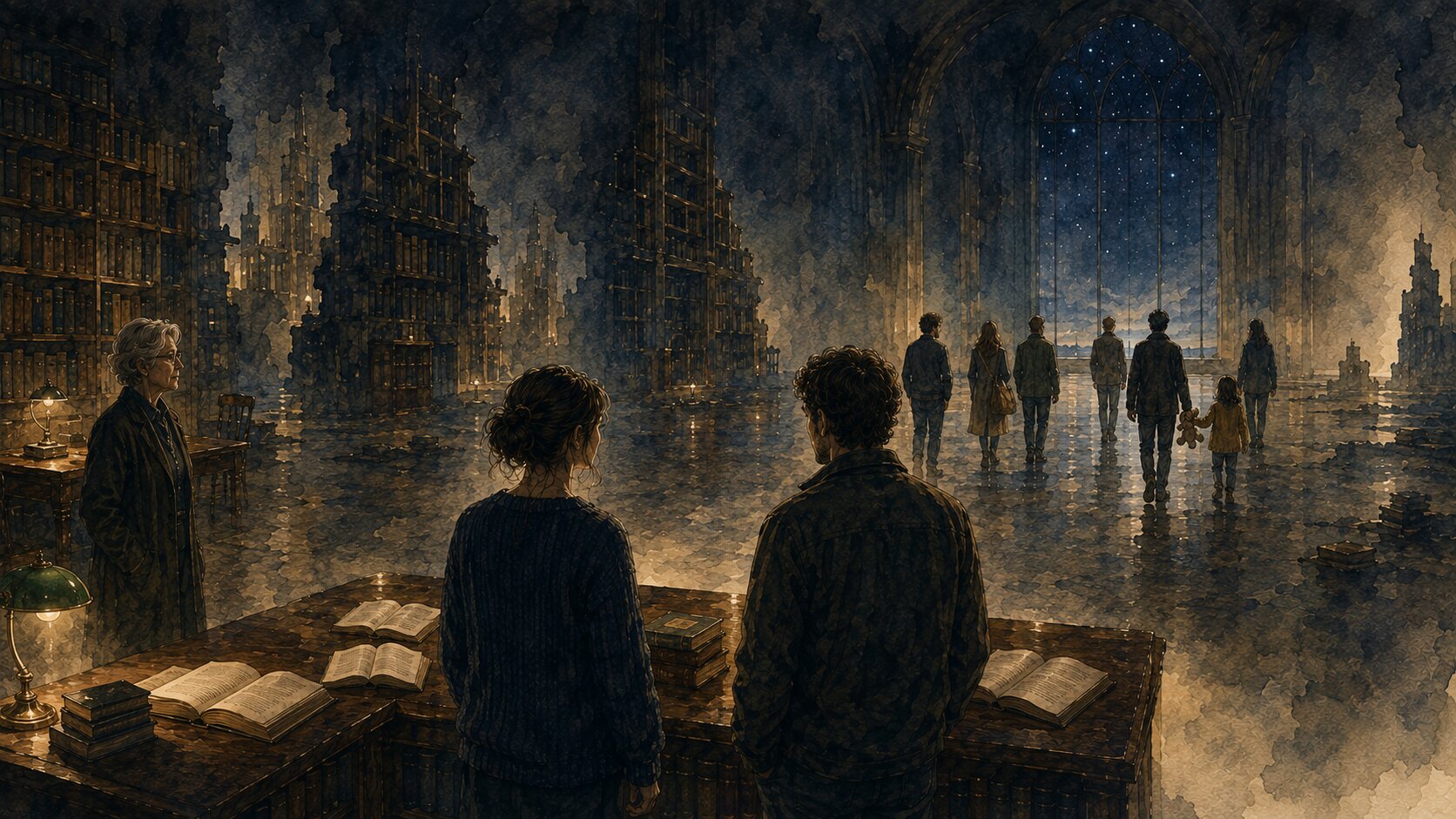
The aisle that had gone dark did not return.
Nora watched the black space where shelves had been.
Hugo watched it too.
Neither of them seemed eager to speak.
Mrs. Elm remained standing beside the desk.
The library no longer felt infinite.
That frightened Nora more than she expected.
Nora: I used to think all these books were freedom.
Hugo: So did I.
Nora: Now they look like postponement.
Hugo gave a faint smile.
Hugo: That's less poetic.
Nora: More accurate.
He nodded.
For once, he did not argue.
Nora walked toward one of the remaining shelves.
Her hand hovered over several books.
She did not touch them.
Nora: When I first came here, I thought choosing was the problem.
Mrs. Elm looked at her.
Nora: If I could just find the right one...
The right career.
The right relationship.
The right city.
The right version of myself.
Then I wouldn't have to feel regret anymore.
Mrs. Elm: And now?
Nora looked toward Hugo.
Nora: Now I'm wondering whether wanting no regret was the problem.
Hugo's expression changed.
Hugo: Explain.
Nora: Every real choice leaves something behind.
If I choose one person, I don't choose someone else.
If I live in one place, I don't live everywhere else.
If I become one kind of person, other versions of me don't happen.
Hugo stared at the shelves.
Nora: Maybe regret isn't always evidence that the choice was wrong.
Maybe sometimes it's just the emotional cost of having chosen at all.
Mrs. Elm said nothing.
Hugo did.
Hugo: That's dangerous.
Nora: Why?
Hugo: Because people use ideas like that to excuse terrible decisions.
Nora turned.
Nora: I'm not saying every choice deserves acceptance.
Hugo: Good.
Nora: I'm saying loss doesn't automatically mean error.
Hugo looked at her for a long moment.
Then nodded.
Hugo: Better.
Nora smiled.
Nora: I feel as though I'm being graded.
Mrs. Elm: You are not.
Hugo: I am.
Mrs. Elm ignored him.
Nora walked toward the table.
Nora: Hugo, what happens when you enter a life that you genuinely like?
Hugo: Eventually?
Nora: Yes.
Hugo: I notice what it lacks.
Nora: And then?
Hugo: I leave.
Nora: Why?
Hugo: We've covered this.
Nora: No.
We've covered comparison.
I want the moment.
Hugo frowned.
Nora: You're sitting at breakfast.
Or you're with someone you love.
Or you're doing work you care about.
You think, “This is good.”
What happens next?
Hugo looked uncomfortable.
Hugo: I remember another life.
Nora: What about it?
Hugo: Something from it.
A person.
A place.
A feeling.
Nora nodded.
Nora: And then?
Hugo: I start wondering whether I should go back.
Nora: Even if you're happy?
Hugo hesitated.
Hugo: Happiness makes it worse.
Nora: Why?
He gave a small, bitter laugh.
Hugo: Because then there's something to lose.
Nora went still.
There it was again.
Not love of possibility.
Fear of loss.
Nora: So you leave before the life can become necessary.
Hugo's face hardened slightly.
Hugo: That's one interpretation.
Nora: Is it wrong?
He did not answer.
Mrs. Elm moved slowly toward them.
Mrs. Elm: What is the safest life, Hugo?
He looked at her.
Hugo: There isn't one.
Mrs. Elm: Try again.
Hugo frowned.
Mrs. Elm waited.
Hugo: A life you don't care about.
The answer came quietly.
Nora looked at him.
Hugo: If you don't care, you can't lose much.
Nora: But you don't stay in those either.
Hugo: No.
Nora: So you want a life meaningful enough to enjoy and disposable enough not to hurt.
Hugo gave her a tired look.
Hugo: You have become extremely irritating.
Nora: I've had good teachers.
Mrs. Elm pretended not to hear.
Hugo looked down.
Hugo: Maybe.
Nora: That's impossible.
Hugo: I know.
Nora: Do you?
His eyes met hers.
Nora softened.
Nora: I don't mean intellectually.
Hugo looked away.
Nora: Do you actually know it?
A long silence.
Hugo: No.
Nora sat beside him.
Hugo: Every time I enter a life, I tell myself I'll know when it's the one.
Nora: The one?
Hugo: The one worth giving up the library for.
Nora looked around.
Nora: What would it need?
Hugo: Enough.
Nora: Enough what?
Hugo laughed.
Hugo: Exactly.
He rubbed his face.
Hugo: Enough love.
Enough meaning.
Enough freedom.
Enough peace.
Enough excitement.
Enough certainty.
Nora stared at him.
Nora: You're asking one life to contain all the lives.
Hugo said nothing.
Nora: That's why none of them can win.
Hugo turned toward her.
Hugo: You were doing the same thing.
Nora: I know.
Hugo: You still might.
Nora: I know that too.
That answer disarmed him.
Nora looked toward the shelves.
Nora: Maybe that's the strange thing.
I thought the perfect life would be the one with the least regret.
Now I think it might be the opposite.
Hugo: Meaning?
Nora: A life worth living may create regrets simply because you cared about things.
You chose.
You stayed.
You loved people.
You lost things.
You could imagine alternatives.
Hugo looked skeptical.
Nora: I'm not romanticizing suffering.
Hugo: Good.
Nora: I'm saying a life with no closed doors isn't a life.
It's a corridor.
Mrs. Elm smiled faintly.
Hugo stared at Nora.
Hugo: That's annoyingly good.
Nora: Thank you.
Mrs. Elm: Please don't encourage her.
Nora laughed.
Then she noticed something at the far end of the library.
A shelf disappeared.
Not a book.
The whole shelf.
The space behind it revealed something Nora had never seen there before.
A wall.
Plain.
Finite.
Nora: Mrs. Elm.
Mrs. Elm followed her gaze.
Nora: There's a wall.
Mrs. Elm: Yes.
Nora: There wasn't before.
Mrs. Elm: Perhaps there was.
Nora: You really never answer anything directly.
Mrs. Elm: It would ruin my reputation.
Nora walked closer to the wall.
She touched it.
Solid.
The library had boundaries.
Nora: I don't like this.
Hugo approached.
Hugo: Neither do I.
Nora: I thought you wanted to leave.
Hugo: Wanting to leave and wanting the exit to exist are different things.
Nora turned toward him.
Nora: That's your whole problem.
Hugo gave her a look.
Nora: Sorry.
Hugo: No, you're not.
Nora: Not really.
They stood together before the wall.
Mrs. Elm spoke from behind them.
Mrs. Elm: What does an infinite library promise?
Nora looked back.
Nora: That there's always another option.
Mrs. Elm: And what does another option protect you from?
Nora looked toward Hugo.
He already knew.
Hugo: Finality.
Mrs. Elm nodded.
Nora: Death?
Mrs. Elm: Sometimes.
Hugo: More often choice.
Nora looked at him.
Hugo: Once you choose, the alternatives become losses.
As long as they're still available, they remain possibilities.
Nora nodded.
Nora: So you keep them alive by refusing to live one fully.
Hugo looked at the floor.
Hugo: Yes.
The honesty in his voice changed the room.
Nora: Did you ever have someone you almost stayed for?
Hugo's expression became unreadable.
Hugo: Several.
Nora: That's not what I asked.
He glanced at her.
Hugo: One.
Nora waited.
Hugo: There was a life in Lyon.
I taught music.
Not especially well.
I had a partner.
Camille.
We lived in a small apartment that was always too warm.
The upstairs neighbor played television too loudly.
The plumbing was terrible.
Nora smiled.
Hugo: It was not impressive.
Nora: But?
Hugo's eyes moved somewhere far away.
Hugo: I knew which cupboard she kept the tea in.
I knew how she sounded when she was pretending not to be angry.
She knew when I was lying about being tired.
We had friends who came every Thursday.
We complained about them after they left.
Then waited all week for them to return.
Nora listened.
Hugo: One morning she was making coffee.
Nothing special.
She asked whether we should visit her sister that weekend.
And suddenly I realized...
He stopped.
Nora: What?
Hugo: I could stay.
Nora's face softened.
Hugo: Not for the weekend.
For the life.
Nora: What did you do?
He laughed once.
No humor in it.
Hugo: I left that afternoon.
Nora closed her eyes.
Nora: Why?
Hugo: Because I had never been more afraid.
Nora: Of what?
Hugo: That if I stayed long enough, all the other lives would stop feeling available.
Nora stared at him.
Hugo: I thought that would be a kind of death.
Mrs. Elm walked closer.
Mrs. Elm: And now?
Hugo looked around the shrinking library.
Hugo: Maybe refusing to choose was another kind.
Silence.
Nora did not touch him.
She simply stood near him.
Nora: Do you regret leaving Camille?
Hugo smiled sadly.
Hugo: Very much.
Nora: Do you know staying would have worked?
He looked at her.
A tiny smile.
Hugo: No.
Nora smiled back.
Nora: Progress.
He laughed.
Hugo: Insufferable.
Mrs. Elm returned to the desk.
Dan, Joe, Izzy, and Ash were still in the library, but farther away now.
Quiet.
Their roles had changed.
They were no longer accusations.
Just people.
Nora looked at them.
Nora: What would happen if none of us ever closed a door?
Mrs. Elm: You tell me.
Nora: We'd never build anything behind one.
Mrs. Elm's expression warmed.
Nora looked at Ash.
At the place Molly had stood.
Her voice softened.
Nora: Love itself is a closed door, isn't it?
Ash looked at her.
Ash: In some ways.
Nora: You choose someone.
You stop pretending every possible relationship remains equally available.
Dan: Ideally.
Izzy laughed.
Nora smiled.
Nora: Friendship too.
Work.
Place.
Family.
Everything.
Joe: Even being in a band.
Nora looked at him.
Nora: Apparently not permanently.
Joe: Fair.
The laughter faded.
Nora turned back toward Mrs. Elm.
Nora: But what if you choose badly?
Mrs. Elm: Sometimes you will.
Nora: That's it?
Mrs. Elm: What answer would you prefer?
Nora: One involving a guarantee.
Mrs. Elm: Wrong library.
Nora breathed out.
Nora: So commitment isn't saying, “This will definitely be the best life.”
Mrs. Elm: No.
Nora: It's saying...
She searched.
Hugo watched her.
Nora: “This is the life I am willing to become responsible for.”
Mrs. Elm said nothing.
Hugo looked toward her.
Hugo: Was that the answer?
Mrs. Elm: There are no answer sheets.
Hugo: Again, terrible library.
Nora smiled.
Then her expression became serious.
Nora: Maybe a life becomes mine partly because I can't exchange it every time it hurts.
The sentence sat there.
No one moved.
Ash looked down.
Joe's eyes softened.
Izzy smiled.
Dan nodded once.
Hugo stared at Nora.
Hugo: That sounds dangerous too.
Nora: It could be.
I'm not saying people should stay in harmful situations.
I'm not saying never change course.
I'm saying leaving and choosing are different things.
Sometimes leaving is the choice.
Sometimes staying is.
The point is that neither can be outsourced to comparison forever.
Hugo nodded slowly.
Nora: I spent so long asking which life deserved me.
Maybe that's backward.
Mrs. Elm: What would be the other question?
Nora looked at her.
Nora: Which life am I willing to participate in?
Not admire.
Not test.
Not compare.
Live.
Another shelf vanished.
Then another.
The library contracted.
The ceiling seemed lower.
The lights warmer.
Nora felt panic rise.
Nora: What's happening?
Mrs. Elm looked around.
Mrs. Elm: You are running out of library.
Hugo stood quickly.
Hugo: That's possible?
Mrs. Elm: Everything is possible here until it isn't.
Nora looked at Hugo.
For the first time, he looked genuinely frightened.
Hugo: What happens when it's gone?
Mrs. Elm regarded him.
Mrs. Elm: That depends on you.
Hugo: That's not helpful.
Mrs. Elm: It isn't meant to be.
Hugo looked toward the remaining books.
He reached for one.
Stopped.
Reached for another.
Stopped again.
Nora watched.
Nora: Hugo.
Hugo: I need to choose.
Nora: Yes.
Hugo: Which one?
Nora walked toward him.
Nora: I can't tell you.
He looked almost angry.
Hugo: After all this, that's what you have?
Nora: That's all anyone has.
She looked at the books.
Nora: Ask.
Listen.
Think.
Choose.
Then become responsible for the choice.
Hugo stared at her.
Hugo: You sound like Mrs. Elm.
Nora: That's alarming.
Mrs. Elm smiled.
Hugo laughed nervously.
Hugo: What if I choose and regret it?
Nora's eyes softened.
Nora: You probably will sometimes.
Hugo: That's not reassuring.
Nora: I don't think reassurance is the point anymore.
Hugo looked at the shelves.
Then, surprisingly, he stepped away from them.
Hugo: Maybe I don't need to choose a book tonight.
Nora frowned.
Hugo: Maybe I need to choose that there will be one.
Mrs. Elm studied him.
Mrs. Elm: Better.
Hugo looked irritated.
Hugo: You do grade us.
Mrs. Elm returned to her desk.
Nora noticed something sitting there.
One book.
Only one.
The shelves behind it were disappearing faster now.
The others in the library began to fade into distance.
Joe.
Izzy.
Dan.
Ash.
Hugo.
Nora hurried toward the desk.
Nora: What's that?
Mrs. Elm placed one hand on the cover.
There was no title.
No name.
Nothing.
Nora reached toward it.
Mrs. Elm did not move her hand.
Nora: Is it another life?
Mrs. Elm: In a sense.
Nora: Mine?
Mrs. Elm: Yes.
Nora's heart beat faster.
Nora: Which one?
Mrs. Elm looked at her.
Mrs. Elm: One you haven't lived yet.
Nora stared.
Nora: Let me see.
Mrs. Elm: No.
Nora: Why not?
Mrs. Elm: You have spent enough time reading lives before living them.
Nora looked at the blank cover.
Nora: Just the first page.
Mrs. Elm: No.
Nora: The first sentence?
Mrs. Elm: Nora.
Nora stopped.
Mrs. Elm's voice softened.
Mrs. Elm: If you read tomorrow before living today, what do you think you'll do with it?
Nora looked down.
She knew.
Nora: Compare.
Mrs. Elm: Yes.
Nora: Plan around it.
Mrs. Elm: Yes.
Nora: Try to avoid anything painful.
Mrs. Elm: Probably.
Nora smiled faintly.
Nora: Turn it into another life I'm trying not to ruin.
Mrs. Elm removed her hand from the book.
For one second Nora thought she was being allowed to open it.
Instead, Mrs. Elm closed Nora's fingers gently around the cover.
Then pushed the book back toward her.
Mrs. Elm: This one is not read here.
Nora: Where do I read it?
Mrs. Elm: You don't.
Nora frowned.
Mrs. Elm: You write it.
Nora stared at her.
The remaining shelves vanished.
The library was almost empty now.
Just the desk.
The book.
Mrs. Elm.
Nora.
Somewhere far away, Hugo's voice:
Hugo: Nora.
She turned.
He stood near the edge of the darkness.
Hugo: I think I understand.
Nora: What?
Hugo smiled.
Not confidently.
Not like before.
Hugo: Forever might be another word for never.
Nora smiled back.
Nora: Choose one.
Hugo nodded.
Then he was gone.
Joe appeared farther away.
Joe: Nora.
She turned.
He smiled.
Joe: You don't have to live my life.
Nora: I know.
Izzy stood beside him.
Izzy: Or mine.
Nora: I know.
Dan raised one hand.
Dan: Definitely not mine.
Nora laughed through tears.
Ash stood last.
Molly beside him.
Nora stopped breathing.
Molly waved.
Molly: Remember the washing machine.
Nora began crying.
Nora: I will.
Molly smiled.
Then they were gone too.
Only Mrs. Elm remained.
Nora looked at the blank book.
Nora: I don't know what happens next.
Mrs. Elm: No.
Nora: I could still make a mess of it.
Mrs. Elm: Certainly.
Nora laughed.
Nora: You could pretend to be supportive.
Mrs. Elm: I am being supportive.
Nora touched the cover.
Nora: I could lose people.
Mrs. Elm: Yes.
Nora: Make terrible decisions.
Mrs. Elm: Yes.
Nora: End up somewhere I never expected.
Mrs. Elm: Very likely.
Nora stared at her.
Nora: How do I know I won't regret what I choose next?
Mrs. Elm smiled.
There was no hesitation.
Mrs. Elm: You don't.
Nora waited for more.
There wasn't any.
No promise that everything would work out.
No perfect life.
No proof.
Just uncertainty.
For the first time, Nora did not immediately experience uncertainty as a threat.
She looked down at the blank book.
Then closed it.
She did not open it.
Nora: That's frightening.
Mrs. Elm: Yes.
Nora: And everyone does this?
Mrs. Elm: Every morning.
Nora looked around the empty library.
Nora: Without seeing the other lives?
Mrs. Elm: Without seeing any of them.
Nora laughed softly.
Nora: That suddenly seems incredibly brave.
Mrs. Elm smiled.
Nora: I thought courage meant choosing correctly.
Mrs. Elm: Perhaps courage is choosing without knowing.
Nora held the blank book against her chest.
Then she looked once more toward the place where the shelves had been.
All those lives.
All those Noras.
The swimmer.
The musician.
The wife.
The mother.
The scientist.
The traveler.
The woman who stayed.
The woman who left.
None of them had been meaningless.
None of them had been the answer.
They were possibilities.
This was something else.
A life.
Unfinished.
Nora looked at Mrs. Elm.
Nora: I'm ready.
Mrs. Elm shook her head gently.
Mrs. Elm: No one is.
Nora smiled.
Nora: Good.
And for once, she did not need to know anything more before moving forward.
Final Thoughts
Perhaps the most important idea in The Midnight Library is not that our regrets are wrong.
Some regrets may be justified.
Some roads not taken really might have contained beautiful things.
Some relationships might have worked.
Some decisions genuinely may have harmed us or others.
But we rarely know the complete alternative.
Nora spent years comparing the painful details of the life she knew with idealized versions of lives she never lived.
That comparison was impossible to win.
The character conversation reveals another layer: Nora often confused responsibility with control.
She could acknowledge hurting Joe without believing she caused everything that happened to him.
She could regret leaving something without assuming staying would have saved everyone.
She could mourn an unlived life without turning it into evidence that her real life was a mistake.
Molly makes this harder.
The life with Ash and Molly cannot simply be dismissed as another illusion. Nora truly loves them. That is precisely why leaving hurts.
It suggests something uncomfortable:
A path not taken does not need to have been terrible for us to accept that we did not take it.
Sometimes maturity may mean allowing ourselves to say:
“That life might have been beautiful.”
And then continuing to live this one.
Hugo represents the opposite extreme.
If Nora was imprisoned by regret over one life, Hugo risks becoming imprisoned by endless possibility.
He can always leave.
Always compare.
Always try another version.
Nothing ever has to become final enough to become fully his.
That leads to the central paradox:
Freedom requires options, but meaning may require eventually closing some of them.
A marriage matters partly because we stop treating every other relationship as equally available.
A friendship deepens through time invested in particular people.
A place becomes home partly because we stay long enough for memories to accumulate there.
A life becomes ours not because it contains everything we could have wanted, but because we participate in it.
That does not mean never changing direction.
Leaving can be an act of courage.
Staying can be an act of courage.
The harder question is whether we are choosing—or endlessly postponing choice until certainty arrives.
Certainty never arrives.
By the end, Nora no longer asks Mrs. Elm to guarantee that her next decision will be correct.
She asks how she can know she will not regret it.
Mrs. Elm’s answer is the only truthful one:
She cannot know.
And perhaps that is where the novel finally becomes less about alternate lives and more about ordinary human courage.
Every morning, people wake up without access to a Midnight Library.
We cannot test the marriage first.
We cannot preview the career.
We cannot know what another city would have done to us.
We cannot open tomorrow’s book.
We choose with incomplete information.
Then we live inside the consequences.
Perhaps a meaningful life is not the one in which we eliminate regret.
Perhaps it is the one in which we stop demanding that regret prove we chose the wrong existence.
Short Bios:
Nora Seed
The central character of The Midnight Library. Overwhelmed by regret and despair, Nora enters a mysterious library between life and death where she experiences alternate versions of the life she might have lived.
Mrs. Elm
Nora’s former school librarian and her guide through the Midnight Library. She helps Nora examine possibilities without simply telling her what life she should choose.
Joe Seed
Nora’s brother and former bandmate. Their strained relationship becomes one of Nora’s major sources of guilt and regret.
Dan
Nora’s former fiancé. Their abandoned plan to marry and run a country pub becomes one of the alternate lives Nora initially believes she should have chosen.
Izzy
Nora’s close friend who once hoped Nora would move to Australia with her. She represents adventure, escape, and another road Nora believed she had failed to take.
Ash
A surgeon whom Nora encounters briefly in her original life and later experiences as her husband in one alternate reality. His life with Nora is one of the most emotionally compelling possibilities she encounters.
Molly
Nora and Ash’s daughter in an alternate life. Her presence transforms the question of alternate realities from an intellectual puzzle into a deeply emotional question about love, memory, and belonging.
Hugo Lefèvre
Another traveler through alternate lives. Hugo serves as a warning about the opposite danger from regret: becoming so attached to possibility that one never fully commits to any life.
Matt Haig
British novelist and essayist whose work often explores mental health, identity, time, regret, and the difficulty of being alive. The Midnight Library, published in 2020, became one of his best-known novels.
Leave a Reply