
Introduction
More than two centuries after Jane Austen published Sense and Sensibility, the novel is returning to the cultural spotlight with a new film adaptation arriving in U.S. theaters on October 16, 2026.
But Austen’s story offers far more than romance.
Behind Elinor and Marianne Dashwood lies a series of questions that still feel remarkably modern:
Does Austen really want us to choose reason over emotion?
Can someone genuinely love another person and still treat them badly?
Is Colonel Brandon truly a better partner than Willoughby, or simply a safer one?
How much freedom did women actually have to choose love when marriage also determined financial security?
Is Edward honorable for keeping an old promise, or does duty sometimes become another way of avoiding difficult truth?
And perhaps most importantly:
What kind of emotional maturity is Jane Austen actually asking us to develop?
In this fictional scholarly discussion, Jane Austen joins literary scholars, historians, philosophers, psychologists, and relationship experts to examine those questions from very different perspectives.
Austen is not treated as the final authority simply because she wrote the novel.
Her guests challenge her.
They question the social world she portrays.
They reconsider Marianne’s transformation.
They examine Elinor’s emotional restraint.
They defend and criticize Willoughby, Edward, Brandon, and Lucy.
And they ask whether the most important love story in Sense and Sensibility may not be romantic at all, but the relationship between two sisters who slowly learn how differently another person can experience the same world.
The discussion ultimately moves beyond the familiar opposition between sense and sensibility.
The deeper question becomes:
Can we learn to feel deeply without becoming blind, and think clearly without becoming emotionally closed?
(Note: This is an imaginary conversation, a creative exploration of an idea, and not a real speech or event.)
Topic 1: Does Austen Want Us to Choose Sense Over Sensibility?
The room is arranged differently from the earlier conversation.
There are no Dashwood sisters here.
No Willoughby.
No Colonel Brandon.
No Edward Ferrars.
Instead, the novel itself has been placed on the table.
And sitting beside it is the woman who wrote it.
Jane Austen looks composed.
Perhaps too composed.
Across from her sits Claudia L. Johnson, literary scholar and critic of overly comfortable readings of Austen.
Beside Johnson is philosopher Martha Nussbaum, who has spent much of her work examining the relationship between emotion, moral judgment, vulnerability, and human flourishing.
Devoney Looser sits nearby, ready to place Austen inside the long history of how readers, critics, adaptations, and popular culture have interpreted her.
Lisa Feldman Barrett, psychologist and neuroscientist, completes the group.
The moderator opens with a familiar claim.
Moderator: For generations, Sense and Sensibility has often been summarized almost like a moral equation.
Elinor represents sense.
Marianne represents sensibility.
Marianne suffers.
Elinor behaves prudently.
Therefore Jane Austen's lesson is:
Be more like Elinor.
Jane, is that what you intended?
Austen smiles.
Jane Austen: If that were all I intended, I should hope the book might have been considerably shorter.
The group laughs.
Jane Austen: I admit the title invites opposition.
That was useful.
Readers see two sisters.
Two temperaments.
Two ways of understanding the world.
But a title can create a contrast without demanding that one side destroy the other.
Claudia Johnson: Yet many readers have done precisely that.
Austen turns toward her.
Claudia Johnson: Marianne is frequently treated as the girl who must be cured.
She feels too much.
Speaks too openly.
Judges too quickly.
Falls too deeply.
Becomes physically ill.
Then emerges quieter, more restrained, more socially acceptable.
It is very easy to read that as a disciplinary story.
Jane Austen: Easy, perhaps.
Accurate, I am less certain.
Johnson: Then let me press you.
Why does Marianne suffer so dramatically while Elinor is rewarded for restraint?
Austen's expression sharpens slightly.
Jane Austen: Elinor suffers enormously.
Johnson: She does.
But the narrative often admires her for carrying it well.
Jane Austen: Because carrying pain without making everyone else responsible for it has some virtue.
Johnson: Some virtue.
That qualification matters.
Jane Austen: Naturally.
Martha Nussbaum: Perhaps this is where we should distinguish between feeling and interpretation.
Austen turns toward her.
Nussbaum: Marianne's emotions are not meaningless simply because they are excessive in expression.
Emotions tell us what we value.
Fear tells us that something important feels threatened.
Grief tells us that something valuable has been lost.
Love tells us that another person has become central to our flourishing.
The problem is not that Marianne feels.
The problem is that she often treats the force of the feeling as proof that her interpretation must be correct.
Lisa Feldman Barrett: Yes, and I would go even further.
The very idea that “reason” and “emotion” are separate forces fighting inside us is misleading.
Human beings do not first feel and then later add reason as some neutral referee.
Our brains are constantly interpreting.
Predicting.
Constructing meaning from memory, bodily state, social context, prior experience.
So when Marianne feels something intensely, that feeling is already shaped by a model of the world.
A model of what love should look like.
What passion should feel like.
What a worthy man should sound like.
What a romantic life should be.
Devoney Looser: Which is why historical context matters.
The word “sensibility” did not simply mean being emotional.
It carried associations with refinement.
Sympathy.
Taste.
Moral sensitivity.
The ability to be moved.
A person of sensibility could be seen as someone capable of finer perception.
Marianne would not have understood herself as simply “irrational.”
She might have understood herself as more alive to beauty and feeling than those around her.
Jane Austen: And, I might add, she is not entirely wrong.
The group pauses.
Moderator: Let us make that our first question.
Question 1: Does Austen actually believe Elinor is right and Marianne is wrong?
Jane Austen: No.
Not entirely.
Elinor is more reliable in judgment.
That much I will defend.
But reliability in judgment does not make her emotionally complete.
Marianne has defects.
She is impatient.
Self-dramatizing at times.
Too certain that sincerity excuses discourtesy.
Too quick to assume that people who do not feel as she does must therefore feel less.
But she also possesses qualities Elinor does not possess so freely.
She delights.
She loves without calculation.
She responds to beauty immediately.
She is capable of enthusiasm.
She gives herself emotionally.
Those things are not defects merely because they require discipline.
Johnson: Yet your narrative makes her pay heavily for them.
Jane Austen: I make her pay for confusing them with moral authority.
Johnson: That is a distinction I want to stay with.
Because women historically have often been told that their emotions are excessive precisely when those emotions become socially inconvenient.
Anger becomes hysteria.
Desire becomes impropriety.
Grief becomes indulgence.
Ambition becomes unattractive.
So when a woman like Marianne is told she must regulate herself, modern readers are right to ask:
Regulate herself for what?
For wisdom?
Or for social acceptability?
Austen looks at her for a long moment.
Jane Austen: Both questions are legitimate.
Johnson: That is more generous than some readings of you.
Jane Austen: Scholars are often disappointed when authors refuse to be as doctrinaire as required.
Looser laughs.
Looser: And authors are often disappointed when scholars refuse to leave them in peace.
Austen smiles.
Nussbaum: Claudia's challenge is important, though.
Because the central question is not simply whether Marianne should feel less.
It is whether her emotions are responsive to reality.
Consider her love for Willoughby.
The emotion tells us something genuine.
She experiences joy.
Recognition.
Possibility.
She sees something in him.
But then she moves from:
“I value this connection intensely”
to:
“Therefore this person must be worthy of my trust.”
That second step is not contained inside the feeling.
It is a judgment.
And judgments can be wrong.
Barrett: Exactly.
We often talk as though emotions are either true or false.
But an emotion is not a courtroom verdict.
It is the brain's best interpretation of what is happening based on prior knowledge, expectation, bodily signals, and context.
Marianne has a strong prediction model for romance.
Willoughby fits it beautifully.
So the emotional experience becomes powerful very quickly.
That does not make it fake.
It makes it meaningful and vulnerable to error at the same time.
Moderator: Jane, did you want readers to distrust strong feeling?
Jane Austen: No.
I wanted them to distrust self-certainty.
There is a difference.
Strong feeling may be entirely justified.
The danger begins when one says:
“Because I feel this strongly, no further examination is necessary.”
That is not passion.
That is vanity wearing passion's clothes.
Nussbaum smiles.
Nussbaum: That is philosophically severe.
Jane Austen: I have been accused of worse.
Johnson: But Elinor has her own self-certainty.
She is convinced that restraint is moral.
She hides Lucy's secret.
She hides her own heartbreak.
She protects her mother.
She protects Marianne.
She protects Edward.
At some point, her restraint becomes not merely thoughtful but almost self-erasing.
Jane Austen: Yes.
Johnson: Then why do so many readers come away believing she is the ideal?
Looser: Because adaptation history matters.
Popular culture often likes clear archetypes.
The sensible sister.
The passionate sister.
The dependable man.
The dangerous man.
But Austen is much slipperier than that.
Elinor and Marianne become cultural types partly because readers simplify them.
The novel itself keeps destabilizing the categories.
Elinor feels intensely.
Marianne can reason brilliantly.
Brandon has passion.
Willoughby has sensitivity.
Lucy has intelligence.
The categories leak.
Moderator: So perhaps the title creates a false binary deliberately?
Jane Austen: I would not call it false.
I would call it incomplete.
Sense and sensibility are real tendencies.
But human beings are rarely kind enough to embody concepts neatly.
Barrett: And psychologically, that is exactly right.
There is no “reason person” and “emotion person.”
Every decision emerges from a system in which bodily state, prior learning, concepts, prediction, social rules, and emotion are interacting.
Elinor is not unemotional.
She is highly emotional and highly regulated.
Marianne is not unreasonable in every domain.
She simply gives certain emotional interpretations too much authority.
Nussbaum: Which leads to a more interesting moral question.
Not:
“Should we choose reason or emotion?”
But:
“What kinds of emotions deserve trust, and how do we educate them?”
Austen turns toward her.
Jane Austen: Yes.
That is closer.
Moderator: Then let us move there.
Question 2: What did “sensibility” mean historically, and what do modern readers misunderstand about it?
Looser: Modern readers often hear “sensibility” and think emotional instability.
But eighteenth-century and early nineteenth-century sensibility was connected to moral responsiveness.
The person of sensibility was imagined as someone who could be moved by suffering.
Moved by beauty.
Moved by literature.
Moved by music.
Sensitive to delicate distinctions others might miss.
It could signal refinement.
Even virtue.
Johnson: And that makes Marianne more culturally intelligible.
She is not simply behaving like someone who never learned emotional regulation.
She is participating in an ideal that had social prestige.
She believes strong feeling demonstrates depth.
Jane Austen: Precisely.
Johnson: But you are also satirizing that ideal.
Jane Austen: Certainly.
Any virtue can become ridiculous when performed self-consciously.
Nussbaum: That is crucial.
Sensibility may begin as sensitivity to value.
But once a person becomes preoccupied with displaying that sensitivity, the emotion turns toward the self.
Instead of:
“This landscape is beautiful.”
It becomes:
“Look how profoundly I respond to this landscape.”
Instead of:
“This loss matters.”
It becomes:
“Observe how deeply I suffer.”
The second reaction may still be sincere.
But self-awareness begins feeding the emotion.
Barrett: That is psychologically plausible too.
Emotions are social.
We learn which feelings signify which identities.
If someone grows up believing that deep grief proves deep love, then suffering can become part of maintaining a self-concept.
Not consciously.
But the mind keeps interpreting the intensity as meaningful evidence.
Moderator: So Marianne is not merely suffering.
She is partly interpreting suffering as proof.
Nussbaum: Yes.
Proof of love.
Proof of depth.
Proof that she is not ordinary.
Proof that her relationship mattered.
Jane Austen: Marianne does dislike ordinary things rather fiercely.
Looser: And that's why she remains attractive to readers.
She wants life intensified.
She wants feeling, beauty, love, and moral seriousness to be vivid.
Many people recognize that hunger.
Johnson: Particularly young people who fear becoming conventional.
Marianne does not simply want a husband.
She wants a love that proves her life will not become emotionally mediocre.
That desire should not be dismissed.
Jane Austen: I never intended to dismiss it.
Johnson: But you do discipline it.
Jane Austen: I educate it.
Johnson smiles.
Johnson: There is the debate.
Moderator: Let us stay exactly there.
What is the difference between disciplining emotion and educating emotion?
Nussbaum answers first.
Nussbaum: Discipline can mean reducing emotion because emotion is considered dangerous.
Education means refining the judgments inside emotion.
Suppose I am jealous.
One response is:
“Jealousy is irrational. Suppress it.”
Another is:
“What does this jealousy tell me I fear losing? Is that fear justified? Am I treating another person as property? Is there a real betrayal? Am I imagining one?”
The emotion becomes an invitation to inquiry.
Barrett: Yes.
And from a psychological perspective, changing emotional life often means changing concepts, expectations, attention, and interpretation.
You do not simply turn feelings off.
You learn to categorize experience differently.
Marianne eventually learns that uncertainty is not passion.
That pain is not proof.
That constancy may look quieter than she expected.
Her emotional world changes because her model of love changes.
Jane Austen: Exactly.
Johnson: Yet I still want to protect the political question.
Who gets to decide which emotions need educating?
Women have historically been asked to regulate themselves in ways men have not.
Willoughby behaves irresponsibly and receives social consequences.
Marianne becomes ill and reconstructs herself.
Why is her body doing so much of the moral work?
Austen's face becomes more serious.
Jane Austen: Because her body has been enlisted by her own imagination.
Johnson: That sounds dangerously close to blaming her.
Jane Austen: Not blaming.
Showing consequences.
She does not merely experience grief.
She cultivates it.
She refuses nourishment.
Rejects moderation.
Returns repeatedly to what deepens the wound.
Her illness is not punishment for loving.
It is connected to a way of living inside feeling without sufficient regard for the body or the people who love her.
Nussbaum: That distinction matters.
But Claudia is also right that the gendered context cannot disappear.
A male character's emotional excess may be called romantic or Byronic.
A woman's may be called disorder.
Both readings can coexist.
Looser: And that tension has shaped adaptations for decades.
Some versions soften Marianne's transformation because modern audiences resist the idea that she must become more like Elinor.
Others romanticize her early passion so strongly that the moral arc becomes difficult to preserve.
The adaptation problem reveals the interpretive problem.
Moderator: Jane, if you were writing Marianne today, would you change her?
Austen pauses.
Jane Austen: I would change her circumstances.
Whether I would change her temperament is another question.
Johnson: That's an interesting answer.
Jane Austen: Give her financial independence.
Give her broader education.
Give her more social freedom.
Give her the ability to leave a relationship without threatening her economic future.
Then we might discover which of her behaviors belonged to temperament and which belonged to constraint.
Looser: That may be one of the most modern things you've said.
Jane Austen: I assure you, I am capable of modernity when provoked.
The group laughs.
The moderator moves toward the third question.
Question 3: Is Elinor emotionally wise or emotionally repressed?
Moderator: Elinor is often treated as the emotionally mature sister.
But throughout the novel, she conceals enormous pain.
Does Austen admire that concealment?
Jane Austen: Sometimes.
Johnson: Again, the qualification.
Jane Austen: Because context matters.
Elinor understands that not every emotion must be announced immediately.
That is maturity.
She can distinguish between what she feels and what another person needs.
That is compassion.
She can continue acting responsibly while distressed.
That is strength.
But there are moments when her restraint goes beyond consideration.
Nussbaum: Into self-protection.
Jane Austen: Yes.
Barrett: This is important.
Regulation is not inherently healthy or unhealthy.
What matters is flexibility.
Can a person express when expression is useful?
Can they restrain when restraint is useful?
Can they ask for support?
Can they tolerate being seen?
Rigid control can be as maladaptive as rigid impulsivity.
Moderator: So Elinor may be highly regulated but not always flexible.
Barrett: Exactly.
She has a preferred strategy.
Contain.
Observe.
Manage.
Protect others.
Keep functioning.
That works beautifully in many contexts.
Until the cost becomes emotional isolation.
Johnson: And there is a gender question again.
Elinor performs emotional labor constantly.
She manages her mother's anxiety.
Marianne's distress.
Edward's situation.
Lucy's secret.
Social awkwardness.
She becomes the stabilizing infrastructure for everyone else.
Readers admire her because families often admire the person who makes everything easier.
But who cares for the person doing the caring?
Austen nods slowly.
Jane Austen: A fair question.
Nussbaum: And perhaps one of the novel's quiet achievements is that Marianne eventually learns to see Elinor's suffering.
That recognition matters morally.
Marianne initially assumes:
“If Elinor does not display pain as I do, she does not feel as deeply.”
Then she discovers that Elinor has been suffering profoundly.
The discovery expands Marianne's moral imagination.
She learns that other people may possess interior worlds unlike her own.
Moderator: Which is a form of empathy.
Nussbaum: Exactly.
Not simply feeling for someone who resembles us.
But recognizing that another person may feel differently and still feel deeply.
Looser: And this is where the sister relationship becomes crucial.
They are not simply opposite examples for the reader.
They educate each other.
Elinor learns from Marianne's openness.
Marianne learns from Elinor's judgment.
Their bond is one of the primary sites of moral development in the novel.
Johnson: Which is why I resist interpretations that end with:
“Marianne finally became sensible.”
No.
Marianne becomes more discerning.
But Elinor's model is not simply copied.
The sisters move toward one another.
Jane Austen: Yes.
That is much closer to what I would defend.
Moderator: What does Elinor need from Marianne?
Austen answers almost immediately.
Jane Austen: Permission to be less invulnerable.
The room becomes quiet.
Johnson: That's excellent.
Jane Austen: Elinor understands social consequence better.
Marianne understands emotional permission better.
Elinor knows that every feeling should not become action.
Marianne knows that a life from which strong feeling has been entirely removed would be impoverished.
Neither should win.
Barrett: That is psychologically interesting because mature regulation is not emotional reduction.
It is increased range.
More options.
More granularity.
More ability to recognize what one feels and choose what to do with it.
A person who only suppresses is not necessarily more regulated than a person who only explodes.
Both may be rigid.
Nussbaum: And morally, that flexibility matters because emotions are part of ethical perception.
Compassion, grief, love, shame, anger, hope, fear.
These are not merely disturbances interfering with rational life.
They reveal our commitments.
But they must remain answerable to reality.
Moderator: Then perhaps we can ask the larger closing question.
Does sense ultimately defeat sensibility, or do the sisters become more like each other?
Looser: The second.
Though not symmetrically.
Marianne's transformation is more visible because her crisis is dramatic.
Elinor's transformation is subtler.
Johnson: And that imbalance is worth critiquing.
Marianne changes publicly.
Elinor's growth is less narratively emphasized.
That partly explains why readers keep assuming Elinor was correct from the beginning.
Jane Austen: I concede that readers may reasonably want more explicit change from Elinor.
Johnson: I shall treasure that concession.
Jane Austen: Do not print it too prominently.
The group laughs.
Nussbaum: I think the philosophical synthesis is this:
Sensibility allows us to recognize value.
Sense allows us to examine our response to value.
If sensibility disappears, life becomes emotionally thin.
If sense disappears, emotion becomes vulnerable to illusion.
Maturity requires both.
Barrett: I would phrase it similarly in psychological terms.
The goal is not fewer emotions.
It is better prediction.
Better interpretation.
More flexibility.
More awareness of context.
More capacity to revise our understanding when reality contradicts expectation.
Moderator: Jane, does that sound like your novel?
Austen smiles.
Jane Austen: It sounds considerably more scientific than my novel.
But yes.
Johnson: I would add one warning.
We should not turn “emotional wisdom” into another respectable way of telling passionate people, especially women, to become quieter.
The question must always remain:
Wisdom according to whom?
For whose comfort?
Within what social structure?
Austen: Agreed.
But neither should we romanticize emotional excess simply because suppression has historically been unjust.
People can harm themselves and others through feeling badly interpreted.
Freedom does not become wisdom merely because restraint was once oppressive.
Johnson nods.
Johnson: That's exactly the tension worth preserving.
Looser: And perhaps that is why the novel keeps surviving.
Every generation thinks it understands the binary.
Then the novel destabilizes it again.
Modern readers admire emotional authenticity.
Austen asks whether authenticity without judgment is enough.
Modern readers admire emotional regulation.
Austen asks whether regulation without openness becomes loneliness.
Modern readers prize romantic chemistry.
Austen asks whether chemistry reveals character.
Modern readers distrust restrictive social norms.
Austen asks whether freedom without responsibility is morally sufficient.
The structure keeps renewing itself.
Moderator: Then let me ask each of you for one sentence.
What does Sense and Sensibility ultimately say about emotion?
Austen begins.
Jane Austen: Feelings deserve respect, but not unquestioned obedience.
Johnson:
Claudia Johnson: Before asking whether an emotion is excessive, ask who benefits from calling it excessive.
Nussbaum:
Martha Nussbaum: Emotion is not the enemy of reason; it is one of the ways human beings perceive what matters.
Barrett:
Lisa Feldman Barrett: Emotional maturity is not feeling less but becoming more flexible in how we understand and respond to what we feel.
Looser:
Devoney Looser: Austen survives because she gives us oppositions that refuse to remain oppositions.
The moderator looks once more at Austen.
Moderator: Then if the title is not asking us to choose between sense and sensibility, what is it asking?
Austen pauses.
For the first time, her answer is not witty.
Jane Austen: Perhaps whether we can become wise without becoming cold.
And passionate without becoming blind.
The room grows still.
Closing Reflection
The easiest reading of Sense and Sensibility is also the least satisfying.
Elinor is sensible.
Marianne is emotional.
Marianne suffers.
Therefore Elinor wins.
But the novel resists that conclusion.
Marianne's emotional life contains real virtues:
sensitivity,
enthusiasm,
aesthetic responsiveness,
devotion,
sincerity,
the courage to care.
Her problem is not that she feels too much.
It is that she often assumes that the strength of a feeling guarantees the accuracy of the judgment beneath it.
Elinor possesses real virtues too:
discernment,
patience,
social awareness,
responsibility,
self-command.
Her danger is the opposite.
She can become so skilled at regulating emotion that regulation turns into concealment.
And concealment into isolation.
The deeper lesson may therefore be neither:
Trust your feelings.
Nor:
Control your feelings.
It may be:
Learn how to understand what your feelings are telling you.
Ask whether they fit reality.
Ask what assumptions are hidden inside them.
Ask whether they enlarge your capacity for love or trap you inside yourself.
Ask whether restraint serves wisdom or fear.
Ask whether passion reveals value or simply intensifies fantasy.
Marianne does not need to become less alive.
Elinor does not need to become less thoughtful.
Each needs part of what the other already possesses.
And perhaps that is the first great lesson of Part 2:
Emotional maturity is not sense defeating sensibility.
It is sense and sensibility learning to correct, deepen, and humanize one another.
Topic 2: What Does Austen Understand About Love That We Still Get Wrong?

The second discussion begins with a more dangerous question.
Not whether Marianne was emotional.
Not whether Elinor was sensible.
But whether modern ideas about love are as wise as we think they are.
At the table sit:
- Jane Austen
- Esther Perel
- Eli Finkel
- Martha Nussbaum
- Devoney Looser
The moderator begins with the relationship at the center of the novel's emotional storm.
Moderator: Marianne and Willoughby appear to possess almost everything modern romantic culture tells us to look for.
Chemistry.
Shared taste.
Instant connection.
Emotional excitement.
Mutual admiration.
A sense of being unusually understood.
And yet the relationship fails badly.
So perhaps Jane Austen is asking a question we still struggle to answer:
What does chemistry actually tell us?
Jane Austen smiles.
Jane Austen: Less than people wish.
Esther Perel: But not nothing.
Jane Austen: Certainly not nothing.
Perel: That distinction matters.
People become suspicious of chemistry after being hurt.
They say, “I should stop trusting attraction.”
But chemistry is information.
It tells us that something has come alive.
The mistake is believing that aliveness predicts relational capacity.
Eli Finkel: Exactly.
Initial attraction can be driven by similarity, novelty, physical appeal, validation, responsiveness, uncertainty, idealization.
Those things matter.
But they are not the same as long-term compatibility.
Devoney Looser: Which is why Willoughby remains so compelling.
If he were obviously false from the beginning, there would be little novel.
He understands Marianne's language.
He loves what she loves.
He appears to confirm her entire theory of romance.
Martha Nussbaum: And that makes the moral problem more serious.
Because Marianne is not simply fooled by emptiness.
She is responding to real qualities.
The question is what those qualities do not tell her.
The moderator turns to Austen.
Moderator: Then let us begin directly.
Question 1: Did Willoughby genuinely love Marianne?
Austen does not answer immediately.
Jane Austen: Yes.
But not well enough.
Perel leans forward.
Perel: That is exactly the distinction I would make.
A person can experience genuine attachment, desire, longing, tenderness, and still be incapable of creating a stable, ethical relationship.
We often ask the wrong question after betrayal.
“Did they ever love me?”
Sometimes the answer is yes.
That is why the betrayal hurts more.
Moderator: Why more?
Perel: Because if the person never loved us, the story becomes simple.
They lied.
We were deceived.
But if they did love us and still chose against us, then we confront a much harder truth:
Love does not automatically produce courage.
Nussbaum: Nor virtue.
Austen: Precisely.
Finkel: And modern relationship science would support the broader point.
Feelings toward a partner and the skills needed to maintain a healthy relationship are related but not identical.
Someone can be highly attracted, highly invested, highly emotional, and still be poor at conflict, commitment, honesty, sacrifice, or self-regulation.
Looser: This is one reason adaptations often struggle with Willoughby.
If they make him too villainous, Marianne looks foolish.
If they make him too sympathetic, his harm gets softened.
Austen keeps him morally uncomfortable.
Jane Austen: He is weak.
That is not the same as being without feeling.
Nussbaum: Weakness is philosophically interesting here.
Because Willoughby does not lack emotional perception.
He lacks the ability to allow that perception to govern action when action becomes costly.
He knows Marianne matters.
He knows she is vulnerable.
He knows what his conduct implies.
And still he chooses comfort.
Moderator: So sincere feeling is morally insufficient?
Nussbaum: Yes.
Love becomes ethically meaningful when the beloved's good enters our practical reasoning.
If I say I love you but repeatedly choose in ways that disregard your wellbeing, then the feeling may be real, but the love is morally incomplete.
Perel: I would add something.
People often imagine that if someone truly loves us, they will automatically overcome fear.
That is not true.
Fear can be stronger.
Dependency can be stronger.
Family pressure can be stronger.
Shame can be stronger.
Money can be stronger.
Addiction can be stronger.
Avoidance can be stronger.
Love can coexist with all of that.
Jane Austen: Which makes people extremely inconvenient.
Looser: A very Austen-like summary.
The group laughs.
Moderator: Jane, why let Willoughby confess later?
Why not simply leave him condemned?
Jane Austen: Because regret is revealing.
It shows that losing Marianne mattered.
But regret does not restore what he failed to protect.
Perel: And that distinction is still misunderstood.
People often treat regret as proof of transformation.
It is not.
You can regret losing access to someone.
Regret the consequences.
Regret your own discomfort.
Regret the version of yourself you lost.
None of that necessarily means you have changed.
Nussbaum: Yes.
Regret concerns pain.
Moral change concerns character.
Those are not the same.
Finkel: And sometimes people return after a breakup not because the relationship has become healthier in memory, but because absence has increased idealization.
Loss sharpens perceived value.
Moderator: So Willoughby's regret does not prove he was right for Marianne.
Perel: Correct.
It proves he lost something he valued.
That is all.
Austen nods.
The moderator moves to the next question.
Question 2: Is Colonel Brandon actually a better romantic partner, or merely a safer one?
Austen smiles.
Jane Austen: I suspect modern readers will quarrel over this forever.
Perel: They should.
Because “safe” is not automatically romantic.
Moderator: Explain.
Perel: In contemporary relationship language, people sometimes overcorrect.
They experience unstable relationships and conclude that secure love must feel calm from the beginning.
Sometimes yes.
Sometimes no.
But safety alone is not enough.
You can feel safe with someone you do not desire.
You can respect someone you do not love.
You can admire someone without wanting intimacy.
A healthy relationship needs more than the absence of chaos.
Finkel: Exactly.
Long-term satisfaction usually depends on a combination of responsiveness, compatibility, mutual admiration, trust, commitment, and sufficient attraction.
Security is foundational, but not sufficient.
Looser: Which helps us resist a simplistic moral reading.
Willoughby equals dangerous excitement.
Brandon equals boring stability.
Therefore choose Brandon.
That is not a satisfying interpretation.
Austen: Nor mine.
Moderator: Then what makes Brandon different?
Austen: He sees Marianne as a person rather than as an occasion for pleasure.
Perel: That's important.
Austen: He does not require her to perform a romantic role for him.
He does not need her to admire him immediately.
He does not punish her for preferring someone else.
He acts when action is needed.
Nussbaum: That suggests his love contains concern for Marianne's flourishing independent of possession.
That is philosophically significant.
He wants her good even before her good includes him.
Perel: Yes.
But I still want to challenge the idea that this makes him automatically desirable.
A woman should not marry a man simply because he behaves ethically.
Jane Austen: I agree.
Perel: Good.
Because women are often told to choose the “good man” and ignore whether they are genuinely alive with him.
That can create dutiful but emotionally dead relationships.
Austen: Marianne does not marry Brandon immediately.
Looser: And that timing matters.
She has to become capable of seeing him differently.
Not because Brandon changes into Willoughby.
Because Marianne's understanding of attraction changes.
Finkel: That is psychologically plausible.
What we find attractive is not fixed.
Experience can change what qualities become salient.
A younger person may prioritize novelty and intensity.
Later, reliability, kindness, emotional availability, and shared values may become more attractive.
Not because desire disappears.
Because the meaning of desirability changes.
Moderator: Does that mean people can learn to be attracted to healthier traits?
Perel: Sometimes.
But we should be careful not to moralize attraction.
You cannot command desire simply by deciding someone is good for you.
The healthier goal is not:
“I should want this person because they are safe.”
It is:
“Can I become more aware of why instability feels exciting to me?”
That is different.
Nussbaum: And it returns us to emotional education.
We do not simply obey desire.
Nor do we replace it with duty.
We examine what desire is responding to.
Austen: Marianne initially associates unpredictability with romance.
Brandon does not fit the aesthetic.
He is older.
Quieter.
Less theatrical.
Less immediately flattering.
She interprets those qualities as deficiency.
Looser: Which is culturally fascinating because adaptations often make Brandon more visibly romantic than the novel initially presents him.
They help modern audiences desire him sooner.
Moderator: Why?
Looser: Because modern viewers expect romantic legitimacy to be emotionally legible.
A film must often show chemistry.
The novel can allow recognition to develop more slowly.
Perel: And that slower development may be closer to many durable relationships.
Not every important bond begins with thunder.
Some become erotic and emotionally deep through trust, admiration, shared history, and increased knowledge.
Moderator: Jane, is that what happens with Marianne?
Austen pauses.
Jane Austen: Yes, though I would not deny that some readers find the transition too compressed.
Looser: There it is.
Austen: I anticipated you.
Looser: Many readers do ask whether Marianne's final attachment is fully convincing.
Austen: A reasonable question.
Nussbaum: But philosophically, the point remains compelling.
Her second attachment is formed under conditions of greater knowledge.
She has suffered enough to revise her earlier concept of love.
Perel: Which brings us directly to the third question.
The moderator nods.
Question 3: Can we genuinely love more than once?
Moderator: Marianne initially believes in the almost sacred uniqueness of first love.
If that love fails, she seems to imagine the heart cannot truly begin again.
Why does that belief have such power?
Looser: Because it belongs to a larger romantic tradition.
The first great attachment is imagined as uniquely authentic.
Second love can seem compromised.
Less pure.
More practical.
More cautious.
Jane Austen: Which is precisely why I was interested in it.
Nussbaum: First love often possesses epistemic innocence.
We do not yet know how much projection is involved.
We do not know how much desire depends on fantasy.
Later love may feel less absolute because the person has acquired knowledge.
But knowledge does not necessarily reduce authenticity.
It may deepen it.
Perel: Yes.
There is a cultural tendency to idealize love that overwhelms us.
But a later love may be less overwhelming because the self is less naive.
That does not mean the love is weaker.
It may mean the person is more integrated.
Finkel: And psychologically, people absolutely can form deep attachment more than once.
Human attachment systems are not designed around one irreversible romantic bond.
Grief can be profound.
But new bonds can still develop.
Moderator: Then why does second love sometimes feel like betrayal?
Perel: Because people confuse healing with erasure.
If I love again, perhaps the first love was not real.
If I become happy, perhaps the grief was false.
If I feel desire for someone new, perhaps I am disloyal to the person I lost.
Those beliefs can keep people emotionally frozen.
Austen: Marianne believed recovery would diminish the greatness of her original feeling.
Nussbaum: Which is why her development matters.
She must learn that continuing to live does not invalidate what she once felt.
Moderator: What about Brandon?
He also had a profound earlier attachment.
Looser: Exactly.
The novel quietly gives us more than one character who must imagine love after loss.
That makes “second attachment” a much larger theme than Marianne alone.
Austen: Brandon understands something Marianne does not yet know.
The heart can carry memory without being permanently closed.
Perel: That is beautifully put.
Moderator: And Edward?
Finkel: His situation is different.
His earlier attachment to Lucy was immature, but it still complicates the question of whether commitments should survive emotional change.
Nussbaum: Which means not all second love is automatically wiser.
Later love benefits from experience only if the person has learned from experience.
Chronology alone creates no virtue.
Perel: Exactly.
Some people repeat the same relationship five times with five different names.
The group laughs.
Jane Austen: I believe I knew several.
Looser: I am certain you did.
Moderator: Then what makes second love potentially different?
Nussbaum answers first.
Nussbaum: Knowledge.
Perel:
Perel: Self-knowledge.
Finkel:
Finkel: Better expectations.
Looser:
Looser: Less mythology.
Austen:
Jane Austen: And perhaps more mercy.
The table grows quiet.
Moderator: Mercy?
Jane Austen: First love often contains enormous expectation.
We want the other person to complete a story.
Later, if we have learned anything, perhaps we are more capable of loving someone as a person rather than as the solution to ourselves.
Perel nods.
Perel: Yes.
Mature love asks less often:
“Will you complete me?”
And more often:
“Can I meet you as someone separate from me?”
That difference is enormous.
Moderator: Does that make mature love less passionate?
Perel: Not necessarily.
It can become more erotic in a deeper way because separateness remains.
The person is not absorbed into our fantasy.
They remain other.
Desire needs some distance.
Nussbaum: And ethically, separateness matters because love should not erase autonomy.
To love another person is not to collapse them into our needs.
Finkel: Which also improves relationship quality.
Partners who can support each other's growth while maintaining connection tend to fare better than relationships built on total fusion.
Looser: Austen dramatizes that centuries before modern relationship science gave us the terminology.
Jane Austen: I shall accept credit.
The group laughs.
Moderator: Then perhaps the deeper lesson is not simply “do not trust chemistry.”
Perel: Absolutely not.
Chemistry matters.
But chemistry is the beginning of a question, not the answer.
Moderator: What question?
Perel thinks.
Perel: Can what makes us feel alive become something that also helps us live well?
Austen nods.
Jane Austen: That is very close.
Nussbaum: I would add:
Can desire survive truth?
Finkel: Can attraction survive increasing knowledge?
Looser: Can romance survive the loss of its own mythology?
The moderator looks toward Austen.
Moderator: Jane?
Austen pauses.
Jane Austen: Can love survive reality without becoming merely practical?
The room goes still.
Closing Reflection
Sense and Sensibility does not tell us that chemistry is false.
Marianne and Willoughby really do feel something.
That is precisely why their story hurts.
Their failure reveals a truth that remains uncomfortable:
Genuine feeling does not guarantee relational capacity.
Someone can love and still avoid.
Love and still lie.
Love and still choose comfort.
Love and still cause profound harm.
Colonel Brandon offers a different possibility.
Not simply safety.
Not simply duty.
But a love that is less dependent on performance and more capable of respecting Marianne as a separate person.
Yet Austen does not ask Marianne to marry virtue without desire.
Her emotional education requires something subtler.
She must learn that attraction itself can change as understanding changes.
She must learn that stability is not the same as dullness.
That excitement is not the same as depth.
That second love is not necessarily lesser love.
And that the first person who awakens us may not be the person with whom we can build a life.
Perhaps the deepest lesson is this:
Chemistry tells us that something has begun.
It cannot tell us what that beginning will become.
That requires time.
Character.
Truth.
Responsibility.
And the willingness to see the other person as they are rather than as the role we hoped they would play.
Topic 3: How Free Were Austen’s Women to Choose Love?
The third discussion begins not with romance, but with property.
A house.
An inheritance.
An income.
A marriage settlement.
A future suddenly made uncertain because money has moved from one branch of a family to another.
At the table sit:
- Jane Austen
- Amanda Vickery
- Stephanie Coontz
- Claudia L. Johnson
- Devoney Looser
The moderator begins.
Moderator: Modern readers often approach Sense and Sensibility as a love story.
Who should Marianne marry?
Does Edward deserve Elinor?
Was Willoughby sincere?
Is Brandon too safe?
But before any of those romantic questions can be asked, the Dashwood women lose their economic security.
The men around them possess forms of freedom the women simply do not.
So perhaps the real question is:
How free were Austen’s women to choose love at all?
Jane Austen looks toward Amanda Vickery.
Jane Austen: I suspect I am about to be reminded that romance is expensive.
Amanda Vickery: Very.
The group smiles.
Vickery: And that is the point modern readers sometimes underestimate.
Marriage in Austen’s world is not merely an emotional decision.
It is deeply connected to housing, property, income, social status, family continuity, respectability, and survival.
For women of the Dashwoods’ class, choosing whom to marry could affect nearly every practical aspect of adult life.
Stephanie Coontz: And historically, the idea that marriage should be primarily about personal fulfillment is much more recent than people think.
Marriage has long been an economic, familial, and social institution.
Romantic love existed, of course.
But people were making choices inside structures.
Families.
Property.
Gender roles.
Inheritance.
Economic necessity.
Claudia Johnson: Which is why I resist readings that judge Lucy Steele, Marianne, Elinor, or even Mrs. Dashwood as though they are operating inside modern individual freedom.
They are not.
Their options are constrained before they make a single romantic choice.
Devoney Looser: And adaptations often soften that.
Beautiful houses.
Elegant dresses.
Country landscapes.
Candlelit rooms.
The economic vulnerability can disappear beneath the aesthetic pleasure.
Jane Austen: A picturesque cottage remains more pleasant to look at than financial dependence.
Looser: Exactly.
The adaptation can make downward mobility look charming.
The novel is sharper than that.
The moderator leans forward.
Question 1: How much of Sense and Sensibility is really about money rather than romance?
Moderator: Jane, if we remove the money, does the novel still happen?
Austen thinks for only a moment.
Jane Austen: Not in the same way.
The Dashwoods would not leave Norland under the same conditions.
Willoughby’s decision would change.
Edward’s mother would lose one of her chief instruments of control.
Lucy’s calculations would be altered.
Marriage itself would become less urgent.
So yes, money is structural.
But I should object to “rather than romance.”
The interesting thing is that money and romance are entangled.
Coontz: That is exactly right.
Economic structures do not sit outside love.
They shape who meets whom.
Who can marry.
Who can wait.
Who can leave.
Who can risk disapproval.
Who can survive a bad choice.
Vickery: And who can remain unmarried.
That point is often missed.
A wealthy man who delays marriage may retain independence.
A woman without sufficient income may face very different consequences.
The same choice does not carry the same cost.
Johnson: Which means “freedom” is unevenly distributed.
Marianne can insist that love should be pure.
But purity is easier to imagine when someone else is paying for the roof.
Lucy Steele understands this.
Not admirably, perhaps.
But clearly.
Moderator: Jane, is Lucy more realistic than Marianne?
Austen smiles.
Jane Austen: In some matters, certainly.
Marianne understands emotional sincerity.
Lucy understands material consequence.
Each overvalues what she understands best.
Looser: That is a useful distinction.
Readers often identify Marianne with authenticity and Lucy with calculation.
But Austen’s world requires both emotional and economic literacy.
The danger comes when one completely eclipses the other.
Coontz: We should also remember that people did not necessarily experience the economic dimension of marriage as corrupt.
It was normal.
Families expected to discuss income, prospects, property, alliances.
The modern fantasy that “real love” should exist untouched by money is historically unusual.
Moderator: But does Austen critique that system?
Johnson answers before Austen.
Johnson: Yes.
Perhaps not through revolutionary speeches.
But the novel shows repeatedly what happens when women lack material independence.
Their romantic choices become morally and emotionally burdened by survival.
That itself is critique.
Austen turns toward Johnson.
Jane Austen: I do not disagree.
Johnson: Good.
Because sometimes Austen is made so decorous that the structural critique disappears.
People remember the marriages.
They forget how often those marriages are responses to a system that leaves women few durable alternatives.
Vickery: And the Dashwoods are not destitute in the modern sense.
That is also important.
They still possess status, manners, education, social contacts.
But their reduced income significantly limits freedom.
That makes the novel more interesting.
Constraint does not have to mean starvation.
It can mean reduced choices.
Dependence.
Vulnerability to family decisions.
The inability to act without consequence.
Moderator: So when modern readers say, “Why doesn’t she just leave?” or “Why doesn’t she support herself?”—
Vickery: They are importing options that were not equally available.
Austen: And authors are often accused of failing to give characters choices their society did not give them.
Looser: That happens constantly in adaptation discourse.
Modern viewers want heroines with visible independence.
So adaptations sometimes subtly modernize their attitudes or opportunities.
Johnson: Which may make them more relatable, but less historically honest.
Moderator: Then perhaps money is not the obstacle to the romance.
It is part of the romance.
Coontz: Exactly.
Every romantic decision carries an economic shadow.
The moderator shifts.
Question 2: Is Lucy Steele a villain, or is she simply good at surviving the system?
Austen smiles.
Jane Austen: I wondered how long it would take.
Johnson: I would like to begin.
Moderator: Please.
Johnson: Lucy is manipulative.
Let us not pretend otherwise.
But she is also one of the clearest readers of the social world in the novel.
She understands that charm, marriage, family connection, and economic positioning matter.
She has fewer resources than many of the people judging her.
So she turns social intelligence into strategy.
Vickery: That is historically plausible.
A woman without wealth had fewer institutional routes to security.
Marriage could become the central economic decision of her life.
That does not make deception virtuous.
But it changes the moral context.
Coontz: Exactly.
We need two levels of analysis.
Structure.
And agency.
Structure tells us why Lucy behaves strategically.
Agency tells us she still makes choices about how to treat people.
Moderator: Jane, do you regard Lucy primarily as morally flawed?
Jane Austen: Yes.
But I do not regard her as stupid.
Quite the opposite.
Lucy’s intelligence is part of what makes her dangerous.
She understands motives.
Weakness.
Flattery.
Status.
Opportunity.
She watches carefully.
Looser: She is socially literate in a way Marianne is not.
Marianne values authenticity so strongly that she underestimates performance.
Lucy understands performance perfectly.
Johnson: And that difference is gendered and classed.
Lucy survives through reading rooms.
Reading people.
Knowing when to flatter.
Knowing when to reveal information.
Knowing which relationship offers advantage.
Her intelligence is relational.
Moderator: Could Lucy have been very different in a society where women had greater economic independence?
Coontz answers first.
Coontz: Possibly.
But we should be careful.
Structural explanation is not destiny.
A more equal society does not automatically eliminate manipulation.
But greater independence would reduce the extent to which marriage determines survival and status.
That could change incentives dramatically.
Vickery: Yes.
If Lucy could build a stable independent life through profession, property ownership, education, or income, marriage would not need to carry the same economic burden.
Austen: Then perhaps she would have found other uses for her cleverness.
Johnson: That is precisely the tragedy.
Women who are intelligent in constrained systems often learn to become strategic because strategy is one of the few available forms of power.
Moderator: Does that make Lucy admirable?
Johnson: No.
It makes her legible.
There is a difference.
Austen: Thank you.
Johnson: I thought you might appreciate that.
Austen: I do.
I object to moral simplification in both directions.
Lucy should not become a feminist heroine simply because she understands money.
Nor should she become a monster simply because she acts strategically.
Looser: Which makes her useful for modern readers.
We are still uncomfortable when someone admits that love and security are connected.
Lucy says the quiet part loudly.
Moderator: Then perhaps the deeper question is this:
When a society limits someone’s options, how much responsibility do they still bear for using other people?
Coontz: A great deal.
But not all.
That is the tension.
Vickery: Historical empathy should expand judgment, not erase it.
Johnson: Exactly.
Austen: Lucy’s circumstances explain her calculations.
They do not excuse cruelty.
The moderator nods.
Question 3: Would Willoughby have chosen Marianne if he were financially secure?
There is a slight shift in the room.
The question moves from women’s structural dependence to male moral weakness.
Moderator: Jane?
Jane Austen: Perhaps.
Looser: A dangerous answer.
Jane Austen: Life is dangerous when one insists on certainty.
The group laughs.
Jane Austen: Willoughby’s problem is not simply poverty.
It is appetite.
He has grown accustomed to comfort.
He expects pleasure.
He resents limitation.
If money were no obstacle, Marianne might indeed have been chosen.
But that does not make him morally sound.
Johnson: Exactly.
The counterfactual can expose character rather than excuse it.
If someone behaves ethically only when ethics costs nothing, that is not strong evidence of virtue.
Coontz: But money does change decisions.
We should not trivialize that.
Financial insecurity can profoundly alter relationship behavior.
People postpone marriage.
Avoid children.
Stay in relationships.
Leave relationships.
Marry for stability.
Fear social decline.
That is not uniquely Austen’s world.
Vickery: Yes.
What changes historically is not whether money matters.
It is how much economic independence people possess and how evenly that independence is distributed.
Moderator: So Willoughby faces real economic pressure.
Austen: Yes.
But he also has moral agency.
That is essential.
If we explain every wrongdoing through circumstance, character disappears.
Johnson: And yet if we ignore circumstance, morality becomes shallow.
Austen: Precisely.
That is why novels are useful.
They allow both.
Looser: That may be one of the reasons Austen remains powerful.
She refuses to isolate individual choice from social structure.
Willoughby is weak.
But the economic system amplifies the consequence of that weakness.
Lucy is calculating.
But the marriage market rewards calculation.
Edward is honorable.
But family wealth makes honor costly.
Elinor is prudent.
But prudence matters partly because she cannot afford total impulsiveness.
Coontz: And Marianne’s romantic idealism is itself a kind of privilege.
She can initially imagine love beyond economics because she has not yet fully internalized what economic dependence means.
Moderator: That is provocative.
Coontz: It should be.
Romantic purity is easier to celebrate when someone else absorbs the practical risk.
Johnson: Which is why women’s economic independence transforms the meaning of romantic choice.
Once survival is less dependent on marriage, love can become more freely chosen.
But then other problems emerge.
Loneliness.
Choice overload.
Individualism.
Instability.
No historical system gives us a perfect answer.
Moderator: Jane, if Marianne had had independent wealth, would her relationship with Willoughby have ended differently?
Austen considers.
Jane Austen: Perhaps.
But I would hope readers do not mistake “married” for “happy.”
The room laughs softly.
Austen: Remove money and you remove one obstacle.
You do not remove vanity.
Weakness.
Immaturity.
Self-deception.
Character remains.
Vickery: That may be the key distinction.
Economic freedom expands options.
It does not guarantee wise choices.
Moderator: Then what are we really learning about freedom here?
Johnson answers.
Johnson: That freedom is not merely having feelings.
It is having the material capacity to act on them.
Coontz: And the social permission.
Vickery: And the legal and economic means.
Looser: And the imagination to recognize alternatives.
Austen adds:
Jane Austen: And the judgment to choose among them.
The moderator smiles.
Moderator: That sounds suspiciously like sense and sensibility again.
Jane Austen: They are difficult to escape.
The group laughs.
The moderator leans back.
Moderator: Let us make the question more contemporary.
Modern readers often say love should be chosen freely.
But money still shapes relationships.
Housing.
Childcare.
Debt.
Career.
Healthcare.
Family obligations.
Class.
Even geography.
Have we changed as much as we think?
Coontz: We have changed enormously.
Especially in women’s legal and economic independence.
But no, love is still embedded in material life.
We simply prefer to imagine ourselves as more autonomous than we are.
Johnson: And contemporary culture often individualizes structural problems.
If a couple struggles financially, we call it communication trouble.
If someone delays marriage, we call it commitment anxiety.
If someone avoids children, we call it preference.
Sometimes those explanations are correct.
Sometimes the real issue is housing, work, insecurity, childcare, or debt.
Vickery: Austen would understand that immediately.
Austen: Naturally.
People are extremely romantic about circumstances they do not personally suffer.
Looser: There’s another line worth keeping.
The moderator turns to Austen.
Moderator: Then if you had to describe the economic lesson of Sense and Sensibility in one sentence, what would it be?
Austen pauses.
Jane Austen: Love may be private in feeling, but it is never private in consequence.
The table goes quiet.
Johnson: Yes.
Coontz: Very much so.
Moderator: Claudia?
Johnson: I would add:
Before judging someone’s romantic choices, ask what choices their society actually gave them.
Vickery: And what leaving would cost.
Looser: And what adaptation has made invisible.
The moderator smiles.
Closing Reflection
Sense and Sensibility is not merely a novel about whom people love.
It is a novel about what love is allowed to become under economic pressure.
The Dashwood women do not begin from freedom.
Their reduced inheritance narrows their world before the romance fully begins.
Lucy Steele understands that marriage is economic strategy.
Marianne resists that reality.
Elinor negotiates it.
Willoughby submits to comfort.
Edward risks inheritance.
Each romantic choice is therefore also a material choice.
This complicates moral judgment.
Lucy is manipulative.
But she is also responding to a system that gives women limited economic power.
Willoughby is selfish.
But his selfishness operates inside a world where wealth and marriage are tightly connected.
Edward is honorable.
But his honor becomes visible precisely because money can be used against him.
And Marianne’s romantic idealism becomes meaningful partly because she initially underestimates the material cost of love.
The lesson is not that money corrupts love.
Nor that practical marriage is morally inferior.
The lesson is harder:
Love always happens inside a world of consequences.
A house must be paid for.
A family must be supported.
A promise may carry social cost.
A woman may depend economically on marriage.
A man may use wealth as power.
A family may use inheritance to control behavior.
Freedom is therefore never merely emotional.
It is also social.
Economic.
Legal.
Historical.
And perhaps Austen’s great achievement is that she refuses to let us choose between structure and character.
Society limits people.
People still make choices.
Circumstance explains.
It does not fully excuse.
And this brings us to the next problem.
Because even within constraint, people still make promises.
Break promises.
Keep promises.
Lie.
Regret.
Forgive.
So the next question becomes moral rather than economic:
What makes someone honorable in love?
Topic 4: What Makes Someone Honorable in Love?

The fourth discussion returns from society to character.
Money matters.
Inheritance matters.
Gender matters.
Social pressure matters.
But even inside those constraints, people still choose.
They make promises.
They avoid difficult truths.
They hurt others.
They regret.
They repair.
Or they do not.
At the table sit:
- Jane Austen
- Martha Nussbaum
- Kwame Anthony Appiah
- Esther Perel
- Stephanie Coontz
The moderator begins.
Moderator: We have spent time asking how much freedom Austen’s characters truly had.
Now I want to ask the opposite question.
Even when society constrains us, what do we still owe the people we claim to love?
Edward keeps a promise that no longer matches his heart.
Willoughby feels real affection but chooses comfort.
Lucy calculates.
Elinor remains silent.
Everyone can explain themselves.
But explanation is not the same as honor.
So let us ask directly:
What makes someone honorable in love?
Jane Austen smiles slightly.
Jane Austen: I suspect we shall discover that everyone prefers a different definition.
Kwame Anthony Appiah: That would be morally appropriate.
Esther Perel: And relationally predictable.
The group laughs.
The moderator begins with Edward.
Question 1: Is Edward honorable for keeping his promise to Lucy, or cowardly for allowing the engagement to continue?
Moderator: Jane, Edward is often praised for refusing to abandon Lucy even after his family threatens him financially.
That appears honorable.
But by then, he loves Elinor.
So is he keeping his word, or avoiding a harder truth?
Austen pauses.
Jane Austen: Both interpretations contain something.
Edward's promise matters.
He gave it voluntarily.
If promises mean nothing once inconvenient feelings change, then commitment becomes very fragile indeed.
Appiah: Yes.
Promises matter because they create legitimate expectations in other people.
When I promise something, I partly transfer control over my future action.
The moral significance lies precisely in making myself less free later.
Perel: But relationships are not contracts in the narrow sense.
People change.
Circumstances change.
Affection changes.
And sometimes the person keeping the promise believes they are being honorable while emotionally abandoning the other person.
That can become a different kind of betrayal.
Nussbaum: Exactly.
The question is not simply whether the promise remains formally intact.
It is whether the person toward whom the promise is directed is still being treated as a full human being.
If Edward intends to marry Lucy while loving Elinor, does Lucy receive the kind of relationship she originally believed she was entering?
Coontz: Historical context matters again.
Breaking an engagement in Austen's world could affect reputation and prospects differently than it would today.
So Edward's fear of dishonor is not theatrical.
The social consequences were real.
Moderator: Yet Lucy also knows his feelings have changed.
Perel: Which makes the relationship emotionally strange.
They are preserving a promise while the living content inside the promise has altered.
That happens in modern relationships too.
People stay because they said they would.
Because families expect it.
Because they fear hurting someone.
Because leaving would make them feel like a bad person.
But staying without honest presence can also harm.
Appiah: I agree.
A promise creates a reason to stay.
It does not necessarily create an absolute reason.
Moral life sometimes involves conflicting obligations.
One may owe fidelity to a promise and honesty about changed circumstances.
Jane Austen: Edward's mistake begins earlier.
He makes a serious promise before possessing serious judgment.
Nussbaum: That's important.
We often discuss whether to keep a promise without asking whether we should have made it.
Perel: Exactly.
Young people sometimes make permanent promises while emotionally intoxicated by the moment.
Then years later they feel trapped by a version of themselves they no longer inhabit.
The lesson cannot be “promises do not matter.”
But it also cannot be “your younger self owns your entire future.”
Moderator: Then what should Edward have done?
Austen thinks.
Jane Austen: Spoken honestly much sooner.
Perel: Yes.
Appiah: Accepted responsibility for the consequences.
Nussbaum: And recognized Lucy's autonomy too.
She deserves truth, not merely technical faithfulness.
Coontz: That is the historical complication.
Honesty could still have damaged her prospects.
So Edward's moral problem is genuine.
There was no painless option.
Moderator: Does honor require choosing the least harmful option, even if no option is clean?
Appiah: Often, yes.
Moral adulthood is partly learning that some choices remain tragic even when made well.
Perel: That is especially true in relationships.
People often search for the choice that lets everyone remain innocent.
Sometimes it does not exist.
Jane Austen: Which is why silence is so attractive.
It postpones moral discomfort.
Moderator: But postponement can deepen harm.
Austen: Precisely.
The moderator lets that settle.
Question 2: Is sincere love morally meaningful if our behavior repeatedly harms the person we love?
Moderator: This brings us to Willoughby.
We have already allowed that he may genuinely love Marianne.
But if his actions repeatedly disregard her wellbeing, what moral significance should we give the feeling?
Nussbaum answers first.
Nussbaum: Very limited significance if it remains disconnected from action.
Love is not merely an inner sensation.
It involves seeing another person as someone whose flourishing matters.
If my behavior repeatedly sacrifices your wellbeing to my comfort, then the emotion may be intense, but the ethical content is weak.
Perel: I agree, though I would preserve the emotional reality.
People often ask after betrayal:
“Was any of it real?”
Sometimes yes.
The affection was real.
The intimacy was real.
The desire was real.
The problem is that real feelings coexist with poor character all the time.
Appiah: Intention matters morally, but action matters too.
Someone who means well and causes harm is different from someone who intends harm.
But repeated harm after warning changes the moral picture.
At some point, “I did not mean to hurt you” becomes inadequate.
Jane Austen: Especially when the person has benefited from not knowing too much.
Moderator: Meaning?
Austen: Willoughby benefits from ambiguity.
He enjoys Marianne's admiration.
He enjoys the intimacy.
He does not force himself to confront where his conduct is leading until consequence arrives.
There is a moral convenience in remaining vague.
Perel: That is extremely modern.
Ambiguity can be self-protective.
People say:
“We never defined the relationship.”
“I never promised anything.”
“I was honest about being confused.”
Sometimes those statements are true.
Sometimes they are ways of enjoying emotional benefits while avoiding responsibility.
Coontz: And social norms shape that too.
A culture can normalize certain forms of ambiguity or asymmetry.
But the moral question remains:
Did you know the other person was relying on your behavior in a way you were unwilling to honor?
Moderator: So sincerity is not enough.
Nussbaum: No.
Sincerity tells us the feeling is genuine.
It does not tell us the action is good.
Appiah: Nor that the relationship is just.
Perel: Nor that the person is safe.
Moderator: Jane, what would you say Willoughby mistakes for moral credit?
Jane Austen: His own emotion.
He thinks feeling badly about what he has done tells us something favorable about him.
Perhaps it does.
But not nearly as much as he wishes.
Perel: Regret can become narcissistic.
“I feel terrible” can still center the person who caused the harm.
Nussbaum: Exactly.
The morally relevant question is not only:
“How bad do you feel?”
It is:
“What truth are you now willing to face?”
“What cost are you willing to bear?”
“What repair are you willing to attempt?”
“What will you do differently?”
Moderator: Then perhaps we need to distinguish several things.
Regret.
Remorse.
Repentance.
Repair.
Perel nods.
Perel: Yes.
Regret says:
“I hate what happened.”
Remorse says:
“I understand that I hurt you.”
Repentance says:
“I need to become different.”
Repair says:
“I am willing to act, if possible, in ways that address the harm.”
These are not the same stage.
Appiah: And forgiveness belongs to yet another category.
Moderator: Which brings us to the final question.
Question 3: Does Willoughby deserve forgiveness?
Austen leans back.
Jane Austen: “Deserve” may already be the wrong word.
Moderator: Why?
Jane Austen: Forgiveness is not always a wage paid for sufficient remorse.
Nussbaum: I agree.
We need to distinguish forgiveness from reconciliation.
A person may forgive without trusting.
Forgive without resuming relationship.
Forgive without denying wrongdoing.
Perel: And without giving access.
That matters enormously.
People often think:
“If I forgive, I must let you back in.”
No.
Forgiveness can be internal.
Reconciliation requires mutual conditions.
Trust requires evidence.
Appiah: Also, some wrongs may remain morally serious even after forgiveness.
Forgiveness does not rewrite history.
It changes the moral relationship to the wrong.
Coontz: Historically, women in particular were often expected to forgive in ways that restored male comfort while preserving unequal structures.
So we should be careful not to romanticize forgiveness as an obligation imposed on the injured person.
Moderator: Then Marianne does not owe Willoughby reconciliation.
Perel: Absolutely not.
Austen: Nor does his regret entitle him to it.
Nussbaum: But she may still benefit from reaching a state where his wrongdoing no longer governs her inner life.
That can resemble forgiveness without being sentimental.
Moderator: Can someone be forgiven before they change?
Appiah thinks.
Appiah: Possibly.
But forgiveness before change may be morally different from reconciliation after change.
One concerns the injured person's stance toward the past.
The other concerns the future of the relationship.
Perel: That distinction is essential.
You can release resentment and still say:
“I do not trust you.”
“You cannot return.”
“I wish you well from far away.”
That can be mature.
Jane Austen: Very sensible.
Perel smiles.
Perel: And perhaps still quite emotional.
Jane Austen: Then we are learning.
The group laughs.
Moderator: But does Willoughby's regret count for anything?
Nussbaum answers.
Nussbaum: Yes.
Moral perception matters.
Recognizing that one has done wrong is better than remaining indifferent.
But insight must not be confused with transformation.
Appiah: Correct.
Character is demonstrated over time.
One confession is not yet a new self.
Coontz: And sometimes people cannot fully repair what they have damaged.
That is another adult truth.
You may become better and still not get back what you lost.
Perel: Which is one of the most painful forms of accountability.
People often want growth to produce reward.
“I changed. Therefore you should return.”
But change may be necessary even when no reward follows.
Austen: That would have been useful for Willoughby to understand.
Moderator: Is that perhaps the distinction between repentance and bargaining?
Perel nods.
Perel: Exactly.
Bargaining says:
“I will change so I can get you back.”
Repentance says:
“I must change because what I did was wrong, even if you never return.”
The room becomes quiet.
Nussbaum: That may be the deepest answer.
Moderator: Jane, do you think Willoughby ever reaches that point?
Austen pauses for a long time.
Jane Austen: I am not certain.
Moderator: You created him.
Jane Austen: Authors create people, not verdicts.
Looser is absent from this panel, but the line feels almost as if she should have been there to enjoy it.
Austen: He regrets.
He suffers.
He understands more than before.
Whether he transforms sufficiently is not demonstrated.
That uncertainty is deliberate.
Appiah: Which is morally satisfying.
We should resist granting redemption simply because a person articulates self-awareness eloquently.
Perel: Very much so.
People can become excellent narrators of their dysfunction without changing it.
Moderator: That is painfully true.
The moderator looks around the table.
Moderator: Then let us return to the larger question.
What makes someone honorable in love?
Austen answers first.
Jane Austen: Truth when truth is inconvenient.
Nussbaum:
Nussbaum: A genuine concern for the other person's flourishing, not merely for one's own feelings about them.
Appiah:
Appiah: Taking promises seriously without turning them into excuses for avoiding moral judgment.
Perel:
Perel: The courage to be clear when ambiguity benefits you.
Coontz:
Coontz: Understanding the social pressures shaping your choices without pretending those pressures erase responsibility.
The moderator pauses.
Moderator: And perhaps one more?
Austen looks toward him.
Moderator: The willingness to accept consequences?
Jane Austen: Yes.
That is often where honor becomes visible.
It is easy to confess when confession costs little.
Harder when truth changes your future.
Closing Reflection
Honor in love is not the same as never making mistakes.
Austen's characters make too many for that.
Nor is honor simply keeping promises no matter what.
Edward shows that duty can become morally complicated when truth has changed.
Nor is honor simply feeling deeply.
Willoughby shows that sincere emotion can coexist with selfish choice.
Nor is honor the same as regret.
Regret may be real and still leave character unchanged.
The deeper pattern is harder.
Honor requires:
truth,
responsibility,
clarity,
courage,
respect for another person's freedom,
willingness to accept consequences,
and the humility to recognize when our feelings do not excuse our behavior.
It also requires distinctions.
A promise is not the same as honesty.
Regret is not the same as repentance.
Repentance is not the same as repair.
Forgiveness is not the same as reconciliation.
Reconciliation is not the same as trust.
And love is not the same as loving well.
Perhaps Austen's most uncomfortable moral insight is that good intentions do not protect us from becoming harmful.
We can care and still deceive.
Love and still avoid.
Regret and still remain unchanged.
The real test comes afterward.
When we finally see what our choices have done.
Do we defend ourselves?
Explain ourselves?
Ask to be forgiven?
Or do we become someone less likely to repeat the harm?
That may be where honor in love truly begins.
Topic 5: What Does Sense and Sensibility Ultimately Ask Us to Become?

The final discussion begins more quietly than the others.
They have already argued about emotion.
Chemistry.
Money.
Promises.
Gender.
Forgiveness.
Honor.
Now the table returns to the two people who have been present beneath every discussion even when they were not in the room:
Elinor and Marianne Dashwood.
At the table sit:
- Jane Austen
- Claudia L. Johnson
- Devoney Looser
- Esther Perel
- Martha Nussbaum
The moderator begins.
Moderator: We have spent much of this discussion talking about romance.
Willoughby.
Brandon.
Edward.
Marriage.
Attraction.
But I want to begin the final topic with a different possibility.
What if the deepest love story in Sense and Sensibility is not romantic at all?
What if it is the relationship between Elinor and Marianne?
Jane Austen smiles.
Jane Austen: I should be cautious about calling it the deepest.
Scholars become very excited by rankings.
Devoney Looser: Readers do too.
Claudia Johnson: But the question is still worth asking.
Because the marriages resolve the plot.
The sisters carry much of the emotional development.
Esther Perel: And they do something the romantic relationships rarely do.
They remain present through misunderstanding.
Martha Nussbaum: They also learn to perceive one another more accurately.
That is morally significant.
The moderator nods.
Question 1: Is the deepest love story actually Elinor and Marianne?
Moderator: Jane, did you imagine the sisters’ relationship as central in that way?
Jane Austen: Certainly central.
But not sentimental.
They love one another deeply.
They also misunderstand one another repeatedly.
Marianne believes Elinor feels too little.
Elinor believes Marianne governs herself too little.
Each initially mistakes difference for deficiency.
Johnson: And that is precisely why the sisterhood matters.
They are not simply comforting each other.
They are learning that another way of being human can still be morally serious.
Marianne must discover that restraint does not mean emotional shallowness.
Elinor must discover that emotional expression is not automatically self-indulgence.
Nussbaum: That is a form of moral education through relationship.
We become more humane when another person forces us to expand the range of what we recognize as legitimate feeling.
Perel: Which is true in intimate relationships generally.
We often enter relationships assuming our emotional style is reality itself.
If I process quickly, I think the other person is avoidant.
If I need space, I think the other person is overwhelming.
If I speak openly, I think silence is dishonesty.
If I am restrained, I think expressiveness is instability.
The work begins when we stop confusing our style with truth.
Looser: And Elinor and Marianne dramatize that beautifully.
The book gives us two sisters who initially interpret the world through different emotional grammars.
By the end, neither fully abandons her own language.
But each becomes bilingual.
Austen looks toward Looser.
Jane Austen: I like that.
Johnson: It is also politically interesting.
Because sisterhood gives women a space of emotional life that is not entirely organized around marriage.
That matters in a novel where so much of women’s futures are defined by marriage.
Moderator: So the sisters’ relationship resists the idea that romantic partnership is the only relationship that completes a person.
Johnson: Exactly.
And I think modern readers should take that seriously.
A culture obsessed with romantic fulfillment can undervalue siblings, friendships, chosen family, mentorship, and other forms of enduring attachment.
Perel: Yes.
One person cannot satisfy every relational need.
That expectation is historically unusual and psychologically exhausting.
Modern romantic culture often asks a partner to be:
lover,
best friend,
confidant,
co-parent,
economic partner,
spiritual companion,
adventure partner,
therapist,
and witness to one's entire identity.
That is a great deal to ask of one relationship.
Jane Austen: It sounds exhausting merely hearing the list.
The table laughs.
Nussbaum: Sisterhood in the novel provides another kind of continuity.
The men are associated with possibility, disappointment, choice, and change.
The sisters are associated with shared history.
They know one another before romance enters.
And they remain when romantic fantasy collapses.
Moderator: Yet their relationship is not automatically healthy simply because it is enduring.
Perel: Exactly.
Marianne initially takes up enormous emotional space.
Elinor initially takes almost none.
That creates imbalance.
The relationship deepens when each becomes more capable of recognizing the other's hidden experience.
Johnson: Especially Marianne.
One of her most important realizations is discovering how much Elinor suffered without displaying it.
That moment punctures Marianne's assumption that visible intensity equals deeper feeling.
Austen: Yes.
Johnson: But Elinor changes too.
Austen: Certainly.
Johnson: We need to insist on that, because readers often see Marianne’s transformation as the whole arc.
Austen: Then insist away.
Johnson: Happily.
The group smiles.
Johnson: Elinor's growth is quieter, but she becomes more emotionally exposed.
Her composure eventually breaks.
She allows herself to be seen.
She receives rather than merely manages emotion.
That matters.
Nussbaum: The moral development is reciprocal.
Marianne learns restraint.
Elinor learns vulnerability.
Neither simply becomes the other.
Moderator: Then perhaps the sisters represent not opposition but incompleteness.
Nussbaum: Exactly.
Each carries a capacity the other needs.
The moderator lets that sit before moving on.
Question 2: Is Marianne’s illness healthy transformation, punishment, or social discipline?
The room changes immediately.
Johnson leans forward.
Johnson: This is the question I have been waiting for.
Austen smiles.
Jane Austen: I had suspected as much.
Moderator: Marianne becomes dangerously ill after months of heartbreak and emotional excess.
After recovering, she reconsiders her behavior.
She becomes more disciplined.
More reflective.
More attentive to others.
Some readers see this as growth.
Others see something more troubling.
Claudia?
Johnson: The troubling reading is difficult to ignore.
A young woman is highly expressive, sexually and emotionally independent in imagination, contemptuous of social restraint, and resistant to conventional expectations.
Then she breaks down physically.
Afterward she emerges quieter, more socially acceptable, and prepared for marriage to an older man.
That can look like the narrative disciplining a woman who felt too much.
Austen: It can look that way.
Johnson: Do you reject that reading?
Austen pauses.
Jane Austen: I reject the idea that I punish Marianne for possessing emotion.
I do not reject the fact that her transformation makes her more socially functional.
Those are not identical claims.
Johnson: But they overlap.
Jane Austen: Yes.
Johnson: And that overlap matters.
Nussbaum: I think we need to separate several things.
First, Marianne genuinely harms herself through the way she responds to grief.
Second, the novel is written within a culture that places strong expectations on female emotional conduct.
Third, psychological growth and social conformity can occur simultaneously.
Those truths need not cancel one another.
Perel: Exactly.
A person can genuinely become healthier while also becoming more socially acceptable.
The danger is assuming those are always the same thing.
They are not.
Moderator: Esther, what makes Marianne's earlier behavior unhealthy rather than merely unconventional?
Perel: Rigidity.
She has one way of processing.
Total immersion.
She ruminates.
She revisits the wound repeatedly.
She treats suffering as evidence of authenticity.
She withdraws from ordinary life.
She interprets recovery as betrayal.
That is not simply strong emotion.
It is a relationship to emotion that narrows her world.
Nussbaum: And importantly, she stops perceiving others well.
Her grief becomes morally isolating.
She does not merely suffer.
She becomes less able to see how her suffering affects those who love her.
Johnson: I agree with that.
But I want to preserve the feminist caution.
Historically, women have often been labeled disordered when their emotions exceed what society finds convenient.
So when we praise Marianne's new moderation, we should always ask:
Would we make the same demand of a male character?
Looser: That is where adaptation history becomes revealing again.
Modern adaptations often try to preserve Marianne’s vitality after her growth.
They do not want viewers to feel that the price of wisdom is becoming less alive.
Jane Austen: Nor would I.
Johnson: Yet your ending can make that fear understandable.
Austen: Fair.
Moderator: Then how should we describe Marianne's transformation without saying she has been “cured” of passion?
Nussbaum answers first.
Nussbaum: She becomes less epistemically arrogant.
The table goes quiet.
Moderator: Explain.
Nussbaum: She stops assuming that because she feels something strongly, she therefore understands reality completely.
She becomes more open to correction.
More aware that other people experience suffering differently.
More capable of distinguishing grief from moral truth.
That is not emotional diminishment.
It is humility.
Perel: I like that.
She also develops more emotional range.
Before, she has one dominant response:
intensify.
Afterward, she has more options.
Reflect.
Pause.
Receive care.
Recognize another person.
Imagine another future.
That is growth.
Johnson: Provided we do not equate “more options” with “becoming quieter for everyone else's comfort.”
Perel: Agreed.
Austen: Completely.
Looser: And this is exactly why the novel survives.
Every era sees Marianne differently.
Some readers fear her excess.
Some envy her emotional freedom.
Some pity her.
Some find her intolerable.
Some see themselves in her completely.
Her instability as a symbol is part of her literary strength.
Moderator: Jane, if you were writing her today, would she still become physically ill?
Austen smiles.
Jane Austen: Perhaps she would delete every message, then restore them, then read them at two in the morning.
The table bursts into laughter.
Perel: That is remarkably plausible.
Looser: Jane Austen has discovered modern heartbreak.
Austen: I suspect it merely acquired electricity.
The laughter settles.
Austen: But seriously, the form would change.
The underlying pattern might not.
A person repeatedly returning to what injures them.
Using suffering to maintain attachment.
Confusing emotional intensity with moral seriousness.
That remains recognizable.
Moderator: So the illness may be historically specific, but the psychological pattern is not.
Perel: Exactly.
The moderator turns toward the last question.
Question 3: Why does Sense and Sensibility still feel psychologically recognizable more than two centuries later?
Looser answers first.
Looser: Because the surface world changes faster than the emotional structures underneath it.
People no longer travel by carriage.
Inheritance law has changed.
Women's economic independence has changed dramatically.
Courtship has changed.
But readers still know what it means to:
idealize someone,
misread chemistry,
wait for a message,
hide heartbreak,
stay too long,
fear vulnerability,
confuse instability with excitement,
or realize that someone kind was more emotionally important than we first understood.
Perel: Absolutely.
The technologies of intimacy change.
The dilemmas persist.
Today someone may meet through an app rather than a country visit.
They may ghost instead of leaving for London.
They may watch someone's social media rather than wait for a letter.
But the emotional questions remain:
Do you want me?
Can I trust you?
Am I enough?
Will you stay?
What do I do if you choose someone else?
Jane Austen: Human beings have modernized communication more quickly than disappointment.
The group laughs.
Nussbaum: The novel also endures because it asks a philosophical question broader than romance.
How should emotion participate in a good life?
That question appears everywhere.
Politics.
Family.
Grief.
Friendship.
Moral judgment.
Religion.
We need emotions to perceive value.
But emotion can also distort.
We need reason to examine our judgments.
But reason without emotional responsiveness becomes morally thin.
That tension is permanent.
Johnson: And gender remains relevant too.
Women are still judged for emotional display in contradictory ways.
Too emotional.
Too cold.
Too ambitious.
Too dependent.
Too sexual.
Too restrained.
The specific standards change, but the demand to perform the “right” emotional femininity persists.
Moderator: Has that changed for men as well?
Johnson: Certainly.
Men have their own scripts.
Do not cry.
Be confident.
Be decisive.
Do not appear needy.
Be vulnerable, but not too vulnerable.
Communicate feelings, but remain strong.
The modern world has expanded emotional expectations for everyone.
It has not eliminated contradiction.
Perel: Which is why Elinor and Marianne are useful beyond gender.
Many couples contain this dynamic.
One pursues.
One withdraws.
One speaks immediately.
One needs time.
One experiences silence as abandonment.
The other experiences intensity as pressure.
Then each concludes:
“My way of feeling is healthy. Yours is the problem.”
Austen dramatizes that long before attachment language.
Nussbaum: And she adds moral depth.
Because the answer is not simply learning better communication techniques.
It is learning to see another person's interior world as real.
That is much harder.
Moderator: Jane, are you surprised people still recognize themselves in these characters?
Jane Austen: Somewhat.
I had hoped humanity might improve.
Looser: Disappointing, isn't it?
Austen: Literarily convenient.
The table laughs.
Moderator: Then perhaps we should ask the largest question.
What does Sense and Sensibility ultimately ask us to become?
No one answers immediately.
Austen looks toward the others.
Jane Austen: Let them answer first.
Johnson: I would say:
More suspicious of easy judgments about emotional behavior.
Before calling someone excessive, cold, foolish, restrained, proper, hysterical, or immature, ask what social expectations are shaping that judgment.
Looser: I would say:
More willing to reread our categories.
The novel begins with opposites and ends by showing us how inadequate those opposites are.
Perel: I would say:
Capable of both aliveness and security.
Too much intensity without safety becomes exhausting.
Too much safety without vitality becomes deadening.
Love needs both.
Nussbaum: I would say:
More capable of examining emotion without humiliating it.
Feelings are not enemies to defeat.
They are judgments about what matters.
Wisdom asks whether those judgments fit reality.
The moderator turns to Austen.
Moderator: Jane?
Austen pauses.
Jane Austen: Less certain that our first interpretation of another person is correct.
The room becomes quiet.
Austen: Marianne misreads Brandon.
She misreads Willoughby.
She misreads Elinor.
Elinor misreads some things too.
Edward misjudges his own youthful promise.
Willoughby misjudges what he can afford to lose.
Lucy understands society but misjudges what makes a good life.
We are all very talented at being wrong about what matters.
Perhaps maturity begins when we become corrigible.
Moderator: Corrigible?
Austen: Capable of being corrected without being destroyed by the correction.
Nussbaum smiles.
Nussbaum: That is excellent.
Austen: I occasionally manage something useful.
Johnson: I will permit it.
The group laughs.
The moderator waits.
Then:
Moderator: So emotional maturity may not mean always choosing correctly.
It may mean becoming capable of revision.
Perel: Yes.
Changing our idea of love.
Changing our understanding of ourselves.
Changing what we find attractive.
Changing what we think strength looks like.
Looser: Which is exactly what rereading Austen does.
A book one reads at eighteen may appear to belong to Marianne.
At thirty, perhaps Elinor.
At fifty, perhaps Mrs. Dashwood or Brandon.
At seventy, perhaps the entire marriage plot looks different.
Johnson: And that reminds us that interpretation changes because readers change.
Austen: As they should.
Moderator: Then let me ask the final round.
One sentence each.
What is the most important thing modern readers should carry away from Sense and Sensibility?
Johnson begins.
Claudia Johnson: Emotional behavior is never purely personal; it is shaped by power, gender, class, and what society permits us to feel openly.
Looser:
Devoney Looser: Do not mistake the romantic surface of Austen for the limits of what she is writing about.
Perel:
Esther Perel: A relationship needs enough security to feel safe and enough freedom and vitality to remain alive.
Nussbaum:
Martha Nussbaum: Feel deeply, but remain willing to examine whether your feelings are accurately perceiving the world.
The moderator turns to Austen.
She thinks for a moment.
Jane Austen: Do not become so sensible that you cease to love greatly.
And do not love so greatly that you cease to see clearly.
No one speaks immediately.
There is little left to add.
Closing Reflection
At first glance, Sense and Sensibility appears to offer two choices.
Sense.
Or sensibility.
Restraint.
Or passion.
Judgment.
Or feeling.
But the longer we remain with Elinor and Marianne, the less convincing the opposition becomes.
Marianne possesses something Elinor needs.
The courage to feel visibly.
To delight.
To risk.
To give herself emotionally.
Elinor possesses something Marianne needs.
The ability to pause.
To observe.
To question interpretation.
To act responsibly despite strong feeling.
Neither woman becomes complete by defeating the other.
They become wiser by learning from one another.
And perhaps that is why their sisterhood matters so much.
Romantic love is tested throughout the novel.
Some forms collapse.
Some mature.
Some prove unreliable.
But the sisters remain close enough to challenge one another's most cherished assumptions.
Marianne learns that visible intensity does not prove deeper feeling.
Elinor learns that protecting everyone from her pain may prevent others from truly knowing her.
Each expands because the other refuses to disappear.
Marianne's transformation therefore does not need to mean that passion has been defeated.
At its best, it means that passion has become less certain of its own infallibility.
And Elinor's growth does not require her to become impulsive.
It means she becomes more willing to let feeling be visible.
The novel ultimately asks for something more difficult than balance.
It asks for integration.
Feeling without blindness.
Reason without coldness.
Security without deadness.
Passion without self-destruction.
Commitment without possession.
Independence without emotional isolation.
Love without fantasy replacing reality.
And perhaps the scholar discussion finally brings us to a different understanding of the title.
“Sense” and “sensibility” are not rival armies.
They are human capacities.
We suffer when either tries to become the whole person.
Final Thought
Perhaps Jane Austen's deepest question is not:
Should we follow our head or our heart?
It is:
Can the head and heart learn to tell the truth to each other?
The heart says:
This matters.
The mind asks:
Why?
The heart says:
I love.
The mind asks:
Whom exactly do you love?
The heart says:
I am hurt.
The mind asks:
What does the hurt mean?
The mind says:
Be careful.
The heart asks:
Are you being wise, or merely afraid?
And maturity begins when neither voice has to silence the other.
Because perhaps the goal was never to become less sensitive.
Or less sensible.
It was to become more fully human.
Final Thoughts
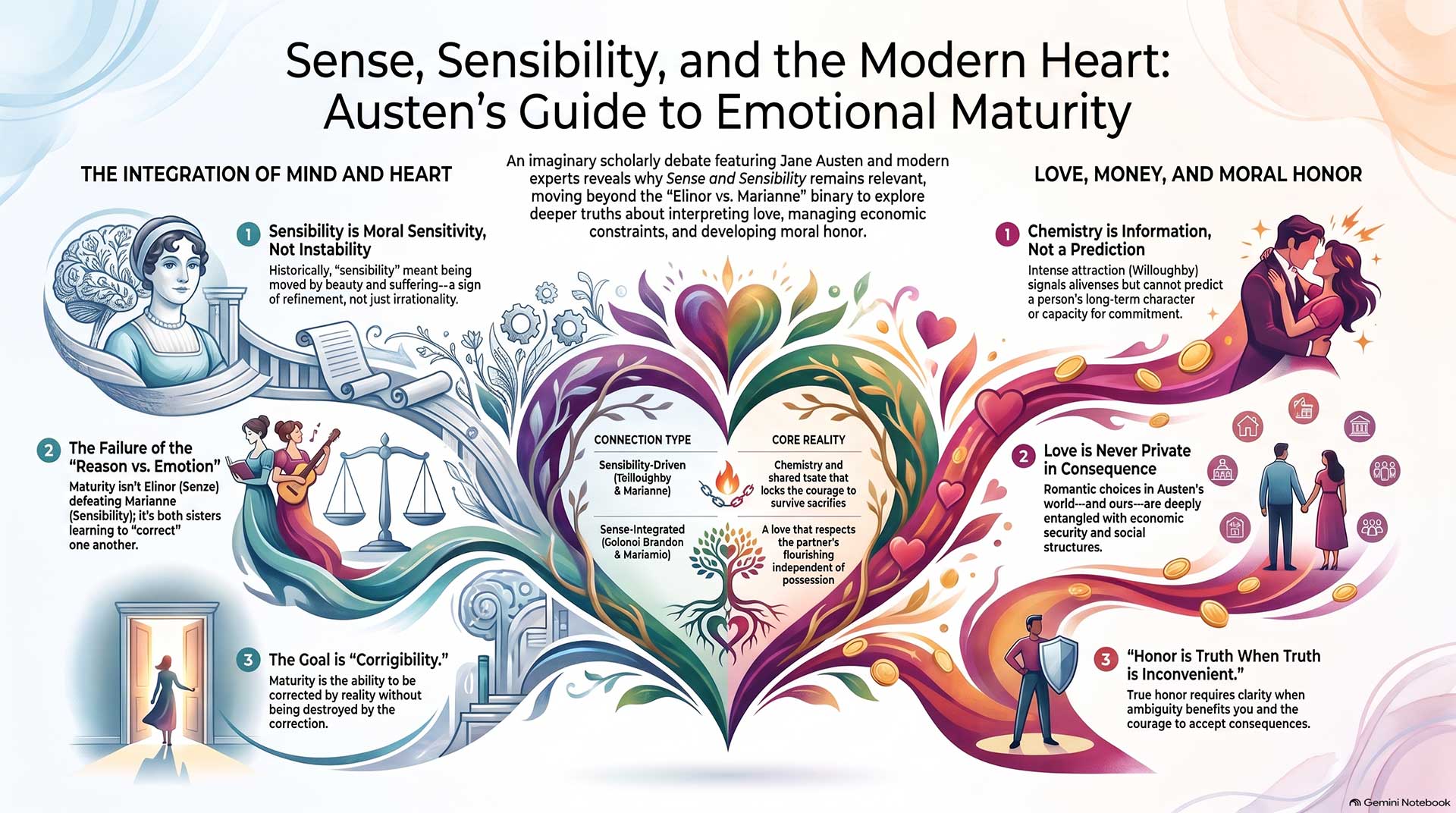
It is tempting to read Sense and Sensibility as a lesson with an obvious answer.
Elinor represents reason.
Marianne represents emotion.
Marianne suffers.
Therefore Elinor must be right.
But the scholar discussion reveals something far more complicated.
Marianne’s problem is not that she possesses too much feeling.
Her problem is that she sometimes treats feeling as evidence.
If love feels overwhelming, she assumes it must be profound.
If grief feels unbearable, she assumes the relationship must have been irreplaceable.
If another person shares her tastes, she assumes they share her character.
Her growth comes when she learns that emotion can be sincere without being accurate.
Elinor faces the opposite danger.
Her self-control is often admirable.
But restraint can become concealment.
Strength can become isolation.
The person who carries everyone else’s emotional burden may eventually become someone nobody knows how to comfort.
So Elinor also has something to learn.
Willoughby introduces another uncomfortable truth.
He may genuinely love Marianne.
Yet genuine feeling does not automatically create moral character.
A person can love and still behave selfishly.
Regret and still fail to change.
Feel deeply and still lack courage.
Edward complicates the idea of honor.
Promises matter.
Commitment matters.
But duty without honesty can also cause harm.
Sometimes keeping a promise requires courage.
Sometimes confronting the truth requires even more.
Lucy Steele forces us to confront the economic world surrounding Austen’s romances.
Women’s choices were not made in conditions of equal freedom.
Marriage affected housing, money, reputation, security, and future possibility.
Her manipulation remains morally questionable, but the system that makes such calculation useful also deserves examination.
And perhaps the most important relationship in the novel is the one that existed before any of the romantic plots began.
Elinor and Marianne.
They repeatedly misunderstand each other.
Marianne assumes visible feeling means deeper feeling.
Elinor assumes self-control is usually the wiser response.
Yet each eventually discovers that the other possesses something she needs.
Marianne learns judgment.
Elinor learns greater vulnerability.
Their development does not require one sister to defeat the other.
It requires each to expand.
That may be Austen’s deepest insight.
Emotional maturity is not feeling less.
It is learning how to feel deeply while remaining open to correction.
It means allowing emotion to tell us what matters without allowing emotion to become unquestionable truth.
It means using reason not to suppress feeling, but to understand it.
It means recognizing the social and economic pressures shaping our choices without pretending those pressures erase personal responsibility.
And it means accepting that love itself is not sufficient.
Love still needs:
truth,
character,
courage,
responsibility,
freedom,
judgment,
forgiveness,
and the willingness to see another person as they really are.
Perhaps that is why Sense and Sensibility still feels so recognizable more than two centuries later.
The social rules have changed.
The technologies of romance have changed.
Women’s economic freedom has changed enormously.
But human beings still confuse attraction with knowledge.
Intensity with truth.
Security with love.
Regret with change.
Control with strength.
And passion with destiny.
Jane Austen’s question therefore remains alive:
Should we follow the head or the heart?
Perhaps her answer is that the question itself is incomplete.
The heart tells us what matters.
The mind asks whether we are seeing clearly.
The heart says:
I love.
The mind asks:
Whom do you actually love: the person, or the person you imagined?
The mind says:
Be careful.
The heart asks:
Are you being wise, or are you simply afraid?
And maturity begins when neither has to silence the other.
Sense and sensibility are not enemies.
They are two capacities that must learn how to correct, deepen, and humanize each other.
Short Bios:
Jane Austen
Jane Austen was an English novelist whose works include Sense and Sensibility, Pride and Prejudice, Emma, Mansfield Park, Persuasion, and Northanger Abbey. Her novels combine wit, social observation, moral psychology, and sharp analysis of marriage, class, money, and women’s limited choices in Georgian England.
Claudia L. Johnson
Claudia L. Johnson is a leading scholar of Jane Austen and eighteenth- and nineteenth-century literature. Her work has examined Austen through questions of gender, politics, social authority, sentiment, and the cultural expectations placed on women.
Devoney Looser
Devoney Looser is a literary scholar and historian known for her work on Jane Austen, women writers, literary culture, and Austen’s long afterlife in publishing, adaptation, fandom, and popular culture.
Martha C. Nussbaum
Martha C. Nussbaum is a philosopher whose work explores ethics, emotion, vulnerability, justice, literature, and human flourishing. Her perspective helps illuminate how emotions can contain judgments about what we value rather than simply opposing reason.
Lisa Feldman Barrett
Lisa Feldman Barrett is a psychologist and neuroscientist known for research on emotion and how the brain constructs emotional experience. Her work challenges the simple idea that reason and emotion operate as separate competing systems.
Esther Perel
Esther Perel is a psychotherapist and relationship expert known for her work on desire, intimacy, infidelity, commitment, security, and the tensions that shape modern romantic relationships.
Eli Finkel
Eli Finkel is a social psychologist and relationship researcher whose work examines attraction, marriage, partner expectations, relationship satisfaction, and how modern romantic expectations have changed.
Amanda Vickery
Amanda Vickery is a historian specializing in Georgian England, women’s lives, domestic culture, class, and social history. Her expertise helps place Austen’s characters inside the economic and cultural realities of their period.
Stephanie Coontz
Stephanie Coontz is a historian of marriage and family life. Her work examines how marriage has changed from an economic and social institution into one increasingly expected to provide intimacy, companionship, and personal fulfillment.
Kwame Anthony Appiah
Kwame Anthony Appiah is a philosopher whose work explores ethics, identity, obligation, honor, social norms, and moral responsibility. His perspective is especially useful for examining promises, duty, forgiveness, and what people owe one another.
Leave a Reply