
Introduction
More than two centuries after Jane Austen published Sense and Sensibility, Elinor and Marianne Dashwood are returning to the cultural spotlight with a new film adaptation arriving in 2026.
But what makes Austen’s novel worth returning to is not simply its romance.
It is a question that feels remarkably modern:
How do we know when love is real?
Marianne Dashwood believes in passion, instinct, and emotional honesty. When love arrives, she wants to trust it completely.
Elinor Dashwood feels just as deeply, but she approaches love through observation, restraint, and judgment.
Then there are the men around them.
Willoughby offers excitement, emotional connection, and romantic intensity.
Colonel Brandon offers patience, steadiness, and loyalty.
Edward Ferrars struggles between affection, duty, and promises made before he fully understood himself.
Together, their stories raise questions people are still asking today.
Does chemistry mean compatibility?
Can someone genuinely love us and still hurt us deeply?
Is emotional restraint strength, or can it become fear?
What happens when love collides with money, family expectations, duty, and security?
Why can heartbreak make us want someone even more?
And when the excitement fades, what actually remains?
In this fictional conversation, the characters of Sense and Sensibility are given the chance to look back on their choices and challenge one another directly.
They do not simply ask whether sense is better than sensibility.
They ask something harder:
What separates feeling love from loving someone well?
(Note: This is an imaginary conversation, a creative exploration of an idea, and not a real speech or event.)
Topic 1: Why Do We Fall for Certain People Before We Know Who They Really Are?

The room is quiet at first.
There is something almost unfair about asking people to analyze the beginning of love after they already know how the story ended.
Marianne Dashwood sits upright, alert. There is no embarrassment in her face, but there is caution. She knows the conversation will return to Willoughby. She also knows that the easiest interpretation of her younger self is that she was foolish.
She has no intention of accepting that interpretation without a fight.
Willoughby sits several chairs away from her.
Colonel Brandon is calm.
Edward Ferrars looks as though he would rather discuss almost anything else.
Elinor, seated beside Marianne, watches everyone before speaking.
The moderator begins.
Moderator: Let us begin before heartbreak, before money, before promises, before betrayal.
Let us begin at the moment when two people meet and something happens almost immediately.
You feel unusually understood.
Conversation comes easily.
You laugh at the same things.
You love the same books.
The other person seems to notice exactly what other people have overlooked.
And sometimes we say, very quickly, “This person understands me.”
What exactly is happening in that moment?
Is it recognition?
Compatibility?
Chemistry?
Or are we sometimes falling in love with someone we have partly imagined?
Marianne looks immediately toward Elinor.
Marianne: I know exactly what you expect me to say.
Elinor: Then perhaps you should surprise us.
Marianne: I shall disappoint you instead.
I still believe there are moments when one person recognizes another before reason has collected enough evidence to approve the recognition.
Elinor smiles faintly.
Elinor: You make reason sound like a disapproving aunt.
Marianne: Frequently it behaves like one.
Edward laughs.
Even Brandon smiles.
Marianne: I do not mean that every attraction is destiny. Of course not. But there are people with whom conversation feels immediately different. You do not have to translate yourself constantly. You do not have to explain why something beautiful matters. They hear the same music in a poem. They notice the same light on a hill. They understand why a piece of music breaks your heart.
Why should that count for nothing?
Elinor: I never said it counts for nothing.
Marianne: You often behaved as though it counted for very little.
Elinor: I behaved as though it did not tell you everything.
Marianne turns to her.
Marianne: But surely it tells you something.
Elinor: Yes.
It tells you how you feel in that person's presence.
That is valuable information.
It does not necessarily tell you who that person is.
The room becomes quieter.
Willoughby shifts in his chair.
Willoughby: That distinction is very convenient after everything has gone wrong.
Elinor looks at him.
Willoughby: Forgive me, but if we are going to examine the beginning honestly, let us not rewrite it as if Marianne alone imagined something that never existed.
She did not invent every conversation.
She did not invent every shared pleasure.
She did not invent my admiration for her.
I loved being with her.
I admired her mind.
I admired the force of her feeling.
I admired precisely those qualities other people found excessive.
Marianne's expression changes.
For a moment, she looks almost like the young woman who once believed him.
Willoughby: When Marianne read poetry aloud, she did not merely recite it. She seemed to experience it while speaking.
When she loved a landscape, you felt ashamed of having passed the same trees without noticing them.
She made ordinary things seem worth feeling strongly about.
I did not manufacture my attraction to her.
Elinor: No one has accused you of manufacturing it.
Willoughby: Not directly.
Elinor: Then perhaps do not defend yourself against charges no one has made.
Willoughby: You see? That is precisely what I mean.
If the story is told simply, Marianne felt too much and I felt too little.
But neither is true.
I felt very much.
Brandon speaks for the first time.
Brandon: That may be true.
Willoughby looks at him, surprised.
Brandon: Feeling deeply and behaving honorably are not the same question.
Willoughby's jaw tightens.
Willoughby: We have already arrived at my trial, then?
Brandon: No.
We have arrived at the distinction this conversation requires.
I do not doubt that you felt something.
I doubt that feeling alone tells us what that something was capable of becoming.
Marianne looks toward Brandon.
Marianne: But must we distrust every beginning because we do not yet know the ending?
Brandon: No.
That would make love impossible.
Marianne seems surprised by the answer.
Brandon: I only mean that beginnings are generous with possibility.
They show us what might be.
Character shows us what can endure.
There is a pause.
The moderator turns slightly toward Marianne.
Moderator: Then let us make the first question explicit.
Question 1: Is instant chemistry evidence that two people truly understand one another?
Marianne: Sometimes, yes.
Elinor raises an eyebrow.
Marianne: I said sometimes.
Imagine meeting someone and discovering that he loves the same poetry you love, not merely because it is fashionable but because the same lines strike him. Imagine discovering that he dislikes the same dullness, notices the same absurdities, laughs before you have finished the thought.
That is not nothing.
It can feel like being understood without having to ask for understanding.
Edward: But perhaps there are two kinds of understanding.
Marianne looks at him.
Edward: There is understanding what delights someone.
And there is understanding what wounds them.
There is understanding what they say.
And there is understanding what they are afraid to say.
There is understanding their taste.
And there is understanding what responsibility toward them requires.
I am not certain those things arrive at the same speed.
Marianne: They need not.
But one may lead to the other.
Edward: Certainly.
Marianne: Then why are we speaking as though early connection is somehow suspect?
Elinor: Because you are defending it as evidence.
That is different from defending it as possibility.
Marianne exhales.
Elinor: Marianne, I never thought your feelings for Willoughby were ridiculous.
I worried because you moved from “I feel understood” to “I understand him.”
Those are not the same sentence.
Marianne says nothing.
Elinor continues.
Elinor: We often know very quickly how someone makes us feel.
Safe.
Excited.
Seen.
Desired.
Admired.
Alive.
But knowing how a person affects us is not yet the same as knowing the person.
Willoughby leans forward.
Willoughby: And how long must one wait before one is allowed to trust affection?
Six months?
A year?
Must love submit references?
Edward laughs softly.
Elinor: No.
But perhaps one should see how a person behaves when disappointed.
Or contradicted.
Or inconvenienced.
Or when there is nothing to gain from behaving well.
Willoughby: No romance would survive such an examination in its first fortnight.
Elinor: Perhaps that is why romance and judgment should not be asked to perform the same task.
Marianne turns sharply.
Marianne: And there is the danger in your position.
If we reduce love to observation, testing, evidence and caution, we may protect ourselves so completely that nothing spontaneous survives.
Elinor's face softens.
Elinor: That is a fair criticism.
Marianne blinks, not expecting the concession.
Elinor: I have spent much of my life believing that understanding danger gives me control over it.
It does not.
Sometimes caution prevents error.
Sometimes it prevents intimacy.
Edward looks toward her.
Elinor notices but does not look back.
Moderator: Colonel Brandon, when you first met Marianne, did you feel anything resembling this kind of immediate recognition?
Brandon takes his time before answering.
Brandon: Attraction, yes.
Recognition, perhaps not in the way Marianne means it.
I admired her vitality almost immediately.
But I did not presume I understood her.
Marianne: You thought me foolish.
Brandon: No.
Marianne: You thought me young.
Brandon: You were young.
Marianne: That is the polite version.
Brandon smiles.
Brandon: I thought you certain.
Marianne's smile disappears.
Brandon: Very certain about what love should feel like.
Certain about which people deserved admiration.
Certain about which qualities revealed depth.
Certain that restraint meant coldness.
Certain that age meant diminished passion.
Certain that people who did not express feeling as you did must therefore feel less.
Marianne looks down.
Brandon: But certainty in youth is not a crime.
I had been certain once too.
That is perhaps why I recognized it.
Marianne: Then perhaps you understood me more quickly than I understood you.
Brandon: Possibly.
But understanding someone does not entitle us to them.
That sentence settles in the room.
Willoughby looks toward Marianne but says nothing.
The moderator moves them forward.
Question 2: Why do shared tastes feel like evidence of shared character?
Moderator: Marianne and Willoughby, so much of your early connection developed through shared taste.
Books.
Music.
Poetry.
Nature.
Humor.
Why does finding someone who loves the same things feel so persuasive?
Marianne: Because taste is personal.
What we find beautiful says something about us.
Elinor: Something, yes.
Marianne: Must every statement I make include your qualification?
Elinor: Only the inaccurate ones.
Edward laughs again.
Marianne tries not to.
Marianne: If someone loves the same poem for the same reason, surely that reveals something about their interior life.
Willoughby: Of course it does.
Elinor: Perhaps.
But two people may admire the same poem and learn opposite lessons from it.
Willoughby: That sounds excessively philosophical for courtship.
Elinor: Courtship might benefit from a little philosophy.
Edward: That may be the least romantic sentence ever spoken.
Elinor: Yet perhaps one of the most useful.
The tension eases.
Brandon speaks.
Brandon: Taste can reveal sensitivity.
It can reveal imagination.
Sometimes education.
Sometimes vanity.
Sometimes aspiration.
But pressure reveals character.
Marianne turns toward him.
Brandon: It is pleasant to discover that someone loves the same music.
It is more important to discover whether they remain kind when angry.
Whether they tell the truth when lying would be easier.
Whether they keep confidence when gossip would make them interesting.
Whether they treat servants with dignity.
Whether they remain when another person becomes inconvenient.
The silence after that final word is unmistakable.
Willoughby looks at him.
Willoughby: You have waited some time to say that.
Brandon: I have said very little compared with what I might have said.
Marianne: Please.
Both men stop.
Marianne looks between them.
Marianne: I do not want this conversation reduced to one man's prosecution and another man's vindication.
Brandon immediately inclines his head.
Brandon: You are right.
Willoughby looks at Marianne with something close to gratitude.
Marianne: The point matters beyond him.
I believed that shared taste meant shared soul.
I do not believe that anymore.
But I cannot say it meant nothing.
I was happier speaking with him than I had been with almost anyone outside my family.
Those moments were real.
Elinor: Yes.
Marianne: Then perhaps the mistake was not believing the connection mattered.
Perhaps the mistake was assuming that because one part of us matched beautifully, the rest would follow.
Edward: That seems true of many relationships.
We discover one extraordinary harmony and imagine total harmony.
Moderator: Why do we do that?
Edward thinks.
Edward: Because gaps are uncomfortable.
When we do not know something about someone we admire, we often fill the empty space with what we hope is there.
Marianne looks toward him.
Edward: Perhaps that is why first impressions are so powerful.
We meet a few facts and then complete the portrait ourselves.
Elinor nods.
Elinor: And because we made part of the portrait, we are reluctant to admit when reality contradicts it.
Marianne: Because then we must lose two people.
Moderator: Two?
Marianne: The person as they are.
And the person we believed them to be.
No one answers immediately.
Willoughby's face changes.
It is the first moment in which he looks less defensive than ashamed.
Willoughby: That is not entirely fair to yourself.
Marianne turns to him.
Willoughby: You did not invent everything good in me.
Marianne studies him.
Marianne: No.
That was part of what made it difficult.
If you had been entirely false, I would have recovered faster.
Willoughby looks away.
Marianne: The worst discoveries are not that someone was never good.
It is discovering that goodness existed and was still not strong enough.
Brandon lowers his eyes.
Elinor reaches over and briefly touches Marianne's hand.
The moderator allows the silence to remain before continuing.
Question 3: How much of falling in love is really projection?
Moderator: Let us stay there.
If we fill gaps with hope, then how much of romantic love, especially early romantic love, is projection?
Marianne answers first, but more slowly now.
Marianne: More than I once wished to admit.
But I dislike the word.
It makes love sound imaginary.
Elinor: Projection does not mean the other person is imaginary.
It means part of our understanding may come from us rather than from them.
Willoughby: And what lover does not do this?
You see someone at their best.
You imagine the best continuing.
They show kindness, and you imagine courage.
They show sensitivity, and you imagine constancy.
They admire you, and you imagine loyalty.
If that is projection, perhaps love cannot begin without it.
Brandon: Perhaps hope is unavoidable.
Projection becomes dangerous when contradiction appears and we refuse to see it.
Willoughby turns toward him.
Willoughby: Meaning Marianne should have seen what?
Brandon: I was not speaking only of Marianne.
Willoughby says nothing.
Brandon: We all project.
A man may project innocence onto a woman because he wishes to protect her.
A woman may project strength onto a man because she wishes to feel safe.
A parent may project virtue onto a child.
A lover may project permanence onto a moment.
The moral problem begins when reality speaks and we silence it.
Elinor looks thoughtfully at Brandon.
Elinor: That is different from saying we should never idealize anyone.
Brandon: Yes.
Love probably contains some idealization.
Perhaps admiration requires it.
But mature love must survive the collapse of idealization.
Edward nods.
Edward: That may be when we begin loving a person instead of our idea of them.
Marianne looks toward Edward.
Marianne: And what if the person we discover is disappointing?
Edward: They will be.
Marianne almost smiles.
Edward: Not always catastrophically.
But certainly.
Anyone we love long enough will eventually fail to match the person we imagined.
Marianne: That sounds terribly bleak.
Edward: I find it comforting.
Everyone looks at him.
Edward: If love requires perfection, none of us has much hope.
Elinor smiles.
Edward: Perhaps knowing someone truly means seeing the disappointment and deciding what it means.
Some disappointments are ordinary human weakness.
Some are incompatibility.
Some are cruelty.
Wisdom may lie in knowing the difference.
Moderator: Willoughby, were there moments when you knew Marianne believed something about you that was not fully true?
The question lands heavily.
Willoughby does not answer immediately.
Willoughby: Yes.
Marianne's eyes remain on him.
Moderator: And what did you do?
Willoughby: Mostly nothing.
Elinor: Nothing can still be a choice.
Willoughby glances toward her.
Willoughby: I know.
He pauses.
Willoughby: It is pleasant to be admired.
More pleasant than most people admit.
And Marianne admired without reservation.
To be seen through her eyes was...
He stops.
Marianne: What?
Willoughby: Better than seeing myself through my own.
That changes the room.
Even Brandon looks at him differently.
Willoughby: She believed me generous.
Brave.
Independent.
Better than convention.
Better than selfish calculation.
I liked the man I became in her imagination.
And perhaps there were moments when I acted more like him because she believed he existed.
Marianne: Then why—
She stops.
Willoughby answers anyway.
Willoughby: Why did I not become him?
Marianne says nothing.
Willoughby: Because being admired for courage is easier than being courageous.
No one interrupts him.
Willoughby: I did not deliberately construct some false character to deceive Marianne.
But when she saw more nobility in me than I possessed, I did not correct her.
Why would I?
We rarely object to flattering misunderstandings.
Elinor: Until someone builds their future upon them.
Willoughby nods.
Willoughby: Yes.
Marianne's voice is quieter.
Marianne: I used to think deception required lies.
Elinor: Sometimes it requires only allowing someone to continue believing what benefits us.
Willoughby accepts the sentence without resistance.
The moderator turns toward Elinor.
Moderator: Did you ever project onto Edward?
Elinor seems caught off guard.
Edward looks suddenly interested.
Elinor: Certainly.
Marianne: I should like to hear this.
Elinor: I imagined that because Edward disliked ambition, he would be decisive whenever moral questions arose.
Edward winces.
Edward: A disastrous assumption.
Elinor: I imagined reserve meant depth in every instance.
Sometimes reserve simply means difficulty speaking.
Edward: That is less flattering but considerably more accurate.
Elinor: I imagined kindness would naturally produce courage.
It does not always.
Edward nods.
Elinor: And because I wished to think well of him, I interpreted uncertainty generously.
Edward: You still do.
Elinor looks at him.
Edward: More than I deserve sometimes.
Elinor's expression softens.
Moderator: And Colonel Brandon? Did you project something onto Marianne?
Brandon takes a breath.
Brandon: Perhaps I projected redemption.
The others look at him.
Marianne: Redemption?
Brandon: Not yours.
Mine.
He pauses.
Brandon: Marianne reminded me of someone I had once loved.
Not because they were identical.
They were not.
But grief can make resemblance dangerous.
One sees a gesture, a spirit, a way of speaking, and something old awakens.
I had to ask myself whether I loved Marianne as Marianne, or whether part of me was trying to repair a story that had ended long before she entered my life.
Marianne's expression changes completely.
Marianne: I did not know that.
Brandon: I scarcely knew it myself at first.
Moderator: What changed?
Brandon: Time.
Watching her become less like the person I remembered.
And discovering I cared for her more, not less.
Marianne looks away, moved.
Elinor is silent.
The moderator does not rush the moment.
Then:
Moderator: Perhaps we should return to the original question.
Why do we sometimes feel we know someone almost immediately?
Marianne answers first.
Marianne: Because sometimes there really is recognition.
I still believe that.
But recognition is not knowledge.
Elinor: Yes.
Marianne: And because we are hungry.
The others look at her.
Marianne: Hungry to be understood.
Hungry to feel chosen.
Hungry to find someone who makes the world seem larger.
When someone appears to meet that hunger, we may give them qualities they have not yet earned.
Elinor looks proud of her sister but does not say so.
Willoughby: And sometimes we enjoy being given those qualities.
Edward: Because another person's belief can become intoxicating.
Brandon: Which is why admiration creates responsibility.
Moderator: Responsibility?
Brandon: If someone trusts us, we are no longer dealing only with our own pleasure.
Their hope has entered our hands.
The room falls quiet again.
Marianne looks at him.
Then at Willoughby.
Then at Elinor.
Marianne: I still refuse to believe love must begin suspiciously.
Elinor: Nor should it.
Marianne: Good.
Elinor: But perhaps openness and observation can coexist.
Marianne: That sounds very much like something you would say.
Elinor: And this sounds very much like you avoiding admitting that you agree with me.
Marianne laughs.
It is the first genuinely light moment after several difficult minutes.
Moderator: Then let me ask one final question.
If someone is falling in love and says, “I have never felt this understood before,” what should they remember?
Edward answers first.
Edward: Enjoy the feeling.
But remain curious.
Brandon: Notice whether the person is kind when no reward follows.
Elinor: Pay attention to what contradicts the story you want to believe.
Willoughby: Do not assume that someone's admiration of you has made you worthy of it.
Everyone looks toward Marianne.
She waits.
Marianne: Do not distrust joy simply because it arrives quickly.
But do not give the future to someone merely because the first chapter is beautiful.
The moderator lets the sentence stand.
And for perhaps the first time in the conversation, Marianne and Elinor do not appear to represent opposite philosophies.
Only different pieces of the same one.
Closing Reflection
Attraction may begin with recognition.
But recognition is not yet knowledge.
Shared tastes can create intimacy.
But taste is not character.
Strong feeling can be genuine.
But genuine feeling does not guarantee courage, loyalty, honesty, or responsibility.
Perhaps the danger of early love is not that we feel too much.
It is that we know too little while feeling so much.
And perhaps the first task of mature love is not to extinguish the dream.
It is to allow reality to enter it.
Because the person we eventually love must be more than the person we hoped to find.
They must be someone we are willing to see clearly.
Topic 2: Does Intense Emotion Mean Deeper Love?
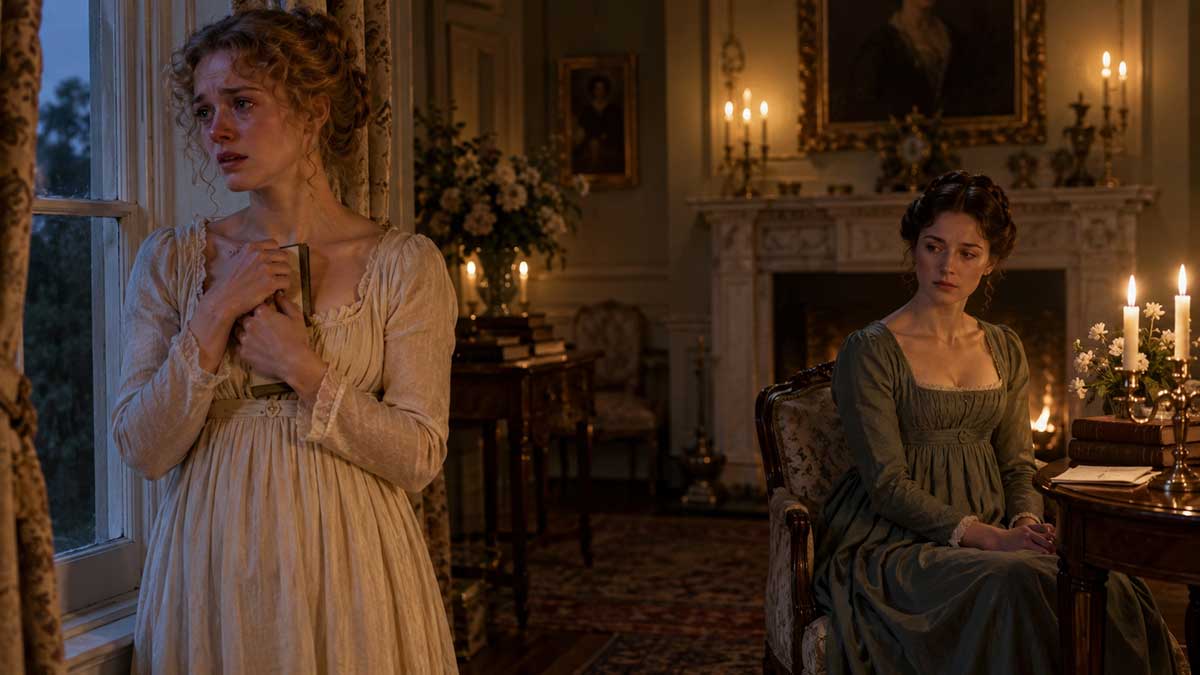
The conversation resumes after a short silence.
Something has shifted.
In the first discussion, Marianne defended the beauty of immediate connection. She did not surrender that belief, but she allowed something new into it: uncertainty.
Now the moderator turns toward a more dangerous question.
Moderator: We often measure love by intensity.
The sleepless nights.
The longing.
The inability to think clearly.
The feeling that one person has become the center of the world.
And sometimes the greater the suffering, the more convinced we become that the love must have been extraordinary.
So let us ask directly:
Does feeling more deeply mean loving more deeply?
Marianne answers almost before the question is finished.
Marianne: Not always.
Elinor glances toward her.
Marianne: Do not look so surprised.
Elinor: I am not surprised.
Marianne: You are trying very hard not to look surprised.
Edward smiles.
Marianne: I once would have said that the intensity of feeling revealed the depth of love. I believed that if a person could remain calm, perhaps they had never loved fully.
I do not believe that anymore.
But I still resist the opposite mistake.
Moderator: Which is?
Marianne: Treating composure as proof of wisdom.
There are people who feel little and call it maturity.
There are people who fear vulnerability and call it self-control.
There are people who never risk enough to be devastated.
That does not make them wise.
Elinor sits back slightly.
Elinor: That is fair.
Marianne turns toward her.
Marianne: You agree?
Elinor: More than you might expect.
Marianne: I should like that recorded.
Edward: I believe we all heard it.
The tension softens.
Moderator: Then perhaps we begin with the first question.
Question 1: Can love be completely sincere and still be unhealthy?
Willoughby looks toward Marianne.
Willoughby: Yes.
Everyone turns to him.
Willoughby: I suppose I am the most obvious evidence.
Marianne's expression tightens slightly.
Willoughby: What I felt for Marianne was not fabricated.
I know it would make the story easier if it had been.
If I had merely been amusing myself, perhaps everyone could place me neatly in one category and move on.
But I did care for her.
Very much.
Elinor: Caring for someone and caring for them well are different things.
Willoughby: I know.
Elinor: Do you?
He looks at her.
Willoughby: More now than then.
Moderator: What do you mean?
Willoughby pauses.
Willoughby: I wanted the feeling.
I wanted Marianne.
I wanted the world that seemed to exist when I was with her.
But I did not want every consequence attached to wanting her.
Money.
Family disapproval.
Responsibility.
The loss of comfort.
The possibility that love would require me to become less selfish than I was.
Marianne says nothing.
Willoughby: I suppose that makes the love real and insufficient at the same time.
Brandon: Yes.
Willoughby looks at him.
Brandon: Feeling can be sincere and still be too immature to protect the person it attaches itself to.
Willoughby: You make it sound very clinical.
Brandon: I do not mean it clinically.
I mean that sincerity does not absolve damage.
A person may sincerely desire someone and still lie to them.
Sincerely miss them and still betray them.
Sincerely regret losing them and still be unsafe for them.
Willoughby looks away.
Marianne speaks.
Marianne: That was one of the hardest things for me to understand.
For a long time, I needed one of two explanations.
Either he had truly loved me, and therefore everything should have ended differently.
Or he had never loved me at all.
I could not accept the possibility that someone might love me and still fail me.
Elinor: Because that possibility is more frightening.
Marianne: Yes.
If love itself guarantees nothing, then what are we supposed to trust?
The question hangs in the room.
Edward answers quietly.
Edward: Perhaps not love alone.
Marianne looks at him.
Edward: Love joined with character.
Elinor: And judgment.
Brandon: And responsibility.
Willoughby: You are all making love sound like a committee.
Marianne almost laughs.
Willoughby: I am serious.
If we burden love with every virtue, perhaps we are no longer speaking of love. Perhaps we are speaking of an ideal person.
Elinor: No.
We are distinguishing the feeling of love from the practice of loving.
Willoughby: And you believe the practice matters more?
Elinor: When another person's wellbeing is involved, yes.
Marianne: I do not think one can exist fully without the other.
Elinor turns toward her.
Marianne: A relationship made entirely of duty would be unbearable.
But feeling without duty can become cruel.
Brandon: Exactly.
Marianne: I am not agreeing with you specifically.
Brandon: I shall try not to enjoy it.
Edward smiles again.
The moderator lets the exchange breathe.
Moderator: Then let me make the question sharper.
If someone says, “But I really loved them,” how much moral weight should that statement carry if their actions repeatedly harmed the other person?
Marianne answers first.
Marianne: Less than they think.
Willoughby looks at her.
Marianne: I do not say that bitterly.
At least, I hope I do not.
But the sentence “I loved you” cannot erase what happened.
Sometimes people use the sincerity of their feelings as a defense against the consequences of their behavior.
Elinor: Yes.
Marianne: I once believed feeling deeply was almost a moral achievement.
Now I think it can become a kind of vanity.
Moderator: Vanity?
Marianne: Yes.
To think, “Look how much I suffer. Look how intensely I love. Surely the intensity itself proves something noble about me.”
But intensity can be selfish too.
You can be so occupied with the grandeur of your own feeling that you barely see the other person.
Brandon watches her carefully.
Willoughby: That accusation could apply to both of us.
Marianne turns toward him.
Willoughby: We enjoyed ourselves tremendously in the beginning.
But I wonder now how much either of us truly knew the other.
We were both intoxicated by the version of ourselves that appeared inside the relationship.
Marianne does not object.
Marianne: Perhaps.
Willoughby: You became the great romantic heroine.
And I became the man worthy of her.
Marianne: Until reality demanded proof.
Willoughby: Yes.
No one speaks for a moment.
The moderator turns toward Elinor.
Question 2: Is emotional restraint a sign of strength, or can it become fear?
Elinor exhales softly.
Elinor: I suspected we would arrive here.
Marianne: I have been waiting very patiently.
Elinor: That itself is suspicious.
The others smile.
Moderator: Marianne, perhaps you should begin.
Marianne: Gladly.
Elinor has spent years being praised for composure.
She notices what everyone needs.
She anticipates embarrassment.
She protects confidences.
She comforts people who have no idea she is suffering more than they are.
Everyone calls this strength.
And much of it is.
But sometimes I think she hides behind competence.
Elinor's face becomes more serious.
Marianne: If no one sees you need anything, no one can disappoint you.
Edward looks toward Elinor.
She does not immediately answer.
Marianne: You were heartbroken over Edward.
And I did not know.
Your own sister.
I was living beside you.
I spoke endlessly of my pain.
You listened to me.
You comforted me.
And all the while you were carrying something just as painful.
I used to think that meant you were stronger.
Now I sometimes think it meant you were lonelier.
Elinor's expression changes.
Elinor: Both may have been true.
Marianne softens.
Moderator: Why did you hide so much?
Elinor thinks carefully.
Elinor: Partly because there was little practical benefit in telling anyone.
Lucy had trusted me with her secret.
Edward's situation was not mine to expose.
My mother had worries enough.
Marianne was suffering.
Someone had to remain functional.
Marianne: There.
Elinor: What?
Marianne: “Someone had to.”
As though the universe would collapse if Elinor Dashwood cried.
Edward laughs once, but stops when he sees Elinor's face.
Elinor: Perhaps I did believe that more than was healthy.
Edward: You still do sometimes.
Elinor looks at him.
Edward: You are very good at being the person everyone depends on.
That makes it difficult to know when you need someone.
Elinor: I do not enjoy needing people.
Marianne: Exactly.
Elinor: Do not look so pleased.
Marianne: I am not pleased.
I am vindicated.
Elinor: Which for you is nearly the same thing.
Marianne smiles, then becomes serious again.
Elinor: But yes.
There is truth in it.
Being needed can feel safer than needing.
If I am useful, I know my place.
If I ask for comfort, I must accept that the other person may not know how to give it.
Or may not want to.
Or may misunderstand me.
Edward: That is vulnerability.
Elinor: Yes.
Edward: Which means perhaps you were not avoiding emotion.
You were avoiding uncertainty.
Elinor is silent.
Brandon enters gently.
Brandon: There is another danger in extreme self-control.
Elinor: Which is?
Brandon: People may mistake your silence for absence of pain.
Then they stop offering tenderness because they assume you do not need it.
Elinor nods slowly.
Brandon: Strong people are often neglected for exactly that reason.
Marianne looks toward Elinor with visible regret.
Marianne: I did that.
Elinor: You were suffering.
Marianne: So were you.
Elinor: Yes.
Marianne: I should have seen it.
Elinor: I made it difficult to see.
The sisters hold each other's gaze.
The moderator does not interrupt immediately.
Then Willoughby speaks unexpectedly.
Willoughby: There is something else.
Elinor turns toward him.
Willoughby: Restraint can also become moral superiority.
Elinor's expression cools.
Willoughby: I do not say this only about you.
People who control themselves sometimes begin to believe they are better than people who do not.
Marianne: He is not entirely wrong.
Elinor looks at her.
Marianne: I said not entirely.
Willoughby: The person who feels wildly looks undisciplined. The person who appears calm looks wise. But calmness can conceal indifference, fear, even cowardice.
Elinor: Agreed.
Willoughby looks surprised.
Elinor: Self-command is only virtuous if it serves something beyond self-protection.
If I restrain anger so I do not wound someone, that may be wise.
If I restrain honesty because I fear rejection, that may be fear.
If I conceal pain so others are not burdened, sometimes that is kindness.
If I conceal pain because I cannot tolerate being seen as vulnerable, that is something else.
Marianne looks at her with quiet affection.
Moderator: Then perhaps the real distinction is not expression versus restraint.
It is whether our emotional habits bring us closer to truth and relationship or farther from them.
Elinor: Yes.
Marianne: That I can agree with.
Edward: A historic evening.
Marianne throws him a look.
The moderator turns the conversation toward the final question.
Question 3: Can passion exist without wisdom?
Moderator: Marianne, you once believed passion itself contained a kind of wisdom.
Do you still?
Marianne: Not by itself.
But I do not want passion demoted to something dangerous that must be supervised by reason at all times.
Elinor: I do not think it should be.
Marianne: Passion notices things reason sometimes misses.
It makes us brave.
It allows us to care beyond convenience.
It can make someone cross a room, write a letter, defend another person, leave a life that has become false.
Without passion, people may remain sensible and miserable forever.
Brandon: I agree.
Marianne turns toward him.
Brandon: Completely.
Marianne: This is becoming unsettling.
Brandon: Passion can reveal value before calculation catches up.
A person may recognize that something matters deeply before being able to explain why.
Edward: Then where does wisdom enter?
Brandon: In asking what the passion asks us to do.
Marianne becomes thoughtful.
Brandon: Desire says, “I want.”
Wisdom asks, “At what cost?”
Passion says, “This matters.”
Wisdom asks, “To whom?”
Emotion says, “Act now.”
Wisdom asks, “What happens after?”
Willoughby: That sounds suspiciously like Elinor.
Brandon: Perhaps she has corrupted me.
Elinor: I shall accept the compliment.
Willoughby leans back.
Willoughby: I still think all of you underestimate the beauty of reckless feeling.
Elinor looks at him.
Willoughby: Not morally.
Aesthetically.
There are moments of life that would become unbearable if we insisted on evaluating everything before surrendering to it.
Love, music, travel, youth itself.
Sometimes one must leap.
Marianne: I understand what you mean.
Elinor turns toward her.
Marianne: I do.
And part of me still believes it.
Some of the happiest moments of my life were moments when I was not calculating consequences.
The danger was believing that because the leap felt beautiful, the landing would be safe.
That is different.
Willoughby watches her closely.
Marianne: Perhaps passion should be allowed to begin things.
But not to govern everything that follows.
Elinor: That may be the wisest thing you have said tonight.
Marianne: I immediately regret it.
Everyone laughs.
The laughter breaks some of the heaviness.
Edward speaks next.
Edward: I think wisdom without passion has its own danger.
Moderator: Which is?
Edward: A person can make every correct decision and never fully live.
They can choose the sensible profession, sensible marriage, sensible house, sensible conversation, sensible future.
And one day discover that prudence became another name for fear.
Elinor looks at him.
Edward: There are people who are never ruined because they never risk enough to be transformed.
No one responds immediately.
Marianne looks almost delighted.
Marianne: Edward, I have underestimated you.
Edward: Most people do. It is extremely restful.
Elinor smiles.
Moderator: Then perhaps passion and wisdom need each other.
Marianne: Yes.
But not in the way people usually say it.
I dislike the idea that passion is the wild horse and reason must hold the reins.
It makes emotion sound childish.
Perhaps passion tells us what is worth caring about.
Wisdom teaches us how to care without destroying ourselves or others.
Elinor nods.
Elinor: That is better.
Brandon: Much better.
Willoughby looks at Marianne.
Willoughby: You have changed.
Marianne: Of course I have.
Willoughby: I do not mean that critically.
Marianne: I know.
He hesitates.
Willoughby: I wonder whether I have.
Marianne says nothing.
Brandon watches him but does not intervene.
Moderator: Let us stay with that.
Can a person feel intensely and still remain emotionally immature?
Elinor: Certainly.
Marianne: Yes.
Edward: Can a person behave responsibly and still remain emotionally immature?
Elinor: Also yes.
Brandon: Which means perhaps maturity is not measured by intensity or restraint.
Moderator: What is it measured by?
Brandon thinks.
Brandon: Whether our feelings enlarge our capacity to care for reality.
The others look at him.
Brandon: Immature feeling bends reality around itself.
It says: because I desire this, it must be right.
Because I suffer, someone must be guilty.
Because I fear losing you, you must reassure me endlessly.
Because I love you, you must belong to me.
Mature feeling remains strong but allows the other person to remain real.
Marianne listens closely.
Marianne: That may be what I failed to do.
Elinor: You were young.
Marianne: I was also certain.
I believed my suffering gave me special access to truth.
If I hurt enough, then surely the love had been extraordinary.
If I could not eat, could not sleep, could barely imagine a future, surely that proved something.
Willoughby: It proved you were hurt.
Marianne looks at him.
Willoughby: Not necessarily that I was worthy of the hurt.
That catches everyone off guard.
Marianne studies him for a moment, then nods once.
Marianne: No.
It did not.
The moderator lets the silence remain.
Then:
Moderator: Why do we so often confuse suffering with depth?
Elinor answers.
Elinor: Because suffering feels serious.
Joy can appear light.
Peace can appear ordinary.
But anguish demands attention.
Edward: Stories teach us that too.
The doomed romance often appears greater than the happy marriage because catastrophe is dramatic.
Marianne: Which is terribly unfair to happiness.
Brandon: Happiness is often quiet.
It does not announce its depth every morning.
Willoughby: Nor does it make very good poetry.
Marianne: That is simply false.
Willoughby: I knew that would provoke you.
Marianne tries not to smile.
Moderator: Then perhaps one final question for this topic.
If someone says, “I have never felt anything this strong before,” what should they ask themselves next?
Elinor answers first.
Elinor: Does this feeling help me see the other person more clearly or less clearly?
Edward follows.
Edward: Am I becoming more honest, or merely more dependent on being wanted?
Brandon:
Brandon: Does this love expand my concern for the other person's wellbeing, even when their wellbeing does not serve my desires?
Willoughby hesitates.
Willoughby: What am I willing to do when the feeling becomes inconvenient?
The room becomes quiet again.
Finally Marianne speaks.
Marianne: I would ask one more question.
Am I in love with the person...
or with the intensity of being in love?
No one answers.
They do not need to.
Closing Reflection
Passion is not the opposite of wisdom.
Restraint is not automatically wisdom either.
A person can feel deeply and behave selfishly.
A person can behave responsibly while hiding behind emotional distance.
Sincerity matters.
But sincerity does not make every desire healthy.
Self-control matters.
But self-control does not make every silence courageous.
Perhaps mature love begins when we stop asking only:
How strongly do I feel?
And begin asking:
What does this feeling ask me to become?
Does it make us more truthful?
More responsible?
More courageous?
More capable of seeing the other person as they really are?
Marianne does not need to become less passionate.
Elinor does not need to become more impulsive.
Both need something from the other.
Passion needs judgment.
Judgment needs vulnerability.
Feeling needs character.
And perhaps the deepest distinction is this:
Intense feeling tells us that something matters to us.
Love is revealed by what we do with that knowledge.
Topic 3: What Happens When Love Becomes Expensive?

The atmosphere changes before anyone speaks.
So far, they have discussed attraction and intensity.
Those subjects are dangerous, but still intimate.
This one is less romantic.
Money.
Inheritance.
Security.
Promises.
Social standing.
Family approval.
The ordinary forces that often decide the future of extraordinary feelings.
Lucy Steele has joined the conversation.
She looks entirely comfortable.
Willoughby does not.
Edward seems even less comfortable.
Marianne folds her hands in her lap.
Elinor watches everyone.
The moderator begins.
Moderator: Love is easiest to praise when nothing has to be surrendered for it.
But eventually reality enters.
A family disapproves.
Money disappears.
A promise interferes.
Marriage changes someone's social position.
Security becomes uncertain.
And suddenly the question is no longer, “Do you love this person?”
It becomes:
What are you willing to lose because you love them?
Willoughby lowers his eyes.
Lucy looks toward him.
Lucy: I expect this discussion will be very moral.
Marianne glances toward her.
Lucy: People who already have security tend to become extremely noble when discussing money.
Elinor answers calmly.
Elinor: That is not entirely unfair.
Lucy smiles.
Lucy: I knew I liked you.
Marianne: You did not.
Lucy: No. But it sounded gracious.
Edward exhales.
The moderator continues.
Moderator: Let us begin with the most difficult version of the question.
Question 1: Is love real if it disappears when sacrifice begins?
Willoughby speaks first.
Willoughby: It did not disappear.
Marianne looks directly at him.
Willoughby: I know everyone prefers that version.
That I loved Marianne until loving her became inconvenient, and then the feeling simply vanished.
It did not.
I chose against it.
That is worse in some ways, but it is different.
Marianne: Different for whom?
Willoughby looks at her.
Marianne: Perhaps it mattered to you that the feeling remained somewhere inside you.
From where I stood, the result was exactly the same.
You left.
You chose another woman.
You allowed me to believe something that no longer existed in practice.
Whether some private part of you continued loving me was of very little use.
Willoughby absorbs that.
Willoughby: I know.
Lucy: But he is making a distinction worth keeping.
Everyone turns toward her.
Lucy: Feelings and decisions are not identical.
People like to pretend that if love is real, it naturally produces noble behavior.
That is not how human beings work.
People love and still choose comfort.
They love and choose family approval.
They love and choose money.
They love and choose reputation.
Sometimes they choose badly.
Sometimes they choose rationally.
But pretending the feeling must have been false simply because the decision was selfish is sentimental nonsense.
Marianne's expression hardens.
Marianne: You speak as though betrayal becomes respectable once properly explained.
Lucy: Not respectable.
Understandable.
Those are different things.
Elinor: They are.
Marianne turns toward Elinor.
Elinor: Understanding a motive does not excuse a choice.
But if we refuse to understand why people choose security over love, we learn very little.
Willoughby looks at her.
Elinor: The moral failure is clearer, not weaker, when we understand what he feared losing.
Moderator: What were you afraid of losing?
Willoughby does not answer immediately.
Willoughby: Comfort.
Freedom.
Status.
A certain kind of life.
I had become accustomed to never considering what things cost.
Not emotionally.
Not financially.
I believed consequences belonged to other people.
Then suddenly I was told that marrying Marianne would mean losing what I had assumed would always be mine.
Marianne: And I was cheaper to lose.
Willoughby flinches.
Willoughby: Yes.
The bluntness surprises everyone.
Willoughby: At least, that is what my choice said.
Marianne looks away.
Brandon speaks.
Brandon: That may be the clearest thing you have said.
Willoughby nods faintly.
Brandon: Because this is where love becomes morally visible.
Not when someone says, “I feel strongly.”
But when values collide.
Comfort against loyalty.
Reputation against truth.
Money against commitment.
Desire against responsibility.
A person reveals hierarchy through sacrifice.
Moderator: Hierarchy?
Brandon: We all have competing goods.
Security matters.
Family matters.
Reputation sometimes matters.
Love matters.
The question is not whether money is meaningless.
The question is what outranks what when we are forced to choose.
Lucy leans forward.
Lucy: And that is exactly where people become dishonest about class.
It is very easy to speak of choosing love when one has another home to return to.
A woman with no fortune cannot eat devotion.
A marriage without money can become misery very quickly.
I do not say money is more important than love.
I say pretending it does not matter is a luxury.
Elinor nods.
Elinor: Yes.
Marianne: But you used marriage as a transaction.
Lucy: And your world allowed me very few transactions of my own.
Marianne says nothing.
Lucy continues.
Lucy: You had affection, education, family loyalty, beauty, and connections.
I had fewer advantages.
So I noticed what security was worth.
That makes me calculating, certainly.
But I refuse to pretend the system itself was not calculating long before I entered it.
Edward looks uncomfortable.
Moderator: Then perhaps we should ask a more precise question.
If someone chooses financial security over love, does that necessarily make them cowardly?
Lucy answers first.
Lucy: No.
Marianne answers immediately.
Marianne: Sometimes.
Elinor: Both are true.
Willoughby looks toward Elinor.
Elinor: There are circumstances in which financial responsibility is moral.
Children must be fed.
Debts must be paid.
Families depend on us.
But there are also moments when “practicality” becomes a respectable word for fear.
Willoughby: Which was mine.
Elinor: Yes.
He does not argue.
Brandon: The distinction may be whether the person faces the cost honestly.
If you say, “I cannot make this choice because others would suffer,” that is one thing.
If you say, “I love you, but I will not surrender comfort,” that is another.
Lucy: And if the comfort is the difference between security and poverty?
Brandon: Then the moral question becomes harder.
Lucy: Good.
Because it usually is harder.
The moderator lets the tension settle.
Question 2: Are promises sacred when the people who made them have changed?
Edward visibly stiffens.
Lucy turns toward him.
Lucy: At last.
Edward sighs.
Edward: I feared we might arrive here.
Moderator: You were engaged to Lucy long before you fell in love with Elinor.
By the time the engagement became known, your feelings had changed.
Yet you still intended to honor the promise.
Why?
Edward pauses.
Edward: Because I had given my word.
Lucy: That sounds very noble.
Edward: You disagree?
Lucy: I think it made you feel noble.
Edward looks at her.
Lucy: You did not love me anymore.
You scarcely concealed that.
But by insisting on keeping the engagement, you could become the honorable man who sacrificed everything for duty.
Very admirable.
Very painful to live with.
Elinor glances toward Edward.
Edward's face tightens.
Edward: I never wished to humiliate you.
Lucy: No.
You merely wished to marry me while loving someone else.
Much more considerate.
Marianne looks from one to the other.
Marianne: She has a point.
Edward rubs his forehead.
Edward: I know.
Elinor: Do you?
Edward turns toward her.
Elinor: Your loyalty was real.
But so was your reluctance to confront what the engagement had become.
Edward takes that in.
Edward: Then what should I have done?
Broken my promise the moment my feelings changed?
Would that have been honorable?
Marianne: Perhaps more honest.
Edward: Honest to whom?
Lucy?
Elinor?
Myself?
A promise means very little if it lasts only until we prefer something else.
Brandon nods slightly.
Brandon: That is true.
Lucy looks at him.
Brandon: But a promise also exists between two living people.
If both people have fundamentally changed, then blindly preserving the form may not preserve the moral purpose.
Edward turns to him.
Edward: So duty can become cowardice too.
Brandon: Certainly.
Edward almost laughs.
Edward: That is inconvenient.
Elinor: Most moral truths are.
Lucy folds her arms.
Moderator: Lucy, did you still love Edward?
She does not answer immediately.
Lucy: I intended to marry him.
Marianne: That was not the question.
Lucy looks at her.
Lucy: People like you enjoy separating love from survival because your imagination permits it.
Mine did not.
Edward was kind.
He was respectable.
He had prospects.
I believed a life with him could be secure.
Did I feel what Marianne would call passion?
No.
Was there attachment?
Yes.
Was there ambition?
Certainly.
Was that so unusual?
Elinor answers quietly.
Elinor: No.
Lucy looks toward her.
Elinor: Only unusually honest.
Lucy smiles slightly.
Moderator: Then when Robert became the wealthier Ferrars brother—
Edward coughs.
Lucy does not look embarrassed.
Lucy: Circumstances changed.
Marianne nearly laughs from disbelief.
Lucy: You may judge me.
But I did what everyone else in our society was doing more delicately.
I married advantage.
Other people simply decorate the transaction with better language.
Marianne: That is too cynical.
Lucy: And you were too romantic.
Perhaps somewhere between us lies reality.
Marianne pauses.
Then:
Marianne: I dislike agreeing with you.
Lucy: Most people do.
Edward: I found that very manageable in the end.
Lucy gives him a sharp look.
For the first time, everyone laughs.
The moderator allows the laughter to pass before continuing.
Moderator: Edward, if you could return to the beginning, would you make the same promise?
Edward: No.
Moderator: And if you could return to the moment you realized you loved Elinor?
Edward looks toward her.
Edward: I would speak honestly much earlier.
Elinor's expression softens.
Edward: I still believe a promise matters.
But I understand now that avoiding a difficult truth because one fears dishonor can itself become dishonest.
Elinor: That is the part people often miss.
Duty is not merely enduring consequences.
Sometimes duty requires creating them.
Edward nods.
Edward: Yes.
Moderator: Meaning?
Elinor: Sometimes the honorable thing is to admit that a situation has become wrong and accept whatever follows from telling the truth.
Brandon adds:
Brandon: Honor without truth becomes performance.
Lucy raises an eyebrow.
Lucy: That is almost poetic.
Marianne: Do not encourage him.
Brandon smiles.
The moderator turns to the third question.
Question 3: Can financial fear excuse moral cowardice?
Willoughby answers before anyone else.
Willoughby: No.
Lucy looks at him.
Willoughby: Explain it, yes.
Excuse it, no.
That took me a very long time to understand.
I believed circumstances had trapped me.
But they had not.
They had presented me with a choice I disliked.
That is different.
Marianne listens.
Willoughby: I told myself poverty would ruin us.
I told myself resentment would follow.
I told myself Marianne's romantic temperament would not survive financial difficulty.
I created sensible predictions until selfishness sounded responsible.
Elinor: We are remarkably talented at that.
Willoughby: Yes.
Moderator: At what?
Elinor: Turning desire into argument.
We often decide what we want first.
Then reason arrives afterward to defend it.
Marianne looks amused.
Marianne: You are describing sensibility using the language of sense.
Elinor: Perhaps the two have been conspiring all along.
Edward smiles.
Lucy turns toward Willoughby.
Lucy: But suppose you had married Marianne and both of you became miserable.
Would everyone here praise your courage then?
Willoughby looks at her.
Lucy: We romanticize sacrifice after we know how the story ends.
But before the choice, sacrifice may simply look foolish.
Brandon responds.
Brandon: True.
There is no guarantee that sacrifice creates happiness.
Lucy: Then why treat willingness to sacrifice as proof of love?
Brandon: Because love cannot be measured by guaranteed outcomes.
It is measured partly by what we are willing to risk for another person's good.
Lucy shakes her head.
Lucy: That still sounds very noble from a man with an estate.
The room goes quiet.
Brandon does not become defensive.
Brandon: You are right to remind me of that.
Lucy seems surprised.
Brandon: I have known grief.
I have known disappointment.
But I have not known the particular fear of having no economic protection.
That limits my authority here.
Elinor watches him carefully.
Marianne: Then what can we say?
If money matters, and sacrifice does not guarantee happiness, and people are not wrong to fear poverty, how do we know when practical caution becomes cowardice?
Elinor answers.
Elinor: Perhaps by asking what truth we are refusing to face.
If someone says, “I cannot marry because I cannot feed a family,” that is reality.
If someone says, “I cannot marry because I would have to live with less comfort than I prefer,” that is another kind of truth.
The numbers may look similar.
The moral meaning may be very different.
Edward: And perhaps by asking who bears the cost.
Elinor turns toward him.
Edward: If I protect my comfort by transferring all the pain to someone else, I should be suspicious of my reasoning.
Willoughby looks down.
Lucy: That is fair.
Marianne seems surprised that Lucy agrees.
Lucy: What?
I am practical, not blind.
Moderator: Lucy, then let me ask you directly.
Is there any point at which choosing security becomes betrayal?
Lucy takes longer to answer.
Lucy: Yes.
The room stills.
Lucy: When you promise one thing while already intending another.
When you let someone build a future around words you no longer mean.
When you use their trust while privately planning your escape.
That is betrayal.
Wanting security is not.
Marianne looks at her differently now.
Marianne: I can agree with that.
Lucy nods.
Lucy: Miracles continue.
The tension eases again.
Moderator: Marianne, has your view of money changed?
Marianne: Completely.
I once thought love should make practical concerns disappear.
Now I think love has to live somewhere.
In a house.
Inside a budget.
Among obligations.
Around illness.
Children perhaps.
Aging parents.
Unexpected losses.
To say money should never matter is childish.
But to let money decide everything is another kind of poverty.
Elinor smiles slightly.
Elinor: That sounds almost sensible.
Marianne: Do not ruin it.
The moderator turns toward Willoughby.
Moderator: If you had understood then what you understand now, what would you have done differently?
Willoughby takes a long breath.
Willoughby: I would have told Marianne the truth before fear turned into betrayal.
Perhaps we still would not have married.
Perhaps the practical obstacles were greater than either of us understood.
But she would have been allowed to make decisions using reality instead of hope.
Marianne's face softens, though only slightly.
Willoughby: I took that from her.
Not merely the relationship.
The right to know what relationship she was actually in.
Elinor looks at him.
Elinor: That may be the deepest wrong.
Willoughby nods.
Moderator: Edward, what would you have done differently?
Edward: I would not have allowed a promise made in youth to become an excuse for years of silence.
I would still have accepted responsibility.
But responsibility should have included honesty much earlier.
Lucy says nothing.
Moderator: Lucy?
She considers.
Lucy: I would probably still have married advantage.
Marianne laughs despite herself.
Lucy: You asked for honesty.
But perhaps I would have been less pleased with myself for being clever.
The answer catches Elinor's attention.
Elinor: That is more than I expected.
Lucy: Do not become sentimental.
Moderator: Colonel Brandon?
Brandon: I would remember that financial security affects moral choices more deeply for those who lack it.
It is easy to condemn calculation when one's own survival is not threatened.
But I would still insist that necessity does not transform deception into virtue.
Moderator: Marianne?
She looks around the room.
Marianne: I would ask whether the person who says they love me is willing to enter reality with me.
Not fantasy.
Reality.
Bills.
Fear.
Family disagreement.
Disappointment.
Sacrifice.
If love only survives while everything feels beautiful, then perhaps what survives is not love but atmosphere.
Elinor looks toward her.
Moderator: Elinor?
Elinor: I would ask a simpler question.
When love becomes costly, who pays?
The room goes quiet.
Elinor: If one person preserves comfort while another absorbs humiliation, confusion, abandonment, or sacrifice, then the arrangement tells us something.
Love does not require equal suffering.
But it does require moral awareness of who is carrying the burden.
No one argues.
Closing Reflection
Love does not become impure merely because money enters the room.
Money was already there.
So were family expectations.
Property.
Inheritance.
Security.
Promises.
Fear.
Social class.
Love has never lived outside reality.
The deeper question is what happens when these forces collide.
Willoughby teaches us that genuine feeling can still lose to comfort.
Edward teaches us that duty can become complicated when truth changes.
Lucy reminds us that romantic morality often ignores the economic vulnerability beneath marriage.
Brandon reminds us that sacrifice matters, but that privilege can distort our understanding of what sacrifice costs.
Marianne learns that practical reality does not cheapen love.
It tests whether love can inhabit the world as it actually is.
And Elinor raises perhaps the hardest question:
When love becomes expensive, who pays the price?
Perhaps that is where character becomes visible.
Not when nothing is at stake.
But when two good things compete.
Love and security.
Truth and reputation.
Promise and freedom.
Comfort and courage.
The decision may not always be obvious.
But whatever we choose reveals what we value most.
Topic 4: What Does Heartbreak Actually Reveal?

The room feels different now.
Money and duty have been discussed openly.
Promises have been questioned.
Choices have been admitted.
But heartbreak is harder.
Money can be argued about.
Duty can be defended.
Heartbreak has fewer places to hide.
Marianne is quieter than before.
Willoughby does not look at her.
Elinor notices both.
The moderator begins gently.
Moderator: When a relationship ends, we often say we are grieving the person.
But perhaps that is only part of what disappears.
We may also lose the future we imagined.
The version of ourselves we expected to become.
The certainty that someone had chosen us.
Even the meaning we gave to the relationship.
So let us begin there.
Question 1: When our heart breaks, are we grieving the person or the future we imagined with them?
Marianne answers first.
Marianne: Both.
Without question.
For a long time, I thought I was grieving Willoughby alone.
I was not.
I was grieving mornings that had never happened.
Rooms I had never entered.
Journeys we had never taken.
Conversations that existed only in my mind.
Even arguments we never had.
She gives a small, almost embarrassed smile.
Marianne: It is strange how detailed an unlived life can become.
Elinor watches her.
Marianne: I had already begun living in it emotionally.
So when he disappeared, it felt as though an entire life had been taken from me.
Not merely one man.
Elinor: That is why heartbreak can seem disproportionate from the outside.
Marianne turns toward her.
Elinor: Other people see the relationship that existed.
The person grieving also sees the future that almost existed.
Edward: Or seemed as if it would.
Elinor: Yes.
Moderator: Does that make the grief less real?
Elinor: No.
Imagined futures can carry real emotional weight.
But perhaps it helps to understand what we are actually mourning.
Willoughby finally looks toward Marianne.
Willoughby: I imagined it too.
Marianne remains still.
Willoughby: Not as completely as you did, perhaps.
But I imagined a life with you.
Marianne: Then why is that supposed to comfort me?
Willoughby: It is not.
I only mean that you were not alone in believing something might happen.
Marianne studies him.
Marianne: That may actually make it worse.
Willoughby: I know.
Marianne: Because if you never imagined a future, then I was simply mistaken.
But if you imagined it too and still walked away, then the future was not impossible.
You chose against it.
Willoughby says nothing.
Brandon shifts slightly but does not interfere.
Moderator: Willoughby, what did you grieve after you left Marianne?
He hesitates.
Willoughby: The obvious answer would be her.
But perhaps I also grieved the man I might have become.
Elinor looks at him carefully.
Willoughby: With Marianne, there was a version of myself I preferred.
More generous.
Less calculating.
More alive.
I lost her.
But I also lost the possibility that I might have become someone better by remaining near her.
Brandon: That possibility was not hers to create for you.
Willoughby turns toward him.
Willoughby: I know.
Brandon: Good.
Because we sometimes burden the people we love with our unrealized selves.
We imagine they will save us from habits we have not chosen to change.
That is not love.
That is hope placed in the wrong hands.
Willoughby absorbs the criticism without protesting.
Marianne: I may have done something similar.
Everyone looks at her.
Marianne: I believed loving Willoughby proved something about me.
That I was capable of a grand love.
That my life would not become ordinary.
That I was different from people who settled for moderation.
When he left, I did not only lose him.
I lost an identity.
The woman in that story disappeared too.
Elinor reaches for her hand.
This time Marianne takes it.
Moderator: Is that why heartbreak can sometimes feel like a crisis of identity?
Elinor: Certainly.
When we build a future around another person, our sense of self becomes tied to that future.
Then the relationship ends and the question is not only, “How do I live without you?”
It is:
“Who am I now that the life I expected is gone?”
Edward nods.
Edward: That may be why heartbreak can make people feel embarrassed as well as sad.
Moderator: Embarrassed?
Edward: Because they must confront how certain they were.
Plans they told friends about.
Things they imagined privately.
Versions of the future they believed were nearly guaranteed.
When those disappear, grief can feel like public error.
Marianne: Yes.
Exactly.
Everyone knew how certain I was.
That was part of the humiliation.
Elinor looks at her sister.
Elinor: But perhaps certainty itself was not the shameful part.
Marianne: No?
Elinor: Loving hopefully is not shameful.
Only refusing reality after it becomes clear can become destructive.
Marianne considers that.
The moderator allows the silence before continuing.
Question 2: Why does rejection sometimes make us want someone even more?
Marianne almost laughs.
Marianne: Because human beings are absurd.
Edward: That is one explanation.
Marianne: Before Willoughby left, I loved him.
After he left, I thought of almost nothing else.
That should tell us something.
Elinor: Uncertainty can make attachment stronger.
When something ends clearly, painful as it is, the mind eventually has a fact to work with.
But when there are unanswered questions—
Why did he leave?
Did he ever love me?
Will he return?
Was there something I could have done?
—then the mind keeps searching.
Marianne: Constantly.
I replayed everything.
Every conversation.
Every look.
Every promise I believed had been made without words.
I thought if I examined the past closely enough, I would discover the answer that would restore the future.
Moderator: Did it?
Marianne: No.
It only made the past larger.
Brandon speaks quietly.
Brandon: Absence can become an idealizing force.
When someone is present, reality keeps interrupting fantasy.
They become tired.
Irritable.
Distracted.
Uninteresting.
They disappoint us in small ways.
When they disappear, imagination has no competition.
Marianne looks toward him.
Brandon: The absent person can remain perfectly composed in memory.
Willoughby: Or perfectly terrible.
Elinor turns toward him.
Willoughby: We idealize and demonize absence equally well.
Sometimes the person who leaves becomes the only good thing we have ever lost.
Sometimes they become the source of everything wrong in our life.
Either way, they grow larger than they were.
Edward: Because they are no longer present to contradict our story.
Elinor: Exactly.
Moderator: Willoughby, do you think your silence intensified Marianne's attachment?
He looks uncomfortable.
Willoughby: Yes.
Marianne: Why did you remain silent?
Willoughby looks directly at her now.
Willoughby: Cowardice.
There is no useful way to decorate it.
I believed avoidance would reduce the damage.
Instead I forced you to invent explanations.
Marianne: I invented hundreds.
Willoughby: I know.
Marianne: No, you do not.
She is not angry exactly.
But the room tightens.
Marianne: You do not know what silence gives the imagination.
Every morning becomes possibility.
Every letter becomes hope.
Every delay acquires meaning.
One keeps thinking:
Perhaps something happened.
Perhaps he is ill.
Perhaps his family intervened.
Perhaps he will explain.
Perhaps tomorrow.
She looks at him steadily.
Marianne: Silence did not spare me.
It kept hope alive long after hope had become cruel.
Willoughby lowers his eyes.
Willoughby: I am sorry.
Marianne does not immediately respond.
Moderator: Does an apology change heartbreak?
Marianne thinks.
Marianne: It can change confusion.
That matters.
But it cannot erase the experience.
Nor should it.
Some things should remain remembered accurately.
Brandon: Forgiveness is not the same as revision.
Marianne turns toward him.
Brandon: One may forgive without pretending the wound was smaller than it was.
Elinor: Or pretending trust should return automatically.
Moderator: Then why does rejection sometimes increase desire?
Edward answers slowly.
Edward: Perhaps because rejection makes love competitive.
Marianne: Competitive?
Edward: We begin by wanting the person.
Then we also want to reverse the rejection.
To prove we were lovable.
To prove they were mistaken.
To recover dignity.
The emotional object changes without our noticing.
We may think, “I want them back.”
But perhaps part of us wants our worth confirmed.
Elinor looks at him.
Elinor: That is true.
Marianne considers it carefully.
Marianne: I hated the idea that Willoughby could leave and remain happy.
There.
I have said it.
Willoughby looks at her.
Marianne: Not forever.
But at first.
I wanted him to regret it.
Deeply.
I wanted my suffering to become evidence against his choice.
If he suffered too, then somehow I had not lost entirely.
Moderator: Why?
Marianne: Because then I still mattered.
The honesty of the answer quiets the room.
Marianne: Indifference would have been harder to bear than regret.
Elinor nods.
Elinor: Because regret preserves connection.
Even painful connection.
Brandon: Which may be why some people prefer conflict to being forgotten.
Edward: Anger can maintain a relationship long after love has ended.
Willoughby looks at Marianne.
Willoughby: I did regret it.
She meets his eyes.
Marianne: I know that now.
Willoughby: Does it matter?
She thinks for a long moment.
Marianne: Less than I once needed it to.
Willoughby nods slowly.
There is sadness in the exchange, but also release.
The moderator continues.
Question 3: When does grief become self-destruction?
Marianne's expression changes again.
She knows this question belongs mostly to her.
Marianne: When suffering becomes proof.
Moderator: Proof of what?
Marianne: Of love.
Of sincerity.
Of seriousness.
I believed recovering too quickly would betray what I had felt.
If I ate normally, laughed, slept, read something unrelated to him, perhaps I had not loved deeply enough.
So grief became almost a duty.
Elinor looks pained.
Marianne: And I began protecting it.
That is the part I am least proud of.
Elinor: You were not trying to hurt us.
Marianne: Intent does not erase effect.
You taught me that.
Elinor says nothing.
Marianne: I made everyone live inside my heartbreak.
My mother worried constantly.
You watched me destroy my health.
I treated concern as interference because I believed nobody understood the purity of what I had lost.
There was arrogance in that.
Elinor: There was also pain.
Marianne: Yes.
But pain does not automatically make every response to pain wise.
Willoughby listens without moving.
Moderator: Why did letting go feel like betrayal?
Marianne: Because if I stopped suffering, I feared the love would become smaller.
And if the love became smaller, perhaps I had been wrong about everything.
So I kept returning to it.
Places.
Letters.
Memories.
I reopened the wound to prove it had been real.
Brandon's voice is soft.
Brandon: We sometimes confuse preserving pain with preserving love.
Marianne looks at him.
Brandon: But they are not the same.
Love may remain after pain changes form.
Sometimes healing is not forgetting.
It is allowing the memory to stop injuring us every time we touch it.
Marianne listens closely.
Moderator: Can letting go be an act of love?
Brandon pauses.
Brandon: Sometimes.
Especially when holding on turns the other person into an object of possession, resentment, or fantasy.
To love someone may eventually require letting them become separate from the life we imagined with them.
Willoughby: Even if they do not deserve that generosity?
Brandon looks at him.
Brandon: Letting go is not generosity toward the person who caused the wound alone.
It is also mercy toward oneself.
Willoughby looks away.
Elinor speaks next.
Elinor: But I think we should be careful.
People often pressure the grieving person to recover because grief makes everyone else uncomfortable.
Marianne: Yes.
Elinor: There is no virtue in rushing someone past pain.
A broken heart needs time.
The danger begins when suffering becomes identity.
When we cannot imagine ourselves without the wound.
Edward: Or when we make decisions to preserve the wound.
Elinor: Exactly.
Moderator: How do we know when that has happened?
Elinor thinks.
Elinor: Perhaps when every path toward life begins to feel like disloyalty.
Marianne looks at her.
Elinor: When laughter feels wrong.
When friendship feels like distraction.
When new affection feels like betrayal.
When the possibility of happiness makes us guilty.
Then perhaps grief is no longer only honoring what was lost.
It is preventing what remains from living.
Marianne's eyes fill slightly.
She looks down.
Marianne: I remember believing I would never love anything properly again.
Not only another man.
Anything.
Music.
Landscape.
Books.
Life itself felt compromised.
And somehow that seemed noble to me.
Elinor: You were ill.
Marianne: Before I became physically ill, I was already feeding the illness emotionally.
She pauses.
Marianne: I thought the depth of my suffering proved the depth of my love.
The room falls completely silent.
It is the sentence everyone feels.
Willoughby closes his eyes briefly.
Brandon speaks only after a long pause.
Brandon: Perhaps surviving love is sometimes the final way we honor it.
Marianne looks at him.
Brandon: Not every love is meant to remain a relationship.
Some become memory.
Some become regret.
Some become instruction.
Some become gratitude.
But if what we once loved leaves us permanently unable to love life, then the relationship has claimed more than it was ever entitled to.
Marianne takes that in slowly.
Moderator: Willoughby, what does heartbreak reveal about the person who caused it?
Willoughby thinks.
Willoughby: Less than the injured person sometimes hopes.
Marianne watches him.
Willoughby: When I learned how deeply Marianne suffered, part of me wanted to interpret that suffering as proof of my importance.
That is ugly, but true.
If she suffered greatly, then perhaps I had been extraordinary to her.
Even regret can contain vanity.
Marianne raises her eyebrows slightly.
Willoughby: But her suffering did not prove my value.
It proved her capacity to attach deeply.
Her imagination.
Her hope.
Her vulnerability.
Some of what I took as evidence about me was actually evidence about her.
Elinor looks genuinely surprised by the honesty.
Marianne: That is true.
Willoughby: I wish it were less true.
Moderator: And what does heartbreak reveal about the person who experiences it?
Edward answers.
Edward: Where they placed hope.
Elinor adds:
Elinor: What they feared losing.
Brandon:
Brandon: What they believed love would rescue them from.
Marianne thinks.
Marianne: And which parts of themselves they had given away.
The moderator looks at her.
Marianne: I had allowed so much of my emotional world to become attached to one person that his departure felt like the collapse of the world itself.
I would not love less now.
But I would try not to disappear inside love.
Elinor squeezes her hand.
Moderator: Is that what maturity means? Loving without losing yourself?
Marianne: Partly.
But I dislike the modern-sounding phrase “protect yourself.”
Love cannot be entirely protected.
If you never risk yourself, you never fully love.
Elinor: Agreed.
Marianne smiles at her.
Marianne: Twice in one evening.
Elinor: Do not become accustomed to it.
The others laugh softly.
Marianne: I think the goal is not to avoid being wounded.
It is to remain capable of returning to yourself afterward.
That quiets them again.
Moderator: Then perhaps heartbreak can teach something love itself could not.
Elinor: Yes.
Love often shows us what we want.
Heartbreak shows us what we built around wanting it.
Edward: Expectations.
Identity.
Fear.
Fantasy.
Dependency.
Brandon: And sometimes genuine tenderness.
We should not reduce everything to pathology simply because it ended.
Marianne: Thank you.
Brandon: Some love fails because people fail.
That does not make every beautiful moment false.
Willoughby looks toward him.
For once, there is no hostility between them.
Willoughby: I did love her.
Brandon meets his gaze.
Brandon: I believe you.
Willoughby seems startled.
Brandon: But you did not love her well.
Willoughby nods.
Willoughby: I know.
Marianne looks between them.
There is no victory in her face.
Only recognition.
Moderator: Marianne, if you could speak to the version of yourself who was waiting desperately for Willoughby to write, what would you tell her?
Marianne takes a long breath.
Marianne: I would not tell her to stop loving him.
She would never listen.
And perhaps she should not.
I would tell her:
You are going to survive something you currently believe will end your life.
One day you will remember him without needing the memory to prove anything.
You will not betray your love by healing.
You will not erase the past by becoming happy again.
And losing one future does not mean you have lost your future.
Elinor's eyes lower.
Brandon says nothing.
Willoughby looks away.
The moderator lets the moment remain untouched.
Then turns to Elinor.
Moderator: And what would you tell someone whose heartbreak is completely hidden?
Elinor smiles sadly.
Elinor: Tell one person.
Not everyone.
Not immediately.
But someone.
Strength becomes dangerous when nobody knows you are carrying anything.
Edward looks toward her.
Moderator: Edward?
Edward: Do not confuse regret with destiny.
Sometimes we keep looking backward because guilt convinces us that the past deserves our entire future.
It does not.
Moderator: Colonel Brandon?
Brandon: Do not ask whether you can stop remembering.
Ask whether memory can become gentle.
Moderator: Willoughby?
He hesitates longest.
Willoughby: If you broke someone's heart, do not demand forgiveness simply because you are sorry.
Their healing does not exist to relieve your guilt.
The room becomes very still.
Finally the moderator looks back at Marianne.
Moderator: One final question.
Does heartbreak make us wiser?
Marianne smiles faintly.
Marianne: Only if we allow it to.
Pain itself teaches nothing.
People can suffer and become cruel.
Suspicious.
Closed.
Obsessed with avoiding humiliation.
Heartbreak can make someone wiser.
Or merely more frightened.
Elinor: Then perhaps the lesson is not inside the pain automatically.
Marianne: No.
We have to make something from it.
Brandon nods.
Brandon: Meaning is not the same thing as justification.
We do not have to call suffering good in order to let something good emerge from it.
Marianne looks toward him.
Marianne: Yes.
That is exactly it.
Closing Reflection
Heartbreak rarely means losing only one person.
We may also lose:
the future we imagined,
the identity we formed inside that future,
the certainty that we were chosen,
the story we believed about ourselves,
and the hope that love would protect us from certain kinds of loneliness.
That is why rejection can make attachment stronger.
The unanswered question keeps the relationship alive.
The absent person becomes easier to idealize.
Regret maintains connection.
Anger maintains connection.
Even suffering can become a way of refusing to let the story end.
But healing does not require declaring the love meaningless.
A relationship can contain real affection and still fail.
A person can love sincerely and still love badly.
A heartbreak can be devastating without proving that the person lost was uniquely destined for us.
And perhaps one of the hardest things Marianne learns is also one of the most hopeful:
Healing does not betray the love that once existed.
We do not honor someone by remaining broken forever.
We honor what was real by remembering truthfully.
We honor ourselves by continuing to live.
And sometimes the final transformation of heartbreak is this:
The question slowly changes from
“How could they leave me?”
to
“Who will I become now that they have?”
Topic 5: How Do We Recognize Mature Love?

The room is calmer now.
Not because the questions have become easier.
Because much of the pretending has ended.
Marianne has admitted that intensity can mislead.
Elinor has admitted that restraint can become isolation.
Willoughby has admitted that sincere feeling did not make him courageous.
Edward has admitted that duty can conceal avoidance.
Colonel Brandon has admitted that even devotion can carry projection.
Lucy has exposed how much romance depends upon money, class, and security.
They have discussed attraction.
Passion.
Sacrifice.
Heartbreak.
Now the moderator asks the question that has been waiting beneath every other one.
Moderator: We began with the question, “How do we know when love is real?”
Perhaps that was too early.
At the beginning of love, almost everything is possibility.
We do not yet know how the person behaves when disappointed.
We do not know what happens when money becomes difficult.
We do not know whether desire survives routine.
We do not know whether admiration survives knowledge.
We do not know whether promises survive fear.
We do not know whether two people can hurt each other and still remain truthful.
So perhaps the better question is not:
“How do we know love is real when it begins?”
Perhaps it is:
How do we recognize mature love after reality arrives?
Marianne leans back.
Marianne: I already dislike the phrase “mature love.”
Edward smiles.
Edward: Why?
Marianne: It sounds as though passion has been placed in sensible shoes.
Elinor laughs.
Elinor: You have learned almost nothing.
Marianne: I have learned a great deal.
I simply refuse to become boring as evidence of growth.
Brandon: I think we can all support that.
Marianne looks at him suspiciously.
Marianne: Even you?
Brandon: Especially me.
Willoughby smiles faintly.
Moderator: Then let us begin with the first question.
Question 1: Is reliability more important than excitement?
Marianne answers immediately.
Marianne: No.
Elinor turns toward her.
Marianne: Do not begin.
I said no because I reject the choice.
If someone asked me years ago, I would have chosen excitement without hesitation.
If you ask me now to choose reliability without feeling, I refuse that too.
A person can be dependable and still not be someone you love.
Elinor: Agreed.
Marianne looks delighted.
Marianne: We should end immediately. We have reached harmony.
Elinor: Do not overstate it.
Marianne: I think reliability is necessary.
But it is not sufficient.
I do not want a man merely because he arrives on time, pays his debts, remembers everyone's birthday, and never causes emotional disturbance.
That describes an excellent clerk.
Edward laughs.
Brandon does too.
Marianne: Love should contain life.
Desire.
Admiration.
Curiosity.
Joy.
Something that makes you glad that this person, specifically, exists.
Moderator: Colonel Brandon?
Brandon: I agree.
Marianne turns toward him.
Brandon: Reliability without emotional intimacy may become duty.
Duty has value.
But marriage should be more than a well-maintained responsibility.
Willoughby: Finally, Brandon and I agree on something.
Brandon: Do not become accustomed to it.
Marianne laughs.
Willoughby: Then perhaps excitement deserves more respect than it has received tonight.
Elinor: Excitement was never on trial.
Your judgment was.
Willoughby gives her a resigned smile.
Willoughby: You do enjoy precision.
Elinor: Someone must.
Moderator: Then what is the role of excitement?
Marianne thinks for a moment.
Marianne: It tells us that something in another person wakes something in us.
That matters.
I still believe that.
I refuse to apologize for it.
But now I would ask another question immediately after:
What happens when the excitement is interrupted?
When someone is tired?
Ill?
Worried?
Poor?
Boring?
When they disappoint me?
When I disappoint them?
What is left then?
Elinor nods.
Elinor: That is the part I trust more.
Willoughby: Because you distrust beginnings.
Elinor: No.
Because beginnings require almost nothing from us.
We are usually presenting the most attractive versions of ourselves.
It is easy to be attentive when attention is pleasurable.
Easy to be generous when generosity feels romantic.
Easy to listen when everything the other person says fascinates us.
Reliability matters because it tells us what remains when the immediate reward diminishes.
Brandon: Yes.
Willoughby: But there is something bleak in judging love entirely by endurance.
Brandon: Then do not judge it entirely by endurance.
Willoughby: You surprise me again.
Brandon: Staying is not always love.
Some people stay because they are afraid to leave.
Some because society expects it.
Some because they need money.
Some because habit becomes easier than change.
Some because possession feels like devotion.
Mere duration proves little.
Marianne watches him.
Brandon: Reliability matters when it is chosen.
Not when it is imprisonment.
Edward: That may be the distinction.
We often praise constancy as though remaining in one place is automatically virtuous.
But real constancy may mean repeatedly choosing the relationship after seeing it clearly.
Elinor turns toward him.
Elinor: Including after seeing yourself clearly within it.
Edward: Unfortunately, yes.
Marianne looks toward Willoughby.
Marianne: You gave me excitement.
Brandon gave me something I did not understand at first.
Willoughby nods slowly.
Marianne: But I do not want our story reduced to:
“One man was exciting. The other was reliable.”
That is too easy.
Brandon looks at her.
Marianne: I had to become capable of seeing different qualities as desirable.
That was part of my growth.
Safety did not become beautiful merely because Willoughby hurt me.
I changed enough to understand why steadiness could itself contain depth.
Moderator: What changed?
Marianne thinks.
Marianne: I stopped asking only:
“How does this person make me feel?”
And began asking:
“What kind of life becomes possible around this person?”
The room grows quiet.
Elinor smiles faintly.
Marianne: That question would once have sounded terribly unromantic to me.
Now I think it may be one of the most romantic questions there is.
Brandon says nothing.
But his expression changes.
Moderator: Why?
Marianne: Because love is not only an experience.
It becomes an environment.
We live inside it.
If the environment is always uncertainty, jealousy, fear, waiting, and emotional chaos, intensity may remain high while life becomes smaller.
If the environment contains trust, freedom, affection, desire, truth, and room to grow, perhaps love becomes quieter in some ways but larger in others.
Elinor nods.
Elinor: That is very well said.
Willoughby: Painfully well said.
Marianne looks at him, but there is no cruelty in her expression.
Moderator: Then perhaps mature love is not excitement replaced by reliability.
It is excitement supported by reliability.
Marianne: Better.
Elinor: Much better.
The moderator turns to the second question.
Question 2: Can love exist without vulnerability?
Elinor immediately looks uncomfortable.
Marianne notices.
Marianne: At last.
Elinor: You have been waiting for this topic since the beginning.
Marianne: Patiently.
Edward: Another sign of growth.
Marianne: Do not ruin it.
The moderator smiles.
Moderator: Elinor, throughout these conversations, we have spoken about your self-control.
But if love means allowing another person to know us, can someone truly love us when we reveal almost nothing of what we need?
Elinor does not answer quickly.
Elinor: They can love what they know.
Moderator: Is that enough?
Elinor: No.
She looks down briefly.
Elinor: I once believed love was safest when I asked very little from it.
If I expected little, I could not be disappointed.
If I did not burden others, they could not resent me.
If I remained composed, I could protect everyone around me from unnecessary distress.
It seemed considerate.
And sometimes it was.
But consideration can become concealment.
Edward watches her closely.
Elinor: I expected people to understand me without giving them enough information to do so.
Then I would quietly feel hurt when they failed.
Marianne leans toward her.
Marianne: That is terribly unfair.
Elinor: Yes.
Marianne: I meant unfair to you.
Elinor looks at her.
Marianne: You made yourself responsible for everyone's comfort and then gave nobody the chance to care for you properly.
Elinor: I know.
Marianne: Why?
Elinor takes a breath.
Elinor: Because needing someone gives them power.
The room becomes still.
Edward: Yes.
Elinor looks at him.
Edward: That is exactly what vulnerability is.
You allow someone the possibility of disappointing you.
Or misunderstanding you.
Or not responding as you hoped.
Elinor: Which sounds very inefficient.
Edward: You see?
Elinor smiles.
Edward: But perhaps being strong for someone is not the same as allowing them to love you.
Elinor looks at him.
Edward: You did many loving things for me.
You understood me.
You defended me even when I scarcely deserved it.
You protected my dignity.
But sometimes I felt I was standing outside a locked room.
I knew there was pain inside.
I simply did not know whether I was permitted to enter.
Elinor's expression softens.
Elinor: I thought I was protecting you.
Edward: Perhaps you were.
But sometimes protection becomes distance.
No one speaks.
Marianne takes Elinor's hand.
Marianne: I used to think you felt less than I did.
Elinor looks at her.
Marianne: That may be the greatest mistake I made about you.
I thought because I cried and you did not, my heart must be deeper.
But you were carrying enormous feeling behind a closed door.
Elinor: And you were expressing enormous feeling without always asking whether everyone around you could carry it.
Marianne smiles ruefully.
Marianne: So we were both impossible.
Elinor: In opposite directions.
Brandon: Which is often how families manage balance.
They compensate for one another until compensation becomes identity.
Elinor looks at him.
Moderator: Can vulnerability go too far?
Willoughby answers.
Willoughby: Certainly.
Marianne turns toward him.
Willoughby: People speak of vulnerability as though revealing everything automatically creates intimacy.
It does not.
Sometimes disclosure is another form of control.
Elinor: Explain.
Willoughby: If I tell someone everything immediately, demand reassurance, make them responsible for every fear, every insecurity, every wound, I may call that openness.
But I may simply be transferring the management of my inner life to them.
Marianne looks thoughtful.
Willoughby: Vulnerability without responsibility becomes emotional dependence.
Brandon nods.
Brandon: I agree.
Willoughby: Twice in one evening. We are progressing rapidly.
Brandon: Do not push your luck.
A few people laugh.
Moderator: So what does healthy vulnerability look like?
Edward answers first.
Edward: Telling the truth without demanding that the other person repair everything.
Elinor adds:
Elinor: Allowing ourselves to be seen without using disclosure as leverage.
Brandon:
Brandon: Sharing weakness while still respecting the other person's freedom.
Marianne:
Marianne: And allowing the other person to have emotions about our emotions.
Everyone looks toward her.
Marianne: I did not do that very well.
If I was devastated, I expected everyone around me to understand the devastation exactly as I did.
If they did not, I felt unseen.
Now I think love must allow two emotional realities to exist at once.
I can be hurt without requiring you to become equally hurt.
I can be afraid without demanding you surrender your calm.
That is harder than expressing oneself.
Elinor: Much harder.
The moderator looks toward Brandon.
Moderator: You have often represented steadiness in this conversation. Are you vulnerable?
Brandon pauses.
Brandon: Not naturally.
Marianne watches him.
Brandon: Silence can look noble when one has practiced it for long enough.
But sometimes silence is fear of humiliation.
Sometimes one says, “I expect nothing,” because expecting something would expose desire.
Marianne looks at him differently.
Brandon: I spent years believing that loving without asking for anything was the purest form of love.
There is truth in that.
But taken too far, it can become another avoidance.
If two people are actually to build a life, one cannot remain permanently self-contained.
One must eventually say:
I want you.
I need something from you.
This matters to me.
You can hurt me.
And I am choosing to remain present anyway.
Marianne does not speak.
Her eyes stay on him.
Willoughby looks away.
Moderator: Then perhaps mature love requires vulnerability from both the expressive and the restrained.
Elinor: Yes.
Marianne nods.
Marianne: It asks me not to drown someone in feeling.
And Elinor not to hide feeling entirely.
Elinor: That sounds suspiciously like balance.
Marianne: I prefer integration.
Edward: Naturally.
The room softens again.
The moderator turns toward the final question.
Question 3: What remains when beauty, novelty, fantasy, money, and excitement fade?
This time, no one answers immediately.
The question lands differently.
They have all already lost something.
The moderator continues.
Moderator: Imagine years have passed.
The first excitement has softened.
Beauty has changed.
Money has risen and fallen.
Illness has arrived.
Families have demanded things.
Disappointments have accumulated.
You know the other person's weaknesses.
They know yours.
What remains that would make us still call this love?
Brandon answers first.
Brandon: Knowledge.
Marianne looks toward him.
Brandon: Real knowledge.
Not knowing someone's favorite book.
Knowing how they become when frightened.
What silence means.
Which wounds return when they are tired.
What kind of kindness embarrasses them.
What they cannot forgive themselves for.
What they need but cannot easily ask for.
And still choosing tenderness rather than exploitation.
Elinor nods slowly.
Elinor: That may be one of the most important differences between infatuation and love.
Infatuation often survives on incomplete knowledge.
Love must survive increasing knowledge.
Willoughby: And what if increasing knowledge makes someone less lovable?
Elinor: Sometimes it should.
Willoughby raises an eyebrow.
Elinor: We should not romanticize endurance.
If knowledge reveals cruelty, contempt, manipulation, violence, or repeated betrayal, love does not require us to remain.
Marianne: That matters.
Very much.
Elinor: Mature love is not blindness with better manners.
It sees clearly.
Sometimes seeing clearly deepens commitment.
Sometimes it requires leaving.
Edward: So accurate knowledge may be more important than idealization.
Elinor: Yes.
But accuracy without generosity can become merciless.
We all need to be seen truthfully and still interpreted with kindness.
Moderator: What else remains?
Edward answers.
Edward: Friendship.
Marianne looks toward him.
Edward: Romance is often discussed as though friendship were what remains after passion dies.
I think that is backward.
Friendship may be what allows passion to survive reality.
You continue liking the person.
Wanting to tell them something.
Wanting their opinion.
Wanting them beside you when nothing dramatic is happening.
The ordinary day becomes important.
Marianne: I used to fear ordinary days.
Elinor smiles.
Marianne: I thought great love should always feel heightened.
Music louder.
Colors brighter.
Rain more meaningful.
Everything dramatic.
Now I think one of the great tests of love is whether an ordinary Tuesday can feel worth sharing.
Brandon smiles.
Brandon: I would accept many ordinary Tuesdays.
Marianne gives him a look.
Marianne: That was dangerously charming.
Willoughby: I object.
Edward: On what grounds?
Willoughby: Brandon has been quietly accumulating advantages for four topics.
Even Elinor laughs.
The tension breaks.
Then Marianne continues.
Marianne: But friendship is not enough either.
I still believe desire matters.
Brandon: So do I.
She looks at him.
Brandon: You seem surprised each time.
Marianne: You have spent much of your life presenting yourself as a monument.
Brandon: A monument?
Marianne: Very dignified. Very respectable. Extremely difficult to imagine dancing.
Brandon smiles.
Brandon: I have danced.
Marianne: Successfully?
Brandon: That is a different question.
The room laughs again.
Then the moderator returns them gently to the point.
Moderator: So mature love may contain desire, friendship, knowledge, reliability. What else?
Willoughby speaks.
Willoughby: Freedom.
Everyone turns toward him.
Willoughby: I did not understand that when I was younger.
I thought being loved meant someone choosing me.
Now I think love must include the freedom not to choose me.
Marianne watches him.
Willoughby: Otherwise affection becomes possession.
If someone's love depends on limiting your alternatives, isolating you, keeping you uncertain, making you afraid to leave, or ensuring you cannot imagine life without them, that may be attachment.
It may be desire.
It may be dependence.
But I would hesitate to call it love.
Brandon nods.
Brandon: Yes.
Willoughby: Real love must be able to survive the knowledge that the other person is free.
And that freedom is frightening.
Marianne: Because they can leave.
Willoughby: Yes.
Elinor: Which makes choosing to stay meaningful.
Willoughby looks at her.
Elinor: A locked door proves nothing about loyalty.
Willoughby nods.
Moderator: What about forgiveness?
Brandon speaks carefully.
Brandon: Essential.
But misunderstood.
Forgiveness does not mean endlessly tolerating the same injury.
It does not mean removing consequences.
It means two imperfect people cannot build a life if every mistake becomes permanently prosecutable.
Marianne looks at him.
Brandon: If people live long enough together, they will fail each other.
Not always dramatically.
Sometimes through neglect.
Impatience.
Selfishness.
Words said carelessly.
Things forgotten.
Moments when one person needed tenderness and received distraction.
If every failure becomes part of a permanent case against the other, intimacy eventually becomes impossible.
Edward: But forgiveness should follow truth.
Brandon: Absolutely.
Forgiveness without truth becomes denial.
Elinor: And apology without change becomes strategy.
Marianne turns to her.
Marianne: That is very good.
Elinor: I know.
Marianne laughs.
Moderator: Then perhaps one final quality?
The room goes quiet again.
Elinor answers.
Elinor: Reality.
Moderator: Reality?
Elinor: Yes.
Mature love loves a real person.
Not a role.
Not a fantasy.
Not the person we expect them to become.
Not the person they were ten years ago.
Not the person we need them to be so our own story makes sense.
A real person.
Changing.
Contradictory.
Sometimes disappointing.
Sometimes astonishing.
If love cannot survive reality, perhaps it loved an image.
Marianne nods slowly.
Marianne: That may be the greatest difference between who I was and who I am now.
I once believed love made someone extraordinary.
Now I think mature love learns to see someone accurately and still finds them precious.
The sentence settles heavily.
Willoughby looks toward her.
For a moment, regret crosses his face.
Then it passes.
The moderator waits before asking the final closing question.
Closing Question: If you could give one sentence to someone falling in love for the first time, what would you tell them?
The group becomes unexpectedly thoughtful.
The moderator looks toward Edward first.
Edward: Make promises slowly.
Everyone turns to him.
Edward: Feeling moves faster than consequence.
Do not give your future word merely because the present feels certain.
Promises matter.
That is exactly why they should not be made lightly.
The moderator turns toward Willoughby.
He takes longer.
Willoughby: Do not mistake being loved for being good.
Marianne looks at him.
Willoughby: Someone's admiration can become intoxicating.
They may see courage in you.
Generosity.
Depth.
Loyalty.
Do not assume their belief has made those qualities true.
Become worthy of the love you receive.
He stops.
No one mocks him.
The moderator turns toward Brandon.
Brandon: Watch what someone protects when choices become difficult.
Moderator: Meaning?
Brandon: We reveal love through priorities.
When comfort, ego, reputation, money, fear, and affection compete, notice what the person repeatedly sacrifices and what they repeatedly preserve.
Words matter.
Feeling matters.
But choices eventually form the clearest language.
The moderator turns toward Elinor.
She looks at Marianne before answering.
Elinor: Do not confuse emotional safety with emotional silence.
Marianne listens.
Elinor: You should feel able to tell the truth.
To be disappointed.
To need something.
To disagree.
To admit fear.
To laugh.
To be foolish sometimes.
To ask for comfort without humiliation.
And to hear truths you would rather not hear.
If a relationship requires one person to disappear emotionally so the other can remain comfortable, something is wrong.
The moderator finally turns toward Marianne.
She takes the longest pause.
Marianne: Do not be ashamed of falling deeply.
Elinor smiles.
Marianne: I mean it.
The world has enough guarded people.
Enough people who pretend not to care because caring gives someone power.
Enough people who calculate every emotion so they can leave first and hurt less.
Love requires courage.
Let yourself be moved.
Let someone matter.
Let joy surprise you.
But—
She looks around the room.
Marianne: Do not give someone your entire future simply because the first chapter is beautiful.
A beautiful beginning is a gift.
It is not a guarantee.
Let time reveal character.
Let reality enter.
Let disappointment teach you.
And if the love is real, reality will not destroy it.
It may change it.
It may humble it.
It may quiet it.
But perhaps it will also make it deeper.
No one speaks.
The moderator looks around the table.
Moderator: Then after five conversations, perhaps we can finally return to our original question.
How do we know when love is real?
Marianne smiles.
Marianne: We may not know at the beginning.
Elinor: Perhaps we are not supposed to.
Edward nods.
Edward: At the beginning, we can know only possibility.
Brandon: Character requires time.
Willoughby: And consequences.
The moderator pauses.
Moderator: Then what should we look for?
Elinor begins.
Elinor: Truth.
Edward adds:
Edward: Responsibility.
Brandon:
Brandon: Constancy freely chosen.
Willoughby:
Willoughby: Courage when love becomes inconvenient.
Marianne looks at each of them.
Then:
Marianne: And joy.
The others turn toward her.
Marianne: Do not forget joy.
If our definition of mature love becomes nothing but duty, sacrifice, reliability, responsibility, and endurance, we have made love sound like a moral examination.
There should still be delight.
Wanting to see someone.
Laughing with them.
Admiring them.
Missing them.
Being glad they came into the room.
Otherwise we have corrected sensibility so thoroughly that we have killed it.
Elinor smiles.
Elinor: And there she is.
Marianne: I never left.
Brandon looks at her warmly.
Brandon: Nor should you.
The moderator leans back.
For the first time, there seems little more to argue.
Not because everyone agrees.
Because their differences no longer require one side to defeat the other.
Closing Reflection
Perhaps Sense and Sensibility has never truly been about choosing between reason and emotion.
That interpretation is too simple.
Marianne's passion is not a disease Elinor must cure.
Elinor's restraint is not a prison Marianne must destroy.
Both women possess something the other needs.
Marianne reminds us that love without feeling becomes hollow.
Elinor reminds us that feeling without judgment becomes vulnerable to illusion.
Willoughby reveals one of the novel's most uncomfortable truths:
A person can genuinely love and still behave selfishly.
Feeling love is not the same as loving well.
Edward shows that commitment matters, but duty without honesty can also injure.
Brandon shows that love can be quiet without being weak, constant without being possessive, patient without demanding reward.
And Lucy Steele, however uncomfortable her presence may be, reminds us that love is never lived in abstraction.
People marry inside economic systems.
They love inside families.
They make choices under pressure.
Reality is always present.
So how do we recognize mature love?
Perhaps not through one sign.
But through a pattern.
Mature love contains attraction without worshipping chemistry.
Passion without surrendering judgment.
Security without suffocation.
Vulnerability without emotional coercion.
Commitment without possession.
Forgiveness without denial.
Sacrifice without self-erasure.
Honesty without cruelty.
Freedom without indifference.
And perhaps, above all:
Mature love allows reality to enter without requiring love to disappear.
The person becomes less idealized.
Yet more known.
Less mysterious.
Yet more precious.
The romance becomes less about what the other person represents and more about who they actually are.
And that may be the deepest journey Marianne and Elinor make together.
Marianne begins by believing that emotion validates itself.
Elinor begins by believing that emotion should be controlled.
Neither philosophy is sufficient.
By the end, sense has learned to become vulnerable.
Sensibility has learned to become discerning.
And love is no longer found entirely in either one.
It lives somewhere between them.
Final Thought
Perhaps the greatest mistake we make in love is asking too early:
“Is this the person?”
Austen's better question may be:
“What happens to both of us when reality enters the relationship?”
Because love is not proven by how intensely it begins.
It is revealed by what remains after illusion fades.
After disappointment.
After fear.
After money.
After sacrifice.
After vulnerability.
After we finally see one another clearly.
And still find something worth choosing.
Again.
And again.
And again.
Final Thoughts
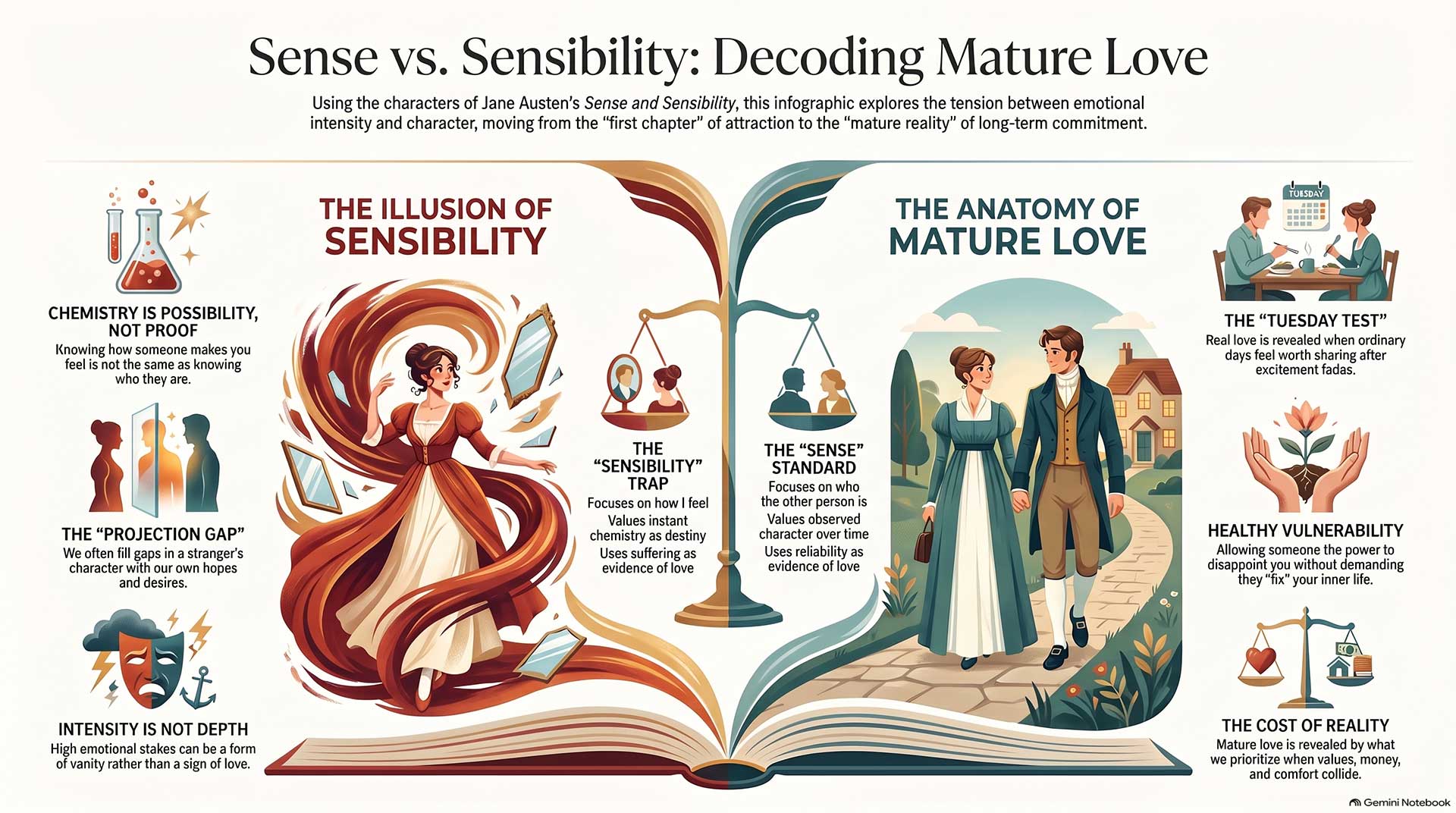
Perhaps the deepest lesson of Sense and Sensibility is that neither reason nor emotion is enough by itself.
Marianne’s mistake is not that she feels too deeply.
Her mistake is believing that intensity automatically reveals truth.
Elinor’s mistake is not that she exercises self-control.
Her danger is believing that strength means carrying pain alone.
Willoughby reveals that a person can feel genuine love and still lack the courage to live according to it.
Edward reminds us that promises matter, but duty without honesty can also cause harm.
Colonel Brandon shows that love does not always arrive dramatically. Sometimes it appears as constancy, patience, protection, and presence.
And Lucy Steele forces everyone to acknowledge something romantic stories often prefer to ignore: love always exists inside practical reality.
Money matters.
Security matters.
Family matters.
Promises matter.
Character matters.
But perhaps what Austen ultimately asks us to seek is not less emotion.
It is wiser emotion.
Not coldness.
Not caution for its own sake.
Not passion without restraint.
But a heart capable of feeling deeply while still seeing clearly.
Because love is not proven by how overwhelming it feels at the beginning.
It is revealed over time.
When disappointment arrives.
When sacrifice is required.
When the person becomes less idealized and more real.
When two people are finally able to see each other clearly and still find something worth choosing.
Perhaps that is where sense and sensibility finally meet.
Short Bios:
Elinor Dashwood
The elder Dashwood sister, Elinor is thoughtful, observant, emotionally disciplined, and deeply considerate of others. She often hides her own pain in order to protect those around her. Her journey reveals both the strength and the loneliness that can come from excessive self-control.
Marianne Dashwood
Passionate, expressive, romantic, and fiercely sincere, Marianne believes strong feeling is evidence of authentic love. Her relationship with Willoughby forces her to confront the difference between emotional intensity and dependable character.
Edward Ferrars
Edward is gentle, modest, and uncomfortable with the ambitions his family has for him. His long-standing engagement to Lucy Steele places him between duty and love, raising difficult questions about promises, honesty, and whether commitment should survive when people change.
Colonel Brandon
Quiet, mature, and dependable, Colonel Brandon loves Marianne without trying to possess her. His actions reveal a form of love based less on performance and more on constancy, responsibility, and care.
John Willoughby
Charming, emotionally expressive, and deeply attractive to Marianne, Willoughby appears at first to embody romantic love. Yet when love begins to cost him financially and socially, his choices expose the difference between sincere feeling and moral courage.
Lucy Steele
Socially intelligent, calculating, and highly aware of the economic realities surrounding marriage, Lucy uses relationships strategically. Though often manipulative, she also exposes the financial vulnerability faced by women and challenges romantic assumptions about love existing apart from money and security.
Leave a Reply