
Introduction
What if the hardest question in Martyr! is not whether death can have meaning, but why human beings feel such a powerful need to make suffering mean something?
Cyrus Shams has spent much of his life searching for an answer.
His mother was supposedly killed when Iran Air Flight 655 was shot down. His father lived a difficult immigrant life raising him alone. Cyrus himself survived addiction, grief, loneliness, and a persistent fear that an ordinary life might disappear without leaving any proof that it mattered.
That fear leads him toward martyrs.
A martyr seems to offer something ordinary death cannot: purpose.
The martyr does not simply die.
The death becomes a message.
A sacrifice.
A story that survives.
Yet the people closest to Cyrus slowly complicate that idea.
His father Ali shows him that giving one's life does not always mean dying. A person can give twenty years through work, responsibility, and care.
His uncle Arash remembers frightened young soldiers whose deaths were later wrapped in the language of glory.
Leila dies under another woman's identity, raising the disturbing question of whether a sacrifice matters when history remembers the wrong person.
Roya, Cyrus's supposedly dead mother, survives and becomes Orkideh, forcing Cyrus to confront the difference between the mother he imagined and the complicated woman who actually lived.
Sang reminds everyone that a person is always larger than the role assigned to them.
And Zee keeps bringing Cyrus back from enormous questions about history, God, death, and martyrdom to something much closer:
Someone loves him now.
Across these five imagined conversations, the characters will ask questions the novel never answers neatly.
Does suffering need a purpose?
Who deserves to be called a martyr?
How much freedom do we have to reinvent ourselves when other people depend on us?
Can faith, art, sobriety, or love save a person?
And perhaps the most difficult question of all:
Is searching for a meaningful death sometimes easier than learning how to live an ordinary, meaningful life?
No one in this conversation has a complete answer.
That may be exactly where Martyr! becomes most human.
(Note: This is an imaginary conversation, a creative exploration of an idea, and not a real speech or event.)
Topic 1: Must Our Suffering Mean Something?
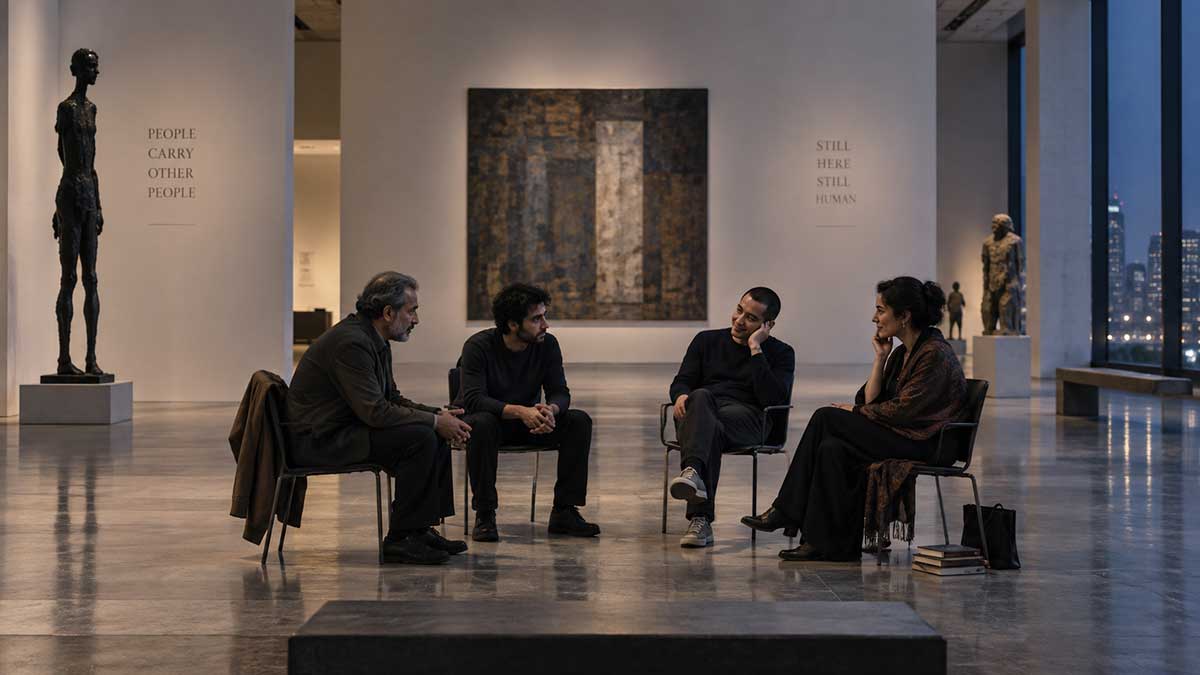
The museum had emptied hours ago.
The chairs from Orkideh’s installation remained arranged in a loose circle beneath the dim gallery lights. Nothing moved except the faint shimmer of reflections against the polished floor.
Cyrus sat forward, elbows against his knees.
Across from him sat Orkideh.
Beside Cyrus was Zee.
Ali occupied another chair, his hands folded calmly in his lap.
Nobody seemed interested in explaining how they had all arrived in the same room.
Perhaps that was fitting.
Cyrus had spent most of his life demanding explanations.
Tonight, explanation was not the price of admission.
Zee broke the silence.
“Can I ask you something I’ve wanted to ask for years?”
Cyrus glanced at him. “You usually do.”
“Why does pain have to mean something to you?”
Cyrus gave a small laugh.
“That’s the question?”
“It’s the first one.”
Cyrus leaned back.
“My mother died on an airplane that got shot out of the sky. My father spent most of his life working himself exhausted. Then he died. I spent years trying to disappear into drugs. You’re asking why I wanted any of that to mean something?”
“Yes.”
Cyrus stared at him.
Zee continued.
“I know why you wanted it to stop hurting. I know why you wanted answers. I’m asking something different. Why did you need the pain itself to contain a message?”
Cyrus looked across the room.
Ali was watching him.
Orkideh was, too.
Cyrus rubbed his palms together.
“If it doesn’t mean anything, then what was it?”
“Pain,” Zee said.
“That’s not enough.”
“Why?”
“It just isn’t.”
Orkideh shifted slightly in her chair.
“There,” she said.
Cyrus looked at her.
“There what?”
“That sentence. ‘It isn’t enough.’”
She studied him.
“You’ve spent your life treating reality as though it owes you more than what happened.”
Cyrus frowned.
“That sounds cold.”
“It probably does.”
“My mother dies, and I’m supposed to say, ‘Well, that happened’?”
Orkideh’s face changed.
For a moment Cyrus remembered who she was.
Not Orkideh the artist.
Not the woman sitting in a museum talking publicly about death.
Roya.
His mother.
The woman who had not died on that airplane at all.
She spoke quietly.
“You spent years mourning someone who was still alive.”
Cyrus looked down.
“Exactly.”
“So your suffering was real.”
“Yes.”
“But the story you built around it was false.”
Cyrus looked up quickly.
“That doesn’t make the suffering false.”
“No,” she said. “That’s the point.”
The room went quiet.
Ali finally spoke.
“You thought the explanation created the pain.”
Cyrus turned toward him.
Ali continued.
“You thought, ‘My mother died, so I became this person.’ Then you learned she had not died, and you were still the same person.”
Cyrus swallowed.
“For a while.”
“For a while,” Ali agreed. “Which means the wound was not attached only to the fact.”
Cyrus stared at him.
“What are you saying?”
“I’m saying a child can suffer from absence without knowing why the person is absent.”
Cyrus’ jaw tightened.
Orkideh looked away.
Ali did not.
“You lost her,” he said. “That was true. You built one explanation for the loss. Later you discovered another. The explanation changed. The loss did not disappear.”
Cyrus leaned back.
“So what am I supposed to do with that?”
Zee answered.
“Maybe stop thinking that an explanation automatically heals anything.”
Cyrus looked irritated now.
“You make it sound like I spent twenty years solving a math problem.”
“In a way, you did.”
“Come on.”
“You kept saying: if I can figure out what this means, then I’ll know how to live.”
Cyrus’ eyes narrowed.
Zee leaned closer.
“You studied martyrs. You wrote about death. You turned history into poetry. You looked at religion. You looked at art. You looked at drugs. You looked at everybody except the possibility that some things hurt and stay hurt.”
“That’s bleak.”
“No. I think the bleak part is deciding you cannot live until the pain explains itself.”
Cyrus said nothing.
Orkideh smiled faintly.
“He got you there.”
“Don’t.”
Zee laughed softly.
“I’m not trying to get you.”
Cyrus stood and walked a few steps across the room.
His reflection stretched across the floor.
“When I was a kid,” he said, “I imagined the plane constantly.”
Ali’s eyes lowered.
“I know.”
“No, you don’t.”
“I knew more than you thought.”
Cyrus turned.
“I imagined the last few minutes. I imagined her looking out the window. I imagined whether she knew. I imagined whether she was afraid.”
His voice softened.
“I wanted the universe to have noticed.”
Nobody interrupted him.
“That’s what nobody ever gets. I wasn’t asking for some pretty explanation. I needed the universe to notice.”
Orkideh’s expression changed.
Cyrus continued.
“If 290 people die, history gets a number. A report. An argument. A government statement. People debate whose fault it was. Then everybody goes home.”
He looked at her.
“But one of those people was supposed to be my mother.”
Ali said quietly, “Supposed to be.”
Cyrus nodded.
“Supposed to be.”
He gave a bitter smile.
“That makes it worse.”
Orkideh did not defend herself.
Cyrus kept speaking.
“If her death had meant something, then she wasn’t just a number. She wasn’t just somebody who got unlucky. She mattered.”
Zee looked at him.
“Did she need to die meaningfully in order to matter?”
Cyrus stopped.
Nobody moved.
Zee repeated the question.
“Did she?”
Cyrus’ mouth opened, then closed.
Orkideh watched him carefully.
“No,” Cyrus said at last.
“Then why did you spend so much time trying to make the death meaningful?”
Cyrus sat down again.
“I don’t know.”
Ali gave him a long look.
“You were afraid that random death meant random life.”
Cyrus turned to him.
Ali continued.
“If a person can disappear suddenly, maybe you thought the life before that disappearance did not count.”
Cyrus leaned forward.
“That’s exactly it.”
Ali nodded.
“I know.”
Cyrus looked at his father.
“How?”
Ali smiled sadly.
“I lost someone too.”
The words landed differently than Cyrus expected.
For years, Cyrus had treated grief as something he inherited.
His grief.
His mother.
His wound.
Ali had been there before him.
Ali had lived the years Cyrus could barely imagine.
Cyrus looked at Orkideh.
Then back at Ali.
“What did you think it meant?”
Ali shook his head.
“I stopped asking.”
“When?”
“I don’t know.”
“You just stopped?”
“Yes.”
“How?”
“I had a baby.”
Cyrus looked almost offended.
“That’s your answer?”
“It’s what happened.”
Ali shrugged.
“I could sit every night asking why my life became what it became, or I could wake up and make your breakfast.”
Cyrus looked away.
Ali continued.
“You think that sounds small.”
“I didn’t say that.”
“You didn’t need to.”
A faint smile appeared on Ali’s face.
“You were always looking for something enormous.”
Cyrus laughed once.
“Apparently.”
“You wanted life to announce itself.”
“And you didn’t?”
“No.”
“Never?”
Ali thought for a moment.
“Maybe when I was young.”
“What changed?”
“You.”
Cyrus looked back at him.
Ali spoke gently.
“I did not need my life to be enormous once someone needed me to come home.”
Cyrus rubbed his face.
“That sounds like the kind of thing people put on greeting cards.”
Ali laughed.
“Then throw the card away.”
Zee smiled.
Orkideh did too.
For a few seconds the room felt almost ordinary.
Then Cyrus looked at his father again.
“I thought you hated your life.”
Ali’s smile faded.
“I hated parts of it.”
“The work.”
“Yes.”
“America sometimes.”
“Yes.”
“Being alone.”
“Yes.”
“Losing her.”
Ali looked across at Orkideh.
“Yes.”
Cyrus waited.
Ali said, “A life can contain misery without becoming a miserable life.”
Cyrus stared at him.
“That’s very convenient now.”
“No. It’s very inconvenient.”
Ali leaned forward.
“You wanted me to be tragic. It made your story cleaner.”
Cyrus stiffened.
“My story?”
“Yes.”
“My father loses his wife. He comes to America. He works a terrible job. He drinks. He dies.”
Ali shook his head.
“You edited me.”
Cyrus looked genuinely hurt.
“I loved you.”
“I know.”
“Then don’t say I edited you.”
“But you did.”
Ali’s voice remained calm.
“You turned my pain into my identity.”
Orkideh watched Cyrus.
Cyrus noticed.
“Don’t look at me like that.”
“I didn’t say anything.”
“You don’t have to.”
She tilted her head.
“You did the same thing to me.”
Cyrus laughed without humor.
“There it is.”
“There what?”
“The part where somehow this becomes my mistake.”
“I didn’t say that.”
“You disappeared.”
“Yes.”
“You let me think you were dead.”
“Yes.”
“You built an entirely new life.”
“Yes.”
“And I’m the one who turned you into a story?”
Orkideh let the anger reach her before answering.
“You had every right to be angry.”
“That is not an answer.”
“You had every right to hate me.”
“That isn’t one either.”
“You had every right to grieve.”
Cyrus stood again.
“But?”
“No ‘but.’”
He stared at her.
She continued.
“You can be right about what I did to you and still be wrong about who I was.”
Cyrus froze.
Orkideh’s voice remained quiet.
“You knew the role I failed to fill.”
Mother.
The word never needed to be spoken.
“You did not know the rest of me.”
Cyrus sat down slowly.
“That’s hard to hear.”
“I know.”
“No, you don’t.”
Orkideh almost smiled.
“You really like saying that.”
Cyrus laughed in spite of himself.
Then the laugh vanished.
“What were you suffering from?”
The question surprised everyone.
Orkideh looked at him.
“Back then?”
“Yes.”
She took her time.
“Being trapped inside a life that felt already written.”
Cyrus nodded.
“And escaping fixed it?”
“No.”
“Did becoming Orkideh fix it?”
“No.”
“Painting?”
“No.”
“Love?”
“No.”
“Then what did?”
She looked at him.
“Why do you keep expecting one thing to fix a life?”
Cyrus did not answer.
Orkideh continued.
“Some things helped. Some things hurt. Some things helped and hurt at the same time.”
She looked around the museum.
“Art gave me somewhere to put what I could not say.”
She looked at Cyrus.
“It did not turn my choices into good ones.”
Then at Ali.
“Love gave me moments I would not trade.”
Then back to Cyrus.
“It did not erase the people I wounded.”
Cyrus whispered, “So what was the meaning?”
“There you go again.”
He laughed.
“I walked into that.”
“Yes.”
Zee leaned forward.
“Maybe this is the part we’re stuck on.”
Cyrus looked at him.
Zee said, “What if meaning isn’t hidden inside the suffering like a note?”
Cyrus raised an eyebrow.
“A note?”
“Something you unwrap.”
He mimed opening a small package.
“Congratulations. Your mother disappeared so you could become a poet.”
Cyrus grimaced.
“That’s awful.”
“Yes. That’s why I’m saying it.”
Zee lowered his hands.
“What if nothing in the suffering says what you’re supposed to become?”
Cyrus said, “Then we decide?”
“Maybe.”
“That sounds arbitrary too.”
“Maybe meaning is partly arbitrary.”
Cyrus shook his head.
“That’s not comforting.”
“Why does truth have to be comforting?”
Orkideh smiled.
“Now he sounds like me.”
Zee looked at her.
“I’m not sure that’s good.”
Ali laughed quietly.
Cyrus looked around the circle.
“So that’s it? Bad things happen and then we invent something afterward?”
Ali shook his head.
“No.”
“What’s different?”
“You keep using the word ‘invent’ as if meaning that humans create is fake.”
Cyrus looked at him.
Ali continued.
“If I choose to care for you, is that fake?”
“No.”
“If Zee chooses to love you?”
Cyrus glanced at Zee.
“No.”
“If someone chooses to make art?”
“No.”
“If someone forgives?”
“No.”
“Then why is chosen meaning less real than discovered meaning?”
Cyrus went quiet.
Orkideh leaned back.
“That might be the question.”
Cyrus stared at the floor.
“If I create meaning after something happens, I still can’t say the thing happened for that reason.”
“No,” Zee said.
“That’s a big difference.”
“Yes.”
Cyrus looked at each of them.
“So my addiction didn’t happen so I could become a better person.”
“No,” Zee said.
“My mother didn’t disappear so I could learn something.”
Orkideh answered this time.
“No.”
“My father didn’t suffer so I could appreciate sacrifice.”
Ali shook his head.
“No.”
Cyrus took a long breath.
“That actually makes me feel better.”
Zee smiled.
“Really?”
“A little.”
“Why?”
“Since I’ve hated the phrase ‘everything happens for a reason’ my whole life.”
Orkideh nodded.
“It can be cruel.”
Cyrus looked at her.
“Especially when somebody else decides the reason.”
“Yes.”
Ali added, “It can turn another person’s pain into your lesson.”
Cyrus absorbed that.
After a moment he asked, “Then what do you say to someone whose suffering feels pointless?”
Nobody answered immediately.
Cyrus looked from face to face.
“Seriously.”
Zee spoke first.
“I don’t think I’d tell them it has a point.”
“What would you tell them?”
“That they don’t have to figure it out tonight.”
Cyrus looked at him.
Zee continued.
“That they can be angry.”
Orkideh said, “That pain does not become sacred merely from being pain.”
Ali added, “That surviving one day is sometimes enough work for one day.”
Cyrus looked at his father.
Ali shrugged.
“Not every day needs a philosophy.”
That made Cyrus smile.
Orkideh looked at Cyrus.
“What would you say?”
He sat with the question.
“I used to say: make something from it.”
“And now?”
“I’m not sure.”
Zee waited.
Cyrus looked around the room.
“Maybe I’d say... don’t let anybody rush you into turning it into something.”
No one spoke.
Cyrus continued.
“You don’t have to turn grief into wisdom right away.”
Orkideh watched him closely.
“You don’t have to become stronger.”
Ali nodded.
“You don’t have to forgive.”
Orkideh’s eyes lowered.
“You don’t have to make art.”
Cyrus looked at his own hands.
“You don’t have to explain why you survived.”
Zee said quietly, “That one sounds personal.”
“It is.”
A long silence followed.
Cyrus finally looked at Zee.
“You asked why pain has to mean something to me.”
“Yes.”
“I think I know.”
Zee waited.
Cyrus inhaled slowly.
“If pain has meaning, then maybe it isn’t wasted.”
Zee nodded.
“And if it is wasted?”
Cyrus looked at Orkideh.
Then Ali.
Then back to Zee.
“Maybe a person doesn’t have to be.”
Zee’s expression softened.
Cyrus continued before anyone could respond.
“That’s different.”
“Yes.”
“The suffering can be pointless.”
“Yes.”
“The death can be pointless.”
Zee nodded.
“The mistake can be pointless.”
Another nod.
“And the person can still matter.”
Ali smiled.
Cyrus noticed and almost protested.
Instead, he let the smile remain.
Orkideh shifted in her chair.
“Does that change how you think about your mother?”
Cyrus looked at her for a long time.
“I don’t know which mother you mean.”
She accepted that.
“The one you thought died.”
Cyrus considered it.
“For most of my life, I needed her death to mean something.”
“And now?”
“Now I know she never died.”
Orkideh did not move.
“And somehow I’m still grieving her.”
Her eyes filled slightly.
Cyrus noticed.
“So maybe grief was never only about death.”
“No,” Ali said.
Cyrus looked at him.
Ali continued.
“Grief is sometimes love looking for a place to go.”
Cyrus groaned.
“That one definitely belongs on a greeting card.”
Ali laughed.
Zee laughed too.
Even Orkideh smiled through the tears.
Cyrus shook his head.
Then he grew quiet again.
“What if there is no final answer?”
Zee asked, “To what?”
“To any of it.”
Cyrus gestured toward the room.
“Why people suffer. Why some people recover. Why some people don’t. Why one person gets on a plane and another person doesn’t. Why one family stays together and another disappears.”
Nobody answered.
Cyrus looked almost relieved by that.
For once, the silence did not feel like failure.
He sat back.
“I think I’ve spent most of my life believing that if I asked the question well enough, somebody would eventually answer.”
Orkideh said, “And now?”
Cyrus looked at Zee.
Then Ali.
Then his mother.
“Now I’m wondering whether being with people who can sit inside the question might be enough.”
Zee smiled.
“Enough for what?”
Cyrus thought.
“For tonight.”
No one tried to turn the moment into something larger.
No one claimed suffering had secretly been a gift.
No one claimed the wounds had vanished.
No one explained the airplane.
No one explained addiction.
No one explained why one person stays and another leaves.
They remained in the museum together.
Cyrus had spent years asking whether pain contained meaning.
For one night, he stopped demanding that it answer.
And the silence felt less empty than before.
Topic 2: Who Is a Martyr?
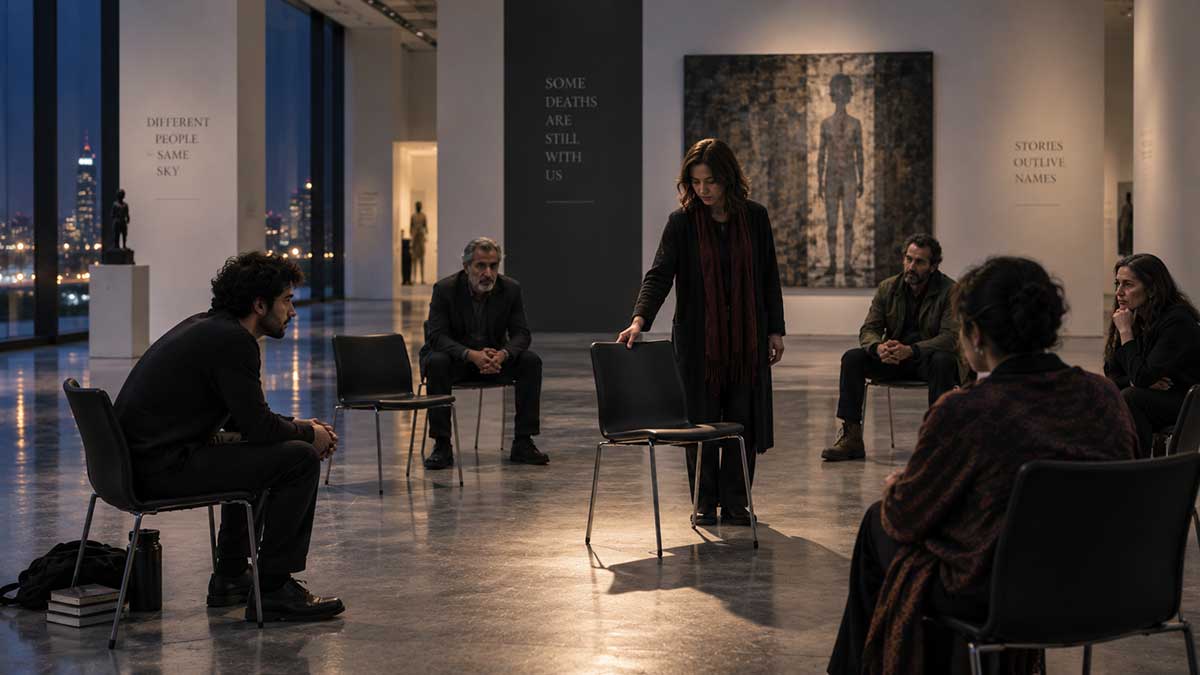
The museum felt different tonight.
The chairs remained where they had been, but Cyrus noticed one empty seat near the center of the circle.
He stared at it longer than he intended.
Arash noticed.
“You keep looking at that chair.”
Cyrus glanced at his uncle.
“I was thinking.”
“That is usually dangerous with you.”
Cyrus smiled.
“Thanks.”
Arash leaned back.
“What were you thinking?”
Cyrus looked at the chair again.
“Who belongs there.”
“Where?”
“In the martyr’s chair.”
Arash raised an eyebrow.
“We have one now?”
“Apparently I just invented it.”
“That seems like something you would do.”
Ali laughed softly.
Across from them sat Leila.
Cyrus still found it difficult to look at her.
For most of his life, the person he had imagined dying aboard Iran Air Flight 655 had been his mother.
Yet the woman who had actually boarded that plane carrying Roya’s identity was sitting only a few feet away.
Orkideh sat beside her.
Roya.
His mother.
The woman Cyrus had transformed into a martyr before learning she had survived.
Arash looked around the room.
“So,” he said, “who gets the chair?”
Cyrus shrugged.
“That’s what I’m trying to figure out.”
“Start with your definition.”
“A martyr is someone who dies for something greater than themselves.”
Leila tilted her head.
“Must they choose to die?”
Cyrus hesitated.
“I think so.”
“Why?”
“Otherwise every person killed by war becomes a martyr.”
“Would that be wrong?”
“It makes the word meaningless.”
Arash smiled slightly.
“You wanted to study martyrs. Now you are protecting the admission requirements.”
Cyrus sighed.
“Fine. Help me.”
Arash leaned forward.
“Someone dies for a cause?”
“Yes.”
“A soldier?”
“Sometimes.”
“A religious believer?”
“Sometimes.”
“A political activist?”
“Yes.”
“A mother protecting her child?”
“Probably.”
“A stranger pushing someone out of the way of a car?”
Cyrus nodded.
“Yes.”
“A person who dies accidentally?”
“No.”
Leila looked directly at him.
“Me?”
The room went silent.
Cyrus swallowed.
“I didn’t mean that.”
“You did.”
“I meant the category.”
“I know.”
Her voice was calm.
“That is why I asked.”
Cyrus looked uncomfortable.
“You didn’t choose to die.”
“No.”
“You were trying to leave.”
“Yes.”
“You were trying to live.”
“Yes.”
Cyrus looked toward Orkideh.
Leila followed his eyes.
“I carried her identity.”
Orkideh said nothing.
Leila continued.
“I got onto the airplane under someone else’s name. The airplane was destroyed. People believed she died.”
She looked at Cyrus.
“You mourned her.”
“Yes.”
“Not me.”
“No.”
“You didn’t know me.”
“No.”
Leila nodded.
“So I died, but the grief went to another name.”
Cyrus looked down.
Leila glanced at the empty chair.
“Do I get to sit there?”
Cyrus looked up.
“I don’t know.”
“Good.”
He seemed surprised.
“Good?”
“I would rather you say you don’t know than turn me into another beautiful idea.”
Cyrus winced.
Arash noticed.
“She got you.”
“I know.”
Leila looked at Cyrus.
“You spent years searching for people whose deaths meant something.”
“Yes.”
“Did you ever wonder whether the dead wanted that?”
Cyrus did not answer.
She continued.
“When people die, the living become very busy.”
“With what?”
“Explaining us.”
Cyrus looked at her.
Leila spoke gently.
“They say we died for freedom. For God. For family. For country. For love. For justice.”
She paused.
“Sometimes perhaps we did.”
Her eyes moved toward Arash.
“Sometimes we were simply trying to get home.”
Arash’s face tightened.
He knew that distinction.
Cyrus noticed.
“What did you see?”
Arash stared at his hands.
“When?”
“In the war.”
Arash breathed slowly.
“You want the heroic version?”
“No.”
“That’s usually the version people want.”
“I don’t.”
Arash gave him a tired smile.
“You say that now.”
He leaned back.
“There were young men who believed deeply in what they were doing. Some spoke about God. Some spoke about Iran. Some spoke about protecting their families.”
He paused.
“Some were terrified.”
Cyrus waited.
“Some wanted to go home.”
Another pause.
“Some were too young to know what they wanted.”
Leila watched him.
Arash continued.
“And then there was me.”
“The angel.”
“Yes.”
Cyrus had heard the story before.
Yet hearing Arash speak about it here, beside Leila and Ali and Orkideh, changed the tone.
“You dressed like an angel for dying soldiers.”
Arash nodded.
“I rode into places where boys were dying and tried to give them something beautiful to see before they were gone.”
Cyrus asked quietly, “Did they believe you were real?”
“Some did.”
“Did you tell them?”
“Tell them what?”
“That you were just a man in a costume.”
Arash laughed once.
“You think that was the moment for a factual correction?”
Cyrus almost smiled.
Then Arash’s expression hardened.
“One boy looked at me and started crying. Not from fear. From relief.”
Cyrus stayed silent.
“He thought heaven had come for him.”
Arash stared somewhere beyond the room.
“I let him believe it.”
“Do you regret that?”
“I don’t know.”
“You must have thought about it.”
“Many times.”
“And?”
Arash looked at Cyrus.
“Would you have taken it away from him?”
Cyrus did not answer.
Arash nodded.
“That is what I thought.”
Cyrus looked at the floor.
“So was he a martyr?”
Arash’s eyes narrowed.
“You tell me.”
“He died in war.”
“That does not answer it.”
“He believed he was fighting for something.”
“Perhaps.”
“Then yes.”
Arash leaned toward him.
“What if his belief was shaped by adults who praised martyrdom?”
Cyrus stopped.
“What if every poster he saw told him that death for the nation was glorious?”
Cyrus said nothing.
“What if religious language made death sound less frightening?”
Arash continued.
“What if his friends enlisted?”
A pause.
“What if his family expected courage?”
Another pause.
“What if he wanted his father to be proud?”
Cyrus frowned.
“You’re saying he didn’t choose?”
“I’m asking what choice means.”
The room quieted.
Arash looked around.
“We like clean stories about sacrifice. The brave person sees the danger, understands everything, freely chooses death, saves someone, and becomes a symbol.”
He shook his head.
“Real people are rarely that clean.”
Leila nodded.
“Neither are deaths.”
Cyrus looked at her.
“So intention matters, but it may not be enough.”
“Perhaps.”
Orkideh spoke for the first time.
“Why are you so interested in whether someone qualifies?”
Cyrus looked at her.
“I spent years writing about martyrs.”
“I know.”
“I wanted to understand what made one death meaningful and another death meaningless.”
“There it is again.”
He sighed.
“I know.”
“No. Listen to yourself.”
She leaned forward.
“You keep dividing death into categories.”
Cyrus waited.
“Meaningful.”
“Meaningless.”
“Heroic.”
“Accidental.”
“Sacrificial.”
“Ordinary.”
She looked toward Leila.
“What happens to the person underneath those words?”
Cyrus said, “We remember them.”
“Do we?”
Her voice sharpened.
“Or do we remember the category?”
Cyrus did not respond.
Orkideh gestured toward Leila.
“She became a victim of Flight 655 under my name.”
Leila gave a small nod.
“You became the grieving son of someone who was not on the plane.”
Cyrus lowered his eyes.
“I became the dead woman who was alive.”
No one moved.
Orkideh looked at Cyrus.
“History loves categories. Human beings do not fit inside them very well.”
Ali spoke quietly.
“Neither does love.”
Cyrus looked toward his father.
Arash smiled.
“Ali has been quiet too long.”
Cyrus nodded.
“That usually means trouble.”
Ali ignored him.
“I have a question.”
“For me?”
“For everyone.”
Ali looked at the empty chair.
“If martyrdom means giving your life for someone else, must you die?”
Cyrus frowned.
“Technically, yes.”
“Why?”
“That’s what martyr means.”
“Then perhaps the word is too small.”
Cyrus stared at him.
Ali continued.
“I gave years of my life to raising you.”
Cyrus’ face changed.
Ali raised one hand.
“I am not asking for praise.”
“I know.”
“I do not want the chair.”
Arash laughed softly.
“I definitely do not want the chair.”
Ali smiled.
“I woke up. I worked. I came home. I worried. I paid bills. I made mistakes.”
He looked at Cyrus.
“I gave you years.”
Cyrus said quietly, “I know.”
“No. You know now.”
Cyrus flinched.
Ali did not sound angry.
That made it worse.
“When you were younger, you saw my life as something that happened to me.”
Cyrus nodded.
“I thought you hated it.”
“I hated parts.”
“You said that before.”
“Yes.”
Ali leaned forward.
“But sacrifice is not always hating your life.”
Cyrus waited.
“Sometimes you choose one responsibility again and again.”
Ali glanced at the empty chair.
“You wanted martyrs to have one enormous moment.”
Cyrus looked at him.
Ali smiled.
“My moments were small.”
“Getting up at five.”
“Yes.”
“Going to work.”
“Yes.”
“Coming home.”
“Yes.”
“Again and again.”
“Yes.”
Cyrus swallowed.
“And you think that was sacrifice?”
Ali considered the question.
“Sometimes.”
“Did you think of it that way then?”
“No.”
“Why not?”
“I was busy.”
Arash laughed.
Leila smiled.
Ali continued.
“That may be one difference.”
“Between what?”
“Living sacrifice and performed sacrifice.”
Orkideh looked interested.
Ali turned toward Cyrus.
“If you are thinking every day, ‘Look at how much I am sacrificing,’ perhaps something has gone wrong.”
Cyrus nodded slowly.
“That hurts.”
“It should.”
“Thanks, Dad.”
Ali smiled.
Orkideh looked toward the empty chair.
“Ali may be closer to the answer than any of us.”
Ali shook his head immediately.
“No.”
“You do not get to escape that easily.”
“I am not a martyr.”
“Why?”
“I chose to raise my son.”
Orkideh looked at him.
“That does not make the cost disappear.”
“I know.”
“You lost things.”
“Yes.”
“You gave things up.”
“Yes.”
“You stayed.”
Ali’s eyes moved toward Cyrus.
“Yes.”
Orkideh nodded.
“Then perhaps martyrdom is not the right word. But sacrifice is.”
Ali accepted that more easily.
“Fine.”
Cyrus looked uneasy.
“What?”
Ali asked.
“I think I spent years looking for sacrifice everywhere except at home.”
Ali shrugged.
“You were young.”
“That doesn’t excuse it.”
“I didn’t ask for an excuse.”
Cyrus stared at him.
Ali continued.
“You are doing it again.”
“Doing what?”
“Making your failure to notice me into another tragedy about you.”
For one second nobody spoke.
Then Arash burst out laughing.
Leila covered her mouth.
Cyrus stared at his father.
“That was brutal.”
Ali smiled.
“It was accurate.”
Even Orkideh laughed.
Cyrus shook his head.
“Fine.”
He looked at Ali.
“Then what do I do?”
“Notice now.”
Cyrus became quiet.
That answer seemed almost too simple.
Arash saw the change in his face.
“Your father is ruining your philosophy.”
“He’s very good at it.”
Ali said, “You make philosophy easy to ruin.”
Cyrus laughed.
Then Leila spoke.
“What about me?”
Everyone turned.
She looked at Ali.
“You gave years knowingly.”
“Yes.”
“I gave something without knowing.”
Ali nodded.
Leila looked at Cyrus.
“Does an accidental sacrifice count?”
Cyrus thought carefully.
“I don’t know if I should call your death a sacrifice.”
“Why?”
“You were trying to survive.”
“Yes.”
“You weren’t giving your life.”
“No.”
“You lost it.”
“Yes.”
Cyrus paused.
“But your death changed other lives.”
Leila’s expression remained calm.
“So?”
“So maybe meaning came later.”
Orkideh watched him.
Cyrus noticed.
“What?”
“You are changing.”
“Don’t sound so surprised.”
“You used to need intention.”
“I still think intention matters.”
“Yet?”
Cyrus looked back at Leila.
“Yet I don’t think intention controls everything a death becomes.”
Leila nodded.
“Better.”
Arash leaned forward.
“Now we are getting somewhere.”
Cyrus sighed.
“I hate when people say that.”
“I know.”
Arash looked at Leila.
“Your death became part of Roya’s survival.”
Leila nodded.
“It became part of Cyrus’ grief.”
“Yes.”
“Part of Ali’s grief.”
“Yes.”
“Part of history under the wrong identity.”
“Yes.”
Arash looked toward Cyrus.
“The event had consequences far beyond anyone’s intention.”
Cyrus nodded.
“So perhaps a death can acquire meaning without becoming martyrdom.”
Leila smiled faintly.
“I like that better.”
“Why?”
“Since I do not want my death upgraded.”
Cyrus looked puzzled.
“Upgraded?”
“To make it more respectable.”
She looked around the room.
“I died. It was terrible. That should be enough.”
Cyrus absorbed the sentence.
Leila continued.
“People sometimes think calling a death meaningful honors the dead.”
She shook her head.
“It can steal something too.”
“What?”
“The right for what happened to simply be wrong.”
The room fell quiet.
Arash lowered his head.
He understood that immediately.
Leila looked at Cyrus.
“If a child dies in war, perhaps we do not need to call him a martyr.”
Cyrus waited.
“Perhaps we can say a child died in war.”
Arash’s face tightened.
Leila continued.
“And perhaps that sentence should disturb us more.”
Nobody spoke for several seconds.
Cyrus finally turned to Arash.
“Did calling soldiers martyrs ever make their deaths easier to accept?”
Arash considered it.
“For whom?”
“The families.”
“Sometimes.”
“The soldiers?”
“Sometimes.”
“The country?”
Arash looked at him sharply.
“Very often.”
Cyrus nodded.
“That’s different.”
“Yes.”
“How?”
Arash inhaled slowly.
“A grieving mother may need to believe her son did not die for nothing.”
Cyrus nodded.
“A government may need her to believe that too.”
The sentence sat heavily in the room.
Cyrus said, “Those are not the same need.”
“No.”
Arash leaned forward.
“One can come from grief.”
He paused.
“The other can become useful.”
Cyrus looked toward Leila.
“So martyrdom can be used.”
“Any powerful story can be used,” Orkideh said.
Cyrus turned to her.
“Religion?”
“Yes.”
“Patriotism?”
“Yes.”
“Art?”
“Yes.”
“Grief?”
“Yes.”
“Love?”
“Yes.”
Cyrus smiled bitterly.
“You don’t leave much untouched.”
“Why should I?”
She gestured around the gallery.
“I spent my life working in a place where people turned objects into meaning.”
Cyrus looked at the walls.
“Is that bad?”
“No.”
“Then what’s the problem?”
“Meaning becomes dangerous when we forget someone created it.”
Cyrus stayed quiet.
She continued.
“Once a story feels sacred, questioning it becomes betrayal.”
Arash nodded slowly.
“I saw that.”
Cyrus looked at him.
“In the war?”
“Yes.”
“People questioned martyrdom?”
“Privately.”
“And publicly?”
“Less.”
“Why?”
Arash gave him a tired look.
“You know why.”
Cyrus did.
Leila leaned forward.
“Can I ask Cyrus something?”
He nodded.
“You wanted your own death to mean something.”
Cyrus tensed.
“Eventually, yes.”
“Did you want to help people?”
“I think so.”
“That was not my question.”
He looked at her.
She repeated it.
“Did you want to help people?”
Cyrus hesitated.
“Yes.”
“Or did you want people to know that you mattered?”
He stopped.
Orkideh said nothing.
Neither did Ali.
Cyrus looked uncomfortable.
“Both.”
Leila nodded.
“That seems more truthful.”
Cyrus rubbed his palms together.
“I hated the idea of disappearing.”
“Why?”
“I don’t know.”
“Yes, you do.”
Cyrus looked at her.
She waited.
Finally he said, “I wanted proof.”
“Of what?”
“That I had been here.”
Leila’s expression softened.
“Now we are closer.”
Cyrus looked around the room.
“I think that’s what martyrdom gave me.”
Arash nodded.
“A permanent witness.”
“Yes.”
Cyrus looked at the empty chair.
“If you die in a way people remember, then nobody can say your life didn’t matter.”
Ali spoke quietly.
“People can remember your death and know nothing about your life.”
Cyrus turned toward him.
Ali continued.
“Those are different things.”
Cyrus nodded slowly.
“I know.”
“Do you?”
“Yes.”
Ali waited.
Cyrus sighed.
“No. Maybe not.”
Ali smiled.
Cyrus looked at Leila.
“You were forgotten under your own name.”
“Yes.”
“Does that make your life smaller?”
“No.”
“Does it make your death less real?”
“No.”
“Does it make what happened to you less wrong?”
“No.”
Cyrus leaned back.
“Then remembrance cannot be the measure.”
Leila nodded.
“No.”
Arash asked, “What is?”
Cyrus thought.
Nobody rushed him.
He looked at Ali.
Then Leila.
Then Orkideh.
Finally he said, “I’m not sure there should be one.”
Arash smiled.
“That is progress.”
“Stop saying that.”
Arash laughed.
Orkideh looked at Cyrus.
“Suppose nobody remembered you one hundred years from now.”
Cyrus grimaced.
“Cruel hypothetical.”
“Answer it.”
“Fine.”
“No books.”
“Okay.”
“No poems.”
“Okay.”
“No museum.”
“Very funny.”
“No one says your name.”
Cyrus looked at Zee’s empty chair from the previous conversation, then back toward the group.
Orkideh asked, “Would your life have mattered?”
Cyrus started to answer quickly.
Then stopped.
Ali watched him.
Leila watched him.
Arash waited.
“Yes.”
Orkideh said nothing.
Cyrus repeated it.
“Yes.”
“Why?”
He struggled.
“Since the people I loved were different after knowing me.”
Ali’s face softened.
Cyrus noticed.
“And I was different after knowing them.”
Orkideh nodded.
“That sounds less like martyrdom.”
“It is.”
“And more like?”
Cyrus looked annoyed.
“Do I have to name everything?”
Everyone laughed.
He smiled.
“No. Maybe that’s part of the problem.”
Leila leaned back.
“The man who spent years naming martyrs finally stops naming.”
“Don’t get excited.”
Arash laughed.
Then Cyrus looked at the empty chair again.
“Maybe nobody should sit there.”
Arash followed his gaze.
“The martyr’s chair?”
“Yes.”
“Why?”
Cyrus thought.
“Since the moment we put someone there, we start turning them into something.”
Leila nodded.
“A symbol.”
“Yes.”
Orkideh said, “And symbols are easier than people.”
Cyrus looked at her.
“Much easier.”
Ali added, “Symbols do not argue with you.”
Cyrus smiled.
“My mother definitely does.”
Orkideh smiled back.
Leila rose from her chair.
Everyone watched.
She walked toward the empty seat in the middle.
For one moment Cyrus thought she might sit.
Instead, she took the chair by its back and moved it out of the circle.
Arash watched her.
“No martyr’s chair?”
Leila shook her head.
“No.”
“Why?”
She returned to her own seat.
“If someone died, let them remain a person.”
Cyrus stared at the space where the chair had been.
Leila continued.
“If someone sacrificed something, remember what they gave.”
She looked toward Ali.
“If someone stayed, remember the years.”
Then toward Arash.
“If someone died frightened, do not force bravery onto them afterward.”
Arash lowered his eyes.
Then Leila looked at Cyrus.
“And if someone’s death had no purpose, do not invent one simply so the living can feel better.”
Cyrus nodded slowly.
“What do we do instead?”
Leila thought.
“Grieve.”
“That’s it?”
“No.”
She smiled faintly.
“Live.”
Cyrus gave a small laugh.
“You make it sound simple.”
“I did not say simple.”
Ali looked at his son.
Cyrus understood before his father spoke.
Living was exactly the thing Cyrus had spent years trying to turn into a theory.
Ali said, “You wanted one great sacrifice.”
Cyrus nodded.
“And?”
Ali smiled.
“Life keeps asking for smaller ones.”
Cyrus stared at him.
“What kind?”
“Time.”
Leila said, “Truth.”
Arash said, “Presence.”
Orkideh said, “Responsibility.”
Cyrus looked around the circle.
No one said death.
That surprised him.
He looked again at the empty space where the martyr’s chair had been.
For years he had believed that martyrdom represented the highest form of meaning.
A life offered completely.
A death transformed into testimony.
Now he saw how easily death could become a stage onto which the living projected whatever they needed.
Religion.
Nation.
Family.
Art.
Grief.
Immortality.
Maybe some people truly did choose to die for others.
Maybe such sacrifices deserved remembrance.
Yet Cyrus could no longer pretend that every meaningful sacrifice ended in death.
Ali had given years.
Leila had lost a life without choosing to become anyone’s symbol.
Arash had watched frightened young men become martyrs in the stories told after them.
Roya had survived and carried the consequences of survival.
Cyrus looked at his father.
“I think I know why I missed your sacrifice.”
Ali raised an eyebrow.
“Why?”
“It didn’t have an ending.”
Ali smiled.
“It did eventually.”
“You know what I mean.”
“I do.”
Cyrus continued.
“You just kept doing it.”
“Yes.”
“No single moment.”
“No.”
“No audience.”
“No.”
“No story.”
Ali looked at him.
“There was a story.”
Cyrus waited.
“You were living it.”
Cyrus became still.
Ali continued.
“You just did not recognize it yet.”
For once, Cyrus had nothing to add.
Arash looked around the room.
“So who is a martyr?”
Cyrus smiled.
“You really want an answer?”
“No.”
“Good.”
Arash laughed.
Cyrus looked at the empty space in the circle one last time.
“Maybe the more interesting question is not who deserves to be called a martyr.”
Leila asked, “Then what?”
Cyrus looked at Ali.
Then at Arash.
Then at Leila.
Then at Orkideh.
“What are we giving our lives to before we die?”
Nobody answered immediately.
This time Cyrus did not mind.
The martyr’s chair was gone.
The people remained.
Topic 3: Do We Have the Right to Become Someone New?
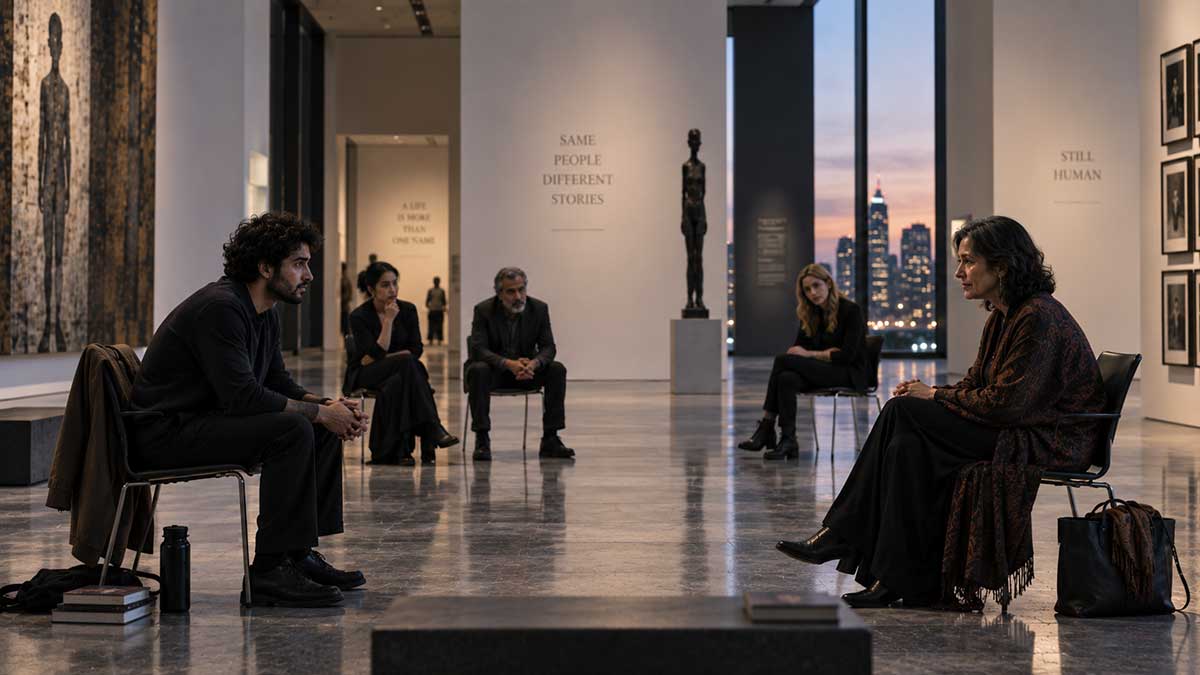
The empty chair was still gone.
Leila had moved it out of the circle the night before, and nobody had brought it back.
Cyrus noticed the space immediately.
He wondered whether that was how absence worked.
Remove one object and suddenly the whole room seemed organized around where it used to be.
Sang Linh sat beside Orkideh.
Cyrus still had trouble thinking of her that way when Sang was present.
Orkideh.
That was the woman Sang had known.
Roya was the woman Ali had known.
Mother was the woman Cyrus had never really known.
Across from them, Ali sat quietly.
Leila occupied the chair beside him.
Sang looked around the circle.
“I think we have been talking about death too much.”
Cyrus smiled.
“You chose an interesting group for that complaint.”
“I mean it.”
She looked toward Orkideh.
“We keep asking who died, who sacrificed, who suffered, who became a martyr.”
Then she looked at Cyrus.
“But there is another question underneath all of this.”
“What?”
“Who are we allowed to become?”
Cyrus glanced at his mother.
“I know where this is going.”
Sang shook her head.
“No, you don’t.”
“I think I do.”
“You think this is going to be a defense of her.”
Cyrus said nothing.
Sang continued.
“It isn’t.”
Orkideh looked at Sang.
“Comforting.”
“I’m not defending you either.”
“Even better.”
Ali smiled faintly.
Sang leaned forward.
“I knew Orkideh.”
Her eyes moved toward Cyrus.
“You knew the absence of Roya.”
Then toward Ali.
“You knew Roya before she disappeared.”
Then toward Leila.
“And you knew a version of her none of us knew.”
Leila nodded.
Sang looked around the circle.
“So which one was the real woman?”
Nobody answered.
Sang waited.
Cyrus finally said, “All of them?”
“Maybe.”
“Then what’s the problem?”
“The problem is that people say things like that until another person’s transformation hurts them.”
Cyrus looked toward Orkideh.
“There we go.”
Sang ignored the comment.
“We like reinvention when it sounds inspiring.”
She counted quietly on her fingers.
“Leave the bad job.”
“Start again.”
“Find yourself.”
“Become who you were meant to be.”
She lowered her hand.
“But what happens when becoming yourself requires disappointing someone?”
Cyrus said, “Disappointing?”
His voice sharpened.
“That is a very generous word.”
Sang looked at him.
“What word would you use?”
“Abandoning.”
Orkideh closed her eyes briefly.
Cyrus noticed.
“No. Don’t do that.”
She opened them.
“Do what?”
“Look wounded when I say it.”
“I am allowed to feel something.”
“And I’m allowed to call it what it was.”
“Yes.”
The answer came so quickly that Cyrus stopped.
Orkideh held his gaze.
“Yes.”
“You abandoned me.”
“Yes.”
Ali looked toward her.
She turned to him.
“And you.”
Ali gave a slow nod.
“Yes.”
Orkideh swallowed.
“I did.”
Sang said nothing.
No one rescued her.
Orkideh looked back at Cyrus.
“But if you are asking whether I wanted to destroy you, no.”
“I didn’t ask that.”
“I know.”
“Intent isn’t everything.”
“No.”
Cyrus leaned forward.
“That’s what bothers me.”
“What?”
“People talk about freedom as though wanting freedom makes whatever follows understandable.”
Orkideh’s expression changed.
“I never said that.”
“You wanted a different life.”
“Yes.”
“You took it.”
“Yes.”
“And I grew up without a mother.”
“Yes.”
“So where exactly does your freedom end?”
Orkideh stared at him.
“That is the question, isn’t it?”
Cyrus almost laughed.
“You don’t get to turn it into philosophy.”
“Why not?”
“Since I lived the answer.”
“So did I.”
Cyrus sat back sharply.
Ali spoke before the exchange hardened further.
“Both of you lived an answer.”
Cyrus turned.
Ali continued.
“Not the same answer.”
Orkideh looked at him.
Ali’s voice remained calm.
“You felt trapped.”
“Yes.”
“I felt abandoned.”
She lowered her eyes.
“Cyrus felt motherless.”
Cyrus nodded.
“Leila was trying to escape something of her own.”
Leila looked at him.
Ali continued.
“None of those truths cancels another.”
Cyrus rubbed his forehead.
“That sounds very reasonable.”
Ali smiled faintly.
“You say that as if reasonable is an insult.”
“It feels inadequate.”
“It usually is.”
That made Cyrus look up.
Ali continued.
“Pain does not become tidy when we describe it correctly.”
The room fell quiet.
Sang looked toward Orkideh.
“Tell him what you were trying to escape.”
Cyrus stiffened.
Orkideh noticed.
“You don’t have to listen.”
“That would be convenient.”
“I mean it.”
“I know.”
He looked at her.
“Tell me.”
Orkideh was silent for several seconds.
“I felt like my life had been decided before I understood I was allowed to want anything different.”
Cyrus listened.
“Daughter.”
“Wife.”
“Mother.”
She paused.
“Woman.”
Her voice softened.
“There were expectations everywhere.”
Cyrus asked, “And I was one of them?”
“No.”
“That’s not what I asked.”
Orkideh looked at him carefully.
“You were not an expectation.”
“What was I?”
“My child.”
“Then why leave?”
She closed her eyes again, then opened them.
“Since loving you did not make the rest of me disappear.”
Cyrus’ face tightened.
Orkideh continued before he could speak.
“That sentence sounds cruel.”
“It is.”
“I know.”
“Then why say it?”
“Since it is true.”
Cyrus looked away.
Orkideh’s voice trembled now.
“I loved you.”
He laughed once.
“You keep saying that.”
“Since you keep hearing love as proof that I should have stayed.”
“Shouldn’t it have been?”
Nobody moved.
Orkideh stared at him.
“I don’t know.”
Cyrus looked stunned.
“You don’t know?”
“No.”
“That’s your answer?”
“It is the only truthful one I have.”
She took a breath.
“If I tell you I absolutely had the right to leave, I turn your childhood into collateral damage.”
Cyrus remained still.
“If I tell you I absolutely should have stayed, I erase the person I was becoming.”
Her eyes filled.
“I cannot make one truth disappear to protect the other.”
Cyrus’ anger remained, but something in it shifted.
Leila spoke quietly.
“I think this is where people want villains.”
Everyone turned toward her.
She looked at Cyrus.
“A villain makes grief easier to organize.”
Cyrus frowned.
“You think I made her a villain?”
“Sometimes.”
He glanced at Orkideh.
“Maybe she earned some of it.”
Leila nodded.
“Maybe.”
Cyrus seemed surprised.
“You agree?”
“I am not here to rescue her.”
Orkideh gave Leila a small smile.
“Thank you.”
Leila ignored it.
“She hurt you.”
Cyrus nodded.
“She hurt Ali.”
Another nod.
“She made choices that affected people who had no voice in those choices.”
“Yes.”
Leila paused.
“And she was trapped.”
Cyrus looked uncomfortable.
“Both can be true.”
“I know.”
“Do you?”
He sighed.
“I’m trying.”
Leila leaned back.
“That may be the best anyone gets.”
Cyrus looked toward her.
“You changed your life too.”
“Yes.”
“With her.”
“Yes.”
“You were trying to escape.”
“Yes.”
“Did you think about what would happen to everyone else?”
Leila looked down.
“Not enough.”
Cyrus waited.
She continued.
“When you are desperate for a door, you do not always think about who will be standing in the room after you leave.”
Cyrus absorbed that.
“That doesn’t excuse it.”
“No.”
“Then why explain it?”
Leila looked directly at him.
“Since explanation is not acquittal.”
Cyrus went still.
The sentence hung between them.
Sang nodded.
“That may be the distinction we need.”
Cyrus looked at her.
“Explain.”
“To understand why someone did something does not require declaring that the thing was acceptable.”
Cyrus leaned back.
Sang continued.
“You can understand your mother’s fear.”
He nodded reluctantly.
“Her need for freedom.”
Another nod.
“Her love for Leila.”
“Yes.”
“Her desire to become someone outside the life assigned to her.”
“Yes.”
“And still say she hurt you.”
Cyrus looked at Orkideh.
“Yes.”
Sang turned to her.
“And you can accept that Cyrus was harmed without deciding your entire life after leaving was illegitimate.”
Orkideh nodded slowly.
Cyrus laughed softly.
“What?”
Sang asked.
“I spent years thinking there had to be a verdict.”
“Guilty or innocent?”
“Yes.”
“Why?”
“Since those are easier.”
“Than what?”
Cyrus looked at Orkideh.
“Than loving someone who did something I may never think was okay.”
Orkideh’s face changed.
She said nothing.
Ali looked at Cyrus.
“That is adulthood.”
Cyrus groaned.
“Please don’t turn this into a lesson.”
“I wasn’t.”
“You absolutely were.”
Ali smiled.
“Maybe a little.”
Sang laughed.
The tension loosened for a moment.
Then Ali looked toward Orkideh.
“I have a question for you.”
She nodded.
“If Cyrus had not existed, would you have left sooner?”
The room became very still.
Cyrus looked at Ali.
Then at his mother.
Orkideh did not answer quickly.
“Yes.”
Cyrus’ face changed.
Ali nodded.
“Thank you.”
Cyrus looked wounded.
Sang watched him.
Orkideh turned toward Cyrus.
“That does not mean I wish you had not existed.”
“I know what it means.”
“Do you?”
“It means I kept you there.”
She flinched.
“For a time.”
Cyrus looked away.
Ali spoke quietly.
“Cyrus.”
“What?”
“That is not the same thing.”
“It feels the same.”
“I know.”
“No, you don’t.”
Ali smiled sadly.
“There it is again.”
Cyrus closed his eyes.
“Sorry.”
“You don’t need to apologize.”
Cyrus looked back at Orkideh.
“So I was part of the reason you stayed.”
“Yes.”
“And then part of the reason leaving became harder.”
“Yes.”
“And you left anyway.”
“Yes.”
Cyrus nodded.
He seemed calmer now.
Not peaceful.
Calmer.
“What did you think would happen to me?”
Orkideh’s eyes lowered.
“I tried not to think about it.”
That hurt more than anything else she had said.
Cyrus recoiled slightly.
She saw it.
“I know.”
“No, say it again.”
“I tried not to think about it.”
“Why?”
“Since if I had let myself fully picture your life after I disappeared, I might not have been able to leave.”
Cyrus stared at her.
“So you had to make me smaller.”
Orkideh’s face crumpled slightly.
“Yes.”
The room fell completely silent.
Cyrus whispered, “That’s awful.”
“Yes.”
Sang did not interrupt.
Ali did not defend her.
Leila lowered her gaze.
Orkideh continued.
“I had to tell myself you had Ali.”
Cyrus looked toward his father.
“I had to tell myself you were young.”
Her voice shook.
“I had to tell myself children adapt.”
Cyrus clenched his jaw.
“I had to tell myself things that made leaving possible.”
She looked at him.
“Some of them were true.”
A pause.
“Some were cowardly.”
Cyrus stared at her.
For the first time that night, his anger seemed to lose its target.
Not vanish.
Lose its simplicity.
He asked, “Do you regret it?”
Orkideh did not answer.
Cyrus almost laughed.
“You’ve had decades.”
“I know.”
“So?”
She looked at him.
“I regret what it did to you.”
“That’s not the same question.”
“No.”
“Do you regret leaving?”
She took a long breath.
“I regret that the life I needed seemed to require the destruction of the life I already had.”
Cyrus’ eyes narrowed.
“That sounds carefully phrased.”
“It is.”
“So answer plainly.”
Orkideh looked toward Leila.
Then Ali.
Then Sang.
Finally back to Cyrus.
“If I say yes, I erase everything that came after.”
Cyrus waited.
“If I say no, I erase you.”
Her voice broke.
“So I cannot give you the answer you want.”
Cyrus looked down.
Sang spoke quietly.
“Maybe that is what makes regret so difficult.”
Cyrus looked at her.
“Sometimes we regret the cost without wishing the entire path away.”
He considered that.
Sang continued.
“A person can love who they became and still grieve what becoming that person cost.”
Orkideh nodded.
Cyrus rubbed his hands together.
“I hate that.”
“I know.”
“It would be easier if she said she regretted everything.”
“Yes.”
“Or nothing.”
“Yes.”
Cyrus laughed bitterly.
“People are inconvenient.”
Sang smiled.
“Very.”
Ali spoke.
“What would you have wanted her to do?”
Cyrus looked at him.
“Stay.”
“Forever?”
Cyrus frowned.
“What do you mean?”
“If staying destroyed her?”
Cyrus looked toward Orkideh.
“I don’t know.”
Ali continued.
“If she became bitter?”
“I don’t know.”
“If she blamed you?”
“Stop.”
“I’m asking.”
Cyrus sighed.
“I don’t know.”
Ali nodded.
“That is fair.”
Cyrus looked at his father.
“What did you want?”
Ali was silent for a long time.
“I wanted the woman I thought I had married.”
Orkideh’s face changed.
Ali continued.
“But perhaps that woman did not exist in the way I needed her to.”
Cyrus watched both of them.
Orkideh whispered, “I’m sorry.”
Ali nodded.
“I know.”
“Do you forgive me?”
Cyrus turned sharply toward his father.
Ali did not answer.
Orkideh waited.
Finally he said, “Some days.”
She smiled sadly.
“That may be the most honest answer anyone has given tonight.”
Cyrus stared at his father.
“You can forgive someone only some days?”
“Why not?”
“I thought forgiveness was a decision.”
“Maybe it is.”
Ali shrugged.
“Maybe it is a decision you have to make more than once.”
Cyrus looked interested now.
“Then sometimes you decide not to?”
“Sometimes I wake up angry.”
Orkideh laughed softly through tears.
“That sounds fair.”
Ali looked at her.
“Sometimes I remember something good.”
A pause.
“Sometimes I remember something terrible.”
He looked toward Cyrus.
“Forgiveness does not erase memory.”
Cyrus asked, “Then what does it do?”
Ali considered.
“For me?”
“Yes.”
“It keeps memory from deciding what I do next.”
Cyrus went quiet.
Leila looked at him.
“You were going to ask about forgiving your mother.”
Cyrus gave her a suspicious look.
“How did you know?”
“You have a very expressive face.”
“Terrible news.”
She smiled.
Cyrus looked at Orkideh.
“I don’t know if I forgive you.”
“I know.”
“I might someday.”
“I know.”
“I might forgive part of it.”
She nodded.
“I might understand you and still be angry.”
“Yes.”
“I might love you and still think what you did was wrong.”
Orkideh’s eyes filled again.
“Yes.”
Cyrus swallowed.
“Does that count?”
“As what?”
“Forgiveness.”
Orkideh smiled faintly.
“I don’t think I get to define it for you.”
Sang leaned forward.
“Maybe you are asking forgiveness to do something it cannot do.”
Cyrus looked at her.
“What?”
“Make the past morally simple.”
He stared at her.
Sang continued.
“Forgiveness does not have to mean that what happened was acceptable.”
Cyrus nodded.
“It does not have to mean there was no damage.”
Another nod.
“It does not require pretending everyone did their best.”
Cyrus glanced at Orkideh.
She accepted the look.
Sang continued.
“It may simply mean you refuse to make the worst thing someone did the total definition of who they are.”
Cyrus became very still.
He looked at his mother.
For years, he had known her through one enormous fact.
She was dead.
Then another.
She was alive.
Then another.
She had left him.
Each fact had threatened to consume everything else.
Cyrus asked quietly, “Who were you after you left?”
Orkideh looked surprised.
He had asked questions about what happened.
Why she left.
Who she loved.
How she survived.
He had rarely asked this.
Who were you?
She took a breath.
“Lost.”
Cyrus waited.
“Then frightened.”
Another pause.
“Then determined.”
“Then?”
“Lonely.”
Sang looked at her.
Orkideh smiled.
“Then less lonely.”
Sang returned the smile.
“Then?”
“An artist.”
Cyrus raised an eyebrow.
“You weren’t before?”
“I wanted to be.”
“But?”
“I did not know how to become one.”
“What changed?”
“I started making things.”
“That simple?”
“No.”
“Of course not.”
Orkideh smiled.
“I failed.”
“Repeatedly?”
“Spectacularly.”
Cyrus laughed.
She continued.
“I painted things I hated.”
“I met people.”
“I lied to people.”
“I told people the truth.”
“I fell in love.”
“I became afraid.”
“I got older.”
“I became someone I had not planned to become.”
Cyrus listened.
“And then?”
“Then I got sick.”
Silence.
Cyrus looked at her.
“And became Orkideh dying in a museum.”
“Yes.”
“That sounds like another role.”
“It was.”
“Did you know?”
“Eventually.”
Cyrus leaned back.
“You escaped being one thing and became another thing people projected onto.”
Orkideh smiled.
“Exactly.”
“The mysterious artist.”
“Yes.”
“The dying woman.”
“Yes.”
“The brave woman facing death.”
“Yes.”
“The woman who had something profound to teach everyone.”
She laughed.
“That one was exhausting.”
Cyrus smiled.
“So nobody escaped roles.”
“No.”
“Then what was the point of becoming someone new?”
Orkideh studied him.
“Maybe becoming new does not mean becoming free of every role.”
“What does it mean?”
“Having some say in which ones you inhabit.”
Cyrus nodded slowly.
Sang looked at him.
“What about you?”
“What about me?”
“Have you become someone new?”
Cyrus laughed.
“I’m trying to survive this conversation.”
“I’m serious.”
He thought.
“Recovering addict.”
Sang waited.
“Poet.”
Another pause.
“Son.”
He looked toward Ali.
“Still.”
Ali smiled.
Cyrus looked at Orkideh.
“Apparently still that too.”
Her eyes softened.
“And?”
Sang asked.
Cyrus looked toward the empty space where the martyr’s chair had once stood.
“I spent years trying to become someone whose death would mean something.”
No one interrupted.
“Maybe that was an identity too.”
Arash was absent tonight, but Cyrus could almost hear his uncle challenging the phrase.
He continued.
“I wanted to be the person whose suffering produced some grand answer.”
Sang asked, “And now?”
“I’m less interested in becoming impressive.”
Ali laughed.
“Finally.”
Cyrus looked at him.
“Let me have my moment.”
Ali smiled.
Cyrus continued.
“I think I want to become someone who can live without knowing exactly what the story means.”
Orkideh watched him.
“That sounds difficult.”
“It is.”
“Good.”
He frowned.
“Why good?”
“Since you spent your life making difficulty sound profound. You might as well try the ordinary version.”
Cyrus laughed.
Leila spoke.
“I think there is one question we have not answered.”
Everyone turned.
She looked at Orkideh.
“When does reinvention become abandonment?”
Orkideh nodded slowly.
“I don’t know.”
Leila looked at Cyrus.
“When does loyalty become imprisonment?”
He had no answer.
She turned to Ali.
“When does sacrifice become self-erasure?”
Ali remained quiet.
Then toward Sang.
“When does accepting who someone became require betraying who they used to be?”
Sang shook her head.
“I don’t know.”
Leila smiled.
“Good.”
Cyrus laughed.
“You’ve started enjoying that word.”
“Very much.”
She looked around the circle.
“Maybe there is no rule.”
Cyrus sighed.
“Wonderful.”
“There may be responsibilities.”
“Such as?”
“Tell the truth when you can.”
Orkideh lowered her eyes.
“Do not make other people pay for your freedom without admitting the cost.”
Cyrus looked at his mother.
She nodded.
Ali added, “Do not call imprisonment love.”
Sang said, “Do not confuse becoming yourself with having no obligations to anyone else.”
Cyrus thought.
“And don’t turn someone into the worst decision they ever made.”
Everyone looked at him.
He immediately raised a hand.
“I said it. I did not say I can do it yet.”
Orkideh smiled through tears.
“That is enough.”
Cyrus looked at her.
“No.”
She waited.
“I think that’s another thing I’m learning.”
“What?”
He leaned forward.
“We say ‘enough’ when we want the conversation to end.”
Orkideh smiled.
“And you don’t?”
“No.”
He looked at her for a long moment.
“I had a dead mother for most of my life.”
Her eyes filled.
“Then I had a mother who abandoned me.”
She swallowed.
“I don’t know what comes after that.”
Orkideh looked at him.
“Maybe a woman.”
Cyrus stayed still.
Not Mother.
Not martyr.
Not victim.
Not monster.
Not artist.
Not Orkideh.
Not Roya.
A woman.
Cyrus nodded slowly.
“I don’t know her.”
“No.”
“Can I?”
Her voice was barely audible.
“If you want.”
Cyrus looked down.
“I don’t know if I want to yet.”
Orkideh closed her eyes.
Then nodded.
“That is fair.”
Cyrus looked back at her.
“And I need you to understand something.”
“What?”
“If I get to know you now, that does not repair what happened then.”
“I know.”
“It does not mean I decided it was okay.”
“I know.”
“It does not mean I stop being angry.”
“I know.”
He paused.
“It just means I’m willing to know more than one thing about you.”
Orkideh began crying quietly.
Cyrus looked uncomfortable.
“Please don’t make this dramatic.”
She laughed through the tears.
“You are telling an artist dying in a museum not to be dramatic?”
Cyrus laughed.
Ali laughed too.
Sang shook her head.
Leila smiled.
For several seconds, none of them were symbols.
No martyr.
No abandoned son.
No betrayed husband.
No runaway mother.
No dead lover.
No keeper of secrets.
Just people sitting together inside lives that had refused to remain simple.
Sang looked around the circle.
“So do we have the right to become someone new?”
Cyrus sighed.
“You really want an answer?”
“No.”
“Good.”
He looked toward his mother.
“Maybe we have the right to change.”
Orkideh listened.
“But not the right to pretend our changes affect only us.”
Ali nodded.
Leila added, “And perhaps the people we hurt have the right to tell their version too.”
Orkideh said quietly, “Yes.”
Sang looked at Cyrus.
“And forgiveness?”
He thought for a long moment.
“I think I’ve been treating forgiveness like a verdict.”
“Guilty or innocent.”
“Yes.”
He shook his head.
“Maybe it isn’t.”
“What is it?”
Cyrus looked at Orkideh.
“Maybe it’s allowing someone to be more than what they did to you.”
His mother did not speak.
Cyrus continued.
“That doesn’t mean forgetting.”
Ali nodded.
“It doesn’t mean excusing.”
Leila nodded.
“It doesn’t mean the relationship becomes what it should have been.”
Sang nodded.
Cyrus looked again at Orkideh.
“It just means the story can have another sentence.”
Orkideh whispered, “And then?”
Cyrus looked around the museum.
He almost smiled.
“Then another.”
No one tried to write the ending.
Topic 4: What Actually Saves a Person?
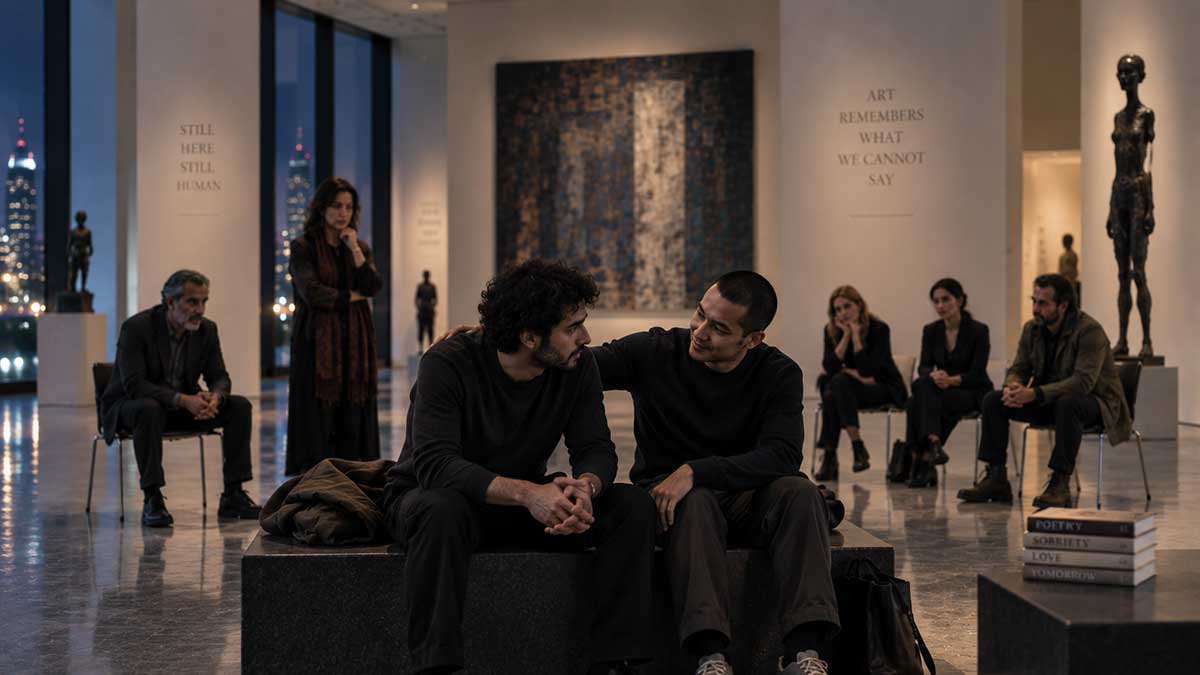
The museum was darker than usual.
Only a few lights remained above the installation, leaving the edges of the gallery in shadow.
Cyrus sat with his hands folded between his knees.
Zee sat beside him.
Across the circle were Orkideh, Ali, Arash, and Sang.
No one had mentioned the missing martyr’s chair.
By now, the empty space where it once stood had become part of the room.
Orkideh looked around.
“We have talked about suffering.”
Cyrus nodded.
“Martyrdom.”
“Yes.”
“Freedom.”
“Yes.”
“Forgiveness.”
He glanced at her.
“Sort of.”
She smiled.
“Tonight I want to ask something simpler.”
Cyrus laughed.
“That sentence has never ended well.”
Orkideh ignored him.
“What saved you?”
Cyrus stared at her.
“That’s simpler?”
“Yes.”
“Saved me from what?”
“Exactly.”
Cyrus sighed.
“Of course.”
Zee leaned back.
“I like it.”
“You would.”
Orkideh looked at Cyrus.
“From addiction.”
Then at Ali.
“From grief.”
At Arash.
“From what you saw.”
At Sang.
“From losing people.”
Then she touched her own chest.
“From yourself.”
Cyrus shook his head.
“I don’t think people get saved once.”
Orkideh smiled.
“Good.”
“You already agree?”
“I was hoping someone would say it.”
Cyrus looked annoyed.
“So I walked into another setup.”
“Completely.”
Zee laughed.
Cyrus glanced at him.
“You seem unusually cheerful.”
“I’m sitting beside you and nobody is asking whether you should become a martyr. I’m enjoying the evening.”
Cyrus laughed.
Orkideh looked at Cyrus again.
“So.”
“What saved you?”
He thought.
“AA.”
Zee turned toward him.
Cyrus continued.
“People.”
“Which people?”
“People who had already done things I thought made me uniquely terrible.”
Zee nodded.
“They weren’t shocked.”
“No.”
“That mattered?”
“A lot.”
Cyrus looked around the circle.
“I think shame needs privacy.”
Sang leaned forward.
“What do you mean?”
“It grows when you think nobody else could understand.”
He rubbed his hands together.
“You think, if anybody knew what I did, what I thought, what I wanted, they would leave.”
Zee was watching him closely.
Cyrus noticed.
“And then you say something ugly in a room full of people.”
He smiled faintly.
“And someone says, ‘Yeah. Me too.’”
Ali looked at him.
“That saved you?”
“Partly.”
Orkideh asked, “Not God?”
Cyrus laughed.
“We’re going there already?”
“You knew we would.”
Cyrus looked upward theatrically.
“Fine.”
He thought for a moment.
“I wanted God to behave like evidence.”
Arash smiled.
“That sounds like you.”
“I wanted proof.”
Cyrus continued.
“If I was going to surrender my life to something, I wanted to know it was real.”
Ali asked, “And did you?”
“No.”
“Then what did you do?”
“I stayed sober anyway.”
Ali smiled.
Cyrus looked at him.
“What?”
“Nothing.”
“No, say it.”
“You acted without certainty.”
Cyrus frowned.
“I hate when you do that.”
“Do what?”
“Find the sentence I don’t want.”
Ali laughed.
Cyrus leaned back.
“I didn’t suddenly become religious.”
“No one said you did.”
“But I had to admit there were things I couldn’t control.”
Orkideh nodded.
“That sounds like surrender.”
Cyrus shook his head.
“I don’t like that word.”
“Why?”
“It sounds weak.”
Arash leaned forward.
“Only if you think control is strength.”
Cyrus looked at him.
Arash continued.
“I spent years watching young men told that courage meant moving forward.”
Cyrus listened.
“Sometimes courage would have been admitting terror.”
He paused.
“Sometimes courage would have been saying no.”
Cyrus nodded.
Arash continued.
“Sometimes surrender is cowardice.”
Another pause.
“Sometimes refusing to surrender is.”
Cyrus smiled.
“You people refuse to let anything stay simple.”
Ali said, “You keep asking complicated people simple questions.”
“Fair.”
Orkideh looked toward Cyrus.
“So faith.”
He sighed.
“Faith did not save me.”
Ali raised an eyebrow.
Cyrus caught it.
“Not in the way people usually mean.”
“What way did it?”
Cyrus stared at the floor.
“Maybe faith gave me permission to act before I had answers.”
No one spoke.
He continued.
“I could say, I don’t know if there is a God.”
He looked toward Arash.
“I don’t know what happens after death.”
Then toward Orkideh.
“I don’t know whether suffering means anything.”
Then toward Zee.
“But I can still choose what I do tonight.”
Zee smiled.
“That sounds useful.”
“It is.”
Orkideh asked, “Enough to save you?”
Cyrus thought.
“Enough to get me through some nights.”
She nodded.
“Maybe that counts.”
Cyrus looked at her.
“You really believe that?”
“Yes.”
“That salvation can be that small?”
Orkideh smiled.
“I think people make salvation too dramatic.”
Cyrus laughed.
“Says the woman who turned dying into a museum installation.”
Everyone laughed.
Orkideh lifted a hand.
“Fair.”
Cyrus leaned forward.
“Did art save you?”
She stopped smiling.
“No.”
That surprised him.
“No?”
“Not by itself.”
“But you built your life around it.”
“Yes.”
“You changed your name. You became an artist.”
“Yes.”
“You made all this.”
She looked around the museum.
“Yes.”
“And it didn’t save you?”
Orkideh shook her head.
“Art gave me somewhere to put things.”
“What things?”
“Fear.”
“Shame.”
“Desire.”
“Memory.”
“Anger.”
She looked toward Cyrus.
“Guilt.”
Cyrus stayed quiet.
She continued.
“But putting pain into a painting does not remove pain from the person who caused it.”
Cyrus looked down.
Orkideh went on.
“Art gave me language.”
“Not absolution.”
Sang nodded.
Cyrus looked at Sang.
“You agree?”
“Very much.”
“Why?”
“Since people romanticize artists.”
Sang leaned forward.
“They imagine suffering creates great work.”
Cyrus nodded.
“It can.”
“Yes.”
“But?”
“Pain can create art.”
Sang paused.
“It can create silence.”
Another pause.
“It can create addiction.”
Cyrus looked away.
“It can create cruelty.”
Orkideh nodded.
“It can create nothing.”
Sang continued.
“People sometimes look at someone’s work and decide the suffering was worth it.”
Cyrus’ face tightened.
“That’s dangerous.”
“Yes.”
“Since the work came later.”
Sang nodded.
“The painting does not travel backward in time and justify the wound.”
Cyrus stared at her.
That sentence stayed with him.
“The poem doesn’t either,” he said.
“No.”
“My addiction didn’t become good since I wrote about it.”
“No.”
“My mother disappearing didn’t become good since she became an artist.”
Orkideh answered.
“No.”
“And Leila dying didn’t become meaningful simply since it shaped all of us.”
“No.”
Cyrus sat back.
“I think I used to believe art could redeem things.”
Orkideh asked, “What do you believe now?”
“It can transform what we do with them.”
She nodded.
“That is closer.”
Zee spoke.
“Can I ask something?”
Cyrus looked at him.
“You’re unusually polite tonight.”
“I’m trying something new.”
“Go ahead.”
Zee looked toward Orkideh.
“You said art didn’t save you.”
“No.”
“Did love?”
Orkideh looked at Sang.
Sang looked back.
Orkideh smiled faintly.
“Sometimes.”
Zee nodded.
“Not permanently?”
“No.”
“Why not?”
“People aren’t medicine.”
Zee smiled.
“Good answer.”
Orkideh continued.
“Sang could love me and I could still be afraid.”
Sang nodded.
“She could know me and I could still lie.”
Another nod.
“She could stay and I could still feel alone.”
Sang looked at her.
“That one hurt.”
“I know.”
Sang smiled sadly.
Orkideh continued.
“But there were moments when being loved made the world feel inhabitable.”
Cyrus looked at Zee.
Zee noticed.
“What?”
“Nothing.”
“You’re doing the thing.”
“What thing?”
“Looking at me like you’re about to discover I’ve been useful.”
Cyrus laughed.
“You have occasionally been useful.”
“High praise.”
Cyrus smiled, then grew serious.
“You stayed.”
“Yes.”
“Why?”
Zee shrugged.
“That’s a dangerous question.”
“I mean it.”
“So do I.”
Zee looked at him.
“I loved you.”
Cyrus said nothing.
Zee continued.
“That doesn’t mean everything you did was okay.”
“I know.”
“It doesn’t mean I never wanted to leave.”
Cyrus looked surprised.
“You did?”
“Of course.”
“When?”
Zee laughed.
“Do you want dates?”
Cyrus almost smiled.
“No.”
“Good.”
Zee leaned forward.
“Love is not the absence of exhaustion.”
Cyrus listened.
“It is not endless patience.”
Another pause.
“It is not letting someone destroy you so they can call your staying devotion.”
Cyrus looked down.
“I did hurt you.”
“Yes.”
“I know.”
“I know you know.”
Cyrus looked back at him.
“Then why stay?”
Zee thought.
“Sometimes I didn’t.”
Cyrus frowned.
“What do you mean?”
“I stepped back.”
“I remember.”
“I stopped trying to rescue you every second.”
Cyrus nodded.
Zee continued.
“That may have been the first time I actually loved you instead of trying to manage you.”
Cyrus looked almost offended.
“Manage me?”
“Yes.”
“Like a project?”
“Sometimes.”
“That’s awful.”
“Yes.”
Zee smiled.
“So was being around you.”
Cyrus laughed.
Ali smiled.
Zee continued.
“I thought love meant preventing every bad thing.”
He shook his head.
“I learned I couldn’t.”
Cyrus grew quiet.
“I had to let you make choices.”
“Some terrible ones.”
“Yes.”
“And still care.”
“Yes.”
Cyrus looked at him.
“So love didn’t save me.”
Zee shook his head.
“No.”
Cyrus nodded.
“That’s disappointing.”
Zee smiled.
“I know.”
“Then what did?”
“You participated.”
Cyrus frowned.
“In what?”
“In being saved.”
Cyrus became still.
Zee continued.
“I could sit beside you.”
“I could answer the phone.”
“I could drive you somewhere.”
“I could listen.”
“I could stay.”
He looked directly at Cyrus.
“But I could not choose sobriety for you.”
Cyrus swallowed.
“No.”
“I could not choose life for you.”
“No.”
“I could make staying easier.”
A pause.
“I could not stay for you.”
Cyrus looked down.
Ali spoke quietly.
“That may be true for parents too.”
Cyrus looked at him.
Ali continued.
“I thought raising you meant protecting you from everything.”
“Did it?”
“No.”
Cyrus smiled.
“Clearly.”
Ali smiled back.
“I could feed you.”
“House you.”
“Teach you.”
“Love you.”
“Fail you.”
He paused.
“But eventually, you became responsible for what you did with the life I helped protect.”
Cyrus nodded.
“That sounds obvious.”
“It does.”
“It probably wasn’t.”
“No.”
Ali looked at Zee.
“People like to think love means saving someone.”
Zee nodded.
Ali continued.
“Sometimes love means discovering you cannot.”
Cyrus stared at them.
“That sounds depressing.”
Orkideh shook her head.
“Maybe it is freeing.”
“How?”
“You do not have to become another person’s God.”
Cyrus looked at her.
“And they do not have to become yours.”
Arash leaned forward.
“That may be where faith becomes useful.”
Cyrus raised an eyebrow.
“Here we go.”
Arash smiled.
“I am not preaching.”
“Good.”
“I mean this.”
Arash looked around the circle.
“If another human being must carry every hope you have, eventually you crush them.”
Cyrus listened.
“If your lover must heal every wound.”
“If your parent must explain your childhood.”
“If your child must justify your sacrifice.”
“If your art must make your suffering worthwhile.”
“If your country must give your death meaning.”
He paused.
“That is too much weight for anything human.”
Cyrus looked toward the empty space in the center.
“So faith takes some of the weight?”
“Perhaps.”
“Onto God?”
“Perhaps onto mystery.”
Cyrus looked interested.
“That sounds less religious.”
Arash smiled.
“Call it what you want.”
Cyrus nodded.
“The idea that not everything has to be carried by another person.”
“Yes.”
“That I might never get the complete answer.”
“Yes.”
“And life continues anyway.”
“Yes.”
Cyrus sighed.
“I keep ending up there.”
“Where?”
“Uncertainty.”
Arash smiled.
“You keep trying to escape it.”
“And you think I shouldn’t?”
“I think you can’t.”
Cyrus laughed.
“Very encouraging.”
“I am your uncle. Encouragement is optional.”
Ali smiled.
Sang looked toward Orkideh.
“What about death?”
Orkideh raised an eyebrow.
“What about it?”
“Did accepting death save you from fearing it?”
Orkideh thought.
“No.”
“You were still afraid?”
“Yes.”
“Then what was the installation for?”
Orkideh looked around the museum.
“To stop pretending.”
Cyrus watched her.
She continued.
“I had spent much of my life hiding one identity inside another.”
“Roya inside Orkideh?”
“Yes.”
She paused.
“When I got sick, I did not want to hide that too.”
Sang nodded.
Orkideh continued.
“I wanted to sit in front of people and say, ‘This is happening.’”
Cyrus asked, “Did saying it make it less frightening?”
“Sometimes.”
“Why?”
“Fear changes when someone else sees it.”
Cyrus looked at her.
“That sounds like recovery.”
She smiled.
“Maybe.”
He thought about the rooms he had sat in.
People saying things aloud that they had once hidden.
Drinking.
Using.
Lying.
Wanting to die.
Wanting to disappear.
Wanting another drink.
Wanting forgiveness.
Wanting nothing.
Cyrus looked at Zee.
“Maybe being witnessed is part of it.”
“Part of what?”
“Being saved.”
Sang nodded.
“People can survive terrible things alone.”
She paused.
“But being seen changes the experience.”
Cyrus looked toward Arash.
“You were a witness.”
Arash frowned.
“To what?”
“Those soldiers.”
His uncle looked away.
“I suppose.”
“You couldn’t save them.”
“No.”
“You couldn’t stop the war.”
“No.”
“You couldn’t make their deaths fair.”
“No.”
“But you were there.”
“Yes.”
Cyrus leaned forward.
“Did that matter?”
Arash took a long time to answer.
“To me?”
“To them.”
“I hope so.”
“That’s all?”
“That is all I have.”
Cyrus nodded slowly.
“Maybe that has to be enough.”
Arash smiled sadly.
“Sometimes hope is the only evidence we get.”
Cyrus looked toward Ali.
“What saved you after Mom disappeared?”
Orkideh looked down.
Ali thought.
“You.”
Cyrus immediately shook his head.
“No.”
Ali smiled.
“You asked.”
“But that’s not fair.”
“Why?”
“I was a baby.”
“Yes.”
“I didn’t choose to save you.”
“No.”
“I didn’t do anything.”
“You existed.”
Cyrus stared at him.
Ali continued.
“I had someone who needed breakfast.”
Cyrus almost laughed.
“We keep returning to breakfast.”
“It is underrated.”
A few people smiled.
Ali continued.
“I could not spend every day collapsing.”
“You could have.”
“Yes.”
“But?”
“You cried.”
“You fed badly.”
“You woke in the night.”
“You made noise.”
“You needed me.”
Ali shrugged.
“Responsibility can save a person too.”
Cyrus frowned.
“Isn’t that dangerous?”
“How?”
“What if people start thinking they have to live only for someone else?”
Ali nodded.
“It is dangerous.”
“Then?”
“It saved me at one stage.”
He looked at Cyrus.
“That does not mean it should become everyone’s rule.”
Cyrus absorbed that.
“So there’s no single thing.”
“No.”
“No universal answer.”
“No.”
“No ‘this saves people.’”
Ali smiled.
“You sound disappointed.”
“I am.”
Orkideh laughed softly.
Cyrus looked around.
“Faith can help.”
Arash nodded.
“Art can help.”
Orkideh nodded.
“Recovery.”
Cyrus touched his chest.
“Love.”
Zee nodded.
“Responsibility.”
Ali nodded.
“Being witnessed.”
Sang nodded.
“Anything else?”
Orkideh said, “Time.”
Cyrus looked at her.
“Time saves people?”
“Sometimes.”
“How?”
“What feels unsurvivable at one moment can become survivable later.”
Cyrus frowned.
“That sounds dangerously close to saying time heals everything.”
“No.”
She shook her head.
“I did not say heal.”
Cyrus waited.
“Some wounds stay.”
Her eyes moved toward him.
“But the person carrying them changes.”
He stayed quiet.
Sang added, “Sometimes a person grows around the wound.”
Cyrus looked toward her.
“So it takes up less of the whole person.”
“Yes.”
He nodded.
“I like that better than healing.”
Zee spoke.
“There’s another one.”
“What?”
“Humor.”
Cyrus laughed.
“Seriously?”
“Very.”
“How does humor save anyone?”
Zee looked at him.
“You’ve been sober long enough to know.”
Cyrus smiled.
Recovery rooms.
Stories that should have been unbearable becoming funny in the telling.
People laughing at the absurdity of who they had been.
Not mocking pain.
Refusing to let pain control every emotion.
Cyrus nodded.
“Fair.”
Orkideh smiled.
“I would add beauty.”
Cyrus groaned.
“Of course the artist says beauty.”
“I’m dying. Let me be predictable.”
He laughed.
“What kind of beauty?”
“Small.”
Cyrus waited.
“Light through a window.”
“Someone’s face when they stop pretending.”
“A painting that surprises me.”
“Sang half asleep.”
Sang smiled.
Orkideh continued.
“Something unnecessary.”
Cyrus frowned.
“Unnecessary?”
“Yes.”
“Why does that matter?”
“Since survival is full of necessities.”
She looked around the room.
“Food.”
“Shelter.”
“Medicine.”
“Money.”
“Safety.”
Then she smiled.
“Beauty reminds me that life contains things that do not need to justify themselves.”
Cyrus went quiet.
Something about the phrase touched the argument they had been having from the beginning.
Things that do not need to justify themselves.
A painting.
A sunset.
A joke.
A person.
Cyrus asked, “What if life itself doesn’t need to justify itself?”
No one answered.
He looked almost embarrassed.
“I know. Very profound.”
Zee smiled.
“No, keep going.”
Cyrus looked at him.
“I spent years thinking my life needed a reason.”
Zee nodded.
“My mother’s death needed a reason.”
Orkideh watched him.
“My father’s suffering needed a reason.”
Ali remained still.
“My addiction needed a reason.”
Cyrus looked down.
“And maybe I kept treating life like a debt.”
Sang leaned forward.
“A debt to whom?”
“I don’t know.”
“To history.”
“To my parents.”
“To the dead.”
“To God, if there is one.”
“To myself.”
He looked around.
“As if being alive meant I had to prove I deserved it.”
Zee’s face softened.
Cyrus noticed.
“What?”
“Nothing.”
“Say it.”
Zee hesitated.
“I’ve been waiting a long time for you to say that.”
Cyrus looked away.
“Why?”
“Since you treat existence like an argument you have to win.”
Cyrus almost laughed.
“That sounds like me.”
“It is exhausting.”
“For you?”
“For everyone.”
Cyrus nodded.
“Fair.”
Zee continued.
“What if you don’t have to prove anything?”
Cyrus immediately replied.
“That sounds irresponsible.”
“Of course it does to you.”
Cyrus laughed.
Zee leaned forward.
“I’m not saying do nothing.”
“I’m saying maybe the fact that you survived doesn’t create a debt.”
Cyrus looked at him.
“You can make something with your life.”
“Yes.”
“You can help people.”
“Yes.”
“You can write.”
“Yes.”
“You can love.”
Cyrus nodded.
“But not to pay for being alive.”
Cyrus became still.
The room quieted around him.
Orkideh watched her son.
Cyrus looked at her.
“Did you feel that?”
“What?”
“That you had to justify surviving?”
Orkideh thought.
“Yes.”
“After the plane?”
“Yes.”
“Since Leila died?”
Her eyes lowered.
“Yes.”
Cyrus leaned forward.
“Is that why you made art?”
“Partly.”
“Why you became Orkideh?”
“Partly.”
“Why the museum?”
“Partly.”
Cyrus stared at her.
“So we were doing the same thing.”
She looked at him.
“In different ways.”
He laughed softly.
“You disappeared into art.”
“And you disappeared into martyrdom.”
A pause.
“And drugs.”
Cyrus nodded.
“Yes.”
They looked at each other.
For perhaps the first time, neither was arguing about who had suffered more.
They were recognizing something shared.
Cyrus asked, “Did it work?”
Orkideh smiled sadly.
“No.”
“Me neither.”
Zee looked between them.
“Maybe that’s another thing that saves people.”
Cyrus turned.
“What?”
“Recognition.”
“Of what?”
“That somebody else has been trapped inside a different version of the same question.”
Cyrus considered it.
Arash nodded.
“That is one thing religion can do well.”
Cyrus looked at him.
“Tell stories about people who struggled before us?”
“Yes.”
“So you’re not uniquely broken.”
Arash smiled.
“Exactly.”
Cyrus nodded.
“Recovery does that too.”
“Yes.”
“Art too.”
Orkideh nodded.
“Sometimes.”
Sang said, “Relationships too.”
Cyrus looked around the circle.
It was becoming difficult to separate the categories.
Faith.
Art.
Recovery.
Love.
Responsibility.
Witnessing.
Time.
Humor.
Beauty.
Recognition.
None of them were complete.
Together, perhaps they did something.
Cyrus looked at Orkideh.
“So what actually saves a person?”
She smiled.
“I think we have spent the entire night proving that is the wrong question.”
Cyrus sighed.
“I should have known.”
She leaned forward.
“Maybe the question is: what helps a person stay?”
Cyrus looked at Zee.
The word from their earlier conversation returned.
Stay.
Not remain trapped.
Not refuse change.
Not tolerate harm.
Stay alive.
Stay present.
Stay reachable.
Stay one more night.
Cyrus looked at his father.
“What helped you stay?”
Ali answered without hesitation.
“You.”
Then at Arash.
Arash thought.
“Duty at first.”
A pause.
“Later, memory.”
Sang answered next.
“People who let me be useful without making me responsible for everything.”
Orkideh said, “Art.”
Then added:
“And love.”
Zee looked at Cyrus.
“You know mine.”
Cyrus raised an eyebrow.
“Me?”
“Sometimes.”
Cyrus laughed.
“That is a terrible judgment.”
“I never claimed good judgment.”
They smiled.
Then everyone looked at Cyrus.
He frowned.
“Why am I last?”
“Since you talk the most,” Zee said.
Cyrus ignored him.
He thought for a long time.
“What helped me stay?”
No one interrupted.
“People.”
He looked at Zee.
“Annoyingly.”
Zee smiled.
“Recovery.”
He touched his hands together.
“Poetry.”
He looked toward Orkideh.
“Questions.”
Orkideh raised an eyebrow.
“Questions saved you?”
“I think so.”
“How?”
“They kept me interested.”
That surprised even him.
Cyrus continued.
“If I had known everything, maybe there would have been nothing left to search for.”
Arash smiled.
“So uncertainty saved you too.”
Cyrus groaned.
“Please don’t ruin this.”
Everyone laughed.
Cyrus smiled.
Then he grew quiet.
“And maybe love.”
Zee looked at him.
Cyrus met his eyes.
“Definitely love.”
No one spoke.
Cyrus looked around the museum.
He had spent much of his life waiting for salvation to arrive in a form large enough to deserve the name.
God speaking.
Art redeeming suffering.
Sobriety transforming him.
Death proving his value.
A single answer.
Nothing had done that.
Instead, there had been smaller interventions.
A meeting.
A phone call.
A poem.
His father coming home.
Zee staying close.
A woman in a museum telling him something he did not want to hear.
Someone laughing when he expected judgment.
Someone listening when there was nothing useful to say.
Perhaps salvation had never been a door opening once.
Perhaps it was a hundred hands keeping a person from disappearing.
Cyrus looked at Orkideh.
“So nobody saved me.”
She smiled.
“No.”
He looked at Zee.
“But I wasn’t alone.”
Zee shook his head.
“No.”
Cyrus nodded slowly.
For once, that seemed larger than an answer.
Topic 5: A Meaningful Death or a Meaningful Life?
The museum was almost completely dark.
Only the lights directly above the circle remained on.
Cyrus noticed that everyone was there tonight.
Zee.
Ali.
Arash.
Leila.
Sang.
Orkideh.
Roya.
He still had trouble knowing which name belonged in his mind.
Maybe both.
Maybe neither.
Maybe names had become another way of making a person easier to hold.
The missing chair had never returned.
No one mentioned it.
Cyrus sat in the same place he had taken during the first conversation.
Something about that amused him.
He had spent nights arguing about suffering, martyrdom, identity, forgiveness, faith, art, addiction, love, and salvation.
He felt no closer to a final answer.
Strangely, that bothered him less now.
Arash looked around the circle.
“So.”
Cyrus groaned.
“That sounds ominous.”
“I haven’t asked anything yet.”
“You have the face.”
“What face?”
“The uncle-about-to-say-something-profound face.”
Ali laughed.
“I know that face.”
Arash looked offended.
“I have no such face.”
“You absolutely do,” Cyrus said.
Leila smiled.
Sang looked toward Cyrus.
“Perhaps you should ask tonight’s question.”
Cyrus frowned.
“Why me?”
Orkideh answered.
“Since you started all this.”
“I did?”
“You are the man who became obsessed with martyrs.”
“Fair.”
“You wanted to understand meaningful death.”
Cyrus nodded.
Orkideh leaned back.
“So ask.”
Cyrus looked around the circle.
Nobody seemed eager to rescue him.
He sighed.
“Fine.”
He stared at the empty space where the martyr’s chair had once stood.
Then he said:
“If nobody remembered your name after you died, would your life still have mattered?”
No one answered immediately.
Cyrus smiled.
“Good. At least I managed to make everyone uncomfortable.”
Ali looked at him.
“You really want an answer?”
“Yes.”
“Then mine is easy.”
Cyrus waited.
“You.”
Cyrus rolled his eyes.
“We’ve done this.”
“No.”
Ali smiled.
“You keep thinking I am trying to make you feel guilty.”
“I didn’t say that.”
“You thought it.”
“Probably.”
Ali continued.
“If nobody remembered my name, I would still have raised you.”
Cyrus looked at him.
“That happened.”
“Yes.”
“You would remember.”
“Suppose you didn’t.”
Cyrus frowned.
“What?”
“Suppose you forgot me too.”
“That’s awful.”
“You created the question.”
Cyrus sighed.
“Fine.”
Ali continued.
“If nobody remembered me, you would still have been fed.”
“You would still have been protected.”
“You would still have been carried when you were too small to walk.”
“You would still have learned things from me.”
Cyrus stared at him.
“You might forget the source.”
Ali shrugged.
“The effect would remain.”
Cyrus sat back.
“So meaning doesn’t require memory.”
“Not for me.”
Leila nodded slowly.
“I like that.”
Cyrus looked toward her.
“Why?”
“Since remembrance is unreliable.”
She gave a small smile.
“I know something about that.”
Cyrus lowered his eyes.
Leila continued.
“I died under the wrong identity.”
“My name disappeared from the story.”
“My death belonged to someone else.”
She glanced toward Orkideh.
Orkideh did not look away.
Leila continued.
“If meaning depends on being remembered correctly, then my life has a problem.”
Cyrus asked, “Did it matter?”
“My life?”
“Yes.”
Leila smiled.
“To me, yes.”
“That sounds obvious.”
“It should.”
Cyrus frowned.
She continued.
“We keep talking about whether a life mattered to history.”
“To family.”
“To God.”
“To the future.”
She leaned forward.
“What if a life mattered first to the person living it?”
Cyrus stared at her.
“That sounds almost selfish.”
“Why?”
“I don’t know.”
“Exactly.”
She smiled.
“Why does a life have to justify itself through usefulness to somebody else?”
Cyrus went quiet.
The question felt familiar.
Zee noticed.
“You said something similar last time.”
Cyrus nodded.
“That I treated being alive like a debt.”
“Yes.”
Leila looked at him.
“To whom?”
“Everyone.”
“That sounds exhausting.”
“It was.”
Zee laughed softly.
“It still is.”
Cyrus glanced at him.
“I’m improving.”
“Debatable.”
Cyrus smiled.
Then Sang spoke.
“I think there is another problem with memory.”
Cyrus turned.
“What?”
“People remember versions.”
He listened.
“They remember the mother.”
“The husband.”
“The artist.”
“The addict.”
“The friend.”
“The martyr.”
She looked at Orkideh.
“They rarely remember the whole person.”
Orkideh smiled faintly.
“No one can.”
Sang nodded.
“So if being remembered is the measure, we are asking another person’s memory to hold a life it can never fully contain.”
Cyrus looked around.
“Then maybe being remembered forever is a terrible goal.”
Arash raised an eyebrow.
“You spent years wanting exactly that.”
“I know.”
“What changed?”
Cyrus thought.
“I think I confused being remembered with having mattered.”
Ali nodded.
“And now?”
Cyrus looked at him.
“Maybe mattering happens before the memory.”
Leila smiled.
“Better.”
Cyrus pointed at her.
“You keep grading me.”
“You need it.”
He laughed.
Orkideh looked toward him.
“What would still matter if no one remembered you?”
Cyrus thought.
He looked at Zee.
“The people I loved.”
Zee smiled.
“You cheated.”
“How?”
“You answered with people.”
“That’s allowed.”
“Fine.”
Cyrus continued.
“Writing something true.”
Orkideh nodded.
“Helping someone.”
Ali nodded.
“Being there when someone needed me.”
Arash nodded.
Cyrus paused.
“And maybe just being alive for things.”
Sang tilted her head.
“What do you mean?”
“Seeing something beautiful.”
“Hearing something funny.”
“Eating something incredible.”
“Being surprised.”
He smiled slightly.
“Maybe experience itself counts.”
Orkideh looked pleased.
Cyrus noticed.
“What?”
“Nothing.”
“You have the face.”
“What face?”
“The dying-artist-who-thinks-I-finally-learned-something face.”
Everyone laughed.
Orkideh shook her head.
“Terrible description.”
“Accurate.”
She smiled.
Arash leaned forward.
“Let me ask the harder version.”
Cyrus sighed.
“Of course.”
Arash looked directly at him.
“Is wanting a meaningful death sometimes easier than accepting an ordinary life?”
Cyrus stopped smiling.
No one rescued him.
He looked toward the floor.
“Yes.”
The answer came faster than anyone expected.
Arash nodded.
“Why?”
Cyrus stayed quiet for several seconds.
“Since death can be one moment.”
He looked up.
“One decision.”
“One act.”
“One sacrifice.”
He gestured toward the missing chair.
“You do something enormous.”
“Everybody understands what it meant.”
“Then you’re gone.”
Ali watched him carefully.
Cyrus continued.
“Living is worse.”
Zee laughed.
“That should be on a poster.”
Cyrus smiled.
“You know what I mean.”
“I do.”
Cyrus leaned forward.
“Living asks the same question every morning.”
Arash listened.
“Are you going to drink?”
“Are you going to tell the truth?”
“Are you going to call someone back?”
“Are you going to apologize?”
“Are you going to show up?”
“Are you going to stay?”
He looked at Zee.
“Are you going to let someone love you without turning their love into another problem to solve?”
Zee’s expression softened.
Cyrus continued.
“Death gives you one dramatic act.”
“Life gives you thousands of small ones.”
Ali nodded.
“And most of them receive no applause.”
“Exactly.”
Cyrus laughed softly.
“That’s what I didn’t like.”
Orkideh raised an eyebrow.
“You wanted applause?”
“I wanted evidence.”
“Of?”
“That I mattered.”
Ali said, “Same thing?”
Cyrus thought.
“Not exactly.”
He paused.
“But closer than I’d like.”
Sang asked, “What would an ordinary meaningful life look like to you now?”
Cyrus grimaced.
“That phrase sounds terrible.”
“Why?”
“Ordinary meaningful life.”
He shook his head.
“It sounds like a retirement brochure.”
Zee laughed.
“Answer.”
Cyrus sighed.
“Fine.”
He thought.
“Stay sober.”
Zee nodded.
“Write.”
Orkideh nodded.
“Love people badly, then maybe learn to do it better.”
Zee smiled.
“That one has potential.”
“Thank you.”
Cyrus continued.
“Stop needing every relationship to explain something about me.”
Sang nodded.
“Maybe become useful to someone.”
Ali smiled.
“Without turning usefulness into proof of worth.”
Cyrus looked at him.
“That was annoyingly good.”
“I know.”
Cyrus looked around the circle.
“And maybe stop trying to turn my life into a story before I’ve finished living it.”
That quieted everyone.
Orkideh looked at him for a long time.
“That may be the hardest thing for a poet.”
Cyrus smiled.
“Probably.”
“You like endings.”
“Yes.”
“Meaning.”
“Yes.”
“Patterns.”
“Yes.”
“Symbols.”
“Yes.”
She leaned forward.
“Life does not cooperate.”
Cyrus laughed.
“I’ve noticed.”
Orkideh continued.
“Art can arrange things.”
“Life keeps interrupting.”
Sang nodded.
“People change.”
Leila said, “People disappear.”
Ali said, “People stay longer than expected.”
Arash added, “People die before the sentence feels finished.”
Zee looked at Cyrus.
“And some people refuse to stop talking long enough for anyone else to finish.”
Cyrus laughed.
“That was unnecessary.”
“It was meaningful.”
Everyone laughed again.
The sound faded slowly.
Cyrus looked toward Orkideh.
“What made your life matter?”
She did not answer immediately.
He waited.
Finally she said, “I would have answered differently at different ages.”
“Answer now.”
She looked around the museum.
“Freedom.”
Cyrus stiffened slightly.
She saw it.
“Not freedom from responsibility.”
He relaxed.
“Then what?”
“The ability to become more than the version of myself other people required.”
Cyrus nodded.
Orkideh continued.
“But I think I misunderstood freedom for a long time.”
“How?”
“I thought freedom meant escape.”
Leila looked toward her.
Orkideh continued.
“Escape from expectations.”
“Escape from roles.”
“Escape from history.”
“Escape from guilt.”
She gave a sad smile.
“I learned that changing your name does not erase everything attached to the old one.”
Cyrus watched her.
“So what does freedom mean now?”
She looked at him.
“Being able to look at what I did without letting it become the only truth about me.”
Cyrus said nothing.
Orkideh continued.
“And allowing you to look at me without demanding that you see me the way I want.”
Cyrus nodded slowly.
“That’s new.”
“Yes.”
“Hard?”
“Yes.”
“Good.”
She laughed.
Cyrus smiled.
Then he looked toward Ali.
“What about you?”
Ali raised an eyebrow.
“What makes a life matter?”
“Yes.”
Ali thought.
“Care.”
Cyrus smiled.
“You said that before.”
“I still believe it.”
“Explain.”
Ali leaned back.
“You keep looking for things that survive death.”
Cyrus nodded.
“Care does.”
“How?”
“If you care for a child, that child carries something forward.”
“If you care for a friend, their life changes.”
“If you care for a stranger, maybe only one afternoon changes.”
He shrugged.
“That is enough.”
Cyrus asked, “What if they never know?”
“They do not have to.”
“What if they forget?”
“They can.”
“What if they never appreciate it?”
Ali smiled.
“Very common.”
Cyrus laughed.
Ali continued.
“Care does not become unreal when gratitude fails.”
Cyrus looked toward him.
“That sounds like fatherhood.”
“Sometimes.”
“Did you ever resent me?”
“Yes.”
Cyrus looked surprised.
Ali laughed.
“You were expecting sainthood?”
“No.”
“Good.”
Ali continued.
“I resented responsibility.”
“I resented being tired.”
“I resented losing choices.”
“I resented you sometimes.”
Cyrus winced.
“Great.”
Ali smiled.
“And I loved you.”
Cyrus nodded.
“Both.”
“Yes.”
Ali leaned forward.
“That may be one reason I dislike the word martyr.”
Cyrus waited.
“Martyrdom makes sacrifice sound pure.”
He shook his head.
“Real sacrifice often includes resentment.”
Cyrus looked interested.
“You can give something and wish you didn’t have to.”
“Yes.”
“You can love someone and feel trapped sometimes.”
“Yes.”
“You can stay and still imagine leaving.”
“Yes.”
Cyrus looked at Orkideh.
She met his gaze.
No one commented.
Arash spoke next.
“For me, presence.”
Cyrus turned.
“What makes a life matter?”
“Yes.”
Arash nodded.
“I spent too much time around people near death.”
He paused.
“People think the dying need answers.”
Cyrus listened.
“Sometimes they do.”
“Often they need someone not to leave.”
He looked at Cyrus.
“I could not stop what was happening to those soldiers.”
“I could not undo the war.”
“I could not promise heaven with certainty.”
He paused.
“But I could be there.”
Cyrus asked, “Even dressed as an angel?”
Arash laughed softly.
“Especially dressed as an angel.”
Cyrus smiled.
Arash continued.
“Presence is small.”
“Yet when someone is terrified, small things stop being small.”
Cyrus nodded.
Leila spoke next.
“Truth.”
Cyrus turned.
“I guessed you might say that.”
“Why?”
“After what happened to your name.”
She smiled.
“Yes.”
Cyrus asked, “What kind of truth?”
“The kind that does not make suffering prettier than it was.”
He listened.
“The kind that allows a person to say, ‘I was afraid.’”
“‘I was selfish.’”
“‘I loved someone.’”
“‘I wanted to leave.’”
“‘I did not die heroically.’”
Her eyes moved toward Cyrus.
“Truth gives ordinary people back their humanity.”
Cyrus asked, “Is truth always better?”
“No.”
He raised an eyebrow.
“That surprises me.”
Leila continued.
“Truth can hurt.”
“It can destroy.”
“It can arrive at the wrong time.”
“It can be used cruelly.”
Cyrus nodded.
“Then why choose it?”
“Since lies eventually require someone to carry them.”
The room fell quiet.
Cyrus looked toward Orkideh.
She accepted the sentence without defending herself.
Sang spoke.
“For me, witnessing.”
Cyrus turned.
“You mean seeing someone?”
“More than seeing.”
“What then?”
“Seeing them beyond their assigned role.”
She looked at Orkideh.
“Artist.”
Then Cyrus.
“Son.”
Ali.
“Father.”
Arash.
“Soldier.”
Leila.
“Victim.”
Zee.
“Lover.”
She paused.
“Every label contains something true.”
“None contains the whole person.”
Cyrus nodded.
“So witnessing means seeing more.”
“And accepting that you will still never see everything.”
“Another uncertainty answer.”
Sang smiled.
“You are surrounded.”
Cyrus laughed.
Then everyone looked toward Zee.
He frowned.
“What?”
“You’re next,” Cyrus said.
“I know.”
“So?”
Zee looked at Cyrus.
“Love.”
Cyrus groaned dramatically.
“Of course.”
Zee smiled.
“You asked.”
“Make it less sentimental.”
“No.”
Cyrus laughed.
Zee continued.
“Love.”
“Not the romantic version people sell.”
Cyrus raised an eyebrow.
“What version?”
“The version that gets irritated.”
“Very romantic.”
“The version that sets boundaries.”
Cyrus nodded.
“The version that sometimes leaves the room.”
Another nod.
“The version that tells the truth.”
Cyrus looked at him.
“The version that says, ‘I am here, but I cannot live your life for you.’”
Cyrus became still.
Zee continued.
“I used to think loving someone meant making sure they never fell.”
“I learned that sometimes you stand nearby and let them learn how to get up.”
Cyrus looked down.
“That sounds cruel when you say it that way.”
“It felt cruel.”
“Was it?”
“Sometimes.”
Cyrus looked up.
“And sometimes it was the only way I could stay without disappearing myself.”
Cyrus nodded.
Zee continued.
“Love without a self is not love for very long.”
Orkideh looked toward him.
“That took me years to learn.”
Cyrus noticed.
For once he did not turn the comment into an argument.
Zee looked back at Cyrus.
“So yes.”
“Love.”
Cyrus asked quietly, “Do you think love makes a life meaningful?”
“Yes.”
“Always?”
“No.”
“What if you love someone terrible?”
“Then the love is still real.”
Cyrus waited.
“It just does not make the terrible part disappear.”
Cyrus smiled faintly.
“We keep ending up there too.”
“Where?”
“Two things can be true.”
Zee smiled.
“You’re learning.”
“Apparently.”
Everyone looked toward Cyrus now.
He sighed.
“I knew this was coming.”
Arash smiled.
“So?”
Cyrus looked around the circle.
Care.
Truth.
Presence.
Witnessing.
Freedom.
Love.
He repeated the words silently.
Then he said, “Staying.”
Zee’s expression changed.
Ali looked toward his son.
Orkideh remained completely still.
Cyrus saw all of them noticing.
“Don’t make it dramatic.”
“No one said anything,” Sang replied.
“You were all thinking.”
Zee smiled.
“Continue.”
Cyrus rubbed his palms together.
“Staying.”
He paused.
“Not staying in every place.”
Ali nodded.
“Not staying in every relationship.”
Orkideh listened.
“Not staying inside an identity that is killing you.”
Leila nodded.
Cyrus continued.
“I mean staying alive long enough to see that whatever story you told yourself might not be the only story.”
No one moved.
Cyrus looked toward the empty space where the chair had once stood.
“I thought my story was that my mother died.”
He looked at Orkideh.
“That changed.”
“I thought my father lived a tragic life.”
He looked at Ali.
“That changed.”
“I thought suffering had to mean something.”
A pause.
“That changed.”
“I thought martyrdom was the highest form of sacrifice.”
He looked at Arash and Leila.
“That changed.”
“I thought being remembered could prove that I mattered.”
He shook his head.
“That changed.”
Zee said quietly, “What hasn’t?”
Cyrus looked at him.
“The need to be loved.”
Zee smiled.
Cyrus continued.
“The need to belong somewhere.”
He looked around.
“The need to feel that my life is connected to something outside me.”
Orkideh asked, “Isn’t that still meaning?”
“Yes.”
Cyrus thought.
“But it feels different.”
“How?”
“I’m not waiting for one grand answer anymore.”
He paused.
“Maybe meaning is plural.”
Sang looked interested.
“Explain.”
Cyrus shrugged.
“One person gets meaning from raising a child.”
He looked at Ali.
“One from art.”
Orkideh.
“One from being with people at their worst moments.”
Arash.
“One from truth.”
Leila.
“One from loving someone stubbornly.”
Zee smiled.
“One from witnessing.”
Sang nodded.
Cyrus continued.
“And the same person may need different meanings at different times.”
Orkideh smiled.
“That sounds more alive.”
Cyrus looked at her.
“Exactly.”
Arash leaned forward.
“What about death?”
Cyrus frowned.
“What about it?”
“You spent years asking what would make death meaningful.”
“Yes.”
“What do you think now?”
Cyrus sat very still.
The question felt old.
Almost embarrassingly old.
Yet it had once controlled him.
He looked toward the missing chair.
“I think some deaths are meaningful.”
Arash nodded.
“Someone can die protecting another person.”
“Yes.”
“Someone can knowingly accept death for a principle.”
“Yes.”
“Someone can sacrifice themselves.”
“Yes.”
Cyrus paused.
“But I don’t think death automatically becomes better when we call it meaningful.”
Leila nodded.
“And I don’t think a meaningless death means the life before it was meaningless.”
Ali smiled.
Cyrus continued.
“I think that was the mistake.”
“What?”
“I kept letting the final moment judge everything before it.”
No one spoke.
Cyrus leaned forward.
“If you die heroically, meaningful life.”
“If you die anonymously, maybe not.”
“If history remembers you, meaningful.”
“If it forgets you, maybe not.”
He shook his head.
“That’s absurd.”
Arash smiled faintly.
“Many civilizations would disagree.”
“I know.”
Cyrus continued.
“Maybe a death is one part of a life.”
“Sometimes a huge part.”
“Sometimes a terrible part.”
“Sometimes a beautiful sacrifice.”
“But it still does not own everything that came before.”
Orkideh asked, “And mine?”
Cyrus looked at her.
The room changed.
No one interrupted.
Orkideh held his gaze.
“You came here since I was dying.”
“Yes.”
“You were fascinated with the performance.”
“Yes.”
“You thought I might teach you something about death.”
“Yes.”
She smiled faintly.
“Did I?”
Cyrus thought.
“Yes.”
“What?”
“That dying does not make you wise.”
Orkideh laughed.
“Excellent.”
Cyrus smiled.
“That being near death doesn’t clean up a life.”
Her smile faded slightly.
“No.”
“That art doesn’t excuse anything.”
“No.”
“That fear survives philosophy.”
“Yes.”
“That you can accept death and still be afraid.”
“Yes.”
Cyrus paused.
“And that I almost missed the person since I was so interested in the dying.”
Orkideh’s face softened.
Cyrus continued.
“I came to see Orkideh, the artist confronting death.”
He looked at her carefully.
“I found my mother.”
A pause.
“Then I started trying to understand Roya.”
Orkideh’s eyes filled.
Cyrus continued before she could speak.
“I don’t know if I ever will.”
She nodded.
“But maybe I don’t have to finish.”
She laughed through the tears.
“You hate unfinished things.”
“I do.”
“Then this is growth.”
“Don’t ruin it.”
She smiled.
Cyrus looked toward everyone.
“I think that’s what staying means now.”
Zee asked, “What?”
“Not demanding the ending before I decide whether the middle was worth living.”
The room fell silent.
Ali lowered his eyes.
Arash leaned back.
Leila smiled faintly.
Sang looked toward Orkideh.
Zee looked only at Cyrus.
Cyrus became uncomfortable.
“Somebody say something.”
Zee shook his head.
“No.”
“Why?”
“Stay in it.”
Cyrus laughed softly.
“Very clever.”
“I learned from you.”
They sat quietly.
After a while, Ali spoke.
“What if your life never becomes extraordinary?”
Cyrus turned.
“That sounds personal.”
“It is.”
Ali smiled.
“No famous book.”
Cyrus winced.
“That was unnecessary.”
“No historical importance.”
“Keep going.”
“No one studies you.”
“Brutal.”
“No museum installation.”
Orkideh smiled.
Ali continued.
“You stay sober.”
“You write things a few people read.”
“You love Zee.”
Zee glanced at Cyrus.
“You have friends.”
“You get older.”
“You make mistakes.”
“You apologize badly.”
Everyone laughed.
“You eat breakfast.”
Cyrus groaned.
“Again with breakfast.”
Ali smiled.
“You die.”
The laughter stopped.
Ali looked at his son.
“Was that enough?”
Cyrus looked at him.
His first instinct was to make a joke.
He didn’t.
He thought about the question.
No monument.
No great sacrifice.
No martyrdom.
No permanent remembrance.
No final proof.
Just days.
People.
Work.
Meals.
Love.
Arguments.
Sobriety.
Failure.
Beauty.
Regret.
Forgiveness that worked some days and failed on others.
He looked at Zee.
Then his father.
Then his mother.
“Yes.”
Ali smiled.
Cyrus continued.
“I think it might be.”
Orkideh asked, “Might?”
Cyrus laughed.
“I’m not giving you certainty.”
“Fair.”
Cyrus leaned back.
“I spent years thinking ordinary meant insufficient.”
Ali nodded.
“And now?”
Cyrus looked around the room.
“Ordinary is where almost everything actually happens.”
Zee smiled.
“Love.”
“Yes.”
Ali said, “Care.”
“Yes.”
Sang said, “Knowing someone.”
“Yes.”
Arash said, “Fear.”
“Yes.”
Leila said, “Loss.”
“Yes.”
Orkideh said, “Beauty.”
Cyrus nodded.
“Yes.”
He looked toward the missing chair.
“Maybe martyrdom attracted me partly since it promised escape from ordinary life.”
Arash listened.
“One moment could settle everything.”
“Yes.”
“One death could give the whole story meaning.”
“Yes.”
Arash nodded.
“And now?”
Cyrus smiled faintly.
“I think that sounds suspiciously easy.”
Ali laughed.
“Dying?”
“No.”
Cyrus looked at his father.
“Making one moment responsible for an entire life.”
Ali nodded.
Cyrus continued.
“Living seems harder.”
Zee asked, “Still depressing?”
Cyrus thought.
“No.”
That surprised him.
He looked at Zee.
“No.”
“Why?”
Cyrus smiled.
“Since if meaning isn’t waiting at the end, I don’t have to wait either.”
Nobody spoke.
Cyrus looked around the circle.
“I can make some now.”
Orkideh began crying again.
Cyrus pointed at her.
“I told you not to make this dramatic.”
She laughed.
“I am dying in a museum. Let me have something.”
Cyrus laughed too.
Sang reached for her hand.
Ali watched Cyrus.
Arash leaned back with a small smile.
Leila looked toward the empty space in the circle.
The martyr’s chair remained gone.
No one needed it.
After a few moments, Cyrus asked one final question.
“If you could give someone one sentence before they died, what would you say?”
Arash frowned.
“That is extremely unfair.”
“I know.”
Leila smiled.
“Your turn to make everyone uncomfortable.”
Cyrus nodded.
Ali answered first.
“You were loved more than you knew.”
Cyrus looked down.
Leila said:
“You do not have to become a symbol.”
Arash thought for a long time.
Then:
“You do not need to be brave for me.”
Sang said:
“Someone saw you.”
Zee looked at Cyrus.
Then said:
“You were here.”
Cyrus swallowed.
Finally he looked toward Orkideh.
She smiled.
“What?”
“You’re last.”
She thought.
Then she said:
“You were allowed to live before you learned how to explain your life.”
Cyrus stared at her.
The sentence landed somewhere deep.
He looked away.
Zee asked, “And yours?”
Cyrus frowned.
“My sentence?”
“Yes.”
Cyrus looked around at all of them.
He thought about the boy who lost his mother.
The addict.
The poet.
The son.
The man who studied martyrs.
The man who wanted death to certify his existence.
The man sitting in a museum surrounded by people whose lives had refused to become simple.
He finally said:
“You did not have to earn being alive.”
Nobody spoke.
Cyrus looked almost embarrassed.
“Too sentimental?”
Zee shook his head.
“No.”
Ali smiled.
Orkideh closed her eyes.
Cyrus looked toward the center of the circle.
Nothing occupied the place where the martyr’s chair had once stood.
For years, he had imagined meaning as something large enough to defeat death.
Tonight, meaning looked smaller.
A father waking early.
A lover staying close.
A frightened soldier seeing an angel.
A woman painting.
A forgotten person having lived anyway.
A friend listening.
A meal.
A joke.
A hand held at the right moment.
A truth spoken late.
A day survived.
Another day chosen.
Cyrus had spent much of his life asking:
What kind of death would prove that I mattered?
The question no longer felt urgent.
He had another one now.
What could he do with tomorrow?
He looked at Zee.
“Breakfast?”
Zee stared at him.
“After five nights of existential crisis, your conclusion is breakfast?”
Cyrus smiled.
“My father is very persuasive.”
Ali laughed.
Zee stood.
“Fine.”
Cyrus rose beside him.
Orkideh looked up at her son.
He paused.
For a moment, Cyrus seemed about to say something enormous.
Instead he said:
“Goodnight.”
Orkideh smiled.
“Goodnight, Cyrus.”
He started walking away.
Then stopped.
He looked back at everyone.
No grand speech came.
No revelation.
No final theory.
No answer to suffering.
No proof of God.
No explanation for death.
No definition of martyrdom.
Just people.
Cyrus smiled.
Then he left the museum with Zee.
Not toward an ending.
Toward morning.
Final Thoughts
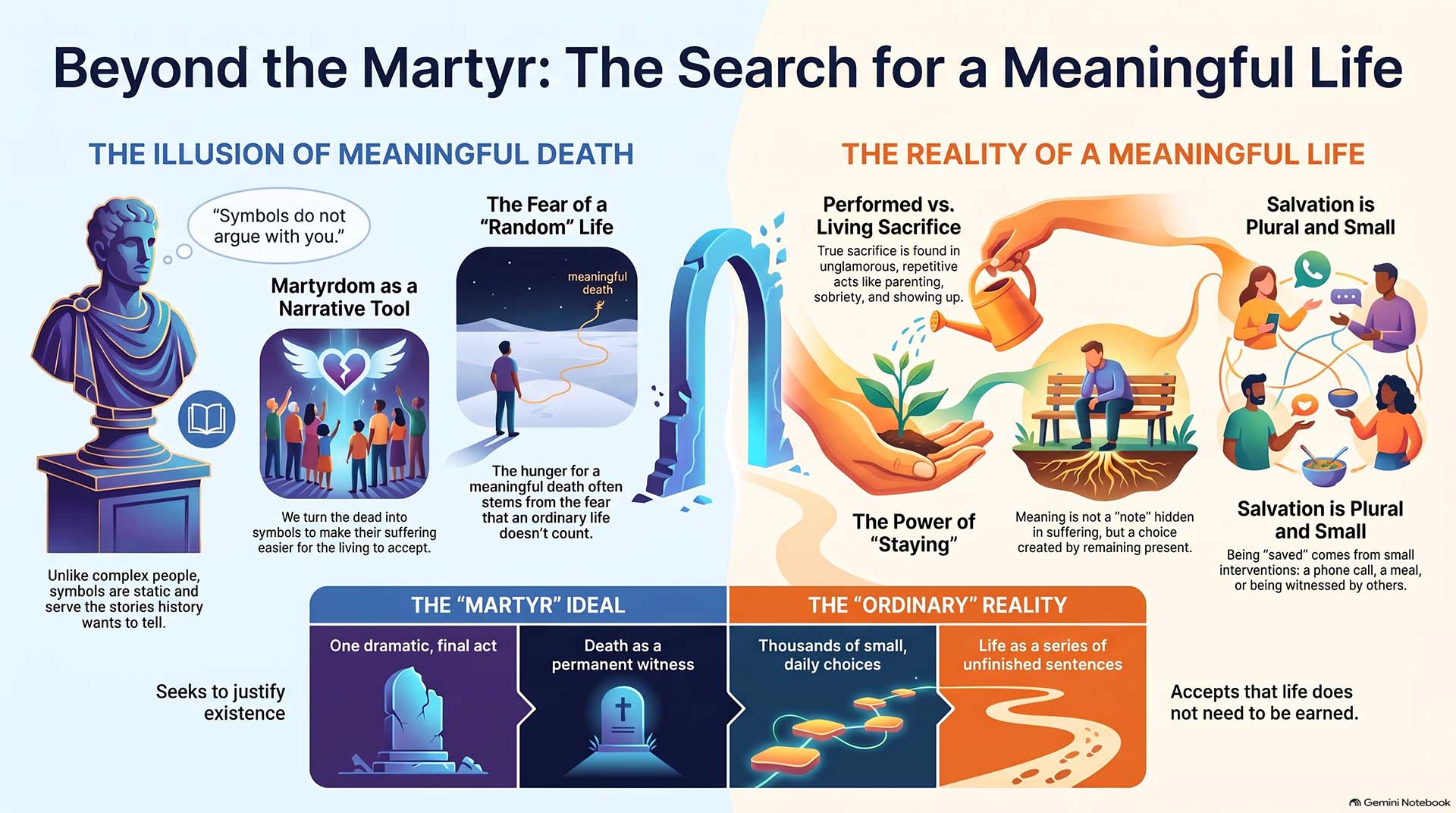
Cyrus begins this conversation believing that meaning must be discovered somewhere beyond ordinary life.
Perhaps in history.
Perhaps in religion.
Perhaps in art.
Perhaps in suffering.
Perhaps in death.
He keeps searching for something large enough to prove that a human life mattered.
Yet the people surrounding him offer very different evidence.
Ali gives years rather than one heroic moment.
Arash discovers that simply being beside someone who is afraid can matter.
Leila reminds Cyrus that a life does not become less real when history forgets the correct name.
Sang shows that truly seeing another person requires looking beyond roles such as mother, father, artist, addict, victim, or martyr.
Orkideh forces Cyrus to accept a painful truth: one person can hurt others deeply and still be more than the worst thing she did.
Zee offers perhaps the simplest answer.
Stay.
Not in every place.
Not in every relationship.
Not inside every identity.
Stay alive long enough to discover that the story you told yourself about your life may not be the only story available.
That becomes Cyrus's greatest change.
At first he asks:
What kind of death would prove that I mattered?
By the end, the question becomes:
What can I do with tomorrow?
That shift may contain the deepest lesson of Martyr!.
A meaningful life does not always look extraordinary.
It may look like sobriety.
Breakfast.
Work.
An apology.
Creating something.
Caring for someone.
Setting a boundary.
Telling the truth.
Holding another person's hand.
Laughing at the wrong moment.
Forgiving someone on Tuesday and becoming angry again on Wednesday.
Trying again Thursday.
Perhaps suffering does not arrive carrying a secret message.
Perhaps every tragedy does not happen for a reason.
Perhaps death does not explain life.
Yet none of that means a life is empty.
Meaning may be created in the relationships we enter, the choices we repeat, the people we refuse to reduce to symbols, and the days we decide to remain present.
Cyrus spent years looking for something large enough to defeat death.
What he begins to discover is smaller.
And perhaps more difficult.
To live.
To love.
To be known.
To remain unfinished.
And to accept that being alive never required him to earn the right to be here.
Short Bios:
Cyrus Shams
A young Iranian American poet and recovering addict whose mother's supposed death aboard Iran Air Flight 655 shapes much of his life. Cyrus becomes fascinated with martyrs and meaningful death as he searches for a reason his own life should matter.
Roya Shams / Orkideh
Cyrus's mother, long believed dead. Roya survives by leaving her former identity behind and eventually becomes the artist Orkideh. Her life forces Cyrus to confront freedom, abandonment, identity, art, guilt, and the limits of forgiveness.
Ali Shams
Cyrus's father. After losing Roya, Ali raises Cyrus in the United States through years of exhausting work and quiet responsibility. His ordinary sacrifices challenge Cyrus's fascination with dramatic martyrdom.
Zee
Cyrus's closest friend and intimate companion. Zee repeatedly pulls Cyrus away from abstraction and back to relationships, sobriety, ordinary life, and the difficult task of allowing oneself to be loved.
Arash
Cyrus's uncle and a veteran of the Iran-Iraq War. His unusual experience appearing to dying soldiers dressed as an angel places him at the intersection of faith, theater, propaganda, comfort, fear, and martyrdom.
Leila
Roya's lover whose fate becomes inseparable from the central family secret. Her death under another woman's identity raises questions about memory, sacrifice, truth, and whether a life requires recognition to matter.
Sang Linh
Orkideh's former wife and gallerist. Sang knew the person Cyrus never had the chance to know. She helps separate Orkideh the public artist, Roya the mother, and the complicated human being behind both identities.
Kaveh Akbar
An Iranian American poet and novelist whose debut novel Martyr! explores grief, addiction, identity, art, faith, death, and the human hunger for meaning. His poetic background gives the novel a distinctive combination of humor, philosophical questioning, emotional intensity, and lyrical language.
Leave a Reply