
Introduction
The alphausa marriage course explores seven major areas of married life: connection, communication, conflict, forgiveness, family, sexual intimacy, and love in action. Created by Nicky and Sila Lee, the course gives couples structured time to talk privately about their relationship.
This fictional conversation takes those seven sessions further.
What might happen if John and Julie Gottman, Sue Johnson, Howard Markman, Scott Stanley, David Olson, Les and Leslie Parrott, Retrouvaille founders Guy and Jeannine Beland, and Gary Chapman joined Nicky and Sila Lee around the same table?
Would Gottman agree with the idea of “resolving” conflict when much marital conflict can remain permanent?
Would Sue Johnson say better communication is enough, or ask what attachment fear lies beneath the argument?
What could PREP add about communication and commitment?
How might Prepare/Enrich reveal that two spouses can experience the same marriage very differently?
What happens when Gary Chapman's Five Love Languages meet newer research questioning whether everyone has one fixed primary language?
The seven themes are:
- Strengthening Connection
- The Art of Communication
- Resolving Conflict
- The Power of Forgiveness
- The Impact of Family
- Good Sex
- Love in Action
Across thirty-five questions, one larger issue keeps returning:
Why do couples who still love each other become distant?
Why can people talk every day yet feel unheard?
Can trust return after serious hurt?
How much of marriage begins in childhood?
What happens to intimacy after decades together?
And after thirty or forty years, what does it mean to keep choosing the same person?
This is not a competition between marriage systems.
Each approach sees a different layer.
Gottman studies daily interaction.
Sue Johnson looks beneath conflict to attachment and emotional safety.
PREP focuses on communication skills and commitment.
Prepare/Enrich examines personality, stress, and differences in perception.
Retrouvaille brings the perspective of marriages already in serious distress.
Gary Chapman asks how love is expressed and received.
Nicky and Sila Lee repeatedly bring the discussion back to ordinary married life.
What can two people actually do tonight?
The deepest question throughout the conversation is not simply:
How do people stay married?
It is:
How do two people stay married without becoming strangers?
(Note: This is an imaginary conversation, a creative exploration of an idea, and not a real speech or event.)
Topic 1: Strengthening Connection
Why Do Two People Who Still Love Each Other Gradually Become Strangers?
The room is quiet and warm. Seven chairs form a loose circle rather than a formal panel.
Nicky and Sila Lee sit beside each other. Across from them are John and Julie Gottman, Sue Johnson, and David Olson.
The Moderator looks around the circle.
Moderator: We are beginning with something that many couples find frightening.
Nothing catastrophic has happened.
There has been no affair.
No one has announced that they want a divorce.
They may still say, “I love you.”
Yet one night they look across the room at the person they have shared twenty or thirty years with and quietly think:
When did we stop being close?
How can two people still love each other and gradually become strangers?
Nicky Lee: I think the word gradually matters.
Most couples don't wake up one morning and deliberately decide, “From now on, we're going to neglect our marriage.”
Life simply starts filling the available space.
Work.
Children.
Money.
Parents.
Appointments.
Responsibilities.
Phones.
Health.
The relationship that once received enormous attention begins receiving whatever is left.
That is why Sila and I use the picture of tending a vineyard. You cannot plant something beautiful and assume it will remain healthy without attention.
Sila Lee: And the painful part is that neither person may notice at first.
You still function very well together.
You get children where they need to go.
You pay bills.
You arrange holidays.
You solve problems.
You might look like a very successful couple from the outside.
Yet gradually most of your conversations become administrative.
“Did you call the plumber?”
“What time are you leaving tomorrow?”
“Did you pick up the prescription?”
“Who's taking Mum to the appointment?”
You can run a household brilliantly and lose the friendship inside it.
John Gottman: I would put a microscope on those ordinary moments.
Couples tend to think the health of a marriage is determined by major events.
Anniversaries.
Vacations.
Arguments.
Sex.
Large romantic gestures.
A remarkable amount of a relationship is built in moments that appear almost meaningless.
One partner looks out the window and says, “That's an interesting bird.”
It sounds trivial.
Yet that may be a bid for connection.
They're really saying, “Come into my little world for a second.”
The other person can turn toward that bid.
They can say, “Where?”
They can turn away.
They might continue looking at their phone.
Or they can turn against it.
“I'm trying to read. Stop interrupting me.”
Those little moments accumulate.
Moderator: So marriages may not become distant through one great rejection.
They can become distant through hundreds of tiny non-responses?
John Gottman: Thousands.
Julie Gottman: And people rarely keep making bids forever when those bids repeatedly fail.
At first:
“Want to go for a walk?”
Then:
“Did you see this?”
Then:
“Come sit with me.”
If those invitations repeatedly go nowhere, many people stop asking.
That silence can later look like indifference.
Yet sometimes it began as disappointment.
Sue Johnson: And this is where I would move beneath the behavior.
When someone reaches for their partner, they are often asking a question much deeper than the words suggest.
Are you there for me?
Do I matter to you?
Can I reach you?
If I need you, will you respond?
Human attachment does not disappear when we become adults.
We become deeply attached to our romantic partners.
So when someone repeatedly reaches and doesn't receive a response, that does not merely feel inconvenient.
It can feel threatening.
Moderator: Threatening seems like a very strong word for something like, “Want to go for a walk?”
Sue Johnson: The conscious mind may hear an invitation to walk.
The attachment system can hear:
Do you still want to be with me?
If the answer seems repeatedly uncertain, people protect themselves.
One person may pursue harder.
“Why don't you ever want to do anything with me?”
The other feels criticized and withdraws.
Then the first person pursues harder.
“You don't care anymore.”
The other withdraws further.
Soon each person's attempt to protect themselves confirms the other person's deepest fear.
The pursuer thinks:
I knew you would leave me emotionally.
The withdrawer thinks:
I knew nothing I did would ever be good enough.
Now they are trapped in a cycle.
Sila Lee: That is very recognizable.
One spouse says, “We never talk anymore.”
The other hears, “You're failing as a spouse.”
They become defensive.
The first spouse sees defensiveness and thinks, “See? You don't want to talk.”
Both people become lonelier.
David Olson: And I would add one more complication.
They may not agree that there is a problem.
I've spent much of my work looking at couples' perceptions of their relationship.
Sometimes one person rates the relationship very positively.
The other person rates the same relationship much lower.
That matters.
One spouse may genuinely think:
“We're doing fine.”
The other may be quietly grieving the relationship.
Moderator: How can two people living in the same home experience the marriage so differently?
David Olson: They are not measuring the same things.
One spouse may define a good marriage as loyalty, financial stability, and low conflict.
Another may define a good marriage as conversation, affection, shared experiences, and emotional openness.
The first person says:
“We never fight. I provide. I'm faithful. What's wrong?”
The second says:
“I feel alone.”
Both descriptions may be factually accurate.
Question 1: Why Do Couples Who Genuinely Love One Another Slowly Become Emotionally Distant?
Moderator: Let me make this harder.
Suppose we have a couple who still genuinely love each other.
No cruelty.
No betrayal.
No intention to leave.
How does distance happen in that marriage?
Nicky Lee: Neglect can exist without lack of love.
That's one of the saddest things.
People tend to think neglect means, “I don't care.”
Often it means, “I assumed you knew I cared.”
Sila Lee: Or:
“I thought we'd have time later.”
Julie Gottman: Familiarity can contribute too.
Early in a relationship, people are curious.
“What was your childhood like?”
“What do you want to do with your life?”
“What are you afraid of?”
“What makes you happy?”
Years later, people start believing they already know the answers.
John Gottman: Yet the person beside you keeps changing.
Your partner at 25 is not identical to your partner at 45.
Or 65.
Their fears change.
Their dreams change.
Their disappointments change.
Their body changes.
Their relationship with work changes.
Their relationship with mortality changes.
Their relationship with their own parents changes.
If you stop updating your knowledge of your partner, your internal map becomes outdated.
Moderator: You call that a Love Map.
John Gottman: Yes.
Knowing your partner's inner world.
Who matters to them now?
What are they worried about now?
What are they hoping for?
What are they carrying?
The word now matters.
Sue Johnson: And there is another form of distance that gets misinterpreted.
People sometimes withdraw precisely when they care deeply.
Moderator: Explain that.
Sue Johnson: Imagine a husband whose wife says:
“You never tell me how you feel.”
He becomes silent.
She thinks:
“There. That's the problem. He's emotionally cold.”
Inside him, something very different may be happening.
He may be thinking:
“I don't know how to answer without disappointing you.”
“I don't know what I'm feeling.”
“If I say the wrong thing, this will become another argument.”
“I feel like a failure.”
Silence may be his way of protecting the relationship from what he fears he will make worse.
His wife experiences that same silence as abandonment.
Now both are hurting.
Julie Gottman: This is why interpretation matters.
Couples do not simply react to behavior.
They react to the meaning they assign to behavior.
Sila Lee: A wife sees her husband looking at his phone and thinks:
“You'd rather be anywhere than here with me.”
He may think:
“I'm exhausted. I'm switching my brain off for ten minutes.”
The behavior is identical.
The meaning is completely different.
David Olson: Which is why couples need a way to compare perceptions.
Many marital conflicts involve two realities.
Not one reality and one mistake.
Two experiences.
Question 2: What Are the Earliest Signs That Connection Is Disappearing?
Moderator: Suppose we want to catch this early.
What should couples notice before they reach the point of saying, “We feel like roommates”?
John Gottman: Reduced turning toward.
One person says something.
The other increasingly does not respond.
One person touches.
The other barely notices.
One person shares something amusing.
No reaction.
One person wants to talk about their day.
The other stays mentally elsewhere.
Nothing dramatic.
Just fewer points of contact.
Julie Gottman: I would watch for the loss of curiosity.
When people stop asking questions they don't already know the answers to.
Sila Lee: Loss of fun.
That one is underestimated.
A couple can become so responsible that they stop enjoying each other.
Nicky Lee: And time together becomes accidental rather than intentional.
They are in the same house.
Perhaps they are even in the same room.
Yet they are not really together.
Sue Johnson: I would watch for something emotional.
You stop bringing your vulnerable self to your partner.
Something difficult happens at work.
You tell a friend instead.
You're scared about your health.
You keep it to yourself.
Something wonderful happens.
Your spouse is no longer the first person you want to tell.
That is significant.
Moderator: That sounds more serious than simply having fewer date nights.
Sue Johnson: Very much so.
The question becomes:
Where do I go emotionally when life happens?
If the answer gradually stops being “my partner,” attachment is changing.
David Olson: Another sign is when satisfaction becomes uneven.
One spouse may be saying:
“I wish we had more time together.”
The other keeps responding:
“I think you're overreacting.”
That is dangerous.
Not since one spouse must always be right, but once one partner reports loneliness, the loneliness itself deserves attention.
Julie Gottman: Exactly.
You don't need to agree with the diagnosis to care about the pain.
Moderator: That's an important distinction.
If my spouse says, “I feel disconnected from you,” replying, “No, we're not disconnected,” doesn't actually answer the statement.
Julie Gottman: Correct.
John Gottman: One person's loneliness is already relationship data.
Sila Lee: Another sign is when affection becomes purely functional.
A kiss becomes automatic.
A hug disappears.
You stop touching as you pass each other.
You stop sitting close.
Those small gestures often disappear quietly.
Nicky Lee: Then people wait for some enormous romantic intervention.
What is often missing is something very small.
Tea together.
Twenty minutes without phones.
A walk.
A question.
A hand held in the car.
Question 3: Is Marital Distance Caused by Neglect, Personality, Emotional Insecurity, or Life Circumstances?
Moderator: Here's where I want disagreement.
Nicky and Sila, you talk about tending the relationship.
John and Julie, you focus heavily on interaction patterns.
Sue, you keep taking us into attachment.
David, you bring personality, stress, and family systems.
Which one actually causes marital distance?
John Gottman: I'd resist choosing one.
Sue Johnson: So would I, but I suspect John and I might disagree about where to intervene first.
John Gottman: That's fair.
Sue Johnson: Suppose we observe a couple.
She criticizes.
He withdraws.
A behavioral description might be accurate.
But if I only say, “Stop criticizing and stop withdrawing,” I may be asking both partners to surrender the very strategies they use to protect themselves without helping them feel safe enough to do something different.
John Gottman: I agree that emotional meaning matters.
At the same time, behavior has consequences independent of intention.
Contempt damages relationships.
Harsh startup makes conversations more difficult.
Physiological flooding changes what people can process.
We need to address what partners actually do.
Sue Johnson: I agree.
I simply don't want the person who criticizes to be reduced to “the critical spouse.”
Often criticism is a distorted protest.
“Why don't you care about me?”
And withdrawal can be a distorted attempt to prevent further damage.
Julie Gottman: Perhaps we are talking about entry points.
One couple may benefit from learning how to regulate conflict first.
Another needs to discover the vulnerable emotion underneath it.
David Olson: And another couple may have a very different problem.
One spouse is highly social.
The other needs much more solitude.
The social spouse experiences the quiet spouse as detached.
The quiet spouse experiences the social spouse as demanding.
No one has an attachment disorder.
No one is neglectful.
They have temperamental differences.
Sila Lee: Yet personality can become an excuse.
“I just don't talk.”
“That's who I am.”
“I don't do affection.”
“I don't plan dates.”
At some point marriage asks us to stretch.
David Olson: I completely agree.
Personality explains.
It does not automatically excuse.
Nicky Lee: That is important.
A good marriage changes us.
Not by erasing who we are.
By asking us to grow beyond our easiest habits.
Moderator: What about life circumstances?
Children.
Caregiving.
Health.
Career.
Empty nest.
Retirement.
Do couples sometimes become disconnected through no great relational mistake at all?
Sila Lee: Certainly.
There are seasons where survival takes most of the available energy.
Sue Johnson: And those seasons can reveal the attachment bond.
When life becomes frightening, the question “Are you there for me?” becomes stronger.
John Gottman: Stress can make turning toward harder.
People have fewer emotional resources.
David Olson: This is one reason assessments include stress.
A couple may interpret a season of overload as proof that their marriage is failing.
Sometimes the marriage needs attention.
Sometimes the couple needs sleep.
Julie Gottman: Or support.
Moderator: So when a couple says, “Something is wrong with us,” perhaps the first question should be:
“What is happening to us?”
Sue Johnson: Yes.
That is a beautiful question.
Question 4: What Happens When One Spouse Wants to Reconnect and the Other Seems Uninterested?
Moderator: Now the difficult version.
One person notices the distance first.
They say:
“We need to spend more time together.”
The spouse replies:
“We're fine.”
They suggest counseling.
“No.”
A marriage course.
“No.”
A date.
“I'm tired.”
Now what?
Sue Johnson: The first thing I would want to know is what “uninterested” means.
That word can hide many experiences.
Fear.
Shame.
Hopelessness.
Resentment.
Exhaustion.
A sense of failure.
Sometimes the person who appears least interested has actually concluded:
“Nothing I do will work.”
Moderator: So pursuing harder may backfire.
Sue Johnson: Very easily.
If one partner is pursuing connection from anxiety, every invitation can carry pressure.
“Talk to me.”
“What are you feeling?”
“Why won't you work on us?”
The other experiences demand.
They retreat.
The pursuer panics and intensifies.
John Gottman: Yet doing nothing isn't the answer either.
Sue Johnson: No.
The invitation needs to change.
Sila Lee: From accusation to vulnerability.
Instead of:
“You never spend time with me.”
perhaps:
“I miss you.”
That is a completely different sentence.
Julie Gottman: Or:
“I don't want to blame you. I just feel far away from you, and I would love to find our way back.”
David Olson: This is where curiosity can help.
Rather than assuming:
“You don't care.”
ask:
“Do you experience the distance the way I do?”
The answer may surprise you.
Nicky Lee: We should say something difficult too.
You cannot create an intimate marriage completely by yourself.
One person can change the atmosphere.
One person can make invitations.
One person can stop criticism.
One person can become more thoughtful.
Yet marriage still involves two people.
Moderator: What if one spouse keeps reaching gently for months and receives very little?
The person asking may be listening to this and thinking:
“I have tried.”
Julie Gottman: Then we should not romanticize endless unilateral effort.
That person may need support.
Perhaps professional help.
Perhaps a serious conversation about what each person wants from the marriage.
Sue Johnson: Yes.
Attachment security cannot be built through permanent emotional absence from one partner.
The withdrawing person must eventually risk engagement too.
Sila Lee: Sometimes the person who says “We're fine” is afraid that admitting a problem means admitting the marriage is failing.
We should normalize saying:
“We're not as close as we used to be.”
That doesn't mean:
“We married the wrong person.”
It can mean:
“We need to return to each other.”
John Gottman: And I would start with something small.
Don't begin with a three-hour summit called “The State of Our Marriage.”
Ask:
“Would you like coffee?”
“Want to take a ten-minute walk?”
“Can I sit with you?”
A distressed relationship often cannot carry huge emotional demands at first.
Moderator: Almost like rebuilding a bridge plank by plank.
John Gottman: Yes.
Sue Johnson: As long as we remember what the bridge is for.
To find each other again.
Question 5: If a Couple Realizes Tonight That They Have Become Roommates, What Should They Do First?
The room becomes quieter.
The Moderator looks around the circle.
Moderator: A couple is reading this tonight.
They've been married twenty-five years.
Maybe thirty-five.
Maybe forty.
They are loyal.
They have history.
They have survived difficult things together.
They still care deeply.
Yet something in this conversation has made both of them realize:
We have become roommates.
No one wants a lecture.
What should they do first?
Nicky Lee: Protect some time.
Not eventually.
Put something on the calendar.
An hour.
No phones.
No television.
No household administration for the first part of it.
Just the two of you.
Sila Lee: And don't begin by listing everything that is wrong.
Start with something warmer.
“Do you remember when we first met?”
“What did we enjoy doing back then?”
“What have been some of our happiest years?”
Connection sometimes returns through remembering that there is still an us beneath all the responsibilities.
John Gottman: Become curious again.
Ask a question whose answer you genuinely don't know.
“What has been on your mind lately?”
“What are you looking forward to?”
“What has been difficult?”
“What do you wish we did more often?”
Then pay attention to the answer.
Julie Gottman: And notice the next small bid.
Tonight.
Tomorrow morning.
Your spouse says:
“Look at this.”
Turn.
Your spouse sighs.
Ask:
“You okay?”
Your spouse reaches for your hand.
Take it.
You do not rebuild closeness only through scheduled conversations.
You rebuild it in the spaces between them.
David Olson: I would ask both people to answer one question privately:
“How connected do I feel to you right now, from zero to ten?”
Then compare.
No arguing over the numbers.
No defending.
Just curiosity.
If one says eight and the other says four, don't say:
“How can you possibly say four?”
Say:
“Help me see what four feels like for you.”
Sue Johnson: I would ask them to sit facing each other and finish one sentence.
Not ten sentences.
One.
“What I miss most about us is...”
Then listen.
Perhaps the answer is:
“I miss laughing with you.”
“I miss feeling wanted.”
“I miss talking in bed.”
“I miss knowing what you're thinking.”
“I miss touching you without it feeling awkward.”
“I miss being the person you came to first.”
And when your partner tells you what they miss, resist the instinct to explain why it disappeared.
For that moment, simply hear the longing.
Moderator: Then what?
Sue Johnson: Perhaps say:
“I miss you too.”
Silence follows.
Nicky looks toward Sila. She reaches over and takes his hand.
John leans back, thinking.
John Gottman: We spend so much time studying marriages in distress that people sometimes expect the answer to be dramatic.
Often it isn't.
A relationship can begin changing when someone turns their chair ten degrees.
When they look up.
When they answer.
When they ask one more question.
When they touch.
When they respond to the tiny invitation hidden inside an ordinary sentence.
Sila Lee: People sometimes fear that they need to recreate the marriage they had when they were twenty-five.
They don't.
Nicky Lee: They couldn't.
Sila Lee: You have lived too much since then.
The goal isn't to go backward.
It is to discover each other again as the people you are now.
David Olson: Which may mean admitting that both of you have changed.
Julie Gottman: And allowing that to be interesting rather than frightening.
Moderator: So perhaps the question is not:
“How do we get back to what we had?”
Sue Johnson: No.
Perhaps it is:
“Can I find you here?”
Moderator: Here?
Sue Johnson: At this age.
In this body.
After these losses.
After these successes.
After the children.
After disappointment.
After everything life has done to both of you.
Can I still reach for you?
And when I reach...
will you reach back?
No one speaks for several seconds.
The Moderator lets the silence remain.
Then he glances at the notes for the next conversation.
Moderator: That brings us naturally to the next question.
Suppose I reach for you.
Suppose I try to tell you what I need.
And somehow, every time we talk, we end up feeling more misunderstood than before.
How can two people share the same home, speak the same language, love each other deeply...
and still fail to hear one another?
The group shifts slightly in their chairs.
Howard Markman and Scott Stanley are waiting outside the room.
Topic 2: The Art of Communication
Why Can Two People Talk Every Day and Still Feel Completely Unheard?
The chairs have changed slightly.
John Gottman and David Olson have stepped away for this conversation. Julie Gottman and Sue Johnson remain.
Nicky and Sila Lee are still seated together.
Two new guests join the circle: Howard Markman and Scott Stanley, whose work with PREP has spent decades examining how couples communicate when conversations become difficult.
The Moderator looks toward the doorway, then back at the group.
Moderator: At the end of our first conversation, Sue asked a beautiful question:
Can I still reach for you, and when I reach, will you reach back?
But reaching is only the beginning.
Sometimes a husband reaches.
A wife responds.
They sit down.
They genuinely try to talk.
Thirty minutes later, both are upset.
One thinks:
You never listened.
The other thinks:
You never listened to me either.
How can two intelligent people speak the same language, share the same history, and still fail to hear one another?
Howard Markman: Communication gets difficult when the conversation itself begins feeling unsafe.
Once people expect criticism, rejection, escalation, or misunderstanding, they stop entering the conversation with curiosity.
They enter prepared for defense.
Scott Stanley: And sometimes they enter with years of evidence already assembled.
They don't hear one sentence.
They hear the last twenty arguments.
Sila Lee: That's very true.
Someone says:
“Can we talk?”
And the spouse doesn't hear three words.
They hear:
“Something is wrong again.”
Nicky Lee: Or:
“I'm about to be criticized.”
Julie Gottman: Which means the nervous system can begin reacting before the real conversation has even started.
Moderator: So a couple may be fighting with yesterday before today's discussion begins?
Julie Gottman: Very much so.
Sue Johnson: And often they are fighting with something even older than yesterday.
They are fighting with the fear underneath the argument.
Will you reject me?
Will you disappear?
Will I disappoint you again?
Am I enough for you?
When those fears become activated, people stop speaking only about the subject in front of them.
They're defending the bond.
Question 1
What Is the Difference Between Hearing Your Spouse's Words and Actually Hearing Your Spouse?
Moderator: Let us begin with the simplest version.
My spouse says something.
I hear every word.
What might I still be missing?
Nicky Lee: Meaning.
Sila Lee: Emotion.
Howard Markman: Intention.
Sue Johnson: Longing.
Scott Stanley: Context.
Julie Gottman: And sometimes the request hidden inside the complaint.
Moderator: Give me an ordinary example.
Sila Lee: A wife says:
“You're always on your phone.”
Her husband hears:
“You are selfish and inconsiderate.”
So he responds:
“I've barely looked at it tonight.”
Now they're debating screen time.
But perhaps what she was trying to say was:
“I miss your attention.”
Sue Johnson: Exactly.
The surface message is about the phone.
The attachment message may be:
“Are you interested in me?”
Howard Markman: Yet we have to be careful.
We cannot simply tell couples to ignore the literal content and search for hidden meaning every time.
Sometimes the phone genuinely is the problem.
Sue Johnson: Of course.
Howard Markman: What helps is slowing things enough that each person can say what they actually mean.
Instead of:
“You're always on your phone.”
try:
“When we're sitting together and you're looking at your phone, I sometimes feel unimportant.”
Now the listener has something more useful to respond to.
Scott Stanley: This is one reason structured communication can help.
It can feel artificial at first.
One person speaks.
The other listens.
The listener reflects back what they heard.
Then you switch.
People sometimes resist that.
They say:
“We've been married thirty years. Why should we need rules to talk?”
But people have rules for driving precisely when two vehicles might collide.
Moderator: That's an interesting comparison.
Scott Stanley: Structure is most useful when emotions make ordinary conversation unreliable.
Julie Gottman: I agree with the need to slow things down.
A listener often begins preparing a response before their spouse has finished.
They're no longer listening.
They're constructing a defense.
Moderator: So there are two conversations happening at once?
Julie Gottman: Yes.
The spoken conversation.
And the internal courtroom.
Sila Lee: That's exactly what happens.
Your spouse is still explaining something and you're already thinking:
“That's unfair.”
“That isn't what happened.”
“What about what you did?”
Nicky Lee: Which is why reflective listening can feel so difficult.
The listener's task is temporarily not to prove their case.
Moderator: Temporarily?
Nicky Lee: Yes.
Listening does not mean surrendering your perspective forever.
It means making enough room to understand your spouse's perspective first.
Sue Johnson: And understanding is not the same as agreeing.
That distinction can rescue many conversations.
You can say:
“I can see why you felt abandoned.”
without saying:
“You are completely correct about every detail.”
Howard Markman: That may be one of the most useful sentences in marriage education.
I can understand your experience without giving up my own.
Question 2
Why Does Good Communication Disappear Exactly When Couples Need It Most?
Moderator: Here's what puzzles people.
A husband and wife may communicate wonderfully when deciding where to eat.
They may plan vacations together.
Run a business.
Raise children.
Manage complicated finances.
Then one emotionally charged issue appears and suddenly neither can communicate.
Why?
Julie Gottman: One reason is physiological flooding.
When the body becomes highly activated during conflict, the person has less access to the kind of calm thinking required for listening, empathy, and problem solving.
Heart rate rises.
Stress hormones increase.
Attention narrows.
The person is no longer simply discussing an issue.
Their body is preparing for threat.
Howard Markman: That's why time-outs can matter.
A time-out is not abandoning the conversation.
It is protecting the conversation from the state you're currently in.
Moderator: But isn't walking away exactly what can terrify the spouse who wants to talk?
Sue smiles slightly.
Sue Johnson: Yes.
This is where techniques have to be emotionally intelligent.
If I simply stand up and leave, my partner may experience:
“There. You always leave me.”
A healthier version is:
“I want to finish this conversation. I'm getting overwhelmed. I need twenty minutes, and I promise I'll come back at eight-thirty.”
Now the message is different.
I'm not leaving you.
I'm stepping away from escalation.
And I am promising return.
Scott Stanley: That return is essential.
A time-out without return can become avoidance.
Sila Lee: Couples sometimes say:
“We'll talk about it later.”
Then later never comes.
Nicky Lee: Which teaches the other spouse:
“If I let this conversation stop, the issue will disappear forever.”
So they refuse to stop.
Moderator: Then one person pursues harder.
The other becomes more overwhelmed.
Sue Johnson: Exactly.
The cycle feeds itself.
The more desperately one reaches, the more pressured the other feels.
The more the other retreats, the more abandoned the first feels.
Neither person wakes up wanting to create that cycle.
Yet together they create it.
Julie Gottman: Tone matters too.
A conversation that begins harshly is much more likely to remain difficult.
“Why are you always so inconsiderate?”
is not an invitation to dialogue.
It is an accusation.
Howard Markman: Couples often underestimate beginnings.
They focus on how the argument ended.
I want to know how it started.
Scott Stanley: Sometimes the first thirty seconds already contain the entire problem.
Moderator: So what would a better beginning sound like?
Sila Lee: Instead of:
“You never help me.”
perhaps:
“I'm feeling overwhelmed tonight. Could you help me with the kitchen?”
Nicky Lee: Specific.
Present tense.
No character attack.
Sue Johnson: And vulnerable.
“I need you.”
That is very different from:
“You are useless.”
Moderator: Why is vulnerability so hard?
Sue Johnson: Since anger often feels safer than longing.
It's easier to say:
“You don't care.”
than:
“I need to know I matter to you.”
It's easier to say:
“Fine. Do whatever you want.”
than:
“I'm scared you're moving away from me.”
Anger protects.
Vulnerability exposes.
Julie Gottman: Yet vulnerability often gives the other person a much better chance to respond with care.
Question 3
Are Communication Techniques Enough When the Real Problem Is Emotional Disconnection?
The Moderator looks directly at Howard Markman, then Sue Johnson.
Moderator: I think this is where we need some disagreement.
Howard, PREP teaches structured communication.
Sue, your work suggests people can know every communication technique and still remain trapped in attachment fear.
So which comes first?
Skill or emotional safety?
Howard Markman: I'd say sometimes skill creates enough safety for something deeper to happen.
A couple may be so chaotic during conflict that they cannot discover the underlying emotion.
Give them a structure.
Slow the exchange.
Reduce interruption.
Create turns.
Now they finally have enough space to hear something they could not hear before.
Sue Johnson: I agree with that more than you might expect.
My concern appears when the skill becomes the destination.
A couple can execute a beautiful communication exercise and remain emotionally untouched.
Howard Markman: Certainly.
Sue Johnson: Suppose a husband says:
“I understand that when I work late, you feel lonely.”
Perfect reflection.
His wife says:
“Yes.”
Then he closes the workbook.
Nothing has changed.
What she may still need is:
“I didn't realize how alone you've felt. I hate that you've been carrying that. I don't want you to feel alone with me.”
Now we have emotional engagement.
Scott Stanley: So perhaps skill provides the road, but connection is where we're trying to go.
Sue Johnson: That's a good way to say it.
Julie Gottman: I would put regulation in there too.
A couple can care deeply and understand each other's emotions, yet if both become flooded every time conflict begins, they may still need concrete ways to manage the interaction.
Nicky Lee: This may be where marriage programs sometimes create false choices.
Do we need technique?
Yes.
Do we need emotional understanding?
Yes.
Do we need commitment?
Yes.
Do we need practice?
Yes.
Marriage doesn't become simpler merely because one theory has a strong explanation.
Moderator: Scott, where does commitment enter communication?
Scott Stanley: Much earlier than people think.
When I'm highly committed, I'm more likely to treat the conversation as something we need to work through rather than something that proves the relationship is failing.
Commitment can create a larger frame.
“We are having a difficult conversation.”
rather than:
“We have a difficult marriage.”
Sue Johnson: Provided commitment doesn't become an excuse for emotional absence.
Scott Stanley: Completely agreed.
Commitment without engagement can become mere endurance.
Sila Lee: And communication without warmth can become management.
You can communicate efficiently about everything and still not feel loved.
Moderator: That's striking.
A couple could score well at logistics and poorly at intimacy.
Julie Gottman: Very easily.
Some couples are excellent project managers.
Children.
Schedules.
Finances.
Travel.
Household tasks.
Yet ask:
“When did you last tell your spouse something vulnerable?”
and the room becomes quiet.
Sue Johnson: Or ask:
“When you are frightened, do you turn toward your spouse?”
That question reveals a great deal.
Question 4
What Should You Do When Your Spouse Says Something That Feels Completely Unfair or Untrue?
Moderator: Reflective listening sounds wonderful until your spouse says something you believe is simply wrong.
“You never support me.”
“You care more about work than me.”
“You're exactly like your father.”
“You don't love me anymore.”
Your immediate thought is:
That is false.
What now?
Howard Markman: This is where structure matters enormously.
Your first task is not deciding whether every sentence is accurate.
Your first task is identifying what your spouse is trying to communicate.
Moderator: But doesn't silence look like agreement?
Howard Markman: Only if we define listening that way.
You can say:
“I see this very differently, but I want to understand what makes it feel that way to you.”
That sentence protects both realities.
Julie Gottman: Very good.
Sue Johnson: I would listen for the injury.
Suppose someone says:
“You care more about work than me.”
A defensive response is:
“That's ridiculous. I work for this family.”
Perhaps factually true.
Yet what if the emotional message is:
“I feel second place.”
If you fight the factual statement immediately, you may never reach the emotional one.
Sila Lee: You could ask:
“When do you feel most like you're second place?”
Now we're learning something.
Scott Stanley: And specificity is extremely helpful.
Words like always and never make people defend their entire history.
Ask for an example.
“Can you think of a recent moment when you felt unsupported?”
Now we have an event.
Events can be discussed.
Character verdicts are much harder.
Nicky Lee: This is why accusations such as:
“You're selfish.”
are so damaging.
How do you solve selfish?
Moderator: You can't.
Nicky Lee: But:
“When you changed our plans without asking me, I felt unimportant.”
Now there's something we can talk about.
Julie Gottman: One of the most difficult skills is finding the part of your partner's complaint that is true.
Not the entire complaint.
The part.
Perhaps:
“You're right. I have been distracted lately.”
Or:
“Yes, I did dismiss what you were saying.”
Or:
“I don't agree that I never support you, but I can see that I wasn't there for you that night.”
That small ownership can completely change the emotional atmosphere.
Moderator: Why is that so hard?
Julie Gottman: Since people fear that admitting one part means losing the entire argument.
Marriage is not a courtroom.
You don't have to defend every inch of territory.
Sue Johnson: And sometimes the most important truth is not factual.
It is relational.
Your spouse says:
“You weren't there for me.”
You remember sitting physically beside them.
You think:
“Of course I was there.”
They may mean:
“You were physically present, but I couldn't reach you emotionally.”
Both memories can be true.
Sila Lee: That's where curiosity can save the conversation.
“What did you need from me that you didn't receive?”
Howard Markman: That is a much better question than:
“How can you say that after everything I've done?”
Moderator: What if my spouse really is being unfair?
Scott Stanley: Then fairness can be discussed after understanding.
If you correct first, the conversation may never get far enough to make correction useful.
Sue Johnson: Sometimes one partner needs to know:
“You see my pain.”
before they can hear:
“You misunderstood my intention.”
Question 5
What Is One Communication Habit Couples Should Practice Every Week?
The Moderator looks around the circle.
Moderator: Let's finish practically.
No theory.
No course materials.
No terminology.
A couple wants one communication habit they can begin this week.
What do you give them?
Nicky Lee: Set aside one regular conversation that is not about administration.
No bills.
No schedules.
No household tasks for the first part.
Ask:
“How are you, really?”
Sila Lee: And don't ask it if you're not going to listen to the answer.
Howard Markman: I would give them one rule:
When a conversation matters, take turns.
One speaks.
One listens.
Do not solve until both people can accurately describe the other's position.
Scott Stanley: I would add a weekly question:
“Is there anything small between us that we should talk about before it becomes big?”
Small problems are much easier to discuss than accumulated resentment.
Julie Gottman: I would ask couples to notice how conversations begin.
For one week, eliminate harsh startup.
Instead of:
“Why didn't you...?”
try:
“I need...”
“I feel...”
“Could we...?”
That one shift can change many discussions.
The Moderator turns to Sue.
Moderator: And you?
Sue Johnson: Once a week, ask your partner:
“When did you feel closest to me this week, and when did you feel furthest away?”
The room becomes still.
Sue Johnson: Don't defend the second answer.
Just listen.
If your partner says:
“I felt closest when you put your arm around me in the kitchen.”
Remember that.
If they say:
“I felt far away when I was telling you about my mother and you kept looking at your phone.”
Don't explain the phone.
Stay with the moment.
Ask:
“What was that like for you?”
Sila Lee: That's a very good question.
Sue Johnson: Then switch.
Both people get to answer.
Now connection itself becomes something the couple can talk about.
Moderator: Let me test this with an ordinary couple.
They've been married thirty years.
One evening the wife says:
“When I was worried about my test results, you immediately started telling me what the doctor would probably say.”
The husband responds:
“I was trying to reassure you.”
What should happen next?
Sue Johnson: She might say:
“I know. I think what I needed first was for you to say you were scared with me.”
The husband pauses.
Howard Markman: Then his job is not to explain reassurance.
It's to reflect.
“You needed me to stay with how frightening it felt before trying to make it better.”
Julie Gottman: Beautiful.
Sila Lee: And perhaps she says:
“Yes.”
Scott Stanley: Now the entire interaction has changed.
He wasn't uncaring.
She wasn't unreasonable.
They simply missed each other.
Nicky Lee: Which happens constantly in marriage.
We give what we think the other person needs.
Sue Johnson: Instead of discovering what they actually need.
The Moderator leans forward.
Moderator: Maybe that is the heart of this topic.
Good communication isn't saying everything perfectly.
It isn't agreeing.
It isn't never becoming defensive.
It is staying interested enough in the person across from you to keep asking:
“What are you trying to tell me?”
Julie nods.
Julie Gottman: And:
“What part of this can I take responsibility for?”
Howard Markman: And:
“Can we slow down enough to understand each other?”
Scott Stanley: And:
“Can we protect the conversation from the patterns that usually destroy it?”
Sue Johnson: And underneath all of those:
“Can I let you matter to me, even when what you're saying is difficult to hear?”
Silence settles across the room.
The Moderator looks at Nicky and Sila.
Moderator: So far we have said:
First, couples can lose connection without losing love.
Then, they can speak without truly hearing each other.
But there is another problem.
Sometimes they hear each other perfectly.
They understand the disagreement.
They know exactly what the other person wants.
And they still disagree.
For ten years.
Twenty years.
Perhaps their entire marriage.
John Gottman has returned to the doorway.
He smiles.
John Gottman: Now you're getting to the interesting part.
A few people laugh.
The Moderator closes his notes.
Topic 3: Resolving Conflict
Do Healthy Couples Actually Resolve Their Conflicts?
John Gottman returns to the circle.
Julie remains beside him. Nicky and Sila Lee are still there. Howard Markman and Scott Stanley stay from the previous discussion, and Sue Johnson takes the chair opposite John.
The Moderator looks around.
Moderator: We ended Topic 2 with a hopeful idea.
Listen carefully.
Slow down.
Hear the emotion underneath the words.
Take responsibility for your part.
But now I want to make things harder.
Suppose all of that works.
I understand what my wife wants.
She understands what I want.
Neither of us is confused.
Neither of us is being cruel.
We simply disagree.
And we have disagreed about the same thing for fifteen years.
What then?
John smiles.
John Gottman: Welcome to marriage.
The group laughs.
Moderator: You have said that a very large proportion of recurring marital conflict is perpetual.
John Gottman: Yes.
Many disagreements come from enduring differences in personality, values, preferences, lifestyle, dreams, or needs.
The mistake couples make is thinking:
“If our marriage were healthy, we would eventually solve this.”
Sometimes you won't.
Nicky Lee: I think we need to define “solve.”
John Gottman: Exactly.
Managing a difference lovingly can be a successful outcome.
Sila Lee: So resolving conflict does not always mean making the conflict disappear.
John Gottman: Correct.
Sometimes resolution means:
“We know this difference exists.”
“We know why it matters to each of us.”
“We have stopped hurting each other over it.”
“And we have found a way to live with it.”
Moderator: That sounds less romantic than:
“We worked it out.”
Julie Gottman: Yet it can be much more realistic.
Question 1
Why Do Couples Keep Having the Same Argument Year After Year?
Moderator: Let's begin there.
Why does the same argument keep returning?
Money.
Cleanliness.
Being late.
Sex.
Children.
In-laws.
Work.
Travel.
One spouse wants more social activity.
The other wants more time at home.
Ten years later, it is still there.
Why?
John Gottman: Often since the argument is attached to something deeper and enduring.
Take money.
One spouse wants to save aggressively.
The other wants to enjoy life now.
At the surface, they are arguing about spending.
Underneath that may be two very different philosophies of life.
For one person, money means security.
For the other, money means freedom.
You cannot solve that simply by producing the perfect spreadsheet.
Scott Stanley: And recurring issues become loaded with history.
At first:
“You spent too much this month.”
Ten years later:
“You never care about our future.”
Now the issue is no longer merely money.
It carries accumulated meaning.
Howard Markman: Patterns begin forming around it too.
She raises the issue.
He expects criticism.
He becomes defensive.
She sees defensiveness and presses harder.
He shuts down.
Soon the argument has its own choreography.
Sue Johnson: I would go one layer deeper.
The recurring content may change, but the emotional question can remain identical.
A couple fights about dishes Monday.
Sex Wednesday.
His mother Friday.
Yet emotionally the argument may always be:
“Do I matter to you?”
Or:
“Can I ever be good enough for you?”
Or:
“Will you choose me?”
Moderator: So three different arguments may really be one argument.
Sue Johnson: Very often.
Julie Gottman: We see another dynamic too.
People frequently believe that changing the spouse will solve the perpetual problem.
“If she were less emotional.”
“If he were more ambitious.”
“If she were more organized.”
“If he enjoyed people more.”
They keep returning to the issue since they are still waiting for the person to become someone else.
Sila Lee: That is an important point.
Some conflicts are really protests against personality.
Nicky Lee: And marriage asks a difficult question:
Can I love someone whose way of being in the world genuinely differs from mine?
Moderator: Give me an example.
Sila Lee: One person likes everything planned.
The other likes spontaneity.
For thirty years the organized spouse thinks:
“If only you would become more responsible.”
The spontaneous spouse thinks:
“If only you would relax.”
Perhaps both spend thirty years trying to convert each other.
John Gottman: Exactly.
And the conflict remains permanent.
Moderator: Then why doesn't the couple eventually accept it?
John Gottman: Sometimes they do.
That is one of the differences between happy and unhappy couples.
Happy couples can sometimes develop humor around enduring differences.
They stop treating every recurrence as fresh evidence that the marriage is failing.
Julie Gottman: Imagine the organized spouse saying:
“I know. You're going to pack twenty minutes before we leave.”
And the other replies:
“And I know your suitcase has been packed since Tuesday.”
They laugh.
The difference remains.
The hostility does not.
Sue Johnson: Humor works when the attachment feels secure.
If I believe you fundamentally accept me, your joke can feel affectionate.
If I believe you secretly despise who I am, the same joke can feel cruel.
John Gottman: Agreed.
Question 2
Are Some Marital Problems Never Meant to Be Solved?
The Moderator looks directly at John.
Moderator: Let's make your claim uncomfortable.
Are you really saying some marital problems should remain unsolved?
John Gottman: I am saying some differences cannot be eliminated without asking one partner to stop being themselves.
That is different.
Moderator: Give me examples.
John Gottman: Introversion and extroversion.
Different needs for order.
Different attitudes toward risk.
Different emotional styles.
Different needs for independence.
Different preferences concerning social life.
Some differences in sexual desire.
Different relationships with money.
Many of these have enduring components.
Nicky Lee: Yet couples still need arrangements.
You can't say:
“We disagree about money, so we simply accept that.”
Then spend whatever you want.
John Gottman: Of course.
Acceptance of difference does not eliminate responsibility.
You still build agreements around the difference.
Scott Stanley: This is where deciding matters.
A permanent difference still requires decisions.
Maybe one spouse wants to save 20 percent and the other wants to save 5 percent.
They cannot both independently implement their preference.
They need a shared decision.
Howard Markman: The communication skill is separating the underlying difference from the practical problem.
The underlying difference might remain.
The practical problem can often be negotiated.
Moderator: Let's take another one.
One spouse loves traveling.
The other hates traveling.
Permanent difference.
What happens?
Sila Lee: They might decide some trips happen together and some do not.
Nicky Lee: Or they search for a form of travel the reluctant spouse finds more comfortable.
Julie Gottman: Or the traveling spouse learns that the real dream isn't travel itself.
Perhaps it is adventure.
Then they find adventure closer to home.
John Gottman: This is where dreams within conflict matter.
Behind rigid positions there are often dreams, values, or identities.
If you only negotiate the position, you miss the meaning.
Moderator: Explain that.
John Gottman: Suppose a wife insists:
“I want us to travel abroad every year.”
Her husband hears:
“You want to waste money.”
But if he asks why travel matters so much, she may say:
“My parents never went anywhere. Our life felt very small. I promised myself I would see the world.”
Now he is not negotiating airfare.
He is hearing a life dream.
Sue Johnson: And perhaps his resistance carries a story too.
“My father lost his job when I was twelve. We nearly lost our house. Having money saved makes me feel safe.”
Now the argument looks different.
One dream is:
“Let me live.”
The other is:
“Keep us safe.”
Moderator: That is much harder to reduce to right and wrong.
Sue Johnson: Exactly.
Scott Stanley: Once couples know the dreams, compromise can become more creative.
Howard Markman: And less insulting.
Instead of:
“You are irresponsible.”
and:
“You are boring.”
it becomes:
“How can we honor adventure and security?”
Sila Lee: That sounds much more like marriage.
Moderator: Then perhaps some conflicts are not asking:
“Who wins?”
They are asking:
“How can two legitimate needs live in the same home?”
Julie Gottman: Very much so.
Question 3
What Is Really Happening Underneath an Argument?
Moderator: I want each of you to look at the same fictional argument.
A wife says:
“You're working again Saturday?”
The husband says:
“I told you this project is important.”
She says:
“Work is always important.”
He says:
“Everything I do is for this family.”
She says:
“You don't even know this family anymore.”
He becomes furious.
What's happening?
Howard Markman: Communication danger signs.
Escalation.
Invalidation.
Negative interpretation.
They're moving from a schedule problem into character judgments.
Scott Stanley: There may be a priority conflict.
Career and family.
They need a deliberate conversation about what they are choosing.
Julie Gottman: The startup becomes harsh very quickly.
“Work is always important” is likely heard as criticism.
His defensiveness arrives immediately:
“Everything I do is for this family.”
Now neither one is discussing Saturday.
John Gottman: I would want to know the dreams.
What does work represent to him?
Achievement?
Security?
Identity?
Providing?
What does Saturday represent to her?
Family?
Partnership?
Being chosen?
Shared memories?
Sue Johnson: I hear:
“Will you choose me?”
And from him:
“Can you see how hard I am trying to be enough for you?”
Moderator: You got all that from four sentences?
Sue Johnson: I would test it rather than assume it.
I might ask her:
“When he says he is working Saturday, what happens inside you?”
Maybe she says:
“I feel lonely.”
Then:
“What is the hardest part of that?”
She says:
“I feel like we always come second.”
Now we know more.
Then I ask him:
“When she says you don't know your family anymore, what happens inside you?”
Perhaps:
“I feel attacked.”
Go deeper.
“I feel like nothing I do counts.”
Go deeper.
“I work constantly to give them a good life. When she says that, I feel like a failure.”
Now we have two vulnerable people.
She is saying:
“Please choose us.”
He is saying:
“Please see what I am doing for us.”
They sound very different from the couple we met sixty seconds earlier.
Nicky Lee: This is why solving only the schedule could miss the marriage.
They might agree that he will not work Saturday.
Yet if she still feels unchosen and he still feels unappreciated, the argument returns next month.
Howard Markman: True.
At the same time, I still want them to solve Saturday.
Insight without behavioral change can become frustrating.
Sue Johnson: Absolutely.
Moderator: There it is again.
Skill and emotional meaning.
Howard Markman: They need each other.
Julie Gottman: And physiology.
If either person is already flooded, neither the insight nor the skill will work very well at that moment.
Scott Stanley: Which means timing matters.
Sometimes the wisest conflict skill is recognizing:
“We cannot do this conversation well right now.”
Sila Lee: That is very different from refusing the conversation.
Scott Stanley: Yes.
A healthy pause contains a return plan.
Moderator: Say it out loud.
Scott Stanley: Something like:
“I want to talk about this. I'm too worked up right now. Can we take thirty minutes and come back at seven?”
Sue Johnson: And perhaps add:
“I'm not leaving you.”
That sentence can matter enormously to someone who experiences withdrawal as abandonment.
Question 4
What Should Happen When Compromise Feels Impossible and Both Spouses Genuinely Believe They Are Right?
The Moderator pauses.
Moderator: Let's remove the easy answer.
People love saying:
“Marriage is compromise.”
But what if compromise feels morally, emotionally, or practically impossible?
Suppose one spouse wants an elderly parent to move into the house.
The other strongly opposes it.
There is no halfway version of someone living in the house.
Now what?
The circle becomes quieter.
Nicky Lee: This is where marriage gets very real.
Both may have legitimate concerns.
One feels responsibility toward a parent.
The other feels responsibility toward the marriage, home, privacy, perhaps health or children.
Sila Lee: And either person can make the other look selfish very quickly.
“You don't care about my mother.”
Or:
“You care about your mother more than our marriage.”
Both statements wound.
John Gottman: First, slow down the position.
“Mother moves in.”
“Mother does not move in.”
Those are solutions.
Before solutions, understand the underlying needs.
Moderator: What might they be?
Julie Gottman: The spouse wanting the parent there may fear guilt.
Or abandonment.
Or cultural shame.
They may believe:
“A good son takes care of his mother.”
The opposing spouse may fear losing all privacy.
Or becoming the caregiver.
Or repeating a previous painful experience with the parent.
Those things need to be spoken.
Sue Johnson: And each partner needs reassurance concerning the bond.
The first may need:
“You are not asking me to abandon my mother.”
The second may need:
“You are not going to sacrifice our marriage without considering me.”
Scott Stanley: Then they need to distinguish values from strategies.
Shared value:
“We want your mother cared for.”
Different strategies:
“She lives here.”
“She lives nearby.”
“We hire help.”
“We rotate care.”
“We contribute financially.”
Once you identify the shared value, more options may appear.
Howard Markman: This is why brainstorming matters before evaluation.
Couples often reject ideas immediately.
“That won't work.”
“Too expensive.”
“She'll hate that.”
Generate possibilities first.
Judge them later.
Moderator: But suppose every possible arrangement still hurts someone.
Sila Lee: Sometimes marriage contains sacrifice.
There may not be a solution where everyone gets everything.
Moderator: Who sacrifices?
Sila Lee: That is the hard question.
Nicky Lee: And it cannot always be the same person.
A marriage where one spouse repeatedly “compromises” by surrendering becomes resentment.
John Gottman: Influence matters.
Healthy couples allow themselves to be influenced by their partner.
That doesn't mean obeying every request.
It means your spouse's needs genuinely enter your decision-making.
Julie Gottman: If your position remains identical after hearing your spouse's deepest fears, dreams, and needs, you may not actually have allowed yourself to be influenced.
Moderator: That's uncomfortable.
Julie Gottman: It should be.
Sue Johnson: And some issues require boundaries rather than compromise.
Moderator: Such as?
Sue Johnson: Harmful behavior.
Addiction.
Violence.
Repeated betrayal.
Coercion.
There are situations where “meet in the middle” is the wrong framework.
Howard Markman: Agreed.
Scott Stanley: Compromise is not a universal moral rule.
Moderator: So “marriage is compromise” may be too simplistic.
Nicky Lee: Much too simplistic.
Marriage is learning how to make decisions as a “we” without erasing either “I.”
Question 5
What Should a Couple Do the Next Time the Same Argument Starts Again?
The Moderator closes the theoretical notes.
Moderator: Let's make this useful tonight.
A couple has the argument.
Every marriage seems to have one.
Maybe two.
They can almost predict the opening line.
Next Saturday it begins again.
What should they do differently?
John Gottman: Recognize it.
Say:
“We know this one.”
That immediately changes the frame.
This is not a new catastrophe.
This is a familiar difference.
Julie Gottman: Then soften the beginning.
Instead of:
“Here we go again. You never listen.”
try:
“I think we're getting into our old argument. Can we try this differently?”
Howard Markman: Stop escalation early.
Do not wait until you're both at nine out of ten emotionally.
If necessary, call a time-out.
State when you will return.
Scott Stanley: Separate the issue from the pattern.
Perhaps say:
“We're arguing about money, but our pattern is that I push and you withdraw.”
Now both people can watch the cycle together.
Sue Johnson: I would make one change.
Don't merely watch the cycle.
Name what happens inside you.
Instead of:
“You're withdrawing again.”
say:
“When you go quiet, I get scared that I've lost you, and I push harder.”
Then the other might say:
“When you push harder, I feel like I'm failing, and I shut down.”
Now the enemy is visible.
Not him.
Not her.
The cycle.
Sila Lee: Then ask:
“What matters most to you about this?”
That question from The Marriage Course can change an argument.
Nicky Lee: And listen for the answer.
The argument may appear to be about a holiday.
What matters most may be:
“I want our children to have memories with my parents.”
Or:
“I desperately need some rest.”
John Gottman: Find the dream.
Moderator: And if it is perpetual?
John Gottman: Stop demanding permanent victory.
Ask:
“How do we handle this difference kindly this time?”
Scott Stanley: Choose something concrete.
Not:
“We'll communicate better.”
Instead:
“For the next month, let's try this arrangement.”
Howard Markman: Then review it.
An agreement can be an experiment rather than a lifetime constitution.
Julie Gottman: And repair quickly when you hurt each other.
“I said that badly.”
“Can I start again?”
“That was unfair.”
“I'm getting defensive.”
“I love you. I'm angry, but I'm still here.”
Those little repair attempts matter.
The Moderator looks toward Sue.
Moderator: Last word?
Sue pauses.
Sue Johnson: When the same argument begins, try asking yourself:
What am I afraid of right now?
Then:
What do I need from you that I am having trouble asking for?
Maybe the answer is:
“I need reassurance.”
“I need respect.”
“I need space.”
“I need to know you choose me.”
“I need to know I'm not failing you.”
Then risk saying that instead of the attack.
Moderator: That sounds much harder than winning.
Sue Johnson: It is.
Winning is often easier than being known.
No one speaks for a moment.
John looks over at Julie.
John Gottman: There's another thing couples should know.
A good marriage is not one where conflict disappears.
Julie Gottman: It's one where conflict does not destroy friendship.
Howard Markman: Where disagreement doesn't automatically become danger.
Scott Stanley: Where people keep making decisions with the relationship in mind.
Sila Lee: Where difference doesn't erase affection.
Nicky Lee: And where being right becomes less important than remaining connected.
The Moderator looks down at the seven-topic map.
Moderator: We began with distance.
Then communication.
Now conflict.
But conflict leaves marks.
Sometimes an argument ends, yet something said during that argument remains for years.
Sometimes the issue isn't the disagreement anymore.
It's what happened inside it.
An insult.
A betrayal.
A secret.
A moment when someone needed you and you weren't there.
Sue's expression changes.
Sue Johnson: That's where things become much more delicate.
Topic 4: The Power of Forgiveness
Can Love Survive Serious Hurt?
The room feels different before anyone speaks.
John Gottman has stepped out. Howard Markman and Scott Stanley are no longer in the circle.
Julie Gottman remains.
Nicky and Sila Lee sit together.
Sue Johnson is still present.
Two new guests have joined them: Guy and Jeannine Beland, representing the Retrouvaille tradition born from work with couples whose marriages had moved far beyond ordinary disagreement.
The Moderator looks around the room.
Moderator: In Topic 3, we talked about recurring conflict.
Some problems can be managed.
Some differences may never disappear.
But something else can happen during those years of conflict.
People get hurt.
Sometimes through one enormous event.
Sometimes through hundreds of smaller ones.
A sentence.
A betrayal.
A lie.
A period of emotional absence.
A time when one spouse desperately needed the other and felt abandoned.
Years later, the event may be over.
The hurt may not be.
So here is the question:
Can love survive serious hurt?
Sila Lee: Yes.
But surviving and healing are not the same thing.
Nicky Lee: A marriage can continue for years with unresolved hurt underneath it.
The couple is still together.
They may still function.
Yet something has become blocked.
Julie Gottman: And people can mistake endurance for repair.
Sue Johnson: The deepest injuries often change the answer to one attachment question:
Can I trust you to be there when I need you?
Once that answer becomes uncertain, the relationship changes.
Guy Beland: Couples who come to Retrouvaille are often far beyond:
“We need better communication.”
Some have stopped believing the other person cares.
Jeannine Beland: Some arrive thinking:
“This is probably over.”
Moderator: So this topic is not merely:
“How do I forgive my spouse for something irritating?”
Jeannine Beland: No.
Sometimes it is:
“How do I sit beside someone who hurt me deeply and decide whether there is still anything here worth rebuilding?”
The room falls quiet.
Question 1
What Is the Difference Between Forgiveness, Reconciliation, and Restored Trust?
Moderator: People use these words as though they mean the same thing.
Forgiveness.
Reconciliation.
Trust.
Do they?
Nicky Lee: No.
Forgiveness can begin with one person.
Reconciliation requires two.
Trust is usually rebuilt over time.
Sila Lee: That distinction matters greatly.
Someone may decide:
“I do not want to live consumed by bitterness.”
That can be forgiveness.
It does not automatically mean:
“I trust you completely again.”
Julie Gottman: Trust needs evidence.
If someone says:
“I am sorry,”
that matters.
But trust asks:
“What happens next?”
Do the behaviors change?
Does the person become more transparent?
Do they respond differently when the same vulnerable situation returns?
Sue Johnson: And reconciliation requires emotional engagement.
You cannot repair an attachment injury if the person who caused the injury says:
“I apologized. Why are we still talking about this?”
The injured partner needs to know the other person has entered the pain with them.
Moderator: What does that mean?
Sue Johnson: Not merely acknowledging the event.
Acknowledging its meaning.
Suppose a wife says:
“When you did that, I felt completely abandoned.”
Her husband replies:
“I said I was sorry.”
That may be factually true.
But she may still be waiting for:
“I see that in that moment, you felt alone and unsafe with me. I understand why that changed something inside you.”
That is different.
Guy Beland: Many couples want to skip from apology to normal life.
Jeannine Beland: The injured spouse may not be able to.
Moderator: Then is forgiveness required before reconciliation?
Nicky Lee: I would say forgiveness can open the door.
But reconciliation depends on honesty, change, and mutual participation.
Julie Gottman: And restored trust may lag behind both.
Moderator: So a person can truthfully say:
“I forgive you, but I do not yet trust you.”
Julie Gottman: Yes.
Sue Johnson: And that can be psychologically coherent.
Sila Lee: It may even be necessary.
Forgiveness should never be used to pressure someone into pretending everything is normal.
Question 2
Why Do Some Wounds Remain Painful Years After the Apology?
Moderator: This is where couples become frustrated.
One spouse says:
“I apologized five years ago.”
The other says:
“I know.”
Then the hurt comes back.
Why?
Julie Gottman: Memory is not erased by apology.
If an incident changed the meaning of the relationship, the nervous system may continue to react.
A certain place.
A certain date.
A certain tone of voice.
A certain behavior.
It can reactivate the old injury.
Sue Johnson: Attachment injuries are especially powerful.
An attachment injury often happens when one partner is emotionally unavailable during a moment of intense need.
It can be infidelity.
But it can be something else.
A medical crisis.
A death.
A frightening diagnosis.
A pregnancy loss.
A family emergency.
A moment when one person thought:
“You will be there for me.”
And the partner was not.
Moderator: The event may last one hour.
The meaning can last years.
Sue Johnson: Exactly.
The injured person may carry:
“When I really need you, I am alone.”
That becomes a new expectation.
Sila Lee: Smaller hurts can accumulate too.
That is why we use the image of a blocked drain.
One incident.
Then another.
Then another.
Eventually the relationship stops flowing freely.
Nicky Lee: And couples often make a mistake with small hurts.
They say:
“It is too small to mention.”
Then they store it.
Moderator: Until twenty small things become one large resentment.
Nicky Lee: Yes.
Guy Beland: In deeply distressed marriages, the story can become fixed.
One spouse becomes:
“The person who always hurts me.”
The other becomes:
“The person who never forgives me.”
Once those identities harden, every new event gets interpreted through them.
Jeannine Beland: That is very difficult to reverse.
But it can be reversed.
Moderator: How?
Jeannine Beland: The story has to become more honest.
Not:
“You always hurt me.”
Not:
“You never let anything go.”
Instead:
“This happened.”
“This is what it did to me.”
“This is what I need now.”
Julie Gottman: Precision matters.
Global accusations create hopelessness.
A clear injury can be repaired.
An identity verdict cannot.
Sue Johnson: And the hurt often remains because the injured partner never felt truly seen.
A technically correct apology may not reach the emotional wound.
Moderator: What would a technically correct apology sound like?
Sue Johnson: Something like:
“I am sorry I lied.”
That is a start.
But perhaps the injured partner needs:
“I understand that when you discovered the lie, you began doubting whether you knew what was real between us.”
That reaches the relational meaning.
Sila Lee: People want to know:
“Do you really understand what that did to me?”
Nicky Lee: Without that, forgiveness can feel like pressure to move on.
Question 3
Can Forgiveness Be Genuine When the Pain Is Still There?
The Moderator looks at Nicky and Sila.
Moderator: This question matters deeply in Christian marriage teaching.
People sometimes hear:
“If you have forgiven, you should not still be hurt.”
Is that true?
Nicky Lee: No.
Forgiveness is not emotional amnesia.
Sila Lee: Pain can remain after a sincere decision to forgive.
Sue Johnson: Feelings do not always obey decisions immediately.
A person can choose not to retaliate.
Choose not to weaponize the past.
Choose to remain open to repair.
And still feel hurt.
Julie Gottman: I would go further.
If someone still experiences pain, that does not prove they have failed to forgive.
It may mean the injury still needs attention.
Moderator: Then what is forgiveness?
Nicky Lee: At one level, releasing the right to keep punishing the other person for the offense.
Sila Lee: It does not mean saying:
“It did not matter.”
Julie Gottman: Or:
“It will never affect me again.”
Sue Johnson: Or:
“I must trust you immediately.”
Guy Beland: Or:
“We must stay married under every circumstance.”
The room goes quiet.
Moderator: I want to stay with that.
Some people hear Christian teaching about forgiveness and interpret it as:
“If I forgive, I must remain in the relationship.”
Guy Beland: That is not the same question.
Jeannine Beland: Forgiveness and staying together are separate decisions.
Nicky Lee: Yes.
And where there is abuse, coercion, ongoing betrayal, or serious danger, forgiveness must never be used to remove healthy boundaries.
Moderator: So forgiveness can coexist with:
“No.”
Sila Lee: Yes.
Moderator: With:
“You cannot treat me this way.”
Sila Lee: Yes.
Moderator: With separation in some circumstances.
Nicky Lee: Yes.
Sue Johnson: Safety is foundational.
Repair cannot be built on continuing harm.
Julie Gottman: And trust cannot be rebuilt where the injuring behavior keeps happening.
Moderator: Then perhaps forgiveness is less about pretending the wound disappeared and more about deciding what relationship you want to have with the wound.
Sue Johnson: That is a thoughtful way to say it.
Jeannine Beland: Some people carry a wound.
Some people let the wound carry them.
Those are not the same.
Question 4
What Happens When One Spouse Wants to Move On and the Other Still Cannot?
Moderator: This may be one of the most painful positions in marriage.
The spouse who caused the hurt says:
“I have apologized.”
“I have changed.”
“I have answered every question.”
“What else can I do?”
The injured spouse says:
“I know.”
“But I still do not feel safe.”
What then?
Julie Gottman: Both experiences need to be recognized.
The injuring partner can become exhausted and ashamed.
The injured partner can remain frightened and hypervigilant.
If either person becomes the villain, repair gets harder.
Sue Johnson: The injuring partner often wants reassurance too.
They may be silently asking:
“Will I ever stop being the worst thing I did?”
That is a real human need.
But it cannot be demanded from the injured partner before safety has returned.
Moderator: So the person who caused the injury may eventually need forgiveness from themselves too.
Sue Johnson: Yes.
But first they need accountability.
Self-forgiveness without accountability becomes escape.
Guy Beland: Couples in crisis often reach a point where one says:
“I cannot keep apologizing forever.”
And the other says:
“I cannot simply switch off the pain.”
That is where they need a new kind of conversation.
Jeannine Beland: Not about the facts anymore.
About what healing would look like.
Moderator: Give me an example.
Jeannine Beland: The injured spouse might say:
“I do not need you to repeat the apology every week. I need consistency.”
Or:
“I need you to answer me calmly when I get scared.”
Or:
“I need transparency for a period of time.”
The other spouse might say:
“I can do that. But I need to know whether anything I do is beginning to matter.”
Now we are talking about a process.
Julie Gottman: That is much better than:
“You should be over it.”
Sila Lee: And better than:
“You will never understand.”
Nicky Lee: Sometimes people need outside help here.
A skilled couples therapist can help when the couple keeps reopening the same injury without making progress.
Moderator: Is there a point where repeatedly revisiting the wound becomes harmful?
Julie Gottman: Yes.
Repair cannot mean endless prosecution.
At some point, the couple needs a way to discuss triggers and pain without recreating the original injury every time.
Sue Johnson: The goal is not forgetting.
The goal is changing what happens when the memory appears.
Instead of:
“I am alone with this again.”
the injured partner begins experiencing:
“You are here with me now.”
That can slowly alter the meaning of the memory.
Moderator: So the past does not change.
The present response changes.
Sue Johnson: Exactly.
Guy Beland: That is where hope begins.
Question 5
How Does a Couple Begin Rebuilding After a Serious Wound?
The Moderator closes his notes.
Moderator: A couple is reading this after something serious.
Perhaps betrayal.
Perhaps years of emotional distance.
Perhaps a moment of abandonment they still cannot forget.
They both want the marriage to survive.
What do they do first?
Nicky Lee: Tell the truth.
Healing cannot begin around partial truth.
Sila Lee: And listen to the hurt without immediately defending intention.
If your spouse says:
“That broke something in me,”
do not begin with:
“But I never meant to.”
Intent matters later.
Impact matters first.
Julie Gottman: Take clear responsibility.
No:
“I am sorry you felt that way.”
No:
“I am sorry, but you were distant too.”
A real apology names what you did.
Guy Beland: Then change behavior.
Jeannine Beland: Words without change create another injury.
Moderator: Sue?
Sue Johnson: Turn toward the attachment wound.
The injured partner needs to risk saying:
“This is what I was afraid it meant.”
The other partner needs to risk answering emotionally.
Not explaining.
Not arguing.
Responding.
Moderator: Can you show me?
Sue Johnson: Suppose the injured spouse says:
“When I discovered what happened, I thought I was not enough for you.”
The other person might instinctively say:
“That was not why I did it.”
Perhaps true.
But the more healing response is:
“I can hear that you felt replaceable. I hate that my actions made you feel that way. You matter to me, and I want to show you that now.”
That is attachment repair.
Julie Gottman: Then build new experiences of reliability.
Trust returns through repeated evidence.
Nicky Lee: Small promises matter.
If you say you will call, call.
If you say you will be home, be home.
If you say you will answer honestly, answer honestly.
Sila Lee: Rebuilding trust is often less dramatic than people expect.
It is consistency.
Guy Beland: And patience.
Jeannine Beland: Both people need patience.
The injured spouse may heal slowly.
The spouse who caused the injury may feel discouraged.
Moderator: Is there a moment when the couple must decide whether they are rebuilding the old marriage or creating something new?
Guy Beland: I would say they are often creating something new.
The old marriage may have broken.
Jeannine Beland: That does not always mean the relationship must end.
Sometimes it means the couple must stop pretending they can simply return to what existed before.
Sue Johnson: Yes.
There can be a new bond.
One built with greater honesty.
Greater vulnerability.
Greater awareness of how much the relationship matters.
Julie Gottman: And sometimes greater humility.
Both people realize:
“We are capable of hurting each other deeply.”
But also:
“We are capable of repair.”
The Moderator looks around the room.
Moderator: I want each of you to complete one sentence.
A couple cannot rebuild trust without...
Nicky Lee: Truth.
Sila Lee: Responsibility.
Julie Gottman: Consistency.
Guy Beland: Commitment.
Jeannine Beland: Patience.
The Moderator turns to Sue.
She pauses.
Sue Johnson: Emotional presence.
Moderator: Why that one?
Sue Johnson: The injured partner must eventually experience something new:
“When I show you my pain, you do not disappear.”
The room becomes silent.
Sila reaches for Nicky's hand.
Moderator: Maybe that is where forgiveness becomes something more than a moral instruction.
It becomes an experience.
Not:
“Forget what happened.”
But:
“What happens now when the wound appears between us?”
Julie Gottman: Yes.
Moderator: And perhaps trust begins returning when the answer becomes:
“You stay.”
Sue nods.
For several moments, nobody speaks.
Then the Moderator looks down at the next page.
Moderator: But there is another question we have not faced yet.
Why do people hurt, withdraw, criticize, control, avoid, overspend, overwork, fear abandonment, struggle with affection, or react so strongly to certain situations in the first place?
Where did those patterns begin?
David Olson is returning.
Les and Leslie Parrott are waiting outside.
The Moderator closes the folder.
Topic 5: The Impact of Family

How Much of Your Marriage Began Before You Ever Met Your Spouse?
The chairs change again.
Julie Gottman, Guy Beland, and Jeannine Beland leave the circle.
David Olson returns.
Les and Leslie Parrott join Nicky and Sila Lee.
Sue Johnson remains.
The Moderator waits until everyone settles.
Moderator: We ended Topic 4 talking about wounds inside marriage.
But some reactions inside marriage may have roots much older than the marriage itself.
A husband hears criticism and shuts down.
A wife feels ignored and panics.
One spouse saves every dollar.
The other spends freely.
One needs constant affection.
The other rarely touches.
One wants parents involved in every family decision.
The other wants distance.
People may think:
“This is just who my spouse is.”
But perhaps another question matters:
Where did this come from?
How much of a marriage begins before two people ever meet?
David Olson: Quite a lot.
People enter marriage carrying personality, family experiences, beliefs, expectations, habits, stress responses, cultural assumptions, and ideas about what relationships are supposed to look like.
Marriage does not begin with two blank pages.
It begins with two already-written histories.
Les Parrott: And those histories can be invisible.
You know your childhood felt normal since it was the only childhood you had.
Then you marry somebody whose normal looks completely different.
Leslie Parrott: That is where people begin saying:
“Why would anyone do it that way?”
Sila Lee: Holidays expose that very quickly.
Nicky Lee: Money too.
Sue Johnson: Conflict.
David Olson: Affection.
Les Parrott: Parenting.
Leslie Parrott: Sex.
Moderator: So people may think they married one person.
In some ways, they married an entire family history.
David Olson: Yes.
Not literally.
But psychologically, a great deal comes with them.
Question 1
How Does Childhood Quietly Shape the Person We Become Inside Marriage?
Moderator: Let us begin with the obvious question.
What does childhood actually teach us about marriage?
Leslie Parrott: Nearly everything, before we ever study marriage directly.
Children observe.
How do adults disagree?
Who apologizes?
Who controls money?
Who makes decisions?
Does anyone say “I love you”?
Is affection physical?
Are emotions welcomed?
Is vulnerability safe?
Does conflict end in repair or silence?
Those lessons become deeply familiar.
Les Parrott: Familiarity can later feel like truth.
If your parents never talked about feelings, you may grow up thinking:
“Normal adults do not need to discuss every emotion.”
Then you marry someone from a family where everyone talks openly.
That spouse thinks:
“You are emotionally unavailable.”
You think:
“You are exhausting.”
Sila Lee: Neither may realize they are defending what childhood taught them was normal.
Nicky Lee: This is why couples can argue intensely over something tiny.
The issue is rarely only the issue.
Moderator: Give me an example.
Sila Lee: Imagine a wife whose father always arrived home at six.
Dinner was at six-thirty.
Everyone ate together.
For her, that meant:
“Family matters.”
She marries a man whose father worked irregular hours and everyone ate whenever they were hungry.
He comes home at eight and says:
“What is the problem?”
She experiences:
“You do not value family.”
He experiences:
“Why are you trying to control me?”
David Olson: Both are importing family expectations.
Moderator: What about money?
David Olson: Money is one of the clearest examples.
A child who grew up with financial instability may experience savings as emotional safety.
A child from a comfortable home may experience money as something to enjoy.
Now they marry.
One says:
“We need more savings.”
The other hears:
“You never let us enjoy life.”
The first hears the spending and thinks:
“We are not safe.”
This is not merely accounting.
Sue Johnson: And fear can become attached to it.
One person may not consciously remember childhood financial anxiety.
Yet their body reacts strongly when savings drop.
The spouse thinks:
“You are overreacting.”
The reaction may be connected to old danger.
Moderator: So a present argument can contain a child from forty years ago.
Sue Johnson: Very much so.
Leslie Parrott: Affection works the same way.
One person grew up hugging everyone.
Another grew up in a loving home where nobody touched much.
Now one spouse says:
“You never touch me.”
The other thinks:
“I love you deeply. Why does touch prove anything?”
They learned different emotional dialects.
Nicky Lee: Which is why curiosity matters again.
Instead of:
“What is wrong with you?”
ask:
“What was this like in your family?”
That question can soften judgment quickly.
Question 2
Are Couples Unconsciously Recreating Their Parents' Marriages?
Moderator: Let me make this more uncomfortable.
Do people end up recreating the marriages they grew up watching?
David Olson: Sometimes.
But another pattern exists too.
People may build their lives in reaction against their parents.
Moderator: Which sounds healthier.
David Olson: Not always.
If your father controlled everything, you may swear:
“I will never control my spouse.”
Then you become so passive that every decision falls on your partner.
You are still being shaped by your father's pattern.
You simply moved to the opposite side of it.
Les Parrott: That's an important distinction.
Repetition and rebellion can both keep the old family in control.
Leslie Parrott: Someone says:
“My parents fought constantly, so we will never fight.”
That sounds admirable.
Then disagreement gets buried.
Resentment grows.
They did not escape conflict.
They changed its form.
Sila Lee: Or:
“My parents divorced, so divorce will never be an option for me.”
That commitment may be beautiful.
But it may make someone terrified to acknowledge problems since admitting trouble feels like stepping onto the same road their parents took.
Sue Johnson: Attachment patterns can enter here too.
A child who learned that closeness was unreliable may later become highly sensitive to distance.
Another child may have learned that emotional intensity was overwhelming and protect themselves through withdrawal.
Now those two people marry.
The one who fears abandonment pursues.
The one who fears engulfment retreats.
Each person's protection activates the other's fear.
Moderator: So they did not consciously choose that dance.
Sue Johnson: No.
Yet they can learn to see it.
That is the hopeful part.
Patterns are powerful.
They are not destiny.
Nicky Lee: I think that deserves emphasis.
Learning where something came from should never become:
“My parents made me this way, so I cannot change.”
Sila Lee: Or:
“This is how my family did it.”
Marriage asks:
“What do we want to do?”
Moderator: So perhaps maturity means neither copying nor rejecting the past blindly.
David Olson: Yes.
It means evaluating it.
What was healthy?
What was painful?
What should continue?
What should end?
Question 3
How Do Personality and Family History Interact?
Moderator: This seems tricky.
Suppose someone is quiet.
Did childhood teach them not to talk?
Or are they simply introverted?
Suppose someone is highly organized.
Did they grow up in chaos and become controlling?
Or are they naturally conscientious?
How do we avoid blaming everything on childhood?
Les Parrott: By respecting personality.
Not every difference has a wound behind it.
Leslie Parrott: Some people really do need more solitude.
Some people genuinely enjoy more structure.
Some are naturally expressive.
Others process internally.
Marriage goes wrong when we moralize personality.
Moderator: Meaning?
Leslie Parrott: We turn differences into character judgments.
“Quiet” becomes “cold.”
“Talkative” becomes “needy.”
“Careful” becomes “cheap.”
“Spontaneous” becomes “irresponsible.”
“Independent” becomes “selfish.”
“Relational” becomes “clingy.”
David Olson: This is one reason assessment can help.
It gives couples language for differences without immediately attaching blame.
Sue Johnson: Yet personality can still become amplified by attachment fear.
A naturally quiet person may become almost unreachable when afraid.
A naturally social person may become intensely pursuing when insecure.
So we need both lenses.
Moderator: Personality and emotional safety.
Sue Johnson: Yes.
Nicky Lee: And behavior.
A person can say:
“I am introverted.”
That may explain why they need quiet.
It does not mean they never need to communicate with their spouse.
Sila Lee: Or:
“I am not naturally affectionate.”
That may be true.
But if affection deeply matters to your husband or wife, love may ask you to stretch.
Les Parrott: This is where marriage gets interesting.
You do not stop being yourself.
Yet you become a version of yourself capable of loving someone different from you.
Moderator: That sounds like growth rather than personality change.
Les Parrott: Exactly.
David Olson: One useful question for couples is:
“Which parts of this are preference, which parts are pain, and which parts are habit?”
Those are different.
Moderator: Let us test it.
A husband hates being late.
His wife is often fifteen minutes late.
He becomes disproportionately angry.
Preference, pain, or habit?
David Olson: Could be preference.
Leslie Parrott: Could be personality.
Sue Johnson: Could be childhood.
Maybe lateness in his family meant chaos.
Maybe he spent years waiting for an unreliable parent.
Nicky Lee: Or he may simply value punctuality.
Moderator: So we should not diagnose from one behavior.
Sue Johnson: Correct.
Curiosity first.
Sila Lee: Ask:
“Why does this matter so much to you?”
That is often more useful than:
“Why are you making such a big deal out of this?”
Question 4
How Can Couples Honor Parents and In-Laws Without Letting Them Control the Marriage?
The Moderator shifts in his chair.
Moderator: This may be one of the hardest family issues.
Parents.
In-laws.
Adult children.
Culture.
Loyalty.
Obligation.
One spouse says:
“They are my parents.”
The other says:
“And I am your spouse.”
What then?
Nicky Lee: Marriage creates a new primary relationship.
That does not mean parents become unimportant.
It means decisions affecting the marriage need to be made by the couple.
Sila Lee: That sounds easy until real life arrives.
A parent becomes ill.
A parent needs money.
A parent wants to move in.
A family expects every holiday together.
One spouse receives constant calls.
Now boundaries become emotional.
David Olson: Cultural context matters greatly here.
In some families, independence is strongly valued.
In others, family interdependence is central.
You cannot treat one model as universally correct.
Les Parrott: Yet every married couple still needs clarity concerning who makes decisions inside the marriage.
Moderator: So a couple might be highly connected to extended family without letting extended family run the marriage.
Les Parrott: Yes.
Leslie Parrott: Problems often begin when a spouse feels outnumbered.
It can feel like:
“You and your mother have already decided.”
Or:
“Your family gets a vote, and I get informed afterward.”
Sila Lee: That creates resentment quickly.
Sue Johnson: It can create attachment threat too.
The spouse may experience:
“When it matters, you choose them over me.”
Moderator: What would a healthier response look like?
Nicky Lee: Perhaps:
“I love my mother, and I care what she thinks. But I will talk with my wife before we decide.”
That honors both relationships.
David Olson: And the couple should discuss expectations before crises.
How much support do we expect to give parents?
What happens if someone needs care?
Would we ever live with parents?
How do we divide holidays?
How much financial help feels acceptable?
What boundaries do we want around private marital issues?
Moderator: Private marital issues?
Leslie Parrott: Very important.
Some people grew up sharing everything with family.
Then after marriage, they tell a parent every argument.
Now the parent may carry anger long after the spouses have repaired.
Sila Lee: That can be very damaging.
Sue Johnson: Your marriage needs a protected emotional space.
Not secrecy around harm.
But privacy around ordinary vulnerability.
Moderator: What if the spouse says:
“My mother is the person I have always talked to.”
Sue Johnson: Then we return to the question of emotional primacy.
Can your spouse become the person you increasingly turn toward?
David Olson: That transition can take time.
Les Parrott: Yet without it, marriage may remain secondary.
Moderator: What about caring for aging parents?
That can become enormous.
Nicky Lee: Then the question should be:
“How do we care for them together?”
Not:
“They are my parents, so this is my decision.”
Sila Lee: And not:
“They are your parents, so they are your problem.”
Moderator: So again, the shift is from two competing loyalties to a shared problem.
Nicky Lee: Yes.
Question 5
Which Family Patterns Should a Couple Keep, and Which Should They Deliberately End?
The Moderator closes the case notes.
Moderator: Let us make this practical.
Every person arrives with a family inheritance.
Some of it is beautiful.
Some painful.
Some simply outdated.
How should a couple decide what stays?
David Olson: Name the strengths first.
People can become so focused on dysfunction that they forget their families gave them valuable things.
Loyalty.
Humor.
Faith.
Generosity.
Discipline.
Hospitality.
Education.
Resilience.
Commitment.
Leslie Parrott: Ask:
“What did your family do well?”
That can be a wonderful conversation.
Les Parrott: Then ask:
“What do you never want us to repeat?”
That question gets deeper.
Sila Lee: One person may say:
“My family always ate together. I want to keep that.”
Another:
“My parents never apologized. I want us to change that.”
Nicky Lee: Or:
“My father worked constantly. I respect how hard he worked, but I do not want work to take over our marriage.”
You can honor the good and still choose differently.
Sue Johnson: I would add:
Ask which patterns make emotional connection easier and which make connection harder.
Did your family teach you to reach for people?
Or hide?
Did it teach you that tears were acceptable?
Or embarrassing?
That needing comfort was normal?
Or weak?
Those lessons affect how available you can be to your spouse.
Moderator: What should a couple do after identifying one painful pattern?
Leslie Parrott: Make it concrete.
Do not say:
“We will be healthier than our parents.”
Say:
“When we are angry, we will not give each other the silent treatment overnight.”
Or:
“We will talk about money monthly instead of avoiding it.”
Or:
“We will tell our children we love them.”
David Olson: New family cultures are built through repeated behavior.
Moderator: New family culture.
I like that phrase.
Nicky Lee: That is the goal.
Not:
“My family's way.”
Not:
“Your family's way.”
But:
“Our way.”
Sila Lee: And it can contain the best of both.
Moderator: Could each of you give one question a couple should ask each other about family history?
David Olson:
“What did marriage look like in your home growing up?”
Les Parrott:
“Which part of your upbringing are you most grateful for?”
Leslie Parrott:
“Which pattern from your childhood are you afraid of repeating?”
Nicky Lee:
“What did your parents teach you about commitment?”
Sila Lee:
“What did affection look like in your family?”
The Moderator turns to Sue.
Sue Johnson:
“When you were upset as a child, who comforted you?”
No one speaks for a moment.
Moderator: That one goes very deep.
Sue Johnson: It tells you a great deal.
If the answer is:
“No one,”
your spouse may have learned very young:
“When I hurt, I handle it alone.”
Then years later you say:
“Why don't you come to me when you're upset?”
Perhaps they never learned that reaching was safe.
Sila Lee: And marriage can become the place where something new is learned.
Sue Johnson: Yes.
That is one of the beautiful possibilities.
You cannot change your childhood.
But you can have a new emotional experience in adulthood.
You can discover:
“When I reach, someone stays.”
Moderator: So perhaps marriage does not erase family history.
It gives us a chance to stop living it unconsciously.
David Olson: Exactly.
Les Parrott: We inherit a script.
We do not have to perform every scene.
Leslie Parrott: We can edit it together.
The Moderator looks around the circle.
Moderator: Which brings us to something deeply connected to childhood, personality, safety, affection, and vulnerability.
Touch.
Desire.
Sex.
Many couples discover that the bedroom carries almost everything we have discussed so far.
Connection.
Communication.
Conflict.
Hurt.
Family messages.
Body image.
Fear.
Rejection.
Longing.
Sue looks toward Nicky and Sila.
Sue Johnson: Sexual intimacy is rarely just about sex.
Moderator: Then that is where we go next.
Topic 6: Good Sex What Happens to Sexual Intimacy After Decades With the Same Person?
The room changes again.
David Olson steps out.
Les and Leslie Parrott remain.
John and Julie Gottman return to the circle.
Nicky and Sila Lee sit together.
Sue Johnson stays in her chair.
The Moderator waits a moment before speaking.
Moderator: We have talked about connection.
Communication.
Conflict.
Forgiveness.
Childhood.
Family patterns.
Now we arrive at a part of marriage where nearly all of those things can meet at once.
Sex.
A couple may have loved each other for thirty or forty years.
They may be loyal.
They may share children, memories, faith, grief, travel, illness, and an entire life.
Yet their sexual relationship can become difficult.
One wants more.
One wants less.
One feels rejected.
The other feels pressured.
Bodies change.
Health changes.
Confidence changes.
Resentment can enter the bedroom.
Sometimes sex nearly disappears.
What happens to sexual intimacy after decades with the same person?
Sila Lee: It changes.
And change itself can frighten couples.
They think:
“It isn't like it used to be. Something must be wrong.”
Nicky Lee: The sexual relationship at sixty will probably not look identical to the sexual relationship at twenty-five.
That doesn't mean it has to become less meaningful.
John Gottman: For some couples, sexual intimacy becomes richer with time.
There is more knowledge of each other.
More trust.
More history.
Less need to perform.
Julie Gottman: Yet time by itself does not create that.
Familiarity can create safety.
Familiarity can create neglect too.
Les Parrott: Early love gives couples novelty automatically.
Later, novelty needs more intention.
Energy changes.
Hormones change.
Responsibilities change.
Many couples wait for desire to arrive spontaneously as it once did.
Then they become worried when it does not.
Leslie Parrott: And they can interpret a normal change as rejection.
Sue Johnson: Sexual rejection can reach directly into attachment.
For one person, sex may quietly mean:
“Do you still want me?”
For the other, frequent requests may begin to mean:
“Do you care about me, or do you mainly want something from me?”
Same marriage.
Same bedroom.
Very different emotional experiences.
Moderator: So sex can become an attachment conversation without either person realizing it.
Sue Johnson: Very often.
Question 1
What Keeps Sexual Intimacy Meaningful After the Novelty of Early Love Fades?
Moderator: Early romance gives people discovery almost automatically.
New touch.
New desire.
New experiences.
Thirty years later, there may be very little mystery concerning who sleeps on which side of the bed.
What keeps sexual intimacy alive?
John Gottman: Friendship.
Couples sometimes separate their sexual relationship from everything else.
Yet how you treat each other during the day matters.
Turning toward.
Affection.
Fondness.
Playfulness.
Admiration.
Those things enter the bedroom with you.
Julie Gottman: Emotional safety matters too.
Physical vulnerability becomes difficult when one person regularly feels criticized, dismissed, or emotionally distant from the other.
Sila Lee: Romance often fades before sex fades.
That's worth noticing.
Couples may say:
“We need to fix our sex life.”
Maybe they need to look at how they greet each other first.
Do they still flirt?
Do they touch casually?
Do they go anywhere alone together?
Do they still notice each other?
Nicky Lee: Sexual connection rarely begins at the bedroom door.
Leslie Parrott: Exactly.
One spouse may wonder:
“Why aren't you interested?”
Yet perhaps there has been almost no affection, no playfulness, no conversation, no attention for several days.
Then suddenly, late at night, sexual interest is expected.
The other person may feel as though a switch should simply turn on.
Les Parrott: People experience desire differently too.
Some people experience spontaneous desire.
They think about sex and want it.
For others, interest emerges after affection, touch, relaxation, or emotional closeness begins.
Moderator: That distinction could change how couples interpret each other.
Leslie Parrott: Very much.
Someone who rarely thinks:
“I want sex right now”
may still enjoy intimacy once closeness begins.
That never means anyone should be pressured.
It means desire can begin at different points for different people.
Sue Johnson: I would bring this back to emotional accessibility.
Sex can be one of the places where partners ask:
“Can I come close?”
“Will you welcome me?”
“Can I show you my body, my longing, my insecurity, and still feel safe with you?”
That vulnerability can deepen with time.
Moderator: So long-married couples may lose some novelty yet gain another kind of intimacy.
Sue Johnson: Yes.
They have seen each other frightened.
Ill.
Grieving.
Successful.
Disappointed.
Aging.
To be desired by someone who knows your entire story can carry deep meaning.
Sila Lee: That can be profoundly romantic.
Question 2
Why Do Spouses So Often Want Sex at Different Frequencies?
Moderator: This may be one of the most common sexual conflicts.
One spouse wants sex more often.
The other wants it less often.
The higher-desire spouse thinks:
“You don't want me.”
The lower-desire spouse thinks:
“You never stop asking.”
How should couples approach that difference?
Les Parrott: Stop treating one partner as normal and the other as defective.
Differences in desire are common.
The issue is what the couple does with that difference.
Leslie Parrott: The person who wants more may feel rejected.
The person who wants less may feel pressured.
Then both begin developing anxiety around sex.
One starts wondering:
“Will every affectionate touch become a request?”
The other starts wondering:
“Will I be rejected if I reach out?”
Soon ordinary affection becomes loaded.
Julie Gottman: That can become a major loss.
Couples need nonsexual touch too.
A hug should sometimes remain a hug.
Holding hands can remain holding hands.
Sitting close can simply mean:
“I like being near you.”
Nicky Lee: If every touch is interpreted as initiation, the lower-desire spouse may begin avoiding touch.
Then the higher-desire spouse feels more rejected.
Sue Johnson: That is a classic cycle.
One person reaches sexually for reassurance.
The other experiences pressure and withdraws.
The first experiences withdrawal as rejection and reaches harder.
The second retreats further.
Moderator: So what looks like a question about frequency can become a question about emotional safety.
Sue Johnson: Yes.
John Gottman: Desire can be affected by many things.
Stress.
Fatigue.
Health.
Hormones.
Medication.
Conflict.
Body image.
Sleep.
Work.
Resentment.
Relationship quality.
Couples need to look beyond:
“You want sex.”
“You don't.”
Sila Lee: Timing matters too.
One spouse may initiate when the other is completely exhausted.
Then the refusal gets interpreted globally.
Perhaps the person is rejecting the timing, not the spouse.
Leslie Parrott: Or sex after a day of emotional distance.
Moderator: What should the higher-desire spouse say?
Les Parrott: Something vulnerable rather than accusatory.
Instead of:
“You never want me.”
perhaps:
“When we go a long time without sexual closeness, I start feeling unwanted.”
Sue Johnson: And the lower-desire spouse could say:
“When I feel pressure, I shut down. I need affection that does not always carry an expectation.”
Now both people can see the pattern.
Julie Gottman: Then they can begin building a sexual relationship that respects both experiences.
Question 3
Does Emotional Closeness Create Good Sex, or Can Sex Create Emotional Closeness?
The Moderator looks around the circle.
Moderator: Which comes first?
Emotional intimacy?
Sexual intimacy?
Sue Johnson: I see them as reciprocal.
Emotional safety can make sexual vulnerability easier.
Sexual closeness can deepen emotional bonding.
John Gottman: I agree.
I would not force a strict sequence.
For some couples, conversation and affection reopen sexual connection.
For others, a tender sexual experience helps them feel emotionally close again.
Julie Gottman: What matters is whether the experience is mutual, respectful, and emotionally connected.
Sex used to avoid a difficult conversation is different from sex that genuinely reconnects two people.
Nicky Lee: Couples should not assume every emotional issue must be completely resolved before physical closeness can return.
Sometimes holding each other, kissing, or lying close can soften distance.
Sila Lee: Yet when serious resentment is present, pressure to resume sex too quickly can create more distance.
Les Parrott: Couples need to learn their own pattern.
Some need emotional conversation before physical intimacy.
Some find physical affection helps them open emotionally.
Leslie Parrott: Gender stereotypes do not help here.
Real couples are much more varied than:
“Men need sex.”
“Women need romance.”
Ask the individual person.
Sue Johnson: Ask what sex means emotionally.
One partner might say:
“When we have sex, I feel close to you.”
The other might say:
“I need to feel close first before I can relax sexually.”
Now neither person is wrong.
They have discovered the loop between them.
John Gottman: Then work from both directions.
Strengthen emotional connection.
Protect sexual connection.
Do not abandon either one.
Sila Lee: Keep romance alive around both.
Question 4
What Happens When Sex Has Been Difficult or Absent for Years?
The room becomes quieter.
Moderator: Let us make this harder.
A couple has not had satisfying sex for years.
Perhaps very little sex at all.
No one talks about it anymore.
Affection has decreased too.
One or both have stopped initiating.
What happens now?
Nicky Lee: Shame often makes the problem harder.
Couples think:
“We should know how to do this.”
So they stay silent.
Sila Lee: Silence creates stories.
The higher-desire spouse may think:
“My partner no longer finds me attractive.”
The lower-desire spouse may think:
“My partner cares about sex more than me.”
Neither story may be accurate.
Julie Gottman: Long sexual distance can create anxiety around the next attempt.
The longer intimacy has been missing, the larger the next encounter can feel.
“Will this work?”
“Will I be rejected?”
“Will my body respond?”
“Will this feel awkward?”
That pressure itself can interfere with closeness.
Les Parrott: Rebuilding may need to begin far from intercourse.
Affection.
Conversation.
Touch.
Time alone.
Flirting.
Humor.
Body confidence.
Leslie Parrott: Couples sometimes need permission to let intimacy stop being a test.
Closeness can come before performance.
Moderator: What if years of rejection have created resentment?
Sue Johnson: Then the resentment needs a voice.
The rejected partner may carry grief.
Not merely frustration.
Grief.
“I stopped reaching since it hurt too much.”
The other may carry a very different grief:
“I stopped responding since I felt pressured, criticized, or unsafe.”
Both may have been protecting themselves.
Moderator: That conversation could become painful.
Sue Johnson: Yes.
It might sound like:
“I thought you no longer wanted me.”
And the response:
“I thought sex was the only way you wanted me.”
That can change the entire picture.
John Gottman: Couples need to examine the wider pattern.
Has affection disappeared?
Is contempt present?
Is there unresolved betrayal?
Is chronic stress present?
Are physical or medical concerns involved?
Sexual difficulties may have relational causes, medical causes, or both.
Julie Gottman: Aging deserves compassion.
Bodies change.
Medication can change sexual response.
Menopause.
Erectile difficulty.
Pain.
Chronic illness.
Fatigue.
Body image.
None of those should become moral judgments.
Sila Lee: Kindness matters enormously.
A careless comment about someone's aging body can remain in memory for years.
Moderator: What about pornography?
Nicky Lee: It can create secrecy, comparison, unrealistic expectations, and distance.
The larger question is whether sexual attention is bringing the couple closer or directing attention away from the marriage.
Julie Gottman: Secrecy often becomes part of the injury.
Moderator: What about affairs?
The circle pauses.
Sue Johnson: Then we return to the work of forgiveness and trust.
Sexual betrayal can become a profound attachment injury.
That cannot be treated as a simple bedroom issue.
Leslie Parrott: Comparison can be deeply painful too.
Feeling measured against another person, sexual images, or fantasy can damage body confidence and emotional safety.
Moderator: Suppose one spouse simply says:
“I am finished with sex.”
Nicky Lee: Then the couple needs a truthful conversation.
Not coercion.
Not silent resignation.
Truth.
What does “finished” mean?
Pain?
Fear?
Lost desire?
Resentment?
Medical difficulty?
Something else?
Sila Lee: The other spouse's experience matters too.
Silence leaves both people alone.
Sue Johnson: The goal is not forcing desire.
The goal is making enough emotional room for truth.
Question 5
How Can a Couple Rebuild Physical Intimacy Without Pressure?
The Moderator leans forward.
Moderator: A long-married couple is reading this.
They love each other.
Their sexual relationship has become distant.
Neither wants another painful argument.
What should they do first?
Sila Lee: Talk outside the bedroom.
Not at midnight.
Not immediately after rejection.
Choose a calm time.
Nicky Lee: Begin gently.
Not:
“Why don't we have sex anymore?”
Perhaps:
“I miss feeling physically close to you. I would like us to talk about what intimacy feels like for each of us now.”
Julie Gottman: Use curiosity.
“What makes you feel desired?”
“What helps you feel safe?”
“What makes you pull away?”
“What do you miss?”
Les Parrott: Protect nonsexual affection.
Agree that some touch will stay just touch.
A hug can remain a hug.
A back rub can remain a back rub.
Holding hands can mean:
“I want to be near you.”
Leslie Parrott: That can lower anxiety.
John Gottman: Build affection throughout ordinary life.
A kiss when leaving.
Touching when passing.
Sitting closer.
Warm greetings.
Playfulness.
The bedroom rests on the relationship happening outside it.
Sue Johnson: I would ask both partners to finish two sentences:
“I feel most open to you physically when...”
and:
“I pull away physically when...”
Then listen.
Do not defend.
Do not solve immediately.
Learn.
Moderator: What might the answers sound like?
Sue Johnson:
“I feel most open when we have been laughing together.”
“I pull away when I feel criticized.”
“I feel open when you touch me without expecting anything.”
“I pull away when I am exhausted.”
“I feel open when you tell me you still find me attractive.”
“I pull away when I feel pressure.”
Those answers give the couple a map.
Sila Lee: That could be very healing.
Nicky Lee: If medical or physical concerns are involved, appropriate healthcare support may matter too.
Some couples remain silent for years over something that may be treatable.
Julie Gottman: If trauma, betrayal, or severe conflict is part of the sexual difficulty, couples therapy or individual support may be useful.
Moderator: How slowly should they move?
Leslie Parrott: Slowly enough that both still feel safe.
Les Parrott: Yet there needs to be some movement, so the relationship does not remain frozen indefinitely.
John Gottman: The balance will differ from couple to couple.
Moderator: What about scheduling sex?
Some people hear that and think it sounds terribly unromantic.
Sila Lee: Couples schedule many things they care about.
Dates.
Travel.
Time with family.
Protecting time for intimacy need not remove romance.
Julie Gottman: Anticipation itself can become romantic.
Sue Johnson: The schedule must remain an invitation, never an obligation.
That difference matters.
Moderator: Invitation, not obligation.
Sue Johnson: Yes.
Sexual intimacy requires freedom.
A meaningful yes depends on a safe no.
The room becomes quiet.
Moderator: I think that may be one of the most important ideas in this entire conversation.
Sila nods.
Sila Lee: I agree.
Moderator: I want to finish differently.
One sentence from each of you.
What do you wish long-married couples knew about sex?
Les Parrott: Desire changes. Change does not mean failure.
Leslie Parrott: Curiosity is kinder than assumption.
Julie Gottman: Affection outside the bedroom matters inside it.
John Gottman: Friendship and erotic connection are closer than many couples realize.
Nicky Lee: Do not stop talking about your sexual relationship simply since many years have passed.
Sila Lee: Keep learning the body and heart of the person beside you.
The Moderator turns to Sue.
Sue Johnson: Sex can become one of the places where we say without words:
“I see you.”
“I want you.”
“You are safe with me.”
“You can come close.”
No one speaks.
John looks across at Julie and takes her hand.
Sila smiles.
The Moderator waits before opening the final folder.
Moderator: We have now talked about connection.
Communication.
Conflict.
Forgiveness.
Family.
Sex.
One question remains.
After thirty or forty years, after disappointment, aging, change, arguments, illness, responsibility, and ordinary life...
what does it mean to keep choosing the same person?
A new chair has been placed in the circle.
Gary Chapman enters quietly.
Scott Stanley returns.
Sue looks across the room.
John and Julie remain.
Nicky and Sila lean forward.
The Moderator closes the folder marked Topic 6.
Topic 7: Love in Action After Decades Together, What Does It Mean to Choose the Same Person Again?
The final chair has been filled.
Gary Chapman sits beside Scott Stanley.
John and Julie Gottman remain.
Sue Johnson is across from them.
Nicky and Sila Lee sit together, just as they did when the first conversation began.
The Moderator looks around the circle.
Moderator: When we began, we asked how two people who still love each other can slowly become strangers.
Since then, we have talked about listening.
Conflict.
Forgiveness.
Family history.
Sex.
Now we arrive at something beneath every one of those subjects.
Love itself.
Not falling in love.
Not the wedding.
Not the honeymoon.
I mean love after thirty years.
Forty years.
After you have seen nearly every side of the person beside you.
After disappointment.
Ordinary Tuesdays.
Children.
Work.
Illness.
Loss.
Bodies changing.
Dreams changing.
After both people have become different from the people who stood together on their wedding day.
What does it mean to choose that person again?
Nicky Lee: It means recognizing that love cannot survive only as memory.
Sila Lee: You cannot live forever on:
“We used to be close.”
“We used to have fun.”
“We used to be romantic.”
Love has to exist in the present.
Gary Chapman: And it has to be expressed.
You can deeply love your spouse internally, yet your spouse may not be receiving what you are trying to communicate.
John Gottman: I agree with that practical idea.
I would frame it as continuing to pay attention to the person in front of you.
Julie Gottman: People need different things at different stages of life.
Scott Stanley: And beneath all of this is choice.
Sometimes love feels effortless.
Sometimes staying engaged is a deliberate decision.
Sue Johnson: Yet choice by itself can feel empty if emotional connection has disappeared.
We need:
“I choose you.”
And:
“You can still reach me.”
Moderator: Then perhaps our final topic is not about keeping a marriage intact on paper.
It is about keeping the bond alive.
Question 1
Do People Really Have One Primary Love Language?
The Moderator turns to Gary Chapman.
Moderator: Gary, your Five Love Languages became one of the most familiar ideas in modern relationship culture.
Words of affirmation.
Quality time.
Receiving gifts.
Acts of service.
Physical touch.
People often say:
“My love language is quality time.”
“My wife's is acts of service.”
Yet researchers have questioned whether everyone really has one fixed primary language that needs to be matched.
So I want to ask directly.
Do people really have one primary love language?
Gary Chapman: I would start with the practical observation.
People often respond more strongly to certain expressions of love.
A husband may hear:
“I love you”
every day and still long for uninterrupted time.
A wife may appreciate gifts, yet what moves her most is practical help when she is exhausted.
The purpose of the framework is to help people become curious about what makes their spouse feel loved.
John Gottman: That curiosity is valuable.
Where I would be cautious is turning preference into a permanent category.
Human beings are more complicated than five boxes.
Julie Gottman: Needs shift.
Someone caring for an aging parent may suddenly experience practical help as deeply loving.
Ten years earlier, physical affection may have mattered more.
Scott Stanley: Life stage matters.
Stress matters.
Health matters.
Children matter.
Loss matters.
Retirement matters.
The relationship itself changes.
Moderator: Gary, does that weaken your idea?
Gary Chapman: I don't think it has to.
The mistake would be:
“I discovered your language twenty years ago, so I already know you.”
That misses the larger point.
Sila Lee: I like that.
Gary Chapman: Keep paying attention.
If your spouse says:
“I feel closest to you when we spend time together,”
listen.
If years later the same spouse says:
“What means most to me now is when you help me without my asking,”
listen again.
Sue Johnson: I would add another layer.
Sometimes what someone calls a love language may express an attachment need.
A person says:
“My love language is quality time.”
Underneath that may be:
“When you give me your full attention, I know I matter.”
Another says:
“Physical touch.”
Perhaps touch means:
“You still want me.”
“You are here.”
“I can reach you.”
The behavior matters.
The emotional meaning matters too.
John Gottman: Which is why I prefer couples developing a broad range.
Words.
Touch.
Attention.
Help.
Time.
Affection.
Kindness.
Interest.
You do not want to become skilled in only one.
Moderator: Then perhaps the better goal is not:
“Discover the one language.”
Maybe it is:
“Become multilingual.”
Gary smiles.
Gary Chapman: I think couples would benefit from that.
The group laughs.
Julie Gottman: It may actually make the idea more useful.
Sila Lee: Many different ways of saying:
“You matter to me.”
Question 2
What Happens When Your Spouse's Way of Receiving Love Changes Over Time?
Moderator: Let us stay with change.
A couple marries at twenty-five.
At thirty-five they may be raising children.
At forty-five careers may dominate.
At fifty-five parents may need care.
At sixty-five retirement may change daily life.
At seventy-five health may become central.
Can the same expression of love mean something very different at different ages?
Sila Lee: Certainly.
A younger couple may feel loved through adventure.
Travel.
Going out.
Late nights.
Years later, one spouse may feel deeply loved through something much quieter.
“Sit with me.”
“Come to the appointment.”
“Hold my hand.”
“Stay home tonight.”
Nicky Lee: Marriage requires continual rediscovery.
John Gottman: This connects directly with Love Maps.
Your knowledge of your partner needs regular updating.
Moderator: So the answer to:
“What does my spouse need?”
can become outdated.
John Gottman: Yes.
You keep asking.
Julie Gottman: One danger in a long marriage is certainty.
“I know him.”
“I know her.”
Sometimes you know an old version extremely well.
Sue Johnson: Grief can change what someone needs too.
A person may spend most of life appearing very independent.
Then their closest friend dies.
Suddenly they need reassurance and closeness they rarely asked for before.
If the spouse responds:
“You were never like this,”
the grieving partner may feel ashamed.
A more caring response is:
“You need me differently right now. I am here.”
Scott Stanley: Marriage involves choosing someone through transitions.
You are not choosing a frozen version of a person.
You are choosing someone who keeps changing.
Moderator: That sounds demanding.
Scott Stanley: It can be.
People sometimes think commitment means preserving the relationship exactly as it was.
I think commitment means protecting the relationship through change.
Gary Chapman: Which means watching closely.
If you keep giving love in a form your spouse no longer receives strongly, frustration can grow.
You say:
“But I do so much for you.”
They say:
“I know. I still feel far from you.”
Sila Lee: That sentence deserves curiosity rather than defense.
Moderator: What should couples ask?
Sila Lee: Perhaps:
“What makes you feel most loved by me now?”
Not ten years ago.
Now.
Sue Johnson: I would add:
“What do you need from me in this season that you did not need before?”
That makes room for change without treating change as rejection.
Question 3
Is Love Mainly a Feeling, an Action, an Attachment Bond, or a Decision?
The Moderator looks slowly around the circle.
Moderator: This may be the largest question in the entire series.
What is love?
A feeling?
An action?
An attachment bond?
A decision?
Gary Chapman: Love needs expression.
You can feel deep affection internally.
Your spouse cannot live inside your mind.
Love must become visible.
John Gottman: I see love clearly in patterns of interaction.
You turn in the direction of your spouse.
You show fondness.
You repair.
You remain interested.
You build shared meaning.
Those repeated actions matter.
Sue Johnson: I see romantic love as an attachment bond.
At the deepest level, partners ask:
“Are you there for me?”
“Can I reach you?”
“Do I matter?”
The bond is more than behavior.
It is emotional security with another person.
Scott Stanley: I would bring commitment into the conversation.
Feelings fluctuate.
Circumstances fluctuate.
There are moments when the decision:
“I am going to protect this relationship”
matters enormously.
Nicky Lee: From a Christian perspective, love includes sacrifice.
Sometimes loving your spouse costs something.
Time.
Comfort.
Pride.
Preference.
Julie Gottman: Yet sacrifice cannot mean one person disappearing.
Nicky Lee: I agree.
Sila Lee: Healthy love should never require one spouse to erase themselves.
Moderator: Then we have several answers.
Expression.
Interaction.
Attachment.
Commitment.
Sacrifice.
Which one is love?
Sue Johnson: Perhaps it is a mistake to require one answer.
John Gottman: I think so.
Scott Stanley: A long marriage may need every one of them at different moments.
Gary Chapman: Feelings may begin a relationship.
Actions help sustain it.
Sue Johnson: Emotional responsiveness keeps those actions from becoming hollow.
Julie Gottman: Friendship keeps commitment from becoming mere duty.
Nicky Lee: Commitment can protect love when emotion becomes fragile.
Moderator: Let me test this.
A husband says:
“I love my wife, but I do not feel in love with her anymore.”
What do you hear?
John Gottman: I want to know what happened to the friendship.
Julie Gottman: I want to know how they treat each other every day.
Sue Johnson: I want to know whether they can still reach each other emotionally.
Gary Chapman: I want to know how they have been expressing love.
Scott Stanley: I want to know what “not in love” means.
Reduced excitement?
Emotional distance?
Resentment?
Attraction to someone else?
Hopelessness?
Those are not the same problem.
Sila Lee: I would ask:
“When did you last enjoy being together?”
That answer may tell us a great deal.
Nicky Lee: Love can become buried.
Buried does not always mean gone.
The room becomes quiet.
Question 4
Can Commitment Keep a Marriage Alive When Romantic Feelings Are Weak?
Moderator: Let us stay with that uncomfortable place.
Suppose affection has weakened.
Sex has become less frequent.
Conversation feels flat.
The couple is not in open crisis.
They are simply tired of each other.
Can commitment keep that marriage alive?
Scott Stanley: Commitment can stop people from making permanent decisions during temporary emotional seasons.
That matters.
There are periods when relationship satisfaction falls.
Stress rises.
Children consume energy.
Caregiving consumes energy.
Work becomes overwhelming.
A couple can mistake one difficult season for the final truth about the marriage.
Moderator: So commitment says:
“Do not make every major decision from today's emotion.”
Scott Stanley: Yes.
But commitment cannot mean:
“We remain exactly like this forever.”
Commitment should create room to work on the relationship.
Sue Johnson: I strongly agree.
If you tell a lonely spouse:
“Stay committed,”
but nobody responds to the loneliness, commitment starts to feel like a sentence.
Nicky Lee: Commitment needs investment.
Sila Lee: You cannot say:
“I promised to stay, so I no longer need to love you actively.”
Julie Gottman: Emotional neglect can exist inside a marriage that remains legally stable.
John Gottman: Stability and relationship quality are not identical.
Moderator: So staying is not enough.
John Gottman: No.
Moderator: Then what are we trying to preserve?
John looks toward Julie.
John Gottman: Friendship that remains alive.
Sue Johnson: Emotional availability.
Gary Chapman: Love expressed in ways the other person can receive.
Scott Stanley: A relationship both people keep choosing.
Nicky Lee: A marriage that keeps developing.
Moderator: Suppose commitment is the only strong thing left for a season.
No excitement.
Very little romance.
Yet both people say:
“We are staying.”
Can that be enough to begin?
Sila Lee: Yes.
Enough to begin.
Not enough to stop there.
Sue Johnson: Sometimes commitment becomes the bridge that keeps two people close enough to rediscover emotion.
Julie Gottman: Curiosity can return.
Humor can return.
Affection can return.
Shared activity can return.
Gary Chapman: Loving action can come before loving feeling.
Moderator: Could that feel fake?
Gary Chapman: It could if the action is manipulative.
But doing something caring when you do not feel intensely romantic is not automatically dishonest.
Parents care for children when exhausted.
Friends show up when tired.
Marriage contains those moments too.
Scott Stanley: Choice is not the enemy of genuine emotion.
Sometimes choice protects the conditions in which emotion can return.
Question 5
If You Could Give a Couple Only One Practice for the Next Thirty Years, What Would It Be?
The Moderator closes his notes.
No one speaks.
He looks around the circle one final time.
Moderator: Seven topics.
Thirty-five questions.
Connection.
Communication.
Conflict.
Forgiveness.
Family.
Sex.
Love.
Now I am going to make every one of you choose.
A couple is sitting in front of you.
You may give them only one practice for the next thirty years.
Not ten.
One.
What do you give them?
He turns toward Gary Chapman.
Gary Chapman: Keep learning how your spouse receives love.
Do not assume.
Ask.
Watch.
Listen.
Then act on what you learn.
The Moderator looks at Scott Stanley.
Scott Stanley: Keep deciding.
Do not let your marriage become something you merely drift through.
Make deliberate decisions that protect the relationship.
When life changes, ask:
“What choice protects us?”
The Moderator turns toward John.
John Gottman: Respond to the small bids.
People wait for extraordinary moments to save relationships.
Most love is built in ordinary ones.
Your spouse says:
“Come look at this.”
Look.
They laugh.
Join them.
They reach.
Respond.
Do that thousands of times.
Julie Gottman: I am going to bend the rule slightly.
Moderator: I suspected someone would.
The group laughs.
Julie Gottman: Repair quickly.
You will hurt each other.
You will say things badly.
You will become defensive.
You will misunderstand.
Do not let every injury become sediment.
Say:
“That came out wrong.”
“I am sorry.”
“Can I try again?”
“I see why that hurt.”
Repair keeps ordinary failures from becoming permanent distance.
The Moderator turns toward Sila.
Sila Lee: Keep making time for each other.
Not only when the marriage feels troubled.
Not only on anniversaries.
Do not give your relationship whatever remains after everything else has taken its share.
Protect time where you are still husband and wife, not merely parents, workers, caregivers, or household managers.
Nicky Lee: Keep investing.
No marriage becomes self-sustaining.
Love needs attention.
Forgiveness.
Humility.
Fun.
Affection.
Intimacy.
Conversation.
Prayer, for couples who share that faith.
Keep putting something into the relationship.
The Moderator turns last to Sue.
She thinks for several seconds.
Sue Johnson: When your partner reaches for you emotionally...
try to be there.
That is my one practice.
Moderator: What does “be there” mean?
Sue Johnson: Sometimes it means:
Listen.
Sometimes:
Hold them.
Sometimes:
Answer the question they are frightened to ask.
Sometimes:
Say, “I am not going anywhere.”
Sometimes:
Admit, “I hurt you.”
Sometimes:
Let them see that you are frightened too.
But keep sending one message:
“You can reach me.”
The room is silent.
The Moderator looks back at John.
Moderator: John says respond to the small bids.
Sue says be reachable.
Scott says choose deliberately.
Gary says keep learning how your spouse receives love.
Julie says repair.
Sila says make time.
Nicky says keep investing.
Seven answers.
Which one is right?
John Gottman: They sound quite compatible to me.
Several people smile.
Sue Johnson: Maybe that is the answer.
Scott Stanley: A marriage does not survive through one heroic decision.
It survives through many ordinary decisions.
Gary Chapman: Usually when nobody else is watching.
Sila Lee: Morning coffee.
Julie Gottman: An apology.
John Gottman: Looking up from the phone.
Nicky Lee: Protecting time.
Sue Johnson: Reaching back.
The Moderator leans back.
Moderator: Let me return to the question that started this entire conversation.
How do two people stay married without becoming strangers?
No one answers immediately.
Then Sila looks toward Nicky.
Sila Lee: You keep meeting each other.
Moderator: Meeting each other?
Sila Lee: Again and again.
The person you married decades ago is still there.
Yet they are not exactly the same.
Neither are you.
So you keep asking:
“Who are you now?”
“What are you carrying?”
“What do you need?”
“What makes you feel close to me?”
“Where are you hurting?”
“What are you hoping for?”
“What can I do that makes you feel loved?”
The Moderator looks toward Sue.
Sue Johnson: And perhaps:
“Can I still reach you?”
John looks at Julie.
John Gottman: And:
“Will I respond when you do?”
Scott Stanley adds quietly:
Scott Stanley: And tomorrow:
“Will I choose us again?”
Gary Chapman nods.
Gary Chapman: Then find a way to show it.
For several seconds, nobody says anything.
The silence does not feel empty.
It feels full.
The Moderator looks once more around the circle that has held seven very different conversations.
Moderator: Maybe lifelong love is not one uninterrupted feeling.
Maybe it is thousands of returns.
Returning after distraction.
Returning after disagreement.
Returning after hurt.
Returning after distance.
Returning after years of change.
Returning to the person beside you and saying, in one form or another:
“I am still here.”
Sila's hand rests inside Nicky's.
John and Julie exchange a glance.
Sue smiles faintly.
Scott looks down for a moment.
Gary folds his hands.
The Moderator closes the folder.
Not with a final answer.
With one last question left in the room:
When your spouse reaches for you tomorrow, how will you answer?
Final Thoughts
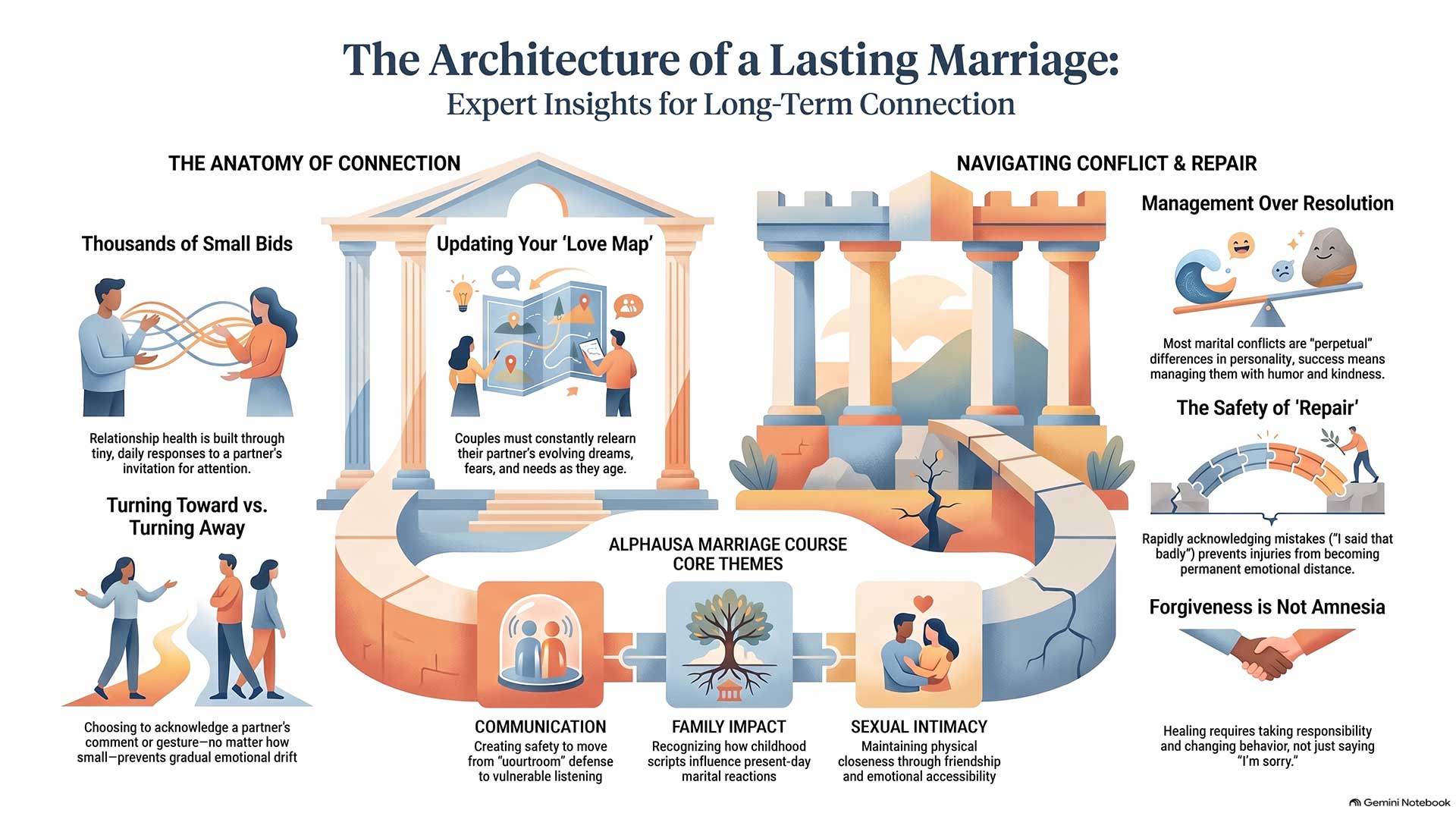
Seven topics and thirty-five questions never produce one secret to lifelong marriage.
Perhaps that is the point.
John and Julie Gottman remind us that love is built through ordinary moments.
A spouse says:
“Look at this.”
Do you look?
They reach for your hand.
Do you take it?
They seem upset.
Do you ask why?
Small responses can accumulate into closeness or distance.
Sue Johnson asks an even deeper question:
Can I reach you?
Many arguments about money, work, sex, chores, or family may hide something more vulnerable:
“Do I matter?”
“Will you choose me?”
“Are you here when I need you?”
Howard Markman and Scott Stanley remind us that love does not automatically create good communication. Couples may need to learn how to slow conflict, listen, and make deliberate decisions together.
David Olson and the Parrotts remind us that every spouse enters marriage carrying a childhood, a personality, family habits, and expectations about money, affection, conflict, sex, and responsibility.
Marriage gives two people the chance to ask:
What should we keep?
What should end with us?
Retrouvaille brings another reality.
Some couples are not asking how to improve a good marriage.
They are asking whether a damaged marriage can still be rebuilt.
That makes forgiveness more than simply saying, “I forgive you.”
Trust may need truth, responsibility, changed behavior, patience, and time.
Sexual intimacy carries many of these same themes.
Trust.
Aging.
Desire.
Rejection.
Affection.
Health.
Body image.
Resentment.
Sex after decades together may look different from early romance, but different does not have to mean poorer.
Then Gary Chapman brings us back to everyday love.
Perhaps the best question is not simply:
“What is my spouse's love language?”
Perhaps it is:
How many ways can I learn to say, “You matter to me”?
Words.
Time.
Touch.
Help.
Listening.
Presence.
A cup of coffee.
An apology.
A hand held during bad news.
After all seven conversations, one idea remains.
A lasting marriage may be built through thousands of returns.
You become distracted.
You return.
You argue.
You repair and return.
Children fill life.
You return.
Work takes over.
You return.
Bodies change.
You learn each other again.
The person beside you at sixty-five is not exactly the person you married at twenty-five.
Neither are you.
So you ask again:
Who are you now?
What do you need from me?
What makes you feel loved now?
Where have we become distant?
Can I still reach you?
Perhaps lifelong love is less about knowing someone once and more about continuing to meet them as both of you change.
And when your spouse reaches for you tomorrow, the question becomes:
How will you answer?
Short Bios:
Nicky and Sila Lee
Nicky and Sila Lee created The Marriage Course, a seven-session program covering connection, communication, conflict, forgiveness, family, sex, and love in action.
Dr. John and Dr. Julie Gottman
John and Julie Gottman are known for research and clinical work on couple relationships, including bids for connection, the Four Horsemen, repair, friendship, conflict, trust, and shared meaning.
Dr. Sue Johnson
Sue Johnson was the primary developer of Emotionally Focused Therapy and author of Hold Me Tight. Her work focused on attachment, emotional responsiveness, vulnerability, and relationship cycles.
Her participation here is reconstructed from her published work and recorded teaching.
Dr. Howard Markman and Dr. Scott Stanley
Markman and Stanley are closely associated with PREP, which focuses on communication, conflict prevention, commitment, and deliberate relationship decisions.
Dr. David Olson
David Olson developed Prepare/Enrich, an assessment system examining communication, conflict, personality, stress, family systems, intimacy, finances, and related areas.
Dr. Les and Dr. Leslie Parrott
Les and Leslie Parrott created SYMBIS, a relationship framework exploring personality, communication, conflict, expectations, faith, and intimacy.
Guy and Jeannine Beland
Guy and Jeannine Beland helped establish Retrouvaille for couples experiencing serious marital distress and disconnection.
Gary Chapman
Gary Chapman is best known for The 5 Love Languages, which describes five common ways people may express and receive love.
Fictional Conversation Note
This article presents an imagined conversation for education and reflection.
The participants did not meet for this discussion, and the dialogue is not direct quotation. Their perspectives are reconstructed from publicly available books, research, courses, interviews, and established relationship frameworks.
This article offers marriage education rather than individualized couples therapy.
Leave a Reply