

Introduction
Empty nest syndrome is often described as loneliness after children leave home, but the deeper transition can touch nearly every part of a parent's life.
How much should you call?
What happens to a marriage after decades of parenting?
What if being needed has become part of your identity?
How do holidays change when adult children build families of their own?
And after spending so many years helping a child become someone, who does the parent become next?
These five modern-day stories take the lessons from our earlier conversations and place them inside ordinary homes, phone calls, dinner tables, garages, holidays, and empty bedrooms.
Each story magnifies a different struggle.
Yet each eventually arrives at the same possibility:
letting go does not have to mean losing love.
(Note: This is an imaginary conversation, a creative exploration of an idea, and not a real speech or event.)
Story 1: The Text That Was Never Sent
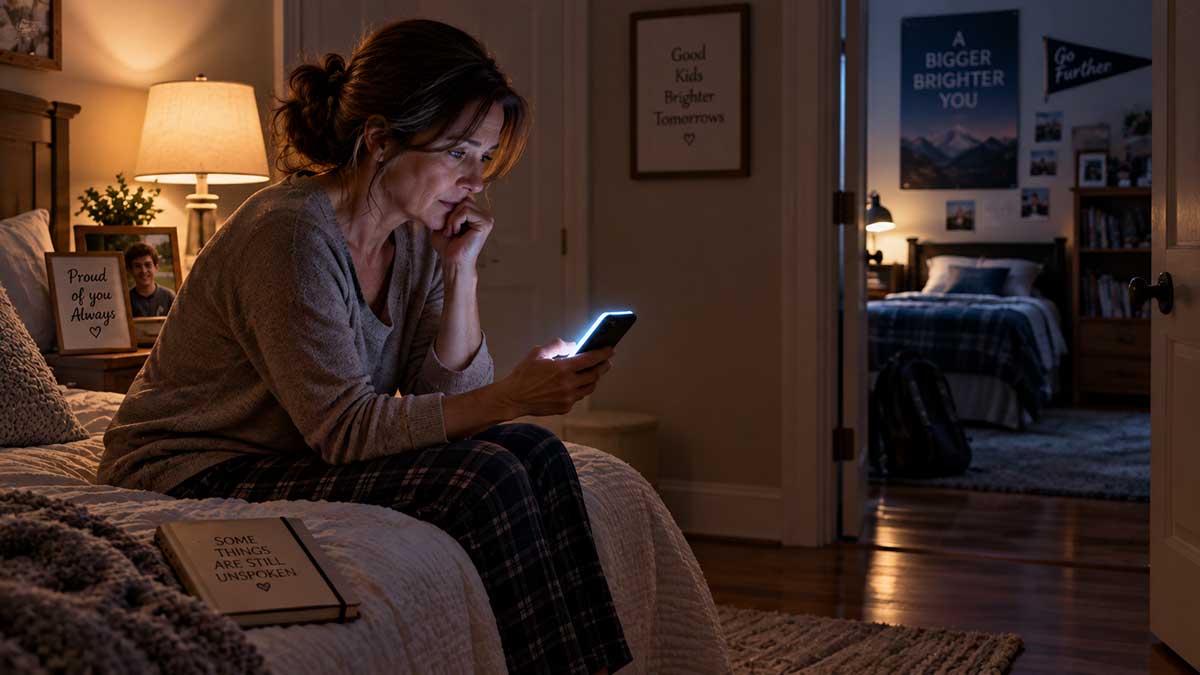
At 7:12 every morning, Linda Parker checked her phone.
For nineteen years, 7:12 had belonged to someone else.
“Ethan, get up.”
“Ethan, you're going to be late.”
“Ethan, breakfast.”
“Ethan, did you pack your charger?”
Now the hallway outside his bedroom stayed dark.
No shower running.
No drawers opening.
No footsteps coming down the stairs two at a time.
The first week after Ethan left for college, Linda still woke at 7:12 without an alarm.
Her body had not received the news that her job had changed.
That Wednesday morning, she reached for her phone before getting out of bed.
Nothing.
She opened their conversation.
The previous night's message sat at the bottom of the screen.
Sleep well. Love you.
Ethan had reacted with a heart at 11:48 p.m.
Linda stared at the small red symbol.
Then typed:
Good morning! Did you sleep okay? Big chemistry class today, right? 
She sent it.
Almost immediately she wondered if it was too much.
She placed the phone facedown.
Thirty seconds later, she turned it over.
No reply.
“Stop it,” she whispered.
She went downstairs.
Her husband Mark was pouring coffee.
“Anything from Ethan?”
Linda hated how quickly she answered.
“No.”
Mark looked at the clock.
“It’s seven twenty.”
“He has an eight o'clock class.”
“Then he's probably getting ready.”
“I know.”
Mark poured another cup.
Linda opened the refrigerator and stared inside.
There were still three bottles of Ethan's favorite protein drink on the bottom shelf.
She had bought twelve the week before he left.
She had known he was leaving.
Still, she had bought twelve.
Her phone buzzed.
Linda grabbed it.
A weather alert.
She put it back on the counter.
Mark watched her.
“You know he likes college, right?”
“I know.”
“He sounded happy Sunday.”
“I know.”
“That’s good.”
Linda turned sharply.
“Did I say it wasn't?”
“No.”
“Then stop talking to me like I'm upset that he's happy.”
Mark lifted both hands slightly.
“I didn't say that.”
Linda closed the refrigerator.
She wasn't angry at Mark.
That made it worse.
She carried her coffee into the living room and sat in the chair where Ethan used to throw his backpack every afternoon.
At 8:03, her phone finally buzzed.
yeah slept good running to class love you
Linda smiled.
Then frowned.
No punctuation.
No question for her.
No “How are you?”
She reread it.
Then caught herself rereading it.
She put the phone down.
“Love you,” she said aloud.
That should have been enough.
It did not feel like enough.
By the third week, Linda had developed rules for herself.
Never send more than two texts without a response.
Never ask why he hasn't called.
Never mention seeing him active on Instagram.
Never say how quiet the house feels.
Never tell him that she sometimes opened his bedroom door just to smell the room.
She broke almost every rule except the last one.
Some days Ethan called.
Those were good days.
He told her about his roommate, Caleb, who snored.
About a professor who talked so quickly that everyone recorded lectures.
About a girl named Hannah who lived two floors above him and had convinced six people to go out for Korean fried chicken at midnight.
Linda listened to every detail.
She learned the names of people she had never met.
Caleb.
Hannah.
Tyler.
Jasmine.
Owen.
Each new name made her happy.
Each new name frightened her a little.
There had once been a time when Linda knew everyone who mattered in Ethan's life.
Now entire friendships were forming without her ever seeing them begin.
One Friday, Ethan called while walking across campus.
His voice was bright.
“Mom, guess what? I got an eighty-eight on that chemistry exam.”
“That's great!”
“I thought I bombed it.”
“I told you you'd do fine.”
“Hannah got a ninety-six. She's ridiculous.”
There was Hannah again.
Linda smiled even though Ethan could not see her.
“You studying together?”
“Yeah. A bunch of us.”
“That’s good.”
Someone shouted Ethan's name in the background.
“Hold on,” he said.
Linda heard laughing.
A girl said something she couldn't make out.
Then Ethan came back.
“Sorry, Mom. We're going to grab food.”
“Oh. Sure.”
“I'll call you later.”
“Tonight?”
A pause.
“Maybe. We're going out after.”
Linda heard herself say it before she could stop.
“You're always going somewhere.”
Another pause.
“What?”
“Nothing. I just meant you're busy.”
“Yeah.”
“That’s good. I want you to be busy.”
“Okay.”
Linda hated the word immediately.
Okay.
He had felt it.
The weight she was trying so hard not to put on him.
“Have fun,” she said brightly.
“Thanks. Love you.”
“Love you too.”
The call ended.
Linda stood in the kitchen holding the silent phone.
On the counter sat a pot of chili large enough for four people.
She had made Ethan's favorite recipe without realizing what she was doing.
Mark entered from the garage.
“Smells good.”
Linda looked at the pot.
“I made too much.”
“We'll freeze it.”
She stared at him.
“I keep doing that.”
“Doing what?”
“Cooking like he's coming home.”
Mark walked closer.
“He is coming home.”
“You know what I mean.”
He did.
That Sunday, Ethan did not call.
Linda told herself she would not care.
At 3:00 she cleaned the bathroom.
At 3:40 she reorganized a drawer that did not need reorganizing.
At 4:15 she walked Luna around the block.
At 5:03 she checked her phone.
Nothing.
At 5:37 she typed:
How was your weekend?
She deleted it.
At 6:12 she typed:
Haven't heard from you today. Everything okay?
Deleted.
At 6:45 she saw that Ethan had posted a photograph.
Seven students around a table in a restaurant.
Ethan was in the middle.
Hannah sat beside him.
Everyone was laughing.
Linda enlarged the picture.
She knew she should not.
She did it anyway.
Her son looked completely happy.
For several seconds she felt nothing but joy.
Then came the other feeling.
He was happy somewhere she wasn't.
Someone else had heard the joke that made him laugh like that.
Someone else knew what he ordered.
Someone else had spent Sunday afternoon with him.
Linda put the phone down.
Five minutes later, she picked it up again.
Still no message.
Mark was watching football.
“You want to watch a movie later?” he asked.
“Maybe.”
At 7:26 she finally sent:
Looks like you're having fun.
Ten minutes.
No response.
Twenty.
Nothing.
At 7:59 she saw him active again.
Something inside Linda tightened.
She typed:
I guess you're too busy to talk to your mother now.
She stared at the sentence.
It was dramatic.
She knew that.
She deleted “too busy.”
Typed:
I guess you don't need your mother anymore.
Her thumb hovered above the arrow.
Then a memory came so sharply that she could almost hear her own mother's voice.
Linda was twenty-two.
She had just started her first job in Chicago.
Her mother called every evening.
If Linda didn't answer, another call came.
Then another.
Eventually the answering machine.
“Linda, I don't know why you can't find five minutes for your own mother.”
On weekends Linda sometimes wanted to stay in the city with friends.
Her mother would become quiet.
“Of course. You're young. You have your own life now.”
The words sounded generous.
The tone was not.
Linda remembered one Thanksgiving when she had wanted to visit Mark's family.
Her mother had cried.
“Maybe next year we'll still be alive.”
Linda had gone home.
She remembered sitting at that Thanksgiving table furious at herself, furious at her mother, smiling through dinner so no one would know.
Then one day, she had begun calling less.
Not from lack of love.
She loved her mother deeply.
She called less since every call carried an invisible bill.
Linda looked again at the message on her phone.
I guess you don't need your mother anymore.
Her stomach turned.
She imagined Ethan reading it at the restaurant.
His smile fading.
Maybe he'd excuse himself.
Maybe he'd call from outside.
Not since he wanted to.
Since he felt guilty.
Linda held the delete key.
The sentence disappeared.
She sat very still.
Then typed:
Hope you're having a great night. No need to reply. Love you.
She read it once.
Sent.
Then she did something surprisingly difficult.
She left her phone upstairs.
Mark looked over when she came into the living room.
“Movie?”
Linda nodded.
“Movie.”
Halfway through, she forgot about the phone.
Not completely.
But enough.
When the movie ended, she climbed the stairs.
The phone showed one missed call.
Ethan.
Her heart jumped.
Then he called again.
Linda answered immediately.
“Hi.”
“Hey, Mom.”
“You okay?”
“Yeah. Why?”
“No reason.”
“We just got back.”
“Looks like you had fun.”
“You saw the picture?”
“I did.”
“That place was amazing. Caleb ate something so spicy he started crying.”
Linda laughed.
Ethan talked for twenty minutes.
He told her about chemistry.
A professor.
A stupid argument in the dorm.
Hannah's obsession with finding the best coffee in town.
The possibility of joining an engineering club.
Linda listened.
Then there was a short silence.
“Mom?”
“Yeah?”
“Can I tell you something?”
Her body tensed.
“Of course.”
“You're doing better.”
Linda frowned.
“At what?”
“You know.”
“No, I don't.”
“With me being here.”
She said nothing.
Ethan continued.
“At first I felt like if I didn't answer right away, you'd think something happened.”
Linda swallowed.
“I worried.”
“I know.”
“I still worry.”
“I know.”
Another pause.
“I like talking to you.”
“I like talking to you too.”
“No, I mean... I really do. I like calling you.”
Linda waited.
“It feels different now.”
“How?”
Ethan seemed embarrassed.
“When I don't feel like I'm supposed to.”
The words hurt.
Linda closed her eyes.
She wanted to defend herself.
She wanted to say:
I never forced you to call.
I only worried.
I only missed you.
I only love you.
Every sentence was true.
None answered what he had actually said.
So she asked:
“Did it feel like that before?”
“Sometimes.”
Linda sat on the edge of the bed.
“I didn't know.”
“I know.”
“I'm sorry.”
“You don't have to be sorry.”
“No. I think I do.”
Ethan was quiet.
Linda looked through the open doorway at his bedroom across the hall.
“I miss you more than I know what to do with sometimes.”
“I miss you too.”
“But that's not your job.”
“What isn't?”
“To fix that.”
She heard him breathe.
Then he said softly:
“Okay.”
Linda laughed through tears.
“That sounded very therapist-like, didn't it?”
“A little.”
“Don't tell anyone.”
“I'll tell Hannah.”
“Absolutely not.”
Ethan laughed.
And Linda felt something loosen.
Not disappear.
Loosen.
“Mom?”
“Yes?”
“I made your ramen yesterday.”
She sat up.
“You did?”
“Sort of.”
“What does ‘sort of’ mean?”
“It was bad.”
“You followed the recipe?”
“I think so.”
“Did you use miso paste?”
Silence.
“Ethan.”
“I used miso soup packets.”
Linda groaned.
“No wonder.”
“Caleb ate two bowls.”
“Caleb is clearly desperate.”
They both laughed.
For a moment, Linda could see him perfectly.
Not the nineteen-year-old walking across some college campus.
The eight-year-old standing on a kitchen chair beside her, stirring soup and asking when dinner would be ready.
Then the image changed.
She saw him as he was now.
Far away.
Building something.
His own routines.
His own friends.
His own mistakes.
His own life.
Linda had spent nineteen years teaching him how to live without her standing beside him.
She had never realized that success would require her to learn something too.
How to love someone without constantly reaching for them.
“How about next time you call me before you cook?” she said.
“I thought I'm supposed to be independent.”
“You can be independent and still use actual miso.”
“Good point.”
They talked another ten minutes.
Then Ethan said he had to go.
“Love you, Mom.”
“Love you too.”
Linda almost said:
Call tomorrow.
She stopped.
“Have a good night.”
“You too.”
The call ended.
Linda remained on the bed.
The house was quiet.
It still hurt.
She had hoped there would be some magic moment when silence stopped feeling like absence.
There wasn't.
Across the hallway, Ethan's bedroom remained empty.
Downstairs, there would still be too much chili.
Tomorrow morning she would probably wake at 7:12.
She would probably check her phone.
She was still his mother.
She was still learning.
Linda opened their text conversation.
For once, she did not type anything.
She simply looked at his last message from earlier that afternoon.
A photograph of a terrible-looking bowl of ramen.
Underneath it he had written:
Need your help next time.
Linda smiled.
Then she placed the phone on the nightstand and turned off the light.
For years she had believed closeness meant being needed.
That night she began learning something quieter.
Sometimes love stayed close by leaving enough room for someone to return on their own.
Story 2: Dinner for Two
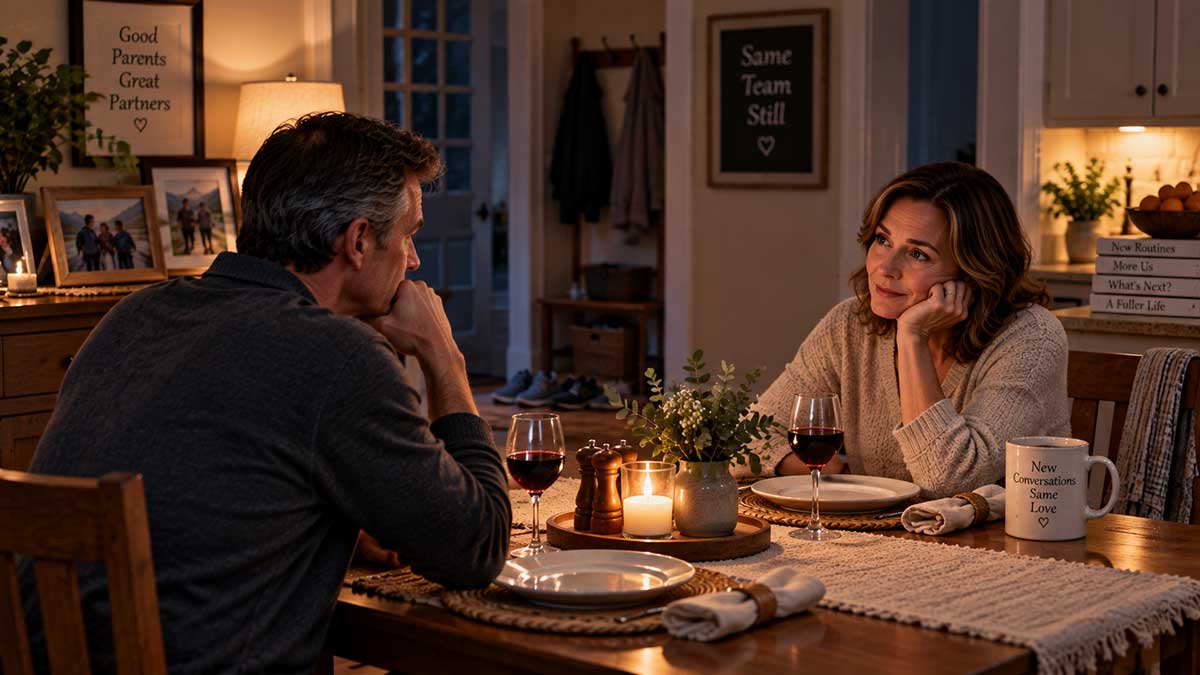
Maria Alvarez still cooked for four.
Not every night.
Just often enough that David noticed.
The first time it happened after their youngest daughter moved out, Maria made chicken enchiladas in the same large baking dish she had used for years.
Twelve enchiladas.
Three bowls of toppings.
A full pot of rice.
Enough beans for a small gathering.
David came into the kitchen, looked at the table, then at Maria.
“Who's coming?”
Maria stopped.
“No one.”
David glanced at the casserole dish.
“Then we’re going to be eating enchiladas until Thursday.”
Maria forced a smile.
“I can freeze some.”
He nodded.
Neither said what both were thinking.
There had always been someone coming.
Their oldest son, Daniel, had been the first to leave.
Then Sofia.
Then, three weeks ago, Emily had moved to another city for her first full-time job.
Twenty-seven years of parenting had ended with two cardboard boxes, three hugs, a car pulling away, and Maria standing in the driveway waving long after Emily could no longer see her.
Now the house felt too organized.
No shoes by the stairs.
No hair ties on bathroom counters.
No half-empty coffee mug left beside the couch.
No voice from upstairs calling:
“Mom, did you see my blue sweater?”
Maria had spent years wanting the house to stay cleaner.
Now the clean counters looked like evidence.
That evening, she set four plates.
She realized what she had done only after placing the forks.
David quietly removed two settings and carried them back to the cabinet.
Maria watched him.
“You didn’t have to do that.”
“We only need two.”
“I know.”
He nodded.
They sat down.
For several seconds, they ate without speaking.
Then Maria asked:
“Did Emily text you?”
“No.”
“She sent me a picture this afternoon.”
“What of?”
“Her desk.”
“Nice?”
“It’s small.”
David smiled.
“She just started.”
“I know.”
“She likes the job?”
“She says she does.”
“Good.”
Silence.
Maria took another bite.
“Daniel called yesterday.”
“Everything okay?”
“Yes. He and Rachel are thinking about replacing the kitchen floor.”
“What are they putting in?”
“I don’t know. Something vinyl.”
David nodded.
More silence.
Maria looked up.
“Did you hear Sofia might come home next month?”
“No.”
“She told me Sunday.”
“That’ll be nice.”
“Yes.”
Another silence.
David reached for the hot sauce.
Maria suddenly put down her fork.
“Is this what we're going to do now?”
David looked at her.
“What?”
“This.”
“Eat dinner?”
“No.”
She gestured between them.
“This.”
He waited.
Maria felt irritated that she had to explain it.
“We talk about the children.”
“We always talk about the children.”
“That’s what I mean.”
David leaned back.
“I’m not following.”
Maria looked at him.
“When was the last time we had dinner and talked about us?”
He frowned.
“We talk all the time.”
“About what?”
“Everything.”
“Name something.”
David stared at her.
Maria waited.
He looked toward the kitchen.
“Work.”
“You tell me your schedule.”
“That counts.”
“It doesn’t.”
“Why not?”
“Since I know when your meetings are does not mean I know you.”
The room changed.
David’s face hardened slightly.
“That’s a little dramatic.”
Maria laughed once.
“See?”
“See what?”
“You don’t even understand what I’m saying.”
“Then explain it.”
She wanted to.
She could not find the words.
Twenty-seven years of marriage should have made this easier.
Instead she said:
“Forget it.”
She stood and carried her plate to the sink.
David remained at the table.
“Maria.”
“I said forget it.”
He watched her scrape food into the disposal.
“You’re upset that Emily left.”
Maria turned.
“Yes.”
“Okay.”
“But that’s not all.”
“What else is there?”
She looked at him for several seconds.
Then said the sentence that had been sitting inside her for weeks.
“I miss us.”
David blinked.
“We’re right here.”
“No, we’re not.”
His expression changed from confusion to hurt.
“That’s not fair.”
“I didn’t say you were a bad husband.”
“Sounds like it.”
“I said I miss us.”
“We’ve been married thirty years.”
“Exactly.”
David stood.
“What is that supposed to mean?”
Maria folded her arms.
“It means we became really good at running this family.”
“Is that bad?”
“No.”
“We raised three kids.”
“I know.”
“Good kids.”
“I know.”
“We got them through school.”
“Yes.”
“College.”
“Yes.”
“Jobs.”
“Yes, David.”
“And now suddenly that wasn’t enough?”
Maria looked at him.
“That’s exactly the problem.”
He stared back.
She continued.
“It was enough for so long that we stopped asking for anything else.”
He said nothing.
Maria’s voice softened.
“I know what you think Daniel should do with his kitchen floor.”
David almost smiled.
She continued.
“I know you think Sofia should stop changing jobs.”
His smile disappeared.
“I know you worry Emily spends too much.”
“I do.”
“I know you think Daniel drinks too much coffee.”
“He does.”
“I know you hate that Rachel drives at night.”
“She drives too fast.”
“David.”
“Okay.”
Maria looked at him.
“But I don’t know what you want anymore.”
He frowned.
“What do you mean?”
“What do you want?”
“For what?”
“For you.”
He looked at her as if the question were written in another language.
Maria gave a small, sad laugh.
“That’s what I mean.”
David looked away.
“I don’t know what you want either.”
The honesty of it surprised both of them.
Maria sat back down.
David did too.
They stayed there after the food had gone cold.
Finally David said:
“When did that happen?”
Maria shook her head.
“I don’t know.”
Neither blamed the children.
That would have been too easy.
Parenthood had been beautiful.
Exhausting.
Funny.
Messy.
Expensive.
Loud.
They had loved those years.
Yet somewhere during them, they had started functioning mainly as a unit.
Who was picking up whom.
Who was paying which bill.
Who was going to parent-teacher night.
Who was calling the dentist.
Who was dealing with the broken dishwasher.
Who was cooking.
Who was staying home with a sick child.
Their teamwork had become so efficient that they stopped noticing what was missing.
The next evening, Maria made enough food for two.
She noticed this before David did.
Two salmon fillets.
Two baked potatoes.
A small salad.
David sat down.
“Look at that.”
“What?”
“Correct portions.”
Maria smiled.
“Progress.”
They started eating.
For the first five minutes, they talked about Emily.
Then Daniel.
Then Sofia.
Maria put down her fork.
“New rule.”
David looked wary.
“What?”
“For thirty minutes, we cannot talk about the kids.”
He laughed.
“You’re serious?”
“Yes.”
“What are we supposed to talk about?”
Maria stared at him.
“That’s terrifying.”
“It kind of is.”
“Fine.”
David looked at the clock on the microwave.
“Thirty minutes?”
“Thirty.”
“Starting now?”
“Starting now.”
He nodded.
Silence.
Maria waited.
David drank water.
Maria moved a piece of lettuce around her plate.
Thirty seconds felt like five minutes.
David finally said:
“How was your day?”
Maria sighed.
“No work questions.”
“That wasn’t a work question.”
“You say it every day.”
“Since I care.”
“I know. Ask me something different.”
David thought.
“What?”
“Anything.”
“What kind of anything?”
Maria laughed.
“This is going well.”
He smiled.
Then became serious.
“What do you miss?”
Maria looked at him.
“About what?”
“Before.”
She did not answer right away.
Then she said:
“Dancing.”
David blinked.
“You never dance.”
“Exactly.”
“You used to.”
“So did you.”
“No.”
“You did.”
“I survived dancing.”
“You loved it.”
“I loved you.”
“That was your excuse.”
“It worked.”
Maria smiled.
David looked down at his plate.
“I miss road trips.”
She looked at him.
“With the kids?”
“No.”
That surprised her.
“Before them.”
Maria remembered.
The old Honda.
Two suitcases.
A road atlas.
No reservations.
Driving until they found somewhere cheap to sleep.
“You hated not having reservations.”
“I pretended.”
“Why?”
“I wanted you to think I was spontaneous.”
Maria laughed.
“You?”
“I was twenty-six.”
“You alphabetized the glove compartment.”
“I did not.”
“You absolutely did.”
They laughed harder.
Something in the room shifted.
Not dramatically.
No music started.
No emotional speech followed.
Yet for the first time in weeks, dinner felt less like the aftermath of something.
The next night they tried again.
No children for thirty minutes.
It was awkward.
Then easier.
They talked about books.
Retirement.
David admitted he was frightened of it.
Maria had never known.
He confessed that he sometimes sat in the car after work for ten minutes before coming inside, not from unhappiness, but since he liked having a few minutes when no one needed anything from him.
Maria admitted she had once considered going back to school after Emily entered high school but had convinced herself it was too late.
“For what?” he asked.
“Interior design.”
David looked surprised.
“You would have been good at that.”
“You never knew I wanted to?”
“No.”
That hurt.
Then she realized she had never told him.
Their children had not stolen these conversations.
They had simply filled every available space.
One Thursday evening, David came home wearing running shoes.
Maria looked down.
“What are those?”
“Shoes.”
“You don't run.”
“I know.”
“Then why are you dressed like a man having a crisis?”
David laughed.
“Come outside.”
“For what?”
“A walk.”
Maria looked at the chicken simmering on the stove.
“Dinner.”
“Turn it off.”
“You’re serious?”
“Twenty minutes.”
She studied him.
Then turned off the burner.
They walked around the neighborhood.
At first, they discussed a neighbor's new fence.
Then David pointed at a house for sale.
“What if we moved someday?”
Maria stopped walking.
“You love this house.”
“I do.”
“We raised the kids here.”
“I know.”
She looked at him carefully.
“You’ve thought about moving?”
“Not seriously.”
“Where?”
“I don’t know.”
“Beach?”
“Too expensive.”
“Mountains?”
“Too cold.”
“City?”
“Too many people.”
Maria laughed.
“So nowhere.”
“Maybe.”
They continued walking.
A few houses down, a man was helping an older neighbor repair a porch railing.
David nodded toward them.
“I should fix our back step.”
Maria groaned.
“There. That’s you.”
“What?”
“One emotional conversation and you immediately return to home maintenance.”
“Back steps are important.”
She slipped her arm through his.
“You can fix it Saturday.”
He looked down at her arm.
It had been years since they walked like that.
He did not say anything.
Neither did she.
Weeks passed.
Their rule changed.
It was no longer thirty minutes without talking about the children.
Sometimes they went an entire dinner before realizing they had not mentioned them.
Maria began taking an evening design class at a local community college.
The first night she nearly backed out.
David drove her.
“You don’t have to wait,” she said.
“I know.”
“Then why are you sitting here?”
“I want to see you go in.”
She laughed.
“What am I, twelve?”
“Apparently.”
She kissed him and got out.
David started researching weekend road trips.
Not expensive ones.
Small towns.
Museums.
State parks.
Restaurants they had never tried.
The first trip went badly.
Rain.
A hotel room beside an ice machine.
A restaurant that lost their reservation.
Maria said:
“This is exactly like when we were twenty-six.”
David said:
“Except now my back hurts.”
They laughed in bed until after midnight.
Three months after Emily moved away, she came home for a weekend.
Maria heard her key in the front door and hurried from the kitchen.
“Mom!”
Emily dropped her bag and hugged her.
David came in from the garage.
“There she is.”
Emily hugged him too.
For two days the house became loud again.
Doors opening.
Music upstairs.
Shoes by the staircase.
Three coffee mugs on the counter.
Maria loved every second.
Sunday afternoon, she and David were cooking together when Emily walked into the kitchen.
David was chopping onions.
Maria was stirring sauce.
Music played from a speaker.
David said something Maria could not hear over the blender.
“What?”
He repeated it.
Maria started laughing.
Emily stood in the doorway watching them.
“What is going on with you two?”
Maria turned.
“What?”
“You're weird.”
David pointed the knife at her.
“Careful.”
“No, seriously.”
Emily smiled.
“You seem different.”
Maria looked at David.
David raised an eyebrow.
Maria said:
“We're dating.”
Emily stared.
“What?”
“We decided to start dating.”
“You are married.”
“We know.”
“For thirty years.”
“That's why it was overdue.”
Emily made a face.
“That is deeply disturbing.”
David laughed.
“Get used to it.”
Emily opened the refrigerator.
“I leave for three months and you guys become romantic?”
“Apparently,” Maria said.
Emily grabbed a drink.
“Well, good.”
The words were casual.
Yet Maria heard something underneath them.
Relief.
Maybe Emily had worried too.
Not about whether her parents would survive without her.
About whether they knew how to live without organizing their lives around her.
That evening, after Emily went upstairs, Maria and David sat outside.
The house was noisy again.
Maria could hear a drawer closing upstairs.
Then footsteps.
Then the shower.
For a moment, the old life returned so completely that Maria felt a physical ache.
David reached for her hand.
“You okay?”
“Yes.”
“You sure?”
Maria listened.
“I miss this.”
“I know.”
“She leaves tomorrow.”
“I know.”
Maria rested her head against his shoulder.
“But it’s different now.”
“How?”
She thought for a moment.
“Before, when the kids left, I thought the house was what became empty.”
David waited.
“I think I was afraid we were empty too.”
He squeezed her hand.
“And now?”
Maria looked through the window into the kitchen.
Two wine glasses stood beside the sink.
Her class project was spread across the dining table.
David's map for their next road trip sat beside it.
Emily's shoes were by the door.
For one weekend, old life and new life existed in the same house.
“No,” she said quietly.
“We were just out of practice.”
David smiled.
The next morning, they hugged Emily goodbye.
Maria cried.
She did not apologize for it.
Emily drove away.
The street became quiet.
Maria stood beside David for a moment.
Then he asked:
“Coffee?”
“Sure.”
They went inside.
Maria reached automatically for three mugs.
She stopped.
Looked at the third one.
Then placed it back on the shelf.
Not sadly.
Not happily.
Simply knowing.
She poured two cups.
David sat at the table.
Maria joined him.
No television.
No phones.
No urgent family problem waiting to be solved.
Just two people.
After nearly thirty years of marriage, they were discovering that the children had not been the only story they had written together.
There were still pages left.
And this time, they had time to read what the other person wanted to write next.
Story 3: The Father Who Kept Fixing Everything
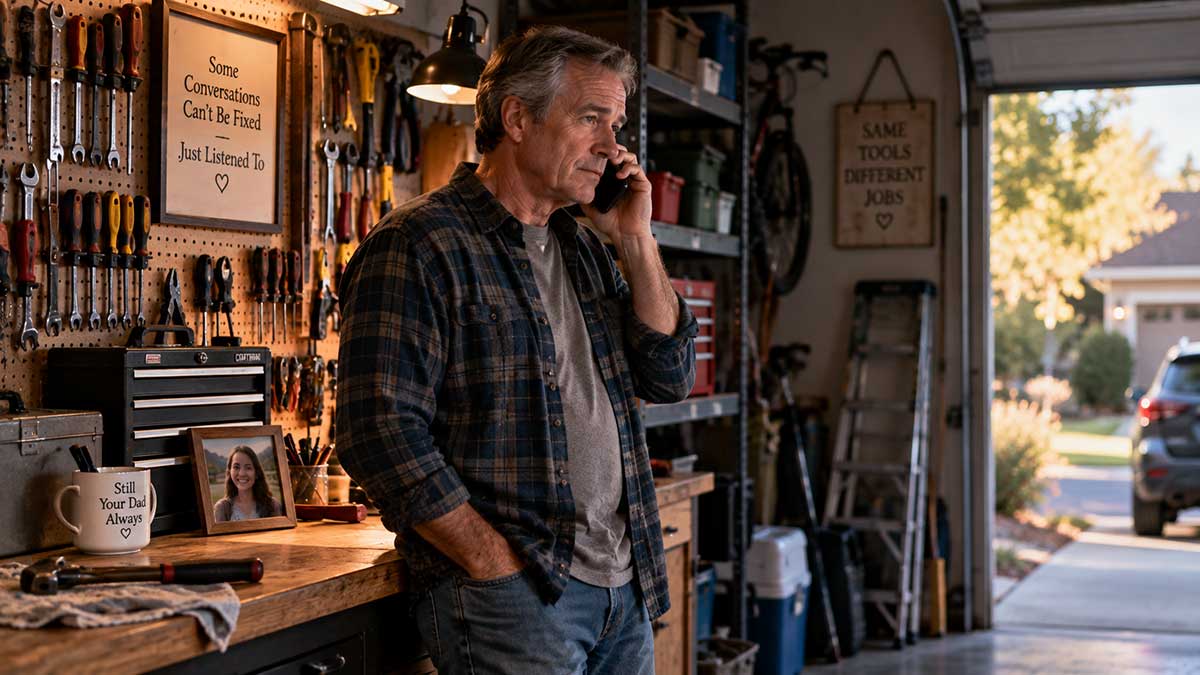
Robert Hayes could repair almost anything.
Toasters.
Cabinet hinges.
Leaking faucets.
Lawn mowers.
Laptop chargers.
Broken drawer tracks.
A jammed garbage disposal.
A car that made “a weird clicking sound.”
His garage had three pegboards of tools arranged by size.
Every wrench had a place.
Every screwdriver had a place.
Every problem, in Robert’s experience, had a solution if you looked long enough.
His daughter Sophie had known this since childhood.
At eight, she brought him a broken music box.
At twelve, a bicycle chain.
At sixteen, a car battery.
At nineteen, a laptop that would no longer turn on.
At twenty-two, a tax return.
At twenty-four, a lease agreement.
Whenever Sophie said:
“Dad, can you help me?”
something inside Robert stood taller.
He rarely said:
“I love you.”
He said:
“Bring it over.”
“Send me the numbers.”
“Let me take a look.”
“Don’t touch anything until I get there.”
That was how love sounded in Robert’s house.
Then Sophie moved six hundred miles away.
Her new job was at an engineering firm in Raleigh.
Robert had helped pack the moving truck.
He had made a list titled:
THINGS TO CHECK IN FIRST APARTMENT
Smoke detectors.
Water shutoff.
Circuit breaker.
Tire pressure.
Emergency contacts.
Renters insurance.
Flashlight.
Spare key.
Sophie laughed when she saw it.
“You know I’m twenty-five, right?”
“That has nothing to do with electrical fires.”
She hugged him.
“I’ll call you.”
“You better.”
For the first month, she did.
The kitchen faucet dripped.
Robert explained how to tighten the aerator.
Her car made a noise.
Robert asked for a recording.
Her internet failed.
Robert gave her three possible causes before the technician arrived.
She bought a bookshelf and sent him a photograph.
Does this look level?
Robert enlarged the picture.
No. Left side is low.
She replied:
I knew you’d say that.
Robert smiled for ten minutes.
Then the calls began changing.
Not suddenly.
Gradually.
Sophie fixed the faucet herself.
A coworker helped with the bookshelf.
She found a mechanic near her apartment.
When her laptop froze, she watched a tutorial.
Robert learned about these things later.
Sometimes much later.
“You had car trouble?”
“Last week.”
“Why didn’t you call?”
“I got it handled.”
“I could’ve told you what to do.”
“I know.”
That phrase bothered him.
I know.
It sounded like a closed door.
One Saturday morning, Robert was replacing weather stripping around the back door when his wife, Diane, came outside.
“You’ve checked your phone six times.”
“No, I haven’t.”
“You just checked it.”
“I’m waiting for the hardware store.”
“The hardware store texts you now?”
Robert ignored her.
Diane leaned against the doorframe.
“She’ll call.”
“I didn’t say anything.”
“You don’t have to.”
He pressed the weather stripping harder than necessary.
“She used to call.”
“She still calls.”
“Not like before.”
Diane was quiet.
Robert looked at her.
“What?”
“Nothing.”
“Say it.”
“She doesn’t need help with every little thing anymore.”
Robert turned back to the door.
“That’s good.”
“I know.”
“That’s what we wanted.”
“I know.”
“Then stop looking at me like that.”
Diane went inside.
Robert finished the job.
Then inspected it three times.
That evening Sophie called.
Robert answered on the first ring.
“Hey.”
“Hey, Dad.”
“You okay?”
“Yeah.”
“Car?”
“No.”
“Apartment?”
“No.”
“What happened?”
Sophie laughed.
“Can I call without something breaking?”
“Apparently.”
He smiled.
Then he heard something in her voice.
“What’s wrong?”
She sighed.
“Work.”
Robert stood straighter.
“What happened?”
“My project manager tore apart my presentation in front of everyone.”
“What did he say?”
“That my assumptions were sloppy and my cost estimates weren’t defensible.”
“Were they?”
“Dad.”
“I’m asking.”
“I don’t know. Maybe some of them.”
“Okay. Did you save the presentation?”
“Yes.”
“Good. First thing tomorrow, pull every assumption into a separate sheet. Then check your inputs against source data.”
Sophie went quiet.
Robert continued.
“And document his comments. Word for word if you remember them. If this becomes a pattern, you need a record.”
“Dad.”
“Then schedule fifteen minutes with him before the next review.”
“Dad.”
“Don’t go in defensive. Ask him exactly what standard he expects.”
“Dad.”
“What?”
Silence.
Then:
“I didn’t call for a project plan.”
Robert stopped.
“What does that mean?”
“I had a terrible day.”
“I know. I’m helping.”
“I know you are.”
“Then what’s the problem?”
“I don’t know.”
“You called me.”
“I know.”
“About work.”
“Yes.”
“So I’m telling you what to do.”
“I didn’t ask what to do.”
Robert frowned.
“Then why did you call?”
The silence that followed was longer this time.
Sophie said quietly:
“I think I just wanted my dad.”
Robert stared at the garage wall.
Every tool in front of him was exactly where it belonged.
The sentence was not.
“You have your dad.”
“That’s not what I mean.”
“Then what do you mean?”
“I don’t want everything fixed.”
“That makes no sense.”
“I know.”
“If something is wrong, you fix it.”
“Sometimes I just want to be upset.”
Robert almost laughed.
“Why?”
Sophie sighed.
“See?”
“What?”
“This.”
“What am I doing?”
“You make everything into a problem.”
“It is a problem.”
“No. My presentation is a problem. Me calling you is not.”
Robert felt irritation rising.
“I’m trying to help you.”
“I know.”
“There’s that again.”
“What?”
“‘I know.’”
Sophie went quiet.
Robert continued.
“You call me with a problem and then get mad when I give you a solution.”
“I’m not mad.”
“You sound mad.”
“I’m tired.”
“Then go to sleep.”
The sentence came out colder than he intended.
Another silence.
“Okay,” Sophie said.
“Sophie.”
“I should go.”
“I didn’t mean...”
“It’s fine.”
“No, it’s not.”
“I’ll talk to you later.”
The call ended.
Robert stared at the phone.
He wanted to call back.
He wanted to tell her exactly why her project manager’s criticism was probably useful.
He wanted to explain that young employees often took feedback too personally.
He wanted to send her a template.
He did none of those things.
Diane walked into the garage.
“How is she?”
“Fine.”
“That didn’t sound fine.”
Robert put the phone on his workbench.
“She called about work.”
“And?”
“And apparently I’m not supposed to help.”
Diane looked at him.
“What did she ask you for?”
“Nothing.”
“Maybe that was the point.”
Robert laughed once.
“Very helpful.”
“I’m serious.”
“So was I.”
Diane walked closer.
“When I tell you I had a bad day, do you always think I want instructions?”
Robert looked at her.
“You usually do.”
“No.”
“You ask me what I think.”
“Sometimes.”
“What else would you want?”
“For you to say, ‘That sounds awful.’”
Robert stared.
“That’s it?”
“Sometimes.”
“That doesn’t solve anything.”
Diane smiled sadly.
“Exactly.”
Robert shook his head.
“I don’t get people.”
“You get machines.”
“Machines make sense.”
“They also don’t call their fathers after a bad presentation.”
Diane went inside.
Robert stayed in the garage.
He picked up a wrench.
Put it down.
Picked up his phone.
Opened Sophie’s contact.
Closed it.
For the next four days, she did not call.
Robert told himself he did not care.
On Monday, he reorganized a drawer of screws.
Tuesday, he changed the furnace filter three weeks early.
Wednesday, he cleaned the gutters.
Thursday afternoon, his elderly neighbor, Mr. Jenkins, waved from across the fence.
“Robert!”
Robert looked over.
Mr. Jenkins was standing beside his porch railing.
One side leaned noticeably.
“That thing finally give up?” Robert asked.
“Looks like it.”
Robert was already walking toward his garage.
“I’ll get my drill.”
“You don’t have to.”
“I know.”
Mr. Jenkins laughed.
“Of course you do.”
For the next hour they worked.
Mr. Jenkins held the railing steady.
Robert replaced two rotted boards.
Neither talked much.
Near the end, Mr. Jenkins said:
“Daughter still in North Carolina?”
“Raleigh.”
“Likes it?”
“I guess.”
“You guess?”
“She’s busy.”
Mr. Jenkins nodded.
“My son moved to Denver thirty years ago.”
“Thirty?”
“Thirty-two.”
“How often do you see him?”
“Couple times a year.”
Robert looked surprised.
“That’s it?”
Mr. Jenkins shrugged.
“Life.”
Robert tightened a screw.
“Doesn’t that bother you?”
“Used to.”
Robert looked at him.
“What changed?”
Mr. Jenkins thought for a moment.
“I stopped expecting him to prove he loved me the way I wanted him to.”
Robert returned to the screw.
“That sounds dramatic.”
“Probably.”
They worked in silence.
Then Mr. Jenkins added:
“He calls me every Sunday.”
“That’s good.”
“Sometimes we barely talk.”
Robert smiled.
“What do you do?”
“Mostly listen to him complain.”
“About what?”
“His boss. His knees. His wife. His kids.”
“You tell him what to do?”
Mr. Jenkins laughed.
“Used to.”
“And now?”
“Sometimes I ask if he wants advice.”
Robert stopped drilling.
Mr. Jenkins looked at him.
“What?”
“Nothing.”
“You got that look.”
“What look?”
“The one men get right before they pretend they didn’t learn something.”
Robert shook his head.
Mr. Jenkins smiled.
Then said casually:
“You know, you might be confusing being useful with being loved.”
Robert turned.
“What?”
“You like fixing things.”
“So?”
“Feels good when people need you.”
“There’s nothing wrong with that.”
“Didn’t say there was.”
Robert’s voice sharpened.
“Sophie is independent. I’m proud of her.”
“I’m sure you are.”
“Then what are you saying?”
Mr. Jenkins looked at the repaired railing.
“I’m saying a person can love you without needing a wrench.”
Robert said nothing.
That evening, he told Diane what Jenkins had said.
She laughed.
“What?”
“I’ve been telling you that for twenty-five years.”
“No, you haven’t.”
“Yes, I have.”
“Not like that.”
“Sorry I didn’t use enough lumber metaphors.”
Robert smiled reluctantly.
He checked his phone before bed.
Nothing from Sophie.
The next afternoon, it rang.
Her name appeared.
He answered.
“Hi.”
“Hey.”
Her voice sounded cautious.
Robert hated that.
“How are you?”
“Okay.”
“How’s work?”
She exhaled.
“Not great.”
His brain immediately started moving.
What happened?
What was said?
What is the solution?
He could almost feel the list forming.
Instead he said:
“Tell me.”
Sophie described another meeting.
The same project manager had challenged her numbers.
She had stayed late trying to redo part of the model.
She was embarrassed.
Angry.
Worried she was not good enough for the job.
Robert’s instinct screamed.
No. Wrong conclusion. Here is what you need to do.
He opened his mouth.
Then stopped.
Mr. Jenkins’ voice returned.
A person can love you without needing a wrench.
Robert took a breath.
“Sophie?”
“Yeah?”
“Do you want my opinion?”
She hesitated.
“Not really.”
Robert almost laughed.
“Okay.”
“Is that okay?”
“It’s new.”
She laughed softly.
“I know.”
He smiled.
“What do you want?”
Another pause.
“Can you just listen?”
Robert leaned back in his chair.
“Yeah.”
So he listened.
At first, badly.
His jaw tightened every time she said something he could correct.
He almost interrupted four times.
Once he actually said:
“Have you considered...”
Then stopped himself.
“Sorry.”
Sophie laughed.
“You’re trying.”
“I am.”
She continued.
She told him how small she had felt in the meeting.
How everyone else seemed more experienced.
How she worried she had been hired by mistake.
Robert wanted to tell her that was nonsense.
Instead he asked:
“What part scared you most?”
Sophie went quiet.
Then she answered.
“That maybe he was right.”
Robert nodded, though she could not see him.
“That’s hard.”
Three words.
Nothing fixed.
Sophie kept talking.
After twenty-five minutes, her voice sounded lighter.
Finally she said:
“I think I know what I need to do tomorrow.”
Robert smiled.
“What?”
“Ask him where my assumptions are weakest and rebuild that part.”
Robert nearly said:
Exactly. That’s what I was going to tell you.
He caught himself.
“That sounds reasonable.”
“You hate saying that, don’t you?”
“A little.”
She laughed.
Then came a pause.
“Dad?”
“Yeah?”
“Thanks.”
“For what?”
“For listening.”
“Anytime.”
“No, I mean... I really needed you tonight.”
Robert did not answer immediately.
His eyes moved toward the pegboard.
Wrenches.
Pliers.
Hammers.
Everything that had taught him one version of usefulness.
He looked down.
“You did?”
“Yeah.”
The word landed differently than every old:
“Dad, can you help me?”
This time there was nothing to repair.
Yet she had needed him.
“I’m glad you called,” he said.
“Me too.”
They talked for another ten minutes about almost nothing.
A new coffee shop.
Her roommate’s terrible cooking.
A movie Diane had recommended.
Then Sophie said:
“I should sleep.”
“Okay.”
“Love you.”
Robert swallowed.
“Love you too.”
The call ended.
He remained in the chair.
Diane entered the room.
“How’d it go?”
Robert looked at her.
“I didn’t fix anything.”
She smiled.
“Must’ve been brutal.”
“It was.”
“Did she survive?”
“Barely.”
Diane sat beside him.
Robert stared at the phone.
Then said:
“She said she needed me.”
Diane’s expression softened.
Robert looked almost confused.
“But I didn’t do anything.”
Diane rested her hand over his.
“Maybe that was the thing you did.”
A few weeks later, Sophie came home for a weekend.
On Saturday morning, Robert heard her in the garage.
He found her staring at a loose cabinet hinge.
“Dad?”
Robert looked at it.
Then at her.
She grinned.
“You want to fix something?”
His face lit up.
“Absolutely.”
They worked together.
Robert handed her the screwdriver.
“No, you do it.”
“You’re the expert.”
“You live six hundred miles away.”
“That sounds like emotional manipulation.”
“I’m evolving.”
She laughed.
He showed her how to align the hinge.
Then let her finish.
When she tightened the final screw, the cabinet door closed perfectly.
Robert nodded.
“Good.”
Sophie looked at him.
“You know what’s funny?”
“What?”
“I still like asking you.”
He smiled.
“I still like being asked.”
“But I don’t always need the answer.”
“I’m learning.”
She leaned against the workbench.
“Was that hard?”
“What?”
“When I stopped calling about everything.”
Robert looked at the tools.
He could have lied.
Instead:
“Yeah.”
Sophie’s face changed.
“I didn’t know.”
“I didn’t want you to.”
“Why?”
Robert thought.
“I think I liked knowing there was something only Dad could do.”
Sophie looked down.
Then back at him.
“There still is.”
“What?”
She shrugged.
“Be Dad.”
Robert laughed softly.
“That sounds very inefficient.”
“Terrible system.”
They stood there smiling.
Years earlier, Robert had believed the measure of fatherhood was how often he could step in.
Fix.
Carry.
Solve.
Protect.
Now Sophie could repair many things herself.
She could make decisions he disagreed with.
She could ask someone else for help.
She could get through entire weeks without needing his expertise.
At first, Robert had experienced each new competence as one less reason for her to call.
He had been wrong.
His daughter was not replacing him.
She was outgrowing the version of him that had once been necessary.
He did not need to become less of a father.
He needed to become a different one.
Someone who could hold a wrench when she needed one.
And keep both hands still when she did not.
Before Sophie left Sunday, she hugged him at the door.
“I’ll call this week.”
Robert almost said:
“When?”
Instead he smiled.
“Whenever.”
She looked surprised.
Then smiled back.
“Look at you.”
“Don’t get used to it.”
She laughed and walked toward her car.
Robert stood in the doorway.
Diane joined him.
“You okay?”
Robert watched Sophie pull away.
“Yeah.”
And for once, he meant it.
His daughter needed him less often.
That was true.
She loved him no less.
That was true too.
Robert had spent years believing love was something proven by problems only he could solve.
Now he was beginning to learn that sometimes love arrived with no broken part at all.
Sometimes it simply called.
And asked him to stay on the line.
Story 4: Christmas at Someone Else’s House

Carol Bennett believed Christmas morning belonged to her house.
Not legally.
Not officially.
But after thirty-one years, some traditions stop feeling like traditions and start feeling like facts.
Christmas morning meant cinnamon rolls at seven.
Coffee before presents.
Stockings first.
Then gifts.
Then eggs, bacon, fruit, and too much food.
Her husband, Jim, always complained about the amount of wrapping paper.
Their son Daniel always opened one present too quickly.
Their daughter Megan always took too many pictures.
Carol always saved the ribbons.
That was Christmas.
The same house.
The same staircase.
The same living room.
The same star on top of the tree.
The same red stocking with Daniel’s name stitched in white thread.
Carol had made that stocking when he was three.
That December, she found it in the storage box and ran her fingers over the letters.
D-A-N-I-E-L.
She smiled.
Then her phone rang.
Daniel.
“Merry almost Christmas,” he said.
Carol laughed.
“You’re early.”
“I know. Listen, Mom, I wanted to talk about Christmas morning.”
Something in his voice made her stop touching the stocking.
“Okay.”
“So Emma and I were thinking we’d do Christmas morning at her parents’ this year.”
Carol said nothing.
Daniel continued quickly.
“We’d come to you guys in the afternoon. Maybe around three.”
Carol looked at the tree.
The lights were on though it was still daytime.
“Christmas morning?”
“Yeah.”
“At her parents’?”
“Just this year.”
Carol sat down.
“Oh.”
“I know we always do yours.”
“No, no. It’s fine.”
“You sure?”
“Of course.”
“Emma’s mom asked us last year too, and we told her we were already committed to you guys.”
Carol’s jaw tightened slightly.
“So this is her turn?”
“I guess.”
Carol heard herself say:
“That sounds fair.”
“It is, right?”
“Yes.”
Daniel relaxed.
“Good. I was worried you’d be upset.”
Carol smiled, though no one could see.
“Why would I be upset?”
“I don’t know.”
“Daniel, you’re married now. You have two families.”
“Exactly.”
Carol hated the sentence.
Not since it was wrong.
Since it was right.
“Three o’clock?” she asked.
“Maybe a little before.”
“Fine.”
“Love you.”
“Love you too.”
After the call ended, Carol sat very still.
Then she looked at Daniel’s stocking.
She put it back into the box.
Jim came in carrying two grocery bags.
“You okay?”
“Yes.”
“What happened?”
“Nothing.”
He looked at her.
“What?”
She stood.
“Daniel and Emma are doing Christmas morning with her parents.”
Jim set the bags down.
“Oh.”
Carol waited.
That was all he said.
“Oh.”
“You don’t care?”
“I care.”
“You don’t sound like it.”
“What do you want me to say?”
“I don’t know.”
Jim looked at her.
“They’re coming here later, right?”
“Three.”
“That’s good.”
Carol stared at him.
“Good?”
“Yes.”
“Christmas morning has always been here.”
“I know.”
“With us.”
“I know.”
“And now suddenly it isn’t.”
Jim took a carton of eggs out of the bag.
“They got married.”
“I am aware.”
“We knew this would happen.”
Carol laughed without humor.
“No, you knew it theoretically.”
Jim paused.
“What does that mean?”
“It means there’s a difference between saying, ‘One day holidays will change,’ and actually waking up Christmas morning without your son.”
Jim was quiet.
Carol began putting groceries away.
“His whole life,” she said, “Christmas morning was here.”
“I know.”
“I made every Christmas.”
“I helped.”
“You plugged in the lights.”
“That was dangerous work.”
She gave him a look.
Jim stopped joking.
Carol continued.
“I cooked. I wrapped. I stayed up until two in the morning assembling toys. I made the stockings. I made the cinnamon rolls. I made everything feel like Christmas.”
Jim nodded.
“You did.”
“And now her family gets the morning.”
There it was.
Her family.
Jim leaned against the counter.
“This isn’t a contest.”
“It feels like one.”
“Then maybe that’s the problem.”
Carol turned.
“Excuse me?”
Jim raised his hands.
“I’m not criticizing you.”
“You just did.”
“I’m saying Daniel isn’t choosing them instead of us.”
“He is literally going there instead of here.”
“For one morning.”
“For Christmas morning.”
Jim sighed.
Carol continued.
“Do you know what Emma’s mother is probably doing right now?”
“No.”
“Celebrating.”
Jim almost smiled.
“I doubt she has a scoreboard.”
“You don’t know.”
Carol shut the refrigerator harder than necessary.
That evening she called Megan.
“You heard about Christmas?”
There was a pause.
“Daniel told me.”
“And?”
“And what?”
“You think this is normal?”
“Yes.”
Carol sat straighter.
“Megan.”
“Mom, he’s married.”
“So?”
“So Emma has parents too.”
“I know that.”
“Do you?”
Carol felt wounded.
“That’s rude.”
“I’m not trying to be rude.”
“Well, you are.”
Megan softened.
“I know it’s hard.”
“No, you don’t.”
“I have in-laws too.”
“You’re coming Christmas morning.”
“Since Josh’s family does Christmas Eve.”
Carol seized the point.
“Exactly. They figured it out.”
“Mom.”
“What?”
“Don’t make Daniel pay for marrying someone whose family wants Christmas morning too.”
Carol went silent.
“I’m not making him pay for anything.”
“I know.”
“Then why would you say that?”
“Since you sound like you’re already building a case.”
Carol ended the call ten minutes later feeling worse.
That night, while brushing her teeth, she thought of possible things she could say to Daniel.
None were technically lies.
Your father has been so tired lately.
True.
We don’t know how many Christmases we have left like this.
Also true.
Your grandmother would have been heartbroken to see this tradition end.
Probably true.
Then another sentence appeared.
I guess traditions just don’t matter anymore.
She stared at herself in the mirror.
That one felt powerful.
Sharp enough to reach him.
Sharp enough to hurt.
She did not send anything.
The next morning, Jim found her sitting at the kitchen table with a notebook.
“What are you doing?”
“Menu.”
“For Christmas?”
“Yes.”
“How many people are we feeding?”
Carol did not look up.
“I don’t know.”
Jim poured coffee.
“Carol.”
“What?”
“You’re angry.”
“I’m planning.”
“You plan when you’re angry.”
“That makes no sense.”
“You reorganized the pantry when Megan moved out.”
“It needed reorganizing.”
“You labeled the cereal.”
“It was efficient.”
Jim sat down.
Carol kept writing.
Ham.
Potatoes.
Green beans.
Rolls.
Pie.
Cake.
Cinnamon rolls.
Jim watched.
“Who are the cinnamon rolls for?”
Carol stopped.
They had always eaten cinnamon rolls Christmas morning.
Daniel loved them.
“They’re tradition.”
“But no one will be here.”
“We’ll be here.”
“Do you want cinnamon rolls?”
“No.”
“Neither do I.”
Carol looked at him.
Jim said gently:
“You’re cooking for a memory.”
That hurt more than he intended.
Carol closed the notebook.
“I don’t want to talk about this.”
Jim waited.
Then asked:
“Do you want him here?”
“Yes.”
“Happy?”
She frowned.
“What kind of question is that?”
“A real one.”
“Of course I want him happy.”
Jim took a breath.
“Do you want him here since he wants to be here, or since you made him feel guilty enough to come?”
Carol stared at him.
“I would never do that.”
Jim said nothing.
That silence made her angrier.
“You think I manipulate him?”
“No.”
“Then say no.”
“I think you’re hurting.”
Carol looked away.
“And I think hurt people sometimes say things they wouldn’t say if they weren’t scared.”
Carol’s eyes filled.
“Scared of what?”
Jim did not answer immediately.
Then:
“Being replaced.”
Carol stood.
“That’s ridiculous.”
She walked out.
But the question followed her.
Being replaced.
She hated it.
The phrase sounded childish.
Competitive.
Possessive.
She loved Emma.
Mostly.
Emma was kind.
Smart.
Patient with Daniel.
She remembered birthdays.
Brought flowers.
Helped with dishes.
Called Carol for recipes.
There was no reason to resent her.
Yet Emma had changed the geometry of the family.
Before marriage, every holiday had pointed home.
Now there were other houses.
Other parents.
Other traditions.
Other people who could reasonably say:
“We want you too.”
Carol had always believed family love expanded.
Now she was discovering that calendars did not.
A week before Christmas, their church announced a community breakfast.
Volunteers needed.
Christmas morning.
Carol barely listened.
Jim did.
“We should do that.”
“No.”
“Why?”
“Since I don’t want to spend Christmas morning serving powdered eggs.”
Jim laughed.
“They’re probably real eggs.”
“No.”
“We’ll be home doing nothing.”
“We are not doing nothing.”
“What are we doing?”
Carol opened her mouth.
Nothing came.
Jim continued.
“Daniel’s not coming until three.”
“I know.”
“Megan won’t be here until noon.”
“I know.”
“We could go from eight to eleven.”
Carol shook her head.
“No.”
Three days later, she changed her mind.
Not from enthusiasm.
From fear of the house.
Christmas morning arrived colder than expected.
Carol woke at 6:14.
For a few seconds she forgot.
Then remembered.
No Daniel.
The house was silent.
Jim slept beside her.
Carol stared at the ceiling.
At 6:45 she went downstairs.
The tree glowed in the dark room.
Presents sat beneath it.
Daniel’s gifts were there.
Emma’s gifts.
Megan’s.
Josh’s.
Stockings hung from the mantel.
Carol had put Daniel’s up after all.
She turned on the kitchen light.
No cinnamon rolls.
That had been Jim’s suggestion.
For the first time in thirty-one years, there were no cinnamon rolls on Christmas morning.
Carol opened the refrigerator.
Then closed it.
She started crying.
Quietly.
Not dramatically.
Just tears.
Jim came downstairs in sweatpants.
He saw her.
“Oh, honey.”
“I’m fine.”
“You’re crying.”
“I know.”
He hugged her.
Carol pressed her face into his chest.
“I hate this.”
“I know.”
“I know it’s stupid.”
“It’s not stupid.”
“It’s one morning.”
“I know.”
“I feel like something died.”
Jim held her tighter.
“Something ended.”
That was more accurate.
Not Daniel.
Not the family.
A version of Christmas.
A version of motherhood.
A time when everyone came home without negotiation.
Carol cried for another minute.
Then pulled away.
“We’re going to that breakfast.”
Jim blinked.
“Really?”
“Before I change my mind.”
The community center was louder than Carol expected.
Children running.
Coffee brewing.
Volunteers moving folding chairs.
The smell of pancakes.
Someone had put cheap red tablecloths on long tables.
Carol immediately noticed everything she would have done differently.
The centerpieces were crooked.
The syrup bottles did not match.
Someone had placed plastic forks with the napkins backward.
She nearly started fixing things.
Then a volunteer coordinator handed her an apron.
“Food line?”
Carol nodded.
“Fine.”
She served scrambled eggs for twenty minutes.
Then pancakes.
Then fruit.
A man in his seventies came through the line alone.
“Merry Christmas,” Carol said.
He smiled.
“Merry Christmas.”
“Coffee?”
“Please.”
He sat by himself.
A few minutes later Carol saw him still alone.
She looked at Jim.
“I’m taking a break.”
She carried coffee over.
“Mind if I sit?”
The man looked surprised.
“Please.”
His name was Walter.
His wife had died in March.
His daughter lived in California and had been unable to travel.
“First Christmas alone,” he said.
Carol looked down.
“I’m sorry.”
Walter shrugged.
“Hard morning.”
She nodded.
“I know something about that.”
He smiled.
“Someone die?”
Carol felt embarrassed.
“No.”
She almost stopped there.
Then said:
“My son got married.”
Walter waited.
“He’s at his wife’s parents’ house this morning.”
Walter stared at her.
Then smiled.
Carol laughed.
“I know. Compared to yours, it sounds ridiculous.”
“No.”
“It does.”
“It sounds different.”
That kindness surprised her.
Across the room, a young woman sat with two small children.
The boy was crying.
The mother looked exhausted.
Carol watched her cut pancakes with one hand while holding a toddler with the other.
“I’ll be back,” Carol told Walter.
She walked over.
“Can I hold her?”
The young mother looked startled.
Then relieved.
“If you don’t mind.”
Carol took the little girl.
The child immediately reached for Carol’s necklace.
“There we go.”
For the next hour, something strange happened.
Carol stopped checking the clock.
She poured coffee.
Held the toddler.
Found crayons for the boy.
Talked to a college student from Brazil who could not afford to fly home.
Helped an older couple carry food.
Straightened the centerpieces after all.
Jim caught her laughing with Walter.
He raised his eyebrows.
She ignored him.
At 10:52, Carol’s phone buzzed.
Daniel.
She looked at the screen.
A photograph.
Daniel and Emma standing with Emma’s parents.
Everyone in pajamas.
Coffee mugs.
A Christmas tree behind them.
Daniel looked happy.
Very happy.
Carol felt the old sting.
Then something new arrived beside it.
She enlarged the photograph.
Emma’s mother had one arm around Daniel.
For the first time, Carol did not see theft.
She saw someone else loving her son.
She stared at the picture for a long time.
Then typed:
Merry Christmas. You all look wonderful. Have a beautiful morning. See you later.
She sent it.
No hidden message.
No guilt.
No test.
At 11:18 Daniel replied:
Love you Mom. Thank you. See you soon.
Carol read the word.
Thank you.
Not for a gift.
Not for food.
For making it easy.
She put the phone away.
At home, Megan and Josh arrived around noon.
By three, the house was noisy again.
Then headlights appeared in the driveway.
Daniel and Emma.
Carol stood.
She expected herself to feel relief.
Instead she felt something calmer.
The front door opened.
“Merry Christmas!”
Daniel hugged her.
Longer than usual.
“Merry Christmas.”
Emma hugged her next.
“Thank you for being so flexible.”
Carol felt the sentence.
The old version of herself might have said:
“Well, I didn’t have much choice.”
Instead she said:
“I hope you had a good morning.”
Emma smiled.
“It was really nice.”
Daniel looked at Carol.
“Mom?”
“Yeah?”
“Thanks.”
“For what?”
“For not making it weird.”
Carol laughed.
“I almost did.”
Daniel looked confused.
Jim, across the room, raised his glass.
Carol ignored him.
Later, after dinner, Emma helped Carol put leftovers away.
Carol opened a cabinet.
Emma said:
“Daniel told me about the cinnamon rolls.”
Carol froze.
“What about them?”
“That you always make them Christmas morning.”
“Oh.”
“I felt bad.”
“Why?”
“Like I was taking something.”
Carol looked at her.
There it was.
The same fear from the other side.
Carol leaned against the counter.
“You weren’t.”
Emma gave her a skeptical look.
Carol smiled.
“Okay. Maybe a little.”
Emma laughed.
Carol continued.
“But maybe next year we make them in the afternoon.”
Emma smiled.
“Or Christmas Eve?”
Carol considered.
“Maybe.”
“Would you show me how?”
Carol looked at her.
“You want the recipe?”
“Daniel talks about them like they’re sacred.”
“They are sacred.”
Emma laughed.
Carol opened a drawer.
The recipe card was inside.
Yellowed.
Stained with butter.
Written in Carol’s handwriting.
She handed it to Emma.
Emma read it carefully.
Carol suddenly understood that traditions did not survive by remaining untouched.
Sometimes they survived by being handed over.
That night, after everyone left, Carol and Jim sat beside the tree.
The house was quiet again.
Jim stretched his legs.
“How was your terrible Christmas?”
Carol leaned into him.
“Different.”
“Bad?”
She thought.
“No.”
“Good?”
“Different.”
Jim smiled.
After a moment, Carol said:
“Walter’s coming to dinner next Sunday.”
“Who’s Walter?”
“The man from breakfast.”
“You invited a stranger to dinner?”
“He’s not a stranger now.”
Jim laughed.
Carol looked at the stockings.
Daniel’s still hung from the mantel.
So did Emma’s.
She had added Emma’s the previous year.
At the time, Carol had thought of it as welcoming someone into Daniel’s family.
Now she understood it differently.
Emma had not entered a finished family.
The family itself was changing shape.
One child married.
Another household became part of theirs.
One Christmas morning moved.
Another tradition might begin.
A widower might come to dinner.
A recipe might pass from one woman to another.
Carol had spent weeks believing Christmas love was being divided.
She finally saw that love was not the thing being divided.
Time was.
Calendars were.
Addresses were.
Love could multiply.
The realization did not make her stop missing the old Christmas mornings.
She suspected she would miss them every year.
But missing them no longer required punishing the people who were creating new ones.
Jim reached for her hand.
Carol looked around the quiet room.
For thirty-one years, she had believed the best Christmas was the one where everyone returned to the same house.
Maybe that had been true once.
Now another kind of Christmas was beginning.
One in which home was no longer a single address.
One in which family could stretch.
One in which love did not have to ask:
Who did you choose?
It could ask something kinder:
Wherever you are this morning, are you loved there too?
And for the first time, Carol realized that if the answer was yes, she had not lost.
Her son had gained another home.
And somehow, if she let it, so had she.
Story 5: The Room She Wouldn’t Change

Rachel Kim kept Maya's room exactly as it was.
Not mostly the same.
Exactly.
The navy blanket stayed folded at the foot of the bed.
Three framed photographs remained on the desk.
A tiny ceramic cat Maya had painted at twelve sat beside an old lamp.
Her high school yearbook stayed beneath the nightstand.
A faded college sweatshirt still hung over the back of the chair.
Rachel dusted the room every Saturday morning.
She changed the sheets once a month.
She vacuumed under the bed.
She watered the pothos plant near the window.
The plant had belonged to Maya.
Technically, Maya had forgotten it.
Rachel preferred to think she had been trusted with it.
Six months earlier, Maya had moved from Ohio to Boston for graduate school.
The first weeks had been terrible.
Rachel had expected loneliness.
She had not expected the strange physical sensation of walking through a house that seemed too large for one person.
She would arrive home from work and automatically say:
"I'm home."
No answer.
She still bought Maya's favorite yogurt.
Still paused outside the bedroom before remembering no one was inside.
Still woke occasionally at midnight and thought she heard movement upstairs.
Rachel had raised Maya mostly alone.
Maya's father had left when she was four.
After that, life became simple in one sense.
There was Rachel.
There was Maya.
Everything else came second.
Work schedules.
School.
Bills.
Dance lessons.
Dentist appointments.
College applications.
Boyfriends.
Breakups.
Flu.
Graduation.
They had fought.
They had laughed.
They had gone two days without speaking once when Maya was seventeen.
Then Maya had crawled into Rachel's bed at one in the morning and said:
"Are you still mad?"
Rachel had said:
"Yes."
Maya had said:
"Can I sleep here anyway?"
Rachel had moved over.
For twenty-three years, motherhood had occupied almost every corner of Rachel's adult life.
Then one August morning, Maya packed her car.
Rachel helped carry boxes downstairs.
Neither cried until the final suitcase went into the trunk.
Maya hugged her at the curb.
"You'll be okay?"
Rachel laughed.
"I'm your mother. I'm supposed to ask you that."
"I'm serious."
"I'll be fine."
Maya studied her face.
"Promise?"
Rachel kissed her forehead.
"Go."
Maya got into the car.
Rachel stood in the driveway.
The car disappeared.
Then Rachel went inside.
She walked directly to Maya's room.
Sat on the bed.
And cried for forty minutes.
After that, the room became sacred.
Friends did not understand.
"Make it a guest room," one said.
"I don't need a guest room."
"You could turn it into an office."
"I have a desk downstairs."
"What about a reading room?"
"I can read anywhere."
Her sister June suggested:
"You could finally paint again."
Rachel immediately changed the subject.
Painting belonged to another life.
Before Maya.
Before marriage.
Before bills.
Before adulthood became a list of things that needed doing.
Rachel had studied art in college.
She had once imagined working as an illustrator.
Then she got married.
Then Maya came.
Then the marriage ended.
Painting slowly disappeared.
At first, Rachel told herself she was taking a break.
Then the break became twenty-three years.
One Saturday afternoon in February, Maya came home unexpectedly.
Rachel heard the front door open.
"Mom?"
Rachel rushed out of the kitchen.
"Maya?"
Maya dropped her bag.
"Surprise."
Rachel hugged her so hard that Maya laughed.
"I need oxygen."
"What are you doing here?"
"Monday's a holiday. I found a cheap flight."
"You didn't tell me."
"That is how surprises work."
Rachel touched her face.
"You look tired."
"Grad school."
"Did you eat?"
"Mom."
"What?"
"I've been inside for fourteen seconds."
Rachel smiled.
"Fine. Come in."
For two days, the house felt alive again.
Shoes by the door.
A phone charging on the kitchen counter.
Music upstairs.
Two coffee cups in the sink.
Rachel slept better.
Sunday afternoon, Maya walked into her old bedroom.
She stood in the doorway for several seconds.
Then laughed.
Rachel was folding laundry across the hall.
"What?"
Maya turned.
"Mom."
"What?"
"This is creepy."
Rachel frowned.
"Creepy?"
"It's exactly the same."
"So?"
"You haven't changed anything."
"Why would I?"
Maya walked inside.
She touched the sweatshirt hanging over the chair.
"I forgot this existed."
Rachel looked at it.
"You loved that sweatshirt."
"In high school."
"You wore it constantly."
"I was seventeen."
Rachel stiffened.
Maya noticed.
"I'm not criticizing."
"It sounds like it."
"I just mean..."
Maya looked around.
"It feels like a museum."
Rachel's expression changed.
Maya regretted the sentence immediately.
"Mom, I didn't mean..."
Rachel walked past her and picked up the ceramic cat.
"You made this when you were twelve."
"I know."
"You said it was supposed to look like Luna."
"It looks like a potato."
Rachel smiled despite herself.
"It does."
Maya sat on the bed.
Rachel placed the cat back.
Then began straightening objects that did not need straightening.
Maya watched.
"Mom?"
"What?"
"Why haven't you changed the room?"
"I told you. I don't need to."
"That's not what I asked."
Rachel folded the sweatshirt.
"It doesn't bother me."
"It bothers you when I move things."
"No, it doesn't."
Maya reached for a stack of old magazines.
Rachel immediately said:
"Leave those."
Maya stopped.
There was a silence.
Then Maya asked gently:
"Does it feel like I'm still here if the room stays the same?"
Rachel looked at her.
The question landed too close.
She turned away.
"You're here right now."
"You know what I mean."
Rachel busied herself with the blinds.
Maya waited.
Then Rachel said:
"If I change it, it means it's over."
Maya's face softened.
"What is?"
Rachel laughed once.
Then the laugh collapsed.
"All of it."
Maya stood.
Rachel stared at the wall.
"Your room. School. You coming downstairs asking what we're having for dinner. You leaving laundry everywhere. You coming home late. Me yelling. You yelling."
Her voice broke.
She covered her face.
Maya stepped closer.
Rachel continued through tears.
"If I change this room, then I have to admit you're not coming back to live here."
Maya put her arms around her.
Rachel cried against her shoulder.
Maya did not say:
Don't cry.
She did not say:
I'll always come home.
She did not pretend anything.
After a long time, she said:
"That part is over."
Rachel pulled back.
The words hurt.
Maya's eyes filled too.
"I know that's not what you want me to say."
Rachel wiped her face.
"No."
"But it is."
Rachel sat on the bed.
Maya sat beside her.
Rachel stared at the old photographs on the desk.
Maya at eight.
Maya at thirteen.
Maya in her graduation gown.
"I hate that you're right."
"I know."
Then Maya said:
"But I'm not over."
Rachel looked at her.
"I'm still here."
Rachel nodded.
"I know."
"And you're still here."
Rachel looked away.
Maya waited.
Then asked:
"What are you going to do with that?"
"With what?"
"Your life."
Rachel gave her a wounded look.
"That sounds harsh."
"I don't mean it like that."
"It sounds like you're saying I don't have one."
"I'm saying you had a huge job for twenty-three years."
"I still do."
"I know."
"But the job changed."
Rachel looked at her.
Maya's voice became softer.
"You spent my whole life helping me become someone."
Rachel said nothing.
Maya continued.
"Who are you going to become now?"
Rachel stared at her daughter.
For the first time, she did not see the child from the photographs.
She saw a young woman.
Tired.
Independent.
Still hers in one sense.
Not hers in another.
Rachel laughed weakly.
"That's a terrible question."
"I know."
"I don't have an answer."
"You don't need one today."
Maya leaned her head against Rachel's shoulder.
They sat like that for a long time.
Monday morning, Rachel drove Maya to the airport.
At the drop-off lane, Maya hugged her.
"Don't turn my room into a gym."
Rachel smiled.
"I hate gyms."
"Good."
"Go."
Maya walked away.
Rachel watched until she disappeared.
The drive home felt quieter than before.
She entered the house.
Placed her keys on the table.
Then stood at the bottom of the stairs.
For almost five minutes, she did nothing.
Finally she went up.
She entered Maya's room.
The room looked exactly as it had two days earlier.
Rachel walked to the window.
Opened it.
Cold February air entered.
She stood there breathing.
Then she noticed something beneath the bed.
A cardboard box.
Rachel knelt.
Pulled it out.
She recognized it immediately.
Paintbrushes.
Old tubes of paint.
A wooden palette.
Two sketchbooks.
She had moved the box from apartment to apartment.
House to house.
She had not opened it in years.
Rachel sat on the floor.
The brushes were hard.
Several tubes had dried.
She opened one sketchbook.
A drawing of a woman on a bus.
Another of a coffee cup.
A self-portrait from age twenty-six.
Then a half-finished drawing of baby Maya sleeping.
Rachel touched the page.
She remembered drawing it at two in the morning.
Maya had finally fallen asleep.
Rachel had sat beside the crib with a pencil.
She had never finished the sketch.
She closed the book.
For the rest of that week, nothing happened.
She went to work.
Came home.
Ate dinner.
Called Maya once.
Called June twice.
Saturday morning, Rachel stood in the doorway of the room with a trash bag.
Then put the bag down.
She was not throwing Maya away.
That was the old fear.
She started with one drawer.
Old receipts.
Broken pens.
Dried markers.
A ticket stub.
A charger for a phone no one owned anymore.
She kept the ticket stub.
Threw away the charger.
The next weekend, she cleared the desk.
She placed Maya's photographs on one shelf.
The ceramic cat remained.
The yearbook remained.
The sweatshirt went into a storage box.
Rachel texted Maya.
Can I move your desk?
Maya replied:
It is your house 
Rachel smiled.
Then another message appeared.
Yes Mom. Move the desk.
Rachel dragged it to the opposite wall.
The room looked wrong.
She hated it.
For three days she considered putting everything back.
Instead, she went to an art store.
She stood in the paint aisle feeling ridiculous.
A young employee asked:
"Can I help you find something?"
Rachel almost left.
Then said:
"I haven't painted in about twenty years."
The employee smiled.
"What did you use?"
Rachel looked at the shelves.
"Acrylic."
"Still there."
She laughed.
"Good."
She bought brushes.
Paint.
Canvas.
Too much of everything.
Her first painting was terrible.
A bowl of pears.
The bowl looked crooked.
The pears looked angry.
Rachel nearly threw it away.
Instead she wrote the date on the back.
Her second painting was worse.
Her third had one corner she liked.
She kept going.
Some evenings she painted for fifteen minutes.
Some for three hours.
She stopped checking the clock.
One night, Maya called.
"What are you doing?"
"Nothing."
Rachel looked at the paint on her hands.
Maya said:
"You're lying."
"I am painting."
There was silence.
Then Maya shouted:
"YES."
Rachel laughed.
"Calm down."
"I knew it."
"You knew nothing."
"Send me a picture."
"No."
"Why?"
"It is terrible."
"Send it."
"No."
"Mom."
"No."
"Fine. I'll see it when I come home."
Rachel smiled.
"Maybe."
By June, half of Maya's old bedroom had changed.
One wall still held photographs.
Her books remained on a shelf.
The ceramic cat remained exactly where it had always been.
The other side held canvases.
Paint jars.
Brushes.
A stool.
A drop cloth.
Rachel bought a small easel.
She began leaving the window open when weather allowed.
Maya came home in July.
She walked upstairs.
Rachel heard her stop outside the room.
Then:
"Mom?"
Rachel came up.
Maya stood in the doorway.
Her mouth was open.
"What?"
"This is..."
Rachel waited.
Maya entered slowly.
She looked at the canvases.
A tree.
A woman reading.
Two hands holding a coffee cup.
A neighborhood street after rain.
"These are yours?"
"No. I robbed an artist."
Maya laughed.
Then she saw the shelf.
Her photos.
Her yearbook.
The ceramic cat.
"You kept Potato Cat."
"Of course."
Maya touched one canvas.
"You did this?"
"Don't touch."
"You sound like Mom again."
"I am Mom."
"Apparently an artist Mom."
Rachel smiled.
Then Maya noticed one painting near the window.
It was unfinished.
An open window.
Morning light.
A pale blue sky.
No people.
No furniture.
Just the view outward.
Maya stood in front of it.
"I like this one."
"It's not done."
"What are you putting outside?"
"I don't know yet."
"Trees?"
"Maybe."
"Someone walking?"
"Maybe."
"A dog?"
"Possibly."
Maya studied it.
"Is this one finished?"
Rachel looked at the canvas.
Then at the room.
Her daughter's childhood remained.
Not everything.
Enough.
Her own life was appearing beside it.
Messy.
Unfinished.
Not replacing what came before.
Growing next to it.
Rachel smiled.
"Not yet."
Maya looked at her.
For a second, neither spoke.
Then Maya smiled too.
Years earlier, Rachel had believed motherhood required giving nearly everything she had.
Time.
Money.
Sleep.
Ambition.
Attention.
Love.
She did not regret it.
She would have done it again.
Her mistake had been believing that once Maya no longer needed all of those things, there would be nothing left of Rachel except memory.
She had been wrong.
The past did not need to be destroyed.
The room did not need to become empty.
It simply needed space for another life to begin inside it.
Rachel turned back to the painting.
The window was still open.
The scene beyond it was still blank.
She picked up a brush.
Not yet.
Final Reflection
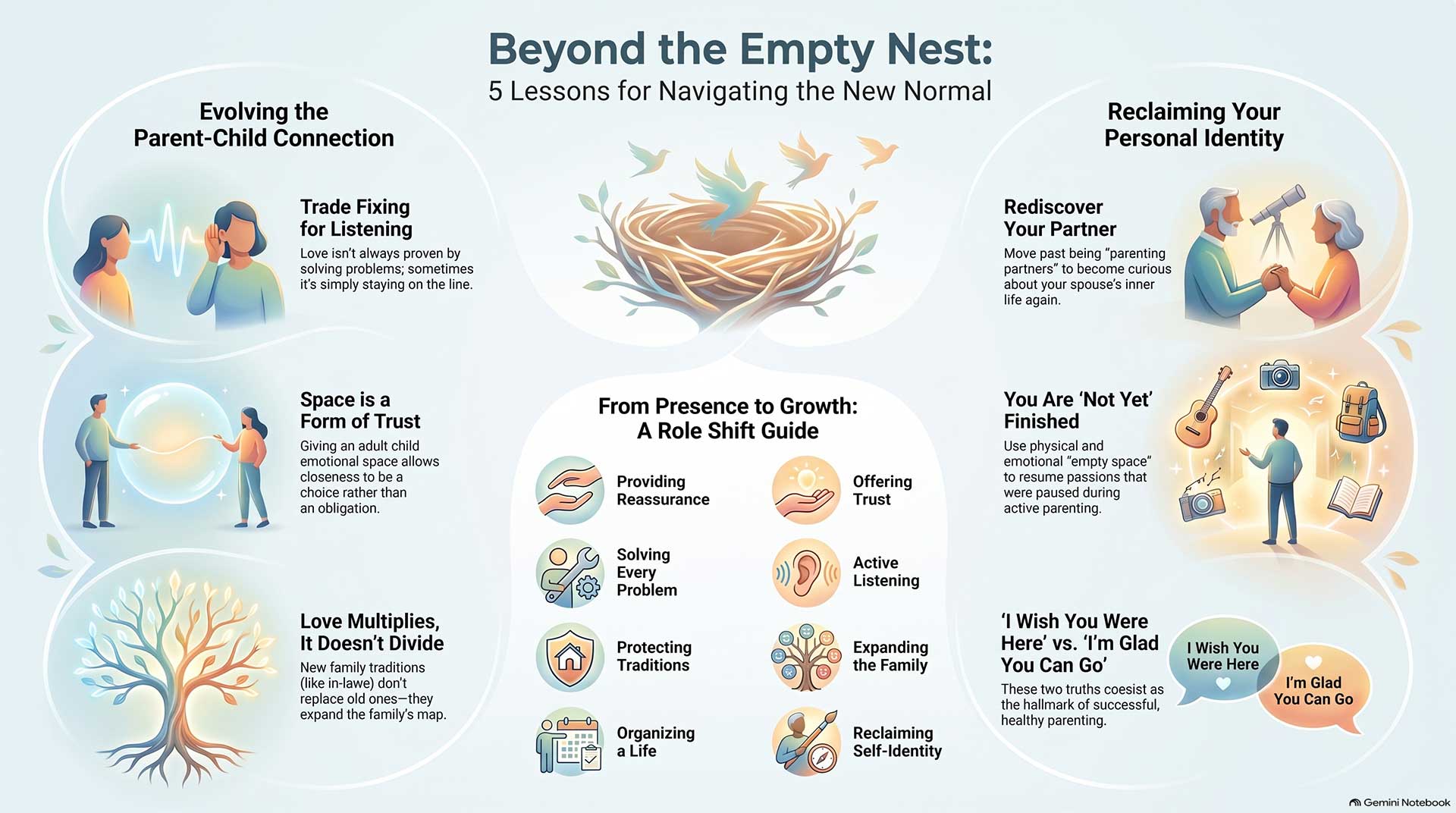
There is something unusual about parenting.
Most forms of love hope for closeness.
Parenting hopes for closeness too, yet successful parenting gradually prepares the person you love to live farther from your control.
You teach a child to make decisions.
Then they make decisions without you.
You teach them to solve problems.
Then they stop asking you to solve every problem.
You give them a safe home.
Then they create another home.
You spend years helping them discover who they are.
And one day, after they leave, you may face the same question yourself.
Who am I now?
Across these five stories, nobody completely stops missing their child.
Linda still wants Ethan to call.
Maria still misses the noisy years when her children filled the dinner table.
Robert still loves hearing Sophie ask for help.
Carol still treasures Christmas mornings when everyone came home.
Rachel still keeps pieces of Maya's childhood in the room upstairs.
Their healing does not require erasing those feelings.
It comes from learning what those feelings can become.
Linda learns that a phone call means more when it comes freely.
Maria learns that the quiet dinner table can become a place where two spouses meet each other again.
Robert discovers that fatherhood does not disappear when his daughter can fix things herself.
Carol learns that a son's new family does not erase his first one.
Rachel finally sees that preserving memory does not require preserving herself exactly as she was.
None of them replaces the child.
That is not the point.
The deeper change is that love begins moving differently.
From constant contact to trust.
From fixing to listening.
From family tradition to a larger definition of family.
From caregiving to companionship.
From identity built around another person's needs to a life that still contains possibility.
Perhaps one of the hardest lessons for an empty nest parent is accepting two truths at the same time:
I wish you were still here.
And:
I am glad you are able to go.
Those sentences do not cancel each other.
They may be two sides of successful parenting.
A child leaving can break a parent's heart a little.
Yet the departure can carry something beautiful inside the pain.
The child is walking into a life that years of parenting helped make possible.
The parent's task now is not to become unnecessary.
It is to become necessary in a different way.
Someone who listens.
Someone who welcomes.
Someone who trusts.
Someone who remains available without demanding access.
Someone whose own life continues growing too.
Maybe that is why Rachel's unfinished painting offers the right final image for all five stories.
An open window.
A view beyond it.
Much of the canvas still unwritten.
When her daughter asks whether the painting is finished, Rachel answers:
“Not yet.”
Those two words belong to every parent in these stories.
The parenting years changed.
The household changed.
The children changed.
The parent changed.
But life?
Not yet.
There is still more to become.
Character Bios:
Linda Parker
Story 1: The Text That Was Never Sent
Linda is a 52-year-old mother adjusting to her nineteen-year-old son Ethan's first months away at college. After years of knowing the details of his daily life, unanswered texts begin feeling far more meaningful than they really are.
Her story explores the difference between wanting connection and requiring reassurance.
Linda gradually learns that giving an adult child emotional space does not weaken closeness. It can make closeness more freely chosen.
Ethan Parker
Ethan is Linda's nineteen-year-old son, newly living away from home.
He loves his mother deeply but is beginning to build friendships, routines, responsibilities, and an identity that does not revolve around home.
His growing independence forces Linda to face one of parenthood's hardest transitions:
A child can need more freedom without loving a parent less.
Maria Alvarez
Story 2: Dinner for Two
Maria is a 54-year-old mother whose youngest child has recently left home.
For nearly three decades, family life shaped her marriage, schedule, and identity. Once the children are gone, Maria begins realizing that she and her husband became excellent parenting partners without noticing how little they knew about each other's inner lives.
Her story asks whether a marriage can begin again without pretending the previous thirty years never happened.
David Alvarez
David, 56, is Maria's husband.
Practical, loyal, and dependable, he initially believes that a stable marriage must mean a healthy marriage.
Through Maria, he discovers that staying together and continuing to know one another are not quite the same thing.
Their empty nest becomes an opportunity to become curious about each other again.
Robert Hayes
Story 3: The Father Who Kept Fixing Everything
Robert is a 58-year-old father and engineer who expresses love by solving problems.
For years, hearing his daughter say, “Dad, can you help me?” gave him a deep sense of purpose.
When Sophie becomes increasingly independent, Robert quietly begins interpreting her competence as evidence that his role is disappearing.
He eventually discovers one of the collection's central lessons:
Being useful and being loved are not the same thing.
Sophie Hayes
Sophie is Robert's 25-year-old daughter, building a professional life hundreds of miles from home.
She still wants her father in her life, but she no longer wants every difficult conversation converted into instructions.
Her relationship with Robert begins changing when she asks for something deceptively simple:
“Can you just listen?”
Carol Bennett
Story 4: Christmas at Someone Else's House
Carol is a 61-year-old mother who has spent more than thirty years creating the family's Christmas traditions.
When her married son chooses to spend Christmas morning with his wife's family, Carol experiences the decision as something much larger than scheduling.
To her, it feels like replacement.
Her story explores changing family loyalties, guilt, tradition, marriage, and the difficult realization that an adult child's expanding family does not require the original family to lose.
Daniel Bennett
Daniel is Carol's adult son, recently married to Emma.
He loves his parents yet now faces the ordinary challenge of balancing two families whose traditions both matter.
His story quietly reveals how parental disappointment can place adult children in painful loyalty conflicts, and how freeing it can feel when a parent chooses love without guilt.
Emma Bennett
Emma is Daniel's wife.
She initially appears mainly as the person whose family has “taken” Christmas morning.
As Carol's perspective changes, Emma becomes something very different:
not someone removing Daniel from the family, but someone joining it.
Rachel Kim
Story 5: The Room She Wouldn't Change
Rachel is a 55-year-old single mother who devoted much of her adult life to raising her daughter Maya.
When Maya moves across the country for graduate school, Rachel preserves her bedroom almost perfectly.
The unchanged room gradually reveals something deeper.
Rachel is not simply preserving her daughter's childhood.
She is protecting an identity she fears will disappear if she admits that the parenting chapter has changed.
Her rediscovery of painting becomes a symbol of a new possibility:
The past can remain loved without becoming the only place a person lives.
Maya Kim
Maya is Rachel's 27-year-old daughter.
She loves her mother and recognizes how much Rachel gave during her childhood.
Yet Maya sees something Rachel cannot see yet.
Her mother spent decades helping Maya become someone.
Now Rachel deserves the same permission.
Maya's question becomes the emotional center of the final story:
“Who are you going to become now?”
And Rachel's eventual answer does not come through words.
It appears through an unfinished painting, an open window, and two final words:
Not yet.
Leave a Reply