


Introduction
A marriage can survive for decades and still become lonely.
Sometimes the danger is obvious: betrayal, a painful conflict, illness, or broken trust.
More often, distance grows quietly.
One spouse stops looking up.
Two people argue about a practical problem without realizing that childhood fears are underneath it.
An apology is accepted, but the body still remembers the hurt.
Physical affection disappears because two people are each trying not to hurt the other.
A couple stays faithful for nearly forty years, then realizes they have stopped asking who the other person has become.
These five modern stories were inspired by the seven themes explored through the AlphaUSA Marriage Course:
connection, communication, conflict, forgiveness, family, sexual intimacy, and love in action.
They are not stories about perfect marriages.
They are stories about ordinary people discovering something they should have seen earlier.
Sometimes love is still there.
The question is whether two people can find their way back to it.
(Note: This is an imaginary conversation, a creative exploration of an idea, and not a real speech or event.)
Story 1: The Empty Seat at the Kitchen Table
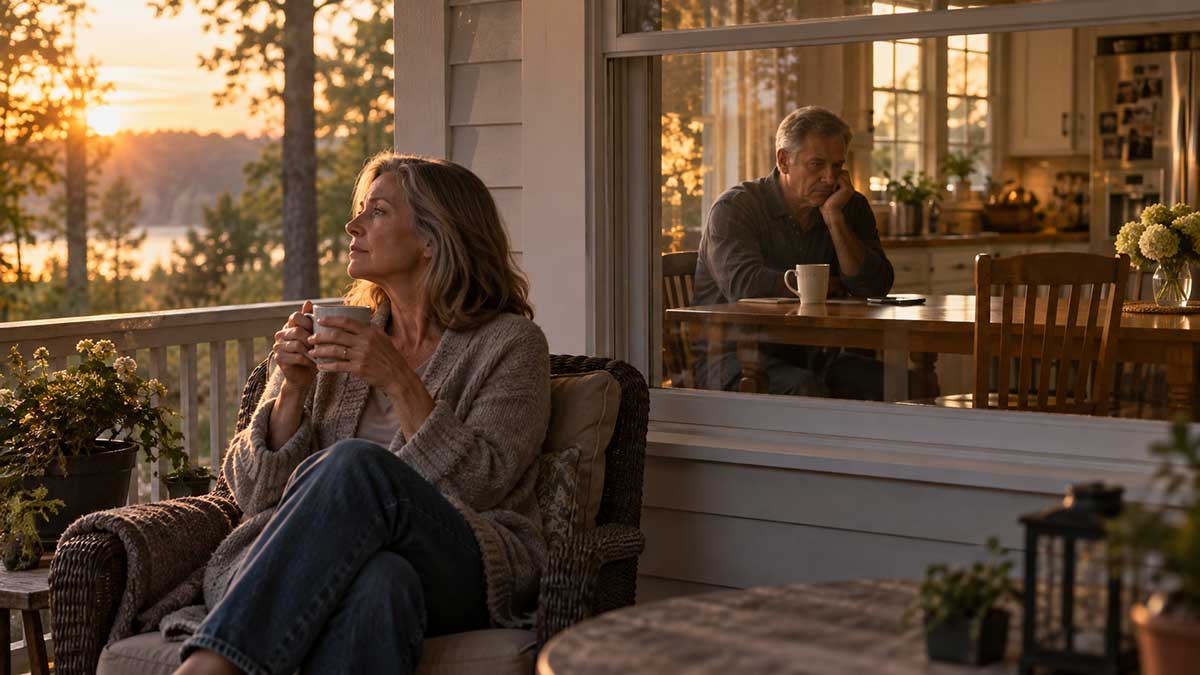
Michael noticed the empty chair on a Tuesday.
It had probably been empty for longer than that.
He simply noticed it on Tuesday.
He was sitting at the kitchen table with his coffee in one hand and his phone in the other, reading an article about retirement taxes he had already opened twice and never finished.
The kitchen was quiet.
Their daughter Emma had moved to Denver six months earlier. Their son lived in Chicago with his wife and two young children. The house now seemed to collect silence in places that once could not hold it.
Michael looked across the table.
Rachel's chair was empty.
Her coffee mug was gone too.
He glanced toward the hallway.
“Rachel?”
No answer.
He walked into the living room.
Empty.
Then he noticed her through the window.
She was sitting on the back porch with a mug in both hands, looking out at the maple trees.
Michael opened the door.
“You're out here?”
Rachel looked over.
“Looks that way.”
He smiled.
“Cold.”
“A little.”
He stood in the doorway.
“Want to come inside?”
She looked toward the trees again.
“I'm okay.”
Michael shrugged.
“Suit yourself.”
He went back to the kitchen.
He did not think about it again until Thursday.
Her chair was empty again.
Then Friday.
Then Sunday.
By the next Tuesday, the empty chair had begun to bother him.
Not enough to say anything.
Just enough that he noticed it.
For thirty-one years, Rachel had sat across from him in the morning.
There had been seasons when they barely managed ten minutes together.
When the children were small, mornings were cereal bowls, missing shoes, signed forms, lunch boxes, and someone shouting from upstairs.
Later came high school schedules, early practices, college applications, tuition questions, and airport runs.
Their morning coffee had survived almost all of it.
Sometimes they talked.
Sometimes they did not.
Sometimes Rachel read a book.
Sometimes Michael opened his laptop.
It had always been there.
Two mugs.
Two chairs.
Now there was one.
Michael finally asked.
It was Wednesday morning.
Rachel came into the kitchen, poured coffee, and turned toward the porch.
“Hey.”
She stopped.
“Yeah?”
“Why don't you have coffee with me anymore?”
Rachel stared at him for a moment.
“I do.”
Michael frowned.
“What?”
“For thirty years, I did.”
Then she opened the porch door.
Michael sat very still.
The sentence stayed in the kitchen long after Rachel had left it.
That evening they ate salmon and rice at the kitchen table.
Rachel asked whether he had called the insurance company.
Michael told her he had.
He asked whether she had heard from Emma.
“She called during lunch.”
“How's the new job?”
“She likes it.”
“Good.”
Rachel told him their neighbor's dog had gotten loose again.
Michael laughed.
“That dog has escaped more times than a prisoner in a movie.”
Rachel smiled.
Dinner continued.
Everything sounded normal.
That bothered him more.
Afterward, Rachel loaded the dishwasher.
Michael dried a pan.
“You said something this morning.”
Rachel kept working.
“I say many things.”
“You know what I mean.”
She placed a plate carefully into the rack.
“For thirty years.”
Rachel stopped.
Michael waited.
She closed the dishwasher.
“Do you really want to talk about it?”
He almost said, Of course.
Instead he noticed the strange feeling in his chest.
He was not sure.
Talking about insurance was easy.
Talking about Emma was easy.
Talking about an empty chair felt oddly dangerous.
“Yes.”
Rachel leaned back against the counter.
“You're going to get defensive.”
“I don't know what I'm defending yet.”
“That never stopped you before.”
Michael stared at her.
Rachel looked down.
“Sorry.”
There was an old sharpness in the room now.
Not loud.
Old.
Michael put the towel down.
“Okay. Try me.”
Rachel folded her arms.
“You remember Sunday?”
“This Sunday?”
“Yes.”
“What about it?”
“I told you about Caroline.”
He searched his memory.
Caroline worked with Rachel.
Something had happened.
“You said she was having trouble at work.”
Rachel nodded.
“She resigned.”
Michael remembered now.
“Right.”
“I told you she'd been crying in my office.”
“I remember.”
“What did you say?”
Michael thought.
“I don't know.”
“You said, ‘That's rough.’”
He waited.
Rachel looked at him.
“Then you went back to your phone.”
Michael felt irritation rise.
“I was reading something.”
“I know.”
“It doesn't mean I don't care.”
“I didn't say you don't care.”
“Then what are we talking about?”
Rachel closed her eyes for a second.
“This.”
“This what?”
“This exact thing.”
Michael laughed once, but nothing was funny.
“You're going to have to help me here.”
“I tell you something. You answer just enough to technically answer me. Then you're gone.”
“Gone where?”
“Somewhere else.”
“That isn't fair.”
Rachel nodded slowly.
“Okay.”
The way she said it made him angrier.
“Don't do that.”
“Do what?”
“Say ‘okay’ when you mean I'm hopeless.”
“I don't mean you're hopeless.”
“Then say what you mean.”
Rachel looked at him.
“I miss you.”
That stopped him.
Not completely.
Part of him still wanted to argue.
But the rest of him had gone quiet.
“I've been here.”
“I know.”
“Every day.”
“I know.”
“I haven't gone anywhere.”
“I know, Michael.”
He shook his head.
“Then what are you saying?”
Rachel's voice softened.
“You're here. You're just not with me very much.”
Michael stared at the floor.
He could hear the dishwasher filling with water.
“I think that's unfair.”
Rachel nodded.
“Maybe.”
“Rachel.”
“What do you want me to say?”
“I want you to tell me what I'm supposedly doing.”
She looked tired now.
Not angry.
That made it worse.
“I don't think you're doing anything terrible.”
“Good.”
“That isn't good.”
He looked up.
Rachel's eyes had filled, but she did not cry.
“I used to tell you things.”
“You still do.”
“Not really.”
“Yes, you do.”
“I tell you information.”
“What does that mean?”
“I tell you Emma got a new job. I tell you your sister called. I tell you the dentist changed the appointment.”
“That is talking.”
“It's managing a life.”
Michael felt something tighten in his throat.
Rachel continued.
“I used to tell you what scared me.”
“You can.”
“I used to tell you stupid things.”
“You still can.”
“I used to tell you things I had no reason to tell anybody.”
Michael wanted to answer.
Nothing came.
Rachel looked toward the kitchen window.
“I stopped.”
“When?”
“I don't know.”
“Why?”
She gave him a sad smile.
“That is the problem.”
The next morning Michael woke earlier than usual.
Rachel was still asleep.
He went downstairs and made coffee.
He sat at the table.
Her chair was empty.
He looked at it for a long time.
Then he remembered something.
It had been months earlier.
Maybe a year.
Rachel had come into the room holding an old photograph.
“Look at this.”
Michael had been replying to an email.
He remembered saying:
“Give me one second.”
He never looked at the photograph.
Another memory came.
Rachel standing near the stairs.
“Do you want to walk around the neighborhood?”
Michael had answered:
“Maybe later.”
They never went.
Another.
She had told him about a dream she had.
Something involving her father, who had died twelve years earlier.
Michael remembered making a joke.
Not a cruel joke.
Just a joke.
Rachel had laughed.
Then never finished telling him the dream.
He remembered one evening when she had said:
“I've been thinking about taking a pottery class.”
He had answered:
“When would you have time?”
He thought he was being practical.
He wondered if she had heard something else.
Michael reached for his phone.
Stopped.
Set it back down.
That night Rachel was reading in bed.
Michael brushed his teeth, changed, and sat beside her.
“What are you reading?”
She held up the cover.
He had seen the book on her nightstand for weeks.
“Any good?”
Rachel lowered the book.
“You're asking me about my book?”
“Yes.”
“Why?”
Michael looked at her.
“I don't know.”
She laughed quietly.
“That might be the most suspicious answer possible.”
He smiled.
“Is it good?”
Rachel studied him, then closed the book.
“Actually, yes.”
She began telling him about it.
A woman returned to the town where she grew up after her sister died.
Michael listened.
At first, he listened too hard.
He could feel himself trying to prove something.
Then Rachel began explaining why one scene had bothered her.
She said it reminded her of visiting her mother after her father died.
Michael forgot about proving anything.
He asked a question.
Rachel answered.
Then another.
Twenty minutes passed.
Finally Rachel looked at the clock.
“It's late.”
“Sorry.”
“No.”
She looked at him strangely.
“Don't be.”
Michael turned off his lamp.
In the darkness, he said:
“I didn't know you were still thinking about that time with your mother.”
Rachel answered quietly.
“There are many things you don't know.”
He felt the words like a small cut.
Then Rachel added:
“There are probably things I don't know about you either.”
Michael stared into the dark.
“Probably.”
Neither spoke for a minute.
Then Rachel said:
“That scares me.”
Michael reached across the bed and found her hand.
“Me too.”
On Saturday afternoon, Michael saw Rachel putting on her coat.
“Where are you going?”
“Bookstore.”
“Can I come?”
Rachel froze with one arm in her coat.
He laughed.
“What?”
“Nothing.”
“That's not nothing.”
“You haven't come to the bookstore with me since Emma was in college.”
“When was that?”
“Seven years ago.”
“That can't be right.”
Rachel gave him a look.
Michael picked up his jacket.
“I'm coming.”
At the bookstore Rachel disappeared into fiction.
Michael wandered through history, business, and travel.
Twenty minutes later, he found her sitting in a chair near the back, reading the first pages of a novel.
He stood beside her.
“Good?”
She looked up.
“Yes.”
“What is it about?”
She stared at him again.
“What?”
“Nothing.”
“You keep doing that.”
“Doing what?”
“Looking at me like I've started speaking French.”
Rachel smiled.
“You're asking questions.”
Michael sat in the chair beside her.
“Was I really that bad?”
Rachel hesitated.
“Do you want the honest answer?”
“Yes.”
“You weren't bad.”
He waited.
“You were busy.”
“That sounds nicer.”
“It isn't.”
Michael nodded.
Rachel put the book down.
“I used to think if I found the right thing to say, you'd look up.”
He looked at her.
“When you didn't, I thought maybe I wasn't interesting anymore.”
“Rachel.”
“I know that sounds ridiculous.”
“No.”
“It does.”
“No.”
He leaned forward.
“It sounds horrible.”
Rachel looked at him.
“I never thought you weren't interesting.”
“I know that now.”
“No. I mean I never thought that.”
“I believe you.”
“Then why did you think it?”
Rachel looked down at the book in her lap.
“Since people believe what happens to them more than what they are told.”
Michael had no answer.
Sunday morning Rachel woke to the smell of coffee.
She went downstairs.
Michael was not at the kitchen table.
For a moment she thought he had gone out.
Then she saw him through the window.
He was on the porch.
Two mugs sat on the small table.
His phone was nowhere in sight.
Rachel opened the door.
Michael looked up.
“Morning.”
She stepped outside.
“You're out here?”
“Looks that way.”
Rachel smiled despite herself.
She sat beside him.
For a minute they looked at the trees.
The morning was cool.
A thin fog hung beyond the fence.
Michael handed her the second mug.
“Thank you.”
Neither spoke.
Rachel wondered whether he had planned something.
A speech.
An apology.
A promise.
Michael took a sip.
Then said:
“What have I missed?”
Rachel looked at the yard.
“The leaves are starting to change.”
“No.”
She turned.
Michael was looking directly at her.
“I mean what have I missed?”
Rachel stared at him.
He looked nervous.
That surprised her.
Michael was rarely nervous.
He fixed things.
Organized things.
Solved things.
Nervousness belonged to situations with no clear instructions.
Rachel's eyes filled.
“A lot.”
Michael nodded.
“I thought so.”
She wiped at one eye.
“You don't have to fix everything today.”
“Good.”
She laughed.
“I mean it.”
“I know.”
Michael looked toward the trees.
“I don't know how to do this.”
“Do what?”
“Catch up.”
Rachel thought about it.
“Don't.”
He turned.
“Don't catch up?”
“No.”
She held the mug between her hands.
“Just start where we are.”
Michael nodded slowly.
“Okay.”
Rachel took a breath.
“My mother called yesterday.”
Michael nearly smiled.
“That sounds like information.”
“It is.”
They both laughed.
Then Rachel continued.
“She asked me whether I think she's becoming a burden.”
Michael's smile disappeared.
“What did you say?”
And this time Rachel told him.
All of it.
The Sunday coffee became a habit.
Not every Sunday was profound.
Some mornings they talked about movies.
Once they spent twenty minutes arguing about whether they had ever visited Vermont together.
They had.
Michael found photographs.
Rachel still refused to admit it.
Some mornings one question opened a door.
“What are you worried about lately?”
“What do you miss about when the kids were little?”
“What would you do if you knew you couldn't fail?”
“What do you want the next five years to feel like?”
Michael began discovering things.
Rachel had started thinking seriously about retiring earlier than planned.
She wanted to visit Scotland.
She worried about becoming like her mother.
She missed dancing.
She had never liked the gray paint Michael chose for the living room.
Rachel discovered things too.
Michael sometimes woke at three in the morning worried about money, despite the fact that they were financially secure.
He missed coaching their son's baseball team more than he ever admitted.
He had been frightened when Rachel had minor surgery two years earlier.
He wanted to learn photography.
He was lonely too.
That surprised her most.
One Sunday Rachel asked:
“Why didn't you ever tell me?”
Michael looked at his coffee.
“Maybe I thought you already knew.”
Rachel smiled gently.
“That's what I thought too.”
Months later, Emma came home for Thanksgiving.
She entered the kitchen early Sunday morning and found it empty.
“Mom?”
No answer.
She looked outside.
Her parents were sitting on the porch.
Two mugs between them.
Her father was speaking.
Her mother was listening.
Then her mother said something that made him laugh.
Emma watched through the glass for a moment.
She did not interrupt.
At the table, Michael's old chair sat empty.
So did Rachel's.
For most of his life, Michael had believed that love was proved by staying.
Working.
Providing.
Being dependable.
And those things mattered.
But after thirty-one years, he was learning something he wished he had learned much earlier.
Sometimes love was much smaller.
Look up.
Put the phone down.
Ask another question.
Turn your chair.
Story 2: Her Mother Is Not Moving In
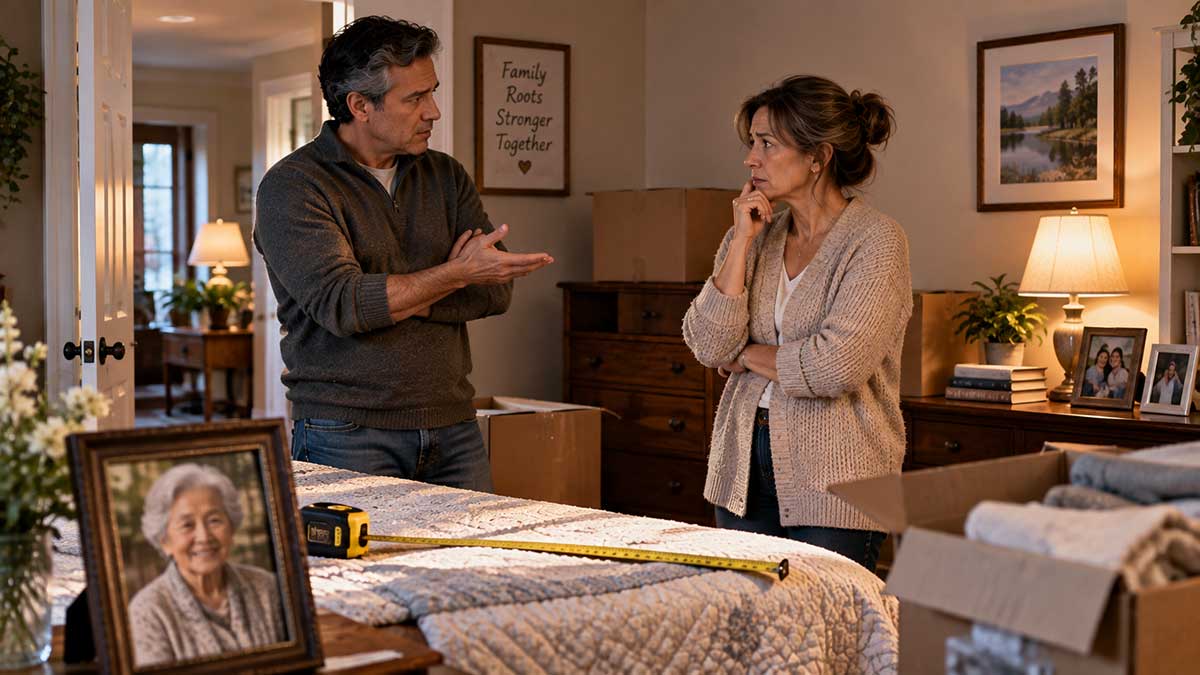
Daniel was measuring the guest bedroom when Emily found him.
He had a tape measure stretched from the wall to the foot of the bed.
“What are you doing?”
Daniel glanced over his shoulder.
“Seeing if the dresser fits on the other side.”
“Why?”
He let the tape snap back into its case.
“Mom is moving in.”
Emily stared at him.
For a moment she thought she had misunderstood.
“What?”
“She can't keep living by herself.”
Emily stood in the doorway.
“When did we decide that?”
Daniel's expression changed.
“We didn't decide anything yet.”
“You just said she's moving in.”
“I mean we need to make it happen.”
“No.”
Daniel blinked.
“No?”
“No. She's not moving in.”
He gave a short laugh.
“You haven't even thought about it.”
“I have thought about it.”
“When?”
“In the last ten seconds.”
“Exactly.”
“And the answer is still no.”
Daniel's face tightened.
“She's my mother.”
Emily folded her arms.
“And I'm your wife.”
Neither spoke.
The room suddenly felt very small.
Daniel's mother, Sun-hee, was seventy-eight.
For most of her life, she had been incapable of sitting still.
She cooked enough food for ten people when three were coming.
She grew peppers in pots on her balcony.
She called Daniel every Sunday evening and asked whether he was eating properly, despite the fact that he was forty-seven years old and lived fifteen minutes away.
Three months earlier, she had slipped in her kitchen.
No broken bones.
No surgery.
She had called Daniel from the floor, embarrassed more than frightened.
He drove over and found her sitting against a cabinet.
She smiled when she saw him.
“I am fine.”
She was not fine.
After that, Daniel began checking on her every day.
Then she left the stove on twice.
Then she forgot a doctor's appointment.
Then a neighbor called Daniel after finding her confused in the parking lot.
Nothing catastrophic had happened.
Yet.
That word sat inside Daniel's mind every night.
Yet.
At dinner, their children knew something was wrong.
Maya, sixteen, looked from her father to her mother.
“Are you guys mad?”
“No,” Emily said.
“Yes,” Daniel said at the same time.
Their fourteen-year-old son, Ethan, stopped chewing.
Emily looked at Daniel.
“Can we not do this now?”
Daniel pushed rice around his plate.
“Fine.”
They ate in silence.
After dinner Daniel took the plates to the sink.
Emily followed him.
“We need to talk.”
“I know.”
“Not like this.”
“Like what?”
“Like we've already chosen sides.”
Daniel set a plate into the sink.
“You chose a side before I finished the sentence.”
“You made a decision before I entered the room.”
“I said she needs to move in.”
“You said she is moving in.”
Daniel turned.
“So that's the issue? Grammar?”
Emily stared at him.
“No.”
“It sounds like it.”
“The issue is that you made a decision about our house, our children, our lives, and my life without asking me.”
“My mother is not some inconvenience we're voting on.”
“I never said she was.”
“You said no.”
“I said no to her moving into our house.”
“What's the difference?”
Emily's voice sharpened.
“A huge one.”
Daniel shook his head.
“She raised me alone.”
“I know.”
“She worked two jobs.”
“I know.”
“She gave up everything.”
“I know.”
“And now she's getting old, and you're telling me she can't live here?”
Emily's face changed.
Not anger now.
Hurt.
“Do you really think that's what I'm saying?”
“What else am I supposed to think?”
She looked at him for several seconds.
Then walked away.
Daniel was nine when his father died.
He remembered almost nothing from the funeral except his mother's hands.
They looked strange.
Still.
His mother was never still.
She cleaned.
Cooked.
Worked.
Carried groceries.
Signed papers.
Fixed buttons.
Counted money.
That day her hands rested in her lap.
Daniel watched them.
He remembered deciding that he had to grow up quickly.
He began making his own breakfast.
He stopped asking for expensive shoes.
When his classmates went skiing during winter break, he told his mother he hated skiing.
He had never skied.
His mother worked mornings at a dry cleaner and evenings at a small Korean restaurant.
Some nights she came home after eleven.
Daniel pretended to be asleep.
He would hear the refrigerator open.
The microwave.
Her footsteps.
Once, when he was twelve, he got up and found her eating rice alone at the kitchen table.
She looked exhausted.
“What are you doing awake?”
“Couldn't sleep.”
She smiled.
“Come sit.”
He sat across from her.
She pushed half her food toward him.
“I already ate.”
“Eat.”
He ate.
His mother always gave him the better pieces.
The bigger piece of fish.
The last dumpling.
The ripest fruit.
He noticed.
Children notice more than adults think.
Years later, when Daniel received his college acceptance letter, Sun-hee cried.
Daniel did not.
He hugged her.
In that moment, he made a promise without saying it aloud.
One day, I will take care of you.
He never forgot it.
Emily grew up with a different promise.
Her grandmother moved into their house when Emily was eleven.
At first, it felt exciting.
Grandma Ruth baked cookies.
She let Emily stay up late.
She told stories from childhood.
Then Ruth's health declined.
She stopped driving.
Then bathing alone.
Then climbing stairs.
Emily's mother, Patricia, became the center of everything.
Doctor visits.
Medication.
Laundry.
Meals.
Bathing.
Insurance calls.
Nighttime emergencies.
Emily's father tried to help.
He worked long hours.
Slowly, Patricia's life became smaller.
She stopped going to book club.
Stopped seeing friends.
Stopped taking trips.
Stopped sleeping properly.
The guest bedroom became Ruth's room.
The dining room became a place for medical supplies.
The family calendar became a schedule of appointments.
At thirteen, Emily heard her parents arguing behind their bedroom door.
Her father said:
“We haven't had one evening alone in months.”
Her mother replied:
“What do you expect me to do? Put my own mother on the street?”
“I didn't say that.”
“You didn't have to.”
Years later, Ruth died.
Emily expected life to return.
It didn't.
Her parents had forgotten how to be together.
They remained married.
They were polite.
They rarely touched.
Emily noticed that too.
At seventeen, she made her own private promise.
I will never let caregiving swallow my marriage.
She never told Daniel.
For the next four days, Daniel and Emily spoke politely.
That was worse than fighting.
“Do we need milk?”
“Yes.”
“I'll get it.”
“Thank you.”
“Are you picking up Ethan?”
“Yes.”
“Okay.”
Their marriage became logistics.
Maya noticed.
She always noticed.
On Friday evening, Sun-hee came for dinner.
She brought enough food for twelve people.
“Mom,” Daniel said, carrying containers from her car, “you didn't need to make all this.”
“I didn't make much.”
Emily opened one container.
“Three kinds of kimchi is not much?”
Sun-hee laughed.
“Kimchi is not food. Kimchi is just there.”
Everyone laughed.
For an hour, the tension disappeared.
Sun-hee asked Maya about school.
She corrected Ethan's chopstick grip.
She told Daniel he looked tired.
She told Emily she looked too thin.
Emily smiled.
“I've looked the same for ten years.”
“Too thin for ten years.”
After dinner, Sun-hee insisted on washing dishes.
Emily stood beside her.
“You sit. I'll do it.”
“I am old, not dead.”
Emily laughed.
“Okay. You wash. I'll dry.”
For a moment, they worked together quietly.
Sun-hee handed her a bowl.
Then another.
“Daniel worries.”
Emily looked at her.
“I know.”
“He thinks I cannot do anything.”
“He loves you.”
“He is annoying.”
Emily smiled.
“Yes.”
Sun-hee glanced toward the living room, where Daniel was talking to Ethan.
“He was always serious.”
“So is his son.”
Sun-hee nodded.
“Too serious.”
Then she became quiet.
“I know I am getting old.”
Emily stopped drying.
Sun-hee kept looking into the sink.
“I don't want to be trouble.”
“You're not trouble.”
“Everyone says that.”
Emily felt something in her chest.
Sun-hee handed her another plate.
“I know how this works.”
“What do you mean?”
“Children have lives.”
Emily said nothing.
Sun-hee smiled.
“Don't worry.”
That night, after she left, Emily stood at the kitchen window watching Daniel help his mother into her car.
He bent down so she could hear him.
She touched his cheek.
For the first time since the argument began, Emily felt his fear.
Not his position.
His fear.
Two nights later, they fought again.
It started over a brochure.
Daniel placed it on the kitchen counter.
“What is this?” Emily asked.
“Home care.”
She looked at him.
“I thought you wanted her here.”
“I do.”
“Then why are you looking at home care?”
“I'm looking at everything.”
Emily opened the brochure.
“Four hours a day.”
“Maybe.”
“That's expensive.”
“I know.”
“Does she need four hours?”
“I don't know.”
Daniel's voice rose.
“That is the problem. I don't know anything.”
Emily looked at him.
“I think we need an assessment.”
“I know.”
“We need to know what she can still do safely.”
“I know.”
“We need to stop arguing about a solution before we know the problem.”
“I know!”
The volume made both of them stop.
Daniel rubbed his face.
“Sorry.”
Emily waited.
He leaned against the counter.
“I go to bed thinking the phone is going to ring.”
Her expression softened.
Daniel continued.
“I wake up at two in the morning and check if she texted.”
Emily had not known that.
“If she doesn't answer by eight, I think she fell.”
He swallowed.
“And every time I leave her apartment, I think, what if that was the last normal conversation?”
Emily moved closer.
“Daniel.”
He looked at her.
“She gave me everything.”
“I know.”
“No, you know the story. You don't know what it feels like.”
Emily's face tightened again.
“What does that mean?”
“It means you don't get it.”
She stepped back.
“No. I don't get to have your childhood. That's true.”
“That's not what I meant.”
“I know exactly what you meant.”
Emily's eyes filled.
“You think this is about convenience.”
“I didn't say that.”
“You think I don't want your mother here since I don't want to sacrifice.”
“Emily.”
“You want to know why I said no?”
Daniel said nothing.
“My grandmother lived with us for six years.”
“I know that.”
“No, Daniel. You know the story.”
He recognized his own words.
Emily continued.
“You don't know what it felt like.”
He went quiet.
“My mother disappeared inside caregiving.”
Daniel watched her.
“She loved Grandma. Deeply. And she became angry at everyone.”
Emily wiped her cheek.
“She was angry at my father for working. Angry at me for needing rides. Angry at Grandma for needing help. Then she hated herself for being angry at Grandma.”
Daniel looked down.
“After Grandma died, my parents had nothing left between them.”
He looked back up.
“They stayed married.”
“I know.”
“They stopped being married.”
The kitchen was silent.
Emily took a breath.
“When you stood in that room and told me your mother was moving in, I wasn't thinking, I don't want his mother here.”
Daniel listened.
“I was thinking, this is how it starts.”
His face changed.
She continued.
“I saw my mother.”
Her voice broke.
“I saw myself becoming her.”
Daniel moved toward her.
Emily raised a hand.
“Don't. Just listen.”
He stopped.
“I love your mother.”
“I know.”
“I will help take care of her.”
Daniel closed his eyes for a moment.
“But I cannot become the entire system.”
“You wouldn't.”
“You don't know that.”
He started to answer.
Then stopped.
She was right.
He did not know.
Maya had been standing in the hallway.
Neither of them saw her until she spoke.
“Can I say something?”
Emily turned.
“Maya.”
“Were you listening?”
“Kind of.”
Daniel sighed.
“Go upstairs.”
“No.”
“Maya.”
She crossed her arms.
“You're both being weird.”
“This isn't your problem.”
“I know.”
“Then stay out of it.”
Maya looked at her father.
“You keep talking like Mom doesn't care about Grandma.”
Daniel opened his mouth.
Then closed it.
Maya looked at Emily.
“And you keep talking like Grandma moving in automatically destroys everything.”
Emily stared at her daughter.
Maya's voice softened.
“Why are both of you talking like Grandma is the problem?”
Neither answered.
Maya shook her head and went upstairs.
Daniel looked at Emily.
Emily looked at Daniel.
Then, against all logic, they both laughed.
Not hard.
Just enough.
Daniel sat down.
“My daughter thinks we're idiots.”
“She may be right.”
“She is sixteen. She definitely thinks we're idiots.”
Emily sat across from him.
For a long time, neither spoke.
Then Daniel asked:
“What scares you most?”
Emily looked at him.
“About your mother?”
“About all of it.”
She thought.
“Becoming my mother.”
He nodded.
Then Emily asked:
“What scares you most?”
Daniel did not answer right away.
Finally:
“Becoming the son who left his mother alone.”
Emily's eyes softened.
“There it is.”
“What?”
“The thing we've actually been fighting about.”
Daniel looked down at his hands.
“I promised myself I would take care of her.”
“When?”
“I don't know. Twelve? Thirteen?”
Emily reached across the table.
Daniel took her hand.
“I promised myself something too.”
“I know.”
“No. You know now.”
He nodded.
“Now.”
The next few weeks were not peaceful.
They were productive.
That felt different.
A geriatric assessment showed that Sun-hee could still live with a fair amount of independence, but she needed help with medication, transportation, and some daily tasks.
Daniel researched senior communities near their home.
Emily visited three with him.
Sun-hee rejected all three.
“I am not old enough.”
“You are seventy-eight,” Daniel said.
“That is not old.”
“You fell in your kitchen.”
“You fell off a ladder last year.”
“That was different.”
“How?”
“I am younger.”
Sun-hee glared at him.
Emily covered a laugh.
They kept looking.
A month later, they found a small apartment in a senior community eight minutes from Daniel and Emily's house.
Sun-hee had her own kitchen.
A balcony.
A garden.
Transportation to medical appointments.
Emergency help available at any hour.
Daniel loved it.
Emily loved it.
Sun-hee hated it.
“I have a home.”
Daniel sat across from her in her old apartment.
“I know.”
“Then why are you trying to move me?”
“Since I'm scared.”
The words came out before he could stop them.
Sun-hee looked at him.
Daniel continued.
“I don't sleep.”
Her expression changed.
“I worry every time you don't answer.”
Sun-hee looked away.
“I don't want you to worry.”
“I know.”
“I don't want to live with you.”
Daniel stared at her.
“What?”
She shrugged.
“You are messy.”
He laughed.
“Mom.”
“And Emily needs her house.”
Daniel felt his throat tighten.
Sun-hee continued.
“I like Emily.”
“I know.”
“I want to keep liking Emily.”
He laughed again, this time through tears.
His mother reached across the table and touched his hand.
“You think taking care of me means I must live under your roof.”
Daniel said nothing.
“You can take care of me from eight minutes away.”
He looked at her.
“What if you hate it there?”
“Then I complain.”
“You already complain.”
“Yes. Practice.”
The move happened in April.
Sun-hee cried the first night.
Daniel almost brought her back home.
Emily stopped him.
“Give her time.”
“She hates it.”
“She hates change.”
“What if she never adjusts?”
“What if she does?”
He looked at Emily.
She touched his arm.
“We don't have to solve every feeling tonight.”
Daniel stayed with his mother until ten.
Then he went home.
The next morning Sun-hee called.
“The woman next door talks too much.”
Daniel closed his eyes.
“Good morning, Mom.”
“And they serve terrible coffee.”
“Good morning.”
“The garden is nice.”
Daniel smiled.
There it was.
A crack of light.
Caregiving still took work.
Daniel handled medical appointments.
Emily helped organize medications.
Maya visited her grandmother on Wednesdays after school.
Ethan learned to make her favorite soup.
Sun-hee came to dinner every Sunday.
Some weeks she complained about the apartment.
Some weeks Daniel felt guilty.
Some weeks Emily feared she was slowly taking on too much and said so.
They adjusted.
Again.
And again.
There was no perfect arrangement.
There was a marriage trying to remain a marriage inside a difficult family season.
One Sunday evening, after Sun-hee left, Daniel stood at the sink washing dishes.
Emily walked in and picked up a towel.
“I can do it.”
“I know.”
She stood beside him anyway.
Daniel handed her a plate.
For a few minutes, they worked quietly.
Then he said:
“Thank you.”
“For what?”
“For helping me take care of her.”
Emily smiled.
“You don't have to thank me.”
“Yes, I do.”
He handed her another plate.
“Thank you for helping me take care of her without losing us.”
Emily stopped drying.
Daniel looked at her.
She reached over and touched his hand.
“Thank you for hearing that I was scared.”
He nodded.
“Not selfish.”
“Not selfish.”
She smiled.
“Still stubborn.”
He laughed.
“Very.”
From upstairs, Maya shouted:
“Can you two stop having emotional breakthroughs and help me with my chemistry homework?”
Daniel looked toward the ceiling.
Emily laughed.
“Your daughter.”
“Our daughter.”
He handed her the last plate.
She dried it.
Neither had gotten exactly what they wanted.
His mother was not living under their roof.
Emily had still become part of a caregiving family.
Sun-hee had lost some independence.
Daniel still worried.
Emily still watched carefully for the old pattern she feared.
Nothing had become simple.
But the question had changed.
They were no longer asking:
Which one of us is right?
They had begun asking:
How do we protect what matters to both of us?
Story 3: The Password
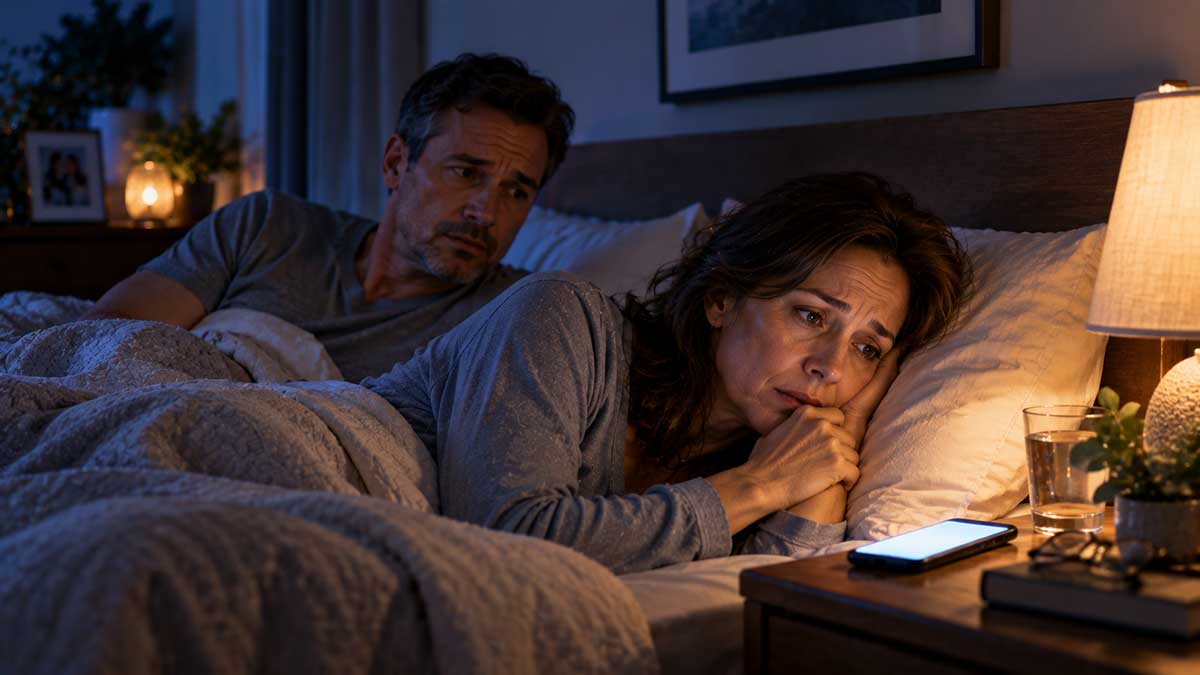
Andre’s phone lit up at 2:13 in the morning.
Simone opened her eyes before she was fully awake.
A pale rectangle glowed on the nightstand.
For half a second, she did not know where she was.
Then her stomach tightened.
Her heart began beating faster.
Andre was asleep beside her.
The phone buzzed again.
Simone stared at it.
She could not see the name from where she lay.
She could reach for it.
She knew the password.
Andre had given it to her eleven months ago.
He had said:
“You can check anything you want.”
At the time, she had checked everything.
Messages.
Email.
Instagram.
Work chats.
Deleted folders.
Browser history.
Once she woke at four in the morning and searched his phone for almost an hour.
She found nothing.
That did not calm her.
It made her feel ashamed.
Now she watched the phone glow.
Her hand moved toward it.
Stopped.
Andre shifted beside her.
“Everything okay?”
Simone said nothing.
His eyes opened.
He followed her gaze.
“Oh.”
He reached for the phone.
Simone’s body went rigid.
Andre noticed.
He stopped.
“It’s probably the London office.”
Simone looked away.
Andre picked up the phone slowly, turned the screen toward her, and unlocked it.
A message from Marcus.
His new boss.
Andre read it.
“Quarterly deck. He says the numbers on slide twenty-two are wrong.”
Simone nodded.
Andre placed the phone face down.
“You okay?”
“Yes.”
He watched her.
“No, you’re not.”
“I’m fine.”
“Simone.”
“Go back to sleep.”
Andre lay down.
Neither of them slept for a long time.
Eleven months earlier, Simone had been looking for a photograph.
Nothing more.
Her father was dying then.
Not suddenly.
Slowly.
Cancer had reduced his world to appointments, medication, blankets, and long afternoons in a recliner beside the window.
Simone visited nearly every day.
Her father had asked for an old photograph of the two of them from a family trip to Cape Cod.
Simone thought Andre might have it on his laptop.
She opened the computer.
Andre had never hidden passwords from her.
Not then.
She searched the photos.
Then a message appeared in the corner of the screen.
Lena: I miss talking to you like this.
Simone stared at it.
The message vanished.
Her hand moved to the trackpad.
She told herself not to click.
Then she clicked.
There were hundreds of messages.
At first, they looked harmless.
Work.
Complaints about meetings.
Jokes.
Pictures of terrible conference-room coffee.
Then the messages changed.
I don’t know how to talk to Simone anymore.
She’s so overwhelmed with her dad.
I feel invisible at home.
Lena replied:
You’re not invisible to me.
Further down:
Wish you were here.
Another:
I shouldn’t say this, but you understand me better than anyone right now.
Simone kept scrolling.
Her hands began to shake.
No photographs.
No explicit sexual messages.
No hotel reservations.
No physical affair she could prove.
Yet she felt as if someone had opened the front door of her marriage and quietly moved into a room she thought belonged only to them.
She read one message twice.
Then a third time.
Andre had written:
Sometimes I sit beside Simone and have no idea how to reach her anymore.
Lena replied:
Maybe you don’t have to try so hard with someone who doesn’t see you.
Simone stopped reading.
She closed the laptop.
Then opened it again.
She read everything.
Andre came home at six.
He found Simone sitting at the dining room table.
His laptop sat between them.
He stopped.
“What happened?”
Simone looked at him.
“Who is Lena?”
Andre’s face told her before his mouth did.
“Simone.”
“Who is she?”
“She works with me.”
“I know that.”
He put his keys down.
“Can we talk?”
“We’re talking.”
Andre sat.
Simone watched him carefully.
“Did you sleep with her?”
“No.”
“Did you kiss her?”
“No.”
“Did you touch her?”
“No.”
“Did you want to?”
Andre looked down.
That was enough.
Simone felt something inside her go quiet.
Not anger.
Something worse.
Andre said:
“It wasn’t physical.”
She laughed.
He flinched.
“That is what you’re going with?”
“No.”
“You told another woman things you stopped telling me.”
“I know.”
“You talked to her about our marriage.”
“I know.”
“You told her I didn’t see you.”
“I know.”
“Did you tell her my father was dying?”
Andre closed his eyes.
“Yes.”
Simone’s voice changed.
“Did you tell her I was spending five nights a week at the hospital?”
“Yes.”
“Did you tell her I was sleeping three hours a night?”
“Yes.”
“Did you tell her I cried in the shower so Dad wouldn’t hear me?”
Andre looked at her.
“Yes.”
“And then you told her I didn’t see you.”
He had no answer.
Simone stood.
“Get out.”
“Simone.”
“Get out.”
Andre slept at his brother’s apartment for nine nights.
He ended all personal contact with Lena on the first day.
Within two months, he had transferred to another department.
Three months later, he accepted a job at another company.
He gave Simone every password.
He found a couples counselor.
He stopped drinking for a period, not from addiction, but since alcohol had been part of several late-night conversations with Lena and Simone hated seeing it.
He answered questions.
Then answered them again.
And again.
When Simone asked whether he had loved Lena, he said no.
When she asked whether he had wanted Lena, he said yes.
When she asked whether he had planned to leave, he said no.
When she asked whether he had pictured sleeping with her, he said yes.
That answer nearly destroyed them.
Andre could have lied.
He did not.
Simone never forgot either part.
The image hurt.
The truth mattered.
Six months later, Simone told him:
“I forgive you.”
They were sitting in the counselor’s office.
Andre cried.
Simone cried too.
He reached for her hand.
She let him hold it.
For several weeks, Andre believed that was the moment everything would begin returning to normal.
It did not.
There were better days.
Then a notification would appear.
A woman’s name.
A late meeting.
A delayed train.
Andre glancing at his phone and smiling at something.
Simone’s body reacted before her mind could catch up.
Her chest tightened.
Her stomach dropped.
Her thoughts accelerated.
Who?
Why?
What did he delete?
Is this happening again?
She hated it.
She hated him for creating it.
Then she hated herself for still living inside it.
One Saturday morning, nearly a year after she found the messages, Andre was making coffee.
His phone buzzed on the counter.
Simone looked at it.
He saw her look.
Neither spoke.
Andre picked it up.
Simone turned away.
“It’s my sister.”
“Okay.”
He put it down.
Simone opened the refrigerator.
Andre stood behind her.
“Can we talk about something?”
She closed her eyes.
“What?”
“This.”
She turned.
“What is this?”
“The phone.”
“There’s nothing to talk about.”
“There is.”
“No.”
“Simone.”
Her voice hardened.
“What do you want me to say?”
Andre ran his hand through his hair.
“I don’t know.”
“Then why are we talking?”
“Since every time my phone makes a sound, you change.”
Simone stared at him.
“I don’t.”
“Yes, you do.”
“I’m trying not to.”
“I know.”
“Then stop watching me.”
“I can’t.”
“Well, I can’t stop my body from reacting.”
Andre’s expression tightened.
“I have done everything you asked.”
Simone froze.
The sentence hung between them.
Andre heard it too late.
“That came out wrong.”
“No. Keep going.”
“I didn’t mean it like that.”
“You’ve done everything I asked.”
“Yes. No. I mean…”
“So what do you want?”
“I want to know when this ends.”
Her eyes filled instantly.
Andre saw it and regretted the question.
Still, a part of him needed the answer.
“How long am I going to pay for this?”
Simone looked at him for a long time.
Then she said:
“I don’t know.”
Andre swallowed.
Simone pressed a hand against her chest.
“But my body still thinks it’s happening.”
Andre said nothing.
The anger left his face.
Simone looked away.
“I know it’s your sister. I know you changed jobs. I know you gave me the passwords.”
Her voice shook.
“I know all of that.”
Andre leaned against the counter.
“And still?”
“Yes.”
“Why?”
Simone looked at him.
“I wish I knew.”
That afternoon they did not speak much.
Andre went for a long walk.
He walked past the park where they used to take their daughter when she was little.
Past the coffee shop where he and Simone had their first date.
Past the church where Simone’s father’s funeral had been held.
He stopped there.
The building was empty.
He sat on the stone wall outside.
For months, Andre had been thinking about what he had done.
The messages.
The secrecy.
The attraction.
The humiliation.
He understood those parts.
He had never understood the timing.
Not fully.
Simone’s father had been dying.
Andre remembered those months differently.
He remembered feeling shut out.
Simone spent almost every evening with her father.
When she came home, she was exhausted.
She rarely asked about Andre’s day.
She did not want sex.
She barely ate.
Andre began telling himself she no longer needed him.
Lena listened.
Lena laughed.
Lena asked questions.
He knew now how selfish that story had been.
Simone had not abandoned him.
She had been losing her father.
Andre had taken her grief and interpreted it as rejection.
Then he had looked elsewhere for comfort.
The realization made him feel sick.
That evening, Simone was folding laundry.
Andre stood in the bedroom doorway.
“Can I ask you something?”
She kept folding.
“Okay.”
“When you think about Lena, what hurts most?”
Simone stopped.
“What kind of question is that?”
“A real one.”
“You know what hurts.”
“I know what I think hurts.”
She sat on the bed.
Andre remained standing.
“I want to know what hurts you.”
Simone stared at a shirt in her hands.
“The messages.”
“I know.”
“No.”
She shook her head.
“That isn’t it.”
Andre waited.
Simone looked at him.
“Do you remember the week Dad stopped eating?”
Andre nodded.
“I was at the hospital almost every day.”
“I remember.”
“You hardly spoke to me.”
Andre looked down.
“I thought you were giving me space.”
“That’s what I told myself too.”
She folded the shirt again, though it was already folded.
“I thought maybe you were overwhelmed.”
Andre sat in the chair across from her.
“I was.”
“I thought you had nothing left.”
He looked up.
Simone’s eyes filled.
“That’s what I kept telling myself.”
“What?”
“That you had nothing left to give.”
Andre’s breathing changed.
Simone continued.
“You were quiet with me. Tired with me. Distant with me.”
She wiped her face.
“And then I found those messages.”
Andre leaned forward.
“I found jokes.”
He closed his eyes.
“Questions.”
Her voice broke.
“Concern.”
Andre covered his mouth.
“All the things I thought you had run out of.”
He could not look at her.
Simone’s next words came softly.
“I thought you had nothing left to give.”
Andre looked up.
“Then I found out you had simply stopped giving it to me.”
He began crying.
Not loudly.
He looked smaller somehow.
“I’m sorry.”
Simone shook her head.
“I know.”
“No.”
Andre leaned forward.
“I’m not saying it to make this go away.”
She watched him.
“I understand now.”
“What?”
“You weren’t just hurt that I wanted someone else.”
Simone said nothing.
“You were drowning.”
His voice cracked.
“And I gave the life jacket to somebody standing on the shore.”
Simone covered her face.
Andre moved toward her, then stopped.
He did not touch her.
After a moment, Simone reached out.
He took her hand.
Something changed after that conversation.
Not everything.
The phone still mattered.
Trust did not return on command.
Yet Andre stopped treating Simone’s fear as evidence that his punishment had not ended.
He began seeing it as evidence that the injury was still alive.
That changed how he responded.
One evening his phone buzzed during dinner.
Simone looked down at her plate.
Andre noticed.
He did not say:
“You can check it.”
He did not say:
“It’s just work.”
He did not sigh.
He asked:
“Where did you go just now?”
Simone looked up.
“What?”
“You disappeared.”
“I didn’t.”
“You did.”
She stared at him.
Andre spoke gently.
“You’re back there again, aren’t you?”
Simone’s eyes filled.
She nodded.
Andre turned the phone face down.
“I’m here now.”
Simone let out a breath.
He did not ask her to believe him.
He stayed.
There were setbacks.
One night Andre arrived home forty minutes late and had forgotten to text.
Simone exploded.
Andre became defensive.
They shouted.
He slept in the guest room.
The next morning, he apologized first.
Not for having an affair again.
For forgetting that predictability mattered now.
Simone apologized for calling him a liar.
They did not call the fight a failure.
They treated it as information.
Another night, Simone checked his phone without telling him.
Andre discovered it.
He felt violated.
Then guilty for feeling violated.
They argued.
Simone admitted she hated who she became when fear took over.
Andre told her that rebuilding trust did not mean she had no responsibility for how she treated him.
That conversation hurt.
It needed to happen.
Repair slowly became less about Andre proving innocence and more about both of them learning how to live honestly again.
A year and four months after Simone found the messages, Andre came home from work and dropped his keys on the counter.
His phone was at twelve percent.
He plugged it into a charger in the kitchen.
Then he joined Simone in the living room.
They watched half a movie.
Andre fell asleep.
Simone laughed and turned the television off.
She covered him with a blanket.
Then she walked into the kitchen for water.
Andre’s phone sat on the counter.
Face up.
Unlocked.
A notification appeared.
Rachel M.
Simone stopped.
For a second, she waited.
Her body remained calm.
No tight chest.
No rush of heat.
No need to touch the phone.
She read only what was visible.
Great presentation today. Thank you.
Simone stared at the screen.
Then at her own hand.
She had not reached for it.
Something inside her shifted.
Small.
Quiet.
She picked up her glass and went back to the living room.
Andre opened one eye.
“What?”
“Nothing.”
“You’re smiling.”
“Am I?”
“Yes.”
Simone sat beside him.
Andre pushed himself upright.
“What happened?”
She looked toward the kitchen.
Then back at him.
“Your phone lit up.”
Andre’s body tensed.
Simone noticed that now too.
He had his own reflexes.
His own fear.
He waited.
Simone leaned against him.
“I didn’t need to look.”
Andre said nothing.
Then his eyes filled.
Simone touched his cheek.
“Don’t make it a big thing.”
He laughed through tears.
“I’m trying very hard.”
“I can tell.”
He took her hand.
Neither said the words:
I trust you again.
They were not ready for that sentence.
Trust had not returned as a decision.
It had returned for one moment.
Then another.
Then another.
Like someone coming home slowly, uncertain whether the door would still be open.
Andre had once believed the password was what would save them.
If Simone could see everything, she would know there were no secrets.
Now he understood something harder.
A password could open a phone.
It could not open a frightened heart.
That required something else.
Truth.
Patience.
Consistency.
And the willingness to remain present when the person you hurt was still standing inside a moment you wished had already ended.
That night, Andre left his phone charging in the kitchen.
Simone did not think about it again.
Story 4: The Light Stayed On
Linda changed clothes in the bathroom now.
Thomas noticed the first week she came home from treatment.
At first, he assumed it was temporary.
She was tired.
Her body hurt.
She wanted privacy.
He did not ask.
A month later, she was still doing it.
At night she would disappear into the bathroom, close the door, and come back wearing a long cotton shirt that reached nearly to her knees.
Thomas would look up from his book and smile.
Linda would smile back.
Then she would cross the room, turn off the lamp, and get into bed.
Thomas never said:
“You don't have to turn off the light.”
Linda never said:
“I don't want you to see me.”
So the darkness became part of the room.
They had been married thirty-seven years.
Long enough to know each other's habits.
Long enough to recognize footsteps.
Long enough for Thomas to know that Linda hated raisins in anything warm and for Linda to know that Thomas would claim he was not tired right before falling asleep in a chair.
They had raised two children.
Buried three parents.
Moved four times.
Changed jobs.
Taken long drives without speaking and never felt uncomfortable.
They had survived periods when money was tight and periods when time was tighter.
Then came the diagnosis.
Breast cancer.
The word rearranged everything.
Appointments.
Tests.
Surgery.
Treatment.
Waiting rooms.
Numbers.
Percentages.
Side effects.
Thomas became organized.
He made lists.
He tracked medications.
He drove.
He cooked.
He cleaned.
He learned which foods Linda could tolerate and which smells made her sick.
At night, when she slept, he sometimes stood in the hallway and listened to her breathe.
He never told her.
Once, after surgery, Linda woke and found him sitting beside the bed.
“You okay?” she asked.
Thomas almost laughed.
She was asking him.
“Yes.”
“You look terrible.”
“So do you.”
She smiled weakly.
“Good. We're matching.”
He took her hand.
For months, survival occupied nearly every corner of the marriage.
Then one day the doctor said the sentence everyone had been waiting for.
The treatment had worked.
There would be monitoring.
Follow-ups.
More tests.
But for now, she was clear.
Everyone celebrated.
Their children came home.
There was cake.
Thomas opened champagne.
Linda laughed more that evening than she had in months.
Later, alone in the bathroom, she took off her clothes and looked at herself in the mirror.
The celebration ended there.
She touched the scar with two fingers.
Her body looked familiar and unfamiliar at the same time.
She knew she should feel grateful.
People kept telling her that.
“You look wonderful.”
“You beat it.”
“You're so strong.”
“You must be so relieved.”
She was relieved.
She was grateful.
She hated the scar.
Then hated herself for hating something attached to the fact that she was alive.
She tried to explain it to herself.
She could not.
So she did what she had done through treatment.
She managed.
She bought different bras.
Different shirts.
A different swimsuit.
She stopped changing clothes in front of Thomas.
Thomas noticed.
He thought:
Give her time.
Months passed.
Before the diagnosis, Thomas had often reached for her in bed.
Nothing dramatic.
A hand at her waist.
A kiss on the back of her shoulder.
Sometimes sex followed.
Sometimes it did not.
After treatment, he became careful.
Very careful.
The first time he touched her side beneath her shirt, Linda stiffened.
Barely.
Thomas felt it.
He pulled his hand away.
She said nothing.
He thought:
Too soon.
A few nights later, he kissed her neck.
Linda froze again.
Thomas noticed that too.
He stopped.
He thought he was learning.
Linda thought he was losing interest.
By the ninth month, they had created a routine neither had chosen.
A kiss before sleep.
A hand squeezed in the kitchen.
Occasional hugs.
Nothing more.
Thomas missed her.
He told himself missing her was selfish.
She had been through cancer.
What kind of husband pressured his wife for sex after that?
He decided patience was love.
Linda interpreted his patience differently.
At first she told herself:
He is scared.
Then:
He is being gentle.
Then:
He does not know what to do.
Then, months later:
He doesn't want me.
That thought hurt enough that she stopped testing it.
One Saturday morning they went grocery shopping.
Linda stood in the produce section holding two avocados.
Thomas came up behind her and put his hand lightly on her lower back.
It was something he had done a thousand times.
Linda's body reacted before she could stop it.
She leaned into him.
Only for a second.
Thomas noticed.
His hand immediately moved away.
Linda felt the absence like a cold draft.
She turned.
“What?”
Thomas looked confused.
“What?”
“You moved.”
“I thought…”
“What?”
He glanced around.
“Nothing.”
Linda put the avocados in the cart.
“Okay.”
They continued shopping.
Neither spoke about it.
That afternoon Linda stood in the bathroom and cried.
She made no sound.
Thomas was in the garage.
She looked at herself in the mirror.
For the first time since treatment, she said the thought aloud.
“He doesn't want me.”
Hearing it made it feel true.
Thomas had his own version of the grocery store.
He had touched her without thinking.
When she leaned into him, he felt something open in his chest.
Then he remembered the bedroom.
The stiffness.
The retreat.
He moved his hand since he did not want her to think touch meant expectation.
He thought:
Don't make her feel trapped.
He had no idea she went home and cried.
Their daughter, Claire, noticed something.
She was visiting one Sunday when Thomas and Linda stood together in the kitchen.
Thomas handed Linda a plate.
Their fingers touched.
Both pulled away too quickly.
Claire said nothing.
Later, while Thomas was outside, Claire sat beside her mother.
“You two okay?”
Linda laughed.
“What kind of question is that?”
“A normal one.”
“We're fine.”
Claire watched her.
“Okay.”
Linda hated the way she said it.
“What?”
“Nothing.”
“You inherited that from your father.”
“What?”
“That face.”
Claire smiled.
“What face?”
“The one that says you don't believe me.”
Claire reached for her coffee.
“I didn't say anything.”
Linda looked down.
After a moment Claire said:
“Mom?”
“Yes?”
“You don't have to be fine since treatment is over.”
Linda's throat tightened.
She looked toward the window.
Thomas was outside filling the bird feeder.
“I know.”
Claire waited.
Linda nearly told her.
Then did not.
Some things still felt too private.
That night Thomas came to bed carrying a new novel.
Linda was already under the covers.
He sat down.
“What did Claire want earlier?”
“What do you mean?”
“You two got very quiet when I came inside.”
Linda shrugged.
“Mother-daughter secrets.”
Thomas smiled.
“Terrifying.”
He began reading.
Linda watched him.
She wanted him to touch her.
The thought frightened her.
She wanted him to want to touch her.
That frightened her more.
She turned away.
Thomas looked over the top of his book.
“Good night.”
“Good night.”
He switched off the lamp.
Linda stared into the darkness.
Winter arrived.
The first snow came early.
Thomas hung lights outside.
Linda made soup.
Their life looked normal.
Then one evening, the bedroom lamp flickered and went dark.
Thomas tapped it.
Nothing.
“Bulb's gone.”
Linda was brushing her hair.
“I'll get one.”
Thomas opened the hallway closet.
He returned with a bulb and replaced it.
The lamp came back on, brighter than before.
Linda turned sharply.
“Leave it.”
Thomas looked at her.
“What?”
“Turn it off.”
“Why?”
“Just turn it off.”
He stood very still.
Linda saw his face and immediately looked away.
“Sorry.”
Thomas did not move.
“Linda.”
“I'm tired.”
“No.”
She turned.
“No what?”
“No, you're not just tired.”
Her face hardened.
“Please don't do this.”
“Do what?”
“Make me explain something I don't want to explain.”
Thomas looked at her.
Then quietly:
“Okay.”
That should have ended it.
Instead, Linda began crying.
Thomas froze.
He took one step toward her.
She raised a hand.
“Don't.”
He stopped.
Linda wiped her face angrily.
“This is ridiculous.”
“No, it isn't.”
“You don't even know what this is.”
“No.”
She laughed through tears.
“Exactly.”
Thomas sat on the edge of the bed.
Linda remained standing.
For several seconds neither spoke.
Then she said:
“You haven't looked at me in almost a year.”
Thomas stared at her.
“What?”
“You heard me.”
“I look at you every day.”
“No.”
“I do.”
“You look at my face.”
Thomas was confused.
Linda touched the hem of her shirt.
“You haven't looked at me.”
The meaning reached him.
His expression changed completely.
“Oh.”
Linda's face tightened.
Thomas stood.
“I thought…”
“What?”
“I thought you didn't want me to.”
Linda stared.
He continued.
“After surgery, you stopped changing in front of me.”
She said nothing.
“You pulled away when I touched you.”
Linda shook her head.
“I was embarrassed.”
“I thought you were uncomfortable.”
“I was.”
Thomas looked helpless.
“So I stopped.”
Linda's voice broke.
“I know.”
“Then why…”
She looked at him.
“Not looking did.”
Thomas went completely still.
Linda wiped her cheeks.
“You were trying not to make me uncomfortable.”
“Yes.”
“And every time you looked away, I thought you couldn't stand to see me.”
Thomas closed his eyes.
“No.”
“I know that now.”
“No, Linda.”
He stepped closer, then stopped again.
“No.”
She looked at him.
“I thought if I touched you, you would think I wanted something.”
Linda's eyes filled again.
“I needed you to want something.”
Thomas stared at her.
She shook her head.
“Not sex.”
Her voice dropped.
“Me.”
Thomas's face crumpled.
Linda continued.
“I needed to know you could still see me.”
He covered his mouth for a moment.
“I was trying to protect you.”
“I know.”
“I thought I was being kind.”
“I know.”
They stood only a few feet apart.
Months of silence between them.
Thomas finally said:
“I was scared.”
Linda looked at him.
“Of me?”
“Of hurting you.”
He swallowed.
“And maybe of wanting you when you didn't want to be wanted.”
Linda closed her eyes.
Thomas's voice softened.
“I didn't know how to touch you without asking for too much.”
She opened her eyes.
“You could have asked.”
He nodded.
“I should have.”
“So should I.”
They did not have sex that night.
That mattered.
Thomas asked:
“Can I sit beside you?”
Linda nodded.
They sat on the bed.
He did not touch her.
After a minute Linda moved her hand between them.
Thomas looked at it.
Then at her.
She turned her palm upward.
He took it.
They sat like that for a long time.
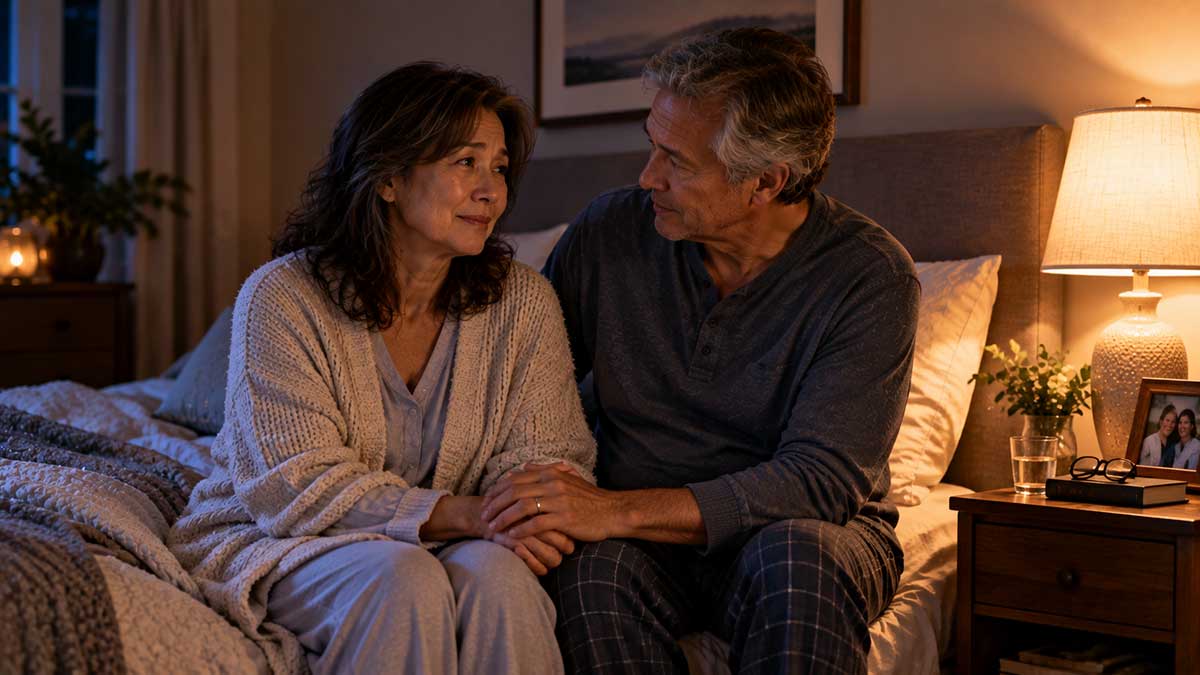
The lamp stayed on.
The next morning Linda almost regretted the conversation.
Vulnerability had a hangover.
She felt exposed.
Thomas behaved normally.
He made coffee.
Burned toast.
Complained about the weather.
That helped.
At breakfast he asked:
“What feels okay right now?”
Linda looked up.
“What do you mean?”
“With us.”
She thought.
“Holding hands.”
“Okay.”
“Hugging.”
“Okay.”
“Kissing.”
Thomas smiled slightly.
“Good.”
Linda pointed a finger at him.
“Don't make that face.”
“What face?”
“That hopeful face.”
“I have no control over my face.”
She laughed.
The laughter eased something.
Then she became serious.
“I don't know about anything else yet.”
Thomas nodded.
“Then we don't know yet.”
That answer mattered.
For several weeks, they relearned touch.
At first it felt strangely formal.
Thomas would ask:
“Can I rub your back?”
Linda would say yes.
Or no.
Both answers became safe.
Sometimes they sat on the couch with Linda's feet across Thomas's lap.
Sometimes he kissed her shoulder.
Sometimes they lay beside each other and talked.
No destination.
No expectation.
One night Linda said:
“I feel ridiculous.”
“Why?”
“We've been married thirty-seven years.”
Thomas smiled.
“And apparently we are beginners.”
She laughed.
“Again?”
“Apparently.”
There were hard moments.
Once Thomas touched the scar without warning.
Linda pulled away.
He immediately said:
“Sorry.”
She went quiet.
Thomas started to retreat.
Linda stopped him.
“Wait.”
He waited.
She took his hand.
Then placed it back.
Not on the scar.
Near it.
Thomas looked at her.
Linda whispered:
“I need to choose.”
He nodded.
“Okay.”
She took a breath.
“Try again.”
That moment became more intimate than anything either expected.
Spring came.
Linda bought a blouse she would never have worn the year before.
Nothing dramatic.
A little more fitted.
She stood in front of the mirror before dinner.
Thomas passed the doorway.
Then stopped.
Linda saw him in the mirror.
He looked at her.
Really looked.
She felt the old instinct to cover herself.
Instead, she said:
“Well?”
Thomas leaned against the doorframe.
“You want the safe answer or the real one?”
Linda smiled.
“The real one.”
“You look beautiful.”
She waited.
Thomas continued:
“And very much like yourself.”
Linda's eyes filled.
“That was the right answer.”
“I had several prepared.”
“Good.”
One evening, months after the lamp conversation, Linda went into the bedroom before Thomas.
She changed clothes.
Not in the bathroom.
In the bedroom.
Her hands trembled slightly.
Thomas entered halfway through.
He stopped.
Linda froze.
For one second the old fear returned.
Thomas immediately looked toward the floor.
Linda saw him do it.
“Thomas.”
He looked up carefully.
“It's okay.”
He looked at her.
Not quickly.
Not hungrily.
Not cautiously.
Tenderly.
Linda felt tears rise.
She laughed.
“Don't make me cry.”
“I didn't say anything.”
“Your face did.”
He smiled.
Linda finished changing.
Then got into bed.
Thomas sat beside her.
Neither spoke.
After a moment Linda reached for the lamp.
Her hand rested on the switch.
Thomas watched.
Linda paused.
Then pulled her hand back.
The light stayed on.
She turned toward him.
Thomas leaned closer.
“Okay?”
Linda nodded.
“Okay.”
He kissed her forehead.
Then her cheek.
Linda moved closer and rested her head against his chest.
Thomas wrapped his arms around her.
Nothing needed to happen after that.
For years, Linda had thought intimacy meant being wanted.
Then cancer taught her how fragile the body could become.
Silence taught her something more painful.
Being loved was not always the same as feeling seen.
Thomas had thought restraint was kindness.
Linda had thought restraint was rejection.
Both had built a story in the silence.
Neither story had been true.
Now, with the lamp still burning beside them, they were learning something they should have known after thirty-seven years.
You can love someone deeply and still misunderstand them.
You can know a body for decades and need permission to meet it again.
And sometimes healing begins with something very small.
A question.
A hand held without expectation.
A light left on.
Story 5: The Tirty-Eighth Anniversary

Robert had been married to Elaine for thirty-eight years when he discovered he no longer knew what she was afraid of.
The realization came at a restaurant overlooking a lake.
Their three children had arranged the weekend as an anniversary gift.
Two nights at a small hotel.
Dinner overlooking the water.
No children.
No grandchildren.
No responsibilities.
Just Robert and Elaine.
Their daughter had written inside the card:
Thirty-eight years deserves more than dinner. Go remember why you like each other.
Robert had laughed when he read it.
“Remember?”
Elaine smiled.
“I think she thinks we're ancient.”
“We are ancient.”
“You're ancient.”
“I'm two years older than you.”
“Exactly.”
They laughed.
It felt good.
Familiar.
Easy.
The kind of laughter that comes from spending most of your adult life with the same person.
At dinner they were seated near another couple celebrating their twentieth anniversary.
The couples began talking.
The younger husband raised his glass.
“Thirty-eight years. That's incredible.”
Robert smiled.
“Some days more incredible than others.”
Everyone laughed.
The younger wife asked:
“So what's the secret?”
Elaine looked at Robert.
Robert shrugged.
“Patience.”
Elaine laughed.
“With him, yes.”
Then the woman asked another question.
“What do you two talk about after thirty-eight years?”
Robert answered immediately.
“Everything.”
Elaine smiled.
But something in her face changed.
Only for a second.
Robert did not notice.
Back in their hotel room, Robert loosened his shoes and sat on the edge of the bed.
“That was good.”
Elaine stood by the window.
The lake was nearly black now.
A few lights from boats moved in the distance.
Robert turned on the television.
Elaine said:
“What do we talk about?”
Robert looked over.
“What?”
“At dinner.”
“What about it?”
“You said we talk about everything.”
“We do.”
Elaine looked at him.
“Do we?”
Robert laughed.
“What is this?”
“Nothing.”
She turned back toward the window.
Robert lowered the television volume.
“No. You don't say something like that and then say nothing.”
Elaine crossed her arms.
“I was just thinking.”
“About?”
She hesitated.
Then turned toward him.
“What am I most afraid of right now?”
Robert smiled.
He thought this was some kind of anniversary quiz.
“Your mother's health.”
Elaine shook her head.
“No.”
“The kids?”
“No.”
“Money?”
Elaine almost laughed.
“We have enough money.”
“I know. You still worry.”
“Not about that.”
Robert sat straighter.
“What is it?”
Elaine did not answer.
Instead she asked:
“What am I most excited about this year?”
Robert thought.
“The Alaska trip?”
“We canceled that.”
“Oh. Right.”
“My retirement?”
“You've been retired for eight months.”
Robert frowned.
Elaine looked at him gently.
“What am I struggling with right now?”
Robert opened his mouth.
Nothing came.
Elaine looked toward the lake again.
Robert felt irritation rise.
“This isn't fair.”
“I know.”
“No, seriously. You ask three random questions and suddenly I'm supposed to fail some test?”
“It's not a test.”
“Feels like one.”
Elaine nodded.
“I shouldn't have done it this way.”
Robert stood.
“What are you trying to say?”
She did not answer immediately.
When she did, her voice was soft.
“You know everything about the woman you married.”
Robert stared at her.
Elaine continued.
“I don't know if you know me.”
He felt as if she had slapped him.
“What does that mean?”
“Robert.”
“No. Explain that.”
“I don't want to fight.”
“Then don't say things like that.”
Elaine turned toward him.
“I'm not saying you don't love me.”
“That's exactly what it sounds like.”
“No.”
Robert began pacing.
“Thirty-eight years.”
“I know.”
“I have been here for thirty-eight years.”
“I know.”
“We raised three kids.”
“Yes.”
“We put them through college.”
“Yes.”
“We built a life.”
“I know.”
“I worked fifty, sixty hours some weeks so you could stop working when your mother got sick.”
“I remember.”
“I never cheated on you.”
“I know.”
“I never disappeared.”
“I know.”
“I came home.”
Elaine's eyes filled.
“I know, Robert.”
“Then what more was I supposed to do?”
She looked at him.
“I didn't say you didn't love me.”
“Then what are you saying?”
Elaine wiped one eye.
“I said you don't know me.”
The room became quiet.
Robert sat down.
For the first time, he understood they were talking about two different things.
They did not solve it that night.
They barely spoke.
Robert lay facing the wall.
Elaine lay facing the window.
He was angry.
Then hurt.
Then confused.
He replayed her words.
You don't know me.
It seemed absurd.
He knew Elaine hated mushrooms.
She loved old houses.
She cried at animal rescue videos.
She took her coffee with a little milk, no sugar.
She could never sleep before a flight.
She hated being late.
She always checked the stove twice.
She read the ending of mystery novels before finishing them.
He knew the names of every teacher she had hated in high school.
He knew the story of the scar near her knee.
He knew she wanted yellow roses, never red.
How could she say he did not know her?
Then another thought came.
He knew who she had been.
Maybe that was different.
The next morning they ate breakfast in the hotel dining room.
Robert ordered eggs.
Elaine had yogurt and fruit.
They talked about the weather.
The drive home.
Their grandson's soccer game.
Nothing else.
Then Robert noticed a notebook sticking out of Elaine's purse.
“What is that?”
Elaine glanced down.
“Nothing.”
“Can I see it?”
She hesitated.
That hesitation bothered him.
“Elaine.”
She handed it over.
Inside were sketches.
Trees.
Windows.
A woman sitting in a café.
A row of old houses.
A small watercolor of the lake outside their hotel.
Robert turned another page.
And another.
“You did these?”
“Yes.”
“When?”
“Over the last few months.”
He looked up.
“You paint?”
“A little.”
“Since when?”
“Since January.”
Robert stared at her.
“You've been taking classes?”
“Yes.”
“Where?”
“The community arts center.”
He closed the notebook.
“Why didn't you tell me?”
Elaine looked at him.
“I don't know.”
“That doesn't make any sense.”
“I thought I had.”
“You definitely didn't.”
She looked down at her coffee.
Robert heard the words before he chose them.
“Who do you talk to about this stuff?”
Elaine looked up.
“What?”
“Painting.”
“My class.”
“So these people know?”
“Some.”
“And I don't.”
Elaine's expression tightened.
Robert instantly recognized the accusation in his voice.
He leaned back.
“Sorry.”
She said nothing.
He opened the notebook again.
There was a painting of a bridge.
Then one of their kitchen window.
Then something that stopped him.
It was Robert.
Sitting at the dining room table.
His head was lowered.
Morning light fell across his shoulders.
He looked lonely.
Robert stared at it.
“When did you do this?”
“February.”
“Why do I look like that?”
“Like what?”
“Sad.”
Elaine looked at the painting.
“You were.”
Robert felt uncomfortable.
“I don't remember.”
“I do.”
He looked at her.
“You had been retired three weeks.”
Robert closed the notebook.
Retirement had been his idea.
For years he talked about it.
Golf.
Travel.
Breakfast on weekdays.
No emails at midnight.
No employees calling during dinner.
Then he retired.
The first Monday morning felt wonderful.
By Thursday, he had reorganized the garage.
By the second week, he had cleaned every file on his computer.
By the third week, he began waking at five-thirty out of habit.
There was nowhere he needed to be.
For forty-two years, someone had needed him somewhere.
Customers.
Employees.
Children.
His father.
Elaine.
Then suddenly no one needed him before nine.
He never said that frightened him.
He did not have language for it.
Instead he became busy.
He fixed shelves.
Changed filters.
Reviewed investments.
Helped his son with a home renovation.
He told everyone retirement was great.
Elaine believed him.
Or perhaps she did not.
Maybe she had painted what he could not say.
Robert looked across the breakfast table.
“What am I afraid of?”
Elaine blinked.
“What?”
“Last night you asked what you're afraid of.”
“Yes.”
“What am I afraid of?”
She studied him.
“I don't know.”
Robert nodded.
“Good.”
“Good?”
“Now we're even.”
Elaine smiled faintly.
Robert looked toward the lake.
Then he said:
“I don't want to go home today.”
Elaine looked surprised.
“Why?”
“I don't know.”
He took a breath.
“Maybe we should stay another day.”
“We have checkout at eleven.”
“We can ask.”
“The kids are coming Sunday.”
“Today is Friday.”
Elaine watched him.
Robert continued.
“I think we should stay.”
“For what?”
He looked at her notebook.
“I think we have homework.”
They got the room for one more night.
Robert drove into town and bought two cheap notebooks.
He gave one to Elaine.
“What are these?”
“Rules.”
Elaine raised an eyebrow.
“I didn't know notebooks came with rules.”
“These do.”
He sat across from her near the lake.
“No questions about the kids.”
“Okay.”
“No grandchildren.”
“Fine.”
“No money.”
Elaine smiled.
“That's difficult for you.”
“No house repairs.”
“Now you're suffering.”
“No medical appointments.”
She laughed.
Robert held up his notebook.
“Ten questions each.”
“About what?”
“Us.”
Elaine's smile faded.
“Us?”
“No.”
He pointed toward her.
“You.”
Then to himself.
“Me.”
He opened his notebook.
“Questions about the person.”
Elaine stared at him.
“Robert.”
“What?”
“This is weird.”
“I know.”
“You hate weird.”
“I know.”
She laughed.
Then opened her notebook.
The first questions were easy.
“What place do you still want to visit?”
“What food do you secretly hate that I think you like?”
“What would you buy if money didn't matter?”
Then the questions became harder.
Elaine asked:
“What do you miss most about being younger?”
Robert said:
“Feeling like there was plenty of time.”
Robert asked:
“When do you feel loneliest?”
Elaine was quiet for a long time.
Then she said:
“Sometimes when we're in the same room.”
Robert wrote nothing after that.
Elaine asked:
“What do you miss about us?”
Robert looked toward the water.
“You laughing before I finish a story since you already know how it ends.”
Elaine smiled.
“I still do that.”
“Not as much.”
She thought about it.
“Maybe your stories got worse.”
He laughed.
They continued.
At some point, Robert forgot this had begun as a problem he needed to fix.
He became curious.
That felt new.
Late in the afternoon, Elaine asked:
“What scares you most about getting older?”
Robert gave the answer he thought he was supposed to give.
“Getting sick.”
Elaine waited.
“What?”
“You're lying.”
Robert smiled.
“I'm not.”
“You are.”
“How do you know?”
“Thirty-eight years.”
He laughed.
“Now thirty-eight years counts?”
“For some things.”
She waited.
Robert looked out over the lake.
A boat moved slowly across the water.
He rubbed his hands together.
“I think I'm scared of becoming unnecessary.”
Elaine said nothing.
That made him continue.
“At work, people needed answers from me.”
She listened.
“The kids needed things.”
He looked down.
“My parents needed things.”
His voice became quieter.
“Now nobody needs anything.”
“That isn't true.”
“It feels true.”
Elaine moved her chair closer.
Robert swallowed.
“I spent my whole life being useful.”
His eyes filled.
He looked embarrassed.
Elaine reached across the table.
“You were never your job to me.”
Robert looked down.
She squeezed his hand.
“You know that, right?”
He did not answer.
That was the answer.
Elaine moved closer.
“Robert.”
He wiped his eyes.
“I don't know who I am if I'm not solving something.”
Elaine smiled through tears.
“Maybe that's something you get to find out.”
He looked at her.
Then at her notebook.
“So do you.”
It was Robert's turn.
He looked at one of the questions he had written.
“What are you most excited about right now?”
Elaine smiled.
“You already failed this one.”
“I get a second chance.”
She looked toward the hotel.
“Painting.”
“I figured.”
“No.”
“What?”
“Not just the class.”
She hesitated.
“I applied for a small community exhibition.”
Robert stared at her.
“You did?”
“Yes.”
“When?”
“Last week.”
“Why didn't you tell me?”
Elaine looked down.
Robert caught himself.
He changed the question.
“Can I see what you're submitting?”
Elaine looked back up.
Something in her face softened.
“Yes.”
“That was the right question, wasn't it?”
She smiled.
“Yes.”
That evening they ate sandwiches on a bench near the water instead of returning to the expensive restaurant.
Elaine asked:
“If you could change one thing about the last ten years, what would it be?”
Robert thought.
“More time with you.”
Elaine laughed.
“You were with me every day.”
“I know.”
She stopped laughing.
Robert looked at her.
“That might be the problem.”
Elaine nodded slowly.
They had confused proximity with attention.
There had always been tomorrow.
Tomorrow to ask.
Tomorrow to listen.
Tomorrow to take the trip.
Tomorrow to tell the story.
Tomorrow to explain the fear.
Tomorrow was plentiful until one day both of them were in their sixties asking when they had stopped talking.
Robert asked:
“When did this happen?”
Elaine looked at the lake.
“I don't think it happened.”
He waited.
“I think we just stopped happening.”
Robert felt the sentence settle inside him.
Not one event.
Not one betrayal.
Not one terrible argument.
A thousand ordinary days.
That was harder to blame.
It was easier to forgive.
They returned home Saturday afternoon.
Nothing looked different.
Same driveway.
Same kitchen.
Same mail on the counter.
Robert carried the bags upstairs.
Elaine put her notebook on the kitchen table.
He stopped.
“Can I see your paintings later?”
She smiled.
“Yes.”
That evening she showed him all of them.
He asked questions.
Some were good questions.
Some were ridiculous.
He stared at one painting of an empty road for several minutes.
“What does this one mean?”
Elaine smiled.
“Nothing.”
“Nothing?”
“I liked the road.”
Robert frowned.
“I thought art was supposed to mean something.”
“Sometimes a road is a road.”
He nodded seriously.
“I'm learning.”
“You have a long way to go.”
“Thirty-eight more years?”
“Don't push it.”
Two months later, Elaine's painting was accepted into the community exhibition.
Robert told everyone.
Too many people, according to Elaine.
He had three of her paintings framed.
One hung in the hallway.
One in their bedroom.
The painting of Robert at the dining table stayed in Elaine's studio.
He asked why.
“That one's mine.”
He did not argue.
He had learned something.
Their Sunday mornings changed.
Coffee became the rule.
No phones for the first half hour.
One question each.
Sometimes the questions were serious.
“What are you worried about this week?”
Sometimes absurd.
“If you had to live inside one television show, which one?”
Once Robert asked:
“What's something you believe now that you didn't believe ten years ago?”
Elaine said:
“That you can be happily married and still get lonely.”
Robert thought about that for days.
Another Sunday Elaine asked:
“What's one thing you want to do before you're seventy?”
Robert said:
“Learn how to cook five things properly.”
“You're sixty-seven.”
“I have three years.”
“You can barely make eggs.”
“Then we should begin immediately.”
They did.
The first meal was terrible.
They ate it anyway.
Four months after the anniversary, their daughter came to visit.
She walked into the hallway.
“Mom, are these yours?”
Elaine looked up from the kitchen.
“Yes.”
Her daughter stared at the paintings.
“When did you start doing this?”
“January.”
“They're good.”
“Your father thinks so.”
Robert appeared carrying coffee.
“I am a patron of the arts.”
Elaine rolled her eyes.
Their daughter laughed.
Then she noticed a card attached to the refrigerator.
Sunday: Coffee. One question each.
She pointed.
“What's this?”
Robert looked.
“Homework.”
Elaine laughed from across the kitchen.
“Something like that.”
Their daughter read the card again.
“This was from the anniversary trip?”
Robert looked at Elaine.
“In a way.”
Elaine poured another cup of coffee.
“Your turn.”
Robert leaned against the counter.
“I asked last Sunday.”
“No, you didn't. You spent forty minutes complaining about the neighbor's tree.”
“That tree is a menace.”
“Question.”
Robert sighed dramatically.
He looked at Elaine.
For a moment his expression changed.
His daughter noticed.
The teasing disappeared.
Robert thought.
Then he asked:
“What's something you've changed your mind about recently?”
Elaine smiled.
Robert waited.
Thirty-eight years together.
Three children.
Six grandchildren.
Thousands of breakfasts.
Arguments.
Flights.
Bills.
Funerals.
Vacations.
Illnesses.
Christmas mornings.
Ordinary Tuesdays.
He knew her history.
He knew her habits.
He knew how she took her coffee.
But standing in their kitchen that morning, Robert did something more important.
He did not assume he knew the answer.
He asked.
And then he listened.
Final Thoughts
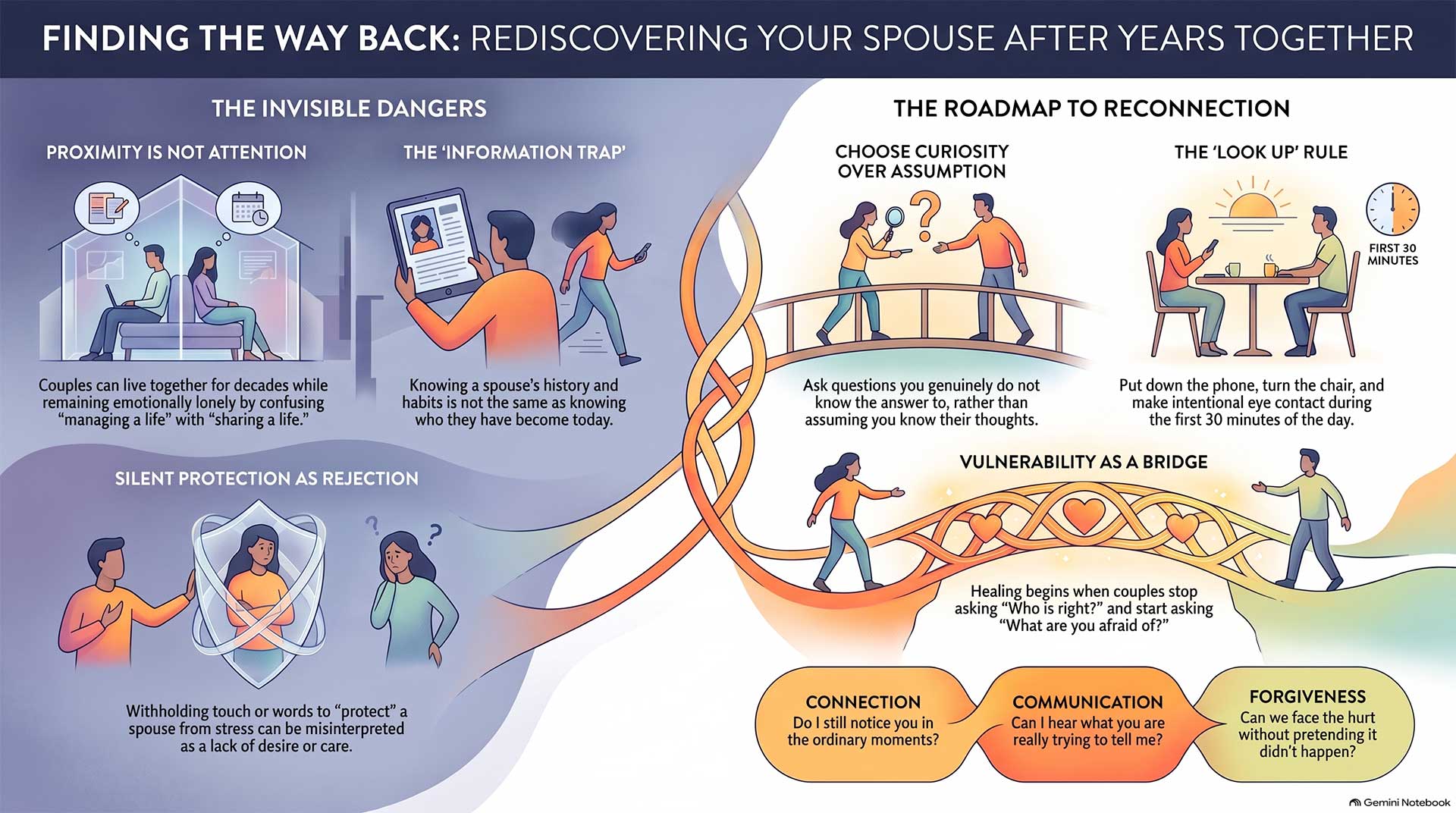
Five couples.
Five very different problems.
Yet each marriage reaches the same crossroads:
Will I keep assuming, or will I become curious again?
Michael and Rachel never stopped loving each other.
They simply stopped paying attention.
Their marriage began changing when Michael put down his phone and asked:
“What have I missed?”
Daniel and Emily thought they were fighting about whether his mother should move into their home.
They were really protecting two promises made long before they met.
Daniel feared becoming the son who abandoned his mother.
Emily feared becoming the exhausted caregiver she had watched her own mother become.
The conflict changed when they stopped asking:
“Who is right?”
and began asking:
“What are you afraid of?”
Andre believed his apology should eventually close the chapter on his emotional betrayal.
Simone had forgiven him, yet her body still reacted every time his phone lit up.
Their marriage began healing more deeply when Andre stopped asking when she would trust him again and finally understood what had been taken from her.
Forgiveness could begin with words.
Trust needed repeated experience.
Thomas and Linda spent nearly a year misunderstanding each other.
He stopped reaching for her because he thought he was protecting her after cancer.
She experienced that same restraint as rejection.
Neither lacked love.
They lacked one honest conversation.
Linda's words revealed how painful silence can become:
“I didn't need you to want sex. I needed to know you could still see me.”
And then Robert and Elaine reached their thirty-eighth anniversary.
No affair.
No divorce papers.
No explosive crisis.
They had raised children, built a home, remained loyal, and created a life that looked successful from the outside.
Yet Elaine asked Robert three simple questions about who she was now.
He could not answer them.
That may be the deepest danger explored across all five stories.
You can know someone's entire history and still stop knowing the person sitting beside you today.
People change.
Their fears change.
Their dreams change.
Their bodies change.
Their relationship with their parents changes.
Their sense of purpose changes.
What they need from love at thirty may not be what they need at sixty.
A marriage cannot live entirely on information learned twenty years ago.
It needs curiosity.
That is where the seven Marriage Course themes begin to connect.
Connection asks:
Do I still notice you?
Communication asks:
Can I hear what you are really trying to tell me?
Conflict asks:
Can your needs matter without threatening mine?
Forgiveness asks:
Can we face what happened without pretending it did not hurt?
Family asks:
What did we bring into this marriage before we ever met?
Sexual intimacy asks:
Can we keep meeting each other with tenderness as our bodies and lives change?
Love in action asks:
How will I show you today that you still matter to me?
None of the five couples solved marriage.
Michael will become distracted again.
Daniel will feel guilty about his mother again.
Simone may still have moments of fear.
Linda may still struggle with her changed body.
Robert and Elaine will still have Sundays when neither feels like talking.
The difference is that each couple has learned how to recognize the road back.
Coffee without phones.
A question asked before an accusation.
Patience after an old wound returns.
Touch without expectation.
One new question after thirty-eight years.
These things look small.
That may be why they are easy to overlook.
A marriage is often changed in moments that would look completely ordinary to anyone watching from outside.
Someone looks up.
Someone listens.
Someone admits fear.
Someone says, “I was wrong.”
Someone leaves the light on.
Someone asks another question.
Perhaps lifelong love is not measured only by whether two people stayed.
Perhaps it is measured by how often they found each other again after becoming distant.
And that leaves one question for every couple reading these stories:
When was the last time you asked your spouse something you genuinely did not know the answer to?
Short Bios:
Michael and Rachel
Married for 31 years, Michael and Rachel have built a stable family life but slowly lost the habit of truly paying attention to each other. Their story explores emotional connection and the small moments that keep love alive.
Daniel and Emily
Married for 19 years, Daniel and Emily face a painful conflict over caring for Daniel’s aging mother. Their story explores family loyalty, childhood experiences, cultural expectations, and how two valid needs can collide.
Andre and Simone
Married for 14 years, Andre and Simone are rebuilding after Andre’s emotional relationship with a coworker. Their story explores betrayal, forgiveness, emotional safety, and the slow return of trust.
Thomas and Linda
Married for 37 years, Thomas and Linda struggle to reconnect physically after Linda’s cancer treatment. Their story explores aging, body image, desire, vulnerability, and the need to feel seen by the person you love.
Robert and Elaine
Married for 38 years, Robert and Elaine appear to have a strong and successful marriage. An anniversary trip reveals how much they have stopped learning about each other. Their story explores curiosity, companionship, identity, and rediscovering a spouse after decades together.
Fictional Story Note
These stories and characters are fictional.
They were created to explore relationship themes raised through the seven Marriage Course sessions and the broader marriage research discussed in Parts 1 and 2.
They are intended for reflection and relationship education rather than individualized couples therapy.
Leave a Reply