


Introduction
Little Wonder asks a difficult question beneath its story of separation, music, motherhood, and reunion:
Can we love someone deeply without making their life responsible for our happiness, sacrifice, fear, or dreams?
The five modern stories in this collection carry that question into different lives.
A mother discovers that sacrifice can quietly become debt.
A gifted child struggles to separate who she is from what she can do.
Two women learn that family does not have to become a competition.
A delivery worker discovers how easily systems measure performance while overlooking humanity.
A mother who nearly lost her son must learn that protecting him cannot mean watching him forever.
These are not retellings of Song and River's story.
They take the emotional questions raised by Little Wonder and place them inside situations families encounter today.
Each begins with something good: love, protection, sacrifice, talent, responsibility, care.
Then that good thing becomes complicated.
The question is never whether love matters.
It is what love becomes when fear, expectation, guilt, ambition, or loss enters it.
Across these five stories, one idea slowly emerges:
The people we love do not owe us their entire lives simply because we gave them part of ours.
Perhaps the greatest gift love can offer is not holding someone close forever.
It is giving them enough room to become themselves and discovering that the relationship can survive.
(Note: This is an imaginary conversation, a creative exploration of an idea, and not a real speech or event.)
Story 1: The Scholarship He Didn’t Want
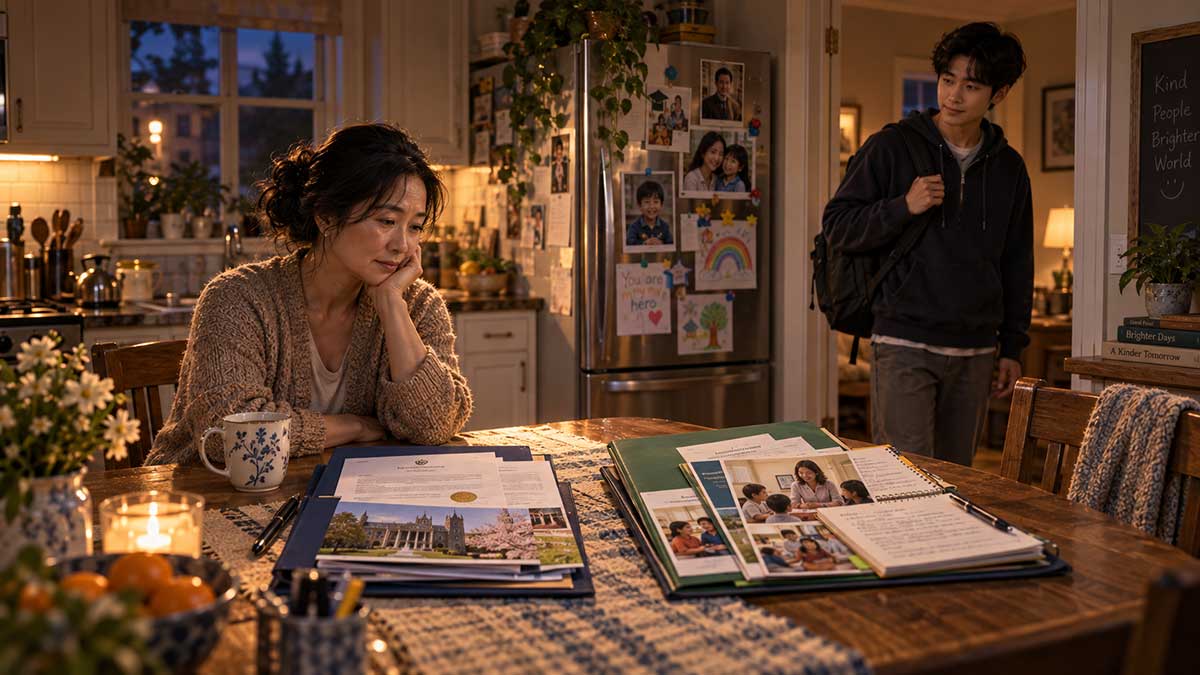
Grace Park found the envelope before Daniel came home.
It was thick, cream-colored, and heavier than ordinary mail.
She knew before opening it.
For a few seconds, she simply stood in the kitchen holding it.
Then she tore it open.
Her eyes moved quickly.
Once.
Twice.
Then slowly.
Congratulations.
Daniel had been accepted into one of the most respected engineering programs in the country.
There was financial aid.
A scholarship.
More money than Grace had allowed herself to hope for.
She sat down.
Then she cried.
Not loudly.
Grace rarely cried loudly.
She pressed the letter against her chest and stared at the refrigerator across from her.
Daniel's old spelling test was still attached with a magnet shaped like a strawberry.
100%.
Beside it was a photograph from middle school.
Daniel standing beside a homemade robot.
Another from tenth grade.
Science competition.
Another.
Math award.
Grace laughed through her tears.
Grace: We did it.
Nobody was there to hear her.
She picked up her phone.
She photographed the letter.
Sent it to her sister.
Her brother.
Daniel's grandmother.
Two women from church.
Then she stopped.
She wanted Daniel to hear the news from her.
She placed the letter carefully on the kitchen table.
Then she began cooking.
His favorite.
Bulgogi.
Rice.
Spinach.
Egg rolls.
She opened the freezer and found the expensive ice cream she had bought two weeks earlier but told Daniel not to touch.
Tonight he could eat all of it.
Grace moved around the kitchen feeling lighter than she had felt in years.
For once, every hour of overtime seemed connected to something.
Every Saturday morning she had gone to work when other mothers were sleeping.
Every pair of shoes she had worn until the soles became thin.
Every vacation she had politely declined.
Every time Daniel had asked:
"Mom, why don't we go somewhere?"
And she had answered:
"Maybe next year."
All those years had become a letter.
Daniel arrived at 5:47.
He opened the front door and smelled dinner.
Daniel: What's going on?
Grace stood in the kitchen doorway holding the envelope.
Daniel stopped.
His backpack slid slightly down one shoulder.
Grace smiled.
Grace: Come here.
Daniel looked at the letter.
Then at her.
He already knew.
Grace held it out.
Daniel did not take it immediately.
Grace: You got in.
Daniel smiled.
But not the smile she expected.
A smaller one.
Tired.
Grace: Daniel.
She laughed.
Grace: You got in.
She rushed forward and hugged him.
Daniel hugged her back.
Grace: Scholarship too.
He closed his eyes.
Grace: Almost everything.
She pulled back and touched his face.
Grace: You did it.
Daniel looked at the letter.
Daniel: Mom.
Grace: Wait until Grandma hears.
Daniel: Mom.
Grace: Your aunt already knows.
Daniel frowned.
Daniel: You told everyone?
Grace stopped.
Grace: Only family.
Daniel looked down.
Grace: What?
Daniel: Nothing.
Grace: Why are you acting like someone died?
Daniel gave a small laugh.
Daniel: I'm not.
Grace: Then smile properly.
Daniel looked at her.
Grace's smile weakened.
Grace: What happened?
He put his backpack down.
Daniel: Can we talk first?
Grace stared at him.
Something cold entered the room.
She hated the sentence immediately.
Grace: About what?
Daniel sat at the kitchen table.
Grace remained standing.
Daniel: I don't think I'm going.
Grace did not move.
Grace: Going where?
Daniel: To the engineering program.
She blinked.
Grace: What do you mean?
Daniel: I don't think I want engineering.
Grace looked at the letter.
Then at him.
Grace: You're tired.
Daniel: No.
Grace: You were studying late.
Daniel: Mom.
Grace: Eat first.
Daniel: I've been thinking about this for months.
That stopped her.
Grace: Months?
Daniel nodded.
Grace: You applied months ago.
Daniel: I know.
Grace: You wrote three essays.
Daniel: I know.
Grace: You met with the counselor six times.
Daniel: I know.
Grace's voice sharpened.
Grace: Then what changed?
Daniel looked down at his hands.
Daniel: Nothing changed.
Grace stared at him.
Daniel: I just finally admitted it.
Grace: Admitted what?
Daniel took a breath.
Daniel: I want to become a teacher.
Grace waited.
She seemed to expect more.
Grace: A teacher.
Daniel: Middle school.
Grace stared.
Grace: Middle school.
Daniel: Probably math.
Grace sat down slowly.
Grace: You got into that school.
Daniel: I know.
Grace: With money.
Daniel: I know.
Grace: Engineering.
Daniel nodded.
Grace: And you want to teach seventh graders fractions.
Daniel: That's not all middle-school math is.
Grace laughed once.
Daniel immediately regretted correcting her.
Grace: Good.
Very good.
Now you are teaching me already.
Daniel: Mom.
Grace: No.
She stood again.
Grace: I want to understand.
Daniel waited.
Grace looked toward the stove.
Grace: Eat.
Daniel: I'm not hungry.
Grace turned toward him.
Grace: I cooked everything.
Daniel closed his eyes briefly.
Daniel: Okay.
They ate in silence.
The bulgogi went cold quickly.
Grace barely touched her food.
Daniel forced himself through half a bowl of rice.
When he finally put his chopsticks down, Grace spoke without looking at him.
Grace: Why?
Daniel: I like teaching.
Grace: You've never been a teacher.
Daniel: I tutor.
Grace: That's different.
Daniel: I know.
Grace: You like tutoring since you're good at math.
Daniel: I like when someone finally understands something they thought they couldn't do.
Grace looked at him.
Daniel continued.
Daniel: You know Kevin from the community center?
Grace nodded.
Daniel: He thought he was stupid.
His teachers thought he was lazy.
He just never understood fractions.
I worked with him for six weeks.
Last month he got a B.
Grace said nothing.
Daniel: He showed me the test.
He was shaking.
Grace watched him.
Daniel: I don't know.
That felt...
He searched for the word.
Daniel: Important.
Grace's face hardened again.
Grace: Engineering is important.
Daniel: I didn't say it wasn't.
Grace: Engineers build hospitals.
Bridges.
Machines.
Everything.
Daniel: I know.
Grace: Teachers complain about money all the time.
Daniel looked down.
Grace leaned toward him.
Grace: You think money does not matter when you're eighteen.
It matters.
Rent matters.
Health insurance matters.
Your car breaks.
Someone gets sick.
You lose work for two weeks.
Everything matters.
Daniel looked at her.
Daniel: I know money matters.
Grace laughed bitterly.
Grace: No.
You know the sentence.
You do not know what it feels like.
Daniel was silent.
Grace stood.
She began clearing plates.
Daniel: Mom.
Grace: You have choices now.
That was the point.
Daniel: I know.
Grace: Then choose something that gives you choices later.
Daniel followed her into the kitchen.
Daniel: Teaching gives me choices.
Grace turned.
Grace: Not enough.
Daniel: For you.
The room changed.
Grace's hand stopped over the sink.
Daniel: I'm sorry.
Grace: No.
Say it.
Daniel: I didn't mean it like that.
Grace: You did.
Daniel stared at the floor.
Grace placed the plate down.
Grace: You think I want to control your life.
Daniel: I think you're scared.
That surprised her.
Grace looked away.
Daniel: I know why.
Grace: You know nothing about it.
Daniel waited.
Grace wiped her hands on a towel.
Grace: Your father died with forty-three dollars in checking.
Daniel's face changed.
She had never told him that number.
Grace: Forty-three.
I remember it since I checked three times.
Forty-three dollars.
Rent was due in nine days.
You were three.
She looked toward him.
Grace: I had no idea how I was going to pay it.
Daniel said nothing.
Grace: Your shoes were too small.
I knew that too.
I kept putting tissue in the front.
Daniel lowered his eyes.
Grace: I borrowed money from your aunt.
Then your grandmother.
Then I worked.
And worked.
And worked.
Her voice was calm now.
That made it more painful.
Grace: I do not care about fancy houses.
I do not care if you become rich.
I care that one broken transmission does not destroy your month.
I care that when you have a child, you can buy shoes when his feet grow.
Daniel's eyes filled.
Grace: I care that you never look at forty-three dollars and wonder how long two people can live on it.
She turned back toward the sink.
Daniel: Mom.
Grace: That's what I wanted.
Not a title.
Safety.
Daniel stood behind her.
Daniel: I know.
Grace shook her head.
Grace: You didn't know.
Daniel: I didn't know the number.
Grace looked toward him.
Daniel: But I knew something.
He sat back down.
Grace stayed standing.
Daniel: I knew every time you said no to something for yourself.
Grace's expression changed.
Daniel: You think I didn't notice.
I did.
Daniel looked at the old winter coat hanging near the door.
Daniel: You wore that coat for nine years.
Grace: It still works.
Daniel: I know.
He looked toward the kitchen counter.
Daniel: You buy the cheapest coffee.
You never replace your phone until it stops turning on.
You tell people you hate vacations so you don't have to explain that you don't want to spend the money.
Grace stared at him.
Daniel: I saw all of it.
Grace's eyes filled.
Daniel: And every time something good happened to me, you looked like it made everything worth it.
Grace whispered:
Grace: It did.
Daniel nodded.
Daniel: That's the problem.
Grace froze.
Daniel's voice shook.
Daniel: I don't know how to choose something you think is a mistake without feeling like I'm saying all of it wasn't worth it.
Grace sat down.
Slowly.
Daniel continued.
Daniel: If I become an engineer, I can tell myself you were right.
You worked two jobs and I became successful.
Daniel swallowed.
Daniel: If I become a teacher...
Grace looked at him.
Daniel: What am I supposed to do with everything you gave up?
Grace wiped one eye angrily.
Grace: I never asked you to pay me back.
Daniel: I know.
Grace: Never.
Daniel: I know.
Grace: Then stop talking like I gave you an invoice.
Daniel looked at her.
He stood suddenly.
Then walked toward the hallway.
Grace: Where are you going?
Daniel: I want to show you something.
He returned with a thick blue folder.
Grace recognized it.
Grace: Where did you get that?
Daniel: Your closet.
Grace stood.
Grace: You went through my things?
Daniel: I was looking for my birth certificate.
He placed the folder on the table.
Grace stared at it.
Daniel opened it.
Inside were receipts.
Tutoring.
SAT preparation.
Summer math camp.
School supplies.
Laptop repair.
College application fees.
A used graphing calculator.
Years of paper.
Daniel: What is this?
Grace stared.
Grace: Records.
Daniel: Why keep them?
Grace: I keep everything.
Daniel: Mom.
Grace looked at him.
Daniel: When I found this, I sat on the floor for twenty minutes.
Grace's face softened.
Daniel: Do you know what it looked like?
Grace did not answer.
Daniel touched the stack.
Daniel: It looked like my childhood had receipts.
Grace shut the folder.
Grace: No.
Daniel stepped back.
Grace: No.
She held the folder against her chest.
Grace: That is not what this is.
Daniel: I know you didn't mean it that way.
Grace: Then don't say it.
Daniel: That's how it felt.
Grace's face broke.
Daniel: I'm not blaming you.
Grace: It sounds like blame.
Daniel: I know.
Grace looked away.
Daniel's voice softened.
Daniel: I just need to know something.
Grace looked toward him.
Daniel: Did you give me choices so I could choose?
He paused.
Daniel: Or so you could choose better choices for me?
Grace stared at him.
The question seemed to take the air from the room.
Daniel immediately looked ashamed.
Daniel: I'm sorry.
Grace lifted one hand.
Grace: Don't.
Daniel waited.
Grace sat.
She looked at the closed blue folder.
For several seconds, neither moved.
Then Grace spoke.
Grace: When you were six, you wanted to be a dinosaur.
Daniel blinked.
Daniel: What?
Grace: Paleontologist.
You said dinosaur first.
Daniel almost smiled.
Grace: Then astronaut.
Then basketball player.
You are terrible at basketball.
Daniel: I know.
Grace: Then engineer.
Grace looked at him.
Grace: I liked engineer.
Daniel nodded.
Grace: Very much.
He sat across from her.
Grace: It sounded safe.
Daniel's eyes softened.
Grace: Every time you said engineer, I could see something.
An apartment.
A car that starts.
Health insurance.
Food.
A refrigerator with too much inside it.
She laughed weakly.
Grace: Stupid things.
Daniel: Not stupid.
Grace shook her head.
Grace: I started loving the picture.
Daniel looked down.
Grace: Maybe too much.
Silence.
Grace touched the folder.
Grace: This...
She struggled.
Grace: I kept these since I was afraid.
Daniel looked up.
Grace: I wanted to know where money went.
I wanted to know we were still moving.
Every receipt meant something had been paid.
Handled.
Not waiting to destroy us.
Daniel had never heard her speak this way.
Grace opened the folder again.
She looked at a receipt from a tutoring center.
Grace: Maybe after a while it became something else.
Daniel waited.
Grace: Proof.
Daniel: Of what?
Grace stared at the paper.
Grace: That I did enough.
Daniel's expression softened.
Grace: That I wasn't failing you.
She laughed once.
Grace: Maybe you were never the one being graded.
Daniel's eyes filled.
Grace looked at him.
Grace: Maybe I was.
Daniel reached across the table.
Grace let him take her hand.
Daniel: You didn't fail me.
Grace squeezed his fingers.
Grace: I know you believe that.
Daniel: I know it.
Grace looked away.
Daniel: Mom.
She turned back.
Daniel: I don't want to become a teacher to reject you.
Grace nodded.
Daniel: I want to become a teacher since when I help someone understand something, I feel useful in a way that feels like me.
Grace's eyes filled again.
Daniel: I know it won't make much money.
I know I may regret parts of it.
I know you may be right about some things.
Grace gave him a tiny smile.
Grace: Many things.
Daniel laughed.
Daniel: Fine.
Many things.
Grace's smile faded.
Daniel continued.
Daniel: But I need the mistake to be mine if it is one.
Grace closed her eyes.
She held his hand for a long time.
Then she released it.
Not angrily.
Gently.
Grace: I need time.
Daniel nodded.
Daniel: Okay.
Grace: I am still angry.
Daniel: Okay.
Grace: I still think engineering is better.
Daniel laughed softly.
Daniel: I know.
Grace: Do not laugh.
Daniel: Sorry.
Grace looked at him.
Grace: I am serious.
Daniel nodded.
Grace: But...
She stopped.
Daniel waited.
Grace: I heard you.
That was enough for that night.
Not approval.
Not resolution.
Just hearing.
Two weeks later, Daniel accepted the teaching scholarship.
He did not tell Grace immediately.
He waited until Sunday afternoon.
She was folding laundry.
Daniel: I accepted it.
Grace stopped folding.
Grace: The teaching one.
Daniel: Yes.
Grace nodded once.
Then continued folding towels.
Daniel stood there awkwardly.
Daniel: That's it?
Grace: What do you want?
Daniel: I don't know.
Yelling?
Grace: I am tired.
Daniel smiled.
Grace did not.
Then she held up a towel.
Grace: Starting salary?
Daniel told her.
Grace stared at him.
Grace: Terrible.
Daniel laughed.
Grace: Not funny.
Daniel: A little funny.
Grace folded the towel aggressively.
Grace: Retirement plan?
Daniel told her.
She asked about health insurance.
Student loans.
Certification.
Housing.
Daniel answered everything he could.
For the first time, Grace was not trying to change the decision.
She was trying to understand it.
That difference mattered.
Graduation arrived in June.
Grace sat in the bleachers wearing the same navy dress she had worn to Daniel's middle-school ceremony.
Her sister complained that Grace needed a new dress.
Grace said:
"This one still works."
Daniel saw her from the graduates' section.
He smiled.
Grace waved too enthusiastically.
He pretended not to know her.
When Daniel's name was called, Grace stood before anyone else.
She clapped so loudly the woman beside her laughed.
After the ceremony, families crowded the field.
Daniel found Grace near a tree.
She was holding something.
The engineering acceptance letter.
Daniel stared at it.
Daniel: You brought that?
Grace nodded.
Daniel: Why?
She looked at the letter.
Then at him.
Grace: I thought this was the future.
Daniel said nothing.
Grace folded the letter once.
Then again.
She held it out.
Daniel took it.
Grace: It was only one future.
Daniel looked at her.
Grace's eyes filled.
Grace: I still think it was a very good one.
Daniel laughed.
Daniel: I know.
Grace: Safer.
Daniel: Probably.
Grace: Better salary.
Daniel: Definitely.
Grace: More respect.
Daniel shrugged.
Grace: Better mother.
Daniel frowned.
Daniel: What?
Grace smiled sadly.
Grace: Maybe that is what I thought.
If you got there, I did my job correctly.
Daniel looked at her.
Grace touched his graduation gown.
Grace: But you are not my report card.
Daniel's face changed.
Grace's voice trembled.
Grace: I did not work all those years so you could owe me your life.
Daniel lowered his head.
Grace touched his cheek.
Grace: I worked so you could have one.
Daniel hugged her.
Grace held him tightly.
Then, after several seconds, she let go first.
Three months later, Daniel came home from college for a weekend.
He found an envelope on the kitchen counter.
Not his.
Grace's.
A retirement account statement.
He stared at it.
There was not much money in it.
Not yet.
But there was a monthly automatic deposit.
Daniel smiled.
Grace entered carrying groceries.
She saw what he was holding.
Grace: Don't look at my financial things.
Daniel: You started this?
Grace took the statement from him.
Grace: Yes.
Daniel: Since when?
Grace: July.
Daniel smiled.
Grace: Why are you smiling?
Daniel: Nothing.
Grace put the statement away.
Daniel: What are you saving for?
Grace stopped.
She seemed confused by the question.
Then she thought.
Grace: I don't know yet.
Daniel leaned against the counter.
Daniel: Good.
Grace looked at him.
Daniel: You can decide later.
Grace narrowed her eyes.
Grace: Do not use my own lessons against me.
Daniel laughed.
Grace tried not to.
Then she did.
That evening, they ate dinner at the same kitchen table where the engineering letter had once sat between them.
Daniel talked about a seventh-grade classroom observation.
Grace complained about the teacher's salary.
Daniel rolled his eyes.
Grace told him to stop.
Nothing had become perfect.
Grace still worried.
Daniel still felt guilty sometimes.
The past had not disappeared.
But something had changed.
For years, Grace had imagined Daniel's future as the place where all her sacrifice would finally make sense.
Now, for the first time, she had begun imagining a future of her own.
And Daniel understood something too.
He did not have to repay his mother's love by becoming the life she had imagined.
He could honor what she gave him by living fully inside the life he chose.
Story 2: The Girl Who Could Hear Everything
Maya Chen could hear when the refrigerator motor changed pitch.
She could hear when the school piano was slightly flat.
She could hear when someone sang a note that was almost right.
At five, she corrected the melody her father hummed while washing dishes.
At seven, she picked out a television theme on a toy keyboard after hearing it once.
At nine, her violin teacher asked David Chen to stay after the lesson.
Dr. Moretti: Your daughter is unusual.
David had heard parents say things like that before.
Usually it meant bright.
Advanced.
Promising.
Dr. Moretti did not smile.
Dr. Moretti: I mean unusual.
She played Maya three notes on the piano.
Maya named them.
Then four.
Then a chord.
Maya named every note.
Dr. Moretti looked at David.
Dr. Moretti: She hears differently.
David drove home without turning on the radio.
At a red light, he looked at Maya in the rearview mirror.
She was staring out the window.
Nine years old.
Holding a violin case nearly as long as her leg.
David: Do you like playing?
Maya looked at him.
Maya: Yes.
David smiled.
That was all he needed to hear.
At least then.
By fourteen, Maya's calendar looked like something belonging to an executive.
Monday: private lesson.
Tuesday: youth orchestra.
Wednesday: theory class.
Thursday: practice coaching.
Friday: school orchestra.
Saturday: master class or competition preparation.
Sunday: three hours of practice divided around homework.
David had learned words he had never used before.
Conservatory.
Repertoire.
Audition recording.
Summer institute.
Competition circuit.
Maya had learned different words.
Again.
Cleaner.
Sharper.
Too slow.
Start over.
Her father drove her everywhere.
He waited outside rehearsal rooms with coffee.
He researched summer programs after midnight.
He watched videos of violinists playing pieces Maya might someday learn.
People often told him:
"You must be so proud."
David always answered:
"Very."
Nobody asked Maya.
Not usually.
At fourteen, she won the regional young artists competition.
When her name was announced, David stood before everyone else.
Dr. Moretti clapped once, hard, then smiled.
Maya walked onto the stage.
She accepted the certificate.
A photographer asked her to hold the violin higher.
She smiled.
The photograph appeared online that evening.
David printed it.
Maya vomited in the bathroom at 2:13 the next morning.
She cleaned the sink herself.
She did not tell anyone.
The next competition was six weeks later.
The nausea began three days before.
The first time, she blamed cafeteria food.
The second time, she blamed nerves.
The third time, she stopped trying to name it.
Before performances, her fingers became cold.
Her chest tightened.
She felt as if someone had placed another person inside her body, someone frightened and impatient, someone who kept whispering:
Don't miss the opening.
Don't rush the run.
Don't disappoint Dad.
Don't disappoint Dr. Moretti.
Don't waste this.
One evening, David stood outside Maya's room and listened.
She was practicing the same sixteen measures.
Again.
Again.
Again.
Again.
He opened the door.
David: How many times?
Maya did not turn.
Maya: I don't know.
David: Your shoulder looks tight.
She lowered the violin.
Maya: It's fine.
David stepped inside.
David: Dr. Moretti said your bow arm was tense yesterday.
Maya stared at the music stand.
David: Maybe slow practice.
She said nothing.
David: Or take five minutes.
Still nothing.
David looked at her.
David: Maya.
She turned.
Her eyes were wet.
David froze.
David: What happened?
Maya: Nothing.
David: You're crying.
Maya: I'm tired.
David: Then stop for tonight.
She shook her head immediately.
David: Why?
Maya: I haven't finished.
David: Finished what?
She pointed at the music.
Maya: Fixing it.
David looked at the score.
David: It does not have to be perfect tonight.
Maya laughed once.
He did not like the sound.
Maya: When does it have to be perfect?
David opened his mouth.
Nothing came out.
Maya wiped her face.
Maya: Tomorrow?
Saturday?
At the competition?
At the audition?
When?
David sat on the edge of the bed.
David: Nobody expects perfect.
Maya looked directly at him.
He knew immediately she did not believe him.
David: I don't.
She looked away.
That hurt more.
David: Do you think I do?
Maya shrugged.
David: Maya.
Maya: You don't say it.
David: Say what?
Maya: Perfect.
David waited.
Maya: You say things like, "You can do better."
"Dr. Moretti thinks you're ready."
"This is a big opportunity."
"Don't let nerves make the decision."
"Just one more year."
David looked down.
Maya continued.
Maya: It's all the same thing.
David: No, it isn't.
Maya: It feels the same.
David stood.
David: I'm trying to help you.
Maya: I know.
David: You asked for lessons.
Maya: When I was seven.
David: You said you loved violin.
Maya: I do.
David: Then what are we talking about?
Maya looked at him.
Her voice became very quiet.
Maya: I don't know.
That frightened him more than anger would have.
David picked up the violin from the bed.
He held it carefully.
David: You know how many kids would love your opportunities?
Maya closed her eyes.
The sentence landed exactly where he did not know it would.
David: I mean, not your life. Just...
He stopped.
Maya turned away.
David: Maya.
Maya: I know.
David: Know what?
Maya: People would do anything to play like me.
David sighed.
David: That's not what I meant.
Maya looked at him.
Maya: Then what did you mean?
He did not have a good answer.
Three weeks later, Maya played at a conservatory hall.
The building was beautiful.
High ceilings.
Dark wood.
Warm lights.
Rows of serious adults.
Maya stood backstage in a black dress.
David adjusted the clasp at the back of her neck.
David: Too tight?
She shook her head.
David: Hands cold?
She nodded.
He rubbed them between his palms.
David: You'll settle once you start.
Maya looked at the curtain.
Maya: Dad.
David: Yes?
Maya: What if I don't?
David: Don't what?
Maya: Settle.
David smiled.
David: You always do.
Maya looked at him for a long moment.
Then her name was announced.
She walked out.
She played beautifully.
People stood at the end.
David cried in the audience.
Maya walked backstage and threw up into a trash can.
Dr. Moretti found her first.
Dr. Moretti: You played exceptionally well.
Maya sat on the floor.
Her hands were shaking.
Dr. Moretti: Breathe slowly.
David arrived.
David: Maya?
He crouched beside her.
David: What happened?
Dr. Moretti answered.
Dr. Moretti: Adrenaline.
She'll settle.
Maya looked up.
Maya: I don't want to do this anymore.
Neither adult spoke.
David: Do what?
Maya laughed weakly.
Maya: Why does everyone keep asking that?
David sat beside her.
Maya: Competitions.
Auditions.
People watching me.
Everyone talking about what I could become.
Dr. Moretti crossed her arms.
Dr. Moretti: This is an emotional moment. We should not make decisions immediately after a performance.
Maya looked at her.
Maya: I have been thinking about it before performances too.
Dr. Moretti's face changed.
David looked between them.
David: Do you want to quit violin?
Maya started crying.
Maya: No.
David reached for her.
She pulled away.
Maya: That's what nobody understands.
Dr. Moretti knelt.
Dr. Moretti: Then tell us.
Maya stared at the floor.
Maya: I don't hate violin.
She lifted her head.
Maya: I hate being the girl who plays violin.
Silence.
David felt the sentence in his stomach.
David: What does that mean?
Maya wiped her face.
Maya: At school, teachers ask about violin.
Relatives ask about violin.
Your friends ask about violin.
Grandma sends me videos about violin.
Every summer is violin.
Every weekend is violin.
If I say I'm tired, everyone thinks I'm tired of violin.
If I say I want to do something else, everyone asks if it will interfere with violin.
She looked at her father.
Maya: I want to know who I am when nobody is listening.
David could not answer.
Dr. Moretti did.
Dr. Moretti: You're fourteen.
Maya turned.
Dr. Moretti: You do not need to know yet.
Maya looked almost relieved.
Dr. Moretti continued.
Dr. Moretti: But you need room to find out.
David looked at her.
He had expected resistance.
Instead, Dr. Moretti looked tired.
David: I thought you would say she needs to keep pushing.
Dr. Moretti sat on the floor too.
Now all three were sitting beside a trash can backstage.
Dr. Moretti: I still think discipline matters.
I still think Maya has rare ability.
I still think walking away from every difficult experience teaches the wrong lesson.
She looked at Maya.
Dr. Moretti: But I may have treated fear as something to defeat before asking what it was trying to say.
Maya looked down.
Dr. Moretti's voice softened.
Dr. Moretti: I am sorry.
David stared at her.
Maya nodded once.
The biggest competition of Maya's young life came four months later.
David had hoped she would withdraw.
Maya chose not to.
That surprised him.
David: Are you sure?
Maya: No.
David: That's not very reassuring.
Maya smiled faintly.
Maya: I want to try.
They changed her schedule.
One private lesson per week.
No extra coaching.
No Sunday competitions.
Maya started seeing a counselor who worked with young performers.
David stopped asking after every rehearsal:
How did you play?
Instead he asked:
How did it feel?
Sometimes Maya rolled her eyes.
He kept asking.
Competition morning arrived.
Maya ate half a banana.
That was better than usual.
She wore a blue dress instead of black.
David drove quietly.
No recordings.
No reminders.
No last-minute advice.
At the venue, Dr. Moretti met them backstage.
Maya tuned.
She played scales.
Her hands shook.
Dr. Moretti: What do you notice?
Maya looked at her fingers.
Maya: They're cold.
Dr. Moretti: Anything else?
Maya: My stomach hurts.
Dr. Moretti: Fear level?
Maya: Eight.
Dr. Moretti: Can you play at eight?
Maya thought.
Maya: Maybe.
David stood several feet away.
He felt useless.
He hated feeling useless.
Then the stage manager appeared.
Stage Manager: Maya Chen. Two minutes.
Maya stopped breathing properly.
David saw it.
Her shoulders rose.
Her face drained.
David: Maya.
She looked at him.
Maya: I can't.
Dr. Moretti stepped closer.
Dr. Moretti: You do not need to decide this second.
Maya: They're waiting.
Dr. Moretti: Let them.
David heard applause from the hall.
Another contestant had finished.
Maya looked at the curtain.
Her breathing became faster.
Maya: I can't.
David remembered the old sentence.
Don't let nerves decide.
He nearly said it.
He felt the words rising.
Then Maya looked at him.
Not at Dr. Moretti.
At him.
There was no ambition in her face.
No laziness.
No rebellion.
Only fear.
David sat down on the floor.
Maya stared.
David: Come here.
She did not move.
David: Maya.
She sat beside him.
Maya: They're going to call my name.
David: Probably.
Maya: Dad.
David: I know.
The stage manager appeared again.
Stage Manager: We need to know.
David looked at Maya.
For years, he had imagined this moment differently.
A big stage.
A big chance.
His daughter walking into a future he could almost see.
Now the future was ten feet away behind a curtain.
All she had to do was stand.
David looked at the stage manager.
David: She is withdrawing.
Maya turned sharply.
Maya: Dad.
David: Is that what you want?
She started crying.
Then nodded.
The stage manager left.
Maya covered her face.
Maya: I'm sorry.
David felt something break open inside him.
Not anger.
Grief.
He did not know until that moment how much he had wanted the performance.
He looked at Dr. Moretti.
She seemed to understand.
David put an arm around Maya.
David: Don't apologize.
Maya: You drove all the way here.
David: Yes.
Maya: You paid the fee.
David: Yes.
Maya: Dr. Moretti worked on the piece for months.
David: Yes.
Maya cried harder.
Maya: Then I wasted everything.
David closed his eyes.
There it was.
The same word.
Waste.
He held her tighter.
David: No.
Maya: Dad.
David: No.
He pulled back so she could see him.
David: Listen to me.
Maya looked at him.
David: You do not owe the stage a performance since we drove here.
You do not owe me a future since I paid for lessons.
Maya stared at him.
David continued.
David: I wanted this.
I need to admit that.
Maya's face changed.
David: I loved watching you win.
I loved people telling me how gifted you are.
I loved thinking I was helping you become something extraordinary.
His voice cracked.
David: Maybe too much.
Maya looked down.
David: I thought I was protecting your gift.
He swallowed.
David: I forgot sometimes that you needed protection from what people wanted from the gift too.
Maya leaned against him.
They stayed backstage until the next contestant had begun.
Music came through the walls.
Someone else was playing Maya's piece.
That hurt.
David did not say so.
On the drive home, Maya slept.
David drove in silence.
For the first time in years, he did not think about the next competition.
For three weeks, Maya did not play.
The violin stayed in its case.
David noticed every day.
He did not mention it.
On the fourth week, he began worrying.
On the fifth, he nearly asked Dr. Moretti whether he should encourage Maya to practice.
He stopped himself.
Six weeks passed.
One Tuesday evening, David was washing dishes.
A sound came from upstairs.
One note.
Then another.
He turned off the faucet.
Violin.
He dried his hands.
Walked upstairs.
Maya's bedroom door was nearly closed.
He reached for the handle.
Then stopped.
Inside, Maya was playing something he did not recognize.
No metronome.
No piano accompaniment.
No recording.
The rhythm changed.
She stopped.
Started again.
Then laughed quietly at a mistake.
David stood outside.
His hand remained near the doorknob.
He wanted to enter.
Tell her it sounded beautiful.
Ask what she was playing.
Ask whether this meant she wanted lessons again.
Ask whether she might compete next year.
He lowered his hand.
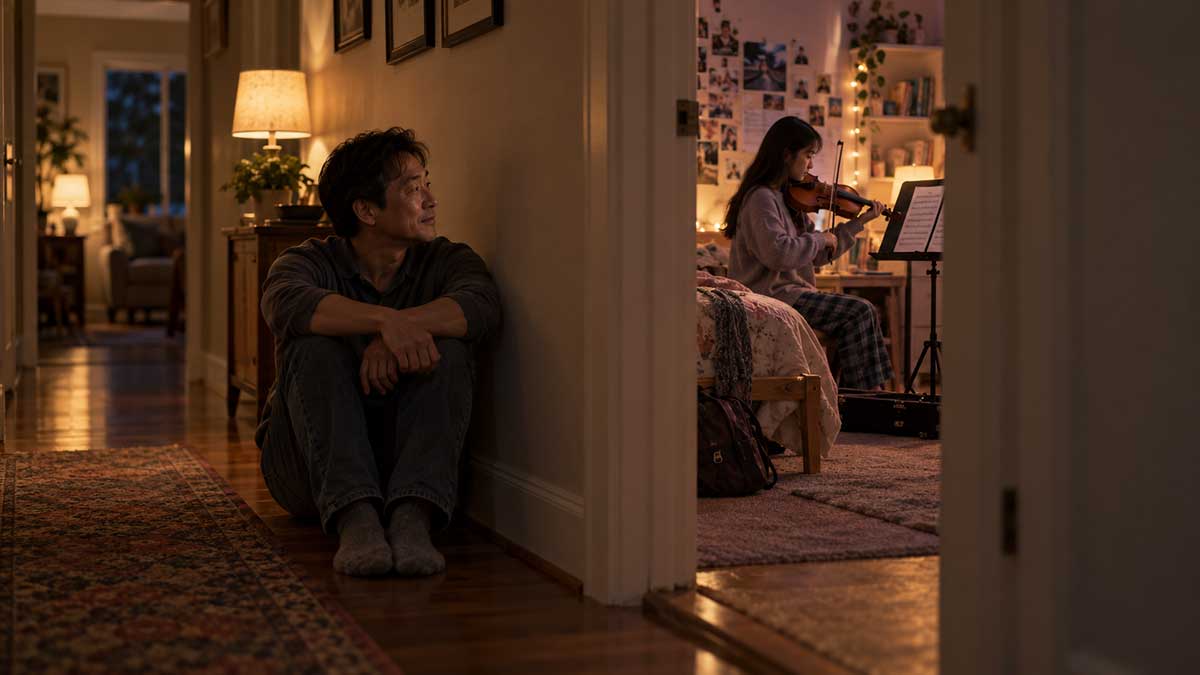
Then sat against the hallway wall.
And listened.
Two months later, Maya returned to Dr. Moretti.
But the conversation was different.
Dr. Moretti: What do you want?
Maya looked suspicious.
Maya: You're asking me?
Dr. Moretti: I am trying something new.
Maya smiled.
Maya: Chamber music.
Dr. Moretti: No competition?
Maya: Not now.
Dr. Moretti: Solo repertoire?
Maya thought.
Maya: Some.
Dr. Moretti nodded.
Dr. Moretti: Good.
Maya blinked.
Maya: That's it?
Dr. Moretti: Did you expect an argument?
Maya: Kind of.
Dr. Moretti opened the score.
Dr. Moretti: I am still going to make you practice scales.
Maya groaned.
Dr. Moretti: I have changed, not died.
Maya laughed.
That summer, Maya joined a string quartet.
They rehearsed in a community arts center.
No judges.
No ranking.
No medals.
Their first concert had forty-three people in the audience.
David sat in the final row.
He could have sat closer.
He chose the back.
Maya came onstage.
She looked nervous.
Not terrified.
She looked at the other three players.
The cellist smiled.
Maya smiled back.
They began.
The piece was not perfect.
Maya missed one entrance.
The violist came in slightly early.
The audience never noticed.
David did.
Once, that would have bothered him.
Now it made him smile.
After the concert, Maya found him near the exit.
Maya: Well?
David looked at her.
David: What?
Maya: You always tell me what you thought.
David pretended to consider.
David: I liked the slow movement.
Maya waited.
David: That's all.
She narrowed her eyes.
Maya: No technical notes?
David: Do you want technical notes?
Maya: No.
David: Then no.
Maya smiled.
They walked toward the parking lot.
Halfway there, David asked:
David: Do you think you'll ever want the big stage again?
Maya stopped.
David immediately regretted asking.
David: Sorry.
Maya shook her head.
Maya: It's okay.
She looked back at the arts center.
Maya: Maybe.
David waited.
Maya: Maybe not.
He nodded.
David: Okay.
Maya studied his face.
Maya: Really?
David: Really.
She started walking again.
David followed.
For years, "maybe" had sounded like danger to him.
Maybe meant lost potential.
Maybe meant wasted training.
Maybe meant uncertainty.
Now it sounded different.
Like room.
Like breath.
Like a future that had not already been decided.
That night, Maya left her violin case beside the sofa.
David noticed it was open.
The instrument rested inside.
No trophy beside it.
No competition schedule.
No list of future auditions.
Only a violin.
And upstairs, Maya was laughing with a friend on the phone about something that had nothing to do with music.
David sat in the living room for a while.
Then he closed the violin case gently.
Not to put the music away.
Just to let it rest.
Story 3: Two Mothers at Graduation
Noah Brooks stared at the form for almost five minutes.
Parent/Guardian Names
The line was too short.
He wrote:
Lena Brooks
Then underneath:
Rachel Brooks
He stopped.
His grandfather should probably be there too.
Noah turned the form over as if the other side might solve the problem.
It did not.
His guidance counselor looked up from her computer.
Ms. Carter: Everything okay?
Noah held up the paper.
Noah: How many parents are you allowed to have?
Ms. Carter smiled.
Ms. Carter: As many as life gives you.
Noah: The form disagrees.
She laughed.
Ms. Carter: Write everyone who matters. We will figure it out.
Noah looked down again.
Everyone who matters.
That was the problem.
Rachel became his guardian when he was eleven.
The arrangement was supposed to last six months.
His mother, Lena, had entered residential treatment after years of addiction, relapses, disappearing phone calls, apologies, promises, and another relapse.
Rachel was Lena's older sister.
She had no children.
She lived twenty minutes away.
She had a spare room.
Six months sounded manageable.
Rachel bought Noah a new toothbrush.
She cleared one drawer.
She told him he could put posters on the wall, but not with tape that peeled paint.
She kept calling the room:
"Your room for now."
By month eight, she stopped saying "for now."
By the second year, Noah knew which floorboard outside Rachel's bedroom creaked.
He knew she hated raisins.
She knew he could not sleep when the hallway light was completely off.
Rachel learned how to sign school forms.
Then medical forms.
Then soccer forms.
She sat through parent-teacher conferences.
She waited in an emergency room when Noah broke his wrist.
She taught him to drive in an empty church parking lot.
She yelled when he nearly hit a shopping cart.
She cried privately the night he received his driver's license.
She learned that Noah lied by rubbing the side of his thumb.
She learned that he became silent when something hurt badly.
She learned that silence did not mean he wanted to be alone.
Lena knew other things.
She knew Noah's first word.
She knew which song stopped him crying as a baby.
She knew how he used to sleep with one foot outside the blanket.
She knew the scar near his left eyebrow came from running into a coffee table at age three.
She knew what his father's laugh sounded like.
Rachel could never know those years.
Lena could never recover the ones she missed.
By Noah's senior year, Lena had been sober for four years.
She had an apartment.
A steady job at a dental office.
A church group.
A therapist.
Plants she remembered to water.
Noah spent Wednesday evenings with her.
Then Saturdays.
Then sometimes entire weekends.
The first time he left a backpack at Lena's apartment intentionally, she cried after he went home.
She did not tell him.
She told Rachel.
Rachel said:
"That's good."
Then Rachel cried too.
Neither woman said why.
At first, everyone tried very hard to be grateful.
Lena was grateful Rachel had taken Noah.
Rachel was grateful Lena was alive.
Noah was grateful nobody made him choose.
Then gratitude became complicated.
It began with small things.
Noah's car would not start one February morning.
He called Rachel.
Lena found out later.
Lena: Why didn't you call me?
Noah looked confused.
Noah: Rachel knows cars.
Lena: I can jump a battery.
Noah: I know.
Lena: Then why Rachel?
Noah shrugged.
Noah: I just called her.
Lena nodded.
Lena: Okay.
She smiled.
Noah believed her.
That evening, Lena sat in her parked car outside her apartment for twenty minutes.
She told herself:
Rachel had been handling emergencies for years.
Of course Noah called Rachel.
It meant nothing.
Then another voice inside her answered:
It means she is still the first person he thinks of.
Lena hated that voice.
She hated herself for listening to it.
A month later, Rachel texted Noah:
Don't forget dentist at 3:30.
Lena saw the message while Noah's phone was on the table.
She did not read anything else.
She did not need to.
Lena: Rachel still makes your dentist appointments?
Noah looked up.
Noah: Sometimes.
Lena: You're eighteen in two months.
Noah: I know.
Lena: You can make your own dentist appointments.
Noah: Apparently nobody has told Rachel.
Lena laughed.
Noah laughed too.
The moment should have ended there.
It did not.
Lena: Maybe she needs to learn that you're not a child anymore.
Noah stopped smiling.
Noah: What does that mean?
Lena: Nothing.
Noah: Mom.
She hated how quickly she answered.
Lena: I just think maybe she could back off a little.
Silence.
Noah looked at her.
Noah: Back off from what?
Lena immediately regretted it.
Lena: Forget it.
Noah: No.
What?
Lena stood.
Lena: I said forget it.
Noah watched her walk into the kitchen.
He did not follow.
The next week Rachel stopped reminding him about the dentist.
Then she stopped asking whether he needed lunch money.
Then she stopped texting when it snowed:
Drive slow.
Noah noticed.
He did not understand why.
Two weeks later, he went to Rachel's house after school.
She was making soup.
Noah: Are you mad at me?
Rachel looked up.
Rachel: What?
Noah: You're weird.
Rachel: Thank you.
Noah: I'm serious.
Rachel stirred the soup.
Rachel: I'm fine.
Noah rubbed his thumb.
Rachel saw it.
Rachel: You're the one lying.
He stopped.
Noah: You're acting different.
Rachel kept stirring.
Noah: You don't text anymore.
Rachel: You're almost eighteen.
Noah: So?
Rachel: You don't need me checking whether you packed your lunch.
Noah stared at her.
Noah: I never needed you checking.
Rachel smiled faintly.
Noah: You did it anyway.
The smile disappeared.
Rachel turned off the stove.
Rachel: Your mom deserves some room.
Noah's stomach tightened.
Noah: Room for what?
Rachel looked at him.
Rachel: To be your mother.
He stared.
Noah: She is my mother.
Rachel: I know.
Noah: Did she say something?
Rachel looked away.
That was answer enough.
Noah: What did she say?
Rachel: Nothing terrible.
Noah: Rachel.
Rachel: She is trying very hard.
Noah: So are you.
Rachel closed her eyes.
Rachel: That's different.
Noah: Why?
Rachel did not answer.
Noah: Why?
Rachel sat at the kitchen table.
Rachel: Since I was supposed to be temporary.
Noah looked at her.
Rachel: Six months.
Remember?
Noah: I was eleven.
Rachel: I remember.
She laughed weakly.
Rachel: I bought you one cheap pillow since I thought you'd be taking it home by Christmas.
Noah looked toward the hallway.
That pillow was still on his bed.
Rachel: Then six months became a year.
Then two.
Then suddenly I knew your teachers.
Your friends.
Your allergies.
Your stupid soccer schedule.
Noah: I quit soccer three years ago.
Rachel: I know.
Noah: Then stop using it against me.
Rachel laughed.
Then her face changed.
Rachel: Noah, I love you.
He waited.
Rachel: Maybe I got too used to being needed.
The sentence sounded familiar somehow.
Not from anyone in his life.
From somewhere deeper.
Noah: So now you're disappearing?
Rachel flinched.
Rachel: No.
Noah: It feels like it.
Rachel: I'm giving you and your mom space.
Noah: Did I ask for space?
Rachel looked down.
Noah: Did she ask you to disappear?
Rachel: She didn't say that.
Noah: Then why are you deciding for both of us?
Rachel's eyes filled.
Rachel: Since somebody has to make this easier.
Noah's voice rose.
Noah: For who?
Rachel did not answer.
That night Lena received a call.
Lena: Hello?
Noah: What did you say to Rachel?
Lena sat up on the sofa.
Lena: What?
Noah: What did you say?
Lena: Noah.
Noah: She thinks she has to back away so you can be my mother.
Lena closed her eyes.
Lena: I didn't ask her to disappear.
Noah: Did you ask her to back off?
Silence.
Noah laughed once.
Noah: Great.
Lena: It was one conversation.
Noah: What conversation?
Lena: I was upset.
Noah: About what?
Lena stood and began pacing.
Lena: You call her first.
Noah: Sometimes.
Lena: She still knows everything.
Noah: She raised me.
The second he said it, both of them went silent.
Lena stopped walking.
Noah closed his eyes.
Noah: Mom.
Lena's voice changed.
Lena: I know.
Noah: I didn't mean...
Lena: No.
You did.
And it's true.
Noah said nothing.
Lena sat again.
Lena: She raised you.
The words nearly broke her.
Lena: For years I was supposed to be doing that.
Noah: You were sick.
Lena: I know.
Noah: You got better.
Lena: I know.
Noah: Then why are you angry at her?
Lena wiped her face.
Lena: I'm not.
Noah: You are.
Lena: I'm angry at me.
Noah became quiet.
Lena: But sometimes she is standing in the place where I can see everything I missed.
Noah looked down at the floor.
Lena continued.
Lena: She knows how you take your coffee.
I don't.
She knows which teacher you hated in ninth grade.
I don't.
She knows the story behind every dent in your car.
I don't.
Her voice cracked.
Lena: Sometimes when she's around, I feel like I'm visiting someone else's memory of my son.
Noah's anger softened.
Noah: Mom.
Lena: I know it's not fair.
She swallowed.
Lena: I know she saved both of us.
Noah: Then don't punish her for it.
Lena closed her eyes.
The sentence hurt since it was true.
Graduation tickets arrived in May.
Every student received two reserved seats.
Noah stared at the envelope.
Two.
He laughed.
Of course.
Rachel was at work when he called.
Noah: I got the graduation tickets.
Rachel: Good.
Noah: Two seats.
Silence.
Rachel answered too quickly.
Rachel: Your mom and Grandpa.
Noah closed his eyes.
Noah: Rachel.
Rachel: It's fine.
Noah: Stop saying that.
Rachel: Your grandfather is eighty-two.
He should be there.
Noah: And you?
Rachel: I can watch the livestream.
Noah said nothing.
Rachel: Noah.
Noah: I hate this.
Rachel: It's okay.
He hung up.
Then he called Lena.
Noah: Graduation tickets came.
Lena: Finally.
How many?
Noah: Two.
Lena became quiet.
Then:
Lena: Grandpa and Rachel.
Noah stared at the wall.
Noah: You two rehearsed this?
Lena: What?
Noah: She said you and Grandpa.
Lena: Noah...
Noah: Why are both of you volunteering to disappear?
Lena did not answer.
Noah: Why does loving one of you always have to hurt the other?
Silence.
Noah's throat tightened.
Noah: I am tired of being careful.
Tired of calling one person first and worrying what the other thinks.
Tired of pretending things don't matter.
Tired of everyone being noble.
Lena sat down.
Noah: I don't need one of you to win.
His voice cracked.
Noah: I need both of you to stop making me prove who my family is.
He ended the call.
The next afternoon, Lena drove to Rachel's house.
Rachel opened the door and looked surprised.
Rachel: Is Noah okay?
Lena: Yes.
Rachel stepped aside.
Rachel: Coffee?
Lena: No.
Rachel: That's serious.
Lena almost smiled.
They sat at the kitchen table.
The same table where Noah had done homework for seven years.
Lena looked around.
There were photographs everywhere.
Noah at twelve.
Thirteen.
Fifteen.
Prom.
Driver's license.
A birthday cake.
Lena saw time on the walls.
Time she could not enter.
Lena: I was jealous of you.
Rachel looked down.
Rachel: I know.
Lena stared at her.
Rachel: Not at first.
Later.
Lena nodded.
Lena: I hated when he called you first.
Rachel's eyes filled.
Lena: I hated that you knew things.
I hated when people assumed you were his mother.
I hated that sometimes you knew what he needed before I did.
Rachel whispered:
Rachel: I'm sorry.
Lena's expression changed.
Lena: See?
Rachel looked up.
Lena: That's the problem.
Why are you apologizing?
Rachel said nothing.
Lena: You did what I couldn't do.
Rachel's eyes filled more.
Lena: And part of me keeps treating that like something you took.
Rachel looked down.
Lena: You didn't take those years.
I lost them.
Rachel swallowed.
Rachel: Do you think I wanted them this way?
Lena looked at her.
Rachel's voice shook.
Rachel: I loved him.
I still love him.
But do you think I wanted him crying in my bathroom after visiting you in rehab?
Do you think I wanted to explain why you missed his birthday?
Do you think I wanted to sign school forms where the mother line was blank?
Lena began crying.
Rachel did too.
Rachel: I wanted you back.
Lena looked up.
Rachel: Every year.
I wanted you to walk in and say:
"I'm okay now. I'll take it from here."
Lena's face broke.
Rachel: And then you did.
Lena waited.
Rachel wiped her face.
Rachel: And I realized I didn't know how to stop being his parent.
The room became very quiet.
Rachel: I felt guilty.
Every time he called me first.
Every time he said, "Can you help me?"
Every time I knew the answer and you didn't.
Rachel laughed weakly.
Rachel: So I thought maybe I should disappear slowly enough that nobody noticed.
Lena shook her head.
Lena: He noticed.
Rachel: I know.
Lena looked toward the hallway.
Noah's old school backpack still hung on a hook.
Lena: You got the years I was supposed to have.
Rachel closed her eyes.
Lena: I hate that.
Rachel nodded.
Lena continued.
Lena: I hate that I missed them.
Rachel looked at her.
Lena's voice softened.
Lena: I don't hate that you loved him.
Rachel covered her mouth.
Lena reached across the table.
Rachel took her hand.
They sat there crying like sisters for the first time in years.
Not competing.
Not apologizing.
Just grieving different versions of the same loss.
Two days before graduation, Ms. Carter called Noah.
Ms. Carter: I found another ticket.
Noah: How?
Ms. Carter: A family only needs one seat.
Noah: Seriously?
Ms. Carter: Seriously.
Noah nearly shouted.
Then he stopped.
Noah: Wait.
Three seats?
Ms. Carter: Yes.
Noah: Good.
He looked at the graduation packet.
Then smiled.
Graduation morning was hot.
Rachel arrived early.
Lena was already there with Noah's grandfather.
For half a second, the two women stood awkwardly.
Then Lena moved her purse off the chair beside her.
Lena: Sit here.
Rachel looked surprised.
Then sat.
Noah saw them from the student line.
He stared.
Rachel said something.
Lena laughed.
His grandfather complained about the sun.
Nothing dramatic.
Nothing cinematic.
Three people sitting together.
That was enough.
The ceremony began.
Names echoed through the stadium.
Families cheered.
When Noah's row stood, Lena's hand tightened around the program.
Rachel noticed.
Without thinking, she placed her hand over Lena's.
Lena looked down.
Then at Rachel.
Lena: Thank you.
Rachel nodded.
The announcer reached Noah's name.
Both women stood.
Lena: NOAH!
Rachel: WOOOO!
Noah turned while crossing the stage.
He saw them.
Both.
Standing.
His grandfather remained seated but waved his cane.
Noah laughed so hard the principal had to wait before handing him the diploma.
Afterward, everyone crowded onto the football field.
Photographs.
Flowers.
Sweating relatives.
Lost children.
Noah found the three of them.
Rachel straightened his graduation collar.
Lena immediately fixed what Rachel had just fixed.
Noah stared at both women.
Noah: Really?
They laughed.
A stranger offered to take a photograph.
Noah stood between Lena and Rachel.
His grandfather stood at the side.
Click.
Then another.
Noah looked at the picture.
Noah: One more.
He handed the phone back.
Then stepped away.
Lena: Where are you going?
Noah: Stay there.
Rachel looked confused.
Rachel: Noah.
Noah: Just stay.
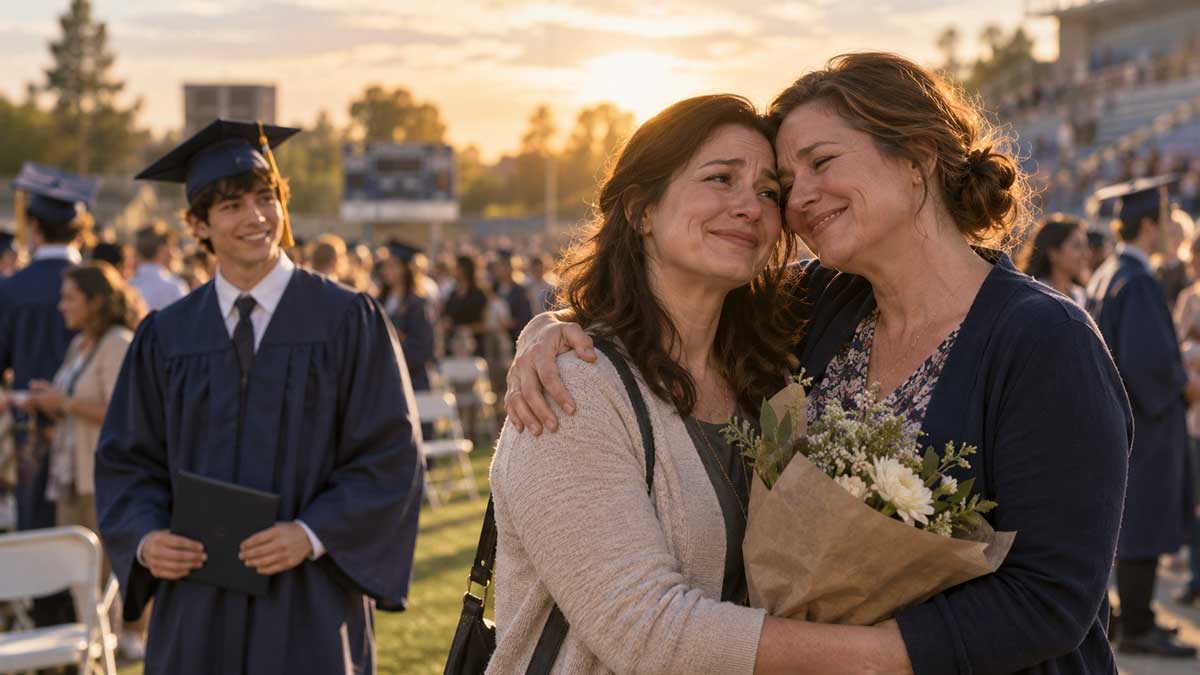
Now only Lena and Rachel stood together.
At first, they left several inches between them.
Noah frowned.
Noah: Come on.
Rachel laughed.
Lena shook her head.
Then Lena put one arm around Rachel.
Rachel did the same.
The stranger took the picture.
At the exact moment the camera clicked, Rachel whispered something.
Noah never learned what.
Lena laughed.
The photograph caught both women looking slightly away from the camera, laughing at each other.
Noah liked that one best.
Months later, he left for college.
Rachel helped pack.
Lena helped unpack.
Neither woman discussed this arrangement beforehand.
It simply happened.
One evening during Noah's first semester, he called Lena.
They spoke for twenty minutes.
After they hung up, he called Rachel.
He did not feel guilty.
Later that night, Lena texted Rachel:
He called me. Says dorm food is terrible.
Rachel replied:
He called me too. He asked how to wash a sweater.
A few seconds passed.
Lena wrote:
Did you tell him?
Rachel answered:
No. I told him to call his mother.
Lena stared at the message.
Then laughed.
She typed:
Idiot. Tell him cold water.
Rachel sent back:
See? This is why he needs two of us.
Lena looked at the screen for a long moment.
Then typed:
Maybe.
She erased it.
Typed again.
Definitely.
Across town, Rachel saw the message and smiled.
Noah never needed one woman to become less important so the other could matter more.
He did not need a winner.
He needed room.
And when Lena and Rachel finally stopped measuring motherhood by who had been there first, longest, or best, they discovered something simpler:
Love had never asked either of them to disappear.
Only fear had.
Story 4: Five Stars
Elena Morales knew exactly what 4.94 meant.
It meant she was safe.
For now.
Her delivery app showed the number beneath her profile photo.
4.94
Green.
Anything above 4.90 usually meant better delivery windows.
More orders.
Fewer warnings.
More chances to make enough money before midnight.
Elena checked the number more often than she checked her bank balance.
Her daughter Sofia noticed.
Sofia: Mom, you look at that thing like it's your report card.
Elena zipped her insulated delivery bag.
Elena: Worse.
Sofia: Worse than a report card?
Elena: Your report card cannot stop me from working tomorrow.
Sofia frowned.
Elena smiled.
Elena: Relax. I'm joking.
Sofia looked at the phone.
Sofia: The phone thinks it's your boss.
Elena picked up her keys.
Elena: The phone is my boss.
Sofia laughed.
Elena did not.
It was 5:11 on a Thursday evening.
Dinner rush.
Elena had already cleaned two office buildings that morning.
She had slept four hours.
She had forty-six dollars in gas on one credit card and thirty-two dollars available on another.
Rent was due in six days.
Her landlord had texted twice.
She had not answered.
The app chimed.
New delivery.
Six miles.
Good tip.
Estimated earnings: $18.40
Elena accepted.
Elena: Homework before TV.
Sofia: I know.
Elena: Food is in the refrigerator.
Sofia: I know.
Elena: Don't open the door for anyone.
Sofia: I know.
Elena reached for the handle.
Sofia: Mom.
Elena turned.
Sofia: I got my science test back.
Elena paused.
Elena: Good?
Sofia held up the paper.
Elena looked at it.
Sofia: Not good.
Elena: Not terrible.
Sofia: Mia got 97.
Elena: Is Mia living here now?
Sofia smiled.
Elena: We'll look at it tonight.
Sofia: You always say that.
The words landed harder than Sofia intended.
Elena looked at the clock.
5:13.
The order had to be picked up by 5:25.
Elena: Tonight.
I promise.
Sofia shrugged.
Sofia: Okay.
Elena left.
The restaurant was seven minutes late.
The app did not care.
It still showed Elena a countdown.
Deliver by 5:52 PM.
She placed the food in the insulated bag and drove.
Traffic was heavy.
Rain began.
Not much.
Enough to blur the windshield.
Her phone spoke directions.
Turn right.
Continue two miles.
Turn left.
The customer lived in a new luxury apartment building downtown.
Elena knew the building.
Marble lobby.
Valet parking.
Tiny dogs wearing sweaters.
Residents who sometimes asked her to leave food outside the door and sometimes asked her to bring it up twenty-seven floors.
The app showed:
12 minutes remaining.
Elena changed lanes.
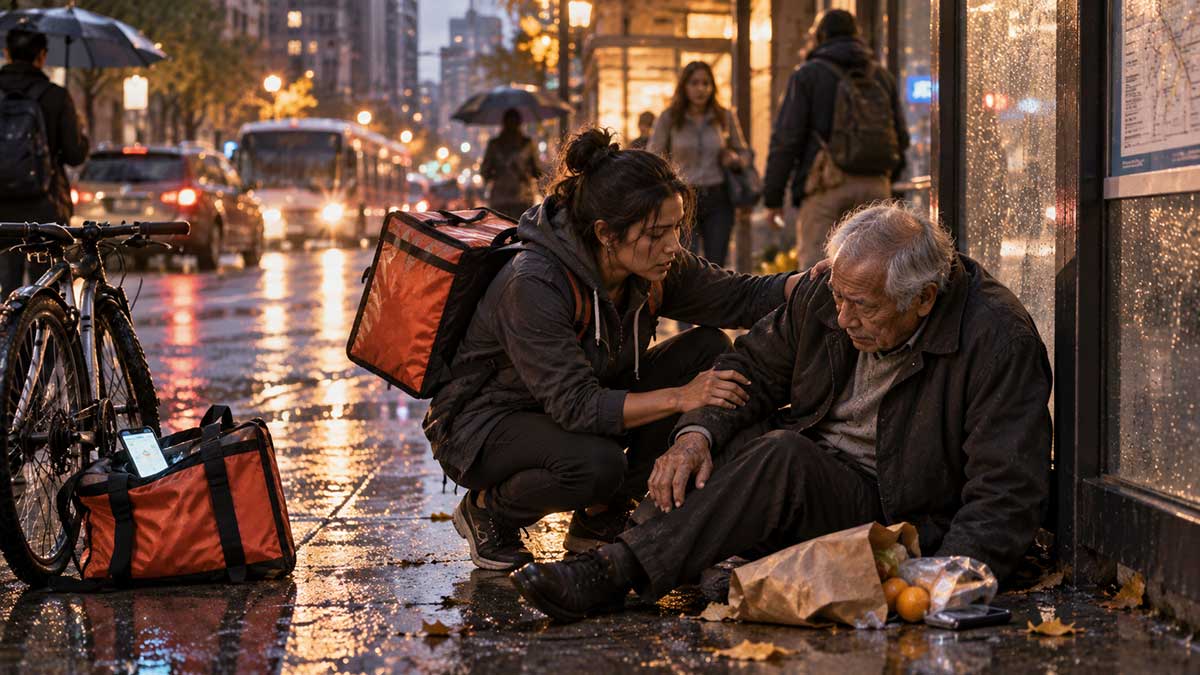
Then she saw the man.
At first she thought he had dropped something.
An older man was bent strangely beside a bus stop.
One hand on the bench.
One knee on the pavement.
People were walking around him.
Elena slowed.
Horn behind her.
She looked at the clock.
10 minutes remaining.
The man fell.
Elena pulled over.
Cars honked.
She grabbed her phone and ran.
Elena: Sir?
The man did not answer.
His eyes were open.
His breathing sounded wrong.
A young man nearby held a coffee and stared.
Elena: Call 911.
The young man looked confused.
Young Man: Me?
Elena: Yes. Call.
Elena knelt.
The older man's hand was cold.
Elena: Sir, can you hear me?
His mouth moved.
No words.
Her phone vibrated.
Delivery due in 8 minutes.
Elena ignored it.
Another vibration.
Customer waiting.
The young man spoke to emergency services.
Young Man: They want to know if he's breathing.
Elena leaned close.
Elena: Yes, but barely.
The man reached weakly toward her wrist.
Elena took his hand.
Elena: You're okay. Help is coming.
She had no idea if that was true.
She said it anyway.
Her phone vibrated again.
Delivery due in 5 minutes.
Elena looked at the screen.
Then at the man.
The app chimed.
Are you having trouble completing this delivery?
She almost laughed.
Instead she pressed:
Yes.
Options appeared.
Traffic.
Restaurant delay.
Vehicle problem.
Other.
She pressed Other.
A text box appeared.
Emergency. Helping collapsed elderly man while ambulance arrives.
She submitted it.
An automated message appeared instantly.
Thank you. Please complete the delivery as soon as possible.
Elena stared.
Then the ambulance arrived.
Paramedics took over.
One of them asked:
Paramedic: Are you family?
Elena: No.
Paramedic: Do you know his name?
Elena shook her head.
The paramedic thanked her.
Elena stood in the rain.
Her jeans were wet at the knees.
Her phone showed:
Delivery late by 14 minutes.
She ran back to the car.
The customer's messages were waiting.
Where are you?
Food is going to be cold.
This is ridiculous.
Elena typed:
I'm sorry. Medical emergency on the way. I'm coming now.
No response.
She arrived twenty-seven minutes late.
The doorman would not let her leave the food in the lobby.
Doorman: Resident requested hand delivery.
Elena rode to the twenty-third floor.
The customer opened the door wearing a white robe.
He looked at the bag.
Then at Elena.
Customer: It's cold.
Elena: I'm very sorry.
There was a medical emergency on the road.
The man took the bag.
Customer: That's not my problem.
The door closed.
Elena stood in the hallway.
Her phone chimed almost immediately.
Order complete.
Then, two minutes later:
You received a new rating.
She did not want to look.
She looked.
4.86
Red.
Elena stared.
One rating could not normally drop it that much.
Then she saw the second notification.
Customer reported food quality issue.
A third appeared.
Your account performance is below preferred standards. Some delivery opportunities may be limited.
Elena leaned against the wall.
The elevator arrived.
She stepped inside.
She pressed the lobby button.
Then pressed it again, harder.
When she got home, Sofia was at the kitchen table.
Her science test was beside her.
Sofia: You're late.
Elena put the delivery bag down.
Elena: I know.
Sofia looked at her.
Sofia: What happened?
Elena opened the refrigerator.
She stared inside.
Nothing looked good.
Sofia: Mom?
Elena closed the refrigerator.
Elena: A man collapsed.
Sofia stopped.
Sofia: Is he okay?
Elena: I don't know.
Sofia: Did you call an ambulance?
Elena: Somebody did.
I stayed with him.
Sofia's eyes widened.
Sofia: Then what?
Elena sat.
Elena: I was late.
Sofia: So?
Elena laughed.
Not happily.
She handed Sofia the phone.
Sofia read the notifications.
Sofia: They punished you?
Elena: The customer rated me.
Sofia: For helping someone?
Elena: For being late.
Sofia stared at the screen.
Sofia: But you told them why.
Elena: I filled out the little box.
Sofia scrolled.
Sofia: Appeal.
Elena took the phone.
Elena: I already did it.
Sofia: What did they say?
Elena opened the email.
Thank you for contacting support. After reviewing the order, the rating and customer report will remain. Delivery partners are expected to complete accepted orders within the estimated delivery window whenever possible.
Sofia read it twice.
Then:
Sofia: That's stupid.
Elena: Sofia.
Sofia: It is.
Elena rubbed her forehead.
Sofia: They know exactly where you were, right?
Elena looked at her.
Sofia: The app tracks you.
Elena: Yes.
Sofia: It knows you stopped.
Elena: Yes.
Sofia: It knows how long.
Elena: Probably.
Sofia pointed at the phone.
Sofia: Then why does it know you were twenty-seven minutes late but not what you did during those twenty-seven minutes?
Elena looked at her daughter.
The question was simple.
Too simple.
Elena: I don't know.
Sofia looked angry now.
Sofia: That's messed up.
Elena almost corrected her language.
She did not.
The next morning, fewer delivery slots appeared.
By Saturday, most of the dinner rush was gone.
Elena refreshed the app repeatedly.
Nothing.
She sent another appeal.
Different wording.
Same answer.
She tried calling support.
A recording directed her back to the app.
She messaged again.
The response began:
We understand your frustration.
Elena threw the phone onto the sofa.
Sofia looked up from the floor.
Sofia: Did a person write that?
Elena: I don't know.
Sofia: It sounds fake.
Elena: It probably is.
Sofia: Then how are you supposed to explain?
Elena sat.
Elena: You don't.
Sofia frowned.
Elena: You just keep pressing buttons until maybe a person appears.
That Monday, Sofia's class received an assignment.
Technology in Everyday Life.
Students could write about any app, device, or digital system they used regularly.
Most chose phones.
Streaming.
Artificial intelligence.
Video games.
Sofia chose her mother's delivery app.
At dinner, she asked:
Sofia: Can I write about what happened?
Elena looked up.
Elena: For school?
Sofia: Yes.
Elena: Don't put my name.
Sofia: Why?
Elena: I don't want trouble.
Sofia: They already took your shifts.
Elena: Sofia.
Sofia: Fine.
No name.
Sofia worked on the paper for three nights.
She wrote about GPS.
Ratings.
Delivery times.
Customer complaints.
Automated decisions.
Then she wrote one sentence in large letters at the top of the final page:
What happens when a system can measure speed but cannot measure why someone stopped?
Her teacher, Mr. Patel, asked her to stay after class.
Sofia assumed she was in trouble.
Mr. Patel: Did this happen to someone you know?
Sofia hesitated.
Sofia: My mom.
Mr. Patel looked at the paper.
Mr. Patel: Is she okay?
Sofia shrugged.
Sofia: She lost a bunch of work.
Mr. Patel nodded slowly.
Mr. Patel: Can I ask the class your question tomorrow?
Sofia looked suspicious.
Sofia: Which one?
He pointed.
She shrugged.
Sofia: Sure.
The next day, Mr. Patel wrote it on the board.
WHAT HAPPENS WHEN A SYSTEM CAN MEASURE SPEED BUT CANNOT MEASURE WHY SOMEONE STOPPED?
At first, nobody spoke.
Then a boy named Isaiah raised his hand.
Isaiah: My sister gets marked late at school sometimes because she has to walk my little brother to daycare.
Another student spoke.
Student: My dad's work tracks bathroom breaks.
Someone laughed.
The student did not.
Student: I'm serious.
Another girl raised her hand.
Girl: My grandma doesn't speak English. My mom misses work sometimes to go to appointments with her.
The conversation moved.
Grades.
Attendance.
Ratings.
Hours worked.
Test scores.
Algorithms.
Credit scores.
Followers.
Delivery times.
Sofia listened.
She had thought her mother's problem was unusual.
It was not.
That made her feel worse.
And strangely better.
That afternoon, Mr. Patel emailed Elena.
He asked whether she would be comfortable speaking briefly with him.
Elena almost ignored it.
Then she called.
Mr. Patel: Sofia's paper raised a strong question.
Elena: She talks too much.
Mr. Patel: I think she notices things.
Elena smiled.
Elena: That's the problem.
Mr. Patel told her about a local worker center that helped gig workers with disputes.
Elena had never heard of it.
Elena: Do they charge?
Mr. Patel: No.
Elena wrote down the number.
She almost did not call.
Then the next day's delivery schedule showed only two available hours.
She called.
A woman named Priya answered.
For the first time, Elena explained the entire story to a human being who did not interrupt.
Priya: Do you have screenshots?
Elena: Some.
Priya: Messages from the customer?
Elena: Yes.
Priya: Ambulance record?
Elena: I don't know anything about the man.
Priya paused.
Priya: Do you remember the location?
Elena did.
Priya helped her submit a more formal review request.
She included the location history.
Customer messages.
The original note Elena had typed about the emergency.
Priya asked whether Elena knew what happened to the man.
She did not.
Two weeks later, Elena received a letter.
Paper.
Not email.
The return address belonged to a woman named Rebecca Kaplan.
Elena opened it standing beside the mailbox.
Dear Ms. Morales,
My father was the man who collapsed at the bus stop on March 18. A paramedic gave us your first name from the incident notes. I have been trying to find you.
Elena sat in her car.
Her hands started shaking.
He suffered a cardiac event. The doctors told us the quick call for help likely made a major difference. He is recovering.
Elena covered her mouth.
She read the next paragraph twice.
I understand that you were working at the time. If helping my father caused any problem for you, please let me know. Our family would like to help if we can.
Elena stared through the windshield.
Rain tapped softly against the glass.
For three weeks, she had thought about the cold food.
The one-star rating.
The missing shifts.
She had barely allowed herself to wonder whether the man had lived.
He had.
That night she showed Sofia.
Sofia read the letter.
Then read it again.
Sofia: He lived.
Elena nodded.
Sofia smiled.
Sofia: So you saved him.
Elena: The paramedics saved him.
Sofia: You stopped.
Elena looked away.
Sofia: Everybody else walked around him.
Elena folded the letter.
Elena: They were probably scared.
Sofia: You were working.
Elena: So were probably half of them.
Sofia thought about that.
Priya helped Elena obtain a short statement from Rebecca Kaplan confirming the emergency.
Another review followed.
Then, late on a Wednesday afternoon, Elena's phone chimed.
Your account review has been completed. The customer rating associated with the March 18 delivery has been excluded from your performance score. Full delivery access has been restored.
Elena stared at the message.
Her rating returned to 4.94.
She laughed.
Then cried.
Then laughed again.
Sofia came running.
Sofia: What?
Elena showed her.
Sofia threw both arms around her.
Sofia: See?
Elena: See what?
Sofia: You won.
Elena looked at the screen.
Elena: Not really.
Sofia stepped back.
Sofia: What do you mean?
Elena pointed at the message.
Elena: They fixed mine.
That's good.
She looked at her daughter.
Elena: What about the next person who doesn't have a teacher who knows somebody who knows a worker center?
Sofia's smile faded.
Elena put the phone down.
Elena: That's the part I don't like.
At school, Sofia's science grade remained a B-minus.
She did not suddenly become a star student.
She still forgot assignments.
She still hated long division.
She still had no special musical ability.
She did not make the soccer team.
When the school announced awards in May, Sofia expected nothing.
Then her name was called.
Community Citizenship Award.
She looked horrified.
The auditorium applauded.
Elena stood.
Sofia: Sit down.
Elena clapped harder.
Sofia walked onto the stage.
Mr. Patel handed her a certificate.
She whispered:
Sofia: What did I do?
He smiled.
Mr. Patel: You asked a good question.
Afterward, Elena took photographs.
Too many.
Sofia complained.
On the drive home, Sofia held the certificate on her lap.
Sofia: This is kind of weird.
Elena: Why?
Sofia: They gave me an award for saying awards miss things.
Elena laughed.
Sofia: I'm serious.
Elena: I know.
Sofia looked out the window.
Sofia: What about kids who take care of little brothers every day?
Elena: What about them?
Sofia: Or kids who translate for their parents.
Or work after school.
Or take care of grandparents.
They don't get awards.
Elena looked at her.
Elena: Maybe tell Mr. Patel.
Sofia nodded.
Then:
Sofia: Maybe school measures the wrong stuff too.
Elena smiled.
Elena: Be careful.
Keep talking like that and somebody will make you principal.
Sofia: No thanks.
A month later, Sofia helped Mr. Patel create a student recognition board.
No rankings.
No first place.
Students nominated classmates for things people rarely noticed.
Helping a younger sibling every morning.
Translating at parent conferences.
Cooking dinner when a parent worked late.
Sitting with someone who ate lunch alone.
Taking care of a sick grandmother.
Returning a lost wallet.
The first time Elena saw the board, she stood in front of it for several minutes.
She thought about all the years nobody had given points for.
The nights she cleaned offices after midnight.
The mornings she got Sofia ready after four hours of sleep.
The money sent to her mother.
The meals made.
The appointments remembered.
The doors held open.
The people helped.
Then she thought about the delivery app.
The app still mattered.
It paid rent.
It still measured her.
It still rated her.
She had not escaped any of that.
One evening several months later, Elena accepted a delivery.
The app showed:
Customer rating: 4.96
She smiled.
Better.
She picked up the order and drove.
Seven minutes from the destination, she saw an elderly woman on the sidewalk.
Two grocery bags had split open.
Oranges were rolling toward the street.
The app showed:
Delivery due in 9 minutes.
Elena slowed.
For half a second, she watched the timer.
8:59.
8:58.
8:57.
Then she pulled over.
She stepped out.
Elena: Ma'am, let me help you.
The woman looked relieved.
Woman: I'm sorry.
Elena: For what?
Elena gathered oranges.
Milk.
Bread.
A can of beans.
She found an extra reusable bag in her trunk.
The woman thanked her three times.
Elena carried the groceries to the building entrance.
When she returned to the car, the app showed:
Delivery due in 4 minutes.
Elena looked at it.
Then placed the phone face down.
She drove.
Not recklessly.
Not slowly.
Just drove.
The delivery arrived three minutes late.
No complaint.
No warning.
Nothing dramatic happened.
That was fine.
Later that night, Elena came home.
Sofia was at the kitchen table doing homework.
Sofia: How was work?
Elena put her keys down.
Elena: Fine.
Sofia: Rating?
Elena paused.
Then smiled.
Elena: I don't know.
Sofia looked surprised.
Sofia: You didn't check?
Elena took off her jacket.
Elena: Not yet.
She walked toward the kitchen.
Sofia: Who are you?
Elena laughed.
Then she saw Sofia's science homework.
Elena: What's that?
Sofia: Physics.
Elena: Bad?
Sofia: Very.
Elena sat beside her.
Elena: Show me.
Sofia pushed the worksheet over.
For the next twenty minutes, neither looked at a rating.
Neither looked at a score.
They just worked through the first problem together.
The answer was wrong.
They tried again.
And somewhere on Elena's phone, a number waited to tell her how well she had performed that day.
For once, she let it wait.
Story 5: The Green Dot

Karen Miller checked Ethan's location before she brushed her teeth.
She did not think of it as checking.
Checking sounded nervous.
Checking sounded excessive.
Karen preferred another word.
Looking.
She was simply looking.
Every morning, sometime between opening her eyes and making coffee, she opened the family location app.
There he was.
A small green dot.
Ethan Miller
Usually inside Harrison Hall.
His college dorm.
Two hours and eleven minutes from Karen's house.
Sometimes the dot sat in the dining hall.
Sometimes the library.
Once, at 7:14 in the morning, it showed him near the gym.
Karen had stared at the screen.
Karen: Since when does he exercise before eight?
She almost texted.
Then decided not to.
Ten minutes later she checked again.
The dot had moved back toward the dorm.
Good.
Karen put the phone down.
She poured coffee.
Her husband, Mark, came into the kitchen.
Mark: Morning.
Karen: Morning.
He kissed her cheek.
Then saw the phone.
Mark: He's alive?
Karen frowned.
Karen: Don't.
Mark: I didn't say anything.
Karen: You know what you're doing.
Mark opened the refrigerator.
Mark: I asked if he's alive.
Karen: You're making fun of me.
Mark: A little.
Karen picked up her coffee.
Karen: You weren't there.
Mark stopped.
He turned.
The joke disappeared.
Mark: Karen.
Karen: You weren't there when the hospital called.
Mark: I know.
Karen: I was.
Mark closed the refrigerator.
Mark: I know.
Karen hated that she had said it.
Again.
Mark had been forty minutes away at work when the accident happened.
Karen had been at home.
Her phone rang at 4:36 in the afternoon.
A police officer said Ethan's name.
Then:
collision.
Then:
ambulance.
Then:
hospital.
Karen did not remember driving there.
She remembered the parking garage.
She remembered leaving the car crooked across two spaces.
She remembered running.
She remembered a nurse saying:
"We are doing everything we can."
Karen remembered wanting to hit her.
Everything we can.
What did that mean?
Was that good?
Bad?
Was he alive?
Was he dying?
Nobody would give her a sentence she could stand on.
Ethan had been seventeen.
He and a friend were driving home from soccer practice.
A truck ran a red light.
The friend broke an arm.
Ethan's injuries were worse.
Internal bleeding.
Broken ribs.
A collapsed lung.
Head trauma.
Karen sat in the hospital waiting room with blood on her sleeve that was not hers.
A surgeon came out at 8:22.
He said Ethan had made it through surgery.
Karen asked:
"Is he going to live?"
The surgeon said:
"We are hopeful."
Hopeful.
Karen learned that night that hopeful could be the most terrifying word in the English language.
Ethan did live.
Three years later, most people spoke about the accident in the past tense.
Karen did too.
Usually.
But her body did not.
Her body still lived at 4:36.
Her body still heard the police officer say Ethan's name.
Her body still knew that one ordinary afternoon could split open without warning.
So she looked at the green dot.
That was all.
Just looked.
When Ethan left for college, location sharing had not seemed unusual.
Their whole family used it.
Karen.
Mark.
Ethan.
His younger sister, Chloe.
Everyone could see everyone.
It was practical.
If Chloe was late from rehearsal, Karen checked.
If Mark was coming home from work, she checked.
If Ethan was driving back from college, she checked.
The app was useful.
The problem was not the app.
Karen told herself that often.
The problem was what happened when the dot stopped moving.
The first time Ethan's phone died at college, Karen noticed at 11:18 at night.
His location had not updated for forty-three minutes.
She refreshed.
Nothing.
Again.
Nothing.
She texted.
Mom: Everything okay?
No answer.
Five minutes later:
Mom: Your location isn't updating.
Nothing.
At 11:31:
Mom: Ethan?
At 11:35 she called.
Straight to voicemail.
Karen's heart began pounding.
Mark was asleep.
She woke him.
Karen: His phone is off.
Mark squinted at the clock.
Mark: What?
Karen: Ethan's phone.
Mark: His battery probably died.
Karen: He knows to charge it.
Mark: He's twenty.
Karen: Exactly. He should know.
Mark sat up.
Mark: Karen.
Karen: What if something happened?
Mark looked at her.
He knew better than to answer too quickly.
Mark: Then somebody would probably call.
Karen stared at him.
A terrible sentence.
Somebody would call.
That was exactly what had happened before.
Mark saw her face.
Mark: I didn't mean...
Karen stood.
Karen: I'm calling the dorm.
Mark: No.
Karen: Why?
Mark: Since his phone battery died.
Karen: You don't know that.
Mark: Neither do you.
Karen called anyway.
The front desk student sounded half asleep.
Yes, Ethan had come in earlier.
No, there had been no emergency.
Karen thanked him.
At 12:04 Ethan texted from his laptop.
Ethan: Phone died. Sorry.
Karen sat on the edge of the bed.
She cried silently.
Then wrote:
Mom: It's okay. Good night. Love you.
She did not tell him she had called his dorm.
For a while, Ethan did not realize how often his mother watched the dot.
Then he started noticing.
One Friday he left campus after class.
His phone rang.
Ethan: Hey.
Karen: Where are you going?
Ethan glanced at the dashboard.
Ethan: What?
Karen: You're on Route 22.
Ethan: Mom.
Karen: I'm asking.
Ethan: Jake's house.
Karen: Who is Jake?
Ethan laughed.
Ethan: My roommate.
Karen paused.
She knew Jake.
Karen: I thought he lived near campus.
Ethan: His parents don't.
Karen: How far?
Ethan: Forty minutes.
Karen: Are you staying overnight?
Ethan: Maybe.
Karen's stomach tightened.
Karen: You didn't tell me.
Ethan: I didn't know I needed to.
Karen: You don't. I'm just asking.
Ethan: You called the second I left campus.
Karen looked at the location screen.
Karen: I happened to see.
Ethan was silent.
Karen: Ethan?
Ethan: Nothing.
Karen: What?
Ethan: Nothing, Mom.
A month later, Karen texted during his chemistry lecture.
Mom: Why are you at the health center?
Ethan stared at the message.
He had gone in for a flu shot.
He did not answer.
Another message came.
Mom: Are you sick?
Ethan put the phone face down.
After class he called.
Ethan: You have to stop.
Karen was unloading groceries.
Karen: Stop what?
Ethan: Watching me.
Karen frowned.
Karen: I don't watch you.
Ethan: You knew I was at the health center before I even left.
Karen: I opened the app.
Ethan: That's watching me.
Karen: Everyone has everyone's location.
Ethan: Dad doesn't text me when I go to Target.
Karen: I don't either.
Ethan laughed.
Ethan: You did last week.
Karen remembered.
He had gone at 10:40 at night.
She had asked why.
Karen: That was late.
Ethan: It was Target.
Karen: People get hurt in parking lots.
Silence.
Karen heard herself.
She closed her eyes.
Karen: I know how that sounds.
Ethan: Do you?
Karen sat at the kitchen table.
Karen: I'm trying.
Ethan softened slightly.
Ethan: I know.
Karen: Then give me a little time.
Ethan: It's been three years.
Karen's face tightened.
Ethan immediately regretted it.
Ethan: Mom.
Karen spoke quietly.
Karen: I know how long it's been.
They changed the subject.
Neither forgot.
By spring, Ethan had learned how to predict his mother's calls.
If he left campus after ten, she would text.
If he stopped somewhere unfamiliar for more than twenty minutes, she would ask where he was.
If his battery dropped low, she sometimes sent:
Charge your phone.
One night, he showed the messages to his roommate.
Jake stared.
Jake: Dude.
Ethan: I know.
Jake: That's intense.
Ethan took the phone back.
Ethan: She almost lost me.
Jake's expression changed.
He knew about the accident.
Jake: Right.
Ethan looked at the screen.
Ethan: She was not like this before.
Jake: Have you told her?
Ethan: Kind of.
Jake: That's not an answer.
Ethan leaned back.
Ethan: Every time I try, I feel like I'm punishing her for being scared.
Jake nodded.
Jake: And every time you don't?
Ethan stared at him.
Jake pointed toward the phone.
Jake: You keep living inside the fear with her.
Ethan did not answer.
The final argument happened on a Saturday in October.
Ethan was twenty now.
He and several friends went to a movie, then to a late dinner.
At 8:12, he looked at his phone.
Three messages from Karen.
Mom: Are you out tonight?
Mom: Your location is showing downtown.
Mom: Everything okay?
Ethan stared.
Jake noticed.
Jake: Your mom?
Ethan nodded.
He opened the location app.
Then stopped.
For months, he had thought about doing it.
His thumb hovered over the setting.
Stop Sharing Location
A warning appeared.
Ethan pressed it.
The green dot disappeared from Karen's phone at 8:14.
She noticed at 8:19.
At first, she thought the app had failed.
She refreshed.
Ethan's name was still there.
No location.
Location unavailable.
Karen restarted the app.
Same thing.
She texted.
Mom: Did your phone die?
No answer.
She checked his battery status.
Nothing.
She called.
Voicemail.
Her breathing changed.
She stood.
Mark was reading on the sofa.
Mark: What?
Karen: His location is gone.
Mark lowered the book.
Mark: Whose?
Karen stared at him.
He sighed.
Mark: Ethan's.
Karen: He isn't answering.
Mark: He's probably busy.
Karen: Location doesn't just disappear.
Mark looked at her.
Mark: Maybe he turned it off.
The idea felt worse.
Karen: Why would he do that?
Mark did not answer.
Karen called again.
No answer.
At 8:31 she texted:
Mom: Ethan, please answer.**
At 8:35:
Mom: I just need to know you're okay.**
At 8:41:
Mom: I'm getting worried.**
At 8:47 Ethan saw the messages.
He was sitting in a dark theater.
He silenced the phone.
At 9:02 Karen got her keys.
Mark stood.
Mark: Where are you going?
Karen: Campus.
Mark: No.
Karen: Give me one reason.
Mark: Since he is twenty years old and hasn't answered his phone for less than an hour.
Karen reached for her coat.
Karen: Last time I thought I was overreacting, I got a call from the police.
Mark stopped.
Karen's voice cracked.
Karen: I will not sit here again.
Mark stared at her.
He knew there was no stopping her.
Mark: Then I'm coming.
Karen: No.
Mark: Karen.
Karen: I need to go.
She left.
At 9:38, Ethan came out of the theater.
He looked at his phone.
Eleven messages.
Four missed calls.
One from Chloe.
Two from Mark.
He stared.
Then called his father.
Mark: Ethan.
Ethan: What's going on?
Mark: Your mother is driving toward campus.
Ethan closed his eyes.
Ethan: What?
Mark: She thought something happened.
Ethan: I turned location off.
Mark: I know.
Ethan: I was at a movie.
Mark: Call her.
Ethan hung up.
He called Karen.
She answered before the first full ring.
Karen: Ethan?
Ethan: I'm fine.
Karen pulled onto the shoulder.
Her whole body shook.
Karen: Where are you?
Ethan stared at the restaurant sign across the parking lot.
Ethan: It doesn't matter.
Karen went silent.
Ethan: I'm safe.
Karen: Where are you?
Ethan: Mom.
Karen: Just tell me.
Ethan: No.
Karen gripped the steering wheel.
Karen: What do you mean, no?
Ethan: I turned location sharing off.
Karen closed her eyes.
Karen: Why?
Ethan: Since I can't do this anymore.
Karen: Do what?
Ethan: This.
Every time I go somewhere, you know.
Every time I don't answer, you panic.
Every time my phone dies, it becomes an emergency.
Karen: I worry.
Ethan: I know.
Karen: Then why would you do something you know would scare me?
The question came out before Karen could stop it.
Ethan's face changed.
Ethan: Hear yourself.
Karen: Don't talk to me like that.
Ethan: You just asked why I would have privacy if privacy scares you.
Karen stared through the windshield.
Cars passed.
Karen: You don't know what it felt like.
Ethan closed his eyes.
Here it was.
Again.
The accident.
Ethan: I know it was terrible.
Karen: No.
You know the story.
You don't know what it felt like when I thought you were going to die.
Ethan's voice rose.
Ethan: You're right.
I don't.
Karen: Then stop acting like I'm crazy.
Ethan: I never said you're crazy.
Karen: You turned off the one thing that helps me know you're okay.
Ethan: It doesn't help.
Karen laughed bitterly.
Karen: Excuse me?
Ethan: It doesn't help you.
It makes you check more.
Karen stared at the road.
Ethan: If the dot is moving, you want to know where I'm going.
If it stops, you want to know why.
If the battery dies, you think I'm dead.
The app didn't make you less afraid.
It gave the fear more things to look at.
Karen felt something cold move through her.
Karen: You have no idea what you're talking about.
Ethan's voice softened.
Ethan: Maybe.
Then he said the sentence Karen would remember for years.
Ethan: But I can't spend the rest of my life proving I'm still alive.
Karen stopped breathing.
Ethan heard the silence.
Ethan: Mom?
Karen looked down at her hands.
They were shaking.
Karen: I have to go.
Ethan: Mom.
She hung up.
Then she cried on the side of the highway.
Not neatly.
Not quietly.
She cried until her forehead touched the steering wheel.
She cried for the seventeen-year-old boy on the operating table.
She cried for the twenty-year-old man asking her to let him go to a movie without reporting his coordinates.
She cried for herself.
She had thought those were the same son.
Maybe they were.
Maybe that was the problem.
Karen drove home.
Mark was waiting in the kitchen.
He did not ask what happened.
Karen sat down.
He placed a glass of water in front of her.
She did not touch it.
After a long silence, Karen said:
Karen: He turned it off.
Mark: I know.
Karen: He said I make him prove he's alive.
Mark sat across from her.
Karen looked at him.
Karen: Am I doing that?
Mark's answer came slowly.
Mark: Sometimes.
Karen looked away.
Karen: Why didn't you tell me?
Mark: I did.
Karen: No, you joked.
Mark: Since when I tried to say it seriously, you went back to the hospital.
Karen stared.
Mark continued.
Mark: Every conversation became that night.
And I understand why.
But Ethan can't argue with a night that almost killed him.
Karen closed her eyes.
Karen: So I'm supposed to just stop being afraid?
Mark: No.
Karen: Then what?
Mark reached across the table.
Mark: Maybe the fear needs somewhere else to go.
Two weeks later, Karen sat across from a therapist named Dr. Singh.
Karen hated the office immediately.
Soft chair.
Water fountain.
Box of tissues placed too conveniently nearby.
She kept her coat on.
Dr. Singh: Tell me why you're here.
Karen almost said:
My son turned his location off.
Then stopped.
That sounded ridiculous.
Karen: My son was in a car accident three years ago.
Dr. Singh nodded.
Karen told the story.
The phone call.
The hospital.
The surgery.
The waiting.
The months of recovery.
The nightmares.
The first time Ethan drove again.
The first time he went somewhere without telling her.
The college move.
The app.
The green dot.
Dr. Singh listened.
Then asked:
Dr. Singh: When did the accident end?
Karen frowned.
Karen: What do you mean?
Dr. Singh: The medical crisis.
Karen: Three years ago.
Dr. Singh: When did it end for you?
Karen opened her mouth.
Nothing came out.
Dr. Singh waited.
Karen looked toward the window.
Karen: I don't know.
That answer followed her home.
Over the next month, Karen began noticing how much of her life had narrowed after the accident.
She had stopped painting.
Before Ethan's crash, she painted badly and happily.
Landscapes.
Bowls of fruit.
One truly awful portrait of Mark that he had framed out of spite.
She had stopped seeing two friends from work regularly.
She rarely traveled anywhere overnight.
She hated being far from Ethan.
She hated being somewhere she could not get to him quickly.
She had called all of this motherhood.
Some of it was.
Some was fear.
One Sunday afternoon, Ethan came home.
The first ten minutes were awkward.
Karen made too much food.
Ethan complimented all of it.
Mark and Chloe mysteriously left after dessert.
Karen suspected a conspiracy.
She and Ethan sat at the kitchen table.
Karen folded her napkin.
Then unfolded it.
Karen: I am not asking you to turn location back on.
Ethan looked surprised.
Ethan: Okay.
Karen nodded.
Karen: I want to ask for something else.
He waited.
Karen: One call a week.
Ethan thought.
Karen: Sunday evening.
Not a report.
Not where you are.
Just talk to me.
Ethan smiled slightly.
Ethan: Seven?
Karen: Seven.
Ethan: Sometimes I may be late.
Karen's stomach tightened.
She noticed it.
Karen: How late?
Ethan laughed.
Karen sighed.
Karen: Right.
Sorry.
Ethan: Maybe seven-ish.
Karen made a face.
Ethan: Seven-ish is a real time in college.
Karen: It is not a real time anywhere.
Ethan smiled.
Karen looked at him.
Karen: I will try.
Ethan's expression softened.
Ethan: I know.
Karen took a breath.
Karen: I'm sorry.
Ethan looked down.
Karen: Not for being afraid.
I'm not there yet.
Ethan nodded.
Karen: I'm sorry I made your freedom feel like something you were doing to me.
Ethan's eyes filled.
He looked toward the kitchen window.
Ethan: I knew why.
Karen: That doesn't make it fair.
Ethan rubbed his face.
Ethan: I didn't want to hurt you.
Karen: You didn't.
She paused.
Karen: Well.
You did a little.
Ethan laughed.
Karen smiled.
Karen: But maybe I needed to be hurt in the right place.
Ethan looked at her.
Karen: The part that thought keeping you close was the same thing as keeping you safe.
Neither spoke for a while.
Before Ethan left, Karen hugged him.
For once, she did not ask him to text when he arrived.
He noticed.
At the door, he turned.
Ethan: I'll text when I get there.
Karen laughed.
Karen: Fine.
The first Sunday came.
At 6:47, Karen put her phone on the kitchen table.
At 6:52, she checked the time.
At 6:55, she sat down.
At 6:58, she stood again.
Mark watched from the sofa.
He said nothing.
7:00.
No call.
Karen looked at the phone.
7:03.
Nothing.
Her chest tightened.
7:05.
She picked up the phone.
The location app was still installed.
Ethan's name still appeared.
No location.
Her thumb hovered over it.
She could text.
Just one.
Everything okay?
Three words.
Completely reasonable.
She put the phone down.
7:07.
Karen stood.
Mark: Where are you going?
Karen: Walking.
Mark looked outside.
Mark: Now?
Karen: Yes.
She put on her shoes.
She walked around the block.
At first she walked too quickly.
Then slower.
A neighbor was watering flowers.
A dog barked at her from behind a fence.
Somebody was grilling.
Ordinary things.
Karen kept moving.
At 7:14 her phone rang.
Ethan.
She stopped beneath a maple tree.
Then answered.
Karen: Hi.
Ethan: Sorry I'm late.
Karen closed her eyes.
Karen: Seven-ish.
Ethan: See? You're learning.
Karen smiled.
They talked for twenty-three minutes.
Chemistry.
A professor who spoke too quietly.
Dorm laundry.
Jake eating Karen's cookies.
Then:
Ethan: There's a girl.
Karen stopped walking.
Karen: A girl?
Ethan: Mom.
Karen: I'm listening.
He told her a little.
Karen wanted to ask seventeen questions.
She asked three.
Progress.
When they hung up, Karen stood in front of her house.
The windows glowed.
Mark was visible inside.
For the first time in months, she realized she had gone nearly half an hour without wondering exactly where Ethan was.
It felt strange.
Then good.
The next week Ethan called at 7:08.
Karen did not mention the eight minutes.
The following week, 6:56.
Then 7:22.
Karen noticed every time.
She stopped treating every minute as evidence.
In December, Karen looked for an evening painting class.
It was full.
She almost gave up.
Then the website suggested pottery.
Karen had never touched clay.
She registered.
The first class was humiliating.
Her bowl collapsed.
The second looked like an ashtray.
The third leaned so badly the instructor asked whether it was intentional.
Karen said yes.
By March, she had made one decent mug.
She sent Ethan a photograph.
Mom: Look.
He replied:
Ethan: What is it?
Karen stared at the screen.
Then:
Mom: You're out of the will.
He sent six laughing faces.
Months passed.
Ethan still called most Sundays.
Not all.
Once he forgot entirely.
Karen woke Monday morning and realized she had slept through the night.
She texted:
Mom: You forgot me.
Ten minutes later:
Ethan: I'm a terrible son.
Mom: Correct.
Then:
Mom: Call when you can.
No panic.
No drive toward campus.
No green dot.
One Thursday evening, Karen sat at a pottery wheel.
Her hands were coated in clay.
The bowl beneath them was finally centered.
She had spent twenty minutes getting it right.
Her phone rang inside her bag.
She ignored it.
Then she heard the special ringtone she had assigned Ethan years ago.
Her body reacted before her mind did.
Heart.
Chest.
Hands.
For one second she was back at 4:36.
Phone ringing.
Something happened.
She looked toward the bag.
The wheel continued spinning.
Her instructor said from across the room:
Instructor: Keep your hands steady.
Karen looked down.
The clay was rising between her palms.
Her phone rang again.
Then stopped.
Karen took a slow breath.
She stayed.
She finished the rim.
Smoothed one side.
Stopped the wheel.
Then she washed her hands.
Only then did she take out the phone.
One missed call.
Ethan.
No voicemail.
No emergency message.
Karen looked at his name.
Then called back.
He answered.
Ethan: Hey.
Karen leaned against the studio counter.
Karen: Everything okay?
Ethan: Yeah.
Why?
Karen smiled.
Karen: No reason.
Ethan: I just wanted to tell you I got the internship.
Karen's face lit up.
Karen: You did?
Ethan: Yeah.
She covered her mouth.
Karen: Ethan.
That's wonderful.
They talked.
Karen paced slowly through the studio.
She told him about the bowl.
He asked if it looked like a bowl this time.
She told him he was still out of the will.
When the call ended, Karen returned to the wheel.
Her bowl sat there.
A little uneven.
A little too thick on one side.
Still standing.
She touched the rim gently.
Three years earlier, Karen had believed love meant never looking away.
Then she believed love meant knowing where Ethan was.
Then she believed letting go meant becoming careless.
Now she knew something different.
Love could pay attention without watching every movement.
Love could remember terror without building a home inside it.
Love could survive unanswered calls.
Love could survive distance.
Love could survive change.
Karen still worried.
She probably always would.
Sometimes, late at night, she still remembered the hospital.
Sometimes she still wanted the green dot back.
But she no longer needed Ethan's location to prove that their connection existed.
And Ethan no longer had to remain visible every minute to remain loved.
Karen looked at the bowl one more time.
Then smiled.
For the first time in three years, she understood that not seeing the green dot did not mean her son had disappeared.
It meant he was somewhere living.
Final Thoughts
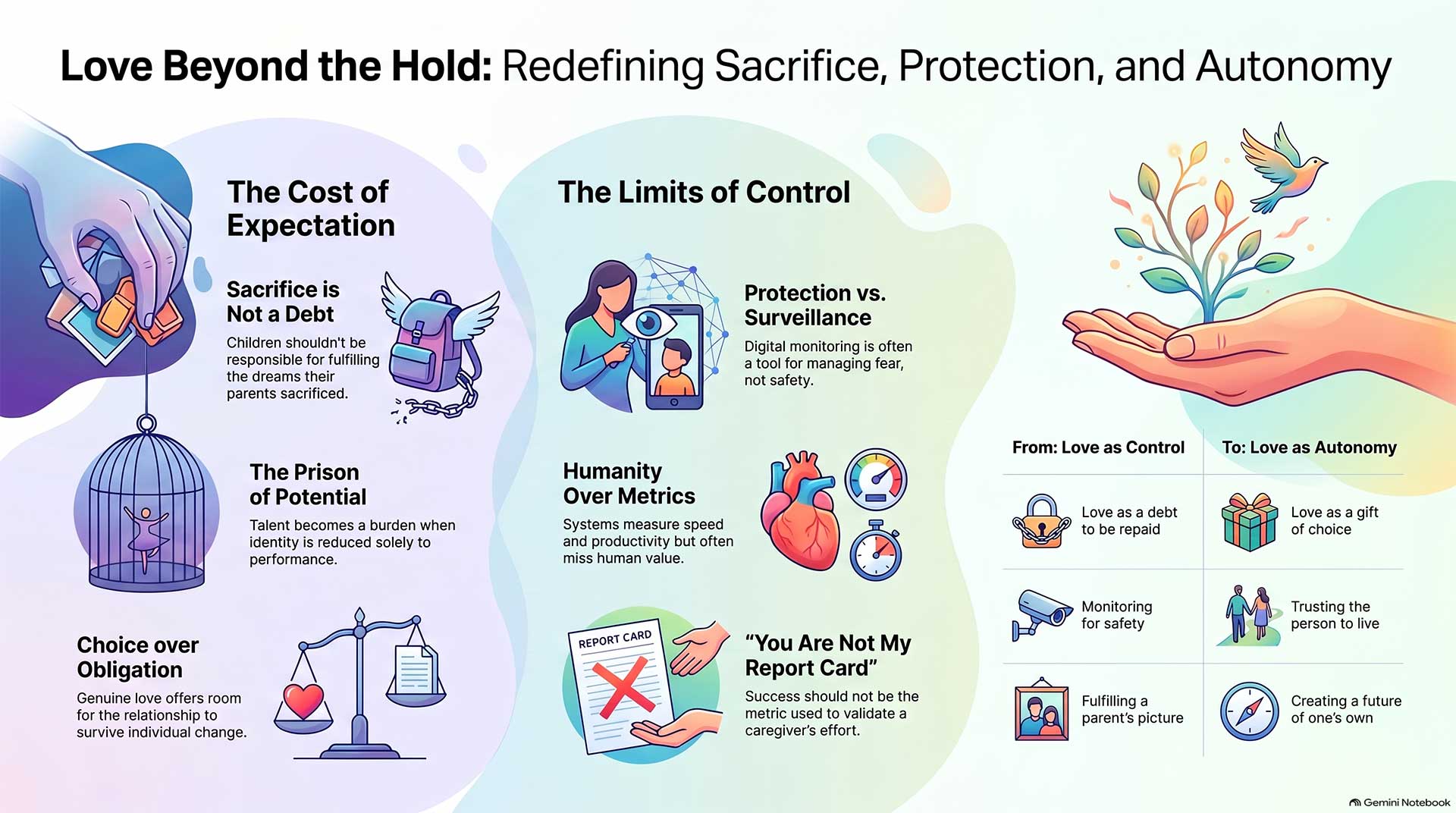
Grace believed Daniel's successful future would prove that all her sacrifices had been worthwhile.
David believed protecting Maya's extraordinary talent meant helping her reach everything she was capable of becoming.
Lena and Rachel both loved Noah so much that each considered making herself smaller for the other.
Elena lived inside a system capable of measuring minutes, ratings, routes, and productivity while missing the human meaning inside those numbers.
Karen loved Ethan so fiercely after nearly losing him that knowing where he was began to feel like the same thing as keeping him safe.
None of them began with bad intentions.
That matters.
The most painful forms of love are often not created by cruelty.
They grow from fear.
Fear that sacrifice will have been wasted.
Fear that talent will disappear.
Fear that another person's love will replace ours.
Fear that society values us only for what we produce.
Fear that someone who leaves our sight might disappear again.
What changes these characters is not learning to love less.
They learn to love differently.
Grace begins creating a future for herself.
David allows Maya's music to belong to Maya again.
Lena and Rachel stop asking which woman counts more.
Elena refuses to believe a number can describe the full value of a person.
Karen learns that her son's absence from a screen can mean something beautiful:
He is somewhere living.
This may be one of the deepest ideas carried from Little Wonder.
Separation changes people.
Love cannot always prevent that.
Nor should it.
A child grows.
A parent changes.
New relationships form.
Old identities loosen.
The person who returns may not be the person who left.
The person waiting may have changed too.
Coming home, then, cannot mean returning to exactly what existed before.
It can mean creating a relationship large enough for both people to arrive as they are now.
Perhaps that is where all five stories finally meet.
Love is not proven by how tightly we hold someone.
Nor by how much they owe us.
Nor by whether they fulfill the future we pictured for them.
Sometimes love is proven by something quieter:
You are free to become yourself, and there is still a place for you beside me.
Short Bios:
Grace Park
A widowed mother who spent years building her son's future and must confront the possibility that her sacrifices have unintentionally become a source of obligation.
Daniel Park
Grace's eighteen-year-old son, an accomplished student who chooses teaching over the prestigious engineering path his mother imagined for him.
Maya Chen
A fourteen-year-old violinist with rare musical ability who begins questioning whether she loves music or has become trapped inside everyone else's expectations for her talent.
David Chen
Maya's devoted father, who must learn that helping a gifted child reach her potential is different from deciding what that potential must become.
Dr. Lena Moretti
Maya's demanding violin teacher, who begins reconsidering when discipline strengthens a young musician and when pressure starts damaging the person behind the performance.
Noah Brooks
A high-school senior who loves both his biological mother and the aunt who raised him, yet becomes exhausted by feeling that every expression of love might wound someone else.
Lena Brooks
Noah's biological mother, rebuilding her relationship with her son after addiction and recovery while grieving the years of motherhood she cannot reclaim.
Rachel Brooks
Lena's sister, who became Noah's guardian during a temporary crisis that lasted years and must discover that stepping aside is not the only way to respect his mother's return.
Elena Morales
A single mother working delivery and cleaning jobs whose decision to stop for a stranger exposes the gap between what modern systems can measure and what human beings know matters.
Sofia Morales
Elena's twelve-year-old daughter, an ordinary student with an unusual ability to notice what other people and institutions overlook.
Karen Miller
A mother living with the emotional aftermath of nearly losing her son in a car accident, whose desire to protect him gradually becomes constant digital monitoring.
Ethan Miller
Karen's twenty-year-old son, who loves his mother yet needs enough distance to build an adult life without constantly proving that he is safe.
Sophie Chen Keller
The author of Little Wonder, whose novel explores motherhood, music, sacrifice, separation, longing, social inequality, unexpected human connection, and the enduring bond between a mother and child.
Leave a Reply