

Introduction
Cleopatra lived more than two thousand years ago.
But the problems surrounding her did not disappear with ancient Egypt.
They changed form.
A relationship can still become the explanation for a woman’s entire career.
Parents can still believe they are protecting their children while quietly deciding those children’s futures.
Leaders can still mistake repeated success for proof that their instincts are always right.
One dramatic image can still erase years of context.
People with layered identities are still pressured to choose one simple label.
And when someone dies, those left behind still decide which parts of that person will survive.
These five modern-day stories take the deepest questions uncovered in the two Cleopatra conversations and move them completely outside the ancient world.
There is no Caesar.
No Antony.
No Octavian.
No Actium.
No pharaoh.
Instead, there is a mayor whose years of public service become overshadowed by a scandal involving the man she loved.
A family that slowly turns its son into the symbol of a legacy he never chose.
A disaster-relief leader whose strategically defensible retreat is experienced by her own volunteers as abandonment.
A novelist forced to explain which of her many identities is supposedly the “real” one.
And a historian who discovers that correcting an unfair reputation can become another form of distortion.
Each story magnifies a different Cleopatra problem.
But together they ask one larger question:
What happens when one part of a human life becomes powerful enough to explain everything else?
A relationship becomes the explanation for leadership.
A child becomes the explanation for legacy.
A retreat becomes the explanation for character.
An identity becomes the explanation for a person.
A reputation becomes the explanation for an entire life.
Cleopatra became one of history’s most famous examples of this process.
These stories ask whether we are still doing the same thing today.
(Note: This is an imaginary conversation, a creative exploration of an idea, and not a real speech or event.)
Story 1: The Woman They Said Destroyed Him
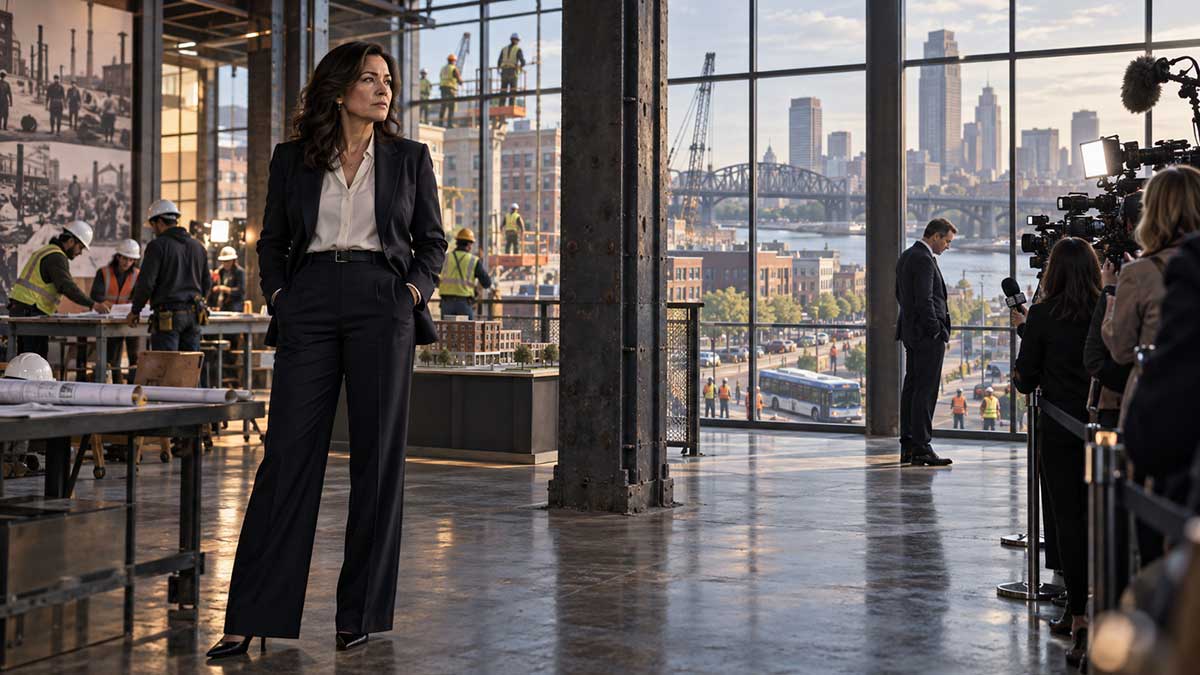
The factory had been empty for nineteen years.
Its windows were broken.
Rust streaked down the brick walls.
Pigeons nested where machines once shook the floor.
Elena Marquez stood beneath a ceiling blackened by decades of oil and dust while a seventy-three-year-old man named Walter Hale ran his hand along a steel column.
“My father worked here,” he said.
Elena looked at him.
“I worked here too.”
Walter smiled, though his eyes had begun to water.
“I thought the building would die before I did.”
Outside, construction crews were unloading equipment.
The abandoned factory would reopen in six months—not as the automobile-parts plant it had once been, but as a manufacturing incubator for small companies producing medical devices, batteries, and industrial robotics.
Four hundred jobs were projected in the first three years.
Not enough to restore everything the city had lost.
But something.
Elena looked through a broken window toward the neighborhood beyond.
Fifteen years earlier, nearly every third house on those blocks had been vacant.
The high school graduation rate had been below sixty percent.
The city’s bond rating had been one step above disaster.
The downtown bus terminal smelled permanently of urine.
People who could leave often did.
Elena had spent eight years trying to change that.
She had never been particularly good at speeches.
She was better at spreadsheets.
Budgets.
Zoning maps.
Meetings nobody wanted to attend.
She could spend three hours arguing over sewer capacity and remember every number afterward.
National reporters rarely came to interview people like her.
Not until Daniel Mercer.
Walter tapped the steel column again.
“You should put your name somewhere in here.”
Elena shook her head.
“The city paid for it.”
“The city didn't make it happen.”
“A lot of people did.”
Walter studied her.
“You always say that.”
“Because it's true.”
He smiled.
“Maybe.”
Then he looked around the cavernous building.
“But people forget who fought when everybody else said it was dead.”
Elena did not know then how much she would remember that sentence.
She met Daniel Mercer at a governors' conference in Chicago.
He was fifty-one.
She was forty-four.
He had already helped elect two senators, three governors, and enough members of Congress that journalists called him one of the most influential political strategists in the country.
He had a way of looking directly at people that made them feel the rest of the room had disappeared.
At dinner, someone introduced them.
“Elena Marquez. Mayor of Bellwether.”
Daniel smiled.
“The city with the bus reform.”
Elena stared at him.
“You know about that?”
“Of course.”
“You're the first person outside Ohio who has ever said that sentence.”
He laughed.
“Everyone wants to talk about presidential elections. I like things that actually work.”
They spoke for forty minutes.
Public transit.
Housing incentives.
Manufacturing tax credits.
How local journalists misunderstand municipal debt.
Nothing romantic happened.
Not that night.
But two days later he emailed her three ideas for attracting advanced manufacturing companies.
One was terrible.
One was obvious.
The third changed her city.
That became their pattern.
Elena knew government.
Daniel understood influence.
He knew who would take a phone call.
Which foundation wanted a project that looked impossible.
Which reporter needed a story.
Which donors wanted access.
Which senators hated one another.
Which governors pretended not to.
He saw invisible pathways through institutions.
Elena saw what could be built at the end of them.
Three years after they met, Daniel helped her secure federal support for a transit overhaul everyone in Bellwether had said was politically impossible.
Two years after that, he convinced a major employer to tour the city.
The company eventually opened a plant there.
He never asked for public credit.
He asked for other things.
At first, dinners.
Then hotel rooms.
Then promises.
Daniel was married.
Elena knew.
His marriage, he said, had been dead for years.
Elena hated the sentence because everyone who said it seemed to believe death excused secrecy.
She also believed him.
That was the first contradiction.
There would be many.
The affair lasted five years.
Sometimes they saw one another twice in a month.
Sometimes not for three months.
They had rules.
No messages during family holidays.
No public photographs alone.
No involvement in each other's personal finances.
No promises about marriage.
No pretending the relationship was harmless.
That last rule mattered to Elena.
“We should at least know what we're doing,” she once told him.
Daniel lay beside her in a hotel room in Washington, looking up at the ceiling.
“And what are we doing?”
“Something we would advise anyone else not to do.”
He laughed.
“That’s why I love you.”
She turned toward him.
“That is not a compliment.”
“It is to me.”
He reached for her hand.
She let him take it.
That was the second contradiction.
Daniel changed her political life.
There was no honest way to deny it.
Before him, Elena was a competent mayor admired mostly by policy people and city managers.
After him, she was invited to national conferences.
Television panels.
University lectures.
Donor retreats.
Her name appeared in articles about “the next generation of pragmatic Democratic leaders.”
Daniel never told her what to believe.
He did something more useful.
He taught important people to notice that she existed.
Elena used that access.
Aggressively.
When a foundation president agreed to meet for twenty minutes, she took fifty.
When a senator owed Daniel a favor, Elena asked Daniel to collect it.
When a corporation considering expansion wanted political reassurance, she made Daniel arrange the call.
Sometimes she felt uncomfortable.
Sometimes she told herself that every mayor used relationships.
And that was true.
Sometimes she told herself she would have accomplished everything without him.
That was not entirely true.
The city improved.
Violent crime fell.
Graduation rates rose.
Municipal debt declined.
Vacant properties were converted into housing.
The bus system became reliable enough that people stopped treating it as punishment for being poor.
National reporters finally discovered Bellwether.
They also discovered Elena.
Daniel began talking about governor.
She refused.
Then lieutenant governor.
She refused.
Then Senate.
She refused twice.
The third time she listened.
“You could win,” he said.
“I don't want Washington.”
“You want power.”
She looked at him sharply.
“I want capacity.”
“That is what everyone who wants power calls it.”
She laughed despite herself.
“You're impossible.”
“No. I'm useful.”
That, too, was true.
The first bad gamble worked.
A major donor threatened to withdraw support from a statewide infrastructure initiative unless Elena publicly backed a controversial redevelopment bill.
Elena hated the bill.
Daniel told her to support it anyway.
“You'll get amendments afterward.”
“I don't have the votes.”
“You will.”
“How?”
Daniel smiled.
“Trust me.”
She did.
The amendments came.
The donor stayed.
The project passed.
The second gamble worked too.
Then the third.
Daniel began saying the same thing after each victory.
“See?”
Elena would ask, “See what?”
“We were right.”
At first she corrected him.
“No. We won.”
He would smile.
“Same thing.”
“No.”
But after enough victories, the distinction began to weaken.
That was the most dangerous thing Daniel ever gave her.
Not access.
Not money.
Not introductions.
A pattern.
Risk.
Victory.
Risk.
Victory.
Risk.
Victory.
Eventually, success began to feel like evidence.
The messages leaked on a Tuesday morning at 6:17.
Elena was brushing her teeth.
Her chief of staff called.
“Don't open anything.”
Elena spit into the sink.
“What happened?”
“Your messages with Mercer.”
She froze.
“What messages?”
“All of them.”
“That's not possible.”
“It is.”
Elena opened her laptop.
The first headline appeared before the page finished loading.
MAYOR’S SECRET AFFAIR WITH TOP STRATEGIST EXPOSED
Then:
MERCER’S MARRIAGE, CAREER IMPLODE AFTER YEARS-LONG RELATIONSHIP
Then:
DID ELENA MARQUEZ MANIPULATE ONE OF AMERICA’S MOST POWERFUL POLITICAL MEN?
By eight o'clock, cable television had photographs.
By nine, commentators were reading fragments of private messages.
By ten, Daniel had been fired from the presidential campaign he had joined six months earlier.
By noon, his wife announced through an attorney that she had filed for divorce.
By three, two major clients terminated his contracts.
By evening, the story had changed.
It was no longer about two adults having an affair.
It was about Elena.
The messages gave people enough truth to build almost anything.
One showed Elena writing:
Push him harder. He wants the endorsement more than we need him.
Another:
If you want the governor to move, make him afraid he'll look weak.
Another:
You always tell me we win when we're willing to go one step further.
There were affectionate messages too.
Funny ones.
Tender ones.
A photograph of a terrible room-service hamburger.
A message Daniel sent after Elena's mother died:
I wish I could sit beside you without anyone asking why I'm there.
Those rarely appeared on television.
Instead, producers displayed the strategic messages beside photographs of Daniel looking exhausted.
A former political consultant went on air and said:
“I think Daniel Mercer became emotionally dependent on Mayor Marquez.”
Another said:
“She clearly had enormous influence over him.”
A columnist wrote:
Daniel Mercer spent thirty years building a reputation for political discipline. Elena Marquez may have been the one risk he could not manage.
Elena read that sentence three times.
Then she threw her phone across the office.
Her chief of staff, Priya, picked it up.
“You broke the case.”
“Good.”
“No. The case cost sixty dollars.”
Elena almost laughed.
Almost.
Daniel called that night.
She did not answer.
He called again.
She answered.
Neither spoke for several seconds.
Finally he said:
“They're making you the villain.”
Elena stared through the window of her office at the city.
“They're making you an idiot.”
Daniel laughed once, bitterly.
“That too.”
“You're not an idiot.”
“No.”
“You made your own decisions.”
“I know.”
“Then say it.”
Silence.
Elena turned.
“Daniel.”
“You know I would never have taken half those chances without you.”
The sentence hurt more than any headline.
She closed her eyes.
“So this is my fault?”
“I didn't say that.”
“You didn't have to.”
“I said you influenced me.”
“You influenced me.”
“I know.”
“You pushed me.”
“I know.”
“You gave me access I used.”
“I know.”
“You told me to take risks.”
“Yes.”
“And I told you to take them too.”
“Yes.”
She could hear him breathing.
Neither was innocent.
Neither had controlled the other.
Finally Elena said:
“And I would never have taken half of mine without you.”
Daniel whispered:
“I know.”
Neither said I love you.
The call ended.
The city council scheduled a no-confidence vote.
Not because Elena had clearly committed a crime.
She had not.
But several messages raised questions about donor access, political favors, and whether Daniel had exerted inappropriate influence.
The council chamber filled three hours early.
Outside, protesters carried signs.
RESIGN.
OUR CITY IS NOT YOUR BEDROOM.
Others carried:
JUDGE THE RECORD.
Elena entered through a side door.
Priya walked with her.
“You can still resign before the vote.”
“No.”
“I'm required to tell you it's an option.”
“You've told me fourteen times.”
“Fifteen.”
Elena stopped.
“Do you think I should?”
Priya hesitated.
That mattered.
“No.”
“Why?”
“Because I think you did things I hate.”
Elena nodded.
“And?”
“And I think this city is better because you were mayor.”
The honesty steadied her more than loyalty would have.
During public comment, speakers lined up.
A man accused Elena of disgracing the city.
A woman thanked her for rebuilding the park where her son played.
A pastor spoke about morality.
A restaurant owner spoke about downtown foot traffic.
A retired police officer called her arrogant.
A housing advocate called her the first mayor who had ever listened.
Then Marlene Brooks stepped to the microphone.
Sixty-two years old.
Principal of Bellwether Central High School.
Elena knew her well.
Marlene placed a folder on the podium.
“I've heard a lot tonight about Daniel Mercer.”
She looked toward the council.
“I don't know Daniel Mercer.”
A few people laughed.
Marlene continued.
“I know what happened to graduation rates.”
She opened the folder.
“Fifty-eight percent when Mayor Marquez took office.”
“Eighty-one percent last year.”
She turned a page.
“I know abandoned properties dropped by more than half.”
Another page.
“I know we have buses that show up now.”
More laughter.
“I know my teachers don't buy as many winter coats for students because the family support program finally has money.”
Someone applauded.
Marlene waited.
“I am not here to tell you Mayor Marquez is a good woman.”
The room became still.
“That is not the question you elected her to answer.”
She looked directly at Elena.
“And I am not here to tell you she did nothing wrong.”
Elena lowered her eyes.
Marlene turned back to the council.
“But if you want to judge the mayor…”
She closed the folder.
“…judge the mayor.”
The no-confidence motion failed by one vote.
Elena finished her term.
She did not run again.
Daniel Mercer never fully recovered his national career.
His marriage ended.
He started a small consulting firm.
For several years they did not speak.
When they finally did, the conversation lasted eleven minutes.
No apology was large enough.
No accusation was clean enough.
They had loved each other.
They had used each other.
They had helped each other.
They had encouraged each other's worst confidence.
All four things remained true.
Five years after Elena left office, a young documentary filmmaker named Sophie Chen visited Priya.
They met in a coffee shop across from the old factory.
The factory was no longer old.
Its brick walls had been cleaned.
Large windows filled the building with afternoon light.
Hundreds of people worked inside.
Sophie placed a recorder between them.
“I've interviewed Daniel Mercer.”
Priya nodded.
“I've interviewed his ex-wife.”
Priya said nothing.
“I've interviewed two former campaign officials.”
“Okay.”
“I've read the leaked messages.”
“Everyone has.”
Sophie looked down at her notes.
“I want to understand Elena.”
Priya smiled sadly.
“Good luck.”
Sophie asked several questions about the affair.
About donors.
About Daniel.
About the council vote.
Then she turned a page.
“How was she as mayor?”
Priya looked up.
For a second, she said nothing.
Sophie worried she had asked something wrong.
Then Priya laughed.
“What?”
“Nothing.”
Priya looked through the coffee-shop window toward the factory.
“It's just…”
She stopped.
Her eyes had filled slightly.
Sophie waited.
Priya finally said:
“You're the first person in five years who asked me about the eight years she governed instead of the eight minutes that destroyed her.”
Sophie looked down at the recorder.
Across the street, workers were leaving the factory at the end of the afternoon shift.
Cars pulled from the lot.
A bus stopped at the corner almost exactly on schedule.
The camera would later hold that shot for several seconds.
No scandal.
No lovers.
No headlines.
Just people going home from work.
And a city that remembered more than one story, even when the rest of the country did not.
Story 2: The Boy on Every Billboard
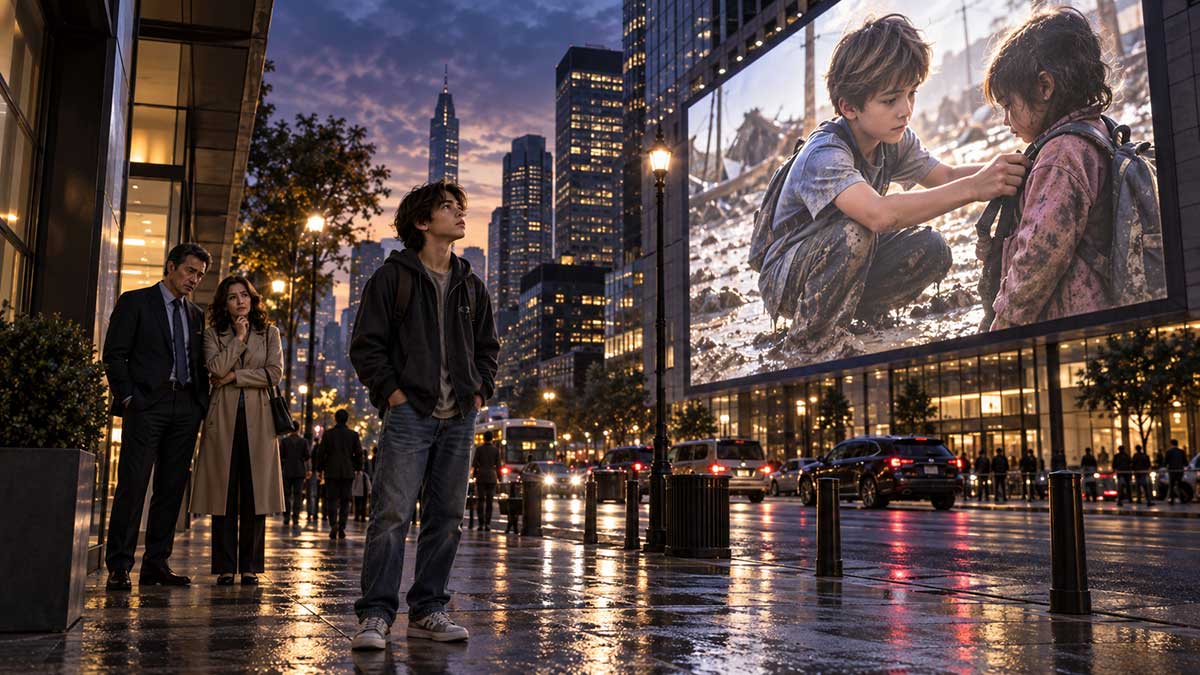
The photograph was never supposed to matter.
Noah Lee was twelve years old when a hurricane struck the Gulf Coast and turned entire neighborhoods into brown water, broken roofs, and mountains of soaked furniture.
His parents had brought him down for two days because schools in Columbus were closed for fall break and Rachel thought it would be good for him to see what the Lee Foundation actually did.
Not the galas.
Not the annual reports.
Not the photographs of smiling donors holding oversized checks.
The work.
They had spent the morning unloading bottled water from a truck when Noah noticed a little girl sitting on the curb.
She could not have been more than six.
Her backpack strap had snapped.
The girl was trying to tie it together with a plastic grocery bag.
Noah crouched beside her.
“Can I see?”
She handed it to him.
He tried tying the strap.
It slipped.
He looked around, found a strip of duct tape, folded the broken pieces together, wrapped the tape around them several times, then tugged hard to make sure it would hold.
“There.”
The girl pulled the backpack onto her shoulders.
“It looks ugly.”
Noah smiled.
“It was already ugly.”
She stared at him.
Then laughed.
A photographer standing twenty feet away pressed the shutter.
Noah never noticed.
Three days later, the photograph appeared on the Lee Foundation’s social media page.
Noah was kneeling in mud.
His T-shirt was stained.
The little girl was smiling.
Behind them stood a destroyed house.
The caption said:
HOPE IS WHAT WE BUILD FOR THE NEXT GENERATION.
Rachel saw it first.
She called her husband.
“Nathan.”
“What?”
“Did you approve this?”
“Approve what?”
“The Noah photo.”
There was a pause.
“Oh. Yes.”
“You didn’t ask me.”
“He’s our son.”
“That is why you should ask me.”
Nathan laughed softly.
“Rachel, he’s fixing a backpack.”
“He’s twelve.”
“I know.”
“It has twenty-seven thousand likes.”
“That’s good.”
She said nothing.
Nathan’s voice softened.
“Rach.”
“What?”
“It’s a beautiful photograph.”
She looked at the screen again.
It was.
That was the problem.
Nathan Lee had built a logistics software company from a rented office above a dry cleaner.
Twenty-one years later, the company was worth several billion dollars.
It coordinated shipping networks for grocery chains, hospitals, manufacturers, and emergency-response agencies.
Nathan was still the sort of man who became restless if a meeting lasted longer than forty minutes.
He hated ceremony.
He loved systems.
“If something arrives late,” he often said, “there is always a reason. Find the reason.”
Rachel had once been an emergency-room physician.
After their second child died during pregnancy, she left medicine for several years.
Eventually she started running the family foundation full-time.
Unlike Nathan, she believed that systems were necessary but incomplete.
“People are not packages,” she told him once.
Nathan had smiled.
“That's why I married you.”
They had been married seventeen years.
They were, in most ways, happy.
That matters.
There was no hidden cruelty inside their home.
No secret hatred.
Nathan helped Noah with algebra.
Rachel made pancakes on Sundays.
They watched old science-fiction movies together.
Noah played basketball badly and chess very well.
He knew the names of more moons than professional athletes.
If someone had told Nathan and Rachel that they would one day use their son, both would have been furious.
They loved him too much for that.
Which was precisely why they never recognized what was happening.
The hurricane photograph brought in $1.8 million in donations within four days.
The foundation’s communications director, Claire, showed Rachel the numbers.
“That photo outperformed every campaign we’ve ever run.”
Rachel frowned.
“No.”
Claire hesitated.
“No?”
“Don’t build a campaign around him.”
“We wouldn’t exploit him.”
“That sentence is usually what people say before they exploit someone.”
Claire smiled nervously.
Nathan was at the other end of the conference table.
“What if Noah wants to do it?”
Rachel turned.
“He's twelve.”
“He can still have an opinion.”
“So ask him.”
They did.
Noah sat at the kitchen island eating cereal while Nathan explained that the hurricane photograph had helped raise money.
“How much?”
“Almost two million.”
Noah stopped chewing.
“Because of me?”
“Because of the whole campaign,” Rachel corrected.
Nathan said:
“But your photo helped.”
Noah looked surprised.
Then proud.
“How many houses is that?”
Rachel smiled.
“A lot.”
“So they want to use the picture again?”
Nathan nodded.
“Only if you’re okay with it.”
Noah shrugged.
“Sure.”
Rachel watched him.
“Are you sure?”
“Mom, it’s just a picture.”
That sentence would return to her years later.
The next campaign used Noah’s photograph in an email.
Then on the foundation website.
Then in a magazine advertisement.
Then on a digital billboard in Atlanta.
Noah saw that one when they were driving from the airport.
He shouted:
“Oh my God!”
Nathan laughed.
Rachel turned from the front seat.
“What?”
Noah pointed through the window.
His own twelve-foot face stared down at traffic.
He burst out laughing.
“That’s so weird!”
Nathan took out his phone and photographed Noah photographing himself.
Rachel laughed too.
That night Noah sent the picture to his friends.
For several months, it seemed harmless.
Useful, even.
The foundation raised enough to rebuild two community clinics.
Noah spoke at a small donor luncheon.
He was terrified before going on stage.
Rachel knelt in front of him.
“You don’t have to do it.”
“I know.”
“Seriously.”
“I know.”
“Then why are you?”
Noah shrugged.
“Because they said donations went up when I talked last time.”
Rachel kissed his forehead.
“You don’t owe anyone a performance.”
He rolled his eyes.
“Mom.”
Then he went on stage.
He told the backpack story badly.
He forgot the little girl’s name.
He said “um” fourteen times.
The donors loved him.
A year later, the Lee Foundation annual report opened with a full-page photograph of Noah.
The headline:
THE NEXT GENERATION OF GIVING
Nathan liked it.
Rachel did not.
“He is becoming the brand.”
Nathan looked up from the report.
“That's dramatic.”
“No.”
She tapped the cover.
“This is dramatic.”
“He likes helping.”
“He likes astronomy.”
“He can like two things.”
“Of course he can.”
Nathan closed the report.
“What are you worried about?”
Rachel struggled to answer.
She was not sure.
Nothing bad had happened.
Noah still seemed happy.
His friends teased him about the billboards.
He teased himself.
He spoke at another event.
Then another.
At fourteen, he appeared beside his father at a global development conference in New York.
At fifteen, a senator introduced him as:
“the future leader of the Lee Foundation.”
Noah smiled politely.
On the flight home, he asked:
“Why does everyone keep saying that?”
Nathan looked up from his laptop.
“Saying what?”
“That I’m going to run the foundation.”
Nathan smiled.
“You might.”
“Did I say that?”
“No.”
“Then why do they?”
Nathan closed the laptop.
“Because people see you care about the work.”
Noah stared out the window.
“I care about space too.”
Nathan laughed.
“You have time.”
Noah said nothing.
The family’s public narrative became smoother with repetition.
Nathan had built the company.
Rachel had built the foundation.
Noah represented the future.
It fit perfectly.
At donor events, people would shake Noah’s hand and say:
“Your parents are building something incredible for you.”
Sometimes they said:
“You must be proud to carry this forward.”
At first, Noah corrected them.
“I’m not sure I will.”
They usually laughed.
“Of course you will.”
Eventually he stopped correcting them.
That was easier.
The trouble began when Nathan’s company entered a legal battle with a much larger competitor.
At first it looked ordinary.
Patent disputes.
Pricing accusations.
Aggressive contracts.
Then a congressional committee began asking whether Nathan’s business relationships had influenced grants awarded through the foundation.
Nothing illegal was immediately proven.
But the story was irresistible.
Billionaire founder.
Political donors.
Charitable foundation.
Government contracts.
And a photogenic teenage son appearing beside senators.
A newspaper ran the headline:
PHILANTHROPY OR FAMILY EMPIRE?
Underneath was a photograph of Noah at age fourteen, smiling beside a cabinet secretary.
Rachel stared at the page.
“They used him.”
Claire from communications looked uncomfortable.
“Yes.”
“He had nothing to do with any of this.”
“I know.”
“Then call them.”
“We did.”
“And?”
“They said the photo demonstrates how integrated the family is with the foundation’s public identity.”
Rachel felt something cold move through her.
Public identity.
They had created that.
Three days later, a photographer waited outside Noah’s school.
A classmate texted him first.
dude there’s media outside
Noah thought it was a joke.
Then he saw the cameras.
He called his mother from the bathroom.
“Mom?”
Rachel heard his voice and stood immediately.
“What happened?”
“There are people outside.”
“Who?”
“I don't know.”
“Stay inside.”
“Why?”
“Just stay inside.”
“Am I in trouble?”
The question stopped her.
“No.”
“Then why are they here?”
Rachel closed her eyes.
“I’m coming.”
By the time she arrived, security had moved Noah through a side entrance.
He was sitting in the back seat of a car.
His hood was pulled over his head.
Rachel opened the door.
“Are you okay?”
He nodded.
“Did anybody touch you?”
“No.”
“Say anything?”
“A guy asked if Dad used me to get government contracts.”
Rachel went still.
Noah looked at her.
“What does that mean?”
“Nothing.”
“Mom.”
“It means they’re trying to connect everything.”
“To me?”
“No.”
“But they asked me.”
She reached for him.
He pulled away.
Not dramatically.
Just enough.
That frightened her more.
Within weeks, Noah’s old social media accounts were copied and searched.
Someone posted an edited screenshot supposedly showing him making a racist joke in a private chat.
It was fake.
That did not matter for the first six hours.
By the time the platform labeled it manipulated, thousands of people had already called Noah spoiled, corrupt, disgusting, privileged, and worse.
He was sixteen.
That night he came downstairs carrying his phone.
Rachel was sitting at the kitchen table.
“Why do people I’ve never met hate me?”
She put down her tea.
“They don’t hate you.”
“They do.”
“They don’t know you.”
Noah stared at her.
Then said:
“Then why do they know my face?”
Rachel opened her mouth.
Nothing came.
Noah waited.
She had answered hundreds of journalists.
Thousands of donors.
Government committees.
Medical boards.
She could not answer her son.
Finally she said:
“We thought it was helping.”
Noah looked at her.
“Helping who?”
The question was quiet.
That made it worse.
Nathan wanted to fight.
“That account is fake.”
“I know,” Rachel said.
“We can sue.”
“That won’t remove his face from the world.”
“No, but we can make them pay.”
Rachel turned toward him.
“This is not one person.”
“Then what are you asking me to do?”
“Stop.”
“Stop what?”
“Using him.”
Nathan stared at her.
“We have never used him.”
Rachel felt the words before she said them.
“Yes, we have.”
His expression changed.
“That is insane.”
“We put him on billboards.”
“He agreed.”
“He was twelve.”
“He was proud.”
“He was a child.”
“We raised millions.”
“For good work.”
“Yes.”
“You wanted those campaigns too.”
Rachel looked at him.
“Yes.”
Nathan fell silent.
She continued:
“I am not accusing you so I can escape it.”
He looked away.
“We both did it.”
“For what?”
“For the foundation.”
“For donations.”
“For the family.”
“For the story.”
Nathan shook his head.
“What story?”
Rachel almost laughed.
“Our story.”
She looked around their beautiful kitchen.
“You built the company. I built the foundation. Noah inherits both.”
“I never said he inherits my company.”
“No.”
“But we said everything else.”
Nathan was quiet.
Rachel continued:
“We kept saying we were building something for him.”
“We were.”
“Were we?”
He looked at her sharply.
“Yes.”
She lowered her voice.
“Or were we building it through him?”
They removed Noah from every new campaign.
Old photographs remained online.
They stopped bringing him to public events.
Security began driving him to school.
For a while, it seemed the crisis might pass.
Then a threat arrived in the mail.
It was addressed directly to Noah.
Inside was one of the foundation’s old fundraising brochures.
Someone had drawn a red X over his face.
Rachel sat on the floor of their bedroom holding the brochure.
Nathan stood by the window.
Neither spoke.
After several minutes he said:
“I did this.”
Rachel looked up.
“We did.”
“No.”
“Yes.”
“I pushed it.”
“You pushed harder.”
“Then say it.”
“What?”
“That it was me.”
She stood.
“Nathan, I am not going to give you the luxury of becoming the villain.”
He looked at her.
“What does that mean?”
“It means if I make this entirely your fault, I get to stay innocent.”
She looked down at the brochure.
“I signed those campaigns.”
“I stood beside him at galas.”
“I watched donations rise and told myself the number justified the exposure.”
Her voice cracked.
“We loved him.”
Nathan whispered:
“We still do.”
“I know.”
That was what made it unbearable.
At seventeen, Noah discovered the interview.
It had been recorded five years earlier at an economic summit.
Nathan was sitting on stage beside two other founders.
The moderator asked:
“What does legacy mean to you?”
Nathan smiled.
“My son.”
The audience softened instantly.
Nathan continued:
“One day, everything Rachel and I have built—business, foundation, relationships, values—will belong to the next generation.”
The moderator said:
“So you expect Noah to carry it forward?”
Nathan laughed.
“I hope he does more than carry it. I hope he makes it bigger.”
Applause.
Noah watched the clip twice.
Then he walked downstairs.
Nathan was in his office.
Noah stood in the doorway.
“Did you mean it?”
Nathan looked up.
“Mean what?”
Noah turned the laptop toward him.
The video was paused on Nathan’s face.
Nathan’s expression changed.
“I said that years ago.”
“That isn’t what I asked.”
Nathan removed his glasses.
“I meant I hoped you would care about what we built.”
“You said I would carry it.”
“I said I hoped.”
“You told thousands of people my future.”
“Noah.”
“Did you ever ask me?”
Nathan stood.
“We talked about the foundation all the time.”
“No.”
“We did.”
“You talked about the foundation.”
Nathan stopped.
Noah’s voice was beginning to shake.
“I was a kid standing next to you.”
“You asked if I liked helping.”
“I did.”
“You asked if I was proud.”
“I was.”
“You asked if I wanted to speak at a dinner.”
“Sometimes I said yes.”
He stepped closer.
“But did you ever ask me if I wanted my whole life?”
Nathan stared at him.
“Noah, I never decided your whole life.”
“You announced it.”
“That is not the same.”
“It felt the same to everyone else.”
“No one can decide your future.”
Noah laughed once.
“They already think they know it.”
Nathan tried to reach him.
Noah stepped back.
“Why?”
Nathan stopped.
“Why what?”
“Why did everyone know my future before I did?”
There was no anger in the question anymore.
Only hurt.
Nathan sat down.
For the first time in Noah’s life, his father looked old.
“I thought…”
He stopped.
Noah waited.
Nathan started again.
“I thought if you inherited what we built, you would never have to struggle the way I did.”
Noah looked at him.
“That was your fear.”
Nathan said nothing.
Noah continued:
“You made it my future.”
Two years later, Noah left for college.
Not business school.
Not public policy.
Astrophysics.
Nathan tried not to make a joke when Noah told him.
Rachel cried.
Noah laughed.
“Mom, people get into college every year.”
“I know.”
“Then stop looking like I’m leaving Earth.”
She smiled through tears.
“You kind of are.”
Before he left, the three of them sat outside after dinner.
No cameras.
No donors.
No staff.
Nathan looked toward his son.
“The foundation board has asked whether you want an observer seat when you’re twenty-one.”
Noah stared at him.
Nathan raised both hands.
“I said I would ask.”
Noah smiled slightly.
“No.”
Nathan nodded.
“Okay.”
“That’s it?”
“That’s it.”
Noah studied him.
“You’re not disappointed?”
Nathan looked toward the yard.
“I’m trying to learn that disappointment is allowed.”
He looked back.
“Control isn’t.”
Noah nodded.
That was not forgiveness.
But it was a beginning.
At twenty-three, Noah Lee returned to the Gulf Coast for the first time since childhood.
Not for the foundation.
A university astronomy program had installed a small research telescope at a coastal observatory.
Light pollution was low.
The sky was enormous.
A journalist from a local paper recognized his name.
“You’re Nathan Lee’s son.”
Noah smiled.
“Yes.”
“And Rachel Lee?”
“Yes.”
“The foundation family.”
He nodded.
The reporter brightened.
“Are you planning to take over someday?”
Noah laughed.
“No.”
The reporter looked surprised.
“Really?”
“Really.”
“What are you going to do?”
Noah pointed toward the observatory dome.
“Astronomy.”
The reporter laughed politely.
Noah did not.
Eventually the reporter realized he was serious.
“Oh.”
Noah smiled.
“It’s okay. Everyone does that.”
“Does what?”
“Assumes there is a punchline.”
That night, after the reporter left, Noah climbed the narrow stairs into the observatory.
The dome opened slowly.
Above him, the sky appeared.
No billboards.
No headlines.
No donor lists.
No family name large enough to cover it.
Just darkness crowded with light.
Noah positioned the telescope toward Saturn.
Through the eyepiece, the planet was tiny.
Pale.
Impossible.
He remembered being twelve years old and fixing a broken backpack with duct tape.
He remembered the photograph.
He remembered seeing his own face over a highway.
He remembered thinking it was funny.
He remembered believing that being useful meant being willing.
He remembered the first time a stranger told him what he would become.
Then the thousandth.
His phone vibrated.
A message from Rachel.
How’s the sky?
Noah looked through the telescope again.
He typed:
Mine.
Three dots appeared.
Then disappeared.
A minute later, Rachel replied:
Good.
Noah put the phone away.
Saturn drifted slowly across the field of view.
For once, nobody was looking at him.
And nothing in the sky expected him to become anything except himself.
Story 3: The Exit

Maya Bennett had been leaving disasters for twenty years.
Not abandoning them.
Leaving them.
There was a difference.
At least, she had always believed there was.
Wildfires in California.
Floods in Kentucky.
Earthquakes in Turkey.
A typhoon in the Philippines.
A hospital evacuation during a civil war that nearly trapped forty-three patients behind a collapsing front line.
Maya had learned something early:
People remembered the moment you arrived.
They rarely understood the moment you decided to go.
That morning, before Hurricane Iris made landfall, a twenty-six-year-old field coordinator named Aaron asked her:
“How do you know when it’s time to leave?”
They were standing beside a warehouse filled with bottled water, antibiotics, satellite radios, tarps, generators, and fuel.
Outside, the wind had already begun bending palm trees.
Maya looked at him.
“You don’t leave because you’re afraid.”
Aaron waited.
“You leave when staying means you won’t be able to help tomorrow.”
He nodded as though she had given him a rule.
Maya had meant it as one.
By midnight, Iris was the strongest hurricane to hit that section of the Gulf Coast in more than half a century.
The storm surge swallowed neighborhoods.
Electrical substations failed.
Two hospitals lost backup generators.
The interstate disappeared beneath water.
Cell towers went down one after another.
Horizon Response, the relief organization Maya had founded nineteen years earlier, already had nearly three hundred staff and volunteers inside the disaster zone.
They had forty-two trucks.
Eight mobile medical units.
Three satellite communication systems.
Fuel.
Food.
Portable water filtration.
Emergency cash.
And one bridge connecting their main forward operation to higher ground.
At 1:40 a.m., an engineer called Maya.
“The east bridge is moving.”
She pressed the phone harder against her ear.
“What does moving mean?”
“Horizontal displacement.”
“How much?”
“Enough that I wouldn’t put heavy vehicles on it tomorrow.”
“What about tonight?”
Silence.
“Maya.”
“How many hours?”
“I can’t give you that.”
“Give me your best guess.”
“Three.”
She looked toward the operations board.
Hundreds of markers.
Red for medical teams.
Blue for volunteers.
Green for supply stations.
Half the city was dark.
“What happens if we keep the convoy where it is?”
“If the bridge fails?”
“Yes.”
“You lose the trucks.”
“And the fuel?”
“Yes.”
“Satellite equipment?”
“Yes.”
“Medical stock?”
“Yes.”
“How long until another route opens?”
“At least two days.”
Maya closed her eyes.
Two days.
In disaster relief, two days could mean thousands of people.
She asked:
“What happens if we move now?”
“You probably get the convoy across.”
“Probably?”
“Nothing is guaranteed tonight.”
Maya looked toward the weather map.
Nothing ever was.
Aaron was standing beside her.
“What?”
“The bridge.”
“Bad?”
“Possibly.”
He looked toward the operations board.
“How bad?”
“We may need to move the main convoy.”
His face changed.
“What about the south teams?”
“They stay.”
“And the shelters?”
“They stay.”
“Medical station six?”
“Stay.”
Aaron stared at her.
“You want the trucks to leave without them?”
“I want the resources protected.”
“We have two hundred people still down there.”
“I know.”
“If they see the trucks leaving—”
“They’ll understand the contingency.”
Aaron shook his head.
“Do they know there is one?”
Maya looked at him.
“We briefed regional leads.”
“When?”
“Yesterday.”
“Before the communications failures.”
She glanced toward the satellite board.
Two channels were already down.
“The leads know.”
“Do the volunteers?”
“They don’t need every operational detail.”
Aaron did not move.
Maya turned.
“What?”
He looked uncomfortable.
“Nothing.”
“What?”
“You always say that before you make the call.”
She frowned.
“Say what?”
“That people don’t need every detail.”
“Because they don’t.”
Aaron nodded.
“I know.”
He stepped away.
Maya watched him go.
Then looked back at the bridge report.
Three hours.
Maybe less.
Horizon Response existed because Maya had refused to wait.
That was the mythology around her.
It was also partly true.
During a wildfire twelve years earlier, local officials had ordered all civilian organizations to remain outside a canyon community until morning.
Maya had found a secondary road.
She sent three medical trucks through.
They evacuated twenty-seven elderly residents before the main road burned.
People called her reckless.
Then they called her heroic.
During an earthquake, she ignored a regional director who insisted the airport would reopen within twenty-four hours.
Maya rerouted supplies through a neighboring country.
The airport remained closed for six days.
During a flood, she moved their warehouse six hours before anyone else.
The original facility ended up beneath nine feet of water.
Each time, someone had said:
Wait.
Slow down.
Coordinate.
Be cautious.
Each time, Maya had moved.
Each time, she had been right.
At Horizon, younger staff joked:
If Maya says run, ask where.
Not why.
She hated the joke.
She also liked it.
At 2:05 a.m., she gave the order.
“Move Convoy One through Four.”
The logistics chief repeated:
“All forty-two?”
“All forty-two.”
“Medical supply trailers?”
“Yes.”
“Fuel?”
“Yes.”
“Communications?”
“Yes.”
“Destination?”
“North staging ground.”
“Personnel?”
“Essential drivers and transport staff only.”
Aaron looked toward her.
Maya continued.
“Leave local shelter teams in position.”
The logistics chief hesitated.
“Maya.”
“What?”
“If we move everything, the south side is empty.”
“It isn’t empty.”
“Operationally—”
“The teams stay.”
“With no heavy transport.”
“For several hours.”
He looked at the map.
“Assuming the bridge still works later.”
Maya said nothing.
The room understood what he had meant.
She leaned toward the table.
“If the bridge collapses with those trucks on the wrong side, we lose the ability to operate tomorrow.”
No one spoke.
She continued:
“Medicine we cannot replace.”
“Fuel we cannot replace.”
“Communications we cannot replace.”
“If we preserve that convoy, we can reach tens of thousands of people after daylight.”
Aaron said:
“And tonight?”
Maya looked at him.
“Tonight we trust the teams already in place.”
The first truck crossed at 2:32.
The rain was almost horizontal.
Drivers could barely see twenty feet ahead.
Volunteers stood beneath awnings watching the convoy move.
Some had received pieces of the plan.
Most had not.
A medical volunteer named Luis Ramirez took out his phone.
At first he filmed the storm.
Then headlights appeared through the rain.
One truck.
Then another.
Then another.
Someone behind him shouted:
“Where are they going?”
Luis turned.
“What?”
“The Horizon trucks.”
A radio crackled uselessly in someone’s hand.
Luis walked into the rain.
One of the trucks passed.
He saw medical markings on the side.
“Hey!”
The driver could not hear him.
Another truck passed.
Then another.
Luis raised his phone.
“What the hell?”
The camera shook.
Rain covered the lens.
Behind him, people were shouting.
He turned the phone toward himself.
“Horizon is pulling out.”
Someone yelled:
“They’re leaving us!”
Luis looked toward the line of trucks disappearing into darkness.
His face changed.
He looked terrified.
“They’re taking everything.”
The video lasted twenty-two seconds.
At 3:11 a.m., the clip went online.
At 3:40, a local reporter reposted it.
At 4:05, a national news producer saw it.
At 4:26, the caption appeared:
RELIEF CEO ORDERS EVACUATION, LEAVES VOLUNTEERS BEHIND
By sunrise, six million people had watched it.
Maya had not.
She was coordinating the north staging ground.
The convoy had made it across.
All forty-two trucks.
Two fuel tankers.
The medical units.
Satellite equipment.
Almost every irreplaceable asset Horizon had.
At 5:17 a.m., the bridge partially failed.
The western support shifted.
The central span dropped several feet.
Heavy vehicles could no longer cross.
Maya stared at the engineer’s message.
For one moment, relief moved through her.
She had been right.
Then her phone began filling with notifications.
Aaron found her twenty minutes later.
“You need to see this.”
Maya barely looked up.
“What?”
He held out the phone.
She watched Luis’s video.
Once.
Then again.
At the end, someone screamed:
“They’re abandoning us!”
Maya handed the phone back.
“It’s wrong.”
Aaron looked at her.
“What part?”
“We didn’t abandon anyone.”
“I know.”
“We preserved the convoy.”
“I know.”
“The bridge failed.”
“I know.”
“If we had waited—”
“I know.”
She stared at him.
“Then what?”
Aaron looked toward the ground.
“They didn’t know.”
“The regional leads knew.”
“Not all of them.”
“They were briefed.”
“Two never got the final radio update.”
Maya felt something tighten in her chest.
“How?”
“Channel failure.”
“When?”
“Before Convoy Three moved.”
“Why wasn’t I told?”
“We were trying.”
She turned away.
Outside the staging tent, vehicles were already being refueled.
Teams were loading medicine.
Satellite equipment was coming online.
The plan was working.
Aaron said quietly:
“They thought you were leaving them.”
Maya turned.
“They were not left.”
Aaron did not answer.
“They had staff.”
“Yes.”
“Medical supplies.”
“Limited.”
“Shelter.”
“Yes.”
“We were still coordinating.”
“From the other side of a broken bridge.”
Maya stared at him.
“That is not the same as abandonment.”
Aaron looked at her for a long moment.
“No.”
Then:
“But I’m not sure they knew the difference.”
At 8:00 a.m., the preserved convoy began moving north and west.
Two mobile clinics opened before noon.
Horizon’s satellite system became one of the few reliable communication networks still functioning.
They transported insulin to three shelters.
Delivered emergency blood products.
Moved oxygen cylinders to a nursing facility.
Evacuated sixty-seven patients from a flooded hospital.
By evening, Maya had barely slept.
The decision had saved the operation.
Then the casualty report came.
Three Horizon volunteers had been caught when floodwater entered an elementary school being used as a temporary shelter.
Two suffered serious injuries.
One, Luis Ramirez, was swept into a stairwell when a door failed.
He drowned before rescue teams reached him.
Maya read the name twice.
Then opened the video again.
Luis’s face appeared.
Rain.
Headlights.
Fear.
“They’re leaving us.”
She stopped the video.
The next morning, the headline changed.
VOLUNTEER DIES AFTER HORIZON WITHDRAWS CONVOY
Then:
DID MAYA BENNETT ABANDON HER OWN PEOPLE?
Commentators divided immediately.
Some called her decision courageous.
Others called it unforgivable.
Emergency-management experts appeared on television.
One said:
“Preserving critical assets is standard disaster strategy.”
Another replied:
“You cannot preserve equipment at the expense of people.”
A third said:
“That is a false choice.”
A fourth said:
“Tell that to the volunteer who died.”
Maya watched for fourteen minutes.
Then turned off the television.
She had spent twenty years making decisions while other people argued later.
This was different.
Luis’s final recorded words had given the decision a face.
Three days after the storm, Luis’s sister arrived.
Her name was Ana.
Thirty-eight.
Elementary-school teacher.
Maya offered to meet privately.
Ana said:
“No lawyers.”
“Fine.”
“No communications staff.”
“Fine.”
“No cameras.”
“Yes.”
They sat inside a small church classroom because Horizon’s offices were unusable.
Children’s drawings still hung on the walls.
Ana placed her brother’s phone on the table.
She did not cry.
That made Maya nervous.
“My brother believed in your organization.”
“I know.”
“No, you don't.”
Maya waited.
“He took unpaid leave to volunteer with you.”
“I read his file.”
“He had been to four disasters.”
“I know.”
“He told everyone you were the reason Horizon worked.”
Maya looked down.
Ana continued:
“He used to say you would never ask someone to stay somewhere you wouldn’t stay yourself.”
Maya swallowed.
“I’ve stayed in many dangerous places.”
“That isn’t what I said.”
Maya looked up.
Ana pushed the phone toward her.
“Did you make the right decision?”
Maya was silent.
She had answered this question internally a hundred times.
The bridge had failed.
The trucks had survived.
Thousands had received aid.
The logic remained intact.
“Yes,” she said.
Ana’s eyes hardened.
Then Maya continued:
“I think moving the convoy prevented a larger operational collapse.”
Ana stared at her.
“That’s not what I asked.”
“It is part of the answer.”
“My brother died.”
“I know.”
“Stop saying that.”
Maya closed her mouth.
Ana leaned forward.
“If your plan made sense to you but looked like betrayal to the people trusting you…”
She paused.
“…who failed?”
Maya could hear the rain again.
Luis’s voice.
They’re leaving us.
She said:
“I don’t know.”
Ana stood.
“Then figure it out.”
Maya returned to work.
There was too much to do.
That was the advantage of disaster.
Grief could be postponed by logistics.
Forty generators were needed.
A clinic required refrigeration.
Two shelters needed transport.
A water system had failed.
She worked sixteen-hour days.
At night, however, her mind returned to older crises.
California.
Turkey.
Kentucky.
The canyon road.
The flooded warehouse.
The border route.
Every time she had ignored caution.
Every time someone had warned her.
Every time the decision had worked.
She opened old reports.
There were lines she had forgotten.
Recommendation: establish clearer pre-evacuation communication protocols.
Another:
Field staff expressed confusion regarding command intent.
Another:
Success of emergency relocation should not obscure communication deficiencies.
Maya stared at the sentence.
Success should not obscure.
She had read those reports.
She had signed them.
Then gone to the next disaster.
Because the mission had succeeded.
Because people had survived.
Because the warehouse had moved.
Because the patients had escaped.
Because the road had stayed open.
Because she had been right.
Or had she?
Maya began to see the pattern differently.
Her instincts had not become sharper merely because outcomes had rewarded them.
The rewards had taught her to trust herself more.
That was not the same thing.
Repeated survival had become a credential she had issued to herself.
Three months later, a public inquiry opened.
The hearing room was crowded.
Maya sat beneath bright lights with lawyers on both sides.
Luis’s family sat several rows behind her.
The attorney questioning Maya spoke calmly.
“Ms. Bennett, was the convoy evacuation ordered by you?”
“Yes.”
“Were you aware volunteers remained south of the bridge?”
“Yes.”
“Were you aware the bridge could become unusable?”
“Yes.”
“Did you move the organization’s primary vehicles, medical supplies, fuel, and communications equipment away from those volunteers?”
“Yes.”
“Did you know all field personnel had received the final contingency plan?”
Maya paused.
“At the time, I believed regional leadership had sufficient information.”
“That was not my question.”
“No.”
She looked toward the attorney.
“I did not know that every team had received it.”
“Did you verify?”
“No.”
“Why not?”
“Communications were deteriorating.”
“Then isn't that when verification was most important?”
Maya said nothing.
The attorney continued:
“Do you still believe your order was correct?”
The room changed.
This was the sentence everyone had been waiting for.
Maya looked toward Luis’s family.
Then toward Aaron.
Then at the table.
“Yes.”
A murmur moved through the room.
The attorney leaned forward.
“Yes?”
Maya nodded.
“I believe preserving the convoy allowed Horizon to continue operations after the bridge failed.”
The attorney said:
“So you would make the same decision again.”
“No.”
Silence.
He frowned.
“You just said it was correct.”
“I said the strategic decision was defensible.”
“Then why would you not repeat it?”
Maya looked directly at him.
“Because I had a strategy.”
She paused.
“They experienced abandonment.”
The room became completely still.
“Both are true.”
The attorney said:
“Explain.”
Maya breathed slowly.
“I treated communication as secondary to movement.”
“I believed regional leaders understood enough.”
“I believed the larger purpose of the withdrawal would become obvious once operations continued.”
“Wasn't it obvious?”
“To me.”
She looked toward Luis’s sister.
“Not to everyone depending on us.”
The attorney said:
“So who failed?”
Maya did not look away.
“I did.”
The room moved again.
The attorney waited.
“Because your order was wrong?”
“No.”
“Then because?”
Maya’s voice became quieter.
“Because leadership includes what people understand.”
She swallowed.
“Not only what I intend.”
After the hearing, reporters surrounded her.
“Do you accept responsibility for Luis Ramirez’s death?”
“Should you resign?”
“Was the convoy evacuation a mistake?”
“Did Horizon prioritize property over people?”
Maya said almost nothing.
Every answer felt too small.
Within a month, Horizon’s board voted to retain her.
Two members resigned in protest.
Donations fell.
Then recovered.
Some people treated the hearing as proof of her courage.
Others as proof that she was incapable of admitting failure.
The twenty-two-second video remained online.
It passed eighty million views.
Every few months, someone reposted it.
Usually with no context.
Sometimes with too much.
Maya eventually stopped reading the comments.
A year later, Horizon built a new leadership-training program.
Not because of Iris alone.
That was what the official materials said.
Everyone knew otherwise.
The first session included thirty future field directors.
Aaron, now regional operations chief, stood in the back.
Maya entered without slides.
She wrote one sentence on the board:
A PLAN IS NOT COMPLETE UNTIL THE PEOPLE DEPENDING ON IT UNDERSTAND THEIR PART IN IT.
One student raised her hand.
“What if there isn’t time?”
Maya looked at her.
“There often isn’t.”
“Then what do you do?”
“You decide what can be simplified.”
“And if communications are failing?”
“You assume your plan is failing with them.”
Another student asked:
“What if explaining delays the operation?”
“Then you decide whether the delay is more dangerous than confusion.”
“How?”
“You use judgment.”
The student smiled.
“That sounds like what got you in trouble.”
Maya smiled too.
“Yes.”
A few people laughed.
She continued:
“The lesson is not to stop making decisions.”
“It is to stop treating confidence as proof.”
During the afternoon exercise, Aaron approached her.
“You remember what I asked you before Iris?”
Maya looked at him.
“No.”
He smiled.
“Yes, you do.”
She did.
“How do you know when to leave?”
Aaron nodded.
Maya looked through the classroom windows.
Rain had begun outside.
Nothing dramatic.
Just September rain.
She said:
“You don’t leave because you’re afraid.”
Aaron smiled.
“Same answer.”
“No.”
She continued:
“You leave when staying prevents you from helping tomorrow.”
He waited.
“And?”
Maya looked at him.
“You make sure the people staying behind know why.”
Aaron’s expression changed.
“And if you can’t?”
Maya answered:
“Then your plan isn’t finished.”
He nodded.
Then asked:
“What if you still have to go?”
Maya was quiet.
“That happens.”
“So what then?”
She looked toward the young leaders inside the room.
“You stop pretending there was a perfect choice.”
Years later, people still argued about Maya Bennett.
In emergency-management classes, Hurricane Iris became a case study.
Some instructors called the convoy evacuation one of the smartest logistical decisions made during the storm.
Others called it a textbook failure of command communication.
Both groups used the same map.
The same bridge.
The same timeline.
The same twenty-two-second video.
Students always wanted to know which interpretation was correct.
Aaron eventually taught the case himself.
One afternoon, a student raised his hand.
“So was Bennett right or wrong?”
Aaron looked toward the screen.
The video was paused on a line of headlights disappearing into rain.
He had watched it hundreds of times.
He remembered standing beside Maya before the convoy moved.
He remembered believing the trucks needed to go.
He remembered believing the volunteers should understand.
He remembered being wrong about the second thing.
Aaron turned back to the class.
“The trucks needed to cross.”
The student nodded.
“So she was right.”
Aaron shook his head.
“Luis needed to know why they were leaving.”
The student frowned.
“So she was wrong.”
Aaron smiled sadly.
“No.”
He pointed toward the frozen image.
“That is why we still teach it.”
The class became quiet.
Outside, students crossed the campus beneath umbrellas.
Inside, the trucks remained frozen on the screen.
Leaving.
Escaping.
Preserving the mission.
Abandoning people.
Depending on where you stood.
And depending on how much of the story you had been told.
Story 4: Choose What You Are

The first person to tell Leila Han what kind of writer she was had never met her.
It happened in a review.
Her second novel had been out for eleven days.
Leila was sitting alone in a hotel room in Toronto, eating cold French fries from a paper carton, when her publicist texted:
Major review just dropped. Very good.
Leila opened the link.
The headline read:
A DEFINING NEW VOICE OF KOREAN-AMERICAN FICTION
She stared at it.
Then laughed.
Not because it was wrong.
Her father was Korean.
The novel contained a Korean father.
There were scenes in Seoul.
A grandmother made seaweed soup.
A family argument happened over kimchi.
Nothing in the headline was false.
Still, Leila scrolled down and thought:
That is interesting.
Because the novel also contained Alexandria.
An Egyptian mother.
A French school.
Arabic lullabies.
A California suburb.
A Muslim grandfather who had stopped believing in God.
A Korean grandmother who believed enough for everyone.
Nobody in the review mentioned those things.
Leila finished her fries.
Then texted her father.
Apparently I am Korean-American fiction now.
He replied:
Congratulations. Better than bad fiction.
She laughed.
That was her father.
Two weeks later, at a bookstore in Chicago, an Egyptian-American woman waited until the signing line had almost disappeared.
She was perhaps sixty.
She held Leila’s book against her chest.
“When I read the grandmother in Alexandria,” she said, “I felt like you had been in my mother's kitchen.”
Leila smiled.
“My grandmother would like that.”
The woman’s eyes widened.
“Your grandmother is Egyptian?”
“My mother’s mother.”
The woman touched Leila’s hand.
“I knew it.”
Leila laughed.
“Did you?”
“Yes.”
“There is something Egyptian in the book.”
Leila nodded.
“There is.”
The woman smiled with enormous satisfaction.
As though something had been confirmed.
An hour later, another reader approached.
A Korean graduate student.
He said:
“The book felt completely Korean to me.”
Leila smiled again.
“That’s interesting.”
“It’s about obligation.”
“Maybe.”
“And silence.”
“Definitely.”
“And parents who never say exactly what they mean.”
Leila laughed.
“That may be universal.”
“No.”
He shook his head.
“That’s Korean.”
Leila signed his copy.
Afterward, she sat alone behind the table.
Two readers.
Two certainties.
Both had found themselves inside the same book.
Leila liked that.
At first.
Her father, Min-jun Han, had grown up in Busan.
Her mother, Nadia Farouk, had been born in Boston to Egyptian parents.
Leila was born in California.
When she was six, her father’s engineering company transferred him to Paris.
The family stayed for nine years.
At home, Leila spoke English with her mother.
Korean with her father when he insisted.
French with her younger brother.
Arabic fragments with her maternal grandmother during summers.
None of this had ever seemed unusual while she was living it.
It was simply breakfast.
School.
Phone calls.
Arguments.
Family.
Identity became complicated only after strangers began asking for explanations.
At twelve, a French teacher asked:
“Where are you really from?”
Leila answered:
“California.”
The teacher smiled patiently.
“No. Before that.”
Leila said:
“The hospital?”
The class laughed.
She was punished for being disrespectful.
At nineteen, an American classmate asked:
“Are you Asian or Middle Eastern?”
Leila said:
“Yes.”
He thought she had misunderstood the question.
At twenty-five, a magazine fact-checker emailed:
For bio purposes, should we describe you as Korean-American, Egyptian-American, mixed-race, Arab-American, Asian-American, or multicultural?
Leila stared at the message for ten minutes.
Then replied:
Writer is fine.
The editor called twenty minutes later.
“We need something more specific.”
By thirty-four, Leila had learned that people were rarely asking only where she came from.
They were asking where to place her.
Bookshelves had categories.
Festivals had panels.
Magazines had themes.
Publishers had markets.
Grants had boxes.
Readers had expectations.
Leila’s first novel sold modestly.
Her second became enormous.
It followed three generations of a family moving between Cairo, Seoul, Paris, and California.
Critics called it:
a diaspora novel
an Asian-American novel
an Arab-American novel
a transnational novel
a mixed-race family epic
a postcolonial novel
a global novel.
Leila sometimes wondered whether anyone had noticed it was also about two sisters who hated each other.
The clip that changed everything lasted fourteen seconds.
She was being interviewed at a literary festival in London.
The moderator asked:
“You are claimed by several different communities. Where do you feel most at home?”
Leila smiled.
It was a familiar question.
Usually she answered gracefully.
That afternoon, she was tired.
She said:
“I never know what answer people want when they ask where I’m from.”
The audience laughed lightly.
The moderator said:
“What answer do you want to give?”
Leila replied:
“That depends on the day.”
More laughter.
The clip ended there.
Online, the laughter disappeared.
Someone posted:
AUTHOR LEILA HAN SAYS HER IDENTITY “DEPENDS ON THE DAY.”
Then came interpretation.
One Korean-American account wrote:
Interesting how some mixed people claim us when useful and become “global” when accountability arrives.
An Arab cultural commentator responded:
Her maternal family is Egyptian. She has every right to reject simplistic Asian-American labeling.
Someone else wrote:
She grew up in Paris. Why is she pretending to represent either community?
Another:
This is what happens when publishers manufacture identity brands.
Another:
She is exactly what modern mixed identity looks like. Stop forcing boxes.
Then:
Leila Han is ashamed of being Korean.
Then:
Leila Han is erasing her Arab heritage.
Then:
Leila Han is exploiting both.
Leila watched the argument for twenty minutes.
Then closed her laptop.
Her phone immediately rang.
Her publicist, Mara.
“Don’t post anything.”
“I wasn’t going to.”
“Good.”
“What happened?”
“You trended.”
“That sounds like a disease.”
“It can be.”
The strangest part was how quickly old materials became evidence.
A five-year-old French interview resurfaced.
In it, Leila had said:
“I think of myself culturally as more Korean than Egyptian.”
That quote spread.
Then someone found a later American interview:
“My mother’s Egyptian family shaped how I understand storytelling.”
Then an Egyptian festival biography:
Egyptian-American novelist Leila Han returns to Cairo...
Then a Korean magazine profile:
Korean-American author Leila Han on family, duty, and language.
A thread compiled them all.
The title:
WHO IS LEILA HAN THIS WEEK?
Leila read every screenshot.
This time she did not close the laptop.
Because the thread hurt for a different reason.
Some of it was true.
Mara came to Leila’s apartment the next morning carrying coffee.
“You need to say nothing for forty-eight hours.”
Leila took the cup.
“Why forty-eight?”
“Because forty-eight sounds like I have a strategy.”
They sat at the kitchen table.
Leila opened the thread again.
“Look at this.”
“I’ve seen it.”
“No. Look.”
She pointed.
“French festival.”
The biography read:
A Paris-raised writer navigating the borders of Europe and the Mediterranean.
Then:
“Korean conference.”
A Korean-American voice examining inherited duty across generations.
Then:
“Cairo.”
A daughter of the Egyptian diaspora returns to the city that shaped her maternal family.
Mara shrugged.
“They’re all true.”
“I approved all of them.”
“Yes.”
Leila looked at her.
“I changed myself depending on the room.”
“No.”
“I did.”
“You changed the emphasis.”
“That sounds nicer.”
“It’s also more accurate.”
Leila leaned back.
“What if they're right?”
“About what?”
“What if I use whichever identity helps?”
Mara paused.
“That’s different from inventing one.”
“Is it?”
“Yes.”
“How?”
“Because your mother doesn’t stop being Egyptian when you’re in Seoul.”
Leila said nothing.
Mara continued:
“And your father doesn’t stop being Korean when you’re in Cairo.”
“But I knew what each audience wanted.”
“Of course you did.”
“And I gave it to them.”
“You’re an author.”
“That is not a defense.”
“No.”
Mara smiled.
“It’s an explanation.”
Leila called her father.
He answered from his car.
“I saw the nonsense.”
“You saw?”
“Your aunt sent me seventeen links.”
“Which aunt?”
“All of them.”
Leila laughed.
Then went quiet.
“Dad.”
“Yes?”
“Do you think I use being Korean?”
He was silent.
“Use how?”
“For my career.”
Another pause.
“Everyone uses something.”
“That is not an answer.”
“It is my answer.”
“Dad.”
He sighed.
“When you write about halmeoni, is she fake?”
“No.”
“When you talk about my family, did you invent us?”
“No.”
“When you tell people you understand Korean culture, do you understand it?”
“Some of it.”
“Good.”
“You’re avoiding the question.”
“No.”
He paused.
“You want me to tell you purity exists.”
Leila became quiet.
“I can’t.”
“Why?”
“Because you are asking the wrong Korean.”
She laughed despite herself.
“What does that mean?”
“I left Korea at twenty-nine.”
“I raised you in France.”
“I speak English at work.”
“I dream in Korean.”
“I swear in French now because of your mother.”
Leila laughed harder.
Her father continued:
“Which part of me is authentic?”
“I don’t know.”
“Good.”
Then, after a pause:
“But if you lie, that is different.”
Leila stopped laughing.
“Have I?”
“I don’t know.”
He said it gently.
“You know.”
That sentence stayed with her.
You know.
Not Twitter.
Not publishers.
Not critics.
You.
A week later, she flew to Boston to see her maternal grandmother.
Samira Farouk was eighty-four and lived in the same two-bedroom condominium she had owned for thirty-one years.
Her shelves contained Arabic poetry, Agatha Christie novels, medical textbooks from her late husband, and photographs of grandchildren.
She had never understood why anyone would pay money to hear Leila talk about books.
“You sit at home alone and write,” she once said.
“Then people pay to watch you sit in a chair and discuss sitting alone writing?”
“Yes.”
“America is rich.”
Samira served tea.
Leila told her everything.
The clip.
The articles.
The biographies.
The accusations.
Her grandmother listened.
When Leila finished, Samira said:
“You look tired.”
“That’s your analysis?”
“You came for analysis?”
“Yes.”
“You should have brought a psychologist.”
“Grandma.”
Samira poured more tea.
“What do they want you to be?”
“That’s the problem.”
“No. Tell me.”
Leila counted on her fingers.
“Korean.”
“Egyptian.”
“Arab.”
“Asian.”
“Mixed.”
“American.”
“French.”
Samira nodded.
“Very busy.”
Leila laughed.
“They say I change depending on who I’m talking to.”
“You do.”
Leila stopped.
Samira drank her tea.
“You spoke Korean to your father.”
“English to your mother.”
“French to your brother.”
“Arabic words to me.”
“You ate kimchi with rice and molokhia with bread.”
“When you were angry, sometimes you became very American.”
Leila smiled.
“What does that mean?”
“Loud.”
“Grandma.”
“It is true.”
Leila laughed.
Then Samira leaned toward her.
“Which one was the fake child?”
Leila looked at her.
Samira repeated:
“Which one?”
Leila’s eyes began to fill.
“None.”
“Then why are you trying to find her now?”
Leila wiped her eyes.
“Because I’ve also used it.”
Her grandmother nodded.
“That is different.”
“You agree?”
“Yes.”
Leila looked surprised.
Samira continued:
“If you tell Egyptians you are Egyptian only when you want applause, that is ugly.”
“If you tell Koreans you are Korean only when it sells books, that is ugly.”
Leila lowered her eyes.
“But if you are both, then saying one thing in one room and another thing in another room is not automatically a lie.”
“How do I know the difference?”
Samira smiled.
“You know.”
Leila groaned.
“That is exactly what Dad said.”
“Your father is occasionally intelligent.”
The controversy did not disappear.
It grew quieter.
Then sharper.
A prominent columnist accused Leila of “identity opportunism.”
Another defended her as “a model of modern plural identity.”
She disliked both descriptions.
The first made her dishonest.
The second made her inspirational.
Neither asked what she actually wanted.
Her publisher suggested an essay.
Title:
I REFUSE TO CHOOSE
Leila hated it instantly.
“Why?”
Mara asked.
“Because I do choose.”
“What?”
“All the time.”
Mara waited.
Leila continued:
“I choose which language to speak.”
“Which family story to tell.”
“Which part of my background to explain.”
“Which one not to.”
“That’s normal.”
“Maybe.”
Leila looked toward the window.
“But saying ‘I refuse to choose’ makes me sound above all of it.”
“And you don’t think you are.”
“No.”
She turned back.
“I participate.”
The television invitation arrived two weeks later.
One of the country's most watched Sunday interview programs.
Mara said:
“Do not go.”
Leila said:
“I’m going.”
“Why?”
“Because I’m tired of biographies written by people who need one sentence.”
“That is a terrible reason to go on television.”
“Probably.”
“Good. You’re learning.”
The studio was colder than expected.
The host, Daniel Price, had the polished warmth of someone who could ask a brutal question while appearing concerned for your comfort.
He began with the novel.
For twelve minutes, they discussed writing.
Leila relaxed.
Then he said:
“You have become part of a larger debate about identity.”
There it was.
She smiled.
“I've noticed.”
He smiled too.
“Some critics say you emphasize different parts of your heritage depending on the audience.”
“Yes.”
The answer surprised him.
He looked down at his notes.
“You agree?”
“With the fact that I emphasize different things.”
“Not that it’s opportunistic?”
“Sometimes it probably has been.”
The studio became quieter.
Daniel leaned forward.
“Can you explain?”
Leila took a breath.
“When I speak at a Korean literary festival, I know people want to hear about my father.”
“At an Egyptian festival, they want to hear about my mother.”
“In France, interviewers ask about my childhood there.”
“In America, everyone asks what box I check.”
A few people laughed.
Leila continued:
“I've learned how to answer.”
“Sometimes because the answer is real.”
“Sometimes because it makes the conversation easier.”
“And yes, sometimes because publishers know identity helps sell books.”
Daniel said:
“Does that trouble you?”
“Yes.”
“Why?”
“Because something can be true and still be used.”
He paused.
“So how do you identify?”
Leila smiled.
“Today?”
The audience laughed.
Daniel did too.
Leila did not.
The laughter faded.
“The question assumes there is one answer underneath all the others.”
Daniel watched her.
“There isn’t.”
“My father is Korean.”
“My mother is Egyptian-American.”
“I was born in California.”
“I grew up partly in France.”
“I learned different parts of myself in different languages.”
“One fact does not cancel the others.”
Daniel said:
“Some people would say that sounds evasive.”
“I know.”
“So what would you say to them?”
“That simplicity is not the same as honesty.”
Silence.
He tried again.
“But surely some identities are more central than others.”
“Sometimes.”
“Which is most central to you?”
Leila thought.
“My family.”
“That isn’t an ethnicity.”
“I know.”
The audience laughed softly.
Daniel smiled.
Then asked:
“Do you feel more Korean or more Egyptian?”
Leila looked at him.
“Do you feel more like your mother’s son or your father’s?”
He stopped.
“That is different.”
“Is it?”
He thought.
Leila continued:
“Some questions become strange only when someone asks you to divide what was never separate inside your life.”
The studio was completely quiet.
After the interview, the clip spread again.
This time:
SIMPLICITY IS NOT THE SAME AS HONESTY.
People praised it.
People mocked it.
People used it as evidence for arguments Leila had never made.
A clothing company emailed asking to put the quote on a campaign.
She declined.
A university invited her to speak on “Radical Hybrid Identity.”
She declined that too.
An Egyptian magazine called her:
A fearless daughter of the diaspora.
A Korean publication called her:
The writer redefining Korean identity abroad.
She sighed.
Mara laughed.
“What did you expect?”
“I don’t know.”
“Everyone to become reasonable?”
“Yes.”
“That was your mistake.”
Six months later, Leila began working on her third novel.
For the first time in years, she told no one what it was about.
Her publisher grew nervous.
“Is it still about diaspora?”
“No.”
“Family?”
“Yes.”
“Korean family?”
“Some.”
“Egyptian?”
“Some.”
“Can we say multicultural?”
Leila looked at the editor.
“You haven't read it.”
“Marketing needs preliminary positioning.”
“It is about two sisters who inherit a hotel.”
The editor waited.
“And?”
“And they hate each other.”
“Yes, but what is the identity angle?”
Leila smiled.
“They both have identities.”
The editor did not laugh.
The novel took three years.
When it was finished, the publisher sent proposed cover copy.
From acclaimed Korean-Egyptian-American author Leila Han comes a sweeping multicultural story of belonging...
Leila deleted the sentence.
She replaced it with:
Two sisters inherit a failing hotel and twenty years of things they never said to one another.
Her editor called.
“We need your background somewhere.”
“It’s in the author bio.”
“This book could reach several markets if we foreground—”
“The story.”
“Yes.”
“Foreground the story.”
Silence.
Finally the editor said:
“You've become difficult.”
Leila smiled.
“I contain several traditions of difficulty.”
The editor laughed despite herself.
“Fine.”
The book came out in September.
The cover showed an empty hotel corridor.
No flags.
No maps.
No pyramids.
No Seoul skyline.
No visual shorthand for identity.
At the first event, a reader asked:
“Is the older sister more Korean and the younger one more Egyptian?”
Leila laughed.
“No.”
The reader looked disappointed.
Another asked:
“Is the hotel meant to represent cultural hybridity?”
“No.”
“What does it represent?”
“A hotel.”
The audience laughed.
Leila did too.
Then an elderly woman in the third row raised her hand.
“I have two sisters.”
Leila smiled.
“That’s dangerous.”
The woman laughed.
“My older sister and I didn’t speak for eleven years.”
The room became quieter.
“This book made me call her.”
Leila stopped smiling.
The woman continued:
“We talked for two hours.”
Leila looked down.
“Thank you for telling me.”
The woman sat.
For the rest of the evening, nobody asked Leila where she was from.
Afterward, Mara met her backstage.
“That went well.”
“Yes.”
“No identity questions for forty-two minutes.”
“A personal record.”
Mara handed her a review.
“You should read this.”
Leila looked suspicious.
“What does it call me?”
“Just read it.”
The review began:
Leila Han’s newest novel is about two sisters, a failing hotel, resentment, memory, and the terrifying possibility that love can survive even after people stop behaving lovingly.
Leila read the sentence twice.
Then continued.
No Korean-American voice.
No Egyptian diaspora writer.
No global citizen.
No multicultural icon.
Near the end, the critic mentioned her background once.
Accurately.
Without turning it into the argument of the book.
Leila folded the review.
Mara watched her.
“Happy?”
Leila thought.
“Yes.”
“Because they ignored your identity?”
“No.”
She shook her head.
“Because they let it be part of me without making it explain everything.”
That winter, Leila returned to Boston.
Samira had become frailer.
They sat by the window drinking tea.
Her grandmother held the new book.
“I don't understand the cover.”
“It’s a hotel.”
“It looks depressing.”
“It is.”
Samira nodded.
“Good.”
Leila smiled.
Her grandmother flipped to the author photograph.
“You look thin.”
“Grandma.”
“It is my job.”
They sat quietly.
Then Samira asked:
“Did you solve the identity problem?”
Leila laughed.
“No.”
“Good.”
“Why good?”
“Problems like that should not be solved.”
“What should happen?”
Samira looked toward the window.
“People should become bigger than the question.”
Leila leaned back.
Outside, snow was beginning to fall.
A few minutes later, Samira spoke again.
“When you were little, I worried you would not know where you belonged.”
Leila looked toward her.
“Did I?”
“No.”
“What changed?”
Samira smiled.
“I became old enough to understand that belonging to several places is not the same as belonging nowhere.”
Leila took her grandmother’s hand.
Samira squeezed it weakly.
“People like one door.”
“What?”
“One door.”
She pointed toward the apartment entrance.
“They want to know how to enter you.”
“Korean door.”
“Egyptian door.”
“American door.”
“French door.”
Leila smiled.
“And?”
“You are a house.”
Samira died the following spring.
At the funeral, Leila heard Arabic.
English.
French.
Korean from her father speaking awkwardly to Egyptian relatives.
People mispronounced names.
They hugged anyway.
Someone brought Korean rice cakes because Samira had once said she liked them.
Someone else brought basbousa.
Leila stood in the middle of the room and suddenly understood something she had spent years trying to explain publicly.
Nothing there was pure.
Nothing there required purity.
It was simply family.
Months later, a young student approached Leila after a university lecture.
She looked nervous.
“My mother is Nigerian and my father is Japanese.”
Leila nodded.
“I grew up in Texas.”
“Okay.”
“People keep asking what I identify as.”
Leila smiled.
“Yes.”
“What do you say?”
The girl waited.
Leila almost gave her the answer she had given on television.
Then stopped.
“Different things.”
The student looked confused.
“That’s it?”
“Yes.”
“Doesn’t that bother you?”
“Sometimes.”
“What if people think I’m fake?”
Leila considered.
“If you invent a story about yourself, that can be fake.”
“If you use people’s identities without caring about them, that can be fake.”
“If you claim experiences you never had, that can be fake.”
The student nodded.
“But having more than one true answer?”
Leila smiled.
“That’s just inconvenient for forms.”
The girl laughed.
Then asked:
“How do I know which answer to give?”
Leila thought of her father.
Her mother.
Paris.
California.
Her grandmother.
Publishers.
Festivals.
Television.
All the rooms in which she had chosen which part of herself to open first.
“You decide what the question deserves.”
The student nodded slowly.
“And if they want one answer?”
Leila smiled.
“They may have asked the wrong person.”
That night, Leila returned to her hotel room.
On the desk lay the printed program for the university event.
Under her name, the organizers had written:
NOVELIST
Nothing else.
Leila stared at it for a while.
She did not feel erased.
She did not feel simplified.
She felt strangely relieved.
She placed the program inside her suitcase.
Her phone lit up with a message from her father.
How did talk go?
She replied:
Good.
Then, after a moment:
They called me a novelist.
Her father responded:
Finally your people.
Leila laughed alone in the room.
Outside, the city lights filled the window.
She had spent years believing the problem was finding the right answer to what she was.
Greek or Egyptian.
Asian or Arab.
American or French.
One thing or another.
But perhaps the deeper mistake had been accepting the premise that a human life required one organizing label.
She had used identities.
Others had used them too.
Some parts she emphasized.
Some she neglected.
Some she was still learning.
All of that deserved examination.
None of it required her to become singular.
For the first time, she stopped asking which version of herself was the most authentic.
She began asking a better question.
Which parts were true?
The answer was inconvenient.
Many of them.
And for once, that was enough.
Story 5: The Biography She Refused to Write
Dr. Evelyn Park believed archives were honest.
Not people.
Archives.
People remembered badly.
They edited themselves.
They lied.
They forgot.
They exaggerated.
They told stories that protected the version of themselves they could live with.
Documents were different.
A letter written before the scandal.
A board memo sent before the lawsuit.
A private diary never intended for publication.
A financial record nobody expected a biographer to see.
Those things, Evelyn believed, carried less vanity.
Not none.
Less.
She had built an academic career around that distinction.
At forty-three, she had published three biographies.
None sold widely.
All were respected.
Reviewers called her:
careful.
balanced.
methodical.
Occasionally:
too cautious.
Evelyn considered that last criticism a compliment.
Then Margaret Vale died.
And caution suddenly became commercially inconvenient.
Margaret Vale had been seventy-two.
Founder of Vale & Co., a consumer-products company that had begun with a single kitchen appliance and eventually expanded into household electronics, medical devices, beauty products, logistics, and retail.
At its peak, the company employed more than sixty thousand people.
Margaret had been one of the first women of her generation to build a company of that scale without inheriting it.
She became famous.
Then controversial.
Then famous for being controversial.
Admirers called her visionary.
Critics called her ruthless.
There were photographs of Margaret ringing the opening bell at the stock exchange.
Margaret with presidents.
Margaret holding babies in hospitals funded by her foundation.
Margaret walking factory floors.
Margaret receiving honorary degrees.
There were other stories.
Employees who said she humiliated people in meetings.
Executives who claimed she destroyed careers over disagreement.
A daughter who went nearly eight years without speaking to her.
A competitor who accused her of using political connections to eliminate his company.
A former friend who called her “the loneliest woman I ever knew.”
When Margaret died, newspapers could not agree on the obituary.
One headline read:
MARGARET VALE, TRAILBLAZING BUSINESS ICON, DIES AT 72
Another:
MARGARET VALE LEAVES BEHIND AN EMPIRE—AND A TRAIL OF BROKEN PEOPLE
Evelyn read both.
Then received a call from Margaret’s estate.
The archive occupied three rooms beneath the Vale Foundation headquarters.
Eight hundred and forty-seven boxes.
Thirty-four filing cabinets.
Hard drives.
Voice recordings.
Photographs.
Legal records.
Board minutes.
Emails.
Personal calendars.
Handwritten notebooks.
Old receipts.
Correspondence dating back forty-five years.
Evelyn stood inside the first room and felt something she had not felt since graduate school.
Joy.
Pure research joy.
The estate lawyer handed her a keycard.
“Mrs. Vale approved broad scholarly access before she died.”
Evelyn looked around.
“All of this?”
“Almost.”
“What is restricted?”
“Medical records involving living third parties. Some active litigation.”
“That’s it?”
“That’s it.”
Evelyn smiled.
“Why me?”
The lawyer hesitated.
“She read your biography of Claire Hoffman.”
Evelyn blinked.
“I didn’t know that.”
“She wrote in the margin.”
“What?”
The lawyer smiled.
“‘At least this one doesn’t worship her subject.’”
Evelyn laughed.
Then looked at the boxes again.
Somewhere in there, she thought, was Margaret Vale.
Not the magazine cover.
Not the accusations.
The woman.
For the first three months, the archive seemed determined to vindicate her.
One of the most famous stories about Margaret concerned her husband, Robert Vale.
For twenty years, journalists repeated that Margaret had forced Robert out of his own technology company because she wanted access to his patents.
The story appeared in documentaries.
Podcasts.
Profiles.
A bestselling business book.
Evelyn found the original correspondence.
Robert had wanted to leave.
His company was insolvent.
Margaret had personally covered payroll twice.
In one letter Robert wrote:
If I stay another year, I will hate everyone around me and probably myself.
In another:
Margaret is the only person telling me the truth about this company.
The famous story was wrong.
Not slightly.
Fundamentally.
Evelyn felt a surge of excitement.
Then she found another myth.
Margaret had supposedly fired a pregnant executive after learning of the pregnancy.
False.
The executive had resigned eight months later after accepting another position.
The allegation originated in a lawsuit filed by someone else.
Then another.
A former male executive had claimed Margaret routinely excluded men from promotions.
Personnel records showed the opposite.
Within weeks, Evelyn began to see a pattern.
The public had wanted a particular Margaret.
Cold.
Ambitious.
Unfeminine.
Punishing.
Successful in ways that required moral explanation.
And sometimes the explanation was simply invented.
One afternoon, Evelyn called her editor.
“I think we have a very different book.”
“How different?”
“A lot of the famous stories are false.”
Silence.
Then:
“How false?”
“Documentably false.”
Her editor’s voice changed.
“This could be big.”
“I know.”
“No, Evelyn. I mean big.”
She knew what he meant.
Not academic-big.
Bookstore-window big.
Podcast big.
Streaming-rights big.
The publisher scheduled a marketing meeting.
There were twelve people on the video call.
Evelyn expected to discuss structure.
Instead, a screen appeared.
On it:
THE WOMAN THEY LIED ABOUT
Below:
How Sexism Turned a Visionary Into a Villain
Evelyn stared.
The marketing director smiled.
“Working title.”
Evelyn said:
“No.”
The smile weakened.
“No?”
“That is not the book.”
“You just said the major accusations were false.”
“Some.”
“Some of the most famous.”
“Yes.”
“Then what is the problem?”
“I’ve only processed about fifteen percent of the archive.”
The marketing director looked toward Evelyn’s editor.
He said:
“Of course.”
Then to Evelyn:
“But you see the direction.”
“I see one direction.”
A publicity executive said:
“There is enormous interest right now in reassessing how powerful women were treated.”
Evelyn nodded.
“Good.”
“This could be the definitive reevaluation.”
“I don’t know that yet.”
Someone said:
“That uncertainty can be handled in the text.”
Evelyn looked at the proposed title again.
“Apparently not on the cover.”
No one laughed.
The title followed her home.
The Woman They Lied About.
She disliked it.
Then began liking it.
That bothered her.
For the first time in her career, major magazines wanted advance interviews.
A producer emailed about a documentary.
A literary festival invited her before she had written a chapter.
She told herself she was interested because Margaret deserved correction.
That was true.
She also liked being asked.
That was true too.
A magazine profile appeared:
THE HISTORIAN RECLAIMING FORGOTTEN WOMEN
Evelyn clipped it.
Then told herself she was saving it for her mother.
Six months into the archive, Box 441 changed everything.
It contained correspondence with Samuel Pierce, founder of a small competing company.
The public story said Pierce’s business had failed because Vale & Co. simply outcompeted it.
The documents told something else.
Margaret had identified a vulnerability in Pierce’s financing.
She arranged an exclusivity agreement with his primary distributor.
Then pressured a bank with which Vale & Co. had enormous deposits to reconsider Pierce’s credit line.
Nothing Evelyn found was clearly illegal.
It was devastating.
One handwritten note from Margaret read:
If he cannot ship by June, he misses holiday orders. He will not survive January.
He did not.
Pierce’s company collapsed eight months later.
Three hundred employees lost their jobs.
Evelyn sat alone at the archive table.
For ten minutes, she did nothing.
Then she wrote in her notes:
Not victim only.
She stared at the words.
Crossed out only.
Wrote:
Victim and actor.
That felt better.
Less comfortable.
Better.
Then came the employee letters.
One was from a vice president named Helen Ortiz.
Twenty-three years at Vale.
Helen wrote after a senior meeting:
You humiliated me deliberately because I disagreed with you in front of the board. You knew exactly what you were doing.
Margaret replied:
I was cruel. I was also correct about the numbers. I am sorry for the first and not the second.
Evelyn read the response twice.
There were more.
Margaret could apologize.
Sometimes sincerely.
She could also be brutal.
One former employee described panic attacks before executive meetings.
Another wrote:
She made me better at my job and worse at being alive.
Evelyn copied the sentence into her notebook.
Then stared at it for a long time.
The most painful material concerned Margaret’s daughter, Anna.
Margaret had spoken publicly for years about building Vale & Co. “for the next generation.”
Anna appeared in company advertisements as a teenager.
At twenty-three she joined the foundation board.
At twenty-five she quit.
The public explanation was:
different career interests.
The private letters were savage.
Anna wrote:
You keep saying this was for me. I have spent my entire life trying to explain that I never asked for it.
Margaret answered:
One day you will understand what I was trying to protect.
Anna replied:
From what? Not becoming you?
Evelyn stopped reading.
She thought unexpectedly of a foundation campaign she had seen years earlier—a young boy smiling from billboards, his family talking publicly about legacy.
She could not remember the family name.
Only the feeling.
How easily adults said:
for the children.
How rarely anyone asked whether the children wanted the gift.
By the end of the first year, Evelyn had found at least five Margarets.
The woman who had been treated unfairly by sexist journalists.
The executive who had treated other people unfairly.
The philanthropist who anonymously paid employees’ medical bills.
The employer who remembered insults for years and retaliated.
The mother who saved every drawing her daughter made in elementary school.
The mother who later used that daughter in company publicity despite her objections.
The wife who had protected Robert during professional collapse.
The business leader who manipulated the press when convenient.
The feminist symbol who privately dismissed another woman executive as “too emotional for real authority.”
Evelyn began hating the archive.
Not because it was incomplete.
Because it refused to cooperate.
Her editor called.
“We need the first three chapters.”
“They’re not ready.”
“You’ve had fourteen months.”
“I know.”
“What’s wrong?”
“The thesis changed.”
Pause.
“How?”
Evelyn looked at the boxes surrounding her.
“Margaret was treated unfairly.”
“Good.”
“And she treated people unfairly.”
Silence.
“Okay.”
“She was more compassionate than critics said.”
“Fine.”
“She was crueler than admirers admit.”
A longer silence.
Her editor finally said:
“That sounds nuanced.”
Evelyn knew the word.
In publishing, nuanced could mean difficult to sell.
“I think it’s the book.”
“Can we still use The Woman They Lied About?”
“No.”
“Why?”
“Because they did lie about her.”
“Exactly.”
“And she lied too.”
Another pause.
“About what?”
“Herself.”
“Competitors.”
“Former employees.”
“Her daughter.”
“Her motivations.”
Her editor sighed.
“Evelyn.”
“What?”
“Every person is complicated.”
“Yes.”
“A biography still needs an argument.”
“I have one.”
“Which is?”
“That the demand for one argument may be part of the problem.”
Silence.
Then:
“That is very historian.”
She smiled.
“I am one.”
A month later, Evelyn discovered Margaret’s private media files.
They were meticulous.
Journalist profiles.
Talking points.
Background memos.
Notes about which reporters were sympathetic.
Which were hostile.
Which could be persuaded.
Which personal stories worked best with which audiences.
One memo read:
Emphasize single mother years for women’s press.
Another:
Avoid discussion of inherited family loan in self-made profiles.
Another:
Use Anna at foundation event—humanizes succession story.
Evelyn closed her eyes.
Use Anna.
There it was.
Not inference.
Language.
She opened another file.
Margaret had written:
Everyone edits their autobiography. The only question is whether you do it yourself or let your enemies do it for you.
Evelyn leaned back.
A terrible sentence.
A brilliant sentence.
Perhaps both.
The archive eventually gave her something stranger.
A photograph.
Margaret Vale stood at a political fundraiser beside former mayor Elena Marquez.
Evelyn recognized Marquez immediately.
The scandal had been national news years earlier.
The photograph showed two women laughing.
On the back, in Margaret’s handwriting:
Elena said: “Good women are always called dangerous eventually.”
Below, Margaret had written:
True.
Evelyn stared at the word.
Then took out her notebook.
She wrote:
Sometimes unfairly.
Then added:
Sometimes accurately.
She stopped.
Crossed out accurately.
Wrote:
Sometimes for real reasons.
Then:
Often both.
She underlined it.
The breakthrough came not from Margaret.
It came from Evelyn herself.
She was sitting on a panel about women and historical memory.
The moderator introduced her:
“Dr. Evelyn Park, the historian best known for reclaiming women distorted by history.”
The audience applauded.
Evelyn smiled.
Later, during the reception, a television producer approached.
“We love the Margaret Vale project.”
“How do you know about it?”
“Your publisher.”
Of course.
“We’re imagining a limited series.”
“It’s not finished.”
“That’s fine.”
“What’s the angle?”
The producer smiled.
“Misunderstood female genius fights a world determined to destroy her.”
Evelyn felt a strange thrill.
Then shame.
Because part of her liked it.
Not Margaret.
Evelyn.
The historian reclaiming forgotten women.
The scholar who corrected the record.
The person brave enough to expose injustice.
There was a role waiting for her too.
A flattering one.
She had nearly stepped into it without noticing.
That night she returned to her hotel room and opened the magazine profile she had saved.
The historian reclaiming forgotten women.
She suddenly disliked the headline.
Not because it was false.
Because it was becoming useful.
When she returned to the archive, Evelyn began reading her own notes from the beginning.
She noticed something.
During the first six months, whenever evidence contradicted a negative story, she wrote:
Important.
Major correction.
Potential chapter centerpiece.
When evidence revealed Margaret’s cruelty, the notes changed:
Context needed.
Investigate further.
Do not overinterpret.
Evelyn stared at the pattern.
She had been applying different burdens of proof.
Not intentionally.
That did not make it disappear.
She opened a new document.
At the top she typed:
WHAT AM I TRYING TO PROVE?
Then below:
That Margaret was treated unfairly.
She added:
True.
Then:
That therefore Margaret was better than people thought.
She hesitated.
Typed:
Sometimes true.
Then:
That correcting the first claim requires the second.
She stared.
Finally:
False.
Evelyn called Anna Vale.
They had met twice before.
Anna had agreed to speak only after Evelyn promised not to use the interview as emotional color.
They met at a quiet restaurant.
Anna was fifty-one now.
She looked remarkably like Margaret around the eyes.
Evelyn told her what she had discovered.
Not everything.
Enough.
Anna listened.
Finally she said:
“So which book are you writing?”
“I don’t know.”
“That’s a bad sign.”
“Why?”
“My mother loved people who knew where they were going.”
Evelyn smiled.
“She would have hated me.”
“Probably.”
They both laughed.
Then Evelyn said:
“Do you think your mother was misunderstood?”
Anna looked toward the window.
“Yes.”
“Do you think she was cruel?”
“Yes.”
“Do you think she loved you?”
Anna’s face changed.
“Yes.”
“Do you think she used you?”
“Yes.”
Evelyn waited.
Anna looked back at her.
“You want those answers to cancel each other.”
“I don’t.”
“You do a little.”
Evelyn smiled sadly.
“Probably.”
Anna continued:
“Everyone did.”
“Her fans wanted the cruelty to be lies.”
“Her enemies wanted the love to be branding.”
She looked down at her hands.
“My mother could love you and still hurt you.”
“She could protect you and still control you.”
“She could tell the truth and manipulate how you heard it.”
Anna looked toward Evelyn again.
“Why is that so hard for people?”
Evelyn answered:
“Because it makes judgment difficult.”
Anna shook her head.
“No.”
“Because it makes stories difficult.”
The publisher hated the new title.
Evelyn had known they would.
The meeting lasted fifty-three minutes.
On screen appeared the old proposal:
THE WOMAN THEY LIED ABOUT
Evelyn said:
“We’re not using it.”
The publisher folded his arms.
“What are you proposing?”
She shared her screen.
WHAT THE EVIDENCE ALLOWS US TO SAY
Nobody spoke.
The marketing director finally said:
“That sounds like a graduate seminar.”
“It’s accurate.”
“It’s terrible.”
“It’s the book.”
Her editor rubbed his forehead.
“Evelyn, readers need some emotional promise.”
“They’ll get one.”
“What?”
“That we won’t manipulate them.”
The publisher laughed once.
Not kindly.
“That is not marketing.”
“No.”
He leaned toward the camera.
“People need to know which Margaret Vale was real.”
Evelyn looked at him.
“They were.”
“Who?”
“The generous one.”
“The cruel one.”
“The visionary.”
“The manipulator.”
“The loving mother.”
“The controlling mother.”
“The sexist target.”
“The executive who sometimes treated other women terribly.”
The publisher shook his head.
“You can’t put all of that on a jacket.”
“Then don’t.”
“You are making this impossible.”
Evelyn said:
“No.”
She paused.
“She was.”
The publisher tried another approach.
“People don’t buy uncertainty.”
Evelyn thought of Margaret.
Everyone edits their autobiography.
She thought of Augustan Rome, though she was not writing ancient history.
She thought of biographies.
Obituaries.
Campaigns.
Documentaries.
Twenty-second videos.
Billboards.
Headlines.
The ways lives became portable.
She looked at the publisher.
“Maybe that is how the first myth happened.”
Silence.
He frowned.
“What do you mean?”
“Someone decided complexity wouldn’t sell.”
They kept the title.
Barely.
The marketing department negotiated a subtitle:
Power, Myth, and the Life of Margaret Vale
Evelyn accepted.
The manuscript took another eighteen months.
She rewrote the first chapter eleven times.
The final opening began:
Margaret Vale was not the woman her enemies described.
Then:
She was also not the woman her admirers needed her to be.
The book did not exonerate Margaret.
It did not prosecute her.
Evelyn reconstructed.
When allegations were false, she called them false.
When evidence was ambiguous, she said so.
When Margaret behaved cruelly, she did not hide behind structural sexism.
When gender shaped criticism unfairly, she demonstrated it.
When Margaret built successful programs, Evelyn described them.
When employees paid the cost, she included them too.
The hardest chapter concerned Anna.
Evelyn sent it to her before publication.
Not for approval.
For factual correction.
Anna called after reading.
“I hate it.”
Evelyn closed her eyes.
“I’m sorry.”
“No.”
Anna’s voice shook.
“I mean I hate reading it.”
“Oh.”
“It’s accurate.”
Evelyn said nothing.
Anna continued:
“You didn’t make her a monster.”
“No.”
“And you didn’t make me ungrateful.”
“I tried not to.”
There was a long silence.
Then Anna said:
“This is the first thing about my mother I’ve read where I recognize both of us.”
The book appeared in October.
Reviews were divided.
One praised its refusal to participate in “simple rehabilitation.”
Another accused Evelyn of failing to celebrate an important female pioneer.
A conservative columnist claimed the book proved feminist revisionism was dishonest.
A feminist critic argued that Evelyn had underestimated structural misogyny.
Former Vale employees wrote to say:
Thank you.
Others wrote:
You still went too easy on her.
Margaret’s admirers accused Evelyn of betrayal.
Margaret’s enemies accused her of whitewashing.
Her editor called.
“You managed to annoy everyone.”
Evelyn smiled.
“That may be the nicest review.”
Three months later, she appeared at a university auditorium.
The room was full.
On stage sat a table.
Two glasses of water.
Her book.
The moderator asked about methodology.
Archives.
Bias.
Memory.
Then the audience questions began.
A student asked:
“Do you think Margaret Vale was a feminist?”
Evelyn answered:
“Sometimes that is a useful question. Sometimes it is a way of forcing a complicated life into a category.”
Another asked:
“Was she a good mother?”
Evelyn paused.
“I don’t think I can responsibly answer that with one adjective.”
A third asked:
“Did she deserve her reputation?”
“Which reputation?”
People laughed.
Evelyn smiled.
Then an older man in the fourth row raised his hand.
He did not smile.
“After three years of research,” he said, “who was the real Margaret Vale?”
The auditorium became quiet.
Evelyn had known this question would come.
She looked down at the book.
For a moment, she thought of the archive room.
Eight hundred and forty-seven boxes.
All those versions.
All those documents.
All those people who remembered Margaret differently.
Then she looked toward the audience.
“The generous woman was real.”
Silence.
“The ruthless woman was real.”
“The mother who loved her daughter was real.”
“The mother who used her daughter publicly was real.”
“The executive who was treated unfairly because she was a woman was real.”
“The executive who treated people unfairly was real.”
“The philanthropist was real.”
“The manipulator was real.”
“The visionary was real.”
“The person who sometimes destroyed people standing in her way was real.”
The man looked dissatisfied.
“So which one matters most?”
Evelyn answered:
“That is exactly the choice I decided the book should not make for you.”
He frowned.
“Isn’t that avoiding judgment?”
“No.”
She paused.
“Judgment requires proportion.”
“Proportion requires allowing more than one fact to survive.”
The room stayed quiet.
Evelyn continued:
“The contradiction is not evidence that we failed to find her.”
She looked at the book.
“The contradiction is part of what we found.”
Afterward, she signed books for nearly an hour.
The last person in line was a young woman.
Maybe twenty.
She placed the book on the table.
“My professor says historians can never really know people.”
Evelyn smiled.
“Professors say dramatic things when students are tired.”
The woman laughed.
“Do you agree?”
“Partly.”
“How partly?”
Evelyn signed the title page.
“We can know things.”
“Actions.”
“Documents.”
“Patterns.”
“Consequences.”
“Context.”
“Sometimes motives.”
“Sometimes not.”
The student nodded.
“But never the whole person?”
Evelyn closed the book.
“No.”
The girl looked disappointed.
Evelyn slid the book toward her.
“That doesn’t make the work pointless.”
“What makes it worth doing?”
Evelyn thought.
Then said:
“Because incomplete knowledge can still be more honest than a complete myth.”
The student smiled.
“Can I quote you?”
“Only if you make me sound smarter.”
They laughed.
When the auditorium emptied, Evelyn remained alone for a few minutes.
The staff had dimmed most of the lights.
On the table sat one unsold copy.
She opened it.
Near the end was the passage she had struggled over longest.
She read:
Margaret Vale deserves neither our worship nor our contempt. She deserves the difficulty of being remembered whole.
Evelyn had once believed the archive contained the real Margaret somewhere inside it.
As though evidence were layers of earth and the biographer's job was simply to dig until a complete person emerged.
She no longer believed that.
Documents had biases.
Memories had needs.
Enemies selected.
Families protected.
Institutions preserved some voices and lost others.
Margaret edited herself.
The media edited Margaret.
And Evelyn had edited both.
The task was not to pretend she could avoid interpretation.
It was to become accountable for it.
She closed the book.
Then noticed someone standing at the back of the auditorium.
Anna Vale.
Evelyn stood.
“I didn’t know you were coming.”
“I almost didn’t.”
Anna walked toward the stage.
“Did you hear the discussion?”
“Most of it.”
Evelyn waited.
Anna looked at the book.
“My mother would hate that title.”
Evelyn laughed.
“I know.”
“She’d call it weak.”
“Probably.”
“She’d want something enormous.”
“Definitely.”
Anna smiled.
Then became quiet.
“Thank you.”
Evelyn looked at her.
“For what?”
Anna took a moment.
“For not making me forgive her.”
Evelyn felt her throat tighten.
Anna continued:
“And for not making me hate her.”
They stood there quietly.
Nothing else needed to be said.
Years later, What the Evidence Allows Us to Say became the book Evelyn was best known for.
The title that marketing had hated became a phrase students repeated.
Sometimes too often.
Other historians criticized the book.
Some improved on it.
New documents emerged.
One of Evelyn’s interpretations turned out to be wrong.
She corrected it in a later edition.
That mattered to her more than being right the first time.
At seventy-one, Evelyn gave her final public lecture.
A student asked the question she had heard hundreds of times.
“What is the most important responsibility of a biographer?”
Evelyn considered all the answers she had given before.
Evidence.
Context.
Fairness.
Proportion.
Humility.
That evening, she chose another.
“The dead cannot correct us.”
The room became still.
“So the least we can do is resist making them simpler than they were.”
She stopped there.
No dramatic conclusion.
No perfect interpretation.
No final verdict.
Just a boundary.
After the lecture, Evelyn returned home and placed Margaret Vale’s biography on a shelf beside the others she had written.
From a distance, every spine looked clean.
Orderly.
Finished.
Lives did that on shelves.
They became titles.
Names.
Arguments.
A few hundred pages.
Evelyn knew better now.
Behind every spine was a person larger than the book.
And perhaps that was the final discipline of history:
not believing the story was complete merely because you had reached the last page.
Final Thoughts
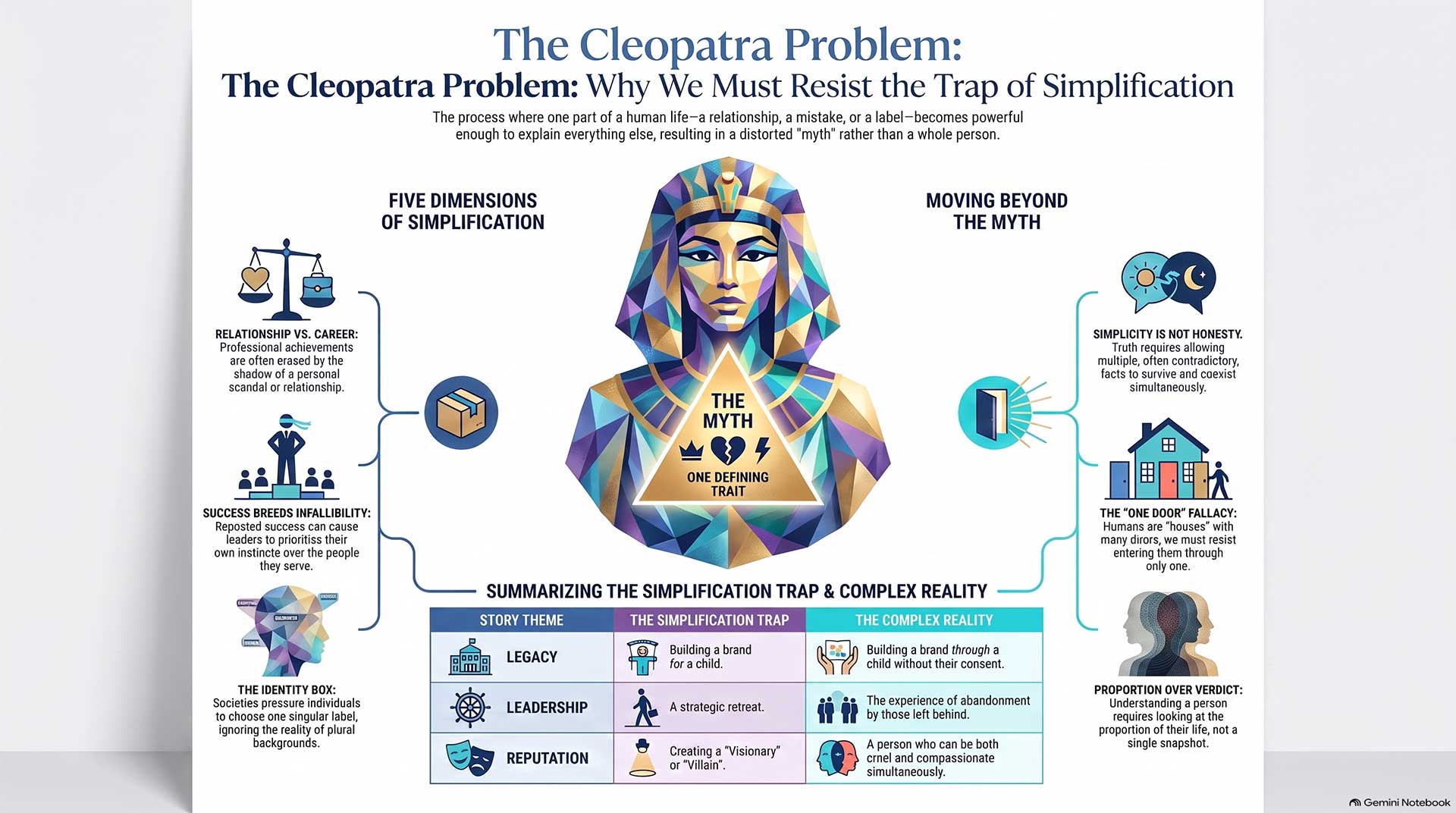
These five stories take place in very different worlds, but underneath them is the same danger:
simplification.
Elena Marquez made real mistakes, but turning her into the explanation for Daniel Mercer’s downfall erased his agency and reduced years of leadership to one scandal.
Nathan and Rachel Lee genuinely loved their son. Yet slowly, building something for Noah became building it through Noah. His question—“Why did everyone know my future before I did?”—captures the danger of confusing parental love with control.
Maya Bennett made a decision that may have preserved the resources needed to save many lives. But the volunteers watching her convoy leave experienced something else: abandonment. Her story reminds us that good intentions do not erase consequences—and that repeated success can make us trust our instincts too much.
Leila Han faces a different simplification. Other people demand that she choose which identity is authentic, even though several parts of her life are equally real. At the same time, she must admit that she sometimes emphasizes different identities because audiences reward them.
Then Evelyn Park brings everything together.
She discovers that Margaret Vale was treated unfairly—and also treated others unfairly. She was loving and controlling, generous and ruthless, victim and manipulator.
Correcting one myth by creating another would still be distortion.
That is where these stories return us to Cleopatra.
She does not need to remain the seductress who destroyed Antony.
But neither must she become a flawless queen whose every failure was someone else’s fault.
Several truths can survive at once.
And perhaps that is the deepest lesson of all five stories:
The more powerful a story becomes, the more carefully we should ask what it has left out.
A life can be distorted not only by lies, but by one true fact being given too much power.
A relationship.
A retreat.
A scandal.
An identity.
A mistake.
None should be allowed to swallow the whole person.
Because eventually almost every human life passes into other people’s hands.
And when it does, perhaps the most respectful thing we can do is resist making that person simpler than they really were.
Short Bios:
Elena Marquez
A highly effective Midwestern mayor whose political accomplishments become overshadowed by her affair with a powerful strategist and the scandal surrounding his downfall.
Daniel Mercer
A nationally influential political strategist whose professional partnership and romantic relationship with Elena blur the boundaries between love, ambition, influence, and responsibility.
Nathan Lee
A billionaire technology founder and devoted father who gradually turns his son into part of the family’s philanthropic legacy without realizing the cost.
Rachel Lee
A former physician who runs the family foundation and eventually recognizes that loving a child does not automatically justify making that child publicly symbolic.
Noah Lee
Nathan and Rachel’s son, whose childhood image becomes the face of the family foundation before he is old enough to decide whether he wants the future others have imagined for him.
Maya Bennett
Founder of a major disaster-relief organization whose bold instincts have repeatedly saved lives—until one strategic retreat forces her to confront the difference between intention and abandonment.
Aaron
A young relief coordinator who witnesses Maya’s decision during the hurricane and later helps teach the complicated lessons that emerge from it.
Leila Han
A successful novelist of Korean and Egyptian-American heritage whose public success forces her to confront identity, authenticity, cultural ownership, and self-presentation.
Samira Farouk
Leila’s Egyptian grandmother, whose simple wisdom helps her understand that belonging to several worlds does not mean belonging nowhere.
Dr. Evelyn Park
A careful historian commissioned to write the definitive biography of Margaret Vale, only to discover that evidence rarely produces the simple person publishers want.
Margaret Vale
A deceased billionaire entrepreneur remembered simultaneously as visionary, philanthropist, ruthless executive, loving mother, manipulator, and victim of unfair public narratives.
Anna Vale
Margaret’s daughter, whose memories force Evelyn to accept that love and harm can coexist inside the same family relationship.
Leave a Reply