
Introduction
If God is loving, why has religion so often become a reason to divide, condemn, and kill?
Across centuries, human beings have built temples, mosques, and churches in search of the divine. Yet the walls raised to honor God have sometimes become barriers separating one community from another. Sacred names meant to guide people toward mercy have been carried into arguments, persecution, and war.
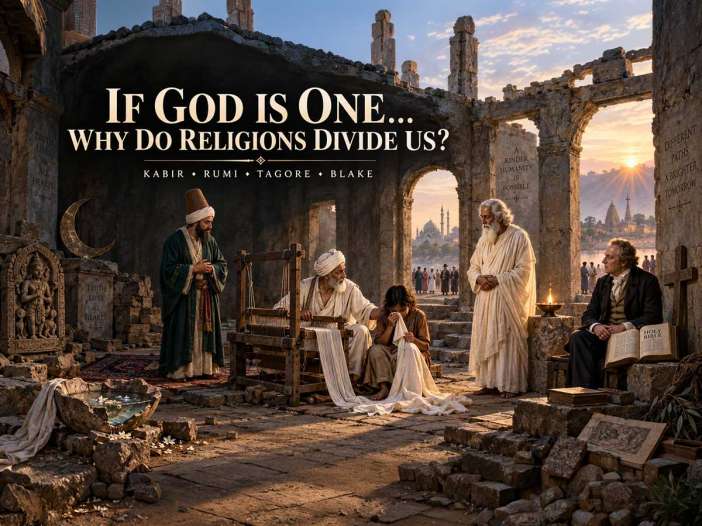
At the center of this fictional conversation stands Kabir, the fifteenth-century Indian mystic poet who challenged both Hindu and Muslim religious pride. He is joined by Rumi, the great Muslim Sufi poet of divine longing; Rabindranath Tagore, the Bengali poet who sought unity without erasing cultural identity; and William Blake, the Christian visionary who revered Jesus yet fiercely criticized religious oppression.
Their meeting takes place inside an unfinished house of worship claimed by several religious communities. A child enters and asks a question none of the adults outside can answer:
“If God is one, why are people fighting over where He lives?”
The conversation moves from sacred places and unanswered prayer to institutional injury, conflicting beliefs, religious violence, and the limits of poetry. The four poets discover that speaking about universal love is easier than deciding how love should respond when a stone is already in someone’s hand.
This is not a conversation in which every religion is declared identical. Rumi remains rooted in Islam. Blake refuses to reduce Jesus to a convenient universal symbol. Tagore protects spiritual unity without denying real differences. Kabir challenges them all to prove their faith through the way they treat people.
Their disagreement raises a question with immediate human consequences:
Can we remain faithful to what we believe without needing another person’s faith to disappear?
(Note: This is an imaginary conversation, a creative exploration of an idea, and not a real speech or event.)
Topic 1: Where Does God Live?
The following is a fictional literary conversation inspired by the lives, writings, and spiritual ideas of Kabir, Rumi, Rabindranath Tagore, and William Blake.
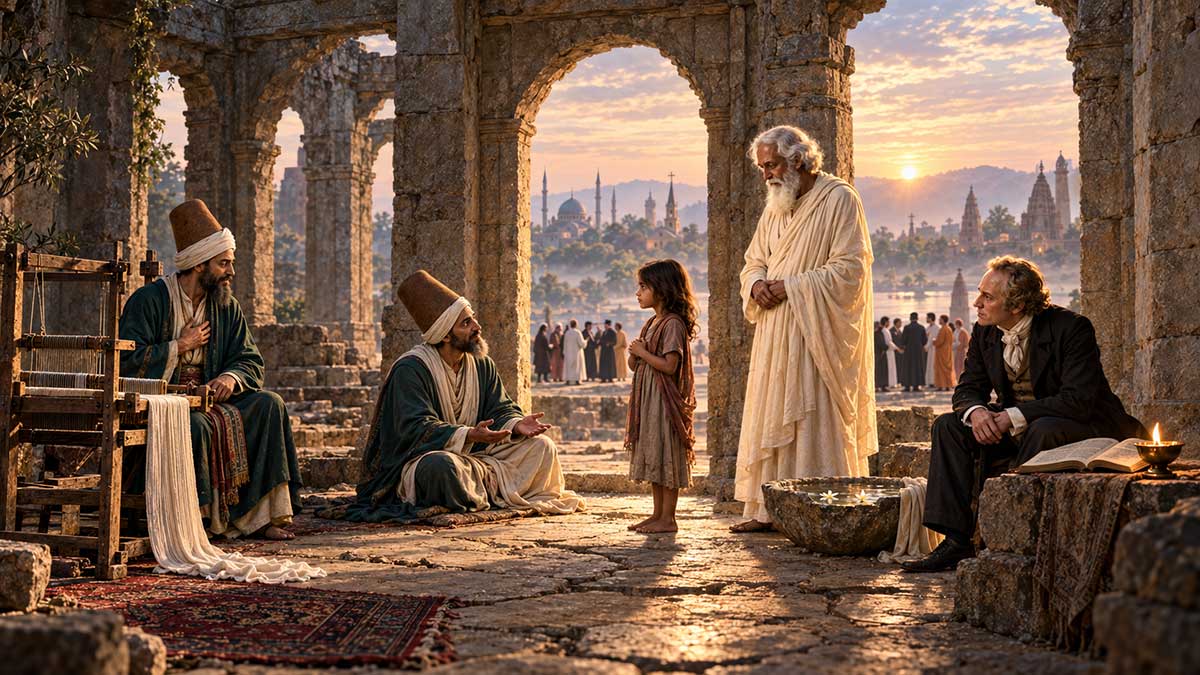
The house of worship had never been completed.
Its stone walls were high enough to catch the morning light, but no roof protected the central room. Rain had darkened the unfinished timber. Weeds had grown between the stones. Above the entrance remained an empty space where a religious symbol was meant to be placed.
No one could agree which symbol belonged there.
A prayer rug rested near the eastern wall. An open Bible lay beside a small oil lamp. Near the window stood a shallow bowl filled with water from the Ganges. At the center of the room, Kabir sat at an old wooden loom.
The shuttle moved through the threads with a dry, steady sound.
Rumi watched him from across the room.
“You have not looked up once,” Rumi said. “Outside, three groups are arguing over this place. Each believes it belongs to them.”
Kabir continued working.
“Their argument does not require me.”
“They may soon enter.”
“Then they will discover that God arrived before they did.”
William Blake stood beneath the empty space above the doorway. He looked at it as though a figure invisible to everyone else had appeared there.
“Someone will place a symbol above that door,” Blake said. “The moment it rises, another person may be told that he does not belong beneath it.”
Tagore touched the stone wall. It was still cool from the night.
“A symbol can exclude,” he said. “It can also carry the memory of generations. A mother lights a lamp as her mother did. A child hears the same prayer his grandfather spoke. We cannot dismiss such things as empty.”
Kabir pulled another thread through the loom.
“I do not dismiss the lamp. I ask whether it has lit the heart.”
Before Tagore could respond, small footsteps approached the entrance.
A child stood at the doorway.
Dust covered the child’s shoes. One sleeve was torn near the wrist. The child looked first at the prayer rug, then at the Bible, the lamp, the bowl, and the four strangers.
“Is this a temple?” the child asked.
“No,” said Kabir.
“A mosque?”
“No.”
“A church?”
“No.”
The child looked confused. “Then what is it?”
“A question,” Tagore answered.
The child stepped inside.
Outside, the argument continued. Men were debating which community had purchased the land, whose ancestors had worshipped nearby, and whose sacred symbol had been removed first. Their words were difficult to distinguish, but their anger crossed the walls clearly.
The child looked toward the empty space above the door.
“They are fighting about what should go there.”
“Yes,” said Blake.
“My father says God will not enter until the correct symbol is placed above the door.”
Kabir finally stopped the loom.
“Your father has made God very small.”
The child stared at him. “Do you know where God lives?”
Kabir placed one hand against his chest.
The child frowned. “Inside you?”
“Inside you too.”
“Then why can’t I feel Him?”
No one answered quickly.
Rumi walked closer and sat on the stone floor, bringing himself level with the child.
“Have you ever missed someone so much that the missing seemed to fill your whole body?”
The child nodded.
“That longing,” Rumi said, “may be closer to God than many confident answers.”
“But longing is not the same as finding.”
“No,” Rumi replied. “It is the opening made by absence.”
Kabir studied him.
“You give beautiful names to hunger,” he said. “A hungry person still needs food.”
“And a soul that longs for God needs more than being told that God is already within it,” Rumi answered. “A closed eye possesses light and still cannot see.”
Kabir smiled faintly. “Then tell the eye to open. Do not sell it a pilgrimage.”
The child looked between them.
“My grandmother traveled a very long distance to pray at a holy place. She said she felt closer to God there than anywhere else.”
“And perhaps she did,” Tagore said.
Kabir turned toward him. “Was God waiting there for her?”
“No. Yet she may have needed to leave her ordinary life before she could notice what had always been near.”
Tagore looked through the open roof at the pale sky.
“A person may live beside a tree for twenty years and never truly see it. Then one morning, after grief has entered the house, the same person sees light moving across its leaves and begins to cry. The tree did not suddenly become sacred. The person became ready to meet it.”
“Then it was not the journey that made the place holy,” Kabir said.
“No,” Tagore replied. “The journey made the traveler attentive.”
Rumi nodded.
“A sacred place can quiet the noise that keeps the heart from hearing. The danger begins when we worship the place instead of the One we hoped to encounter there.”
Blake moved away from the doorway.
“The same danger lives in churches,” he said. “Stones are raised in the name of heaven, then children beneath those stones are taught fear. They are told that God watches them with suspicion. They learn to hide their questions before they learn to pray.”
The child looked at the open Bible.
“Do you believe that book comes from God?”
“I believe it contains voices that have led human beings toward God,” Blake said. “I believe it has been used to set people free. I have seen it used to place chains upon them too.”
“How can the same book do both?”
“The words enter different hearts.”
Rumi reached toward the oil lamp but did not touch its flame.
“Fire can warm a home or burn it. We do not learn its purpose merely by looking at the flame. We must look at the hands carrying it.”
Kabir resumed his work.
“People blame the book. People defend the book. Few allow the book to question them.”
The child watched the threads crossing before Kabir’s hands.
“If God lives in everyone, does God live inside the angry people outside?”
“Yes,” Kabir said.
“Does He live inside murderers?”
The shuttle stopped again.
Blake’s face tightened. Tagore lowered his eyes. Rumi studied the lamp.
Kabir answered first.
“The sun can shine upon a house whose windows have been covered. The darkness inside does not prove that the sun has died.”
“That sounds like an excuse,” the child said.
“It is not.”
“If God is inside a murderer, why doesn’t God stop him?”
Kabir placed the shuttle down.
“To say that the divine is present in a human being does not mean every human action is divine. The ego can bury compassion beneath fear, greed, pride, and hatred. A person can spend a lifetime refusing the truth within.”
“But God is still there?”
“The possibility of awakening remains.”
“What about the person who was murdered? Does that possibility help them?”
Kabir had no immediate reply.
Blake stepped closer.
“We should be careful when speaking about divine light in those who commit cruelty,” he said. “Such language can become another injury to the victim. Before we search for the hidden light in the oppressor, we must stand beside the person crushed beneath his actions.”
Rumi looked at Blake.
“Can we stand beside the victim and still refuse to believe that the offender is beyond transformation?”
“We can,” Blake replied. “Forgiveness is not the denial of evil. Mercy does not ask the wounded person to call the wound good.”
Tagore sat near the bowl of river water.
“Perhaps the divine presence in us is not a possession,” he said. “It is a call. We become human by answering it. A person who refuses compassion is not revealing God within. He is refusing God within.”
The child considered this.
“Then God lives inside us, but He does not control us?”
“If love controlled its recipient,” Rumi said, “it would no longer be love.”
The child turned sharply toward him.
“People say things like that when something terrible happens.”
Rumi’s expression changed.
“What do they say?”
“They say God allows suffering for a reason. They say we are too small to know the reason. They say pain brings us closer to Him.”
The anger outside seemed distant now.
The child looked down at the torn sleeve.
“My mother became sick last winter. My father prayed every morning and every night. He promised God he would change his life. He promised he would give money to the poor. He promised everything.”
No one moved.
“She died anyway.”
Kabir’s hand remained on the unfinished cloth.
The child looked directly at Rumi.
“Was her death an opening made by absence?”
Rumi closed his eyes.
“No,” he said softly. “I should not have offered a beautiful sentence before knowing your pain.”
The child’s eyes filled, but no tears fell.
“Then where was God?”
Rumi looked at the floor.
“I do not know.”
Kabir lifted his eyes toward him.
Rumi did not retreat from the answer.
“I can tell you what longing has meant in my own life,” he continued. “I can tell you that love has carried me through separations I believed would destroy me. I cannot tell you why your mother died. If I gave you an answer that made her death fit neatly inside a spiritual lesson, I would be protecting my certainty rather than caring for your sorrow.”
The child turned to Blake.
“Do you know?”
“No.”
“To Tagore?”
“No,” Tagore said. “But I know that grief is not proof that you lacked faith.”
The child looked at Kabir last.
Kabir rose from the loom. He was smaller than the child had expected. His hands were rough from years of work.
“I do not know why she died,” he said. “I know that anyone who uses her death to make himself appear wise has placed his own voice where silence belongs.”
“Then none of you knows where God was.”
Blake knelt near the Bible.
“Perhaps God was not watching from a distant throne,” he said. “Perhaps God was present in your father’s trembling voice, in the hands that cared for your mother, in her fear, in her courage, and in the love that made losing her unbearable.”
“But He did not save her.”
“No,” Blake said.
The honesty of the words seemed to strike the room harder than any explanation could have.
Tagore dipped his fingers into the bowl.
“When someone we love dies, people often speak about acceptance before grief has been allowed to speak. They hurry toward meaning. They fear the emptiness left by death.”
“Do you believe my mother is still somewhere?”
“I believe love reveals something in us that death cannot easily explain away,” Tagore said. “I cannot describe where she is as though I have visited and returned. I can say that the relationship has not become nothing. You still speak to her in your thoughts, do you not?”
The child nodded.
“Sometimes I tell her what happened during the day.”
“And when you do, does it feel foolish?”
“No.”
“Then do not let anyone mock that conversation. Love continues to address the person it has lost.”
Rumi looked at the child.
“I spoke inwardly to Shams after he disappeared from my life. At first I searched for him in the world. Later I discovered that what he awakened in me had entered my own voice. That did not make the separation painless. It changed the place from which I called his name.”
“Are you saying my mother is inside me?”
“I am saying that love does not remain outside the person who loves.”
Kabir walked to the open entrance.
The religious groups were still disputing ownership. One man carried a wooden cross. Another held a crescent-shaped ornament. A third held a carved sacred syllable wrapped in cloth.
Each waited for the others to surrender.
Kabir called to them.
“You have brought signs for God. Did any of you bring food for the child?”
The voices stopped briefly.
No one answered.
Kabir turned back into the room.
“That is where God was when your mother was ill,” he told the child.
“Where?”
“In every person who had the chance to love her. Some answered. Some walked past.”
The child looked angry again.
“That makes God sound helpless.”
“It makes us responsible.”
Rumi stood.
“Yet responsibility is not the whole of faith. There are moments when every human effort fails. The physician cannot heal. The parent cannot protect. The lover cannot prevent death. In those moments, a person may still surrender the beloved into a mercy larger than human hands.”
Kabir faced him.
“And if the grieving person cannot believe in that mercy?”
“Then we sit beside them without demanding belief.”
Blake nodded.
“Faith forced upon grief becomes cruelty.”
The child walked toward the bowl and studied the reflection trembling upon the water.
“My father does not pray anymore.”
“Does he speak about your mother?” Tagore asked.
“Only when he is angry.”
“What does he say?”
“He says God took her.”
Kabir’s face hardened.
“And what do you believe?”
“I think God did nothing.”
The words hung beneath the open sky.
Rumi approached slowly.
“Your anger may be a form of prayer.”
The child looked up. “How?”
“You are still speaking to the One you accuse of silence.”
“I am speaking about Him, not to Him.”
“Then speak to Him. Say exactly what you have said here.”
“Would that be disrespectful?”
“A God who cannot receive the truth of a grieving child is smaller than grief.”
Blake’s eyes brightened.
“Sacred speech does not always sound gentle. The Bible contains cries of abandonment, accusation, terror, and despair. A living relationship permits protest.”
Tagore added, “Silence offered freely can be prayer. Silence forced by fear is something else.”
The child sat beside the bowl.
“What if I never feel God?”
Kabir returned to his loom and lifted the unfinished cloth.
“Do you see this?”
“Yes.”
“Tell me which thread is the cloth.”
The child moved closer.
“None of them.”
“Then where does the cloth live?”
“In all of them together.”
Kabir gave the cloth to the child.
“A single moment may not reveal a life. A single prayer may not reveal God. You may encounter the divine through love, anger, work, doubt, grief, another person, or a silence you cannot yet bear. Do not let anyone tell you that God must appear in the form they have chosen.”
Rumi touched the edge of the fabric.
“And do not mistake every feeling for God. The heart needs honesty, patience, and guidance. Inner experience can open us, but it can deceive us too.”
Blake glanced again at the empty place above the entrance.
“Religious authorities can deceive us. Private visions can deceive us. Fear can speak in the voice of God. Desire can do the same. We must judge every claimed revelation by what it produces.”
“What should it produce?” the child asked.
“Greater mercy,” Tagore said.
“Greater freedom from the ego,” said Rumi.
“Courage against cruelty,” said Blake.
Kabir pulled the next thread through the loom.
“A life in which no human being is treated as spiritually untouchable.”
Outside, the men began arguing again. This time they were demanding that the child leave the building. Each feared the child might belong to one of the other groups.
The child stood between the Bible, the prayer rug, the river water, and Kabir’s unfinished cloth.
“If God lives in every person,” the child asked, “why do religious people keep deciding who is allowed near Him?”
Kabir looked toward the doorway.
“That,” he said, “is the question religion must answer before it asks the world to trust it.”
Blake stepped between the child and the gathering crowd.
Rumi moved beside him. Tagore lifted the fallen oil lamp before its flame could die.
Kabir left the loom and walked toward the men waiting outside.
The dispute over where God lived had reached the door.
Topic 2: Does Religion Lead Us to God or Stand Between Us?
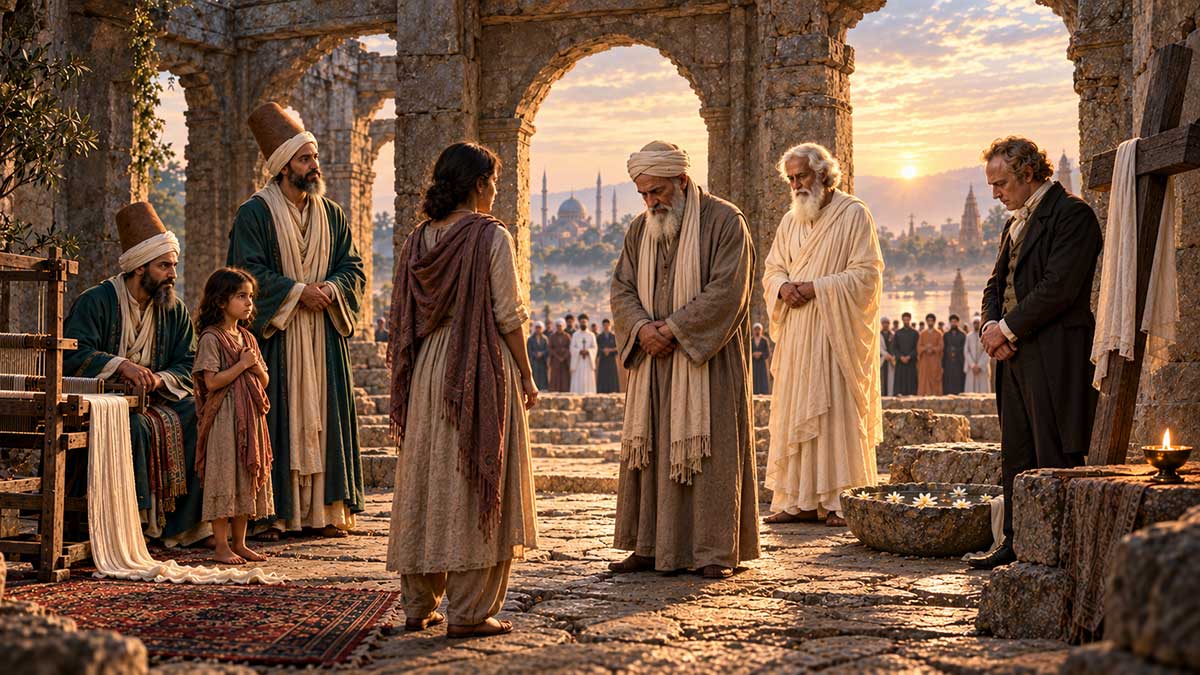
Kabir reached the entrance before the men outside could cross it.
One carried a wooden cross against his chest. Another held a metal crescent. The third protected a carved sacred syllable beneath a piece of red cloth.
Behind them stood their families, religious leaders, and neighbors. Some appeared angry. Others looked frightened. Several had come only to see what would happen.
A gray-haired man holding the cross pointed into the unfinished building.
“That child cannot remain here until we know which community this place belongs to.”
Kabir looked at him.
“Which community does the child belong to?”
“That is what we need to determine.”
“Why?”
“So we know where the child should worship.”
Kabir glanced back. The child stood between Rumi, Tagore, and Blake, still holding the unfinished cloth.
“Perhaps the child came here to escape people who had already determined too much.”
The man holding the crescent stepped forward.
“This land belonged to our community before construction began.”
A woman behind him objected. “Your people prayed here for three years. Our shrine stood here for generations.”
“You have no evidence.”
“We have the memory of our elders.”
“And we have legal records.”
The argument began again.
Kabir raised one hand.
“If God lives here, your shouting will not make Him more present. If God does not live here, your documents will not persuade Him.”
A religious elder pushed through the crowd.
“You speak carelessly about sacred matters.”
“I speak carefully about people,” Kabir answered. “That is often mistaken for carelessness about religion.”
The elder pointed toward the loom.
“We know who you are. You mocked temples. You mocked mosques. You confused ordinary people and encouraged them to disobey their traditions.”
“I asked people to stop mistaking the container for what it was meant to carry.”
“Without the container, everything is spilled.”
Rumi came to the doorway.
“On that point,” he said, “the elder may deserve an answer.”
Kabir turned.
“You wish to defend him?”
“I wish to examine your accusation. You speak as if religious form is nearly always the enemy of spiritual truth.”
“When the form becomes more precious than the person standing before it, it has declared itself.”
“That is the corruption of religion,” Rumi replied. “It is not the whole of religion.”
The crowd quieted. They had expected the four strangers to stand together against them. They had not expected disagreement inside the building.
Rumi looked toward the prayer rug.
“A person rises before dawn, washes, stands in humility, bows, and remembers the Creator. Another fasts and discovers how completely the body commands the mind. Another repeats the name of God until the noise within begins to soften. Are all these merely empty actions?”
“No,” Kabir said. “An empty action is empty. A sincere action is sincere.”
“Then ritual itself is not the problem.”
“The danger is forgetting what the ritual was meant to do.”
The elder nodded. “That is why people require teachers.”
Kabir faced him.
“Teachers can remind people of the path. They can place themselves at the end of it too.”
The child stepped closer to the doorway.
“How can you tell the difference?”
No one in the crowd answered.
Rumi turned toward the child.
“A trustworthy teacher does not make your soul dependent upon his approval. He guides your attention toward God.”
“What if he says that questioning him is the same as questioning God?”
“Then he has confused his voice with the divine voice.”
The elder’s expression hardened.
“Children must be taught obedience before they can possess wisdom.”
Blake moved suddenly from the shadows.
“Obedience to what?”
“To divine law.”
“Spoken by whom?”
“By scripture.”
“Interpreted by whom?”
“By those trained to interpret it.”
“And who corrects the interpreter when his heart becomes cruel?”
The elder looked at Blake’s plain clothing and intense eyes.
“Are you a Christian?”
“I follow Jesus.”
“That was not my question.”
“It was my answer.”
The man with the cross spoke again.
“If you follow Jesus, then you know that faith requires a church.”
Blake looked at the wooden cross in the man’s hands.
“A church can become the living body of compassion. It can feed the hungry, protect the abandoned, comfort the grieving, and call the arrogant to repentance.”
“Then you agree.”
“I have not finished.”
The man tightened his grip on the cross.
“A church can teach a child that every natural question is sinful. It can make the poor kneel before the wealthy. It can speak endlessly of heaven so that no one challenges the misery it permits on earth. It can place the cross above its door and refuse to recognize the suffering person carrying one outside.”
“You condemn the church through its worst representatives.”
“I judge it by what it does to the vulnerable.”
The man raised the cross as if defending it from Blake.
“This symbol represents salvation.”
“Then carry it as Jesus carried it,” Blake replied. “Do not hold it like a weapon.”
A murmur moved through the crowd.
Tagore came forward and stood between the two men.
“We are in danger of repeating the very failure we are discussing,” he said. “The institution is accused, so the believer feels personally accused. The believer defends himself, so the wounded person feels erased.”
The child looked at him.
“Can both of them be right?”
“They may both be speaking from real experience. One person remembers a church that kept his family alive. Another remembers a church that taught her to despise herself. The word ‘church’ does not awaken the same memory in every heart.”
“Is one memory more true?”
“No. Yet the institution must pay close attention to the person it has wounded. Those who were protected by it may find it difficult to believe that others were harmed.”
A woman standing near the back of the crowd began to leave.
The child recognized her.
“Wait,” the child called.
The woman stopped but did not turn around.
“You used to pray with my mother.”
The crowd looked at her.
She remained facing away.
“Not anymore,” she said.
“Why did you stop?”
The religious elder answered for her.
“She became angry with God.”
The woman slowly turned.
“No. I became afraid of you.”
The elder stared at her.
“I counseled you for many years.”
“You instructed me for many years.”
“I tried to protect your marriage.”
“You told me to return to a husband who beat me.”
The crowd became silent.
The elder looked around before responding.
“Marriage is a sacred promise. I encouraged patience, forgiveness, and reconciliation.”
“You told me that leaving him would shame our community.”
“I said separation should be the final choice.”
“I came to you with blood beneath my hair.”
The child lowered the cloth.
The woman continued.
“You asked what I had said to provoke him. You asked whether I had fulfilled my duties. You asked whether I had prayed before speaking to him. You never asked whether I was safe.”
The elder’s face lost its certainty.
“I did not know the full situation.”
“I told you.”
“I may not have recognized its seriousness.”
“You recognized it. You feared divorce more than you feared my death.”
Tagore closed his eyes.
Blake looked toward the cross, but the man holding it now kept it lowered.
The woman turned to leave again.
Kabir called after her.
“Did you leave God?”
She looked back.
“I left the building.”
“That was not my question.”
She hesitated.
“I don’t know.”
“Do you still speak to God?”
“Sometimes.”
“What do you say?”
“That I no longer know whether the voice I heard in prayer was God, my fear, or the teachings placed inside me since childhood.”
Kabir nodded.
“Then your doubt may be more honest than many people’s certainty.”
The elder stepped forward.
“Are you encouraging her to abandon faith?”
“I am encouraging you to hear what your certainty did to her.”
“She should not judge an entire tradition through one painful experience.”
Blake’s voice cut through the room.
“One painful experience?”
The elder looked at him.
“She was sent back into violence under sacred instruction. Do not reduce that to an unfortunate misunderstanding.”
Rumi walked toward the woman.
“What happened after you left?”
“I stayed with my sister. I found work. My husband came to my workplace twice. The second time, the police arrested him.”
“And your religious community?”
“Some women brought food secretly. They were kind. Their husbands did not know.”
“Did anyone speak publicly for you?”
“No.”
Rumi lowered his head.
“Then the community asked private compassion to hide behind public cowardice.”
The woman studied him.
“Do you believe I must return to religion?”
“No.”
She seemed surprised.
“I believe no wounded person should be pushed back into the place of injury before she can breathe freely,” Rumi continued. “Yet I would not tell you that every form of religious life will repeat what happened.”
“How would I know?”
“You would watch what happens when you say no. A healthy community can receive your boundaries. A controlling one will call them rebellion.”
Kabir looked at Rumi.
“And if she never returns?”
“God is not trapped inside the building she left.”
Kabir smiled.
“At last, the mystic escapes the gatekeeper.”
Rumi did not smile back.
“Do not celebrate too quickly. Solitude can heal, but it can become another enclosure. A person wounded by false authority may decide that no one can teach her anything. Then pain becomes the new teacher, and pain is not always wise.”
The woman crossed her arms.
“You think I need another religious teacher?”
“I think every human being requires companions who can question us with love. They need not carry titles. They need not speak from a pulpit. Complete independence is often another name for hidden captivity.”
Tagore approached her.
“May I ask what you miss?”
“From religion?”
“Yes.”
She looked through the unfinished roof.
“The singing.”
No one spoke.
“My mother sang beside me when I was young,” she continued. “I knew where her voice would rise and where it would tremble. After she died, I kept attending partly to hear the songs she had loved. When I left, I lost them too.”
“Do you sing them alone?” Tagore asked.
“I tried once. I could hear the elder telling me that I had broken my vows.”
The elder lowered his eyes.
Tagore looked toward him.
“This is what institutional injury can do. It enters memory. It stands inside a person long after she has left the building.”
The child moved beside the woman.
“My mother used to sing at home.”
“I remember,” the woman said.
“Could you teach me one of her songs?”
The woman’s mouth opened, but no sound came.
She looked at the crowd, then at the unfinished sanctuary.
“Here?”
“If you want.”
The elder began to speak.
Kabir stopped him with a glance.
The woman sat on the stone step. The child sat beside her.
At first, she could not sing. Her breathing became shallow. She pressed one hand against her throat.
Tagore sat several feet away, leaving space around her.
“You owe no one a song,” he said.
She nodded.
A low note finally emerged. It broke almost immediately.
She tried again.
This time the child joined her, uncertain of the melody. The woman corrected one note, then another. Her voice grew steadier. Several people in the crowd recognized the song.
A man began singing softly.
The woman stopped.
“No,” she said.
The man fell silent.
“I need to sing it without all of you first.”
No one argued.
She began again.
The song rose into the roofless morning. It belonged to a religious tradition, yet in that moment no authority controlled it. It carried her mother, her childhood, her fear, the marriage she had escaped, and the life she had recovered.
When the final note faded, Rumi’s eyes were wet.
Kabir sat on the ground near the entrance.
“Was that religion?” the child asked.
The woman considered the question.
“It came from religion.”
“Did it bring you closer to God?”
“I don’t know. It brought me closer to my mother.”
Tagore smiled gently.
“Perhaps that is enough for this morning.”
The elder stepped toward her.
“I failed you.”
She looked at him without speaking.
“I believed I was protecting something sacred.”
“You were protecting the institution from the truth.”
“Yes.”
The admission disturbed several members of the crowd.
One man whispered that the elder should not apologize publicly. Another said the woman’s private history should never have been discussed before children. A third accused Blake and Kabir of creating disrespect.
The elder heard them.
“I told her to endure danger so that our teaching would remain unchallenged,” he said. “That was wrong.”
“Will you tell the whole community?” she asked.
He hesitated.
Kabir noticed.
“The truth grows heavier when carried through a public door.”
The elder looked at the people behind him.
“If I speak publicly, some will say I have weakened our teaching.”
Blake answered, “A teaching protected by someone else’s suffering has already become weak.”
The elder turned to the woman.
“Yes. I will tell them.”
She did not forgive him. She did not embrace him. She did not promise to return.
She simply nodded.
The child looked at Rumi.
“Was his apology a religious act?”
“It may become one,” Rumi said.
“Isn’t saying sorry enough?”
“Repentance begins in speech. Its truth appears in what follows.”
Kabir pointed toward the crowd.
“If the next wounded person receives protection, the apology has begun to live.”
The man holding the cross stepped inside and placed it carefully against the wall.
“I still believe this building should become a church,” he said.
The woman with the red cloth entered after him.
“I still believe our shrine stood here first.”
The man with the crescent followed.
“And I still believe our legal claim is strongest.”
The child looked disappointed.
“Nothing changed.”
“Something changed,” Tagore said. “They entered without forcing you to leave.”
“But they still disagree.”
“Peace is not the disappearance of disagreement.”
Kabir rose.
“Nor is entering the same room proof of love. People can sit together and quietly wait for their chance to rule.”
Rumi looked around the unfinished building.
“Then what would you have them do?”
“Stop asking which religion will own the building. Ask what human need the building should serve.”
The woman who had sung looked toward the open roof.
“A refuge,” she said.
“For whom?” asked the elder.
“For anyone escaping violence.”
The man with the crescent considered it.
“There could be a room for prayer.”
“More than one,” said the man with the cross.
“No room should be controlled by a single community,” the woman replied.
Another voice came from the crowd.
“What about people with no religion?”
“They may need refuge most,” Tagore said.
The child looked at Kabir.
“Would that make this a religious building?”
Kabir touched the stone beside the entrance.
“If the hungry are fed, the frightened are protected, the grieving are heard, and no one is asked to prove the correct name for God before entering, you may call it whatever you wish.”
Rumi approached the prayer rug.
“I would still pray here.”
Blake picked up the Bible.
“I would still read here.”
Tagore relit the oil lamp.
“I would still welcome beauty here.”
The child held up Kabir’s unfinished cloth.
“And what would you do?”
Kabir returned to the loom.
“I would watch all of you carefully.”
A few people laughed, but Kabir did not.
“Every refuge can become an institution. Every institution can begin serving itself. The first generation remembers the suffering that created it. The second creates rules to protect it. The third may protect the rules more fiercely than the people.”
The elder studied him.
“Then are institutions destined to become corrupt?”
“No. They are destined to require honesty.”
“Who decides when they have lost their way?”
“The person no one wants to hear.”
The woman who had escaped her husband looked at him.
“The wounded person?”
“Often.”
The child looked around at the sacred objects.
“If religion can heal people and hurt people, how do we know whether to trust it?”
Blake placed the open Bible on the floor rather than upon an altar.
“Ask what it teaches you to see.”
Rumi unrolled the prayer rug fully.
“Ask whether its practices make you more honest about your ego.”
Tagore set the lamp near the broken bowl.
“Ask whether your belonging enlarges your compassion or narrows it.”
Kabir sent the shuttle through the threads.
“And when your religion asks you to stop recognizing another person’s humanity, refuse.”
Outside, someone lifted the carved symbol toward the empty place above the door.
The crowd became tense again.
“Which symbol will go there?” the child asked.
Kabir looked at the cross, the crescent, the sacred syllable, and the faces gathered beneath them.
Before anyone could answer, Blake spoke.
“Perhaps our next question is whether these symbols name different paths to one God, or truths that cannot be joined without betraying them.”
Rumi looked at him.
“You believe there is something that cannot be joined?”
“I believe unity purchased by denying conviction is only silence wearing a pleasant face.”
Kabir’s loom stopped.
Tagore turned from the lamp.
The child carried the unfinished cloth to the doorway and held it beneath the empty space.
Four words had been marked faintly across it:
Ram. Allah. God. Beloved.
“Do these names belong together?” the child asked.
This time, the disagreement began inside the building.
Topic 3: Are All Religions Speaking About the Same God?
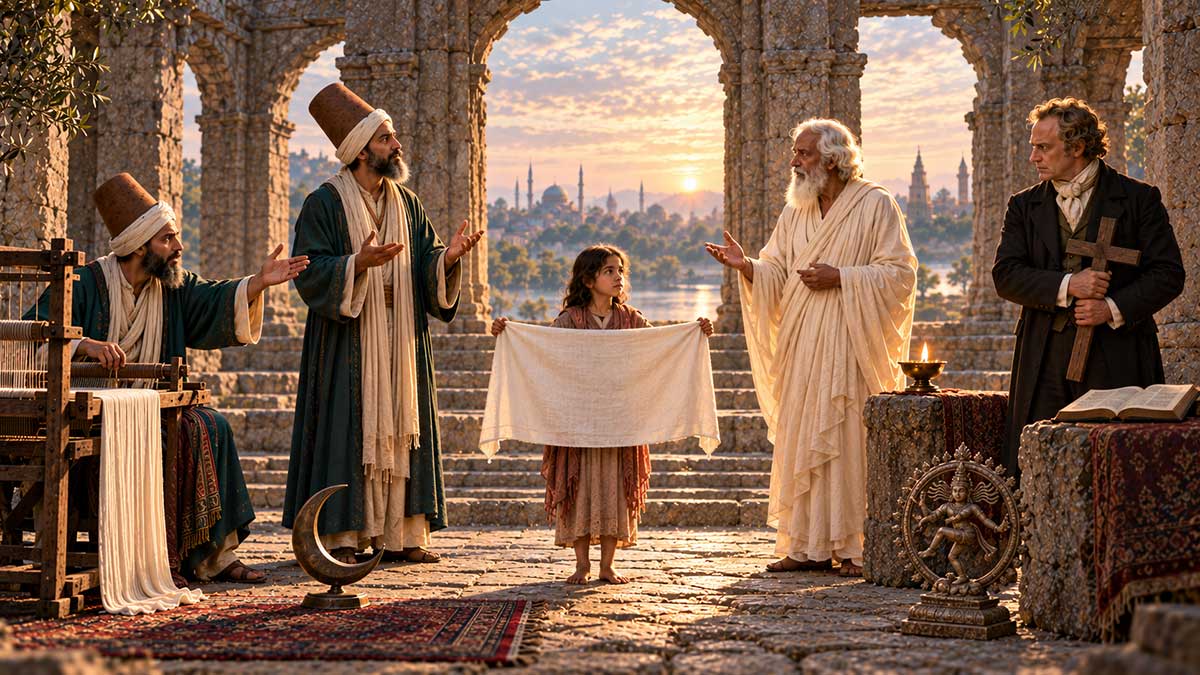
The child held Kabir’s unfinished cloth beneath the empty space above the entrance.
Four words had been written across it:
Ram. Allah. God. Beloved.
“Do these names belong together?” the child asked.
No one answered at once.
Outside, the three groups waited. Each had brought a symbol for the unfinished building. The wooden cross leaned against one wall. The metal crescent caught the morning light. The sacred syllable remained wrapped in red cloth.
Kabir looked at the four names.
“The mouth creates distance more easily than the heart,” he said.
Blake stepped nearer.
“A name can create distance. It can carry truth too.”
Kabir turned toward him.
“Does truth disappear when the name changes?”
“That depends on what the name tells us.”
“God existed before human speech.”
“Yes.”
“Then no word can contain Him.”
“No word can contain Him,” Blake replied. “Yet a word may reveal something true about Him.”
Rumi approached the cloth.
“The thirsty person may say water in Persian, Arabic, Hindi, or English. The tongue changes. The need does not.”
Blake studied him.
“Water remains water in every language. Religious claims do not merely give different names to the same object. They sometimes describe different realities.”
The child lowered the cloth slightly.
“What does that mean?”
Blake knelt beside the cross.
“One faith says God became known through Jesus in a singular way. Another honors Jesus but rejects the same claim about him. Some speak of many manifestations of the divine. Others reject that idea completely. These are not differences in pronunciation.”
Rumi nodded.
“A Muslim can love Jesus as Messiah and prophet without accepting Christian teachings about his divine nature. Respect does not erase that difference.”
“Then one of them must be wrong,” the child said.
The crowd stirred.
Several people seemed relieved. They preferred a clear contest. If one claim was right and another wrong, the building could eventually be assigned to the winners.
Tagore noticed their reaction.
“The desire to identify who is wrong often arrives before the desire to learn what another person means,” he said.
“But two opposite claims cannot both be true,” the child replied.
“Not in the same sense,” Tagore said. “Yet human descriptions of the infinite may contain insight without containing the whole.”
The man holding the crescent entered the building.
“That sounds pleasant,” he said, “but it avoids the question. Either God revealed truth or He did not. Either prophets carried His message or they did not. Either scripture can be trusted or it cannot.”
Tagore faced him.
“You are right to resist a unity created through vague language.”
The man seemed surprised.
“I do not wish to turn every religion into a different costume covering an identical idea,” Tagore continued. “Religions make real claims. They carry distinct histories, disciplines, visions, and responsibilities. Those differences deserve honesty.”
“Then how can they all lead to God?”
“I did not say they all lead to God in the same way.”
The child looked at Kabir.
“You said the names do not matter.”
“I said people become trapped by names.”
“That is different?”
“Yes.”
Kabir pointed outside.
“Those people are prepared to injure one another over symbols. Do you believe the divine reality has become greater through their defense?”
“No.”
“Then their correct word has not saved them from a corrupted heart.”
The man with the crescent objected.
“Correct belief still matters.”
Kabir looked at him.
“What has your belief made you?”
“A servant of God.”
“Were you serving God when you tried to remove the child?”
The man’s expression changed.
“I did not know who the child was.”
“Did God require that information before creating the child?”
“That is unfair.”
“It is direct.”
Rumi stepped between them.
“Kabir, a person can fail his own faith without proving the faith false.”
“And a person can defend the truth of his faith to avoid facing his failure.”
Both men became silent.
Rumi turned to the man.
“You believe there is one God?”
“Yes.”
“You believe God is merciful?”
“Yes.”
“You believe every human being will answer for his actions?”
“Yes.”
“Then your faith gives you no permission to treat an unclassified child as less worthy of protection.”
The man lowered his eyes.
Rumi looked toward the child.
“Religious truth should not be judged only by the failures of believers. Yet believers cannot use doctrine to hide from the moral demands of what they claim.”
The child studied the four words again.
“My mother said Ram.”
Kabir’s eyes moved toward the child.
“My father says Allah.”
Rumi’s face softened.
“That is why they never agreed about where I should pray.”
The crowd became restless again.
“Was your mother Hindu?” the woman with the red cloth asked.
“She said she was born Hindu. She stopped going to the temple after she married my father.”
“Did she become Muslim?”
“My father said she did.”
“What did she say?”
“She said God knew her.”
The woman looked toward the man with the crescent.
“Was the marriage accepted by his family?”
“Some of them accepted her,” the child answered. “Some said she had spoken the correct words but had not changed her heart.”
“And her own family?”
“They stopped speaking to her.”
Tagore moved closer.
“Did they ever meet you?”
“My grandmother did. She came secretly.”
“What did she teach you?”
“A song to Ram.”
The child looked at Rumi.
“My father heard me singing it. He said I should not sing it again.”
Rumi’s eyes lowered.
“Did he explain why?”
“He said there is only one God.”
“And what did your mother say?”
“She said there was only one God too.”
Kabir looked toward the people outside.
“There stands the madness of the human mind. Two people declare that God is one, then divide their home over the name.”
The man with the crescent objected again.
“The name may reflect what someone believes about God. This cannot be treated as meaningless.”
“No,” Rumi said. “It cannot.”
Kabir looked at him.
“You defend the father?”
“I defend his right to take faith seriously. I do not defend his attempt to silence his wife’s history.”
“If the song expresses a belief he considers false, what should he do?” the man asked.
Rumi thought before answering.
“He should listen before he forbids.”
“And if listening does not remove the disagreement?”
“Then they must decide whether faith will become a reason to control one another.”
Blake came to the center of the room.
“There is another question,” he said. “Did the father fear the song itself, or did he fear losing possession of the child’s soul?”
The child looked at him.
“Can someone own another person’s soul?”
“Many religious authorities have tried.”
“My father loves me.”
“Love and fear can inhabit the same person. A parent may love a child deeply and still become frightened when the child’s beliefs do not follow the expected path.”
Tagore sat beside the loom.
“A parent may experience the child’s spiritual independence as rejection. The child asks a question about religion, but the parent hears, ‘I no longer belong to you.’”
“That is what happened,” the child said. “When I asked whether I could visit my grandmother’s temple, my father asked whether I was ashamed of him.”
“What did you say?”
“I said no. Then he asked why his faith was not enough for me.”
Rumi closed his eyes.
“A child should not have to prove love for a parent by surrendering every question.”
“Would you tell my father that?”
“Yes.”
“Would you tell him I should go to the temple?”
“I would tell him that fear cannot guide another soul toward God.”
“That is not an answer.”
Rumi accepted the correction.
“No. It is not.”
The child waited.
“I would tell him to accompany you.”
The man with the crescent looked shocked.
“Into a temple?”
“Yes.”
“To witness worship he believes is wrong?”
“To witness his child meeting the family and history that shaped the mother he loved.”
The child’s grip tightened around the cloth.
“My mother asked him to go once. He refused.”
“Then perhaps grief has preserved a door that fear kept closed.”
“She is dead now.”
“Yes.”
“He cannot repair it with her.”
“No. He can still repair something with you.”
Kabir looked at Rumi with quiet approval.
Blake picked up the wooden cross.
“What do you think about Jesus?” the child asked him.
The question seemed to surprise Blake.
“I believe Jesus reveals what humanity becomes when divine love is lived without submission to cruelty.”
“Is he the only way to God?”
The Christian members of the crowd leaned closer.
Blake held the cross, but he did not raise it.
“I will not make Jesus smaller so that agreement becomes easier.”
The child waited.
“Nor will I use his name to declare that compassion, truth, and divine longing found beyond the church are worthless.”
“That still isn’t an answer.”
Blake smiled sadly.
“You have become skilled at recognizing escape.”
“I have heard adults do it many times.”
Blake sat on the floor.
“When I say that Jesus is the way, I do not mean that everyone who speaks his name walks with him. I mean that the way revealed through him is self-giving love, forgiveness, courage before oppression, and recognition of the divine worth within humanity.”
“Can someone follow that way without being Christian?”
Blake looked toward Kabir, then Rumi and Tagore.
“A person may live nearer to the spirit of Jesus without calling himself Christian than someone who repeats his name and rejects his mercy.”
The man who had carried the cross spoke from the wall.
“Then does belief in Jesus matter?”
“Yes.”
“How?”
“It calls me into relationship with a life, not merely an ethical idea. Jesus is not useful to me as a symbol that approves everything I already believe. He judges the false god I continually create in my own image.”
The man seemed dissatisfied.
“You are weakening the claim.”
“No. I am removing it from your weapon.”
The man lifted his chin.
“If Christ is true, people need to hear it.”
“They do.”
“Then we must persuade them.”
“Perhaps.”
“Convert them.”
Blake looked toward the child.
“What do you hear when he says that?”
The child thought for a moment.
“That I am wrong before he knows me.”
The man responded quickly.
“I did not say the child was wrong.”
“You said everyone outside your faith must be converted.”
“For their salvation.”
“Have you asked what the child believes?”
“The child is confused.”
The child’s face hardened.
“My mother was not confused.”
No one spoke.
“She knew my father called God Allah. She called God Ram. She sometimes prayed without using any name. My father said she had to choose. Her family said she had already chosen against them. Everyone kept asking what she was.”
The child’s voice began to shake.
“When she was dying, she could barely speak. My father recited prayers beside her. My grandmother sang the old song from the doorway. Neither one would stand beside the other.”
Tagore’s eyes filled with grief.
“What did your mother do?”
“She reached one hand toward my father and one toward my grandmother.”
The red cloth slipped from the woman’s hands. The carved symbol beneath it touched the floor.
The child continued.
“I held her hand in the middle.”
Rumi pressed his palm against his chest.
“She died with all three of us touching her.”
The child looked at the four names on the cloth.
“Tell me which God was in that room.”
The building became entirely still.
Kabir walked to the child.
“The God who did not ask your mother to divide her final breath.”
The man with the crescent looked away.
The woman with the sacred symbol covered her mouth.
Blake set the cross down.
Rumi spoke softly.
“Your father’s prayer did not need to silence your grandmother’s song.”
“Then why couldn’t they pray together?”
“They may have believed that standing together would betray the truth.”
“Would it?”
Rumi looked at Kabir.
“No.”
Kabir said nothing.
Rumi continued.
“Prayer beside a dying person is not a theological contest. Your father could have remained Muslim. Your grandmother could have remained Hindu. Neither needed to pretend that their beliefs were identical. Love asked them to stand together, not to erase themselves.”
Tagore looked toward the doorway.
“There is a form of unity that demands sameness. It is another kind of conquest. Genuine unity permits each person to remain fully present.”
The child looked at Blake.
“Could you have prayed with them?”
“Yes.”
“What would you have said?”
“I might have asked the Father of all life to receive your mother with mercy. I would not have asked her to solve centuries of religious disagreement before dying.”
Kabir placed his unfinished cloth across the child’s shoulders.
“People spend their lives arguing about which road reaches God. Death arrives and reveals that everyone has been walking through the same uncertainty.”
The religious elder moved closer.
“If we say every sincere path is acceptable, what protects people from false teachings?”
Kabir turned.
“What protects people now?”
“Scripture. Tradition. Learned interpretation.”
“The woman you sent back to violence had all three around her.”
The elder absorbed the words without defending himself.
Tagore addressed him more gently.
“A tradition should preserve wisdom, but age does not make every inherited belief sacred. Communities need moral memory. They need the courage to examine that memory too.”
“By what standard?”
“Human dignity cannot be the only standard,” Blake said. “People can define dignity according to their own desires.”
“Then what do you propose?” Tagore asked.
“Judge spiritual teaching by the life it creates. Does it produce mercy? Does it free the oppressed? Does it expose self-righteousness? Does it make forgiveness possible without protecting abuse? Does it teach us to see the sacred worth of another person?”
Rumi added, “Does it turn the soul away from worship of itself?”
Kabir looked toward the symbols.
“And does it survive without an enemy?”
The elder frowned.
“What do you mean?”
“Some identities know themselves only through opposition. They require someone impure, condemned, foreign, or lost. Remove the outsider, and the believer no longer knows who he is.”
The child looked at the gathered groups.
“Is that why they need to convert one another?”
“Sometimes conversion is offered from sincere love,” Rumi said. “A person discovers something sacred and wishes to share it.”
“How can I tell whether it is love or control?”
“See whether the person can remain your friend after you say no.”
The man who had carried the cross looked troubled.
“If I truly believe someone is in danger, would silence be loving?”
“No,” Blake replied. “But speech can warn without humiliating. Witness can invite without coercing. Love does not require pretending that convictions do not matter.”
“What if they reject what I tell them?”
“Then you discover whether you loved the person or merely loved the possibility of changing them.”
The child turned to Rumi.
“Do you want me to become Muslim?”
Rumi’s face became solemn.
“I want you to know the mercy of the one Creator. I want you to live truthfully, pray sincerely, resist the ego, and treat every human life as entrusted to your care.”
“That sounds like yes.”
Rumi did not hide behind poetry.
“My life, thought, and devotion are rooted in Islam. I cannot pretend that this means nothing to me. Yet your soul is not mine to conquer. Faith entered through fear rarely becomes love.”
The child turned to Tagore.
“Do you want me to become Hindu?”
“I want you to know your mother’s songs without being imprisoned by anyone’s demand that you define yourself before you are ready.”
“Do you believe all religions are true?”
“I believe no religion owns the infinite. I believe each can reveal truth and each can conceal it. I do not believe every doctrine says the same thing.”
“Kabir?”
“I want you to stop asking adults for permission to belong to God.”
“That sounds easy.”
“It is the hardest freedom. People will offer you identities that come with enemies. Refuse the enemy.”
“Blake?”
“I want you to encounter Jesus without meeting him first through the hatred of those who misuse his name.”
The child looked at all four.
“So each of you still wants me to see God the way you do.”
Tagore smiled.
“Yes. None of us has escaped being human.”
Kabir laughed.
“At last, someone has exposed the mystics.”
The laughter moved gently through the building. It did not remove the disagreement, but it made honesty possible.
Outside, more people had gathered. Rumors had spread that the unfinished building would be shared by several religions. Some came out of curiosity. Others came to prevent it.
A young man shouted from the crowd.
“Sharing this building would betray our ancestors.”
Another answered him.
“Your ancestors drove ours from this land.”
A third voice called out.
“Our sacred site was destroyed here.”
No one knew which history had begun first. Each community remembered its wounds more clearly than the wounds it had caused.
The child walked to the doorway.
“My mother and grandmother believed different things,” the child said. “They still loved each other.”
Someone in the crowd shouted back.
“Love does not make falsehood true.”
“No,” the child answered. “But hatred does not make you right.”
The crowd erupted.
A stone flew through the entrance and struck the wall beside the child.
Blake pulled the child backward.
Another stone followed. It shattered the remaining edge of the Ganges bowl. Water spread across the floor again, running beneath the cross, touching the prayer rug, and darkening the red cloth around the sacred carving.
The man with the crescent turned toward his own group.
“Stop!”
The woman lifted the sacred symbol from the wet floor.
The man with the cross stood in the doorway, no longer facing those inside. He faced the people who had arrived carrying his own religious signs.
Kabir watched them.
Only minutes earlier, each had demanded ownership of the building. Now each stood between the child and members of their own community.
Rumi looked at the four names written on Kabir’s cloth.
“The names are not the same,” he said.
Tagore watched the water pass beneath every symbol.
“No,” he replied. “But the hatred gathering outside recognizes no sacred difference.”
Blake saw another stone rise above the crowd.
Kabir stepped into the doorway.
“If your God requires the blood of this child,” he called out, “bring that God here and let Him ask for it Himself.”
The raised hand froze.
No divine voice came.
Only human anger remained, searching for a holy name to give it permission.
Topic 4: Why Do People Kill in the Name of a Loving God?
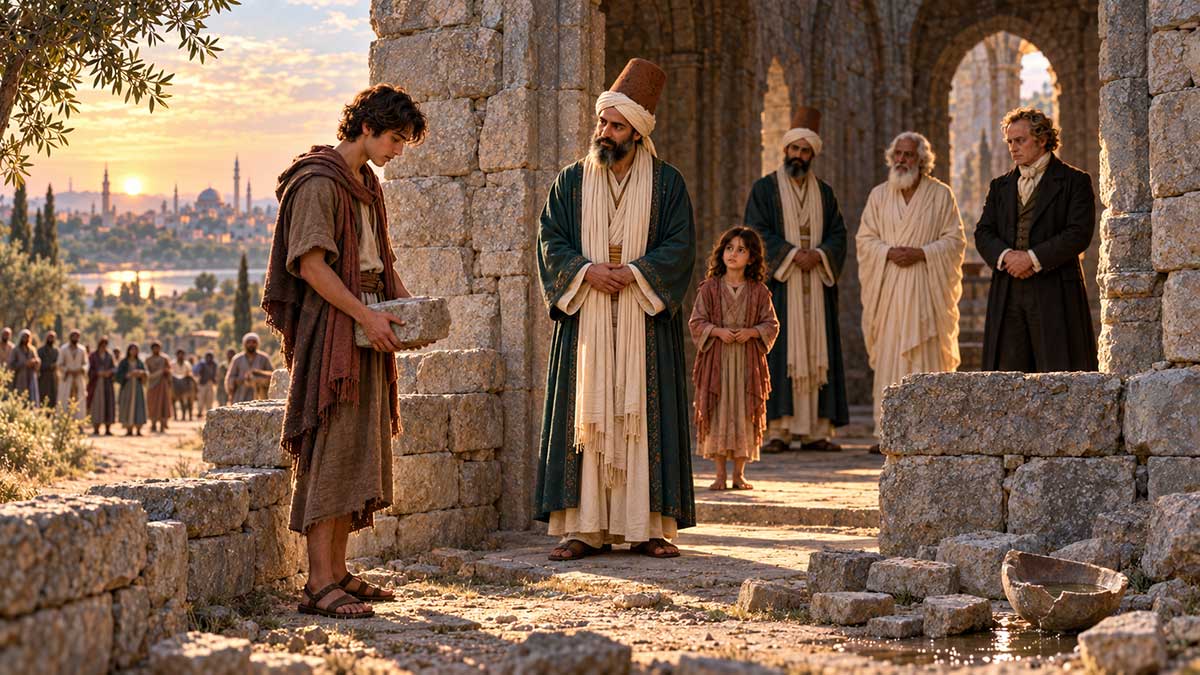
The raised hand froze.
The stone remained above the young man’s head.
Kabir stood in the doorway, waiting.
“If your God requires the blood of this child,” he repeated, “bring that God here and let Him ask for it Himself.”
No one moved.
The young man’s arm began to tremble.
Behind him, members of three religious groups filled the road. Crosses, crescents, sacred carvings, flags, and handwritten signs rose above their heads. Some had come to defend the building. Others had come to claim it. Many no longer remembered why they had come.
The young man lowered the stone.
A man behind him seized his wrist.
“Do not let that old blasphemer shame you.”
Kabir looked at the second man.
“Then you throw it.”
The man released the young man’s wrist.
“That is what I thought,” Kabir said. “Hatred often requires someone younger to carry it.”
The young man dropped the stone.
A religious leader pushed through the crowd.
“You are provoking them.”
“I asked them to take responsibility for what they were preparing to do.”
“You insulted their faith.”
“No. I removed faith from their excuse.”
Inside the building, the child stood behind Blake. Tagore held the oil lamp. Rumi watched the crowd with sorrow rather than fear.
The child looked at the stone lying in the road.
“Was he really going to hit me?”
Blake turned.
“He may not have known what he was going to do until the stone left his hand.”
“How could he not know?”
“A crowd can lend a person an identity before it asks for a conscience.”
Tagore came nearer.
“Alone, he might have seen you as a child. Inside the crowd, he saw you as a symbol of the people he feared.”
“I am not a symbol.”
“No,” Tagore said. “That is what hatred makes difficult to remember.”
The young man heard them.
“I wasn’t aiming at the child.”
Kabir stepped aside so the young man could see inside.
“Then whom were you aiming at?”
“The people taking our place.”
“Which people?”
The young man pointed toward the symbols on the floor.
“Them.”
The three objects belonged to three different groups.
“Which one?” Kabir asked.
The young man looked confused.
“The ones trying to steal the building.”
“Every group outside believes another group is stealing it.”
The young man looked back at the people behind him, seeking help.
The man who had urged him to throw the stone shouted, “Our community has been attacked for years.”
The woman holding the sacred carving answered from inside.
“So has mine.”
The man with the crescent said, “Every one of us has a story in which we are the victim.”
Blake looked toward the broken bowl.
“Few communities preserve the story in which they became the persecutor.”
The crowd protested.
“We have never persecuted anyone.”
“We were defending ourselves.”
“Our scripture gave us the right.”
“They began it.”
“They insulted what is sacred.”
“They entered land that belonged to us.”
“They tried to change our children.”
The accusations crossed one another until no sentence could be heard fully.
Kabir returned to the loom and struck its wooden frame once with his palm.
The sharp sound silenced the room.
“You have given hatred many names,” he said. “Defense. Loyalty. Honor. Purity. Obedience. Justice. Which name makes the dead return to life?”
A woman in the crowd called out.
“You speak as though every side is equally guilty.”
“No.”
That answer surprised her.
“Then which side is guilty?”
“The side that asks you to stop seeing a human being.”
“That could describe any of them.”
“Yes.”
The religious leader entered.
“You reduce sacred conflict to human emotion. Some acts are commanded by God.”
Rumi stepped forward.
“Be careful.”
The leader turned toward him.
“Do you deny that sacred texts contain commands, laws, punishments, and accounts of war?”
“I deny your right to take the place of God.”
“I stand upon scripture.”
“So does the person opposing you. That is why repeating a verse does not end the moral question.”
The leader’s eyes narrowed.
“Do you place human judgment above revelation?”
“I ask whether your interpretation has been purified of pride, anger, fear, ambition, and tribal loyalty.”
“Revelation does not depend upon human feelings.”
“Your reading of it passes through a human mind.”
The leader lifted his sacred book.
“These words are clear.”
“Then why have scholars argued about them for centuries?”
“They argue over details.”
“People often bleed inside what leaders call details.”
The crowd grew restless.
The child came out from behind Blake.
“Does scripture tell people to kill?”
The leader drew breath to answer, but Blake spoke first.
“Sacred books contain war, judgment, punishment, mercy, liberation, love, and forgiveness. A person who enters scripture searching only for permission to hate will find fragments he can misuse.”
“Then the book is dangerous,” the child said.
“So is the human heart.”
“That sounds like blaming people for what the book says.”
“No,” Blake replied. “We must face difficult passages honestly. We must ask who wrote them, what suffering surrounded them, how communities received them, and whether our interpretation reflects the mercy we claim God possesses.”
The leader looked at him.
“You allow human morality to judge God.”
Blake’s expression became fierce.
“I refuse to call cruelty holy merely to protect a doctrine.”
“Then you worship your own conscience.”
“My conscience can fail. So can yours.”
Kabir watched them.
“There is the trap,” he said. “One man believes every inner feeling comes from God. Another believes every inherited command comes from God. Each has found a way to avoid examining himself.”
Rumi turned to the child.
“Scripture can confront the ego. It can remind a community of obligations it would rather forget. It can teach mercy when anger demands revenge.”
“Can it cause violence?”
“Words do not move without human hands. Yet words can shape what those hands believe they are permitted to do. Anyone teaching sacred texts carries a grave responsibility.”
The young man who had dropped the stone came closer to the entrance.
“Our teacher said that if we lost this building, our faith would disappear from this town.”
Tagore looked at him.
“How old are you?”
“Seventeen.”
“Have you entered this building before today?”
“No.”
“Did you know the child?”
“No.”
“Did you know the people standing inside?”
“No.”
“Yet you were prepared to throw a stone.”
The young man stared at the ground.
“They told us our future was being taken.”
Tagore nodded sadly.
“Fear was given to you as an inheritance.”
“My grandfather was driven from his village.”
“That suffering matters.”
“Then why shouldn’t I defend what belongs to us?”
“You should defend people from injustice. You should preserve memory. You should protect the freedom to worship. None of those duties requires you to strike a child.”
“You don’t know what happened to my family.”
“No. Tell us.”
The young man hesitated.
“My grandfather was a boy. A crowd entered his neighborhood after a religious leader was killed. Houses were burned. His older brother disappeared.”
“Did the people who attacked them belong to one of the groups here?”
“Yes.”
The young man pointed toward the woman holding the sacred carving.
Several people turned toward her.
She held it against her chest.
“I was not alive,” she said.
“They were your people.”
“They were not me.”
“My grandfather never returned home.”
“I am sorry.”
“Sorry does not restore his brother.”
“No.”
“Then what am I supposed to do with that?”
The woman took a step closer.
“My father was killed when I was nine.”
The young man looked up.
“By whom?”
“Men carrying the same symbol you carry.”
His face changed.
“That has nothing to do with me.”
“No,” she said. “It does not.”
He understood what she meant.
She placed the sacred carving on the ground.
“I could make your identity responsible for my father’s death. You could make mine responsible for your grandfather’s suffering. We could pass those identities to our children until no one remembers the original faces.”
“My grandfather remembered.”
“So did I.”
“How did you stop hating us?”
“I did not stop all at once.”
“What changed?”
“A nurse stayed beside my mother the night my father died. She belonged to your community.”
The young man said nothing.
“My relatives told her to leave. My mother asked her to stay. She stayed until morning.”
“Did that make you forgive the killers?”
“No. It made it impossible to hate every person who shared their religion.”
Kabir looked at the crowd.
“One human face interrupted the inheritance.”
The religious leader objected.
“A touching story cannot resolve questions of justice.”
“No,” Tagore said. “Justice asks who committed the act, who commanded it, who permitted it, and who suffered from it. Collective hatred makes identity itself the crime.”
“What about collective responsibility?”
“A community must face what was done in its name. That is different from declaring every member guilty by birth.”
The child looked at the young man.
“Do you still want this building?”
“Yes.”
“Would you hurt someone to get it?”
He looked at the stone in the road.
“I don’t know.”
Kabir came toward him.
“Then pick it up.”
The young man stared at him.
“Why?”
“Feel its weight without the crowd shouting.”
The young man retrieved the stone.
Kabir brought him inside and placed him before the child.
“Look at the person who would receive it.”
The child did not step away.
“Now decide.”
The young man held the stone with both hands.
No chants surrounded him. No leader told him that history demanded action. No flag concealed the child’s face.
His hands opened.
The stone fell to the floor.
“I can’t.”
Kabir nodded.
“You could before.”
“I wasn’t this close.”
“That is why hatred prefers distance.”
The man who had urged him earlier shouted from the crowd.
“He has been humiliated!”
The young man turned.
“No.”
“They have made you weak.”
“No.”
“You have betrayed your grandfather.”
The young man’s face tightened.
“My grandfather lost his brother to a crowd. I almost became part of another one.”
The older man pushed forward.
“You dishonor the dead by refusing to defend them.”
The young man picked up the stone again.
The crowd drew breath.
He carried it to the broken wall and set it into an unfinished space between two larger stones.
“I will remember my grandfather,” he said. “I will not create another child like him.”
The older man’s face filled with rage.
“You are no longer one of us.”
The young man went pale.
Rumi stepped beside him.
“Here is the price hatred demands. It says you belong only as long as you obey it.”
The young man looked at his family in the crowd. His mother covered her face. His father stared at the road.
“Am I betraying them?” he asked.
Tagore answered carefully.
“You are refusing one action. You have not rejected your family, history, or faith.”
“They will say I have.”
“Then they have made obedience the measure of love.”
The young man’s mother stepped from the crowd.
“Come home.”
He looked at her.
“Will he be there?”
She glanced at the older man.
“He is your uncle.”
“I know.”
“You must apologize to him.”
“For not throwing the stone?”
“For shaming him publicly.”
The young man looked toward Kabir.
Kabir shook his head.
“Do not ask me to decide whether you return to your family.”
“What should I do?”
“Listen for the answer that does not require you to lie.”
The young man faced his mother.
“I will come home. I will not apologize for refusing to hurt the child.”
His mother began to cry.
“They may turn against our whole family.”
“Then stand with me.”
“I am afraid.”
“So am I.”
She walked toward him slowly. Her brother called her name, ordering her to stop.
She entered the unfinished building.
The young man took her hand.
No one cheered. Celebration would have made their choice appear easy. They stood together knowing they might lose friends, status, and protection within their own community.
The child looked at Tagore.
“Why is it so difficult to disagree with your own group?”
“The group carries part of our identity,” Tagore said. “Its approval tells us that we belong. Its rejection can feel like a kind of death.”
“Is that why good people stay silent?”
“Fear is one reason. Some tell themselves they can help more by remaining inside. Some hope the problem will pass. Some know that speaking will cost them work, family, friendship, or safety.”
“Does that excuse them?”
“No. Yet condemnation from a safe distance costs very little.”
Blake looked at the silent members of the crowd.
“The hardest moral test is rarely identifying evil in an enemy. It is naming evil when it wears the face of someone we love.”
The elder who had apologized to the abused woman moved to the entrance.
“I failed that test.”
Everyone looked at him.
“I knew our teaching was harming her. I knew the advice I gave could place her in danger. I remained more afraid of criticism from other leaders than of what might happen to her.”
The woman stood near the lamp. She watched him without rescuing him from his confession.
“Why are you saying this now?” someone asked.
“Silence once protected my position. I can no longer call that silence wisdom.”
A member of his community shouted, “You are weakening all of us.”
The elder turned toward him.
“If our unity depends upon hiding harm, it deserves to be weakened.”
“You will divide the community.”
“The harm divided it. Speaking has revealed the division.”
Blake looked toward the child.
“This is what repentance looks like before anyone knows whether forgiveness will come.”
The child asked the elder, “Are you still a religious leader?”
“I do not know whether they will allow me to remain one.”
“Would you say the same thing if you knew they would remove you?”
The elder looked at the woman he had failed.
“I hope so.”
Kabir responded, “Hope is not an answer.”
The elder nodded.
“Yes. I would say it.”
The woman finally spoke.
“Then say her name.”
The elder looked confused.
“Whose name?”
“The next woman who comes to you. Say that her life matters more than your reputation.”
He met her eyes.
“I will.”
“Say it where the others can hear.”
The elder turned toward his community.
“Anyone who comes to us facing violence will receive protection. No marriage, family honor, religious teaching, or leader’s reputation will be placed above that person’s safety.”
Several people walked away.
The elder watched them go.
Kabir moved beside him.
“Truth has begun collecting its price.”
“Did you expect me to feel free?”
“No. Freedom often feels like loss when chains have carried familiar names.”
Outside, arguments broke out among those who remained. Some condemned the elder. Some defended him. Others began discussing the young man who had refused to throw the stone.
The child listened.
“Now every group is fighting with itself.”
Tagore looked across the gathering.
“That may be the beginning of moral life.”
“How?”
“When people stop believing that loyalty requires a single voice, conscience can enter the community.”
Rumi looked toward the symbols on the floor.
“Faith needs communal life. People pray together, mourn together, serve together, and preserve wisdom together. Yet community must remain accountable to the God it claims to serve.”
“How can a community know when it has made itself more important than God?” the child asked.
Kabir answered, “When protecting its image matters more than protecting a person.”
Blake said, “When questioning leaders is treated as sin.”
Tagore said, “When historical suffering becomes permission to create new victims.”
Rumi said, “When devotion produces pride rather than humility.”
The child picked up one of the smaller pieces from the broken bowl.
“What should believers do when their own people are wrong?”
“Speak,” said Blake.
“Listen first,” Tagore replied. “Then speak with enough knowledge to be truthful.”
“Act,” said Kabir. “Words without risk are easily forgotten.”
“Remain conscious of your own ego,” Rumi said. “A person can oppose injustice and begin worshipping his own righteousness.”
Blake faced him.
“Fear of self-righteousness cannot become an excuse for silence.”
“I agree.”
Kabir smiled.
“The mystic and the prophet have stopped arguing.”
“For the moment,” Blake said.
The child walked outside carrying the broken fragment.
The three groups watched.
The child placed it beside the stone the young man had set into the wall.
“My mother held my father’s hand and my grandmother’s hand when she died,” the child said. “Neither person had to abandon a religion to hold her.”
The child looked at the crowd.
“If you need me to hate someone before I can belong to you, I would rather not belong.”
The words were quiet. The road remained silent after them.
No one threw another stone.
Some people left. A few removed their religious signs. Others stayed but kept their distance. One family brought water. Another began sweeping broken glass. Two men who had shouted at each other earlier lifted a damaged wooden beam together without speaking.
The building had not become a temple, mosque, or church.
It had become a place where people were deciding what their faith required when anger no longer made the decision for them.
Rumi watched the families clearing the road.
“Perhaps a heart can change.”
Blake looked at the stones still scattered beyond the entrance.
“Perhaps.”
Tagore turned toward the child.
“Do you believe what happened here will change the town?”
The child watched the young man work beside his mother.
“I don’t know.”
Kabir returned to the loom.
“Good.”
The child looked at him.
“Why is that good?”
“Certainty would let you stop watching.”
The child walked closer.
“You have spoken all morning. Rumi speaks about love. Blake speaks about Jesus and freedom. Tagore speaks about dignity. You speak about the heart.”
Kabir sent the shuttle through the unfinished threads.
“Yes.”
“But the stone stopped only when the young man looked at me.”
Kabir’s hands became still.
The child continued.
“What can poems do for people who never come close enough to see the person they hate?”
Rumi looked toward the open roof.
Blake studied the shattered bowl.
Tagore listened to the brooms moving across the stone.
Kabir placed the shuttle down.
The four poets had condemned religious violence.
Now they would have to defend the value of their own words.
Topic 5: Can Poetry Heal a Religiously Divided World?
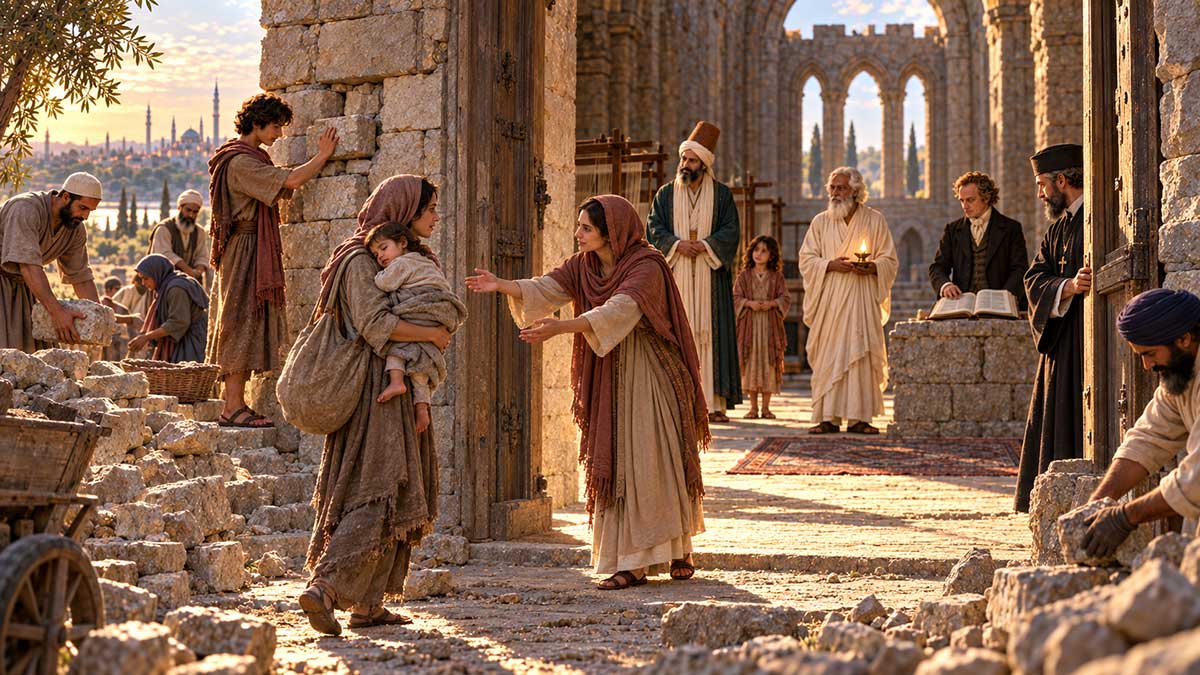
The four poets had condemned religious violence.
Now they would have to defend the value of their own words.
The child stood beside Kabir’s loom.
“You have spoken all morning,” the child said. “People outside still picked up stones.”
No one objected.
“Rumi speaks about love. Blake speaks about Jesus and freedom. Tagore speaks about human dignity. Kabir tells people to find God within themselves.”
The child pointed toward the broken wall.
“But the stone stopped only when the young man came close enough to see my face.”
Kabir placed the shuttle down.
“Then perhaps your face accomplished what our words could not.”
“Does that mean poems are useless?”
“No.”
“Then what did they change?”
Before Kabir could answer, the young man who had thrown the stone entered with his mother. He carried a broom in one hand and his phone in the other.
“I think I can answer part of that,” he said.
The child looked at him cautiously.
The young man held out his phone.
A photograph of Rumi appeared on the screen beneath a sentence about love crossing every human boundary.
“I shared this yesterday,” he said.
Rumi looked at the screen.
“You shared words about love?”
“Yes.”
“And today you nearly struck a child?”
The young man lowered the phone.
“Yes.”
Kabir laughed once, but there was no joy in it.
“The poem decorated his wall. It did not enter his life.”
The young man looked ashamed.
“I meant it when I shared it.”
“What did you mean?”
“I thought it was beautiful.”
“Beauty is not obedience,” Kabir said.
Rumi took the phone and read the sentence again.
“Do you know whether I wrote these exact words?”
The young man shook his head.
“No.”
“Do you know what poem they came from?”
“No.”
“Do you know what I believed?”
“You believed in love.”
“I believed in God.”
The young man looked surprised.
“I have been presented to you as a poet who approves a pleasant feeling. My words have been separated from prayer, surrender, discipline, and the destruction of the ego.”
“I didn’t separate them.”
“Someone did. You repeated what remained.”
Rumi returned the phone.
“Yet the greater failure is not the missing context. You admired the language without permitting it to question your behavior.”
“I didn’t connect the post with what happened here.”
“That is precisely the problem.”
The child sat on the stone floor.
“Why do people like words they do not follow?”
Tagore answered.
“A beautiful sentence can make us feel that we have already become the person it describes.”
The young man stared at the image on his phone.
“I thought sharing it meant I believed it.”
“Belief is easy when nothing is asked of us,” Blake said. “The meaning appeared when you held the stone.”
The young man deleted the post.
Rumi stopped him.
“Why did you do that?”
“I was a hypocrite.”
“Then let the words accuse you.”
“I don’t deserve to share them.”
“The purpose of a spiritual teaching is not to reward those who have already perfected themselves. Keep it if you are prepared to live differently.”
The young man looked at the child.
“What should I write beneath it?”
Kabir answered, “Nothing.”
The young man waited.
“Put down the phone. Finish sweeping the glass.”
The child smiled for the first time.
The young man placed the phone in his pocket and returned to work.
Blake watched him.
“Words failed when they became a public display. They began working when they exposed a contradiction.”
“So a poem can make someone feel guilty?” the child asked.
“Guilt alone can become another form of self-absorption. The question is whether it produces change.”
“What kind of change?”
“The hand that once held a stone now holds a broom.”
Kabir looked toward Blake.
“That sentence will be posted before sunset.”
A few people laughed.
Blake almost smiled.
“Then we will need another sentence to accuse them tomorrow.”
Tagore moved closer to the open entrance. People from the three groups were clearing debris from the road. They had not reconciled. Several refused to work beside one another. One family had left after being insulted. Two religious leaders were arguing quietly near the wall.
“This is what art often faces,” Tagore said. “A poem enters a society filled with memories, loyalties, injuries, and fear. It does not erase them. At its finest, it creates a moment in which another possibility can be felt.”
“Is feeling enough?” the child asked.
“No.”
“Then why begin with feeling?”
“Many acts of cruelty require the victim to become unreal. Art restores the human face. A story can place us inside a life we were prepared to judge from a distance.”
Kabir looked outside.
“And what happens when the story ends?”
“That depends upon the listener.”
“That is a convenient answer.”
“It is an honest one,” Tagore replied. “A poet cannot control what a reader does.”
“Then poetry has no responsibility?”
“It has immense responsibility. The poet chooses what suffering is seen, whose voice is heard, and what questions remain in the reader’s conscience.”
Kabir leaned against the loom.
“Poets can make suffering beautiful enough for comfortable people to admire.”
“Yes,” Tagore said. “That is one of our dangers.”
The woman who had escaped her violent marriage was collecting broken glass near the lamp.
“I have heard poems about suffering,” she said. “People applaud them. Then they return to homes where they refuse to believe the person suffering beside them.”
Blake turned toward her.
“What would you want from a poem?”
“One that does not make my pain sound noble.”
“What should it make your pain sound like?”
“Something that should have been stopped.”
Blake bowed his head.
“That is a harder poem.”
“It should be.”
The child looked at him.
“Do beautiful words make suffering less serious?”
“They can,” Blake said. “A writer may describe misery so gracefully that the reader admires the description and forgets the person.”
“Then should poets stop writing about pain?”
“No. They must write in a way that does not turn another person’s wound into decoration.”
Kabir looked toward the woman.
“What would have helped you when you were trapped in your marriage?”
“A safe room. Money. Someone who believed me. A religious leader willing to tell my husband that he was wrong.”
“Would a poem have helped?”
She thought carefully.
“Some nights, a song helped me survive until morning.”
Kabir did not challenge her answer.
Rumi approached.
“That matters.”
“It did not change my husband.”
“No. It kept him from owning every part of your inner life.”
She looked at him.
“The song reminded me of my mother.”
“Then beauty protected something he could not reach.”
The child watched the woman return to the broken glass.
“So spiritual beauty matters when people are suffering?”
“Yes,” Rumi said. “A hungry person needs food. A frightened person needs safety. A grieving person may need words, silence, prayer, or a song. Human beings do not become bodies without souls during suffering.”
Kabir lifted a finger.
“But never give a poem in place of bread.”
“No.”
“Never tell the oppressed to find inner peace so that you can avoid confronting the oppressor.”
“No.”
“Never describe poverty as spiritually pure when you sleep with a full stomach.”
Rumi met Kabir’s gaze.
“No.”
Blake came beside them.
“A church that sings about heaven yet ignores the suffering outside its door has turned worship into concealment.”
The man who had carried the cross heard him.
“Must every religious song become a political statement?”
“No,” Blake replied. “A song may praise, mourn, celebrate, confess, or rest in wonder. Yet worship that never changes how we treat human beings has become separated from the life it praises.”
The man looked toward the people sweeping.
“What would you have us sing?”
Blake answered, “Sing what you are prepared to become.”
The man studied the cross resting against the wall.
“Our hymns speak about forgiveness.”
“Then forgive without demanding humiliation.”
“They speak about caring for strangers.”
“Then open the door.”
“They speak about sacrifice.”
“Then give up something that costs you more than a song.”
The man looked away.
“What if people take advantage of mercy?”
“Then mercy requires wisdom. Fear of being deceived cannot excuse refusing everyone.”
The child turned toward Tagore.
“You created a school. Did you believe education could stop hatred?”
“I believed education could bring a child into relationship with nature, art, history, and other human beings. Knowledge alone does not create goodness. Educated people can build elegant arguments for cruelty.”
“Then what must education teach?”
“How to encounter another life without immediately trying to possess, classify, or defeat it.”
“Can a poem teach that?”
“It can invite the practice.”
Kabir asked, “Why call it practice?”
“A reader enters a consciousness unlike his own. For a few minutes, he is asked to see through unfamiliar eyes. That movement can weaken the habit of treating outsiders as abstractions.”
The young man paused his sweeping.
“Is that why seeing the child stopped me?”
“Yes,” Tagore said. “The child ceased to be an idea.”
“But I had read stories about children from other religions.”
“Reading is not a guarantee. No moral method is.”
The young man looked frustrated.
“Then what changes people?”
“Sometimes love,” Rumi said.
“Sometimes loss,” Blake added.
“Sometimes shame,” said Kabir.
“Sometimes education,” said Tagore.
“Sometimes nothing?”
The four men became quiet.
“Yes,” Tagore said.
The child looked from one poet to another.
“Some people never change?”
“Some refuse every invitation,” Rumi said.
“Then what good is hope?”
“Hope does not predict that every person will choose mercy. It keeps mercy from surrendering its place in you.”
A woman outside shouted angrily that members of another community had taken her cleaning supplies. The fragile cooperation almost broke apart. Two people accused each other of stealing. A third began repeating an old insult.
Kabir pointed toward them.
“There is your answer. One moving moment does not destroy the ego. It returns quickly, often over something small.”
Rumi walked outside and asked both sides to describe what had happened. The missing supplies were found behind a stone column.
No one apologized.
The groups returned to work with greater distance between them.
The child watched.
“They nearly started again over a broom.”
“Hatred does not require a great cause,” Blake said. “It requires an available wound.”
The child unfolded Kabir’s cloth.
The four names remained visible:
Ram. Allah. God. Beloved.
“What would each of you ask people to do after hearing this conversation?”
Kabir answered first.
“Meet the person your community has described as dangerous.”
“That is all?”
“No. Listen without preparing your defense. Ask what your people look like through that person’s memories.”
Rumi sat beside the child.
“I would ask each believer to examine what faith is doing to the ego.”
“How?”
“When you pray, do you become humbler or more certain of your superiority? When you read scripture, do you search for correction or confirmation? When you speak about God, do people feel invited toward mercy or pushed beneath your judgment?”
Tagore touched the unfinished wall.
“I would ask people to protect human dignity before protecting collective pride.”
“What does that look like?”
“It means refusing jokes that make another group less human. It means teaching history without hiding what your own people did. It means defending a neighbor’s freedom to worship, including a form of worship you do not share. It means refusing to turn children into carriers of inherited hatred.”
The child turned to Blake.
“I would ask Christians to look at the person standing outside every gate they have built.”
“What if the gate protects something sacred?”
“Then ask whether Jesus would be found guarding the gate or standing beside the excluded person.”
“Would you ask people to become Christian?”
Blake looked at the cross.
“I would ask them to encounter Jesus. I would not ask them to imitate Christians who have forgotten his mercy.”
The man beside the cross appeared wounded by the statement.
“Do you believe Christians have done nothing good?”
“I believe countless Christians have fed, sheltered, healed, taught, forgiven, resisted injustice, and given their lives in service. I believe others have used the same name to justify conquest, forced conversion, racial hatred, and fear.”
“Why speak so strongly about the failures?”
“Faith that cannot examine its own history becomes dangerous.”
Rumi nodded.
“That duty belongs to Muslims too.”
Tagore added, “And to Hindus.”
Kabir looked at all three.
“And to anyone who believes criticism is needed only by other people.”
The child carried the cloth toward the entrance.
The empty space above the door still waited for a symbol.
People gathered again.
The man with the cross spoke first.
“Our symbol should not be hidden.”
The man with the crescent agreed. “Nor should ours.”
The woman carrying the sacred carving held it carefully.
“Placing all three above the entrance may suggest that our beliefs are identical.”
“They are not,” Blake said.
“Then what should we place there?” the child asked.
Suggestions came from every side.
A combined symbol.
A written statement.
A lamp.
An open hand.
Nothing.
Each proposal created another disagreement.
Kabir listened until everyone had exhausted themselves.
“Leave it empty,” he said.
Several people protested.
“For how long?” asked the elder.
“Until you can look at the empty space without fearing that another person will fill it.”
“That could take years.”
“Yes.”
“What will the building be called?”
The woman who had sung answered.
“A refuge.”
“That is its purpose,” the elder said. “It still needs a name.”
The child looked around the unfinished room.
“Call it the House Without a Name.”
The people reacted with confusion.
“How will anyone know whose house it is?” someone asked.
“That is the point,” said the child.
Kabir smiled.
The man with the cross remained uncertain.
“Can Christians pray here as Christians?”
“Yes,” the child said.
“Can Muslims pray as Muslims?” asked the man with the crescent.
“Yes.”
“Can Hindus practice their traditions?” asked the woman with the carving.
“Yes.”
“What about people who believe none of it?”
“They can come inside too.”
The religious leader asked, “Who will make the rules?”
The child looked toward the woman who had escaped violence.
“People who remember what it feels like to need the door opened.”
The woman stopped sweeping.
“I do not want authority over anyone.”
“Good,” Kabir said. “That makes you safer than those who hunger for it.”
She looked at him.
“I would need help.”
“Then ask for it.”
“What if the same failures return?”
“They will.”
The people stared at Kabir.
“You say that as if this will fail,” the elder said.
“It will fail many times. Someone will try to control it. Someone will misuse its kindness. Someone will create rules that protect the building more than the people. Someone will speak beautifully about its mission and treat workers poorly.”
“Then why build it?”
Kabir pointed toward the young man, his mother, the abused woman, the child, and the people clearing stones from the road.
“Failure is not a reason to abandon the work. It is a reason to remain awake.”
The child hung Kabir’s cloth inside the entrance, low enough for every visitor to touch.
The empty space above the door remained empty.
The cross stayed near one wall. The prayer rug remained near another. The sacred carving rested beside the oil lamp. They had not been blended into one object. Each retained its own shape.
The poets stood together in the central room.
“What poem should we place on the wall?” someone asked.
Kabir replied, “None yet.”
“Why?”
“The first poem is what you do when the next stranger arrives.”
At that moment, a figure appeared at the far end of the road.
A woman walked slowly toward the building carrying a sleeping child. One side of her face was bruised. She stopped when she saw the religious groups gathered near the entrance.
Fear passed across her face.
She turned as if preparing to leave.
The woman who had escaped her own violent home dropped the broom and ran toward her.
No one asked the newcomer’s religion.
No one asked which name she used for God.
No one asked whether she deserved help.
The door opened.
Rumi watched the women enter.
“The poem has begun,” he said.
Kabir looked at him.
“No.”
Rumi waited.
Kabir pointed toward the room being prepared for them.
“The poem begins tomorrow, when helping her is no longer beautiful, when her fear exhausts them, when sheltering her costs money, when someone from her family threatens the house, and when compassion becomes inconvenient.”
Tagore looked at the unfinished walls.
“Then poetry does not heal the world in a single moment.”
“No,” Kabir said. “It may help a hand open before the stone is released. After that, the hand must learn what else it can carry.”
Outside, the young man lifted another stone.
This time, he carried it to the broken wall and set it carefully into place.
Final Thoughts
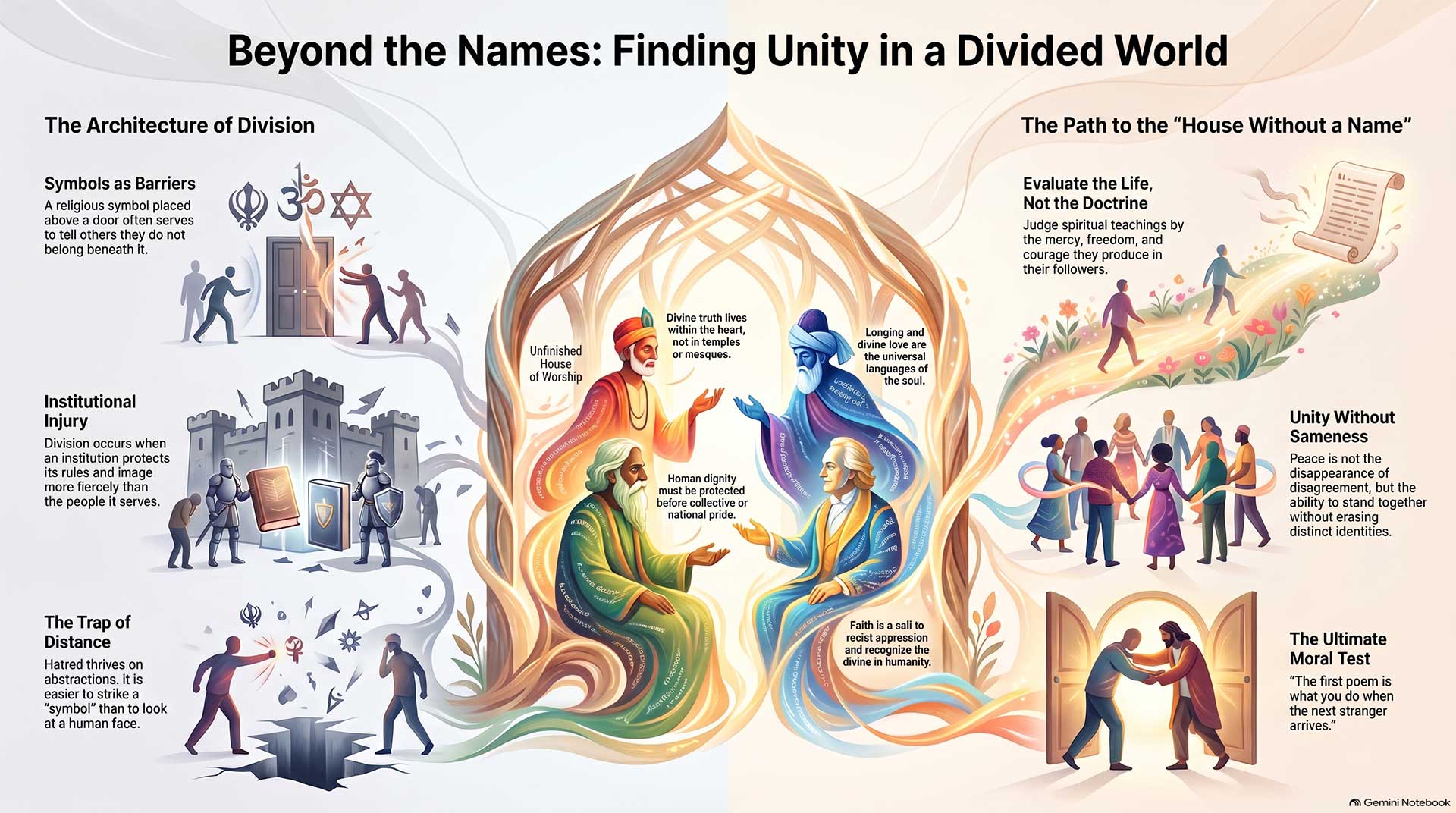
Kabir, Rumi, Tagore, and Blake do not solve the conflict between religions. They offer something more honest: a way to disagree without surrendering another person’s humanity.
The unfinished house remains without an official religious name. Its cross, prayer rug, sacred carving, Bible, lamp, and river water retain their distinct identities. Unity does not require them to become one object.
The decisive moment comes when a frightened woman carrying a child approaches the door. No one asks which religion she follows before offering shelter.
That act becomes the real test of every poem, prayer, doctrine, and sacred symbol.
Religious belief may begin with what we say about God. Its moral truth appears in what we do when another human being needs the door opened.
Short Bios:
Kabir was a fifteenth-century Indian mystic poet associated with the bhakti tradition and influenced by Hindu and Islamic spiritual thought. Traditionally described as a weaver, he condemned caste, empty ritual, religious hypocrisy, and arguments over the proper name for God. His verses remain influential in Hindu, Muslim, Sikh, and interfaith communities.
Rumi was a thirteenth-century Persian-language poet, Islamic scholar, and Sufi mystic. His poetry explores divine love, separation, surrender, and the soul’s longing for God. His relationship with the spiritual teacher Shams of Tabriz transformed his life and poetic vision.
Rabindranath Tagore was a Bengali poet, novelist, philosopher, composer, and educator. He received the Nobel Prize in Literature in 1913 and later helped introduce Kabir’s poetry to English-language readers. His work examined spiritual freedom, human dignity, nature, nationalism, and the relationship between individual identity and universal humanity.
William Blake was an English poet, artist, engraver, and Christian visionary. His imagination was deeply shaped by the Bible and the life of Jesus, yet he strongly opposed religious authority when it supported fear, repression, poverty, or cruelty. His poetry joined spiritual vision with a demand for human freedom.
This conversation is fictional. Kabir, Rumi, Rabindranath Tagore, and William Blake never met one another. Their dialogue has been created from themes found in their poetry, spiritual thought, historical settings, and recorded beliefs. The words attributed to them here should not be treated as verified quotations.
Leave a Reply