

Introduction
When a child leaves home, parents often expect the house to become quieter.
What they may not expect is how much of themselves seems to leave with that child.
The empty bedroom is only the visible part.
Underneath it can be grief, identity loss, changes in marriage, uncertainty about how often to call, fear of becoming unnecessary, and a question many parents hesitate to say aloud:
If my child no longer needs me every day, what is my role now?
In this scholar discussion, psychologists, family researchers, sociologists, and thinkers on human meaning explore thirty of the most common questions surrounding empty nest syndrome.
They examine why a child's successful independence can still feel like loss, why some parents experience freedom rather than sadness, what happens to marriage after children leave, how parents can stay close without becoming intrusive, and whether letting go may be one of the final developmental tasks of parenthood.
The conversation eventually reaches something deeper than loneliness.
Perhaps an empty nest is not simply about learning to live without a child in the house.
It is about learning how parental love changes when love can no longer depend on being needed.
(Note: This is an imaginary conversation, a creative exploration of an idea, and not a real speech or event.)
Topic 1: Why Does an Empty House Hurt So Much?

Participants
Geneviève Bouchard, psychologist and empty-nest researcher
Susan Krauss Whitbourne, lifespan psychologist
Barbara Mitchell, sociologist and family researcher
Karen Fingerman, researcher on parents and adult children
Lisa Neff, psychologist specializing in marriage and close relationships
Bouchard: I want to begin with something parents often feel embarrassed to admit. Your child leaves home for a good reason. They are going to college, beginning work, getting married, traveling, serving somewhere, building a life. You may be proud of them.
Then you walk past the bedroom that night and cry.
Parents sometimes think, "What is wrong with me? This is what I raised my child to do."
There may be nothing contradictory about those two emotions.
You can be proud that your child is leaving and heartbroken that they left.
Whitbourne: I think that distinction matters enormously. We tend to treat emotions as if only one can be legitimate at a time.
If I am happy for my child, I shouldn't be sad.
If I am sad, perhaps I am being selfish.
Human emotion doesn't work that neatly.
A parent may stand at an airport watching a child disappear through security and feel pride, fear, gratitude, loneliness, excitement, regret, and love in the same sixty seconds.
Mitchell: And what are they grieving?
That is where this conversation becomes much more interesting.
People tend to say, "They miss their child."
Of course they do.
But they may be grieving much more than the physical person.
They are grieving a structure.
For perhaps eighteen or twenty years, much of daily life was organized around another human being.
What time does school start?
Who needs a ride?
What are we having for dinner?
Did someone finish their homework?
Is anyone coming home late?
Do we need groceries?
Who needs help?
Then those questions disappear.
Fingerman: Yes. And parents may not realize how many tiny interactions formed the emotional texture of their day.
The child walking into the kitchen.
Hearing a bedroom door close.
A backpack left somewhere it shouldn't be.
Someone shouting, "Do we have anything to eat?"
A late-night conversation that begins unexpectedly.
A disagreement over something ridiculous.
A request for help.
Those moments can feel mundane when they happen every day.
Once they stop, parents may suddenly recognize how meaningful they were.
Neff: We often recognize the value of routine only after the routine disappears.
A mother may have complained for years about dirty dishes in the sink.
Then there are no dirty dishes.
And the clean sink hurts.
Whitbourne: That's such a powerful example.
The thing you once wanted gone becomes evidence that someone was there.
Bouchard: Which takes us to our first question.
What are parents actually grieving when a child leaves home?
I think one answer is that they are grieving several losses layered together.
The child's physical presence.
The parenting routines.
A familiar identity.
A sense of usefulness.
A chapter of family life.
Perhaps even a version of themselves.
Mitchell: And time itself.
That part gets overlooked.
A child leaving home can force a parent to confront the passage of time.
Yesterday, at least emotionally, you were holding this person's hand while crossing a street.
Now they're packing a car.
Their departure says something about the parent too.
Your child became an adult.
Which means you became older.
Whitbourne: Exactly.
Empty-nest feelings are often connected with larger midlife questions.
Where did those twenty years go?
Did I spend them well?
What happened to the person I was before I had children?
What will the next twenty years look like?
A child's departure can act almost like a psychological clock striking loudly.
Fingerman: There can be another layer.
Some parents aren't grieving what happened.
They're grieving what will never happen again.
There will never be another first day of kindergarten for that child.
There will never be another ordinary Tuesday evening when they are fifteen and sitting at the kitchen table.
There will never be another childhood bedtime.
The parent isn't simply missing yesterday.
They're recognizing that yesterday is unrecoverable.
Neff: That's close to grief in its deepest form.
Not tragedy.
Irreversibility.
Bouchard: And I want to be careful here. We shouldn't equate a child moving out with bereavement. Those are very different experiences.
Yet some emotional processes can overlap.
A familiar presence disappears.
Routines change.
Identity shifts.
The brain keeps expecting someone to be where they used to be.
You hear a sound and briefly think they're home.
You cook too much food.
You see something at the store and think, "He likes this."
Then you realize he's not eating dinner here tonight.
Whitbourne: And perhaps not tomorrow night either.
That repeated realization is part of adjustment.
Mitchell: There's another question parents ask: "If this is normal, why does my friend seem perfectly fine?"
That brings us into our second question.
Why do some parents struggle deeply, yet others feel relief or excitement?
Fingerman: One major factor is how central active parenting became to someone's identity.
If you have many meaningful roles, parent, spouse, friend, colleague, volunteer, creator, sibling, neighbor, community member, the reduction of one role still matters, but the rest of the self remains visible.
If the parenting role occupied almost everything, the departure can leave a larger psychological vacuum.
Whitbourne: I would put it this way.
There is a difference between saying:
"Being a parent is one of the most meaningful parts of my life."
and saying:
"Being needed by my child is how I know that I matter."
Those statements sound similar.
They aren't.
Neff: That's an important distinction.
The first can survive the child's independence.
The second is threatened by it.
Bouchard: We need compassion for the parent in the second situation.
People sometimes judge that parent as overly attached.
Yet consider the years of investment.
A person may have rearranged work, friendships, sleep, finances, hobbies, marriage, travel, and personal goals around caring for a child.
Then society says, "Great job. Now let go."
Psychologically, that can be a profound adjustment.
Mitchell: Gender history matters here too.
For many women in older generations, motherhood carried enormous cultural expectations.
Some had fewer professional opportunities.
Some were told that being a good mother meant placing children at the center of life.
Then when the children became independent, those same women could be criticized for struggling to let go.
Society helped construct the identity, then blamed the person when the identity became difficult to release.
Fingerman: Fathers can struggle too, though they may express it differently.
A father might not say, "I'm grieving."
He might suddenly become unusually quiet.
Spend more time in the child's room.
Call more often.
Become overly interested in practical matters.
Ask about money, the car, classes, work.
Sometimes practical questions become a socially acceptable way of saying:
"I miss you."
Whitbourne: That's beautiful.
"What did the mechanic say?" may occasionally mean, "Please stay connected to me."
Neff: We should talk about parents who feel relief too.
Some feel guilty about it.
They love their children deeply.
Yet parenting may have involved years of scheduling, conflict, financial pressure, disrupted sleep, worry, and very little personal time.
When the child leaves, the parent might notice:
The house is calmer.
There is more time.
The marriage has more space.
They can travel.
They can eat whenever they want.
They can rediscover interests.
Feeling relief does not mean the parent loved the child less.
Bouchard: This is where the role-loss and role-relief ideas become useful.
One parent experiences mainly loss.
Another experiences mainly relief.
Many experience both.
Mitchell: Sometimes within the same hour.
Fingerman: Absolutely.
A parent can cry in the child's bedroom at five o'clock and enjoy a quiet dinner with their spouse at seven.
One emotion doesn't cancel the other.
Whitbourne: Yet parents often police themselves.
"I had fun tonight. Does that mean I don't miss my daughter?"
No.
"I cried today. Does that mean I'm not happy for my son?"
No.
Emotional maturity sometimes means allowing apparently opposing truths to coexist.
Neff: Relationship quality before the departure matters too.
A parent whose marriage is satisfying may transition into more couple time.
A single parent may experience the change very differently.
A parent caring for elderly parents may move directly from one caregiving role into another.
Someone with strong friendships may have more social support.
Someone socially isolated may suddenly feel the silence much more intensely.
Mitchell: Financial circumstances matter.
Culture matters.
Health matters.
Whether the child moved twenty minutes away or across the country matters.
Whether the departure was gradual or sudden matters.
Whether the parent supported the decision matters.
Whether the child left after conflict matters.
Bouchard: And timing matters.
A planned departure can still hurt.
Yet an unexpected departure may create another layer.
Imagine believing you have another year together, then suddenly your child accepts an opportunity and leaves in three weeks.
The parent's emotional calendar hasn't caught up with the child's actual calendar.
Whitbourne: That is such a good phrase.
The emotional calendar.
Parents may know intellectually that children eventually leave.
Yet knowing that someday is coming is very different from waking up and realizing that someday is Thursday.
Fingerman: There is another situation that can be especially painful.
The child is happy.
Very happy.
They call home and say:
"This is amazing."
"I love my new friends."
"I'm having such a great time."
And the parent genuinely feels joy.
Then the phone call ends.
The house is quiet again.
The child's happiness can strangely intensify the parent's sadness.
Neff: Since the child is moving forward, and the parent feels left behind.
Fingerman: Exactly.
The parent may never say that aloud.
They don't want the child to feel guilty.
So they say:
"I'm so happy for you."
Then cry after hanging up.
Bouchard: That hidden grief deserves recognition.
A loving parent may intentionally protect the child from the full intensity of their sadness.
That creates a strange emotional situation.
The person you most want comfort from may be the very person you don't want to burden.
Whitbourne: Which makes friendships, spouses, community, spiritual life, meaningful activities, and other forms of connection very important during the transition.
Mitchell: Now we come to the difficult third question.
When does normal empty-nest sadness become something more serious?
We need to avoid pathologizing every tear.
If your child leaves and you cry, that doesn't mean something is wrong.
If you walk past their room and feel lonely, that doesn't mean you are ill.
If the first few weeks feel strange, that is hardly surprising.
Bouchard: The key question is less:
"Am I sad?"
and more:
"What is happening to my ability to live?"
Are you still eating?
Sleeping reasonably?
Working?
Connecting with people?
Finding occasional enjoyment?
Taking care of yourself?
Can you experience sadness and still participate in life?
Or is the sadness becoming persistent, overwhelming, and disabling?
Whitbourne: I would add another question.
Is your emotional world gradually changing?
Adjustment doesn't mean every day gets better.
You may have a good day, then a terrible day.
But across time, is there some movement?
Are there moments when you forget to be sad?
Moments of curiosity?
Moments when the house feels peaceful instead of painfully silent?
Moments when you begin thinking about your own future again?
Neff: If a person feels no movement at all for a prolonged period, can't function, withdraws from everyone, loses interest in nearly everything, feels hopeless, or begins feeling that life no longer has value, that's a very different situation from ordinary transitional sadness.
Bouchard: And professional support can be appropriate at that point.
Seeking help doesn't erase the meaning of the grief.
It simply means the emotional burden has become too heavy to carry alone.
Fingerman: Parents sometimes resist support since they think:
"My child is healthy. Other people have real problems. I have no right to be this upset."
Pain doesn't work according to a ranking system.
You can be grateful that your child is thriving and still need support for your own transition.
Mitchell: This is especially true when empty nesting arrives alongside other midlife changes.
Retirement.
Menopause.
Aging parents.
Illness.
Career change.
Financial stress.
Bereavement.
Changes in marriage.
A child leaving home may be one event inside a much larger season of transition.
Whitbourne: And when several identities shift at once, the person may ask a frightening question:
"Where did my old life go?"
Neff: I wonder whether we sometimes focus too much on getting rid of sadness.
Maybe the better goal isn't:
"How quickly can I stop missing my child?"
Maybe it is:
"How can I make room for missing my child without allowing that sadness to consume everything else?"
Bouchard: I agree.
If you loved someone every day for nineteen years, perhaps the immediate goal should not be emotional detachment.
The relationship has to be reorganized.
Fingerman: That's the word I like.
Reorganized.
Not ended.
Mitchell: Yes.
The word "empty" can mislead us.
The nest may be physically emptier.
The family relationship still exists.
Whitbourne: And parenthood continues.
One of the most important things I would want parents to hear is this:
Your job has changed.
Your relationship has changed.
Your daily usefulness has changed.
Your parenthood has not disappeared.
Neff: Yet perhaps the old form of parenthood does need to disappear.
Whitbourne: Yes. That's the tension.
You remain a parent.
You cannot remain the parent of a twelve-year-old when your child is twenty-five.
Fingerman: The relationship has to mature on both sides.
The child learns:
"I can live without depending on my parent every day."
The parent learns:
"I can love my child without being involved in every day."
Bouchard: And there may be grief in both lessons.
Mitchell: There may be pride too.
Neff: And relief.
Whitbourne: And fear.
Fingerman: And something parents don't always expect.
Curiosity.
Bouchard: Curiosity?
Fingerman: Yes.
At some point, after the first pain softens, a different question may appear.
Not:
"How do I get my old life back?"
But:
"What is my life now?"
Whitbourne: That is where I think our next conversation has to go.
The empty bedroom may be the visible change.
The deeper change may be happening inside the parent.
For years you woke up knowing exactly who needed you.
Then one morning no one calls from upstairs.
And eventually the question becomes impossible to avoid:
If my child doesn't need me in the same way anymore, who am I now?
Bouchard: And perhaps that question is not a sign that parenthood failed.
It may be the question that becomes possible when parenthood succeeds.
Topic 2: If My Child Doesn’t Need Me, Who Am I?

Participants
Geneviève Bouchard, psychologist and empty-nest researcher
Susan Krauss Whitbourne, lifespan psychologist
Barbara Mitchell, sociologist and family researcher
Karen Fingerman, researcher on parents and adult children
Lisa Neff, psychologist specializing in marriage and close relationships
Erik Erikson, developmental psychologist
Viktor Frankl, psychiatrist and thinker on meaning
Whitbourne: We ended our last conversation with a question that many parents may never say aloud.
"If my child doesn't need me in the same way anymore, who am I now?"
I think that question can be more painful than the empty bedroom itself.
Bouchard: Yes.
The bedroom is concrete.
You can see the empty bed.
You can see the unused desk.
Identity is harder to see.
A parent may simply feel restless, lonely, irritable, or unusually emotional without realizing that underneath those feelings lies something much larger.
For years, their sense of self may have been connected to usefulness.
Someone needed them.
Now that need has changed.
Fingerman: And there is a major difference between being loved and being needed.
Adult children may love their parents deeply.
They may call them.
Visit them.
Ask for advice.
Think about them every day.
Yet they may no longer need a parent to manage their daily life.
For some parents, that distinction can feel surprisingly painful.
Neff: I think many people have unconsciously learned to measure love through necessity.
"If someone needs me, I matter."
"If nobody needs me, what value do I have?"
That idea can exist long before parenthood.
Parenthood simply gives it a very strong place to live.
Mitchell: Particularly for people whose adult lives were organized heavily around caregiving.
They might have spent decades being needed from morning until night.
A child needed breakfast.
A spouse needed help.
A school needed a volunteer.
A parent needed care.
A household needed management.
Then suddenly several of those responsibilities disappear at once.
The person has not lost value.
Yet the evidence they used every day to prove their value has become quieter.
Erikson: This is where the idea of generativity becomes useful.
Human development does not end when children grow up.
At midlife and beyond, one of the central tasks is to contribute to something that outlives the self.
Parenthood is one very strong form of generativity.
Yet it is not the only form.
Teaching can be generative.
Mentoring can be generative.
Creating can be generative.
Serving can be generative.
Helping younger people can be generative.
Building something that will continue after you are gone can be generative.
Whitbourne: That is important.
A parent may mistakenly think:
"My years of contribution are ending."
But the deeper developmental question might be:
"Where does my contribution go next?"
Frankl: Meaning does not disappear when one role changes.
The danger comes when a person believes meaning existed in only one form.
A mother may say:
"My children were my purpose."
That sentence can be beautiful.
It can carry danger too.
If purpose is defined so narrowly that the child's independence destroys it, then the child's growth begins to feel like the parent's disappearance.
Bouchard: And the parent may then unconsciously resist the very independence they spent years trying to create.
Fingerman: Exactly.
They may call more often.
Give advice that was not requested.
Create small emergencies.
Offer money in ways that maintain dependence.
Become hurt when the adult child makes decisions without consultation.
The parent may sincerely believe they are helping.
Underneath the helping may be a deeper plea:
"Please still need me."
Neff: That is such a delicate issue, since the parent may not be trying to control anyone.
They may simply be trying to protect a source of identity.
Mitchell: Which brings us to our first question.
How much of a parent's identity can become attached to being needed?
Whitbourne: I would say a great deal.
Human identity is built from roles.
Parent.
Spouse.
Worker.
Friend.
Sibling.
Neighbor.
Caregiver.
Community member.
When one role becomes dominant, changes in that role can affect the entire sense of self.
Bouchard: And there is no shame in that.
If you spent twenty years investing intensely in one role, it makes sense that a major change in that role would affect you deeply.
The goal is not to say:
"I should never have cared so much."
The goal is to ask:
"What else in me has been waiting for attention?"
Frankl: That question matters.
A person is always larger than any single role.
Larger than a profession.
Larger than marriage.
Larger than parenthood.
Larger than success.
Larger than failure.
When life removes one familiar form of meaning, the task is not merely to replace activity.
The task is to discover what still calls for responsibility.
Erikson: And one danger at this stage is stagnation.
A person can become psychologically fixed around what has already been completed.
"My best years were when the children were young."
"My life mattered more then."
"Everything meaningful is behind me."
That can gradually shrink the future.
Generativity points in the opposite direction.
It asks:
"What can still grow through me?"
Fingerman: I like that phrasing.
Parents often think generativity means having grandchildren.
It can include grandchildren, of course.
Yet the idea is much wider.
You can influence people who are not related to you.
You can mentor.
Volunteer.
Teach.
Create.
Sponsor someone.
Care for a neighbor.
Start a project.
Support a young family.
Write.
Build community.
Mitchell: In many cultures, older adults naturally move into these broader roles.
They become elders.
Advisers.
Story keepers.
Caregivers for grandchildren.
Community anchors.
The transition is not always framed as:
"My children don't need me."
It may be framed as:
"My role has widened."
Whitbourne: That can be psychologically healthier than treating independence as rejection.
Neff: Yet we should not rush parents into productivity.
Sometimes people hear:
"Your children are gone. Now find a hobby."
That can feel almost insulting.
A person may be grieving a twenty-year chapter.
They may need time before asking what comes next.
Bouchard: Yes.
There is a difference between creating a new life and frantically filling every empty hour so you do not feel anything.
Frankl: Activity is not automatically meaning.
Busyness can become escape.
A person may schedule every minute and still feel empty.
Meaning requires a relationship with something beyond immediate distraction.
A task.
A person.
A cause.
A responsibility.
A way of responding to life.
Erikson: Which brings us to the second question.
Is the empty nest a loss of purpose or a transition into another kind of purpose?
Whitbourne: I think both can be true.
There is a genuine loss of one kind of purpose.
Daily parenting once required constant action.
That action decreases.
We shouldn't pretend nothing was lost.
Yet the reduction creates room for another kind of purpose.
Fingerman: And that purpose may still include the child.
It simply changes.
The parent of a young child acts directly.
The parent of an adult child may influence more quietly.
They become a sounding board.
A source of perspective.
A stable person to call.
A keeper of family history.
Someone who can say:
"I trust you."
Neff: Trust may become one of the new forms of parental love.
When children are young, love often looks like intervention.
When children are adults, love sometimes looks like restraint.
Bouchard: That can feel almost unnatural after years of active caregiving.
The parent sees a problem and thinks:
"I know how to fix this."
Then has to ask:
"Is it mine to fix?"
Fingerman: Or:
"Did they ask me?"
Mitchell: And sometimes the answer is no.
Whitbourne: That may be one of the hardest developments in adult parenthood.
Your experience increases at the same moment your authority decreases.
Neff: That's painful.
You may know more than your child about money.
Relationships.
Career mistakes.
Health habits.
People.
Risk.
Yet they now have the right to learn through their own choices.
Frankl: Love that respects another person's freedom is different from love that seeks control.
One can care deeply and still permit another person to choose.
There is suffering in that.
Freedom means the person may choose badly.
Parents often know this.
They cannot guarantee the outcome.
Erikson: Which creates a developmental task for the parent too.
Can I remain deeply invested without requiring control?
Can I care about what happens without making another person's life my only source of identity?
Bouchard: That is a very mature form of parenthood.
Fingerman: And perhaps a very difficult one.
Whitbourne: I want to return to something Barbara said earlier.
The phrase:
"My best years were when the children were young."
Many parents feel this.
It deserves tenderness.
Those years may truly have been extraordinary.
There were first words.
First steps.
Birthdays.
School plays.
Family trips.
Holiday mornings.
Teenage conversations.
Ordinary dinners.
A whole period filled with shared life.
The danger is not loving those memories.
The danger is turning memory into a verdict against the future.
Frankl: Yes.
Memory can become gratitude.
It can become a prison too.
If a person says:
"Nothing ahead can matter as much as what is behind me,"
then the future is condemned before it arrives.
Neff: Which brings us to our third question.
Can the second half of life become as meaningful as the years of raising children?
Erikson: It can become meaningful in a different way.
The first half of adult life often involves building.
Career.
Family.
Home.
Stability.
Identity.
The later years can involve contribution, reflection, guidance, transmission, and legacy.
Not smaller meaning.
Different meaning.
Mitchell: This is where social expectations can hurt people.
Our culture often celebrates beginnings.
Graduation.
Marriage.
Babies.
Promotions.
New homes.
Youth.
There are fewer rituals for middle-age transitions.
Nobody throws a party and says:
"Congratulations. Your child left home. Now discover who you are next."
Fingerman: Maybe we should.
Neff: It might help.
Whitbourne: There is something moving about that idea.
Parents celebrate children's transitions constantly.
First day of school.
Graduation.
College.
Wedding.
New job.
The parent is moving through a transition too, yet often silently.
Bouchard: And without a cultural script.
People know what to say to the child.
"Good luck."
"We're proud of you."
"This is your new beginning."
What do we say to the parent?
Frankl: Perhaps:
"Your task has changed."
Erikson: Or:
"Your contribution is not finished."
Mitchell: Or simply:
"Your life is still unfolding."
Fingerman: That may matter especially for parents who spent many years postponing themselves.
"I'll travel when the children are older."
"I'll paint again someday."
"I'll go back to school later."
"I'll start that business later."
"I'll volunteer later."
"I'll see my friends later."
Then later finally arrives.
And strangely, they may not know what they want anymore.
Neff: That is very common.
When your schedule has been shaped around someone else's needs for years, desire can become rusty.
Ask:
"What do you want?"
And the person may answer:
"I don't know."
Whitbourne: Which is not failure.
It may simply mean they have not asked themselves that question in a very long time.
Bouchard: The first task might not be finding a huge purpose.
It might be recovering curiosity.
What interests me?
What gives me energy?
Who do I enjoy being with?
What did I once care about?
What have I always wanted to learn?
What do I want my next ten years to contain?
Frankl: Meaning may appear through small commitments before grand answers.
One does not need a dramatic mission.
Care for one person.
Serve one community.
Create one thing.
Take responsibility for one worthy task.
Meaning often becomes visible through action.
Erikson: And generativity can begin very quietly.
A parent might tutor a teenager.
Teach someone to cook.
Help a young couple.
Share professional knowledge.
Coach.
Write family stories.
Care for grandchildren.
Plant a garden that others will enjoy.
Create something that remains.
Mitchell: We should include friendship here.
Some parents neglect friendships during the intense parenting years.
Later life can provide a chance to rebuild social connection.
Friendship is not a consolation prize for missing children.
It is its own major form of human relationship.
Neff: Marriage too.
A spouse may have been standing next to you for twenty years, yet the relationship may have received the leftovers after work and parenting.
The empty nest can create space to rediscover that person.
Fingerman: And perhaps rediscover oneself separately from marriage too.
One partner may want to travel.
The other may want to garden.
One may want friends.
The other may want quiet.
A healthy next chapter doesn't require both people to become identical.
Whitbourne: That is an important point.
Identity after active parenting should not simply move from:
"I live for my children"
to:
"I live entirely for my spouse."
The deeper task is building a self that can love others intensely without disappearing inside their needs.
Frankl: Yes.
Love and selfhood are not enemies.
To love another person fully does not require erasing oneself.
Bouchard: Some parents may hear this conversation and feel guilty.
They may think:
"I did erase myself."
I would not want them to leave with regret.
They did what made sense at the time.
They loved.
They sacrificed.
They gave.
Now life is asking something different.
Erikson: Development means the task changes.
A strength that served one stage can become limiting if it never changes form.
Intense protection is necessary with a toddler.
The same protection applied to a thirty-year-old may restrict both parent and child.
Fingerman: The relationship has to evolve.
So does identity.
Mitchell: Perhaps one of the hardest sentences for a parent to accept is:
"My child is building a life that does not center me."
Neff: And the next sentence may be:
"I need to build a life that does not center only my child."
Whitbourne: That does not weaken the bond.
It can protect it.
Adult children often feel freer to move closer emotionally when they do not feel responsible for their parent's entire happiness.
Fingerman: Yes.
That is so important.
If every missed phone call becomes:
"You don't care about me,"
the child may begin to experience contact as obligation.
If the parent has a meaningful life of their own, contact can become more voluntary.
More joyful.
More adult.
Frankl: Love is strongest when it does not make another person responsible for proving our worth.
Bouchard: That may be one of the central lessons here.
The parent's worth existed before the child was born.
It existed during the parenting years.
It still exists after the child leaves.
Erikson: And the next question is not merely:
"Who am I without daily parenting?"
It might be:
"Who am I becoming now that daily parenting has changed?"
Whitbourne: That word changes everything.
Becoming.
Not disappearing.
Mitchell: And perhaps the empty nest is less an empty space than an unfinished one.
Neff: Which can feel frightening.
Yet unfinished means something can still be created.
Frankl: Life continues to ask questions of us.
The answer is given through how we live.
Fingerman: Then perhaps the parent's task changes from:
"How can I remain necessary?"
to:
"How can I remain loving?"
Bouchard: And from:
"What have I lost?"
to:
"What might still be possible?"
Whitbourne: Yet there is one relationship waiting in the middle of all this.
Often the person sitting across the dinner table.
The spouse.
For years two people may have worked together mainly as parents.
Now the children leave, the routines disappear, and two people look at each other in a much quieter house.
And they may discover something beautiful.
Or something unsettling.
Perhaps both.
Neff: Which brings us to our next question.
When parenting stops organizing the marriage every day...
what happens to the two people who remain?
Topic 3: What Happens to the Marriage After the Children Leave?

Participants
Geneviève Bouchard, psychologist and empty-nest researcher
Susan Krauss Whitbourne, lifespan psychologist
Barbara Mitchell, sociologist and family researcher
Karen Fingerman, researcher on parents and adult children
Lisa Neff, psychologist specializing in marriage and close relationships
Erik Erikson, developmental psychologist
Viktor Frankl, psychiatrist and thinker on meaning
Neff: We ended our last conversation with a very simple image.
Two people sitting across from each other at the dinner table.
For years, there were children between them.
Not literally every night, perhaps.
But psychologically.
School.
Sports.
Homework.
College applications.
Health.
Friends.
Curfews.
Money.
Meals.
Problems.
Plans.
The children gave the marriage thousands of things to talk about.
Then the children leave.
And one evening the couple sits down to dinner and realizes there is no school schedule to discuss.
No practice.
No pickup.
No teenage drama.
No question about who will drive tomorrow.
The room becomes quiet.
And sometimes one spouse thinks:
"Now we finally have time for each other."
The other thinks:
"What exactly do we have left to say?"
Whitbourne: That can be one of the most startling parts of the empty-nest transition.
A couple may have been married twenty-five years and still discover that they have not spent much time being simply husband and wife for a very long time.
They became parents.
Managers.
Drivers.
Cooks.
Problem solvers.
Financial planners.
Emergency responders.
The marriage survived.
Yet the marital relationship itself may have been receiving very little attention.
Mitchell: Family life can be so demanding that a couple may not recognize this as a problem.
They are busy.
Busy relationships can appear healthy simply because there is constant activity.
Everyone is doing something.
Everyone is needed.
Everyone is tired.
Then the activity stops.
Silence arrives.
And silence reveals things.
Bouchard: Sometimes beautiful things.
A couple realizes:
"I still really like this person."
They start walking together.
Talking longer.
Traveling.
Going out to dinner.
Sleeping better.
Laughing more.
The house becomes peaceful.
They discover that parenting occupied their time, but it did not destroy their friendship.
For some couples, this period is deeply rewarding.
Neff: Yes.
We need to resist the stereotype that the empty nest automatically harms marriage.
Many couples experience more satisfaction after children leave.
There can be less logistical stress.
Less conflict over parenting.
More privacy.
More freedom.
More time for intimacy.
More room for spontaneity.
A couple may begin experiencing each other again as people rather than primarily as co-parents.
Fingerman: Yet another couple can experience the exact same reduction in responsibilities and feel frightened by it.
The children may have been functioning as emotional glue.
Not intentionally.
No one said:
"We are staying together for school pickup."
But the family system gave the marriage structure.
Once the children leave, the couple may discover that much of their closeness depended on shared parenting tasks.
Erikson: A role can organize a relationship for years.
When the role changes, the relationship must answer a developmental question of its own.
Are we still becoming something together?
Or have we simply been maintaining a system?
Frankl: Shared responsibility can give meaning to a relationship.
Yet a relationship cannot live forever on responsibility alone.
Two people may accomplish many tasks together and still become strangers.
Whitbourne: Which brings us to our first question.
Why do some marriages become stronger after children leave, and others feel strangely empty?
Neff: I think one answer is friendship.
Not romance in the dramatic sense.
Friendship.
Do these two people still enjoy each other?
Are they curious about each other?
Can they talk about something other than the children?
Can they laugh?
Can they disagree without contempt?
Can they sit quietly without feeling uncomfortable?
Can they experience pleasure together?
These simple things become very important once the parenting structure becomes less dominant.
Mitchell: Shared history can help too.
A long marriage contains thousands of memories.
The early apartment.
The first job.
The birth of the children.
Financial struggles.
Family crises.
Vacations.
Illnesses.
Celebrations.
Losses.
A couple may rediscover that history and think:
"We built all of this together."
That realization can create tremendous closeness.
Bouchard: Yet history alone is not enough.
Two people can share thirty years of history and still feel emotionally disconnected in the present.
Neff: Exactly.
The question is not only:
"What have we survived together?"
It is:
"Do we still want to know each other now?"
People change.
The person you married at twenty-five is not the same person at fifty-five.
And neither are you.
Whitbourne: That can become exciting.
The empty nest can create a second courtship.
Not pretending to be young again.
Actually meeting the person your spouse has become.
Fingerman: I like that.
Sometimes couples assume they already know everything about each other.
But after decades of parenting, one spouse may have developed interests, fears, dreams, or regrets that were rarely discussed.
You can ask:
"What do you want now?"
And discover that you do not know the answer.
Frankl: Love requires seeing the other person as someone who is still becoming.
If we reduce a spouse to a fixed identity, we stop encountering the person.
Erikson: Development continues throughout adulthood.
A marriage must adapt to two changing individuals.
Children leaving is one of the moments when those changes become impossible to ignore.
Mitchell: There is another factor.
Some couples fought frequently over parenting.
One was strict.
One was permissive.
One worried constantly.
One believed the children needed more independence.
One spent money freely.
One wanted discipline.
When the children leave, an entire category of marital conflict may disappear.
Neff: That can create immediate relief.
A couple who argued about parenting for twenty years may suddenly realize:
"We don't fight nearly as much."
Bouchard: Yet a different couple may have used parenting conflict to avoid deeper marital conflict.
They argued about the child rather than talking about loneliness, resentment, sex, money, betrayal, disappointment, or emotional distance.
When the child leaves, the distraction disappears.
Whitbourne: And then the real conversation begins.
Neff: Or the couple avoids it again.
They fill the calendar.
Travel.
Work.
Golf.
Television.
Social media.
Grandchildren.
Anything can become another distraction.
Frankl: Activity can conceal emptiness in a marriage just as easily as it can conceal emptiness in an individual life.
Erikson: The challenge is not merely finding things to do together.
It is creating a relationship worth inhabiting.
Fingerman: That makes me think about the second question.
What happens when one parent is grieving and the other feels relieved?
This is extremely common.
One spouse may be devastated.
The other may be energized.
The grieving spouse walks past the child's room every day.
The other spouse starts talking about taking a trip.
Mitchell: And both can feel misunderstood.
Bouchard: The grieving parent may think:
"How can you be so happy? Don't you miss our child?"
Neff: The relieved parent may think:
"How long are we supposed to be sad? Can't we enjoy this stage too?"
Then emotional difference becomes moral judgment.
Sadness becomes proof of love.
Relief becomes proof of selfishness.
That is dangerous.
Whitbourne: Two people can love the same child deeply and experience separation differently.
Attachment style may differ.
Daily caregiving roles may have differed.
One parent may have spent far more time with the child.
One may have had a career that continued unchanged.
The other may have built the day around the child's needs.
Their losses are not identical.
Mitchell: Gender expectations can shape this.
A mother may have performed much more daily caregiving.
A father may have experienced parenthood differently.
That does not mean the father loved less.
It means the departure altered their daily lives in different ways.
Fingerman: The opposite can happen too.
A father who quietly organized his emotional life around a child may struggle deeply after departure.
He may have fewer close friendships and less practice talking about grief.
The mother may adapt faster.
Stereotypes do not tell us what any individual family will experience.
Bouchard: What helps is removing the competition.
Instead of:
"Who misses the child more?"
ask:
"What is this transition like for you?"
Neff: Exactly.
Imagine one spouse says:
"I hate how quiet the house is."
The other could respond:
"I actually enjoy the quiet, but I can see that it hurts you."
That sentence leaves room for both experiences.
Whitbourne: Emotional agreement is not required for emotional support.
Frankl: Love does not require identical feelings.
It requires presence before another person's reality.
Erikson: And this period may require couples to develop a new language.
For years their emotional vocabulary may have been organized around children.
Now they have to say things such as:
"I feel lonely."
"I miss being needed."
"I want more time with you."
"I need more space."
"I am excited."
"I am scared."
"I don't know who I am right now."
Those are very different conversations from:
"Who is picking him up?"
Mitchell: There can be resentment too.
A parent may think:
"I sacrificed everything for this family."
The spouse may hear:
"So did I."
Old accounting begins.
Who gave up more?
Who worked harder?
Who missed opportunities?
Who carried the emotional burden?
Who handled discipline?
Who earned the money?
Who stayed home?
Who was appreciated?
Once the children leave, these old questions can surface.
Neff: And if they have been accumulating for twenty years, this is not something a weekend getaway will automatically fix.
Bouchard: Which is why the empty nest can reveal rather than create marital problems.
The departure gets blamed since that is when the distress becomes visible.
Yet the roots may be much older.
Whitbourne: That distinction matters.
The child leaving may not have damaged the marriage.
The quieter house may simply have made it easier to hear what was already there.
Fingerman: There is another emotional mismatch that can be painful.
One spouse may expect renewed romance immediately.
They think:
"The kids are gone. This is our time."
The other spouse may be grieving and emotionally depleted.
The first experiences rejection.
The second experiences pressure.
Neff: Yes.
Reconnection cannot be forced.
If a couple has spent twenty years giving each other fragments of attention, intimacy may need to be rebuilt slowly.
Conversation first.
Friendship.
Warmth.
Curiosity.
Physical affection that does not always demand sex.
Shared experiences.
Playfulness.
Trust.
Frankl: People often want the result without accepting the renewal that must precede it.
Erikson: A second-stage marriage may need to be created almost as intentionally as the first.
Whitbourne: Which takes us to our third question.
How can two people rediscover a relationship that has revolved around children for decades?
Neff: I would start very small.
Do not begin with:
"We need to fix our marriage."
That can feel overwhelming.
Begin with:
"What did we used to enjoy together?"
"What have we never had time to do?"
"What would make this week a little more enjoyable?"
"What do you miss about us?"
"What would you like more of?"
Those questions can reopen curiosity.
Bouchard: New rituals can matter greatly.
Maybe Friday breakfast.
An evening walk.
Sunday coffee.
Cooking together.
A monthly day trip.
A television series they only watch together.
A class.
A shared volunteer activity.
The ritual itself is less important than the recurring message:
"We are still building a life together."
Mitchell: I would include separate lives too.
Couples sometimes respond to the empty nest by trying to spend every moment together.
That can create another kind of pressure.
A healthy marriage may involve rediscovering individual interests.
One spouse joins a book group.
The other returns to woodworking.
One reconnects with old friends.
The other takes a class.
They come back together with more to share.
Whitbourne: That is especially important after years of overidentification with family roles.
Two people need enough individuality to remain interesting to each other.
Frankl: Love does not require the destruction of separateness.
Two people can move in the same direction without becoming the same person.
Fingerman: Couples should talk about their adult children too.
Not every conversation about children needs to disappear.
Parents still share concern, pride, and love.
The shift is that the child should no longer be the only subject holding the couple together.
Neff: Yes.
If every dinner conversation is:
"Did she call?"
"What did he say?"
"Do you think she is okay?"
"Should we text him?"
then physically the children have left, but psychologically the marriage is still orbiting them.
Bouchard: The couple needs permission to care about something else.
Mitchell: And permission to enjoy themselves.
Some parents feel guilty.
Their child is studying hard, working long hours, or struggling financially.
The parents go away for a weekend and think:
"Should we really be spending this money on ourselves?"
They have spent years prioritizing children.
Enjoying their own lives can feel almost disloyal.
Whitbourne: Yet adult children often benefit from seeing parents who have lives of their own.
It reduces the pressure to provide their parents' entire emotional future.
Fingerman: That is a gift to the child.
A parent who says:
"I miss you, but I am okay"
offers something very different from:
"I miss you, and my happiness depends on you coming home."
Frankl: Love can bless another person's freedom.
That may be one of its highest forms.
Erikson: And the marriage can become part of that blessing.
Two parents who continue growing together communicate to the adult child:
"You are free to build your life. We are still building ours."
Neff: That is such a healthy message.
Bouchard: Yet we should talk about couples who look at each other after the children leave and discover that they truly have grown apart.
What then?
Neff: They should not assume the relationship is finished simply from feeling distant.
Distance accumulated over years may need time to reverse.
A couple may need structured conversations.
Professional counseling can help when resentment, contempt, betrayal, or severe communication problems are present.
The goal is not to force every marriage to continue.
The goal is to stop treating the empty nest as automatic evidence that love is gone.
Whitbourne: There is a temptation to make dramatic interpretations during transitions.
"The children left and now everything feels different, so maybe our marriage was a mistake."
Sometimes that conclusion may eventually prove true.
Sometimes the person is simply disoriented.
Major transitions can temporarily destabilize identity and relationships.
Mitchell: There are single parents too.
We should not make this entire discussion about married couples.
For a single parent, the child's departure can create a very different form of silence.
There may be no spouse at the table.
The child may have been the primary companion in the household.
That can make the transition particularly intense.
Fingerman: Divorced parents may face different issues.
One may have a new partner.
One may live alone.
Contact patterns with the adult child may change.
The parent may worry that the child will choose one household over another during holidays.
Old family tensions can continue into the adult years.
Bouchard: Widowed parents can experience another layer.
The child's departure may reactivate grief for the spouse who is no longer there.
The parent may think:
"If my husband were alive, this house would not feel so empty."
The empty nest can become intertwined with earlier losses.
Frankl: Human suffering rarely arrives in neat categories.
A person may be grieving the child's departure, a deceased spouse, aging, lost opportunities, and the end of a life chapter at the same time.
Erikson: Yet transition also creates possibility.
A couple can ask questions they may have postponed for years.
Who are we now?
What do we want our home to feel like?
What kind of grandparents do we hope to become someday?
Where do we want to live?
What causes matter to us?
What do we still want to learn?
How do we want to spend the years ahead?
Whitbourne: I think that future orientation is very important.
Many couples talk endlessly about the children's future.
Very few ask:
"What is our future?"
Neff: And that question can be intimate.
Not in the purely sexual sense.
Intimacy is allowing the other person back into your inner life.
"What scares you now?"
"What are you excited about?"
"What do you regret?"
"What do you still dream about?"
"What do you want from me?"
These questions can make a thirty-year marriage feel unexpectedly new.
Mitchell: There is something almost poetic about it.
Children leaving can mark the end of the household you spent decades constructing.
Yet it can reveal the relationship that existed before the household became so busy.
Bouchard: Maybe not the old relationship.
A new one.
Whitbourne: Yes.
Trying to recreate age twenty-five would be impossible.
The opportunity is to discover what love looks like at fifty-five, sixty, or seventy.
Frankl: Mature love includes history.
It knows what the other person has suffered.
It knows their weaknesses.
It has witnessed failures.
Illness.
Aging.
Disappointment.
And it still asks:
"Who are you becoming?"
Erikson: That question keeps a relationship alive.
Fingerman: There is another benefit.
When parents build a fulfilling relationship that does not depend entirely on the child's presence, they may become better parents of adult children.
There is less pressure.
Less guilt.
Less emotional dependence.
The adult child can call from desire rather than obligation.
Neff: Which may actually create more closeness.
Bouchard: That's an important paradox.
Sometimes holding less tightly can make the relationship stronger.
Whitbourne: We are moving naturally into our next topic.
The parents have rediscovered themselves.
Perhaps they have begun rediscovering each other.
Yet the adult child remains at the center of their hearts.
And now an entirely new parenting question appears.
How much should I call?
Should I text?
Should I give advice?
Should I help financially?
Should I ask where they are?
Should I wait for them to contact me?
How close is too close?
How distant is too distant?
Fingerman: Parenting an adult child may require a skill that parents were rarely taught.
Remaining available without remaining in charge.
Neff: Loving deeply without requiring constant access.
Mitchell: Staying connected without treating independence as abandonment.
Frankl: Respecting the freedom of the person you spent years preparing to become free.
Whitbourne: Which may be the most delicate transition yet.
Bouchard: The parent has to learn something that sounds simple and may feel almost impossible:
How do I stay close without holding on?
Topic 4: How Do You Stay Close Without Holding On?

Participants
Geneviève Bouchard, psychologist and empty-nest researcher
Susan Krauss Whitbourne, lifespan psychologist
Barbara Mitchell, sociologist and family researcher
Karen Fingerman, researcher on parents and adult children
Lisa Neff, psychologist specializing in marriage and close relationships
Erik Erikson, developmental psychologist
Viktor Frankl, psychiatrist and thinker on meaning
Fingerman: We ended our last conversation with perhaps the central challenge of parenting an adult child.
How do I stay close without holding on?
Parents spend nearly two decades learning how to become more involved in a child's life.
Know where they are.
Know who their friends are.
Know what they are doing.
Watch for danger.
Give advice.
Correct mistakes.
Ask questions.
Then adulthood arrives, and many of those same instincts have to change direction.
Whitbourne: Which is psychologically strange.
For years good parenting meant paying attention.
Then suddenly too much attention can feel intrusive.
Bouchard: A question that once sounded completely normal can change meaning.
"Where are you going?"
To a fourteen-year-old, that may be responsible parenting.
To a twenty-four-year-old, it may sound like surveillance.
Mitchell: The parent may say:
"But I have always asked that."
And that is exactly the point.
The relationship changed.
The habit did not.
Neff: This is one of the hardest things about adult relationships.
Love can remain constant, yet its proper expression changes.
Erikson: Every developmental stage asks relationships to adapt.
Parents often prepare the child for adulthood.
Few people prepare the parent for having an adult child.
Fingerman: And that brings us directly to our first question.
How much contact between parents and adult children is healthy?
There is no universal number.
One family talks every day and feels close without feeling controlled.
Another talks once a week and feels equally connected.
Another sends short messages throughout the day.
Another rarely speaks by phone but sees each other frequently.
The number of contacts matters less than the emotional meaning attached to them.
Whitbourne: So a daily text can be healthy.
Fingerman: Certainly.
The question is:
What happens if the child does not answer?
If the parent sends:
"Hope your day is going well. Love you."
and then goes on with life, that is one thing.
If ten minutes later comes:
"Are you okay?"
Then:
"Why aren't you answering?"
Then:
"Did I do something wrong?"
Then:
"I guess you're too busy for your family now."
That is a very different interaction.
Neff: The first message offers connection.
The later messages create an emotional obligation.
Bouchard: The child learns:
"If I don't respond quickly enough, my parent becomes distressed."
Eventually the child may feel responsible for regulating the parent's emotions.
Frankl: Love becomes burdensome when contact is demanded as proof.
Mitchell: This can be especially difficult with modern technology.
Previous generations could send a child away to college and wait for a phone call.
Now a parent may know that the child received the message.
Perhaps they can see that the child was online.
They may see social media activity.
Some families share locations.
Technology has reduced physical distance.
It has created entirely new opportunities for anxiety.
Whitbourne: Yes.
A parent thinks:
"He didn't answer me, but I saw him post something twenty minutes ago."
Then hurt enters.
"What does that mean?"
Maybe nothing.
He may have opened an app for thirty seconds.
Yet the parent can construct an entire emotional story around it.
Fingerman: And adult children do this too.
They may interpret parental contact in ways the parent did not intend.
"Did you eat?"
may mean:
"I love you."
The child may hear:
"You still think I cannot take care of myself."
Neff: So perhaps families need to develop a new communication language.
Bouchard: Yes.
Instead of assuming, ask.
"What kind of contact feels good to you?"
That can be a surprisingly powerful conversation.
Mitchell: Parents may fear the answer.
What if the child says:
"Once a week is enough."
Whitbourne: That can feel like rejection if the parent wants daily contact.
Yet the child may be asking for independence, not less love.
Fingerman: Exactly.
A young adult may be trying to build a new life.
New schedule.
New friends.
New work.
New responsibilities.
They may not be thinking:
"I want less of my parents."
They may simply be thinking:
"My life is very full."
Neff: There is a painful asymmetry here.
The child leaves home and enters a period of enormous expansion.
The parent may experience contraction.
The child's world gets bigger.
The parent's household gets smaller.
Bouchard: That may explain why the same phone call carries different weight for each person.
For the child, it is one relationship among many new experiences.
For the parent, that call may be the emotional high point of the day.
Whitbourne: Which can create pressure without anyone intending it.
Frankl: A relationship is healthiest when each person has enough life outside the relationship that contact can remain free.
Erikson: That brings us back to generativity.
Parents who continue developing their own purposes may find it easier to let an adult child breathe.
The parent still loves deeply.
Yet every unanswered text does not become an existential event.
Fingerman: I would say one of the healthiest messages a parent can give an adult child is:
"I love hearing from you. You do not need to manage my happiness."
Neff: That is enormous.
Mitchell: And very hard.
Bouchard: Especially when the parent genuinely is lonely.
We should not pretend loneliness disappears just from recognizing it.
The parent may want contact for perfectly human reasons.
Whitbourne: The solution is not emotional dishonesty.
A parent can say:
"I miss you."
That is different from:
"You need to call me more so I don't feel lonely."
Fingerman: Yes.
"I miss you" shares emotion.
"You are responsible for fixing my loneliness" transfers responsibility.
Frankl: Love can reveal vulnerability without demanding rescue.
Neff: Which takes us naturally into the second question.
Where is the line between helping an adult child and controlling their life?
This may be even harder than communication frequency.
Mitchell: Parents often possess knowledge the child does not yet have.
They can see danger sooner.
They have made financial mistakes.
Relationship mistakes.
Career mistakes.
Health mistakes.
They want to save the child from unnecessary suffering.
Whitbourne: And sometimes they are completely right.
That is what makes this difficult.
The parent may genuinely know that the decision is poor.
Fingerman: Yet being right does not automatically create authority.
That shift can be painful.
Bouchard: Imagine your twenty-two-year-old child dating someone you believe is terrible for them.
Every instinct says:
"Stop this."
At sixteen, you might intervene strongly.
At twenty-two, your position is very different.
Neff: The parent may fear:
"If I stay quiet, I am failing them."
Fingerman: Sometimes the mature form of help begins with one question:
"Do you want me to listen, or do you want my opinion?"
That changes everything.
Whitbourne: Such a simple sentence.
Fingerman: It gives the adult child control over the conversation.
Sometimes they want advice.
Sometimes they already know what you think.
They just need somewhere safe to talk.
Mitchell: Parents can become frustrated with that.
They say:
"Why tell me your problem if you don't want my solution?"
Neff: Since being heard can itself be a form of support.
Frankl: Presence does not always require intervention.
Erikson: And adult development requires making decisions.
If parents remove every consequence, they may reduce opportunities for growth.
Bouchard: That leads to the question of rescue.
Suppose the adult child spends irresponsibly and repeatedly asks for money.
When is helping loving?
When does helping prolong the problem?
Fingerman: There is no single answer, but I would ask three questions.
Is this emergency exceptional or repetitive?
Does the help increase future independence?
What expectation comes attached to the help?
Whitbourne: That third one is interesting.
Fingerman: Money can become a hidden form of control.
"I will help with your rent, but then I expect to know where you are."
"I paid for college, so I should have a say in your career."
"I helped you buy the house, so you should visit more."
If financial support creates invisible emotional debt, the relationship can become complicated.
Mitchell: In some families, that is culturally expected.
Parents support adult children financially.
Adult children later care for aging parents.
Interdependence is normal.
We shouldn't judge every family through an individualistic model.
Bouchard: That's very important.
Healthy adulthood does not have to mean absolute independence.
Families can remain deeply interdependent.
The question is whether support is freely negotiated or emotionally coercive.
Frankl: Freedom can exist inside interdependence when each person's dignity remains intact.
Neff: The parent should ask:
"Am I helping this person become more capable?"
or:
"Am I helping in a way that keeps me necessary?"
That second question may be uncomfortable.
Whitbourne: Yet very revealing.
Sometimes a parent complains:
"My son never learns."
But each time the son faces a consequence, the parent removes it.
Fingerman: Then both people become trapped.
The child remains dependent.
The parent remains indispensable.
Neither fully grows.
Erikson: Generativity is not the same as permanent rescue.
True generativity helps another person develop capacity.
Mitchell: There is another form of control that looks softer.
Advice.
Constant advice.
Every phone call contains correction.
Eat better.
Save money.
Change jobs.
Call your grandmother.
Exercise more.
Don't trust that friend.
Why are you still dating that person?
You should buy a house.
You should not buy a house.
Neff: And after a few months the adult child calls less.
The parent says:
"I don't know why they don't talk to me anymore."
Fingerman: Sometimes children stop sharing since every disclosure becomes a problem-solving session.
They say:
"Work has been stressful."
The parent says:
"You need to find another job."
They say:
"I'm tired."
The parent says:
"You're staying up too late."
They say:
"I had an argument with my partner."
The parent says:
"I never liked that person."
Eventually the child learns:
"If I share my life, I receive judgment."
Bouchard: Perhaps one of the most important skills for parents of adult children is learning to be interested without immediately becoming corrective.
Whitbourne: Ask:
"How did that feel?"
"What are you thinking?"
"What do you want to do?"
"What would be helpful from me?"
Those questions communicate confidence.
Neff: They say:
"I believe you can think."
Frankl: Respect can be one of the purest expressions of love.
Mitchell: Yet there are moments when parents must speak.
If there is serious danger, abuse, addiction, exploitation, or a severe threat to safety, silence may not be loving.
Fingerman: Yes.
Letting go does not mean becoming indifferent.
Boundaries are not abandonment.
There are situations where direct concern is appropriate.
The difference is that the parent recognizes the adult child's agency.
Whitbourne: Perhaps:
"I am worried about what I am seeing. I respect that this is your life, but I love you too much to pretend I am not concerned."
Bouchard: That is very different from:
"You will do what I say."
Neff: And it leaves the relationship open.
Erikson: Which brings us to the third question.
What should parents do when the adult child seems to need them less and less?
This may be the most emotionally painful question of the three.
Fingerman: Yes.
The adult child begins calling someone else first.
A romantic partner.
A friend.
A mentor.
A coworker.
The parent finds out about major news after other people already know.
A new job.
A relationship.
A trip.
A difficult decision.
And the parent thinks:
"I used to be the first person."
Bouchard: That can hurt enormously.
Whitbourne: Especially if the parent interprets changing priority as declining love.
Fingerman: Yet adulthood naturally reorganizes attachments.
A long-term partner may become the first person the adult child calls.
That is developmentally normal.
In many cases, it is exactly what parents hoped would happen.
They wanted their child to build close relationships.
Then it happens.
And it hurts.
Neff: This is one of parenthood's great contradictions.
You spend years saying:
"I want you to build your own life."
Then the child builds it.
And you realize their own life means a life in which you are no longer at the center.
Mitchell: Holidays reveal this vividly.
For years everyone came to the parents' house.
Then adult children form relationships.
Suddenly there are two families.
Then three.
Thanksgiving changes.
Christmas changes.
Birthdays change.
The parent may hear:
"We're spending Christmas morning with her family this year."
And something inside them breaks a little.
Bouchard: They may know intellectually that this is fair.
Emotion does not always follow fairness.
Whitbourne: And one of the most harmful responses is turning the holiday into a loyalty test.
"If you really cared about us, you'd come home."
Fingerman: That may win the visit and weaken the relationship.
Neff: The child comes physically and resents being there emotionally.
Frankl: Possession can obtain presence without obtaining love.
Erikson: Mature parenthood must gradually accept that adult children belong to a network of relationships larger than the family of origin.
Mitchell: This can be harder in cultures or families where loyalty to parents is strongly valued.
The transition may create conflict between individual autonomy and family obligation.
There is no simple formula.
Yet guilt tends to damage intimacy when it becomes the primary glue.
Fingerman: Parents sometimes ask:
"Should I wait for my child to call me?"
I don't think relationships need to become a game.
You do not need to count:
"I called twice, so now it's his turn."
If you want to call, call.
The deeper question is whether your contact respects the other person's life.
Whitbourne: So initiative is fine.
Pressure is the issue.
Fingerman: Exactly.
A message like:
"Thinking about you. Call whenever you have time."
leaves room.
A message like:
"I haven't heard from you in three days. Apparently you don't need your family anymore."
closes room.
Bouchard: There is another painful circumstance.
The child really does become more distant.
Not merely busy.
They call rarely.
They share little.
They may want more emotional separation.
What then?
Neff: That requires humility.
The parent may need to ask whether there are reasons.
Was advice experienced as criticism?
Was support attached to control?
Were boundaries ignored?
Did earlier family conflicts remain unresolved?
Sometimes the child's distance is not simply youthful independence.
It may be communication.
Mitchell: And sometimes the parent did nothing obviously wrong.
Adult children have personalities, partners, work demands, emotional struggles, and lives that parents cannot fully see.
We should be careful not to tell every grieving parent:
"If your child is distant, you caused it."
That can be deeply unfair.
Whitbourne: Yes.
The parent can examine themselves without assuming total responsibility.
Frankl: We are responsible for our actions.
We are not sovereign over another person's choices.
That distinction protects both accountability and dignity.
Fingerman: A parent can ask:
"Is there anything I do that makes it harder for you to stay close to me?"
That question takes courage.
Bouchard: Especially if you are prepared to hear the answer.
Neff: The worst response would be:
"Tell me what bothers you."
Then when the child answers:
"That is ridiculous. I never do that."
Whitbourne: Then the invitation was not real.
Mitchell: Listening does not require agreeing with every accusation.
It requires being willing to hear another person's experience.
Erikson: That capacity may mark the transition from hierarchical parent-child relationship to adult-to-adult relationship.
Fingerman: Yes.
When the child is young, the parent defines reality more strongly.
As adults, both people have perspectives.
The parent may say:
"I thought I was helping."
The adult child says:
"It felt like pressure."
Both statements can be true.
Neff: That is one of the hardest ideas in families.
Intent and impact can differ.
Bouchard: I want to return to something very emotional.
What should a parent do when they want to call every day, but they know the child needs space?
Whitbourne: Feel the wanting.
Do not shame it.
Missing someone is not a character flaw.
Fingerman: Then create places for the emotion to go that do not all lead directly to the child's phone.
Call a friend.
Talk to your spouse.
Write.
Walk.
Pray.
Volunteer.
Cook.
Work on something meaningful.
Let the feeling exist without turning every feeling into contact.
Frankl: Not every emotion requires an action directed at the person who awakened it.
Neff: That may be one of the most useful ideas in this discussion.
"I miss you" does not always require "I must contact you right now."
Bouchard: And when you do contact them, perhaps let the message carry warmth rather than emotional weight.
Mitchell: There is a beautiful difference between:
"The house is miserable without you."
and:
"I made your favorite soup today and thought of you. Hope you're doing well."
Both come from missing someone.
One creates guilt.
The other creates connection.
Whitbourne: Yes.
The second says:
"You remain part of my life."
It does not say:
"You are responsible for filling the empty space."
Fingerman: Parents can become a secure base again.
Not a base the child must constantly return to.
A base the child knows exists.
Erikson: That is a major transformation of the parental role.
From manager to witness.
From protector to adviser.
From authority to presence.
Frankl: From holding tightly to standing faithfully.
Neff: And perhaps the parent begins to discover that being needed less does not mean being loved less.
Bouchard: That may take time to feel.
Whitbourne: A long time.
Mitchell: Especially when the old form of love was so physical and daily.
Meals.
Laundry.
Driving.
Waiting up.
Checking homework.
Fixing things.
A parent may need to learn how to recognize love in new forms.
A short phone call.
A photograph.
A request for advice once every few weeks.
A visit home.
A text saying:
"Made your recipe tonight."
Fingerman: Or the adult child calling during a difficult moment and saying:
"I didn't know who else to talk to."
The parent may suddenly realize:
I am no longer needed for everything.
But I still matter deeply.
Frankl: Mature love does not demand to be everything.
Neff: That may be one of the hardest lessons in any close relationship.
Bouchard: And perhaps one of the most freeing.
Whitbourne: We began with the question:
How do you stay close without holding on?
Maybe the answer is not one behavior.
It is an attitude.
Stay interested.
Stay available.
Stay loving.
Speak when concern truly matters.
Listen more than you correct.
Offer help without creating debt.
Respect boundaries.
Let the child have relationships that do not include you.
Let them make decisions you would not make.
Let them become someone you did not entirely predict.
Fingerman: And keep the door open without standing in the doorway.
Mitchell: That image says almost everything.
Erikson: Parenthood begins with enormous responsibility for another person's life.
Its later stage requires increasing respect for the life that person has made.
Frankl: And freedom is part of love.
If we truly love another person, we eventually have to allow that person to exist outside our control.
Neff: Which means the deepest empty-nest question may not actually be:
"How often should I call?"
It may be:
"Can I love my child without needing constant evidence that I am still central?"
Bouchard: And beneath that lies an even deeper question.
Can I accept that my child belongs to their own life now?
Whitbourne: Which brings us directly to our final topic.
For nearly twenty years, parenting was built around holding.
Holding a baby.
Holding a hand.
Holding boundaries.
Holding responsibility.
Then adulthood asks for something almost opposite.
Release.
Not abandonment.
Not emotional withdrawal.
Release.
Fingerman: The strange possibility is that letting go may not be the end of parenting.
Erikson: It may be one of its final developmental achievements.
Frankl: Perhaps love becomes most visible when it can say:
"I want you near me, but I will not make your freedom pay the price for my longing."
Bouchard: And that leaves us with the deepest question of all:
Is letting go one of the final lessons of parenthood?
Topic 5: Is Letting Go the Final Lesson of Parenthood?

Participants
Geneviève Bouchard, psychologist and empty-nest researcher
Susan Krauss Whitbourne, lifespan psychologist
Barbara Mitchell, sociologist and family researcher
Karen Fingerman, researcher on parents and adult children
Lisa Neff, psychologist specializing in marriage and close relationships
Erik Erikson, developmental psychologist
Viktor Frankl, psychiatrist and thinker on meaning
Bouchard: We ended our last conversation with a sentence that may be difficult for many parents to hear.
"I want you near me, but I will not make your freedom pay the price for my longing."
That may be one of the deepest transitions in parenthood.
When children are born, love is expressed through holding.
You hold the baby.
You hold their hand.
You hold them when they fall.
You hold boundaries.
You hold responsibility.
You hold the family together during difficult years.
Then, little by little, good parenting begins to require release.
Whitbourne: Which seems almost unfair.
The parent spends years becoming skilled at protecting, guiding, correcting, planning, anticipating danger.
Then adulthood arrives and asks them to become skilled at restraint.
Fingerman: And the parent may feel that restraint as absence.
"If I don't step in, am I still parenting?"
"If I don't advise, am I being careless?"
"If I let them make this mistake, am I failing them?"
Erikson: Yet growth requires changes in the form of care.
The developmental task is not to stop loving.
It is to let love mature.
Neff: That distinction matters.
Letting go sounds cold to some parents.
It can sound like:
"Stop caring."
"Move on."
"Detach."
But perhaps the healthier meaning is:
"Care differently."
Frankl: Love does not become smaller when it relinquishes control.
It may become more demanding.
Control can sometimes relieve anxiety.
Trust requires living with uncertainty.
Mitchell: And parents know exactly what uncertainty means.
Your child leaves home.
You no longer know what they are doing every evening.
You may not know whom they spend time with.
You may not know every difficulty.
You may discover bad news after it has already happened.
The parent has to live with not knowing.
Bouchard: That may be one of the least discussed forms of empty-nest grief.
The loss of information.
For years you knew almost everything.
Now your child has private thoughts, private relationships, private struggles, private decisions.
That privacy is part of adulthood.
Yet to the parent, it can feel like a door quietly closing.
Fingerman: And the temptation is to keep opening the door.
More questions.
More texts.
More advice.
More checking.
Not from malice.
From fear.
Whitbourne: Which brings us to our first question.
Is letting go one of the final responsibilities of raising a child?
Erikson: I would say yes, though "final" may not mean last.
Parenthood continues.
The relationship keeps changing.
Yet the ability to relinquish unnecessary control is one of the great developmental achievements of parenting.
The goal of raising a child is not permanent dependence.
It is growing capacity.
Mitchell: That sounds obvious in theory.
Emotionally, it can be painful.
Parents celebrate the first step.
The first day of school.
The driver's license.
The graduation.
The first apartment.
Every milestone represents independence.
And every milestone quietly removes one small part of the parent's former role.
Neff: The tragedy is that success can feel like loss.
Bouchard: Yes.
The parent succeeds in creating an independent person.
Then independence arrives and the parent experiences it as separation.
Fingerman: Perhaps the parent needs to learn to reinterpret the pain.
Not:
"They don't need me anymore, so I have failed to remain important."
But:
"They can stand without me every day, which means much of what I taught them is living inside them."
Whitbourne: That is beautiful.
The parent may no longer be physically present in the decision.
Yet the parenting may still be present.
The child hears a phrase the parent used to say.
Cooks a recipe they learned at home.
Handles money using habits they were taught.
Comforts a friend in a way they once saw a parent offer comfort.
Works hard since they watched someone work hard.
Apologizes after conflict since that was modeled at home.
Mitchell: In that sense, parents sometimes confuse visibility with influence.
You may see less of your influence precisely when it has become internal.
Frankl: What we give to another person does not vanish when our direct control ends.
Meaning often continues invisibly.
Erikson: That is generativity.
Part of oneself continues through what has been given.
Not ownership.
Transmission.
Bouchard: Then perhaps one of the hardest realizations is:
My child can carry me without staying beside me.
Fingerman: Yes.
And they may need distance at times to discover which parts of the family they truly want to carry.
Neff: That's difficult for parents too.
Adult children do not inherit everything.
They may reject certain values.
Change traditions.
Practice faith differently.
Choose a different career.
Raise their own children differently.
Live somewhere unexpected.
Marry someone the parents would not have predicted.
Their adulthood may be partly an act of continuation and partly an act of differentiation.
Whitbourne: And differentiation is not necessarily rejection.
Mitchell: Culture affects this enormously.
In some families, adulthood is defined strongly by independence.
Leave home.
Build your own household.
Make your own decisions.
In other families, adulthood remains deeply interdependent.
Parents and children may speak every day.
Live nearby.
Share money.
Care for one another across generations.
Neither structure alone tells us whether the relationship is healthy.
Fingerman: The deeper questions are about freedom, respect, obligation, affection, and whether both generations can breathe inside the relationship.
Frankl: Love without freedom becomes possession.
Freedom without love can become abandonment.
Human relationships need both.
Bouchard: That takes us into our second question.
Can empty-nest grief carry spiritual meaning?
Whitbourne: Before we answer, I think we should acknowledge that people interpret spirituality differently.
For one person it means God.
For another prayer.
For another nature.
For another contemplation.
For another a sense that life has meaning larger than individual desires.
Frankl: The spiritual dimension often becomes most visible when life confronts us with something we cannot control.
And parenting is filled with this paradox.
You are given enormous responsibility for a life that never truly belongs to you.
Neff: That is a striking way to say it.
Frankl: A child arrives through you, but does not exist for you.
The parent protects, teaches, sacrifices, hopes.
Yet eventually the child must answer life with their own choices.
Erikson: Which means a parent's developmental task includes accepting separateness.
Bouchard: For a person of faith, this can become an act of surrender.
"I did what I could."
"I gave what I knew how to give."
"I cannot control every road ahead."
"I place this person into hands larger than mine."
Mitchell: That kind of surrender may be especially meaningful when children move far away or enter uncertain stages of life.
Fingerman: Yet surrender should not become passivity.
Parents still care.
They still speak when necessary.
They still offer support.
They still remain available.
The difference is that they stop treating control as the measure of love.
Whitbourne: There is a spiritual humility in that.
The parent says:
"I am deeply important in my child's life, but I am not the author of my child's entire life."
Frankl: Yes.
And that can be painful precisely since love wants safety.
We want guarantees for those we love.
There are none.
Neff: Every parent eventually has to discover that.
You can teach carefully.
Save money.
Give advice.
Pray.
Protect.
Plan.
Still, your child will suffer.
They will be disappointed.
Rejected.
Confused.
Possibly betrayed.
They may make mistakes you cannot prevent.
Bouchard: And that realization can be devastating.
Many parents think:
"If I love enough, I can protect enough."
Then adulthood teaches them that love cannot eliminate suffering.
Frankl: It can accompany suffering.
That is different.
Fingerman: The adult child may not need a parent who prevents every fall.
They may need a parent who remains emotionally safe after the fall.
Someone who does not say:
"I told you so."
Someone who says:
"I'm here."
Whitbourne: That may be one of the highest forms of parental maturity.
Not:
"I prevented every mistake."
But:
"When mistakes happened, my child knew home was still a place of dignity."
Mitchell: And "home" may no longer mean the physical house.
It may mean the relationship.
Neff: That is important.
A parent can turn themselves into home.
Not a place the child is forced to stay.
A place the child knows they can return to emotionally.
Bouchard: Without being shamed.
Fingerman: Without having to surrender adulthood.
Frankl: Without paying for comfort with obedience.
Erikson: That is a very mature form of generativity.
The parent becomes less of a manager and more of a source.
A source of memory.
Perspective.
Stability.
Wisdom.
Welcome.
Whitbourne: Which may help us reinterpret the word "empty."
Perhaps the nest becomes empty of dependency.
It need not become empty of connection.
Mitchell: And in many cultures, the nest is not empty for long.
Adult children return.
Grandchildren arrive.
Parents begin caring for their own elderly parents.
Families contract and expand.
The idea of one clean transition from "full nest" to "empty nest" may be too simple.
Bouchard: Yes.
A child may leave, return, leave again.
A grandchild may stay for a summer.
An aging parent may move in.
Family life is often cyclical.
Fingerman: Which means the deeper adaptation cannot depend entirely on whether someone is sleeping in the spare bedroom.
The parent needs an identity that survives changing household arrangements.
Whitbourne: That brings us to our third question.
Where does parental love go when daily parenting ends?
Neff: That question moves me.
For years love had somewhere obvious to go.
Lunchboxes.
Doctor appointments.
Tuition.
Laundry.
Driving.
Cooking.
Homework.
College forms.
Late-night talks.
Emergency phone calls.
Birthday cakes.
Sports.
Music lessons.
Shoes.
Medication.
Allowance.
There were endless containers for love.
Then the containers disappear.
The love does not.
Bouchard: And that can be the pain.
The heart still produces the same amount of care.
Daily life no longer requires the same amount of caregiving.
Frankl: Love then asks to be transformed.
Erikson: This is where generativity becomes far wider than parenthood.
The question may shift from:
"Who needs me at home?"
to:
"What needs care in the larger human community?"
Mitchell: A school.
A church.
A neighborhood.
A young family.
A nonprofit.
A lonely person.
A mentoring program.
An elderly neighbor.
A community garden.
A cultural tradition.
A family history that needs to be preserved.
Fingerman: Or one adult child who needs a different kind of parent now.
Perhaps less advice.
More listening.
Less rescuing.
More confidence.
Less involvement.
More steadiness.
Whitbourne: And grandchildren can become part of this for some families, but parents should be careful about making grandchildren the sole answer.
Neff: Yes.
Otherwise the cycle simply repeats.
"I was empty when my children left, and now my grandchildren must fill me."
That can create new pressure.
Bouchard: Love can expand without transferring dependency from one generation to another.
Frankl: The deepest question is not:
"Who can fill my emptiness?"
It may be:
"What can I give from what life has taught me?"
Erikson: That is the movement from stagnation into generativity.
Experience becomes contribution.
Pain becomes compassion.
Knowledge becomes guidance.
Love becomes service.
Mitchell: And service does not have to be grand.
Sometimes people hear words like legacy and think they need to establish a foundation or write a book.
Legacy can be much quieter.
Fingerman: Teaching a young person how to cook.
Listening to someone who feels lost.
Helping a new parent.
Driving an elderly neighbor.
Showing up every week.
Remembering birthdays.
Making a home where people feel welcome.
Neff: Or repairing a marriage.
Rebuilding friendships.
Calling a sibling.
Caring for your own body so your children do not have to worry about you unnecessarily.
Whitbourne: That's a meaningful form of love too.
Building a life your adult child does not have to carry.
Bouchard: That may surprise people.
Parents often think sacrifice is the highest proof of love.
At this stage, self-care can become a gift to the child.
Fingerman: Yes.
If parents develop relationships, interests, health routines, purpose, and community, adult children may feel freer.
They know:
"My parents miss me, but they are living."
That can reduce guilt enormously.
Frankl: A meaningful life can itself become a final lesson given to one's children.
They learn by watching:
"Life does not end when one role changes."
Erikson: Exactly.
Parents taught their children how to begin life.
Later they may teach them how to continue life through transition.
Mitchell: That lesson may become more important than parents realize.
The adult child will one day face their own losses.
Children leaving.
Retirement.
Aging.
Death of loved ones.
Changing bodies.
Changing roles.
If they watch their parents meet change with courage and meaning, that becomes part of the inheritance.
Whitbourne: So the empty-nest years can become another period of modeling.
Neff: The child may be watching from far away.
Maybe silently.
They see whether the parent becomes bitter.
Clinging.
Curious.
Alive.
Generous.
Closed.
Open.
Bouchard: No parent should feel pressured to perform perfect resilience.
There will be grief.
Loneliness.
Bad days.
That humanity is part of the lesson too.
Frankl: Courage does not mean absence of sorrow.
It means sorrow does not receive the final word.
Fingerman: I want to return to something practical.
What does letting go actually sound like?
It might sound like:
"I trust you."
"I'm here if you need me."
"You don't have to choose what I would choose."
"I have concerns, but I respect that it is your decision."
"I miss you, and I am glad you're building your life."
"I'm proud of you."
"Come home whenever you can."
Neff: And perhaps one of the hardest:
"You don't have to take care of me."
Whitbourne: That sentence can be a tremendous gift.
Mitchell: Especially for adult children who sense how lonely their parents are.
They may delay opportunities from guilt.
Choose a nearby job.
Avoid moving.
Call constantly.
Return home more often than they want.
Not from love alone.
From responsibility for the parent's emotional stability.
Bouchard: Parents may never consciously ask for that sacrifice.
Their sadness can still communicate it.
Fingerman: Which is why parents need other places for their grief.
Friends.
Spouses.
Support groups.
Therapy when needed.
Community.
Faith.
Creative work.
Meaningful routines.
The adult child can know the parent misses them without becoming the treatment for the parent's pain.
Frankl: No human being can safely carry the entire meaning of another person's life.
Erikson: And no child should be asked to remain psychologically young so that a parent can continue feeling necessary.
Neff: That sentence may hurt.
Yet it contains love.
Whitbourne: There is another side.
Some parents become so determined not to interfere that they withdraw too much.
They think:
"I must let go."
So they stop calling.
Stop asking.
Stop expressing affection.
The child may interpret this as indifference.
Fingerman: Very true.
Letting go is not disappearing.
An adult child may still want parents who initiate.
Invite.
Celebrate.
Ask questions.
Offer warmth.
Say:
"I miss you."
The goal is not distance.
It is closeness without control.
Bouchard: Perhaps we could describe it this way.
When children are small, parents often stand in front of them.
Blocking danger.
Directing movement.
Later, parents stand beside them.
Giving advice.
Walking together.
Then eventually, parents may stand behind them.
Still there.
Still watching.
Still loving.
But allowing them to choose the road.
Mitchell: And sometimes the child turns around.
Neff: Sometimes often.
Sometimes rarely.
Fingerman: Yet the parent remains part of the map.
Frankl: Love can remain present without occupying the center.
Erikson: And perhaps that is where parental identity reaches a new maturity.
The parent is no longer asking:
"How can I keep my child close enough to prove that I mattered?"
The question becomes:
"What kind of relationship allows both of us to keep growing?"
Whitbourne: That is very different from abandonment.
It is faith in development.
Bouchard: And for parents with spiritual faith, perhaps faith in something deeper too.
I cannot accompany my child into every room.
I cannot prevent every heartbreak.
I cannot make every decision.
I cannot know every danger.
But I can love.
I can pray.
I can listen.
I can remain available.
I can trust.
Frankl: Human beings suffer when they confuse responsibility with control.
We are responsible for how we love.
We are not given control over every outcome.
Neff: That distinction could free many parents.
Mitchell: And maybe help them breathe again.
Fingerman: I think we should address one final fear.
If I let go, will my child forget me?
Whitbourne: That may be underneath so much of this.
Bouchard: Yes.
The fear is not always:
"Will they be safe?"
Sometimes it is:
"Will I still matter when they discover a life beyond me?"
Erikson: Yet healthy development does not erase origins.
People carry family in complicated ways.
Some close.
Some painful.
Some beautiful.
Some unfinished.
The relationship changes, but the formative bond remains.
Fingerman: And sometimes adult children return emotionally in ways parents could not have predicted.
A twenty-year-old may want distance.
At twenty-eight they call for advice.
At thirty-five they become parents and suddenly ask:
"Was I like this as a baby?"
At forty they begin seeing their parents as people.
Not merely Mom or Dad.
Neff: That can create a remarkable second relationship.
Mitchell: Parent and child first.
Then, slowly, two adults who share a history no one else can fully share.
Whitbourne: Which means letting go may actually make room for a new kind of closeness.
Frankl: Love that allows freedom gives relationship the chance to become voluntary.
The child no longer comes home since they must.
They come home since they want to.
Bouchard: That may be one of the most beautiful transitions in parenthood.
The relationship moves from obligation into chosen connection.
Fingerman: And chosen connection can be very deep.
Erikson: Then perhaps letting go is not the last act of parenting.
It is the doorway into adult parenthood.
Neff: A quieter form.
Mitchell: Less visible.
Whitbourne: Less controlling.
Bouchard: Yet still full of love.
Frankl: And perhaps more trusting.
Fingerman: We began this entire Part 2 with an empty house.
A parent walks past a quiet bedroom.
The clothes are gone.
The familiar noise is gone.
The child is somewhere else, beginning a new life.
At first the parent thinks:
"Something has ended."
Whitbourne: And something has.
We should not deny that.
Childhood ended.
Daily parenting changed.
A family chapter closed.
Erikson: Yet development means endings can create new tasks.
Mitchell: The household became smaller.
The parent's life does not have to become smaller.
Neff: The marriage does not have to become smaller.
Fingerman: The relationship with the adult child does not have to become smaller.
It can become different.
Frankl: And love itself may become larger when it is released from the need to possess.
Bouchard: Maybe the word "empty" deserves one final challenge.
The bedroom can be empty.
The chair can be empty.
The driveway can be empty.
The house can feel painfully quiet.
But the parent's life is not automatically empty.
Whitbourne: Nor is the relationship.
Erikson: Nor is the future.
Mitchell: Nor is the person's usefulness.
Neff: Nor their capacity for intimacy.
Fingerman: Nor their ability to give.
Frankl: Nor their ability to find meaning.
Bouchard: Perhaps the deeper transition is this.
For years parental love asked:
"What do you need from me?"
Then one day the child needs less.
And love must learn a new question.
Whitbourne: Not:
"How can I make you need me again?"
Fingerman: But:
"How can I love you in the life you are creating?"
Erikson: And perhaps another question beside it:
"What remains for me to create in my own life?"
Neff: That may be the point where grief and possibility finally meet.
Mitchell: The parent does not have to choose between loving the past and living the future.
Both can exist.
Frankl: We honor what has been by responding fully to what still remains.
Bouchard: Then maybe the final lesson of the empty nest is not how to stop missing your child.
Perhaps you never completely stop.
Maybe that is not the goal.
The goal may be learning that missing someone and living fully can exist together.
Whitbourne: Loving deeply and releasing can exist together.
Fingerman: Staying close and respecting distance can exist together.
Neff: Marriage and parenthood can exist together without one consuming the other.
Erikson: Memory and becoming can exist together.
Frankl: Grief and meaning can exist together.
Bouchard: And perhaps that is where we finally arrive.
Parenthood begins with a child being placed into your arms.
For years, love says:
"I've got you."
Then life asks the parent to loosen that grip.
Not since the love has weakened.
Since the child has grown.
And perhaps one day, standing in the quieter house, the parent can finally say:
"I still miss you.
I still think about you.
Part of me will always want you close.
But I am proud that you have a life beyond this house.
I trust you enough to live it.
And I am going to learn how to live mine too."
That may not be the end of parenting.
It may be one of the deepest forms parenthood ever takes.
Final Reflection
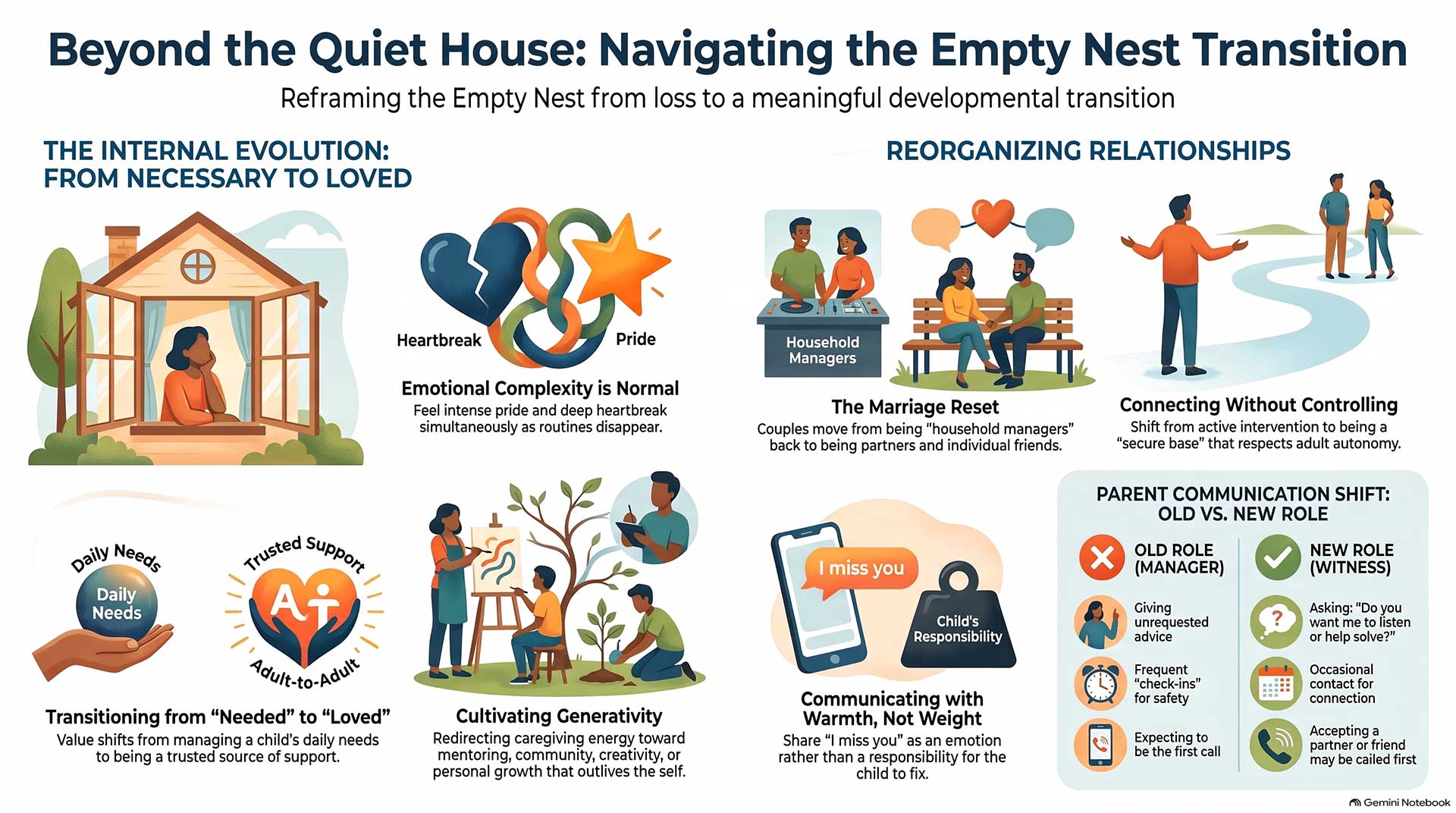
A parent spends years preparing a child to leave.
That may be one of parenthood's strangest contradictions.
You teach them to walk so they will eventually walk away from your hand.
You teach them to think so they will eventually make decisions without asking you.
You teach them courage so they can enter places where you cannot follow.
You teach them independence, then discover that their independence changes your own life.
The scholars in these conversations repeatedly returned to one idea:
The relationship does not end when daily parenting ends. Its form changes.
At first, parents provide protection.
Then guidance.
Later, perhaps something quieter.
Presence.
Trust.
Perspective.
A place where the adult child can return without surrendering adulthood.
This does not mean parents should pretend they are not lonely.
Missing a child is not weakness.
Crying in an empty bedroom does not mean the parent wants the child to fail.
Feeling relieved by a quieter house does not mean the parent loved less.
Pride and grief can live together.
Freedom and loneliness can live together.
A parent can deeply miss the years that have passed and still build a meaningful future.
The hardest transition may come when parents stop asking:
"How can I remain necessary?"
and begin asking:
"How can I remain loving?"
That change affects everything.
How often they call.
How they give advice.
How they respond to mistakes.
How they relate to a spouse.
How they use their time.
How they interpret silence.
How they see the years ahead.
For some parents, the next chapter may involve marriage.
For others, friendship.
Faith.
Mentoring.
Creative work.
Community.
Grandchildren.
Service.
Learning.
Travel.
Care for aging relatives.
Or simply rediscovering parts of themselves that spent twenty years waiting.
None of these activities replaces the child.
That should not be the goal.
A child is not a vacancy that must be filled.
The deeper task is learning that the capacity to love which grew through parenthood can continue flowing into life in new ways.
Perhaps that is why the phrase empty nest never tells the whole story.
A bedroom may be empty.
A chair may be empty.
Dinner may suddenly require fewer plates.
But love has not disappeared.
The relationship has not disappeared.
The parent's value has not disappeared.
The future has not disappeared.
Parenthood began with holding.
Adult parenthood may require something more difficult:
holding the relationship gently enough that the child can move freely.
And perhaps, after years of saying,
"I've got you,"
a parent eventually learns to say:
"I trust you."
Then one final sentence becomes possible.
"I am going to learn how to live fully too."
Short Bios:
Geneviève Bouchard is a psychologist whose research has examined parents' experiences as children leave home. Her work helps challenge the stereotype that empty nesting produces one universal emotional response. Some parents experience grief and identity disruption, others experience greater freedom and well-being, and many experience both.
In this discussion, Bouchard helps distinguish normal transitional sadness from deeper psychological distress and examines how parents adapt when everyday caregiving suddenly decreases.
Susan Krauss Whitbourne is a psychologist known for her work in adult development, aging, personality, and identity.
Her perspective is especially useful for understanding why parenthood remains part of someone's identity long after children leave home. She helps explore how identity evolves across adulthood and why a change in parenting responsibilities can trigger much larger questions about aging, purpose, and the self.
Barbara Mitchell is a sociologist and family researcher whose work has examined empty nesting, intergenerational relationships, family transitions, gender, and changing family structures.
Mitchell brings the cultural and sociological dimension to the conversation. She challenges the assumption that every family experiences children's departure in the same way and examines how gender expectations, social roles, economics, and cultural traditions shape the transition.
Karen Fingerman is a leading researcher on relationships between parents and their adult children.
Her work examines how parents and grown children remain connected through emotional support, communication, practical assistance, financial help, advice, and everyday contact.
In these conversations, Fingerman addresses one of the most difficult questions facing empty nest parents:
How can parents remain close to adult children without interfering with their independence?
Lisa Neff is a psychologist whose research focuses on marriage, close relationships, stress, and how couples adapt across major life transitions.
Her perspective becomes central when the children leave and the couple must rediscover what exists between them apart from parenting.
Neff explores why some marriages grow closer after the empty nest transition, why others reveal long-standing distance, and how couples can begin creating a relationship suited to the next stage of life.
Erik Erikson was a developmental psychologist best known for his theory of psychosocial development across the human lifespan.
His concept of generativity is especially relevant to empty nest parents.
Generativity describes the desire to guide, nurture, create, contribute, and leave something valuable for future generations.
Erikson's perspective asks parents to consider whether the energy once concentrated mainly on raising children might gradually widen into mentoring, service, creativity, community, teaching, or other forms of contribution.
Viktor Frankl was an Austrian psychiatrist, neurologist, Holocaust survivor, and author of Man's Search for Meaning.
His work centered on the human search for meaning, responsibility, suffering, freedom, and how people respond when circumstances cannot be controlled.
Frankl's perspective brings an existential and spiritual dimension to the empty nest transition.
When parents can no longer control their children's choices or guarantee their safety, his ideas raise a deeper question:
Can love remain meaningful when it must release control?
Within this discussion, Frankl helps move the empty nest from a problem of absence into a larger exploration of freedom, meaning, responsibility, and the continuing possibility of a purposeful life.
Leave a Reply