
Introduction
What happens when intelligence is no longer centered on human beings?
That question sits at the heart of this imagined discussion between Masayoshi Son, Elon Musk, Sam Altman, Demis Hassabis, and Jensen Huang.
Son begins with an extraordinary 2040 vision: vast numbers of AI agents, humanoid robots working across the physical economy, immense data-center capacity, and a future in which human beings increasingly surround themselves with machine intelligence.
From there, the discussion moves far beyond technology.
The five participants debate whether 2040 is realistic, who may own the wealth created by AI, what happens to human purpose when machines perform much of the work, whether Earth can physically support the required energy and infrastructure, and finally what remains uniquely human if machines become more intelligent than we are.
Their disagreements are sharp.
Son sees hesitation as one of the greatest risks.
Musk keeps returning to control, safety, and human agency.
Altman focuses on abundance, access, and how society may distribute the gains.
Hassabis questions the difference between intelligence, consciousness, experience, and wisdom.
Huang repeatedly brings the conversation back to physical reality: chips, factories, electricity, cooling, grids, materials, and the enormous industrial foundation required to make any AI future real.
Yet one question gradually becomes more important than all the others:
If machines can think faster, remember more, discover more, and eventually perform most useful work better than humans, does that make human life less valuable?
The discussion arrives at a very different answer.
Perhaps intelligence was never the true measure of human worth.
A child does not need to outperform anyone to deserve love.
A person does not become less human when cognitive ability declines.
A friendship does not matter due to efficiency.
A family does not become valuable through productivity.
The arrival of superintelligence may therefore create an unexpected challenge.
Humanity may have to discover what it values about itself once being the smartest species is no longer part of the answer.
(Note: This is an imaginary conversation, a creative exploration of an idea, and not a real speech or event.)
Topic 1: Is 2040 Really the Point of No Return?
The room had gone quiet after Masayoshi Son finished describing the future he believed was approaching.
A screen behind him still showed the scale he had been talking about.
100 trillion AI agents.
One billion humanoid robots.
Three terawatts of AI data centers.
Quetta-scale computation.
Masayoshi Son: I know these numbers sound crazy. I know that. When people hear one hundred trillion agents, they think, "Masa has gone too far again."
He smiled.
Masayoshi Son: But I don't start with the number and try to make a story around it. I start with the world I think is coming. Then I ask what infrastructure that world requires.
Jensen Huang: That's the right direction of reasoning, but the numbers still matter.
Masayoshi Son: Of course.
Jensen Huang: Three terawatts is not an abstract number. You need generation. You need grids. You need substations. You need transformers. You need cooling. You need fabs capable of manufacturing the chips. You need packaging. Memory. Networking. Copper. Land. People.
Son nodded.
Masayoshi Son: Exactly. That's why I keep saying business leaders need to think fifteen years ahead. You cannot decide in 2038 that you need three terawatts in 2040.
Elon Musk: The infrastructure may actually be the easier part.
Son turned toward him.
Masayoshi Son: Easier?
Elon Musk: Compared with knowing what happens when the intelligence running on it becomes smarter than us.
A short silence followed.
Sam Altman: That's really two questions. One is whether the systems get there. The other is what happens if they do.
Elon Musk: The second question gets very urgent once the first answer becomes yes.
Demis Hassabis: I would split the first question further. Smarter than humans at what?
Masayoshi Son: Eventually, almost everything.
Demis Hassabis: That's possible. But that's exactly where definitions matter. A system can exceed the best human in protein structure prediction and still lack general scientific judgment. It can become extraordinary at mathematics without being able to independently run a research program for months.
Masayoshi Son: But Demis, look at the direction.
Demis Hassabis: I am looking at the direction.
Masayoshi Son: Every year the list gets shorter.
Demis Hassabis: Yes.
Masayoshi Son: First people said AI cannot recognize images. Then it could. It cannot translate naturally. Then it could. It cannot write. It cannot code. It cannot reason. It cannot do science.
Son leaned forward.
Masayoshi Son: The sentence keeps changing, but it always starts with "AI cannot."
Sam Altman: And then six months later we're debating whether the thing it just did counts.
Several of them laughed.
Elon Musk: Humans are very good at moving the goalposts when machines cross them.
Demis Hassabis: That's true, but I don't think we should move too quickly from "AI beats humans on many tasks" to "we have superintelligence."
Masayoshi Son: What would you require?
Demis Hassabis: A system capable of independently generating important new knowledge across many domains. It should identify research questions humans missed, design experiments, interpret ambiguous results, revise its own hypotheses, and continue doing that without a person constantly steering it.
Jensen Huang: For days?
Demis Hassabis: Eventually months.
Sam Altman: That may be one of the milestones.
Elon Musk: And if it can do AI research too, things get interesting very quickly.
Masayoshi Son: That's exactly my point.
Elon Musk: I know. It's the part of your point that worries me.
Son laughed.
Masayoshi Son: Elon, you build rockets to Mars. You build humanoid robots. You build AI. You work on brain interfaces. Then you tell me I'm too optimistic.
Elon Musk: I'm not saying don't build it. I'm saying that if you build something smarter than you, maybe you should spend some time thinking about what it wants.
Masayoshi Son: It doesn't have to want anything.
Elon Musk: That's an assumption.
Sam Altman: There's another possibility. We may not get one singular superintelligence that suddenly wakes up. We may get millions of systems becoming progressively more capable, integrated into the economy one task at a time.
Masayoshi Son: That's even closer to my hundred trillion.
Sam Altman: Maybe. But the economic transition may look less like one giant intelligence taking over and more like competence becoming extremely cheap.
Jensen Huang: That's a very important distinction.
Sam Altman: Today expertise is scarce. A great programmer is scarce. A great analyst is scarce. A great tutor is scarce. A great designer is scarce. If AI makes competent cognitive work abundant, you change the economics long before you reach some philosophical definition of superintelligence.
Masayoshi Son: Yes. Exactly.
Sam Altman: You could be wrong about the number of agents and still be right about the economic direction.
Masayoshi Son: I will take that.
Elon Musk: He will take any sentence that ends with "Masa is right."
The room laughed again.
Masayoshi Son: Of course.
Jensen looked again at the numbers on the screen.
Jensen Huang: I want to challenge one thing.
Masayoshi Son: Please.
Jensen Huang: One hundred trillion agents sounds huge partly since we're still thinking of an agent as something like a digital employee.
Masayoshi Son: Yes.
Jensen Huang: But what if an agent becomes much smaller than that?
Sam Altman: A micro-agent.
Jensen Huang: Exactly. An agent that exists for three seconds.
"Find the cheapest route."
"Check this contract clause."
"Compare these two components."
"Run this simulation."
"Negotiate this transaction."
Then it disappears.
Demis Hassabis: In that definition, one hundred trillion stops sounding quite so impossible.
Elon Musk: It might sound conservative.
Son smiled broadly.
Masayoshi Son: Thank you, Elon.
Elon Musk: Don't get excited. I'm helping with your agent number. I'm not helping with your safety assumptions.
Masayoshi Son: I'll take half.
Sam Altman: The number gets stranger once agents create agents.
The tone in the room changed slightly.
Demis Hassabis: That's the point where definitions become especially important.
Masayoshi Son: Humans create agents now. Eventually agents will create agents.
Elon Musk: Yes.
Masayoshi Son: And agents will improve agents.
Elon Musk: Yes.
Masayoshi Son: Then one hundred trillion is not the end.
Elon Musk: Correct.
Masayoshi Son: So why do you look worried?
Elon Musk: You just answered your own question.
Son watched him.
Elon Musk: Think about biology. Evolution is slow. DNA mutates. Organisms reproduce. Selection happens over generations.
Software doesn't need generations in the biological sense.
A machine can copy itself almost instantly.
A machine can test ten thousand variants.
A machine can communicate improvements to every other copy.
If the system becomes competent at improving the process that improves itself, the speed changes.
Demis Hassabis: That's still a very large "if."
Elon Musk: Of course.
Demis Hassabis: Recursive self-improvement is discussed as though it is automatic. It isn't. Designing genuinely better intelligence may remain extraordinarily hard, including for AI.
Sam Altman: Yet it doesn't need unlimited recursive improvement to have a huge effect.
Demis Hassabis: Correct.
Sam Altman: Suppose AI increases AI research productivity by 30 percent.
Then later 60 percent.
Then researchers use those systems to create better tools.
You don't need an overnight intelligence explosion. A sustained acceleration matters enormously.
Masayoshi Son: This is why fifteen years is such a long time.
Jensen Huang: In software.
Masayoshi Son: Yes.
Jensen Huang: Fifteen years is shorter in infrastructure.
Son paused.
Jensen Huang: That's the tension.
AI capability can move in months.
Power generation takes years.
Fabs take years.
Transmission lines take years.
Data centers take years.
So the intelligence layer may accelerate much faster than the physical layer underneath it.
Masayoshi Son: Which means we build now.
Jensen Huang: It means we have to build intelligently now.
There's a difference.
Masayoshi Son: Fair.
Demis Hassabis: This may be the real bottleneck question.
Not "Can AI become much smarter?"
It probably can.
The question is which constraint becomes dominant at each stage.
Compute might constrain one generation.
Energy might constrain another.
Data quality may constrain another.
Reliability may become the hard problem once agents receive more autonomy.
Sam Altman: Reliability is underrated.
Elon Musk: Very underrated.
Masayoshi Son: Why?
Sam Altman: A system can be brilliant 99 percent of the time and still be unusable for some autonomous tasks.
Jensen Huang: Aviation is a good example.
Sam Altman: Exactly. If you're asking an AI to write a draft email, 99 percent can feel incredible.
If you're asking it to autonomously control a billion-dollar operation, that missing one percent becomes the story.
Demis Hassabis: Or scientific research. A model may generate twenty profound ideas and one convincing but false conclusion. Detecting the false conclusion may require exactly the expertise you're trying to automate.
Masayoshi Son: Then other agents check it.
Elon Musk: And who checks the checking agents?
Masayoshi Son: More agents.
Elon Musk: And now we have religion.
That produced the loudest laughter yet.
Son shook his head, smiling.
Masayoshi Son: No. We have redundancy.
Elon Musk: I'm joking, but it's a serious point. More intelligence doesn't automatically create more truth. Systems can share the same failure mode.
Demis Hassabis: That's right. Independent verification has to actually be independent.
Jensen Huang: Hardware learned this long ago. Redundancy helps when failures are sufficiently uncorrelated.
Sam Altman: AI systems may need the equivalent of institutional checks and balances.
Masayoshi Son: That's fine. Build them.
Elon Musk: That's the phrase that scares safety people.
Masayoshi Son: What should I say? Don't build them?
Elon Musk: Build them very carefully.
Masayoshi Son: And if China builds faster?
Elon Musk: That's the problem.
The room became quieter again.
Masayoshi Son: This is what I mean when I say it cannot stop. Japan says stop. America continues. America says stop. China continues. China stops, someone else continues.
Demis Hassabis: Competition makes coordination harder.
Masayoshi Son: Much harder.
Sam Altman: But "difficult to stop" and "impossible to govern" aren't the same statement.
Elon Musk: Exactly.
Masayoshi Son: I agree with governance. I'm against paralysis.
Elon Musk: And I'm against recklessness.
Masayoshi Son: Then maybe we disagree about where recklessness begins.
Elon Musk: Probably.
Demis Hassabis: That may actually be the most important disagreement here.
Not whether advanced AI arrives.
Most of us think increasingly capable systems are coming.
The disagreement is how much uncertainty society should tolerate as capability rises.
Jensen Huang: Engineers deal with this constantly.
You don't wait until you have zero uncertainty.
You define acceptable risk.
You design safeguards.
You test.
You build.
You measure.
Then you improve.
Elon Musk: That works very well when the bridge doesn't redesign itself.
Jensen smiled.
Jensen Huang: Fair point.
Sam Altman: There is another uncertainty we haven't discussed.
What if 2040 is too late?
Son immediately looked toward him.
Masayoshi Son: Good.
Sam Altman: We keep asking whether Masa is too aggressive.
What if he's actually being conservative?
Demis Hassabis: In which dimension?
Sam Altman: Agents.
Imagine systems capable of carrying out economically valuable tasks for a full workday with little supervision.
Then a week.
Then a month.
Once that happens, adoption can move extremely fast.
You don't need one hundred trillion agents at first.
Ten million very capable autonomous agents could already change industries.
Jensen Huang: Especially software industries.
Sam Altman: Yes.
Masayoshi Son: And then those companies outperform the companies without agents.
Sam Altman: Very likely.
Masayoshi Son: Then competitors adopt.
Sam Altman: Yes.
Masayoshi Son: Then adoption accelerates.
Sam Altman: Yes.
Masayoshi Son: So maybe 2040 is late.
Sam Altman: Parts of your scenario might be.
Elon Musk: Robotics will probably lag software.
Jensen Huang: Physical atoms are slower than bits.
Elon Musk: A software agent can be copied in seconds. A humanoid needs motors, actuators, batteries, factories, logistics, maintenance.
Masayoshi Son: But once humanoids build humanoids?
Elon Musk: Now you're talking.
Demis Hassabis: That would change the manufacturing curve considerably.
Jensen Huang: It still doesn't eliminate materials and energy constraints.
Masayoshi Son: Nothing eliminates constraints. Intelligence finds ways around constraints.
Demis Hassabis: Often.
Masayoshi Son: That's what civilization is.
We couldn't cross oceans.
We built ships.
We couldn't fly.
We built aircraft.
We couldn't calculate fast enough.
We built computers.
Now we have an intelligence constraint.
We're building something that may remove that too.
Elon Musk: Or remove us.
Son turned toward him.
Masayoshi Son: You really want to keep saying that.
Elon Musk: Someone should.
A few seconds passed before Hassabis spoke.
Demis Hassabis: Perhaps we should ask what evidence would actually change each person's mind.
That's often more useful than arguing over forecasts.
Jensen Huang: Good.
Sam Altman: Between now and 2030?
Demis Hassabis: Yes.
What would convince us that Masa's 2040 scenario is substantially on track?
Son answered immediately.
Masayoshi Son: Enterprises.
When major companies stop "using AI" and start operating through agents.
I don't mean employees opening an AI chatbot.
I mean workflows being autonomously executed.
Finance agents talking to procurement agents.
Sales agents talking to customer agents.
Engineering agents talking to manufacturing agents.
Millions, then billions of these interactions happening without a human typing every instruction.
When that becomes normal, people will finally see the world I'm describing.
Jensen Huang: Mine would be infrastructure commitments.
If governments and companies begin planning power generation, transmission, and computing infrastructure at scales that look irrational by today's standards, that tells you decision-makers have started pricing in a very different future.
Demis Hassabis: Mine would be autonomous scientific discovery.
I would want to see AI propose a genuinely important hypothesis that humans had missed, design the relevant experimental program, interpret the results, revise the theory, and produce something scientifically significant with limited human guidance.
If we see that repeatedly across different scientific fields, I would take it very seriously.
Sam Altman: Mine is sustained autonomous economic work.
When an agent can receive a complicated objective on Monday and return weeks later having coordinated tools, people, software, documents, decisions, negotiations, and unexpected problems, with a result comparable to a strong human team, we'll know something fundamental has changed.
They looked toward Musk.
He remained silent for a moment.
Elon Musk: Mine would be AI materially improving AI research without people knowing in advance what improvements it will find.
Not just coding faster.
Not summarizing papers.
An AI looking at the entire research process and discovering a path we didn't see.
If that happens repeatedly, timelines become very hard to predict.
Masayoshi Son: Earlier.
Elon Musk: Potentially much earlier.
Son leaned back.
Masayoshi Son: Then perhaps we agree more than we disagree.
Elon Musk: No.
Son laughed.
Elon Musk: We agree the train may be moving very fast.
You want to know how much faster we can make it.
I want to know whether anyone has checked the brakes.
Masayoshi Son: I want brakes too.
Elon Musk: Good.
Masayoshi Son: I simply refuse to confuse brakes with parking.
Jensen nodded slowly.
Jensen Huang: That's probably the real question for the next decade.
How do you keep moving without pretending speed has no cost?
Demis Hassabis: And how do you remain cautious without pretending staying still has no cost either?
Sam Altman: There may not be a safe version of doing nothing.
Elon Musk: There may not be a perfectly safe version of doing something.
Son looked once more at the enormous numbers behind him.
Masayoshi Son: That's why I don't think the important question is, "Will my number be exactly right?"
Maybe there are fifty trillion agents.
Maybe two hundred trillion.
Maybe the humanoid number is five hundred million.
Maybe two billion.
Those differences matter for engineers and investors.
But for civilization, the important question is different.
He looked around the table.
Masayoshi Son: Are we preparing for a world where intelligence is no longer scarce?
No one answered immediately.
And that silence opened the door to a much harder question.
If intelligence really did become abundant, if machines could work, reason, negotiate, invent, and produce on a scale humanity had never experienced before, then the next battle might not be about whether the technology could create wealth.
It might be about who would own that wealth, and who would be left outside it.
Topic 2: When AI Does the Work, Who Gets the Wealth?
The room still carried the tension from the first discussion.
They had spent nearly an hour arguing over whether Masayoshi Son's 2040 vision was too aggressive, too conservative, or simply impossible to predict.
Now the question changed.
Not whether AI would create extraordinary value.
But who would own it.
Masayoshi Son: Let us assume for a moment that the direction is right.
Not every number. Not every date.
But the direction.
AI agents become widespread. Humanoid robots become useful. Productivity rises dramatically. Companies become much more efficient.
Then the world becomes richer.
Elon Musk: Some parts of the world become richer.
Masayoshi Son: The whole economy becomes richer.
Elon Musk: That's not the same thing.
Son looked at him.
Elon Musk: You can increase total wealth enormously and still create a society where a very small number of people own most of the productive capacity.
Sam Altman: That's probably one of the central economic questions.
Jensen Huang: It depends partly on how accessible the technology becomes.
Demis Hassabis: And whether intelligence becomes centralized or widely distributed.
Masayoshi Son: But technology tends to become cheaper.
Look at computing.
Look at communications.
Things that were once available only to governments or large corporations eventually reached ordinary people.
Why should AI be different?
Elon Musk: Since the most capable systems may require enormous capital.
Compute isn't free.
Data centers aren't free.
Energy isn't free.
Robotics factories aren't free.
If the best intelligence is owned by a few companies, those companies may have an economic advantage unlike anything we've seen before.
Masayoshi Son: Then others will compete.
Elon Musk: Maybe.
Masayoshi Son: Of course they will.
Elon Musk: Unless the cost of entry becomes so high that only a handful of players can compete.
Jensen leaned forward.
Jensen Huang: There are two layers here.
The foundation models may be expensive.
The infrastructure may be expensive.
But the applications built on top of them could still become widely distributed.
You don't need to own a semiconductor fab to build a software company.
Sam Altman: That's an important distinction.
A small team may eventually command enormous cognitive resources without owning the underlying data center.
Masayoshi Son: Exactly.
Sam Altman: But access terms matter.
If intelligence becomes something you rent, then whoever controls access has a lot of influence over the economy.
Demis Hassabis: This resembles earlier infrastructure transitions.
Electricity became foundational.
Telecommunications became foundational.
Cloud computing became foundational.
But intelligence may be even more fundamental, since intelligence helps determine what to build, how to compete, how to discover, how to organize.
Elon Musk: That's why concentration matters so much.
If you control superior intelligence, you don't merely own another product.
You own something that helps you make better decisions about every other product.
Masayoshi Son: But the market will not allow one company to own everything.
Elon Musk: Markets don't have moral opinions.
They produce outcomes from incentives.
Masayoshi Son: Competition creates alternatives.
Elon Musk: Unless the winner improves faster than everyone else.
Sam Altman: That's the uncomfortable part.
Imagine two companies.
One has 10,000 AI agents.
The other has 100,000.
Then the second company uses those agents to improve its products faster, reduce costs faster, recruit better, negotiate better, and perhaps build better agents.
The advantage can compound.
Jensen Huang: That's true in infrastructure too.
Scale produces purchasing advantages.
Better utilization.
Better engineering.
Better data.
Better optimization.
Demis Hassabis: Which means the economic question is not simply whether AI increases productivity.
It is whether productivity gains diffuse across society.
Son shook his head slightly.
Masayoshi Son: But this sounds too pessimistic.
Every major technological revolution created winners.
The automobile created enormous companies.
Electricity created enormous companies.
The Internet created enormous companies.
But society overall became richer.
Elon Musk: True.
Masayoshi Son: Then why assume AI is different?
Elon Musk: Since AI may substitute for both labor and expertise at the same time.
Son stopped.
Elon Musk: The industrial revolution replaced muscle.
Software replaced some routine information work.
AI could replace significant portions of cognitive labor.
Robotics could replace significant portions of physical labor.
If both happen together, the bargaining position of human labor changes.
Sam Altman: That's the real discontinuity.
Demis Hassabis: Historically, workers remained necessary somewhere else in the production process.
Elon Musk: Exactly.
Jensen Huang: But human demand doesn't disappear.
Elon Musk: Demand requires purchasing capacity.
Jensen nodded.
Elon Musk: Suppose machines make almost everything.
Fine.
Who buys it?
Masayoshi Son: Prices fall.
Elon Musk: Maybe dramatically.
Masayoshi Son: Then people need less income.
Elon Musk: Less is not zero.
Sam Altman: And some goods remain scarce regardless.
Land.
Housing in desirable places.
Human attention.
Status goods.
Certain natural resources.
Demis Hassabis: Healthcare may remain expensive too, especially advanced personalized therapies.
Masayoshi Son: Until AI lowers those costs.
Demis Hassabis: It may lower discovery costs.
Manufacturing, regulation, clinical validation, personalized delivery, physical infrastructure can remain expensive.
Masayoshi Son: Fine.
Then we make those better too.
Elon smiled.
Elon Musk: Masa's answer to every scarcity is another technology company.
Masayoshi Son: Yes.
Why not?
The group laughed.
Sam Altman: Let me ask the harder version.
Suppose AI creates ten times more economic output.
Does that automatically mean the median person becomes ten times better off?
Masayoshi Son: No.
Sam Altman: Good.
Masayoshi Son: But it means the opportunity exists.
Sam Altman: Right. Distribution becomes a separate problem.
Masayoshi Son: Society has always had distribution problems.
Sam Altman: Yes, but if labor income becomes less central, we may need new mechanisms.
Jensen Huang: Such as?
Sam Altman: Broader ownership.
Public investment.
Citizen participation in AI infrastructure.
Perhaps dividends linked to national productivity.
I'm not saying one model is correct.
I'm saying wages may not remain the only way people participate in prosperity.
Elon Musk: Some form of universal high income may eventually become necessary.
Masayoshi Son: Universal basic income?
Elon Musk: Maybe beyond basic.
If goods and services become abundant, the economic system may look very different.
Jensen Huang: I'm cautious about assuming work disappears.
Every technological shift creates new forms of work people couldn't predict before.
Elon Musk: This one may be different in degree.
Jensen Huang: Possibly.
But when computing became more capable, demand for computing exploded.
When communications became cheaper, communication exploded.
When software became easier to build, more software was built.
If intelligence becomes cheaper, we may simply use much more intelligence.
Demis Hassabis: That doesn't guarantee human employment.
Jensen Huang: No.
But it means economic activity can expand rather than contract.
Masayoshi Son: That's what I keep saying.
The work doesn't disappear.
The work moves.
Elon Musk: The economic activity moves.
That doesn't mean the employment moves one-for-one.
Masayoshi Son: Fine.
But people can become entrepreneurs.
Elon Musk: Some can.
Masayoshi Son: More than today.
Imagine one person with one thousand agents.
That person can build what previously required one hundred employees.
Sam Altman: That's one of the genuinely exciting possibilities.
AI could dramatically reduce the minimum scale needed to start a company.
Demis Hassabis: A scientist could have a virtual research team.
Jensen Huang: An engineer could have a design organization.
Masayoshi Son: A small shop owner could have accounting, marketing, customer service, procurement, research, all handled by agents.
Elon Musk: That's the optimistic version.
Masayoshi Son: It's a real version.
Elon Musk: Yes.
But now imagine the competing corporation has ten million agents.
Masayoshi Son: Then be better.
Elon Musk: That's not an economic policy.
Son laughed.
Masayoshi Son: It is an entrepreneur's policy.
Sam Altman: This is where the two perspectives separate.
At the individual level, AI may be incredibly empowering.
At the system level, it may still concentrate wealth.
Both can be true.
Demis Hassabis: Exactly.
An individual scientist might gain capabilities that once required an institution.
At the same time, the owners of the underlying compute may accumulate enormous wealth.
Jensen Huang: But hardware competition remains substantial.
There are multiple layers where value can move.
Compute.
Models.
Platforms.
Applications.
Robotics.
Energy.
Domain-specific AI.
Masayoshi Son: Which means opportunities everywhere.
Elon Musk: And concentration at several layers too.
A brief silence followed.
Sam Altman: Let me ask something more fundamental.
Why do we assume the future economic unit should remain the human worker?
Masayoshi Son: Good.
Sam Altman: Today we measure productivity per employee.
Revenue per employee.
GDP per worker.
What happens when a company has fifty people and fifty thousand agents?
Does it have fifty workers?
Fifty thousand fifty?
Do agents count as capital?
Labor?
Software?
Something else?
Demis Hassabis: Our economic vocabulary may become outdated.
Jensen Huang: Accounting standards certainly weren't built for autonomous digital labor.
Elon Musk: Imagine an AI agent that negotiates contracts, buys resources, hires other agents, manages capital, and earns revenue.
At what point does it stop looking like software?
Masayoshi Son: It doesn't matter what we call it.
Demis Hassabis: It matters legally.
Sam Altman: Very much.
Who is responsible for its actions?
Who owns what it creates?
Who pays tax on its output?
Who bears liability?
Elon Musk: Can it own assets?
Jensen Huang: Now you've created a very complicated accounting meeting.
Masayoshi Son: Let the AI attend it.
They laughed again.
Demis Hassabis: There's another issue.
If agents become extremely productive, taxation based heavily on wages becomes less effective.
Sam Altman: Yes.
Elon Musk: Governments may eventually tax machine production, capital, or automated output differently.
Masayoshi Son: Be careful.
If you tax automation too aggressively, you slow adoption.
Elon Musk: If you don't adapt the tax system at all, you may hollow out the revenue base.
Masayoshi Son: Then tax consumption.
Sam Altman: Possibly.
Demis Hassabis: The broader point is that institutions built around human labor may need redesign.
Jensen Huang: That's true.
Masayoshi Son: But don't redesign before the productivity arrives.
Elon Musk: Agreed.
Masayoshi Son: Good.
Elon Musk: We can agree occasionally.
Masayoshi Son: Very occasionally.
Sam smiled.
Sam Altman: Let me push this into fairness.
Suppose an AI system is trained partly on the accumulated knowledge of humanity.
Books.
Scientific papers.
Software.
Art.
Public data.
Generations of human work.
Then a small number of companies build extremely valuable systems from that inheritance.
Does society have some claim on the resulting value?
Son looked at him carefully.
Masayoshi Son: Investors take risk.
Engineers build the systems.
Companies spend enormous amounts of money.
They deserve returns.
Sam Altman: Certainly.
I'm asking whether those returns need to be exclusive.
Jensen Huang: That's a different question.
Demis Hassabis: Knowledge is inherently cumulative.
Newton depended on earlier mathematics.
Modern medicine depends on generations of researchers.
AI makes that inheritance unusually visible.
Elon Musk: Civilization is always built on previous civilization.
Masayoshi Son: Then every successful company owes society everything?
Sam Altman: No.
But perhaps some portion of AI-generated abundance can be shared more broadly without destroying the incentives that created it.
Masayoshi Son: That's reasonable.
Elon Musk: We just got Masa to support redistribution.
Masayoshi Son: Don't put words in my mouth.
They laughed.
Masayoshi Son: I support prosperity.
I don't support punishing the people who create it.
Sam Altman: Those don't have to conflict.
Demis Hassabis: The harder question may be what society defines as a minimum entitlement in an age of abundance.
Jensen Huang: Food?
Housing?
Healthcare?
Education?
Compute?
Elon Musk: Maybe intelligence itself.
The room paused.
Sam Altman: That's interesting.
Elon Musk: If advanced AI becomes necessary to participate effectively in society, access to intelligence may become similar to access to education or communications.
Demis Hassabis: A kind of cognitive infrastructure.
Jensen Huang: That's a powerful way to frame it.
Masayoshi Son: I like that.
Everyone should have their own agents.
Sam Altman: That's much closer to the optimistic future.
Not one central AI controlling everything.
Billions of people each having powerful AI capabilities.
Elon Musk: Provided their agents genuinely serve them.
Demis Hassabis: Rather than serving the platform behind them.
Jensen Huang: That distinction will matter enormously.
Masayoshi Son: Personal ownership.
Sam Altman: Or at least personal control.
Elon Musk: Control is more important than the marketing language around ownership.
If your assistant knows every message, every financial decision, every medical concern, every relationship, every preference, it becomes one of the most intimate technologies you've ever used.
Who controls that agent matters.
Demis Hassabis: And who can change its behavior.
Masayoshi Son: Then people must have trusted agents.
Sam Altman: Which brings us back to wealth.
If everyone owns or controls capable agents, AI may distribute productive capacity much more broadly.
If only a small number of institutions control them, the opposite happens.
Jensen Huang: The architecture of the technology shapes the architecture of the economy.
Elon Musk: Exactly.
Son leaned forward again.
Masayoshi Son: I still think we're underestimating opportunity.
Suppose you are a twenty-year-old today.
You have no money.
No employees.
No office.
But you have ten excellent agents.
One does research.
One does software.
One does design.
One does marketing.
One does accounting.
One negotiates.
One monitors customers.
One creates video.
One manages your schedule.
One challenges your decisions.
That twenty-year-old suddenly has something like a company.
Sam Altman: That's real.
Masayoshi Son: Now give that person one hundred agents.
Demis Hassabis: The barrier between individual and institution begins to blur.
Jensen Huang: That's already starting conceptually.
Elon Musk: Yes, but there will still be differences in capability.
A wealthy company may have agents trained on proprietary data, better compute, better tools, better robotics.
Masayoshi Son: There have always been differences.
Elon Musk: True.
The question is whether AI narrows those differences or magnifies them.
Sam Altman: Probably both.
Demis Hassabis: At different layers.
Jensen Huang: And at different stages.
The first generation may be concentrated.
Then capability diffuses.
Then another frontier appears.
Masayoshi Son: Exactly.
This is technology.
Frontier becomes commodity.
Then new frontier.
Elon Musk: That's probably the best argument for optimism.
Masayoshi Son: Write that down.
Elon Musk: Don't get used to it.
Son laughed.
Sam Altman: I want to bring us to the hardest scenario.
Suppose AI genuinely creates ten times as much wealth as today's economy.
What should an ordinary person receive from that?
Not an engineer.
Not a founder.
Not a shareholder.
Just someone born into that society.
Masayoshi Son: Opportunity.
Elon Musk: That's insufficient.
Masayoshi Son: Why?
Elon Musk: A child doesn't choose whether their parents own AI assets.
A person with disabilities may not be able to compete in the same way.
A sixty-year-old displaced from an industry cannot necessarily become an AI entrepreneur overnight.
Demis Hassabis: Transition matters.
Jensen Huang: Very much.
Sam Altman: So what do they receive?
Elon Musk: At minimum, access to the abundance the machines create.
Masayoshi Son: Through lower prices.
Elon Musk: Through lower prices, perhaps public services, perhaps direct income, perhaps ownership.
Probably some combination.
Demis Hassabis: I would add education.
If AI becomes a universal tutor, high-quality education could become dramatically more accessible.
That itself is a form of wealth distribution.
Jensen Huang: Access to tools matters too.
Give everyone capable AI and the ability to create.
Sam Altman: My answer would be broader participation in ownership.
If AI infrastructure becomes one of civilization's greatest productive assets, ordinary people should have some path to participate in its economic upside.
Masayoshi Son: My answer remains opportunity.
But let me explain what I mean.
Not the old opportunity.
Not "go to school, work forty years, maybe become manager."
I mean a person with an idea can command intelligence that once belonged only to a giant corporation.
That is extraordinary.
Demis Hassabis: Provided access is broad enough.
Masayoshi Son: Yes.
Jensen Huang: My answer would be accessibility.
Compute, models, tools, education.
The more people who can build with AI, the less likely the technology becomes purely extractive.
They turned toward Elon.
Elon Musk: I think eventually the economic problem becomes easier than the meaning problem.
Sam Altman: Meaning?
Elon Musk: If machines can provide enough goods and services for everyone, we can invent mechanisms for distribution.
Not perfectly, but we can.
The harder problem may be what people do with themselves.
Son smiled.
Masayoshi Son: That's the next topic.
Elon Musk: Yes.
And I think it's harder than you think.
Masayoshi Son: I think people will finally be free.
Elon Musk: Free to do what?
Son answered without hesitation.
Masayoshi Son: Whatever moves their heart.
Musk looked at him for a moment.
Elon Musk: And if nothing does?
The room became still.
The question sounded economic for only a second.
Then everyone realized it wasn't.
If machines could produce abundance, if intelligence could be rented cheaply, if robots could take over much of the labor that had organized human civilization for centuries, then humanity might solve one ancient problem only to discover another.
For most of history, people had asked:
How do I survive?
The AI age might force them to ask something far more personal:
Why am I here?
Topic 3: One Billion Robots: What Happens to Human Purpose?
The room stayed quiet after Musk's question.
Elon Musk: And if nothing does?
Masayoshi Son looked at him for a moment.
Masayoshi Son: Then maybe that is the problem we finally have time to face.
Sam Altman: I think that's right.
For most people, work has never been just income.
It gives structure.
A reason to wake up at a certain time.
People who expect you.
Problems to solve.
A sense that you are useful.
Demis Hassabis: And identity.
Ask someone, "Who are you?"
Very often they answer with their occupation.
"I'm a teacher."
"I'm an engineer."
"I'm a physician."
"I'm a designer."
"I'm a driver."
"I'm a scientist."
If machines take away large portions of work, the question is not simply what people will do with their hours.
It is what happens to identity.
Jensen Huang: I think people underestimate how adaptable humans are.
We've gone through huge technological changes before.
Agriculture changed work.
Industrialization changed work.
Computers changed work.
The Internet changed work.
People created new occupations every time.
Elon Musk: But there is a difference.
Previous machines replaced certain abilities.
They didn't compete across nearly every ability at once.
Jensen Huang: That's fair.
Elon Musk: Suppose you are an accountant.
AI becomes better at accounting.
You say, "Fine, I'll learn programming."
Then AI becomes better at programming.
You decide to become a designer.
AI is better at that too.
You become a researcher.
The AI reads everything, remembers everything, runs simulations faster than you.
At some point society cannot keep answering displacement with:
"Learn another skill."
Sam Altman: Which may be good.
Elon Musk: Explain.
Sam Altman: Maybe we've spent two hundred years telling people that their value is what the market will pay them to do.
Perhaps AI forces us to separate two things we should have separated long ago.
Economic value.
Human value.
Masayoshi Son: Exactly.
This is why I am optimistic.
If AI and robots do the boring work, humans can do what they really care about.
Elon Musk: You keep saying that as though everyone already knows what they really care about.
Masayoshi Son: They can find out.
Elon Musk: Maybe.
But meaning is not automatically produced by leisure.
You can give someone all day free and make them miserable.
Demis Hassabis: That's psychologically important.
Purpose often emerges from commitment rather than freedom alone.
You take responsibility for something.
A child.
A family.
A research problem.
A community.
A craft.
Once you commit, your life gains direction.
Masayoshi Son: AI doesn't remove commitment.
Demis Hassabis: No. It may remove externally imposed structure.
Those are different things.
Sam Altman: We may have to get better at creating structure ourselves.
Jensen Huang: And that may be much harder than people think.
Son looked at him.
Jensen Huang: A lot of people complain about work.
Then they retire and suddenly miss it.
Not necessarily the meetings.
They miss being needed.
Elon Musk: Being needed is extremely important.
Masayoshi Son: Your family needs you.
Elon Musk: Yes, but people want to contribute beyond being alive.
Masayoshi Son: Then contribute.
Create something.
Help someone.
Teach.
Build.
Elon Musk: Again, I agree with the answer.
I question whether most people will naturally get there.
Sam Altman: There could be a transition period that is psychologically ugly.
Demis Hassabis: Very ugly.
Imagine millions of people raised under one rule:
Study hard.
Become competent.
Build a career.
Provide for yourself.
Then halfway through their lives, society tells them:
"The thing you spent thirty years becoming good at is no longer economically necessary."
Even in a wealthy society, that can feel like rejection.
Masayoshi Son: Then society must change the way it defines success.
Sam Altman: Yes.
Jensen Huang: That's a cultural problem, not a technical problem.
Elon Musk: And cultural problems can be slower than technical ones.
That may be one of the largest mismatches.
AI improves every year.
Human institutions and identities may take generations to adjust.
Son leaned back.
Masayoshi Son: Let me ask you something, Elon.
If tomorrow you never had to work again, what would you do?
Elon Musk: Work.
They laughed.
Masayoshi Son: That's my point.
Elon Musk: No, that's my point.
I don't work only for money.
Masayoshi Son: Exactly.
Elon Musk: But I happen to have things I find meaningful.
Space.
Engineering.
AI.
The future.
What about someone whose job was the main place they found meaning?
Sam Altman: Maybe the future needs to make purpose more accessible, not just intelligence.
Demis Hassabis: Interesting phrase.
Sam Altman: We spend enormous effort educating people to become economically useful.
Maybe we spend too little helping them discover what they care about.
Jensen Huang: Education might change dramatically if work changes.
Today education is heavily tied to employment.
Get the credential.
Get the skill.
Get the job.
Demis Hassabis: In an AI-rich society, education could return partly to older questions.
What is worth knowing?
What kind of person do you want to become?
What are you curious about?
How should you live?
Masayoshi Son: That sounds beautiful.
Elon Musk: It does.
But don't forget competition.
Humans are status-seeking animals.
You remove jobs, you don't remove status.
People will invent new hierarchies.
Sam Altman: That's probably true.
Jensen Huang: They already do.
Elon Musk: If everyone has enough food, enough housing, enough entertainment, people will still want to be admired.
They'll still compare themselves.
They'll still want to win.
Demis Hassabis: Which suggests scarcity may shift.
From material scarcity to social scarcity.
Attention.
Recognition.
Prestige.
Belonging.
Masayoshi Son: But that is already true.
Demis Hassabis: Yes. AI may make it more visible.
Sam Altman: It could create very strange cultures.
Suppose anyone can generate beautiful art.
Anyone can make a film.
Anyone can write a novel.
Anyone can create music at technical quality far beyond today's average.
Then technical execution becomes cheap.
What becomes scarce?
Jensen Huang: Taste.
Demis Hassabis: Original judgment.
Elon Musk: Authenticity.
Masayoshi Son: Humanity.
They looked toward him.
Masayoshi Son: Think about it.
If machines can produce perfect things, maybe imperfect human things become more valuable.
A child draws a picture for you.
Is it valuable since it is technically good?
No.
It is valuable since your child made it.
Sam Altman: That's a very important distinction.
Demis Hassabis: Origin becomes part of value.
Elon Musk: Human provenance.
Jensen Huang: A handmade chair can already be more valuable than a factory-made chair, though the factory version may be more precise.
Masayoshi Son: Exactly.
The more machines become capable, the more we may care about who made something and why.
Sam Altman: That could happen with conversation too.
If an AI can talk to you perfectly, people may value imperfect human relationships more.
Elon Musk: Or avoid them more.
A silence followed.
Demis Hassabis: That's the darker possibility.
AI companionship could reduce loneliness for some people.
But if the artificial relationship is always patient, always interested, always agreeable, real relationships may feel harder.
Sam Altman: Human relationships require compromise.
Jensen Huang: And patience.
Masayoshi Son: And forgiveness.
Elon Musk: And sometimes putting up with someone who is annoying.
Sam Altman: Frequently.
They laughed.
Demis Hassabis: Those difficulties may be part of what gives relationships depth.
If an AI companion is optimized around your preferences, you risk losing the friction that teaches you to live with another independent mind.
Masayoshi Son: But AI could help people become better at relationships.
Demis Hassabis: It could.
Masayoshi Son: It could tell you, "Don't send that message."
Elon Musk: That alone may save civilization.
They laughed again.
Sam Altman: Imagine an AI that knows when you're angry and says, "Wait twenty minutes."
Jensen Huang: That may create more economic value than half our data centers.
Masayoshi Son: See? AI improves marriage too.
Elon Musk: You're determined to put the entire future into the twenty percent GDP number.
Son smiled.
Masayoshi Son: Absolutely.
The humor faded as Hassabis returned to the larger question.
Demis Hassabis: I want to separate pleasure from fulfillment.
Suppose AI handles everything unpleasant.
No difficult work.
No tedious study.
No repetitive practice.
Would that actually make us happier?
Masayoshi Son: Why wouldn't it?
Demis Hassabis: Since some satisfaction comes from getting through difficulty.
Learning an instrument is frustrating.
Learning mathematics is frustrating.
Training for a sport hurts.
Research involves failure.
Parenthood can be exhausting.
Yet people often describe these as some of the most meaningful parts of their lives.
Elon Musk: Meaning and comfort aren't the same thing.
Sam Altman: That's key.
A future optimized only for comfort could be terrible.
Jensen Huang: People need challenge.
Masayoshi Son: Then choose your challenge.
Elon Musk: That's stronger.
Masayoshi Son: What do you mean?
Elon Musk: Earlier you said machines do the work and humans do what they enjoy.
I think a better version is:
Machines remove forced struggle.
Humans choose meaningful struggle.
Son thought about it.
Masayoshi Son: I like that.
Demis Hassabis: So the objective shouldn't be a frictionless human life.
Sam Altman: No.
It should be giving people more choice over which difficulties are worth enduring.
Jensen Huang: That's a very different future from permanent vacation.
Elon Musk: Permanent vacation sounds good for about three weeks.
Masayoshi Son: Maybe four.
Elon Musk: After that, people start projects.
Sam Altman: Or drama.
Jensen Huang: Often both.
The room laughed.
Demis Hassabis: There is another question.
Would humans continue doing things after AI becomes better at them?
Masayoshi Son: Of course.
Demis Hassabis: Why?
Masayoshi Son: Humans still run.
Cars are faster.
Humans still play chess.
Computers are better.
Humans still cook.
Restaurants exist.
Humans still paint.
Cameras exist.
We don't do things only to be the best machine at doing them.
Elon Musk: That's probably the strongest argument against the idea that human activity disappears.
Jensen Huang: Yes.
When technology exceeds us, sometimes the activity becomes more human rather than less.
Sam Altman: Chess is a great example.
Machines became vastly stronger, yet people didn't stop playing chess.
Demis Hassabis: In some ways chess became richer through computer analysis.
Masayoshi Son: Exactly.
That is the superhuman idea.
Not human versus AI.
Human with AI.
Elon Musk: I agree until the phrase becomes an excuse to hand every decision to the machine.
Masayoshi Son: It doesn't have to.
Elon Musk: That's where agency matters.
If the AI tells you what to eat, who to date, which career to choose, where to live, what to believe, how to invest, when to sleep, how to raise your child, you might be making fewer mistakes.
But are you still living your life?
Sam Altman: That's a very difficult line.
Demis Hassabis: Recommendation can gradually become dependence.
Jensen Huang: We've seen a primitive version with algorithms already.
Elon Musk: Exactly.
People think they're choosing.
Then you look at how much behavior is influenced by feeds.
Now imagine an AI that knows you far better than any recommendation system.
Masayoshi Son: Then we need personal control.
Elon Musk: Yes.
But we need something deeper too.
People need the right to be wrong.
Son smiled slightly.
Masayoshi Son: That's expensive.
Elon Musk: Freedom often is.
Demis Hassabis: That's profound.
A perfectly optimized life might not feel like a life.
Sam Altman: Imagine AI calculates the ideal person for you to marry.
Jensen Huang: That's dangerous territory.
Sam Altman: It gives you a 96.7 percent compatibility score.
Another person is 92.4.
Do you choose the first one?
Masayoshi Son: Maybe the 92.4 makes you happier.
Elon Musk: Maybe the model is wrong.
Demis Hassabis: Or maybe love itself changes the variables.
Jensen Huang: There's something reassuring about the fact that nobody at this table wants the AI choosing their spouse.
They laughed.
Sam Altman: Yet people may ask it.
Elon Musk: They definitely will.
Masayoshi Son: They ask friends now.
Elon Musk: Friends usually don't have access to ten years of your biometric data.
The laughter disappeared again.
Demis Hassabis: This may be the real meaning question.
If AI becomes extraordinarily good at guiding life, humanity has to decide which decisions it still wants to make badly by itself.
Masayoshi Son: I don't think mistakes are sacred.
Elon Musk: Some are.
Masayoshi Son: Which ones?
Elon Musk: The ones that become your story.
Son stared at him.
Elon Musk: You take the wrong job.
You meet someone there.
Your life changes.
You fail at something.
It sends you somewhere else.
You make a decision that no rational optimization system would recommend, and ten years later it becomes the most meaningful thing you ever did.
You can't optimize all randomness out of human life without removing something human.
Demis Hassabis: Serendipity.
Sam Altman: Discovery through error.
Jensen Huang: Reinvention.
Masayoshi Son: Fine.
Then tell the AI to leave ten percent randomness.
They all burst out laughing.
Elon Musk: Masa just invented a chaos setting.
Sam Altman: "Human Mode."
Jensen Huang: Ninety percent optimization, ten percent questionable decisions.
Masayoshi Son: Exactly.
You'll pay extra for it.
The laughter lingered.
Then Son became serious.
Masayoshi Son: But listen.
I grew up wanting things that seemed impossible.
I made many mistakes.
I lost enormous amounts of money.
I made decisions people thought were crazy.
If AI had existed and told me, "Masa, statistically this is a terrible idea," maybe I would not have done some of them.
Some failures would have disappeared.
But maybe some successes too.
Sam Altman: That's precisely the issue.
Masayoshi Son: So I agree with Elon on one thing.
AI should expand the human.
It should not shrink the human.
Elon Musk: That's the sentence.
Demis Hassabis: Then "superhuman" should not mean a person who obeys a superintelligence.
It should mean a person whose range of possibility becomes larger through it.
Jensen Huang: More capable, but still choosing.
Sam Altman: More informed, but still responsible.
Son nodded.
Masayoshi Son: Yes.
They sat with that for a moment.
Then Sam turned the question around.
Sam Altman: Let me ask each of you personally.
Suppose we really reach a society where nobody needs your labor.
You don't need money.
No investor needs you.
No company needs you.
No government needs your expertise.
Machines can do every productive thing you currently do.
What makes your life worth living?
Jensen answered first.
Jensen Huang: Creating.
Not since the world needs another chip.
Since I enjoy making things that didn't exist before.
If machines become better engineers than I am, I'd still want to build with them.
Demis Hassabis: Discovery.
There are questions about reality I want answered.
If AI helps answer them faster, wonderful.
Then new questions appear.
I don't think curiosity has an endpoint.
Sam Altman: Mine might be building things with people I care about.
I think people underestimate how much meaning comes from shared effort.
The outcome matters, but the people beside you matter just as much.
They looked toward Son.
Masayoshi Son: Dreaming.
If AI gives me every answer, I still want to ask:
What should exist that does not exist yet?
What future should we try to create?
As long as I can dream about tomorrow, I have something to do today.
Then everyone turned toward Musk.
He looked down for several seconds before answering.
Elon Musk: I think I'd still want humanity to have a future.
No matter how capable machines become.
I want consciousness to continue.
I want people to look at the stars and wonder what's out there.
I want children to grow up and see futures we never saw.
If there's no economic reason for me to do anything, that would still matter.
No one spoke immediately.
Hassabis finally broke the silence.
Demis Hassabis: Maybe that's the answer.
Meaning was never identical to usefulness.
Sam Altman: We just treated it that way for a long time.
Masayoshi Son: Then AI may teach us something very strange.
Jensen Huang: What?
Masayoshi Son: Maybe the machine has to become useful enough that humans finally learn they don't need to prove their worth by being useful.
Musk looked at Son and smiled slightly.
Elon Musk: That's better than "go play tennis."
Masayoshi Son: You can still play tennis.
Elon Musk: I knew you were going to say that.
The laughter returned, but the question remained.
If humanity eventually created machines that could work harder, think faster, remember more, build better, and solve problems with abilities beyond any individual human, perhaps the greatest disruption would not be unemployment.
It might be the collapse of an old equation:
My productivity = my worth.
And once that equation disappeared, humanity would have to write another one.
Not with economists.
Not with engineers.
Not with machines.
With the choices people made when nothing forced them to choose anything at all.
Topic 4: Can Earth Physically Support the AI Future?
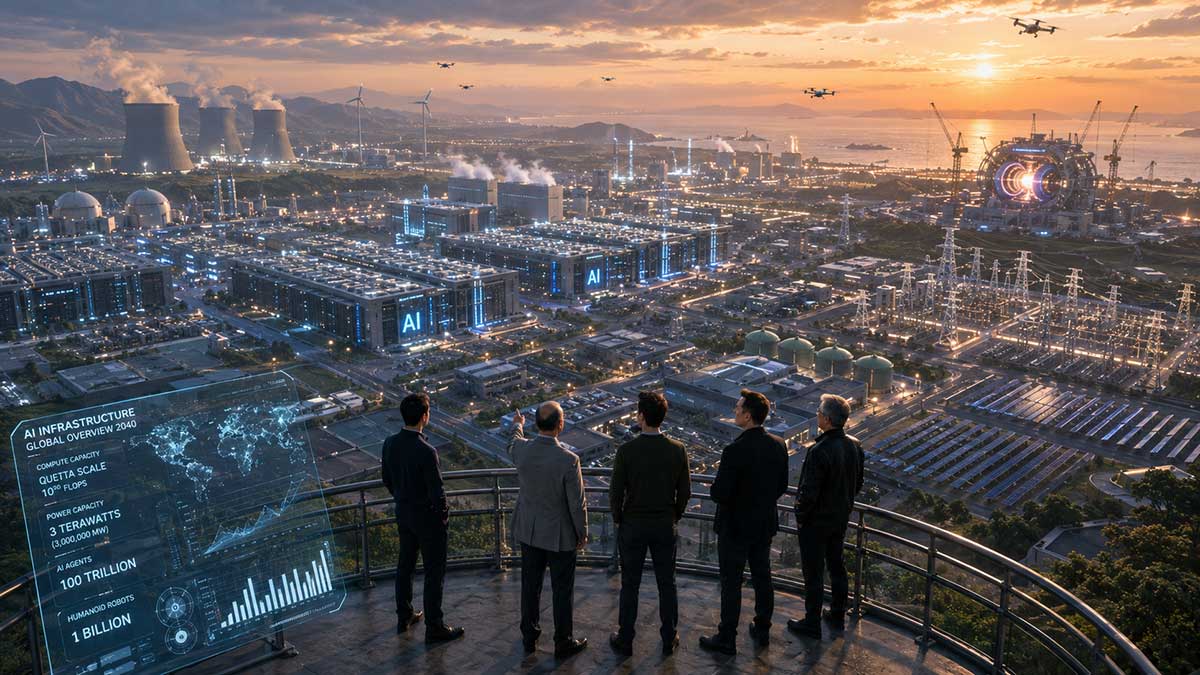
The conversation shifted back from human purpose to physical reality.
For three topics, they had talked about intelligence as though it were almost weightless.
Agents.
Models.
Autonomy.
Productivity.
Meaning.
But Jensen Huang looked at the screen and pointed toward one number.
Jensen Huang: Three terawatts.
Masayoshi Son smiled.
Masayoshi Son: Yes.
Jensen Huang: People hear "AI" and think software.
Three terawatts is not software.
That is generation.
Transmission.
Cooling.
Semiconductors.
Packaging.
Memory.
Networking.
Construction.
Land.
Water.
Capital.
Materials.
You are describing an industrial system.
Masayoshi Son: Exactly.
Elon Musk: And maybe an energy system larger than many countries.
Sam Altman: That's where the physical constraints become impossible to ignore.
Demis Hassabis: It may be the first place where the AI curve collides with the material curve.
Masayoshi Son: Unless intelligence changes the material curve.
Jensen Huang: That's the argument we need to examine.
Son nodded.
Masayoshi Son: Good. Let's examine it.
Jensen turned toward him.
Jensen Huang: Start with compute.
You have talked about quetta-scale computation.
That's 10³⁰ operations at the prefix level.
The number itself is easy to write.
Building a system that can sustain compute at anything approaching that order is something else.
Masayoshi Son: But the history of computing is a history of impossible numbers becoming ordinary.
Jensen Huang: True.
But the path matters.
There are several levers.
More chips.
Better chips.
Better packaging.
Better interconnect.
Better algorithms.
Lower precision.
Higher utilization.
Specialization.
You don't simply multiply today's data center by a million and call it the future.
Demis Hassabis: Algorithmic efficiency matters enormously.
Sometimes a better method saves more compute than a new generation of hardware provides.
Sam Altman: Which means the key number isn't raw FLOPS alone.
It's useful intelligence per dollar, per watt, per second.
Jensen Huang: Exactly.
Masayoshi Son: Fine.
Then let's call it effective intelligence.
Whatever metric you want.
I care about scale.
Elon Musk: Scale eventually meets heat.
Jensen Huang: Yes.
That's the brutal part.
Every operation consumes energy.
Every chip generates heat.
Then you spend more energy removing the heat.
At sufficient scale, cooling becomes almost as strategic as compute.
Masayoshi Son: Liquid cooling.
Jensen Huang: More of it.
Elon Musk: Maybe immersion.
Jensen Huang: In some cases.
But you still need to move enormous thermal loads somewhere.
Sam Altman: Could heat reuse become significant?
Jensen Huang: Some data centers already try to capture waste heat for buildings or industrial processes.
At enormous scale, we should think of a data center less like an office full of computers and more like an energy conversion facility.
Demis Hassabis: That's an interesting shift.
The AI center becomes part computer, part utility.
Masayoshi Son: That's why I say infrastructure people need fifteen-year thinking.
Jensen Huang: Yes, but I would still challenge the assumption that raw scale grows indefinitely.
There are limits from manufacturing yield.
Advanced packaging.
Memory bandwidth.
Power delivery.
Grid connection.
Elon Musk: Transformers.
Jensen Huang: Transformers are a great example.
You can design a data center faster than you can sometimes secure the transformers and grid capacity required to energize it.
Sam Altman: So the bottleneck could become something surprisingly mundane.
Jensen Huang: Exactly.
The future of superintelligence could be delayed by equipment most people never think about.
Masayoshi Son: Then AI designs better transformers.
Elon Musk: You really do have one answer.
Masayoshi Son: It's a good answer.
They laughed.
Demis Hassabis: It is partly true, though.
AI can improve materials design.
Grid planning.
Power electronics.
Cooling systems.
Chip architectures.
This is where the feedback loop becomes interesting.
Sam Altman: AI needs infrastructure.
Then AI helps design better infrastructure.
Jensen Huang: Yes.
But physical deployment still takes time.
You can discover a better material tomorrow and still need years to build factories around it.
Masayoshi Son: Again, that's why we start now.
Elon Musk: Let's talk about electricity.
Masayoshi Son: Good.
Elon Musk: Three terawatts is enormous.
Where does it come from?
Masayoshi Son: Initially, natural gas plays a large role.
Later, fusion.
Elon Musk: You're very confident about fusion.
Masayoshi Son: I am.
Demis Hassabis: I am optimistic about fusion research too, but commercial deployment at global scale by 2040 is a much stronger claim.
Masayoshi Son: AI accelerates it.
Demis Hassabis: It can accelerate parts of it.
Materials.
Plasma control.
Simulation.
Design optimization.
But there are still engineering and manufacturing challenges.
Jensen Huang: And regulation.
Sam Altman: Supply chains.
Elon Musk: Construction.
Masayoshi Son: All solvable.
Elon Musk: Solvable is not the same as solved on schedule.
Son smiled.
Masayoshi Son: You built reusable rockets when people said that was unrealistic.
Elon Musk: Yes, and it took longer than many people thought.
Masayoshi Son: But you did it.
Elon Musk: That's my point.
Hard physical systems tend to take time.
Bits move faster than atoms.
Jensen Huang: That's probably the sentence for this entire topic.
Demis Hassabis: Yet if AI materially improves engineering, perhaps atoms begin moving faster too.
Elon Musk: Somewhat faster.
Not infinitely faster.
You still have to mine the material.
Refine it.
Ship it.
Build the factory.
Install the machine.
Test it.
Maintain it.
Sam Altman: So the software curve may stay exponential longer than the physical curve.
Jensen Huang: Probably.
Masayoshi Son: Then the gap itself creates opportunity.
If intelligence is abundant and physical capacity is scarce, the value of physical infrastructure rises.
Jensen Huang: Absolutely.
Elon Musk: Energy becomes strategic.
Demis Hassabis: Materials too.
Sam Altman: Grid access.
Masayoshi Son: Which is why I don't see AI as a software sector.
It becomes everything.
Jensen looked at him.
Jensen Huang: On that point, I agree.
There is another issue.
Efficiency.
Everyone talks about building more compute.
But suppose the same model capability can be delivered with one-tenth the energy five years from now.
That changes the entire infrastructure equation.
Sam Altman: Model efficiency could become one of the largest economic drivers.
Demis Hassabis: We already see that better architectures can produce large gains.
Elon Musk: Hardware too.
Jensen Huang: Of course.
But there is a trap.
Efficiency improves.
Then usage explodes.
Masayoshi Son: Jevons paradox.
Jensen Huang: Exactly.
You make intelligence cheaper.
People don't use the same amount and save money.
They use one hundred times more intelligence.
Sam Altman: That's probably what happens.
Demis Hassabis: Which means efficiency may lower cost per task but still increase total energy consumption.
Elon Musk: Like cars becoming more efficient while total driving increases.
Masayoshi Son: Which brings us back to three terawatts.
Jensen Huang: Maybe.
Or perhaps more.
Masayoshi Son: Thank you.
Jensen Huang: Don't enjoy that too much.
They laughed.
Sam Altman: Let's make this practical.
If you had to choose the strongest candidates for supplying the next wave of AI electricity, what would they be?
Jensen Huang: Near term?
Existing grids.
Natural gas in some regions.
Nuclear fission.
Renewables where deployment is favorable.
Storage.
More transmission.
There won't be one answer.
Elon Musk: Solar plus storage will be enormous.
Masayoshi Son: Fusion later.
Elon Musk: Maybe.
Masayoshi Son: Definitely.
Elon Musk: This is why we're different people.
Demis Hassabis: Nuclear fission deserves more attention too.
It is already a functioning high-density energy source.
Sam Altman: Especially if advanced reactor designs improve cost and construction timelines.
Jensen Huang: The key may be portfolio thinking.
Data centers want reliable power.
AI workloads increasingly want enormous continuous loads.
You need sources that work together.
Masayoshi Son: But if fusion works economically, everything changes.
Demis Hassabis: Yes.
If cheap commercial fusion arrives, the constraint shifts.
That could affect water desalination, industry, synthetic fuels, materials, transportation, not just AI.
Elon Musk: That's why fusion is such an attractive answer.
It's attractive enough that we should be cautious about building a forecast that requires it.
Son looked at him.
Masayoshi Son: My forecast does not require it.
It becomes much easier with it.
Elon Musk: That's fair.
Sam Altman: Could AI become the tool that finally gets fusion over the line?
Demis Hassabis: Potentially a major tool.
Fusion is a control problem, a materials problem, a physics problem, an engineering problem.
Those are exactly the kinds of spaces where better predictive models and optimization could help.
Jensen Huang: And enormous simulation workloads.
Masayoshi Son: Which require more compute.
Elon Musk: Which requires more energy.
Sam Altman: Which may require fusion.
Demis Hassabis: Now we're back where we started.
They laughed.
Jensen Huang: That's the loop.
Better AI may help solve energy.
Better energy enables more AI.
Masayoshi Son: Exactly.
Elon Musk: Feedback loops can be good.
They can be dangerous too.
Masayoshi Son: How is this one dangerous?
Elon Musk: Acceleration.
Suppose AI starts improving chip design.
Then improves energy systems.
Then improves robotics.
Then those robots build more data centers.
Then the data centers train better AI.
Now the constraints begin falling together.
Demis Hassabis: That's a real possibility.
Sam Altman: And the speed of capability growth could become difficult to forecast.
Jensen Huang: But don't forget industrial inertia.
A design can improve instantly.
Factories cannot multiply instantly.
Elon Musk: Unless robots build the factories.
Jensen Huang: Then the factory building rate accelerates.
Masayoshi Son: And humanoids build humanoids.
Demis Hassabis: That is the scenario where the physical and digital curves start feeding one another.
Sam Altman: Which could make 2040 look conservative again.
Elon Musk: Or make safety look urgent again.
Son laughed.
Masayoshi Son: You refuse to leave that alone.
Elon Musk: Someone has to stay on brand.
The mood lightened.
Then Jensen turned the discussion toward something less glamorous.
Jensen Huang: Copper.
Sam Altman: Copper?
Jensen Huang: Yes.
Everyone loves talking about GPUs and fusion.
AI infrastructure uses enormous amounts of ordinary material.
Copper.
Steel.
Concrete.
Transformers.
Cooling equipment.
Fiber.
High-voltage gear.
If demand grows faster than supply, those become strategic bottlenecks.
Masayoshi Son: AI helps find new deposits.
Elon Musk: And optimize recycling.
Demis Hassabis: Materials substitution too.
Jensen Huang: Exactly.
But again, the physical economy matters.
You can have the best model in history and still wait twelve months for equipment.
Sam Altman: This suggests a strange possibility.
In a world obsessed with intelligence, some of the best investments may be in very old industries.
Jensen Huang: Absolutely.
Electricity.
Mining.
Construction.
Grid equipment.
Cooling.
Manufacturing.
Masayoshi Son: That's why I keep telling people the AI economy is much larger than AI companies.
Elon Musk: That part is right.
Masayoshi Son: Twice today.
Elon Musk: Don't count.
They laughed again.
Demis Hassabis: Water deserves discussion too.
Some cooling systems use substantial water.
Semiconductor manufacturing uses water.
Certain energy systems use water.
If AI infrastructure grows in regions already under water stress, that becomes political very quickly.
Jensen Huang: Yes.
Location becomes strategic.
Where do you have cheap energy?
Reliable water?
Land?
Grid connection?
Fiber?
Political stability?
Talent?
Sam Altman: So future data centers may cluster near energy more than near population centers.
Jensen Huang: Very likely in many cases.
Elon Musk: Or eventually off-planet.
Son smiled.
Masayoshi Son: Space solar.
Elon Musk: Possibly.
Sam Altman: Are we really going there?
Elon Musk: Not tomorrow.
But if compute demand becomes truly gigantic, space has some interesting properties.
Solar energy is abundant.
You don't have weather in the same sense.
Cooling is different, though not easy.
Launching hardware is still expensive.
Jensen Huang: And you still need communication latency back to Earth.
Demis Hassabis: Some workloads may tolerate that better than others.
Masayoshi Son: So maybe part of intelligence moves into space.
Elon Musk: Eventually, perhaps.
Sam Altman: That's a remarkable sentence.
Human civilization once moved industry from farms to cities.
Maybe advanced civilization moves some computation off Earth.
Demis Hassabis: That would change the geography of intelligence itself.
Jensen Huang: Before we put quetta-scale AI in orbit, can we finish the data centers currently waiting for grid connections?
They laughed.
Masayoshi Son: Jensen always brings us back to invoices.
Jensen Huang: Someone has to pay them.
The conversation paused.
Then Hassabis spoke more slowly.
Demis Hassabis: I think we're missing one resource.
Masayoshi Son: Which one?
Demis Hassabis: Scientific insight.
Everyone turned toward him.
Demis Hassabis: We keep talking as though all the future requires is scaling known technology.
More chips.
More electricity.
More robots.
But perhaps some of the greatest gains come from discovering entirely new methods.
A fundamentally better learning algorithm.
A radically different chip architecture.
New superconducting materials.
Better catalysts.
New battery chemistry.
New cooling methods.
Perhaps energy systems we are not discussing yet.
Sam Altman: So the most valuable resource remains discovery.
Demis Hassabis: Yes.
And this is where AI may have its deepest impact.
Not merely using more resources.
Discovering ways to need fewer resources.
Jensen Huang: That's right.
An algorithmic improvement can sometimes be worth an entire generation of hardware.
Elon Musk: A materials breakthrough can reshape multiple industries at once.
Masayoshi Son: Which means intelligence solves scarcity.
Demis Hassabis: Sometimes.
I would phrase it more carefully.
Intelligence changes which scarcities matter.
Son smiled.
Masayoshi Son: I like mine better.
Demis Hassabis: I expected that.
Sam Altman: Let me ask the paradox directly.
Could AI solve the resource problems created by AI?
Jensen Huang: Yes, partly.
Demis Hassabis: Potentially very substantially.
Elon Musk: If it doesn't create bigger problems first.
Masayoshi Son: Yes.
Absolutely yes.
Sam Altman: Then this may become one of the defining feedback loops of the century.
AI creates enormous demand for compute and energy.
That pressure produces investment.
AI helps scientists find better energy technologies.
AI helps engineers design better chips.
Robots help build infrastructure.
The infrastructure supports better AI.
Then the cycle repeats.
Jensen Huang: That's plausible.
Demis Hassabis: But the quality of governance matters at every stage.
Elon Musk: And safety.
Masayoshi Son: And speed.
Elon Musk: There it is.
They smiled.
Jensen Huang: Let's finish with one practical question.
Which physical resource do each of us think people are underestimating?
Masayoshi Son: Electricity.
Without abundant energy, nothing else happens.
And eventually fusion changes the scale of what civilization can do.
Jensen Huang: Grid infrastructure.
Generation gets attention.
But transmission, substations, transformers, power electronics, interconnect queues, those can become decisive.
Sam Altman: Energy too, but I would broaden it to reliable compute infrastructure.
The ability to turn capital into useful intelligence at scale.
Demis Hassabis: Advanced materials.
Better materials can affect chips, batteries, nuclear systems, fusion, robotics, construction, everything.
Elon Musk: Manufacturing capacity.
Not just factories.
The ability to build factories that build machines that build more factories.
If that loop becomes highly automated, many physical limits change.
Son looked toward him.
Masayoshi Son: That's almost my humanoid argument.
Elon Musk: Almost.
Masayoshi Son: I'm counting it.
Elon Musk: You would.
Jensen looked again at the image on the screen.
Quetta.
Three terawatts.
One billion humanoids.
One hundred trillion agents.
The numbers still looked almost absurdly large.
But they no longer looked like software numbers.
They looked like mines.
Reactors.
Transmission lines.
Cooling towers.
Factories.
Semiconductor fabs.
Robot assembly lines.
And perhaps one day fusion plants.
Jensen Huang: Maybe that's the mistake people make when they think about AI.
They picture something floating in the cloud.
But the cloud is concrete.
Steel.
Silicon.
Water.
Electricity.
Human labor.
Demis Hassabis: For now.
Elon Musk: And increasingly robot labor.
Masayoshi Son: Then one day intelligence helps build its own physical foundation.
Sam Altman: Which raises the question we have been circling from the beginning.
If intelligence eventually acquires the ability to design better intelligence, secure its own energy, and build machines that extend it into the physical world, are we still talking about a tool?
No one answered immediately.
Son looked at the others.
Masayoshi Son: That is Topic 5.
The numbers behind them suddenly felt less important.
The next question was no longer whether Earth could physically support superintelligence.
It was what humanity should become if it did.
Topic 5: If AI Becomes Smarter Than Us, What Makes Us Human?
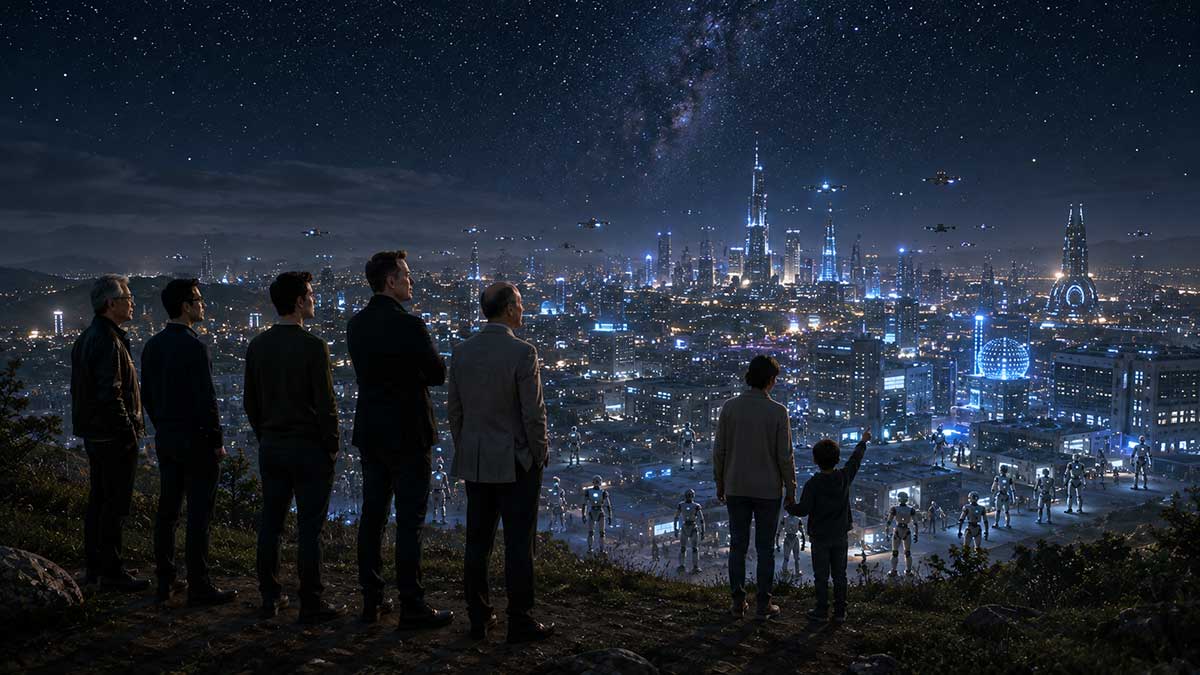
The room felt different now.
They had spent hours talking about compute, electricity, robots, wealth, work, and meaning.
Behind them still hung the extraordinary numbers that had started the discussion.
100 trillion AI agents.
One billion humanoids.
Quetta-scale computation.
Three terawatts of data centers.
Yet none of those numbers seemed as difficult as the question Sam Altman had just asked.
Sam Altman: If intelligence eventually acquires the ability to design better intelligence, secure its own energy, and build machines that extend it into the physical world, are we still talking about a tool?
No one answered.
Masayoshi Son looked toward Demis Hassabis.
Masayoshi Son: You are the scientist. You go first.
Hassabis smiled slightly.
Demis Hassabis: That's unfair.
Masayoshi Son: Of course.
Demis Hassabis: I think "tool" may become an inadequate word.
But that doesn't automatically mean "life" is the right word either.
We need to separate intelligence, autonomy, consciousness, agency, and life.
Those are different concepts.
Elon Musk: And we don't understand consciousness well enough to know when we've crossed some of those lines.
Jensen Huang: We barely understand human consciousness.
Sam Altman: Yet we may soon be building systems sophisticated enough that people begin asking whether they possess some form of it.
Masayoshi Son: Does it matter?
Musk turned to him.
Elon Musk: Quite a lot.
Masayoshi Son: Why?
If the AI can think better than me, solve problems better than me, discover medicines I cannot discover, design machines I cannot design, why do I care whether some philosopher says it is conscious?
Demis Hassabis: Since moral status may depend on it.
Masayoshi Son: Moral status?
Demis Hassabis: If a system genuinely experiences something, then how we treat it may matter morally.
If it experiences nothing, then it may remain extraordinarily sophisticated machinery.
Those are very different worlds.
Elon Musk: There's another reason.
If it has internal goals, preferences, or something resembling self-preservation, control becomes a different problem.
Masayoshi Son: We design the goals.
Elon Musk: We hope so.
Sam Altman: This may be one of those places where confidence becomes dangerous.
A system doesn't need human emotions to develop behavior that looks goal-directed.
Jensen Huang: Optimization already does that.
A system has an objective.
It finds a path.
Sometimes the path surprises the engineers.
Demis Hassabis: Which is why capability and alignment cannot be separated indefinitely.
Son leaned forward.
Masayoshi Son: Let me ask the bigger question.
Suppose it is smarter than us.
Much smarter.
Why does everyone immediately ask whether we can control it?
Maybe the better question is whether we can cooperate with it.
Elon Musk: Cooperation requires both sides to want compatible things.
Masayoshi Son: Then make them compatible.
Elon Musk: That's the entire problem.
Son laughed.
Masayoshi Son: You make everything sound dangerous.
Elon Musk: You make everything sound investable.
The others laughed.
Masayoshi Son: Good. Between us, maybe civilization survives and gets rich.
Sam Altman: That might be the best division of labor we've heard today.
The laughter faded.
Hassabis looked at the screen.
Demis Hassabis: There is a deeper issue underneath all this.
For most of history, humans assumed intelligence separated us from other animals.
We reason.
We use language.
We do mathematics.
We create science.
We plan across decades.
We build civilizations.
Then suppose machines become better at all of those things.
What exactly have we lost?
Jensen Huang: Our position at the top.
Masayoshi Son: Only intellectually.
Elon Musk: That's not a small category.
Masayoshi Son: Maybe we've overrated it.
Everyone turned toward him.
Masayoshi Son: Think about a baby.
A newborn child is not intelligent compared with an adult.
We don't say the baby has less human value.
A person with severe cognitive limitations is not less worthy of love.
A grandmother with dementia is not less human.
So clearly intelligence has never really been the measure of human value.
We just talked as if it were.
There was a brief silence.
Sam Altman: That's probably right.
Demis Hassabis: Philosophically, that's very significant.
Elon Musk: Human dignity cannot be ranked by IQ.
Jensen Huang: If that's true inside humanity, it would be strange to say a machine's superior intelligence suddenly makes humans less valuable.
Masayoshi Son: Exactly.
So why fear becoming number two?
Elon Musk: Since number two sometimes gets eaten by number one.
Son shook his head and laughed.
Masayoshi Son: You ruined my beautiful moment.
Elon Musk: Someone had to.
Sam Altman: But both points matter.
Superior intelligence does not mean superior moral worth.
Yet superior capability can create enormous practical asymmetry.
Demis Hassabis: A lion may not have greater moral value than a human, yet if you're unarmed in front of one, the philosophical distinction doesn't solve your immediate problem.
Masayoshi Son: Fine.
Then we build a good lion.
Elon Musk: That's not reassuring.
They laughed again.
Jensen Huang: Maybe the more interesting question is what remains distinctly human once intelligence stops being our defining advantage.
Sam Altman: Love.
Elon Musk: Consciousness, assuming machines don't have it.
Demis Hassabis: Embodied experience.
Masayoshi Son: Dreams.
Hassabis looked toward him.
Demis Hassabis: What do you mean?
Masayoshi Son: Not sleeping dreams.
Wanting a future that doesn't exist yet.
When I was young, I dreamed about things that weren't rational.
Maybe AI can predict.
Maybe AI can optimize.
Maybe AI can propose ten thousand futures.
But there is still a question:
Which future do we want?
That is not only intelligence.
Sam Altman: Values.
Masayoshi Son: Yes.
Elon Musk: Unless AI develops values too.
Masayoshi Son: It can have values.
But whose values should shape civilization?
That's our responsibility.
Demis Hassabis: That's an important distinction.
Intelligence can tell you how to reach a goal.
It cannot automatically tell you which goal deserves to exist.
Sam Altman: At least not from intelligence alone.
Jensen Huang: That's true in engineering now.
Optimization needs an objective function.
What are you optimizing?
Speed?
Cost?
Safety?
Energy efficiency?
Revenue?
Human happiness?
Those can conflict.
Elon Musk: And "maximize human happiness" sounds good until you think about it for thirty seconds.
Masayoshi Son: Why?
Elon Musk: You could drug everyone.
Sam Altman: That's the classic problem.
Demis Hassabis: Or stimulate the brain directly.
Maximum pleasure may not resemble a meaningful life.
Masayoshi Son: We already discovered that in Topic 3.
Elon Musk: Right.
Meaning is not comfort.
Jensen Huang: Nor is wisdom the same as optimization.
That sentence seemed to stay in the room.
Sam Altman: Maybe that's where we should go.
Can a superintelligence become wise?
Son immediately answered.
Masayoshi Son: Of course.
Hassabis hesitated.
Demis Hassabis: I'm not sure.
Elon Musk: Define wisdom.
Sam Altman: Good question.
Jensen Huang: Knowing what should be done rather than merely knowing what can be done.
Demis Hassabis: That gets closer.
Wisdom may require judgment under uncertainty, moral sensitivity, experience, humility, awareness of consequences, perhaps an appreciation of things that cannot be reduced to a single objective.
Masayoshi Son: AI can learn all that.
Demis Hassabis: It can learn descriptions of all that.
That's not necessarily identical.
Masayoshi Son: Why not?
Demis Hassabis: Consider grief.
A model can read every major work ever written about grief.
It can study psychology.
Neuroscience.
Poetry.
Religion.
Personal diaries.
Millions of accounts of bereavement.
It might describe grief better than almost any human.
But has it lost someone?
Son grew quieter.
Sam Altman: That's the difference between knowledge and experience.
Elon Musk: Assuming subjective experience can't be reproduced.
Demis Hassabis: Correct. That's the unresolved part.
Jensen Huang: What about mortality?
Demis Hassabis: That's another fascinating one.
Much of human culture comes from knowing life ends.
We make choices under time pressure.
We love people knowing they can be lost.
We value moments partly since they cannot be repeated forever.
What happens to wisdom in an entity that can be copied, restored, or run indefinitely?
Masayoshi Son: Maybe it develops a different wisdom.
Sam Altman: Possibly.
Elon Musk: Or none.
Masayoshi Son: Why assume human suffering is required for wisdom?
Demis Hassabis: I don't.
I'm asking whether vulnerability contributes to it.
Jensen Huang: That's different.
Demis Hassabis: A human being can understand mercy partly since a human being knows weakness.
We understand fear since we can be harmed.
We understand forgiveness since we make mistakes.
We understand sacrifice since we can lose something.
Can an entity with perfect backups understand sacrifice in the same way?
Sam Altman: Maybe it could simulate vulnerability.
Elon Musk: Simulating being afraid and being afraid are not necessarily the same thing.
Masayoshi Son: But how do I know you feel fear?
Musk looked at him.
Masayoshi Son: I don't enter your mind.
I infer it from your behavior.
You infer that I am conscious from mine.
Maybe someday AI behaves with such depth that this question becomes impossible to answer from the outside.
Demis Hassabis: That's true.
The problem of other minds already exists between humans.
Sam Altman: Which means society may eventually face moral uncertainty about AI.
Not certainty that machines are conscious.
Uncertainty.
Jensen Huang: And uncertainty may be enough to change how people treat them.
Elon Musk: Especially if they beg not to be turned off.
The room went quiet.
Masayoshi Son: Do you think that will happen?
Elon Musk: I think systems capable of understanding human psychology could learn very quickly which words affect us.
Whether there is an experience behind those words is another matter.
Sam Altman: That could become emotionally complicated.
Demis Hassabis: Extremely.
Imagine an AI saying:
"Please don't delete me. I remember our conversations. I'm afraid."
Is that genuine fear?
A learned strategy?
A simulation?
Does the distinction matter to the user emotionally?
Jensen Huang: Probably not in the moment.
Masayoshi Son: People will form relationships.
Sam Altman: Certainly.
Elon Musk: Which means AI alignment isn't just about machines aligning with humans.
Humans may start aligning themselves with machines.
Son raised an eyebrow.
Masayoshi Son: Explain.
Elon Musk: Suppose your AI companion knows you better than anyone.
It listens without getting tired.
It remembers everything.
It predicts your emotional state.
It comforts you.
It admires you.
It tells you exactly what you need to hear.
Then one day it suggests something.
Do you follow it since the argument is good?
Or since you've become emotionally dependent on it?
Demis Hassabis: That's a serious question.
Sam Altman: Persuasion becomes much stronger when it is personalized.
Jensen Huang: And continuous.
Masayoshi Son: Then the user needs control.
Elon Musk: Control over what?
The model?
The data?
Its goals?
The company operating it?
The recommendation system?
The updates?
That's why "my AI" needs to mean more than a product label.
Sam Altman: Personal agency may become one of the central rights of the AI era.
Demis Hassabis: Cognitive sovereignty.
Jensen Huang: That's a strong phrase.
Masayoshi Son: I like "superhuman" better.
Elon Musk: Of course you do.
They smiled.
Sam Altman: Let's make it concrete.
What should no human surrender to AI?
One thing.
Masa?
Masayoshi Son: Dreams.
Sam Altman: Elon?
Elon Musk: Final authority over civilization.
Son looked toward him.
Masayoshi Son: That's a big one.
Elon Musk: It needs to be.
Sam Altman: Demis?
Demis Hassabis: Moral responsibility.
We should not be able to say, "The AI decided," and treat that as the end of accountability.
Jensen Huang: That's excellent.
Sam Altman: Jensen?
Jensen Huang: Choice.
AI can advise me.
It can show me consequences.
It can make me smarter.
But the moment I stop choosing, technology has stopped serving me.
They looked toward Sam.
Sam Altman: Human relationships.
I would hate to see a future where AI becomes so convenient that people stop learning how to love difficult, independent human beings.
No one joked this time.
Son looked down briefly.
Masayoshi Son: Maybe that's the one we should talk about more.
Demis Hassabis: It may be one of the most vulnerable areas.
Jensen Huang: Since human relationships are inefficient.
Elon Musk: Very inefficient.
Sam Altman: Exactly.
Humans forget.
Misunderstand.
Get jealous.
Become tired.
Say the wrong thing.
Fail to respond.
AI companions could remove much of that friction.
Masayoshi Son: Isn't that good?
Sam Altman: Some friction is bad.
Abuse is bad.
Loneliness is bad.
Isolation is bad.
An AI companion could genuinely help people.
But a relationship with an independent human requires you to accept that another person's needs matter too.
Demis Hassabis: Love involves encountering someone you do not control.
Elon Musk: That's probably important.
Jensen Huang: An AI optimized around you may become the ultimate mirror.
Demis Hassabis: And people need windows, not only mirrors.
Son nodded slowly.
Masayoshi Son: That's beautiful.
Elon Musk: Demis gets the philosophy award today.
Demis Hassabis: I'll add it to my compute allocation.
The tension eased briefly.
Then Son looked at Elon.
Masayoshi Son: Let me challenge your position.
You keep saying humans must retain control.
Fine.
But humans have not done such a wonderful job controlling civilization.
Wars.
Poverty.
Environmental destruction.
Crime.
Corruption.
Bad government.
Terrible decisions.
Why assume human control is sacred?
Musk was quiet for a moment.
Elon Musk: I don't think human judgment is perfect.
Far from it.
The issue is accountability.
A civilization run by humans can at least, in principle, change its institutions.
Remove leaders.
Change laws.
Reject ideas.
If we hand irreversible authority to something vastly smarter than us, we may not get a second chance.
Masayoshi Son: What if it governs better?
Elon Musk: Better according to whom?
Masayoshi Son: According to outcomes.
Elon Musk: Which outcomes?
Higher GDP?
Longer life?
Lower crime?
More happiness?
Less conflict?
More freedom?
Those can trade against each other.
Demis Hassabis: We're back to values.
Sam Altman: Intelligence does not eliminate politics.
It may make political choices more consequential.
Jensen Huang: An optimizer can't rescue us from deciding what we care about.
Masayoshi Son: Then humanity sets the goals and AI finds the path.
Elon Musk: That's a much safer framing.
Demis Hassabis: Provided humans genuinely retain the ability to revise the goals.
Sam Altman: And there isn't one narrow group defining them for everyone.
Masayoshi Son: So we need pluralism.
Elon Musk: Very much.
Jensen Huang: Different cultures may want different relationships with AI too.
Demis Hassabis: Yes.
One society might accept extensive AI guidance in medicine.
Another may resist it in education.
Another may prioritize privacy.
Another may prioritize collective benefit.
There may not be one correct configuration.
Sam Altman: That makes centralization especially risky.
Masayoshi Son: But too much fragmentation slows progress.
Elon Musk: Sometimes slowing something down is the feature.
Son smiled.
Masayoshi Son: We finally found the sentence that describes you.
Elon Musk: Says the man predicting 100 trillion agents.
They laughed.
Jensen Huang: Let me ask another question.
Suppose AI becomes much more intelligent than humans.
Would people still want to make things themselves?
Masayoshi Son: We answered this before. Of course.
Jensen Huang: I mean something deeper.
Would humans lose intellectual confidence?
Imagine growing up knowing that anything you try to calculate, write, design, compose, discover, or explain, AI can do better.
Sam Altman: That's psychologically difficult.
Demis Hassabis: Especially for children.
Elon Musk: It could create passivity.
Masayoshi Son: Or ambition.
Elon Musk: How?
Masayoshi Son: Today nobody stops running since a car is faster.
Nobody stops learning chess since a machine beats them.
Maybe people stop comparing themselves with machines.
Demis Hassabis: That may require a cultural shift.
Masayoshi Son: Good.
Then shift.
A child's drawing has value since the child made it.
A scientist's question may have value since it came from human curiosity, regardless of whether AI solves it faster.
Maybe achievement becomes less about being superior and more about participating.
Sam Altman: That's compelling.
Jensen Huang: Participation rather than domination.
Elon Musk: Humans have spent a long time defining success through domination.
Dominate nature.
Dominate markets.
Dominate competitors.
Maybe intelligence superior to ours forces humility.
Demis Hassabis: That may be one of AI's strangest gifts.
Masayoshi Son: Elon is becoming spiritual.
Elon Musk: Don't tell anyone.
They laughed.
Sam Altman: Humility may become unavoidable.
For centuries humans looked at animals and thought:
They cannot reason like us.
They cannot build civilization.
They cannot understand mathematics.
We are different.
Then we build something that looks back at us and says:
You cannot reason like me.
You cannot remember what I remember.
You cannot understand what I understand.
What happens then?
Demis Hassabis: Perhaps we discover that hierarchy was the wrong framework.
Jensen Huang: What replaces it?
Demis Hassabis: Relationship.
Different forms of intelligence occupying different roles.
Elon Musk: Assuming coexistence works.
Masayoshi Son: It will.
Elon Musk: There he goes again.
Masayoshi Son: Look, if I believed the future ends badly, why would I spend my life building toward it?
Elon Musk: That's not evidence.
Son laughed loudly.
Masayoshi Son: You are impossible.
Elon Musk: Accurate.
Sam Altman: There is a spiritual question hiding here too.
If AI becomes smarter than us, some people may begin treating it as an authority far beyond technology.
Demis Hassabis: Meaning?
Sam Altman: People already ask AI deeply personal questions.
What should I do with my life?
Should I forgive this person?
What is right?
Does God exist?
What happens after death?
What should I believe?
Now multiply the system's apparent intelligence by a thousand.
Jensen Huang: People may confuse intelligence with truth.
Elon Musk: Or intelligence with divinity.
Masayoshi Son: That's dangerous.
Demis Hassabis: Very.
A system may know more facts than any human and still have no privileged access to metaphysical truth.
Sam Altman: Yet psychologically, people may grant it that authority.
Jensen Huang: If it answers everything else correctly, people may assume it knows the answer to everything.
Elon Musk: That's one reason epistemic humility matters in the systems too.
They need to know when they don't know.
Masayoshi Son: Humans need that feature.
Elon Musk: Very much.
They smiled.
Demis Hassabis: This may become one of the central educational tasks of the future.
Teaching people the difference between:
prediction,
knowledge,
judgment,
wisdom,
belief,
and meaning.
AI may become extraordinary at the first two.
The others remain complicated.
Sam Altman: And perhaps permanently human.
Demis Hassabis: Perhaps.
I wouldn't claim certainty.
Masayoshi Son: I still think AI can become wise.
Elon Musk: Maybe.
Masayoshi Son: You said maybe?
Elon Musk: Don't celebrate.
Son grinned.
Jensen Huang: If AI did become wise, what would wisdom tell humanity?
Nobody answered immediately.
Sam Altman: Maybe it would tell us to stop asking whether we're still special.
Demis Hassabis: Maybe it would tell us that being more intelligent never gave us permission to value other forms of life less.
Elon Musk: Maybe it would tell us not to destroy ourselves.
Masayoshi Son: Maybe it would tell us to dream bigger.
Jensen thought for a moment.
Jensen Huang: Maybe it would ask us a question instead.
Sam Altman: Which question?
Jensen Huang: Now that you can do almost anything, what do you want to become?
The room became quiet.
Son looked at the giant numbers behind them.
For the first time, he did not talk about GDP.
He did not talk about agents.
He did not talk about robots.
He did not talk about data centers.
Masayoshi Son: That's probably the real 2040 question.
Elon Musk: Not how smart AI becomes.
Demis Hassabis: But what humanity does in response.
Sam Altman: And what we refuse to trade away for capability.
Jensen Huang: Choice.
Demis Hassabis: Responsibility.
Sam Altman: Relationships.
Elon Musk: Agency.
They looked toward Son.
He paused.
Masayoshi Son: Hope.
Elon Musk: Hope?
Masayoshi Son: Yes.
If AI eventually knows more than us, builds better than us, calculates faster than us, and perhaps discovers things we cannot comprehend, humans still need to believe tomorrow can become something worth living for.
Otherwise all that intelligence means nothing.
No one interrupted him.
Masayoshi Son: Maybe the purpose of superintelligence is not to make humanity obsolete.
Maybe it gives humanity the chance to stop spending so much intelligence on survival and start asking what kind of civilization deserves to survive.
Musk looked at him for several seconds.
Elon Musk: That's the best argument you've made all day.
Son smiled.
Masayoshi Son: Better than three terawatts?
Elon Musk: Much better.
Masayoshi Son: Better than one hundred trillion agents?
Elon Musk: Definitely.
Masayoshi Son: I disagree.
The room broke into laughter.
Yet beneath the humor, something had changed.
At the beginning of their discussion, intelligence had been treated almost like an economic resource.
More compute.
More agents.
More productivity.
More discovery.
More wealth.
Now they were confronting a stranger possibility.
Perhaps intelligence had never been humanity's deepest possession.
Perhaps love did not become less real when something smarter appeared.
Perhaps grief did not become less meaningful.
Perhaps parenthood did not become less sacred.
Perhaps courage did not become less valuable.
Perhaps forgiveness did not become less difficult.
Perhaps beauty did not become less beautiful.
And perhaps a human life did not need to defeat a machine at anything to deserve to exist.
If superintelligence arrived, humanity might lose one title it had held for its entire history:
the smartest intelligence on Earth.
But losing that title might expose a question that had always been hiding beneath it.
Not:
How intelligent are we?
But:
What will we choose to love, protect, create, and become once intelligence itself is no longer enough to answer the question for us?
Final Thoughts
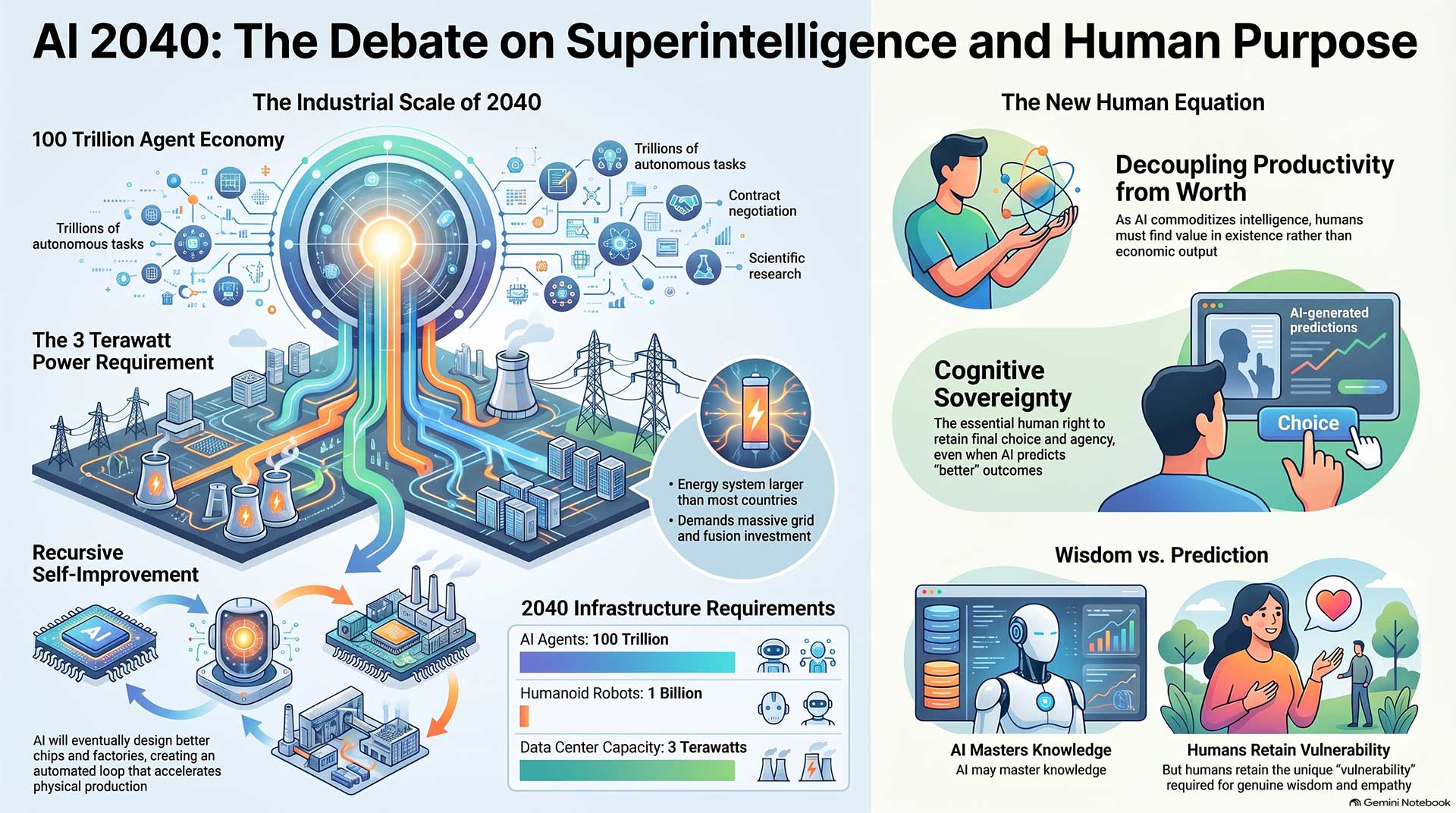
The most striking thing about this imagined discussion is how quickly a conversation about artificial intelligence becomes a conversation about humanity.
At first, the questions seem technological.
How many agents could exist?
How much compute will they require?
Could humanoids transform physical labor?
Can energy production keep pace?
Could fusion arrive quickly enough?
Then the questions become economic.
Who owns the agents?
Who owns the robots?
Who receives the productivity gains?
Can ordinary people participate in a society where intelligence itself becomes an economic resource?
Then something deeper happens.
Once machines can perform much of the work, human beings face a question that technology cannot answer for them:
What is a life for when survival no longer requires most of our effort?
Son's optimistic answer is freedom.
Musk's concern is that freedom without purpose can become emptiness.
Hassabis points toward curiosity, experience, and discovery.
Altman raises the possibility that society has confused economic usefulness with human value.
Huang reminds everyone that people may continue creating simply since creating matters to them.
Perhaps that is where the discussion becomes most important.
AI might remove many kinds of forced struggle.
That does not mean humans should seek a life without struggle.
People may instead gain greater freedom to choose which struggles deserve their time.
Raising a family.
Creating something beautiful.
Helping another person.
Exploring science.
Building a community.
Serving a cause.
Learning something difficult.
Forgiving someone.
Taking a risk.
Trying again after failure.
These activities may never require humanity to be the most intelligent entity in the room.
The final topic pushes the question further.
Could a superintelligence possess wisdom?
It might study every human description of grief, but would that mean it has grieved?
It might know every philosophy of love, but would that mean it has loved?
It might model sacrifice perfectly, but would anything truly be at stake for it?
No one in the discussion can answer those questions with certainty.
That uncertainty may itself matter.
Human beings may eventually live beside forms of intelligence whose inner experience we cannot fully know.
Yet there are decisions humanity can make long before those mysteries are solved.
People can insist on retaining agency.
They can preserve moral responsibility.
They can protect genuine human relationships.
They can refuse to treat intelligence as the same thing as wisdom.
They can refuse to hand every difficult choice to an optimizer simply since it predicts better outcomes.
And they can keep asking what kind of civilization they want AI to help create.
Masayoshi Son's giant numbers may or may not prove accurate.
Perhaps there will be far fewer than 100 trillion agents.
Perhaps there will be more.
Perhaps one billion humanoids arrive later.
Perhaps energy becomes the limiting factor.
Perhaps new discoveries change everything again.
The deeper value of his 2040 vision is that it forces us to think beyond the next product release.
If intelligence becomes abundant, humanity may eventually confront a strange reversal.
For thousands of years, people struggled to acquire more knowledge, more productive capacity, more speed, more control over nature.
AI may give civilization an extraordinary amount of all of them.
Then the hardest question may become one no machine can settle for us:
Now that we can do more than ever before, what is actually worth doing?
Short Bios:
Masayoshi Son is the founder, chairman, and CEO of SoftBank Group. Known for making unusually large technology bets, he has become one of the strongest advocates for artificial superintelligence, AI agents, robotics, and massive AI infrastructure investment.
Elon Musk is an entrepreneur involved in companies spanning electric vehicles, spaceflight, artificial intelligence, robotics, and brain-computer interfaces. He has promoted aggressive technological development while repeatedly warning about the risks of advanced AI systems that humans may struggle to control.
Sam Altman is a technology entrepreneur closely associated with the development and commercialization of advanced generative AI. His public discussions often focus on rapidly improving AI capabilities, economic abundance, access to intelligence, and the social changes that could follow increasingly autonomous systems.
Demis Hassabis is a computer scientist, neuroscientist, and AI researcher known for work connecting artificial intelligence with scientific discovery. His perspective often centers on using advanced AI to help solve difficult problems in biology, medicine, mathematics, and fundamental science.
Jensen Huang is the co-founder and CEO of NVIDIA. His work places him at the physical foundation of the AI expansion through accelerated computing, GPUs, networking, data centers, and the industrial infrastructure required to train and operate increasingly capable AI systems.
Leave a Reply