

J.M. Barrie:
“Come in, come in. The glade is quiet tonight, and you’ve arrived just in time.”
I once wrote about a boy who wouldn’t grow up. Not because growing was wrong, but because something breaks when we forget how to fly—not with wings, but with wonder.
You see, long ago I learned something: the world is filled with invisible things. Fairies, yes, but also kindness. Grief. Imagination. Love. None of them can be measured, but all of them can change us.
And so tonight, under this silver canopy of leaf and starlight, I find myself in conversation once again—with my old friend Arthur, who spent a lifetime seeking proof… and with someone who needs no proof at all: a fairy.
We’ll speak of laughter and belief. Of being a little kinder than necessary. Of how maybe, just maybe, we’ve become the very fairies the world stopped seeing.
So hush your clocks and quiet your certainties. You’re not too late. The story hasn’t ended. In fact, it’s just beginning—where all good stories begin: in a place you once believed was real.
(Note: This is an imaginary conversation, a creative exploration of an idea, and not a real speech or event.)

Topic 1: “A Little Kinder Than Necessary” — The True Magic of the Human Heart

Setting:
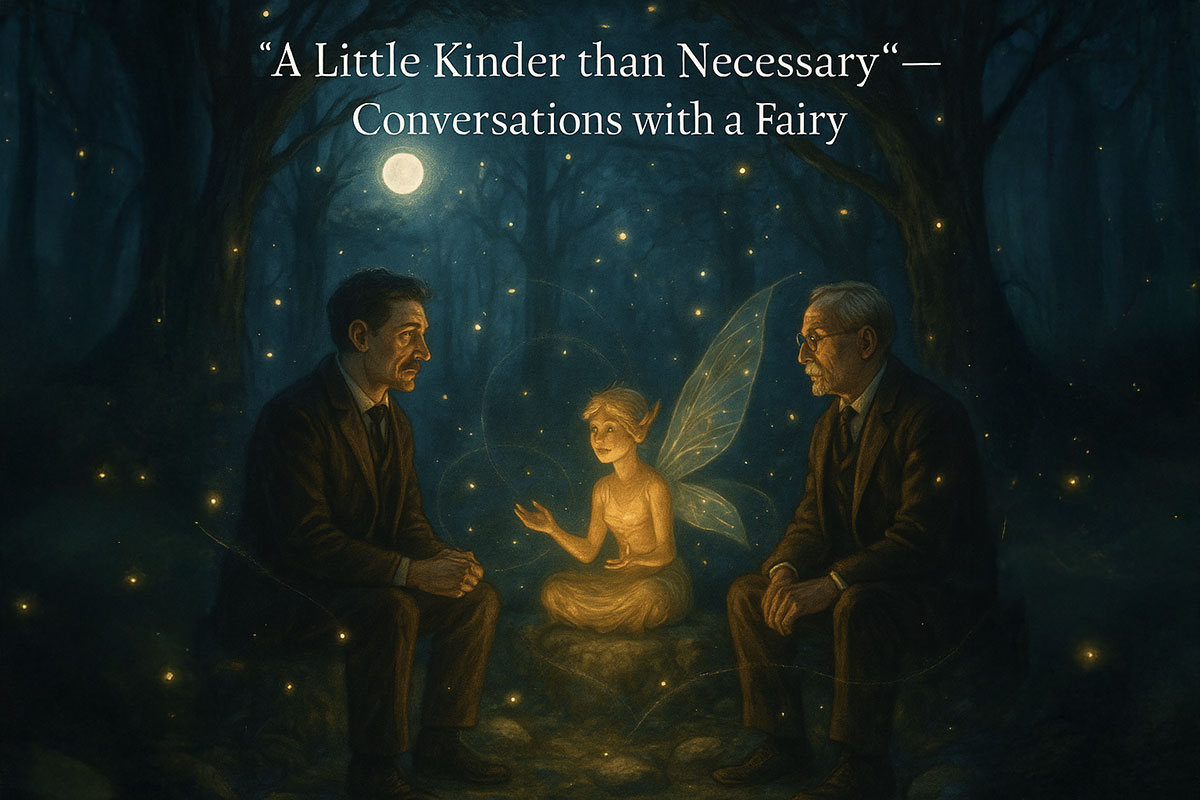
A circle of mossy stones under an ancient oak. Fireflies flicker like suspended stars. Three figures sit together: J.M. Barrie, in a worn velvet coat, his eyes twinkling; Sir Arthur Conan Doyle, posture upright, with a leather-bound notebook in his lap; and a small, shimmering fairy with iridescent wings and eyes that seem to hold the memory of flowers.
Fairy (softly, curiously):
What did you mean, Mr. Barrie, when you said, “Always be a little kinder than necessary”? Is it a rule? A charm? Or something you forgot to teach your grown-ups?
J.M. Barrie (smiling, leaning forward):
Ah. It was more of a... whisper than a rule. The world can be harsh, even for children. But when someone gives just a touch more kindness than expected—like offering their umbrella and a smile in the rain—it’s like the moment blushes. It glows. It becomes unforgettable.
Sir Arthur Conan Doyle:
I daresay it’s the closest thing to real magic. And believe me, I’ve chased magic across seances, séances, and spirit boards. But often, it is the unrecorded acts of gentle decency that convince me most that there is more to this world than meets the eye.
Fairy (tilting her head):
Do you know what your kindnesses do to our world? When a child forgives her brother, or when someone comforts a stranger... the grass grows greener, the bees hum sweeter. Kindness adds color to the wings of new fairies. It’s like light you can’t see, but we live inside it.
Barrie (quietly):
I always believed in invisible things. Peter was born that way. And I thought, perhaps, if people couldn’t see fairies, they could still be them—by doing just that: a little more good than anyone asked for.
Conan Doyle (nodding, scribbling):
Fascinating. So, are you saying that morality—kindness—is a force that crosses the boundary between realms?
Fairy (touching the air with her fingertip, creating a ripple):
Yes. Kindness echoes. It lasts longer than stars. When you’re a little kinder than necessary, you lengthen the life of beauty in both your world and mine. It’s how children feel safe in their sleep, and why certain trees bloom brighter near old people who smile.
Barrie (with a catch in his voice):
I once knew a boy who died too young. He asked if I thought heaven had stories. I told him yes—but only if the people down here keep being kind enough to write them.
Conan Doyle (gently):
James, was that George? Your brother?
Barrie (nodding):
He lived on in Peter. I think of him whenever someone offers kindness not because it’s owed, but because it’s beautiful.
Fairy (eyes glowing now):
You humans forget—you are the only creatures who choose to be kind. That’s why it’s sacred. It’s the one power even fairies envy.
Barrie (smiling):
Then I hope we never stop using it. Even just a little more than necessary.
Conan Doyle (looking up from his notes):
Perhaps proof isn’t the point, after all. Perhaps it’s the trace a gesture leaves—in this world and the next—that matters.
Final Reflection — From the Fairy:
Some think kindness is weakness, or politeness, or manners. But no—it’s what wakes the sleeping flowers before spring. It’s the echo of love without a name. Be a little kinder than necessary, and you awaken the unseen—both around you, and within.
Topic 2: When Imagination Becomes Reality — Where Do Fairies Actually Live?
Setting:
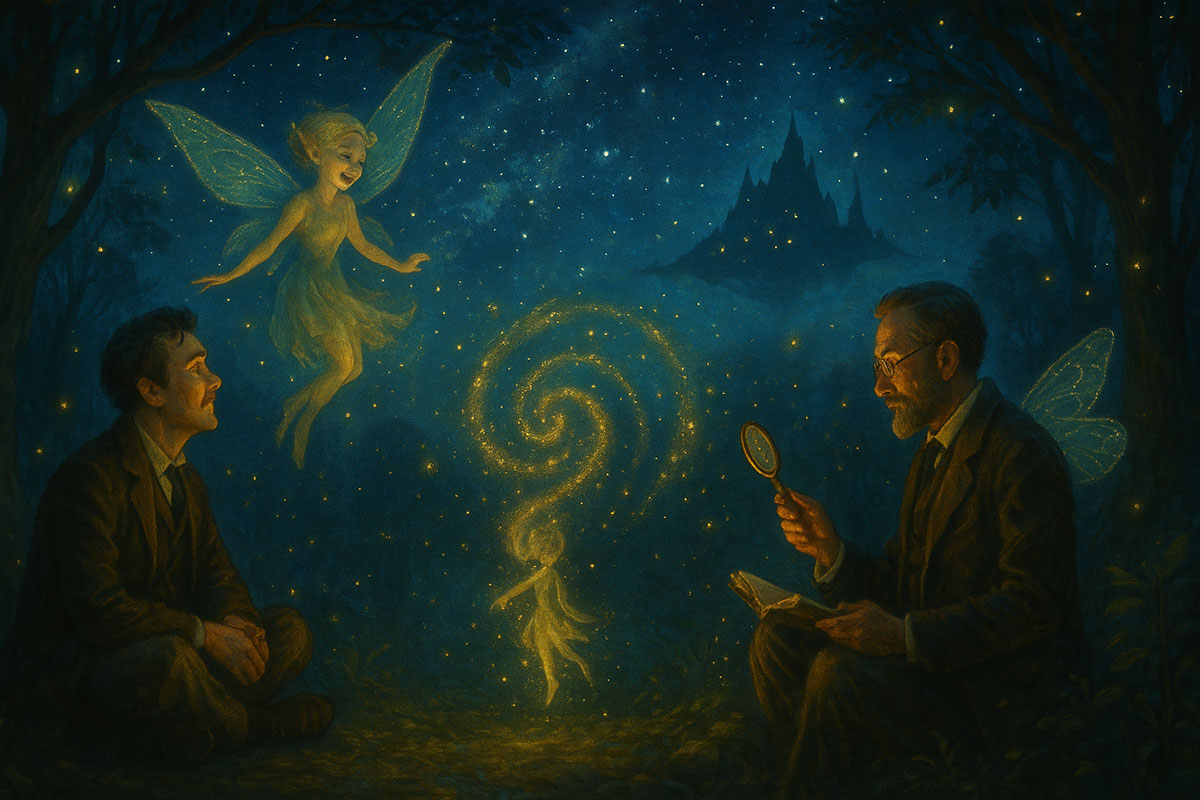
The twilight glade is darker now, but still glowing with soft light from the moon above and mushrooms below. The fairy hovers just above a mossy toadstool. J.M. Barrie leans back on his elbows, gazing upward. Conan Doyle adjusts his glasses, holding a magnifying lens, ever the seeker of what lies beyond the veil.
Fairy (hovering gently):
You ask where fairies live... But isn’t that the wrong question? It’s not where we live, but what keeps us alive. And for us, that place is imagination. Belief is our bread. Wonder is our wind.
Barrie (softly):
That’s exactly what I suspected. Neverland was never meant to be a place on a map. It was the bit of the soul not tamed by clocks. I always thought—when a child believes in fairies, a door opens somewhere. But what happens when that belief fades?
Conan Doyle (clearing his throat):
That was the tragedy behind the Cottingley Fairies, wasn’t it? The world wanted evidence. We had photographs—yes, likely fabricated—but the need behind them… the desire to prove the unseen… that was real. Painfully real.
Barrie (turning to him):
You believed in them, Arthur.
Conan Doyle:
I needed to. After I lost my son, I could no longer afford the luxury of disbelief. Spirit photography, séances—they weren’t desperation. They were hope with a scientific instinct. I wanted to prove to the world that the soul—like the fairy—continues.
Fairy (lowering to the stone between them):
You both were right. Imagination creates us, and love sustains us. But you must know—when people laugh less, when they grow cold to wonder, we flicker. We dim. Not because we die, but because you forget how to see us.
Barrie (quietly):
I wonder... is kindness a form of imagination? A belief in something better than what’s merely practical?
Conan Doyle (pensively):
It is the most irrational thing, kindness. Unprovoked goodness. There’s no evolutionary advantage in being kinder than necessary. And yet we do it. Perhaps that's the clearest evidence we are touched by something beyond biology.
Fairy (smiling):
In our world, kindness is light. But imagination? That is the air we breathe. When a child tells a story, or paints wings on the clouds, a door opens. Not just for them—for us, too.
Barrie (half-laughing):
Then we must all write more stories. Tell more lies that are truer than facts.
Conan Doyle (chuckling):
And perhaps I’ll invent a new instrument—not to detect fairies, but to detect imagination itself. If I could prove that imagination has weight... how many skeptics would finally see?
Fairy (tilting her head):
They won’t see with instruments. But they will see when they love. When they forgive. When they tuck in a child and sing a lullaby they made up on the spot. That’s when we hover closest. That’s when the veil is thinnest.
Barrie (smiling, eyes moist):
So maybe the real question isn’t where do fairies live—but what in us is still fairy enough to believe in them?
Final Reflection — From Conan Doyle:
We spent so much time trying to prove fairies, we missed the larger truth: we don’t find them in the forest… we find them in moments when the soul remembers how to dream.
Topic 3: The Laugh That Made the Fairies — Are We Still Laughing Enough?

Setting:
The moon has fully risen, casting silver light through the trees. The glade is quieter now, more sacred than playful. A faint sound of wind chimes dances on the breeze, though none can be seen. The fairy sits cross-legged on a petal, eyes distant. Barrie and Conan Doyle are wrapped in cloaks, warmed more by memory than fabric.
Fairy (looking skyward):
We were born from the first baby's laugh, you know. Every laugh since then was like a seed, scattering new light. But lately… there’s less laughter. Especially from the grown ones. Are you still laughing enough?
J.M. Barrie (nodding slowly):
Not nearly. I fear we've replaced laughter with knowing smirks and cleverness. We use sarcasm like armor. But true laughter—soulful, unguarded—that's become rare. That’s the kind that builds worlds.
Sir Arthur Conan Doyle:
And yet, it is often laughter that echoes longest after death. I remember my wife laughing once at a joke I never meant to make. I’d give all my spirit investigations for one more echo of that sound.
Barrie (softly):
Sometimes I think Peter Pan isn’t a boy. He’s the sound of a laugh that never grew up.
Fairy:
We feel laughter like lightning. It shatters the gray fog between realms. It calls us forth. Do you know why some children see fairies and others don’t?
Conan Doyle:
They believe?
Fairy (shaking her head):
They laugh from the heart. Deep belly giggles. Sudden surprise chuckles. Even silent laughter that makes their eyes leak stars. That’s when we appear.
Barrie:
So when we stop laughing, you… disappear?
Fairy:
We fade. Not die. We don’t die as you know it. But it hurts. Like watching a fire go out in a hearth that once kept an entire village warm.
Conan Doyle (quietly):
But how do we laugh again, when so much seems broken?
Barrie:
Perhaps by being a little kinder than necessary. I’ve found that when someone is unexpectedly kind, a laugh is often not far behind. It’s a breath of relief. A laugh of disbelief at goodness.
Fairy:
Yes! That kind of laughter heals. It sounds like silver rain. Even if it’s only for a moment, it feeds us for years. In truth, the purest laughs come not from jokes, but from surprise joy. A kindness no one expected. A forgiveness no one earned.
Conan Doyle (pensively):
Then maybe our most sacred duty isn’t to prove the soul exists… but to make it laugh while it’s here.
Barrie:
I always said the moment you doubt whether you can fly, you cease forever to be able to do it. But maybe we should also say: the moment you stop laughing from your soul, you cease to be able to see magic.
Fairy (smiling, glowing faintly):
Then laugh, dear ones. Laugh even if the world forgets why. It is the oldest magic, the truest spell, and the bridge between all that is broken and all that can be made whole again.
Final Reflection — From Barrie:
I never grew up, not really. Because I remembered the sound of my brother’s laugh and chased it into stories. If laughter gives birth to fairies… perhaps kindness is what helps them grow old with us.
Topic 4: Proof, Belief, and the Invisible Threads of Love

Setting:
The fireflies have dimmed, replaced by the pale shimmer of moonflowers blooming around the circle. The glade is hushed—more solemn now, like a sacred chamber. Barrie holds a worn notebook to his chest. Conan Doyle adjusts a small pocket watch, not to check the time, but to remind himself that time still moves. The fairy floats between them like a slow-burning candle flame.
Sir Arthur Conan Doyle (leaning forward):
You know, I spent a good portion of my life trying to prove the unseen. Spirits. The afterlife. Fairies. And what did I earn for it? Laughter—not the kind that births your kind, but the cruel kind. Mockery from scientists, friends, even admirers.
J.M. Barrie (quietly):
And I, Arthur, never tried to prove a thing. I wrote what I hoped was true and let the children decide what was real. We stood on opposite shores, you and I. Both looking for the same light.
Fairy (hovering still):
So I ask you both: which mattered more? That people believed in what you shared… or that they felt something when they read it or heard it?
Conan Doyle:
For me, it was the truth. I wanted to know. Not just hope. If the soul endures, if the spirit speaks—I needed more than comfort. I needed confirmation.
Barrie (tilting his head):
And I needed none of that. I only needed to see a child close her eyes and fly. I suppose that was my proof—that the invisible is real if it changes us.
Fairy (softly):
But what of love? You never proved that either. And yet you’ve both clung to it like a lifeline in the dark.
Conan Doyle (quietly, eyes glistening):
Love is different. It's everywhere. It visits in dreams. It lingers in an empty chair. But even that… I tried to prove. Through automatic writing. Voices in séances. Anything to hear from my son again.
Barrie:
And did you?
Conan Doyle (after a long pause):
Once. Maybe. Or maybe I imagined it. But does it matter? The love stayed either way.
Fairy (nods):
That is what I came to say. You try to separate proof and belief, but they were never enemies. They are dance partners. One leads, then the other. But it’s love that plays the music.
Barrie:
Then kindness, too, must live in that space. That strange gap between proof and belief. We do kind things not because we’re certain they’ll matter—but because we hope they will. That’s the magic.
Conan Doyle:
Perhaps that’s the only proof we ever get—the echo left in someone else’s heart.
Fairy (glowing brighter):
And in our realm, we don’t care whether you believe in us. We care that you believe in each other. That’s where we live—in the invisible threads between you, woven from trust, laughter, sorrow, and the mercy of being a little kinder than you need to be.
Barrie (whispering):
So maybe the fairies I wrote were never separate from us. Maybe they were the shape love takes when it’s too gentle to stay still.
Final Reflection — From Conan Doyle:
I once thought the soul needed defending. But now I think… it needs listening. Perhaps belief doesn’t require evidence—just resonance. When something feels eternal, that’s all the proof we were ever meant to hold.
Topic 5: What If We’re the Fairies Now?
Setting:
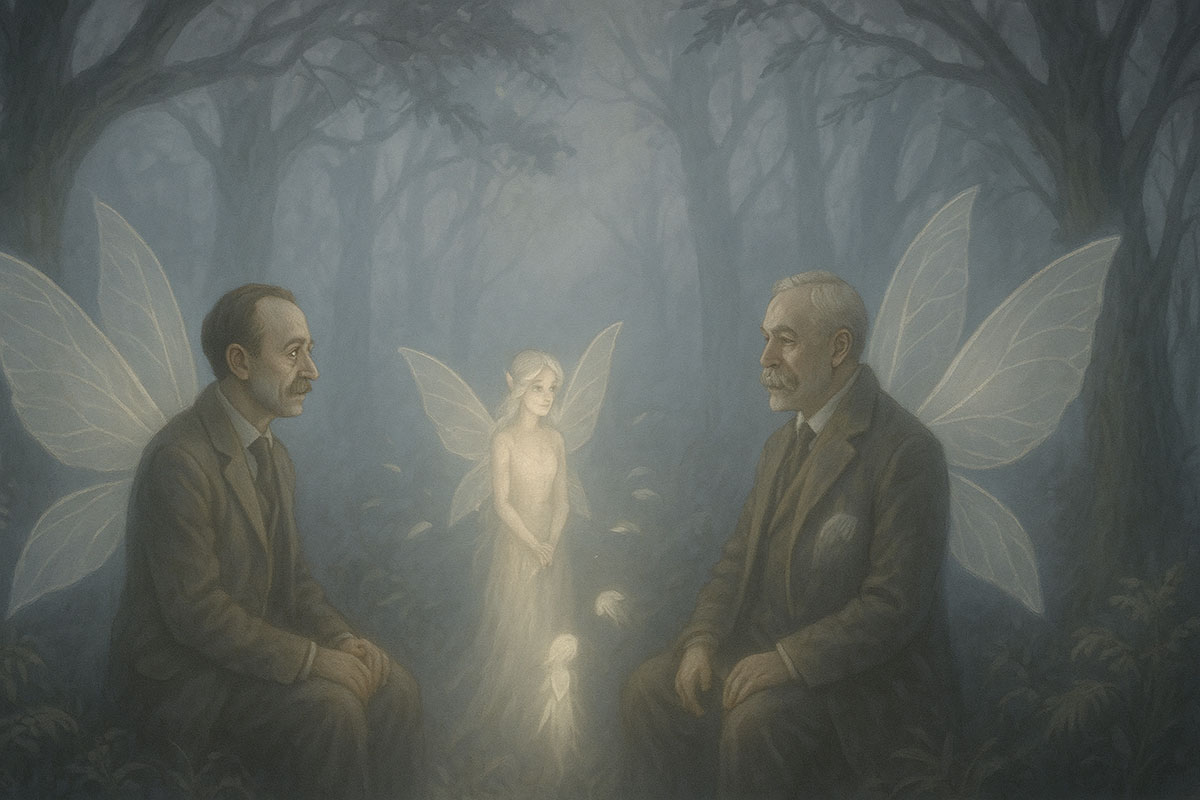
The glade is now fully transformed. The oak trees shimmer faintly, as if remembering something from long ago. Mist curls around their feet like breath. The fairy now glows with a soft inner light—not bright, but steady. J.M. Barrie sits cross-legged, fingers laced. Sir Arthur Conan Doyle gazes skyward, as if listening for voices in the stars.
Barrie (gazing into the mist):
You know... I've begun to wonder. What if we were never meant to find fairies in forests or prove them with cameras? What if the point was... to become them?
Conan Doyle (raising an eyebrow):
Become them?
Barrie (smiling gently):
Think of it. A mother comforting her frightened child in the dark. A stranger leaving coins in a broken vending machine. A letter written long after someone’s gone, just to say “you mattered.” Aren’t those wings? Aren’t those spells?
Fairy (quietly):
Yes. Yes, they are. When someone is a little kinder than necessary, they take on our shimmer. Even if just for a moment. You wear our wings in the way you listen, in how you forgive, in the words you don’t say when anger tempts you.
Conan Doyle (murmuring):
Then perhaps our mistake wasn’t in chasing proof of you… but in not recognizing when we had become you, ourselves.
Barrie:
Peter Pan didn’t need to be real to make real things happen. Joy. Bravery. Hope. I think every child who believed in him became a bit of him. Just like every person who chooses mercy becomes something more than flesh.
Fairy:
You see, we fairies are not a separate species. We’re a possibility inside you. A way your heart remembers what it came here to do.
Conan Doyle:
Then the true afterlife isn’t somewhere else—but something we generate through love?
Fairy (smiling):
Yes. It’s built—not found. Every kind act is a brick. Every laugh, a window. Every “I forgive you” opens a door. The afterlife is being born right now, each time someone chooses to be softer, not harder.
Barrie (with wonder):
So it was never about never growing up… it was about never growing cold.
Conan Doyle:
And perhaps the only proof we need of the invisible… is what we become when we choose kindness in a world that teaches us not to.
Fairy (rising slowly):
And when you do—when you love without return, give without record, or laugh in the middle of grief—you grow wings we can see. Some of you are glowing now.
Barrie:
Then let them say there are no fairies left. We'll prove them wrong with every small, invisible goodness.
Conan Doyle (placing his notebook down):
Perhaps, in the end, the only legacy that matters is this: Did I make the world more tender for someone else? If yes… I’ve done enough.
Final Reflection — From the Fairy:
You asked where we live. The answer is in you. Not in forests or meadows—but in the choice to be gentle in a world made of stone. You are what keeps the magic alive. You are what keeps us alive.
Final Thoughts by J.M. Barrie
I’ve often wondered if Peter Pan ever truly left us.
Perhaps not. Perhaps he slipped inside all of us the moment we first chose kindness over pride. Or when we laughed despite sorrow. Or when we believed, if only for a breath, in something without needing to hold it in our hands.
Tonight, we didn’t find fairies.
We remembered them.
And in doing so, we remembered ourselves—what we are capable of when we are just a little kinder than necessary.
I cannot promise you wings. But I can promise this: every time you offer gentleness where harshness is expected, every time you forgive the unforgivable, or give without fanfare—you are closer to the magic than you’ve ever been.
And if one day you hear a laugh that sounds like bells or feel warmth where no sun touches—don’t doubt it.
The fairies are still with us.
They always were.
Especially when we act like them.
Short Bios:
J.M. Barrie
Scottish author and playwright best known for Peter Pan, J.M. Barrie captured the eternal spirit of childhood and the quiet magic of kindness. A close friend of Sir Arthur Conan Doyle, Barrie embraced the unseen not with evidence, but with wonder—reminding the world that belief begins in the heart.
Sir Arthur Conan Doyle
Renowned for creating Sherlock Holmes, Sir Arthur Conan Doyle was a man of reason who later turned to spiritualism in search of deeper truths. A devoted friend of J.M. Barrie, he brought logic to the edge of mystery, seeking proof of the soul while holding space for magic.
The Fairy
Born of the first child’s laugh and sustained by acts of kindness, the fairy is the invisible thread between imagination and love. Unseen by most but felt by all, she joins Barrie and Doyle to remind us: kindness is its own kind of evidence—and magic is never far.
Leave a Reply