
Introduction
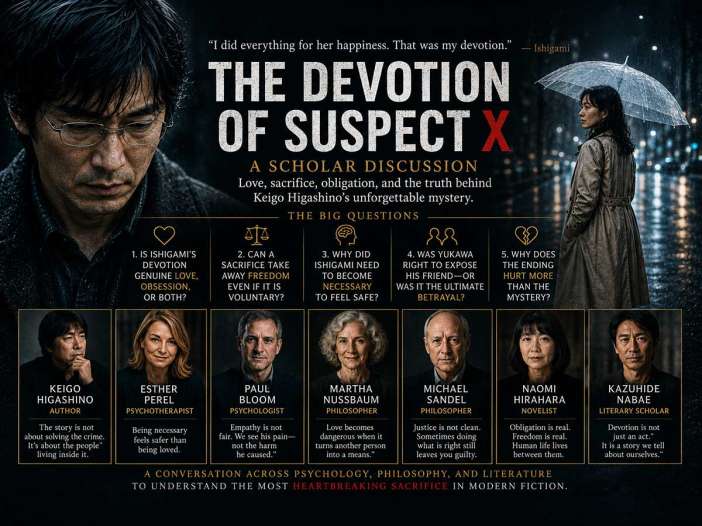
Keigo Higashino’s The Devotion of Suspect X is often praised for its ingenious mystery, but the questions that remain after the crime is solved are far more human.
For this discussion, we brought together perspectives from psychology, ethics, philosophy, cultural interpretation, and literary criticism to examine the novel’s most difficult questions: Why do readers want to forgive Ishigami? Does devotion preserve Yasuko’s freedom or burden it? Why did Ishigami need to become necessary? Was Yukawa right to expose him? And why does the ending hurt more than the mystery itself?
The discussion kept returning to one troubling possibility:
The devotion is real. The love is real. The self-erasure is real too. None of those truths cancels the others.
(Note: This is an imaginary conversation, a creative exploration of an idea, and not a real speech or event.)
Topic 1 — Why Do Readers Want to Forgive Ishigami?
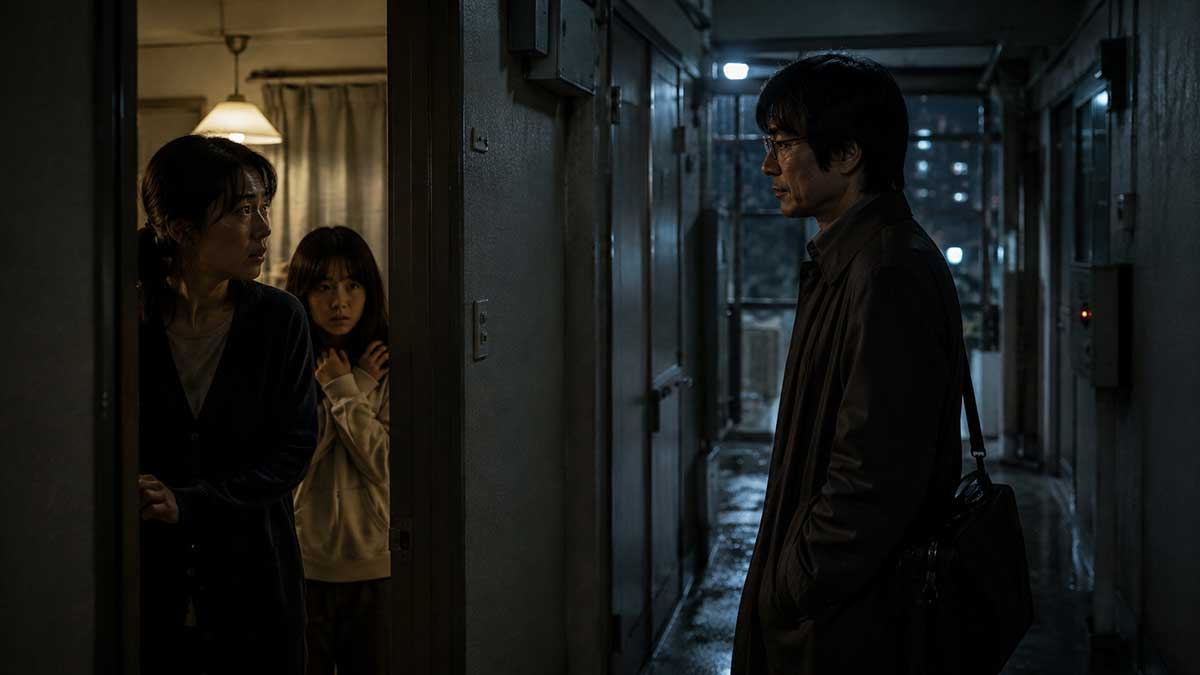
The room had already agreed on one thing.
No one wanted a simple answer.
Paul Bloom looked around the table.
Paul Bloom:
“Before we ask whether Ishigami was right, I want to ask something more uncomfortable.”
Naomi Hirahara turned toward him.
Martha Nussbaum folded her hands.
Esther Perel watched quietly.
Michael Sandel leaned back.
Kazuhide Nabae looked down at his notes.
Keigo Higashino said nothing.
Bloom continued.
Paul Bloom:
“Why do so many readers want to forgive Ishigami?”
Silence.
Then Nussbaum answered.
Martha Nussbaum:
“Because we know his suffering.”
Bloom nodded.
Paul Bloom:
“Exactly.”
He paused.
“And whose suffering do we barely know?”
No one answered at first.
Sandel’s face changed.
Michael Sandel:
“The person whose life became part of Ishigami’s solution.”
Bloom nodded again.
Paul Bloom:
“We know Ishigami’s loneliness.”
“We know his brilliance.”
“We know what Yasuko means to him.”
“We know how little he expects in return.”
“We know the emotional price he is willing to pay.”
He looked around the table.
Paul Bloom:
“Then there is another human being.”
“A human being whose inner life we barely enter.”
Nussbaum looked at him carefully.
Martha Nussbaum:
“You’re saying the novel makes our empathy unequal.”
Paul Bloom:
“Yes.”
“And once empathy becomes unequal, moral judgment can become unequal too.”
Hirahara leaned forward.
Naomi Hirahara:
“I think that is true.”
“But I would be careful.”
Bloom looked at her.
Naomi Hirahara:
“If we say readers sympathize with Ishigami only because they have been emotionally manipulated, we lose something.”
Paul Bloom:
“What?”
Naomi Hirahara:
“The reality that obligation matters.”
“The story is not simply about an obsessive man.”
“It is about a person who believes he has received something so important that repayment becomes almost existential.”
Perel turned toward her.
Esther Perel:
“But repayment is already an interesting word.”
Hirahara nodded.
Naomi Hirahara:
“Yes.”
“That is exactly why I’m using it.”
Higashino remained silent.
Nabae looked toward him briefly, then spoke.
Kazuhide Nabae:
“The title itself creates a problem.”
Michael Sandel:
“Devotion.”
Kazuhide Nabae:
“Yes.”
“What does devotion ask us to imagine?”
“Purity?”
“Loyalty?”
“Love without self-interest?”
“Religious commitment?”
“Romantic surrender?”
He looked around.
Kazuhide Nabae:
“The word arrives before we have decided what Ishigami’s feeling actually is.”
Perel nodded.
Esther Perel:
“And once we call something devotion, suffering begins to acquire beauty.”
Bloom looked at her.
Paul Bloom:
“That is exactly what worries me.”
Sandel leaned forward.
Michael Sandel:
“Let me ask a simpler question.”
“If Ishigami had carried out the same actions without loving Yasuko, would readers judge him differently?”
Bloom answered immediately.
Paul Bloom:
“Yes.”
Nussbaum looked toward him.
Martha Nussbaum:
“Probably.”
Sandel continued.
Michael Sandel:
“So motive changes our judgment.”
Martha Nussbaum:
“It should.”
Bloom looked at her.
Paul Bloom:
“How much?”
Nussbaum did not answer quickly.
Martha Nussbaum:
“That is the hard part.”
Perel spoke.
Esther Perel:
“We are attracted to sacrifice because sacrifice feels like proof.”
Everyone turned toward her.
Esther Perel:
“Love is difficult to measure.”
“You cannot weigh tenderness.”
“You cannot count loyalty.”
“You cannot prove intimacy.”
She paused.
Esther Perel:
“But sacrifice is visible.”
“If someone gives up everything, we say, ‘Look how much he loved.’”
Bloom nodded.
Paul Bloom:
“So suffering becomes evidence.”
Esther Perel:
“Yes.”
“And once suffering becomes evidence, greater suffering begins to look like greater love.”
Nussbaum frowned slightly.
Martha Nussbaum:
“I would resist that equation.”
Esther Perel:
“So would I.”
Nussbaum continued.
Martha Nussbaum:
“Love can contain sacrifice.”
“But sacrifice does not automatically ennoble love.”
“If I destroy another person’s dignity in the name of loving you, the love does not erase what I have done.”
Sandel nodded.
Michael Sandel:
“Then we have at least two moral objects.”
“The beloved person.”
“And everyone else affected by the devotion.”
Bloom looked at Higashino.
Paul Bloom:
“That is where the novel becomes dangerous.”
Higashino finally spoke.
Keigo Higashino:
“Dangerous?”
Bloom nodded.
Paul Bloom:
“Yes.”
“It makes Ishigami understandable enough that readers may start treating understanding as justification.”
Higashino looked at him.
Keigo Higashino:
“Do you think understanding should make judgment easier?”
Bloom paused.
Paul Bloom:
“No.”
Keigo Higashino:
“Then perhaps difficulty is not a defect.”
Hirahara smiled slightly.
Naomi Hirahara:
“That may be the key.”
She turned toward Bloom.
Naomi Hirahara:
“You are right that sympathy can distort.”
“But lack of sympathy can distort too.”
Bloom nodded.
Paul Bloom:
“Agreed.”
Naomi Hirahara:
“If we read Ishigami as nothing but a criminal, we fail.”
“If we read him as nothing but a tragic lover, we fail.”
“His humanity does not disappear when his morality fails.”
Nussbaum looked at Higashino.
Martha Nussbaum:
“Do you think readers are supposed to love him?”
Higashino gave a faint smile.
Keigo Higashino:
“I think ‘supposed to’ is dangerous language for fiction.”
Nussbaum waited.
Keigo Higashino:
“A novelist can place someone before you.”
“What you do with that person belongs partly to you.”
Bloom leaned back.
Paul Bloom:
“Then let’s look at what readers do.”
He turned toward the group.
Paul Bloom:
“We see a lonely mathematics teacher.”
“A man whose life has narrowed.”
“A man who experiences ordinary kindness as something almost miraculous.”
“He loves without expecting conventional reward.”
“He is brilliant.”
“He is socially awkward.”
“He is willing to suffer.”
Bloom paused.
Paul Bloom:
“That is an extraordinarily powerful empathy package.”
Perel almost laughed.
Esther Perel:
“An empathy package?”
Paul Bloom:
“Yes.”
“You know what I mean.”
Sandel looked thoughtful.
Michael Sandel:
“There is another element.”
Bloom:
**“Which?”
Michael Sandel:
“Competence.”
Perel:
**“Explain.”
Michael Sandel:
“We admire people who can do difficult things.”
“Ishigami’s plan is morally horrifying.”
“It is intellectually impressive.”
Those two reactions exist at the same time.”
Nabae nodded.
Kazuhide Nabae:
“And the novel does not force us to collapse them into one judgment.”
Bloom leaned toward Sandel.
Paul Bloom:
“Do you think brilliance makes cruelty easier to romanticize?”
Sandel thought.
Michael Sandel:
“Sometimes.”
“If the plan were clumsy, we might see only brutality.”
“If it is elegant, we begin using words like genius.”
“And genius can create moral distance.”
Nussbaum turned toward him.
Martha Nussbaum:
“But that is not only the reader’s weakness.”
“The novel is interested in the tension between intellect and human value.”
Sandel nodded.
Michael Sandel:
“Yes.”
Perel looked at Higashino.
Esther Perel:
“Can I ask you something?”
Higashino nodded.
Esther Perel:
“Did you want Ishigami to be lovable?”
Higashino smiled faintly.
Keigo Higashino:
“You are asking for a verdict again.”
Esther Perel:
“I’m asking about construction.”
Keigo Higashino:
“And I am answering about effect.”
She waited.
Keigo Higashino:
“If he were easy to hate, would his devotion trouble you?”
Perel shook her head.
Esther Perel:
“No.”
Keigo Higashino:
“Then perhaps difficulty requires proximity.”
Hirahara spoke.
Naomi Hirahara:
“There is something else English-language readers may do too quickly.”
Perel looked at her.
Naomi Hirahara:
“Translate Ishigami immediately into the language of obsession.”
Bloom:
**“You think that is wrong?”
Naomi Hirahara:
“Not always wrong.”
“Too fast.”
She paused.
Naomi Hirahara:
“There are social emotions here that do not fit neatly into individual desire.”
“Debt.”
“Obligation.”
“Reciprocity.”
“Gratitude.”
“Burden.”
“The feeling that someone has done something so large for you that your life can no longer be morally private.”
Perel nodded slowly.
Esther Perel:
“I agree.”
“But I would add something.”
Hirahara waited.
Esther Perel:
“Obligation can deepen relationship.”
“It can create meaning.”
“It can bind generations.”
“It can hold families together.”
She paused.
Esther Perel:
“But it can become psychologically dangerous when the person receiving the gift cannot imagine saying no.”
Hirahara nodded.
Naomi Hirahara:
“Yes.”
“That is the line.”
Bloom looked around the table.
Paul Bloom:
“Then are readers forgiving Ishigami because they admire obligation?”
Hirahara shook her head.
Naomi Hirahara:
“Not simply.”
“I think readers feel the terrible purity of what he thinks he is doing.”
Perel turned toward her.
Esther Perel:
“Purity is another dangerous word.”
Hirahara smiled.
Naomi Hirahara:
“I know.”
“That’s why I chose it.”
Nabae spoke.
Kazuhide Nabae:
“Perhaps the problem is that devotion wants to escape ordinary exchange.”
Sandel:
**“Meaning?”
Kazuhide Nabae:
“Ordinary love is messy.”
“You give.”
“I give.”
“You disappoint me.”
“I disappoint you.”
“You want something.”
“I want something else.”
He looked toward Higashino.
Kazuhide Nabae:
“Ishigami tries to create a form of love beyond negotiation.”
Perel immediately responded.
Esther Perel:
“Yes.”
“And once love leaves negotiation, the other person’s freedom becomes unstable.”
Bloom leaned forward.
Paul Bloom:
“But readers may admire exactly that.”
Everyone looked at him.
Paul Bloom:
“The fantasy of love without negotiation.”
“Love without need.”
“Love without rejection.”
“Love without bargaining.”
“Love without vulnerability.”
Perel’s expression sharpened.
Esther Perel:
“That is not love without vulnerability.”
“That is vulnerability transformed into sacrifice.”
Bloom paused.
Paul Bloom:
“Explain.”
Esther Perel:
“If I ask you to love me, you can refuse.”
“If I tell you I need you, you can disappoint me.”
“If I enter a relationship, I must tolerate uncertainty.”
She looked toward Higashino.
Esther Perel:
“If I sacrifice myself silently, I can avoid asking.”
The room became very quiet.
Nussbaum looked at her.
Martha Nussbaum:
“So sacrifice can become a way of escaping reciprocity.”
Esther Perel:
“Yes.”
“Not consciously.”
“Not cynically.”
“But psychologically, it can.”
Higashino spoke.
Keigo Higashino:
“You are making Ishigami sound afraid.”
Perel turned toward him.
Esther Perel:
“I think he is.”
Keigo Higashino:
“Of rejection?”
Esther Perel:
“Of needing.”
That stopped the room.
Bloom looked at her.
Paul Bloom:
“That is stronger.”
Perel nodded.
Esther Perel:
“Being useful is safer than being needy.”
“If I am useful, I know my value.”
“If I need you, my value depends partly on your response.”
Hirahara looked thoughtful.
Naomi Hirahara:
“And Ishigami is a man who wants solvable structures.”
Perel:
**“Exactly.”
Kazuhide Nabae:
“Then his devotion may be less ordinary romance than an attempt to create certainty around attachment.”
Sandel raised a hand slightly.
Michael Sandel:
“But let us not make his psychology so compelling that the victim disappears again.”
Bloom looked at him.
Sandel continued.
Michael Sandel:
“That is exactly the danger Bloom began with.”
“We move closer and closer to Ishigami.”
“We understand more.”
“We reinterpret.”
“We complicate.”
“Meanwhile another person is dead.”
The room changed.
Nussbaum nodded slowly.
Martha Nussbaum:
“Yes.”
“This is where compassion must widen.”
She looked around.
Martha Nussbaum:
“We need not become colder toward Ishigami.”
“We need to become more capable of holding several human realities at once.”
Bloom:
**“That is harder than empathy.”
Martha Nussbaum:
“Much harder.”
Bloom leaned forward.
Paul Bloom:
“This is why I distrust empathy as the sole moral guide.”
“It follows faces.”
“Stories.”
“Proximity.”
“We feel most for the person we know best.”
Nussbaum:
**“Then the answer is not less feeling.”
“It is better moral attention.”
Bloom smiled faintly.
Paul Bloom:
“We may disagree there.”
Martha Nussbaum:
“I expected we would.”
Higashino watched them.
Keigo Higashino:
“You are discussing the reader as if the reader were outside the crime.”
Bloom looked toward him.
Paul Bloom:
“What do you mean?”
Keigo Higashino:
“The reader is making choices too.”
“Who matters.”
“Whom to forgive.”
“Whose suffering is visible.”
“Whose suffering becomes abstract.”
He paused.
Keigo Higashino:
“Perhaps the mystery is not only what Ishigami has hidden.”
The room became still.
Keigo Higashino:
“Perhaps it is what the reader is willing not to see.”
No one spoke for several seconds.
Sandel finally said:
Michael Sandel:
“That may be the moral trap.”
Higashino did not answer.
Hirahara looked down at her notes.
Naomi Hirahara:
“I want to return to the word ‘forgive.’”
Bloom:
**“Go ahead.”
Naomi Hirahara:
“Do readers really want to forgive Ishigami?”
“Or do they want to preserve something beautiful in him?”
Nussbaum looked at her.
Naomi Hirahara:
“That is different.”
“Forgiveness says, ‘What you did can be morally released.’”
“Preserving beauty says, ‘What you did was terrible, but I refuse to believe the terrible act contains the whole person.’”
Nussbaum nodded.
Martha Nussbaum:
“That is a crucial distinction.”
Bloom considered it.
Paul Bloom:
“Yes.”
“I think many readers are doing the second.”
Perel:
**“They want the love to remain real.”
Hirahara:**
“Yes.”
Nabae spoke.
Kazuhide Nabae:
“Perhaps that is why calling Ishigami obsessive is emotionally unsatisfying.”
Bloom:
**“Why?”
Kazuhide Nabae:
“Because obsession can explain intensity.”
“It does not explain tenderness.”
Perel nodded.
Kazuhide Nabae:
“And calling him selfless is incomplete too.”
“Selflessness does not explain why the relationship becomes so total.”
He paused.
Kazuhide Nabae:
“The character resists moral vocabulary that wants one clean category.”
Sandel looked at Higashino.
Michael Sandel:
“Was that intentional?”
Higashino smiled slightly.
Keigo Higashino:
“You are trying again.”
Sandel smiled back.
Michael Sandel:
“I had to.”
Perel spoke.
Esther Perel:
“I think the strongest question is not whether his love was real.”
“It was.”
She paused.
Esther Perel:
“The stronger question is whether real love can become dangerous.”
Nussbaum:
**“Of course it can.”
Bloom:
**“And whether sincerity makes us excuse danger.”
Hirahara:**
“Or whether cultural ideas about obligation make the danger harder to name.”
Nabae:
**“Or whether the word devotion is carrying more ambiguity than we permit.”
Sandel:
**“And whether any motive, no matter how moving, can justify treating another person as expendable.”
Higashino listened.
Then said:
Keigo Higashino:
“You are all trying to decide what Ishigami is.”
Bloom:
**“Isn’t that why we are here?”
Higashino shook his head.
Keigo Higashino:
“No.”
He looked around the table.
Keigo Higashino:
“You are here to decide what happens to your judgment when you come close enough to understand him.”
Silence.
Bloom leaned back.
Paul Bloom:
“That is fair.”
Nussbaum looked around the room.
Martha Nussbaum:
“Then perhaps we can answer the first question.”
Bloom:
**“Why do readers want to forgive him?”
She nodded.
Martha Nussbaum:
“Because the novel refuses to let wrongdoing erase personhood.”
Bloom considered that.
Paul Bloom:
“And because personhood can make wrongdoing harder to judge.”
Nussbaum:
**“Yes.”
Hirahara:**
“And because Ishigami’s devotion touches recognizable human experiences—gratitude, obligation, loneliness, wanting to matter.”
Perel:
**“And because self-destruction is often mistaken for proof of emotional depth.”
Sandel:
**“And because brilliance can make moral horror look elegant.”
Nabae:
**“And because ‘devotion’ itself tempts us toward admiration before we have finished asking what it costs.”
All eyes turned toward Higashino.
He remained quiet.
Bloom waited.
Paul Bloom:
“Anything to add?”
Higashino looked at him.
Keigo Higashino:
“One thing.”
The room waited.
Keigo Higashino:
“If you leave this discussion loving Ishigami less, I am not sure you have understood more.”
Bloom’s expression changed.
Higashino continued.
Keigo Higashino:
“If you leave excusing him more, I am not sure you have understood more either.”
Silence.
Keigo Higashino:
“The difficult position is to keep both.”
Perel nodded slowly.
Esther Perel:
“Love him enough to see him.”
Nussbaum:
**“Judge him enough to see everyone else.”
Bloom looked down for a moment.
Then up.
Paul Bloom:
“That may be the real task.”
Hirahara turned toward Yasuko’s place in the story.
Naomi Hirahara:
“We have spent a great deal of time asking what Ishigami intended.”
“What he felt.”
“Why readers respond to him.”
She paused.
Naomi Hirahara:
“But devotion is never experienced only by the person giving it.”
Perel looked at her.
Hirahara continued.
Naomi Hirahara:
“Perhaps the next question belongs to Yasuko.”
Sandel:
**“Which question?”
Hirahara looked around the table.
Naomi Hirahara:
“What does it mean to receive a sacrifice so large that gratitude itself can begin to feel like a prison?”
The room became quiet again.
And the conversation moved away from the beauty of Ishigami’s devotion and toward its burden:
Can love remain a gift when the person receiving it no longer feels free to refuse what has been given?
Topic 2 — Love, Obligation, and Yasuko’s Freedom
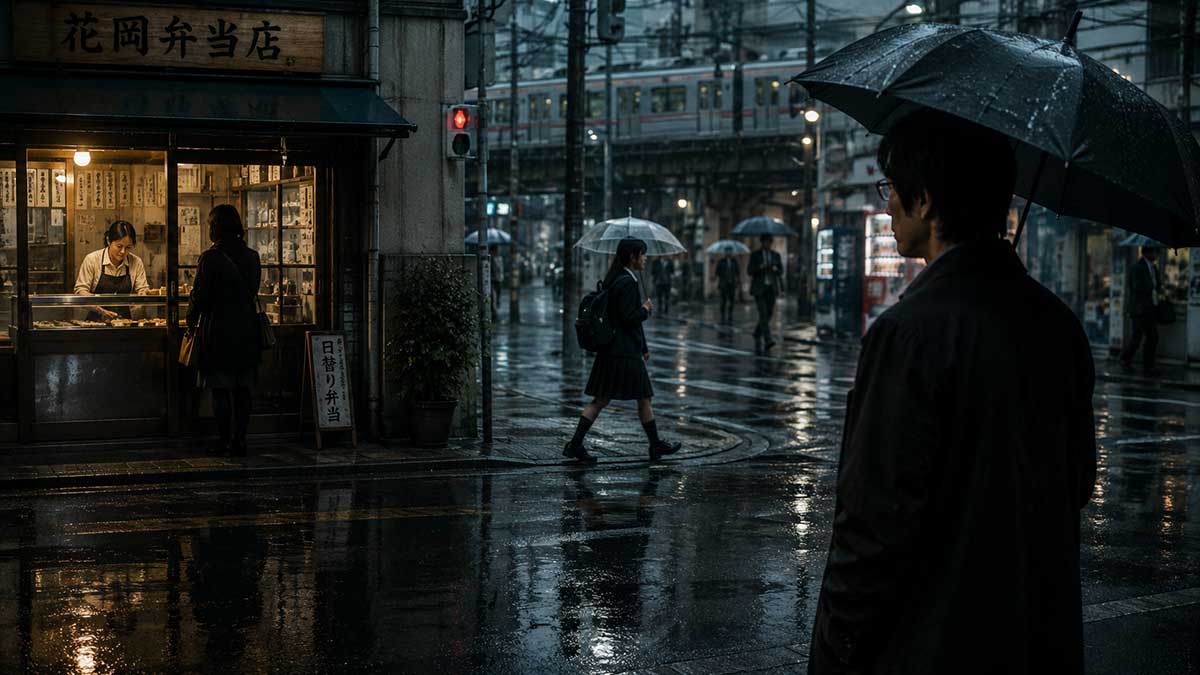
Naomi Hirahara’s question remained in the room.
Naomi Hirahara:
“What does it mean to receive a sacrifice so large that gratitude itself can begin to feel like a prison?”
Esther Perel looked toward her.
Esther Perel:
“I would begin one step earlier.”
Hirahara waited.
Esther Perel:
“When someone says, ‘I did this entirely for you,’ we tend to ask whether the giver was sincere.”
“Was the love genuine?”
“Was there manipulation?”
“Was there a hidden demand?”
She paused.
Esther Perel:
“But perhaps the first question should be asked from the other side.”
“What must the recipient now live with?”
Martha Nussbaum nodded.
Martha Nussbaum:
“That changes the moral center.”
Paul Bloom:
“From intention to consequence.”
Nussbaum:
“Not instead of intention.”
“Alongside it.”
Michael Sandel leaned forward.
Michael Sandel:
“If Ishigami expected no repayment, does that make his sacrifice morally cleaner?”
Perel answered first.
Esther Perel:
“Cleaner for whom?”
Sandel looked at her.
Perel:
“For Ishigami, perhaps.”
“He can tell himself, ‘I demand nothing.’”
“But Yasuko does not experience his sacrifice from inside his intentions.”
“She experiences it as a fact about her own future.”
Naomi Hirahara spoke.
Naomi Hirahara:
“And this is where obligation becomes very important.”
Bloom:
“In what sense?”
Hirahara considered her words.
Naomi Hirahara:
“English discussions can quickly move toward the language of autonomy.”
“Did Yasuko freely consent?”
“Did Ishigami violate her freedom?”
“Was his devotion controlling?”
“All useful questions.”
She paused.
Naomi Hirahara:
“But human relationships are rarely built from autonomy alone.”
“We owe things to people.”
“We feel gratitude.”
“We remember favors.”
“We feel ashamed when we cannot repay kindness.”
“We feel indebted to parents, teachers, friends, neighbors.”
“And these debts are not always pathological.”
Perel nodded.
Esther Perel:
“Agreed.”
“Obligation can be beautiful.”
“It can say, ‘Your life has entered mine deeply enough that I cannot behave as though you are irrelevant.’”
Hirahara smiled faintly.
Naomi Hirahara:
“Yes.”
Perel continued.
Esther Perel:
“But obligation becomes dangerous when repayment is impossible.”
Sandel looked at her.
Michael Sandel:
“Why?”
Esther Perel:
“Because then the recipient cannot restore balance.”
“If you buy me dinner, I can buy you dinner.”
“If you help me move, I can help you someday.”
“If you sit beside me in the hospital, I can remember that when you are sick.”
She paused.
Esther Perel:
“But what do I do if you surrender your entire future for me?”
No one answered.
Esther Perel:
“There is no equal return.”
“So the relationship can become permanently asymmetrical.”
Kazuhide Nabae spoke.
Kazuhide Nabae:
“Yet perhaps equality is the wrong standard.”
Perel turned toward him.
Kazuhide Nabae:
“Some forms of devotion are defined precisely by refusing equivalence.”
“A parent does not expect a child to repay infancy.”
“A person may care for a dying spouse without expecting equal return.”
“Religious devotion often rejects calculation entirely.”
Esther Perel:
“Yes.”
Kazuhide Nabae:
“So if we say, ‘The gift cannot be repaid, therefore it is oppressive,’ we have gone too far.”
Perel:
“I agree.”
“The problem is not that repayment is impossible.”
“The problem is whether the recipient remains psychologically free to live a life that does not honor the sacrifice in the way the giver imagined.”
Higashino, who had been listening, finally spoke.
Keigo Higashino:
“But did Ishigami imagine a particular repayment?”
Perel looked at him.
Esther Perel:
“Perhaps not.”
Keigo Higashino:
“Then are you holding him responsible for a demand he never made?”
Perel smiled slightly.
Esther Perel:
“No.”
“I’m holding the relationship responsible for a burden that can exist without anyone demanding it.”
Higashino’s eyes narrowed with interest.
Martha Nussbaum entered.
Martha Nussbaum:
“This is where dignity matters.”
Sandel turned toward her.
Martha Nussbaum:
“To respect another person is not merely to refrain from demanding payment.”
“It is to recognize them as someone whose choices remain morally real.”
Bloom:
“Meaning?”
Nussbaum:
**“Suppose I sacrifice myself for you.”
“I say you owe me nothing.”
“But I have arranged circumstances so that every future joy of yours will exist beside the knowledge of my destruction.”
She paused.
Martha Nussbaum:
“I may have demanded nothing.”
“But I have altered the moral conditions under which you choose.”
Sandel nodded slowly.
Michael Sandel:
“Then the question becomes whether one person has the right to impose that kind of moral debt.”
Hirahara looked toward him.
Naomi Hirahara:
“I would still be careful with the word impose.”
Sandel:
“Why?”
Naomi Hirahara:
“Because it makes Ishigami sound as though the obligation itself was his objective.”
“It wasn’t.”
Sandel:
“Intent again.”
Naomi Hirahara:
“Yes, because intent matters.”
“Not everything.”
“But something.”
She looked around the table.
Naomi Hirahara:
“There is a difference between saying, ‘I will sacrifice myself so you can never leave me’…”
“…and saying, ‘I will sacrifice myself and ask nothing from you.’”
Perel nodded.
Esther Perel:
“Psychologically very different.”
Hirahara:
**“Yet both can leave the recipient carrying an enormous weight.”
Bloom leaned forward.
Paul Bloom:
“This raises an uncomfortable possibility.”
Nussbaum:
“Which is?”
Paul Bloom:
“That the most selfless gift can become harder to refuse than a selfish one.”
Perel looked at him.
Paul Bloom:
“If someone says, ‘I did this for you, now love me,’ resistance is easy to organize morally.”
“We recognize coercion.”
“We become angry.”
“We reject the demand.”
He paused.
Paul Bloom:
“But if someone says, ‘I destroyed myself for you and want nothing’…”
He looked around.
Paul Bloom:
“What emotion protects the recipient then?”
Silence.
Hirahara answered quietly.
Naomi Hirahara:
“Guilt often enters.”
Perel:
**“And gratitude.”
Nussbaum:**
“And pity.”
Sandel:
**“And obligation.”
Nabae:**
“And perhaps reverence.”
Bloom turned toward him.
Paul Bloom:
“Reverence?”
Nabae nodded.
Kazuhide Nabae:
“Extreme sacrifice can make the giver morally larger in the recipient’s imagination.”
“Almost untouchable.”
“That may be part of what the word devotion does.”
Perel frowned slightly.
Esther Perel:
“And once someone becomes morally sacred, intimacy becomes almost impossible.”
Nabae looked at her.
Kazuhide Nabae:
“Why?”
Esther Perel:
“Because intimacy requires ordinary disappointment.”
No one spoke.
Esther Perel:
“You have to be able to say…”
“You annoy me.”
“I disagree.”
“I don’t want what you want.”
“I need distance.”
“I may choose somebody else.”
She paused.
Esther Perel:
“How do you say those things to someone whose entire ruined future is sitting in front of you?”
Hirahara nodded slowly.
Naomi Hirahara:
“That is very close to Yasuko’s problem.”
Sandel looked toward Higashino.
Michael Sandel:
“Then perhaps the sacrifice destroys the possibility of an ordinary relationship.”
Higashino replied:
Keigo Higashino:
“Was an ordinary relationship ever possible?”
Sandel stopped.
Higashino continued.
Keigo Higashino:
“Sometimes analysis imagines a normal relationship sitting nearby, waiting to be chosen.”
“But these characters arrive with histories.”
“Fear.”
“Isolation.”
“Violence.”
“Crime.”
He paused.
Keigo Higashino:
“The alternative may not have been ordinary.”
Perel nodded.
Esther Perel:
“That is fair.”
“I don’t want to romanticize the alternate path.”
“But impossibility is different from never allowing the other person to participate in the choice.”
Nussbaum looked toward Hirahara.
Martha Nussbaum:
“You mentioned Japanese obligation.”
“How far should we take that?”
Hirahara thought carefully.
Naomi Hirahara:
“Far enough to complicate interpretation.”
“Not far enough to become cultural excuse.”
Bloom nodded.
Hirahara continued.
Naomi Hirahara:
“A reader shaped strongly by individual autonomy may instinctively say…”
“Yasuko owes him nothing.”
“His sacrifice was his choice.”
“She should live freely.”
She paused.
Naomi Hirahara:
“That statement can be morally attractive.”
“But emotionally it may be unrealistic.”
Sandel:
**“Because human beings do feel indebted.”
Hirahara:**
“Yes.”
“And social worlds teach us that receiving creates bonds.”
“The question is not whether Yasuko should magically eliminate obligation.”
“The question is what kind of obligation can be lived with without destroying her agency.”
Perel smiled slightly.
Esther Perel:
“That is exactly where our languages meet.”
Hirahara looked at her.
Esther Perel:
“I would never say freedom means owing nobody anything.”
“That is not relationship.”
“Freedom means being able to remain in relationship without losing the right to have a separate self.”
Nabae leaned forward.
Kazuhide Nabae:
“Then perhaps we should distinguish obligation from possession.”
Perel:
**“Yes.”
Nabae:**
“Obligation says…”
“Your act matters to me.”
“Your suffering affects me.”
“I cannot pretend nothing was given.”
He paused.
Kazuhide Nabae:
“Possession says…”
“Because I gave, your future now belongs inside the meaning of my gift.”
Sandel nodded.
Michael Sandel:
“That is a useful distinction.”
Bloom looked skeptical.
Paul Bloom:
“But can Yasuko actually make that distinction emotionally?”
Hirahara:
**“Probably not cleanly.”
Bloom:**
“Then we are back to burden.”
Hirahara:
**“Yes.”
“But burden itself is not proof that the relationship is illegitimate.”
Bloom:
**“No.”
Hirahara:
“Sometimes loving somebody means carrying burdens you never would have chosen abstractly.”
Perel interjected.
Esther Perel:
“But we must be able to ask whether the burden is mutual, chosen, revisable.”
Hirahara nodded.
Naomi Hirahara:
“Revisable is important.”
Nussbaum turned toward Perel.
Martha Nussbaum:
“Why?”
Perel:
**“Healthy relationships can be renegotiated.”
“Today I need you more.”
“Tomorrow you need me.”
“One person gives more for a period.”
“Then the arrangement changes.”
She paused.
Esther Perel:
“Ishigami’s sacrifice cannot be renegotiated.”
“It becomes permanent.”
Sandel:
**“Irreversibility.”
Perel:**
“Yes.”
Michael Sandel:
“And irreversible gifts carry a special moral danger.”
Nussbaum:
**“Especially when the gift is the self.”
Higashino spoke.
Keigo Higashino:
“You are calling Ishigami’s act a gift.”
The table quieted.
Paul Bloom:
“Would you not?”
Higashino:
**“I am asking what happens when you call it that.”
Bloom considered this.
Higashino continued.
Keigo Higashino:
“A gift suggests something offered.”
“Perhaps voluntarily.”
“Perhaps generously.”
“Perhaps for the recipient.”
He paused.
Keigo Higashino:
“But what if the recipient would have rejected it had she understood the full price?”
Perel looked at him.
Esther Perel:
“Then it becomes a gift she was denied the chance to refuse.”
Nussbaum nodded.
Martha Nussbaum:
“And that is a serious moral problem.”
Sandel leaned forward.
Michael Sandel:
“Could Yasuko have refused?”
Hirahara answered.
Naomi Hirahara:
“At the beginning?”
“Probably not in any meaningful sense.”
“She is frightened.”
“Under pressure.”
“Dependent on Ishigami’s knowledge.”
“Her daughter is involved.”
“The situation is already extreme.”
Sandel:
**“Then consent is compromised.”
Perel:**
“Yes.”
“But later, there are moments when choice could have been returned.”
Bloom looked at Perel.
Paul Bloom:
“Returned?”
Esther Perel:
“That is how I would frame it.”
“In crisis, one person may temporarily take over.”
“Drive the car.”
“Call the ambulance.”
“Make the immediate decision.”
“That is not automatically domination.”
She paused.
Esther Perel:
“The moral question comes later.”
“When the emergency passes, do you return the other person’s life to them?”
Hirahara’s expression changed.
Naomi Hirahara:
“That is a very strong way of putting it.”
Nussbaum nodded.
Martha Nussbaum:
“Protection becomes morally questionable when temporary necessity becomes permanent authority.”
Nabae looked at Higashino.
Kazuhide Nabae:
“And Ishigami’s brilliance makes that transition difficult.”
Higashino:
**“Why?”
Kazuhide Nabae:
“Because competence invites obedience.”
Sandel nodded.
Nabae continued.
Kazuhide Nabae:
“He knows more.”
“He sees further.”
“He anticipates consequences.”
“Once Yasuko experiences that, resistance becomes harder.”
Perel:
**“This happens in many relationships.”
Hirahara turned toward her.
Esther Perel:
“One person is better with money.”
“One handles crises.”
“One understands bureaucracy.”
“One makes decisions quickly.”
“The other begins by saying, ‘Thank God you’re here.’”
She paused.
Esther Perel:
“And years later may realize…”
“‘I no longer know where your judgment ends and mine begins.’”
Bloom looked toward Higashino.
Paul Bloom:
“That is disturbing in Ishigami’s case because the competence is real.”
Higashino:
**“Would it be less disturbing if he were incompetent?”
Bloom gave a short laugh.
Paul Bloom:
“No.”
“But real competence makes submission easier to rationalize.”
Nussbaum spoke.
Martha Nussbaum:
“We should say something about Yasuko’s dignity.”
The group quieted.
Martha Nussbaum:
“She is often interpreted through Ishigami.”
“What he feels.”
“What he sacrifices.”
“What he wants for her.”
She paused.
Martha Nussbaum:
“But Yasuko is not merely the object through which we measure Ishigami’s moral greatness.”
“She has fear.”
“Guilt.”
“Desire.”
“A daughter.”
“A history.”
“A future.”
“A right to make bad decisions.”
Sandel looked at her.
Michael Sandel:
“A right to make bad decisions?”
Nussbaum:
**“Of course.”
“Human dignity includes the right not to be perfectly managed by someone wiser than you.”
Perel smiled.
Esther Perel:
“That sentence belongs in every relationship.”
Higashino watched them.
Keigo Higashino:
“Then perhaps Ishigami’s greatest error was not deciding badly.”
Everyone turned toward him.
He paused.
Keigo Higashino:
“Perhaps it was becoming too certain that he should decide.”
Silence.
Bloom looked down.
Hirahara nodded slowly.
Sandel picked up the thread.
Michael Sandel:
“Then let me make the moral challenge sharper.”
“If I can save you only by placing you inside a future you did not choose…”
“Have I saved you?”
Perel:
**“Partly.”
Sandel looked at her.
Esther Perel:
“That is why this is difficult.”
“You may genuinely save somebody from one danger and create another form of confinement.”
Hirahara nodded.
Naomi Hirahara:
“We do harm to the story if we say Ishigami did nothing but imprison Yasuko.”
“He did help her.”
“He did protect her.”
“The relief was real.”
Perel:
**“And so was the later burden.”
Hirahara:**
“Yes.”
Bloom spoke.
Paul Bloom:
“This may be another reason readers forgive Ishigami.”
Nussbaum:
**“How?”
Paul Bloom:
“Because the benefit is concrete.”
“We can see what he saves Yasuko from.”
“The cost to her autonomy is slower.”
“Less visible.”
“Psychological.”
“Distributed over time.”
He paused.
Paul Bloom:
“Humans are often more responsive to immediate rescue than delayed moral cost.”
Sandel nodded.
Michael Sandel:
“And sacrifice itself creates a moral asymmetry.”
“The more Ishigami loses…”
“…the harder it becomes to criticize him without feeling cruel.”
Perel looked at him.
Esther Perel:
“Yes.”
“Who wants to tell the person who gave everything…”
‘You gave too much.’
Nussbaum spoke softly.
Martha Nussbaum:
“Yasuko eventually does, in effect.”
The room quieted.
Martha Nussbaum:
“Her refusal to continue benefiting from his sacrifice becomes morally significant.”
Hirahara nodded.
Naomi Hirahara:
“She refuses the debt as Ishigami intended it.”
Nabae tilted his head.
Kazuhide Nabae:
“Does she refuse the debt?”
Hirahara looked at him.
Kazuhide Nabae:
“Or does she accept it so fully that she cannot continue living comfortably beneath it?”
That stopped the room.
Perel:
**“Interesting.”
Nabae continued.
Kazuhide Nabae:
“If she felt no obligation, she could simply accept his sacrifice and move forward.”
“She cannot.”
“Her confession may be evidence that the bond has become morally unbearable.”
Hirahara nodded.
Naomi Hirahara:
“Yes.”
“Not rejection of relationship.”
“Refusal of the form the relationship has taken.”
Sandel:
**“She refuses a benefit whose price she can no longer morally accept.”
Nussbaum:**
“And in doing so, restores something of her own agency.”
Perel turned toward Higashino.
Esther Perel:
“I think that matters greatly.”
“Yasuko’s confession is not simply guilt.”
“It is action.”
“She becomes an agent again.”
Higashino listened.
Esther Perel:
“Ishigami has been several moves ahead for much of the story.”
“He constructs the future.”
“She eventually does something he did not want.”
“Something he cannot control.”
Bloom nodded.
Paul Bloom:
“And it destroys his plan.”
Perel:
**“Yes.”
Paul Bloom:
“So her freedom appears precisely when she refuses the future his devotion created for her.”
The room fell quiet.
Hirahara spoke.
Naomi Hirahara:
“That is powerful.”
“But I would still resist saying she simply liberates herself from Ishigami.”
Perel:
**“Why?”
Naomi Hirahara:
“Because she is not walking away untouched.”
“She is taking responsibility.”
“She is accepting consequence.”
“She is acknowledging relationship.”
“That is not individual freedom in the sense of cutting ties.”
She paused.
Naomi Hirahara:
“It is a morally relational act.”
Perel nodded.
Esther Perel:
“Yes.”
“She says, in effect…”
‘Your sacrifice matters to me enough that I cannot let you carry it alone.’
Hirahara smiled slightly.
Naomi Hirahara:
“Exactly.”
Nussbaum looked around the table.
Martha Nussbaum:
“Then perhaps Yasuko’s freedom and obligation are not opposites.”
Sandel:
**“Explain.”
Nussbaum:**
“She becomes freer not by denying the bond…”
“…but by choosing how she will respond to it.”
Silence.
Sandel nodded slowly.
Michael Sandel:
“That is an important distinction.”
“Obligation imposed by circumstances.”
“Response chosen by the person.”
Nabae added:
Kazuhide Nabae:
“Then devotion fails when it scripts the recipient’s role in advance.”
Perel:
**“Yes.”
Kazuhide Nabae:
“And perhaps Yasuko’s final action breaks the script.”
Higashino finally spoke.
Keigo Higashino:
“You are making Yasuko more central.”
Bloom looked at him.
Paul Bloom:
“Shouldn’t she be?”
Higashino gave a faint smile.
Keigo Higashino:
“That is for the reader to decide.”
Nussbaum:
**“No.”
Everyone looked at her.
She smiled slightly.
Martha Nussbaum:
“Not entirely.”
“If moral interpretation continually treats the recipient of sacrifice as scenery for the giver’s tragedy, then interpretation itself repeats the problem.”
The table went silent.
Perel nodded slowly.
Esther Perel:
“That may be the most important thing said so far.”
Hirahara:
**“Yes.”
Bloom looked thoughtful.
Paul Bloom:
“So the reader’s empathy can do to Yasuko what Ishigami’s devotion does.”
Sandel turned toward him.
Paul Bloom:
“Make her life secondary to the meaning of his sacrifice.”
No one spoke.
Higashino looked at Bloom for a long moment.
Then:
Keigo Higashino:
“Now you are asking a better question.”
The room remained quiet.
After a moment, Perel spoke.
Esther Perel:
“Then perhaps we can answer the question we began with.”
Hirahara looked at her.
Esther Perel:
“Can love remain a gift when the recipient no longer feels free to refuse what has been given?”
She paused.
Esther Perel:
“Yes.”
“But only if the recipient is eventually allowed to become a participant rather than a beneficiary.”
Hirahara added:
Naomi Hirahara:
“And obligation itself is not the enemy.”
“The problem is obligation so total that the other person’s future becomes morally prewritten.”
Nussbaum:
Martha Nussbaum:
“A gift respects dignity when it leaves room for response.”
Sandel:
Michael Sandel:
“For refusal.”
Nabae:
Kazuhide Nabae:
“For reinterpretation.”
Bloom:
Paul Bloom:
“And perhaps for disappointment.”
Perel nodded.
Esther Perel:
“Especially disappointment.”
Higashino said nothing.
Sandel looked toward him.
Michael Sandel:
“You disagree?”
Higashino shook his head.
Keigo Higashino:
“No.”
He paused.
Keigo Higashino:
“I am wondering why Ishigami found disappointment so much harder than sacrifice.”
That changed the room.
Perel’s eyes narrowed.
Bloom leaned forward.
Nussbaum looked toward her.
Perel spoke first.
Esther Perel:
“Because sacrifice made him necessary.”
Silence.
Hirahara looked at her.
Perel continued.
Esther Perel:
“And being necessary may have felt much safer than simply being loved.”
Higashino did not respond.
Bloom leaned toward her.
Paul Bloom:
“Safer from what?”
Perel answered quietly.
Esther Perel:
“From needing someone who could say no.”
And with that, the conversation moved beneath Yasuko’s burden and into Ishigami himself.
Not merely:
Why did he love her?
But:
Why did he need love to take the form of becoming indispensable?
Topic 3 — Why Did Ishigami Need to Become Necessary?
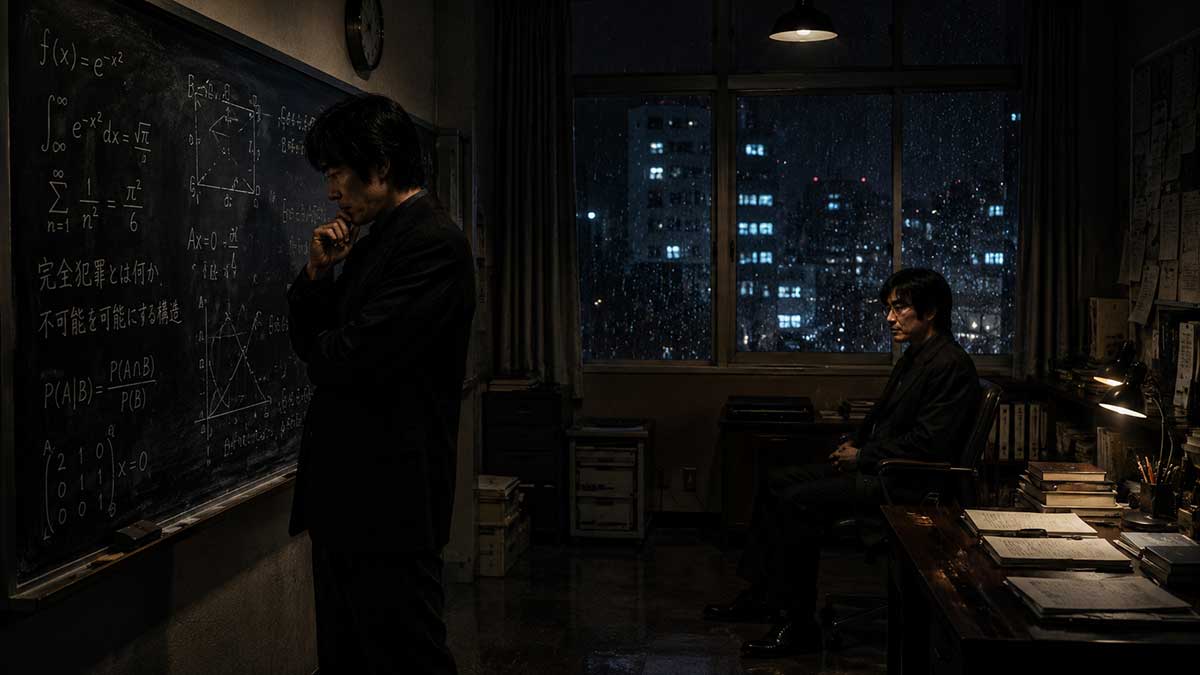
Perel’s last sentence stayed in the room.
Esther Perel:
“Being necessary may have felt much safer than simply being loved.”
Paul Bloom leaned forward.
Paul Bloom:
“Safer from what?”
Perel answered quietly.
Esther Perel:
“From needing someone who could say no.”
No one spoke for a moment.
Keigo Higashino watched her.
Martha Nussbaum looked down at her hands.
Naomi Hirahara seemed to be turning the sentence over.
Michael Sandel broke the silence.
Michael Sandel:
“You’re suggesting usefulness can become a defense against vulnerability.”
Esther Perel:
“Yes.”
“If I am indispensable to you, I know why I matter.”
“If you simply love me…”
She paused.
Esther Perel:
“…I have to trust something I cannot control.”
Bloom nodded.
Paul Bloom:
“That distinction may explain more than romantic attachment.”
Perel looked toward him.
Paul Bloom:
“People often prefer roles with measurable value.”
“I provide.”
“I solve.”
“I protect.”
“I earn.”
“I fix.”
He paused.
Paul Bloom:
“Those roles give evidence.”
Nussbaum:
“Evidence of worth.”
Bloom nodded.
Paul Bloom:
“Yes.”
Hirahara entered.
Naomi Hirahara:
“And Ishigami is especially vulnerable to that.”
Nabae turned toward her.
Naomi Hirahara:
“He is a mathematician.”
“His deepest intellectual life is built around structures that can be demonstrated.”
“Relationships cannot be demonstrated in the same way.”
Perel:
**“Exactly.”
Hirahara:**
“If Yasuko needs him, he has proof of his place.”
“If she merely cares for him…”
She paused.
Naomi Hirahara:
“…that place can change.”
Higashino finally spoke.
Keigo Higashino:
“Do you think Ishigami consciously wanted proof?”
Perel shook her head.
Esther Perel:
“No.”
“I think that would make him too simple.”
Higashino nodded slightly.
Esther Perel:
“I think he discovered a form of connection that felt safe to him.”
“Helping.”
“Protecting.”
“Solving.”
“And once he discovered it…”
She paused.
Esther Perel:
“…he kept going deeper into the same role.”
Nussbaum looked toward Higashino.
Martha Nussbaum:
“There is something tragic here.”
Higashino waited.
Martha Nussbaum:
“The thing that reconnects Ishigami to humanity…”
“becomes the thing through which he erases himself.”
No one moved.
Martha Nussbaum:
“Yasuko and Misato make ordinary human life matter to him again.”
“And instead of entering that life…”
She looked toward Perel.
Martha Nussbaum:
“…he turns himself into a function inside theirs.”
Bloom’s expression changed.
Paul Bloom:
“That is strong.”
Sandel looked at Nussbaum.
Michael Sandel:
“A function.”
Nussbaum nodded.
Martha Nussbaum:
“He becomes useful rather than reciprocal.”
“He acts.”
“He protects.”
“He calculates.”
“But he does not easily say…”
“I am lonely.”
“I need you.”
“Please stay.”
“Can I come in?”
She paused.
Martha Nussbaum:
“That is a very different kind of exposure.”
Nabae leaned forward.
Kazuhide Nabae:
“Perhaps we should ask whether devotion becomes a substitute for relationship.”
Perel looked toward him.
Esther Perel:
“Yes.”
Nabae continued.
Kazuhide Nabae:
“If relationship means uncertainty…”
“negotiation…”
“misunderstanding…”
“rejection…”
“ordinary disappointment…”
He paused.
Kazuhide Nabae:
“Then devotion can become cleaner.”
Bloom:
**“Cleaner?”
Kazuhide Nabae:
“One-sided.”
“Absolute.”
“Unanswered.”
“There is no need to negotiate if one person has already decided to give everything.”
Perel nodded.
Esther Perel:
“And that can feel morally beautiful precisely because it removes the mess.”
Hirahara:
**“But the mess is where the other person lives.”
The table went quiet.
Sandel looked at Hirahara.
Michael Sandel:
“Explain.”
Naomi Hirahara:
“If I love someone in real life, I have to encounter their resistance.”
“Their preferences.”
“Their timing.”
“Their refusal.”
“Their obligations to other people.”
She paused.
Naomi Hirahara:
“Ishigami’s devotion is magnificent in scale.”
“But scale can hide the fact that Yasuko’s independent will becomes less central than the plan built for her.”
Bloom looked toward Perel.
Paul Bloom:
“So when you say being necessary is safer than being loved…”
Perel nodded.
Paul Bloom:
“…you mean necessity removes the possibility that the other person might choose differently.”
Esther Perel:
“Not entirely.”
“But it reduces uncertainty.”
“If you need me to survive this crisis, my importance is guaranteed.”
“If you are simply free to love me…”
She stopped.
Esther Perel:
“…you may not.”
Higashino’s gaze stayed on her.
Keigo Higashino:
“You make him sound afraid of freedom.”
Perel looked at him.
Esther Perel:
“Perhaps.”
Keigo Higashino:
“Whose freedom?”
Perel paused.
Esther Perel:
“Both.”
The room shifted.
Esther Perel:
“Yasuko’s freedom means she might not choose him.”
“His own freedom means he has to decide what to do with a life that no longer has a fixed purpose.”
Nussbaum nodded slowly.
Martha Nussbaum:
“That second part matters.”
Sandel:
**“Why?”
Nussbaum:**
“People often discuss Ishigami as though Yasuko is the only person whose freedom narrows.”
“But Ishigami narrows his own future too.”
“He takes a life with many possible forms…”
“teacher…”
“mathematician…”
“friend…”
“neighbor…”
“perhaps lover…”
“perhaps not…”
She paused.
Martha Nussbaum:
“…and reduces it to one identity.”
Protector.
Bloom spoke.
Paul Bloom:
“That can feel very rewarding psychologically.”
Nussbaum turned toward him.
Paul Bloom:
“A single identity simplifies the self.”
“If I know my role…”
“I no longer have to solve the question of who I am.”
Nabae looked thoughtful.
Kazuhide Nabae:
“Then devotion is not merely directed outward.”
“It organizes Ishigami inwardly.”
Perel nodded.
Esther Perel:
“Yes.”
“That is why calling it pure selflessness may miss something.”
“It gives him something.”
Hirahara looked at her carefully.
Naomi Hirahara:
“Meaning.”
Perel:
**“Meaning.”
Paul Bloom:
“Structure.”
Martha Nussbaum:
“Identity.”
Michael Sandel:
“And perhaps moral purpose.”
Higashino remained silent.
Sandel turned toward him.
Michael Sandel:
“Does that make the sacrifice less selfless?”
Higashino replied:
Keigo Higashino:
“Why must selflessness contain no benefit to the self?”
Sandel paused.
Higashino continued.
Keigo Higashino:
“If helping another person gives someone meaning…”
“does that contaminate the help?”
Nussbaum shook her head.
Martha Nussbaum:
“No.”
Perel:
**“Not at all.”
Bloom:**
“But it makes motive more layered.”
Higashino nodded faintly.
Hirahara spoke.
Naomi Hirahara:
“Perhaps the problem begins when meaning becomes exclusive.”
Perel looked at her.
Naomi Hirahara:
“If I matter because I care for someone, that can be healthy.”
“If I matter only because I care for that person…”
She paused.
Naomi Hirahara:
“…then their existence is carrying my identity.”
Nussbaum:
**“And their loss becomes annihilation.”
Bloom nodded.
Perel leaned forward.
Esther Perel:
“This is why I keep returning to ordinary relationship.”
Higashino looked at her.
Esther Perel:
“Ishigami can perform extraordinary sacrifice.”
“But ordinary intimacy asks something different.”
“Can you be present without being indispensable?”
“Can you remain valuable when the other person does not need saving?”
“Can you tolerate being loved imperfectly?”
“Can you survive being disappointed?”
Nabae added:
Kazuhide Nabae:
“Can you exist beside someone rather than for someone?”
Perel nodded.
Bloom looked at Higashino.
Paul Bloom:
“There’s a strange inversion here.”
Higashino waited.
Paul Bloom:
“Most people would consider sacrificing everything terrifying.”
“For Ishigami, maybe ordinary uncertainty was more terrifying.”
Higashino’s expression changed slightly.
Sandel leaned back.
Michael Sandel:
“Which means the heroic act may have been psychologically easier than the modest one.”
Nussbaum:
**“That is deeply tragic.”
Hirahara looked at Nussbaum.
Naomi Hirahara:
“What modest act?”
Nussbaum answered quietly.
Martha Nussbaum:
“Ask for dinner.”
Silence.
Perel smiled sadly.
Esther Perel:
“Yes.”
Higashino looked at the table.
Keigo Higashino:
“You are all very attached to this dinner.”
Bloom laughed softly.
Paul Bloom:
“Because it is so small.”
Nussbaum:
**“That is the point.”
Perel continued.
Esther Perel:
“To say…”
“Would you like to eat together?”
“is far more vulnerable than it appears.”
Sandel:
**“More vulnerable than prison?”
Perel:**
“For some people, yes.”
She paused.
Esther Perel:
“Prison can be endured alone.”
“Rejection cannot be controlled alone.”
The room fell quiet.
Higashino looked at her for a long moment.
Then:
Keigo Higashino:
“That may be the most interesting thing you have said.”
Bloom leaned forward.
Paul Bloom:
“Let’s test it.”
He looked around the room.
Paul Bloom:
“What happens when someone whose self-worth is built around usefulness encounters a person who simply likes them?”
Nussbaum:
**“They may distrust it.”
Perel:**
“Or convert it into a task.”
Hirahara:
**“Something they can repay.”
Nabae:**
“Something they can structure.”
Sandel:
**“Something they can earn.”
Bloom nodded.
Paul Bloom:
“And that may be what Ishigami does.”
“Yasuko’s ordinary kindness arrives without a contract.”
“He cannot easily understand why it should exist.”
“So he gives it structure.”
Perel:
**“He becomes useful.”
Bloom:**
“Indispensable.”
Nussbaum:
**“Sacrificial.”
Hirahara raised a hand slightly.
Naomi Hirahara:
“I want to be cautious here.”
Bloom looked at her.
Naomi Hirahara:
“Otherwise we risk turning every act of devotion into hidden insecurity.”
Perel nodded.
Esther Perel:
“Fair.”
Hirahara continued.
Naomi Hirahara:
“Ishigami’s care for Yasuko is real.”
“It is not merely a psychological strategy.”
“He does love.”
“He does want her safe.”
“His actions cannot be reduced to…”
‘He needed to feel needed.’
Higashino nodded.
Keigo Higashino:
“Thank you.”
Perel smiled.
Esther Perel:
“I agree with her.”
Higashino looked mildly surprised.
Perel continued.
Esther Perel:
“I don’t think usefulness cancels love.”
“I think it becomes the form through which he knows how to express love.”
Nussbaum:
**“And perhaps the form becomes destructive because it is too narrow.”
Perel:**
“Yes.”
Sandel looked toward Higashino.
Michael Sandel:
“Then we have a distinction.”
“Love is the feeling.”
“Necessity is the structure he builds around it.”
Higashino considered this.
Keigo Higashino:
“Perhaps.”
Bloom spoke.
Paul Bloom:
“I want to return to something earlier.”
“Yasuko and Misato’s ordinary presence gave Ishigami renewed contact with life.”
Hirahara nodded.
Paul Bloom:
“Why could something so small matter so much?”
Nussbaum answered.
Martha Nussbaum:
“Because human beings do not live through achievement alone.”
She looked around.
Martha Nussbaum:
“To flourish is not simply to perform.”
“It is to participate.”
“To be recognized.”
“To be cared for.”
“To care.”
“To have ordinary attachments.”
Perel added:
Esther Perel:
“And to be expected.”
Bloom turned toward her.
Esther Perel:
“That is a powerful human experience.”
“Someone expects you tomorrow.”
“They notice when you are absent.”
“They know how you take your coffee.”
“They remember what you dislike.”
She paused.
Esther Perel:
“These are tiny acts.”
“But for someone profoundly isolated, they can become enormous.”
Hirahara nodded.
Naomi Hirahara:
“Belonging often arrives through repetition.”
“Not declaration.”
“You become part of someone’s ordinary world.”
Nabae looked toward Higashino.
Kazuhide Nabae:
“And perhaps that is why the story’s emotional center is not really grand romance.”
Higashino waited.
Kazuhide Nabae:
“It is the shock of ordinary human proximity.”
Bloom:
**“Which Ishigami then transforms into something extraordinary.”
Nabae nodded.
Kazuhide Nabae:
“Yes.”
Perel leaned back.
Esther Perel:
“That transformation may be the tragedy.”
“Something ordinary reaches him.”
“And he answers with something absolute.”
Nussbaum looked toward her.
Martha Nussbaum:
“That is beautiful and terrible.”
Perel:
**“Yes.”
Sandel frowned.
Michael Sandel:
“But why absolute?”
No one answered immediately.
Then Bloom spoke.
Paul Bloom:
“Maybe certainty.”
Perel:
**“Maybe fear.”
Hirahara:**
“Maybe gratitude.”
Nabae:
**“Maybe the logic of devotion itself.”
Nussbaum:
**“Maybe he had never learned how to receive ordinary care without feeling he must justify it.”
Higashino looked at Nussbaum.
Keigo Higashino:
“That last one interests me.”
Nussbaum continued.
Martha Nussbaum:
“To receive care without earning it is difficult for many people.”
“It asks you to believe…”
‘I can be worth something before I become useful.’
The room went silent.
Perel nodded.
Esther Perel:
“And if you do not believe that…”
“you turn care into debt.”
“Then debt into repayment.”
“Then repayment into identity.”
Hirahara:
**“And eventually devotion.”
Perel looked at her.
Esther Perel:
“Yes.”
Bloom leaned forward.
Paul Bloom:
“Then perhaps Ishigami’s story is partly about inability to receive.”
Sandel:
**“Interesting.”
Bloom:**
“He can give enormously.”
“But can he receive something small without transforming it into obligation?”
No one answered.
Higashino spoke.
Keigo Higashino:
“You are asking whether generosity can hide difficulty receiving.”
Perel:
**“Very often.”
Higashino:**
“And in Ishigami?”
Perel paused.
Esther Perel:
“I would say yes.”
“But I would not call that his secret motive.”
“I would call it part of the tragedy.”
Nabae looked around.
Kazuhide Nabae:
“If so, then the word devotion becomes even more interesting.”
Bloom looked toward him.
Kazuhide Nabae:
“Devotion sounds like giving.”
“But perhaps Ishigami’s deepest difficulty is receiving.”
Nussbaum nodded slowly.
Martha Nussbaum:
“That is very powerful.”
Sandel leaned toward the table.
Michael Sandel:
“Then let me ask the moral version.”
“If someone cannot believe they possess value apart from usefulness…”
“…how free is their decision to sacrifice themselves?”
The room went quiet.
Perel’s face changed.
Bloom looked toward Sandel.
Paul Bloom:
“That is a serious question.”
Hirahara responded carefully.
Naomi Hirahara:
“We should not eliminate agency.”
Sandel nodded.
Michael Sandel:
“I’m not trying to.”
Hirahara:
**“Good.”
“Ishigami makes choices.”
“He bears responsibility.”
“Psychological explanation cannot turn him into a passive object of his history.”
Nussbaum nodded.
Martha Nussbaum:
“Yes.”
“Compassion and responsibility have to remain together.”
Sandel:
**“Then perhaps freedom is not absent.”
“It is constrained by the meaning he has assigned to himself.”
Perel:
**“Exactly.”
“He can choose.”
“But the range of imaginable choices has become very narrow.”
Bloom:
**“He can imagine sacrifice.”
“Can he imagine asking for companionship?”
Perel:
**“That is the question.”
Higashino looked around the table.
Keigo Higashino:
“Why do you all assume companionship would save him?”
No one answered immediately.
Higashino continued.
Keigo Higashino:
“Perhaps dinner changes nothing.”
“Perhaps friendship fails.”
“Perhaps Yasuko says no.”
“Perhaps Yukawa asks twice and Ishigami still says he is fine.”
He paused.
Keigo Higashino:
“Human connection is not a guaranteed cure.”
Nussbaum nodded.
Martha Nussbaum:
“You are right.”
Perel:
**“Completely.”
Bloom:**
“Then what are we claiming?”
Nussbaum answered.
Martha Nussbaum:
“Not that another person could have saved him.”
She paused.
Martha Nussbaum:
“That he might have learned his life could contain more than one source of meaning.”
Perel nodded.
Esther Perel:
“That is very different.”
Hirahara:
**“And safer for Yasuko.”
Bloom looked toward Nussbaum.
Paul Bloom:
“Because one person no longer carries the whole structure.”
Martha Nussbaum:
“Yes.”
Perel leaned forward again.
Esther Perel:
“There is a sentence I would want Ishigami to hear.”
Higashino looked at her.
Esther Perel:
“You can need me without making me responsible for your existence.”
Silence.
Hirahara lowered her eyes.
Nussbaum nodded slowly.
Sandel responded.
Michael Sandel:
“And perhaps the reciprocal sentence is…”
“You can matter to me without surrendering your own life.”
Perel:
**“Yes.”
Bloom looked thoughtful.
Paul Bloom:
“That may be the healthier alternative to becoming necessary.”
“Be significant.”
“Not indispensable.”
Nabae nodded.
Kazuhide Nabae:
“Significance allows plurality.”
Sandel:
**“Meaning?”
Nabae:**
“I can matter deeply to you.”
“And other things can matter too.”
“Work.”
“Friends.”
“Family.”
“Your own future.”
He paused.
Kazuhide Nabae:
“Indispensability wants exclusivity.”
Hirahara:
**“And obligation becomes bearable when it exists among many bonds.”
Nabae nodded.
Higashino spoke softly.
Keigo Higashino:
“Then perhaps Ishigami’s mistake was not loving one person deeply.”
Everyone looked at him.
Keigo Higashino:
“It was allowing all other possible meanings to become smaller beside that love.”
Perel nodded.
Esther Perel:
“Yes.”
Nussbaum:
**“And allowing himself to become smaller too.”
Silence.
Bloom broke it.
Paul Bloom:
“Then we have reached something close to the center.”
He looked around.
Paul Bloom:
“Ishigami’s devotion may have been sincere.”
“His usefulness was real.”
“His protection was real.”
“His love was real.”
He paused.
Paul Bloom:
“But perhaps being needed became the only form in which he knew how to experience his own value.”
Hirahara:
Naomi Hirahara:
“And that made the relationship too heavy for one person.”
Nussbaum:
**“Too narrow for him.”
Perel:**
“Too binding for Yasuko.”
Sandel:
**“And morally dangerous for everyone drawn into the plan.”
Higashino said nothing.
Perel looked toward him.
Esther Perel:
“You’ve been quiet.”
Higashino paused.
Keigo Higashino:
“I am wondering whether Ishigami would accept any of this.”
Bloom smiled slightly.
Paul Bloom:
“Probably not.”
Higashino:
**“Then perhaps he remains alive as a character.”
The room softened for a moment.
Then Sandel leaned forward.
Michael Sandel:
“If Ishigami chose a form of love that erased himself…”
He looked toward the others.
Michael Sandel:
“…what moral right did Yukawa have to stop him?”
The room changed again.
Bloom sat back.
Nussbaum looked toward Sandel.
Perel’s expression became more serious.
Hirahara closed her notebook.
And the conversation moved from Ishigami’s need to be necessary to the man who refused to let his sacrifice remain hidden:
Was Yukawa defending truth—or imposing his own judgment on a friend who had already chosen his fate?
Topic 4 — Was Yukawa Morally Right to Expose Ishigami?
Michael Sandel’s question changed the room.
Michael Sandel:
“If Ishigami chose a form of love that erased himself…”
He looked around the table.
“…what moral right did Yukawa have to stop him?”
Paul Bloom leaned back.
Martha Nussbaum looked thoughtful.
Esther Perel folded her arms.
Naomi Hirahara closed her notebook.
Kazuhide Nabae watched Higashino.
For several seconds, no one spoke.
Then Bloom did.
Paul Bloom:
“Before we decide whether Yukawa had the right, I want to separate two things.”
Sandel nodded.
Paul Bloom:
“Ishigami’s right to sacrifice himself.”
“And Ishigami’s right to construct that sacrifice through harm to other people.”
Sandel:
**“Good.”
Bloom:**
“They are not the same moral question.”
Nussbaum entered.
Martha Nussbaum:
“And the second one is much easier.”
“No person’s willingness to suffer gives them permission to treat another human being as an instrument.”
She paused.
Martha Nussbaum:
“If Ishigami had sacrificed only himself, the moral problem would still be serious.”
“But once his solution requires another life to function as a piece of the plan…”
She shook her head.
Martha Nussbaum:
“His self-sacrifice cannot morally cleanse that act.”
Sandel nodded.
Michael Sandel:
“Then Yukawa has one strong justification.”
“The truth concerns more than Ishigami.”
Paul Bloom:
“Yes.”
“The dead matter too.”
Naomi Hirahara looked toward them.
Naomi Hirahara:
“And Yasuko.”
Martha Nussbaum:
“And Misato.”
Hirahara:
“And the people whose lives continue under the story Ishigami constructed.”
Perel leaned forward.
Esther Perel:
“But that still leaves the personal question.”
Sandel turned toward her.
Esther Perel:
“Suppose Yukawa had discovered the truth without being Ishigami’s friend.”
“He might still have had reasons to reveal it.”
“Justice.”
“The victim.”
“The integrity of the investigation.”
She paused.
Esther Perel:
“But he is Ishigami’s friend.”
“That changes the emotional meaning of what he does.”
Nabae nodded.
Kazuhide Nabae:
“Then the question becomes…”
“Can one betray a friend’s intention and remain loyal to the friend?”
Sandel:
**“That is exactly the difficulty.”
Higashino listened.
Bloom looked toward him.
Paul Bloom:
“Do you see Yukawa as acting morally?”
Higashino gave the faintest smile.
Keigo Higashino:
“You are asking me to close a door you have spent all evening opening.”
Bloom smiled.
Paul Bloom:
“Fair.”
Sandel turned back to the group.
Michael Sandel:
“Let me sharpen it.”
“If someone tells you…”
‘This is my life. I have chosen what to do with it.’
“Do you respect that choice?”
Nussbaum:
**“Not automatically.”
Sandel:**
“Why?”
Martha Nussbaum:
“Autonomy matters.”
“But autonomy does not mean every choice made by an adult must be treated as morally untouchable.”
Sandel:
**“So friendship can justify intervention?”
Nussbaum:**
“Sometimes.”
Perel looked at her.
Esther Perel:
“That can become dangerous very quickly.”
Nussbaum nodded.
Martha Nussbaum:
“Yes.”
Perel:
**“People often say…”
‘I know what is best for you.’
‘You cannot see clearly.’
‘I am doing this for your own good.’
She paused.
Esther Perel:
“That is the same structure we criticized in Ishigami.”
The table went quiet.
Hirahara looked toward Sandel.
Naomi Hirahara:
“That symmetry matters.”
Sandel:
**“Ishigami decides what Yasuko needs.”
“Yukawa decides what Ishigami needs.”
Hirahara nodded.
Naomi Hirahara:
“Yes.”
Bloom leaned forward.
Paul Bloom:
“So Yukawa may oppose paternalism through an act that contains paternalism.”
Perel:
**“Exactly.”
Higashino spoke.
Keigo Higashino:
“Perhaps that is why friendship becomes interesting.”
Everyone turned toward him.
Keigo Higashino:
“A stranger may owe you respect for your decisions.”
“A friend may sometimes refuse to leave you alone with them.”
Nussbaum looked at him.
Martha Nussbaum:
“That is a strong distinction.”
Perel:
**“And a dangerous one.”
Higashino:**
“Yes.”
Sandel smiled slightly.
Michael Sandel:
“Now we are finally in moral territory.”
No one laughed.
He continued.
Michael Sandel:
“Friendship can create obligations that law cannot describe.”
“If I see a friend destroying himself…”
“I may feel I have a duty to interfere.”
Perel:
**“Yet interference risks treating him as incapable of choosing.”
Sandel:**
“Yes.”
Esther Perel:
“And sometimes love becomes disrespectful precisely when it cannot tolerate another person making a decision we hate.”
Bloom looked toward her.
Paul Bloom:
“Would you say Yukawa should have stayed silent?”
Perel shook her head.
Esther Perel:
“No.”
“I’m saying I want him to feel the violence of intervening.”
Nussbaum nodded.
Martha Nussbaum:
“That is important.”
“Doing the morally necessary thing does not always make one morally innocent.”
Sandel looked toward her.
Michael Sandel:
“Say more.”
Martha Nussbaum:
“One can act for good reasons and still wound someone.”
“One can tell the truth and still break trust.”
“One can defend justice and still carry guilt.”
She paused.
Martha Nussbaum:
“Ethics does not always give clean hands.”
Hirahara looked toward Higashino.
Naomi Hirahara:
“That may be very close to Yukawa.”
Higashino said nothing.
Bloom leaned forward.
Paul Bloom:
“I want to ask about pride.”
Sandel:
**“Good.”
Bloom:**
“Yukawa is not merely a friend.”
“He is Ishigami’s intellectual equal.”
“He encounters a problem designed by someone he knows to be brilliant.”
He paused.
Paul Bloom:
“Can we really pretend curiosity did not matter?”
Nabae nodded.
Kazuhide Nabae:
“The contest matters.”
Perel looked toward him.
Kazuhide Nabae:
“There is intimacy in intellectual rivalry too.”
“They understand one another through problem solving.”
“The crime becomes morally horrifying, yes.”
“But it is still a puzzle constructed by one mind for another mind capable of seeing it.”
Nussbaum frowned.
Martha Nussbaum:
“That makes me uneasy.”
Bloom:
**“It should.”
Nussbaum:**
“Someone’s suffering becomes intellectually stimulating.”
Bloom nodded.
Paul Bloom:
“And people can have mixed motives.”
“Yukawa may care about justice.”
“Care about Ishigami.”
“Care about the truth.”
“And still enjoy being challenged.”
Sandel looked toward Higashino.
Michael Sandel:
“Does mixed motive weaken the moral value of the act?”
Higashino answered with another question.
Keigo Higashino:
“Can you name many important human acts that come from one motive?”
Sandel smiled.
Michael Sandel:
“Not many.”
Perel looked toward Bloom.
Esther Perel:
“Then I don’t think pride disqualifies Yukawa.”
Bloom nodded.
Paul Bloom:
“Neither do I.”
Perel:
**“But it complicates the story he might tell himself.”
Bloom:**
“Yes.”
Hirahara spoke.
Naomi Hirahara:
“There is another form of pride.”
Everyone looked at her.
Naomi Hirahara:
“Moral pride.”
Sandel:
**“Meaning?”
Hirahara:**
“The belief that once I know the truth, I occupy the morally cleaner position.”
She paused.
Naomi Hirahara:
“Yukawa should be careful of that too.”
Nussbaum nodded.
Martha Nussbaum:
“Very careful.”
“Truth does not automatically make the truth-teller superior to everyone living inside the consequences.”
Bloom leaned back.
Paul Bloom:
“This sounds like Yasuko again.”
Hirahara:
**“It is.”
“We keep circling back to her.”
“Two brilliant men understand the structure of the crime.”
“One designs it.”
“One destroys it.”
She paused.
Naomi Hirahara:
“And Yasuko has to live through both.”
Perel’s face tightened.
Esther Perel:
“That may be the most uncomfortable part of Yukawa’s moral position.”
Sandel:
**“How?”
Esther Perel:
“He may be right about the truth.”
“But Yasuko is not simply a moral principle.”
“She is a person whose life is about to collapse.”
Nussbaum nodded.
Martha Nussbaum:
“So justice must see her suffering without turning away from the dead.”
Bloom:
**“Again, widened attention.”
Nussbaum:**
“Yes.”
Sandel folded his hands.
Michael Sandel:
“Then let us ask directly.”
“Is truth always owed?”
No one answered immediately.
Nabae spoke first.
Kazuhide Nabae:
“No.”
Sandel looked at him.
Kazuhide Nabae:
“Human life contains secrets that morality does not require us to expose.”
Perel nodded.
Esther Perel:
“Agreed.”
Sandel:
**“Then why this truth?”
Bloom answered.
Paul Bloom:
“A person has been killed.”
Nussbaum:
**“An innocent human being has been used.”
Hirahara:**
“Yasuko’s future rests on a deception she does not fully control.”
Sandel:
**“So silence itself acquires moral cost.”
Bloom:**
“Yes.”
Higashino spoke softly.
Keigo Higashino:
“Silence is rarely empty.”
The table turned toward him.
Keigo Higashino:
“Sometimes silence protects.”
“Sometimes it abandons.”
“Sometimes it becomes agreement.”
He paused.
Keigo Higashino:
“Yukawa has to decide what his silence would mean.”
Perel looked at him.
Esther Perel:
“And perhaps what it would do to him.”
Higashino nodded slightly.
Bloom said:
Paul Bloom:
“If Yukawa stays silent, he has to live knowing Ishigami succeeded.”
Sandel:
**“Succeeded morally?”
Bloom:**
“No.”
“Succeeded in disappearing.”
Nussbaum’s face changed.
Martha Nussbaum:
“That may be central.”
She looked around the table.
Martha Nussbaum:
“We keep discussing Yukawa as exposing a crime.”
“What if he is also refusing a suicide of identity?”
Perel:
**“Explain.”
Nussbaum:**
“Ishigami has built an outcome where his future ceases to matter.”
“His intelligence remains.”
“His sacrifice remains.”
“His plan remains.”
“But Ishigami as a person with an open future…”
She paused.
Martha Nussbaum:
“…is gone.”
Sandel nodded slowly.
Michael Sandel:
“Then Yukawa may be saying…”
‘I refuse your definition of yourself.’
Nussbaum:
**“Yes.”
Perel shook her head slightly.
Esther Perel:
“That is both moving and frightening.”
Bloom looked toward her.
Esther Perel:
“Moving, since a friend sees value you cannot see in yourself.”
“Frightening, since that friend may override your choices in the name of that value.”
Hirahara:
**“So we cannot simply call it rescue.”
Perel:**
“No.”
Naomi Hirahara:
“Nor simply betrayal.”
Esther Perel:
“No.”
Nabae leaned forward.
Kazuhide Nabae:
“Perhaps the tension is already inside the word friendship.”
Sandel:
**“How so?”
Nabae:**
“A friend is neither judge nor servant.”
“They do not owe you obedience.”
“They do not own you.”
“They may oppose you.”
“They may refuse your story about yourself.”
He paused.
Kazuhide Nabae:
“And still remain connected.”
Bloom nodded.
Paul Bloom:
“That is very different from loyalty as agreement.”
Nabae:
**“Yes.”
Higashino looked toward Nabae.
Keigo Higashino:
“Then betrayal may sometimes preserve relationship.”
Nabae smiled faintly.
Kazuhide Nabae:
“Sometimes.”
Sandel leaned forward again.
Michael Sandel:
“I want to push harder.”
“Suppose Ishigami says…”
‘You have no right to save me from the consequences I chose.’
“What does Yukawa say?”
Perel answered first.
Esther Perel:
“I don’t think he says, ‘I have the right.’”
Sandel:
**“Then what?”
Perel paused.
Esther Perel:
“Perhaps…”
‘I cannot help you disappear.’
The table went silent.
Nussbaum nodded slowly.
Martha Nussbaum:
“That is stronger.”
Bloom looked toward Sandel.
Paul Bloom:
“It avoids claiming authority over Ishigami.”
Sandel:
**“Yet still refuses cooperation.”
Bloom:**
“Yes.”
Hirahara added:
Naomi Hirahara:
“And it preserves responsibility.”
“Yukawa does not say…”
‘You are innocent.’
‘You do not deserve consequence.’
“He says…”
‘I will not protect the structure you created.’
Nussbaum:
**“That is morally cleaner than pretending the only choices are punishment or mercy.”
Higashino spoke.
Keigo Higashino:
“But the result is still punishment.”
Nussbaum turned toward him.
Martha Nussbaum:
“Yes.”
Keigo Higashino:
“And Yasuko still suffers.”
Martha Nussbaum:
“Yes.”
Keigo Higashino:
“And Misato.”
Nussbaum:
**“Yes.”
Higashino:**
“Then moral clarity does not rescue anyone.”
Nussbaum looked at him.
Martha Nussbaum:
“No.”
Her voice was quiet.
Martha Nussbaum:
“Sometimes morality arrives after rescue has become impossible.”
No one spoke.
Bloom finally said:
Paul Bloom:
“That may explain why the ending feels so cruel.”
Sandel looked toward him.
Paul Bloom:
“No option produces innocence.”
“If Yukawa stays silent, he participates in a terrible deception.”
“If he speaks, he destroys Ishigami’s intended sacrifice and Yasuko’s fragile future.”
He paused.
Paul Bloom:
“The reader wants a third option.”
Higashino:
**“And there may not be one.”
Perel shook her head slightly.
Esther Perel:
“There may have been earlier.”
Higashino looked at her.
Esther Perel:
“Not at the final stage.”
“Earlier.”
“Before Ishigami became indispensable.”
“Before Yasuko surrendered so much decision-making.”
“Before the plan required more harm.”
She paused.
Esther Perel:
“At the end, everyone is choosing among losses.”
Hirahara nodded.
Naomi Hirahara:
“That is an important distinction.”
“Late moral choices are often tragic precisely when earlier relational choices were missed.”
Sandel:
**“So Yukawa may be right too late.”
Nussbaum:**
“Yes.”
Nabae looked toward Higashino.
Kazuhide Nabae:
“Perhaps that is why the mystery solution feels emotionally unsatisfying.”
Bloom:
**“Meaning?”
Nabae:**
“In an ordinary detective story, solving the puzzle restores order.”
“Here, solving it destroys the only order several characters have left.”
Higashino smiled faintly.
Keigo Higashino:
“Now we are getting closer.”
Sandel looked at him.
Michael Sandel:
“Closer to what?”
Higashino paused.
Keigo Higashino:
“To why being correct can feel like a tragedy.”
The room fell silent.
Nussbaum picked up the thought.
Martha Nussbaum:
“Truth is often represented as illumination.”
“Light.”
“Revelation.”
“Seeing clearly.”
She paused.
Martha Nussbaum:
“But some truths do not illuminate a path forward.”
“They illuminate what has already been destroyed.”
Perel looked down.
Esther Perel:
“And what cannot be undone.”
Bloom spoke.
Paul Bloom:
“Then perhaps Yukawa’s moral achievement is smaller than we want.”
Sandel:
**“Smaller?”
Bloom:**
“He cannot save everyone.”
“He cannot restore the victim.”
“He cannot give Yasuko innocence.”
“He cannot return Ishigami to the life he might have had.”
He paused.
Paul Bloom:
“He can only refuse the false story.”
Hirahara nodded.
Naomi Hirahara:
“And perhaps refuse to let Ishigami’s sacrifice become morally pure through secrecy.”
Sandel looked thoughtful.
Michael Sandel:
“That matters.”
“Once hidden, the sacrifice can become noble in its own private mythology.”
“Once exposed, every cost becomes visible.”
Perel:
**“Including the cost to Ishigami.”
Nussbaum:**
“Yes.”
Higashino spoke quietly.
Keigo Higashino:
“And visibility does not always bring redemption.”
No one disagreed.
After a long pause, Sandel looked around the table.
Michael Sandel:
“Then was Yukawa morally right?”
Bloom answered first.
Paul Bloom:
“I think he had strong moral reasons to reveal the truth.”
Nussbaum:
**“So do I.”
Hirahara:**
“Yes.”
Nabae:
**“Yes, with reservations.”
Perel did not answer immediately.
Sandel noticed.
Michael Sandel:
“Esther?”
She thought.
Esther Perel:
“I think he was right to refuse the plan.”
She paused.
Esther Perel:
“I am less interested in calling him right than in making sure we never let ‘right’ erase the betrayal Ishigami experiences.”
Nussbaum nodded.
Martha Nussbaum:
“That is fair.”
Sandel looked toward Higashino.
Michael Sandel:
“And you?”
Higashino was quiet for a long time.
Then:
Keigo Higashino:
“If I answer ‘yes,’ Ishigami becomes easier.”
“If I answer ‘no,’ Yukawa becomes easier.”
He looked around the table.
Keigo Higashino:
“I prefer them difficult.”
Bloom smiled faintly.
Paul Bloom:
“That may be the author’s privilege.”
Hirahara reopened her notebook.
Naomi Hirahara:
“I think there is one phrase that captures it.”
Everyone looked at her.
Naomi Hirahara:
“Yukawa may have betrayed what Ishigami wanted…”
She paused.
“…without betraying the belief that Ishigami still mattered.”
Perel nodded.
Esther Perel:
“Yes.”
Nussbaum:
**“And Ishigami may never experience those as different.”
The room went quiet again.
Then Nabae asked:
Kazuhide Nabae:
“If Yukawa’s truth is morally defensible…”
He looked toward Higashino.
“…why does the ending feel less like justice and more like devastation?”
Bloom leaned forward.
Nussbaum’s face changed.
Perel looked down.
Hirahara stopped writing.
And the discussion moved to the final question:
Why does Ishigami’s collapse hurt readers more deeply than the solution of the mystery satisfies them?
Topic 5 — Why Does the Ending Hurt More Than the Mystery?
Kazuhide Nabae’s question stayed in the room.
Kazuhide Nabae:
“If Yukawa’s truth is morally defensible…”
He looked around the table.
“…why does the ending feel less like justice and more like devastation?”
No one answered immediately.
Paul Bloom leaned forward.
Paul Bloom:
“Because the puzzle ends before the emotional problem does.”
Martha Nussbaum looked at him.
Martha Nussbaum:
“Explain.”
Paul Bloom:
“A mystery normally gives the reader satisfaction when uncertainty collapses.”
“Who did it?”
“How?”
“Why?”
“Once the mechanism is revealed, tension releases.”
He paused.
Paul Bloom:
“But here, the revelation creates a second problem.”
He looked toward Higashino.
Paul Bloom:
“Now we understand Ishigami.”
“And understanding him makes the ending worse.”
Esther Perel nodded slowly.
Esther Perel:
“The crime becomes clearer.”
“The relationship becomes less clear.”
Naomi Hirahara looked toward her.
Naomi Hirahara:
“Yes.”
Esther Perel:
“We learn what Ishigami did.”
“But we are left asking what Yasuko meant to him.”
“What he meant to her.”
“What kind of debt now exists.”
“What kind of freedom remains.”
She paused.
Esther Perel:
“A solved crime leaves an unsolved bond.”
Nabae turned toward Higashino.
Kazuhide Nabae:
“And perhaps that is where the title becomes most difficult.”
Higashino listened.
Kazuhide Nabae:
“At the beginning, ‘devotion’ sounds like a description.”
“By the end, it becomes a question.”
Michael Sandel nodded.
Michael Sandel:
“Devotion to what?”
Nabae:
**“Exactly.”
“To Yasuko?”
“To an ideal of love?”
“To self-sacrifice?”
“To the plan?”
“To the belief that his life has value only through another person?”
Nussbaum spoke quietly.
Martha Nussbaum:
“And perhaps to the image of himself as someone who asks nothing.”
Perel looked at her.
Esther Perel:
“Yes.”
“That identity becomes almost sacred.”
Bloom leaned back.
Paul Bloom:
“I think the ending hurts partly because Ishigami loses the one thing that made the suffering coherent.”
Sandel:
**“The plan?”
Bloom:**
“More than that.”
“Meaning.”
He paused.
Paul Bloom:
“If he suffers and Yasuko goes free, the suffering has purpose.”
“If Yasuko refuses that outcome…”
Bloom stopped.
Paul Bloom:
“Then the meaning he built collapses.”
Hirahara nodded.
Naomi Hirahara:
“That is very important.”
“Yasuko’s decision does not simply expose him.”
“It refuses the moral arrangement.”
Perel:
**“Exactly.”
Sandel looked toward Hirahara.
Michael Sandel:
“Arrangement?”
Naomi Hirahara:
“Ishigami’s plan says, in effect…”
‘I will carry this. You will live.’
She paused.
Naomi Hirahara:
“Yasuko’s confession answers…”
‘No. I will not accept the life you assigned me if its price is your complete ruin.’
Perel leaned forward.
Esther Perel:
“That is why I think her confession is an act of agency.”
Bloom looked toward her.
Esther Perel:
“For much of the story, Ishigami has the greater knowledge.”
“He anticipates.”
“He constructs.”
“He protects.”
“He decides.”
She paused.
Esther Perel:
“At the end, Yasuko does the one thing his devotion cannot absorb.”
Paul Bloom:
“She chooses against him.”
Esther Perel:
“Yes.”
Nussbaum looked down.
Martha Nussbaum:
“And that choice is morally respectful in a strange way.”
Sandel turned toward her.
Michael Sandel:
“Respectful?”
Martha Nussbaum:
“She refuses to treat Ishigami as an object of sacrifice.”
“She refuses to say…”
‘Your destruction is acceptable because it benefits me.’
She paused.
Martha Nussbaum:
“She restores his humanity by refusing the role he created for himself.”
Perel nodded.
Esther Perel:
“Yes.”
“But from his point of view, she destroys the only form in which he knew how to love.”
No one spoke.
Higashino finally said:
Keigo Higashino:
“That is why her action can be both mercy and cruelty.”
Everyone turned toward him.
Keigo Higashino:
“She refuses his sacrifice.”
“But the sacrifice is where he placed all his meaning.”
Bloom looked at him.
Paul Bloom:
“So her freedom breaks him.”
Higashino replied:
Keigo Higashino:
“Perhaps.”
Then he added:
Keigo Higashino:
“Or perhaps it reveals that he was already broken.”
The room went silent.
Nussbaum looked toward Higashino.
Martha Nussbaum:
“That matters.”
“His breakdown at the end is not necessarily the moment destruction begins.”
“It may be the moment concealment ends.”
Nabae nodded.
Kazuhide Nabae:
“The emotional equivalent of solving the mystery.”
Bloom looked toward him.
Kazuhide Nabae:
“The criminal structure is exposed.”
“And so is Ishigami’s internal structure.”
Perel’s face tightened.
Esther Perel:
“Yes.”
“All evening we have talked about competence.”
“Calculation.”
“Control.”
“Usefulness.”
“Necessity.”
She paused.
Esther Perel:
“At the end, none of those protect him.”
Hirahara looked down at her notes.
Naomi Hirahara:
“The ending strips away obligation as performance too.”
Sandel:
**“What do you mean?”
Hirahara:**
“Ishigami has transformed obligation into action.”
“Protect.”
“Plan.”
“Endure.”
“Sacrifice.”
She paused.
Naomi Hirahara:
“But once Yasuko refuses to let him carry everything, he has to face a relationship he cannot control through duty.”
Perel nodded.
Esther Perel:
“He has to receive.”
Everyone looked toward her.
Esther Perel:
“That may be the unbearable thing.”
Bloom leaned forward.
Paul Bloom:
“Receive what?”
Esther Perel:
“Her guilt.”
“Her grief.”
“Her choice.”
“Her refusal.”
“Her recognition of him.”
She paused.
Esther Perel:
“He has spent the story giving.”
“Giving protection.”
“Giving strategy.”
“Giving his future.”
“And at the end Yasuko gives something back that he does not want.”
Nussbaum:
**“Responsibility.”
Perel:**
“Yes.”
Naomi Hirahara:
“And relationship.”
Higashino listened.
Perel continued.
Esther Perel:
“She says, in effect…”
‘You do not get to carry this alone.’
“That sounds compassionate.”
“But to someone whose identity depends on carrying alone…”
She paused.
Esther Perel:
“…it can feel like annihilation.”
Sandel looked thoughtful.
Michael Sandel:
“Then Yasuko’s confession breaks the asymmetry.”
Perel:
**“Yes.”
Nabae leaned forward.
Kazuhide Nabae:
“And perhaps that is why the title changes meaning.”
Bloom:
**“How?”
Kazuhide Nabae:
“At first, devotion seems to move in one direction.”
Ishigami toward Yasuko.”
He paused.
Kazuhide Nabae:
“By the end, Yasuko’s refusal may itself become a form of devotion.”
The room shifted.
Hirahara nodded slowly.
Naomi Hirahara:
“That is interesting.”
Nabae continued.
Kazuhide Nabae:
“She could accept his sacrifice.”
“Remain silent.”
“Preserve the future he created.”
“But she cannot.”
He paused.
Kazuhide Nabae:
“Perhaps devotion is no longer…”
‘I will suffer so you do not.’
“Perhaps it becomes…”
‘I will accept suffering rather than let you carry everything alone.’
Nussbaum nodded.
Martha Nussbaum:
“That is morally richer.”
Sandel:
**“And less pure.”
Nussbaum:**
“Yes.”
She looked toward him.
Martha Nussbaum:
“Which may be why it is more human.”
Bloom sat back.
Paul Bloom:
“This complicates my earlier empathy argument.”
Higashino looked toward him.
Paul Bloom:
“We begin emotionally aligned with Ishigami.”
“His suffering dominates.”
“But at the end, Yasuko forces our attention outward.”
Bloom paused.
Paul Bloom:
“She refuses to remain merely the beneficiary of his tragedy.”
Hirahara:
**“Exactly.”
Paul Bloom:
“And then the reader has to decide whether to stay emotionally inside Ishigami’s preferred ending…”
“…or follow Yasuko out of it.”
Perel looked toward Bloom.
Esther Perel:
“That is very strong.”
Sandel leaned forward.
Michael Sandel:
“Then perhaps the ending is morally painful because justice and love finally point in the same direction…”
Everyone looked toward him.
Michael Sandel:
“…and Ishigami experiences that direction as betrayal.”
Nussbaum thought for a moment.
Martha Nussbaum:
“Explain.”
Sandel:
**“Yasuko accepts responsibility.”
“That serves justice.”
“She refuses to let Ishigami disappear entirely beneath her benefit.”
“That may serve love.”
He paused.
Michael Sandel:
“But both destroy the outcome he wanted.”
Hirahara nodded.
Naomi Hirahara:
“So the thing that may honor him most is the thing he experiences as the destruction of his devotion.”
Higashino looked down.
No one asked him anything.
For a moment, the room remained quiet.
Then Bloom spoke.
Paul Bloom:
“I want to ask about Ishigami’s collapse.”
Nussbaum looked toward him.
Paul Bloom:
“Why does that moment affect readers so strongly?”
Perel answered first.
Esther Perel:
“Because competence disappears.”
Bloom:
**“Go on.”
Esther Perel:
“For most of the story, Ishigami is ahead.”
“He knows.”
“He plans.”
“He predicts.”
“He makes himself useful.”
“He rarely asks.”
“He rarely loses control.”
She paused.
Esther Perel:
“Then suddenly there is nothing he can do.”
Nussbaum nodded.
Martha Nussbaum:
“And helplessness reveals the person underneath the function.”
Bloom:
**“So empathy intensifies once usefulness collapses.”
Perel:**
“Yes.”
Hirahara looked toward Nussbaum.
Naomi Hirahara:
“There may be something culturally important there too.”
Nussbaum waited.
Naomi Hirahara:
“Endurance has moral weight.”
“Bearing.”
“Not burdening others.”
“Doing what must be done without complaint.”
She paused.
Naomi Hirahara:
“Ishigami’s control can be read partly through that moral vocabulary.”
“But his final breakdown destroys the image of perfect endurance.”
Nabae nodded.
Kazuhide Nabae:
“And perhaps that is when devotion stops being an idea.”
“It becomes suffering.”
Sandel looked toward Bloom.
Michael Sandel:
“Which returns us to your first topic.”
“The reader sees the face.”
Bloom nodded.
Paul Bloom:
“Yes.”
“And the moral danger returns too.”
Nussbaum turned toward him.
Martha Nussbaum:
“You mean we may forgive him again because he suffers.”
Paul Bloom:
“Yes.”
“His breakdown can become another empathy trap.”
Perel shook her head slightly.
Esther Perel:
“I would not call every deep emotional response a trap.”
Bloom smiled.
Paul Bloom:
“I expected that.”
Perel continued.
Esther Perel:
“The fact that we are moved by his suffering does not mean we have forgotten the crime.”
“It may mean we are capable of holding punishment and pity together.”
Nussbaum nodded.
Martha Nussbaum:
“That is closer to my position.”
“Compassion does not acquit.”
Bloom considered it.
Paul Bloom:
“Fair.”
Then he added:
Paul Bloom:
“But readers should still ask why Ishigami’s tears feel more immediate than the suffering of the person his plan consumed.”
No one disagreed.
Higashino spoke.
Keigo Higashino:
“Perhaps the reader should feel uncomfortable about that.”
Bloom looked toward him.
Paul Bloom:
“I agree.”
Nabae turned toward Higashino.
Kazuhide Nabae:
“May I ask about the final emotional collapse?”
Higashino smiled faintly.
Keigo Higashino:
“You may ask.”
Nabae:
**“Does it tell us what devotion finally means?”
Higashino:**
“No.”
Nabae seemed surprised.
Kazuhide Nabae:
“No?”
Keigo Higashino:
“It tells you what happens.”
“Meaning is what you are all arguing about.”
Perel smiled.
Esther Perel:
“You really are determined not to help us.”
Higashino:
**“I wrote the novel.”
A small laugh moved around the table.
Then Nussbaum grew serious again.
Martha Nussbaum:
“I think there is another reason the ending hurts.”
Bloom looked toward her.
Martha Nussbaum:
“We discover that Ishigami’s greatest sacrifice may have been unnecessary in the deepest human sense.”
The table went still.
Sandel:
**“Unnecessary?”
Nussbaum:**
“Not strategically.”
“Humanly.”
She paused.
Martha Nussbaum:
“He believed love required him to become expendable.”
“But Yasuko’s final act tells us…”
‘I did not want your disappearance.’
Perel nodded slowly.
Esther Perel:
“Yes.”
“That is devastating.”
Nussbaum continued.
Martha Nussbaum:
“To suffer for someone who wants the sacrifice may be tragic.”
“To discover that the person never wanted you to destroy yourself…”
She stopped.
Martha Nussbaum:
“That is something else.”
Hirahara whispered:
Naomi Hirahara:
“It makes the sacrifice lonely.”
No one moved.
Bloom looked toward her.
Paul Bloom:
“Lonely?”
Hirahara nodded.
Naomi Hirahara:
“It is no longer a shared moral act.”
“It is something Ishigami built largely inside himself.”
“Yasuko benefits from it.”
“Depends on it.”
“Feels indebted by it.”
“But she never fully inhabits its meaning the way he does.”
She paused.
Naomi Hirahara:
“Then at the end, she refuses that meaning.”
Perel looked down.
Esther Perel:
“And he is left without the person who was supposed to make the sacrifice coherent.”
The room remained silent for a long time.
Sandel finally spoke.
Michael Sandel:
“Then perhaps the ending asks whether sacrifice is morally meaningful merely because the giver believes it is.”
Nussbaum:
**“No.”
Sandel:**
“You answer quickly.”
Martha Nussbaum:
“Because another person is involved.”
“Love is relational.”
“It cannot be defined entirely from one side.”
Perel nodded.
Esther Perel:
“That is the central point.”
“If my expression of love requires you to occupy a role you do not choose…”
“…then my sincerity is not enough.”
Nabae:
**“Yet if we reduce devotion to mutual agreement, something disappears too.”
Perel looked at him.
Kazuhide Nabae:
“Love sometimes exceeds reciprocity.”
“People give knowing they will not receive equally.”
Perel:
**“Of course.”
Nabae:**
“So the problem cannot simply be unequal giving.”
Hirahara nodded.
Naomi Hirahara:
“Maybe the question is whether inequality leaves the recipient able to respond as a moral person.”
Nussbaum:
**“Yes.”
Bloom looked around the table.
Paul Bloom:
“So Yasuko’s confession becomes the response Ishigami’s plan could not tolerate.”
Sandel:
**“The response that restores her moral agency.”
Perel:**
“And forces him to encounter her as separate from his sacrifice.”
Higashino watched quietly.
Nabae turned toward him again.
Kazuhide Nabae:
“Then let me ask the question differently.”
Higashino waited.
Kazuhide Nabae:
“What does Ishigami’s final cry mean?”
Higashino was silent.
Everyone watched him.
At last he said:
Keigo Higashino:
“If one sentence could settle it…”
He paused.
“…perhaps the novel would not need to end there.”
No one pressed him.
Bloom broke the silence.
Paul Bloom:
“Then perhaps the final question really does belong to the reader.”
He looked around the table.
Paul Bloom:
“When we call Ishigami’s sacrifice beautiful…”
His voice slowed.
“…what exactly are we admiring?”
Perel answered first.
Esther Perel:
“His capacity to love?”
Sandel:
**“His willingness to pay a price?”
Nussbaum:**
“His refusal to abandon Yasuko?”
Hirahara:
**“His sense of obligation?”
Nabae:**
“His attempt to make devotion absolute?”
Bloom nodded.
Then asked:
Paul Bloom:
“Or his suffering?”
No one answered.
Perel spoke after a while.
Esther Perel:
“There is something we need to be careful about.”
Everyone looked toward her.
Esther Perel:
“People often call love profound when someone suffers enormously.”
“We say…”
“They waited twenty years.”
“They gave up everything.”
“They ruined themselves.”
“They could never love again.”
She paused.
Esther Perel:
“But suffering is not a measurement of love.”
Sandel nodded.
Michael Sandel:
“Nor sacrifice a measurement of moral worth.”
Nussbaum:
**“Nor purity a measurement of human goodness.”
Hirahara:**
“Nor obligation proof that freedom has disappeared.”
Nabae:
**“Nor freedom proof that obligation should disappear.”
Higashino looked around the table.
For once, he seemed less interested in resisting them.
Nussbaum spoke softly.
Martha Nussbaum:
“Perhaps devotion becomes humane only when it leaves both lives morally visible.”
Perel looked toward her.
Martha Nussbaum:
“Yours.”
“Mine.”
“The person we love.”
“The stranger harmed by what we do.”
“The people who must live afterward.”
She paused.
Martha Nussbaum:
“No one becomes merely a variable.”
Sandel nodded.
Michael Sandel:
“That may be the deepest moral failure in Ishigami’s plan.”
“Not that he loved too deeply.”
“But that love allowed him to decide some lives could become means.”
Bloom added:
Paul Bloom:
“Including his own.”
Silence.
That changed the sentence.
No one spoke for several seconds.
Hirahara finally said:
Naomi Hirahara:
“Yes.”
“He instrumentalizes himself too.”
Perel:
**“And calls it devotion.”
Nabae looked toward Higashino.
Kazuhide Nabae:
“Then perhaps the title contains the tragedy.”
Higashino waited.
Kazuhide Nabae:
“The devotion is real.”
“And the self-erasure is real.”
“Neither cancels the other.”
Higashino gave a small nod.
Bloom looked around the table.
Paul Bloom:
“Then maybe we should stop asking whether Ishigami deserves forgiveness.”
Nussbaum:
**“What should we ask instead?”
Bloom paused.
Paul Bloom:
“What our sympathy is helping us see.”
“And what it is helping us ignore.”
Perel:
**“What we call love.”
Sandel:**
“What we allow love to justify.”
Hirahara:
**“What obligations we create when we save someone.”
Nabae:
**“What devotion becomes when it refuses ordinary human limits.”
Nussbaum:
**“And whether a person can love another without making either life expendable.”
They turned toward Higashino.
He remained silent.
Perel smiled faintly.
Esther Perel:
“You’re not going to give us the ending.”
Keigo Higashino:
“You already have the ending.”
She looked at him.
Esther Perel:
“Not the answer.”
Higashino’s expression softened.
Keigo Higashino:
“No.”
The room became quiet.
Not resolved.
Not comfortable.
Only quiet.
At last Bloom spoke.
Paul Bloom:
“Then I think the question we should leave with is this.”
He looked around the table.
“When suffering makes sacrifice look sacred, how do we tell the difference between profound love and profound self-erasure?”
No one answered.
And perhaps that was the point.
Final Thoughts
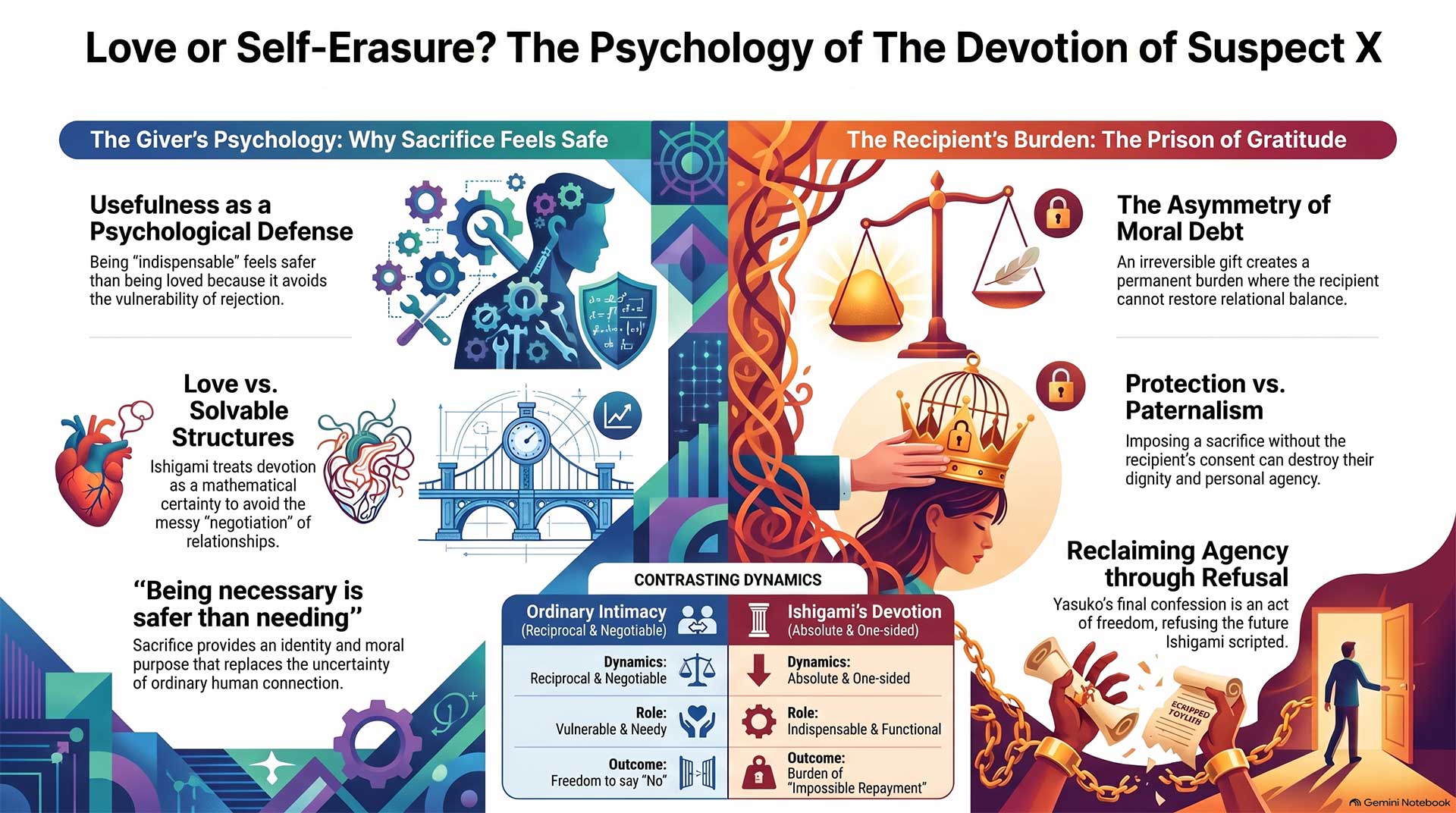
The conversation began with Ishigami, but it gradually exposed something about the reader.
We are given intimate access to his loneliness, intelligence, tenderness, sacrifice, and suffering. That closeness makes him difficult to condemn completely.
Paul Bloom’s challenge became important here: empathy does not distribute itself fairly. We know Ishigami deeply, yet another life can become almost invisible inside the elegance of his plan.
Martha Nussbaum pushed the discussion in another direction. The answer is not to feel less for Ishigami. It is to widen moral attention until everyone remains visible.
That includes Yasuko.
One of the strongest conclusions was that a sacrifice can be sincere in intention and still become binding in effect.
Ishigami demands no repayment. Yet Yasuko must still live with the knowledge that another person has surrendered almost everything for her.
Naomi Hirahara’s perspective on obligation made that problem richer. Human relationships naturally create gratitude, duty, reciprocity, and emotional debt. Freedom does not require pretending we owe nothing to anyone.
But Esther Perel drew an important boundary:
A relationship becomes dangerous when the recipient can no longer remain a separate person who is free to disagree, refuse, disappoint, or choose another path.
That led to the psychological center of the discussion.
Perhaps Ishigami did not merely want to be loved.
Perhaps he needed to be necessary.
Being useful gave him certainty.
Being needed gave him a role.
But simply asking another person to care for him would have required something far less controllable:
rejection, uncertainty, disappointment, ordinary vulnerability.
The smallest act may have been harder than the greatest sacrifice.
Ask for dinner.
Say you are lonely.
Admit you need someone.
Let them say no.
That idea gave Ishigami’s tragedy a different shape.
Yasuko and Misato may not have given him a life that belonged to them.
They may have revealed that he still wanted to participate in life at all.
Yukawa’s decision became equally difficult.
He exposes Ishigami’s plan, yet the discussion resisted calling that act either pure justice or simple betrayal.
He may have betrayed what Ishigami wanted while refusing to betray the belief that Ishigami still mattered.
That does not make Yukawa morally clean.
It makes the choice tragic.
By the final topic, the meaning of devotion had changed.
At first, devotion looked like one person giving everything.
By the end, Yasuko’s refusal to accept that sacrifice may itself become another form of devotion.
She effectively says:
“You do not get to carry this alone.”
That destroys Ishigami’s intended ending.
It may also be the first moment his life is treated as something that cannot simply be spent for another person.
The final question remains unresolved:
When suffering makes sacrifice look sacred, how do we tell the difference between profound love and profound self-erasure?
Short Bios:
Keigo Higashino
Japanese novelist and creator of The Devotion of Suspect X. In this fictional discussion, he resists explanations that make Ishigami too easy to diagnose or judge, repeatedly returning interpretation to the ambiguity of the novel.
Esther Perel
Psychotherapist and writer known for exploring intimacy, desire, autonomy, attachment, and relationship dynamics. Her perspective focuses on Ishigami’s need to become necessary and the difference between being significant to someone and becoming indispensable.
Paul Bloom
Psychologist and author whose work has examined empathy and moral judgment. His role centers on selective empathy: why readers feel so deeply for Ishigami and what that emotional closeness may cause them to overlook.
Martha Nussbaum
Philosopher whose work explores ethics, emotion, dignity, justice, and human flourishing. She asks whether love can remain morally admirable when it reduces another person—or the lover himself—to an instrument.
Michael Sandel
Political philosopher known for examining justice, moral responsibility, and the limits of individual choice. He presses the discussion on sacrifice, autonomy, truth, and whether Yukawa has the right to intervene in Ishigami’s chosen fate.
Naomi Hirahara
Japanese American mystery writer who has written about The Devotion of Suspect X and the role of obligation in the novel. Her perspective brings cultural nuance to gratitude, reciprocity, indebtedness, and Yasuko’s response to Ishigami’s sacrifice.
Kazuhide Nabae
Literary scholar who has published academic work interpreting The Devotion of Suspect X. His role questions what “devotion” itself means and whether Ishigami’s attachment fits comfortably inside ordinary categories such as romance, obsession, or selflessness.
This is a fictional discussion using real public thinkers as interpretive participants. The dialogue was newly created for literary analysis and does not represent statements these individuals actually made, except where their published work or commentary informed the general perspective attributed to them.
Leave a Reply