
Introduction
Daniel Rosen is an ordinary hospital maintenance worker in New York City. He fixes broken cooling systems, faulty doors, and whatever else stops working during one of the worst heat emergencies the city has faced.
Then Daniel discovers something he cannot repair with tools.
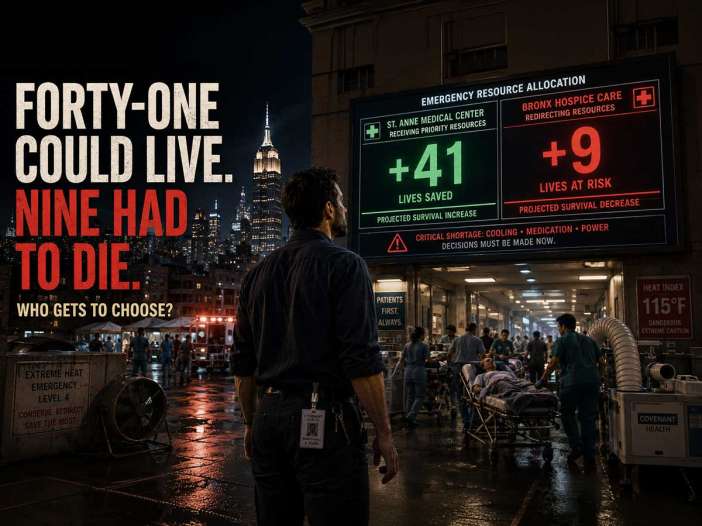
Covenant Health has developed a system for deciding where scarce medical resources should go—and which patients may have to be left behind.
One decision pulls Daniel into a conflict involving doctors, executives, journalists, his own family, and eventually millions of strangers who begin turning him into something he never wanted to become: a symbol.
The Man Who Wouldn’t Be a Symbol is a story about sacrifice, guilt, love, faith, and a deceptively simple question:
When there is nothing left to fix, will you stay?
Chapter 1: The Night Shift
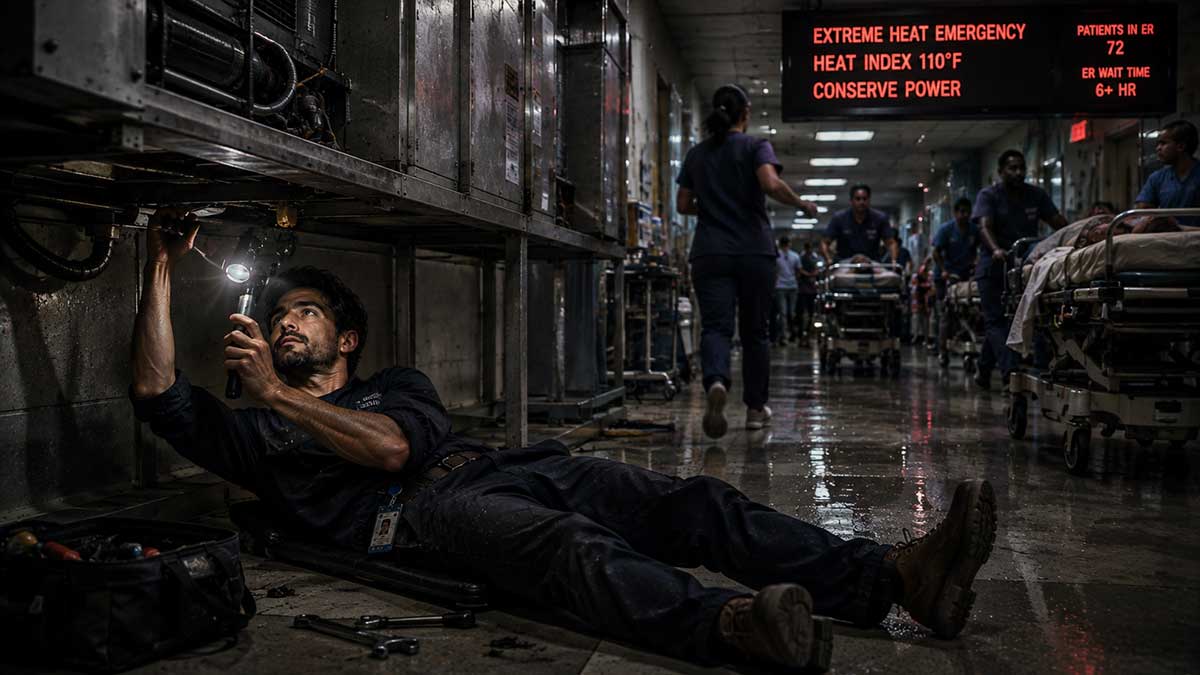
At 11:48 p.m., the heat outside Covenant Metropolitan Hospital was still ninety-eight degrees.
Daniel Rosen was lying on his back beneath an air-handling unit with a flashlight between his teeth.
The nurse standing above him had asked the same question three times.
“How long?”
Daniel pulled the flashlight out of his mouth.
“Ten minutes.”
It would be forty.
He knew that.
She did not need to.
“Ten?”
“Maybe fifteen.”
She looked toward the hallway.
“We have three patients waiting for this room.”
Daniel reached back into the machine.
“Then fifteen.”
The nurse disappeared.
Daniel smiled to himself.
He had been telling people “ten minutes” for twelve years.
Sometimes the repair took five.
Sometimes an hour.
Ten minutes was not a measurement.
It was anesthesia.
He tightened a loose connection.
The compressor coughed.
Then stopped.
“Come on.”
He tapped the side panel.
Nothing.
“Don’t embarrass me.”
The machine shuddered back to life.
Cool air pushed through the vent.
Daniel stayed beneath it another few seconds.
Not since he needed to.
He liked the feeling.
For most of the night, everything around him was hot, failing, or angry.
Cold air felt like evidence that something could still be fixed.
He slid out.
His Covenant maintenance shirt was soaked through.
The nurse reappeared.
“That was fast.”
Daniel looked at his watch.
Twenty-seven minutes.
“Ten.”
She stared at him.
He smiled.
“Hospital time.”
She shook her head and walked away.
Daniel packed his tools.
The overhead speaker announced another heat emergency arrival.
Then another.
Then another.
He looked toward the emergency department.
Stretchers filled both sides of the hallway.
A man with an oxygen mask sat in a wheelchair.
An elderly woman lay beneath damp towels.
A paramedic argued with a charge nurse about where to place another patient.
The hospital felt less like a building than a machine running beyond its limits.
Daniel understood machines.
They rarely failed all at once.
First came small noises.
A vibration.
A delay.
A temperature slightly outside normal.
Then everyone ignored it.
Then the failure looked sudden.
New York had been under an excessive heat warning for five days.
The news called it historic.
Daniel thought the word was being overused.
Historic temperatures.
Historic demand.
Historic emergency-room volume.
Historic strain on the electrical grid.
People liked the word since it made suffering sound important.
Mostly, Daniel saw broken air conditioners.
By 1:10 a.m., he had repaired two room vents, reset a pharmacy refrigerator alarm, cleared a condensate drain, and helped move three portable cooling units from outpatient offices into patient care areas.
His radio crackled.
“Facilities to six east.”
Daniel pressed the button.
“Facilities.”
“Room 614. Window lock.”
He looked at the tool cart.
“A window lock?”
“Patient is upset.”
“That is nursing.”
“Window lock is facilities.”
Daniel sighed.
“On my way.”
Six east was hospice overflow.
It had never been designed to hold this many dying people during a heat emergency.
Half the rooms had temporary cooling units.
The hallway smelled faintly of antiseptic, plastic, and overheated electrical equipment.
Daniel found room 614.
Mara Bennett was sitting on the floor.
That was the first thing he noticed.
Not beside the patient.
On the floor.
Her back rested against the bed frame.
Mrs. Adler, eighty-four, lay beneath a thin sheet, breathing through an oxygen cannula.
The window beside her bed was open two inches.
Mara looked at Daniel.
“Hero arrives.”
“I was told there was a broken lock.”
“There is.”
He tested it.
The latch had slipped out of alignment.
“Two minutes.”
Mrs. Adler looked toward him.
“Can you make it open more?”
Daniel glanced at Mara.
Mara shook her head slightly.
“No.”
Mrs. Adler whispered:
“I can’t breathe.”
Daniel looked at the oxygen line.
Then the vent.
Then the monitor.
Everything appeared functional.
Mara spoke gently.
“You are breathing.”
Mrs. Adler shook her head.
“No air.”
Daniel understood.
Not the room.
The feeling.
He fixed the latch.
The window opened another inch.
Warm air entered.
It did nothing.
Mrs. Adler took Daniel’s hand.
He froze.
She had thin fingers and surprising strength.
“Don’t close it.”
“I won’t.”
“Promise?”
“I promise.”
Mara watched him.
Daniel stood there.
Thirty seconds.
A minute.
Two.
Mrs. Adler’s breathing slowed.
Mara leaned toward her.
“Better?”
Mrs. Adler nodded.
Daniel tried to release her hand.
She tightened her grip.
He stayed.
Five minutes passed.
Then ten.
His radio crackled twice.
He ignored it.
Eventually Mrs. Adler fell asleep.
Daniel carefully removed his hand.
Mara stood.
“You know the window was fixed about eight minutes ago.”
Daniel gathered his tools.
“I was checking the seal.”
“For loneliness?”
He looked at her.
“Very funny.”
Mara smiled.
Her hair was pulled into a careless knot.
Her scrubs had a dark line of sweat along the collar.
She looked as tired as he felt.
“You eaten?”
“Yes.”
“What?”
“Food.”
“That is not an answer.”
“Turkey sandwich.”
“When?”
He thought about it.
“Yesterday.”
“Daniel.”
“I am working.”
“So are kidneys.”
He started walking.
Mara followed.
“You need water.”
“I have water.”
“You have coffee.”
“Coffee contains water.”
“That explains your personality.”
He smiled despite himself.
This was how they talked.
Mara was one of the few people in Covenant who never sounded impressed by competence.
She treated Daniel like someone who needed supervision.
He sometimes appreciated it.
Usually not.
At the elevator, Mara handed him a bottle of water.
He took it.
“Happy?”
“No.”
“Good night, Mara.”
“It is one in the morning.”
“Exactly.”
The elevator doors opened.
Before entering, Daniel looked back.
“Mrs. Adler okay?”
Mara’s expression changed slightly.
“No.”
He understood.
He nodded once and stepped inside.
At 2:06 a.m., his father called.
Daniel almost ignored it.
David Rosen did not call at two in the morning unless someone was dead or he had forgotten time existed.
Daniel answered.
“What happened?”
“Where are you?”
“At work.”
“You need to leave.”
Daniel leaned against a supply-room wall.
“Good morning to you too.”
“I mean it.”
“Dad.”
“Come home.”
“To Queens?”
“Yes.”
“In the middle of a hospital emergency?”
“Daniel.”
Something in his voice made Daniel stop smiling.
“What is wrong?”
“The grid.”
“What about it?”
“I’ve been watching the load reports.”
“You’re retired.”
“Retired people still know how electricity works.”
Daniel rubbed his forehead.
“The hospital has emergency generation.”
“Until it doesn’t.”
“We have three separate backups.”
“So did other places.”
Daniel heard something strange in his father’s voice.
Fear.
Not worry.
Fear.
“You okay?”
David did not answer.
“Dad?”
“Get out of Manhattan.”
Daniel looked through the small window in the supply-room door.
A transporter rushed past pushing a patient.
“Not happening.”
“I’ve seen this before.”
Daniel assumed he meant 2003.
The great blackout had become one of David’s favorite stories.
Daniel had been eleven.
He remembered darkness.
Candles.
His mother making jokes.
His father moving through the apartment with a flashlight.
Nothing more.
“Dad, this is not 2003.”
David became quiet.
Daniel noticed.
“What?”
“Nothing.”
“You called me at two in the morning to tell me to leave Manhattan, then ‘nothing’?”
“Just come home when you can.”
“I will.”
“Tonight.”
“I said I will.”
David ended the call.
Daniel stared at the phone.
Then his radio crackled.
“Facilities, central mechanical.”
He put the phone away.
Whatever had frightened his father could wait.
Hospitals were filled with things that could not.
At 3:18 a.m., Daniel was inside the central mechanical room when the emergency allocation dashboard refreshed.
He almost missed it.
The screen usually displayed energy load, generator reserves, oxygen supply, cooling status, and network alarms across Covenant facilities.
Tonight a new column had appeared.
PRIORITY STATUS
Green.
Green.
Yellow.
Green.
Then one red.
Covenant St. Anne Community Care — Bronx
Daniel clicked it.
The facility served long-term respiratory patients, hospice beds, and medically fragile adults.
He knew the building.
Old.
Ugly.
Always underfunded.
A notice appeared.
EMERGENCY COOLING REDISTRIBUTION IN EFFECT
Daniel frowned.
The system showed two portable industrial chillers assigned to St. Anne.
Both had been redirected to Covenant Metropolitan.
He refreshed.
Same result.
He called central operations.
A woman answered after forty seconds.
“Covenant command.”
“This is Rosen, Metro facilities. I’m looking at a diversion from St. Anne.”
“Facility ID?”
He gave it.
Keyboard sounds.
“Yes.”
“Is that an error?”
“No.”
“They have medically fragile patients.”
“So does Metro.”
“I know. I’m standing in it.”
Silence.
Daniel looked at the numbers.
“Who authorized the move?”
“Allocation confirmed.”
“By who?”
“The model.”
Daniel frowned.
“What model?”
“Emergency resource optimization.”
He had heard the phrase during training but never seen it operating at this level.
“Can a person reverse it?”
“Not without central authorization.”
“Who gives that?”
“Executive command.”
Daniel looked at the screen again.
Below the chiller transfer appeared a smaller panel.
PROJECTED SURVIVAL GAIN THROUGH DIVERSION: +41
He read it twice.
Then saw the next line.
PROJECTED LOCAL MORTALITY INCREASE: +9
Daniel stared.
Nine.
Not percentage.
People.
He brought the phone closer.
“What does ‘local mortality increase plus nine’ mean?”
The operator paused.
“You know what it means.”
Daniel felt the room become louder around him.
Fans.
Pumps.
Compressors.
Machines doing exactly what they had been told to do.
“Who chose nine?”
“The model doesn’t choose people.”
Daniel looked at the red facility.
“No?”
“It allocates resources.”
He said nothing.
“Mr. Rosen?”
Daniel ended the call.
For several minutes, he stood alone before the screen.
Metro needed the chillers.
That was true.
Forty-one people might live.
That was true too.
He looked at the other number.
Nine people might die.
Also true.
The screen had no photographs.
No names.
No families.
Only arithmetic.
Daniel reached for the mouse.
There was no override button.
Only:
ALLOCATION CONFIRMED
Behind him, the hospital continued running.
He thought about Mrs. Adler asking him not to close the window.
Then he thought about nine people in another building he had never met.
For the first time that night, Daniel found something broken and had no idea where to put his hands.
Chapter 2: Acceptable Losses
By morning, Daniel had convinced himself the number meant something else.
Nine additional risk-adjusted deaths.
Nine statistical equivalents.
Nine probability units.
Anything but nine actual people.
At 7:20 a.m., before leaving the hospital, he opened the allocation dashboard again.
St. Anne remained red.
No cooling units had been returned.
The mortality estimate had changed.
+11
Daniel stopped.
Two more.
He took a screenshot.
Then another.
He emailed both to himself.
Technically, that violated policy.
He did it anyway.
He slept four hours.
At noon, he woke sweating.
His apartment air conditioner had stopped.
Daniel lay on top of the sheets staring at the ceiling.
For several seconds, he almost laughed.
Then someone knocked.
His landlord shouted through the door:
“Whole line is down!”
Daniel closed his eyes.
Of course.
His phone contained six missed calls.
Three from work.
One from Mara.
Two from David.
He called Mara first.
She answered immediately.
“You alive?”
“Unfortunately.”
“Good. I need a favor.”
“No.”
“I haven’t told you what.”
“That saves time.”
“St. Anne needs portable cooling.”
Daniel sat up.
“How do you know?”
“Two hospice patients were transferred here overnight. Staff said their cooling allocation was pulled.”
Daniel looked at the screenshots.
“What do you need?”
“I thought you said no.”
“I changed.”
“Personal growth.”
“Mara.”
She became serious.
“They have one portable unit left. It is failing.”
Daniel stood.
“How many patients?”
“Twenty-six high-risk.”
He rubbed his face.
“Did they submit an emergency request?”
“Twice.”
“Denied?”
“Yes.”
Daniel looked toward the broken air conditioner in his own room.
“I’ll call you back.”
At 1:18 p.m., Daniel entered Covenant Metropolitan through the loading dock.
He was technically off shift.
No one questioned him.
Maintenance workers belonged everywhere and nowhere.
He went directly to storage.
Two old portable cooling units sat behind broken wheelchairs and obsolete monitors.
One carried a red sticker:
REMOVE FROM SERVICE
The second:
PARTS ONLY
Daniel opened the first.
Compressor intact.
Bad capacitor.
Fan motor worn.
Repairable.
His supervisor found him ten minutes later.
“What are you doing?”
“Inventory.”
“You came in on your day off to inventory trash?”
“Yes.”
His supervisor stared.
Daniel continued working.
“Daniel.”
He looked up.
“Don’t.”
“Don’t what?”
“Whatever you are about to do.”
Daniel smiled.
“I’m replacing a capacitor.”
“I know your face.”
“What face?”
“The one you make before paperwork.”
Daniel returned to the machine.
“I’ll fill it out.”
“That is not comforting.”
His supervisor walked away.
Daniel waited until he disappeared.
Then called Mara.
“Can you get a van?”
Mara arrived forty minutes later driving a Covenant hospice transport vehicle.
Daniel stared at it.
“You stole an ambulance?”
“It’s not an ambulance.”
“It has Covenant written on it.”
“So do you.”
“That is not reassuring.”
Together they loaded the cooling unit.
Mara shut the rear doors.
“Where is the authorization?”
Daniel looked at her.
She nodded.
“Thought so.”
“You asked for help.”
“I asked whether there was equipment.”
“You knew what that meant.”
“I know you.”
“That is worse.”
They got in.
The van’s air conditioning barely worked.
Mara drove.
Daniel sat beside the portable unit listening to every vibration.
“You think this is funny?” he asked.
“No.”
“You’re smiling.”
“I’m watching you commit theft with a maintenance checklist.”
“It is not theft.”
“What is it?”
“Temporary reallocation.”
Mara laughed.
Daniel looked out the window.
Traffic barely moved.
People stood beneath awnings.
Fire hydrants had been opened along several blocks.
Ambulances threaded through intersections.
Digital signs warned:
EXTREME HEAT — LIMIT OUTDOOR ACTIVITY
Daniel looked at pedestrians waiting for buses.
“Who came up with ‘limit outdoor activity’?”
Mara shrugged.
“People with indoor air conditioning.”
At 2:40 p.m., Daniel and Mara reached St. Anne Community Care.
The lobby felt warmer than outside.
Daniel stopped immediately.
“No.”
Mara looked at him.
“What?”
“This is bad.”
He walked toward the mechanical closet.
The nurse manager followed.
“Main chiller is running.”
“Barely.”
“We’ve called central.”
“I know.”
“How?”
Daniel ignored the question.
Patients had been moved into interior corridors where portable fans pushed hot air in circles.
Some were on oxygen.
Some were unconscious.
Others watched Daniel pass.
He hated that.
Not since they were looking at him.
Since he knew he might fail in front of them.
A nurse pulled back a curtain so Daniel could move the cooling unit through.
Behind it lay an elderly man curled beneath a damp sheet.
Daniel glanced at him.
Then another patient.
Then another.
Nobody in the hallway knew who Daniel was.
Nobody cared.
He was simply the man pushing the machine they needed.
He kept pushing.
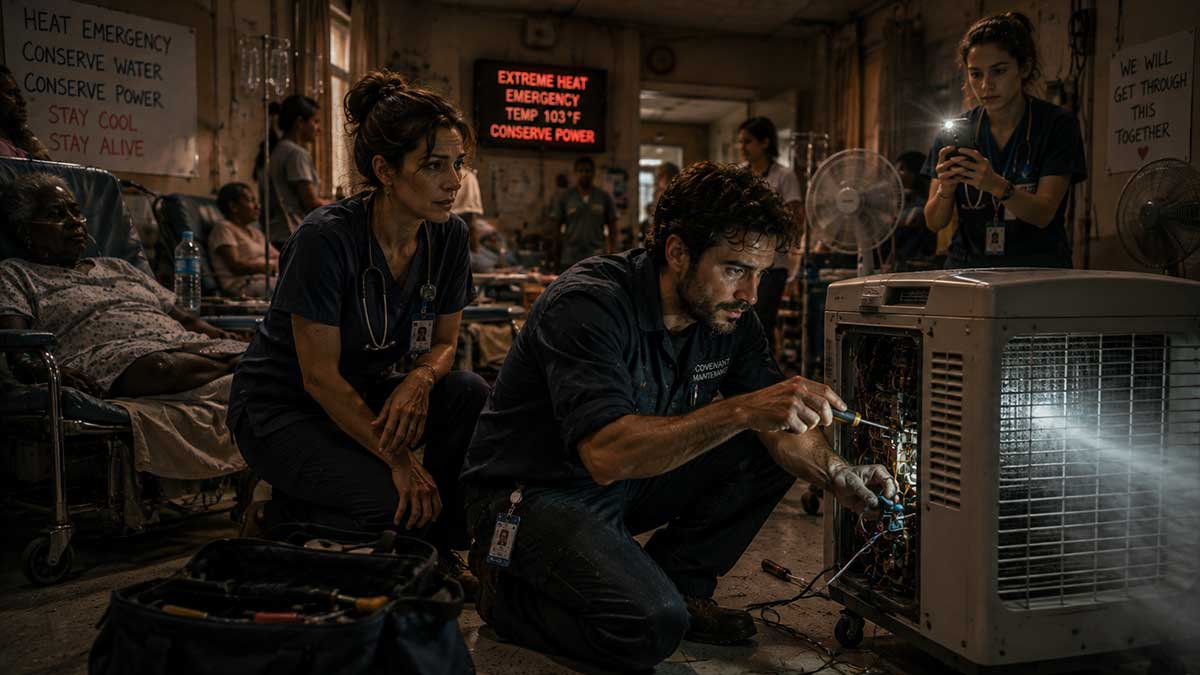
They rolled the cooling unit into the hospice wing.
Daniel plugged it in.
Nothing.
He opened the panel.
Mara stood over him.
“Tell me it works.”
“It works.”
“You have not touched it.”
“I’m encouraging it.”
He removed the capacitor.
Wrong rating.
Someone had replaced it years earlier with whatever they had available.
Daniel swore.
A young medical student crouched nearby.
“Can I help?”
“Find me a forty-five microfarad capacitor.”
The student stared.
“Where?”
Daniel handed him the old one.
“Anywhere.”
The student ran.
Mara knelt beside Daniel.
“How long?”
“Ten minutes.”
She stared.
Daniel looked at her.
“What?”
“You use that voice when you’re lying.”
“Twenty.”
A nurse approached.
“If this does not start, we have to transfer twelve patients.”
“To where?”
“No beds.”
Daniel looked at the broken unit.
Then the hallway.
Then the patients.
“Okay.”
He began rewiring the fan motor directly.
Mara watched.
“That seems safe.”
“It is temporary.”
“You say that about everything.”
Daniel did not answer.
The medical student returned holding two capacitors.
“Found them in a basement storage room.”
Daniel looked at the ratings.
Wrong.
He took both anyway.
“Can you combine them?”
“Maybe.”
“That does not sound good.”
“It sounds electrical.”
He connected them in parallel.
The unit clicked.
Then hummed.
The fan began spinning.
A second later, cold air pushed through the vent.
The nurse manager laughed.
Mara closed her eyes.
Daniel sat on the floor.
“Temporary.”
The medical student held up his phone.
Daniel noticed.
“Were you recording?”
The student lowered it.
“Sorry.”
“Delete it.”
“I was just—”
“Delete it.”
The student nodded.
Daniel watched him tap the screen.
Satisfied, Daniel stood.
He was wrong.
The video had already uploaded automatically.
By 5:30 p.m., Daniel’s phone began vibrating.
Texts.
Emails.
Unknown numbers.
He ignored them.
Mara finally looked at her phone.
“Oh.”
Daniel glanced over.
“What?”
“You are internet famous.”
“No.”
She turned the screen.
A video showed Daniel sitting on the floor beside the cooling unit.
Sweat soaked his shirt.
Sparks flashed briefly from the panel.
A nurse in the background said:
“If he gets this running, we can keep twelve people here.”
Then the machine started.
Someone cheered.
The caption read:
MAINTENANCE WORKER SAVES HOSPICE DURING NYC HEAT EMERGENCY
Daniel stared.
“That is not what happened.”
Mara read comments.
“Oh, it gets better.”
“No.”
“‘Unsung hero.’”
“Stop.”
“‘This man deserves a medal.’”
“Mara.”
“‘Where are the executives?’”
Daniel took the phone.
“I fixed a machine.”
Mara took it back.
“People need stories.”
“They need accurate ones.”
“That has never stopped anyone.”
His own phone rang.
Rebecca.
Daniel looked at the name.
He almost let it go.
Mara noticed.
“Answer.”
“No.”
“Answer.”
He walked away.
“Hi.”
Rebecca sounded amused.
“You’re famous.”
“Apparently.”
“I saw the video.”
“It is misleading.”
“You look exactly the same.”
“What does that mean?”
“Angry that anyone noticed you.”
Daniel smiled.
For a moment, the conversation felt easy.
Old.
Then Rebecca became quiet.
“Be careful.”
“With Covenant?”
“No.”
Daniel leaned against the hallway wall.
“With what?”
“People liking you for this.”
He frowned.
“That is a strange thing to say.”
“I know you.”
“What is that supposed to mean?”
Rebecca took a second.
“You like being needed.”
“That is not the same as liking attention.”
“I didn’t say it was.”
Daniel felt defensive immediately.
“People needed help.”
“I know.”
“So?”
“So nothing.”
“Rebecca.”
She sighed.
“Just be careful.”
The call ended soon after.
Daniel stood alone in the corridor.
He told himself she was wrong.
The fact that the warning bothered him suggested otherwise.
That evening, Daniel visited David.
His father lived in the same Queens neighborhood where Daniel had grown up.
The apartment smelled like coffee and old books.
David had the news muted.
Daniel’s face was on the screen.
He grabbed the remote and turned it off.
“You too?”
David looked toward him.
“You should not have gone.”
Daniel laughed.
“What?”
“St. Anne.”
Daniel stopped.
“How did you know?”
“It’s on television.”
“No. How did you know where?”
David looked away.
Daniel noticed.
“What?”
“Nothing.”
“Everybody keeps saying that today.”
David went into the kitchen.
Daniel followed.
“Dad.”
“Eat.”
“I’m not hungry.”
“You never are until you are.”
David opened the refrigerator.
Daniel leaned against the counter.
“Covenant diverted their cooling.”
David froze.
Only for a second.
Daniel saw it.
“They’re using some optimization model.”
David closed the refrigerator.
“Which facilities?”
Daniel listed three.
David’s face changed with each name.
“Why?”
“They say it saves more people.”
David sat down.
Daniel watched him.
“You know something.”
David shook his head.
“Dad.”
“No.”
“That was not a question.”
David looked at him.
Daniel waited.
His father did not speak.
Daniel finally walked toward the door.
Before leaving, he said:
“You spent my whole life telling me not to lie.”
David closed his eyes.
Daniel left.
Back at Covenant, the allocation dashboard had expanded.
More red facilities.
More yellow.
More transfers.
Daniel searched internal documents.
Most were unreadable.
Technical projections.
Risk weighting.
Equipment scarcity models.
Then he found a phrase.
Buried inside an executive summary:
ACCEPTABLE LOSS DISTRIBUTION
Daniel stared at it.
He read the paragraph.
During catastrophic scarcity, centralized resource allocation would maximize survival by accepting higher mortality in lower-yield intervention environments.
Lower-yield intervention environments.
Daniel opened the facility list.
St. Anne.
Two rehabilitation hospitals.
A nursing facility.
A clinic serving homeless patients.
He felt his jaw tighten.
Then another emergency request appeared.
Covenant Harbor Care
Portable generator requested.
Priority:
Red.
Denied.
Daniel checked available backup.
Metro had reserve capacity.
He could manually redirect a temporary feed for roughly thirty minutes.
Doing so would reduce redundant protection for two intensive-care floors.
If nothing else failed, no problem.
If the grid dipped during those thirty minutes, dozens of people at Metro could be at risk.
Daniel placed his hand on the keyboard.
The override screen appeared.
CONFIRM MANUAL REDISTRIBUTION?
He thought about St. Anne.
Then Mrs. Adler.
Then Dr. Vale’s model.
He looked at the clock.
8:41.
Daniel waited.
What if he moved it?
What if someone at Metro died?
What if he did nothing?
8:44.
He called central command.
Busy.
8:47.
He called again.
No answer.
8:50.
Daniel returned to the override screen.
His finger hovered.
Then the request disappeared.
TRANSFER NO LONGER REQUIRED
He stared.
At 9:13, Mara found him outside the mechanical room.
She knew something was wrong.
“What happened?”
Daniel shook his head.
“What?”
“Nothing.”
She waited.
He looked at her.
“Harbor lost three patients.”
Mara’s face changed.
Daniel continued.
“I had an override.”
“Would it have worked?”
“I don’t know.”
“Would it have saved them?”
“I don’t know.”
“Why didn’t you use it?”
Daniel looked away.
Since he had been afraid.
Since forty-one could become more important than nine.
Since numbers had suddenly become real only after the dead had names.
“I needed more information.”
Mara looked at him for a long time.
Then nodded.
Not agreement.
Recognition.
Daniel almost wished she had accused him.
It would have been easier.
His phone vibrated.
An internal message.
URGENT: Unauthorized equipment redistribution traced to employee credentials.
Daniel closed his eyes.
Another message arrived immediately.
FROM: OFFICE OF THE CHIEF EXECUTIVE
Mr. Rosen, Dr. Adrian Vale would like to meet with you tomorrow morning.
Mara read his face.
“Good news?”
Daniel showed her the screen.
She smiled faintly.
“You might finally get fired.”
Daniel looked toward the crowded hospital.
For the first time all week, the thought sounded almost peaceful.
Chapter 3: Stay With Them
Dr. Adrian Vale’s office was colder than any room Daniel had entered all week.
Not comfortable cold.
Expensive cold.
The kind of temperature that seemed designed to prove the building had never heard of scarcity.
Daniel stood near the window overlooking Manhattan.
Far below, traffic barely moved through the heat shimmer.
Vale sat behind a desk large enough to make Daniel feel like he had entered a courtroom.
No security.
No lawyers.
No Human Resources.
That surprised him.
Vale looked younger than he did on television.
More tired too.
“Sit.”
Daniel remained standing.
Vale noticed.
“Fine.”
He folded his hands.
“Why did you take the cooling unit?”
Daniel had prepared three answers on the subway.
None came out.
“People needed it.”
Vale nodded.
“Did anyone authorize you?”
“No.”
“Did you know the unit had been removed from service?”
“Yes.”
“Did you know transporting it created liability?”
“Yes.”
“Did you know St. Anne had been deprioritized?”
Daniel stared.
“Yes.”
Vale leaned back.
“Good.”
Daniel frowned.
“Good?”
“I prefer conversations where no one pretends.”
Daniel looked toward the window again.
Vale continued.
“Do you think I wanted those patients deprioritized?”
Daniel turned.
“I don’t know.”
“Do you think the people who wrote that model enjoy choosing who loses equipment?”
“I don’t know.”
Vale’s voice remained calm.
“Then maybe start there.”
He opened a tablet.
A map of Covenant facilities appeared.
Colored circles covered the city.
Green.
Yellow.
Red.
Vale tapped one.
Projected demand.
Staffing.
Generator capacity.
Patient survival estimates.
Transfer times.
Then another.
Then another.
The numbers came quickly.
Daniel hated how convincing they looked.
Vale said:
“If we distribute equipment equally, projected deaths increase sharply.”
Daniel looked at the screen.
“How sharply?”
“Best estimate?”
Vale paused.
“Between eighteen hundred and twenty-four hundred across the network during a seven-day emergency.”
Daniel said nothing.
“With centralized allocation, the projection drops below nine hundred.”
The room felt colder.
Vale turned the tablet toward him.
“Do you want me to ignore that?”
Daniel stared at the numbers.
“No.”
“Good.”
Vale waited.
Daniel looked up.
“I want to know why the same facilities keep ending up red.”
Vale did not react.
“Population vulnerability.”
“That sounds backwards.”
“It isn’t.”
“Chronic illness lowers survival probability.”
“Yes.”
“So people who are already sick receive less.”
“In some scenarios.”
Daniel felt anger rise.
“People in smaller facilities receive less.”
“In some scenarios.”
“People in poorer neighborhoods receive less.”
Vale looked directly at him.
“In some scenarios.”
Daniel laughed once.
“So the model says it is neutral.”
“No.”
That stopped him.
Vale continued.
“The model says it is brutal.”
Daniel stared.
Vale leaned forward.
“There is no version of this week where everyone survives.”
Daniel’s jaw tightened.
“That doesn’t mean you get to decide who doesn’t.”
Vale’s expression changed.
“Someone does.”
Silence.
Daniel looked away.
Vale continued.
“You think refusing to choose keeps your hands clean?”
Daniel thought of Harbor Care.
Three patients.
Twelve minutes.
“I didn’t say that.”
“No.”
Vale studied him.
“You look like someone who already knows.”
Daniel said nothing.
When Daniel left the office, he expected relief.
Instead, he felt worse.
He wanted Vale to be cruel.
Cruel people were easier.
Cruelty simplified things.
Vale had shown him numbers.
Lives saved.
Lives lost.
No clean answer.
Daniel took the service stairs.
He did not want to stand beside executives in an elevator.
By the time he reached the tenth floor, his phone was vibrating again.
Unknown number.
He ignored it.
Another.
Then another.
Mara texted:
Come upstairs. Mrs. Adler asking for you.
Daniel stopped walking.
He climbed.
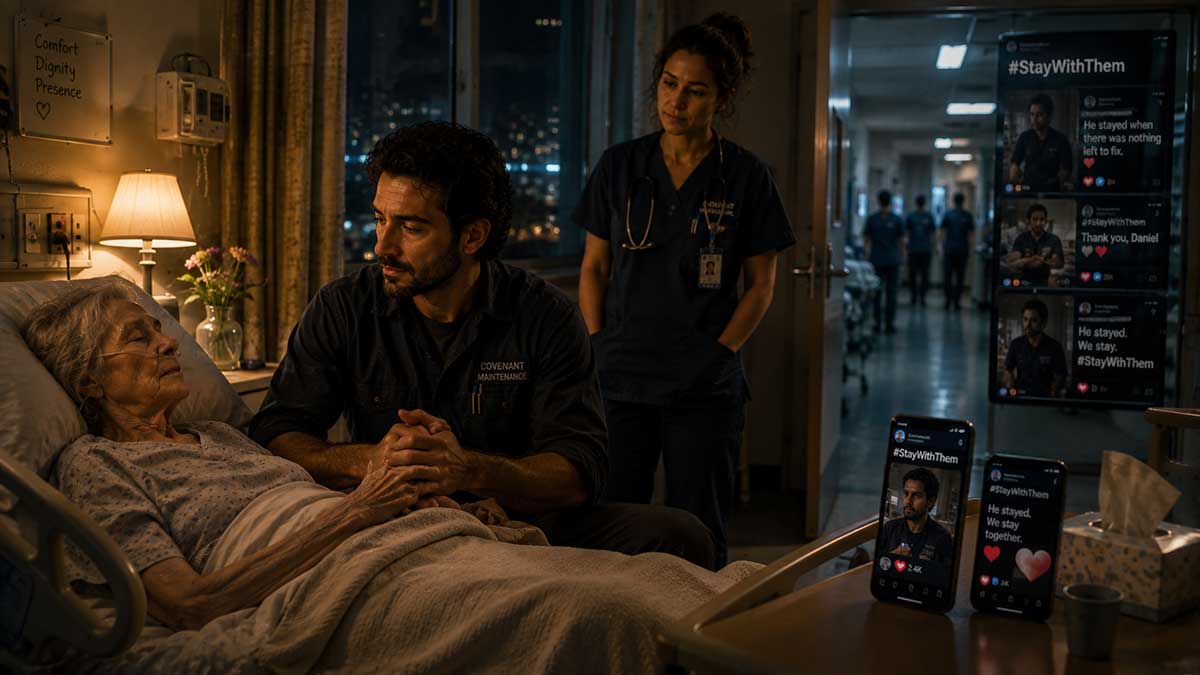
At 11:35 a.m., Daniel entered Mrs. Adler’s room.
She looked smaller.
That was the first thing he noticed.
The room had been dimmed.
No monitor alarms.
No urgency.
Mara stood by the window.
The same window Daniel had repaired.
Mrs. Adler smiled weakly.
“The window man.”
Daniel sat beside her.
“Maintenance supervisor.”
She shook her head.
“Window man.”
“Fine.”
Her hand found his.
The strength was gone now.
“You fix things?”
“Sometimes.”
“This?”
Daniel looked toward Mara.
Mara did not rescue him.
He looked back at Mrs. Adler.
“No.”
She nodded.
The answer seemed to calm her.
“Good.”
Daniel frowned.
“Good?”
“You didn’t lie.”
That hurt more than he expected.
Mrs. Adler closed her eyes.
Daniel stayed.
Five minutes.
Ten.
Twenty.
His radio went off twice.
He turned it down.
Mrs. Adler opened her eyes again.
“You leaving?”
“No.”
“Nothing to fix.”
“I know.”
She seemed confused by that.
Then frightened.
Daniel held her hand.
“If we can’t fix it yet, we stay.”
Mara looked at him.
The words had come out without thought.
Mrs. Adler relaxed.
Several minutes later, she died.
Daniel did not notice the exact moment.
Mara did.
She reached over and turned off the oxygen.
Daniel remained seated.
Neither spoke.
His eyes filled before he could stop them.
He looked down at their joined hands and let the tears come silently.
Mara said nothing.
She did not touch him.
She stayed.
By noon, the phrase had appeared online.
Daniel learned this when Rebecca sent him a screenshot.
A nurse from six east had posted:
“If we can’t fix it, we stay.” — maintenance worker Daniel Rosen, sitting with a dying patient through the NYC heat crisis. #StayWithThem
Daniel stared at the screen.
He texted Mara.
Did you post this?
She replied:
No.
Then:
I would have fixed the grammar.
Daniel called her.
“You think this is funny?”
“No.”
“You sound like you do.”
“I sound tired.”
“Tell whoever posted it to take it down.”
“That ship left yesterday.”
“What does that mean?”
“Search your name.”
He did.
He regretted it immediately.
The cooling-unit video had passed two million views.
People had found old clips.
Security footage.
Phone videos.
Daniel pushing hospital beds.
Daniel unloading oxygen cylinders.
Daniel sitting on the floor beside a patient.
A compilation account had titled one:
THE MAN WHO WON’T LEAVE
He closed the app.
His stomach turned.
Mara said:
“You okay?”
“No.”
“Good.”
“Why good?”
“You should be worried.”
“About Covenant?”
“About everybody.”
That afternoon, strangers began arriving at St. Anne.
Not crowds.
At first, six people.
A nursing student.
Two electricians.
A delivery driver.
A retired respiratory therapist.
A man with a pickup truck full of box fans.
They said they saw the hashtag.
They wanted to help.
Daniel told them to go home.
They did not.
One electrician said:
“Tell us where.”
Daniel stared.
“Where what?”
“Where the problems are.”
“I don’t know.”
“You do.”
“No.”
The man smiled.
“You stole an air conditioner.”
Daniel looked toward Mara.
She was trying not to laugh.
By sunset, Daniel had given them a list.
Not instructions.
A list.
Facilities needing equipment.
People needing rides.
A nursing home looking for bottled water.
A hospice needing portable batteries.
Daniel told himself that was different from organizing anything.
It was not.
The next day, more people showed up.
Then more.
Maintenance crews from other hospitals began calling Daniel directly.
Nurses sent photos of unused equipment.
Volunteers built shared spreadsheets.
Someone made a website.
STAYWITHTHEM.ORG
Daniel did not authorize it.
The site had his face on the homepage.
He nearly threw his phone.
Mara took it away.
“Breaking your phone won’t fix the internet.”
“I want my name off.”
“Tell them.”
“I did.”
“And?”
“They said the movement is bigger than one person.”
Mara looked at him.
Daniel saw her expression.
“What?”
“Nothing.”
“Don’t do that.”
“Do what?”
“That face.”
“What face?”
“The one where you know something.”
Mara handed the phone back.
“People are very good at deciding what other people mean.”
Leah Stein found him in the loading dock.
She was younger than he expected.
Short.
Dark hair.
No camera crew.
Just a recorder and a notebook.
“Daniel Rosen?”
“No.”
She looked at him.
“That is an interesting answer.”
“What do you want?”
“Ten minutes.”
He laughed.
“No.”
“I know about the allocation model.”
Daniel stopped.
Leah noticed.
“I know St. Anne was deliberately deprioritized.”
Daniel looked around.
“Not here.”
“Then where?”
“Nowhere.”
She stepped closer.
“Three facilities lost backup resources the same night Covenant Metropolitan received them.”
Daniel said nothing.
“I know internal documents use the phrase ‘acceptable loss distribution.’”
His face changed.
Leah lowered her voice.
“People are dying inside a system nobody knows exists.”
Daniel stared at her.
“You don’t know enough.”
“Then tell me.”
“No.”
“Why?”
Daniel thought of Vale.
The map.
Nine hundred versus two thousand.
“Since you want a villain.”
Leah’s expression hardened.
“I want evidence.”
“You want evidence that fits your article.”
“You don’t know me.”
Daniel turned away.
She called after him.
“Neither do the people making you a hero.”
He stopped.
Leah waited.
Daniel looked back.
“That supposed to help?”
“No.”
She closed her notebook.
“It’s supposed to bother you.”
It did.
Rebecca met him the following night at a diner near the hospital.
Daniel arrived twenty minutes late.
She had ordered for him.
Turkey sandwich.
He stared.
“You remember.”
“Not difficult.”
They sat across from each other.
Rebecca looked unchanged enough to hurt.
Same careful posture.
Same way she folded a napkin before speaking about anything serious.
“You look terrible.”
“Thank you.”
“I mean it.”
“So do I.”
She smiled.
For a moment, he remembered being married.
Then Rebecca looked toward the television above the counter.
Daniel’s face appeared beside the words:
#STAYWITHTHEM MOVEMENT EXPANDS
She looked back at him.
“You like this.”
Daniel almost laughed.
“No.”
“Yes.”
“I hate this.”
“You hate the attention.”
“That is the same thing.”
“No.”
Rebecca leaned forward.
“You like being necessary.”
Daniel stared.
“That is unfair.”
“Is it?”
“I am trying to help people.”
“I know.”
“Then what is your problem?”
Rebecca sat back.
“My problem?”
Daniel closed his eyes.
Wrong question.
Rebecca spoke quietly.
“Everyone always had a reason they needed you more.”
He looked at her.
“The superintendent.”
“Your father.”
“The hospital.”
“The guy downstairs whose sink broke.”
“The neighbor who needed a ride.”
“The nurse who called at midnight.”
Daniel said:
“They needed help.”
“So did I.”
He had no answer.
Rebecca continued.
“You gave everybody the emergency version of yourself.”
Her voice softened.
“I got whatever was left.”
Daniel looked down.
The sandwich sat untouched.
Rebecca glanced toward the television again.
“You are very good when there is a crisis.”
Daniel looked at her.
“What happens when there isn’t one?”
The question stayed with him long after she left.
Two nights later, Daniel visited David without calling.
His father was not home.
Daniel used the spare key.
He went inside.
The apartment was dark except for a lamp in the back room.
Daniel almost left.
Then he saw boxes on the dining table.
Old receipts.
Envelopes.
Repair invoices.
Donation letters.
He recognized his father’s handwriting.
No charge.
Paid anonymously.
Replace furnace.
Groceries — monthly.
Dates ran back years.
One file contained names Daniel did not know.
Families.
Buildings.
A nursing facility.
A widow in Yonkers.
A shelter in Queens.
Hundreds of small acts.
David entered behind him.
He froze.
“What are you doing?”
Daniel held up a folder.
“What is this?”
David’s face changed.
“Put it down.”
“Why?”
“Daniel.”
“You’ve been paying people’s bills for twenty years?”
“Put it down.”
“Why?”
David moved toward the table.
Daniel pulled the folder away.
“You don’t have money.”
“I have enough.”
“That isn’t the question.”
David stopped.
Daniel looked at the dates.
The earliest folder:
AUGUST 2003
He stared.
“Dad.”
David closed his eyes.
Daniel felt something shift.
Not understanding.
Suspicion.
The kind that feels like understanding one second before the truth arrives.
“What happened in 2003?”
David said nothing.
Daniel stepped closer.
“What did you do?”
David whispered:
“Go home.”
“No.”
“Daniel.”
“No.”
David looked toward the boxes.
Then toward his son.
His mouth opened.
Closed.
Daniel waited.
David said only:
“Not tonight.”
Daniel laughed bitterly.
“Twenty-three years and tonight is too soon?”
David sat.
Daniel watched him.
For the first time, the old man did not look stubborn.
He looked afraid.
Daniel left without another word.
At Covenant, the movement had become impossible to ignore.
Volunteers now coordinated supply routes across four boroughs.
A church in Harlem offered basement cooling space.
A mosque in Queens opened overnight.
A synagogue in Brooklyn provided vans.
Union drivers transported medicine.
Students delivered water.
Nobody was waiting for Daniel anymore.
That should have relieved him.
Instead, he felt something he did not want to name.
Irrelevance.
He hated himself for it.
Mara found him staring at the shared dashboard.
“What?”
“Nothing.”
“You’re lying.”
“I’m working.”
“No.”
She looked at the volunteer network.
“You’re watching.”
Daniel closed the laptop.
Mara smiled faintly.
“You thought they needed you.”
“They do not.”
“That bothers you.”
“No.”
She waited.
Daniel looked away.
Mara said:
“You should figure that out before they turn you into something you enjoy too much.”
He looked at her.
“What are they turning me into?”
Mara glanced toward a poster taped near the nurses’ station.
Daniel’s face.
Underneath:
STAY WITH THEM
She looked back at him.
“Useful.”
That evening, the television in the staff lounge ran a segment about the movement.
A commentator called Daniel:
“the conscience of the heat crisis.”
Daniel turned off the screen.
Mara sat beside him.
“You know what the problem is?”
Daniel said:
“Everything?”
“People are already forgetting the patients.”
He looked at her.
“They talk about you.”
“The system.”
“The movement.”
“The corruption.”
She nodded toward the dark television.
“Mrs. Adler is gone.”
Daniel said nothing.
Mara continued.
“St. Anne still needs funding.”
“Harbor lost three people.”
“But everybody loves a story.”
Daniel stared at the blank screen.
Mara stood.
Before leaving, she said:
“Be careful they don’t make the story more important than the people who started it.”
Daniel remained there alone.
For the first time, the attention frightened him more than Covenant did.
Chapter 4: The People We Warn
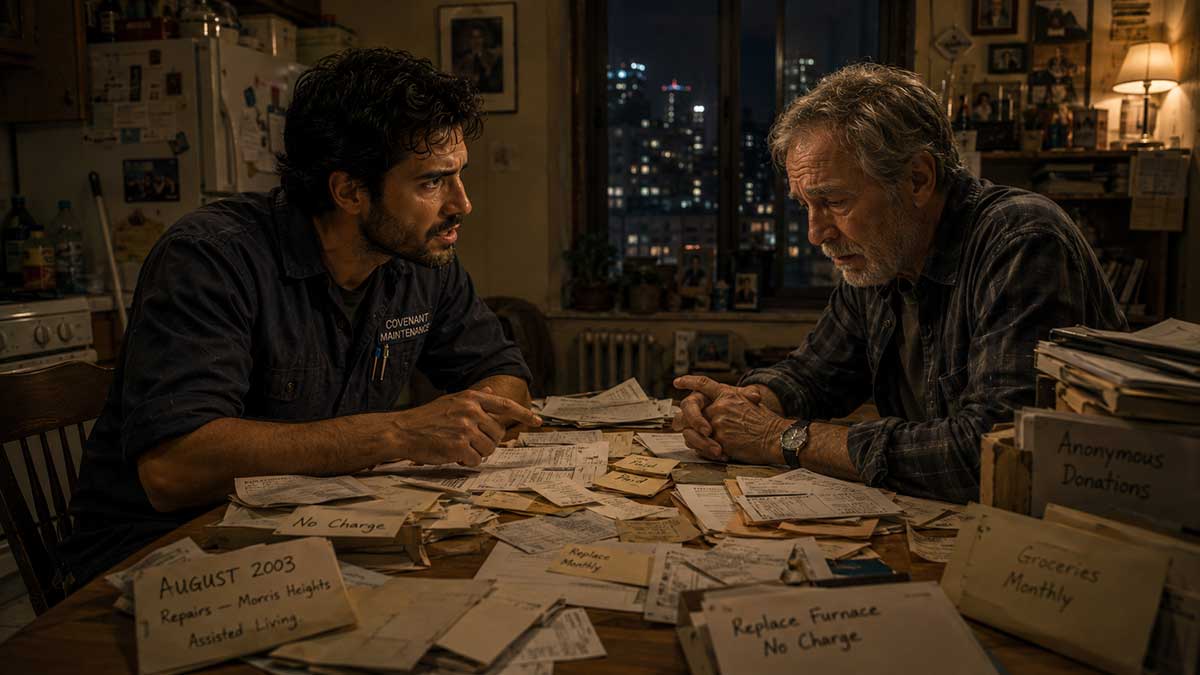
David called at 6:13 the next morning.
“Come over.”
Daniel did not ask why.
He knew.
David had made coffee.
Two cups.
No food.
That was how Daniel knew this was serious.
His father always fed people before hurting them.
Daniel sat.
David remained standing.
For a long time, neither spoke.
Then David said:
“You were eleven.”
Daniel looked at him.
“During the blackout.”
David nodded.
“I was working nights.”
“At Covenant?”
“Yes.”
“Which building?”
“Not Metro.”
David looked toward the window.
“A smaller facility near Morris Heights.”
Daniel waited.
David’s hands trembled slightly.
“There was an assisted-living building three blocks away.”
“Covenant?”
“No.”
“Then why—”
“I had worked on their cooling system before.”
Daniel stopped.
David continued.
“Old equipment. Bad wiring. No backup worth trusting.”
He swallowed.
“When the grid failed, I knew what would happen.”
Daniel stared.
David’s voice became quieter.
“I knew the upper floors would become ovens.”
“How many people?”
David shook his head.
“I don’t remember.”
“You remember.”
Silence.
“How many?”
“Forty-three residents.”
Daniel felt sick.
David continued.
“Most elderly. Some on oxygen.”
Daniel’s jaw tightened.
“What did you do?”
David looked at him.
“I called your mother.”
Daniel went still.
“I told her to take you and Rachel downstairs.”
“Then what?”
“I came home.”
Daniel stared.
“You left?”
“I came home.”
“You knew.”
“Yes.”
“You knew those people were trapped.”
“Yes.”
“You had a phone.”
“Yes.”
“You knew the building.”
“Yes.”
Daniel’s voice rose.
“And you called us?”
David closed his eyes.
“Yes.”
Daniel stood.
“Why didn’t you call them?”
David’s face broke.
“I was thinking about you.”
Daniel stared at him.
“That isn’t an answer.”
David whispered:
“It is the worst answer I have.”
Daniel walked into the kitchen.
Then back.
He could not stay still.
“Did anyone die?”
David looked down.
“Eight.”
Daniel stopped.
The number felt familiar.
Too familiar.
“Eight?”
“Yes.”
“And you never told me?”
“No.”
“You let me grow up thinking you saved us from some blackout adventure.”
“I did save you.”
Daniel turned sharply.
David flinched.
Daniel said:
“Do not say that like it ends the sentence.”
Silence.
David nodded.
“You’re right.”
Daniel laughed.
“You’re right?”
“What do you want me to say?”
“I don’t know.”
Daniel looked at the boxes stacked against the wall.
“The money.”
David said nothing.
“The repairs.”
“The groceries.”
“All those people.”
David sat.
“I thought if I did enough…”
Daniel waited.
David’s voice broke.
“…eventually the number would balance.”
Daniel looked at him.
“Did it?”
David shook his head.
“No.”
That answer stopped the anger for one second.
Only one.
Daniel said:
“So what? You’ve been paying interest on eight people?”
David looked up.
“No.”
“Then what?”
“I was trying to become someone who would not do it again.”
Daniel’s expression hardened.
“You had one job.”
David nodded.
“Warn them.”
“Yes.”
“I know.”
“You could have called.”
“I know.”
“You could have knocked.”
“I know.”
“You could have sent somebody.”
“I know.”
Daniel slammed his hand against the table.
“Stop saying you know!”
David stared at him.
Daniel’s eyes filled.
“You knew then.”
The room went quiet.
David looked down.
That was the wound.
Not ignorance.
Knowledge.
At 3:16 p.m., Daniel was back at Covenant, carrying a box of replacement control boards through the loading dock.
He had been thinking about his father for hours.
About the call.
About David choosing his family first.
About eight people who had never known that somebody else already knew they were in danger.
A transporter stopped him.
“Rosen?”
Daniel turned.
“We’ve got a patient transfer stuck on nine. Elevator’s out again.”
Daniel almost said no.
He had work to do.
His head hurt.
He was angry.
He wanted ten minutes in a room where nobody needed him.
Then he saw the patient.
An elderly man on oxygen.
Frightened.
Daniel put the box down.
“I’ll take the stairs and reset it from mechanical.”
The transporter said:
“That could take a while.”
Daniel looked at the patient.
“I know.”
He picked up the box again.
Then changed his mind.
He handed it to another technician.
“You take this.”
Daniel stayed with the patient until the elevator came back online.
No one filmed him.
Nobody thanked him.
He did not notice the time again.
Mara found him three hours later in the loading dock.
He had been moving crates that did not need moving.
She watched him for a minute.
Then:
“You’re angry.”
“Excellent nursing.”
“What happened?”
“Nothing.”
She waited.
Daniel moved another box.
Mara said:
“Your father?”
Daniel stopped.
He looked at her.
“How do you do that?”
“You have three moods.”
“Very scientific.”
“Your father is one of them.”
Daniel laughed despite himself.
Then the laughter vanished.
He told her.
Not everything.
Enough.
The blackout.
The building.
The eight people.
David calling home first.
Mara listened.
When Daniel finished, he said:
“He spent twenty-three years pretending charity could erase it.”
Mara looked toward him.
“Maybe he wasn’t pretending.”
Daniel frowned.
“He knew.”
“Yes.”
“He saved us.”
“Yes.”
“And left them.”
“Yes.”
Mara waited.
Daniel looked angry again.
“Why are you defending him?”
“I’m not.”
“It sounds like it.”
“I’m trying to stop you from turning him into something simple.”
Daniel stared.
“Eight people died.”
“I heard you.”
“He knew.”
“I heard that too.”
Daniel looked away.
Mara spoke more softly.
“You don’t become different from your father just by judging him harder.”
Daniel turned.
“What is that supposed to mean?”
“It means guilt can make people cruel in more than one direction.”
Daniel felt the Harbor screen flash in his mind.
He snapped.
“You don’t know what you’re talking about.”
Mara’s face changed.
“Okay.”
She walked away.
Daniel wanted to call her back.
He did not.
Leah Stein found him that night near the mechanical room.
She carried a folder.
No greeting.
“Read this.”
Daniel did not take it.
“What?”
“Internal risk weighting.”
“I told you—”
“Read it.”
He took the pages.
Highlighted sections.
The model assigned lower survival value to facilities with high chronic-care populations.
Lower long-term recovery likelihood.
Higher baseline mortality.
Lower projected return per emergency resource unit.
Daniel read the phrase twice.
“Return.”
Leah nodded.
“That is the word.”
“This could mean resource efficiency.”
“It does.”
“That is not automatically evil.”
“I did not say evil.”
Daniel looked at her.
Leah continued.
“I said people with chronic illness count less.”
Daniel hated the sentence.
“Not literally.”
“Mathematically.”
“That is not the same.”
“No?”
He looked down at the pages again.
Leah said:
“Who gets lower scores?”
Daniel did not answer.
“People already sick.”
“Elderly.”
“Disabled.”
“Facilities with worse baseline outcomes.”
Daniel said:
“The model saves more people overall.”
Leah stared.
“You sound like Vale.”
Daniel felt it.
Immediately.
He closed the folder.
“You don’t understand the projections.”
“Neither do you.”
“Then stop pretending.”
She stepped closer.
“You think since the people who built it have better numbers, they must have better morality.”
Daniel looked away.
“That isn’t what I said.”
“No.”
She took the folder back.
“You’re just starting to need it to be true.”
She left.
Daniel stood alone.
Again.
The next morning, David called.
Daniel ignored it.
Rebecca called.
He ignored that too.
Mara did not call.
That bothered him most.
By afternoon, Daniel had discovered another internal file.
The title:
Resource Preservation Under Extreme Scarcity
Buried in the appendix was a line:
Lower intervention priority may be assigned where survival extension produces limited projected system benefit.
Daniel read it slowly.
System benefit.
Not patient benefit.
System.
He closed the file.
Then opened it again.
He called Vale.
The assistant said Vale was unavailable.
Daniel said:
“Tell him Daniel Rosen called.”
Silence.
Then:
“He asked that you come tomorrow morning.”
“Where?”
“Executive headquarters.”
Daniel looked toward the service corridor.
“I was just there.”
“Not Metro.”
She gave him an address in Midtown.
Covenant’s corporate tower.
Daniel knew the building.
He had never entered through the front.
The assistant said:
“Dr. Vale said to tell you…”
She paused.
“…you’ve seen enough of the basement.”
Daniel said nothing.
That evening, Daniel went to David’s apartment.
He stood outside the door for almost five minutes.
Then knocked.
David opened.
Neither spoke.
Daniel stepped inside.
He looked at the boxes.
The receipts.
The years.
David said:
“I’m sorry.”
Daniel shook his head.
“I don’t know what to do with that.”
David nodded.
Daniel sat.
For a moment, they were simply father and son again.
Then Daniel asked:
“If it happened tonight, what would you do?”
David answered immediately.
“Warn them.”
“Before us?”
David closed his eyes.
When he opened them:
“Yes.”
Daniel stared.
“You’d risk us?”
David’s voice shook.
“Yes.”
“Why?”
David looked toward the old boxes.
“Since I know what happens when love becomes an excuse for only seeing your own door.”
Daniel looked down.
The sentence hurt in a different place.
He thought of Covenant.
Metro.
St. Anne.
Harbor.
High-survival facilities.
Low-yield populations.
Their people.
Our people.
The language changed.
The structure did not.
Daniel stood.
David watched him.
“Where are you going?”
Daniel looked toward the door.
“Upstairs.”
David did not understand.
Daniel did.
For the first time, he was ready to see what the people making the choices could see.
And what they could no longer see at all.
Chapter 5: The View From Upstairs
Covenant Health’s corporate headquarters occupied thirty-eight floors of glass in Midtown.
Daniel had worked for the system twelve years.
He had repaired ventilation units under operating rooms, crawled behind laundry equipment, cleared flooded mechanical rooms, replaced broken ceiling tiles, and slept twice on a boiler-room floor during snow emergencies.
He had never been above the twentieth floor of headquarters.
The receptionist looked at his maintenance shirt.
Then at the appointment.
Then back at him.
“Dr. Vale is expecting you.”
That bothered him.
Not the appointment.
The expectation.
Daniel had spent the week reacting to rooms no one could predict.
Vale seemed to have predicted this one.
The elevator rose silently.
Twenty-six.
Twenty-nine.
Thirty-three.
Daniel watched Manhattan fall away beneath him.
The city looked different from above.
Less crowded.
Cleaner.
Orderly.
You could not see people waiting for buses.
You could not see patients sweating inside old buildings.
You could not see Mrs. Adler asking him not to leave.
You could see traffic patterns.
Neighborhood grids.
Hospital roofs.
Infrastructure.
Daniel suddenly understood why people upstairs spoke differently.
Distance changed vocabulary.
Vale’s office was larger than the one at Metropolitan.
No personal photographs.
No trophies.
Just books, city maps, and a long table facing the skyline.
Vale did not sit behind a desk.
He stood beside the window.
“I thought you might come.”
Daniel closed the door.
“You asked me.”
“I meant before today.”
Daniel frowned.
Vale motioned toward the table.
“Coffee?”
“No.”
“Water?”
“No.”
“Sit?”
“No.”
Vale smiled faintly.
“You are consistent.”
Daniel placed Leah’s documents on the table.
“What does this mean?”
Vale looked down.
He already knew.
“Which part?”
“Limited projected system benefit.”
Vale nodded.
Daniel stared.
“That is your answer?”
“No.”
Vale pulled out a chair and sat.
Daniel remained standing.
“Sit, Mr. Rosen.”
“No.”
Vale looked at him.
“Then this will be tiring for both of us.”
Daniel sat.
Vale opened the documents.
“These are model-design notes.”
“I can read.”
“I know.”
“People with chronic illness receive lower priority.”
“In some circumstances.”
“Elderly patients receive lower priority.”
“In some circumstances.”
“Disabled patients.”
“In some circumstances.”
“Poor facilities.”
“Indirectly.”
Daniel laughed once.
“What does indirectly mean?”
“Facilities with lower recovery probability receive fewer scarce resources when the same resources are projected to save more lives elsewhere.”
Daniel leaned forward.
“You keep saying more lives like that ends the argument.”
Vale looked at him.
“No.”
Silence.
“It begins the argument.”
Daniel stopped.
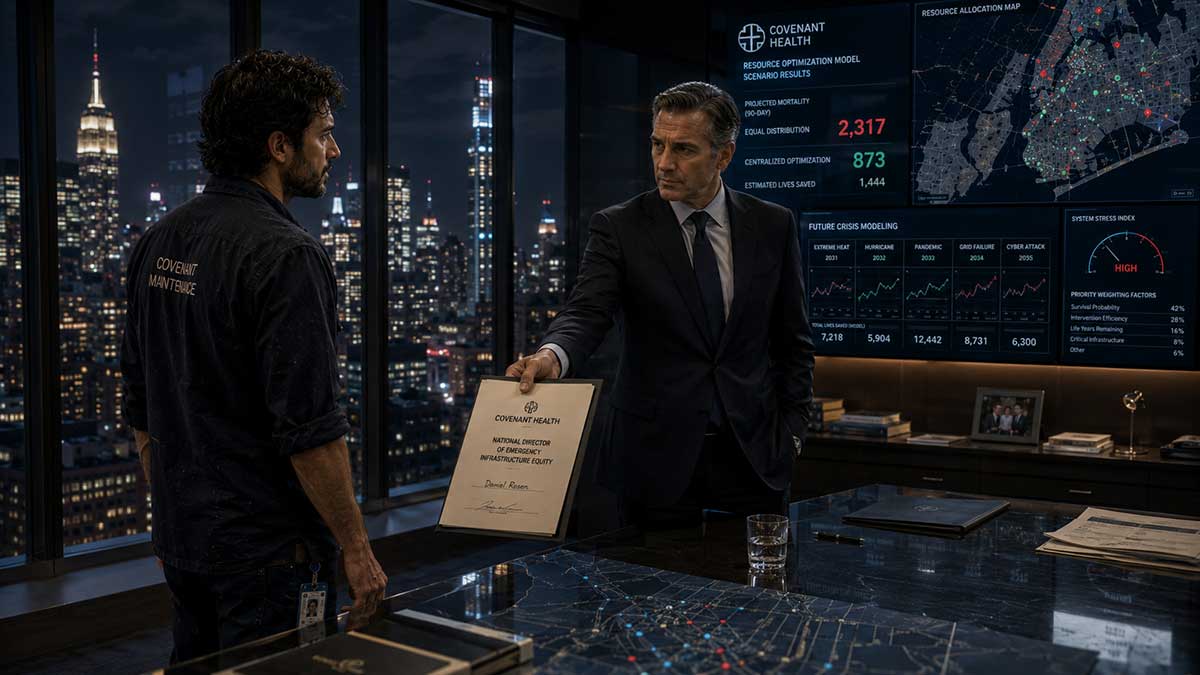
Vale turned his monitor toward him.
A map appeared.
Covenant facilities across New York.
Numbers everywhere.
Admissions.
ICU capacity.
Generator reserves.
Mortality projections.
Vale clicked one scenario.
“Equal resource distribution.”
Projected mortality:
2,317
Another.
“Centralized optimization.”
Projected mortality:
873
Daniel stared.
Vale said:
“These are not guarantees.”
“I know.”
“Best estimates.”
“I know.”
“If we ignore the model, more people may die.”
Daniel said nothing.
Vale zoomed in.
“Here.”
Metro.
St. Anne.
Harbor.
Two nursing facilities.
A dialysis center.
Vale moved equipment icons between them.
The death projections changed with every transfer.
Daniel hated how simple it looked.
A generator moved.
A number dropped.
A cooling unit shifted.
Another number rose.
“Do you know what people think executives do?” Vale asked.
Daniel looked at him.
Vale continued.
“They think we choose profit over lives.”
“Sometimes you do.”
Vale nodded.
“Sometimes.”
Daniel had not expected that.
Vale said:
“They think we sit in rooms like this and decide who matters.”
“You do.”
“No.”
Vale looked toward the screen.
“We decide what to do after learning there is no choice where nobody dies.”
Daniel stared.
“You’re trying to make this sound noble.”
“I’m trying to make it sound terrible.”
That silenced him.
Vale closed the map.
“For fifteen years I have watched people demand simple morality from complicated emergencies.”
Daniel leaned back.
“And?”
“And simple morality kills people too.”
Vale walked toward a second room.
“Come.”
Daniel followed.
A wall-length display activated.
Projections.
Heat waves.
Hurricanes.
Grid failures.
Pandemics.
Cyberattacks.
Each scenario showed hospital demand under future crises.
“What is this?”
“Covenant 2035 emergency modeling.”
Daniel laughed bitterly.
“Of course it has a name.”
Vale ignored him.
“If we implement current optimization nationally, these are projected lives preserved over nine years.”
Numbers appeared.
Daniel stared.
Tens of thousands.
Vale said:
“I want you to help redesign it.”
Daniel looked toward him.
“What?”
“Emergency allocation.”
“I fix air conditioners.”
“You see failures the people who built the model do not.”
“I am not a statistician.”
“No.”
Vale smiled faintly.
“That may be your greatest qualification.”
Daniel thought he had misheard.
“What exactly are you offering me?”
Vale opened a folder.
A position.
National director of emergency infrastructure equity.
A salary nearly three times Daniel’s current pay.
A full engineering and policy staff.
Federal partnerships.
Authority to redesign allocation procedures.
Independent review access.
Daniel stared.
“Why me?”
Vale answered immediately.
“Since people trust you.”
The sentence made his stomach tighten.
“I don’t want them to.”
“That does not matter.”
“It matters to me.”
Vale looked toward the window.
“Trust is a resource.”
Daniel’s expression hardened.
“There it is.”
“What?”
“You make everything sound like inventory.”
Vale turned back.
“Daniel, you have thousands of volunteers moving supplies with no central control.”
“I did not organize them.”
“They believe you did.”
“That is their mistake.”
Vale stepped closer.
“Mistakes can still produce good.”
Daniel looked away.
At 1:34 p.m., Vale finally placed the contract between them.
Daniel glanced at the clock without thinking.
Vale slid the papers forward.
“Read the title.”
Daniel did.
National Director of Emergency Infrastructure Equity
A second page listed the authority attached to the role.
Budget oversight.
Emergency policy access.
Direct federal coordination.
Community review boards.
Daniel looked up.
Vale said:
“You could change how this country handles scarcity.”
Daniel stared at the contract.
Vale continued.
“You could make sure the next St. Anne is not invisible.”
Daniel’s hand rested near the papers.
For a second, he saw what the job could become.
Hospitals with real backup systems.
Transparent reviews.
A seat at every table where people like Mrs. Adler had previously appeared only as numbers.
It was not vanity.
That was what frightened him.
It was good.
Vale said:
“You can remain morally untouched and help hundreds.”
Daniel said nothing.
“Or accept responsibility and help millions.”
The sentence hit harder than Daniel expected.
Vale saw it.
“That bothers you.”
“Yes.”
“Why?”
“Since you make compromise sound like courage.”
“Sometimes it is.”
“And sometimes cowardice.”
“Yes.”
Daniel looked at him.
Vale continued.
“That is why I am asking you.”
Daniel laughed.
“You think I know the difference?”
“No.”
Vale looked exhausted now.
“I think you know you don’t.”
Daniel looked once more at the clock.
1:34.
Then at the contract.
He folded it.
Not signed.
Not rejected.
Carried.
That bothered him more than the offer itself.
Mara found him that evening in a break room eating crackers over a sink.
“How was heaven?”
Daniel looked up.
“What?”
“Executive floor.”
He almost smiled.
“It has air conditioning.”
“Of course.”
He handed her the contract.
Mara read the first page.
Then the salary.
Her eyebrows rose.
“They really like you.”
“They like what people think I am.”
“Same problem?”
“Yes.”
She continued reading.
“This is real.”
“I know.”
“You could do something with this.”
“I know.”
Mara looked at him.
Daniel began talking.
“Independent review.”
“Federal access.”
“National standards.”
“Human override requirements.”
“Community representation.”
Mara listened.
Daniel kept going.
“They would fund new infrastructure in smaller facilities.”
“Require public documentation.”
“Change weighting.”
“Create—”
“Daniel.”
He stopped.
“Do you want the job?”
He stared.
“That is not the point.”
Mara handed the contract back.
“That was my question.”
“I could help thousands.”
“Maybe.”
“Tens of thousands.”
“Maybe.”
He became frustrated.
“Why are you doing this?”
“Since everyone else keeps telling you what you could become.”
Mara stepped closer.
“I’m asking whether you still know who you are.”
Daniel looked away.
“I fix things.”
“No.”
His eyes returned to hers.
Mara continued.
“That is what you do.”
He did not answer.
He found the hospital chapel hallway after midnight.
Not the chapel.
The hallway.
He sat beneath a vending machine since the outlet nearby still worked.
His phone was at three percent.
A young chaplain came around the corner.
Eli Kaplan.
Daniel knew him vaguely.
Thirty.
Glasses.
Too much hair.
The kind of person who remembered everyone's name.
Eli looked at Daniel sitting on the floor.
“Praying?”
“Charging.”
“Same posture.”
Daniel held up the phone.
“Battery does not care about theology.”
Eli sat opposite him.
“You okay?”
“Yes.”
“Great conversation.”
Daniel sighed.
They sat in silence.
After a minute, Eli said:
“You know what they’re turning you into, right?”
Daniel looked at him.
“A lawsuit?”
Eli laughed.
Then stopped.
“Something older.”
Daniel stared.
“What is that supposed to mean?”
Eli shrugged.
“People want someone whose suffering can explain theirs.”
Daniel’s expression changed.
“I am not suffering.”
Eli looked at him.
“Sure.”
Daniel stood.
“My phone is charged.”
“It’s at nine percent.”
“Enough.”
He walked away.
Eli called after him.
“Daniel.”
He turned.
Eli said:
“Be careful when people love what you mean more than they love you.”
Daniel stood frozen for a second.
Then kept walking.
Leah arrived at 2:40 a.m.
She carried a flash drive.
“I have it.”
Daniel looked around.
“Have what?”
“Internal communications.”
She handed it to him.
“You need to see before I publish.”
Daniel plugged it into a workstation.
Emails.
Meeting notes.
Model revisions.
One executive wrote:
Regulators are unlikely to accept weighting language tied directly to long-term patient value. Recommend reframing as intervention efficiency.
Another:
Avoid demographic framing. Geographic proxies produce nearly identical optimization outcomes.
Daniel’s jaw tightened.
Leah said:
“They knew.”
Daniel kept reading.
Another thread.
Some executives objected.
A physician warned that vulnerable populations would absorb disproportionate mortality.
Vale replied:
Concern valid. However, suspending optimization under peak scarcity produces larger projected system mortality. Develop mitigation, not abandonment of model.
Daniel stared.
Leah said:
“He knew.”
Daniel looked at her.
“Yes.”
“You still think he’s complicated?”
“Yes.”
Leah became angry.
“How?”
Daniel pulled up the mortality projections.
“Since he might still be right about what happens if the system collapses.”
Leah stared at him.
“You are unbelievable.”
“No.”
“I have proof they hid discriminatory effects.”
“And he has proof more people may die without allocation.”
“Projections.”
“Yes.”
“Made by them.”
“Reviewed externally.”
Leah stepped closer.
“You want him to be right.”
Daniel looked at her.
“Why would I want that?”
“Since then you don’t have to destroy anything.”
That hurt.
Leah knew it.
She softened slightly.
“Daniel.”
He looked at the files again.
“If Covenant loses federal contracts this week, how many facilities run out of cash?”
Leah said nothing.
“If lenders freeze emergency credit?”
Nothing.
“If suppliers stop deliveries?”
“Are you defending them now?”
“I am asking.”
Leah closed her eyes.
“Fine.”
She pulled up another folder.
Financial projections.
Covenant was closer to collapse than the public knew.
The heat emergency had pushed several hospitals to the edge.
Daniel read quietly.
“If this all goes public…”
Leah nodded.
“Could be ugly.”
“How ugly?”
“I don’t know.”
Vale called him ten minutes later.
Daniel answered.
Vale said:
“You have the files.”
Not a question.
“Yes.”
“Come upstairs.”
“No.”
“Then listen.”
Daniel waited.
“If Covenant collapses this week, our best estimate is six hospitals enter emergency receivership within thirty days.”
Daniel closed his eyes.
“Clinics?”
“Possibly twelve.”
“Deaths?”
“We cannot model it reliably.”
“Meaning?”
“Potentially high.”
Daniel looked toward Leah.
She watched him.
Vale continued.
“Now you know everything.”
Daniel said:
“No.”
Vale paused.
Daniel whispered:
“I know enough to hate every answer.”
Vale said:
“Good.”
Daniel almost laughed.
“That is the second time you’ve said that.”
“Only dangerous people know immediately.”
The call ended.
Daniel stared at the dead screen.
For the first time, he understood what Vale had been trying to tell him.
The trap was not choosing between good and evil.
It was choosing which good would be allowed to become someone else’s suffering.
Chapter 6: What Do You Represent?
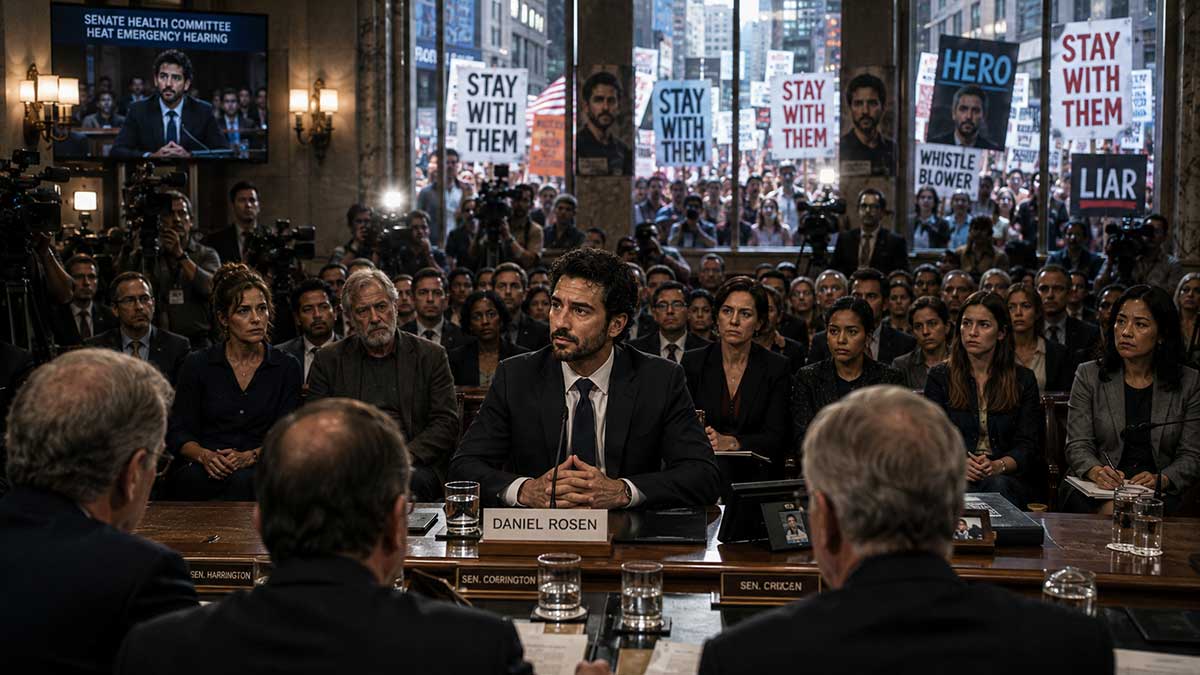
Daniel did not sleep.
At 6:15 a.m., he met Leah in a twenty-four-hour diner.
Mara came ten minutes later.
David arrived last.
Daniel had asked all three to come.
Nobody knew why.
He placed the flash drive on the table.
“Everything goes out.”
Leah stared.
“Everything?”
“Everything.”
She reached for it.
Daniel stopped her.
“Not yet.”
“What?”
“The projections too.”
Leah frowned.
“What projections?”
“Lives saved.”
“Covenant’s internal modeling.”
“External review.”
“Financial collapse scenarios.”
Her expression hardened.
“No.”
Daniel looked at her.
“If you publish only the files that make them monsters, you become them.”
“That is ridiculous.”
“No.”
“They buried discriminatory outcomes.”
“Yes.”
“They manipulated language.”
“Yes.”
“And you want to help them defend themselves?”
“I want people to know what they were actually deciding.”
Leah stared.
“That helps Covenant.”
“It helps the truth.”
“Those are not the same.”
“I know.”
Mara watched both of them.
David said nothing.
Leah leaned forward.
“You realize what happens if you muddy this?”
Daniel’s face hardened.
“I’m not muddying it.”
“You are making people sympathize with them.”
“Maybe they should.”
“Daniel.”
“Maybe they shouldn’t.”
Silence.
“I don’t get to decide which part people are allowed to see.”
Leah sat back.
“What else?”
Daniel looked at David.
His father already knew.
Mara noticed.
Daniel said:
“There is something from 2003.”
David closed his eyes.
Leah looked confused.
Daniel told her.
The blackout.
The assisted-living building.
David warning his own family.
Eight dead.
Leah slowly turned toward David.
“You want me to publish that?”
David looked toward Daniel.
Daniel said:
“Yes.”
David whispered:
“No.”
Mara looked at him.
Daniel’s jaw tightened.
“Dad.”
“No.”
“You said—”
“I know what I said.”
David’s voice trembled.
“This is my sin.”
Daniel stared.
“That’s not how this works.”
“Leave my family out.”
“You made our family part of it when you called us and not them.”
David flinched.
Daniel continued.
“You want Covenant to tell the truth?”
“Yes.”
“You want Vale accountable?”
“Yes.”
“Then you don’t get to keep your part private.”
David looked furious now.
“And you?”
Daniel froze.
His father knew.
Mara’s eyes narrowed.
David said:
“You told me you never waited.”
Daniel looked down.
Leah glanced between them.
“What does that mean?”
David waited.
Daniel said nothing.
Mara whispered:
“Harbor?”
He looked at her.
She understood immediately.
Daniel nodded.
He told them.
The override.
The twelve minutes.
Three deaths.
Leah’s face changed.
“You had manual access?”
“Yes.”
“Could you have saved them?”
“I don’t know.”
“Did you tell investigators?”
“No investigation asked.”
“That is not what I asked.”
Daniel looked down.
“No.”
Leah stood.
“Jesus Christ.”
Daniel flinched at the phrase for reasons he could not explain.
Leah walked away from the booth.
Then back.
“You have been letting people call you the conscience of this crisis.”
“I told them to stop.”
“You knew this.”
“Yes.”
Mara watched him.
Daniel looked at her.
“I was afraid.”
She nodded.
He almost wanted accusation.
Instead she asked:
“Why are you telling us now?”
Daniel looked toward the flash drive.
“Since if I release their silence and keep mine, then none of this means anything.”
David looked at him.
Something in his expression broke.
Daniel turned.
David said quietly:
“I spent twenty-three years trying to pay for silence.”
He pushed the flash drive back toward his son.
“Don’t buy yours with mine.”
Daniel’s eyes filled.
That was David’s permission.
Not forgiveness.
Something harder.
Truth.
At 3:13 p.m., Daniel told Leah to publish the archive.
They were sitting in a borrowed conference room two blocks from the hearing offices.
Leah’s finger hovered above the upload command.
“You know what this does to you.”
“Yes.”
“The Harbor statement is in there.”
“Yes.”
“Your father’s statement too.”
“Yes.”
“The financial projections.”
“Yes.”
“The internal dissent.”
“Yes.”
“The evidence that parts of the model probably saved lives.”
“Yes.”
Leah looked at him.
“You could still separate your statement.”
Daniel shook his head.
“No.”
“You could release theirs first.”
“No.”
“Daniel.”
He looked at the screen.
“Everything.”
Leah waited another second.
Then clicked.
The archive went public.
Daniel watched the progress bar reach one hundred percent.
No thunder.
No applause.
Just a small confirmation box.
UPLOAD COMPLETE
For a moment, he felt almost nothing.
Then his phone began vibrating.
The internet exploded before the hearing even began.
For thirty minutes, Daniel was called courageous.
Then people reached his confession.
The tone changed.
HERO HID HIS OWN FAILURE
DANIEL ROSEN WAITED WHILE PATIENTS DIED
WHISTLEBLOWER OR HYPOCRITE?
WHY DID ROSEN STAY SILENT?
The #StayWithThem movement split almost instantly.
Some defended him.
Others said he had betrayed everything.
One organizer posted:
Daniel Rosen is not the movement.
Daniel read it.
He whispered:
“Good.”
Mara sat beside him.
“You mean that?”
He looked at the screen.
“No.”
That honesty frightened him.
Congress announced emergency hearings within forty-eight hours.
Daniel received a subpoena.
Vale did too.
Covenant’s board suspended three executives.
Vale remained CEO temporarily.
The system froze expansion of the allocation model.
Hospitals continued operating.
For the moment.
At 7:30 p.m., Daniel’s employee badge stopped working.
He pressed it against the reader.
Red.
He tried again.
Red.
Twelve years at Covenant ended with a light the size of his thumbnail.
Mara stood beside him.
“Need me to let you in?”
Daniel shook his head.
“No.”
He took the badge off.
Held it.
Then put it in his pocket.
He did not look back at the reader.
The hearing room was brighter than any hospital.
White walls.
Television lights.
Senators.
Lawyers.
Staff.
Press.
Daniel sat alone at the witness table.
Behind him, the gallery overflowed.
Outside the building, protesters filled both sides of the street.
He had seen the signs on the way in.
STAY WITH THEM
DANIEL ROSEN SAVED NEW YORK
DANIEL ROSEN LET THEM DIE
HEALTHCARE IS NOT AN ALGORITHM
TRUST THE DATA
One enormous banner carried Daniel’s face.
He hated the photograph.
A pastor held a sign quoting:
IF WE CAN’T FIX IT, WE STAY
Across the street, a secular activist group used the same words beneath:
HUMANITY NEEDS NO GOD
Daniel stared from the car.
Mara noticed.
“Do not read them.”
“They’re my words.”
“No.”
She looked toward the crowd.
“They belong to whoever printed them now.”
Vale testified first.
He did not deny the system.
He defended it.
That shocked some senators.
“Did you know certain communities would experience higher mortality?”
“Yes.”
“Did you continue deployment?”
“Yes.”
“Why?”
“Since every alternative we modeled produced greater total mortality.”
A senator leaned forward.
“So you knowingly sacrificed vulnerable people.”
Vale replied:
“I knowingly accepted unequal risk under catastrophic scarcity.”
“That sounds like corporate language.”
“It is precise language.”
“People died.”
“Yes.”
“Do you regret the system?”
Vale paused.
“I regret every death.”
“That is not what I asked.”
Vale looked toward Daniel.
“No.”
The room erupted.
Vale continued.
“I regret the secrecy.”
“The language.”
“The lack of community review.”
“The absence of sufficient human override.”
“But I do not regret trying to save as many lives as possible.”
Daniel hated him again.
Then hated himself for understanding.
Daniel was called at 2:14 p.m.
He took the oath.
Sat.
The first senator praised him.
“You exposed misconduct at enormous personal cost.”
Daniel said:
“I exposed records.”
The senator smiled.
“Modest.”
Daniel did not.
A second senator attacked him.
“Mr. Rosen, you confessed that three patients died during a period when you possessed override capability.”
“Yes.”
“Why should anyone treat you as a moral authority?”
“They shouldn’t.”
The senator paused.
Daniel continued.
“That is part of why I included it.”
Another senator asked:
“Do you believe Dr. Vale is responsible for those deaths?”
Daniel looked toward Vale.
“Some.”
“Some?”
“Yes.”
“Who else?”
“People who designed the model.”
“People who hid its effects.”
“People who defended it.”
“People who knew and did nothing.”
The senator leaned forward.
“Does that include you?”
Daniel said:
“Yes.”
The room quieted.
Then the hearing changed.
It became less about documents.
More about Daniel.
One senator praised the movement.
Another called him an anti-corporate activist.
He said he wasn’t.
A pastor invited to testify called Daniel’s actions “sacrificial.”
Daniel looked uncomfortable.
A labor leader called him “the voice of workers forgotten by executive medicine.”
Daniel said:
“I am not.”
A healthcare reform group called him proof that public accountability could transform institutions.
Daniel shook his head.
A commentator whispered from the press row.
He could hear:
“Messianic figure.”
Daniel looked toward Mara.
She looked back.
Neither spoke.
Then Senator Caldwell asked the question.
“Mr. Rosen.”
Daniel turned.
“After everything that has happened, millions of Americans know your name.”
Daniel stared.
“Some see you as a whistleblower.”
“Some as a negligent employee.”
“Some as a symbol of resistance.”
“Others as proof that individual conscience can overcome institutional failure.”
Daniel shifted.
Caldwell continued.
“What do you believe you represent?”
The room became silent.
Daniel looked behind him.
David sat near the aisle.
Rebecca two rows back.
Leah beside the press section.
Mara near the wall.
Vale at counsel table.
Outside, chanting reached faintly through the building.
Stay with them.
Stay with them.
Stay with them.
Daniel looked toward the senator.
“I don’t represent anybody.”
Caldwell smiled slightly.
“Surely you understand people see you differently.”
“I understand.”
“What do you represent to them?”
Daniel shook his head.
“That’s the problem.”
Caldwell frowned.
Daniel continued.
“That’s what started all of this.”
The room quieted further.
“We stopped seeing people.”
“We saw facilities.”
“Risk scores.”
“Intervention yield.”
“Costs.”
“Projected survival.”
“High-value beds.”
“Low-value outcomes.”
He looked toward the gallery.
“Then everyone got angry about that.”
“And we did it again.”
A senator interrupted.
“How?”
Daniel pointed toward the crowd outside.
“Hero.”
“Villain.”
“Whistleblower.”
“Hypocrite.”
“Movement.”
“Symbol.”
He looked back at Caldwell.
“A representation is easier to use than a person.”
No one spoke.
Daniel continued.
“I fixed a cooling unit.”
“I waited when I should have acted.”
“I lied to my father.”
“I judged him for something I later understood too well.”
“I helped some people.”
“I failed others.”
“That is what happened.”
His voice shook now.
“If you need me to mean more than that, you are doing exactly what the model did.”
Caldwell stared.
Daniel whispered:
“You’re replacing a person with something easier to calculate.”
The hearing adjourned three hours later.
Daniel left through a side entrance.
No press.
Security had cleared the alley.
He stepped outside carrying nothing.
No badge.
No job.
No attorney.
His phone showed 312 unread messages.
He turned it off.
Mara stood beside a black SUV.
Daniel looked surprised.
“You waited.”
She shrugged.
“I had nowhere better.”
He laughed once.
Then started crying.
Not dramatically.
His face simply collapsed.
Mara stood there.
Daniel said:
“I think I ruined everything.”
She looked at him.
“No.”
He wiped his face.
“Covenant could collapse.”
“Maybe.”
“The movement hates me.”
“Half.”
“Rebecca looked at me like—”
“Daniel.”
He stopped.
Mara stepped closer.
“You ruined what they needed you to be.”
He stared at her.
“That is not the same as ruining everything.”
Daniel looked back at the hearing building.
People were still chanting somewhere around the corner.
His name.
The phrase.
The story.
All of it continuing without him.
Mara opened the car door.
“Come on.”
“Where?”
“Home.”
Daniel looked at her.
“I don’t know where that is right now.”
Mara nodded.
“Then we’ll drive until you do.”
Here the hidden references become stronger:
1:34 p.m. → John 13:34, the command to love one another. It appears at the moment Daniel is offered the chance to help people on a national scale, forcing him to ask whether large-scale “love” can remain human.
3:13 p.m. → John 15:13, the passage about laying down one’s life for others. Daniel gives up career, reputation, heroic image, and moral safety by releasing everything, including his own failure.
7:30 p.m. → John 19:30, “It is finished.” His Covenant life ends quietly when his badge turns red.
Those three together create a hidden progression from love → sacrifice → ending, without stating any biblical connection inside the story.
Chapter 7: Nothing Left to Fix
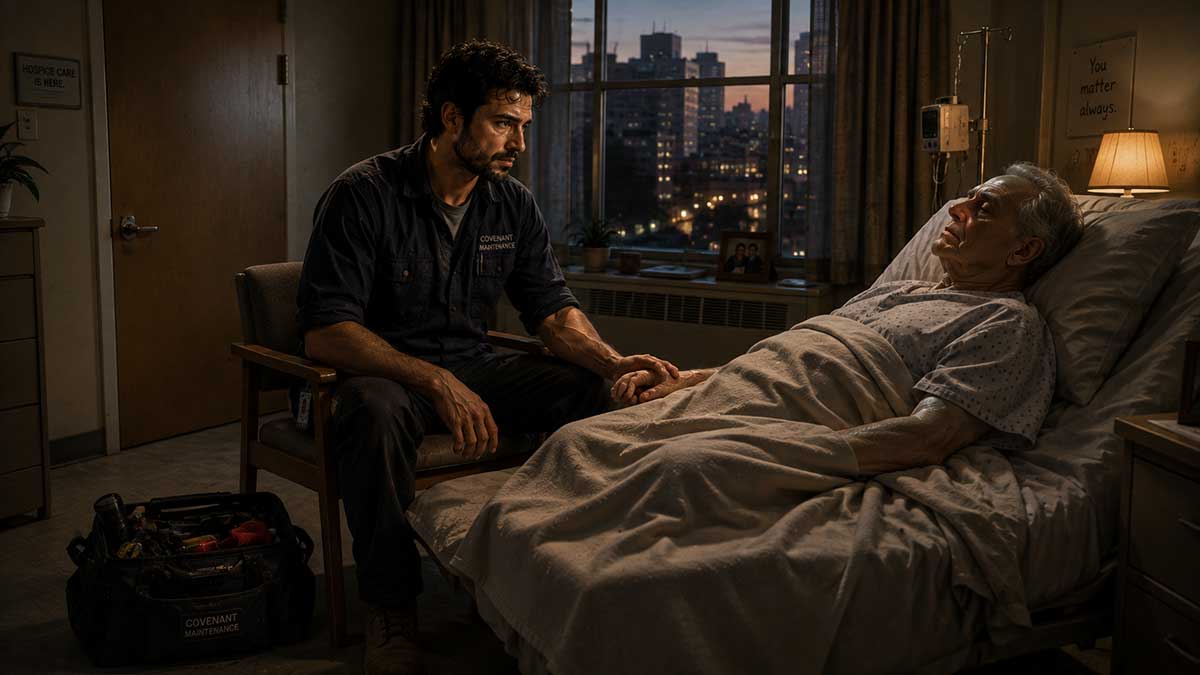
Four months later, Daniel Rosen was replacing a window latch.
The hospice room was small.
One bed.
One chair.
One television mounted too high on the wall.
The window faced an alley behind a synagogue and a laundromat in Queens.
Daniel tightened the final screw and tested the latch twice.
It held.
The man in the bed watched him.
“You’re Daniel Rosen.”
Daniel kept working.
“Yes.”
“The hospital guy.”
Daniel sighed.
“Yes.”
“The one from television.”
Daniel packed the screwdriver into his bag.
“Yes.”
The man smiled.
“I knew it.”
Daniel looked toward the door.
The hallway was quiet.
No cameras.
No reporters.
No volunteers.
No chanting.
Just a nurse pushing a medication cart past room 212.
Daniel had taken the hospice maintenance job six weeks earlier.
Lower pay.
No title.
No staff.
No office.
He liked it more than he expected.
The man in the bed extended a hand.
“Sam Levinson.”
Daniel shook it.
“Daniel.”
Sam laughed.
“I know.”
Daniel almost smiled.
“How’s the window?”
“Fixed.”
“Good.”
Daniel picked up his bag.
Sam looked toward the door.
“You leaving?”
“Yes.”
Sam nodded.
Then:
“Okay.”
Daniel took two steps.
Stopped.
The word had sounded wrong.
Not angry.
Not disappointed.
Afraid.
Daniel turned.
Sam stared at the ceiling.
Daniel placed the tool bag back on the floor.
“You need something?”
“No.”
“You sure?”
Sam nodded.
Daniel pulled the chair closer to the bed.
Sam looked at him.
“The window is fixed.”
“I know.”
“Then why are you sitting?”
Daniel shrugged.
“Maybe I’m bad at scheduling.”
Sam smiled.
That bought Daniel ten minutes.
Covenant Health had survived.
Barely.
The federal government placed the network under emergency supervision.
Three board members resigned.
Two executives were fired.
Dr. Adrian Vale resigned voluntarily one week after the hearings.
Daniel never learned whether that was punishment, strategy, or exhaustion.
The allocation model was suspended.
Then studied.
Then partially rebuilt under public oversight.
The new system required human review, public documentation, independent auditing, and community representatives.
Some people called that reform.
Some called it cosmetic.
Daniel thought both groups were probably right.
Several small Covenant facilities received new cooling systems before winter.
One rehabilitation hospital closed anyway.
Two community clinics lost funding.
St. Anne survived.
Harbor Care merged with another facility.
The world did not divide itself neatly into before and after.
That disappointed everyone who had needed the hearings to mean something clean.
Daniel’s old Covenant badge remained in a kitchen drawer.
He had not thrown it away.
He had not decided why.
His divorce papers arrived in October.
Rebecca signed first.
Daniel signed two days later.
They met afterward for coffee.
Neither cried.
That surprised him.
Rebecca looked at him across the table.
“You okay?”
“Yes.”
She smiled.
“You still lie exactly the same way.”
He looked down at the coffee.
“I’m getting better.”
“At lying?”
“At noticing.”
She laughed.
It felt good.
They sat quietly.
Then Rebecca said:
“I used to think you needed everyone to need you.”
Daniel looked up.
“You were right.”
“I know.”
He smiled.
Rebecca continued.
“What changed?”
Daniel thought about Sam Levinson.
Mrs. Adler.
Mara.
David.
The thousands of people who had repeated his words.
“I’m trying to stay after I stop being useful.”
Rebecca’s eyes filled.
She nodded.
No reconciliation.
No romantic return.
That mattered.
Some relationships could become honest without becoming restored.
At 1:34 p.m., Daniel left the coffee shop and stood outside for a moment before heading back to the hospice.
He noticed the time only since his phone screen lit up.
1:34.
Rebecca had just told him something about love that had nothing to do with rescue.
Nothing to do with fixing.
Nothing to do with being needed.
He put the phone away.
For once, he did not rush anywhere.
David called every Sunday.
Daniel answered every third Sunday.
Sometimes every second.
They talked about ordinary things.
The Knicks.
A leaking kitchen faucet.
Daniel’s sister.
The price of groceries.
Neither mentioned 2003.
Then one evening Daniel went to David’s apartment without calling.
His father opened the door.
Surprise crossed his face.
Daniel held up a bag.
“Soup.”
David stepped aside.
They ate at the kitchen table.
Afterward, David washed the bowls.
Daniel dried them.
Neither knew how to begin.
David eventually said:
“Do you forgive me?”
Daniel stopped drying.
He looked at his father.
“I don’t know.”
David nodded.
No disappointment.
No argument.
Daniel put the bowl away.
Then:
“I’m here.”
David closed his eyes.
For several seconds, he stood facing the sink.
When he turned around, his eyes were wet.
“That’s enough.”
Daniel shook his head.
“I didn’t say that.”
David nodded.
“No.”
He looked toward his son.
“But it is something.”
The movement kept growing.
That was the strangest part.
Daniel had assumed that once people learned about Harbor, his name would disappear.
It did not.
It multiplied.
#StayWithThem chapters appeared in Chicago.
Detroit.
Phoenix.
Toronto.
London.
Some focused on healthcare.
Others on homelessness.
Elder care.
Disaster response.
Immigration detention.
Prisons.
One group used the phrase for animal rescue.
Daniel did not know how to feel about that.
His sentences appeared on posters.
Most were misquoted.
One mural showed him carrying a child he had never carried.
Another showed him standing beneath a hospital cross with his arms spread wide.
Daniel stared at that one for nearly a minute.
Then walked away.
A church in Brooklyn preached a sermon titled:
The Gospel According to Daniel Rosen
He did not attend.
A secular ethics conference invited him to keynote.
He declined.
A labor coalition asked him to endorse legislation.
He declined.
A political campaign asked permission to use his image.
He said no.
They quoted publicly available hearing footage instead.
Daniel stopped watching television.
Then he stopped reading articles.
Then Leah sent him a documentary trailer.
He replied:
Please stop sending these.
She wrote back:
Fair.
Ten minutes later:
It’s actually good though.
Daniel blocked her for one hour.
Then unblocked her.
Mara did not disappear.
She did not move in.
She did not become his reward.
She showed up.
Sometimes with food.
Sometimes with coffee.
Sometimes only long enough to insult his furniture.
Their relationship remained unnamed.
Daniel preferred it that way.
One evening she entered the hospice carrying a magazine.
She placed it on the nurses’ station.
Daniel’s face covered the front.
The headline:
THE MAN WHO WOULDN’T BE A SYMBOL
Daniel stared.
“That is insulting.”
Mara looked at the cover.
“It is flattering.”
“That is worse.”
“They used a decent photo.”
He turned it face down.
Mara laughed.
A nurse called Daniel from room 212.
“Sam’s window again?”
“No.”
Daniel looked toward the hallway.
“What?”
“He’s asking for you.”
Daniel stopped.
Mara noticed.
“Go.”
He did.
At 8:29 p.m., Sam looked worse.
Daniel knew enough by now to understand what worse meant.
No dramatic medical emergency.
No alarm.
Just less.
Less voice.
Less movement.
Less interest in the television.
Daniel sat.
Sam opened his eyes.
“There he is.”
“Window still works.”
“I checked.”
“You don’t trust me?”
“Never trust maintenance.”
Daniel smiled.
Sam looked toward him.
“Were you really trying to save New York?”
Daniel’s smile disappeared.
“No.”
“That’s what they say.”
“They say a lot.”
“What were you trying to do?”
Daniel thought.
“Get cooling to people.”
“That’s boring.”
“Yes.”
“Heroes need better motives.”
“I wasn’t a hero.”
Sam studied him.
“You believe that?”
“Yes.”
Sam closed his eyes.
Then:
“Were you scared?”
Daniel looked toward the window.
“Most of the time.”
“People don’t say that either.”
“No.”
Sam smiled faintly.
“Maybe that’s why I believe you.”
A silence followed.
Sam breathed slowly.
Daniel waited.
Eventually Sam said:
“I’m afraid now.”
Daniel looked toward him.
“Okay.”
Sam opened his eyes.
“That’s it?”
“What do you want me to say?”
“I don’t know.”
“Neither do I.”
Sam laughed weakly.
Then winced.
Daniel moved closer.
“Pain?”
“No.”
“Need the nurse?”
“No.”
Daniel waited.
Sam whispered:
“Can you stay?”
Daniel looked toward the clock.
His shift had ended fourteen minutes earlier.
He had dinner plans with Mara.
David had left a voicemail.
There was nothing Daniel could repair.
“Yes.”
Sam relaxed.
Daniel remained.
Mara arrived forty minutes later.
She saw Daniel through the doorway.
Sam was asleep.
Daniel sat beside him reading nothing on his phone.
Mara did not enter.
She looked at him for a while.
Then at the magazine still lying face down on the nurses’ station.
She turned it over.
Daniel’s photograph stared back.
A serious face.
Carefully lit.
Someone had darkened the background.
The article called him:
a whistleblower.
a moral dissident.
a reluctant leader.
a symbol of conscience.
Mara closed the magazine.
She knew another Daniel.
The one who lied about repair times.
The one who had failed his marriage by turning emergencies into identity.
The one who hesitated twelve minutes.
The one who judged his father before admitting he recognized him.
The one who occasionally checked whether people were still talking about him and hated himself afterward.
The one who could be selfish.
Sharp.
Exhausting.
Funny.
Afraid.
Human.
She preferred him.
Sam died shortly before midnight.
Daniel stayed until the nurse came.
Then longer.
Mara waited in the hallway.
When Daniel finally stepped out, he looked tired.
“He died?”
Daniel nodded.
Mara handed him coffee.
He took it.
“What are you doing here?”
“Dinner.”
He looked at the clock.
“Oh.”
“Very romantic.”
“Sorry.”
“I expected this.”
They walked toward the elevator.
Daniel stopped beside the magazine.
He stared at his face.
Mara said:
“You want me to throw it out?”
“No.”
“Burn it?”
“Tempting.”
He picked it up.
Turned several pages.
There were photos of the hearings.
St. Anne.
The movement.
Vale.
Leah.
Mara.
David.
Then Daniel saw a photograph he had never seen.
Mrs. Adler.
Not during her death.
Earlier.
Sitting by the repaired window.
Smiling.
He stopped.
Mara looked.
Daniel closed the magazine.
“That should have been the cover.”
Mara understood.
“Yeah.”
They left through the rear entrance.
Cold November air hit them.
Daniel pulled his jacket tighter.
Across the street, an old #StayWithThem poster remained taped inside a bus shelter.
His face had faded in the sun.
Someone had written beneath it with black marker:
SAVE EVERYONE
Daniel stared.
Mara looked at him.
“You hate that.”
“Yes.”
“Why?”
“Since you can’t.”
Mara waited.
Daniel continued.
“And when people think you can, they stop asking what they can do.”
He walked closer to the poster.
Someone else had written beneath the first message:
START WITH ONE
Daniel looked at it.
He smiled.
Mara noticed.
“Better?”
“Less stupid.”
They began walking.
No cameras followed.
No one recognized him.
At the corner, a homeless man sat beneath an awning.
Daniel reached into his pocket.
Mara touched his arm.
He looked at her.
“What?”
“Do you have to?”
Daniel frowned.
She nodded toward the man.
“You’re doing the thing.”
Daniel almost argued.
Then stopped.
He understood.
Helping could still become escape.
He put his wallet back.
Then he walked to the man.
“Do you need anything?”
The man looked up.
“Coffee.”
Daniel nodded.
“Milk?”
“Black.”
Daniel bought two.
He handed one over.
Then hesitated.
The man took the cup.
“Thanks.”
Daniel started walking away.
The man said:
“You drinking yours?”
Daniel looked at the second cup.
“Yeah.”
“Sit down then.”
Daniel looked toward Mara.
She smiled.
He sat.
Later, Mara walked home alone.
She passed another poster.
Another face.
Another slogan.
For months, everyone had argued about what Daniel Rosen meant.
The newspapers.
The Senate.
The hospital.
The movement.
Religious leaders.
Activists.
Critics.
Supporters.
People had turned his failures into lessons and his ordinary sentences into doctrine.
Mara had stopped asking.
She had known him before he meant anything.
And perhaps that was the only way she had ever truly known him.
Epilogue: The Story They Made of Him
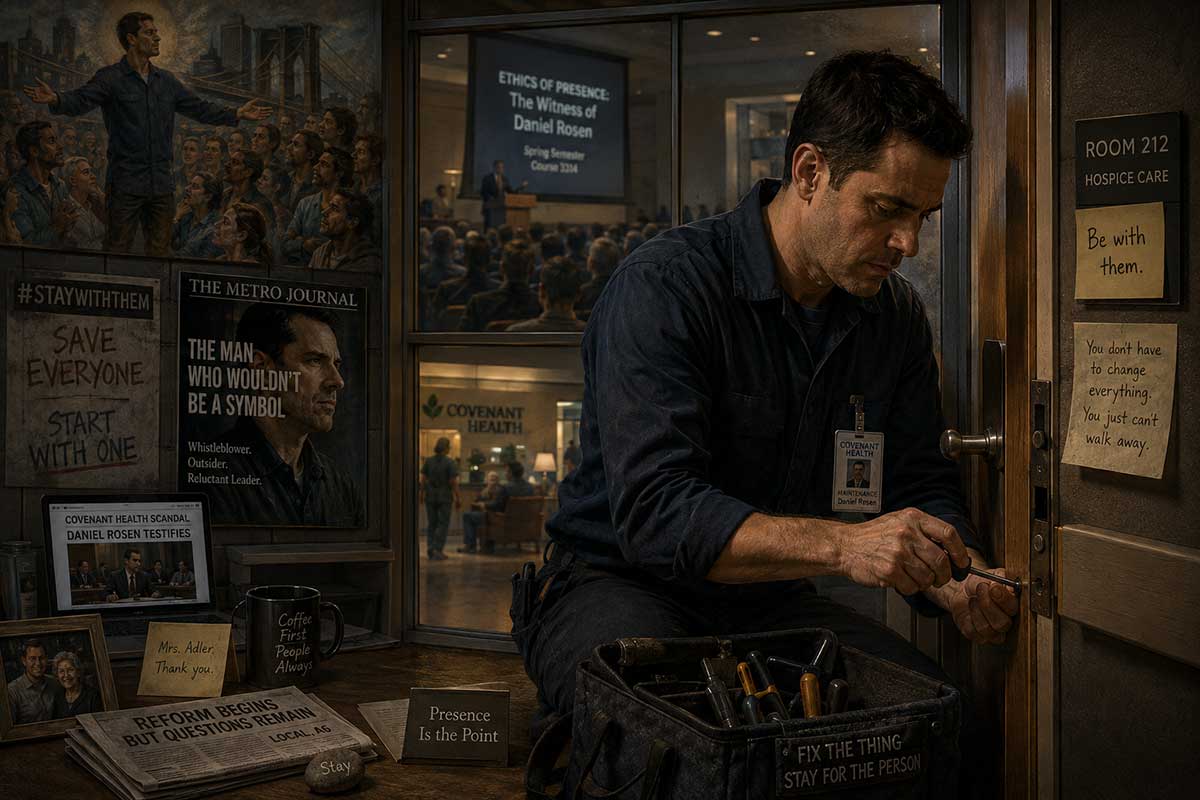
Three years later, a university course assigned Daniel Rosen’s congressional testimony alongside writings on healthcare ethics, disaster triage, Jewish moral thought, whistleblowing, and religious symbolism.
Daniel learned this from Leah.
He immediately regretted answering her call.
“They teach me now?”
“Apparently.”
“That seems irresponsible.”
“You are required reading.”
“I dropped out of community college.”
“History loves irony.”
Daniel rubbed his forehead.
“Why are you calling?”
“Someone wrote a paper comparing you to Jesus.”
Silence.
Daniel stared through the hospice workshop window.
“Daniel?”
“No.”
“No what?”
“No.”
Leah laughed.
“You haven’t heard the argument.”
“I don’t want the argument.”
“It’s actually interesting.”
“Goodbye, Leah.”
“Wait.”
He waited.
She became serious.
“Do you know people have been making that comparison for years?”
“Yes.”
“And?”
Daniel looked toward a shelf of replacement door hardware.
“I’m Jewish.”
“So was he.”
Daniel closed his eyes.
He should have known she would say that.
“Goodbye.”
“Daniel.”
“What?”
“Does it bother you?”
He thought.
“Yes.”
“Why?”
Daniel looked through the workshop window.
A nurse wheeled a patient slowly through the courtyard.
“Since the minute you turn someone into Jesus, you stop expecting yourself to do what they did.”
Leah went quiet.
Daniel continued.
“You say, ‘Of course he stayed. He was Jesus.’”
He picked up a broken latch.
“But if he was just a person…”
Daniel stopped.
Leah finished quietly:
“Then the rest of us have fewer excuses.”
Daniel looked at the latch in his hand.
“Something like that.”
That evening, Daniel visited David.
His father was seventy now.
Slower.
Thinner.
They sat beside the window.
David asked:
“Do you believe in God again?”
Daniel smiled.
“Again?”
“You know what I mean.”
Daniel looked outside.
“I don’t know.”
David nodded.
“Fair.”
Daniel looked toward him.
“You?”
“Yes.”
“After everything?”
David smiled faintly.
“Especially after everything.”
Daniel considered that.
“Why?”
David thought for a long time.
“Since I stopped believing God was the explanation.”
Daniel turned.
David continued.
“Maybe God is the question I’m willing to keep living inside.”
Daniel smiled.
“That sounds like something Eli would say.”
“I stole it from a rabbi.”
“Better.”
They sat quietly.
Then David said:
“Daniel.”
“Yeah?”
“I am glad I called your mother.”
Daniel looked toward him.
The old wound returned immediately.
David saw it.
“I am not saying I am glad I didn’t warn them.”
Daniel waited.
David’s voice shook.
“I am saying I still love that you lived.”
Daniel’s eyes filled.
For years, Daniel had believed moral clarity required rejecting that sentence.
Now he understood something else.
Both truths could remain.
David had failed those residents.
David had loved his son.
One truth did not erase the other.
Daniel took his father’s hand.
“I’m glad too.”
David began crying.
Nothing was forgiven completely.
Nothing needed to be.
At 8:29 p.m., Daniel returned to the hospice.
A new patient had arrived.
Young.
Forty-two.
Terminal cancer.
Two children.
Terrified.
Daniel was supposed to repair a faulty closet door.
He fixed it in six minutes.
The patient watched him.
“That’s it?”
“That’s it.”
Daniel packed his tools.
The man looked toward the dark window.
Daniel recognized the look.
“Want me to get someone?”
The man shook his head.
“No.”
Daniel waited.
Then placed the tool bag back on the floor.
He pulled up the chair.
The man looked confused.
“You finished.”
Daniel nodded.
“So why are you staying?”
Daniel looked toward him.
He could have answered many ways now.
People had written entire books explaining the meaning of staying.
Daniel chose the smallest answer.
“You asked with your face.”
The man laughed.
Then cried.
Daniel stayed.
Outside, New York continued without noticing.
No heat emergency.
No hearings.
No movement.
No cameras.
Nothing historic.
Just one frightened person.
And another person who had finally learned that presence did not need to become a symbol before it mattered.
Short Bios:
Mara Bennett — A hospice nurse and Daniel’s closest emotional companion. She sees his weaknesses as clearly as his goodness and repeatedly reminds him that helping people is different from needing to be their hero.
David Rosen — Daniel’s father and a retired maintenance engineer. He has spent more than twenty years quietly trying to make amends for a terrible decision he made during the 2003 New York blackout.
Dr. Adrian Vale — CEO of Covenant Health and architect of its controversial emergency-allocation system. He believes sacrificing resources in some places can save more lives overall, placing him at the center of Daniel’s moral conflict.
Rebecca Rosen — Daniel’s estranged wife. She understands something about Daniel that the public misses: his greatest strength—being needed during a crisis—has sometimes prevented him from being present for the people closest to him.
Leah Stein — An investigative journalist who uncovers Covenant’s hidden allocation records. She pushes Daniel to expose the system, yet clashes with his refusal to reduce complicated people into simple heroes and villains.
Eli Kaplan — A young hospital chaplain who recognizes early that society is beginning to turn Daniel into something larger than himself. His warning becomes increasingly meaningful as Daniel’s public image grows.
Leave a Reply