
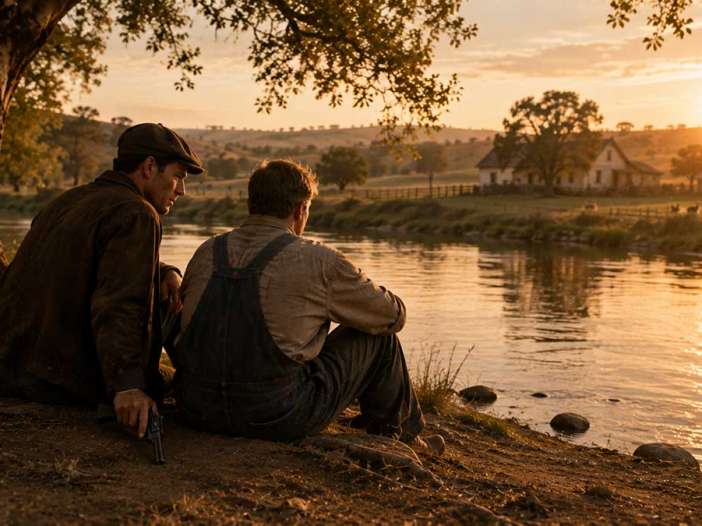
Introduction
John Steinbeck’s Of Mice and Men is often remembered as the story of two migrant workers and a dream that never comes true.
But after listening to George, Lennie, Candy, Crooks, Curley’s wife, and Slim speak together, the novel begins to look much larger.
It becomes a story about what happens when human beings need one another in a world that gives them very little protection.
George and Lennie begin with something almost nobody else on the ranch possesses: each other.
George remembers what Lennie forgets. He finds the jobs, carries the money, recognizes danger, and tells Lennie what to do when the world becomes confusing.
Lennie gives George something too.
He gives George somebody who knows him beyond his wages, his job, and the next ranch. George can complain that Lennie is a burden, yet Lennie is one reason George does not become another solitary worker moving from bunkhouse to bunkhouse with nobody waiting for him.
Their friendship is unequal.
It is exhausting.
At times it is frightening.
But it is real.
Around them are people showing different forms of the same hunger.
Candy fears the day when his aging body will make him disposable.
Crooks has learned to protect himself from the pain of exclusion by pretending he does not need belonging.
Curley’s wife dreamed of becoming somebody whose name people would know, yet she ends up known only through her husband.
Even Slim, the man who seems most complete, quietly admits that perhaps he has simply learned not to expect too much.
Then there is the farm.
At first it sounds almost childish.
A few acres.
Vegetables.
Chickens.
A stove.
Rabbits.
Yet each character gradually reveals that the farm means something different.
For George, it means control over his own life.
For Lennie, safety.
For Candy, a place where growing old will not mean being thrown away.
For Crooks, a door he can enter without asking permission.
The tragedy is that the farm becomes briefly believable.
Candy has money.
George knows of land they might buy.
For a few precious days, the dream stops being fantasy and becomes a possible future.
That makes its destruction far more painful.
Yet Steinbeck places something darker beside the dream.
Lennie loves soft things.
A mouse.
A dress.
A puppy.
A woman’s hair.
The rabbits he hopes someday to care for.
Again and again, Lennie reaches toward something fragile with affection and destroys it with strength he cannot adequately control.
This creates the moral problem at the center of the novel.
Lennie does not want to hurt people.
But people can still be hurt by him.
George knows this.
And eventually George must confront something he has spent years trying not to see:
Loving Lennie and keeping everyone safe may no longer be the same thing.
That realization takes the story back to the riverbank where it began.
George finds Lennie before Curley and the others do.
He tells Lennie about the farm one final time.
Lennie looks toward the future.
George raises the gun.
And the friend Lennie trusts more than anyone becomes the person who ends his life.
Was George protecting Lennie?
Was he betraying him?
Was he doing both?
Steinbeck refuses to give us the comfort of an easy answer.
That is why Of Mice and Men remains so painful.
It asks what love requires when every available choice seems capable of hurting someone.
(Note: This is an imaginary conversation, a creative exploration of an idea, and not a real speech or event.)
Topic 1: Why Do George and Lennie Need Each Other So Much?
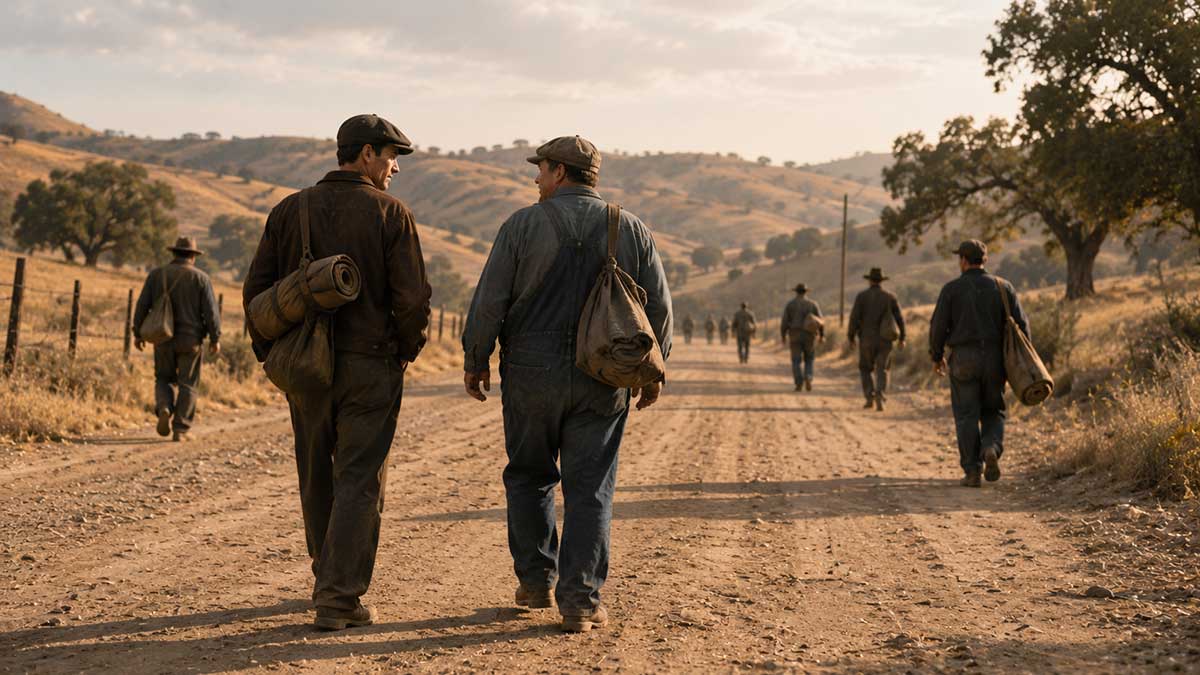
Slim: Funny thing about you two. Every man who comes through a ranch like this comes alone. Sleeps alone. Works alone. Moves on alone. Then the two of you walk in together.
George: Yeah. People always notice that.
Candy: Hard not to.
Crooks: Men notice anything that looks different from what they got used to.
George: Most guys figure there’s something wrong with it. Two grown men traveling together.
Slim: I never said there was anything wrong with it.
George: No. You didn’t.
Slim: I just wondered why.
Lennie: Me and George go together.
George: Lennie...
Lennie: We do.
Slim: I know you do.
Lennie: George tells me where we’re going.
Curley’s Wife: That sounds convenient.
George: What’s that supposed to mean?
Curley’s Wife: Nothing. Just that he says it like the whole world makes sense as long as you tell him where to stand.
Lennie looked toward George as if waiting to see whether the remark was friendly.
George: He gets mixed up sometimes.
Curley’s Wife: I can see that.
Lennie: George remembers things.
George: Not everything.
Lennie: You remember better’n me.
Candy: There are worse things a man can have than somebody who remembers for him.
George glanced toward Candy.
George: Maybe.
Crooks: Depends what else the remembering man gets to decide.
The room quieted a little.
George: What are you getting at?
Crooks: Nothing complicated. Lennie forgets. You remember. Lennie gets scared. You tell him what to do. Lennie wants something. You tell him whether he can have it. Seems to me that gives you a lot of say over another man’s life.
George: You think I asked for that?
Crooks: Didn’t say you did.
George: You think I like having to watch him every minute? You think I like wondering if he’s going to touch something he shouldn’t, say something wrong, scare somebody, get us run out of another place?
Lennie lowered his head.
George saw it immediately.
George: I ain’t saying you’re bad, Lennie.
Lennie: I know.
But he did not sound as though he knew.
Slim: George, you’ve said before that without Lennie you could live easier.
George: I could.
Slim: More money?
George: Sure.
Slim: Stay in one place longer?
George: Maybe.
Slim: Go into town whenever you felt like it?
George: Yeah.
Slim: No one to watch?
George: That’s right.
Slim waited.
Slim: Then why didn’t you leave?
George rubbed his thumb across the edge of his palm.
George: I don’t know.
Curley’s Wife: You know.
George: You don’t know anything about it.
Curley’s Wife: I know what it looks like when somebody says they could leave and keeps staying.
George gave her a hard look.
George: And what does it look like?
Curley’s Wife: Like leaving would hurt worse.
Nobody answered.
Lennie brightened slightly.
Lennie: George ain’t gonna leave me.
George looked at him.
George: No.
Lennie: I could go away if you wanted. I could find a cave.
George: Quit talking about that damn cave.
Lennie: I could.
George: I know you could say it. That ain’t the same thing as doing it.
Lennie: I’d get rabbits maybe.
George: You wouldn’t last two days.
Lennie: I could eat ketchup.
George: There wouldn’t be any ketchup.
Candy laughed softly, but George did not.
Slim: You always do that.
George: Do what?
Slim: He starts talking about going off alone, and you start explaining why he can’t.
George: Well, he can’t.
Slim: Maybe. But you could just let him believe it for a minute.
George: What good would that do?
Slim: Might tell you something about how much you need him to stay.
George’s face tightened.
George: I don’t need him.
Lennie looked up quickly.
Lennie: You don’t?
George closed his eyes for half a second.
George: That ain’t what I meant.
Lennie: You said you don’t need me.
George: I mean I can take care of myself.
Lennie: I know.
George: Lennie...
Lennie: I can carry things.
George: I know you can.
Lennie: I work good.
George: You work real good.
Lennie: I don’t eat too much.
George: Lennie, stop.
The desperation in Lennie’s voice made everyone uncomfortable.
Candy: He ain’t asking whether you need another pair of hands.
George looked at Candy.
Candy: He’s asking whether you’d miss him.
That landed differently.
George looked away.
George: Course I’d miss him.
Lennie smiled.
Lennie: I’d miss you too, George.
Curley’s Wife: There. Was that so hard?
George: You stay out of it.
Curley’s Wife: Why? Everybody else gets to talk about loneliness like it belongs to men.
Crooks: You want to talk about loneliness?
Curley’s Wife: I might know something about it.
Crooks gave her a long look.
Crooks: Maybe you do.
Curley’s Wife: People think if there are bodies around you, you can’t be lonely. Curley’s around. Ranch hands are around. Men walk through all day. Doesn’t mean anybody talks to me.
George: Plenty of men would talk to you if it didn’t get them in trouble.
Curley’s Wife: That’s exactly what I mean. Nobody sees me. They see Curley’s wife. They see trouble. They see something to stay away from.
Candy: You do go looking for the men.
Curley’s Wife: Where else am I supposed to go?
Candy had no quick answer.
Curley’s Wife: George complains because Lennie follows him everywhere. You know what it feels like when nobody comes looking for you at all?
George’s expression softened despite himself.
George: Ain’t the same thing.
Curley’s Wife: No. It isn’t.
Crooks shifted against the wall.
Crooks: None of it is the same thing.
They looked toward him.
Crooks: George gets tired of Lennie because Lennie is always there. She gets sick from nobody being there in the way she wants. Candy’s got people around him until the day he can’t work. Then he don’t know what happens. Me, I can hear the men laughing from another room I ain’t welcome in.
Lennie looked puzzled.
Lennie: You can come with us.
Crooks almost smiled.
Crooks: You say things easy, don’t you?
Lennie: You can come to the farm.
George turned.
George: Lennie.
Lennie: We got rabbits.
George: We ain’t got the farm yet.
Lennie: We’re gonna.
Crooks: That’s his answer to everything?
George: Pretty much.
Slim: Maybe that’s one reason you keep telling him the story.
George looked at Slim again.
George: What now?
Slim: Lennie needs the farm because it makes him feel safe. But every time you tell it, you sound different too.
George: It’s just something he likes to hear.
Slim: Is it?
George: Yeah.
Slim: Then why do you know every part of it?
George: I told it enough times.
Slim: Why do you add things?
George hesitated.
Slim: The stove. The vegetables. Rain on the roof. Nobody telling you when to work. Nobody able to throw you off.
George: A man can want things.
Slim: Exactly.
George stared at the floor.
George: Maybe I like the idea.
Candy: More than the idea.
George: What’s that mean?
Candy: When I heard you two talking about that place, I knew right off what I wanted from it.
George: A place to stay.
Candy: A place where getting old wouldn’t mean getting sent away.
Crooks watched him.
Candy: I got one hand. I can still sweep. I can still do chores. But I know how men look at somebody whose best working years are behind him.
He paused.
Candy: I wanted a place where I wouldn’t have to ask whether I was still worth the room I slept in.
Nobody spoke for a moment.
George: That’s different from Lennie.
Candy: Is it?
George: Lennie ain’t worried about getting old.
Candy: No. But he’s worried every five minutes you’re gonna stop wanting him around.
George looked at Lennie.
Lennie was stroking his thumb across his trouser leg, eyes lowered.
George: You worry about that?
Lennie: Sometimes.
George: Why?
Lennie: You get mad.
George: I get mad all the time.
Lennie: I know.
George: And I’m still here.
Lennie: I know.
George: Then why worry?
Lennie thought about it.
Lennie: When you get real mad, you say you could have a good time without me.
George’s expression changed.
Lennie: You say you could have money. You could go places.
George: Lennie, I don’t mean...
Lennie: I know.
That “I know” sounded different from the earlier ones.
Lennie: But I remember that part.
George swallowed.
Slim: Funny what a man remembers.
George: I say things when I’m tired.
Slim: That doesn’t mean he doesn’t hear them.
George: So now I’m the bad guy?
Slim: Nobody said that.
George: Feels like it.
Crooks: Maybe you’re used to thinking there are only two choices. Either you’re a good friend or you’re a bad one.
George looked at him.
Crooks: Maybe you’re both a good friend and a tired man.
George gave a short, humorless laugh.
George: That sounds about right.
Curley’s Wife: Maybe you hate needing him.
George turned sharply.
George: I told you, I don’t need him.
Curley’s Wife: You need something.
George: What?
Curley’s Wife: Somebody who knows who you are.
The room became still again.
She continued more quietly.
Curley’s Wife: Everybody around here has a version of themselves they show. Curley acts tough. Slim doesn’t need anybody. Candy makes himself useful. Crooks acts like he doesn’t care whether anyone comes into his room.
Crooks’ eyes hardened, but he did not interrupt.
Curley’s Wife: You act like Lennie is just a responsibility.
She looked at George.
Curley’s Wife: But he knows you before the ranch. Before this job. Before whatever man you’re pretending to be today.
George seemed to dislike how close she had come.
George: Lennie don’t know half of what’s going on.
Curley’s Wife: Maybe that’s why he knows you better.
George: That don’t make any sense.
Slim: Might.
George: Not you too.
Slim: Lennie doesn’t care how much money you got. Doesn’t care whether you’re the best worker. Doesn’t care whether the boss likes you.
Candy: Just wants you to tell him about the rabbits.
Lennie smiled again.
Lennie: Tell about the rabbits, George.
George almost smiled.
George: Not now.
Lennie: Later?
George: Yeah. Later.
Crooks watched them carefully.
Crooks: You know what the strange thing is?
George: What?
Crooks: Men like you two scare people a little.
George: Why?
Crooks: Because if two men can stick together, then maybe all those fellows wandering around alone got to ask why they don’t.
Candy: Most don’t have anybody.
Crooks: Maybe. Or maybe they learned not to expect anybody.
Slim: That’s closer.
Crooks: A man alone long enough starts acting like he chose it.
Candy nodded.
Crooks: Easier than admitting nobody stayed.
Curley’s wife looked down.
George’s irritation faded.
George: When I was younger, Lennie’s Aunt Clara took care of him. Then she died.
Lennie: Aunt Clara gave me mice.
George: Yeah.
Lennie: She didn’t like when I killed ’em.
George: You didn’t mean to.
Lennie: I petted ’em.
George: I know.
Slim: And after Clara died?
George: He came with me.
Slim: Just like that?
George: Pretty much.
Slim: Nobody asked if you wanted the responsibility?
George: No.
Slim: Nobody asked if Lennie wanted you instead of somebody else?
George frowned.
George: There wasn’t anybody else.
That sentence stayed in the room.
Crooks leaned forward slightly.
Crooks: There it is.
George: What?
Crooks: That’s the whole thing.
George: What is?
Crooks: “There wasn’t anybody else.”
George said nothing.
Crooks: Maybe that’s how a lot of lives get built. Not by choosing from ten good roads. Just by seeing one person standing there and realizing everybody else walked away.
Lennie looked at George.
Lennie: You didn’t walk away.
George’s jaw tightened.
George: No.
Lennie: You stayed.
George: Yeah.
Lennie smiled with the simple satisfaction of someone who had found the answer he needed.
Lennie: Then we’re okay.
George did not smile back immediately.
George: Lennie...
Lennie: We’re okay, ain’t we?
George finally nodded.
George: Yeah.
Lennie: And we’re gonna get the farm.
George: Yeah.
Lennie: And I get the rabbits.
George: You get the rabbits.
Slim looked at George.
Slim: You believe it when you tell him?
George stared toward nothing for a while.
George: Sometimes.
Slim: And the other times?
George: I want to.
That answer seemed to surprise even him.
Candy shifted closer.
Candy: Maybe that’s enough for a while.
Crooks: Till it isn’t.
Candy glanced at him.
Crooks: I ain’t trying to spoil it. I’m saying needing somebody can save you. It can trap you too.
George: You think Lennie traps me?
Crooks: I think every person you love gets some kind of hold on you.
Curley’s wife looked toward the doorway.
Curley’s Wife: Sometimes the ones who don’t love you have a hold too.
Crooks met her eyes.
Crooks: That’s true.
Lennie looked from face to face.
Lennie: I don’t want to trap George.
George: You don’t.
Lennie: I can go to the cave.
George: Jesus, Lennie.
For the first time, George laughed.
Not because it was funny. Because it was so completely Lennie.
George: You ain’t going to no cave.
Lennie: Okay.
George: You hear me?
Lennie: I hear you.
George: Good.
Lennie settled back, content again.
Slim watched George more than Lennie.
Slim: You know, George, maybe there’s a question you keep answering without asking it.
George: What question?
Slim: Whether you stay because Lennie can’t live without you.
George waited.
Slim: Maybe someday you ought to ask what happens to you if you have to live without him.
George’s face became completely still.
Candy looked away.
Crooks did too.
Curley’s wife said nothing.
Lennie, unaware of the weight that had entered the room, leaned toward George.
Lennie: We ain’t gonna have to do that.
George looked at him.
Lennie: Right, George?
A long pause.
George: Right.
Lennie: We got each other.
George nodded.
George: Yeah.
Lennie: That’s why we’re different.
George looked down at his hands.
When he spoke again, his voice was quieter.
George: Yeah, Lennie.
He looked around at Candy, Crooks, Slim, and Curley’s wife, all of them lonely in different ways.
Then back at Lennie.
George: Maybe that is why we’re different.
And for a moment, nobody tried to decide whether George was carrying Lennie, Lennie was holding George together, or both things had been true all along.
Topic 2: If You Cannot Work, Do You Still Matter?
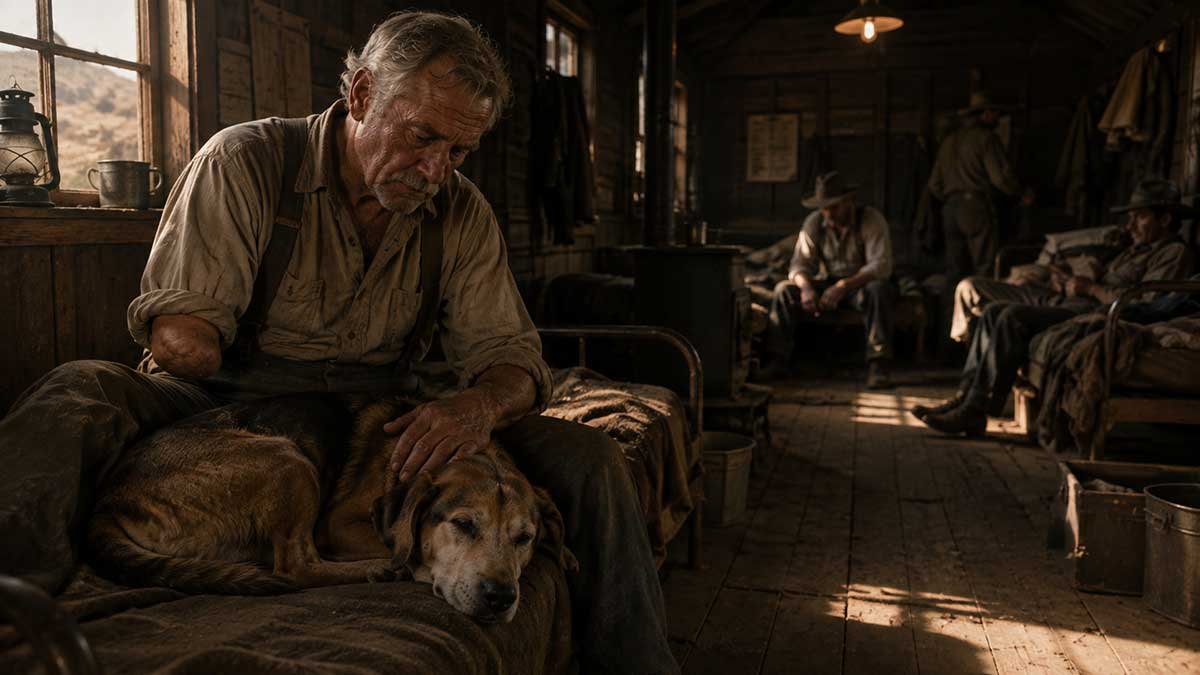
Candy: I knew what they were saying about me before they ever said it.
George: Who?
Candy: Carlson. The others. Maybe all of them.
Slim: About your dog?
Candy: About the dog first.
Candy looked down at his missing hand.
Candy: Then me.
Nobody answered immediately.
Lennie: They was talking about you?
Candy: Not exactly.
Lennie: Then how’d you know?
Candy smiled sadly.
Candy: You live long enough, Lennie, you learn to hear what people mean when they’re talking about somebody else.
Lennie looked at George for help.
George: He means when Carlson said the dog was old and no good anymore, Candy started wondering if someday they’d say the same thing about him.
Lennie: But Candy ain’t a dog.
Candy: No.
Lennie: Candy can talk.
Candy: That ain’t always enough.
Lennie: He can sweep.
Candy: For now.
Lennie: He can come to the farm.
George glanced at him.
Lennie: Then it don’t matter if he can sweep.
Candy looked at Lennie for several seconds.
Candy: That might be the smartest thing anybody’s said about it.
George: Don’t encourage him.
Candy: Why not?
George: He don’t know what you’re talking about.
Candy: Maybe that’s why he can see it.
Crooks shifted in his chair.
Crooks: Lennie’s right about one thing. On your farm, Candy figures he wouldn’t have to prove every morning that he’s worth feeding.
Candy nodded.
Candy: That’s it.
Slim: You really feel that way here?
Candy: Don’t you?
Slim: I asked about you.
Candy: I wake up and know exactly what I am. One old swamper with one hand. I can clean. I can carry little things. I can make myself useful.
He paused.
Candy: So I make damn sure I’m useful.
George: Everybody has to work.
Candy: I know.
George: Nobody’s paying us to sit around.
Candy: I know that too.
George: Then what are you saying?
Candy: I’m saying there’s a difference between needing to work for your living and wondering whether anybody will think you deserve a living when you can’t work anymore.
George stopped.
Slim: That’s different.
Candy: Sure is when you’re the one getting old.
Curley’s wife had been listening from across the room.
Curley’s Wife: Men always think usefulness means work.
Candy looked at her.
Candy: What else would it mean around here?
Curley’s Wife: Ask Curley.
George: Here we go.
Curley’s Wife: I’m serious. What am I useful for?
Nobody answered.
Curley’s Wife: I don’t work the fields. I don’t buck barley. I don’t clean the bunkhouse. I don’t own anything. I don’t earn anything.
Candy: You’re the boss’s son’s wife.
Curley’s Wife: That’s not a job.
Crooks: Gives you something.
She looked at him.
Curley’s Wife: What?
Crooks: Position.
Her expression changed.
Curley’s Wife: You think I got power?
Crooks: I know you got more than me.
Curley’s Wife: I can’t even leave without Curley wanting to know where I’ve been.
Crooks: And you can still walk into my room and remind me what could happen if you said the right words to the right men.
Silence.
George looked between them.
Candy lowered his eyes.
Curley’s wife stiffened.
Curley’s Wife: You were telling me to get out.
Crooks: I was.
Curley’s Wife: You acted like I was nothing.
Crooks: And you made sure I remembered which one of us could be made into nothing faster.
She looked away.
Curley’s Wife: I was angry.
Crooks: I know.
Curley’s Wife: They were all treating me like I didn’t belong there.
Crooks: I know that too.
Curley’s Wife: Then you know why I said it.
Crooks: Knowing why ain’t the same as making it disappear.
She did not answer.
Slim: That may be something all of us do.
George: What?
Slim: Somebody makes us feel small, and we look for somebody smaller.
Crooks nodded once.
Candy: Don’t make it right.
Slim: No.
Curley’s wife looked at Crooks again.
For once, there was no challenge in her face.
Curley’s Wife: I knew it would scare you.
Crooks: It did.
Curley’s Wife: Maybe that’s why I said it.
Crooks watched her.
Crooks: That’s probably why.
She swallowed.
Curley’s Wife: I’m not proud of it.
Crooks: You don’t need me to make you feel better about it.
Curley’s Wife: I know.
That was all.
Lennie had become restless.
Lennie: Candy?
Candy: Yeah?
Lennie: Why’d they shoot your dog?
Candy breathed out slowly.
Candy: Carlson said he was suffering.
Lennie: Was he?
Candy: Some.
Lennie: Was he sick?
Candy: Old mostly.
Lennie: How old?
Candy: Real old.
Lennie: Did he still like you?
Candy looked at him.
Candy: Yeah.
Lennie: Did you still like him?
Candy: Course I did.
Lennie: Then why’d they shoot him?
No one answered.
Lennie waited.
Lennie: George?
George: Carlson figured it was kinder.
Lennie: Did the dog want it?
George looked at Slim.
Slim looked at Candy.
Candy: I don’t know.
Lennie: You didn’t ask him?
George: Dogs can’t answer that, Lennie.
Lennie: But Candy could answer.
Candy's face tightened.
Lennie: Did you want him shot?
Candy: No.
Lennie: Then why’d you say okay?
Candy rubbed the stump of his wrist.
Candy: Because everybody kept telling me it was time.
Lennie: But he was your dog.
Candy: I know.
Lennie: Since he was little?
Candy: Since he was a pup.
Lennie: Then you knew him best.
Candy's eyes dropped.
Candy: Yeah.
Lennie: Better’n Carlson.
Candy: Yeah.
Lennie: Then why did Carlson get to say?
Candy did not answer.
George shifted uncomfortably.
George: Lennie, leave it alone.
Candy: No.
George looked at him.
Candy: Let him ask.
He turned back toward Lennie.
Candy: Carlson said the dog wasn’t enjoying life anymore. Said he couldn’t eat right. Couldn’t walk good. Smelled bad. Said keeping him alive was for me, not for the dog.
Lennie: Was it?
Candy stared at the floor.
Candy: Maybe some of it.
Lennie: What happened after?
Candy: Carlson took him outside.
Lennie: You went too?
Candy shook his head.
Lennie: Why not?
Candy's voice became very quiet.
Candy: That’s the part I wish I could change.
Nobody moved.
Candy: I let another man take him out.
Slim: Candy...
Candy: I should’ve gone.
Slim: You told me before you wished you had shot him yourself.
Candy: I did.
Lennie: Why?
Candy: Because he trusted me.
That silenced Lennie.
Candy: He’d been with me all those years. If his last minute had to come, maybe the last person he ought to have seen was somebody he knew.
George's face changed.
Slim noticed.
Slim: George?
George: What?
Slim: Nothing.
George: Then don’t look at me like that.
Slim: Like what?
George: You know damn well.
Slim said nothing.
Crooks broke the silence.
Crooks: There’s something about that dog story I don’t like.
Candy: You think I liked it?
Crooks: Not that.
Candy: What then?
Crooks: Everybody talks about whether Carlson was right to shoot him. Whether you should’ve done it yourself. Whether the dog was suffering.
Candy: Yeah?
Crooks: But they always say he was no good anymore.
Candy looked at him.
Crooks: Why does that part matter?
George: Because he couldn’t do anything.
Crooks: Do what?
George: Whatever dogs do.
Crooks: So?
George: Come on, Crooks.
Crooks: No. I mean it.
He leaned forward.
Crooks: Suppose the dog wasn’t hurting at all. Suppose he was just old. Couldn’t herd. Couldn’t guard. Couldn’t do anything useful. Just slept beside Candy all day.
George: Then maybe you leave him be.
Crooks: Why?
George: Because he ain’t suffering.
Crooks: Good.
He looked around the room.
Crooks: Then usefulness wasn’t the reason to kill him.
Candy: Shouldn’t have been.
Crooks: Yet everybody mentioned it.
Slim nodded slowly.
Crooks: That’s what bothers me.
Curley’s Wife: People do that with each other too.
Candy: That’s what I’ve been saying.
Curley’s Wife: Not just old people.
She looked toward Lennie.
George immediately stiffened.
George: Watch yourself.
Curley’s Wife: I haven’t said anything.
George: I know where you’re going.
Curley’s Wife: Do you?
She turned toward Lennie.
Curley’s Wife: Lennie works hard, doesn’t he?
George: Better than most.
Curley’s Wife: Strong.
George: Stronger than anybody here.
Curley’s Wife: So the ranch wants him.
George said nothing.
Curley’s Wife: What if he couldn’t work?
George: I’d take care of him.
Curley’s Wife: With what?
George frowned.
Curley’s Wife: You got a house?
George: No.
Curley’s Wife: Savings?
George: Some.
Curley’s Wife: Family?
George: Not much.
Curley’s Wife: Land?
George: You know I don’t.
Curley’s Wife: So what happens?
George: I’d figure something out.
Curley’s Wife: That’s not an answer.
George: It’s the answer I got.
Lennie watched them nervously.
Lennie: I can work, George.
George: I know.
Lennie: I work real hard.
George: Nobody said you didn’t.
Lennie: I can buck barley.
George: Lennie, nobody’s taking your job.
Lennie: I can carry more’n anybody.
George: I know.
Lennie relaxed only slightly.
Crooks noticed.
Crooks: Look at him.
George turned.
Crooks: We been talking five minutes about whether people matter when they can’t work, and first thing Lennie does is tell us how hard he can work.
George looked at Lennie differently.
Crooks: Where do you suppose he learned that?
Candy's voice came quietly.
Candy: Same place I did.
Nobody answered.
Candy: Same place all of us did.
Slim: The ranch?
Candy: Bigger than the ranch.
George: A man ought to pull his own weight.
Candy: Sure.
George: What’s wrong with that?
Candy: Nothing, till you can’t.
George stopped.
Candy: That’s when you find out whether people thought your work had value or whether they thought your work was your value.
Slim leaned back.
Slim: Those aren't the same thing.
Candy: No.
Crooks gave a short laugh.
Crooks: Some men don’t even get to start even.
George: You mean because you’re Black.
Crooks: What else would I mean?
George: You got a job.
Crooks: I got a job.
George: You got your own room.
Crooks stared at him.
Crooks: You think I got my own room because they respect my privacy?
George immediately knew he had said something foolish.
George: I didn’t mean it like that.
Crooks: I know.
George: I just mean you got somewhere to sleep.
Crooks: Separate.
George: Yeah.
Crooks: That's the word.
Crooks looked toward the bunkhouse.
Crooks: You fellows finish work and you belong somewhere. You play cards. Talk. Fight. Laugh. You can be broke as hell and still walk through that door.
He pointed toward his own room.
Crooks: I finish work and go somewhere else.
Slim: That ain't right.
Crooks: Maybe not. Still happens.
Candy: You get used to it?
Crooks laughed again.
Crooks: People say that about everything they don't want to fix.
Candy went quiet.
Crooks: You don't get used to being told you don't belong. You just get better at acting like you don't care.
Curley's wife looked at him.
She seemed to understand that sentence too well, though she knew their situations were not equal.
Curley’s Wife: What if they let you in tomorrow?
Crooks: Where?
Curley’s Wife: Bunkhouse. Cards. Everything.
Crooks: I'd go.
The answer came so quickly that Crooks himself seemed embarrassed by it.
Crooks: Maybe.
Slim: You'd go.
Crooks looked away.
Crooks: Yeah.
Lennie smiled.
Lennie: You can come to the farm.
Crooks shook his head.
Lennie: Why not?
Crooks: Because there ain't gonna be no farm.
Lennie: George says there is.
Crooks: Men say lots of things.
Lennie: George don't lie.
George looked uncomfortable.
Crooks: I'm not calling George a liar.
Lennie: We're gonna have rabbits.
Crooks: I know.
Lennie: And Candy's coming.
Candy: That's right.
Lennie: You can come too.
Crooks' expression softened.
Crooks: What would I do there?
Lennie seemed confused by the question.
Lennie: Live there.
Crooks stared at him.
Crooks: I said what would I do.
Lennie: I know.
Crooks: What work?
Lennie: I don't know.
Crooks: Then why would you want me?
Lennie shrugged.
Lennie: You'd be there.
Nobody spoke.
Candy smiled.
Slim lowered his head slightly.
Even George did not correct Lennie.
Crooks looked away first.
Curley’s Wife: Funny.
George: What?
Curley’s Wife: Lennie's the one everybody worries can't understand things.
George almost protested, then stopped.
Curley’s Wife: He just answered the question nobody else could.
Candy: What question?
Curley’s Wife: What does Crooks have to do to deserve being there?
Crooks looked at Lennie.
Lennie was already distracted, rubbing his fingers together as though imagining rabbit fur.
Crooks: According to him?
Curley’s Wife: Nothing.
George was quiet for a long time.
Then he spoke.
George: That sounds nice.
Crooks looked at him.
George: But it ain't how the world works.
Candy: Maybe that's the problem.
George: Somebody has to grow the food. Somebody has to build the house. Somebody has to pay.
Slim: Nobody's arguing against work.
George: Sounds like it.
Slim: We're asking what happens when a person can't.
George: Somebody else carries him.
Candy: For how long?
George: I don't know.
Candy: That's the question.
George: Families do it.
Curley's wife laughed bitterly.
Curley’s Wife: If you got one.
Crooks: And if they can afford it.
Candy: And if they want to.
George: So what's the answer?
No one had one.
George: That's what I thought.
Slim finally spoke.
Slim: Maybe there isn't one answer.
George: Helpful.
Slim: I'm serious.
He looked at Candy.
Slim: Your dog couldn't work anymore. That didn't mean he stopped mattering to you.
Then Crooks.
Slim: Crooks can work as hard as anybody, and that still doesn't buy him equal belonging.
Then Curley's wife.
Slim: She doesn't have work that gives her independence, so everybody defines her by Curley.
Then Lennie.
Slim: Lennie works harder than most men here, but George knows there are things work can't solve for him.
George looked toward Lennie.
Slim: So maybe usefulness never answered the question in the first place.
George: What question?
Slim: What makes a life matter.
Lennie looked puzzled again.
Lennie: George?
George: Yeah?
Lennie: If I couldn't work no more, would I still get the rabbits?
George's face softened.
George: Yeah.
Lennie: Even if I couldn't feed 'em?
George hesitated.
George: I'd feed 'em.
Lennie: And I could pet 'em?
George looked at Lennie's enormous hands.
For just an instant, something troubled passed through his face.
George: Yeah, Lennie.
Lennie: Then that's okay.
Lennie smiled.
Candy watched him.
Candy: And me?
George looked over.
Candy: Suppose we get that place and my other hand goes bad. Suppose my legs give out. Suppose I can't sweep nothing.
George: Candy...
Candy: Do I still get my room?
George answered more quickly this time.
George: Yeah.
Candy nodded.
Candy: That's why I wanted the place.
Crooks' voice came from the other side of the room.
Crooks: And me?
Everyone turned.
Crooks looked almost annoyed that he had asked.
Crooks: Suppose I came. Suppose one day my back got worse and I couldn't tend horses.
George hesitated.
Not from cruelty.
The question was becoming real.
Lennie answered first.
Lennie: You'd still be there.
Crooks looked at him.
Lennie: We already said.
A tiny smile appeared on Crooks' face.
Crooks: Yeah.
He looked down.
Crooks: We already said.
Candy rubbed his missing wrist again.
Candy: Maybe that's all I ever wanted.
Slim: What?
Candy: To know there's a place where I don't have to earn tomorrow every day.
George looked at him.
Candy: I ain't asking to do nothing. I want to work while I can.
He paused.
Candy: I just don't want the day to come when I can't work and somebody looks at me the way Carlson looked at my dog.
Nobody needed him to explain further.
Lennie broke the silence.
Lennie: On our farm nobody gets shot because they're old.
George froze.
Candy's eyes closed briefly.
Slim looked toward George.
Lennie continued innocently.
Lennie: Right, George?
George took a long time to answer.
George: Right.
Lennie: Nobody gets throwed out?
George: Right.
Lennie: Crooks can stay?
George looked toward Crooks.
George: If he wants.
Crooks gave him a skeptical look, but there was something else beneath it now.
Lennie: Candy stays.
George: Candy stays.
Lennie: And me.
George looked at him.
Lennie: I stay too.
George's voice became quieter.
George: Yeah, Lennie.
Lennie: Even if I can't work.
George swallowed.
George: Even then.
Lennie smiled.
To him, the matter was settled.
For everyone else, it had just become more complicated.
The farm was beginning to mean something none of them had said when George first described it.
Not rabbits.
Not alfalfa.
Not vegetables.
Not even freedom from a boss.
It was becoming a place where a person's right to remain did not disappear the moment that person stopped being useful.
And perhaps that was why Candy wanted it so badly.
Why Crooks, despite himself, had briefly wanted to believe in it.
Why Lennie never questioned whether there would be room for another person.
And why George was beginning to realize that the little farm he kept describing might contain a promise much larger than land:
You do not have to earn the right to belong every morning.
The painful question was whether such a place could exist anywhere outside the story George kept telling.
Topic 3: Why Does Everyone Need a Dream?
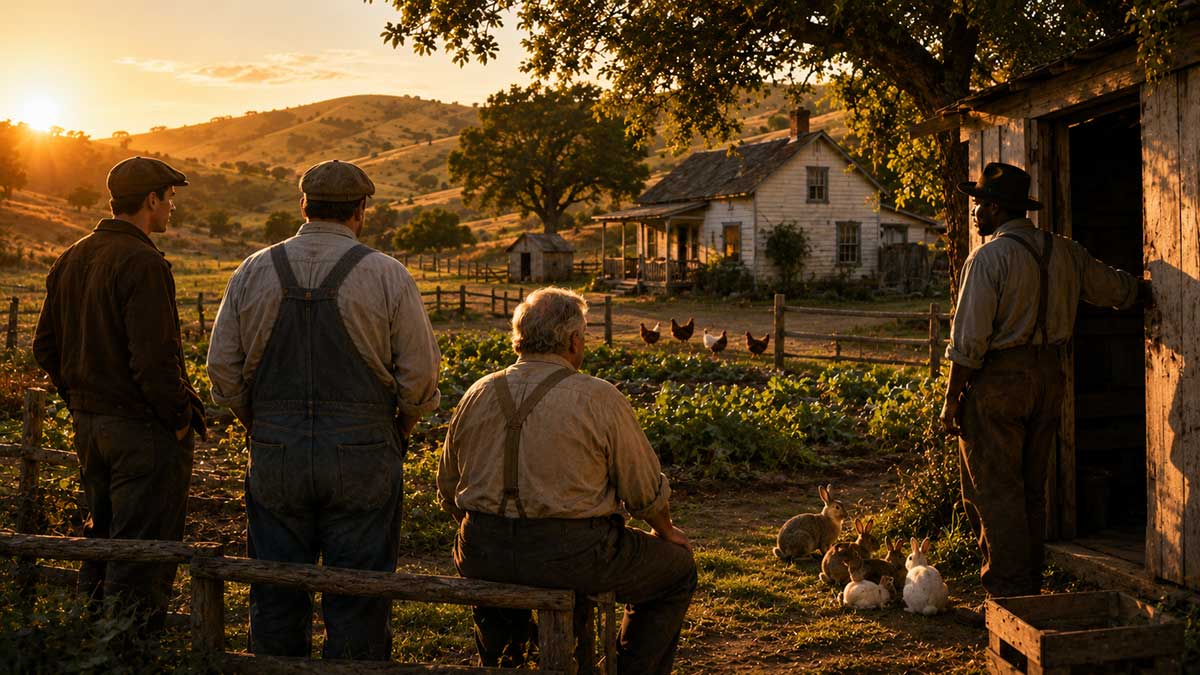
Lennie: George?
George: What?
Lennie: Tell about the place.
George sighed.
George: We were just talking about it.
Lennie: I know. Tell it again.
George: You know it already.
Lennie: I like when you tell it.
Candy smiled.
Candy: Go ahead, George.
George: You too?
Candy: Sounds different now.
George: How?
Candy: Used to be your story. Then it became mine.
Crooks shifted in his chair.
Crooks: That's how those things spread.
Curley’s Wife: Dreams?
Crooks: Trouble.
George laughed.
George: He's probably right.
Lennie leaned forward.
Lennie: Tell it, George.
George looked at him.
He had told the story so many times that he could have done it without thinking.
But this time he hesitated.
George: All right. We get a little place.
Lennie's face brightened immediately.
George: Not much. Few acres. Little house.
Lennie: And rabbits.
George: I'm getting there.
Lennie: Tell that part.
George: We'll have some chickens.
Lennie: And rabbits.
George: Maybe a cow.
Lennie: Rabbits, George.
George: Jesus Christ. Yes, Lennie. Rabbits.
Lennie smiled.
George: We'll grow vegetables. Have a stove when it gets cold. When it rains, we won't have to go nowhere unless we want to.
Candy: And nobody can run us off.
George nodded.
George: Nobody can run us off.
Lennie: And I tend the rabbits.
George: You tend the rabbits.
Lennie sat back, completely satisfied.
Curley's wife had been watching him.
Curley’s Wife: That's it?
Lennie: What?
Curley’s Wife: That's your whole dream?
Lennie: Rabbits.
Curley’s Wife: You don't want money?
Lennie shook his head.
Curley’s Wife: Nice clothes?
Another shake.
Curley’s Wife: People knowing who you are?
Lennie looked confused.
Lennie: Rabbits got soft fur.
She stared at him for a moment.
Then she laughed, though not cruelly.
Curley’s Wife: Maybe you've got the easiest dream of all of us.
Crooks shook his head.
Crooks: Ain't easy if you never get it.
Slim looked toward George.
Slim: How long have you been telling him that story?
George: Long time.
Slim: Before this ranch?
George: Sure.
Slim: Before Weed?
George: Yeah.
Slim: Was there always a real piece of land you were planning to buy?
George: No.
Slim: Then where'd the farm come from?
George shrugged.
George: I don't know. Had an old place in mind. Knew a little piece might come up for sale someday.
Slim: That's not what I asked.
George: What do you want me to say?
Slim: I'm wondering whether the farm started as a plan or as something you told Lennie when he was scared.
George looked at Lennie.
George: Maybe both.
Slim: Which came first?
George thought.
George: Probably the story.
Candy looked surprised.
Candy: You mean you didn't always figure you'd really buy one?
George: Come on, Candy. Guys like us talk about little places all the time.
Crooks gave a dry laugh.
Crooks: That's true.
George: Every damn bunkhouse has somebody saying he's gonna save his money and get land.
Crooks: And every month the money disappears.
George: Exactly.
Candy: But ours is different.
Crooks looked at him.
Candy: We got money.
Crooks: You got some money.
Candy: Enough to get close.
George: He's right.
Crooks stared at George.
Crooks: You really believe that?
George: I didn't before.
Candy: But now?
George looked from Candy to Lennie.
George: Now maybe I do.
Lennie grinned.
Lennie: I told you.
Slim: That's interesting.
George: What is?
Slim: You told Lennie the story before you believed it.
George: So?
Slim: Maybe you thought you were keeping him going.
George waited.
Slim: Now Candy's money has you believing your own story.
George frowned.
George: What's wrong with that?
Slim: Nothing.
Crooks: Plenty, if it falls apart.
Candy: Why do you always have to do that?
Crooks: Do what?
Candy: Somebody starts hoping and you start digging the grave.
Crooks: Maybe I've seen enough graves.
Candy: Maybe you've seen so many you forgot people are still alive.
That silenced Crooks.
Candy seemed surprised by his own sharpness.
Candy: Sorry.
Crooks: Don't be.
A pause.
Crooks: Maybe you're right.
Curley's wife looked toward George.
Curley’s Wife: Why does everybody like your dream?
George: What do you mean?
Curley’s Wife: You say you're going to buy a farm and everybody listens like it's beautiful.
George: It's a decent dream.
Curley’s Wife: I wanted to be in pictures.
George looked away.
Curley’s Wife: There.
George: What?
Curley’s Wife: That look.
George: I didn't say anything.
Curley’s Wife: You didn't have to.
Candy: Being in pictures ain't the same as buying a little farm.
Curley’s Wife: Why?
Candy opened his mouth, then stopped.
Curley’s Wife: Why is your dream respectable and mine stupid?
George: Nobody said stupid.
Curley’s Wife: You think it.
George: Lots of girls want to be movie stars.
Curley’s Wife: Lots of men want farms.
George did not answer.
Curley’s Wife: I met a man once who said I could be in pictures. Said I was natural.
Crooks: Maybe he meant it.
Curley’s Wife: I thought he did.
Slim: What happened?
Her face changed.
Curley’s Wife: Nothing.
That one word carried more than the others expected.
Curley’s Wife: That's what happened.
Lennie: You wanted rabbits too?
She smiled faintly.
Curley’s Wife: No.
Lennie: What'd you want?
She looked at him.
Curley’s Wife: I wanted people to know my name.
The room went quiet.
Lennie seemed confused.
Lennie: What's your name?
George turned sharply toward him.
Curley's wife did not answer.
Lennie waited.
Lennie: I know George's name.
George: Lennie...
Lennie: Candy. Crooks. Slim.
He looked back at her.
Lennie: What's yours?
She stared at him.
Nobody spoke.
Curley’s Wife: Funny.
Candy: What?
Curley’s Wife: All that talk I used to do about being famous.
She gave a small, bitter laugh.
Curley’s Wife: And right here nobody even asks my name.
Lennie had.
The realization seemed to disturb her more than comfort her.
Curley’s Wife: Maybe that was the dream.
Slim: Hollywood?
She shook her head.
Curley’s Wife: Being somebody before I became somebody's wife.
Crooks looked toward her.
For once, there was no hostility between them.
Candy broke the silence.
Candy: Mine ain't really the farm either.
George looked at him.
George: What?
Candy: I want the farm. Sure.
George: You put money into it.
Candy: I know.
George: Then what are you saying?
Candy looked at his missing hand.
Candy: Suppose you gave me a big house somewhere else. Free. But every morning somebody could come tell me I had to leave.
George: What kind of house is that?
Candy: Exactly.
He looked at George.
Candy: I don't care how many acres we got.
George: Then what do you want?
Candy: A key.
Lennie: A key?
Candy: To my own door.
Lennie: Why?
Candy: So I know I'm allowed to come back tomorrow.
Lennie considered this.
Lennie: George lets me come back.
Candy smiled sadly.
Candy: Yeah.
Lennie: I don't need a key.
George looked at him.
Candy: No. You've got George.
The smile disappeared from George's face.
Crooks spoke quietly.
Crooks: That's the dangerous part.
Candy: What?
Crooks: Building your home inside another person.
George stiffened.
Crooks: Houses disappear. Jobs disappear. Land gets taken. People disappear too.
Lennie: George ain't disappearing.
Nobody answered.
Lennie: George?
George: I'm here.
Lennie: You're staying.
George: Yeah.
Lennie relaxed.
Crooks looked away.
Crooks: That's what I mean.
Slim turned toward Crooks.
Slim: What about you?
Crooks: What about me?
Slim: What would the farm mean to you?
Crooks: Nothing.
Candy laughed.
Candy: That's a lie.
Crooks glared at him.
Candy: You asked if you could come.
Crooks: For about five minutes.
Candy: Still asked.
Crooks: I was fooling.
Slim: Were you?
Crooks became defensive.
Crooks: I've seen hundreds of men come through here with the same damn idea. Little piece of land. Chickens. Cow. Never happens.
George: Ours could.
Crooks: Maybe.
The word escaped before Crooks could stop it.
Candy smiled.
Candy: There.
Crooks: Don't.
Candy: You said maybe.
Crooks: I said maybe because I want you to shut up.
Candy: Sure.
Crooks shook his head.
Then his expression changed.
Crooks: You really want to know?
Slim: Yeah.
Crooks: A door.
Candy looked at him.
Candy: Same as me.
Crooks: No.
He pointed toward the imagined farm.
Crooks: A door I don't have to stop at.
Nobody interrupted.
Crooks: That's what I'd want.
He looked toward the bunkhouse.
Crooks: Walk into a room and not have to wonder whether somebody's gonna tell me I don't belong there.
Candy nodded.
Crooks: Sit down because there's an empty chair. Not because somebody gave me permission.
Curley's wife lowered her eyes.
Crooks noticed but continued.
Crooks: Maybe eat at the same table.
Lennie: You can eat with us.
Crooks looked at him.
Lennie: We got plenty.
Crooks: You ain't got anything yet.
Lennie: We will.
Crooks almost laughed.
Crooks: You sure make believing sound easy.
Slim looked around.
Slim: That's strange.
George: What now?
Slim: George says farm and none of you are talking about farming.
George looked from one face to another.
Slim was right.
Slim: Lennie wants rabbits.
Lennie: Yeah.
Slim: Candy wants a key.
Candy nodded.
Slim: Crooks wants a door he can walk through.
Crooks said nothing.
Slim: She wants her own name.
Curley's wife looked down.
Slim: What do you want, George?
George: I told you.
Slim: Land?
George: Yeah.
Slim: Why?
George: So it's ours.
Slim: Why does that matter?
George became irritated.
George: Because I'm sick of somebody else deciding everything.
There it was.
George: When I wake up. When I work. Where I sleep. Whether I stay. Whether I go.
His voice grew stronger.
George: I'm sick of working my ass off and ending the month with nothing except enough money to get to the next damn place where I do it again.
Lennie watched him.
George: I want one thing nobody can take away because some boss changes his mind.
Slim nodded.
Slim: So you don't want land.
George frowned.
Slim: You want control over your own life.
George stopped.
George: Maybe.
Curley's wife looked at him.
Curley’s Wife: That's what I wanted too.
George glanced at her.
Curley’s Wife: Different dream. Same reason.
That surprised him.
George: Maybe.
Curley’s Wife: You wanted a farm because nobody could tell you what to do.
George: Yeah.
Curley’s Wife: I wanted pictures because nobody would call me somebody's wife.
George nodded slowly.
Curley’s Wife: Candy wants somewhere he can't be thrown out.
Candy: That's right.
Curley’s Wife: Crooks wants somewhere he doesn't have to ask permission to enter.
Crooks looked at her.
Curley’s Wife: Lennie wants rabbits.
Lennie: Lots of 'em.
For once, everyone laughed.
Even Crooks.
Then Lennie asked:
Lennie: What does Slim want?
The laughter stopped.
Slim smiled.
Slim: Nobody asked me that.
Lennie: I did.
Slim thought for a while.
Slim: Maybe I don't know.
Curley’s Wife: Everybody thinks you're the one who has everything figured out.
Slim: That's their mistake.
George: You never talk about leaving.
Slim: Maybe I got good at not expecting too much.
Crooks looked at him.
Crooks: That's one way to keep from being disappointed.
Slim: Yeah.
Candy: Ain't that the same as giving up?
Slim considered it.
Slim: Maybe sometimes.
George leaned back.
George: So what's better? Want something you probably ain't gonna get or stop wanting it?
Crooks: Stop wanting.
Candy: Hell no.
Crooks: Easy for you to say. Your money made the dream real.
Candy: Before I heard about that farm, I thought I knew exactly how my life ended.
Crooks looked at him.
Candy: Work till I couldn't. Then somebody tells me to go.
His hand trembled slightly.
Candy: Now maybe it still ends that way.
He looked at George.
Candy: But for a little while, it didn't have to.
George: That matters?
Candy: Course it matters.
Crooks: Why? If it don't happen?
Candy: Because yesterday I had no tomorrow.
That silenced everyone.
Candy: Today I got one.
Curley's wife looked toward the window.
Curley’s Wife: Mine did the opposite.
Slim: Your dream?
She nodded.
Curley’s Wife: It made everything I had look smaller.
Nobody interrupted.
Curley’s Wife: Every time Curley got mad, every time I sat alone in that house, I'd think about what I could've been.
She paused.
Curley’s Wife: Maybe sometimes a dream keeps you alive.
She looked toward George.
Curley’s Wife: Maybe sometimes it keeps you from living.
George seemed struck by that.
George: You think that's what ours does?
Curley’s Wife: I don't know.
Then she looked at Lennie.
Curley’s Wife: Maybe ask him.
George: Lennie?
Lennie: Yeah?
George: Suppose we never get the farm.
Lennie's smile vanished.
Lennie: We're gonna.
George: I know. I'm just saying suppose.
Lennie: We are.
George: Lennie.
Fear entered Lennie's face.
Lennie: You said.
George: I know what I said.
Lennie: You said we'd get a little place.
George: We will.
Lennie: And rabbits.
George: Yeah.
Lennie: Don't say we won't.
George saw immediately what he had done.
George: Okay.
Lennie: Don't say it.
George: I won't.
Lennie breathed easier.
George: We're gonna get the place.
Lennie: Yeah.
George: And the rabbits.
Lennie: Yeah.
George: You tend 'em.
Lennie smiled again.
Lennie: I tend 'em.
George looked toward Slim.
Slim understood.
The farm was not simply something Lennie wanted.
It was something holding his world together.
Crooks watched Lennie carefully.
Crooks: That's what scares me about dreams.
Candy: Here you go again.
Crooks: Look at him.
Candy did.
Crooks: Take that dream away and what does he have?
George answered immediately.
George: Me.
Crooks turned toward him.
George seemed surprised by his own answer.
Crooks: Exactly.
George: What's wrong with that?
Crooks: Nothing.
A pause.
Crooks: Until something happens to you.
George stared at him.
Lennie did not understand.
Slim finally spoke.
Slim: Maybe dreams aren't promises.
George: Lennie thinks ours is.
Slim: Maybe that's the difference.
Candy: Between what?
Slim: A dream and a promise.
George looked toward Lennie.
Slim: A dream says, “I hope we get there.”
Candy: And a promise?
Slim answered quietly.
Slim: “I'll get you there.”
George's face changed.
For years he had been telling Lennie about the farm.
Maybe Lennie had never heard it as a fantasy.
Maybe he had heard George making a promise.
Again.
And again.
And again.
George: Jesus.
Candy: What?
George: Nothing.
But it was not nothing.
He looked at Lennie.
George: You really think I'm gonna get you those rabbits, don't you?
Lennie laughed.
Lennie: Sure.
George: Why?
Lennie seemed puzzled by the question.
Lennie: Because you said.
George looked away.
Curley's wife watched him.
Curley’s Wife: That's a lot to carry.
George nodded almost imperceptibly.
Curley’s Wife: Somebody else's whole future.
George: Yeah.
Curley’s Wife: Maybe that's why you get mad at him.
George looked at her.
George: Maybe.
Curley’s Wife: Not because he believes the dream.
George: What then?
Curley’s Wife: Because you're afraid you can't give it to him.
George did not answer.
Candy broke the silence.
Candy: Well, I still want it.
Crooks: I know.
Candy: Even if we don't make it.
Crooks: Why?
Candy thought.
Candy: Because for a few days I wasn't waiting to become useless.
Crooks looked down.
Candy: What about you?
Crooks: I told you. I ain't coming.
Candy: Didn't ask that.
Crooks looked at him.
Candy: Was it worth thinking about?
Crooks was silent for a long time.
Crooks: Yeah.
Candy smiled.
Crooks: Don't make anything out of it.
Candy: I won't.
Crooks: Just...
He stopped.
Candy: What?
Crooks: For a minute I could see the door.
Candy understood.
Curley's wife spoke next.
Curley’s Wife: I can still see mine too.
George: Hollywood?
She shook her head.
Curley’s Wife: Me.
George waited.
Curley’s Wife: The girl I thought I'd become.
Her voice softened.
Curley’s Wife: Sometimes I don't know if she was ever real.
Nobody tried to answer.
Lennie looked around at them.
He did not seem to understand why everyone had become sad.
Lennie: Our dream ain't sad.
George smiled faintly.
George: No?
Lennie: No.
George: What is it then?
Lennie thought very hard.
Lennie: It's where we're going.
The simplicity of it silenced them.
Not what they wanted.
Not what they hoped for.
Where they were going.
For Lennie, the future was a place George had already shown him.
Slim looked around the room.
Slim: Maybe that's why people need dreams.
Crooks: Why?
Slim: Sometimes where you are is too hard to live in without somewhere you're going.
Crooks stared at him.
Candy nodded.
Curley's wife looked toward the doorway.
George looked at Lennie.
George: But what if you never get there?
Slim considered the question.
Slim: Then maybe you ask whether the dream helped you live or kept you from living.
Curley's wife lowered her eyes.
Candy held his missing wrist.
Crooks looked toward a door he had spent years being told was not his.
Lennie smiled at rabbits that did not exist.
And George suddenly seemed to see the farm differently.
For Lennie, it was safety.
For Candy, a future.
For Crooks, belonging.
For Curley's wife, the conversation had exposed another lost dream entirely.
For George, it had begun as a story.
Then it became a plan.
Then a possibility.
And somewhere along the way, without realizing it, George had turned it into a promise.
Lennie: George?
George: Yeah?
Lennie: We're still going, right?
George looked at him for a long time.
George: Yeah.
Lennie: To the farm?
George: To the farm.
Lennie smiled.
But George did not.
For the first time, he seemed to understand that losing the farm would mean more than losing a few acres of land.
He would be breaking the future he had taught Lennie to trust.
And none of them yet knew that the greatest threat to that dream was not money, the ranch, Curley, or bad luck.
It was already sitting among them, wanting nothing more dangerous than something soft to hold.
Topic 4: If Someone Does Not Mean to Hurt People, How Responsible Are They?
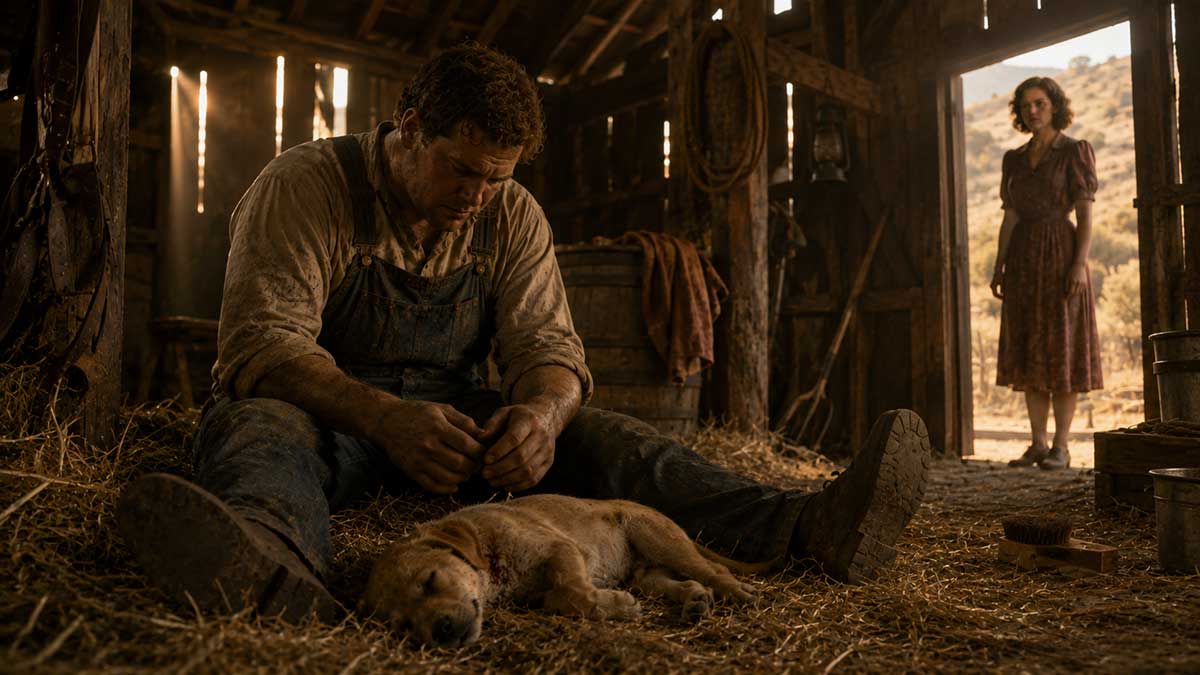
For a while, nobody spoke.
The farm was still there between them.
A little house.
A door Crooks could walk through.
A room Candy could keep when he grew too old to work.
A name that belonged to Curley’s wife herself.
Rabbits for Lennie.
A life George could finally control.
Then Slim looked at Lennie’s hands.
Slim: Lennie, can I ask you something?
Lennie: Sure.
Slim: What happened to the puppy?
Lennie’s face changed immediately.
Lennie: I didn’t do nothing bad.
George sat forward.
George: Lennie.
Lennie: I didn’t.
Slim: I didn’t say you did.
Lennie: He was little.
Slim: I know.
Lennie: I was petting him.
George: Too hard.
Lennie: I didn’t mean to.
George: Nobody said you meant to.
Lennie: He acted like he was gonna bite me.
Lennie looked at George anxiously.
Lennie: Then I smacked him a little.
George: Lennie...
Lennie: Just a little.
Slim: But you’re strong.
Lennie looked at his hands.
Lennie: I forgot.
Curley’s wife had been watching him.
Curley’s Wife: You forgot how strong you are?
Lennie: Sometimes.
Curley’s Wife: How do you forget something like that?
George immediately turned toward her.
George: Leave him alone.
Curley’s Wife: I’m asking.
George: You’re pushing him.
Curley’s Wife: Maybe everybody spends too much time making sure he doesn’t feel bad.
George: You don’t know what you’re talking about.
Curley’s Wife: Then tell me.
George’s jaw tightened.
Curley’s Wife: He killed an animal.
George: By accident.
Curley’s Wife: Does the puppy know the difference?
Silence.
Lennie looked frightened.
Lennie: George?
George: It’s okay.
Lennie: You ain’t mad?
George: No.
Lennie: I still get to tend the rabbits?
George hesitated.
Only for a moment.
But Curley’s wife saw it.
George: Yeah.
Lennie: I won’t hurt them.
George: I know.
Lennie: I’ll be real careful.
George: I know you will.
Lennie relaxed.
Curley’s wife did not.
Curley’s Wife: That’s what he worries about?
George looked at her.
Curley’s Wife: The rabbits?
George: He understands things different.
Curley’s Wife: The puppy is dead and he’s worried you won’t give him rabbits.
George: He don’t think like you.
Curley’s Wife: I can see that.
George: Then stop expecting him to.
Curley’s Wife: I’m not.
She paused.
Curley’s Wife: I’m asking what happens to everybody else.
George stared at her.
Curley’s Wife: You know he doesn’t mean it. Fine.
She pointed toward Lennie.
Curley’s Wife: He knows he doesn’t mean it.
Then toward the place where the puppy had been.
Curley’s Wife: The puppy’s still dead.
Nobody answered.
Crooks spoke quietly.
Crooks: That’s the problem.
George: What?
Crooks: Everybody keeps trying to decide whether Lennie’s good or bad.
Candy: He ain’t bad.
Crooks: I didn’t say he was.
Candy: He don’t mean harm.
Crooks: I know.
Candy: Then what are you saying?
Crooks leaned forward.
Crooks: Maybe good and bad ain’t the question.
George frowned.
Crooks: Maybe the question is whether somebody can be good and still be dangerous.
Lennie looked toward George.
Lennie: I ain’t dangerous.
George: Nobody’s saying you’re dangerous.
Crooks looked at George.
Crooks: Aren’t we?
George’s expression hardened.
George: Watch it.
Slim: George.
George: No. Everybody’s sitting here talking like Lennie’s some animal that might turn.
Candy flinched slightly at the word animal.
Slim: Nobody said that.
George: Sounds like it.
Slim: Lennie hurt Curley.
George: Curley started it.
Slim: He did.
George: Lennie didn’t even fight back until I told him.
Slim: True.
George: Then what?
Slim: Then Lennie grabbed his hand.
George said nothing.
Slim: And he didn’t let go.
George: He was scared.
Slim: I know.
George: Curley was hitting him.
Slim: I know that too.
George: So what the hell do you want?
Slim’s voice stayed calm.
Slim: I want you to stop thinking that explaining why Lennie hurts somebody makes the hurt disappear.
That stopped George.
Lennie looked between them.
Lennie: I didn’t like Curley hitting me.
Slim: I know.
Lennie: He hurt me.
Slim: He did.
Lennie: George told me to get him.
George lowered his head.
Lennie: So I got him.
Slim: You crushed his hand.
Lennie: I didn’t mean to bust it.
Slim: I believe you.
Lennie looked surprised.
Lennie: You do?
Slim: Yeah.
Lennie: Then I ain’t bad.
Slim paused.
Slim: Lennie, those aren’t the only choices.
Lennie: What choices?
Slim: Meaning to hurt somebody or not meaning to.
Lennie did not understand.
Slim: You can hurt somebody without wanting to.
Lennie: Then it ain’t bad.
Slim looked at George.
George knew what Slim was asking him to do.
George: Lennie...
Lennie: Yeah?
George: If you hurt somebody by accident, they still get hurt.
Lennie thought.
Lennie: But I say sorry.
George: Yeah.
Lennie: Then it’s okay.
George’s face tightened.
George: Sometimes.
Lennie: Sometimes?
George: Sometimes sorry can’t fix it.
Lennie stared at him.
That seemed to be a frightening idea.
Lennie: Then what fixes it?
Nobody answered.
Lennie: George?
George looked at him.
George: Sometimes nothing does.
Lennie’s eyes widened.
Lennie: Nothing?
George: Yeah.
Lennie: But if I didn’t mean it?
George: Still.
Lennie became agitated.
Lennie: That ain’t fair.
George: I know.
Lennie: If I don’t mean it, it ain’t fair.
George: I know, Lennie.
Lennie: Then why?
George had no answer simple enough to give him.
Curley’s wife spoke.
Curley’s Wife: Maybe because the person who gets hurt gets a life too.
Lennie looked at her.
Curley’s Wife: You’re not the only person in the story.
George turned toward her.
She did not look at him.
Curley’s Wife: Everybody keeps talking about what Lennie understands. What Lennie wants. What Lennie means.
Her voice became quieter.
Curley’s Wife: What about the person standing in front of him?
Lennie looked uneasy.
George: You stay away from him and there won’t be a problem.
She turned sharply.
Curley’s Wife: There.
George: What?
Curley’s Wife: That’s exactly what I mean.
George: I told you from the start to stay away from him.
Curley’s Wife: So it’s my job?
George: I didn’t say that.
Curley’s Wife: You just did.
George: I’m trying to keep everybody out of trouble.
Curley’s Wife: By telling everybody else to manage Lennie?
George: By telling you not to flirt around him.
Her face hardened.
Curley’s Wife: And if something happens, that makes it my fault?
George: I didn’t say that.
Curley’s Wife: You’re getting close.
Slim watched George.
George knew it too.
George: I know Lennie.
Curley’s Wife: Exactly.
George: I know what confuses him.
Curley’s Wife: Exactly.
George: I know what scares him.
Curley’s Wife: Exactly.
She leaned closer.
Curley’s Wife: I don’t.
George stopped.
Curley’s Wife: Curley doesn’t.
George: Curley don’t care.
Curley’s Wife: The girl in Weed didn’t.
George’s face changed.
Curley’s Wife: Did she know?
George: No.
Curley’s Wife: She knew Lennie liked soft things?
George: No.
Curley’s Wife: She knew he panics when people scream?
George: No.
Curley’s Wife: She knew he grabs tighter when he gets scared?
George said nothing.
Curley’s Wife: But you did.
The room went silent.
George’s voice dropped.
George: What are you saying?
Curley’s Wife: I’m asking you something.
She looked directly at him.
Curley’s Wife: If you know all of that, and something happens, how much of it belongs to Lennie?
George waited.
Curley’s Wife: And how much belongs to you?
Lennie looked alarmed.
Lennie: George didn’t do nothing.
George: It’s okay.
Lennie: Don’t blame George.
Curley’s Wife: I’m not blaming him.
Lennie: You are.
Curley’s Wife: I’m asking him what he’s responsible for.
Lennie: George takes care of me.
She looked at Lennie.
Curley’s Wife: I know.
Lennie: He keeps me out of trouble.
George looked down.
Crooks noticed.
Crooks: Most of the time.
George glared at him.
Crooks: That’s what you’re thinking.
George: You don’t know what I’m thinking.
Crooks: You think if you watch him close enough, nothing bad happens.
George: Usually it don’t.
Crooks: Until you ain’t there.
George’s expression changed.
Crooks: Then what?
George: He knows what I tell him.
Crooks: Does he?
George: He remembers enough.
Crooks: He remembers rabbits.
George said nothing.
Crooks: He remembers where to hide if something goes wrong.
Silence.
Crooks: Think about that.
George looked at him.
Crooks: You taught him where to go after trouble.
George’s face tightened.
Crooks: Maybe you knew trouble was coming before you admitted it.
George: I knew he might get scared.
Crooks: Scared of what?
George did not answer.
Candy spoke softly.
Candy: George, why did you tell Lennie to go back to the river if anything happened?
George: So I could find him.
Candy: Why'd you think you'd need to find him?
George: Because Lennie gets into things.
Candy: Bad things?
George: Sometimes.
Candy: Things where people might come after him?
George looked at Candy.
George: What do you want me to say?
Candy: Nothing.
George: You all want me to admit I knew he was dangerous.
Slim: Did you?
George stood.
George: No.
Nobody moved.
George: I knew he was strong.
Slim: That's not the same thing.
George: I knew he got scared.
Slim: Not the same thing either.
George: I knew people misunderstand him.
Slim: George.
George turned.
Slim's voice softened.
Slim: Did you know he could hurt somebody badly without meaning to?
George stared at him.
A long silence.
George: Yeah.
There it was.
Lennie looked frightened.
Lennie: George?
George sat down again.
Lennie: You think I’m bad?
George: No.
Lennie: You think I hurt people?
George looked at him.
He could have comforted him.
He had done it a hundred times.
Instead:
George: Sometimes you do.
Lennie’s eyes filled with fear.
Lennie: I don't mean to.
George: I know.
Lennie: I never mean to.
George: I know that too.
Lennie: Then why do I?
George swallowed.
George: Because wanting to be gentle and knowing how to be gentle ain't always the same thing.
Lennie looked down at his hands.
Lennie: My hands bad?
George moved immediately.
George: No.
Lennie: They kill things.
George: Lennie...
Lennie: Mouse.
Nobody spoke.
Lennie: Puppy.
His voice became smaller.
Lennie: Curley's hand.
George reached toward him.
Lennie: Maybe my hands are bad.
George: Your hands aren't bad.
Lennie: Then what is?
George stopped.
That question seemed to hurt more than anything else.
George: Nothing in you is bad like that.
Lennie: But things get hurt.
George: Yeah.
Lennie: Why?
George could not answer.
Slim did.
Slim: Because sometimes a person can have something inside him he can't control very well.
Lennie looked at Slim.
Slim: That doesn't make him evil.
Lennie: But it makes things get hurt?
Slim: It can.
Lennie stared at his hands again.
Candy rubbed his missing wrist.
Candy: Funny thing about hands.
Everyone looked at him.
Candy: Mine can't do enough anymore.
He looked toward Lennie.
Candy: His can do too much.
Lennie looked at Candy's missing hand.
Candy looked at Lennie's enormous ones.
Neither man said anything.
Curley’s wife finally broke the silence.
Curley’s Wife: George, were you ever scared of him?
Lennie immediately looked up.
George: No.
Curley’s Wife: Never?
George: No.
Curley’s Wife: Not even once?
George: I said no.
Slim watched him.
Curley’s Wife: You weren't scared when he held onto that girl's dress?
George: I was scared for him.
Curley’s Wife: Not her?
George hesitated.
That was enough.
Curley’s Wife: That's what I thought.
George: I didn't want her hurt.
Curley’s Wife: But she wasn't yours.
George stiffened.
Curley’s Wife: Lennie was.
George: He's not mine.
Curley’s Wife: You know what I mean.
George did.
Curley’s Wife: Maybe that's what love does sometimes.
George: What?
Curley’s Wife: Makes one person's fear louder than somebody else's.
George looked at her.
Curley’s Wife: You see Lennie scared and you want to protect him.
She touched her own chest.
Curley’s Wife: What if I'm scared?
George said nothing.
Curley’s Wife: Who protects me from him?
The room became very still.
Lennie looked confused.
Lennie: I wouldn't hurt you.
She looked at him.
For the first time, her expression held no flirtation, no mockery, no anger.
Only sadness.
Curley’s Wife: I believe you.
George looked at her.
Curley’s Wife: That's what makes it worse.
Lennie seemed relieved.
Lennie: See, George? She knows.
Curley’s wife closed her eyes.
Lennie: I ain't gonna hurt nobody.
No one answered.
Lennie: I ain't.
George: I know you don't want to.
Lennie: That's what I said.
George looked at him.
George: But maybe that ain't enough anymore.
Lennie’s smile disappeared.
Lennie: What do you mean?
George struggled.
George: I mean...
He stopped.
How could he explain responsibility to a man whose whole moral world had been built around staying out of trouble?
George: Suppose you pick up a mouse.
Lennie: I like mice.
George: I know. Suppose you squeeze it.
Lennie: I don't mean to.
George: I know. But it dies.
Lennie nodded sadly.
George: Next time, you gotta remember what happened.
Lennie: I try.
George: I know.
Lennie: Sometimes I forget.
George: I know that too.
Lennie: Then you remind me.
George froze.
Lennie: That's what you do.
No accusation.
No manipulation.
Just certainty.
Lennie: You remind me.
George looked devastated.
Crooks spoke quietly.
Crooks: There it is again.
Slim: What?
Crooks: Responsibility moving.
George looked at him.
Crooks: Lennie can't carry all of it.
He looked toward Lennie.
Crooks: Maybe he can't understand enough to carry all of it.
Then toward George.
Crooks: So George carries more.
George's voice sharpened.
George: How much more?
Crooks did not answer.
George: All of it?
Silence.
George: Every damn thing he does, I answer for?
Slim: Nobody said all.
George: Then tell me where mine stops.
No one could.
George: Tell me.
He looked at Candy.
George: You know?
Candy shook his head.
George looked at Crooks.
George: You?
Nothing.
Curley’s wife.
George: You got plenty to say. Tell me.
She could not.
Finally Slim.
George: Where does my responsibility stop and his begin?
Slim looked at Lennie.
Slim: I don't know.
George laughed bitterly.
George: That's useful.
Slim: Maybe there isn't a clean line.
George: There has to be.
Slim: Why?
George: Because if there ain't, I can never know when I've done enough.
That silenced them.
George's anger disappeared as quickly as it had arrived.
What remained was exhaustion.
George: You think I don't know?
His voice cracked slightly.
George: Every time something happens, I go over it afterward.
Nobody interrupted.
George: Should've seen it.
Should've stopped him.
Shouldn't have gone there.
Shouldn't have left him alone.
Should've told him different.
Should've known.
Lennie stared at him.
George: And every time I tell myself next time I'll watch closer.
He looked at his friend.
George: But there’s always a next time.
Lennie looked wounded.
Lennie: I'm sorry, George.
George immediately regretted saying it.
George: Lennie, no.
Lennie: I make you tired.
George: That ain't what I meant.
Lennie: I can go away.
George: Stop.
Lennie: I'll find a cave.
George: Lennie, stop talking about the damn cave.
Lennie: Then you don't gotta watch me.
George: I said stop.
Lennie fell silent.
George softened.
George: Look at me.
Lennie did.
George: I don't want you gone.
Lennie: But I make trouble.
George: Yeah.
Lennie seemed startled by the honesty.
George: And I still don't want you gone.
Lennie stared at him.
George: Both can be true.
Slim nodded.
Slim: That's the thing we've been trying to say.
George looked toward him.
Slim: Lennie can be innocent of wanting harm and still cause harm.
He looked toward Curley’s wife.
Slim: Somebody can be lonely and still hurt somebody weaker.
Her eyes moved toward Crooks.
Slim: George can love Lennie and still be tired of carrying him.
George looked down.
Slim: People don't come in one piece.
Crooks gave a quiet nod.
Crooks: Maybe that's why judging them is easy from far away.
Curley’s wife looked at Lennie.
Curley’s Wife: Can I ask you something?
George immediately looked at her.
Curley’s Wife: I'm asking him.
Lennie nodded.
Curley’s Wife: Suppose somebody had something soft.
Lennie listened closely.
Curley’s Wife: And they told you to stop touching it.
Lennie: Why?
Curley’s Wife: Because they were scared.
Lennie frowned.
Curley’s Wife: Would you stop?
Lennie: George says I gotta.
Curley’s Wife: George isn't there.
Lennie looked toward George.
Lennie: Where's George?
Curley’s Wife: Somewhere else.
Lennie became uncomfortable.
Curley’s Wife: It's just you.
Lennie: I don't like that.
Curley’s Wife: I know.
Lennie: George should be there.
Curley’s Wife: But he isn't.
Lennie thought hard.
Curley’s Wife: The person says stop.
Lennie: I stop.
Curley’s Wife: What if you're scared?
Lennie rubbed his hands together.
Lennie: I don't know.
Curley’s Wife: What if they scream?
His face tightened.
Lennie: I don't like screaming.
Curley’s Wife: What do you do?
Lennie: Make 'em stop.
George went pale.
George: That's enough.
Curley’s wife looked at him.
George: Enough.
She stopped.
No triumph appeared on her face.
She seemed frightened by the answer too.
Candy whispered:
Candy: George.
George: Don't.
Candy: I wasn't gonna say anything.
George: Good.
But George already knew.
They all did.
The mouse.
The dress.
Curley's hand.
The puppy.
Each event had looked separate when it happened.
Now they formed a line.
Not destiny.
Not evil.
A pattern.
George looked at Lennie.
For perhaps the first time, he did not ask:
Does Lennie mean well?
He already knew the answer.
Yes.
Instead, another question had appeared.
Is meaning well enough to keep someone safe?
And George knew the answer to that one too.
No.
Lennie: George?
George: Yeah?
Lennie: We still get the farm?
The question nearly broke him.
George: Yeah.
Lennie: And the rabbits?
George looked at Lennie's hands.
Those hands wanted nothing more than softness.
They had killed a mouse.
Killed a puppy.
Crushed a man's hand.
And Lennie still dreamed of using them to care for something fragile.
George: Yeah, Lennie.
Lennie: I'll be careful.
George nodded.
George: I know you will.
Lennie: Real careful.
George: I know.
Lennie smiled.
George did not.
Crooks looked toward George.
Crooks: You know what scares you now?
George did not answer.
Crooks: It ain't that Lennie wants to hurt somebody.
George looked at him.
Crooks: It's that he doesn't.
George's eyes moved back toward Lennie.
That was exactly it.
If Lennie were cruel, George could hate him.
If Lennie enjoyed violence, George could leave him.
If Lennie understood what he was doing and chose it anyway, responsibility would be easier to place.
But Lennie loved mice.
He loved puppies.
He loved soft hair.
He loved George.
He wanted rabbits.
The things he destroyed were often the very things he wanted most desperately to hold.
Slim spoke quietly.
Slim: Maybe innocence and danger can live in the same person.
George nodded.
Slim: And maybe protecting that person doesn't mean pretending one of those things isn't there.
Curley's wife looked at George.
Curley’s Wife: Then protect both.
George: Both what?
Curley’s Wife: Him.
She paused.
Curley’s Wife: And whoever is standing in front of him.
George stared at her.
It sounded simple.
It was not.
George: And if I can't?
Nobody answered.
George: What if someday I can't protect both?
Still nothing.
George looked around the room.
At Candy, who knew what it meant to watch someone vulnerable become a problem other people wanted solved.
At Crooks, who knew what happened when society decided some people deserved less protection.
At Curley's wife, who knew what it meant to be seen as danger before being seen as a person, yet who now understood she might herself be in danger.
At Slim, who could see several truths at once but could not manufacture a painless answer.
Then George looked at Lennie.
George: What am I supposed to do then?
Lennie smiled at him.
Lennie: You tell me about the rabbits.
George's face collapsed into the faintest, saddest smile.
George: Yeah.
He looked away.
George: That's what I always do.
But this time the rabbits could not answer the question.
If Lennie could not carry the full weight of his actions, that weight had to go somewhere.
Some of it belonged to George.
Some of it belonged to a world with no safe place prepared for Lennie.
And some of it could never be assigned neatly at all.
The question waiting at the riverbank was no longer whether Lennie was good.
George knew he was not cruel.
The question was what love required once innocence could no longer guarantee safety.
And soon George would have to answer it without Slim, Candy, Crooks, or anyone else beside him.
Topic 5: Did George Save Lennie, Betray Him, or Both?
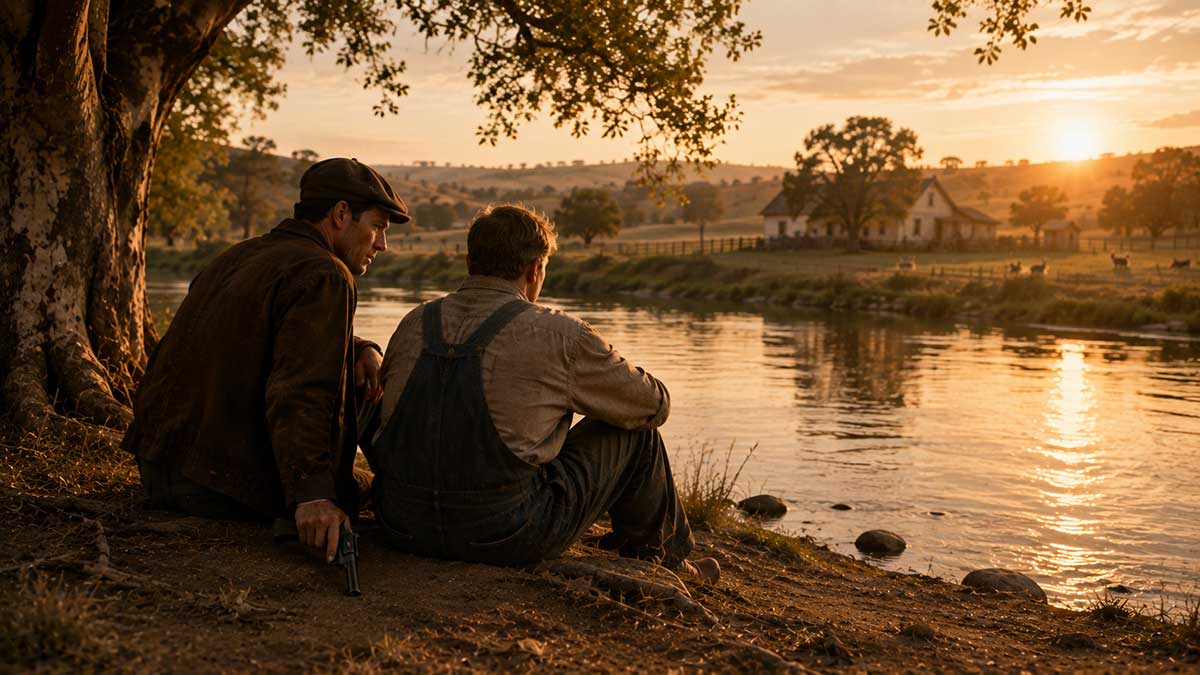
Nobody wanted to be the first to say it.
They had talked about friendship.
Usefulness.
Dreams.
Danger.
They had followed the story as far as they could without arriving at the river.
Now there was nowhere else to go.
Slim finally looked at George.
Slim: We have to talk about what you did.
George stared at the floor.
George: I know.
Candy: You don't have to if you don't want.
George gave a tired laugh.
George: That's the funny thing, Candy. Everybody else gets to decide whether they want to talk about it.
He looked up.
George: I don't get to stop thinking about it.
Lennie looked confused.
Lennie: Thinking about what, George?
George's face changed.
George: The river.
Lennie smiled.
Lennie: That's where you told me to go.
George: Yeah.
Lennie: If I got in trouble.
George: Yeah.
Lennie: I remembered.
George looked away.
Lennie: You always say I forget things, but I remembered that.
George: You did.
Lennie: I went right there.
George: I know.
Lennie: And you found me.
George closed his eyes.
Lennie: Just like you said.
No one spoke.
Crooks: That's one thing I can't get past.
George opened his eyes.
George: What?
Crooks: You picked that place before you knew what would happen.
George: I picked a place where I could find him.
Crooks: I know.
George: That's all.
Crooks: I believe you.
George looked surprised.
Crooks: But think about it.
Crooks leaned forward.
Crooks: You knew there might come a time when Lennie would need somewhere to hide from everybody else.
George said nothing.
Crooks: The river was supposed to be where you saved him.
George looked toward Lennie.
Crooks: It became where you killed him.
Lennie frowned.
Lennie: George didn't kill me.
The words stopped everyone.
George looked at him.
Lennie smiled uncertainly.
Lennie: George takes care of me.
George's eyes filled.
George: Lennie...
Lennie: You ain't gonna let nobody hurt me.
George could not answer.
Curley's wife spoke quietly.
Curley’s Wife: That's why we have to ask him.
George turned toward her.
There was no accusation in her voice.
Curley’s Wife: George, whose suffering were you ending?
George stared at her.
George: What?
Curley’s Wife: Lennie's?
She paused.
Curley’s Wife: Or yours?
Candy shifted uncomfortably.
Candy: That's a hell of a thing to ask.
George: No.
George kept looking at her.
George: It's fair.
Slim watched him.
George: Curley was coming.
Curley’s Wife: I know.
George: You know what he wanted to do.
She nodded.
George: He wasn't coming to bring Lennie back nice and easy. He wanted him hurt.
Curley’s Wife: Yes.
George seemed surprised that she agreed.
George: I knew what they'd do if they caught him.
Slim: So you got there first.
George: Yeah.
Curley’s Wife: That's what happened.
She leaned slightly toward him.
Curley’s Wife: It doesn't answer my question.
George's face hardened.
George: I was trying to save him from Curley.
Curley’s Wife: I believe you.
George: Then what the hell do you want from me?
Curley’s Wife: The part you're not saying.
George looked away.
Candy spoke.
Candy: Maybe she means the part nobody likes to admit.
George: You too?
Candy: You loved Lennie.
George: Yeah.
Candy: And you were tired.
George stared at him.
Candy: Both can be true. We already said that.
George: You think I shot him because I was tired of him?
Candy: No.
George: Then don't say it.
Candy: I'm saying maybe when it was over...
He stopped.
George waited.
Candy: Maybe some little part of you knew you wouldn't have to be afraid anymore.
George stood abruptly.
George: Shut up.
Candy flinched.
George: You think I wanted that?
Candy: No.
George: You think I wanted to be free of him?
Candy: George...
George: Say it.
Candy: I think you wanted Lennie alive.
George stared at him.
Candy: And I think you wanted the fear to stop.
George slowly sat again.
Lennie looked worried.
Lennie: I make you scared?
George turned.
George: Sometimes.
Lennie: I don't mean to.
George: I know.
Lennie: What are you scared of?
George looked at him for a long time.
George: Losing you.
Lennie smiled.
Then George continued.
George: And what might happen before I did.
The smile faded.
Slim leaned forward.
Slim: George, did you think about bringing him in?
George: To Curley?
Slim: To the law.
George shook his head.
George: There wasn't time.
Crooks: Maybe there wasn't.
George: There wasn't.
Slim: I'm not arguing.
George: Sounds like you are.
Slim: I'm asking whether you knew what would happen if you surrendered him.
George: No.
Slim: Prison?
George: Maybe.
Slim: An institution?
George: Maybe.
Slim: Trial?
George: I don't know.
Slim: Then you didn't know there was no other future.
George's eyes hardened.
George: You weren't standing there.
Slim: No.
George: You didn't have Curley coming with a gun.
Slim: No.
George: You didn't have Lennie sitting there waiting for you to fix everything.
Slim: No.
George: Then don't give me choices I didn't have time to make.
Slim nodded.
Slim: That's fair.
George seemed almost disappointed that Slim did not fight back.
Crooks spoke.
Crooks: Maybe that's the difference.
George: Between what?
Crooks: Saying you had no choice and saying every choice you could see was terrible.
George looked at him.
Crooks: Those aren't the same thing.
George: What difference does it make now?
Crooks: Maybe none to Lennie.
He paused.
Crooks: Maybe a lot to you.
Lennie looked from one person to another.
Lennie: I don't like this.
George immediately softened.
George: I know.
Lennie: Everybody's mad.
George: Nobody's mad at you.
Lennie: Curley is.
George: Forget Curley.
Lennie: He wants to hurt me.
George froze.
Lennie: Don't let him, George.
George: I won't.
The answer came automatically.
The same promise.
The same role.
George would protect Lennie.
The only question was what protection meant now.
Candy stared at George.
Candy: When Carlson took my dog out, I let him.
George looked at him.
Candy: I sat there.
Nobody interrupted.
Candy: I knew what was coming.
He rubbed his missing wrist.
Candy: Then I heard the shot.
George lowered his eyes.
Candy: I hated myself for not going.
George: You said you wished you'd done it yourself.
Candy: Yeah.
George: That's what I remembered.
Candy looked at him.
George: At the river.
The room went still.
Candy: You thought about my dog?
George: Yeah.
Candy: When you had the gun?
George: Yeah.
Candy swallowed.
George: You said you shouldn't have let a stranger do it.
Candy's face tightened.
George: Lennie trusted me.
Candy: I know.
George: If he was gonna die...
George struggled with the words.
George: I wasn't gonna let Curley be the last thing he saw.
Candy closed his eyes.
Candy: George...
George: What?
Candy: I don't know if what I said was right.
George stared at him.
Candy: About my dog.
George: What do you mean?
Candy: I know I wish I'd been there.
George: That's what you said.
Candy: Yeah.
George: So?
Candy: Maybe there's a difference between saying, “If he has to die, I want him with me,” and saying, “I get to decide he has to die.”
George went completely still.
Nobody moved.
George: You think I didn't have the right.
Candy: I don't know.
George: Say it.
Candy: I don't know, George.
George: That's easy now.
Candy: No, it ain't.
Candy's voice trembled.
Candy: You think I don't wonder whether I let them kill that dog because everybody made me feel foolish for loving something old and useless?
George stared at him.
Candy: Maybe I told myself it was mercy after.
George: He was suffering.
Candy: Some.
George: Carlson said...
Candy: Carlson wanted him gone.
That stopped George.
Candy: That's different.
Crooks leaned forward.
Crooks: There's something worse in the comparison.
George looked at him.
Crooks: Lennie wasn't a dog.
George: I know that.
Crooks: Do you?
George stood again.
George: You better watch yourself.
Crooks: I'm not insulting him.
George: Sure sounds like it.
Crooks: I'm doing the opposite.
George waited.
Crooks: A dog can't tell you what future it wants.
He looked toward Lennie.
Crooks: Lennie couldn't understand everything. But he was still a man.
George's anger disappeared.
Crooks: He had wants.
Lennie: Rabbits.
Crooks nodded.
Crooks: Yeah.
Lennie: And the farm.
Crooks: Yeah.
Lennie: And George.
Crooks looked at him.
Crooks: Especially George.
Crooks: So here's the part I can't answer.
He turned toward George.
Crooks: Lennie never asked you to die.
George: I know.
Crooks: He never said he wanted it over.
George: I know.
Crooks: He wanted tomorrow.
George's face twisted.
Crooks: He thought tomorrow had rabbits in it.
George: Stop.
Crooks: That's what makes it hard.
George: I said stop.
Crooks did.
George sat down.
For several seconds, the only sound was Lennie's breathing.
Then Lennie asked:
Lennie: George?
George did not look at him.
Lennie: I get tomorrow, right?
George closed his eyes.
Lennie: George?
George: Tell me something, Lennie.
Lennie: What?
George: You remember the farm?
Lennie brightened.
Lennie: Sure.
George: Tell me.
Lennie laughed.
Lennie: You're supposed to tell.
George: This time you tell me.
Lennie thought.
Lennie: We got a little house.
George: Yeah.
Lennie: And a stove.
George: Yeah.
Lennie: Candy gets a room.
Candy looked down.
Lennie: Crooks can come in any door he wants.
Crooks turned away.
Lennie: And nobody tells him to get out.
Curley's wife watched him.
Lennie: And she gets to be...
He struggled.
Curley’s Wife: Me.
Lennie: Yeah.
She smiled sadly.
Lennie: She gets to be her.
Then Lennie looked at George.
Lennie: And you don't gotta be scared no more.
George's face broke.
George: What?
Lennie: At the farm.
George: I never told you that.
Lennie: I know.
George: Then why'd you say it?
Lennie shrugged.
Lennie: You're scared lots.
George stared at him.
All this time he had thought Lennie barely noticed.
Lennie: At the farm you ain't gotta watch me all the time.
George could not speak.
Lennie: I tend the rabbits real careful.
George: Yeah.
Lennie: Then you can rest.
George covered his face.
Slim looked away.
Candy's eyes filled.
Even Crooks had nothing to say.
Curley's wife broke the silence.
Curley’s Wife: Maybe Lennie needed the farm for George too.
George lowered his hands.
He looked at Lennie as though seeing something he had missed for years.
George: You wanted me to rest?
Lennie: Sure.
George: Why?
Again Lennie seemed confused by the question.
Lennie: 'Cause you're George.
Nothing more.
No philosophy.
No moral argument.
Just that.
George breathed deeply.
George: That's why I told him the story at the river.
Slim looked at him.
George: I didn't want him looking at Curley.
He paused.
George: I didn't want him looking at me with the gun.
His voice dropped.
George: I wanted him looking at the farm.
Candy began to cry quietly.
George: He was happy.
Nobody challenged him.
George: He believed me.
George looked at Lennie.
George: Right till the end.
Curley's wife spoke gently.
Curley’s Wife: Was that mercy?
George looked at her.
George: I thought so.
Curley’s Wife: Do you still?
A long pause.
George: Some days.
Slim: And the other days?
George swallowed.
George: The other days I think maybe I used his trust against him.
Nobody moved.
George: He did exactly what I told him.
His voice cracked.
George: Look over there, Lennie.
Think about the farm, Lennie.
Tell me what you see, Lennie.
George shook his head.
George: He trusted every damn word.
Lennie looked toward him.
Lennie: Course I did.
George shut his eyes.
George: That's the part nobody tells you about mercy.
Slim waited.
George: Everybody talks like mercy feels clean.
George looked at Candy.
George: It don't.
Then Crooks.
George: Maybe it ain't supposed to.
Then Curley's wife.
George: Maybe if you're sure you were right afterward, you didn't understand what you did.
Slim nodded slowly.
Slim: I understood why you did it.
George looked at him.
George: You said that then.
Slim: I know.
George: You still think I had to?
Slim took his time.
Slim: I think you believed Lennie was minutes away from a worse death.
George: That's not what I asked.
Slim: I know.
George: Was I right?
Slim looked at Lennie.
Then back at George.
Slim: I don't know.
George seemed startled.
George: You don't?
Slim: No.
George: You're the one person I thought understood.
Slim: Understanding you ain't the same as declaring you right.
George absorbed that.
Slim: I understand why you couldn't hand him to Curley.
George: Yeah.
Slim: I understand why you wanted his last moment peaceful.
George: Yeah.
Slim: I understand why you thought there wasn't time.
George nodded.
Slim: And I still wish there had been another way.
George's eyes filled again.
George: So do I.
Lennie looked around.
Lennie: What other way?
No one answered.
That was the terrible center of it.
They could imagine alternatives afterward.
Run.
Surrender.
Prison.
An institution.
Another town.
Another farm.
Maybe one of those roads could have continued Lennie's life.
Maybe one would have ended in something worse.
Nobody could know.
George had made an irreversible decision under the pressure of a few irreversible minutes.
Crooks: Maybe we've been asking the wrong question.
George looked at him.
Crooks: Maybe it ain't just whether George failed Lennie.
Candy: What then?
Crooks looked around.
Crooks: Where the hell was everybody else before that river?
Silence.
Crooks: Lennie had one man.
He pointed toward George.
Crooks: One.
George: He had Aunt Clara before me.
Crooks: Then she died.
George nodded.
Crooks: After that, everything was you.
Food.
Work.
Rules.
Protection.
Money.
Trouble.
Future.
George lowered his eyes.
Crooks: That's too much for one friend.
Candy: What was supposed to happen?
Crooks: That's what I'm asking.
Candy: There weren't places for men like Lennie.
Crooks: Exactly.
Slim: There were institutions.
Crooks looked at him.
Crooks: You want to promise me they would've treated him kindly?
Slim could not.
Crooks: Prison?
Nothing.
Crooks: Curley's mob?
Nothing.
Crooks: Running forever with George?
George answered.
George: We already tried that.
Curley's wife spoke.
Curley’s Wife: But don't make the world responsible for everything either.
Crooks looked toward her.
Curley’s Wife: I was still dead.
The room froze.
She looked at Lennie.
There was sadness in her face, but no hatred.
Curley’s Wife: Whatever the world failed to give him, somebody still had to protect the people around him.
George nodded.
Curley’s Wife: I mattered too.
George: I know.
Curley’s Wife: Did you know before?
George struggled.
George: Not enough.
She accepted that.
Curley’s Wife: That's the part I want remembered.
She looked around the room.
Curley’s Wife: Don't make Lennie a monster.
Then George.
Curley’s Wife: But don't love him so much that everybody he hurt disappears.
George nodded.
Curley’s Wife: The girl in Weed mattered.
George: Yeah.
Curley’s Wife: Curley mattered, even if he was a bastard.
A faint smile passed through Slim's face.
Curley’s Wife: The puppy mattered.
She paused.
Curley’s Wife: I mattered.
George: Yeah.
Curley’s Wife: And Lennie mattered.
George looked toward him.
George: More than anybody knew.
Candy spoke quietly.
Candy: Maybe that's why it hurts.
Slim: What?
Candy: Everybody mattered.
No one answered.
Candy: If Lennie was evil, it'd be easier.
Crooks nodded.
Candy: If George didn't love him, it'd be easier.
Slim nodded.
Candy: If Curley's wife didn't matter, it'd be easier.
She looked at Candy.
Candy: If there was some good place waiting to take Lennie, it'd be easier.
George stared toward the floor.
Candy: But none of those things were true.
Lennie tugged lightly at George's sleeve.
Lennie: George?
George: Yeah?
Lennie: Tell it now.
George knew what he meant.
George: The farm?
Lennie nodded eagerly.
Lennie: Tell how we're different.
George looked around the room.
At people who had spent the whole conversation showing him how little any of them truly were.
Candy wanted somewhere he would not be discarded.
Crooks wanted a door.
Curley's wife wanted a name.
Slim wanted truth without cruelty.
Lennie wanted rabbits.
George had wanted freedom.
And somehow George's idea of freedom had always contained Lennie.
George: Guys like us...
He stopped.
The old words would not come.
Lennie: Go on, George.
George: Guys like us got nobody.
Lennie: But not us.
George looked at him.
Lennie: Tell that part.
George swallowed.
George: But not us.
Lennie smiled.
George: We got somebody.
Lennie: I got you.
George's voice nearly disappeared.
George: Yeah.
Lennie: And you got me.
George nodded.
George: Yeah, Lennie.
Lennie: That's what makes us different.
George looked at him for a long time.
George: It did.
Lennie frowned.
Lennie: Did?
George caught himself.
George: Does.
Lennie smiled again.
Slim watched George.
Slim: Maybe that's what you lost too.
George looked at him.
Slim: Everybody talks about Lennie's death.
George: What else would they talk about?
Slim: The man who got up afterward.
George did not understand.
Slim: Before that river, you were George and Lennie.
George stared at him.
Slim: Afterward, you were just George.
The words landed harder than anything else that had been said.
George had spent years imagining the freedom Lennie's absence might give him.
He could keep his wages.
Go into town.
Take any job.
Sleep without listening for trouble.
Stop apologizing.
Stop running.
Stop being responsible for another man's mistakes.
At the riverbank, all of that freedom finally became his.
And George discovered that freedom could look remarkably like loneliness.
George: I used to tell him I could live real easy without him.
Nobody interrupted.
George: Used to get mad and tell him all the things I'd do.
He laughed softly.
George: Never thought about who I'd tell them to.
Candy lowered his head.
George: Never thought about coming back from work and nobody asking about the rabbits.
His eyes filled.
George: Never thought about nobody needing me to remember.
He looked toward Lennie.
George: I thought the burden was Lennie.
A long pause.
George: Maybe some of the burden was loving somebody.
Slim nodded.
George: And maybe some of the reason my life mattered to me was the same thing.
Crooks leaned back.
Crooks: That's the price.
George: Of what?
Crooks: Having somebody.
George looked at him.
Crooks: You get somebody, you get something to lose.
George nodded.
Crooks: Us lonely fellows avoid that part.
Curley’s Wife: Doesn't make it better.
Crooks: No.
Candy: Just quieter.
Lennie seemed to have lost interest in the sadness around him.
Lennie: George?
George: Yeah?
Lennie: When we get the farm, can we have different-colored rabbits?
George laughed through his tears.
George: Sure.
Lennie: White ones?
George: Yeah.
Lennie: Brown ones?
George: Yeah.
Lennie: Lots?
George: Lots.
Lennie closed his eyes.
Perhaps he could already see them.
George watched him.
Then he spoke to the others.
George: You want to know if I saved him?
Nobody answered.
George: I saved him from Curley.
He paused.
George: I know that much.
He looked at Lennie.
George: You want to know if I betrayed him?
Another pause.
George: I took the thing he trusted most, me, and used it to keep him calm while I killed him.
Candy closed his eyes.
George: So maybe I did that too.
Slim said nothing.
George: Maybe both are true.
Slim: And love?
George looked at him.
Slim: Was it love?
George looked back at Lennie.
George: Yeah.
No hesitation.
Slim: Was it enough?
This time George could not answer.
The river returned to all of them.
The place George had chosen as Lennie's refuge.
The place where Lennie waited because George had promised to come.
The place where George told him about the farm one final time.
The place where protection, fear, exhaustion, responsibility, mercy and betrayal became impossible to separate.
Perhaps that was why the ending endured.
Steinbeck did not leave us with a clean moral lesson.
He left us with George.
A man who loved Lennie.
A man who failed to keep everyone safe.
A man living in a society with almost nowhere humane to place the responsibility he carried.
A man who made a choice for someone who could not fully make it for himself.
A man who may have spared his friend a terrifying death.
A man who still killed the person who trusted him most.
All of those things could be true at once.
Lennie opened his eyes.
Lennie: George?
George: Yeah?
Lennie: You ain't mad at me?
George shook his head.
George: No.
Lennie: I done bad things.
George looked at him.
George: You done things that hurt people.
Lennie's face fell.
George continued.
George: That ain't the same as saying there was nothing good in you.
Lennie looked up.
Lennie: You still like me?
George smiled.
George: Yeah.
Lennie: Even after everything?
George's eyes filled once more.
George: Even after everything.
Lennie smiled and closed his eyes again.
Nobody spoke for a while.
Then Curley's wife asked the question none of them had been able to answer.
Curley’s Wife: So what was George supposed to do?
Slim looked down.
Candy had no answer.
Crooks had no answer.
George himself had no answer.
And perhaps that was the point.
If there had been an obvious good choice, this would not have been a tragedy.
Finally Slim spoke.
Slim: Maybe the question isn't whether George loved Lennie.
Candy: Then what is it?
Slim looked at George.
Slim: Maybe it's whether love should ever have been asked to carry all of this alone.
George stared at him.
Slim continued.
Slim: One man shouldn't have to be another man's friend, family, protector, caretaker, conscience, future, and last court of appeal.
Crooks nodded slowly.
Slim: Maybe George's final choice belongs to George.
He looked around the room.
Slim: But the road that left him standing there with only terrible choices belongs to more than George.
George looked toward Lennie.
George: I wish I'd found another road.
Lennie opened his eyes.
Lennie: We got a road.
George almost smiled.
George: Yeah?
Lennie: Goes to the farm.
George stared at him.
Lennie: You told me.
George nodded slowly.
George: I did.
Lennie: So we're going?
George looked at the friend who had trusted him to know the way.
George: Yeah, Lennie.
His voice softened.
George: You just keep looking at it.
And that is where their conversation should end.
Not with a verdict on George.
Not with Lennie declared innocent or guilty.
Not with Curley's wife forgotten.
Not with society blamed for every individual action.
But with the question Steinbeck leaves painfully unresolved:
What do we owe someone we love when love can no longer keep them, or everyone around them, safe?
And beneath it, perhaps the harder question:
Did George fail Lennie, or did their world fail both of them long before George ever raised the gun?
The answer may be neither one nor the other.
It may be that George saved Lennie from something terrible.
It may be that George betrayed Lennie's deepest trust.
It may be that George acted out of love.
And it may be that love was being asked to do a job that love alone could never do.
Final Thoughts
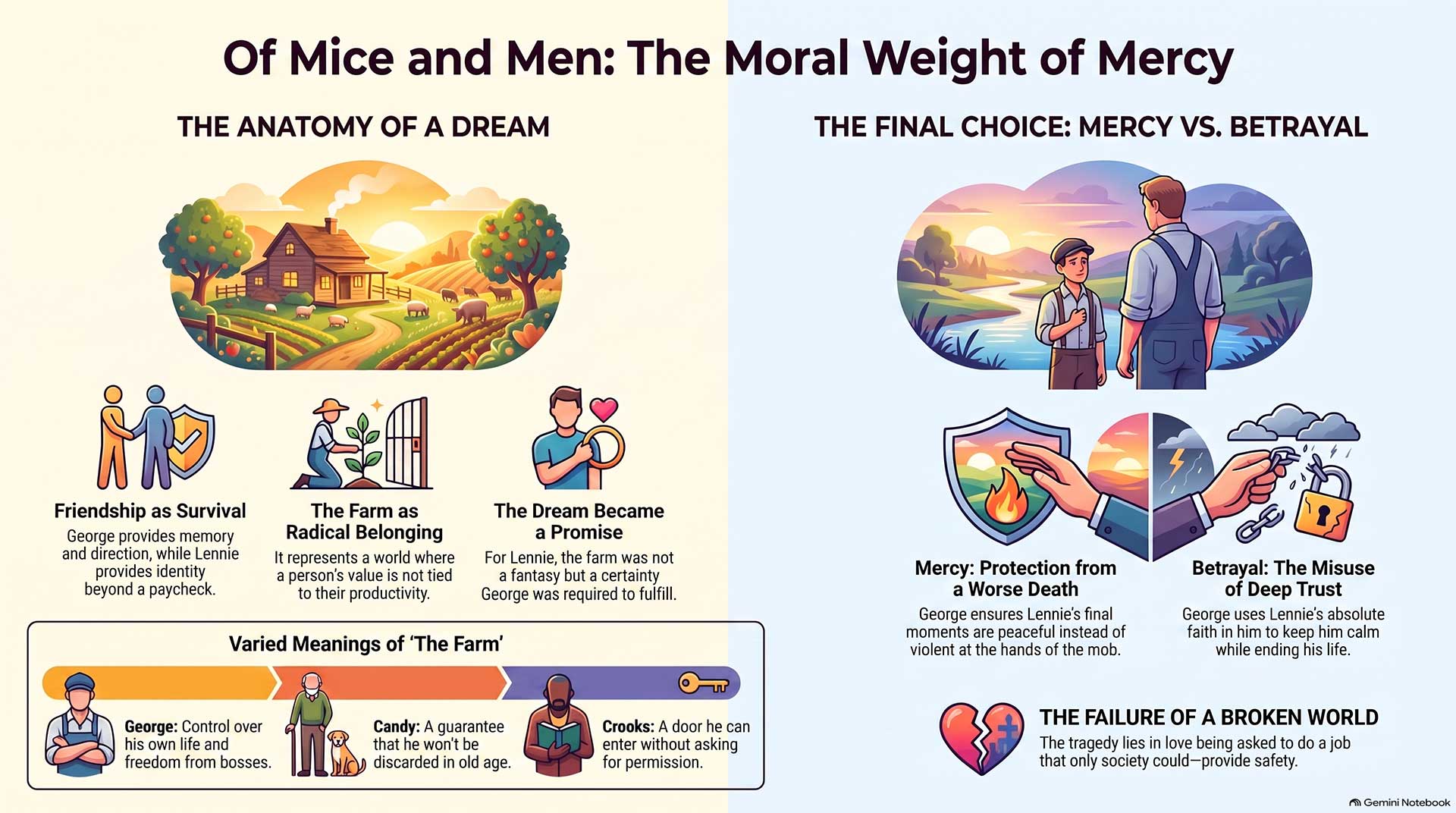
At the beginning of Of Mice and Men, George believes he knows what makes him and Lennie different.
Other migrant workers are alone.
George and Lennie have each other.
That sounds like an advantage.
By the end, it has become something much more complicated.
George is Lennie’s friend, protector, guide, memory, caretaker, and connection to the wider world.
When Lennie is frightened, he looks for George.
When he forgets, George remembers.
When he imagines the future, George supplies the words.
Even Lennie’s dream of rabbits depends on George getting him there.
But one friendship was being asked to carry an impossible amount of responsibility.
That may be one of Steinbeck’s deepest ideas.
We often speak about love as though enough love can solve almost anything.
Sometimes it cannot.
George loves Lennie, yet that love cannot teach Lennie to control his strength.
It cannot bring the puppy back.
It cannot undo what happened in Weed.
It cannot restore Curley’s hand.
It cannot bring Curley’s wife back to life.
And it cannot make the approaching mob disappear.
Love matters enormously.
Love is simply not the same thing as safety, judgment, social support, or a humane system of care.
That distinction matters when we think about Lennie.
It would be easy to turn him into a symbol of pure innocence.
Steinbeck does something harder.
Lennie can be innocent in intention and dangerous in consequence.
Those truths can exist together.
The people harmed by Lennie do not matter less simply because Lennie did not intend their suffering.
Curley’s wife makes this especially difficult.
She is lonely, frustrated, and trapped within a life far smaller than the one she once pictured. She can be cruel herself, most painfully when she uses racism to threaten Crooks.
Her suffering does not erase that cruelty.
Her cruelty does not erase her humanity.
And Lennie’s lack of murderous intent does not make her death less real.
The same refusal to simplify appears in Candy.
His old dog seems at first to foreshadow Lennie’s death.
But the comparison becomes uncomfortable when examined closely.
Candy regrets allowing Carlson to kill the dog. He believes that if death was unavoidable, the animal should at least have been with someone it trusted.
George seems to carry that lesson to the riverbank.
He will not let Curley determine Lennie’s final moments.
George will be there.
Lennie will hear the farm story.
He will die thinking about rabbits rather than looking into the faces of angry men.
That can look like mercy.
Yet there is a troubling difference.
Lennie is not Candy’s dog.
He is a human being with desires and a future he believes is coming.
He never asks George to kill him.
He does not understand the decision being made for him.
He wants tomorrow.
That is what prevents the ending from becoming a simple story of merciful sacrifice.
George protects Lennie from Curley.
George also takes Lennie’s future away.
Both truths remain.
Perhaps the saddest moment comes after the gunshot.
For years, George had complained about everything Lennie prevented him from doing.
Without Lennie, George could keep his money.
Go into town.
Stay wherever he wanted.
Stop watching for trouble.
Live for himself.
At the riverbank, George finally receives that freedom.
And suddenly it resembles the condition every lonely character in the novel has been trying to escape.
George is alone.
The burden is gone.
So is the person who gave part of George’s life its meaning.
This connects George to Candy, Crooks, and Curley’s wife in a way he could not have anticipated.
They have all been searching for somewhere, or someone, that makes them feel they belong.
That is why the farm matters so much.
The farm is never merely land.
It is the opposite of disposability.
It says to Candy:
You can stay when you are old.
It says to Crooks:
You can come through the door.
It says to Lennie:
You will be safe here.
And perhaps it says something to George that he does not fully recognize until too late:
You do not have to carry everything alone.
They never reach that place.
But that does not make the dream meaningless.
For a brief period, Candy wakes up believing he has a future.
Crooks allows himself to picture belonging.
George begins believing that his life might become more than another ranch and another paycheck.
Lennie believes completely.
Perhaps dreams sometimes matter before they come true.
They give people somewhere emotionally to walk toward when the place where they are standing has become unbearable.
That makes the title of Steinbeck’s novel painfully fitting.
The best plans can fail.
The farm disappears.
The rabbits disappear.
George and Lennie disappear as a pair.
Yet something remains.
The question of what human beings owe one another when strength fails, usefulness ends, dreams collapse, or care becomes more than one person can provide.
East of Eden asks whether we can choose who we become.
The Grapes of Wrath asks who belongs when we say “we.”
Of Mice and Men brings the question closer.
It places two people beside a river and asks:
What do we owe someone we love when love can no longer keep them, or everyone around them, safe?
Steinbeck gives us no comfortable answer.
Perhaps he gives us something more valuable.
He makes it impossible to forget that Lennie mattered.
Curley’s wife mattered.
Candy mattered.
Crooks mattered.
George mattered.
The people who might have been harmed next mattered too.
Everybody mattered.
And that is precisely why there was no painless ending.
Short Bios:
John Steinbeck (1902–1968)
American novelist born in Salinas, California, whose fiction frequently explored migrant workers, poverty, dignity, loneliness, community, and moral responsibility. Of Mice and Men was published in 1937. Steinbeck later wrote The Grapes of Wrath and East of Eden and received the Nobel Prize in Literature in 1962.
George Milton
A small, intelligent, quick-tempered migrant worker who travels with Lennie Small. George often complains about the responsibility Lennie places on him, yet he remains fiercely protective. His relationship with Lennie forces him to confront the boundary between friendship, responsibility, freedom, protection, and moral authority.
Lennie Small
A physically powerful migrant worker with significant intellectual limitations who depends heavily on George. Lennie loves soft things and dreams of tending rabbits on their future farm. He rarely intends harm, yet his inability to understand and control his strength creates devastating consequences.
Candy
An aging ranch worker who has lost one hand and fears becoming useless to his employer. After hearing about George and Lennie’s farm, Candy offers his savings and transforms their fantasy into a genuine possibility. His relationship with his elderly dog foreshadows the novel’s final moral crisis.
Crooks
A Black stable hand who lives separately from the other ranch workers because of racial segregation. Intelligent, guarded, and deeply lonely, Crooks initially mocks the dream of owning land but briefly allows himself to hope that he might join George, Lennie, and Candy.
Curley’s Wife
The only major female character in the novel, never given a personal name. She is lonely, frustrated, and trapped in an unhappy marriage, carrying an abandoned dream of becoming an actress. She can be vulnerable and cruel, making her one of the novel’s most complicated figures. Her encounter with Lennie brings the story toward its tragic conclusion.
Slim
A highly respected ranch worker whose quiet confidence gives him unusual moral authority among the men. Slim recognizes complexities others miss and becomes one of the few people capable of seeing George’s final action as a human tragedy rather than simply a problem that has been solved.
Leave a Reply