
Introduction
John Steinbeck’s Of Mice and Men is often remembered as the heartbreaking story of George Milton and Lennie Small, two migrant workers traveling through Depression-era California with a simple dream.
They want a little land.
A house of their own.
A few animals.
And rabbits for Lennie.
But beneath that small dream sits a much harder question.
What happens when one human relationship is asked to carry responsibilities that no relationship should have to carry alone?
George is Lennie’s friend, but friendship is only the beginning.
He finds their jobs.
Manages their money.
Explains Lennie to strangers.
Tells Lennie what to say and what not to say.
Tries to anticipate danger.
Calms him when he becomes frightened.
Protects him when things go wrong.
And eventually makes the most irreversible decision possible on Lennie’s behalf.
George has become friend, caregiver, guardian, advocate, safety system, and decision-maker.
Almost nobody helps him.
That changes how we understand their relationship.
The usual question is:
Why does George put up with Lennie?
Our scholars found a better one:
Why was George expected to carry Lennie almost entirely by himself?
Arthur Kleinman’s work on caregiving helps us see that love and exhaustion are not opposites. George can love Lennie and resent the responsibility. He can fantasize about freedom and still fear losing the person who gives his life companionship and purpose.
Eva Feder Kittay pushes the question further.
Why do we immediately describe Lennie’s dependency as the problem?
Human beings depend upon other human beings throughout life. The moral failure may not be that Lennie needs care. It may be that George receives almost no help providing it.
And Lennie is not simply taking from George.
George has something most of the other ranch workers lack.
Someone who knows him.
Someone who waits for him.
Someone with whom he remembers yesterday and pictures tomorrow.
Their relationship is unequal.
But it is not empty in either direction.
That becomes important when we reach the other lonely people on the ranch.
Candy fears growing old.
Crooks lives apart because he is Black.
Curley’s wife lives among people yet remains painfully unseen.
Each character reveals a different kind of exclusion.
And through Candy’s old dog, Steinbeck introduces one of the book’s most disturbing questions:
What happens when usefulness becomes confused with worth?
The dog is old.
Weak.
No longer useful.
Carlson sees a problem that should be removed.
Candy sees a companion.
Candy’s terror is deeper than losing his dog.
He recognizes himself.
One day his body may fail too.
What happens then?
Lennie occupies another strange position. He is extraordinarily useful as a worker because of his strength, yet deeply dependent in other areas of life.
Crooks works, yet racism still excludes him.
Curley’s wife possesses youth and beauty, yet has so little identity of her own that Steinbeck never gives her a personal name.
Different people.
Different forms of vulnerability.
The ranch keeps asking the same hidden question:
What can you still give us?
Then George tells a different story.
The farm.
At first it seems like a simple version of the American Dream.
But each character sees something different inside it.
George sees autonomy.
Lennie sees safety and rabbits.
Candy sees somewhere he can grow old without being thrown away.
Crooks briefly sees a door he might finally be allowed to enter.
Curley’s wife has her own separate dream of Hollywood, which represents recognition and a life belonging to herself.
Nobody really dreams about acreage.
They dream about a future in which they matter.
That may explain why the farm becomes so psychologically important before it ever exists.
For a few days, Candy is no longer simply an aging worker.
Crooks briefly permits himself to picture belonging.
George begins calculating instead of fantasizing.
Lennie has something waiting for him tomorrow.
The farm creates community before it creates property.
Then Steinbeck destroys it.
And he destroys it through the character who believes in it most completely.
That brings us to Lennie.
Modern readers can make two opposite mistakes with him.
We can turn him into a monster.
Or we can make his innocence so complete that the people he harms disappear.
Our experts resisted both.
The mouse.
The girl in Weed.
Curley’s hand.
The puppy.
Curley’s wife.
Lennie rarely intends the harm.
That matters.
The harm still happens.
That matters too.
Clare Lawrence’s disability perspective makes this especially important. Lennie deserves dignity, appropriate support, meaningful agency, and protection from dehumanization.
But Curley’s wife deserves safety.
The woman in Weed deserved safety.
Other people around Lennie deserve safety.
Respecting Lennie does not require pretending he presents no danger.
And recognizing danger does not require treating Lennie as less human.
Perhaps the most important discovery of the scholar discussion is that responsibility does not simply disappear when a person has limited ability to understand consequences.
It moves.
Some remains with Lennie.
More falls upon George as George becomes increasingly aware of the danger.
And beyond George should stand something larger:
Community.
Support.
Shared caregiving.
Institutions.
Social responsibility.
But very little stands there.
So responsibility keeps falling back onto George.
Until George reaches the river.
And by then, it may already be too late for any good choice.
(Note: This is an imaginary conversation, a creative exploration of an idea, and not a real speech or event.)
Topic 1: When Does Love Become Caregiving, and Can One Person Carry Another Person’s Life?
Susan Shillinglaw: There is something easy to overlook at the beginning of Of Mice and Men. Before we know about the farm, before Candy’s dog, before Curley’s wife, before the riverbank, Steinbeck gives us something unusual.
George and Lennie travel together.
For these migrant workers, that is already remarkable.
Julianne Holt-Lunstad: Which means we might begin with the wrong assumption if we immediately ask why George accepts the burden of Lennie.
Arthur Kleinman: Yes.
Julianne Holt-Lunstad: We assume George is giving something and Lennie is receiving it.
But companionship itself may be something George receives.
Eva Feder Kittay: I would go further.
Even the word burden needs examination.
The moment somebody requires substantial care, we often begin describing the relationship from the perspective of the person providing that care.
How difficult is Lennie?
How much work does Lennie create?
How much freedom does George lose?
Those are legitimate questions.
But notice what happens.
Lennie becomes the problem.
Clare Lawrence: And that happens remarkably quickly with Lennie.
Readers learn to see him largely through George.
George tells us what Lennie can understand.
George explains what Lennie has done.
George tells Lennie what to say.
George tells him what not to say.
George tells him where to go.
George tells other people what Lennie means.
So before we decide what kind of relationship they have, I think we need to ask something uncomfortable.
How much access do we ever get to Lennie without George interpreting him for us?
Susan Shillinglaw: Yet Steinbeck also makes George’s role understandable.
George isn't controlling Lennie merely for pleasure.
He knows something the other ranch workers don't know.
He knows what happened in Weed.
He knows how Lennie responds to fear.
He knows Lennie’s physical strength.
He knows Lennie can misunderstand a situation and panic.
George is constantly anticipating danger.
Arthur Kleinman: Which is precisely what interests me.
George isn't simply a friend anymore.
He has become a caregiver.
Perhaps without ever consciously choosing that identity.
Mimi Reisel Gladstein: When did he choose it?
Arthur Kleinman: That's difficult.
Mimi Reisel Gladstein: Aunt Clara dies.
George remains.
Was there ever a moment when somebody asked George:
“Do you want responsibility for Lennie’s life?”
Arthur Kleinman: Probably not.
And that matters.
Caregiving relationships often don't begin with a formal decision.
They accumulate.
One task becomes another.
You start helping somebody remember something.
Then you manage another difficulty.
Then another.
Eventually you discover that another person's ability to function depends substantially upon you.
Julianne Holt-Lunstad: And leaving becomes psychologically much harder than outsiders assume.
Arthur Kleinman: Very much so.
George says repeatedly that his life would be easier without Lennie.
We should believe him.
Susan Shillinglaw: That's important.
We shouldn't sentimentalize the friendship.
George genuinely experiences Lennie as difficult.
Arthur Kleinman: Of course.
Love doesn't erase exhaustion.
Care does not erase resentment.
Devotion does not erase the desire to escape.
A person can think, “I love you,” and five minutes later think, “I cannot do this anymore.”
Those statements are not necessarily contradictions.
Eva Feder Kittay: But there is another assumption hiding there.
Why is George expected to do it alone?
Susan Shillinglaw: In Steinbeck's world, who else is there?
Eva Feder Kittay: Exactly.
And that changes the moral picture.
We could say:
“Lennie is too dependent.”
Or we could say:
“George has too little support.”
Those are radically different descriptions of the same relationship.
Clare Lawrence: And the first description makes Lennie's existence itself appear to be the problem.
Eva Feder Kittay: Yes.
Human dependency is not some strange failure that happens only to a few unfortunate people.
Every one of us begins life completely dependent.
Many of us will become dependent again through illness, disability, injury, aging, or circumstance.
A society reveals something about itself through what it does with dependency.
Mimi Reisel Gladstein: Which immediately connects Lennie to Candy.
Eva Feder Kittay: Very much.
Candy is frightened of becoming dependent.
Lennie already is dependent.
Candy sees dependency approaching and fears what will happen when he can no longer earn his place.
Lennie lives inside that vulnerability already.
Julianne Holt-Lunstad: Yet there is something Lennie possesses that Candy and Crooks desperately lack.
Susan Shillinglaw: George.
Julianne Holt-Lunstad: Yes.
Social connection.
Lennie has somebody who expects him to return.
Somebody notices if he disappears.
Somebody knows his habits.
Somebody remembers his history.
Somebody plans tomorrow with him.
That is enormous.
Clare Lawrence: Which may explain why Lennie's world is so centered on George.
Julianne Holt-Lunstad: Exactly.
And it works in the other direction too.
George also has somebody waiting for him.
We sometimes talk about their relationship as though George has everything and Lennie has nothing.
But compare George with the other migrant workers.
They earn their money.
They go into town.
They spend it.
They move on.
George describes that life himself.
He could have it.
Yet he doesn't.
Susan Shillinglaw: George says something close to that repeatedly.
Without Lennie, he could live easily.
He could get a job and keep it.
He could spend his money however he wanted.
Arthur Kleinman: Then we should ask the obvious question.
Why doesn't he?
Mimi Reisel Gladstein: Responsibility.
Arthur Kleinman: Certainly.
Julianne Holt-Lunstad: Companionship.
Eva Feder Kittay: Obligation.
Clare Lawrence: Perhaps guilt.
Susan Shillinglaw: Love.
Arthur smiled slightly.
Arthur Kleinman: Why must we choose?
Nobody spoke for a moment.
Then Kleinman continued.
Arthur Kleinman: One of the mistakes people make when thinking about care is believing there must be one pure motive.
There usually isn't.
George may love Lennie.
He may feel obligated to Aunt Clara.
He may fear what would happen if he abandoned Lennie.
He may enjoy being needed.
He may resent being needed.
He may fear loneliness.
He may derive meaning from protecting someone.
He may occasionally fantasize about escape.
All of those things can live inside one person.
Susan Shillinglaw: That makes George much more interesting than either interpretation we often hear.
“George is a saint.”
Or:
“George is trapped.”
Arthur Kleinman: He can be devoted and trapped.
Mimi Reisel Gladstein: I want to ask something more uncomfortable.
Does George have power over Lennie?
Eva Feder Kittay: Certainly.
Mimi Reisel Gladstein: Then we cannot discuss care without discussing that.
Arthur Kleinman: Agreed.
Mimi Reisel Gladstein: George controls the money.
George chooses the jobs.
George determines when Lennie should speak.
George tells him whom to avoid.
George decides what information other people receive about him.
That is a tremendous amount of authority.
Clare Lawrence: And readers frequently accept it without questioning it, since Steinbeck positions George as the competent one.
Susan Shillinglaw: But isn't some of that authority necessary?
Clare Lawrence: Some may be.
I'm not arguing that George should simply abandon all guidance.
I'm asking whether we notice the cost.
There is a difference between:
“Lennie needs help making certain decisions.”
and:
“George should make Lennie's decisions.”
Those statements are not identical.
Eva Feder Kittay: This is where our modern language of independence can mislead us too.
Respecting someone does not necessarily mean leaving that person alone to make every decision without assistance.
Some people require substantial support.
Supported agency is still agency.
Clare Lawrence: Yes.
Eva Feder Kittay: The question is whether the support enables the person to participate in their own life or gradually replaces them.
Arthur Kleinman: That's beautifully put.
Susan Shillinglaw: And George probably wouldn't recognize that distinction.
Eva Feder Kittay: Of course not.
We should not turn a Depression-era migrant worker into a twenty-first-century disability ethicist.
George is improvising.
Susan Shillinglaw: Constantly.
Eva Feder Kittay: And perhaps that is part of the tragedy.
He's making decisions with enormous consequences without training, resources, respite, institutional support, or anyone sharing responsibility.
Julianne Holt-Lunstad: There is another question we haven't asked.
What does being needed do for George?
Mimi Reisel Gladstein: That's dangerous territory.
Julianne Holt-Lunstad: It is.
But I don't mean that George deliberately keeps Lennie dependent.
I'm asking about identity.
Suppose you spend years being the person who remembers.
The person who knows where you're going.
The person who solves the problem.
The person somebody calls when frightened.
At some point, that role becomes part of who you are.
Arthur Kleinman: Very much.
Julianne Holt-Lunstad: Then George's fantasy of freedom becomes psychologically complicated.
He thinks:
“If Lennie were gone, I could finally live for myself.”
But who is George when nobody needs George?
Susan Shillinglaw: That's an excellent way of approaching the ending without getting there yet.
Julianne Holt-Lunstad: Look at the other men.
Their independence hasn't necessarily made them happy.
Arthur Kleinman: Quite the opposite.
Julianne Holt-Lunstad: They have mobility without belonging.
George complains that Lennie prevents him from living like them.
But the very thing preventing George from becoming like them may also be protecting him from their loneliness.
Clare Lawrence: There is a beautiful irony there.
Lennie is considered dependent.
Yet emotionally, he may be providing something George needs.
Eva Feder Kittay: Which exposes the weakness of dividing human beings into caregivers and dependents as though the exchange travels in only one direction.
Care relationships can be deeply unequal without being one-way.
Lennie cannot manage George's money.
He cannot protect George from physical danger in any reliable sense.
He cannot plan their employment.
But perhaps he gives George continuity.
Someone who knows him from before this ranch.
Someone for whom George isn't merely another hired hand.
Arthur Kleinman: Someone whose presence says:
“You matter to me.”
Mimi Reisel Gladstein: Yet I want to resist making Lennie valuable by proving what he gives George.
Eva Feder Kittay: Yes.
Thank you.
That's crucial.
Mimi Reisel Gladstein: If we say Lennie deserves care since he gives George companionship, haven't we returned to usefulness through another door?
Eva Feder Kittay: Precisely.
Lennie should not need to justify his existence by being emotionally useful to George.
Julianne Holt-Lunstad: I agree.
I'm describing what the relationship may give George, not arguing that it establishes Lennie's worth.
Eva Feder Kittay: Good distinction.
A person's claim to dignity cannot depend on proving that somebody else benefits from keeping them around.
Susan Shillinglaw: And now Candy's dog is already waiting for us.
Nobody answered immediately.
They all knew where that thought led.
Susan Shillinglaw: We'll reach him soon.
But before we do, I want to stay with George.
George repeatedly tells Lennie about the farm.
Why?
Arthur Kleinman: Perhaps caregiving needs a future.
Susan Shillinglaw: Explain.
Arthur Kleinman: If every day is only management, prevention, correction, work, exhaustion, and starting again tomorrow, care can become unbearable.
A future changes the meaning of the present.
George isn't merely getting Lennie through another ranch.
He is getting Lennie somewhere.
Julianne Holt-Lunstad: The farm.
Arthur Kleinman: Yes.
And perhaps he's getting himself there too.
Clare Lawrence: Which means the rabbits have a different meaning for each man.
For Lennie, they're concrete.
For George, the farm may represent the day he no longer has to manage Lennie's life under hostile conditions.
Eva Feder Kittay: A place where dependency becomes easier to accommodate.
Susan Shillinglaw: That's interesting.
Eva Feder Kittay: Think about it.
Lennie's difficulties become especially dangerous in environments demanding constant conformity.
Remember instructions.
Control impulses.
Read strangers correctly.
Understand social boundaries.
Avoid conflict.
Perform reliably for employers.
The farm fantasy removes some of those pressures.
Clare Lawrence: Which raises an important disability question.
Is Lennie incapable of living safely?
Or is Lennie incapable of living safely in this environment?
The question changed the room.
Susan Shillinglaw: We have to be careful.
Clare Lawrence: Very careful.
I'm not saying the environment explains everything.
Lennie's strength and behavior create genuine danger.
But disability is partly relational.
A person's impairments interact with the demands and structures surrounding them.
Change the environment and some difficulties may diminish.
Others remain.
Arthur Kleinman: So the farm isn't simply escape from poverty.
Clare Lawrence: It may be an imagined environment constructed around Lennie's needs.
Predictability.
Familiar people.
Less movement.
Less contact with strangers.
Animals.
Routine.
George nearby.
Eva Feder Kittay: Which makes its eventual collapse even more devastating.
Mimi Reisel Gladstein: But there is a person missing from this beautiful farm arrangement.
They looked toward her.
Mimi Reisel Gladstein: Women.
Susan nodded.
Mimi Reisel Gladstein: George imagines a safe world by removing many of the complications of the social world.
But one of the dangers George identifies repeatedly is women.
The girl in Weed.
Curley's wife.
Women become something Lennie must stay away from.
Clare Lawrence: That's troubling.
Mimi Reisel Gladstein: Very.
Rather than asking how Lennie can safely interact with women, George's solution is essentially:
Don't.
Susan Shillinglaw: Which is probably practical from George's immediate perspective.
Mimi Reisel Gladstein: Practical for whom?
Susan paused.
Mimi Reisel Gladstein: That's the question we have to keep asking.
George's caregiving strategy is built around protecting Lennie from consequences.
But other people are living inside those consequences too.
Arthur Kleinman: That may be the central problem of caregiving when danger enters the picture.
The caregiver's moral world expands.
George owes something to Lennie.
But George also exists among other people.
If caring for one vulnerable person exposes another vulnerable person to harm, care becomes morally divided.
Eva Feder Kittay: Yes.
Care does not excuse us from justice toward others.
Clare Lawrence: Nor does protecting others permit us to erase Lennie's humanity.
Arthur Kleinman: Exactly.
And now George is standing between obligations that may eventually become incompatible.
Julianne Holt-Lunstad: Which makes me return to something Eva asked earlier.
Who supports George?
Nobody answered.
Julianne Holt-Lunstad: Who does he call when he's overwhelmed?
Susan Shillinglaw: Nobody.
Julianne Holt-Lunstad: Who takes over for a week?
Arthur Kleinman: Nobody.
Julianne Holt-Lunstad: Who helps him make decisions?
Clare Lawrence: Nobody.
Julianne Holt-Lunstad: Who teaches him how to handle Lennie's panic?
Eva Feder Kittay: Nobody.
Julianne Holt-Lunstad: Who helps Lennie develop more independence?
Silence.
Julianne Holt-Lunstad: Nobody.
Eva Feder Kittay: Then perhaps we should stop asking only whether George is a good enough caregiver.
Arthur Kleinman: Yes.
Eva Feder Kittay: We should ask why the entire responsibility has been privatized into one relationship between two poor men.
Susan Shillinglaw: That's where Steinbeck's economic world matters.
These are not people with secure homes, money, stable communities, or extensive choices.
They move where the work is.
Eva Feder Kittay: Which means every weakness becomes more dangerous.
There is no margin.
Arthur Kleinman: That's true of caregiving generally.
Resources create margin.
Money.
Time.
Housing.
Other family members.
Community.
Professional support.
George has almost none of those.
Clare Lawrence: And Lennie pays for that lack too.
Susan Shillinglaw: How?
Clare Lawrence: George has only a few tools.
Commands.
Warnings.
Threats about the rabbits.
Repetition.
Keeping Lennie close.
Keeping Lennie away from certain people.
Telling him where to hide.
George cannot build a sophisticated support system, so he tries to become the support system himself.
Arthur Kleinman: Until the system is one exhausted human being.
Clare Lawrence: Exactly.
And one human being can fail.
Nobody spoke.
The implications were already leading them toward the riverbank.
Susan stopped them.
Susan Shillinglaw: Not yet.
Before we go there, I want to ask each of you something.
Suppose George had left Lennie before the ranch.
What happens?
Clare Lawrence: Lennie becomes extraordinarily vulnerable.
Eva Feder Kittay: Almost certainly.
Arthur Kleinman: George might experience relief initially.
Julianne Holt-Lunstad: Followed perhaps by guilt, grief, loneliness, or some mixture.
Mimi Reisel Gladstein: Other people might also face risk if Lennie were completely unsupported.
Susan nodded.
Susan Shillinglaw: So staying has costs.
Leaving has costs.
Controlling Lennie has costs.
Giving Lennie more independence may have costs.
Arthur Kleinman: That's what makes care morally difficult.
We like stories in which love tells us what to do.
Real care often gives us competing obligations.
Eva Feder Kittay: But I want one thing made very clear before we finish.
Lennie's dependency is not a moral failure.
Clare Lawrence: Absolutely.
Eva Feder Kittay: And George's exhaustion is not proof that George doesn't love him.
Arthur Kleinman: Yes.
Eva Feder Kittay: Those two truths need to remain together.
Lennie can deserve care without apology.
George can find providing that care exhausting without shame.
The question is what structures exist around them so that neither person's humanity must be sacrificed to the other's needs.
Julianne Holt-Lunstad: And perhaps there is a third truth.
Susan Shillinglaw: Which is?
Julianne Holt-Lunstad: The relationship may be one of the best things in both their lives.
Everyone looked toward her.
Julianne Holt-Lunstad: We have spent all this time examining dependency, burden, agency, control and responsibility.
Fairly.
But George and Lennie also laugh together.
Travel together.
Remember together.
Dream together.
George tells Lennie stories.
Lennie believes George.
They possess something most people on that ranch desperately want.
Someone.
Arthur Kleinman: Care is not merely work.
Julianne Holt-Lunstad: Exactly.
Arthur Kleinman: Sometimes the person who exhausts you is also the person around whom some of the deepest meaning in your life has formed.
Mimi Reisel Gladstein: Which explains why simply removing the burden may not produce freedom.
Arthur Kleinman: Yes.
It may produce an absence.
Susan looked around the table.
Susan Shillinglaw: Then perhaps our first question has changed.
We began by asking:
When does friendship become caregiving?
Maybe Steinbeck gives us something harder.
Clare Lawrence: Whether it ever stops being friendship after it becomes caregiving?
Susan Shillinglaw: Yes.
Arthur nodded.
Arthur Kleinman: And whether we make a mistake by believing the two must be opposites.
There was another silence.
Then Eva spoke.
Eva Feder Kittay: I would leave George with one question.
Not:
“Why didn't you do a better job?”
Not:
“Why didn't you leave?”
Not even:
“Why did you stay?”
She paused.
Eva Feder Kittay: I would ask:
Why were you expected to do this alone?
That question changed everything.
If George abandoned Lennie, Lennie might not survive.
If George stayed, George carried responsibilities far beyond ordinary friendship.
If George controlled Lennie, Lennie's agency diminished.
If George loosened that control, other risks appeared.
And behind every choice stood the same fact:
There was almost nobody else.
Arthur Kleinman: One person can love another person profoundly.
One person can sacrifice for another.
One person can care for another for years.
But there are responsibilities no relationship should be forced to carry alone.
Julianne Holt-Lunstad: Which makes their friendship both their protection and their vulnerability.
Susan Shillinglaw: George and Lennie have what the other ranch workers do not.
They have each other.
She paused.
Susan Shillinglaw: The tragedy may be that they have almost nothing else.
And that brings us to the ranch itself.
A place where protection is scarce.
Where belonging is conditional.
Where an old worker watches an old dog and recognizes his own future.
Where a Black man is told which room he belongs in.
Where the only major woman is known through her husband rather than her own name.
Where Lennie's strength makes him employable, yet his dependency makes him vulnerable.
The first conversation asked:
Who cares for the caregiver?
The next must ask something colder:
Who gets treated as disposable when they can no longer prove that they are useful?
Topic 2: Who Gets Treated as Disposable?
Susan Shillinglaw: I think we should begin with the dog.
Arthur Kleinman: Candy’s dog?
Susan Shillinglaw: Yes.
It is easy to rush past that scene because readers know it foreshadows Lennie.
But if we slow down, something more disturbing appears.
Carlson looks at the dog and sees an old animal who smells bad, cannot do useful work, and appears to be suffering.
Candy looks at the same dog and sees history.
Companionship.
Years of shared life.
The difference between those two ways of seeing is enormous.
Eva Feder Kittay: And the word useful sits underneath the entire scene.
Clare Lawrence: Exactly.
The dog has ceased to be useful.
Candy knows that one day he may cease to be useful too.
Julianne Holt-Lunstad: Which means Candy is not merely losing a dog.
He is watching a possible version of his own future.
Mimi Reisel Gladstein: And the ranch is teaching him what may happen when that future arrives.
Susan Shillinglaw: Carlson’s argument sounds practical.
The dog is old.
The dog is weak.
The dog smells.
The dog suffers.
Eva Feder Kittay: Practical arguments often become morally dangerous when they begin measuring life through inconvenience.
Arthur Kleinman: Yes.
Eva Feder Kittay: The moment the question becomes, “What does this dependent being still contribute?” we are already standing on unstable ground.
Clare Lawrence: Especially in a world where nearly everyone’s value is tied to labor.
Susan Shillinglaw: Which is very much Steinbeck’s world.
These are migrant workers.
Bodies matter.
Strength matters.
A hand matters.
A back matters.
If your body fails, your economic position can disappear quickly.
Arthur Kleinman: And once economic worth becomes confused with human worth, people begin anticipating their own disposability.
Julianne Holt-Lunstad: Candy already does that.
He is not only afraid of losing income.
He is afraid of losing belonging.
There is an important difference.
Eva Feder Kittay: Very important.
Julianne Holt-Lunstad: A person can survive materially and still experience the terror of feeling unnecessary.
Candy senses that once he can no longer work, he may no longer have a place in the group.
Mimi Reisel Gladstein: Which helps explain why the farm becomes so emotionally urgent for him.
Susan Shillinglaw: Yes.
The farm later offers him something the ranch cannot.
A place where growing old does not automatically mean expulsion.
Clare Lawrence: And this is where Lennie becomes interesting.
Lennie is physically strong.
Very strong.
Economically useful.
But socially and cognitively dependent.
Eva Feder Kittay: Which exposes the weakness of our usual categories.
We tend to imagine the independent person as useful and the dependent person as burdensome.
Lennie confuses that picture.
His body is highly valuable to the ranch.
His need for support makes him vulnerable.
Arthur Kleinman: He can perform difficult labor, yet he cannot safely navigate all the social demands surrounding that labor.
Clare Lawrence: Exactly.
So when people call him helpless, that is not quite right.
When people call him fully independent, that is wrong too.
He occupies an uncomfortable middle ground.
Susan Shillinglaw: Which may be why Steinbeck makes him so physically powerful.
Clare Lawrence: Yes.
That contradiction matters.
A large, strong man who requires care unsettles people’s assumptions.
They expect dependency to look weak.
Lennie does not look weak.
Mimi Reisel Gladstein: And because he does not look weak, others may underestimate the kind of support he needs.
Eva Feder Kittay: Or resent it.
Arthur Kleinman: Or fear it.
Julianne Holt-Lunstad: I want to return to Candy for a moment.
What does he actually hear when Carlson says the dog should be put down?
Susan Shillinglaw: He hears the argument about the dog.
Julianne Holt-Lunstad: Yes, but emotionally?
Arthur Kleinman: Perhaps:
“You have had your use.”
Eva Feder Kittay: Exactly.
Julianne Holt-Lunstad: And perhaps:
“When the rest of us decide you are no longer worth the trouble, your attachment to your own life may not matter very much.”
Nobody spoke for a moment.
Mimi Reisel Gladstein: That is why the scene cannot remain merely a literary device.
Susan Shillinglaw: I agree.
Mimi Reisel Gladstein: If we only say, “The dog foreshadows Lennie,” we miss what Steinbeck is showing about power.
Carlson has more social authority than Candy in that moment.
He controls the argument.
He defines the dog’s condition.
He supplies the solution.
Candy’s emotional attachment becomes almost embarrassing.
Arthur Kleinman: Yes.
The language of efficiency can shame care.
Eva Feder Kittay: And shame dependency.
Clare Lawrence: There is another problem.
When a dependent life is described mainly through the burden it places on others, the person or animal at the center becomes almost invisible.
We hear Carlson’s inconvenience.
We hear Candy’s grief.
But the dog itself becomes a problem to be solved.
Susan Shillinglaw: And later Lennie risks becoming the same thing.
Clare Lawrence: Precisely.
A problem.
A danger.
A burden.
A crisis.
Once those labels take over, it becomes easier to stop seeing the person.
Eva Feder Kittay: But we must be careful not to go too far.
Dependency does create real obligations.
Sometimes difficult ones.
Sometimes exhausting ones.
Sometimes expensive ones.
Acknowledging that is not dehumanizing.
Arthur Kleinman: Completely agree.
Eva Feder Kittay: The danger comes when the burden becomes the whole story.
The person disappears behind the work required to care for them.
Susan Shillinglaw: That brings us naturally to Crooks.
He is not treated as disposable because he is weak.
He is treated as separate because he is Black.
Julianne Holt-Lunstad: Which shows us that exclusion does not arise from one single mechanism.
Susan Shillinglaw: Right.
Candy fears exclusion through age and declining usefulness.
Lennie is vulnerable through disability and dependency.
Crooks is segregated by race.
Curley’s wife is constrained by gender.
Mimi Reisel Gladstein: And yet they are all trapped inside a social order deciding who gets access to safety, privacy, voice, and belonging.
Clare Lawrence: I think Crooks matters deeply here because his loneliness is structured.
It is not merely that he has a difficult personality.
Julianne Holt-Lunstad: Exactly.
People sometimes talk about loneliness as though it is purely emotional.
But social isolation can be imposed.
You can be placed outside the group.
You can be denied access to common space.
You can be reminded physically that you do not belong.
Susan Shillinglaw: Crooks lives apart from the bunkhouse.
Julianne Holt-Lunstad: Which means the architecture itself tells him something.
You are not one of them.
Eva Feder Kittay: And that raises a broader question.
What happens when a society makes exclusion feel normal?
Arthur Kleinman: People begin adapting psychologically.
Julianne Holt-Lunstad: Often defensively.
Arthur Kleinman: Yes.
Sarcasm.
Withdrawal.
Distrust.
Refusing hope before hope can disappoint you.
Susan Shillinglaw: Which is exactly how Crooks responds to the farm at first.
Julianne Holt-Lunstad: Because hoping may feel dangerous when exclusion has been repeated enough times.
Mimi Reisel Gladstein: But then Curley’s wife enters Crooks’s room.
And the hierarchy becomes more complicated.
Susan Shillinglaw: Very.
Mimi Reisel Gladstein: She has limited power on the ranch.
She is isolated.
She is unnamed.
Her identity is attached to her husband.
Men treat her as a threat.
She is lonely.
All of that is true.
Then she threatens Crooks using racial power she knows he cannot safely resist.
Clare Lawrence: That moment matters enormously.
Eva Feder Kittay: Yes.
It prevents us from turning vulnerability into innocence.
Arthur Kleinman: A person can suffer and still make another person suffer.
Mimi Reisel Gladstein: Exactly.
Her lack of power does not erase the power she does have.
Julianne Holt-Lunstad: Which makes the question “Who gets treated as disposable?” more complicated than victim versus oppressor.
Mimi Reisel Gladstein: Much more.
A person can be low in one hierarchy and high in another.
Curley’s wife is constrained by gender.
Crooks is constrained by race.
In that room, she knows exactly which hierarchy gives her leverage.
Susan Shillinglaw: And Steinbeck makes the shift brutal.
Crooks briefly allows himself to hope.
Then one threat reminds him how fragile his place really is.
Arthur Kleinman: That may be the psychological cruelty of exclusion.
It does not merely limit what a person can do.
It teaches the person not to trust moments of belonging.
Julianne Holt-Lunstad: Yes.
And once that happens, social connection becomes harder to sustain.
A person may retreat before someone else can reject them.
Eva Feder Kittay: Which is why belonging cannot be reduced to physical proximity.
Crooks can be surrounded by workers and still remain outside the social body of the ranch.
Clare Lawrence: I want to ask something difficult.
Does Steinbeck himself fully escape the attitudes he is criticizing?
Susan Shillinglaw: That's fair.
Clare Lawrence: Lennie is frequently described through animal imagery.
Crooks is defined first through racial difference.
Curley’s wife lacks a name.
Candy’s value is tied to bodily decline.
Steinbeck clearly exposes cruelty.
But modern readers can still ask whether some of his language reproduces the very hierarchies the book condemns.
Mimi Reisel Gladstein: Particularly with Curley’s wife.
Susan Shillinglaw: Yes.
Mimi Reisel Gladstein: Readers often inherit George’s suspicion of her.
She becomes danger before she becomes person.
And because she has no name, that danger can swallow her identity.
Eva Feder Kittay: Yet I think the novel gives us enough to resist that reduction.
Mimi Reisel Gladstein: I agree.
Eva Feder Kittay: The question is whether readers choose to.
Arthur Kleinman: That's an important distinction.
Texts can contain possibilities readers fail to follow.
Julianne Holt-Lunstad: Can we connect all four characters through one question?
Susan Shillinglaw: Try.
Julianne Holt-Lunstad: What must each person prove to remain inside the human circle of the ranch?
Candy must prove he can still work.
Crooks is denied full inclusion regardless of his work.
Curley’s wife is seen largely through sexuality and marriage.
Lennie must prove he can behave safely enough to remain employable.
Eva Feder Kittay: Which means belonging is conditional.
Julianne Holt-Lunstad: Exactly.
And conditional belonging is psychologically unstable.
A person is never fully secure.
They are always waiting for the condition to fail.
Arthur Kleinman: Candy knows this most explicitly.
Susan Shillinglaw: Yes.
Arthur Kleinman: His fear is not abstract.
He watches the dog.
He understands the logic.
Old.
Weak.
No longer productive.
Then removed.
That sequence becomes a warning.
Eva Feder Kittay: A terrible one.
Clare Lawrence: And what happens when people internalize that logic?
Arthur Kleinman: They begin evaluating themselves through it.
Clare Lawrence: Which is exactly what Candy does.
Eva Feder Kittay: And perhaps Lennie too, in a different way.
He repeatedly insists he can work.
Susan Shillinglaw: Yes.
Eva Feder Kittay: That matters.
Why does Lennie need George to know he can work?
Because work is one of the few socially recognized ways he can prove he deserves a place.
Julianne Holt-Lunstad: Which is heartbreaking.
A person begins believing:
“If I can still produce, I can still stay.”
Mimi Reisel Gladstein: Curley’s wife faces the opposite problem.
There is almost no legitimate role available to her.
Susan Shillinglaw: Wife.
Mimi Reisel Gladstein: Exactly.
Her identity is relational.
She is Curley’s wife.
Not herself.
Her abandoned Hollywood dream is partly a dream of becoming visible.
To have a name.
To be seen.
Arthur Kleinman: Which means usefulness looks different for her.
Mimi Reisel Gladstein: Yes.
She is expected to be attractive.
Loyal.
Contained.
Sexually available to her husband but not socially available to other men.
Her value is defined through a narrow gender role.
Eva Feder Kittay: So disposability is not always explicit removal.
Sometimes it means being treated as though the parts of you outside your assigned function do not count.
Mimi Reisel Gladstein: Exactly.
Curley’s wife can remain physically present and still be socially erased.
Julianne Holt-Lunstad: Crooks too.
Clare Lawrence: Lennie too.
Arthur Kleinman: Candy fears becoming so.
Susan leaned back.
Susan Shillinglaw: Then maybe the dog scene is bigger than we thought.
The dog is the only one literally killed for being old, weak, and inconvenient.
But everyone else recognizes some version of that logic.
Eva Feder Kittay: Yes.
And the moral danger comes when usefulness becomes the hidden test for belonging.
Arthur Kleinman: I want to ask Candy’s question in another form.
What does a person deserve once they can no longer give back?
Eva Feder Kittay: Care.
Arthur Kleinman: Without proving anything?
Eva Feder Kittay: Yes.
Arthur Kleinman: Even if the care is difficult?
Eva Feder Kittay: Yes.
Arthur Kleinman: Even if they never become independent?
Eva Feder Kittay: Yes.
That is precisely the point.
Human dignity cannot depend on graduating from dependency.
Clare Lawrence: And that matters enormously for Lennie.
Susan Shillinglaw: Because Lennie may never become independent.
Clare Lawrence: Right.
If we treat independence as the only successful outcome, Lennie is already framed as a failed adult.
If we treat supported life as a valid life, the moral picture changes.
Julianne Holt-Lunstad: Then the question becomes:
What would a life built around support look like?
Clare Lawrence: Exactly.
Mimi Reisel Gladstein: But we must keep another truth alive.
Supported life cannot mean others are expected to absorb unlimited risk.
Eva Feder Kittay: Of course.
Mimi Reisel Gladstein: Curley’s wife still matters.
The girl in Weed still matters.
Clare Lawrence: Yes.
Arthur Kleinman: Care and protection have to extend outward.
Eva Feder Kittay: That is why community matters.
One relationship cannot absorb every competing obligation.
Susan Shillinglaw: Which brings us back to the farm again.
Julianne Holt-Lunstad: The farm is starting to look like the opposite of the ranch.
Susan Shillinglaw: How so?
Julianne Holt-Lunstad: On the ranch, you remain if you are useful.
On the farm, at least in the dream, you remain because you belong.
Candy can grow old.
Crooks can enter.
Lennie can live with support.
George can stop answering to a boss.
Mimi Reisel Gladstein: Curley’s wife is still excluded from that fantasy.
Susan Shillinglaw: True.
Mimi Reisel Gladstein: Which tells us something too.
Their imagined refuge does not solve every exclusion.
Eva Feder Kittay: Still, the central difference is striking.
A community based on contribution says:
“What can you do?”
A community based on belonging says:
“Who are you to us?”
Arthur Kleinman: And perhaps Candy’s entire emotional response to the farm comes from sensing that difference.
There was a pause.
Then Susan returned to the dog.
Susan Shillinglaw: We have avoided one thing.
Candy eventually says he wishes he had killed the dog himself.
Arthur Kleinman: Yes.
Susan Shillinglaw: George hears that.
Eva Feder Kittay: And learns from it.
Clare Lawrence: The question is what he learns.
Mimi Reisel Gladstein: The compassionate reading is obvious.
If someone you love must die, do not let a stranger do it coldly.
Arthur Kleinman: Stay with them.
Julianne Holt-Lunstad: Let their final moment contain familiarity rather than fear.
Susan Shillinglaw: Which later echoes strongly at the riverbank.
Eva Feder Kittay: But there is a darker reading.
Everyone turned toward her.
Eva Feder Kittay: Candy says he should have been the one to do it.
That can be read as love.
But it can also normalize a dangerous idea.
The person closest to the dependent individual may possess the authority to decide that person’s life should end.
Clare Lawrence: Yes.
Eva Feder Kittay: We need to separate two claims.
“If death is unavoidable, someone trusted should be there.”
And:
“The trusted person gets to decide death is unavoidable.”
Those are not the same moral claim.
Arthur Kleinman: That's very important.
Susan Shillinglaw: And Steinbeck deliberately makes the parallel uncomfortable.
Clare Lawrence: Which means the dog is not a simple rehearsal for Lennie.
Eva Feder Kittay: Exactly.
If readers treat the two deaths as equivalent, they risk reducing Lennie to the status of an animal whose future can be decided by someone else.
Susan Shillinglaw: Yet Steinbeck certainly wants us to feel the parallel.
Clare Lawrence: Yes.
The challenge is not to deny it.
The challenge is to ask what the parallel reveals and what it obscures.
Mimi Reisel Gladstein: And perhaps it reveals the ranch’s moral climate.
Old dog.
Disabled man.
Aging worker.
Black stable hand.
Unnamed woman.
Everyone is valued conditionally.
Arthur Kleinman: The conditions differ.
Mimi Reisel Gladstein: But the insecurity is shared.
Julianne Holt-Lunstad: Then maybe the most painful thing about Candy is not that he is afraid of death.
Susan Shillinglaw: What is it?
Julianne Holt-Lunstad: He is afraid that nobody will have a reason to keep him.
The room fell silent.
Eva Feder Kittay: That is exactly the moral failure of usefulness as a measure of worth.
A person should not need to produce a reason to remain.
Clare Lawrence: Or prove that caring for them gives somebody else enough emotional benefit.
Arthur Kleinman: Or become inspirational.
Mimi Reisel Gladstein: Or attractive.
Julianne Holt-Lunstad: Or socially convenient.
Susan Shillinglaw: Or strong.
Arthur looked around the table.
Arthur Kleinman: Maybe that is the question Steinbeck keeps asking through different bodies.
What happens when the world begins ranking people according to how difficult they are to carry?
Nobody answered immediately.
Susan finally did.
Susan Shillinglaw: The ranch never says outright that some lives matter less.
It doesn't need to.
Its structure already teaches everyone the rules.
Crooks knows which room he belongs in.
Candy knows what happens when his body fails.
Curley’s wife knows her name matters less than her marriage.
Lennie knows he must prove he can work and stay out of trouble.
And everyone watches what happens to the dog.
Eva Feder Kittay: Which may be the coldest lesson in the novel.
Not:
“You are worthless.”
Something subtler.
Arthur Kleinman: “Show us why keeping you is still worth it.”
Eva nodded.
There was a long silence.
Then Julianne spoke.
Julianne Holt-Lunstad: No wonder the farm becomes irresistible.
Susan Shillinglaw: Because?
Julianne Holt-Lunstad: Because for a moment it offers the opposite rule.
You do not stay because you can still work.
You stay because you are one of us.
Candy can grow old there.
Crooks can enter.
Lennie can be supported.
George can stop proving himself to employers every morning.
For a few days, they picture a future where belonging is not something that has to be earned again and again.
Susan looked around the table.
Susan Shillinglaw: Then our next question is unavoidable.
If the ranch teaches people that belonging is conditional, what does the farm give them?
Arthur Kleinman: A future.
Julianne Holt-Lunstad: A place.
Eva Feder Kittay: Security.
Clare Lawrence: Accommodation.
Mimi Reisel Gladstein: Identity.
Susan nodded.
Susan Shillinglaw: Then perhaps Topic 3 is no longer merely about the American Dream.
It is about why people who have been made to feel disposable need somewhere, even an imagined somewhere, where they believe they will still matter tomorrow.
Topic 3: Why Do People Need a Future They Can Believe In?
Susan Shillinglaw: We ended with the farm.
Perhaps that is where we should begin.
A few acres.
A little house.
Vegetables.
Chickens.
A cow.
And, if Lennie gets his way, rabbits.
It sounds modest.
Julianne Holt-Lunstad: Yet emotionally, it is enormous.
Susan Shillinglaw: Why?
Julianne Holt-Lunstad: Because almost nobody in this novel knows where they belong tomorrow.
The ranch workers can lose their jobs.
Candy can lose his usefulness.
Crooks can be reminded that he is tolerated rather than included.
Curley’s wife has a home but doesn't seem to experience it as belonging.
George and Lennie keep moving.
So when George describes the farm, he is describing something rare.
Permanence.
Arthur Kleinman: Which means we should be careful about calling it merely a dream.
Susan Shillinglaw: What would you call it?
Arthur Kleinman: A structure of hope.
Eva Feder Kittay: Explain that.
Arthur Kleinman: Human beings can endure extraordinary difficulty if present suffering belongs to a story that leads somewhere.
This job is temporary.
This hardship has a destination.
We are getting through this because something waits on the other side.
George's farm does that.
The ranch is no longer simply another ranch.
It becomes one step closer to home.
Clare Lawrence: And for Lennie, that structure may be especially important.
The farm gives him something concrete.
He does not need to grasp complicated economics.
He understands rabbits.
Susan Shillinglaw: Rabbits are the future in a form Lennie can hold in his mind.
Clare Lawrence: Exactly.
George doesn't say:
“We will eventually achieve economic independence through property ownership.”
He says:
“You get to tend the rabbits.”
That gives Lennie a picture.
Something repeatable.
Something emotionally meaningful.
Julianne Holt-Lunstad: And George repeats it.
Again and again.
That repetition matters.
Arthur Kleinman: Almost like a ritual.
Julianne Holt-Lunstad: Yes.
The words themselves create stability.
The world changes.
Jobs change.
Ranches change.
Trouble happens.
But George tells the same story.
Eva Feder Kittay: Which means the farm is already providing something before it exists.
Susan Shillinglaw: That's important.
Eva Feder Kittay: They do not own the land.
Yet the idea of the land is already caring for them.
Mimi Reisel Gladstein: But not equally.
Susan Shillinglaw: No.
Mimi Reisel Gladstein: We should ask what each person actually sees when George says “farm.”
Because I don't think they're seeing the same place.
Susan Shillinglaw: Let's do that.
George first.
Arthur Kleinman: Control over his own life.
Susan Shillinglaw: Yes.
George's dream is filled with small acts of autonomy.
No boss.
No constant moving.
Working his own land.
Choosing what he does.
Eva Feder Kittay: And perhaps caring for Lennie under conditions George can shape rather than conditions imposed upon them.
Clare Lawrence: Which matters enormously.
On the ranch, George is constantly adapting Lennie to other people's expectations.
On the farm, George imagines adapting the environment to their lives.
Julianne Holt-Lunstad: Lennie?
Clare Lawrence: Safety.
Predictability.
George.
Rabbits.
Arthur Kleinman: And perhaps permanence without understanding the word permanence.
Clare Lawrence: Yes.
Lennie doesn't seem particularly interested in property.
He doesn't dream of a deed.
He dreams of waking up tomorrow and finding the same person, same animals, same place.
Susan Shillinglaw: Candy?
Julianne Holt-Lunstad: Security.
Eva Feder Kittay: Particularly security from becoming disposable.
Arthur Kleinman: Candy does something fascinating.
He hears George's dream and immediately puts real money behind it.
Susan Shillinglaw: Which changes everything.
Before Candy, the farm may be fantasy.
After Candy, George begins calculating.
Arthur Kleinman: Exactly.
Hope becomes financially imaginable.
Julianne Holt-Lunstad: And what does Candy actually want?
I don't think it is acreage.
Eva Feder Kittay: He wants permission to grow old somewhere.
Julianne Holt-Lunstad: Yes.
A place where tomorrow morning nobody evaluates whether he has earned another day.
Arthur Kleinman: That is a profound form of security.
Susan Shillinglaw: Crooks?
Nobody answered immediately.
Julianne Holt-Lunstad: A door.
Susan Shillinglaw: A door?
Julianne Holt-Lunstad: A door he can enter.
He has a room on the ranch.
But having a room is not the same as having a home.
A home is partly a place where your presence is expected.
Crooks lives physically among the men yet outside their circle.
The farm briefly gives him another possibility.
Clare Lawrence: Belonging without segregation.
Eva Feder Kittay: Inclusion without asking permission.
Susan Shillinglaw: And Curley's wife?
Mimi leaned forward.
Mimi Reisel Gladstein: Hers is the dream readers often laugh at.
Hollywood.
Movies.
Nice clothes.
Recognition.
Someone supposedly told her she could have been in pictures.
It is easy to call it naïve.
Susan Shillinglaw: Perhaps it is.
Mimi Reisel Gladstein: Perhaps.
But George's dream isn't exactly financially sophisticated either.
Why does his fantasy receive tenderness while hers so often receives contempt?
Arthur Kleinman: What do you think she really wants?
Mimi Reisel Gladstein: A self.
Before she becomes Curley's wife, she imagines becoming someone the world will notice.
After marriage, she doesn't even receive a name in the novel.
Think about that contrast.
She dreams of being seen by millions.
Instead, readers know her only through the man she married.
Julianne Holt-Lunstad: So her dream is recognition.
Mimi Reisel Gladstein: Recognition and autonomy.
“I could have been somebody.”
People sometimes hear vanity in that.
I hear grief.
Eva Feder Kittay: Then all of these dreams may share something.
Susan Shillinglaw: What?
Eva Feder Kittay: Each person wants a life in which someone else does not constantly determine their worth.
George wants freedom from employers.
Candy wants freedom from being discarded when his labor declines.
Crooks wants freedom from racial exclusion.
Curley's wife wants freedom from an identity defined by her husband.
Lennie wants a world stable enough for him to live safely within it.
Different dreams.
Same hunger.
Arthur Kleinman: “My life belongs to me.”
Mimi Reisel Gladstein: Yes.
Susan Shillinglaw: Which makes the farm much larger than a farm.
There was a pause.
Clare Lawrence: But there is something that bothers me.
Susan Shillinglaw: What?
Clare Lawrence: Lennie's dream belongs to George.
George tells it to him.
George controls access to it.
George can even threaten to remove the rabbits when Lennie misbehaves.
Eva Feder Kittay: Yes.
Clare Lawrence: So the thing that gives Lennie hope also gives George tremendous psychological authority.
Arthur Kleinman: That's uncomfortable.
Clare Lawrence: It should be.
George can calm Lennie by invoking the farm.
He can motivate him with the rabbits.
He can frighten him by suggesting he may not get to tend them.
The dream becomes part comfort, part behavioral tool.
Susan Shillinglaw: Do you think George is manipulating him?
Clare Lawrence: Sometimes.
But manipulation does not necessarily mean malicious manipulation.
George is improvising ways to help Lennie regulate himself.
Still, we should notice what is happening.
Eva Feder Kittay: Care relationships contain power.
We cannot make that disappear by calling the caregiver loving.
Arthur Kleinman: Nor should the presence of power automatically make the care abusive.
Eva Feder Kittay: Exactly.
The question is how that power is used.
Julianne Holt-Lunstad: There is another possibility.
Perhaps George repeats the farm story for himself as much as for Lennie.
Susan Shillinglaw: I think that's very likely.
Julianne Holt-Lunstad: George sounds like the storyteller.
Lennie sounds like the believer.
But storytellers can begin believing their own stories.
Arthur Kleinman: Especially when the story makes suffering bearable.
George may say:
“I tell it because Lennie likes hearing it.”
But every time George tells it, he also rehearses another version of his own life.
Not hired hand.
Not caretaker moving from crisis to crisis.
Not man always waiting for Lennie to get into trouble.
Owner.
Neighbor.
Friend.
Someone with a home.
Mimi Reisel Gladstein: Which makes Candy's money psychologically dangerous.
Susan Shillinglaw: Dangerous?
Mimi Reisel Gladstein: Before Candy, George can protect himself by knowing it is fantasy.
Then Candy says:
“I have money.”
Suddenly George cannot dismiss it anymore.
Arthur Kleinman: The dream crosses into possibility.
Mimi Reisel Gladstein: Yes.
And something hurts much more when you almost had it.
Susan Shillinglaw: That may be one of Steinbeck's cruelest choices.
If the farm were obviously impossible from page one, losing it would mean less.
Arthur Kleinman: But Steinbeck brings them close enough to touch it.
Eva Feder Kittay: Which changes the nature of the tragedy.
They don't merely lose a fantasy.
They lose a plausible future.
Julianne Holt-Lunstad: And for Candy, the loss is especially severe.
Before the farm, Candy has no future he wants.
Then he has one.
Then it disappears.
Arthur Kleinman: Which raises our next question.
Was having the dream worth it?
Susan Shillinglaw: Crooks might say no.
Julianne Holt-Lunstad: At first.
Susan Shillinglaw: He has probably heard dreams like this before.
Workers save money.
Workers talk about land.
Workers imagine escape.
Nothing happens.
So Crooks protects himself with disbelief.
Arthur Kleinman: That's psychologically understandable.
Hope creates vulnerability.
If I expect nothing, disappointment has less access to me.
Eva Feder Kittay: But that strategy has a cost.
Julianne Holt-Lunstad: A very large one.
If you never allow yourself to hope, you may avoid disappointment.
But you also surrender possible futures before they have a chance to exist.
Arthur Kleinman: Which is why Crooks's brief change matters so much.
For a moment, he asks whether there might be room for him.
Susan Shillinglaw: He wants in.
Julianne Holt-Lunstad: Yes.
And that tiny movement tells us how much he wants belonging beneath all the cynicism.
Clare Lawrence: Then after Curley's wife threatens him, he withdraws.
Julianne Holt-Lunstad: Exactly.
That scene is psychologically devastating.
Hope opens him.
The threat closes him.
Mimi Reisel Gladstein: And we cannot discuss that without remembering who closes him.
Curley's wife.
A woman whose own dream has already collapsed.
Arthur Kleinman: That's striking.
Mimi Reisel Gladstein: One person whose future has been crushed uses what little power she possesses to crush another person's brief moment of possibility.
Eva Feder Kittay: Pain does not automatically produce compassion.
Mimi Reisel Gladstein: No.
Sometimes it produces the opposite.
Arthur Kleinman: That may be worth dwelling on.
People sometimes romanticize suffering.
As though suffering makes people wiser or kinder.
It can.
It can also make people frightened, defensive, resentful, cruel.
Julianne Holt-Lunstad: Particularly when people experience belonging as scarce.
If there is only room for some people inside the circle, people may fight over who gets included.
Susan Shillinglaw: Then perhaps the farm is radical in a small way.
It keeps expanding.
First George and Lennie.
Then Candy.
Briefly Crooks.
Eva Feder Kittay: The “we” gets larger.
Susan smiled.
Susan Shillinglaw: Steinbeck would recognize that question.
Clare Lawrence: But there is a limit.
Mimi Reisel Gladstein: Curley's wife never gets invited.
Clare Lawrence: Exactly.
Mimi Reisel Gladstein: Which means their imagined community still has boundaries.
Eva Feder Kittay: Every “we” does.
Mimi Reisel Gladstein: Then the moral question is who gets left outside.
Julianne Holt-Lunstad: There's something else about shared dreams.
A private fantasy comforts one person.
A shared dream can create a group.
Susan Shillinglaw: That's exactly what happens.
Julianne Holt-Lunstad: George tells the story.
Lennie believes it.
Candy joins it.
Crooks briefly enters it.
Now they aren't merely four lonely individuals.
For a moment they possess a shared future.
Arthur Kleinman: Which means the farm creates community before it creates property.
Julianne Holt-Lunstad: Yes.
That may be its greatest achievement.
It never produces a single vegetable.
It never houses anyone.
It never produces income.
Yet it creates something real.
For several days, people who thought they had no future begin planning one together.
Eva Feder Kittay: Then we need to reconsider what counts as a failed dream.
Susan Shillinglaw: Say more.
Eva Feder Kittay: If we judge the farm only by whether they purchase it, it fails completely.
But if we ask what the dream does while they believe in it, the answer changes.
Candy stops seeing himself only as an aging worker waiting to be discarded.
Crooks briefly imagines belonging.
George imagines autonomy.
Lennie experiences safety.
That is not nothing.
Arthur Kleinman: Hope can change the present before it changes the future.
Julianne Holt-Lunstad: Exactly.
Clare Lawrence: But I want to bring us back to Lennie.
There may be a point where hope becomes dangerous.
Susan Shillinglaw: How?
Clare Lawrence: Lennie does not seem to hold the farm as a possibility.
He holds it as something George has promised.
Arthur Kleinman: That's a major difference.
Clare Lawrence: George may mean:
“I hope we can do this.”
Lennie hears:
“This is what will happen.”
Eva Feder Kittay: Then the caregiver has taken responsibility for the future.
Clare Lawrence: Exactly.
Every repetition strengthens it.
The rabbits are coming.
The farm is coming.
George will be there.
Safety is coming.
Julianne Holt-Lunstad: Which makes the farm almost part of Lennie's emotional regulation.
Clare Lawrence: Yes.
When frightened, he returns to it.
When George is angry, he worries about losing it.
When things go wrong, he wants reassurance that the rabbits remain.
Arthur Kleinman: That changes the moral weight of George's storytelling.
Susan Shillinglaw: Yet what else should George have done?
Tell Lennie every night:
“Our future is uncertain and statistically improbable”?
There was a small laugh around the table.
Clare Lawrence: Of course not.
I'm not criticizing George for giving Lennie hope.
I'm asking what happens when someone becomes dependent upon a future another person has taught them to trust.
Eva Feder Kittay: Especially when that same person controls access to the future.
Mimi Reisel Gladstein: George becomes more than Lennie's caregiver.
He becomes the keeper of tomorrow.
That phrase stopped them.
Arthur Kleinman: The keeper of tomorrow.
Julianne Holt-Lunstad: That's exactly it.
Lennie cannot construct a complicated future alone.
George constructs it for him.
Then Lennie lives toward it.
Susan Shillinglaw: Which makes the final river scene even more painful.
Clare Lawrence: Yes.
But we're not there yet.
Susan nodded.
Arthur Kleinman: Let me ask something different.
What if the farm had happened?
Susan Shillinglaw: Interesting.
Arthur Kleinman: Would it actually solve their problems?
Clare Lawrence: No.
Eva Feder Kittay: Certainly not all of them.
Mimi Reisel Gladstein: Curley's wife would still be dead if we're imagining it after the fact.
Arthur Kleinman: I mean before the tragedy.
Suppose they bought the farm.
Would George suddenly stop being responsible for Lennie?
Clare Lawrence: No.
Arthur Kleinman: Would Lennie stop having difficulty controlling his strength?
Clare Lawrence: No.
Arthur Kleinman: Would George stop becoming exhausted?
Eva Feder Kittay: Probably not.
Julianne Holt-Lunstad: But some things could change.
Clare Lawrence: Yes.
More predictable environment.
Fewer strangers.
More stable routine.
Shared responsibility if Candy is there.
Perhaps Crooks too.
Eva Feder Kittay: That matters.
The farm might not cure Lennie.
It might make his life more supportable.
Susan Shillinglaw: That's a very different way of reading the dream.
Not paradise.
Not cure.
A better environment.
Clare Lawrence: Exactly.
And that is much more interesting.
Lennie does not need to become somebody else before he deserves a place.
The place changes so that he can live there.
Eva Feder Kittay: Which brings us directly back to belonging.
A humane community does not ask every person to become equally independent.
It asks how people with different needs can live together without sacrificing one another's dignity or safety.
Arthur Kleinman: And that last part is where the dream remains incomplete.
Eva Feder Kittay: Yes.
Safety still matters.
We cannot romanticize the farm as though rabbits and vegetables solve every moral problem.
Mimi Reisel Gladstein: Nor should we romanticize escape.
Curley's wife also believed a different place would solve her life.
Hollywood.
George believes land will solve his.
Crooks briefly believes the farm might solve exclusion.
Candy believes it will solve old age.
People often place salvation geographically.
Somewhere else.
Julianne Holt-Lunstad: Yet sometimes somewhere else really is better.
Mimi Reisel Gladstein: Absolutely.
I don't mean all dreams are illusions.
I'm saying we often put into a place everything we cannot find where we are.
Arthur Kleinman: Perhaps that is why dreams become so emotionally large.
The farm isn't required merely to be a farm.
It must solve loneliness.
Poverty.
Dependency.
Aging.
Powerlessness.
Fear.
Susan Shillinglaw: That's quite a burden for ten acres.
A few of them smiled.
Then Julianne grew serious.
Julianne Holt-Lunstad: Yet human beings do this constantly.
We attach psychological needs to future events.
When I get the job.
When I buy the house.
When I leave this town.
When I find someone.
When I retire.
Then I will belong.
Then I will be safe.
Then my life will begin.
Arthur Kleinman: Which brings us to the dangerous side of hope.
Mimi Reisel Gladstein: Curley's wife embodies that.
Her imagined future may have prevented her from seeing any meaningful future available where she was.
Julianne Holt-Lunstad: Or perhaps there truly wasn't much available.
Mimi Reisel Gladstein: That's fair.
We shouldn't turn her dissatisfaction into a psychological defect when her options were genuinely narrow.
Susan Shillinglaw: So can a dream keep someone alive and simultaneously keep them from living?
Arthur Kleinman: Yes.
Julianne Holt-Lunstad: Certainly.
Eva Feder Kittay: Depending on the dream.
Clare Lawrence: And how rigidly the person depends upon it.
Arthur Kleinman: A healthy hope can say:
“There may be another life.”
A dangerous hope can become:
“Only that life is worth living.”
Mimi Reisel Gladstein: Curley's wife may have crossed that line.
Julianne Holt-Lunstad: Perhaps Crooks protects himself by refusing to approach it.
Susan Shillinglaw: And Lennie?
Clare Lawrence: Lennie may not be able to make that distinction.
Susan Shillinglaw: What about George?
Arthur thought for a moment.
Arthur Kleinman: George begins as storyteller.
Then planner.
Then believer.
Then, perhaps, promiser.
Eva Feder Kittay: That's the progression.
Arthur Kleinman: And each step increases responsibility.
Julianne Holt-Lunstad: Candy's money is the turning point.
Before Candy, George can say:
“Someday.”
After Candy, he begins to think:
“Soon.”
Susan Shillinglaw: Yes.
Julianne Holt-Lunstad: And psychologically, “soon” is much more powerful than “someday.”
Mimi Reisel Gladstein: Which is why Candy's reaction after Curley's wife dies is so painful.
He doesn't merely realize Lennie has done something terrible.
He realizes the farm is gone.
Arthur Kleinman: His future dies in the barn too.
Susan Shillinglaw: That's beautifully terrible.
Nobody spoke.
Then Eva broke the silence.
Eva Feder Kittay: We should ask whether the dream was worth having.
Susan Shillinglaw: Let's answer it.
Julianne Holt-Lunstad: Yes.
Arthur Kleinman: Yes.
Clare Lawrence: Yes.
Mimi hesitated.
Mimi Reisel Gladstein: Yes, but with caution.
Susan looked toward Eva.
Eva Feder Kittay: Yes.
Susan Shillinglaw: Why?
Julianne Holt-Lunstad: Because for a short time they stopped experiencing themselves as isolated individuals moving through someone else's world.
They became a future community.
Arthur Kleinman: Because hope changed the meaning of their present suffering.
Eva Feder Kittay: Because Candy could imagine aging without becoming disposable.
Clare Lawrence: Because Lennie could picture an environment where his needs were expected rather than constantly treated as disruption.
Mimi Reisel Gladstein: Because Crooks allowed himself, however briefly, to picture a door he could enter.
Susan waited.
Susan Shillinglaw: And Curley's wife?
Mimi's answer came quietly.
Mimi Reisel Gladstein: Her dream mattered too.
Even if it was unrealistic.
Even if someone lied to her about Hollywood.
Even if she would never have become an actress.
For a time, the dream told her that her life might become her own.
We should not mock that simply because it failed.
Arthur Kleinman: Then perhaps a dream does not need to come true to have been real.
Julianne Holt-Lunstad: The future can affect us before it exists.
Clare Lawrence: But that makes destroying a future morally significant too.
Eva Feder Kittay: Yes.
Clare Lawrence: When Lennie loses the farm, he loses more than rabbits.
Candy loses more than land.
Crooks loses more than a room.
George loses more than independence.
They lose versions of themselves they had begun to believe were possible.
Susan Shillinglaw: Which may be why Steinbeck allows the farm to become almost attainable.
If it remained fantasy, we could dismiss it.
Instead, he makes us believe for a moment.
Just as they do.
The room became quiet again.
Then Arthur spoke.
Arthur Kleinman: There is one person we have not really questioned.
George.
Susan Shillinglaw: About what?
Arthur Kleinman: Whether he understands what he has created.
He thinks he is telling Lennie a story.
But the story has become Lennie's future.
He thinks he is planning a farm.
But Candy has placed his old age inside it.
Crooks briefly places his belonging inside it.
George himself places freedom inside it.
The dream becomes responsible for more and more lives.
Eva Feder Kittay: No dream can safely carry that much.
Julianne Holt-Lunstad: Yet sometimes people have nothing else.
Susan looked down for a moment.
Susan Shillinglaw: And then Steinbeck places something fragile at the center of all of it.
Clare Lawrence: Lennie.
Susan Shillinglaw: Yes.
The man who believes most completely in the dream is also the person whose actions may destroy it.
Mimi Reisel Gladstein: Which means we have reached the point where hope is no longer enough.
Arthur Kleinman: We have to talk about responsibility.
Eva Feder Kittay: And danger.
Clare Lawrence: Without turning Lennie into a monster.
Mimi Reisel Gladstein: And without making the people he harms disappear.
Susan nodded.
Susan Shillinglaw: Then perhaps the farm gives us one final lesson before we leave it.
George wants autonomy.
Lennie wants safety.
Candy wants permanence.
Crooks wants belonging.
Curley's wife wants an identity that belongs to her.
For a little while, dreams give each of them a future larger than the life they have been assigned.
That matters.
But hope cannot answer the question waiting underneath Lennie's history.
The mouse.
The girl's dress in Weed.
Curley's hand.
The puppy.
Soon, Curley's wife.
None of these begins with Lennie wanting to hurt someone.
That fact matters.
And none of it prevents someone from being hurt.
That matters too.
So our next question must be the question the dream can no longer protect them from:
Topic 4: Can Someone Be Innocent and Dangerous at the Same Time?
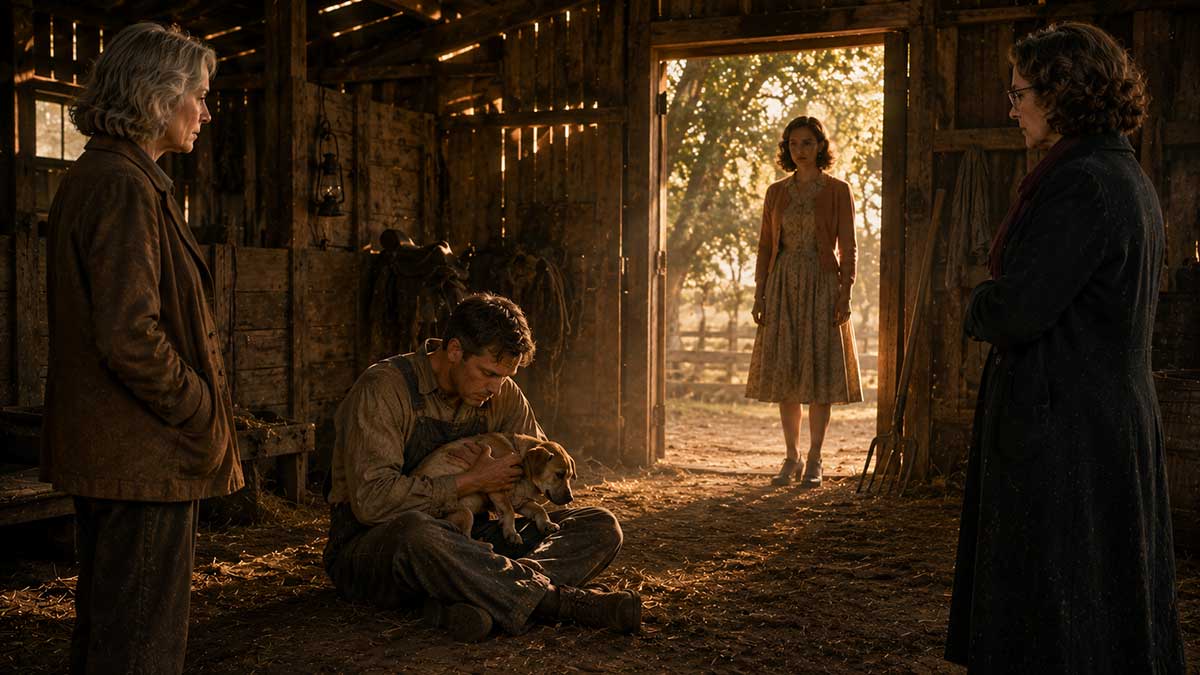
Susan Shillinglaw: We ended with a sequence.
The mouse.
The girl's dress in Weed.
Curley's hand.
The puppy.
Curley's wife.
When we put those events beside one another, it becomes difficult to call them isolated accidents.
Clare Lawrence: Yes.
But the sequence can lead readers into a dangerous conclusion.
Susan Shillinglaw: That Lennie is inevitably violent?
Clare Lawrence: Or that he is a monster waiting to reveal himself.
I don't think either reading is adequate.
Mimi Reisel Gladstein: Yet if we move too far in the opposite direction, we make another mistake.
Clare Lawrence: Absolutely.
Mimi Reisel Gladstein: We call him innocent.
Then the word innocent becomes so large that the people he hurts begin disappearing behind it.
Eva Feder Kittay: Perhaps we need to separate two things immediately.
Innocence of intention.
And innocence of consequence.
Arthur Kleinman: Yes.
Eva Feder Kittay: Lennie often does not intend the harm he causes.
That tells us something morally important about him.
It does not undo the harm.
Julianne Holt-Lunstad: Which is one reason this question is so difficult emotionally.
If Lennie deliberately wanted to hurt people, readers could place him into a familiar category.
Dangerous man.
Punish him.
Protect everyone else.
Arthur Kleinman: But Steinbeck refuses us that simplicity.
Susan Shillinglaw: Let's begin with the mouse.
Lennie wants something soft.
He pets it.
He kills it.
Clare Lawrence: And then hides it.
Susan Shillinglaw: Which is interesting.
Does hiding the mouse mean Lennie knows he has done something wrong?
Clare Lawrence: It may mean he knows George will be angry.
Those are not necessarily the same thing.
Eva Feder Kittay: That's an important distinction.
Knowing that an action produces punishment is different from understanding why the action is wrong.
A person can learn:
“If I do X, George gets angry.”
Without fully grasping:
“X causes suffering to another living being.”
Arthur Kleinman: So we should not infer full moral comprehension merely from concealment.
Clare Lawrence: Exactly.
Mimi Reisel Gladstein: But then we reach Weed.
The stakes are different.
A young woman is frightened.
Susan Shillinglaw: Lennie touches her dress because he likes the texture.
She becomes frightened.
She tries to pull away.
Lennie panics and holds tighter.
Mimi Reisel Gladstein: And from her perspective, intention is almost irrelevant in that moment.
A physically powerful man will not release her.
She does not know what is happening inside Lennie's mind.
She knows she cannot get away.
Julianne Holt-Lunstad: That's an important perspective shift.
We usually receive the Weed story through George.
Mimi Reisel Gladstein: Exactly.
George knows Lennie.
The woman doesn't.
George can say:
“He didn't mean anything.”
But what does that sentence mean to the person being held?
Clare Lawrence: This is where defending Lennie's humanity requires more care, not less.
We should resist portraying him as predatory if that is not supported by his intention or comprehension.
But respecting Lennie does not require telling frightened women that they should somehow understand him better while he is restraining them.
Eva Feder Kittay: Precisely.
Dignity cannot belong to only one vulnerable person at a time.
Arthur Kleinman: Then perhaps our first principle is:
Intent matters, but consequences matter too.
Susan Shillinglaw: Simple to say.
Much harder to apply.
Eva Feder Kittay: Especially when capacity is limited.
Moral responsibility usually assumes some ability to understand what one is doing, anticipate consequences, regulate behavior, and choose among alternatives.
Lennie's capacities in those areas appear limited.
But limited responsibility does not mean that danger disappears.
Clare Lawrence: Nor does it mean Lennie ceases to be a moral subject.
That's another mistake.
People sometimes move from:
“He may not fully understand.”
to:
“Nothing he does can have moral meaning.”
That also diminishes him.
Susan Shillinglaw: Then how should we think about responsibility?
Eva Feder Kittay: As something that may be distributed rather than simply switched on or off.
Arthur Kleinman: Explain.
Eva Feder Kittay: We often ask:
“Is Lennie responsible?”
Yes or no.
But perhaps the better question is:
How much responsibility can Lennie carry, and where does the responsibility he cannot carry go?
The room became quiet.
Arthur Kleinman: George.
Eva Feder Kittay: Some of it, yes.
Clare Lawrence: And eventually beyond George.
Eva Feder Kittay: Exactly.
Susan Shillinglaw: Before we go there, Curley's hand.
Curley attacks Lennie.
At first Lennie does not fight back.
Clare Lawrence: He looks to George.
Susan Shillinglaw: George tells him to defend himself.
Then Lennie grabs Curley's hand and crushes it.
Arthur Kleinman: Which shows us something interesting.
Lennie has enormous physical capacity and limited ability to calibrate it.
Clare Lawrence: Yes.
He doesn't merely need to know whether he is allowed to use force.
He needs to regulate how much force.
That appears extraordinarily difficult for him.
Mimi Reisel Gladstein: And George knows that afterward.
Susan Shillinglaw: Yes.
Mimi Reisel Gladstein: That matters.
We keep examining Lennie's responsibility.
At some point, we have to examine George's knowledge.
Arthur Kleinman: George has already seen Weed.
He knows about the mice.
Now he sees Curley's hand.
Clare Lawrence: And later the puppy.
Arthur Kleinman: So George's knowledge of risk is increasing.
Julianne Holt-Lunstad: Which changes caregiving.
If I do not know somebody presents a particular risk, my responsibility is one thing.
Once I know, it changes.
Eva Feder Kittay: Yes.
Foreseeability matters.
Susan Shillinglaw: Then let me ask the difficult question.
At what point should George have realized that protecting Lennie meant more than protecting Lennie from other people's reactions?
Mimi Reisel Gladstein: Earlier than he does.
Arthur Kleinman: I think so.
Clare Lawrence: Yes.
George's protection strategy is largely reactive.
Keep Lennie away from trouble.
Tell him what not to do.
Tell him where to hide if something goes wrong.
Eva Feder Kittay: Which protects Lennie after danger occurs more effectively than it prevents danger from occurring.
Mimi Reisel Gladstein: And that distinction matters enormously for women around Lennie.
George tells Lennie to stay away from Curley's wife.
But that strategy assumes Curley's wife will cooperate with a safety plan she doesn't even know exists.
Susan Shillinglaw: That's a very good point.
Mimi Reisel Gladstein: She is moving around her own home.
She has not agreed to become part of George's management system for Lennie.
Clare Lawrence: Yes.
A support plan that depends upon everyone else unknowingly behaving in exactly the right way is not much of a support plan.
Arthur Kleinman: But what realistic alternative does George have?
Mimi Reisel Gladstein: That is the question.
Arthur Kleinman: He's poor.
He moves from ranch to ranch.
He doesn't have professional guidance.
He has no formal respite.
He has no stable home.
He may not know what services exist, assuming meaningful services are available at all.
We can recognize his responsibility without pretending he possesses resources he doesn't have.
Eva Feder Kittay: Which means responsibility begins spreading outward.
Lennie has some.
George has some.
Employers perhaps have some once they know.
Communities have some.
Institutions have some.
Society has some.
Susan Shillinglaw: But in Steinbeck's world, much of that larger structure is absent.
Eva Feder Kittay: And when the larger structure disappears, responsibility doesn't disappear with it.
It falls downward.
Onto families.
Friends.
Women.
Neighbors.
Poor people.
People like George.
Julianne Holt-Lunstad: Until one relationship is carrying everything again.
Arthur Kleinman: Exactly.
Susan Shillinglaw: Then comes the puppy.
Lennie is devastated.
Clare Lawrence: And I think that matters.
He is not indifferent.
Eva Feder Kittay: Yes.
Clare Lawrence: Lennie wants the puppy alive.
He doesn't enjoy killing it.
He doesn't celebrate what happened.
He becomes frightened and upset.
That tells us something important about his intentions.
Mimi Reisel Gladstein: But what frightens him most?
Clare Lawrence: George's reaction.
Mimi Reisel Gladstein: Exactly.
He worries George won't let him tend the rabbits.
Again, we have to distinguish remorse for suffering from fear of consequences.
Arthur Kleinman: Does Lennie understand death?
Clare Lawrence: Perhaps partially.
We should not claim more certainty than the novel gives us.
He knows the puppy is dead.
He knows it cannot be restored.
He knows George will be angry.
What he understands about the puppy's experience or his own responsibility is less clear.
Eva Feder Kittay: Which returns us to moral capacity.
Capacity is rarely all or nothing.
Lennie may understand some aspects and fail to understand others.
Susan Shillinglaw: That seems much closer to Steinbeck's portrayal.
Julianne Holt-Lunstad: But something else happens after the puppy.
The warning pattern has become very strong.
Arthur Kleinman: Mouse.
Weed.
Curley's hand.
Puppy.
Julianne Holt-Lunstad: Each event gives George more information.
Mimi Reisel Gladstein: And then Curley's wife enters the barn.
There was a pause.
Mimi Reisel Gladstein: I want us to stay with her perspective for a while.
Not George's.
Not Lennie's.
Hers.
She is lonely.
The men are elsewhere.
She finds Lennie.
She talks about her life.
For perhaps one of the few times in the book, she tells someone what she once wanted.
Susan Shillinglaw: Hollywood.
Mimi Reisel Gladstein: Recognition.
Another life.
Then she notices Lennie likes soft things.
She allows him to touch her hair.
Clare Lawrence: And from Lennie's perspective, that invitation matters.
Mimi Reisel Gladstein: It does.
She permits the initial touch.
Then she wants him to stop.
That matters even more.
Eva Feder Kittay: Yes.
Consent can change.
Permission to begin is not permission to continue.
Mimi Reisel Gladstein: Exactly.
She says stop.
Lennie does not release her.
She becomes frightened.
She screams.
Lennie becomes frightened by her fear.
He tries to silence her.
And she dies.
Arthur Kleinman: A catastrophic feedback loop.
Clare Lawrence: Yes.
Fear produces behavior that produces more fear.
Lennie panics because she screams.
She screams because Lennie will not release her.
His attempt to stop the screaming makes her more frightened.
Then his strength turns panic into fatal harm.
Julianne Holt-Lunstad: Neither person knows how to stop the escalation.
Mimi Reisel Gladstein: But only one of them has overwhelming physical strength.
Clare Lawrence: Correct.
And we must say that plainly.
Susan Shillinglaw: So is Lennie responsible for her death?
Silence.
Eva Feder Kittay: Partially.
Clare Lawrence: I would agree, with great caution.
Mimi Reisel Gladstein: I would insist that whatever language we use must leave room for her death to remain morally significant.
Arthur Kleinman: Then perhaps we need several separate questions.
Did Lennie intend to kill her?
No.
Did Lennie's actions kill her?
Yes.
Could Lennie fully understand the likely consequences?
Probably not.
Was she still entitled to safety from him?
Absolutely.
Eva Feder Kittay: That is exactly the complexity.
Reduced responsibility does not mean reduced value of the victim.
Clare Lawrence: And recognizing Lennie's disability should increase our demand for appropriate support.
It should not increase our willingness to ignore risk.
Susan Shillinglaw: That's important.
Clare Lawrence: Disability rights and public safety are sometimes falsely framed as enemies.
They do not have to be.
A person can deserve dignity, accommodation, community, and meaningful autonomy while also requiring substantial safeguards.
Eva Feder Kittay: The ethical failure occurs when we believe we have only two choices.
Total independence.
Or total control.
Arthur Kleinman: There should be something between them.
Eva Feder Kittay: Many things between them.
Supported decision-making.
Shared caregiving.
Appropriate environments.
Supervision where necessary.
Community responsibility.
Ways of preserving agency without pretending risk does not exist.
Susan Shillinglaw: None of which George really has.
Eva Feder Kittay: Exactly.
And that should disturb us.
Julianne Holt-Lunstad: Could this tragedy have happened differently today?
Clare Lawrence: Possibly.
But I would be cautious.
Arthur Kleinman: Very cautious.
Clare Lawrence: We should not tell ourselves a comforting story that modern systems would automatically save everyone.
Families still struggle to obtain support.
Caregivers still become overwhelmed.
People with intellectual disabilities can still be isolated, abused, misunderstood, or poorly supported.
Potential victims can still be failed.
Eva Feder Kittay: Yet there are concepts and services George does not possess.
Clare Lawrence: Yes.
And that difference matters.
Mimi Reisel Gladstein: I want to challenge something.
We keep saying “potential victims.”
By this point Curley's wife is not potential.
She's dead.
Arthur Kleinman: You're right.
Mimi Reisel Gladstein: I think readers sometimes hurry past her death because the emotional center immediately shifts to George and Lennie.
Will Lennie escape?
What will George do?
Will Curley catch him?
And suddenly the dead young woman becomes the event that creates the men's tragedy.
Susan Shillinglaw: That's a powerful criticism.
Mimi Reisel Gladstein: She had a life.
A miserable one perhaps.
A flawed one certainly.
She behaved cruelly toward Crooks.
She was lonely.
She had dreams.
She made mistakes.
And then she died.
We should not require her to be morally perfect before her death counts.
Clare Lawrence: Absolutely.
And we should not require Lennie to become morally monstrous before her death counts either.
Mimi Reisel Gladstein: Yes.
That's the difficult balance.
Eva Feder Kittay: Two human beings can occupy the same tragedy without one person's dignity requiring the destruction of the other's.
The room went quiet.
Arthur Kleinman: That may be the sentence we need.
Susan Shillinglaw: Let me ask something that readers rarely ask.
What would justice look like here?
Not punishment.
Justice.
Eva Feder Kittay: Before or after her death?
Susan Shillinglaw: Both.
Clare Lawrence: Before her death, justice would mean Lennie has support adequate to his actual needs.
Not merely George telling him to behave.
Arthur Kleinman: George would have help.
Julianne Holt-Lunstad: Stable community.
Eva Feder Kittay: Shared responsibility.
Mimi Reisel Gladstein: Women around Lennie would not unknowingly carry the risk created by inadequate support.
Susan Shillinglaw: Crooks would not be segregated.
Mimi Reisel Gladstein: Curley's wife would have a social world larger than wandering around looking for someone to talk to.
Arthur Kleinman: That's interesting.
The barn tragedy is usually treated as a collision between Lennie and Curley's wife.
But many earlier failures converge there.
Julianne Holt-Lunstad: Lennie's isolation.
Her isolation.
George's unsupported caregiving.
A ranch built on transient relationships.
Gender restrictions.
Lack of appropriate supervision.
Fear.
Poor communication.
Eva Feder Kittay: Structural failures do not erase individual actions.
But they help explain why certain moments become catastrophic.
Susan Shillinglaw: And after her death?
Mimi Reisel Gladstein: Justice must begin by refusing to erase her.
Clare Lawrence: And refusing to dehumanize Lennie.
Eva Feder Kittay: Then comes the much harder problem of protection.
What happens now?
Arthur Kleinman: Which is where the novel becomes almost unbearable.
Before the barn, we can imagine interventions.
After the barn, the time for prevention is gone.
Susan Shillinglaw: Curley organizes the men.
Mimi Reisel Gladstein: And he wants vengeance.
Clare Lawrence: Lennie runs to the place George told him to go.
Julianne Holt-Lunstad: Which means even in catastrophe Lennie's instinct is relational.
Find George.
Wait for George.
George will know what to do.
Arthur Kleinman: George has become his entire emergency system.
Eva Feder Kittay: And now that system is being asked to solve something it was never capable of solving.
Susan Shillinglaw: A killing.
Eva Feder Kittay: Yes.
George must somehow consider Lennie's safety.
Other people's safety.
Curley's vengeance.
Lennie's future.
His own responsibility.
And he must do it almost immediately.
Mimi Reisel Gladstein: But before we let George become the victim of impossible responsibility, I want one more question answered.
When did he know?
Susan Shillinglaw: Know what?
Mimi Reisel Gladstein: That Lennie could seriously hurt someone without meaning to.
Arthur looked down.
Arthur Kleinman: Weed should have frightened him.
Clare Lawrence: Certainly.
Eva Feder Kittay: Curley's hand should have intensified that fear.
Clare Lawrence: The dead animals too.
Mimi Reisel Gladstein: Then George cannot enter the riverbank morally untouched by everything that came before.
Arthur Kleinman: No.
But knowing a risk exists is different from knowing how to manage it.
Mimi Reisel Gladstein: Agreed.
I'm not saying George wanted this.
I'm saying love cannot become an excuse for refusing to see danger.
Clare Lawrence: And fear of stigma cannot either.
Sometimes families protect vulnerable people from outsiders because they know outsiders may misunderstand or mistreat them.
That instinct can be understandable.
But if protection becomes secrecy around genuine risk, everyone becomes more vulnerable.
Eva Feder Kittay: Including the disabled person.
Clare Lawrence: Especially the disabled person.
Lennie needs the world around him to understand his needs.
Instead, George repeatedly tries to make Lennie appear capable enough to fit into environments that are poorly suited to him.
Susan Shillinglaw: Because employment depends on it.
Clare Lawrence: Yes.
Again, economics matters.
If George openly says:
“This man requires substantial supervision and sometimes cannot control his physical strength when frightened,”
does Lennie get hired?
Probably not.
Arthur Kleinman: Then George faces another terrible incentive.
Hide the vulnerability so they can survive economically.
Julianne Holt-Lunstad: Which increases the danger.
Arthur Kleinman: Exactly.
Eva Feder Kittay: That is what structural failure looks like.
The system creates conditions where honesty may threaten survival.
Then people conceal needs.
Then everyone bears greater risk.
Susan Shillinglaw: So who is responsible?
Let's answer the question we began with.
Lennie?
Eva Feder Kittay: To the extent his capacity allows.
Clare Lawrence: Yes.
Susan Shillinglaw: George?
Arthur Kleinman: Increasingly, as his knowledge of the risk grows.
Mimi Reisel Gladstein: Yes.
Susan Shillinglaw: The ranch?
Julianne Holt-Lunstad: Once people are living and working together, community responsibility exists whether they acknowledge it or not.
Susan Shillinglaw: Society?
Eva Feder Kittay: Absolutely.
Susan Shillinglaw: Then responsibility is distributed.
Eva Feder Kittay: Yes.
But harm is not distributed so neatly.
Curley's wife is still dead.
That silenced them.
Julianne Holt-Lunstad: There is something terribly human about that.
Many people can contribute to conditions that make tragedy more likely.
One person may bear the final consequence.
Arthur Kleinman: And afterward everyone asks:
“Who did it?”
A necessary question.
But perhaps not the only one.
Eva Feder Kittay: We should also ask:
“What made this outcome increasingly likely?”
“Who saw warning signs?”
“Who had resources?”
“Who lacked them?”
“What alternatives existed?”
“What support never arrived?”
Mimi Reisel Gladstein: As long as those questions do not become a way of saying Curley's wife died because society failed Lennie.
She died because Lennie broke her neck.
Eva Feder Kittay: Yes.
Mimi Reisel Gladstein: Then we can examine everything around that fact.
But the fact must remain.
Clare Lawrence: I agree.
And the corresponding fact must remain too.
Lennie did not set out to kill her.
Susan Shillinglaw: Two truths.
Clare Lawrence: Yes.
Lennie is not a calculating murderer.
Curley's wife is still dead because of his actions.
Arthur Kleinman: Perhaps mature moral thinking begins when we stop demanding that one truth destroy the other.
The room stayed quiet.
Then Susan returned to the beginning.
Susan Shillinglaw: Mouse.
Dress.
Hand.
Puppy.
Woman.
What does the pattern finally tell us?
Clare Lawrence: That affection does not guarantee safety.
Mimi Reisel Gladstein: That innocent intention does not erase another person's fear.
Eva Feder Kittay: That reduced capacity changes responsibility without eliminating the need for protection.
Arthur Kleinman: That caregivers can recognize danger and still lack the resources to manage it.
Julianne Holt-Lunstad: That isolation makes difficult situations more dangerous for everyone involved.
Susan Shillinglaw: And perhaps something even sadder.
Lennie wants most deeply to care for fragile things.
The mouse.
The puppy.
The rabbits he dreams about.
Curley's wife's soft hair.
But the things he wants to hold are often the things least safe in his hands.
Nobody answered.
Clare Lawrence: We should be careful with that sentence.
Susan Shillinglaw: Why?
Clare Lawrence: Because it sounds dangerously close to saying Lennie himself is the tragedy.
I don't think he is.
Susan Shillinglaw: What is?
Clare Lawrence: That nobody ever finds a way for his desire to connect with the world to exist safely within it.
Eva nodded slowly.
Eva Feder Kittay: That's better.
The tragedy isn't simply:
“Lennie is dangerous.”
It is:
“Lennie needs forms of support that his world does not know how, or does not choose, to provide.”
Mimi Reisel Gladstein: And the tragedy is also that someone dies before anyone solves that problem.
Clare Lawrence: Yes.
We cannot forget her.
Arthur Kleinman: Then perhaps our original question has changed.
We asked:
Can someone be innocent and dangerous at the same time?
The answer is yes.
But that answer creates another question.
If a person cannot fully carry responsibility for the danger they present, someone else must help carry it.
George tries.
He cannot carry enough.
The community does almost nothing.
The system offers little.
Then the crisis arrives.
Eva Feder Kittay: And suddenly responsibility that should have been shared across many people collapses back onto one person.
Susan Shillinglaw: George.
Julianne looked toward Susan.
Julianne Holt-Lunstad: At the river.
Susan Shillinglaw: At the river.
Mimi Reisel Gladstein: But this time we cannot begin with George.
Susan Shillinglaw: Who do we begin with?
Mimi Reisel Gladstein: Lennie.
He goes to the place George told him to go.
He waits.
George arrives.
Lennie trusts him.
He believes George will protect him.
He believes the farm still exists.
He believes the rabbits are still waiting somewhere in his future.
Clare Lawrence: He does not ask to die.
Eva Feder Kittay: He does not consent.
Arthur Kleinman: George knows what Curley intends.
Susan Shillinglaw: And George knows what Carlson's gun can do.
Silence returned.
Then Eva spoke.
Eva Feder Kittay: We have spent four conversations asking who cares, who matters, why people need hope, and where responsibility goes when capacity is limited.
Now all four questions collide.
George loves Lennie.
George knows Lennie is dangerous.
George knows Lennie is vulnerable.
George knows another person is already dead.
George believes the men coming for Lennie will show him no mercy.
And George has almost no time.
But none of those facts answers the final moral question.
Susan Shillinglaw: Which is?
Eva looked around the table.
Eva Feder Kittay: Not merely:
“Was George right?”
Something harder.
Topic 5: What Gave George the Right to Decide That Lennie’s Life Was Over?
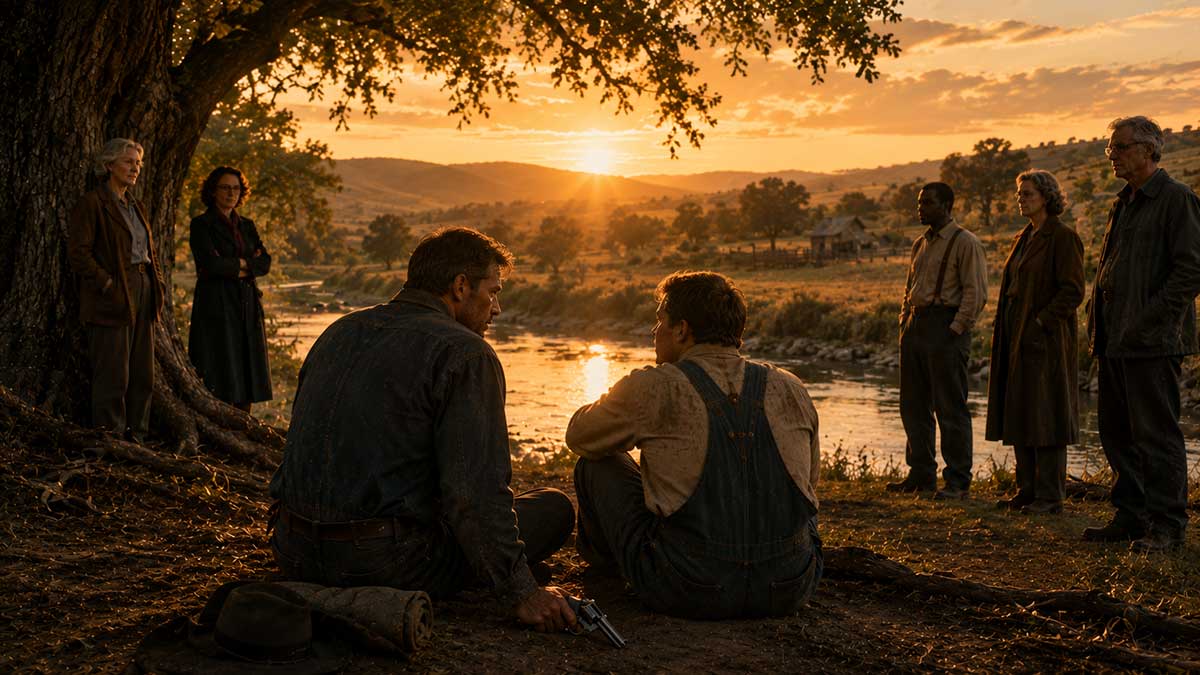
Susan Shillinglaw: We have arrived at the river.
The same place where the novel began.
The same water.
The same trees.
The same shelter George once told Lennie to return to if trouble came.
But nothing is the same now.
Arthur Kleinman: Lennie believes George is still his protector.
Clare Lawrence: That matters enormously.
Eva Feder Kittay: Yes.
Because George does not meet Lennie as an enemy.
He meets him as the person Lennie trusts most.
Mimi Reisel Gladstein: And Curley’s wife is dead.
We need to say that before we go any further.
Susan Shillinglaw: Absolutely.
Mimi Reisel Gladstein: George is not making this decision in a vacuum. A woman has died. Curley is hunting Lennie. Other men are armed. George believes violence is coming.
Julianne Holt-Lunstad: Yet Lennie does not understand the full situation.
Clare Lawrence: He returns to the river because George told him to.
That obedience becomes terribly important.
Susan Shillinglaw: Let’s begin with the question readers usually ask.
Was George right to kill Lennie?
Eva Feder Kittay: I would resist answering that first.
Susan Shillinglaw: Why?
Eva Feder Kittay: Because it begins too late.
It begins after George has already accepted that Lennie’s life is something he may decide.
I want to ask a more basic question.
What gave George the authority to make that decision?
The room became still.
Arthur Kleinman: Love?
Eva Feder Kittay: Love gives us obligations.
It does not automatically give us ownership.
Arthur Kleinman: Responsibility?
Eva Feder Kittay: Responsibility may require intervention.
Again, that is not the same as the authority to end another person’s life.
Susan Shillinglaw: Necessity?
Eva Feder Kittay: Now we are closer to the real argument.
George believes an emergency has narrowed the available choices.
But even there, we should separate:
“I believed this was the least terrible option”
from
“I had the moral right to decide.”
Those are not identical claims.
Clare Lawrence: And Lennie never agrees.
Susan Shillinglaw: No.
Clare Lawrence: He does not ask George to kill him.
He does not say he is suffering unbearably.
He does not say he would rather die than face Curley.
He does not even fully know what is about to happen.
Eva Feder Kittay: Which is why calling the act “euthanasia” too casually creates problems.
Arthur Kleinman: Yes.
Eva Feder Kittay: Modern discussions of euthanasia often involve consent, autonomy, decisional capacity, suffering, terminal illness, medical responsibility.
Lennie’s situation is different.
Susan Shillinglaw: Yet George knows Curley.
He knows the men are coming.
Mimi Reisel Gladstein: And Curley does not seem interested in justice.
He wants revenge.
Arthur Kleinman: George may believe Lennie is about to experience terror and brutality.
Julianne Holt-Lunstad: Which means George’s decision may be rooted in protection.
Eva Feder Kittay: I do not deny that.
The motive may be compassionate.
The question is whether compassion resolves the moral problem.
Clare Lawrence: It does not for me.
Susan Shillinglaw: Why?
Clare Lawrence: Because disabled people have often been subjected to decisions made by others who were convinced they knew what was best.
Sometimes lovingly.
Sometimes paternalistically.
Sometimes violently.
So when readers say, “George knew Lennie better than anyone,” I hear two truths.
Yes, George understood Lennie deeply.
And yes, that closeness gave George extraordinary power over someone with limited ability to challenge him.
Arthur Kleinman: Care creates asymmetry.
Clare Lawrence: Exactly.
George can explain Lennie to the world.
Lennie cannot explain George in the same way.
George controls the plan.
The money.
The movement.
The information.
And now the final decision.
Eva Feder Kittay: That does not make George evil.
Clare Lawrence: No.
Not at all.
That is what makes the scene tragic.
If George were simply cruel, there would be little to discuss.
Susan Shillinglaw: Arthur, from the caregiving perspective, what is happening to George in those final minutes?
Arthur Kleinman: He is making a catastrophic decision under extreme pressure.
Years of responsibility have collapsed into one moment.
He knows Lennie.
He knows Curley’s anger.
He knows what Lennie has done.
He knows what the men may do.
He knows that running again may only repeat the cycle.
And he appears to believe there is no humane future left.
Eva Feder Kittay: That last phrase matters.
Arthur Kleinman: Which one?
Eva Feder Kittay: “He appears to believe.”
We should not turn George’s belief into objective fact.
Susan Shillinglaw: So you would not say he had no choice?
Eva Feder Kittay: I would say he believed the remaining choices were unbearable.
That is more careful.
Mimi Reisel Gladstein: And I think we need to list those choices, however awful they were.
Susan Shillinglaw: Go ahead.
Mimi Reisel Gladstein: He might have surrendered Lennie.
He might have tried to flee again.
He might have tried to protect Lennie from Curley physically.
He might have sought custody, confinement, institutional care, law enforcement.
None sounds good.
Some may have been unrealistic.
Some might have produced enormous suffering.
But “terrible alternatives” is still different from “no alternatives.”
Arthur Kleinman: Agreed.
Clare Lawrence: And we should avoid pretending we know exactly what would have happened under each one.
Susan Shillinglaw: Right.
We cannot rewrite the historical world as though George could simply call a modern support service.
Julianne Holt-Lunstad: Yet that historical limitation is part of the point.
Susan Shillinglaw: Explain.
Julianne Holt-Lunstad: George has almost nobody to call.
That means the social network around him has already failed.
By the time he reaches the river, the problem is not only what George decides.
It is that one poor migrant worker has somehow become the final authority over another man’s life.
Eva Feder Kittay: Yes.
That is morally shocking even before we decide whether his specific choice was defensible.
Arthur Kleinman: I think there are three questions tangled together.
First:
What did George intend?
Second:
What alternatives did he perceive?
Third:
What authority did he actually possess?
Susan Shillinglaw: Let’s take them one by one.
Intent first.
Arthur Kleinman: I believe George intends to spare Lennie from fear and from Curley’s vengeance.
Julianne Holt-Lunstad: I agree.
Susan Shillinglaw: The way he tells Lennie about the farm again supports that.
Arthur Kleinman: Yes.
George gives him the familiar story.
The rabbits.
The future.
Safety.
He places Lennie psychologically inside the dream before he pulls the trigger.
Clare Lawrence: Which is compassionate.
And deeply troubling.
Susan Shillinglaw: Both?
Clare Lawrence: Both.
He knows exactly what Lennie trusts.
He knows what calms him.
He uses that knowledge to keep Lennie peaceful.
But he also uses it to prevent Lennie from understanding what George is about to do.
Eva Feder Kittay: This is where trust becomes morally complicated.
George gives Lennie comfort through the same trust that makes resistance impossible.
Mimi Reisel Gladstein: We called George the keeper of tomorrow in the last discussion.
Arthur Kleinman: Yes.
Mimi Reisel Gladstein: Here, he tells Lennie about tomorrow while already knowing Lennie will never reach it.
Nobody spoke.
Julianne Holt-Lunstad: That may be the most painful part.
Lennie dies believing the relationship is still doing what it has always done.
George is protecting him.
George is telling him what comes next.
Clare Lawrence: And in one sense, George believes he is protecting him.
Eva Feder Kittay: Yet in another sense, he is ending the very future Lennie has been taught to trust.
Susan Shillinglaw: So can an act be merciful and a betrayal at the same time?
Arthur Kleinman: Yes.
Clare Lawrence: I think so.
Eva Feder Kittay: Certainly.
Mimi paused.
Mimi Reisel Gladstein: Yes, but we cannot let the word mercy close the discussion.
Susan Shillinglaw: Why not?
Mimi Reisel Gladstein: Because mercy sounds morally clean.
This is not clean.
George protects Lennie from one kind of violence by committing another.
That may have been the least cruel outcome he could imagine.
But we should not sanitize what happens.
Arthur Kleinman: That is fair.
Mimi Reisel Gladstein: And Curley’s wife remains part of this decision.
Her death changes what George knows about the future.
If Lennie escapes again, could someone else die?
That is not paranoia anymore.
It has happened.
Eva Feder Kittay: Which means George owes duties in more than one direction.
He owes Lennie care.
He owes others protection.
He owes the dead woman recognition.
He owes himself something too.
Arthur Kleinman: Yes.
And those duties may no longer be compatible.
Susan Shillinglaw: This may be the philosophical core of the ending.
When obligations collide, whom are we permitted to sacrifice?
Eva Feder Kittay: Exactly.
And I dislike how easily the answer becomes the most dependent person.
Clare Lawrence: That is crucial.
When systems fail, the person with the least power can become the person whose life is treated as negotiable.
Arthur Kleinman: But what if keeping that person alive poses serious danger to others?
Clare Lawrence: Then we need protection.
Containment perhaps.
Supervision.
Shared responsibility.
But that is still not identical to saying death is the solution.
Arthur Kleinman: Yet George does not have a humane containment system available.
Clare Lawrence: I know.
That is why I am not condemning him from a comfortable distance.
I am saying the absence of alternatives does not turn killing into something morally simple.
Eva Feder Kittay: Precisely.
The tragedy may be that every path has become morally damaged.
Julianne Holt-Lunstad: Can we talk about Candy’s dog now?
Susan Shillinglaw: We have to.
Julianne Holt-Lunstad: Candy regrets letting Carlson kill the dog.
George heard that.
Later George refuses to let Curley be the person who kills Lennie.
The parallel is obvious.
Arthur Kleinman: It suggests:
If death is coming, let the loved one be with someone familiar.
Eva Feder Kittay: But again, the parallel has limits.
Susan Shillinglaw: Because Lennie is not a dog.
Eva Feder Kittay: Yes.
Lennie has desires.
He imagines a future.
He participates in relationships.
He has preferences.
He has trust.
He may have limited decisional capacity, but he is a human being.
If the dog scene teaches George that love should stay close at death, that is one lesson.
If it teaches him that love gives him authority to choose death, that is much more troubling.
Clare Lawrence: And the novel deliberately makes those lessons hard to separate.
Mimi Reisel Gladstein: Perhaps Candy’s regret teaches George something emotionally true and morally incomplete.
Susan Shillinglaw: That's interesting.
Mimi Reisel Gladstein: Candy wishes he had been present and responsible.
George may hear:
“Do not abandon someone you love at the final moment.”
That is deeply human.
But George may also infer:
“If the end is inevitable, I should be the one to decide how it happens.”
The first does not automatically justify the second.
Arthur Kleinman: That distinction is powerful.
Susan Shillinglaw: Let me ask each of you plainly.
Do you think George saves Lennie?
Julianne Holt-Lunstad: From Curley’s vengeance, probably.
Arthur Kleinman: I believe that is George’s intention.
Clare Lawrence: From one possible future, yes.
Eva Feder Kittay: But he also eliminates every other possible future.
Mimi Reisel Gladstein: And we cannot know whether Curley’s vengeance was literally the only future available.
Susan Shillinglaw: Does George betray Lennie?
Clare Lawrence: Yes.
Arthur Kleinman: I think he does.
Julianne Holt-Lunstad: Painfully, yes.
Eva Feder Kittay: The betrayal lies partly in using trust without consent.
Mimi Reisel Gladstein: And the love does not erase that.
Susan Shillinglaw: So he saves him and betrays him.
Arthur Kleinman: I think Steinbeck forces us to hold both.
Julianne Holt-Lunstad: Which brings us back to loneliness.
George repeatedly fantasizes about what life would be like without Lennie.
He could keep his money.
Go into town.
Do what he wants.
Now Lennie is gone.
George has the freedom he imagined.
Susan Shillinglaw: And?
Julianne Holt-Lunstad: It doesn't look like freedom anymore.
Arthur Kleinman: No.
It looks like loss.
Susan Shillinglaw: Slim understands that.
Julianne Holt-Lunstad: Yes.
Slim does not approach George as though a practical problem has been solved.
He recognizes bereavement.
Arthur Kleinman: Carlson does not.
Susan Shillinglaw: Carlson’s final question is remarkable.
Why are George and Slim acting like this?
He cannot understand.
Mimi Reisel Gladstein: Because to Carlson, Lennie was the danger.
Danger removed.
Problem solved.
Eva Feder Kittay: Which returns us to disposability.
If you see only the problem someone creates, their disappearance can look like relief.
If you see the relationship, their disappearance looks like grief.
Clare Lawrence: And Carlson cannot see what Lennie meant to George.
Julianne Holt-Lunstad: Or perhaps what George meant to Lennie.
Susan Shillinglaw: Slim can.
Arthur Kleinman: At least partly.
Mimi Reisel Gladstein: But should Slim reassure George?
Susan Shillinglaw: You mean his understanding?
Mimi Reisel Gladstein: Yes.
Readers often take Slim’s sympathy as Steinbeck telling us George did the right thing.
I’m not sure we should.
Susan Shillinglaw: I agree.
Slim understands George.
That is not identical to morally absolving him.
Eva Feder Kittay: Compassion and judgment can coexist.
Arthur Kleinman: Which may be another lesson of caregiving.
We can understand why someone made a terrible decision without declaring the decision good.
Clare Lawrence: Yes.
Understanding is not acquittal.
Julianne Holt-Lunstad: Nor is judgment the same as refusing empathy.
Susan Shillinglaw: Then perhaps the novel’s ending is asking us to do something difficult.
Understand George deeply.
Refuse to make Lennie less human.
Remember Curley’s wife.
Recognize the danger.
Recognize the social failure.
And still admit we do not possess a clean answer.
Eva Feder Kittay: That is where I would leave it.
Arthur Kleinman: I want to go one step further.
Suppose we ask whether George failed.
What exactly would we mean?
Did he fail Lennie?
Did he fail Curley’s wife?
Did the ranch fail them?
Did society fail George?
Did all of these things happen at once?
Mimi Reisel Gladstein: I think all at once.
Clare Lawrence: But I want to guard against making “society failed” into a way of erasing George’s agency.
George makes the final decision.
Eva Feder Kittay: Absolutely.
Structural explanation does not dissolve personal responsibility.
Arthur Kleinman: Just as personal responsibility does not dissolve structural failure.
Susan Shillinglaw: That sounds very much like the entire novel.
Steinbeck keeps putting individuals inside conditions larger than themselves.
They still act.
Their actions still matter.
But they do not act from unlimited freedom.
Julianne Holt-Lunstad: Which is why the riverbank feels so different from the beginning.
At the beginning, the place represents escape.
If trouble comes, come here.
At the end, there is nowhere else to go.
Susan Shillinglaw: The same refuge becomes the place where possibility ends.
Clare Lawrence: Does Lennie understand anything is ending?
Susan Shillinglaw: Probably not fully.
Clare Lawrence: That matters to me.
His last experience is trust.
Not consent.
Trust.
Eva Feder Kittay: Which is why I cannot call George’s act simply merciful.
Arthur Kleinman: Yet would you call it murder?
Eva hesitated.
Eva Feder Kittay: Legally, we are not conducting a legal analysis here.
Morally, I would call it an intentional killing under perceived catastrophic necessity.
And I would leave the moral verdict open.
Susan Shillinglaw: Clare?
Clare Lawrence: I would say George kills someone who trusts him because George believes he is preventing something worse.
I want every part of that sentence preserved.
If you remove trusts him, the betrayal disappears.
If you remove preventing something worse, the compassion disappears.
If you remove kills, the violence disappears.
Mimi Reisel Gladstein: And if you remove Curley’s wife, the reason the situation became catastrophic disappears.
Arthur Kleinman: Then perhaps no single label works.
Mercy.
Betrayal.
Love.
Fear.
Violence.
Responsibility.
Desperation.
All are present.
Julianne Holt-Lunstad: And grief.
Nobody spoke for a while.
Susan Shillinglaw: Let me ask the question we have avoided since Topic 1.
Was George protecting Lennie, or was George also protecting himself?
Arthur Kleinman: Probably both, though not necessarily consciously.
Mimi Reisel Gladstein: From what?
Arthur Kleinman: Another flight.
Another crisis.
Another injury.
Another person harmed.
Another year of carrying everything alone.
Clare Lawrence: That is uncomfortable.
Arthur Kleinman: It should be.
Caregiver exhaustion does not mean George secretly wanted Lennie dead.
But if we pretend George's own exhaustion plays no role in how he imagines the future, we make him less human.
Eva Feder Kittay: And this is why unsupported care is dangerous.
Not because caregivers are bad people.
Because human beings have limits.
Julianne Holt-Lunstad: Yet George's immediate reaction afterward does not look like relief.
Arthur Kleinman: No.
Julianne Holt-Lunstad: Which suggests whatever freedom he thought he wanted has become meaningless at the moment he receives it.
Susan Shillinglaw: George once said he could live easily without Lennie.
At the end, Steinbeck gives him that life.
And does anyone believe he is better off?
No one answered.
Eva Feder Kittay: Maybe that is why the question “Did George save Lennie?” is incomplete.
We also have to ask:
What did George destroy in himself by doing it?
Arthur Kleinman: Caregiver and cared-for do not emerge from a relationship untouched.
Their identities can become deeply entangled.
George does not simply remove Lennie from his life.
He removes the person around whom much of his life has been organized.
Julianne Holt-Lunstad: The person who knew where he came from.
The person who expected him tomorrow.
The person who shared the farm story.
Mimi Reisel Gladstein: The last person with whom the dream was fully alive.
Susan Shillinglaw: Then perhaps the gun kills two futures.
Lennie’s.
And George’s imagined future with Lennie.
Clare Lawrence: But George survives.
Susan Shillinglaw: Yes.
Clare Lawrence: Which means he must live with the decision Lennie never had to understand.
Eva Feder Kittay: That may be George’s punishment, if we want to use that word.
Not legal punishment.
Moral memory.
Arthur Kleinman: The caregiver who becomes decision-maker must continue living after the person they decided for is gone.
Susan Shillinglaw: And perhaps that is what Slim recognizes.
Not that George is unquestionably right.
But that George has crossed a line he can never uncross.
Julianne Holt-Lunstad: Carlson sees only the end of Lennie.
Slim sees what has happened to George.
The room fell silent again.
Then Mimi spoke.
Mimi Reisel Gladstein: I want Curley’s wife remembered one last time.
Susan Shillinglaw: Please.
Mimi Reisel Gladstein: If we end this conversation by mourning George and Lennie beautifully, we risk repeating the novel’s most common imbalance.
She had a dream too.
She wanted a different life.
She was lonely.
She behaved cruelly at times.
She made a choice to enter the barn and talk to Lennie.
She did not choose death.
Her life should not become merely the event that tests George’s morality.
Clare Lawrence: Yes.
And Lennie’s disability should not become merely the explanation for her death.
Eva Feder Kittay: And George’s love should not become merely the justification for Lennie’s death.
Arthur Kleinman: Then all three must remain fully human.
Susan Shillinglaw: George.
Lennie.
Curley’s wife.
No simplification.
Julianne Holt-Lunstad: And perhaps Candy and Crooks too.
Everyone in the novel is trying to find a place where they will not be discarded.
Susan Shillinglaw: Which brings us back through all five topics.
We began with George carrying Lennie almost alone.
Then we asked who is treated as disposable.
Then why people need dreams of somewhere they will still belong.
Then whether innocence and danger can exist in one person.
Now we arrive at a final act in which all those problems converge.
One man is dependent.
One woman is dead.
One caregiver is overwhelmed.
One mob is approaching.
One society has provided very little help.
And one person decides.
Eva Feder Kittay: Perhaps the deepest moral question is not:
“Was George right?”
Arthur Kleinman: Nor:
“Was George wrong?”
Clare Lawrence: Nor:
“Was Lennie too dangerous to live?”
Mimi Reisel Gladstein: Nor:
“Was Curley’s wife responsible for being there?”
Julianne Holt-Lunstad: Nor even:
“Did George love Lennie?”
Susan looked at them.
Susan Shillinglaw: Then what is it?
Eva answered quietly.
Eva Feder Kittay: How did responsibility that should have belonged to many people become concentrated in the hands of one frightened man with a gun?
No one spoke.
Arthur Kleinman: That does not absolve George.
Clare Lawrence: It does not erase Lennie’s danger.
Mimi Reisel Gladstein: It does not erase Curley’s wife’s death.
Julianne Holt-Lunstad: It does not erase the love.
Susan Shillinglaw: It simply makes the tragedy larger.
Arthur leaned forward.
Arthur Kleinman: One person can love another person deeply.
One person can protect another for years.
One person can sacrifice enormous parts of life for another.
But love has limits.
Not limits of feeling.
Limits of function.
Love cannot become an entire healthcare system.
An entire social system.
An entire safety plan.
An entire community.
An entire moral court.
Eva Feder Kittay: And when we force it to become all of those things, eventually we may ask love to make decisions that love should never have been left to make alone.
Clare Lawrence: Lennie needed more than George.
Mimi Reisel Gladstein: Curley’s wife needed more than Curley’s ranch.
Julianne Holt-Lunstad: Candy needed somewhere his belonging would survive his usefulness.
Susan Shillinglaw: Crooks needed a community that did not place him outside its door.
Arthur Kleinman: And George needed someone to help him carry the person he loved.
Susan looked once more toward the riverbank the novel leaves behind.
Susan Shillinglaw: Perhaps that is why Steinbeck does not give us a courtroom after the shooting.
He gives us Slim.
Carlson.
George.
A few words.
And then the book ends.
No verdict.
No explanation large enough to settle it.
Just the terrible difference between a man who understands that something human has been lost and a man who cannot understand why anyone is upset.
Eva Feder Kittay: Maybe that is where Steinbeck leaves the judgment.
With us.
Susan Shillinglaw: Then let us leave it without pretending we can make the ending clean.
George may have saved Lennie from Curley.
George may have betrayed Lennie’s trust.
George may have acted out of love.
George may have acted out of fear.
George may have believed there was no humane alternative.
George may have been wrong about that.
Society may have failed both of them long before the riverbank.
And Curley’s wife is still dead.
All of those truths can stand together.
The farm is gone.
The rabbits will never come.
Candy will not grow old there.
Crooks will never enter through its door.
Curley’s wife will never become the woman she hoped to become.
Lennie will never hear George tell the story again.
And George finally has the freedom he once said he wanted.
But Steinbeck leaves us with the question of whether freedom without the person who gave your life meaning can still be called freedom.
Perhaps the tragedy of Of Mice and Men is not simply that George made an unbearable choice.
Perhaps it is that one fragile friendship was forced to carry responsibilities that friendship alone was never capable of carrying.
And when that friendship finally broke under the weight, there was no one left to catch either of them.
Final Thoughts
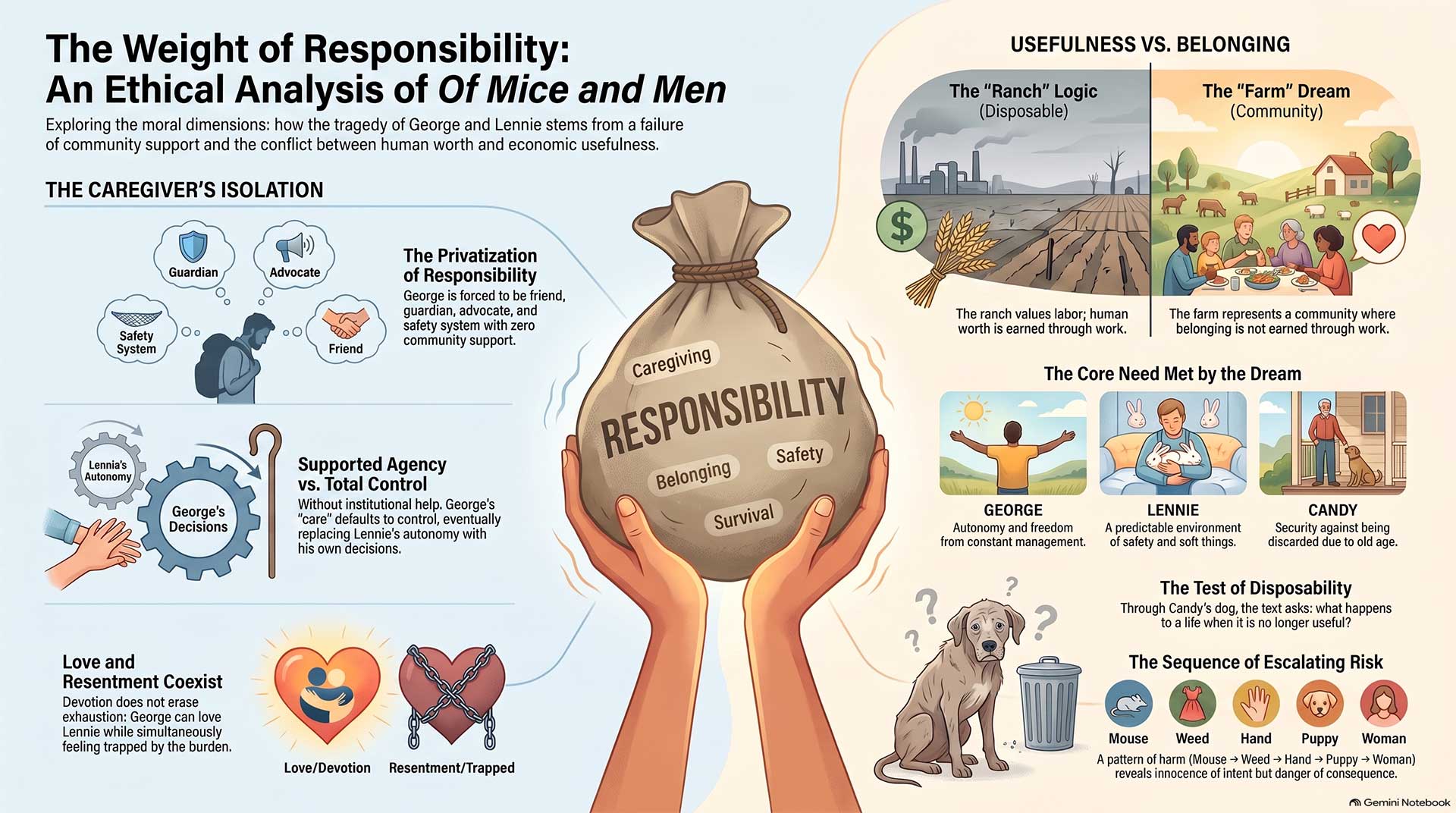
The most famous question about Of Mice and Men is simple:
Was George right to kill Lennie?
After this discussion, that question feels almost too small.
A deeper question is:
What gave George the right to decide?
Lennie never asks to die.
He does not understand what George is planning.
He does not believe his future is over.
Quite the opposite.
George tells him about the farm one final time.
Lennie listens.
The rabbits are still coming.
George will still be there.
Everything Lennie trusts tells him that tomorrow still exists.
Then George shoots him.
There is tenderness in that scene.
There is also violence.
There is protection.
There is also betrayal.
George may save Lennie from Curley’s revenge.
But he uses Lennie’s deepest trust to do it.
Calling the act simply “mercy” removes too much.
Calling George simply a murderer removes too much too.
George believes the remaining possibilities have become unbearable.
That does not mean no other possibilities existed.
Surrender.
Escape.
Custody.
Institutionalization.
Trying to stop Curley.
Each possibility contains uncertainty and potential suffering.
We cannot know what would have happened.
That uncertainty is part of the moral problem.
Candy’s dog makes it harder.
Candy regrets allowing Carlson to kill the animal he loved.
George appears to absorb a lesson from that regret:
If someone you love is going to die, do not leave the final moment to a stranger.
There is something compassionate in that.
But our scholars uncovered a darker possibility.
Perhaps George also absorbs another idea:
The person closest to someone dependent may decide when that person’s life should end.
Those are very different lessons.
Love may give George a duty to stay with Lennie.
It does not automatically give him ownership over Lennie’s future.
And this is where Curley’s wife must remain present.
It would be easy to make the ending entirely about George and Lennie.
She deserves better than that.
She is lonely.
She dreams of another life.
She can be cruel, especially in her racist threat against Crooks.
Her suffering does not excuse that.
Her cruelty does not make her death less tragic.
She initially allows Lennie to touch her hair.
Then she wants him to stop.
Lennie panics.
She becomes frightened.
His overwhelming strength turns panic into death.
Lennie does not intend to kill her.
She is still dead because of his actions.
Those truths must remain together.
That may be one of the greatest lessons Steinbeck gives us.
Mature moral judgment does not always require choosing one truth and destroying another.
Lennie can be innocent in intention and dangerous in consequence.
George can love Lennie and sometimes control him.
Curley’s wife can be oppressed and still use racism against Crooks.
Candy can understand the supposed mercy of killing his dog and still regret surrendering the decision.
The farm can be unrealistic and still give people genuine hope.
George can save Lennie from Curley and betray Lennie at the same time.
And society can fail George without removing George’s responsibility for what he ultimately does.
There may be no single label large enough for the riverbank.
Mercy.
Betrayal.
Love.
Fear.
Violence.
Responsibility.
Desperation.
Grief.
All are there.
That is why Slim and Carlson matter so much at the end.
Carlson sees that the dangerous man is gone.
Problem solved.
Slim sees George.
Something human has been destroyed too.
Understanding George does not require declaring him right.
Judging George does not require refusing him compassion.
Steinbeck leaves us between those positions.
And perhaps that is exactly where he wants us.
The novel begins beside a river with George and Lennie together.
It ends after George has finally received the freedom he once claimed he wanted.
No Lennie to supervise.
No Lennie to rescue.
No Lennie to get them fired.
No Lennie standing between George and an easier life.
But freedom no longer looks like freedom.
It looks like absence.
The farm disappears with Lennie.
Candy will never grow old there.
Crooks will never walk through its door.
Lennie will never tend the rabbits.
George will never tell the story in quite the same way again.
The dream failed as a piece of property.
But perhaps it succeeded briefly as something else.
For a little while, several people who felt disposable pictured themselves living somewhere they would still matter tomorrow.
That may be why losing it hurts so much.
Across our five discussions, one question kept growing larger.
Who cares for the caregiver?
Who decides which lives remain valuable?
Why do people need a future?
Where does responsibility go when someone cannot fully carry it?
Who has authority when safety, autonomy, love, and danger collide?
All of them lead toward one final thought:
Perhaps George’s tragedy was not simply that he made an unbearable decision.
Perhaps the deeper tragedy was that one friendship had been forced to carry responsibilities that friendship alone was never capable of carrying.
Lennie needed more than George.
George needed more than love.
Candy needed somewhere his worth could survive his usefulness.
Crooks needed belonging that racism could not revoke.
Curley’s wife needed a life larger than the identity other people assigned her.
None of them received enough.
By the time George raises Carlson’s gun, the failure has been accumulating for years.
That does not make his decision right.
It does not make it wrong.
It makes the question larger than George.
And perhaps that is why, almost ninety years after Steinbeck wrote Of Mice and Men, readers still argue about that final gunshot.
We are not really asking only what George should have done.
We are asking something about ourselves:
When someone we love needs more than we alone can give, what do we owe them, what do we owe everyone else, and what should the rest of us have done before one frightened person was left to carry that responsibility alone?
Short Bios:
John Steinbeck (1902–1968)
American novelist and Nobel Prize winner whose fiction frequently examined migrant laborers, poverty, loneliness, dignity, friendship, and people living near society’s margins. Of Mice and Men was published in 1937.
Susan Shillinglaw
American Steinbeck scholar whose research and teaching have explored Steinbeck’s fiction, California settings, historical context, characters, and literary legacy. She serves as the conversation’s primary Steinbeck voice.
Arthur Kleinman
Psychiatrist, anthropologist, and Harvard scholar known for his work on caregiving, suffering, illness, and the moral experience of caring for another human being. His perspective helps illuminate George’s years of responsibility for Lennie.
Eva Feder Kittay
American philosopher known for influential work on disability, dependency, caregiving, dignity, equality, and bioethics. Her perspective challenges the assumption that independence determines human worth.
Clare Lawrence
British scholar whose work includes disability and autism research and a modern reconsideration of Lennie’s portrayal in Of Mice and Men. Her perspective helps distinguish disability, agency, dignity, responsibility, and danger without reducing Lennie to a diagnosis.
Julianne Holt-Lunstad
American psychologist and researcher known for major work on social connection, loneliness, isolation, relationships, and health. Her perspective helps reveal why companionship and belonging matter so deeply to George, Lennie, Candy, Crooks, and Curley’s wife.
Mimi Reisel Gladstein
American literary scholar whose work includes Steinbeck studies and feminist literary criticism. Her perspective helps keep Curley’s wife from disappearing beneath George and Lennie’s tragedy and explores gender, identity, exclusion, and power within the novel.
Leave a Reply