
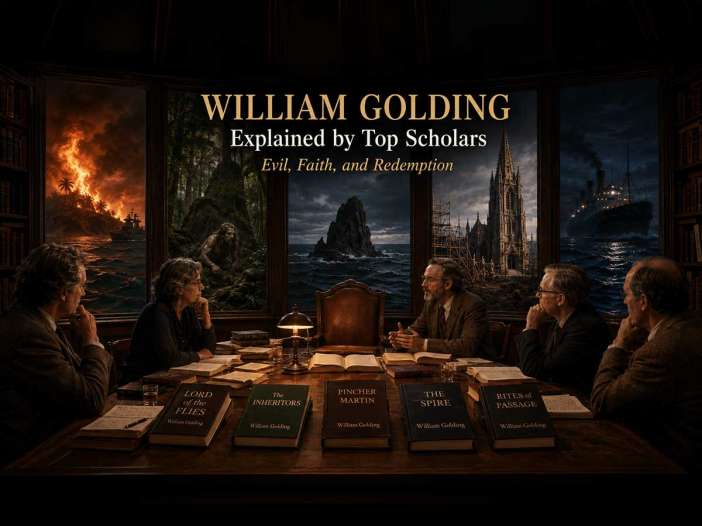
Introduction
What if Lord of the Flies was only the beginning of Golding’s moral argument?
Most readers know William Golding through a single unforgettable image: a group of schoolboys stranded on an island, slowly descending from cooperation into fear, tribalism, and murder.
For generations, Lord of the Flies has been read as a warning about civilization's fragility and humanity's capacity for violence. Its symbols—the conch, the signal fire, the beast, Simon, Piggy's glasses—have become part of literary culture itself.
Yet there is a danger in stopping there.
Golding wrote more than a dozen novels after Lord of the Flies, and each one returned to the same disturbing question from a different direction. The Inheritors asks whether civilization itself may have been built through conquest. Pincher Martin traps readers inside a mind that mistakes survival for virtue. Free Fall explores the mystery of moral freedom. The Spire examines spiritual ambition corrupted by pride. Rites of Passage uncovers cruelty beneath education, class, and respectable manners.
Taken together, these works reveal that Golding was never simply interested in whether people are good or evil.
He wanted to know why intelligent people deceive themselves so easily.
Why fear becomes stronger than truth.
Why groups often destroy the very people who understand them best.
Why civilization can restrain violence one day and organize it the next.
Most of all, he wanted to know whether genuine moral change remains possible after innocence has disappeared.
To explore those questions, five of Golding's most influential interpreters gather for an imaginary scholarly conversation.
John Carey approaches Golding through biography, war, and personal contradiction, arguing that Golding's wartime experiences shattered comforting illusions about civilization while forcing him to confront the darkness within himself.
Virginia Tiger examines Golding psychologically, insisting that self-knowledge alone never saves anyone unless it transforms how we see other people.
Kevin McCarron repeatedly reminds the group that Lord of the Flies is only the doorway into Golding's much larger literary vision, bringing his later novels into every stage of the discussion.
James R. Baker explores Golding through theology, asking whether sin, judgment, sacrifice, and grace still offer language capable of explaining humanity after the catastrophes of the twentieth century.
Philip Redpath focuses on Golding's narrative architecture, showing how readers themselves become participants in the same failures of perception that trap Golding's characters.
Their conversation follows a gradual progression.
They begin by asking whether World War II created Golding's dark view of humanity or merely exposed something civilization had always concealed.
They then confront the meaning of the Beast—not as a simple symbol, but as the human need to locate evil somewhere outside ourselves.
At the emotional center of the discussion stands Simon, whose attempt to bring truth to the frightened boys becomes one of literature's most heartbreaking failures of communication.
From there the scholars leave the island entirely, discovering that Golding spent the rest of his career asking deeper and more difficult questions than many readers ever realize.
By the final discussion, the debate is no longer about evil.
Everyone accepts that human beings are capable of terrible things.
The real question becomes whether redemption is still possible after we lose the comforting belief in our own innocence.
Rather than searching for a single answer, the scholars discover something closer to Golding's own lifelong pursuit:
Not certainty.
Responsibility.
(Note: This is an imaginary conversation, a creative exploration of an idea, and not a real speech or event.)
Topic 1: Did World War II Create Golding’s View of Humanity?
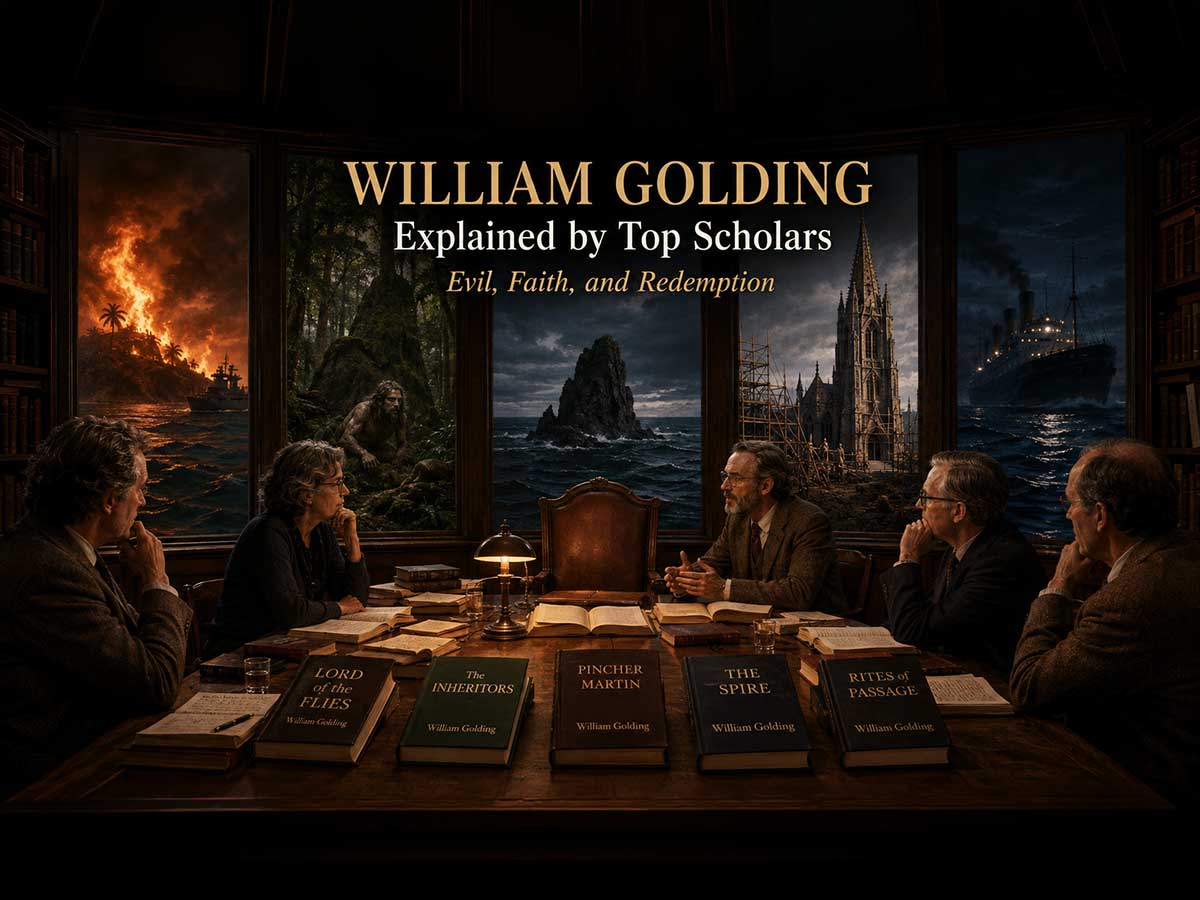
The reading room was dark except for a single lamp above the table.
Five books lay open beneath it.
Lord of the Flies.
The Inheritors.
Pincher Martin.
The Spire.
Rites of Passage.
Beyond the tallest window, a tropical island burned beneath a black sky.
The flames were distant.
The reflection on the glass was not.
John Carey stood with one hand resting on the back of his chair.
James R. Baker sat opposite him, turning a pencil between his fingers.
Virginia Tiger had opened Lord of the Flies to the final page.
Kevin McCarron had already closed his copy.
Philip Redpath watched the window.
No one spoke at first.
Carey broke the silence.
John Carey: People often say that Ralph weeps for lost innocence.
He looked at the open book.
John Carey: I am not certain Golding believed innocence had ever existed.
Baker stopped turning the pencil.
James R. Baker: Then what was lost?
Tiger looked up from the page.
Virginia Tiger: The illusion that innocence belonged to them.
McCarron leaned back.
Kevin McCarron: That is precisely why we should not treat this novel as Golding’s final answer.
Redpath turned from the window.
Philip Redpath: Before we search the later books for an answer, we should ask whether the first book offers a verdict at all.
He looked at Carey.
Philip Redpath: Or whether Golding constructed a trap and waited for readers to call it a conclusion.
Carey sat.
The island fire moved across the window.
No one appeared comfortable beneath its light.
Did War Create Golding’s Darkness?
John Carey: Golding served in the Royal Navy. He witnessed war directly. He saw what educated, organized, supposedly civilized people were capable of doing.
Baker nodded.
James R. Baker: War revealed something.
John Carey: Yes.
James R. Baker: That does not mean war created it.
Carey looked across the table.
John Carey: You would say war confirmed what theology had already named.
James R. Baker: I would say war stripped away flattering language.
Tiger closed the book in front of her.
Virginia Tiger: Both of you are still speaking as though the darkness waited outside him.
Carey frowned.
John Carey: I do not think it did.
Virginia Tiger: Then say it more clearly.
Carey studied her.
Virginia Tiger: Did Golding distrust humanity after the war?
Or did he distrust himself after discovering that he belonged to humanity?
The room went quiet.
McCarron looked toward Carey.
Kevin McCarron: That distinction matters.
Carey nodded slowly.
John Carey: Golding was not writing from the position of a judge standing beyond the crime.
He looked toward the burning island.
John Carey: He was writing as someone who feared he might have carried the same capacities as the people he condemned.
Baker’s voice softened.
James R. Baker: That is already close to confession.
John Carey: Perhaps.
James R. Baker: Not perhaps.
Carey turned.
James R. Baker: Golding’s darkness has force since it is not accusation from a safe distance.
It is participation.
Redpath folded his hands.
Philip Redpath: Yet the structure of Lord of the Flies complicates even that.
The boys do not begin by confessing anything.
They begin by assuming they are different from adults.
Tiger nodded.
Virginia Tiger: They believe the island is a blank space.
Philip Redpath: A place where they can create order without inheriting corruption.
Kevin McCarron: And the reader is invited to believe them.
Philip Redpath: Exactly.
He opened the book again.
Philip Redpath: Golding lets the reader enjoy the fantasy before dismantling it.
The conch.
The election.
The shelters.
The fire.
All the visible signs of moral confidence appear early.
The failure begins beneath them.
Carey looked at him.
John Carey: You are saying the war is already present before any mention of it.
Philip Redpath: I am saying the boys carry the adult world inside them.
The war outside the island is not background.
It is proof that the island is not an exception.
Baker tapped the pencil against the table once.
James R. Baker: Then the island is not a fall from innocence.
It is a smaller repetition of an older fall.
Tiger looked toward him.
Virginia Tiger: That is one reading.
James R. Baker: A necessary one.
Virginia Tiger: Necessary to whom?
Baker’s eyes narrowed.
James R. Baker: To anyone who believes evil cannot be explained merely as social malfunction.
Tiger leaned forward.
Virginia Tiger: I do not reduce it to malfunction.
I question whether naming it “sin” explains more than naming it “shadow.”
James R. Baker: It names responsibility.
Virginia Tiger: Only when the word is still alive.
The pencil stopped.
Carey watched them both.
Virginia Tiger: After mechanized war, after camps, after cities destroyed from the air, religious language can become either morally piercing or morally numb.
James R. Baker: I agree.
Tiger seemed surprised.
James R. Baker: The question is not whether old language survives untouched.
It does not.
The question is whether humanity’s ability to destroy one another makes the language of fall less true—or more difficult to evade.
McCarron opened The Inheritors.
Kevin McCarron: Yet Golding does not answer that question through one symbolic island alone.
He looks at them all.
Kevin McCarron: In The Inheritors, violence enters through a collision of peoples.
In Pincher Martin, the enemy is the self refusing extinction.
In The Spire, obsession clothes itself as divine calling.
In Rites of Passage, cruelty appears inside manners, class, and social ritual.
He pushed the books slightly forward.
Kevin McCarron: War matters.
But war becomes one manifestation of a deeper pattern.
Carey nodded.
John Carey: The pattern being self-deception.
Kevin McCarron: Yes.
Virginia Tiger: And failed perception.
James R. Baker: And sin.
Philip Redpath: And form.
Everyone turned toward him.
Philip Redpath: Golding does not merely describe self-deception.
He makes the reader inhabit it.
That is why his work resists simple diagnosis.
The fire outside the window flared.
For a moment, each scholar’s face reflected in the glass beside the island.
Are the Boys Different From the Adults?
John Carey: Readers often focus on the absence of adults.
Yet the novel never permits us to forget the adult war.
James R. Baker: The naval officer arrives from a world no less violent than the island.
Kevin McCarron: More violent.
The boys have spears.
The adults have warships.
Tiger looked at the final page again.
Virginia Tiger: The officer sees painted children and feels embarrassed for them.
That embarrassment matters.
Philip Redpath: He recognizes disorder.
He does not recognize resemblance.
Carey pointed toward the window.
John Carey: He asks whether British boys could not have made a better show of it.
James R. Baker: Which is an extraordinary moral blindness.
He stands before a burning island while serving in a global war and still imagines civilization as a British possession.
Virginia Tiger: His uniform protects him from seeing himself.
Philip Redpath: As the conch once protected Ralph from seeing the fragility of his authority.
Kevin McCarron: As Jack’s paint protected him from shame.
John Carey: As Piggy’s reason protected him from fear.
The comparisons settled over the table.
Baker looked at Carey.
James R. Baker: Then war does not create the novel’s moral vision.
It reveals the scale of the same blindness.
John Carey: That is fair.
Virginia Tiger: Not entirely.
Carey turned.
Virginia Tiger: War may not create the human capacity Golding fears.
It changes his confidence in the institutions meant to restrain it.
John Carey: Explain.
Virginia Tiger: The boys do not descend into violence after education fails.
They bring education with them.
Choir discipline.
School hierarchy.
National pride.
Rules of speech.
Ideas of leadership.
They are not untouched creatures.
They are products of civilization.
Philip Redpath: Which means the novel does not ask whether society can civilize the natural child.
It asks what civilization has actually taught him.
McCarron nodded.
Kevin McCarron: Competition.
Status.
Obedience.
Humiliation.
James R. Baker: Yet it taught conscience too.
Simon did not invent compassion on the island.
Piggy did not invent reason.
Ralph did not invent duty.
Virginia Tiger: True.
James R. Baker: Then civilization carries both restraint and corruption.
Tiger looked at him.
Virginia Tiger: Which makes the adult world neither cure nor cause.
Baker nodded once.
James R. Baker: A vessel.
Redpath leaned back.
Philip Redpath: That may be the more frightening possibility.
Everyone waited.
Philip Redpath: Civilization does not remove darkness.
It gives darkness language, ceremony, rank, and machinery.
Carey looked toward the naval ship beyond the window.
John Carey: That line belongs at the center of the novel.
Philip Redpath: It is already there.
The officer simply does not know he is carrying it.
Was Golding Accusing Humanity—or Confessing Membership in It?
Carey’s face changed.
The discussion had reached him before he intended it to.
John Carey: There is a danger in speaking about Golding as though war turned him into a prophet of darkness.
Kevin McCarron: Since prophets enjoy distance.
John Carey: Exactly.
He folded his hands.
John Carey: Golding’s power comes from discomfort with his own motives.
He could be vain.
Cruel.
Jealous.
Self-dramatizing.
Ashamed.
He did not present himself as morally clean.
Baker watched him carefully.
James R. Baker: Does biography deepen the work here?
Or tempt us to explain it away?
Carey did not answer at once.
John Carey: Both dangers exist.
He looked at the open books.
John Carey: A critic can turn every symbol into a disguised diary entry.
That would flatten the fiction.
Yet ignoring the author’s own moral fear would flatten it too.
Tiger rested one hand on Lord of the Flies.
Virginia Tiger: Golding understood self-deception from inside.
That matters more than identifying which character resembles him.
John Carey: Yes.
Virginia Tiger: He knew that confession can become performance.
That guilt can become vanity.
That a person can condemn his own darkness and still remain fascinated by it.
Carey’s eyes stayed on her.
John Carey: You think his guilt was not always morally productive.
Virginia Tiger: No guilt is automatically productive.
It can deepen responsibility.
It can deepen self-absorption.
Baker set the pencil down.
James R. Baker: That is why confession alone is insufficient.
Tiger almost smiled.
Virginia Tiger: Here we agree.
James R. Baker: I suspected we might.
Kevin McCarron: For three minutes.
They laughed softly.
The laughter did not last.
Redpath opened Pincher Martin.
Philip Redpath: Golding repeatedly creates characters who mistake persistence for virtue.
They cling to identity.
To command.
To vision.
To survival.
The reader may initially admire them.
Then the narrative turns.
John Carey: And reveals that what looked like endurance may be refusal.
Philip Redpath: Refusal to surrender illusion.
Refusal to see others.
Refusal to accept limits.
Virginia Tiger: Refusal to die to the self one has invented.
Baker looked toward her.
James R. Baker: You are speaking theologically again.
Virginia Tiger: Perhaps theology stole the language from psychology first.
McCarron shook his head.
Kevin McCarron: Golding would have enjoyed this.
John Carey: Or hated it.
Philip Redpath: Likely both.
Carey looked toward the empty space beyond the table.
There was no chair there.
The absence felt intentional.
John Carey: I keep returning to one question.
No one interrupted.
John Carey: When Golding wrote the boys into that final collapse, was he accusing humanity?
Or was he confessing that no one has the right to stand outside the circle?
Baker answered first.
James R. Baker: Confessing.
Tiger followed.
Virginia Tiger: Exposing.
McCarron considered.
Kevin McCarron: Beginning.
Carey looked at him.
Kevin McCarron: He had not yet asked every question.
Lord of the Flies is the beginning of the inquiry, not its completion.
Redpath’s voice was quieter.
Philip Redpath: And perhaps trapping.
John Carey: Trapping whom?
Philip Redpath: The reader who finishes the novel thinking, “Yes, people are terrible.”
He looked at each of them.
Philip Redpath: That judgment can become another form of innocence.
The room went still.
Philip Redpath: It lets the reader condemn humanity in the abstract without identifying the moment he himself joins the chant.
Tiger looked down.
Baker’s eyes moved toward the burning window.
McCarron closed the book in front of him.
Carey whispered:
John Carey: Then pessimism can become self-protection.
Philip Redpath: Yes.
James R. Baker: Since despair asks less of us than repentance.
Tiger turned toward Baker.
This time, she did not challenge him.
Did Golding Lose Faith in Humanity—or in Human Self-Description?
The fire outside had begun to dim.
Smoke covered part of the island.
Carey rose and walked toward the window.
John Carey: Perhaps we have phrased the question wrongly.
The others waited.
John Carey: Perhaps Golding did not lose faith in humanity.
Perhaps he lost faith in humanity’s description of itself.
Kevin McCarron: Civilized.
Virginia Tiger: Rational.
James R. Baker: Innocent.
Philip Redpath: Perceptive.
Carey nodded.
John Carey: Good.
The word sounded fragile.
John Carey: He distrusted the ease with which people claim goodness before being tested.
Baker stood.
James R. Baker: Yet the novel contains good acts.
Simon helps.
Piggy thinks.
Ralph remembers the fire.
The twins resist for a time.
Virginia Tiger: Goodness exists.
It simply does not belong permanently to anyone.
Baker looked at her.
Virginia Tiger: It must be chosen again.
Kevin McCarron: Which becomes clearer in the later work.
Philip Redpath: And harder.
Carey turned from the window.
John Carey: Then war did not teach Golding that people are monsters.
James R. Baker: No.
Virginia Tiger: It taught him that monsters are one of the stories people use to place evil elsewhere.
Philip Redpath: On an enemy.
A tribe.
A nation.
A beast.
Kevin McCarron: Or one famous novel.
They looked at him.
Kevin McCarron: Readers place all of Golding’s darkness inside Lord of the Flies.
Then they leave the rest of his work unread.
Carey returned to the table.
John Carey: You believe we have already mistaken the island for the whole map.
Kevin McCarron: We have done exactly what Golding’s characters do.
We found one visible shape and called it the beast.
Redpath’s eyes sharpened.
Philip Redpath: That should disturb us.
Virginia Tiger: It does.
Baker picked up the pencil again.
He did not turn it this time.
James R. Baker: Then our next question cannot be merely what the beast symbolizes.
John Carey: No.
James R. Baker: We must ask why readers need it to be a symbol at all.
The lamp above the table flickered.
Outside the window, the burning island faded.
In its place, something darker appeared among the trees.
Not a creature.
Only a shape the eye could not yet identify.
Tiger opened the book again.
Virginia Tiger: There it is.
Kevin McCarron: What?
She looked toward the glass.
Virginia Tiger: The need to name what frightens us before we have understood it.
Redpath closed his notebook.
Philip Redpath: Then Topic 2 has already begun.
No one left the table.
Topic 2: Is Golding’s Beast Original Sin, Psychology, or Social Fear?
The shape beyond the window did not move.
That made it worse.
It hung between the trees where the island had been, half hidden by smoke and darkness. No claws. No eyes. No body anyone could name.
Only the outline of something waiting to be interpreted.
Virginia Tiger stood first.
She walked toward the glass and studied it.
Virginia Tiger: The mind hates an unfinished shape.
James R. Baker: It hates uncertainty.
Philip Redpath: More than evil?
Tiger glanced back.
Virginia Tiger: Often.
She lifted one hand toward the shadow.
Virginia Tiger: Evil can be named. Uncertainty must be endured.
John Carey: Golding’s boys do not endure it.
Kevin McCarron: Neither do most readers.
Baker closed the copy of Lord of the Flies before him.
James R. Baker: Let us begin plainly.
The beast is real.
Tiger turned.
Virginia Tiger: In what sense?
James R. Baker: In the sense Simon discovers.
It does not live in the forest.
It lives in them.
Virginia Tiger: That does not answer my question.
James R. Baker: It answers the necessary one.
Tiger walked back to the table.
Virginia Tiger: No, it gives the darkness a theological name.
James R. Baker: You prefer a psychological one.
Virginia Tiger: I prefer not to mistake naming for explanation.
Redpath leaned forward.
Philip Redpath: That may be our first trap.
The novel invites us to ask what the beast represents.
Perhaps the more difficult question is why we are so eager to turn it into one thing.
McCarron opened The Inheritors.
Kevin McCarron: Golding rarely permits one answer to remain clean.
The beast may be sin.
Fear.
Aggression.
Projection.
Political invention.
The hunger for belonging.
The wish to surrender responsibility.
John Carey: And Golding’s own distrust of himself.
Baker looked at Carey.
James R. Baker: You keep returning to biography.
John Carey: Golding kept returning to guilt.
James R. Baker: Guilt is not biography alone.
John Carey: I did not say it was.
The shadow outside seemed to deepen.
No one looked away from it for long.
Is the Beast Original Sin?
Baker placed both hands on the table.
James R. Baker: The religious structure is difficult to ignore.
The island resembles a fallen Eden.
The boys arrive in apparent freedom.
They create order.
They violate it.
They turn fear into ritual.
Simon enters the wilderness alone, confronts the truth, returns with revelation, and is killed.
The pig’s head carries the language of demonic temptation.
The title itself invokes Beelzebub.
Tiger listened without interrupting.
James R. Baker: Golding is not writing a church lesson.
Yet the novel draws deeply from the idea that evil is not imported into humanity.
It is already present.
Virginia Tiger: Present as what?
James R. Baker: A damaged condition.
Virginia Tiger: That phrase moves too quickly.
James R. Baker: Toward what?
Virginia Tiger: Toward universality.
Baker’s expression tightened.
Virginia Tiger: Once you say all are fallen, you gain moral seriousness.
You may lose difference.
Jack is not Ralph.
Roger is not Simon.
Piggy is not the naval officer.
If darkness exists in everyone, what explains why some feed it, some resist it, and some die trying to expose it?
Baker answered without hesitation.
James R. Baker: Choice.
Tiger held his gaze.
Virginia Tiger: Then the condition does not explain the choice.
James R. Baker: It explains why the choice exists.
Virginia Tiger: No.
It explains why temptation exists.
It does not explain why Roger smiles when another person suffers.
Carey looked toward Baker.
John Carey: She has a point.
James R. Baker: I know she does.
Tiger seemed surprised again.
Baker continued.
James R. Baker: Original sin is often caricatured as a claim that everyone behaves identically.
It is not.
It is a claim that no one stands outside moral danger.
Philip Redpath: Which is close to the novel’s structural argument.
James R. Baker: Yes.
Philip Redpath: Yet structure may be more precise.
The novel does not tell us every boy is equally violent.
It shows every claim to innocence becoming unstable.
Baker nodded.
Philip Redpath: Ralph wants rescue and status.
Piggy wants reason and vindication.
Jack wants leadership and domination.
Roger wants permission.
Simon wants truth, yet cannot make others receive it.
Each carries a different failure.
Virginia Tiger: Then perhaps the beast is not one impulse.
It is the mind’s ability to convert fear, shame, desire, and injury into permission.
McCarron looked up.
Kevin McCarron: That sounds closer to Golding across the later novels.
James R. Baker: And farther from grace.
Tiger turned toward him.
Virginia Tiger: We have not reached grace.
James R. Baker: You often speak as though we never will.
The room became still.
Tiger’s face changed.
The remark had touched something beyond argument.
Virginia Tiger: Perhaps I distrust any grace that arrives too quickly.
Baker softened.
James R. Baker: So do I.
The tension eased, but did not disappear.
Is the Beast the Psychological Shadow?
Tiger opened the book to Simon’s encounter with the pig’s head.
Virginia Tiger: Simon does not discover a doctrine.
He experiences a collapse of separation.
The beast is not there.
The beast is not elsewhere.
It is part of him.
Part of them.
Part of the human mind that creates a monster so it will not have to examine itself.
Carey nodded.
John Carey: Golding’s own life gives that reading weight.
He knew the temptation to imagine one’s worst impulses as something alien.
Kevin McCarron: Pincher Martin depends on a similar refusal.
A man clings to the identity he has made and cannot surrender the self that torments him.
Virginia Tiger: Exactly.
Golding’s characters often confuse survival with moral worth.
They think persistence proves goodness.
It may prove only attachment.
James R. Baker: Attachment to self.
Virginia Tiger: Yes.
James R. Baker: Which is theological language again.
Tiger sighed.
Virginia Tiger: You are enjoying this too much.
James R. Baker: A little.
Redpath opened his notebook.
Philip Redpath: The psychological reading becomes strongest when we examine sequence.
The boys first fear a beast.
Then they describe it.
Then they search for it.
Then Jack promises protection from it.
Then the group creates rituals around it.
Then Simon identifies it within them.
The beast grows through interpretation.
John Carey: Fear supplies the energy.
Philip Redpath: Narrative supplies the body.
Kevin McCarron: Leadership supplies the target.
Virginia Tiger: Shame supplies the need.
Baker looked around the table.
James R. Baker: And sin supplies the possibility.
Tiger almost objected.
She stopped herself.
Virginia Tiger: Let me ask a different question.
Why does Simon understand what the others cannot?
James R. Baker: Spiritual perception.
John Carey: Temperament.
Kevin McCarron: Isolation.
Philip Redpath: Narrative position.
Tiger looked at each of them.
Virginia Tiger: Or suffering.
They went quiet.
Virginia Tiger: Simon is physically vulnerable.
He faints.
He withdraws.
He helps children who cannot reward him.
He stands near fear without needing to dominate it.
His weakness may let him see what stronger boys avoid.
Baker watched her carefully.
James R. Baker: You are moving toward sanctity.
Virginia Tiger: No.
Toward attention.
James R. Baker: Are they so different?
Tiger’s voice softened.
Virginia Tiger: Sometimes.
Sometimes not.
Outside, the shadow between the trees seemed to shrink.
Not since it had changed.
Since the scholars had begun seeing the space around it.
Does Society Create the Beast?
Carey returned to his chair.
John Carey: We should be careful not to make the beast too private.
Golding had lived through organized violence.
War is not merely many individual shadows happening at once.
It depends on institutions.
Commands.
Uniforms.
Stories.
Enemies.
Kevin McCarron: Jack understands that instinctively.
John Carey: Yes.
He does not invent fear.
He organizes it.
Philip Redpath: He gives fear procedure.
Virginia Tiger: And belonging.
James R. Baker: And sacrifice.
Carey looked toward the window.
John Carey: The boys become dangerous when fear stops being a private feeling and becomes a public system.
Kevin McCarron: A tribe.
John Carey: More than a tribe.
A moral arrangement.
Jack decides who is protected.
Who is fed.
Who is outside.
Who can be punished.
Who may speak.
Philip Redpath: The beast becomes politically useful.
Virginia Tiger: That does not make it unreal.
Philip Redpath: No.
It makes unreality effective.
Baker leaned back.
James R. Baker: That is one of the novel’s deepest insights.
A false object can organize real violence.
McCarron closed The Inheritors and opened Rites of Passage.
Kevin McCarron: Golding returns to this pattern in more civilized settings.
People do not require painted faces to humiliate someone.
They can use manners.
Class.
Language.
Custom.
A dining table.
A ship.
John Carey: Which makes the schoolboy island misleading if read too literally.
Kevin McCarron: Precisely.
The island strips the pattern bare.
Later novels dress it again.
Virginia Tiger: The beast learns etiquette.
No one laughed.
The line was too accurate.
Philip Redpath: Then society does not merely restrain evil.
It can arrange it.
James R. Baker: Yet society can restrain it too.
John Carey: Sometimes.
James R. Baker: That hesitation matters.
Carey faced him.
James R. Baker: We speak easily about institutions failing.
Less easily about institutions protecting.
Law.
Memory.
Education.
Ritual.
Community.
These can feed violence.
They can prevent it.
Virginia Tiger: Only when the people inside them keep seeing one another.
Philip Redpath: Which returns us to perception.
Kevin McCarron: And responsibility.
Baker nodded.
James R. Baker: And sin.
Tiger looked at him.
Virginia Tiger: You were waiting.
James R. Baker: Patiently.
Is Roger More Frightening Than Jack?
The shadow outside shifted at last.
A second shape appeared beside it.
One seemed larger.
The other stiller.
Carey noticed first.
John Carey: Jack and Roger.
Redpath looked through the glass.
Philip Redpath: Or leadership and appetite.
McCarron closed the book.
Kevin McCarron: Jack needs witnesses.
Roger does not.
Tiger stood again.
Virginia Tiger: Jack’s violence serves identity.
Roger’s violence serves sensation.
James R. Baker: Roger still needs the collapse of restraint.
Virginia Tiger: At first.
John Carey: He throws stones near Henry and intentionally misses.
The old world remains in his arm.
Parents.
Teachers.
Police.
Punishment.
Philip Redpath: The most revealing word is “near.”
He wants the act and the boundary at once.
Kevin McCarron: Later, he no longer needs the boundary.
James R. Baker: Which supports the claim that civilization restrains.
Virginia Tiger: It supports the claim that external restraint can fail.
It does not prove inner conscience was ever formed.
Baker considered that.
John Carey: Roger frightens readers since he resists explanation.
Jack can be traced through humiliation, ambition, hunger for status.
Roger seems to move toward cruelty with fewer stories.
Philip Redpath: That may be another trap.
John Carey: Explain.
Philip Redpath: Readers prefer Roger to be inexplicable.
Then he becomes the exceptional monster.
Virginia Tiger: The place where darkness can be safely stored.
James R. Baker: Yet some people are more cruel than others.
We should not erase that.
Philip Redpath: I agree.
The trap is not recognizing difference.
The trap is using difference to restore our innocence.
McCarron looked toward the two shadows.
Kevin McCarron: Jack says, “Follow me.”
Roger asks, “What can I do once no one stops me?”
John Carey: Which is more dangerous?
Virginia Tiger: Together?
Far more than either alone.
The answer hung over the table.
Baker spoke slowly.
James R. Baker: Leadership without conscience recruits appetite.
Appetite without leadership remains scattered.
Philip Redpath: Fear binds them.
Kevin McCarron: Ritual normalizes them.
John Carey: Shame silences opposition.
Virginia Tiger: And the victim becomes the explanation.
They all knew where the conversation had gone.
Simon.
Why Must the Beast Have a Body?
Tiger looked toward the open page.
Virginia Tiger: Simon learns that the beast has no body.
Then the group gives it his.
No one answered.
John Carey: That may be the cruelest turn in the novel.
James R. Baker: He brings truth and becomes the object of the lie.
Philip Redpath: Since the group cannot preserve the ritual without a target.
Kevin McCarron: Fear becomes unstable when it remains abstract.
A body steadies it.
Virginia Tiger: A face.
A name.
A shape everyone can strike.
Carey’s expression darkened.
John Carey: That is where the war context returns.
A nation creates an enemy image.
A group creates a beast.
The act becomes possible after the person disappears beneath the category.
Baker looked down.
James R. Baker: Sin becomes easiest when the victim no longer appears human.
Tiger looked at him.
She did not object to the word this time.
Virginia Tiger: Psychology says something similar.
Projection allows the group to place its disowned fear inside another person.
Then destroying that person feels like purification.
Philip Redpath: The narrative forces the reader to know Simon before the crowd fails to know him.
Kevin McCarron: Which makes the reader’s helplessness part of the design.
John Carey: We see.
They do not.
Philip Redpath: Yet seeing from outside is easy.
Golding’s harsher question is whether we would see from inside the circle.
The shadow beyond the window disappeared.
The scholars stared at the empty space where it had been.
The absence offered no relief.
Why Do Readers Need the Beast to Mean One Thing?
Redpath turned back to the table.
Philip Redpath: We have named it five times.
Sin.
Shadow.
Fear.
Politics.
Aggression.
Have we understood it?
James R. Baker: More than when we began.
Virginia Tiger: Or protected ourselves with better vocabulary.
Baker looked at her.
Virginia Tiger: Scholars can do what the boys do.
We can build a circle of concepts and chant until uncertainty disappears.
Carey gave a weary smile.
John Carey: That accusation includes you.
Virginia Tiger: Of course.
Kevin McCarron: Which concept is your chant?
Tiger considered.
Virginia Tiger: Discovery.
She looked toward the books.
Virginia Tiger: I have spent years believing that Golding’s characters reach terrible truth through self-discovery.
Yet discovery can become another flattering word.
It can make pain sound productive.
Sometimes people see and do not change.
Sometimes knowledge arrives and merely increases suffering.
Baker’s face softened.
James R. Baker: That is the question beneath your work.
Tiger nodded.
Virginia Tiger: Yes.
John Carey: Does self-knowledge save?
Virginia Tiger: I do not know.
The admission changed the room.
McCarron looked at Baker.
Kevin McCarron: Your word?
Baker held the pencil again.
James R. Baker: Sin.
He rolled it between his fingers.
James R. Baker: It can awaken responsibility.
It can become a total explanation that prevents attention to history, trauma, politics, and difference.
Carey looked at McCarron.
John Carey: Yours?
Kevin McCarron: Career.
He glanced at the seven Golding novels around them.
Kevin McCarron: I keep trying to rescue Golding from one book.
Perhaps I sometimes use the later work to avoid the frightening clarity of the first.
Redpath looked at Carey.
Philip Redpath: Biography?
Carey nodded.
John Carey: Biography gives contradiction flesh.
It can tempt me to treat the life as the master key.
No life is that neat.
Tiger turned to Redpath.
Virginia Tiger: Structure?
He looked down at his notebook.
Philip Redpath: Structure can show how a reader is guided into error.
It can make suffering sound like an elegant device.
Simon’s death is not merely a reversal.
Piggy’s death is not merely formal closure.
The people inside form remain people.
No one spoke for several moments.
The scholars had stopped interpreting Golding.
They were examining the habits they brought to him.
The Question Beneath Every Interpretation
The lamp above the table dimmed.
Outside the windows, the island was gone.
The forest remained.
The sea remained.
The darkness remained.
Baker broke the silence.
James R. Baker: Perhaps the beast is what enters when a person refuses responsibility for what he fears.
Tiger looked at him.
Virginia Tiger: That is close.
John Carey: Too close to one answer?
Philip Redpath: Every answer should remain incomplete.
Kevin McCarron: Incomplete does not mean useless.
Redpath nodded.
Philip Redpath: No.
It means answerable to what it leaves out.
Tiger rested her hand on Simon’s final scene.
Virginia Tiger: The beast may be inherited vulnerability.
Private aggression.
Collective fear.
Political invention.
Spiritual corruption.
It becomes lethal when these find one another.
James R. Baker: And when conscience fails.
John Carey: Or is silenced.
Kevin McCarron: Or has never been allowed to mature.
Philip Redpath: Or recognizes the truth too late.
Tiger looked at him.
Virginia Tiger: Simon recognizes it.
Philip Redpath: Yes.
Virginia Tiger: It does not save him.
The room grew colder.
Baker looked at the page.
James R. Baker: Perhaps truth alone was never the promise.
Virginia Tiger: Then what was?
Baker did not answer.
Carey looked from one scholar to another.
John Carey: That is our next subject.
McCarron opened the book to Simon’s death.
Kevin McCarron: The boy who sees what no one else sees.
Philip Redpath: The messenger who returns.
Virginia Tiger: The truth that arrives too late.
Baker’s voice was almost a whisper.
James R. Baker: And the possibility that sacrifice reveals without redeeming.
The lamp flickered again.
Through the central window, rain began to fall.
A lone figure appeared beyond the glass, descending from the mountain with something pale in his hands.
No one mistook him for a beast.
Not yet.
Topic 3: Is Simon a Savior, a Mystic, or a Failed Messenger?
Rain moved across the central window in silver lines.
The lone figure continued descending from the mountain.
He held a pale piece of fabric in both hands.
Behind him, something hung among the trees.
A parachute.
A body.
A truth without a voice.
Virginia Tiger rose first.
She walked to the window and placed her palm against the glass.
Virginia Tiger: He already knows they may not listen.
James R. Baker looked toward her.
James R. Baker: Yet he goes.
Virginia Tiger: Is that faith?
James R. Baker: It may be.
Philip Redpath: Or narrative necessity.
Baker turned sharply.
James R. Baker: Must you reduce every act to structure?
Redpath did not react.
Philip Redpath: No.
I ask what the structure makes the act mean.
Kevin McCarron opened Darkness Visible beside Lord of the Flies.
Kevin McCarron: Simon is not Golding’s last visionary figure.
He is the first one most readers meet.
John Carey remained seated.
His eyes followed the figure beyond the glass.
John Carey: He may be the first figure readers mourn without fully knowing.
Tiger looked back.
Virginia Tiger: That may be the point.
John Carey: Explain.
Virginia Tiger: Simon sees everyone.
Very few people see Simon.
The room grew quiet.
The rain struck harder.
The figure outside slipped on the mountain path, caught himself, then kept walking.
Is Simon a Christ Figure?
Baker opened the novel to the clearing where Simon confronts the pig’s head.
James R. Baker: The Christian parallels are too strong to dismiss.
Simon withdraws into solitude.
He confronts a demonic presence.
He learns the truth.
He returns to the group.
He is killed by those he comes to save.
After death, his body is carried out to sea in luminous imagery.
Tiger sat across from him.
Virginia Tiger: Yet there is no resurrection.
James R. Baker: Not every Christ figure requires literal resurrection.
Virginia Tiger: There is no conversion either.
No one understands his death.
Ralph and Piggy evade responsibility.
Jack continues.
Roger becomes worse.
What has the sacrifice changed?
Baker held her gaze.
James R. Baker: It reveals.
Virginia Tiger: To whom?
Baker paused.
Redpath answered.
Philip Redpath: To the reader.
They turned toward him.
Philip Redpath: Simon’s death changes the reader’s relation to the island.
Before that scene, disorder can still seem reversible.
After it, the moral condition becomes undeniable.
Virginia Tiger: Then Simon dies to educate us?
Philip Redpath: I did not say that.
Virginia Tiger: It sounds close.
Redpath closed his notebook.
Philip Redpath: This is the danger of structural language.
I admit it.
He looked toward the window.
Philip Redpath: Simon is not a device first.
He is a boy carrying truth into a crowd that has turned fear into ritual.
The structure intensifies the human loss.
It does not replace it.
Baker nodded.
James R. Baker: His death reveals the crowd.
John Carey: And Ralph.
Kevin McCarron: And Piggy.
Virginia Tiger: And the limits of truth.
Baker looked at her.
James R. Baker: You keep returning to failure.
Virginia Tiger: Simon returns with the truth.
He is killed.
What word would you use?
James R. Baker: Witness.
Tiger’s expression changed.
Virginia Tiger: Witness without rescue?
James R. Baker: Yes.
Virginia Tiger: Then your reading is darker than mine.
Baker looked down at the page.
James R. Baker: Perhaps it is.
The admission surprised everyone.
Does Simon Save Anyone?
Carey leaned forward.
John Carey: Simon helps the littluns.
That matters.
He gives them fruit.
He works on the shelters.
He recognizes fear without mocking it.
We should not define his goodness only through death.
Tiger nodded.
Virginia Tiger: Yes.
His moral life exists before the symbolic climax.
Kevin McCarron: Which separates him from a purely allegorical figure.
He does not announce himself.
He does not seek disciples.
He does not ask for authority.
Philip Redpath: He acts where no one is watching.
Baker looked toward the rain.
James R. Baker: That may be the closest the novel comes to grace.
Tiger studied him.
Virginia Tiger: Small acts?
James R. Baker: Unrewarded attention.
Carey’s eyes moved toward the open book.
John Carey: Simon does what Ralph cannot.
He stays near frightened children without demanding that their fear become rational first.
Virginia Tiger: He sees need before failure.
Kevin McCarron: Yet he cannot translate that way of seeing into public speech.
Philip Redpath: The conch belongs to debate.
Simon belongs to perception.
James R. Baker: And prophecy.
Tiger looked at him.
Virginia Tiger: Prophets speak.
Simon struggles.
James R. Baker: Prophets often struggle.
Virginia Tiger: He faints.
He hesitates.
He cannot make the group receive what he knows.
James R. Baker: None of that disqualifies him.
Virginia Tiger: I am not disqualifying him.
I am resisting the temptation to make weakness ornamental.
The rain blurred the figure outside.
For a moment, Simon vanished.
Carey stood.
John Carey: That is worth staying with.
He walked closer to the window.
John Carey: Readers often make Simon’s frailty beautiful.
His fainting.
His solitude.
His death.
Beauty can protect us from the terror of what happens to a vulnerable child.
No one answered.
Carey looked back.
John Carey: What if Simon is not moving since he is saintly?
What if he is moving since no one else will?
Baker’s voice softened.
James R. Baker: Those are not mutually exclusive.
John Carey: No.
Yet one reading can make his death feel destined.
The other makes it preventable.
The distinction settled over the table.
Tiger looked down.
Virginia Tiger: Preventable is harder.
Philip Redpath: Since destiny excuses the crowd.
Kevin McCarron: And perhaps the author.
Baker’s eyes narrowed.
James R. Baker: Are you accusing Golding of arranging a sacrifice too neatly?
Kevin McCarron: I am asking whether the symbolic force risks consuming Simon as a person.
James R. Baker: The novel mourns him.
Virginia Tiger: The prose mourns him.
The boys do not.
That difference matters.
Is Simon a Mystic?
The figure outside emerged again beneath a flash of lightning.
He had reached the lower path.
The pale fabric clung to his hands.
Tiger returned to her chair.
Virginia Tiger: Simon’s encounter with the pig’s head is not a theological lecture.
It is bodily.
Heat.
Faintness.
Flies.
Blood.
Terror.
The voice comes from within and outside him at once.
Philip Redpath: A collapse of boundaries.
Virginia Tiger: Yes.
Mystical experience often dissolves ordinary separation.
Here, the dissolution is horrifying.
Simon learns that the thing he fears is not elsewhere.
James R. Baker: The demonic speaks truth.
John Carey: Or Simon’s mind speaks in the form he can bear.
Kevin McCarron: Barely bear.
Tiger nodded.
Virginia Tiger: The scene is a revelation without comfort.
James R. Baker: Most true revelations are not comfortable.
Tiger looked toward him.
Virginia Tiger: You keep defending revelation.
James R. Baker: You keep treating discomfort as proof against it.
Virginia Tiger: I do not.
I question what revelation does when it remains private.
Baker sat back.
Virginia Tiger: Simon knows the beast is within them.
The group does not.
He discovers the dead parachutist.
The group does not.
He returns with truth.
The group kills him.
What kind of knowledge cannot cross the distance between one person and many?
Philip Redpath: Knowledge without shared language.
John Carey: Truth without trust.
Kevin McCarron: Insight without social position.
James R. Baker: Prophecy without repentance.
Tiger looked at each of them.
Virginia Tiger: Then truth alone is powerless.
Baker answered at once.
James R. Baker: No.
Truth alone is costly.
Virginia Tiger: That is not the same.
James R. Baker: I know.
They stared at one another.
The rain continued.
Why Can Simon See What the Others Cannot?
McCarron pushed The Inheritors into the center of the table.
Kevin McCarron: Golding repeatedly gives perception to figures without social authority.
The innocent.
The marginal.
The ridiculed.
The spiritually wounded.
He looked toward Simon beyond the glass.
Kevin McCarron: Vision does not belong to leadership in these novels.
John Carey: Leadership often blocks it.
Philip Redpath: Since leaders must preserve a story.
Virginia Tiger: Simon has no story to protect.
James R. Baker: He has no rank to defend.
Kevin McCarron: No tribe to maintain.
John Carey: No image of himself as chief.
Virginia Tiger: No need to be right in public.
They grew quiet.
Redpath opened the novel again.
Philip Redpath: The others ask, “What is the beast?”
Simon senses that the question is wrong.
James R. Baker: Since the beast is not an object.
Virginia Tiger: It is a relation.
Everyone looked toward her.
Virginia Tiger: A relation between fear and denial.
Between shame and projection.
Between group need and chosen victim.
Simon sees the pattern before he can explain it.
John Carey: Then his insight is pre-verbal.
Philip Redpath: Which makes his return to the group more tragic.
The truth has not yet become language strong enough to survive the circle.
Baker looked troubled.
James R. Baker: Are you saying he fails as a messenger?
Philip Redpath: I am saying the message fails in transmission.
Virginia Tiger: That still leaves the question.
Did Simon fail?
Baker answered.
James R. Baker: No.
Virginia Tiger: Why not?
James R. Baker: Success cannot be the measure of witness.
Tiger’s face tightened.
Virginia Tiger: That is dangerous.
James R. Baker: How?
Virginia Tiger: It can romanticize useless suffering.
Baker leaned forward.
James R. Baker: And measuring truth only by effectiveness can turn morality into strategy.
Virginia Tiger: I did not say only.
James R. Baker: Yet you ask whether Simon succeeds as though survival validates truth.
Tiger’s voice sharpened.
Virginia Tiger: I ask whether truth owes anything to the people it hopes to reach.
The room went silent.
Baker looked at her for a long time.
James R. Baker: Yes.
Tiger’s anger softened.
James R. Baker: It owes love.
Virginia Tiger: Simon has love.
James R. Baker: Then perhaps the failure belongs elsewhere.
They both turned toward the window.
The crowd had begun to gather in the distance.
Does the Group Need Simon to Fail?
Carey spoke without looking away from the glass.
John Carey: The boys do not merely misunderstand Simon.
They need not to understand him.
Kevin McCarron: Since his truth threatens the tribe.
Philip Redpath: If there is no beast outside, Jack loses his central claim.
Virginia Tiger: Protection.
James R. Baker: Ritual.
John Carey: Authority.
Kevin McCarron: Identity.
Redpath traced one finger across the page.
Philip Redpath: Simon’s message does not bring new information alone.
It dissolves the structure holding the group together.
The beast is false.
The fear has been manipulated.
The ritual is exposed.
The leader is weakened.
Virginia Tiger: Then Simon is dangerous before anyone mistakes him for the beast.
John Carey: Yes.
James R. Baker: Truth arrives as a threat.
Kevin McCarron: Which means the group’s violence is not pure confusion.
Tiger looked at him.
Kevin McCarron: Some part of them may recognize what he carries.
Not consciously.
Not clearly.
Enough to feel endangered.
Baker lowered his eyes.
James R. Baker: They kill the person who would return responsibility to them.
No one spoke.
Outside, Simon reached the edge of the clearing.
The fire beyond the window rose.
Figures moved around it.
Philip Redpath: That may be why Golding stages the scene in a storm.
The weather gives everyone an alibi.
Noise.
Darkness.
Rain.
Confusion.
John Carey: The crowd hides inside atmosphere.
Virginia Tiger: Just as readers hide inside symbolism.
Redpath looked at her.
Virginia Tiger: We say Simon is Christ.
Mystic.
Prophet.
Messenger.
All may be true.
Each can move us away from the simple fact that frightened people beat a vulnerable boy to death.
The room tightened around the sentence.
Baker closed his eyes.
James R. Baker: Yes.
No one challenged her.
Is Simon’s Death Sacrifice Without Redemption?
The figure outside stepped closer to the circle.
The scholars could now see his face.
He was trying to speak.
No one could hear him through the glass.
Baker stood.
James R. Baker: What kind of novel creates a Christlike figure, kills him, and permits almost no one to understand?
Tiger answered softly.
Virginia Tiger: One that does not trust symbolic sacrifice to save anyone.
Philip Redpath: Or one that shifts responsibility to the reader.
Kevin McCarron: Or one whose later novels continue asking what the first could not answer.
Carey looked at Baker.
John Carey: What is your answer?
Baker did not speak for several seconds.
James R. Baker: Simon’s death does not redeem the island.
It judges it.
Tiger watched him.
James R. Baker: His sacrifice reveals the truth about those around him.
It does not transform them.
Virginia Tiger: Then it is revelation without grace.
Baker’s face tightened.
James R. Baker: Perhaps grace is refused.
Virginia Tiger: By whom?
James R. Baker: Everyone who chooses the circle.
Tiger looked away.
McCarron opened Free Fall.
Kevin McCarron: Golding returns often to the moment after recognition.
His characters see.
Then face the question of what sight demands.
Simon dies before that second stage.
The burden passes to others.
Philip Redpath: Ralph.
Piggy.
The reader.
John Carey: Golding himself.
Baker looked toward the empty place beyond the table.
James R. Baker: Us.
Outside, the circle tightened.
What Does Simon Ask of the Reader?
The scholars did not sit.
They stood around the table as though awaiting a verdict.
Redpath spoke first.
Philip Redpath: Simon exposes a weakness in interpretation.
Readers admire him.
Then place his goodness at a safe distance.
Virginia Tiger: We make him exceptional.
John Carey: Too pure for ordinary life.
Kevin McCarron: Too mystical to imitate.
James R. Baker: Too sacred to resemble us.
Redpath nodded.
Philip Redpath: Then his moral claim disappears.
Tiger looked toward Simon.
Virginia Tiger: His goodness is practical.
He helps.
He notices.
He stays.
He tells the truth.
John Carey: He does not win.
Kevin McCarron: He does not lead.
James R. Baker: He does not survive.
Redpath closed the book.
Philip Redpath: Yet perhaps Golding asks whether moral value depends on those things.
The circle outside moved faster.
The scholars could no longer distinguish one figure from another.
Simon disappeared among them.
Tiger pressed both hands against the table.
Virginia Tiger: Stop.
No one in the room had done anything.
Baker looked at her.
Her face had gone pale.
Virginia Tiger: Every time I read this scene, I still want the text to stop.
Carey’s voice softened.
John Carey: So do I.
Virginia Tiger: That is irrational.
We know what happens.
Philip Redpath: Knowledge does not remove witness.
Tiger looked at him.
Virginia Tiger: Or helplessness.
McCarron closed all the books except Lord of the Flies.
Kevin McCarron: Perhaps that is why Simon remains central.
Not since he solves the novel.
Since he leaves the reader with an unbearable gap.
Truth is known.
Violence still happens.
James R. Baker: Then the question is no longer whether truth exists.
It is whether a community can become capable of receiving it.
The storm outside reached its height.
Lightning erased the window for one white second.
When the view returned, the circle was empty.
Simon was gone.
The fire remained.
No one in the room moved.
The Scholars Speak Personally
Carey sat first.
His hands trembled slightly.
John Carey: Simon matters to me since biography teaches how often people become visible only after damage.
A life is examined.
Documents are opened.
Motives are reconstructed.
Everyone sees too late.
Tiger sat across from him.
Virginia Tiger: Simon matters to me since he discovers the truth and receives no reward for it.
I have spent years writing about discovery.
He reminds me that knowledge may deepen responsibility without reducing pain.
McCarron rested one hand on the later novels.
Kevin McCarron: Simon matters since readers can mistake one luminous figure for Golding’s entire spiritual answer.
Golding keeps writing after Simon.
That means the question remains open.
Baker looked toward the rain.
James R. Baker: Simon matters to me since he carries truth without authority.
He resembles every religious claim stripped of institution, status, and protection.
Only witness remains.
Redpath spoke last.
Philip Redpath: Simon matters to me since the novel makes us see him clearly before the crowd fails to.
The structure removes our excuse.
We cannot say we did not know who entered the circle.
The rain began to slow.
Closing
Tiger reopened the book.
Virginia Tiger: Is Simon a savior?
Baker answered.
James R. Baker: He reveals what requires saving.
Virginia Tiger: A mystic?
John Carey: He experiences truth before he can explain it.
Virginia Tiger: A failed messenger?
Redpath looked toward the empty clearing.
Philip Redpath: The message fails.
That does not mean the messenger does.
McCarron stood.
Kevin McCarron: Yet Golding’s later work asks whether revelation can ever become transformation.
Baker looked at him.
James R. Baker: You are taking us away from the island again.
Kevin McCarron: We must leave eventually.
Tiger closed Lord of the Flies.
Virginia Tiger: Simon does not.
No one answered.
Beyond the window, dawn began to touch the burned beach.
The pale parachute fabric lay near the tree line.
The group had vanished.
The truth had arrived.
The island had refused it.
Redpath looked at the five open books.
Philip Redpath: Perhaps that is why one novel was never enough.
McCarron placed his hand on The Inheritors.
Kevin McCarron: Then let us ask what Golding saw after the island.
The central window darkened.
The tropical shore faded.
A prehistoric forest appeared behind the glass.
Something innocent moved among the trees.
Something else was watching it.
Topic 4: Was Lord of the Flies Golding’s Greatest Work—or His Most Misleading One?
The tropical island disappeared.
A prehistoric forest filled the central window.
The trees were immense, wet with morning mist. Ferns crowded the earth. A small figure moved between them with cautious, open curiosity.
Farther back, almost hidden by branches, another figure watched.
Kevin McCarron stood beside The Inheritors.
Kevin McCarron: This is where many readers should go next.
James R. Baker looked toward the forest.
James R. Baker: Yet most never do.
Kevin McCarron: That is the problem.
Virginia Tiger touched the cover of Lord of the Flies.
Virginia Tiger: Or the price of success.
John Carey: Golding became known through one book that the culture could teach, summarize, symbolize, and examine.
Philip Redpath: A book that appears simpler each time people reduce it.
McCarron looked at them.
Kevin McCarron: Millions know Golding’s supposed answer about humanity.
Far fewer know the questions he spent the rest of his life asking.
The figure in the forest stopped.
It looked toward the watcher without recognizing danger.
Did Lord of the Flies Trap Golding’s Reputation?
John Carey: Golding knew what it meant to be overshadowed by his first success.
Kevin McCarron: And readers often treat every later novel as a footnote to it.
James R. Baker: Is that entirely unfair?
McCarron turned sharply.
Kevin McCarron: Yes.
Baker raised an eyebrow.
James R. Baker: Entirely?
Kevin McCarron: Nearly.
Lord of the Flies is culturally dominant, structurally clear, morally forceful, and teachable.
That does not make it the whole of Golding.
Virginia Tiger: You sound angry.
Kevin McCarron: I am.
The admission surprised them.
McCarron looked down at the books.
Kevin McCarron: A writer spends decades changing.
Risking.
Failing.
Revising.
Then history fixes him inside the first room where the public recognized him.
John Carey: You feel the injustice personally.
McCarron did not deny it.
Kevin McCarron: I have watched intelligent readers discuss Golding as though Ralph and Jack exhausted him.
As though every later character were another boy on another island.
As though one early allegorical clarity became the measure of everything that followed.
Philip Redpath: Yet fame rarely preserves proportion.
It selects an image.
Virginia Tiger: A conch.
A beast.
A signal fire.
James R. Baker: Symbols survive since they travel easily.
Kevin McCarron: And what cannot travel easily disappears.
He opened The Inheritors.
Kevin McCarron: This novel is stranger.
More tender.
More formally difficult.
More dangerous to the reader.
Philip Redpath: Since the reader misperceives from inside the narrative.
Virginia Tiger: The innocent beings do not know they are being replaced.
John Carey: The violence arrives through another form of humanity.
James R. Baker: Which complicates the claim that humanity falls from innocence.
Here, innocence belongs to those humanity destroys.
McCarron nodded.
Kevin McCarron: Exactly.
Lord of the Flies asks what civilized children may become.
The Inheritors asks what civilized humanity may have destroyed while naming itself progress.
The watcher in the forest moved closer.
The smaller figure smiled.
It had not yet understood fear.
Is The Inheritors a Deeper Novel About Innocence?
Tiger rose and approached the window.
Virginia Tiger: This book hurts differently.
John Carey: Since innocence here is not self-description.
Virginia Tiger: Yes.
The Neanderthal group does not announce moral purity.
They simply experience the world with less separation.
Touch.
Smell.
Memory.
Communal feeling.
James R. Baker: Then violence enters as a new kind of consciousness.
Philip Redpath: Or a new kind of distance.
Kevin McCarron: The newcomers can imagine others as objects.
That is their advantage.
Tiger looked toward him.
Virginia Tiger: And their wound.
McCarron nodded.
Virginia Tiger: The novel suggests that domination begins in the ability to stand apart.
To plan.
To classify.
To turn another life into a problem.
John Carey: Which makes intelligence morally ambiguous.
James R. Baker: As Piggy already showed.
Virginia Tiger: No.
Piggy’s reason seeks order.
Here, reason becomes conquest.
The difference matters.
Redpath opened the novel.
Philip Redpath: The formal method matters too.
Readers inhabit one way of perceiving, then slowly realize how partial it has been.
The shift does not merely reveal a plot fact.
It indicts the reader’s confidence.
Kevin McCarron: That is why I resist calling Lord of the Flies Golding’s complete statement.
The Inheritors is less interested in whether civilization restrains savagery.
It asks whether what we call civilization may itself be the victorious form of savagery.
Baker looked troubled.
James R. Baker: Does that leave any moral ground?
Virginia Tiger: Attention.
James R. Baker: Attention is not enough.
Virginia Tiger: It is where violence often begins to lose its disguise.
Baker considered her answer.
He did not reject it.
Does Pincher Martin Reveal Golding’s Darkest Vision?
The forest faded.
A black rock appeared in the next window.
Sea struck it from every side.
A solitary man clung to the stone beneath a sky without mercy.
Tiger sat.
No one spoke for several seconds.
John Carey: This is the novel in which survival becomes accusation.
Kevin McCarron: A man refuses extinction so completely that identity itself becomes torment.
James R. Baker: Pride stripped to its final form.
Philip Redpath: Yet readers initially admire him.
That is the structural cruelty.
We cheer endurance.
We later question what is enduring.
Virginia Tiger: A self that cannot surrender.
She watched the figure on the rock.
Virginia Tiger: Pincher Martin frightens me more than Lord of the Flies.
Carey turned.
John Carey: Why?
Virginia Tiger: The island offers a group.
A fall.
A social explanation.
This rock gives us one consciousness trapped with itself.
No tribe to blame.
No leader to accuse.
No crowd to absorb guilt.
Only a self fighting to remain the center of existence.
Baker leaned forward.
James R. Baker: That is why the theological reading becomes severe.
The refusal to surrender the self becomes damnation.
Virginia Tiger: Or psychological imprisonment.
James R. Baker: We are back there again.
Virginia Tiger: We never left.
McCarron looked from one to the other.
Kevin McCarron: The later fiction does not settle your argument.
It sharpens it.
Philip Redpath: And changes the reader’s role.
In Lord of the Flies, we watch collapse.
In Pincher Martin, we inhabit refusal.
John Carey: Which means Golding moves from social allegory into metaphysical terror.
Kevin McCarron: Yes.
That movement matters.
The famous first novel gives the impression of clarity.
The later work often takes clarity away.
Does The Spire Make Faith Dangerous?
The black rock vanished.
A cathedral rose behind the glass.
Its spire climbed into cloud.
Inside the window’s reflection, scaffolding bent beneath impossible weight.
Baker stood before anyone else.
James R. Baker: Here Golding turns religious conviction against itself.
Tiger watched him.
Virginia Tiger: You sound relieved.
James R. Baker: I am not.
He opened The Spire.
James R. Baker: Jocelin believes he has received a vision.
He believes the spire must rise.
He interprets resistance as weakness.
Doubt as failure.
Human cost as sacrifice.
John Carey: He uses faith to protect ambition.
Kevin McCarron: Or ambition to interpret faith.
Philip Redpath: The reader cannot separate them cleanly.
Virginia Tiger: That is the point.
Jocelin may be called.
He may be deluded.
He may be both.
Baker looked at the cathedral.
James R. Baker: This is where Golding becomes hardest for religious readers.
He does not dismiss faith.
He shows how faith can be corrupted by the self that claims to serve it.
John Carey: Which mirrors Golding’s lifelong suspicion of moral certainty.
Kevin McCarron: The spire is magnificent.
It is built through suffering.
Golding refuses to let beauty cancel damage.
Tiger’s face tightened.
Virginia Tiger: Or damage cancel beauty.
No one answered.
That tension remained.
Redpath pointed toward the scaffolding.
Philip Redpath: The structure of the novel resembles the structure inside it.
Everything rises through hidden strain.
The higher the vision climbs, the more pressure moves downward into bodies no one celebrates.
James R. Baker: Faith becomes dangerous when the visionary stops seeing those who must carry the vision.
Tiger looked at him.
Virginia Tiger: That is one of the clearest things you have said.
Baker gave a tired smile.
James R. Baker: I will try not to ruin it.
Did Golding Become More Compassionate?
The cathedral remained.
The scholars sat again.
Carey opened his biography notes.
John Carey: The question is not only whether Golding became more difficult.
Did he become more compassionate?
McCarron considered.
Kevin McCarron: In some works, yes.
In others, he becomes harsher.
Virginia Tiger: Compassion in Golding rarely means comfort.
It means seeing contradiction without simplifying the person.
Philip Redpath: Which is different from forgiving them.
James R. Baker: Grace need not erase judgment.
Tiger looked at him.
Virginia Tiger: You have been waiting to return to that word.
James R. Baker: I never left it.
Carey turned toward Rites of Passage.
John Carey: Talbot begins convinced of his own cultivation.
He observes others from a position of class confidence.
His cruelty is often social rather than openly violent.
Kevin McCarron: Which makes it familiar.
Virginia Tiger: He does not paint his face.
He does not chant.
He writes.
Philip Redpath: His journal becomes a mask.
James R. Baker: Language becomes face paint.
The phrase silenced the room.
McCarron nodded.
Kevin McCarron: That is why the Sea Trilogy matters.
Golding no longer needs an island stripped of society.
He shows hierarchy, ridicule, class, sexuality, humiliation, and exclusion inside an organized community.
John Carey: Civilization is fully present.
Virginia Tiger: So is the beast.
Philip Redpath: Dressed in grammar.
Baker looked toward the ship now appearing faintly in another window.
James R. Baker: Then Golding’s later compassion lies partly in refusing visible villains.
Kevin McCarron: Yes.
Damage comes through manners.
Blindness.
Self-importance.
Cowardice.
Social pleasure.
Virginia Tiger: The small violence before the catastrophic one.
Carey looked toward her.
John Carey: Which returns us to Simon.
Virginia Tiger: It always does.
Why Do Schools Keep Returning to Lord of the Flies?
Redpath closed The Spire.
Philip Redpath: We should ask why the first novel remains dominant.
Not merely blame readers.
John Carey: It is teachable.
James R. Baker: Symbolically rich.
Virginia Tiger: Emotionally direct.
Kevin McCarron: Short.
They smiled.
McCarron did not.
Kevin McCarron: I mean it.
Length matters.
Clarity matters.
Schools need texts that fit schedules.
Teachers need shared interpretive ground.
Students can grasp the conch, fire, beast, and painted face.
Philip Redpath: Yet teachability can harden into reduction.
Virginia Tiger: Ralph becomes civilization.
Jack becomes savagery.
Simon becomes Christ.
Piggy becomes reason.
Roger becomes evil.
James R. Baker: Those readings are not false.
Virginia Tiger: No.
They become false when treated as complete.
Carey looked at the table.
John Carey: Perhaps the first novel survives since it gives young readers a moral language they can enter.
Kevin McCarron: Then the responsibility is to open the next door.
Philip Redpath: To say: the island is the beginning.
James R. Baker: Not the entire map.
McCarron looked at him.
Kevin McCarron: At last.
Baker smiled.
James R. Baker: I can be taught.
Has One Famous Book Become Golding’s Beast?
The cathedral faded.
All five windows now showed different scenes.
The island.
The forest.
The black rock.
The spire.
The ship.
The five books beneath the lamp appeared less like separate works than rooms in one long structure.
Redpath rose.
Philip Redpath: There is an irony here.
John Carey: Which one?
Philip Redpath: Readers treat Lord of the Flies as the beast in Golding’s career.
Everyone turned.
Philip Redpath: A single visible shape that explains everything.
A symbol large enough to stop inquiry.
McCarron watched him.
Kevin McCarron: That is exactly what I have been saying.
Philip Redpath: Not quite.
McCarron frowned.
Philip Redpath: You speak as though the solution is escape.
Leave the island.
Read the later books.
Correct the imbalance.
Kevin McCarron: Yes.
Philip Redpath: Yet you may resent Lord of the Flies so much that it becomes your own simplifying object.
The room tightened.
McCarron’s expression changed.
Kevin McCarron: You think I use the later work against the first.
Philip Redpath: Sometimes.
Tiger watched McCarron carefully.
Virginia Tiger: Is he wrong?
McCarron looked toward the burning island.
For the first time, he seemed unwilling to answer.
John Carey: Kevin?
McCarron sat.
Kevin McCarron: No.
The word came quietly.
Kevin McCarron: He is not entirely wrong.
He touched the first novel.
Kevin McCarron: I have spent so long trying to rescue Golding from this book that I may sometimes punish the book for being loved.
No one interrupted.
Kevin McCarron: Its clarity is real.
Its cultural force is real.
Its pain is real.
The fact that people stop there is not the novel’s fault.
Redpath nodded.
Philip Redpath: Then what is it?
McCarron looked at the five windows.
Kevin McCarron: A door mistaken for a house.
The line settled over them.
Which Book Best Reveals Golding?
Carey looked around the table.
John Carey: Then let each of us answer.
Which work reveals Golding most fully?
Baker spoke first.
James R. Baker: The Spire.
It shows vision, pride, faith, self-deception, beauty, damage, and the dangerous intimacy between spiritual longing and personal ambition.
Tiger followed.
Virginia Tiger: Pincher Martin.
No other novel traps the reader so completely inside a self that mistakes refusal for survival.
Redpath looked toward the forest.
Philip Redpath: The Inheritors.
Its structural reversal changes not only what the reader knows, but what the reader realizes about the act of knowing.
Carey considered.
John Carey: Lord of the Flies.
Not since it is the fullest, but since it contains the biographical wound from which so much follows: war, shame, leadership, fear, guilt, and the collapse of flattering self-description.
McCarron smiled faintly.
Kevin McCarron: I should choose a later work.
Everyone waited.
Kevin McCarron: Rites of Passage.
It places cruelty back inside cultivated society.
No wilderness excuse.
No painted faces.
No absence of adults.
Only people who believe manners separate them from savagery.
Tiger looked at the five books.
Virginia Tiger: Five answers.
James R. Baker: Which may be the right answer.
Philip Redpath: Or another refusal to choose.
John Carey: Must we choose?
Redpath looked toward the windows.
Philip Redpath: Golding’s work rarely rewards the wish for one master key.
Closing
The prehistoric figure in the forest approached the edge of the trees.
The watcher behind it raised a weapon.
The man on the black rock clung harder.
The cathedral spire vanished into cloud.
The ship crossed dark water.
The island continued burning.
McCarron stood at the center of the table.
Kevin McCarron: Lord of the Flies was not Golding’s final answer.
Baker looked at him.
James R. Baker: Was it an answer at all?
McCarron considered.
Kevin McCarron: A first accusation.
Tiger shook her head gently.
Virginia Tiger: A first discovery.
Carey added:
John Carey: A first confession.
Redpath looked at the five windows.
Philip Redpath: A first trap.
They turned toward him.
Philip Redpath: Golding gives readers a clear image of human darkness.
Then spends the rest of his career asking whether clarity itself can become another illusion.
No one spoke.
McCarron placed Lord of the Flies beside the later novels rather than beneath them.
For the first time, the books formed a circle.
Kevin McCarron: Then we should stop asking which book replaces it.
Virginia Tiger: And ask what each book changes in the others.
Baker looked toward the spire.
James R. Baker: Especially our reading of hope.
Carey faced him.
John Carey: You believe the later novels offer more?
James R. Baker: I believe they make the question harder.
Tiger looked toward the black rock.
Virginia Tiger: Harder may be more honest.
Redpath closed his notebook.
Philip Redpath: Then we have reached the last subject.
Not whether Golding believed in innocence.
He did not trust it.
Not whether he believed in darkness.
He did.
The question is what remains after innocence collapses and darkness is seen.
Outside the windows, all five scenes dimmed.
Only the empty chair near the end of the table remained visible.
No one had placed it there.
McCarron looked at the others.
Kevin McCarron: Did Golding believe redemption was possible?
Baker did not answer.
Tiger did not move.
Carey looked toward the empty chair.
Redpath turned off the lamp.
In the darkness, the question remained.
Topic 5: Did Golding Believe Redemption Was Possible?
The lamp remained off.
No one moved to turn it back on.
The five windows held their final images in darkness:
the burned island,
the prehistoric forest,
the black rock at sea,
the cathedral spire,
the ship crossing night water.
At the end of the table, the empty chair seemed closer than before.
John Carey stood beside it.
John Carey: We have spent four discussions asking what Golding feared.
War.
Self-deception.
Violence.
False vision.
The failure of truth.
Perhaps the last question is whether he believed any of it could be overcome.
James R. Baker looked toward the darkened spire.
James R. Baker: Overcome is not the word I would use.
Virginia Tiger sat with both hands around the closed copy of Lord of the Flies.
Virginia Tiger: What word would you use?
James R. Baker: Redeemed.
Tiger’s expression tightened.
Virginia Tiger: That is a heavier word.
James R. Baker: It should be.
Kevin McCarron opened Free Fall.
Kevin McCarron: Golding’s fiction rarely restores innocence.
Philip Redpath: Since innocence is often the first illusion to collapse.
John Carey: Then perhaps the question is not whether people can return to what they were.
Virginia Tiger: But whether they can become answerable for what they have seen.
Baker nodded.
James R. Baker: That may be where redemption begins.
Tiger looked at him.
Virginia Tiger: Begins.
Not ends.
James R. Baker: Yes.
For once, there was no argument in his voice.
Was Golding a Pessimist?
Carey walked back to his chair.
John Carey: Golding is often called pessimistic.
Kevin McCarron: Usually by people who have read one novel.
Philip Redpath: Sometimes by people who have read all of them.
McCarron gave him a tired look.
Kevin McCarron: Fair.
John Carey: The label persists since Golding repeatedly strips away flattering ideas about human nature.
He does not trust progress.
He does not trust reason by itself.
He does not trust institutions.
He does not trust spiritual certainty.
He does not trust self-knowledge to arrive in time.
Tiger looked toward him.
Virginia Tiger: He does not trust innocence either.
James R. Baker: Yet distrust is not despair.
Philip Redpath: That depends on what follows it.
Baker turned.
James R. Baker: What follows is judgment.
Virginia Tiger: Judgment can end in condemnation.
James R. Baker: It can.
Virginia Tiger: Does Golding offer more?
Baker looked toward the empty chair.
James R. Baker: Sometimes only the possibility of more.
Tiger shook her head.
Virginia Tiger: That sounds evasive.
James R. Baker: It is cautious.
Golding is cautious with hope.
He knows hope can become another flattering story.
Carey nodded.
John Carey: He distrusted people who announced their goodness too easily.
Kevin McCarron: Or their salvation.
Philip Redpath: Or their moral clarity.
Tiger leaned forward.
Virginia Tiger: Then perhaps Golding is not pessimistic about goodness.
He is pessimistic about self-description.
The others looked at her.
Virginia Tiger: His characters often believe they know what they are.
Chief.
Visionary.
Civilized man.
Survivor.
Believer.
Gentleman.
Their certainty becomes dangerous.
John Carey: Ralph is not ruined by wanting rescue.
He is wounded by believing that wanting rescue proves he is good.
Kevin McCarron: Jocelin is not ruined by wanting the spire.
He is ruined by believing the vision excuses the bodies beneath it.
Philip Redpath: Talbot is not ruined by education.
He is ruined by believing education has already made him morally superior.
James R. Baker: Pincher Martin is ruined by believing continued selfhood is the highest good.
Tiger looked at the black rock beyond the glass.
Virginia Tiger: Then Golding’s darkness may begin where identity becomes defense.
No one answered.
The line seemed to pass through all five books at once.
Can Self-Knowledge Save Anyone?
Tiger opened Free Fall.
Virginia Tiger: Golding’s characters often reach moments of recognition.
They see what they have done.
They see what they have become.
The question is whether recognition changes anything.
Philip Redpath: Sometimes it arrives too late.
John Carey: Sometimes it becomes another performance.
Kevin McCarron: Sometimes it deepens suffering without producing repair.
James R. Baker: Sometimes it becomes repentance.
Tiger looked at him.
Virginia Tiger: Name one moment where you believe that happens.
Baker took time before answering.
James R. Baker: Sammy Mountjoy’s effort to locate the moment he lost his freedom.
Virginia Tiger: Effort is not repentance.
James R. Baker: No.
Yet the desire to tell the truth about one’s own corruption matters.
Philip Redpath: Only if the narrative refuses to turn confession into self-admiration.
John Carey: Golding understood that danger personally.
Tiger looked at Carey.
Virginia Tiger: Guilt can become vanity.
You said that earlier.
John Carey: Yes.
A person can become fascinated by his own darkness.
Confession can keep the self at the center.
Kevin McCarron: Which means self-knowledge may still be selfish.
Virginia Tiger: Exactly.
She closed the book.
Virginia Tiger: That is why I hesitate when critics say Golding’s characters are redeemed through recognition.
Recognition can be morally important.
It can remain barren.
Baker rested his hands on the table.
James R. Baker: Then what would make it fruitful?
Tiger answered quietly.
Virginia Tiger: Another person.
The room changed.
Baker watched her.
Virginia Tiger: Self-knowledge becomes moral when it changes how someone sees another human being.
Not when it produces a grander understanding of the self.
Not when it generates beautiful guilt.
Not when it creates a final speech.
When it interrupts harm.
When it changes attention.
When someone previously unseen becomes real.
Carey lowered his eyes.
John Carey: That may be the most hopeful thing we have said.
Virginia Tiger: It is not hopeful enough.
John Carey: Why?
Virginia Tiger: Since Golding’s characters so often see too late.
Simon is recognized after death.
Piggy is understood after the rock falls.
The victims of progress are mourned after replacement.
The damage beneath the spire is noticed after suffering has become structural.
Carey looked toward her.
John Carey: Too late does not mean meaningless.
Virginia Tiger: No.
It means irreparable.
That word settled over them.
Baker spoke softly.
James R. Baker: Redemption is not the same as repair.
Tiger turned.
James R. Baker: Some things cannot be repaired.
A life cannot be restored by regret.
A murdered person cannot be returned by insight.
A humiliated person cannot be made untouched.
Yet the guilty person may still be called to truth.
Virginia Tiger: Called by whom?
James R. Baker: By the reality of the other.
Tiger held his gaze.
This time, she did not dismiss the language.
Is Grace Present in Golding’s Fiction?
The cathedral window brightened faintly.
The spire rose into a pale gray sky.
Baker looked toward it.
James R. Baker: Golding’s fiction is full of failed vision.
That does not mean every vision is false.
Philip Redpath: Yet he rarely makes grace visible in a simple form.
James R. Baker: Grace is not simple.
Kevin McCarron: Nor common in these books.
James R. Baker: Perhaps not.
He opened The Spire.
James R. Baker: Jocelin’s vision is corrupted by pride, desire, and self-deception.
Yet the spire exists.
It rises.
Its beauty is real.
The suffering beneath it is real.
Golding refuses to let one truth erase the other.
Tiger looked toward the window.
Virginia Tiger: Do you see the spire as grace?
James R. Baker: No.
I see the possibility that beauty can emerge through corrupted people without making corruption holy.
Carey frowned.
John Carey: That is dangerous ground.
James R. Baker: All serious theology is dangerous ground.
Philip Redpath: The structure resists a clean moral ledger.
The spire cannot be declared pure.
It cannot be declared meaningless.
The reader must hold beauty and damage together.
Kevin McCarron: That may be Golding’s mature method.
He abandons the hope that symbols can remain morally tidy.
Virginia Tiger: Then grace, if present, is not innocence restored.
James R. Baker: No.
Virginia Tiger: Not suffering justified.
James R. Baker: No.
Virginia Tiger: Not guilt erased.
James R. Baker: No.
Tiger leaned closer.
Virginia Tiger: Then what is it?
Baker looked toward the empty chair.
His answer came slowly.
James R. Baker: The refusal to let guilt have the final word about what a person must become.
No one spoke.
Tiger’s face softened.
Virginia Tiger: I can accept that more than I expected.
Kevin McCarron: Write down the date.
Tiger almost smiled.
Baker did not.
His eyes remained on the empty chair.
Does Simon Offer Hope?
Redpath opened Lord of the Flies to Simon’s final scenes.
Philip Redpath: We should return to Simon.
Virginia Tiger: We always do.
Philip Redpath: Since he offers the clearest test.
If goodness exists in the novel, it appears in him.
If truth exists, he sees it.
If compassion exists, he practices it.
Yet he dies.
John Carey: Which is why readers may confuse Golding’s refusal of reward with rejection of goodness.
James R. Baker: Simon’s goodness is not invalidated by failure.
Kevin McCarron: Yet it does not transform the group.
Tiger looked toward Baker.
Virginia Tiger: Earlier you called him a witness.
James R. Baker: Yes.
Virginia Tiger: Is witness enough?
Baker’s eyes lowered.
James R. Baker: No.
The answer surprised them.
James R. Baker: Not enough to save the island.
Not enough to stop the circle.
Not enough to preserve his life.
Tiger waited.
James R. Baker: Still necessary.
Philip Redpath: Since without witness, violence becomes the only story left.
John Carey: Simon does not save the boys.
He prevents the reader from accepting their version of events.
Kevin McCarron: He makes denial impossible.
Tiger looked down at the page.
Virginia Tiger: Then hope may lie less in what Simon accomplishes and more in what his presence refuses to let us forget.
Philip Redpath: That another way of being human existed on the island.
James R. Baker: Quietly.
Without rank.
Without force.
Without reward.
John Carey: A goodness no one elected.
The lamp above them flickered back to life for a moment.
The empty chair remained vacant.
Is the Naval Rescue a Form of Salvation?
The burning island returned to the first window.
A naval officer stood on the beach.
Behind him waited the machinery of war.
Carey looked toward the image.
John Carey: The boys are rescued.
Virginia Tiger: Physically.
Kevin McCarron: By a civilization committing larger violence.
James R. Baker: Which does not make the rescue unreal.
Tiger turned toward him.
James R. Baker: The officer stops Ralph’s death.
That matters.
Philip Redpath: He fails to understand what he has stopped.
James R. Baker: Both can be true.
John Carey: Golding seems drawn to compromised rescue.
The rescuer is not pure.
The institution is not innocent.
The act may still preserve life.
Virginia Tiger: Then salvation may arrive through morally compromised hands.
James R. Baker: It often does.
Kevin McCarron: That sounds almost like your reading of the spire.
James R. Baker: It is related.
Philip Redpath: Yet the structure denies closure.
The officer turns away.
Ralph weeps.
The reader sees the warship.
The rescue ends one violence inside a larger violence.
John Carey: Which means survival is not absolution.
Virginia Tiger: Nor return.
Kevin McCarron: Nor innocence.
Baker looked toward Ralph beyond the window.
James R. Baker: It may still be a beginning.
Tiger watched the image.
Virginia Tiger: Only if he tells the truth afterward.
Philip Redpath: The novel does not tell us whether he does.
John Carey: Golding leaves that burden outside the final page.
Kevin McCarron: With the reader.
Again.
Can Civilization Improve?
McCarron stood and walked around the table.
Kevin McCarron: Golding distrusts civilization.
Yet he does not ask us to abandon it.
John Carey: Since the alternative is not purity.
Philip Redpath: It is unrestrained appetite, fear, hierarchy, or violence.
Virginia Tiger: Civilization is necessary.
Not sufficient.
James R. Baker: Like law.
Virginia Tiger: Like reason.
Kevin McCarron: Like education.
John Carey: Like religion.
Baker looked at him.
John Carey: Do not object.
You know it is true.
Baker nodded.
James R. Baker: I do.
Philip Redpath: Every structure Golding presents can protect or conceal.
The conch can distribute speech or become a token of false legitimacy.
The uniform can stop violence or hide resemblance.
The church can call people beyond themselves or turn ambition sacred.
Education can deepen attention or strengthen contempt.
Tiger added:
Virginia Tiger: Language can confess or disguise.
Kevin McCarron: Memory can preserve victims or polish the survivor’s self-image.
Carey returned to the table.
John Carey: Then Golding’s question is never whether structures are pure.
It is whether people inside them remain morally awake.
James R. Baker: Vigilant.
Virginia Tiger: Attentive.
Philip Redpath: Suspicious of their own interpretation.
Kevin McCarron: Willing to be corrected by the person their system has made invisible.
The five windows brightened one by one.
Not fully.
Enough to show detail.
The island fire.
The frightened Neanderthal face.
The man clinging to the rock.
The workers beneath the spire.
The isolated victim aboard the ship.
Each scene contained someone another person had failed to see.
What Does Redemption Mean Without Innocence?
Baker stood beside the empty chair.
James R. Baker: We should answer directly.
If innocence cannot be restored, what does redemption mean?
Tiger looked toward him.
Virginia Tiger: Not forgetting.
John Carey: Not pretending the past can be cleaned.
Kevin McCarron: Not turning guilt into identity.
Philip Redpath: Not mistaking insight for completion.
Baker nodded.
James R. Baker: Then what?
Tiger answered first.
Virginia Tiger: Seeing another person before your need turns them into an object.
Carey followed.
John Carey: Telling the truth without placing yourself outside it.
McCarron rested one hand on the later novels.
Kevin McCarron: Allowing new knowledge to revise the story you prefer about yourself.
Redpath closed his notebook.
Philip Redpath: Learning to distrust the moment interpretation becomes too satisfying.
Baker looked at them all.
James R. Baker: Accepting judgment without surrendering the possibility of transformation.
Tiger studied him.
Virginia Tiger: That is your answer?
James R. Baker: Yes.
Virginia Tiger: Mine is less certain.
James R. Baker: It may still be close.
She nodded.
Virginia Tiger: Perhaps.
After Studying Golding, Do You Trust Humanity More, Less, or Differently?
The lamp came fully back on.
No one looked relieved.
Carey returned to the head of the table.
John Carey: We agreed to answer personally.
No abstraction.
No final theory.
He looked at Baker.
John Carey: James?
Baker placed the pencil down.
James R. Baker: Differently.
I trust humanity less when it declares itself innocent.
I trust it more when it confesses need, limitation, and guilt without turning confession into spectacle.
I do not believe darkness cancels grace.
I believe grace becomes meaningful only when darkness is named without disguise.
Carey turned to Tiger.
She looked toward Simon’s closed book.
Virginia Tiger: Less.
She paused.
Virginia Tiger: And more carefully.
Golding has made me distrust the idea that self-knowledge saves.
People can see and remain cruel.
They can understand themselves and still choose domination.
Yet I trust attention.
I trust the small act of seeing another person before the crowd names them.
That trust is narrow.
It is not nothing.
McCarron spoke next.
Kevin McCarron: Differently.
Lord of the Flies once seemed to offer a verdict.
The later novels taught me that Golding kept reopening the case.
I trust humanity less as a species.
I trust individual moments of moral revision more.
A person may fail repeatedly and still become less blind.
That is not innocence.
It may be enough to begin.
Redpath looked at the five windows.
Philip Redpath: Less.
Since readers prefer moral certainty, and Golding shows how easily certainty becomes error.
Yet I trust interruption.
A structure can guide people into blindness.
It can be interrupted.
A story can expose the point where perception failed.
A reader can recognize that point earlier next time.
Not always.
Sometimes.
Carey spoke last.
John Carey: Differently.
Biography has taught me that greatness and failure can inhabit the same person without canceling one another.
Golding was capable of insight and cruelty, honesty and evasion, shame and self-dramatization.
That does not make him exceptional.
It makes him human.
I trust humanity less when it divides people into good and bad categories.
I trust it more when someone says, “I am capable of this too,” and lets that knowledge become restraint.
No one spoke after him.
The empty chair remained between them.
Golding’s Final Position
Tiger looked toward the chair.
Virginia Tiger: What would he say?
McCarron shook his head.
Kevin McCarron: He contradicted himself too often for us to know.
John Carey: He distrusted final positions.
Philip Redpath: Especially ones attached neatly to authors.
Baker looked at the seven books.
James R. Baker: Then perhaps we should not make him answer.
Tiger nodded.
Virginia Tiger: Yet we can say what the work demands.
John Carey: Say it.
Tiger looked toward the island.
Virginia Tiger: Stop calling yourself innocent.
McCarron looked toward the forest.
Kevin McCarron: Stop mistaking progress for goodness.
Redpath looked toward the black rock.
Philip Redpath: Stop treating survival as proof of moral worth.
Baker looked toward the spire.
James R. Baker: Stop using vision to excuse suffering.
Carey looked toward the ship.
John Carey: Stop letting civilization’s language hide the violence it organizes.
The five windows brightened.
Then dimmed again.
Closing
The scholars began gathering their books.
McCarron stacked the later novels beside Lord of the Flies.
Tiger left Simon’s book open.
Baker placed his pencil across the final page.
Redpath closed his notebook without writing a conclusion.
Carey stood beside the empty chair one last time.
John Carey: Was Lord of the Flies Golding’s final answer?
Kevin McCarron: No.
Virginia Tiger: It was his first wound.
Philip Redpath: His first trap.
James R. Baker: His first judgment.
Carey looked toward the chair.
John Carey: And redemption?
No one answered immediately.
Outside the windows, the island fire faded.
The prehistoric forest remained.
The black rock remained.
The spire remained.
The ship continued across the water.
Baker finally spoke.
James R. Baker: Redemption may be what begins when a person can no longer believe his innocence and still refuses despair.
Tiger looked at him.
Virginia Tiger: I would say responsibility.
James R. Baker: I know.
Virginia Tiger: Perhaps we are naming neighboring rooms.
McCarron smiled faintly.
Kevin McCarron: Golding would refuse to tell us which door is correct.
Redpath looked toward the empty chair.
Philip Redpath: He would ask what we fail to see before choosing one.
Carey turned off the lamp.
This time, the room did not become completely dark.
A thin light remained beneath each open book.
The scholars left one by one.
No one sat in Golding’s chair.
The books remained open.
Beyond the windows, every landscape faded except the shoreline.
A broken conch lay in the sand.
Nearby, another set of footprints approached it.
The reader’s.
And for the first time, the question was no longer whether humanity could be saved.
It was whether the person entering the scene would notice what had already been broken before stepping closer.
Final Thoughts
William Golding is often remembered as one of literature's great pessimists.
That description captures only part of his achievement.
A pessimist simply tells us that humanity is hopeless.
Golding demands something much harder.
He insists that we abandon every comforting story we tell about ourselves before asking whether hope has any meaning at all.
Throughout this conversation, the scholars repeatedly disagree about the language best suited to describe Golding's vision.
James R. Baker sees the world through the vocabulary of sin, judgment, sacrifice, repentance, and grace.
Virginia Tiger argues that psychological insight matters only when it changes the way we encounter another human being.
John Carey reminds us that Golding never wrote from the safety of moral superiority. His war experience convinced him that the darkness he described was never someone else's problem. It was his own as well.
Kevin McCarron continually broadens the discussion beyond Lord of the Flies, demonstrating that Golding spent the rest of his literary career challenging and refining the ideas readers often assume were settled in his first novel.
Philip Redpath reveals that Golding's greatest artistic gift may be his ability to lead readers into the very misunderstandings they believe belong only to his characters.
Their disagreements become increasingly personal.
The theological reading explains moral responsibility, yet cannot fully account for historical complexity.
The psychological reading reveals projection and self-deception, yet cannot guarantee transformation.
Biography deepens the novels but risks reducing fiction to lived experience.
Structural criticism uncovers hidden design but can unintentionally make profound suffering appear like elegant craftsmanship.
Each approach explains something essential.
None explains everything.
Golding seems to resist every attempt to reduce his work to a single system.
Simon embodies that resistance more than any other character.
He can be understood as a Christ figure, prophet, mystic, moral witness, vulnerable child, or simply the only boy who truly sees what is happening.
Every interpretation adds something valuable.
None removes the tragedy.
Simon recognizes the truth.
He carries it back to the others.
He dies before anyone can receive it.
His failure is not intellectual.
It is communal.
The group has become incapable of recognizing truth when it threatens the story that holds them together.
That insight reaches far beyond one island.
Again and again, Golding shows people reducing others to categories before they ever resort to violence.
The littluns become burdens.
Piggy becomes a nickname.
Simon becomes the Beast.
The Neanderthals become obstacles to progress.
The workers beneath Jocelin's cathedral become tools serving another man's vision.
Respectable passengers aboard a ship quietly transform another human being into an object of ridicule.
Violence rarely begins with murder.
It begins when another person's humanity becomes less visible than our own needs.
Perhaps the most surprising moment of the conversation arrives near the end.
The scholars discover they no longer disagree primarily about evil.
They disagree about redemption.
Can people truly change?
Can self-knowledge interrupt cruelty?
Can confession become more than another form of self-absorption?
Can civilization remain morally awake without believing itself morally superior?
Golding never supplies easy answers.
He distrusts innocence.
He distrusts certainty.
He distrusts ideologies that promise permanent solutions.
Yet he never abandons responsibility.
The conversation finally arrives at a quiet conclusion shared from different directions.
Redemption does not mean returning to innocence.
It does not erase guilt.
It does not undo suffering.
Instead, it begins when people stop protecting the illusion of their own innocence and choose to see another human being clearly.
James R. Baker describes redemption as the moment "when a person can no longer believe his innocence and still refuses despair."
Virginia Tiger calls it learning to see another person before fear, shame, or belonging turns them into an object.
John Carey finds hope in the willingness to admit, "I am capable of this too."
Kevin McCarron sees hope in Golding's refusal to stop asking difficult questions after his first masterpiece.
Philip Redpath finds hope in readers who recognize their own failures of perception before repeating them.
The conversation closes with an empty chair reserved for William Golding.
No one speaks for him.
No scholar claims the final word.
Outside the window rests a broken conch lying in the sand.
Fresh footprints approach it.
They belong neither to Ralph nor Jack.
They belong to the reader.
That final image captures Golding's enduring challenge.
His novels never ask us simply whether humanity is good or evil.
They ask whether we will recognize what has already been broken before we step into the story ourselves.
Short Bios:
John Carey
John Carey is a British literary critic, former Merton Professor of English Literature at Oxford University, and the author of William Golding: The Man Who Wrote Lord of the Flies. His biography explores Golding's wartime experiences, personal contradictions, teaching career, family life, and the moral struggles that shaped his fiction.
Virginia Tiger
Virginia Tiger is an American literary scholar best known for William Golding: The Dark Fields of Discovery. Her work emphasizes psychological transformation, moral perception, and the painful discoveries that define Golding's characters.
Kevin McCarron
Kevin McCarron is one of the leading scholars of William Golding's complete body of work. His criticism encourages readers to move beyond Lord of the Flies and appreciate later masterpieces such as The Inheritors, Pincher Martin, Free Fall, The Spire, Darkness Visible, and the Sea Trilogy.
James R. Baker
James R. Baker was among the earliest major Golding critics. His influential studies established many of the theological, symbolic, and moral frameworks through which Golding's fiction continues to be interpreted.
Philip Redpath
Philip Redpath is the author of William Golding: A Structural Reading of His Fiction. His scholarship examines how Golding's narrative designs intentionally place readers inside moral and perceptual failures before revealing the truth.
William Golding
William Golding (1911–1993) was an English novelist, schoolteacher, and Royal Navy veteran whose experiences during World War II profoundly shaped his view of humanity. He received the Nobel Prize in Literature in 1983 for novels that illuminate "the human condition in the world of today." His best-known works include Lord of the Flies, The Inheritors, Pincher Martin, Free Fall, The Spire, Darkness Visible, and the Booker Prize-winning Rites of Passage. His fiction remains one of the twentieth century's most searching explorations of conscience, civilization, and moral responsibility.
Leave a Reply