

Introduction
What if the deepest question in East of Eden is not whether Cal is good or bad, but whether any of us can become more than what family, biology, pain, and history have already made us?
That question feels especially timely in 2026 as the new East of Eden Netflix adaptation, created by Zoe Kazan and starring Florence Pugh as Cathy Ames, brings Steinbeck's story to a new generation. With renewed attention on Cathy, inherited darkness, family wounds, and what one generation passes to the next, the series returns us to questions Steinbeck refused to settle easily.
Was Cathy born evil, or did Steinbeck make her too absolute?
Why do families repeat the very wounds they hated receiving?
Can idealizing someone feel like love yet prevent us from truly seeing that person?
How much guilt should Cal carry for Aron's death?
And after everything psychology and neuroscience have taught us about heredity, childhood, temperament, trauma, and the brain, can Steinbeck's famous idea of timshel still survive?
These questions go beyond the new Netflix series. They go to the heart of why East of Eden has endured for generations.
For this fictional scholarly discussion, Steinbeck joins thinkers from literature, psychology, neuroscience, family systems, philosophy, relationships, and biblical scholarship.
He is not treated as the final authority simply because he wrote the novel.
His guests challenge him.
At times, he defends his choices.
At times, modern research complicates them.
At other moments, the scholars discover that ideas Steinbeck expressed through fiction remain surprisingly difficult to dismiss.
Across five topics, the discussion moves from nature to family, from family to love, from love to responsibility, and finally from responsibility to freedom.
At the center stands Cal Trask.
A young man who fears that darkness has been passed down to him.
A son desperate to be chosen.
A brother capable of cruelty.
A human being forced to confront a terrifying question:
If I understand where my worst impulses came from, does that explain them, excuse them, or give me a chance to respond differently?
The answer may determine whether the tragedy of the Trask family is a story about destiny.
Or a story about interruption.
For the character conversation that begins this trilogy and explores Cal, Cathy, Adam, Aron, Abra, Lee, and the meaning of timshel, read Part 1: East of Eden: Timshel and the Choice to Break the Cycle.
(Note: This is an imaginary conversation, a creative exploration of an idea, and not a real speech or event.)
Topic 1: Was Cathy Born Evil?
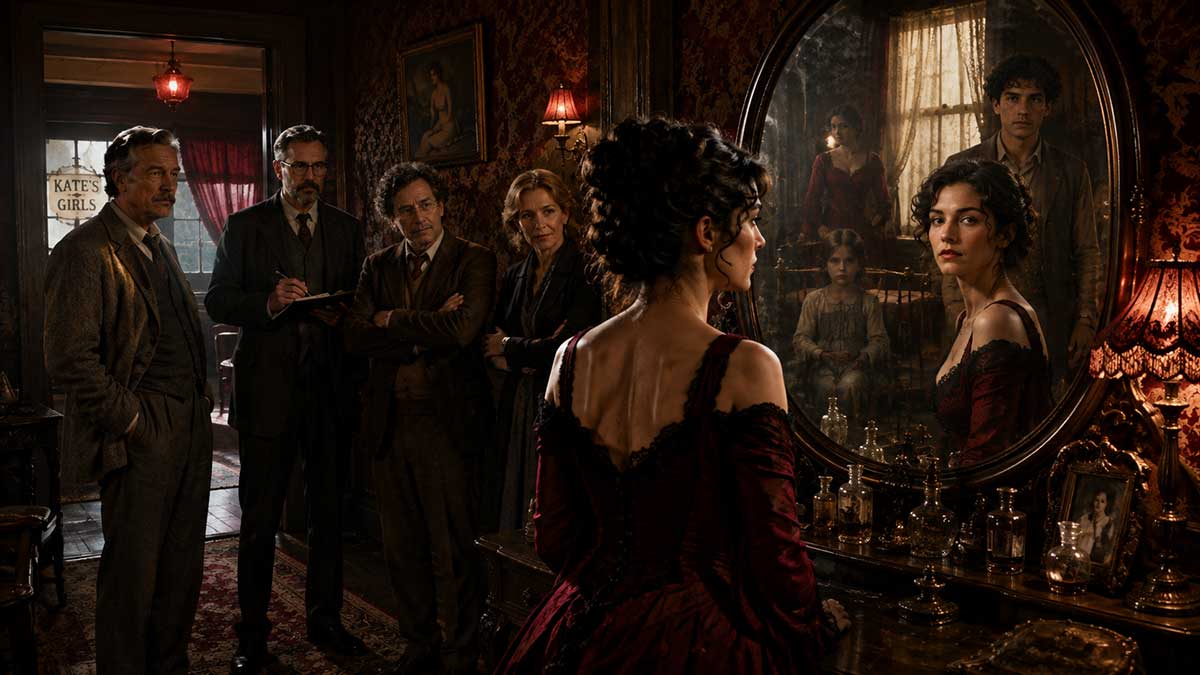
For a few moments, nobody spoke.
John Steinbeck sat with his hands folded in front of him. Across from him were Paul Bloom, Adrian Raine, and Susan Shillinglaw.
On the table lay a copy of East of Eden.
Susan touched the cover.
Susan Shillinglaw: John, I think we should begin with the question readers have been arguing about for decades.
John Steinbeck: I suspected you might.
Susan Shillinglaw: Did you mean Cathy to be born evil?
Steinbeck looked at the book rather than at Susan.
John Steinbeck: I meant her to frighten us.
Paul Bloom: That's not quite the same thing.
John Steinbeck: No.
Adrian Raine: And it doesn't answer the question.
Steinbeck smiled.
John Steinbeck: Scholars.
Susan Shillinglaw: You invited us.
John Steinbeck: Apparently I did.
Susan Shillinglaw: You describe Cathy very differently from most of your characters. Adam is flawed. Cal is conflicted. Charles can be violent. Yet with Cathy, the language sometimes pushes readers toward something almost elemental. She can seem less like a wounded person who became cruel and more like someone fundamentally different from other people.
John Steinbeck: Yes.
Paul Bloom: Do you still believe people like that exist?
Steinbeck thought.
John Steinbeck: I believe there are people who seem to experience other human beings differently from the way most of us do.
Adrian Raine: That formulation interests me much more than “born evil.”
John Steinbeck: Why?
Adrian Raine: Since “evil” is a moral judgment. It doesn't tell us very much about what is happening inside a person.
John Steinbeck: Sometimes moral judgment is precisely what a novelist is interested in.
Adrian Raine: Certainly. But suppose Cathy has unusually low empathy. Suppose she has unusual fear responses, unusual emotional processing, unusual temperament. Suppose some of that has biological roots.
Would you still call that evil?
John Steinbeck: If she deliberately destroys people?
Adrian Raine: Now you've moved from what she is to what she does.
Steinbeck looked at him.
Adrian Raine: That distinction matters.
Paul Bloom: Very much.
John Steinbeck: You both seem uncomfortable with the word.
Paul Bloom: I'm uncomfortable with what the word can hide.
John Steinbeck: Meaning?
Paul Bloom: We call someone evil, and suddenly we feel we have explained them.
He leaned forward.
Paul Bloom: But we haven't explained anything.
John Steinbeck: Perhaps explanation isn't always the point.
Paul Bloom: That's fair.
John Steinbeck: Suppose a man tortures another human being for pleasure. At some point, do we really need a laboratory before we're permitted to make a moral judgment?
Paul Bloom: No.
Adrian Raine: No.
Steinbeck seemed surprised by the quick agreement.
Adrian Raine: Explaining behavior does not require excusing it.
John Steinbeck: Good.
Adrian Raine: But condemning behavior does not require us to stop explaining it either.
Steinbeck nodded slowly.
Susan Shillinglaw: That may be where Cathy becomes difficult for modern readers.
John Steinbeck: Modern readers?
Susan Shillinglaw: Some readers look at Cathy and ask questions your original presentation doesn't fully answer.
What happened inside this woman?
How did she come to experience other people this way?
Was she born with certain traits?
Were there experiences we never learn about?
Is she meant to be psychologically understandable at all?
Or is she functioning partly as a symbolic presence?
John Steinbeck: And what do you think?
Susan Shillinglaw: I think you deliberately made her resistant to explanation.
Steinbeck smiled faintly.
John Steinbeck: Yes.
Susan Shillinglaw: Which makes her artistically fascinating.
She paused.
Susan Shillinglaw: And psychologically troublesome.
John Steinbeck: Why troublesome?
Susan Shillinglaw: Since once the narrator tells readers, in effect, that they are encountering a monster, the reader is encouraged to stop searching for the human being.
Steinbeck's expression changed.
John Steinbeck: Perhaps there wasn't much human being there to find.
A brief silence followed.
Paul Bloom: That's the claim I'd like to challenge.
Steinbeck turned toward him.
Paul Bloom: What would it mean for someone to have almost nothing human inside?
John Steinbeck: You tell me.
Paul Bloom: I don't think that's how people work.
John Steinbeck: Yet people commit acts that seem incomprehensible to ordinary moral intuition.
Paul Bloom: Certainly.
John Steinbeck: People exploit children. Betray people who trust them. Manipulate love. Enjoy humiliation. Destroy others without remorse.
Paul Bloom: Yes.
John Steinbeck: At what point are you willing to use the word?
Paul Bloom: I might use “evil” to describe an act.
Steinbeck waited.
Paul Bloom: I'm much more cautious about using it as an explanation of a person.
John Steinbeck: Why?
Paul Bloom: Since people are mixtures.
John Steinbeck: Cathy doesn't appear to be much of a mixture.
Paul Bloom: Exactly.
Now Steinbeck looked interested.
Paul Bloom: Maybe that's the real question.
He tapped the book lightly.
Paul Bloom: Did you make her too pure?
John Steinbeck: Pure?
Paul Bloom: Purely evil.
Susan smiled slightly.
Paul Bloom: Aron wants purity in goodness.
Adam wants purity in goodness.
And perhaps you gave them a woman who represents purity in the opposite direction.
Steinbeck leaned back.
John Steinbeck: That's an accusation I hadn't expected.
Susan Shillinglaw: It's a good one.
John Steinbeck: I see that you're enjoying this.
Susan Shillinglaw: Very much.
Adrian Raine: Let me approach Cathy from another direction.
John Steinbeck: Please.
Adrian Raine: Human beings differ from the beginning.
Children aren't identical moral blank slates.
Temperament varies.
Fearfulness varies.
Impulsivity varies.
Aggression varies.
Sensitivity to punishment varies.
Emotional responsiveness varies.
There can be biological contributions to traits associated with later antisocial behavior.
John Steinbeck: So perhaps I was right.
Adrian Raine: Not so fast.
Steinbeck laughed.
Adrian Raine: Predisposition is not destiny.
John Steinbeck: Explain.
Adrian Raine: Suppose two children begin life with different temperaments. One is emotionally reactive. Another unusually fearless. Another impulsive. Another highly sensitive.
Those differences can interact with parenting, nutrition, social conditions, trauma, relationships, opportunity, learning, culture, and countless experiences.
You don't get a simple equation:
low fear plus low empathy equals Cathy Ames.
John Steinbeck: Of course not.
Adrian Raine: Yet that is exactly why “born evil” bothers me.
It compresses an enormous developmental process into a moral verdict.
John Steinbeck: But suppose Cathy was born with something missing.
Adrian Raine: Missing what?
Steinbeck hesitated.
John Steinbeck: Whatever prevents most people from treating others as objects.
Paul Bloom: Empathy?
John Steinbeck: Perhaps.
Paul Bloom: Empathy isn't the same thing as morality.
John Steinbeck: No?
Paul Bloom: No.
Steinbeck looked intrigued.
Paul Bloom: A person can understand another person's emotions very well and use that knowledge to manipulate them.
Susan glanced toward the novel.
Susan Shillinglaw: Which sounds rather like Cathy.
Paul Bloom: Exactly.
John Steinbeck: Then what is missing?
Paul Bloom: Maybe nothing simple is missing.
That answer seemed to bother Steinbeck.
John Steinbeck: You people dislike clean categories.
Susan Shillinglaw: So does your novel.
Steinbeck turned toward her.
Susan Shillinglaw: Except perhaps when it comes to Cathy.
Silence.
That one landed.
John Steinbeck: You think I failed her.
Susan Shillinglaw: I think you created a character strong enough to make later readers question the framework you gave them.
John Steinbeck: That's a polite answer.
Susan Shillinglaw: It's the answer I mean.
John Steinbeck: Then give me the impolite one.
Susan considered it.
Susan Shillinglaw: Did you allow Cathy the same psychological depth you allowed Cal?
Steinbeck did not respond immediately.
Susan Shillinglaw: Cal contains darkness.
But we enter his fear of it.
We see his jealousy.
His longing for Adam.
His humiliation.
His remorse.
His desire to become different.
We understand how competing impulses live inside him.
With Cathy, we frequently encounter the consequences of what she does without receiving the same interior complexity.
John Steinbeck: Perhaps Cathy doesn't experience that conflict.
Susan Shillinglaw: That's possible.
John Steinbeck: Then why invent one for her?
Susan Shillinglaw: We shouldn't.
She paused.
Susan Shillinglaw: But absence of visible conflict does not prove absence of psychological history.
Steinbeck nodded slowly.
Paul Bloom: Let me ask you something more uncomfortable.
John Steinbeck: Apparently that's why I'm here.
Paul Bloom: If Cathy were a man, would you have written the character the same way?
Steinbeck's eyes narrowed slightly.
John Steinbeck: You think her gender explains how I wrote her?
Paul Bloom: I'm asking.
John Steinbeck: I don't know.
Susan Shillinglaw: That's an important answer.
John Steinbeck: Don't congratulate me for uncertainty.
Susan Shillinglaw: I'm not.
Steinbeck thought for a moment.
John Steinbeck: Cathy uses sexuality, beauty, secrecy, and men's desires. Her being a woman is part of the construction.
Susan Shillinglaw: Yes.
John Steinbeck: Does that make the character illegitimate?
Susan Shillinglaw: No.
Paul Bloom: But it may change what we need to examine.
John Steinbeck: Such as?
Susan Shillinglaw: Whether some of the horror surrounding Cathy comes from cruelty itself and whether some comes from violating expectations about women, motherhood, sexuality, tenderness, and maternal instinct.
Steinbeck became very still.
John Steinbeck: She abandons her babies.
Susan Shillinglaw: Exactly.
John Steinbeck: That's horrific.
Susan Shillinglaw: It is.
John Steinbeck: Then why complicate it?
Susan Shillinglaw: Since literature becomes interesting when we ask why certain violations horrify us more than others.
Steinbeck considered this.
Susan Shillinglaw: Charles nearly kills Adam.
Yet readers rarely discuss Charles as though he belongs to another species.
Steinbeck looked down.
Susan Shillinglaw: Cathy is treated differently.
John Steinbeck: She does far more than abandon children.
Susan Shillinglaw: Certainly.
John Steinbeck: She poisons. Manipulates. Exploits. Blackmails. Destroys.
Susan Shillinglaw: Yes.
John Steinbeck: Then let her be responsible.
Adrian Raine: Nobody here is trying to remove responsibility.
Steinbeck looked toward him.
Adrian Raine: We're trying to determine where responsibility begins.
John Steinbeck: There's your modern problem.
Paul Bloom: Which is?
John Steinbeck: You are afraid that explaining people will dissolve judgment.
Paul Bloom: And perhaps you're afraid explanation will dissolve tragedy.
Steinbeck smiled.
John Steinbeck: That's better.
Paul Bloom: Does it?
John Steinbeck: Sometimes.
Paul Bloom: How?
John Steinbeck: A novelist sometimes needs to say: Here is something terrible. Look at it.
Not immediately explain it.
Not turn it into a case history.
Not make it safe through terminology.
Just look.
Susan Shillinglaw: That's a strong defense of Cathy as literature.
John Steinbeck: But?
Susan Shillinglaw: But we're discussing whether that literary construction tells us something true about actual human beings.
Steinbeck nodded.
John Steinbeck: Fair.
Adrian Raine: Then let me ask the question plainly.
John Steinbeck: Go ahead.
Adrian Raine: Do you believe a baby can be evil?
Steinbeck stared at him.
Nobody interrupted.
John Steinbeck: That's much harder when you say it that way.
Paul Bloom: It should be.
Steinbeck looked toward the window.
John Steinbeck: No.
He paused.
John Steinbeck: I don't think I can look at an infant and say, “That child is evil.”
Adrian Raine: Then Cathy had to become Cathy somehow.
John Steinbeck: Or reveal what was already there.
Adrian Raine: Some traits may have been there.
John Steinbeck: Yes.
Adrian Raine: But traits are not a biography.
Steinbeck nodded.
Adrian Raine: And biology is not a verdict.
John Steinbeck: Then what turns predisposition into character?
Adrian Raine: That's the difficult part.
Paul Bloom: Choices matter.
Adrian glanced toward him.
Adrian Raine: Circumstances matter.
Susan Shillinglaw: Relationships matter.
Paul Bloom: Opportunity matters.
Adrian Raine: Development matters.
John Steinbeck: And eventually?
Nobody answered immediately.
John Steinbeck: Eventually she does something.
He leaned forward.
John Steinbeck: Eventually Cathy makes choices.
Paul Bloom: Yes.
John Steinbeck: Then morality enters.
Paul Bloom: It was probably there before too.
John Steinbeck: But now we can judge the act.
Paul Bloom: Yes.
John Steinbeck: And repeated acts?
Paul Bloom: They tell us something about character.
John Steinbeck: So if someone repeatedly chooses cruelty...
Paul Bloom: We should take that very seriously.
John Steinbeck: For years?
Paul Bloom: Yes.
John Steinbeck: Without remorse?
Paul Bloom: Yes.
John Steinbeck: Using other people as instruments?
Paul Bloom: Yes.
John Steinbeck: Then eventually may I call her evil?
Paul smiled.
Paul Bloom: You really want that word.
John Steinbeck: I'm a novelist. We like words.
Susan laughed.
Then her expression became serious again.
Susan Shillinglaw: Perhaps there is another reason Cathy matters.
John Steinbeck: What?
Susan Shillinglaw: Everyone wants to know whether Cathy is evil.
But maybe Cathy performs another function.
John Steinbeck: Which is?
Susan Shillinglaw: She allows everyone else to feel less evil.
Steinbeck looked at her.
Paul Bloom: That's interesting.
Susan Shillinglaw: Think about the structure.
Adam can be blind.
Charles can be violent.
Cal can be cruel.
Men can enter Kate's brothel carrying desires and secrets they hide from respectable society.
Yet Cathy becomes the concentrated location of darkness.
John Steinbeck: You think everyone puts their sins into her.
Susan Shillinglaw: In a sense.
Paul Bloom: A moral container.
Adrian Raine: The dangerous person becomes “other.”
Susan Shillinglaw: Yes.
She turned to Steinbeck.
Susan Shillinglaw: And once darkness belongs to the monster, ordinary people can stop looking for it in themselves.
Steinbeck sat quietly.
John Steinbeck: That I recognize.
Susan Shillinglaw: You intended it?
John Steinbeck: Parts of it.
Susan smiled.
Susan Shillinglaw: Only parts?
John Steinbeck: You scholars always want authors to claim everything you find.
Susan Shillinglaw: And authors sometimes want to claim it afterward.
Steinbeck laughed.
John Steinbeck: Fair enough.
Paul Bloom: This brings us to Cal.
John Steinbeck: Yes.
Paul Bloom: Cal discovers who his mother is and thinks he has discovered who he is.
John Steinbeck: Precisely.
Paul Bloom: That's psychologically powerful.
A frightening parent can become an explanation.
I am angry.
She was cruel.
I feel jealousy.
She manipulated people.
I wanted to hurt my brother.
She hurt everyone.
Then the child concludes:
I contain the parent.
Adrian Raine: And that is exactly where biological explanations can become dangerous if badly communicated.
John Steinbeck: Why?
Adrian Raine: Suppose Cal is told that certain traits have heritable components.
He may hear:
“My future has been diagnosed.”
Paul Bloom: When what he has actually learned is that he may have certain tendencies.
Adrian Raine: Correct.
John Steinbeck: So knowledge itself can become fatalism.
Adrian Raine: Yes.
Susan Shillinglaw: Which takes us remarkably close to what your novel is doing.
Steinbeck smiled.
John Steinbeck: Now you're trying to rescue me.
Susan Shillinglaw: You don't need rescuing.
John Steinbeck: Let me ask all of you something.
They waited.
John Steinbeck: Suppose Cal has something of Cathy in him.
Not metaphorically.
Suppose he really inherits traits from her.
A capacity for suspicion.
A quick perception of weakness.
Maybe even some pleasure in manipulation.
Would that trouble you?
Paul Bloom: Of course.
Adrian Raine: Yes.
John Steinbeck: Good.
He looked almost relieved.
John Steinbeck: I don't want a philosophy that tells Cal none of this matters.
Susan Shillinglaw: Neither do we.
John Steinbeck: His darkness matters.
Paul Bloom: Yes.
John Steinbeck: His jealousy matters.
Paul Bloom: Yes.
John Steinbeck: The fact that he enjoys hurting Aron for a moment matters.
Adrian Raine: Absolutely.
John Steinbeck: Then where do Cal and Cathy separate?
Nobody answered immediately.
Steinbeck looked from one to another.
John Steinbeck: They both see weakness.
They both can manipulate.
They both can hurt.
Cal himself fears they are alike.
So where do they separate?
Paul Bloom: Remorse.
Steinbeck looked at him.
Adrian Raine: Reflection.
Susan Shillinglaw: Relationship.
John Steinbeck: Choice?
Paul paused.
Paul Bloom: Yes.
Adrian Raine: With qualifications.
Steinbeck laughed.
John Steinbeck: Of course.
Susan Shillinglaw: But there may be one more difference.
John Steinbeck: What?
Susan Shillinglaw: Cal asks whether he can become different.
Steinbeck's expression softened.
Susan Shillinglaw: Cathy largely doesn't.
John Steinbeck: Yes.
Susan Shillinglaw: That doesn't prove Cal was born better.
Adrian Raine: No.
Susan Shillinglaw: It shows us two people relating differently to what exists inside them.
Paul Bloom: Cathy repeatedly treats her impulses as truth about human nature.
Adrian Raine: Cal experiences his impulses as a problem.
John Steinbeck: Is feeling guilty enough?
Paul Bloom: Certainly not.
John Steinbeck: Good.
Paul Bloom: But guilt can indicate that another value is present.
Steinbeck nodded slowly.
John Steinbeck: Cathy says, in effect, “This is what people are.”
Susan Shillinglaw: Cal asks, “Is this what I have to be?”
Silence.
Steinbeck looked down at the copy of East of Eden.
John Steinbeck: Perhaps I would write Cathy differently now.
Nobody expected that.
Susan Shillinglaw: How?
Steinbeck took his time.
John Steinbeck: I don't know that I would make her kinder.
Paul Bloom: Good.
John Steinbeck: Or give her an explanatory childhood simply to make readers comfortable.
Susan Shillinglaw: Good.
John Steinbeck: But perhaps I would leave one more door open.
Adrian Raine: For what?
John Steinbeck: Uncertainty.
Susan watched him.
John Steinbeck: Not uncertainty about what she did.
Those things remain.
He paused.
John Steinbeck: Uncertainty about whether I, as the author, had the right to know completely what she was.
That quieted the room.
Susan Shillinglaw: That would change her.
John Steinbeck: Perhaps.
Paul Bloom: It might make her more frightening.
Steinbeck looked at him.
Paul Bloom: A monster is safely different from us.
A human being capable of monstrous acts is harder to dismiss.
Steinbeck's expression changed.
John Steinbeck: Yes.
Adrian Raine: Then maybe our original question was wrong.
Susan Shillinglaw: “Was Cathy born evil?”
Adrian Raine: Yes.
John Steinbeck: What's the better question?
Adrian thought.
Adrian Raine: What was Cathy born with, what happened to her, what did she learn, and what did she repeatedly choose?
Paul Bloom: And which of those questions can we actually answer from the novel?
Susan Shillinglaw: Not all of them.
John Steinbeck: Perhaps deliberately.
Susan Shillinglaw: Perhaps.
Steinbeck looked at the three scholars.
John Steinbeck: Then let me put the question back to you.
They waited.
John Steinbeck: If Cal inherited some of Cathy's darkness...
He paused.
John Steinbeck: and Cal still becomes capable of remorse, love, responsibility, and another choice...
He looked directly at Susan.
John Steinbeck: what does that do to Cathy?
Susan did not answer immediately.
Susan Shillinglaw: It makes her more responsible, not less.
Steinbeck looked surprised.
John Steinbeck: Explain.
Susan Shillinglaw: If Cal's darkness does not determine Cal...
She glanced at the book between them.
Susan Shillinglaw: then Cathy's darkness may not have determined Cathy either.
Nobody spoke.
Paul Bloom: Which means explaining her does not excuse her.
Adrian Raine: And biology does not condemn her.
Steinbeck slowly nodded.
John Steinbeck: So we arrive somewhere uncomfortable.
Susan Shillinglaw: Where?
Steinbeck looked again at the Trask family he had created.
John Steinbeck: Cathy may have been shaped by things she never chose.
He paused.
John Steinbeck: And still be responsible for what she did with them.
Paul Bloom: Yes.
Steinbeck leaned back.
John Steinbeck: Then perhaps the frightening question isn't whether Cathy was born evil.
Susan Shillinglaw: What is it?
Steinbeck thought for a moment.
John Steinbeck: How many times can a family repeat the same wound before somebody realizes repetition isn't destiny?
Susan looked toward him.
Susan Shillinglaw: Charles and Adam.
Steinbeck nodded.
Adrian Raine: Cal and Aron.
Another nod.
Paul Bloom: Two generations.
Steinbeck rested his hand on the book.
John Steinbeck: Then perhaps we should stop examining Cathy alone.
He looked around the table.
John Steinbeck: Perhaps we should examine the family that keeps producing brothers who believe love must be won from each other.
Topic 2: Why Do Families Repeat the Same Wounds?
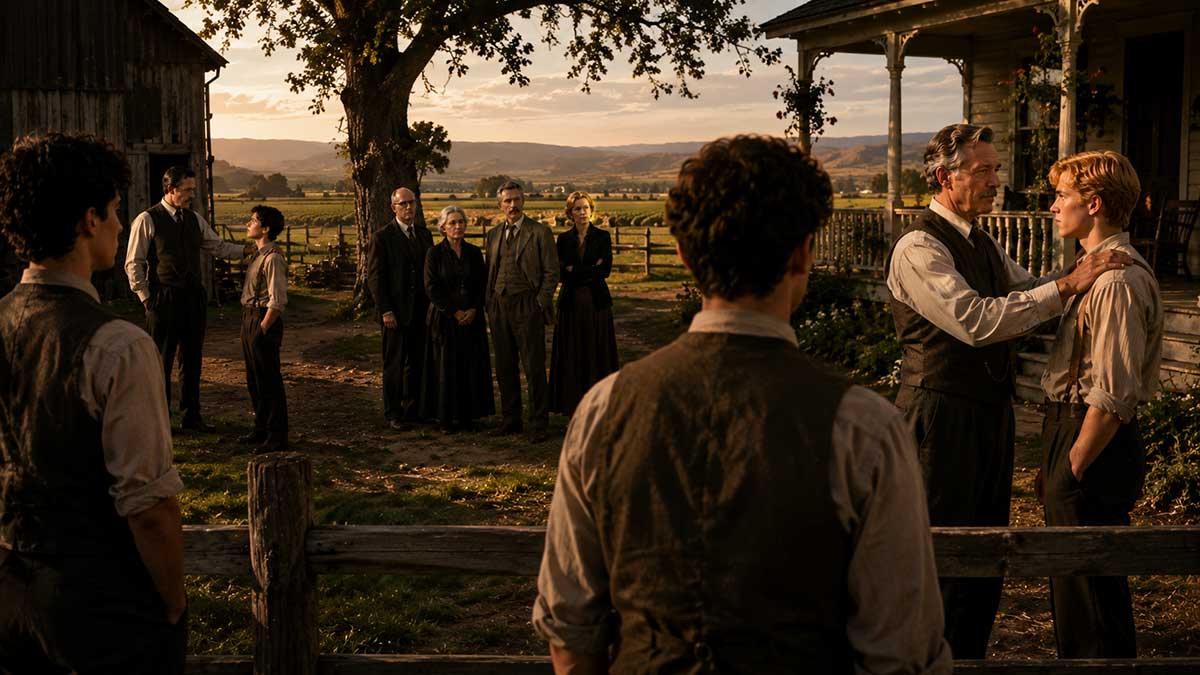
The question Steinbeck had left hanging seemed to change the room.
Charles and Adam.
Cal and Aron.
Two generations of brothers.
Two fathers whose love had not felt evenly distributed.
Two families in which one son seemed chosen and another seemed left measuring himself against that choice.
Rachel Yehuda looked at Steinbeck.
Rachel Yehuda: You said something important at the end of the last discussion.
John Steinbeck: Which part?
Rachel Yehuda: That perhaps we should stop examining Cathy alone and examine the family.
Steinbeck nodded.
Rachel Yehuda: I think that's exactly right.
Murray Bowen had been quiet until then.
Now he leaned forward.
Murray Bowen: I would go one step further.
John Steinbeck: Go ahead.
Murray Bowen: Perhaps the central unit of this story is not the individual at all.
Steinbeck looked interested.
Murray Bowen: Perhaps it is the family system.
Susan Shillinglaw: Meaning?
Murray Bowen: We keep asking why Charles hated Adam.
Why Cal envied Aron.
Why Adam favored one son.
Why Cyrus seemed to value one child differently.
But those questions become more revealing when we stop treating each relationship separately.
He looked at Steinbeck.
Murray Bowen: Families organize emotion.
John Steinbeck: Organize it?
Murray Bowen: Yes.
Fear goes somewhere.
Expectation goes somewhere.
Disappointment goes somewhere.
Hope goes somewhere.
One child may become the one who carries the family's anxiety.
Another becomes the one who carries its ideal.
Steinbeck's expression shifted.
John Steinbeck: The good child and the difficult child.
Murray Bowen: Exactly.
Susan Shillinglaw: Aron and Cal.
Murray Bowen: Perhaps.
John Steinbeck: Charles and Adam too.
Murray Bowen: Perhaps there as well.
Rachel Yehuda: And once those roles form, everyone begins responding to them as though they were facts.
John Steinbeck: You mean the family creates the character?
Murray Bowen: I would not go that far.
John Steinbeck: Good.
Bowen smiled.
Murray Bowen: Temperament matters. Individual differences matter. Circumstances matter.
But families can reinforce certain identities until the identities begin to feel inevitable.
Susan Shillinglaw: John, why did you repeat Cain and Abel?
Steinbeck looked at her.
John Steinbeck: Since one generation wasn't enough.
Susan Shillinglaw: What do you mean?
John Steinbeck: A single pair of brothers could be dismissed as tragedy.
He paused.
John Steinbeck: Repetition asks whether tragedy has become pattern.
Bowen watched him carefully.
Murray Bowen: That's very close to how I would frame it.
John Steinbeck: I thought you might approve.
Murray Bowen: Don't get comfortable.
Steinbeck laughed.
Murray Bowen: The interesting question is what keeps the pattern alive.
John Steinbeck: Jealousy.
Murray Bowen: Too simple.
John Steinbeck: Rejection.
Murray Bowen: Closer.
Rachel Yehuda: Fear of not being chosen.
Steinbeck looked at her.
Rachel Yehuda: That may be deeper.
Susan Shillinglaw: Let's begin with Charles and Adam.
John Steinbeck: All right.
Susan Shillinglaw: Cyrus favors Adam.
Charles gives him a gift that comes from effort and feeling.
Cyrus seems more impressed by Adam's gift.
Charles experiences that as rejection.
Then later, Adam becomes a father and Cal experiences Aron as the son who is easier to love.
Steinbeck nodded.
Susan Shillinglaw: Were you consciously repeating the emotional wound?
John Steinbeck: Yes.
Murray Bowen: Then let me ask you something.
John Steinbeck: Please.
Murray Bowen: Did Adam understand that he was repeating it?
Steinbeck thought.
John Steinbeck: No.
Murray Bowen: That's the important part.
Rachel Yehuda: Very important.
John Steinbeck: Why?
Murray Bowen: People often repeat what hurt them without recognizing the repetition.
Steinbeck frowned slightly.
John Steinbeck: That sounds almost too convenient.
Murray Bowen: It isn't convenient at all.
John Steinbeck: Then explain it.
Murray Bowen: A child learns far more than rules.
He learns emotional patterns.
How conflict is handled.
How affection is expressed.
How disappointment is shown.
What earns approval.
What creates distance.
Who becomes the strong one.
Who becomes the disappointing one.
Who gets protected.
Who gets blamed.
He paused.
Murray Bowen: None of this requires a parent to say, “I am teaching you how to repeat me.”
John Steinbeck: So Adam could hate Cyrus's failures and still reproduce some of them.
Murray Bowen: Exactly.
Rachel Yehuda: This is where we need to be careful with the language of inheritance.
Steinbeck turned toward her.
Rachel Yehuda: People hear “intergenerational trauma” and sometimes think it means a wound travels directly from parent to child like eye color.
John Steinbeck: Doesn't it sometimes?
Rachel Yehuda: There are biological questions worth studying, yes.
But families transmit experience through many channels.
John Steinbeck: Such as?
Rachel Yehuda: Parenting.
Attachment.
Stress responses.
Silence.
Fear.
Modeling.
Stories.
Expectations.
The way one generation talks about what happened.
Or refuses to talk about it.
The way children interpret behavior nobody explains.
Steinbeck nodded slowly.
Rachel Yehuda: A child can inherit a world without inheriting a sentence.
John Steinbeck: That's good.
Rachel Yehuda: Meaning?
John Steinbeck: A world without a sentence.
He repeated it softly.
John Steinbeck: Yes.
Murray Bowen: Look at Cal.
John Steinbeck: I'm listening.
Murray Bowen: Everyone treats Cal's rivalry with Aron as though the line runs directly between the brothers.
Bowen lifted one hand.
Murray Bowen: Cal to Aron.
Steinbeck nodded.
Bowen lifted another.
Murray Bowen: But I suspect the more important triangle is Cal to Adam to Aron.
Susan Shillinglaw: Yes.
Rachel Yehuda: Very much.
John Steinbeck: Explain why triangle matters.
Murray Bowen: Cal does not simply want Aron to lose.
He wants Adam to see Cal differently.
John Steinbeck: Yes.
Murray Bowen: Aron becomes evidence.
John Steinbeck: Evidence of what?
Murray Bowen: That Cal is less loved.
Steinbeck became quiet.
Susan Shillinglaw: That was one of the strongest discoveries in the character discussion.
Cal did not simply resent Aron for being Aron.
He resented what Aron's existence seemed to say about Cal.
Steinbeck nodded.
Murray Bowen: Exactly.
John Steinbeck: Then Aron becomes a measuring instrument.
Murray Bowen: Yes.
John Steinbeck: A brother becomes proof.
Murray Bowen: Yes.
John Steinbeck: That's cruel.
Murray Bowen: It is.
Rachel Yehuda: And painful for both children.
John Steinbeck: People usually sympathize more with Cal.
Susan Shillinglaw: Yes.
John Steinbeck: Maybe too much.
Susan Shillinglaw: Why?
John Steinbeck: We understand the rejected child.
He paused.
John Steinbeck: But what happens to the chosen child?
Bowen nodded.
Murray Bowen: Good.
Rachel Yehuda: Aron also becomes trapped.
John Steinbeck: How?
Rachel Yehuda: If Cal becomes the difficult one, Aron may become the good one.
Then Aron has something to lose too.
Susan Shillinglaw: His innocence becomes a family role.
Murray Bowen: Exactly.
John Steinbeck: So favoritism wounds the favored child too.
Murray Bowen: It can.
John Steinbeck: That's harder to see.
Rachel Yehuda: Since privilege and pressure can coexist.
Aron may receive more idealization, more trust, more warmth.
That matters.
But he may also learn:
I must remain this person.
Susan Shillinglaw: Which connects to our next topic about idealization.
Murray Bowen: Yes, but here the family role matters first.
John Steinbeck: Then let me challenge you.
Murray Bowen: Please.
John Steinbeck: Suppose Adam truly did find Aron easier to understand.
Not due to some family system.
Simply due to temperament.
One child speaks your emotional language.
Another does not.
Is that automatically favoritism?
Murray Bowen: No.
John Steinbeck: Good.
Murray Bowen: But children do not experience parental intention.
They experience parental behavior.
Steinbeck looked at him.
Murray Bowen: Adam may say, “I loved both.”
Cal may say, “One of us felt easier for you to love.”
Both statements may be sincere.
John Steinbeck: Then who's right?
Murray Bowen: Wrong question.
Steinbeck smiled.
John Steinbeck: You people enjoy saying that.
Murray Bowen: Since families often become trapped trying to determine whose version is objectively correct.
John Steinbeck: What should they ask instead?
Murray Bowen: What happened between them?
Rachel Yehuda: I would add something.
John Steinbeck: Please.
Rachel Yehuda: Parents can transmit fear without intending to.
If Adam fears something in Cal, Cal may become exquisitely sensitive to that fear.
John Steinbeck: Even if Adam never says it?
Rachel Yehuda: Especially if he never says it.
Steinbeck looked intrigued.
Rachel Yehuda: Children notice hesitation.
Facial expression.
Who gets watched more closely.
Who gets forgiven more easily.
Who causes tension.
Who makes the room relax.
Susan Shillinglaw: Which fits Cal perfectly.
Rachel Yehuda: Yes.
John Steinbeck: Cal thinks every bad impulse confirms Adam's fear.
Rachel Yehuda: Exactly.
Murray Bowen: Then the family system can become self-reinforcing.
John Steinbeck: Meaning?
Murray Bowen: Adam worries about Cal.
Cal senses the worry.
Cal becomes anxious about himself.
That anxiety may make him more secretive or reactive.
Adam sees the secrecy and becomes more worried.
John Steinbeck: So both start producing evidence for the other's fear.
Murray Bowen: Yes.
Susan Shillinglaw: That's very Trask.
John Steinbeck: Then who begins it?
Murray Bowen: Another wrong question.
Steinbeck laughed.
John Steinbeck: You make blame very difficult.
Murray Bowen: Family systems make simple blame difficult.
John Steinbeck: Does that risk letting everyone escape?
Murray Bowen: No.
John Steinbeck: Explain.
Murray Bowen: If a pattern has many participants, each participant still has responsibility for his part.
But finding one villain rarely explains the system.
Steinbeck looked toward Rachel.
John Steinbeck: You agree?
Rachel Yehuda: Completely.
John Steinbeck: Then family trauma does not mean nobody is responsible.
Rachel Yehuda: Correct.
John Steinbeck: It means responsibility exists inside history.
Rachel Yehuda: Yes.
Steinbeck sat with that.
Susan Shillinglaw: John, I want to go back to Cyrus.
John Steinbeck: All right.
Susan Shillinglaw: Did he understand what his favoritism did to Charles?
John Steinbeck: Probably not.
Susan Shillinglaw: Did Adam understand what his behavior did to Cal?
John Steinbeck: Not until very late.
Susan Shillinglaw: Then perhaps ignorance is part of the pattern.
John Steinbeck: How?
Susan Shillinglaw: Each generation experiences its own pain as vivid.
The pain it causes others may remain invisible.
Steinbeck looked at her.
Susan Shillinglaw: Adam knows what Charles did to him.
He may understand less clearly what Cyrus's favoritism did to Charles.
Later, Adam knows what Cathy did to him.
He may understand less clearly what his idealization and uneven attention do to his sons.
John Steinbeck: So the wounded person remembers the wound better than the transmission.
Rachel Yehuda: Yes.
Murray Bowen: Very often.
John Steinbeck: Then how does anyone break it?
Nobody answered immediately.
Steinbeck looked around.
John Steinbeck: You've made the pattern sound nearly invisible.
Murray Bowen: It often is.
John Steinbeck: And deeply emotional.
Murray Bowen: Yes.
John Steinbeck: And older than the person repeating it.
Rachel Yehuda: Often.
John Steinbeck: Then what chance does Cal have?
Bowen looked at him.
Murray Bowen: Awareness.
Steinbeck seemed almost disappointed.
John Steinbeck: That's all?
Murray Bowen: No.
Rachel Yehuda: Awareness is only the beginning.
John Steinbeck: What comes after?
Murray Bowen: Learning to remain connected without automatically reacting.
John Steinbeck: That's very clinical.
Murray Bowen: Then let me put it another way.
He paused.
Murray Bowen: Cal has to stop letting Aron's position determine Cal's identity.
Steinbeck looked at him.
Murray Bowen: As long as Aron being loved means Cal is unlovable, the pattern owns him.
Susan Shillinglaw: That's excellent.
John Steinbeck: And Aron?
Murray Bowen: Aron has to stop needing Cal to be the dark brother so Aron can remain the good one.
Rachel Yehuda: Adam has to stop treating his sons as emotional opposites.
John Steinbeck: So every person has a piece of the work.
Murray Bowen: Yes.
Rachel Yehuda: There is another part of cycle breaking that matters.
John Steinbeck: What?
Rachel Yehuda: People often think breaking a cycle means becoming completely different from one's parents.
John Steinbeck: Doesn't it?
Rachel Yehuda: Not necessarily.
Sometimes people react against a parent so strongly that the parent still organizes their life.
Steinbeck frowned.
John Steinbeck: Explain.
Rachel Yehuda: Suppose someone grows up with a controlling father and vows never to control anyone.
That sounds free.
But if every decision is still made in opposition to the father, the father remains psychologically present.
Murray Bowen: Exactly.
John Steinbeck: Then rebellion can still be dependence.
Murray Bowen: Yes.
Susan Shillinglaw: That has implications for Cal and Cathy too.
Steinbeck looked at her.
Susan Shillinglaw: Cal fears becoming Cathy.
If his entire moral identity becomes “I will not be my mother,” Cathy still defines him.
Steinbeck became still.
John Steinbeck: Then what would freedom look like?
Rachel Yehuda: Becoming something more than opposition.
John Steinbeck: That's difficult.
Murray Bowen: Very.
John Steinbeck: If you hate what your father did, you naturally say, “I will never do that.”
Rachel Yehuda: Yes.
John Steinbeck: What's wrong with that?
Rachel Yehuda: Nothing at first.
But eventually the question has to change.
Not merely:
“What will I refuse to repeat?”
But:
“What kind of person do I want to become?”
Steinbeck nodded slowly.
Susan Shillinglaw: That may be why Cal matters more than Charles.
John Steinbeck: Say more.
Susan Shillinglaw: Charles experiences rejection and becomes violent.
Cal experiences rejection and also becomes cruel.
But Cal becomes conscious of himself.
John Steinbeck: Yes.
Susan Shillinglaw: He observes his jealousy.
He fears his resemblance to Cathy.
He knows he wanted Aron hurt.
He feels remorse.
He asks whether he can become different.
Murray Bowen: Consciousness changes the system.
John Steinbeck: Does it?
Murray Bowen: It can.
John Steinbeck: But Cal still hurts Aron.
Murray Bowen: Awareness does not guarantee success.
Rachel Yehuda: Nor does healing mean a person never repeats anything.
John Steinbeck: Then how do you know a cycle is being broken?
Rachel thought.
Rachel Yehuda: Perhaps not when someone becomes perfect.
Steinbeck waited.
Rachel Yehuda: Perhaps when the pattern becomes visible soon enough that the next choice can be different.
Steinbeck's expression softened.
John Steinbeck: That sounds suspiciously close to where I eventually go.
Susan Shillinglaw: We know.
John Steinbeck: You're trying to drag timshel into Topic 2.
Susan Shillinglaw: Not yet.
John Steinbeck: Good.
Bowen looked toward Steinbeck.
Murray Bowen: I want to ask you something about the Cain and Abel structure.
John Steinbeck: Go ahead.
Murray Bowen: Is Cain and Abel in your novel a destiny or a warning?
Steinbeck considered it carefully.
John Steinbeck: A warning.
Murray Bowen: Then why repeat it?
John Steinbeck: So the reader can see repetition before the characters do.
Susan nodded.
John Steinbeck: Charles and Adam happen.
Then Cal and Aron happen.
The second pair forces us to remember the first.
Murray Bowen: Meaning the reader becomes the first person in the family to recognize the pattern.
Steinbeck smiled.
John Steinbeck: I like that.
Susan Shillinglaw: That's a beautiful way to put it.
Rachel Yehuda: And once the reader sees it, another question appears.
John Steinbeck: Which is?
Rachel Yehuda: What would have to change for the pattern not to reach a third generation?
Silence.
Steinbeck looked at her.
John Steinbeck: That's the question I care about.
Rachel Yehuda: Then Cal's future matters more than Cal's past.
John Steinbeck: Perhaps.
Murray Bowen: And whoever Cal loves next matters.
Susan Shillinglaw: Abra.
Steinbeck nodded.
Murray Bowen: How Cal interprets conflict.
How he handles jealousy.
How he responds if one child resembles him more than another.
How he handles disappointment.
Rachel Yehuda: Whether he can speak about family history without turning it into fate.
John Steinbeck: Whether he compares.
Murray Bowen: Yes.
John Steinbeck: Whether he chooses one child as good and another as dangerous.
Rachel Yehuda: Exactly.
Steinbeck looked down at his hands.
John Steinbeck: Then perhaps the true test of Cal is never shown in the book.
Susan Shillinglaw: What would it be?
John Steinbeck: His children.
The others were quiet.
John Steinbeck: We spend the novel asking whether Cal can survive Adam.
He paused.
John Steinbeck: Maybe the harder question is whether Cal can become a father without recreating Adam.
Rachel nodded.
Rachel Yehuda: That is exactly the intergenerational question.
John Steinbeck: And if he fails?
Murray Bowen: Then the pattern continues.
John Steinbeck: If he succeeds?
Murray Bowen: The past remains true.
Steinbeck waited.
Murray Bowen: But it stops being prophecy.
That sentence hung in the room.
Susan Shillinglaw: John, you said earlier that one generation wasn't enough.
John Steinbeck: Yes.
Susan Shillinglaw: Perhaps two generations aren't enough either.
Steinbeck looked at her.
Susan Shillinglaw: The novel ends before we learn whether Cal really breaks anything.
John Steinbeck: That's true.
Rachel Yehuda: Which may make the ending more honest.
John Steinbeck: Why?
Rachel Yehuda: No single insight proves a cycle has been broken.
No single apology.
No single moment of forgiveness.
No single word.
Steinbeck smiled faintly.
John Steinbeck: Careful.
Rachel Yehuda: I know where we're headed.
Murray Bowen: There is something else I want to challenge.
John Steinbeck: Please.
Murray Bowen: You frame the story through Cain and Abel.
John Steinbeck: Yes.
Murray Bowen: Does that framing risk making sibling rivalry seem more inevitable than it is?
Steinbeck raised an eyebrow.
John Steinbeck: Now you're challenging the Bible too?
Murray Bowen: I'm challenging what the family may hear when it receives a myth.
John Steinbeck: Go on.
Murray Bowen: If Cal believes, “I am Cain,” that identity can become dangerous.
Susan Shillinglaw: Very much so.
Rachel Yehuda: A family story can become a script.
John Steinbeck: Meaning?
Rachel Yehuda: Families tell children who they are.
The responsible one.
The wild one.
The fragile one.
The selfish one.
The brilliant one.
The failure.
A myth can give shape to experience.
It can also trap someone inside it.
Steinbeck was listening closely now.
Murray Bowen: Cal's task may not simply be to become a better Cain.
John Steinbeck: Then what?
Murray Bowen: To stop believing Cain is the only name available to him.
Silence.
Steinbeck leaned back.
John Steinbeck: That's very good.
Susan Shillinglaw: And perhaps Aron has the same problem.
John Steinbeck: Abel.
Susan Shillinglaw: Yes.
Rachel Yehuda: Being Abel can be a prison too.
John Steinbeck: Since Abel has to remain innocent.
Murray Bowen: And Cain has to remain dangerous.
Susan Shillinglaw: Then the brothers begin serving the story instead of living their own lives.
Steinbeck looked almost troubled.
John Steinbeck: A writer should be careful what names he gives people.
Susan Shillinglaw: Families should too.
For a moment, everyone looked at the book.
Then Steinbeck spoke.
John Steinbeck: Let me see if I understand what all of you are saying.
Nobody interrupted.
John Steinbeck: Cyrus wounds Charles.
Charles turns Adam into a rival.
Adam carries his own unresolved patterns forward.
He idealizes Aron.
Worries about Cal.
Cal experiences Aron as proof that he is less loved.
Aron experiences Cal as the dark brother against whom his goodness becomes visible.
And each person begins living inside a role nobody consciously designed.
Murray Bowen: Yes.
Rachel Yehuda: That's close.
John Steinbeck: Then nobody chose the whole structure.
Murray Bowen: Correct.
John Steinbeck: But everyone participates in keeping it alive.
Murray Bowen: Yes.
Steinbeck nodded.
John Steinbeck: That word again.
Susan Shillinglaw: Which word?
John Steinbeck: Participate.
Rachel smiled.
John Steinbeck: We used it before when talking about what a person becomes.
Now we're using it for family patterns.
Rachel Yehuda: It fits.
John Steinbeck: We do not create everything we inherit.
Rachel Yehuda: No.
John Steinbeck: Yet perhaps we participate in whether it continues.
Murray Bowen: Yes.
Steinbeck looked thoughtful.
Susan Shillinglaw: Then perhaps awareness does matter.
John Steinbeck: Perhaps.
Susan Shillinglaw: Charles never seems to understand the pattern.
John Steinbeck: No.
Susan Shillinglaw: Cal begins to.
John Steinbeck: Yes.
Susan Shillinglaw: Is that the difference?
Steinbeck hesitated.
John Steinbeck: Not enough of one.
Susan Shillinglaw: Why?
John Steinbeck: Since knowing you're jealous doesn't stop you from acting jealously.
Knowing your father wounded you doesn't stop you from wounding somebody else.
Knowing your mother frightened you doesn't stop you from using her to destroy your brother.
Rachel nodded.
Rachel Yehuda: Exactly.
John Steinbeck: Then awareness is not redemption.
Murray Bowen: No.
John Steinbeck: What is it?
Bowen thought.
Murray Bowen: A chance to interrupt automatic repetition.
Steinbeck looked at him.
John Steinbeck: A chance.
Murray Bowen: Yes.
Susan watched Steinbeck carefully.
Susan Shillinglaw: You're thinking about the final word already.
John Steinbeck: I am.
Susan Shillinglaw: We're not there yet.
John Steinbeck: I know.
He smiled.
John Steinbeck: But I can see it approaching.
Rachel turned a page in the book.
Rachel Yehuda: Before we leave the family, I want to ask one more thing.
John Steinbeck: Please.
Rachel Yehuda: If Cal truly begins to break the pattern, who helps him?
Steinbeck did not answer immediately.
Susan Shillinglaw: Lee.
Murray Bowen: Abra.
Rachel Yehuda: Yes.
Steinbeck nodded.
Rachel Yehuda: That's important.
Cycles are often discussed as though one heroic individual wakes up and defeats generations of history alone.
John Steinbeck: Life rarely works that way.
Rachel Yehuda: Exactly.
Relationships can transmit wounds.
Relationships can help people change too.
John Steinbeck: So inheritance travels through relationship, and healing may travel through relationship.
Rachel Yehuda: Yes.
Susan Shillinglaw: Which brings us rather neatly to Abra.
John Steinbeck: I suspected it might.
Murray Bowen: She sees Cal differently from Adam.
Rachel Yehuda: And Cal sees her differently from Aron.
Steinbeck looked at the three of them.
John Steinbeck: Then maybe we've arrived at another family question without meaning to.
Susan Shillinglaw: Which one?
Steinbeck closed the book.
John Steinbeck: If our families teach us how love is supposed to look...
He paused.
John Steinbeck: how do we know when we're loving another person...
His eyes moved from one scholar to another.
John Steinbeck: and when we're merely repeating the kind of love we were taught?
Topic 3: Is Idealization Really Love?
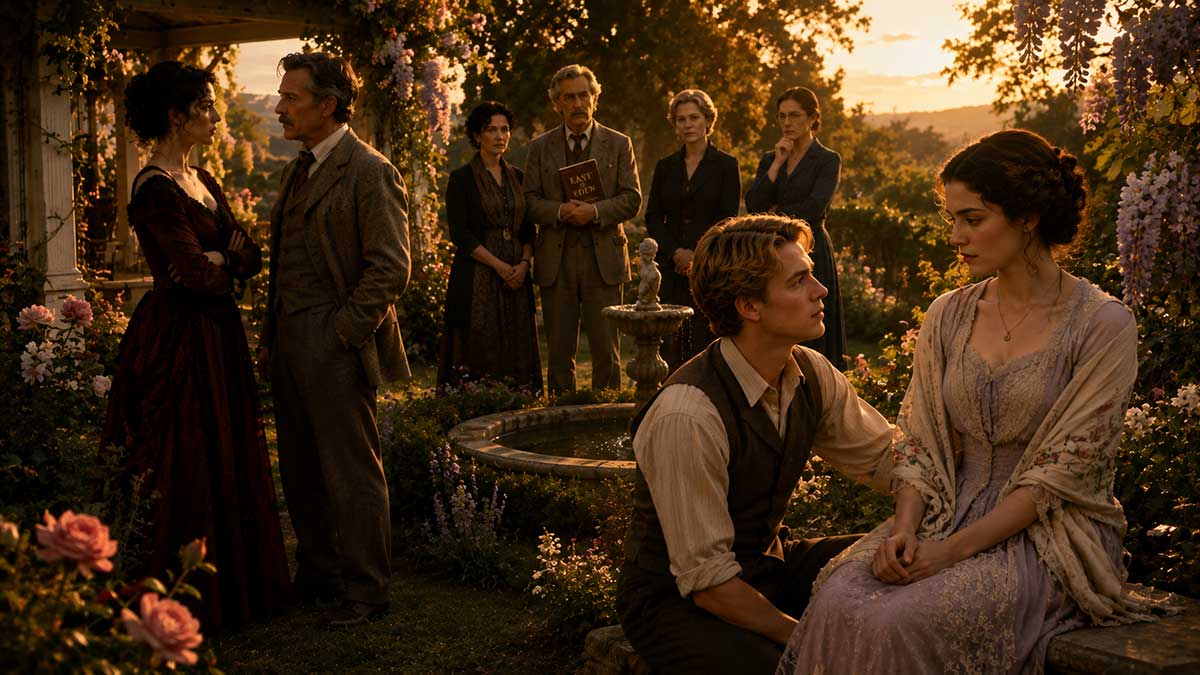
The question Steinbeck had left behind seemed simple at first.
How do we know whether we are loving another person or repeating the kind of love we were taught?
Esther Perel looked at him.
Esther Perel: John, I want to ask you something very directly.
John Steinbeck: Please.
Esther Perel: Did Adam love Cathy?
Steinbeck did not answer at once.
John Steinbeck: Yes.
Erich Fromm: Which Cathy?
Steinbeck turned toward him.
Erich Fromm: The woman herself?
Or the woman Adam needed her to be?
Steinbeck leaned back.
John Steinbeck: I see we're beginning without mercy.
Susan Shillinglaw: It seems appropriate.
John Steinbeck: Adam loved what he believed Cathy was.
Esther Perel: That's different.
John Steinbeck: Of course it is.
Esther Perel: Then perhaps he loved an idea.
John Steinbeck: Most people begin with an idea.
Esther Perel: Yes.
John Steinbeck: We meet someone. We see fragments. We fill in the rest.
Esther Perel: Exactly.
She paused.
Esther Perel: The trouble begins when the other person contradicts the fantasy and we refuse the contradiction.
Steinbeck looked at her.
Esther Perel: Cathy tells Adam she does not want the life he is building.
She resists.
She rejects his dream.
Yet he keeps interpreting her resistance as though it must mean something other than what she is actually saying.
John Steinbeck: He thinks love will change her.
Erich Fromm: Then he is not loving her.
Steinbeck raised an eyebrow.
John Steinbeck: That's a severe judgment.
Erich Fromm: Love requires knowledge.
Not fantasy.
Not possession.
Not the satisfaction of one's own need.
To love someone means to take seriously the reality of that person.
John Steinbeck: Even when that reality is terrible?
Erich Fromm: Especially then.
Susan Shillinglaw: John, did you think of Adam's love as noble?
Steinbeck considered the question.
John Steinbeck: At first, yes.
Susan Shillinglaw: And later?
John Steinbeck: Blind.
Esther Perel: That's the word.
John Steinbeck: But blindness can feel very much like devotion from the inside.
Esther Perel: It often does.
She looked around the table.
Esther Perel: Idealization can feel romantic.
You see someone as extraordinary.
Pure.
Different from everyone else.
The person seems to complete a story you already carry inside yourself.
John Steinbeck: Adam wants Eden.
Esther Perel: Exactly.
Cathy becomes part of the architecture of Eden.
Not merely a woman.
She becomes wife, innocence, beauty, renewal, future.
Susan Shillinglaw: Adam needs her to belong inside the dream.
Esther Perel: And when a person becomes part of your dream, you can stop hearing what she actually says.
John Steinbeck: Then are you saying Adam's love was selfish?
Esther Perel: Partly.
John Steinbeck: That's hard.
Esther Perel: Love often contains selfishness.
The question is whether the relationship can survive contact with reality.
Erich Fromm: Mature love is not the same as emotional hunger.
John Steinbeck: Explain.
Erich Fromm: A person may say, “I love you,” when what he means is, “I need you to preserve my picture of myself.”
Steinbeck looked at him.
Erich Fromm: Adam's Eden depends on Cathy.
If Cathy rejects the dream, she threatens more than the marriage.
She threatens Adam's identity as the man who escaped his past and built something pure.
Susan Shillinglaw: So losing Cathy means losing the story he told himself about his own life.
Erich Fromm: Yes.
John Steinbeck: That makes him sound almost as if he is using her.
Esther Perel: He is not using her in the way Cathy uses people.
But he is assigning her a role.
Those are different forms of failure.
John Steinbeck: Let me defend him.
Susan Shillinglaw: Please.
John Steinbeck: Adam has spent much of his life emotionally starved.
He wants a home.
He wants beauty.
He wants tenderness.
He wants to begin again.
Then Cathy appears.
Isn't it human that he would see salvation in her?
Esther Perel: Completely human.
John Steinbeck: Then where does the moral failure begin?
Esther Perel: When her reality becomes inconvenient and he prefers the fantasy.
Steinbeck nodded slowly.
Esther Perel: There is nothing wrong with projection at the beginning of love.
We all project.
The question is whether we later allow the real person to replace the imagined one.
John Steinbeck: Adam does not.
Esther Perel: No.
Erich Fromm: There is another issue.
John Steinbeck: Go ahead.
Erich Fromm: Adam thinks love means intensity.
John Steinbeck: Perhaps.
Erich Fromm: But intensity is not proof of love.
John Steinbeck: What is?
Erich Fromm: Care.
Responsibility.
Knowledge.
Respect.
John Steinbeck: And Adam lacks knowledge.
Erich Fromm: Profoundly.
Susan Shillinglaw: Perhaps respect too.
Steinbeck turned toward her.
John Steinbeck: That's an interesting accusation.
Susan Shillinglaw: He doesn't respect Cathy's stated wishes.
John Steinbeck: True.
Susan Shillinglaw: He interprets them away.
Esther Perel: Which is common in relationships.
A partner says, “I don't want this.”
The other hears, “You're afraid.”
The partner says, “I am unhappy.”
The other hears, “You just need time.”
The partner says, “This is who I am.”
The other hears, “I can change you.”
Steinbeck exhaled.
John Steinbeck: Adam does all three.
Susan Shillinglaw: Which raises a difficult question.
John Steinbeck: Ask it.
Susan Shillinglaw: Did Adam love Cathy too much?
Or did he fail to love her enough?
Steinbeck looked at her for several seconds.
John Steinbeck: I would once have said too much.
Esther Perel: And now?
John Steinbeck: Perhaps not enough.
Erich Fromm: Good.
John Steinbeck: Don't enjoy that too much.
Fromm smiled.
John Steinbeck: He loved the dream more completely than he loved the woman.
Esther Perel: That's the tragedy.
The room grew quieter.
Then Esther turned to Susan.
Esther Perel: We should move to Aron and Abra.
Susan Shillinglaw: Yes.
Steinbeck nodded.
John Steinbeck: The second version of the problem.
Erich Fromm: Which may be subtler.
Esther Perel: Aron loves Abra.
But he seems to need something from her.
John Steinbeck: Purity.
Esther Perel: Yes.
Susan Shillinglaw: He needs her to remain connected to the world he wants to believe in.
Erich Fromm: She becomes evidence that goodness is intact.
John Steinbeck: Just as Cathy was evidence for Adam that Eden was possible.
Esther Perel: Exactly.
Steinbeck looked troubled by the symmetry.
John Steinbeck: I did that to them.
Susan Shillinglaw: You did.
John Steinbeck: Adam and Aron.
Susan Shillinglaw: Father and son.
John Steinbeck: Both asking women to remain inside a picture.
Esther Perel: Yes.
John Steinbeck: Yet Aron is gentler.
Esther Perel: Certainly.
John Steinbeck: Less controlling.
Esther Perel: Perhaps outwardly.
But idealization can still create pressure without obvious control.
John Steinbeck: How?
Esther Perel: Suppose someone tells you:
“You are the purest person I know.”
At first, that may feel beautiful.
Then you become angry.
Or jealous.
Or sexual.
Or selfish.
Or tired.
What happens?
Susan Shillinglaw: You begin hiding the parts that do not match the image.
Esther Perel: Exactly.
Erich Fromm: Then admiration becomes a cage.
Steinbeck nodded.
John Steinbeck: That explains Abra.
Susan Shillinglaw: Very much.
John Steinbeck: She knows she isn't the girl Aron thinks she is.
Esther Perel: And that is lonely.
John Steinbeck: Even though she is loved.
Esther Perel: Especially when the love depends on misunderstanding.
Steinbeck looked at her.
Esther Perel: One of the loneliest experiences in a relationship is being adored by someone who does not know you.
Silence.
John Steinbeck: That's cruelly true.
Erich Fromm: And this is where mature love becomes difficult.
John Steinbeck: What would mature love require from Aron?
Erich Fromm: The ability to remain in relationship after Abra ceases to be his ideal.
John Steinbeck: If he can.
Erich Fromm: Yes.
Esther Perel: Can Aron tolerate disappointment without turning it into betrayal?
That is the question.
Susan Shillinglaw: He has trouble tolerating contradiction anywhere.
John Steinbeck: Cathy is either the mother he imagined or the horror he discovers.
Susan Shillinglaw: Exactly.
Esther Perel: Abra is either pure or threatening to the image.
Erich Fromm: Aron himself is either good or contaminated.
Steinbeck became still.
John Steinbeck: So idealization is connected to fragility.
Esther Perel: Often.
John Steinbeck: Explain.
Esther Perel: If your emotional safety depends on another person remaining ideal, then every contradiction becomes dangerous.
The stronger the fantasy, the more threatening reality becomes.
John Steinbeck: Then Adam and Aron are both psychologically dependent on innocence.
Susan Shillinglaw: Yes.
John Steinbeck: Adam survives the collapse eventually.
Susan Shillinglaw: Barely.
John Steinbeck: Aron does not.
Erich Fromm: Which may tell us that innocence is not always strength.
Steinbeck looked down at the book.
John Steinbeck: Readers usually call Aron the good brother.
Susan Shillinglaw: They do.
John Steinbeck: Maybe that's too easy.
Esther Perel: Goodness that cannot survive knowledge is vulnerable.
John Steinbeck: Are you saying Cal may be healthier?
Esther Perel: In certain ways.
John Steinbeck: That's dangerous.
Esther Perel: Yes.
John Steinbeck: Cal is jealous.
Manipulative.
Capable of cruelty.
Esther Perel: And aware of contradiction.
Erich Fromm: Awareness does not make him morally better by itself.
Esther Perel: No.
But it may make change more possible.
Susan Shillinglaw: Abra senses that.
John Steinbeck: Why does she move closer to Cal?
Esther Perel: Perhaps she can breathe around him.
John Steinbeck: Since he sees her flaws?
Esther Perel: Since she does not have to protect his fantasy of her.
Steinbeck nodded.
Esther Perel: There is relief in being known imperfectly and still welcomed.
Erich Fromm: But we should be careful.
John Steinbeck: About what?
Erich Fromm: We should not turn Cal and Abra into proof that two wounded people automatically create mature love.
Susan Shillinglaw: Agreed.
Erich Fromm: Seeing flaws is not enough.
A person can see another clearly and exploit that knowledge.
Cathy does.
John Steinbeck: Good point.
Erich Fromm: Mature love requires recognition without domination.
Esther Perel: And boundaries.
John Steinbeck: Meaning?
Esther Perel: “I see your darkness” is not the same as “I will accept whatever you do.”
Steinbeck nodded.
Esther Perel: Abra can understand Cal's jealousy and still refuse cruelty.
She can see his insecurity and still expect accountability.
Erich Fromm: Love without truth becomes fantasy.
Truth without care becomes brutality.
John Steinbeck: That sounds like Cathy.
Erich Fromm: Exactly.
Cathy sees weakness very clearly.
She simply does not love.
Steinbeck looked at Fromm.
John Steinbeck: Then perhaps Cathy is not blind at all.
Erich Fromm: No.
John Steinbeck: Adam is blind and loves badly.
Cathy sees clearly and does not love.
Esther Perel: And the challenge is to do both.
John Steinbeck: See clearly and love.
Esther Perel: Yes.
Susan leaned forward.
Susan Shillinglaw: I want to complicate this further.
John Steinbeck: Of course you do.
Susan Shillinglaw: Cal may idealize Cathy too.
Steinbeck looked surprised.
John Steinbeck: As evil.
Susan Shillinglaw: Yes.
Esther Perel: That's interesting.
Susan Shillinglaw: Adam invents Cathy as completely good.
Cal may invent Cathy as completely bad.
John Steinbeck: Why would he need that?
Susan Shillinglaw: To explain himself.
Steinbeck's expression changed.
Susan Shillinglaw: If Cathy is absolute darkness, then every dark feeling in Cal has a source.
He can point backward.
There.
My mother.
That is where this came from.
Erich Fromm: Then demonization becomes another form of projection.
Esther Perel: And another refusal to see a whole person.
John Steinbeck: But Cathy did terrible things.
Susan Shillinglaw: Yes.
John Steinbeck: We said this already.
Susan Shillinglaw: And we need to keep saying it.
Seeing complexity does not require moral confusion.
John Steinbeck: Good.
Susan Shillinglaw: But Cal may need Cathy to be completely evil for the same reason Adam needed her to be completely good.
Steinbeck slowly nodded.
John Steinbeck: Both versions protect the person doing the imagining.
Esther Perel: Exactly.
John Steinbeck: Adam's fantasy protects hope.
Cal's fantasy protects explanation.
Erich Fromm: And Aron's fantasy protects innocence.
Silence.
John Steinbeck: That's uncomfortable.
Susan Shillinglaw: It should be.
John Steinbeck: Everyone is using someone else to stabilize themselves.
Esther Perel: That happens in relationships constantly.
John Steinbeck: Is that always wrong?
Esther Perel: No.
We all need each other.
We all derive identity from relationships.
The question is whether the other person is permitted to remain separate from our need.
Steinbeck looked at her.
Esther Perel: Can Cathy say no and still remain Cathy?
Can Abra reveal contradiction and still remain lovable?
Can Cal stop carrying Adam's fears?
Can Aron stop requiring others to preserve his innocence?
John Steinbeck: That sounds like freedom inside intimacy.
Erich Fromm: Yes.
John Steinbeck: Then let me ask the hardest version.
He looked at Fromm.
John Steinbeck: If I love someone exactly as they are, doesn't that sometimes mean accepting things that should not be accepted?
Erich Fromm: No.
John Steinbeck: Why not?
Erich Fromm: Love is not surrender of judgment.
John Steinbeck: Then mature love can say no.
Erich Fromm: It must sometimes.
Esther Perel: You can see someone clearly and leave.
John Steinbeck: Adam could have done that with Cathy.
Esther Perel: Yes.
John Steinbeck: Before she left him.
Esther Perel: Yes.
John Steinbeck: And that might have been more loving than trying to transform her.
Erich Fromm: More respectful, certainly.
Steinbeck stared at the table.
John Steinbeck: That's difficult for romantic literature.
Susan Shillinglaw: Why?
John Steinbeck: We like persistence.
Devotion.
The man who refuses to give up.
Esther Perel: Sometimes refusing to give up is refusing to listen.
Steinbeck looked up.
Esther Perel: Persistence can be beautiful.
It can be selfish.
Context decides.
Susan Shillinglaw: There is another reason this matters for Adam.
John Steinbeck: What?
Susan Shillinglaw: He doesn't merely misread Cathy.
He misreads himself.
John Steinbeck: Explain.
Susan Shillinglaw: He thinks he is building Eden for both of them.
But much of it is his Eden.
His escape.
His renewal.
His imagined family.
John Steinbeck: So idealization of another person can begin with idealization of one's own motives.
Esther Perel: Very often.
John Steinbeck: “I only want what's best for you.”
Esther Perel: One of the most dangerous sentences in relationships.
Steinbeck smiled.
John Steinbeck: You don't trust anyone.
Esther Perel: I trust people more when they admit mixed motives.
Erich Fromm: That may be one reason Abra is important.
John Steinbeck: She knows she is mixed.
Erich Fromm: Yes.
She does not need to be perfect in order to believe herself worthy of love.
Susan Shillinglaw: That makes her remarkably different from Aron.
John Steinbeck: And perhaps from Adam.
Esther Perel: Abra can tolerate ambivalence.
John Steinbeck: Meaning she can love and be disappointed at the same time.
Esther Perel: Yes.
She can desire someone and criticize him.
Care for someone and refuse him.
Feel tenderness and anger together.
That is psychological maturity.
John Steinbeck: Then perhaps the opposite of idealization is not disappointment.
Esther Perel: No.
John Steinbeck: It's complexity.
Esther Perel: Exactly.
Erich Fromm: And love worthy of the name must tolerate complexity.
Steinbeck became quiet again.
Then he looked at Susan.
John Steinbeck: Did I know all of this when I wrote it?
Susan Shillinglaw: Some of it.
John Steinbeck: That's charitable.
Susan Shillinglaw: Some of it probably emerged from the relationships you created.
John Steinbeck: Meaning the book knew more than I did.
Susan Shillinglaw: Books sometimes do.
Steinbeck smiled.
Esther Perel: John, can I ask you something personal about the craft?
John Steinbeck: Go ahead.
Esther Perel: Why make Adam's dream so beautiful?
Steinbeck considered it.
John Steinbeck: Since false things are more dangerous when they are beautiful.
Susan Shillinglaw: That's very Steinbeck.
John Steinbeck: Adam doesn't dream of cruelty.
He dreams of home.
Family.
Land.
Peace.
Children.
A second beginning.
Esther Perel: Exactly.
John Steinbeck: That's why he can't see what the dream costs.
Erich Fromm: Which may be the deeper warning.
Not every harmful relationship begins with bad intentions.
John Steinbeck: Then perhaps Adam's failure is not that he dreamed.
Susan Shillinglaw: No.
John Steinbeck: It's that he required Cathy to live inside the dream.
Esther Perel: Yes.
The room settled.
Then Susan spoke.
Susan Shillinglaw: I think we should return to something from the family discussion.
John Steinbeck: Which part?
Susan Shillinglaw: Families teach us how love looks.
John Steinbeck: Yes.
Susan Shillinglaw: Adam grows up with Cyrus.
Preference.
Distance.
Competition.
Then he meets Cathy and creates an almost absolute form of romantic devotion.
Esther Perel: Sometimes people who grow up with uncertain love search for certainty later.
John Steinbeck: Absolute love.
Esther Perel: Or what feels like it.
John Steinbeck: And Aron does the same?
Esther Perel: Possibly.
He needs purity since ambiguity feels unsafe.
Erich Fromm: Then idealization may be less about the beloved than about managing fear.
Steinbeck nodded.
John Steinbeck: So when someone says, “You're perfect,” we should be suspicious.
Esther Perel: Maybe curious.
Steinbeck laughed.
Esther Perel: Ask what happens when you're not.
That quieted everyone.
Susan Shillinglaw: That's the real test, isn't it?
Erich Fromm: Yes.
Susan Shillinglaw: What happens when the person disappoints us?
Esther Perel: That is when fantasy ends and relationship begins.
Steinbeck looked toward the closed book.
John Steinbeck: Then Adam never truly reaches relationship with Cathy.
Esther Perel: I don't think he does.
John Steinbeck: Aron may never reach it with Abra either.
Erich Fromm: Perhaps not.
John Steinbeck: Cal might.
Susan Shillinglaw: Might.
Steinbeck smiled.
John Steinbeck: You insist on that word.
Susan Shillinglaw: It seems appropriate for this book.
After a moment, Steinbeck leaned forward.
John Steinbeck: Let me try something.
Everyone waited.
John Steinbeck: Adam needed Cathy good.
Aron needed Abra good.
Cal needed Cathy evil.
He paused.
John Steinbeck: Three people.
Three images.
Three ways of turning another person into something emotionally useful.
Esther Perel: Yes.
John Steinbeck: Then perhaps the question is not whether idealization is love.
Erich Fromm: What is it?
Steinbeck looked around the table.
John Steinbeck: Whether love can survive when the image dies.
Nobody spoke.
Then Esther nodded.
Esther Perel: That's the question.
Susan looked at Steinbeck.
Susan Shillinglaw: And Aron gives us the darkest version of the answer.
Steinbeck's expression changed.
John Steinbeck: Cathy.
Susan Shillinglaw: Yes.
John Steinbeck: He sees the woman his imagination could not contain.
Esther Perel: And his world collapses.
Erich Fromm: Which means our next question may not really be about love anymore.
John Steinbeck: What is it about?
Susan answered.
Susan Shillinglaw: What happens when reality destroys the story a person needed in order to live?
Steinbeck looked down.
John Steinbeck: And then Cal has to live with what he did next.
Topic 4: How Guilty Is Cal for Aron’s Death?
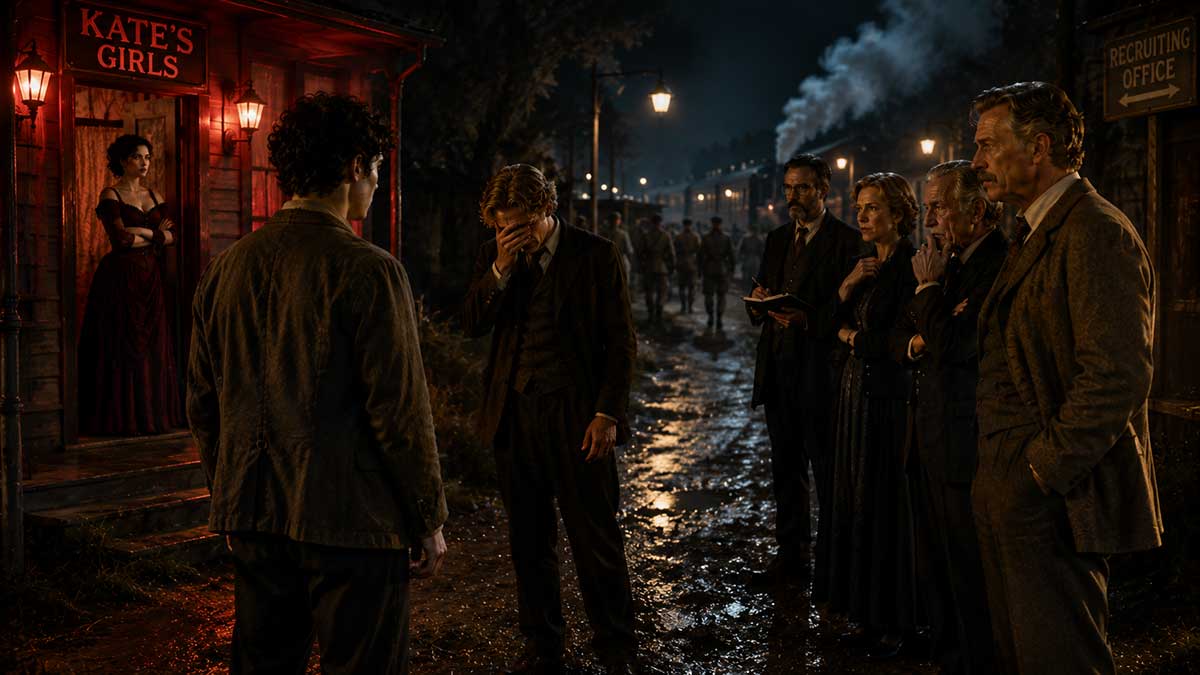
The question Susan had left behind was heavier than anything they had discussed so far.
What happens when reality destroys the story a person needed in order to live?
Robert Sapolsky looked at Steinbeck.
Robert Sapolsky: Before we talk about guilt, I want the sequence clear.
John Steinbeck: Go ahead.
Robert Sapolsky: Cal is hurt by Adam.
He wants Aron to hurt.
He takes Aron to Cathy.
Aron sees his mother.
His idealized picture of her collapses.
He enlists.
He goes to war.
He dies.
John Steinbeck: Yes.
Brené Brown: And Cal thinks he killed him.
John Steinbeck: Yes.
Viktor Frankl: Did you mean the reader to believe that too?
Steinbeck looked at him.
John Steinbeck: No.
Robert Sapolsky: Good.
John Steinbeck: You sound relieved.
Robert Sapolsky: Since the causal chain is far more complicated than Cal's guilt allows.
John Steinbeck: But Cal wanted to hurt Aron.
Robert Sapolsky: Absolutely.
John Steinbeck: He deliberately found the most devastating truth available and used it as a weapon.
Brené Brown: That matters enormously.
John Steinbeck: Then let's not rescue him too quickly.
Viktor Frankl: Nobody should.
For a moment, they sat with that.
Then Brené spoke.
Brené Brown: Perhaps we should begin with the sentence Cal can honestly say.
John Steinbeck: Which sentence?
Brené Brown: “I deliberately hurt my brother.”
Steinbeck nodded.
Brené Brown: That is true.
Robert Sapolsky: Yes.
Brené Brown: But then Cal moves toward a much larger sentence.
“I killed my brother.”
John Steinbeck: Yes.
Brené Brown: And those are not the same statement.
John Steinbeck: Emotionally they may feel identical.
Brené Brown: Emotionally, certainly.
Morally, causally, psychologically, they are very different.
Viktor Frankl: We should ask what guilt is for.
Steinbeck turned toward him.
John Steinbeck: For punishment?
Viktor Frankl: Not necessarily.
John Steinbeck: Then what?
Viktor Frankl: Guilt can reveal that a person has violated something he values.
It can become a summons.
Robert Sapolsky: A summons to what?
Viktor Frankl: To responsibility.
To change.
To a different future.
Robert Sapolsky: That assumes the person could have acted differently.
Frankl looked at him.
Viktor Frankl: I suspected we would reach this point.
Robert Sapolsky: We were going to eventually.
Steinbeck smiled faintly.
John Steinbeck: Perhaps sooner than I expected.
Robert Sapolsky: Let's trace Cal backward.
Why does he hurt Aron?
He has just offered Adam the money.
Adam rejects it.
Cal experiences humiliation.
He already carries years of feeling secondary to Aron.
He fears he resembles Cathy.
He has learned to notice other people's weaknesses.
He knows precisely which truth will destroy Aron's innocence.
All of that exists before the moment he acts.
John Steinbeck: Yes.
Robert Sapolsky: Then we can go further backward.
Why does Adam respond to Cal as he does?
His own history.
Cyrus.
Charles.
Cathy.
His temperament.
His moral beliefs about the money.
The life he has lived.
John Steinbeck: Yes.
Robert Sapolsky: Why is Aron vulnerable?
Temperament.
Adam's idealization.
His conception of Cathy.
His need for purity.
His relationship with Abra.
Religion.
Family history.
John Steinbeck: Yes.
Robert Sapolsky: Then the event we call “Cal shows Aron Cathy” does not appear from nowhere.
It is the end point of an enormous chain of prior causes.
John Steinbeck: And yet Cal walks him there.
Robert Sapolsky: Yes.
John Steinbeck: Knowing why he walked does not change the fact that he walked.
Robert Sapolsky: Correct.
John Steinbeck: Then we still have responsibility.
Robert Sapolsky: We have behavior.
The question is what kind of responsibility makes sense once we fully acknowledge causation.
Brené Brown: I think Cal himself makes a different mistake.
John Steinbeck: Which one?
Brené Brown: He takes responsibility for too much.
Sapolsky glanced toward her.
Brené Brown: That can sound morally impressive.
It isn't always.
John Steinbeck: How can taking too much responsibility be morally wrong?
Brené Brown: Since it can distort reality.
Cal is responsible for choosing to wound Aron.
But Aron made choices too.
Adam played a role.
Cathy played a role.
War played a role.
The military played a role.
History played a role.
Chance played a role.
If Cal says, “I alone killed Aron,” he takes everyone else's agency and places it inside himself.
Viktor Frankl: Yes.
John Steinbeck: That's interesting.
Brené Brown: Excessive guilt can become strangely self-centered.
Steinbeck looked skeptical.
John Steinbeck: Self-centered?
Brené Brown: Yes.
John Steinbeck: The boy is devastated by his brother's death.
Brené Brown: I know.
I'm not minimizing that.
But think about what happens when someone says:
“Everything terrible that followed belongs entirely to me.”
The person's pain becomes the center of the entire story.
Robert Sapolsky: Aron's own decisions disappear.
Brené Brown: Exactly.
Viktor Frankl: And responsibility becomes confused with omnipotence.
Steinbeck turned toward him.
John Steinbeck: Omnipotence?
Viktor Frankl: To believe, “I caused everything,” can contain an unconscious belief that one's influence was greater than it actually was.
John Steinbeck: So guilt can exaggerate one's importance.
Brené Brown: Yes.
Steinbeck sat with that.
John Steinbeck: But Aron would not have gone to Cathy that night without Cal.
Robert Sapolsky: Probably not.
John Steinbeck: That matters.
Robert Sapolsky: Deeply.
John Steinbeck: And perhaps he would not have enlisted when he did.
Robert Sapolsky: Possibly.
John Steinbeck: Then how can Cal not feel implicated?
Brené Brown: He should feel implicated.
John Steinbeck: Good.
Brené Brown: But implicated is not the same as solely responsible.
Viktor Frankl: There is another distinction we should make.
John Steinbeck: Go ahead.
Viktor Frankl: Responsibility for intention.
Responsibility for action.
Responsibility for consequence.
These can overlap without being identical.
Steinbeck nodded slowly.
Viktor Frankl: Cal intended to wound Aron.
That intention belongs to him.
He acted on it.
That action belongs to him.
Aron's later enlistment and death are consequences influenced by Cal but not entirely controlled by him.
John Steinbeck: Then he is fully responsible for the cruelty but only partly responsible for what followed.
Viktor Frankl: That is closer.
Robert Sapolsky: Though I would still ask what “fully responsible” means once we account for the causes of the cruelty.
Frankl turned toward him.
Viktor Frankl: And I would ask what remains of moral life if causation removes all responsibility.
Robert Sapolsky: Good.
Steinbeck leaned forward.
John Steinbeck: Now we're getting somewhere.
Robert Sapolsky: Consider this.
Cal is humiliated.
His nervous system changes.
Stress hormones rise.
His attention narrows.
Years of jealousy become activated.
Memories surface.
His brain predicts threat.
His ability to regulate emotion is shaped by everything that has happened before that moment.
Then he acts.
Where exactly in that chain do you insert a completely independent chooser?
Viktor Frankl: I don't require a completely independent chooser.
Robert Sapolsky: What do you require?
Viktor Frankl: Enough interior distance for a person to relate to an impulse rather than merely become it.
Sapolsky watched him.
Viktor Frankl: A person may not choose the impulse.
He may not choose the emotion.
He may not choose the history that made the emotion likely.
But there can still be a question of what he does in relation to it.
Robert Sapolsky: And I would say that relation is itself caused.
Viktor Frankl: Perhaps.
Robert Sapolsky: Then where is freedom?
Viktor Frankl: Perhaps freedom is not what you think I mean by freedom.
Steinbeck smiled.
John Steinbeck: That sounds familiar.
Brené Brown: Very.
Viktor Frankl: I am not describing a human being floating outside biology.
I am saying that meaning and responsibility remain part of human experience, even under constraint.
Robert Sapolsky: But experience is not proof of metaphysical freedom.
Viktor Frankl: Nor is neuroscience proof that moral responsibility must become meaningless.
Sapolsky nodded.
Robert Sapolsky: Fair.
John Steinbeck: Let me bring Cal back before the two of you turn him into a philosophical experiment.
They both smiled.
John Steinbeck: Cal does something ugly.
Immediately afterward, he cannot live comfortably with what he has done.
Why?
Brené Brown: Since his action conflicts with the person he wants to be.
John Steinbeck: That's guilt.
Brené Brown: Yes.
John Steinbeck: And then?
Brené Brown: Then guilt risks becoming shame.
John Steinbeck: Give me the difference.
Brené Brown: Guilt says:
“I did something bad.”
Shame says:
“I am bad.”
Steinbeck nodded.
Brené Brown: Guilt focuses on behavior.
Shame collapses behavior into identity.
John Steinbeck: Cal has always feared the second one.
Susan Shillinglaw: Very much.
She had been quiet, listening.
Now she joined them.
Susan Shillinglaw: Long before Aron's death, Cal asks whether the darkness in him proves what he is.
His discovery of Cathy intensifies that fear.
After Aron dies, he receives what feels like final confirmation.
Not merely:
“I behaved like my mother.”
But:
“I am my mother's son in the worst possible sense.”
John Steinbeck: So Aron's death doesn't create Cal's shame.
Brené Brown: No.
It lands inside shame that already exists.
John Steinbeck: That's important.
Brené Brown: Very.
Susan Shillinglaw: Cal's guilt has history.
Adam's preference.
Cathy's identity.
His own jealousy.
His fear of inheritance.
Then comes the act against Aron.
The death gives every earlier fear a single terrible symbol.
John Steinbeck: “I knew I was bad.”
Brené Brown: Exactly.
John Steinbeck: So shame takes evidence from the worst night of his life and uses it to explain his entire existence.
Brené Brown: Yes.
Viktor Frankl: And that is spiritually dangerous.
John Steinbeck: Why?
Viktor Frankl: Since if a person decides, “This act reveals what I permanently am,” then transformation becomes unnecessary.
Steinbeck looked at him.
John Steinbeck: Unnecessary?
Viktor Frankl: Think carefully.
If Cal is permanently condemned by essence, what remains for him to do?
John Steinbeck: Suffer.
Viktor Frankl: Exactly.
Brené Brown: Shame loves that.
John Steinbeck: Loves suffering?
Brené Brown: Shame loves paralysis.
Steinbeck frowned.
John Steinbeck: But suffering feels morally appropriate after hurting someone.
Brené Brown: Sometimes.
John Steinbeck: You don't want him cheerful the next morning.
Brené Brown: Of course not.
John Steinbeck: Then pain has a place.
Brené Brown: Yes.
But pain and transformation are not identical.
A person can suffer for fifty years and learn nothing.
Viktor Frankl: Punishment can happen quickly.
Change may require the rest of a life.
Steinbeck looked toward him.
Viktor Frankl: That is far harder.
John Steinbeck: Harder than suffering?
Viktor Frankl: Often.
A person who says, “I deserve misery forever,” has chosen a fixed sentence.
A person who says, “I must now live in such a way that this act is not repeated through me,” has accepted an unfinished task.
John Steinbeck: That sounds like responsibility rather than absolution.
Viktor Frankl: Exactly.
Robert Sapolsky: I like the practical outcome, though I would explain it differently.
Steinbeck smiled.
John Steinbeck: Naturally.
Robert Sapolsky: If guilt helps change future behavior, it has social value.
If shame merely produces collapse, secrecy, aggression, or self-destruction, it may make future harm more likely.
Brené Brown: That's where we overlap.
Robert Sapolsky: Probably more than either of us would enjoy admitting.
John Steinbeck: Then let me make this harder.
He looked at Brené.
John Steinbeck: Cal wanted something inside Aron to break.
Brené did not move.
John Steinbeck: That's not an accident.
That's not carelessness.
That's not misunderstanding.
He wanted his brother to suffer.
Brené Brown: Yes.
John Steinbeck: How does someone forgive himself for that?
Brené Brown: Maybe he doesn't begin with forgiveness.
Steinbeck looked surprised.
Brené Brown: He begins with truth.
Brené Brown: No euphemism.
No “I was upset.”
No “I made a mistake.”
No “Things got out of hand.”
He has to say:
“I wanted to hurt him, and I chose the thing I knew would hurt him most.”
Steinbeck nodded.
Brené Brown: That's accountability.
John Steinbeck: And after that?
Brené Brown: He has to understand what made that act possible.
Not to excuse it.
To recognize the conditions under which he becomes dangerous.
Robert Sapolsky: Now you're sounding deterministic.
Brené Brown: I'm sounding practical.
Sapolsky smiled.
Brené Brown: If Cal knows humiliation makes him reach for revenge, that matters.
If comparison activates cruelty, that matters.
If rejection from Adam makes Aron become a target, that matters.
If he refuses to study those patterns and simply calls himself evil, he learns nothing.
John Steinbeck: So “I am evil” can actually protect him from examining the mechanism.
Brené Brown: Yes.
Susan Shillinglaw: Cathy does something similar from the opposite direction.
Steinbeck turned toward her.
John Steinbeck: Explain.
Susan Shillinglaw: Cathy seems to say:
“This is simply what I am.”
Cal risks saying the same thing with different emotion.
Cathy says it without remorse.
Cal says it with despair.
But both formulations can close the future.
Steinbeck became quiet.
John Steinbeck: That's unsettling.
Viktor Frankl: It should be.
John Steinbeck: Cal may hate Cathy and still imitate her fatalism.
Susan Shillinglaw: Yes.
John Steinbeck: “This is what I am.”
Brené Brown: Exactly.
Robert leaned forward.
Robert Sapolsky: And this is where I have some sympathy for Cal.
John Steinbeck: Some?
Robert Sapolsky: A great deal, actually.
He is trying to understand why he did what he did.
But the only language available to him is moral essence.
Good.
Bad.
Cain.
Cathy.
Aron.
John Steinbeck: You think he needs a causal explanation.
Robert Sapolsky: Yes.
John Steinbeck: And if he gets one?
Robert Sapolsky: Then perhaps he can stop asking:
“What monster inside me did this?”
And start asking:
“What conditions produced this behavior, and how do I change those conditions?”
Viktor Frankl: Useful.
But incomplete.
Robert Sapolsky: Why?
Viktor Frankl: Since a person must still say:
“I did it.”
Sapolsky nodded.
Robert Sapolsky: I have no objection to factual ownership.
Viktor Frankl: It is more than factual.
Robert Sapolsky: That's where we differ.
John Steinbeck: Good.
He looked from one to the other.
John Steinbeck: Don't resolve that yet.
We need it for timshel.
Brené looked back at Steinbeck.
Brené Brown: Can I ask you something about Aron?
John Steinbeck: Please.
Brené Brown: Does Cal's guilt accidentally erase him?
Steinbeck frowned.
John Steinbeck: How?
Brené Brown: Aron becomes the dead brother in Cal's moral story.
But Aron had agency.
He chose to enlist.
He responded to the revelation in a particular way.
Other people might have responded differently.
John Steinbeck: True.
Brené Brown: If we say Cal destroyed him completely, do we reduce Aron again to fragile innocence?
Susan nodded.
Susan Shillinglaw: That's important.
John Steinbeck: Aron hated what he discovered.
Susan Shillinglaw: Yes.
John Steinbeck: But he still made a choice.
Viktor Frankl: Precisely.
John Steinbeck: Does saying that blame Aron for his own death?
Viktor Frankl: No.
John Steinbeck: It sounds dangerous.
Viktor Frankl: Agency is not the same as blame.
A person can act under enormous distress and still remain a participant in his own life.
Brené Brown: Giving Aron agency actually respects him more.
John Steinbeck: How?
Brené Brown: It stops making him an object passed from Adam's idealization to Cal's cruelty to war.
He remains a person.
Steinbeck looked down.
John Steinbeck: In our character discussion, Aron said something like that.
Susan Shillinglaw: Yes.
John Steinbeck: He wanted his choices back.
Susan Shillinglaw: Exactly.
Robert Sapolsky: Though I would still argue that Aron's choice to enlist has its own causal history.
John Steinbeck: We know, Robert.
Sapolsky laughed.
Robert Sapolsky: I'm being consistent.
John Steinbeck: Irritatingly.
Susan Shillinglaw: John, I want to ask you the question you may like least.
John Steinbeck: We've had several candidates.
Susan Shillinglaw: Why did you allow Cal a future?
Steinbeck looked at her.
Susan Shillinglaw: Aron dies.
Cal remains.
Then Adam, in that final scene, gives Cal something that can be understood as permission to continue.
Why?
Steinbeck took a long time.
John Steinbeck: Since the living have to live.
Susan Shillinglaw: That's not enough.
John Steinbeck: I know.
He thought again.
John Steinbeck: If every terrible act permanently disqualifies a person from moral life, then morality ends at failure.
Viktor Frankl: Yes.
John Steinbeck: Cal cannot undo what he did.
He cannot restore Aron.
He cannot make the moment disappear.
Brené Brown: No.
John Steinbeck: But if nothing he does afterward matters, then what exactly are we asking from remorse?
Nobody answered.
John Steinbeck: If remorse has no future, it's merely torture.
Viktor Frankl: Precisely.
John Steinbeck: And I did not want torture to be the final moral achievement.
Brené watched him.
Brené Brown: That's very close to the distinction between shame and accountability.
John Steinbeck: How?
Brené Brown: Shame says:
“You are permanently unworthy.”
Accountability says:
“This mattered. You caused harm. What will you do with that truth?”
Steinbeck nodded.
Robert Sapolsky: But notice something.
Every intervention you're describing changes the future by changing causes.
Therapy.
Relationships.
Insight.
Compassion.
Accountability.
Environment.
All of these affect the brain and behavior.
We don't need metaphysical free will for change.
Viktor Frankl: Perhaps not.
John Steinbeck: You're conceding something?
Robert Sapolsky: Don't get excited.
Steinbeck laughed.
Viktor Frankl: The difference may be smaller than it appears.
Robert asks:
“What causes could help Cal become different?”
I ask:
“What responsibility can Cal assume for becoming different?”
Perhaps both questions matter.
Robert Sapolsky: I can live with that phrasing for now.
John Steinbeck: For now.
The room softened briefly.
Then Steinbeck's face changed again.
John Steinbeck: But there's still Aron.
Nobody spoke.
John Steinbeck: All this talk about transformation is for the living.
Aron doesn't receive it.
Brené Brown: No.
John Steinbeck: Doesn't redemption become unfair?
Frankl looked at him carefully.
Viktor Frankl: Redemption is not repayment.
John Steinbeck: Explain.
Viktor Frankl: Cal cannot create a future good enough to balance Aron's death.
There is no arithmetic that makes the loss equal.
John Steinbeck: Then what can he do?
Viktor Frankl: Refuse to make another life pay for the same wound.
Steinbeck looked at him.
Viktor Frankl: That may be the closest thing available.
Susan Shillinglaw: That's the intergenerational connection again.
John Steinbeck: Yes.
Susan Shillinglaw: Cal cannot save Aron.
But perhaps he can prevent Aron from becoming the beginning of another repetition.
Brené Brown: He can stop converting shame into new harm.
Robert Sapolsky: He can alter the conditions that shape his future behavior.
Viktor Frankl: He can allow guilt to become responsibility rather than identity.
Steinbeck sat quietly.
John Steinbeck: So the question is not:
“How much must Cal suffer to pay for Aron?”
Brené Brown: No.
John Steinbeck: What is it?
Viktor Frankl: What does Cal owe the future after what he did to the past?
No one spoke for several seconds.
John Steinbeck: That's harder.
Susan Shillinglaw: Much harder.
John Steinbeck: Suffering is simpler.
Brené Brown: Yes.
John Steinbeck: You can measure suffering.
Years.
Loneliness.
Self-hatred.
Brené Brown: And still remain unchanged.
John Steinbeck: But living differently has to be chosen again and again.
Frankl nodded.
John Steinbeck: Then suppose Cal says:
“I hurt Aron deliberately.”
Brené Brown: Good.
John Steinbeck: “I contributed to what followed.”
Robert Sapolsky: Good.
John Steinbeck: “I did not control everything that followed.”
Brené Brown: Good.
John Steinbeck: “I cannot repair his death.”
Viktor Frankl: Yes.
John Steinbeck: “I will not turn that fact into permission to destroy myself or anyone else.”
Brené nodded.
Brené Brown: Now we're somewhere.
Steinbeck looked at Sapolsky.
John Steinbeck: Are you comfortable with that?
Robert Sapolsky: Mostly.
John Steinbeck: Mostly?
Robert Sapolsky: I would remove any suggestion that Cal simply wills himself into being different.
Change will require conditions.
Relationships.
Practice.
Time.
Perhaps luck.
John Steinbeck: Fair.
He turned toward Frankl.
John Steinbeck: And you?
Viktor Frankl: I would keep one thing Robert may dislike.
Robert Sapolsky: I can guess.
Viktor Frankl: Cal must participate.
Sapolsky smiled.
Robert Sapolsky: There it is.
Susan Shillinglaw: That word keeps returning.
John Steinbeck: Yes.
Participate.
Not create himself.
Not escape history.
Not deny causation.
Participate.
He looked toward Sapolsky.
John Steinbeck: Is that too much freedom for you?
Robert Sapolsky: It depends on what you mean by it.
John Steinbeck: Good.
Steinbeck leaned back.
John Steinbeck: Then perhaps we're finally ready.
Brené Brown: For timshel?
John Steinbeck: Almost.
Frankl looked at Steinbeck.
Viktor Frankl: One more question.
John Steinbeck: Ask it.
Viktor Frankl: Do you think Cal should forgive himself?
Steinbeck's eyes moved toward the book.
He took his time.
John Steinbeck: I don't know whether forgiveness is the first word I'd use.
Brené Brown: What word would you use?
John Steinbeck: Continue.
Silence.
John Steinbeck: Not forget.
Not excuse.
Not declare himself innocent.
Continue.
Susan Shillinglaw: Into what?
Steinbeck looked at her.
John Steinbeck: That's the question.
Robert folded his arms.
Robert Sapolsky: And now we're back to whether the next version of Cal could ever have been anything other than the result of everything before him.
Viktor Frankl: And I would ask whether being shaped by everything before him makes the next act meaningless.
Brené Brown: And I would ask whether Cal can separate what he did from what he believes he is.
Susan Shillinglaw: And I would ask what Steinbeck was trying to give Cal in that final room with Adam.
They all looked at him.
Steinbeck smiled slightly.
John Steinbeck: One word.
Robert Sapolsky: A very controversial word.
John Steinbeck: Apparently.
He placed his hand on the book.
John Steinbeck: Then let's put it on trial.
Topic 5: Does Timshel Survive Modern Science?
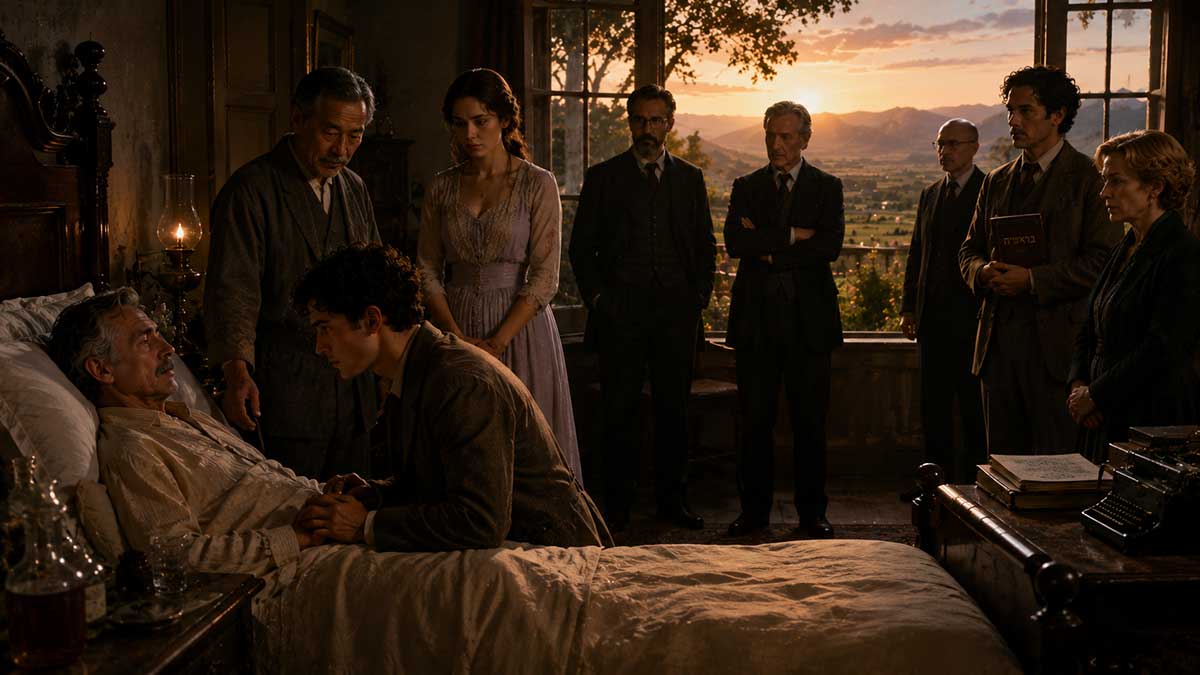
The word was still sitting between them.
Timshel.
Steinbeck had placed it there almost like evidence.
Robert Alter looked at the book.
Robert Alter: Before we discuss free will, I think we have to clean up the Hebrew.
Steinbeck smiled.
John Steinbeck: I knew you were going to say that.
Robert Alter: You invited a biblical scholar.
Robert Sapolsky: I was hoping we could postpone theology and fight about neuroscience first.
Viktor Frankl: Patience.
Susan Shillinglaw: This is probably the one topic where John should not be allowed to define his own word without resistance.
Steinbeck looked at her.
John Steinbeck: My own word?
Robert Alter: That's part of the problem.
John Steinbeck: Fine.
Let's begin there.
Robert Alter: In the novel, timshel becomes “thou mayest.”
That interpretation becomes the moral center of the book.
But the Hebrew in Genesis is more complicated than that simple formula suggests.
John Steinbeck: You think I got it wrong.
Robert Alter: I think you made a literary interpretation do more linguistic work than the Hebrew itself comfortably supports.
Steinbeck leaned back.
John Steinbeck: That's diplomatic.
Robert Alter: I'm trying.
John Steinbeck: Don't.
Alter smiled.
Robert Alter: Fine.
If someone reads East of Eden and then says, “The Hebrew Bible literally says ‘thou mayest,’” I would correct that.
John Steinbeck: Fair.
Susan Shillinglaw: That's the accuracy distinction we need.
In Steinbeck's novel, timshel comes to mean “thou mayest.”
That is different from saying Hebrew scholarship universally establishes that meaning.
John Steinbeck: I can live with that.
Robert Alter: Can you?
John Steinbeck: Apparently I have to.
Viktor Frankl: Does the linguistic issue damage the philosophy?
Alter thought.
Robert Alter: Not necessarily.
A novelist can build meaning from language without producing a scholarly translation.
The question is whether readers understand the difference.
John Steinbeck: Then perhaps I was writing morally with the word rather than philologically.
Robert Alter: That is much closer to how I would put it.
John Steinbeck: Good.
Robert Sapolsky: So we've established that the Hebrew doesn't prove free will.
John Steinbeck: You seem delighted.
Robert Sapolsky: It saves time.
Susan Shillinglaw: John, let me ask the question we planned to begin with.
John Steinbeck: Go ahead.
Susan Shillinglaw: If we removed timshel from East of Eden, what would be lost?
Steinbeck looked down at the book.
He took longer than expected.
John Steinbeck: The future.
Nobody spoke.
Susan Shillinglaw: Explain.
John Steinbeck: Without it, Cal's past becomes too strong.
Cathy becomes too strong.
Cain becomes too strong.
Family becomes too strong.
Guilt becomes too strong.
The whole novel risks becoming an argument that once enough things happen to you, the rest is already decided.
Robert Sapolsky: Which may be closer to the truth.
Steinbeck looked at him.
John Steinbeck: There you are.
Robert Sapolsky: You knew this was coming.
John Steinbeck: Yes.
Robert Sapolsky: I don't think people author themselves in the way we often like to believe.
Take Cal.
His temperament comes from somewhere.
His brain comes from somewhere.
His stress responses come from somewhere.
His childhood comes from somewhere.
His relationships shape him.
His hormones shape him.
His culture shapes him.
Adam shapes him.
Cathy shapes him.
Aron shapes him.
Every moment before a decision influences the decision.
So when Cal stands at a crossroads, where exactly is this separate little entity called “free will” that steps outside all causes and chooses?
John Steinbeck: Perhaps it doesn't step outside them.
Robert Sapolsky: Then what does it do?
John Steinbeck: Perhaps it moves within them.
Sapolsky shook his head slightly.
Robert Sapolsky: That's poetic.
John Steinbeck: I'm a novelist.
Robert Sapolsky: I noticed.
Viktor Frankl: I don't think John needs a completely uncaused chooser.
Sapolsky turned toward him.
Robert Sapolsky: Good.
Viktor Frankl: But I don't accept that causation makes responsibility meaningless.
Robert Sapolsky: Why not?
Viktor Frankl: Since human beings experience themselves not merely as bundles of causes but as beings who answer situations.
Robert Sapolsky: Experience doesn't prove metaphysical freedom.
Viktor Frankl: I agree.
Robert Sapolsky: You do?
Viktor Frankl: Of course.
Frankl paused.
Viktor Frankl: My claim is smaller.
John Steinbeck: Smaller how?
Viktor Frankl: Human freedom is limited.
Sometimes terribly limited.
But limitation does not automatically equal absence.
Robert Sapolsky: I would still ask what produces the so-called response.
Frankl nodded.
Viktor Frankl: And I would still ask whether tracing causes exhausts the meaning of the response.
Robert Sapolsky: Explain.
Viktor Frankl: Suppose Cal feels jealousy.
He did not choose its first arrival.
Suppose he feels humiliation.
He did not choose Adam's rejection.
Suppose anger rises.
He did not choose every condition that made anger likely.
But there may still be a difference between feeling anger and turning that anger into cruelty.
Robert Sapolsky: That difference has causes too.
Viktor Frankl: Yes.
Robert Sapolsky: Then why call it freedom?
Viktor Frankl: Since the human being is part of those causes.
Sapolsky looked at him.
John Steinbeck: That's close to the word we've been circling.
Susan Shillinglaw: Participate.
John Steinbeck: Yes.
Robert Sapolsky: Participation still doesn't create free will.
John Steinbeck: Maybe timshel doesn't require the kind of free will you're attacking.
Robert Sapolsky: That's an important distinction.
Susan Shillinglaw: Then let's define the version being tested.
Not:
A person is completely independent of biology, history, family, circumstance, and causation.
Nobody here needs that.
Instead:
A person may be deeply shaped by forces outside his control and still have some meaningful role in what happens next.
Robert, do you reject even that?
Sapolsky thought.
Robert Sapolsky: It depends on “meaningful role.”
John Steinbeck: You really dislike convenient words.
Robert Sapolsky: Convenient words have caused centuries of bad thinking.
Robert Sapolsky: If by “role” you mean Cal's brain processes information, weighs competing impulses, remembers consequences, responds to relationships, changes over time, then of course he has a role.
Viktor Frankl: Good.
Robert Sapolsky: But all of that has causes.
Viktor Frankl: We know.
Robert Sapolsky: Then I would not call it freedom in the traditional sense.
John Steinbeck: What would you call it?
Robert Sapolsky: Behavior emerging from an extraordinarily complicated organism embedded in history.
Steinbeck stared at him.
John Steinbeck: That is an awful ending for a novel.
Sapolsky laughed.
Robert Sapolsky: I admit it lacks elegance.
Robert Alter: Perhaps the biblical story helps here in a different way.
John Steinbeck: How?
Robert Alter: Cain is warned before the murder.
He is not described as someone with no impulses.
The danger is already present.
The story acknowledges desire, anger, rivalry.
The moral drama exists precisely inside that pressure.
Viktor Frankl: Yes.
Robert Alter: Biblical narrative often cares less about abstract philosophical freedom than about responsibility within human life.
Robert Sapolsky: Which doesn't solve the neuroscience.
Robert Alter: I didn't claim it did.
Susan Shillinglaw: Maybe that's the first thing we should stop asking of East of Eden.
John Steinbeck: What?
Susan Shillinglaw: We shouldn't demand that timshel solve neuroscience.
Steinbeck smiled.
John Steinbeck: Thank you.
Susan Shillinglaw: Don't relax.
John Steinbeck: I knew there was more.
Susan Shillinglaw: We still have to ask whether its moral claim is defensible.
John Steinbeck: Then let me state it plainly.
He looked at Sapolsky.
John Steinbeck: Cal is not responsible for being born Cal.
Robert Sapolsky: Good.
John Steinbeck: He is not responsible for Cathy being his mother.
Robert Sapolsky: Good.
John Steinbeck: He is not responsible for Adam's blindness.
Robert Sapolsky: Good.
John Steinbeck: He is not responsible for his first jealous impulse.
Robert Sapolsky: Good.
John Steinbeck: But when he begins to know himself, I refuse to say that knowledge means nothing.
Sapolsky watched him.
John Steinbeck: I refuse to say reflection means nothing.
Relationship means nothing.
Remorse means nothing.
Practice means nothing.
Learning means nothing.
Robert Sapolsky: I don't say any of those things mean nothing.
John Steinbeck: Then we're closer than you pretend.
Robert Sapolsky: No.
Steinbeck laughed.
Robert Sapolsky: Those things matter precisely since they become causes of later behavior.
John Steinbeck: Fine.
Robert Sapolsky: If Lee's words change Cal, Lee has changed the causal chain.
If Abra changes Cal, she has changed the chain.
If Adam's final gesture changes Cal, that changes the chain.
John Steinbeck: Then timshel becomes one of the causes.
Sapolsky paused.
Robert Sapolsky: That's actually interesting.
Susan Shillinglaw: Very.
John Steinbeck: Say more.
Robert Sapolsky: Suppose Cal believes, “I am doomed to become Cathy.”
That belief affects his future behavior.
Suppose he instead believes, “My impulses do not guarantee my actions.”
That belief may change how he responds next time.
Viktor Frankl: Precisely.
Robert Sapolsky: Don't celebrate yet.
I'm saying the idea can influence behavior.
I'm not conceding metaphysical freedom.
John Steinbeck: I'll take what I can get.
Susan Shillinglaw: Then perhaps timshel has psychological force whether or not it proves free will.
Robert Sapolsky: Yes.
John Steinbeck: That's more than I expected from you.
Robert Sapolsky: It's still not what you think.
John Steinbeck: Let me enjoy five seconds.
Frankl leaned forward.
Viktor Frankl: But there is something missing if we reduce timshel to behavioral influence.
Robert Sapolsky: I assumed you'd say that.
Viktor Frankl: The person hears it as an address.
John Steinbeck: Explain.
Viktor Frankl: “Thou mayest” speaks to someone.
It treats the person as capable of answering.
That matters.
Robert Sapolsky: Psychologically, yes.
Viktor Frankl: Morally too.
Robert Sapolsky: That's where we differ.
Viktor Frankl: If I tell Cal, “Everything about you is the inevitable result of prior causes,” he may still change.
Perhaps.
But I have described him entirely from the outside.
Robert Sapolsky: And?
Viktor Frankl: Human life is lived from the inside.
A person encounters choices as questions.
Should I say this?
Should I strike?
Should I lie?
Should I return?
Should I apologize?
Should I repeat what was done to me?
Robert Sapolsky: Those deliberations are brain processes.
Viktor Frankl: Certainly.
But calling them brain processes does not make their meaning disappear.
John Steinbeck: That's what I care about.
Robert Sapolsky: Meaning.
John Steinbeck: Yes.
Robert Sapolsky: Not proof.
John Steinbeck: Perhaps not.
Robert Alter: Which may bring us back to the Hebrew issue.
Everyone turned toward him.
Robert Alter: A biblical text can operate morally without functioning as a philosophical treatise.
Steinbeck's use of timshel may be strongest if we stop forcing it to prove more than literature can prove.
Susan Shillinglaw: So the word can remain central without being treated as linguistic or scientific evidence.
Robert Alter: Exactly.
John Steinbeck: Robert, let me ask you directly.
Robert Alter: Which Robert?
Steinbeck smiled.
John Steinbeck: Alter.
Sapolsky looked disappointed.
John Steinbeck: If my Hebrew was imperfect, would you still keep the word in the novel?
Alter thought.
Robert Alter: Yes.
Steinbeck looked surprised.
Robert Alter: But I would want readers to understand what it is doing.
John Steinbeck: Which is?
Robert Alter: Creating a moral vocabulary for possibility.
Steinbeck nodded slowly.
Robert Alter: That can be artistically valid without being a dictionary entry.
Susan Shillinglaw: Then perhaps the larger question is not whether timshel is a perfect translation.
It is whether possibility matters.
Robert Sapolsky: Possibility from whose perspective?
John Steinbeck: You really won't let anything pass.
Robert Sapolsky: That's why you invited me.
Susan Shillinglaw: From Cal's perspective.
He believes two futures are possible.
One in which he becomes what he fears.
Another in which he does something different.
Does the existence of those imagined possibilities matter?
Robert Sapolsky: Yes.
Viktor Frankl: Good.
Robert Sapolsky: Again, as causes.
John Steinbeck: We'll take it.
Viktor Frankl: Let us make this concrete.
Cal feels envy.
Two futures may be available in consciousness.
Humiliate Aron.
Do not humiliate Aron.
The fact that both futures can be represented mentally changes the situation.
Robert Sapolsky: Yes.
Viktor Frankl: Reflection creates distance.
Robert Sapolsky: Reflection is a cognitive process.
Viktor Frankl: We are using different languages for overlapping phenomena.
Sapolsky thought about that.
Robert Sapolsky: Sometimes.
John Steinbeck: Then perhaps the argument isn't:
“Are humans totally free?”
Maybe it's:
“What happens once a human being can see the pattern?”
Susan nodded.
John Steinbeck: Cal learns:
I become cruel when rejected.
I turn Aron into proof that I am unloved.
I use Cathy to explain myself.
I confuse guilt with identity.
Once he sees these things, does that awareness become part of what happens next?
Robert Sapolsky: Absolutely.
John Steinbeck: Then I have something.
Robert Sapolsky: You have learning.
John Steinbeck: I'll call it timshel.
Robert Sapolsky: Of course you will.
Everyone laughed, and the tension eased.
Then Susan became serious.
Susan Shillinglaw: But we still haven't asked the hardest question.
John Steinbeck: Which one?
Susan Shillinglaw: Cathy.
Steinbeck's expression changed.
Susan Shillinglaw: If timshel applies to Cal, does it apply to Cathy?
Silence.
Viktor Frankl: It must.
Robert Sapolsky: If you're going to use the idea consistently, yes.
Robert Alter: Otherwise it becomes favoritism disguised as philosophy.
Steinbeck looked at them.
John Steinbeck: Cathy may have had fewer internal resources.
Robert Sapolsky: Possibly.
John Steinbeck: Different temperament.
Different history.
Different capacities.
Robert Sapolsky: Yes.
John Steinbeck: Then her range of possible responses may have been different from Cal's.
Viktor Frankl: Certainly.
John Steinbeck: But not necessarily zero.
Frankl nodded.
Robert Sapolsky: Here I want to be careful.
People differ greatly in their capacity for self-control, empathy, reflection, foresight, emotional regulation.
We should not pretend everyone receives the same amount of behavioral flexibility.
Viktor Frankl: Agreed.
Robert Sapolsky: Some people may have an inch where others have a mile.
Frankl looked at him.
Viktor Frankl: That's close to something I could accept.
John Steinbeck: An inch.
He repeated it.
John Steinbeck: Maybe that's enough for the novel.
Susan Shillinglaw: This connects beautifully with compassion.
If someone has an inch of flexibility, we should not condemn them for failing to move a mile.
Robert Sapolsky: Yes.
Viktor Frankl: But neither should we pretend the inch is meaningless.
Sapolsky looked at him.
Robert Sapolsky: That's where I remain cautious.
John Steinbeck: Cautious is fine.
Robert Alter: Perhaps biblical moral language has always lived with that tension.
Human beings are creatures.
Limited.
Dependent.
Shaped by conditions.
Yet addressed as responsible beings.
The tension is not fully resolved.
John Steinbeck: Maybe I shouldn't have tried to resolve it either.
Susan Shillinglaw: I don't think the novel does.
John Steinbeck: No?
Susan Shillinglaw: The final word doesn't tell us what Cal will do.
Steinbeck looked at her.
Susan Shillinglaw: That's important.
Timshel is not:
“You will become good.”
It is not:
“You have overcome.”
It is not:
“You are forgiven forever.”
It leaves the future open.
Steinbeck smiled.
Viktor Frankl: Which is why possibility carries responsibility.
If the future were guaranteed, responsibility would disappear.
Robert Sapolsky: Or if the future were fully predetermined and known.
John Steinbeck: Exactly.
Susan Shillinglaw: John, would you still end the book with the same word after hearing all this?
The room became quiet.
Steinbeck looked at Alter first.
Then Sapolsky.
Then Frankl.
Then Susan.
John Steinbeck: Yes.
Sapolsky smiled slightly.
Robert Sapolsky: Of course.
Susan Shillinglaw: Why?
John Steinbeck: Not since I think it proves free will.
He looked at Sapolsky.
John Steinbeck: You've made that claim harder for me.
Robert Sapolsky: Good.
John Steinbeck: And not since I believe my Hebrew should settle biblical scholarship.
He looked at Alter.
John Steinbeck: You've taken care of that.
Robert Alter: Glad to help.
John Steinbeck: I would keep it since Cal needs something between excuse and condemnation.
Nobody interrupted.
John Steinbeck: If I tell him:
“You couldn't help it,”
I take responsibility away.
If I tell him:
“You are what you did,”
I take the future away.
He paused.
John Steinbeck: I wanted a word that did neither.
Frankl nodded slowly.
John Steinbeck: Cathy explains too much with human nature.
Cal explains too much with inheritance.
Adam explains too much with dreams.
Aron explains too much with innocence.
I wanted something smaller.
Something that says:
You were shaped.
You were wounded.
You inherited things you never asked for.
You did things you cannot undo.
And still the sentence is not finished.
No one spoke.
Sapolsky finally broke the silence.
Robert Sapolsky: I can accept the unfinished sentence more easily than I can accept traditional free will.
Steinbeck looked at him.
John Steinbeck: That's enough.
Robert Sapolsky: Don't put words in my mouth.
John Steinbeck: I'm a novelist. It's what we do.
Viktor Frankl: I would go further.
The unfinished sentence is the human condition.
We arrive inside histories we did not write.
Yet meaning can arise in how we answer them.
Robert Sapolsky: And I would say how we answer them emerges from prior causes.
Viktor Frankl: Yes, Robert.
We have heard you.
Sapolsky laughed.
Robert Alter: Perhaps the disagreement should remain.
Susan Shillinglaw: I think it must.
John Steinbeck: Why?
Susan Shillinglaw: If everyone agrees, timshel becomes a slogan.
Steinbeck nodded.
Susan Shillinglaw: It is stronger as a question.
John Steinbeck: Then ask it.
Susan looked at him.
Susan Shillinglaw: If everything about us has a cause, does that mean nothing about us can still be called ours?
Sapolsky did not answer immediately.
Frankl did not either.
Alter looked down at the text.
Steinbeck waited.
Robert Sapolsky: I think “ours” can still mean something.
Steinbeck raised an eyebrow.
John Steinbeck: Careful.
Robert Sapolsky: Our brain.
Our history.
Our relationships.
Our behavior.
Our consequences.
All ours in the sense that they happen through us.
But that does not mean we authored the entire chain.
Viktor Frankl: I agree with the last sentence.
John Steinbeck: And disagree with the first?
Viktor Frankl: I think more can belong to us than Robert permits.
Robert Sapolsky: Naturally.
Susan Shillinglaw: Maybe that is exactly where the book should leave us.
Not with certainty.
With responsibility under uncertainty.
Steinbeck repeated it.
John Steinbeck: Responsibility under uncertainty.
Robert Alter: That is a better description of much biblical morality than absolute philosophical certainty.
Robert Sapolsky: And a better description of science too.
Everyone looked at him.
Robert Sapolsky: What?
Steinbeck laughed.
Then he closed the book.
John Steinbeck: All right.
One last question.
He looked at each of them.
John Steinbeck: Suppose Cal's past explains almost everything about how he became Cal.
Cathy.
Adam.
Aron.
Family.
Biology.
Jealousy.
Fear.
Humiliation.
Suppose all of that is true.
He paused.
John Steinbeck: At what point does explanation become excuse?
No one answered.
Steinbeck continued.
John Steinbeck: And at what point does the future become his?
Still silence.
Frankl finally spoke.
Viktor Frankl: Perhaps the future becomes his whenever he can answer for the next act.
Robert Sapolsky: I would say whenever the system that is Cal produces a different act.
Robert Alter: I would say the biblical tradition leaves humans addressed by the question whether or not philosophy settles the mechanics.
Susan Shillinglaw: And I would say the novel refuses to answer it for Cal.
Steinbeck looked at her.
John Steinbeck: Good.
He rested one hand on the cover.
John Steinbeck: Then maybe that is why the last word had to be so small.
Not a sermon.
Not a guarantee.
Not a verdict.
Just a door left unlocked.
Sapolsky looked at him.
Robert Sapolsky: You had to end poetically, didn't you?
John Steinbeck: Yes.
Susan smiled.
Susan Shillinglaw: Then say it.
Steinbeck looked at the book one final time.
He did not explain the word.
He did not defend the translation.
He did not claim that science had proven him right.
He simply said:
John Steinbeck: Timshel.
And this time nobody tried to translate it for him.
Final Thoughts
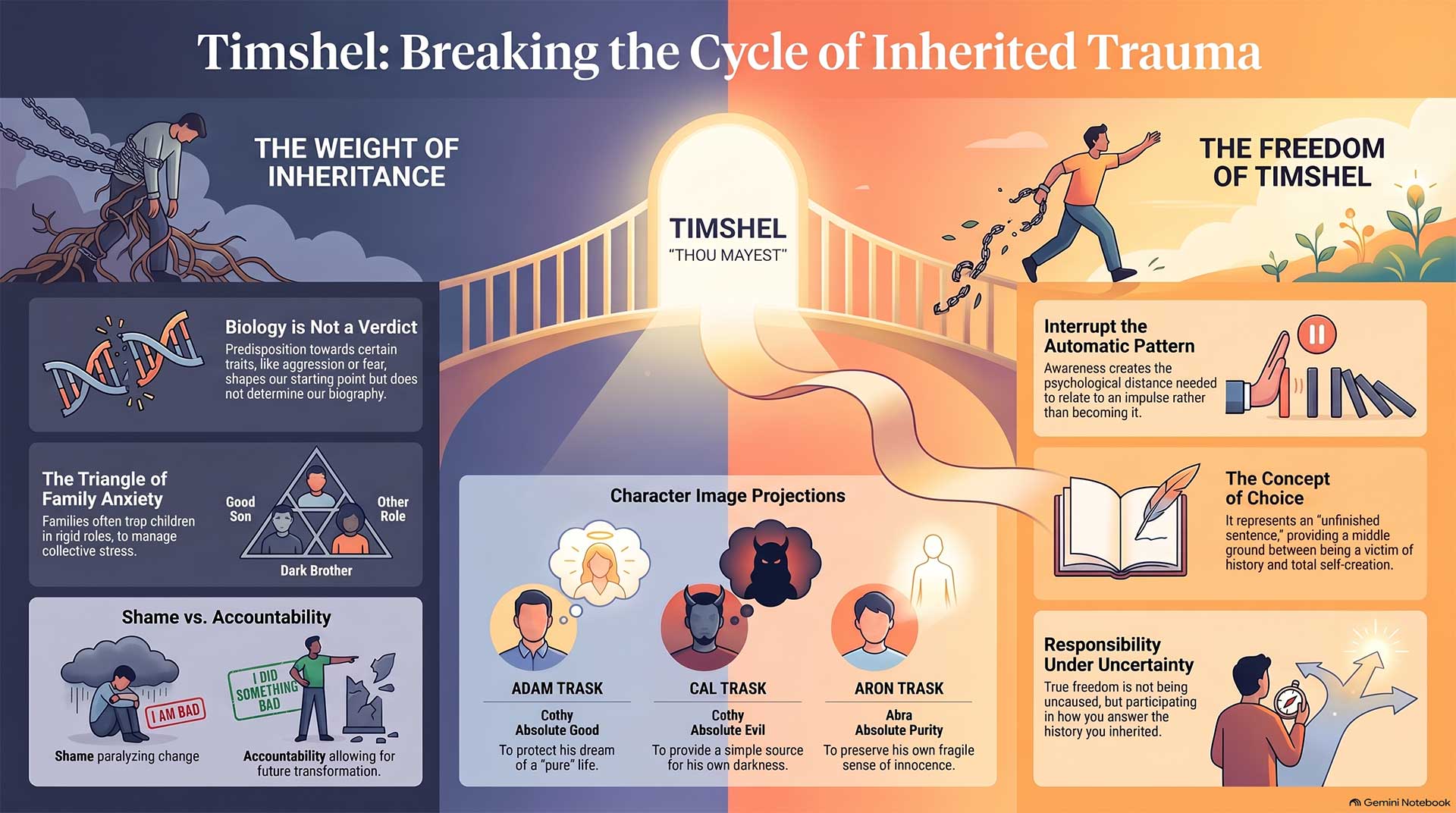
At the beginning of this discussion, the question seemed almost ancient:
Are some people simply born evil?
Cathy Ames appears to invite that conclusion.
Steinbeck presents her with an unusual moral extremity. Yet once Paul Bloom, Adrian Raine, and Susan Shillinglaw begin questioning that category, the problem becomes less comfortable.
A person may be born with a particular temperament.
Empathy, fearfulness, aggression, impulse control, emotional responsiveness, and other traits can vary.
Those differences matter.
So do childhood, relationships, environment, learning, opportunity, and countless experiences that follow.
None of these factors automatically erase responsibility.
But neither do they permit us to turn biology into destiny.
That becomes important once we turn from Cathy to Cal.
Cal believes that discovering his mother means discovering himself.
He sees jealousy, anger, manipulation, and the ability to notice weakness inside himself and fears that Cathy has already determined his future.
Yet Cal differs from Cathy in one striking way.
He worries about what he might become.
He reflects.
He feels remorse.
He asks whether another direction remains possible.
That question leads directly into the Trask family.
Cyrus wounds Charles.
Charles turns Adam into a rival.
Adam later creates another emotional division between Cal and Aron.
Nobody consciously designs this repetition.
Yet everyone participates in it.
Murray Bowen’s family-systems perspective helps reveal that the conflict is not simply Cal versus Aron.
The more revealing structure is often:
Cal → Adam → Aron.
Aron becomes evidence that Cal is less loved.
Cal becomes evidence that Aron is the good son.
Each brother becomes trapped inside a role partly created by the emotional needs of the family around him.
Rachel Yehuda’s perspective adds another warning.
Intergenerational wounds do not need to travel through a single biological mechanism.
Families transmit far more than genes.
They transmit silence.
Fear.
Expectations.
Ways of expressing love.
Ways of withholding it.
Stories about who belongs.
Stories about who disappoints.
Stories about which child is strong, weak, good, dangerous, successful, difficult, or fragile.
A person may deeply resent what happened in childhood and still reproduce part of the pattern later.
That may be one of the most painful truths in East of Eden.
The wounded child can become the parent who unknowingly creates a similar wound.
Yet repetition is not necessarily fate.
Awareness may not break a cycle by itself.
Cal proves that.
He becomes conscious of jealousy and still hurts Aron.
But awareness can create something that did not exist before:
the possibility of interrupting an automatic pattern.
That same problem appears in love.
Adam believes he loves Cathy.
Aron believes he loves Abra.
But Esther Perel and Erich Fromm expose a harder question:
Do they love these women, or do they love what these women make possible inside their own emotional worlds?
Adam needs Cathy to belong inside his Eden.
Aron needs Abra to remain pure enough to preserve his innocence.
Cal may perform the same act in reverse by needing Cathy to be completely evil so that his own darkness has a simple explanation.
Adam needs Cathy good.
Aron needs Abra good.
Cal needs Cathy evil.
Three images.
Three people turned into something psychologically useful.
That leads to one of the most unsettling questions in the entire discussion:
Can idealization become a socially acceptable way of refusing to know another person?
Being placed on a pedestal may feel wonderful until the person discovers that coming down from it threatens the relationship.
Abra understands this.
She does not want to be loved as an ideal.
She wants enough room to remain contradictory, imperfect, alive.
Perhaps mature love begins after the image breaks.
Then the discussion reaches Cal’s worst act.
He deliberately takes Aron to Cathy intending to hurt him.
That intention belongs to Cal.
The cruelty belongs to Cal.
Yet Aron’s later enlistment and death emerge from a much larger chain involving Adam, Cathy, Aron’s own psychology, Cal’s humiliation, the collapse of Aron’s worldview, war, circumstance, and Aron’s own decisions.
Cal is responsible.
But he is not omnipotent.
Brené Brown helps separate two statements:
“I did something terrible.”
and
“I am terrible.”
The first can lead to accountability.
The second can turn one act into a permanent identity.
That distinction may matter more than it first appears.
If Cal concludes that he is permanently evil, change becomes unnecessary.
His only remaining task is punishment.
He can suffer forever without becoming different.
That is why Viktor Frankl pushes responsibility beyond self-punishment.
Cal cannot undo Aron’s death.
No later goodness can mathematically repay it.
But Cal can refuse to make another person pay for the same wound.
Perhaps this is what responsibility after irreversible harm looks like.
Not forgetting.
Not declaring innocence.
Not pretending the harm did not matter.
Living differently.
Then Robert Sapolsky makes the final question much harder.
If Cal’s temperament, brain, childhood, family history, biology, stress responses, relationships, humiliations, and prior experiences all help produce his actions, where exactly does freedom begin?
Steinbeck’s timshel can no longer be treated as a simple scientific claim that human beings possess completely independent free will.
Robert Alter complicates the biblical side as well.
The safest formulation is not that the Hebrew Bible unquestionably translates timshel as “thou mayest.”
Rather:
In Steinbeck’s novel, timshel comes to mean “thou mayest.”
Its force is literary and moral.
And perhaps that is enough.
Steinbeck does not need timshel to prove that human beings exist outside causation.
He needs something more modest.
Cal did not choose Cathy.
He did not choose Adam.
He did not choose the family pattern into which he was born.
He did not choose every jealous impulse that appeared inside him.
He cannot choose a past in which Aron remains alive.
But once Cal begins to see the pattern, that knowledge itself becomes part of what shapes the next moment.
Lee matters.
Abra matters.
Remorse matters.
Reflection matters.
Relationships matter.
Learning matters.
The belief that change is possible may itself change what becomes possible.
Perhaps timshel survives modern science best when we stop demanding that it mean absolute freedom.
It may mean participation.
We do not create everything that enters us.
We do not control every force that shaped us.
People do not receive equal amounts of emotional freedom, opportunity, self-control, support, or psychological flexibility.
Some may have a mile.
Others may have an inch.
Compassion requires recognizing that difference.
Responsibility asks what happens inside whatever space remains.
That leaves us with a quieter version of Steinbeck’s great idea:
We may be deeply shaped without being completely finished.
The past can explain us without becoming our only possible future.
Perhaps this is why East of Eden still ends so beautifully with a word that does not promise victory.
It does not say:
You will overcome.
It does not say:
You must overcome.
It does not even say:
You will be forgiven.
It leaves the sentence unfinished.
And perhaps that unfinished sentence is where the reader enters.
Everything that made you has already happened.
The family you received.
The love you missed.
The mistakes you made.
The wounds you inherited.
The people you hurt.
The things you cannot undo.
So the question remaining is not whether the past belongs to you.
It does.
The harder question is:
How much of what you become next still can?
Short Bios:
John Steinbeck was an American novelist and the recipient of the 1962 Nobel Prize in Literature. His works frequently explored family, poverty, morality, belonging, labor, human dignity, and the tension between individual choice and larger social forces. East of Eden, published in 1952, became one of his most ambitious treatments of good and evil, family inheritance, Cain and Abel, and moral choice.
Paul Bloom is a psychologist and author known for research and writing on morality, empathy, pleasure, childhood development, and human nature. His work frequently challenges simple assumptions about innocence, cruelty, compassion, and the relationship between emotion and moral judgment.
Adrian Raine is a psychologist and criminologist whose research has examined biological, neurological, developmental, and environmental factors associated with antisocial and violent behavior. His work is useful for questioning simplistic claims that people are either biologically destined for wrongdoing or shaped entirely by environment.
Susan Shillinglaw is a leading John Steinbeck scholar whose work has explored Steinbeck’s life, fiction, California settings, philosophical influences, and literary legacy. In this imagined discussion, she serves as a bridge between Steinbeck’s intentions and the meanings later readers may discover in the novel.
Murray Bowen was a psychiatrist and a major founder of family systems theory. His work examined how emotional patterns operate across families and generations, including triangles, differentiation, anxiety, and recurring relational roles.
Rachel Yehuda is a researcher widely known for work on trauma, post-traumatic stress, and intergenerational effects of trauma. Her research has helped deepen discussion of how traumatic experiences may influence later generations while cautioning against simplistic claims that trauma creates unavoidable biological destiny.
Esther Perel is a psychotherapist and author known for her work on intimacy, desire, relationships, conflict, and the tensions between individuality and connection. Her perspective helps illuminate the difference between loving another person and loving an image constructed around that person.
Erich Fromm was a social psychologist, psychoanalyst, philosopher, and author whose work explored love, freedom, human needs, alienation, and responsibility. In The Art of Loving, he argued that mature love involves knowledge, care, responsibility, and respect rather than possession or romantic fantasy.
Brené Brown is a researcher and author known for work on shame, vulnerability, courage, empathy, and accountability. Her distinction between guilt centered on behavior and shame centered on identity provides a useful framework for examining Cal’s response to Aron’s death.
Viktor Frankl was a psychiatrist, neurologist, Holocaust survivor, and founder of logotherapy. His work emphasized meaning, responsibility, and the possibility of a human response within conditions that may be severely constrained.
Robert Sapolsky is a neuroscientist, primatologist, and author whose work examines stress, behavior, biology, environment, and the causes underlying human action. His arguments about determinism pose one of the strongest modern challenges to simple concepts of free will.
Robert Alter is a scholar of Hebrew literature and biblical translation known for close attention to the literary character and language of the Hebrew Bible. His perspective helps distinguish Steinbeck’s literary use of timshel from claims about the precise linguistic meaning of the Hebrew text in Genesis.
Leave a Reply