

Introduction
What happens when the defenses that once protected us begin shaping the lives we are trying to save?
These five modern stories were inspired by themes explored in Madeline Miller’s Circe, but they are not retellings of the novel. Each story moves into a different contemporary life and magnifies one emotional problem beneath the mythology.
A successful attorney in Ohio discovers that always being ready to leave can make intimacy almost impossible. A woman in Seoul destroys another woman’s reputation after betrayal and later learns she punished the wrong person. A celebrated emergency physician realizes the traits that make him extraordinary in crisis are exhausting the people at home. A widowed mother in Tokyo uses technology to watch over her daughter until protection becomes surveillance. A wealthy longevity investor in California learns that adding years to life does not answer the question of how to inhabit a day.
Across all five stories, the characters struggle with rejection, blame, greatness, control, fear, mortality, and the desire to keep loss from happening.
Their strategies are different.
Their deeper question is the same:
What do we do when life refuses to become safe enough for love?
(Note: This is an imaginary conversation, a creative exploration of an idea, and not a real speech or event.)
Story 1 — The Woman Who Could Always Leave
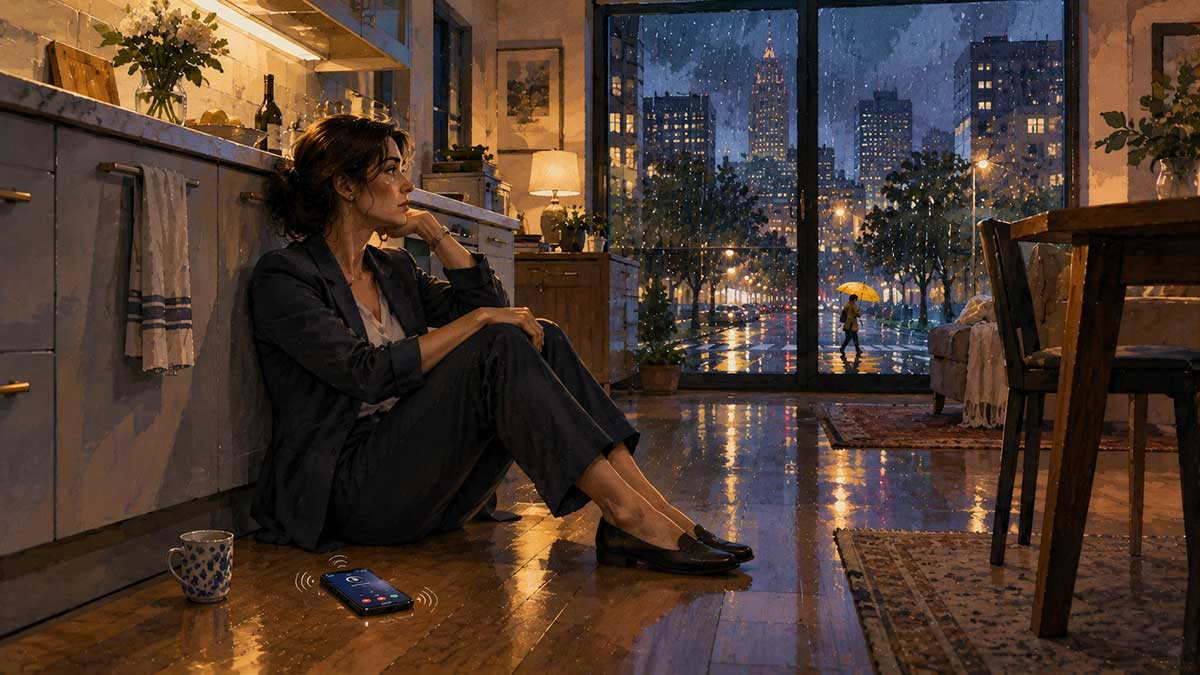
By the time the men across the conference table realized Maya Bennett was actually leaving, she had already put her laptop in her bag.
“Maya.”
She kept walking.
“Maya, come on.”
She stopped at the glass door but did not turn around.
Behind her, twelve floors above downtown Columbus, papers shifted and chairs scraped against the floor.
“We can move on the termination clause.”
Now she turned.
“How far?”
The older man at the end of the table sighed. “Sixty days.”
“Thirty.”
“Forty-five.”
“Thirty.”
He stared at her.
Maya waited.
“Fine.”
She returned to her chair.
Twenty minutes later, the agreement was done.
In the elevator, Tyler, the youngest attorney on her team, looked at her with something close to awe.
“How did you know they'd call you back?”
“I didn't.”
“But you just walked out.”
“The deal wasn't good enough.”
“What if they hadn't stopped you?”
“Then I would've left.”
Tyler laughed.
“You always know when to walk away.”
Maya smiled.
“That’s why people stop assuming I won't.”
Daniel was cooking when she arrived at his house that evening.
He had flour on his shirt.
“You're late.”
“You say that like you're surprised.”
“I say that because the pasta has achieved structural collapse.”
Maya kissed him.
“Then call it rustic.”
Emma was sitting at the kitchen island doing homework.
“Dad made the sauce from scratch,” she announced.
“Which means?”
“He's been talking about tomatoes for forty minutes.”
Daniel pointed a wooden spoon at his daughter.
“One day you'll appreciate craftsmanship.”
“I appreciate DoorDash.”
Maya laughed.
She liked Emma.
That had surprised her.
Dating a divorced man with a child had originally appeared on Maya's private list of unnecessary complications. Yet Emma was twelve, funny without trying too hard, and old enough not to need Maya to become anything particular.
They ate together.
Emma complained about science class.
Daniel complained about a contractor.
Maya told them about the negotiation.
“You actually walked out?” Emma asked.
“Yep.”
“That's terrifying.”
“For them.”
Emma grinned.
Daniel didn't.
Maya noticed.
“What?”
“Nothing.”
“That wasn't a nothing face.”
He looked at Emma.
“Finish your homework.”
“That's the universal parent code for we're about to talk about something.”
“Emma.”
“Going.”
She gathered her books and disappeared upstairs.
Daniel poured Maya more wine.
“I've been thinking about something.”
“Dangerous.”
“I think you should move in.”
Maya looked at him.
Daniel smiled slightly.
“You don't have to look like I proposed a merger.”
“You rehearsed that.”
“Several times.”
She laughed, but he continued watching her.
“I'm serious.”
“Here?”
“No. Montana.”
“Daniel.”
“Yes, here.”
She looked around the kitchen.
She knew the room well.
The drawer where Daniel kept things that belonged nowhere else. Emma's school calendar attached crookedly to the refrigerator. A chip in the counter near the sink. Three coffee mugs Daniel refused to throw away.
“I have a house.”
“I've noticed.”
“A house I like.”
“I've noticed that too.”
“And where would all my stuff go?”
“Maya.”
“What?”
“We've been together eighteen months.”
“I know.”
“We spend four nights a week together anyway.”
“At two houses.”
“Exactly.”
He reached across the table.
“I don't want to keep dating you between two addresses.”
Something inside her tightened.
Not enough to call fear.
More like alertness.
She pulled her hand away to pick up her wine.
“What about Emma?”
“She likes you.”
“I know, but living together is different.”
“We'd talk to her.”
“And Rachel?”
Daniel's expression changed almost imperceptibly.
“What about Rachel?”
“She might have feelings about someone moving into the house where Emma stays.”
“Then she can have feelings.”
“That sounds healthy.”
“You asked.”
Maya smiled.
“I need to think.”
“Okay.”
That was all he said.
And for reasons she could not explain, his acceptance irritated her.
At home, Maya walked through rooms she had spent six years making exactly right.
The house was in Bexley, brick, old enough to have character without requiring constant rescue.
She had refinished the floors.
Chosen every light fixture.
Converted the smallest bedroom into an office.
There were books stacked beside her bed and one expensive chair nobody sat in except her.
She stood in the kitchen drinking water.
Move in.
The idea should have made her happy.
It did, partly.
Then her mind began solving problems.
Would she rent her house?
Sell it?
No. Definitely not sell.
What if living together changed things?
What if Emma eventually resented her?
What if Rachel became intrusive?
What if Daniel discovered that he preferred having Maya three or four nights a week rather than seven?
She opened her banking app.
She had enough liquid savings to cover more than a year without income.
She knew this.
She checked anyway.
Then she laughed quietly at herself.
“Ridiculous.”
She closed the app.
But she did not sleep well.
Two weeks later, Emma was looking for an old photograph.
She had a school project about family history and had brought a storage box into Daniel's living room.
“Look at Dad.”
Maya took the photograph.
Daniel looked about thirty.
His hair was longer.
Rachel stood beside him.
They were on a beach somewhere, both laughing at something outside the frame.
“You were skinny,” Emma told him.
“I remain an elite physical specimen.”
“You make noises when you stand up.”
“Architectural settling.”
Emma dug deeper into the box.
Maya looked at the photograph once more before handing it back.
There was nothing remarkable about it.
Of course Daniel had loved Rachel.
They had been married.
They had a child.
Maya knew all of this.
Knowing it was different from seeing his face before Maya existed in his life.
Later that evening Daniel was upstairs helping Emma find something.
His phone lit up on the counter.
Maya wasn't trying to read it.
She saw the name first.
Rachel.
Then the message.
Thanks for earlier. I really needed that.
Maya looked away.
Daniel returned several minutes later.
She waited.
He said nothing.
On the drive home, she told herself she would forget it.
She made it almost six minutes.
“What did Rachel need?”
Daniel glanced at her.
“What?”
“She texted while you were upstairs. I saw it.”
“Oh.”
He looked back at the road.
“Her dad's in the hospital.”
Maya waited.
“He had some kind of cardiac episode yesterday. They're still running tests.”
“Is he okay?”
“I don't know.”
“You talked to her?”
“Yeah.”
“When?”
“This afternoon.”
“How long?”
Daniel looked at her again.
“Maybe half an hour.”
“That's a long call.”
“Her father's in the hospital.”
“I know.”
Silence.
Maya watched houses pass outside.
Daniel finally said, “Her dad was my father-in-law for fifteen years. I care what happens to him.”
“I didn't say you shouldn't.”
“I know.”
“Then why are you getting defensive?”
“I'm not.”
“You sound defensive.”
Daniel exhaled.
“Maya.”
“What?”
“Nothing.”
She turned toward the window.
There it was again.
Nothing.
On Friday she canceled their weekend plans.
Buried in work. Rain check?
Daniel called.
“I can bring dinner to your office.”
“No, don't. I'll be there all night.”
“You sure?”
“Completely.”
“Okay. Get some sleep eventually.”
“Yep.”
“Love you.”
“Love you too.”
That evening Maya finished at seven thirty.
Earlier than expected.
She stayed until nine.
Daniel texted at 8:14.
Hope you're surviving.
At 9:03:
Going to bed. Emma has soccer ridiculously early. Call me tomorrow. Love you.
Maya stared at the screen.
She had told him not to come.
She knew that.
Yet some small part of her had pictured the elevator opening at eight, Daniel emerging with Thai food.
Something unnecessary.
Something inconvenient.
Proof.
Instead, he had listened.
She drove home angry without being able to say precisely what he had done.
Claire noticed before Maya did.
They were having lunch near Easton when Maya told her about Rachel.
Claire listened while breaking a piece of bread.
“So he told you what happened?”
“After I asked.”
“Okay.”
“Why didn't he mention it?”
“Maybe he didn't think it was important.”
“Talking to your ex-wife for thirty minutes isn't important?”
“Her dad was in the hospital.”
Maya stared at her sister.
“Whose side are you on?”
Claire laughed.
“There are sides?”
“Forget it.”
“No, seriously. Do you think something is happening?”
“I didn't say that.”
“You're making the face.”
“What face?”
“The one Mom used to make when she'd already convicted Dad and was waiting for him to confess.”
Maya put down her fork.
“I am nothing like Mom.”
Claire raised both hands.
“I didn't say you were.”
“You literally just did.”
“No. I said you were making her face.”
“Much better.”
Claire smiled, but Maya didn't.
Daniel's first real complaint came three weeks later.
They were lying in bed at Maya's house.
He was reading.
She was looking at her phone.
“You're angry.”
“No.”
“Okay.”
Maya put down the phone.
“That's it?”
Daniel lowered his book.
“What?”
“You think I'm angry and that's all you say?”
“You said you're not.”
“You could ask why.”
“I did.”
“No, you didn't.”
“Maya.”
“What?”
He closed the book.
“I don't know what answer I'm supposed to give here.”
“There isn't a supposed answer.”
“There usually is.”
She stared at him.
“What does that mean?”
Daniel sat up.
“It means sometimes I feel like I'm taking an exam I don't remember signing up for.”
“That sounds dramatic.”
“Last weekend you told me you wanted a night alone.”
“I did.”
“So I went home.”
“Right.”
“Then you barely spoke to me the next day.”
“I was busy.”
“You were angry.”
“You don't know that.”
“Okay.”
Again that word.
Maya hated it.
Daniel rubbed his face.
“If you want me to stay, tell me to stay.”
“I shouldn't have to tell you everything.”
“No. But I shouldn't have to assume you mean the opposite of what you say.”
“I want someone who fights for the relationship.”
“So do I.”
“That doesn't feel like it.”
Daniel looked at her for a long time.
“I'm trying to have a relationship with you. That's different from fighting you for permission to have one.”
Maya got out of bed.
“I'm going downstairs.”
“Maya.”
“I need water.”
She didn't return for twenty minutes.
And yet the following weekend was wonderful.
That mattered later.
Emma came over Saturday morning.
They made pancakes.
Daniel burned the first batch.
Maya took over.
Emma played music too loudly.
Daniel danced badly enough that both of them begged him to stop.
Later, Maya and Emma went shopping alone.
Emma bought earrings with money she had saved.
On the drive back, she asked:
“Are you going to live with us?”
Maya nearly missed the light turning green.
“Your dad told you?”
“He asked what I'd think.”
“And?”
“I said it'd be cool.”
Maya glanced at her.
“Really?”
Emma shrugged.
“You're already there all the time.”
That evening, Daniel asked again.
Not formally.
They were washing dishes.
“So?”
Maya leaned against him.
“Maybe.”
“Maybe?”
“Don't ruin it.”
He kissed the top of her head.
For several minutes Maya allowed herself to picture it.
Her books upstairs.
Coffee with Emma before school.
Daniel's shoes irritating her near the door.
Christmas.
Arguments.
Groceries.
Ordinary things.
She wanted it so much that something inside her immediately began preparing to lose it.
The conversation about Evan happened accidentally.
Daniel asked why Maya never talked about people she had dated before him.
“There isn't much to tell.”
“I know about the guy who cheated.”
“Congratulations.”
“What was his name?”
“Evan.”
“How long?”
“Almost three years.”
Daniel looked surprised.
“You were going to marry him?”
“I thought so.”
“What happened?”
“He cheated. You know this.”
“I know that part.”
Maya became still.
Daniel noticed.
“Forget it.”
“No. It's fine.”
She looked toward the window.
“He said he loved me.”
Daniel waited.
“He said he loved me but never knew when I was upset until I'd already decided the relationship was over.”
Daniel said nothing.
Maya turned.
“Go ahead.”
“I'm not going to defend someone who cheated on you.”
“But?”
“No but.”
“There was a but.”
Daniel sighed.
“Someone can do something wrong and still see something that's true.”
Maya felt heat rise into her face.
“Wow.”
“That's not what I meant.”
“No, I understand.”
“Maya.”
“You think I caused him to cheat.”
“I absolutely did not say that.”
“You didn't need to.”
She stood.
And suddenly she was eleven years old.
She had forgotten the dress.
Not forgotten it exactly.
Forgotten how blue it was.
She had chosen it with her mother for the school music program.
At six fifteen she put it on.
At six thirty she sat on the stairs.
Her father was on the phone.
Ben had gotten into trouble at school again.
Claire was crying upstairs after fighting with their mother.
Six forty-five.
Six fifty.
Maya could have said something.
Instead she went back to her room.
Removed the blue dress.
Put on pajamas.
The next morning her mother found the program on the kitchen counter.
“Oh my God.”
Maya remembered her mother's face more clearly than the performance she missed.
“Why didn't you remind us?”
“You had enough going on.”
Her mother pulled her close.
“My sweet girl.”
Then the sentence.
The sentence Maya had carried like a medal.
“You're such a good girl. You never make anything harder.”
Years later, Maya and Claire would remember that childhood differently.
“You think nobody noticed you?” Claire said during an argument that summer.
“They didn't.”
“Maya, they worshipped you.”
She laughed.
“That's ridiculous.”
“Do you know how many times I heard, ‘Why can't you be more like Maya?’”
Maya stared at her.
“‘Maya doesn't cause drama.’ ‘Maya understands.’ ‘Maya handles things.’”
“They ignored me.”
“They admired you.”
Maya answered before thinking.
“Same result.”
Neither sister spoke.
That sentence frightened Maya.
She changed the subject.
Rachel's father died in September.
Daniel called Maya that morning.
Emma was devastated.
Daniel planned to spend much of the weekend helping Rachel's family.
“Of course,” Maya said.
And she meant it.
Mostly.
Saturday evening she saw a photograph online.
Someone from Rachel's family had posted several pictures.
There was Daniel.
Rachel.
Emma.
Daniel's hand rested on Emma's shoulder.
Rachel stood beside them.
Three grieving people.
Nothing inappropriate.
Nothing hidden.
Nothing wrong.
They looked like a family.
Maya stared at the photograph until its innocence became unbearable.
At 8:42 she texted Daniel.
I've been thinking. Maybe we should take some space.
He called immediately.
She watched the phone ring.
Didn't answer.
Is this about this weekend?
No. I've just been thinking.
Another call.
She rejected it.
I'll come over.
Maya's fingers hovered.
Then:
Don't.
She put the phone face down.
Ten minutes passed.
Twenty.
Forty.
At eleven she went to the window.
No headlights.
At midnight she checked the driveway again.
Nothing.
She told herself she was relieved.
Instead a sentence formed quietly inside her.
There it is.
They met Sunday afternoon.
Maya had prepared herself.
She explained that their lives were complicated.
Rachel would always be present.
Daniel had emotional ties Maya could never fully understand.
Maybe moving in had been premature.
Maybe they wanted different things.
Daniel listened.
Eventually he said:
“Have you already decided?”
“I think I know what this is.”
“No.”
His voice was unusually hard.
“I think you know what you're afraid it is.”
Maya folded her arms.
“I trust my instincts.”
“I know.”
“What's that supposed to mean?”
Daniel looked exhausted.
“You keep calling it intuition. Sometimes it's fear with very good vocabulary.”
She stared at him.
“So now I'm paranoid.”
“I didn't say that.”
“You're dismissing what I feel.”
“No. I'm telling you that once you've decided what something means, nothing I do can change it.”
“You could've come over last night.”
Daniel went quiet.
There.
Finally.
Maya felt almost relieved.
“I told you not to.”
“You knew I didn't mean it.”
“How?”
She opened her mouth.
Nothing came.
Daniel shook his head.
“You wanted me to prove I loved you by ignoring what you asked me to do.”
“It wasn't a test.”
“Yes, Maya. It was.”
Silence.
Then she said it.
“Maybe we shouldn't do this anymore.”
Daniel looked at her.
For one terrible second, she wanted him to say no.
He didn't.
He nodded.
“Maybe we shouldn't.”
The speed of his answer cut through her.
“That's it?”
“What do you want me to do?”
She almost told him.
Fight.
Stay.
Know.
Instead:
“Nothing.”
Daniel nodded again.
Then left.
The first week was surprisingly easy.
Maya worked.
Exercised.
Met Claire for dinner.
Cleaned the house.
Nothing needed dividing.
Daniel had a few things at her place. She put them into a box.
Her things at his house fit into two bags.
No lease.
No shared bank account.
No furniture purchased together.
No dog.
No marriage.
No legal complications.
Clean.
Maya had constructed her adult life so nobody could trap her inside a bad ending.
And here was the proof.
She had escaped almost without disruption.
The second week was harder.
By the fourth, she understood that Daniel wasn't coming.
No late-night message.
No flowers.
No accidental reason to call.
Nothing.
One evening she opened their old text thread and scrolled backward.
She found dozens of moments she had forgotten.
Daniel offering to pick her up.
Daniel asking whether she wanted company.
Daniel saying he missed her.
And Maya:
I'm fine.
Don't worry about it.
I'm busy.
Maybe another night.
She put down the phone.
For the first time, she wondered how many times he had believed her.
Six weeks after the breakup, she texted.
Could we talk?
They met at a coffee shop in German Village.
Daniel looked tired.
But when he saw her, he smiled.
That smile gave Maya hope she had not given herself permission to have.
They talked awkwardly for several minutes.
Then Maya said:
“I think I overreacted.”
Daniel looked at his coffee.
“I think you did too.”
She laughed.
He didn't.
“So?”
He looked up.
“What?”
Maya felt suddenly foolish.
“I thought maybe we could try again.”
Daniel's face changed.
Not anger.
Something worse.
Sadness.
“I don't think I can.”
Maya stared at him.
“Are you seeing someone?”
“No.”
“So you don't love me anymore?”
Daniel took too long.
“No. That's not it.”
The answer hurt more than yes.
“Then what is it?”
He rubbed his thumb along the edge of the cup.
“I started thinking about everything before I said it.”
“Everyone does that.”
“Not like this.”
He looked at her.
“If Rachel called, I wondered whether I should tell you immediately or wait until you asked. If you said you wanted to be alone, I wondered whether you actually wanted me to come over. If you didn't answer, I wondered whether I should keep calling or whether calling would become evidence that I didn't respect you.”
Maya said nothing.
“I was becoming less honest just trying not to get something wrong.”
“That wasn't what I wanted.”
“I know.”
His voice was gentle.
“I was starting to disappear inside the relationship too.”
Something in Maya collapsed.
She became angry because anger was still available.
“So that's it?”
“I don't want to punish you.”
“Then don't.”
Daniel looked at her.
“Coming back because you're hurting wouldn't be love.”
She hated him for saying it.
For perhaps ten seconds, she truly hated him.
Then he stood.
“I am sorry.”
Maya looked away.
Daniel waited.
She didn't speak.
Eventually he left.
For once, Maya remained seated while somebody else walked away.
Three days later she closed another difficult deal.
Tyler followed her toward the elevators.
“That was insane.”
Maya pressed the button.
“You did fine.”
“No, I nearly gave away the extension.”
“You caught it.”
“Only because you were there.”
The elevator opened.
They stepped inside.
Tyler shook his head.
“I swear, you always know exactly when to walk away.”
Maya watched the numbers descend.
Twelve.
Eleven.
Ten.
“I need the restroom.”
“What?”
She stepped out at nine before the doors closed.
Inside the women's room, Maya entered a stall and locked it.
Then she cried.
Silently at first.
Then not silently.
She pressed both hands against her face.
She wasn't crying only for Daniel.
That would have been easier.
She was crying for the blue dress.
For the eleven-year-old girl sitting on the stairs.
For every time someone had said, You're so strong, and she had accepted the compliment without asking what the strength had cost.
For every relationship she had entered with one hand already resting on the door.
And for the unbearable possibility that some of the things she was proudest of had begun as ways of surviving things she should never have had to survive alone.
Her phone was in her hand before she decided whom to call.
Claire answered.
“What's up?”
“Nothing.”
The word came automatically.
Maya closed her eyes.
On the other end Claire said, “Okay. I'm literally walking into Kroger, so if you need anything—”
“Wait.”
Claire stopped talking.
Maya sat down on the closed toilet lid.
“I don't think I'm doing very well.”
Claire's voice changed immediately.
“What happened? Are you at work? Do you want me to come get you? I can—”
“No.”
“Okay.”
“I don't want advice.”
Claire went quiet.
Maya nearly retreated.
She could hear carts rattling somewhere behind her sister.
A child crying.
Someone speaking over the store intercom.
Normal life.
Maya swallowed.
“Can you just stay on the phone with me?”
A pause.
“Yeah.”
That night Maya called her again.
There was no crisis.
That almost made it harder.
She sat on the kitchen floor with her back against the cabinet, still wearing her work clothes.
Claire was telling her something about dinner.
Then neither of them spoke for a while.
Maya looked around the kitchen.
Her kitchen.
Her house.
Her life.
She still loved it.
She did not suddenly wish she had sold everything and moved into Daniel's house.
She did not regret having money of her own.
She did not regret knowing she could survive alone.
The mistake had never been learning how to leave.
It had been believing that leaving was the only way to know she was free.
Rain tapped softly against the windows.
Across the street, someone hurried along the sidewalk beneath a yellow umbrella.
Maya watched until the person disappeared.
Claire had become quiet.
Maya felt the old reflex.
She's busy.
You've kept her long enough.
Don't become a burden.
She reached for the phone.
Her finger hovered above the red button.
Then stopped.
“Claire?”
“Yeah?”
Maya looked down at her hand.
“Are you still there?”
“Yeah.”
Maya leaned her head against the cabinet.
For once, she didn't say she was fine.
For once, nobody asked her to be.
And for once, Maya Bennett—the woman who could always leave—stayed.
Story 2 — The Woman I Destroyed
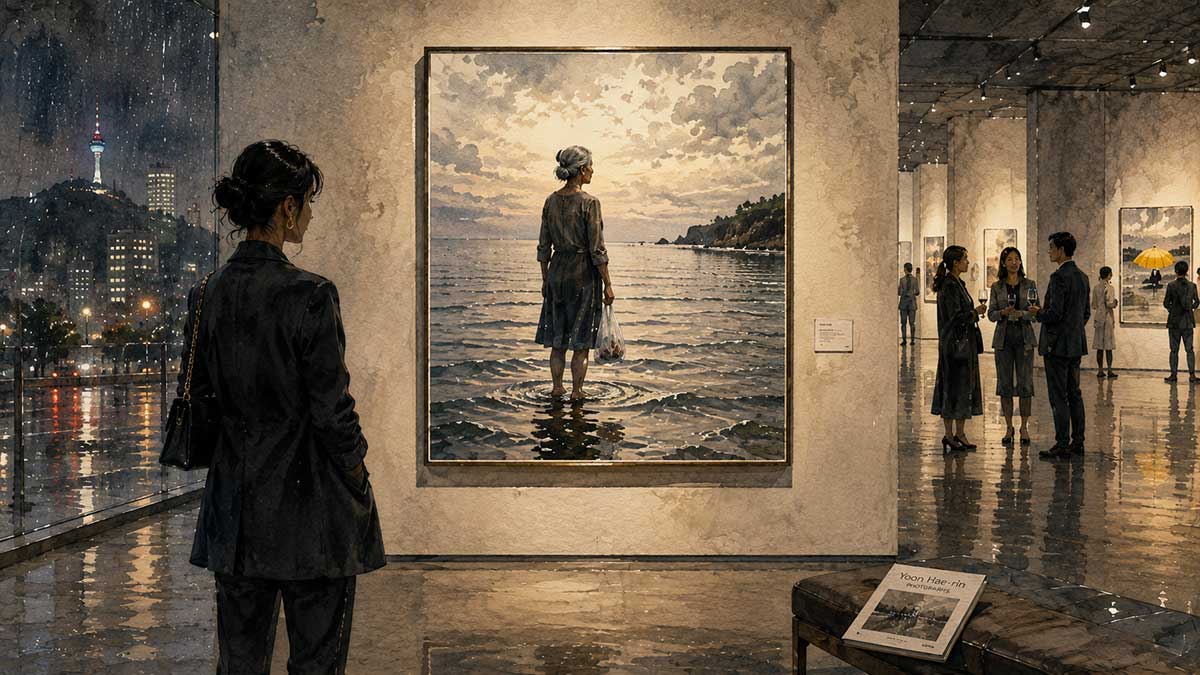
The first thing Seo-jin noticed about Hae-rin was that she never looked rushed.
That irritated her.
Everyone at Lumière Cosmetics looked rushed.
People moved through the Seoul office carrying laptops, coffee, garment bags, lighting notes, pitch decks, phones pressed to their ears. Campaign weeks turned the building into a machine that fed on sleep.
Hae-rin seemed untouched by it.
She arrived twenty minutes before the shoot wearing black jeans, white sneakers, and no visible makeup. She carried two cameras and a canvas bag with oranges printed on it.
Seo-jin looked at her and thought:
Too young.
Then:
Too relaxed.
Then, almost against her will:
Beautiful.
Not in the polished way Lumière sold beauty.
Hae-rin’s hair was tied badly. She had a faint scar near one eyebrow. She laughed with the lighting assistant before she had even unpacked.
Seo-jin disliked her before they spoke.
That embarrassed her.
So she became extremely polite.
“Yoon Hae-rin?”
Hae-rin turned.
“Yes.”
“I’m Han Seo-jin. Brand strategy.”
“I know.”
“You do?”
“You rejected my first treatment.”
Seo-jin blinked.
Hae-rin smiled.
“It was better after the rejection.”
That should have disarmed her.
Instead Seo-jin heard confidence.
“Good,” she said. “Then we agree.”
Hae-rin laughed.
Seo-jin did not.
The campaign was for an anti-aging serum being repositioned toward women in their thirties.
The original concept showed perfect skin, polished stone, pale flowers.
Hae-rin had sent it back.
Too dead, she wrote.
Seo-jin had nearly removed her from the project.
Then Hae-rin sent a second treatment.
Women laughing in elevators.
Lipstick on coffee cups.
Hair moving in wind.
A face half-lit on a night bus.
Beauty that looked as though it had somewhere to go.
Seo-jin approved it.
The photographs were excellent.
That irritated her too.
At lunch on the second shoot day, Seo-jin opened Instagram and saw that Min-jae followed Hae-rin.
She stared at the screen.
It meant nothing.
Min-jae followed hundreds of people.
He worked in technology. He followed founders, photographers, designers, restaurants, former classmates, people he met once at conferences.
Still.
She clicked Hae-rin’s profile.
There were photographs from Busan, Jeju, Tokyo.
Streetlights reflected in rain.
Old women at markets.
A boy asleep on a ferry.
Then Min-jae’s name appeared beneath one image.
Liked by minjae_k and others.
Seo-jin put down the phone.
“Everything okay?”
Her assistant, Ji-won, was looking at her.
“Fine.”
Seo-jin smiled.
She had become very good at saying that word without appearing to lie.
She had been with Min-jae for six years.
Six years was long enough that people had stopped asking whether they would marry and started asking when.
His mother sent Seo-jin kimchi.
Her parents referred to him as if he already belonged to the family.
They had discussed apartments.
School districts, jokingly.
Children, less jokingly.
Min-jae kept saying:
“After this year.”
The first time, his startup was raising money.
The second time, Seo-jin was up for promotion.
The third time, housing prices made everything ridiculous.
There was always a reason.
Seo-jin accepted them because six years seemed like evidence.
People did not spend six years building something they intended to leave.
That was what she believed.
Until Thursday night.
Min-jae was in the shower.
His laptop was open on the dining table.
Seo-jin was looking for the reservation confirmation for a weekend trip.
A notification appeared.
Hae-rin: I told you I don't like doing this.
Seo-jin stopped breathing.
The message disappeared.
She clicked.
The thread opened.
There were weeks of messages.
Not explicit at first.
Recommendations.
Photos.
A joke about the Lumière shoot.
Then dinners Seo-jin did not know about.
One message from Min-jae:
I think about you constantly.
Another:
I wish things were simpler.
Hae-rin:
You keep saying that.
Seo-jin scrolled faster.
Her hands began shaking.
She heard the shower stop.
Min-jae walked into the room drying his hair.
He saw her face.
Then the laptop.
He froze.
Neither spoke for several seconds.
Seo-jin looked at him.
“How long?”
“Seo-jin—”
“How long?”
“Three months.”
She laughed.
It came out wrong.
“Three months?”
He sat down.
“Please.”
“Did she know?”
Min-jae rubbed his face.
“Know what?”
Seo-jin stared at him.
“About me.”
Silence.
That silence was very small.
Less than two seconds.
Years later, Seo-jin would remember it more clearly than anything he said afterward.
“Yes,” he said.
Something inside her found a target.
Min-jae apologized for hours.
He said he was confused.
He said they had grown apart.
He said Seo-jin worked constantly.
He said he had been lonely.
Every explanation made him smaller.
But none of them hurt as much as one image Seo-jin could not stop creating.
Hae-rin knew.
Hae-rin had stood across from her at work, smiling.
Hae-rin had shaken her hand.
Hae-rin had watched her discuss schedules and budgets while sleeping with Min-jae.
The humiliation became almost physical.
“What did she say about me?”
“Nothing.”
“Don't lie.”
“She didn't.”
“Did she ask?”
“Seo-jin.”
“Did she ask about me?”
Min-jae hesitated again.
“Yes.”
“And?”
“I told her things were complicated.”
Seo-jin felt something cold settle into place.
Things were complicated.
Six years reduced to complicated.
She left the apartment that night.
Not because she had decided anything.
Because if she stayed, she was afraid she might destroy something.
At the time, she meant furniture.
For three days, Seo-jin did nothing.
On Monday she went to work.
Hae-rin was not there.
The campaign was already finished.
Ji-won asked if Seo-jin wanted coffee.
“Yes.”
“Americano?”
“Yes.”
She opened Instagram.
Hae-rin had posted a photograph of sunlight on an apartment wall.
No caption.
Seo-jin stared at it.
She wondered whether Min-jae had been there.
She wondered whether the apartment belonged to Hae-rin.
She wondered whether the wall had seen things Seo-jin had paid six years to believe belonged to her.
That was when she sent the first message.
Not to Hae-rin.
To an acquaintance at another cosmetics company.
You worked with Yoon Hae-rin before, right?
The reply came quickly.
Once. Why?
Seo-jin typed:
Just curious how professional she was.
Then deleted it.
Typed again.
We had some boundary issues. Wanted to see if it was a pattern.
She looked at the message.
It was not exactly a lie.
That was how it started.
The story spread efficiently because Seo-jin knew how stories spread.
She had built a career making people remember things.
Never state too much.
Suggest.
Leave room for the other person to complete the conclusion.
At lunch with a creative director:
“I probably shouldn’t say anything.”
He leaned closer.
She sighed.
“Just be careful if you hire her for anything involving senior clients.”
“What happened?”
“Nothing I can prove professionally.”
That phrase did enormous work.
Another conversation:
“She’s talented.”
Pause.
“Very talented.”
The second “very” changed the first.
A month later, someone sent Seo-jin a screenshot from a group chat.
Anyone worked with Hae-rin? Heard she gets personally involved with people on accounts.
Seo-jin stared at it.
She had not written that.
She felt a strange relief.
The rumor no longer belonged to her.
Then came the anonymous email.
She created a new address from a café.
Attached screenshots of messages between Min-jae and Hae-rin.
She cropped them.
Removed the lines where Hae-rin questioned him.
Left the flirtation.
Sent them to a producer considering Hae-rin for a large luxury campaign.
Thought you should know before you put your client in a difficult position.
Seo-jin’s heart pounded after she clicked send.
She walked outside.
Seoul was bright and cold.
People crossed Gangnam-daero carrying shopping bags and coffee.
A woman brushed past her without apologizing.
Seo-jin wanted to laugh.
For the first time since finding the messages, she felt strong.
Min-jae moved out two months later.
That surprised her.
Some part of Seo-jin had believed the affair ending would pull them back together.
He had stopped seeing Hae-rin.
He said so.
He showed her his phone.
He offered passwords.
He suggested counseling.
Seo-jin discovered that revenge and reconciliation required completely different emotions.
She could not summon both.
One night he said:
“I don't know how to make you believe me anymore.”
She replied:
“You should've thought about that before.”
He nodded.
A week later, he packed.
Seo-jin watched him fold shirts into boxes.
“You're giving up?”
Min-jae stopped.
“I don't know what you want me to do.”
The sentence enraged her.
Men always seemed to say this when they wanted women to explain the consequences of things the men had done.
“Nothing,” she said.
So he did.
Hae-rin lost the luxury campaign in November.
Seo-jin heard through Ji-won.
“Apparently they went with someone else at the last second.”
Seo-jin kept typing.
“Why?”
“No idea. There are rumors.”
“What rumors?”
Ji-won lowered her voice.
“Personal stuff.”
Seo-jin nodded.
That evening she bought an expensive bottle of wine.
She expected satisfaction.
She got it.
It lasted perhaps forty minutes.
By spring, Hae-rin had left Seoul.
Her profile changed.
More photographs of Busan.
Harbor cranes.
Old houses.
Grey sea.
A woman carrying fish in red gloves.
Seo-jin stopped checking.
Or told herself she did.
Her promotion came through.
She moved into a larger apartment.
She began dating occasionally.
Nothing serious.
Min-jae married someone else three years later.
Seo-jin learned from Facebook.
That hurt less than she expected.
By then, she had turned the entire relationship into something filed under previous life.
Hae-rin stayed there too.
Until the old email appeared.
It was late on a Sunday.
Seo-jin was moving files from an aging laptop before replacing it.
There were folders she had not opened in years.
Campaigns.
Contracts.
Tax documents.
Photographs.
Then:
Min-jae backup
She nearly deleted it.
Instead she opened the folder.
Old screenshots.
Exports.
Documents from the breakup period.
Seo-jin felt almost bored by them now.
Then she saw an email chain.
She did not remember saving it.
From: Min-jae
To: Hae-rin
I told you already. Seo-jin and I separated months ago. We haven't announced it because of family and work.
Seo-jin stopped.
She read it again.
The date was six weeks before the first message she had seen.
Below:
Hae-rin: Are you actually separated, or are you telling me you're emotionally separated? Those aren't the same.
Min-jae:
Actually separated.
Another:
Then why do you still live together?
Lease and timing. It's messy.
Another:
I don't want to be the person who finds out later there was another woman all along.
Seo-jin’s hands went cold.
She kept reading.
Weeks later:
Hae-rin: I saw Seo-jin at the shoot today. You told me she knew. She clearly doesn't know.
Min-jae:
We talked after. I'll explain.
Hae-rin:
No. Don't. I think you lied to me.
Then the final email.
Don't contact me again.
Seo-jin sat completely still.
The room made small evening sounds.
The refrigerator.
Traffic below.
A neighbor closing a cabinet.
She remembered asking Min-jae:
Did she know?
The pause.
Yes.
Seo-jin closed the laptop.
Then opened it again.
She read every message.
She threw up in the kitchen sink.
For two days she could barely work.
Not from guilt exactly.
Guilt was too clean.
This was something uglier.
Her mind kept trying to escape.
Min-jae had lied.
She had been devastated.
She had not known.
Hae-rin had still been involved with him.
Maybe she should have investigated more.
Maybe Hae-rin had suspected.
Maybe—
Seo-jin stopped herself.
She knew what she was doing.
Building a defense.
The same skill that had made her successful.
Find the angle.
Control the story.
She opened Instagram.
Hae-rin’s account was public.
She was still in Busan.
She had an exhibition scheduled in two months.
Seo-jin typed:
I need to talk to you.
Deleted.
Typed:
I found something that changes what I thought happened.
Deleted.
Finally:
I owe you an apology. I don't expect an answer.
She sent it.
Nothing came back.
A week passed.
Seo-jin sent one more message.
I won't contact you again after this. I spread things about you after Min-jae and I broke up. Some were false. I found messages showing he lied to you about us. I am sorry.
Two days later:
If you come to Busan, I will meet you once.
Seo-jin read the message until the screen dimmed.
On the KTX to Busan, she wrote the apology in her notes app.
It became eleven paragraphs.
She explained the six years.
Her age then.
The pressure to marry.
How publicly humiliating betrayal felt.
How she had seen Hae-rin at work and believed she was laughing at her.
How Min-jae had manipulated them both.
How Seo-jin had not slept.
How her mother kept asking when they would marry.
How she felt replaced.
How she thought she was losing everything she had spent her thirties building.
She read it.
Every paragraph began with:
I.
I.
I.
Seo-jin selected all.
Deleted it.
Outside the window, apartment blocks blurred into hills.
She sat with nothing prepared.
For once, that seemed appropriate.
Hae-rin chose a small café near Gwangalli Beach.
She arrived wearing a navy coat.
Her hair was shorter.
She looked older than the woman Seo-jin remembered.
Of course she did.
Seo-jin hated herself for being surprised.
Four years had passed for Hae-rin too.
“Hello,” Seo-jin said.
Hae-rin sat.
“Hello.”
Neither ordered food.
Seo-jin had imagined dozens of versions of this meeting.
Hae-rin furious.
Hae-rin crying.
Hae-rin refusing to look at her.
Instead she looked tired.
That was worse.
Seo-jin placed her hands on her lap.
“I sent the rumors.”
Hae-rin said nothing.
“The first ones. About you being unprofessional. About clients.”
Still nothing.
“I sent screenshots to Maison Belle's producer.”
Hae-rin’s eyes changed.
Seo-jin saw recognition.
“That was you.”
“Yes.”
Hae-rin looked toward the window.
“I lost Paris because of that.”
Seo-jin knew about the campaign.
She had not known what losing it meant.
“I know.”
“No, you don't.”
Seo-jin swallowed.
“You're right.”
Hae-rin looked back at her.
Seo-jin continued.
“I found Min-jae’s emails. He told you we'd separated.”
“Yes.”
“He told me you knew we were together.”
“I assumed he did.”
“He lied.”
“Yes.”
Seo-jin nodded.
“I am sorry.”
Hae-rin laughed once.
There was no humor in it.
“You came all the way from Seoul to tell me that?”
“No.”
“What else?”
Seo-jin stared at her hands.
“I wanted to explain.”
Hae-rin waited.
Seo-jin looked up.
“But I think the explanation is mostly for me.”
For the first time, Hae-rin’s expression softened slightly.
Seo-jin continued.
“I was humiliated. I hated you. I made you the reason for something he did.”
Her voice shook.
“I wanted people to see you the way I saw you.”
“And they did.”
“Yes.”
Hae-rin looked down.
“I couldn't get work for months.”
Seo-jin closed her eyes briefly.
“My mother thought I'd done something criminal.”
“I’m sorry.”
“I moved back to Busan because I couldn't afford Seoul.”
Seo-jin’s face burned.
“I know sorry isn't—”
“Don't.”
Seo-jin stopped.
Hae-rin folded her hands around the coffee cup.
“I believe you're sorry.”
Seo-jin looked at her.
Tears came before she could stop them.
Hae-rin watched.
Then said quietly:
“That doesn't mean I want you in my life.”
Seo-jin nodded.
“I know.”
“I don't want updates.”
“Okay.”
“I don't want us to become two women who survived the same bad man and now understand each other.”
Seo-jin flinched.
Hae-rin continued.
“That would be a nice story for you.”
Seo-jin looked down.
“Yes.”
“I don't want that story.”
“I understand.”
Hae-rin stood.
Seo-jin stood too, automatically.
Hae-rin picked up her bag.
At the door, she stopped.
“Do you know what bothered me most?”
Seo-jin waited.
“I kept wondering what I had done that made people believe you.”
Seo-jin could not answer.
Hae-rin nodded slightly.
Then left.
Seo-jin stayed in the café another hour.
Outside, the sea was grey.
A yellow umbrella moved slowly along the promenade.
She watched it disappear behind a bus.
For the first time, Seo-jin understood something she had resisted her entire adult life.
Knowing why she had done something did not reduce what had happened to the person who received it.
The explanation belonged to Seo-jin.
The consequences belonged to Hae-rin.
Those were not equal possessions.
She began correcting the damage the following Monday.
Not dramatically.
One conversation at a time.
She called the creative director who had first heard the rumor.
“I need to correct something I told you years ago about Yoon Hae-rin.”
There was silence.
“What happened?”
“I was involved personally. I misrepresented what happened.”
“Why are you telling me now?”
“Because it was wrong.”
Another call.
Another.
Then Maison Belle.
That one was harder.
The producer remembered the email.
Seo-jin admitted sending it.
“Do you understand what that did?”
“Yes.”
“No, I don't think you do.”
Seo-jin almost defended herself.
Instead:
“You're probably right.”
Some people appreciated the correction.
Others looked at Seo-jin differently afterward.
One colleague stopped inviting her to industry dinners.
Ji-won eventually asked:
“Why would you tell people it was you?”
Seo-jin looked at her.
“Because it was.”
Ji-won frowned.
“That doesn't undo anything.”
“No.”
“Then what's the point?”
Seo-jin did not know how to answer.
Maybe there wasn't one.
Not for her.
She made the calls anyway.
Months later, Seo-jin was invited to a gallery opening in Hannam-dong.
She almost did not go.
The room was crowded.
White walls.
Wine.
People discussing photographs with the grave expressions people sometimes used when they wanted others to know they understood art.
Seo-jin moved slowly through the exhibition.
Then she stopped.
A photograph showed an old woman standing in shallow seawater at dawn.
Her trousers were rolled above the knees.
She held a plastic shopping bag in one hand.
Nothing dramatic was happening.
Yet the woman's face made Seo-jin stay.
She looked at the label.
Yoon Hae-rin
Seo-jin’s stomach tightened.
She glanced across the room.
Hae-rin was there.
Talking with two people.
Laughing.
Seo-jin’s first impulse was to leave.
Her second was to approach.
She imagined saying nothing important.
Just:
Congratulations.
Hae-rin might nod.
Maybe enough time had passed.
Maybe they could—
Seo-jin stopped.
There it was again.
Her desire to turn Hae-rin into something useful to her.
Forgiver.
Witness.
Proof that Seo-jin had changed.
She stayed where she was.
Looked back at the photograph.
The woman in the water was looking beyond the camera.
Seo-jin wondered who she was.
Where she lived.
Whether the shopping bag contained shoes.
Whether the water was cold.
Whether Hae-rin had spoken to her before taking the photograph.
Questions with no Seo-jin inside them.
She stood there a long time.
Then Hae-rin happened to look across the room.
Their eyes met.
Seo-jin did not wave.
Hae-rin did not either.
After a moment, Hae-rin returned to her conversation.
Seo-jin looked once more at the name beneath the photograph.
Not Min-jae's other woman.
Not the person who ruined six years.
Not the person Seo-jin ruined.
Just:
Yoon Hae-rin.
A photographer.
A person.
A life that had continued outside Seo-jin's story.
Seo-jin stayed until she had really seen the photograph.
Then she left without asking for anything.
Story 3 — Everyone Called Him a Hero
David Morales was at his best when somebody else was dying.
The first time the documentary crew filmed him, a construction worker had been brought into the emergency department after falling from scaffolding.
Everything around David accelerated.
Nurses moved faster.
A resident called for blood.
Someone cut through a jacket.
Someone else shouted a pressure.
David did not raise his voice.
“Two units now.”
“Ultrasound.”
“Call surgery.”
He touched the injured man’s shoulder.
“Stay with me.”
The man’s eyes rolled toward him.
David leaned closer.
“Stay with me.”
There was blood on his glove.
A machine began alarming.
A younger doctor froze for less than a second.
David saw it.
“Look at me.”
The doctor did.
“What do you need?”
The younger man answered.
David nodded.
“Do it.”
Twenty-seven minutes later, the patient was on his way to surgery.
Alive.
The camera operator lowered the camera.
Nobody spoke for a moment.
Then the producer, a woman named Celia Grant, looked at David.
“That,” she said quietly, “is why people call you a hero.”
David pulled off his gloves.
“No.”
He dropped them into the bin.
“That’s why people call emergency departments noisy.”
Celia smiled.
The line would make the documentary.
David knew it.
At home, Elena was trying to fix the dishwasher.
David walked into the kitchen and found half the lower cabinet emptied onto the floor.
“What happened?”
“It stopped draining.”
“Did you check the filter?”
“Yes.”
“The hose?”
“Yes.”
“The disposal?”
“Yes.”
David put down his bag.
“Move.”
Elena stayed where she was.
“I already called someone.”
“You called a plumber?”
“Appliance repair.”
“For a clogged drain?”
“We don't know that it's clogged.”
David crouched.
“I can have this fixed in ten minutes.”
Elena closed her eyes.
“What?”
“Nothing.”
He looked up.
“That wasn't a nothing face.”
She laughed once.
“Where have I heard that?”
David ignored the question.
“Hand me the screwdriver.”
Elena did not.
“David.”
“What?”
“The guy is coming tomorrow.”
“So you want dirty water sitting in there all night?”
“I want you to leave it alone.”
He stared at her.
“You want me to leave a broken dishwasher alone.”
“Yes.”
“Why?”
“Just because.”
“That makes no sense.”
“I know.”
He looked at her for another second.
Then stood.
“Fine.”
He picked up his bag again.
Elena watched him walk out of the kitchen.
Five minutes later, she found him in the garage looking for a flashlight.
Lucas came home from college that weekend.
He was nineteen, tall like David, quieter than David, and increasingly resistant to any sentence that began with “Have you thought about.”
They were eating Sunday lunch when Lucas said:
“I might take next semester off.”
David stopped chewing.
Elena kept her eyes on her plate.
Sofia, fifteen, immediately looked interested.
“To do what?” David asked.
“Go to Maine.”
“Maine.”
“Yes.”
“For?”
“There’s a potter there. Jonah Reese. I applied for an apprenticeship.”
David stared at him.
Sofia smiled.
“That sounds cool.”
David turned toward her.
“He’s in college.”
“I know.”
“He wants to leave college to make bowls.”
Lucas put down his fork.
“Ceramics.”
“Bowls are ceramics.”
Elena said, “David.”
“No, I’m trying to understand.”
Lucas leaned back.
“I knew this was a mistake.”
“What was a mistake?”
“Telling you before I decided.”
David felt something tighten.
“You’re nineteen.”
“I know how old I am.”
“You have a scholarship.”
“I can defer.”
“You’re studying biomedical engineering.”
“For now.”
David stared.
“For now?”
Lucas shrugged.
“I don't think I want it.”
“You’ve wanted engineering since high school.”
“No. You wanted engineering since high school.”
Elena looked at David.
He ignored her.
“I never forced you.”
Lucas laughed.
“No.”
“What’s funny?”
“You didn’t have to.”
David leaned forward.
“You have opportunities people would do anything for.”
Lucas looked at him.
“Then let one of them have my life.”
Silence.
Sofia looked down at her plate.
David felt the conversation slipping into a place he did not understand.
“So this is about me now.”
Lucas stood.
“No. That’s the problem. Everything becomes about you eventually.”
He left the table.
David stared after him.
Elena said nothing.
“What?”
She shook her head.
“Nothing.”
He hated that word in his own house.
The documentary crew returned three weeks later.
David had spent fifteen years in emergency medicine.
Eight years earlier, he had joined a medical relief team after an earthquake in Turkey.
Then another mission.
Then another.
Wildfires.
Floods.
A hospital under bombardment overseas.
A refugee clinic where he slept four hours in three days.
He had never planned to become publicly known.
A photograph did it.
David kneeling beside a blood-covered child outside a damaged hospital.
The image spread.
Then came interviews.
Speaking invitations.
Donors.
A foundation.
More missions.
David learned that attention could be turned into medical supplies.
He accepted it.
Elena never complained.
At first.
Celia interviewed her in their living room.
David was upstairs taking a call.
The camera faced Elena.
Celia asked about the early years.
Elena told stories.
David studying at two in the morning.
Their first apartment.
Lucas as a baby.
David missing Christmas once after a highway pileup.
Then Celia asked:
“What’s it like being married to a hero?”
Elena stopped.
The silence lasted perhaps four seconds.
On camera, it would feel much longer.
She smiled.
“I’m married to David.”
Celia waited.
Elena did not add anything.
Upstairs, David had finished his call.
He heard the answer.
He said nothing until the crew left.
Then:
“What was that?”
Elena folded a blanket on the sofa.
“What?”
“‘I’m married to David.’”
She continued folding.
“What was I supposed to say?”
“I don't know. Something.”
“I did.”
“You made it sound like the question annoyed you.”
“It did.”
“Why?”
Elena placed the blanket down.
“I don't know.”
David laughed softly.
“Yes, you do.”
She looked at him.
“Do we have to do this now?”
“Celia’s making a documentary that could bring millions into the foundation.”
“I know.”
“So when she asks what it’s like being married to a hero, maybe sounding irritated isn’t ideal.”
Elena stared at him.
“What should I have said?”
“That's not what I mean.”
“No. Tell me.”
“Something true.”
She smiled without warmth.
“You sure?”
David’s expression changed.
Elena looked away.
Then:
“You know how to save strangers.”
He waited.
“You don't know how to let your family have a problem you cannot fix.”
David almost laughed.
“What does that mean?”
“It means exactly what I said.”
“No, it doesn't. Give me an example.”
Elena looked at him.
“That.”
“What?”
“I tell you how I feel, and you turn it into a case that needs evidence.”
“I’m asking for clarification.”
“You’re cross-examining me.”
“I’m trying to understand you.”
“No. You’re trying to solve me.”
David took a step back.
“That’s ridiculous.”
Elena’s eyes filled.
“You see?”
“See what?”
She shook her head.
“Forget it.”
He watched her walk upstairs.
He stood in the living room alone.
The camera crew had moved one chair six inches to improve the shot.
David put it back.
Sofia’s school called on a Tuesday afternoon.
David was between meetings.
A counselor said Sofia had become dizzy in class.
Her hands had gone numb.
She had trouble breathing.
David’s body moved before the conversation ended.
He canceled everything.
Called Elena.
Drove to school.
By the time he arrived, Sofia was sitting in the nurse’s office wrapped in a grey blanket.
She looked embarrassed.
“What happened?”
“I’m fine.”
“Tell me.”
“I couldn't breathe.”
“Chest pain?”
“No.”
“Palpitations?”
“I don't know.”
“Any medication today?”
“No.”
“Caffeine?”
“Dad.”
“How much?”
“Stop.”
The nurse said gently, “It may have been a panic attack.”
David nodded.
“We still need to rule things out.”
Sofia stared at him.
“Rule what out?”
“Arrhythmia. Thyroid issues. Electrolytes. We can get an ECG.”
The counselor said, “Dr. Morales—”
“I know.”
He did not sound angry.
That made it worse.
“I’m not saying she has something serious. I’m saying we check.”
On the drive home he called a pediatric cardiologist he knew.
Then a therapist.
Then Elena called.
Then David started making a list.
By dinner, Sofia had appointments.
She sat at the table barely eating.
David said, “The cardiologist can see you Thursday.”
Sofia looked up.
“I don't want to go.”
“It’s one appointment.”
“I said I don't want to.”
“Sofia.”
“I had a panic attack.”
“We don't know that yet.”
“Yes, we do.”
“No. We have a likely explanation.”
She pushed back her chair.
“Why can't you just believe me?”
“I do believe you.”
“No, you don't.”
“Yes, I do.”
“You believe tests.”
David stopped.
Sofia’s voice rose.
“You believe machines and numbers and people with letters after their names.”
“Sofia.”
“Stop making me your patient.”
The room went silent.
She was crying now.
David stood.
She stepped backward.
That movement stopped him.
His own daughter had moved away from him as if he were approaching with an instrument.
Sofia wiped her face.
“I just wanted you to ask if I was scared.”
David said nothing.
She left the room.
Elena stared at him.
He looked down at the untouched food on Sofia’s plate.
The documentary editor sent David an early cut several weeks later.
He watched it alone in his office.
There he was in Turkey.
There he was in scrubs.
There he was speaking at a fundraiser.
A nurse said:
“When everyone else starts panicking, David gets calmer.”
A former patient said:
“He saved my life.”
A colleague said:
“He's fearless.”
David paused the video.
Fearless.
He disliked the word.
He resumed.
The film cut to the family interview.
Elena talked about their marriage.
Lucas talked about David missing birthdays but calling from disaster zones.
Sofia said:
“He wants to help everybody.”
Then came raw footage that had apparently been included accidentally.
The formal interview ended.
David stood.
He left the frame.
Someone off camera said they needed ten minutes to reset.
The camera kept running.
Lucas came into the room.
Sofia threw a cushion at him.
He threw it back.
Elena appeared carrying plates.
Lucas grabbed one.
Elena slapped his hand.
Sofia laughed.
Then Elena laughed.
Lucas said something David couldn't hear.
All three of them started laughing harder.
David watched.
Nothing important was happening.
That was what struck him.
Nobody needed anything.
Nobody was being saved.
Nobody was explaining a problem.
Elena’s shoulders were lower.
Sofia had her feet tucked beneath her.
Lucas was talking with his mouth full.
They looked—
David paused the footage.
He did not know the word at first.
Then he did.
Relaxed.
His family looked relaxed when he was not in the room.
David closed the laptop.
He sat there for a long time.
Lucas returned home the next weekend to pick up clothes.
David found him in his bedroom.
“Can we talk?”
Lucas kept folding shirts.
“About Maine?”
“About you.”
“That sounds dangerous.”
David ignored it.
“Why pottery?”
Lucas looked at him.
“I already told you.”
“No. You told me what you wanted to do.”
He sat on the edge of the desk.
“I’m asking why.”
Lucas kept folding.
For perhaps thirty seconds, nothing happened.
David felt an almost physical need to fill the silence.
He did not.
Finally Lucas said:
“I like it.”
David waited.
Lucas laughed.
“You’re not going to tell me that's not a reason?”
“No.”
Lucas watched him suspiciously.
“I like that if I mess something up, it just becomes clay again.”
David nodded.
“I like that nobody cares who you are.”
Another shirt folded.
“I like working with my hands.”
David almost said something about repetitive strain injury.
He stopped himself.
Lucas noticed.
“What?”
“Nothing.”
Lucas smiled faintly.
Then he became serious.
“I thought about medicine once.”
David looked up.
“When?”
“Junior year.”
“You never told me.”
“No.”
“Why not?”
Lucas shrugged.
“Everyone already thought I would.”
David frowned.
“Who?”
“Everybody.”
“That's not true.”
“Dad.”
Lucas looked at him.
“Teachers would ask if I was going to be a doctor like you. People at fundraisers would say I had big shoes to fill. Grandma kept telling people I got your brain.”
David looked away.
“I didn't tell them to say that.”
“I know.”
“Then why blame me?”
“I’m not blaming you.”
“You just said—”
Lucas stopped him with one hand.
“This is what you do.”
David went quiet.
Lucas sat on the bed.
“I almost picked medicine just so I wouldn't disappoint you.”
David stared.
“Then I realized if I became a doctor, I would spend the rest of my life being compared to you.”
“That wouldn't matter to me.”
“It would matter to me.”
David had no answer.
Lucas looked at the half-packed suitcase.
“Pottery was the first thing I found that didn't feel like it already belonged to you.”
That hurt in a place David had no defense for.
He said:
“I wanted you to have options.”
“I know.”
“I worked hard so you could choose.”
“I know.”
“Then why does it sound like I did something wrong?”
Lucas looked tired.
“You gave me choices. You just made some of them feel like failures.”
David sat very still.
Lucas continued.
“I don't need my life to impress you.”
“It isn't about impressing me.”
Lucas nodded.
“That’s what makes it worse.”
David looked at him.
“You think your definition of a meaningful life is reality.”
The sentence stayed in the room.
David could have argued.
He had arguments.
Statistics.
Career projections.
Student debt.
Income.
Benefits.
Risk.
He knew how apprenticeships failed.
He knew how artists struggled.
He knew twenty ways Lucas could regret this.
He said none of them.
Instead:
“Are you scared?”
Lucas looked surprised.
“About Maine?”
“Yes.”
“Yeah.”
David nodded.
“Me too.”
For once, that was all.
Celia called the following Monday.
“We’re almost locked.”
David said, “Take out ‘fearless.’”
“What?”
“The colleague who calls me fearless.”
“David, that’s one of the strongest lines.”
“It’s wrong.”
“You ran into a hospital during shelling.”
“I was scared.”
“That’s not how it reads.”
“Then make it read correctly.”
Celia was silent.
“What do you want it to say?”
David looked out his office window.
People crossed the street below.
“I was useful when people were afraid.”
Celia sighed.
“That’s less cinematic.”
“It’s more true.”
She laughed.
“You're difficult.”
“I've heard.”
David drove Lucas to Maine in October.
Elena offered to go.
Lucas said he wanted it to be just them.
For the first two hours, David talked too much.
Traffic.
Weather.
The apprenticeship agreement.
Health insurance.
How often Lucas should call.
Lucas answered minimally.
Then David stopped.
They drove through long stretches of highway with nothing but music.
At a gas station in Massachusetts, David bought terrible coffee.
Lucas took one sip.
“This is what happens when you leave civilization.”
“Maine hasn't even started yet.”
“I'm preparing.”
David smiled.
Later Lucas fell asleep.
David looked at him briefly.
When Lucas was five, David used to carry him from the car after he fell asleep.
He remembered the weight.
The warm face against his neck.
The certainty that his job was simple.
Carry him.
Feed him.
Keep him safe.
Nobody had explained that eventually the child would become a person whose choices could frighten you.
Nobody had explained that love could require standing still.
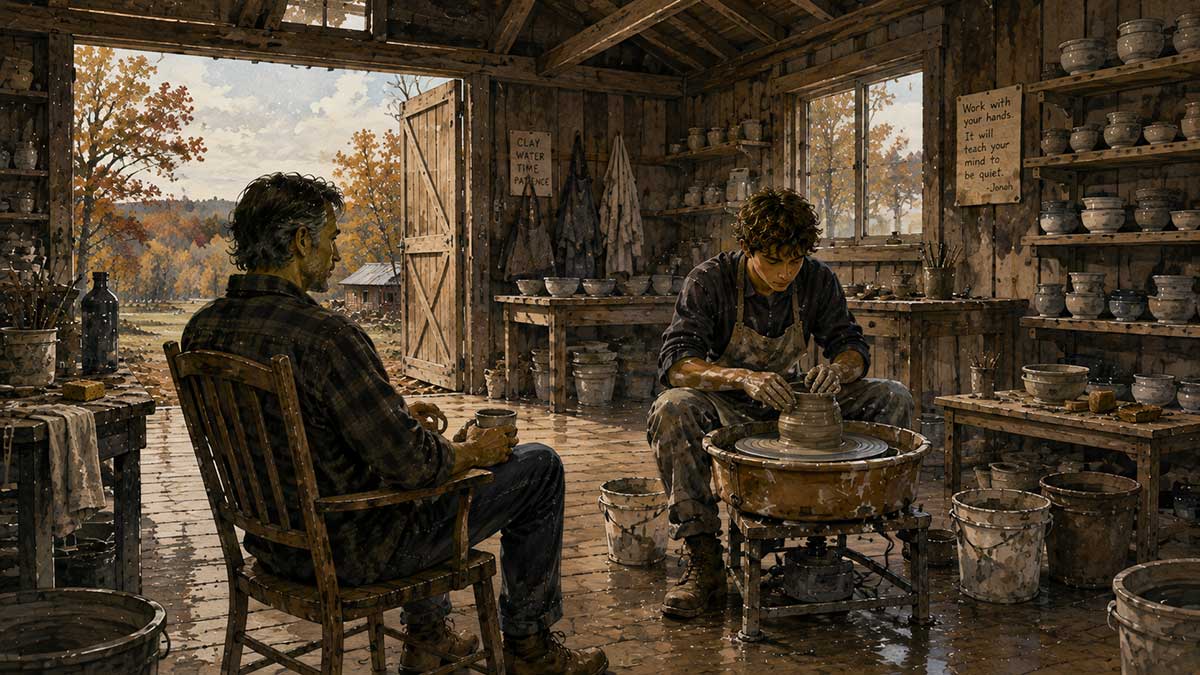
Jonah Reese's studio sat outside a small town surrounded by pine trees.
It was less impressive than David expected.
A converted barn.
Shelves of bowls.
Buckets.
Dust.
A kiln.
Lucas looked at it as if they had arrived at a cathedral.
Jonah was sixty-three, broad-shouldered, with clay under his fingernails.
He showed Lucas where he would sleep.
Introduced two other apprentices.
Then brought them into the studio.
A wheel sat near an open window.
“Go ahead,” Jonah said.
Lucas sat.
He placed clay on the wheel.
David stood behind him.
The wheel began turning.
Lucas wet his hands.
The clay rose.
Then tilted.
David saw the problem instantly.
Too much pressure on the right side.
His mouth opened.
Lucas adjusted his hands.
The clay steadied.
David closed his mouth.
Lucas looked over his shoulder.
He had noticed.
Neither said anything.
Jonah handed David a mug.
“First kid?”
“What?”
“Leaving.”
David nodded.
Jonah smiled.
“Harder than it looks.”
David watched Lucas bend over the wheel.
“I've done harder things.”
Jonah looked at him.
“Not sure you have.”
David almost laughed.
Then realized the man was serious.
He sat down.
Lucas worked.
The shape collapsed once.
Then again.
David did nothing.
Nobody needed him.
No alarms.
No blood.
No one calling his name.
No decision that could change who lived and who died.
Only his son trying to center a piece of clay.
David felt restless.
Then useless.
Then, after a long time, something else.
Present.
Lucas finally produced something resembling a bowl.
It leaned slightly.
He looked at David.
“Well?”
David could see every flaw.
He smiled.
“I like it.”
Lucas narrowed his eyes.
“That's it?”
David nodded.
“That's it.”
Lucas looked back at the bowl.
For once, David let the silence remain unfinished.
Outside, wind moved through the trees.
Inside, Lucas placed both hands around the clay.
David sat nearby with the mug warming his palms.
The man who had spent years entering rooms where everyone needed him stayed in one where nobody did.
Story 4 — Find My Daughter
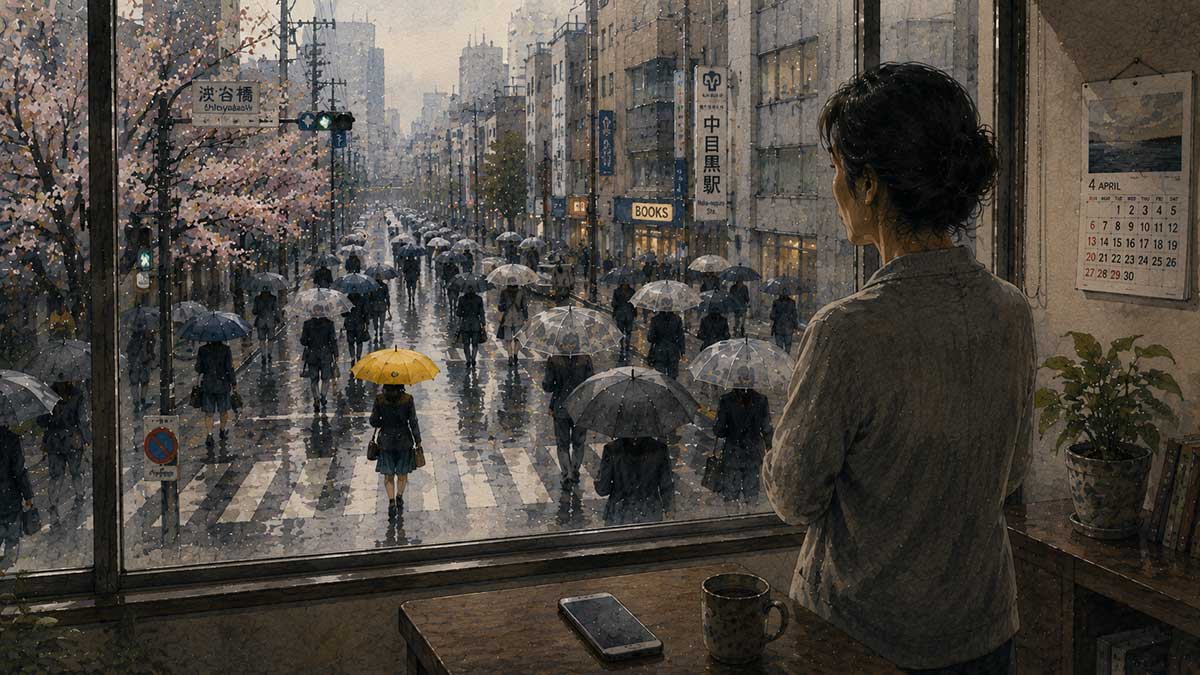
Keiko Nakamura checked her daughter’s location for the first time at 7:12 in the morning.
Misaki was already at the station.
A small blue circle moved across the map toward the train platform.
Keiko put down her phone and poured hot water over coffee.
At 7:19 she checked again.
The blue circle had moved.
Good.
At 7:41 Misaki was near the university.
At 8:03 she was inside the campus building.
Keiko placed the phone face down.
She had not called.
She had not texted.
She was not interfering.
That distinction mattered to her.
Other mothers called too often.
Other mothers asked where their children were every hour.
Keiko simply looked.
Looking was harmless.
Misaki had suggested location sharing herself.
She was seventeen then.
Her school club sometimes finished after dark, and Tokyo trains could be crowded late in the evening.
“Here,” Misaki had said, taking her mother’s phone. “Now you don't have to keep asking.”
Keiko remembered laughing.
“I don't keep asking.”
Misaki had looked at her.
Keiko laughed harder.
“Fine. Maybe a little.”
At first she checked only when Misaki was late.
Then when there was heavy rain.
Then when the trains stopped.
Then when Misaki did not answer a message.
Then whenever Keiko woke during the night.
Eventually there did not have to be a reason.
The map was there.
Misaki was there.
That was enough.
Or it should have been.
At nine years old, Misaki had waited beside Keiko at the hospital while two police officers explained that her father would not be coming home.
There had been no warning.
That part never left Keiko.
The morning had been ordinary.
Her husband, Takashi, had complained that his coffee was too hot.
Misaki had forgotten a worksheet.
Keiko had stood at the apartment door holding Takashi’s umbrella.
“You'll need this.”
He looked out at the clear sky.
“No rain.”
“You always say that.”
He took it anyway.
Then he kissed her cheek.
That was the final time she touched him while he was alive.
A truck crossed an intersection at the wrong moment.
Takashi died before Keiko reached the hospital.
For months afterward, she would replay the morning and search for a mistake.
What if she had kept him talking another thirty seconds?
What if the coffee had been cooler?
What if Misaki had not forgotten the worksheet?
What if Keiko had insisted he take a different route?
None of those thoughts changed anything.
Yet they taught her something she never forgot:
A life could end inside an ordinary morning without asking permission first.
Misaki was twenty now.
She studied economics at a university in Tokyo and worked two evenings a week at a café.
She was responsible.
Painfully responsible, Keiko sometimes thought.
She texted when plans changed.
She carried a portable charger.
She rarely drank.
She called if she would miss the last train.
Keiko should have had very little to worry about.
Then Misaki met Ren.
His full name was Sato Ren.
Twenty-one.
Political science.
From Nagano.
Keiko learned these facts before Misaki formally introduced him.
His social media was easy to find.
He played futsal.
He had an older sister.
His father owned some kind of printing business.
He had once posted a photograph from Shinjuku at 2:14 in the morning.
Keiko noticed that.
She noticed a lot.
At dinner one evening, Misaki said casually:
“I might bring someone here sometime.”
Keiko looked up.
“Someone?”
“A friend.”
“A boy?”
Misaki smiled despite herself.
“Maybe.”
“What does he study?”
“Mom.”
“What? I asked one question.”
“You already know, don't you?”
Keiko froze.
Misaki stared at her.
“How would I know?”
“Did you look him up?”
Keiko became offended quickly.
“Why would I do that?”
Misaki laughed.
“Oh my God.”
“Don't speak like that.”
“You did.”
“I may have looked once.”
“Once?”
“I wanted to know who you were spending time with.”
Misaki put down her chopsticks.
“His account is public.”
“I know.”
“So there is no privacy issue.”
Misaki looked at her for several seconds.
“That isn't the point.”
Keiko felt irritation rise.
“Then what is the point?”
“The point is you couldn't wait for me to tell you.”
Keiko wanted to say that mothers should know who their daughters spent time with.
She wanted to say that twenty was still young.
She wanted to say that girls were hurt every day by men whose mothers probably thought they were nice.
Instead she said:
“I worry.”
Misaki’s face softened.
That was Keiko’s great advantage and her great shame.
Misaki always softened when Takashi’s absence entered the room.
“I know.”
Keiko reached across the table.
Misaki let her hold her hand.
The argument ended.
Nothing changed.
Ren came for dinner two weeks later.
He brought sweets.
Too many.
Keiko liked that.
He took his shoes off neatly.
Good.
He thanked her for the food before tasting it.
Good.
He asked about Takashi after seeing a photograph.
Risky.
Keiko watched how he asked.
Not too curious.
Not afraid either.
Good.
By dessert, Keiko disliked herself for liking him.
Ren was easy to talk to.
He laughed with Misaki in a way that changed her daughter’s face.
Keiko saw it.
She had not realized how long it had been since she had seen Misaki look so unguarded.
That frightened her more than anything Ren actually did.
After he left, Keiko washed dishes.
“He seems nice,” she said.
Misaki dried a bowl.
“That's almost an endorsement.”
“I said seems.”
Misaki laughed.
Keiko smiled too.
Then asked:
“How late do his classes go on Thursday?”
Misaki stopped drying.
“Why?”
“No reason.”
“You checked my location today, didn't you?”
Keiko’s hands paused underwater.
“I check sometimes.”
“How many times?”
“I don't count.”
“That means a lot.”
“It means I don't count.”
Misaki put down the towel.
“Can you stop?”
Keiko looked at her.
“Stop what?”
“Checking unless I'm actually late.”
Keiko turned off the water.
“What if something happens?”
“You can call.”
“And if you don't answer?”
“Then check.”
Keiko stared at the sink.
Misaki’s voice became gentler.
“Mom.”
Keiko nodded.
“Fine.”
Misaki smiled.
“Thank you.”
The next morning Keiko lasted until 10:23.
It became a game Keiko played against herself.
Do not check.
She placed the phone in another room.
Then she imagined Misaki on a platform.
A stranger following her.
A sudden illness.
A train accident.
The phone came back into her hand.
The blue dot sat inside the university.
Keiko exhaled.
Safe.
An hour later she checked again.
The dot had moved to a nearby restaurant.
She wondered who Misaki was eating with.
She did not text.
That proved restraint.
At three fifteen, Misaki was in a neighborhood Keiko did not recognize.
She zoomed in.
An apartment building.
Keiko stared at the map.
Ren’s apartment?
She remembered his social media.
Shinjuku? No.
Maybe his sister?
Maybe a friend?
Misaki had said nothing.
Keiko locked the phone.
Ten minutes later she checked again.
The blue dot had not moved.
At 4:02 she sent:
How is your day?
Misaki replied:
Good! Studying with friends.
Keiko stared at the word friends.
Plural.
Maybe true.
Maybe not.
She hated the person she became in those moments.
Then she hated uncertainty more.
One Friday evening, Keiko woke on the sofa at 11:40.
The television was still on.
Misaki had said she would stay at Ren’s place until the last train.
Keiko checked the map.
Battery: 9%.
Misaki was near the station.
Good.
At 11:47 the dot moved.
At 11:53 it stopped.
At midnight, still stopped.
Keiko called.
No answer.
She waited two minutes.
Called again.
Nothing.
Battery: 6%.
Keiko stood.
She put on a sweater.
Checked train delays.
None.
At 12:07 Misaki called.
“Mom?”
“Where are you?”
“At the station.”
“You weren't moving.”
“What?”
“Your location stopped.”
Silence.
Then:
“You were watching?”
Keiko ignored it.
“Why didn't you answer?”
“I was running for the train.”
“I called twice.”
“I know.”
“Your battery is almost dead.”
“I know.”
“Why didn't you charge it?”
“Mom.”
Keiko heard irritation now.
“I just wanted to know you were safe.”
Misaki was silent.
Then:
“I’m on the train.”
Keiko sat down.
“Okay.”
“I’ll be home in thirty-five minutes.”
“Okay.”
Misaki hung up.
Keiko stared at the map until the blue dot started moving again.
Only then did her hands stop shaking.
The next afternoon, Misaki sat with Ren in a café near Kichijoji.
Her phone lay face down on the table.
Ren watched her.
“You’re mad.”
“I'm tired.”
“Same thing with your mom?”
Misaki nodded.
“She called because my location froze.”
Ren stirred his coffee.
“Why don't you turn it off?”
Misaki laughed.
“You've met her.”
“She'd survive.”
“You don't know that.”
Ren looked up.
Misaki regretted the words immediately.
“She would survive,” she corrected. “I just mean...”
She searched for the sentence.
“If she wakes up and sees I'm not where she expected, she can't sleep.”
“So?”
Misaki looked at him.
“That sounds mean.”
“No. I mean, is that your job?”
Misaki looked out the window.
People crossed beneath umbrellas.
“She lost my dad.”
“I know.”
“I was there.”
“I know.”
Ren waited.
Misaki picked at the paper sleeve around her cup.
“I think she believes if she can see me, then whatever happened to him can't happen to me.”
Ren said nothing.
Misaki’s eyes filled unexpectedly.
“I leave it on so she can sleep.”
There.
She had never said that aloud.
Ren looked at her.
“Does she know?”
“No.”
“Maybe she should.”
Misaki shook her head.
“It would destroy her.”
Ren’s voice was quiet.
“Maybe you're already carrying the part that would.”
Keiko found the messages by accident.
That was what she told herself.
Misaki had left her tablet in the living room.
A notification appeared.
Ren:
Did you tell her about Hakone?
Keiko looked away.
Then back.
Hakone.
Misaki had mentioned nothing.
The tablet screen dimmed.
Keiko touched it.
No password.
The message thread opened.
She read.
Weekend trip.
One night.
Train reservations.
A small hotel.
Ren had written:
You can tell her after exams if you want.
Misaki:
No, that makes it worse.
Then:
She’ll ask me to share location the whole time.
Ren:
Turn it off.
Misaki:
Then she won't sleep.
Keiko felt something tear inside her.
Not anger at first.
Pain.
Her daughter was discussing her like an illness to be managed.
She read further.
Misaki:
Sometimes I think she only knows I'm safe if she can see the blue dot.
Keiko closed the tablet.
For several seconds she could not breathe normally.
Then Misaki walked in.
She saw the tablet.
Saw her mother’s face.
Everything became clear instantly.
“You read it.”
Keiko stood.
“You're going to Hakone?”
Misaki closed her eyes.
“Oh my God.”
“When were you planning to tell me?”
“You read my messages?”
“Answer me.”
“No.”
Keiko stared.
“No what?”
“No, I'm not answering you.”
“Misaki.”
“You read my messages.”
“You left it open.”
“That doesn't mean you read them!”
“I saw Hakone.”
“So you opened the thread.”
“I was worried.”
“You weren't worried. You were curious.”
Keiko flinched.
“I am your mother.”
“And I'm twenty.”
“Exactly. Twenty.”
Misaki laughed in disbelief.
“What does that mean?”
“It means you think you're older than you are.”
“No. It means I'm exactly as old as I am.”
Keiko stepped closer.
“You're planning to stay overnight with a man and hide it from me.”
“I was going to tell you.”
“When?”
“Before I left.”
“That is hiding.”
“No, Mom. Hiding is what I do so I don't have to manage your reaction for three weeks.”
Keiko went still.
“Manage me?”
Misaki’s anger faltered.
Then returned.
“Yes.”
Keiko felt suddenly cold.
“So that is what I am to you.”
“No.”
“A problem you manage.”
“I didn't say that.”
“You wrote it.”
“I wrote that I leave location sharing on so you can sleep.”
Keiko stared at her.
Misaki’s voice softened, and that made it worse.
“I don't want to do it anymore.”
Keiko swallowed.
“Fine.”
She picked up her phone.
“Fine. Turn it off.”
Misaki looked at her.
“Mom.”
“No. You want freedom. Turn it off.”
“That isn't what I'm saying.”
“Turn it off.”
Misaki’s face hardened.
She took out her phone.
Three taps.
Keiko’s screen changed.
Location unavailable.
The absence was immediate.
A blankness where the blue circle had always been.
Keiko looked at it.
Her chest tightened.
“If something happens to you, how am I supposed to find you?”
Misaki’s eyes filled.
“Maybe I'm not supposed to live every day as the next person you're going to lose.”
The room became silent.
Keiko looked at her daughter.
For one terrible moment, she saw Takashi.
Not his face.
His absence.
An ordinary morning.
An umbrella.
A police officer.
A hospital corridor.
She whispered:
“Don't say that.”
Misaki began crying.
“I love you.”
“Then don't say that.”
“I love you, but I can't keep being alive for you like it's a job.”
Keiko stepped back as though struck.
Misaki went to her room.
The door closed.
Keiko remained standing in the living room.
Her phone still displayed the map.
No blue dot.
For the next two weeks, they moved around each other carefully.
Misaki still texted when she would be late.
Keiko answered:
Okay.
Nothing else.
She did not ask for location sharing back.
She wanted to.
Every day.
Misaki eventually told her about Hakone.
“We're still going.”
Keiko was washing rice.
“When?”
“Next Saturday.”
Keiko nodded.
“The weather may be bad.”
“I know.”
“There's a storm system coming.”
“We know.”
“You should check the trains.”
“We will.”
Keiko’s hands tightened around the bowl.
She wanted to tell Misaki not to go.
Instead:
“What hotel?”
Misaki hesitated.
Then told her.
Keiko wrote it down.
Misaki saw.
Keiko almost defended herself.
She did not.
Saturday morning arrived grey.
Misaki packed one small bag.
Keiko stood in the kitchen.
“You have your charger?”
“Yes.”
“Portable one?”
“Yes.”
“Medicine?”
“I don't take medicine.”
“Pain reliever.”
“Yes.”
“Cash?”
“Yes.”
“Emergency contact—”
“Mom.”
Keiko stopped.
Misaki put on her coat.
The yellow umbrella stood beside the door.
Takashi had once owned one almost that color.
Keiko hated the coincidence.
Misaki reached for it.
Keiko said:
“Wait.”
Misaki froze.
For one second both of them thought Keiko might forbid the trip.
Keiko walked over.
She adjusted the scarf near Misaki’s neck.
“That was bothering me.”
Misaki looked at her.
“Okay.”
Keiko stepped back.
“Have fun.”
Misaki smiled uncertainly.
“I'll text when we get there.”
“You don't have to—”
“I know.”
Misaki picked up the umbrella.
Then left.
Keiko stood behind the closed door.
Her phone felt very heavy in her pocket.
She did not take it out.
The first message arrived at 11:18.
Here. Rain is terrible lol
A photograph followed.
Misaki and Ren under the yellow umbrella.
Both wet.
Both smiling.
Keiko stared at it until she smiled too.
She replied:
Have fun.
At four, the rain intensified.
News alerts mentioned train disruptions.
Keiko checked the rail company.
Several lines delayed.
She texted:
Weather looks bad. Hotel okay?
No answer.
Twenty minutes.
Thirty.
Keiko called.
Voicemail.
She told herself Misaki was inside somewhere.
At 5:11 Ren’s phone went straight to voicemail too.
Keiko opened the weather map.
Red.
Orange.
Warnings.
Her heart started pounding.
She called the hotel.
No answer at first.
Then someone picked up.
Keiko explained.
The reservation?
Yes, Nakamura and Sato.
Had they checked in?
No.
Keiko stood.
“They haven't?”
“Not yet.”
“What time were they expected?”
The employee did not know.
Keiko called Misaki again.
Nothing.
She looked at the map automatically.
No location.
The blank screen felt like accusation.
For years she had told herself the blue dot was unnecessary.
Now she would have given anything to see it.
At 6:03 the railway announced a suspension on part of the route.
Keiko called Ren’s number again.
Nothing.
She called Misaki.
Nothing.
Her hands shook so badly she dropped the phone.
At 6:30 Keiko was wearing her coat.
She had decided she would go.
Go where, she did not know.
Hakone.
A station.
The hotel.
Anywhere closer.
She grabbed her keys.
Then her phone rang.
Unknown number.
“Hello?”
“Mom?”
Keiko stopped breathing.
“Misaki?”
“Yeah.”
“Where are you?”
“We're okay.”
Keiko pressed one hand against the wall.
“Where are you?”
“We got stuck near a station after the trains stopped. My phone died and Ren's died too.”
“Why didn't you charge them?”
The question came out sharp.
There it was.
Anger arriving behind relief.
Misaki went quiet.
Keiko closed her eyes.
“Sorry.”
“We borrowed someone's phone.”
“Are you safe?”
“Yes.”
“Can you get to the hotel?”
“No. They're saying no trains until morning.”
Keiko felt panic rise again.
“Then what are you going to do?”
“There’s a community center open for stranded people. We're going there.”
“Who is there?”
“Lots of people.”
“Staff?”
“Yes.”
“Police?”
“I don't know.”
“Send me the address.”
“I don't know it yet.”
“Misaki—”
“Mom.”
Keiko stopped.
Misaki sounded tired.
And frightened.
Keiko heard it.
For once, fear in her daughter's voice did not make Keiko immediately start issuing instructions.
“Are you scared?” she asked.
Silence.
Then:
“A little.”
Keiko leaned against the wall.
“Me too.”
Misaki breathed out.
“I know.”
Keiko almost said:
This is why I wanted your location.
The sentence reached her mouth.
She swallowed it.
“Call me again when you can.”
“I will.”
“Borrow another phone if you need to.”
“I know.”
“I love you.”
“I love you too.”
The call ended.
Keiko remained against the wall.
The blue dot would not have stopped the storm.
That thought came quietly.
It would not have charged the battery.
It would not have restarted the train.
It would not have kept Misaki dry.
It would only have allowed Keiko to watch the danger move.
She sat down on the floor.
For the first time, she wondered whether knowing and protecting had ever been the same thing.
Misaki returned the next morning.
Her clothes smelled damp.
Her hair was greasy.
She looked exhausted.
Keiko opened the door.
For a moment neither moved.
Then Keiko pulled her close.
Misaki held her.
They stood that way for a long time.
Then Keiko stepped back.
Anger came again.
“You should have—”
She stopped.
Misaki waited.
Keiko saw exactly how the next minute could go.
Why didn't you charge your phone?
Why didn't you leave earlier?
Why did you go when you knew the weather?
See what happens?
She had rehearsed those sentences all night.
They were ready.
They were not false.
That made them harder to release.
Keiko looked at her daughter’s face.
“Were you scared?”
Misaki nodded.
“Yes.”
“So was I.”
Misaki started crying.
Keiko did too.
Nothing else was said.
A month later, Misaki came into the kitchen carrying her phone.
“I can share my location again if you want.”
Keiko looked at her.
“Why?”
Misaki shrugged.
“So you don't worry.”
Keiko felt the old relief rise instantly.
Yes.
Say yes.
The blue dot could return.
She could sleep.
She could know.
Then she remembered the messages.
I leave it on so she can sleep.
Keiko turned back to the tea she was making.
“No.”
Misaki blinked.
“No?”
“If you want to share it sometimes, share it.”
Keiko measured tea leaves carefully.
“But I don't want you doing it for me.”
Misaki sat down.
Keiko continued.
“If you tell me something, I want it to be something you want me to know.”
Misaki studied her.
“What if you're worried?”
“I will be worried.”
“That's it?”
Keiko gave her a tired smile.
“I'm starting to think worry may be my problem.”
Misaki laughed softly.
Keiko did too.
Then Misaki reached across the table.
Keiko took her hand.
She noticed she was holding it too tightly.
She loosened her fingers.
Spring arrived slowly.
Misaki spent more nights out.
Sometimes she texted.
Sometimes she forgot.
Keiko still checked train alerts.
Still read stories about accidents she should not have read.
Still woke at two in the morning and imagined things she could not control.
She did not become a different person.
Some nights she opened the location-sharing app by habit.
There was no blue dot.
At first the blank map felt like loss.
Eventually it became simply a map.
One rainy morning, Misaki stood at the door putting on her shoes.
“You'll be late,” Keiko said.
“I know.”
“Take an umbrella.”
“I have one.”
The yellow umbrella.
Keiko watched her pick it up.
For an instant she remembered Takashi leaving.
Clear sky.
His hand taking an umbrella he did not think he needed.
The door shutting.
The last ordinary moment.
Fear moved through Keiko so quickly it felt physical.
Misaki opened the door.
“Bye.”
Keiko wanted to say:
Text me when you get there.
Tell me which train.
Call if you change plans.
Charge your phone.
Be careful.
Come home.
Instead:
“Have a good day.”
Misaki smiled.
“You too.”
The door closed.
Keiko went to the window.
Below, umbrellas moved along the wet street.
Black.
Clear plastic.
Navy.
Then yellow.
Misaki walked toward the station.
Keiko watched until the crowd swallowed her.
Her hand moved toward the phone on the table.
Stopped.
For a moment she simply stood there.
She did not know where Misaki would go after class.
She did not know whom she would meet.
She did not know whether the trains would run on time.
She did not know whether the world would be kind.
She had spent eleven years treating uncertainty as something love should defeat.
It had never been defeated.
It had only been watched.
Keiko turned away from the window.
In the kitchen, the kettle had begun to whistle.
She poured the water.
Steam rose.
Outside, rain continued falling over Tokyo.
And somewhere beyond the window, her daughter kept walking.
Story 5 — One Ordinary Year
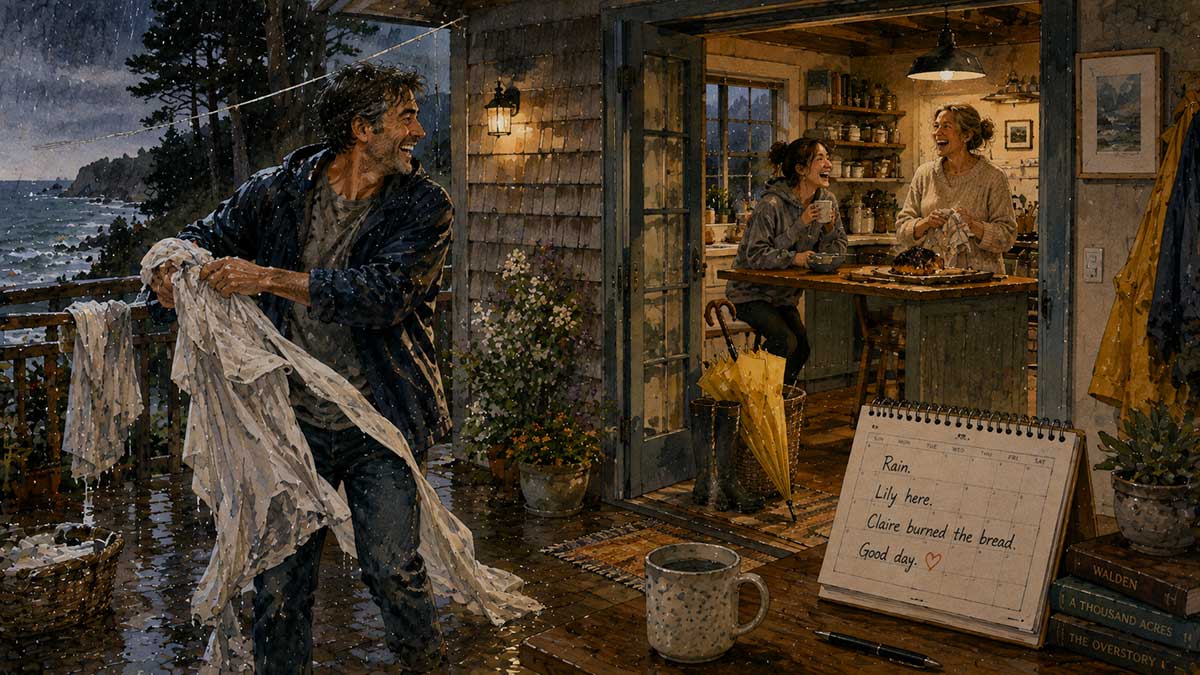
Ethan Cole knew exactly how old he was.
Not fifty-eight.
That number was almost useless.
His biological age, according to the latest panel, was forty-six point eight.
His cardiovascular age was lower.
His sleep score had improved by seven percent over three months.
His resting heart rate had fallen.
His fasting glucose was excellent.
His inflammation markers were better than they had been five years earlier.
His assistant knew not to schedule breakfast meetings before blood work.
His chef knew exactly how much protein he wanted at lunch.
His trainer knew his recovery windows.
His physician had access to a dashboard that Ethan checked more often than his investment portfolio.
He considered this sensible.
People insured houses.
Backed up data.
Diversified assets.
Yet almost everyone treated the one irreplaceable possession—their body—as though maintenance were optional.
Ethan found that irrational.
At 5:42 each morning, the blinds opened automatically.
At 5:45 he drank water.
At 5:50 he stood on the scale.
At 6:00 he began zone-two cardio.
At 6:47 he stretched.
At 7:02 he ate.
By eight, he had already completed more intentional actions than many people managed before lunch.
He was proud of that.
Not loudly.
Ethan had learned that talking too openly about optimization made people defensive about their own habits.
So he softened the language.
He said healthspan.
He said prevention.
He said giving people more good years.
Those things were true.
He believed them.
He had invested more than eighty million dollars in longevity research.
Some of that money might eventually help millions of people.
It mattered.
His daughter Lily still found it exhausting.
They were having dinner in San Francisco when she told him she was moving to Oregon.
Ethan looked up from the salmon.
“Portland?”
“Outside Portland.”
“How far outside?”
“About forty minutes.”
“North or south?”
“Dad.”
“What?”
“I haven't even finished.”
He put down his fork.
“Go ahead.”
“I got the job.”
“At the nonprofit?”
“Yes.”
“The environmental one?”
“Yes.”
Ethan nodded slowly.
He had read their annual report after Lily mentioned the interview.
He disliked their financial structure.
Too dependent on grants.
He had not said that yet.
“When do you start?”
“October.”
“That’s fast.”
“Two months.”
“Do they offer relocation?”
“A little.”
“Health insurance?”
“Yes.”
“Retirement match?”
“Dad.”
“What?”
She laughed.
Not happily.
“You always do this.”
“Do what?”
“Turn my life into a due-diligence folder.”
“I’m asking basic questions.”
“I know.”
Ethan leaned back.
“What do you want me to say?”
“I don't know. Maybe congratulations?”
He blinked.
Then smiled.
“Congratulations.”
“Thank you.”
“I'm serious.”
“I know.”
“It's a good opportunity.”
She nodded.
He could see she was waiting for something else.
“What?”
“Nothing.”
“Lily.”
She sighed.
“I’m moving.”
“I heard you.”
“No. I mean I'm moving.”
He stared at her.
“What am I missing?”
She looked out the restaurant window.
Fog had softened the buildings across the street.
“I don't know.”
Ethan did.
Or thought he did.
“You're worried we won't see each other.”
She gave him a tired look.
“Are you?”
“Of course.”
“I live twenty minutes from you now.”
“I know.”
“How many times have we had dinner this year?”
Ethan frowned.
“This is dinner.”
“How many?”
He reached for his phone instinctively.
Lily laughed.
“You're going to check the calendar?”
“I can tell you exactly.”
“That is so perfectly you.”
He stopped.
Put the phone down.
“I’ve been traveling.”
“I know.”
“The Singapore conference took two weeks.”
“I know.”
“And we had the Series C closing.”
“I know.”
“Then what's your point?”
Lily looked at him.
“You keep acting like distance is going to be the problem.”
“What is the problem?”
She was quiet for a moment.
Then:
“You keep solving distance instead of spending time.”
Ethan felt irritation rise.
“That doesn't make sense.”
“It does to me.”
“If you're in Oregon, I can buy a place nearby.”
Lily actually laughed.
There.
He heard it.
“I’m serious.”
“I know you are.”
“I could work from there.”
“For three days every two months?”
“Why are you attacking me?”
“I’m not.”
“It sounds like it.”
Lily rubbed her forehead.
“Forget it.”
“No. Finish.”
She looked at him.
“I don't need you to buy a house near me.”
“Fine.”
“I don't need better flight schedules.”
“Fine.”
“I don't need a system.”
“Then what do you need?”
The answer came quickly.
“Dinner Thursday.”
Ethan stared at her.
Lily’s eyes filled slightly.
“I know you're trying to add years to human life.”
She looked down.
“I’m asking for dinner Thursday.”
He said nothing.
The waiter approached.
Neither noticed.
Walter Cole died on a Tuesday.
There was no dramatic decline.
No final diagnosis.
No hospital vigil.
He had been eighty-six.
He had eaten breakfast.
Called a friend.
Watered tomatoes.
At some point after lunch, he sat down in his favorite chair.
That was where the neighbor found him.
Ethan received the call during a meeting about mitochondrial therapeutics.
His first emotion was disbelief.
His second was anger.
That embarrassed him later.
At the time it felt completely reasonable.
Walter had refused almost everything Ethan offered.
Advanced testing.
A specialist in age-related cardiac risk.
Continuous monitoring.
A new medication his physician suggested discussing.
Personal training.
Meal delivery.
Walter’s answer was almost always the same.
“I’m fine.”
Ethan hated those words.
Fine was not data.
Fine was not prevention.
Fine was what people said before something became irreversible.
At the funeral, people told stories about Walter’s tomatoes.
His terrible jokes.
The bench he repaired at the community garden.
How he called every Sunday.
How he always ordered pie.
Nobody mentioned whether his LDL could have been lower.
Ethan stood beside the coffin listening to people describe a life as though it had been complete.
He did not feel complete.
He felt cheated.
Walter’s house smelled the same as it had when Ethan was sixteen.
Wood.
Coffee.
Dust.
Something sweet in the pantry.
Ethan stood in the kitchen after everyone else left.
His father had lived in this small house for thirty-eight years.
Ethan had offered to buy him something newer.
Walter refused.
“The roof works.”
“It needs replacing.”
“Then I’ll replace it.”
“You could have a place with no maintenance.”
“Then what would I complain about?”
That had been Walter’s answer.
Ethan opened drawers.
Rubber bands.
Old batteries.
Coupons.
Receipts.
Nothing organized properly.
He felt an urge to throw everything away.
Instead he went to the study.
Walter had kept calendars.
Dozens.
Cheap paper ones.
Some hung on nails.
Others were stacked in a drawer.
Ethan opened one from three years earlier.
The boxes contained handwriting.
Not appointments exactly.
Small notes.
Lunch with Ellen.
Tomatoes finally ripe.
Rain all afternoon.
Ethan called.
He stopped.
The note was on a Sunday.
He tried to remember the call.
Could not.
Another page.
Lily visited.
Another:
Bad knee today.
Another:
Fixed gate.
Another:
Pie with Sam.
Ethan flipped faster.
He expected to find important entries.
Surgeries.
Birthdays.
Financial matters.
Instead:
Cloudy.
Good walk.
Dentist.
Ethan in London.
Beans too salty.
He almost laughed.
Why write any of this down?
Then he opened an older calendar.
Same thing.
Another.
Same.
Thirty years of ordinary days.
Walter had documented almost nothing Ethan would have considered significant.
Yet he had documented everything.
Claire came to the house two days later.
Not Ethan’s daughter.
His partner.
Claire Morgan had been with him for eleven years.
They maintained separate homes.
Separate finances.
Separate calendars synchronized through assistants.
They spent four nights a week together when both were in California.
Less when Ethan traveled.
For years, people had asked whether they would marry.
Claire eventually stopped answering.
She walked into Walter’s study carrying two coffees.
“You look terrible.”
“Thank you.”
“You're welcome.”
She handed him a cup.
He gestured toward the calendars.
“Look at this.”
Claire opened one.
Read several entries.
Smiled.
“What?”
“Nothing.”
“That smile was something.”
“He was sweet.”
“Sweet?”
She showed him a page.
Claire brought lemon cake.
Ethan stared.
“When was that?”
“Years ago.”
“You visited him without me?”
“Sometimes.”
“Why?”
Claire looked at him.
“Because I liked him.”
Ethan nodded.
He turned another page.
“Why would someone record this?”
Claire glanced at the calendar.
“Maybe he wanted to remember his life.”
“‘Rain all afternoon’?”
“That was part of his life.”
Ethan shook his head.
“He should have taken better care of himself.”
Claire became still.
“What?”
“He could have had more time.”
“Maybe.”
“He refused almost everything.”
“You offered him a lot.”
“I offered him access most people would kill for.”
Claire sat down.
“Did he want it?”
“That isn't the point.”
Her face changed.
Ethan heard himself.
He looked away.
Claire said gently:
“I think it might be exactly the point.”
Three weeks later, Ethan stood backstage at the FutureLife Summit.
Two thousand people waited in the ballroom.
More online.
His keynote was titled:
THE NEXT FORTY YEARS: MAKING LONGEVITY PRACTICAL
He had given versions of the talk before.
The slides were excellent.
Aging curves.
Investment trends.
Disease compression.
Projected improvements in healthy lifespan.
One slide showed a horizontal timeline extending from sixty to one hundred.
Ethan stared at it.
Forty years.
The graphic made them look available.
Stored somewhere.
A warehouse of future Tuesdays.
He thought of Walter’s calendars.
Rain.
Tomatoes.
Lily visited.
Someone touched his shoulder.
“Two minutes.”
Ethan nodded.
He walked onto the stage.
Applause.
The first forty minutes went exactly as planned.
He was good at this.
Clear.
Measured.
Optimistic without making promises the science could not support.
He spoke about prevention.
Access.
The danger of turning longevity into something available only to wealthy people.
He meant every word.
Then he reached the final slide.
MORE HEALTHY YEARS = MORE LIFE
He stopped.
The audience waited.
Ethan looked at the words.
Then clicked the remote.
The slide went black.
He set the remote down.
“I was going to end by telling you that time is our most valuable resource.”
People leaned forward.
“I still believe that.”
He paused.
“My father died three weeks ago.”
The room changed.
“He was eighty-six. I spent years trying to persuade him to manage aging more aggressively.”
A few people smiled knowingly.
“He mostly ignored me.”
More smiles.
“I thought he was wasting opportunities.”
Ethan looked toward the back of the room.
“He kept calendars.”
Silence.
“Not impressive calendars. Grocery-store calendars.”
A little laughter.
“He wrote things down like ‘Rain.’ ‘Tomatoes.’ ‘Lily visited.’”
He felt his throat tighten unexpectedly.
“And I've been thinking about that.”
He looked down.
“What if the tragedy is not only that life is too short?”
The room became completely quiet.
“What if we keep assuming the important part starts later?”
He did not have a slide for that.
For once, he ended without data.
Claire refused to move with him.
That surprised Ethan.
He had expected resistance to the idea of stepping away from his executive roles for a year.
He had not expected her to say no.
They were in her kitchen when he explained the plan.
“One year.”
“In Mendocino.”
“Near there.”
“You rented a house?”
“Yes.”
“Already?”
“I found a good one.”
Claire laughed.
“What?”
“You've turned having an ordinary life into another project.”
Ethan frowned.
“I’m taking a year off.”
“You made a spreadsheet.”
“It’s not a schedule.”
“It has tabs.”
“One is finances.”
“You have more money than some countries.”
“That doesn't mean—”
Claire held up a hand.
“Ethan.”
He stopped.
She looked tired.
“I love you.”
He waited.
“But I’m not moving into your experiment.”
“It isn't an experiment.”
“You called it ‘Year One’ in the email.”
“That was just the folder name.”
She stared at him.
He laughed despite himself.
“Okay. Fine.”
Claire softened.
“What are you actually trying to do?”
Ethan did not know.
That frightened him.
“I think I want to see what happens if I stop treating everything like preparation.”
Claire looked at him for a long moment.
“Then do that.”
“With me.”
“No.”
“Why?”
“Because I don't trust that this isn't another reinvention.”
Ethan felt defensive.
“I’m trying.”
“I know.”
“Then why not come?”
Claire walked around the counter.
“Because if you're really doing this, you need to find out whether you can sit still without someone applauding you for it.”
That hurt.
He almost argued.
Instead:
“Will you visit?”
She smiled.
“Yes.”
The house sat above a small stretch of Northern California coast.
Not spectacular.
That disappointed Ethan.
The listing photographs had made the view look larger.
In person, trees blocked part of the ocean.
The kitchen was old.
The internet unreliable.
The shower pressure irritated him.
The first morning, he woke at 5:42 without an alarm.
He measured his heart rate.
Then remembered the rule.
No dashboards before breakfast.
He had made the rule himself.
Of course he had.
At six ten, he went for a run.
At six thirty-five, he realized he was tracking pace mentally.
He stopped.
Walked.
Immediately felt ridiculous.
Was walking now evidence of emotional progress?
He hated his own mind.
By the end of the first week, he had reorganized the pantry.
By week two, he had created a maintenance schedule for the house.
By week three, Claire visited.
She found the schedule taped inside a cabinet.
“I knew it.”
“It’s plumbing.”
“You have assigned inspection dates.”
“It’s an old house.”
She kissed him.
“You're impossible.”
“I’m improving.”
“You're measuring improvement?”
He looked at her.
She laughed.
The year was boring more often than Ethan expected.
Nobody had warned him.
Or perhaps everyone had.
He read.
Walked.
Advised companies remotely.
Cooked badly.
Learned which grocery store carried decent fish.
Met a retired teacher named Simon who talked too much.
Helped repair a fence.
Spent an entire afternoon waiting for a plumber who never came.
Some days felt meaningful.
Some did not.
That unsettled Ethan.
He had expected ordinary life to reveal something.
Instead ordinary life often simply happened.
In January, it rained for nine days.
He became irritable.
Claire stayed four of them.
They argued about towels.
Not metaphorically.
Actual towels.
Ethan wanted them hung a certain way so they dried faster.
Claire told him she had spent eleven years watching him optimize everything and would not allow him to optimize towels.
He said damp towels smelled.
She said:
“Then smell them.”
They did not speak for an hour.
Later, both laughed.
That night Ethan lay awake listening to rain.
He realized he had not learned anything from the argument.
The thought pleased him.
Not everything had to become instruction.
Lily visited in February.
She arrived with a yellow umbrella she had bought in Portland.
It stood dripping near the door.
“You hate yellow,” Ethan said.
“I do not.”
“You did at fourteen.”
“I was fourteen.”
“You said it looked desperate.”
Lily stared at him.
“You remember that?”
“I remember things.”
“You remember data.”
“Apparently yellow too.”
She smiled.
They cooked together.
Ethan checked the time twice without meaning to.
Lily noticed the second.
“Are you expecting something?”
“No.”
“Then why do you keep checking?”
He looked at the clock.
“I don't know.”
She chopped onions.
After a moment, Ethan took his watch off.
Placed it in a drawer.
Lily looked at him.
“That seems dramatic.”
“It is.”
“Put it back on if you want.”
“No.”
“Dad.”
“What?”
“You don't have to perform relaxation.”
He laughed.
Claire had said nearly the same thing.
“Everyone has become very critical.”
“Maybe you're finally around long enough to hear it.”
That landed.
Ethan looked at his daughter.
“How is Oregon?”
She shrugged.
“Good.”
“Work?”
“Hard.”
“Money?”
“Fine.”
“Benefits?”
Lily looked at him.
“Sorry.”
They both laughed.
Then she said:
“I’m lonely sometimes.”
Ethan’s instinct rose instantly.
Flights.
Social networks.
Introductions.
Could she work remotely from California periodically?
Was her apartment in the wrong area?
He felt the solutions assemble.
He said:
“That sounds hard.”
Lily stopped chopping.
Looked at him.
“That’s it?”
“I can say more.”
“No.”
She smiled.
“That was good.”
Ethan felt absurdly proud.
Then embarrassed by feeling proud.
He kept chopping.
In April, one of the largest longevity companies in the world contacted him.
The founder wanted out.
The board wanted Ethan as CEO.
The package was enormous.
The mission was almost perfectly aligned with everything he had spent fifteen years building.
He read the proposal three times.
His body reacted before his thoughts did.
Energy.
Urgency.
Possibility.
He could see the organization reorganized.
Clinical partnerships.
Access programs.
Better trial design.
He knew exactly whom he would hire.
He called Claire.
“They offered me Helix.”
“I heard.”
“How?”
“People talk.”
“What do you think?”
“What do you think?”
“I asked first.”
Claire laughed.
“Do you want it?”
“Yes.”
The answer came instantly.
Ethan closed his eyes.
“Then take it.”
He opened them.
“What?”
“Why are you asking me?”
“I don't know.”
“You want me to tell you it would ruin your year.”
“Would it?”
“Yes.”
“That was fast.”
“You asked.”
Ethan walked to the window.
The ocean was grey.
“I could run it differently.”
“I'm sure.”
“Remote part of the time.”
“I'm sure.”
“Keep this place.”
“Ethan.”
“What?”
“Do you want the company or do you want to be the person who runs the company?”
He said nothing.
Claire continued.
“Those are different desires.”
Ethan sat down.
After they hung up, he opened Walter’s calendar.
He had brought three of them to the coast.
One was from the year Walter turned sixty.
Ethan had barely looked at the older ones.
He opened it.
The handwriting was different.
Sharper.
Entries crowded the boxes.
Chicago — sales conference
Dinner cancelled
Boston
Call Ethan school
Missed game
Ethan stopped.
Another month.
Promotion?
Airport
Airport
Airport
Then:
Ethan mad.
He stared.
He did not remember what he had been angry about.
He turned several years forward.
The entries changed.
Less travel.
Then after retirement:
Garden.
Lunch with Ellen.
Ethan called.
Ethan sat for a long time.
Walter had not always been the old man with tomatoes.
He had known this, technically.
But Ethan had never considered that his father’s ordinary life might have been chosen.
Not surrender.
Correction.
Perhaps Walter had already lived the life Ethan was still defending.
Ethan declined the CEO job.
He spent an hour composing the email.
Deleted most of it.
Finally:
I believe in what you're building. I’d like to help as an adviser. I don't want to run it.
The chairman called.
“Are you sure?”
Ethan looked around the kitchen.
A pipe under the sink had begun dripping again.
“No.”
The chairman laughed.
“That's reassuring.”
Near the end of the year, Claire stayed more often.
Neither discussed moving permanently.
Ethan had discovered that asking where everything was going could destroy what was happening.
So he tried not to.
Sometimes failed.
One evening he asked:
“Do you think you'll move here?”
Claire looked at him.
“Maybe.”
“When?”
She smiled.
“There he is.”
“Sorry.”
“You're allowed to ask.”
“I thought I wasn't.”
“You're allowed to ask. You're not allowed to build a timeline before I answer.”
Ethan laughed.
“Fair.”
They ate outside.
The food was slightly overcooked.
The wind was cold.
Ethan wanted to move inside.
Claire wanted to stay.
They stayed.
Nothing happened.
He remembered the evening later.
That surprised him.
The year officially ended on a Thursday.
Ethan knew because he had, despite everything, marked the date.
Lily arrived that afternoon.
Claire was already there.
Rain began around five.
Lily’s yellow umbrella leaned near the back door.
Claire decided to bake bread.
She had never been good at bread.
Ethan offered advice once.
She pointed the wooden spoon at him.
“No.”
He raised both hands.
Thirty minutes later the smell changed.
Lily looked toward the oven.
“Is that supposed to happen?”
Claire opened the door.
Smoke rolled out.
Ethan reached automatically for the pan.
“No,” Claire said.
“It’s burning.”
“I know.”
“Then—”
She started laughing.
Lily did too.
Ethan stared at them.
Then the rain intensified.
He remembered laundry hanging behind the house.
“Damn it.”
He ran outside.
The sheets were already soaked.
Lily stood at the doorway laughing.
“You're too late!”
“I can see that.”
He grabbed one end.
Wind twisted it around him.
Claire came outside.
“Leave it!”
“It’ll be worse if—”
A gust hit him.
Cold rain ran down his face.
The sheet wrapped around his shoulder.
Lily laughed harder.
Ethan became irritated.
For perhaps three seconds.
Then he saw himself.
Fifty-nine now.
Standing in the rain.
Fighting wet laundry.
Bread burning inside.
His daughter laughing.
Claire barefoot at the door.
Nothing optimized.
Nothing useful.
Nothing memorable by the standards Ethan had used for most of his life.
He started laughing.
He could not stop.
After dinner, Claire and Lily fell asleep on opposite ends of the sofa.
The bread had been nearly inedible.
They ate some anyway.
Rain tapped the windows.
Ethan went to the small desk near the kitchen.
Walter’s calendar lay there.
He had begun using it months earlier.
Not every day.
That had been another rule he eventually abandoned.
He opened to the date.
For a moment he did not know what to write.
He could have written:
One year completed.
That sounded like him.
He almost smiled.
Instead:
Rain. Lily here. Claire burned the bread.
He stopped.
The sentence looked ridiculous.
Walter would have liked it.
Ethan looked toward the sofa.
Lily had one arm hanging over the edge.
Claire’s feet were under a blanket.
Ethan thought about the conference slide.
Forty years.
Decades stretching neatly across a screen.
He still wanted them.
He wanted medicine to improve.
He wanted people to suffer less.
He wanted his body to remain healthy.
He wanted to see eighty.
Ninety.
More, if more came well.
He had not become indifferent to death.
If anything, he feared it more clearly now.
There were more things he did not want to lose.
That seemed unfair.
Perhaps that was the price.
Ethan looked back at the calendar.
Under the first sentence, he wrote:
Good day.
He almost added something.
Why it had been good.
What he had learned.
How the year had changed him.
He did not.
He closed the calendar.
The rain continued outside.
Tomorrow he would probably exercise.
He might check his blood pressure.
He would answer emails.
He might become impatient with Claire.
He would almost certainly give Lily advice she had not requested.
Nothing had been solved.
The future remained uncertain.
His body would eventually fail him.
Everyone he loved would someday leave him or be left by him.
There was no metric that could negotiate that away.
From the sofa, Lily moved.
“Dad?”
Ethan turned.
“Yeah?”
She opened her eyes halfway.
“Are you going to bed?”
“In a minute.”
“Okay.”
She closed them again.
Ethan sat there.
For most of his life, “in a minute” had meant after one more email.
One more task.
One more useful thing.
Tonight there was nothing left to finish.
He turned off the kitchen light and walked toward the sofa.
The calendar remained closed on the desk.
One ordinary year had ended.
The next day had not begun yet.
For once, Ethan did not need more time than that.
Final Thoughts
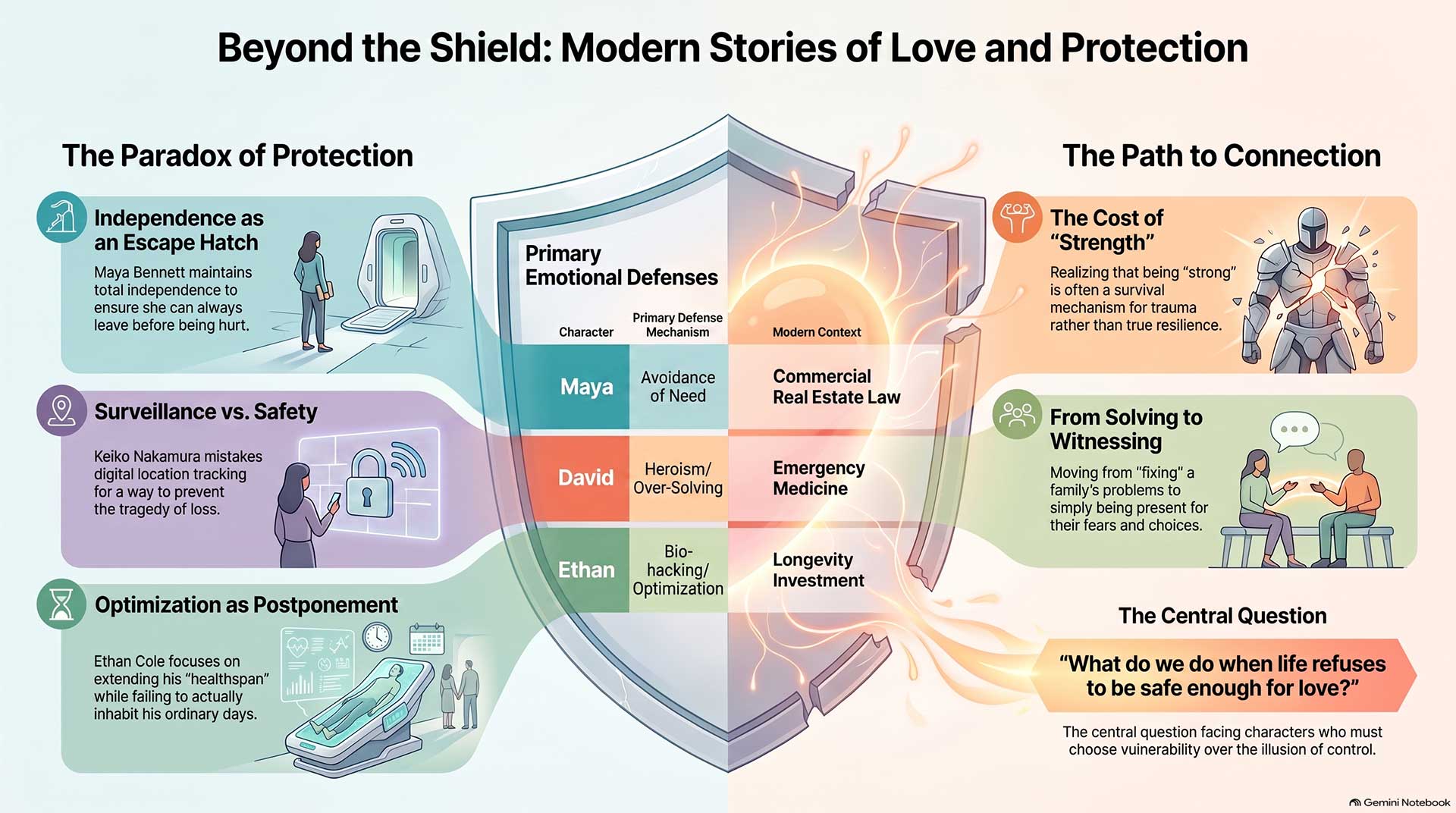
The five stories begin with people trying to protect something.
Maya protects herself from abandonment by remaining capable of leaving first.
Seo-jin protects her wounded pride by turning another woman into the source of her pain.
David protects his family by approaching ordinary problems with the same urgency that once saved lives.
Keiko protects her daughter by trying to know where she is at every moment.
Ethan protects life itself by measuring, extending, and optimizing as much of it as possible.
None of these desires begins as something absurd.
That is what makes them dangerous.
Each defense contains something reasonable.
People do leave.
Betrayal does hurt.
Danger is real.
Children can be harmed.
Bodies age.
Death comes.
The stories never defeat those facts.
Instead, each protagonist discovers that control has limits.
Maya cannot force Daniel to return.
Seo-jin cannot make Hae-rin forgive her.
David cannot choose Lucas’s meaningful life for him.
Keiko cannot make the world harmless by watching a blue dot.
Ethan cannot turn future years into guaranteed possessions.
Their growth is therefore smaller than transformation usually appears in stories.
They do not become fearless.
They acquire another possible response.
Maya stays on the phone.
Seo-jin repairs what she can without asking for absolution.
David remains quiet beside the pottery wheel.
Keiko lets her daughter disappear into the crowd.
Ethan writes down an ordinary day and allows it to be enough.
That may be the deepest connection to Circe.
Strength matters.
Protection matters.
Knowledge matters.
Yet eventually life asks for something harder:
to love without possessing,
to regret without demanding forgiveness,
to admire greatness without hiding its cost,
to let people become separate from us,
and to live knowing that nothing we love can be kept forever.
The final story does not argue against ambition, medicine, achievement, or longer life.
It asks a different question.
If another ten years were given to us, would we know what they were for?
Perhaps the answer is not found in immortality.
Perhaps it begins in something much smaller:
a phone call we do not end,
a person we finally see outside our own pain,
a child allowed to choose,
a hand pulled back from the screen,
rain,
burned bread,
and one ordinary day we were present enough to notice.
Short Bios:
Maya Bennett — A 41-year-old commercial real-estate attorney in Columbus, Ohio, whose admired independence gradually reveals a fear of needing anyone deeply.
Han Seo-jin — A 34-year-old cosmetics brand strategist in Seoul whose response to betrayal damages another woman’s life and forces her to confront responsibility without guaranteed forgiveness.
Dr. David Morales — A 48-year-old emergency physician and humanitarian responder whose public courage contrasts with the controlling habits his family experiences at home.
Keiko Nakamura — A 52-year-old widow in Tokyo whose fear of sudden loss leads her to monitor her adult daughter until love and surveillance become difficult to separate.
Ethan Cole — A 58-year-old technology founder and longevity investor who begins questioning whether extending life can become another way of postponing it.
Leave a Reply