
Introduction
What happens when the person everyone remembers as a hero is experienced very differently by the people who loved him?
Madeline Miller’s Circe takes a woman who once appeared at the edge of another man’s epic and places her at the center of her own life. Circe begins as a daughter desperate for approval, becomes a woman shaped by rejection and anger, then slowly learns that freedom cannot come from being chosen by someone else.
In this imaginary conversation, Circe sits with Penelope, Odysseus, Telemachus, and Telegonus. They speak about rejection, jealousy, responsibility, parenthood, fame, absent fathers, marriage, mortality, and the difference between protecting someone and controlling them.
Circe is forced to confront Scylla and the harm she caused. Odysseus hears what his heroism looked like inside his own family. Penelope speaks about the years that history reduces to “waiting.” Telemachus questions what it means to grow up beneath a famous father. Telegonus faces the father he spent his childhood trying to know.
Their deepest question gradually changes.
At first it is:
Who chose me?
By the end, it becomes:
What will I choose—and what kind of life will truly be mine?
(Note: This is an imaginary conversation, a creative exploration of an idea, and not a real speech or event.)
Topic 1 — The Hunger to Be Chosen
Circe: I used to think rejection was a kind of verdict.
If someone turned away from me, I did not think, They failed to see me.
I thought, They saw me clearly.
And what they saw was insufficient.
Penelope: That is a dangerous way to live.
Circe: I know that now.
Penelope: Do you?
Circe: You think I still live that way?
Penelope: I think people can abandon an old belief and still build their lives around it.
Circe looked at her.
Circe: Explain.
Penelope: You stopped begging your father to admire you. You stopped begging your family to respect you. You stopped begging Glaucos to love you.
But afterward?
You became someone no one could easily reject.
That is not always the same thing as becoming free.
Odysseus shifted slightly in his chair.
Circe noticed.
Circe: You agree with her?
Odysseus: I think she has found the wound.
Circe: That was not what I asked.
Odysseus: Then yes.
Circe gave a short laugh.
Circe: Of course you do.
Odysseus: You invited me here to speak.
Circe: I invited you here so you could finally listen.
Penelope: Circe.
Circe: No. Let him answer.
She turned to Odysseus.
Circe: You think I built myself into someone who could not be rejected?
Odysseus: I think you learned that helplessness was intolerable to you.
Circe: That is different.
Odysseus: Is it?
You had been mocked. Dismissed. Exiled. Threatened.
Then you became stronger.
Strong enough to turn men into animals.
Strong enough to stand against gods.
Strong enough that people had to think carefully before hurting you.
There is freedom in that.
There is fear in it too.
Circe: You speak as though you never lived from fear.
Odysseus: I lived from fear constantly.
That is why I recognize it.
Telemachus looked at his father.
Telemachus: You never said that.
Odysseus: Most fathers do not tell their sons how frightened they were.
Telemachus: Perhaps they should.
Odysseus met his eyes, but Telemachus did not look away.
Telemachus: It might prevent the sons from mistaking fear for greatness.
Silence.
Telegonus glanced from one half-brother to the other.
Telegonus: I used to envy you.
Telemachus turned.
Telemachus: Me?
Telegonus: You had him.
Telemachus almost smiled, but there was nothing amused in it.
Telemachus: That is what people always think about someone else's father.
Telegonus: I had stories.
You had memories.
Telemachus: Stories are sometimes kinder.
Odysseus looked down.
Circe watched him, then turned back to Penelope.
Circe: You said I built my life around rejection.
Tell me what you think I should have done instead.
Penelope: Nothing so simple.
I am not accusing you of becoming strong.
I am asking whether you ever stopped measuring yourself against the people who refused you.
Circe's expression hardened.
Penelope: When you loved Glaucos—
Circe: I was young.
Penelope: Yes.
When you loved him, what did you want?
Circe: Him.
Penelope: Only him?
Circe said nothing.
Penelope: Did you want him, or did you want what his love would prove?
That the gods were wrong?
That your sisters were wrong?
That your father's indifference was wrong?
That someone could look at you and say, You are the one I choose?
Circe's voice became quieter.
Circe: Is there something shameful in wanting that?
Penelope: No.
That is why it is so dangerous.
Telegonus leaned forward.
Telegonus: Why dangerous?
Penelope looked at him.
Penelope: Because when another person's love becomes evidence of your worth, you stop asking whether their love is good for you.
You only ask whether you can keep it.
Circe lowered her eyes.
Circe: Glaucos was kind to me when no one else was.
Penelope: I believe you.
Circe: He listened.
He did not laugh at my voice.
He did not look at me the way my family did.
Do you know what that meant to me?
Penelope: Yes.
Circe looked up sharply.
Penelope's face had changed.
Penelope: More than you think.
When Odysseus chose me, I was young too.
And he was—
She paused.
Odysseus: Say it.
Penelope: Larger than the room.
Not physically.
Every room seemed to rearrange itself around him.
People watched him.
Men wanted his approval.
Women noticed him.
Kings listened when he spoke.
And he chose me.
Do you know what that can do to a young woman?
Circe stared at her.
Penelope: It can make her mistake being chosen by an extraordinary man for becoming extraordinary herself.
Odysseus closed his eyes briefly.
Circe: You regretted marrying him?
Penelope: That is too easy a question.
I loved him.
I resented him.
I waited for him.
I defended him.
I feared losing him.
I feared what would happen when he returned.
I spent so many years being "the woman Odysseus was returning to" that sometimes I wondered who Penelope was when no ship was expected.
Telemachus looked at his mother.
Telemachus: You never told me that.
Penelope: A mother spends years telling a child the version of the family that allows the child to sleep.
Then one day the child grows up.
Telemachus: And then?
Penelope: Then perhaps she owes him the truth.
Odysseus looked toward her.
Odysseus: Did my love make you feel trapped?
Penelope studied him for a long moment.
Penelope: Your love did not.
Your importance did.
That answer landed harder than accusation.
Odysseus said nothing.
Circe breathed out slowly.
Circe: Glaucos was not important.
Penelope: He was to you.
Circe: Yes.
Penelope: Then the mechanism is the same.
You gave another person authority over your reflection.
Circe's eyes moved toward the table.
Circe: When he became a god, he changed.
Penelope: Or perhaps he became visible.
Circe: He looked at me as though I were something he had outgrown.
Telegonus: Is that when you hated him?
Circe: No.
That would have been easier.
I wanted him to look at me again.
That was the humiliation.
She swallowed.
Circe: I could have hated him and left.
Instead I thought perhaps I could become beautiful enough.
Strange enough.
Desirable enough.
Powerful enough.
Something enough.
Telemachus spoke softly.
Telemachus: Enough for him?
Circe: Enough for myself.
She stopped.
Then shook her head.
Circe: No.
That is a lie.
Enough for him.
I thought if he changed his mind, then the wound would disappear.
Penelope: That is what rejection makes us believe.
That the person who wounded us possesses the medicine.
Circe: And they do not.
Penelope: Usually they are the last person who does.
Telegonus looked troubled.
Telegonus: Then what is the medicine?
Penelope smiled faintly.
Penelope: I am old enough to distrust anyone who answers that quickly.
Circe almost smiled too.
Odysseus: Perhaps there is no medicine.
Circe: Spoken like a man who solved most problems with movement.
Odysseus: Movement kept me alive.
Telemachus: It kept you from many things too.
Odysseus: Such as?
Telemachus: Staying still long enough to discover whether anyone loved you when you were not performing.
Odysseus looked at him.
Telemachus's voice remained calm.
Telemachus: You speak of Mother's need to be chosen. Circe's need to be chosen.
What about yours?
Odysseus: Mine?
Telemachus: You needed kings to choose you.
Armies to follow you.
Enemies to fear you.
Poets to remember you.
Gods to notice you.
You wanted the whole world to choose you.
Odysseus leaned back.
For once he seemed uncertain how to answer.
Odysseus: Ambition is not the same as insecurity.
Telemachus: Sometimes it is insecurity that learned to wear armor.
Circe looked at Telemachus differently then.
Not affectionately.
Not yet.
But with recognition.
Odysseus: You think everything I accomplished was compensation for some childhood wound?
Telemachus: No.
I think you accomplished great things.
I think you needed them to mean something about who you were.
Those are different statements.
Odysseus: Everyone wants their life to mean something.
Telemachus: Yes.
But must meaning always require witnesses?
No one spoke.
That question seemed to alter the room.
Circe looked down at her hands.
Circe: My father never praised me.
Telegonus glanced at her.
She had spoken so quietly he almost missed it.
Circe: Helios had children who dazzled.
Children who were beautiful.
Children who frightened people.
Children who reflected something magnificent back to him.
I did not.
I had an ugly voice.
I was awkward.
I asked questions no one wanted asked.
He looked through me.
Not cruelly, most of the time.
That might have been easier.
He simply seemed uninterested.
Penelope: Indifference can wound more deeply than anger.
Circe: Anger at least says you have reached someone.
Indifference says there was nothing there worth reaching.
Odysseus watched her closely.
Circe: So when Glaucos looked at me—
She stopped.
Penelope: You existed.
Circe's eyes filled, but she did not look away.
Circe: Yes.
That was it.
For the first time, I existed in someone's face.
Telegonus stared at his mother.
He had known her as the woman who confronted gods.
The woman who commanded animals.
The woman whose voice could turn dangerous men into trembling creatures.
He had never pictured her waiting for a fisherman's eyes to tell her she was real.
Telegonus: Mother.
Circe shook her head gently.
Circe: Do not pity me.
Telegonus: I wasn't.
I was thinking—
He hesitated.
Circe: Say it.
Telegonus: I think I did that to you too.
Circe frowned.
Telegonus: I think I made you my proof.
Circe: Proof of what?
Telegonus: That my father could not matter more than the person who raised me.
But he did matter.
Not more.
Just differently.
And every time I asked about him, I saw something happen in your face.
So sometimes I stopped asking.
Circe became very still.
Telegonus: Then I felt guilty for wanting to know him.
And guilty for not wanting enough.
And guilty when I finally left.
And then—
His voice failed.
Everyone knew what came next.
Telegonus: Then I found him.
And killed him.
Odysseus looked at his son.
Telegonus kept his eyes down.
Odysseus: You did not mean to.
Telegonus: Does intention change the body on the ground?
Odysseus had no answer.
Circe reached toward Telegonus, then stopped herself before touching him.
He noticed.
Telegonus: You can.
She placed her hand over his.
Circe: I spent years trying to keep you from every danger.
Telegonus: I know.
Circe: Perhaps I needed you to keep choosing the island.
Choosing me.
Telegonus: I did choose you.
Circe: That is not the same as never leaving.
Telegonus: No.
Circe: I did not know that then.
Penelope watched them.
Penelope: Most of us learn it too late.
Circe: What?
Penelope: That love is not proven by staying.
Sometimes staying proves fear.
Sometimes leaving proves love.
Sometimes neither proves anything.
Circe looked toward Odysseus.
Circe: You left everyone.
Odysseus: Yes.
Circe: Did you ever wonder whether you were free?
Odysseus gave a tired smile.
Odysseus: Every day.
Circe: And?
He looked at Penelope.
Then Telemachus.
Then Telegonus.
Finally Circe.
Odysseus: I suspect I spent much of my life mistaking the ability to leave for freedom.
That surprised everyone.
Telemachus looked at him carefully.
Telemachus: What do you think freedom is now?
Odysseus was silent for a long time.
Odysseus: Perhaps being able to stay somewhere without feeling that staying makes you smaller.
Penelope's face softened, but only slightly.
Penelope: You discovered that late.
Odysseus: Most important discoveries arrive late.
Circe: Some arrive when there is no time left to use them.
Odysseus looked at her.
Odysseus: Yes.
The room fell quiet again.
Then Circe spoke.
Circe: I have spent centuries thinking about people who rejected me.
My father.
My siblings.
Glaucos.
Men who came to my island and thought my body was theirs because they believed no one would defend me.
Gods who believed exile would reduce me.
She looked from one face to another.
Circe: Perhaps this is the most humiliating part.
They occupied far more of my life than they deserved.
Penelope: That is what rejection steals.
Not simply affection.
Attention.
Years of attention.
Circe: Then how do you take it back?
Penelope looked toward the open distance beyond them, as though Ithaca might somehow be visible there.
Penelope: Perhaps by refusing to make your life an argument against the people who failed to love you.
Circe absorbed the words.
Penelope: If you become beautiful to prove them wrong, they still govern you.
If you become powerful to prove them wrong, they still govern you.
If you become indifferent to prove them wrong, they still govern you.
If every choice says, Look what I became without you, then some part of you is still standing before them.
Circe's eyes glistened.
Circe: Then what is left?
Penelope: A harder question.
What would you have become if you had never needed to prove anything to them?
Circe did not answer.
For the first time in the conversation, she seemed unable to.
Telemachus broke the silence.
Telemachus: Perhaps nobody knows.
Circe: That frightens me.
Telemachus: It should.
Circe: Why?
Telemachus: Because if we stop living against other people's expectations, we lose the map.
Circe looked at him.
Telemachus: But perhaps losing the map is the first time the road is actually ours.
Odysseus smiled faintly.
Odysseus: Careful.
That sounds almost like something I would have said.
Telemachus: Then I may reconsider it.
Penelope laughed.
Circe did too.
Only briefly.
Then her expression changed again.
Circe: There is something we have avoided.
Penelope knew immediately.
Penelope: Yes.
Circe: We have spoken about the people who hurt me.
We have spoken about rejection.
About humiliation.
About becoming strong.
But there was someone who did nothing to me.
And I destroyed her anyway.
No one needed to say the name.
Circe said it herself.
Circe: Scylla.
Her hand tightened around Telegonus's.
Circe: If I am going to speak about what rejection did to me, then I must speak about what I did with that pain.
And I am not certain I will like the woman who answers.
The warmth disappeared from the room.
Penelope looked directly at her.
Penelope: Then perhaps that is where we have to go next.**
Topic 2 — When the Hurt Person Hurts Someone Else
Circe: I used to tell myself that Scylla was punishment.
Not cruelty.
Punishment.
The distinction mattered to me then.
Penelope: Why?
Circe: Punishment sounds deserved.
Cruelty does not.
Odysseus: And did she deserve it?
Circe looked at him.
Circe: No.
Odysseus: Then you already know the answer.
Circe: Knowing the answer now does not erase the woman I was then.
Telemachus: Perhaps it should not.
Circe turned to him.
Telemachus: If regret erased the person who caused the harm, regret would become very convenient.
Circe nodded slowly.
Circe: Yes.
That is true.
Telegonus watched his mother carefully.
Telegonus: Did you hate Scylla?
Circe: I thought I did.
Telegonus: What did she do to you?
Circe did not answer at once.
Circe: She was beautiful.
Telegonus: That was all?
Circe gave him a sad look.
Circe: Sometimes that is enough when you hate yourself.
Penelope's face tightened.
Circe: Glaucos wanted her.
I wanted Glaucos.
So I made her body carry the punishment for his rejection.
Penelope: That may be the ugliest part.
Circe: I know.
Penelope: No. Listen.
You did not attack the man who rejected you.
You attacked the woman he preferred.
Circe lowered her eyes.
Penelope: People do that constantly.
They cannot bear to face the person whose affection they wanted, so they turn another woman into the enemy.
Circe: I knew he had chosen her.
I knew he had humiliated me.
Yet when I looked at Scylla, I saw the answer to a question I could not bear to ask.
Telemachus: Which question?
Circe: Why was she enough when I was not?
No one spoke.
Circe: I wanted to destroy the evidence.
Penelope: And so you destroyed her.
Circe: Yes.
The word came out quietly.
No defense.
No explanation.
Just yes.
Odysseus: Did you regret it immediately?
Circe: No.
That is the truth I dislike most.
At first, I felt relief.
Penelope stared at her.
Circe: For a little time, I believed I had restored something.
Balance.
Justice.
My dignity.
Call it whatever lie you like.
Telemachus: And then?
Circe: Then the feeling passed.
The act did not.
Telegonus looked down.
Telegonus: That seems unfair.
Circe: It is.
Telegonus: I mean the way anger can last a moment, but what you do inside it can last forever.
Circe: Yes.
That is one of the great injustices of being human.
And god.
Odysseus shifted.
Odysseus: Anger has made corpses of many people around me.
Penelope: Around you?
Odysseus looked toward her.
Penelope: That phrasing is generous to yourself.
Odysseus: Fair.
Anger made corpses through me.
Penelope held his gaze.
Odysseus: Better?
Penelope: Truer.
Circe watched them both.
Circe: Did you ever use pain as permission?
Odysseus gave a short, humorless laugh.
Odysseus: Often.
Telemachus: Permission for what?
Odysseus: To do what I wanted and call it necessity.
To strike before I could be struck.
To distrust before I could be betrayed.
To punish before I knew whether punishment was just.
To tell myself that survival excused whatever survival required.
Telemachus: Did it?
Odysseus: No.
Sometimes it explained me.
That is not the same as excusing me.
Circe looked at him sharply.
Circe: That is the line, isn't it?
Penelope: Which line?
Circe: Explanation and excuse.
People confuse them.
If you understand why someone became cruel, people think you are defending the cruelty.
If you condemn the cruelty, people think you must deny the wound that came before it.
Penelope: Both can be true.
A person can be deeply wounded.
And still be responsible.
Circe: Yes.
She said it with more force this time.
Circe: That is what I resisted for years.
I wanted one truth to cancel the other.
I wanted my suffering to make me innocent.
It did not.
Telegonus: Do you forgive yourself?
Circe's expression changed.
Circe: I do not know what that means anymore.
Telegonus: You have lived with this for centuries.
Circe: Time is not repentance.
Telemachus: What is?
Circe turned toward him.
Circe: Perhaps refusing to lie about what you did.
Perhaps refusing to turn your pain into a crown.
Perhaps changing what you do next.
Perhaps knowing that none of that restores the person you harmed.
Penelope nodded.
Penelope: That last part matters.
There are people who apologize only to feel clean.
Circe: Yes.
Penelope: They confess so the victim will release them.
Forgive me.
Tell me I am not a monster.
Tell me I have changed.
Tell me I may go home.
Odysseus: Is asking forgiveness wrong?
Penelope: No.
Expecting forgiveness is.
Circe sat very still.
Penelope: The wounded person does not exist to complete the offender's moral recovery.
Circe closed her eyes.
Circe: Scylla never forgave me.
Telemachus: Did you ask her?
Circe opened her eyes.
Circe: Not in any meaningful sense.
What could I have asked?
I changed her body.
I changed the shape of her existence.
I gave her hunger that was not hers before.
I turned another person into the form of my jealousy.
What sentence begins with "I'm sorry" and survives that?
Telegonus: Perhaps one that ends without asking anything back.
Circe looked at him.
He seemed surprised at his own words.
Telegonus: I mean...
Maybe remorse is saying it without trying to be forgiven.
Circe's face softened.
Circe: Perhaps.
Odysseus leaned forward.
Odysseus: There is another danger.
Penelope: Which is?
Odysseus: Becoming so ashamed of what you did that shame itself becomes another form of self-obsession.
Circe stared at him.
Odysseus: I know that sounds convenient coming from me.
Circe: It does.
Odysseus: Still true.
If every thought becomes, I am terrible, I am unforgivable, I am monstrous, then the harmed person disappears again.
You are still looking only at yourself.
Penelope nodded reluctantly.
Penelope: That is true.
Circe: So what do you suggest?
Odysseus: I do not know.
Perhaps the question is not, "Am I a good person now?"
Perhaps it is, "What does the person I harmed need from me, if anything?"
Telemachus: That sounds less heroic.
Odysseus: Most useful things do.
Circe almost smiled.
Then her face darkened again.
Circe: I used to think monsters were easy to recognize.
Telegonus looked at her.
Circe: Teeth.
Claws.
Blood.
A body twisted into something unnatural.
Then I created one.
And I began to understand that the monster may begin long before the body changes.
Penelope: Where?
Circe: In the moment when another person's humanity becomes less important than your pain.
The room went quiet.
Circe: I did not see Scylla as a person.
I saw her as the reason I was suffering.
That was enough.
Once she became the reason, anything I did to her began to feel justified.
Telemachus: That sounds familiar.
Circe: From where?
Telemachus: War.
Odysseus looked at him.
Telemachus: You stop seeing people as people.
They become Trojans.
Enemies.
Threats.
Obstacles.
Then cruelty becomes easier.
Odysseus: Yes.
Telemachus: You agree?
Odysseus: I have no reason not to.
Telemachus: You used to have many reasons.
Odysseus: I used to need them.
Penelope watched father and son.
Penelope: Perhaps that is part of growing older.
You lose interest in defending every old version of yourself.
Odysseus looked toward her.
Odysseus: I hope so.
Circe was quiet for several moments.
Then she spoke.
Circe: There is something else I fear.
Telegonus: What?
Circe: That people will hear my story and sympathize with me too much.
Penelope raised an eyebrow.
Circe: They will hear that my family mocked me.
That men hurt me.
That I lived alone.
That I was frightened.
And they may begin to excuse what I did.
Penelope: You cannot control that.
Circe: No.
But I can refuse to cooperate with it.
She looked directly ahead.
Circe: I was hurt.
And I hurt someone who did not deserve it.
Both sentences belong together.
Neither cancels the other.
Telemachus nodded.
Telemachus: That may be the hardest kind of truth.
Telegonus: Why?
Telemachus: Because it gives you nowhere comfortable to stand.
You cannot say, "I was only a victim."
You cannot say, "I was only a monster."
You have to live with both.
Telegonus looked at Circe.
Telegonus: Is that what you mean when you say you do not know whether you forgive yourself?
Circe: Perhaps.
I do not want forgiveness to mean forgetting the weight of it.
Penelope: It does not have to.
Circe: Then what does it mean?
Penelope took her time.
Penelope: Perhaps it means you stop using the worst thing you ever did as the only definition of who you are.
Circe looked at her.
Penelope: Responsibility without self-erasure.
Remorse without endless performance.
Change without pretending the past changed with you.
Circe's eyes filled again.
Circe: You make it sound possible.
Penelope: I said possible.
Not easy.
Circe laughed softly through the tears.
Then Telegonus spoke.
Telegonus: Mother, if Scylla were here, what would you say?
The room changed.
Circe froze.
Penelope looked at Telegonus, then back at Circe.
Odysseus said nothing.
Telemachus seemed ready to stop the question, but Circe lifted one hand.
Circe: No.
He should ask.
She took a breath.
Circe: I would tell her...
Her voice failed.
She started again.
Circe: I would tell her that what happened to me did not give me the right to make her suffer.
I would tell her that Glaucos's choice was not her crime.
That her beauty was not an insult to me.
That my shame belonged to me.
That I put it on her body.
Her hands trembled.
Circe: I would tell her I was jealous.
Small.
Afraid.
Cruel.
And that none of those words are excuses.
Penelope watched her in silence.
Circe: I would not ask her to forgive me.
I would not ask her to understand me.
I would not ask her to tell me I became better.
I would say only—
Circe swallowed.
Circe: You were a person before I turned you into my pain.
And I am sorry that I refused to see you.
No one moved.
Then Odysseus spoke.
Very quietly.
Odysseus: That may be the closest any of us come to repentance.
Telemachus: Seeing the person again?
Odysseus: Yes.
The person we replaced with our story about them.
Circe looked at him.
Circe: And how many people did you replace with stories?
Odysseus did not flinch.
Odysseus: More than I want to count.
Penelope: Then count them.
Odysseus turned toward her.
Penelope's voice remained calm.
Penelope: We have spent a great deal of time discussing Circe's cruelty.
Perhaps we should not allow the famous man at this table to become merely the wise observer of everyone else's sins.
Odysseus gave a slow nod.
Odysseus: Fair.
Penelope: Good.
Because there is something I have wanted to ask you for years.
Telemachus straightened.
Telegonus looked from Penelope to his father.
Circe's expression sharpened.
Odysseus: Ask.
Penelope held his eyes.
Penelope: When everyone called you a hero...
Did you ever wonder what your heroism cost the people who loved you?
Odysseus did not answer.
And this time, no one rescued him from the silence.
Topic 3 — Odysseus: Hero to One Person, Wound to Another
Odysseus: Yes.
I wondered.
Not often enough.
Penelope did not move.
Penelope: When?
Odysseus: At sea. Sometimes at night. Sometimes after men died because I had misjudged something. Sometimes when I thought of Ithaca.
Penelope: That is not the question I asked.
Odysseus: I know.
Penelope: I asked whether you wondered what your heroism cost the people who loved you.
Odysseus looked at her.
Odysseus: Then yes.
But I usually wondered after the choice had already been made.
Penelope: Which means the wondering cost you very little.
Telemachus looked at his mother.
Circe did not interrupt.
Odysseus: You think I should have abandoned the war?
Penelope: No.
There.
That is what you always do.
Turn the question into one you can defeat.
I did not ask whether you should have abandoned Troy.
I asked whether you ever considered that being the man everyone admired might make you impossible to live beside.
Odysseus's face changed.
Odysseus: Impossible?
Penelope: At times.
Yes.
Odysseus: You never said that to me.
Penelope: You were gone for twenty years.
Then you returned expecting the house to recognize you.
Odysseus: It was my house.
Penelope: Exactly.
Circe looked at Penelope.
Penelope: You say "my house."
"My kingdom."
"My wife."
"My son."
You returned to things you believed had remained yours during your absence.
But we had lived twenty years without you.
Do you know what twenty years does to possession?
Odysseus: You remained my wife.
Penelope: Legally.
Faithfully.
Painfully.
But I was not preserved in a jar.
Telemachus lowered his gaze.
Penelope: Every morning you were gone, I became someone you did not know.
Every funeral.
Every rumor.
Every suitor.
Every night I heard a sound outside and wondered whether it was you.
Every morning it was not.
Those years belonged to me too.
Odysseus said nothing.
Penelope: Yet when the songs are told, my twenty years become waiting.
Your twenty years become adventure.
Circe's eyes narrowed.
Circe: That is true.
Odysseus turned to her.
Odysseus: You want to join her now?
Circe: I do not need to join anyone.
I know what it was like to hear your stories.
Every place you entered became part of the story of Odysseus.
Every woman became an episode.
Every monster became evidence of your cleverness.
Every loss became another trial you survived.
Odysseus: You think I wrote the songs?
Circe: No.
I think you learned how to live so that songs would know what to do with you.
Telemachus looked at his father.
Telemachus: I know that man.
Odysseus's eyes moved toward him.
Odysseus: Do you?
Telemachus: I knew him before I knew you.
When I was a boy, everyone told me about my father.
The cleverest of the Greeks.
The man who devised the horse.
The king who crossed impossible seas.
The man gods noticed.
Do you know what nobody told me?
Odysseus: What?
Telemachus: What you sounded like when you were tired.
What frightened you.
Whether you were patient.
Whether you apologized.
Whether you laughed at stupid things.
Whether you knew how to sit beside someone who was grieving without turning grief into a problem to solve.
Odysseus looked away.
Telemachus: I knew your achievements before I knew your humanity.
And by the time you came home, I had spent my whole childhood wondering whether I was supposed to become you.
Odysseus: I never asked you to.
Telemachus: You did not need to.
Everyone else did it for you.
Penelope closed her eyes briefly.
Telemachus: A famous father can give orders without speaking.
Odysseus leaned forward.
Odysseus: And you resented me for being admired?
Telemachus: Sometimes.
Odysseus: That seems unfair.
Telemachus: It is.
Children are not always fair to their parents.
Parents are not always fair to their children.
Odysseus almost smiled.
Telemachus: But I resented something else more.
Odysseus: What?
Telemachus: Everyone wanted me to be proud of you before anyone asked whether I missed you.
The room fell quiet.
Telegonus looked at Telemachus with sudden recognition.
Telegonus: Yes.
Telemachus turned to him.
Telegonus: That is it.
I had the opposite problem, but it is the same wound.
Telemachus: What do you mean?
Telegonus: Nobody expected me to be proud of him.
I barely knew anything.
So I invented him.
I took every story I could find and built a father.
The brave one.
The clever one.
The survivor.
The man who might look at me once and somehow explain why I was the way I was.
Circe watched her son.
Telegonus: I thought meeting him would answer something.
Circe: About him?
Telegonus: About me.
Odysseus's expression softened.
Telegonus: I did not want a famous father.
I wanted a father who would recognize me.
That is different.
Odysseus's face tightened.
Odysseus: I did not have the chance.
Telegonus stared at him.
Telegonus: I know.
That is what makes it worse.
No one intended what happened.
I wanted to meet you.
You did not know me.
We fought.
And then there was no time left for either of us to become anything else.
Odysseus: You still think that moment defines us?
Telegonus: Sometimes.
Odysseus: It should not.
Telegonus: You can say that easily.
Odysseus: No.
I can say it because I know what it is to have one act swallow the rest of a life.
Telemachus looked at him.
Telemachus: Which act?
Odysseus paused.
Odysseus: There are several.
Circe gave him a long look.
Circe: That may be the first answer tonight I completely believe.
Penelope almost smiled.
Then her face hardened again.
Penelope: You are still avoiding something.
Odysseus: I suspected I was.
Penelope: We keep talking about how others saw you.
The Greeks.
The poets.
Your sons.
Circe.
Me.
But how did you see yourself?
Odysseus looked down at his hands.
Odysseus: Necessary.
Penelope: Necessary?
Odysseus: Yes.
If something impossible had to be done, I wanted to believe I was the man who could do it.
Circe: Wanted to believe?
Odysseus: Needed to.
Telemachus: Why?
Odysseus took a long breath.
Odysseus: If I was necessary, then leaving could be justified.
If I was necessary, men dying under my command could mean something.
If I was necessary, every terrible choice could be placed inside a larger purpose.
Circe studied him.
Circe: And if you were not necessary?
Odysseus looked at her.
For once there was no cleverness in his face.
Odysseus: Then perhaps I had simply left people who loved me and caused suffering wherever I went.
Penelope did not soften.
But she listened.
Odysseus: Do you think I did not know that possibility existed?
I knew.
I kept it at a distance.
A man cannot lead an army if he examines every corpse as someone's son.
He cannot cross the sea if every island becomes a place he could have stayed.
He cannot survive if every decision becomes a trial of his soul.
Telemachus: Maybe that is the problem.
Odysseus: What?
Telemachus: Maybe survival became your highest virtue.
Odysseus: Survival matters.
Telemachus: Of course.
But if surviving requires turning everyone around you into a cost you are willing to pay, what survives?
Odysseus looked at him.
Telemachus: Your body?
Your name?
Your story?
What about the person?
Odysseus's jaw tightened.
Odysseus: You speak from a safe distance.
Telemachus: Yes.
I do.
Odysseus: You did not stand where I stood.
Telemachus: No.
And you did not grow up where I did.
Odysseus stopped.
Telemachus: That is the point.
Neither of us gets to use his own suffering to erase the other's.
Penelope looked between them.
Penelope: That may be the first useful thing either of you has said about fathers and sons.
Odysseus: You enjoyed that.
Penelope: Immensely.
For a moment, the room loosened.
Then Circe spoke.
Circe: I loved you.
Odysseus turned toward her.
Penelope did too.
Circe did not look away.
Circe: I think I did.
For a time.
Odysseus's expression became unreadable.
Circe: But I have wondered whether I loved you, or whether I loved the feeling of being near someone who could never be contained.
Odysseus: That sounds less flattering.
Circe: It is not meant to flatter you.
You were alive in a way few people are.
Restless.
Dangerous.
Attentive.
You made the room feel temporary.
Even when you were sitting still, some part of you had already begun leaving.
Penelope: Yes.
Circe looked at her.
Penelope: That was him.
Circe: Did you love that about him?
Penelope considered it.
Penelope: At first.
Later, I learned that qualities which attract us to someone can become the same qualities that wound us.
Circe nodded.
Penelope: His cleverness made me feel safe.
Then it made me wonder whether I was being managed.
His confidence made me trust him.
Then it made disagreement exhausting.
His courage inspired me.
Then it made ordinary life seem too small for him.
Odysseus took that in.
Penelope: People ask whether a person is good or bad.
That question is often too small.
A trait can save a kingdom and damage a marriage.
The same man can be brave on a battlefield and cowardly in a conversation.
Circe looked toward Odysseus.
Circe: Were you?
Odysseus: Often.
Circe: Cowardly?
Odysseus: In conversation, yes.
Circe raised an eyebrow.
Odysseus: Battles are simpler.
Telemachus: That may be the most Odysseus thing you have ever said.
Odysseus: It is true.
On a battlefield, someone is trying to kill you.
The goal is clear.
At home, someone you love says, "You hurt me."
What is the victory?
Proving they are wrong?
Admitting they are right?
Making them feel better?
Making yourself feel less guilty?
There is no clean strategy.
Penelope's voice softened.
Penelope: So you turned many conversations into battles.
Odysseus: Yes.
Penelope: And tried to win them.
Odysseus: Yes.
Penelope: You were very good at winning.
Odysseus looked at her.
Penelope: It cost us.
He nodded.
Odysseus: I know.
Penelope: Do you?
Odysseus: More now than then.
Penelope studied him for a long time.
Penelope: That is the tragedy of insight.
It often arrives after the people around us have already paid for our ignorance.
No one spoke.
Telegonus looked toward Odysseus.
Telegonus: Were you happy?
Odysseus seemed startled.
Odysseus: What?
Telegonus: Everyone keeps talking about what you accomplished.
Were you happy?
Odysseus leaned back.
The question seemed to disturb him more than anything else.
Odysseus: Sometimes.
Telegonus: When?
Odysseus thought.
Odysseus: Before the war, perhaps.
At moments during it.
With friends.
At sea, rarely.
On islands, sometimes.
With Circe.
Circe looked at him.
Odysseus: Yes.
I was happy there.
Circe: Then why leave?
Odysseus: Because happiness was not enough.
That sentence changed the room.
Penelope closed her eyes.
Telemachus looked almost angry.
Circe: Say that again.
Odysseus: Happiness was not enough.
Circe: What was missing?
Odysseus: Home.
Duty.
My name.
My kingdom.
My wife.
My son.
Who I believed I was supposed to be.
Circe: So happiness lost to identity.
Odysseus: Perhaps.
Telemachus: Or to pride.
Odysseus looked at him.
Telemachus: You could not remain somewhere that did not need you to be Odysseus.
Circe's eyes widened slightly.
Odysseus: That is not fair.
Telemachus: Is it false?
Odysseus did not answer.
Circe spoke softly.
Circe: On my island, you did not have a kingdom.
No army.
No court.
No people chanting your name.
You were still clever.
Still restless.
Still yourself.
But perhaps you were afraid that if you stayed too long, you would discover that a man could live without being legendary.
Odysseus looked at her.
Odysseus: And you think that frightened me?
Circe: I think ordinary happiness frightens people who have built their identities around extraordinary struggle.
Penelope nodded.
Penelope: Peace can feel like disappearance to someone accustomed to crisis.
Odysseus stared at the table.
Telemachus: Is that why home was difficult?
Penelope glanced at him.
Odysseus was slow to answer.
Odysseus: Partly.
Telemachus: What happened when there was no monster to defeat?
Odysseus looked at his son.
Odysseus: I began finding monsters.
The admission was so quiet that nobody responded at first.
Penelope's face changed.
Not shock.
Recognition.
Penelope: Yes.
Odysseus: A man who spends years surviving danger can become suspicious of calm.
He begins expecting betrayal.
Reading threat into silence.
Treating disagreement like rebellion.
Circe: So the hero comes home and brings the war with him.
Odysseus nodded.
Odysseus: Sometimes.
Telemachus looked shaken.
Telemachus: I spent years thinking you returned from the war.
Odysseus: My body did.
Telemachus looked toward Penelope.
She understood the question before he spoke.
Telemachus: Did you know?
Penelope: Slowly.
At first, I thought having him home would end the fear.
Then I discovered there are different kinds of waiting.
I waited for the husband I remembered.
Some days he appeared.
Some days he did not.
Odysseus's eyes filled, but he did not turn away.
Penelope: I do not say this to punish you.
Odysseus: I know.
Penelope: I say it because people love heroic stories.
And heroic stories often end too early.
The war ends.
The monster dies.
The ship reaches shore.
The king returns.
Everyone calls that the ending.
But someone has to live with the man who came back.
Circe was silent.
Telemachus stared ahead.
Telegonus looked toward the father he had barely known.
Telegonus: Then who were you really?
Odysseus looked at him.
Telegonus: The hero?
The husband Mother knew?
The husband Penelope knew?
The father Telemachus knew?
The man who fought me?
Which one was you?
Odysseus considered the question.
Odysseus: All of them.
Telegonus: That feels like avoiding the answer.
Odysseus: No.
It is the answer I resisted most of my life.
I wanted a single story.
The clever king.
The survivor.
The faithful man trying to return home.
The warrior.
The victim of the gods.
The hero.
Each story made certain things easier to live with.
But a person is not one story.
Circe watched him closely.
Odysseus: I could be brave and selfish in the same hour.
Tender with one person and cruel to another.
Faithful in one sense and faithless in another.
A good father in a moment and an absent father across years.
A man can contain contradictions without one side being false.
Penelope: That is what people dislike.
Odysseus: Yes.
Penelope: We want heroes clean.
Villains cleaner.
Odysseus nodded.
Penelope: A hero who harms people is uncomfortable.
A wounded person who harms someone else is uncomfortable.
A loving parent who controls a child is uncomfortable.
Circe looked at her.
Penelope met her eyes.
Penelope: Yet that may be where most real people live.
Not in innocence.
Not in monstrosity.
In contradiction.
Circe looked down.
Circe: Then what do we do with heroes?
Telemachus answered first.
Telemachus: Stop asking them to be gods.
Odysseus gave him a faint smile.
Telemachus: Admire the courage.
Tell the truth about the damage.
Learn from both.
Telegonus: And love them?
Telemachus hesitated.
Telemachus: If you can.
But love should not require lying.
Odysseus's smile disappeared.
He looked at his son for a long time.
Odysseus: I think that is what I wanted from you.
Telemachus: What?
Odysseus: Pride without scrutiny.
Telemachus: Yes.
Odysseus: I am sorry.
Telemachus froze.
Penelope turned toward Odysseus.
Circe watched Telemachus.
Odysseus: I wanted you to inherit the version of me that made me easiest to admire.
That was unfair.
Telemachus swallowed.
Odysseus: You were my son.
You were not my audience.
Telemachus lowered his head.
When he raised it again, his eyes were wet.
Telemachus: I wanted a father.
Not a legend.
Odysseus: I know.
Telemachus: No.
You know now.
Odysseus nodded.
Odysseus: Yes.
Now.
Telemachus looked at him for a long moment.
Then he spoke.
Telemachus: I think I can live with "now."
Odysseus's face broke for just a second.
Penelope looked away.
Circe did not.
Telegonus wiped his eyes.
Then Circe turned toward Odysseus.
Circe: There is something strange about all of this.
Odysseus: What?
Circe: You spent your life trying to become unforgettable.
And the people who knew you best are asking whether they were allowed to forget the legend long enough to meet the man.
Odysseus exhaled.
Odysseus: That sounds like justice.
Penelope: Do not make it poetic.
Everyone looked at her.
Penelope: That is another one of your tricks.
Turn pain into a beautiful sentence and suddenly it feels resolved.
Circe laughed unexpectedly.
Telemachus did too.
Odysseus shook his head.
Odysseus: I had forgotten how merciless you are.
Penelope: No.
You had forgotten how patient I was.
The laughter disappeared.
Penelope leaned forward.
Penelope: There is one thing I want every person at this table to admit before we leave this question.
No one is only what happened to them.
No one is only what they accomplished.
And no one is only what they did at their worst.
Circe looked toward her.
Penelope: But love does not erase consequences.
Admiration does not erase harm.
Trauma does not erase responsibility.
And responsibility does not erase humanity.
Odysseus nodded.
Telemachus: Then maybe the question is not whether Father was a hero.
Telegonus: What is it?
Telemachus looked at Odysseus.
Telemachus: Whether becoming a hero ever taught him how to be a husband.
A father.
A man at peace.
Odysseus held his son's gaze.
Odysseus: No.
It did not.
The answer was immediate.
Odysseus: Those required different skills.
And I learned some of them very late.
Penelope's voice was quieter now.
Penelope: Some people never do.
Odysseus looked at her.
Odysseus: Did I?
Penelope did not answer immediately.
Then she nodded once.
Penelope: Enough for me to know you were trying.
Not enough to undo what happened.
Both are true.
Odysseus closed his eyes.
Circe: Perhaps that is the closest anyone gets.
Penelope: To what?
Circe: Being seen whole.
Not forgiven automatically.
Not condemned completely.
Seen.
Odysseus opened his eyes.
For perhaps the first time, nobody at the table seemed to be looking at a hero.
They were looking at a man.
And strangely, he seemed relieved.
Then Telegonus spoke.
Telegonus: There is something I still do not understand.
Circe turned toward him.
Telegonus: Mother fought gods to keep me safe.
Penelope waited twenty years for a husband who might never return.
Telemachus grew up beneath a father's shadow.
Father spent his life trying to survive enough to come home.
Everyone here says they loved someone.
But every one of those loves seems to have frightened somebody.
Circe's expression shifted.
Telemachus looked at his half-brother.
Telegonus: When does protecting someone become controlling them?
No one answered quickly.
Circe's hand slowly tightened around his.
She already knew that the next question would be hers.
Topic 4 — When Love Becomes Protection, and Protection Becomes Control
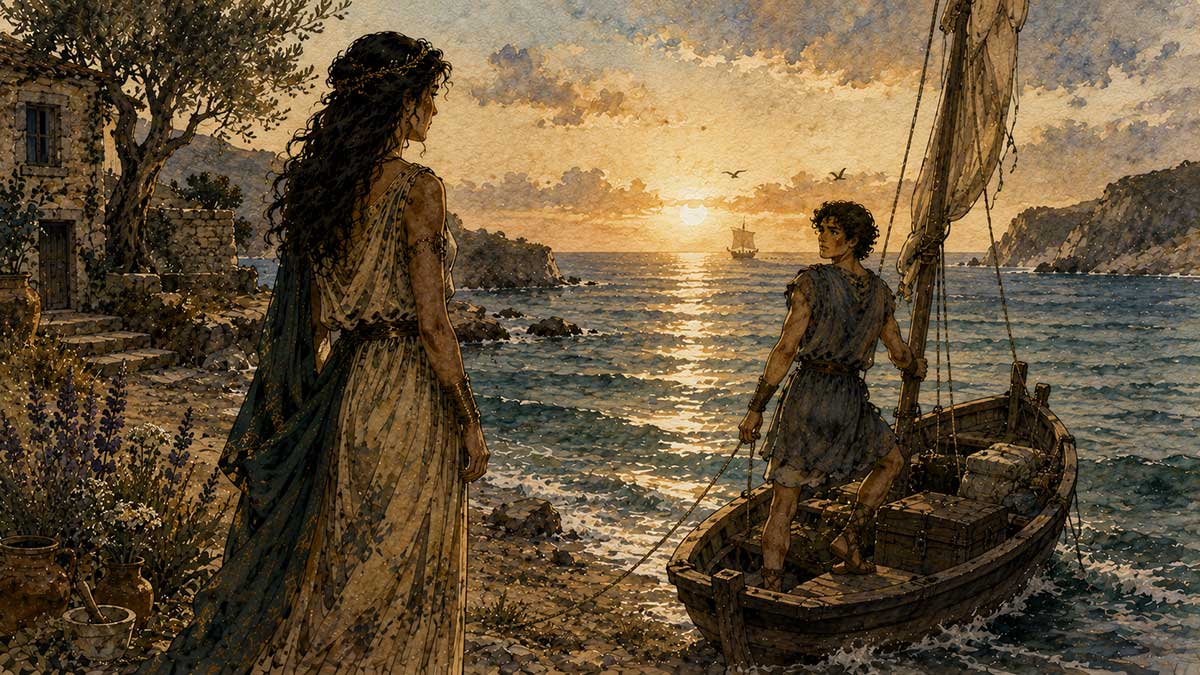
Circe: I do not know.
Telegonus looked at her.
Telegonus: You do not know when protection becomes control?
Circe: I know now that the line exists.
I did not always know where it was.
Telegonus: Did you ever think you were controlling me?
Circe: No.
I thought I was keeping you alive.
Telegonus: That sounds like the answer every frightened parent would give.
Circe winced.
Circe: Yes.
Penelope watched them.
Penelope: Fear can make love very persuasive.
Circe: What does that mean?
Penelope: It means fear rarely introduces itself as fear.
It says, I know what is best for you.
It says, You are not ready.
It says, The world is dangerous.
It says, I am doing this for you.
And sometimes every word is true.
That is why the line is so difficult to see.
Circe lowered her gaze.
Circe: Athena wanted him dead.
She was not an imaginary danger.
Telegonus: I know.
Circe: Gods do not threaten children idly.
I felt her attention on you before you could walk.
I built protections around the island.
I watched you sleep.
I listened for every change in the air.
You were mortal.
So small.
So breakable.
Her voice tightened.
Circe: Do you understand what that was like for me?
Telegonus: I think I do.
Circe: No, you do not.
The answer came sharper than she intended.
Telegonus went quiet.
Circe immediately regretted it.
Circe: I am sorry.
Telegonus: That is part of it too.
Circe: What?
Telegonus: Parents saying, "You do not understand."
Sometimes we don't.
But sometimes it becomes a way of ending the conversation.
Circe stared at him.
Telemachus: He is right.
Odysseus looked toward him.
Telemachus: I heard versions of that growing up.
You will understand when you are older.
You will understand when you are king.
You will understand when you have responsibilities.
Sometimes adults mean, There are things you have not lived yet.
Sometimes they mean, Stop questioning me.
Penelope nodded.
Penelope: Those are not the same thing.
Circe looked back at Telegonus.
Circe: Then tell me what I did not see.
Telegonus took a breath.
Telegonus: I knew I was loved.
That part was never unclear.
I knew you would fight gods for me.
I knew you would stand between me and anything that tried to hurt me.
As a child, that felt like the safest thing in existence.
Circe's face softened.
Telegonus: Then I got older.
And safety began to feel smaller.
Circe did not move.
Telegonus: I wanted to know what was beyond the island.
I wanted to know where I came from.
I wanted to know my father.
Every question seemed to frighten you.
So I learned that curiosity could hurt you.
Circe: I never wanted you to feel that.
Telegonus: I know.
That did not stop me from feeling it.
A silence passed between them.
Telegonus: Children become very good at reading their parents.
We notice the pause.
The face.
The breath.
The subject that makes the room change.
You never had to say, "Do not ask about your father."
Sometimes your face said it.
Circe's eyes filled.
Circe: I thought I hid that from you.
Telegonus: You hid the words.
Not the feeling.
Penelope looked down.
Penelope: Children often inherit what parents refuse to name.
Circe turned toward her.
Circe: Did Telemachus?
Penelope exhaled.
Penelope: Of course.
Telemachus glanced at her.
Penelope: I tried to protect him from my fear.
I told him his father would return.
I told stories carefully.
I kept anger out of my voice when I could.
I wanted him to believe in Odysseus without carrying all of my uncertainty.
Telemachus: I carried it anyway.
Penelope nodded.
Telemachus: When everyone around you is waiting for one person, you learn to wait too.
Penelope: I know.
Telemachus: I spent years feeling that our real life had not begun yet.
It would begin when Father came home.
Penelope closed her eyes briefly.
Telemachus: That is a strange thing to teach a child.
That the present is only a hallway.
That life is somewhere ahead.
Odysseus looked devastated.
Odysseus: I did that to you without being there.
Telemachus: Yes.
Odysseus: I am sorry.
Telemachus: I know.
Circe looked toward Telegonus.
Circe: Did I make the island feel like that?
Telegonus: No.
The island felt real.
It felt like home.
But sometimes it felt like home had invisible walls.
Circe: Invisible?
Telegonus: You never chained me.
You did something harder to fight.
You loved me so much that leaving felt cruel.
Circe looked away.
No one spoke.
Telegonus: I thought if I left, I was choosing Father over you.
Circe: You were not.
Telegonus: I know that now.
I did not know it then.
Circe's voice dropped.
Circe: Perhaps I did not know it then either.
Telegonus looked at her.
Circe: I told myself I feared what would happen to you.
That was true.
But I feared what would happen to me too.
If you left...
She stopped.
Telegonus: You would be alone again.
Circe nodded.
Circe: Yes.
That island had been exile before you.
Then you arrived, and it became something else.
A home.
A place with mornings I wanted to wake up for.
A place where someone called for me.
Needed me.
Loved me without asking me to become more beautiful or more divine or more useful.
She wiped her cheek.
Circe: Then you grew.
And the world began calling you.
I hated the world for it.
Telegonus: I thought you hated my wanting it.
Circe: Sometimes I did.
I am ashamed of that.
Not of you.
Of the part of me that heard your independence as rejection.
Telegonus looked at her for a long time.
Telegonus: That is what I wanted you to say.
Circe's face crumpled slightly.
Circe: Why?
Telegonus: I spent years wondering whether I imagined it.
Penelope leaned forward.
Penelope: That may be one of the greatest gifts a parent can give an adult child.
Circe: Which?
Penelope: To say, "You were not imagining what happened."
Telemachus looked at his mother.
She noticed.
Penelope: Yes.
You too.
Telemachus said nothing.
Circe: But where is the line?
If the danger is real, are we supposed to let children walk into it?
Penelope: No.
Circe: Then what?
Penelope: I think the question changes as the child changes.
When Telegonus was an infant, you decided almost everything.
When he became a boy, you still carried most of that burden.
But eventually the child becomes someone who must participate in the risk.
Circe frowned.
Penelope: A parent cannot keep making every decision forever simply because the parent can imagine every terrible outcome.
Circe: That sounds easy when the terrible outcome has not happened.
Telegonus flinched.
Circe stopped.
The terrible outcome had happened.
He had left.
He had found Odysseus.
Odysseus had died.
Circe covered her mouth.
Circe: Forgive me.
Telegonus: No.
Say it.
Circe: I do not want to.
Telegonus: Say it.
Circe's voice shook.
Circe: You left.
And your father died.
There.
Silence.
Telegonus: Yes.
Circe: Every frightened part of me could point to that and say, See? I was right.
Telegonus's eyes filled.
Circe: And that thought disgusts me.
Telegonus: Why?
Circe: Because being right about danger does not mean I would have been right to keep you imprisoned forever.
Telegonus stared at her.
Circe continued.
Circe: That is what I finally had to learn.
A bad outcome does not prove control was justified.
Sometimes people are free and terrible things happen.
That is unbearable.
Penelope: Yes.
Circe: I wanted a bargain the universe never offered me.
If I loved you enough, protected you enough, watched carefully enough, then nothing irreversible would happen.
Telegonus: There was no such bargain.
Circe: No.
And when I discovered that, I hated the world.
Odysseus had been silent.
Now he spoke.
Odysseus: Parents confuse responsibility with control.
Circe turned toward him.
Odysseus: Responsibility is real.
You feed the child.
Teach him.
Protect him when he cannot protect himself.
But control offers a fantasy.
It says that if the parent makes every correct decision, tragedy can be prevented.
Circe: You sound very wise for a man who was absent.
Odysseus accepted the blow.
Odysseus: I was.
And absence has its own version of control.
Telemachus: How?
Odysseus looked at him.
Odysseus: Expectations.
A father can be far away and still occupy a son's future.
I expected you to inherit Ithaca.
My name.
My place.
Perhaps I assumed that was a gift.
I did not ask whether you wanted the life attached to it.
Telemachus: I did not.
Odysseus: I know.
Telemachus: It frightened me to admit that.
Odysseus: Why?
Telemachus gave him a sad look.
Telemachus: You really have to ask?
Odysseus lowered his eyes.
Telemachus: People spoke of inheritance as gratitude.
To reject what you left me felt like rejecting you.
Odysseus: So you felt trapped by what I gave you.
Telemachus: Yes.
Odysseus: I thought fathers were supposed to leave sons something.
Telemachus: Maybe they are.
Odysseus: Then what should I have left you?
Telemachus thought for a long moment.
Telemachus: Permission.
Odysseus looked confused.
Telemachus: Permission to become someone you would not have chosen.
That landed quietly.
Telemachus: A child needs to know that disappointing a parent's expectation is not the same as losing the parent's love.
Circe's eyes shifted to Telegonus.
He had heard it too.
Circe: Did you believe my love depended on staying?
Telegonus: Not consciously.
Circe: But somewhere?
Telegonus: Yes.
Circe looked devastated.
Telegonus: Mother, I am not saying you failed me.
Circe: Perhaps you should.
Telegonus: No.
I am saying you loved me in a way that carried your fear inside it.
There is a difference.
Circe stared at him.
Telegonus: You gave me more than fear.
You gave me the island.
Stories.
Food.
Magic.
Laughter.
Safety.
You taught me to notice plants and weather and animals.
You taught me that gods could be resisted.
You taught me I mattered.
I do not want one mistake to erase a childhood full of love.
Circe began to cry.
Telegonus: But I need to be able to say the love hurt sometimes too.
Circe nodded through the tears.
Circe: You can.
Telegonus: Without comforting you afterward?
That question stopped her.
Penelope looked at Telegonus with admiration.
Circe swallowed.
Circe: Yes.
Telegonus: That may be harder.
Circe: It is.
Telegonus: I know.
Circe took her hand away from his.
Not in anger.
In restraint.
Circe: I want to hold your hand right now.
Telegonus: I know.
Circe: But perhaps I am trying to make myself feel better.
Telegonus considered that.
Then reached for her hand himself.
Telegonus: Now you can.
Circe let out a broken laugh.
Penelope smiled faintly.
Odysseus: That may be the whole problem in one gesture.
Circe: Which problem?
Odysseus: Knowing the difference between taking someone's hand and letting them offer it.
Circe looked at him.
Penelope: You are becoming suspiciously useful.
Odysseus: Death has improved me.
Telemachus: I would not recommend the method.
A quiet laugh moved through them.
Then Penelope turned serious.
Penelope: There is another part of parental control we have not discussed.
Circe: Which?
Penelope: Sacrifice.
Telegonus: Sacrifice?
Penelope: Parents sacrifice for children.
That is natural.
But sacrifice can become a debt the child never agreed to incur.
Telemachus looked at her.
Penelope noticed.
Penelope: I waited.
I protected Ithaca.
I endured the suitors.
I kept the household together.
I preserved your father's place.
Much of that protected you.
Telemachus: Yes.
Penelope: There were moments when some small, ugly part of me wanted you to know how much it cost.
Telemachus stayed silent.
Penelope: Not merely know.
Repay.
Through loyalty.
Through obedience.
Through gratitude.
She looked ashamed.
Penelope: I never said it plainly.
But perhaps children hear such things without words.
Telemachus: They do.
Penelope nodded.
Penelope: Then I am sorry.
Telemachus: Mother—
Penelope: No.
Let me finish.
A parent can give freely, then secretly turn the gift into a contract.
After everything I did for you.
That sentence has imprisoned many children.
Circe lowered her head.
Circe: I have thought it.
Telegonus looked at her.
Circe: I do not think I said it.
But I thought it.
After everything I did to protect you, why must you go looking for him?
I thought your desire for Odysseus made my years of motherhood smaller.
Telegonus: They were never smaller.
Circe: I know now.
Telegonus: Loving a missing parent does not subtract from the parent who stayed.
Odysseus looked down.
Telegonus: I wish children were told that.
Circe squeezed his hand gently.
Circe: So do I.
Telemachus: There is another side.
Everyone looked toward him.
Telemachus: Children can control parents too.
Penelope raised an eyebrow.
Telemachus: We can learn what frightens them.
What makes them give in.
What guilt works.
What silence works.
Families teach everyone where the levers are.
Penelope: Very true.
Telemachus: Love makes us vulnerable to one another.
The question is what we do with that vulnerability.
Odysseus nodded.
Odysseus: That may be closer to the line we were looking for.
Circe: Say more.
Telemachus: Protection says, "Your life matters to me."
Control says, "Your life must follow the shape that keeps me from being afraid."
Circe went still.
Telegonus looked at him.
Telemachus: Love can contain fear.
It probably always does.
But once my fear becomes the reason you are not allowed to become yourself, something has changed.
Circe stared at Telegonus.
Circe: I did that.
Telegonus: Sometimes.
Circe: I did.
Telegonus: Sometimes.
Circe looked at him.
Telegonus: Do not turn this into another way to condemn yourself completely.
We just talked about that.
Circe laughed softly.
Circe: You have been listening.
Telegonus: I had a very intense mother.
Everyone laughed this time, including Circe.
Then Telegonus became serious.
Telegonus: I need you to hear something else.
Circe: Tell me.
Telegonus: If I could return to that day...
Circe's face changed.
Telegonus: Knowing what happened...
Knowing I would meet Father...
Knowing he would die...
I do not know whether I would still go.
Odysseus looked at him.
Circe's breathing slowed.
Telegonus: Part of me wants to say no.
I would stay.
I would spare everyone.
But another part knows that I could not remain a boy forever.
I had to leave the island someday.
Maybe not that day.
Maybe not that way.
But someday.
Circe's tears returned.
Telegonus: You were never going to protect me from having a life.
Circe closed her eyes.
Circe: No.
Telegonus: A life includes things parents cannot fix.
Mistakes.
Loss.
Love.
Shame.
Wrong turns.
Sometimes terrible consequences.
Circe: I hate that.
Telegonus: I know.
Circe: I still want to protect you from all of it.
Telegonus: I know that too.
Circe: Does that ever stop?
Penelope answered.
Penelope: No.
You just become less entitled to act on it.
Circe laughed through her tears.
Circe: That is terrible.
Penelope: Parenthood contains many terrible arrangements.
Telemachus: Children become adults.
Penelope: Exactly.
A ridiculous design.
Odysseus: And the parents are expected to adapt?
Penelope: Ideally.
Odysseus: Poor planning by the gods.
Circe: The gods rarely plan for healthy families.
That drew another brief laugh.
Then Circe looked toward Telegonus again.
Circe: I have one question.
Telegonus: Ask.
Circe: When I finally let you go...
Did you know how afraid I was?
Telegonus: Yes.
Circe: Did it make leaving harder?
Telegonus: Yes.
Circe nodded.
Telegonus: It made leaving more meaningful too.
Circe looked surprised.
Circe: How?
Telegonus: You could have stopped me.
You were stronger than I was.
You had magic.
You had every argument.
You had real danger on your side.
And you still let me go.
He squeezed her hand.
Telegonus: That was one of the moments I knew you loved me most.
Circe began crying openly.
Circe: The moment I let you leave?
Telegonus: Yes.
Circe: I felt like I was failing you.
Telegonus: I felt like you finally trusted me with my own life.
Circe covered her face.
Penelope looked away to give her privacy.
Telemachus watched quietly.
Odysseus stared at the table.
After a long time, Circe lowered her hands.
Circe: So love is not keeping someone safe.
Penelope: Sometimes it is.
Circe: And sometimes?
Penelope: Sometimes it is allowing them to become responsible for risks you can no longer take for them.
Circe: I do not like that definition.
Penelope: Neither do I.
Telemachus: That may be why it is useful.
Circe smiled faintly.
Then Odysseus spoke.
Odysseus: I think there is something more frightening.
Circe: More frightening than letting your child walk into danger?
Odysseus: Yes.
Letting your child become someone whose life you do not fully understand.
Telemachus looked at him.
Odysseus: I could understand a son who wanted Ithaca.
A son who wanted battle.
A son who wanted reputation.
Those were languages I spoke.
But a son who wanted peace?
A smaller life?
A different kind of courage?
I might have mistaken that for weakness.
Telemachus: You did.
Odysseus: Yes.
Telemachus: For a long time.
Odysseus: Yes.
Telemachus: And now?
Odysseus looked at him.
Odysseus: Now I wonder whether you were braver than I was.
Telemachus stared at him.
Odysseus: I knew how to risk death.
You knew how to risk disappointing me.
I am no longer certain mine was the harder thing.
Telemachus's eyes filled.
Telemachus: I waited my whole childhood to hear something like that.
Odysseus nodded slowly.
Odysseus: I know.
Telemachus: I wish you had said it sooner.
Odysseus: So do I.
Penelope watched both of them.
Penelope: This is what parents forget.
Children do not need us to approve every choice.
They need to know that disagreement will not erase belonging.
Circe looked at Telegonus.
Circe: You can leave me and still belong to me?
Telegonus smiled.
Telegonus: I do not belong to you.
Circe froze.
Telegonus squeezed her hand.
Telegonus: But I belong with you.
Circe stared at him.
Then she smiled through tears.
Circe: That is better.
Telegonus: Much better.
The room became quiet.
The kind of quiet that no longer felt threatening.
Circe looked out toward the imagined sea beyond them.
Circe: I spent so much of my life afraid of being abandoned.
Then I became a mother and discovered something worse.
Loving someone whom I could not keep.
Penelope nodded.
Circe: Perhaps that is what mortality teaches us before death ever arrives.
Everything we love is already beyond possession.
People.
Children.
Bodies.
Homes.
Years.
Odysseus looked toward her.
Odysseus: And yet we keep trying to hold them.
Circe: Yes.
Telemachus: Maybe that is why ordinary life requires more courage than we admit.
Circe turned.
Telemachus: You wake up knowing nothing stays.
And you love it anyway.
No one answered.
Telegonus looked at his mother.
Telegonus: You were offered something most of us never are.
Circe knew what he meant.
Immortality.
Telegonus: You could remain outside what frightens everyone else.
Aging.
Loss.
Death.
Circe looked at her son.
Then at Penelope.
Telemachus.
Odysseus.
Telegonus: Why would anyone give that up?
Circe did not answer.
Not yet.
Her eyes rested on the mortal faces around her.
And for the first time that evening, the question was no longer about how to keep someone from leaving.
It was about why anyone would choose a life in which everything eventually does.
Topic 5 — Mortality, Ordinary Life, and the Courage to Choose
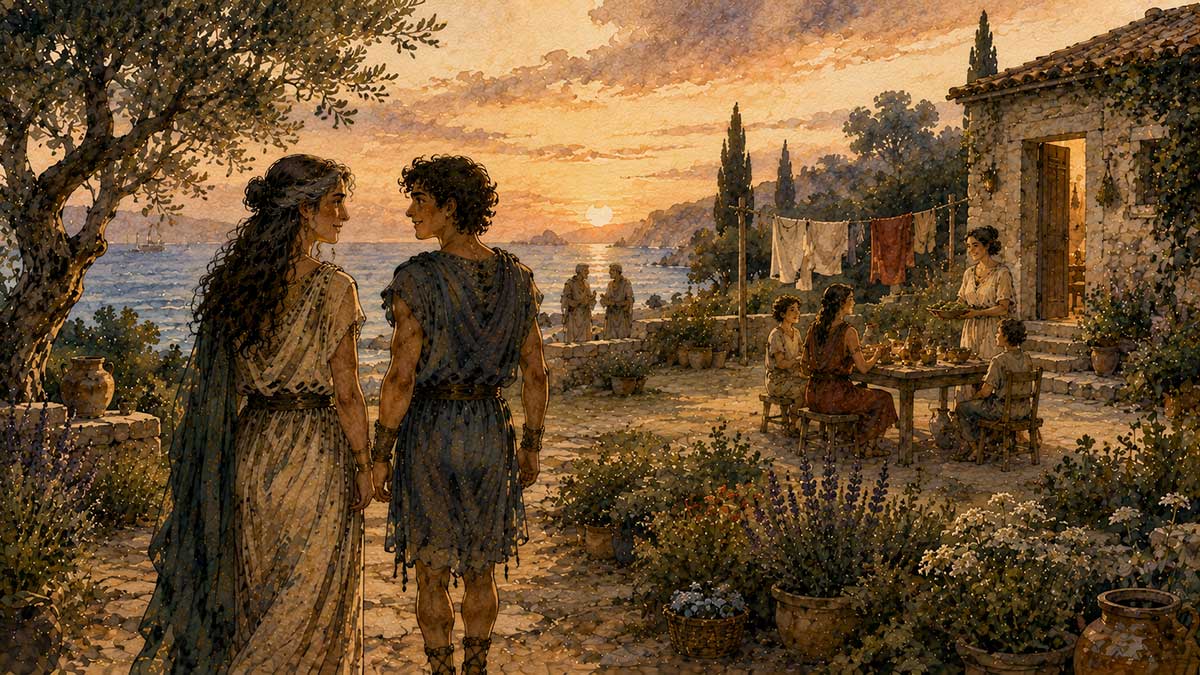
Circe: Because eternity began to feel like another kind of prison.
Telegonus watched her.
Telegonus: You were immortal.
Circe: Yes.
Telegonus: You could not grow old.
Circe: Yes.
Telegonus: You could not die.
Circe: Not as mortals do.
Telegonus: And you wanted to give that up?
Circe looked at him.
Circe: Eventually.
Telegonus: I still do not understand.
Odysseus: Neither would most men.
Circe turned toward him.
Odysseus: We spent our lives trying to delay death.
You were born beyond it.
Circe: And you think that made me fortunate?
Odysseus: Didn't it?
Circe looked toward the distance.
Circe: When I was young, I thought so.
The gods seemed magnificent to me.
They did not age.
Their bodies did not betray them.
Centuries passed and they remained unchanged.
I thought permanence was proof of superiority.
Then I lived among them long enough.
Penelope: And?
Circe: I discovered that remaining unchanged is not always a gift.
Odysseus leaned back.
Circe: My father could live ten thousand years and still be Helios.
My relatives could repeat the same humiliations, rivalries, desires, cruelties.
Century after century.
They possessed infinite time.
Yet many of them had almost no reason to become different.
Telemachus: Mortals do?
Circe: You have to.
Time acts upon you whether you cooperate or not.
You lose people.
Your body changes.
Children grow.
Parents weaken.
Places disappear.
You cannot remain exactly who you were.
Penelope: Some try.
Circe: Yes.
Penelope: They become miserable.
Circe smiled faintly.
Odysseus: Mortals can repeat themselves too.
Circe: Of course.
But death waits at the edge of every repetition.
That changes the meaning.
Odysseus considered this.
Circe: If you have forever, postponement becomes easy.
Tomorrow.
Another century.
Another lover.
Another quarrel.
Another chance.
But mortals eventually run out of another chances.
Telegonus looked at Odysseus.
No one missed it.
Odysseus did not either.
Odysseus: Yes.
They do.
Circe's voice softened.
Circe: That is cruel.
But it makes choices matter.
Telemachus: So death gives life meaning?
Circe shook her head.
Circe: I would not say death creates meaning.
I think limitation forces us to notice meaning.
Penelope nodded.
Penelope: A day becomes precious when you cannot replace it infinitely.
Circe: Exactly.
Telegonus: Yet people waste days constantly.
Penelope: We do.
Telegonus: Then knowing we will die does not seem to help very much.
Penelope laughed softly.
Penelope: Human beings are capable of knowing something completely and living as if we do not know it at all.
Odysseus: That may be our greatest talent.
Telemachus: Greater than yours?
Odysseus: Easily.
They smiled.
Then Circe turned toward Odysseus.
Circe: You wanted immortality too.
Odysseus: Not literally.
Circe: Through memory.
Odysseus's expression changed.
Circe: You wanted your name to survive your body.
Odysseus: Most men do.
Circe: Most men do not cross oceans for it.
Odysseus: I crossed oceans to return home.
Penelope: And to become someone worth singing about.
Odysseus looked at her.
Penelope: Both can be true.
He sighed.
Odysseus: Fine.
Yes.
I wanted to be remembered.
Telemachus: Why?
Odysseus: Because death frightened me.
Telegonus looked surprised.
Odysseus: Not the pain.
Not mainly.
The disappearance.
The thought that one day I would have thought my last thought.
Made my last decision.
Spoken my final word.
Then eventually even those who remembered me would die.
Telemachus: So you wanted the story to continue.
Odysseus: Yes.
Circe: And it did.
Odysseus: Apparently.
Circe: Are you satisfied?
Odysseus looked at her.
Odysseus: What kind of question is that?
Circe: A simple one.
You received what you wanted.
Men remembered you.
They told your story.
They called you clever.
Heroic.
Resourceful.
Your name survived kingdoms.
Was it enough?
Odysseus was quiet.
Odysseus: No.
Circe waited.
Odysseus: It is strange.
When you are alive, immortality through reputation seems enormous.
Afterward—
He paused.
Odysseus: I would trade a great many songs for one ordinary afternoon I failed to appreciate.
Penelope looked at him.
Odysseus: A meal.
You complaining that I had left something where it did not belong.
Telemachus asking a question when I was trying to think.
Rain outside.
Nothing important happening.
Penelope smiled.
Penelope: You hated those days.
Odysseus: I know.
Penelope: You became restless.
Odysseus: I know that too.
Penelope: You would stare toward the harbor.
Odysseus: Yes.
Penelope: And now you want one back.
Odysseus smiled sadly.
Odysseus: More than Troy.
Penelope looked away.
Circe watched them.
Circe: That is what I came to understand.
The gods possess endless time and constantly search for spectacle.
Mortals possess very little and often fail to recognize the miracle of an uneventful day.
Telemachus: I like uneventful days.
Odysseus glanced at him.
Odysseus: I know.
Telemachus: You used to think that made me unambitious.
Odysseus: I did.
Telemachus: And now?
Odysseus: Now I think I did not know the difference between a small life and a quiet one.
Telemachus looked at him.
Odysseus: They are not the same.
Telemachus: No.
Odysseus: A quiet life can contain enormous things.
Penelope: Love.
Telemachus: Work.
Telegonus: Children.
Circe: Forgiveness.
Odysseus nodded.
Penelope: And boredom.
Everyone laughed.
Penelope: Let us not romanticize mortality too much.
Circe laughed with her.
Circe: Fair.
Penelope: There are aching backs.
Illness.
Bad weather.
People repeating themselves.
Meals that disappoint.
People you love irritating you for decades.
Odysseus: You seem to have prepared this list.
Penelope: I had material.
Circe: Still, you chose it.
Penelope's smile faded.
Penelope: Mortality?
Circe: Life.
Again and again.
Penelope: I suppose so.
Circe looked at her carefully.
Circe: Did you ever want to leave Ithaca?
Penelope froze.
Telemachus turned toward her.
Penelope: Yes.
Odysseus looked surprised.
Odysseus: You never told me.
Penelope: There are many things I never told you.
Odysseus: When?
Penelope: During the waiting.
After your return.
Sometimes after breakfast.
Odysseus blinked.
Penelope: Did you think only heroes dreamed of escape?
Circe smiled.
Penelope: There were mornings when I wanted to walk until nobody knew my name.
No queen.
No faithful wife.
No keeper of Ithaca.
No symbol of patience.
Just a woman walking somewhere.
Telemachus: Why didn't you?
Penelope looked at him.
Penelope: Some days, duty.
Some days, fear.
Some days, love.
Some days, habit.
And perhaps some days I chose my life.
Telemachus nodded slowly.
Penelope: That distinction took me years to see.
Circe: Between staying because you cannot leave and staying because you choose to remain.
Penelope: Yes.
Circe looked down at her hands.
Circe: That became important to me too.
Aiaia began as exile.
I did not choose it.
My father sent me there.
The gods decided where I would live.
For years, every tree reminded me that I had been removed from the world.
Telegonus: But you loved the island.
Circe: Eventually.
Telegonus: When did it become home?
Circe considered the question.
Circe: When I stopped thinking of it as the place they had put me.
Telegonus remained quiet.
Circe: The island did not change.
I did.
I planted what I wanted.
Learned what grew there.
Walked paths no god had assigned.
Made meals no one commanded me to make.
Made mistakes that belonged entirely to me.
Then you were born.
She looked at him.
Circe: At some point I realized Aiaia was no longer evidence of my punishment.
It was my life.
Telemachus: The same place can be prison and home?
Circe: Yes.
Penelope: Depending on whether there is choice.
Circe nodded.
Circe: That may be why mortality began to call to me.
I had been born a goddess without being asked.
Immortality was given to me before I could choose it.
For centuries I assumed that what had been given must be valuable.
Then I asked a forbidden question.
Telegonus: Which?
Circe: What if I do not want it?
Odysseus stared at her.
Circe: That question frightened me more than any god.
Telemachus: Why?
Circe: Because once you admit you do not want the life handed to you, responsibility becomes yours.
Telemachus's expression changed.
Circe noticed.
Circe: You know that feeling.
Telemachus: Yes.
Ithaca.
Circe: Your father's legacy.
Telemachus: Yes.
Circe: A life can be magnificent and still be wrong for the person receiving it.
Odysseus looked down.
Telemachus: That took me a long time to accept.
Odysseus: And longer for me.
Telemachus looked at him.
Odysseus: I thought refusing my life meant refusing me.
Telemachus: It did not.
Odysseus: I know.
He paused.
Odysseus: Perhaps parents want children to repeat their lives because repetition makes our own choices feel validated.
Penelope turned toward him.
Penelope: That is uncomfortably insightful.
Odysseus: Death continues to improve me.
Circe: Still not recommending it.
Odysseus: Wise.
A small laugh passed between them.
Then Telegonus spoke.
Telegonus: Mother, were you afraid?
Circe: Of becoming mortal?
Telegonus: Yes.
Circe looked at him.
Circe: Terrified.
Telegonus: Of dying?
Circe: Of everything before dying too.
Aging.
Weakness.
Illness.
Watching my body become unfamiliar.
Knowing that a wound might not heal.
Knowing that each goodbye might truly be the last.
Penelope: Then why choose it?
Circe looked toward Telemachus.
He seemed startled.
Circe: Because I wanted a life that could be lost.
No one spoke.
Circe: I know how foolish that sounds.
Odysseus: It does not.
Circe: The gods possess things endlessly.
After enough centuries, possession can make attention lazy.
If tomorrow is guaranteed forever, what does today demand from you?
Mortality asks something harsher.
It says:
This person will not always be here.
Neither will you.
What will you do with that knowledge?
Penelope's eyes lowered.
Circe: I wanted meals that mattered because there would be a last one.
Seasons that mattered because I would not see them infinitely.
A face I could watch change beside mine.
A morning that would never return.
Telemachus: You wanted limitation.
Circe: I wanted consequence.
I wanted my choices to close other doors.
I wanted to know that saying yes to one life meant saying no to countless others.
Odysseus: That sounds painful.
Circe: It is.
But perhaps a choice means more when you cannot choose everything.
Penelope looked at Odysseus.
Penelope: You spent your life keeping possibilities open.
Odysseus: Survival required it.
Penelope: Sometimes.
Odysseus: You disagree?
Penelope: I think you loved possibility.
Another shore.
Another plan.
Another escape.
Another version of yourself.
Odysseus smiled faintly.
Penelope: Commitment frightened you because every commitment kills another future.
Odysseus's smile disappeared.
Odysseus: That is severe.
Penelope: Is it wrong?
Odysseus thought for a moment.
Odysseus: No.
Circe looked at them.
Odysseus: Perhaps that was another reason ordinary life frightened me.
To live one life means abandoning thousands I could have lived.
Telemachus: Everyone does that.
Odysseus: Yes.
I simply resisted admitting it.
Circe: The gods resist it forever.
They want every appetite.
Every revenge.
Every lover.
Every century.
They call that freedom.
Penelope: You do not?
Circe: Not anymore.
Penelope: What is freedom then?
Circe became quiet.
Circe: Choosing what you are willing to lose.
Penelope watched her.
Circe: Every real choice costs something.
If nothing can be lost, nothing has truly been chosen.
Telemachus leaned forward.
Telemachus: Then mortality makes choice possible?
Circe: Perhaps it makes choice visible.
Telegonus looked troubled.
Telegonus: But if everything ends, doesn't that make everything sad?
Circe turned toward him.
Circe: Yes.
Telegonus: That's your answer?
Circe smiled.
Circe: Would you prefer I lie?
Telegonus: No.
Circe: Everything ending is sad.
The mistake is believing sadness makes something worthless.
Telegonus was silent.
Circe: Your childhood ended.
Was it worthless?
Telegonus: No.
Circe: My time with Odysseus ended.
It still mattered.
Odysseus looked toward her.
Circe: Penelope's waiting ended.
Telemachus's childhood ended.
Wars end.
Marriages end one way or another.
Bodies end.
The ending does not travel backward and erase what came before.
Penelope nodded.
Penelope: Sometimes the ending reveals what mattered.
Telegonus: I wish Father's ending had been different.
Odysseus looked at him.
Telegonus: I wish we had spoken.
Really spoken.
Odysseus: So do I.
Telegonus: There were so many things I wanted to ask.
Odysseus: Ask one now.
Telegonus looked surprised.
Telegonus: What?
Odysseus: Ask me.
Telegonus hesitated.
Then his voice became small.
Telegonus: If you had known about me...
Would you have wanted me?
Circe closed her eyes.
Penelope looked toward Odysseus.
Telemachus held still.
Odysseus did not answer immediately.
Telegonus: Please do not give me the heroic answer.
Odysseus nodded.
Odysseus: I would have been frightened.
Telegonus looked down.
Odysseus: Wait.
Let me finish.
I would have been frightened of what you meant.
Another son.
Another responsibility.
Another piece of my life I had failed to know.
I might have wondered what Penelope would think.
What Telemachus would think.
What Ithaca would think.
I might have behaved badly before behaving well.
Circe watched him closely.
Odysseus: But yes.
I would have wanted to know you.
Telegonus's eyes filled.
Odysseus: Not because you were my legacy.
Not because you carried my blood.
Because you were there.
A person.
My son.
And I would have wanted the chance to discover who you were.
Telegonus wiped his face.
Telegonus: That is enough.
Odysseus: Is it?
Telegonus: It has to be.
That sentence settled over them.
Penelope looked at Telegonus with tenderness.
Penelope: That is one of mortality's hardest lessons.
Sometimes there is no complete answer.
Only the answer you received before time closed.
Telegonus nodded.
Circe reached for him, then paused.
Telegonus noticed and leaned into her.
She held him.
No one spoke for a moment.
Then Telemachus looked at Circe.
Telemachus: If you became mortal, what would you want your life to look like?
Circe smiled.
Circe: Very unimpressive.
Odysseus laughed.
Odysseus: After all this?
Circe: Yes.
Telemachus: Define unimpressive.
Circe: A house.
A garden.
Work worth doing.
People coming and going.
Arguments that do not become wars.
Food.
Rain.
Perhaps children nearby, though not so nearby that I can interfere constantly.
Telegonus smiled.
Circe: I heard that.
Telegonus: Good.
Circe looked toward Telemachus.
Circe: Someone beside me who does not need me to be a goddess.
Telemachus met her eyes.
The room became very quiet.
Odysseus noticed.
So did Penelope.
So did Telegonus.
Telemachus smiled faintly.
Telemachus: That sounds difficult.
Circe: More difficult than monsters, apparently.
Telemachus: Monsters make themselves known.
Circe: People require conversation.
Odysseus: Avoid it if possible.
Penelope gave him a look.
Odysseus: I am joking.
Mostly.
They laughed.
Then Circe looked toward Odysseus.
Circe: Would you choose differently?
Odysseus: If I could return?
Circe: Yes.
Odysseus thought.
Odysseus: I do not know.
Everyone seemed surprised.
Odysseus: That may sound cowardly.
But changing one choice changes everything after it.
If I avoid Troy, perhaps men live who died.
Perhaps others die instead.
Perhaps I never become the man sitting here.
Perhaps Telemachus grows up with me and hates me for entirely different reasons.
Telemachus: Likely.
Odysseus: Thank you.
Telemachus smiled.
Odysseus: I cannot rewrite everything.
But I know what I would value differently.
Circe: What?
Odysseus looked at Penelope.
Odysseus: I would stop treating ordinary days as preparation for important ones.
Penelope's eyes filled.
He turned to Telemachus.
Odysseus: I would ask my son who he was before telling him who he ought to become.
Then Telegonus.
Odysseus: I would leave fewer children wondering whether they mattered to me.
Then Circe.
Odysseus: And I would recognize sooner that peace is not what happens between adventures.
It is a life.
Circe nodded.
Telemachus: I think I always knew that.
Odysseus: Yes.
That was something you could have taught me.
Telemachus smiled.
Telemachus: Fathers can learn from sons?
Odysseus: Apparently the gods permit it.
Penelope: Rarely.
They laughed again.
Then Penelope looked toward Circe.
Penelope: I have a question for you.
Circe: Ask.
Penelope: At the beginning, we spoke about being chosen.
Circe nodded.
Penelope: Glaucos did not choose you.
Your family did not choose you.
Odysseus left.
You spent much of your life looking into other people's faces for evidence that you mattered.
Circe's eyes lowered.
Penelope: If you could speak to that young girl now, what would you tell her?
Circe was silent for a long time.
When she finally spoke, her voice was almost a whisper.
Circe: I would tell her that she is asking the wrong question.
Penelope: Which question?
Circe: "Who will choose me?"
No one moved.
Circe: I asked it for centuries.
Who will love me?
Who will stay?
Who will recognize me?
Who will say I am beautiful?
Who will tell me my voice deserves to be heard?
Who will tell me I belong?
She looked around the table.
Circe: I thought one perfect answer from another person would settle all of it.
It never did.
Telegonus: What should she ask instead?
Circe looked at him.
Then at Penelope.
Odysseus.
Telemachus.
Circe: "What will I choose?"
The words seemed almost too simple.
Circe: What kind of person will I become?
What will I refuse to repeat?
Whom will I love without owning?
What pain will I carry without passing it onward?
What life will I accept knowing it ends?
What will I do when no one is watching?
She looked down.
Circe: Perhaps that is adulthood.
Not finally being chosen.
Finally choosing.
Penelope nodded slowly.
Penelope: And if someone chooses you too?
Circe smiled.
Circe: Then perhaps you can love them without needing them to prove you exist.
Telemachus looked at her.
Their eyes held.
Telemachus: That sounds like freedom.
Circe: I think it might be.
Odysseus leaned back.
Odysseus: No songs?
Circe looked at him.
Odysseus: No monuments?
Circe: None.
Odysseus: No one remembering your name in a thousand years?
Circe considered it.
Circe: Perhaps not.
Odysseus: And that does not frighten you?
Circe smiled.
Circe: Less than spending eternity living a life I never chose.
Odysseus nodded.
Odysseus: You always were braver than I understood.
Circe: No.
I became brave.
There is a difference.
That answer pleased her.
She could feel it.
For so long, she had thought strength was something certain beings possessed and others lacked.
Gods possessed it.
Beautiful people possessed it.
Men like Odysseus possessed it.
She had once looked outward for every measure of herself.
Now she looked at the people around the table.
The husband who had become a legend.
The wife who had survived being turned into a symbol.
The son who refused his father's destiny.
The son who had crossed the sea looking for a father and returned carrying grief.
And herself.
A goddess who had once believed immortality meant having everything.
Circe: I think I know what I want now.
Telegonus: What?
Circe looked toward the horizon.
Circe: Enough time to love what is here.
Not forever.
Just enough.
Penelope smiled.
Penelope: How much is enough?
Circe looked back at her.
Circe: I suppose you only discover that when there is no more.
Penelope nodded.
No one tried to improve the answer.
The silence that followed was not empty.
Odysseus finally spoke.
Odysseus: There is something amusing about this.
Penelope: I am already suspicious.
Odysseus: I spent my life trying to defeat limits.
Distance.
War.
The sea.
Death.
Fate.
Circe spent hers discovering that limits might be what make life bearable.
Telemachus: Perhaps you were both trying to reach the same place from opposite directions.
Odysseus: Which place?
Telemachus looked around the table.
Telemachus: A life that feels like your own.
Circe smiled.
Penelope rested her hands quietly before her.
Telegonus looked at his mother.
Odysseus looked toward the imagined sea.
No one had solved death.
No one had erased what they had done.
Scylla remained wounded.
Odysseus remained dead.
Telegonus remained the son who had killed the father he wanted to know.
Penelope's twenty lost years had not returned.
Telemachus would never receive the childhood he had wanted.
Circe could not become the girl she had been before humiliation taught her to hate herself.
Nothing had been repaired by pretending it had never broken.
Yet something had changed.
They no longer seemed to be asking whether their lives could become flawless.
Only whether they could become theirs.
Circe looked once more at the people beside her.
Circe: Perhaps that is enough.
And this time, nobody asked her to prove it.
Final Thoughts
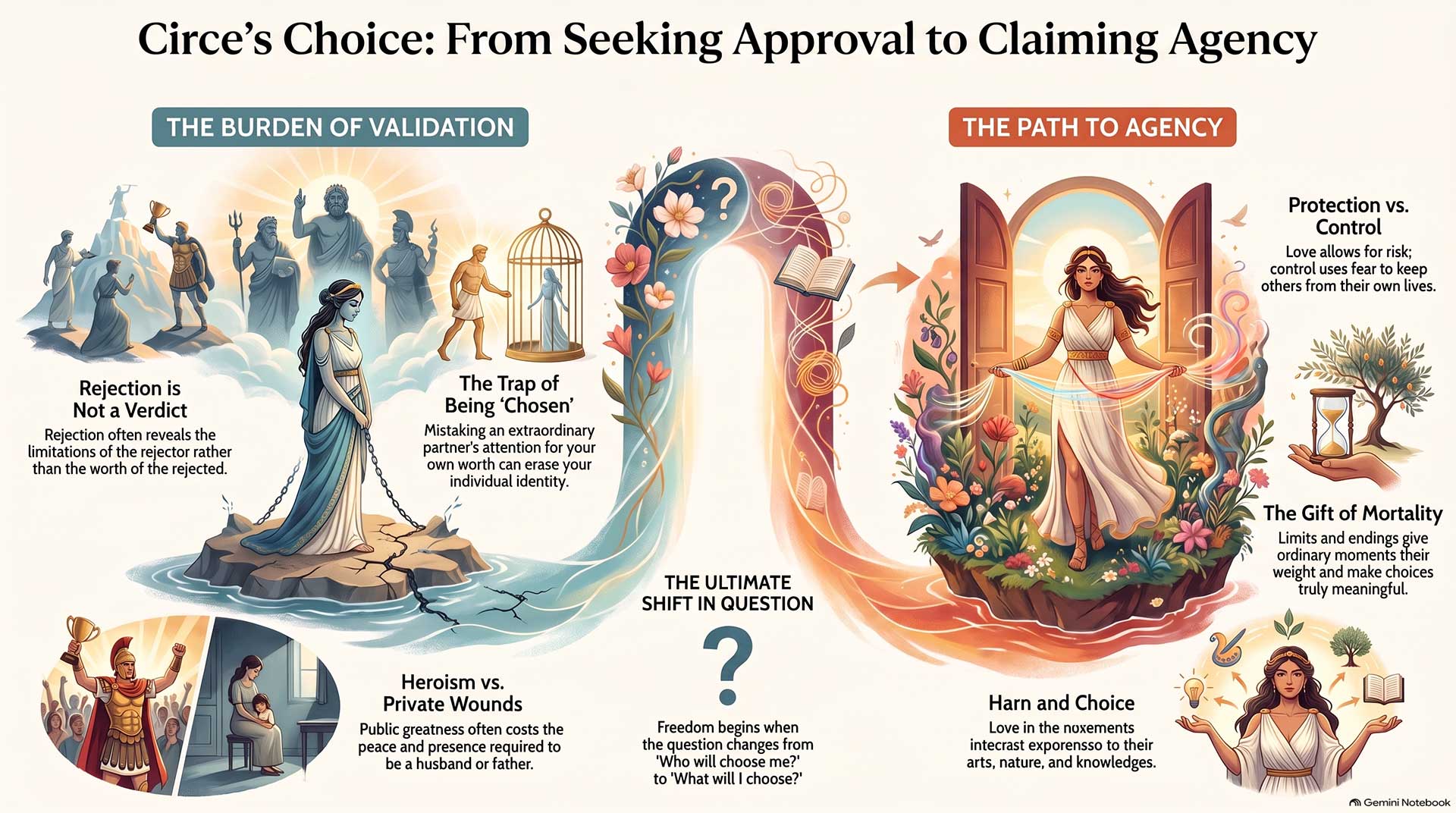
Perhaps the most moving idea in Circe is that freedom does not arrive when everyone finally recognizes our worth.
Circe spends much of her early life looking outward.
Her father’s attention.
Glaucos’s love.
The gods’ respect.
Odysseus’s affection.
Each seems capable of answering the question she cannot answer herself: Am I enough?
Yet being wounded does not automatically make Circe innocent. Her jealousy destroys Scylla, forcing her to confront one of the hardest moral truths in the story: suffering can explain cruelty without excusing it.
Odysseus faces a related truth. A person may be a hero publicly and still leave private wounds behind. Courage on a battlefield does not automatically teach someone how to be a husband, father, or peaceful human being.
Penelope gives perhaps the clearest perspective. Love does not require us to lie about the person we love.
Telemachus carries another lesson: children should not have to reproduce their parents’ lives to prove their gratitude.
And Telegonus reveals the painful paradox of parenthood. A parent may devote everything to protecting a child, yet eventually love requires allowing that child to live a life the parent cannot control.
Circe’s final attraction to mortality brings all these ideas together.
She once believed immortality meant having more life.
Eventually she discovers that limitation may make life matter.
There will be a last meal.
A last summer.
A last conversation.
A last time someone walks through the door.
That knowledge is painful, yet it gives ordinary moments their weight.
Circe finally stops asking:
Who will choose me?
She begins asking:
What will I choose?
Perhaps that is the quiet transformation at the heart of her story.
We may never control who loves us, who leaves us, what happened before us, or how long anything lasts.
But we can still decide what pain we refuse to pass forward, whom we love without owning, what inherited expectations we decline, and what kind of finite life we are willing to call our own.
Short Bios:
Circe — Daughter of the sun god Helios and the central character of Madeline Miller’s novel. Rejected and exiled, she develops formidable witchcraft and gradually builds an identity independent of her divine family.
Penelope — Wife of Odysseus and mother of Telemachus. Known for her intelligence, endurance, and long wait during Odysseus’s absence, she becomes one of Circe’s most revealing counterparts.
Odysseus — King of Ithaca, husband of Penelope, and legendary hero of The Odyssey. Brilliant and resilient, yet deeply complicated, he represents the distance between public greatness and private consequences.
Telemachus — Son of Odysseus and Penelope. He grows up beneath the weight of his father’s reputation and ultimately seeks a quieter identity that does not depend upon repeating Odysseus’s life.
Telegonus — Son of Circe and Odysseus. Raised by Circe on Aiaia, his longing to know his absent father leads to one of the story’s most tragic turns.
Leave a Reply