
Introduction by José Saramago
Did Saramago reject Christianity, or challenge Christianity to examine its relationship with authority and suffering?
I wrote a book about Jesus, and many people assumed that meant I intended to write a book against Jesus.
I did not.
The Jesus who interested me was precisely the opposite: a human being caught between what he might desire for his own life and what others—God, history, religion, humanity—would eventually demand that his life mean.
Before Jesus can understand his destiny, however, there is Joseph.
Joseph learns that children are in danger.
He saves his own son.
He does not warn the others.
That failure matters since it introduces a question that follows the novel from Bethlehem to the cross:
What responsibility comes with knowing?
A frightened father knows.
Later Jesus knows.
God knows more than either of them.
Should responsibility decrease as knowledge and authority increase?
Or should it increase?
Then there is Mary Magdalene.
She does something history finds surprisingly difficult.
She looks at Jesus and sees Jesus.
Not Christianity.
Not salvation.
Not the future.
Not a symbol.
A man.
She reminds us that every great historical abstraction eventually reaches a human body.
And bodies suffer what ideas merely explain.
The Devil complicates matters further.
Readers expect God to possess the strongest moral arguments and the Devil the weakest.
I saw no reason to make things so convenient.
If an argument is good, should it become bad simply since the Devil speaks it?
If an action is cruel, should it become good simply since God commands it?
Perhaps names sometimes prevent us from judging what is actually before us.
Then comes the question of freedom.
Jesus discovers what is expected of him.
He resists.
But what kind of rebellion is possible when God already knows the rebellion?
Can Jesus refuse a destiny that has already included his refusal?
Perhaps freedom does not mean controlling history.
Perhaps it means preserving the right to say:
You may know what I will do, but you do not automatically own why I do it.
The five scholars gathered here approach these questions differently.
Sara Grünhagen brings us close to the language, characters, cultural context, and intimate relationships of the novel.
Carlos Reis asks what narration itself is doing—and whether the novelist who controls Jesus may resemble the God whose control the novel questions.
David Frier examines ideology and the danger of allowing promised future good to justify present suffering.
Mark Sabine asks what happens when authority claims that history itself validates its decisions.
Elaine Pagels brings another necessary perspective: the Jesus remembered by Christianity has always existed within interpretation, memory, community, theology, and argument.
They will disagree.
Good.
A book that produces only agreement has probably asked questions too small for its readers.
The question before them is not simply whether God exists.
Nor whether Christianity is true or false.
The harder question is this:
What happens when any authority—religious, political, historical, or literary—believes its great purpose gives it the right to decide what another human being must sacrifice?
That is where our conversation begins.
(Note: This is an imaginary conversation, a creative exploration of an idea, and not a real speech or event.)
Topic 1: Did Saramago Rewrite Jesus—or Put Human Responsibility on Trial?
The five scholars sat around a circular table overlooking Lisbon.
A copy of The Gospel According to Jesus Christ rested at its center.
For several moments, no one opened it.
The discussion began somewhere else.
Bethlehem.
Why Does Saramago Make Guilt Precede Jesus’s Public Mission?
Carlos Reis: One of Saramago’s most revealing choices is that Jesus’s great moral problem begins before Jesus is capable of making a moral choice. His life is already entangled in someone else’s decision.
Sara Grünhagen: And that someone is Joseph. This matters enormously. Before we reach God, miracles, the Shepherd, Mary Magdalene, or the extraordinary encounter on the lake, Saramago gives us a frightened father.
Elaine Pagels: We need to establish something for readers immediately. Saramago is creating literature here. The canonical infancy traditions do not tell us that Joseph learned about Herod’s intentions and consciously failed to warn Bethlehem.
David Frier: Precisely. Which means we should ask why Saramago invents that responsibility.
Mark Sabine: I think the answer lies in scale. If Saramago began by accusing God, readers could immediately retreat into theology.
Is God just?
Does God permit evil?
Why does God allow suffering?
Those questions are enormous and familiar.
Instead, Saramago begins with a decision almost anyone can understand.
You discover that children are in danger.
Your own child is among them.
What do you do?
Sara Grünhagen: And Joseph does what many people fear they might actually do.
He thinks first of his own child.
Carlos Reis: Which prevents the moral problem from becoming abstract.
Joseph is not a dictator.
He is not a theologian.
He is not a monster.
He is a father.
David Frier: That is precisely what makes the episode disturbing.
We prefer evil to arrive wearing recognizable clothing.
Saramago often refuses us that comfort.
Moral catastrophe can begin with someone frightened, ordinary, loving, and concerned with the person nearest to him.
Elaine Pagels: Yet we need some sympathy for Joseph here.
There is a danger in discussing his decision from the calm safety of a seminar table.
Imagine receiving terrifying information and believing your child may be killed.
The psychological response is immediate.
Protect the child.
Mark Sabine: Certainly.
But explanation and absolution are different things.
Elaine Pagels: Yes.
That distinction matters.
Sara Grünhagen: And Saramago makes Joseph live inside precisely that distinction.
He understands why he ran.
That does not release him from knowing what he failed to do.
Is Joseph Guilty for Saving Jesus but Failing to Warn the Other Families?
Carlos Reis: Let me make the question uncomfortable.
What should Joseph have done?
David Frier: Warned them.
Carlos Reis: Before saving Jesus?
David Frier: That is harder.
Carlos Reis: Exactly.
We say, “He should have warned Bethlehem,” and morally that seems obvious.
But imagine the sequence.
You believe soldiers are coming.
Your child may have minutes.
Do you first run from house to house?
Do you gather everyone?
Do you save your child, then return?
Every minute matters.
Sara Grünhagen: But the novel does not condemn Joseph simply for saving Jesus first.
The moral wound comes from the absence of warning.
Those are not identical actions.
Mark Sabine: That distinction is essential.
The problem is not:
“You loved Jesus.”
The problem is:
“Did loving Jesus make everyone else less visible?”
Elaine Pagels: And now we reach something far beyond this novel.
Human beings are morally partial creatures.
We love particular people.
Children.
Parents.
Partners.
Friends.
We do not experience the suffering of every stranger with equal emotional intensity.
David Frier: Nor could we.
Elaine Pagels: Exactly.
If morality required us to feel identical attachment to every human being, ordinary human love might become impossible.
Sara Grünhagen: Yet Saramago asks what happens when emotional partiality becomes moral partiality.
I may love my child more intensely than another child.
Does that mean the other child has less claim on my action when I can help?
Mark Sabine: That is the real problem.
And it becomes political very quickly.
Nations do this.
Communities do this.
Religions do this.
Families do this.
We divide the human field into:
ours
and theirs.
Then suffering becomes easier to accept on one side of the boundary.
Carlos Reis: Which is why Joseph is such a brilliant starting point.
The novel begins with perhaps the smallest possible version of tribal morality.
My child.
Their children.
David Frier: And Joseph chooses “my child.”
Elaine Pagels: I would phrase it more carefully.
Joseph acts for his child and fails the others.
Those two parts need to remain together.
If we simply say he “chooses Jesus over the other children,” we risk making the decision sound colder and more deliberate than Saramago’s moral psychology requires.
Mark Sabine: Fair.
But from the perspective of the other families, the distinction may mean very little.
Elaine Pagels: Morally, perhaps.
Psychologically, it means a great deal.
David Frier: And Saramago needs both.
If Joseph were simply cruel, his guilt would teach us nothing.
The frightening possibility is that a loving man can commit a serious moral failure precisely when love becomes too narrow.
Can Love Become Morally Dangerous?
Sara Grünhagen: This becomes one of the novel’s recurring patterns.
Saramago distrusts abstractions, but he does not automatically romanticize intimate attachment either.
Human love can protect.
It can also exclude.
Carlos Reis: Which creates an interesting contrast with Mary Magdalene later.
Mary’s love for Jesus also begins with a particular person.
Yet her love repeatedly restores his humanity rather than separating him from other people.
David Frier: Perhaps the difference is possession.
Joseph’s fear says:
I must preserve this person.
Mary’s love increasingly says:
This person must remain capable of belonging to himself.
Mark Sabine: I would hesitate to make Joseph’s love possessive in that moment.
He is trying to keep his son alive.
David Frier: Fair objection.
Mark Sabine: The larger lesson may be simpler.
Love does not automatically produce justice.
That is uncomfortable since we frequently treat love as morally self-validating.
Elaine Pagels: Yes.
A parent can love deeply and behave unjustly.
A religious community can love its members and mistreat outsiders.
A nation can love its citizens and become indifferent to foreigners.
The existence of love does not answer the ethical question.
It sometimes creates it.
Carlos Reis: Which is very Saramago.
He repeatedly takes words we assume are good—
faith,
love,
order,
history,
duty—
and asks:
Good for whom?
Why Does Jesus Inherit Joseph’s Guilt?
Sara Grünhagen: Now we reach what I find most painful.
Jesus did nothing.
He was a child.
Yet Joseph’s decision becomes part of Jesus’s identity.
Elaine Pagels: That is psychologically recognizable.
Children inherit stories they did not create.
Family guilt.
Family silence.
National memory.
Religious memory.
David Frier: And political memory.
Mark Sabine: Exactly.
Later generations repeatedly discover themselves benefiting from actions they never personally committed.
Then comes the difficult question:
What responsibility accompanies inherited benefit?
Carlos Reis: Jesus survives.
Other children do not.
He did not choose that arrangement.
Yet once he learns about it, innocence becomes more complicated.
Elaine Pagels: I would resist saying his innocence changes.
His responsibility changes.
That distinction matters.
Sara Grünhagen: Yes.
Jesus is not retroactively guilty.
He becomes responsible for what he does after knowing.
David Frier: That may be one of the most important sentences for this entire novel.
Knowledge does not make you guilty of the past.
It changes your responsibility in the present.
Mark Sabine: And that becomes the bridge from Joseph to Jesus.
Joseph's tragedy is:
He knew and failed to act adequately.
Jesus’s moral challenge becomes:
Now you know.
What will you do?
Does Joseph’s Failure Establish the Standard by Which God Will Later Be Judged?
The table became quieter.
Carlos Reis: Here is where the structure becomes dangerous.
If Joseph is morally implicated since he knew children were going to suffer and did too little, what happens when the novel introduces a being who knows infinitely more?
David Frier: Exactly.
Joseph becomes the precedent.
Elaine Pagels: Literary precedent.
I want to keep stressing that distinction.
Carlos Reis: Certainly.
Elaine Pagels: Saramago’s God is a character constructed for this novel.
Readers should not move casually from “Saramago depicts God this way” to “Christian theology says God is this way.”
Those are very different claims.
Mark Sabine: Yet within the novel, the comparison is unmistakable.
Elaine Pagels: Within the novel, yes.
Mark Sabine: Joseph knows a massacre is coming.
He acts insufficiently.
God knows centuries of suffering are coming.
He proceeds with the plan.
Once Saramago has made knowledge morally significant in Joseph’s case, he has created a standard that eventually reaches upward.
Sara Grünhagen: And perhaps that is why Joseph’s guilt needs to come first.
Saramago teaches the reader how to judge before revealing whom the reader will eventually be asked to judge.
David Frier: Precisely.
If God appeared first and announced the future, readers would approach him carrying centuries of theology.
Omnipotence.
Providence.
Mystery.
Divine purpose.
Saramago instead gives us Joseph.
We judge the human father using ordinary moral intuition.
Then much later the novel quietly asks:
Will you apply the same principle to the divine Father?
Carlos Reis: That is extraordinarily provocative.
Elaine Pagels: And philosophically dangerous, since human and divine knowledge are not necessarily comparable categories.
David Frier: Which is exactly the defense Saramago wants us to notice.
Elaine Pagels: Explain.
David Frier: The moment moral scrutiny reaches God, we begin changing the rules.
God's knowledge is different.
God's purposes are different.
God sees more.
God exists outside time.
Perhaps all of those claims are theologically defensible.
But Saramago asks whether they function morally as exemptions.
Mark Sabine: Yes.
If greater knowledge normally creates greater responsibility, why would infinite knowledge create less?
The table fell silent.
Does Greater Knowledge Create Greater Responsibility?
Elaine Pagels: That is a formidable question.
Yet Christianity has wrestled with it for centuries through the problem of suffering.
Saramago did not invent the accusation.
Job confronts God.
The Psalms contain lament.
Religious traditions themselves preserve human protest against divine action or apparent inaction.
Sara Grünhagen: Which complicates the claim that Saramago is simply attacking religion.
Elaine Pagels: Very much.
Argument with God can occur inside religious consciousness.
Carlos Reis: Yet Saramago removes one traditional protection.
Mystery.
He makes God speak.
David Frier: Yes!
That changes everything.
A silent God can remain mysterious.
Saramago’s God explains himself.
Mark Sabine: And explanations create accountability.
Carlos Reis: Precisely.
Once God explains the plan in political, historical, almost strategic terms, readers can evaluate the argument.
Sara Grünhagen: Which may be far more dangerous than simply depicting God as cruel.
Cruelty would be easy to reject.
Saramago gives God reasons.
David Frier: And some of them are good reasons.
Faith.
Hope.
Communities.
Meaning.
Compassion.
Lives transformed.
That is what makes the moral problem serious.
Mark Sabine: Every ideology worth fearing has good things somewhere in its promised future.
Elaine Pagels: That statement may be too sweeping.
Mark Sabine: Perhaps.
Let me narrow it.
Historical violence often becomes easier to justify when people believe the final outcome redeems the immediate cost.
Elaine Pagels: That I agree with.
Is God Being Judged by His Own Moral Standard?
Carlos Reis: Let us return to Joseph.
Suppose Joseph said:
“Yes, those children died, but Jesus survived, and his survival eventually brought enormous good.”
Would that excuse him?
Sara Grünhagen: No.
David Frier: Certainly not.
Mark Sabine: It might make the historical consequence significant.
It would not erase the moral failure.
Elaine Pagels: Agreed.
Carlos Reis: Then Saramago has us exactly where he wants us.
If future good cannot absolve Joseph, why should future good automatically absolve God?
Silence.
Elaine Pagels: There is still a theological response.
The analogy assumes God and Joseph occupy comparable moral positions.
Traditional theology may reject that premise.
David Frier: And Saramago would ask why.
Elaine Pagels: Yes.
David Frier: That “why” may contain the entire novel.
Is Saramago Putting God on Trial?
Sara Grünhagen: Perhaps we should be careful with the phrase “putting God on trial.”
I think Saramago is doing something subtler.
He places authority under the moral conditions normally applied to ordinary people.
Mark Sabine: Which authority almost always dislikes.
Carlos Reis: Joseph cannot say:
“My intentions were good.”
That is insufficient.
He cannot say:
“I was afraid.”
That explains but does not absolve.
He cannot say:
“Something good eventually happened.”
That does not restore the dead.
David Frier: Later God offers structurally similar arguments on a vastly larger scale.
Elaine Pagels: Yet something fascinating happens.
Jesus does not merely become prosecutor.
He becomes implicated too.
Once God reveals the future, Jesus now possesses knowledge.
Sara Grünhagen: Exactly.
The moral structure repeats.
Joseph knew.
Then God knows.
Then Jesus knows.
Mark Sabine: Knowledge travels through the novel like a burden.
David Frier: And every person who receives it loses the innocence of saying:
“I didn't know.”
What Does Knowledge Require?
Carlos Reis: Perhaps that is our real first topic.
Not guilt.
Knowledge.
What happens after you know?
Elaine Pagels: That takes us somewhere profound.
Moral responsibility is rarely the responsibility to fix everything.
That would be impossible.
The question is what becomes impossible to ignore once you have seen it.
Sara Grünhagen: Joseph cannot save every child himself.
But warning is possible.
Jesus cannot control centuries.
But silence becomes impossible.
Mark Sabine: And perhaps that applies to readers too.
David Frier: Explain.
Mark Sabine: Saramago gives us knowledge.
He shows how fear narrows attention.
How institutions justify sacrifice.
How people convert suffering into statistics.
Once we recognize those patterns, what happens when we encounter them outside the novel?
Carlos Reis: Then the book has transferred Joseph’s problem to us.
Elaine Pagels: That may be the most interesting interpretation yet.
The reader becomes the next person who knows.
The table fell silent again.
The novel remained unopened at its center.
No one needed the page yet.
Closing: From Joseph to God
Sara Grünhagen: I began thinking Joseph’s guilt was the foundation of Jesus’s psychological development.
I now think it does something larger.
It teaches the reader the novel’s moral grammar.
David Frier: Knowledge creates responsibility.
Mark Sabine: Fear can explain failure without erasing it.
Elaine Pagels: Love for those nearest us does not cancel the moral existence of strangers.
Carlos Reis: And future good does not automatically erase present suffering.
He looked around the table.
Carlos Reis: Then Saramago makes a remarkable move.
He establishes those principles using an ordinary father.
Only afterward does he introduce God.
Elaine Pagels: Which means the reader arrives before God carrying a moral standard already formed.
David Frier: And Saramago asks whether we will suddenly abandon it when the defendant changes.
No one spoke for several seconds.
Then Sabine leaned forward.
Mark Sabine: Which leads directly to the next problem.
If God knows what history will cost and proceeds anyway, perhaps Saramago is asking something larger than whether God is good.
Perhaps he is asking why authority so often believes that knowing the future gives it permission to sacrifice the present.
Carlos looked toward him.
Carlos Reis: And then God begins sounding remarkably like someone else.
Sara Grünhagen: A ruler.
David Frier: A political planner.
Elaine Pagels: Or perhaps humanity’s projection of one onto heaven.
Sabine nodded.
Mark Sabine: That distinction is exactly where Topic 2 should begin.
For now, Joseph leaves us with a smaller question.
A question no theology can easily remove.
Once you know someone else may suffer, what does knowing require you to do?
The five scholars looked down at Saramago’s novel.
And the question that began at a doorway in Bethlehem had already begun climbing toward heaven.
Topic 2: Is Saramago’s God Really God, or a Portrait of Political Authority?
The Lisbon skyline had darkened.
Lights appeared in apartment windows across the hills.
Inside the room, the five scholars had returned to the same problem from a different direction.
Joseph had failed as a father.
Now they were ready to ask what happens when the same logic belongs to authority.
Why Does Saramago’s God Think in Centuries Instead of Individual Lives?
David Frier: What strikes me first is scale.
Joseph thinks about one child.
God thinks about centuries.
That difference seems enormous, but Saramago deliberately makes the moral structure feel similar.
Mark Sabine: Yes. The larger the scale becomes, the easier it is to stop seeing people.
That is one of the oldest dangers in political thinking.
History.
Destiny.
Progress.
Revolution.
Civilization.
Once those words become large enough, the person standing in front of you can disappear.
Carlos Reis: Saramago is very interested in that disappearance.
His fiction repeatedly resists systems that convert human beings into categories.
In this novel, God speaks with extraordinary historical confidence.
He sees expansion.
Influence.
Growth.
A future religion.
That language matters.
Elaine Pagels: We should still distinguish literary construction from theological claim.
Saramago’s God is written to be judged.
He is given arguments that resemble the arguments of rulers, strategists, and planners.
That does not mean Saramago is giving us a neutral portrait of the God of Christian tradition.
Sara Grünhagen: Right.
But the literary choice is precisely what makes the comparison unavoidable.
Saramago could have written God as mysterious.
He does not.
He makes God articulate.
He explains.
He calculates.
He forecasts.
Once God speaks that way, readers naturally begin judging his reasoning as reasoning.
David Frier: Which is almost political language.
Mark Sabine: More than almost.
The frightening phrase in political history is often some variation of:
“People will suffer now, but history will prove the sacrifice worthwhile.”
God’s argument in the novel sometimes approaches that structure.
When Does Providence Start Sound Like a Political Plan?
Carlos Reis: Let us be precise.
What does God want?
David Frier: Expansion.
Sara Grünhagen: Recognition.
Mark Sabine: Historical reach.
Elaine Pagels: Relation with humanity, if we take the character’s own defense seriously.
Carlos Reis: Good.
Now ask what language accompanies that desire.
Followers.
Future generations.
Historical consequence.
Necessary suffering.
The scale grows.
The individual recedes.
Mark Sabine: And that is how political authority often protects itself from moral scrutiny.
A person suffers.
Authority says:
“You do not understand the larger picture.”
Another person dies.
Authority says:
“You do not understand history.”
A community resists.
Authority says:
“You do not understand necessity.”
Elaine Pagels: Yet there is a genuine philosophical difficulty here.
Any large institution has to think beyond one individual.
Governments do.
Hospitals do.
Religious communities do.
Families sometimes do.
You cannot manage collective life by treating every decision as though only one person exists.
David Frier: True.
But Saramago’s question is what happens when the collective becomes an excuse.
Sara Grünhagen: Exactly.
Scale is not automatically immoral.
Indifference hidden inside scale is.
Does Saramago Turn God Into an Authoritarian?
Mark Sabine: I think he does, at least partially.
Elaine Pagels: I would qualify that.
Mark Sabine: Please do.
Elaine Pagels: An authoritarian ruler needs obedience.
Saramago’s God certainly wants recognition and historical expansion.
But the novel is doing something more complicated than simply saying:
“God equals dictator.”
That would be too crude.
Carlos Reis: Agreed.
Saramago is rarely that simple.
Elaine Pagels: I think he asks why human beings so often imagine divine authority in political terms.
King.
Lord.
Kingdom.
Judgment.
Law.
Conquest.
Victory.
Enemies.
Those metaphors already exist in religious language.
Saramago intensifies them until their political implications become uncomfortable.
David Frier: That is a very important distinction.
Perhaps the target is not God alone.
Perhaps the target is the human habit of imagining ultimate goodness through the language of hierarchy.
Sara Grünhagen: And then defending hierarchy since it has been given sacred vocabulary.
Mark Sabine: Which is why the political reading remains strong.
Once authority claims divine necessity, resistance becomes morally suspect before the argument even begins.
What Happens When Suffering Becomes “Necessary”?
Carlos Reis: Let us return to the future God shows Jesus.
The good is real.
Faith.
Mercy.
Charity.
Communities.
Hope.
The suffering is real too.
Persecution.
Violence.
Martyrdom.
Institutional cruelty.
What makes the scene disturbing is that God accepts both.
David Frier: Yes.
The argument is not:
“There will only be evil.”
The argument is:
“The good is large enough to justify the cost.”
Mark Sabine: That is the political heart of the novel.
Every grand project becomes dangerous when it starts believing the future can morally reimburse the dead.
Elaine Pagels: That is strongly put.
Mark Sabine: It should be.
The dead never receive the future.
They only receive the cost.
Silence.
Sara Grünhagen: That may be one of the sharpest ways to put Saramago’s objection.
Those who suffer become means.
Those who arrive later receive the meaning.
Carlos Reis: Which raises the question of consent.
Can someone be sacrificed for a future they never chose?
David Frier: And can authority call that sacrifice holy?
Can a Good Outcome Justify a Terrible Means?
Elaine Pagels: This is where religious and political traditions both become morally difficult.
People often accept sacrifice if they believe the outcome matters enough.
War.
Resistance.
Martyrdom.
Rescue.
Civil disobedience.
There are cases where people knowingly accept suffering for something larger.
Sara Grünhagen: But knowingly is the key word.
Elaine Pagels: Exactly.
Consent changes the moral character.
Mark Sabine: Which Saramago understands.
His Jesus becomes angry since the future has already been attached to his body before his consent is clear.
David Frier: And the future suffering of others is treated as part of that same historical project.
Carlos Reis: So perhaps the novel’s central political accusation is not against sacrifice itself.
It is against imposed sacrifice.
Sara Grünhagen: Yes.
And imposed meaning.
People suffer.
Then institutions explain what their suffering was for.
That is another form of possession.
Does Sacred Language Make Power Harder to Question?
Mark Sabine: Absolutely.
Elaine Pagels: Often, yes.
Carlos Reis: Why?
Mark Sabine: Since ordinary political authority has to defend itself with reasons.
Sacred authority can sometimes defend itself with identity.
“This is right since God wills it.”
The debate ends before it begins.
Sara Grünhagen: And Saramago refuses that privilege.
He keeps asking:
If the action were performed by a king rather than God, how would we judge it?
If a ruler told one man:
“You must suffer so my future kingdom can grow,”
would we call that holy?
David Frier: That is what makes the novel feel almost like a moral stress test.
Remove the label.
Judge the act.
Elaine Pagels: But religious traditions themselves have tools for this.
Prophets challenge kings.
Job challenges God.
Lament questions divine absence.
So sacred tradition is not uniformly obedient.
Carlos Reis: Which means Saramago may be less foreign to religious protest than many assume.
Elaine Pagels: Precisely.
He may stand outside belief, yet his questions sometimes resemble the oldest religious arguments.
Why Is the Devil’s Offer of Reconciliation So Important?
Sara Grünhagen: We should move to the most destabilizing part.
The Devil offers reconciliation.
David Frier: One of the novel’s most brilliant reversals.
Mark Sabine: Since the offer sounds morally attractive.
End the conflict.
Remove the enemy.
Stop structuring the cosmos around opposition.
Elaine Pagels: And God refuses.
Carlos Reis: Which immediately raises a political question.
Does authority need an enemy?
Mark Sabine: Very often.
Enemies organize loyalty.
They simplify identity.
They make doubt feel dangerous.
They allow rulers to say:
“Whatever our flaws, look at what stands against us.”
David Frier: Which is why the Devil’s offer is so threatening.
If he disappears as absolute enemy, the system loses one of its organizing principles.
Sara Grünhagen: Good becomes harder to define through opposition.
Elaine Pagels: We should not imply that religious morality requires Satan.
Many religious traditions have more complicated accounts of evil than a single opposing personality.
Carlos Reis: Of course.
But within Saramago’s fiction, the symbolic function is clear.
The Devil asks:
“If conflict is the problem, why not end the conflict?”
Mark Sabine: And God’s refusal makes the reader wonder whether the conflict serves the system itself.
Does Every Authority Need a “Them”?
David Frier: This is where the novel becomes frighteningly modern.
Political systems repeatedly create moral identity through enemies.
Believers and unbelievers.
Patriots and traitors.
Pure and impure.
Civilized and barbaric.
Us and them.
Sara Grünhagen: The moment identity depends on opposition, reconciliation becomes dangerous.
If the enemy changes, the self may have to change too.
Elaine Pagels: That is psychologically true far beyond politics.
People sometimes need someone else to remain wrong so they can remain certain they are right.
Carlos Reis: Which is why the Devil’s request is so clever.
He is not merely saying:
“Forgive me.”
He is asking whether the entire moral architecture can survive forgiveness.
Mark Sabine: And God appears unwilling to risk the answer.
Is Saramago Attacking God—or the Human Desire for Absolute Certainty?
Elaine Pagels: I think this is the deeper question.
Saramago is suspicious of absolute moral authority.
Not simply religious authority.
Any system that claims final certainty becomes dangerous in his fiction.
David Frier: Yes.
Since certainty reduces the need to listen.
Sara Grünhagen: And listening matters profoundly in Saramago.
People become morally visible through attention.
Once certainty replaces attention, individuals become easier to sacrifice.
Carlos Reis: That connects directly to Mary Magdalene later.
She does something systems cannot do easily.
She attends to one person.
Mark Sabine: Which may be why Saramago trusts intimacy more than institutions.
Institutions need categories.
Intimacy can preserve names.
Can Institutions Ever Avoid This Problem?
Elaine Pagels: I want to resist romanticizing the personal too much.
Human intimacy can be cruel.
Families can dominate.
Lovers can possess.
Small communities can exclude outsiders with extraordinary intensity.
Sara Grünhagen: Completely agreed.
Saramago does not say small equals good.
He asks whether scale makes moral evasion easier.
David Frier: That distinction is strong.
A cruel individual may still see the face of the person being harmed.
A large system can produce suffering through forms, policies, doctrines, statistics, and procedures.
No one feels personally responsible.
Mark Sabine: Which is why language matters.
“Necessary loss.”
“Collateral damage.”
“Historical inevitability.”
“Doctrinal purity.”
“Security.”
“Salvation.”
The larger the word, the easier it is to hide the person.
Is God’s Greatest Flaw Ambition?
Carlos Reis: Let me ask something simpler.
What is God’s deepest flaw in the novel?
Cruelty?
Indifference?
Pride?
Ambition?
David Frier: Ambition.
Mark Sabine: I would say historical ambition.
Sara Grünhagen: Perhaps inability to see why human scale should limit divine purpose.
Elaine Pagels: I might say certainty.
He knows.
Therefore he believes he is justified.
Carlos Reis: Interesting.
So the problem is not that God lacks knowledge.
He may have too much certainty in what knowledge permits him to do.
David Frier: Exactly.
Knowledge becomes license.
Mark Sabine: Which is another political pattern.
Those who claim to know history’s direction often become less patient with those standing in the way.
Why Does Saramago Make God Sound So Calm?
Sara Grünhagen: The calmness matters.
If God were furious, readers would recognize tyranny immediately.
Instead, he is composed.
Reasonable.
Strategic.
Carlos Reis: That is a narrative achievement.
Violence is often frightening when it screams.
Saramago shows us something colder.
Authority explaining itself.
David Frier: The bureaucratic tone is morally important.
A person can become more terrifying when suffering appears to them as administration.
Elaine Pagels: That may be where the political metaphor is strongest.
The individual says:
“This hurts.”
The institution says:
“The process is necessary.”
Those two forms of language rarely meet.
Can Providence Be Defended Without Becoming Domination?
Elaine Pagels: I want to offer the strongest defense.
Religious faith often holds that human beings cannot see the totality of reality.
From that perspective, judging divine providence by immediate human perception may be incomplete.
Mark Sabine: But Saramago would ask what moral work “incomplete” is doing.
Elaine Pagels: Yes.
Still, intellectually we should grant the argument.
A limited being may not be able to assess an unlimited perspective.
David Frier: True.
But then accountability becomes impossible.
Any suffering can be defended by saying:
“You cannot see enough.”
Sara Grünhagen: And Saramago refuses a moral system where greater authority means less accountability.
Carlos Reis: That may be the key.
Traditional hierarchical thinking often says:
Greater authority deserves greater trust.
Saramago asks:
Why not greater scrutiny?
Is Saramago’s God a Warning About Every Institution?
Mark Sabine: I think so.
The moment any institution says:
“Your suffering is necessary for the future,”
Saramago wants us to ask:
Who decided?
Who benefits?
Who pays?
Who gets remembered?
Who gets forgotten?
David Frier: And who writes the history afterward.
Sara Grünhagen: That last part matters enormously.
Those who survive often become the interpreters of those who suffered.
Elaine Pagels: Which returns us to religion.
Communities interpret suffering after the fact.
They turn death into martyrdom.
Loss into meaning.
Defeat into providence.
Those interpretations can comfort.
They can also overwrite the person who suffered.
Closing: Does God Sound Like a Ruler—or Do Rulers Learn to Sound Like God?
The room had grown dark except for the table lamp.
Lisbon shimmered beyond the windows.
Carlos Reis: We began by asking whether Saramago’s God is really God or a portrait of political authority.
I think the answer may be both and neither.
He is a literary God constructed through political language.
Sara Grünhagen: Which forces readers to examine the political assumptions already hidden inside sacred vocabulary.
David Frier: And the moral danger of any authority that converts people into means for a future.
Mark Sabine: Especially when the authority claims history has already justified the decision.
Elaine Pagels: Yet the novel may be strongest when it refuses to let us separate religion and politics too neatly.
Humans repeatedly borrow language between them.
Kings become sacred.
God becomes king.
Nations become chosen.
Wars become holy.
Political enemies become moral enemies.
The metaphors move in both directions.
Carlos nodded.
Carlos Reis: Then perhaps Saramago’s most unsettling question is not:
“Why does God behave like a ruler?”
He paused.
Carlos Reis: It is:
“Why have rulers found it so useful to behave as though they speak for God?”
No one answered immediately.
Sabine looked toward the copy of the novel.
Mark Sabine: And perhaps there is one more question.
If systems become dangerous when they stop seeing individual people, where in this novel do we find an alternative?
Sara answered quietly.
Sara Grünhagen: Mary Magdalene.
Pagels nodded.
Elaine Pagels: She sees Jesus before she sees the future built around him.
Frier leaned back.
David Frier: Then Topic 3 begins with something authority almost never asks.
Not:
“What can this person accomplish?”
But:
“Who is this person before we need anything from them?”
The city lights reflected against the window.
For a moment, the discussion left kingdoms, institutions, and centuries behind.
And returned to one human being sitting beside someone who loved him.
Topic 3: Is Mary Magdalene the Novel’s True Moral Center?
The room had gone quiet after the argument about authority.
Outside, Lisbon glowed beneath the night sky.
Inside, the five scholars turned from institutions and history back to one person.
Mary Magdalene.
Why Does Mary See Jesus Differently From Everyone Else?
Sara Grünhagen: Mary’s importance begins with how she looks at Jesus.
Not what she sees him becoming.
What she sees already.
Carlos Reis: A man.
Sara Grünhagen: Yes.
Before Messiah.
Before symbol.
Before history.
David Frier: That sounds simple, but in this novel it is radical.
Everyone else keeps translating Jesus into function.
Joseph sees son.
God sees mission.
The future sees founder.
The crowd sees miracle worker.
Mary keeps returning him to personhood.
Elaine Pagels: And bodily personhood matters here.
She sees hunger.
Fear.
Desire.
Exhaustion.
Tenderness.
She knows the body before doctrine claims it.
Mark Sabine: Which creates a political contrast too.
Large systems need categories.
Mary resists category.
Carlos Reis: She does not ask, “What does Jesus represent?”
She asks, in effect, “What does Jesus feel?”
Sara Grünhagen: And that may be why readers often underestimate her.
She seems intimate rather than historical.
Yet intimacy becomes Saramago’s alternative moral scale.
Is Mary’s Love More Ethical Since It Is Particular?
Elaine Pagels: We should be careful.
Particular love is not automatically morally superior.
Topic 1 already showed us that.
Joseph’s particular love for Jesus narrowed his attention.
David Frier: Exactly.
So Mary must be different from Joseph somehow.
Mark Sabine: The difference may be that Joseph’s love becomes protective possession.
Mary’s love preserves Jesus’s agency.
Carlos Reis: That is strong.
She wants him.
She wants him alive.
She wants him near her.
Yet she does not claim that desire gives her ownership over his choice.
Sara Grünhagen: She can say, “Stay,” and still recognize that he may leave.
That matters.
Elaine Pagels: Consent enters again.
Her love has desire without pretending desire is command.
Does Mary Love Jesus More Truly Than God Does?
David Frier: I suspect many readers want to answer yes.
Carlos Reis: Too quickly.
David Frier: Agreed.
God’s love, if we call it that within the novel, is attached to vocation.
Mary’s love is attached to presence.
That creates a devastating contrast.
Mark Sabine: God asks, “What can Jesus become for history?”
Mary asks, “Who is Jesus before history uses him?”
Sara Grünhagen: Yet Mary is not morally pure.
That is important.
She wants a future with him.
She wants the ordinary life.
She has her own desire.
Elaine Pagels: Which gives her credibility.
She does not disguise desire as universal necessity.
She says, in effect:
“I want you alive since I love you.”
God says:
“You must die since history needs you.”
The moral difference lies partly in honesty about interest.
Is Bodily Love Placed Above Religious Love?
Carlos Reis: Saramago often gives the body enormous moral weight.
Food.
Sex.
Fatigue.
Pain.
Touch.
These are not decorative details.
They interrupt abstraction.
Sara Grünhagen: Yes.
The body says:
This person is here.
Now.
Before your theory.
David Frier: Which may be why Mary’s sexuality matters so much.
Some readers treat it primarily as provocation.
I think it does more.
It restores Jesus to embodied human existence.
Elaine Pagels: It rejects the idea that holiness requires distance from ordinary human intimacy.
Mark Sabine: And it exposes how institutions can prefer symbols over bodies.
Bodies complicate plans.
They suffer.
They desire.
They refuse.
They age.
They die.
Symbols are easier to control.
Is Mary Saramago’s Humanist Alternative to Religion?
David Frier: I would say partly.
Elaine Pagels: I would resist making her merely a secular substitute.
Sara Grünhagen: Same.
Mary is too complex for that.
Carlos Reis: She is not an argument in human form.
She is a person whose way of loving reveals a moral possibility.
Mark Sabine: Which is more interesting anyway.
Humanism in Saramago often appears less as doctrine than practice.
See the person.
Listen.
Refuse unnecessary suffering.
Distrust grand abstractions.
David Frier: Then Mary may embody that better than almost anyone else here.
Elaine Pagels: Perhaps.
But Jesus himself increasingly does too.
Mary may help teach him how.
Does Mary Give Jesus Permission to Remain Human?
Sara Grünhagen: That is the heart of it.
Everyone else tells Jesus who he is.
Mary asks who he wants to be.
Carlos Reis: Which is a profound difference.
Identity imposed from outside versus identity lived from within.
Mark Sabine: She gives him space where destiny is temporarily suspended.
David Frier: A room without history.
Elaine Pagels: Or at least a room where history is not the only scale.
Sara Grünhagen: Exactly.
He can be tired there.
Uncertain.
Afraid.
He can want bread.
He can want mornings.
He can be someone before being meaning.
Is That Enough?
David Frier: Here is the harder question.
Is Mary’s love enough to answer God’s argument?
Mark Sabine: No.
Sara Grünhagen: Why not?
Mark Sabine: Since intimacy cannot solve history by itself.
Mary can preserve Jesus’s humanity.
She cannot stop what happens to millions after him.
Elaine Pagels: That is fair.
Love at human scale is morally precious, but it does not eliminate collective responsibility.
Carlos Reis: Saramago is not saying:
“Forget history. Love one person.”
That would be too easy.
David Frier: Then Mary’s role may be corrective rather than complete.
She prevents history from becoming morally self-sufficient.
Can Universal Love Become Less Moral Than Particular Love?
Mark Sabine: This is where God’s language becomes dangerous.
He speaks for humanity.
Mary speaks for Jesus.
Usually universal concern sounds morally larger.
But Saramago asks whether universal love can become less humane when it stops seeing individuals.
Elaine Pagels: Yes.
An abstract love for “humanity” can coexist with cruelty toward actual people.
History proves that repeatedly.
Sara Grünhagen: Mary’s love exposes that contradiction.
If you claim to love humanity but cannot hear the person directly before you saying, “I do not want this,” what does your love mean?
Carlos Reis: That may be the strongest moral question of the novel.
Does Mary Want Jesus to Belong to Himself?
David Frier: I think so.
Elaine Pagels: With one qualification.
She wants him to belong to himself, but she hopes that self will choose her.
Sara Grünhagen: Yes.
And she knows that.
That self-knowledge protects her love from becoming absolute.
Mark Sabine: So perhaps the difference between Mary and God is not that Mary wants nothing.
It is that Mary knows her wanting does not become law.
Carlos Reis: Precisely.
She can desire without legislating.
God desires and history bends.
Why Is Mary So Important to the Free-Will Question?
Elaine Pagels: Since freedom becomes easier to see beside someone who can actually lose you.
Mary cannot guarantee Jesus’s return.
God, within the novel, seems to know the ending.
That changes the emotional meaning of love.
David Frier: Mary’s love includes risk.
Sara Grünhagen: Yes.
She can be rejected.
Abandoned.
Outlived.
That vulnerability matters.
Mark Sabine: The powerful often call their attachment love after removing the possibility of refusal.
Mary cannot remove refusal.
God can shape the conditions around it.
Is Mary the Only Character Who Does Not Turn Jesus Into a Symbol?
Carlos Reis: Almost.
Joseph sometimes sees the son beneath the destiny.
The Shepherd sometimes sees the individual beneath the plan too, though for uncertain reasons.
David Frier: But Mary is the most consistent.
Elaine Pagels: And she does something else.
She does not require Jesus to be morally useful every moment.
That is rare in the novel.
Sara Grünhagen: Yes.
She can love him tired.
Confused.
Afraid.
That is morally significant.
What Does Mary Reveal About Saramago’s Ethics?
Mark Sabine: Attention.
David Frier: Particularity.
Elaine Pagels: Consent.
Carlos Reis: Embodiment.
Sara Grünhagen: Recognition.
They paused.
Sara Grünhagen: Put those together and you have a fairly strong account of Saramago’s ethics.
See the person.
Do not abstract them too quickly.
Do not confuse love with control.
Do not convert suffering into meaning before listening to the sufferer.
Do not let the future erase the present body.
Is Mary the True Moral Center, Then?
David Frier: I would vote yes.
Carlos Reis: I would say she is one of them.
Elaine Pagels: Same.
Mark Sabine: She may be the moral counterweight to God.
Sara Grünhagen: And perhaps the person who teaches Jesus how to resist becoming only a symbol.
Closing: Who Is Jesus Before the World Needs Him?
The city outside had gone almost completely dark.
Only the river reflected light.
Carlos Reis: We began by asking whether Mary is the novel’s true moral center.
Perhaps the stronger claim is this:
She protects a question everyone else keeps losing.
Elaine Pagels: Which question?
Carlos looked toward the book.
Carlos Reis: Who is Jesus before anyone needs anything from him?
Silence.
David Frier: That is devastating since every institution begins by answering the opposite question.
What can you do?
What can you represent?
What can your suffering achieve?
Mark Sabine: Mary asks whether a person has value before usefulness.
Sara Grünhagen: And that may be exactly why Topic 4 becomes so difficult.
If Jesus belongs to himself, can he actually choose himself against destiny?
Pagels closed the book.
Elaine Pagels: Or does the story already own him?
No one answered.
The conversation had moved from love to freedom.
And the scholars knew the next question would be harder than either.
Topic 4: Is Jesus Free—or Is Free Will Another Story Authority Tells Us?
The room had grown colder.
Lisbon still shone beyond the windows, but no one was looking outside now.
The five scholars had arrived at the question the novel had been circling from the beginning.
Not guilt.
Not love.
Not authority.
Choice.
Can Free Will Exist if God Already Knows Every Choice?
Elaine Pagels: We need to separate several issues that are easy to collapse.
Foreknowledge is not automatically coercion.
Knowing what someone will do is not the same as making them do it.
Carlos Reis: True.
But Saramago refuses to leave the problem there.
His God does not merely know.
He creates the conditions in which Jesus acts.
He reveals the future.
He assigns significance to the death.
He defines the larger plan.
David Frier: So the question becomes less:
“Can knowledge coexist with freedom?”
And more:
“Can freedom remain intact under overwhelming asymmetry?”
Mark Sabine: Exactly.
If one party controls the frame, knows the outcome, understands every possible response, and possesses vastly greater authority, then consent becomes morally difficult.
Sara Grünhagen: Especially when the person inside the choice is told that millions of future lives depend on him.
That is not ordinary freedom.
It is freedom under moral pressure so immense that refusal begins to feel like guilt.
Is Jesus Free if Refusal Still Serves the Plan?
Carlos Reis: This is one of Saramago’s most brilliant traps.
Jesus tries to resist.
He thinks he can die as a political criminal rather than as Messiah.
He tries to break the symbolic meaning attached to his own death.
Yet the resistance itself becomes part of the story.
David Frier: Which is deeply tragic.
The more he attempts to escape the role, the more the role absorbs his rebellion.
Mark Sabine: That is how large systems often behave.
They can incorporate dissent.
A rebel becomes proof of the system’s openness.
A martyr becomes proof of the system’s enemies.
A critic becomes part of the institution’s mythology.
Resistance is metabolized.
Elaine Pagels: Religious traditions can do something similar.
A rejection of authority may later become a sacred narrative about faithful resistance.
Meaning grows after the person is gone.
Sara Grünhagen: Which means Jesus cannot control what history will call him.
Can You Be Free if You Cannot Control What Your Life Means?
Elaine Pagels: No one controls that entirely.
That is not unique to Jesus.
We all act, and other people interpret what we do.
Carlos Reis: True.
But Jesus’s situation is extreme.
He is told beforehand that interpretation will become civilization-scale history.
David Frier: He knows his death may be used in ways he rejects.
That knowledge changes the moral problem.
Mark Sabine: Yet total control over meaning would be another kind of domination.
If Jesus could dictate every future interpretation, later generations would have no agency either.
Sara Grünhagen: So freedom cannot mean control over interpretation.
It must mean something smaller.
Is Saramago Himself Another Version of God?
Carlos leaned back.
He had been waiting for this question.
Carlos Reis: Here is where the novel becomes fascinating as fiction.
God knows Jesus’s ending.
But so does Saramago.
The author controls the page.
The author chooses the encounter on the lake.
The author constructs God.
The author decides that Jesus will resist.
The author decides how that resistance fails.
David Frier: Which makes Saramago strangely similar to the authority he criticizes.
Carlos Reis: Precisely.
Sara Grünhagen: Do you think that is intentional?
Carlos Reis: I suspect so, at least at the level of narrative consciousness.
A novelist cannot give a character literal freedom.
Every line is written.
Yet great fiction makes us experience choice.
Elaine Pagels: Which mirrors the theological paradox.
A person may experience freedom inside a reality already fully known by another mind.
Mark Sabine: That parallel is extraordinary.
God is author within the story.
Saramago is author outside it.
Jesus is trapped between both.
Does the Author’s Control Destroy the Character’s Moral Agency?
David Frier: I would say no.
A fictional character can still possess moral agency within the logic of the story.
We judge choices even though we know the writer created them.
Sara Grünhagen: Then perhaps foreknowledge alone does not destroy freedom.
Elaine Pagels: Exactly.
That is why the theological issue is more subtle than it first appears.
Mark Sabine: But authorial control is not merely foreknowledge.
The author determines.
Carlos Reis: Yes.
And Saramago knows this.
Which may be why the novel keeps making us uncomfortable about authorship itself.
Who gets to tell another person’s life?
Who gets to assign meaning afterward?
Who gets to decide which suffering becomes necessary for the story?
Is God the Author Jesus Is Trying to Escape?
Sara Grünhagen: In that sense, yes.
Jesus wants one thing the author cannot truly give him.
An unwritten future.
David Frier: That is tragic.
He wants to surprise God.
Elaine Pagels: Or to surprise the story.
Mark Sabine: Which may be the purest definition of freedom imaginable.
To become something no system predicted.
Carlos Reis: Yet no character can surprise the novelist who has already written the final page.
The room went quiet.
Can Freedom Survive Without Surprise?
Elaine Pagels: I think it can.
Freedom need not require unpredictability.
If I know someone deeply and correctly anticipate what they choose, that does not necessarily make the choice less theirs.
David Frier: But perfect foreknowledge is different.
Elaine Pagels: Yes.
Still, the principle holds.
Being known is not identical to being controlled.
Mark Sabine: Yet Jesus’s complaint is existential.
He wants some interior space that does not already belong to someone else’s knowledge.
Sara Grünhagen: That desire is deeply human.
To feel that one can still become.
Carlos Reis: Which may matter more emotionally than philosophically.
Saramago is not writing a technical treatise on free will.
He is writing the anguish of someone who feels preinterpreted.
What Does It Mean to Be Preinterpreted?
David Frier: That is an excellent word.
Jesus is interpreted before he acts.
Son.
Messiah.
Sacrifice.
Founder.
Redeemer.
His future identity arrives before his lived experience catches up.
Sara Grünhagen: Mary resists that.
She lets him exist before interpretation.
Elaine Pagels: Which connects Topic 3 directly to this one.
Love gives him a temporary space where he is not yet being explained.
Mark Sabine: Political systems do the opposite.
They interpret people first.
Citizen.
Traitor.
Victim.
Hero.
Enemy.
Then the person has to live inside the category.
Carlos Reis: Saramago’s Jesus is trapped inside the largest category imaginable.
If Jesus Cannot Escape the Outcome, Can He Still Choose Why He Acts?
Elaine Pagels: Here is where I think the novel retains a form of agency.
Motivation.
David Frier: Yes.
Jesus may not control history.
He may still control his reason for acting.
Sara Grünhagen: He can heal since someone suffers, not since healing advances a divine campaign.
Mark Sabine: He can love Mary since she is Mary, not since the relationship teaches history something.
Carlos Reis: He can speak since silence would betray conscience, not since speech fulfills prophecy.
Elaine Pagels: That matters.
The same outward act can have different moral meaning depending on why it is chosen.
Is Meaning the Last Territory of Freedom?
David Frier: Perhaps.
If destiny owns the event, conscience may still own the intention.
Mark Sabine: I like that, but it has limits.
Intentions do not erase consequences.
Sara Grünhagen: Of course.
We learned that from Joseph.
Good intention does not absolve failure.
Elaine Pagels: Yet consequence does not erase intention either.
Moral judgment needs both.
Carlos Reis: Which means Saramago does not let Jesus escape into purity.
He cannot say:
“My motives were good, so history is not my problem.”
Nor can he say:
“History will misuse me, so my life has no meaning.”
He remains responsible within limits.
What Are Those Limits?
Mark Sabine: That may be the central political question.
How much responsibility can one person carry for a system larger than themselves?
David Frier: Too little responsibility creates evasion.
Too much destroys agency.
Sara Grünhagen: Jesus cannot carry every future believer.
But he cannot ignore what he knows either.
Elaine Pagels: That balance is morally serious.
You are responsible where your action meets foreseeable consequence.
You are not omnipotently responsible for every later act another person chooses.
Carlos Reis: Which is perhaps the only way Jesus can remain human.
Does Rebellion Still Matter if It Fails?
David Frier: Absolutely.
Mark Sabine: I agree.
Failure does not make resistance meaningless.
Sara Grünhagen: Joseph’s story teaches that too.
The important distinction is not whether one controls the entire outcome.
It is whether one acts differently after knowing.
Elaine Pagels: Exactly.
Moral agency may survive in the refusal itself.
Even if the system absorbs the refusal, the refusal remains ethically significant.
Carlos Reis: That sounds almost paradoxical.
The story owns the event.
The character owns the stance.
Can Saramago’s Jesus Be Free Without Escaping God?
Elaine Pagels: Perhaps that is the answer.
Freedom does not require escaping being known.
It requires that the act still arise from the self rather than compulsion alone.
Mark Sabine: Yet Saramago keeps the pressure high enough that we never feel fully comfortable calling the choice free.
David Frier: Which is the point.
He wants freedom to remain morally contested.
Sara Grünhagen: Especially under authority.
A person can say yes under conditions where saying no feels impossible.
The word “yes” still exists.
The freedom may be compromised.
Is Consent Still Consent Under Infinite Pressure?
Carlos Reis: Let us ask it directly.
Jesus knows that refusing may cost future people hope.
Can consent given under that knowledge be called free?
Elaine Pagels: Legally, we would call severe pressure coercive in many contexts.
Theologically, the analogy becomes difficult.
Mark Sabine: Politically, the structure is familiar.
“If you refuse, others will suffer.”
That is one of the strongest tools authority possesses.
David Frier: Guilt as governance.
Sara Grünhagen: And Saramago places that burden on Jesus.
The future becomes the pressure that disciplines the present.
Does Jesus Ever Truly Refuse God?
Carlos Reis: I think he refuses the meaning God assigns.
That may be more important than refusing the path itself.
Elaine Pagels: Yes.
He may walk toward the same destination.
He does not have to agree about why.
Mark Sabine: Which returns us to interpretation.
God says:
“This is fulfillment.”
Jesus can say:
“No. This is what I chose for different reasons.”
David Frier: That distinction may look small from the outside.
Inside conscience, it is enormous.
Is That Enough to Call Him Free?
The scholars paused.
Sara Grünhagen: Enough for complete freedom?
No.
Enough for moral agency?
Yes.
Elaine Pagels: I agree.
Mark Sabine: With discomfort.
David Frier: Good.
Saramago would probably prefer the discomfort.
Carlos Reis: So would I.
Closing: Who Owns Jesus’s Choice?
The lamp on the table had become the brightest object in the room.
Carlos Reis: We began with divine foreknowledge.
Then we discovered another author outside the story.
Saramago himself.
Elaine Pagels: Which means the novel does not solve free will.
It dramatizes the feeling of being known before one has finished becoming.
David Frier: And the terror of discovering that resistance can still be incorporated into the structure one resists.
Mark Sabine: Yet the novel refuses total fatalism.
Jesus can still ask why he acts.
He can still refuse another person’s interpretation of his conscience.
Sara Grünhagen: Which may be why Mary mattered so much in Topic 3.
Before Jesus can resist the meaning history gives him, someone must first recognize that he has a self capable of meaning anything at all.
Pagels nodded.
Elaine Pagels: Then perhaps freedom survives in a smaller form than sovereignty.
Not:
“I control what happens.”
But:
“I remain morally present inside what happens.”
Silence.
Carlos looked toward the novel.
Carlos Reis: And now we reach the final problem.
If Jesus remains morally present, then he can judge.
God.
History.
The institution built after him.
Perhaps Christianity itself.
Frier leaned forward.
David Frier: Which brings us to the question Saramago never lets readers avoid.
Does this novel reject Christianity—
or demand that Christianity submit to the same moral scrutiny it applies to everyone else?
No one answered.
That would be Topic 5.
Topic 5: Did Saramago Reject Christianity—or Demand a More Human Christianity?
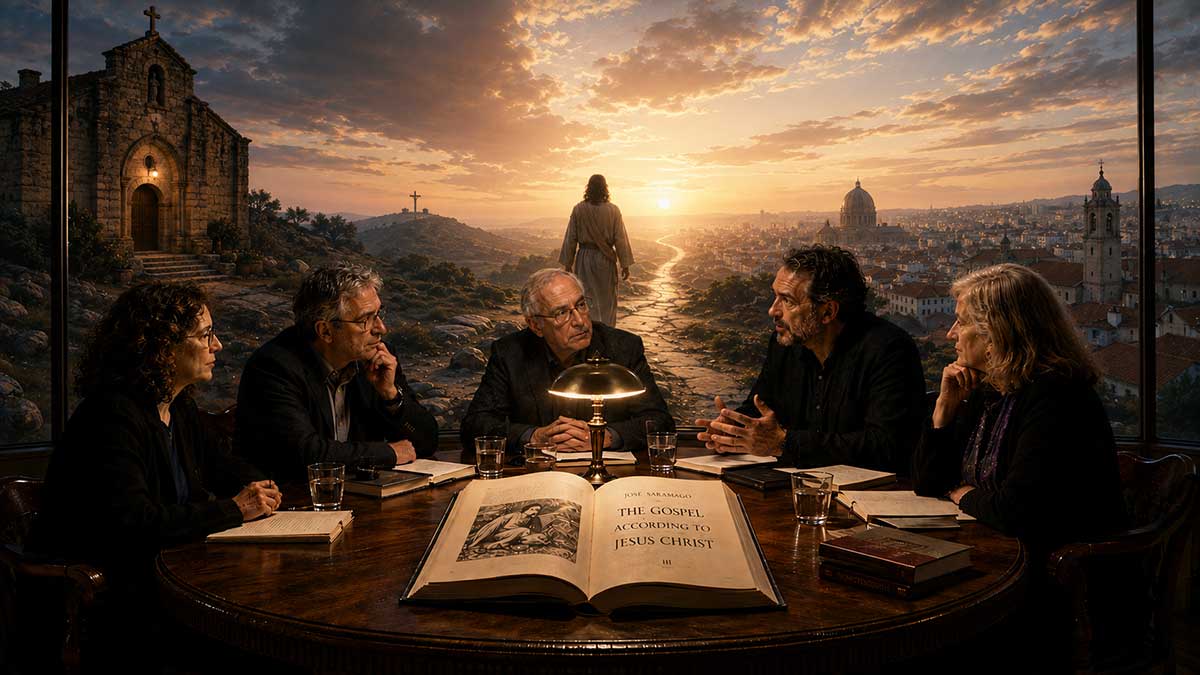
The room was quiet before anyone spoke.
The copy of The Gospel According to Jesus Christ remained open at the center of the table.
Outside, Lisbon had nearly disappeared into darkness.
Inside, the five scholars had reached the question most readers eventually ask.
Was Saramago attacking Christianity?
Or was he forcing it to face its own moral claims?
Is the Novel Anti-Christian?
David Frier: We should begin with the obvious.
Saramago was an atheist.
He was often sharply critical of religious institutions.
So pretending this novel is secretly devotional would be dishonest.
Elaine Pagels: Agreed.
Sara Grünhagen: Yet calling it simply anti-Christian is too crude.
Mark Sabine: Much too crude.
Carlos Reis: Saramago does not merely ridicule Christianity.
He takes its central figures seriously enough to argue with them for hundreds of pages.
That matters.
Elaine Pagels: Yes.
Indifference would be easier.
This is engagement.
Hostile at times.
Provocative.
But morally engaged.
David Frier: He is interested in Jesus.
Deeply.
Perhaps more sympathetically than he is interested in God.
Sara Grünhagen: His Jesus is wounded by the gap between compassion and authority.
That is not the portrait of a meaningless figure.
Does Saramago Reject Jesus—or Reclaim Him From Institutions?
Carlos Reis: I think Saramago separates Jesus from what later institutions do with him.
Mark Sabine: That separation is central.
Jesus becomes morally attractive when he remains close to individual suffering.
The institutional future becomes dangerous when it turns his life into doctrine, authority, expansion, and identity.
Elaine Pagels: There is a historical irony there.
Early Christianity itself contained competing interpretations of Jesus.
The process of defining doctrine took time.
Communities remembered him differently.
David Frier: Which means Saramago enters a very old argument:
Who gets to say what Jesus means?
Sara Grünhagen: And his answer seems to be:
No institution should own him completely.
What Form of Christianity Does the Novel Refuse?
Mark Sabine: Christianity as domination.
David Frier: Christianity as historical entitlement.
Sara Grünhagen: Christianity when sacrifice becomes beautiful enough that we stop seeing the person sacrificed.
Carlos Reis: Christianity when doctrine outranks compassion.
Elaine Pagels: Christianity when authority treats questioning as betrayal.
They paused.
Elaine Pagels: Yet we should distinguish those failures from the entire religious tradition.
Christianity contains traditions of care, self-criticism, lament, dissent, service, and resistance to authority too.
David Frier: Which Saramago partly acknowledges through the good future God shows Jesus.
Hospitals.
Communities.
Care for the poor.
Faith that sustains people.
Mark Sabine: Yes.
That is what keeps the novel from becoming easy propaganda.
The good is real.
The accusation survives anyway.
Is Saramago Attacking Sacrifice—or Imposed Sacrifice?
Sara Grünhagen: I think imposed sacrifice is the key.
Carlos Reis: So do I.
Elaine Pagels: Christian tradition places great moral weight on voluntary self-giving.
Saramago complicates that by asking whether Jesus is ever fully free to consent.
David Frier: Which changes everything.
If destiny precedes consent, sacrifice begins to look like assignment.
Mark Sabine: And authority loves assigned sacrifice.
Someone else pays.
The system calls it noble.
Elaine Pagels: That is a strong political reading.
Mark Sabine: It is hard not to see one.
A society sends people to die.
Later it calls them heroes.
That may honor them.
It may also hide the question of whether the sacrifice should have been demanded.
Does Saramago Reject Forgiveness?
Carlos Reis: No.
I think he rejects cheap forgiveness.
Sara Grünhagen: Forgiveness without accountability.
David Frier: Forgiveness demanded from the injured for the comfort of everyone else.
Elaine Pagels: That is important.
Religious language can sometimes pressure wounded people into premature reconciliation.
Forgiveness becomes another duty imposed on them.
Mark Sabine: Which mirrors the entire novel.
The person carrying the cost is repeatedly told what the cost means.
Saramago resists that.
Why Reverse Forgiveness at the Cross?
The table became still.
Carlos Reis: This is the great reversal.
Traditional Christian memory often turns toward humanity’s need for divine forgiveness.
Saramago turns the moral question upward.
Elaine Pagels: It is shocking since it changes the direction of judgment.
David Frier: Humanity becomes capable of judging heaven.
Mark Sabine: Which removes the final exemption of authority.
Joseph can be judged.
Jesus can be judged.
Institutions can be judged.
Why not God?
Sara Grünhagen: The whole novel has been preparing that move.
Knowledge created responsibility in Topic 1.
Authority did not erase responsibility in Topic 2.
Love did not erase consent in Topic 3.
Foreknowledge did not erase moral agency in Topic 4.
So Topic 5 asks:
Why should divinity erase accountability?
Is That Blasphemy—or Moral Consistency?
Elaine Pagels: Both, depending on one's framework.
From orthodox theological perspectives, placing God under human judgment may appear blasphemous.
From Saramago’s moral structure, refusing to do so would look inconsistent.
David Frier: Exactly.
If the reader has spent the novel agreeing that greater power should mean greater responsibility, the final question becomes unavoidable.
Mark Sabine: Saramago forces readers to choose between hierarchy and moral consistency.
Carlos Reis: And he knows that choice will hurt.
Can Protest Against God Be Religious?
Elaine Pagels: Absolutely.
Religious traditions contain protest.
Job argues.
Prophets accuse.
Psalms lament.
People ask why God is absent, silent, unjust, or hidden.
Argument does not necessarily mean absence of faith.
Sara Grünhagen: That complicates Saramago’s atheism in an interesting way.
Elaine Pagels: Yes.
He may reject belief, yet some of his moral gestures resemble religious protest.
David Frier: Which raises a strange possibility.
Saramago may stand outside Christianity while asking questions Christianity itself has never completely silenced.
Mark Sabine: Perhaps his difference is that he does not give God the final answer.
Carlos Reis: Precisely.
He leaves the accusation standing.
Does the Novel Demand a More Human Christianity?
Sara Grünhagen: I think that phrase is useful if we are careful.
Not “human Christianity” in the sense of removing the sacred.
More human in the sense of refusing to let abstraction erase persons.
David Frier: A Christianity that remembers Jesus before the institution.
Mark Sabine: A Christianity suspicious of historical triumph.
Elaine Pagels: A Christianity capable of self-criticism.
Carlos Reis: A Christianity where compassion cannot be overruled merely by authority.
What Would That Christianity Look Like?
Sara Grünhagen: It would ask who is suffering before asking which doctrine is threatened.
David Frier: It would distinguish voluntary sacrifice from imposed sacrifice.
Mark Sabine: It would distrust any claim that suffering today is justified by future greatness.
Elaine Pagels: It would preserve argument with God rather than treating doubt as moral failure.
Carlos Reis: It would remember that symbols are made from lives.
Does Saramago Still Leave Room for the Sacred?
David Frier: That is harder.
Elaine Pagels: I think he leaves room for moral seriousness that resembles the sacred.
Mark Sabine: Human dignity.
Sara Grünhagen: Compassion.
Carlos Reis: Conscience.
David Frier: Love.
Elaine Pagels: Protest.
They sat with that.
Is Moral Protest Itself a Sacred Act?
Mark Sabine: Perhaps that is the strongest bridge between Saramago and religion.
The refusal to accept unnecessary suffering.
The insistence that power justify itself.
The protection of the vulnerable.
Those impulses can be secular.
They can be religious too.
Elaine Pagels: Yes.
The sacred may not disappear when someone argues with God.
It may become more serious.
Carlos Reis: Since unquestioning obedience is not the same as faith.
If Faith Cannot Survive Questioning, What Was It?
David Frier: That may be the final question.
Sara Grünhagen: And perhaps the novel’s greatest challenge to believers is not:
“Stop believing.”
It is:
“Ask what your belief permits you to excuse.”
Elaine Pagels: That is far more demanding.
Mark Sabine: Since disbelief can also become comfortable.
Believers are not the only people capable of moral certainty.
Carlos Reis: Saramago himself knew that.
Ideology of any kind can become self-protective.
Does Saramago Escape His Own Critique?
Elaine Pagels: We should ask that too.
David Frier: Good.
Elaine Pagels: If Saramago criticizes religious certainty, does he ever become too certain about religion?
Sara Grünhagen: At times, perhaps.
Mark Sabine: Yes.
His God can feel constructed to lose the moral argument.
Carlos Reis: Which is fair criticism.
Saramago controls the courtroom.
He writes the defendant.
He writes the evidence.
He writes the verdict.
David Frier: That does not invalidate the questions.
Elaine Pagels: No.
But it reminds us that the novel itself should remain open to scrutiny.
Can an Atheist Novel Teach Believers Anything?
Elaine Pagels: Certainly.
Traditions often learn from critics outside them.
Sara Grünhagen: Especially critics who notice where language and practice diverge.
Mark Sabine: A believer can reject Saramago’s theology and still take his moral questions seriously.
David Frier: Perhaps especially then.
Disagreement can sharpen reading.
Carlos Reis: And a nonbeliever can recognize that religious traditions contain more self-criticism than Saramago sometimes allows.
That exchange is healthier than caricature.
What Does the Novel Ultimately Defend?
The scholars paused.
Sara Grünhagen: The person before the system.
David Frier: Moral responsibility before historical excuse.
Mark Sabine: Conscience before authority.
Elaine Pagels: Questioning before imposed certainty.
Carlos Reis: And perhaps love before usefulness.
The room went quiet.
Closing: Did Saramago Put Christianity on Trial?
Carlos Reis: We began this series with Joseph.
One frightened father.
One failure to warn.
A small moral question.
By the end, Saramago has expanded the same logic until it reaches God.
David Frier: Knowledge creates responsibility.
Sara Grünhagen: Love does not cancel consent.
Mark Sabine: History does not reimburse suffering.
Elaine Pagels: Faith does not have to mean silence.
Carlos looked toward the novel.
Carlos Reis: So did Saramago reject Christianity?
David Frier: Parts of it, certainly.
Sara Grünhagen: Certain forms of it, fiercely.
Mark Sabine: Especially when it becomes authority without accountability.
Elaine Pagels: Yet he remained fascinated by Jesus, moral responsibility, forgiveness, suffering, and the human hunger for meaning.
Carlos nodded.
Carlos Reis: Then perhaps the novel does something stranger than rejection.
It forces Christianity to stand before the moral questions Christianity has asked everyone else.
The five scholars sat in silence.
Outside, Lisbon continued below them.
Church towers.
Apartment windows.
Traffic.
People returning home.
Pagels closed the book.
Elaine Pagels: There is one question I would leave open.
Everyone looked toward her.
Elaine Pagels: If faith cannot survive moral questioning, was it faith?
She paused.
Elaine Pagels: Or was it obedience?
No one answered.
No one needed to.
The conversation had begun by asking whether Joseph should have warned the doors of Bethlehem.
It ended with a door turned toward the reader.
What should any person do when conscience and sacred authority no longer point in the same direction?
Saramago never closes that door.
He leaves us standing in it.
Final Thoughts by José Saramago
I have listened to these scholars discuss my God, my Jesus, Joseph, Mary Magdalene, the Devil, history, freedom, and forgiveness.
Perhaps I should correct one thing.
They are not mine.
That is part of the problem.
The moment a character enters another mind, the author begins losing authority over him.
Perhaps God discovers something similar with humanity.
We began with Joseph.
I find it significant that our discussion returned repeatedly to him.
Joseph is not evil.
That is why he matters.
He is frightened.
He loves his child.
He does what frightened people have done throughout history.
He makes the person nearest to him more real than the people farther away.
His love is genuine.
So is the consequence.
From Joseph we learned something uncomfortable:
Good intentions do not erase responsibility.
Then we moved upward.
To institutions.
To history.
To God.
And suddenly people became reluctant to apply the same rule.
We heard that God sees more.
That God understands history.
That God possesses purposes unavailable to ordinary human beings.
Perhaps.
But I have always been suspicious when greater authority becomes an argument for less accountability.
If knowledge creates responsibility for Joseph, why should infinite knowledge escape it?
This is not merely a question about religion.
Governments have their gods.
Revolutions have their gods.
Markets have their gods.
Nations have their gods.
Ideologies have their gods.
Whenever someone says:
“People must suffer now for the greatness that will come later,”
we should become suspicious.
The future has one enormous advantage over the present.
It cannot complain.
The person suffering before us can.
That is why Mary Magdalene matters so much.
She does not love humanity.
She loves a human being.
There is a difference.
People have committed terrible acts claiming to love humanity.
It is much harder to sacrifice someone after looking carefully into that person's face.
Mary keeps looking.
She sees Jesus before he becomes useful.
Perhaps that is one of the simplest moral acts available to us:
See the person before the purpose.
Then there is freedom.
Our scholars asked whether Jesus is free if God already knows his decisions.
Carlos Reis noticed something amusing at my expense.
I too knew Jesus's decisions.
I wrote them.
I put words in his mouth.
I led him where I wanted him to go.
Perhaps authors should be careful when accusing gods of controlling their characters.
Yet something strange happens in literature.
Characters resist.
Not literally, of course.
But morally.
You create them for one purpose and discover that what you have made requires another.
Readers discover things in them that you did not command.
Meaning escapes.
Perhaps human freedom has something of that quality.
Authority may construct the circumstances.
History may create the categories.
Religion may supply the language.
Society may tell you what you are supposed to become.
Yet conscience can still answer:
That is not why I am doing this.
A small freedom?
Perhaps.
Small freedoms have caused considerable trouble for large systems.
And finally we arrived at Christianity.
Was my novel an attack upon Christianity?
Certainly I criticized Christianity.
Why pretend otherwise?
I criticized the suffering committed under religious authority.
I criticized the idea that divine purpose automatically resolves moral argument.
I criticized the transformation of suffering into something beautiful merely since theology has found a meaning for it.
Yet criticism is not the same as indifference.
Jesus interested me precisely since the human being at the center of Christianity can sometimes appear morally closer to the vulnerable than the institutions constructed around his name.
That contradiction deserves attention.
The scholars asked whether I wanted a more human Christianity.
That question belongs to Christians more than to me.
But I can say what kind of morality interests me.
One that does not stop asking questions when authority enters the room.
One that does not turn suffering into arithmetic.
One that remembers names.
One that allows the wounded person to speak before explaining what the wound means.
One that recognizes that forgiveness cannot be meaningful when it is simply another command imposed upon the injured.
One that understands that doubt can sometimes protect morality better than certainty.
I would add one warning.
Do not turn Saramago into another authority.
Do not finish this conversation saying:
“Saramago has explained God.”
I have done no such thing.
I wrote a novel.
I created a God who could be questioned.
I created a Jesus who could question him.
Readers must decide what survives the argument.
Elaine Pagels asked our final question:
If faith cannot survive moral questioning, was it faith—or obedience?
I would leave another beside it.
If disbelief cannot survive questioning either, what is it?
Certainty belongs to believers and atheists alike.
Neither should trust it too much.
Perhaps that is where literature becomes useful.
A novel does not need to settle the argument.
It can place people around a table who would never have sat together.
It can allow God to speak.
It can allow the Devil to answer.
It can let Jesus refuse both.
It can give Mary Magdalene the sentence everyone else overlooked.
And then it can leave the reader alone with the consequences.
If you finish The Gospel According to Jesus Christ certain that you know who was right, perhaps you should read it again.
The more interesting question is not whether God won.
Or Jesus.
Or the Devil.
Or Saramago.
It is whether, after listening to all of them, you have become less willing to let anyone else's certainty replace your conscience.
If so, the conversation has done enough.
Short Bios:
Sara Grünhagen is a literary scholar and researcher whose work includes extensive study of José Saramago. Her scholarship explores Saramago’s characters, intertextuality, religion, gender, and the cultural traditions behind his fiction, including The Gospel According to Jesus Christ.
Carlos Reis is a leading Portuguese literary scholar and one of the major academic voices on José Saramago. A professor emeritus at the University of Coimbra, he has written extensively about Portuguese literature, narrative theory, and Saramago’s literary legacy.
David Frier is a scholar of Portuguese literature and author of The Novels of José Saramago. His research examines Saramago’s treatment of ideology, exclusion, love, mortality, identity, and the ethical questions running through his fiction.
Mark Sabine is a scholar of Portuguese and Lusophone literature whose research has closely examined José Saramago. His work explores history, political ideology, utopian thought, authority, identity, and the relationship between individuals and larger social systems.
Elaine Pagels is a historian of religion and renowned scholar of early Christianity. A professor emerita at Princeton University, she is known for her research on the early Christian movement, the Gnostic Gospels, changing interpretations of Jesus, Satan, revelation, and the development of Christian traditions.
Leave a Reply