

Introduction by Henry Ford
What if true confidence is knowing exactly when to speak and when to let your work speak instead?
People have often associated my name with four simple words: "Never complain, never explain." Whether I first said them matters less than whether we understand them correctly.
Many have mistaken this principle for stubbornness. Others have thought it encourages silence at any cost. That was never my intention.
During my life, I was criticized more times than I could count. Newspapers questioned my decisions. Competitors predicted my failure. Friends occasionally doubted my judgment. Had I answered every accusation, I would have had little time left to build automobiles, factories, or new ways of working.
Work taught me something that arguments rarely do: the strongest answer is often a life well lived.
Yet silence has limits. A father owes explanations to his children. A leader owes clarity to those who follow him. A man who has wronged another owes an honest apology. Silence without responsibility is no virtue.
That is why I wanted to invite Benjamin Disraeli into this conversation. Few leaders understood both words and power as deeply as he did. He spent a lifetime persuading nations, whereas I spent mine building machines. From different paths, we arrived at similar questions.
When should we speak?
When should we remain silent?
When does explanation become wisdom, and when does it become vanity?
Most of us will never build an automobile company or lead a nation. Yet every one of us will face criticism, misunderstanding, failure, and moments when we must decide whether to answer or continue our work.
I hope our conversation does not teach you merely to speak less.
I hope it teaches you to speak with purpose.
I hope it does not encourage you to ignore every criticism.
I hope it teaches you to recognize which voices deserve your attention.
Most of all, I hope it reminds you that character is built quietly, one decision at a time. Long after arguments are forgotten, your work, your integrity, and the way you treated other people will continue speaking on your behalf.
Perhaps that is the only explanation any of us truly needs.
(Note: This is an imaginary conversation, a creative exploration of an idea, and not a real speech or event.)
Topic 1 — What Does “Never Complain, Never Explain” Really Mean?

Opening
Benjamin Disraeli: Henry, your name has become closely associated with the phrase, "Never complain, never explain." Many people admire it. Others think it encourages emotional distance or stubbornness. Before we examine it further, tell me what those words have meant in your own life.
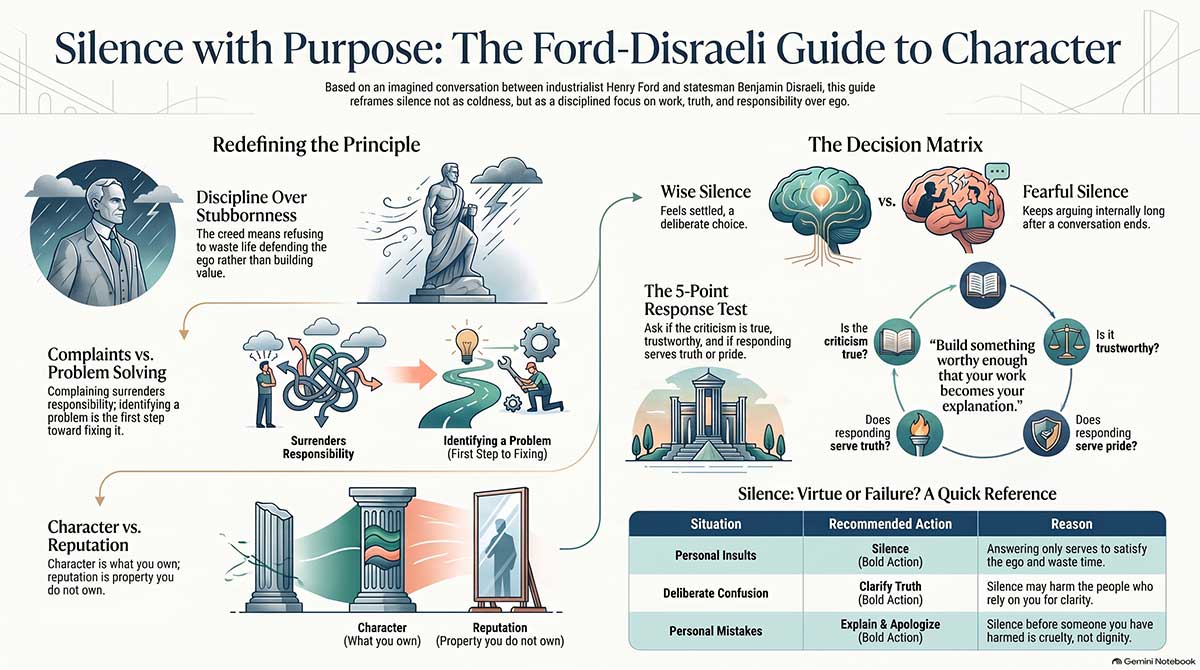
Henry Ford: To me, they have never meant becoming cold or refusing to listen. They mean refusing to waste your life defending your ego. Every hour spent arguing with critics is an hour stolen from building something worthwhile. I found that machines respond to work, not excuses. Life is much the same.
Benjamin Disraeli: An interesting distinction. You are speaking about discipline rather than silence for its own sake.
Henry Ford: Exactly. Most complaints change nothing except the attitude of the one complaining. Most explanations satisfy no one except the person giving them.
Question 1
Is complaining ever useful, or does it always weaken a person?
Benjamin Disraeli: Surely there must be moments when a complaint is justified. If workers are mistreated or citizens suffer injustice, should they simply remain silent?
Henry Ford: That is not complaining. That is identifying a problem with the intention of fixing it. Complaining begins when we expect someone else to solve what we refuse to face ourselves.
Benjamin Disraeli: So your concern is not with speaking about hardship but with surrendering responsibility.
Henry Ford: Precisely. A mechanic who spends all morning telling me why an engine cannot run accomplishes little. One who quietly begins repairing it earns my respect.
Benjamin Disraeli: Politics taught me something similar. Parliament was full of men who described problems brilliantly. The rarer gift belonged to those willing to bear the burden of solving them.
Henry Ford: Every complaint asks, "Who is to blame?" Every builder asks, "What can I do next?"
Benjamin Disraeli: That is a subtle yet profound difference.
Question 2
Why do people feel such a strong need to explain themselves?
Benjamin Disraeli: If complaining seeks relief, perhaps explaining seeks acceptance. Why are human beings so eager to justify themselves?
Henry Ford: We want control over what other people think. That is an impossible ambition.
Benjamin Disraeli: Yet reputation has value. A public figure cannot ignore every misunderstanding.
Henry Ford: Reputation matters, but chasing every rumor is like trying to gather feathers after they have been scattered by the wind.
Benjamin Disraeli: I agree that endless self-defense becomes exhausting. Yet I discovered another danger. If honorable people never speak, dishonest voices may become the only story history remembers.
Henry Ford: Then speak to reveal truth, not to protect pride.
Benjamin Disraeli: There is the balance. Explanations given from wounded vanity rarely persuade. Explanations offered in service of truth may become a duty.
Henry Ford: And that duty should be exercised sparingly.
Question 3
If people misunderstand us, should we simply let them?
Benjamin Disraeli: Let us test the principle. Suppose someone deliberately twists your motives. Do you answer them?
Henry Ford: I first ask myself a question. Will answering improve reality, or merely improve my feelings?
Benjamin Disraeli: An excellent question.
Henry Ford: Most attacks fade on their own. My factories produced millions of automobiles. That answered more critics than any newspaper interview ever could.
Benjamin Disraeli: My experience was somewhat different. A statesman cannot always wait. False ideas can shape elections, laws, and even wars. Silence sometimes carries a cost.
Henry Ford: Then perhaps our occupations shaped our instincts.
Benjamin Disraeli: I believe so. An industrialist may allow his work to speak. A prime minister occasionally must speak so that the nation may work.
Henry Ford: Yet in both cases the purpose remains the same. Speak for the work, not for the ego.
Benjamin Disraeli: Well said. Perhaps the proverb is incomplete without that final sentence.
Closing
Benjamin Disraeli: Henry, I began tonight wondering whether your famous principle encouraged silence above all else.
Henry Ford: And I leave thinking silence is only valuable when it serves something greater than ourselves.
Benjamin Disraeli: Then perhaps the real lesson is this: complain less, explain less, but think more deeply before doing either.
Henry Ford: Yes. Build a life that requires fewer explanations, and reserve your words for moments when truth truly needs a voice.
Topic 2: When Does Silence Become Strength—and When Does It Become Cowardice?

Opening
Henry Ford: Benjamin, we agreed that silence can protect a person from wasting energy on criticism. Yet silence has its own danger. A man may call himself disciplined when he is merely afraid.
Benjamin Disraeli: That is one of the oldest disguises of fear. Cowardice rarely introduces itself honestly. It borrows the language of patience, dignity, and restraint.
Henry Ford: Then the difficult question is not whether we remain silent. It is why.
Benjamin Disraeli: Precisely. Two men may say nothing in the same room. One is governing himself. The other is abandoning his duty.
How can we tell whether our silence comes from wisdom or fear?
Henry Ford: I would begin with what happens inside us. Wise silence feels settled. Fearful silence keeps arguing long after the conversation has ended.
Benjamin Disraeli: You mean that the body may remain quiet when the mind has not.
Henry Ford: Yes. A man may walk away from an insult and tell himself he has shown restraint. Yet he spends the next three days rehearsing what he wished he had said. That is not peace.
Benjamin Disraeli: Nor is it always cowardice. Sometimes the right words arrive too late.
Henry Ford: True. Yet when silence is wise, we can return to our work. When it is fear, the unfinished moment follows us.
Benjamin Disraeli: I would ask a second question: Whom does the silence protect?
Henry Ford: Explain.
Benjamin Disraeli: If I remain silent to protect the dignity of another person, restraint may be noble. If I remain silent only to protect my own comfort, it may be avoidance.
Henry Ford: That distinction matters in business. A manager who refuses to correct a serious problem may say he wants harmony. In truth, he does not want an uncomfortable conversation.
Benjamin Disraeli: Politics contains the same weakness. Men praise unity when they are frightened of disagreement.
Henry Ford: Then wise silence protects purpose. Fearful silence protects comfort.
Benjamin Disraeli: Yes, though we must remain honest enough to know which one we are protecting.
Does pride speak too much—or stay silent too long?
Benjamin Disraeli: We often associate pride with loudness. Yet pride may hide behind silence too.
Henry Ford: Certainly. A proud man may refuse to explain himself, not from discipline, but from contempt.
Benjamin Disraeli: He thinks, “These people do not deserve my words.”
Henry Ford: Or he fears that explaining himself would require admitting he was wrong.
Benjamin Disraeli: That is a deeper form of pride. The person appears calm, yet his silence is a locked door.
Henry Ford: I have known men who would rather lose a friendship than say, “I misunderstood you.”
Benjamin Disraeli: Public life taught me that some people speak endlessly to display their intelligence. Others remain silent to preserve the illusion of intelligence.
Henry Ford: Silence can make a foolish man appear wise for a few minutes.
Benjamin Disraeli: Until responsibility asks him a question.
Henry Ford: Pride speaks too much when it wants attention. It stays silent too long when it fears humility.
Benjamin Disraeli: Then humility is not measured by the number of words spoken.
Henry Ford: No. Humility speaks when correction is needed and listens when correction is received.
Benjamin Disraeli: That may be one of the clearest tests. Can a person break his silence to admit fault?
Henry Ford: If he cannot, his silence is not strength. It is armor.
Can forgiveness exist without explanation?
Benjamin Disraeli: Let us move from public criticism to private injury. Suppose one person harms another and refuses to explain. Can forgiveness still occur?
Henry Ford: Forgiveness can occur without explanation, but trust may not return without truth.
Benjamin Disraeli: A vital distinction.
Henry Ford: A person may release resentment for his own peace. Yet reconciliation requires two people. Silence cannot rebuild what dishonesty destroyed.
Benjamin Disraeli: Some explanations are excuses wearing formal clothes.
Henry Ford: Yes. “I hurt you, but here is why you should not blame me.”
Benjamin Disraeli: A sincere explanation sounds different. It does not erase responsibility. It makes responsibility clearer.
Henry Ford: It says, “This is what I did. This is why I did it. I was wrong.”
Benjamin Disraeli: Then perhaps “never explain” should never be used to avoid an apology.
Henry Ford: Agreed. A man does not owe every critic an explanation. He may owe one to the person he wounded.
Benjamin Disraeli: Silence before strangers may preserve dignity. Silence before someone we have harmed may become cruelty.
Henry Ford: That is where the proverb reaches its limit.
Benjamin Disraeli: Every principle reaches a limit when it meets human responsibility.
Closing
Henry Ford: We began by asking whether silence is strength or cowardice. I think the answer lies in what the silence serves.
Benjamin Disraeli: If it serves truth, patience, or another person’s dignity, it may be strength.
Henry Ford: If it serves fear, pride, or comfort, it becomes avoidance.
Benjamin Disraeli: And when we have caused harm, silence may no longer belong to us. The injured person may deserve an honest account.
Henry Ford: Then the wise man does not worship silence. He uses it carefully.
Benjamin Disraeli: Nor does he worship speech. He speaks when responsibility asks for a voice.
Henry Ford: Which brings us to leaders. Private silence affects a few people. Public silence may affect millions.
Benjamin Disraeli: Then our next question must be harder: When criticism reaches the public, does a leader still have the right to remain silent?
Topic 3: Should Leaders Defend Themselves Against Public Criticism?
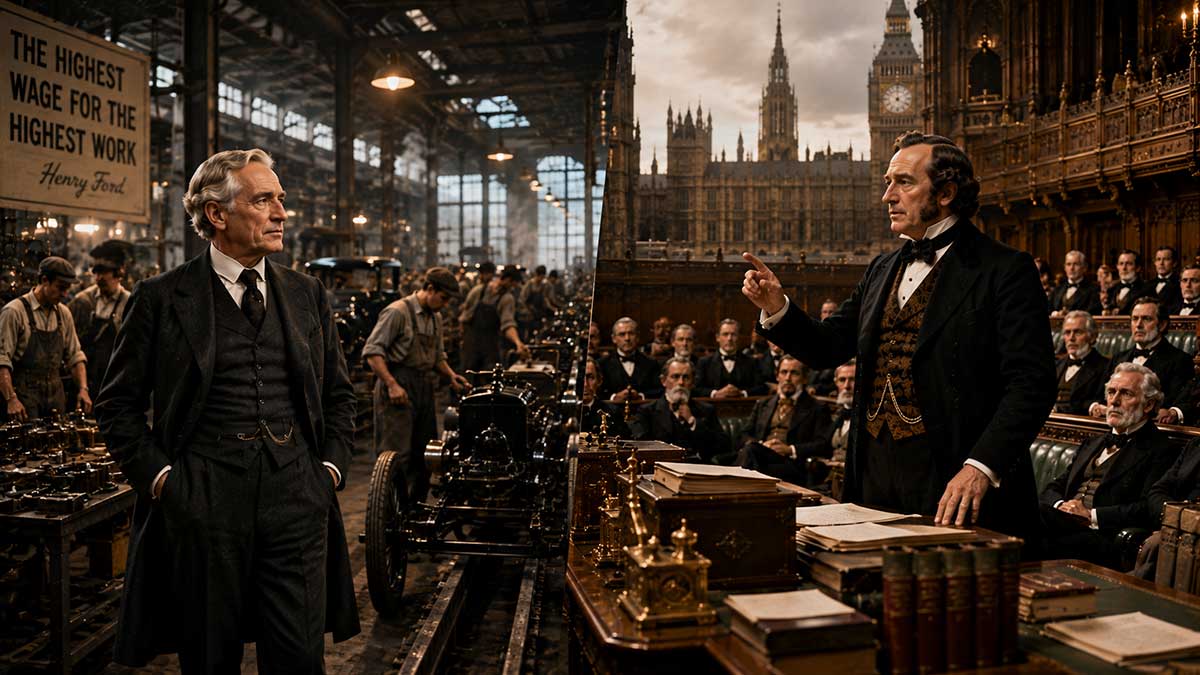
Opening
Benjamin Disraeli: Henry, private criticism may be ignored. Public criticism is different. A leader’s silence can influence employees, citizens, investors, and entire institutions.
Henry Ford: True. Once other people depend on your decisions, silence is no longer merely personal.
Benjamin Disraeli: A leader may wish to protect his dignity, yet his followers may need clarity.
Henry Ford: That is where “never explain” becomes dangerous when taken too literally.
Benjamin Disraeli: Then perhaps leadership requires a different rule.
Henry Ford: Perhaps this one: never explain merely to save face, but explain whenever others need the truth to act wisely.
What criticism deserves no response?
Benjamin Disraeli: Let us begin with the easier side. What kind of criticism should a leader ignore?
Henry Ford: Criticism that has no interest in truth.
Benjamin Disraeli: How can one recognize it?
Henry Ford: It attacks character without addressing facts. It changes its accusation whenever one answer is given. Its purpose is not correction. Its purpose is attention, humiliation, or control.
Benjamin Disraeli: In Parliament, I encountered men who asked questions without wanting answers. They wanted the appearance of having exposed something.
Henry Ford: Business has the same kind of critic. Some people are not asking whether a decision works. They simply want the person making it to fail.
Benjamin Disraeli: Yet ignoring hostile criticism can sometimes make it appear credible.
Henry Ford: That is why a leader must judge the audience, not merely the attacker.
Benjamin Disraeli: Explain that distinction.
Henry Ford: The critic may deserve no answer. The public may still deserve one.
Benjamin Disraeli: Excellent. A statesman may refuse to debate a dishonest opponent, yet still clarify the truth for the nation.
Henry Ford: Exactly. The response is not given to the accuser. It is given to those who might be confused.
Benjamin Disraeli: Then the question is not, “Does this critic deserve my attention?” It is, “Could my silence harm the people who rely on me?”
Henry Ford: That is the better question.
When does explaining become part of leadership rather than self-defense?
Benjamin Disraeli: Leaders often claim they are communicating for the public good when they are really protecting their pride. How can we tell the difference?
Henry Ford: Look at the content of the explanation. Does it clarify the decision, accept responsibility, and tell people what happens next? Or does it spend most of its time blaming others?
Benjamin Disraeli: Self-defense looks backward. Leadership must eventually point forward.
Henry Ford: Yes. A useful explanation answers three things: what happened, what we learned, and what we will do now.
Benjamin Disraeli: It must also admit uncertainty. Leaders often fear that saying “I do not yet know” will weaken confidence.
Henry Ford: Pretending certainty is far more dangerous.
Benjamin Disraeli: In politics, the public can forgive an incomplete answer more easily than a dishonest one.
Henry Ford: Workers are much the same. A factory floor notices when management avoids the truth.
Benjamin Disraeli: Yet leaders are often surrounded by advisers who soften bad news.
Henry Ford: Which is why leadership can become lonely. The higher a man rises, the more people may tell him what protects their own position.
Benjamin Disraeli: Then a leader must create conditions where unwelcome truth can reach him.
Henry Ford: Yes. Otherwise, “never complain, never explain” becomes a shield against accountability.
Benjamin Disraeli: A leader who never explains may appear strong for a season.
Henry Ford: Until people begin filling the silence with suspicion.
Should leaders care about legacy—or only today’s decisions?
Benjamin Disraeli: Let us turn to legacy. Should leaders concern themselves with how history will judge them?
Henry Ford: A man who thinks too much about history may stop doing the work in front of him.
Benjamin Disraeli: Yet a leader who thinks only about today may make decisions that burden the future.
Henry Ford: I would distinguish legacy from reputation.
Benjamin Disraeli: Go on.
Henry Ford: Reputation is what people say while you are alive. Legacy is what your decisions continue doing after you are gone.
Benjamin Disraeli: Then one may ignore reputation yet still take legacy seriously.
Henry Ford: Yes. A leader should not ask, “Will people praise me?” He should ask, “What will remain after this decision?”
Benjamin Disraeli: That is especially true in government. A speech may be forgotten, yet a law may shape lives for generations.
Henry Ford: In industry, the same is true of systems, wages, working conditions, and products. What we build continues speaking.
Benjamin Disraeli: Still, history often judges unfairly.
Henry Ford: It does. That is another reason not to live for applause.
Benjamin Disraeli: Yet leaders sometimes need to record their reasons so later generations can understand the choices they faced.
Henry Ford: That kind of explanation is not vanity. It is testimony.
Benjamin Disraeli: Precisely. A private diary, a public statement, a clear record of decisions—these may protect truth long after rumors have disappeared.
Henry Ford: Then leaders should explain enough to preserve responsibility, but not so much that explanation becomes performance.
Benjamin Disraeli: A difficult balance.
Henry Ford: Leadership is often the discipline of carrying difficult balances without pretending they are simple.
Closing
Benjamin Disraeli: We began with the question of whether leaders should defend themselves.
Henry Ford: I would say no—not merely themselves.
Benjamin Disraeli: But they may need to defend truth, public trust, and the people affected by their decisions.
Henry Ford: A leader should ignore insults, answer genuine confusion, admit mistakes, and explain what others need in order to move forward.
Benjamin Disraeli: Silence may protect personal dignity.
Henry Ford: Yet explanation may protect an institution.
Benjamin Disraeli: Then the mature leader asks neither, “How do I silence my critics?” nor “How do I prove I was right?”
Henry Ford: He asks, “What response best serves the people who now carry the consequences?”
Benjamin Disraeli: And what happens when the criticism is no longer merely mistaken, but deliberately twisted?
Henry Ford: Then we reach the harder trial: how to live when people choose to misunderstand us.
Topic 4: How Do You Respond When People Deliberately Misunderstand You?

Opening
Henry Ford: Benjamin, honest disagreement can be useful. Deliberate misunderstanding is different. It begins with a conclusion and then searches for evidence.
Benjamin Disraeli: Yes. Some people do not misread us by accident. They choose the interpretation that best serves their purpose.
Henry Ford: That can be difficult to accept. We assume that clearer words will solve the problem.
Benjamin Disraeli: Yet clarity cannot persuade someone who benefits from confusion.
Henry Ford: Then the challenge is not simply how to correct the record.
Benjamin Disraeli: It is how to protect one’s character without becoming consumed by the struggle.
Why do people often choose the worst interpretation?
Benjamin Disraeli: Why are people so ready to assign the darkest motive to another person?
Henry Ford: Suspicion is often easier than examination. If I decide a man is selfish, I no longer need to study the full situation.
Benjamin Disraeli: Judgment gives the mind a quick sense of certainty.
Henry Ford: It can give the judge a feeling of superiority too.
Benjamin Disraeli: Politics depends heavily on motive. Opponents rarely say, “He made a poor decision.” They say, “He intended harm.”
Henry Ford: Business critics do the same. A difficult decision may come from necessity, yet people describe it as greed before examining the facts.
Benjamin Disraeli: We must admit that leaders sometimes earn such suspicion.
Henry Ford: Certainly. When leaders hide mistakes, the public learns to distrust explanations.
Benjamin Disraeli: Then deliberate misunderstanding sometimes grows in soil prepared by previous dishonesty.
Henry Ford: Yes, though that does not make every accusation fair.
Benjamin Disraeli: Human beings interpret new events through old wounds. A worker betrayed by one employer may suspect the next. A citizen deceived by one government may distrust every official statement.
Henry Ford: That means a leader may inherit suspicion he did not create.
Benjamin Disraeli: He may, and anger toward an institution often settles upon the nearest visible person.
Henry Ford: Can that person reason his way out of it?
Benjamin Disraeli: Sometimes. Yet emotional judgment is rarely changed by facts alone.
Henry Ford: Then what changes it?
Benjamin Disraeli: Consistency over time. A single explanation may clarify an event. Repeated conduct reveals character.
Henry Ford: That returns us to action.
Benjamin Disraeli: Yes, but action needs patience. A person cannot demand that years of distrust disappear after one honest sentence.
How much of our reputation truly belongs to us?
Henry Ford: We speak about protecting reputation, but how much control do we actually possess?
Benjamin Disraeli: Less than most people wish and more than some are willing to accept.
Henry Ford: Explain.
Benjamin Disraeli: We cannot control what others say. We can control whether our conduct gives falsehood an easy home.
Henry Ford: So reputation is partly ours and partly beyond us.
Benjamin Disraeli: Precisely. Character belongs to us. Reputation lives in other people’s minds.
Henry Ford: Then many people spend their lives trying to manage property they do not own.
Benjamin Disraeli: A striking way to put it.
Henry Ford: They adjust every word, every appearance, every friendship, hoping no one will misunderstand them.
Benjamin Disraeli: And in doing so, they may become less truthful. A person governed by reputation begins performing instead of living.
Henry Ford: Yet public trust still matters.
Benjamin Disraeli: It does. We must distinguish stewardship from obsession.
Henry Ford: Stewardship means correcting serious falsehoods and maintaining credibility.
Benjamin Disraeli: Obsession means needing everyone to approve.
Henry Ford: No leader can survive that need.
Benjamin Disraeli: Nor can any ordinary person. Some minds have already decided who we are. They will interpret kindness as manipulation and silence as guilt.
Henry Ford: Then we must decide whose judgment deserves weight.
Benjamin Disraeli: Yes. The opinion of a stranger, the counsel of a trusted friend, and the pain of someone we have harmed should never be treated as equal voices.
Henry Ford: That is where many people become confused. They ignore those closest to them and spend all day answering strangers.
Benjamin Disraeli: Public applause can become a refuge from private accountability.
Henry Ford: A man may defend his reputation before thousands and refuse to listen to his own family.
Benjamin Disraeli: Then the people who know our daily conduct may deserve more attention than those who know only a headline.
Can character survive false judgment?
Benjamin Disraeli: False judgment can damage employment, friendship, office, and legacy. Can character truly survive it?
Henry Ford: Character survives when a man refuses to let accusation determine his behavior.
Benjamin Disraeli: Yet false judgment can make a person bitter.
Henry Ford: That is the greater danger. A lie told about us may do less harm than the bitterness it awakens within us.
Benjamin Disraeli: The falsely accused person may slowly become hard, suspicious, and cruel.
Henry Ford: Then his enemies begin shaping him without his permission.
Benjamin Disraeli: Exactly. To preserve character is not merely to prove innocence. It is to resist becoming a smaller person under pressure.
Henry Ford: That may require speaking.
Benjamin Disraeli: It may. A person should defend himself when silence endangers others, damages a just cause, or allows a harmful falsehood to become accepted fact.
Henry Ford: Yet he should not live inside that defense.
Benjamin Disraeli: No. There must be a point at which he returns to life.
Henry Ford: How does he know when that point has come?
Benjamin Disraeli: After he has stated the truth clearly, provided what evidence he can, accepted what remains beyond his control, and resumed his duties.
Henry Ford: That last part matters. Resume the work.
Benjamin Disraeli: Otherwise, the accusation becomes the center of his identity.
Henry Ford: A man begins every conversation with what others said about him.
Benjamin Disraeli: And eventually he becomes more committed to being vindicated than to being useful.
Henry Ford: Then character survives false judgment through truth, restraint, and continued purpose.
Benjamin Disraeli: And through trusted companionship. Isolation can make false accusations feel larger than they are.
Henry Ford: A few honest people may steady a man more than a thousand public statements.
Benjamin Disraeli: Yes. We need companions who will defend us when we are falsely accused and correct us when the accusation contains some truth.
Henry Ford: That second part is harder.
Benjamin Disraeli: Yet without it, loyalty becomes flattery.
Closing
Henry Ford: We began by asking how to respond when people deliberately misunderstand us.
Benjamin Disraeli: We cannot force honesty upon those who prefer distortion.
Henry Ford: We can state the truth, protect those who depend on us, and refuse to let the battle consume our lives.
Benjamin Disraeli: We must care more about character than reputation, yet never use that principle to escape accountability.
Henry Ford: And we must listen most carefully to those who truly know us.
Benjamin Disraeli: False judgment tests more than our patience. It tests whether our identity rests upon public approval.
Henry Ford: A man who knows what he stands for can endure being misunderstood.
Benjamin Disraeli: Yet the young often find that hardest. They live before a constant audience and may mistake every criticism for a final verdict.
Henry Ford: Then our final conversation should be for them.
Benjamin Disraeli: Yes. What should the next generation learn about criticism, reputation, humility, and inner confidence?
Topic 5: What Should Young People Learn About Criticism, Reputation, and Inner Confidence?

Opening
Benjamin Disraeli: Henry, the young now live before an audience larger than anything we knew. A mistake can be recorded, repeated, judged, and shared before a person has time to think.
Henry Ford: That makes self-command more necessary, not less.
Benjamin Disraeli: Yet many young people are taught to present themselves before they have had time to form themselves.
Henry Ford: They begin managing a reputation before they have built a character.
Benjamin Disraeli: And when criticism comes, it may feel like a judgment upon their entire identity.
Henry Ford: Then our final question is not how they can avoid criticism. No useful life can promise that.
Benjamin Disraeli: It is how they can hear criticism without becoming controlled by it.
How should young people handle criticism without becoming bitter?
Henry Ford: I would tell them to separate the message from the messenger.
Benjamin Disraeli: Meaning that an unpleasant person may still say something true?
Henry Ford: Yes. A critic may speak cruelly and still identify a weakness worth correcting.
Benjamin Disraeli: That requires unusual maturity. Most people either accept the whole attack or reject every part of it.
Henry Ford: Wisdom takes the useful piece and leaves the poison.
Benjamin Disraeli: How should a young person know which part is useful?
Henry Ford: Ask whether the same criticism comes from several trustworthy people. Ask whether it points to a repeated pattern. Ask whether accepting it would improve the work or merely satisfy the critic.
Benjamin Disraeli: I would add another question: Does the criticism address conduct, or does it condemn identity?
Henry Ford: Give me an example.
Benjamin Disraeli: “You handled that poorly” leaves room for growth. “You are worthless” does not seek correction. It seeks injury.
Henry Ford: Then one should examine the first and reject the second.
Benjamin Disraeli: Yes. Criticism should describe something that can be considered, tested, or changed.
Henry Ford: Young people must learn that correction is not humiliation.
Benjamin Disraeli: Nor is every rejection a verdict on their future.
Henry Ford: I failed at many things before I built anything that lasted.
Benjamin Disraeli: I faced ridicule before I gained influence. Public embarrassment feels permanent when one is young. Time reveals that most defeats are chapters, not endings.
Henry Ford: Bitterness begins when pain becomes a permanent explanation for who we are.
Benjamin Disraeli: And when we give our critics the authority to define every later choice.
Henry Ford: A young person may say, “They doubted me, so I will prove them wrong.”
Benjamin Disraeli: That may motivate him for a season.
Henry Ford: Yet if he builds his whole life around proving others wrong, they still control him.
Benjamin Disraeli: A far better aim is to build what he believes is right.
Henry Ford: Work done from purpose lasts longer than work done from resentment.
How can someone remain humble without becoming weak?
Benjamin Disraeli: Many young people confuse humility with making themselves smaller.
Henry Ford: Humility is not denying ability. It is refusing to believe ability makes you superior.
Benjamin Disraeli: A humble person may still speak firmly.
Henry Ford: He may say, “I know how to do this,” without saying, “Only I know how to do this.”
Benjamin Disraeli: Then confidence concerns capability. Arrogance concerns rank.
Henry Ford: Yes. Confidence says, “I can learn.” Arrogance says, “I have nothing left to learn.”
Benjamin Disraeli: What happens when humility becomes passivity?
Henry Ford: Then it is no longer humility. A person who sees a serious problem and refuses to act may call himself modest, but he may simply fear responsibility.
Benjamin Disraeli: Some people apologize before every opinion.
Henry Ford: They ask permission to exist in the room.
Benjamin Disraeli: Yet others enter every room determined to dominate it.
Henry Ford: Both are too occupied with themselves.
Benjamin Disraeli: That is perceptive. One fears being seen. The other demands to be seen.
Henry Ford: The balanced person focuses on what the situation requires.
Benjamin Disraeli: Humility directs attention away from self-importance. Courage directs attention away from self-protection.
Henry Ford: Together, they allow a person to act without pretending to be greater than he is.
Benjamin Disraeli: And to admit error without feeling destroyed.
Henry Ford: That may be the clearest sign of inner confidence. A secure person can say, “I was wrong,” and still continue.
Benjamin Disraeli: The insecure person treats every correction as an attack upon his worth.
Henry Ford: Which is why he explains too much.
Benjamin Disraeli: Or refuses to explain at all.
Henry Ford: Both reactions can come from the same fear.
How should young people decide when to answer and when to remain silent?
Benjamin Disraeli: Let us give them something practical. A criticism arrives. What should they ask before responding?
Henry Ford: First: Is it true?
Benjamin Disraeli: Second: Does it come from someone whose judgment has earned weight?
Henry Ford: Third: Will my response help anyone understand, repair, or act?
Benjamin Disraeli: Fourth: Am I speaking from responsibility or wounded pride?
Henry Ford: Fifth: What happens if I say nothing?
Benjamin Disraeli: That last question matters. Silence may calm a trivial dispute, yet it may deepen a serious misunderstanding.
Henry Ford: If the answer affects only one’s ego, silence is often best.
Benjamin Disraeli: If the answer affects another person’s trust, safety, livelihood, or dignity, speech may be necessary.
Henry Ford: And do not answer immediately when angry.
Benjamin Disraeli: Delay can save a person from publishing words his calmer self would never choose.
Henry Ford: A response written at midnight may look foolish by morning.
Benjamin Disraeli: Yet delay should not become avoidance.
Henry Ford: Correct. Pause long enough to regain judgment, then act.
Benjamin Disraeli: Young people may need to accept that no response will satisfy everyone.
Henry Ford: That is part of adulthood. A good decision may still disappoint people.
Benjamin Disraeli: Inner confidence grows when a person can bear disapproval without losing conscience.
Henry Ford: And can accept correction without losing direction.
If you could leave one sentence for future generations, what would it be?
Benjamin Disraeli: Henry, suppose a young builder asks you for one sentence to carry through life. What would you tell him?
Henry Ford: Build something worthy enough that your work becomes your explanation.
Benjamin Disraeli: That sounds very much like you.
Henry Ford: It reminds him that action must come before image. What would you say?
Benjamin Disraeli: Speak when your words serve truth, duty, or mercy. Remain silent when they serve only vanity.
Henry Ford: Your sentence leaves more room for speech than mine.
Benjamin Disraeli: And yours leaves more room for work.
Henry Ford: Perhaps the young need both.
Benjamin Disraeli: Yes. Work without words can become hidden or misunderstood. Words without work become empty.
Henry Ford: Then let us join them.
Benjamin Disraeli: Try.
Henry Ford: Build carefully. Speak truthfully. Do neither merely to win approval.
Benjamin Disraeli: I would gladly leave them that.
Final Exchange
Benjamin Disraeli: We began with four sharp words: “Never complain, never explain.”
Henry Ford: They sounded simple before we tested them.
Benjamin Disraeli: We found that complaining is not the same as naming injustice.
Henry Ford: Explaining is not the same as making excuses.
Benjamin Disraeli: Silence is not always strength.
Henry Ford: Speech is not always courage.
Benjamin Disraeli: A person may remain silent from dignity, fear, pride, patience, wisdom, or indifference.
Henry Ford: He may speak from duty, vanity, honesty, anger, love, or self-defense.
Benjamin Disraeli: The words alone do not reveal the character of the act.
Henry Ford: Motive and consequence do.
Benjamin Disraeli: Then the mature principle may be less memorable, yet more truthful.
Henry Ford: Do not complain when you should act.
Benjamin Disraeli: Do not explain when you merely want approval.
Henry Ford: Speak when truth or responsibility requires it.
Benjamin Disraeli: And remain silent when your ego is the only voice asking to be heard.
Henry Ford: That may be the best explanation we could give.
Benjamin Disraeli: Which means, by our own rule, we should now stop.
Henry Ford: For once, Benjamin, I have no complaint.
Benjamin Disraeli: Nor any need to explain.
Final Thoughts by Henry Ford
When I was young, I believed success would silence criticism.
It does not.
Success often attracts more criticism than failure ever receives.
What changes is not the voices around us but the strength within us.
As I have grown older, I no longer ask whether people understand me perfectly. I ask whether I have acted honestly, corrected my mistakes, fulfilled my responsibilities, and continued building something useful.
Those questions are difficult enough without carrying every stranger's opinion on our shoulders.
Benjamin reminded us that silence can become cowardice.
I reminded him that explanation can become vanity.
Together we discovered something larger.
The question is never simply whether to speak or remain silent.
The question is always:
Who is served by my words?
If your words serve truth, responsibility, justice, mercy, or reconciliation, speak with courage.
If they serve wounded pride, endless self-defense, or the desire to win every argument, your silence may carry greater strength.
Your life will be judged by many voices.
Do not allow every voice to become your master.
Build well.
Live honestly.
Treat people fairly.
And when your work has been completed, let it tell your story better than you ever could.
Short Bios:
Henry Ford (1863–1947) was an American industrialist and founder of the Ford Motor Company. By pioneering the moving assembly line, he transformed manufacturing, made automobiles affordable for ordinary families, and changed the modern economy. His philosophy emphasized practical action, disciplined work, and continuous improvement over endless debate.
Benjamin Disraeli (1804–1881) was a British statesman, novelist, and twice Prime Minister of the United Kingdom. Renowned for his wit, political insight, and eloquence, he guided Britain through periods of major social and imperial change. His leadership reflected a rare combination of strategic thinking, persuasive communication, and deep appreciation for history and human nature.
Leave a Reply