


Introduction
The Great Gatsby is filled with people reaching for something just beyond them: love, wealth, belonging, another social class, another identity, another chance at the past.
A century later, the objects have changed, but the longing has not.
These five modern stories follow people chasing their own versions of Gatsby's green light: an old love, an exclusive club, a different social world, millions of followers, and a beautiful house across the water.
Their central question is simple:
What happens when the life we are chasing becomes more important than the life and people already in front of us?
The stories do not argue that we should stop dreaming. They ask something harder: Can we keep our dreams without becoming prisoners of them?
(Note: This is an imaginary conversation, a creative exploration of an idea, and not a real speech or event.)
Story 1: The Life She Was Supposed to Have
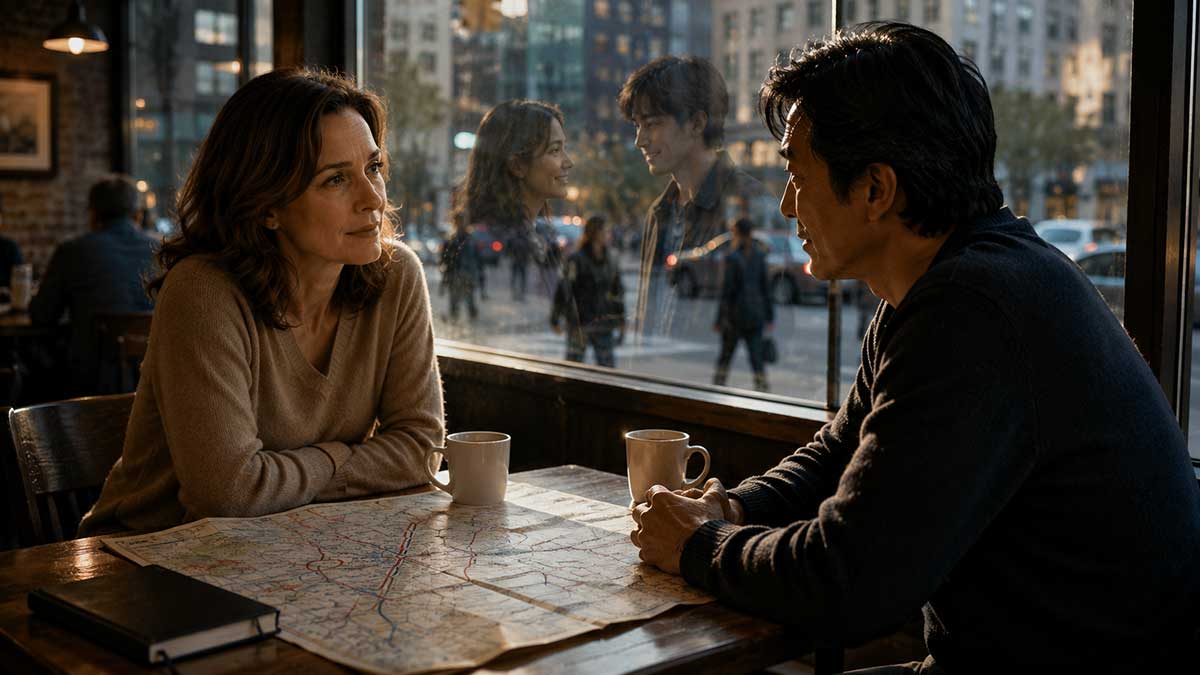
The message arrived while Claire Bennett was folding her husband's shirts.
She had one of Michael's sleeves stretched across the kitchen table when her phone lit up beside the laundry basket.
Daniel Cho
For several seconds, Claire simply stared at the name.
Twenty-one years had passed since she had seen it appear on anything meant for her.
The shirt remained beneath her hands.
Upstairs, her daughter was practicing the same six measures on the piano for what felt like the hundredth time. Her son was shouting at someone through a headset. Water ran somewhere in the house. Michael was in the garage trying to repair a cabinet hinge that Claire had told him three times they could simply replace.
It was an ordinary Tuesday evening.
And suddenly Claire was twenty-two.
She picked up the phone.
The message was short.
I found something today that made me think of you. I hope you're doing well.
Beneath it was a photograph.
An old New York City subway map.
Claire sat down.
She knew that map.
Not one like it.
That one.
In college, she and Daniel had bought it from a used bookstore for three dollars. They spread it across the floor of his apartment and circled neighborhoods where they might live after graduation.
Astoria.
Brooklyn Heights.
The Upper West Side, which they could never have afforded but circled anyway.
Daniel had drawn a tiny star beside Greenwich Village.
Claire had written:
First apartment.
There had been no apartment.
There had been no New York.
There had been no Daniel and Claire after twenty-two.
Claire looked toward the garage door.
She could hear Michael swearing quietly at the cabinet hinge.
Her phone vibrated again.
Do you remember this?
Claire typed:
Of course.
Then deleted it.
She typed:
Wow. Long time ago.
Deleted that too.
Finally:
Yes. I remember.
Three dots appeared almost immediately.
I knew you would.
Claire turned the phone facedown.
Then she finished folding Michael's shirt.
At twenty-two, Claire believed life would happen in a straight line.
College.
New York.
Photography.
Daniel.
Travel.
Maybe children someday, although she and Daniel disagreed about how many. Daniel wanted three. Claire said one. They compromised at two as if imaginary children required negotiation.
Then, six weeks before graduation, Claire's father collapsed at work.
Cancer.
Advanced.
Her mother couldn't manage alone.
Claire went home “for a few months.”
Daniel went to New York.
At first they talked every night.
Then every other night.
Then Sundays.
Daniel visited twice.
Claire visited once.
Her father's condition worsened.
Claire postponed New York.
Then postponed it again.
Daniel got a job.
Claire found work near her parents.
Her father died fourteen months later.
By then, Claire and Daniel had become experts at discussing everything except what was happening to them.
There was no betrayal.
No screaming.
No final declaration.
One Sunday Daniel called.
They talked for eleven minutes about work.
Then neither had anything else to say.
“I miss you,” he said.
“I miss you too.”
They both cried.
Three months later, it was over.
Claire eventually met Michael.
He made her laugh on their first date by spilling soup on himself and pretending the restaurant had served it incorrectly.
He was steady in ways Daniel had never needed to be.
When Claire's mother had surgery, Michael sat in the hospital waiting room for nine hours.
When their son was born six weeks early, Michael slept upright in a plastic chair beside Claire for four nights.
When Claire turned thirty-eight and became convinced she had wasted whatever artistic ability she once possessed, Michael bought her a camera.
She used it for six months.
Then work became busy.
The camera went into a closet.
There was nothing dramatically wrong with Claire's life.
Perhaps that was what made Daniel's message so dangerous.
They began texting.
Carefully at first.
Where do you live?
What do you do?
How old are your children?
Daniel had married at thirty-one.
Divorced at forty.
No children.
He lived in Brooklyn.
He had become an architect.
Claire laughed when she read that.
You actually did it.
Did what?
New York.
A minute passed.
Some of it.
Claire looked at those words for a long time.
Some of it.
They exchanged photographs.
Daniel had gray at his temples.
Claire told him it looked distinguished.
He said she looked exactly the same.
She knew this was absurd.
She was forty-three.
She had lines around her eyes.
She had gained twelve pounds since college.
But she read his message three times.
Soon they were texting every day.
Not constantly.
That would have frightened her.
Instead, Daniel entered the spaces between the other parts of Claire's life.
At a red light.
Waiting for the dentist.
Before bed.
In the grocery store.
During lunch.
He remembered things Michael didn't know.
The professor Claire hated.
The tiny diner where she ordered pancakes at midnight.
The winter she cut her hair and cried for two days.
The photography series she had planned about strangers waiting for trains.
One afternoon Daniel asked:
Do you still take pictures?
Claire stared at the question.
Not really.
You were good.
She almost wrote:
I know.
Instead:
Life got busy.
Daniel replied:
Life does that.
That evening Claire opened the closet.
The camera was behind an old suitcase.
She held it.
The battery was dead.
A month after Daniel's first message, he wrote something different.
Can I tell you something probably inappropriate?
Claire's stomach tightened.
She waited five minutes before answering.
Probably not.
Daniel sent a laughing face.
Then:
Fair.
Nothing else came.
Claire should have felt relieved.
She didn't.
At 11:47 that night, while Michael slept beside her, she wrote:
What were you going to say?
Daniel didn't answer until morning.
Sometimes I think we ended up in the wrong lives.
Claire read it in bed.
Michael was brushing his teeth.
The bathroom door was open.
He was humming badly.
Claire read Daniel's sentence again.
Wrong lives.
Something inside her responded before she could stop it.
Not agreement exactly.
Recognition.
For years Claire had occasionally pictured the other life.
Not Daniel specifically.
A loft with enormous windows.
Photographs drying in a darkroom.
Train stations.
Passports.
Dinner at ten.
A version of herself who had never learned which grocery store had chicken breasts on sale on Wednesdays.
She looked at Michael.
He spat toothpaste into the sink.
“You want coffee?” he asked.
“Sure.”
“Regular?”
“When have I ever wanted anything else?”
Michael smiled.
“People change.”
Then he walked downstairs.
Claire sat very still.
Daniel came to Chicago two months later for work.
He didn't ask Claire to meet him.
Claire was the one who suggested coffee.
She told Michael she was meeting an old college friend.
This was technically true.
Michael said, “Have fun.”
That made her feel worse.
Daniel was waiting by the window when she arrived.
For one extraordinary second, Claire saw both versions of him.
The twenty-two-year-old with black hair falling into his eyes.
The forty-four-year-old man standing to greet her.
Then the younger one disappeared.
“Claire.”
“Hi.”
They hugged.
Too long.
Not terribly long.
Just long enough that both noticed.
They talked for two hours.
College.
His marriage.
Her father.
His divorce.
Her children.
Michael.
New York.
Daniel had lived in four apartments before buying one in Brooklyn.
“Is it anything like the one on our map?” Claire asked.
Daniel smiled.
“Not even close.”
She laughed.
“Good.”
“Why good?”
“I don't know.”
They became quiet.
Daniel stirred coffee he wasn't drinking.
“I went to that diner once.”
Claire looked up.
“What diner?”
“Ours.”
“It wasn't ours.”
“You know what I mean.”
“When?”
“Maybe fifteen years ago.”
Claire smiled.
“Was it still terrible?”
“Closed.”
“Oh.”
“I stood outside for a while anyway.”
Something moved through her.
Not romance.
Something older.
Grief, perhaps.
For two people who had once been absolutely certain that wanting a life was the same thing as eventually having it.
Daniel reached into his bag.
“I brought you something.”
He unfolded the subway map.
The paper had yellowed along the folds.
Claire touched the tiny circles they had drawn.
There was her handwriting.
First apartment.
She laughed softly.
“I can't believe you kept this.”
“I couldn't throw it away.”
Claire traced the line toward Manhattan.
“I thought everything was going to happen.”
Daniel looked at her.
“A lot did.”
“Not what we thought.”
“No.”
Outside, people hurried past the window.
Daniel said, “Are you happy?”
Claire looked at him.
It was a simple question.
She couldn't find a simple answer.
“Yes.”
Daniel nodded.
Then Claire said:
“And sometimes no.”
He looked relieved.
That bothered her.
“Are you?”
“Sometimes.”
They both laughed.
It felt like forgiveness.
Then Daniel said:
“If you could go back, wouldn't you choose differently?”
Claire stopped smiling.
He continued.
“If your dad hadn't gotten sick. If you had come to New York. If we'd had the chance.”
Claire looked down at the map.
There it was.
The question she had secretly been asking herself for twenty years.
She had expected hearing Daniel ask it would feel like a door opening.
Instead, something about it felt wrong.
“Would you?” she asked.
“Yes.”
Too quickly.
Claire looked at him.
“You don't even know who I was going to become.”
“I knew you.”
“You knew me at twenty-two.”
“I loved you.”
“I loved you too.”
Daniel leaned forward.
“Then what are we arguing about?”
Claire didn't know.
So she didn't answer.
That night Michael was making spaghetti when Claire came home.
“How was your friend?”
Claire put her purse on the counter.
“Good.”
“Architect guy?”
She looked at him.
“You remember?”
“You've mentioned him.”
Michael tasted the sauce.
“Needs salt.”
Claire watched him.
He had changed his shirt after work but hadn't fixed his hair. There was tomato sauce on his wrist.
“Did you ever wonder what would've happened if you'd married someone else?”
Michael looked at her.
“That's an interesting question to ask after seeing an old boyfriend.”
Claire froze.
Then Michael laughed.
“I know who Daniel is, Claire.”
She stared at him.
“You do?”
“We've been married eighteen years.”
“Oh.”
Michael added salt.
Then he said, “Of course I've wondered.”
Claire hadn't expected that.
“About who?”
“That's classified.”
“Michael.”
He smiled.
Then became serious.
“Everybody has roads they didn't take.”
“Do you regret this one?”
He looked around the kitchen.
At the sauce.
At the homework scattered across the island.
At the dog waiting for something to fall.
At Claire.
“Sometimes I regret pieces of it.”
Claire felt something tighten.
Michael continued.
“I regret working too much when Emma was little. I regret buying that stupid house in Naperville. I regret not traveling more before we had kids.”
“That's not what I asked.”
“I know.”
He turned off the burner.
“No. I don't regret you.”
Claire looked down.
Michael didn't ask whether she regretted him.
That hurt more than if he had.
Claire and Daniel met once more before he returned to New York.
They walked along the lake.
Daniel told her he still loved her.
Claire cried.
She told him part of her loved him too.
Daniel stopped walking.
“Then come with me.”
Claire laughed through her tears.
“Where?”
“New York.”
“You're serious?”
“Maybe not tomorrow.”
“Daniel.”
“Why is this crazy?”
“My children are here.”
“They'll grow up.”
“My husband is here.”
“You said part of you still loves me.”
Claire looked at him.
And suddenly she saw what had been bothering her since the coffee shop.
Daniel wasn't offering her a future.
He was offering her the continuation of a sentence they had stopped writing twenty-one years ago.
He still had the subway map.
He still had the diner.
He still had the apartment they never rented.
And Claire had been doing the same thing.
She had preserved a version of herself untouched by everything that came afterward.
A Claire who had never watched her father die.
Never married Michael.
Never held her premature son beneath hospital lights.
Never fought with her teenage daughter.
Never gained weight.
Never abandoned photography.
Never learned how exhausting and funny and disappointing and tender an ordinary life could be.
That woman had never existed.
Not really.
She had only been promised.
Daniel said, “If you could go back, Claire, wouldn't you?”
She wiped her face.
“No.”
He looked stunned.
Claire was surprised too.
“No?”
“No.”
“What changed?”
“I did.”
Daniel looked away.
Claire continued.
“I kept thinking I wanted my old life back.”
“You could have some of it.”
“No.”
She shook her head.
“I think I wanted my old self back.”
Daniel said nothing.
“And you're connected to her.”
“Claire...”
“When you text me, I remember who I was before everything happened. Before Dad got sick. Before responsibilities. Before I became the person who knows when the furnace filter needs changing.”
Daniel smiled sadly.
“I remember her too.”
“I know.”
That was the problem.
Claire took his hand.
“I don't want to go back.”
She looked toward the water.
“I want to know whether I can still become someone from here.”
Daniel's hand tightened around hers.
Neither spoke for a while.
Eventually he said, “I would've liked New York with you.”
Claire smiled.
“So would I.”
That was all.
No promise.
No kiss.
No attempt to turn grief into destiny.
Just two people standing beside the life they never had.
For the first time, Claire allowed it to remain there.
Three weeks later, Claire was folding laundry again.
Same kitchen.
Same table.
Same Tuesday.
Michael's shirts.
Emma's piano upstairs.
Her son shouting at his headset.
The dog circling hopefully.
Claire laughed.
For years she had unconsciously collected these things as evidence against herself.
Laundry.
Schedules.
Grocery lists.
School pickups.
Mortgage payments.
Ordinary marriage.
Evidence that somewhere along the way, the interesting version of Claire Bennett had disappeared.
Now she wondered whether she had been unfair to the woman who remained.
She had survived her father's death.
Raised two children.
Built a career.
Stayed through difficult years of marriage.
Been loved.
Failed at things.
Forgiven people.
Been forgiven.
Changed.
None of that was the absence of a life.
It was a life.
Michael came into the kitchen carrying the cabinet door.
“You're not going to believe this.”
“You fixed it?”
“No. I've made it significantly worse.”
Claire laughed.
He put the cabinet down.
Then noticed something on the table beside the laundry.
“What is that?”
A course catalog.
Claire had circled one class.
Documentary Photography: Tuesday Evenings, 7:00 PM.
Michael picked it up.
“You taking this?”
“I think so.”
“When?”
“Tuesday.”
He looked toward the laundry.
“Who's going to fold my shirts?”
Claire stared at him.
Michael held the expression for three seconds before laughing.
“You should see your face.”
She threw a sock at him.
He caught it.
Then he looked at the course again.
“You should do it.”
Claire nodded.
“I'm going to.”
Michael set the catalog down.
Not someday.
Not after the children left.
Not after work became easier.
Not in another life.
Tuesday.
On the first night of class, Claire arrived fifteen minutes early.
She sat in her car with the camera Michael had bought her five years earlier resting on the passenger seat.
For a moment she was terrified.
Not of photography.
Of disappointment.
What if she wasn't good anymore?
What if she had never been good?
What if the person she was trying to recover had disappeared?
Then Claire understood.
She wasn't there to recover anyone.
She picked up the camera.
Inside the classroom, the instructor gave them their first assignment.
“Photograph something ordinary,” she said. “Something you've stopped seeing because it's always there.”
Claire almost laughed.
On the drive home, she passed a train station.
People stood beneath the platform lights.
A woman held a sleeping child.
A man loosened his tie.
Two teenagers leaned against each other.
An older woman stood alone with grocery bags at her feet.
Claire pulled over.
She took out her camera.
Twenty-one years earlier, she had wanted to photograph strangers waiting for trains.
She had forgotten.
Or perhaps she hadn't.
Claire raised the camera.
Through the viewfinder, the platform became suddenly unfamiliar.
Beautiful, even.
She took one photograph.
Then another.
Her phone vibrated in her coat pocket.
She didn't look.
Across the tracks, a train approached.
Claire kept photographing the people who were already there.
Story 2: The Member List
The first time Elias Park entered the Hawthorne Club, he was seventeen years old and carrying six freshly pressed shirts.
He was not allowed to use the front door.
A man in a navy blazer stopped him halfway up the stone steps.
“Deliveries around back.”
Elias looked at the enormous brass doors.
“Oh. Sorry.”
The man pointed toward the side of the building.
Elias walked back down.
His father's dry-cleaning van was parked at the curb, engine running.
PARK FAMILY CLEANERS
The lettering had begun peeling from the driver's door.
Elias carried the shirts around the building, found a gray metal service entrance and rang the bell.
A kitchen worker opened it.
“Dry cleaning.”
“Put it there.”
Elias hung the shirts on a rolling rack.
Through the open kitchen door, he could see part of the dining room.
Dark wood.
White tablecloths.
Men wearing jackets at lunch.
A waiter carried glasses of red wine on a silver tray.
Elias had never seen people drink wine at lunch on a Wednesday.
He watched for several seconds.
“Kid?”
Elias turned.
The kitchen worker was holding the door.
“We good?”
“Yeah.”
Elias stepped outside.
The door closed.
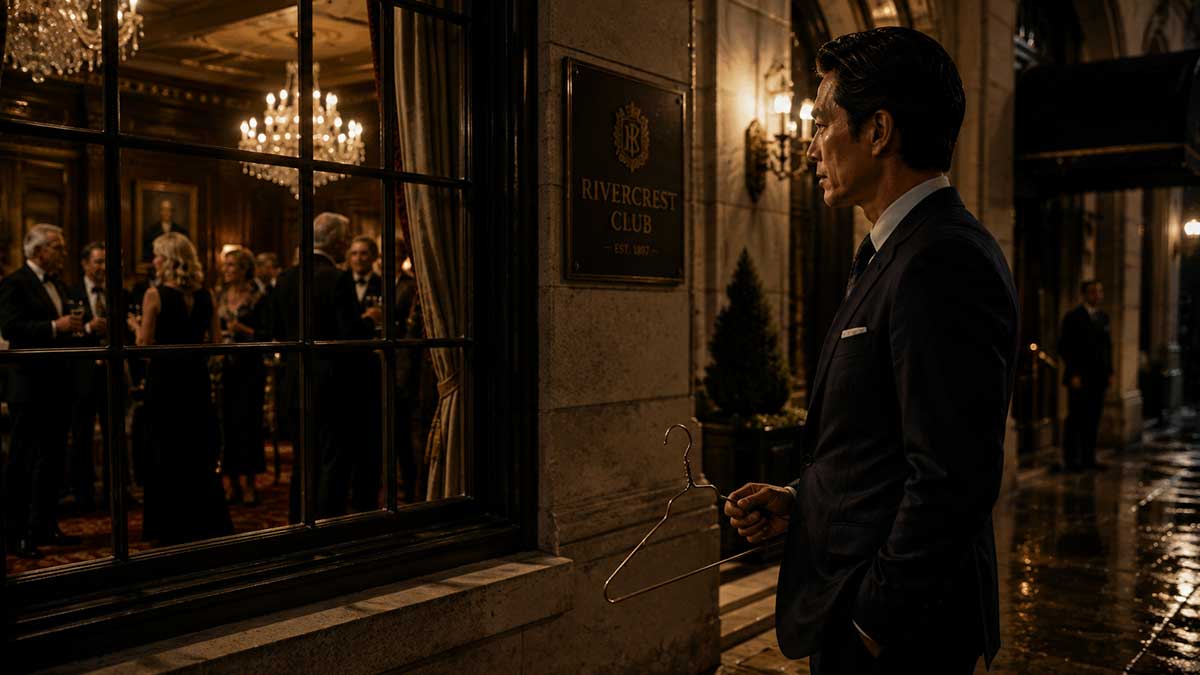
He stood in the alley holding six empty wire hangers.
That afternoon, while driving back to his parents' shop, Elias made himself a promise.
One day he would walk through the front door.
Thirty-one years later, Elias Park was worth approximately eighty-two million dollars.
The number changed depending on who calculated it.
His accountant used one number.
Business magazines used another.
Elias rarely checked.
Three months earlier, a larger technology company had acquired the software firm he had built from a rented office above a dental practice.
The financial press called it an overnight success.
Elias enjoyed that.
The night had lasted fourteen years.
He had slept beneath his desk.
Missed vacations.
Mortgaged his house.
Nearly lost the company twice.
Hired twelve people before he could afford to pay himself properly.
When the acquisition closed, Elias called his parents first.
His father, Jae, listened quietly.
“How much?”
Elias told him.
Silence.
“Dad?”
“You sold the whole thing?”
“Most of it.”
“Why?”
Elias laughed.
“Because they gave me eighty million dollars.”
Another silence.
Then Jae said:
“That seems like a good reason.”
Elias bought very little at first.
Hannah expected him to buy a sports car.
He bought a new coffee machine.
“You're terrible at being rich,” she told him.
“Give me time.”
Then came the house.
Not enormous, but beautiful.
A restored home in one of the city's oldest neighborhoods.
Then art.
A wine cellar Elias didn't know how to use.
A watch that cost more than his parents' first car.
Hannah watched all of it with amusement.
She had met Elias when he was twenty-six and eating instant noodles four nights a week.
Money impressed her less than it impressed him.
Their daughter Sophie was sixteen.
She was impressed by nothing.
At dinner one night, Elias mentioned the Hawthorne Club.
Hannah looked up.
“The place downtown?”
“Yes.”
“What about it?”
“Martin says I should join.”
Martin was an investment banker who had helped with the acquisition.
“Why?”
“Networking.”
Sophie looked up from her food.
“You just sold your company for eighty million dollars. Who are you networking for?”
Elias pointed his fork at her.
“College fund.”
“I think we're good.”
Hannah laughed.
Elias smiled.
But he submitted the application.
The Hawthorne Club had occupied the same stone building for more than a century.
Presidents had eaten there.
Governors.
Judges.
Industrialists.
Old families whose names appeared on hospitals and university buildings.
The club had modernized.
Women were members now.
So were people from many backgrounds.
At least according to the photographs on its website.
Elias had no reason to believe he wouldn't be accepted.
He knew members.
He had money.
He had accomplishments.
His company employed more than eight hundred people.
He funded scholarships.
He sat on the board of a children's hospital.
He had been profiled in national magazines.
Six weeks after applying, Elias received a letter.
He opened it in his kitchen.
Hannah was making tea.
He read it twice.
“What?”
“Nothing.”
“What does it say?”
“Membership is limited.”
Hannah waited.
“And?”
“They aren't able to offer me membership at this time.”
“Oh.”
Elias placed the letter on the counter.
“Maybe there's a waiting list.”
“Maybe.”
Hannah poured hot water into her cup.
“You okay?”
“Of course.”
He threw the letter away.
Twenty minutes later, when Hannah went upstairs, Elias took it out of the trash.
He called Martin the next morning.
“Did I do something wrong?”
“What?”
“The Hawthorne application.”
A pause.
“You heard?”
“Yesterday.”
“That's strange.”
“Why?”
“I thought you were good.”
“What does that mean?”
“Nothing. I just thought you had the votes.”
“Votes?”
“There's a committee.”
“I know there's a committee.”
“Don't take it personally.”
Elias hated that sentence immediately.
“I'm not.”
“They reject people.”
“I know.”
“You can apply again.”
“I'm not applying again.”
“Good.”
Elias waited.
Martin said:
“Give it a year.”
Elias stared at his office window.
“I said I'm not applying again.”
“Of course.”
They both knew he would.
The rejection became a puzzle.
Elias had built his career solving puzzles.
Why did customers cancel?
Why did one product outperform another?
Why did talented employees leave?
Problems had variables.
Variables could be identified.
Systems could be improved.
So Elias began improving himself.
Quietly.
His suits changed first.
He had always bought expensive clothes, but now someone introduced him to a tailor who visited his home.
Then golf.
Elias hated golf.
He took lessons anyway.
Wine.
He hired a consultant for a private tasting.
The consultant explained Burgundy for two hours.
Elias nodded as if learning emergency medicine.
Hannah found him studying a map of French vineyards one night.
“Planning a trip?”
“No.”
“Then why are you memorizing France?”
“I'm not.”
“You have flash cards.”
“They came with the course.”
“What course?”
Elias closed the book.
Hannah looked at him.
“This is about the club.”
“No.”
“Elias.”
“I like wine.”
“You drink beer.”
“I can like two things.”
“You called Pinot Noir 'peanut noir' until last year.”
“That happened once.”
Hannah laughed.
Elias didn't.
She stopped.
“Why does this matter so much?”
“It doesn't.”
“Then stop.”
“I don't want to stop.”
“Then it matters.”
Elias stood.
“I have a meeting.”
“At nine at night?”
“Tokyo.”
Hannah watched him leave.
He joined a museum board.
He increased his contribution to the symphony.
He attended dinners he would once have avoided.
He learned names.
Families.
Schools.
Who had married whom.
Who owned what.
He became good at it.
That bothered him.
There were rules here too.
They simply weren't written down.
At business conferences, everyone wanted something.
Money.
Customers.
Investment.
A job.
At these dinners, wanting anything too visibly was considered embarrassing.
People with the most spoke about money the least.
People with enormous houses described them as “the place.”
Someone's family owned six hundred acres outside the city.
He called it “a little property.”
Elias learned to laugh at the right volume.
He learned that asking what something cost was worse than paying too much for it.
He learned which achievements should be mentioned and which should appear accidentally in conversation.
Most of the people were perfectly pleasant.
That frustrated him more.
He wanted them to be villains.
They weren't.
They were simply at home.
Elias was always visiting.
One Saturday, Sophie came downstairs and found him changing jackets.
“Where are you going?”
“Lunch.”
“With Mom?”
“No.”
“The club people?”
Elias looked at her through the mirror.
“What club people?”
“The people you keep pretending aren't club people.”
He turned.
“I have friends there.”
“Do you?”
“Yes.”
Sophie sat on the bed.
“Can I ask you something?”
“That usually means you're going to anyway.”
“Do you even like these people?”
Elias laughed.
“Some of them.”
“Which ones?”
“What is this?”
“I'm asking.”
“Why?”
“Because you complain every time you come home.”
“I don't complain.”
“You complained for twenty minutes because somebody asked where you went to college.”
“He knew where I went.”
“Okay.”
“It was condescending.”
“Then why do you hang out with him?”
Elias adjusted his cuff.
“Relationships matter.”
Sophie watched him.
“Dad.”
“What?”
“If you don't even like them, why do you need them to like you?”
Elias's hands stopped.
Sophie waited.
“That's not what this is about.”
“What is it about?”
“You wouldn't understand.”
She shrugged.
“Okay.”
Then she left.
Elias remained in front of the mirror.
For some reason, he changed back into the first jacket.
His second application went in eleven months after the first.
This time he had stronger sponsors.
Two board members personally supported him.
Martin told him:
“You're good.”
Elias hated hearing it.
He spent six weeks pretending he didn't care.
Then another letter arrived.
He opened it alone.
The language was slightly different.
The result was the same.
Elias sat at his desk.
He read the letter.
Then read it again.
He felt something he hadn't felt when investors rejected him.
Or when clients left.
Or when competitors mocked his company.
Those things had made him angry.
This made him small.
He looked around his office.
Awards.
Photographs.
A framed magazine cover.
A photograph of him shaking hands with a former president.
Another with his employees on the day the acquisition was announced.
Eighty-two million dollars.
Eight hundred employees.
Two rejections.
The two rejections seemed heavier.
His parents announced they were closing Park Family Cleaners that spring.
“Finally,” Elias said.
His mother, Min, frowned.
“What does that mean?”
“It means you should've retired ten years ago.”
“Then who cleans people's clothes?”
“Somebody else.”
“Somebody else doesn't do it right.”
Jae nodded.
“Your mother is correct.”
“You're both impossible.”
The shop had been open for thirty-seven years.
Same strip mall.
Same counter.
Same bell over the door.
Same faded photographs behind the register.
Elias offered to buy the building.
His father refused.
Elias offered to pay for a complete renovation.
His mother laughed.
“We're closing. Why renovate?”
He offered them money.
They refused that too.
“We have money,” Jae said.
“You have enough.”
“Enough is money.”
Elias smiled.
He had spent his entire adult life trying to understand that sentence.
On the final Sunday, Elias went to help pack.
He wore jeans.
His father handed him boxes.
“You remember how?”
“How to put things in boxes?”
“You became CEO. Maybe you forgot.”
“Very funny.”
Sophie came too.
She found an old Polaroid taped beneath the counter.
“Dad!”
Elias looked over.
“What?”
She held it up.
A teenage boy stood beside a white delivery van.
Too-large polo shirt.
Skinny arms.
Bad haircut.
PARK FAMILY CLEANERS on the door.
Sophie burst out laughing.
“Oh my God.”
“Give me that.”
“No.”
“Sophie.”
“Your hair.”
“It was 1995.”
“That's not an excuse.”
Jae came over.
He took the photograph.
For several seconds he simply looked at it.
“You were seventeen.”
“Something like that.”
“You hated deliveries.”
“I hated everything at seventeen.”
“No.”
Jae smiled.
“You liked driving.”
“I liked being away from the store.”
“That too.”
He studied the photograph again.
Then said:
“You were always going somewhere.”
Elias smiled.
“Apparently.”
Jae handed the photograph back.
Elias looked at the van.
And remembered the Hawthorne Club.
The six shirts.
The front steps.
Deliveries around back.
He remembered standing in the alley with empty wire hangers.
He had not thought about that afternoon in years.
Or perhaps he had thought about it every day without knowing.
Near closing time, Elias found a box of wire hangers.
“Trash?” he asked.
His mother looked horrified.
“Those are good.”
“Mom, the store is closing.”
“Hangers don't expire.”
“What are you going to do with five hundred hangers?”
“Take them home.”
“No.”
“Yes.”
“Dad.”
Jae lifted both hands.
“I've been married forty-nine years. I know when not to participate.”
Sophie laughed.
Elias pulled one hanger from the box.
Thin metal.
Bent slightly at the hook.
Worth almost nothing.
He remembered holding six just like it behind the Hawthorne Club.
Seventeen-year-old Elias had believed the difference between the alley and the dining room was money.
So he made money.
Then he discovered another door.
And another.
And another.
At some point, he had stopped asking where he wanted to go.
He only knew he wanted to be admitted.
A month later, Martin called.
“I have good news.”
Elias was driving.
“What?”
“Hawthorne.”
Elias tightened his grip on the steering wheel.
“What about it?”
“There's an opening.”
“I didn't apply.”
“I know.”
“They reconsidered some candidates.”
Elias said nothing.
“Apparently the membership chair wants to meet you personally.”
“Why?”
“Does it matter?”
Elias almost laughed.
A year earlier, he would have canceled anything.
“Dinner Thursday.”
“I can't.”
“You have something?”
“Sophie's school thing.”
“What school thing?”
“A photography exhibit.”
Martin paused.
“Can Hannah go?”
“She is.”
Another pause.
“You've been trying to get into this club for two years.”
“I know.”
“I can probably move it.”
Elias looked at the traffic ahead.
On the passenger seat was Sophie's invitation.
Her photograph had been selected for a student exhibition.
She had pretended not to care.
Elias knew she cared enormously.
“Don't move it.”
“You sure?”
Elias wasn't sure.
That surprised him.
He had expected revelation to feel cleaner.
Instead, part of him still wanted to go.
He still wanted the brass doors.
The dining room.
The membership card.
The seventeen-year-old boy inside him had not suddenly become wise.
He was still standing in the alley.
Elias said:
“Tell them I'll meet another time.”
“Okay.”
“And Martin?”
“Yeah?”
“Don't tell them why.”
“Why not?”
Elias smiled.
“I don't know.”
He hung up.
Sophie's photograph was called After Closing.
Elias stood in the school gallery looking at it.
She had photographed Park Family Cleaners on its final evening.
The shop was dark except for one fluorescent light above the counter.
Garment bags hung in rows.
His parents stood at the back, small in the frame.
And in the foreground, suspended from a rack, was a single empty wire hanger.
Elias stared at it.
Sophie appeared beside him.
“You hate it?”
“No.”
“You've been staring for five minutes.”
“I like it.”
“You don't have to say that.”
“I know.”
She looked at the photograph.
“Grandpa cried.”
“Grandpa doesn't cry.”
“He did.”
“Dust.”
“There was no dust.”
“Dry-cleaning chemical.”
She smiled.
Then noticed something in his jacket pocket.
“Is that a hanger?”
Elias looked down.
The hook of the old wire hanger was sticking out.
He had brought it from the shop without thinking and later placed it in his office. That evening, for reasons he couldn't explain, he had taken it with him.
“Yeah.”
“Why?”
Elias pulled it out.
Sophie stared.
“You brought a hanger to my photography show?”
“When you say it like that, it sounds strange.”
“It is strange.”
He held it up beside the photograph.
Sophie laughed.
Then walked toward her friends.
Elias remained there.
He thought about his father's words.
You were always going somewhere.
He had once believed that was the whole point.
Keep going.
Up.
Forward.
Through the next door.
Into the next room.
Until nobody could send him around back again.
But standing in his daughter's school gallery, Elias finally recognized the question he had somehow forgotten to ask.
Where?
Where was he trying to go?
And who had told him that arriving there would mean he had become enough?
His phone vibrated.
A message from Martin.
Hawthorne can do Tuesday at 7. Want me to confirm?
Elias looked at it.
The old hunger was still there.
Smaller.
But there.
He did not pretend otherwise.
He put the phone back in his pocket without answering.
Not yet.
Across the gallery, Sophie was explaining her photograph to a teacher.
Hannah stood beside Jae and Min.
His mother was crying openly.
His father was pretending not to notice.
Elias walked toward them.
His mother saw the hanger in his hand.
“I told you those were good.”
Elias laughed.
“Yes, Mom.”
He slipped it back into his pocket.
For thirty-one years, Elias had remembered the front door of the Hawthorne Club.
He had forgotten the people waiting for him at the dry cleaner.
That night, for the first time, the club did not feel exclusive.
It felt small.
Topic 3: The Upstairs Apartment
Rosa Alvarez first understood how much money people could spend without thinking when she found a receipt for $1,840 beside an untouched piece of chocolate cake.
The cake had one bite missing.
She stood inside Suite 1804 of the Bellmont Hotel, holding the receipt in one gloved hand and a trash bag in the other.
Dinner for four.
Wine.
Dessert.
Room service charge.
Gratuity.
$1,840.
Rosa looked at the cake.
She had worked eleven hours the day before because another housekeeper called in sick.
She had cleaned fourteen rooms.
Changed twenty-eight beds.
Scrubbed nine bathtubs.
Picked someone's wet underwear off a bathroom floor.
Her feet still hurt.
And someone had ordered a piece of cake that probably cost more than Rosa's lunch and eaten one bite.
She scraped it into the trash.
Then she went back to work.
Rosa had cleaned hotel rooms for nine years.
The Bellmont wasn't the largest hotel in the city, but it was the kind of place where nobody said the price of anything aloud.
People simply signed.
Rosa knew wealthy strangers more intimately than they knew her.
She knew who slept with the television on.
Who left pills beside the bed.
Who drank alone.
Who tipped.
Who didn't.
Who fought.
Who cried.
Who ordered champagne at two in the morning and left two full glasses beside an untouched bottle.
She knew which couples slept on opposite sides of king-sized beds.
She knew that beautiful luggage could contain dirty socks.
And she knew something that had taken years to understand:
Luxury looked different after people had slept in it.
At eight in the morning, a $2,000 hotel suite smelled surprisingly similar to a cheap apartment.
Perfume.
Coffee.
Sweat.
Toothpaste.
Sometimes loneliness.
Rosa's younger sister Lucía thought this was funny.
“You're saying rich people smell?”
“I'm saying everybody smells.”
“That's your wisdom after nine years at the Bellmont?”
“Nine years and six months.”
Lucía laughed.
They were sitting at their kitchen table eating conchas their mother had brought over.
Their grandmother's old recipe notebook lay open between them.
The cover had once been red.
Now it was brown at the corners and held together with tape.
Lucía tapped a page.
“We could sell these.”
“We are selling them.”
“To Mom.”
“Mom pays.”
“Sometimes.”
Rosa smiled.
Lucía had been talking about opening a bakery for four years.
Not a large one.
Twelve tables.
Coffee.
Their grandmother's sweet bread.
Tres leches.
Guava pastries.
Lucía had already named it.
Abuela's Window.
Rosa hated the name.
Rosa loved the name.
She also knew what commercial rent cost.
“What do we have saved?” Lucía asked.
“You know what we have.”
“Say it.”
“No.”
“Rosa.”
“Twenty-three thousand.”
“Twenty-three thousand four hundred.”
“We need at least sixty.”
“So we keep saving.”
“For how long?”
“As long as it takes.”
Rosa closed the notebook.
“People like us lose twenty-three thousand dollars opening bakeries.”
Lucía leaned back.
“What does that mean?”
“It means we don't have parents who can give us another twenty-three thousand if it goes wrong.”
“So?”
“So we have to be careful.”
Lucía studied her.
“You've been careful your whole life.”
“That's why we have twenty-three thousand dollars.”
“No. That's why you have twenty-three thousand dollars and a job you complain about every day.”
Rosa stood.
“I have to work.”
“You're off today.”
“I have laundry.”
Lucía shook her head.
“You always find something to clean when you don't want to talk.”
Rosa carried two plates to the sink.
She didn't answer.
Andrew Mercer first spoke to her because he couldn't make the espresso machine work.
Suite 1902.
Three-night stay.
Rosa was replacing towels when he walked into the kitchenette wearing a white shirt with the sleeves rolled up.
“Do you know how this thing works?”
Rosa looked at the machine.
“Yes.”
“I've been pressing buttons for ten minutes.”
“You need water.”
Andrew looked at the empty reservoir.
“That would explain it.”
Rosa filled it.
“You just saved my life.”
“Then your life was in serious trouble.”
He laughed.
Most guests barely looked at Rosa.
Andrew did.
The next morning there was a twenty-dollar bill on the desk with a note.
For saving my life.
Rosa smiled despite herself.
He returned three weeks later.
Then again.
His company had an office nearby.
He began requesting the same suite.
Rosa learned his schedule without intending to.
Coffee at six.
Gym.
Meetings.
Back after seven.
Scotch.
Calls.
Sometimes dinner downstairs.
He always left the room tidy.
And he always tipped.
One afternoon Rosa was changing the sheets when Andrew returned unexpectedly.
“You again.”
“I work here.”
“I was beginning to think you lived here.”
“I can't afford to.”
He laughed.
Then stopped.
“Sorry.”
Rosa shrugged.
“It's true.”
He looked around the suite.
“You're not missing much.”
Rosa stared at him.
“That's easy to say when you're staying here.”
Andrew smiled.
“Fair.”
That was the first conversation.
The second lasted five minutes.
The third lasted twenty.
Andrew was fifty-one.
He worked in commercial real estate.
He lived in Connecticut.
He had two children in college.
He was married.
Rosa learned that last.
Not because Andrew deliberately hid it.
Because he didn't mention it.
One evening he invited her for a drink after her shift.
Rosa said no.
He asked again the next week.
She said no.
The third time, she said yes.
They went to the hotel bar.
Rosa changed out of her uniform first.
Andrew noticed.
“You look different.”
“I am different.”
“I didn't mean it like that.”
“I know.”
She smiled.
He asked about her family.
Rosa told him about Lucía.
Her mother.
Her grandmother.
The bakery.
Andrew leaned forward.
“You should do it.”
Rosa laughed.
“Everybody says that when it isn't their money.”
“How much do you need?”
The question embarrassed her.
“I don't know.”
“Yes, you do.”
She looked at him.
“Maybe sixty thousand to start properly.”
Andrew nodded.
As if she'd said sixty dollars.
“You could raise that.”
“From who?”
“Investors.”
Rosa laughed again.
“What?”
“You really don't know how normal people live, do you?”
Andrew smiled.
“Probably not.”
Something about his willingness to admit it made her like him.
That was dangerous.
The first restaurant Andrew took her to didn't have prices on the menu.
Rosa thought she'd been given the wrong one.
“Where are the prices?”
Andrew looked up.
“There aren't any.”
“That's ridiculous.”
“Why?”
“How do you know what anything costs?”
“You ask.”
“Did you?”
“No.”
Rosa stared at him.
Andrew laughed.
“You look offended.”
“I am offended.”
“By the menu?”
“By you.”
He laughed harder.
Rosa did too.
Then she ordered carefully anyway.
Later, Andrew ordered a bottle of wine.
Rosa saw the price when the waiter briefly placed the wine list beside her.
$480.
She almost told him not to.
Then stopped herself.
She wanted to know what $480 wine tasted like.
It tasted like wine.
Good wine.
But still wine.
Rosa laughed after the first sip.
“What?”
“Nothing.”
“Tell me.”
“I thought it would taste more expensive.”
Andrew grinned.
“What does expensive taste like?”
“I don't know. That's why I tried it.”
Their affair began three weeks later.
Rosa knew it was wrong.
She knew Andrew was married.
She knew there was a woman somewhere who didn't know Rosa existed.
Knowing did not prevent her.
For the first time in years, Rosa entered hotel rooms without pushing a cart.
Andrew gave her a keycard.
That tiny piece of plastic felt strangely important.
She could enter Suite 1902 through the same door as anyone else.
No uniform.
No towels.
No cleaning supplies.
She began experiencing the city differently.
Restaurants where reservations took weeks.
A gallery opening.
A charity dinner.
A rooftop where the skyline looked close enough to touch.
Andrew bought her a dress.
She refused it.
Then accepted it.
Then hated herself for accepting it.
Then wore it three times.
Lucía noticed.
“Where are you going?”
“Dinner.”
“With who?”
“A friend.”
“Does your friend own a bank?”
Rosa looked down at the dress.
“Why?”
“Because you look expensive.”
Rosa smiled.
“Maybe I am.”
Lucía didn't.
Something changed in Rosa during those months.
But not in the way Lucía feared.
At the Bellmont, Rosa had spent years walking through beautiful rooms thinking:
This belongs to other people.
With Andrew, she began asking:
Why?
Not why couldn't she have a $480 bottle of wine.
She didn't care about that.
Why couldn't she own a bakery with twelve tables?
Why couldn't the walls be beautiful?
Why couldn't people make reservations?
Why couldn't someone walk inside her place and think:
I want to stay here?
One night Andrew took her to a tiny restaurant hidden behind an unmarked door.
Twenty seats.
One chef.
The owner came to every table.
Rosa barely spoke during dinner.
“What?” Andrew finally asked.
“This.”
“What about it?”
“This is what I want.”
“The food?”
“No.”
She looked around.
“The size.”
She could suddenly see Abuela's Window.
Not the fantasy Lucía kept describing.
The actual room.
Twelve tables.
White tile.
Plants in the front window.
Her grandmother's recipes framed near the kitchen.
Morning light.
Coffee.
Bread cooling behind glass.
Rosa took out her phone and began typing notes.
Andrew smiled.
“There she is.”
“Who?”
“The person who actually wants something.”
Rosa looked at him.
She didn't realize until much later how much that sentence affected her.
Lucía was less impressed.
“You're sleeping with him.”
Rosa froze.
They were standing in their kitchen.
“How do you know?”
“I'm not stupid.”
“Lucía.”
“He's married?”
Rosa didn't answer.
“Oh my God.”
“Don't.”
“Don't what?”
“Do this.”
“I'm doing something?”
“You don't know him.”
“I know he's married.”
“His marriage is complicated.”
Lucía stared at her.
Then laughed once.
“Of course it is.”
“You don't know anything about it.”
“Does his wife?”
Rosa looked away.
“Does his wife know their marriage is complicated enough for you to be in it?”
“Stop.”
“No.”
“Lucía.”
“You think I'm judging you because he's rich.”
“I think you judge everything.”
“No. I'm judging you because he's married.”
Rosa picked up her purse.
“And because you think I'm trying to become something I'm not.”
Lucía's face changed.
“I never said that.”
“You didn't have to.”
“Rosa.”
But Rosa left.
Andrew began talking seriously about the bakery.
He knew commercial landlords.
Contractors.
Accountants.
He could help with permits.
He even suggested investing.
“How much?” Rosa asked.
“Whatever gets you started.”
She laughed.
“That's not a number.”
“Fifty?”
Rosa stopped breathing for a moment.
“Fifty thousand?”
“If the plan makes sense.”
She thought about Lucía.
About the twenty-three thousand four hundred dollars.
About years of waiting.
“You'd really do that?”
Andrew touched her hand.
“I believe in you.”
Nobody had ever said those words to Rosa in quite that way.
Her mother believed in her.
Lucía believed in her.
But their belief always felt like love.
Andrew's felt like evidence.
He knew money.
Buildings.
Businesses.
People who opened things.
If Andrew Mercer believed she could do it, perhaps she actually could.
That was the mistake.
For two months, Rosa and Lucía looked at storefronts.
Lucía remained angry about Andrew but eventually agreed to discuss the investment.
They found a place on a corner near a hospital.
Small.
Good foot traffic.
Large front windows.
The rent frightened Rosa.
Lucía loved it.
“This is it.”
“We can't afford it.”
“With the investment, we can.”
Rosa looked through the dusty glass.
She could see everything.
Tables.
Counter.
Plants.
Morning sun.
Abuela's Window.
For once the name didn't sound ridiculous.
It sounded inevitable.
That evening Rosa sent Andrew photographs.
He replied:
Beautiful. Let's talk tomorrow.
Tomorrow became Friday.
Friday became next week.
Andrew stopped staying at the Bellmont.
His texts became shorter.
Then one afternoon:
Can we talk?
Rosa already knew.
They met in a coffee shop.
Not the Bellmont.
Andrew looked tired.
“My wife found messages.”
Rosa said nothing.
“Things are bad.”
“You told her?”
“She knows enough.”
“About me?”
“Yes.”
Rosa looked down.
For the first time, Andrew's wife became more than an idea.
A woman had read messages.
Maybe sitting at a kitchen table.
Maybe alone.
Rosa felt ashamed.
Andrew continued.
“I need to focus on my family.”
“I understand.”
“I don't want you to think what we had wasn't real.”
Rosa almost laughed.
That sentence seemed designed to comfort him more than her.
“What about the bakery?”
Andrew stopped.
There it was.
Rosa saw the answer before he spoke.
“I can't do anything financially right now.”
“You promised.”
“I said I'd help.”
“You said fifty thousand.”
“I know.”
“We're about to sign a lease.”
“Don't.”
Rosa stared at him.
“Don't?”
“Not if you're relying on me.”
The room seemed to tilt.
“You told me to do this.”
“I encouraged you.”
“You told me you believed in me.”
“I do.”
“Apparently not fifty thousand dollars' worth.”
“Rosa.”
She stood.
Andrew reached for her hand.
She moved it away.
Then she took the hotel keycard he had given her from her wallet and placed it beside his coffee.
“I think this is yours.”
Andrew looked at it.
“No.”
“Yes.”
She left.
Rosa cried for two days.
Not continuously.
She went to work.
Changed sheets.
Cleaned bathrooms.
Smiled at guests.
Then cried in the supply closet.
At home she told Lucía the investment was gone.
Lucía didn't say I told you so.
That somehow made it worse.
“We can't take the storefront,” Rosa said.
Lucía was silent.
“We don't have enough.”
“We have twenty-seven now.”
“We need sixty.”
“We can start smaller.”
“With what?”
“A loan.”
“Rejected.”
“We try another.”
“Lucía.”
“A food stall.”
“No.”
“Weekend markets.”
“No.”
“Shared kitchen.”
“Stop.”
Lucía stared at her.
Rosa slammed her hand against the table.
“He was the reason this could happen!”
Lucía went still.
Then she looked at the recipe notebook between them.
“Was the bakery his idea?”
Rosa said nothing.
“Was it?”
“No.”
“Did he teach us to bake?”
“No.”
“Did he save twenty-seven thousand dollars?”
“No.”
“Did he name it?”
Rosa almost smiled.
“No. Unfortunately, that was you.”
Lucía ignored the joke.
“Then why does he get to take it away?”
Rosa looked at her sister.
For several seconds, she couldn't answer.
Something inside her had become confused.
Andrew had opened doors.
Restaurants.
Rooms.
People.
Possibilities.
Somewhere along the way, Rosa had begun believing he owned the possibilities too.
Lucía pushed the recipe notebook toward her.
“He doesn't.”
They did not get the beautiful corner storefront.
Someone else rented it.
Rosa cried again when she saw paper covering the windows.
Three months later, Lucía found another place.
Smaller.
Six tables, maybe eight if they crowded them.
The previous tenant had sold phone accessories.
The floor was ugly.
The ceiling needed repair.
There was no beautiful morning light.
Rosa hated it.
Then she saw the rent.
She hated it less.
They borrowed money from their mother.
Rosa hated that most of all.
Her mother said:
“I gave birth to you. You already owe me more than this.”
They laughed.
Rosa kept working at the Bellmont.
Lucía kept her job too.
They painted at night.
Bought used equipment.
Found chairs from three different restaurants and painted them to match.
Rosa learned permits.
Insurance.
Payroll.
Food costs.
Things Andrew could have solved with phone calls became weeks of work.
Sometimes Rosa resented him.
Sometimes she missed him.
Sometimes she missed the restaurants more than she missed him.
That embarrassed her.
Then she decided embarrassment wasn't useful.
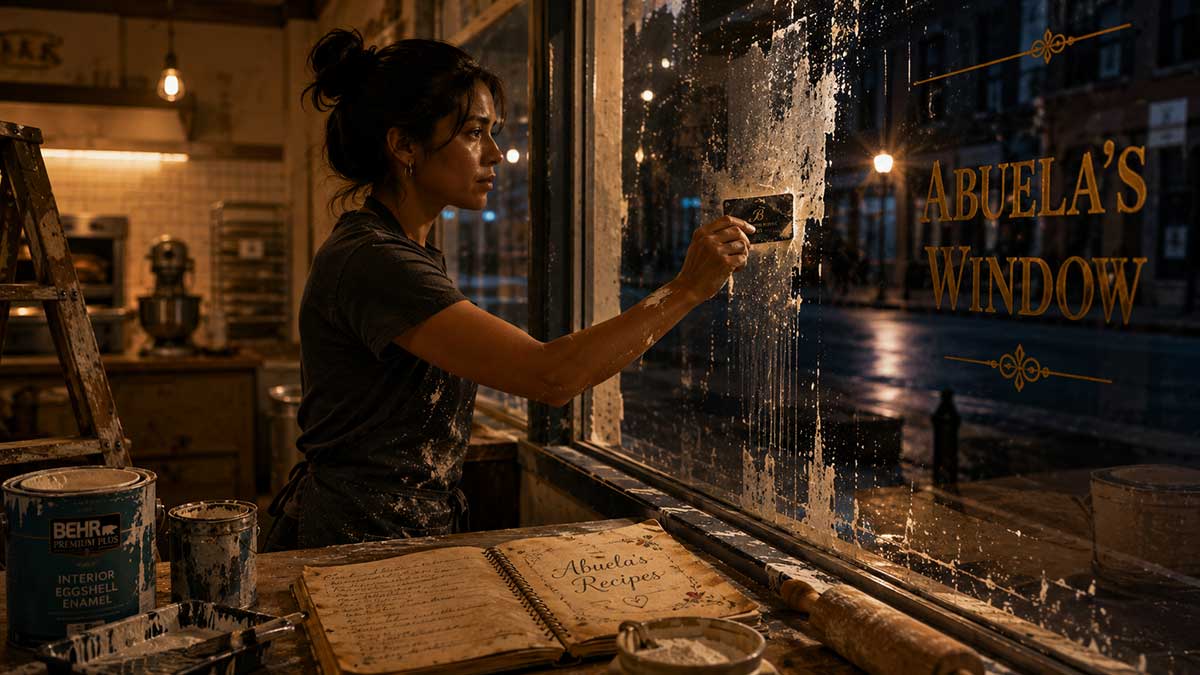
One night, Rosa was alone in the bakery scraping dried paint from the front window.
Lucía had gone home.
It was after midnight.
The room smelled like primer and cinnamon from a test batch cooling in the kitchen.
Rosa reached into her purse for an old gift card she sometimes used as a scraper.
Her fingers touched plastic.
She pulled it out.
The Bellmont logo.
Suite 1902.
Andrew's keycard.
She thought she had returned it.
Apparently she had kept another.
Rosa turned it over in her hand.
For months, that card had felt like admission.
It opened a door she had once entered only to clean.
Behind it had been wine.
White sheets.
Andrew.
Another version of herself.
For a moment she remembered the first night she used it.
How powerful it felt when the lock flashed green.
As if someone had finally said:
You may enter.
Rosa looked around the unfinished bakery.
Paint cans.
Secondhand chairs.
A ladder.
Her grandmother's recipe notebook on the counter.
No marble bathroom.
No room service.
No $480 wine.
Nothing anyone at the Bellmont would call luxurious.
Rosa smiled.
Then she pressed the edge of the keycard against the window.
The dried paint came off perfectly.
She scraped again.
And again.
By the time she finished, the card was scratched almost beyond recognition.
Abuela's Window opened six weeks later.
On the first morning, Rosa arrived at 4:40.
Lucía was already there.
“You're late.”
“It's four forty.”
“Late.”
Their mother arrived at six carrying flowers they didn't need and food they hadn't asked for.
At 6:58, nobody was outside.
At 7:03, still nobody.
Rosa pretended to rearrange pastries.
At 7:11, a nurse from the nearby clinic came in.
“Are you open?”
Rosa looked at Lucía.
Lucía looked at Rosa.
“Yes,” Rosa said.
The nurse ordered coffee and a guava pastry.
$6.75.
Rosa took the payment.
Their first sale.
The nurse sat beside the window.
Ten minutes later, another customer entered.
Then two construction workers.
Then nobody for forty minutes.
It was not a spectacular opening.
There were no photographers.
No champagne.
No wealthy investors.
No one said the word success.
At noon, Rosa looked around.
Four tables were occupied.
An old man was reading a newspaper.
Two nurses were sharing tres leches.
A mother was tearing a sweet roll into pieces for her little boy.
Lucía stood behind the counter arguing with their mother about how much cinnamon belonged in the next batch.
Rosa leaned against the kitchen doorway.
For years she had cleaned beautiful rooms belonging to other people.
Then she had mistaken access to those rooms for access to another life.
She finally understood something Andrew had accidentally taught her.
There really were more rooms in the world than the ones she had been given.
He had been right about that.
He had simply been wrong about who held the key.
A woman near the window raised her hand.
“Excuse me?”
Rosa walked over.
“Could we get two more coffees?”
“Of course.”
As Rosa turned back toward the counter, she caught her reflection in the front window.
Apron.
Hair tied back.
Flour on her cheek.
Behind the reflection, painted in small gold letters on the glass, were the words Lucía had insisted on from the beginning.
ABUELA'S WINDOW
Rosa looked at them.
Then at the people sitting inside.
For once, she wasn't looking through someone else's window.
She was standing on her own side of the glass.
Story 4: Three Hundred People Came to His Birthday
At 11:58 p.m., three hundred people were waiting for Noah Reyes to pretend he was surprised.
He knew about the cake.
He knew about the champagne.
He knew the DJ would stop the music at midnight.
He even knew which side of the room he was supposed to enter from so the cameras could catch his reaction.
But when the lights went dark and three hundred voices shouted his name, Noah put both hands over his mouth as if none of it had been planned.
The room erupted.
Phones rose everywhere.
Someone fired gold confetti over his head.
The DJ shouted:
“Make some noise for the birthday boy!”
Noah laughed.
He hugged people.
He kissed cheeks.
He lifted a bottle.
Someone pulled him onto a platform beneath an enormous glowing 31.
“Speech!”
“Speech!”
Noah took the microphone.
He looked across the nightclub.
Creators.
Actors.
Musicians.
Brand representatives.
Photographers.
People he had collaborated with once.
People he had never met.
People who knew his follower count before they knew his last name.
And people he genuinely liked.
That mattered.
They weren't all fake.
Noah hated when people assumed that.
Many were funny.
Talented.
Generous.
Interesting.
Some had helped him when he was starting.
Some had become friends.
Or something close to friends.
Noah raised his glass.
“I don't know how I got this lucky.”
The crowd cheered.
“Seriously. Look at this.”
He turned slowly, taking in the room.
“I love you guys.”
More cheering.
Someone shouted, “WE LOVE YOU, NOAH!”
Noah laughed.
The cake arrived.
Three hundred people sang.
By 12:23, the first video was online.
By 1:00, there were hundreds.
By 2:00, Noah's name was trending locally.
At 3:14 in the morning, lying alone in the back seat of a car, he posted a photograph of himself standing beneath the falling confetti.
The caption said:
BEST NIGHT OF MY LIFE.
Within ten minutes, 41,000 people liked it.
Noah watched the number climb until he fell asleep.
His mother called the next morning at 9:07.
Noah didn't answer.
She called again at 9:11.
Then at 9:14.
He pulled a pillow over his head.
At 9:18, his sister called.
Noah sat up.
“What's wrong?”
“Noah.”
He knew from her voice.
“What happened?”
“Mom collapsed.”
The hangover disappeared.
“What?”
“I'm at the hospital.”
“Is she okay?”
“I don't know.”
“What do you mean you don't know?”
“They're running tests.”
Noah was already out of bed.
“I'm coming.”
Elena Reyes was sixty-two and had never learned how to text without using complete sentences.
Every message ended with punctuation.
Even emojis.
Good morning, sweetheart. 
Did you eat?
I saw your new video. Very funny.
Call me when you have time.
That last sentence appeared often.
Noah usually intended to.
He loved his mother.
There was never any question about that.
He just lived inside a calendar that always seemed to be full.
Filming.
Editing.
Meetings.
Flights.
Brand events.
Podcast appearances.
Dinners.
Collaborations.
He had once explained his schedule to Elena.
She listened for five minutes.
Then said:
“So you get paid to be busy?”
Noah laughed.
“Basically.”
“Then you're doing very well.”
The doctors said Elena would need surgery.
Then recovery.
Then help at home.
Noah canceled a flight.
Then a shoot.
Then a brand dinner.
His manager, Celeste, handled everything.
“Take as much time as you need.”
“Thanks.”
“I mean it.”
“I know.”
“We'll move the campaign.”
“Okay.”
“And don't worry about posting.”
Noah looked through the glass at his mother sleeping.
“I wasn't.”
He heard how defensive it sounded.
Celeste ignored it.
“Call me if you need anything.”
There it was.
The sentence everyone said.
Noah didn't notice yet.
For the first week, his phone never stopped.
BRO HEARD ABOUT YOUR MOM. LOVE YOU.
Anything you need.
Praying for her.
Sending good energy.
Here for you.
Flowers arrived.
Baskets.
A candle from a wellness company he had promoted.
A giant box of protein bars.
Someone sent Elena a designer blanket.
She woke, touched it, and asked:
“Why does this blanket have a name?”
“It's the company.”
“Why is the company on my blanket?”
“Branding.”
Elena stared at him.
“I liked my old blanket.”
Noah laughed for the first time in two days.
He posted nothing about her.
That surprised people.
Noah shared almost everything.
Meals.
Airports.
Workouts.
Hotels.
Bad haircuts.
Good sunsets.
His followers knew when he changed toothpaste.
But this felt different.
Once he photographed his mother's hand resting on the hospital blanket.
He opened the posting screen.
Then closed it.
Some things, he decided, should be allowed to happen without becoming content.
After the surgery, Elena had complications.
Nothing catastrophic.
But recovery stretched from days into weeks.
Noah moved back into the house where he had grown up.
His childhood bedroom still had a basketball trophy on the shelf.
His mother had turned half the closet into storage.
There were six boxes labeled CHRISTMAS and one labeled NOAH SCHOOL.
He opened it one night.
Report cards.
Drawings.
A broken plastic dinosaur.
Photographs.
One showed Noah at nineteen sitting beside Marcus Lee on the hood of a terrible used Honda.
Noah smiled.
He took a picture of the photograph with his phone.
Then stopped.
Marcus.
They hadn't spoken in almost a year.
Not because anything happened.
That was the strange part.
Nothing happened.
They had once been inseparable.
College roommates.
First apartment.
Noah slept on Marcus's couch after a breakup.
Marcus loaned him $900 when Noah couldn't make rent.
When Noah's first video passed a million views, Marcus bought a grocery-store cake and wrote INTERNET LOSER across it with icing.
Then Noah's life accelerated.
Marcus became a high school teacher.
Noah began traveling.
They kept trying.
Dinner next week?
I'm in LA.
Thursday?
Brand thing.
Weekend?
Flying out.
Eventually the invitations slowed.
Neither seemed angry.
Their friendship had not broken.
It had simply been left somewhere.
Noah looked at the photograph.
He thought about texting Marcus.
Then Elena called from downstairs.
“Noah?”
“Coming!”
He put the photograph back in the box.
By the third week, the messages slowed.
That was normal.
People had lives.
Noah understood.
He wasn't angry.
His mother was improving.
The emergency had passed.
There wasn't much to say.
His own social-media numbers were changing too.
At first, old videos kept circulating.
Then engagement dropped.
Another creator had a public breakup.
Someone launched a podcast.
A comedian Noah knew accidentally started an enormous argument over a twelve-second clip.
The internet moved.
It always moved.
Celeste called.
“How are you?”
“Good.”
“How's your mom?”
“Better.”
“That's great.”
“Yeah.”
A pause.
“You thinking about coming back next week?”
Noah looked toward the living room.
Elena was asleep in a recliner.
“Maybe.”
“No pressure.”
“I know.”
“But the Vanta campaign needs a decision.”
“I thought we moved it.”
“We did.”
Another pause.
“They're asking.”
Noah understood.
“When?”
“Friday.”
“I'll figure it out.”
“Noah.”
“Yeah?”
“Don't make yourself crazy.”
He smiled.
“Too late.”
After they hung up, Noah opened his analytics.
He hadn't checked them in twelve days.
He stared at the numbers longer than he wanted to admit.
Down.
Down.
Down.
He closed the app.
Opened it again.
Then closed it.
One afternoon Elena watched him scrolling.
“You're working?”
“No.”
“You look like you're working.”
“I'm not.”
“What are you doing?”
“Nothing.”
She continued watching.
Noah sighed.
“What?”
“Who's your best friend?”
He laughed.
“What kind of question is that?”
“A question.”
“Why?”
“You've been here almost a month.”
“So?”
“Many people sent flowers.”
“Yes.”
“Many people texted.”
“Yes.”
“Many people said they love you.”
“Mom.”
She waited.
Noah put his phone down.
“What are you trying to say?”
“Nothing.”
“You're clearly trying to say something.”
Elena adjusted the blanket across her legs.
“I wondered who your best friend is.”
Noah smiled.
“I have a lot of close friends.”
“Good. Who?”
He opened his mouth.
“Celeste.”
“That's your manager.”
“She's also my friend.”
“Okay.”
“Dev.”
“Who?”
“Dev. You've met him.”
“The man with the sunglasses?”
“He doesn't always wear sunglasses.”
“He wore them inside my house.”
Noah laughed.
“Fine. Not Dev.”
Elena smiled.
“Who else?”
“There's Priya.”
“Your podcast friend?”
“Yes.”
“Good.”
“And Jordan.”
“Which Jordan?”
Noah paused.
He knew three.
His mother waited.
“Why are you interrogating me?”
“I'm not.”
“You are.”
“I asked who your best friend is.”
“And I said I have a lot.”
Elena nodded.
Then looked toward the television.
Noah picked up his phone.
He opened his contacts.
He didn't know why.
Thousands of names.
Some famous.
Some not.
People in New York.
Los Angeles.
Miami.
London.
People who had invited him to weddings.
People whose birthdays he had attended.
People who sent him Christmas gifts through assistants.
He scrolled.
And scrolled.
Then he stopped.
Marcus Lee
Noah locked the phone.
At 2:13 the following morning, Elena woke him.
“Noah.”
He sat up instantly.
She was standing in the hallway.
“What?”
“I don't feel right.”
Twenty minutes later they were driving to the emergency room.
Noah called his sister.
No answer.
Called again.
Voicemail.
She had two small children and lived forty minutes away.
He texted:
Taking Mom to ER. Call me.
At the hospital, nurses took Elena away.
Noah sat alone.
2:58.
3:17.
3:41.
His phone had 38 percent battery.
He opened Instagram.
Closed it.
Opened messages.
There were conversations everywhere.
Hundreds.
Most ended with some variation of:
Let's link soon.
Miss you bro.
We need to catch up.
Next time you're in LA.
Anything you need.
Noah stared at the last phrase.
Anything you need.
He suddenly wondered what it meant.
Could he call any of them now?
Not to solve anything.
Just because he was afraid.
He tapped Dev's name.
Stopped.
It was 3:48.
Priya had a baby.
Celeste was his manager.
Jordan was in Europe.
Another friend was probably at a club.
Noah kept scrolling.
He felt ridiculous.
He had 2.4 million followers.
Three hundred people had come to his birthday.
He couldn't decide who he was allowed to wake up.
The thought embarrassed him so much that he put the phone down.
At 4:26, the doctor came out.
Elena was stable.
A medication issue.
They wanted to observe her.
Noah nodded.
“Can I see her?”
“Soon.”
The doctor left.
Noah sat back down.
The waiting room television was playing a cooking show with the sound off.
A vending machine hummed.
Someone coughed across the room.
Noah closed his eyes.
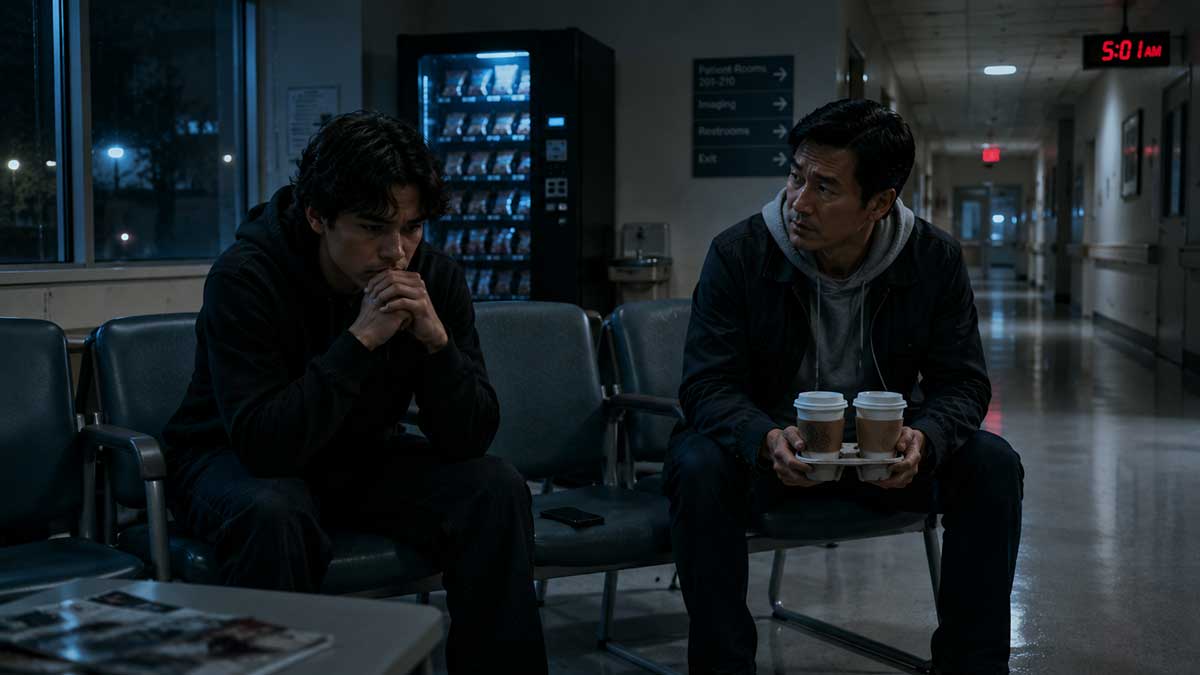
At 4:51, he heard footsteps.
“Noah.”
He opened his eyes.
Marcus was walking toward him carrying two coffees.
Noah stood.
For a second neither moved.
Then Marcus handed him one.
“What are you doing here?”
“Your sister called me.”
Noah stared at him.
“My sister?”
“She couldn't get away immediately. Kids are asleep. Her husband is out of town.”
Marcus sat down.
Noah remained standing.
“You came here at five in the morning?”
“Technically four fifty-one.”
“Marcus.”
“Sit down.”
Noah sat.
Neither spoke.
Marcus drank his coffee.
Noah looked at him.
“You didn't have to come.”
“I know.”
That answer almost broke him.
Noah looked down at the cup.
“Mom's okay.”
“Good.”
“They're watching her.”
Marcus nodded.
“Good.”
Another silence.
Noah expected Marcus to ask about work.
Followers.
Why Noah hadn't called.
Why they'd stopped seeing each other.
He didn't.
He just sat there.
After a while Noah said:
“I found that picture.”
“What picture?”
“The Honda.”
Marcus groaned.
“That car was a public-health emergency.”
“You loved that car.”
“I loved that it started twice a week.”
Noah laughed.
Marcus smiled.
Then the waiting room became quiet again.
Noah looked at his phone.
He had an impulse to photograph the coffees.
Two paper cups.
Hospital lights.
4:57 a.m.
It would make a good post.
Something about real friendship.
He could already see the caption.
Noah hated himself a little for thinking it.
Then he realized he didn't have to.
He put the phone in his pocket.
Marcus didn't take his out either.
Elena went home two days later.
Marcus helped Noah carry things into the house.
Elena hugged him.
“Marcus.”
“Hi, Mrs. Reyes.”
“You got skinny.”
“Good to see you too.”
“You need food.”
“I knew this was coming.”
She pointed toward the kitchen.
“There is rice.”
“Mom,” Noah said.
“What?”
“He can feed himself.”
Elena looked offended.
“Then why is he skinny?”
Marcus laughed.
Noah watched them.
Something inside him hurt.
Not because Marcus had abandoned him.
Because he hadn't.
Noah had simply stopped showing up.
Three months later, Noah returned to work fully.
The numbers recovered.
Not immediately.
But enough.
Then more than enough.
A video went viral.
The Vanta campaign renewed.
He traveled again.
The invitations returned.
The phone lit up.
The internet had not punished him.
It had simply continued without him for a while.
Strangely, that no longer frightened him as much.
He still loved creating.
Still checked analytics too often.
Still enjoyed parties.
Still liked applause.
Still sometimes photographed his dinner before eating it.
He did not become a different person.
But Thursday nights changed.
Noah kept them empty.
Marcus usually came over.
Sometimes they went out.
Sometimes they watched basketball.
Sometimes Marcus graded papers while Noah edited videos.
Nothing worth posting happened.
That became part of why Noah liked Thursdays.
On Noah's thirty-second birthday, Celeste asked what he wanted to do.
“No club.”
“Restaurant?”
“Maybe.”
“How many people?”
Noah thought.
“Ten?”
Celeste stared at him.
“Ten?”
“Twelve.”
“You had three hundred last year.”
“I know.”
“You okay?”
Noah smiled.
“Yeah.”
The dinner became fourteen.
His mother came.
His sister.
Marcus.
Celeste.
A few old friends.
A few newer ones.
Someone brought a cake.
It leaned slightly to one side.
No sponsors.
No photographer.
No glowing number behind him.
At 11:52, Noah's phone buzzed on the table.
He looked down.
A video he had posted that afternoon was taking off.
Notifications stacked across the screen.
Comments.
Shares.
Messages.
Numbers climbing.
Noah picked up the phone.
Across from him, Marcus was telling a story.
“So this kid raises his hand and says, 'Mr. Lee, technically you never said we couldn't use ChatGPT.'”
Everyone laughed.
Noah had missed the beginning.
“What happened?” he asked.
Marcus pointed at him.
“No. You were on your phone. You don't get the story.”
“Come on.”
“Nope.”
“Marcus.”
“Consequences.”
Noah laughed.
The phone buzzed again in his hand.
He looked at the screen.
Then at Marcus.
He turned the phone facedown.
“Start over.”
Marcus made him wait.
Then he started again.
Noah listened.
His phone continued vibrating against the table.
For once, he let people somewhere else keep talking about him.
He was busy being there.
Story 5: The House Across the Water
For thirty-two years, David Mercer had been promising his wife a house he did not own.
He could see it from their dock.
White siding.
Dark roof.
A long wooden porch facing the lake.
Three chimneys.
A stone path descending toward the water.
At night, one small porch light burned near the end of the property.
David had first noticed the house when he was thirty-five.
Ellen was thirty-three.
Their children were seven and four.
They had rented a little cottage for a week because it was the cheapest vacation they could afford.
On their second night, David and Ellen sat at the end of the dock after putting the children to bed.
David pointed across the water.
“See that house?”
Ellen followed his finger.
“What about it?”
“Someday.”
“Someday what?”
“We'll have something like that.”
Ellen laughed.
“We have something like that.”
She pointed behind them.
Their rental cottage had brown carpet, a leaking kitchen faucet and a screen door that wouldn't close.
David looked at her.
“You know what I mean.”
“I do.”
“One day we'll wake up beside the water. No alarm. No commute. I'll make coffee. You'll read.”
“You'll make coffee?”
“I'll learn.”
“That I'd like to see.”
“We'll travel whenever we want.”
“Where?”
“Everywhere.”
Ellen leaned against him.
“And what will we do all day?”
“Whatever we want.”
She smiled.
“Sounds expensive.”
David kissed the top of her head.
“Give me time.”
David gave it time.
He gave it thirty-two years.
He worked in commercial insurance.
He was good at it.
Very good.
Not brilliant.
Not ruthless.
Not lucky.
Just dependable.
He arrived early.
Returned calls.
Remembered clients' children's names.
Prepared.
Stayed late.
When other people changed companies, David stayed.
When younger employees arrived, David trained them.
When they were promoted, he congratulated them.
Then accepted another promotion himself.
The money became good.
Then very good.
Each improvement brought another promise.
After the next promotion.
After we pay off the mortgage.
After Emma finishes college.
After Ben finishes college.
After we rebuild the retirement account.
After the market recovers.
After the bonus.
After sixty.
After sixty-five.
After retirement.
Ellen occasionally teased him.
“Someday David.”
He'd smile.
“Almost.”
He meant it.
That was important.
David was never lying.
There were trips.
Just fewer than they planned.
There were dinners.
Just more often on weekends than weekdays.
There were vacations.
Just sometimes interrupted by calls.
David attended the children's games.
Most of them.
School performances.
Most of them.
Anniversaries.
All of them, although one year he arrived at the restaurant forty minutes late.
He bought Ellen flowers the following morning.
She forgave him.
David loved his family.
Nobody doubted that.
When Emma needed braces, David paid without complaint.
When Ben crashed his first car, David drove two hours at midnight to get him.
When Ellen's mother became ill, David rearranged his schedule for months.
He was the person everyone called when something had to be handled.
The problem was that life rarely announced which moments mattered before they happened.
A Tuesday dinner didn't seem important.
A walk after work didn't seem important.
Sitting on the porch doing nothing seemed almost irresponsible when there was work waiting.
So David postponed the things that could be postponed.
The important things would come later.
At fifty-eight, David and Ellen bought a modest lake house.
Not the white one.
A smaller place across the water from it.
It was supposed to be for weekends.
Eventually retirement.
David loved it.
But he still noticed the other house.
From their dock, he could see its porch light.
“Still looking?” Ellen asked one evening.
David smiled.
“Just appreciating.”
“Mm-hmm.”
“You wouldn't want it?”
Ellen looked across the water.
“It's beautiful.”
“That wasn't my question.”
She thought.
“I think I'd like the porch.”
“I'll buy you the porch.”
“Can we leave the house?”
“No.”
“Then that's wasteful.”
He laughed.
After that, they jokingly called it Someday House.
When David had a difficult week:
“Someday House.”
When Ellen shoveled snow:
“Someday House.”
When their refrigerator died:
“Someday House.”
It became shorthand for a future where things were easier.
A future where nothing needed to be postponed.
David retired at sixty-seven.
His colleagues held a dinner.
There were speeches.
Photographs.
A watch.
His boss, who was younger than David's daughter, called him “an institution.”
Everyone laughed.
David laughed too.
On Monday morning, he woke at 5:42 without an alarm.
He lay beside Ellen staring at the ceiling.
No email.
No commute.
No meeting.
He smiled.
Ellen opened one eye.
“What?”
“Nothing.”
“Then stop smiling at the ceiling. It's creepy.”
“I'm retired.”
“So I've heard.”
“What do we do?”
“It's six in the morning.”
“I know.”
“Sleep.”
David couldn't.
He went downstairs and made coffee.
It was terrible.
Ellen drank it anyway.
Two months later, Someday House went on the market.
David saw the listing before breakfast.
He stared at his laptop.
Then shouted:
“Ellen!”
No answer.
“ELLEN!”
She came downstairs wearing one sock.
“What happened?”
He turned the laptop toward her.
She looked.
Then looked at him.
“No.”
“What do you mean no?”
“You screamed like somebody died.”
“Look.”
“I am looking.”
“It's for sale.”
“I can see that.”
“Someday House.”
Ellen sat down.
David scrolled through the photographs.
The porch was even better than they had imagined.
Four bedrooms.
A stone fireplace.
Huge kitchen.
Library.
Dock.
Floor-to-ceiling windows facing the water.
“Look at that view.”
“We have that view.”
“No. We have a view of that view.”
Ellen laughed.
David clicked through the photographs again.
“We can afford it.”
She stopped smiling.
“David.”
“We can.”
“I know.”
“We could sell this place.”
“I like this place.”
“You like that place too.”
“I've never been inside.”
“You've been looking at it for nine years.”
“You've been looking at it for nine years.”
David turned toward her.
“Let's go see it.”
Ellen looked at the photograph.
Then at David.
“Fine.”
The house was magnificent.
Not enormous in the way David feared.
Warm.
Old wood.
Bookshelves.
Windows everywhere.
Ellen stood on the porch for a long time.
David watched her.
He could already see them there.
Coffee.
Books.
Grandchildren running toward the water.
Thanksgiving.
Christmas.
Summer evenings.
No alarm.
No commute.
Everything they had talked about.
On the drive home, David asked:
“What do you think?”
“It's beautiful.”
“That's it?”
“What do you want me to say?”
“You know what I want you to say.”
Ellen looked out the window.
David laughed.
“Come on. We talked about this for years.”
“We joked about it.”
“I wasn't joking.”
“I know.”
Something in her voice bothered him.
“What?”
“Nothing.”
“Ellen.”
“It's a lot of house.”
“The kids will come.”
“They'll come to this house.”
“The grandkids would love it.”
“They love our dock.”
David gripped the steering wheel.
“You don't want it?”
“I didn't say that.”
“What are you saying?”
“I don't know yet.”
David became quiet.
He had spent thirty-two years believing he knew exactly what she would say when this day came.
He made an offer.
Ellen agreed.
Not enthusiastically.
But she agreed.
The sellers accepted.
David opened champagne.
Emma and Ben came for dinner.
Everyone celebrated.
Ben joked:
“Dad finally caught the white whale.”
“What white whale?”
“Someday House.”
Emma raised her glass.
“To Dad finally running out of things to postpone.”
Everyone laughed.
Except Ellen.
David noticed.
Three nights before closing, Ellen found him on the dock.
The porch light across the water was on.
Soon, David thought, he would be sitting beneath it.
Ellen lowered herself into the chair beside him.
“We need to talk.”
David's stomach tightened.
“About what?”
“The house.”
“What about it?”
“I don't know if I want to move.”
David stared at her.
“We close Friday.”
“I know.”
“You agreed.”
“I know.”
“We sold this house.”
“I know.”
“What do you mean you don't want to move?”
“I didn't say I don't want to.”
“You just did.”
“I said I don't know.”
David stood.
“Ellen, we've talked about this for thirty years.”
“No. You talked about it.”
“That is not fair.”
“You're right.”
She rubbed her forehead.
“I'm saying this badly.”
“Yes.”
David walked several steps down the dock.
“What happened?”
“Nothing happened.”
“Then what is this?”
Ellen looked toward Someday House.
“I got scared.”
“Of what?”
She was silent.
“Money?”
“No.”
“The move?”
“No.”
“Then what?”
Ellen looked at him.
“I'm afraid it's going to become another place where we're waiting for our life to begin.”
David stared at her.
“What does that even mean?”
“It means I don't want another house where we're waiting for our life to begin.”
“We're retired.”
“I know.”
“This is the beginning.”
“That's what you always say.”
David felt anger rise.
“Always?”
“After the next promotion.”
“Oh, come on.”
“After the mortgage.”
“We had bills.”
“After the kids graduated.”
“They needed us.”
“After sixty.”
“I was still working.”
“After sixty-five.”
“What was I supposed to do, quit with no plan?”
“I didn't ask you to quit.”
“What did you want me to do?”
Ellen stopped.
Her eyes filled.
“I wanted you to stop treating the life we had like the hallway to the life we were going to have.”
David said nothing.
Ellen looked down.
“I know why you worked.”
“Apparently you don't.”
“I do.”
“For you.”
“I know.”
“For the kids.”
“I know.”
“For this.”
He pointed across the water.
“For exactly this.”
“I know, David.”
“Then what was I supposed to do?”
Ellen wiped her eyes.
“I don't know.”
The answer made him angrier.
“You don't know.”
“No.”
“Thirty-two years, Ellen.”
“I know.”
“I worked thirty-two years.”
“I was there for them.”
“So was I.”
“I know.”
“You make it sound like I abandoned everybody.”
“I didn't say that.”
“I went to the games.”
“I know.”
“I took vacations.”
“I know.”
“I was there when your mother got sick.”
“I know.”
“Then what?”
Ellen looked at him.
“Why are you trying to prove you were there?”
David stopped.
Neither spoke.
The water moved beneath the dock.
Across the lake, the porch light burned.
David slept badly.
For the next two days, he barely spoke to Ellen.
He was hurt in a way he couldn't explain.
He had expected the house to mean something.
Not the building.
The arrival.
Proof.
That all the early mornings and late nights and missed dinners and delayed trips had led somewhere.
That he had kept his promise.
He had spent decades saying:
Give me time.
Now time had arrived.
And Ellen was asking what they had done with it.
On Thursday afternoon, David found an old box while packing.
Photographs.
He sat on the floor.
Emma at seven.
Ben missing his front teeth.
Ellen at thirty-five wearing a swimsuit she used to complain made her look fat.
David laughed.
She looked impossibly young.
There was a photograph from the first lake vacation.
The cheap rental cottage.
The broken screen door.
David and Ellen sitting on the dock.
Someone, probably Emma, had taken it crooked.
David stared.
He remembered that evening.
Someday.
He remembered another photograph.
Emma's tenth birthday.
He had arrived after cake.
Client emergency.
Another.
Ben's middle-school concert.
David had been there.
He remembered checking his phone throughout the second half.
Another.
Ellen sitting alone at an airport gate.
Their twentieth-anniversary trip.
David had joined her the following morning because a meeting ran late.
Nothing terrible.
That was the strange thing.
No single photograph accused him.
No single decision had ruined anything.
Every choice had made sense when he made it.
One more meeting.
One more call.
One more year.
One more goal.
David sat among the photographs.
A life could disappear that way, he realized.
Not through tragedy.
Through reasonable decisions.
That evening he found Ellen packing books.
“Do you want the house?”
She stopped.
“Do you?”
“Yes.”
“Then yes.”
“That's not what I'm asking.”
Ellen sat on the floor.
David sat across from her.
“I thought buying it would mean I kept my promise.”
“You did keep your promises.”
“Not all of them.”
“Nobody does.”
“I missed things.”
“So did I.”
“I kept thinking there would be more time.”
Ellen smiled sadly.
“There usually was.”
“Until there wasn't.”
She nodded.
David looked toward the window.
From there, Someday House was visible across the lake.
“Do you regret us?”
Ellen looked startled.
“No.”
“Do you regret the life we had?”
“No.”
“Then why does this feel like you're telling me I did it wrong?”
“I'm not.”
She moved closer.
“I loved our life.”
“Then what are you afraid of?”
Ellen thought.
“That you'll find another porch light.”
David looked at her.
“What?”
“We get there. We unpack. You sit on that beautiful porch for two weeks.”
She smiled.
“Then you'll start thinking about something else.”
David almost denied it.
Then didn't.
A bigger boat.
A trip.
Renovations.
Investments.
A project.
Something.
There was always something.
Ellen took his hand.
“I don't want you to stop wanting things.”
“Then what?”
“I want to be there when we get there.”
They closed on the house Friday.
They moved three weeks later.
David learned the coffee machine.
His coffee remained terrible.
Ellen drank it anyway.
The grandchildren loved the dock.
Ben complained about the Wi-Fi.
Emma claimed the library.
David repaired two porch boards even though a contractor was scheduled to do it.
For the first month, he woke early with a strange anxiety that he had forgotten somewhere he needed to be.
Then it slowly faded.
He and Ellen traveled.
Not everywhere.
Portugal once.
Vancouver.
A road trip that ended early because Ellen caught the flu.
They canceled another trip because their granddaughter had a school play.
David attended.
He left his phone in the car.
Nothing remarkable happened.
The child forgot one line.
David applauded anyway.
A year after they moved, David and Ellen sat on the dock one September evening.
Two old wooden chairs.
Ellen was reading.
David had a glass of wine.
The lake was almost black.
Small lights appeared around the shoreline.
David noticed one directly across from them.
A house.
Not their old one.
Farther down.
Large windows.
Beautiful porch.
A single light reflected across the water.
He stared at it.
He wondered who lived there.
What the inside looked like.
How much land came with it.
Whether the view was better.
The thought arrived so naturally that David almost laughed.
There it was.
Another light.
Another shore.
Another possibility.
He looked at Ellen.
She was trying not to laugh at something in her book.
“What?”
She shook her head.
“What?”
“Nothing.”
“You're laughing.”
“I'm reading.”
“What are you reading?”
“You wouldn't like it.”
“How do you know?”
“Because there are no spreadsheets.”
David smiled.
His eyes drifted toward the distant porch light again.
It was beautiful.
He could admit that.
There would always be another light somewhere.
Another house.
Another trip.
Another goal.
Another version of life that looked complete from across the water.
He didn't need to stop seeing them.
He didn't need to stop wanting things.
He only needed to remember where he was standing when he saw them.
Ellen turned a page.
David moved his chair closer to hers.
She looked up.
“What are you doing?”
“Nothing.”
“You're blocking my light.”
“Sorry.”
He shifted slightly.
Ellen returned to her book.
David looked across the lake once more.
Then he looked at the woman sitting beside him.
Thirty-three.
Forty.
Fifty.
Sixty-five.
Every version of her seemed present for a moment.
Not waiting somewhere behind them.
Not waiting somewhere ahead.
Here.
David reached for her hand.
Ellen gave it to him without looking up.
Across the water, the little porch light continued to burn.
David let it.
He stayed where he was.
Final Thoughts

Claire thought she missed the man she loved at twenty-two. She eventually discovered that she missed the woman she had been when the future still seemed completely open.
Elias became extraordinarily successful, yet still needed people from another social world to confirm that he had finally arrived.
Rosa entered rooms she had once cleaned and briefly confused access with belonging. Her breakthrough came when she realized that someone else could awaken her dream without owning it.
Noah had millions of followers and hundreds of birthday guests, yet discovered how different an audience is from someone willing to sit beside you at five in the morning.
And David finally reached the house across the water, only to learn that there will always be another light somewhere in the distance.
Together, their stories offer a different response to Gatsby.
The problem is not the green light.
The problem begins when we ask it to prove that we are enough, repair what happened long ago, or promise that our real life will finally begin once we reach it.
Perhaps we do not need to stop reaching.
We need to look around while we reach.
Sometimes the past can remain beautiful without becoming our destination. Sometimes success needs a definition we choose ourselves. Sometimes we can keep the dream while releasing the person we attached to it. Sometimes being known by one person matters more than being watched by thousands.
And sometimes the light across the water can remain exactly where it is.
Beautiful.
Distant.
Still worth seeing.
Without making us forget the person sitting beside us.
Short Bios:
Claire Bennett is a 43-year-old wife and mother whose encounter with a college love forces her to distinguish between wanting an old relationship back and longing for the person she once was.
Elias Park is a successful entrepreneur who escapes the financial limitations of his childhood but discovers that wealth cannot satisfy his need to be accepted by people whose approval he has spent decades pursuing.
Rosa Alvarez is a hotel housekeeper who enters a wealthy man's world and discovers that the future he helped her picture never belonged to him in the first place.
Noah Reyes is a successful social-media creator whose mother's illness reveals the distance between attracting attention and building relationships that remain when the cameras disappear.
David Mercer is a newly retired husband who finally purchases the lakeside house he dreamed about for decades and discovers that reaching “someday” means little if we spend our lives waiting to begin living.
These five stories are original fictional works inspired by themes explored in F. Scott Fitzgerald's The Great Gatsby. They are not adaptations, continuations, or lost stories by Fitzgerald.
Leave a Reply