
Introduction
Some relationships change our lives without ever becoming the lives we expected.
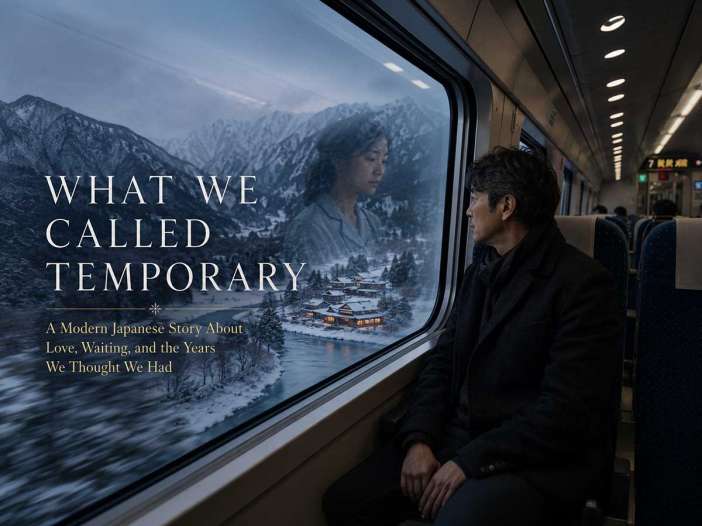
What We Called Temporary is a modern Japanese story inspired by the emotional questions beneath Yasunari Kawabata’s Snow Country. Set between Tokyo and a snow-covered town in Niigata, it follows Takashi Mori, a married 52-year-old creative director who begins returning to a small ryokan run by Aki Sato.
Takashi tells himself the trips are temporary.
Aki once told herself she would return home for only one year.
Mio, a young regional nurse, tells herself that caring for everyone else is simply who she is.
Years quietly gather around these explanations.
The story asks a question that becomes more unsettling with age:
What if the greatest danger is not making the wrong choice, but waiting so long for certainty that time makes the choice for us?
This is a story about love, marriage, caregiving, aging parents, regional Japan, regret, and the ordinary decisions that slowly become a life.
Above all, it asks whether loving someone is enough—or whether we must eventually ask what that love is making of us.
Chapter 1 — The Reflection in the Train Window
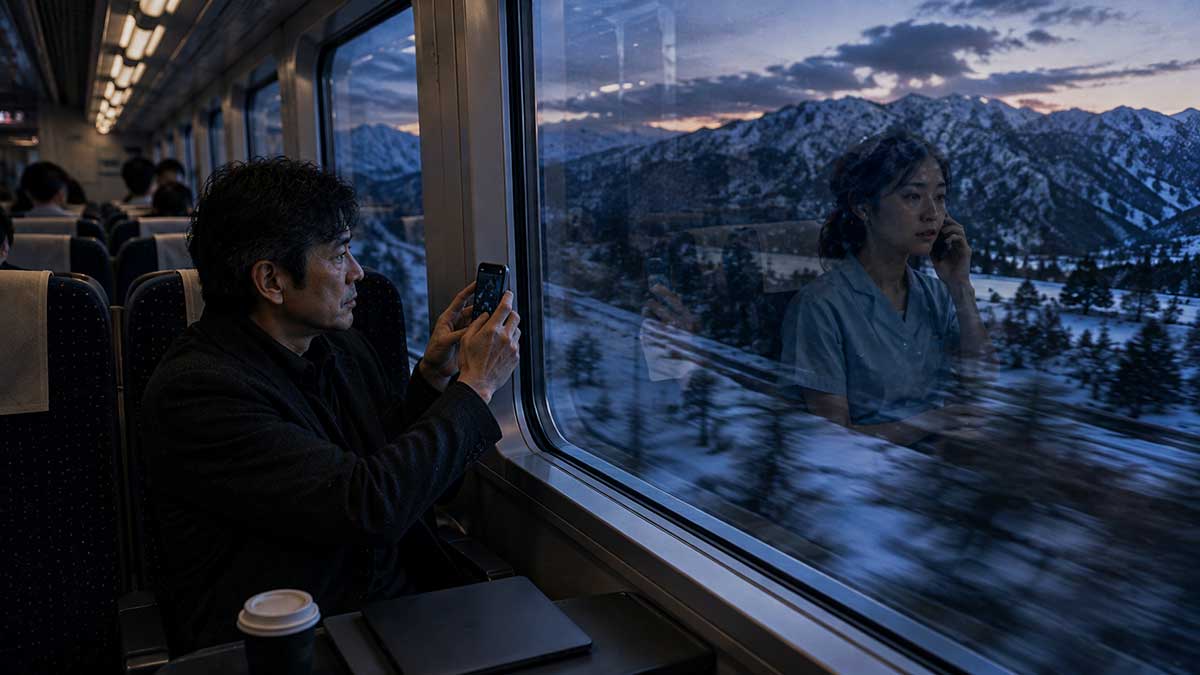
The woman in the window looked as if she were crying.
Takashi Mori noticed her somewhere after Takasaki.
He had been trying not to work.
That was one of the reasons he had taken the train.
For twenty-seven years, Takashi had been good at working in places where other people could not. Airport lounges. Taxis. Hospital waiting rooms. His daughter's piano recitals. Once, during his father's funeral reception, he had gone upstairs to approve a campaign headline while relatives drank sake below.
At fifty-two, he had acquired the ability to divide his attention so completely that nobody could tell which half of him they were speaking to.
His laptop was closed now.
His phone was in his hand.
He told himself that was different.
Outside the Shinkansen window, the late-afternoon landscape had begun losing color. Mountains darkened against a winter sky. Patches of snow appeared beside houses and then vanished.
Takashi raised his phone.
He liked photographing transitions.
City becoming countryside.
Rain becoming snow.
Afternoon becoming evening.
He framed the mountains through the glass.
That was when he saw her.
A young woman's face floated over the landscape.
Dark hair tied loosely behind her head.
Pale hospital scrubs beneath a winter coat.
Her eyes seemed wet.
For several seconds Takashi forgot that he was looking at a reflection.
Then he heard her voice behind him.
“No, please don't apologize.”
Takashi lowered the phone slightly.
The woman sat two rows back across the aisle.
She was speaking quietly through wireless earbuds.
“I was there when he woke up.”
Pause.
“Yes.”
Another pause.
“No, he wasn't alone.”
Her reflected face moved across the snow.
Takashi could not hear the person on the other end.
“I told him you were coming tomorrow.”
A long silence.
Then:
“He understood.”
The woman's eyes closed.
Takashi looked away.
He had photographed her without intending to.
He opened the picture.
Mountains.
Snow.
The faint interior of the train.
And her face.
It was a beautiful photograph.
He almost deleted it.
Instead, he locked the screen.
His wife had asked that morning why he needed to go.
“Didn't you just come back from Osaka?”
“That was work.”
“And this?”
“Work.”
Emi had looked at him over her coffee.
They had been married twenty-four years, which was long enough for one-word answers to develop histories.
“What kind?”
“I'm trying to finish the hotel campaign somewhere quiet.”
“You have an office.”
“The office isn't quiet.”
“You have a room upstairs.”
He had smiled.
“You're making this difficult.”
“No,” Emi had said. “I'm asking what you're doing.”
That had irritated him more than it should have.
Their daughter Hana was studying in Vancouver. For the first time since she was born, the house in Setagaya belonged entirely to Takashi and Emi.
Takashi had expected this to feel like freedom.
Instead, the house seemed to have become larger.
Two people could live surprisingly far apart in the same three-bedroom home.
The train entered the tunnel.
The window went black.
For an instant Takashi saw himself.
Gray beginning at the temples.
Expensive glasses.
Dark wool coat.
A face that still looked younger than fifty-two when photographed from the right angle.
Behind his reflection, the young nurse was still speaking.
Then the train emerged.
Snow.
Not patches now.
Snow everywhere.
Roofs.
Fields.
Trees.
Roads.
The entire world had changed during the darkness.
Takashi stared.
He had seen snow hundreds of times.
Still, something about arriving inside it felt different.
His phone vibrated.
EMI:
Call me when you get there.
He typed:
Will do.
Then another message appeared.
His creative director in Tokyo.
Then an account manager.
Then a client.
Takashi turned the phone face down on the tray.
For several minutes, he did nothing.
The woman got off at the same station.
Takashi saw her on the platform ahead of him, carrying a canvas bag and a small suitcase.
Snow blew beneath the station roof.
She stopped beside an elderly man struggling with the ticket gate.
Without hesitation, she put down her suitcase and helped him.
Takashi walked past.
Outside, a woman held a small white board.
MORI-SAN
She was wearing a dark green coat and snow boots.
Takashi approached.
“Mori?”
She looked up.
“You're taller than your booking profile.”
Takashi laughed.
“I didn't realize my booking profile had a height.”
“It doesn't. That's why I guessed wrong.”
She bowed lightly.
“Aki Sato. My mother owns the ryokan.”
“Thank you for coming.”
“You're lucky.”
“Why?”
“The road almost closed.”
Takashi looked at the snow.
“This much?”
Aki followed his gaze.
“You're from Tokyo.”
It was not a question.
Her car was small, old, and extremely warm.
A shamisen case occupied most of the back seat.
Takashi placed his suitcase beside it.
“You play?”
“When necessary.”
“What does that mean?”
“It means guests from Tokyo like shamisen when it snows.”
He smiled.
“You don't?”
“I like shamisen.”
She pulled into traffic.
“I don't always like guests from Tokyo.”
Takashi laughed.
Aki didn't.
Then, after three seconds, she did.
The ryokan was smaller than it had looked online.
Takashi had selected it partly for that reason.
No luxury branding.
No enormous lobby.
No international hotel group pretending cedar walls had existed for four hundred years.
The entrance smelled faintly of tatami, heater fuel, and something simmering in the kitchen.
An elderly woman behind the reception desk stood when they entered.
“My mother,” Aki said.
Her mother bowed.
Takashi bowed more deeply.
Aki handed him a form.
“Dinner is at seven. Bath downstairs. Breakfast seven-thirty to nine.”
“Wi-Fi?”
Aki pointed upward.
The password was handwritten on a wooden plaque.
SNOW2024.
“2024?”
“I haven't changed it.”
“Security risk.”
“If somebody comes all the way here to steal our Wi-Fi, they deserve it.”
His room looked over the back of the property.
Beyond a narrow river stood dark cedar trees covered in snow.
Takashi set his laptop on the low table.
Then his charger.
Phone.
Notebook.
Reading glasses.
Portable battery.
Earbuds.
He had reconstructed Tokyo in approximately ninety seconds.
He sat.
Opened the laptop.
Looked at the screen.
Closed it.
Outside, snow fell without needing him.
He stood at the window for nearly ten minutes.
Then reached for his phone.
Dinner was served in a small room downstairs.
There were only six guests.
A retired couple from Yokohama.
Two Australian tourists.
Takashi.
And a young man who spent most of dinner filming his food.
Aki carried dishes from the kitchen.
Her mother explained each course.
Halfway through dinner, Aki disappeared.
Several minutes later, she returned wearing a kimono.
She carried the shamisen.
The Australians immediately raised their phones.
So did the young man.
Takashi reached for his.
Then stopped.
He wasn't sure why.
Aki sat.
Adjusted the instrument.
And began.
She had joked about playing for tourists.
There was nothing joking in the way she played.
Her face changed.
Not dramatically.
It simply became concentrated.
Takashi knew almost nothing about shamisen.
He knew performance.
He had spent his career identifying the moment when somebody stopped presenting and became absorbed.
Aki was there.
Outside, snow pressed against the dark windows.
Inside, nobody spoke.
When she finished, the Australians applauded enthusiastically.
The young man checked his video.
Takashi kept looking at Aki.
She noticed.
For some reason, he looked away first.
At 10:40 that night, Takashi came downstairs looking for water.
Aki was kneeling behind the reception counter surrounded by invoices.
She wore sweatpants and a gray sweatshirt.
The kimono was gone.
So was the woman from the performance.
Or perhaps this was the woman the performance had hidden.
“Can't sleep?” she asked.
“Water.”
She pointed toward the kitchen.
He found a glass.
When he returned, she was staring at a spreadsheet.
“Problem?”
“Always.”
He sat on the opposite side of the counter.
“What kind?”
“January.”
“What happens in January?”
“January happens.”
He smiled.
She rotated the laptop.
Occupancy.
Food costs.
Heating.
Payroll.
Booking commissions.
Repairs.
Takashi scanned the numbers.
“This place is expensive to run.”
Aki looked at him.
“You sound surprised.”
“I hadn't thought about it.”
“No one does.”
She closed the laptop.
“They see snow.”
Takashi looked toward the dark entrance.
“You grew up here?”
“Mostly.”
“Never left?”
Aki laughed.
“I lived in Tokyo for eleven years.”
“Really?”
“Advertising.”
Takashi looked at her again.
“Agency?”
“Small one. Ebisu.”
“What did you do?”
“Account management.”
“What happened?”
“My father died.”
Her voice remained ordinary.
“My mother couldn't run this alone. I came back.”
“When?”
“Eight years ago.”
Takashi did the arithmetic.
“You've been here eight years?”
“Yes.”
“I thought you said you came back to help.”
“I did.”
“For eight years?”
Aki smiled.
“No.”
She gathered the invoices into a stack.
“I came back for one year.”
Something about the sentence stayed with him.
Upstairs, Takashi called Emi.
“How is it?” she asked.
“Beautiful.”
“Snow?”
“Everywhere.”
“Did you work?”
“A little.”
Emi laughed.
“What?”
“You traveled three hours to work a little?”
“I'll work tomorrow.”
There was silence.
Then Emi said:
“Hana called.”
“How is she?”
“You could call her.”
“I will.”
“You said that Sunday.”
“I've been busy.”
Another silence.
Takashi looked through the window.
Snow continued falling over the river.
“Emi?”
“Yes?”
“Were you ever sorry we stayed in Tokyo?”
The question surprised both of them.
“What?”
“Nothing.”
“No. You asked.”
“I was just thinking.”
“About what?”
Takashi watched snow collect on the railing.
“I don't know.”
Emi waited.
He could have tried.
Instead he said:
“I should sleep.”
“Okay.”
“Good night.”
“Good night.”
Neither said I love you.
Neither noticed anymore.
Before bed, Takashi opened the photograph from the train.
The young nurse's reflection floated over the mountains.
He enlarged it.
Something bothered him.
He had thought she was crying.
Now he wasn't sure.
Perhaps she had simply been tired.
Perhaps he had turned exhaustion into sadness because sadness made a better photograph.
Takashi deleted the picture.
Then he went to Recently Deleted.
He looked at it once more.
And left it there.
Chapter 2 — Just Until Spring
Aki woke at 5:17.
Her alarm was set for 5:30.
She had not needed it in years.
The first thing she did every morning was look outside.
Not because the snow was beautiful.
Because snow meant work.
Twenty centimeters.
Maybe twenty-five.
She dressed quietly.
Her mother was already awake.
“You don't have to do the front,” Aki said.
“I know.”
“You said that yesterday.”
“I know.”
“Then why are you putting on boots?”
Her mother ignored her.
At sixty-nine, Keiko Sato had perfected the parental technique of treating adult children as temporary management.
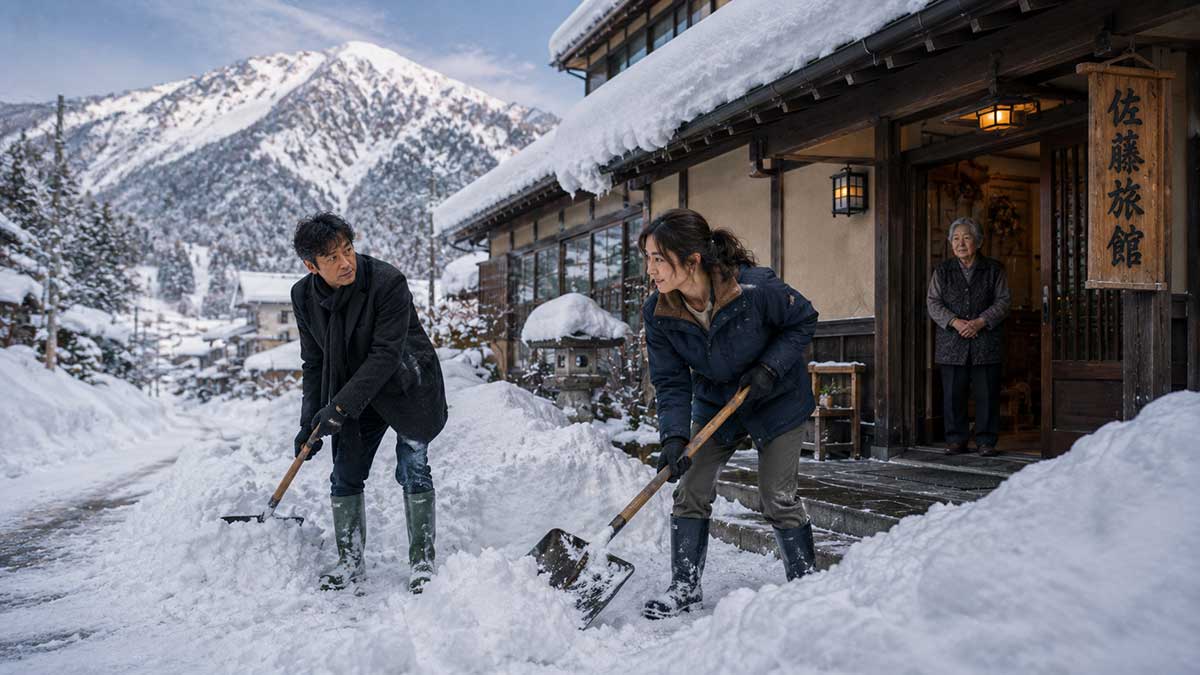
Aki opened the front door.
Cold air entered.
The world outside was white.
She stood there for a second.
It was beautiful.
She hated that it was beautiful.
Then she picked up the shovel.
At 6:05, Takashi came downstairs.
He wore a navy sweater and looked rested in a way Aki found mildly offensive.
He stood at the entrance watching her.
“Good morning.”
Aki kept shoveling.
“Good morning.”
“That's a lot.”
“Yes.”
“Do you do this every morning?”
“No.”
She pushed another load aside.
“Only when it snows.”
He laughed.
Then realized she wasn't joking.
“Can I help?”
Aki looked at his shoes.
“No.”
“Why?”
“Those cost more than our snowblower.”
He looked down.
“You can tell?”
“I worked in advertising.”
He disappeared inside.
A minute later he returned wearing borrowed rubber boots.
Aki stared.
“My mother's?”
“She gave them to me.”
“They're too small.”
“They're extremely too small.”
She handed him a shovel.
“Good.”
He lasted eleven minutes.
Aki timed him without appearing to.
At minute seven, he removed his coat.
At minute nine, he stopped speaking.
At minute eleven, he leaned on the shovel.
“This is terrible.”
Aki nodded.
“Beautiful, isn't it?”
Takashi started laughing.
She did too.
They ate breakfast in the kitchen after the guests had finished.
Keiko placed rice, miso soup, grilled salmon, and pickles in front of Takashi.
“I already ate.”
Keiko ignored him.
He ate again.
Aki watched.
“My mother thinks men become ill if they go three hours without rice.”
Keiko said something from the stove.
Takashi looked toward Aki.
“What did she say?”
“That you look thin.”
“I've never been called thin.”
“You have now.”
Keiko brought him more rice.
Takashi opened his laptop after breakfast.
Aki did not see him again until noon.
Then he appeared at reception.
“Is there somewhere I can walk?”
“Outside.”
He smiled.
“I meant somewhere worth seeing.”
Aki looked at him.
“This is why we don't like Tokyo people.”
She drew a route anyway.
A river.
Small shrine.
Closed elementary school.
Hill overlooking town.
“Don't go past here.”
“Why?”
“Snow.”
“There is snow everywhere.”
“Different snow.”
He stared at the map.
Aki sighed.
“Avalanche risk.”
“Oh.”
“Tokyo people.”
He returned two hours later with red cheeks and wet socks.
“Your school closed?”
Aki looked up.
“What?”
“The elementary school.”
“Six years ago.”
“There were children's drawings inside.”
“They never cleaned everything out.”
“How many students?”
“At the end? Nineteen.”
“In the whole school?”
“Yes.”
Takashi looked toward the street.
“What happened to them?”
“They grew up.”
“I mean—”
“I know what you mean.”
Aki returned to the reservation screen.
“Most families moved.”
Takashi stood there.
“Doesn't that bother you?”
She looked up.
“What kind of question is that?”
“Sorry.”
“No. I'm curious.”
Aki folded her arms.
“When people from Tokyo come here, they always ask questions like that.”
“What questions?”
“Doesn't it make you sad? Aren't you worried the town is disappearing? Isn't it lonely?”
Takashi said nothing.
“You know what nobody asks?”
“What?”
“Did the boiler survive last winter?”
He smiled.
She didn't.
“Did the supermarket stop carrying something we need? Can the hospital keep enough nurses? Who is going to repair the roof? Can we afford kerosene?”
She pointed toward the window.
“You see disappearance.”
Aki returned to the computer.
“We see Thursday.”
That afternoon, Takashi worked.
Really worked.
At 5:30, his Tokyo team joined a video meeting.
He listened to three people argue about whether a luxury hotel advertisement should say “timeless” or “eternal.”
“Takashi-san?”
He looked at the screen.
“Sorry?”
“Which do you prefer?”
He glanced toward the window.
Aki was outside dragging trash bags through snow.
“Neither.”
Silence.
His copywriter laughed nervously.
“What do you want?”
Takashi looked again at Aki.
“Something less dishonest.”
At dinner, Aki did not play shamisen.
Takashi found himself disappointed.
He wondered why.
At ten, he came downstairs again.
This time he brought two cans of beer from the vending machine.
Aki was folding towels.
He placed one beside her.
“I don't drink with guests.”
“I'm not asking as a guest.”
Aki looked at the beer.
“What are you asking as?”
Takashi did not have an answer.
She took it anyway.
They sat on the floor beside piles of towels.
“Why did you leave advertising?” Takashi asked.
“I told you.”
“Your father.”
“Yes.”
“But you could have gone back.”
Aki opened the beer.
“I was going to.”
“What happened?”
“Spring.”
He waited.
“Then summer.”
She folded a towel.
“My mother said she could manage by autumn.”
Another towel.
“Then one employee left.”
Another.
“Then the roof needed repairs.”
Another.
“Then my mother fell.”
Takashi watched the pile grow.
“Then?”
Aki smiled.
“Then eight years.”
“Do you regret it?”
She looked at him.
“You ask very expensive questions for someone drinking ¥300 beer.”
“Sorry.”
“No.”
“You don't regret it?”
“No. I mean, don't apologize.”
She took a drink.
“Of course I regret it sometimes.”
“What do you miss?”
“Convenience stores at two in the morning.”
“We have those.”
“Thai food.”
“We have that too.”
“People who don't know my mother.”
Takashi laughed.
Aki didn't.
Then he understood.
“What did you want to do?”
Aki took another drink.
“When?”
“Before.”
“Before what?”
“Before you came back.”
She thought.
“I don't remember.”
“That can't be true.”
“It isn't.”
She folded another towel.
“I just don't tell guests.”
Takashi leaned against the wall.
“I wanted to be a photographer.”
Aki looked at him.
“You're an advertising executive.”
“Creative director.”
“Same disease.”
He laughed.
“When?”
“University.”
“What happened?”
“I was good at advertising.”
“That doesn't answer the question.”
Takashi looked at her.
For the first time, Aki smiled as if she had caught him doing something.
“You ask expensive questions too.”
He opened his beer.
“I got a job.”
“Then?”
“I got promoted.”
“Then?”
“I got married.”
“Then?”
“Hana was born.”
“Then?”
Takashi stared at the can.
“Then twenty years.”
Aki stopped folding.
For a moment neither spoke.
Then she laughed.
Not at him.
At the symmetry.
Takashi laughed too.
“My daughter is nineteen,” he said.
“University?”
“Vancouver.”
“You miss her?”
“Yes.”
“You call her?”
Takashi hesitated.
Aki looked at him.
“Oh.”
“What?”
“You're one of those fathers.”
“What does that mean?”
“You miss people privately.”
He frowned.
“What's wrong with that?”
“Nothing.”
She returned to the towels.
“If they can read minds.”
His phone vibrated.
Emi.
He looked at the screen.
Did not answer.
Aki saw the name.
She continued folding.
“Your wife?”
“Yes.”
“You should answer.”
“I'll call later.”
Aki folded another towel.
Takashi put the phone face down.
The room felt different.
Neither mentioned it.
That was the first boundary.
Nothing happened.
That was why neither of them recognized it.
The following morning, Takashi was supposed to return to Tokyo.
Snow delayed several trains.
At breakfast he checked the railway app.
“Could be two hours,” he said.
Aki poured tea.
“Could be six.”
“I have meetings tomorrow.”
“There will probably be trains by tonight.”
Takashi looked outside.
Snow covered the road.
Then he looked at the reservation calendar behind the desk.
“My room booked tonight?”
Aki checked.
“No.”
Takashi nodded.
“I'll stay.”
She looked at him.
“You don't have to.”
“I know.”
“The trains will probably run.”
“I know.”
Aki waited.
Takashi smiled.
“I can work here.”
At 9:15, he messaged his office.
Snow delay. Staying another night.
Then Emi.
Train situation bad. Coming back tomorrow.
Her reply came quickly.
Okay.
Nothing else.
Takashi stared at the word.
He could not decide whether he felt relieved or disappointed.
That afternoon, the trains resumed.
Aki saw the notification before Takashi did.
She found him working near the window.
“Shinkansen is running.”
Takashi looked at his laptop.
Then outside.
“Good.”
Aki waited.
“You can make the 4:20.”
“I already paid for the room.”
“You haven't.”
He looked at her.
She knew.
He knew she knew.
Neither moved.
At six, Takashi walked outside.
Snow had stopped.
The town was almost painfully quiet.
Aki stood near the entrance sweeping powder from the steps.
“You missed your train,” she said.
Takashi looked toward the station.
“I know.”
She continued sweeping.
“Accident?”
“No.”
“Emergency?”
“No.”
Aki stopped.
“Then why are you still here?”
Takashi looked at her.
He could have said:
I like talking to you.
He could have said:
I don't want to go home yet.
He could have said:
Something about this place makes me feel like a person I thought I'd lost.
Instead he looked at the snow.
“Just until tomorrow.”
Aki studied him.
Then she smiled.
Not warmly.
Not coldly.
Almost knowingly.
“That's how it starts.”
Takashi looked at her.
“How what starts?”
Aki opened the door.
“Eight years.”
She went inside.
Takashi remained outside.
Above him, snow rested heavily on the roof.
Behind him, the station lights glowed.
His train was already gone.
For the first time in years, nobody had prevented Takashi Mori from going home.
He had simply chosen not to.
And somewhere inside him, quietly enough that he could still pretend not to hear it, something had begun.
Chapter 3 — The Life Between His Visits
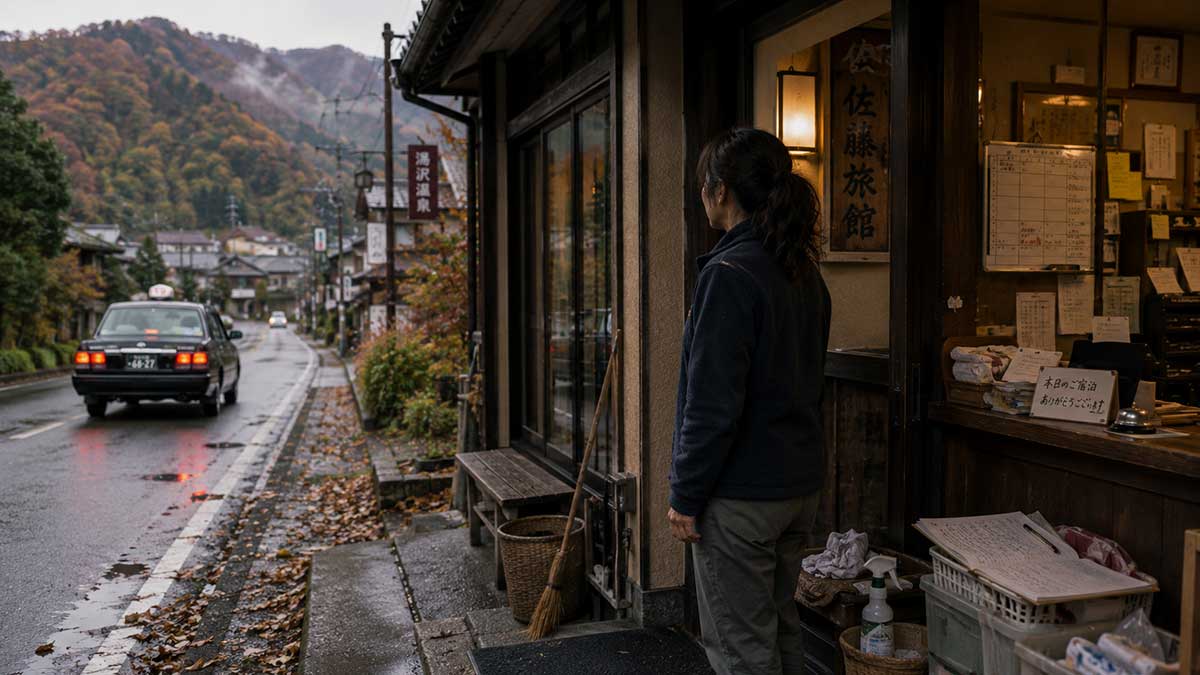
Takashi came back three weeks later.
Aki told herself she was not surprised.
That was a lie.
She had checked the booking system twice after seeing his name.
Then she had checked whether Room 204 was available.
Then she had moved another guest.
Only afterward did she realize what she had done.
“Why did you move them?” her mother asked.
“Plumbing.”
“There is nothing wrong with the plumbing.”
“There could be.”
Keiko looked at her daughter for several seconds.
Aki returned to the computer.
Her mother said nothing.
That was worse.
Takashi arrived on Friday afternoon.
No snow delay.
No client emergency.
No excuse.
Aki stood behind the reception desk when he entered.
“You found us again.”
Takashi smiled.
“I checked the map.”
“Tokyo people are improving.”
He placed his suitcase beside the desk.
“Same room?”
Aki looked at him.
“Why?”
“Good view.”
“Of what?”
“The river.”
Aki handed him the key.
“You barely looked at the river.”
Takashi took it.
“Maybe I came back to try again.”
Neither of them said what else he might be trying again.
At first, his visits seemed accidental.
February.
Then March.
Then June.
There was no snow in June.
That surprised him more than it should have.
Without snow, the town looked smaller.
Concrete appeared.
Parking lots.
Rust.
Old signs.
Buildings that winter had softened became ordinary.
Takashi stood outside the ryokan looking at a cracked wall.
Aki caught him staring.
“Disappointed?”
“No.”
“You look disappointed.”
“I was just thinking.”
“Snow hides a lot.”
He looked at her.
“So does distance.”
Aki smiled.
“You're becoming philosophical.”
“Occupational hazard.”
“You sell hotel rooms.”
“I sell feelings about hotel rooms.”
“Much worse.”
Their conversations began accumulating.
Not dramatically.
A coffee after guests left.
A walk to the convenience store.
Beer behind reception.
Ten minutes became an hour.
An hour became midnight.
Aki learned that Takashi hated natto but pretended to like it in business breakfasts.
That he had stopped playing guitar at twenty-three.
That his father had wanted him to join the family printing business.
That he had not visited his father's grave in almost a year.
Takashi learned that Aki slept with the television on when her mother was in the hospital.
That she hated when travel magazines called the town “untouched.”
That she had once almost married someone in Tokyo.
He asked what happened.
“He wanted me to come back.”
“To Tokyo?”
“Yes.”
“Why didn't you?”
Aki looked toward the front desk.
“My mother needed me.”
“That was eight years ago.”
“I know.”
He wanted to ask something else.
Did the man wait?
Did she still think about him?
Would she have married him if her father had lived?
Instead he asked:
“What was his name?”
Aki looked at him.
“You don't get everything.”
By August, Takashi no longer stayed only when he had work nearby.
He created reasons.
Remote strategy days.
Photography research.
Regional hospitality research.
Once, he told his office he was meeting a client in Niigata.
There was no client.
The lie bothered him for about twelve minutes.
Then the train entered the mountains.
Aki noticed that his visits divided time.
Before Takashi.
Takashi.
After Takashi.
That frightened her.
The days before he arrived became preparation.
She cleaned Room 204 herself.
She bought the beer he liked.
She checked whether the restaurant near the river had reopened.
She told herself she did these things for any repeat guest.
Then he left.
And the days afterward had a strange flatness.
Not sadness exactly.
More like someone had lowered the volume.
For Takashi, the relationship worked differently.
He left and carried the feeling with him.
Aki remained psychologically available inside his memory.
He could return to Tokyo knowing she existed.
That was enough to make Tokyo feel less final.
Sometimes he would be sitting beside Emi watching television and think about the river behind the ryokan.
He would remember Aki saying something sarcastic.
He would smile.
Emi would ask:
“What?”
“Nothing.”
And he meant it.
Nothing had happened.
Nothing he could name.
Nothing he could confess.
That was part of the danger.
In September, Takashi took Aki to dinner.
Not at the ryokan.
A small restaurant fifteen minutes away.
“I know this place,” Aki said.
“I assumed.”
“You're taking me to a restaurant I've been to forty times.”
“Then pretend.”
“Pretend what?”
“That I'm showing you.”
She looked at him.
“That sounds like your entire relationship with this town.”
Takashi laughed.
Then realized she was not completely joking.
They sat at the counter.
Sake came.
Then grilled fish.
Then more sake.
Takashi asked about Tokyo again.
“You really never want to go back?”
Aki looked at her cup.
“Sometimes.”
“Why don't you?”
“My mother.”
“She is doing better.”
“For now.”
“The ryokan?”
“Obviously.”
“You could hire someone.”
“With what money?”
He paused.
“You could sell.”
Aki looked up.
“To whom?”
“I don't know.”
“Exactly.”
He stopped.
“You do this,” she said.
“What?”
“Turn every impossible thing into a decision someone hasn't been brave enough to make.”
Takashi frowned.
“I was trying to help.”
“I know.”
“Then why are you angry?”
Aki looked at him for a long time.
“Because you can always leave.”
Takashi did not answer.
The owner placed another dish between them.
Neither touched it.
Later they walked back through light rain.
No snow.
No cinematic landscape.
Just wet pavement and vending machines.
Takashi liked that.
He liked being with her when the town was ugly.
That seemed meaningful.
He almost told her.
Instead:
“Are you cold?”
“No.”
At the ryokan entrance, Aki turned.
“Your train is at nine tomorrow?”
“Yes.”
“You'll make it?”
“Yes.”
She nodded.
“Good.”
Takashi felt disappointed.
That irritated him.
“Why good?”
Aki looked at him.
“Because you have a life.”
The sentence sounded simple.
It did not feel simple.
The next morning, Takashi left.
Aki watched the taxi disappear.
Then Room 204 needed cleaning.
A guest had spilled coffee on a futon.
The boiler made a noise.
Her mother needed a prescription.
A tour company called asking for twenty rooms they did not have.
Takashi was on the Shinkansen thinking about her.
Aki was unclogging a bathroom drain.
This was the difference.
He experienced the relationship in visits.
She experienced the life between them.
In October, Takashi sent:
Coming next Thursday.
Aki stared at the message.
Her first feeling was happiness.
Her second was anger at the first.
She typed:
Okay.
Deleted it.
Typed:
Room 204 is booked.
That was true.
He replied:
Any room.
She stared again.
Then:
Why are you coming?
Three dots appeared.
Stopped.
Appeared again.
Then:
Do I need a reason?
Aki looked toward the empty lobby.
She typed:
Maybe.
His reply came ten minutes later.
I miss talking to you.
Aki read it three times.
For seven months, they had carefully avoided sentences like that.
She set the phone down.
Her mother called from the kitchen.
“Aki?”
“Yes.”
“Delivery.”
“Coming.”
She put the phone in her pocket.
It vibrated again.
She did not look.
Not yet.
That evening, Mio came into the ryokan.
Aki knew her from town.
Everyone knew Mio.
If an elderly resident missed a hospital bus, Mio found someone to drive them.
If a coworker had a sick child, Mio covered the shift.
If her father forgot groceries, Mio bought them.
If someone said, “I hate to ask,” Mio usually said yes before hearing the request.
She stood near the desk holding a paper bag.
“Your mother's medicine.”
Aki blinked.
“I was supposed to pick that up.”
“She called.”
“Of course she did.”
Mio smiled.
“It's okay.”
Aki looked at her.
“You came after work?”
“Yes.”
“You live twenty minutes the other direction.”
“It's fine.”
Aki took the bag.
“No.”
Mio looked confused.
“What?”
“Stop saying that.”
“Saying what?”
“It's fine.”
Mio laughed.
“It is.”
Aki watched her.
For some reason, Takashi's message entered her mind.
I miss talking to you.
Aki looked at Mio's tired face.
“Do you ever tell people no?”
Mio smiled.
“When necessary.”
“That means no.”
“Probably.”
Mio turned to leave.
“Mio.”
She looked back.
“What do you want?”
Mio seemed puzzled.
“Right now?”
“In general.”
She laughed.
“What kind of question is that?”
Aki almost laughed too.
Then she realized.
It was exactly what she had once said to Takashi.
That night, Aki finally answered him.
You can come.
She waited.
Then sent another message.
But don't come here only because you don't want to be somewhere else.
She regretted sending it immediately.
Takashi did not reply for twenty-two minutes.
Then:
Fair.
That one word bothered her more than an argument would have.
Two days later, Emi found the hotel confirmation.
Not because she was searching.
Takashi had left his tablet open.
She saw the email notification.
SATO RYOKAN — RESERVATION CONFIRMED.
She stared at it.
Then opened the calendar.
January.
February.
March.
June.
August.
September.
October.
The same place.
Emi sat alone at the dining table.
She did not immediately think:
Affair.
She thought something stranger.
He has somewhere he goes.
And for the first time, she realized that she did not know where her husband went emotionally when he left the room.
Chapter 4 — What Have You Spent Yours On?
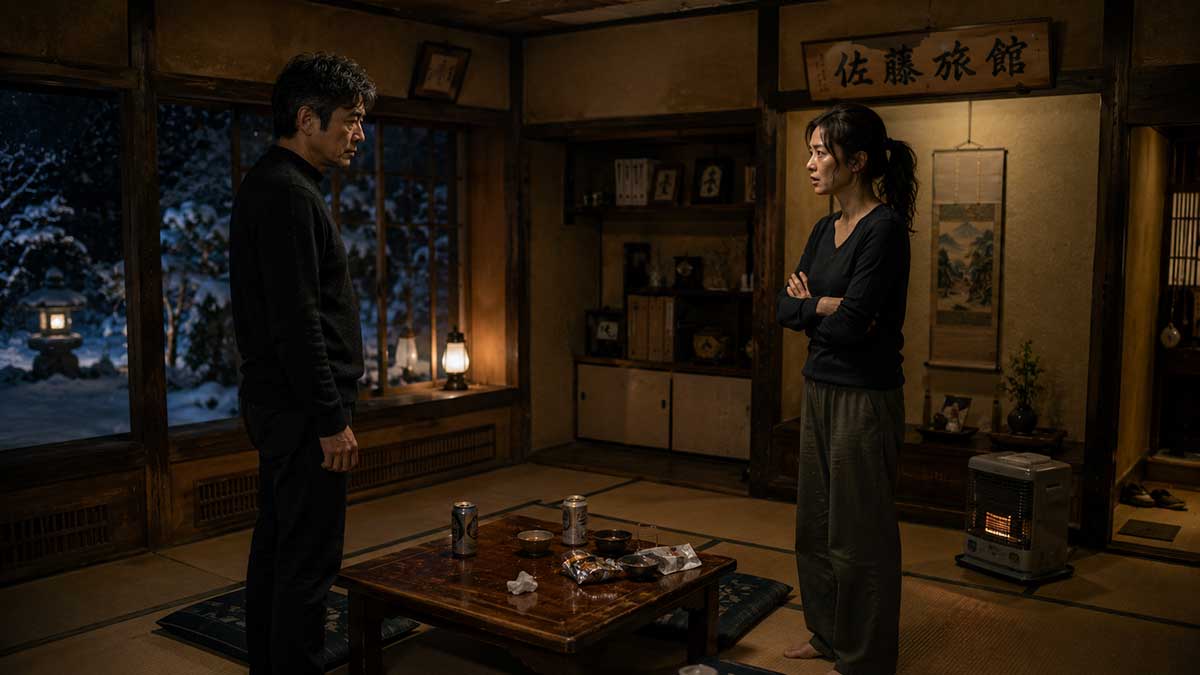
Takashi arrived in November.
The first snow had not yet fallen.
The mountains were brown.
The town seemed to be waiting for winter.
Aki was not at the station.
He took a taxi.
When he entered the ryokan, Keiko was at reception.
“Aki?”
“Hospital.”
Takashi's stomach tightened.
“Her mother?”
Keiko stared at him.
Then laughed.
“I am her mother.”
“Right. Sorry.”
“My sister.”
Takashi nodded.
“Is she okay?”
“Probably.”
Keiko looked at his suitcase.
“You come often.”
Takashi smiled.
“So I've been told.”
Keiko did not smile back.
Aki returned after nine.
Takashi was working downstairs.
She stopped when she saw him.
“You're here.”
“You knew I was coming.”
“Knowing is different from seeing.”
The sentence stayed between them.
Then Aki took off her coat.
“My aunt had chest pain. She's fine.”
“Good.”
“You eat?”
“Yes.”
“Drink?”
“Not yet.”
“Good.”
She went to the vending machine and bought two beers.
They sat in the dining room.
No guests.
November was quiet.
Takashi told her about a new project.
Luxury accommodation.
Regional tourism.
“Your company would love this place,” he said.
Aki looked at him.
“My company?”
“Sorry. Client.”
“What would they do?”
“Renovate an old property. High-end rooms. International market.”
“How much?”
“Maybe ¥120,000 a night.”
Aki laughed.
“What?”
“Nothing.”
“What?”
“You'll sell people the countryside after the people who live here can no longer afford it.”
Takashi frowned.
“That isn't fair.”
“Probably not.”
“I actually think investment could help towns like this.”
Aki drank.
“Of course.”
“I'm serious.”
“So am I.”
“You can't preserve everything exactly as it is.”
“I know.”
“Some properties are dying.”
“I know.”
“Some should close.”
Aki put down the can.
“You really like that word.”
“What word?”
“Dying.”
Takashi paused.
Aki looked at him.
“The town is dying.”
“The ryokan is dying.”
“The school is dead.”
“Everyone here is old.”
She leaned back.
“You say these things like you're describing the weather.”
“I didn't mean—”
“I know.”
There it was again.
I know.
Takashi looked around.
The old dining room.
Scratched wood.
A stain in the ceiling.
A heater that probably cost too much to run.
“You can't keep doing this forever.”
Aki's face changed.
“Doing what?”
“This.”
She waited.
“Working every day to keep a place going that may not survive anyway.”
Silence.
Takashi heard the sentence after he had said it.
Aki looked at him.
“You think I'm wasting my life.”
“No.”
“You do.”
“I think you're sacrificing a lot.”
“That's nicer.”
“I mean it.”
“For something hopeless?”
“I didn't say hopeless.”
“You didn't have to.”
Takashi leaned forward.
“Aki, you're thirty-six.”
“Thank you for the update.”
“You had a career.”
“I have one.”
“You know what I mean.”
“No. Explain it.”
He hesitated.
“You could do more.”
Aki stared at him.
“More than what?”
“More than spending every day trying to keep this place alive.”
The room went very quiet.
Then Aki smiled.
Not kindly.
“You know what's interesting?”
Takashi waited.
“You talk about my life like it's a building you might acquire.”
“What?”
“You look at it.”
Find the inefficient parts.
Calculate what has value.
Decide what should be cut.”
“Aki—”
“You think because you're worried about me, you're not judging me.”
“I am worried about you.”
“I know.”
She stood.
“That's what makes it worse.”
Takashi stood too.
“I don't want you to wake up at fifty and realize you gave everything to something that disappeared.”
Aki turned.
There it was.
The real sentence.
She looked at him for a long time.
Then:
“Maybe I will.”
Takashi said nothing.
Aki continued.
“Maybe this place closes.”
“Maybe my mother dies.”
“Maybe nobody wants it.”
“Maybe I wake up and realize I spent twenty years trying to save something that couldn't be saved.”
Her eyes had become wet.
She did not look away.
“But at least I'll know what I spent them on.”
Takashi froze.
Aki stepped closer.
“You keep telling me I'm wasting my life.”
“I never said—”
“What have you spent yours on?”
He stopped.
Aki waited.
Takashi opened his mouth.
Career.
Family.
Marriage.
Hana.
Work.
All obvious answers.
None arrived.
Aki looked at him.
“You're fifty-two.”
He flinched.
“Thank you for the update.”
She did not smile.
“What did you want?”
Takashi stared.
“What?”
“Before the promotions.”
“Before the house.”
“Before your daughter.”
“Before everyone decided you were successful.”
She paused.
“What did you want?”
He felt suddenly angry.
“I don't know.”
Aki nodded.
“Exactly.”
She walked out.
Takashi remained alone.
The beer sat unfinished.
He looked around the dining room.
For the first time, its age did not look picturesque.
It looked expensive.
Heavy.
Real.
He picked up his phone.
Opened the camera.
Then stopped.
Nothing in the room needed photographing.
The next morning, Aki behaved normally.
That was worse.
“Breakfast until nine.”
“Your taxi is eleven-ten.”
“Road may freeze tonight.”
Takashi watched her move through reception.
“Are we okay?”
Aki looked at him.
“What does that mean?”
“You know.”
“No. I don't.”
“Aki.”
She lowered her voice.
“We had an argument.”
“Yes.”
“People survive those.”
Takashi almost smiled.
Then she added:
“Relationships do too, if they know what they are.”
He stared at her.
“What are we?”
Aki asked.
He had wanted this question for months.
Now that it existed, he hated it.
“I don't know.”
Aki looked down.
“Of course.”
Takashi stepped closer.
“I care about you.”
Aki's eyes lifted.
“I know.”
“More than I should.”
“I know.”
“I think about you in Tokyo.”
“I know.”
“I come here because—”
He stopped.
Aki waited.
“Because what?”
Because I love you.
Because I don't want to go home.
Because when I'm here I remember who I used to be.
Because you look at me like there is still time.
He chose none of them.
“I feel different here.”
Aki closed her eyes.
That answer hurt more than he expected.
“When you're here,” she said, “you get to be different.”
Takashi listened.
“You don't have meetings after dinner.”
“You don't have your wife asking where you are.”
“You don't have twenty-four years of marriage sitting across from you.”
“You don't have a daughter noticing which promises you forgot.”
She paused.
“You get snow and beer and conversations at midnight.”
Takashi looked away.
“And me,” Aki said.
He looked back.
“Yes.”
Aki nodded.
“That's what scares me.”
“What?”
“I don't know if you love me.”
Takashi's face changed.
Aki continued.
“I think you might.”
He waited.
“But I don't know if you love me.”
She pointed through the window.
“Or if you love who you are when you're here.”
Takashi had no answer.
His taxi arrived.
The driver waited outside.
Aki handed him his coat.
Takashi did not take it immediately.
“I'll come back.”
Aki looked at him.
“That's what you always say.”
“I mean—”
“I know what you mean.”
She gave him the coat.
“That is the problem.”
On the train, Takashi opened his phone.
He had three messages from work.
One from Hana.
One from Emi.
Emi:
Can we talk tonight?
He stared at it.
Then looked out the window.
The town disappeared.
Mountains.
Tunnels.
Gray sky.
He opened the camera.
Raised the phone.
In the glass, his own face appeared.
For once, he lowered it.
Back in Niigata, Mio sat in the hospital break room.
She had been awake for seventeen hours.
Her coworker Aya stood in the doorway.
“Mio, I'm really sorry.”
Mio looked up.
Aya twisted her hands.
“My son has a fever.”
Mio already knew what was coming.
“Could you cover tonight too?”
The answer rose automatically.
Of course.
Instead, Mio remembered Aki asking:
What do you want?
She looked at Aya.
“I can't.”
Aya blinked.
“What?”
Mio's heart began beating faster.
“I can't tonight.”
“Oh.”
Silence.
Aya looked disappointed.
Mio felt something close to panic.
She nearly reversed herself.
Then:
“I'm sorry.”
Aya nodded.
“No. It's okay. I'll figure it out.”
She left.
Mio sat completely still.
Nothing terrible happened.
The hospital did not collapse.
Aya did not hate her.
Nobody died.
Mio looked at her own hands.
For the first time in years, saying no felt almost like committing a crime.
And almost like breathing.
That night, Takashi sat across from Emi in their kitchen.
She had placed his tablet on the table.
He recognized the reservation email immediately.
Neither spoke.
Finally Emi said:
“How long?”
Takashi looked at her.
“How long what?”
She gave a small laugh.
It contained no humor.
“Don't make me do all the work here too.”
Takashi looked down.
“Her name is Aki?”
His silence answered.
Emi nodded.
“Are you sleeping with her?”
“No.”
The answer came quickly.
It was true.
Emi looked at him.
“Do you love her?”
Takashi could not answer.
Emi's face changed.
That was answer enough.
She sat back.
“Interesting.”
“Emi—”
“No.”
She raised one hand.
“I need one minute where you don't explain yourself.”
Takashi stopped.
Emi looked toward the dark window.
“For years I thought this was just you.”
“What?”
“The distance.”
She touched the table lightly.
“I thought this was your personality.”
“You worked too much.”
“You forgot things.”
“You went quiet.”
“You disappeared into your phone.”
“I told myself: That's Takashi.”
She looked at him.
“Now I find out somewhere else you talk.”
He lowered his eyes.
“Emi.”
“What?”
“I didn't plan this.”
She laughed again.
“Do you think that makes it better?”
“No.”
“Then why say it?”
Takashi had no answer.
Emi studied him.
“You know what makes me angry?”
“What?”
“You keep talking inside your own head about the life you didn't get.”
Takashi looked at her.
She continued.
“The photographer you didn't become.”
“The freedom you didn't have.”
“The feelings you stopped feeling.”
“Your lost youth.”
Her voice remained calm.
“Did it ever occur to you that I had a life I didn't get too?”
Takashi went still.
Emi stood.
“I wanted things.”
He stared at her.
“I gave things up.”
“I got older.”
“I stayed.”
She looked at him.
“You're not the only person who had another life available once.”
Then she walked upstairs.
Takashi remained in the kitchen.
Aki's question returned.
What have you spent yours on?
Then Emi's.
Did it ever occur to you that I had one too?
He sat in the dark for a long time.
For years, Takashi had thought his greatest problem was that he had not chosen the life he truly wanted.
That night, another possibility appeared.
Perhaps the problem was that he had spent decades treating everyone else's choices as background to his own.
And for the first time, the snow country did not feel like an escape waiting for him.
It felt like another place where someone was waiting for him to decide what kind of man he was going to be.
Chapter 5 — The Years We Thought We Had
Takashi did not go back to Niigata for six weeks.
At first he told himself he was giving Aki space.
Then he told himself work had become impossible.
Then he stopped explaining it even to himself.
December became January.
Tokyo turned cold without becoming beautiful.
Emi moved into Hana’s old room.
Not dramatically.
She carried her pillow upstairs one night and did not bring it back.
Takashi noticed the next morning.
He said nothing.
Emi said nothing.
That had become one of their shared skills.
At work, Takashi approved photographs of mountain resorts.
Snow.
Steam.
Wood.
Couples in private baths.
Words like escape, silence, timeless, return to yourself.
He began to hate all of them.
A copywriter placed a headline on the screen:
FIND THE LIFE YOU LEFT BEHIND.
Takashi stared at it.
“Too much?” the copywriter asked.
Takashi closed the deck.
“Maybe.”
He called Hana that night.
She answered from Vancouver.
“Dad?”
“Bad time?”
“No. Just surprised.”
Takashi smiled.
“You're funny.”
“You never call.”
“I call.”
“You react to messages.”
“That counts.”
“It doesn't.”
He looked toward the empty chair across from him.
“How are you?”
Hana hesitated.
“Fine.”
“What?”
“You sound weird.”
“I'm trying to ask.”
She became quiet.
Then laughed softly.
“Okay.”
They talked for forty-three minutes.
At the end, Hana said:
“You should call Mom too.”
Takashi almost said, I live with her.
Instead he said:
“I know.”
In Niigata, Aki’s mother had begun forgetting small things.
Not names.
Not yet.
Dates.
Whether she had already ordered rice.
Whether a guest was arriving Thursday or Friday.
Whether Aki had told her something five minutes earlier.
The first time it happened, Aki ignored it.
The fifth time, she made an appointment.
The doctor used gentle words.
Observation.
Testing.
Early changes.
Nothing definite.
Aki heard only one sentence:
“We should keep watching.”
She had spent eight years watching.
Her father.
Her mother.
The ryokan.
The weather.
Reservations.
Takashi's arrival times.
She was tired of watching things become uncertain.
Takashi finally messaged.
How is your mother?
Aki read it.
She almost wrote:
Why do you know?
Then remembered she had told him about the appointment weeks earlier.
She typed:
Still testing.
He replied:
I'm sorry.
Aki stared at the screen.
Then:
You don't need to be sorry.
Three dots appeared.
Stopped.
Appeared again.
I want to come.
Aki did not answer.
That night, Mio sat beside her father at dinner.
He had left three missed calls on her phone that afternoon.
None had been urgent.
He wanted her to pick up detergent.
Then batteries.
Then his prescription.
Mio had done all three.
Now he was complaining that the fish was cold.
She listened.
Then put down her chopsticks.
“Dad.”
He looked up.
“What?”
“I can't keep doing everything.”
He frowned.
“Everything?”
“This.”
“What is this?”
She almost laughed.
“That is the problem.”
Her father looked offended.
“I never asked you to sacrifice your life.”
Mio stared at him.
“No.”
He continued.
“You chose to stay here.”
That sentence hit harder than he intended.
Mio lowered her eyes.
Her father noticed.
“Mio.”
She stood.
“I know.”
“What?”
“That I chose.”
Her voice was quiet.
“I just didn't notice I was choosing every day.”
She left the table.
The next morning, Mio applied for a six-month emergency-care training program in Yokohama.
She did not tell anyone.
Not yet.
For the first time in years, she made a decision that created inconvenience for other people.
She felt sick for two hours.
Then oddly calm.
Aki began looking at job listings.
She did it at night.
Kyoto.
Kanazawa.
Tokyo.
Nagano.
Hospitality management.
Regional tourism.
Digital marketing.
She did not apply.
She only looked.
That alone felt disloyal.
Her mother had spent thirty-nine years in the ryokan.
Her father had died trying to keep it alive.
Guests returned because Aki remembered which rooms they liked.
She knew which floorboard creaked.
Which boiler valve stuck.
Which supplier gave them three extra days when cash was tight.
Leaving was not one decision.
It was abandoning a thousand invisible responsibilities.
She closed the browser.
Then opened it again.
Takashi came on a Tuesday.
No reservation.
No message.
He stood at the entrance carrying one small bag.
Aki looked at him.
“You can't do this.”
“I know.”
“No, I mean literally. We are full.”
He almost smiled.
“I'll stay somewhere else.”
“Then why are you here?”
Takashi looked tired.
“I wanted to see you.”
Aki closed her eyes.
“That isn't enough anymore.”
He said nothing.
They walked to the river.
Snow along the banks had hardened into gray edges.
Takashi kept his hands in his coat pockets.
Aki looked straight ahead.
“Emi knows.”
Aki stopped.
He did too.
“How much?”
“Enough.”
Aki looked at him.
“You told her?”
“No.”
“Then how?”
“Reservation email.”
Aki laughed once.
Of course.
Not confession.
Not courage.
A notification.
“What did she say?”
“That she had a life too.”
Aki looked away.
“She does.”
“I know.”
“No. I mean really.”
Takashi said nothing.
Aki turned back toward him.
“What do you want me to do with this?”
“I don't know.”
She nodded slowly.
“There it is.”
“What?”
“The answer you keep giving whenever somebody else's life requires something from you.”
“Aki—”
“No.”
Her voice sharpened.
“I don't need you to choose me right now.”
Takashi stared.
“I need you to understand that you have already been choosing.”
He looked toward the river.
“I don't know if I can leave my marriage.”
Aki's face changed.
Not surprise.
Something closer to exhaustion.
“I didn't ask you to.”
“I know.”
“Then why are you answering a question I didn't ask?”
Takashi looked at her.
Aki continued.
“I spent a year asking myself whether you loved me.”
He swallowed.
“Then I spent another year asking whether you would ever choose me.”
She shook her head.
“I don't think either question matters anymore.”
“What matters?”
Aki looked at him for a long time.
Then:
“What is loving you making of me?”
He went still.
Aki's eyes filled.
“I don't like the answer.”
Takashi did not move.
“I check my phone too much.”
“I plan around your visits.”
“I get angry at days that should have nothing to do with you.”
“I tell myself I am independent because I never asked you for anything.”
She laughed bitterly.
“But I've been asking without words for years.”
Takashi looked broken.
“I never wanted that.”
“I know.”
“That matters.”
“Some.”
“Only some?”
Aki nodded.
“Intent matters less after enough time.”
They stood beside the river.
Aki spoke again.
“I got an interview.”
Takashi looked at her.
“For what?”
“A hospitality group in Kanazawa.”
He stared.
“You're leaving?”
“I don't know.”
“But the ryokan?”
“I don't know.”
“Your mother?”
“I don't know.”
Now it was her turn.
Takashi heard how different the words sounded.
Not avoidance.
Possibility.
“Why Kanazawa?”
“Because I applied.”
“When?”
“Last week.”
“You didn't tell me.”
Aki laughed.
“Listen to yourself.”
He stopped.
That night, Takashi did not stay at the ryokan.
He took a room at a business hotel near the station.
At 1:12 a.m., he received a message from Emi.
Are you in Niigata?
He stared at the screen.
For once, he did not lie.
Yes.
Her reply came several minutes later.
Then don't come home until you know why.
Takashi read it twice.
He expected anger.
Instead he felt something worse.
Permission.
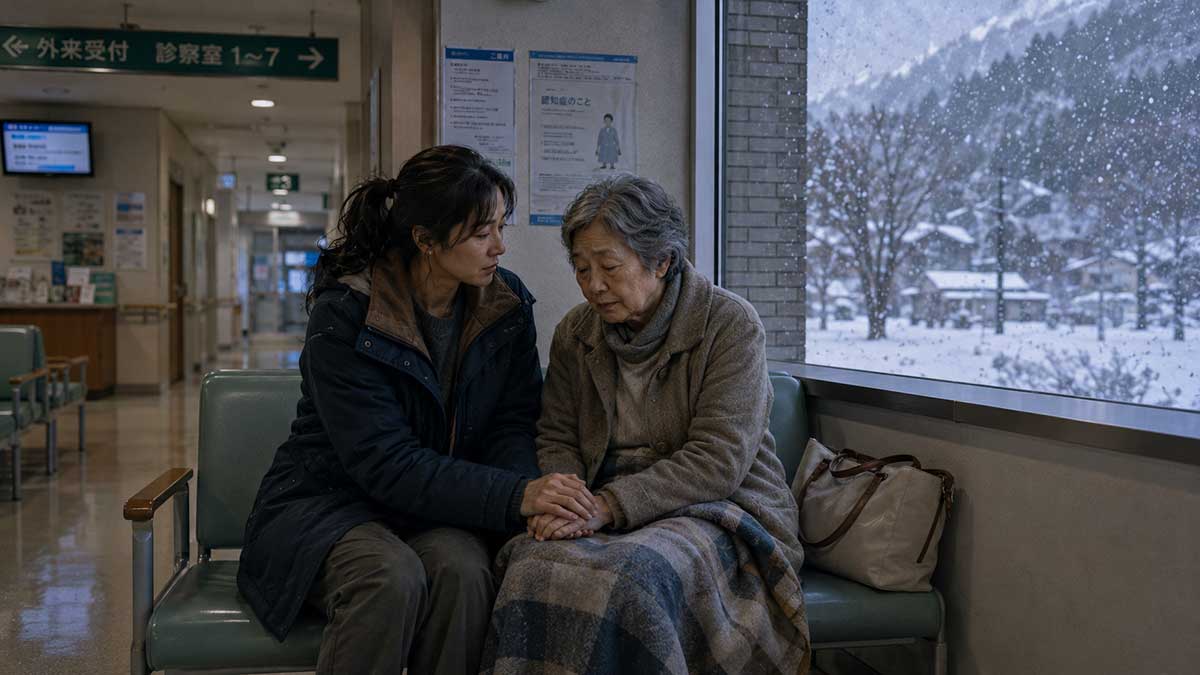
The next morning, Aki sat in the hospital with her mother.
Keiko was looking at a calendar.
“Your father is coming Thursday?”
Aki felt her body go cold.
Her father had been dead eight years.
She reached for her mother's hand.
“Mom.”
Keiko looked at her.
Then slowly understood.
Her face changed.
“Oh.”
Aki squeezed her hand.
Neither spoke.
On the train back to Tokyo, Takashi looked through the window.
For years he had thought time was something that waited.
Careers could change later.
Marriages could be repaired later.
Parents could be called later.
Children could be called tomorrow.
Aki could be visited next month.
The ryokan would still be there.
Snow would return.
Everything felt repeatable.
For the first time, he understood that repetition had hidden disappearance.
The same train.
The same town.
The same room.
The same woman.
None of them were actually staying the same.
Chapter 6 — What We Called Temporary
Aki went to Kanazawa for the interview.
She did not tell her mother the real reason.
“Supplier meeting,” she said.
Keiko nodded.
Aki hated herself for the lie.
Then hated the fact that she thought she needed permission to leave town for one night.
The interview lasted ninety minutes.
The company managed small heritage hotels across several regions.
The woman interviewing Aki was forty-five and from Toyama.
“You know old properties,” she said.
“I know leaking roofs.”
“That may be more useful.”
Aki smiled.
They talked about staffing shortages.
Foreign guests.
Digital booking.
Local culture.
What could be preserved.
What should be changed.
At the end, the woman asked:
“Why do you want to leave your family inn?”
Aki had prepared three answers.
Career development.
Broader responsibility.
New challenges.
None came out.
Instead:
“I don't know if I want to leave it.”
The interviewer waited.
Aki continued.
“I need to know I can.”
The woman nodded.
“That is a better answer.”
They offered her the job two days later.
Start in April.
One-year contract.
Housing assistance.
She could return after a year.
Aki stared at the email.
A year.
She laughed.
Everything important in her life seemed to begin with those words.
Just one year.
Takashi came back in February.
This time, he asked first.
Can I come?
Aki stared at the message.
Then:
Yes.
He arrived on a Friday.
Snow had returned heavily.
Aki met him at the station.
Neither mentioned the first time she had done that.
In the car, Takashi asked:
“How is your mother?”
“Some days good.”
“Some?”
Aki nodded.
He did not push.
That was new.
At the ryokan, Keiko greeted him warmly.
“You haven't been here in a long time.”
Takashi looked at Aki.
Six weeks.
To Keiko, perhaps months.
Perhaps yesterday.
Takashi bowed.
“I'm sorry.”
Keiko smiled.
“For what?”
He had no answer.
After dinner, Aki took Takashi into the empty dining room.
The shamisen case rested against the wall.
He sat.
She remained standing.
“I took the job.”
Takashi looked at her.
“Kanazawa?”
“Yes.”
“When?”
“April.”
“For how long?”
“One year.”
He almost laughed at the phrase.
Aki noticed.
“What?”
“Nothing.”
“No. Tell me.”
Takashi shook his head.
“You came home for one year.”
Aki understood.
She smiled sadly.
“Maybe I'm finally finishing it.”
“What happens to the ryokan?”
“My cousin may help.”
“Your mother?”
“My aunt is moving closer.”
“You trust them?”
“No.”
Takashi almost smiled.
Aki sat across from him.
“That isn't the same as being unable to leave.”
Takashi looked down.
“What about us?”
There it was.
After all this time.
Aki heard the question and felt almost nothing.
That frightened her.
“What about us?”
“I don't know what happens.”
Aki looked at him.
“You're asking me?”
“Yes.”
“No.”
He stared.
“You don't get to put the next part in my hands because you waited too long to hold it yourself.”
Takashi sat very still.
“I love you.”
The words came out plainly.
No snow metaphor.
No qualification.
No distance.
Aki closed her eyes.
For two years she had wanted those words.
Now they arrived after she had stopped building her future around them.
She opened her eyes.
“I know.”
Takashi looked wounded.
“That's all?”
“What do you want me to say?”
“That you love me.”
Aki's face softened.
“I do.”
The answer gave him no relief.
“Then why are you leaving?”
Aki stared at him.
“Because I love you.”
Takashi frowned.
“That doesn't make sense.”
“It finally does to me.”
She leaned forward.
“I used to think leaving meant admitting this wasn't real.”
He listened.
“I thought if I stopped waiting, then all the waiting became stupid.”
“I thought if I built a life that didn't include you, then I was saying you never mattered.”
She shook her head.
“I was wrong.”
Takashi's eyes filled.
“Aki.”
“I can love you and still stop living like your arrival is the event my life is organized around.”
He looked away.
“What if I leave Emi?”
Aki went still.
Takashi heard himself.
He had said it.
At last.
The sentence he had avoided for years.
Aki looked at him.
“Are you going to?”
He hesitated.
That hesitation answered.
Aki smiled sadly.
“See?”
“No. I need time.”
She nodded.
“Of course.”
“That isn't fair.”
“No.”
She stood.
“None of this is.”
Takashi stood too.
“I don't want to lose you.”
Aki turned.
“You keep saying loss like I disappear when you stop having access to me.”
He froze.
“I am not disappearing.”
“I am going to Kanazawa.”
“I will still exist.”
Takashi sat back down.
For once, he looked old.
Not fifty-two.
Just tired.
Aki almost went to him.
Almost touched his shoulder.
She didn't.
Not because she no longer cared.
Because she finally understood that compassion and reversal were not the same thing.
The next morning, Takashi found Mio outside the station.
He recognized her only after several seconds.
“The train nurse,” he said.
Mio looked confused.
Then remembered.
“You were at the ryokan.”
“Yes.”
“Aki's guest.”
The word landed strangely.
“Yes.”
Mio carried one suitcase.
Takashi looked at it.
“Going somewhere?”
“Yokohama.”
“Work?”
“Training.”
“For how long?”
“Six months.”
Takashi smiled faintly.
“Everyone is leaving.”
Mio looked at him.
“No.”
He waited.
“Some of us are going somewhere.”
Takashi looked at her suitcase.
“Was it hard?”
“Yes.”
“How did you know?”
“Know what?”
“That it was time.”
Mio thought.
“I didn't.”
Takashi waited.
“I just realized waiting to feel certain was another way of staying.”
He stared at her.
Her train announcement sounded.
Mio bowed lightly.
“Take care.”
“You too.”
She began walking.
Takashi called after her.
“Mio.”
She turned.
“Are you scared?”
She smiled.
“Very.”
Then got on the train.
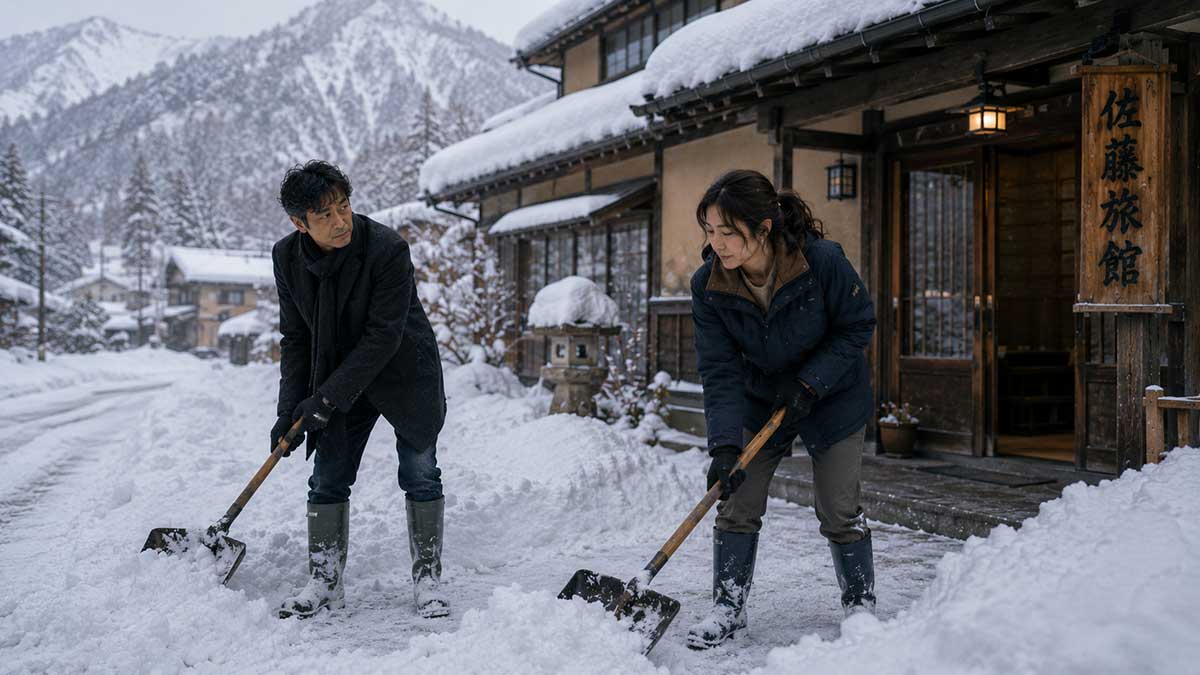
Takashi returned to the ryokan.
Aki was outside clearing snow from the steps.
He stood watching.
She looked up.
“What?”
“Nothing.”
She kept shoveling.
Takashi took another shovel.
This time he had brought proper boots.
Aki noticed.
She said nothing.
They worked side by side.
No argument.
No confession.
No future arranged.
Just snow.
At one point Takashi stopped.
“Aki.”
She looked at him.
“When you leave, will you come back?”
Aki rested both hands on the shovel.
“Probably.”
He waited.
She looked toward the ryokan.
“Just not because I have nowhere else to go.”
That evening, Takashi sat alone in Room 204.
He opened his phone.
Old photographs.
Snow.
River.
Shamisen.
The ryokan sign.
Aki laughing once with her head turned away.
He kept scrolling.
Then found a screenshot he had forgotten.
A hotel campaign from two years earlier.
ESCAPE THE ORDINARY.
Takashi stared at it.
Then deleted it.
He called Emi.
She answered after five rings.
“Hello?”
“It's me.”
“I know.”
Takashi looked at the dark window.
“I don't know what I'm doing.”
Emi was silent.
“I kept thinking I needed more time.”
Still silence.
“I think I've used time as an excuse for years.”
Emi finally spoke.
“What do you want from me?”
Takashi closed his eyes.
“I don't know.”
She exhaled.
“Then call me when you know.”
She hung up.
Takashi sat alone.
For once, nobody was willing to hold his uncertainty for him.
Outside, Aki locked the front entrance.
Her mother had gone to bed.
The lobby was quiet.
Aki looked at the old wooden walls.
For years she had said:
Just until spring.
Just until Mom is stronger.
Just until we find staff.
Just until bookings improve.
Just until Takashi figures out what he wants.
She suddenly understood that “temporary” was not a period of time.
It was a story people told themselves when they were afraid to admit that a decision had already become a life.
Aki switched off the lobby light.
In April, she would leave.
The ryokan might survive.
It might not.
Takashi might change his life.
He might not.
Her mother might remember tomorrow.
She might forget.
None of those uncertainties belonged to Aki alone anymore.
For the first time in years, her future contained something she had chosen before knowing how it would end.
Chapter 7 — Put the Phone Down
In February 2056, an eighty-two-year-old Takashi Mori returned to Niigata.
The train was quieter than he remembered.
Or perhaps his hearing was worse.
He sat beside the window.
His phone lay on the tray.
For most of his life, he had photographed transitions.
City becoming countryside.
Rain becoming snow.
Afternoon becoming evening.
People becoming memories.
Now he mostly watched.
Outside, the mountains approached.
Thirty years had not made him wise.
This disappointed him less than it would have at fifty-two.
At fifty-two, he had imagined older people carried answers.
At eighty-two, he knew they mostly carried consequences.
Some understood them.
Some didn't.
Emi had remarried at sixty.
A university professor who loved gardening and hated airports.
They exchanged New Year's messages now.
Sometimes photographs of Hana's children.
Their marriage had once seemed like the central moral crisis of his life.
Thirty years later, it had become one chapter among many.
That surprised him.
Mio had stayed in Yokohama longer than planned.
She eventually became an emergency-care administrator and later taught nursing.
She never moved back permanently to care for her father.
She helped him.
Visited.
Arranged support.
Argued with him.
Loved him.
But she never again made herself his entire solution.
Years earlier she had sent Takashi a message:
I finally learned people survive when I say no.
He had saved it.
Aki remained in Kanazawa.
One year became five.
Then ten.
She eventually helped manage the restoration of several historic inns across Hokuriku.
Her mother died at seventy-eight.
The Sato Ryokan survived.
Hiroshi became surprisingly good at running it.
Aki returned often.
She never moved back permanently.
That mattered.
Takashi and Aki saw each other perhaps twelve times over thirty years.
Coffee.
Dinner.
Once a museum.
Once a funeral.
Two long walks.
One ridiculous argument at sixty-three that neither of them remembered clearly later.
They never resumed the relationship they once had.
They never completely became strangers either.
There was no satisfactory name for what remained.
Eventually they stopped trying to find one.
The train entered a tunnel.
Takashi looked at the window.
His own reflection appeared.
Old.
Much older than he felt from inside.
For one moment, memory placed Mio's younger reflected face beside his.
Then Aki's.
Then nothing.
The train emerged.
Snow.
Takashi smiled.
Some images refused to retire.
The ryokan had changed.
The sign still read:
佐藤旅館
But the entrance had been rebuilt.
Larger windows.
Accessible ramp.
Modern lighting.
A discreet digital check-in screen Takashi disliked immediately.
He entered anyway.
A young woman bowed.
“Mori-sama?”
“Yes.”
“Welcome.”
“You know who I am?”
“You have a reservation.”
“Right.”
He smiled.
Old age occasionally made ordinary competence feel miraculous.
The lobby contained photographs of the ryokan through the decades.
Takashi stopped.
Snow-covered entrance.
River.
Mountains.
No people.
He knew the photograph.
He had taken it.
A small plaque beneath it read:
Photograph donated by Aki Sato, 2041.
Takashi stared.
Then laughed softly.
“Of course.”
His hand went automatically toward his phone.
Photograph the photograph.
The old reflex.
He stopped.
Then laughed again.
At eighty-two, apparently some lessons still required repetition.
He put the phone away.
“Do you know Ms. Sato?” he asked the receptionist.
“Aki-san?”
“Yes.”
“She visits sometimes.”
“Still in Kanazawa?”
“I believe so.”
Takashi nodded.
Still.
The word made him strangely happy.
Before dinner, Takashi walked to the station.
Snow had begun falling.
The town was busier than it had been in 2026.
Foreign tourists.
Renovated inns.
Rental shops.
New buildings where old ones had disappeared.
Takashi could not decide whether the town had survived or become something else.
Perhaps those were not opposites.
Inside the waiting room, a young couple sat several seats away.
Mid-thirties.
Maybe younger.
They were arguing quietly.
Takashi tried not to listen.
At eighty-two, curiosity remained stronger than manners.
The woman said:
“I got the job.”
“Tokyo?”
“Yes.”
The man looked toward the tracks.
“What about your mother?”
“My sister can help.”
“And us?”
The woman said nothing.
Takashi stared at the snow.
The man spoke again.
“Can we wait until next year?”
Takashi closed his eyes.
Thirty years disappeared in one sentence.
“Just until spring,” the man said.
Takashi almost laughed.
Instead he felt something closer to grief.
Not for them.
For the way younger people believed another season was an amount of time they owned.
His phone vibrated.
Hana.
Did you arrive okay?
Takashi typed:
Yes.
Then:
Snowing.
He considered taking a photograph.
Instead he pressed Call.
Hana answered immediately.
“Dad?”
“Bad time?”
“No.”
“I arrived.”
“I know. You texted me.”
“Yes.”
“So why are you calling?”
Takashi looked through the glass.
“Stay with me for a minute.”
Hana laughed.
“You're strange.”
“I know.”
They talked.
Her oldest son.
Takashi's medication.
Whether he should still travel alone.
Nothing important.
Everything important.
Takashi watched passengers arrive and leave.
Every person seemed to be entering or leaving some invisible story.
“Dad?”
“Yes?”
“You went quiet.”
“Looking at the snow.”
“Take a picture.”
Takashi looked outside.
“No.”
“Why?”
“I'll remember.”
“At eighty-two?”
“Cruel.”
After the call, Takashi remained seated.
He thought of himself at fifty-two.
Dark coat.
Phone in hand.
Convinced Mio was sad because sadness made the better image.
Convinced Aki was wasting her life.
Convinced his marriage had simply happened to him.
Convinced choices became real only after they were announced.
Convinced time would remain available until he understood what he wanted.
Takashi wished he could speak to that man.
In his mind, the younger Takashi sat across from him.
Young Takashi: So what should I do?
The old man smiled.
Old Takashi: You always ask for the conclusion first.
Young Takashi: I don't have thirty years.
Old Takashi: That's exactly what you think you have.
Young Takashi: Do I stay with Emi?
Old Takashi: I'm not telling you.
Young Takashi: Do I choose Aki?
Old Takashi: I'm not telling you that either.
Young Takashi: Then what good are you?
Old Takashi looked through the window.
Old Takashi: I'm trying to tell you that you keep asking which life is correct when the real danger is refusing to live any of them honestly.
The younger Takashi looked irritated.
Young Takashi: What if I make the wrong choice?
Old Takashi: You will.
The younger man stared.
Old Takashi: More than once.
Young Takashi: That's your wisdom?
Old Takashi: Part of it.
Young Takashi: What if I hurt people?
The older man looked at him.
Old Takashi: You already have.
And they have hurt you.
And they will hurt each other.
That isn't permission to be careless.
It's permission to stop pretending perfect innocence is available.
The younger man went quiet.
Young Takashi: What do you regret most?
Old Takashi thought.
Not Aki.
Not Emi.
Not divorce.
Not staying.
Not leaving.
Not the career.
Something quieter.
Old Takashi: Every time I knew a conversation needed to happen and told myself tomorrow would be better.
The station announcement interrupted the memory.
Takashi opened his eyes.
His train was approaching.
He stood carefully.
His knees complained.
He picked up his bag.
The young couple was still arguing.
The woman was crying now.
Takashi passed them.
For one reckless second, he wanted to stop.
Tell them:
Go.
Stay.
Choose.
Don't waste thirty years.
But he kept walking.
They had to live their own lives.
That was another thing he had learned late.
Advice was often just regret looking for somewhere else to live.
His phone vibrated again.
A message.
Aki.
Takashi stared at the name.
Hiroshi told me you're in town.
Takashi smiled.
Of course Hiroshi had.
Another message:
Still taking pictures of snow?
Takashi typed:
Less.
Her reply came quickly.
Progress.
Then:
How are you?
Takashi considered the question.
At eighty-two, he no longer believed it required a complete answer.
Cold. Old. Fine.
Aki replied:
Sounds about right.
Then:
Next time tell me you're coming.
Takashi looked toward the train.
I will.
He hesitated.
Then:
If there is a next time.
Three dots appeared.
Aki replied:
There usually is until there isn't.
Takashi stared at the sentence.
Very Aki.
He boarded.
Sat beside the window.
The train began to move.
The town drifted backward.
Takashi watched.
He did not photograph it.
Temporary did not mean meaningless.
Permanent did not mean right.
Leaving did not erase love.
Staying did not prove it.
Being needed did not mean being known.
And uncertainty was not a waiting room outside life.
It was part of life.
The train entered the tunnel.
For several seconds the window became a mirror.
Takashi looked at the old man reflected there.
This time he did not turn away.
Then the train emerged.
Snow filled the world.
Takashi smiled.
And let it pass.
Epilogue — Thirty Winters Later
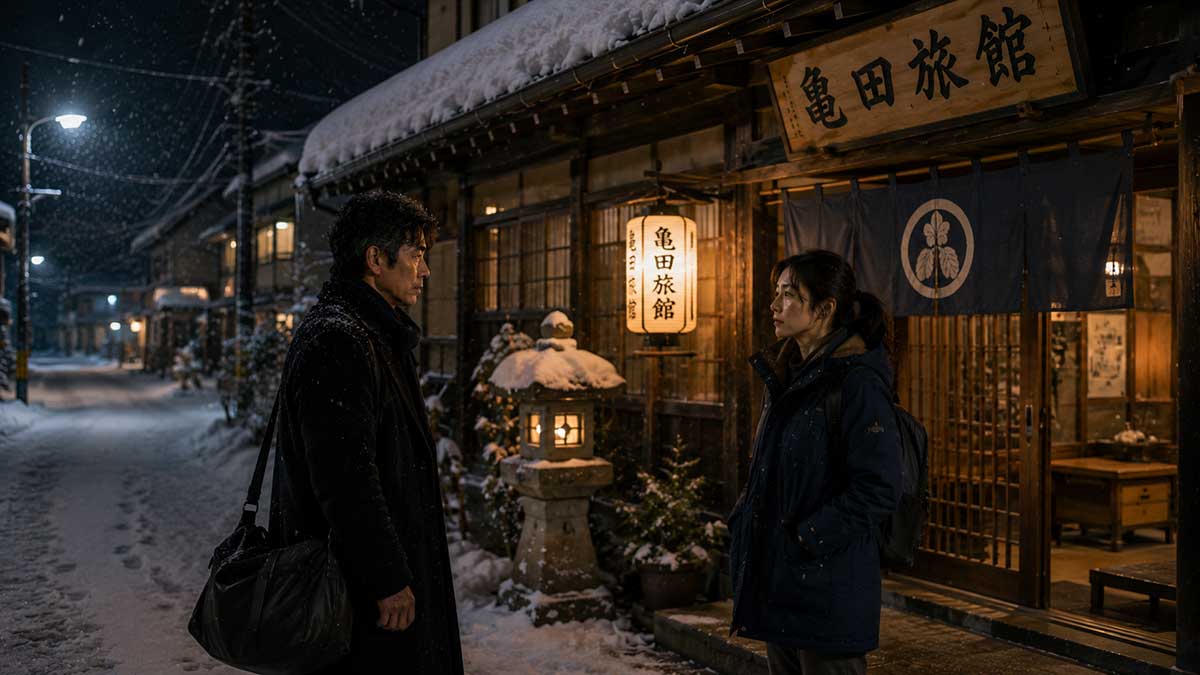
In February 2056, an eighty-two-year-old Takashi Mori returned to Niigata.
The train was quieter than he remembered.
Or perhaps his hearing was worse.
He sat beside the window.
His phone lay on the tray.
For most of his life, he had photographed transitions.
City becoming countryside.
Rain becoming snow.
Afternoon becoming evening.
People becoming memories.
Now he mostly watched.
Outside, the mountains approached.
Thirty years had not made him wise.
This disappointed him less than it would have at fifty-two.
At fifty-two, he had imagined older people carried answers.
At eighty-two, he knew they mostly carried consequences.
Some understood them.
Some didn't.
Emi had remarried at sixty.
A university professor who loved gardening and hated airports.
They exchanged New Year's messages now.
Sometimes photographs of Hana's children.
Their marriage had once seemed like the central moral crisis of his life.
Thirty years later, it had become one chapter among many.
That surprised him.
Mio had stayed in Yokohama longer than planned.
She eventually became an emergency-care administrator and later taught nursing.
She never moved back permanently to care for her father.
She helped him.
Visited.
Arranged support.
Argued with him.
Loved him.
But she never again made herself his entire solution.
Years earlier she had sent Takashi a message:
I finally learned people survive when I say no.
He had saved it.
Aki remained in Kanazawa.
One year became five.
Then ten.
She eventually helped manage the restoration of several historic inns across Hokuriku.
Her mother died at seventy-eight.
The Sato Ryokan survived.
Hiroshi became surprisingly good at running it.
Aki returned often.
She never moved back permanently.
That mattered.
Takashi and Aki saw each other perhaps twelve times over thirty years.
Coffee.
Dinner.
Once a museum.
Once a funeral.
Two long walks.
One ridiculous argument at sixty-three that neither of them remembered clearly later.
They never resumed the relationship they once had.
They never completely became strangers either.
There was no satisfactory name for what remained.
Eventually they stopped trying to find one.
The train entered a tunnel.
Takashi looked at the window.
His own reflection appeared.
Old.
Much older than he felt from inside.
For one moment, memory placed Mio's younger reflected face beside his.
Then Aki's.
Then nothing.
The train emerged.
Snow.
Takashi smiled.
Some images refused to retire.
The ryokan had changed.
The sign still read:
佐藤旅館
But the entrance had been rebuilt.
Larger windows.
Accessible ramp.
Modern lighting.
A discreet digital check-in screen Takashi disliked immediately.
He entered anyway.
A young woman bowed.
“Mori-sama?”
“Yes.”
“Welcome.”
“You know who I am?”
“You have a reservation.”
“Right.”
He smiled.
Old age occasionally made ordinary competence feel miraculous.
The lobby contained photographs of the ryokan through the decades.
Takashi stopped.
Snow-covered entrance.
River.
Mountains.
No people.
He knew the photograph.
He had taken it.
A small plaque beneath it read:
Photograph donated by Aki Sato, 2041.
Takashi stared.
Then laughed softly.
“Of course.”
His hand went automatically toward his phone.
Photograph the photograph.
The old reflex.
He stopped.
Then laughed again.
At eighty-two, apparently some lessons still required repetition.
He put the phone away.
“Do you know Ms. Sato?” he asked the receptionist.
“Aki-san?”
“Yes.”
“She visits sometimes.”
“Still in Kanazawa?”
“I believe so.”
Takashi nodded.
Still.
The word made him strangely happy.
Before dinner, Takashi walked to the station.
Snow had begun falling.
The town was busier than it had been in 2026.
Foreign tourists.
Renovated inns.
Rental shops.
New buildings where old ones had disappeared.
Takashi could not decide whether the town had survived or become something else.
Perhaps those were not opposites.
Inside the waiting room, a young couple sat several seats away.
Mid-thirties.
Maybe younger.
They were arguing quietly.
Takashi tried not to listen.
At eighty-two, curiosity remained stronger than manners.
The woman said:
“I got the job.”
“Tokyo?”
“Yes.”
The man looked toward the tracks.
“What about your mother?”
“My sister can help.”
“And us?”
The woman said nothing.
Takashi stared at the snow.
The man spoke again.
“Can we wait until next year?”
Takashi closed his eyes.
Thirty years disappeared in one sentence.
“Just until spring,” the man said.
Takashi almost laughed.
Instead he felt something closer to grief.
Not for them.
For the way younger people believed another season was an amount of time they owned.
His phone vibrated.
Hana.
Did you arrive okay?
Takashi typed:
Yes.
Then:
Snowing.
He considered taking a photograph.
Instead he pressed Call.
Hana answered immediately.
“Dad?”
“Bad time?”
“No.”
“I arrived.”
“I know. You texted me.”
“Yes.”
“So why are you calling?”
Takashi looked through the glass.
“Stay with me for a minute.”
Hana laughed.
“You're strange.”
“I know.”
They talked.
Her oldest son.
Takashi's medication.
Whether he should still travel alone.
Nothing important.
Everything important.
Takashi watched passengers arrive and leave.
Every person seemed to be entering or leaving some invisible story.
“Dad?”
“Yes?”
“You went quiet.”
“Looking at the snow.”
“Take a picture.”
Takashi looked outside.
“No.”
“Why?”
“I'll remember.”
“At eighty-two?”
“Cruel.”
After the call, Takashi remained seated.
He thought of himself at fifty-two.
Dark coat.
Phone in hand.
Convinced Mio was sad because sadness made the better image.
Convinced Aki was wasting her life.
Convinced his marriage had simply happened to him.
Convinced choices became real only after they were announced.
Convinced time would remain available until he understood what he wanted.
Takashi wished he could speak to that man.
In his mind, the younger Takashi sat across from him.
Young Takashi: So what should I do?
The old man smiled.
Old Takashi: You always ask for the conclusion first.
Young Takashi: I don't have thirty years.
Old Takashi: That's exactly what you think you have.
Young Takashi: Do I stay with Emi?
Old Takashi: I'm not telling you.
Young Takashi: Do I choose Aki?
Old Takashi: I'm not telling you that either.
Young Takashi: Then what good are you?
Old Takashi looked through the window.
Old Takashi: I'm trying to tell you that you keep asking which life is correct when the real danger is refusing to live any of them honestly.
The younger Takashi looked irritated.
Young Takashi: What if I make the wrong choice?
Old Takashi: You will.
The younger man stared.
Old Takashi: More than once.
Young Takashi: That's your wisdom?
Old Takashi: Part of it.
Young Takashi: What if I hurt people?
The older man looked at him.
Old Takashi: You already have.
And they have hurt you.
And they will hurt each other.
That isn't permission to be careless.
It's permission to stop pretending perfect innocence is available.
The younger man went quiet.
Young Takashi: What do you regret most?
Old Takashi thought.
Not Aki.
Not Emi.
Not divorce.
Not staying.
Not leaving.
Not the career.
Something quieter.
Old Takashi: Every time I knew a conversation needed to happen and told myself tomorrow would be better.
The station announcement interrupted the memory.
Takashi opened his eyes.
His train was approaching.
He stood carefully.
His knees complained.
He picked up his bag.
The young couple was still arguing.
The woman was crying now.
Takashi passed them.
For one reckless second, he wanted to stop.
Tell them:
Go.
Stay.
Choose.
Don't waste thirty years.
But he kept walking.
They had to live their own lives.
That was another thing he had learned late.
Advice was often just regret looking for somewhere else to live.
His phone vibrated again.
A message.
Aki.
Takashi stared at the name.
Hiroshi told me you're in town.
Takashi smiled.
Of course Hiroshi had.
Another message:
Still taking pictures of snow?
Takashi typed:
Less.
Her reply came quickly.
Progress.
Then:
How are you?
Takashi considered the question.
At eighty-two, he no longer believed it required a complete answer.
Cold. Old. Fine.
Aki replied:
Sounds about right.
Then:
Next time tell me you're coming.
Takashi looked toward the train.
I will.
He hesitated.
Then:
If there is a next time.
Three dots appeared.
Aki replied:
There usually is until there isn't.
Takashi stared at the sentence.
Very Aki.
He boarded.
Sat beside the window.
The train began to move.
The town drifted backward.
Takashi watched.
He did not photograph it.
Temporary did not mean meaningless.
Permanent did not mean right.
Leaving did not erase love.
Staying did not prove it.
Being needed did not mean being known.
And uncertainty was not a waiting room outside life.
It was part of life.
The train entered the tunnel.
For several seconds the window became a mirror.
Takashi looked at the old man reflected there.
This time he did not turn away.
Then the train emerged.
Snow filled the world.
Takashi smiled.
And let it pass.
Short Bios:
Takashi Mori — A 52-year-old Tokyo creative director who has spent much of his life observing, photographing, and postponing. His trips to Niigata awaken a part of himself he thought had disappeared, forcing him to confront the difference between feeling alive and actually choosing a life.
Aki Sato — A 36-year-old former advertising professional who returned to Niigata “for one year” after her father died. Eight years later, she is still helping run her family's aging ryokan. Her relationship with Takashi eventually forces her to ask whether loyalty to love can become disloyalty to her own future.
Mio Hayashi — A 27-year-old regional nurse first seen by Takashi as a reflection in a train window. Reliable and endlessly needed, Mio gradually realizes that usefulness has become a place to hide from her own desires.
Emi Mori — Takashi's 51-year-old wife of twenty-four years. Rather than serving merely as an obstacle to Takashi and Aki, Emi carries her own unlived possibilities and eventually forces Takashi to recognize that he was never the only person sacrificing another possible life.
Keiko Sato — Aki's 69-year-old mother and longtime ryokan owner. Her gradual memory problems transform time from an abstract theme into something painfully immediate, forcing Aki to confront a truth she has avoided for years: there may never be a perfect moment to leave.
Leave a Reply