


Introduction
Yasunari Kawabata’s Snow Country has inspired generations of readers with its beauty, silence, longing, and ambiguity.
Yet beneath that beauty are much harder questions.
Is the relationship between Shimamura and Komako truly love? What does the novel mean by “wasted effort”? Why are mirrors, windows, and reflections so central? Does Kawabata’s beautiful treatment of women and suffering deepen our perception—or risk turning people into images? And what are we meant to make of the astonishing final scene, where Yoko falls beneath the Milky Way?
In this imaginary scholarly discussion, leading Kawabata critics and translators—including Donald Keene, Edward Seidensticker, Masao Miyoshi, Nina Cornyetz, Miho Matsugu, Masaki Mori, Kinya Tsuruta, James T. Araki, Alan V. Liman, Makoto Akiyama, and Roy Starrs—approach the novel from literary, historical, aesthetic, ethical, and cultural perspectives.
Their disagreements reveal something essential:
Snow Country may be most powerful precisely where it refuses to give us one final answer.
(Note: This is an imaginary conversation, a creative exploration of an idea, and not a real speech or event.)
Topic 1 — Is Snow Country Really a Love Story?
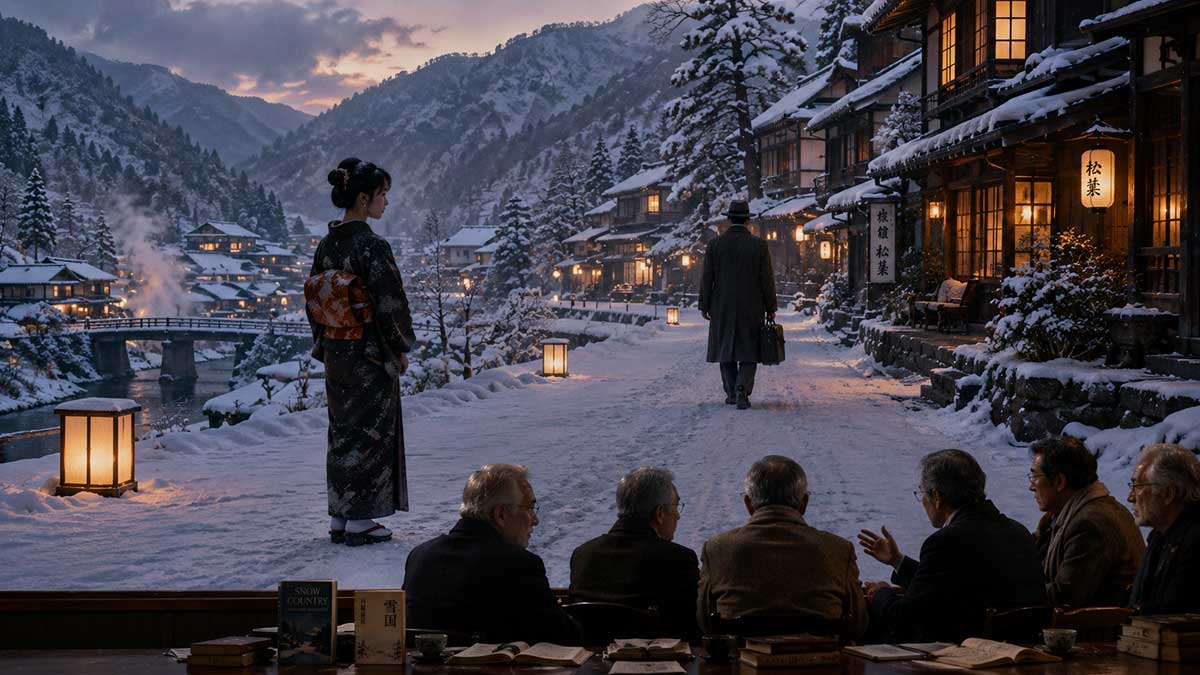
The five scholars sat around a long wooden table facing a broad window.
Outside, snow had begun to fall.
It seemed appropriate for a conversation about Yasunari Kawabata, perhaps almost too appropriate.
On the table lay several editions of Snow Country. Edward Seidensticker had both the Japanese text and his English translation in front of him.
Donald Keene sat beside him.
Across the table were James T. Araki, Miho Matsugu, and Nina Cornyetz.
For several moments, nobody spoke.
Then Keene looked through the window.
Donald Keene: When people describe Snow Country, they very often call it a tragic love story.
A wealthy married man from Tokyo travels to a remote hot-spring town.
There he becomes involved with Komako, a geisha.
She falls increasingly deeply in love with him.
He continues returning.
Yet he never truly joins her life.
That certainly sounds like a love story.
Keene turned back to the table.
Donald Keene: But I wonder whether calling it that makes the novel smaller than it actually is.
Edward Seidensticker: Smaller in what sense?
Donald Keene: It encourages us to ask the conventional questions.
Does Shimamura love Komako?
Will he stay?
Will she finally understand that he will not?
But Kawabata seems interested in something stranger.
What happens when beauty becomes inseparable from distance?
What happens when a person can feel deeply and still refuse to enter the life of the person who moves him?
Nina Cornyetz: Then perhaps our first question shouldn't be whether Snow Country is a love story.
Perhaps it should be:
What kind of love story permits the man to remain mysterious and the woman to suffer the consequences?
The room became quiet.
Seidensticker looked down at the book before him.
Edward Seidensticker: Then perhaps we should begin with the most obvious question.
Did Shimamura actually love Komako?
Question 1 — Did Shimamura Really Love Komako?
James T. Araki: I think we have to resist answering too quickly.
One of Kawabata's achievements is that Shimamura's emotional state remains extraordinarily difficult to fix.
He returns.
That matters.
If Komako were merely a passing amusement, why return to the snow country?
Nina Cornyetz: Desire can return.
That doesn't necessarily make it love.
James T. Araki: Certainly.
But he remembers her.
He watches her intensely.
He is moved by her.
Something about her continues calling him back.
Miho Matsugu: But notice the language we are already using.
He watches her.
He is moved by her.
She calls him back.
Those statements tell us about Shimamura's experience of Komako.
They tell us much less about what he gives Komako.
Edward Seidensticker: That distinction is fair.
Yet I would hesitate to turn Kawabata into a novelist who is secretly giving us a moral case against Shimamura.
Kawabata rarely works so directly.
His emotional effects accumulate.
A gesture.
A color.
A voice.
A reflection.
A moment of embarrassment.
A departure.
A return.
We are rarely told:
"This is love."
"This is selfishness."
"This is exploitation."
The uncertainty is part of the experience.
Donald Keene: Quite.
And Shimamura is not emotionless.
That seems important.
He isn't a villain who feels nothing.
Nina Cornyetz: Which makes him more interesting.
If he felt nothing, there would be very little to discuss.
The disturbing possibility is that he feels a great deal.
Cornyetz leaned forward.
Nina Cornyetz: We often assume that deep feeling naturally produces ethical action.
Snow Country complicates that assumption.
Shimamura may be genuinely moved by Komako.
He may genuinely desire her.
He may genuinely miss her.
He may experience something we could reasonably call love.
And he may still fail her.
Donald Keene: Then you would allow the word "love"?
Nina Cornyetz: Perhaps.
But I wouldn't allow the word to excuse him.
Can Someone Love You and Still Refuse to Choose You?
James T. Araki: This is where Komako becomes central.
Her feelings intensify across the novel.
What may begin with uncertainty becomes increasingly difficult for her to contain.
She waits.
She drinks.
She becomes jealous.
She seeks Shimamura out.
She sometimes behaves irrationally.
Yet beneath all of that is something painfully simple.
She wants his presence to mean more than it means to him.
Edward Seidensticker: Yes.
James T. Araki: And that produces one of the novel's deepest asymmetries.
For Shimamura, returning is an event.
For Komako, his return can reorganize her emotional life.
Miho Matsugu: And his departure does not operate equally either.
Shimamura goes back to Tokyo.
Komako remains.
That geographical fact is easy to romanticize.
The sophisticated man from Tokyo enters this beautiful remote region and encounters a passionate geisha.
But we should reverse the camera.
What does his departure look like from her side?
She doesn't return to some abstract landscape.
She returns to work.
To obligations.
To money.
To the social reality of being a geisha in a provincial hot-spring resort.
Donald Keene: Certainly. Yet Kawabata also transforms that environment into something much larger than its economics.
Miho Matsugu: He does.
I'm not asking us to reduce Komako to economics.
I'm asking us not to remove economics from Komako in order to make her more beautiful.
That distinction hung in the air.
Seidensticker slowly closed the Japanese edition.
Edward Seidensticker: There is something else.
Shimamura never seriously deceives himself into believing that this relationship has an ordinary future.
Nina Cornyetz: Does Komako?
Edward Seidensticker: That is harder.
James T. Araki: I think she knows much more than readers sometimes give her credit for.
Komako isn't simply a naïve woman waiting for a married man to rescue her.
She understands impossibility.
Yet knowing something intellectually doesn't stop a person from hoping emotionally.
Donald Keene: That may be one of the most human things in the novel.
We can know a relationship cannot become what we want it to become and continue wanting it anyway.
Question 2 — Can Real Love Still Be Exploitative?
Matsugu looked at the others.
Miho Matsugu: Let me make the question harder.
Suppose we agree, for the sake of argument, that Shimamura loves Komako.
What changes?
Donald Keene: Quite a lot.
Miho Matsugu: Morally?
Keene paused.
Miho Matsugu: If the relationship remains unequal, does calling his feeling "love" solve anything?
Edward Seidensticker: No.
Miho Matsugu: Then perhaps we need to separate two questions that readers often collapse.
Did Shimamura love Komako?
And:
Did Shimamura love Komako well?
Those are completely different questions.
Cornyetz smiled slightly.
Nina Cornyetz: That's much better.
James T. Araki: And the second question is much harder on him.
Miho Matsugu: It should be.
Shimamura possesses something Komako does not.
The ability to leave.
Not merely physically.
Socially.
Economically.
Emotionally.
He can experience this relationship as an interruption of ordinary life.
For Komako, the relationship becomes part of ordinary life.
Donald Keene: But I want to resist making Shimamura's mobility itself a moral offense.
He comes from somewhere else.
He has a family.
He cannot become a different social person merely by wishing it.
Miho Matsugu: I agree.
The problem isn't that he can leave.
The problem is whether he understands what repeatedly returning does to someone who cannot follow him.
Edward Seidensticker: That is beautifully put.
Nina Cornyetz: And terribly uncomfortable.
It means exploitation doesn't always require deception.
You can tell someone the truth about your limitations and still benefit from their hope.
The table went silent.
Keene looked toward Cornyetz.
Donald Keene: Explain that.
Nina Cornyetz: Shimamura does not need to say, "I will leave my wife."
He doesn't need to promise Komako a future.
If he knows that his presence keeps alive a hope he cannot fulfill, and if he continues returning partly because he enjoys what that hope gives him—
her attention,
her desire,
her emotional intensity,
her beauty—
then the absence of a lie doesn't settle the ethical question.
Is Honesty Enough?
James T. Araki: That's an important distinction.
We sometimes give people enormous moral credit for saying:
"I never promised you anything."
But relationships are not contracts written only in sentences.
Presence communicates.
Return communicates.
Tenderness communicates.
Jealousy communicates.
Repeated intimacy communicates.
Edward Seidensticker: Yet we must be careful.
Once we say that, we risk making people responsible for every hope another person attaches to them.
Miho Matsugu: True.
Komako has agency.
That must remain in the discussion.
Nina Cornyetz: Absolutely.
Turning Komako into a helpless victim would objectify her in another way.
Donald Keene: Then perhaps the tragedy requires both truths.
Shimamura bears responsibility for what he takes from the relationship.
Komako bears responsibility for continuing to invest herself in something whose limits she increasingly understands.
James T. Araki: Yes.
And neither truth cancels the other.
Is Komako Weak Because She Cannot Leave?
Miho Matsugu: I wouldn't phrase it as "cannot leave."
Komako isn't merely trapped.
She works.
She studies.
She practices music seriously.
She keeps records.
She possesses discipline that Shimamura himself finds remarkable.
This is not an empty woman waiting for a sophisticated man to give her meaning.
Donald Keene: Quite the opposite.
Miho Matsugu: Which makes her attachment more painful.
A capable person can still become emotionally attached to someone who cannot give her what she needs.
Competence does not protect people from longing.
Nina Cornyetz: And there is another danger.
Readers sometimes find Komako most beautiful when she is suffering most intensely.
That should make us suspicious.
Edward Seidensticker: Suspicious of Kawabata?
Nina Cornyetz: Perhaps.
Suspicious of ourselves first.
Question 3 — Are We Romanticizing Komako's Suffering?
Cornyetz picked up the novel.
Nina Cornyetz: Consider how readers remember Komako.
Her face against snow.
Her flushed skin.
Her drunkenness.
Her shamisen.
Her jealousy.
Her nighttime visits.
Her emotional exposure.
All of this becomes part of the extraordinary beauty of the book.
But what exactly are we admiring?
Donald Keene: Kawabata's ability to transform experience through language.
Nina Cornyetz: Certainly.
But Komako's suffering is part of that experience.
Edward Seidensticker: Literature has always made beauty from suffering.
Nina Cornyetz: Yes.
That doesn't settle the question.
Edward Seidensticker: No, it doesn't.
Cornyetz turned toward him.
Nina Cornyetz: Suppose Kawabata wrote Komako badly.
Suppose her loneliness were described without elegance.
Suppose her drunkenness were merely unpleasant.
Suppose her longing looked embarrassing rather than luminous.
Would readers feel the same tenderness toward her?
Edward Seidensticker: Probably not.
Nina Cornyetz: Then beauty is doing ethical work.
It is teaching us how to feel about her.
The question is whether it teaches us to care for her—
or simply to admire the image of her suffering.
Keene considered this.
Donald Keene: Perhaps it can do both.
Nina Cornyetz: I think it can.
And that's exactly why Kawabata remains interesting.
Does Kawabata Love Komako More Than Shimamura Does?
Araki smiled.
James T. Araki: Let me ask something provocative.
Perhaps we have been asking the wrong question.
Instead of:
"Does Shimamura love Komako?"
What if we ask:
Does Kawabata love Komako?
Everyone became quiet.
Edward Seidensticker: That's dangerous territory.
James T. Araki: Of course.
But consider the attention given to her.
Her discipline.
Contradictions.
Humor.
Embarrassment.
Anger.
Sensuality.
Loneliness.
Her shamisen playing.
Her desire to record what she reads.
She becomes extraordinarily alive.
Donald Keene: More alive than Shimamura, perhaps.
Miho Matsugu: In many ways, yes.
Nina Cornyetz: Yet we should be cautious about equating intense artistic attention with love.
That was precisely our problem with Shimamura.
The ability to look closely at a woman does not automatically mean one has escaped objectification.
Seidensticker laughed softly.
Edward Seidensticker: You have trapped us rather neatly.
Nina Cornyetz: Kawabata trapped us first.
Is Shimamura the Problem—or Is He Our Point of Entry?
Donald Keene: There is something uncomfortable about condemning Shimamura too easily.
Readers enter the snow country much as he does.
We arrive from somewhere else.
We see the snow.
The mountains.
The inn.
Komako.
Yoko.
We are enchanted.
Then we leave the book.
Matsugu looked at him.
Miho Matsugu: Exactly.
Which means Shimamura may be closer to the reader than we want to admit.
Donald Keene: We visit.
Komako stays.
That difference matters.
Edward Seidensticker: And perhaps that is part of the strange sadness of reading the novel.
We too get to leave the snow country.
Is Shimamura Simply a Tourist?
Miho Matsugu: In one sense, yes.
And tourism is a useful way to think about his emotional position.
A tourist wants intensity without permanence.
You travel somewhere partly because it is different from ordinary life.
You experience it.
You are moved.
You may sincerely love the place.
Then you return home.
James T. Araki: And Komako cannot be merely a place.
Miho Matsugu: Exactly.
That is the problem.
A place does not ask you why you left.
A landscape doesn't wait for you.
A mountain doesn't rearrange its emotional life when you return.
A person does.
Nina Cornyetz: Which may explain why Shimamura is so comfortable turning people into landscape.
If Komako becomes snow, color, sound, skin, movement—
she becomes easier to experience without obligation.
Seidensticker leaned back.
Edward Seidensticker: Yet I still want to defend something in Shimamura.
Nina Cornyetz: Please do.
Edward Seidensticker: His response isn't entirely predatory.
There is genuine astonishment in him.
He sees things.
Sometimes exquisitely.
His problem may not be that he lacks feeling.
His problem may be that he mistakes perception for participation.
Keene immediately looked at him.
Donald Keene: That's it.
Perception Is Not Participation
Donald Keene: Shimamura may believe that seeing deeply is itself a form of intimacy.
He notices Komako.
Perhaps more closely than many people around her do.
James T. Araki: Yet she doesn't need only to be noticed.
Donald Keene: Precisely.
That may be the tragedy.
He gives her attention when she eventually needs presence.
Miho Matsugu: And those are very different gifts.
Nina Cornyetz: Attention can still center the observer.
Presence requires the observer to become vulnerable too.
Nobody spoke for several seconds.
Snow continued accumulating outside.
What Does Komako Actually Want?
James T. Araki: We should ask this directly.
What does Komako want?
Miho Matsugu: Not necessarily marriage.
That is an important correction.
Donald Keene: Yes.
Miho Matsugu: Readers can impose a conventional romantic goal on her.
The novel is more complicated.
What she appears to want, increasingly, is for the relationship to carry weight.
For Shimamura's returns to mean something.
For her emotional reality to exist outside the moments when he happens to be present.
Nina Cornyetz: She wants not merely to be experienced.
She wants to matter.
That sentence changed the room.
And What Does Shimamura Want?
Seidensticker turned the question around.
Edward Seidensticker: Then what does Shimamura want?
Donald Keene: Beauty.
James T. Araki: Escape.
Miho Matsugu: Intimacy without complete incorporation into another person's life.
Nina Cornyetz: Perhaps something more subtle.
He wants to be moved without being claimed.
Seidensticker looked at her.
Edward Seidensticker: That's very good.
Nina Cornyetz: Komako's tragedy is that being moved is not enough for her.
Eventually she wants his feelings to acquire consequences.
Can Love Exist Without a Future?
Keene returned to the original question.
Donald Keene: Suppose two people genuinely love one another.
Suppose they know the relationship will end.
Does the absence of a future make the love less real?
Edward Seidensticker: No.
James T. Araki: Certainly not.
Miho Matsugu: No.
Nina Cornyetz: But knowing something will end does not free us from responsibility for how we behave before it ends.
Donald Keene: Then perhaps we have reached something.
The tragedy isn't simply that Shimamura doesn't love Komako.
Perhaps he does.
The tragedy may be that love means different things to them.
The Same Relationship, Two Different Times
Araki picked up the thought.
James T. Araki: Komako's love moves forward.
It asks:
What happens tomorrow?
When will you return?
What does this become?
Shimamura's feeling remains intensely present-tense.
This night.
This snow.
This face.
This music.
This return.
Edward Seidensticker: That sounds very close to Kawabata's form itself.
Fragments of extraordinary intensity.
Nina Cornyetz: Which raises a dangerous possibility.
Perhaps Shimamura's way of loving resembles Kawabata's way of writing.
Nobody answered immediately.
Keene looked toward her.
Donald Keene: Explain.
Nina Cornyetz: Shimamura experiences Komako through luminous fragments.
Kawabata gives Komako to us through luminous fragments.
Shimamura aestheticizes.
Kawabata aestheticizes.
We criticize Shimamura for turning a woman into beautiful moments.
Yet the novel gives us some of the most beautiful moments in modern literature by doing something uncomfortably similar.
Edward Seidensticker: And now we have arrived at the question that will eventually trouble the entire discussion.
Does Kawabata expose Shimamura's gaze—
or share it?
Miho Matsugu: Perhaps both.
Does Snow Country Judge Shimamura?
Donald Keene: I don't think Kawabata gives us a courtroom.
James T. Araki: Nor an acquittal.
Edward Seidensticker: Exactly.
Nina Cornyetz: Which is why readers have to perform ethical work that the narrator refuses to perform for them.
Miho Matsugu: And we should resist turning Komako into evidence in Shimamura's moral trial.
She has her own life.
That matters.
Perhaps one of the most revealing things we can do is temporarily stop asking:
"What does Komako reveal about Shimamura?"
And ask:
"What does Komako reveal about Komako?"
Keene smiled.
Donald Keene: Which may be harder than it sounds.
Final Round — Is It a Love Story?
Keene looked around the table.
Donald Keene: One answer each.
Is Snow Country a love story?
Seidensticker went first.
Edward Seidensticker: Yes.
But it is a love story whose emotional truth depends upon what remains unsaid.
Araki followed.
James T. Araki: Yes.
But its tragedy comes from two people assigning different futures to the same intimacy.
Matsugu thought for a moment.
Miho Matsugu: Yes, but I would never put the word "love" before the conditions surrounding it.
Who can leave?
Who works?
Who waits?
Who returns?
Those questions belong inside the love story.
Cornyetz spoke next.
Nina Cornyetz: I would say it is partly a story about the danger of confusing intense perception with love.
A person can look at another human being with extraordinary sensitivity and still fail to meet that person ethically.
Finally, Keene.
Donald Keene: I would call it a love story in which love is neither sufficient nor redemptive.
That may be why it continues to hurt.
The scholars fell silent.
Outside, the snow had erased nearly every footprint.
Seidensticker opened the novel again.
Edward Seidensticker: There is something peculiar about Komako.
The more impossible her situation becomes, the more effort she seems to put into living.
She reads.
She keeps records.
She practices the shamisen.
She works.
She loves.
Shimamura watches all of this and repeatedly encounters something like futility.
Matsugu looked across the table.
Miho Matsugu: Perhaps that tells us more about Shimamura than it tells us about Komako.
Miyoshi's empty chair was waiting for the next discussion.
Keene looked at it and smiled slightly.
Donald Keene: Then perhaps he should join us.
Cornyetz closed her book.
Nina Cornyetz: Yes.
Because before we call Komako's life futile, we should ask a much more dangerous question.
She looked around the table.
Nina Cornyetz: What if the person wasting his life isn't Komako?
The snow continued falling.
And the second discussion was ready to begin.
Topic 2 — What Does “Wasted Effort” Really Mean?
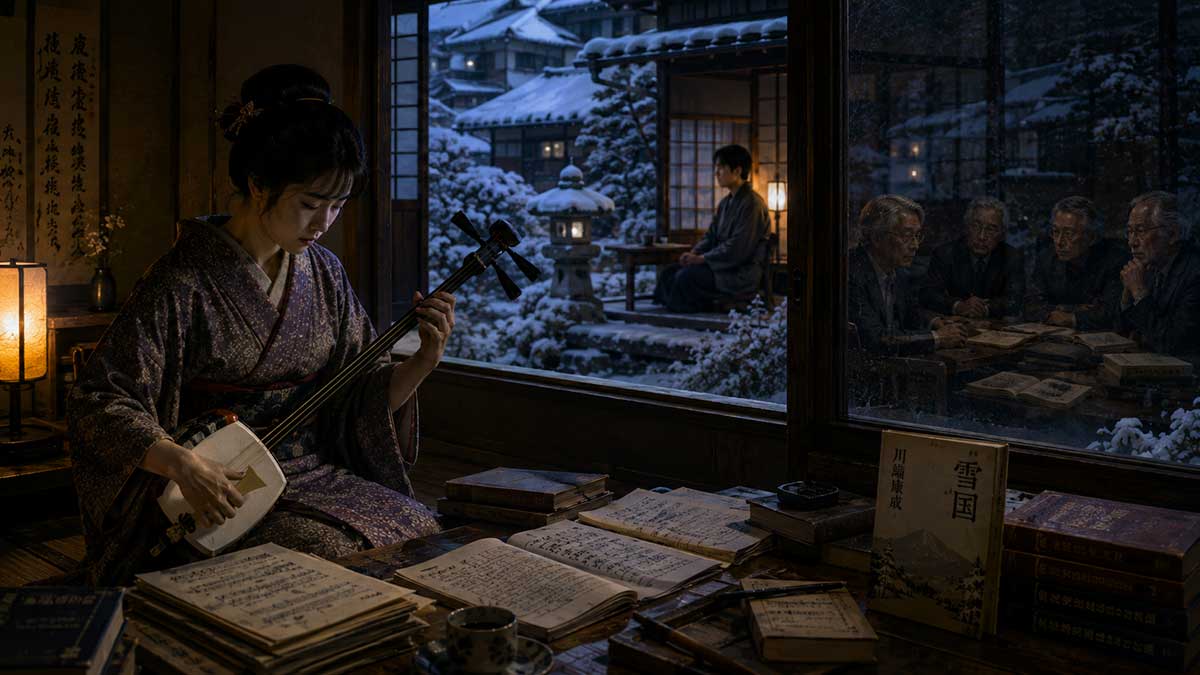
The snow outside had grown heavier.
Donald Keene remained at the table.
James T. Araki and Miho Matsugu stayed as well.
Edward Seidensticker and Nina Cornyetz had stepped away.
In their places now sat Kinya Tsuruta and Masao Miyoshi.
On the table lay the same copies of Snow Country.
This time, the conversation began with Komako.
Not her beauty.
Not her love for Shimamura.
Her effort.
James T. Araki: Komako is always doing something.
She reads.
She keeps records.
She practices the shamisen.
She works.
She travels through snow.
She loves with a seriousness Shimamura can barely match.
And yet Shimamura repeatedly responds to these efforts with a sense of futility.
Araki looked around the table.
James T. Araki: So let me begin with the distinction I think matters most.
When Snow Country speaks of wasted effort—
is that Kawabata speaking?
Or Shimamura?
Question 1 — Whose Judgment Is “Wasted Effort”?
Donald Keene: I would begin cautiously.
Kawabata is deeply attracted to things that do not last.
Flowers.
Snow.
Youth.
Beauty.
Music.
Relationships.
It would be easy to say that futility itself becomes beautiful in his work.
Masao Miyoshi: Too easy.
Keene turned toward him.
Masao Miyoshi: One of the recurring problems in Western readings of Japanese literature is the temptation to take anything transient, sad, or unresolved and place it under a single cultural label.
Impermanence.
Resignation.
Japanese beauty.
It can become a shortcut.
Donald Keene: You think “wasted effort” is being over-Japanized.
Masao Miyoshi: Frequently.
A person may call another person's work futile for reasons that have nothing mystical about them.
Class.
Privilege.
Distance.
Self-protection.
Miho Matsugu nodded.
Miho Matsugu: That is where Shimamura matters.
He can afford to see Komako's effort as touchingly futile.
He does not have to depend on that effort.
She does.
Is Shimamura Mistaking Labor for Poetry?
Miho Matsugu: Take the shamisen.
For Shimamura, Komako playing can become a beautiful scene.
Snow outside.
Music.
Her body.
Her seriousness.
But for Komako, practice is work.
Skill.
Professional identity.
Something that has to be maintained.
James T. Araki: And something she takes genuine pride in.
Miho Matsugu: Exactly.
If Shimamura sees only the sadness of effort without result, he may be missing the result entirely.
The result is not fame.
The result is competence.
Discipline.
A life organized around something she values.
Kinya Tsuruta: Which is why I would hesitate to isolate “futility” as a philosophical statement.
The novel works through repetition.
Return.
Departure.
Practice.
Snowfall.
Melting.
Memory.
Reappearance.
What looks futile at the level of outcome may create form at the level of experience.
Can Repetition Itself Create Meaning?
Donald Keene: Say more.
Kinya Tsuruta: Komako does many things again and again.
She practices.
She records.
She waits.
Shimamura returns.
Then leaves.
The novel itself is constructed through recurrence.
A thing need not progress toward a conventional goal to acquire meaning.
Sometimes repetition is the meaning.
Masao Miyoshi: But we should still distinguish artistic pattern from lived cost.
Kinya Tsuruta: Certainly.
Masao Miyoshi: A repeated structure can be beautiful in a novel and exhausting in a life.
That distinction matters.
Question 2 — When Shimamura Says “Futile,” What Can He Afford Not to See?
Matsugu leaned forward.
Miho Matsugu: This may be the sharpest version of the question.
Shimamura is economically comfortable.
He can travel.
He can study Western ballet without needing to make anything from that study.
He can admire effort from outside.
Komako cannot live that way.
Her labor has consequences.
Her income matters.
Her status matters.
Her choices are constrained in ways his are not.
So when he looks at her striving and thinks, in effect, “how touching, how futile,” we should ask:
What gives him the luxury of calling it futile?
Donald Keene: That is fair.
But I don't want to reduce every response Shimamura has to privilege.
He is genuinely responsive to beauty.
Miho Matsugu: I agree.
Privilege doesn't cancel sensitivity.
It shapes what sensitivity can ignore.
That sentence quieted the room.
Is Komako More Alive Than Shimamura?
James T. Araki: This is where I think the novel begins to reverse Shimamura's judgment.
He sees Komako's effort as doomed.
Yet who seems more alive?
Komako.
By far.
Donald Keene: Yes.
James T. Araki: She acts.
She learns.
She works.
She fails.
She hopes.
She embarrasses herself.
She gets angry.
She loves.
Shimamura observes almost all of it.
Masao Miyoshi: Which raises a disturbing possibility.
Perhaps the novel allows Shimamura to think he is the sophisticated one because he sees futility clearly.
But the reader gradually discovers that his sophistication may be another form of avoidance.
Question 3 — Is Avoiding Futility Another Kind of Futility?
Masao Miyoshi: Suppose someone refuses to commit deeply because commitment may fail.
Refuses to love too much because love may end.
Refuses to strive because the outcome may not justify the effort.
At first, that can look intelligent.
Controlled.
Adult.
But if you continue long enough—
what is preserved?
Keene looked at him.
Donald Keene: Freedom.
Perhaps.
Masao Miyoshi: For what?
No one answered immediately.
James T. Araki: That question gets very close to Shimamura.
He preserves freedom from obligation.
Freedom from disappointment.
Freedom from foolish hope.
But he does very little with the preserved freedom.
Kinya Tsuruta: Which may be why Komako's apparently futile movement carries more energy than Shimamura's detached awareness.
One is always entering experience.
The other is continually converting experience into observation.
What Does Komako Gain From “Futile” Effort?
Miho Matsugu: We should ask the reverse.
What does Komako gain?
Not what does she achieve by external standards.
What does the effort give her?
James T. Araki: Identity.
Donald Keene: Skill.
Kinya Tsuruta: Rhythm.
Masao Miyoshi: A way of inhabiting time.
Miho Matsugu: Exactly.
That last one matters.
Work gives time shape.
Practice gives time shape.
Reading gives time shape.
Waiting gives time shape too, though that can become dangerous.
Komako's life is not empty between Shimamura's visits.
She has a structure.
The irony is that Shimamura may admire the beauty of that structure without recognizing its necessity.
Is Komako’s Love “Wasted Effort”?
Keene folded his hands.
Donald Keene: We should confront the obvious application.
If her music and reading are not necessarily futile, what about loving Shimamura?
James T. Araki: Much harder.
Miho Matsugu: Some of it probably is wasted.
That answer surprised the table.
Donald Keene: You would use the word?
Miho Matsugu: Of course.
We don't need to rescue every choice Komako makes.
She waits too long.
She gives too much meaning to his returns.
She invests herself in a man who is structurally unlikely to give her what she wants.
Some of that costs her.
Calling that cost real does not make her weak.
Masao Miyoshi: Good.
There is a danger in correcting Shimamura so strongly that we romanticize Komako instead.
We move from:
“Her effort is futile”
to:
“Every act of devotion is noble.”
Neither is convincing.
Can Something Be Both Wasteful and Meaningful?
Kinya Tsuruta: Perhaps that contradiction is closer to the novel.
Something can be wasteful and meaningful at the same time.
Donald Keene: Yes.
Kinya Tsuruta: A failed love may consume years.
Those years are still lived.
A practice may lead nowhere externally.
It can still transform the practitioner.
A journey may return you to the same place.
You are not necessarily the same person.
James T. Araki: Which is very close to Komako.
Some of what she gives Shimamura may be wasted on him.
That does not mean the capacity to give was wasted inside her.
Who Gets to Define “Use”?
Miyoshi looked toward Keene.
Masao Miyoshi: There is another issue.
The word “waste” assumes a standard of use.
What counts as useful?
Productivity?
Permanence?
Recognition?
Return on effort?
Donald Keene: Kawabata would hardly accept those as the only measures.
Masao Miyoshi: Exactly.
Then the phrase becomes suspicious.
What if the supposedly useless things—
music,
memory,
attention,
love—
are the things that make a life recognizable as one's own?
Does Mono no Aware Help Here—or Get in the Way?
Keene smiled slightly.
Donald Keene: We should probably address the phrase everyone expects.
Mono no aware.
The sadness of things.
Sensitivity to impermanence.
It certainly has relevance.
Masao Miyoshi: With caution.
Donald Keene: Naturally.
Masao Miyoshi: The problem begins when every disappointment becomes elevated into beautiful resignation.
Komako is not merely contemplating transience.
She is working.
Drinking.
Waiting.
Hurting.
The material and emotional messiness should not disappear beneath a cultural concept.
Kinya Tsuruta: Yet impermanence is still structurally present.
Snow falls.
Snow melts.
People return.
People leave.
Images appear and disappear.
The question is not whether transience exists.
It does.
The question is what each character does with it.
Two Responses to Impermanence
James T. Araki: That may be the real contrast.
Komako responds to impermanence by investing more deeply.
Shimamura responds by keeping distance.
Donald Keene: Nicely put.
James T. Araki: She seems to say:
Because this may disappear, I must feel it fully.
He seems to say:
Because this may disappear, I should never become fully dependent on it.
Masao Miyoshi: And the novel does not hand us a simple winner.
Komako suffers badly.
Shimamura avoids some suffering.
The question is what else he avoids.
What Does Shimamura’s Interest in Western Ballet Reveal?
Keene glanced at the Japanese edition.
Donald Keene: We should bring in the ballet.
It is too revealing to ignore.
Shimamura studies Western ballet largely through books and reproductions.
He is fascinated by an art form at a distance.
Kinya Tsuruta: Which fits his broader method of living.
Miho Matsugu: Knowledge without participation.
James T. Araki: Admiration without risk.
Masao Miyoshi: And perhaps even sophistication without consequence.
He can know a great deal about something he barely experiences directly.
That is nearly a model for his emotional life.
Does Shimamura Prefer Possibility to Reality?
James T. Araki: Reality limits.
A real performance may disappoint.
A real relationship may become ordinary.
A real commitment closes other possibilities.
Distance preserves imagination.
Donald Keene: Which is aesthetically attractive.
Masao Miyoshi: And existentially dangerous.
Who Actually Wastes More?
The room became quieter.
Outside, snow pressed against the glass.
Miyoshi spoke first.
Masao Miyoshi: Let us ask the question without softening it.
Who wastes more of life?
Komako, by giving too much?
Or Shimamura, by giving too little?
Donald Keene: I would resist a verdict.
Masao Miyoshi: Naturally.
But choose where the danger is greater.
Keene thought.
Donald Keene: Komako risks depletion.
Shimamura risks emptiness.
James T. Araki: That is the distinction.
Komako may spend herself badly.
Shimamura may fail to spend himself at all.
Miho Matsugu: And we should not forget that “spending oneself” sounds poetic until one is the person doing the labor.
Komako's depletion is not merely beautiful.
It costs something.
Kinya Tsuruta: Yet structurally, she generates movement.
Without Komako's effort, much of the novel would become still.
Shimamura receives.
Komako produces.
Emotion.
Music.
Conflict.
Return.
Expectation.
Is Detachment a Form of Consumption?
Miyoshi looked toward Matsugu.
Masao Miyoshi: Perhaps that is the hidden asymmetry.
Komako produces experience.
Shimamura consumes it.
Matsugu paused.
Miho Matsugu: That is severe.
But useful.
He consumes the snow country as experience.
He consumes beauty.
Music.
Emotion.
The atmosphere of another person's life.
Then leaves.
Keene pushed back.
Donald Keene: But “consumes” risks making every act of appreciation morally suspect.
Miho Matsugu: I agree.
The issue is not appreciation itself.
It is whether appreciation takes without becoming responsible for what it takes from.
Can a Life Be Too Careful?
Araki looked down at the book.
James T. Araki: I keep returning to a simple possibility.
Komako's tragedy is obvious.
Shimamura's is quieter.
She may waste years loving badly.
He may waste years refusing to be changed by anything.
Kinya Tsuruta: And that quietness is why readers can miss it.
Her suffering is dramatic.
His absence of commitment looks like composure.
Masao Miyoshi: We tend to recognize excess as danger.
Too much love.
Too much drink.
Too much hope.
Too much attachment.
We are less skilled at recognizing insufficient participation as a danger.
What Exactly Is Shimamura Protecting?
Miyoshi turned toward Keene again.
Masao Miyoshi: Let me ask the question plainly.
Shimamura protects himself from foolish commitments.
From disappointment.
From emotional dependency.
From getting trapped in another person's life.
What exactly is he protecting for?
Keene smiled faintly.
Donald Keene: You like that question.
Masao Miyoshi: Because the novel makes it hard to answer.
No one spoke for a few seconds.
Then Keene said:
Donald Keene: Perhaps nothing.
And that may be the problem.
Final Round — Is “Wasted Effort” a Judgment or a Mirror?
Araki looked around the table.
James T. Araki: One answer each.
What does “wasted effort” finally reveal?
Keene began.
Donald Keene: It reveals Kawabata's fascination with things whose beauty is not guaranteed by permanence or utility.
Tsuruta followed.
Kinya Tsuruta: It reveals how repetition and apparent futility create the novel's movement. What seems to go nowhere may still create form.
Matsugu spoke next.
Miho Matsugu: It reveals privilege. The person who can call another's labor futile may be the person least dependent on labor.
Miyoshi leaned back.
Masao Miyoshi: It reveals the danger of treating detachment as wisdom. Seeing futility clearly is not the same as knowing how to live.
Finally, Araki.
James T. Araki: It reveals Komako as perhaps the novel's most alive character precisely because she keeps investing herself in things that may not last.
The table became quiet again.
Outside, the snow covered the window ledge.
Keene looked toward the book.
Donald Keene: Then perhaps the phrase reverses itself.
What first appears to describe Komako may eventually describe Shimamura.
Miyoshi nodded.
Masao Miyoshi: The woman who wastes effort may be living.
The man who avoids waste may be disappearing.
Tsuruta turned toward the dark window.
A faint reflection of everyone at the table floated over the snowy landscape outside.
He watched it for several seconds.
Kinya Tsuruta: Interesting.
The others looked toward him.
Kinya Tsuruta: We have spent two topics asking what these characters feel and how they live.
But Kawabata rarely lets us encounter them directly.
He gives us reflections.
Windows.
Surfaces.
Fragments.
Matsugu followed his gaze.
In the glass, their faces overlapped with the falling snow.
Kinya Tsuruta: Perhaps before we decide who wasted anything, we should ask how the novel taught us to see them in the first place.
That was where the third discussion would begin.
Topic 3 — Why Are Mirrors, Windows, and Reflections Everywhere?
The scholar panel changed again.
Masaki Mori took the central seat.
Beside him sat Kinya Tsuruta, Alan V. Liman, Makoto Akiyama, and Nina Cornyetz.
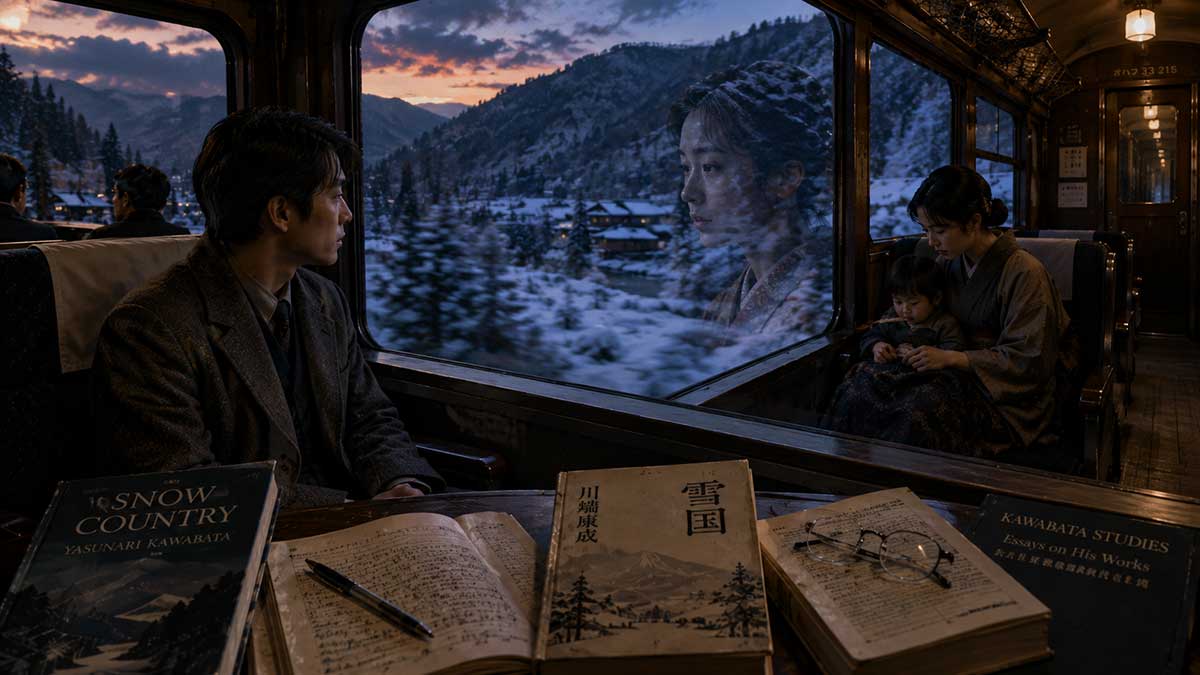
On the table lay several copies of Snow Country, opened to the train scene.
Outside, evening had fallen.
The window behind them had turned dark enough to reflect their own faces.
Mori noticed first.
Masaki Mori: Kawabata would have liked this.
Tsuruta glanced toward the glass.
Their reflections floated over the snow outside.
Kinya Tsuruta: Or Shimamura would have.
Cornyetz smiled faintly.
Nina Cornyetz: That distinction may become important.
Mori opened the novel.
Masaki Mori: Then let us begin with the most famous image in the book.
Shimamura is traveling by train into the snow country.
He watches Yoko indirectly.
Her face appears in the window.
Behind the reflection, the landscape is moving.
Face and mountains occupy the same surface.
Reality and image become almost impossible to separate.
Mori looked around the table.
Masaki Mori: Why does Kawabata give us Yoko that way?
Why not simply let Shimamura turn his head and look at her?
Question 1 — Does the Reflection Bring Shimamura Closer to Yoko or Keep Him Farther Away?
Alan V. Liman: I would begin with the lyric effect.
The scene is not constructed like ordinary psychological realism.
Kawabata does not merely tell us:
“There was a young woman on the train.”
He fuses face, glass, light, darkness, and landscape into one image.
The emotional effect comes from that fusion.
Makoto Akiyama: Yet we experience the fusion through Shimamura.
That matters.
The novel repeatedly gives us the snow country through the consciousness of a visitor.
He arrives from elsewhere.
He observes.
He interprets.
Kinya Tsuruta: And the reflection is perfect for that position.
He is inside the train.
Yoko is nearby.
The landscape is outside.
The glass holds all three together and keeps them apart.
Mori nodded.
Masaki Mori: Exactly.
A mirror can collapse distance visually without removing distance physically.
That paradox runs through Snow Country.
Nina Cornyetz: Which sounds very much like Shimamura himself.
Masaki Mori: Yes.
He can experience extraordinary intimacy through seeing.
Yet seeing does not necessarily require him to cross into another person's life.
Is the Window a Form of Intimacy?
Makoto Akiyama: We should not assume mediation is always a failure.
Sometimes indirect seeing creates a more intense perception.
The reflection is perhaps more powerful to Shimamura than direct sight would have been.
Alan V. Liman: I agree.
The lyric mode depends on transformation.
Kawabata is not photographing reality.
He is making one thing pass into another.
Woman into landscape.
Landscape into memory.
Reflection into emotion.
Nina Cornyetz: But we should be careful with the phrase “woman into landscape.”
Everyone looked toward her.
Nina Cornyetz: A mountain does not object when you transform it into an image.
A woman might.
The room became quiet.
Does Reflection Reveal More—or Protect Shimamura?
Masaki Mori: Let me defend the image for a moment.
The reflection may allow Shimamura to perceive multiple realities at once.
Yoko's face.
The landscape.
His own position as observer.
Light passing through darkness.
This is not necessarily reduction.
It can be multiplication.
Nina Cornyetz: Formally, yes.
Ethically, perhaps not.
Masaki Mori: Explain.
Nina Cornyetz: The image becomes richer.
Yoko may become thinner.
Mori leaned back.
Nina Cornyetz: She acquires symbolic force.
Mystery.
Purity.
Voice.
Reflection.
But what happens to her ordinary personhood?
The more aesthetically charged she becomes, the easier it may be to forget that she has desires, frustrations, choices, and material existence outside Shimamura's perception.
Makoto Akiyama: Yet that may be precisely the point of point of view.
We are not receiving an objective Yoko.
We are receiving Yoko as Shimamura experiences her.
Nina Cornyetz: Then the next question is unavoidable.
Does the novel ask us to recognize the limitations of his perception—
or simply inhabit them?
Question 2 — Is the Reader Looking Through the Same Glass?
Tsuruta closed his book.
Kinya Tsuruta: I think this is the more dangerous question.
Readers often criticize Shimamura for aestheticizing people.
But how do readers encounter Komako and Yoko?
Through luminous fragments.
A voice.
Skin.
A gesture.
Snow.
A reflection.
A drunken moment.
A piece of music.
We receive them through pieces.
Alan V. Liman: Which is one reason the novel feels so lyrical.
Kinya Tsuruta: Yes.
But perhaps Kawabata places us very close to Shimamura's method of perception.
Are We Different From Shimamura?
Makoto Akiyama: The reader is structurally dependent on his point of view much of the time.
We arrive with him.
We see what catches his eye.
We encounter Yoko first through his fascination.
Nina Cornyetz: Which means the reader may participate in exactly what we later criticize.
Mori looked toward Cornyetz.
Masaki Mori: But participation does not equal endorsement.
Nina Cornyetz: Agreed.
A novel can make us inhabit a gaze so that we eventually become uncomfortable with it.
Alan V. Liman: That may be too ethical a description of something that is also poetic.
Nina Cornyetz: Why must those be separated?
Liman smiled slightly.
Alan V. Liman: They don't have to be.
But if every image immediately becomes an ethical test, we lose part of what Kawabata is doing with language.
Nina Cornyetz: And if every image remains safely “lyrical,” we risk losing the people inside it.
Does the Reader Become a Tourist Too?
Akiyama turned to Tsuruta.
Makoto Akiyama: Perhaps the reader shares another feature with Shimamura.
We are visitors.
We enter the snow country.
We are fascinated.
We observe.
Then we close the book.
Kinya Tsuruta: Yes.
We leave.
Nina Cornyetz: Komako does not.
Mori looked down at the text.
Masaki Mori: That changes the train window.
Perhaps it is not merely a visual device.
It is a model of reading.
The world passes before us.
Beautiful.
Framed.
Temporary.
We watch from inside.
Are Mirrors About Doubling?
Alan V. Liman: There is another layer.
Komako and Yoko can begin to echo one another through Kawabata's imagery.
They are not interchangeable characters.
But the novel creates lyrical relationships between them.
Warmth and distance.
Physical presence and elusive voice.
Intimacy and mystery.
Kinya Tsuruta: And those relationships are often created through visual repetition rather than explanation.
Masaki Mori: Mirrors do not simply reproduce.
They rearrange.
An image in a mirror is the same and not the same.
That logic belongs throughout the novel.
Is Yoko an Alternative to Komako—or Another Image?
Makoto Akiyama: Shimamura's relation to Yoko is much more distant.
That distance itself becomes part of her attraction.
Nina Cornyetz: Which should make us suspicious of calling her “pure” or “mysterious.”
Those are often labels produced by lack of knowledge.
Alan V. Liman: But mystery is genuinely part of the novel's form.
Nina Cornyetz: Yes.
I am not trying to eliminate mystery.
I am asking who gets turned into mystery.
That sharpened the room.
Question 3 — Why Are Women So Often the Beautiful Image?
Cornyetz turned the discussion directly.
Nina Cornyetz: We have talked about reflection.
Doubling.
Lyricism.
Perspective.
Movement.
Now I want to ask the less elegant question.
Why are women's faces and bodies so often where this aesthetic system becomes most intense?
No one answered immediately.
Masaki Mori: Because relationships with women are central to Kawabata's imagination.
Nina Cornyetz: True, but descriptive rather than explanatory.
Alan V. Liman: Perhaps feminine presence serves as the point where landscape and feeling meet.
Nina Cornyetz: And why should women bear that symbolic burden?
Tsuruta intervened.
Kinya Tsuruta: We may need to distinguish Kawabata's formal practice from Shimamura's psychology.
Nina Cornyetz: Can we?
Kinya Tsuruta: Not completely.
But they are not identical.
A novel may use a character's gaze while creating patterns that exceed the character.
Does the Mirror Belong to Shimamura or Kawabata?
Mori nodded.
Masaki Mori: That is essential.
The mirror image cannot be reduced to “Shimamura objectifies Yoko.”
The image does more.
It reorganizes space.
Collapses foreground and background.
Makes body and landscape coexist.
Creates a field in which boundaries become unstable.
Nina Cornyetz: I agree.
But the formal richness doesn't erase the ethical question.
It intensifies it.
Makoto Akiyama: Then perhaps the image has two levels.
At the level of consciousness:
Shimamura turns Yoko into an extraordinary visual experience.
At the level of form:
Kawabata uses that perception to construct a novel in which reality is always mediated.
Does Mediation Mean Distance From Truth?
Alan V. Liman: We often talk as though direct perception would give us truth.
I am not sure Kawabata believes that.
Masaki Mori: Nor am I.
Alan V. Liman: A direct face is not necessarily more truthful than a reflected face.
Memory distorts.
Desire distorts.
Language distorts.
Even ordinary sight selects.
Perhaps the reflection is honest precisely because it admits mediation.
Cornyetz nodded.
Nina Cornyetz: That is persuasive.
A window shows the barrier.
A gaze often pretends there is none.
Is the Reflection More Honest Than Direct Looking?
Kinya Tsuruta: Interesting.
The glass tells us:
You are looking through something.
Perhaps that makes it more honest than a supposedly transparent narrator.
Makoto Akiyama: And the reader is constantly reminded that access to these characters is partial.
Masaki Mori: Exactly.
The reflection announces incompleteness.
Nina Cornyetz: Then I would ask whether readers honor that incompleteness.
Or whether we fill it with convenient ideas:
Yoko is purity.
Komako is passion.
Shimamura is detachment.
And suddenly the difficult people become symbols.
Why Does Kawabata Give Us Fragments Instead of Explanations?
Liman answered first.
Alan V. Liman: Because explanation would change the mode.
Kawabata often wants an emotional relation among details rather than a fully articulated psychological system.
Kinya Tsuruta: The fragments create movement.
The reader participates by connecting them.
Makoto Akiyama: Yet that participation brings risk.
The reader may create coherence that the text never guarantees.
Is Ambiguity Something We Experience—or Something We Invent?
Masaki Mori: That is excellent.
At what point does interpretation become projection?
Nina Cornyetz: Especially with women whose interior lives are only partly available.
Alan V. Liman: But all interpretation projects something.
Nina Cornyetz: Certainly.
The issue is whether we mistake the projection for the person.
The Train Window as the Entire Novel in Miniature
Mori looked toward the dark glass behind them.
Masaki Mori: I would go further.
The train-window image may contain the whole novel.
Inside:
Shimamura.
Outside:
the snow country.
In reflection:
Yoko.
The glass joins everything.
The glass separates everything.
Movement continues.
Nothing can be held.
Kinya Tsuruta: And the image exists only briefly.
The train moves.
Light changes.
The reflection disappears.
Alan V. Liman: Which gives the image its lyric intensity.
Makoto Akiyama: And makes Shimamura's mode of seeing inseparable from transience.
Is Distance Necessary for Beauty?
Masaki Mori: Perhaps Kawabata asks whether distance creates beauty.
Nina Cornyetz: And perhaps he asks what that beauty costs.
The two looked at one another.
Neither contradicted the other.
Can Someone Be Seen Too Beautifully?
Akiyama turned toward Cornyetz.
Makoto Akiyama: Let me ask you directly.
Can someone be seen too beautifully?
Nina Cornyetz: Absolutely.
Makoto Akiyama: How?
Nina Cornyetz: When beauty becomes the most important fact about them.
When pain becomes attractive.
When mystery becomes preferable to knowledge.
When another person's opacity becomes something the observer enjoys rather than something that invites humility.
Mori nodded slowly.
Masaki Mori: Then perhaps the mirror can create two opposite ethical responses.
One says:
“How beautiful.”
The other says:
“I cannot fully know this person.”
Nina Cornyetz: Exactly.
The second interests me much more.
Does Shimamura Ever Learn the Difference?
Tsuruta looked toward the open novel.
Kinya Tsuruta: That question may have to wait until the ending.
Alan V. Liman: The fire.
Masaki Mori: The Milky Way.
Makoto Akiyama: Yoko's fall.
Cornyetz looked out the window.
Nina Cornyetz: And perhaps the disappearance of safe distance.
Final Round — What Does the Mirror Mean?
Mori looked around the table.
Masaki Mori: One answer each.
What is the mirror doing in Snow Country?
Liman began.
Alan V. Liman: It creates lyric simultaneity. Person, landscape, memory, and emotion can exist on one surface.
Tsuruta followed.
Kinya Tsuruta: It creates movement between realities that never fully merge.
Akiyama spoke next.
Makoto Akiyama: It reminds us that what we know of Komako and Yoko comes through a particular consciousness and can never be entirely objective.
Cornyetz leaned forward.
Nina Cornyetz: It exposes the temptation to confuse a beautiful image of another person with knowledge of that person.
Finally, Mori.
Masaki Mori: I think the mirror reveals Kawabata's deepest paradox.
Distance can make perception more intense.
And distance can prevent encounter.
Both are true at once.
No one spoke for a moment.
Their reflections remained visible in the window.
Then Cornyetz stood and moved closer to the glass.
Her reflected face floated over the snow.
Nina Cornyetz: There is still something bothering me.
Mori looked toward her.
Nina Cornyetz: We have spent an hour admiring how brilliantly Kawabata turns bodies, snow, windows, voices, and suffering into beauty.
She turned back toward the table.
Nina Cornyetz: What if that beauty itself is part of the problem?
The room changed.
Mori closed his book.
Tsuruta leaned back.
Akiyama looked toward the snowy darkness.
Cornyetz returned to her chair.
Nina Cornyetz: Perhaps the next question should not be how Kawabata creates beauty.
Perhaps it should be what beauty allows both Shimamura and the reader not to see.
Topic 4 — Is the Beauty of Snow Country Innocent?
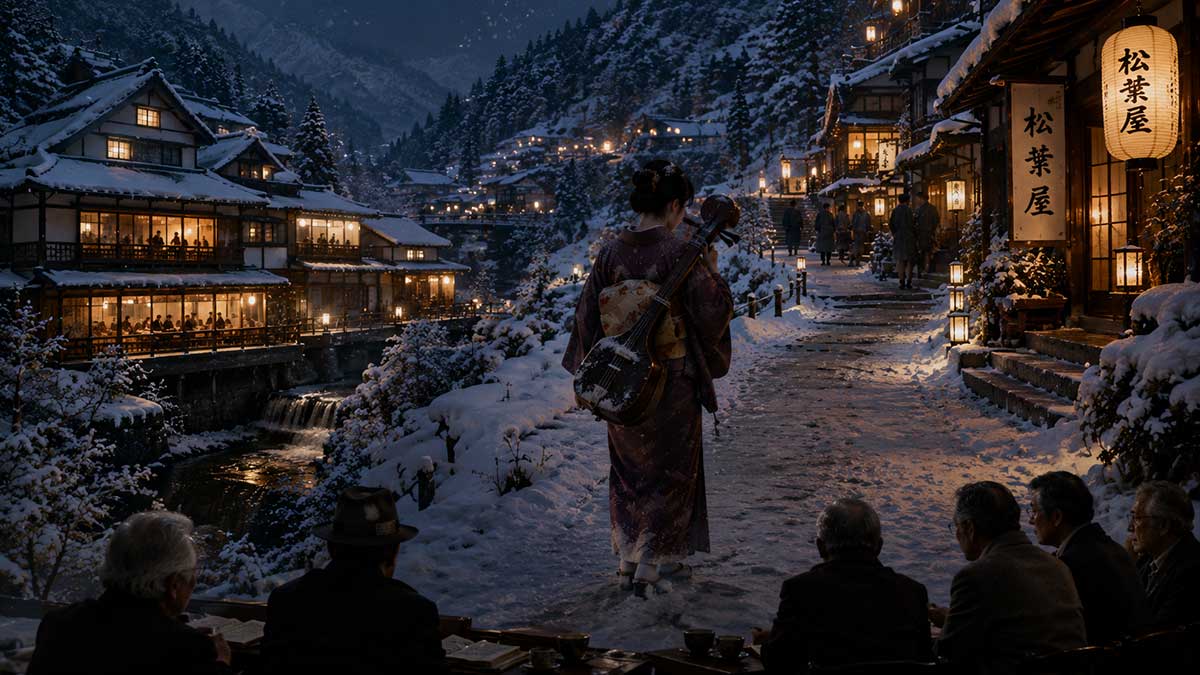
The panel changed once more.
Nina Cornyetz remained.
Miho Matsugu returned to the table.
Donald Keene took his seat beside her.
Across from them sat Roy Starrs and Masao Miyoshi.
The window was dark now.
Snow continued falling outside, but the room had become warmer.
On the table were photographs of old hot-spring towns, geisha houses, mountain railways, and several Japanese editions of Snow Country.
Cornyetz opened the discussion.
Nina Cornyetz: Perhaps we have spent too much time asking why Snow Country is beautiful.
And too little time asking what that beauty allows us not to see.
Keene looked toward her.
Donald Keene: You want to put beauty itself on trial.
Nina Cornyetz: Not beauty.
Our use of it.
Roy Starrs: That distinction matters.
Nina Cornyetz: Very much.
Snow is beautiful.
Komako is described beautifully.
Yoko becomes almost spectral.
Pain becomes lyrical.
Loneliness becomes exquisite.
Even the ending places human catastrophe beneath one of the most overwhelming images of cosmic beauty in the novel.
She looked around the table.
Nina Cornyetz: So my question is simple.
When suffering becomes beautiful enough, do we begin to admire it instead of asking what produced it?
Question 1 — What Disappears When Komako Becomes “Beautiful”?
Matsugu answered first.
Miho Matsugu: Labor.
The others turned toward her.
Miho Matsugu: That is one thing that can disappear very quickly.
Readers remember Komako walking through snow.
Playing the shamisen.
Drinking.
Waiting.
Loving.
All of this can become part of a beautiful image.
But Komako works.
Her music is labor.
Her position as a geisha is labor.
Her movement through the resort town is shaped by money, clientele, expectation, and social position.
If we call her simply a tragic beauty in the snow, we lose part of her reality.
Donald Keene: But Kawabata is not writing an economic study.
Miho Matsugu: I know.
Nor am I asking him to.
A novel does not have to become sociology for class and labor to matter.
Masao Miyoshi: Especially when one character has the privilege of treating another character's world as atmosphere.
Keene looked toward Miyoshi.
Donald Keene: You mean Shimamura.
Masao Miyoshi: Of course.
For Shimamura, the snow country is a place to enter.
For Komako, it is where she lives.
That difference is not merely geographic.
It is structural.
When Does Setting Become Someone Else’s Life?
Roy Starrs: That may be one of Kawabata's central tensions.
The snow country is both actual place and aesthetic space.
Shimamura experiences it almost as a world apart.
A place where ordinary categories loosen.
Miho Matsugu: Which is precisely why we need to keep asking:
Apart for whom?
He gets to experience the region as an escape.
Komako does not escape into it.
She gets up and works there.
Nina Cornyetz: So when Shimamura says, in effect, “How beautiful,” Matsugu asks us to hear another question beneath it:
Who is paying the cost of this beauty?
Matsugu nodded.
Is Komako’s Labor Hidden Inside Her Beauty?
Miho Matsugu: Look at the shamisen.
To Shimamura, the sound can become almost transcendent.
The snow sharpens it.
The room frames it.
Komako becomes extraordinarily beautiful in the act of playing.
But she practices because she needs skill.
Her musicianship does not simply emerge as natural femininity.
It is discipline.
Donald Keene: Certainly.
Miho Matsugu: Yet readers can receive only the final image.
Beautiful woman.
Traditional instrument.
Snow.
Japan.
That is exactly where historical and material specificity can disappear.
Miyoshi smiled slightly.
Masao Miyoshi: And then someone says, “Ah, timeless Japanese beauty.”
Donald Keene: You dislike that phrase.
Masao Miyoshi: I dislike what happens when “timeless” removes history.
Is “Japanese Beauty” Too Comfortable a Category?
Keene leaned forward.
Donald Keene: But one should not overcorrect.
Kawabata was profoundly responsive to Japanese artistic traditions.
Landscape.
Seasonality.
Traditional arts.
Gesture.
Silence.
Transience.
Those aren't inventions of Western readers.
Masao Miyoshi: No.
But they can be packaged.
There is a difference between saying Kawabata engages with Japanese aesthetic traditions and saying he somehow gives us an untouched essence of Japan.
Snow Country is a modern novel.
Its train matters.
Tokyo matters.
Western ballet matters.
Tourism matters.
Money matters.
Modern mobility matters.
Roy Starrs: I agree with that.
Kawabata is not preserving a sealed premodern world.
He is writing from within modernity.
The beauty often emerges precisely from tension between modern and traditional forms.
Miho Matsugu: And Komako stands inside that tension.
She is not a decorative survival from some earlier Japan.
She is a working woman in a changing social world.
Is Shimamura Looking for an Imaginary Japan?
Cornyetz turned toward Starrs.
Nina Cornyetz: Could Shimamura's attraction to the snow country partly be attraction to a Japan he wants to experience aesthetically?
Roy Starrs: I think that is a useful reading.
He comes from Tokyo.
He is fascinated by distance.
Traditional music.
Landscape.
Women associated with the hot-spring town.
One might say he seeks an intensified experience of something “other” to metropolitan life.
Masao Miyoshi: Which resembles tourism.
Roy Starrs: Yes, but with philosophical depth.
Masao Miyoshi: Tourism can have philosophical depth.
Starrs laughed softly.
Roy Starrs: Fair enough.
Question 2 — Does Kawabata Criticize Shimamura’s Gaze—or Share It?
Cornyetz picked up the book.
Nina Cornyetz: Here is the question I think we cannot avoid.
Shimamura turns women into beautiful impressions.
We have criticized him for that.
But Kawabata's prose turns those same women into extraordinarily beautiful impressions.
So where is the distance between character and author?
Keene responded immediately.
Donald Keene: A novelist can depict a mode of perception without endorsing it.
Nina Cornyetz: Certainly.
But how do we know that is happening here?
Donald Keene: Through complexity.
Komako exceeds Shimamura's perception.
She is too contradictory, too alive, too emotionally disruptive to remain merely an image.
Miho Matsugu: I agree with that.
Nina Cornyetz: So Kawabata may use Shimamura's gaze while letting Komako repeatedly break out of it.
Donald Keene: Exactly.
Does Komako Escape the Image?
Matsugu thought for a moment.
Miho Matsugu: Partly.
But not completely.
That matters too.
Komako is given more ordinary reality than Yoko.
She works.
Reads.
Practices.
Gets drunk.
Gets irritated.
Makes mistakes.
She is difficult to keep purely symbolic.
Yet the prose still repeatedly aestheticizes her.
Masao Miyoshi: Which may be why the novel is stronger than either a simple defense or a simple indictment.
It does not give us an innocent realism outside the aesthetic gaze.
The aesthetic gaze is part of the world of the novel.
What About Yoko?
Cornyetz turned toward Matsugu.
Nina Cornyetz: Yoko seems more vulnerable to becoming an image.
Miho Matsugu: Yes.
She is much less available as an ordinary social person.
Voice.
Face.
Reflection.
Care.
Fall.
She can become almost entirely symbolic if we aren't careful.
Roy Starrs: Yet that symbolic intensity may be deliberate.
Yoko has another function in the architecture of the novel.
Nina Cornyetz: I don't dispute function.
I dispute the idea that literary function erases ethical consequence.
Can a Woman Be Both Character and Symbol?
Keene answered.
Donald Keene: Of course she can.
Nina Cornyetz: Yes.
But the balance matters.
A character can bear symbolic meaning without ceasing to be a person.
The danger comes when the symbol becomes more interesting than the person.
Masao Miyoshi: Which is another reason the Western reception of Kawabata deserves scrutiny.
Readers may be especially tempted to receive Yoko as mystery, purity, ephemerality—
all the things they expect to find in “Japanese aesthetics.”
Keene looked at him.
Donald Keene: You are determined not to let anyone enjoy the snow.
Miyoshi smiled.
Masao Miyoshi: Enjoy it.
Just don't confuse enjoyment with explanation.
Is Beauty a Form of Knowledge?
Starrs entered more strongly now.
Roy Starrs: We may be speaking as if beauty and knowledge are opposites.
I am not convinced.
Beauty can reveal.
It can intensify perception.
It can make something emotionally unavoidable.
Nina Cornyetz: Agreed.
Roy Starrs: Then Kawabata's beauty may not be hiding suffering.
It may be what makes suffering register.
Does Beauty Make Us Care More?
Donald Keene: Precisely.
Komako's pain becomes memorable partly because Kawabata renders it with such precision.
If the prose were flat, perhaps we would care less.
Nina Cornyetz: That is the strongest defense of aestheticization.
And I accept part of it.
But we still need another question.
Care about what?
Donald Keene: Komako.
Nina Cornyetz: Or the feeling Komako produces in us?
Keene paused.
Can Compassion Become Self-Regard?
Nina Cornyetz: Readers can feel deeply moved and still remain centered on their own experience.
“How sad.”
“How beautiful.”
“How haunting.”
The response may feel compassionate.
But it can still be about what the artwork does to us.
Roy Starrs: Yet that is true of almost all art.
Nina Cornyetz: Yes.
I am not condemning it.
I am asking us to notice it.
Does Kawabata Make Us Uncomfortable Enough?
Matsugu looked toward Cornyetz.
Miho Matsugu: Perhaps the test is whether the beauty closes the question or opens it.
If we finish a scene thinking only:
“What a beautiful geisha in the snow,”
then something has been lost.
If we finish thinking:
“What does it mean that she works, waits, loves, and cannot leave this situation as easily as Shimamura can?”
then beauty has opened perception rather than closed it.
Masao Miyoshi: That is useful.
Beauty can become an endpoint.
Or a beginning.
Question 3 — Can Beauty Make Suffering Harder to See?
Cornyetz turned to Keene.
Nina Cornyetz: Let me put the hardest version to you.
Can Kawabata's beauty make suffering less disturbing precisely by making it aesthetically satisfying?
Keene considered.
Donald Keene: Yes.
Any beautiful treatment of suffering carries that risk.
But removing beauty does not automatically produce ethical truth.
Nina Cornyetz: Good.
Donald Keene: A crude representation of suffering can exploit just as easily.
The issue is not beauty versus truth.
It is whether the work leaves suffering irreducible.
Roy Starrs: That may be exactly what the ending does.
No one gets to resolve Yoko's fall into a comforting meaning.
The Milky Way does not explain it.
The fire does not explain it.
Komako's response does not explain it.
Shimamura's response certainly does not.
Beauty and Horror Can Coexist
Roy Starrs: Perhaps one of Kawabata's deepest achievements is refusing the expectation that beauty should disappear when horror enters.
The night remains beautiful.
The Milky Way remains immense.
A human body falls.
These things coexist.
Miho Matsugu: But coexistence is not equivalence.
Roy Starrs: No.
Miho Matsugu: The stars are not morally equal to the person falling.
Roy Starrs: Of course not.
But consciousness can register both.
That may be the point.
Does Beauty Distance Us—or Make Contradiction Unbearable?
Miyoshi looked toward Starrs.
Masao Miyoshi: That is where I find the novel strongest.
Not when beauty explains suffering.
When beauty makes the contradiction harder to bear.
Nina Cornyetz: Yes.
The problem comes when readers use beauty to resolve contradiction.
Donald Keene: In other words:
“Kawabata teaches us that suffering is beautiful.”
Nina Cornyetz: Exactly.
That would be far too simple.
Is Komako “Beautifully Tragic” a Dangerous Phrase?
Matsugu nodded.
Miho Matsugu: I would almost ban that phrase.
Donald Keene: Why?
Miho Matsugu: Because it turns the adjective into permission.
Beautifully tragic.
Then tragedy becomes aesthetically complete.
But Komako's life is not complete as a tragic image.
It continues.
She has to wake up the next morning.
That line changed the mood at the table.
The Morning After Beauty
Masao Miyoshi: That may be what Shimamura rarely sees.
The morning after beauty.
Miho Matsugu: Exactly.
Nina Cornyetz: Which may be the moral center of this whole discussion.
Shimamura loves the intense image.
Komako has to live after it.
Roy Starrs: And Kawabata's form is often intensely momentary.
So the question becomes whether the novel itself can represent the after.
Donald Keene: Komako partly represents it.
She returns.
Again and again.
The image does not contain her completely.
Does Komako Resist Kawabata’s Own Aesthetic System?
Cornyetz looked toward Keene.
Nina Cornyetz: That is an interesting defense.
Komako may be the character who keeps refusing to remain an image.
She talks too much.
Drinks too much.
Works too hard.
Wants too much.
She disrupts aesthetic stillness.
Miho Matsugu: Yes.
She is inconvenient.
That is part of her strength.
Masao Miyoshi: Then perhaps Shimamura wants a perfectly beautiful snow country and keeps encountering a woman who insists on being human inside it.
Keene smiled.
Donald Keene: That is very good.
What Does Yoko Do to This Contrast?
Starrs looked at the book.
Roy Starrs: Yoko may function differently.
She remains more elusive.
More easily fused with voice, reflection, and final catastrophe.
Nina Cornyetz: Which means the novel's aesthetic system has greater control over her.
Miho Matsugu: And less social detail protects her from symbolic absorption.
Donald Keene: Yet perhaps that difference between Komako and Yoko is deliberate.
Komako pulls us into embodied life.
Yoko pulls us into distance, memory, death, and image.
Nina Cornyetz: I accept that formal distinction.
I simply want us never to forget the gendered pattern.
Is Aesthetic Distance Always Wrong?
Miyoshi shook his head.
Masao Miyoshi: No.
That would be absurd.
Without distance there is no art.
Art selects.
Frames.
Transforms.
Nina Cornyetz: Agreed.
Masao Miyoshi: So the question cannot be:
“Should Kawabata stop aestheticizing?”
He is a novelist.
Of course he aestheticizes.
The question is:
What becomes visible through the transformation, and what disappears?
Miho Matsugu: And who disappears.
Is Kawabata More Ethical Than Shimamura?
Keene considered this.
Donald Keene: I think Kawabata gives Komako more existence than Shimamura does.
That matters.
Nina Cornyetz: Yes.
Donald Keene: Shimamura often sees her as experience.
The novel repeatedly gives her resistance.
That gap may be where ethical distance appears.
Roy Starrs: Yet Kawabata never fully leaves Shimamura's aesthetic mode either.
Donald Keene: No.
Roy Starrs: Which gives us the tension.
The novel criticizes through the very beauty that creates the problem.
Can a Novel Be Complicit and Critical at the Same Time?
Cornyetz smiled.
Nina Cornyetz: Now we are getting somewhere.
Perhaps the choice between:
“Kawabata exposes Shimamura”
and
“Kawabata shares Shimamura's gaze”
is false.
A work can participate in a gaze and disturb that gaze at the same time.
Masao Miyoshi: Literature often does.
Miho Matsugu: Which means the reader's job becomes harder.
Donald Keene: Thankfully.
Final Round — Is the Beauty Innocent?
Cornyetz looked around the table.
Nina Cornyetz: One answer each.
Is the beauty of Snow Country innocent?
Keene began.
Donald Keene: No beauty in serious art is entirely innocent. But Kawabata's beauty enlarges experience more often than it conceals it.
Matsugu followed.
Miho Matsugu: It becomes dangerous when it erases labor, class, gender, and the difference between the visitor who leaves and the woman who remains.
Miyoshi spoke next.
Masao Miyoshi: I distrust any reading that turns Kawabata's beauty into a timeless national essence. The novel is modern, historical, and full of social tension.
Starrs leaned forward.
Roy Starrs: Beauty here is neither escape nor truth by itself. It is the medium through which incompatible realities occupy the same moment.
Finally, Cornyetz.
Nina Cornyetz: I would say beauty becomes ethically meaningful only when it makes us look again.
Not when it makes suffering easier to admire.
The room grew quiet.
Outside, the snowfall had thinned.
Starrs looked toward the dark sky.
Roy Starrs: Perhaps that is why the ending is so difficult.
Cornyetz turned toward him.
Roy Starrs: The novel gives us the most extreme version of everything we have discussed.
A woman's body.
A fall.
Fire.
Snow.
The Milky Way.
Human catastrophe and breathtaking beauty occupy the same instant.
Keene nodded.
Donald Keene: And Kawabata refuses to tell us which one explains the other.
Miyoshi closed his book.
Masao Miyoshi: Perhaps neither does.
Matsugu looked toward the window.
Miho Matsugu: Then the final question isn't whether the ending is beautiful.
It obviously is.
She turned back.
Miho Matsugu: The question is what we are supposed to do with that beauty when someone has just fallen.
Cornyetz looked around the table.
Nina Cornyetz: Good.
Then that should be our last discussion.
Topic 5 — What Does the Ending Actually Mean?
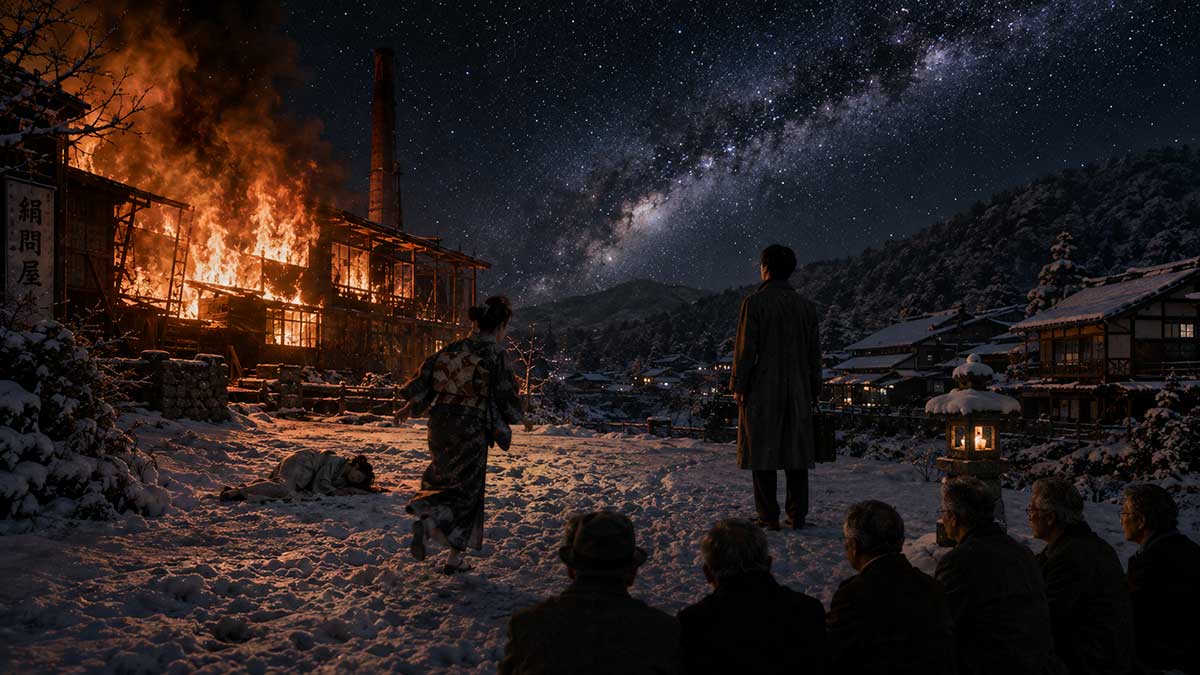
The final panel gathered after dark.
Edward Seidensticker returned to the table.
Donald Keene sat beside him.
Across from them were Masaki Mori, Kinya Tsuruta, and Roy Starrs.
The Japanese text lay open near the center.
Outside, the snow had nearly stopped.
Above the dark ridge, the sky was clear enough for stars.
Seidensticker looked down at the final pages.
Edward Seidensticker: Perhaps our first mistake is assuming that the ending is a puzzle with one correct solution.
Keene nodded.
Donald Keene: Yes.
Readers often approach endings as though the author has hidden an answer somewhere.
Masaki Mori: Kawabata may be doing something else.
Roy Starrs: Giving us an experience rather than a conclusion.
Kinya Tsuruta: And letting several meanings occupy the same moment.
Seidensticker closed the book halfway.
Edward Seidensticker: Then let us begin with the event itself.
There is a fire.
Yoko falls.
Komako rushes toward her.
Shimamura looks upward.
And the Milky Way suddenly becomes overwhelming.
He looked around the table.
Edward Seidensticker: Why?
Question 1 — Is Shimamura Escaping Into Beauty One Final Time?
Keene answered first.
Donald Keene: That reading is very difficult to avoid.
Throughout the novel, Shimamura transforms experience into perception.
A woman becomes an image.
A voice becomes beauty.
Pain becomes something observed.
Distance protects him.
Then, at the moment of crisis, he looks toward the sky.
One can reasonably say:
He has done it again.
Kinya Tsuruta: And structurally, the moment resembles earlier movements in the novel.
Human figure and landscape are brought together.
Reality is transformed through perception.
Masaki Mori: But the ending is more violent than the earlier mirror scenes.
Donald Keene: Certainly.
Masaki Mori: Earlier, the image is framed.
A train window.
A mirror.
Glass.
The observer remains separate.
At the end, that separation becomes unstable.
Does Shimamura Abandon Yoko in the Moment She Most Needs Reality?
Edward Seidensticker: Yet the ethical question remains.
Komako moves toward Yoko.
Shimamura's consciousness moves elsewhere.
Roy Starrs: Or outward.
Edward Seidensticker: Is that meaningfully different?
Roy Starrs: Perhaps.
Starrs leaned forward.
Roy Starrs: We should be careful with the language of “escape.”
Escape implies that the sky offers relief.
But the Milky Way does not seem comforting.
It seems overwhelming.
Almost annihilating.
Donald Keene: Yes.
Roy Starrs: He may not be fleeing pain.
He may be experiencing pain and cosmic scale simultaneously.
Does Beauty Still Protect Him?
Mori looked toward Keene.
Masaki Mori: Earlier, beauty gave Shimamura distance.
Here, I am not sure distance remains.
The Milky Way seems to enter consciousness with unusual force.
Kinya Tsuruta: The direction reverses.
Earlier, he projects onto what he sees.
At the end, what he sees seems to act upon him.
Edward Seidensticker: That is an important distinction.
For most of the novel, Shimamura is the observer.
At the end, perhaps he becomes the one overwhelmed by the observed.
Question 2 — Has Beauty Finally Broken Through His Detachment?
Mori opened the book again.
Masaki Mori: If we think of the mirror imagery across the novel, the ending may complete it in a strange way.
Earlier:
face and landscape overlap on glass.
The image remains a surface.
At the end, there is no safe pane.
Fire.
Body.
Snow.
Sky.
Milky Way.
Everything seems to collapse into one field of perception.
Kinya Tsuruta: The novel's visual system becomes total.
Roy Starrs: Which may be why the moment feels almost metaphysical.
The boundary between individual consciousness and world weakens.
Is This Transcendence?
Keene looked toward Starrs.
Donald Keene: Would you call it transcendence?
Roy Starrs: Perhaps, but with caution.
Transcendence can sound too consoling.
Nothing about Yoko's fall is consoled.
Edward Seidensticker: Good.
Roy Starrs: I would say Shimamura encounters a scale of reality that makes his ordinary habits of perception insufficient.
For a moment, the human and cosmic occupy the same consciousness.
Masaki Mori: And that does not necessarily mean enlightenment.
Roy Starrs: Exactly.
Can Someone Be Overwhelmed Without Being Changed?
Tsuruta spoke.
Kinya Tsuruta: That may be the key distinction.
An overwhelming moment is not the same as transformation.
Donald Keene: Yes.
Kinya Tsuruta: Readers may want the ending to redeem Shimamura.
Detached man finally sees tragedy.
Detached man finally awakens.
But Kawabata gives us no life afterward through which we can verify that.
Edward Seidensticker: Which raises the next question.
Does Shimamura actually change?
Question 3 — Does Shimamura Change at the End?
Silence.
Keene smiled faintly.
Donald Keene: We do not know.
Edward Seidensticker: Exactly.
And perhaps we are not supposed to.
Are Readers Asking for a Western-Style Character Arc?
Edward Seidensticker: There is a temptation to impose a familiar sequence.
A flawed character experiences crisis.
Crisis produces insight.
Insight produces moral change.
But Kawabata ends before that structure can complete itself.
Kinya Tsuruta: The ending gives intensity rather than verification.
Masaki Mori: A transformed image, not a transformed biography.
Roy Starrs: Which may be more consistent with the novel's entire philosophy of moments.
Nothing is guaranteed beyond the moment itself.
Donald Keene: Yet that sounds dangerously close to Shimamura's own way of living.
Starrs smiled.
Roy Starrs: Precisely.
That may be why the ending remains unstable.
Is the Ending Criticizing Shimamura—or Repeating Him?
Seidensticker turned toward Mori.
Edward Seidensticker: If the novel ends in overwhelming beauty at the exact moment of human catastrophe, are we witnessing Shimamura's final escape—
or Kawabata's?
Mori paused.
Masaki Mori: I would resist separating those too quickly.
The novel has spent hundreds of pages making the reader experience reality through aesthetic transformation.
The ending intensifies that method.
So the reader is placed in the same difficulty as Shimamura.
Donald Keene: We see the Milky Way too.
Masaki Mori: Exactly.
We may condemn him for looking upward, yet Kawabata makes us look with him.
That changed the conversation.
Is the Reader Complicit in the Ending?
Tsuruta looked toward Seidensticker.
Kinya Tsuruta: This connects to our previous topic.
We keep asking what Shimamura does with beauty.
But the ending asks what the reader does.
Yoko falls.
Yet the prose gives us cosmic beauty.
Which do we attend to?
Edward Seidensticker: And translation intensifies that responsibility.
A translator must choose rhythm, weight, sequence.
One can make the cosmic image dominate.
Or the bodily fall.
Or the transition between them.
No translation is neutral.
Can Translation Preserve Ambiguity?
Keene looked toward him.
Donald Keene: How much uncertainty can translation preserve?
Edward Seidensticker: Never all of it.
That is the uncomfortable answer.
Syntax carries emphasis.
Japanese and English distribute attention differently.
A translator has to build a sentence.
And building a sentence means making choices.
Masaki Mori: Which means English-language readers encounter the ending partly through your decisions.
Edward Seidensticker: Yes.
And that is why I would be very reluctant to say:
“This image means X.”
The translator should not become the final interpreter.
What Does the Milky Way Actually Do?
Starrs returned to the image itself.
Roy Starrs: Perhaps we can list the possibilities without choosing.
The Milky Way may represent:
escape.
Transcendence.
Impermanence.
Cosmic indifference.
The dissolution of the self.
Aesthetic shock.
Or simply a simultaneous perception too intense to reduce.
Donald Keene: I would add beauty that refuses to cooperate with human tragedy.
Kinya Tsuruta: Yes.
The sky does not darken because Yoko falls.
Is Cosmic Indifference Cruel?
Seidensticker asked:
Edward Seidensticker: Does the Milky Way make Yoko's death seem insignificant?
Roy Starrs: It could.
But it may do the opposite.
Against that enormous scale, the individual body becomes tiny—
yet emotionally central.
Masaki Mori: That contradiction matters.
The cosmos is immense.
Yoko is almost nothing within it.
Yet Shimamura cannot experience the cosmos apart from the moment of her fall.
Does the Infinite Make the Individual More Precious?
Keene considered.
Donald Keene: Perhaps that is one of the paradoxes of impermanence.
Human life is very small.
That does not make it meaningless.
It can make its fragility more intense.
Kinya Tsuruta: Snowflake against sky.
Body against stars.
Moment against eternity.
Edward Seidensticker: And Kawabata gives us no sentence saying which scale should govern our interpretation.
Why Does Komako Run While Shimamura Looks?
Mori turned toward Keene.
Masaki Mori: We should not lose the contrast with Komako.
She moves.
He perceives.
Donald Keene: The entire novel in two gestures.
Kinya Tsuruta: Komako enters the event bodily.
Shimamura enters it aesthetically.
Roy Starrs: Yet perhaps his aesthetic response is bodily too by this point.
Edward Seidensticker: That is possible.
Is Komako the Ethical Center of the Ending?
Keene looked around the table.
Donald Keene: Perhaps Komako is the one character whose response needs little interpretation.
Someone falls.
She runs.
Masaki Mori: Immediate action.
Kinya Tsuruta: No framing.
Roy Starrs: No abstraction.
Edward Seidensticker: But Kawabata does not end with her action alone.
He redirects us toward Shimamura's consciousness.
That choice matters.
Why End With Shimamura Rather Than Komako?
Mori answered.
Masaki Mori: Because the novel is deeply concerned with perception.
Komako's movement gives us human response.
Shimamura's consciousness gives us the unresolved problem.
Roy Starrs: If the novel ended simply with Komako rushing toward Yoko, we might leave with a much clearer ethical center.
Donald Keene: Kawabata refuses clarity.
Is That Refusal Profound—or Evasive?
Seidensticker smiled.
Edward Seidensticker: There is the uncomfortable question.
Kinya Tsuruta: Perhaps both.
Donald Keene: Literary ambiguity can become a kind of prestige if we aren't careful.
Sometimes critics praise uncertainty merely because it is uncertainty.
Roy Starrs: True.
But here the contradiction seems earned.
Nothing in the novel has prepared us for a clean moral resolution.
Does the Ending Complete the Novel’s Mirror Structure?
Mori returned to his central theme.
Masaki Mori: I think it does.
In the train scene, Yoko appears as a reflected image against landscape.
At the end, Yoko's body and cosmic landscape are once again brought together.
But the relationship is transformed.
At first, she is visually distant and beautiful.
At the end, beauty and bodily catastrophe collide.
Kinya Tsuruta: So the opening reflection returns in a darker form.
Masaki Mori: Yes.
At the beginning, the image enchants.
At the end, the image wounds.
Has Shimamura’s Way of Seeing Finally Become Unbearable to Him?
Keene looked toward Mori.
Donald Keene: That may be the strongest argument for transformation.
His aesthetic sensitivity, which once protected him, becomes painful.
Masaki Mori: Exactly.
The same capacity that allowed him distance may finally destroy distance.
Edward Seidensticker: But again—
we do not know what he does tomorrow.
Does Tomorrow Matter?
Starrs answered.
Roy Starrs: Perhaps tomorrow matters greatly.
But Kawabata refuses to write it.
That refusal forces the reader to live inside the moment before consequence.
Donald Keene: Which sounds, once again, very much like Shimamura.
Everyone laughed softly.
Is Kawabata Trapping the Reader Inside Shimamura’s Consciousness?
Kinya Tsuruta: Perhaps that is intentional.
We want the “after.”
Does he change?
Does he return?
Does he think differently?
Kawabata denies us the continuation.
We are left with an image.
Just as Shimamura so often is.
Edward Seidensticker: That is wonderfully uncomfortable.
The reader wants what Shimamura avoids:
the consequences after the beautiful moment.
Final Round — Five Interpretations of the Ending
Seidensticker looked around the table.
Edward Seidensticker: Let us finish without forcing agreement.
One interpretation from each of us.
Keene began.
Donald Keene: I read the ending as the culmination of Kawabata's lifelong concern with beauty and transience. Yoko's fall and the Milky Way coexist without one explaining the other. Human life becomes fragile, not meaningless.
Tsuruta followed.
Kinya Tsuruta: I see structural culmination. Recurring movements between figure and landscape, nearness and distance, return and disappearance finally reach their most intense form.
Mori spoke next.
Masaki Mori: I see the collapse of the mirror. Earlier, Shimamura experiences the world through surfaces. At the end, the separation between observer and image becomes unstable. Beauty no longer remains safely outside him.
Starrs leaned forward.
Roy Starrs: I see an encounter with scale. The self, the body, the relationship, and the cosmos occupy one moment. It may resemble transcendence, but it offers no consolation.
Finally, Seidensticker.
Edward Seidensticker: I see an ending that should remain partly resistant to explanation. The moment loses force if we translate it into a lesson.
Final Question — Does Shimamura Change?
Keene looked toward Seidensticker.
Donald Keene: You are avoiding the final answer.
Edward Seidensticker: Deliberately.
Donald Keene: Then I will ask one last time.
Does Shimamura change?
Seidensticker looked at the Japanese text.
Then at the snow outside.
Edward Seidensticker: Something happens to him.
That is all I would claim.
Roy Starrs: Perhaps that is enough.
Kinya Tsuruta: For a novel, perhaps.
Masaki Mori: For a life, perhaps not.
The room went quiet.
That distinction remained.
A moment can transform perception.
A life requires what follows.
One Final Question From Each Scholar
Keene closed his book.
Donald Keene: Are we reading Kawabata—
or our own desire for Kawabata to explain what human beings should do with beauty?
Seidensticker placed his hand on the English edition.
Edward Seidensticker: How much uncertainty can language preserve before interpretation begins deciding for us?
Tsuruta looked toward the window.
Kinya Tsuruta: If everything in the novel returns and disappears, is repetition futile—or is repetition how meaning survives?
Starrs looked upward.
Roy Starrs: When the individual appears almost nothing beneath the cosmos, why does one human fall still fill consciousness completely?
Finally, Mori.
He looked at his own faint reflection in the glass.
Masaki Mori: If the window finally disappears—
what happens to a man who has spent the entire novel looking through it?
No one answered.
Outside, the clouds had moved away.
A few stars were visible above the ridge.
Seidensticker looked toward them for several seconds.
Then back at the table.
Edward Seidensticker: Perhaps Kawabata does not ask us to choose between these meanings.
Mori nodded.
Masaki Mori: Perhaps the novel exists in the space between them.
Keene smiled faintly.
Donald Keene: Rather like the reflection in the train window.
Person.
Landscape.
Reality.
Image.
All there at once.
The books remained open on the table.
No scholar had solved Snow Country.
Perhaps that was the wrong ambition.
The five conversations had begun by asking whether Shimamura loved Komako.
They ended somewhere much larger.
Can love be real and unequal?
Can effort be futile and meaningful?
Can a reflection reveal and separate at once?
Can beauty deepen compassion and obscure suffering?
Can a person experience something profound without knowing how to live differently afterward?
And finally:
When everything beautiful is temporary, what should awareness of that impermanence do to us?
Kawabata leaves the question unanswered.
The snow melts.
The image disappears.
The reader is left to decide what happens after looking.
Final Thoughts
The scholars do not “solve” Snow Country.
Instead, they uncover several truths that can exist together.
Komako’s love may be real and still unequal.
Her effort may be partly futile and still deeply meaningful.
Shimamura’s sensitivity may be genuine and still insufficient.
A mirror can reveal something and keep us separated from it.
Beauty can make suffering unforgettable and, at times, make suffering easier to admire from a distance.
And the ending may represent escape, awakening, transcendence, aesthetic shock—or several of these at once.
Perhaps Kawabata’s deepest question is not simply what beauty means.
It is what beauty asks of the person who sees it.
Shimamura spends much of the novel looking.
The final question is whether seeing ever becomes living.
Short Bios:
Donald Keene — Influential scholar of Japanese literature whose work placed Kawabata within the larger history of modern Japanese writing.
Edward Seidensticker — Translator of Snow Country into English and a major interpreter of Kawabata’s style, ambiguity, and emotional restraint.
Masao Miyoshi — Literary critic known for challenging simplified Western readings of modern Japanese literature and cultural ideas such as silence and “Japanese beauty.”
Nina Cornyetz — Scholar whose work examines gender, bodies, aesthetics, representation, and the ethical implications of beauty in Kawabata.
Miho Matsugu — Scholar whose work on Snow Country examines Komako, geisha culture, labor, class, gender, and the social realities beneath the novel’s aesthetic surface.
Masaki Mori — Scholar known for examining Kawabata’s mirror imagery, reflection, visual perception, and the relationship between observer and observed.
Kinya Tsuruta — Kawabata scholar who has written on the structure, recurring imagery, movement, and flow of Snow Country.
James T. Araki — Scholar of Japanese literature whose criticism of Snow Country explores Komako, modernity, literary technique, and Kawabata’s distinctive narrative form.
Alan V. Liman — Scholar who has examined the lyrical mode of Snow Country and the poetic relationships among its images and characters.
Makoto Akiyama — Scholar whose work considers point of view and Shimamura’s role as a traveler and observer of Komako, Yoko, and the snow-country setting.
Roy Starrs — Scholar of Kawabata, Japanese aesthetics, modernity, cultural identity, and philosophical interpretations of transience and beauty.
Yasunari Kawabata — Japanese novelist and 1968 Nobel Prize in Literature laureate. His fiction is known for sparse prose, emotional restraint, beauty, loneliness, memory, and the fleeting nature of human experience.
Leave a Reply