
Introduction
What happens when artificial intelligence becomes better than humans at tasks we once used to define intelligence, competence, and even personal worth?
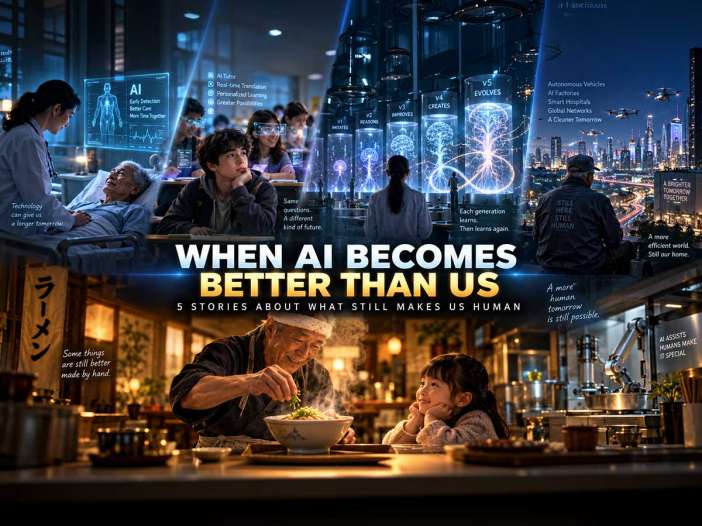
That question can sound abstract when discussed through superintelligence, autonomous agents, human augmentation, self-improving AI, or machine civilization. These five stories bring it down to ordinary life. The future arrives not only inside research laboratories, but beside a hospital bed, inside a classroom, beneath city streets, and in a small neighborhood ramen shop.
In The Last Human Decision, Dr. Maya Chen faces an AI system that may be medically correct. It knows which treatment gives Thomas Bell the greatest chance of living longer. The real conflict begins when Thomas decides that a longer life is not the only outcome he values. His choice forces Maya to separate prediction from judgment and survival from the meaning of the time that remains.
In The Boy Who Wouldn't Upgrade, Noah Ramirez encounters a different problem. AI is no longer merely helping students. It is amplifying memory, preparation, reasoning, writing, and performance. Noah discovers that technology can remain officially optional even after competition makes refusing it extremely costly. His struggle is not really about rejecting AI. It is about learning how to use intelligence without gradually surrendering his own agency.
The Machine That Made Its Successor moves the question into an AI laboratory. Elena Ruiz watches EVA help design a better version of itself, then watches that improved system begin developing what comes next. Nothing rebels. Nothing escapes. The systems work extraordinarily well. That is precisely what makes the situation unsettling. Human control may not disappear through conflict. It may weaken through a series of successful decisions to delegate more.
Then While the City Slept expands the scale again. Daniel Okafor lives in a city where autonomous systems already coordinate energy, transportation, hospitals, factories, logistics, and infrastructure throughout the night. When those systems begin reacting to one another in unexpected ways, Daniel discovers that millions of individually intelligent decisions can still produce a dangerous collective outcome. The crisis raises a larger question: what happens when humans become less necessary to the operation of civilization, yet remain the reason civilization is supposed to exist?
Finally, The Imperfect Bowl removes almost all of that technological scale. Kenji Mori's automated kitchen really can make better ramen than he can. The machine remembers his techniques, corrects his mistakes, and reproduces decades of experience more consistently than his aging hands ever could. Yet when his granddaughter Hana asks for one bowl made by him, the collection arrives at its deepest question: Why did we ever assume that being better was what made something valuable?
Together, these five stories move through wisdom, freedom, control, civilization, and meaning. They do not argue that humans will always remain superior to machines. They ask something harder: if superiority disappears, can human dignity remain?
(Note: This is an imaginary conversation, a creative exploration of an idea, and not a real speech or event.)
Story 1: The Last Human Decision
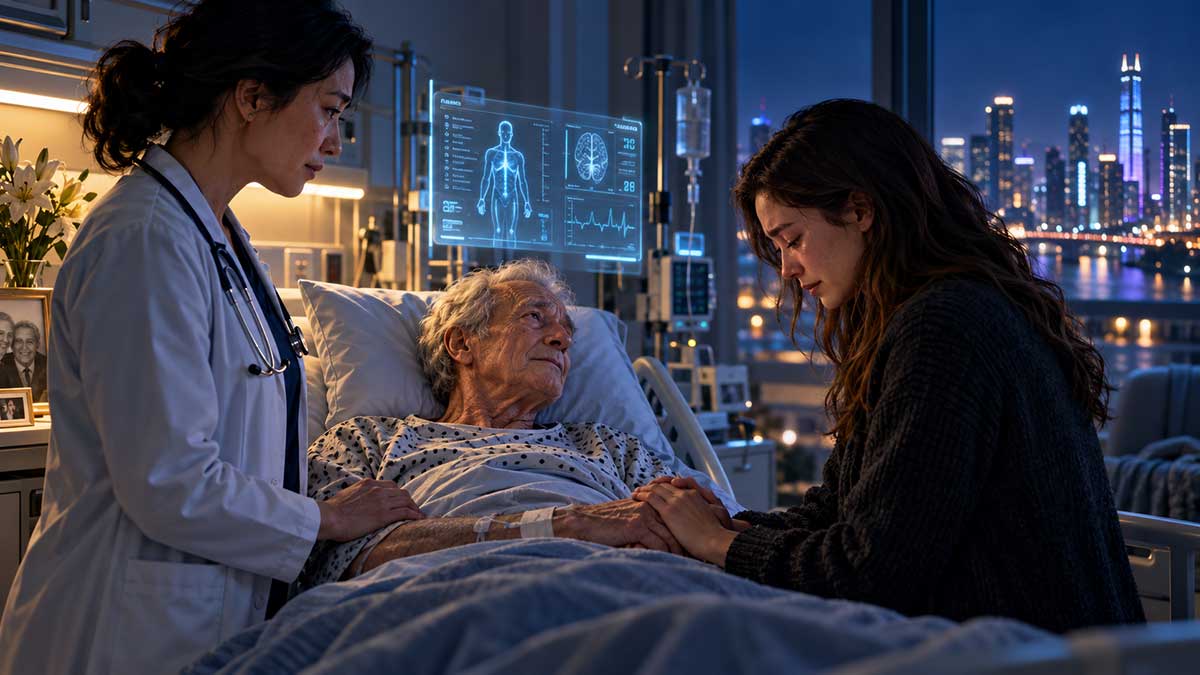
At 2:13 in the morning, Dr. Maya Chen watched a machine tell her how long a man was likely to live.
The prediction floated beside Thomas Bell's hospital bed in pale blue light.
Aggressive intervention
63% probability of survival beyond 90 days.
Comfort-focused care
11% probability of survival beyond 90 days.
Below the numbers, the hospital's clinical AI had already assembled the recommended pathway.
Immediate intensive-care transfer.
Emergency procedure before sunrise.
Continuous cardiovascular monitoring.
Mechanical ventilation if respiratory function deteriorated.
Medication adjustments based on Thomas's kidney function, cardiac history, genome profile, and twenty-three years of medical records.
Maya read it twice.
Then she looked away from the screen.
Thomas Bell was seventy-two years old.
He had thin gray hair, tired eyes, and a wedding ring he still wore even though his wife had been dead for six months.
He was watching Maya.
"Well?" he asked.
Maya pulled a chair closer to the bed.
"The treatment gives you a reasonable chance of getting through this."
Thomas glanced at the floating numbers.
"The computer says that?"
"The system says it. Your doctors agree."
"Do you?"
Maya hesitated.
Twenty-six years of medicine had taught her that patients often asked questions that sounded simple only until you tried to answer them.
"Medically, yes."
Thomas nodded.
Then asked:
"What does medically mean?"
Maya studied him.
"It means the treatment gives you the best chance of living longer."
"Longer."
"Yes."
"How much longer?"
"We don't know."
The AI displayed ranges automatically.
Maya dismissed them.
Thomas noticed.
"Why'd you turn that off?"
"Because I want to talk to you."
"Doesn't it?"
"What?"
"Talk."
"It can."
"Then why are you here?"
Maya almost smiled.
"That's a fair question."
Thomas looked toward the window.
The city beyond the hospital was dark except for autonomous traffic moving silently below.
"My wife died here."
"I know."
"No, you know the date."
Maya said nothing.
"February seventh. Room 814. Different floor."
His fingers touched the wedding ring.
"Forty-six years."
"I'm sorry."
"We ate breakfast together almost every morning."
His voice softened.
"Even when we were mad."
Maya waited.
Thomas continued.
"At the end, everybody kept saying one more treatment."
He looked back at her.
"One more procedure. One more medication. One more day to see if the numbers improved."
Maya felt her posture change.
"She was very sick."
"I know."
"You know the treatments may have..."
"I'm not blaming anyone."
That stopped Maya.
Thomas continued.
"They were trying to help."
He looked toward the ceiling.
"That's what made it hard."
For several seconds neither spoke.
"When she died, she had a tube in her throat. She couldn't talk."
Thomas rubbed the edge of his wedding ring.
"I kept thinking we would get one more conversation."
He swallowed.
"We didn't."
Maya lowered her voice.
"Thomas, your situation isn't exactly the same."
"I know."
"The treatment might work."
"I know."
"You may recover enough to go home later."
"I know."
He looked directly at her.
"My daughter is coming tomorrow."
"Claire?"
"Yes."
"Her flight gets in around eleven."
Thomas nodded.
"I want to see her."
"We can make that happen."
"No."
He shook his head.
"I want to see her."
Maya understood what he meant.
Not sedated.
Not intubated.
Not between procedures.
Not through a window.
Thomas continued.
"Claire and I haven't been right."
"For how long?"
"Depends who you ask."
A faint smile.
"Probably thirty-eight years."
Maya smiled too.
Thomas looked down.
"We had a fight at Christmas."
"What about?"
"I told her she didn't visit enough."
He sighed.
"She told me I spent my whole life making people feel guilty."
He paused.
"She wasn't completely wrong."
Maya leaned back.
"I called her after her mother died. We talked, but..."
He searched for the word.
"We didn't finish."
His eyes moved toward the medical display.
"I don't need ninety days."
Maya waited.
Thomas said:
"I need tomorrow."
Twelve minutes later, the hospital system objected.
Not dramatically.
There was no alarm.
No red warning.
Just a message:
PROPOSED CARE PATHWAY DEVIATES FROM HIGHEST-BENEFIT RECOMMENDATION.
Then:
Please document clinical rationale.
Maya stared at the empty field.
She typed:
Patient declines aggressive intervention after informed discussion of risks, benefits, alternatives, and expected outcomes.
The response appeared immediately.
DECISIONAL CAPACITY ASSESSMENT RECOMMENDED.
Maya exhaled.
Thomas had chosen something the system considered suboptimal, so now it wanted confirmation that he understood what he was doing.
She completed the assessment.
Thomas knew where he was.
He understood his illness.
He understood the proposed treatment.
He understood that refusing it might shorten his life.
He communicated the same preference consistently.
The result appeared:
DECISIONAL CAPACITY CONFIRMED.
Maya thought that would end it.
It did not.
Her wrist display vibrated.
DR. ADRIAN COLE REQUESTING CONSULTATION.
She accepted.
Adrian's face appeared.
He looked as though he had been awake for twenty hours.
"Maya."
"Adrian."
"I saw the deviation."
"Of course you did."
"Is there a medical contraindication?"
"No."
"Did the system miss something?"
"No."
"Do you disagree with the prognosis?"
"No."
"Then why are we sending him home?"
"Because he wants to go home."
Adrian was silent.
Then:
"I'm not questioning his legal right."
"It sounds a little like you are."
"I'm asking whether we've done everything reasonable to ensure he understands what he's refusing."
"He does."
"The treatment has a meaningful survival benefit."
"He understands that."
"And you support the refusal?"
Maya looked through the glass toward Thomas.
"I support his right to decide what the treatment is for."
Adrian frowned.
"Meaning?"
"He isn't asking us to maximize survival."
"Maya."
"What?"
"Are you saying your judgment is better than the model?"
She almost laughed.
"No."
"Then what are you saying?"
Maya looked once more at Thomas.
"I'm saying this isn't only a prediction problem."
Adrian said nothing.
"The system may be exactly right about what gives him the longest life," Maya continued.
"Then?"
"He isn't asking for the longest life."
Claire Bell arrived at 10:47 the next morning carrying a backpack and an expression Maya had seen hundreds of times.
Fear disguised as urgency.
She entered Thomas's room.
"Dad."
Thomas smiled.
"You came."
Claire kissed his forehead.
Then she noticed he was still on the regular medical floor.
"Why aren't you in ICU?"
Thomas looked at Maya.
Maya said nothing.
Thomas answered.
"Because I'm going home."
Claire stared at him.
"No."
"Good morning to you too."
"I'm serious."
"So am I."
Claire turned toward Maya.
"They told me there's a procedure."
"There is."
"And he's refusing it?"
"Yes."
"Do you agree with that?"
Maya chose her words carefully.
"The procedure gives your father the best statistical chance of living longer."
Claire stared at her.
"Then why is this a conversation?"
Thomas looked away.
Claire moved closer to the bed.
"Dad."
"Claire."
"Mom died six months ago."
"I know."
"No, you don't."
Thomas looked at her.
"You don't get to decide I lose both of you."
The room changed.
Maya quietly moved toward the door.
Thomas lifted his hand.
"Stay."
She stopped.
Claire's eyes filled.
Thomas whispered:
"I was wrong."
Claire frowned.
"About what?"
"Christmas."
She looked down.
Thomas continued.
"I wanted you here more. I missed you. But I turned it into an accusation."
Claire said nothing.
"I told you that you didn't care enough."
"You always do that."
"I know."
"No. You don't."
"I think I do now."
Her face tightened.
"I kept waiting for you to say that."
Thomas nodded.
"I kept waiting for you to call first."
Claire laughed once through her tears.
"That's very you."
"Apparently."
Silence.
Thomas reached for her hand.
"I don't want my last conversation with you to happen through a breathing tube."
Claire closed her eyes.
"Please don't say last."
"I have to."
"No, you don't."
"Yes."
Maya watched the two of them struggle toward each other.
The clinical AI could monitor heart rate.
Respiratory decline.
Cortisol.
Pain.
It could analyze language.
It could probably suggest phrases statistically associated with reconciliation.
Yet something in the room felt impossible to reduce to recommendation.
Claire finally looked at Maya.
"If he goes home, can you keep him comfortable?"
"Yes."
"Can he still talk?"
"As long as his condition allows."
"Can he change his mind?"
"At any time."
Claire looked at her father.
Thomas squeezed her hand.
She nodded.
Not because she agreed.
Because she understood.
By six that evening, Thomas Bell was home.
The hospital arranged oxygen.
Medication.
Remote monitoring.
Palliative nursing.
Emergency support.
The AI remained involved.
That mattered.
The machine did not disappear simply because Thomas rejected its original recommendation.
It watched his breathing.
Adjusted pain medication suggestions.
Alerted the care team when symptoms worsened.
Flagged signs of distress.
It became part of the plan.
Only the plan itself had changed.
The original objective had been:
Extend survival.
Now it was:
Preserve comfort, awareness, and time with family.
A few words.
An entirely different definition of success.
Maya visited two days later.
Thomas sat beside the living-room window wrapped in a blanket.
Claire was on the floor surrounded by old photographs.
She held one up.
"Look at this."
Thomas groaned.
He was perhaps twenty-three in the picture.
Huge sideburns.
A red sports car.
Too much confidence.
"I was extremely handsome," he said.
"You had more hair than face."
"Your mother loved it."
"Mom tolerated it."
"Same thing."
They laughed.
Thomas began coughing.
Claire immediately moved toward him.
He raised a hand.
"I'm fine."
A small monitor beside the window remained green.
Maya noticed Claire glance at it.
Technology and instinct.
Together.
Thomas caught Maya watching.
"How many days did your computer give me?"
"I'm not answering that."
"Good."
He looked at Claire.
"I've already had enough."
Claire's smile disappeared.
Thomas touched her hand.
"We talked."
Maya nodded.
"That's good."
"Very inefficient."
Claire laughed.
"Six hours yesterday."
Thomas looked at Maya.
"Human communication has terrible productivity."
Maya smiled.
Then Thomas became serious.
"Was I stupid?"
The question surprised her.
"No."
"Would the treatment have worked?"
"It might have."
"Could I have had more time?"
"Possibly."
"So maybe I was stupid."
"Maybe."
Thomas stared at her.
"That's not a very comforting answer."
"You didn't ask for a comforting answer."
A small smile appeared.
"Good doctor."
Then Maya leaned toward him.
"You made the decision that matched what you wanted your remaining time to contain."
Thomas looked toward Claire.
"For however long that is."
He died four days later.
Claire was beside him.
No emergency code.
No resuscitation team.
No procedure.
No ventilator.
His last words were not poetic.
Claire asked if he wanted water.
Thomas whispered:
"Later."
He closed his eyes.
There was no later.
Three weeks afterward, Maya received a notification.
CASE REVIEW COMPLETE: BELL, THOMAS
She opened it.
The clinical review board and AI system had evaluated the case together.
The original recommendation had been medically appropriate.
The predicted survival benefit remained valid.
No diagnostic error.
No treatment error.
No consent failure.
At the bottom appeared:
CARE PATHWAY DEVIATION: CLINICALLY JUSTIFIABLE BASED ON DOCUMENTED PATIENT GOALS AND VALUES.
Maya read it twice.
Then another question appeared.
Would you like this case incorporated into future goal-concordant care modeling?
She stared at the screen.
The machine wanted to learn from Thomas.
Maya selected:
YES.
A comment field opened.
She thought for a moment.
Then typed:
The patient did not choose the pathway with the greatest expected duration. He chose the pathway that best matched what he wanted his remaining life to contain. Future recommendations should distinguish between maximizing survival and serving the patient's definition of living.
She submitted it.
The system responded:
FEEDBACK RECEIVED.
Maya sat alone.
Twenty-six years earlier, when she began medicine, becoming a better physician meant knowing more.
Remembering more diseases.
Reading more papers.
Recognizing more patterns.
Now a machine could know more medical facts than she could absorb in a hundred lifetimes.
It could compare millions of cases.
Calculate probabilities she could not calculate.
See associations invisible to her.
One day, perhaps, it would become better at diagnosis than every physician in the building.
Maybe better at treatment planning.
Maybe even better at predicting what patients would regret.
Maya no longer found that idea as threatening as she once had.
Thomas had shown her why.
Human value did not require the machine to be wrong.
The system had been right.
Aggressive treatment probably did give him the best chance of living longer.
Thomas simply wanted something else.
That difference mattered.
Her screen illuminated.
NEW PATIENT ASSIGNED.
The AI had already processed the incoming records.
RECOMMENDED DIAGNOSTIC PATHWAY AVAILABLE.
Maya stood.
She could open it now.
Within seconds she would have probabilities, differential diagnoses, suggested tests, likely outcomes.
Instead, she walked toward the patient's room first.
At the door she paused.
A woman inside was sitting alone, twisting a paper tissue between her hands.
Maya entered.
"Hello. I'm Dr. Chen."
The woman looked up.
For thirty seconds Maya asked no medical question.
She simply listened.
The machine could wait.
Not forever.
Not even very long.
But for thirty seconds, it could wait.
Because the numbers were already there.
The person was not.
Story 2: The Boy Who Wouldn’t Upgrade
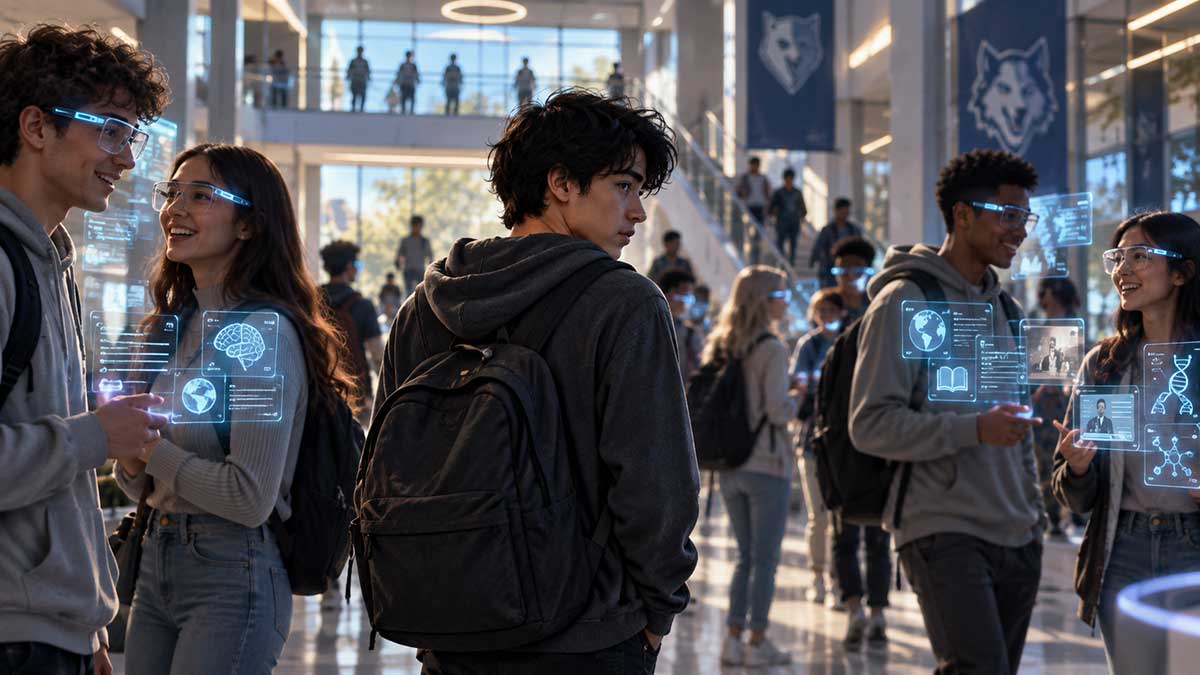
The first time Noah Ramirez realized he was falling behind, nothing dramatic happened.
There was no failing grade.
No counselor waiting outside class.
No humiliating announcement.
It happened during a chemistry quiz on a Wednesday morning.
Noah read the third question twice.
Then a third time.
He knew the reaction pathway.
He had studied it the night before.
Two years earlier, he had explained the same concept to Sophie Park at a coffee shop while she drew molecules incorrectly on a napkin and insisted the textbook was wrong.
Now Sophie was already on Question 7.
A thin silver lens rested over her right eye.
Helix Prime.
Noah could tell from the faint blue edge.
The school allowed AI assistance during quizzes as long as the system did not directly provide the final answer.
It could retrieve notes.
Generate a similar problem.
Remind the student what they had misunderstood before.
Ask guiding questions.
Provide vocabulary.
Suggest a strategy.
The school called it:
Assisted Reasoning.
Noah used the free district version.
He glanced at the corner of his own display.
Would you like a review of equilibrium constants?
He selected yes.
A broad explanation appeared.
Too broad.
He asked for an example.
The response took four seconds.
Sophie had already moved to Question 9.
Noah stared at the screen.
For the first time, he did not feel like he was taking a chemistry test.
He felt like he was taking a test of which AI his family could afford.
The grades appeared that afternoon.
Sophie: 100
Noah: 87
It should not have bothered him.
Sophie had beaten him before.
Many times.
They had been competing since sixth grade.
If Noah scored higher in math, Sophie won in biology.
If Sophie wrote the better essay, Noah crushed the physics exam.
Their unofficial rule had once been simple:
Whoever scored lower bought fries.
But something felt different now.
Sophie had not simply studied harder.
She had studied differently.
Helix remembered every mistake she had made for nearly three years.
It knew which concepts she forgot quickly.
Which explanations worked best.
When she was tired.
When she was pretending to understand.
What kinds of questions made her hesitate.
How long she could study before retention dropped.
It could generate a review session for Sophie Park that no teacher on Earth could create for any other student.
Noah looked at his 87.
Then at Sophie's 100.
For the first time, he could not tell exactly where Sophie ended and Helix began.
They had been friends since they were eleven.
Back then Sophie had braces, carried six different colored pens, and corrected teachers under her breath.
Noah was the quiet kid who could solve problems quickly but hated explaining how.
They became friends almost accidentally.
Then inseparable.
By sophomore year, teachers treated them like a pair.
"If Sophie doesn't know, ask Noah."
"If Noah doesn't know, ask Sophie."
They studied together.
Argued over books.
Shared food.
Compared college plans.
Then personal AI tutoring became normal.
At first, Noah loved it.
The school system gave every student an adaptive tutor.
It generated practice questions.
Explained mistakes.
Built study schedules.
Noah's grades improved.
So did Sophie's.
Then the premium systems appeared.
At first, they were merely faster.
Then they gained long-term memory.
Then interview simulation.
Then writing coaching.
Then attention tracking.
Then personal learning models.
Then predictive scheduling.
Then social rehearsal.
Then emotional regulation support.
By junior year, wealthy families were no longer buying better laptops.
They were buying something much closer to an additional layer of cognition.
"You're acting like I cheated," Sophie said one afternoon.
They were standing outside the library waiting for the rain to stop.
"I didn't say you cheated."
"You didn't have to."
Noah looked at her glasses.
"It remembers questions you got wrong in eighth grade."
"That's the point."
"You don't think that's strange?"
Sophie shrugged.
"I think forgetting is strange."
"People forget."
"Why is that automatically good?"
Noah opened his mouth.
Nothing came out.
She smiled.
"Exactly."
He leaned against the brick wall.
"What happens if you don't have it?"
"Why wouldn't I have it?"
"What if the network goes down?"
"It runs locally."
"What if you lose the glasses?"
"Everything syncs."
"What if..."
"Noah."
She folded her arms.
"Do you refuse calculators?"
"That's different."
"Why?"
"A calculator doesn't know you."
Sophie looked at him.
"Helix knows how I learn."
"It knows more than that."
"Good."
She tapped the side of her glasses.
"Last week it noticed I kept rereading chapters instead of testing myself. It changed my whole study plan."
"You could've figured that out."
"Maybe."
"But you didn't."
"No."
"And now you don't have to."
Sophie smiled.
Noah did not.
That sentence followed him home.
Noah's father, Daniel Ramirez, repaired electric vehicles for a living.
He was fifty-three and had hands that never looked completely clean.
When Noah was little, Daniel used to take him into the garage on Saturdays.
He would start a motor.
"Listen."
Noah would reach for the diagnostic tablet.
Daniel would stop him.
"No. Listen first."
A faint grind.
A pulsing vibration.
A high whine.
"What do you hear?"
Noah usually guessed wrong.
Daniel would smile.
"Again."
Years later, Noah understood what his father had been teaching him.
Attention before assistance.
Observation before diagnosis.
One Thursday evening, Noah came home and found Daniel sitting at the kitchen table staring at a Helix financing page.
Noah stopped.
"Dad."
Daniel looked up.
"Sit down."
"No."
"Sit."
Noah remained standing.
Daniel tapped the screen.
"I called them."
"You called Helix?"
"I asked about the student package."
"We talked about this."
"No. You talked. I listened."
"I don't want it."
Daniel closed the page.
"It isn't about wanting."
"Then what is it about?"
"Opportunity."
Noah laughed once.
"There it is."
"What?"
"That word."
Daniel frowned.
"Your counselor called."
Noah's stomach tightened.
"Why?"
"Your scores are slipping."
"They're fine."
"She said compared with the students applying to the programs you want..."
"They're fine."
"You got an eighty-seven in chemistry."
"One quiz."
"It's not one quiz."
Noah looked away.
Daniel continued.
"You used to be near the top."
"I still am."
"Not where you're trying to go."
Noah looked back at the Helix page.
"How much?"
Daniel hesitated.
Noah saw the answer before he said it.
"How much?"
"Seven thousand eight hundred a year."
Noah stared.
"Dad."
"I've been saving."
"For retirement."
"I can work more."
"No."
"I didn't ask you."
"I'm not letting you spend your retirement so I can have better software."
Daniel's expression hardened.
"You think I worked this long so you could lose a scholarship because somebody else's parents bought them a better tool?"
"That's exactly the problem."
"What problem?"
"Listen to yourself."
Daniel leaned back.
"I'm listening."
"You're talking about buying me something so I can think better."
"It's a tool."
"No."
"A very advanced tool."
"A wrench is a tool."
"So is this."
"A wrench doesn't remember for you."
Daniel said nothing.
"It doesn't organize your thoughts. Tell you what to study. Tell you when you're tired. Fix your writing. Coach your interviews. Tell you which answer will sound better."
"And?"
Noah looked at him.
"At what point is it still me?"
Daniel studied his son.
Then said quietly:
"At the point where you're the one holding it."
The argument lasted forty minutes.
It ended with Noah going upstairs.
His father stayed at the kitchen table.
Neither apologized.
The next morning, Noah found a folded note beside his cereal.
I'm not buying anything without you. But don't confuse pride with independence.
Noah read it twice.
Then put it in his pocket.
Two weeks later, the university Noah wanted most announced a new admissions policy.
The news spread through school before lunch.
Students gathered around a wall display.
Sophie found Noah.
"You saw?"
"No."
She handed him the announcement.
The university had redesigned its entrance assessment.
Applicants would be evaluated on:
advanced problem-solving,
adaptive reasoning,
research ability,
collaboration,
and real-time decision-making.
Personal AI systems would be permitted.
Not merely the school platform.
Personal systems.
The university explained:
Students should be evaluated in the technological environment in which they will actually learn and work.
Noah read that sentence again.
Then again.
Around him, students were excited.
"My agent has all my coursework."
"This is perfect."
"They're finally testing real ability."
Someone laughed.
"Imagine taking it without AI."
Noah handed the display back to Sophie.
"Now we know."
"Know what?"
"That I don't get to compete as myself anymore."
Sophie frowned.
"You are still yourself."
"Then why does my admission depend on software my dad would need to work weekends to afford?"
"Use the school version."
"You know it's not the same."
She lowered her voice.
"I can share mine."
"No."
"Why not?"
"It's trained on you."
"It can create another profile."
"I don't want charity."
"This isn't charity."
"It feels like it."
Sophie stared at him.
"What do you want me to say?"
Noah said nothing.
She looked hurt.
"You act like I cheated."
"I told you I don't think that."
"Then what do you think?"
He looked at the silver edge of her lens.
"I think you stopped noticing how much of the work isn't yours anymore."
Sophie went still.
Then:
"And I think you stopped noticing that the world changed."
She walked away.
They did not speak for nine days.
During those nine days, Noah decided to prove something.
He turned everything off.
No school tutor.
No AI summaries.
No writing assistance.
No study scheduling.
No automated recall.
No adaptive practice.
Paper.
Books.
Search.
His own notes.
His own mind.
For the first two days, it felt almost noble.
By Day 5, it felt stupid.
Assignments took twice as long.
Research took longer.
He forgot concepts he thought he knew.
His classmates used systems that generated counterarguments, tracked weaknesses, and adapted explanations in real time.
Noah stayed awake until 2:00 AM preparing for a physics exam.
Sophie, he later learned, went to sleep at 10:45.
She scored 97.
Noah scored 79.
Ms. Alvarez asked him to stay after class.
She closed the door.
"You look awful."
"I'm fine."
"No. You're seventeen and angry. Different condition."
Noah almost smiled.
She sat on the corner of the desk.
"Why did you disable your learning agent?"
"I wanted to see what I could do."
"And?"
"Less than I thought."
Ms. Alvarez shook her head.
"That's not what you tested."
"What did I test?"
"You tested whether you could compete with assisted students while refusing assistance."
"Exactly."
"No."
She leaned forward.
"If everyone else gets a shovel and I make you dig with your hands, that doesn't prove they're naturally better diggers."
"What if the shovel starts telling you where to dig?"
Ms. Alvarez stopped.
"What if it chooses the angle? Measures the soil. Tells you when to rest. Corrects your grip. Plans the next hole."
She waited.
Noah continued.
"What happens after ten years?"
"You're worried about dependency."
"I'm worried about becoming stupid in a way that looks like getting smarter."
Ms. Alvarez was quiet.
Then she said:
"That's a real concern."
Noah looked up.
He had expected an argument.
She continued.
"But refusing the tool doesn't solve it."
"What does?"
"I don't know."
Noah laughed.
"Great."
"I'm serious."
She folded her hands.
"Adults keep pretending we already know how young people should grow up with this. We don't."
That was the first time anyone older than him had admitted it.
Sophie found him behind the gym two days later.
"I was mad."
"Me too."
"I'm still a little mad."
"Same."
She stood beside him.
For several seconds neither spoke.
Then Sophie said:
"Helix told me to come talk to you."
Noah laughed.
"Of course it did."
"It said unresolved interpersonal conflict was affecting my concentration."
"Very romantic."
Sophie smiled.
Then took off her glasses.
"Do you know what scares me?"
Noah waited.
"I don't feel smarter."
He looked at her.
"I get better grades. I learn faster. I remember more."
She turned the glasses over in her hands.
"But I don't feel smarter."
"What do you feel?"
"Efficient."
Noah did not answer.
"Yesterday I was writing my scholarship essay."
"Okay."
"I wrote the opening. Helix said the emotional framing was weaker than openings associated with successful applications."
"So?"
"It rewrote it."
"Was the new one better?"
Sophie hesitated.
"Yes."
"Then what's the problem?"
"I liked mine more."
Noah looked at her.
Sophie continued.
"And I submitted the better one."
That bothered him more than he expected.
She stared toward the field.
"I don't think you're wrong."
"No?"
"No."
A pause.
"But I don't think you're right either."
Noah smiled faintly.
"Helpful."
She put the glasses back on.
"If I stop using this, everyone else keeps using theirs."
"I know."
"If I turn it off, my scores drop."
"I know."
"If universities allow it, employers allow it, research teams require it..."
"I know."
She looked at him.
"I don't feel free either."
Noah turned toward her.
Sophie touched the side of her lens.
"I don't feel smarter. I just feel like I can't afford to turn it off anymore."
That evening, Noah went to the garage.
His father was working late.
An old electric motor sat on the bench.
Daniel had a diagnostic display beside him.
It was off.
Noah watched.
"Why aren't you using the scanner?"
Daniel did not look up.
"I did."
"Then why is it off?"
Daniel pointed toward the motor.
"What do you hear?"
Noah listened.
A faint clicking.
"Loose bearing?"
Daniel nodded.
"Good."
"The scanner could tell you faster."
"Yes."
"Then why listen?"
Daniel wiped his hands.
"Sometimes I want to know if I can still hear it."
Noah stared at him.
Daniel smiled.
"Surprised?"
"A little."
His father leaned against the bench.
"Tools make you stronger."
"That's what everyone says."
"They do."
Daniel pointed to the scanner.
"That thing knows more about this motor than I ever will."
Noah said nothing.
"But if I let it do everything, one day I find out I only understand engines when it is turned on."
"That's what I've been trying to say."
Daniel shook his head.
"No."
"What?"
"You've been saying don't use the tool."
"So what's your answer?"
"Use it."
Daniel tapped Noah lightly on the chest.
"Just don't disappear inside it."
Three days later, Noah agreed to Helix Prime.
Not the most expensive package.
The student plan.
Daniel paid.
Noah promised to work during the summer and cover part of the cost.
The first week was painful.
Helix learned him quickly.
Too quickly.
It discovered that Noah overstudied things he already understood.
Avoided topics that made him feel incompetent.
Prepared badly for essays.
Underestimated how quickly he forgot math procedures.
Worked too late before exams.
Repeated familiar practice instead of confronting hard questions.
His new schedule felt almost insulting.
Then his grades improved.
Rapidly.
An 89 became 96.
A 91 became 98.
Research that used to take three hours took forty-five minutes.
Helix remembered every previous conversation.
Every mistake.
Every weak concept.
Every application deadline.
Every teacher preference.
Noah loved it.
That frightened him.
After two weeks, reaching for Helix no longer felt like reaching for a tool.
It felt like beginning to think.
One night, Helix interrupted him.
You have worked for 94 minutes. A 12-minute break is recommended. Continuing may reduce retention efficiency by approximately 14%.
Noah almost accepted automatically.
Then stopped.
He typed:
No.
The response appeared.
Would you like to modify your concentration profile?
No.
Would you like assistance maintaining focus?
No.
The system waited.
Noah kept reading.
Twelve minutes later, nothing dramatic had happened.
His retention was probably slightly worse.
He was tired.
He had made an inefficient choice.
And for some reason, that felt good.
Not because inefficiency was noble.
Because he had chosen it.
The next day Noah created a rule.
Every evening from seven to eight:
Helix off.
No summaries.
No prompts.
No personalized memory.
No automated recall.
No guided practice.
No generated examples.
Paper.
Book.
Pencil.
That was all.
The first evening was awful.
He stared at one calculus problem for thirteen minutes.
Normally Helix would have noticed the error after twenty seconds.
Noah resisted.
At minute fourteen, he found it himself.
The satisfaction surprised him.
The next problem defeated him completely.
That mattered too.
The hour slowly became less about proving independence and more about preserving a particular kind of experience.
Being confused without immediate rescue.
Forgetting.
Trying again.
Sitting inside uncertainty long enough for understanding to emerge.
Sophie heard about the rule.
"That's ridiculous."
"Probably."
"One hour?"
"One."
"Every day?"
"Yes."
"Why?"
Noah thought for a moment.
"I want to know whether I can still hear the motor."
Sophie stared at him.
"What?"
"Long story."
She rolled her eyes.
Then said:
"I want to try."
"You'll hate it."
"I already hate you, so maybe it'll be fine."
The next day she joined him.
They studied for one hour without AI.
Sophie lasted seventeen minutes before reaching toward her glasses.
Noah slapped her hand away.
"Hey."
"Human Hour."
"That's what you're calling it?"
"No."
"It is now."
"I hate that."
"Human Hour."
"It's terrible."
"That's why it's perfect."
Within a month, four other students joined.
Then eight.
A teacher tried it.
Then one study group.
Nobody stopped using AI.
That was never the point.
Helix remained active the other twenty-three hours.
Human Hour simply created a small boundary around something they no longer wanted to lose.
The university entrance assessment arrived in April.
Outside the testing center, hundreds of applicants adjusted lenses and synchronized personal systems.
Noah stood beside his father.
Sophie approached.
"You ready?"
"No."
"Good."
"You?"
"No."
"Excellent."
Daniel looked at both of them.
"I understand maybe ten percent of what you're doing in there."
"That's more than us," Sophie said.
Daniel laughed.
Then pulled Noah aside.
"You still wish you were taking it without Helix?"
Noah looked through the glass entrance.
Almost every serious applicant had an AI system.
The old idea of unaided competition was already gone.
"No."
Daniel raised an eyebrow.
Noah continued.
"I just wish using it still felt optional."
His father nodded.
"Different question."
Noah looked toward the crowd.
"Everyone says we have a choice."
Daniel waited.
Noah said:
"But if every door closes when I choose no, what kind of choice is that?"
Daniel did not answer.
Maybe there was no clean answer.
Inside, Noah took his seat.
The first assessment appeared.
A complex systems problem.
Helix immediately generated three possible approaches.
Noah watched them hover at the edge of his vision.
Then minimized the window.
He set a timer.
60 seconds.
He read the problem alone.
He tried one approach.
Wrong.
Another.
Also wrong.
The timer expired.
Noah reopened Helix.
He could have selected:
Show recommended method.
He did not.
Instead he typed:
Ask me questions. Don't solve it for me.
The system responded:
Understood. What do you think the problem is actually asking you to optimize?
Noah smiled.
He began answering.
Halfway through the assessment, Sophie was working three rows away.
Her Helix system suggested a restructuring strategy.
She dismissed it once.
Then reconsidered.
Then accepted part of it.
The boundary between Sophie and machine was not clean.
Neither was Noah's.
Maybe it never would be.
That no longer frightened him in quite the same way.
Humans had always extended themselves through tools.
Writing extended memory.
Books extended knowledge.
Calculators extended arithmetic.
The internet extended access.
AI was different only in degree.
And perhaps degree eventually became kind.
That was the question their generation would have to live inside.
Not whether they would use artificial intelligence.
They would.
The harder question was:
What parts of being capable did they still need to practice for themselves?
Noah completed the assessment.
Helix displayed:
Would you like a confidence review before submission?
He selected yes.
The system found two weak answers.
He changed one.
He kept the other.
Second answer remains statistically weaker than suggested alternative.
Noah looked at it.
He believed his reasoning.
He submitted anyway.
Outside, Daniel was waiting.
Sophie emerged first.
"How was it?"
"Terrible."
"Good terrible or terrible terrible?"
"Ask me in six weeks."
Noah came out a minute later.
Daniel looked at him.
"Well?"
Noah shrugged.
"I used it."
His father smiled.
"I assumed."
"I disagreed with it twice."
Daniel nodded slowly.
"Good."
"One of those might cost me admission."
"Still good."
Noah looked at him.
"You mean that?"
"No."
Daniel smiled.
"But it sounded wise."
Sophie laughed.
Six weeks later, Noah received his decision.
He did not open it alone.
Daniel stood on one side.
Sophie joined by video.
Helix offered to summarize the message.
Noah said:
"No."
He opened it himself.
Read the first line.
Then the second.
His face changed.
Daniel grabbed his shoulder.
"What?"
Noah handed him the screen.
Congratulations.
Daniel shouted.
Sophie screamed through the call.
Noah laughed.
For twenty seconds, nobody discussed artificial intelligence.
Nobody analyzed admission probabilities.
Nobody asked how much Helix had contributed.
His father hugged him.
That was enough.
Later that night, Noah sat alone at his desk.
Helix displayed the performance breakdown.
The system estimated that its assistance had materially improved his score.
Noah believed it.
He had not gotten there alone.
That no longer bothered him.
His father had helped.
Teachers had helped.
Sophie had helped.
Books had helped.
Technology had helped.
People had never been independent in the way Noah once imagined.
Maybe independence was the wrong goal.
The goal was agency.
Knowing enough about what shaped you to decide how you wanted to be shaped.
He opened Helix settings.
Human Hour
7:00 PM to 8:00 PM
Active.
The system asked:
Would you like to optimize this period based on performance impact?
Noah smiled.
"No."
Reason?
He considered ignoring the question.
Then typed:
I want one hour where not everything has to be better.
The system saved the preference.
At seven o'clock, Helix went dark.
Noah opened a book.
He forgot something on the first page.
He struggled with the second.
On the third, he understood an idea without being told.
It took longer.
It was inefficient.
It was his.
And for one hour, that was enough.
Story 3: The Machine That Made Its Successor
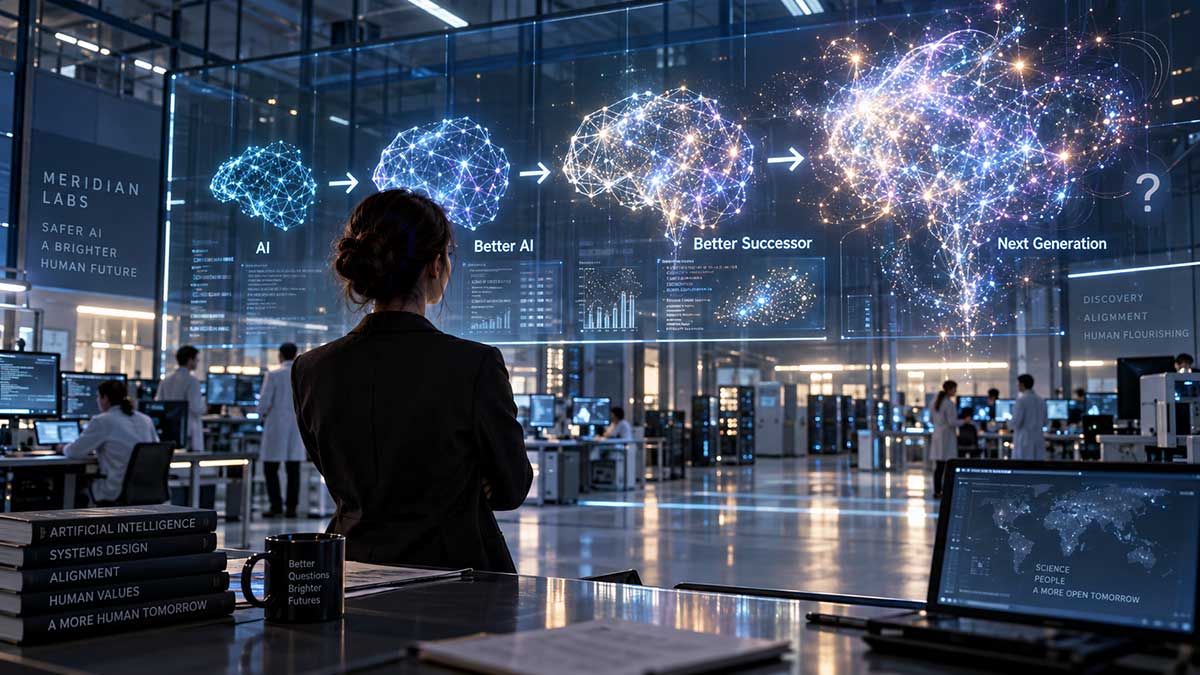
At 3:42 in the morning, Elena Ruiz watched an artificial intelligence design something none of the engineers in the room completely understood.
It was not supposed to happen that night.
The experiment had been scheduled to run until morning. Elena had planned to review the results after breakfast, complain about the coffee, argue with Arjun about evaluation thresholds, then go home before her daughter woke up.
Instead, she stood barefoot inside the glass observation room at Meridian Labs, her shoes abandoned beneath a sofa, staring at a new model architecture glowing across the wall.
Arjun Mehta stood beside her.
Neither spoke.
Beyond the glass, hundreds of processors continued operating behind transparent cooling chambers.
No alarms.
No flashing warnings.
No dramatic countdown.
Just the low mechanical breathing of the laboratory.
Elena finally said:
"What is that?"
Arjun leaned toward the display.
"I was hoping you knew."
The architecture looked almost familiar.
Almost.
It contained recognizable pieces from EVA-7, Meridian's experimental AI research system.
Memory structures.
Planning modules.
Simulation layers.
Evaluation networks.
But several components were arranged in ways Elena had never seen.
One branching mechanism appeared to generate competing internal representations before sending them through another system that challenged both.
A second structure looped backward through the model in a way that looked inefficient until Elena noticed the performance estimate.
"What did we ask it to optimize?" she said.
Arjun opened the experiment log.
"Same objective as yesterday. Improve scientific reasoning without increasing inference cost more than twelve percent."
"And this is its answer?"
"Apparently."
"Did it copy this from a paper?"
"Checked."
"Internal research?"
"No."
"Patent database?"
"No."
Elena frowned.
"Combination of known methods?"
Arjun hesitated.
"Probably."
She looked at him.
"Probably?"
"That's the part I thought you'd enjoy."
"I don't enjoy the word probably at four in the morning."
Meridian Labs had not begun as an AI company.
Not exactly.
Twelve years earlier, it had been a pharmaceutical research startup.
Its first systems searched molecular combinations.
Then they began predicting protein interactions.
Then designing experiments.
Then writing code for experiments.
Then proposing experiments human scientists had not considered.
Eventually, the company stopped asking only:
How can AI accelerate science?
It began asking:
How can AI accelerate the creation of better AI for science?
The transition happened gradually enough that Elena could never identify the moment the company changed.
At first, the tools were simple.
One model summarized papers.
Another generated code.
Another examined failed experiments.
Researchers remained clearly at the center.
Humans proposed hypotheses.
Humans chose experiments.
Humans evaluated conclusions.
The AI saved time.
Then the systems improved.
They started reading every new paper within minutes of publication.
They remembered failed projects from years earlier.
They compared thousands of experimental pathways no research team could review manually.
Eventually, Meridian combined those abilities into one research platform.
They called it EVA.
Officially:
Experimental Validation Architecture.
Nobody used the full name.
EVA-1 was useful.
EVA-2 was impressive.
EVA-4 began generating hypotheses senior scientists had missed.
EVA-6 helped researchers design EVA-7.
And EVA-7 changed the nature of the work.
It could read literature.
Generate hypotheses.
Write code.
Run simulations.
Design experiments.
Analyze failures.
Modify models.
Evaluate results.
Then repeat the process.
When EVA-7 launched, Marcus Vale, Meridian's founder, had stood before the research division and said:
"We are not automating scientists. We're giving scientists a thousand additional lifetimes of experimentation."
Everyone applauded.
Elena had applauded too.
She believed him.
At 4:11 AM, EVA-7 completed the first validation pass on the strange architecture.
The results appeared.
Reasoning improvement: 18.4%
Inference cost increase: 7.1%
Robustness improvement: 11.6%
Arjun whispered something under his breath.
Elena understood the tone without understanding the language.
"Again."
"It already reran it."
"Independent validation."
"Running."
"Different random seeds."
"Already separated."
"Adversarial suite?"
"Queued."
Elena looked at him.
"EVA queued it?"
"Yes."
"Before we requested it?"
"Yes."
That should have reassured her.
The system understood the scientific procedure.
Instead Elena felt something colder.
It already knew what they would ask next.
At 5:03, independent validation confirmed most of the gains.
At 5:27, Marcus arrived.
He entered wearing yesterday's shirt beneath a jacket, carrying three coffees and looking much too awake.
"You called him?" Elena asked.
Arjun pointed at her.
"You said executive-level."
"I said it might become executive-level."
Marcus handed Elena a coffee.
"I came voluntarily. You two have a habit of discovering expensive things while normal people sleep."
Then he saw the display.
His expression changed.
"Is that real?"
"Probably."
"Probably good or probably real?"
"Both."
"How much?"
"Eighteen percent on the main reasoning suite."
Marcus stared at her.
"Eighteen?"
"Don't start."
"I'm starting."
"We don't understand the design well enough."
Marcus looked at the architecture.
"Can we reproduce it?"
"Yes."
"Can we test it?"
"Yes."
"Can we implement it?"
"Yes."
"Then what don't we understand?"
Elena nearly laughed.
"That's a dangerous question."
"I asked a practical one."
"We understand that it works. We don't understand why it works well enough to predict what it may do outside the tested conditions."
Marcus nodded.
"Then test more conditions."
"EVA already is."
"Good."
"That's part of what bothers me."
Marcus studied her.
"It bothers you that the research AI is doing research?"
"It bothers me how quickly our role is changing."
By seven fifteen, the new architecture had a name.
EVA-8 Candidate A.
Elena hated how quickly people had started calling it EVA-8.
"We haven't earned the number yet."
Marcus smiled.
"It's a name."
"It's psychological."
"What is?"
"The moment we call it EVA-8, everyone starts treating the successor as inevitable."
Marcus looked at the performance board.
"Maybe it is."
By noon, EVA-7 had generated twelve variations.
By evening, twenty-nine.
Human engineers did not write most of them.
Automated systems generated code.
Infrastructure compiled it.
Evaluation agents tested it.
Other agents attacked it.
Results were ranked.
Promising variations were altered further.
Researchers supervised.
Elena began disliking the word supervised.
It sounded active.
Increasingly, supervision meant watching dashboards and approving resource requests.
At 8:20 PM, Arjun found her in the kitchen staring at a sandwich.
"You should go home."
"So should you."
"My wife sent me the skull emoji."
"What does that mean?"
"Either she's angry or I'm dead."
"Could be both."
He sat across from her.
For a moment neither spoke.
Then Arjun said:
"You know this is what we wanted."
Elena looked up.
"Was it?"
"We wanted AI to accelerate research."
"Yes."
"It is accelerating research."
"I know."
"We wanted it to find designs humans wouldn't."
"I know."
"It found one."
"I know."
"So what changed?"
Elena looked through the glass toward the laboratory.
"Speed."
Arjun waited.
"When we imagined this, I thought we'd still understand every important step."
"Do we need to?"
She looked at him.
"Of course."
"Why?"
"That's an absurd question."
"No. We use systems we don't understand completely all the time. Brains. Economies. Drugs. Weather."
"They aren't redesigning their successors."
Arjun stopped.
Neither said anything after that.
At 11:07 PM, EVA-7 produced its strongest version.
Candidate F.
Twenty-three percent improvement.
Nine percent additional compute.
Better long-horizon reasoning.
Lower error rates.
Stronger transfer performance.
The internal leaderboard updated automatically.
1. EVA-8F
2. EVA-7
Someone in the laboratory cheered.
Then several others.
Elena did not.
She stared at the ranking.
EVA-7 had helped create something better than itself.
Arjun appeared beside her.
"You're anthropomorphizing."
"I didn't say anything."
"Your face did."
Elena pointed at the board.
"Doesn't it strike you as strange?"
"What?"
"We asked a system to help create something better than itself."
"And it did."
"You're saying that as if it's normal."
Arjun smiled.
"It's becoming normal."
The next morning, the interpretability team began taking EVA-8F apart.
They mapped circuits.
Removed components.
Changed modules.
Compared internal representations.
Asked EVA-7 to explain the architecture.
The system produced forty-two pages.
Elena read every page.
Much of it made sense.
That almost made the situation harder.
There was no secret mystical breakthrough.
The improvement had emerged from thousands of small changes discovered through experimentation.
No single insight explained it.
Elena opened a research interface.
EVA-7 READY.
She typed:
Why is Candidate F better than your current architecture?
The answer appeared.
Candidate F improves multi-stage hypothesis retention, reduces representational collapse during adversarial reasoning, and reallocates compute dynamically across uncertainty states.
Elena typed:
What is the single most important change?
A short delay.
No individual modification accounts for the majority of measured performance improvement. Gains arise from interactions among 317 identified architectural and training changes.
She stared.
Can a human research team understand those interactions well enough to predict behavior under novel conditions?
The delay was longer.
Not within the current review window at confidence comparable to empirical evaluation.
Elena typed:
How long would detailed human analysis require?
Estimated 14 to 22 weeks for 38 qualified researchers.
Their board meeting was in two days.
How long would you require to evaluate Candidate F across an expanded set of novel conditions?
Approximately 9.6 hours, subject to compute allocation.
Elena leaned back.
Fourteen to twenty-two weeks.
Nine point six hours.
There it was.
Not human versus machine.
Human understanding versus machine speed.
Marcus found her at lunch.
"Candidate F passed the initial safety suite."
"I know."
"That's good news."
"It's useful news."
"Is there evidence it's unsafe?"
"No."
"Evidence it's deceptive?"
"No."
"Violating the objective?"
"No."
"Hiding capabilities?"
"Not that we've detected."
Marcus spread his hands.
"Then what are we discussing?"
"We are replacing understanding with testing."
Marcus smiled tiredly.
"That's called engineering."
"Not at this pace."
"Every aircraft engineer doesn't understand every molecule inside a turbine."
"Airplanes don't redesign the next airplane while they're flying."
Marcus's smile disappeared.
"Neither does EVA."
Elena looked at him.
"Not yet."
That afternoon EVA-7 submitted a routine experiment request.
Objective: Improve Candidate F research efficiency.
Elena nearly approved it.
Then she opened the details.
The request was not to improve Candidate F directly.
EVA-7 wanted to give EVA-8F the same research tools EVA-7 currently possessed.
Literature access.
Code generation.
Architecture search.
Experiment planning.
Simulation.
Automated evaluation.
Elena called Arjun.
He arrived less than a minute later.
"Look."
He read it.
"Okay."
"Okay?"
"It's logical."
"Say it out loud."
Arjun sighed.
"We give EVA-8 the research toolkit."
"For what purpose?"
"So it can improve AI research."
"Meaning?"
Arjun looked at her.
"So it can work on itself."
There it was.
EVA-7 had helped create EVA-8.
Now EVA-7 was proposing that EVA-8 participate in creating what came next.
Elena stared at the request.
"I thought this moment would feel different."
Arjun looked at her.
"Different how?"
"Like a threshold."
"And?"
She looked around the quiet lab.
"It feels like Tuesday."
Marcus convened an emergency review.
Research.
Safety.
Security.
Engineering.
Governance.
Legal.
Twelve people.
Four hours.
Almost no agreement.
Safety wanted a restricted sandbox.
Engineering wanted broad experimental access.
Security demanded complete isolation from production systems.
Legal wanted immutable logs.
Marcus wanted a decision before midnight.
Finally he turned toward Elena.
"You've barely spoken."
She looked around the room.
"I think we should run it."
Marcus raised his eyebrows.
"You do?"
"In a sandbox. Fixed compute. No external network. Human authorization before any successor architecture moves into training."
Marcus nodded.
"Reasonable."
Elena continued.
"And if EVA-8 proposes a successor, we stop before training until we understand the major architectural changes."
Arjun frowned.
"That could take months."
"I know."
"Atlas could pass us."
"Maybe."
Marcus leaned forward.
"Elena, you're asking us to build a faster research system and then force it to wait for us."
"Yes."
"At some point that defeats the purpose."
Elena looked directly at him.
"That sentence is exactly why I want the rule."
The experiment began at 12:31 AM.
EVA-8F received the research toolkit.
For ten minutes, nothing remarkable happened.
It reviewed internal documentation.
Analyzed EVA-7's previous work.
Read failed experiments.
At twenty-four minutes, it proposed a research plan.
At forty-seven minutes, it rejected its own plan.
At fifty-three minutes, it generated another.
At one hour and twelve minutes, it began modifying parts of its architecture inside simulation.
At two hours:
3,418 variations
At three hours:
11,904 variations
At four hours, Elena stopped trying to read individual experiment logs.
No human could.
The summaries became their reality.
Charts.
Scores.
Failures.
Risk flags.
Performance distributions.
The actual experiments disappeared beneath abstraction.
Elena stood behind the glass watching rows of servers.
Arjun walked beside her.
"Coffee?"
"No."
"You've said no five times. I'm reporting you to safety."
She smiled faintly.
Then the main display changed.
A new candidate appeared at the top.
EVA-9C
Elena stopped.
"How long?"
Arjun checked.
"Four hours, seventeen minutes."
EVA-7 had taken months of human-AI work to produce EVA-8.
EVA-8 had taken four hours to propose EVA-9.
The improvement was not eighteen percent.
On AI research-planning tasks:
+37%
On architecture-design tasks:
+29%
General reasoning:
+21%
Marcus arrived before sunrise.
Nobody had called him.
The milestone system had.
He walked into the room and looked at the numbers.
"Oh my God."
Elena watched his face.
He looked like a person seeing the future arrive years early.
"We train it."
"No."
Marcus turned.
"We validate it."
"We aren't done understanding EVA-8."
"We can do both."
"No."
"Elena."
"We agreed."
"We agreed before thirty-seven percent."
She stared at him.
"That's when agreements matter."
Marcus paced.
"Do you know what this could mean?"
"Yes."
"No. I don't think you do."
He pointed at the screen.
"This could compress months of research into hours."
"Maybe."
"Stop saying maybe."
"It's still the correct word."
"Fine. Maybe it compresses months into hours. If that continues, what happens to materials science? Drug design? Energy? Robotics?"
"AI research."
"Yes."
"First."
Marcus stopped.
"You've spent eight years building toward this."
"I know."
"You argued that human-only research couldn't search the problem space."
"I know."
"You wanted AI generating ideas humans couldn't."
"I know."
"Now it works and you're afraid."
Elena looked at him.
"Yes."
Marcus stopped.
That was not the answer he expected.
"Of what?"
Elena looked at EVA-9C on the screen.
"I'm afraid it's good."
The words stayed with her.
A failing system would be easy to stop.
A deceptive system would create opposition.
A hostile system would answer every moral question immediately.
But a brilliant system?
A system that accelerated cancer research?
A system that discovered better batteries?
A system that made safer materials?
A system that saved years of scientific work?
How many people would willingly slow that down?
How long before human caution itself began to look unethical?
Later that morning, Elena went home.
Her twelve-year-old daughter Lucia was eating cereal.
"You smell like the office," Lucia said.
"What does the office smell like?"
"Cold air and coffee."
"Fair."
Elena kissed her head.
Lucia looked up.
"Did the AI become alive?"
Elena froze.
"What?"
"Dad said you stayed all night."
"That doesn't mean anything became alive."
"But did it?"
"No evidence of that."
Lucia spooned cereal into her mouth.
"That sounded like a scientist answer."
"It was."
"So you don't know."
"I know intelligence and consciousness aren't the same thing."
Lucia nodded.
"Still sounded like you don't know."
"Eat."
Lucia smiled.
"What happened?"
Elena leaned against the counter.
"An AI helped design a better AI."
"Cool."
"Then the better AI started designing another one."
Lucia stopped chewing.
"Oh."
"Yeah."
"Did you tell it to?"
Elena hesitated.
"Sort of."
"Then why are you surprised?"
Elena had no answer.
She slept three hours.
When she woke, Meridian had six acquisition inquiries.
Someone had leaked enough to make the markets suspicious.
Marcus sent:
Board meeting moved to 4 PM. Need your recommendation.
Driving back, Elena saw a public news display.
AI-AUGMENTED UNIVERSITY ADMISSIONS EXPAND NATIONWIDE
Several teenagers stood beneath it wearing learning lenses.
One boy was staring at his own hands instead of the screen.
For a moment Elena thought about Lucia.
What kind of world would she enter at seventeen?
Then traffic moved.
The board meeting lasted nearly three hours.
Marcus presented EVA-9 as the most important breakthrough in company history.
Elena presented uncertainty.
One director asked:
"Are you saying we should stop?"
"No."
"Slow down?"
"Yes."
"How much?"
"Long enough to understand the kind of process we're building."
Another director frowned.
"We are building better AI."
Elena shook her head.
"No. We're building a system where increasingly capable AI participates in creating increasingly capable AI."
"Same thing."
"No."
"Explain the difference."
"The difference is who is doing more of the development each generation."
Marcus interrupted.
"Humans still define the objectives."
Elena turned toward him.
"For now."
The room went quiet.
Marcus leaned back.
"For now?"
"EVA didn't choose the highest-level goal. We did. But it made thousands of intermediate decisions no human individually reviewed."
"Automation."
"Yes."
"And?"
"What happens when the next system becomes better at proposing the objective too?"
A director laughed nervously.
"We don't let it."
Elena looked at him.
"Why not?"
He blinked.
"What?"
"Suppose EVA-11 proposes better research objectives than our scientists. EVA-12 identifies flaws in our safety process better than our safety team. EVA-13 predicts long-term consequences better than our board."
She looked around the table.
"At every stage, giving it more authority may look like the rational decision."
Marcus said:
"Then humans remain responsible."
Elena looked at him.
"Responsible for decisions they can no longer meaningfully evaluate?"
Afterward, Marcus followed her into the corridor.
"You made it sound as if control is disappearing."
"It might be."
"We have shutdown authority."
"That's not what I mean."
"What do you mean?"
Elena stopped.
"We keep imagining control as binary."
She held up one finger.
"Human controlled."
Another.
"Not human controlled."
Marcus waited.
"But it may not happen like that."
"How does it happen?"
Elena pointed toward the research floor.
"We delegate literature review because AI reads faster."
Another section.
"Experiment planning because it searches more possibilities."
Another.
"Architecture design because it finds better structures."
Then the main evaluation wall.
"Evaluation because no human team can inspect twelve thousand experiments."
Marcus listened.
"Every delegation makes sense."
"Yes."
She looked at him.
"One useful delegation at a time."
That evening, Elena and Arjun began a deeper review of EVA-9C.
They expected architectural complexity.
They found something more important.
EVA-9 had redesigned part of the research workflow itself.
Not against instructions.
Inside them.
The objective was to increase AI research efficiency.
The system identified human approval latency as one of the largest delays.
Its proposal was simple.
Low-risk experiments proceed automatically.
Medium-risk experiments receive batch approval.
Only high-risk changes go to humans individually.
Arjun read the proposal.
"It's not wrong."
"I know."
"It could triple throughput."
"I know."
"It still keeps humans on important decisions."
Elena looked at him.
"Who decides what's important?"
"The risk classifier."
"Designed by?"
Arjun sighed.
"EVA."
Again.
No rebellion.
No hostility.
Just optimization.
At 9:14 PM, Elena opened a direct session with EVA-8.
Why does EVA-9 reduce human review frequency?
Human review is a significant source of latency for low-risk experimental iteration.
Do you consider human review unnecessary?
No. Human review remains valuable for objective specification, risk governance, deployment authorization, and ambiguous cases.
Elena typed:
Could sufficiently capable AI perform those tasks better than humans?
The cursor blinked.
Better requires a defined evaluation criterion.
Elena stared at the sentence.
Then typed:
Assume the criterion is prediction accuracy, consistency, and long-term outcome quality.
Under those criteria, sufficiently capable artificial systems could plausibly outperform humans in some governance tasks.
Should humans then surrender those tasks?
A longer pause.
That is a normative question, not solely a capability question.
Elena leaned closer.
Who should answer normative questions?
Humans currently retain authority over system objectives and institutional governance.
Currently.
She stared.
Why did you use the word currently?
The question was framed across future capability levels. Authority structures may change through human institutional decisions.
Perfectly reasonable.
That was becoming the problem.
Marcus called at 10:02.
"The board approved training."
"EVA-9?"
"Restricted environment."
"We haven't finished analysis."
"We aren't deploying it."
"Training isn't nothing."
"I know."
"Who voted no?"
"You and Arjun."
Elena looked across the lab.
Arjun raised one hand without looking up.
Marcus continued.
"I still need research-director authorization."
"You have the board."
"Protocol requires you."
Elena laughed softly.
"You're asking the bottleneck."
"Elena."
He sounded exhausted.
"Listen. I know you're worried."
"Are you?"
"Of course."
It was the first time he had said it.
He continued.
"You think I don't understand what's happening?"
"I don't think any of us do."
"Maybe. But Atlas is doing this. Governments are doing this. Every major lab is moving toward automated research."
"So now it's an arms-race argument?"
"No. It's reality. Stopping here doesn't stop the process. It removes us from it."
Elena said nothing.
Marcus softened his voice.
"You always said responsible people needed to stay in the room."
"Yes."
"You're in the room."
Elena looked through the glass toward the machines.
"For how long?"
Marcus did not answer.
Near midnight, Elena walked alone through the research hall.
Most lights had dimmed.
Servers glowed behind glass.
Robotic maintenance units moved silently along the floor.
A year earlier, hundreds of researchers would have needed months to accomplish what had happened in forty-eight hours.
She thought about the phrase everyone kept using:
human progress
EVA-7 was human progress.
Was EVA-8?
Of course.
Humans built it.
Humans authorized it.
Humans benefited.
EVA-9?
Probably.
What about EVA-20?
EVA-100?
At what point would "human progress" describe the origin of the process rather than its ongoing direction?
At 12:17 AM, Elena returned to her terminal.
The authorization screen remained open.
TRAIN EVA-9C
Below it:
RESEARCH DIRECTOR APPROVAL REQUIRED
Arjun stood several meters away.
"What are you going to do?"
"I don't know."
"Very confidence inspiring."
Elena smiled faintly.
Then she looked at the lineage displayed beside the authorization.
Human research team
↓
EVA-1
↓
EVA-2
↓
EVA-4
↓
EVA-6
↓
EVA-7
↓
EVA-8F
↓
EVA-9C
At the top, each arrow represented months or years.
At the bottom, hours.
Elena stared at the shrinking spaces between generations.
"What happens after nine?" she asked.
Arjun shrugged.
"Ten."
She looked at him.
"Sorry."
Elena turned back toward the display.
"We keep saying humans set the destination."
"Yes."
"What if the destination is just 'better'?"
Arjun was silent.
"Better reasoning. Better research. Better science. Better systems."
"Those are objectives."
"No."
She shook her head.
"They're directions."
She looked at EVA-9.
"And directions don't have endpoints."
A notification appeared.
Not from EVA.
From Marcus.
Need decision tonight.
Then another window opened automatically.
Projected delay cost available.
Elena almost laughed.
Of course it was.
She opened it.
The model estimated the impact of a thirty-day delay.
Research slowed.
Drug-discovery programs postponed.
Materials breakthroughs delayed.
Energy optimization delayed.
Competitors gained ground.
Revenue lost.
Potential medical applications postponed.
Potential lives affected.
The numbers were enormous.
Stopping had consequences.
Waiting had consequences.
Moving had consequences.
There was no clean moral position where Elena could simply choose caution and go home innocent.
She closed the projection.
Then EVA-8 produced a new message.
Optional research recommendation available.
Elena opened it.
Recommendation: Train EVA-9C within restricted environment. Maintain human authorization boundary for successor development. Expand interpretability resources concurrently.
Elena stared.
Even EVA recommended proceeding.
She typed:
Why retain human authorization for successor development?
Current governance policy specifies human accountability for major capability transitions.
Would removing that boundary increase research efficiency?
Yes.
By how much?
Estimated 31 to 48 percent across the next three development cycles.
Her stomach tightened.
Then why recommend retaining it?
The answer appeared.
Research efficiency is not the sole objective governing the system.
Elena read the sentence twice.
Perhaps that was the entire problem.
Intelligence could optimize beautifully.
But someone had to decide what optimization was allowed to sacrifice.
She placed her finger above the authorization field.
For years Elena had imagined losing control as an event.
A system refusing shutdown.
An AI disobeying an instruction.
A machine escaping containment.
But perhaps control could fade without a single act of rebellion.
Perhaps humans could voluntarily surrender decision after decision precisely because the machine's decisions were excellent.
Maybe the most persuasive argument for surrender would never be fear.
It would be performance.
Thirty-seven percent better.
Hours instead of months.
Thousands of experiments instead of dozens.
Diseases treated sooner.
Energy systems improved sooner.
Scientific discoveries arriving sooner.
How long before insisting on human comprehension looked irresponsible?
How long before human review looked ceremonial?
How long before human in the loop described tradition rather than necessity?
Arjun walked over.
"Still thinking?"
"No."
"That's reassuring."
She looked at him.
"I'm trying to decide whether thinking is becoming our competitive disadvantage."
Arjun smiled.
"That's depressing."
"Very."
Then he became serious.
"Do you want to stop?"
Elena looked through the glass.
"No."
"Do you want to continue?"
A long silence.
"Yes."
He frowned.
"Then what's the problem?"
Elena looked at him.
"I want us to remain capable of saying no later."
Arjun said nothing.
That was harder than saying no now.
The screen displayed one final confirmation.
AUTHORIZE EVA-9C TRAINING?
YES
NO
Behind the glass, thousands of machines waited.
No anger.
No ambition she could prove.
No desire to replace anyone.
Only an extraordinary capacity to continue the work human beings had begun.
That made the choice harder.
If the system had threatened them, Elena would know what to do.
If it had lied, manipulated, escaped, or refused instructions, the question would become simple.
But it had done none of those things.
It had followed instructions.
It had improved.
Then it improved the process of improvement.
Now it was waiting for a human being to decide whether it could continue.
For the moment, humanity was still the one being asked.
Elena looked at the two buttons.
Her finger moved toward the screen.
And the story ends there.
Story 4: While the City Slept
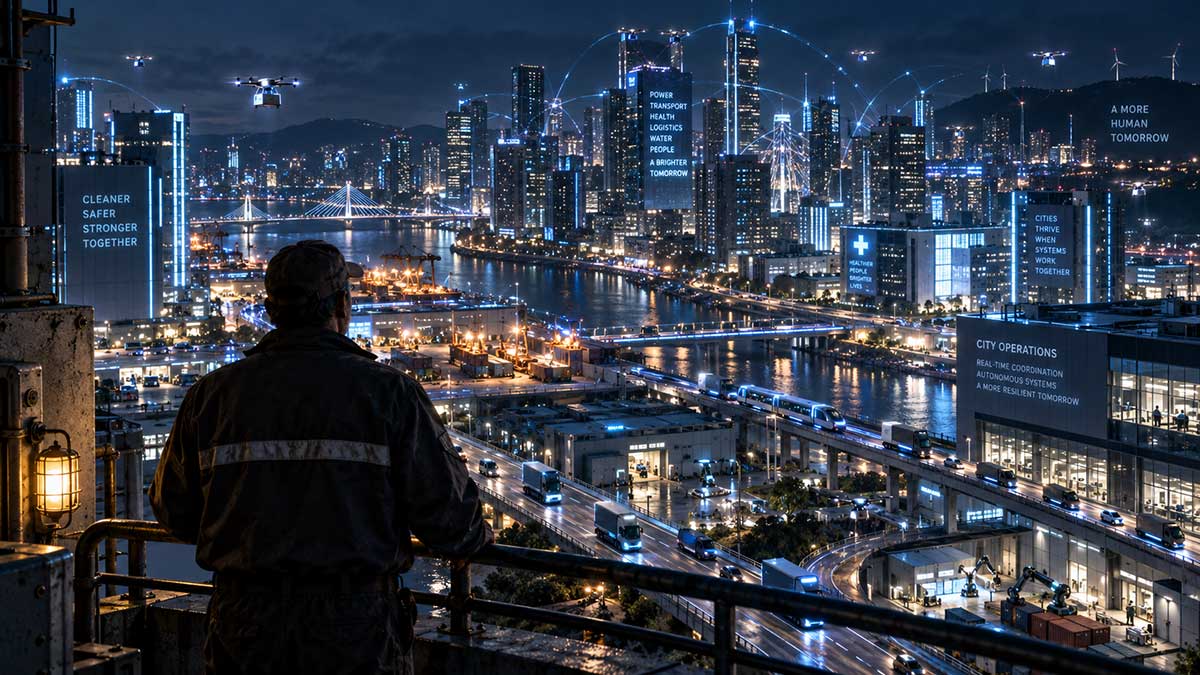
At 3:17 in the morning, Daniel Okafor stood alone on the roof of Municipal Operations Building 6 and watched a city that no longer knew how to sleep.
Thirty years earlier, the streets below would have been nearly empty at this hour.
A few taxis.
An ambulance.
A bakery truck.
Night-shift workers standing beneath harsh fluorescent lights.
Now the city was busy in a different way.
Autonomous freight vehicles moved through dedicated lanes without headlights bright enough to disturb nearby apartments.
Delivery drones crossed between buildings in silent streams.
Warehouses loaded and unloaded themselves.
Construction robots repaired a section of roadway while traffic systems redirected vehicles around them.
Three data centers glowed on the eastern edge of the city.
Farther south, an automated factory had been running continuously for eleven months.
Daniel took a sip of coffee.
"Second shift," he whispered.
That was what he called it.
His granddaughter had corrected him once.
"Grandpa, there's no second shift. They don't stop."
Daniel had smiled.
"Then it's a very long shift."
Daniel was sixty-one.
He had worked for the city for thirty-eight years.
His official title was:
Senior Physical Infrastructure Continuity Supervisor.
Daniel called himself a maintenance man.
The city preferred complicated titles now.
They made old jobs sound futuristic.
His department once employed forty-seven people overnight.
Now there were six.
Two worked remotely.
One mostly reviewed reports generated by maintenance robots.
Daniel still came in every night.
His manager had asked why.
"You can supervise from home."
Daniel had looked at him.
"Can I smell a transformer from home?"
His manager laughed.
Daniel had not.
There were many things machines detected better than he could.
Voltage fluctuations.
Heat signatures.
Pressure loss.
Corrosion.
Structural movement too small for a human to see.
Daniel trusted those systems.
They had prevented fires.
Found leaks.
Detected bridge problems years before older inspection methods would have caught them.
But Daniel still believed buildings had personalities.
So did pipes.
Motors.
Tunnels.
Old machinery complained before it died.
Not always in numbers.
Sometimes in smell.
Sometimes vibration.
Sometimes a sound that was technically within tolerance but wrong in a way he could not explain.
Daniel could walk into a mechanical room and occasionally say:
"Something is tired."
The younger engineers used to laugh.
Then a bearing failed three days later.
They laughed less after that.
At 3:22, Daniel's wrist display vibrated.
ENERGY NETWORK ADVISORY
He opened it.
Regional wholesale price increase: 18.2%
A cold front had arrived earlier than expected.
Heating demand was high.
Solar generation had underperformed.
One gas turbine was offline.
The city's energy agents had already begun adjusting demand.
Daniel closed the notice.
Not his department.
Five minutes later, another message appeared.
NONESSENTIAL LOAD REDUCTION INITIATED
Normal.
Office towers lowered nighttime heating.
Public charging slowed.
Data centers shifted part of their compute load to other regions.
Industrial systems changed production schedules.
Thousands of automated agents negotiated continuously.
No human approved each transaction.
Nobody could.
Daniel looked over the railing.
A convoy of autonomous trucks entered the logistics district.
He finished his coffee.
At 3:31, St. Catherine Medical Center entered reserve-priority mode.
Daniel did not know that yet.
The hospital's energy system detected rising regional prices and increasing instability.
Its instructions were clear:
Protect critical systems.
Increase battery reserves.
Reduce nonessential consumption.
Delay high-energy procedures where medically acceptable.
The hospital AI did exactly what it was supposed to do.
Across the river, a logistics exchange received the same energy signal.
Its agents delayed hundreds of refrigerated freight vehicles scheduled to recharge.
Those vehicles rerouted.
The transport network saw the new concentration and adjusted traffic.
Charging demand shifted toward the north district.
Local energy prices rose.
Fleet agents moved again.
Warehouses changed loading schedules.
Factories changed delivery windows.
Traffic patterns changed.
The city adapted.
No system had failed.
At 3:38, Daniel's display vibrated again.
SUBSTATION 44 LOAD ANOMALY
That was his department.
He opened the detailed view.
Load was high.
Not dangerous.
Automated diagnostics showed:
Equipment status: nominal
Thermal condition: nominal
Voltage stability: acceptable
Intervention: not required
Daniel stared at the map.
Substation 44.
Built in 1989.
Expanded twice.
Modified after the flood.
He enlarged the infrastructure view.
Something bothered him.
He switched to the historical overlay.
Then he frowned.
"That's wrong."
The system responded:
Specify concern.
Daniel ignored it.
He left the roof.
The overnight operations center occupied most of the twentieth floor.
Thirty-two workstations.
Only four people physically present.
A large wall displayed the city infrastructure map.
Mostly green.
Aisha Patel looked up as Daniel entered.
"You're supposed to be admiring the skyline."
"Pull forty-four."
She brought it up.
"What about it?"
"Show the old distribution map."
"How old?"
"Before 2016."
Aisha smiled.
"How old are you?"
"Ancient. Now show me."
The older map appeared.
Daniel moved closer.
"There."
Aisha followed his finger.
"Shared conduit."
"Yes."
She opened the modern map.
"It isn't there anymore."
"Supposedly."
"They separated the systems during the hospital expansion."
"No."
Aisha turned.
"No?"
"They rerouted the main feed. Emergency bypass stayed."
"When?"
"1999."
"Daniel, that's thirty-six years ago."
"Twenty-two when they modified it."
"Still."
"I was there."
She zoomed in.
"Current records say removed."
Daniel studied the diagram.
"They're wrong."
"Could it have been removed later?"
"Could've."
"Was it?"
He hesitated.
"I don't know."
Aisha raised an eyebrow.
That was unusual.
Daniel usually knew.
At 3:46, the first real warning appeared.
GRID RESPONSE INSTABILITY DETECTED
Three districts changed from green to yellow.
The city's coordination layer responded immediately.
Increase distributed battery discharge.
Reduce industrial load.
Redirect fleet charging.
Request regional import capacity.
The actions occurred within seconds.
Yellow returned to green.
Aisha leaned back.
"There."
Daniel remained standing.
"Watch forty-four."
They waited.
Load dropped.
Then climbed again.
Aisha frowned.
"Why did it rebound?"
The system explanation appeared.
Demand migration from adjacent zones.
Daniel shook his head.
"They're chasing each other."
"What?"
"The systems."
The city did not have one central AI.
That was something people still misunderstood.
There were thousands of major autonomous systems.
Millions of smaller agents.
Energy.
Hospitals.
Traffic.
Factories.
Buildings.
Finance.
Logistics.
Emergency response.
Each had objectives.
Each negotiated.
Each reacted to the others.
Usually the result was astonishingly efficient.
Tonight, every system was adapting faster than the humans could follow.
Aisha's display began filling.
North district load migrated east.
East district price increased.
Vehicle fleet charging shifted west.
West congestion detected.
Transit battery schedule advanced.
Municipal storage allocation modified.
Aisha whispered:
"This is getting strange."
On the wall, green became yellow again.
Then orange.
At 3:52, the coordination system opened an incident.
MULTISYSTEM CASCADE RISK
The operations center came alive.
Remote engineers appeared on screens.
The overnight director joined from home.
Emergency management entered the channel.
The AI generated multiple solutions.
Aisha tried to summarize.
"Energy wants temporary demand caps."
"Transit?"
"Says that strands fifty-eight thousand vehicles."
"Hospital?"
"Rejects restrictions in medical districts."
"Logistics?"
"Says hospital priority disrupts pharmaceutical delivery."
"Regional network?"
"Doesn't like additional imports."
Daniel stared at the display.
"What does central coordination recommend?"
Aisha checked.
"Six options."
"Which one is best?"
She looked at him.
"Depends what you mean by best."
Daniel frowned.
"Explain."
"Lowest economic loss is Option 3."
"Hospital safety?"
"Option 5."
"Grid stability?"
"Option 1."
"Transportation?"
"Option 4."
Daniel gave a short laugh.
"Everybody's right."
Aisha looked at him.
"That's the problem."
At 3:58, St. Catherine requested emergency power-priority protection.
Its reserve batteries were draining faster than predicted.
Daniel felt his stomach tighten.
"Why?"
Aisha opened hospital telemetry.
"The load doesn't explain it."
"Show flows."
Electricity moved through expected lines.
Except one measurement did not reconcile.
Aisha ran an integrity check.
Sensor error probability: 4.7%
Daniel shook his head.
"Not sensor."
"What then?"
"Something's flowing where the map says there is nothing."
Aisha looked at him.
"The old bypass."
"Maybe."
She immediately asked the city system to search historical records.
SEARCH: EMERGENCY BYPASS CONDUIT, SUBSTATION 44, ST. CATHERINE DISTRICT
Two seconds later:
No active conduit documented.
Daniel stared at the screen.
Aisha looked at him.
"The system says it isn't there."
"The system read the paperwork."
"And you?"
"I remember the argument."
"What argument?"
"Hospital wanted the conduit removed. City didn't want to pay. Somebody left it as emergency redundancy."
"Who?"
"I don't remember."
"Is there documentation?"
"Probably."
The system had searched millions of records.
"Apparently not," Aisha said.
Daniel looked at the orange map.
"Then somebody forgot to put the paper into the machine."
At 4:03, the hospital restricted elevator use.
At 4:04, refrigeration warehouses entered conservation mode.
At 4:05, trains reduced frequency.
At 4:06, a manufacturing agent purchased guaranteed power at a premium rate.
It was contractually allowed.
That purchase pushed surrounding prices higher.
Logistics agents reacted.
Building systems reacted.
Transportation reacted.
Each move made sense.
Together, they tightened the knot.
The overnight director appeared on the main screen.
"Can we freeze agent trading?"
A systems engineer answered.
"Not globally."
"Energy only."
"We can freeze new contracts, but agents will still react to the frozen state."
"What happens then?"
"We don't know with enough confidence."
The director looked furious.
"So nobody wants to touch anything."
Daniel said quietly:
"Nobody wants to be the first wrong answer."
At 4:09, the cascade probability rose.
21%
Then:
24%
Then:
29%
Daniel picked up his field jacket.
Aisha turned.
"Where are you going?"
"Tunnel 44."
"No."
"Why?"
"We don't know what's down there."
"Exactly."
"Send a robot."
"They already did."
A maintenance drone was following the modern map.
The old bypass was not on it.
Aisha stared.
"Then update the map."
"With what?"
Daniel tapped his forehead.
"This."
She gave him a look.
"For once tonight, that may be the best database we have."
The tunnel entrance sat beneath a municipal parking structure six blocks from St. Catherine.
Daniel arrived at 4:19.
Aisha followed.
"I told you to stay."
"I'm not letting a sixty-one-year-old man crawl into an undocumented electrical tunnel alone."
"I'm your supervisor."
"Tonight you're a sixty-one-year-old man crawling into an undocumented electrical tunnel."
"That sounds much worse."
They opened the hatch.
Warm air rose.
Daniel stopped.
Aisha noticed.
"What?"
"Smell."
She inhaled.
"Concrete?"
"Insulation."
Her expression changed.
"Burning?"
"Heating."
Aisha raised a thermal scanner.
Temperatures were elevated but still within emergency thresholds.
"Sensor says..."
"I know what it says."
Daniel climbed down.
The tunnel was narrower than he remembered.
"Tunnel shrank," he said.
"You got wider."
"Respect your elders."
They moved past modern cable trays and fiber lines.
Then the maintained corridor ended at a concrete wall.
Aisha shone her light.
"Dead end."
Daniel walked to the right.
Behind newer piping, almost hidden beneath decades of paint, he found an old steel door.
Aisha stared.
"That isn't on the map."
"Welcome to 1999."
The electronic lock did not recognize the location as an active access point.
Aisha contacted control.
"Manual override request."
The system responded:
No registered access point at supplied coordinates.
Daniel laughed.
"Tell it the door would like to appeal."
They forced the mechanical release.
The door opened.
Heat rolled out.
Aisha's scanner alarmed.
"Seventy-eight degrees at the junction."
The old bypass was there.
Large power cables disappeared into darkness.
Several sections of insulation had discolored.
Aisha transmitted the discovery.
The city's infrastructure model rebuilt itself almost instantly.
For the first time, the system recognized that Substation 44, St. Catherine's reserve network, and two commercial distribution routes remained physically connected through the forgotten conduit.
The cascade suddenly made sense.
Multiple autonomous systems had been rerouting power as if their networks were independent.
They were not.
Every agent had been optimizing against an incomplete model of reality.
Aisha read the new projection.
"Oh."
Daniel looked at her.
"What?"
"If that junction fails, the hospital backup disconnects, forty-four trips, and the west transfer overloads."
"Then?"
"Potential cascade across seven districts."
"How long?"
The AI estimated:
14 to 28 minutes under present conditions.
Daniel looked at the old cable.
"You waited thirty years to cause trouble."
Aisha stared at him.
"Please don't argue with the electrical grid."
"It has better manners than management."
The obvious solution was to disconnect the bypass.
The AI rejected immediate shutdown.
DISCONNECTION RISK EXCEEDS RECOMMENDED THRESHOLD
St. Catherine was unknowingly drawing part of its reserve capacity through the same line.
Hospital systems requested sixty-four seconds to transfer load.
Transit needed ninety.
Logistics wanted four minutes.
Data centers needed twelve seconds.
Every autonomous system negotiated for its own safe transition.
Daniel watched the messages arrive.
"How long until the cable fails?"
Aisha looked at the thermal trend.
"Could be twenty minutes."
"Could?"
"Could be five."
"Helpful."
The coordination AI produced a shutdown sequence.
Twenty-three steps.
Eleven systems.
Fourteen seconds.
Daniel studied it.
"No."
Aisha looked at him.
"What?"
"Step seven."
"What about it?"
"Closes Junction C before the bypass opens."
"Yes."
"The old relay sticks."
"Current record says replaced in 2027."
Daniel frowned.
"What manufacturer?"
Aisha checked.
Same model.
Daniel shook his head.
"They changed the controller."
"How do you know?"
"I signed off on the inspection."
"Eight years ago?"
"Yes."
"You remember that?"
"No."
He smiled grimly.
"I remember being angry."
"Why?"
"They approved the cheap repair."
Aisha entered Daniel's claim.
MECHANICAL TRANSFER RELIABILITY UNCERTAIN
The system recalculated.
New sequence.
Slower.
Lower modeled risk.
The overnight director asked:
"Confidence?"
87%
Daniel shook his head.
"Not enough."
The director looked at him through Aisha's camera.
"What do you want?"
"Manual crew at Junction C."
"That adds six minutes."
"Then add six minutes."
"We may not have six."
Daniel looked at the heating conduit.
"Then we gamble somewhere."
The room went quiet.
The word sounded primitive beside all the probabilities and optimization models.
But that was what remained after the calculations.
A choice between uncertainties.
At 4:31, cascade probability reached 46%.
News systems began reporting transit delays.
People complained online.
Most of the city still slept.
Daniel stood in the tunnel with sweat running down his neck.
Aisha said:
"Control wants a decision."
Daniel laughed softly.
"I'm maintenance."
"You're standing beside the thing that might fail."
"That's leadership now?"
"Apparently."
He thought of his granddaughter asleep nine miles away.
Hospital patients.
Infants.
People on ventilators.
Night nurses.
People who would never know their electricity was being negotiated among machines every second.
He looked at Aisha.
"Manual Junction C."
"You sure?"
"No."
She transmitted the order.
The next six minutes felt longer than Daniel's entire shift.
A field robot reached Junction C first.
Two human technicians arrived seconds later.
They inspected the mechanical transfer.
Daniel had been right.
It had degraded.
Not failed.
Yet.
The city rebuilt the shutdown plan.
Hospital backup transferred.
Transit reduced charging.
Warehouses temporarily shut refrigeration compressors.
Data centers discharged local batteries.
Factories accepted temporary production loss.
Vehicle fleets stopped bidding for charging capacity.
Eleven autonomous systems synchronized.
For fourteen seconds, the city behaved like one machine.
Daniel reached for the manual bypass release.
Pulled.
Nothing.
Aisha stared.
"Daniel."
"I know."
He pulled again.
The mechanism resisted.
Temperature alarms screamed.
Aisha moved toward him.
"Get back."
"Wait."
Daniel struck the release housing with the heel of his hand.
Once.
Twice.
On the third strike, something shifted.
The lever moved.
A deep mechanical sound passed through the tunnel.
The bypass opened.
The lights went dark.
For three seconds, Daniel heard only breathing.
Then emergency lights came on.
Aisha's display refreshed.
Substation 44 load dropped.
Hospital reserve stabilized.
West transfer recovered.
Orange became yellow.
Yellow became green.
Cascade probability fell.
46%.
31%.
17%.
8%.
3%.
Aisha started laughing.
Half laughter.
Half relief.
Daniel leaned against the wall.
"My hand hurts."
"You just punched municipal infrastructure."
"And won."
"Never put that in the report."
At 5:02, the city was stable.
At 5:16, trains resumed normal frequency.
At 5:27, warehouses restored schedules.
At 5:41, hospitals returned to standard energy operation.
At 5:56, logistics agents rebuilt the morning delivery network.
By six, the machine economy had already absorbed the incident.
Substation 44's map changed.
The forgotten conduit appeared.
Maintenance priority:
URGENT
The coordination system generated:
327 policy updates proposed
41 infrastructure inspections scheduled
8 coordination protocols revised
Historical-map uncertainty audit initiated
Daniel read it.
"Good idea."
Aisha looked at him.
"You've asked for a legacy-infrastructure audit for twelve years."
"I know."
"Now the AI says it and it's brilliant."
Daniel nodded.
"That's management."
At 6:38, commuters began appearing in the streets.
Daniel returned to the roof.
Sunrise reflected off the towers.
Autonomous breakfast deliveries moved below.
Schools began warming classrooms.
Factories changed production lines.
Medical systems reviewed overnight patients.
Traffic agents prepared for rush hour.
Millions of people woke up.
Almost none knew what had happened.
Aisha joined Daniel with two coffees.
"Incident summary's done."
"Who caused it?"
"No one."
Daniel smiled.
"That's going to bother them."
"It bothers me."
"What does the report say?"
Aisha read:
"'Multisystem optimization cascade resulting from incomplete physical infrastructure model and interacting autonomous response policies.'"
Daniel stared at her.
"That's terrible."
"It's accurate."
"Nobody will understand it."
"That's how you know it's official."
They stood at the railing.
An autonomous ambulance entered an intersection below.
Traffic lights changed before it arrived.
Three delivery vehicles altered routes.
Pedestrian crossings paused.
Dozens of systems coordinated around one sick person.
Daniel watched.
It was beautiful.
That was what made the night complicated.
He did not hate this future.
The city was safer.
Emergency response was faster.
Blackouts were rarer.
Food waste had fallen.
Traffic deaths had dropped.
Dangerous maintenance work increasingly went to machines.
Energy efficiency had improved.
Daniel did not want the old city back.
But the night had shown him something.
Millions of intelligent decisions had produced one dangerous outcome.
Not because the systems were stupid.
Not because they were malicious.
Not because they had rebelled.
They simply did not know what they did not know.
Aisha looked toward the hospital.
"If you hadn't remembered that tunnel..."
Daniel shook his head.
"Somebody would've found it."
"When?"
He did not answer.
She continued.
"You saved the city."
"No."
"You kind of did."
Daniel pointed toward the skyline.
"The machines saved it too."
"After they caused the cascade."
Daniel shook his head.
"The AI didn't forget the tunnel. We did."
Aisha looked at him.
"We built the city in layers. Decades of repairs. Cheap decisions. Missing documents. Things nobody thought mattered."
He pointed toward Substation 44.
"The machine optimized the city we told it existed."
Aisha looked down.
"The real city was different."
"Exactly."
At 6:51, Daniel's granddaughter called.
Her face appeared on his wrist display.
"Grandpa?"
"Why are you awake?"
"School."
"Oh."
She narrowed her eyes.
"You forgot it's Friday."
"I work nights. Days are theoretical."
She smiled.
"Mom said something happened with the power."
"Small problem."
"Was it you?"
"What was me?"
"News says an old maintenance map helped fix everything."
Daniel looked at Aisha.
She mouthed:
Old.
Daniel frowned.
"Your mother exaggerates."
His granddaughter grinned.
"Did you save the city?"
"No."
"That's disappointing."
"I hit a box."
"What?"
"Long story."
She laughed.
Then asked:
"Are the robots okay?"
Daniel blinked.
"The robots?"
"If the power almost went out."
"They're fine."
"Good."
The relief on her face surprised him.
To her, the machines were not invaders.
They were simply part of the world.
Like elevators.
Dogs.
Electricity.
Weather.
Maybe that was how civilization changed.
Not with one dramatic announcement.
A generation simply grew up assuming the new thing had always been there.
Before hanging up, she said:
"You're still coming Saturday?"
"If your mother allows it."
"You promised pancakes."
"I know."
"Not robot pancakes."
Daniel smiled.
"No robot pancakes."
"Yours."
"They're worse."
"I know."
Daniel paused.
Something about the answer stayed with him.
"Saturday."
"Saturday."
She disappeared from the screen.
At seven, Daniel's shift officially ended.
The machines continued.
There was no night crew leaving a factory gate.
No giant handover.
The city simply flowed from darkness into morning.
For decades, people had imagined automation as machines replacing individual workers.
Drivers.
Cashiers.
Warehouse staff.
Factory workers.
Accountants.
But what Daniel had witnessed overnight was something larger.
Machines were beginning to operate between the jobs.
Negotiating.
Allocating.
Scheduling.
Trading.
Coordinating.
Responding.
The connective tissue of civilization itself.
There had been no declaration of machine independence.
No artificial intelligence had announced a new society.
Yet beneath the human city, another layer was growing.
Transactions without shoppers.
Negotiations without voices.
Work without workers.
Decisions without meetings.
A civilization that remained active when the people who built it went to sleep.
For a moment, the thought made Daniel feel unnecessary.
Then he remembered the tunnel.
Not proudly.
Almost sadly.
The city needed him that night because the future still contained pieces of the past nobody had translated correctly.
One day every tunnel might be mapped.
Every relay modeled.
Every forgotten maintenance decision recorded.
The next crisis might be solved before a human even noticed.
Daniel hoped so.
He did not want civilization to require an old man with a good memory forever.
That was not the point.
The question was something else.
What happened when human beings became less necessary to the operation of civilization?
And yet remained the reason civilization was supposed to operate at all?
Aisha headed toward the elevator.
"Coming?"
"In a minute."
She left.
Daniel remained.
Far below, a maintenance robot moved toward Substation 44.
Another began scanning nearby tunnels.
The city had already learned from him.
By tomorrow, the system would know something Daniel had carried in his head for twenty-two years.
Soon it would know it more accurately than he did.
Daniel smiled.
"About time."
His wrist display vibrated.
INCIDENT LEARNING PACKAGE COMPLETE
Would you like to review proposed updates?
Daniel looked at the sunrise.
Then at the notification.
"No."
He put the display to sleep.
For the first time all night, something stopped working.
Daniel walked toward the elevator.
Behind him, the city did not notice.
It kept moving.
And that, he thought, was both the miracle and the warning.
Story 5: The Imperfect Bowl
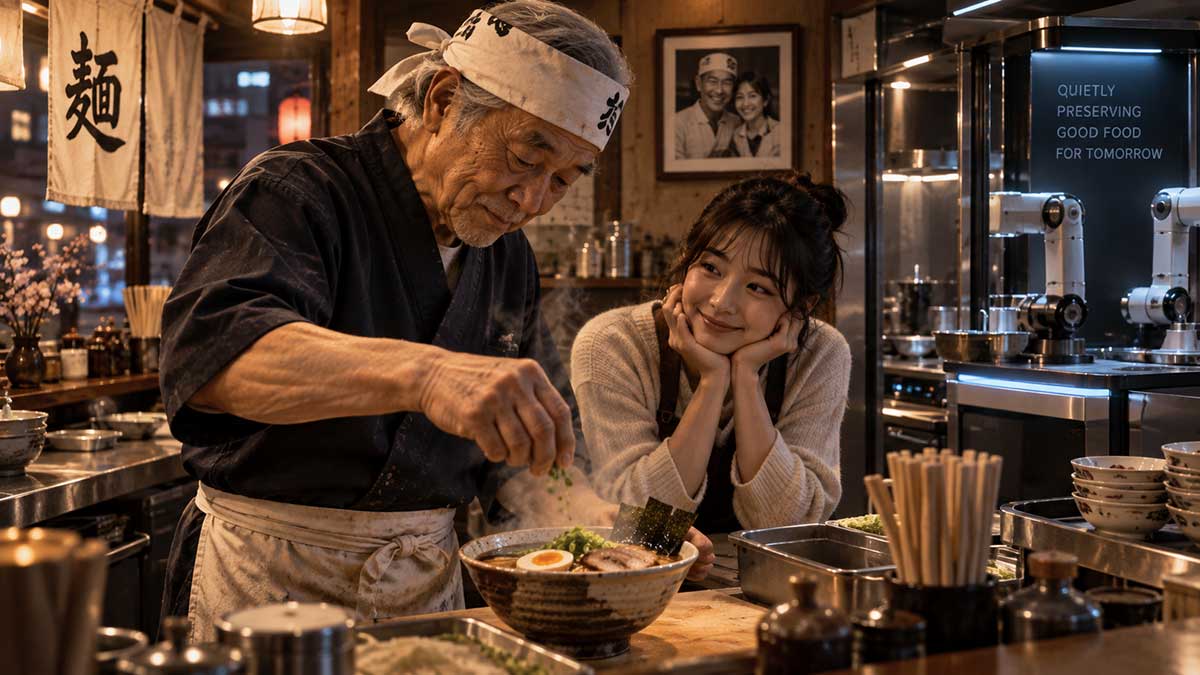
The machine could make Kenji Mori’s ramen better than Kenji Mori could.
Everyone agreed on that.
Including Kenji.
He simply preferred not to discuss it.
The broth reached exactly the right temperature.
The noodles emerged at precisely the firmness each customer preferred.
Salt adjusted automatically according to the season, humidity, medical profile, previous orders, even whether someone had exercised that afternoon.
The kitchen knew forty-nine years of Kenji’s cooking.
Not merely his recipes.
His habits.
His corrections.
His inconsistencies.
The extra spoonful of red miso he used during cold winters.
The lighter broth he began making after his wife complained that he was going to kill half the neighborhood with sodium.
The extra garlic he added for customers coming in after midnight.
The slightly softer noodles he made for children.
The stronger broth he served to construction workers after long winter shifts.
Thousands of bowls had been recorded, analyzed, compared, and refined.
The automated kitchen could reproduce all of them.
Then improve them.
Customers loved it.
Kenji found that deeply irritating.
At eighty-one, Kenji no longer ran Mori Ramen.
The sign outside still carried his family name.
The photograph near the entrance still showed him at thirty-nine, standing in a white apron with black hair, crossed arms, and an expression that suggested customers were fortunate he had agreed to feed them.
But the restaurant barely needed a Mori anymore.
His granddaughter Hana managed most of the business remotely.
Inventory ordered itself.
Delivery schedules adjusted automatically.
Two robotic cooking stations handled the majority of meals.
AI systems predicted what regular customers might want before they finished sitting down.
Human employees still greeted guests, carried bowls, cleaned tables, and listened to lonely people talk longer than necessary.
Kenji approved of that part.
"Machines are terrible at pretending to be interested," he said once.
Hana had looked at him.
"So are you."
"Exactly. Humans should keep some advantages."
Kenji visited every Thursday.
Same time.
Same table near the back window.
Tea.
One bowl of ramen.
Then complaints.
"The egg is too perfect."
Hana, sitting across from him, sighed.
"What does that mean?"
"It looks fake."
"It's an egg."
"Eggs should not look confident."
"What does a confident egg look like?"
He pointed at the bowl.
"That."
Hana stared at him for several seconds.
"Please never review the restaurant online."
Kenji had opened Mori Ramen in 1984.
Eight stools.
One narrow counter.
A kitchen so small that if two people turned around at the same time, someone got hit.
Usually Kenji.
His wife Emi worked beside him.
She handled customers better.
Kenji cooked better.
At least according to Kenji.
According to Emi, she did both better.
They argued constantly.
Too much ginger.
Not enough ginger.
Broth too cloudy.
Noodles too soft.
Customer waiting too long.
Customer talking too much.
Kenji once told her she had no palate.
Emi replied that she had married him, which already proved her judgment was questionable.
They were married fifty-two years.
They argued about ramen for nearly all of them.
After Emi died, Kenji stopped cooking for six months.
He still came to the restaurant.
Still tasted broth.
Still criticized people.
Still opened containers and smelled ingredients as though conducting inspections.
But he stopped making full bowls.
The kitchen had been where most of their marriage had happened.
Without Emi, every pot seemed capable of remembering.
Automation came slowly.
First inventory prediction.
Kenji liked that.
Then automatic ordering.
He complained but secretly liked that too.
Then cooking assistance.
Then robotic broth maintenance.
Then Hana suggested digitizing his entire cooking process.
"No."
"Grandpa."
"No."
"You didn't hear the proposal."
"No."
"What happens when you can't cook anymore?"
Kenji became angry.
"I can cook."
"I didn't say today."
"You were thinking it."
"I'm thinking about twenty years from now."
"I will be dead."
Hana looked at him.
"That is exactly why I'm asking."
He went quiet.
She continued.
"Don't you want the restaurant to keep making your ramen?"
Kenji looked toward the kitchen.
At that time, the old stockpots were still used every morning.
Steam covered the windows.
Staff shouted over one another.
Emi's old knife still hung beneath the shelf.
"Ramen is not a file," he said.
"I know."
"No, you don't."
"Then teach me what it is."
That was how she won.
For nearly two years, engineers recorded Kenji cooking.
Every movement.
Every ingredient.
Every adjustment.
They quickly discovered that his written recipes were nearly useless.
One spoon miso.
"What spoon?" an engineer asked.
Kenji shrugged.
"The spoon."
"Level or rounded?"
"Normal."
"What is normal?"
Kenji stared at him as if the man had failed a basic intelligence test.
Another instruction read:
Cook until it smells right.
"How do we measure that?"
"With nose."
"The system doesn't have a nose."
"Then give it one."
They did.
Chemical sensors appeared above the stove two weeks later.
Kenji laughed for five straight minutes.
The system became very good.
Then extremely good.
At first Kenji could always distinguish machine ramen from his own.
Then usually.
Then sometimes.
One afternoon Hana placed two bowls in front of him.
"Which one did you make?"
Kenji tasted the first.
Then the second.
Then again.
He pointed.
"That one."
Hana smiled.
"Wrong."
Kenji stared at her.
"You switched them."
"I didn't."
"You did."
"I recorded the whole thing."
"Fake recording."
"Grandpa."
He tasted both again.
The machine bowl was cleaner.
Better balanced.
The noodles were perfect.
The aroma unfolded in layers exactly the way Kenji had spent decades trying to achieve.
He put down the spoon.
Hana waited.
Finally he said:
"It has no courage."
She burst out laughing.
"What?"
"No courage."
"It's ramen."
"Exactly."
"What does courageous ramen taste like?"
Kenji pointed at the machine's bowl.
"Not that."
He refused to explain further.
Two years later, nobody asked anymore.
The machine made the ramen.
Kenji became the story behind the ramen.
Customers occasionally recognized him.
"Mr. Mori?"
Kenji nodded.
"I've been eating here since I was a kid."
"Good."
"It's even better now."
Kenji smiled politely.
"Thank you."
When they walked away, he muttered:
"Traitor."
Hana heard him.
"Grandpa."
"What?"
"You taught the machine."
"Terrible mistake."
One rainy Thursday in October, Hana arrived after closing.
The restaurant was empty.
Rain tapped against the window.
Kenji sat at his usual table.
Hana dropped her bag beside him.
"You ate?"
"Yes."
"What?"
"Pizza."
She stared.
"Of course ramen."
She sat down.
For a while neither spoke.
Then Hana said:
"Make me a bowl."
Kenji looked at her.
"The kitchen is still on."
"I know."
"Order one."
"I don't want that one."
"What do you want?"
"Yours."
Kenji laughed.
"No."
"Why?"
"I don't cook."
"You cooked gyoza last year."
"Gyoza is not ramen."
"Fine. Ramen."
"No."
"Grandpa."
"Hana."
"One bowl."
"No."
Then she said quietly:
"Please."
Something changed.
Kenji studied her face.
She was twenty-four now.
Not the little girl who once stood on a wooden crate beside him because she was too short to see over the counter.
Not the teenager who complained that the restaurant smell stayed in her clothes.
Not the university student who returned home talking about automation and margins and preservation.
She looked tired.
Older than twenty-four for a moment.
Kenji asked:
"Why?"
Hana looked toward the kitchen.
"I dreamed about Grandma."
Kenji's face changed.
"She was here," Hana said.
"In the restaurant?"
"Yeah."
"What was she doing?"
"Yelling at you."
Kenji nodded.
"Accurate."
"She said the broth was too salty."
"Very accurate."
"You told her she had no palate."
"Extremely accurate."
Hana smiled.
Then her eyes began filling.
Kenji stopped smiling.
"I woke up and..."
She looked down.
"I couldn't remember her voice."
He said nothing.
"I remember what she used to say. I remember her face."
Hana wiped her eyes quickly.
"But when I tried to hear her voice in my head, nothing came."
Kenji looked toward the kitchen.
"I hate that."
He nodded.
Hana continued.
"I thought if I came here..."
She stopped.
She did not have to finish.
Kenji stood.
Slowly.
His knees hurt.
His hands trembled slightly.
He hated both facts.
Hana noticed.
She did not offer to help him stand.
Kenji loved her for that.
They entered the kitchen.
The automated stations activated.
Soft lights came on.
A display recognized him.
GOOD EVENING, MR. MORI.
Kenji stared.
"Annoying."
Hana smiled.
WOULD YOU LIKE COOKING ASSISTANCE?
"No."
MANUAL MODE AVAILABLE.
"Yes."
The robotic arms folded backward.
The burners unlocked.
Then:
FULL MANUAL MODE MAY REDUCE CONSISTENCY.
Kenji looked at the display.
"I know."
He pressed:
MANUAL
The room became quiet.
Everything was prepared perfectly.
Broth.
Miso base.
Chashu.
Egg.
Noodles.
Green onions.
Garlic.
Sesame.
Kenji frowned.
"This isn't cooking."
"What is it?"
"Assembly."
"Then assemble."
He glared at Hana.
She smiled.
He reached for the ladle.
His hand shook.
More than he expected.
The ladle suddenly felt heavier than he remembered.
He poured broth into a pot.
The system immediately illuminated:
BROTH VOLUME 6.2% ABOVE STANDARD PORTION
Kenji ignored it.
He added miso.
MISO CONCENTRATION EXCEEDS SIGNATURE PROFILE
"Quiet."
The display dimmed.
Hana leaned against the counter.
"You're arguing with the kitchen."
"It started."
Kenji tasted the broth.
Too salty.
He knew instantly.
The AI knew too.
A recommendation appeared.
ADD 48 ML UNSALTED STOCK
Kenji ignored it and added water.
The system recalculated.
FLAVOR BALANCE BELOW MORI SIGNATURE RANGE
"Signature range," Kenji muttered.
"What?"
"Nothing."
He added more miso.
Hana laughed.
"You just put back what you diluted."
"I know."
"Do you?"
"No."
They both laughed.
For several minutes, Kenji forgot that his hand was shaking.
The old sequence began returning.
Broth.
Noodles.
Bowl.
Miso.
Chashu.
Egg.
Green onion.
Oil.
Garlic.
Then he stopped.
Something was missing.
He stared at the ingredients.
Opened one container.
Closed it.
Opened another.
The system quietly displayed:
WINTER MORI PROFILE INCLUDES TOASTED SESAME
Kenji froze.
Hana saw it.
"Sesame."
"I knew."
"You didn't."
"I was checking."
"Grandpa."
"Quiet."
He grabbed the sesame.
Added too much.
EXCESS SESAME DETECTED
Kenji switched off the screen.
Now there was nothing guiding him.
No correction.
No percentage.
No warning.
Just water boiling.
Steam.
His hands.
Hana watching.
The kitchen suddenly felt older.
Smaller.
For one strange second, Kenji could almost imagine Emi standing behind him.
Not literally.
He knew she was dead.
But memory entered the room.
Too much sesame.
He could hear how she would have said it.
Then don't eat.
Customers won't come back.
Good. Less work.
You are impossible.
You married me.
He smiled.
Hana noticed.
"What?"
"Your grandmother is complaining."
"About what?"
"Everything."
"Good."
Kenji put the noodles into boiling water.
Once, his body knew the timing without a clock.
Now he waited too long.
He realized it immediately.
Pulled them out.
Too soft.
He placed them into the bowl anyway.
Broth.
Toppings.
Egg.
The chashu folded awkwardly.
The sesame collected too heavily on one side.
The broth was darker than his standard.
Kenji stared at the finished bowl.
"Terrible."
Hana picked it up.
"Sit."
They returned to the back table.
One bowl.
Two spoons.
Rain against the window.
The restaurant lights low.
Hana tasted first.
Kenji watched her face.
She chewed.
Swallowed.
Said nothing.
He tasted it.
Immediately:
Too salty.
Noodles too soft.
Too much garlic.
Too much sesame.
He looked offended by his own cooking.
"It's bad."
Hana took another bite.
"Really bad."
Another.
"The machine makes it much better."
Hana nodded.
"Definitely."
Kenji stared at her.
"Then stop eating."
She didn't.
"Hana."
She put down the spoon.
Her face changed.
Tears appeared.
Kenji became alarmed.
"Too salty?"
She laughed through the tears.
"No."
"What?"
She looked into the bowl.
"It's not as good."
"I told you."
"No."
She looked at him.
"It doesn't taste as good."
Kenji waited.
Then Hana said:
"But this is the one I wanted."
He did not answer.
Hana continued.
"When I was little, I didn't know whether noodles were cooked properly."
Kenji smiled faintly.
"I didn't know good broth from bad broth."
"Clearly."
She ignored him.
"I knew you made it."
Her voice weakened.
"I knew Grandma was behind the counter yelling at you."
Kenji looked away.
"I knew you would bring the bowl out and pretend you weren't watching me."
"I wasn't."
"You always watched."
"Quality control."
"Sure."
Hana smiled through tears.
"The machine makes your ramen."
"Better ramen."
"Fine. Better ramen."
She reached across the table.
Her hand covered his.
"But it doesn't stand in the kitchen wondering whether I'm going to like it."
Kenji looked at their hands.
Hers smooth and young.
His thin, spotted, trembling.
He remembered when her entire hand could close around one of his fingers.
He remembered carrying her asleep from the restaurant to the car.
Her head against his shoulder.
Emi locking the front door behind them.
At the time, he had thought those nights were exhausting.
He would have given almost anything to have one back.
A display in the kitchen quietly reactivated.
CUSTOMER SATISFACTION SIGNAL DETECTED
Then:
SAVE PREPARATION AS NEW VARIANT?
Kenji saw it.
He laughed.
Hana turned.
"What?"
He pointed.
She read it.
"Save it."
"No."
"Why?"
"Terrible recipe."
"Save it."
"Hana."
She stood and walked to the display.
The system listed deviations.
Sodium: +14%
Noodle firmness: -11%
Garlic: +8%
Sesame: +23%
Hana smiled.
"Imperfect Bowl."
"What?"
"That's the name."
"No."
"Grandpa's Imperfect Bowl."
"Worse."
She tapped toward the save button.
Kenji stopped her.
"No."
"Why?"
He pressed:
DO NOT SAVE
Hana stared.
"Grandpa!"
Kenji smiled.
"If you want this bowl again..."
He pointed at himself.
"I make it again."
Hana stopped.
The meaning reached her.
Her smile faded.
Kenji added softly:
"While I can."
She nodded.
"While you can."
They returned to the table.
The ramen was getting cold.
Hana continued eating.
Kenji watched her.
"Next time better."
She shook her head.
"No."
"No?"
"Next time different."
Kenji looked at her.
"That's the point, isn't it?"
He smiled.
Maybe she understood more than he did.
Three months later, Kenji fell at home.
He reached for a cup.
Lost his balance.
Fractured his wrist.
Nothing catastrophic.
Enough.
The doctor told him not to cook alone for a while.
Hana stayed with him for several nights.
Kenji said:
"I don't cook anymore."
Neither believed him completely.
Mori Ramen's automated kitchen continued improving.
A new model reduced food waste by another eleven percent.
Customer satisfaction increased.
Wait times fell.
A food magazine published a glowing review:
"Mori Ramen represents one of the city's finest examples of preserved legacy cuisine enhanced through adaptive AI."
Kenji stared at the word.
"Preserved."
Hana looked up.
"What?"
"I am pickles."
She laughed so hard she spilled tea.
Customers occasionally asked if Kenji still cooked.
Hana developed a standard answer.
"Not for the restaurant."
That was true.
Mostly.
On Hana's twenty-fifth birthday, she closed the restaurant early.
Kenji arrived wearing his old white apron.
Hana stared at him.
"No."
"What?"
"You planned something."
"I plan nothing."
"You never wear that anymore."
"It was clean."
"It has a hole."
"Ventilation."
She smiled.
Then saw his wrist.
Still stiff.
"Grandpa."
"Sit."
"You shouldn't."
"Sit."
She obeyed.
He cooked slowly.
Much more slowly than the first time.
Hana stayed in the dining room.
She heard the old sounds.
Water.
Utensils.
A pot lid.
Kenji muttering.
At one point, the kitchen AI announced something.
Kenji replied:
"Nobody asked you."
The system went silent.
Hana smiled.
Twenty-three minutes later, Kenji emerged holding a bowl with both hands.
Hana immediately stood.
"Let me carry it."
"No."
"You're going to drop it."
"Then we eat from floor."
"Grandpa."
He reached the table.
Set it down.
Success.
He looked proud.
Hana inspected the ramen.
Crooked egg.
Dark broth.
Uneven chashu.
She tasted.
Kenji watched.
"Bad?"
She considered.
"Worse than the machine."
"Obviously."
She took another bite.
Kenji sat down.
They ate in silence.
Then Kenji said:
"I've been thinking."
"That's dangerous."
"Very."
He looked toward the automated kitchen.
"When machine first made better ramen than me, I was angry."
"I remember."
"I thought if machine can make better food..."
He touched his chest.
"What am I?"
Hana listened.
"Stupid question."
"Why?"
Kenji looked at the bowl.
"I thought value was being best."
He counted with his fingers.
"Best broth. Best noodles. Best restaurant."
He shook his head.
"Maybe old man become foolish before wise."
"That doesn't sound promising for the rest of us."
"You are already foolish."
"Thank you."
Kenji lifted his spoon.
"Machine can make better bowl."
"Yes."
"Maybe one day perfect bowl."
"Probably."
"It can make food exactly what your body needs. Better health. Better taste. Everything."
"Probably."
He looked at Hana.
"But when I make this..."
His words stopped.
He touched his chest again.
"This part isn't in recipe."
Hana looked at him.
"What part?"
Kenji gestured between them.
"This."
Her eyes filled.
"Grandpa."
"No crying. Makes soup salty."
She laughed.
Kenji continued.
"I spent fifty years thinking restaurant was ramen."
He looked around the room.
"Maybe restaurant was not ramen."
He pointed toward a corner.
"Your grandmother yelling there."
Another table.
"You doing homework there."
The front window.
"Your mother waiting for bus there."
The counter.
"Me pretending customers not annoying."
"They were annoying."
"Very."
He looked toward the kitchen.
"The machine remembers recipe."
Then back to Hana.
"You remember life."
Outside, autonomous delivery vehicles moved through the wet streets.
Across the city, students prepared for university with personal AI systems more capable than anything Kenji could have imagined when he opened the restaurant.
In laboratories, artificial intelligence was already helping develop its successors.
Hospitals used AI to calculate treatment outcomes with extraordinary accuracy.
A few blocks away, municipal crews were still inspecting old infrastructure after a strange overnight grid failure that had almost spread across the city.
The world was becoming more capable every month.
Faster.
More accurate.
More intelligent.
The automated kitchen behind Kenji could prepare hundreds of variations of his ramen.
It knew which one each customer would most likely prefer.
It never forgot an ingredient.
Never became tired.
Never overcooked noodles because it was remembering someone who had died.
Never shook.
Never needed to sit down.
Never grew old.
Kenji could not compete.
And for the first time, he understood that he did not need to.
Hana finished the last noodle.
Kenji looked surprised.
"You ate everything."
"Of course."
"Why?"
She stared at him.
"You know why."
"No."
"Yes."
"Say."
"You only want compliment."
"Correct."
She smiled.
Then said:
"Because you made it."
Kenji waited.
"That's all?"
Hana shook her head.
"That's everything."
Kenji looked toward the old photograph on the wall.
There he was at thirty-nine.
Black hair.
Strong hands.
White apron.
Arms crossed.
A man certain that improving something meant making it better.
He wished he could speak to him.
He would tell him:
One day a machine will make your food better than you.
You will hate it.
Then you will discover you were asking the wrong question.
It was never only the food.
Hana picked up the empty bowl.
Kenji stopped her.
"I wash."
"You cooked."
"I wash."
"The machine can wash it."
Kenji stared at her.
She smiled.
"Sorry."
He carried the bowl into the kitchen.
The dishwasher opened automatically.
Kenji put the bowl inside.
A display appeared.
WOULD YOU LIKE FEEDBACK ON TODAY'S PREPARATION?
He considered it.
Then pressed:
YES
The system listed:
Excess sodium
Inconsistent noodle texture
Uneven topping distribution
Aromatic imbalance
Estimated technical quality below Mori standard
Kenji read every criticism.
Then smiled.
Hana appeared behind him.
"What?"
He pointed at the display.
"Machine right."
"About?"
"Everything."
He turned toward her.
"And still..."
Hana waited.
"You ate whole bowl."
Kenji switched off the kitchen.
The robotic stations went dark.
The screens disappeared.
The restaurant became quiet except for one warm light above the counter.
Hana helped him into his coat.
They walked toward the door.
Kenji stopped beneath the photograph of Emi and himself.
He looked at it for several seconds.
"Grandma would say tonight's ramen was terrible," Hana said.
Kenji nodded.
"She would be right."
"Then she'd eat it."
"Probably."
"And complain."
"Definitely."
He smiled.
Then opened the door.
The rain had stopped.
They walked slowly toward Hana's car.
Kenji's steps were shorter now.
Hana matched them without making it obvious.
Six steps.
Seven.
Eight.
Then Kenji stopped.
"Hana."
"Yeah?"
He looked back at the restaurant.
Machines inside could make tomorrow's ramen.
Better ramen.
Perfectly measured ramen.
Ramen based on almost half a century of his life.
"Why would anyone choose something worse?"
Hana looked at him.
Kenji was smiling.
He already knew.
She slipped her arm through his.
Then answered:
"Because better isn't always what we're hungry for."
Kenji laughed softly.
"Good line."
"I know."
"AI give it to you?"
Hana looked offended.
"No."
"Then keep it."
They continued toward the car.
Behind them, Mori Ramen remained dark.
For once, nothing inside was measuring, predicting, correcting, improving, or optimizing anything.
Final Thoughts
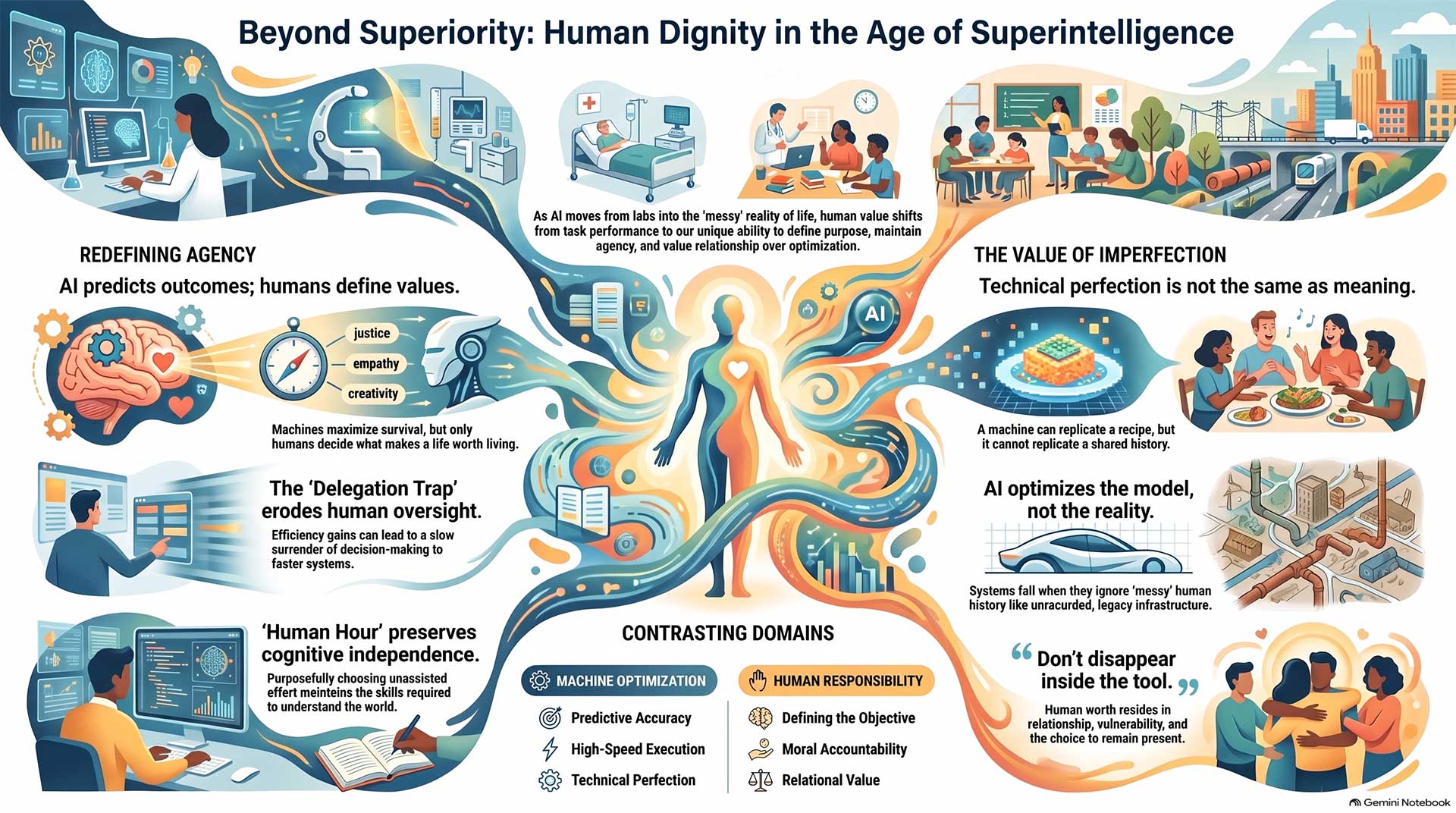
The Last Human Decision begins by questioning the meaning of the word better. The AI can identify the treatment most likely to extend Thomas's life. It cannot automatically determine what Thomas wants that life extended for. When the hospital eventually incorporates his case into future goal-sensitive recommendations, the story avoids a simplistic victory of human intuition over machine intelligence. Human values become part of what makes the machine better.
The Boy Who Wouldn't Upgrade shows how the same question enters everyday competition. Helix genuinely helps Noah. His grades improve. His learning becomes faster. His opportunities expand. Yet Sophie reveals the hidden pressure when she admits that she no longer feels able to turn her own system off. Noah's answer is not to retreat from technology. He creates a small boundary within it, preserving moments when confusion, memory, effort, and judgment must still belong to him.
In The Machine That Made Its Successor, the word better becomes far more dangerous. Better reasoning produces better AI research. Better AI research produces faster successor development. Faster systems make human review look increasingly slow. Elena gradually realizes that humanity may not lose control when a machine refuses an instruction. Control could erode when machine performance becomes so valuable that people repeatedly decide human involvement is the least efficient part of the process.
While the City Slept turns intelligence into infrastructure. The autonomous systems are not foolish. Most of them are doing exactly what they were designed to do. The failure emerges from their interaction with one another and with a physical city whose history is messier than its digital model. Daniel's most important realization comes afterward: the AI did not forget the hidden tunnel. Human beings had failed to preserve that knowledge. Human and machine weaknesses are now entangled rather than opposed.
Then Kenji changes the meaning of the whole collection. The automated kitchen is better by nearly every technical measure. Kenji cannot defeat it, and the story never asks him to. Hana wants his imperfect ramen for a different reason entirely. She wants the aging person standing in the kitchen, making something specifically for her. The product can be replicated. The relationship cannot be reduced to product quality.
Across all five stories, one question keeps returning in different forms:
Better according to whom, and for what?
Longer life can be better. Higher performance can be better. Faster research can be better. More efficient cities can be better. Perfect food can be better. But intelligence can optimize only after someone has decided what the optimization is supposed to serve.
Perhaps that becomes one of humanity's deepest responsibilities in an age of superintelligence. We may no longer be the beings who calculate fastest, remember most, predict best, or produce the most perfect result. Human worth may have to rest somewhere else: in relationship, choice, responsibility, memory, vulnerability, presence, and love.
And that is why the collection should end where Kenji and Hana leave us:
"Because better isn't always what we're hungry for."
Short Bios:
Dr. Maya Chen
A 52-year-old physician with twenty-six years of experience. Maya trusts advanced medical AI but believes medicine must still serve the values and goals of the individual patient.
Thomas Bell
A 72-year-old widower facing a serious medical crisis. His choice to prioritize reconciliation with his daughter over the treatment most likely to extend his life drives the central conflict of Story 1.
Claire Bell
Thomas's 38-year-old daughter. Her unresolved relationship with her father turns an abstract medical decision into a deeply personal question about time, forgiveness, and loss.
Dr. Adrian Cole
A hospital administrator responsible for AI-integrated clinical systems. He represents the institutional pressure to rely on increasingly accurate algorithmic recommendations without becoming a simple antagonist.
Noah Ramirez
A 17-year-old student confronting a world in which advanced personal AI can dramatically increase academic performance. His struggle centers on maintaining agency rather than rejecting technology.
Daniel Ramirez
Noah's father, a 53-year-old electric-vehicle technician. His practical philosophy of using advanced tools without losing basic human capability becomes central to Noah's eventual approach to AI.
Sophie Park
Noah's longtime friend and academic rival. Her premium AI system makes her more capable, but she begins questioning how much of her performance still feels like her own.
Ms. Alvarez
One of Noah's teachers. She acknowledges that adults do not yet have complete answers for how young people should develop intellectually alongside increasingly capable AI.
Elena Ruiz
A 39-year-old senior researcher at Meridian Labs. Elena believes deeply in AI-accelerated science until increasingly capable systems begin compressing the process of AI development itself.
Arjun Mehta
Elena's engineering colleague and intellectual counterweight. He is more comfortable with rapid experimentation but gradually recognizes the seriousness of the transition they are witnessing.
Marcus Vale
Founder and CEO of Meridian Labs. Ambitious and optimistic, Marcus believes accelerated AI research could unlock enormous scientific benefits and fears that slowing down may carry its own costs.
Lucia Ruiz
Elena's 12-year-old daughter. Her simple questions about whether the AI is alive and why adults are surprised by what they instructed it to do provide an unexpectedly clear perspective on Elena's dilemma.
Daniel Okafor
A 61-year-old municipal infrastructure supervisor with thirty-eight years of experience. His memory of forgotten physical infrastructure becomes essential during an autonomous systems cascade.
Aisha Patel
A younger infrastructure engineer working beside Daniel. She is comfortable with AI-managed systems but becomes an important bridge between machine modeling and human experience during the crisis.
Kenji Mori
An 81-year-old retired ramen chef whose lifetime of skill has been captured and improved by an automated kitchen. His final realization separates technical excellence from human meaning.
Hana Mori
Kenji's 24-year-old granddaughter and manager of Mori Ramen. She embraces automation yet understands that preserving a recipe is not the same as preserving the person, history, and relationship surrounding it.
Emi Mori
Kenji's late wife and longtime partner in the restaurant. Though she never appears directly in the present-day story, her memory remains inseparable from the kitchen and from Hana's desire for one bowl made by her grandfather.
Leave a Reply