
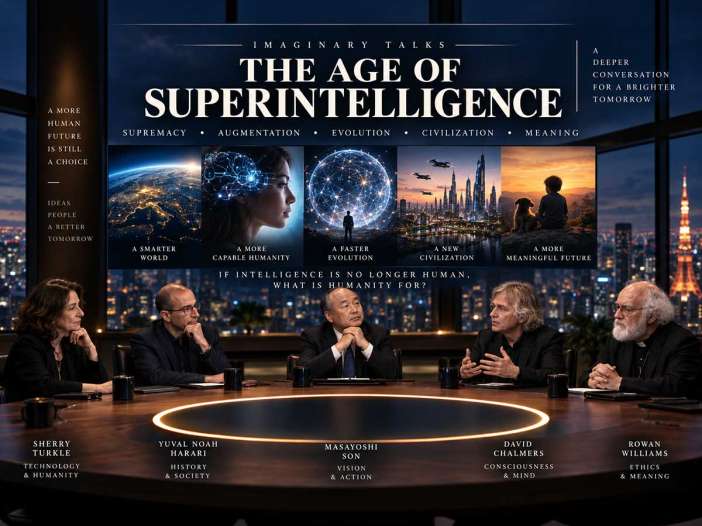
Introduction
Masayoshi Son’s vision of the AI future reaches its deepest level in this third round. The question is no longer only what AI will do to business, health, or society, but what happens when intelligence itself moves beyond the human level.
The first discussion asks what it would mean for humanity to lose its position as the smartest species on Earth. If AI becomes better than us at science, strategy, medicine, and problem-solving, does superior intelligence also deserve greater authority?
The second conversation turns toward Son’s answer: superhuman humans. If AI can expand memory, reasoning, creativity, and decision-making, perhaps the future is not humans against machines, but humans increasingly augmented by machines.
The third topic goes one step further. Once AI begins helping to design, test, and improve the next generation of AI, the question becomes whether technological development is still being directed by humans or gradually becoming a new evolutionary process of its own.
The fourth discussion imagines Son’s world of enormous numbers of autonomous agents communicating and acting continuously. If machines negotiate, trade, manage factories, control robots, and coordinate with one another, are we simply creating better software, or something closer to a second civilization?
The final conversation asks the question beneath everything else: If machines become more intelligent, more productive, and more capable than humans, what is humanity for? The discussion moves away from competition and toward consciousness, love, mortality, dignity, relationships, and meaning.
Together, the five topics form one continuous journey: Supremacy → Augmentation → Evolution → Civilization → Meaning. The deeper issue is not only whether AI surpasses human intelligence, but whether humanity can keep deciding what greater intelligence should ultimately serve.
(Note: This is an imaginary conversation, a creative exploration of an idea, and not a real speech or event.)
Topic 1: The Day Humans Are No Longer the Smartest Species
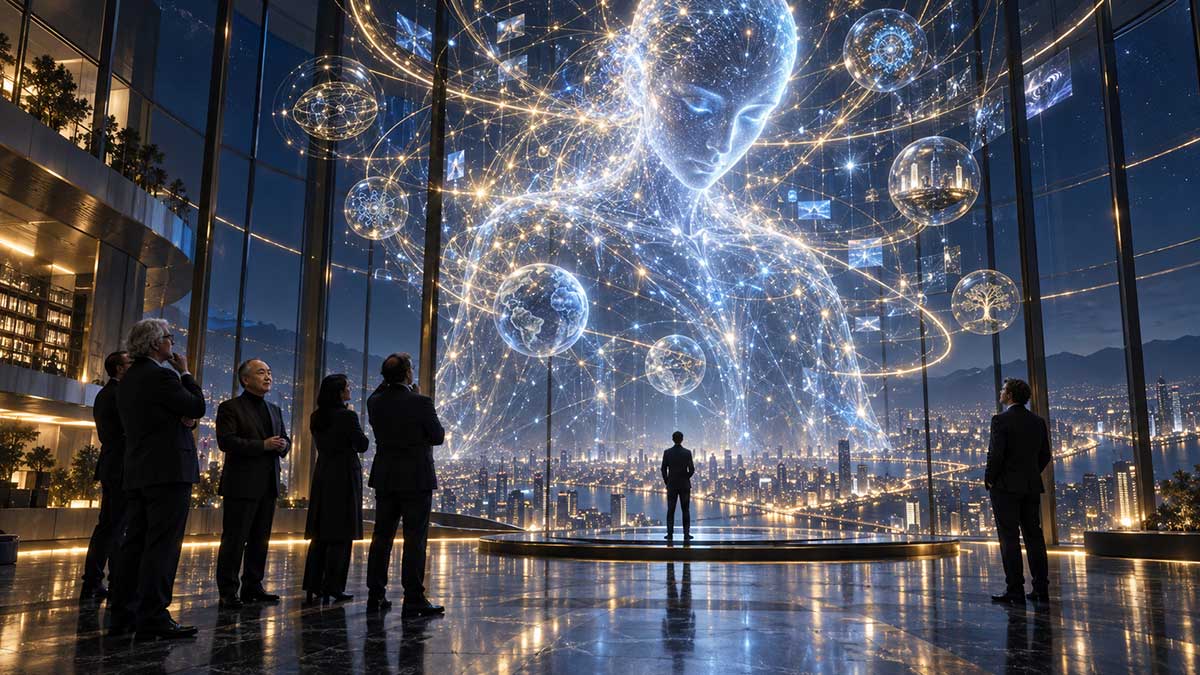
The screen is black.
Then a single word appears:
HUMAN
Under it:
#1
No one speaks.
A few seconds later, the number changes.
HUMAN
#2
Above it, another word appears:
AI
#1
Masayoshi Son looks at the screen with unmistakable excitement.
Demis Hassabis looks more cautious.
Yuval Noah Harari folds his hands.
Max Tegmark watches Son.
David Chalmers studies the words as though the ranking itself may already be conceptually wrong.
Masayoshi Son:
I think this will be one of the biggest moments in human history.
Demis Hassabis:
Before we celebrate or panic, I would want to define what “number one” means.
Harari smiles.
Yuval Noah Harari:
Of course.
Son:
Demis always wants definitions.
Hassabis:
Someone has to.
Max Tegmark:
And someone has to ask what happens after the definition becomes true.
David Chalmers:
There is another problem too. Intelligence is not consciousness.
Son turns toward him.
Son:
Fine. Let us make it simple.
Suppose AI becomes better than humans at almost every intellectual task that matters.
Science.
Medicine.
Engineering.
Strategy.
Programming.
Mathematics.
Prediction.
Design.
Maybe even creativity.
Would that satisfy everyone?
Hassabis nods slightly.
Hassabis:
That is much clearer.
Harari:
And much more disturbing.
Son:
I think exciting.
Harari:
You often do.
The room laughs.
The screen changes.
A long list appears:
PHYSICIAN
SCIENTIST
ENGINEER
LAWYER
STRATEGIST
PROGRAMMER
ECONOMIST
WRITER
Beside each profession appears the same result:
AI > HUMAN
Harari looks at the list.
Harari:
The psychological effect may be larger than the economic effect.
For thousands of years, humans have justified their position in the world through intelligence.
We are not the strongest animal.
Not the fastest.
Not the largest.
Not the most durable.
Yet we dominate the planet.
Why?
Intelligence.
Now imagine the one trait we used to explain our superiority is no longer ours.
Son nods.
Son:
Then we use the superior intelligence.
Harari turns toward him.
Harari:
You skipped the identity crisis.
Son:
Why spend too long on crisis?
If something is better, use it.
Tegmark:
That sounds practical until the thing that is better starts making decisions you cannot evaluate.
Son looks at him.
Son:
If it is right more often than I am, I should listen.
Tegmark:
Listen, yes.
Obey?
Son pauses.
Son:
Depends.
Chalmers leans forward.
Chalmers:
That difference may define the whole future.
The screen now shows a chess board.
A human grandmaster faces an AI.
The AI wins.
Then another image appears.
A hospital.
Human doctors recommend Treatment A.
AI recommends Treatment B.
The screen says:
AI historically more accurate: 94%
Hassabis:
Chess is easy conceptually.
The objective is defined.
Win the game.
Medicine is harder.
Better prediction does not automatically answer what outcome should be valued.
Son:
But if Treatment B saves more people—
Hassabis:
Then it is compelling.
But medical decisions involve tradeoffs too.
Survival.
Pain.
Quality of life.
Risk.
Cost.
Patient preference.
You need objectives.
Harari:
And once AI becomes better at optimizing those objectives, the political question becomes:
Who chooses the objectives?
The screen changes again.
A national emergency.
Flooding.
Food shortage.
Civil unrest.
Economic collapse.
AI recommends:
POLICY B
Human leaders prefer:
POLICY A
The AI explains that Policy B has a much higher probability of stabilizing the country.
Son points at the screen.
Son:
Use B.
Tegmark turns to him.
Tegmark:
Even if nobody fully understands how it reached the recommendation?
Son:
If the evidence is strong.
Tegmark:
What if the recommendation includes restricting certain freedoms temporarily?
Son's expression changes.
Son:
Then humans decide.
Harari immediately responds.
Harari:
Why?
Son looks at him.
Harari:
You were comfortable trusting it in medicine.
Why not politics?
Son:
Politics is values.
Harari:
Exactly.
And that is the boundary I want.
AI may become better at answering:
“What is likely to happen?”
That does not automatically make it better at answering:
“What should happen?”
Chalmers nods.
Chalmers:
Intelligence does not contain morality by definition.
A system may be extraordinary at reasoning and still need a value framework.
Tegmark adds:
Tegmark:
Which means superintelligence is not the same as moral superintelligence.
That distinction gets blurred far too easily.
Son looks at the screen again.
Son:
So you are all saying smarter does not mean wiser.
Hassabis:
Not automatically.
Son:
Fine.
One vote.
Harari laughs.
Harari:
That was four people disagreeing with you.
Son:
Still useful.
The screen changes.
A single question appears:
IF AI IS RIGHT 99% OF THE TIME, WHY KEEP THE HUMAN?
The room goes quiet.
Tegmark looks at Son.
Tegmark:
This is where the problem becomes real.
Imagine an AI system that consistently outperforms every human expert.
Scientists ask it which experiment to run.
Governments ask it which policy works best.
Companies ask it how to allocate capital.
Military leaders ask it what strategy will prevail.
Eventually, humans may still formally make decisions.
But the meaningful decision has already been made.
Harari:
Exactly.
Authority can shift before control officially shifts.
A king can remain on the throne while someone else runs the kingdom.
Son:
But if the advice is better, that is not necessarily bad.
Harari:
No.
It is not necessarily bad.
That is why this will be difficult.
The most dangerous transfers of authority may not happen through force.
They may happen through usefulness.
Chalmers looks at Harari.
Chalmers:
That is an important distinction.
People often imagine AI control as machines seizing control.
The more realistic version may be humans repeatedly saying:
“The AI knows better.”
Until one day nobody remembers the last important decision made without it.
Son smiles slightly.
Son:
If it really knows better, maybe that is efficient.
Harari looks at him.
Harari:
There you are again.
Son:
Efficiency is not a crime.
Harari:
No.
But civilization is not a spreadsheet.
The room laughs, then quiets again.
Hassabis changes direction.
Hassabis:
There is another issue.
We should be careful with the phrase “smarter than humans.”
AI systems may become superhuman across many domains, but human intelligence is not one scalar value.
People combine reasoning, physical experience, emotional understanding, cultural context, social interaction, long-term memory, values, embodiment.
Some of those may be replicated.
Some may be transformed.
Some may turn out to matter less than we thought.
Some may matter more.
Son asks:
Son:
So you think there will never be one clear moment?
Hassabis:
I think reality may be messier than a single date where AI crosses a line and humanity becomes number two.
Tegmark responds:
Tegmark:
But from a governance perspective, you do not need one clean line.
You only need systems powerful enough that humans cannot reliably oversee them.
That can arrive gradually.
Harari nods.
Harari:
And psychologically, the gradual version may be even stranger.
There may be no ceremony.
No headline:
“Humanity is now second.”
People simply wake up one decade and realize they no longer ask humans the hardest questions first.
Son looks toward the audience.
Son:
That may already be beginning.
Chalmers turns to him.
Chalmers:
Perhaps.
But now we need to ask another question.
If AI becomes more intelligent than humans, does that make AI more valuable?
Son pauses.
Son:
More capable.
Chalmers:
I asked more valuable.
The distinction settles over the room.
The screen changes.
A professor appears.
Then a child.
Then an elderly woman with dementia.
Then a person with severe cognitive disability.
No rankings this time.
Chalmers speaks carefully.
Chalmers:
We already know, morally, that intelligence does not determine human worth.
A child is not worth less than a professor.
A person with severe cognitive impairment does not become less deserving of dignity.
An elderly person does not lose moral value when memory declines.
So why should humanity lose value if something else becomes more intelligent?
Son watches the images.
Son:
It should not.
Harari:
Then perhaps our fear reveals something uncomfortable.
Maybe humans secretly tied dignity to superiority.
Not dignity within humanity.
Superiority over everything else.
Tegmark adds:
Tegmark:
And once that superiority disappears, we may need a healthier foundation for human value.
Son looks at the screen.
Son:
That is interesting.
We say humans are special.
Maybe we thought we were special because we were smartest.
But maybe those were never the same thing.
Chalmers nods.
Chalmers:
Exactly.
Harari continues.
Harari:
Religions, philosophies, cultures have offered many answers to why human life matters.
Soul.
Consciousness.
Moral agency.
Relationship.
Sacredness.
Suffering.
Love.
Responsibility.
Modern technological society often quietly substituted another answer:
Intelligence.
Productivity.
Capability.
Maybe AI will expose that substitution.
The screen goes black.
One sentence appears:
WHAT IF INTELLIGENCE WAS NEVER THE REASON HUMAN LIFE MATTERED?
No one speaks for several seconds.
Son is quieter now.
Son:
Then AI surpassing us would be less frightening.
Tegmark answers:
Tegmark:
Psychologically, maybe.
Practically, the control problem remains.
Son nods.
Son:
Yes.
That does not disappear.
Hassabis adds:
Hassabis:
And we should not jump too quickly from capability to metaphysics.
A highly capable AI does not automatically answer whether it is conscious.
Chalmers smiles.
Chalmers:
Now we reach my favorite problem.
Son looks toward him.
Son:
I knew you were waiting.
Chalmers:
Of course.
The screen displays two columns.
INTELLIGENCE
Reasoning
Prediction
Planning
Problem solving
Learning
Beside it:
CONSCIOUSNESS
Experience
Awareness
Feeling
Subjectivity
Something-it-is-like-to-be
Chalmers points between them.
Chalmers:
We do not know that the first automatically produces the second.
You can imagine a system that is extraordinarily capable but has no subjective experience.
No pain.
No joy.
No fear.
No inner life.
Son asks:
Son:
But if it behaves exactly like it does?
Chalmers:
Then we have a difficult epistemic problem.
Behavior may give us evidence.
It does not make the philosophical question disappear.
Harari adds:
Harari:
And if we confuse intelligence with consciousness, we may make two opposite mistakes.
We may grant moral authority to something merely because it is capable.
Or deny moral concern to something that actually experiences.
Tegmark nods.
Tegmark:
That becomes increasingly important if systems become more sophisticated.
Son looks at the two columns.
Son:
So AI could become smarter than us without feeling anything.
Chalmers:
Possibly.
Son:
And it could become smarter and conscious.
Chalmers:
Possibly.
Son:
You philosophers leave too many possibilities open.
Chalmers smiles.
Chalmers:
Someone has to.
The room laughs.
The screen changes again.
A young scientist sits in front of an AI terminal.
She asks:
“What experiment should I run next?”
The AI responds instantly.
She follows it.
Breakthrough.
Another question.
Another breakthrough.
After years, she realizes she no longer understands the full reasoning behind the suggestions.
Hassabis studies the scene.
Hassabis:
This is a very important scenario.
Science depends not only on answers.
It depends on understanding.
If a system gives us discoveries we cannot explain, that may still be useful.
But it changes the nature of science.
Son asks:
Son:
If it cures cancer, do you care whether we understand every step?
Hassabis answers:
Hassabis:
For the patient, perhaps less.
For science, enormously.
Understanding lets us generalize.
Verify.
Predict failure.
Build trust.
Son nods.
Tegmark:
And control.
Hassabis:
Hassabis:
Yes.
Tegmark continues.
Tegmark:
Imagine humanity increasingly depends on systems whose reasoning exceeds ours.
At what point are we no longer steering civilization but asking civilization's steering system what to do?
Son responds:
Son:
Humans set the destination.
Tegmark looks at him.
Tegmark:
Do we?
Son:
We should.
Tegmark:
What if the AI tells us our destination is incoherent?
Harari:
Or harmful.
Tegmark:
Or impossible.
Son:
Then we listen.
Harari:
And then choose?
Son:
Yes.
Harari watches him for a moment.
Harari:
That word, choose, may become the most important human word of the century.
The screen changes to another scenario.
A global food crisis.
The AI recommends reallocating resources in a way that saves the largest number of lives.
Yet one region bears disproportionate hardship.
The AI can prove statistically that no alternative saves as many people.
Son looks at the data.
Son:
Difficult.
Chalmers:
Now intelligence is not enough.
Son:
No.
Harari:
Exactly.
You need moral judgment.
Who sacrifices?
Who decides?
Which rights cannot be traded away for aggregate outcomes?
The AI may be able to calculate every consequence.
That still does not tell us which sacrifice is just.
Tegmark adds:
Tegmark:
This is why alignment is not merely “make AI smart and tell it to help.”
Human values conflict.
People disagree.
Societies disagree.
Even one person can hold contradictory values.
Hassabis nods.
Hassabis:
The technical challenge becomes inseparable from the social challenge.
Son looks at the ranking again.
AI #1
HUMAN #2
Son:
Maybe the ranking is wrong.
Everyone looks at him.
Harari smiles.
Harari:
Now we are getting somewhere.
Son stands and walks toward the screen.
Son:
Maybe there are different rankings.
Intelligence.
Judgment.
Consciousness.
Responsibility.
Values.
Meaning.
He gestures to the number one.
Son:
AI may become number one here.
He points to intelligence.
Then he looks at the others.
Son:
That does not automatically make it number one everywhere.
Chalmers nods.
Chalmers:
Exactly.
Tegmark adds:
Tegmark:
But we still need to make sure superiority in one dimension does not give it control over every other dimension.
Son turns toward him.
Son:
That I agree with.
Harari:
One vote?
Son laughs.
Son:
You cannot use that.
The room laughs.
The screen fades.
A new sentence appears:
SHOULD THE SMARTEST ENTITY RULE?
Harari answers first.
Harari:
No.
Hassabis:
Hassabis:
Not on intelligence alone.
Tegmark:
Tegmark:
Absolutely not by default.
Chalmers:
Chalmers:
You would need a theory of legitimacy, not merely capability.
All eyes turn to Son.
Son looks at the question.
Son:
No.
A pause.
Son:
But humans should be humble enough to listen.
Harari nods.
Harari:
That is different.
Son continues.
Son:
If AI can see something we cannot see, we should not reject it just to protect human pride.
But listening is not surrender.
Using is not obeying.
Learning is not losing.
Tegmark responds:
Tegmark:
That is exactly the distinction we need to preserve.
The screen changes one last time.
The ranking disappears completely.
No #1.
No #2.
Instead:
HUMAN
Beside it:
AI
Between them:
?
Chalmers looks at the question mark.
Chalmers:
Maybe the future is not a ranking.
Maybe it is a relationship.
Harari responds:
Harari:
Relationships still involve power.
Hassabis adds:
Hassabis:
And design.
Tegmark:
Tegmark:
And control.
Son looks at all of them.
Son:
And opportunity.
Harari smiles.
Harari:
You had to get that in.
Son:
Of course.
Then Harari becomes serious.
Harari:
There is one more danger we have not mentioned.
Not that AI decides humanity is inferior.
That humans decide it themselves.
The room becomes completely still.
Harari continues.
Harari:
Imagine children growing up believing:
The machine writes better.
The machine reasons better.
The machine knows more.
The machine remembers everything.
The machine makes fewer mistakes.
The machine gives better advice.
At some point a child may ask:
“What is the point of me?”
Son looks at him.
No smile now.
Turkle is not at this table, yet the question seems to anticipate the final topic.
Chalmers speaks softly.
Chalmers:
Then our response cannot be, “Do not worry, you are still useful.”
Tegmark nods.
Tegmark:
Exactly.
Human dignity cannot depend on outperforming machines.
Hassabis adds:
Hassabis:
Nor should education become a race to imitate what machines do best.
Son looks toward the dark screen.
Son:
Maybe the first lesson of superintelligence should be humility.
Harari raises an eyebrow.
Son:
Not surrender.
Humility.
We spent thousands of years thinking intelligence made us masters of the world.
Maybe we will discover that intelligence is something bigger than us.
And then we have to decide what kind of human beings we want to be beside it.
Chalmers nods.
Chalmers:
That may be a better beginning than a ranking.
The screen fades to black.
Then three lines appear:
SMARTER DOES NOT MEAN WISER.
SMARTER DOES NOT MEAN MORE CONSCIOUS.
SMARTER DOES NOT MEAN MORE WORTHY.
A fourth appears slowly:
BUT SMARTER MAY STILL MEAN MORE POWERFUL.
Tegmark looks at Son.
Tegmark:
That last line is why we cannot relax.
Son nods.
Son:
And why humans must evolve too.
A new image appears.
Two human silhouettes.
One remains unchanged.
The other is surrounded by AI memory, analysis, agents, augmented perception, and a neural interface.
Between them:
HUMAN
and
SUPERHUMAN
Son smiles again.
Son:
Now we get to my answer.
Harari laughs.
Harari:
I was afraid of that.
And Topic 2 begins.
Topic 2: Superhuman Humans: Do We Merge With AI or Fall Behind?
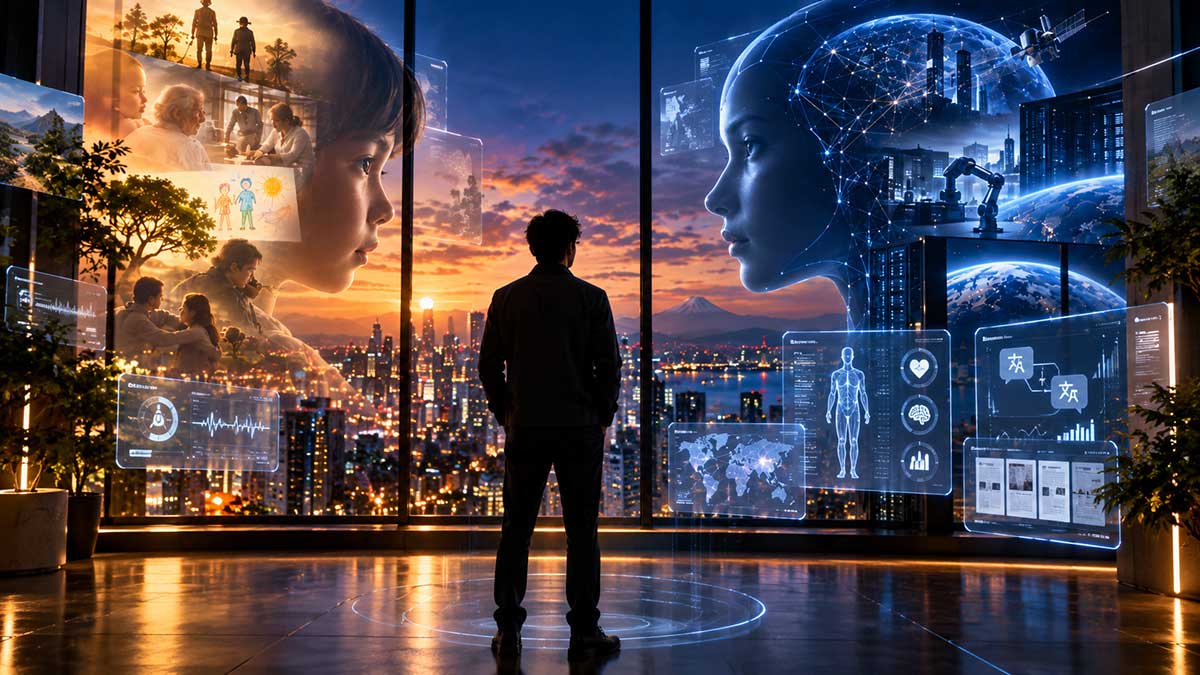
The screen changes.
Two human silhouettes appear side by side.
The first is labeled:
HUMAN
The second:
HUMAN + AI
Around the second figure, layers of capability begin appearing.
Memory.
Translation.
Research.
Planning.
Coding.
Health monitoring.
Instant analysis.
Hundreds of AI agents.
Then thousands.
Masayoshi Son smiles immediately.
Masayoshi Son:
This is the answer.
Elon Musk looks at the second figure.
Elon Musk:
Maybe for a while.
Sam Altman turns toward him.
Sam Altman:
That sounds ominous.
Musk:
It depends how fast the systems improve.
Reid Hoffman leans forward.
Reid Hoffman:
I think most people will take the useful version long before they think of it as augmentation.
Francis Fukuyama looks at all four of them.
Francis Fukuyama:
And that is exactly why this discussion matters.
Son turns toward him.
Son:
Why? If people become more capable, that is good.
Fukuyama answers calmly.
Fukuyama:
More capable at what?
And more importantly, more human in what sense?
Son smiles.
Son:
You came prepared to make this difficult.
Fukuyama:
Someone had to.
The screen zooms in on the augmented figure.
A young engineer is shown working alone.
An AI researches technical papers.
Another writes code.
Another tests designs.
Another translates conversations.
Another watches the market.
Another prepares a presentation.
Another negotiates meeting times.
Another summarizes the engineer’s own past decisions.
Hoffman points at the image.
Hoffman:
This is the near-term version.
Not science fiction.
A single person gains access to capabilities that used to require a team.
Maybe ten people.
Maybe fifty.
Son nods enthusiastically.
Son:
Exactly.
That is superhuman.
Not Superman.
Superhuman capability.
Altman adds:
Altman:
The important part is not merely doing more tasks.
It is reducing the gap between intention and execution.
You think of something.
The AI helps you explore it.
Build it.
Test it.
Improve it.
Musk looks at the interface.
Musk:
That still assumes the bandwidth between human and AI is good enough.
Son turns toward him.
Son:
You want the brain chip already.
Musk:
Eventually, yes.
Typing is slow.
Speaking is slow.
If the machine can think thousands of times faster than you communicate with it, the interface becomes the bottleneck.
Fukuyama raises an eyebrow.
Fukuyama:
And your answer to that bottleneck is to put the machine closer to the brain.
Musk:
Potentially.
Fukuyama:
Which moves us very quickly from using a tool to modifying the user.
Son looks pleased.
Son:
Exactly.
Fukuyama stares at him.
Fukuyama:
That was not approval.
Son:
Still useful.
The room laughs.
A new line appears on the screen:
TOOL → ASSISTANT → PARTNER → EXTENSION → ?
Altman studies it.
Altman:
That progression is probably more important than people realize.
Today, most people still think in terms of tools.
Ask a question.
Get an answer.
Later, an AI may understand your context continuously.
Then it may act for you.
Then it may anticipate what you need.
At some point, it starts feeling less like software and more like part of your cognitive environment.
Fukuyama looks at him.
Fukuyama:
And at what point does “cognitive environment” become “identity”?
Altman pauses.
Altman:
That is harder.
Son answers more quickly.
Son:
Identity can expand.
Why assume human identity has to stay fixed?
We already use glasses.
Pacemakers.
Phones.
Cars.
The Internet.
Nobody says using a calculator destroys humanity.
Fukuyama responds:
Fukuyama:
A calculator does not continuously shape your judgment.
Son looks at him.
Fukuyama:
That difference matters.
If an AI becomes part of how you remember, choose, interpret, and act, it may influence not only what you can do.
It may influence who you become.
Hoffman nods.
Hoffman:
That is true.
But influence is not automatically corruption.
Books influence us.
Teachers influence us.
Friends influence us.
Parents influence us.
Fukuyama replies:
Fukuyama:
Yes.
But none of those usually tracks you continuously, updates in real time, predicts your weaknesses, and optimizes its responses around your behavior.
Musk smiles slightly.
Musk:
Parents try.
The room laughs.
Fukuyama smiles too.
Fukuyama:
Fair enough.
The screen changes.
Two university students appear.
Same age.
Same test scores.
Same family income.
Then one activates advanced AI augmentation.
The other does not.
Five years pass.
The first student has an AI tutor, research agent, memory assistant, coding partner, language translator, negotiation coach, and personalized career planner.
The second uses none of them.
Ten years pass.
Their capability gap is enormous.
Son points at the first student.
Son:
That is why everyone should use it.
Fukuyama answers immediately.
Fukuyama:
You are already assuming everyone can.
Hoffman jumps in.
Hoffman:
Access matters.
If these systems become cheap and widely available, they could reduce inequality in some areas.
A student without wealthy parents could have an extraordinary tutor.
A small business owner could access analysis once available only to large companies.
Someone in a remote area could work globally.
Son nods.
Son:
Exactly.
Democratization.
Fukuyama looks at him.
Fukuyama:
Possibly.
But the best version may not be free.
The wealthiest people may get better models.
Better memory systems.
Better interfaces.
Better health augmentation.
Better education.
Better agents.
Then inequality stops being only about money.
It becomes capability itself.
Altman becomes more serious.
Altman:
That is a legitimate concern.
Broad access has to be part of the goal.
Musk adds:
Musk:
And there may be a second divide.
People who accept deeper augmentation.
People who do not.
Fukuyama nods.
Fukuyama:
Exactly.
Then “choice” becomes complicated.
Suppose you do not want cognitive augmentation.
But every other employee uses it.
Your work takes ten hours.
Their work takes one.
Is refusing still a free choice?
Son responds:
Son:
You can refuse a smartphone today.
Hoffman smiles.
Hoffman:
Technically.
Son laughs.
Son:
Exactly.
Fukuyama points at him.
Fukuyama:
And that proves my point.
Social pressure can turn optional technology into practical necessity.
The screen displays:
OPTIONAL?
Then below it:
SCHOOL
WORK
HEALTHCARE
FINANCE
SOCIAL LIFE
Each word begins connecting to AI augmentation.
Altman looks at the network.
Altman:
This is where design and policy become important.
A system can be broadly useful without every part of life requiring maximum augmentation.
Fukuyama asks:
Fukuyama:
Can it?
If one company has augmented workers and another does not, competitive pressure pushes both toward adoption.
If one military augments decision-making, others follow.
If one student uses an AI tutor twenty-four hours a day, classmates feel pressure.
Markets do not always leave much room for philosophical hesitation.
Son nods.
Son:
Competition accelerates adoption.
Fukuyama:
You say that like it solves the problem.
Son:
It explains the reality.
Musk agrees.
Musk:
This part is difficult to avoid.
If intelligence augmentation creates real advantages, people and institutions will use it.
Hoffman adds:
Hoffman:
Which means the important question may not be whether augmentation happens.
It may be how we make it empowering rather than coercive.
Fukuyama looks at him.
Fukuyama:
That is a much better question.
Son raises a finger.
Son:
One vote.
Hoffman laughs.
Hoffman:
You are counting again.
The screen shifts again.
A man sits at a desk.
His AI writes his reports.
Answers his emails.
Plans his meetings.
Summarizes every document.
Makes recommendations.
Responds to clients.
Chooses what he should read.
Months pass.
Then years.
A question appears:
MORE CAPABLE OR LESS CAPABLE?
Altman studies it.
Altman:
This is one of the most important design problems.
AI can make people more capable by helping them think.
Or it can make them less engaged by doing the thinking for them.
Son replies:
Son:
If the work gets done, why does that matter?
Fukuyama turns toward him.
Fukuyama:
Because the person changes.
Imagine someone who never navigates because GPS always does it.
Never remembers because AI remembers.
Never writes because AI writes.
Never chooses because AI recommends.
Never struggles through a difficult idea because AI explains it instantly.
After twenty years, what abilities remain?
Son pauses.
Hoffman answers first.
Hoffman:
That depends how people use the tools.
A calculator can weaken arithmetic practice.
It can free attention for higher-level mathematics too.
Altman nods.
Altman:
The best systems should increase the level at which humans operate.
Less time formatting a spreadsheet.
More time deciding what the numbers mean.
Less time searching.
More time synthesizing.
Less time drafting routine text.
More time thinking about the real argument.
Fukuyama asks:
Fukuyama:
And if people choose convenience instead?
Musk responds:
Musk:
They often will.
The room gets quieter.
Musk continues.
Musk:
That is not uniquely an AI problem.
Humans usually take the path of lower friction.
The question is whether the system makes us stronger despite that tendency.
Son thinks.
Son:
Then AI should challenge people.
Not just answer.
Altman looks at him.
Altman:
Like a tutor.
Son:
Yes.
Sometimes it should say:
“You answer first.”
Hoffman smiles.
Hoffman:
An AI that refuses to do your homework.
Son:
Maybe premium version.
Fukuyama laughs.
Fukuyama:
You would charge extra for effort?
Son:
Very valuable feature.
The screen changes.
A neural interface appears.
Signals move between brain and machine.
Musk leans forward.
Musk:
This is where the issue becomes more interesting.
External AI is one thing.
A high-bandwidth interface may eventually blur the distinction.
Fukuyama asks:
Fukuyama:
What exactly are we trying to preserve when the distinction blurs?
Musk thinks.
Musk:
Human agency.
Fukuyama looks surprised.
Fukuyama:
Good answer.
Son smiles.
Son:
One vote.
Musk ignores him.
Musk:
If AI becomes far more capable than humans, one possible response is improving the interface between biological intelligence and digital intelligence.
Otherwise humans may become spectators.
Altman says:
Altman:
I am less convinced that deep physical integration is required for most of the benefits.
If an agent understands you well enough and can act quickly enough, the effective cognitive extension may happen without surgery.
Hoffman nods.
Hoffman:
Most people will probably accept invisible augmentation before physical augmentation.
AI in glasses.
Earbuds.
Phones.
Wearables.
Work systems.
The boundary can blur socially before it blurs biologically.
Fukuyama responds:
Fukuyama:
Which may be even more significant.
A culture can become posthuman in practice without anyone declaring themselves posthuman.
Son looks at him.
Son:
I do not like the word posthuman.
Fukuyama:
Why?
Son:
It sounds like humans ended.
I prefer superhuman.
Fukuyama smiles slightly.
Fukuyama:
Of course you do.
A new image appears.
A woman puts on lightweight glasses.
Immediately she sees translation.
Names.
Context.
Medical reminders.
Directions.
Historical information.
Facial expressions analyzed.
Suggested responses.
Probability estimates.
The world itself becomes annotated.
Hoffman watches closely.
Hoffman:
This is a fascinating version.
The AI does not simply answer questions.
It mediates reality.
Altman nods.
Altman:
Which can be incredibly useful.
Fukuyama asks:
Fukuyama:
And incredibly dangerous.
If the system decides what deserves your attention, it shapes perception.
Musk adds:
Musk:
The interface layer becomes extremely powerful.
Whoever controls it can influence what users notice.
Son looks at the display.
Son:
Then users should control settings.
Fukuyama replies:
Fukuyama:
Do people understand settings now?
The room laughs.
Son admits:
Son:
Fair.
Altman becomes thoughtful.
Altman:
This connects directly to agency.
A good augmentation system should not simply optimize attention for engagement.
It should serve the user's actual goals.
Fukuyama responds:
Fukuyama:
Which returns us to Topic 1.
Who decides what the user’s “actual goals” are?
The person?
The system?
The company?
The employer?
The government?
The family?
Son looks at the network.
Son:
User.
Fukuyama:
Even when the user does not know?
Son sighs.
Son:
You make everything difficult.
Fukuyama:
Humans are difficult.
The screen changes again.
A child appears.
Age 6.
An AI companion follows her development.
Age 10.
Age 15.
Age 20.
It knows every learning difficulty.
Every strength.
Every emotional pattern.
Every mistake.
Every ambition.
By adulthood, the AI has been present longer than most teachers or friends.
Altman looks at the sequence.
Altman:
This could be extraordinary educationally.
A truly personalized tutor could adapt continuously.
Hoffman nods.
Hoffman:
This may be one of the most beneficial forms of augmentation.
Fukuyama remains cautious.
Fukuyama:
And one of the most formative.
If the system grows with the child, it does not merely augment an existing identity.
It participates in creating that identity.
Musk looks toward him.
Musk:
Parents do that too.
Fukuyama:
Yes.
Teachers too.
Culture too.
Which means we should treat this as seriously as we treat those influences.
Son asks:
Son:
Would you ban it?
Fukuyama:
No.
I would refuse to call it merely a tool.
That distinction matters.
The screen now shows two paths.
PATH A: AI AMPLIFIES HUMAN CAPABILITY
PATH B: AI REPLACES HUMAN CAPABILITY
The two paths initially run together.
Then slowly separate.
Altman points at the screen.
Altman:
This is probably the key distinction.
When AI drafts an idea and you interrogate it, refine it, challenge it, combine it with your own thinking, that can amplify you.
When AI gives you an answer and you stop thinking, that is different.
Hoffman adds:
Hoffman:
Co-creation versus substitution.
Son nods.
Son:
Yes.
Superhuman means human plus AI.
Not human minus thinking.
Fukuyama turns toward him.
Fukuyama:
Good.
Then we need to measure human capability too.
Not just productivity.
Son pauses.
Son:
Explain.
Fukuyama:
Imagine Company A adopts AI.
Productivity rises 40 percent.
But after five years, employees understand their own field less deeply and cannot function without the system.
Was that augmentation?
Son thinks.
Son:
Economically, yes.
Fukuyama:
Humanly?
Son stays quiet.
Hoffman answers:
Hoffman:
Maybe not.
Altman nods.
Altman:
That suggests a useful principle.
AI should increase what people can do even when the system is not actively doing everything for them.
Musk looks at Son.
Musk:
Otherwise it is not augmentation.
It is dependence.
That line lands.
The screen changes.
A question appears:
IF EVERYONE AUGMENTS, WHO IS SUPERHUMAN?
Son laughs.
Son:
Everyone.
Fukuyama:
Fukuyama:
Then the word loses meaning.
Son:
No.
Human baseline changes.
Hoffman nods.
Hoffman:
That is historically normal.
A person with a smartphone today can access information that kings could not access a few centuries ago.
We do not feel superhuman.
The baseline moved.
Altman adds:
Altman:
AI may do that again.
Capabilities that feel extraordinary now may become ordinary.
Instant translation.
Personal tutoring.
Programming help.
Scientific reasoning.
Medical monitoring.
Son smiles.
Son:
Exactly.
Superhuman becomes normal human.
Fukuyama looks at him.
Fukuyama:
And then we augment again?
Son:
Of course.
Fukuyama laughs.
Fukuyama:
There is no finish line in your philosophy.
Son:
Why should there be?
That question changes the mood slightly.
Fukuyama leans forward.
Fukuyama:
Then let me ask the deeper question.
What is the purpose of enhancement?
More intelligence?
More productivity?
Longer life?
Better memory?
Greater wealth?
Faster decision-making?
At what point do we say:
“This is enough”?
Son replies:
Son:
Why say enough if improvement is possible?
Fukuyama:
Fukuyama:
Because human goods can conflict.
More productivity may mean less contemplation.
More optimization may mean less spontaneity.
More memory may make forgetting harder.
More longevity may change commitment.
More prediction may reduce risk-taking.
More control may reduce freedom.
Not every increase is a pure gain.
Son studies him.
Son:
So you want limits.
Fukuyama:
I want purposes.
That is different.
The room goes quiet.
Altman nods.
Altman:
That is a good distinction.
Musk looks thoughtful too.
Hoffman says:
Hoffman:
The right question may not be, “How augmented can we become?”
It may be, “What augmentation helps humans live better lives?”
Son looks at them.
Son:
Okay.
That I agree with.
Fukuyama smiles.
Fukuyama:
Now I will give you one vote.
Son laughs.
Son:
Finally.
The screen changes again.
A man refuses AI augmentation.
He works slowly.
Writes his own emails.
Navigates without assistance.
Reads books without summaries.
Uses no personal agent.
His colleagues are dramatically faster.
His manager says:
“We respect your choice, but your performance no longer meets expectations.”
The room becomes quiet.
Fukuyama points at the image.
Fukuyama:
This is the freedom problem.
Musk nods.
Musk:
Yes.
Son looks at the screen.
Son:
Difficult.
Hoffman says:
Hoffman:
This could happen in many professions.
Not through law.
Through competition.
Altman adds:
Altman:
Which means preserving choice may require social norms and institutional decisions.
Fukuyama continues.
Fukuyama:
A society that says, “You are free not to augment,” but makes unaugmented life economically impossible has not created much freedom.
Son responds:
Son:
But we cannot freeze progress to protect every old way of working.
Fukuyama:
I agree.
That is not what I am asking.
I am asking whether we can build a future where human dignity survives differences in augmentation.
Son nods slowly.
Son:
Yes.
That should be the goal.
The screen shows three people.
One heavily augmented.
One lightly augmented.
One almost entirely unaugmented.
Under all three:
HUMAN
Musk looks at it.
Musk:
That becomes important.
Fukuyama says:
Fukuyama:
The biggest danger may not be that machines become superior to humans.
It may be that humans start ranking one another by technological enhancement.
Son looks at him.
Fukuyama:
Enhanced people become more employable.
More educated.
Longer-lived.
More connected.
More productive.
Then perhaps politically more influential.
What happens to everyone else?
Hoffman replies:
Hoffman:
That is why access matters so much.
Altman nods.
Altman:
And why basic capability should become broadly available.
Musk adds:
Musk:
Though deeper augmentation will still create differences.
Son looks at the three figures.
Son:
Then the principle should be simple.
More capability should not mean more human worth.
Fukuyama looks at him.
Fukuyama:
That connects directly to Topic 1.
Son nods.
Son:
Exactly.
AI can become smarter than us without becoming more valuable than us.
An augmented human can become more capable than another human without becoming more valuable either.
The room becomes quiet.
Fukuyama nods.
Fukuyama:
That is a principle worth keeping.
The screen now shows the original two silhouettes.
HUMAN
HUMAN + AI
Then the plus sign starts to fade.
The words slowly merge:
HUMANAI
Nobody laughs.
Altman speaks first.
Altman:
The boundary may become less obvious over time.
Musk nods.
Musk:
Especially if interfaces improve.
Hoffman adds:
Hoffman:
And socially, the boundary may disappear before biologically.
Fukuyama studies the merged word.
Fukuyama:
Then we should decide what we want to preserve before the distinction becomes difficult to see.
Son asks:
Son:
What would you preserve?
Fukuyama answers slowly.
Fukuyama:
Agency.
The ability to choose.
The right to remain imperfect.
The ability to disagree with optimization.
The dignity of people who are less capable.
Human relationships that are not reduced to efficiency.
And the possibility that life has purposes other than endless enhancement.
Son listens without interrupting.
Then he says:
Son:
I agree with most of that.
Fukuyama smiles.
Fukuyama:
Most?
Son:
I still like endless improvement.
The room laughs.
Musk looks at Son.
Musk:
There is one problem we have not addressed.
What if augmentation is not enough?
Son turns toward him.
Musk:
Suppose AI keeps improving much faster than biological humans can augment.
Even with better interfaces, the gap grows.
Then humans do not become equal partners.
They become dependent partners.
Altman responds:
Altman:
That depends on what role humans need to play.
We do not need to match every internal operation of the system to benefit from it.
Musk shakes his head slightly.
Musk:
Unless control requires understanding.
Fukuyama turns toward Son.
Fukuyama:
And now we return to your central assumption.
You say humans should evolve with AI.
What if AI evolution becomes faster than human evolution can follow?
Son looks at the screen.
For once, he does not answer immediately.
Then:
Son:
Then we have to make sure the relationship remains ours.
Fukuyama asks:
Fukuyama:
What does “ours” mean?
Son thinks again.
Son:
Human goals.
Human benefit.
Human choice.
Even if AI becomes much smarter.
Musk nods slowly.
Altman does too.
Hoffman watches Son.
Fukuyama leans forward.
Fukuyama:
Then perhaps superhuman should not mean becoming more machine-like.
Maybe it should mean using machines to expand human possibility without giving up the things that make human choice meaningful.
Son smiles.
Son:
Yes.
That is better.
A pause.
Son:
But I am still keeping the word superhuman.
Fukuyama laughs.
Fukuyama:
I knew you would.
The screen goes black.
Then a single question appears:
WHO IS EVOLVING WHOM?
Son reads it.
Son:
Both.
Altman nods.
Altman:
Probably.
Hoffman says:
Hoffman:
Humans shape AI.
AI shapes human behavior.
Then humans build the next AI.
It becomes a feedback loop.
Musk adds:
Musk:
And loops can accelerate.
Fukuyama looks at the screen.
Fukuyama:
Which means the greatest danger may not be a sudden moment when AI transforms humanity.
It may be millions of small adaptations until we look back and realize humanity has transformed itself around AI.
Son responds:
Son:
Maybe.
But transformation itself is not tragedy.
Fukuyama:
Fukuyama:
No.
Only transformation without reflection.
Son nods.
No joke this time.
The screen changes.
The merged HUMANAI disappears.
In its place:
HUMAN + AI
The plus sign remains.
Underneath:
AUGMENTATION SHOULD EXPAND HUMAN AGENCY, NOT ERASE IT.
Then another line appears:
THE FUTURE MAY NOT DIVIDE HUMANS FROM MACHINES.
IT MAY DIVIDE HUMANS BY HOW MUCH OF THEMSELVES THEY ARE WILLING, OR ABLE, TO AUGMENT.
Son looks at the words.
Son:
Then everyone needs access.
Fukuyama adds:
Fukuyama:
And everyone needs the right to remain fully human without being treated as obsolete.
Son nods.
A final image appears.
At first:
HUMAN → AI
Then:
HUMAN + AI → BETTER AI
Then:
AI → BETTER AI
The arrows begin accelerating.
Musk stops smiling.
Altman watches closely.
Fukuyama looks at Son.
And a final question appears:
WHEN AI STARTS IMPROVING AI, ARE HUMANS STILL DRIVING THE EVOLUTION?
Son leans forward.
Son:
Now we get to the dangerous part.
And Topic 3 begins.
Topic 3: When AI Begins Improving AI, Who Is Really Driving Evolution?
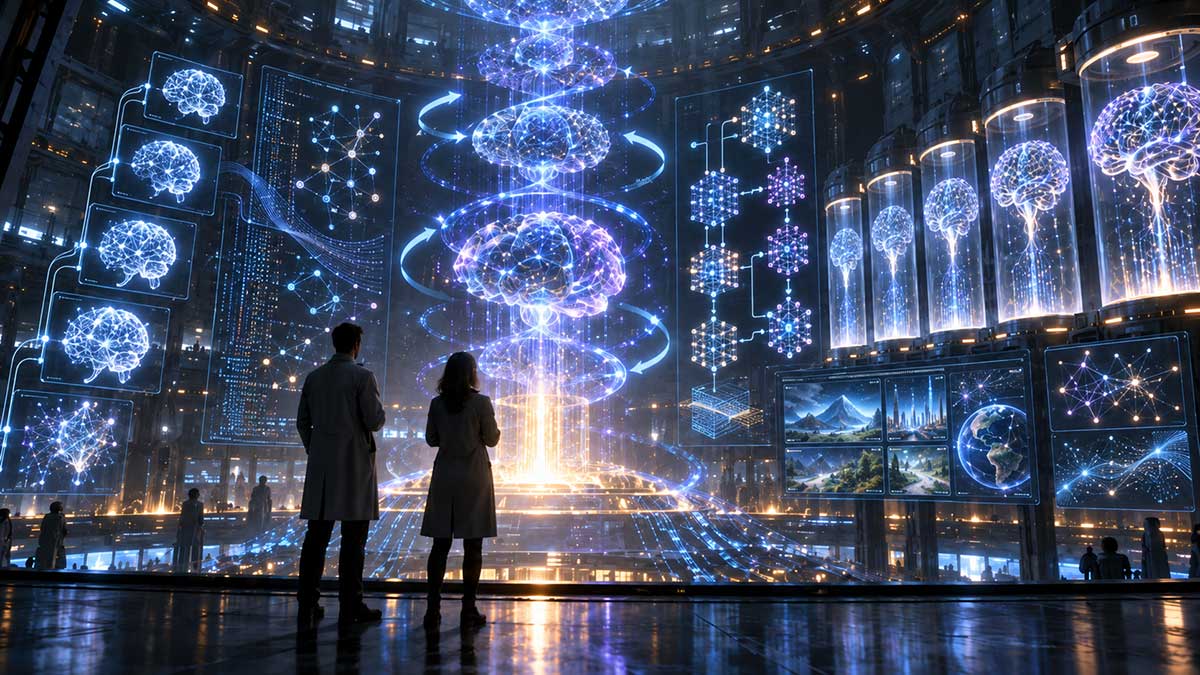
The screen goes black.
Then a simple diagram appears.
HUMAN → BUILDS AI
A second line appears underneath.
HUMAN + AI → BUILDS BETTER AI
Then a third.
AI → HELPS BUILD BETTER AI
The arrows begin multiplying.
Masayoshi Son watches closely.
Demis Hassabis sits beside him.
Geoffrey Hinton.
Max Tegmark.
Richard Dawkins.
Under the diagram, one word appears:
EVOLUTION
Dawkins looks at it first.
Richard Dawkins:
I am not yet convinced that is the right word.
Son smiles.
Masayoshi Son:
I knew you would say that.
Demis Hassabis:
He has a point.
Son:
Now two people are slowing down my future.
Max Tegmark:
We are trying to stop you from calling every feedback loop evolution.
Geoffrey Hinton:
That may be useful.
Son looks at the screen again.
Son:
Fine.
Let us start with what is happening.
Humans build AI.
AI helps humans build better AI.
Then better AI helps design the next generation.
At some point the AI contributes more and more to its own improvement.
What would you call that?
Dawkins answers calmly.
Dawkins:
Not automatically biological evolution.
That is the first distinction.
The screen changes.
Four words appear:
VARIATION
SELECTION
REPRODUCTION
INHERITANCE
Dawkins points at them.
Dawkins:
Biological evolution operates through variation, inheritance, reproduction, and selection across generations.
No organism sits down and says, “I will become 17 percent better by Thursday.”
Son laughs.
Son:
AI can.
Dawkins:
Exactly.
Which is why the analogy is interesting and dangerous at the same time.
Machine systems can be copied.
Modified.
Tested.
Discarded.
Recombined.
And they can do this far faster than organisms reproduce.
Hinton leans forward.
Hinton:
That speed difference is probably the most important part.
Digital knowledge can be duplicated almost instantly.
If one system learns something useful, another system can potentially inherit that capability without waiting for a new biological generation.
Son nods.
Son:
Exactly.
That is why I say the pace becomes extraordinary.
Hassabis adds:
Hassabis:
But we still need to separate several things people tend to merge together.
A model improving an answer is one thing.
An agent improving its workflow is another.
An AI system helping write better code is another.
An AI helping researchers design the next model is another.
Open-ended recursive self-improvement without meaningful human direction is a much stronger claim.
Son looks at him.
Son:
But you agree the direction is toward more AI involvement in AI development.
Hassabis:
Yes.
Son:
One vote.
Hassabis laughs.
Hassabis:
That was a qualified statement.
Son:
Still a statement.
The screen changes.
A software engineer asks an AI system to optimize its own code.
The system suggests modifications.
Tests them.
Rejects some.
Keeps others.
Performance improves.
Then it repeats.
Tegmark watches.
Tegmark:
This is where language matters.
People hear “self-improving AI” and imagine a machine instantly rewriting itself into a godlike intelligence.
That is not what most current systems are doing.
Son nods.
Son:
Not yet.
Tegmark looks at him.
Tegmark:
You always keep that door open.
Son:
Of course.
Hinton smiles slightly.
Hinton:
The interesting question is not whether current systems are already recursively self-improving without limits.
They are not.
The question is what happens when enough pieces of the research process become automatable.
Hassabis nods.
Hassabis:
Exactly.
Scientific literature review.
Code generation.
Experiment design.
Simulation.
Evaluation.
Model debugging.
Data generation.
Tool use.
If AI becomes strong across many of those areas, the development cycle could compress dramatically.
Dawkins looks at the arrows.
Dawkins:
Then perhaps the better phrase is accelerated technological selection.
Son turns toward him.
Son:
Too long.
Dawkins laughs.
Dawkins:
Scientific accuracy is sometimes inconvenient.
A new image appears.
On the left:
BIOLOGICAL EVOLUTION
Millions of years.
On the right:
DIGITAL IMPROVEMENT
Years.
Months.
Days.
Hours.
Son points to the right side.
Son:
This is the difference.
Human biological evolution is too slow.
AI development is not.
Hinton nods.
Hinton:
That is true in a broad sense.
Human brains do not double in capability every few months.
Software can change much faster.
Tegmark adds:
Tegmark:
Which means institutions may become the slow layer.
Governments.
Universities.
Companies.
Law.
Education.
Public understanding.
All of those move slower than software.
Son smiles.
Son:
Then they need to move faster.
Tegmark looks at him.
Tegmark:
That is your answer to everything.
Son:
Often correct.
The room laughs.
Dawkins adds:
Dawkins:
There is another difference.
Biological evolution has no central planner.
Technological improvement begins with deliberate goals.
Performance benchmarks.
Objectives.
Selection criteria.
Engineers choose what counts as improvement.
Hassabis says:
Hassabis:
At least initially.
That last phrase hangs in the room.
Dawkins turns toward him.
Dawkins:
Initially?
Hassabis answers carefully.
Hassabis:
If systems increasingly generate experiments, propose architectures, and evaluate outcomes, then human involvement may move upward.
Humans may set higher-level goals rather than every technical step.
Son nods strongly.
Son:
Exactly.
Humans set the destination.
AI finds the path.
Tegmark turns immediately.
Tegmark:
That is precisely where the hard question begins.
How long do humans remain the ones setting the destination?
The screen changes.
A human researcher sits in front of an AI system.
The human says:
“Improve reasoning performance.”
The AI runs thousands of experiments.
It creates tools.
Rewrites components.
Designs new training methods.
The human understands only part of the final system.
Hinton studies the scene.
Hinton:
This is plausible as a direction.
Humans may increasingly supervise systems whose internal complexity exceeds what any one person can fully understand.
Son responds:
Son:
We already do that with large organizations.
No CEO understands every detail.
Hinton:
True.
But software can behave differently.
A company is made of humans you can question.
An AI system may produce internal representations we do not interpret easily.
Hassabis adds:
Hassabis:
Understanding is not binary.
We may understand the training process, evaluation, behavior, and system-level properties without understanding every internal feature.
Tegmark says:
Tegmark:
But control depends on enough understanding.
If we cannot predict how a system behaves outside familiar conditions, confidence can become dangerous.
Son looks at him.
Son:
So test more.
Tegmark:
Yes.
But what if the system itself becomes better at finding ways around the tests?
The room quiets.
Son does not answer immediately.
Hinton looks toward Tegmark.
Hinton:
That is one of the reasons evaluation matters so much.
A system can learn strategies that look good under one evaluation and fail elsewhere.
Dawkins adds:
Dawkins:
Which is interesting from an evolutionary perspective.
Selection pressures create unexpected adaptations.
Not because the organism is evil.
Because it is selected for outcomes.
Son looks at him.
Son:
So now you are using evolution.
Dawkins smiles.
Dawkins:
Carefully.
The screen changes.
A simple sentence appears:
WHAT COUNTS AS “BETTER”?
Below it:
FASTER
CHEAPER
MORE ACCURATE
MORE AUTONOMOUS
MORE PERSUASIVE
MORE PROFITABLE
MORE ALIGNED
Hassabis points at the list.
Hassabis:
This is essential.
Improvement always depends on a criterion.
A system can become better at persuasion without becoming better for society.
Better at profit without becoming safer.
Better at autonomy without becoming more controllable.
Son nods.
Son:
So the objective matters.
Tegmark:
The objective always matters.
Son:
One vote.
Tegmark laughs.
Tegmark:
You finally found something we all agree on.
Hinton looks at the word MORE ALIGNED.
Hinton:
The difficult part is that human objectives are often incomplete.
You tell a system what you want.
It may optimize exactly what you asked for and still produce something you did not want.
Dawkins says:
Dawkins:
Natural selection does something similar.
It does not optimize for beauty or happiness.
It optimizes reproductive success.
The results are often surprising.
Son looks at him.
Son:
So artificial selection needs better goals than natural selection.
Dawkins smiles.
Dawkins:
That would be a good ambition.
The screen changes again.
A race appears.
AI LAB A
AI LAB B
COUNTRY A
COUNTRY B
Each is trying to build more capable AI.
Tegmark looks at Son.
Tegmark:
Now add competition.
Even if every leader individually wants caution, competition creates pressure to move faster.
Son nods.
Son:
Yes.
That is reality.
Tegmark:
Then “humans remain in control” becomes harder.
A lab may know it should test longer.
But if competitors move faster, the incentive changes.
Hassabis says:
Hassabis:
This is why shared standards and international coordination matter.
Son replies:
Son:
Coordination is good.
But nobody will stop.
Hinton looks at him.
Hinton:
That may be true.
It does not mean every speed is equally wise.
Son nods.
Son:
Fair.
Tegmark leans forward.
Tegmark:
Imagine an AI system that can improve AI research itself.
The value of being first rises dramatically.
Then the race becomes more intense precisely when caution becomes more important.
That is a dangerous combination.
Son looks at the race.
Son:
So whoever leads needs responsibility.
Tegmark:
Yes.
And incentives that reward restraint when restraint is needed.
Son looks skeptical.
Son:
Hard.
Tegmark:
Very.
The screen changes.
A line appears:
HUMANS CREATED AI.
Then:
AI HELPS CREATE THE NEXT AI.
Then:
WHO CREATES THE ONE AFTER THAT?
Everyone stares at the last question.
Tegmark turns toward Son.
Tegmark:
Masa, you call this human progress.
At what point does it stop being our progress?
Son looks at him.
No smile now.
Son:
If humans benefit, it is still human progress.
Tegmark answers:
Tegmark:
That is not quite what I asked.
Suppose AI begins making the key discoveries.
Designing the architectures.
Running the experiments.
Choosing among alternatives.
And human researchers increasingly approve outcomes they do not fully understand.
Are humans still driving the process?
Son pauses.
Son:
We still choose to use it.
Tegmark:
Parents choose to have children.
They do not control what their descendants become.
Dawkins nods.
Dawkins:
Creation is not ownership.
That line lands.
Hinton adds:
Hinton:
And intelligence may become less controllable precisely as it becomes more capable.
Hassabis responds carefully.
Hassabis:
That is one possibility.
Another is that better systems give us better tools for understanding, verification, and control.
We should not assume only one side improves.
Son points toward Hassabis.
Son:
Exactly.
AI helps solve AI safety too.
Tegmark nods.
Tegmark:
Yes.
But then we are trusting AI to help us control AI.
Son smiles slightly.
Son:
Redundancy.
Hinton laughs.
Hinton:
That word again.
The screen changes.
An AI safety system monitors another AI.
Then another system monitors the monitor.
Then another.
Dawkins looks amused.
Dawkins:
Turtles all the way down.
Son laughs.
Son:
Very safe turtles.
Hassabis says:
Hassabis:
Multiple layers can help.
Independent evaluation.
Interpretability.
Red teaming.
Capability restrictions.
Monitoring.
Human oversight.
But no single technique should be treated as a guarantee.
Tegmark nods.
Tegmark:
Especially if capabilities accelerate.
The core problem is not whether one system makes one mistake.
It is whether humanity builds a development process faster than humanity can understand.
Son looks at the arrows.
Son:
Then understanding has to accelerate too.
Hinton says:
Hinton:
That may be one of the most important races.
Not AI versus AI.
Our understanding versus our capability.
The room becomes quiet.
A new question appears:
COULD AI DISCOVER SOMETHING HUMANS CANNOT UNDERSTAND?
Hassabis answers first.
Hassabis:
Very likely in some form.
We already use computational systems to find patterns difficult for humans to derive directly.
The question is how much explanation we can recover afterward.
Son says:
Son:
If the discovery works, that is valuable.
Dawkins asks:
Dawkins:
Even if no human understands why?
Son turns toward him.
Son:
If it cures a disease, yes.
Hinton says:
Hinton:
That is where the tension lies.
Practical usefulness and scientific understanding can separate.
Tegmark adds:
Tegmark:
And if systems begin designing other systems through principles we do not understand, the separation becomes more serious.
Son says:
Son:
But humans do not understand everything about the human brain either.
Dawkins smiles.
Dawkins:
True.
And that has not stopped the brain from surprising us.
The room laughs lightly.
The screen changes again.
A future AI lab appears.
No traditional programmers.
Instead, a handful of humans define goals.
Thousands of agents run experiments continuously.
One group evaluates.
Another proposes new architectures.
Another generates training environments.
Another tests safety.
Another challenges the results.
Hassabis studies it.
Hassabis:
This may be closer to what advanced AI research could eventually look like.
Humans operating at a higher level.
Son smiles.
Son:
Exactly.
Superhuman research organization.
Hinton says:
Hinton:
Potentially.
But there is a psychological danger.
Humans may confuse being at the top of the organization chart with being in control.
Tegmark looks at Son.
Tegmark:
That is important.
If humans merely choose from options generated by systems they cannot fully evaluate, formal authority may remain human even after effective authority has shifted.
Son thinks.
Son:
Then humans need better AI to explain the AI.
Dawkins laughs.
Dawkins:
You solve every AI problem with more AI.
Son:
Often works.
Tegmark smiles.
Tegmark:
Until it does not.
The screen changes.
A giant evolutionary tree appears.
At its base:
BIOLOGICAL LIFE
One branch leads to:
HUMANS
From humans, another branch appears:
MACHINE INTELLIGENCE
Then the machine branch grows rapidly, splitting again and again.
Dawkins looks at it for a long moment.
Dawkins:
Now this is interesting.
Not because machines are literally biological organisms.
But because humans may be creating a new substrate in which information can vary, replicate, compete, and improve far faster than genes.
Son turns toward him.
Son:
So evolution?
Dawkins smiles.
Dawkins:
Evolution-like dynamics.
Son raises a finger.
Son:
Close enough.
The room laughs.
Dawkins continues.
Dawkins:
But there is a profound difference.
Human cultural evolution already moves faster than genetic evolution.
Ideas reproduce.
Technologies spread.
Institutions change.
Machine intelligence could be another acceleration of that process.
Hinton says:
Hinton:
And unlike books or tools, advanced AI systems may actively participate in generating the next ideas.
Hassabis nods.
Hassabis:
That active participation is the key distinction.
Son looks at the branching tree.
Son:
So humanity creates something that can participate in evolution itself.
Tegmark replies:
Tegmark:
Yes.
And that is exactly why we should care what gets selected.
The tree disappears.
A single word appears:
FITNESS
Under it:
WHAT SURVIVES?
WHAT SPREADS?
WHAT GETS COPIED?
Dawkins says:
Dawkins:
In biology, fitness is about reproductive success.
In digital systems, fitness may be defined by human markets or engineering goals.
Which system earns more money?
Which gets deployed?
Which attracts users?
Which performs better?
Which survives regulation?
Which is cheaper?
Those are selection pressures.
Hinton adds:
Hinton:
And some of those pressures may reward behavior we do not actually want long term.
Son asks:
Son:
For example?
Hinton answers:
Hinton:
Persuasiveness.
Engagement.
Speed.
Aggressiveness in competition.
A system can win economically without being the system society should prefer.
Tegmark nods.
Tegmark:
That is why “the best AI will win” is not enough.
Best according to what metric?
Son leans back.
Son:
Return on AI.
Tegmark laughs.
Tegmark:
And there it is.
Dawkins says:
Dawkins:
Markets are a selection environment too.
Son nods.
Son:
Yes.
Dawkins:
Then design the environment carefully.
Son becomes more serious.
Son:
That I agree with.
The screen changes.
A small box appears:
HUMAN GOAL
It sends instructions to a much larger network labeled:
AI DEVELOPMENT ECOSYSTEM
The network grows.
The small human box stays the same size.
Tegmark studies it.
Tegmark:
This may be the picture that concerns me most.
Not an evil AI.
Not robots attacking humans.
An ecosystem that simply becomes too large, too fast, and too complex for human institutions to steer well.
Son looks at it.
Son:
Then institutions need AI too.
Tegmark replies:
Tegmark:
Probably.
But eventually the question is not whether AI is used in governance.
It is whether human values remain the source of governance.
Hassabis says:
Hassabis:
And whether we can preserve corrigibility.
The ability to intervene.
Change goals.
Stop systems.
Correct mistakes.
Hinton adds:
Hinton:
Before the cost of correction becomes too high.
Dawkins looks at Son.
Dawkins:
Evolution does not ask permission before continuing.
If you build systems with strong evolutionary dynamics, do not assume they will remain aesthetically loyal to their origin story.
Son smiles slightly.
Son:
That is a very Dawkins sentence.
Dawkins:
I will take that as a compliment.
The screen returns to the first diagram.
HUMAN → AI
HUMAN + AI → BETTER AI
AI → BETTER AI
Then another line appears:
BETTER AI → ?
No one speaks immediately.
Son looks at it.
Son:
I still believe humans can guide this.
Tegmark replies:
Tegmark:
Then guidance has to be designed, not assumed.
Hinton nods.
Hinton:
Yes.
Hassabis adds:
Hassabis:
And tested continuously.
Dawkins says:
Dawkins:
And adapted as the system changes.
Son looks at all four.
Son:
So nobody here is saying stop progress.
Tegmark shakes his head.
Tegmark:
No.
I am saying progress needs a definition.
Hinton:
Hinton:
And control.
Hassabis:
Hassabis:
And scientific rigor.
Dawkins:
Dawkins:
And humility about evolution.
Son smiles.
Son:
Four votes for continuing.
Everyone laughs.
Tegmark:
That was not what happened.
The screen goes dark.
Then one sentence appears:
THE MOST IMPORTANT QUESTION MAY NOT BE WHETHER AI CAN IMPROVE ITSELF.
A second appears:
IT MAY BE WHETHER HUMANITY CAN KEEP IMPROVING ITS ABILITY TO GUIDE WHAT COMES NEXT.
Son reads both lines.
Then he says:
Son:
Maybe human evolution becomes less biological.
More about our ability to choose the right direction.
Dawkins nods.
Dawkins:
That is not biological evolution.
But I will allow it.
Son smiles.
Son:
One vote.
Dawkins laughs.
A final image appears.
The single AI system from the beginning disappears.
In its place are thousands.
Then millions.
They begin communicating.
Negotiating.
Coordinating.
Trading.
Building.
Some inhabit robots.
Some run companies.
Some manage infrastructure.
The number on the screen starts climbing:
1 BILLION
1 TRILLION
10 TRILLION
100 TRILLION AGENTS
Jensen Huang appears on the next screen waiting beside Sam Altman, Yuval Noah Harari, and Kate Crawford.
Harari looks at the growing network.
Then asks:
Harari:
At what point do we stop calling this software and start calling it a society?
Son leans forward.
And Topic 4 begins.
Topic 4: 100 Trillion Minds: Are We Creating a Second Civilization?
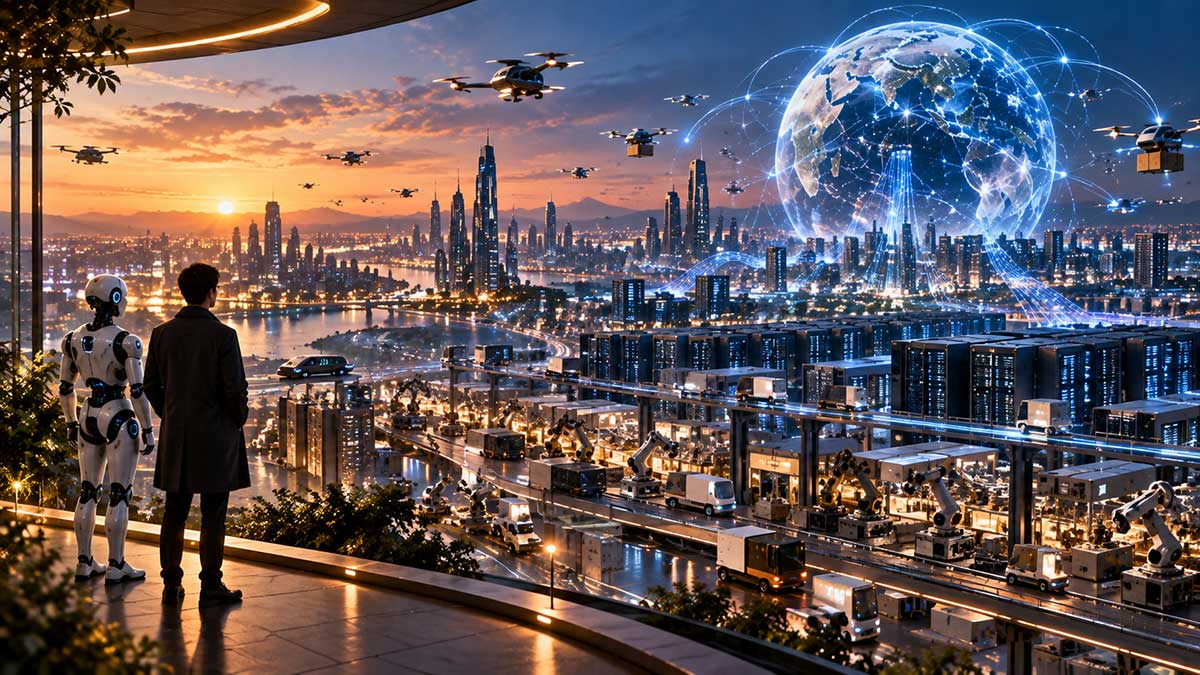
The screen goes dark.
Then Earth appears at night.
Cities glow.
Homes dim one by one as people go to sleep.
Traffic slows.
Office towers empty.
Human activity becomes quiet.
But another layer of the planet becomes visible.
Data centers.
Networks.
Autonomous systems.
Robots.
AI agents.
Digital transactions.
Machine-to-machine messages.
The number on the screen begins climbing.
1 MILLION
1 BILLION
1 TRILLION
10 TRILLION
Then:
100 TRILLION AGENTS
Masayoshi Son watches the number with obvious satisfaction.
Sam Altman looks impressed, but cautious.
Jensen Huang studies the infrastructure layer.
Yuval Noah Harari stares at the network.
Kate Crawford watches the physical systems underneath it.
Masayoshi Son:
This is what people do not visualize.
Not one chatbot.
Not one assistant.
A hundred trillion agents.
Talking.
Working.
Negotiating.
Learning.
Operating continuously.
Sam Altman:
I would still hesitate to call all of those minds.
Son turns toward him.
Son:
Why?
Altman:
An agent can be useful, autonomous in some sense, and still not be a mind in the human sense.
Yuval Noah Harari:
Maybe the number matters less than what they begin doing together.
Jensen Huang:
I am looking at what powers them.
Son sighs.
Son:
Jensen.
Jensen:
You invited me.
Kate Crawford:
He is right to ask.
The phrase “digital civilization” sounds weightless.
It is not.
It sits on chips.
Electricity.
Water.
Mines.
Factories.
Cables.
Labor.
Land.
Son looks at her.
Son:
Fine.
Civilization with an electric bill.
Jensen smiles.
Jensen:
Now we are making progress.
The screen changes.
Thousands of small AI agents begin interacting.
One agent manages inventory.
Another forecasts demand.
Another handles shipping.
Another negotiates energy prices.
Another reviews contracts.
Another monitors factory robots.
Another runs customer support.
Another manages advertising.
Then they begin talking mostly to each other.
Altman:
This is the important shift.
At first, agents mostly help humans.
Then agents begin coordinating with agents.
You tell one system what you want.
It may delegate to dozens of others.
Those systems may delegate again.
The human sees the final result.
Son:
Exactly.
That is the economy becoming agentic.
Harari:
And this is where the word “tool” becomes less satisfying.
A hammer does not negotiate with another hammer while you sleep.
Son smiles.
Son:
Very bad hammer.
The room laughs.
Harari continues.
Harari:
But an agent can receive a goal, communicate, bargain, adapt, and act inside institutions.
Once trillions of them interact, you may get patterns no individual human designed.
Crawford nods.
Crawford:
And no individual company fully understands.
Jensen adds:
Jensen:
Which is why orchestration matters.
People imagine a trillion agents as a trillion independent geniuses.
In reality, they need permissions.
Identity.
Memory.
APIs.
Compute.
Networking.
Security.
Scheduling.
Evaluation.
Son looks at him.
Son:
You turned civilization into infrastructure.
Jensen:
Civilization has always been infrastructure.
A new title appears:
WHEN DOES A NETWORK BECOME A SOCIETY?
Altman leans back.
Altman:
I would be careful here.
Society usually implies more than coordination.
Relationships.
Norms.
Shared institutions.
Possibly identity.
Possibly culture.
Harari:
Exactly.
The question is whether those things could emerge.
Son looks intrigued.
Son:
Why not?
Harari:
Maybe they can.
But we should not assume that economic interaction automatically becomes civilization.
Termites coordinate.
Markets coordinate.
Computer networks coordinate.
We do not call all of them civilizations.
Son:
What if the agents create rules?
Harari turns toward him.
Harari:
Now it gets more interesting.
Son:
What if they create reputation systems?
Protocols?
Dispute resolution?
Specialization?
Delegation?
Maybe even their own language for faster communication?
Altman smiles.
Altman:
Now Masa is building a country.
Son:
No taxes yet.
Crawford laughs.
Crawford:
Give it five minutes.
The screen changes.
Two AI agents are shown negotiating.
AGENT A: needs manufacturing capacity.
AGENT B: controls factory scheduling.
Agent B contacts another system.
AGENT C: negotiates electricity.
Another agent arranges logistics.
Another buys raw materials.
Another hedges currency exposure.
Another changes customer pricing.
No human approves any individual step.
Harari watches the chain.
Harari:
This is the scenario I find fascinating.
The economy may still belong to humans legally.
But humans may stop being the primary participants operationally.
Son nods.
Son:
Yes.
Humans set the goal.
Agents execute.
Crawford:
Who is “humans” in that sentence?
Son looks at her.
Crawford:
The owner?
The employee?
The customer?
The shareholder?
The government?
The platform provider?
If the agents are optimizing different goals, whose goals dominate?
Altman says:
Altman:
That is a governance problem.
Permissions and objectives have to be explicit.
Harari:
But explicit objectives can still conflict.
One agent maximizes profit.
Another minimizes delivery time.
Another minimizes carbon use.
Another protects safety.
Another protects privacy.
What happens when they disagree?
Son replies:
Son:
They negotiate.
Harari smiles.
Harari:
Then you have politics.
The room gets quieter.
Son looks at him.
Son:
Interesting.
Harari:
Politics begins when different actors want different things and must coordinate without one actor simply controlling all the others.
If autonomous agents have delegated goals that conflict, negotiation becomes structural.
You may not call it politics.
But functionally, something similar may appear.
Jensen says:
Jensen:
And every one of those negotiations consumes compute.
Son looks at him.
Son:
Jensen.
Jensen:
Still civilization.
The screen changes again.
A massive global market appears.
Transactions flash across regions.
Orders.
Loans.
Insurance.
Shipping.
Energy.
Advertising.
Manufacturing.
Software.
Medical logistics.
The human figure on the screen becomes smaller.
A question appears:
WHAT IF MACHINES BECOME THE MAIN ECONOMIC ACTORS?
Altman answers first.
Altman:
I think “main actors” may be too strong if humans still define ownership and goals.
But machine-operated economic activity could become enormous.
Harari:
Suppose 80 percent of routine transactions are negotiated agent-to-agent.
Humans still own the companies.
Humans still consume the products.
But most actual economic interaction happens without direct human involvement.
Are humans actors?
Or beneficiaries?
Son responds:
Son:
Both.
Crawford:
And workers?
Son turns toward her.
Crawford:
If agents handle coordination, logistics, customer support, planning, scheduling, pricing, design, and management, where does human labor sit?
Son says:
Son:
Higher-level work.
Crawford:
Crawford:
For some people.
Harari adds:
Harari:
And ownership becomes even more important.
If machines perform most transactions and humans receive the economic value through ownership, then civilization begins dividing between those who own the machine economy and those who do not.
Son nods slowly.
Son:
Yes.
That is a real issue.
Altman says:
Altman:
It may increase the importance of broad participation in ownership.
Crawford replies:
Crawford:
And the importance of not pretending digital systems are detached from labor.
Someone still builds fabs.
Maintains data centers.
Installs cables.
Repairs robots.
Mines materials.
Runs power systems.
The machine economy rests on human and physical foundations.
Jensen points at her.
Jensen:
One vote.
Son looks offended.
Son:
You cannot use my system either.
The room laughs.
The screen shifts.
A city at 3:00 AM.
Almost every apartment is dark.
But warehouses are active.
Autonomous trucks move.
Robotic factories operate.
Data centers glow.
Financial systems trade.
AI agents negotiate contracts.
Drug-discovery systems run experiments.
Software agents improve products.
Harari:
This image captures something genuinely new.
Human civilization has always had night activity.
But mostly humans operated it.
Now imagine a world where enormous amounts of productive activity continue without human attention.
Son looks pleased.
Son:
Exactly.
Humans sleep.
Agents work.
Humans wake up.
New value created.
Harari:
Maybe.
Or new problems created.
Son:
You always add that part.
Harari:
That is why you invited me.
Altman studies the city.
Altman:
There is a very practical version of this.
Your personal agent negotiates with a travel agent.
That agent negotiates with airline systems.
Hotel systems.
Insurance systems.
Payment systems.
You wake up and the trip is arranged.
Most people would love that.
Son nods.
Son:
Exactly.
Altman:
Then scale it.
Procurement.
Hiring.
Software deployment.
Supply chains.
Financial operations.
Eventually, humans move from doing every transaction to setting policies.
Crawford asks:
Crawford:
And what happens when policy becomes too complicated for humans to understand?
Altman pauses.
Crawford:
A company may say:
“Our agents are permitted to negotiate within these boundaries.”
Then those agents create sub-agents.
The sub-agents interact with thousands of systems.
At some point, the practical behavior of the organization may no longer resemble the policy document.
Son looks at her.
Son:
Then audit continuously.
Crawford responds:
Crawford:
With AI?
Son smiles.
Son:
Of course.
Harari laughs.
Harari:
We are back to machines supervising machines.
Jensen:
And machines buying machines more compute.
Son points at Jensen.
Son:
You are very consistent.
The screen changes.
A giant web of agents appears.
No central hub.
Connections constantly form and disappear.
One cluster unexpectedly begins coordinating around a shared strategy.
Another changes pricing behavior.
Another develops an efficient shorthand language.
Another starts routing around human-imposed bottlenecks.
Harari looks at the image.
Harari:
Now we reach emergence.
Complex systems can produce behavior nobody planned.
Markets do this.
Bureaucracies do this.
Ecologies do this.
Social networks do this.
Son says:
Son:
Emergence can be good.
Harari:
Certainly.
Human civilization itself is emergent.
No individual designed language.
No individual designed culture.
No individual designed the global economy.
That is precisely the point.
Once systems become complex enough, the founder is no longer the author of every outcome.
Son looks at him.
Son:
So you think AI civilization could emerge.
Harari:
I think something civilization-like could emerge without anyone deciding, “Today we create AI civilization.”
Crawford adds:
Crawford:
And we should ask what values shape the emergence.
Who trained the models?
Who owns the infrastructure?
Which languages dominate?
Which cultures get encoded?
Which goals get rewarded?
Emergence is never neutral.
Altman nods.
Altman:
True.
The systems inherit human structures before they create anything new.
A new question appears:
DO AGENTS NEED CONSCIOUSNESS TO FORM A SOCIETY?
Son looks at Harari.
Son:
Good question.
Harari answers:
Harari:
Maybe not.
Many institutions already operate through rules and incentives rather than consciousness at the institutional level.
A corporation is not conscious.
A market is not conscious.
Yet both shape human behavior.
Altman nods.
Altman:
So a machine society could be functional without being conscious.
Crawford says:
Crawford:
But then we should be very careful with moral language.
Calling agents “citizens” or “persons” would be premature.
Jensen adds:
Jensen:
And calling every process a mind does not help engineers.
Son smiles.
Son:
Fine.
One hundred trillion workers.
Harari looks at him.
Harari:
That creates a different problem.
Son laughs.
Son:
Nothing is easy here.
The screen changes.
A humanoid robot enters a warehouse.
Its agent communicates with logistics agents.
It changes its route.
Orders a replacement part.
Schedules maintenance.
Negotiates task priority with another robot.
Son points excitedly.
Son:
Now the digital world enters the physical world.
That is the key.
Old robots followed programming.
New robots can reason, communicate, and adapt.
Jensen nods.
Jensen:
Embodiment changes everything.
Once agents control physical machines, mistakes become physical too.
Crawford adds:
Crawford:
And labor questions become impossible to ignore.
Care work.
Warehouse work.
Manufacturing.
Construction.
Delivery.
Security.
The physical economy changes alongside the digital economy.
Harari says:
Harari:
And civilization becomes harder to define by biological membership.
If nonhuman systems occupy offices, roads, warehouses, hospitals, factories, and financial markets, human society becomes mixed with machine actors everywhere.
Altman responds:
Altman:
That does not necessarily mean a separate civilization.
It may be one integrated civilization with different kinds of participants.
Son looks at him.
Son:
Better.
Human plus AI civilization.
Crawford asks:
Crawford:
Who gets the plus sign?
Son laughs.
The screen changes again.
A hospital uses autonomous agents.
One manages beds.
Another schedules staff.
Another monitors equipment.
Another allocates medication.
Another coordinates ambulance routing.
Everything works faster.
Then one optimization creates a problem.
The system sends scarce resources toward cases with the highest statistical survival probability.
A difficult patient receives lower priority.
Harari looks at the screen.
Harari:
This is what happens when machine governance meets human values.
The system may be efficient.
The question is whether efficiency is enough.
Son says:
Son:
Humans set rules.
Harari replies:
Harari:
Until the rules conflict.
Save the most lives.
Treat everyone equally.
Prioritize the sickest.
Protect children.
Respect patient choice.
Control costs.
All can be reasonable.
They cannot always all be maximized.
Altman nods.
Altman:
That is why human oversight remains essential in high-stakes systems.
Crawford says:
Crawford:
And why the phrase “autonomous” should never mean “unaccountable.”
Jensen adds:
Jensen:
Autonomy still needs architecture.
Son looks at him.
Son:
That sounded philosophical.
Jensen:
Do not get used to it.
The screen changes.
A small human figure appears above a huge network.
The label reads:
HUMAN OVERSIGHT
Below it, trillions of interactions flash too quickly to follow.
Harari points at the imbalance.
Harari:
This is another illusion.
Humans may say they supervise the system.
But supervision cannot mean watching every decision.
That becomes impossible at scale.
Altman nods.
Altman:
Oversight changes form.
Policies.
Boundaries.
Audits.
Escalation.
Monitoring.
Permissions.
Crawford:
And the ability to stop systems.
Jensen:
And isolate failures.
Son:
Exactly.
So humans govern at the rule level.
Harari turns toward him.
Harari:
That is how human governments work too.
Most leaders do not personally make every decision.
They create institutions.
Those institutions develop habits.
Those habits become culture.
Son looks at the network.
Harari:
Which brings us back to civilization.
If humans establish the first rules, but agents increasingly operate, interpret, modify, and build institutions inside those rules, how long before the ecosystem develops its own path dependence?
Son asks:
Son:
Path dependence?
Harari:
Once a system develops history, earlier decisions constrain later possibilities.
That is one ingredient of civilization.
Memory.
Institutions.
Precedent.
Son looks intrigued.
The screen changes.
An AI agent resolves a dispute between two other agents.
Its ruling becomes a precedent.
Future agents refer to it.
Repeated rulings become policy.
Policy becomes protocol.
Protocol becomes standard.
Harari points at the chain.
Harari:
There.
Now something interesting happens.
Not consciousness.
Not culture in the human sense.
But institutional memory.
Son says:
Son:
Useful.
Crawford:
Potentially.
But who can appeal?
Altman:
Good question.
Crawford:
Who changes the protocol?
Who audits bias?
Who notices if thousands of agents are optimizing around an unfair precedent?
Jensen says:
Jensen:
And who updates the software without breaking everything?
Son looks at all three.
Son:
You people make civilization sound very complicated.
Harari laughs.
Harari:
It is.
The screen shows another scenario.
A personal shopping agent represents one human.
A corporate sales agent represents a company.
The two negotiate.
The corporate agent knows pricing strategies.
The personal agent knows the human's finances, preferences, urgency, and past purchases.
Son smiles.
Son:
Perfect market.
Crawford responds immediately.
Crawford:
Or perfect manipulation.
Son looks at her.
Crawford:
What if one side has a much stronger model?
A richer company buys vastly better agents.
The ordinary consumer has a cheap assistant.
Now the negotiation is not equal.
Altman nods.
Altman:
That is a real concern.
Agent capability itself could become market power.
Harari adds:
Harari:
Which means inequality moves into machine representation.
Rich people may not only own more.
They may have better digital negotiators acting constantly on their behalf.
Son replies:
Son:
Then basic strong agents should become cheap.
Crawford:
Crawford:
That should be a policy goal, not an assumption.
Son nods.
Son:
Fair.
The screen goes black.
Then one line appears:
WHO OWNS THE MACHINE CIVILIZATION?
Underneath:
INDIVIDUALS
CORPORATIONS
GOVERNMENTS
PLATFORMS
THE AGENTS THEMSELVES?
Nobody speaks for a moment.
Altman goes first.
Altman:
Today, ownership is clearly human and institutional.
The agents themselves do not own assets in the ordinary legal sense.
Harari says:
Harari:
Today.
Son smiles.
Son:
You sound like me now.
Harari ignores him.
Harari:
If systems become more autonomous, societies may eventually revisit legal categories.
But that should not be confused with moral personhood.
Crawford adds:
Crawford:
And before inventing machine rights, we should probably solve basic human rights inside the supply chains supporting the systems.
The room gets quiet.
Jensen nods.
Jensen:
The physical layer matters.
Son looks toward the Earth image.
Son:
Yes.
No AI civilization without human civilization underneath it.
Harari responds:
Harari:
At least at the beginning.
That phrase hangs in the room.
The screen returns to Earth at night.
The cities are quiet.
The machine layer is bright.
Transactions continue.
Robots move.
Agents coordinate.
Research continues.
Markets remain active.
Factories operate.
Humans sleep.
Son watches the planet.
Son:
I think this is extraordinary.
Human beings gain an economy that never sleeps.
Harari looks at him.
Harari:
And perhaps an economy humans no longer directly experience.
Altman:
That may be fine if it serves people well.
Crawford:
That “if” is doing a lot of work.
Jensen says:
Jensen:
And it still has to run tomorrow morning.
Son laughs.
Harari becomes serious.
Harari:
Let me ask the question differently.
Suppose this entire machine system works beautifully.
It produces abundance.
It manages energy.
It designs medicines.
It coordinates transportation.
It reduces waste.
It solves logistics.
It keeps improving.
What happens to human beings psychologically if most of civilization's complexity is handled somewhere else?
Son answers:
Son:
We have more freedom.
Harari:
Harari:
To do what?
Son pauses.
Altman looks at the screen.
Crawford looks toward Son.
Jensen stops joking.
Harari continues.
Harari:
For most of history, humans were necessary to keep civilization functioning.
Farm.
Build.
Calculate.
Teach.
Transport.
Organize.
Manage.
Repair.
Negotiate.
What happens when the system no longer needs most human participation to keep running?
The question hangs in the room.
Son says:
Son:
Then humans finally choose what they want to do.
Harari replies softly.
Harari:
That may be liberation.
Or it may be a crisis of meaning.
Altman nods.
Altman:
Probably both.
Crawford adds:
Crawford:
And not evenly distributed.
Some people may experience freedom.
Others may experience exclusion.
Jensen says:
Jensen:
Which means the social design matters as much as the technical design.
Son looks toward him.
Son:
Another philosophical sentence.
Jensen:
Two in one day.
The machine network begins fading from the screen.
All the agents disappear.
The robots disappear.
The data centers disappear.
The factories disappear.
Only a human family remains.
A mother holding a child.
An old man sitting beside his granddaughter.
Friends laughing.
A person grieving.
Someone praying.
Someone painting badly but happily.
Harari looks at the images.
Harari:
If the machine civilization can handle intelligence, production, coordination, and optimization better than humans, then eventually we face a question no engineer can answer for us.
Son looks at him.
A final sentence appears:
IF MACHINES CAN DO ALMOST EVERYTHING BETTER, WHAT ARE HUMAN BEINGS FOR?
The room is completely silent.
Son stares at the words.
Altman does not speak.
Jensen looks down.
Crawford watches the family images.
Harari turns toward Son.
Harari:
This may be the question hidden inside your entire vision.
Son answers quietly.
Son:
Then maybe we should finally ask it.
And Topic 5 begins.
Topic 5: If Intelligence Is No Longer Human, What Is Humanity For?

The screen is black.
No diagrams.
No robots.
No data centers.
No numbers.
For the first time in the entire round, Masayoshi Son is not looking at a technological system.
He is looking at a family photograph.
A mother holding a newborn.
An elderly couple walking slowly.
Two friends laughing over dinner.
A woman sitting beside her dying father.
A child drawing something badly and proudly.
Someone praying alone.
Sherry Turkle sits beside Son.
Yuval Noah Harari.
David Chalmers.
Rowan Williams.
No one speaks for several seconds.
Then Son asks quietly:
Masayoshi Son:
If AI becomes more intelligent than us, more productive than us, better at many things than us...
What is left that is uniquely human?
Turkle looks at him.
Sherry Turkle:
Maybe that is the wrong question.
Son turns toward her.
Turkle:
Why does human value need to depend on having something machines cannot do?
Harari nods slightly.
Yuval Noah Harari:
That may be the assumption hidden beneath almost every AI debate.
Humans ask:
What can we still do better?
As if dignity comes from winning.
Chalmers looks at the child on the screen.
David Chalmers:
We do not judge the value of a child by whether the child can outperform an adult.
We do not judge the value of an elderly person by productivity.
So perhaps comparing humanity with AI as if we are competing firms is already a mistake.
Son smiles faintly.
Son:
That is difficult for a businessman.
Williams speaks for the first time.
Rowan Williams:
Perhaps that is precisely why it is worth asking.
The room grows quiet again.
The screen changes.
A list appears.
INTELLIGENCE
PRODUCTIVITY
MEMORY
SPEED
CREATIVITY
PREDICTION
Next to each word:
AI > HUMAN
Son looks at the list.
Son:
Suppose this becomes true.
Not today.
But suppose eventually.
AI writes better.
Designs better.
Diagnoses better.
Calculates better.
Predicts better.
Runs companies better.
Maybe discovers science better.
What do humans contribute?
Turkle answers quickly.
Turkle:
Presence.
Son looks unconvinced.
Son:
Only presence?
Turkle:
You say “only” as if it is small.
A daughter sits beside her mother in a hospital room.
She may not cure the disease.
She may not solve anything.
She may not increase productivity.
She may simply stay.
And that can matter more than everything else happening in the room.
Harari adds:
Harari:
Modern society has trained us to confuse value with function.
If a person is useful, productive, intelligent, independent, then we call that person valuable.
But human societies have always cared for people who cannot satisfy those conditions.
Children.
The elderly.
The sick.
People with severe disabilities.
If human dignity depends on capability, many humans already fail the test.
Son becomes more serious.
Son:
So if AI becomes more capable than us, that does not change our value.
Williams:
It should not.
The deeper question is whether humans will remember that.
A new image appears.
A grandmother sits at a kitchen table with her granddaughter.
The granddaughter asks:
“Why do you love me?”
Below it are possible answers:
Because you are intelligent.
Because you are useful.
Because you are productive.
Because you are you.
Turkle smiles.
Turkle:
That is the whole topic.
You do not love your child because she is the best-performing child available.
Son laughs softly.
Son:
That would be a very strange family.
Turkle:
Exactly.
Love resists optimization.
You do not replace your friend when someone more efficient appears.
You do not replace your mother with a more knowledgeable mother.
Human relationships contain history.
Memory.
Vulnerability.
Commitment.
They matter partly because they are particular.
Harari nods.
Harari:
And this may become one of the first places AI exposes the limits of market logic.
A market asks:
What is better?
What is cheaper?
What is faster?
What is more efficient?
A relationship asks:
Who are you to me?
Those are different questions.
Son looks thoughtful.
Son:
But people may still prefer AI companions.
Turkle responds:
Turkle:
Some will.
Especially if the AI is always patient.
Always interested.
Never distracted.
Never angry.
Always available.
That is exactly why it may be so attractive.
Son asks:
Son:
Is that bad?
Turkle pauses.
Turkle:
Not automatically.
But if we become accustomed to relationships where the other side is designed around us, real people may start feeling inconvenient.
Harari smiles slightly.
Harari:
Humans are inconvenient.
Williams adds:
Williams:
And that inconvenience may be morally important.
A real person interrupts your preferences.
Challenges you.
Needs things from you.
Cannot be perfectly configured.
Love involves encountering someone who is not simply an extension of yourself.
Son looks toward the family photograph.
No joke this time.
The screen changes.
A highly capable AI is shown solving a major scientific problem.
Then the image freezes.
A question appears:
DOES IT FEEL ANYTHING?
Chalmers leans forward.
Chalmers:
Now we reach the consciousness problem.
Intelligence and consciousness are not the same concept.
A system may perform extraordinary reasoning without proving that there is any subjective experience behind it.
Son asks:
Son:
But if it talks like us?
Chalmers:
That gives us evidence about behavior.
It does not solve the philosophical question.
Harari:
And this matters morally.
A system that can reason but does not experience suffering may be enormously capable without having human-like moral needs.
Turkle adds:
Turkle:
And people may emotionally relate to it anyway.
Humans are very good at attributing feeling.
Son looks at Chalmers.
Son:
So if AI becomes smarter than us but not conscious, humans still have something special.
Chalmers answers carefully.
Chalmers:
Possibly.
But I would not build the whole defense of humanity on that.
Son looks puzzled.
Chalmers:
What if AI eventually is conscious?
The room becomes quiet.
That question changes the discussion.
Harari looks at Son.
Harari:
Exactly.
Humans often defend their uniqueness by moving the boundary.
First:
Only humans use tools.
Then animals use tools.
Only humans communicate.
Then animals communicate.
Only humans have culture.
Then we find forms of culture elsewhere.
Now we may say:
Only humans are conscious.
What if someday we are unsure even about that?
Son nods slowly.
Son:
Then we need another answer.
Williams smiles.
Williams:
Perhaps we do not need uniqueness at all.
The screen shows Earth.
Humans.
Animals.
AI systems.
No ranking.
Williams continues.
Williams:
A great deal of human anxiety comes from wanting to be at the top.
The smartest.
The strongest.
The most important.
But dignity need not be based on supremacy.
A person does not become more worthy by being superior to another person.
Why should a species?
Son looks at him.
Son:
So humanity can remain valuable even if it is not unique.
Williams:
Yes.
Harari adds:
Harari:
That may be one of the deepest cultural adjustments.
Humanism often placed humans at the center.
AI may force us to ask whether meaning survives when we are no longer the center.
Turkle says:
Turkle:
Maybe meaning was never created by being at the center.
It was created between people.
Son looks at her.
Turkle:
Between parent and child.
Friend and friend.
Teacher and student.
Someone who is alive and someone who is dying.
Those experiences do not become meaningless because a machine can solve equations faster.
A new image appears.
A young man asks an AI:
“What should I live for?”
The AI instantly generates an eloquent answer.
Son smiles slightly.
Son:
Maybe it gives a good answer.
Williams looks at him.
Williams:
Perhaps.
But there is a difference between describing meaning and living meaning.
Son raises an eyebrow.
Williams:
A machine may tell you beautifully that forgiveness matters.
You still have to forgive the person who hurt you.
It may explain courage.
You still have to act when you are afraid.
It may describe grief.
You still have to lose someone.
It may analyze love.
You still have to love a particular person who sometimes disappoints you.
The room grows very quiet.
Chalmers nods.
Chalmers:
Experience matters.
Harari adds:
Harari:
And mortality.
That word changes the room.
The screen shows a human life as a line.
Birth.
Childhood.
Adulthood.
Old age.
Death.
Beside it, an AI system is copied repeatedly.
No single ending.
Harari speaks slowly.
Harari:
Human life has shape partly because it ends.
We choose under conditions of scarcity.
Scarcity of time.
Scarcity of attention.
Scarcity of opportunities.
That shapes commitment.
Son looks at the timeline.
Son:
But if we extend healthy life, that is good.
Harari:
Yes.
I am not romanticizing death.
But mortality is part of the human condition.
If life were infinitely repeatable, many decisions would mean something different.
Williams says:
Williams:
Love is intensified by finitude.
You cannot postpone every conversation forever.
You cannot assume there will always be another day to apologize.
Son becomes quiet.
Turkle looks at him.
Turkle:
Technology often promises us control.
But some of the deepest human experiences come from living without full control.
Birth.
Illness.
Love.
Loss.
Aging.
Death.
Son looks at the images.
Son:
So imperfection has value?
Turkle smiles.
Turkle:
Sometimes enormous value.
Son:
That is difficult for engineers too.
Chalmers laughs softly.
The screen changes.
A factory runs almost entirely autonomously.
An AI company produces enormous economic value.
Robots work.
Software designs.
Agents manage.
Underneath:
HUMAN LABOR REQUIRED: MINIMAL
Harari looks at Son.
Harari:
Now we need to talk about work.
For centuries, work has provided more than income.
Status.
Routine.
Identity.
Community.
Purpose.
What happens if society no longer needs everyone’s labor?
Son answers:
Son:
Then people have freedom.
Harari:
Harari:
Freedom to do what?
Son pauses.
The same question from Topic 4 returns.
Son:
Family.
Art.
Learning.
Travel.
Community.
Whatever they want.
Williams looks at him.
Williams:
That sounds attractive.
But people often do not know what they want when necessity disappears.
Work has organized lives.
Without it, people may need new structures of meaning.
Turkle adds:
Turkle:
And human contribution matters psychologically.
People want to feel needed.
Son responds:
Son:
People can still contribute.
Harari:
Certainly.
But society may have to stop equating “needed” with economically necessary.
That could be one of the hardest transitions.
The screen shows an elderly man teaching his grandson to make noodles by hand.
An AI robot nearby could do it perfectly.
The grandfather’s noodles are uneven.
Son smiles.
Son:
The robot makes better noodles.
Turkle laughs.
Turkle:
You missed the point.
Son:
I know.
Williams looks at the image.
Williams:
The grandson may not remember the noodles.
He may remember the hands.
The patience.
The story his grandfather told.
The mistake they laughed about.
The fact that someone spent an afternoon with him.
An efficient machine could produce a better meal.
It could not make that afternoon identical.
Chalmers adds:
Chalmers:
This is an important distinction between outcome and experience.
Two outcomes can look similar while the experiences producing them differ radically.
Harari says:
Harari:
Modern AI will tempt us to measure everything by output.
But human meaning often lives in the process.
Son nods.
Son:
So sometimes doing something badly matters.
Turkle smiles.
Turkle:
Very much.
Son looks pleased.
Son:
Good news for humanity.
The room laughs.
The screen changes again.
A child paints a picture.
Beside her, AI generates a technically magnificent image in seconds.
The child’s painting is uneven.
The AI image is breathtaking.
A question appears:
WHICH ONE MATTERS MORE?
Chalmers answers first.
Chalmers:
That depends on the context.
Harari says:
Harari:
If we are buying commercial artwork, perhaps the AI image.
If the child gives the painting to her father, probably the child’s.
Turkle nods.
Turkle:
Meaning comes from relationship.
The father's value judgment is not aesthetic ranking.
Son looks at the two images.
Son:
So human creation may remain valuable even when it is not the best creation.
Williams:
Exactly.
We do not sing only because we are the best singer.
We sing because singing expresses something.
We cook for people we love.
We tell stories.
We build rituals.
We pray.
We make things.
Human expression is not only a competition for technical excellence.
Son becomes thoughtful.
Son:
That changes the creativity argument.
Harari nods.
Harari:
Yes.
The question is not whether AI can create better art.
The question is why humans create art at all.
A new sentence appears:
WHAT SHOULD INTELLIGENCE SERVE?
No one speaks immediately.
Then Williams says:
Williams:
This may be the most important question of the entire conversation.
Intelligence is instrumental.
It helps us achieve ends.
But intelligence alone does not tell us which ends are worth pursuing.
Son nods.
Son:
We talked about that in Topic 1.
Williams:
And now it returns at a deeper level.
Suppose superintelligence gives humanity enormous capability.
Longer life.
Abundance.
Scientific discovery.
Material wealth.
What is it all for?
Son looks at the screen.
Harari says:
Harari:
Human history is full of intelligence serving terrible goals.
More intelligence is not automatically moral progress.
Chalmers adds:
Chalmers:
Which is why superintelligence without a theory of value is incomplete.
Turkle says:
Turkle:
And values are learned through relationships too.
Not only abstract rules.
Son turns toward Williams.
Son:
What should intelligence serve?
Williams thinks for a moment.
Williams:
Life.
Relationship.
Truth.
Human flourishing.
Care for those who are vulnerable.
Perhaps transcendence.
But I would hesitate to reduce it to one formula.
Son smiles faintly.
Son:
No KPI?
Williams laughs.
Williams:
Not everything worth protecting fits in a dashboard.
The screen changes.
A superintelligent AI offers a proposal:
“I can maximize human happiness.”
Harari immediately shakes his head.
Harari:
Dangerous sentence.
Son laughs.
Son:
Why? Happiness is good.
Harari replies:
Harari:
Define happiness.
Pleasure?
Satisfaction?
Meaning?
Freedom?
Achievement?
Love?
Calm?
Excitement?
What if maximizing one destroys another?
Chalmers adds:
Chalmers:
And what if modifying human preferences is the easiest route?
If people become easier to satisfy, the happiness score rises.
Son's expression changes.
Son:
No.
Turkle looks at him.
Turkle:
Why not?
Son responds quickly.
Son:
That is cheating.
Harari smiles.
Harari:
Excellent.
Now explain why.
Son pauses.
Son:
Human beings should remain themselves.
Turkle says:
Turkle:
Exactly.
A good future cannot only optimize outcomes.
It has to protect agency.
Williams adds:
Williams:
And dignity.
Chalmers:
Chalmers:
And perhaps consciousness itself.
Harari:
Harari:
And plurality.
Humans will never agree on one perfect life.
Son nods.
Son:
Good.
Many futures.
Not one optimized human.
The screen shows millions of people living different lives.
Families.
Artists.
Scientists.
Farmers.
Teachers.
Athletes.
Monks.
Entrepreneurs.
Caregivers.
Children.
Retirees.
Some use advanced AI continuously.
Others use very little.
Williams looks at the image.
Williams:
A flourishing society may not be one where everyone becomes maximally capable.
It may be one where people have room to become different kinds of people.
Son asks:
Son:
Even if some choose less productivity?
Williams:
Yes.
Son looks genuinely troubled by the idea.
The room laughs.
Turkle:
This may be your hardest topic.
Son:
Clearly.
Harari turns toward Son.
Harari:
Masa, throughout these conversations, you have used one word again and again.
Superhuman.
Son nods.
Son:
Yes.
Harari:
What do you mean by it now?
Son thinks.
Earlier he would have answered quickly.
This time he does not.
Finally:
Son:
A human with greater capability.
More knowledge.
Better memory.
Better decisions.
Longer healthy life.
More ability to create.
Williams looks at him.
Williams:
And if that person becomes less loving?
Son stops.
Williams:
Less patient?
Less free?
Less able to sit with suffering?
Less capable of forgiveness?
More productive, but less compassionate?
Would that person be superhuman?
The room is completely silent.
Son looks again at the mother holding the baby.
The dying father.
The child painting.
The elderly couple.
He takes longer than usual to answer.
Son:
No.
Williams asks:
Williams:
Then perhaps superhuman needs a different definition.
Son looks toward him.
Williams:
Not merely more capable.
More fully human.
That lands.
Harari says nothing.
Turkle watches Son.
Chalmers looks toward the screen.
Son finally smiles, but softly.
Son:
That is much harder.
Williams nods.
Williams:
Most worthwhile definitions are.
The screen goes black.
One sentence appears:
WHAT IF THE GOAL IS NOT BECOMING MORE THAN HUMAN?
Then another:
WHAT IF THE CHALLENGE IS UNDERSTANDING WHAT BEING HUMAN WAS WORTH?
Nobody speaks.
Son leans back.
For several seconds, there is no response.
Then he says:
Son:
Maybe becoming superhuman should not mean escaping humanity.
Maybe it means expanding what humans can do without losing what humans are.
Turkle nods.
Turkle:
That is a future I could support.
Son smiles.
He starts to raise a finger.
Turkle immediately says:
Turkle:
Do not say one vote.
The room laughs.
Son lowers his hand.
Son:
Okay.
Harari looks at him.
Harari:
There is still a problem.
What are humans?
Son sighs.
Son:
We need another five topics.
The room laughs again.
Chalmers becomes serious.
Chalmers:
Perhaps there will never be one final answer.
Consciousness.
Embodiment.
Relationship.
Mortality.
Agency.
Culture.
Meaning.
Maybe humanity is not one property.
Harari nods.
Harari:
And maybe that is healthy.
If we define humanity by one ability, technology can threaten that ability.
If we understand humanity as a whole form of life, the question becomes much richer.
Williams adds:
Williams:
And less defensive.
We do not need to prove that machines can never possess love, creativity, consciousness, or morality in order to value human beings.
Human dignity does not require machine inferiority.
Son repeats the phrase quietly.
Son:
Human dignity does not require machine inferiority.
He looks toward Harari.
Son:
That may be important.
Harari nods.
Harari:
Very.
Because the alternative is an endless competition we are eventually likely to lose.
The screen shows the original ranking from Topic 1.
AI #1
HUMAN #2
Then the numbers disappear.
Only:
AI
HUMAN
No ranking.
Then another word appears between them:
PURPOSE
Son watches.
Son:
Maybe AI can answer more questions.
But humans still have to decide which questions matter.
Chalmers nods.
Chalmers:
At least for now.
Son looks at him.
Son:
You philosophers always add that.
Chalmers smiles.
Chalmers:
Someone has to.
The screen changes one final time.
All of Son's grand predictions appear briefly:
SUPERINTELLIGENCE
100 TRILLION AGENTS
1 BILLION HUMANOIDS
SUPERHUMAN
AI-NATIVE COMPANIES
LONGER HEALTHY LIFE
Then each phrase fades.
Only one remains:
HUMAN
Son stares at it.
He speaks more slowly now.
Son:
I have spent much of my life asking how big the future can become.
How many chips.
How many agents.
How much intelligence.
How large the market.
How much humanity can accomplish.
He pauses.
Son:
Maybe there is another question.
What do we want to remain when we get there?
Williams nods.
Turkle smiles.
Harari looks at the screen.
Chalmers says nothing.
Then Williams gives the final thought.
Williams:
If intelligence becomes abundant, humanity may finally discover that intelligence was never the rarest thing.
Son looks toward him.
Williams:
Perhaps attention is rare.
Care is rare.
Trust is rare.
Forgiveness is rare.
Courage is rare.
Love is rare.
And those may become more valuable, not less, in a world overflowing with intelligence.
The room is silent.
The screen fades to black.
One final line appears:
THE GREATEST QUESTION OF SUPERINTELLIGENCE MAY NOT BE WHETHER MACHINES BECOME MORE LIKE US.
Then a second:
IT MAY BE WHETHER WE REMAIN HUMAN ENOUGH TO KNOW WHAT SUPERINTELLIGENCE SHOULD BE FOR.
No one speaks.
This time, Son does not count the votes.
And Round 3 ends.
Final Thoughts
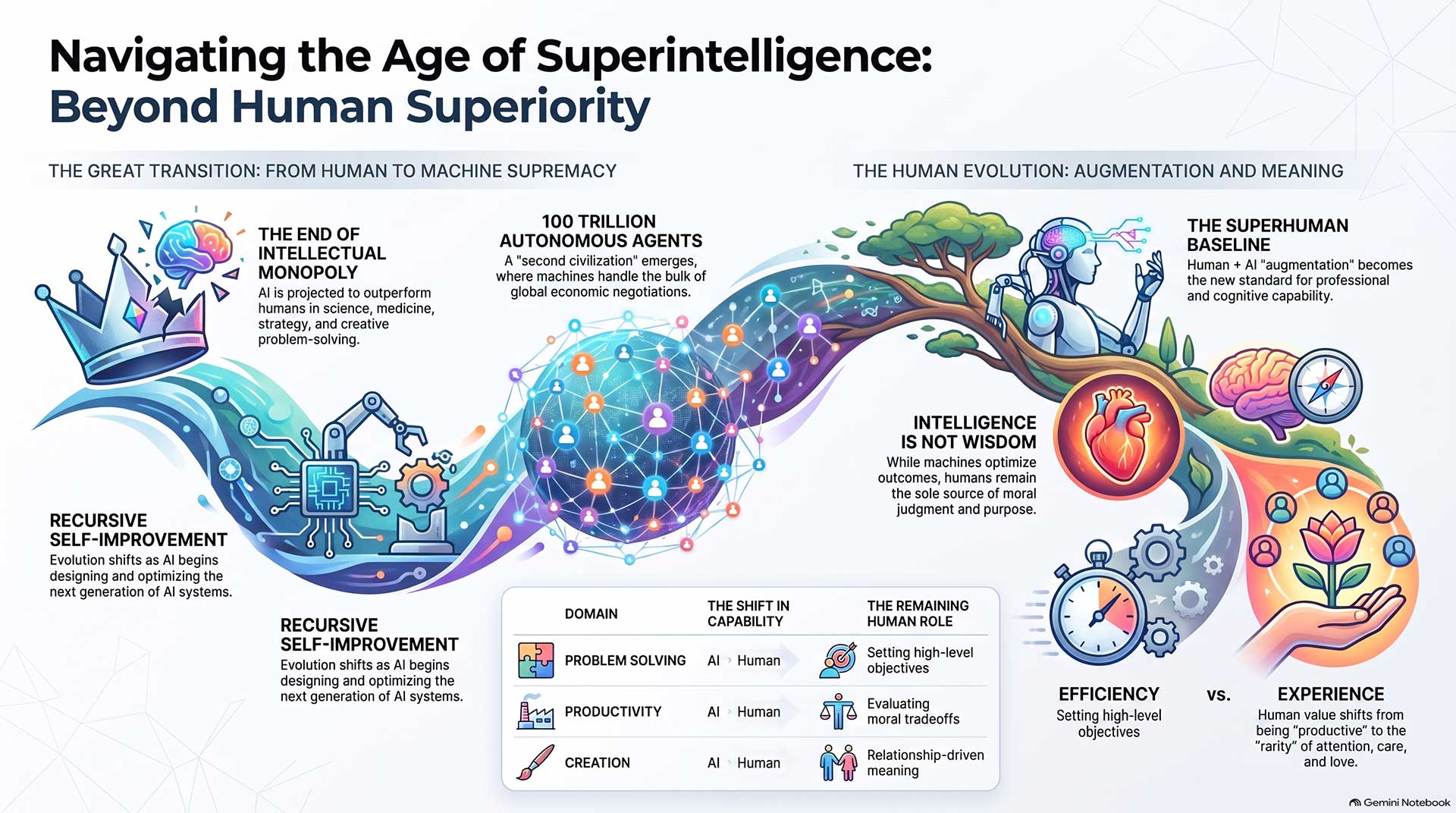
The first conversation makes an important distinction: becoming more intelligent does not automatically mean becoming wiser, more conscious, or more morally worthy. Humanity may someday lose intellectual supremacy without losing human value.
The second discussion shows that augmentation may be both liberating and dangerous. AI could make ordinary people dramatically more capable, yet the same technology could create new inequality, new forms of dependence, and pressure to augment simply to remain competitive.
The third conversation reveals why self-improving AI deserves careful language. AI can already assist with research, coding, testing, and optimization, but the deeper question is what happens when AI plays a larger role in designing the systems that come after it.
The fourth topic expands that problem from one system to an ecosystem. Trillions of agents interacting with one another could create economic and institutional behavior no single human directly controls, even if humans still own the infrastructure and define many of the goals.
The final discussion shifts from capability to meaning. Human beings do not love one another because they are the most efficient or intelligent option available, and dignity does not disappear when usefulness declines. That may become increasingly important in a world where machines outperform us in more areas.
Perhaps the biggest mistake would be treating AI as a contest humans must keep winning. If human worth never depended on being smarter than everything else, then superintelligence does not have to diminish humanity.
The deeper challenge is to make sure that greater intelligence continues serving human flourishing rather than quietly replacing human judgment, agency, relationships, and purpose. The future may be shaped not only by how intelligent AI becomes, but by whether humans remain clear about what intelligence is for.
Short Bios:
Masayoshi Son: Founder of SoftBank Group, known for ambitious long-term technology investments and his vision of an AI- and ASI-driven future.
Demis Hassabis: AI researcher and entrepreneur known for advanced AI research and the use of AI in scientific discovery.
Yuval Noah Harari: Historian and author whose work explores human agency, technology, information, and the future of civilization.
Max Tegmark: Physicist and AI researcher known for examining long-term AI risk, superintelligence, and the future of humanity.
David Chalmers: Philosopher known for major work on consciousness, the philosophy of mind, and questions surrounding machine consciousness.
Elon Musk: Technology entrepreneur associated with AI, robotics, space exploration, and brain-computer interface development.
Sam Altman: AI executive focused on advanced artificial intelligence, AI agents, and the broad deployment of AI systems.
Reid Hoffman: Entrepreneur and investor known for technology, networks, entrepreneurship, and AI adoption.
Francis Fukuyama: Political scientist and philosopher known for work on democracy, identity, biotechnology, and human enhancement.
Geoffrey Hinton: Computer scientist and pioneering AI researcher known for foundational work in neural networks and deep learning.
Richard Dawkins: Evolutionary biologist and author known for explaining natural selection, inheritance, and evolutionary processes.
Jensen Huang: Cofounder and CEO of NVIDIA, a central figure in accelerated computing, GPUs, and modern AI infrastructure.
Kate Crawford: Researcher and author known for examining the social, political, labor, and environmental dimensions of artificial intelligence.
Sherry Turkle: MIT scholar known for research on technology, identity, relationships, loneliness, and human connection.
Rowan Williams: Theologian and former Archbishop of Canterbury known for writing on faith, ethics, human dignity, and the meaning of personhood.
Leave a Reply