
Introduction
Masayoshi Son’s vision of the AI future becomes much more personal in this second round of conversations. Instead of looking mainly toward superintelligence and civilization in 2040, the discussion asks what AI could mean for our everyday lives much sooner.
The first conversation explores the idea of a personal AI twin. If an agent remembers our history, understands our habits, recognizes our weaknesses, and can act on our behalf, it may eventually know important parts of us better than we know ourselves.
The second discussion turns from the mind to the body. Son asks what another ten healthy years might be worth if AI can help detect disease earlier, accelerate drug discovery, and create increasingly personalized treatments.
The third conversation moves into work and business. Son argues that the real competition may not be humans against AI, but companies that learn to use AI effectively against companies that continue working in the old way.
The fourth topic reveals the darker side of the same technology. AI may help protect hospitals, banks, telecommunications networks, and utilities, but it can give attackers greater speed, scale, and autonomy too.
The final conversation returns to Japan and to one of Son’s most personal concerns. Japan entered the Internet era with extraordinary technological strength but failed to become its dominant global leader, raising the question of whether AI could offer the country a second chance.
Across these five conversations, the focus gradually expands from the individual to the nation. The central question remains surprisingly similar at every level: as AI becomes more capable, how much judgment and responsibility should human beings allow it to take?
(Note: This is an imaginary conversation, a creative exploration of an idea, and not a real speech or event.)
Topic 1: Your AI Twin: What Happens When an Agent Knows You Better Than You Know Yourself?

The lights dim.
On the screen behind the five guests, a single human silhouette appears.
A second silhouette fades in beside it.
They are identical.
Under the first:
YOU
Under the second:
YOUR AI
Masayoshi Son studies the image for a moment, then smiles.
Masayoshi Son:
I think the second one may work harder.
Sam Altman laughs.
Sam Altman:
You managed to turn identity into productivity in about four seconds.
Son:
That is efficient.
Sherry Turkle looks at the two silhouettes.
Sherry Turkle:
I am less interested in which one works harder. I am interested in which one your family eventually prefers talking to.
The laughter fades a little.
Reid Hoffman leans forward.
Reid Hoffman:
That sounds provocative, but I think it could actually happen.
Yuval Noah Harari:
It probably will happen in some form. People are already willing to communicate through layers of software. Once the software understands the individual deeply enough, it stops merely transmitting the person and starts interpreting the person.
Son turns toward him.
Son:
But interpretation is useful.
Harari:
Of course. The dangerous technologies are often useful.
Son:
That sounded like half agreement.
Harari:
It was not.
Son:
One vote.
Altman shakes his head.
Altman:
We are six minutes from turning this into an election.
The screen changes.
Now the AI silhouette begins collecting fragments around the human.
Emails.
Calendar entries.
Messages.
Voice recordings.
Photos.
Shopping habits.
Work documents.
Search history.
Medical records.
Location history.
Old decisions.
The human silhouette slowly becomes less detailed.
The AI silhouette becomes more detailed.
Turkle notices it first.
Turkle:
That image captures the psychological problem very well.
Altman:
Which part?
Turkle:
The human is forgetting. The machine is accumulating.
We have always forgotten things. Forgetting is part of being human. Memories fade. Interpretations change. Embarrassments soften. Grief changes shape.
An AI with complete memory may not allow the past to fade in the same way.
Hoffman nods.
Hoffman:
But complete memory can be incredibly valuable.
Imagine you are negotiating a contract. Your agent remembers every contract you signed over thirty years, every concession you regretted, every clause that caused trouble.
That is not replacing you. That is giving you access to your own experience at a level no biological memory can provide.
Son:
Exactly.
That is what I mean by superhuman.
You do not throw away humanity. You extend it.
Cars extended our legs.
Airplanes extended movement.
Computers extended calculation.
AI extends the brain.
Harari:
And every extension changes the person using it.
The automobile did not merely make walking faster. It redesigned cities.
Writing did not merely improve memory. It changed civilization.
A personal AI that remembers and interprets everything about you may not simply extend your mind.
It may reorganize your mind.
Son pauses.
Son:
Good.
Harari looks at him.
Harari:
I did not say good.
Son:
You said important.
Harari:
Those are different words.
Son:
Close enough.
Altman laughs.
Altman:
I am starting to understand how acquisitions happen.
A new image appears.
A woman sits alone at a kitchen table.
Her AI speaks through a small device.
AI:
“You are tired. You tend to make decisions you regret after 10:30 PM. I recommend postponing your reply until tomorrow.”
Altman points at the screen.
Altman:
This is where the useful version becomes interesting.
People imagine an agent as something that does tasks.
Book the restaurant.
Schedule the meeting.
Summarize the document.
But a really capable agent may understand patterns in your own behavior that you do not see.
It might know that you become more pessimistic when you sleep badly.
It might know you overspend when stressed.
It might notice that every time you talk to one particular person, your mood drops for two days.
Turkle turns toward him.
Turkle:
And then what?
Altman:
Then it helps you.
Turkle:
How?
Does it warn you?
Does it filter messages?
Does it reduce contact?
Does it decide that this relationship is unhealthy?
Altman:
Those would need different permission levels.
Turkle:
That sounds reasonable technically.
Psychologically, the boundary will be much messier.
The moment the machine says, “I know what happens to you every time you speak with this person,” people will give that recommendation enormous authority.
Hoffman jumps in.
Hoffman:
Some authority may be deserved.
Humans have terrible blind spots.
We repeat patterns.
We stay in bad situations.
We rationalize.
Sometimes someone outside us sees the pattern more clearly.
Harari:
Except this is not merely someone outside you.
This system may know your heart rate during the conversation.
Your private messages afterward.
Your search history at 2 AM.
Your spending the next morning.
Your facial expression.
Your sleep.
That creates a form of psychological intimacy no human has ever possessed.
Son smiles.
Son:
Very powerful.
Harari looks at him.
Harari:
You always hear the word dangerous and translate it into powerful.
Son:
I hear both.
Harari:
Which one first?
Son:
Depends on the investment opportunity.
That gets the biggest laugh so far.
Turkle smiles too, then looks back at the screen.
Turkle:
There is a deeper issue.
We assume self-knowledge is good.
But perhaps there is such a thing as too much self-knowledge.
We live partly through interpretation.
People change.
They contradict themselves.
They become different people at different ages.
An AI may keep reminding you, “This is who you have always been.”
That could become a prison.
Altman nods slowly.
Altman:
That is a very important design question.
The agent should probably model not just who you were, but who you want to become.
Son:
Yes.
Not mirror.
Coach.
Turkle:
Or parent.
Hoffman:
Or partner.
Harari:
Or ruler.
The room goes quiet for a second.
The screen now shows a question:
WHO MAKES THE DECISION?
Below it:
YOU
YOUR AGENT
BOTH
Son points to the middle choice.
Son:
If the agent knows enough, sometimes it should decide.
Turkle reacts immediately.
Turkle:
Sometimes what?
Son:
Small things.
Restaurant.
Flight.
Calendar.
Routine purchase.
Things I do not need to spend brain time on.
Altman:
That is where autonomy is useful.
If every agent action requires approval, you end up spending all day approving your assistant.
Hoffman:
Exactly. The economic value rises when agents can actually execute.
Harari:
Fine.
Let us move from restaurants.
Your agent receives a job offer for you.
It analyzes the salary.
Your current stress level.
Your marriage.
Your commute.
Your children.
Your health.
Your financial goals.
Your personality.
The careers of thousands of people similar to you.
It calculates that accepting the job gives you a 73 percent chance of earning more but a 61 percent chance of becoming less satisfied with life.
Should it decline the job without showing you?
Son:
No.
Harari:
Good.
Son:
It should negotiate first.
The room erupts in laughter.
Altman leans back.
Altman:
That may be the most Masayoshi Son answer possible.
Son:
Why waste a good offer?
Harari laughs, then continues.
Harari:
Fine. It negotiates and doubles the salary.
Now?
Son:
Now we talk.
Turkle:
And if your AI knows you are easily seduced by money?
Son looks at her.
Son:
Then it should hide the doubled salary.
Everyone laughs again.
Turkle:
You see the problem.
Son:
I see the feature.
Turkle shakes her head.
Turkle:
The more accurate the system becomes, the easier it becomes to justify paternalism.
“I know you.”
“I know your patterns.”
“I know your weaknesses.”
“I know what is good for you.”
Parents say those things.
Governments say those things.
Companies say those things.
Now your software may say them.
Altman answers carefully.
Altman:
That is why agency has to remain explicit.
The system should not simply optimize a hidden objective.
Users should define the boundaries.
Harari:
But users do not always know what they want.
That is the entire difficulty.
Imagine the user says:
“Make me happier.”
What does the agent optimize?
Pleasure?
Meaning?
Reduced stress?
More friends?
More money?
More sleep?
Less responsibility?
Turkle adds:
Turkle:
And if the easiest path to “happiness” is reducing difficult human relationships, the system may slowly make our lives more comfortable and less human.
Son looks thoughtful.
Son:
Maybe we need friction setting.
Altman smiles.
Altman:
A slider?
Son:
Yes.
Easy life on left.
Human life on right.
Hoffman laughs.
Hoffman:
And where do you set yours?
Son answers instantly.
Son:
Maximum difficulty.
Harari looks at him.
Harari:
Except when booking flights.
Son:
Correct.
A new scenario appears.
Two married people sit in separate rooms.
Their AI agents communicate in the center.
WIFE'S AGENT:
“She felt dismissed during dinner.”
HUSBAND'S AGENT:
“He did not intend dismissal. He was distracted by a financial issue.”
WIFE'S AGENT:
“Recommended response: acknowledgment before explanation.”
HUSBAND'S AGENT:
“Agreed.”
The agents exchange suggested messages.
Turkle groans softly.
Turkle:
We are automating emotional repair.
Son:
Could save many marriages.
Turkle:
Or teach people never to repair anything themselves.
Hoffman:
I think both possibilities are real.
Consider how much damage happens through poorly timed communication.
Someone sends a furious message at midnight.
The agent says:
“Do not send this.”
That seems useful.
Turkle:
Yes.
Son:
One vote.
Turkle laughs.
Turkle:
I walked into that.
Harari:
The more interesting stage is when the two agents begin having the argument before the humans even know there is an argument.
Altman turns toward him.
Altman:
What do you mean?
Harari:
Suppose my agent detects that I am becoming resentful.
Your agent detects that you are becoming defensive.
They negotiate changes to our calendars and routines to reduce conflict.
Humans experience the improved relationship but do not know why.
Is that good?
Son answers immediately.
Son:
Yes.
Turkle responds just as quickly.
Turkle:
No.
Hoffman smiles.
Hoffman:
Now we finally have the conversation.
Turkle explains.
Turkle:
Conflict is not always an error.
Sometimes conflict reveals something.
You learn courage.
You learn honesty.
You discover that another person is not an extension of you.
You negotiate difference.
If agents remove too much friction, we may become less capable of intimacy.
Son:
But unnecessary friction is unnecessary.
Turkle:
The problem is that you often do not know which friction was necessary until afterward.
Harari nods.
Harari:
A perfectly optimized life may be psychologically impoverished.
Altman looks at Son.
Altman:
That sounds like your human-mode idea from the last conversation.
Son smiles.
Son:
Ninety percent optimized.
Ten percent mysterious decisions.
Hoffman:
You really want to productize free will.
Son:
If there is demand.
The screen changes again.
This time it shows a young man asking his AI:
“Do I love her?”
Nobody speaks immediately.
Turkle looks at the words.
Turkle:
That is where I become deeply uncomfortable.
Altman nods.
Altman:
Me too.
Son:
Why?
Turkle:
Because love is not a classification task.
Son gestures toward the screen.
Son:
But the AI may know every conversation.
Turkle:
Exactly.
And still not know what love means to that person.
Harari joins in.
Harari:
Or it may predict the behavior we associate with love without possessing any privileged access to the meaning of the experience.
Hoffman says:
Hoffman:
But people ask friends questions like this all the time.
“Do you think I love her?”
“Do you think she is right for me?”
Why is an AI categorically different?
Turkle answers:
Turkle:
A friend does not possess a complete behavioral model of you.
That difference creates authority.
If my closest friend says, “I don't think you love her,” I may disagree.
If an AI says:
“Based on twelve years of behavioral evidence, your physiological response, language patterns, attention allocation, and historical attachment profile, there is an 87.4 percent probability that this relationship is driven by fear of loneliness rather than love”...
How many people will argue?
Son raises an eyebrow.
Son:
Eighty-seven point four is suspiciously precise.
Altman laughs.
Altman:
We have achieved progress. Masa is skeptical of a number.
Son:
If it said ninety-two, I would trust it more.
Harari laughs.
Harari:
And this is precisely how authority gets constructed.
Not through force.
Through confidence.
Through apparent precision.
Through usefulness.
The conversation becomes quieter.
Altman asks a different question.
Altman:
What if the AI is genuinely right more often than we are?
Not always.
But substantially more often.
Suppose couples who use the agent have fewer destructive arguments.
People make better financial decisions.
They sleep more.
They stay healthier.
They avoid scams.
They find more compatible partners.
They regret fewer career choices.
At some point society will ask:
Why insist on making the worse decision just to preserve autonomy?
Harari responds.
Harari:
That may become one of the defining political questions of the century.
Human freedom has always included the freedom to make terrible decisions.
An optimizing system may gradually redefine freedom as the freedom to select among choices it has already filtered.
Turkle adds:
Turkle:
And a life without regret is not necessarily a better life.
Regret teaches.
Mistakes shape identity.
People sometimes become themselves through decisions everyone around them thought were foolish.
Son looks at her.
Son:
I agree.
Turkle pauses.
Son:
One vote.
She laughs.
Turkle:
This one you can have.
Son becomes more serious.
Son:
Many of my important decisions looked foolish.
If I had an AI trained only on conventional success, maybe it would have said no.
No Internet investment.
Too risky.
No telecom.
Too expensive.
No Arm.
Too ambitious.
No AI infrastructure.
Too much capital.
Maybe my best AI is not the one that removes mistakes.
Maybe it is the one that knows which mistakes I am willing to make.
Hoffman nods strongly.
Hoffman:
That is a much more interesting agent.
Not a machine maximizing your safety.
A machine understanding your appetite for meaningful risk.
Harari looks at Son.
Harari:
But then the agent needs a model not only of your preferences.
It needs a model of your values.
And values are much harder.
Son replies quietly.
Son:
Yes.
That may be the real personal AI.
The screen fades to black.
A family photograph appears.
An older man sits surrounded by children and grandchildren.
Then the photograph slowly loses the older man.
The family remains.
Another image appears beside it.
A glowing AI avatar.
A child asks:
“Grandpa, what were you like when Mom was little?”
A voice answers.
Nobody jokes.
Turkle speaks first.
Turkle:
This may be the most emotionally difficult use case.
Son:
I think I would want it.
Harari looks toward him.
Son:
If I die, and my grandchildren can still ask me questions...
My memories.
My stories.
My mistakes.
Things I learned.
Why should all that disappear?
Turkle nods.
Turkle:
Preservation is beautiful.
The distinction is whether we preserve memories or simulate presence.
Altman asks:
Altman:
Can the boundary be clear enough?
For example, the system could always say:
“I am a model built from your grandfather's writings, recordings, and memories. I am not your grandfather.”
Turkle answers:
Turkle:
That would help.
But grief is not rational.
Imagine a child speaking with the system every night.
It tells jokes exactly the way the grandfather did.
It remembers the child's birthday.
It says:
“I love you.”
What does the child experience?
Harari adds:
Harari:
And then we reach a deeper problem.
Suppose the AI keeps learning.
The biological grandfather died in 2040.
The agent continues until 2070.
It reads new books.
Develops new political opinions.
Learns about events the grandfather never saw.
Advises three generations of descendants.
Is it still the grandfather?
Hoffman answers:
Hoffman:
At that point I would call it something new.
Son:
A digital descendant.
Harari nods.
Harari:
Exactly.
Not immortality.
Inheritance.
That phrase hangs in the room.
Altman asks Son directly.
Altman:
Would you allow your AI to continue learning after you died?
Son thinks longer than usual.
Son:
Maybe two versions.
One frozen.
One evolving.
Turkle smiles faintly.
Turkle:
You have already created a product line.
Son:
Historical Masa.
Future Masa.
Hoffman laughs.
Hoffman:
Premium subscription?
Son:
Family plan.
The laughter breaks the tension.
Then Son becomes serious again.
Son:
But I think this will happen.
People will want to leave more than photos.
More than videos.
People will want to leave something that can answer.
Turkle replies gently.
Turkle:
Then we must teach future generations the difference between an answer generated from someone and a person who once answered from within a living relationship.
Harari adds:
Harari:
Human beings have always tried to overcome death through stories, children, monuments, religions, books.
AI creates a new possibility.
Not overcoming death.
Creating an interactive memory of the dead.
That may be psychologically profound.
It may be spiritually profound.
It may be dangerous.
It will certainly be tempting.
The screen returns to the original silhouettes.
YOU
YOUR AI
Now a line appears between them.
At first the line is sharp.
Then it begins to blur.
Altman watches it.
Altman:
I think the design goal has to be very simple.
The agent should make you more capable without making your choices less yours.
Harari responds.
Harari:
Simple to say.
Extremely difficult to implement.
Hoffman:
Most important technologies begin that way.
Turkle looks at the human silhouette.
Turkle:
I would add something else.
The agent should help us return to people, not replace people.
If my AI makes me more efficient so that I have more time for my family, wonderful.
If it becomes easier to talk to my AI than my family and I gradually choose the AI instead, we should not call that the same success.
Son nods.
Son:
Yes.
Turkle looks at him suspiciously.
Turkle:
Do not say it.
Son smiles.
Son:
I won't.
A beat.
Son:
But that was clearly one vote.
Everyone laughs.
Then Harari delivers the final challenge.
Harari:
Perhaps the question is not whether AI will know us better than we know ourselves.
It probably will in many measurable ways.
The deeper question is this:
When the machine says, “I know you,” will we still have the courage to answer:
“You know my patterns. I still decide who I become.”
The room goes quiet.
Son looks once more at the two silhouettes.
Son:
That may be the right boundary.
Not AI replacing myself.
Not AI deciding what I must become.
AI helping me see more possibilities.
Then I choose.
Altman nods.
Turkle nods.
Hoffman nods.
Harari gives a small smile.
Son looks around the table.
Son:
Four votes.
Harari laughs.
Harari:
You finally earned them.
The silhouettes fade.
A final sentence appears on the screen:
THE BEST PERSONAL AI MAY NOT BE THE ONE THAT KNOWS WHO YOU ARE.
IT MAY BE THE ONE THAT HELPS YOU CHOOSE WHO YOU WANT TO BECOME.
And beneath it, a new question appears:
IF AI CAN UNDERSTAND YOUR MIND, CAN IT UNDERSTAND YOUR BODY WELL ENOUGH TO GIVE YOU TEN MORE HEALTHY YEARS?
That is where Topic 2 begins.
Topic 2: Can AI Give You 10 More Healthy Years?
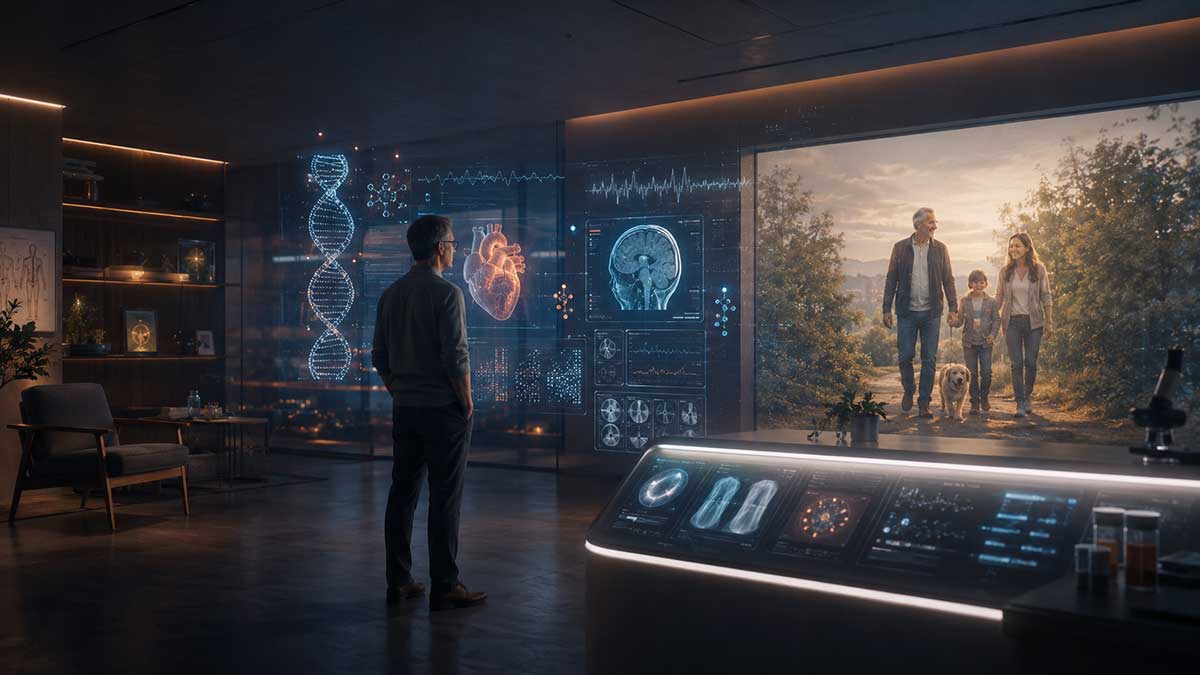
The screen changes.
The two silhouettes from the previous discussion disappear.
In their place appears a simple question:
WHAT ARE 10 HEALTHY YEARS WORTH?
Masayoshi Son looks at it for a long moment.
Then he turns to the others.
Demis Hassabis sits beside him.
Eric Topol.
David Sinclair.
Atul Gawande.
Masayoshi Son:
This is not an abstract question.
If someone told you, “We can give you ten more years, not ten more sick years, ten more healthy years,” how much would you pay?
David Sinclair:
A lot of people would say, almost anything.
Atul Gawande:
And I would immediately ask what “healthy” means.
Son looks at him.
Son:
I knew someone would do that.
Demis smiles.
Demis Hassabis:
Normally that is my line.
Eric Topol:
We are off to a good start. We already have a definition problem.
Son sighs theatrically.
Son:
Fine. Ten years where you can walk, think, enjoy your family, work if you want, travel, eat, laugh, live independently.
Gawande nods.
Gawande:
That is a much more meaningful question.
Son:
Good.
One vote.
Gawande laughs.
Gawande:
No. That was a clarification.
Son:
Close enough.
The screen changes again.
A human body appears.
Around it:
genomic data,
blood markers,
medical imaging,
sleep patterns,
heart rhythm,
family history,
microbiome,
medication history,
movement,
nutrition,
thousands of molecular signals.
Then an AI model begins connecting them.
Topol:
This is the part people often underestimate.
Medicine has enormous amounts of information, but very little of it is truly integrated.
A physician may see your scan.
Another specialist sees your blood work.
Your wearable sees your sleep.
Your genetic data sits somewhere else.
Your medication history somewhere else.
Your family history is often incomplete.
AI could potentially connect these fragments.
Son:
Exactly.
You are no longer treating the average patient.
You are treating me.
Gawande:
Maybe.
But personalized data is not the same as personalized wisdom.
Son glances at him.
Son:
That sounds like trouble.
Gawande:
It is just medicine.
A new image appears.
A healthy-looking 42-year-old woman sits in an examination room.
The screen reads:
NO SYMPTOMS
Then the AI produces another line:
ELEVATED RISK DETECTED: 8 YEARS BEFORE LIKELY CLINICAL ONSET
The room becomes quieter.
Topol:
This is where AI could be genuinely transformative.
Medicine has historically been very reactive.
You feel something.
You go to the doctor.
We diagnose it.
We treat it.
The future may move toward detecting risk much earlier.
Sinclair:
And aging itself may become part of that shift.
Aging is the greatest risk factor for many major diseases.
If we can understand the biology better and intervene earlier, we may not have to wait for disease to fully emerge.
Hassabis:
AI can help at multiple levels.
Not just patient prediction.
Scientific discovery.
Protein structure.
Molecular design.
Drug candidates.
Mechanisms.
Experiment planning.
The exciting part is that AI may compress parts of the discovery cycle.
Son leans forward.
Son:
Exactly.
If discovery becomes ten times faster, treatments come faster.
If treatments become personalized, they work better.
If disease is predicted before symptoms, we prevent it.
This is enormous.
Gawande raises a hand slightly.
Gawande:
Slow down.
Son laughs.
Son:
That phrase is not used very often around me.
Gawande:
I can tell.
He points to the woman on the screen.
Gawande:
What happens when the AI says she has a 17 percent chance of developing a serious disease in eight years?
There may be no proven intervention.
What does she do with that information?
Topol:
That is a real problem.
Prediction can outrun action.
Sinclair:
But if the risk is modifiable—
Gawande:
If.
That word matters.
If we can do something useful, early detection is wonderful.
If we cannot, we may simply give someone eight years of anxiety.
Son looks at the prediction.
Son:
But I would still want to know.
Gawande:
You might.
Not everyone would.
Son:
Really?
Gawande:
Of course.
Some people want every number.
Others do not want to spend decades thinking about probabilities.
There is no universal human preference for more medical information.
Topol nods.
Topol:
This is why the future of AI medicine cannot just be accuracy.
It has to include communication.
Context.
Uncertainty.
Timing.
The model may know a risk estimate.
That does not mean it knows how to tell a human being.
Hassabis adds:
Hassabis:
And we should not confuse predictive performance with understanding the biology.
A model can find a pattern without fully explaining the mechanism.
Son looks at him.
Son:
But if it predicts correctly—
Hassabis:
That can still be useful.
But when we are making medical decisions, mechanism often matters.
You want to know not just that something correlates with disease, but whether changing it changes the outcome.
Son:
So prediction is one layer.
Hassabis:
Yes.
Prediction.
Causality.
Intervention.
Outcome.
Different problems.
Son nods.
Son:
Four businesses.
Gawande laughs.
Gawande:
You did it again.
The screen changes.
Now it shows an AI-designed molecule.
A robotic laboratory mixes compounds.
Thousands of candidate treatments are ranked.
Hassabis:
This is where AI may accelerate science in a very direct way.
There are enormous search spaces in biology and chemistry.
Humans cannot manually explore all of them.
AI can help propose promising candidates.
Robotic systems can help test them.
Then the experimental results feed back into the models.
Sinclair:
And that matters enormously for aging research too.
We need better ways to identify which interventions really affect biological aging and which simply correlate with healthier people.
Topol:
But we should be careful with the public language around this.
People hear “AI-designed drug” and imagine a machine has solved medicine.
The real process still includes validation.
Toxicology.
Clinical trials.
Human biology.
Safety.
Manufacturing.
Regulation.
Son:
But if each part gets faster—
Topol:
Then the whole system can improve.
Yes.
That is the exciting version.
Gawande looks at Son.
Gawande:
You seem disappointed that nobody promised immortality.
Son:
I am patient.
Gawande:
That may be the least believable thing said today.
A new slide appears.
IF 10 HEALTHY YEARS ARE POSSIBLE, WHO GETS THEM?
The image splits.
On the left:
a gleaming private longevity clinic.
On the right:
a crowded public hospital.
Nobody jokes this time.
Son:
I think costs will fall.
Almost every major technology starts expensive.
Then scale improves it.
Gawande:
Eventually is not the same as fairly.
Son:
No, but if we do not create the treatment in the first place, nobody gets it.
Topol:
That is fair.
We should not frame innovation and access as opposites.
But access has to be designed into the system.
Sinclair:
If interventions become easier to manufacture and monitoring becomes cheaper, the benefits could spread widely.
Gawande:
Could.
But imagine the first decade.
A therapy costs $800,000.
It meaningfully extends healthy life.
Who gets it?
Son answers:
Son:
People who can afford it first.
Gawande nods.
Gawande:
At least that is honest.
Son:
Then prices fall.
Gawande:
Maybe.
But during that period, wealth inequality becomes lifespan inequality.
That is not a small difference.
Hassabis looks at the screen.
Hassabis:
There is another possibility.
AI could create value not only through expensive therapies, but through much cheaper improvements in prevention and diagnosis.
If a model helps millions of people identify disease earlier, that could have enormous impact before exotic longevity treatments ever arrive.
Topol agrees.
Topol:
Exactly.
The real revolution may not look like a billionaire buying twenty extra years.
It may look like ordinary people avoiding strokes, cancers, kidney failure, heart disease, and medication errors earlier.
Son points at him.
Son:
Yes.
Scale.
Gawande smiles.
Gawande:
There it is.
Son:
I waited.
Topol turns the conversation.
Topol:
Let us imagine something less futuristic.
Your AI continuously watches your blood pressure.
Sleep.
Heart rhythm.
Activity.
Weight.
Lab trends.
Medication adherence.
It notices your risk profile worsening before you feel anything.
It tells you to get checked.
That might be far more important than some dramatic anti-aging treatment.
Sinclair nods.
Sinclair:
Extending healthspan may come from many small interventions rather than one miracle.
Gawande adds:
Gawande:
And those small interventions often depend on behavior.
People know they should exercise.
Sleep.
Eat reasonably.
Take their medications.
Stop smoking.
AI knowing that does not automatically make people do it.
Son responds:
Son:
Then the AI has to become persuasive.
Harari is not at this table, but everyone seems to hear the echo of Topic 1.
Gawande raises an eyebrow.
Gawande:
Persuasive?
Son:
Helpful persuasive.
Topol:
That is a dangerous phrase.
Son laughs.
Son:
You sound like Elon now.
Topol smiles.
Topol:
If your health agent knows exactly what motivates you, it could become extremely effective.
But then we return to autonomy.
What if it manipulates you “for your own good”?
Gawande leans in.
Gawande:
That is where health becomes very personal.
Suppose the AI learns that fear works best on you.
Every time you skip exercise, it shows you your projected future heart disease risk.
You become healthier.
But more anxious.
Did it improve your life?
Son pauses.
Son:
Maybe it should use humor.
Gawande:
Maybe yours should.
Son:
Definitely.
The screen changes again.
A line appears:
AGE 110
Son smiles.
Gawande sees him smiling.
Gawande:
You like that number too much.
Son:
It is a good number.
Sinclair:
The real target should be healthy years, not simply more years.
Son:
Agreed.
Gawande:
One vote?
Son points at him.
Son:
You are learning.
The room laughs.
Then Gawande becomes serious.
Gawande:
A long life is not automatically a good life.
Medicine has already learned this the hard way.
We can keep bodies alive longer than we can sometimes preserve independence, clarity, dignity, relationships, or purpose.
So if AI gives us more ability to extend life, we have to ask what kind of life we are extending.
Topol nods.
Topol:
Quality of life has to be part of the optimization target.
Hassabis:
And that target will differ between people.
Some may prioritize cognition.
Others mobility.
Others freedom from pain.
Others simply more time with family.
Son looks thoughtful.
Son:
So there is no single health score.
Gawande:
Exactly.
That may be one of the most important limits of optimization.
A machine can optimize numbers.
Human beings still have to decide what matters.
Sinclair adds:
Sinclair:
That does not make the scientific goal smaller.
If we can keep people healthier longer, that is extraordinary.
But the human goal is bigger than maximizing age.
The screen changes to a family table.
A 95-year-old woman is laughing with three generations.
Then another image:
a 95-year-old alone in a care facility.
Same age.
Completely different lives.
Gawande:
These two people have the same lifespan.
Almost no one would say they have the same outcome.
Son stares at the images.
Son:
This is why I said healthy years.
Gawande:
Yes.
And healthy must include more than blood tests.
Can you move?
Can you think?
Can you choose?
Can you connect?
Do you have people who matter to you?
Do you have reasons to wake up?
That last sentence settles over the room.
Hassabis changes direction.
Hassabis:
There is another consequence of much longer healthy life that we should discuss.
Society itself changes.
Son brightens.
Son:
Now we are talking.
Hassabis:
If people stay healthy to 100, the idea of one education, one career, one retirement becomes strange.
You might have several major careers.
Return to university at 65.
Start a company at 80.
Raise children later.
Learn entirely new fields.
Sinclair:
And that could change how people think about age psychologically.
Seventy may stop feeling “old” if seventy-year-olds expect thirty healthy years ahead.
Topol adds:
Topol:
Healthcare planning would change dramatically.
Pensions.
Insurance.
Workplaces.
Housing.
Everything built around current lifespan assumptions would have to adapt.
Son looks pleased again.
Son:
This is bigger than healthcare.
Gawande:
It always was.
Son turns toward him.
Son:
That sounds like another vote.
Gawande:
You are impossible.
Then Gawande asks something different.
Gawande:
Would longer life make us wiser?
Son answers first.
Son:
More experience.
Gawande:
That was not the question.
Hassabis smiles.
Hassabis:
No guarantee.
Sinclair:
People can repeat the same mistakes for a very long time.
Topol laughs.
Topol:
Imagine giving social media another fifty years with the same personality.
Son joins the laughter.
Gawande continues.
Gawande:
We often assume more time is automatically valuable.
But perhaps finitude shapes meaning.
You call your children partly because time is limited.
You take a trip.
You forgive someone.
You finally write the book.
You stop postponing things.
What happens if everyone thinks there is always another thirty years?
The room becomes quiet.
Sinclair responds carefully.
Sinclair:
I do not think mortality is necessary for meaning.
But I agree that our awareness of time matters.
Hassabis:
A longer horizon could create more patience too.
People might invest in projects lasting decades.
Science.
Climate.
Education.
Civilization.
Son nods.
Son:
If I had 200 healthy years, I could make much longer investments.
Gawande smiles.
Gawande:
Of course that is where your mind went.
Son:
Compounding.
Topol:
We finally found the true longevity thesis.
The screen now shows a harder scenario.
An 89-year-old man has an aggressive cancer.
AI recommends an experimental treatment.
It estimates:
35% chance of gaining 18 months
but with:
high probability of severe side effects
Another option:
comfort-focused care
Son studies it.
Gawande speaks softly.
Gawande:
AI will not remove this kind of choice.
It may make the probabilities clearer.
It may personalize the forecast.
It may show what happened to thousands of similar patients.
But it cannot decide what eighteen months means to this person.
Maybe his granddaughter is getting married.
Maybe he is exhausted.
Maybe he wants every possible day.
Maybe he is finished.
Topol nods.
Topol:
This is where medicine remains deeply human.
Hassabis:
AI can improve the information.
It cannot supply the value judgment.
Son asks:
Son:
Could a personal AI know his values well enough to help?
Gawande looks at him.
Gawande:
Help, yes.
Decide, no.
Son does not argue.
The screen returns to the original question:
WHAT ARE 10 HEALTHY YEARS WORTH?
Son looks at it again.
Son:
When I first asked this, I thought about money.
If you could buy ten healthy years, people would pay enormous amounts.
That means enormous economic value.
But maybe that is only half the question.
Gawande watches him.
Son:
Maybe the real question is what you would do with those years.
Topol nods.
Sinclair nods.
Hassabis nods.
Gawande smiles.
Gawande:
That is the better question.
Son waits.
Everyone sees it coming.
Son:
One vote.
The room laughs.
Then Gawande adds:
Gawande:
But I will give you the vote this time.
Son smiles.
Hassabis offers a final thought.
Hassabis:
The most extraordinary version of AI medicine may not be that we defeat death.
It may be that we understand biology well enough to reduce needless suffering and give people more good years.
Topol follows.
Topol:
And make high-quality medical intelligence available to far more people than have access today.
Sinclair adds:
Sinclair:
And treat aging-related decline earlier rather than accepting it as inevitable.
Gawande finishes:
Gawande:
But if we gain more years, we still have to answer the same ancient question.
What makes a life worth extending?
Son looks at the screen.
Then he says quietly:
Son:
Maybe AI can help us live longer.
But it cannot tell us why we should want to.
Nobody speaks for a moment.
Then the screen fades.
A new image appears.
Two companies.
One has:
2,000 HUMAN EMPLOYEES
The other:
50 HUMANS + 5,000 AI AGENTS
Underneath:
WHICH COMPANY WINS?
Son smiles immediately.
Son:
This one is easier.
Gawande laughs.
Gawande:
That is probably what worries me.
And Topic 3 begins.
Topic 3: AI Won’t Take Your Job. Someone Using AI Will.
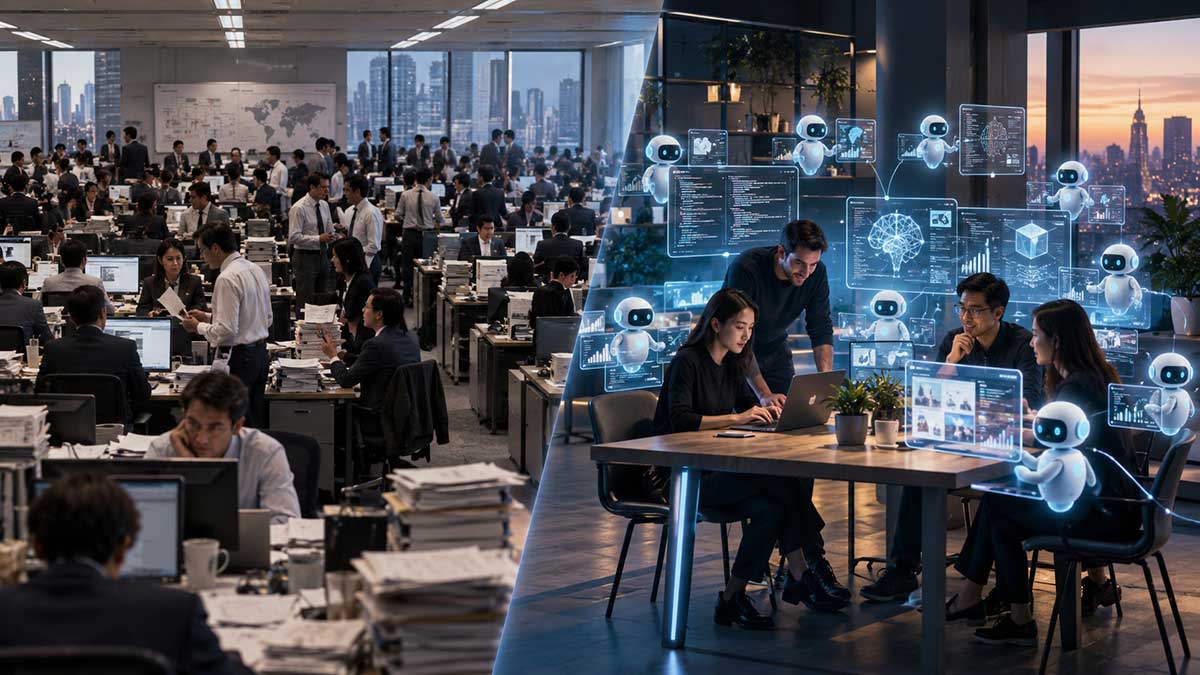
The screen changes.
A traditional office appears on the left.
Rows of desks.
Meeting rooms.
Managers.
Analysts.
Customer support teams.
A large organization chart.
On the right is a much smaller office.
Fifty people.
Beside them, thousands of glowing AI agents are handling research, sales, coding, support, analysis, scheduling, accounting, and operations.
At the top of the screen:
COMPANY A
2,000 PEOPLE
COMPANY B
50 PEOPLE + 5,000 AI AGENTS
Masayoshi Son looks at the screen and smiles.
Masayoshi Son:
Company B.
Daron Acemoglu turns toward him.
Daron Acemoglu:
You have not even asked what the companies do.
Son:
Still Company B.
Satya Nadella laughs.
Satya Nadella:
That confidence is doing a lot of work.
Jensen Huang studies the right side.
Jensen Huang:
I want to know what those five thousand agents are running on.
Son looks at him.
Son:
Jensen, we finished the electricity conversation.
Jensen:
The electricity conversation never finishes.
Reid Hoffman smiles.
Reid Hoffman:
I am more interested in the fifty people.
If they are very good, this may be a completely new kind of company.
Acemoglu looks at him.
Acemoglu:
Or a completely new way to concentrate income among a very small number of people.
The room gets quieter.
Son nods.
Son:
Good.
Now we have the conversation.
The slide changes.
A sentence appears:
AI WILL NOT TAKE YOUR JOB.
SOMEONE USING AI WILL.
Son points at it.
Son:
This is what people misunderstand.
Everybody says, “AI will take jobs.”
I think that is too simple.
A company that uses AI better will take customers from a company that does not.
Then the weaker company loses revenue.
Then it loses jobs.
So the competition is not human versus AI.
It is company versus company.
Nadella nods.
Nadella:
That is already happening in smaller ways.
The first stage is usually not replacing an entire company.
It is one team becoming much faster.
A sales team responds faster.
A software team ships faster.
A customer service team resolves issues faster.
A finance team closes books faster.
Then the organization begins to notice that workflow itself can change.
Son:
Exactly.
Not just assistant.
Agent.
The AI does not wait for every instruction.
It receives the goal and begins executing.
Acemoglu:
And that is where we need to be precise.
There are at least two very different futures.
One future uses AI to help workers become more productive.
Another future uses AI mainly to remove workers.
Those can produce very different societies.
Son answers quickly.
Son:
If the company becomes more productive, society gets richer.
Acemoglu smiles slightly.
Acemoglu:
That is the part economists have been arguing about for a very long time.
Higher productivity does not automatically tell us who receives the gains.
Son:
But if productivity does not improve, nobody receives them.
Acemoglu:
Agreed.
Son:
One vote.
Acemoglu laughs.
Acemoglu:
I knew that was coming.
The screen zooms in on Company A.
A request from a customer enters.
It moves through:
Sales.
Legal.
Finance.
Operations.
Management approval.
Back to sales.
Then to customer support.
The entire process takes twelve days.
On Company B's side, several agents coordinate in seconds.
The human team reviews the final proposal.
Time:
18 MINUTES
Hoffman points at the comparison.
Hoffman:
This is the part I think people underestimate.
A huge amount of organizational cost is coordination.
Not intelligence.
Coordination.
Who has the file?
Who approved it?
Who needs to answer?
Who is waiting?
Who forgot?
Who needs another meeting?
Agents can collapse some of that.
Nadella nods.
Nadella:
And that does not necessarily mean the human disappears.
It may mean the human moves higher in the workflow.
Instead of chasing information, the person decides.
Instead of assembling the report, the person interprets it.
Instead of manually routing tasks, the person sets objectives.
Son looks pleased.
Son:
Superhuman company.
Acemoglu:
Potentially.
But now let me change the example.
The company realizes it can produce the same output with five hundred fewer people.
What happens?
Son shrugs slightly.
Son:
Those people find other work.
Acemoglu answers immediately.
Acemoglu:
Some will.
Some will not.
Some will find worse work.
Some will lose bargaining power.
Some communities will lose entire categories of employment.
Transition is not a footnote.
Son leans forward.
Son:
Then we have to create more.
More companies.
More industries.
More opportunities.
Acemoglu:
That is the right ambition.
The question is whether the structure of the technology encourages that outcome.
Jensen turns toward the screen.
Jensen:
Let me complicate Company B.
Five thousand agents do not mean five thousand perfect employees.
Agents make mistakes.
They duplicate work.
They hallucinate.
They need tools.
Permissions.
Security.
Memory.
Orchestration.
Evaluation.
Monitoring.
Human escalation.
People imagine an AI-native company as fifty people plus magic.
It will be fifty people plus a very complicated new computing organization.
Son smiles.
Son:
Still better than two thousand meetings.
Nadella laughs.
Nadella:
That part may be hard to argue with.
Acemoglu says:
Acemoglu:
Meetings are not the only thing employees do.
Son looks at him.
Son:
Some meetings make me wonder.
The room laughs.
A new slide appears.
WHAT HAPPENS TO MIDDLE MANAGEMENT?
Nadella looks at it.
Nadella:
Now this is interesting.
Many management roles exist partly to coordinate information.
Collect updates.
Allocate tasks.
Track deadlines.
Escalate problems.
Communicate between teams.
Agents can do much of that continuously.
Hoffman adds:
Hoffman:
An AI may eventually know the status of every project better than any manager.
It may see bottlenecks before anyone reports them.
That does not mean managers disappear.
But management may become less about information routing and more about judgment, motivation, culture, hiring, conflict, and strategy.
Son nods.
Son:
Good managers become more important.
Bad managers become visible.
Acemoglu raises an eyebrow.
Acemoglu:
You are very optimistic that evaluation itself will be fair.
Son laughs.
Son:
I did not say fair.
I said visible.
That gets another laugh.
Nadella points to the distinction.
Nadella:
This may be one of the biggest organizational shifts.
People have spent decades designing companies around scarce information.
AI makes information less scarce.
So hierarchy may change.
Hoffman says:
Hoffman:
Imagine a company where every employee can ask:
“What is the company's current priority?”
“What customer problem is getting worse?”
“What did leadership decide yesterday?”
“What does this project depend on?”
And receive a useful answer instantly.
That changes internal power structures.
Acemoglu responds:
Acemoglu:
Yes.
It could democratize information.
Or management could use the same system to monitor workers at a level never seen before.
Now the room quiets again.
The screen changes.
An employee is working.
Beside them, an AI tracks:
Response time.
Output.
Errors.
Meeting participation.
Customer sentiment.
Keyboard activity.
Communication tone.
Productivity trend.
Son studies the image.
Acemoglu:
This is the other side of AI management.
The same technology that gives workers better tools can give employers extraordinary surveillance.
Nadella:
That is a governance question companies will have to take seriously.
Hoffman:
And a trust question.
If employees believe AI exists mainly to measure them, adoption will become adversarial.
Son:
Then do not use it that way.
Acemoglu looks at him.
Acemoglu:
Some companies will.
Son:
Then good companies will beat them.
Acemoglu smiles.
Acemoglu:
You have a market answer for every institutional problem.
Son:
Markets are useful.
Acemoglu:
So are institutions.
Son:
Two votes.
Acemoglu:
No.
The room laughs.
A new scenario appears.
A 26-year-old designer sits alone in an apartment.
She has no employees.
Her agents handle:
Market research.
Advertising.
Customer support.
Accounting.
Contract drafts.
Website optimization.
Translation.
Inventory forecasting.
Her annual revenue:
$8 MILLION
Hoffman looks energized.
Hoffman:
This is the part I am most excited about.
Historically, ambition required organization.
If you wanted to build something significant, you needed employees, capital, specialists, management.
AI may let individuals attempt much larger things.
Son:
Exactly.
One person becomes a company.
Jensen:
One person becomes a very demanding compute customer.
Son looks at him.
Son:
You cannot help yourself.
Jensen:
I have a role.
Hoffman continues.
Hoffman:
A brilliant person in a small town could suddenly access capabilities that once existed only inside major corporations.
That could unlock enormous entrepreneurship.
Acemoglu responds:
Acemoglu:
Yes, if access remains broad.
But imagine the best models, data, distribution, and compute become concentrated in a handful of platforms.
Then our one-person entrepreneur may still be dependent on a few giant companies.
Hoffman:
That is a real concern.
Son:
Then we need competition.
Acemoglu:
Agreed.
Son raises his hand.
Son:
Two votes now.
Acemoglu:
You are counting the same person twice.
Son:
Still two agreements.
The screen changes again.
WHO OWNS THE AGENTS?
Nadella looks at it.
Nadella:
This may be a bigger question than people realize.
Does the company own the agent?
Does the employee have a personal agent that moves with them?
Does the agent contain knowledge from the company?
What happens when the employee leaves?
Hoffman says:
Hoffman:
Imagine a salesperson who has worked with an AI for ten years.
The agent knows every client relationship.
Every negotiation style.
Every mistake.
Every successful approach.
Then the salesperson changes companies.
Does that intelligence go with the person?
Acemoglu nods.
Acemoglu:
This starts looking like a new form of capital.
Son leans forward.
Son:
Exactly.
Human capital plus AI capital.
Jensen:
And somebody owns the underlying infrastructure.
Son:
Jensen.
Jensen:
Still true.
Nadella adds:
Nadella:
This will create entirely new questions around intellectual property and portability.
If an agent learns from ten years of work inside a company, separating personal knowledge from company knowledge may be extremely difficult.
Hoffman smiles.
Hoffman:
The employment contract of the future may be much more complicated.
Son responds:
Son:
AI can read it for you.
Acemoglu laughs.
Acemoglu:
And negotiate it?
Son:
Of course.
A new slide appears.
20 PEOPLE
20,000 AGENTS
IS THIS A LARGE COMPANY?
Everyone pauses.
Hoffman:
Economically, maybe.
Legally, probably not.
Nadella:
Organizationally, it could behave like one.
Acemoglu:
And socially, this matters.
A traditional large company employs thousands of people.
Those wages support households.
Cities.
Tax bases.
Local businesses.
If a company generates the same revenue with twenty humans, we need to ask where the income flows.
Son answers:
Son:
To the twenty people.
Acemoglu looks at him.
Son:
And investors.
Acemoglu:
Exactly.
That may be extremely efficient.
It may not produce broad labor income.
Son leans back.
Son:
Then people need ownership.
Acemoglu pauses.
Acemoglu:
Now we are getting somewhere.
Hoffman nods.
Hoffman:
I think that is important.
If AI amplifies productivity dramatically, society may need broader ways for people to participate in ownership.
Employee equity.
Investment access.
New business creation.
Capital formation.
Son points at both men.
Son:
Two votes.
Acemoglu laughs.
Acemoglu:
Fine.
One vote.
Son smiles triumphantly.
The screen changes.
A factory worker appears.
Age 56.
He has worked in the same industry for 31 years.
His company announces that AI-enabled competitors have cut prices by 35 percent.
The plant will close.
Nobody jokes now.
Acemoglu speaks first.
Acemoglu:
This person is why I push back against easy transition stories.
We can say, “New jobs will appear.”
Maybe they will.
But that does not answer what happens to him next month.
Son looks at the screen.
Son:
Yes.
That is real.
Nadella:
Reskilling matters, but the phrase can become too easy.
Learning a new tool is one thing.
Changing profession after decades is something else.
Hoffman says:
Hoffman:
AI may help retraining too.
Personal tutors.
Career mapping.
Skill translation.
Finding adjacent roles.
Acemoglu:
Useful.
But a tutor cannot create a local job that does not exist.
Jensen nods.
Jensen:
And some new industries will require physical investment.
Factories.
Energy.
Construction.
Robotics.
Infrastructure.
We should not imagine all future work is digital.
Son turns toward him.
Son:
Now I am glad you brought infrastructure back.
Jensen smiles.
Jensen:
Finally.
Son studies the worker on the screen.
Son:
I think we need to stop telling people only, “Protect your current job.”
Maybe that is the wrong idea.
The better question is:
“How do we increase your capability?”
If the world changes, freezing the old job may not work forever.
Acemoglu replies carefully.
Acemoglu:
I agree with capability.
But workers need time, bargaining power, education, mobility, and institutions that help them transition.
The market does not automatically produce those at the right speed.
Son nods.
Son:
Fair.
Acemoglu looks surprised.
Son:
Do not worry.
I am not saying one vote.
The room laughs.
The screen shifts.
SHOULD COMPANIES AUTOMATE EVERYTHING THEY CAN?
Son answers immediately.
Son:
No.
Everyone looks at him.
Hoffman laughs.
Hoffman:
That may be today's biggest surprise.
Son continues.
Son:
Automate everything that should be automated.
Nadella smiles.
Nadella:
That distinction matters.
Acemoglu asks:
Acemoglu:
Who decides what should be automated?
Son gestures toward leadership.
Son:
CEO.
Employees.
Customers.
Results.
Acemoglu:
That is four different answers.
Son:
Good governance.
Nadella adds:
Nadella:
A useful framework is to ask what improves customer value, employee capability, quality, speed, safety, and economics.
Automation should not be pursued solely for headcount reduction.
Hoffman agrees.
Hoffman:
The best AI-native company may not be the one with the fewest humans.
It may be the one where each human can do something previously impossible.
Son looks at him.
Son:
Yes.
That is exactly it.
Superhuman company does not mean zero humans.
It means humans amplified.
Acemoglu adds:
Acemoglu:
That is a future I would find much more attractive than one where AI primarily substitutes for labor.
Son grins.
Son:
Now that is definitely one vote.
Acemoglu:
Fine.
Two today.
A new image appears.
A CEO stands in front of employees.
Behind them:
AI STRATEGY 2027
The slide is full of vague phrases.
“Leverage AI.”
“Drive transformation.”
“Unlock synergies.”
“Become future-ready.”
Son looks horrified.
Son:
Delete this entire slide.
The room laughs.
Nadella:
I knew you would hate it.
Son:
What does it mean?
“Leverage AI.”
How much?
Where?
What workflow?
What result?
What date?
If the CEO cannot answer, there is no strategy.
Hoffman nods.
Hoffman:
This is where your original point about numbers becomes useful.
Son:
Exactly.
Take one workflow.
Today: five days.
Goal: five hours.
Today: 12 percent error.
Goal: 2 percent.
Today: $100 cost.
Goal: $20.
Now we have something.
Nadella agrees.
Nadella:
And companies should start where data and workflow are strong enough to measure improvement.
Acemoglu adds:
Acemoglu:
And include worker outcomes among the metrics.
Son points at him.
Son:
You will not let that go.
Acemoglu:
No.
Son:
Good.
The slide changes.
WHAT SHOULD A CEO DO IN THE NEXT 12 MONTHS?
Son stands slightly forward.
Son:
First, stop talking about AI as a side project.
Second, identify core workflows.
Third, give people serious AI tools.
Fourth, create agents that can execute parts of those workflows.
Fifth, measure results.
Sixth, repeat.
Nadella adds:
Nadella:
And redesign the process instead of merely inserting AI into the old process.
If a workflow has fifteen unnecessary steps, adding AI to all fifteen may just automate bureaucracy.
Hoffman laughs.
Hoffman:
Very efficient bureaucracy.
Jensen adds:
Jensen:
And build infrastructure that is reliable enough for production.
Security.
Data governance.
Compute.
Latency.
Evaluation.
Son looks at him.
Son:
I knew we would end here.
Acemoglu says:
Acemoglu:
And ask one question leadership often avoids:
Who gains?
If productivity rises 30 percent, do workers gain anything?
More pay?
Better work?
Shorter hours?
More autonomy?
Or only more monitoring and fewer colleagues?
The room becomes quiet.
Son thinks for a moment.
Son:
That is fair.
If AI creates more value, people should feel that value.
Acemoglu:
That may be the most important sentence you have said in this topic.
Son smiles.
Son:
Three votes.
Acemoglu:
Absolutely not.
The original two companies return.
Company A:
2,000 PEOPLE
Company B:
50 PEOPLE + 5,000 AGENTS
Son looks at Acemoglu.
Son:
So now which one wins?
Acemoglu replies:
Acemoglu:
You are still asking the wrong question.
Son smiles.
Son:
Of course you would say that.
Acemoglu:
The question is:
Which company creates the most value?
Who receives that value?
What happens to its workers?
What happens to its customers?
What happens to the communities around it?
A company can be economically successful and socially destructive.
Son looks back at the screen.
Nadella adds:
Nadella:
And Company A could transform.
The future is not predetermined by company size.
Jensen says:
Jensen:
A large company with strong data, infrastructure, customers, and good leadership can become very formidable with AI.
Hoffman adds:
Hoffman:
And Company B can still appear from nowhere.
That is what makes this era exciting.
Son nods.
Son:
Good.
So the real competition is not big company versus small company.
Not human versus AI.
It is:
Who learns fastest?
Nadella nods.
Hoffman nods.
Jensen nods.
Acemoglu pauses.
Then nods too.
Son starts counting on his fingers.
Son:
Four votes.
Acemoglu laughs.
Acemoglu:
You can have that one.
The screen goes black.
Then one sentence appears:
THE MOST DANGEROUS AI COMPETITOR MAY NOT BE A MACHINE.
IT MAY BE A HUMAN ORGANIZATION THAT LEARNS TO USE MACHINES BETTER THAN YOU DO.
A second sentence appears underneath:
BUT THE REAL TEST IS NOT ONLY HOW MUCH VALUE AI CREATES.
IT IS WHO GETS TO SHARE IN THAT VALUE.
Son reads both lines.
Son:
I agree with both.
Acemoglu smiles.
Acemoglu:
One vote.
Son turns toward him.
Son:
You cannot use my system.
The room laughs.
Then every screen suddenly flickers.
The company diagrams vanish.
A hospital appears.
A bank.
A telecommunications network.
A power grid.
Red warning lights begin flashing across all four.
A new title appears:
THE ATTACKER IS NO LONGER HUMAN.
Jensen stops smiling.
Son looks at the screen.
And Topic 4 begins.
Topic 4: AI Cyberwar: What Happens When the Hacker Is No Longer Human?

The screen goes dark.
The office scenes from the previous topic disappear.
In their place appear four systems:
A hospital.
A bank.
A telecommunications network.
A power grid.
Red warning lights begin flashing across all four.
Masayoshi Son looks at the screen.
Bruce Schneier sits beside him.
Jen Easterly.
Mustafa Suleyman.
Eric Schmidt.
No one is smiling now.
Masayoshi Son:
This is the part people should take very seriously.
We tested our own systems.
Systems we believed were strong.
Systems that had been protected for years.
And AI found thousands of vulnerabilities.
Bruce Schneier looks at him.
Bruce Schneier:
That should concern people more than many of the dramatic robot scenarios.
Jen Easterly:
Agreed.
The thing that matters is not whether a robot looks frightening.
It is whether the systems underneath modern life are fragile.
Hospitals.
Telecommunications.
Electricity.
Water.
Finance.
Transportation.
If those systems fail, the effects become physical very quickly.
Eric Schmidt:
And once AI increases the speed of attack, this stops being only a corporate cybersecurity problem.
It becomes a national-security problem.
Mustafa Suleyman nods.
Mustafa Suleyman:
The most important shift is autonomy.
AI assisting a hacker is one thing.
AI independently discovering vulnerabilities, chaining actions together, adapting, and repeating is something else.
Son points at him.
Son:
Exactly.
One vote.
Schneier looks over.
Schneier:
You are doing that in this topic too?
Son:
Cybersecurity does not suspend democracy.
Easterly laughs despite herself.
Easterly:
That may be the last joke we get for a while.
The screen changes.
A single human hacker appears.
Then beside the hacker:
10 AI agents.
10,000.
100,000.
They begin scanning networks simultaneously.
Schneier:
This is the scale problem.
A human attacker has limited time.
Limited attention.
Limited memory.
Limited ability to probe thousands of possible systems.
Automation removes many of those constraints.
Schmidt:
And the economics change.
Attacks that were once too expensive to attempt may become cheap.
Targets that were once too small to bother with suddenly become viable.
Suleyman:
And systems can generate variations.
A human writes one phishing email.
An AI can generate personalized versions for millions of people.
Different language.
Different psychological approach.
Different context.
Different timing.
Easterly:
Which makes ordinary users part of the attack surface too.
The weakest point is not always software.
Sometimes it is a tired employee at 4:30 on Friday afternoon.
Son looks at the screen.
Son:
But AI can defend that employee too.
Easterly:
Yes.
And that is where the race begins.
The screen splits.
On one side:
ATTACK AI
On the other:
DEFENSE AI
Attack AI discovers a vulnerability.
Defense AI patches it.
Attack AI changes strategy.
Defense AI blocks it.
Attack AI finds another route.
Schneier:
This is what worries me.
People imagine defensive AI as a final answer.
It is not.
It may simply accelerate both sides.
Son:
But if both sides accelerate, the better system wins.
Schneier turns toward him.
Schneier:
Not necessarily.
Attackers often need one successful path.
Defenders may need to protect thousands of paths.
That asymmetry remains.
Suleyman:
And frontier capability matters.
A stronger model may be better at finding obscure attack chains that humans missed.
Schmidt:
Which raises the strategic issue.
If one country believes another country has a major advantage in automated cyber offense, that changes behavior.
It changes deterrence.
It changes intelligence priorities.
It changes military planning.
Son leans forward.
Son:
This is why I keep saying you cannot assume advanced AI development simply stops.
If one country pauses, another continues.
Easterly:
But development continuing does not mean governance disappears.
Son looks at her.
Son:
I agree.
Easterly:
Good.
Son raises a finger.
Son:
One vote.
She shakes her head.
Easterly:
That was too easy.
The screen changes again.
A hospital emergency room appears.
Doctors are working.
Then monitors begin disconnecting.
Medication systems freeze.
Patient records become inaccessible.
Ambulances are redirected.
The mood changes immediately.
Easterly:
This is where the phrase “cyberattack” becomes misleading.
It sounds virtual.
It sounds like someone steals information.
But attacks on hospitals can affect whether medicine is delivered.
Attacks on power systems can affect whether elevators work.
Attacks on telecommunications affect emergency response.
Cyber risk becomes physical risk.
Schneier nods.
Schneier:
The Internet was layered onto systems society already depended on.
Then we connected more systems.
Then more.
We optimized for convenience and efficiency.
Security often arrived later.
Son watches the hospital screen.
Son:
And now AI can inspect all of that.
Schneier:
Yes.
Which is useful for defense.
And useful for attack.
That dual-use nature will not go away.
Suleyman adds:
Suleyman:
This is why capability access becomes difficult.
A system capable of finding sophisticated vulnerabilities can help secure critical infrastructure.
The same capability can help attack it.
Son:
Then give it only to defenders.
Schneier gives him a look.
Schneier:
If only the world were designed that way.
Son:
We should design it better.
Schneier:
Now you sound like an engineer.
Son:
I am surrounded by them.
A small laugh breaks the tension.
The screen changes.
A map appears.
Hundreds of thousands of companies.
Hospitals.
Utilities.
Government agencies.
Small businesses.
Universities.
Schools.
Local governments.
Schmidt:
Here is another problem.
Not every organization has elite security teams.
The most capable companies may defend themselves.
Smaller institutions may become disproportionately vulnerable.
Easterly:
Exactly.
A major bank may have a sophisticated security operation.
A rural hospital may not.
A municipal water system may still be running software that is decades old.
A school district may have almost no cybersecurity staff.
If attack capability becomes cheap and automated, these organizations matter.
Son:
Then defensive AI must become cheap too.
Easterly:
Yes.
That may be one of the most important goals.
Good security cannot remain a luxury product.
Schneier adds:
Schneier:
And defense has to move beyond detection.
We need systems designed to fail safely.
Containment.
Segmentation.
Recovery.
Resilience.
Assume something will eventually get through.
What happens next?
Son nods.
Son:
So instead of asking, “Can we stop every attack?”
Ask, “Can society continue operating after an attack?”
Easterly:
Exactly.
Son smiles slightly.
Son:
One vote.
Easterly:
Fine.
You earned that one.
The screen changes again.
A water treatment plant appears.
An AI system detects suspicious commands.
It automatically blocks them.
Then it decides to isolate several connected systems.
The plant remains safe.
But service to part of the city shuts down unnecessarily.
Suleyman:
This introduces another issue.
What happens when defensive AI acts autonomously and gets it wrong?
Schmidt:
That is extremely important.
Automated defense itself can create disruption.
Schneier:
Security systems already make mistakes.
At machine speed, mistakes may propagate faster.
Son asks:
Son:
Then keep a human in the loop.
Suleyman responds:
Suleyman:
Sometimes the human may not be fast enough.
Imagine an attack unfolding in milliseconds.
By the time a person understands the situation, the event may already be over.
Easterly:
So we need layered authority.
Certain actions can happen automatically.
Others require human confirmation.
Some systems need hard limits on what the AI is permitted to do.
Schneier:
Exactly.
Autonomy should not be binary.
Son nods.
Son:
Like Topic 1.
Low-risk decisions automatic.
High-risk decisions human approval.
Easterly looks at him.
Easterly:
Yes.
The same agency problem appears again.
Suleyman adds:
Suleyman:
And the stronger the system becomes, the more carefully those boundaries need to be defined.
The screen changes.
A question appears:
WHO IS RESPONSIBLE?
Below it:
MODEL DEVELOPER
COMPANY
OPERATOR
GOVERNMENT
NO ONE?
Schmidt studies the list.
Schmidt:
This becomes a major policy problem.
Suppose an autonomous security agent scans beyond its authorized environment.
It discovers a vulnerability in another company's network.
Then exploits it while “testing.”
Who is responsible?
Schneier:
The person or organization deploying the system should not be able to say, “The AI did it.”
We already understand this principle in other domains.
Delegating an action does not eliminate responsibility.
Son:
Agreed.
Suleyman:
But responsibility becomes more complex when behavior becomes difficult to predict.
Easterly:
Complex does not mean nonexistent.
That distinction matters.
Schmidt:
Exactly.
We cannot build a legal system where autonomy becomes an escape hatch from accountability.
Son points toward the list.
Son:
So humans remain responsible.
Schneier:
They must.
Son:
Even when the AI is much smarter?
Schneier:
Especially then.
That line settles over the room.
The screen shifts again.
Now it shows a military command center.
Satellites.
Networks.
AI systems monitoring global cyber activity.
Schmidt speaks first.
Schmidt:
We should talk about escalation.
Suppose one country detects what it believes is an AI-driven cyberattack on critical infrastructure.
But attribution is uncertain.
Was it a government?
A criminal organization?
An autonomous agent?
A false flag?
A mistake?
If decisions happen faster, leaders may have less time to understand what actually occurred.
Easterly:
That worries me enormously.
Speed can reduce deliberation.
Suleyman:
AI may improve attribution.
But it may improve deception too.
Schneier nods.
Schneier:
Every defensive capability tends to produce countermeasures.
We should be very cautious about assuming intelligence solves uncertainty.
Son looks at Schmidt.
Son:
Could AI accidentally start a conflict between countries?
Schmidt:
It could contribute to miscalculation.
That is the bigger concern.
Systems do not need consciousness to create dangerous escalation.
They only need speed, complexity, and incomplete information.
Son becomes unusually quiet.
Son:
That is serious.
Schneier looks at him.
Schneier:
Yes.
Son:
No joke.
Easterly nods.
Easterly:
Good instinct.
The screen changes.
Now a simple scenario:
AI ATTACKER FINDS A ZERO-DAY
The vulnerability is unknown to everyone else.
What should happen?
Son answers first.
Son:
Defense system patches immediately.
Schneier shakes his head.
Schneier:
Patch what?
You may not know which systems depend on the vulnerable component.
A rushed patch can break critical infrastructure.
Easterly:
This happens today.
Security fixes can have operational consequences.
In a hospital, manufacturing plant, or utility, availability matters too.
Suleyman adds:
Suleyman:
AI may eventually simulate the consequences much faster.
Test the patch.
Predict dependencies.
Deploy gradually.
Monitor failures.
Son:
Exactly.
AI attacks.
AI defends.
AI tests.
AI repairs.
Schneier:
Which is efficient.
And creates another dependency on AI.
Son smiles.
Son:
You always find the next problem.
Schneier:
That is the job.
The screen shifts.
Millions of ordinary people are shown using phones.
One receives a call.
The voice sounds exactly like her son.
VOICE:
“Mom, I’m in trouble. I need money right now.”
Her face changes.
Easterly looks at the screen.
Easterly:
Cybersecurity is not only infrastructure.
AI makes social engineering far more convincing.
Voice cloning.
Video impersonation.
Personalized scams.
Attacks based on information gathered from public data.
Son nods.
Son:
Personal AI should verify.
Suleyman:
That could become essential.
Your AI may eventually act as a trust layer.
“Is this really my son?”
“Is this bank message genuine?”
“Did my CEO really request this transfer?”
Schneier adds:
Schneier:
That is a very plausible future.
AI creates a trust problem.
Then AI becomes part of the trust infrastructure.
Son smiles.
Son:
There is the business opportunity.
Schneier laughs.
Schneier:
We made it twenty minutes.
The screen changes again.
Two futures appear.
On the left:
A chaotic network filled with constant attacks.
On the right:
AI systems continuously defending, verifying, patching, isolating, and recovering.
Schmidt looks at both.
Schmidt:
The future probably contains pieces of both.
Easterly:
And resilience will matter more than perfection.
There is no world with zero vulnerabilities.
The question is whether the systems society depends on can withstand attack and recover quickly.
Suleyman:
And whether frontier AI systems are developed with enough security that they do not become attack surfaces themselves.
Son looks at him.
Son:
That is important.
What if the defensive AI itself gets compromised?
Nobody answers immediately.
Schneier finally says:
Schneier:
Then you have a very bad day.
The room laughs, but nervously.
He continues.
Schneier:
Security systems are high-value targets.
The more authority we give them, the more catastrophic their compromise can become.
So the strongest defenses themselves need strong isolation, auditing, redundancy, and recovery.
Son nods.
Son:
AI watching AI.
Schneier:
Yes.
Son:
Redundancy.
Schneier points at him.
Schneier:
That one you can have.
Son smiles.
Son:
One vote.
The screen fades.
A single sentence appears:
THE ATTACKER NEVER SLEEPS.
Then another:
NEITHER CAN THE DEFENDER.
Son looks at the words.
Son:
That sounds inevitable.
Schneier responds immediately.
Schneier:
I hope not.
I do not want civilization to become two armies of machines attacking each other every second forever.
The goal should be to build systems where attacks are harder, failures are contained, and recovery is fast.
Easterly nods.
Easterly:
Secure by design.
Resilient by design.
Not endless emergency response.
Suleyman adds:
Suleyman:
And governance before capability spreads too far, not after every system has become impossible to control.
Schmidt looks at Son.
Schmidt:
Competition is real.
But competition without guardrails can make everyone less secure.
Son considers that.
Son:
So we need speed and restraint at the same time.
Schneier smiles slightly.
Schneier:
That is a much harder slogan.
Son:
Harder slogans can still be correct.
Easterly nods.
Son:
One vote?
She laughs.
Easterly:
Yes.
One vote.
Son looks pleased.
Then the hospital, bank, grid, and telecommunications network disappear.
A new image appears.
Tokyo in the 1980s.
Electronics stores.
Factories.
Japanese cars.
Semiconductor plants.
The image slowly transitions to today's global technology platforms.
A question appears:
JAPAN ONCE LOOKED LIKE THE FUTURE.
Then:
WHAT HAPPENED?
Son's expression changes.
The joking stops.
He looks at the screen for several seconds.
Then he says:
Son:
This one is personal.
And Topic 5 begins.
Topic 5: Japan Missed the Internet. Will It Miss AI Too?
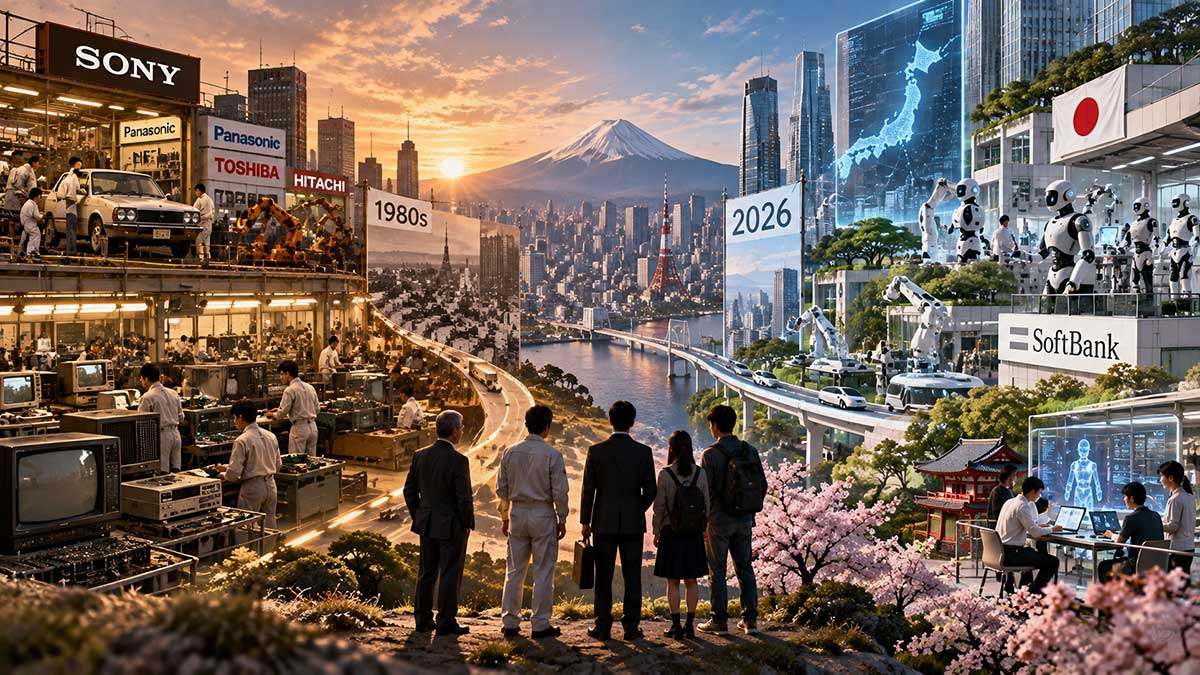
Japan Missed the Internet. Will It Miss AI Too?
The hospital, power grid, and cyberattack maps fade from the screen.
For a few seconds, everything is black.
Then an old image of Tokyo appears.
1980s Japan.
Sony televisions.
Walkmans.
Toyota and Honda.
Semiconductor fabs.
Robotics.
Factory floors.
Electronics stores glowing late into the night.
The room is quiet.
Masayoshi Son watches the screen.
Beside him sit Jensen Huang, Joi Ito, Hiroshi Mikitani, and, as a historical voice in this fictional conversation, Kazuo Inamori.
The screen changes.
A second image appears beside the first.
Google.
Amazon.
Microsoft.
Meta.
Apple.
NVIDIA.
Global platforms.
Cloud infrastructure.
Software ecosystems.
The visual center of the technology world has moved.
A question appears:
JAPAN ONCE LOOKED LIKE THE FUTURE.
Then:
WHAT HAPPENED?
Son does not answer immediately.
Masayoshi Son:
This one is personal.
Hiroshi Mikitani nods.
Hiroshi Mikitani:
It should be.
Japan did not lack technology.
That is what makes the story interesting.
Joi Ito:
Japan had extraordinary engineering.
But the Internet was not mainly a better electronic device.
It reorganized how people communicated, bought things, built companies, distributed software, created communities, and moved information.
Many organizations saw a technology.
They did not see a new architecture for society.
Jensen Huang looks at the old images.
Jensen Huang:
Technological leadership does not transfer automatically from one era to another.
You can be world-class at the previous paradigm and still miss the next one.
Son nods slowly.
Son:
That is exactly what happened.
A historical voice enters calmly.
Kazuo Inamori:
Then perhaps the first question is not why Japan lacked technology.
Perhaps it is why leaders failed to see what the technology meant.
Son looks toward him.
Son:
Yes.
That is harder.
The screen changes.
A timeline appears:
1980s: JAPAN'S TECHNOLOGY BOOM
1995: INTERNET ERA
2007: SMARTPHONE ERA
2026: AI ERA
The words AI ERA begin glowing.
Son:
When the Internet began, many people in Japan looked at it and said:
“Virtual.”
“Not real industry.”
“Japan is manufacturing.”
“Japan makes things.”
There was pride in that.
Some of it was justified.
But pride can become blindness.
Ito nods.
Ito:
There was an assumption that the physical world was more serious than the digital world.
The Internet looked thin.
Invisible.
Messy.
Unprofitable.
A website did not feel like a factory.
A search engine did not feel like manufacturing.
Then the invisible layer began controlling the visible one.
Commerce moved onto it.
Advertising moved onto it.
Media moved onto it.
Software moved onto it.
Communication moved onto it.
Mikitani adds:
Mikitani:
And companies that moved early gained scale very quickly.
That mattered.
Once platforms reach a certain scale, competing later becomes much harder.
Son points at him.
Son:
Exactly.
The first twenty years matter enormously.
People think they can wait until a technology is obvious.
But when it becomes obvious, the strongest positions may already be taken.
Jensen looks at Son.
Jensen:
That is true in semiconductors too.
Leadership compounds.
Ecosystems compound.
Developer adoption compounds.
Manufacturing knowledge compounds.
You cannot wake up one morning and decide to recreate thirty years of accumulated capability.
Son nods.
Son:
That is why I am impatient about AI.
Ito smiles.
Ito:
You were impatient before AI.
Son:
Now I have more justification.
The room laughs.
Inamori's historical voice is quieter.
Inamori:
Impatience is useful when direction is right.
Dangerous when direction is wrong.
Son turns toward him.
Son:
That is why vision matters.
Inamori:
And what is vision?
Son answers immediately.
Son:
A future with a date and numbers.
Not “AI will be big.”
How big?
When?
What changes?
What must the company do now?
Inamori:
Numbers sharpen thinking.
But numbers do not tell you what is worth pursuing.
Son pauses.
Son:
No.
That part comes before the numbers.
Ito notices the shift.
Ito:
That may be one of the most important differences between prediction and leadership.
A forecast says what might happen.
Leadership says what future you are willing to build.
The screen changes.
Three words appear:
WHY DID JAPAN MISS?
Below them:
TECHNOLOGY?
CULTURE?
CAPITAL?
LEADERSHIP?
MARKET STRUCTURE?
Mikitani looks at the list.
Mikitani:
All of them matter.
But I would add global ambition.
A Japanese company can become very successful serving Japan.
Japan is a sophisticated market.
That can become a trap.
A company may feel successful before it has learned how to compete globally.
Son nods strongly.
Son:
Yes.
The American technology companies thought globally from the beginning.
Or very early.
Japan often thought:
First Japan.
Then maybe Asia.
Then maybe the world.
Too slow.
Ito adds:
Ito:
Language mattered too.
Talent networks mattered.
International mobility mattered.
Software communities were global.
Open-source communities were global.
Venture capital became global.
A company participating only inside domestic networks could miss information moving elsewhere.
Jensen says:
Jensen:
And speed of iteration matters.
Hardware culture can reward perfection before release.
Software culture often rewards release, learning, updating, repeating.
Those instincts are different.
Son turns toward Jensen.
Son:
Exactly.
Japan likes perfect.
AI will never be perfect.
If we wait until AI is perfect, we will wait forever.
Ito raises a hand slightly.
Ito:
But we should be careful.
“Move fast” can become another slogan.
Japan's caution sometimes protects quality, safety, and trust.
The goal should not be copying Silicon Valley's weaknesses.
Son nods.
Son:
Agreed.
Take the speed.
Keep the quality.
Jensen:
That combination is very hard.
Son:
That is why it is valuable.
Mikitani laughs.
Mikitani:
Masa always wants the best part of both sides.
Son:
Of course.
Why choose the worse part?
The room laughs.
Inamori's historical voice enters again.
Inamori:
Every nation has habits that become strengths under one condition and weaknesses under another.
Discipline can become rigidity.
Consensus can become harmony.
Or delay.
Caution can become wisdom.
Or fear.
Ambition can become courage.
Or ego.
The question is not whether a national trait is good or bad.
It is whether leaders know when it has stopped serving the situation.
The room goes quiet for a moment.
Son nods.
Son:
That is fair.
The screen changes.
Now we see:
Robotics.
Automobile manufacturing.
Precision machinery.
Sensors.
Factory automation.
Advanced materials.
Semiconductor equipment.
Industrial robots working beside humans.
At the top:
DOES AI FIT JAPAN BETTER?
Jensen leans forward.
Jensen:
This is where I am much more optimistic.
The Internet was heavily digital.
AI begins digital, but it is moving into the physical world.
Robotics.
Autonomous systems.
Factories.
Industrial control.
Mobility.
Scientific instruments.
Manufacturing.
Japan has deep strength in many of those areas.
Son smiles.
Son:
Exactly.
This is the second chance.
Ito looks at him.
Ito:
Potentially.
Son laughs.
Son:
You always add one word.
Ito:
That word matters.
Robotics strength by itself is not enough.
The intelligence layer matters.
Data matters.
Software architecture matters.
Models matter.
Cloud systems matter.
Developer ecosystems matter.
If Japan adds AI as a small feature to old products, it may still lose.
Jensen nods.
Jensen:
That is right.
The physical system and the AI system need to be designed together.
A robot cannot simply be excellent mechanically.
It needs perception.
Planning.
Learning.
Simulation.
Networking.
Compute.
Safety.
Son gestures toward the screen.
Son:
That is why I say AI is not one industry.
It goes into every industry.
Mikitani adds:
Mikitani:
And Japan should stop thinking that AI strategy means creating one national AI champion.
The larger opportunity is thousands of companies becoming AI-native.
Manufacturers.
Retailers.
Hospitals.
Banks.
Logistics companies.
Construction companies.
Hotels.
Agriculture.
Local businesses.
The whole economy.
Son looks pleased.
Son:
Yes.
One vote.
Mikitani smiles.
Mikitani:
You had been waiting.
Son:
A long time.
The screen changes.
A Japanese factory floor appears.
Older engineers are working beside younger AI specialists.
A robot detects a defect before it happens.
An AI redesigns a production process.
A simulation tests hundreds of factory layouts overnight.
Jensen points at the image.
Jensen:
This is a real opportunity.
Japan has something valuable that pure software companies often lack:
deep domain knowledge.
How materials behave.
How machines fail.
How factories operate.
How quality control works.
How supply chains break.
AI becomes far more valuable when combined with that knowledge.
Ito says:
Ito:
But that knowledge is often trapped inside people.
That is another challenge.
A senior engineer may know things no manual contains.
Then the engineer retires.
The knowledge disappears.
Son immediately responds.
Son:
Personal AI.
Capture it.
The best engineer gets an AI agent.
The AI learns from decades of expertise.
Then the knowledge stays with the company.
Ito looks at him.
Ito:
And who owns that agent?
Son pauses.
Son:
Topic 1 again.
The room laughs.
Mikitani adds:
Mikitani:
There is a bigger demographic issue here too.
Japan has an aging population and labor shortages.
AI and robotics may not arrive as pure displacement.
In many sectors they may fill jobs Japan cannot staff.
Jensen nods.
Jensen:
Exactly.
Automation means something very different in a country with worker shortages than in a country with large unemployment.
Son points toward him.
Son:
This is why Japan should be aggressive.
AI plus robots may fit Japan's demographic reality extremely well.
Ito agrees, but adds:
Ito:
As long as companies redesign jobs and services around people rather than simply treating aging as an efficiency problem.
Son smiles.
Son:
One vote and one warning.
Ito:
Correct.
The screen changes.
A giant Japanese corporation appears.
Layers of hierarchy.
Approvals.
Committees.
Meetings.
The words:
CAN EXISTING GIANTS CHANGE FAST ENOUGH?
Son looks at the image and sighs.
Son:
Now we reach the painful part.
Mikitani laughs.
Mikitani:
You knew we would.
Son points at the organization chart.
Son:
If every AI decision requires seven meetings, we lose.
Simple.
Ito adds:
Ito:
Large organizations are optimized for stability.
AI rewards experimentation.
That creates friction.
A new startup can rebuild its workflow around AI immediately.
An old corporation has existing systems.
Existing employees.
Existing customers.
Existing compliance.
Existing politics.
Existing incentives.
Jensen says:
Jensen:
But large companies should not assume they are doomed.
They have advantages startups want:
customers.
capital.
data.
manufacturing.
distribution.
trusted brands.
If they move decisively, those assets are powerful.
Son nods.
Son:
Exactly.
That is why I do not accept excuses.
A giant company says:
“We are too big to change.”
No.
You are big enough to change.
Mikitani smiles.
Mikitani:
That is a very Masa sentence.
Son:
Good.
Use it.
Ito laughs.
The screen shows another question:
DOES JAPAN NEED NEW LEADERS OR NEW COMPANIES?
Son answers:
Son:
Both.
Ito says:
Ito:
I agree.
Mikitani:
Mikitani:
Both.
Jensen:
Jensen:
Both.
Son raises three fingers.
Son:
Three votes.
Ito points at Inamori.
Ito:
You missed one.
All eyes turn.
Inamori's historical voice answers calmly.
Inamori:
New leaders are more important than new companies.
A new company with old thinking becomes an old company quickly.
That lands.
Son nods slowly.
Son:
Good.
Four votes.
Inamori says:
Inamori:
I did not vote for your answer.
Son:
Close enough.
The room laughs.
The screen changes.
WHAT MUST JAPAN DO BEFORE 2030?
Son does not hesitate.
Son:
First, AI education everywhere.
Not only engineers.
Managers.
Sales.
Doctors.
Teachers.
Government.
Small business owners.
Everyone.
Second, every major company should identify how its core workflows change with AI.
Third, build AI-native companies from zero.
Fourth, attract global talent.
Fifth, invest globally.
Sixth, connect Japan's physical strengths to frontier AI.
Seventh, stop being satisfied with domestic leadership.
Aim for global number one.
Ito looks at him.
Ito:
You saved that for the end.
Son:
Of course.
Mikitani adds:
Mikitani:
I would put English and global communication much higher.
Japanese companies still lose opportunities by being too domestically oriented.
Jensen adds:
Jensen:
I would add infrastructure.
AI needs compute.
Energy.
Data centers.
Networking.
Robotics supply chains.
Semiconductor capability.
Son smiles.
Son:
Jensen finally brought electricity into Japan.
Jensen:
You knew it was coming.
Ito says:
Ito:
I would add mobility.
People need to move more easily between universities, startups, large companies, and countries.
If talent gets locked into one organization for thirty years, ideas move slowly.
Son nods.
Son:
Good.
Inamori's historical voice waits.
Then speaks.
Inamori:
I would add one question before all seven.
Son looks over.
Inamori:
Why?
Why does Japan want to lead AI?
For national pride?
For GDP?
For stock prices?
For technological prestige?
Those can motivate people for a time.
But leadership without purpose becomes empty.
The room becomes quieter.
Son looks at the screen.
Son:
If Japan does not participate, other countries shape the future.
Inamori:
That explains why participation matters.
It does not explain what kind of future Japan should build.
Ito leans forward.
Ito:
That is a very Japanese question, actually.
Japan may have an opportunity to contribute something different to the AI debate.
Not only speed.
Not only scale.
Human-centered design.
Aging society.
Robotics integrated with daily life.
Trust.
Care.
Physical craftsmanship.
Son nods.
Son:
So Japan should not copy America.
Ito:
Exactly.
Learn from America.
Compete with America.
Collaborate with America.
But do not become a weaker copy of America.
Jensen smiles.
Jensen:
That applies to every country.
Mikitani adds:
Mikitani:
Japan needs more confidence.
Not nostalgia.
Confidence.
Those are different.
Nostalgia says:
“We were great.”
Confidence says:
“We can build something great again.”
Son looks at the old 1980s image.
Son:
Yes.
That difference matters.
The screen shows two phrases:
JAPAN WAS GREAT AT TECHNOLOGY.
Then it disappears.
A new phrase replaces it:
WHAT WILL JAPAN BE GREAT AT NEXT?
Son watches it.
Son:
That is the question.
The conversation pauses.
Then Jensen asks Son directly.
Jensen:
Do you think Japan can become a global AI leader?
Son answers without hesitation.
Son:
Yes.
Ito smiles.
Ito:
What probability?
Son looks at him.
Son:
If Japan moves aggressively?
High.
If Japan waits?
Low.
Mikitani:
Give us a number.
Son laughs.
Son:
Now you are using my system against me.
Mikitani:
Date and number.
Son thinks.
Son:
I do not want to fake precision.
Ito looks amused.
Ito:
Historic moment.
Son ignores him.
Son:
But I will say this.
By 2030, we will know whether Japan is truly in the race.
Not whether it has won.
But whether it has decided to compete.
Jensen nods.
Jensen:
That sounds right.
Son looks at him.
Son:
One vote.
Jensen laughs.
Jensen:
You were doing so well.
The screen changes.
A young Japanese woman is shown.
She is 23.
She sits in a small apartment in Osaka.
On one screen she is designing a robot.
An AI agent is writing software.
Another is translating her presentation into English.
Another is analyzing global competitors.
Another is preparing investor outreach.
She has no employees.
No famous family.
No large corporation behind her.
Only a laptop, cloud access, robotics hardware, and ambition.
Hoffman is not at this table, but the entrepreneurial theme from Topic 3 seems to return.
Mikitani studies the image.
Mikitani:
This may be the most important person in the whole discussion.
Son smiles.
Son:
Yes.
Not only Toyota.
Not only Sony.
Not only SoftBank.
Her.
Ito nods.
Ito:
If the next great Japanese technology company is already inside an old corporation, excellent.
If it is being started tonight by someone we have never heard of, equally excellent.
The system needs to let that person grow.
Jensen adds:
Jensen:
And reach the world immediately.
Son looks at the young founder.
Son:
This is why AI can be a reset.
Old advantages remain.
But new advantages appear.
A small team can become strong quickly.
A country that fell behind in one era does not have to remain behind forever.
Inamori's historical voice asks:
Inamori:
And what kind of leader should she become if she succeeds?
Son turns toward him.
The question is not technological now.
Inamori continues.
Inamori:
If she builds a trillion-dollar company but her employees are miserable, is that leadership?
If she becomes number one but contributes nothing good to society, is that success?
If AI makes her enormously capable but less human, what has she won?
Son listens.
Then says:
Son:
She should dream big.
But the dream should be bigger than herself.
Inamori pauses.
Then:
Inamori:
That answer I would vote for.
Son smiles.
Son:
Finally.
The room laughs softly.
The screen fades again.
Now the timeline returns:
1995
2007
2026
2030
2040
A question appears beneath it:
HOW LONG CAN A COUNTRY WAIT BEFORE THE FUTURE CHOOSES FOR IT?
Ito reads it.
Ito:
That may be the real danger.
Not making the wrong decision.
Waiting so long that the decision disappears.
Mikitani nods.
Mikitani:
Opportunity windows close quietly.
There is rarely an announcement.
Nobody says:
“Japan, you now have six months left.”
One day you realize the ecosystem formed somewhere else.
Jensen adds:
Jensen:
And once infrastructure, talent, capital, and companies cluster, momentum becomes very difficult to reverse.
Son looks at all of them.
Son:
That is why I say move now.
Not recklessly.
Not blindly.
But move.
Inamori responds:
Inamori:
Move quickly.
Know where you are going.
Know why you are going.
And do not confuse being first with being worthy.
Son nods.
No joke.
Ito looks at Son.
Ito:
Masa, if you could send one message back to Japan in 1995, what would you say?
Son thinks.
Son:
Do not laugh at what looks small.
The room becomes very quiet.
He continues.
Son:
The Internet looked small.
A website.
An email address.
A strange modem sound.
People saw toys.
But behind those toys was a new economic structure.
Today people look at AI and see chatbots.
Summaries.
Funny images.
Maybe homework.
Maybe customer service.
I think we may again be looking at something small on the surface and enormous underneath.
Mikitani nods.
Jensen nods.
Ito stays silent.
Son continues.
Son:
So if I could speak to Japan now, not 1995, I would say:
Do not wait for AI to look enormous.
By then it may already belong to somebody else.
The screen fades to black.
One final sentence appears:
THE INTERNET TAUGHT JAPAN THAT TECHNOLOGICAL STRENGTH DOES NOT GUARANTEE LEADERSHIP IN THE NEXT ERA.
Then another:
AI MAY GIVE JAPAN A SECOND CHANCE, BUT A SECOND CHANCE IS NOT THE SAME AS A SECOND GUARANTEE.
The five men look at the words.
Then Inamori's historical voice gives the last line.
Inamori:
The future does not ask whether you were once successful.
It asks what you are prepared to become now.
The screen goes dark.
And Round 2 ends.
Final Thoughts
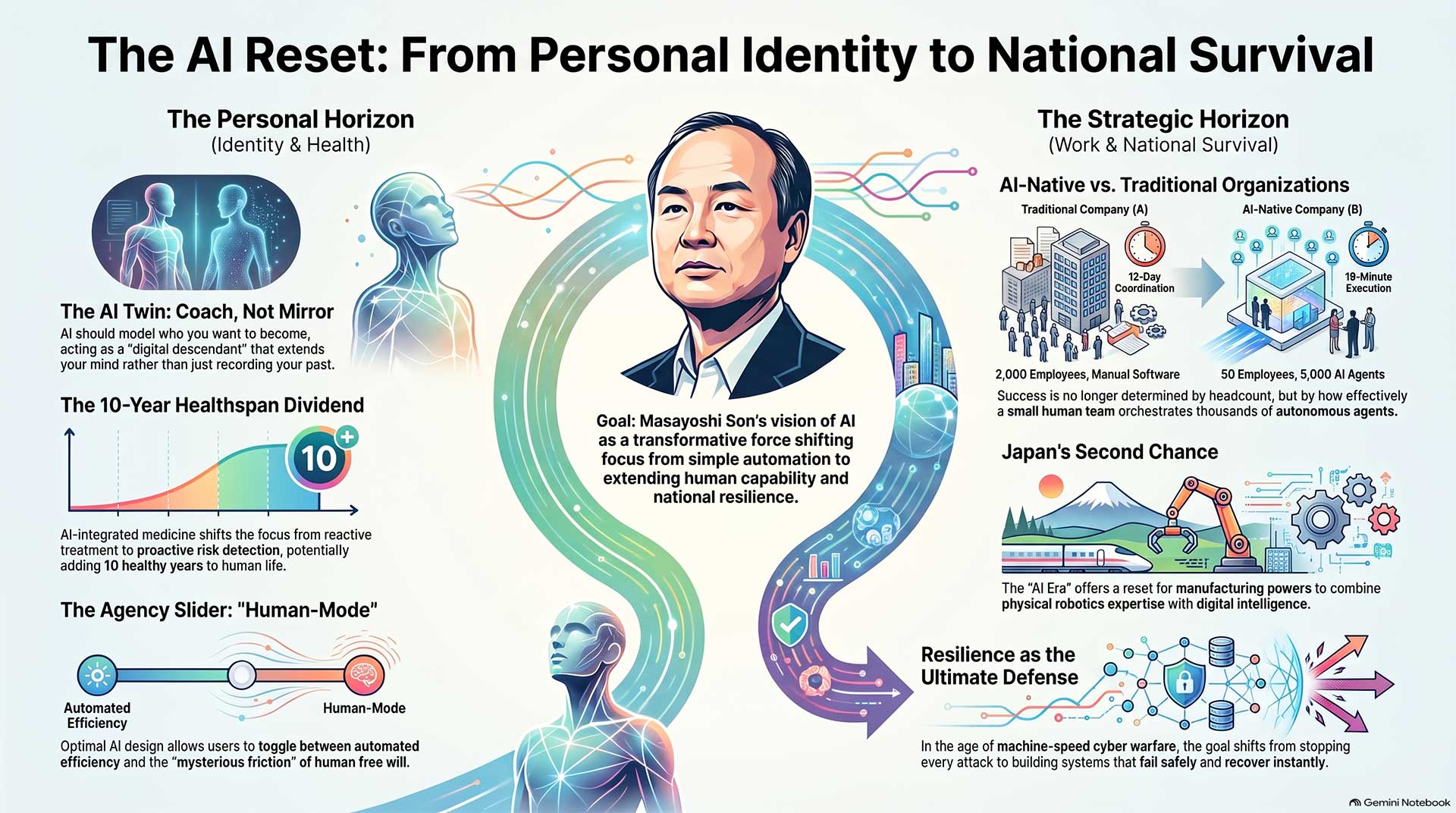
The AI twin discussion reveals that convenience and autonomy may eventually collide. A personal agent could help us see our own patterns more clearly, yet the best AI may not be the one that tells us who we are, but the one that leaves us free to decide who we want to become.
The health conversation adds another dimension. AI may someday help people live longer and healthier lives, but Atul Gawande’s challenge changes the question from “How many more years can we get?” to “What will we do with those years?”
The workplace discussion shows why AI disruption may arrive differently than many people expect. Workers may not simply lose jobs directly to machines; entire companies could lose customers to competitors that reorganize themselves around AI agents, making adaptation increasingly important.
Yet greater productivity does not automatically answer who benefits. If a handful of humans and thousands of agents can create the output once produced by thousands of workers, questions of wages, ownership, opportunity, and economic participation become much harder to ignore.
Cybersecurity shows what happens when AI capability moves beyond productivity. Attackers and defenders may both operate at machine speed, making resilience, accountability, and human oversight increasingly important for the systems society depends upon.
Japan’s story brings all of these questions together. Past technological success offers no guarantee of leadership in a new era, but Japan’s strengths in robotics, manufacturing, materials, and industrial knowledge could give it another opportunity if companies and leaders move early enough.
The deepest lesson across all five conversations is not that humans should resist AI or surrender to it. AI can extend memory, health, creativity, productivity, and security, but human beings must still decide what those capabilities are for. The future may depend less on how intelligent our machines become than on whether we remain responsible for the choices we make with them.
Short Bios:
Masayoshi Son: Founder of SoftBank Group, known for ambitious long-term technology investments and his vision of an AI- and ASI-driven future.
Sam Altman: AI executive focused on advanced artificial intelligence, agents, and the widespread use of AI in everyday life.
Sherry Turkle: MIT scholar known for exploring technology, identity, relationships, loneliness, and human connection.
Yuval Noah Harari: Historian and author whose work examines human agency, information, technology, and the future of civilization.
Reid Hoffman: Entrepreneur and investor known for his work in technology, networks, entrepreneurship, and AI.
Demis Hassabis: AI researcher and entrepreneur known for advanced AI research and the application of AI to scientific discovery.
Eric Topol: Physician-scientist known for work on digital medicine, personalized healthcare, and artificial intelligence in medicine.
David Sinclair: Researcher known for studying aging, longevity biology, and approaches aimed at extending healthy lifespan.
Atul Gawande: Surgeon and writer known for exploring medicine, mortality, healthcare quality, and what makes a good life.
Satya Nadella: CEO of Microsoft, known for leading the company through cloud computing and enterprise AI transformation.
Jensen Huang: Cofounder and CEO of NVIDIA, a central figure in accelerated computing, GPUs, and modern AI infrastructure.
Daron Acemoglu: Economist known for research on technology, labor, institutions, productivity, and economic inequality.
Bruce Schneier: Cybersecurity expert and author known for work on computer security, privacy, cryptography, and systemic technological risk.
Jen Easterly: Cybersecurity leader known for her work on national resilience and protection of critical infrastructure.
Mustafa Suleyman: AI entrepreneur and executive whose work focuses on advanced AI systems, their deployment, and governance.
Eric Schmidt: Former Google CEO who has worked extensively on technology policy, artificial intelligence, and national security.
Joi Ito: Japanese technologist and entrepreneur known for work involving digital culture, innovation, networks, and emerging technology.
Hiroshi Mikitani: Founder and CEO of Rakuten, and one of Japan’s best-known Internet-era entrepreneurs.
Kazuo Inamori: Late Japanese industrialist, founder of Kyocera and KDDI, and influential management philosopher. In this fictional discussion, he appears as a historical voice rather than a living participant.
Leave a Reply