

Introduction
Nearly a century after Pearl S. Buck wrote The Good Earth, most of us no longer live in Wang Lung’s world.
We may never plow a field, survive a famine, take a concubine, or watch our children debate whether to sell the land that fed generations of our family.
And yet the questions beneath Wang Lung and O-lan’s lives have hardly disappeared.
They have simply changed clothes.
A father works for decades so his daughter will have choices—then discovers that the choice she makes is to leave the future he built for her.
A woman spends so many years taking care of everyone else that a pair of earrings becomes an almost embarrassing declaration that she is allowed to want something simply because it is beautiful.
A boy who once watched his family lose their home grows into a successful landlord—and must decide what the memory of suffering actually requires of him.
An aging farmer watches subdivisions rise around the last acres of his family land while his children struggle to understand why dirt, trees, fence posts, and an old barn can mean more than millions of dollars.
And a writer who helps strangers understand a refugee community discovers the uncomfortable difference between telling someone’s story and possessing it.
These are not modern retellings of The Good Earth.
Daniel is not Wang Lung.
Marisol is not O-lan.
Marcus’s eviction notice is not a famine.
Elias’s Ohio farm is not Wang Lung’s fields.
Rachel’s book is not Pearl S. Buck’s novel.
But something travels between their worlds.
The desire to make our families secure.
The danger of valuing people mainly for what they provide.
The strange ways suffering remains inside us after the suffering itself has ended.
The tension between gratitude and freedom.
The meaning we attach to places and objects other people might consider worthless.
And perhaps most deeply, the human desire to say:
This is mine.
My company.
My family.
My earrings.
My property.
My land.
My suffering.
My story.
These five modern-day stories ask what happens when that simple sentence becomes complicated.
Because perhaps The Good Earth was never only asking whether Wang Lung would keep his land.
Perhaps it was asking how much of anything a human being can truly keep.
(Note: This is an imaginary conversation, a creative exploration of an idea, and not a real speech or event.)
Story 1: The House He Bought for Them

Daniel Park had imagined this office belonging to his daughter for so long that he had never once considered asking whether she wanted it.
The thought struck him only when Sophie stood in the doorway holding a paper cup of coffee and said, “Dad, can we talk?”
Behind Daniel’s desk hung three framed photographs.
The first showed him at twenty-seven, skinny and exhausted, standing beside a dented white work van.
The second showed Park & Sons Construction’s first real crew, six men in dusty boots outside a half-finished house.
The third showed Sophie at her college graduation, Daniel and his wife, Mina, standing on either side of her.
Daniel had placed that photograph in the center.
He had also cleared the bookshelf along the wall.
Not completely.
Just enough room for someone else's things.
He had not told Sophie that.
“Sit,” he said.
“I’m okay.”
“Sit. You look nervous.”
“I am nervous.”
Daniel smiled.
“Then definitely sit.”
She did.
Sophie was twenty-four now, though sometimes Daniel still saw the eight-year-old girl sitting at the kitchen table doing multiplication homework as he came home after dark with drywall dust in his hair.
Sometimes he saw the thirteen-year-old who had begged him not to wear his construction clothes to a school event.
Sometimes the eighteen-year-old crying at the airport before leaving for college.
Mostly, though, he saw the woman in front of him and felt proud.
She had graduated with honors.
She spoke confidently.
She understood contracts better than most adults.
She had always been organized.
Responsible.
Careful.
Daniel had never said aloud what everyone in the company already assumed.
One day, Sophie would take over.
Maybe not immediately.
Maybe she would work somewhere else for a few years.
But eventually.
The company was hers.
He had built it that way.
“So?” he asked.
Sophie placed her coffee on the edge of the desk.
“I got a job offer.”
Daniel's face brightened.
“Good.”
“It’s in Minneapolis.”
The smile remained, but weakened slightly.
“Minneapolis?”
“Yes.”
“What company?”
“It’s not a company.”
She hesitated.
“It’s a nonprofit.”
Daniel waited.
“They develop affordable housing projects. They work with cities and community groups. They help convert abandoned properties and build mixed-income housing.”
Daniel said nothing.
Sophie continued.
“I'd be working on project planning and development.”
“How much?”
She looked down.
“Sophie.”
“Fifty-four.”
Daniel stared at her.
“Fifty-four thousand?”
“Yes.”
He leaned back.
“You went to school four years for fifty-four thousand dollars?”
“It’s an entry-level position.”
“At Park & Sons, you can start at seventy-five.”
“I know.”
“Eighty, if that is the issue.”
“It’s not the issue.”
“Health insurance. Retirement. Company car after one year.”
“Dad.”
“You already know half the clients. You know estimating. You know our systems.”
“Dad.”
“You don't have to stay forever. Work here three years. Learn operations. Then decide.”
Sophie looked at him.
“I already decided.”
Something tightened behind Daniel’s ribs.
He did not like the feeling.
He had experienced it before with banks.
With clients who delayed payment.
With inspectors who rejected work.
With doctors.
With men who told him no.
He knew how to respond to problems.
A problem was something you solved.
“What exactly are you deciding?”
“I’m taking the job.”
He looked toward the graduation photograph.
“Why?”
“I want to do it.”
“That is not a reason.”
“It is a reason.”
“You can do affordable housing here.”
“That’s different.”
“How?”
“Because I don’t want to work for Park & Sons.”
The words were quiet.
That made them worse.
Daniel looked at her for several seconds.
“Ever?”
Sophie inhaled.
“I don’t think so.”
He turned toward the window.
Outside, three trucks sat in the parking lot.
White.
Clean.
Park & Sons Construction printed in dark blue across the doors.
There had once been only one truck.
It had been older than Daniel.
The passenger window would not roll down.
The heater worked only when the vehicle was moving.
Mina used to complain that the van smelled like wet wood and coffee.
Daniel had loved it.
It was proof that he owned something.
“What have you been telling me all these years?” he asked.
Sophie frowned.
“What?”
“That you were interested.”
“I am interested in development.”
“You came to job sites.”
“You brought me.”
“You worked here summers.”
“You asked questions.”
“I like construction.”
“So?”
“So that doesn’t mean I want this.”
Daniel turned back.
“This?”
She immediately regretted the word.
“I didn’t mean it that way.”
“What way?”
“Like it’s nothing.”
“That is exactly how you said it.”
“No, Dad.”
He stood.
“This company paid for your college.”
“I know.”
“This company paid for your apartment.”
“I know.”
“This company paid for everything.”
“I know.”
“Do you?”
Sophie stood too.
“Yes.”
“Then why are you throwing it away?”
“I’m not throwing anything away.”
“You say you don’t want it.”
“That doesn’t mean I don’t value it.”
“What is the difference?”
“The difference is that it’s yours.”
Daniel stared at her.
“No.”
He pointed at her.
“It is yours.”
She shook her head.
“No, Dad. You decided that.”
Daniel’s mouth opened.
Nothing came out.
Sophie picked up her coffee.
“I knew this would go badly.”
“You knew?”
“Yes.”
“So you discussed it with your mother.”
“Dad.”
“You discussed my company with your mother before me?”
“It’s not about the company.”
“Everything is not about the company to you. I understand.”
“That’s not what I said.”
Daniel turned away again.
Sophie stood there for several seconds.
Then she said quietly, “I’m going home.”
“Fine.”
She moved toward the door.
Daniel spoke without looking at her.
“You know how many people would give anything to have what you have?”
Sophie stopped.
“Yes.”
“No, you don't.”
She closed her eyes.
Then she left.
At dinner that night, Mina served grilled fish, rice, kimchi, and soup.
Nobody mentioned Minneapolis.
Daniel ate quickly.
Sophie pushed vegetables around her plate.
Mina looked from one to the other.
Finally, she said, “This is ridiculous.”
Daniel continued eating.
Sophie said, “Mom.”
“No. I cooked. Nobody is talking. I did not cook for silence.”
Daniel put down his chopsticks.
“Your daughter is moving.”
“Our daughter.”
“She made it clear.”
Sophie looked at him.
“Can you not do that?”
“Do what?”
“Make everything sound like I am rejecting the family.”
“What do you call it?”
“I call it taking a job.”
“In another state.”
“People move for work.”
Daniel laughed once.
A short, humorless sound.
“Of course.”
Mina stared at him.
“Daniel.”
He ignored her.
Sophie’s face hardened.
“This is exactly why I didn’t want to tell you.”
“Why? Because I might have an opinion?”
“Because your opinion becomes a debt.”
Daniel stopped.
Mina said, “Sophie.”
But Sophie was already crying, though she seemed angry at herself for it.
“You always talk about everything you did for us like it was a gift, and then the second we make a choice you don’t like, suddenly it becomes evidence.”
Daniel looked confused.
“Evidence of what?”
“That we owe you the life you imagined.”
“I never said that.”
“You don't have to say it.”
“Then don't put words in my mouth.”
“I’m not.”
“You are.”
“Dad, you told everyone at the company I would take over.”
“I said maybe.”
“You told Uncle Joon you were keeping the business in the family.”
“That is normal.”
“You ordered new office furniture.”
Daniel froze.
Mina looked at him.
Sophie did too.
“What?”
Sophie wiped her face.
“I saw it.”
Daniel said nothing.
“The bookshelf. The second desk. You even got the chair I liked.”
Mina slowly turned toward her husband.
“You bought her an office?”
“I was preparing.”
“For what?” Sophie asked.
“For your future.”
“My future, or yours?”
The room fell silent.
Daniel stood.
He carried his bowl to the sink.
Mina watched him.
Sophie looked down.
Daniel turned around.
His voice was calm now.
Almost too calm.
“Do you know what I was doing when you were born?”
Sophie said nothing.
“I was installing cabinets during the day and cleaning a restaurant from eleven at night until three in the morning.”
“Dad, I know.”
“No.”
He shook his head.
“You know the sentence. You do not know the life.”
Mina looked at him carefully.
Daniel almost never spoke about those years.
Not in detail.
He told the funny stories.
The broken van.
The landlord who complained about the smell of Korean food.
The time he accidentally drove to Wisconsin with a customer’s dog asleep in the back of the van.
He did not tell the others.
The nights he fell asleep sitting upright.
The winter Mina heated the apartment using the oven when the furnace broke.
The month Daniel had twenty-three dollars left after rent and prayed no one would get sick.
The first time Sophie developed a fever and he waited until morning to take her to urgent care since he feared the bill.
The shame of that decision had remained inside him for twenty-three years.
“You think I wanted this company?” he asked.
Sophie looked at him.
“I wanted a paycheck.”
His voice trembled slightly.
“One paycheck. Then another.”
He looked toward Mina.
“We wanted health insurance.”
Mina lowered her eyes.
“We wanted an apartment where the bedroom window closed all the way.”
Daniel looked back at Sophie.
“You wanted dance lessons. Do you remember?”
“I was six.”
“You cried for three weeks.”
Sophie almost smiled.
Almost.
“I took one extra bathroom job. Saturday and Sunday. That paid for the year.”
“Dad...”
“No. Listen.”
He pointed toward the ceiling, though he seemed to be pointing beyond it.
“You grew up in a house with your own room. You went to a good school. You traveled. You graduated with no debt.”
His eyes were wet now.
“I did not have these things.”
“I know.”
“I gave you everything I did not have.”
Sophie stood slowly.
“I know.”
“Then why is that not enough?”
The question came out differently than Daniel intended.
It did not sound angry.
It sounded hurt.
Sophie’s expression softened.
She walked around the table.
“Dad.”
He turned away.
She stopped behind him.
Then she said the sentence she had been trying not to say since the office.
“You keep telling me you worked so I could have choices.”
Daniel closed his eyes.
“I chose.”
He said nothing.
Sophie waited.
Then, very quietly:
“Why does that feel like betrayal to you?”
Daniel looked at the floor.
Mina did not move.
The kitchen clock ticked.
Somewhere outside, a car passed.
Daniel had no answer.
Two days later, Sophie went back to the office.
She was not looking for her father.
She had left a folder in one of the conference rooms.
The building was almost empty.
Daniel had already gone to a job site.
As Sophie passed his office, she saw the half-cleared bookshelf again.
This time she stepped inside.
The new desk had been moved against the side wall.
There was still plastic around one leg.
She ran her fingers over the surface.
She felt guilty.
Then angry that she felt guilty.
On Daniel's desk sat an open cardboard box.
Inside were old papers, photographs, receipts, and small tools he had apparently been sorting.
Sophie glanced down.
A key caught her attention.
It was attached to a cracked red plastic tag.
No label.
Just a number.
She picked it up.
It looked ancient.
Rust at the edges.
She almost put it back.
Then she noticed a photograph underneath.
Her mother.
Much younger.
Standing beside a window holding a baby.
Sophie.
The apartment behind them was tiny.
Paint peeling near the frame.
A portable fan in the corner.
A mattress visible on the floor.
Sophie stared at it.
She had seen photographs from that apartment before.
But not this one.
Daniel walked in behind her.
She jumped.
“What are you doing?”
“I came for my folder.”
He saw the key in her hand.
His face changed.
Sophie held it up.
“What is this?”
Daniel put his tool bag down.
“Nothing.”
“Dad.”
He sighed.
“Apartment.”
“The first one?”
He nodded.
“Why do you still have the key?”
Daniel looked at her as though the answer were obvious.
Then realized it wasn't.
He sat.
Sophie remained standing.
“You were born there,” he said.
“I know.”
“Your crib was beside our bed.”
“I know that too.”
“No crib at first.”
Sophie looked at him.
“We used a laundry basket for a few weeks.”
She laughed in surprise.
“You did not.”
“We did.”
“Mom never told me that.”
“Your mother has standards now.”
Sophie smiled.
Daniel smiled too.
For the first time since the argument, the air softened.
He reached for the key.
Sophie handed it to him.
Daniel turned it over in his fingers.
“The landlord wanted two months deposit.”
“How much?”
“Eight hundred dollars.”
“That doesn't sound like much now.”
Daniel looked at her.
“Exactly.”
She immediately understood.
He continued.
“I had six hundred and forty.”
“What did you do?”
“Borrowed from your uncle.”
“Uncle Joon?”
“Yes.”
“He always says you loaned him money.”
“Later.”
Daniel leaned back.
“The first night we slept there, your mother cried.”
Sophie looked toward him.
“Why?”
“She was happy.”
Mina had never told her that either.
“She said, ‘Nobody can tell us to leave tonight.’”
Daniel looked down at the key.
“That sentence stayed with me.”
Sophie sat across from him.
For the next hour, Daniel told her stories he had never told in full.
Not speeches about sacrifice.
Stories.
The electric bill taped to the refrigerator so they would not forget which week it had to be paid.
The winter he worked with a fever.
The first contractor who refused to pay him.
The client who quietly gave him an extra three hundred dollars after learning Sophie had been born.
The used crib Mina found at a church sale.
The Sunday Daniel drove through neighborhoods he could not afford and looked at houses.
“I used to park,” he said.
“Just look.”
“At houses?”
“Yes.”
“Why?”
“To see what people had.”
Sophie smiled.
“That sounds a little creepy.”
Daniel laughed.
“Maybe.”
Then he became serious.
“I would imagine you running around inside.”
Sophie looked down.
“And when we finally bought our first house?”
“I sat in the garage for twenty minutes before going inside.”
“Why?”
“I did not know what to do.”
She looked at him.
“You had spent so long trying to get there.”
He nodded.
“And then?”
“Then there is another thing.”
“A bigger house?”
“Better schools.”
“Then?”
“College.”
“Then?”
Daniel smiled faintly.
“Then apparently you move to Minneapolis.”
Sophie laughed.
He did too.
Then both became quiet.
Sophie looked around the office.
“I don't hate this place.”
“I know.”
“I’m proud of you.”
Daniel nodded.
“I know.”
“Do you?”
That question surprised him.
Sophie leaned forward.
“I think sometimes when I say I don’t want the company, you hear that I don’t respect what you did.”
Daniel did not answer.
“But I do.”
She pointed toward the trucks outside.
“I grew up watching you build this.”
“I wanted it to be yours.”
“I know.”
“Why don't you want it?”
She thought for a moment.
Then answered carefully.
“Maybe I want to build something too.”
Daniel looked confused.
“This is already built.”
“Exactly.”
He almost objected.
Then stopped.
Sophie continued.
“If I come here, I would be taking over Dad's company.”
She looked at him.
“I want to find out what Sophie can build.”
Daniel lowered his eyes.
There was pain in that.
But there was pride too.
He was not ready to admit both.
“Fifty-four thousand,” he said.
Sophie laughed.
“Yes.”
“Terrible.”
“It’s not terrible.”
“Minneapolis winter.”
“I know.”
“Very cold.”
“I know.”
“Your mother will call every day.”
“I know.”
“Probably me too.”
“I know.”
Daniel turned the old key in his fingers.
“Your apartment?”
“Found one.”
“Safe?”
“Yes.”
“Good building?”
“Dad.”
“What?”
“You can visit before I sign.”
Daniel nodded.
“That is smart.”
Sophie rolled her eyes.
Then Daniel held out the key.
She frowned.
“What?”
“Take it.”
“What am I supposed to do with this?”
“Keep it.”
“Dad, this is yours.”
“No.”
He shook his head.
“It was ours.”
Sophie looked at the number on the faded red tag.
“I don't want to lose it.”
“You won't.”
“How do you know?”
Daniel shrugged.
“You lose it, then maybe you understand why I kept it so long.”
She smiled.
Then closed her fingers around the key.
Daniel looked at her hand.
“Don't forget where the first door was.”
Sophie looked at him for a long moment.
Then she said:
“I won't.”
She slipped the key into her pocket.
“But you opened it so I could walk somewhere else.”
Daniel stared at her.
He wanted to argue.
The words rose immediately.
A father does not work thirty years to watch his children walk away.
A company does not build itself.
Family should stay close.
Security matters.
Fifty-four thousand is ridiculous.
Minneapolis is too cold.
But beneath every objection was something he had not recognized before.
Fear.
Not fear for Sophie.
Not entirely.
Fear that if she chose another life, his life would somehow become smaller.
He looked again at the first photograph on the wall.
The skinny young man beside the dented van.
Daniel barely recognized him.
Yet everything in the office had come from that man.
Maybe a life did not become meaningless simply because the next person chose not to repeat it.
Daniel nodded once.
“Okay.”
Sophie looked surprised.
“Okay?”
“Don't make me say it twice.”
She laughed.
Then walked around the desk and hugged him.
Daniel held her tightly.
For a moment, neither moved.
Three weeks later, Sophie loaded the final suitcase into her car.
Mina had packed enough food to survive a natural disaster.
Daniel had inspected the tires twice.
He had also put a small toolbox in the trunk without asking.
“You don't need all this,” Sophie said.
“You will.”
“I live in an apartment.”
“Things break in apartments.”
“There are maintenance people.”
Daniel stared at her.
She laughed.
“Fine. Toolbox stays.”
Mina hugged Sophie and immediately began crying.
Daniel stood beside the driveway.
The house behind him was large.
Five bedrooms.
Three-car garage.
Stone front.
Finished basement.
The kind of house he once parked across the street from just to look.
Sophie hugged him last.
“Call me when you get there.”
“I will.”
“Not text.”
“I’ll call.”
“And if weather bad, stop.”
“I know.”
“And if the car makes any noise...”
“Dad.”
“Fine.”
She smiled.
Then touched her coat pocket.
“I have the key.”
Daniel nodded.
“Good.”
Sophie got into the car.
She rolled down the window.
“Dad?”
“Yes?”
“I’m not leaving you.”
He looked away for a second.
“I know.”
She drove off.
Daniel stood there long after the car disappeared.
Mina went inside.
He stayed.
In his hand was the key to the house behind him.
Heavy.
Newer.
Expensive lock.
He looked at it.
For years, Daniel had believed the proof that he had succeeded was that his children would always have somewhere to come home to.
Now, for the first time, he wondered whether success might mean something else.
Maybe the house was not proof that they would stay.
Maybe it was proof that they could leave without being afraid there would be nowhere to return.
Daniel closed his hand around the key.
Then opened it again.
The house was still there.
So was he.
And somewhere on the highway north, his daughter was carrying the key to the first door he had ever opened for her.
Story 2: The Earrings in the Drawer
Marisol Vega saw the earrings on a Tuesday afternoon when she was supposed to be buying compression socks for her mother.
They were in the window of a small jewelry shop between a bakery and a dry cleaner.
Blue enamel.
Oval.
No stones.
No gold.
Nothing dramatic.
She stopped anyway.
The color reminded her of swimming pools when she was a child, before sunscreen, school pickups, insurance forms, prescription refills, grocery lists, and everyone asking where things were.
For several seconds she simply looked.
Then her phone buzzed.
Mom.
Marisol answered.
“Hi, Mami.”
“Did you get the socks?”
“I’m getting them.”
“Not the tight ones.”
“I know.”
“The last ones were too tight.”
“I know.”
“And check if they have the beige.”
“I wrote it down.”
“Your sister said she can take me Thursday.”
“That’s good.”
“But I told her you already said you would.”
Marisol closed her eyes.
“Yes. I’ll take you.”
“Okay. And your cousin called.”
“Which cousin?”
“Teresa.”
“What does she need?”
“I don’t know. Something about Saturday.”
Of course.
Marisol looked again at the earrings.
“I’ll call her.”
“Okay, mija.”
“Love you.”
“Love you too.”
The call ended.
Marisol almost walked away.
Instead, she opened the jewelry shop door.
A bell rang overhead.
The woman behind the counter looked up.
“Hi.”
“Hi.”
Marisol pointed.
“Those blue ones.”
The woman smiled.
“Good choice.”
Marisol laughed softly.
“That sounded dangerous.”
“They’re forty-eight dollars.”
“Less dangerous.”
The woman removed them from the display.
Up close, the enamel was slightly uneven.
Handmade.
Marisol liked that.
“They’re beautiful,” she said.
The words slipped out before she could stop them.
The woman handed her a small mirror.
“Try them.”
Marisol shook her head.
“I’m okay.”
“You sure?”
“Yes.”
She hesitated.
Then:
“I’ll take them.”
The woman wrapped them in tissue paper and put them in a white box.
“Gift?”
Marisol almost said yes.
Then she said:
“No. They’re for me.”
The woman smiled.
“That’s even better.”
Marisol carried the box out of the store feeling strangely guilty.
Not terribly guilty.
Just enough.
Forty-eight dollars could buy groceries.
Gas.
Part of her mother’s medication.
A birthday gift.
Something for the house.
Something useful.
The earrings were none of those things.
She liked them anyway.
That evening she placed the box in the top drawer of her dresser beneath two scarves.
She told herself she would wear them on Friday.
Friday came.
She did not.
There was dinner with Luis’s brother and his family.
Marisol wore the small silver hoops she always wore.
The blue earrings stayed in the drawer.
The next week, her daughter Elena called.
“Mom, can you pick up Mateo from daycare?”
“What time?”
“Five-thirty.”
“I get off at five.”
“I know. I’m stuck.”
“Okay.”
“Thank you. You’re saving me.”
Marisol smiled.
“Love you.”
“Love you too.”
That evening, she came home with Mateo asleep against her shoulder.
Luis met her at the door.
“Dinner’s almost ready.”
“You cooked?”
“I heated.”
“That is not cooking.”
“It was cooked before I heated it. Somewhere.”
She laughed.
Mateo woke and immediately asked for juice.
Luis took him.
“Go sit down.”
“I’m fine.”
“Sit.”
“I have to call my mother.”
“Call her sitting.”
Marisol smiled.
Luis was a good husband.
This mattered.
He noticed when she was tired.
He rubbed her shoulders.
He made coffee every morning.
He had been with her twenty-six years.
He still called her pretty when she looked exhausted.
Which made what happened later harder to explain.
The earrings remained in the drawer.
Weeks passed.
Then months.
Every so often Marisol opened the box.
Once, late at night, she tried them on.
They looked brighter than she expected.
She stood in front of the mirror.
Her hair was tied back.
No makeup.
Old T-shirt.
The earrings changed nothing.
They also changed something.
Marisol turned her head.
The blue caught the bathroom light.
She smiled.
Then Luis knocked.
“You okay?”
She quickly removed them.
“Yes.”
“What are you doing?”
“Nothing.”
“Come to bed.”
“In a minute.”
She put the earrings back in the box.
She did not know why she hid them.
No one had forbidden her to buy them.
Luis would not care.
The children would not care.
Still, they felt private.
Not secret.
Private.
There was a difference.
Marisol liked knowing they were there.
Something unnecessary.
Something untouched by everyone else’s needs.
Then came the Sunday cleaning.
Luis was preparing the guest room before his niece Camila’s birthday dinner.
Marisol was at her mother’s.
Their youngest son, Nico, was home from college.
The house was noisy.
Music playing.
Laundry moving from room to room.
Boxes being opened.
Closets reorganized.
Luis decided to clean the bedroom.
He dusted.
Vacuumed.
Sorted a pile of old receipts.
Opened Marisol’s dresser drawer looking for extra batteries.
He saw the white box.
He opened it.
Blue earrings.
Unused.
He thought for a moment.
Then smiled.
Camila loved blue.
At dinner that night, Camila opened a small gift bag.
She gasped.
“Oh my God.”
Marisol looked over from the kitchen.
Camila lifted the earrings.
The room tilted.
Not dramatically.
Just enough.
Marisol stared.
Luis was smiling.
“I found them in the drawer.”
Camila put them against her ears.
“They’re so pretty.”
Everyone agreed.
Marisol said nothing.
Then Luis looked toward her.
“You never wore them, right?”
Silence.
It lasted maybe one second.
Maybe less.
Marisol heard herself say:
“No.”
Luis nodded.
“I figured you didn’t like them.”
Something rose in her chest.
Hot.
Fast.
Embarrassing.
Camila smiled at her.
“Aunt Mari, are you sure?”
Marisol looked at the earrings in her hands.
“Yes.”
Her voice sounded far away.
“They look good on you.”
Camila hugged her.
“Thank you.”
Marisol hugged her back.
Then carried plates to the table.
She made it through dinner.
She laughed.
She cut cake.
She packed leftovers.
She reminded Elena to take Mateo’s sweater.
She found Nico’s missing charger.
She gave her mother the medication she had picked up earlier.
Then everyone left.
Luis locked the door.
Marisol stood at the sink with her hands in soapy water.
Luis came behind her.
“That went well.”
She kept washing.
“Mm-hm.”
“Camila loved the earrings.”
Marisol stopped.
Luis did not notice.
“I knew she would.”
Marisol rinsed a plate.
“You gave away my earrings.”
Luis looked at her.
“What?”
She turned.
“My earrings.”
He blinked.
“I thought you didn’t want them.”
“Why?”
“You never wore them.”
“That means I didn’t want them?”
“I mean…”
He looked confused.
“They were in the drawer for months.”
“So?”
“So I thought you forgot about them.”
Marisol felt herself becoming angry again.
She hated it.
Not him.
The anger.
It felt too large for forty-eight-dollar earrings.
Luis saw it now.
“Wait. Were they important?”
Marisol laughed once.
Not happily.
Luis frowned.
“I’m asking.”
“They were mine.”
“I know.”
“No, apparently you didn’t.”
“That’s not fair.”
“Isn’t it?”
Luis stared at her.
“If I knew you cared about them, I wouldn’t have touched them.”
Marisol crossed her arms.
“I shouldn’t have to submit paperwork proving something matters before it can stay mine.”
Luis looked hurt.
“That’s not what happened.”
“What happened, then?”
“I thought they were sitting there unused.”
“So you gave them away.”
“To Camila.”
“Yes.”
“You love Camila.”
“That has nothing to do with it.”
“I was trying to do something nice.”
“I know.”
“Then why are you talking to me like I stole from you?”
Marisol looked at him.
Her eyes filled.
That frightened Luis more than the anger.
“Mari.”
She turned away.
“I’m tired.”
“Of what?”
She looked around the kitchen.
The counters.
The lunch containers.
The envelopes waiting to be mailed.
Her mother’s pill organizer.
Mateo’s toy truck under the chair.
A grocery list held to the refrigerator by a magnet from a vacation she barely remembered enjoying.
“Everything.”
Luis stood still.
Marisol wiped her face angrily.
“I don’t mean everything. I mean…”
She struggled.
“I don’t know.”
Luis pulled out a chair.
“Sit.”
“I don’t want to sit.”
“Okay.”
He remained standing.
Marisol looked at him.
“Do you know what everyone asks me?”
Luis said nothing.
“Where is this?”
“Can you pick up that?”
“Can you call them?”
“Did you remember the appointment?”
“Can you bring something?”
“Can you watch Mateo?”
“Can you talk to Mom?”
“Can you send the birthday card?”
“Can you find my insurance card?”
Luis opened his mouth.
She raised a hand.
“No. I know you help.”
He closed it.
“You do.”
Her voice softened.
“You really do.”
That almost made her cry harder.
“This isn’t about you being bad.”
“Then what is it?”
Marisol stared at the kitchen window.
Her reflection looked back at her.
“I think everybody got used to me being available.”
Luis leaned against the counter.
“And I let them.”
He did not answer.
“I like helping.”
She looked at him.
“I do.”
“I know.”
“I love my mother. I love Elena. I love the kids. I love Mateo. I love you.”
“I know.”
“But sometimes I feel like if I disappeared, everyone would miss the services.”
Luis flinched.
“Mari.”
“I know that sounds terrible.”
“It sounds terrible because it’s not true.”
“I know it’s not completely true.”
“Not even close.”
She nodded.
“Maybe.”
Then she whispered:
“But some days it feels true.”
Luis looked down.
The anger had left his face.
Marisol continued.
“The earrings were stupid.”
“They weren’t.”
“They were.”
“They weren’t.”
“They didn’t do anything.”
Luis almost smiled.
“Earrings rarely do.”
She did not smile back.
“That was the point.”
He looked at her.
“What?”
Marisol took a long breath.
“They were the first thing I bought in years that had no reason.”
Luis said nothing.
“No birthday.”
“No holiday.”
“No work event.”
“No one else needed them.”
“I just saw them and wanted them.”
The word hung there.
Wanted.
Luis looked toward the hallway leading to their bedroom.
“Why didn’t you wear them?”
“I don’t know.”
“You bought them.”
“I know.”
“So…”
“I think I liked that they were there.”
He still looked confused.
Marisol tried again.
“Everything I buy usually turns into something.”
“Food gets eaten.”
“Soap gets used.”
“Clothes are for work.”
“Gifts go to someone.”
“Money goes somewhere.”
“The earrings just stayed mine.”
Luis sat down.
Marisol watched him.
He rubbed his forehead.
“I really screwed this up.”
She sighed.
“I don’t want you to make this into some huge thing.”
“It is a huge thing if you’re crying.”
“I’m crying because I’m tired.”
“And the earrings.”
“And the earrings.”
He nodded.
“I’ll buy you another pair.”
“No.”
“Mari.”
“No.”
“Why not?”
“Because that won’t fix it.”
“I know, but…”
“I don’t want replacements.”
“Okay.”
He looked down again.
Then said:
“I’m sorry.”
Marisol stared at him.
“I mean it.”
“I know.”
“I should have asked.”
“Yes.”
“I honestly thought you didn’t care.”
“I know.”
Luis looked at her carefully.
“Why did you have to care quietly?”
She looked away.
That question surprised her.
He continued.
“You’re mad that I didn’t see it.”
“Yes.”
“But you hid it.”
“I know.”
“I’m not blaming you.”
“It sounds like you are.”
“I’m not.”
He paused.
“I’m asking why.”
Marisol sat at last.
She folded her hands.
“I think…”
She stopped.
Then started again.
“I think somewhere along the way, wanting things for myself started to feel embarrassing.”
Luis looked stunned.
“Why?”
“I don’t know.”
“You work.”
“I know.”
“You make your own money.”
“I know.”
“You don’t have to ask me permission.”
“I know.”
“Then why?”
She looked at him.
“Because everybody needs something.”
Luis had no answer.
She continued.
“When your mother got sick, we helped.”
“When my mother stopped driving, I helped.”
“When Elena had Mateo, I helped.”
“When Nico had trouble at school, I helped.”
“When you started the new job, I helped.”
“When Dad died, everybody came here and I helped.”
“It just keeps going.”
Luis nodded slowly.
“And at some point, if I wanted something that didn’t help anybody…”
She laughed softly.
“It felt selfish.”
Luis reached across the table.
Marisol let him take her hand.
“I never wanted you to feel that.”
“I know.”
“That doesn’t make it okay.”
“I know.”
They sat in silence.
Then Luis asked:
“What did you like about them?”
Marisol looked up.
“The earrings?”
“Yes.”
She almost said she did not know.
Then she thought about the shop window.
“Blue.”
Luis smiled.
“Very detailed.”
She laughed.
“No. I mean the color.”
“What color?”
“Like pool water.”
He waited.
“When I was a kid, my aunt had a pool.”
“I didn’t know that.”
“It wasn’t really hers. Apartment complex.”
“You still count it.”
She smiled.
“We used to stay in until our fingers wrinkled.”
“I can picture you.”
“No, you can’t.”
“I can try.”
Marisol looked down.
“I hadn’t thought about that in years.”
Luis squeezed her hand.
“So they reminded you of being a kid.”
“Maybe.”
“No one needing anything.”
She looked at him.
That was it.
Luis saw it on her face.
“Oh.”
Marisol nodded.
“Oh.”
The kitchen went quiet again.
This time the silence felt gentler.
Three days later, Luis drove to Camila’s apartment.
He did not ask for the earrings back.
Marisol had made that clear.
Camila had done nothing wrong.
He brought her a small cake instead and stayed for coffee.
When he returned home, Marisol was sitting on the sofa watching television.
Luis sat beside her.
“I talked to Camila.”
Marisol looked worried.
“You didn’t ask for them.”
“No.”
“Good.”
“She wore them.”
Marisol smiled faintly.
“They looked good?”
“Very.”
“Good.”
Luis paused.
“Want to go somewhere Saturday?”
“Where?”
“I don’t know.”
“What do we need?”
“Nothing.”
Marisol laughed.
“That sounds suspicious.”
“I thought maybe we could do something with no purpose.”
She looked at him.
“Lunch?”
“Too practical.”
“A movie?”
“Still technically entertainment.”
She smiled.
“That’s allowed.”
“Fine. Movie.”
“Maybe.”
Luis leaned back.
Then said:
“You know you can say no to people.”
Marisol gave him a look.
“Don’t become a life coach.”
“Okay.”
“Seriously.”
“Understood.”
She rested her head against him.
Then said quietly:
“I have to learn.”
Luis nodded.
“So do we.”
The next Friday, Marisol left work early.
She did not tell anyone.
She drove back to the jewelry shop.
The same bell rang.
The same woman looked up.
“Oh.”
Marisol smiled.
“You remember me?”
“Blue earrings.”
Marisol laughed.
“That’s embarrassing.”
“Not at all.”
The woman looked toward the display.
“Want another pair?”
Marisol shook her head.
“Not the same.”
“Good.”
The woman came around the counter.
“What are we looking for?”
Marisol almost said something modest.
Something safe.
Instead:
“I don’t know.”
The woman smiled.
“Perfect.”
They looked for twenty minutes.
Marisol tried on silver leaves.
Too delicate.
Red beads.
Too bright.
Small green hoops.
Almost.
Then she saw a pair made from hammered brass with tiny turquoise drops.
She tried them on.
The woman held up the mirror.
Marisol looked.
“They’re not really me.”
The woman tilted her head.
“Maybe they are now.”
Marisol laughed.
“That is a dangerous sales strategy.”
“Is it working?”
“Yes.”
She bought them.
This time, she wore them out of the store.
No box hidden in a bag.
No drawer.
No plan for later.
She drove home with the windows down.
At dinner, Luis noticed immediately.
He said nothing.
Marisol saw him notice.
She appreciated that.
Nico came in halfway through the meal.
He opened the refrigerator.
“Anything good?”
“There’s chicken.”
He turned around.
Then stopped.
“Those are new.”
Marisol touched one earring.
“Yes.”
“They’re cool.”
“Thank you.”
“Dad buy them?”
Luis looked down at his plate.
Marisol smiled.
“No.”
“Who did?”
“I did.”
Nico shrugged.
“Nice.”
Then he took the chicken.
That was all.
Marisol laughed.
Luis looked at her.
“What?”
“Nothing.”
After dinner, everyone drifted away.
Nico went upstairs.
Luis took the trash out.
Marisol stood at the sink.
For years, this was the moment when her hands automatically moved toward whatever remained.
Plates.
Glasses.
Pans.
She reached for a dish towel.
Then stopped.
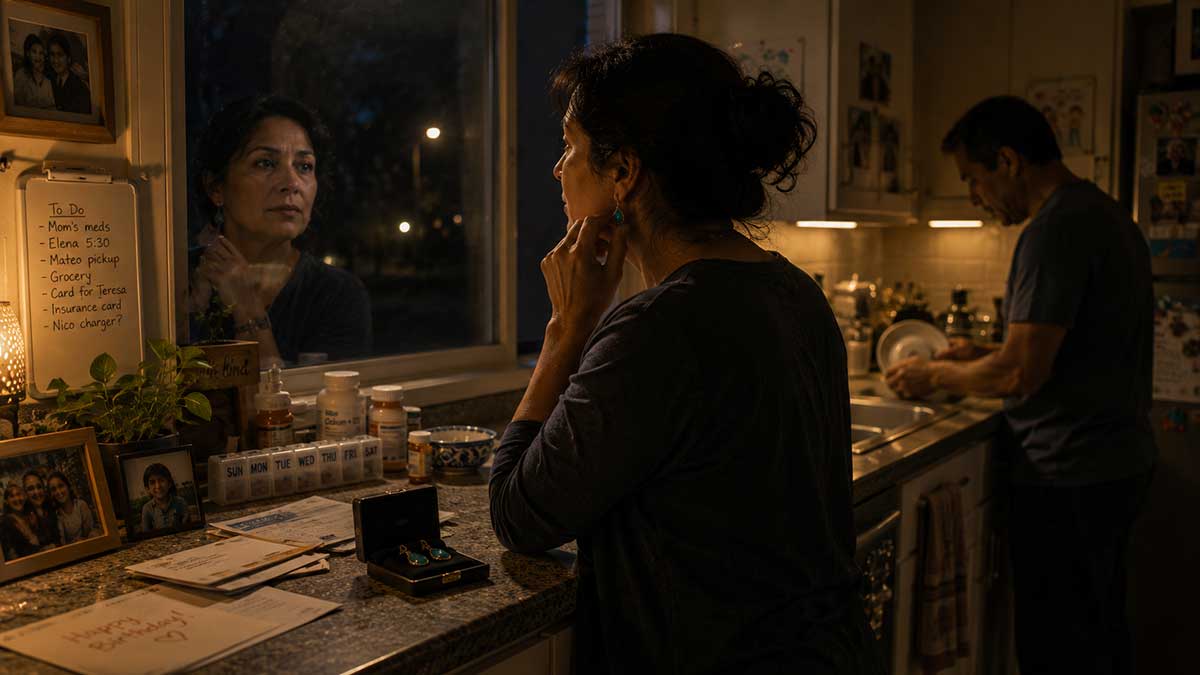
Outside the kitchen window, the glass had become dark enough to reflect her face.
She saw the earrings first.
Then herself.
She stood there.
Not long.
Maybe fifteen seconds.
Long enough.
Luis came back inside.
“You okay?”
Marisol did not turn around immediately.
“Yes.”
She looked at her reflection once more.
Then at him.
“Can you do the dishes?”
Luis smiled.
“Absolutely.”
Marisol walked out of the kitchen.
“Where are you going?”
She thought about it.
“Upstairs.”
“For what?”
She smiled.
“Nothing.”
Luis watched her go.
Then turned on the water.
Marisol climbed the stairs slowly.
In the bedroom, she opened the top dresser drawer.
The old white jewelry box was still there.
Empty now.
She picked it up.
For a second, she thought about throwing it away.
Instead, she placed it back in the drawer.
Not as a shrine.
Not as a wound.
Just as something that had once held something she wanted.
Then she closed the drawer.
In the mirror above the dresser, the turquoise caught the light.
Marisol touched one earring.
And this time, she did not feel ridiculous at all.
Story 3: After the Eviction Notice
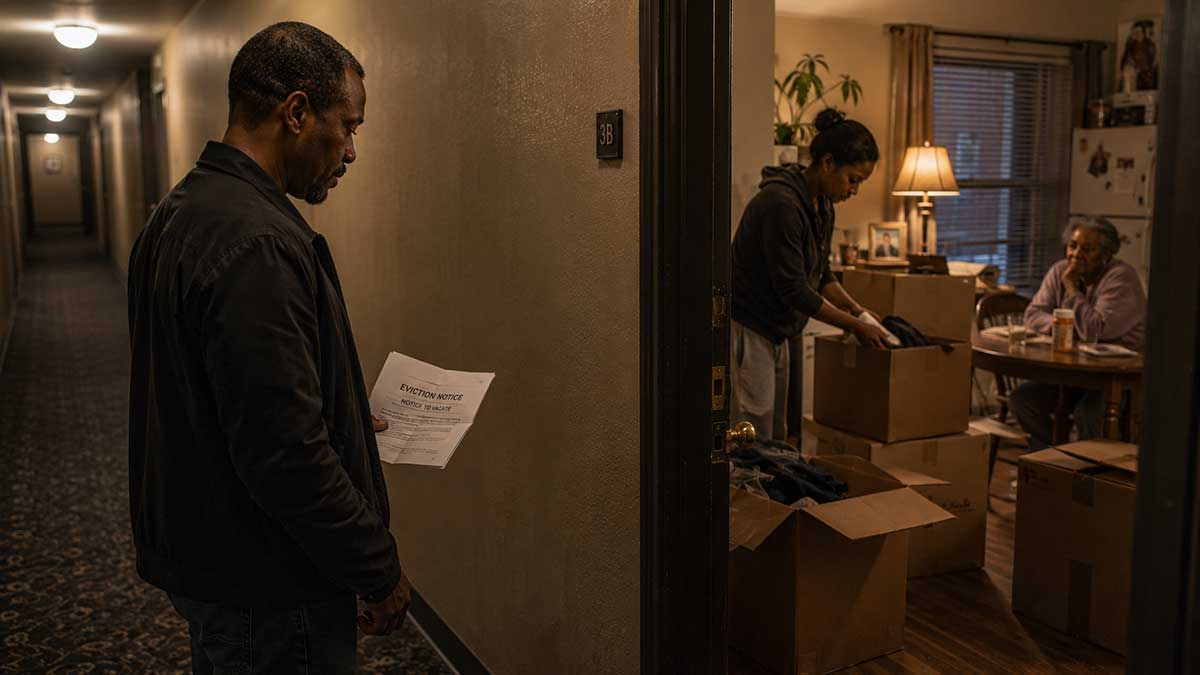
Marcus Reed kept the eviction notice in a blue plastic storage box beneath old tax returns, baseball cards, and the first lease he had ever signed as a landlord.
He had not looked at it in years.
He did not need to.
He knew every line.
FINAL NOTICE.
PAYMENT REQUIRED.
VACATE PREMISES.
He had been nine years old when the paper appeared on the apartment door.
His mother had torn it down quickly.
Too quickly.
As if Marcus might not have seen.
He had.
That Friday, their furniture sat on the sidewalk.
A brown sofa.
Two dining chairs.
Three black trash bags of clothes.
A television with a cracked corner.
Marcus remembered standing beside the sofa holding his school backpack.
He remembered people driving past.
He remembered refusing to look at them.
His mother had asked the landlord for one more week.
Seven days.
He said no.
That night, Marcus learned something he carried for the next forty-two years.
Never build a life that depends on mercy.
By fifty-one, he owned forty-three rental units.
He had built them one property at a time.
A duplex first.
Then a small four-unit building.
Then six.
He repaired sinks himself.
Painted hallways.
Replaced furnaces.
Collected rent.
Fought contractors.
Argued with insurance companies.
Refinanced.
Saved.
Bought again.
People called him successful now.
Marcus preferred prepared.
Success sounded lucky.
Prepared sounded earned.
His son Andre worked with him part-time.
Andre was twenty-two, an accounting student, organized to the point of irritation.
Marcus liked that.
Andre built spreadsheets for everything.
Vacancies.
Repairs.
Taxes.
Projected cash flow.
One Tuesday morning, Andre was sitting at the desk in Marcus’s office when a woman walked in.
Tasha Green.
Unit 3B on Superior Avenue.
Marcus knew before she spoke.
People walked differently when they were coming to ask for time.
“Mr. Reed?”
Marcus looked up.
“Tasha.”
She held an envelope in both hands.
“I wanted to talk about rent.”
Marcus leaned back.
Andre kept his eyes on the computer.
“How much can you pay today?”
“Four hundred.”
“You owe eleven twenty.”
“I know.”
“Late fee already applied.”
“I know.”
Marcus waited.
Tasha swallowed.
“My mother was in the hospital.”
Marcus said nothing.
“She lives with me.”
“I know.”
“I missed almost two weeks of work.”
“What about the four hundred?”
“I have it now.”
“And the rest?”
“I can get it by next Friday.”
Marcus looked at the calendar.
“That is twelve days.”
“Yes.”
“No.”
Tasha blinked.
“I’m sorry?”
“Rent was due on the first.”
“I know, but…”
“You were already given the grace period.”
“I understand.”
“Then you understand.”
Andre looked up.
Tasha tightened her grip on the envelope.
“I’ve never been late before.”
Marcus checked the ledger.
She was right.
Fourteen months.
Every payment on time.
That helped.
It did not change the rule.
“You need to pay the balance by Friday.”
Her face dropped.
“This Friday?”
“Yes.”
“I can’t.”
Marcus folded his hands.
“I’m sorry.”
Tasha stared at him.
“Are you?”
The question irritated him.
“I have mortgages too.”
“I know.”
“Insurance went up.”
“I know.”
“Repairs cost money.”
“I’m not asking you to erase it.”
“Then what are you asking?”
“Time.”
Marcus held her gaze.
“I don’t run the business on exceptions.”
Tasha looked toward Andre.
Andre looked down.
Then she turned back.
“Okay.”
She placed the four hundred dollars on the desk.
Marcus pushed it back.
“Full payment only.”
Tasha looked stunned.
“I thought paying something would help.”
“It complicates the filing.”
She slowly picked up the envelope.
Marcus printed the notice.
Andre watched.
Marcus signed it.
Then slid the paper across the desk.
Tasha stared at the words.
Her eyes did not fill.
That was worse.
She folded the paper once.
Then once again.
“Thank you for your time.”
She left.
The door shut.
Andre did not move.
Marcus returned to his computer.
After a minute, Andre said, “That was cold.”
Marcus looked up.
“What?”
“That.”
“She owes rent.”
“I know.”
“So?”
“She asked for twelve days.”
Marcus stared at him.
“Do you know how many people ask for twelve days?”
“No.”
“Then twelve becomes twenty.”
“Not always.”
“Enough.”
Andre turned in his chair.
“She’s never been late.”
“That makes her better than people who are late every month.”
“You could have worked something out.”
Marcus laughed.
“With whose money?”
Andre said nothing.
Marcus pointed around the office.
“You see all this and think it runs on kindness?”
“No.”
“Good.”
“I think it can run on judgment.”
Marcus’s expression changed.
“You think I don’t use judgment?”
“I think you use rules so you don’t have to.”
Marcus stood.
“That is enough.”
Andre stood too.
“You know what your problem is?”
Marcus laughed again.
“Please. Tell me.”
“You think every person who needs help is trying to become dependent on you.”
Marcus’s face hardened.
“You have no idea what you’re talking about.”
“I know what I just watched.”
“No, you know a spreadsheet.”
Andre flinched.
Marcus immediately regretted it.
He did not apologize.
Andre grabbed his backpack.
“Where are you going?”
“Class.”
“You don’t have class until two.”
“I’m leaving early.”
He walked out.
Marcus sat again.
His hands were trembling.
He told himself it was anger.
It was not entirely anger.
That evening Andre came home carrying the blue storage box.
Marcus was in the garage fixing a cabinet hinge.
He saw the box and froze.
“What are you doing with that?”
“Mom said it was yours.”
“It is.”
“I was looking for the old closing documents.”
“You ask before going through my things.”
Andre set the box on the workbench.
“I found this.”
He held up the eviction notice.
Marcus stared at it.
The paper had yellowed.
Andre unfolded it carefully.
“This yours?”
Marcus put down the screwdriver.
“Yes.”
“How old were you?”
“Nine.”
Andre looked at the notice.
“Seven days.”
Marcus said nothing.
“That’s what your mom asked for?”
Marcus looked at him sharply.
“How do you know that?”
“You told me once.”
“I did not.”
“You did. Years ago. You said she asked the landlord for a week.”
Marcus remembered.
Maybe he had.
Andre held up the paper.
“You kept this for forty years.”
“Put it back.”
“Why?”
“Because it belongs to me.”
“What did you keep it for?”
Marcus turned away.
“Andre.”
“No. I’m serious.”
“I said put it back.”
Andre did not.
Marcus turned.
Andre’s voice was quieter now.
“Why did you keep this all these years if it taught you nothing about the person on the other side of the door?”
Marcus stared at him.
That sentence landed harder than the argument.
He walked over and took the paper from Andre’s hand.
“You think it taught me nothing?”
“I think today it didn’t.”
Marcus laughed once.
“Boy, that paper taught me everything.”
Andre said nothing.
Marcus held it up.
“It taught me nobody is coming.”
His voice had changed.
“It taught me people feel sorry for you right up until your problem costs them something.”
Andre watched him.
“It taught me my mother could cry, beg, work two jobs, do everything she was supposed to do, and none of that mattered when rent was due.”
Andre’s face softened.
Marcus kept going.
“It taught me never to stand on a sidewalk again with my things in trash bags.”
He hit the paper with one finger.
“That is what it taught me.”
Andre said, “So now you make sure somebody else stands there first.”
Marcus stopped.
The garage went silent.
Andre looked frightened by his own words.
Marcus stepped back.
“Get out.”
“Dad.”
“Get out.”
Andre left.
Marcus stood alone.
The eviction notice shook in his hand.
He put it back in the box.
Then shut the lid.
Hard.
The next morning, Marcus filed the paperwork.
He told himself there was no connection between what Andre had said and how badly he had slept.
He told himself Tasha was not his mother.
He told himself business did not work if every tenant brought a story.
He told himself stories were exactly how people avoided consequences.
By noon, he almost believed himself.
Then his phone rang.
A maintenance worker at the Superior building.
“Unit 3B got boxes in the hallway.”
Marcus frowned.
“What?”
“Boxes. Lot of them.”
“Why?”
“Looks like she’s packing.”
Marcus looked at the calendar.
The court date was still days away.
He grabbed his keys.
Andre was at school.
Marcus was glad.
The drive took eighteen minutes.
He knew every building on the route.
He had once wanted to own half the block.
Now he did.
At 3B, the door was open.
Tasha was inside.
Cardboard boxes lined the walls.
Books.
Kitchen items.
Folded clothes.
A lamp.
Marcus knocked against the frame.
Tasha looked up.
“Oh.”
“I heard you were moving.”
She nodded.
“My cousin said I can stay with her.”
“You don’t have to leave today.”
“I know.”
“Then why are you packing?”
She taped a box shut.
“Feels easier if I do it before someone makes me.”
Marcus looked around.
An older woman sat at the kitchen table wearing a hospital wristband.
Her mother.
A blanket around her shoulders.
She looked at Marcus and smiled politely.
“You’re the landlord?”
“Yes, ma’am.”
“Tasha says you keep the building nice.”
Marcus said nothing.
Tasha gave her mother a look.
“Mom.”
“What?”
Marcus noticed a stack of pill bottles on the counter.
An oxygen concentrator beside the chair.
He looked away.
Tasha kept packing.
Marcus said, “You said next Friday.”
She stopped.
“Yes.”
“You’re sure?”
“Yes.”
“How?”
“My brother’s sending some. I picked up extra shifts. I sold my laptop.”
Marcus looked toward the empty desk in the corner.
“You need a laptop?”
“For work sometimes.”
“Then why sell it?”
She gave him a look that answered the question.
Marcus felt something shift.
Not sympathy.
Not yet.
Recognition.
A room half-packed.
Furniture waiting to move.
A person trying to leave before being forced.
He saw the brown sofa.
The school backpack.
His mother’s face.
Not crying outside.
Never outside.
Only later.
That night.
Marcus sat down without asking.
Tasha watched him.
“I can give you the twelve days.”
She did not react.
Marcus continued.
“Pay the four hundred now.”
“The rest next Friday.”
“No additional late fee.”
Tasha stared.
“Why?”
Marcus looked toward her mother.
Then back.
“Does it matter?”
“Yes.”
That irritated him.
Then, strangely, he respected it.
“I changed my mind.”
She waited.
Marcus said, “That’s all.”
Tasha’s shoulders lowered.
Not dramatically.
Just enough.
She picked up the envelope from the counter.
The same one.
Four hundred dollars.
Marcus took it.
Her mother said, “Thank you.”
Marcus nodded.
Tasha said, “I’m still selling the laptop.”
“No.”
She frowned.
“You just said…”
“I said no late fee.”
“I need the money.”
“How much are you short if you keep it?”
She hesitated.
“Three hundred.”
Marcus thought.
“You can split that over two months.”
Tasha stared at him.
“This isn’t normally how you do things.”
“No.”
“Then what is normally happening right now?”
Marcus almost smiled.
“Don’t push it.”
She laughed.
A small laugh.
The first one.
Marcus stood.
At the door, Tasha said, “Mr. Reed?”
He turned.
“I wasn’t asking you to save me.”
“I know.”
“I was asking you not to make it harder.”
Marcus looked at her.
Then nodded once.
That sentence stayed with him all afternoon.
At home, Andre was at the kitchen table doing homework.
Marcus placed the blue storage box beside him.
Andre looked up.
“What’s that?”
“You know.”
Marcus sat.
For a minute, neither spoke.
Then Marcus said, “I gave her the twelve days.”
Andre looked surprised.
“Okay.”
“Don’t make a face.”
“I’m not.”
“You are.”
Andre smiled.
Marcus did not.
“I’m not changing everything.”
“I didn’t ask you to.”
“I have tenants who lie.”
“I know.”
“People who stop answering calls.”
“I know.”
“People who damage units.”
“I know.”
“This is a business.”
“I know.”
Marcus leaned back.
“But maybe a rule that cannot tell the difference between a person in trouble and a person taking advantage is not much of a rule.”
Andre looked at him.
Marcus hated how wise that sounded.
He continued.
“I want a hardship policy.”
Andre straightened.
“What kind?”
“Written.”
“Documentation.”
“Hospitalization.”
“Job loss.”
“Emergency.”
“Payment plan limits.”
“Maximum extension.”
Andre was already opening his laptop.
“How many days?”
Marcus thought.
“Twelve.”
Andre looked at him.
Marcus stared back.
“Not a word.”
Andre nodded.
“Nothing.”
He began typing.
After a few minutes, he asked, “Dad?”
“What?”
“Are you getting soft?”
Marcus looked toward the storage box.
“No.”
Andre waited.
Marcus opened the lid.
He removed the old eviction notice.
For the first time in years, he read the landlord’s name.
He had forgotten it.
That surprised him.
So much of Marcus’s life had been built around a man whose name he barely remembered.
He folded the notice.
Then said:
“I’m trying not to become the man on the other side of that paper.”
Andre stopped typing.
Marcus placed the notice back in the box.
But this time he left the lid open.
Weeks later, Tasha paid in full.
Marcus did not congratulate her.
She did not thank him again.
The world kept moving.
A water heater broke.
Two tenants moved out.
Insurance premiums increased.
A contractor overcharged him.
One tenant claimed hardship and produced a story Marcus discovered was false.
He denied the request.
Andre agreed.
That mattered to Marcus.
Mercy did not mean becoming foolish.
It meant seeing.
That was different.
Months later, Marcus drove past the apartment where he had lived as a boy.
The building was gone.
A pharmacy stood there now.
For years, Marcus had imagined that if he became successful enough, the old memory would shrink.
It had not.
Money had changed the distance between him and the sidewalk.
It had not erased the sidewalk.
He parked across the street.
For a moment, he remained in the car.
He pictured his mother.
The sofa.
The bags.
Himself.
Nine years old.
Angry before he even knew what anger was for.
Marcus had spent forty-two years proving that boy would never need mercy again.
He had never considered what would happen when one day he became the person capable of giving it.
That, he realized, was a different kind of test.
He started the car.
At the office the next morning, the blue box sat beneath his desk.
The lid was still open.
Story 4: The Last Acre
The developer offered Elias Mercer $3.8 million for twelve acres of land that his grandfather had once bought for less than the price of a used pickup truck.
Claire read the number twice.
Then she looked across the kitchen table at her father.
“You said no?”
Elias continued peeling an apple.
“Yes.”
“You actually said no?”
“Yes.”
Ben leaned back in his chair.
“Dad.”
Elias cut away a bruised section.
“What?”
“Three point eight million dollars.”
“I heard him.”
Claire looked toward her brother as though he might be able to translate.
Ben had flown in from Seattle the night before.
Claire had driven up from Cincinnati that morning.
Their father had summoned neither of them.
They had come because the developer had called Claire after Elias stopped returning his messages.
“Dad,” Claire said carefully, “do you understand what they’re offering?”
Elias looked at her.
“I’m old, Claire. Not stupid.”
“I didn’t say you were stupid.”
“You asked if I understood a number.”
“I’m asking if you understand what that number means.”
Elias put down the knife.
“I understand exactly what it means.”
“What?”
“It means twelve acres.”
Claire closed her eyes.
Ben rubbed his forehead.
Outside the kitchen window, September sunlight fell across the remaining Mercer farm.
Twelve acres.
A red barn leaning slightly east.
A farmhouse built in 1928.
Three maples.
An equipment shed.
A small family cemetery behind a row of pines.
And beyond that, soybean fields turning yellow.
Once there had been 140 acres.
Elias’s grandfather had farmed them.
Then his father.
Then Elias.
Over the years, pieces disappeared.
Twenty acres sold when corn prices collapsed.
Thirty-two when Elias needed to refinance.
Fifteen when Ruth got sick.
Another twenty when the county widened the road.
More after taxes rose.
Now twelve remained.
Around them, the world had changed.
Where corn once grew, there were subdivisions with names like Meadow Ridge and Harvest Glen.
Where Elias used to buy tractor parts, there was a coffee shop selling eight-dollar drinks.
A traffic light stood at the intersection where he had once waited for cows to cross.
The developer wanted the final twelve acres for sixty-eight houses.
Claire pushed the contract toward her father.
“You could live anywhere.”
“I already live somewhere.”
“You could buy a smaller place.”
“I don't want a smaller place.”
“You could stop worrying about repairs.”
“I don't worry about repairs.”
“Your roof leaks.”
“In one spot.”
“Your furnace is twenty-four years old.”
“Works.”
“Your knees barely do.”
Elias stared at her.
Ben intervened.
“Claire.”
“What? He knows.”
Elias picked up his apple.
Claire softened.
“Dad, I’m not trying to get rid of you.”
“I know.”
“We're worried.”
“I know.”
“You could put the money away. You could travel.”
“Where?”
“I don’t know.”
“Then why would I go?”
Claire sighed.
“You could help the grandchildren.”
“I already help them.”
“You could pay for all their college.”
“They can work.”
“Dad.”
“What?”
Ben leaned forward.
“Forget the money for a second.”
Elias smiled.
“Developer won't.”
“Why don't you want to sell?”
Elias looked toward the window.
“Because I don't.”
“That’s not an answer.”
“It was enough of an answer when I bought the land.”
“You didn't buy it.”
The words came out before Ben could stop them.
Elias looked at him.
Ben corrected himself.
“I mean—you inherited most of it.”
“My father bought some. My grandfather bought some. I bought pieces back.”
“I know.”
“No, you don't.”
Ben stopped.
Elias stood.
He walked to the sink and dropped the apple core into a small compost container.
Claire watched him.
“Dad.”
He turned.
“You two see twelve acres.”
“What are we supposed to see?”
Elias looked at her.
“That’s exactly the problem.”
He left the kitchen.
The screen door slammed.
Claire stared after him.
Then she whispered:
“Wonderful.”
Ben looked out the window.
Their father was walking toward the barn.
“Give him a minute.”
“I have given him seventy-four years.”
“You've been alive forty-six.”
“It feels longer today.”
Ben almost laughed.
Claire did not.
She looked again at the contract.
“Three point eight million dollars.”
“I know.”
“This is insane.”
Ben watched Elias disappear behind the barn.
“Maybe.”
Claire looked at him.
“You're not starting to agree with him.”
“No.”
“Good.”
Ben stood.
“But I’m going to find out what twelve acres means.”
Elias was replacing a fence post.
Ben found him near the western edge of the property with a shovel, a level, and a new cedar post lying in the grass.
“Need help?”
“No.”
Ben stood there.
Elias dug.
“You know I haven't used a shovel in twenty years.”
“I can tell.”
“I haven’t even touched it.”
“I can still tell.”
Ben smiled.
Elias did not.
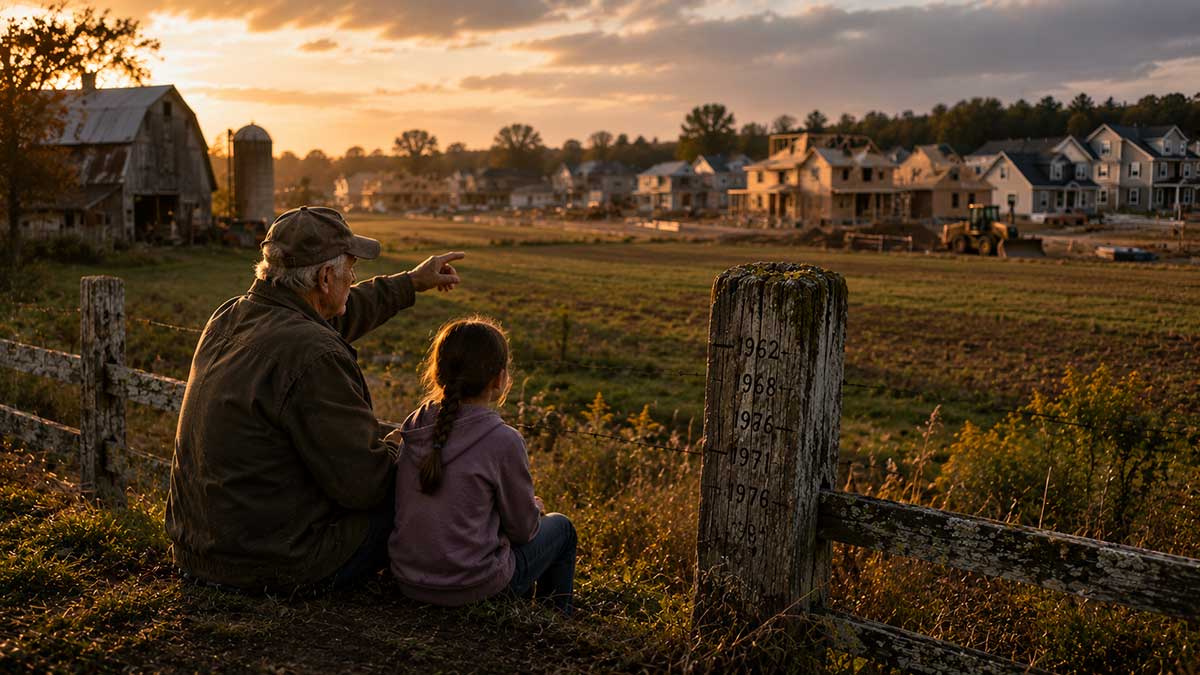
After a minute, Ben noticed the old post lying nearby.
It was gray and split near the bottom.
Several lines had been carved into it.
Ben crouched.
“What is this?”
Elias stopped digging.
Ben brushed dirt away.
There were initials.
C.M. — 4'2"
B.M. — 3'11"
Higher:
C.M. — 4'9"
B.M. — 4'7"
Then:
B.M. — 5'5"
Ben stared.
“No way.”
Elias leaned on the shovel.
“You remember?”
“Not this.”
“Your mother did it.”
Ben ran his fingers across the marks.
“How old was I?”
“First one? Six.”
Ben smiled.
“Claire was taller.”
“Until you were fourteen.”
“Did she hate that?”
“Very much.”
Ben laughed.
For a moment, Elias did too.
Then Ben looked at the new post.
“You're replacing this?”
“Rotten.”
“What happens to the old one?”
“Barn.”
Ben nodded.
He sat on the grass.
Elias resumed digging.
After a while, Ben said:
“Dad, if we keep the land but none of us come back, what exactly have we saved?”
The shovel stopped.
Ben immediately wished he had phrased it differently.
Elias stared into the hole.
“Is that what you think?”
“I don't know.”
“You don't come back?”
“I’m here.”
“For three days.”
“I live two thousand miles away.”
“Your choice.”
“Yes.”
Elias stabbed the shovel into the dirt.
Ben watched him.
“I’m not attacking you.”
“Could have fooled me.”
“I’m asking.”
Elias pulled another scoop of earth out.
Ben continued.
“Claire's in Cincinnati. I'm in Seattle. Neither of us farms.”
“I noticed.”
“Our kids aren't going to farm.”
“You don't know that.”
“Dad.”
“People change.”
“Exactly.”
Elias looked at him.
Ben let the word sit between them.
After a moment, Elias said:
“You think I don't know what’s happening?”
“I think you know better than anyone.”
“Then stop explaining it.”
Ben looked toward the fields.
New houses were visible beyond the trees.
Their roofs rose where cattle once grazed.
“What do you see when you look out there?” he asked.
Elias did not answer.
“Seriously.”
Elias rested both hands on the shovel.
“That maple?”
Ben followed his gaze.
“Yeah.”
“Your mother planted it.”
“I know.”
“No, you don't.”
Ben smiled faintly.
“Apparently I don't know anything.”
“It was the week after we got married.”
Ben looked again at the tree.
“Really?”
“Wasn't even three feet tall.”
Elias pointed farther.
“Barn. My father built half of it. I built the other half after the old roof collapsed.”
He pointed toward the hill.
“Your grandmother used to sit there when storms came.”
“Why?”
“She liked storms.”
“I never knew that.”
“Your uncle Tommy broke his leg near that ditch.”
“Dad, Uncle Tommy died before I was born.”
“I know.”
Elias pointed toward the southern field.
“Your mother taught Claire to drive there.”
Ben laughed.
“I remember that.”
“She hit the mailbox.”
“I remember that too.”
“New mailbox cost me forty dollars.”
Ben looked across the land differently now.
Nothing visible had changed.
But the empty places were becoming crowded.
People he knew.
People he barely remembered.
People he had never met.
Elias sat on the new fence post.
His breathing was heavier than he wanted Ben to notice.
“When your mother was dying,” he said, “she asked me if I was going to sell.”
Ben turned.
Elias had never told him this.
“What did you say?”
“I said no.”
“Did she ask you not to?”
“No.”
“Then why did she ask?”
Elias shrugged.
“Maybe she knew me.”
They sat quietly.
Ben looked toward the line of pines.
Ruth was buried behind them.
“Dad…”
Elias knew what was coming.
“Don't.”
“I'm not going to tell you to sell.”
“Good.”
“But Mom isn't the land.”
Elias looked at him.
“I know.”
“Grandpa isn't the barn.”
“I know.”
“You're not going to lose them if a developer builds houses here.”
Elias stared at the field.
“You sure?”
Ben opened his mouth.
Then closed it.
Elias nodded.
“That's what I thought.”
That evening Claire found her father sitting on the porch.
She brought two glasses of iced tea.
“You still mad?”
“No.”
“Liar.”
“Sit.”
She sat.
For several minutes, they watched traffic on the road.
When Claire was a child, three cars in ten minutes would have been unusual.
Now there was an almost continuous stream.
“Ben showed me the fence post,” she said.
Elias nodded.
“I forgot about that.”
“I didn't.”
“Apparently.”
Claire took a sip.
“I’m sorry about what I said.”
“What part?”
“Most of it.”
“Useful.”
She smiled.
Then became serious.
“I don't want your land.”
“I know.”
“I don't care about the inheritance.”
“I know.”
“I care that you're seventy-four and climbing onto the roof.”
“I use a ladder.”
“That is not better.”
He smiled.
She looked at him.
“I worry that you're holding onto this place because you think letting it go means letting Mom go.”
Elias said nothing.
Claire continued.
“And I worry that one day you're going to fall out there and nobody will know until the next morning.”
“That is cheerful.”
“I'm a doctor.”
“You're supposed to make people feel better.”
“Different department.”
Elias laughed.
Claire leaned against the chair.
“When I look at that offer, I don't see greed.”
“I know.”
“I see you safe.”
Elias looked at her.
“I see college for the kids. Somebody else fixing your furnace. Maybe a condo near me. Dinner on Sundays.”
“You cook?”
“I can order.”
“That I believe.”
She smiled.
Then Elias asked:
“When you look at the field, do you see your mother?”
Claire's smile disappeared.
“Sometimes.”
“Where?”
She thought.
“The garden.”
Elias nodded.
“She hated that garden.”
“No, she didn't.”
“She hated weeding.”
“Everybody hates weeding.”
“She used to make you do it.”
Claire laughed.
“She said it built character.”
“She said that because she didn't want to weed.”
They both laughed.
Then Claire wiped her eyes.
Elias looked away to give her privacy.
After a while, he said:
“You said something this morning.”
“What?”
“That I was choosing dead memories over living family.”
Claire closed her eyes.
“Dad, I said I was sorry.”
“I know.”
He looked toward the field.
“But maybe I am.”
She turned.
“I don't mean it like that.”
“Neither do I.”
He rubbed his hands together.
“I spent so much time keeping this place because I thought keeping the place kept everything else.”
Claire listened.
“I don't know where one ends anymore.”
She reached across and took his hand.
Elias let her.
After a minute, he said:
“But I want to ask you something.”
“Okay.”
“If we sell everything and nobody remembers what was here…”
He looked at her.
“What exactly have we gained?”
Claire stared toward the fields.
She had no answer.
And for once, she did not try to manufacture one.
The compromise took four months.
Elias hated the word.
Compromise sounded like everyone had failed equally.
But that was what it was.
The developer purchased eight acres.
Four remained with the farmhouse.
The family cemetery was legally protected.
The maple stayed.
So did the barn, though Claire made Elias promise to repair the roof professionally.
A conservation strip preserved part of the field.
The price was still enough that Elias would never have to worry about money again.
He complained about the taxes.
Claire considered that a sign he had recovered.
Before the sale closed, Ben suggested something.
“One weekend,” he said.
“What?”
“All of us here.”
“Why?”
“No reason.”
Elias looked suspicious.
That Friday, cars began arriving.
Claire.
Her husband.
Their two children.
Ben and his wife.
Their daughter.
Coolers.
Bags.
Too many shoes by the door.
Too many people using the bathroom.
Elias complained continuously.
He was happier than he had been in years.
On Saturday morning, Ben took out his phone.
Elias immediately objected.
“No.”
“I haven't asked anything.”
“You're going to record me.”
“Yes.”
“No.”
“Why?”
“Because I don't want to be one of your internet things.”
“What internet things?”
“I don't know.”
Claire laughed from the porch.
“Dad thinks you're an influencer.”
“I write cybersecurity software.”
“Same thing to him.”
Elias frowned.
Ben held up the phone.
“Just tell us where things happened.”
Elias looked around.
His grandchildren were waiting.
That changed the answer.
They began at the barn.
Elias told them about his father.
At the maple, he told them about Ruth planting it.
At the ditch, he told them about Tommy's broken leg.
At the old garden, Claire corrected half his stories.
At the hill, he told them about his mother watching storms.
At the cemetery, everyone became quiet.
Elias stood beside Ruth's stone.
He did not say much.
He did not need to.
Then they walked to the western fence.
The old post was gone.
Ben had removed it before the developers arrived.
He brought it from the barn.
The grandchildren gathered around.
“What are those lines?” Claire's daughter asked.
“That was your mother,” Elias said.
He pointed.
“Here.”
Claire crouched.
“That was me?”
“Eight years old.”
“I was tiny.”
“You were loud.”
“I’m still loud.”
“Yes.”
They laughed.
Ben's daughter pointed at another mark.
“Which one was Dad?”
Elias showed her.
“That one.”
She looked at Ben.
“You were shorter than Aunt Claire?”
“For a while.”
Claire smiled.
“For a long while.”
“Do we have to preserve every humiliation?”
Elias looked at the old post.
“Yes.”
Ben was still recording.
Elias noticed.
This time, he did not tell him to stop.
Construction began the following spring.
The first bulldozer arrived at seven in the morning.
Elias stood on the porch drinking coffee.
He had expected to feel angry.
Instead, he felt something closer to grief.
Not dramatic grief.
No tears.
No shouting.
Just an ache.
A machine moved across land he had plowed hundreds of times.
Topsoil rolled away.
Survey stakes appeared.
Roads began where roads had never been.
Elias watched until he could not anymore.
Then he went inside.
He opened the refrigerator.
Nothing interesting.
He closed it.
He walked to the barn.
The old fence post rested against the wall.
He ran his hand over the carved lines.
For the first time, he understood something he had resisted for years.
Keeping a place did not keep time from moving through it.
The land had never remained unchanged.
His grandfather had cleared trees.
His father had built the barn.
Elias had installed drainage.
Ruth had planted the maple.
Roads had widened.
Fields had changed crops.
Children had grown.
People had died.
He had called all of it the same farm because he needed a word large enough to hold the changes.
Perhaps that was what home was.
Not something unchanged.
Something changed so many times that the changes themselves became part of it.
A few months later, the first houses were framed.
Elias disliked them.
Too large.
Too close together.
Not enough trees.
He told everyone.
One Saturday Claire visited with her daughter, Lily.
Lily was eleven now.
She ran outside while Claire helped Elias sort medications at the kitchen table.
A few minutes later, Lily came back.
“Grandpa?”
“What?”
“Come here.”
“My knees.”
“You're already standing.”
He looked down.
She was right.
“Fine.”
She led him toward the western edge of the remaining property.
The new houses rose beyond it.
Roofers worked in the distance.
A cement truck backed up with a shrill warning beep.
Lily stopped beside the replacement fence.
The old post was no longer there, but Ben had attached a small section of it to the inside of the new fence where the family could still see the height marks.
Lily pointed.
“Which one was Dad again?”
Elias smiled.
He touched the carving.
“This one.”
She stood against the fence.
“I'm taller than he was.”
“At your age?”
“Yes.”
Elias pretended to inspect carefully.
“Maybe.”
“I am.”
“Your shoes are thick.”
“Grandpa.”
He laughed.
Lily looked toward the new houses.
“Were there really cows over there?”
“Yes.”
“How many?”
“Depends on the year.”
“Did Dad help?”
“Sometimes.”
“Was he good?”
“No.”
Lily laughed.
Elias began telling her about the morning Ben left a gate open and six cattle wandered onto the road.
He told her how Ruth ran outside in slippers.
How a sheriff stopped traffic.
How Ben hid in the barn because he thought he was going to jail.
Lily laughed so hard she bent forward.
Elias laughed with her.
Behind them, hammers struck wood.
Engines moved earth.
A new neighborhood was being built on the place where an old life had happened.
Elias could still feel the loss.
He hoped he always would.
Some things deserved to hurt when they disappeared.
But beside him stood a girl who had never seen the farm as it had been, asking questions about people who had lived there before she was born.
Elias looked at the old marks in the wood.
For years he had feared that selling the land would erase the story.
Now he understood that keeping the land had never guaranteed anyone would remember it.
Someone had to tell them.
And someone had to care enough to ask.
Lily pointed toward another mark.
“Who is T.M.?”
Elias's hand stopped.
He smiled.
“My brother Tommy.”
“I don't know him.”
“No.”
“What happened to him?”
Elias looked toward the field.
Then back at his granddaughter.
“Well…”
He lowered himself carefully onto the grass.
Lily sat beside him.
Elias began.
And while the new houses rose beyond the fence, the old farm became crowded again.
Story 5: Before You Asked Me What Happened
The question came from a woman Rachel Levin had known for four years.
That was what made it difficult.
If a stranger had asked it, Rachel could have answered.
She had answered strangers for months.
At bookstores.
Universities.
Libraries.
Podcasts.
Radio programs.
Churches.
Synagogues.
Community centers.
The questions changed, but the answers had become familiar.
How did you gain the families’ trust?
How did you avoid exploiting their trauma?
What surprised you most?
What can ordinary Americans do to help refugees?
Rachel answered carefully.
She always said the same important things.
Listen before speaking.
Do not reduce people to victims.
Learn the history.
Remember that refugees had lives before they became refugees.
Let people retain complexity.
Tonight, nearly three hundred people filled an auditorium at a university outside Detroit.
Rachel sat beneath a projected image of her book cover.
The Lives We Carried.
It had spent nineteen weeks on the bestseller list.
Reviews called it compassionate.
Necessary.
Intimate.
Humanizing.
One critic wrote that Rachel had “given a voice to families too often reduced to statistics.”
Rachel disliked that sentence.
She had corrected interviewers more than once.
“I didn’t give anyone a voice. They already had voices. I tried to help more people hear them.”
Audiences liked that answer.
Rachel believed it.
The moderator smiled.
“One final question.”
A woman stood near the center aisle.
Rachel recognized her immediately.
Samira Haddad.
Twenty-seven.
Engineer.
Amateur photographer.
Oldest of four siblings.
Terrible cook, by her own admission.
Owner of an orange cat named Chairman Meow, which Rachel had unsuccessfully argued deserved one sentence in the book.
Rachel smiled.
“Samira.”
Several people turned toward her.
Samira held the microphone.
“Hi.”
Rachel laughed softly.
“You could have texted me.”
The audience laughed.
Samira did too.
Then she became serious.
“I wanted to ask you here.”
Something in Rachel’s chest tightened.
Samira looked toward the audience.
Then back at Rachel.
“Your book helped people care about families like mine.”
Rachel waited.
“I know that.”
Samira continued.
“My mother cried when she read parts of it.”
Rachel smiled faintly.
“She was proud.”
“She was.”
A pause.
“And I’m grateful.”
Rachel heard the word before it came.
But.
“But…”
There it was.
Samira looked down briefly.
“Sometimes I wish you had written less about us.”
The room changed.
Not visibly.
But Rachel felt it.
The moderator shifted slightly.
Rachel kept her expression neutral.
“What do you mean?”
Samira inhaled.
“When people meet me now, especially people who read the book, they already know things.”
Rachel waited.
“They know about the basement.”
The room was completely silent.
“They know what happened to my father.”
“They know about the border.”
“They know about my mother’s nightmares.”
“They know what I told you about the first winter.”
Rachel felt heat rising along her neck.
Samira continued.
“And sometimes people meet me and…”
She searched for the words.
“They look at me like they’ve already met me.”
Rachel leaned toward the microphone.
“I understand.”
Samira looked directly at her.
“I don't think you do.”
Rachel stopped.
Samira's voice remained gentle.
That somehow made it harder.
“I think you wrote honestly.”
Rachel nodded.
“I think you tried to be fair.”
Another nod.
“I think the book did good.”
Rachel waited.
“But people keep handing my life back to me in your words.”
No one moved.
Rachel stared at Samira.
For four years, she had trained herself to remain quiet when someone she interviewed spoke.
Do not fill silence.
Do not rescue.
Do not defend.
Tonight, every instinct told her to explain.
She resisted.
Samira handed the microphone back.
The moderator looked toward Rachel.
Rachel could feel three hundred people waiting.
Finally she said:
“Thank you.”
It sounded inadequate.
It was inadequate.
For once, Rachel had nothing better.
At the reception afterward, people told Rachel she had handled the question beautifully.
She hated them for it.
Not really.
But almost.
“That was such an important exchange.”
“You were incredibly gracious.”
“What courage from both of you.”
Someone asked whether the moment had been planned.
Rachel stared at him.
“No.”
She found Samira near the exit.
“Can we talk?”
Samira looked tired.
“Tonight?”
“Please.”
They walked outside.
September air.
Cars moving through the parking lot.
Rachel folded her arms.
“I’m not angry.”
Samira gave her a look.
“That sounds like something people say when they're angry.”
“Okay. I’m a little angry.”
“I know.”
“Why didn't you tell me?”
“I just did.”
“You know what I mean.”
Samira looked toward the street.
“I tried.”
“When?”
“Last year.”
Rachel frowned.
“You said the publicity was overwhelming.”
“Yes.”
“You said you wanted fewer interviews.”
“Yes.”
“That is not the same thing.”
“To you.”
Rachel stopped.
Samira turned toward her.
“I didn't know how to say it.”
“You could have called.”
“And said what?”
“That the book bothered you.”
“Parts of it bother me.”
“Which parts?”
Samira laughed quietly.
“There.”
“What?”
“That.”
Rachel frowned.
“You immediately want the list.”
“I want to understand.”
“I know.”
“Is that bad?”
“No.”
Samira hesitated.
“But sometimes understanding is how you take control of things.”
Rachel stared at her.
“That’s not fair.”
“Maybe not.”
“I spent four years on that book.”
“I know.”
“I checked everything with you.”
“You checked facts.”
“I showed you sections.”
“Sections.”
“You told me you liked them.”
“I did.”
Rachel stepped back.
“Then what exactly are you accusing me of?”
Samira’s face changed.
“I’m not accusing you.”
“It feels like it.”
“I’m telling you something changed.”
“What?”
“Me.”
Rachel said nothing.
Samira continued.
“I was twenty-three when we met.”
“I know.”
“I wanted people to know what happened.”
“I wanted people to understand why families were coming here.”
“I wanted people to know my father wasn't a number.”
Rachel nodded.
“And now?”
“Now I'm tired.”
“Of the book?”
“Of being introduced by the worst things that ever happened to me.”
Rachel looked away.
Cars passed behind them.
Samira spoke more quietly.
“You didn't do that alone.”
Rachel looked back.
“The news does it.”
“Politicians do it.”
“Charities do it.”
“People ask.”
She smiled sadly.
“You were actually better than most.”
“That’s comforting.”
“It’s supposed to be.”
“It isn't.”
“I know.”
They stood quietly.
Then Rachel said:
“I never claimed your story was mine.”
Samira looked at her.
Rachel regretted the sentence immediately.
But it was already there.
“No,” Samira said.
“You didn't.”
She paused.
“But everyone keeps handing it back to me in your words.”
The sentence hurt more the second time.
Rachel looked down.
Samira continued.
“I don't want you to regret the book.”
“I don't.”
“You look like you do.”
“I regret hurting you.”
“You also helped us.”
“Both can be true?”
“Yes.”
Rachel gave a small laugh.
“I hate answers like that.”
“I know.”
“You always did.”
They both smiled.
The tension loosened slightly.
Rachel said:
“I want to fix it.”
Samira sighed.
Rachel saw it.
“What?”
“Nothing.”
“No. What?”
“That sentence.”
“What’s wrong with that?”
“You want an ending.”
Rachel stared.
Samira continued.
“You want me to tell you what to do so this becomes a lesson.”
“That is not what I'm doing.”
“Maybe not consciously.”
Rachel folded her arms again.
“Then what do you want from me?”
Samira thought.
“Right now?”
“Yes.”
“Nothing.”
Rachel blinked.
“Nothing?”
“Nothing.”
“That’s not very helpful.”
Samira laughed.
“I know.”
Then she hugged Rachel.
Rachel was surprised.
Samira pulled away.
“I’m glad you wrote it.”
Rachel looked at her.
“I’m also glad I said what I said.”
Both statements remained between them.
Neither canceled the other.
Rachel went home to Brooklyn the next morning.
For several days she avoided the book.
Copies were everywhere.
Office.
Bedroom.
Kitchen shelf.
A stack near the front door waiting to be signed.
She had spent so many years wanting people to read it.
Now she felt watched by it.
On Thursday, she opened the photo archive.
14,382 images.
Some taken by Rachel.
Many sent by families.
Birthdays.
Apartments.
Airports.
Graduations.
Hospital rooms.
Picnics.
Snowstorms.
Weddings.
Rachel searched:
SAMIRA.
Hundreds appeared.
She scrolled.
Samira at twenty-three standing beside her mother.
Samira holding a photograph of her father.
Samira in front of the apartment building where the family first lived.
Samira looking through documents.
Samira crying during an interview.
Several of those photographs had appeared in publicity.
Then Rachel found one she had forgotten.
A picnic.
Summer.
Samira sitting on a folding chair, head thrown backward.
Laughing.
Not smiling.
Laughing so hard her mouth was open and one hand covered her stomach.
Her younger brother was blurred beside her.
Someone had spilled lemonade.
Nothing in the photograph explained anything.
There was no caption about war.
No border.
No trauma.
No resettlement.
No loss.
It was simply a young woman laughing.
Rachel remembered rejecting the photograph for the book’s photo insert.
Beautiful, she had thought.
But it doesn't tell the story.
Now she stared at it.
Whose story?
The question embarrassed her.
Not because she had done something obviously wrong.
That would have been easier.
Rachel had selected images because selection was her job.
A book could not contain fourteen thousand photographs.
A writer chose.
A photographer framed.
An editor cut.
A title named.
A narrative arranged.
That was how stories became comprehensible.
It was also how lives became smaller.
Rachel enlarged the photograph.
Samira filled the screen.
She looked free.
Rachel almost wrote that down.
Then stopped herself.
Perhaps Samira had simply been laughing.
Not every moment needed Rachel's interpretation.
She closed the notebook beside her computer.
The paperback edition was due in four months.
Rachel called her editor.
“I want to add an author's note.”
“About what?”
“The limits of the book.”
A pause.
“That sounds ominous.”
“It shouldn't.”
“Did something happen?”
“Yes.”
“What?”
Rachel looked at Samira’s photograph on the screen.
“Someone reminded me that a book can be careful and still be incomplete.”
Her editor was silent.
“That’s not exactly a revelation.”
“No.”
Rachel smiled.
“But apparently I needed it.”
The author's note took six drafts.
The first was too defensive.
The second too apologetic.
The third turned Samira into a lesson.
Rachel deleted it.
The fourth sounded academic.
The fifth sounded like Rachel wanted praise for admitting limitations.
She hated it.
The sixth was short.
She explained that The Lives We Carried contained stories told to her at particular moments by particular people, filtered through her choices as a writer.
It was neither a complete account of those individuals nor a definitive portrait of any community.
Then she added a reading list.
Memoirs.
Novels.
Poetry.
Essays.
Documentaries.
Photography.
Most created by people from the communities represented in the book.
Her editor approved it.
Then Rachel had another idea.
She called Samira.
“Can I ask you something?”
“Depends.”
“Would you write an afterword?”
Silence.
Rachel continued.
“Anything you want.”
More silence.
“Five pages. Twenty. One.”
Samira said:
“No.”
Rachel blinked.
“Okay.”
“You sound surprised.”
“I am.”
“Why?”
“I thought you might want the space.”
“I have space.”
Rachel paused.
“What do you mean?”
“I don't need your book to give it to me.”
The sentence stung.
Rachel felt herself becoming defensive.
Then she stopped.
“Okay.”
Samira continued.
“I don't mean that cruelly.”
“I know.”
“I have my own work.”
“I know.”
“My photography.”
“I know.”
“I’m applying for a gallery show.”
Rachel sat up.
“You are?”
“Yes.”
“That’s amazing.”
“Maybe.”
“No, it is.”
“See?”
“What?”
“You’re doing it again.”
Rachel froze.
Samira laughed.
“I’m joking.”
Rachel laughed too.
“Terrible person.”
“I learned from journalists.”
Rachel smiled.
Then said:
“I understand.”
“About the afterword?”
“Yes.”
“Thank you for asking.”
“Thank you for saying no.”
“That sounded painfully enlightened.”
“It felt worse.”
They laughed.
After they hung up, Rachel sat alone.
She had imagined the afterword beautifully.
Samira speaking back.
Two perspectives sharing space.
A model of dialogue.
Reviewers would have loved it.
Rachel realized she had already constructed the ending before Samira agreed to participate.
She laughed at herself.
Then she deleted the email draft she had prepared for her editor.
Samira did not owe Rachel a better ending.
Nine months later, an envelope arrived.
Inside was a card.
No letter.
Just an address.
A gallery in Detroit.
And a date.
Rachel went.
She did not tell Samira she was coming.
The exhibition was called:
OTHER THINGS I REMEMBER
Rachel stopped at the title.
Inside were photographs of ordinary life.
A woman asleep on a bus.
Two boys arguing over a basketball.
An elderly man repairing a watch.
A grocery store clerk eating lunch behind the counter.
A bride smoking behind a wedding hall.
A child staring into a laundromat dryer.
Some photographs were joyful.
Some lonely.
Some strange.
None explained themselves completely.
Rachel moved slowly.
Then she reached the final room.
The picnic photograph hung on the wall.
Larger than she had ever seen it.
Samira laughing.
Head back.
Eyes nearly closed.
One hand against her stomach.
Rachel stepped closer.
Below it was a small title.
Before You Asked Me What Happened
Rachel stared at the words.
Something inside her tightened.
Then released.
She heard laughter across the gallery.
Samira.
She stood with three friends near the entrance.
She was wearing a black dress and holding a glass of wine.
One friend said something.
Samira laughed.
Almost exactly as she had in the photograph.
Rachel instinctively reached toward her purse.
Her notebook was inside.
She stopped.
For four years, she had trained herself to notice.
Remember.
Record.
Interpret.
She had believed attention was a form of respect.
Often, it was.
But perhaps respect sometimes required something else.
To see without taking.
To hear without recording.
To witness without turning the moment into material.
Samira noticed her.
Their eyes met across the room.
Samira smiled.
Rachel smiled back.
She did not walk over immediately.
Instead, she turned again toward the photograph.
The woman in it was someone Rachel knew.
And someone she did not.
A refugee.
An engineer.
A daughter.
A sister.
A photographer.
A terrible cook.
A woman who had survived terrible things.
A woman who had laughed before them.
A woman who had laughed after them.
A woman whose life continued when Rachel closed her notebook.
Rachel had once believed the purpose of her work was to make strangers understandable to one another.
She still believed that.
But now she understood the danger hidden inside the word understandable.
A human being was not a problem to be solved.
Understanding someone did not mean reaching the end of them.
Rachel looked once more at the title.
Before You Asked Me What Happened.
Then she walked toward Samira.
Samira hugged her.
“You came.”
“Of course.”
“What do you think?”
Rachel looked around the gallery.
For a second, she nearly began analyzing.
The framing.
The sequence.
The photograph by the window.
The relationship between memory and ordinary life.
Then she stopped.
“It’s beautiful.”
Samira studied her.
“That’s all?”
Rachel smiled.
“For tonight.”
Samira laughed.
“Good.”
Someone called Samira's name.
She turned.
“I’ll be back.”
“Go.”
Samira crossed the room.
Rachel watched her join another group.
Someone asked about one of the photographs.
Samira began answering.
Her hands moved when she spoke.
Rachel could not hear the words.
She could have moved closer.
She didn't.
She stood there for another moment.
Then she turned toward a photograph of an elderly woman looking out of a kitchen window.
Rachel read the title.
She looked.
And for once, she allowed herself not to know the rest.
Final Thoughts
At first, these five stories seem to be about very different things.
A business.
A pair of earrings.
An eviction notice.
A farm.
A photograph.
But each object carries something much larger than itself.
Daniel’s old apartment key remembers a door his daughter was too young to remember entering.
Marisol’s earrings represent something almost everyone around her has overlooked: the part of her that exists without being useful to anyone.
Marcus’s eviction notice preserves the frightened nine-year-old inside a successful fifty-one-year-old man.
Elias’s fence post holds children who grew up, a wife who died, a brother his grandchildren never knew, and a farm disappearing beneath new houses.
And Samira’s photograph contains something Rachel’s celebrated book could never completely capture—a human life continuing beyond the story someone else told about it.
This is why O-lan’s two pearls remain so powerful.
They are tiny.
Economically, they barely matter compared with Wang Lung’s land.
Emotionally, they contain an entire hidden life.
O-lan has cooked, worked, given birth, survived famine, labored beside Wang Lung, cared for his father, helped rebuild his fortune, and carried the family through circumstances that might have destroyed them.
Almost everything she possesses has a purpose for somebody else.
Then she asks to keep two pearls.
Not because they can feed anyone.
Not because they can buy land.
Not because they make the family safer.
Simply because she wants them.
That may be one of The Good Earth’s quietest and most devastating truths:
Human beings need more than usefulness.
Marisol discovers the same thing.
But the modern stories also reveal another side of Buck’s novel.
Wang Lung spends much of his life trying to escape insecurity.
Daniel does too.
Marcus does too.
Elias, in another way, does too.
They build.
Save.
Acquire.
Protect.
Hold.
And eventually each must confront the same uncomfortable possibility:
The thing that once protected us can become the thing we are afraid to release.
For Wang Lung, it is land and wealth.
For Daniel, it is the future he imagined for Sophie.
For Marcus, it is the hardness that once protected him from helplessness.
For Elias, it is the physical land carrying his memories.
None of these attachments is foolish.
That matters.
The answer is not simply to let go.
Some things deserve loyalty.
Some traditions deserve preservation.
Some land should remain land.
Some memories should hurt when the places connected to them disappear.
Some sacrifices deserve gratitude.
But gratitude and obedience are not the same thing.
Daniel gives Sophie what he never had: choice.
His greatest challenge comes when she actually uses it.
That is the paradox of successful sacrifice.
Parents often work to create children whose lives will be different from their own—and then discover that different lives produce different people.
Wang Lung’s sons cannot inherit his hunger.
Daniel’s daughter cannot inherit the fear of the tiny apartment where she once slept in a laundry basket.
Elias’s grandchildren cannot remember a farm that disappeared before they were old enough to know it.
Experience does not pass automatically through blood.
Someone must tell the story.
And someone else must care enough to ask.
Yet Story 5 adds one final complication.
Even telling the story does not mean owning it.
Rachel can know Samira deeply and still not know all of her.
She can represent Samira honestly and still select certain moments while leaving others outside the frame.
She can help thousands of people care about refugees while unintentionally helping turn one complicated woman into “a refugee story.”
This brings us back not only to The Good Earth, but to Pearl S. Buck herself.
Buck knew China intimately. China shaped her childhood, imagination, language, and understanding of storytelling.
Her work helped generations of Western readers encounter Chinese farmers and families not merely as distant abstractions but as recognizable human beings.
That achievement matters.
But The Good Earth is still one novel.
One perspective.
One doorway.
It cannot contain China.
Just as Rachel’s book cannot contain Samira.
Just as Wang Lung cannot completely know O-lan.
Just as Daniel cannot completely know Sophie.
Just as children cannot completely know the lives their parents lived before becoming “Mom” and “Dad.”
Perhaps this is where all five stories finally meet.
Love does not mean possession.
Daniel cannot possess Sophie’s future.
Marisol’s family cannot possess her usefulness.
Marcus cannot allow his suffering to possess his morality forever.
Elias cannot possess time simply by possessing land.
Rachel cannot possess Samira’s story simply because she has been trusted with part of it.
And Wang Lung, despite everything he accumulates, cannot permanently possess the earth.
He will return to it.
His children will make their own decisions.
The House of Hwang rose and fell.
Wang Lung’s family rises.
The final pages quietly suggest that another cycle may already be beginning.
The earth remains.
That may be why Pearl S. Buck’s title is so important.
Not Wang Lung’s Earth.
Not The Wang Family Land.
The Good Earth.
People arrive.
They work it.
Fight over it.
Buy it.
Sell it.
Build upon it.
Inherit it.
Remember it.
And eventually leave it.
Perhaps the deepest question running through these five modern stories is therefore not:
What belongs to us?
It is:
What are we responsible for while something is temporarily in our hands?
A business.
A marriage.
A child.
Money.
Land.
Memory.
Power.
Someone else’s story.
Maybe we never truly own any of them in the permanent sense we imagine.
Maybe we are their temporary caretakers.
And if so, perhaps a meaningful life is not measured only by what we manage to keep.
Perhaps it is also measured by what we protect without imprisoning, what we remember without demanding repetition, what we love without possessing—and what we eventually learn to let go.
Short Bios:
Pearl S. Buck
Pearl S. Buck (1892–1973) was an American writer who spent much of her childhood and early adulthood in China. Her experiences there deeply shaped her writing, particularly her portrayals of ordinary Chinese family and rural life. The Good Earth, published in 1931, became an international bestseller and won the Pulitzer Prize. Buck received the Nobel Prize in Literature in 1938.
Daniel Park — “The House He Bought for Them”
Daniel is a 59-year-old Korean American contractor who spent decades building a successful business so his children would never experience the insecurity he once knew. His daughter Sophie’s decision to choose a different future forces him to confront the difference between giving a child freedom and choosing how that freedom should be used.
Sophie Park — “The House He Bought for Them”
Sophie is Daniel’s 24-year-old daughter. Grateful for her father’s sacrifices but determined to build something of her own, she becomes the living result of the security her father worked to create—and therefore the person who most deeply challenges his expectations.
Marisol Vega — “The Earrings in the Drawer”
Marisol is a 48-year-old wife, mother, daughter, grandmother, and hospital administrative assistant whose competence has made her indispensable to almost everyone around her. A pair of earrings awakens a deceptively simple question: when so much of your life belongs to other people’s needs, what are you allowed to keep simply because you want it?
Luis Vega — “The Earrings in the Drawer”
Luis is Marisol’s loving husband of twenty-six years. His well-intentioned decision to give away earrings he assumes Marisol does not want forces both of them to recognize how easily love can coexist with failing to notice another person’s private desires.
Marcus Reed — “After the Eviction Notice”
Marcus is a 51-year-old property owner who experienced eviction as a child and built his adult life around never depending upon another person’s mercy. When a reliable tenant asks him for twelve additional days to pay rent, Marcus must decide whether his childhood suffering taught him compassion—or merely taught him never to be vulnerable again.
Andre Reed — “After the Eviction Notice”
Andre is Marcus’s 22-year-old son and accounting student. He admires his father’s discipline and accomplishments but challenges the rigid philosophy that grew from Marcus’s childhood poverty, asking whether surviving hardship means anything if we cannot recognize the same fear in someone else.
Elias Mercer — “The Last Acre”
Elias is a 74-year-old Ohio farmer facing a multimillion-dollar offer for the last twelve acres of his family property. To his children, the land offers financial security. To Elias, it contains generations of births, marriages, work, death, memory, and belonging.
Rachel Levin — “Before You Asked Me What Happened”
Rachel is a 42-year-old journalist whose acclaimed book about refugee families helps thousands of readers encounter lives they previously knew little about. When one of the women she wrote about challenges the way readers now believe they know her, Rachel must reconsider the difference between careful representation, understanding, and ownership.
Samira Haddad — “Before You Asked Me What Happened”
Samira is a 27-year-old engineer and photographer whose family history appears prominently in Rachel’s book. Grateful for the good the book has accomplished yet uncomfortable with being continually defined by the most painful events of her past, she insists on the right to remain larger than any story told about her.
Leave a Reply