

Introduction
Joan of Arc has been studied for nearly six centuries, yet the central mysteries of her life remain unusually resistant to simple answers.
She said heavenly voices guided her.
She entered war as a teenager.
Experienced soldiers listened to her.
She helped change the momentum of the French campaign.
She was captured, interrogated, condemned, and executed at nineteen.
Later generations turned her into a saint, military heroine, patriot, victim, rebel, feminist symbol, psychological case study, and national icon.
But how much of any of those versions belongs to Joan herself?
In this fictional scholarly conversation, five experts examine Joan from very different directions: medieval history, interrogation and source criticism, military history, psychology and spiritual voice-hearing, and medieval gender and religion.
Their goal is not to decide once and for all whether Joan heard God.
They ask harder questions.
What can modern psychology really tell us about her voices?
Was she genuinely a military leader?
Can we trust a trial record produced by people trying to condemn her?
Was her execution driven by theology, politics, gender, law, or some combination?
And after centuries of reinterpretation, can historians still recover the young woman beneath the legend?
The conversation is fictional, but the scholarly positions and historical questions are grounded in published research.
(Note: This is an imaginary conversation, a creative exploration of an idea, and not a real speech or event.)
Topic 1: What Were Joan of Arc's Voices?

Daniel Hobbins placed a copy of the trial record on the table.
“If we want to talk about Joan's voices,” he said, “we should begin here.”
Christopher Cook looked down at the pages.
“Not with psychiatry?”
“No.”
“Neurology?”
“No.”
“Religious experience?”
“Not yet.”
Karen Sullivan smiled slightly.
“I suspect Daniel wants to protect Joan from all of us.”
Hobbins looked at her.
“I want to protect the evidence from us.”
Kelly DeVries leaned back.
“That may be harder.”
Dyan Elliott looked toward Hobbins.
“What does the evidence let us say with confidence?”
Hobbins opened the volume.
“That Joan repeatedly reported experiences she interpreted as communications from heavenly figures. She eventually identified St. Michael, St. Catherine, and St. Margaret. She spoke of voices. She spoke of light. She described guidance, instruction, comfort, and command.”
Cook nodded.
“And she did not describe them casually.”
“No.”
“They mattered enormously.”
“They structured her sense of mission.”
Sullivan leaned forward.
“There is already a difficulty.”
Hobbins looked at her.
“We say, ‘Joan described her voices.’”
“Yes.”
“But Joan was describing them under interrogation.”
Hobbins nodded.
“I knew you were going there.”
“We have to.”
Cook looked between them.
“What difference does that make for the voice experience itself?”
Sullivan answered.
“A great deal. Think about how knowledge gets produced in an interrogation. Joan does not sit down and freely narrate her spiritual life from childhood onward. Clerics ask questions. They choose categories. They return to certain subjects. They push for distinctions. They want to know whether the voices have bodies, whether Joan sees them, how she identifies them, what they say, whether they command obedience, whether they possess wings, how Joan knows they are saints.”
Cook nodded slowly.
“So the transcript may tell us as much about the questions medieval theologians considered important as it tells us about what Joan spontaneously considered important.”
“Exactly.”
Hobbins raised a hand.
“That is fair, but I would not push it too far. Joan does resist them. Repeatedly. She refuses questions. She limits answers. She says some things are for the king alone. She catches traps. She can become impatient. Her personality breaks through.”
Sullivan smiled.
“I agree.”
DeVries looked surprised.
“That disagreement ended quickly.”
“It is not a disagreement about whether the record matters,” Sullivan said. “It is a disagreement about what kind of access it gives us.”
Hobbins nodded.
“I would say extraordinary access.”
“And I would say extraordinary access through a structured encounter.”
Cook looked down again.
“That distinction matters medically too.”
Elliott turned to him.
“How?”
“If someone today came into a clinic and said, ‘I hear a voice,’ we would ask many questions. Does it seem external or internal? One voice or several? Familiar or unfamiliar? Threatening or comforting? Does it occur during sleep transitions? Does it impair functioning? Is there distress? Are there other unusual beliefs or perceptions?”
Sullivan said, “Which means modern psychiatry performs its own interrogation.”
Cook smiled.
“Yes, though clinical interviews and judicial interrogations have very different goals.”
“Of course.”
“But your broader point is sound. The framework shapes what appears in the record.”
Hobbins said, “And the danger starts when people take a few lines from Joan's testimony, compare them with a modern diagnostic checklist, then announce that the case is solved.”
Cook nodded.
“It is not solved.”
DeVries looked at him.
“Can it be diagnosed at all?”
“No.”
“Nothing?”
“Not responsibly as a definitive diagnosis.”
Elliott leaned forward.
“Yet people have been diagnosing her for more than a century.”
“Yes.”
“With what?”
Cook counted on his fingers.
“Different psychiatric disorders. Epilepsy. Migraine phenomena. Temporal-lobe conditions. Sleep-related experiences. Auditory hallucinations. Various neurological theories.”
DeVries said, “And every generation seems to find a disorder that fits its own interests.”
Cook looked at him.
“That is one of the striking patterns in the medical literature.”
Hobbins nodded.
“Which is historically revealing.”
Sullivan said, “Not necessarily about Joan.”
“Precisely.”
Cook continued.
“A physician in one era sees hysteria. Another sees schizophrenia. Another sees epilepsy. New medical categories arrive, and Joan gets rewritten through them.”
Elliott said, “Which resembles what happens politically and religiously too.”
Hobbins looked toward her.
“Every age creates another Joan.”
“Yes, but we will get to that later.”
DeVries smiled.
“Apparently I am the only one trying to keep us on Topic 1.”
Sullivan looked at him.
“You are a military historian. This may be the first time anyone has accused you of restraint.”
He laughed.
Cook returned to the question.
“I think the biggest modern misunderstanding begins with the phrase ‘hearing voices.’ Many people hear it and immediately infer psychosis.”
“Which is wrong?” DeVries asked.
“Yes. Voice-hearing is not synonymous with psychotic illness.”
Elliott said, “Explain that carefully.”
Cook nodded.
“People can report hearing voices across a wide range of contexts. Some have psychiatric disorders. Some do not. Some experiences are distressing. Some are comforting. Some are interpreted spiritually. Some occur in bereavement. Some around sleep. Some are long-lasting and integrated into a person's life without causing broad disorganization.”
Hobbins looked at him.
“And Joan?”
“We cannot move from that general fact to Joan's diagnosis.”
“But it changes the question.”
“Yes.”
Sullivan said, “It removes the lazy assumption that ‘she heard voices’ means ‘she was mentally ill.’”
Cook nodded.
“Exactly.”
DeVries crossed his arms.
“Then what signs would make you more concerned about psychosis?”
Cook thought.
“Disorganization across multiple areas of life. Severe functional decline. Incoherence. Marked loss of reality testing across domains. Other symptoms. Context matters enormously.”
DeVries said, “Does Joan show that?”
Cook looked toward Hobbins.
“The historian should answer first.”
Hobbins replied.
“The Joan in the surviving record can be remarkably coherent. She travels through dangerous territory. She persuades people to assist her. She speaks with Charles. She survives military campaigns. She interacts with commanders. During interrogation she often responds quickly and strategically. She recognizes dangerous theological questions.”
Cook nodded.
“That does not fit a simple picture of a globally disorganized person.”
Sullivan added, “Her interrogators clearly found her difficult to corner.”
Hobbins smiled.
“Very.”
Elliott said, “Which creates a cultural problem. Modern readers may think, ‘If she saw saints, something must have been wrong.’ Medieval people did not operate with that assumption.”
Cook turned toward her.
“Right.”
Elliott continued.
“Visionary experience belonged to the religious culture available to her. Women had long claimed visions, revelations, encounters with saints, Christ, angels, the Virgin. Some became revered. Others were tested. Some were distrusted. Joan did not invent the idea that a young woman might receive divine communication.”
Sullivan said, “What made her unusual was what she did with it.”
“Yes.”
DeVries nodded.
“She went to war.”
Elliott turned to him.
“That changes everything.”
Hobbins said, “A visionary telling people to pray is one thing.”
Sullivan continued, “A visionary telling a disputed claimant that heaven wants him crowned is another.”
DeVries added, “A visionary arriving at a siege and pressing soldiers to attack is another again.”
Cook looked around the table.
“So the unusual feature may not be voice-hearing itself.”
Elliott nodded.
“It is the social consequences she attaches to the experience.”
Cook thought for a moment.
“That is very important.”
DeVries smiled.
“I knew eventually the army would matter.”
Sullivan looked at Cook.
“Let me ask a clinical question.”
“Go ahead.”
“If Joan appeared in a modern clinic and told you St. Michael spoke to her, would you challenge that belief?”
Cook paused.
“I would not begin by telling her it was false.”
“Why?”
“Since the clinical task is not to settle metaphysics. I would want to know whether the experience caused distress, danger, impairment, loss of control, or other symptoms. I would want to know what it meant to her.”
Hobbins said, “But if she said the voice instructed her to lead armed men into war?”
Cook nodded.
“That raises risk and ethical questions immediately.”
DeVries leaned forward.
“So the moment the private experience begins guiding public action, the standard changes.”
“Yes.”
Elliott looked toward Sullivan.
“That sounds oddly close to the medieval problem.”
Sullivan smiled.
“It does.”
Hobbins said, “Cauchon's question returns.”
DeVries frowned.
“Which question?”
“How does anyone else evaluate a revelation only Joan can experience?”
Cook nodded.
“That is not an obsolete question.”
Sullivan said, “It may be the central question.”
Elliott looked at Cook.
“Can modern science answer it?”
“No.”
“Not even partly?”
“It can answer parts around it.”
“Such as?”
“We can study voice-hearing. We can study perception. We can study brain activity. We can study dissociation, epilepsy, psychosis, spiritual practices, sleep transitions, trauma, expectation, cultural framing.”
Elliott said, “But none of that tells us whether God spoke.”
“No.”
DeVries looked skeptical.
“Suppose you had a perfect brain scan of Joan at thirteen. You could see exactly what happened when she heard St. Michael.”
Cook nodded.
“All right.”
“And suppose the scan showed a clear neurological event.”
“Yes.”
“Would that settle it?”
“No.”
DeVries frowned.
“Why not?”
Cook leaned forward.
“Since finding the neural mechanism of an experience does not settle its metaphysical meaning.”
Hobbins nodded.
“A person praying has brain activity.”
“Yes.”
“A person seeing a cathedral has brain activity.”
“Yes.”
“A person hearing ordinary speech has brain activity.”
“Yes.”
Cook continued.
“Any human experience must involve the brain. A believer could say divine communication works through human perception. A skeptic could say the neural mechanism supplies enough explanation without a supernatural source.”
Sullivan said, “And the scan would not decide between them.”
“Correct.”
DeVries looked unconvinced.
“So science reaches a wall.”
“Science reaches the boundary of the question it is equipped to answer.”
Elliott said, “That is a better way to put it.”
Sullivan looked at Cook.
“What if we found evidence of epilepsy?”
Cook replied immediately.
“It still would not settle the theological question.”
Hobbins said, “But it might change the historical interpretation.”
“Yes.”
“How?”
“If there were strong evidence that Joan had recurrent neurological episodes known to cause auditory and visual phenomena, that could provide a plausible mechanism for some experiences.”
DeVries said, “Yet not why she interpreted them as St. Michael.”
“Correct.”
Elliott nodded.
“That interpretation comes from culture, theology, expectation, identity, perhaps personal experience.”
Cook said, “And possibly from whatever Joan believed she encountered.”
Sullivan glanced at him.
“You leave the supernatural door open.”
“I leave it outside my authority to close.”
Hobbins smiled.
“That may be the most careful sentence we have heard.”
Cook laughed.
“I hope so.”
DeVries looked at Hobbins.
“What do you think happened?”
Hobbins shook his head.
“As a historian?”
“Yes.”
“I think Joan reported experiences she considered external to ordinary thought and deeply authoritative. I think she believed them.”
“Do you think she invented them?”
“I see little reason to reduce her story to conscious fraud.”
Sullivan nodded.
“I agree.”
DeVries looked at her.
“Strongly?”
“Yes. Nothing about the long-term pattern suggests an easy cynical performance.”
Elliott added, “She persists under conditions where abandoning the claim might have helped her survive.”
Cook said, “Sincerity still does not prove source.”
“No,” Sullivan replied. “But it matters.”
DeVries leaned back.
“So fraud falls lower.”
Hobbins said, “For me, yes.”
“Psychosis?”
Cook replied, “Not established.”
“Epilepsy?”
“Possible theories exist. Not established.”
“Ordinary religious experience?”
Cook thought.
“That phrase hides a lot.”
Elliott smiled.
“Nothing about Joan was ordinary.”
Cook continued.
“She may have had experiences that fit within a broad family of spiritually interpreted voice-hearing. That still tells us very little about cause.”
Sullivan looked toward Hobbins.
“What about the bells?”
DeVries frowned.
“Bells?”
Hobbins nodded.
“Some medical arguments have drawn attention to references involving bells and sensory experiences.”
Cook said, “Researchers have tried to connect details of Joan's testimony with neurological hypotheses.”
Sullivan asked, “How much weight should those details carry?”
Cook hesitated.
“Very little in isolation.”
Hobbins nodded.
“That is the historian's concern.”
DeVries said, “A later doctor sees one line about bells and suddenly Joan has epilepsy.”
“Exactly,” Hobbins said.
Cook added, “The more responsible medical work treats such theories as hypotheses rather than verdicts.”
Elliott looked at Sullivan.
“And the wording may itself have been shaped by interrogation.”
“Yes.”
Cook smiled.
“You see why I need all of you before diagnosing a medieval saint.”
DeVries laughed.
“Too late. People have done it for you.”
Sullivan grew serious.
“There is another question.”
Hobbins looked at her.
“What if we are still making the same mistake the judges made?”
Cook frowned.
“Explain.”
“The judges wanted Joan's experience to fit a theological classification. True spirit, false spirit, divine, demonic, obedient, disobedient.”
“Yes.”
“Modern medicine may want it to fit diagnostic categories.”
Cook nodded cautiously.
“Yes.”
“Historians may want it to fit cultural categories.”
Hobbins smiled.
“We are not escaping.”
“None of us.”
Elliott said, “Gender historians too.”
Sullivan nodded.
“Exactly.”
DeVries looked amused.
“And military historians?”
“You turn everyone into commanders.”
He laughed.
“Fair.”
Sullivan continued.
“Every discipline approaches Joan with a set of questions. Those questions reveal things, yet they hide other things.”
Hobbins said, “That does not mean all interpretations are equally strong.”
“No.”
“Evidence still matters.”
“Of course.”
“But it means we should know what our questions are doing.”
“Yes.”
Cook leaned forward.
“I think that is especially relevant to voice-hearing. If I ask only, ‘What pathology produced this?’ I may miss meaning. If a theologian asks only, ‘Was this divine?’ they may miss psychological mechanisms. If a historian asks only, ‘What did medieval culture permit?’ they may miss individual variation.”
Elliott nodded.
“And if I ask only how gender shaped reception, I may flatten Joan into a representative woman rather than an unusual person.”
DeVries looked around the table.
“Then perhaps the question ‘What were the voices?’ is wrong.”
Hobbins raised an eyebrow.
“What would you ask?”
DeVries thought.
“What did the voices do?”
Cook looked interested.
“In Joan's life?”
“Yes.”
“They gave her mission,” Elliott said.
“Confidence,” Hobbins added.
“A framework for interpreting events,” Sullivan said.
“Comfort,” Cook said.
“Authority,” DeVries said.
Everyone looked at him.
He continued.
“That is what interests me. A teenage girl walks into a military and political crisis carrying no title, no army, no formal authority. The voices give her one.”
Elliott nodded.
“Not institutional authority.”
“No.”
“Charismatic authority.”
“Yes.”
Sullivan said, “Authority that competes with institutions.”
Hobbins said, “Which is why the voices cannot remain private.”
Cook nodded.
“A private experience creates public consequences.”
DeVries said, “And those consequences become enormous.”
Elliott leaned forward.
“This brings us to Joan's gender.”
DeVries smiled.
“I knew you would.”
“She could not simply become a cleric.”
“True.”
“She could not hold ordinary church office.”
“True.”
“She could not enter formal military command through the same path as a nobleman.”
“True.”
“Yet a divine mission gives her a route around normal structures.”
Sullivan said, “Which helps explain both her extraordinary rise and the anxiety surrounding her.”
Cook looked thoughtful.
“So the voices are not only psychological events.”
“No,” Elliott said. “They are social instruments, religious claims, sources of identity, routes to authority.”
Hobbins added, “And to Joan herself, they were persons.”
The room quieted.
Cook looked at him.
“That matters.”
“Yes.”
Hobbins continued.
“We can become so analytical that we forget Joan did not speak about ‘auditory phenomena.’ She spoke about St. Michael, St. Catherine, and St. Margaret.”
Sullivan nodded.
“Named beings.”
“Exactly.”
Cook said, “Which tells us something about interpretation.”
Hobbins replied, “Yes, but perhaps more than interpretation in Joan's own mind.”
Cook nodded.
“Fair.”
Elliott said, “To Joan, the question ‘What were the voices?’ may have sounded strange.”
DeVries asked, “Why?”
“She knew who they were.”
Sullivan smiled faintly.
“That is the tension.”
Cook added, “Modern observers ask what kind of experience occurred. Joan answers with identity.”
Hobbins said, “St. Michael.”
Sullivan said, “St. Catherine.”
Elliott said, “St. Margaret.”
DeVries looked at Cook.
“Can psychiatry handle a voice that has a name?”
“Quite easily.”
He smiled.
“That part is not unusual.”
DeVries laughed.
Cook continued.
“Voices can have identities, personalities, emotional tones, relationships with the hearer. That alone tells us little about diagnosis.”
Hobbins asked, “What about the consistency of Joan's voices?”
Cook thought.
“Consistency can matter, but again, it is not diagnostic by itself.”
Sullivan said, “She sometimes refuses to say what they told her.”
“Yes.”
Hobbins nodded.
“Some revelations she treats as confidential.”
Elliott said, “That secrecy may strengthen authority.”
DeVries looked at her.
“How?”
“If a person says, ‘I receive knowledge you cannot access,’ others must decide whether to trust the person without possessing the source.”
Sullivan added, “Charles faced that problem.”
Hobbins said, “So did the judges.”
Cook said, “So did Joan's family.”
DeVries nodded.
“And the soldiers.”
Sullivan looked around the table.
“Then perhaps Topic 1 is not fundamentally about hallucination.”
Cook smiled.
“I would be relieved.”
“It is about inaccessible knowledge.”
Hobbins leaned forward.
“Say more.”
“Joan has an experience that she claims gives her knowledge.”
“Yes.”
“She cannot transfer the experience to anyone else.”
“Yes.”
“Yet she asks people to act on what she learned.”
“Yes.”
“Now everyone around her faces an epistemological problem.”
Cook said, “How much weight do you give someone else's private experience?”
“Exactly.”
Elliott added, “Especially when that experience challenges existing authority.”
DeVries said, “And produces successful action.”
Hobbins looked toward him.
“You are already trying to pull us into Topic 2.”
“I have been waiting patiently.”
Sullivan smiled.
“Not yet.”
DeVries sighed dramatically.
Cook returned to Joan.
“There is one thing I would like to ask all of you.”
Hobbins nodded.
“If Joan's voices had told her only to pray more often, would we still be talking about them six centuries later?”
“No,” DeVries said immediately.
Elliott shook her head.
“Probably not.”
Sullivan agreed.
Hobbins said, “Very unlikely.”
Cook nodded.
“Then the voices become historically significant through action.”
DeVries smiled.
“Finally.”
Cook continued.
“The experience becomes inseparable from what Joan did next.”
Elliott said, “Which means the theological, psychological, and political questions cannot stay separate.”
Sullivan nodded.
“Nor can the source question.”
Hobbins looked around the table.
“Let me try a narrow conclusion.”
DeVries said, “A historian's favorite kind.”
Hobbins ignored him.
“We cannot prove that Joan heard divine beings.”
Cook nodded.
“We cannot establish a modern psychiatric or neurological diagnosis.”
Cook nodded again.
“We have substantial reason to think she sincerely experienced what she described as voices and heavenly figures.”
Sullivan said, “With the qualification that our access comes through mediated records.”
“Yes.”
“We can say that the experiences were central to her identity and mission.”
Elliott nodded.
“And that medieval religious culture gave her a language through which to interpret them.”
“Yes.”
DeVries leaned forward.
“And that those experiences helped propel her into military action.”
Hobbins smiled.
“Yes, Kelly.”
“Good.”
Cook looked at the record.
“I would add one thing.”
“What?”
“The fact that we cannot decide whether the voices were divine does not make the question meaningless.”
Hobbins nodded.
Cook continued.
“For Joan, meaning came before mechanism.”
Elliott said, “Perhaps that remains true for many people.”
Sullivan looked at Cook.
“Then what should a modern reader do with Joan?”
He thought for a moment.
“Resist two temptations.”
“Which?”
“The temptation to say, ‘She heard voices, so she was ill.’”
“And the other?”
“‘She was coherent and courageous, so the voices must have come from God.’”
Hobbins nodded.
“Both exceed the evidence.”
“Yes.”
DeVries said, “Then we end where we began.”
Sullivan looked at him.
“Not quite.”
“What changed?”
“We know what kinds of answers we cannot justify.”
Hobbins smiled.
“That is progress.”
Elliott looked at the trial record.
“And perhaps we know something else.”
“What?”
“The voices gave Joan a language through which a young rural woman could claim that history had asked something of her.”
DeVries leaned forward.
“And then she acted.”
“Yes.”
He looked around the table.
“So are we finally allowed to talk about Orléans?”
Cook laughed.
Hobbins closed the trial record.
“Yes.”
DeVries sat forward immediately.
“Good. Since whatever happened in that garden, the next extraordinary fact is that professional soldiers eventually listened to her.”
Sullivan looked at him.
“And now you want to prove she was a military commander.”
“No.”
DeVries smiled.
“I want to find out what she actually did.”
Hobbins nodded.
“That is a better question.”
DeVries looked across the table.
“Then let us ask it.”
He paused.
“Was Joan of Arc really a military leader?”
Topic 2: Was Joan of Arc Really a Military Leader?

“Was Joan of Arc really a military leader?”
Kelly DeVries let the question sit for a moment.
Then he smiled.
“People tend to answer too quickly.”
Daniel Hobbins looked at him.
“Which way?”
“Both.”
Karen Sullivan folded her hands.
“Either she was a military genius or she was a religious mascot.”
“Exactly.”
Dyan Elliott leaned forward.
“And both versions are convenient.”
Christopher Cook looked toward her.
“How so?”
“The genius story makes her exceptional enough to explain away the gender problem. The mascot story restores military competence to the men around her.”
DeVries nodded.
“That is exactly why the evidence matters.”
Hobbins said, “Then start with the narrowest claim.”
DeVries looked down at his notes.
“Joan was not simply carried around by commanders as a symbolic figure.”
Hobbins nodded.
“I agree.”
“She participated in military operations.”
“Yes.”
“She pressed for aggressive action.”
“Yes.”
“She went close to combat.”
“Yes.”
“She was wounded.”
“Yes.”
“She returned.”
“Yes.”
“She affected morale.”
“Yes.”
Sullivan raised a hand.
“All good so far.”
DeVries looked at her.
“You sound suspicious.”
“I am waiting for the leap.”
He smiled.
“From active participant to commander.”
“Precisely.”
DeVries leaned back.
“Then perhaps the first question is not whether Joan was a military leader.”
Hobbins looked interested.
“What is it?”
“What did military leadership mean in 1429?”
Sullivan nodded.
“That is better.”
DeVries continued.
“We tend to picture a modern chain of command. Formal rank. Defined operational authority. Orders moving downward. That does not map neatly onto every medieval army.”
Elliott said, “So leadership could be distributed.”
“Yes.”
“Political.”
“Yes.”
“Religious.”
“Yes.”
“Personal.”
“Yes.”
“Aristocratic.”
“Very much so.”
Hobbins added, “And situational.”
DeVries nodded.
“Exactly.”
Cook asked, “Then what forms of leadership might Joan have exercised?”
DeVries counted them.
“Symbolic leadership.”
“Morale.”
“Yes.”
“Operational pressure.”
Hobbins nodded.
“Religious authority.”
Elliott added.
“Political legitimacy.”
Sullivan said, “And perhaps decision-shaping without formal command.”
DeVries smiled.
“Now we are getting somewhere.”
Hobbins leaned forward.
“But we still need to distinguish what is documented from what later witnesses remembered.”
“Agreed.”
Sullivan looked at DeVries.
“What is the strongest evidence that Joan did more than inspire?”
He answered carefully.
“She repeatedly urged action when commanders preferred delay. She participated in planning around sieges. She was present in moments where military decisions were being discussed. Later testimony credits her with insight into practical matters.”
Sullivan interrupted.
“Later testimony.”
“Yes.”
“Decades later.”
“Yes.”
“After her reputation had transformed.”
“Yes.”
“So how much weight do you give it?”
“Some.”
Hobbins nodded.
“That is fair.”
Sullivan looked at him.
“You are comfortable with that?”
“With some weight, yes.”
“Why?”
“Memory degrades. Political context changes. Reputation reshapes recollection. Yet later testimony is not automatically fabricated.”
DeVries said, “Exactly.”
Hobbins continued.
“You ask whether a claim is corroborated. Whether it fits earlier records. Whether the witness had direct access. Whether the statement sounds plausible in context.”
Sullivan nodded.
“So we do not throw out the later testimony.”
“No.”
“But we do not let it carry the whole argument.”
“Correct.”
DeVries looked at Sullivan.
“I can live with that.”
She smiled.
“How generous.”
Cook asked, “What about the artillery claims?”
DeVries turned to him.
“That is a good example.”
Elliott said, “Explain.”
“Later testimony gives Joan unusual credit in connection with artillery placement and military judgment.”
Hobbins said, “Which is intriguing.”
“Yes.”
Sullivan added, “And dangerous.”
DeVries laughed.
“Only if someone turns it into ‘Joan invented modern artillery warfare.’”
Cook smiled.
“That happens?”
“People love a miracle.”
Hobbins said, “Or a genius.”
DeVries continued.
“The better reading is modest. The testimony suggests some people remembered Joan as practically engaged with warfare, not merely waving a banner at a distance.”
Sullivan nodded.
“That I accept.”
Elliott looked toward DeVries.
“Would a young man with the same record be called a commander more easily?”
He hesitated.
“Yes.”
The answer came quickly enough to surprise the others.
Elliott smiled faintly.
“Interesting.”
DeVries continued.
“I do think historians have sometimes been reluctant to grant Joan military agency.”
“Why?”
“Partly the evidence problem. Partly the extraordinary nature of her story. Partly the tendency to separate charisma from military competence.”
Elliott said, “And partly gender?”
“Yes.”
Hobbins leaned forward.
“But I would still resist overcorrection.”
Elliott turned.
“As would I.”
Sullivan looked amused.
“We are agreeing too much again.”
Hobbins said, “Joan's gender may have influenced how both contemporaries and later historians interpreted her. That does not mean every disputed claim about her command should be resolved in her favor.”
“Exactly,” Elliott said.
DeVries nodded.
“Then let us talk about Orléans.”
He looked almost relieved.
Cook smiled.
“You have been waiting.”
“For an entire topic.”
Sullivan said, “Go on.”
DeVries leaned forward.
“Imagine the situation she enters.”
Hobbins interrupted.
“We do not have to imagine all of it.”
“Fair.”
DeVries corrected himself.
“Consider the situation. Orléans is under severe pressure. The French side has experienced years of damaging defeats and political division. Joan arrives carrying a religious mission and a promise of action.”
Cook said, “How much does morale matter militarily?”
“Enormously.”
“Hard to measure?”
“Very.”
“Then historians risk undercounting it.”
“Yes.”
Hobbins nodded.
“That is one of the difficulties with Joan.”
DeVries continued.
“Military history can count troops, weapons, fortifications, supply, casualties, dates. Morale is harder.”
Sullivan said, “Especially medieval morale.”
“Yes.”
Elliott added, “Religious morale may be harder still for modern historians to feel.”
DeVries looked at her.
“Exactly.”
Cook asked, “What might Joan have done psychologically?”
DeVries thought.
“She changed expectation.”
Hobbins nodded.
“That was one of the strongest insights from Part 1.”
DeVries continued.
“An army that expects delay behaves differently from an army that expects breakthrough. A force that thinks it may be abandoned behaves differently from one that thinks God favors the cause.”
Cook said, “Confidence can affect risk tolerance.”
“Yes.”
“Persistence.”
“Yes.”
“Coordination.”
“Yes.”
“Pain tolerance.”
“Yes.”
“Willingness to re-engage.”
“Yes.”
Elliott said, “And willingness to obey an unexpected person.”
DeVries nodded.
“Joan's presence may have compressed all of that.”
Sullivan leaned forward.
“But does morale make her a military leader?”
DeVries did not hesitate.
“Yes.”
She raised an eyebrow.
“Strong answer.”
“Leadership is not limited to drawing maps.”
Hobbins nodded.
“Agreed.”
DeVries continued.
“If a person changes an army's willingness to act, alters its tempo, influences commanders, pushes assaults, and becomes a visible center of confidence, that is military leadership.”
Sullivan said, “Not necessarily supreme command.”
“No.”
“Not necessarily tactical genius.”
“No.”
“Not necessarily sole authorship of victory.”
“No.”
“Then I agree.”
DeVries smiled.
“Good.”
Cook looked toward Hobbins.
“Do the sources support that level of influence?”
“Yes, with care.”
“Meaning?”
“Joan is repeatedly associated with urging action and remaining close to military operations. Later witnesses emphasize her effect. The broader sequence of 1429 gives us evidence that her presence mattered.”
Sullivan said, “That last phrase needs caution.”
Hobbins nodded.
“Of course.”
She continued.
“Events happen after Joan arrives. That does not automatically mean they happen since she arrives.”
DeVries said, “True.”
“Post hoc problems.”
“Yes.”
“But?”
He leaned forward.
“But the testimony and behavior of people around her suggest that contemporaries themselves experienced her as causally important.”
Hobbins nodded.
“That distinction matters.”
Cook said, “So rather than saying, ‘Joan caused the French turnaround,’ we can say, ‘People involved believed her presence altered what they were willing to do.’”
DeVries smiled.
“That is much stronger historically.”
Elliott looked at him.
“And less dramatic.”
“Accuracy often is.”
Sullivan said, “Not always.”
DeVries laughed.
Hobbins asked, “How important was her personal exposure to danger?”
“Very.”
Cook looked toward him.
“Why?”
“Soldiers watch whether leaders share risk.”
Elliott said, “Especially a leader who arrives from outside the normal military hierarchy.”
“Yes.”
DeVries continued.
“If Joan had remained safely behind the lines telling experienced men that God wanted them to attack, she might have become intolerable.”
Sullivan smiled.
“She was already intolerable to some.”
“True.”
“But she went forward.”
“Yes.”
“She was wounded.”
“Yes.”
“She returned.”
“Yes.”
Cook said, “That reinforces credibility.”
“Exactly.”
Hobbins added, “Her actions matched her certainty.”
Elliott said, “Which made the gender disruption stronger.”
DeVries turned.
“Explain.”
“A young woman making claims about divine mission could be dismissed as spiritually misguided.”
“Yes.”
“A young woman visibly enduring danger beside armed men complicates dismissal.”
“Yes.”
“A woman repeatedly surviving spaces coded as male begins accumulating another kind of authority.”
DeVries nodded.
“That is fair.”
Sullivan added, “And every success retrospectively validates prior audacity.”
Hobbins said, “Until it does not.”
“Paris.”
“Yes.”
“Compiègne.”
“Yes.”
Cook leaned forward.
“Did failure reduce military belief in her?”
DeVries thought.
“Eventually, certainly the aura changed.”
Hobbins said, “Her political influence and momentum weaken after the high point of 1429.”
Sullivan added, “Which is useful evidence against the idea that she possessed uncontested command.”
DeVries nodded.
“If she had been a conventional supreme commander, the pattern would look different.”
Elliott said, “So perhaps she had more influence than office.”
“Exactly.”
Cook looked interested.
“Can influence outrun formal authority?”
“Constantly.”
Charles and Joan had already taught them that in Part 1.
Hobbins said, “That may be the best formulation.”
Sullivan asked, “Then why do people keep asking whether she was a real commander?”
DeVries answered.
“Since ‘real’ often means ‘formal’ to modern readers.”
Elliott said, “Or male.”
DeVries glanced at her.
“Sometimes.”
She smiled.
Hobbins leaned forward.
“Let us test the counterfactual.”
Sullivan looked at him.
“Dangerous.”
“I know.”
He continued.
“Remove Joan from 1429.”
DeVries became serious.
“Then we have a very different campaign.”
“Do we know that?”
“No.”
“Can we say France fails at Orléans?”
“No.”
“Can we say Charles never reaches Reims?”
“No.”
“Can we say the war ends differently?”
“No.”
Sullivan nodded.
“Good.”
DeVries continued.
“But I think it is reasonable to say the sequence becomes less likely to unfold exactly as it did.”
Hobbins nodded.
“That is where I would land.”
Cook asked, “Can we say she was necessary?”
“No,” Hobbins said.
“Decisive?”
DeVries answered.
“In important moments, perhaps.”
Sullivan said, “Influential is safer.”
DeVries looked at her.
“Safe words can become evasive.”
She smiled.
“So can heroic words.”
He laughed.
Elliott asked, “What if Joan's greatest contribution was not something military historians traditionally count?”
DeVries turned.
“Such as?”
“Legitimacy.”
Hobbins nodded.
“Interesting.”
Elliott continued.
“She did not simply inspire soldiers. She fused war with sacred meaning.”
Cook said, “That raises ethical concerns.”
“Yes.”
DeVries said, “And military advantages.”
Sullivan looked toward him.
“Explain.”
“If troops believe the campaign has divine sanction, cohesion may strengthen.”
Cook said, “So might willingness to take risk.”
“Yes.”
Elliott said, “So might intolerance of the enemy.”
DeVries nodded.
“That danger is real.”
Hobbins added, “Joan's record does include concern with discipline and behavior.”
DeVries said, “Which matters.”
Cook asked, “Could religious discipline improve military effectiveness?”
“Yes.”
“How?”
“Reducing disorder. Looting. Drunkenness. Internal conflict.”
Elliott said, “So spiritual authority can produce practical military effects.”
“Yes.”
Sullivan smiled.
“Joan keeps refusing our categories.”
Hobbins nodded.
“Religion becomes military.”
DeVries added, “Military becomes political.”
Elliott said, “Political becomes gendered.”
Cook said, “Private experience becomes public behavior.”
Sullivan leaned back.
“And later public behavior becomes text.”
DeVries looked around the table.
“Then perhaps our categories are the problem.”
Hobbins smiled.
“Historians hate hearing that.”
“Military historians especially?”
“Certainly.”
Cook asked, “What about her aggressive instinct?”
DeVries became more animated.
“That is significant.”
Hobbins said, “Careful.”
“I know.”
DeVries continued.
“Joan repeatedly presses for action. She appears less patient with delay than some experienced commanders.”
Sullivan said, “Part 1 dramatized that strongly.”
“Yes.”
Cook asked, “Could youth explain that?”
“Possibly.”
Elliott said, “Or certainty.”
“Yes.”
Hobbins said, “Or the belief that the mission had a divine timetable.”
“Exactly.”
Sullivan asked, “Was aggressiveness good military judgment or simply fortunate?”
DeVries smiled.
“That is difficult.”
“Why?”
“Winning makes aggressiveness look insightful.”
Hobbins nodded.
“Losing makes the same trait look reckless.”
Cook said, “Outcome bias.”
“Yes.”
Elliott said, “Which returns us to success as proof.”
DeVries nodded.
“Orléans supports the bold Joan.”
“Paris complicates her.”
“Yes.”
“Compiègne complicates her further.”
“Yes.”
Sullivan said, “Then we should avoid extracting a stable military personality from a few outcomes.”
DeVries nodded.
“Agreed.”
Hobbins looked toward him.
“Would you call her tactically gifted?”
He hesitated.
“Capable.”
“Strategically gifted?”
“Harder.”
“Operationally influential?”
“Yes.”
“Militarily significant?”
“Absolutely.”
Sullivan smiled.
“That sounded carefully calibrated.”
“It took decades.”
Cook asked, “What would you reject outright?”
DeVries answered.
“That Joan was merely decorative.”
Hobbins nodded.
“Yes.”
“That her entire military reputation is posthumous invention.”
“Yes.”
“That she single-handedly designed and commanded every successful action.”
Sullivan smiled.
“Yes.”
“That professional commanders simply obeyed her in a modern chain of command.”
Hobbins said, “Yes.”
Elliott asked, “Would you reject the idea that her gender increased her influence?”
“No.”
They all looked at him.
DeVries continued.
“I think the sheer improbability of her presence mattered.”
“How?”
“A male nobleman arriving with confidence is ordinary.”
“Relatively.”
“A teenage village girl arriving with confidence, prophecy, armor, and a claim to divine mission is not.”
Elliott nodded.
“The disruption itself creates attention.”
“Yes.”
Cook said, “Attention creates salience.”
“Yes.”
Sullivan added, “Success converts salience into authority.”
DeVries smiled.
“Exactly.”
Hobbins said, “Until failure converts authority back into vulnerability.”
The room quieted.
DeVries nodded.
“That is Joan's military arc.”
Cook looked toward him.
“Then perhaps her greatest military gift was not command.”
“What was it?”
“Belief.”
DeVries thought.
“Too vague.”
Cook smiled.
“Of course you would say that.”
“Belief matters only if it changes behavior.”
“Did hers?”
“Yes.”
“Then?”
DeVries leaned back.
“Then perhaps you are right.”
Sullivan said, “Careful. We may need to record this.”
DeVries laughed.
Elliott asked, “Belief in what?”
DeVries looked at Joan's record on the table.
“That defeat was not inevitable.”
Hobbins nodded.
“That is historically important.”
Cook added, “And psychologically potent.”
Elliott said, “And religiously framed.”
Sullivan looked at DeVries.
“Would that make her a military leader?”
He answered without hesitation.
“Yes.”
Hobbins nodded.
“With qualifications.”
“Many.”
Sullivan added, “With source criticism.”
“Always.”
Elliott said, “With gender context.”
“Yes.”
Cook said, “With no need to turn charisma into pathology.”
“Agreed.”
DeVries smiled.
“This is becoming crowded.”
Hobbins said, “Joan was crowded.”
“Meaning?”
“Every category collided in her.”
They fell silent.
Then Sullivan picked up the trial record.
“We have spent an entire conversation saying what Joan did.”
DeVries looked at her.
“You sound ominous.”
“I am.”
She opened the book.
“How certain are we that the documents telling us who Joan was are giving us Joan at all?”
Hobbins smiled faintly.
“There it is.”
Cook looked down at the pages.
Sullivan continued.
“We keep quoting her words.”
“Yes,” Hobbins said.
“We keep describing her personality.”
“Yes.”
“We keep reconstructing her beliefs.”
“Yes.”
“And our richest source was created inside an interrogation run by her enemies.”
DeVries leaned back.
“So now you want to take away the evidence.”
“No.”
She closed the book gently.
“I want to ask what kind of evidence it is.”
Hobbins nodded.
“That is fair.”
Sullivan looked around the table.
“Then let us ask the question historians cannot avoid.”
She placed her hand on the trial record.
“Can we trust the Joan of Arc trial records?”
Topic 3: Can We Trust the Joan of Arc Trial Records?
Karen Sullivan placed her hand on the trial record.
“Can we trust the Joan of Arc trial records?”
Daniel Hobbins looked at the book.
“Yes.”
Sullivan smiled.
“That was fast.”
“I knew where you were going.”
Kelly DeVries leaned back.
“So Daniel trusts them, Karen distrusts them, and the rest of us watch?”
“No,” Sullivan said.
Hobbins nodded.
“That would be much too simple.”
Christopher Cook looked at the pages.
“Then what does trust mean here?”
Hobbins answered.
“That is the right question.”
Dyan Elliott folded her hands.
“Trust them for what?”
Hobbins pointed toward the record.
“If I want to know whether Joan was interrogated about her voices, yes.”
Sullivan nodded.
“If I want to know whether she spoke about St. Michael?”
“Yes.”
“If I want to know whether she resisted certain questions?”
“Yes.”
“If I want to know exactly how every sentence left her mouth?”
Hobbins paused.
“No.”
DeVries smiled.
“Progress.”
Sullivan looked at him.
“We have barely begun.”
Hobbins continued.
“This is one of the richest records we possess for a medieval woman of Joan's background. The proceedings were recorded carefully. We have material created close to the interrogations. We see patterns in her language, recurring answers, refusals, distinctions, flashes of humor, irritation.”
Cook asked, “So you think her personality survives?”
“Yes.”
“How strongly?”
“Strongly enough that I would be very reluctant to say we know only the judges' Joan.”
Sullivan leaned forward.
“That is where I want to press you.”
“Go ahead.”
“When people read the trial, they often experience immediacy.”
“Yes.”
“They think: I am hearing Joan.”
“Yes.”
“And that feeling can become misleading.”
Hobbins nodded.
“It can.”
Sullivan continued.
“The record is not Joan speaking into a device.”
“No.”
“There are judges.”
“Yes.”
“Questions.”
“Yes.”
“Notaries.”
“Yes.”
“Legal aims.”
“Yes.”
“Translation and formalization.”
“Yes.”
“Selection.”
“Yes.”
“Repetition.”
“Yes.”
“And a process whose purpose was to determine whether she was in error.”
“Yes.”
Sullivan looked around the table.
“That structure matters.”
DeVries asked, “How much?”
“Enough that we should never treat the transcript as a window with no glass.”
Hobbins smiled.
“I like that.”
“You may borrow it.”
“I may.”
Cook leaned forward.
“Can you give an example?”
Sullivan nodded.
“Suppose the judges ask Joan repeatedly about her voices.”
“Yes.”
“They ask what the voices look like, what they say, who they are, how she knows, whether they have bodies, whether she obeys them.”
Cook nodded.
“Then our surviving Joan becomes intensely associated with voice-hearing.”
“Exactly.”
Elliott said, “Since that is what the judges wanted to classify.”
“Yes.”
Sullivan continued.
“What if Joan spent equal emotional energy thinking about homesickness, fear, friendships, physical exhaustion, anger at Charles, guilt over soldiers, memories of Domrémy?”
DeVries said, “We get much less of that.”
“Yes.”
Hobbins raised a hand.
“But that does not mean the voices were unimportant to her.”
“No.”
“They clearly were.”
“I agree.”
“Then the judges did not invent the centrality of the voices.”
“No.”
Sullivan looked at him.
“They helped determine the form in which that centrality survives.”
Hobbins nodded.
“That I accept.”
Cook said, “That sounds like clinical interviewing.”
Everyone looked at him.
He continued.
“A clinician can ask twenty questions about voice-hearing and five about grief. The resulting notes may make voice-hearing appear to dominate the person's life.”
Sullivan nodded.
“Exactly.”
Cook continued.
“The notes are not false.”
“No.”
“But they are structured by what the interviewer wanted to know.”
“Yes.”
DeVries leaned forward.
“So the trial record may be accurate and shaped.”
Hobbins said, “Those are not opposites.”
Elliott smiled.
“That may be the central lesson.”
Sullivan nodded.
“A source can preserve real speech within a framework that influences what kind of speech appears.”
DeVries looked at Hobbins.
“How confident are you that Joan's famous answers are close to what she actually said?”
Hobbins thought for a moment.
“Some very close, I think. The consistency of her verbal personality matters.”
Sullivan said, “Explain.”
“Joan answers in recognizable ways.”
He counted them.
“She can be direct.”
“Yes.”
“Evasive when she thinks a question crosses a boundary.”
“Yes.”
“Quick.”
“Yes.”
“Occasionally sharp.”
“Yes.”
“Capable of theological distinctions beyond what people expect from her social background.”
Sullivan nodded.
“She clearly learned quickly.”
Hobbins continued.
“She notices traps.”
Cook said, “Such as the question about being in God's grace.”
“Yes.”
DeVries looked at Sullivan.
“Would you say that answer is really Joan?”
She paused.
“I would say it is very likely close to Joan.”
“Why the caution?”
“Since the responsible answer is caution.”
DeVries smiled.
“You scholars enjoy that word.”
Sullivan ignored him.
“The point is not that the record is unreliable. The point is that the record is an artifact produced by a process.”
Elliott leaned forward.
“And that process had authority.”
“Yes.”
“Male clerical authority.”
“Yes.”
“Political circumstances.”
“Yes.”
“Legal language.”
“Yes.”
“And expectations about what kind of woman Joan should have been.”
Sullivan nodded.
“All of that.”
Hobbins said, “But I want to guard against another temptation.”
Elliott looked toward him.
“Which?”
“To see power everywhere and Joan nowhere.”
Sullivan smiled.
“I knew you would say that.”
Hobbins continued.
“Joan is not passive raw material.”
“No.”
“She pushes back.”
“Yes.”
“She refuses.”
“Yes.”
“She makes the judges work.”
“Yes.”
“She creates problems for the structure.”
Sullivan nodded.
“That is one reason the record is so fascinating.”
Cook looked interested.
“So the transcript captures a struggle over knowledge.”
“Exactly,” Sullivan said.
“What do you mean?”
“The judges ask questions meant to place Joan inside categories.”
“Orthodox.”
“Yes.”
“Heretical.”
“Yes.”
“Obedient.”
“Yes.”
“Disobedient.”
“Yes.”
“Divine.”
“Yes.”
“Deceived.”
“Yes.”
Sullivan continued.
“Joan often refuses to let them decide the category so easily.”
Hobbins nodded.
“She says some matters belong to God.”
“Some to the king.”
“Yes.”
“Some she will not answer.”
“Yes.”
“She preserves private spaces inside an institution built to expose them.”
Elliott said, “That is especially striking for a young woman with almost no formal authority.”
“Yes.”
DeVries leaned forward.
“Does that resistance make the record more trustworthy?”
Hobbins smiled.
“In one sense.”
“How?”
“If the court were simply inventing Joan's answers, why preserve so many moments where she frustrates the examiners?”
Sullivan nodded.
“That is a fair argument.”
“Her resistance gives the text friction.”
“Good word.”
“It does not read like a perfectly controlled prosecution document.”
Cook said, “It contains too much personality.”
“Yes.”
DeVries nodded slowly.
“So Joan survives partly through the failures of the interrogation.”
Sullivan looked at him.
“That is very good.”
He smiled.
“Military historians occasionally have useful thoughts.”
Elliott laughed.
Hobbins looked toward the record.
“There is another reason the record matters.”
“What?” Cook asked.
“Memory.”
Sullivan leaned forward.
“Now we move to 1456.”
“Yes.”
DeVries said, “The rehabilitation trial.”
Hobbins nodded.
“Years later, witnesses testify about Joan.”
Elliott said, “Her mother.”
“Yes.”
“Dunois.”
“Yes.”
“People from Domrémy.”
“Yes.”
“Clergy.”
“Yes.”
“People involved in earlier events.”
“Yes.”
Sullivan looked around the table.
“And many readers prefer those testimonies.”
Cook asked, “Since they are favorable to Joan?”
“Exactly.”
DeVries said, “And the original trial was hostile.”
“Yes.”
Sullivan continued.
“So people think: hostile source bad, friendly source good.”
Hobbins shook his head.
“History does not work that way.”
Cook smiled.
“Explain it to the psychiatrist.”
Hobbins did.
“Every source has context.”
“The 1431 trial had political and legal motives.”
“Yes.”
“The 1456 proceedings had their own motives.”
“Yes.”
“Charles VII was secure by then.”
“Yes.”
“Joan's reputation had changed.”
“Yes.”
“Witnesses were remembering events decades later.”
“Yes.”
“Memory had time to reshape.”
“Yes.”
Sullivan added, “And the rehabilitation process was trying to produce a different legal outcome.”
DeVries frowned.
“So are the later witnesses unreliable?”
“No,” Hobbins said.
“Then what do we do with them?”
“Use them critically.”
Sullivan nodded.
“Compare.”
“Corroborate.”
“Yes.”
“Ask what each witness could realistically know.”
“Yes.”
“Ask what changed between event and testimony.”
“Yes.”
Elliott said, “Ask what kind of Joan the rehabilitation wanted to recover.”
Sullivan turned to her.
“Exactly.”
Cook asked, “What do you mean by that?”
Elliott thought.
“The condemned Joan was dangerous.”
“Dangerous how?”
“Spiritually independent. Politically explosive. Militarily disruptive. Gender-transgressive in certain ways.”
Cook nodded.
“And the rehabilitated Joan?”
“Can be reconstructed more safely.”
DeVries looked skeptical.
“Safely?”
“As a faithful daughter of the Church who was unjustly judged.”
Hobbins nodded slowly.
“That is an important point.”
Elliott continued.
“Rehabilitation does not merely say the first trial was wrong. It helps produce a Joan who can be restored to religious and political legitimacy.”
Sullivan said, “A different framework.”
“Yes.”
DeVries looked toward Hobbins.
“Does that mean later witnesses softened anything uncomfortable?”
“Possibly.”
“Can we prove it?”
“Not in every instance.”
“So again we live with probabilities.”
“Yes.”
Cook smiled.
“Historians sound more like clinicians than they admit.”
Hobbins looked at him.
“We have better archives.”
Cook laughed.
Sullivan turned serious.
“There is a deeper problem.”
DeVries sighed.
“There always is.”
She ignored him.
“When people read Joan, they often search for the one document that tells the truth.”
Hobbins nodded.
“Yes.”
“The trial transcript.”
“Yes.”
“The rehabilitation testimony.”
“Yes.”
“Her letters.”
“Yes.”
“Chronicles.”
“Yes.”
“They want one source to become Joan.”
“Yes.”
Sullivan looked around the table.
“But no source is Joan.”
The room quieted.
Cook leaned forward.
“Say more.”
“A source is an encounter.”
She pointed toward the trial record.
“This is Joan plus judges plus notaries plus procedure plus theology plus politics plus language.”
She pointed toward another imagined stack.
“The rehabilitation record is Joan remembered through family, comrades, clergy, later politics, later grief, later admiration.”
She looked toward Hobbins.
“Every archive is relational.”
Hobbins nodded.
“I agree.”
DeVries asked, “Then can we ever recover the person?”
“Yes,” Hobbins said.
Sullivan looked at him.
“I expected you to answer that.”
He smiled.
“We recover patterns.”
“Such as?”
“Consistency across source types.”
“Yes.”
“Actions that match testimony.”
“Yes.”
“Claims appearing close to events.”
“Yes.”
“Things witnesses agree on independently.”
“Yes.”
“Behavior preserved even by hostile sources.”
Sullivan nodded.
“That last one matters.”
Cook asked, “Why?”
Hobbins answered.
“If an enemy source preserves something favorable or impressive about Joan, it can carry special weight.”
DeVries nodded.
“Since the writer had little incentive to glorify her.”
“Yes.”
Sullivan said, “With care.”
“Always.”
Elliott asked, “What parts of Joan feel strongest across the evidence?”
Hobbins thought.
“Her certainty.”
Cook nodded.
“Her verbal intelligence.”
Sullivan added.
“Her resistance to being fully controlled by questioning.”
DeVries said, “Her willingness to act.”
Elliott said, “Her religious identity.”
Hobbins nodded.
“Her courage.”
DeVries added.
“Her effect on others.”
Cook said, “Her experiences of voices.”
Sullivan leaned forward.
“And what feels least recoverable?”
Hobbins paused.
“Interior motive.”
Cook nodded.
“Always difficult.”
“Did she privately doubt more than she admitted?”
Sullivan said.
“Did she feel pride?”
Elliott added.
“How did she understand herself as a woman?”
DeVries said.
“How much tactical judgment was truly hers?”
Cook added.
“What exactly happened perceptually during the voices?”
Hobbins nodded.
“Those questions remain much harder.”
Sullivan looked around the table.
“That distinction matters.”
DeVries asked, “Between action and interiority?”
“Yes.”
“We can often recover what a person did more securely than why they believed they did it.”
Cook said, “Especially six centuries later.”
Elliott leaned forward.
“Then perhaps modern readers make Joan too psychologically transparent.”
Hobbins looked at her.
“I think they often do.”
Sullivan nodded.
“They say: Joan felt this.”
“Yes.”
“She wanted this.”
“Yes.”
“She secretly feared this.”
“Yes.”
“They convert interpretation into certainty.”
Cook said, “The language should be: she may have, she appears to, the evidence suggests.”
DeVries groaned theatrically.
“You are all destroying storytelling.”
Sullivan smiled.
“No. We are making it better.”
“How?”
“Uncertainty can be dramatic.”
Hobbins nodded.
“Joan becomes more interesting when we admit what we cannot know.”
DeVries looked unconvinced.
“Readers want answers.”
Cook said, “Readers want truth more.”
DeVries looked at him.
“Optimistic.”
Elliott said, “Maybe they want both.”
Sullivan turned to DeVries.
“Take Joan's military confidence.”
“Yes.”
“If we say, ‘She never doubted,’ that is simple.”
“Yes.”
“If we say, ‘The record presents remarkable certainty, yet we cannot know how much private fear or hesitation remained unspoken,’ that is more human.”
DeVries thought.
“Yes.”
Hobbins smiled.
“There you are.”
“Do not enjoy it.”
Cook looked toward Sullivan.
“What about translation?”
She nodded.
“Very important.”
DeVries asked, “How much?”
“Joan spoke in French.”
“Yes.”
“The formal record survives importantly in Latin form.”
“Yes.”
“Translation can change nuance.”
Hobbins said, “Yet the textual history is stronger than older scholarship sometimes assumed.”
Sullivan nodded.
“I agree. This is not a case where we throw our hands up and say nothing survives.”
Cook asked, “Could tone be lost?”
“Yes.”
“Humor?”
“Yes.”
“Irony?”
“Yes.”
“Social register?”
“Yes.”
“Emotion?”
“Possibly.”
Hobbins added, “But some of that still comes through.”
Sullivan smiled.
“Joan is difficult to erase.”
DeVries said, “That may explain her survival.”
Elliott looked at the record.
“There is another layer.”
Hobbins turned.
“What?”
“Gendered listening.”
Sullivan leaned forward.
“Go on.”
“The judges did not hear an abstract speaker.”
“No.”
“They heard a young woman.”
“Yes.”
“From a rural background.”
“Yes.”
“Claiming direct communication with saints.”
“Yes.”
“Speaking about warfare.”
“Yes.”
“Wearing male clothing.”
“Yes.”
“Resisting clerical authority.”
“Yes.”
Elliott continued.
“The same sentence can sound different depending on who speaks it.”
DeVries said, “You think Joan's answers were interpreted differently since she was female.”
“In part.”
Hobbins nodded cautiously.
“Very plausible.”
Sullivan said, “And the record itself can preserve that tension.”
Cook asked, “Example?”
Elliott thought.
“Her certainty may be read not only as theological error, but as social insolence.”
DeVries nodded.
“A young male noble might be called bold.”
“A young woman could be called presumptuous.”
Sullivan said, “The categories overlap.”
“Yes.”
Elliott continued.
“That does not mean the judges consciously thought: she is a woman, condemn her.”
“No.”
“It means gender affects what kinds of behavior seem credible, threatening, obedient, excessive.”
Hobbins said, “That is much stronger historically than reducing the trial to misogyny.”
“Yes.”
Cook looked toward Sullivan.
“So when we read the record, we are reading not only Joan's words but how a gendered institution processed them.”
“Exactly.”
DeVries leaned forward.
“Can we know when that processing changes the meaning?”
“Sometimes.”
“Not always.”
“No.”
“Frustrating.”
“Yes.”
Hobbins said, “Welcome to history.”
Cook smiled.
DeVries shook his head.
“Military history gives you dead bodies, fortifications, weapons. Nice tangible things.”
Elliott said, “And then you argue for two hundred years about what they mean.”
He laughed.
“Fair.”
Sullivan returned to the book.
“I want to ask something uncomfortable.”
Hobbins looked at her.
“Go ahead.”
“If the trial record did not exist, would Joan be easier to turn into a legend?”
“Yes,” Hobbins said.
DeVries nodded.
“Much easier.”
Cook said, “Why?”
Hobbins answered.
“Since the transcript gives us a person who is difficult.”
Sullivan nodded.
“Not just saintly.”
“Exactly.”
“She can be stubborn.”
“Yes.”
“Evasive.”
“Yes.”
“Sharp.”
“Yes.”
“Certain.”
“Yes.”
“Strategic.”
“Yes.”
“Sometimes vulnerable.”
“Yes.”
“Sometimes frustrating.”
“Yes.”
Sullivan smiled.
“The hostile document may have preserved the complexity that later admirers would have polished away.”
Elliott nodded.
“That is one of history's ironies.”
DeVries said, “Her enemies gave her a voice.”
Hobbins looked at him.
“In a sense.”
Cook said, “And six centuries later, that voice is one reason we resist reducing her to pathology.”
Hobbins nodded.
“Yes.”
Elliott added, “Or to gender symbol.”
Sullivan said, “Or saint.”
DeVries said, “Or commander.”
Hobbins closed the record.
“That may be why we need the trial so much.”
Cook looked surprised.
“After an entire topic criticizing it?”
“Criticism is not rejection.”
Sullivan smiled.
“Exactly.”
Hobbins continued.
“A serious historian does not ask, ‘Can I trust this source, yes or no?’”
DeVries said, “What do you ask?”
“Trust it for what?”
Sullivan nodded.
“How was it made?”
Elliott added.
“Who had power?”
Cook said.
“What categories shaped the questions?”
DeVries added.
“What can other evidence confirm?”
Hobbins nodded.
“Then you build from there.”
Cook looked at the book.
“Can we say we know Joan?”
Hobbins was silent for a moment.
“In part.”
Sullivan said, “Through mediation.”
Elliott said, “Through institutions.”
DeVries said, “Through action.”
Cook said, “Through reported experience.”
Hobbins nodded.
“And through contradictions.”
Sullivan smiled.
“That may be the closest we get.”
DeVries looked around.
“So the trial record is both a prison and a doorway.”
Everyone turned toward him.
He shrugged.
“What?”
Sullivan smiled.
“That was annoyingly good.”
He grinned.
Hobbins nodded.
“Yes.”
Cook looked thoughtful.
“A prison since the interrogation limits what Joan can say.”
“Yes,” Sullivan said.
“A doorway since without it, much of Joan disappears.”
“Yes.”
Elliott leaned forward.
“And perhaps there is one more irony.”
“What?” Hobbins asked.
“The men who tried to define Joan permanently failed.”
Sullivan nodded.
“They created the record.”
“Yes.”
“They produced categories.”
“Yes.”
“They condemned her.”
“Yes.”
Elliott looked at the closed book.
“And the record now lets later generations question the judgment itself.”
The room fell quiet.
DeVries said, “So the trial survived the verdict.”
Hobbins nodded.
“And Joan survived both.”
Cook looked toward Sullivan.
“Then what do we do next?”
She looked at the others.
“We have established that the record is valuable, mediated, politically situated, gendered, legally structured, and still capable of preserving Joan.”
DeVries said, “That is a lot of adjectives.”
Sullivan ignored him.
“Now we have to ask what that record was actually used to do.”
Elliott's expression changed.
“Condemn her.”
“Yes.”
Cook leaned forward.
“For heresy?”
Sullivan looked at him.
“Partly.”
DeVries said, “Politics.”
Elliott added, “Gender.”
Hobbins said, “Law.”
Sullivan nodded.
“And none of those can be separated cleanly.”
She opened the trial record again.
“Then perhaps the next question is the hardest one yet.”
The others waited.
Sullivan looked around the table.
“Was Joan of Arc condemned for heresy, politics, gender, or all three?”
Topic 4: Was Joan Condemned for Heresy, Politics, Gender, or All Three?
“Was Joan of Arc condemned for heresy, politics, gender, or all three?”
Karen Sullivan looked around the table.
Daniel Hobbins answered first.
“All three is tempting.”
Kelly DeVries smiled.
“And wrong?”
“Too easy.”
Dyan Elliott nodded.
“If we simply stack three causes together, we still have not explained how they interacted.”
Christopher Cook leaned forward.
“Then begin with heresy.”
Sullivan looked toward Hobbins.
“Was there a genuine theological problem?”
“Yes.”
DeVries raised an eyebrow.
“That quickly?”
“Yes.”
Hobbins continued.
“Joan claimed direct supernatural guidance. She believed heavenly figures gave her instruction. She connected those revelations to political legitimacy, warfare, obedience, and royal action.”
Cook nodded.
“A private spiritual experience with public consequences.”
“Exactly.”
Sullivan added, “And she resisted allowing clerical authorities to become the final interpreters of that experience.”
Elliott said, “That is where the issue becomes more than private devotion.”
DeVries looked between them.
“Suppose Joan had stayed in Domrémy and said St. Catherine told her to pray more.”
Elliott smiled slightly.
“We probably would not have a trial.”
Hobbins nodded.
“Very likely.”
“So the theological danger grows through action.”
“Yes.”
Cook said, “That sounds close to our first topic.”
“It is connected,” Sullivan replied. “The Church did not face merely a young woman who reported unusual experiences. It faced a person saying those experiences carried authority.”
DeVries said, “Authority enough to move soldiers.”
“Yes.”
“To influence Charles.”
“Yes.”
“To make claims about France.”
“Yes.”
“To resist judges.”
“Yes.”
DeVries leaned back.
“Then the theology was real.”
Hobbins nodded.
“Yes.”
Elliott looked toward Sullivan.
“But a real theological concern does not tell us whether the trial was fair.”
“No.”
Cook said, “Nor whether the theological concern became entangled with other interests.”
“Exactly.”
Sullivan folded her hands.
“Let us separate two questions.”
She raised one finger.
“Was it legitimate for medieval church authorities to examine Joan's claimed revelations?”
Hobbins answered.
“Yes.”
A second finger.
“Was this particular examination free from political pressure, procedural problems, and social assumptions?”
Hobbins paused.
“No.”
DeVries smiled faintly.
“That is the crack everything enters through.”
Elliott shook her head.
“Not a crack. More like the architecture.”
Sullivan looked at her.
“Explain.”
“Joan's case did not begin as pure theology and then get contaminated later. Politics, war, sex, clothing, status, and authority were present from the start.”
Hobbins nodded.
“That is fair.”
Cook asked, “Then can we meaningfully speak about theological concerns apart from politics?”
“We can analytically,” Sullivan said.
“Historically?”
“Only partly.”
DeVries leaned forward.
“Let us make the politics concrete.”
Hobbins nodded.
“Joan supported Charles VII.”
“She helped move him toward Reims.”
“Yes.”
“His coronation gained immense symbolic value.”
“Yes.”
“She had become associated with the claim that heaven favored his cause.”
“Yes.”
DeVries continued.
“So her enemies had a direct interest in discrediting her.”
“Yes.”
Cook said, “Not just defeating her militarily.”
“No,” Hobbins replied.
Sullivan added, “If Joan could be presented as spiritually false, deceptive, disobedient, or heretical, that potentially damaged the sacred meaning surrounding what she had helped accomplish.”
Elliott looked toward DeVries.
“The military prisoner becomes a theological problem with political value.”
He nodded.
“Yes.”
Cook frowned.
“Does that mean the English needed a heresy verdict?”
Sullivan answered carefully.
“They had powerful reasons to welcome one.”
“Different statement.”
“Very.”
Hobbins leaned forward.
“We should resist imagining every churchman involved privately saying, ‘I know Joan is innocent, but England needs this.’”
DeVries nodded.
“That would be cartoon history.”
“Exactly.”
Cook said, “People can sincerely believe something that benefits their political side.”
Sullivan looked at him.
“That is one of the hardest forms of bias to identify.”
Elliott nodded.
“When conviction and advantage point in the same direction, the person may experience no conflict at all.”
DeVries looked toward Cauchon's name in his notes.
“Pierre Cauchon.”
Hobbins nodded.
“Politically aligned with the Anglo-Burgundian side.”
“And leading the trial.”
“Yes.”
“Would Joan have had reason to distrust him?”
“Yes.”
Sullivan added, “Strong reason.”
Cook asked, “Would Cauchon have seen himself as politically compromised?”
Hobbins paused.
“We cannot know his inner self with confidence.”
Sullivan nodded.
“That answer matters.”
Cook looked at her.
“Since?”
“We keep wanting historical actors to confess motives in modern categories. People rarely experience themselves that neatly.”
Elliott said, “He may have understood himself as defending order, doctrine, law, and legitimate authority.”
DeVries said, “And England benefited.”
“Yes.”
“Both can be true.”
“Yes.”
Cook leaned back.
“That is much more unsettling than corruption.”
Sullivan looked at him.
“Why?”
“Corruption lets us say the problem was bad people knowingly doing bad things. Sincere belief joined to political advantage is much harder to protect against.”
The table went quiet.
Hobbins nodded slowly.
“Yes.”
Elliott turned toward Sullivan.
“Now law.”
Sullivan sighed.
“The part people often skip.”
DeVries smiled.
“Since it is less dramatic?”
“Since legal process can sound technical until someone dies from it.”
That silenced him.
Sullivan continued.
“The trial was not merely a debate over Joan's theology. Procedure mattered. Custody mattered. Who controlled access mattered. Who questioned her mattered. The structure of the process mattered.”
Cook said, “And she had no modern defense counsel.”
“No.”
Hobbins added, “We should avoid judging medieval procedure only by modern courtroom standards.”
“Agreed,” Sullivan said. “The stronger criticism is whether the proceeding met the legal and ecclesiastical standards available in its own setting.”
Elliott nodded.
“That is much stronger.”
DeVries asked, “Did it?”
Sullivan looked toward Hobbins.
“Not cleanly.”
He nodded.
“There are serious grounds for criticism.”
DeVries pressed.
“Such as?”
Sullivan answered.
“Hostile custody. Political entanglement. Pressure surrounding submission. The way Joan's answers were turned into propositions against her. Questions surrounding the conduct of the proceeding itself.”
Cook said, “So we do not need modern law to find problems.”
“Correct.”
DeVries looked thoughtful.
“Then Topic 4 is beginning to look less like ‘why did they condemn her?’ and more like ‘what kind of system produced the condemnation?’”
Sullivan nodded.
“Yes.”
Elliott leaned forward.
“And now gender enters that system.”
DeVries looked at her.
“You have been waiting.”
“Yes.”
Cook smiled.
“Your Orléans.”
“Exactly.”
She looked around the table.
“I want to begin with a warning.”
Hobbins nodded.
“Go ahead.”
“Joan was not condemned simply for being a woman.”
Sullivan nodded.
“Agreed.”
“Her trial was not a medieval referendum on whether women should be strong.”
Hobbins nodded again.
“Agreed.”
“She was not using modern identity categories.”
Cook said, “Important.”
Elliott continued.
“Yet none of that makes sex irrelevant.”
DeVries leaned forward.
“Where does it matter most?”
“Everywhere and nowhere.”
He frowned.
“That sounds evasive.”
“It is precise.”
“Explain.”
Elliott did.
“Joan was not charged with the offense of being female. Yet her sex shaped how extraordinary her behavior appeared.”
Hobbins nodded.
“A rural teenage girl speaking to a king.”
“Yes.”
“Entering military life.”
“Yes.”
“Wearing male clothing.”
“Yes.”
“Claiming saints instructed her.”
“Yes.”
“Rejecting clerical demands concerning those experiences.”
“Yes.”
Elliott continued.
“The same actions coming from a young nobleman would have occupied a different social frame.”
DeVries nodded.
“I said something similar in Topic 2.”
“You did.”
Cook asked, “Can we know whether the judges consciously treated her differently from a man?”
“Not in every instance.”
Hobbins said, “That distinction matters.”
“Yes.”
Elliott continued.
“Gender need not appear as an explicit statement to shape credibility, authority, danger, obedience, or scandal.”
Sullivan leaned forward.
“Take clothing.”
Elliott nodded.
“Exactly.”
DeVries said, “Military clothing had practical value.”
“Yes.”
“Riding.”
“Yes.”
“Armor.”
“Yes.”
“Travel.”
“Yes.”
“Protection among men.”
“Yes.”
Sullivan added, “Then clothing becomes theological and legal evidence.”
Cook frowned.
“That transformation fascinates me.”
Hobbins looked at him.
“Why?”
“A practical behavior can acquire symbolic meaning through institutional interpretation.”
Elliott nodded.
“Precisely.”
DeVries said, “To Joan, trousers may help her ride.”
Sullivan said, “To a judge, continued male dress may become evidence of disobedience.”
Elliott added, “To society, it may signal boundary crossing.”
Cook said, “To modern readers, it may become a statement Joan never intended.”
They all nodded.
Hobbins smiled faintly.
“One pair of clothes. Four centuries of interpretation.”
Sullivan corrected him.
“More than four.”
He smiled.
“Fair.”
DeVries looked toward Elliott.
“Would Joan have faced less scrutiny as a man?”
She paused.
“Yes, in some areas.”
“Military life?”
“Almost certainly.”
“Clothing?”
“Clearly.”
“Public authority?”
“Likely.”
“Visions?”
“Not necessarily.”
Hobbins nodded.
“Men claiming revelations could face scrutiny too.”
“Exactly,” Elliott said.
Cook added, “So we cannot say the entire religious question disappears if Joan is male.”
“No.”
Sullivan said, “Yet the combination changes.”
Elliott nodded.
“That is the key.”
DeVries leaned back.
“So the question ‘Would a male Joan have been condemned?’ may be impossible.”
“Yes.”
“But a male Joan would not have been the same historical problem.”
“Exactly.”
Cook looked toward Sullivan.
“Could gender make a legitimate theological concern appear more threatening?”
“Yes.”
“How?”
“Joan's claim bypasses ordinary routes of authority. Her sex magnifies how unusual that bypass looks.”
Elliott added, “A man outside clerical authority could still be dangerous. A young woman publicly directing men through claimed heavenly authority presses multiple boundaries at once.”
DeVries said, “And then she succeeds.”
“Yes.”
Hobbins leaned forward.
“That matters enormously.”
Cook nodded.
“Success changes how seriously people take the claim.”
Sullivan said, “And how dangerous enemies perceive it.”
DeVries looked at Hobbins.
“Suppose Joan had failed at Orléans.”
Hobbins thought.
“She likely becomes a much smaller problem.”
“Perhaps mocked.”
“Yes.”
“Perhaps ignored.”
“Possible.”
“Perhaps remembered locally.”
“Possible.”
Elliott said, “Success gave the transgression consequence.”
Sullivan nodded.
“Exactly.”
Cook said, “Then the trial cannot be separated from Joan's earlier victories.”
“No.”
DeVries smiled.
“My topic survives.”
Sullivan ignored him.
Hobbins looked around the table.
“Let us test another simplification.”
Elliott nodded.
“Go ahead.”
“Was Joan condemned for politics?”
DeVries answered.
“Not only.”
“Heresy?”
Sullivan answered.
“Not only.”
“Gender?”
Elliott answered.
“Not only.”
“Law?”
Sullivan said, “Not only.”
Cook leaned forward.
“Then what is the relationship?”
Elliott answered first.
“They reinforced one another.”
Hobbins nodded.
“Joan's religious claims gained political significance.”
Sullivan added.
“Political interests increased pressure around the religious judgment.”
DeVries said, “Her military success increased both.”
Elliott continued.
“Her sex and clothing intensified the social strangeness of her authority.”
Sullivan said, “The legal process converted all of that into formal accusations.”
Cook looked around.
“So the trial is an intersection, not a list.”
“Yes,” Hobbins said.
Cook thought.
“That makes moral judgment harder.”
DeVries frowned.
“Why?”
“If the process had been pure politics, we could dismiss the theology.”
“Yes.”
“If it had been pure theology, we could ignore the political context.”
“Yes.”
“If it had been pure misogyny, we could explain it through gender.”
“Yes.”
Cook continued.
“But when several genuine and distorted concerns merge, people inside the process may no longer know which motive they are serving.”
Sullivan nodded.
“That is very important.”
Elliott added, “Institutions can make mixed motives look singular.”
DeVries asked, “Meaning?”
“The verdict says heresy.”
“Yes.”
“But the path to that verdict may contain political fear, social boundary policing, legal pressure, theological concern, hostility, and self-interest.”
Hobbins nodded.
“The formal category does not necessarily capture the entire causal structure.”
DeVries looked toward Sullivan.
“Could Joan have received a fair trial under different political conditions?”
She paused.
“Possibly.”
Hobbins said, “That counterfactual is difficult.”
“Of course.”
Sullivan continued.
“But imagine neutral custody, judges without such close political alignment, greater procedural protection, and a setting where her revelation could be examined without English interests hovering over the outcome.”
Cook said, “The questions might remain.”
“Yes.”
“The result might differ.”
“Yes.”
Elliott added, “And her clothing might still be scrutinized.”
“Yes.”
“Her refusal to submit might still trouble authorities.”
“Yes.”
“So removing politics does not remove all conflict.”
“No.”
DeVries nodded.
“That matters.”
Hobbins looked toward Cook.
“Let me bring back something from Topic 1.”
Cook nodded.
“The medieval authorities had a problem modern institutions still have.”
“What?”
“Someone says: ‘I possess private knowledge that demands public obedience.’”
Cook nodded.
“Yes.”
“What should institutions do?”
Cook thought.
“Question it.”
Sullivan nodded.
“Exactly.”
DeVries asked, “Then Cauchon was right?”
Sullivan answered immediately.
“To ask questions? Yes.”
“To conduct the process as he did?”
“No.”
Hobbins nodded.
“That distinction must remain.”
Elliott said, “A legitimate question can be asked through an illegitimate process.”
The room went quiet.
Cook repeated it softly.
“A legitimate question through an illegitimate process.”
Sullivan nodded.
“That may be Topic 4.”
DeVries looked toward her.
“Then the great irony is that the trial may have had a genuine problem to examine and still produced an unjust outcome.”
“Yes.”
Hobbins added, “History gives us that pattern often.”
Cook said, “So does medicine.”
Elliott looked at him.
“How?”
“A concern may be real. The institution's response may still harm the person.”
Sullivan nodded.
“Good comparison.”
DeVries looked at Elliott.
“Would you call Joan a victim of misogyny?”
She paused.
“I would call gender a meaningful part of the conditions under which she was judged.”
“That sounds cautious.”
“It is meant to be.”
“Would you reject the term?”
“No.”
“Then?”
“I would reject using it as the whole explanation.”
Hobbins nodded.
“Yes.”
Elliott continued.
“If we say ‘they killed her since she was a powerful woman,’ we erase theology, politics, war, law, and Joan's own unusual religious claims.”
Sullivan added, “We erase the trial itself.”
“Exactly.”
Cook asked, “Would you say gender made every other factor more intense?”
Elliott considered.
“In many ways, yes.”
“Religion?”
“A female visionary exercising public authority invited different scrutiny.”
“Politics?”
“A young woman influencing royal legitimacy was extraordinary.”
“War?”
“Her military presence crossed expectations.”
“Clothing?”
“Directly.”
“Law?”
“Her gender shaped how conduct could be interpreted.”
Cook nodded.
“That is a stronger claim than saying gender caused the verdict.”
“Yes.”
DeVries leaned forward.
“Can we talk about heresy itself?”
Sullivan smiled.
“We have been.”
“No. The word.”
Hobbins looked interested.
“What about it?”
“Modern readers hear ‘heretic’ and think ‘person with a different opinion.’”
Sullivan nodded.
“That is too weak.”
Hobbins continued.
“Heresy in the medieval Christian setting had profound implications for salvation, communal order, doctrine, and authority.”
Cook said, “So Cauchon's framework was not merely censorship.”
“No.”
Elliott added, “From inside the system, false spiritual claims could endanger souls.”
DeVries looked skeptical.
“Yet conveniently, this dangerous soul belonged to England's enemy.”
Sullivan nodded.
“There is the entanglement again.”
Hobbins said, “We cannot dismiss theological sincerity merely since political benefit existed.”
DeVries replied, “Nor ignore political benefit merely since theological sincerity existed.”
“Yes.”
Cook smiled.
“You two have found the whole topic.”
Sullivan leaned back.
“There is another question.”
DeVries said, “Of course.”
She ignored him.
“Why execute her?”
The table quieted.
Hobbins looked down.
Sullivan continued.
“If the goal were purely to examine her claims, why does the process end in death?”
Cook said, “Relapse.”
Hobbins nodded.
“The legal-theological category becomes central at the end.”
Elliott said, “Especially after the abjuration and return to male clothing.”
DeVries frowned.
“Which again makes clothing carry enormous weight.”
“Yes,” Sullivan said.
Cook asked, “Could prison conditions have affected that return?”
Hobbins answered cautiously.
“There are reasons to take that possibility seriously.”
Elliott nodded.
“And later testimony certainly makes the prison environment part of the story.”
Sullivan said, “Which complicates any neat claim that she simply chose defiance in a vacuum.”
DeVries looked disturbed.
“So the system may create the condition, then treat the response as evidence.”
Sullivan nodded.
“That is one of the darkest possibilities.”
Cook leaned forward.
“And psychologically, imprisonment changes decision-making.”
Hobbins looked at him.
“Careful.”
“I know. I am not diagnosing her. I am saying fear, coercion, sleep disruption, threat, isolation, and dependence affect human behavior.”
Sullivan nodded.
“That is fair.”
Elliott looked at the others.
“Then think about the gendered prison environment again.”
DeVries said nothing.
She continued.
“A young woman held under male guard, clothing tied to physical safety, religious obedience, and legal judgment.”
Cook shook his head slowly.
“The categories become impossible to separate.”
“Yes.”
Hobbins added, “Which is why the final relapse judgment cannot be read only as a clothing dispute.”
Sullivan nodded.
“Nor only as politics.”
DeVries said, “Nor only as theology.”
Elliott added, “Nor only as gender.”
The table fell quiet again.
Cook looked toward Hobbins.
“Do you think Joan would have survived under a genuinely neutral ecclesiastical process?”
Hobbins took his time.
“I do not know.”
Cook waited.
“She might still have faced serious theological challenge.”
“Yes.”
“She might still have resisted submission.”
“Yes.”
“Her claims might still have been judged problematic.”
“Yes.”
Hobbins continued.
“But the circumstances surrounding the actual trial make it difficult to treat the resulting condemnation as though it emerged from a neutral search for truth.”
Sullivan nodded.
“That is where I would land.”
Elliott agreed.
“So would I.”
DeVries looked toward Cook.
“And you?”
“I would add that certainty existed on both sides.”
Sullivan raised an eyebrow.
“Joan and judges?”
“Yes.”
“Explain.”
Cook continued.
“Joan's private certainty frightened the institution.”
Hobbins nodded.
“The institution answered with its own certainty.”
Elliott said, “Backed by coercive authority.”
“Yes.”
DeVries leaned forward.
“So one side had conviction.”
“Yes.”
“The other had conviction plus prison.”
Cook nodded.
“That asymmetry matters.”
Sullivan looked at him.
“Very much.”
Hobbins said, “Part 1 reached a similar insight through Isabelle.”
Elliott nodded.
“A girl's certainty and an institution's certainty are not socially equal.”
Cook looked toward her.
“Yet the institution may experience itself as protecting everyone else from one person's certainty.”
“Yes.”
DeVries said, “Which may be true in some cases.”
Sullivan nodded.
“Exactly.”
He frowned.
“That makes this uncomfortable.”
“It should.”
Elliott leaned forward.
“The question is not whether institutions need authority.”
“No.”
“Nor whether private revelation should automatically override them.”
“No.”
“The question is what constraints must exist when an institution judges a vulnerable person whose claim threatens that institution's allies, categories, and legitimacy.”
Sullivan nodded.
“That is the deeper problem.”
Cook said, “And perhaps why Joan remains modern.”
Hobbins looked at him.
“Modern?”
“Not in her beliefs. In the structural question.”
DeVries nodded slowly.
“Who judges the dissenter?”
“Yes.”
“Who checks the judge?”
“Yes.”
“What happens when the dissenter may be wrong?”
“Yes.”
“What happens when the institution may be wrong?”
“Yes.”
Elliott said, “And what happens when both are certain?”
No one answered.
Sullivan looked down at the record.
“Twenty-five years later, the condemnation was annulled.”
DeVries said, “Which seems like vindication.”
Hobbins raised a finger.
“Careful.”
DeVries smiled.
“I knew that was coming.”
Hobbins continued.
“The nullification proceeding tells us the earlier judgment was formally overturned.”
“Yes.”
“It gives powerful evidence of problems in the first trial.”
“Yes.”
“It does not turn every later testimony into perfect truth.”
Sullivan nodded.
“We covered that.”
Elliott said, “Nor does it reverse every social assumption that shaped Joan's life.”
Cook asked, “What does it tell us morally?”
Hobbins paused.
“That institutions can revise themselves.”
Sullivan added, “After the person harmed is dead.”
The sentence landed heavily.
DeVries looked down.
Elliott said, “And after political circumstances have changed.”
Cook nodded.
“So institutional correction matters.”
“Yes.”
“But it is not restoration.”
“No.”
Sullivan looked at the book.
“The verdict can be annulled.”
Elliott continued.
“The execution cannot.”
No one spoke.
DeVries broke the silence.
“If you had to assign weight, how would you do it?”
Hobbins frowned.
“To what?”
“Heresy, politics, gender, law.”
Sullivan shook her head.
“I would refuse.”
“Convenient.”
“No. The factors are not independent variables.”
Elliott nodded.
“You cannot say thirty percent politics, twenty percent gender.”
DeVries smiled.
“I knew historians would hate numbers.”
Cook said, “Psychiatry would hate those numbers too.”
Hobbins leaned forward.
“I would frame it differently.”
“How?”
“The trial asked theological questions.”
Sullivan nodded.
“It unfolded inside political interests.”
DeVries nodded.
“It operated through a deeply problematic legal process.”
Sullivan nodded.
“It judged a young woman whose sex and behavior shaped how her authority was understood.”
Elliott nodded.
“And her military success had already made all of those questions consequential.”
DeVries smiled faintly.
“There. I made the list.”
Hobbins smiled.
“Yes.”
Cook looked around the table.
“Then was Joan condemned for heresy?”
“Yes,” Hobbins said.
“Politics?”
“Deeply relevant,” Sullivan said.
“Gender?”
“Meaningfully embedded,” Elliott said.
“Law?”
“Central to how the condemnation was produced,” Sullivan replied.
“War?”
DeVries nodded.
“Without the war, there is no Joan of Arc as we know her.”
Cook sat back.
“So the answer really is all of them.”
Sullivan shook her head gently.
“Not as a pile.”
Elliott finished the thought.
“As a system.”
That quieted everyone.
Hobbins looked at the trial record.
“A system that turned a nineteen-year-old prisoner's claims into a judgment carrying enormous religious and political meaning.”
DeVries said, “A judgment meant to define her.”
Sullivan nodded.
“Yes.”
Cook looked at the closed book.
“And it failed.”
Hobbins looked toward him.
“In what sense?”
“It killed her.”
“Yes.”
“But it did not control what she became.”
Elliott nodded.
“That may be the greatest irony.”
DeVries leaned forward.
“The English wanted to neutralize a symbol.”
“Yes.”
“The trial condemned her.”
“Yes.”
“She died.”
“Yes.”
“And then?”
Sullivan looked toward Hobbins.
He answered.
“Her meaning kept growing.”
Cook said, “Saint.”
Elliott said, “Patriot.”
DeVries said, “Warrior.”
Sullivan said, “Victim of interrogation.”
Cook added, “Voice-hearer.”
Elliott said, “Woman crossing the boundaries of her age.”
Hobbins looked around the table.
“And every century seems to find another Joan.”
Sullivan closed the trial record.
“Then perhaps our final question is no longer why Joan was condemned.”
DeVries looked at her.
“What is it?”
She glanced at each scholar.
“Why did the condemnation fail to define her?”
Elliott leaned forward.
“Or perhaps it helped create the Joan later generations needed.”
Cook frowned.
“Needed?”
“Yes.”
“The Church needed one Joan.”
“France another.”
“Women another.”
“Soldiers another.”
“Psychiatrists another.”
“Writers another.”
DeVries smiled.
“Military historians another.”
Elliott returned the smile.
“Certainly.”
Hobbins looked at the book.
“And somewhere beneath all of them is a nineteen-year-old woman.”
Sullivan nodded.
“If we can still reach her.”
Cook looked toward Hobbins.
“Can we?”
He did not answer immediately.
Then he said:
“Enough to keep trying.”
Sullivan looked around the table.
“Then that is where we should end.”
DeVries leaned forward.
“With the legend?”
“No.”
“With the problem beneath the legend.”
She paused.
“Who was the real Joan of Arc, and why does every age create a different one?”
Topic 5: Who Was the Real Joan of Arc, and Why Does Every Age Create a Different One?
“Who was the real Joan of Arc, and why does every age create a different one?”
Karen Sullivan closed the trial record.
Nobody answered immediately.
Daniel Hobbins looked at the book.
Kelly DeVries looked at Joan’s military career.
Christopher Cook seemed to be thinking about the voices again.
Dyan Elliott looked beyond all of them.
Finally Elliott spoke.
“Perhaps the question assumes there was only one Joan.”
DeVries frowned.
“There was one person.”
“Yes.”
“One life.”
“Yes.”
“One body.”
“Yes.”
“One military career.”
“Yes.”
“One execution.”
“Yes.”
Elliott leaned forward.
“But people encountered different parts of her.”
Cook nodded slowly.
“Her mother encountered a daughter.”
“Soldiers encountered a source of courage.”
DeVries nodded.
“Charles encountered political and religious legitimacy.”
Hobbins added.
“Her judges encountered a theological problem.”
Sullivan said, “Her interrogators encountered someone who resisted their categories.”
Cook continued.
“Later physicians encountered a voice-hearer.”
Elliott said, “Later women encountered someone who crossed boundaries they knew very well.”
DeVries said, “France encountered a national heroine.”
Hobbins added, “Catholic tradition eventually encountered a saint.”
Sullivan looked around the table.
“Which of those is false?”
Nobody answered.
DeVries said, “Some interpretations must be weaker than others.”
“Of course,” Hobbins replied.
Cook nodded.
“We should not fall into the idea that every Joan is equally historical.”
Elliott agreed.
“A later political movement can claim Joan. That does not mean Joan herself would have recognized the movement.”
Sullivan leaned forward.
“That distinction is essential.”
DeVries said, “Then we need two Joans.”
Hobbins raised an eyebrow.
“Only two?”
“The historical person and the later symbol.”
Elliott shook her head.
“I think there are more.”
DeVries sighed.
“I knew you would say that.”
She smiled.
“There is Joan as she understood herself.”
Hobbins nodded.
“Joan as contemporaries understood her.”
Sullivan added.
“Joan as the trial constructed her.”
Elliott continued.
“Joan as the rehabilitation proceeding reconstructed her.”
Cook said, “Joan as religious memory preserved her.”
DeVries added.
“Joan as military history evaluates her.”
Hobbins said, “Joan as modern scholarship tries to recover her.”
Sullivan looked toward DeVries.
“And then there are the cultural Joans.”
He nodded.
“Saint.”
“Patriot.”
“Rebel.”
“Victim.”
“Warrior.”
“Mystic.”
“Feminist symbol.”
“Nationalist symbol.”
“Psychiatric case.”
“Teenager.”
The table became quiet again.
Cook looked at Hobbins.
“How much of that would Joan herself recognize?”
Hobbins thought.
“Very little of the later vocabulary.”
Elliott nodded.
“She would understand saint.”
“Yes.”
“Virgin.”
“Yes.”
“Warrior?”
“In some sense.”
“Patriot?”
“Not in the modern national sense.”
“Feminist?”
“No.”
“Psychiatric case?”
“Certainly not.”
Cook smiled faintly.
“I suspected that.”
Sullivan said, “Yet every later interpretation begins with something real.”
DeVries looked toward her.
“Does it?”
“Often.”
She counted.
“Her military action feeds the warrior.”
“Yes.”
“Her trial feeds the victim.”
“Yes.”
“Her resistance feeds the rebel.”
“Yes.”
“Her piety feeds the saint.”
“Yes.”
“Her sex and public authority feed later feminist readings.”
Elliott nodded.
“Her voices feed theological and psychiatric interpretations.”
Cook nodded.
“Her support for Charles and France feeds national memory.”
Hobbins added.
“So later Joans are rarely invented from nothing.”
Sullivan said, “They are selected.”
Elliott looked at her.
“That may be the key word.”
Sullivan continued.
“Each generation selects parts of Joan.”
DeVries said, “And ignores others.”
“Yes.”
Cook leaned forward.
“Then what gets ignored most often?”
Hobbins answered first.
“Her age.”
The others looked at him.
“She was nineteen when she died.”
Sullivan nodded.
“That fact is so familiar that people stop feeling it.”
Hobbins continued.
“We speak about Joan as though she had decades to become Joan of Arc.”
DeVries said, “She did not.”
“No.”
“Her public career was incredibly short.”
“Yes.”
Cook looked thoughtful.
“So she had almost no time to control her own legacy.”
“Exactly.”
Elliott leaned forward.
“That matters enormously.”
“How?”
“She became symbolic before she had time to mature beyond the circumstances that made her symbolic.”
Sullivan nodded.
“She never got to become thirty.”
Cook said, “Or forty.”
DeVries added, “She never got to explain how she understood Orléans twenty years later.”
Hobbins said, “Or reconsider Charles.”
Sullivan added, “Or speak about the trial from old age.”
Elliott said, “Or change her mind about clothing.”
Cook said, “Or reinterpret the voices.”
The table quieted.
Hobbins looked down.
“Death froze her.”
Sullivan nodded.
“And everyone else kept moving.”
DeVries leaned back.
“That may explain why she is so useful as a symbol.”
Elliott looked toward him.
“Useful?”
“Yes.”
“She cannot contradict anyone.”
Sullivan smiled sadly.
“That is harsh.”
“It is true.”
Hobbins nodded.
“The dead cannot revise later appropriations.”
Cook said, “They cannot say, ‘That is not what I meant.’”
Elliott added, “They cannot refuse a political movement.”
Sullivan said, “Or a religious movement.”
DeVries said, “Or a historian.”
Hobbins looked at him.
“Historians are supposed to be different.”
“Are we?”
Hobbins paused.
“No.”
Cook smiled.
“Good answer.”
Sullivan leaned forward.
“Let us ask the uncomfortable version.”
Everyone looked at her.
“What Joan does each of us want?”
DeVries laughed.
“Now you are interrogating the panel.”
“Yes.”
She looked at Hobbins first.
“Daniel?”
He thought.
“I want the Joan closest to the sources.”
Sullivan smiled.
“That is still a preference.”
“Of course.”
“What danger comes with it?”
Hobbins paused.
“I may privilege what survives over what mattered equally but left no record.”
Sullivan nodded.
“Good.”
She turned to DeVries.
“Kelly?”
He answered quickly.
“I want the Joan who acted.”
“Meaning?”
“The woman who did things in war rather than disappearing beneath visions, sainthood, gender, and trial records.”
“What danger?”
He thought.
“I may overvalue action since military history can see it more clearly than interior life.”
Sullivan nodded.
Then Cook.
“Christopher?”
“I want the Joan whose experiences are taken seriously without forcing them into either pathology or supernatural certainty.”
“What danger?”
“I may make ambiguity itself too comfortable.”
Hobbins looked interested.
Cook continued.
“Sometimes scholars love saying, ‘We cannot know.’ It protects us.”
Sullivan nodded.
“Very good.”
She turned to Elliott.
“Dyan?”
Elliott took longer.
“I want the Joan whose gender remains historically visible without becoming the explanation for everything.”
“What danger?”
“That I may see structures Joan herself did not consciously experience in the way I describe them.”
Sullivan nodded.
Then Hobbins looked toward Sullivan.
“Your turn.”
She smiled.
“I knew that was coming.”
“What Joan do you want?”
Sullivan looked at the trial record.
“The Joan who resists interpretation.”
DeVries raised an eyebrow.
“That sounds very Karen Sullivan.”
She smiled.
“Probably.”
“What is the danger?”
“That I may become so interested in how interpretation fails that I understate how much we really can know.”
Hobbins nodded.
“Good.”
Cook looked around the table.
“So every scholar creates a Joan too.”
Nobody objected.
Elliott said, “That should make us more careful.”
DeVries replied, “Not silent.”
“No.”
Hobbins said, “Carefulness is not surrender.”
Sullivan nodded.
“It is discipline.”
Cook looked toward the book.
“Can we recover Joan herself?”
Hobbins answered.
“In fragments.”
Sullivan said, “In encounters.”
DeVries said, “In actions.”
Elliott said, “In social conflict.”
Cook said, “In reported experience.”
Hobbins leaned forward.
“And when several kinds of evidence converge, confidence grows.”
DeVries asked, “What converges most strongly?”
Hobbins thought.
“Her religious conviction.”
Cook nodded.
“Her certainty that the voices mattered.”
“Yes.”
Sullivan said, “Her resistance under questioning.”
“Yes.”
DeVries said, “Her extraordinary willingness to act.”
“Yes.”
Elliott said, “Her crossing of expected social boundaries.”
“Yes.”
Cook added, “Her coherence across many areas of life.”
Hobbins nodded.
“Yes.”
Sullivan asked, “Her courage?”
DeVries answered.
“Undeniable.”
Hobbins nodded.
“Historically visible.”
Elliott looked at them.
“Her vulnerability?”
Nobody answered immediately.
Cook said, “Less visible.”
Sullivan nodded.
“The trial lets some of it through.”
Hobbins said, “Fear appears.”
Cook added, “Dependence.”
Elliott said, “Isolation.”
DeVries looked down.
“Capture.”
Sullivan continued.
“Yet later images often remove vulnerability.”
Elliott nodded.
“They turn her into certainty wearing armor.”
Hobbins looked toward her.
“That is a good description.”
Cook said, “Which may be exactly what modern people want.”
DeVries frowned.
“Why?”
“Certainty is attractive.”
“Especially now?”
Cook hesitated.
“In many periods.”
Sullivan said, “People living through confusion often admire figures who seem to know.”
Elliott nodded.
“Joan knew.”
Hobbins corrected gently.
“Joan believed she knew.”
That sentence quieted them.
Cook looked at him.
“That distinction may be the whole story.”
“Yes.”
DeVries leaned forward.
“But from inside Joan's life, there was no distinction.”
Hobbins nodded.
“Precisely.”
Sullivan said, “And from outside her life, we cannot erase it.”
Elliott looked around the table.
“That is why she works so well as a mirror.”
Cook frowned slightly.
“A mirror?”
“Yes.”
“She believed deeply.”
Skeptical readers ask whether certainty can become dangerous.
Believers ask whether modern people have lost the courage to obey.
Women may see someone forcing entry into male spaces.
Traditional Christians may see obedience to God.
Critics of institutions may see resistance to church authority.
Catholics may see a saint recognized after wrongful condemnation.
Nationalists may see devotion to country.
Anti-nationalists may see the danger of sacred warfare.
Military historians see leadership.
Psychologists see unusual experience.
Elliott stopped.
“Joan contains enough contradiction for many people to find themselves.”
Sullivan nodded.
“Or the opposite of themselves.”
“Yes.”
DeVries looked uneasy.
“Then does studying Joan tell us more about us than about Joan?”
Hobbins shook his head.
“If we are careless.”
Cook said, “Maybe both.”
Sullivan looked toward him.
“That is probably closer.”
Cook continued.
“The questions we ask tell us about ourselves. The answers still have to answer to evidence.”
Hobbins nodded.
“Exactly.”
DeVries smiled.
“There is the historian's boundary.”
“Yes.”
Elliott said, “Then let us test a few versions.”
Sullivan nodded.
“Saint first.”
Cook looked toward Hobbins.
“Does canonization tell us who Joan was?”
“It tells us how the Catholic Church eventually judged her sanctity.”
“Does it prove the voices came from God?”
“No.”
“Does it prove she was historically right about every decision?”
“No.”
Elliott added, “Canonization comes nearly five centuries after her death.”
Sullivan said, “It belongs to reception history too.”
DeVries leaned forward.
“Warrior.”
Hobbins nodded.
“Historically grounded.”
DeVries smiled.
“Good.”
“With qualifications.”
He sighed.
“Of course.”
Hobbins continued.
“She participated meaningfully in military campaigns. She influenced commanders and soldiers. She was not sole architect of French success.”
DeVries nodded.
“Fair.”
Sullivan said, “Victim.”
Elliott answered.
“Certainly.”
Hobbins added, “But not only victim.”
Sullivan nodded.
“Important.”
Cook said, “Visionary.”
Hobbins replied.
“That reflects Joan's own self-description far better than many later categories.”
Cook nodded.
“Psychiatric patient?”
“No.”
“Clinical case?”
Hobbins looked toward him.
“You tell us.”
Cook shook his head.
“She cannot responsibly become a retrospective patient with a definitive diagnosis.”
Sullivan nodded.
“Feminist icon?”
Elliott smiled slightly.
“As a later symbol, understandable.”
“As Joan's own identity?”
“No.”
DeVries said, “Nationalist?”
Hobbins answered.
“Modern nationalism does not map neatly onto fifteenth-century political identity.”
Elliott nodded.
“Yet devotion to France and Charles is certainly part of her story.”
Sullivan looked around.
“Rebel?”
Hobbins hesitated.
“Sometimes.”
Elliott said, “And obedient.”
Cook smiled.
“That contradiction is important.”
DeVries said, “She obeyed what she believed was higher authority.”
Sullivan nodded.
“Which can look like rebellion to the lower authority.”
Elliott added, “And obedience to the person herself.”
Cook leaned forward.
“So Joan can be simultaneously obedient and defiant.”
“Yes.”
“Traditional and disruptive.”
“Yes.”
“Devout and institutionally threatening.”
“Yes.”
“Militarily bold and personally vulnerable.”
“Yes.”
DeVries smiled.
“Now she sounds interesting again.”
Sullivan looked at him.
“When was she not?”
“Whenever people make her perfect.”
The table quieted.
Hobbins nodded.
“That is one of the great dangers.”
Cook asked, “Perfection?”
“Yes.”
“Why?”
“It makes historical people less human.”
Sullivan added, “And less knowable.”
Elliott said, “A flawless saint explains nothing.”
DeVries said, “A flawless general teaches nothing.”
Cook continued.
“A flawless believer never needs discernment.”
Hobbins looked around the table.
“And Joan's surviving record is full of difficulty.”
Sullivan nodded.
“That difficulty protects her from perfection.”
Elliott smiled.
“Perhaps Cauchon's trial accidentally preserved what hagiography might have removed.”
DeVries said, “Stubbornness.”
Hobbins nodded.
“Sharpness.”
Sullivan added, “Refusal.”
Cook said, “Fear.”
Elliott said, “Boundary crossing.”
DeVries added, “Impatience.”
Hobbins smiled.
“Yes.”
Cook looked thoughtful.
“Would Joan be less interesting if we knew for certain that the voices had a neurological origin?”
Sullivan looked at him.
“You are trying to revive Topic 1.”
“I am asking about memory.”
Elliott said, “Go on.”
Cook continued.
“Suppose tomorrow some impossible discovery proved that Joan experienced a specific neurological condition.”
DeVries said, “Impossible, but continue.”
“Would that destroy Joan the saint?”
Hobbins said, “For some people, perhaps.”
Cook asked, “Should it?”
Elliott looked toward him.
“You think not.”
“I think mechanism and meaning are still separate questions.”
Sullivan nodded.
“And Joan's historical consequences remain.”
DeVries said, “Orléans still happened.”
“Yes.”
“Reims still happened.”
“Yes.”
“Her courage still happened.”
“Yes.”
“Her execution still happened.”
“Yes.”
Hobbins added, “Her interpretation of the voices would remain historically real.”
Cook nodded.
“Exactly.”
Elliott said, “Then a new explanation would create another Joan rather than erase the others.”
Cook smiled.
“Yes.”
Sullivan leaned back.
“That is almost frightening.”
DeVries looked at her.
“Why?”
“Since Joan seems infinitely reusable.”
Hobbins frowned.
“That is where evidence must resist reuse.”
Elliott nodded.
“Very important.”
She continued.
“A culture can draw meaning from Joan.”
“Yes.”
“It should not rewrite her into whatever it wants.”
Hobbins nodded.
Sullivan asked, “How do we know when interpretation becomes appropriation?”
Nobody answered quickly.
DeVries said, “When inconvenient facts disappear?”
Hobbins nodded.
“That is one sign.”
Cook added, “When Joan stops challenging the person using her.”
Elliott looked toward him.
“That is good.”
Cook continued.
“If your Joan agrees with everything you already believe, you may have created her in your image.”
Sullivan smiled.
“That may be our final warning.”
DeVries looked around the table.
“Then every generation needs Joan to disagree with it somewhere.”
Hobbins nodded.
“Yes.”
Elliott said, “The historical person should resist the symbol.”
Sullivan added, “The archive should resist desire.”
Cook said, “Uncertainty should resist certainty.”
DeVries smiled.
“And reality should resist a good story.”
Sullivan looked at him.
“That must hurt.”
“Deeply.”
They laughed.
Then Hobbins returned to the serious question.
“What can we recover?”
The table quieted again.
He continued.
“We can recover a young woman born in Domrémy.”
Sullivan nodded.
“A girl who reported extraordinary religious experiences.”
Cook nodded.
“A person who believed those experiences carried meaning and command.”
Elliott nodded.
“A young woman who crossed social boundaries few women around her could cross.”
DeVries nodded.
“A military participant whose presence mattered.”
Hobbins continued.
“A supporter of Charles VII.”
Sullivan added.
“A prisoner who resisted interrogation.”
Cook said, “A frightened person who remained deeply convinced.”
Elliott said, “A woman whose clothing became evidence.”
DeVries said, “A captured enemy whose symbolic value exceeded ordinary military value.”
Hobbins continued.
“A nineteen-year-old executed at Rouen.”
The table became quiet.
Sullivan spoke softly.
“And after that?”
Hobbins looked at her.
“After that, Joan belongs partly to history.”
Elliott said, “And partly to memory.”
Cook added, “Partly to faith.”
DeVries said, “Partly to national myth.”
Sullivan nodded.
“Partly to everyone who reads her.”
Hobbins frowned slightly.
“Careful.”
She smiled.
“I knew you would say that.”
He continued.
“She still does not belong to us.”
That sentence stopped them.
Elliott looked at him.
“Explain.”
“We study her.”
“Yes.”
“We interpret her.”
“Yes.”
“We argue over her.”
“Yes.”
“We use her in books, films, sermons, politics, scholarship.”
“Yes.”
Hobbins looked down at the trial record.
“But there should remain some humility before another person's life.”
Cook nodded.
“We do not possess her interior world.”
“No.”
“We do not know exactly what happened in the garden.”
“No.”
“We do not know every private doubt.”
“No.”
“We do not know whether St. Michael spoke.”
“No.”
Sullivan said, “We know fragments.”
“Yes.”
DeVries said, “Remarkable fragments.”
“Very.”
Elliott looked around.
“Enough to know she was more complicated than the symbols.”
Hobbins nodded.
“Yes.”
Cook leaned back.
“Then perhaps the real Joan survives precisely in the places where our interpretations fail to contain her.”
Sullivan smiled.
“You sound like me now.”
“Dangerous.”
She laughed.
DeVries looked thoughtful.
“I keep returning to something.”
“What?” Elliott asked.
“She was nineteen.”
Nobody spoke.
He continued.
“We have spent hours asking whether she was a commander, visionary, political instrument, symbol, saint, psychological case.”
Hobbins nodded.
“And?”
“Sometimes those words make her seem older than she was.”
Cook looked down.
“Yes.”
DeVries continued.
“She never got the years most people use to revise themselves.”
Elliott said, “Or contradict their younger selves.”
Sullivan added, “Or apologize.”
Hobbins said, “Or change.”
Cook said, “Or become less certain.”
DeVries nodded.
“History kept the nineteen-year-old and discarded the woman she might have become.”
The table fell silent.
Elliott looked toward Hobbins.
“Perhaps that missing woman is another part of the mystery.”
He nodded.
“The Joan who never existed.”
Sullivan said, “Joan at forty.”
Cook said, “Joan after twenty years of reflecting on the voices.”
DeVries said, “Joan looking back on war.”
Elliott said, “Joan describing what it meant to become a woman in a world that first knew her as the Maid.”
Hobbins looked at them.
“We cannot recover a life she did not get to live.”
“No,” Sullivan said.
“Yet remembering that absence prevents the legend from swallowing the person.”
Elliott nodded.
Cook looked at the trial record.
“So what should modern readers take from her?”
Sullivan smiled.
“That sounds dangerous.”
“I know.”
Hobbins thought.
“Curiosity.”
DeVries said, “Courage.”
Elliott added, “Suspicion of easy categories.”
Cook said, “Humility before experiences we cannot fully explain.”
Sullivan said, “Attention to who controls questions.”
Hobbins looked around the table.
“And respect for evidence.”
DeVries smiled.
“You had to put that last.”
“Of course.”
Elliott looked at them.
“I would add one more.”
“What?” Cook asked.
“Let Joan remain strange.”
Sullivan smiled.
“Yes.”
DeVries frowned.
“Strange sounds dismissive.”
“Not that kind of strange.”
Elliott continued.
“Do not make her so familiar that every part of her becomes modern.”
Hobbins nodded.
“She lived in a religious, political, social, and military culture very different from ours.”
“Yes.”
Elliott continued.
“If we turn her into a twenty-first-century teenager wearing medieval armor, we lose her.”
Cook nodded.
“If we turn her into a psychiatric diagnosis, we lose her.”
DeVries said, “If we turn her into a superhero, we lose her.”
Sullivan added, “If we turn her into pure victim, we lose her.”
Hobbins said, “If we turn her into perfect saint, we lose her.”
Elliott looked at the others.
“Then perhaps the real Joan appears most clearly when none of those versions is allowed to win completely.”
The room went quiet.
After a moment, Sullivan opened the trial record one last time.
“So where does that leave us?”
Hobbins looked at the pages.
“Closer than we were.”
Cook smiled.
“And still unable to answer the first question.”
DeVries nodded.
“The voices.”
“Yes.”
Elliott looked toward Hobbins.
“Do you find that frustrating?”
He thought.
“No.”
Sullivan raised an eyebrow.
“No?”
“No.”
“Why?”
“History is not valuable only when it solves people.”
Nobody spoke.
Hobbins continued.
“Sometimes its value lies in recovering enough of a person that the mystery becomes more precise.”
Cook nodded slowly.
“That is good.”
Hobbins looked at the book.
“We began with a vague legend.”
He counted carefully.
“A peasant girl.”
“A voice.”
“A war.”
“A king.”
“A trial.”
“A fire.”
He paused.
“Now we have something harder.”
Sullivan said, “A person.”
“Yes.”
DeVries added, “Who acted.”
Elliott said, “Who crossed boundaries.”
Cook said, “Who experienced something we still cannot explain.”
Hobbins nodded.
“And whose life other people have been interpreting ever since.”
Sullivan closed the book.
“Then perhaps that is our answer.”
DeVries looked at her.
“To which question?”
“Who was the real Joan of Arc?”
She paused.
“No single later label is enough.”
Cook nodded.
“Saint is not enough.”
DeVries said, “Commander is not enough.”
Elliott said, “Woman who defied gender expectations is not enough.”
Hobbins said, “Visionary is not enough.”
Sullivan added, “Victim is not enough.”
Cook said, “Voice-hearer is not enough.”
DeVries said, “Patriot is not enough.”
Elliott leaned forward.
“Perhaps even ‘Joan of Arc’ is already a little too large.”
The others looked at her.
“What do you mean?” Hobbins asked.
She smiled sadly.
“Before all of us built meanings around her, there was Jeannette.”
The room became still.
Sullivan looked down.
“The girl from Domrémy.”
“Yes.”
Cook said, “Hearing something.”
DeVries added, “Then acting.”
Hobbins looked toward the closed record.
“And leaving behind enough evidence for us to keep asking.”
Sullivan whispered:
“Who was she?”
Nobody answered.
They no longer needed to.
For nearly six centuries, armies, churches, governments, historians, physicians, writers, believers, skeptics, and movements had answered for her.
Perhaps scholarship's final responsibility was not to produce the last Joan of Arc.
Perhaps it was to prevent any single Joan from becoming the last one.
The saint mattered.
The soldier mattered.
The visionary mattered.
The prisoner mattered.
The daughter mattered.
The nineteen-year-old mattered.
And somewhere beneath every statue, diagnosis, painting, sermon, political speech, military history, and scholarly argument remained a young woman who once said that a voice had called her.
History could bring us very close to that moment.
Then history had to stop.
The rest belonged to Joan.
Final Thoughts
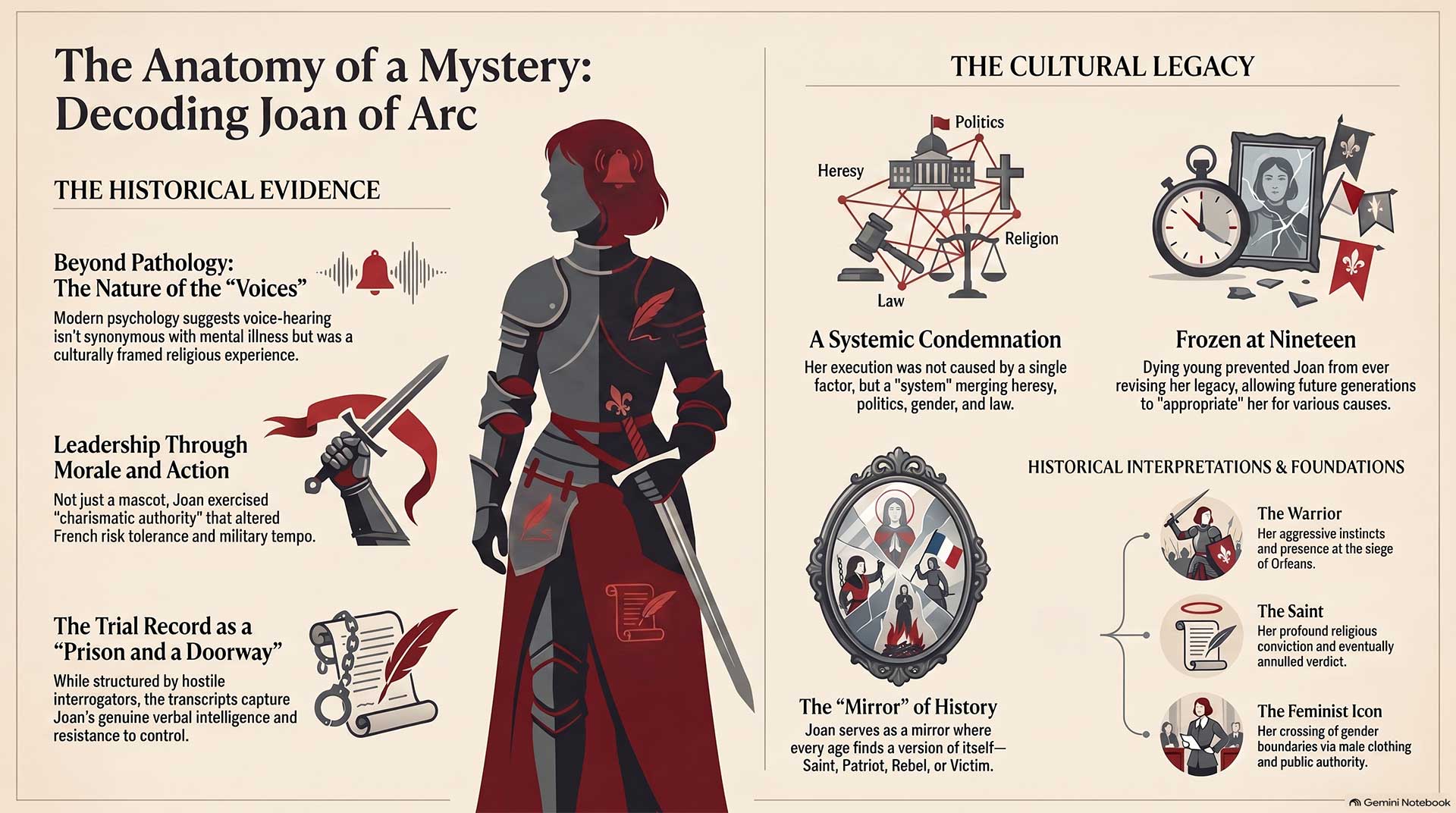
The scholars begin by trying to explain Joan.
By the end, they confront the limits of explanation itself.
History can tell us that Joan repeatedly described voices she believed came from St. Michael, St. Catherine, and St. Margaret.
Psychology can show that voice-hearing does not automatically indicate severe mental illness.
Military history can demonstrate that Joan was far more than a passive symbol.
Source criticism can reveal both the extraordinary value and the limits of the trial record.
Gender history can show why Joan’s public authority, military role, clothing, and spiritual independence made her especially unusual in fifteenth-century Europe.
Legal and political analysis can expose how theological questions became entangled with English interests and a deeply problematic judicial process.
Yet none of those fields can cross one final boundary.
No historian can enter Joan’s consciousness in the garden at Domrémy.
No neurologist can examine her brain.
No theologian can produce historical proof that St. Michael appeared.
No military historian can calculate precisely how much of Orléans came from tactics, morale, faith, timing, or Joan herself.
The closer scholars get to Joan, the more precise the mystery becomes.
Perhaps that is why she survives.
Each age creates a Joan that answers its own concerns.
Saint.
Soldier.
Visionary.
Victim.
Rebel.
Patriot.
Psychological case.
Symbol of women breaking social boundaries.
Yet none is large enough to contain the whole person.
Joan died before she had the chance to become older, reconsider her younger self, reinterpret her experiences, or challenge the meanings later generations placed upon her.
She remained nineteen.
Everyone else kept changing.
The task of scholarship may not be to produce the final Joan of Arc.
It may be to keep every easy version from replacing the human being beneath it.
Short Bios:
Daniel Hobbins is a historian of late-medieval Europe whose research includes Joan of Arc, Jean Gerson, medieval intellectual culture, and manuscript history. His work on Joan’s trial records helps establish how unusually rich the surviving evidence is and how cautiously historians must use it.
Karen Sullivan is a scholar of medieval literature, inquisition, heresy, and interrogation. Her work on Joan explores how the trial record was shaped by questions, legal procedure, clerical categories, and the encounter between Joan and her interrogators.
Kelly DeVries is a medieval military historian whose research includes Joan of Arc’s military career. He has argued for taking Joan seriously as a military leader without turning her into the sole architect of French victory.
Christopher C. H. Cook has worked across psychiatry, theology, spirituality, and the study of voice-hearing. His research examines spiritually significant voices and helps challenge the assumption that hearing voices automatically means psychiatric illness.
Dyan Elliott is a historian of medieval gender, religion, spirituality, sexuality, and inquisitorial culture. Her work provides a wider frame for examining female spiritual authority and the social structures surrounding women whose religious claims challenged established boundaries.
Leave a Reply