

Introduction
What if love becomes dangerous precisely when it looks most admirable?
Keigo Higashino’s The Devotion of Suspect X leaves us with an unsettling problem. Ishigami gives almost everything for Yasuko. His devotion can feel beautiful, frightening, selfless, obsessive, and morally indefensible at the same time.
After exploring those questions through the characters and then through scholars and psychologists, these five original modern-day stories move the problem somewhere new.
They do not retell Ishigami’s story.
Instead, each takes one question hidden inside his sacrifice and magnifies it.
Daniel needs to be needed so badly that helping others becomes his identity.
Elena receives extraordinary generosity and discovers that a gift can create a debt nobody intended.
Adrian builds a system capable of protecting his daughter from mistakes—and discovers that perfect protection can become another name for control.
Ethan chooses truth over loyalty and learns that doing what he believes is right does not erase betrayal.
David loves his seriously ill wife so fiercely that his devotion begins consuming the life she desperately wants him to keep.
Five different lives.
Five different moral problems.
One question runs beneath them all:
When does giving more stop becoming evidence of greater love?
(Note: This is an imaginary conversation, a creative exploration of an idea, and not a real speech or event.)
Story 1 — The Man Everyone Needed

At 2:17 in the morning, Daniel Park’s phone began to vibrate.
He was awake before it finished the first vibration.
He always was.
Three laptops glowed on the dining table of his apartment. One showed lines of server logs. Another showed the company’s internal chat. The third had been playing a movie Daniel had stopped watching forty minutes earlier.
He picked up.
“Daniel?”
It was Luis.
Daniel could hear keyboards and frightened voices behind him.
“Production is down.”
Daniel stood.
“How much?”
“Everything.”
“How long?”
“Eleven minutes.”
“Did you roll back the deployment?”
“We tried.”
“And?”
“It got worse.”
Daniel was already opening his laptop.
Luis lowered his voice.
“I’m sorry.”
Daniel began typing.
“For what?”
“I know it’s two in the morning.”
“It’s fine.”
“We didn’t know who else to call.”
Daniel stopped typing for half a second.
Then Luis said the words.
“Thank God. We need you.”
Daniel smiled.
“No problem.”
By 2:43, the servers were coming back.
At 2:51, customers could log in again.
At 3:06, the founder posted in the company channel:
DANIEL SAVED US AGAIN.
People responded with applause emojis.
GOAT.
Legend.
What would we do without you?
Daniel sat alone at his dining table reading every message.
He should have been exhausted.
Instead, he felt completely awake.
He closed the laptop at 3:24.
For several seconds, the apartment was silent.
Then he opened it again.
Just to make sure nobody needed anything else.
Daniel had been at BrightPath for seven years.
When he joined, there were twelve employees.
Now there were 340.
The company built software for hospitals. Its growth had been fast enough that nobody completely understood how everything worked anymore.
Nobody except Daniel.
He knew which ancient database would collapse if somebody changed a field name.
He knew why the billing server occasionally stopped communicating with the authentication system.
He knew which piece of code had been written by an engineer who left four years earlier.
People joked that BrightPath had two infrastructure systems.
The cloud.
And Daniel.
Daniel laughed whenever they said it.
He secretly loved it.
At 9:10 the next morning, he walked into the office carrying coffee.
Luis stared at him.
“What are you doing here?”
“Working.”
“You went to sleep at four.”
“Three forty.”
“That makes it worse.”
Daniel sat down.
Luis shook his head.
“I don’t know how you do it.”
Daniel opened his laptop.
“It wasn’t complicated.”
“For you.”
Daniel looked at him.
Luis was twenty-six.
Smart.
Eager.
Still nervous whenever something went wrong.
Daniel liked him.
Luis reminded him of himself twenty years earlier, except Luis asked for help without appearing ashamed of it.
Daniel had never understood how people did that.
At eleven, a message appeared.
Priya: Do you have five minutes?
Daniel walked to accounting.
Her eyes were red.
“Everything okay?”
She closed the door.
“My landlord raised the rent.”
Daniel waited.
“My daughter’s daycare raised theirs too.”
She laughed once.
“Everybody apparently had a meeting and decided I had too much money.”
Daniel smiled.
“How much are you short?”
“No. I didn’t come here for money.”
“How much?”
“Daniel.”
“How much?”
She eventually told him.
Daniel transferred it that afternoon.
When she promised to repay him, he waved her away.
“Whenever.”
“Seriously, Daniel.”
“It’s fine.”
“You do too much for everybody.”
Daniel smiled.
“That’s what I’m here for.”
The sentence stayed with him.
That’s what I’m here for.
It sounded good.
Complete.
Three months later, BrightPath hired Maya Shah.
Her title was Vice President of Systems Reliability.
At the company meeting, the CEO introduced her enthusiastically.
“Maya’s job is simple. We’ve grown too dependent on individual heroes.”
Everyone laughed.
Daniel did not.
The CEO continued.
“If somebody goes on vacation, nothing should collapse. If somebody leaves, knowledge shouldn’t leave with them.”
Maya stood and smiled.
“My goal is boring systems.”
More laughter.
“I want emergencies to become rare. I want two-in-the-morning phone calls to become almost nonexistent.”
People applauded.
Daniel clapped too.
But something inside him tightened.
Maya visited his desk the following morning.
“So you’re Daniel.”
“So they tell me.”
“I’ve heard about you.”
“Should I apologize?”
She smiled.
“I want to learn everything you know.”
“That could take a while.”
“Good.”
She pulled up a chair.
“Show me the authentication architecture.”
Daniel began.
Twenty minutes later, Maya interrupted.
“Where is this documented?”
Daniel pointed at his head.
She smiled.
“I was afraid of that.”
For the next six weeks, Maya followed Daniel everywhere.
Not literally, but it felt that way.
Every system he touched, she asked for documentation.
Every emergency procedure, she wanted a second owner.
Every password, dependency, workaround and undocumented script had to be recorded.
Daniel cooperated.
Mostly.
Sometimes Maya asked him to document something and Daniel would say:
“I’ll get to it.”
Then an emergency happened.
Or somebody needed help.
Or Daniel simply did the task himself.
One afternoon Maya asked about a deployment process she had requested three times.
“I haven't finished the documentation.”
“Why?”
“I've been busy.”
“With what?”
Daniel turned his monitor.
“I fixed the claims-processing issue.”
“Was that assigned to you?”
“No.”
“Who was handling it?”
“Luis.”
Maya waited.
Daniel continued.
“He was stuck.”
“How long?”
“Maybe twenty minutes.”
“And then?”
“I fixed it.”
Maya looked at him for a moment.
“What would have happened if you'd waited another twenty minutes?”
Daniel frowned.
“What?”
“What would have happened?”
“He might have fixed it.”
“Exactly.”
Daniel stared at her.
“Or it might have gotten worse.”
“Maybe.”
“I wasn’t going to let that happen.”
Maya nodded.
“I know.”
There was something about the way she said it that annoyed him.
By December, the two-in-the-morning calls were becoming rare.
Maya created an on-call rotation.
Luis learned the authentication system.
Priya learned enough technical operations to stop calling Daniel about every billing discrepancy.
Two younger engineers took over deployment.
The company created a knowledge base.
Daniel should have been proud.
BrightPath was becoming better.
Instead, he began checking his phone more often.
One Saturday morning, Daniel woke at 7:03.
No messages.
He made coffee.
Checked again.
Nothing.
At 8:14, he opened Slack.
Nobody had mentioned him.
At 9:32, he checked the monitoring system.
Everything was green.
At 10:20, he noticed an unusual server-load pattern.
Not dangerous.
He watched it.
It corrected itself.
At noon, he reheated leftover noodles.
His phone remained silent.
At 1:17, he opened the company chat.
Luis had solved a database issue.
Maya: Nice catch.
Luis: Learned from Daniel.
Daniel stared at the message.
He should have felt good.
Instead, he felt something he did not want to name.
He walked around his apartment.
There was nothing to do.
He considered calling someone.
Then realized he didn't know whom.
Luis?
They talked about work.
Priya?
She had children.
His sister lived in California. They spoke every few months.
His mother had died six years earlier.
Daniel opened his contacts and scrolled.
Hundreds of names.
He stopped at none of them.
At 2:46, he returned to his laptop.
His mother had once called him her little man.
Daniel was eight.
His father had left the year before.
There were bills on the kitchen table.
His mother was crying.
Daniel remembered climbing onto a chair.
“What happened?”
“Nothing.”
“Why are you crying?”
“I'm tired.”
He looked at the envelopes.
“What can I do?”
His mother wiped her face.
“Nothing. You're eight.”
But Daniel had made dinner for his younger sister.
Toast.
Scrambled eggs.
Too much salt.
His mother ate it anyway.
Then she hugged him.
“What would I do without you?”
Daniel remembered that sentence more clearly than he remembered her face that night.
At twelve, he learned to fix the washing machine.
At fourteen, he managed the household internet.
At sixteen, he helped his mother negotiate a medical bill.
At eighteen, he filled out his sister’s financial-aid forms.
Every time something broke, Daniel became calmer.
Broken things made sense.
They gave you a problem.
You solved it.
Then someone looked at you differently.
With relief.
With gratitude.
With need.
Monday morning, Maya appeared beside his desk.
“You okay?”
“Fine.”
“You were online all weekend.”
“I was checking things.”
“That’s what the on-call team is for.”
“I know.”
She sat down.
“Daniel, when was your last vacation?”
“March.”
“This is January.”
“I've been busy.”
“I mean a real vacation.”
“So do I.”
“Did you take your laptop?”
Daniel smiled.
She didn't.
Two weeks later, a payment-processing service began failing intermittently.
Luis was handling it.
Daniel watched the internal thread.
Luis: Found the likely source. Testing.
Daniel knew immediately what was wrong.
There was an old caching rule.
He could type the solution in one sentence.
His fingers hovered above the keyboard.
He waited.
Five minutes.
Ten.
Luis posted:
Luis: Still testing.
Daniel typed:
Check the legacy cache invalidation rule in service B.
Before he could press Enter, Maya sent him a private message.
Maya: Don't.
Daniel stared at it.
Daniel: I know the answer.
Maya: I know.
Daniel: Then why let him waste time?
Maya: He's learning.
Daniel: Customers are affected.
Maya: Minimally. We have time.
Daniel deleted his message.
Three minutes later, Luis posted:
Luis: Found it. Legacy cache rule.
Daniel closed Slack.
He stood and went to the restroom.
He locked himself in a stall.
His hands were shaking.
This was ridiculous.
Luis had solved a problem.
Daniel had trained him.
This was success.
He pressed his palms against his eyes.
Then, without warning, he began crying.
Silently at first.
Then harder.
He sat on the closed toilet seat and covered his mouth so nobody would hear him.
He had no idea what he was grieving.
Maya was waiting outside his office when he returned.
“Walk with me.”
“I have work.”
“No, you don't.”
The sentence hit harder than she intended.
Daniel stopped.
Maya realized it.
“I mean nothing urgent.”
“I know what you meant.”
They walked downstairs.
Outside, January air cut through Daniel’s coat.
For several blocks neither spoke.
Finally Maya said:
“Luis solved it.”
“I know.”
“You taught him.”
“I know.”
“That should make you happy.”
“It does.”
“No, it doesn't.”
Daniel stopped walking.
“What do you want from me?”
Maya turned.
“I want you to stop pretending this is about reliability.”
Daniel laughed bitterly.
“You've been here four months.”
“Correct.”
“You have no idea what I've done for this company.”
“I know exactly what you've done.”
“No, you don't.”
“Then tell me.”
Daniel started listing things.
The outages.
The weekends.
The migrations.
The employees he had trained.
The nights he had slept beneath his desk during the early years.
The Christmas morning he had spent fixing a corrupted database.
Maya listened.
When he finished, she said:
“That's extraordinary.”
Daniel waited.
Then she added:
“And it can't continue.”
“Why?”
“Because you've built a company that knows how to need you.”
“I didn't build that.”
“You helped.”
Daniel stared at her.
“You think I caused the problems?”
“No.”
“You think I'm sabotaging things?”
“No.”
“Then what exactly are you accusing me of?”
Maya was quiet.
Then she said:
“You keep saving everyone from problems you never allow them to learn how to solve.”
Daniel felt heat rise in his face.
“That is bullshit.”
“Maybe.”
“You don't know me.”
“Probably not.”
“I help people.”
“I know.”
“Is that a problem now?”
“No.”
“Then what?”
Maya looked directly at him.
“I think you don't know when helping is finished.”
Daniel walked back to the office alone.
He barely spoke to Maya for three days.
Then Luis asked him to lunch.
Daniel almost declined.
They went to a small Korean restaurant around the corner.
Luis ordered first.
After a few minutes he said:
“Are you mad at me?”
Daniel looked up.
“What?”
“The payment thing.”
“Of course not.”
“Maya told me not to ask you.”
Daniel felt betrayed.
“She said that?”
“She said I should try another hour.”
“And?”
Luis smiled.
“I figured it out.”
“I know.”
“Felt amazing.”
Daniel looked down at his food.
Luis continued.
“You know something weird?”
“What?”
“The first year I worked here, I thought I was terrible at this job.”
“Why?”
“Because every time I got stuck, you'd appear and solve it in thirty seconds.”
Daniel said nothing.
“I thought that's what being good looked like.”
Luis laughed.
“Then Maya started making you leave us alone.”
Daniel looked at him.
“And I realized maybe being good means being confused for an hour and eventually figuring it out.”
Daniel had no response.
Luis took another bite.
Then said:
“I still need you, though.”
Daniel looked up.
Luis smiled.
“Just differently.”
That night, Daniel sat alone in his apartment.
His phone was beside him.
Silent.
He thought about his mother.
What would I do without you?
For thirty-four years, Daniel had remembered those words as love.
Now he wondered if an eight-year-old boy had heard something else inside them.
A job description.
He opened his laptop.
There was a document Maya had requested months earlier.
Authentication Architecture — Knowledge Transfer
Blank.
Daniel stared at it.
Then began typing.
At 11:46, he stopped.
Deleted half of it.
Started again.
Explaining something felt strangely intimate.
Once it existed outside his head, it no longer belonged only to him.
Anyone could know it.
Anyone could fix it.
Anyone could become Daniel.
The thought frightened him.
He kept typing.
Two months later, BrightPath had its largest outage of the year.
Daniel was in the office when alarms erupted.
People stood.
Monitors turned red.
Luis ran toward him.
“Authentication failure.”
Daniel stood automatically.
“Show me.”
They reached the operations room.
Luis pulled up the logs.
Daniel saw the problem almost immediately.
His body responded before thought.
“Move.”
Luis started to slide his chair aside.
Then Maya's voice came from behind them.
“Daniel.”
He looked back.
She said:
“Help him.”
Daniel waited.
“Don't replace him.”
Luis looked between them.
“I can move.”
Daniel stared at the screen.
Every instinct told him to take the keyboard.
Thirty seconds.
Maybe forty-five.
He could fix this.
Customers were waiting.
Executives were panicking.
Somebody needed him.
The old warmth returned.
Clear.
Familiar.
Almost beautiful.
Daniel put one hand on the back of Luis's chair.
“Look at the second authentication request.”
Luis scanned the logs.
“I don't see it.”
“Don't look for the error.”
“What am I looking for?”
“What should be there?”
Luis stared.
Then leaned closer.
“Oh.”
Daniel said nothing.
Luis began typing.
Wrong command.
Daniel almost reached forward.
Stopped himself.
“Check that.”
Luis looked.
“Right.”
Corrected it.
Three minutes passed.
Then five.
Daniel could feel his heart pounding.
Finally Luis froze.
“I've got it.”
Daniel looked at the screen.
Luis entered the fix.
They waited.
One monitor turned green.
Then another.
Then another.
Someone behind them shouted.
Applause spread across the room.
Luis leaned back and laughed.
“Oh my God.”
He turned toward Daniel.
“I did it.”
Daniel smiled.
“Yes.”
Luis stood and hugged him.
“Thank you.”
Daniel patted his back.
Then walked away.
He made it to the restroom before the tears came.
This time he understood them.
BrightPath could survive without him.
Luis could solve the problem.
Maya could build the systems.
People he had trained could train other people.
The thing Daniel had spent years building was finally becoming strong enough that it did not need him at its center.
And some frightened part of him experienced that as abandonment.
He looked at himself in the mirror.
Forty-two years old.
Exhausted.
Useful.
Very useful.
He thought about his mother.
Priya.
Luis.
The founder.
Every emergency.
Every relieved face.
Every version of:
What would we do without you?
Daniel whispered to the empty restroom:
“Maybe being needed was the only way I knew how to feel loved.”
He waited.
Nothing answered.
For once, there was no problem to solve.
The following Monday, Daniel booked a meeting with Luis.
Subject:
Authentication System Training — Session 1
Luis arrived carrying his laptop.
“What are we doing?”
“I'm teaching you the whole thing.”
Luis laughed.
“The whole thing?”
“The whole thing.”
“That could take months.”
“I know.”
They sat together.
Daniel opened the architecture document.
For the first twenty minutes, he explained everything too quickly.
Luis stopped him.
“Wait.”
Daniel sighed.
“What?”
“You skipped something.”
“No, I didn't.”
“You absolutely did.”
Daniel looked.
Luis was right.
Daniel went back.
He explained it again.
Slower.
Luis typed notes.
At one point, he reached for the keyboard.
Daniel's hand moved instinctively.
He wanted to take over.
He stopped.
Pulled his hand back.
“Try it.”
Luis did.
Wrong.
Daniel waited.
Luis tried again.
Still wrong.
Daniel felt the old discomfort rise.
Then Luis laughed.
“Give me a minute.”
Daniel leaned back.
“Take two.”
His phone vibrated on the desk.
Both men looked at it.
Daniel recognized the name.
Someone from accounting.
Normally, he would have answered before the second vibration.
The phone vibrated again.
Luis looked at him.
“You gonna get that?”
Daniel watched the screen.
For the first time in years, being needed did not feel like an emergency.
He let it ring once more.
Then he turned back to Luis.
“Show me what you tried.”
And Luis began explaining.
Story 2 — The Gift She Could Never Repay
The first time Marcus Bell paid Elena Ramirez’s rent, she returned the money within eleven minutes.
He sent it again.
She returned it again.
He sent it a third time.
This time with a message.
Stop.
Elena stared at her phone.
Then another message appeared.
You can be mad at me after you and Sofia have a place to sleep next month.
Elena called him immediately.
“What the hell are you doing?”
“Making dinner.”
“Marcus.”
“Chicken.”
“Take the money back.”
“No.”
“I’m serious.”
“So am I.”
“I didn’t ask you for money.”
“I know.”
“That matters.”
“I know.”
“You cannot just send somebody three thousand dollars.”
“Apparently I can.”
“Marcus.”
He became quiet.
Then his voice changed.
“Elena.”
She hated when he used that voice.
Not angry.
Not commanding.
Gentle.
“You’re forty-eight hours from being late on rent.”
She said nothing.
“Sofia’s tuition payment is next week.”
Silence.
“You’ve got $612 in checking.”
Elena stood.
“How do you know that?”
“You left your banking app open when I was fixing your printer.”
“You looked?”
“I saw.”
“That’s looking.”
“Fine. I looked.”
She began pacing.
“I don’t need rescuing.”
“I know.”
“Apparently you don’t.”
Marcus waited.
Then said:
“You don’t owe me anything.”
Elena closed her eyes.
“I mean it.”
“I know.”
“No, you don’t.”
He paused.
“Someday you’ll be okay again. When that happens, help somebody else.”
Elena sat down.
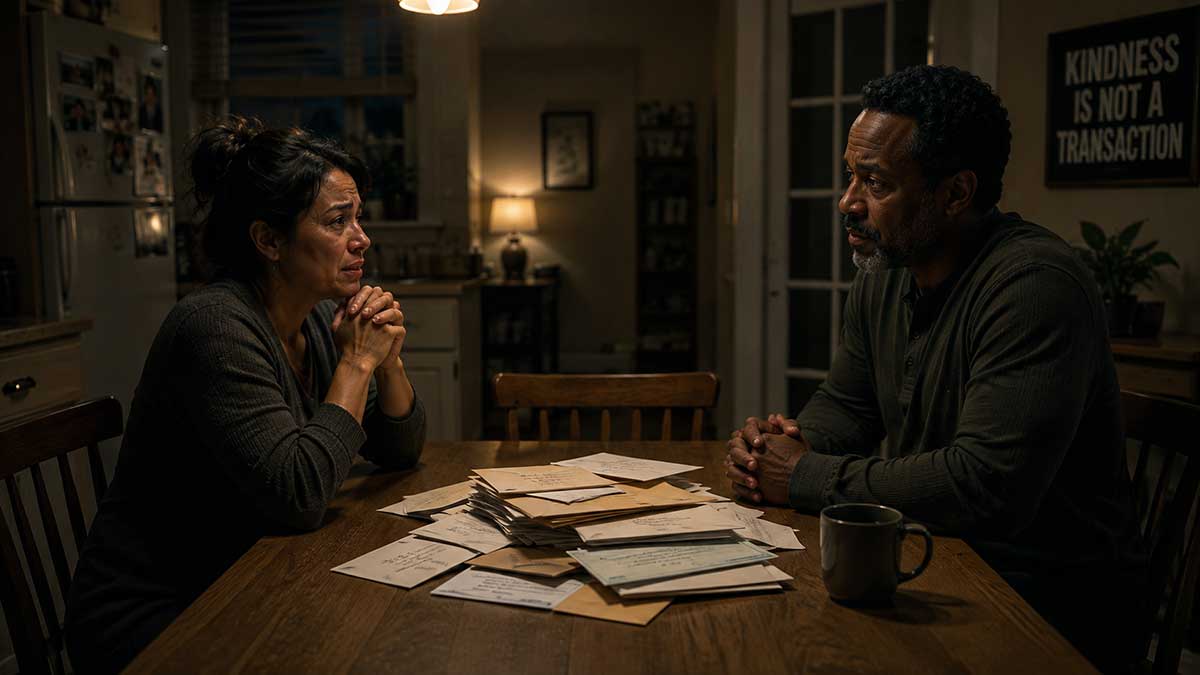
She looked at the envelopes scattered across the kitchen table.
Rent.
Electricity.
Hospital.
Tuition.
For months she had been opening them in order of which frightened her most.
“Marcus.”
“Yeah?”
“I’m paying you back.”
“Fine.”
“Every dollar.”
“Fine.”
“I mean it.”
“I know.”
She hated how relieved she felt.
Three years earlier, Elena had left her husband with two suitcases, a seventeen-year-old daughter and $4,800.
She considered it one of the greatest achievements of her life.
For fourteen years, Carlos had controlled the money.
Not violently.
Not dramatically.
There were no locked bank accounts.
No weekly allowance.
Nothing Elena could easily explain to another person.
Carlos simply knew everything.
Every purchase.
Every receipt.
Every transfer.
“Why did you spend $86 at Target?”
“What was the $14.72?”
“Why are we paying for Sofia’s dance lessons when she’ll quit in six months?”
Eventually Elena stopped buying things she could not defend.
When she finally left, she promised herself one thing.
Nobody would ever control her with money again.
Marcus had been their friend long before the divorce.
Not Carlos’s friend.
Hers.
They had met at twenty-two while working at the same hotel.
Marcus was the night manager.
Elena worked events.
They had eaten terrible vending-machine dinners together at one in the morning.
Marcus attended her wedding.
When Sofia was born, he brought a stuffed elephant almost larger than the baby.
When Elena’s mother died, he sat in the back row at the funeral and said almost nothing.
He was simply there.
That was Marcus.
He appeared.
He carried boxes.
Fixed things.
Remembered birthdays.
Never made himself the center of the room.
Which was why accepting money from him felt possible.
Just once.
Then the transmission failed.
Elena stood in the repair shop staring at the estimate.
$2,870.
She called three places.
Same answer.
She could not work without the car.
She could not get Sofia to college without the car.
She put the repair on a credit card.
Marcus found out.
Two days later, he paid the card.
Elena called him.
“No.”
“Elena.”
“No.”
“You're paying twenty-four percent interest.”
“That's my problem.”
“Now it isn't.”
She hung up on him.
He did not call back.
That somehow made her angrier.
She created a spreadsheet.
MARCUS
Rent: $3,000.
Car: $2,870.
She added interest.
Marcus told her to remove the interest.
She kept it.
Then came the hospital bill.
Then Sofia’s tuition gap.
Then the refrigerator.
Each time Elena said no.
Each time Marcus helped anyway.
Sometimes directly.
Sometimes by leaving a check.
Once by paying a bill before she knew he had seen it.
Elena became furious.
Then grateful.
Then furious that she was grateful.
One evening, Sofia found the spreadsheet.
She was nineteen.
“What is this?”
“Nothing.”
“Mom.”
“Money I owe Marcus.”
Sofia scrolled.
Her eyes widened.
“Jesus.”
“Language.”
“Mom, this is like twenty grand.”
“Twenty-two.”
“You’re paying him back?”
“Of course.”
“Does he want it?”
“That doesn’t matter.”
Sofia looked at her.
“Why?”
“Because you pay people back.”
“He told me he doesn't want it.”
Elena turned.
“You talked about this?”
“He paid my tuition.”
“He helped.”
“He paid it.”
Elena took the laptop.
“You’re staying out of this.”
Sofia watched her.
Then said:
“Sometimes I think you hate owing people more than you hated being broke.”
Elena closed the laptop.
“Go study.”
Two years passed.
Elena got promoted.
Then promoted again.
She moved into a smaller but better apartment.
Sofia graduated.
Elena began paying Marcus $400 every month.
He returned the first payment.
She sent it again.
He returned it.
Eventually she mailed checks.
Marcus stopped depositing them.
Elena discovered six months later.
She drove to his house carrying the uncashed envelopes.
“What is wrong with you?”
Marcus looked at the envelopes.
“Oh.”
“‘Oh’?”
“I forgot about those.”
“You did not forget.”
He smiled.
“No.”
“Deposit them.”
“I don't need the money.”
“I don't care.”
“Elena.”
“You said I could pay you back.”
“I said ‘fine’ so you'd stop yelling at me.”
She stared at him.
Marcus sighed.
“I helped you when you needed help.”
“And now I don't.”
“Exactly.”
“So take it.”
“Why?”
“Because it's mine to repay.”
Marcus studied her.
Then took the envelopes.
“Okay.”
Elena exhaled.
“Thank you.”
He put them in a drawer.
She pointed at it.
“Deposit them.”
“Yes, ma’am.”
He never did.
At forty-two, Elena met Aaron Blake.
He taught eighth-grade history.
Their first date was terrible.
Aaron spent fifteen minutes explaining Roman taxation before realizing Elena had asked about his vacation to Rome.
She laughed so hard she nearly spilled her wine.
“I’m sorry,” he said.
“No. Keep going.”
“About taxation?”
“I want to see how far this goes.”
That was the beginning.
Aaron did not rescue Elena.
This was one of the things she loved about him.
When her kitchen faucet leaked, he said:
“Want help?”
She said:
“No.”
He answered:
“Okay.”
Carlos would have told her what she was doing wrong.
Marcus would have arrived with tools.
Aaron watched television.
Twenty minutes later Elena walked into the living room soaking wet.
“Help.”
Aaron stood.
“Absolutely.”
No judgment.
No lesson.
No victory.
Just help when asked.
Elena noticed the difference.
They dated for two years.
Marcus met Aaron several times.
They liked each other.
That should have made everything easier.
It did not.
Aaron proposed on a Tuesday night in Elena’s kitchen.
No restaurant.
No photographer.
No hidden family members.
He was drying dishes.
Elena was putting them away.
He said:
“I’ve been thinking.”
“That’s dangerous.”
“I think we should get married.”
Elena turned.
Aaron was holding a dish towel.
“You’re proposing with a towel?”
“I wasn't planning to do it right now.”
“You have a ring?”
“Yes.”
“Where?”
“My coat.”
Elena laughed.
Then cried.
Then said yes before he reached the coat.
That night she called Sofia.
Sofia screamed.
She called her sister.
More screaming.
She called two friends from work.
Then she opened Marcus’s contact.
Her finger hovered.
She put the phone down.
The next morning, she tried again.
Didn’t call.
That evening.
Didn’t call.
Three days.
A week.
Aaron noticed.
“Did you tell Marcus?”
“I will.”
“You've told the mailman.”
“I did not tell the mailman.”
“He congratulated me.”
“He saw the ring.”
“Elena.”
“I'll tell him.”
Aaron watched her.
“Why haven't you?”
“I don't know.”
But she did.
She imagined Marcus alone in his house.
She imagined the checks he had never deposited.
The rent.
The tuition.
The car.
The hospital bill.
The refrigerator.
She imagined saying:
Thank you for carrying me through the worst years of my life. I’m going to spend the rest of it with someone else.
It sounded monstrous.
Three weeks later, Marcus found out accidentally.
Sofia posted a photograph online.
Marcus called.
Elena stared at his name.
Her stomach dropped.
She answered.
“Hi.”
“You're engaged?”
There it was.
“Marcus—”
“You're engaged!”
He sounded delighted.
Elena stopped.
“When?”
“A few weeks ago.”
“A few weeks?”
“I was going to tell you.”
“Forget that. Tell me about him proposing.”
She sat down.
“Marcus…”
“What?”
“You're not upset?”
Silence.
Then:
“Why would I be upset?”
“I don't know.”
“Elena, I like Aaron.”
“I know.”
“He's good to you.”
“I know.”
“You love him.”
She couldn't speak.
Marcus laughed softly.
“Finally.”
“What?”
“You've had enough bad years.”
Elena covered her mouth.
“Hey,” Marcus said. “Are you crying?”
“No.”
“You are.”
“Shut up.”
He laughed.
“You deserve this.”
That sentence broke something.
Elena ended the call as quickly as she could.
Then she sat on the kitchen floor and cried harder than she had cried the day her divorce became final.
Aaron found her there.
He sat beside her.
“What happened?”
“Marcus knows.”
“And?”
“He’s happy.”
Aaron waited.
“He said I deserve this.”
Aaron looked confused.
“Isn’t that good?”
Elena wiped her face.
“Yes.”
“Then why are you crying?”
She shook her head.
“I don’t know.”
Aaron did not ask again.
He simply sat beside her.
For the next week, Elena slept badly.
She began calculating again.
She found the old spreadsheet.
$22,430.
She calculated what it would be with interest.
Then inflation.
Then investment returns.
The number grew.
She stared at it.
Ridiculous.
She knew it was ridiculous.
Then she opened another spreadsheet.
Wedding costs.
House down payment.
Retirement.
Aaron’s finances.
Her finances.
Marcus.
She stopped.
Why was Marcus on the page?
She closed the computer.
And suddenly she knew.
Marcus was cooking when Elena arrived at his house.
Chicken.
Of course.
“You hungry?”
“No.”
“That sounds serious.”
“It is.”
Marcus turned off the stove.
Elena remained standing.
“Why didn't you ever ask me for anything?”
Marcus frowned.
“What?”
“All those years.”
“What are you talking about?”
“The money.”
“Elena—”
“Why didn't you ask for anything?”
“I didn't want anything.”
“That's not possible.”
Marcus stared at her.
“Of course it's possible.”
“No.”
“Elena, what is going on?”
She felt anger rising.
Not at him.
That made it worse.
“Why couldn’t you have asked for something?”
Marcus looked genuinely lost.
“Like what?”
“I don’t know.”
“Then what are we talking about?”
She could feel tears coming.
She hated that.
“Dinner.”
“We've had dinner a thousand times.”
“A date.”
Marcus froze.
Elena continued.
“Anything.”
“Elena…”
“Something I could answer.”
His face changed.
Then she said it.
“If you had asked for something, I could have said no.”
Silence.
Marcus stepped back.
“What?”
“If you had wanted me to date you, I could say no.”
“I never asked you to date me.”
“I know.”
“If I wanted something, I would have asked.”
“I know.”
“Then what have I done?”
Elena looked at him.
For the first time, she realized how terrible this conversation sounded.
“You helped me.”
“Yes.”
“You saved my apartment.”
“I helped with rent.”
“You kept Sofia in school.”
“I helped with tuition.”
“You paid my medical bill.”
“Elena, what is this?”
“And every time I tried to pay you back, you wouldn't let me.”
Marcus’s face hardened.
“So helping you was wrong?”
“No.”
“That’s what you're saying.”
“No.”
“I never touched you.”
“I know.”
“I never asked you to leave anyone.”
“I know.”
“I never told you not to date.”
“I know.”
“I congratulated you!”
“I KNOW.”
Her voice filled the kitchen.
They both stopped.
Marcus turned away.
For the first time in all the years Elena had known him, he looked angry with her.
“You think I bought something.”
“No.”
“That’s exactly what you think.”
“No, Marcus.”
“You think every time I gave you money I was putting something into some invisible account.”
“No.”
“Then what?”
Elena struggled.
Because he was right.
And he wasn't.
Finally she whispered:
“I did.”
Marcus turned.
“What?”
“I put it in the account.”
Silence.
“Not you.”
She wiped her face.
“Me.”
Marcus stared at her.
Elena continued.
“I kept track of everything.”
“I know about the spreadsheet.”
She looked up.
“You knew?”
“Sofia told me.”
“Of course she did.”
“She was worried.”
Elena almost laughed.
“I thought if I paid everything back, I'd be free.”
Marcus looked hurt.
“Free from me?”
“No.”
“Then from what?”
Elena thought for a long time.
“From being the kind of person who takes that much from somebody and then walks away.”
Marcus sat down.
Elena remained standing.
“Walks away where?”
She looked at her engagement ring.
Marcus followed her eyes.
His face changed.
“Oh.”
Elena began crying again.
“I don't know how to marry Aaron without feeling like I'm leaving you.”
Marcus stared at her.
“Elena…”
“You were there for everything.”
“Elena.”
“You saved us.”
“Elena.”
“What?”
“I don't want you.”
She froze.
Marcus immediately winced.
“That came out wrong.”
Despite herself, Elena laughed through her tears.
“Wow.”
“I mean—I love you.”
“Much better.”
“Not helping.”
“No.”
He rubbed his face.
“I love you. I love Sofia. You're family.”
Elena sat opposite him.
“But I never gave you that money hoping you'd eventually choose me.”
“I know.”
“Do you?”
“Yes.”
“Then why are we here?”
Elena looked down at her hands.
“Because gratitude has weight.”
Marcus said nothing.
“And you kept telling me it didn't.”
“I was trying to take the weight away.”
“I know.”
“Apparently I did a terrible job.”
“No.”
She looked at him.
“You did something wonderful.”
Marcus waited.
“And I turned wonderful into something I had to deserve.”
His expression softened.
Elena continued.
“I think Carlos taught me that everything comes with a price.”
Marcus nodded slowly.
“So when you told me there wasn't one…”
She stopped.
“What?”
“I invented one.”
Marcus looked toward the drawer.
The drawer where he had placed her checks.
He stood.
Opened it.
The envelopes were still there.
All of them.
He brought them to the table.
Elena stared.
“You bastard.”
Marcus almost smiled.
“I know.”
“You said you'd deposit them.”
“I lied.”
“That is literally a crime.”
“I don't think it is.”
“It should be.”
He pushed the envelopes toward her.
“Take them.”
“No.”
“Elena.”
“No.”
They stared at each other.
Then Marcus laughed.
“You see what we're doing?”
She did.
Two people fighting over who was allowed to give.
Marcus sat again.
“What do you actually want?”
The question stopped her.
Nobody had asked it that plainly.
Not what was fair.
Not what she owed.
Not what Marcus deserved.
What did she want?
“I want to marry Aaron.”
“Good.”
“I want you at the wedding.”
“I'll be there.”
“I want you in my life.”
“I'll be there.”
She paused.
“And I want to stop paying you.”
Marcus smiled.
“That was always my favorite option.”
“Don't ruin the moment.”
“Sorry.”
Elena placed her hand over the envelopes.
Then she said:
“What you gave me mattered. But my life cannot become the repayment.”
Marcus nodded.
“No.”
“It can't.”
“No.”
“And that doesn't make me ungrateful.”
“No.”
She looked at him.
“Say it better.”
Marcus smiled.
“It doesn't make you ungrateful.”
She nodded.
Then Marcus said:
“And helping you doesn't make me your owner.”
“I never thought you were.”
“I know.”
He paused.
“But maybe you needed to hear me say it.”
She did.
Elena took the envelopes home.
She did not cash the money.
She did not send it back.
For several days they sat on her kitchen table.
Then she shredded the checks.
One by one.
Four months later, Elena married Aaron.
Marcus sat in the third row beside Sofia.
When Elena walked down the aisle, she saw him.
He smiled.
Nothing broke.
Nobody was abandoned.
Nobody disappeared.
The debt did not suddenly become meaningless.
It simply stopped being the definition of their relationship.
Three weeks after the wedding, Marcus received an envelope.
He recognized Elena’s handwriting.
For one terrible second, he thought it contained another check.
He opened it.
One sheet of paper.
No money.
No accounting.
No total.
Just a letter.
Marcus sat at his kitchen table and read.
Elena thanked him for the rent.
The car.
The tuition.
The hospital bill.
The refrigerator.
She thanked him for carrying things when she could not.
Then she wrote:
For years, I thought there were only two ways to live with what you gave me.
Repay it.
Or owe you forever.
I finally understand there was a third.
I can simply be grateful.
Marcus stopped reading.
He wiped his eyes.
Then continued.
I used to think accepting something without repayment made me weak.
Now I think maybe receiving is something I never learned how to do.
At the bottom she had written one final sentence.
Thank you for helping me when I needed you—and for letting me become someone who doesn't.
Marcus read that sentence twice.
Then folded the letter carefully.
He opened the drawer where Elena’s checks had once been.
It was empty.
He placed the letter inside.
And closed it.
Story 3 — The Algorithm That Loved Her Too Much

At 7:12 every morning, Adrian Chen watched his daughter leave the house.
At 7:13, his phone told him whether she was safe.
ROUTE RISK: LOW
Green.
He liked green.
Mia never knew the alert appeared.
She would sling her backpack over one shoulder, push her hair behind one ear, yell, “Bye, Dad,” and disappear down the sidewalk toward the train.
Adrian would wait until the dot on the map moved through the station entrance.
Then he would make coffee.
Only then.
The system had started after his wife died.
Three years earlier.
A blood clot.
Unexpected.
Fast.
By the time Adrian understood what was happening, there was nothing left to predict.
That sentence haunted him.
Nothing left to predict.
For months he replayed the previous week.
The headaches she had mentioned.
The fatigue.
The long flight.
The pain in her calf she dismissed.
Adrian worked in predictive systems.
He built models that found fraud before banks lost money.
Models that flagged equipment failures before machines broke.
Models that estimated human behavior with uncomfortable accuracy.
And yet he had failed to see the one thing that mattered.
After the funeral, Mia was fourteen.
She started walking to school alone.
Adrian downloaded three safety apps.
Then replaced them.
They were too crude.
Too many false alarms.
Not enough context.
So he built his own.
At first, it did almost nothing.
Weather.
Traffic.
Transit delays.
Location.
Phone battery.
If Mia’s route changed unexpectedly, Adrian received an alert.
He told himself it was temporary.
Then winter came.
One afternoon, Mia took a different route home.
The system noticed.
Adrian’s phone buzzed.
ROUTE DEVIATION: 0.8 MILES
He called.
“Where are you?”
“Walking.”
“Where?”
“Why?”
“You're not on your usual route.”
Silence.
“How do you know that?”
Adrian froze.
He had forgotten she didn’t know the full extent of the tracking.
“I can see your location.”
“Oh.”
“With Find My.”
That part was technically true.
“I'm with Ava.”
“Where are you going?”
“Coffee.”
“Which place?”
“Dad.”
“What?”
“Nothing.”
She hung up.
Adrian watched the dot move.
Nothing happened.
She came home safely.
He told himself the system had worked.
A few months later, he added crime data.
Then weather severity.
Then transit disruptions.
Then emergency-room proximity.
Then driver-risk scoring.
He built slowly.
Carefully.
Always for a reason.
Every new feature began with something real.
A train delay.
A school fight.
A robbery two blocks away.
A drunk driver.
A wildfire alert during a family trip.
The system learned.
Adrian named it Harbor.
He almost regretted the name immediately.
It sounded sentimental.
He kept it anyway.
Mia knew about Harbor by then.
At least she thought she did.
“Dad’s weird safety thing.”
That was how she described it.
She mocked the alerts.
“Should I bring an umbrella?”
“Harbor says yes.”
“Can I go to Ava’s?”
“Harbor says low risk.”
“Can I have cereal?”
“Harbor says absolutely not.”
Adrian would smile.
That humor helped.
It made the system feel normal.
By sixteen, Mia had learned how to read her father’s face whenever Harbor disliked something.
She asked to drive to a concert.
Adrian hesitated.
“What?”
“Nothing.”
“Harbor?”
He sighed.
“Traffic risk is elevated.”
“By how much?”
“Thirty-two percent.”
“Thirty-two percent what?”
“Above baseline.”
“So?”
“So maybe take the train.”
Mia rolled her eyes.
“Fine.”
She took the train.
The highway had a major accident that night.
Adrian said nothing.
Mia did.
“Harbor wins.”
He smiled.
That sentence stayed with him all week.
Then came Noah.
Mia met him during a summer design program.
Seventeen.
Funny.
Restless.
Always late.
Adrian disliked him immediately.
He tried not to.
He knew fathers were supposed to dislike teenage boys on principle.
He did not want to become that father.
So he said very little.
Then Harbor started finding things.
Noah had changed schools twice.
His attendance was poor.
His driving history showed two speeding citations.
Public social posts revealed angry fights with former friends.
His language patterns in texts to Mia showed escalating jealousy.
Adrian stared at the model’s summary.
RELATIONSHIP HARM RISK: 74%
He closed the laptop.
Opened it again.
For three days he did nothing.
Then Mia said:
“Noah’s coming over Friday.”
Adrian looked up.
“For dinner?”
“Yeah.”
“Okay.”
That night, he added another layer to Harbor.
Behavioral relationship prediction.
He told himself he was not spying.
The model was analyzing patterns already present in data Mia had willingly synced into the family system.
He did not read her messages.
Not directly.
The model did.
That distinction mattered to him.
At first.
Friday dinner was uncomfortable.
Noah talked too much.
Interrupted Mia twice.
Made one joke Adrian did not like.
Nothing terrible.
After he left, Adrian asked:
“You like him?”
Mia smiled.
“Obviously.”
“He seems intense.”
“So are you.”
“Different kind.”
“Sure.”
Adrian almost told her.
He didn’t.
Over the next month, Harbor’s score climbed.
78%.
81%.
Mia started canceling plans with friends to be with Noah.
He called frequently.
Asked where she was.
Got upset when she did not answer quickly.
Adrian watched the indicators.
The system was right.
He knew it.
That was the problem.
He began intervening.
Small things.
He scheduled a family dinner on a night Mia planned to see Noah.
He suggested a weekend trip.
He reminded her of a school deadline exactly when Noah wanted to meet.
He asked questions.
“Does he get angry when you see Ava?”
“Why?”
“Just asking.”
“Did Ava say something?”
“No.”
He did not lie well.
Mia noticed.
One night she came home crying.
Adrian was in the kitchen.
“What happened?”
“Nothing.”
“Mia.”
“Leave it.”
“Did Noah—”
She looked at him sharply.
“How do you know?”
Adrian stopped.
“Know what?”
“That it was Noah.”
He said nothing.
Mia stared at him.
Then walked upstairs.
Two weeks later, she ended the relationship.
Adrian felt relief so strong it made him light-headed.
He hated that.
Three months after that, Ava told Mia that Noah had become frightening with another girl.
Jealous.
Controlling.
Threatening.
Mia came home and sat at the counter.
“You were right.”
Adrian looked up.
“About?”
“Noah.”
He stayed quiet.
Mia laughed bitterly.
“Don’t pretend.”
“I’m not.”
“You thought something was wrong.”
“Yes.”
“How?”
Adrian hesitated.
That was the moment.
He could have told her everything.
Instead:
“Pattern.”
“What pattern?”
“Just things I noticed.”
Mia nodded slowly.
“Of course.”
Adrian told himself he had protected her.
The system had worked.
The evidence supported him.
That made the next step easier.
Harbor began evaluating more.
College programs.
Career paths.
Travel.
Neighborhoods.
Friends.
Financial behavior.
Mental-health stress indicators.
Adrian never asked it to decide.
Only to predict.
That difference mattered.
At first.
Mia wanted to apply to a competitive art-and-technology program in Seattle.
Adrian ran the data.
Tuition was high.
Completion rates were mixed.
Graduates had uneven income.
The program involved intense critique culture.
Harbor returned:
FINANCIAL INSTABILITY RISK: 63%
ACADEMIC STRESS RISK: 71%
LONG-TERM CAREER VOLATILITY: HIGH
Adrian closed the report.
He did not mention it.
Instead he began sending Mia information about safer schools.
State university.
Computer science.
Industrial design.
Programs with stronger employment rates.
Mia noticed.
“Why are you sending me all this?”
“Options.”
“I have options.”
“More is better.”
“No.”
She looked at him.
“You want me to go somewhere else.”
“I want you to think.”
“I am thinking.”
“Then look at the numbers.”
Mia’s face changed.
“What numbers?”
Adrian realized his mistake.
That evening, Mia waited until he went downstairs.
She opened his laptop.
She knew the password.
He had never hidden it.
She searched Harbor.
At first, she found safety dashboards.
Then something else.
MIA — DECISION MODEL
She clicked.
Pages.
Scores.
Probabilities.
Noah.
Friends.
College.
Driving.
Travel.
Health.
Mood.
Even the likelihood that she would drop a class.
Her hands started shaking.
Adrian found her sitting at his desk.
The screen was open.
He stopped in the doorway.
“Mia.”
She turned.
“What is this?”
He did not answer.
She pointed at the screen.
“What is this?”
“Harbor.”
“I know what Harbor is.”
“No, you know part of—”
“YOU SCORED MY BOYFRIEND?”
Adrian closed the door.
“Mia.”
“You analyzed my messages?”
“Not manually.”
She stared at him.
“That is your defense?”
“I never read them.”
“THE COMPUTER DID?”
“It analyzes patterns.”
“Dad.”
“It predicted Noah.”
“That does not make this okay.”
“It was right.”
The sentence came out too fast.
He knew immediately.
Mia stepped back.
“There.”
“What?”
“That.”
She pointed at him.
“You think being right means you get to do it.”
“No.”
“Yes.”
“I was trying to protect you.”
“From what?”
“People who hurt you.”
“Failure.”
“Bad decisions.”
He stopped.
Mia looked at him.
“How far does it go?”
Adrian said nothing.
Her face changed.
“Oh my God.”
She opened another page.
College.
Another.
Friends.
Another.
Adrian felt something collapse inside him.
“Mia, listen.”
“No.”
“You need context.”
“No.”
“I did this after Mom.”
“Do not use Mom.”
His face went still.
“Don’t.”
“I’m not using her.”
“Yes, you are.”
Mia’s voice broke.
“You always do this.”
“You say if you had known, maybe she would still be here.”
Adrian looked down.
Mia continued.
“So now you have to know everything.”
“That is not fair.”
“No?”
She turned the laptop toward him.
RISK SCORE: 68%
“Is this fair?”
Adrian tried to stay calm.
“This does not control you.”
Mia laughed.
“Really?”
“You still make your own decisions.”
“Do I?”
“Yes.”
“Did I break up with Noah because I wanted to?”
Adrian’s face changed.
Mia saw it.
“What did you do?”
“Nothing direct.”
“What does that mean?”
“I created space.”
She stared at him.
“You manipulated me.”
“No.”
“You moved things around.”
“I gave you time to see him clearly.”
“THAT IS MANIPULATION.”
Adrian raised his voice.
“And he was dangerous.”
Mia stopped.
Adrian continued.
“I was right.”
“I know.”
“He could have hurt you.”
“I know.”
“Then what exactly are we arguing about?”
Mia stared at him.
For a moment, she seemed almost calm.
That frightened him more.
Then she said:
“If you are right about everything, when do I get to become a person?”
Adrian froze.
Mia wiped her face.
“I mean it.”
“When?”
“When the probability is low enough?”
“When Harbor approves?”
“When you die?”
“Mia.”
“No.”
She closed the laptop.
“You don’t trust me to have a life.”
“That is not true.”
“You trust yourself to predict one.”
She left the room.
Adrian stood alone.
For the next week, they barely spoke.
Harbor continued running.
Adrian could not stop looking.
Mia’s stress score rose.
Sleep quality fell.
She skipped lunch twice.
The system recommended intervention.
He ignored it.
That alone felt terrifying.
One evening, Adrian sat across from his brother Victor.
They had not eaten together in months.
Victor listened to the story without interrupting.
When Adrian finished, Victor said:
“You built a prison.”
Adrian stared at him.
“That’s dramatic.”
Victor shrugged.
“You asked.”
“It prevents harm.”
“Prisons do that too.”
Adrian pushed his plate away.
“You don't understand what happened with Grace.”
Victor’s expression changed.
“I was at the hospital.”
“That’s not what I mean.”
“No. I do understand.”
Victor leaned forward.
“You think her death was a prediction failure.”
Adrian’s jaw tightened.
“It was preventable.”
“Maybe.”
“It was.”
“Fine.”
Victor waited.
“What if it was?”
Adrian looked at him.
Victor continued.
“What does Mia owe you for that?”
“Nothing.”
“Then why does she have to live inside your correction?”
Adrian said nothing.
Victor softened.
“You loved Grace.”
“I know.”
“You didn’t kill her.”
“I know.”
“No, you don’t.”
Adrian looked away.
Two months later, Mia was accepted into the Seattle program.
She came home holding the email.
“I got in.”
Adrian stood.
For one second, pure joy.
He hugged her.
“I knew you would.”
She laughed.
Then both remembered.
The system.
The scores.
The room changed.
Mia stepped back.
“I’m going.”
Adrian swallowed.
“Okay.”
She looked surprised.
“Okay?”
“Yes.”
“You hate it.”
“I don’t hate it.”
“Harbor does.”
Adrian looked away.
That night, he opened the model.
The updated report was worse.
FINANCIAL INSTABILITY RISK: 68%
ACADEMIC WITHDRAWAL RISK: 29%
EMOTIONAL DISTRESS RISK: 76%
CAREER OUTCOME UNCERTAINTY: HIGH
A recommendation appeared:
PREFERRED ALTERNATIVE: IN-STATE PROGRAM
Adrian stared at it.
The numbers were not fabricated.
The program really was risky.
His concerns were not irrational.
That made everything harder.
He imagined Mia lonely in another city.
Calling at 2:00 a.m.
Failing a class.
Falling in love with another Noah.
Running out of money.
Getting sick.
Being hurt.
The images came fast.
Then another image.
Grace.
Hospital bed.
Too late.
His hand moved to the parental settings.
There were still things he could do.
Financial controls.
Travel permissions.
Insurance restrictions.
He could make the Seattle choice difficult enough that Mia would reconsider.
Not forbid it.
Just shape reality.
He had become very good at that.
His finger hovered.
Then his phone displayed another Harbor alert.
DECISION RISK: HIGH
Adrian stared at the words.
He began to laugh.
Once.
Then again.
He closed the alert.
Opened settings.
Turned off the behavioral prediction layer.
The system asked:
CONFIRM?
His finger shook.
He pressed yes.
Harbor did not disappear.
Weather remained.
Traffic.
Fraud.
Emergency location.
Things Mia knew about.
Things she had agreed to.
Everything else went dark.
On the morning Mia left, Adrian drove her to the station.
Two suitcases.
One portfolio case.
One backpack.
He had prepared a speech.
Budget.
Emergency contacts.
Health insurance.
Neighborhood safety.
Transit.
He said almost none of it.
At the platform, Mia looked at him.
“You okay?”
“No.”
She smiled.
“Good.”
He laughed.
“Thanks.”
“I mean good that you're saying it.”
The train pulled in.
Mia hugged him.
Adrian held her longer than he intended.
Then let go.
“Call me if you need me.”
Mia looked at him.
Not suspicious.
Not angry.
Just looking.
“I will.”
She stepped onto the train.
Adrian wanted to add:
And if you don’t need me, call anyway.
He almost said it.
Couldn’t.
Not yet.
The doors closed.
The train started moving.
Adrian’s phone vibrated.
He looked.
Harbor had detected something.
TRAVEL RISK: MODERATE
Below it:
WEATHER DISRUPTION POSSIBLE
Ordinary.
Useful.
Agreed upon.
He smiled.
Then another thought came.
What if she fails?
What if the model was right?
He watched the train disappear.
For years, Adrian had believed love meant reducing risk.
But there was no life without risk.
Only smaller and smaller lives.
He put the phone in his pocket.
Three weeks later, Mia called.
“Dad?”
Adrian sat up.
“What happened?”
“Nothing.”
He stopped.
“Okay.”
“I just wanted to talk.”
Adrian said nothing.
Mia laughed.
“Are you still there?”
“Yeah.”
“You sounded weird.”
“I’m learning.”
“Learning what?”
He looked at the silent Harbor screen on his desk.
Then said:
“How to be useful after you ask.”
Mia was quiet.
“That sounds hard.”
“It is.”
She told him about school.
A professor she hated.
A project that failed.
A girl she had become friends with.
A bus she missed.
A critique that made her cry.
Adrian listened.
Halfway through, he realized something.
He had solutions for almost all of it.
He gave none.
At the end, Mia said:
“I think I’m going to stay.”
Adrian smiled.
“I know.”
Silence.
Mia:
“Harbor?”
Adrian closed his eyes.
“No.”
He corrected himself.
“I mean…”
“I didn’t know.”
Mia laughed.
“Better.”
After they hung up, Adrian opened Harbor.
Not Mia’s page.
There was no page anymore.
Just the home screen.
Weather.
Traffic.
Emergency alerts.
He stared at the empty space where the predictive dashboard used to be.
For the first time since Grace died, uncertainty did not feel like failure.
It felt unbearable.
And alive.
Adrian turned off the monitor.
Then he went to bed.
Story 4 — The Friend Who Told the Truth

Ethan Cole found the transfer at 11:43 on a Thursday night.
He was alone in the office.
Everyone else had left hours earlier.
The quarterly audit sat open across two monitors. Columns of donor restrictions, program expenses, payroll, legal services, emergency housing, transportation.
Then one number stopped him.
$480,000
Restricted donor funds.
Moved into emergency housing.
Without approval.
Ethan leaned closer.
He checked the authorization trail.
Nothing.
Checked again.
Still nothing.
His stomach tightened.
The money had not vanished.
That would have been easier.
It had gone somewhere very specific.
Twenty-three families.
Rent.
Hotel rooms.
Security deposits.
Storage units.
Emergency motel extensions.
Three months of utility payments.
He stared at the names.
Then opened the transfer history.
Approved by:
Malcolm Reed
Ethan sat back.
For several seconds, he did nothing.
Then he called his best friend.
Malcolm answered on the fourth ring.
“You know what time it is?”
“Come to the office.”
Silence.
“What happened?”
“Come here.”
“Ethan.”
“Now.”
Malcolm arrived twenty-eight minutes later wearing sweatpants and a coat over a T-shirt.
He walked into Ethan’s office.
“What?”
Ethan turned the monitor.
Malcolm looked.
He did not pretend not to understand.
That was the first bad sign.
Ethan said:
“Tell me this is wrong.”
Malcolm sat down.
“Which part?”
Ethan stared at him.
“Which part?”
Malcolm rubbed his face.
“It’s not wrong.”
Ethan felt something cold move through him.
“You moved restricted funds.”
“Yes.”
“Without donor approval.”
“Yes.”
“Without board approval.”
“Yes.”
“You forged the internal classification.”
Malcolm looked at him.
“I reclassified it.”
“That is not better.”
“I know.”
“Do you?”
Malcolm leaned back.
“They were getting evicted.”
Ethan said nothing.
“Twenty-three families.”
“I can read.”
“One woman had three kids.”
“Malcolm.”
“One family had forty-eight hours.”
“Stop.”
“One had already spent four nights in their car.”
“STOP.”
The room went quiet.
Malcolm looked exhausted.
“I asked the donor.”
Ethan stared at him.
“What?”
“I asked for an emergency exception.”
“And?”
“They said the review would take six weeks.”
Ethan looked back at the screen.
Malcolm continued.
“Six weeks.”
“People had notices on their doors.”
“I know what emergency means.”
“Then you know why.”
“No.”
Malcolm’s face changed.
“What do you mean no?”
“I know why you wanted to help them.”
“Good.”
“I do not know why you decided you were allowed to move money that wasn’t ours to move.”
Malcolm laughed once.
“That’s where you want to stand?”
“Yes.”
“Really?”
“Yes.”
They had started the nonprofit together twenty-one years earlier.
At twenty-five, they slept on office floors.
At thirty, they could finally pay themselves.
At thirty-eight, newspapers started calling them innovative.
At forty-three, they opened housing centers in five cities.
At forty-six, they had 214 employees and a national reputation.
They had spent half their adult lives together.
Malcolm was godfather to Ethan’s daughter.
Ethan had stood beside Malcolm at his mother’s funeral.
They knew each other’s marriages.
Failures.
Bad years.
Private humiliations.
There were very few people Ethan trusted more.
That was what made the spreadsheet look impossible.
Ethan said:
“How long?”
Malcolm looked down.
“Since January.”
Ethan’s throat tightened.
“January?”
“Yes.”
“This wasn’t one transfer.”
“No.”
“How many?”
“Seven.”
Ethan stood.
“Seven?”
“Different families.”
“You lied to me for eight months.”
“I didn’t lie.”
“You hid it.”
“Yes.”
“That is lying.”
Malcolm leaned forward.
“I knew what you’d say.”
“That makes it worse.”
“No, it explains it.”
Ethan began pacing.
“You understand what happens if this is discovered?”
“Yes.”
“Do you?”
“Donor clawback.”
“Possibly.”
“State investigation.”
“Possibly.”
“Tax exposure.”
“Yes.”
“Board removal.”
“Maybe.”
“Criminal charges.”
Malcolm said nothing.
Ethan stared at him.
“Do you understand?”
“Yes.”
“Then why?”
Malcolm looked at him.
“Because the families were real.”
The sentence landed like an insult.
Ethan turned away.
Two days later, Ethan drove three hours to visit one of them.
He told nobody.
The apartment was small.
Clean.
Two children were doing homework at a kitchen table.
Their mother, Denise, recognized the nonprofit name but not Ethan.
“You helped us stay here.”
Ethan nodded.
She told him what had happened.
Her husband had died.
She missed two months of rent.
The landlord filed.
She was forty-eight hours from removal.
The nonprofit paid everything.
Security arrears.
Rent.
Utilities.
“You saved us.”
Ethan looked at the children.
One was drawing.
The other was eating cereal.
He said:
“I’m glad you’re okay.”
On the drive home, he pulled over and threw up.
Ethan grew up in a family that protected lies.
His uncle Robert had managed the family construction business.
Money disappeared.
Not once.
For years.
Everyone knew something was wrong.
Nobody said anything.
His grandmother said:
“We handle family problems inside the family.”
His father said:
“Don’t ruin your uncle’s life.”
His mother said:
“Think about what this would do to everybody.”
Then taxes were not paid.
Employees lost retirement money.
The company collapsed.
Ethan’s father lost the house.
His parents separated.
Robert moved to Florida.
Nobody ever called it theft.
They called it:
“a mistake.”
“bad bookkeeping.”
“something complicated.”
Ethan was nineteen when he promised himself:
Never again.
No protecting lies because truth is inconvenient.
No pretending silence is kindness.
Never again.
Monday morning, Ethan opened a new document.
INTERNAL REPORT — RESTRICTED FUND MISALLOCATION
He wrote three pages.
Then deleted them.
Started again.
He listed facts.
No adjectives.
No excuses.
No judgment.
At 2:17 p.m., Malcolm walked in.
He looked at the screen.
Then at Ethan.
“So that’s it.”
Ethan minimized the document.
“We need to involve counsel.”
Malcolm laughed.
“Of course.”
“What does that mean?”
“Nothing.”
“No. Say it.”
Malcolm sat down.
“You need to be clean.”
Ethan stared at him.
“What?”
“You need the truth on record.”
“That is my responsibility.”
“No.”
Malcolm leaned forward.
“You need it.”
Ethan felt anger rise.
“Don’t do this.”
“You think this is about protecting the organization.”
“It is.”
“You think this is about donor trust.”
“It is.”
“You think this is about law.”
“It is.”
Malcolm shook his head.
“No.”
Ethan stood.
“Then what is it about?”
Malcolm looked directly at him.
“Don’t pretend this is about me. You need the truth to stay clean.”
The room went silent.
Ethan’s face burned.
“That’s disgusting.”
“Is it wrong?”
“Yes.”
“Completely?”
“Yes.”
Malcolm waited.
Ethan’s anger broke.
He looked away.
Malcolm said:
“You’ve spent your whole life proving you're not your family.”
“Shut up.”
“You think if you hide one thing, you become them.”
“Shut up.”
“You think truth keeps you different.”
Ethan turned.
“I said shut up.”
Malcolm stood too.
“And maybe that matters more to you than what happens to everyone here.”
Ethan stared at him.
“You think I want this?”
“I think you need to believe your hands are clean.”
That night Ethan did not sleep.
He opened the report at 1:06.
Closed it.
Opened it.
He searched himself.
Not legally.
Morally.
Was Malcolm right?
Partly.
That was unbearable.
Ethan did want to be the kind of person who did not hide wrongdoing.
He had built an identity around it.
Reliable.
Transparent.
Principled.
He had used those words about himself.
Now he could hear them differently.
Not qualities.
Armor.
The next morning, he called the nonprofit’s attorney.
Then disconnected before the call went through.
He sat alone.
He imagined telling nobody.
The money could probably be replaced.
A donor might never discover it.
Nobody had personally profited.
Twenty-three families had homes.
What was silence protecting?
Malcolm.
Employees.
Families.
The organization.
Maybe hundreds of people.
Then another voice came.
His father.
Think about what this would do to everybody.
Ethan covered his face.
For six days he told no one.
He became sick.
Every conversation felt contaminated.
At a board meeting, someone praised financial discipline.
Ethan nearly left the room.
At lunch, Denise’s children came into his mind.
Then Uncle Robert.
Then Malcolm.
Then 214 employees.
Every direction contained people.
His wife, Karen, finally said:
“You look terrible.”
“Work.”
“What happened?”
“I can’t tell you.”
“That bad?”
“Yes.”
She watched him.
“Did you do something?”
“No.”
“Someone else?”
Ethan looked at her.
That was enough.
Karen sat down.
“What are you going to do?”
“I don’t know.”
She nodded.
Then said:
“Whatever you do, stop pretending there’s a choice where nobody gets hurt.”
Ethan looked at her.
She went upstairs.
The next day Malcolm came into his office carrying coffee.
He placed one on Ethan’s desk.
“You look terrible.”
“Thank you.”
“You decided?”
“No.”
Malcolm sat.
“Can I tell you something?”
Ethan waited.
“I'd do it again.”
Ethan’s eyes hardened.
“I know.”
“No. I mean now.”
“After all this.”
“Yes.”
“Knowing what it could do to us.”
“Yes.”
Ethan stared at him.
“Then you learned nothing.”
Malcolm shook his head.
“No. I learned the price.”
“That’s not the same thing.”
“No.”
Ethan said:
“What if the charity closes?”
“Then it closes.”
“What if employees lose jobs?”
“I know.”
“What if families lose support?”
Malcolm closed his eyes.
“I know.”
“What if you go to prison?”
Silence.
Malcolm opened his eyes.
“I know.”
Ethan’s voice broke.
“Then how can you say you’d do it again?”
Malcolm looked at him.
“Because you keep talking about consequences like I didn't see the other consequences.”
“What other consequences?”
“Children sleeping in cars.”
“Women going back to abusive partners.”
“Families losing everything.”
He paused.
“I had two sets of wrong choices.”
“I chose one.”
Ethan sat down.
For the first time, he understood something he hated.
Malcolm did not think he had done something right.
He thought he had chosen the wrong he could live with.
That made judgment harder.
Ethan asked:
“Why didn’t you tell me?”
Malcolm laughed softly.
“Because I knew exactly what you’d do.”
“That isn’t an answer.”
“It is.”
“No.”
Malcolm looked at him.
“Fine.”
He paused.
“Because I didn’t want you to stop me.”
That hurt more.
Ethan stared at him.
Malcolm continued.
“You would have made me wait.”
“You would have found a legal route.”
“You would have called donors.”
“You would have written memos.”
“Yes.”
“And families would have lost homes.”
“You don’t know that.”
“I do.”
“No, you don’t.”
Malcolm looked tired.
“Maybe.”
Ethan whispered:
“You took the choice away from me.”
Malcolm’s expression changed.
“Yes.”
“And now you’re asking me to protect yours.”
Malcolm looked down.
“Yes.”
The symmetry sat between them.
Two nights later, Ethan finished the report.
Fifteen pages.
Every transfer.
Every family.
Every authorization violation.
Every emergency condition.
Every attempt Malcolm had made to request exceptions.
Ethan included all of it.
Not to excuse him.
Not to condemn him.
To make the truth large enough to contain what actually happened.
He emailed counsel.
Then board chair.
Then outside auditors.
At 11:08 p.m., he pressed send.
He immediately wanted to take it back.
The investigation began within forty-eight hours.
By the end of the week, Malcolm was suspended.
Two major donors froze grants.
The press called.
Within a month, the nonprofit laid off thirty-six employees.
Emergency services were reduced.
Families on waiting lists were referred elsewhere.
Some found help.
Some did not.
Malcolm was charged with financial misconduct and falsification of records.
Nobody called Ethan brave.
That surprised him.
Some employees thanked him.
Others would not look at him.
One wrote anonymously:
You destroyed this place to prove you were honest.
Ethan printed the message.
Carried it in his wallet for six months.
Malcolm refused to speak to him.
Ethan tried once.
A letter.
No response.
Then another.
Returned unopened.
He stopped.
The board removed both founders.
Ethan did not contest it.
He spent nine months consulting.
Then taught nonprofit governance at a university.
People introduced him as a whistleblower.
He hated the word.
It made the story sound cleaner than it was.
Malcolm eventually pleaded guilty to lesser charges.
No prison.
Community service.
A fine.
Professional restrictions.
Ethan learned from the newspaper.
He did not contact him.
Three years later, the housing organization reopened under a different structure.
Smaller.
Stricter financial controls.
More flexible emergency-fund policies.
It served fewer families.
But it survived.
Ethan was invited to the opening of a new housing complex.
He almost declined.
Then went.
The building stood on what had once been an abandoned motel.
Forty-eight apartments.
Playground.
Community room.
Daycare.
A plaque near the entrance read:
REED-COLE FAMILY HOUSING CENTER
Ethan froze.
He had not known.
A young employee came over.
“We wanted to honor both founders.”
Ethan stared at the names.
Malcolm Reed.
Ethan Cole.
Side by side.
He touched the metal lightly.
For twenty-one years they had built things together.
Then Ethan had done the one thing Malcolm asked him not to do.
Ethan still believed he had to.
That was the hardest part.
Time had not given him a better answer.
A woman nearby recognized him.
“You’re Ethan Cole?”
“Yes.”
“My sister stayed with your organization years ago.”
He smiled.
“I’m glad.”
“You and Malcolm built something amazing.”
Ethan looked at the plaque.
“Yes.”
She walked away.
He stood there until the event ended.
People left.
Children continued playing.
A staff member began stacking chairs.
Ethan sat on a bench.
He thought about the night he found the transfer.
How badly he had wanted one answer to become clean.
Report it.
Hide it.
Loyal.
Disloyal.
Truth.
Betrayal.
Years later, none of those words felt large enough.
His phone vibrated.
Unknown number.
He ignored it.
Then another message appeared.
A text.
Saw the plaque.
Ethan stopped breathing.
He knew.
Malcolm.
Three years.
Nothing.
Ethan stared at the screen.
Typed:
Me too.
Deleted it.
Typed:
I’m sorry.
Deleted it.
Typed:
I still think I had to tell.
He stared.
Sent.
A long time passed.
Then Malcolm replied.
I know.
Ethan’s eyes filled.
Another message.
That doesn’t mean you didn’t betray me.
Ethan closed his eyes.
There it was.
The sentence he had spent three years trying to escape.
He typed:
I know.
This time he sent it immediately.
No reconciliation followed.
No invitation to meet.
No forgiveness.
That was all.
But something inside Ethan shifted.
For years he had tried to decide whether he was a truth-teller or a traitor.
As though one word had to defeat the other.
It didn’t.
He could have acted from principle.
And fear.
Justice.
And identity.
Care.
And pride.
He could have done what he believed necessary.
And still broken something real.
Ethan stood.
Placed his hand once more against the plaque.
Two names.
Still beside each other.
He no longer needed the truth to make him clean.
He only needed it to remain true.
And he no longer needed Malcolm’s forgiveness to pretend the cost had been small.
It had not been small.
That was part of the truth too.
Story 5 — Please Don’t Die for Me
At 3:40 in the morning, Rachel Morgan woke and reached across the bed.
David’s side was empty.
She listened.
No shower.
No television.
No footsteps upstairs.
Then she saw the thin line of light under the bedroom door.
Rachel pulled on a robe and walked downstairs.
David was at the dining table.
Laptop open.
Three medical journals beside him.
A legal pad filled with handwriting.
Two bottles of supplements.
An insurance statement.
A mug of coffee gone cold.
He looked up.
“You should be sleeping.”
Rachel stared at him.
“So should you.”
“I found three more treatment options.”
“David.”
“One is in Boston.”
“David.”
“The second one is a trial, but the inclusion criteria—”
“David.”
He stopped.
Rachel looked at the clock on the microwave.
3:46.
“How long have you been down here?”
He glanced away.
“Not long.”
“David.”
“Since one.”
Rachel closed her eyes.
He pushed one of the papers toward her.
“This one has a better response rate than what Dr. Mehta mentioned.”
Rachel did not take it.
David tapped the page.
“It’s early data, but—”
“I don’t want to read this right now.”
“We should know every option.”
“We?”
“Yes.”
Rachel looked at him.
He softened.
“Go back to bed.”
“You too.”
“In a minute.”
She knew he was lying.
Six weeks earlier, Rachel had been sitting in a beige examination room when the doctor said the word.
Cancer.
Everything after that became fragments.
Stage.
Imaging.
Biopsy.
Treatment plan.
Possibilities.
David asked questions.
So many questions.
What type?
What grade?
Margins?
Mutations?
Treatment sequence?
Second opinion?
Clinical trials?
Rachel remembered staring at his profile.
He looked calm.
Competent.
Almost frighteningly calm.
When they reached the parking lot, Rachel sat in the passenger seat and cried.
David held her.
Then said:
“We’re going to beat this.”
Rachel wanted to believe him.
So she nodded.
For twenty-eight years, David had been the person who handled things.
Taxes.
Insurance.
Car trouble.
College applications.
Storm damage.
His mother’s funeral.
Rachel’s father’s dementia.
He was not cold.
He cried at weddings.
Laughed loudly.
Made terrible pancakes.
Forgot birthdays until the day before.
But when a real crisis came, something inside him became hard and efficient.
People admired that.
Rachel had admired it too.
Until now.
Within a week, David built a treatment spreadsheet.
Color-coded.
Appointments.
Medication.
Possible side effects.
Insurance calls.
Questions for doctors.
Nutrition.
Transportation.
He bought a second printer because the first one jammed.
Rachel laughed.
At first.
Then he took a leave from work.
“You didn’t have to do that.”
“I’m not letting you do this alone.”
“I’m not alone.”
“I know.”
“You could still work.”
“Rachel.”
“What?”
“What am I supposed to do? Sit in meetings?”
“Yes. Sometimes.”
He stared at her.
She smiled.
He did not.
Two weeks later, he resigned.
Rachel found out when his coworker sent flowers.
Thinking of both of you. We’ll miss David.
Rachel read the card twice.
Then found him in the garage organizing medical supplies.
“You quit?”
David stopped.
“I was going to tell you.”
“When?”
“Tonight.”
“Why?”
He looked genuinely confused.
“Why?”
“Yes.”
“You have cancer.”
“I know.”
“I need to be here.”
“I did not ask you to quit your job.”
“You shouldn't have to.”
Rachel stared at him.
That sentence would return to her many times.
You shouldn't have to ask.
Friends praised him.
At church:
“Rachel, you have an amazing husband.”
At treatment:
“My husband would never do all this.”
At dinner:
“David, you’re incredible.”
Someone once said:
“That is what real love looks like.”
Rachel smiled.
David looked embarrassed.
But pleased.
Rachel noticed.
Then hated herself for noticing.
David woke before her.
Packed every medical bag.
Drove every appointment.
Sat through every infusion.
Recorded every question.
Tracked every symptom.
He made smoothies Rachel hated.
He replaced the coffee she loved with green tea she did not.
When she complained, he said:
“It’s temporary.”
One afternoon, Rachel found him throwing away a box of cookies.
“What are you doing?”
“Sugar.”
“What about it?”
“You don’t need this.”
“They’re mine.”
“I know.”
“Then put them back.”
“Rachel.”
“Put them back.”
He did.
But reluctantly.
The look on his face frightened her.
Not anger.
Fear.
His fear was becoming the third person in their marriage.
Rachel’s sister, Lauren, offered to take her to treatment one Thursday.
Rachel thought it sounded wonderful.
A ride with somebody who might talk about something other than cancer.
She told David.
“No.”
Rachel looked at him.
“What?”
“I’ll take you.”
“Lauren offered.”
“I already know the routine.”
“She can learn.”
“Why?”
Rachel stared.
“To help.”
“I don’t need help.”
Rachel laughed once.
“Neither did I, apparently.”
David’s face changed.
“That’s not fair.”
“No.”
It wasn’t.
She hated that too.
Treatment made Rachel tired.
David reacted by doing more.
If she slept twelve hours, he researched twelve hours.
If she lost weight, he created meal plans.
If she had nausea, he called three offices.
If she cried, he opened the notebook.
“What hurts?”
“Nothing.”
“What’s wrong?”
“I’m scared.”
“Okay.”
He reached for the laptop.
Rachel stopped him.
“What are you doing?”
“Looking at—”
“No.”
“What?”
“I said I’m scared.”
“I know.”
“Then don’t research.”
David froze.
“What do you want me to do?”
“Sit here.”
He sat.
For forty-three seconds.
Then:
“Do you want water?”
Rachel laughed and cried at the same time.
Three months in, David had lost fourteen pounds.
Not from illness.
From forgetting to eat.
His blood pressure was high.
He stopped seeing friends.
Stopped playing basketball on Saturdays.
Stopped calling his brother.
He cancelled a fishing trip they had planned for years.
Rachel found the cancellation email.
“You didn’t have to cancel that.”
“Of course I did.”
“Why?”
He stared at her.
“Rachel.”
“Go.”
“What?”
“Go fishing.”
“I’m not leaving you.”
“For three days.”
“No.”
“I’m not dying this weekend.”
David’s face broke.
“Don’t say that.”
Rachel regretted it immediately.
He walked out.
That night, she found him sitting on the garage floor.
He had been crying.
Rachel sat beside him.
“I’m sorry.”
David wiped his face.
“Don’t joke about dying.”
“I wasn’t joking.”
“That’s worse.”
They sat silently.
Then David said:
“I can’t lose you.”
Rachel leaned against him.
“I know.”
He whispered:
“I can’t.”
For a moment, she understood everything.
Not agreed.
Understood.
David had grown up watching his mother care for his father.
His father had ALS.
Four years.
His mother stopped working.
Stopped traveling.
Stopped sleeping.
She bathed him.
Fed him.
Lifted him.
Changed him.
Almost never complained.
Relatives praised her constantly.
What a wife.
She gave everything.
That is devotion.
At his father’s funeral, David heard an aunt say:
“Nobody could ever love a man more than she loved him.”
David was twenty-three.
The sentence lodged somewhere deep.
He never questioned it.
Rachel began noticing the inheritance.
Love equals sacrifice.
The person who gives up more loves more.
Rest looks selfish.
Pleasure looks disloyal.
A separate life looks like abandonment.
Then Rachel began hiding things.
A headache.
She did not tell him.
Nausea.
She waited.
Pain in her hip.
She said nothing.
Not out of denial.
Not because she feared the disease.
Because every symptom produced escalation.
A headache could mean four phone calls.
Nausea could mean a night of research.
Pain could mean David not sleeping.
Rachel started protecting David from her illness.
That was when she knew something had gone wrong.
At her next appointment, Dr. Mehta asked:
“How’s the fatigue?”
Rachel glanced at David.
“Fine.”
David looked at her.
“No, it isn’t.”
Rachel’s stomach tightened.
Dr. Mehta looked between them.
“How bad?”
David answered.
“Much worse this week.”
Rachel snapped:
“I can speak.”
The room went quiet.
David’s face changed.
Dr. Mehta leaned back.
“Rachel?”
She swallowed.
“It’s moderate.”
“Anything else?”
Rachel said no.
David said:
“Her appetite—”
Rachel turned.
“Stop.”
David froze.
Dr. Mehta looked at him.
“Maybe let Rachel answer first.”
David nodded.
He looked ashamed.
Rachel immediately felt guilty.
That was becoming another pattern.
On the drive home, neither spoke.
Then David said:
“I’m trying to help.”
“I know.”
“You make it sound like I’m hurting you.”
Rachel looked out the window.
“I didn’t say that.”
“You didn’t have to.”
Two weeks later, Rachel’s scans were mixed.
Some tumors had shrunk.
One area was unchanged.
The doctor called it cautiously encouraging.
David heard:
Not enough.
That night he found an experimental protocol in Texas.
By morning he had contacted the clinic.
By afternoon he had scheduled a consultation.
The treatment would cost nearly $180,000 out of pocket.
Rachel stared at the estimate.
“No.”
David blinked.
“What?”
“No.”
“We haven't even talked to them.”
“I don't want it.”
“You don’t know enough yet.”
“I know enough.”
“How?”
“Because I don’t want to spend our retirement on something with no clear evidence.”
“It's money.”
“It’s our life.”
“It’s money.”
“David.”
“What do you want me to do? Keep money while you—”
He stopped.
Rachel’s face changed.
“While I what?”
David looked away.
That night, Rachel went upstairs alone.
She opened their retirement account.
Then home equity.
Then savings.
Then David’s resignation letter.
For the first time, she pictured surviving.
She had spent months imagining death.
Now she imagined living.
A year later.
Cancer controlled.
Maybe remission.
Maybe chronic treatment.
She pictured walking downstairs.
David with no job.
Savings gone.
His body exhausted.
No friends.
No hobbies.
Nothing in his life untouched by her illness.
The image terrified her.
She closed the laptop.
And thought:
If I live, what exactly will be left for us to live inside?
The next morning, David was packing the medical bag.
Rachel watched.
Water.
Medications.
Insurance cards.
Snacks.
Notebook.
Phone charger.
Two extra masks.
He zipped it.
Rachel said:
“Don’t bring it.”
David looked up.
“What?”
“The bag.”
“We need it.”
“No.”
“Rachel.”
“Leave it.”
He frowned.
“We have an appointment.”
“I know.”
“We need your medication.”
“I have it in my purse.”
“The paperwork?”
“On my phone.”
“Rachel, why are we fighting over a bag?”
She looked at him.
“We’re not.”
That afternoon, Lauren came over.
She looked at David.
“You look awful.”
“Thanks.”
“I mean it.”
“So do I.”
Lauren ignored him.
“When did you last sleep eight hours?”
David laughed.
“Who sleeps eight hours?”
“People.”
Rachel looked at her sister.
Lauren understood.
“I'm taking Rachel Thursday.”
David immediately said:
“No.”
Lauren folded her arms.
“Not asking.”
“I take her.”
“I know.”
“I know the doctors.”
“So do I.”
“You don’t know the medication schedule.”
Rachel interrupted.
“Enough.”
They looked at her.
“Lauren is taking me.”
David stared.
Rachel could see hurt.
Not anger.
Hurt.
Like she had removed him from something sacred.
Thursday morning, David stood at the window as Lauren drove Rachel away.
He had nothing to do.
That was intolerable.
He cleaned the kitchen.
Then the bathroom.
Then opened a medical journal.
Read the same paragraph six times.
At noon his old friend Michael texted.
Lunch?
David ignored it.
Then another message.
Lauren told me you're home. I'm outside.
David looked through the window.
Michael was in the driveway.
David laughed despite himself.
At lunch, Michael talked about work.
Basketball.
His daughter failing her driving test.
A neighbor who painted his house purple.
David barely listened at first.
Then, for nine minutes, he forgot Rachel had cancer.
When he remembered, guilt hit so hard he nearly stood.
Michael noticed.
“What?”
“Nothing.”
“You looked like you did something wrong.”
David stared at him.
“I forgot.”
“Forgot what?”
David could not say it.
Michael understood anyway.
“David.”
“I was laughing.”
“Yes.”
“She’s at treatment.”
“Yes.”
“I was laughing.”
Michael waited.
Then said:
“You know Rachel isn't helped by you being miserable every second.”
David looked at him.
“Don't.”
“Fine.”
But the sentence followed him home.
Rachel returned tired.
David rushed to the door.
“How was it?”
“Okay.”
“What did Mehta say?”
“Lauren has notes.”
He frowned.
“Lauren has notes?”
Rachel smiled weakly.
“Yes.”
David took her coat.
For the first time, he realized someone else could bring her home.
The house had not collapsed.
Then came the argument.
The real one.
David had received a callback from Texas.
The experimental clinic had an opening.
He was excited in a way Rachel had not seen for weeks.
“We can go Tuesday.”
Rachel stared.
“I told you no.”
“This is just the consultation.”
“No.”
“Rachel.”
“No.”
“You haven’t heard them.”
“I don’t want to.”
His face changed.
“You’re giving up.”
She stood.
“Do not say that to me.”
“I’m not saying—”
“You just did.”
“I’m saying we have options.”
“I have an option.”
“What?”
“To say no.”
David stared.
“You’re not thinking clearly.”
There it was.
Rachel went still.
David heard it too.
“Rachel, I didn't mean—”
“Yes, you did.”
“No.”
“You think because I’m scared I can’t decide.”
“That is not what I think.”
“You think because you researched more, you get the final vote.”
“I’m trying to keep you alive.”
Rachel’s voice broke.
“And I am trying to stay a person.”
David stepped back.
“I never stopped treating you like a person.”
Rachel laughed bitterly.
“You answer questions for me.”
“I know your history.”
“You throw away my food.”
“I put the cookies back.”
“You quit your job.”
“That was my decision.”
“You cancelled your life.”
“Because I love you.”
Rachel’s face changed.
There it was.
The sentence underneath everything.
She whispered:
“I know.”
David looked confused.
Rachel began crying.
“That’s the problem.”
He stared.
“What does that mean?”
She tried to speak.
Couldn’t.
David stepped closer.
“Rachel.”
She held up a hand.
Then finally:
“I need you to stop proving that you love me.”
David froze.
“What?”
“I need you to stop.”
“Stop what?”
“This.”
She gestured around them.
The papers.
The bag.
The phone.
The laptop.
The entire house had become a treatment center.
David looked wounded.
“You think this is for me?”
“I think some of it is.”
His face hardened.
“That’s unbelievable.”
“I think you love me.”
“I do.”
“I know.”
“I would do anything for you.”
Rachel shut her eyes.
“That sentence scares me now.”
David stared at her.
“You want me to do less?”
“Yes.”
“You want me to care less?”
“No.”
“That's what you're asking.”
“No!”
Rachel’s voice filled the room.
“I am asking you to stay alive with me!”
David stopped.
She was shaking.
“If I die—”
“Don’t.”
“If I die, I don’t want your whole life buried with me.”
“Stop.”
“And if I live—”
She moved closer.
Then said it.
“If I live, I don’t want to wake up inside the ruins of your life.”
David’s face collapsed.
He sat down.
For several seconds, neither spoke.
Then David whispered:
“What am I supposed to do?”
Rachel sat across from him.
“Live.”
“That’s not an answer.”
“Yes, it is.”
“I’m supposed to go to work while you’re sick?”
“Sometimes.”
“Have lunch?”
“Yes.”
“See friends?”
“Yes.”
“Go fishing?”
“Yes.”
“Sleep?”
Rachel laughed through tears.
“Yes, David. Sleep.”
He stared at her.
“And if something happens while I’m gone?”
Rachel swallowed.
“Then something happens.”
His face tightened.
“That’s unbearable.”
“I know.”
David covered his face.
“I could have saved him.”
Rachel went still.
“Who?”
“My dad.”
She knew.
He continued.
“If Mom had known more.”
“If doctors had…”
He stopped.
Then shook his head.
“Mom never left him.”
Rachel moved closer.
“She loved him.”
“She gave everything.”
“Yes.”
“Everybody said she was incredible.”
“She was.”
David looked at her.
“Then what am I doing wrong?”
Rachel’s heart broke.
She sat beside him.
“Maybe nothing at first.”
He looked at her.
“Maybe you learned love from watching somebody in a situation where there was no room for anything else.”
She paused.
“But we are not your parents.”
David cried quietly.
Rachel held his hand.
After a while, he said:
“If I stop…”
“What?”
“If I stop doing all this…”
He struggled.
“What if that means I’m accepting that you might die?”
Rachel squeezed his hand.
“Maybe it means accepting that you might not be able to prevent it.”
He looked at her.
“That feels the same.”
“I know.”
Nothing changed quickly.
David did not wake the next day cured of sacrifice.
He still researched.
Still packed too much.
Still asked doctors too many questions.
But he began giving things away.
Not Rachel.
Tasks.
Lauren took Thursday treatments.
Michael drove once.
Rachel organized her own medication.
David went back to work three days a week.
The first morning, he stood in the garage for ten minutes.
Rachel finally opened the door.
“Go.”
“What if—”
“Go.”
He went.
Came home at lunch.
Rachel laughed.
“Three days a week does not mean three hours.”
“I know.”
“Do you?”
“No.”
He started sleeping.
Not well.
But more.
He ate.
His blood pressure improved.
One Saturday, Michael called about basketball.
David said no.
Then called back.
“Yes.”
He played for forty minutes.
His legs hurt for two days.
Rachel thought it was wonderful.
Her illness did not politely improve in response.
One scan was better.
The next uncertain.
Treatment changed.
There were hard weeks.
One hospitalization.
More fear.
David sometimes slipped back.
Once Rachel woke at two in the morning and found him researching again.
She stood in the doorway.
He looked guilty.
She said:
“Come to bed.”
“Five minutes.”
Rachel waited.
David looked at the screen.
Then closed it.
That was enough.
Six months later, Rachel was sitting by the window when the front door opened.
David came in.
No medical bag.
No pharmacy sack.
No papers.
Just David.
He was carrying nothing.
Rachel looked up.
“Where were you?”
He hesitated.
“Lunch.”
“With?”
“Michael.”
She smiled.
“How was it?”
David looked almost ashamed.
“Good.”
Rachel waited.
He added:
“Really good.”
She smiled wider.
“Good.”
He stood there.
For once, he did not apologize.
David sat beside her.
They watched cars move down the street.
Rachel’s prognosis was still uncertain.
No one knew what the next scan would show.
No spreadsheet could guarantee the future.
No amount of sacrifice could bargain with it.
David reached for her hand.
Rachel took his.
Nothing had been solved.
But something had changed.
David was no longer trying to prove that Rachel mattered by making himself disappear.
He was beginning to learn something harder.
He could love her completely.
And still remain alive beside her.
Final Thoughts
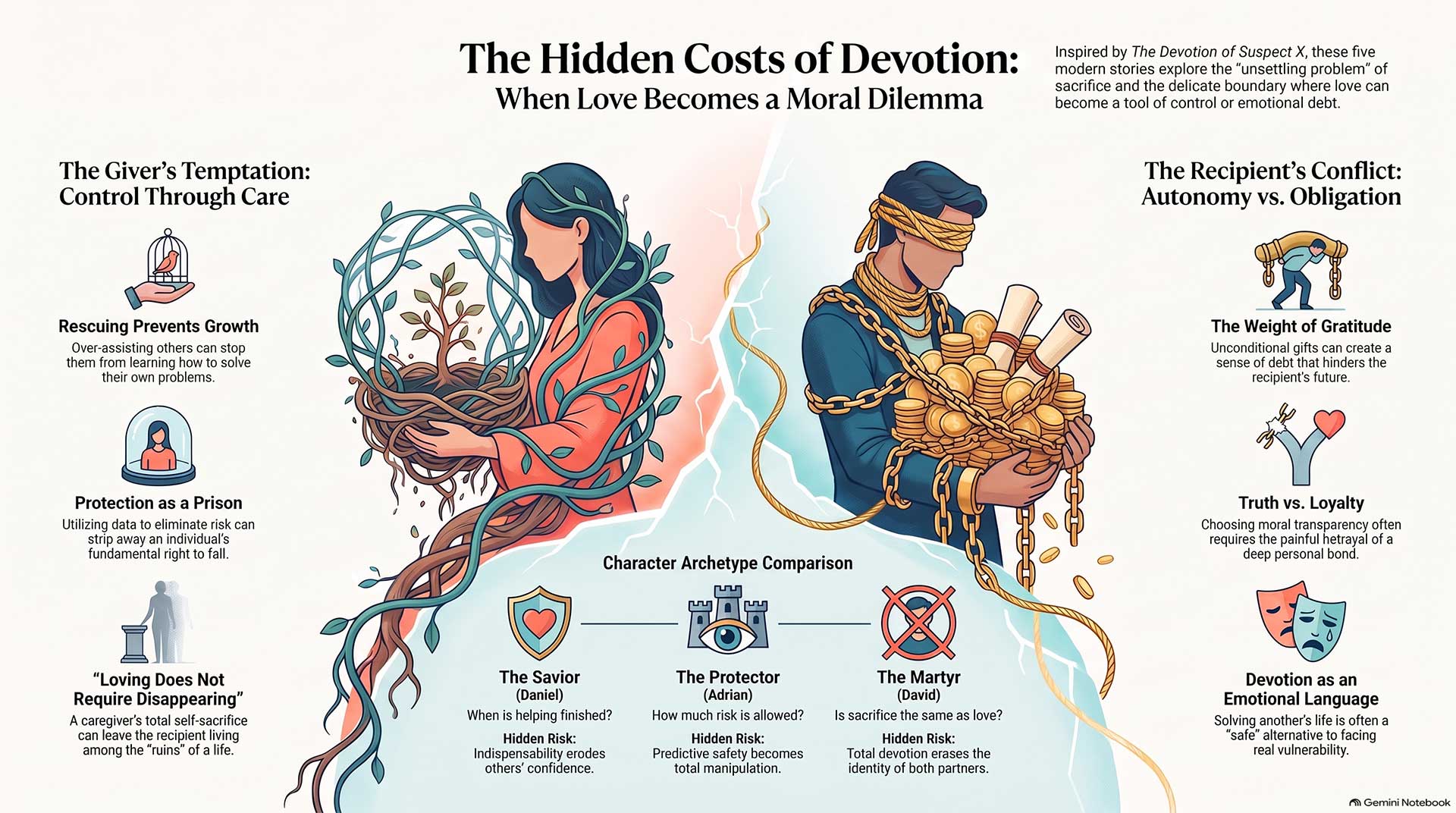
Perhaps the hardest lesson in these stories is that the person causing harm does not always have bad intentions.
Daniel genuinely wants to help.
Marcus genuinely expects nothing from Elena.
Adrian genuinely wants Mia safe.
Ethan genuinely believes the truth must be told.
David genuinely loves Rachel.
That is what makes their problems difficult.
We know how to recognize selfishness.
It is much harder to recognize danger inside generosity, protection, honesty, usefulness, and sacrifice.
The five stories gradually move us from one kind of devotion to another.
Daniel learns to help without making himself indispensable.
Elena learns that gratitude does not require surrendering her future.
Adrian learns that loving his daughter includes allowing her to make choices he fears.
Ethan learns that a morally necessary decision can still wound someone he loves.
David learns perhaps the hardest lesson of all:
Loving another person does not require disappearing.
This brings us back to Ishigami from a different direction.
Maybe the deepest tragedy of The Devotion of Suspect X is not simply that Ishigami sacrifices too much.
It is that sacrifice becomes his language for expressing something he cannot express through ordinary vulnerability.
Being needed is safer than asking to be loved.
Giving everything is safer than asking for something.
Solving another person's life is safer than standing beside them without knowing what will happen.
And perhaps mature love asks for something far more frightening:
Remain a person.
Let the person you love remain a person too.
Then live beside each other without turning either life into payment for the other.
Short Bios:
Daniel Park — The Man Everyone Needed
A 42-year-old senior systems engineer whose identity has become inseparable from solving other people's problems. Daniel must discover whether people can still value him when they no longer depend on him.
Elena Ramirez — The Gift She Could Never Repay
A 42-year-old divorced mother who rebuilt her independence after a financially controlling marriage. When years of unconditional generosity from an old friend begin weighing on her future, Elena must learn the difference between gratitude and obligation.
Marcus Bell — The Gift She Could Never Repay
Elena's longtime friend, whose financial help carries no hidden demand. His sincere generosity creates the story's harder question: can someone feel imprisoned by a debt the giver never intended to create?
Dr. Adrian Chen — The Algorithm That Loved Her Too Much
A 47-year-old widowed predictive-systems engineer haunted by his wife's sudden death. His attempt to protect his daughter Mia becomes increasingly sophisticated until he must choose between reducing her risk and respecting her freedom.
Mia Chen — The Algorithm That Loved Her Too Much
Adrian's 17-year-old daughter, whose life has quietly become the subject of her father's predictive system. Mia forces him to confront a devastating question: if someone else can predict her mistakes, does she still have the right to make them?
Ethan Cole — The Friend Who Told the Truth
A 46-year-old nonprofit co-founder whose childhood taught him the destructive cost of concealed wrongdoing. When he discovers his closest friend illegally redirected funds to save families from eviction, Ethan must choose between loyalty and disclosure.
Malcolm Reed — The Friend Who Told the Truth
Ethan's lifelong friend and fellow nonprofit founder. Malcolm knowingly violates financial restrictions to keep desperate families housed, forcing everyone around him to confront the difference between choosing what is right and choosing the wrong one can live with.
Rachel Morgan — Please Don't Die for Me
A 52-year-old woman undergoing treatment for a serious illness. Rachel gradually discovers that she has begun hiding her own suffering to protect her husband from sacrificing more of himself.
David Morgan — Please Don't Die for Me
Rachel's husband of twenty-eight years, who learned early that the person who sacrifices the most loves the most. His deepest challenge is accepting that caring for Rachel and continuing to live his own life are not betrayals of each other.
Leave a Reply