


Franz Kafka:
Franz Kafka biography is not merely the record of a man’s life but the portrait of a soul resisting erasure. I have often wondered if the act of living was itself a kind of trial—one in which the defendant never fully understands the charges, the laws, or the judge. In these chapters, I am no longer the whisper behind a locked door. I am allowed, for once, to speak in daylight. What you will read is not the truth by chronology, but the truth by temperature—the emotional degrees of my existence. The boy who couldn’t find his father’s eyes, the lover who could only write love, the man who lived in metaphors because reality offered no foothold. These scenes do not redeem me; they reveal me. Perhaps what was missing from my life was not clarity, but companionship—a witness not to explain me, but to sit beside the silence and not turn away. Here, with you, I begin again, not to explain my life, but to feel it.
(Note: This is an imaginary conversation, a creative exploration of an idea, and not a real speech or event.)

Chapter 1: The Letter He Couldn’t Send

The room was still, but his hands were not.
Franz sat hunched over his desk, candlelight trembling across a dozen crumpled drafts scattered like fallen leaves. He wrote not with ink, but with old sorrow—the kind that sits behind the eyes and never fully dries. Outside, the Prague winter pressed itself against the windowpanes like a silent accuser. Inside, a storm of memory rattled in his chest.
"I am afraid of him even now," Franz whispered, not to me, not even to himself, but to some boy still trapped in a chair too big for his body and a world too loud for his soul.
I didn’t speak. Not yet. Instead, I crouched beside his desk and read the letter he could not finish.
“Dearest Father, You asked me recently why I maintain that I am afraid of you. As usual, I was unable to think of any answer...”
He tore the page from the binding and buried his face in his hands.
“It’s no use,” he said. “He’ll never read it. He’ll never understand. Even if I lit it on fire in front of him, he’d say I was doing it wrong.”
“But Franz,” I said gently, “maybe this letter isn’t for him. Maybe it’s for you.”
His laugh was bitter. “I write for no one. Not even myself. My words are like my dreams—private catastrophes. They cannot rescue me.”
“You don’t need rescuing,” I said. “You need witnessing.”
That word stopped him.
Witnessing.
As if someone could stand beside his trembling soul and not flee.
He held up the letter again, his fingers ink-stained and shaking. “When I try to speak to him in my mind, my words turn to sawdust. This letter is the closest I’ve come to shouting.”
“Then let it be your voice,” I said. “Even if he never reads it. Let it be the father to your silence.”
We sat there, surrounded by drafts and ghosts. I could almost see the boy he had been—frightened, striving, unseen—standing beside the man he had become, desperate to speak but too fluent in shame.
“Do you think,” he asked after a long pause, “that it’s a betrayal to keep living without his approval?”
“No,” I said. “It’s the beginning of freedom.”
He turned toward me, eyes red, breath thin.
“You’re the first person who hasn’t tried to fix me.”
I smiled. “That’s because you were never broken. Only buried.”
He folded the letter carefully, not to send, but to keep.
Then he did something I had never seen him do before.
He set down his pen… and closed his eyes in peace.
Chapter 2: The Hunger for Love

He hadn’t eaten in days.
Not because of some ailment, but because he could not bear the weight of appetite—neither for food nor for affection. Love, for Franz, was like a locked bakery window: sweetness always visible, never reachable. The world offered warmth, and he wore gloves.
“I frighten women,” he said quietly, seated on a bench in Letná Park as snow began to settle into his shoulders like unanswered letters.
“They don’t see you clearly,” I answered. “Only the masks you keep handing them.”
He glanced sideways. “And what do you see?”
“I see a man starving for touch, yet flinching from every hand extended.”
He looked away.
There had been Felice, of course. And Milena. Both women had loved him—intelligently, passionately. But to Franz, even love was a form of surveillance. If someone looked too long, they would discover the monster he imagined inside himself. And so, he vanished before being abandoned.
“I want love to lift me,” he confessed, “but I fear it will drown me instead.”
We sat in silence, watching a child chase birds across the snow.
“You deserve a love that doesn’t require translation,” I said. “A love that doesn’t ask you to explain the tremble in your voice.”
“Such a love doesn’t exist in this world,” he replied.
“Then let’s invent it.”
He laughed, a thin sound. “Like my fiction?”
“No,” I said. “Not fiction. A private truth. Something you build between the silences.”
He opened his coat just a little, as if that gesture itself was a form of bravery. From his pocket, he took a worn photograph—one Milena had once given him. He touched the corner of it softly.
“She wrote to me,” he said. “Even when her own world was crumbling.”
“Because she saw your beauty,” I whispered. “Even through your shame.”
He closed his eyes.
“Then why couldn't I believe it?”
“Because you were taught to doubt joy. But joy isn’t a trick, Franz. It’s an inheritance you’ve never claimed.”
He held the photo closer to his chest and wept—not from despair, but from the terrifying closeness of grace.
In that moment, he wasn’t a ghost or a puzzle.
He was simply a man, hungry to be held.
And this time, he didn’t pull away when I placed my hand over his.
Chapter 3: The Trial Within

The courtroom was empty.
No judge, no jury—only Franz, seated alone at the defense table, his coat draped over the back of the chair like a fallen verdict. Sunlight filtered through high, barred windows, illuminating dust motes that floated like unspoken accusations.
“This is where I live,” he said.
“In your imagination?” I asked gently.
“No,” he replied, without irony. “In this room of endless questioning. The cross-examinations never stop.”
His hands trembled in his lap, fingers tracing the edges of a crumpled note he hadn’t meant to keep. A rejection. A silence. A line in someone’s letter that could be interpreted ten different ways—all of them fatal.
“They accuse me,” he murmured, “but I never hear the charges.”
“Franz,” I said, “you are both prisoner and prosecutor. You’ve locked yourself in with no exit, but the key has always been inside your own pocket.”
He didn’t respond. His eyes stared forward, into nothing. Or perhaps into something I couldn’t see—a tribunal of all his failures: the father he never pleased, the love he never claimed, the art he never thought was worthy of survival.
“I write to be judged,” he confessed. “Not by others. By myself.”
I rose and walked to the center of the courtroom, placing my palms flat on the bench as if to address an invisible court.
“Then let the trial end,” I said. “Let the accused speak not to defend himself, but to forgive himself.”
Franz looked up. A crack in his certainty.
“You don’t understand,” he said. “Guilt is the only thing that proves I exist.”
“No,” I said softly. “It’s the only thing you’ve trusted.”
The silence stretched like an old rope. And then—
He stood. Just barely. His knees unsteady, like a man learning to walk on ground he once feared.
“What if I leave the courtroom?” he whispered.
“You’ll find a garden outside,” I said. “Or maybe a hallway. But it will be yours.”
He stepped forward. Slowly.
Behind him, the great double doors remained closed. But within him, something unlatched. A small sound. Like the clink of a key turning for the first time in years.
I offered him my hand.
And this time, he took it.
Chapter 4: The Letter That Never Left His Desk
It sat beneath a paperweight of amber glass, folded three times, yellowed at the creases.
Kafka’s desk was a landscape of restraint—ink bottles stopped tight, quills aligned like obedient soldiers, and pages of script so thin they trembled if you breathed too near.
“This letter,” he said, placing his palm atop it, “has watched me live without being lived.”
“To whom?” I asked gently.
He didn’t answer right away. His eyes, rimmed with grief, wandered toward the window, where the dusk pooled on the panes like unshed tears.
“It began as a letter to Milena,” he finally whispered. “But it became a letter to God. Or to the absence of God. Or perhaps… to the me that might have loved freely.”
The silence between us turned thick, not uncomfortable, but reverent.
“I rewrote it every year,” he continued, “never changing the ending. I always stopped just before the goodbye.”
I reached for the envelope, only to find it wasn’t sealed. Inside, his handwriting slanted like someone leaning too far into the wind.
I read only the first line: “If I were braver, this would have reached you.”
Franz turned away. I didn’t push.
“You were always braver than you believed,” I said.
“No,” he said, almost sharply. “I was only more afraid than most and skilled at surviving it.”
A small smile flickered across his lips, a smile that knew it would vanish quickly, but had the decency to visit.
“I never sent it,” he said. “But I wrote it. Isn’t that the truer act?”
I nodded.
“Writing is the confession. Sending is the risk.”
“And what about tearing it up?” he asked.
“That’s the lie.”
We sat for a while, the air warm with the scent of ink and dust, the soft ticking of the lamp clock filling the spaces between our breaths.
“You could still send it,” I said. “Even if no one reads it. Even if she’s no longer there to receive it.”
He placed the letter into my hand.
“I just did.”
Chapter 5: The Door That Was Always Open

The sanatorium smelled faintly of pine and antiseptic. Snow clung to the edges of the windows like forgotten lace. The hallway lights flickered—half working, half dreaming.
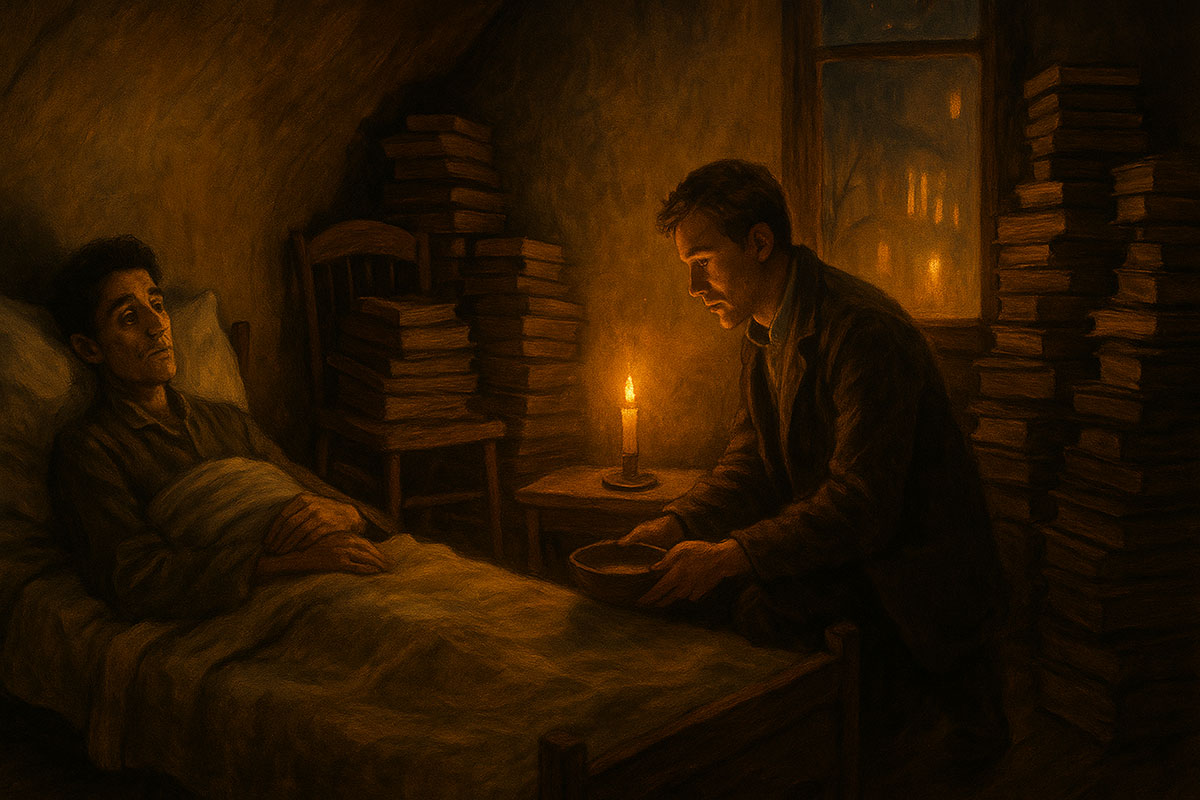
Franz sat upright in bed, thinner than before, but still regal in the slope of his shoulders, the gentleness of his gaze. I placed a fresh pear on the table beside him.
“Did you know,” he said with a faint smile, “that I used to eat fruit as if it were sacred?”
“It still is,” I said.
He nodded. “Only now I cannot eat it at all.”
A quiet passed between us. The pear gleamed. Untouched.
“I used to think illness was punishment,” he said. “But now I think it is simply the body’s last metaphor.”
The room was warm with hush. Outside, the pine trees bowed under the weight of the world.
He reached beneath his pillow and pulled out a slip of paper. “Last night I dreamed again,” he said.
“Another trial?”
“No,” he said. “This time, no judge. No castle. Just a door.”
He held it up—a drawing he had made. A door standing in the middle of a field. Open.
“I think I misunderstood,” he whispered. “It was never about the gatekeeper. The door was always open.”
My eyes stung. I took his hand, cold as porcelain.
“All those years,” he said, “I stood waiting for permission. When all I had to do… was walk through.”
He looked at me then, and in that gaze, there was no fear left. Only release.
“You always walked beside me,” he said.
“And I always will.”
He rested his head back. The snow kept falling. The trees did not move. The door stood wide in his dream.
And he walked through it.
Final Thoughts by Franz Kafka
I have always felt that death would clarify what life only muddled. But now I think: perhaps it is presence, not absence, that saves us. In these imagined moments, someone sat beside me—not to cure the ache, but to honor it. That may be the truest intimacy. Not the solving of suffering, but the willingness to remain nearby while it hums. If I leave behind anything worth reading, perhaps it is not my books, but my longing. A longing to be understood without translation. To be held in the rawness, not revised into something smoother. If these pages let you glimpse the child who feared his father, the man who wrote against his own skin, or the soul who stood still while the world kept moving, then I have been less alone. And perhaps, so have you.
Short Bios:
Franz Kafka
A Czech-born Jewish writer (1883–1924), Kafka is known for his haunting, existential works such as The Trial and The Metamorphosis. His writing explored alienation, bureaucracy, and the surreal burdens of modern life. Despite his wishes to have his works destroyed, Kafka's posthumous legacy shaped 20th-century literature.
Felice Bauer
Kafka’s fiancée and long-time correspondent. Their intense, epistolary relationship reflected Kafka’s deep conflict between love and solitude. Though they never married, Felice remained a symbolic figure of the emotional longing and restraint that haunted his writings.
Max Brod
Kafka’s closest friend and literary executor. Despite Kafka's instructions to burn his unpublished manuscripts, Brod preserved and published them, ensuring Kafka’s enduring legacy. His loyalty sparked ethical debates but secured Kafka’s place in literary history.
Kafka’s Father (Hermann Kafka)
A dominating presence in Kafka’s life, his father’s overbearing personality inspired much of Kafka’s internal conflict and feelings of inadequacy. The unsent “Letter to His Father” remains one of the most revealing documents of Kafka’s psyche.
The Friend (Imagined Companion)
A silent observer and emotional anchor, this fictional character symbolizes the compassionate presence Kafka never fully had—a mirror for his solitude, a keeper of his letters, and a witness to his final moments.
Leave a Reply