

Julian Barnes:
Henry James once wrote that the whole of life is “a matter of vision.” Not simply the faculty of sight, but the gift of seeing deeply—through the surface pleasantries, the cultivated manners, the silences, to the restless truth beneath. He was a man who lived between continents, between centuries, and between the delicate boundaries of belonging and observation. For James, the world was both a salon and a stage, and he walked through it with the precision of a novelist arranging his final, most telling scene.
This is the story of a friendship as much as it is the story of a life—a companionship that followed him from the sun-warmed gardens of Italy to the crowded streets of New York. It is a map of moments: the first conversations over coffee in a villa courtyard, the unspoken confidences shared under chandeliers in Paris, the long evenings by Venetian waters where memory seemed to fold in on itself like the ripples of the canal.
But every map must end somewhere. The final turning is always back toward home—though by then, the home has changed, or perhaps the traveler has. Henry James’s journey, like all good narratives, is not only about where he went but about what he carried with him: the subtle architecture of feeling, the quiet pulse of art, the weight and gift of human connection.
(Note: This is an imaginary conversation, a creative exploration of an idea, and not a real speech or event.)
Chapter 1: The Quiet Watcher
The winter light of New York in 1848 had a way of softening the city’s rough edges, turning soot and brick into muted harmonies of grey and gold. On West 14th Street, in a parlor warmed by a small coal stove, a boy sat in a high-backed chair, hands folded loosely in his lap, his gaze fixed not on the book in front of him, but on the slow theatre of life beyond the frost-tinted window.
Henry James was nine years old, and even then, it seemed to those who knew him that he was less a participant in life than its careful archivist. The snow in the street was churned into slush by carriage wheels; a neighbor’s maid emerged with a pail of ashes; two boys, red-cheeked and loud, pelted each other with ice. Every gesture, every inflection of voice, seemed to Henry worth noticing, worth storing away.
I sat beside him that day—his friend, though perhaps I was also something like an anchor to the present moment. Henry had a tendency to drift, to wander into long corridors of thought, and I’d grown accustomed to nudging him back with a question or a story.
“You’re not reading,” I remarked, nodding toward the closed book in his lap.
“I am,” he said, his eyes never leaving the window. “Just not the kind they print.”
There was no pretension in his tone, only a curious certainty. He explained that books were everywhere, but life—life as it was truly lived—had to be caught in the instant, before it evaporated. Even as a child, Henry seemed to sense that the human heart revealed itself most clearly in the small, unguarded moments no one thought to record.
The James household was a place of conversation, books, and visitors—clergymen, artists, reformers, the occasional European traveler. Henry’s father, with his philosophical leanings and restless intellect, encouraged his children to think broadly, to question, to travel in mind if not yet in body. But Henry, shy in company, often preferred the role of silent listener.
That afternoon, when the light began to fade, he finally opened his book. Yet even as he read aloud to me from its pages, I could tell his mind was still half-occupied by the world outside. He described, with almost painterly detail, the way the maid’s shawl had been patched at the elbow, or the exact timbre of the laughter from the boys in the street.
It was not imitation that Henry practiced, but translation—turning fleeting images into something enduring, something precise. Even then, it seemed inevitable that he would leave America one day, that he would seek in Europe the deeper shadows and subtler lights his imagination craved.
As the stove popped and hissed, and the night closed over the city, Henry looked at me and said softly, “Someday, I will write about all of this—not as it is, but as it feels.”
In that moment, I knew he already had.
Chapter 2: The City of Conversations

Paris in the early 1870s was a city both wounded and resplendent. The scars of the Franco-Prussian War still lingered in its quieter quarters, where bullet-pocked walls stood beside shopfronts newly painted in colors that tried, with varying success, to outshine memory. Yet in the salons and cafés, life had gathered itself again with a kind of stubborn elegance, as if conversation itself were a way of holding the world together.
Henry James walked among it all like a man gathering threads for a tapestry no one else could yet see. He had been in Europe for years now, moving between London, Rome, and Paris, and though he spoke the languages awkwardly, he spoke the art of listening fluently.
I joined him one brisk February evening at the Café de la Régence, where the scent of coffee, tobacco, and damp wool hung in the air. Outside, the gaslamps threw pale halos on the wet pavement. Inside, the room shimmered with low conversation, the clink of porcelain cups, the soft scrape of a chair.
Henry sat with his back to the wall, his gaze roaming—not in restlessness, but in method. He did not simply look at people; he seemed to take their measure in layers: the way a hand lingered too long on a wine glass, the subtle pause between words when a woman’s attention wandered, the unspoken hierarchies in the tilt of a head.
“I’ve found,” he told me, “that one never truly meets a person—one meets a succession of selves, each adjusted to the company they keep.”
It was the sort of remark that, once heard, changed the way you saw the room. I began to notice the same shifts he did—voices lowered when certain guests approached, laughter sharpened or softened depending on the listener. Henry absorbed it all, as if he were building an invisible map of human behavior, one he could later unfold on the page.
That night, a small group gathered near us: an aging painter with nicotine-stained fingers, a young woman with restless eyes, and a lawyer whose voice carried just enough to suggest he wanted to be overheard. Henry leaned slightly forward, catching phrases in French and English alike. He did not interrupt, did not even pretend to participate. He was, as ever, the quietest man in the room, and yet the most present.
When the group departed, leaving behind the faint trace of perfume and cigar smoke, Henry sat back, eyes thoughtful. “They think they’ve been speaking to each other,” he said, “but truly, they’ve been speaking to themselves—and I have been their witness.”
We left the café and stepped into the Paris night. The Seine moved slowly under its bridges, reflecting the city’s lights in broken, shimmering lines. Henry walked in silence for a while, then added, almost to himself, “One day, I will write a book that is nothing but a conversation—yet it will contain the whole world.”
In the dark, I could almost see it already forming in his mind.
Chapter 3: The Drawing Room Labyrinth

London in the late 1870s was a city of gray stone and greater certainties—or so it liked to think of itself. The fog, that eternal actor on the English stage, hung in the streets like a curtain drawn between acts, dimming the gaslamps and softening the edges of even the most severe architecture. Inside the drawing rooms of Mayfair and Kensington, the world was filtered through cut crystal, the polite rustle of silk, and the carefully modulated murmur of conversation.
It was in one such drawing room, belonging to Lady Ashcombe, that Henry James and I found ourselves one March evening. The room was long and high-ceilinged, the air faintly scented with hyacinths placed in porcelain bowls. Every object in sight—from the gilt-framed mirrors to the arrangement of chairs angled just so toward the hearth—spoke of the English art of understatement.
Henry, standing near the mantelpiece, seemed perfectly at ease, though I knew he was studying the room with the same quiet intensity he had in Paris. Where the French salon had been fluid, with talk flowing like wine, this was a game of measured moves. Conversation here was less about the expression of thoughts than the careful positioning of them, like chess pieces moved with gloved hands.
A gentleman in a velvet waistcoat approached Henry, remarking on the “peculiar excess” of American optimism. Henry listened without flinching, replying with a soft, deliberate wit that disarmed the man without revealing whether he agreed. Later, he told me, “In England, one learns to express entire paragraphs in the weight of a pause.”
Lady Ashcombe herself floated from guest to guest, her fan opening and closing with the rhythm of a conductor’s baton. Henry greeted her with a bow that was neither too deep nor too shallow—he had mastered, in just a few years, the subtle calibrations that made one a welcome foreigner.
When a young novelist began speaking, somewhat too loudly, about the state of English literature, Henry leaned in to me. “Observe,” he murmured, “how the room grows attentive, not because they wish to hear him, but because they wish to remember his words for later, when they can discuss them elsewhere.” It was this secondary life of conversation—the afterlife in other rooms—that fascinated him.
The evening moved in currents: topics shifted without warning, alliances formed and dissolved in the turn of a sentence. Henry navigated it all with a kind of detached courtesy, never forcing his presence, yet leaving no doubt he had been there. By the time the clock chimed midnight, he had spoken at length to no more than a dozen people, yet he had taken the measure of them all.
As we left into the cool, misty night, he said, “In London, the rooms are like novels—one must read them slowly, for every phrase is written to conceal as much as it reveals.”
And then, almost as an afterthought: “But perhaps that is why I feel so at home here.”
Chapter 4: The Sunlit Enigma

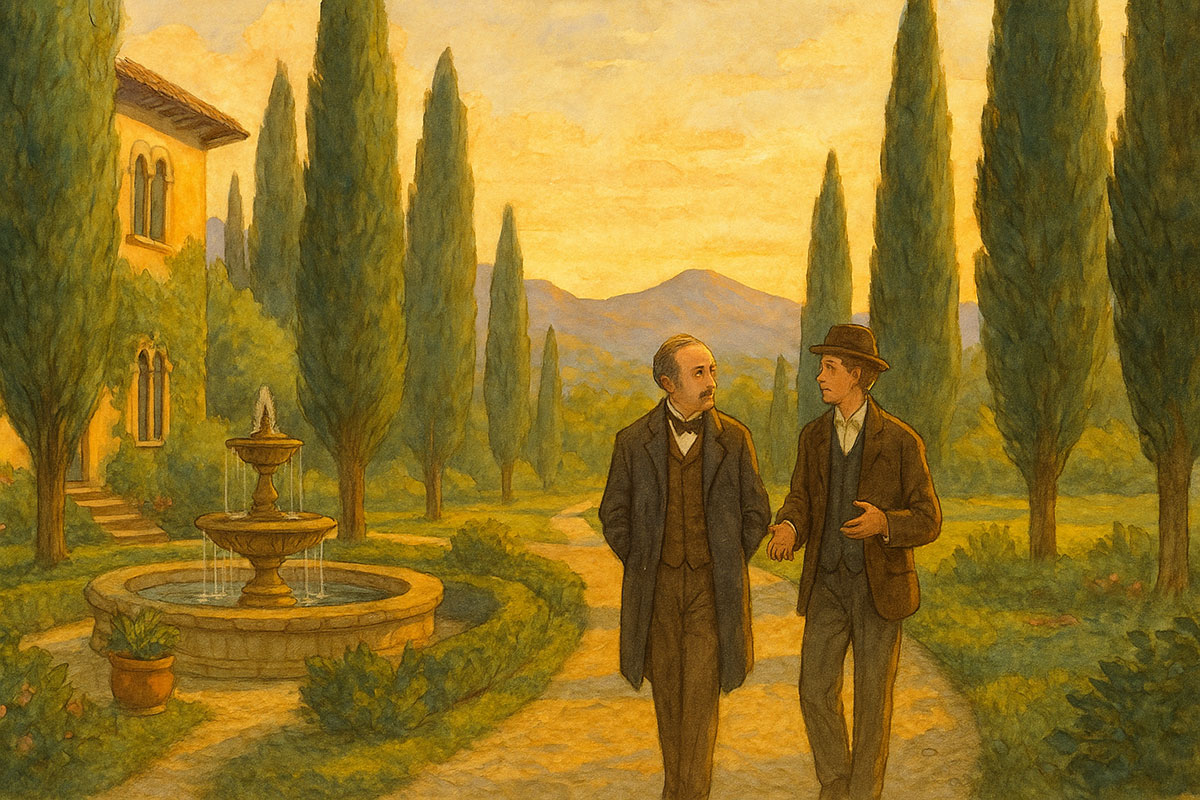
Italy was a place where time did not march so much as drift, like a gondola on still water. The moment Henry James and I stepped off the train in Florence, the air felt warmer, looser—its sunlight less concerned with illuminating facts than with caressing surfaces. Even the shadows seemed painted, and the narrow streets carried the scent of coffee, leather, and stone that had known centuries of footsteps.
For Henry, Italy was no mere backdrop—it was a theatre of history, where every wall whispered its own tangled story. “One walks here,” he said to me as we strolled past ochre façades and shuttered windows, “as though in the corridors of an old novel—every turn promises a new chapter, though one suspects the plot may be older than one’s imagination.”
Our days were unhurried. Mornings began in small cafés where Henry would sip espresso so slowly it seemed a kind of meditation, eyes half-lidded as if listening for the footsteps of the Renaissance. In the afternoons, we wandered through palaces and galleries, Henry’s gaze moving not only over the paintings but over the visitors themselves. He was as interested in the way a young woman tilted her head before a Botticelli as he was in the painting’s mythic beauty.
Yet there was a curious tension in him here. Italy’s light, for all its brilliance, did not dispel his fascination with shadow. In the Uffizi, he stood before Caravaggio’s Medusa, tracing the interplay of terror and artistry. “The Italians,” he whispered, “understand that beauty need not comfort—it can unsettle, and still be more perfect for it.”
One evening in Venice, we were invited to a dinner in an old palazzo whose windows opened onto the Grand Canal. The dining hall was lit by a dozen candelabras, their flames mirrored in polished silver and reflected in the water beyond. The conversation flowed like the wine—freer, more passionate than the careful exchanges of London. Stories were told without apology for their embellishments, and laughter seemed to dissolve the centuries between guests.
But when the talk turned to politics, Henry leaned back, his face half in shadow, observing rather than participating. Later, as we walked along the canal, he explained, “Italy is like one of its own frescoes—part of the beauty lies in the cracks, the imperfections. If you fill them in, you lose the story.”
In Rome, standing before the ruins of the Forum, he grew quiet. “It’s strange,” he said, “how civilizations leave behind both their grandest stones and their smallest traces. Perhaps it is the small traces—the worn step, the faded carving—that speak most honestly of what we were.”
As we prepared to leave, I sensed that Italy had not so much changed Henry as confirmed something in him—that truth, in life as in fiction, was rarely found in what stood boldly before us, but in what lingered just beyond the light’s reach.
Chapter 5: The Return to the New World

The steamer’s whistle cut through the gray Atlantic morning as Manhattan rose slowly into view. From the deck, Henry James stood beside me, hands resting lightly on the rail, eyes narrowing at the skyline. “It is taller,” he murmured, “but not necessarily older.” His words held no disdain—only the measured curiosity of a man accustomed to measuring worlds against one another.
The harbor was a living mural of motion: ferries crisscrossing the water, gulls wheeling overhead, the sharp smell of coal smoke and salt mingling in the wind. We disembarked into a city that pulsed with immediacy. The carriages rattled at a pace faster than any Venetian gondola, the conversations on the street clipped and urgent. Here, history was not a patient accumulation—it was a sprint, a layering of ambition over ambition.
Henry, fresh from Italy’s languid corridors, seemed both invigorated and unsettled. In Europe, he had walked among ghosts; here, he walked among possibilities. “America,” he said as we made our way up Broadway, “does not pause to admire its own reflection. It is too busy making another.”
Our first days were filled with invitations—luncheons in brownstone parlors, evenings in drawing rooms where oil portraits of Revolutionary forebears looked down on guests in the latest Parisian fashions. Henry listened more than he spoke, watching the way young women in silk gowns leaned forward to catch the attention of self-made men with sharp eyes and quicker fortunes. “This,” he confided to me later, “is the theater of arrival. Everyone is in the first act, even if they’ve been here for years.”
Yet it wasn’t all polite society. One afternoon we wandered into the immigrant districts, where shop signs bore languages neither of us could read and the air was thick with the smell of bread baking in ovens as old as the Old World itself. Henry lingered at a corner, watching a boy chase a rolling hoop down the cobblestones while his mother bargained for vegetables. “Here,” he said quietly, “is the other half of the American novel—less gilded, but perhaps more enduring.”
He was equally fascinated by the pace of change. Streets he remembered from a previous visit had been altered beyond recognition—wooden buildings replaced by brick, open lots now filled with steel skeletons reaching skyward. The transformation seemed to thrill and disquiet him in equal measure. “In America,” he remarked, “the ink is never dry. The story insists on rewriting itself before you’ve finished the first page.”
On our final evening, we walked along the Hudson as the sun dropped behind the Jersey shore. The river caught the fading light, turning gold before surrendering to shadow. “I have lived much of my life between two worlds,” Henry said. “But perhaps that is the writer’s truest home—not in one country or another, but in the space between, where each illuminates the other.”
And as the city lights flickered on behind us, I realized his return was not a homecoming in the ordinary sense. It was another chapter—open-ended, brimming with both memory and possibility.
Final Thoughts by Julian Barnes
In the last years of his life, Henry James moved more slowly through the world, but his vision—always acute—grew even more exacting. He understood, perhaps better than anyone, that to return is never to arrive at the same place. New York, Paris, Venice—they had all become not only physical places but vast interiors within him, their light and shadow rearranged by memory.
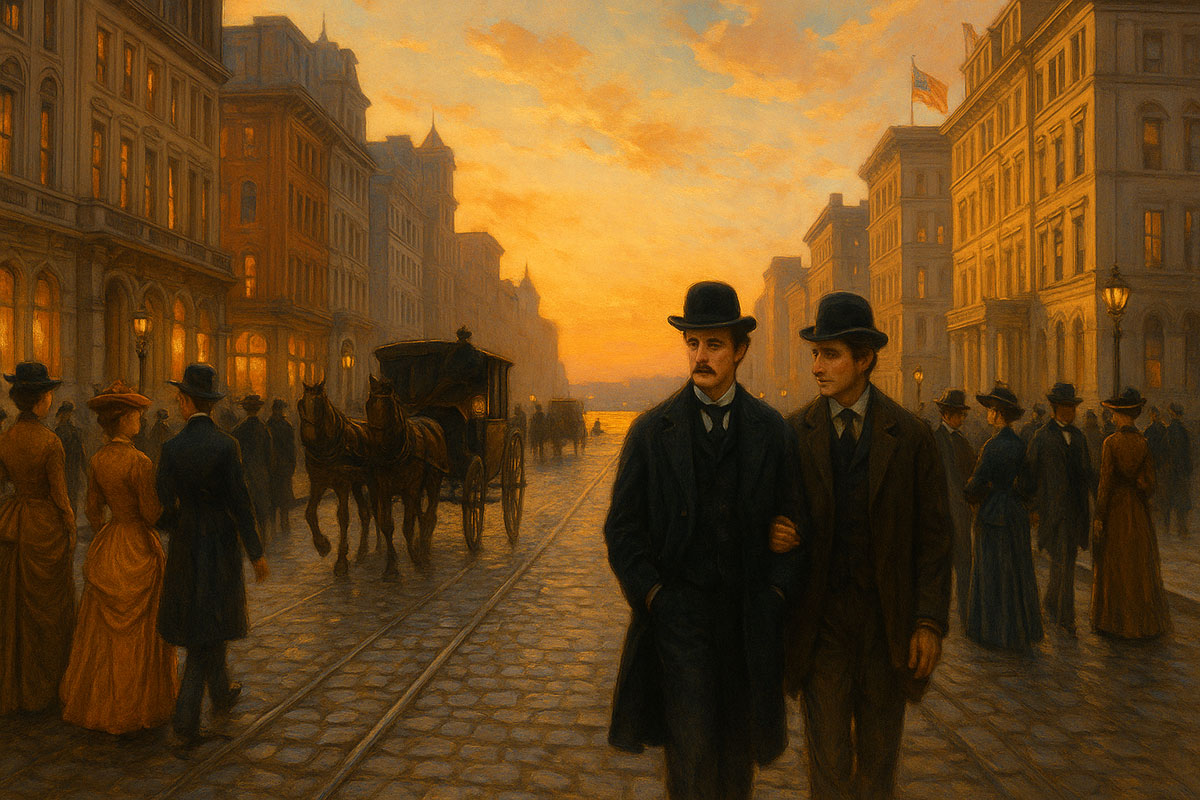
And so we imagine him here, walking through a city whose buildings wear the sunset like a final, forgiving smile. His friend is beside him, as they were at the start. There is no need to speak much now; the conversation has been going on for decades, and it will go on still—in letters, in memory, in the invisible threads that bind two people across time.
If life is indeed “a matter of vision,” then Henry James’s final view was a rich one: the streets of his youth lit in the long gold of evening, the Hudson glimmering at the edge, and the warm presence of a friend whose companionship had been the steady counterpoint to the music of his travels. The rest—like all good endings—was silence, and the turning of a page.
Short Bios:
Henry James (1843–1916) – American-born novelist, critic, and master of psychological realism, James bridged European sophistication and American sensibility in works like The Portrait of a Lady and The Ambassadors.
Julian Barnes (1946– ) – Acclaimed British novelist and essayist, winner of the Man Booker Prize for The Sense of an Ending, known for his elegant prose and meditations on memory, art, and mortality.
Leave a Reply