
Introduction
Hermann Hesse’s Siddhartha has been read for generations as a spiritual classic.
But what kind of spiritual book is it really?
Is it Buddhist?
Hindu?
A European novel wearing Indian religious clothing?
A defense of radical individuality?
A critique of spiritual pride?
Or something far harder to classify?
In this imaginary discussion, leading Hesse scholars and experts in Buddhism, Indian philosophy, comparative religion, and literary reception examine the tensions inside the book rather than smoothing them over.
They ask whether Siddhartha truly understands Buddhism, whether his fierce independence sometimes becomes arrogance, what the river actually means, why Western readers embraced the novel so strongly, and whether Hesse creates a form of spirituality shaped as much by modern individualism as by Indian thought.
The deepest paradox arrives at the end.
Siddhartha claims wisdom cannot simply be taught.
Yet Hesse writes an entire novel about wisdom.
So what can a book actually give us?
Perhaps not Siddhartha’s realization itself.
Perhaps something more useful:
questions capable of disturbing the answers we borrowed from other people.
(Note: This is an imaginary conversation, a creative exploration of an idea, and not a real speech or event.)
Topic 1 — Is Siddhartha Actually Buddhist?
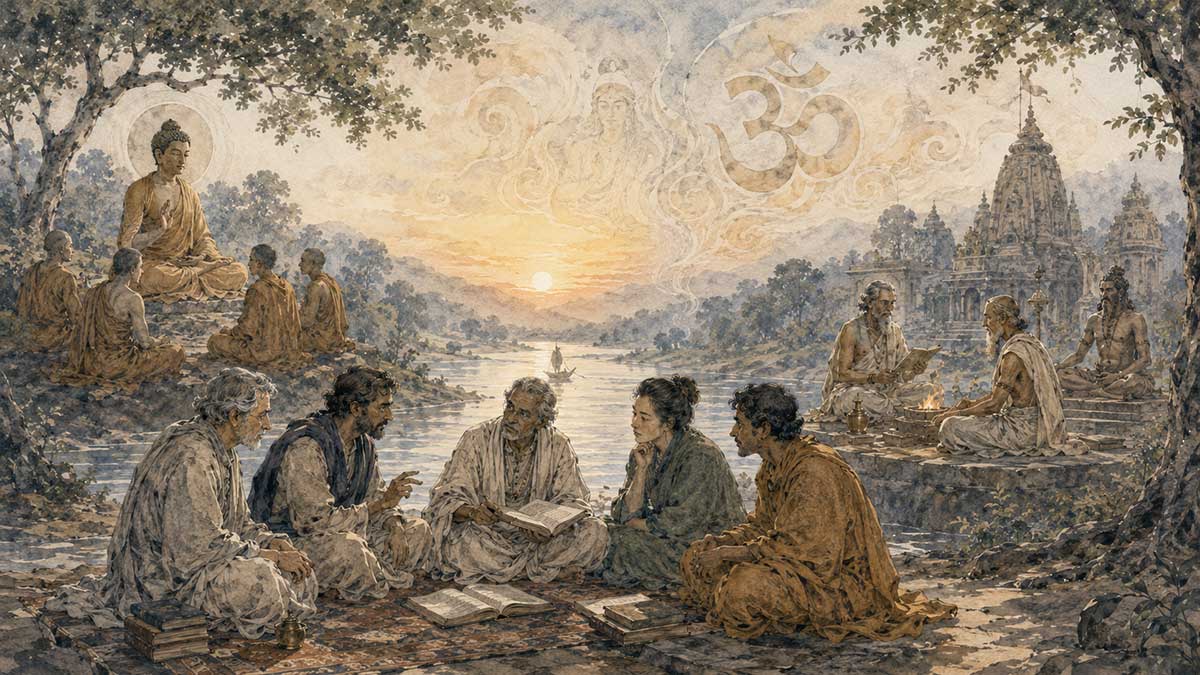
The scholars had gathered beside the river before sunrise.
Not the river of Hesse’s novel exactly, but one close enough to invite the comparison.
Mist rested over the water. A narrow wooden ferry moved slowly near the opposite bank. Birds had begun calling from the trees, though the sun had not yet appeared.
Theodore Ziolkowski sat with a notebook closed on his lap.
Ralph Freedman leaned slightly forward, listening.
Mark Boulby had already been studying the river as if Hesse himself might have placed it there for interpretive purposes.
Across from them sat a Buddhist studies scholar, an Indian philosophy scholar, and a comparative religion scholar.
The first question had seemed easy when it was proposed.
It no longer did.
Ziolkowski: Perhaps we should begin by removing the most obvious assumption.
The Buddhist scholar smiled.
Buddhist Scholar: Which one?
Ziolkowski: That Siddhartha is a Buddhist novel.
There was a brief silence.
Freedman: That should wake everyone up.
Indian Philosophy Scholar: It should.
Boulby: Yet the title alone encourages the misunderstanding.
Buddhist Scholar: Precisely.
A reader hears “Siddhartha,” sees ancient India, encounters Gautama Buddha, hears about meditation, suffering, liberation—
She lifted one hand.
Buddhist Scholar: —and naturally says, “Buddhism.”
Ziolkowski: But Hesse gives us a protagonist who meets the Buddha and declines to follow him.
Comparative Religion Scholar: Which is already a rather strange foundation for calling the novel Buddhist.
Freedman: Unless the refusal itself is being interpreted as a Buddhist act.
The Buddhist scholar laughed softly.
Buddhist Scholar: That is where Western readers sometimes become very inventive.
Boulby smiled.
Boulby: Meaning?
Buddhist Scholar: Meaning we occasionally take anything that sounds inward, anti-dogmatic, contemplative, or peaceful and label it Buddhist.
Indian Philosophy Scholar: And in doing so we flatten Indian traditions into one large spiritual category.
She looked around the group.
Indian Philosophy Scholar: Om appears.
Atman matters.
Brahminical learning matters.
Ascetic traditions matter.
Ideas about unity matter.
Then Gautama Buddha appears.
These things do not become one system simply because a European novelist places them in the same book.
Ziolkowski: Which raises a basic question.
Was Hesse trying to represent a system accurately?
Indian Philosophy Scholar: I doubt that was his primary objective.
Buddhist Scholar: Nor do I.
But that does not make accuracy irrelevant.
Freedman: There is the tension.
Hesse is writing a work of literature shaped by his own spiritual crisis.
The scholar of religion asks, “Is this Buddhism?”
The literary critic asks, “What is Hesse doing with Buddhism?”
Those are very different questions.
Boulby: And perhaps the second is more useful for the novel.
Buddhist Scholar: More useful literarily.
Not necessarily culturally.
Boulby turned toward her.
Boulby: Explain.
Buddhist Scholar: A book can say, “I am not a textbook,” and that is fair.
But readers may still receive their first impression of a religious tradition through it.
So when someone finishes Siddhartha believing Buddhism teaches that teachers are unnecessary, doctrine is an obstacle, and personal intuition is the highest spiritual authority—
She shook her head.
Buddhist Scholar: —we should at least say that Buddhism is considerably more complicated than that.
Ziolkowski: Perhaps Siddhartha rejects something Buddhism never claimed.
The Buddhist scholar looked at him.
Buddhist Scholar: Exactly.
That is one of the most interesting ironies in the novel.
Siddhartha seems to conclude that the Buddha cannot give him enlightenment.
A Buddhist teacher might answer:
“Of course I cannot.”
No serious Buddhist teaching says enlightenment can simply be transferred like property.
Comparative Religion Scholar: Then Siddhartha’s objection is partly directed at a misunderstanding of teaching itself.
Buddhist Scholar: Potentially.
A teacher provides practices.
Disciplines.
Ethical frameworks.
Ways of seeing.
Communities.
Warnings.
The realization still has to occur in the practitioner.
Freedman: Which makes Siddhartha’s refusal more psychologically interesting than doctrinally revolutionary.
Boulby: That is good.
Say more.
Freedman: Perhaps Siddhartha does not leave Gautama because Gautama’s teaching is insufficient.
Perhaps he leaves because Siddhartha cannot become himself through obedience.
The Indian philosophy scholar nodded.
Indian Philosophy Scholar: Now we are moving closer to Hesse.
Ziolkowski: Yes.
The problem may be less “Can Buddhist doctrine produce enlightenment?”
and more:
“Can Siddhartha accept any truth that arrives bearing someone else’s name?”
The Buddhist scholar smiled.
Buddhist Scholar: That is a very different novel.
Boulby: And perhaps a more accurate one.
The ferry reached the opposite bank.
No one spoke for several seconds.
Then the comparative religion scholar looked toward the water.
Comparative Religion Scholar: I want to complicate something else.
People often describe Siddhartha’s final realization as Buddhist enlightenment.
But what exactly does he experience?
He hears all voices in the river.
He perceives unity.
He encounters Om.
Time seems to collapse.
Opposites belong together.
Suffering and joy, sinner and saint, birth and death become parts of a single totality.
He turned toward the Buddhist scholar.
Comparative Religion Scholar: Would you call that straightforwardly Buddhist?
She smiled.
Buddhist Scholar: No.
Indian Philosophy Scholar: Nor would I call it straightforwardly anything else.
Boulby: That answer may frustrate readers.
Indian Philosophy Scholar: It should.
Religion is allowed to frustrate literary categorization.
A little laughter passed through the group.
She continued.
Indian Philosophy Scholar: Hesse is drawing from multiple sources.
Readers encounter concepts associated with Hindu traditions.
They encounter Buddha.
They encounter asceticism.
They encounter ideas Hesse absorbed through European intellectual channels.
They encounter his own philosophical imagination.
Then all of that gets reorganized into Siddhartha’s personal spiritual narrative.
Ziolkowski: A synthesis.
Indian Philosophy Scholar: Yes, but “synthesis” can sound cleaner than the process really is.
It is not as though Hesse carefully lays several traditions side by side and constructs a perfectly balanced philosophy from them.
He selects.
Transforms.
Reinterprets.
Sometimes romanticizes.
Freedman: Which is what novelists do.
Indian Philosophy Scholar: Certainly.
But we should remain aware of who has the freedom to transform whose traditions.
The group became quieter.
Ziolkowski: You are raising the question of cultural distance.
Indian Philosophy Scholar: Yes.
Hesse’s India is partly historical India.
Partly philosophical India.
And partly an imaginative India constructed by a European writer seeking an answer to European dissatisfaction.
Boulby: Then perhaps the setting is doing two jobs at once.
Indian Philosophy Scholar: Very much so.
It is a real civilization with real traditions.
And it becomes symbolic territory in Hesse’s inner search.
Those two functions are not always comfortable together.
Freedman: Yet Hesse’s attraction to Indian thought was hardly casual decoration.
Indian Philosophy Scholar: I agree.
I would never reduce it to decoration.
His engagement was sincere.
The question is not whether he cared.
The question is what happens when sincere engagement becomes literary reinvention.
Buddhist Scholar: And whether readers can distinguish the reinvention from the traditions themselves.
Ziolkowski: Which many do not.
Buddhist Scholar: Especially when the novel is emotionally persuasive.
That is the interesting part.
A reader may know very little about Buddhism or Hindu philosophy.
Yet Siddhartha’s conclusions feel spiritually authentic.
That feeling can be stronger than historical knowledge.
Comparative Religion Scholar: Literature has that advantage.
It does not have to win an argument.
It can make something feel true.
Boulby looked toward the river.
Boulby: That may explain why the river has done more theological work for some readers than entire libraries.
The Indian philosophy scholar smiled.
Indian Philosophy Scholar: And that is both beautiful and dangerous.
Freedman: Dangerous?
Indian Philosophy Scholar: Beautiful because symbolic experience can open genuine curiosity.
Dangerous when symbolic experience replaces curiosity.
A reader encounters Om in Siddhartha, feels moved, and believes he now understands Indian spirituality.
That is where literature can become a shortcut.
Ziolkowski: Yet perhaps Hesse would insist that shortcuts are exactly what Siddhartha rejects.
Buddhist Scholar: Which creates a wonderful irony.
The novel tells you not to inherit someone else’s wisdom, and readers inherit Siddhartha’s.
The group laughed.
Boulby: We may have found Topic Five too early.
Freedman: Save it.
The mist above the river had begun thinning.
Ziolkowski opened his notebook but did not write.
Ziolkowski: I want to return to the title.
You said earlier that the title itself may be misleading.
The Buddhist scholar nodded.
Ziolkowski: How far would you take that?
Buddhist Scholar: Far enough to say that many readers unconsciously merge Hesse’s Siddhartha with Siddhartha Gautama.
But Hesse carefully separates them.
His Siddhartha encounters Gautama.
He admires him.
He recognizes something extraordinary in him.
Then he chooses another path.
That distinction matters enormously.
Freedman: Hesse creates a seeker who stands beside the Buddha and says, in effect:
“Your truth is real. But it cannot become mine simply because you possess it.”
Boulby: Which sounds inspiring.
Buddhist Scholar: Yes.
And extremely modern.
Indian Philosophy Scholar: Extremely Western, perhaps.
There was a pause.
Ziolkowski looked toward her.
Ziolkowski: We are getting ahead again.
Indian Philosophy Scholar: Perhaps.
But it is difficult not to notice.
Siddhartha’s deepest spiritual instinct is personal sovereignty.
He must test everything.
He must reject inherited authority.
He must experience for himself.
That resonates strongly with modern Western ideas of authenticity.
Freedman: Yet Indian traditions contain profound traditions of inquiry too.
Indian Philosophy Scholar: Certainly.
I am not drawing a crude East-West contrast.
I am saying Hesse’s arrangement of these elements matters.
His protagonist does not merely seek liberation.
He seeks liberation in a way that preserves the authority of his individual experience.
Comparative Religion Scholar: Which may be why the book travels so well culturally.
Boulby: “Travels well” is an interesting phrase.
Comparative Religion Scholar: Think about it.
A reader can enter the novel without becoming Buddhist.
Without becoming Hindu.
Without joining a monastery.
Without accepting a creed.
The novel asks for almost no institutional loyalty.
It tells the reader:
Your life itself can become the path.
The group fell quiet.
Freedman: That may be one reason the book became so beloved.
Buddhist Scholar: And one reason religious scholars become cautious.
Ziolkowski: Because religions tend to contain communities, obligations, practices, traditions.
Buddhist Scholar: Yes.
Spirituality stripped of all of that can become very attractive.
It can become very lonely too.
The line seemed to linger.
Freedman looked toward the river.
Freedman: Perhaps that loneliness belongs to Siddhartha more than we usually admit.
Boulby: Now we are approaching him as a character rather than a symbol.
Freedman: Good.
I think we should.
A biographical reading makes his refusal of teachers feel less like abstract philosophy and more like temperament.
He is restless.
Proud.
Brilliant.
Dissatisfied.
He cannot remain within inherited forms.
Ziolkowski: That sounds suspiciously like Hesse.
Freedman: Precisely.
The Indian philosophy scholar leaned back slightly.
Indian Philosophy Scholar: Which raises a question I would like to put to the Hesse scholars.
When Hesse writes ancient India, how much are we really reading about Hesse’s Europe?
Boulby answered first.
Boulby: A great deal.
The book’s structure may be Indian in imagery, but the crisis is deeply modern.
The individual stands before inherited authority and asks:
“Can this truth still be mine if I did not discover it?”
Ziolkowski: And more painfully:
“Who am I when the inherited forms no longer satisfy me?”
Freedman: Hesse knew that question intimately.
Buddhist Scholar: Then perhaps calling the novel “Buddhist” hides the more interesting thing it is doing.
Comparative Religion Scholar: Which is?
She answered after a moment.
Buddhist Scholar: Using Buddhism as one of several mirrors in which a modern self examines itself.
The group went quiet again.
The sun had begun to lighten the horizon now.
The river was changing color.
Boulby watched it.
Boulby: Hesse would probably enjoy that sentence.
Indian Philosophy Scholar: I am not sure Buddhism would.
A few people laughed.
Ziolkowski: Let me ask the question plainly, then.
If someone finished Siddhartha and asked:
“What religion does Siddhartha finally belong to?”
What would each of you say?
Buddhist Scholar: I would say the question is already forcing him into a category the novel is trying to dissolve.
Indian Philosophy Scholar: I would say his final vision draws from Indian religious vocabulary but should not be mistaken for a faithful expression of one Indian tradition.
Comparative Religion Scholar: I would call it Hesse’s mystical synthesis.
Boulby: I would call it literary.
Freedman: I would call it autobiographical in spirit.
Ziolkowski smiled.
Ziolkowski: I might call it Siddhartha’s.
The Buddhist scholar laughed.
Buddhist Scholar: Which is probably exactly the answer the protagonist would want.
Indian Philosophy Scholar: And that may be the problem.
Everyone turned toward her.
She continued.
Indian Philosophy Scholar: We keep returning to the authority of the individual.
“My experience.”
“My path.”
“My truth.”
“My realization.”
At what point does spiritual freedom become spiritual self-importance?
Freedman looked toward Ziolkowski.
Boulby smiled slightly.
The Buddhist scholar folded her hands.
No one answered immediately.
The Indian philosophy scholar looked around the group.
Indian Philosophy Scholar: Perhaps Siddhartha’s real religion is not Buddhism.
Not Hinduism.
Not asceticism.
Perhaps his deepest religion is independence.
Ziolkowski closed his notebook.
Ziolkowski: Then our next question is obvious.
Boulby nodded.
Boulby: Is that independence wisdom—
He looked across the river.
Boulby: —or ego?
The ferry pushed away from the far bank again.
And this time, no one seemed quite ready to answer.
Topic 2 — Is Siddhartha Independent, or Spiritually Arrogant?
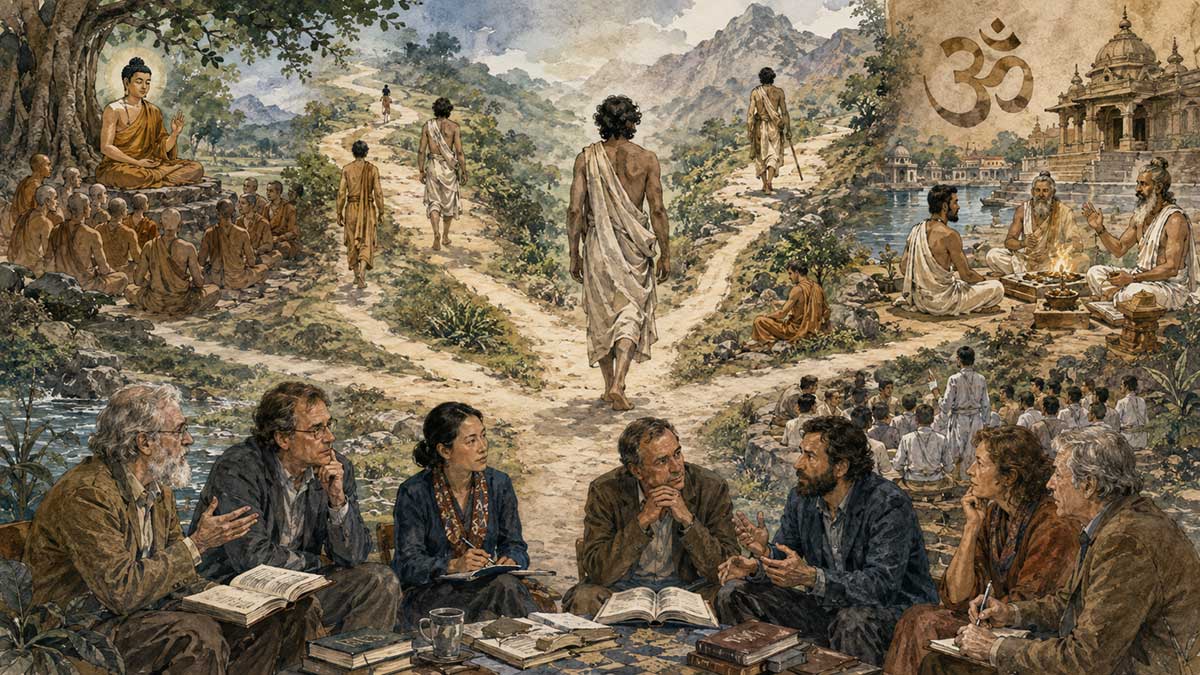
The sun had finally reached the water.
Not fully.
Just enough to lay a pale gold line across the river.
The scholars had shifted slightly as the morning warmed. Freedman had moved closer to the bank. Boulby sat with one knee raised, looking less like a formal critic now and more like someone who had been arguing with the book for years.
The Indian philosophy scholar was still thinking about the last sentence.
Siddhartha’s real religion may be independence.
Ziolkowski turned toward Freedman.
Ziolkowski: You wanted to bring Hesse himself into this.
Freedman: I think we have to.
The Siddhartha who refuses inherited authority is not simply an Indian seeker.
He carries a temperament Hesse knew very well.
Distrust of institutions.
Resistance to conformity.
Suspicion of prescribed identities.
A need to experience life personally.
Boulby: And a remarkable confidence that other people’s answers will not be enough.
Freedman: Yes.
That confidence can look heroic.
It can look insufferable too.
The Buddhist scholar smiled.
Buddhist Scholar: Thank you.
I was beginning to wonder who would say it.
Ziolkowski: You find Siddhartha insufferable?
Buddhist Scholar: At certain moments, absolutely.
Not because he questions teachers.
Questioning is healthy.
I find him difficult when questioning becomes part of his identity.
There is a difference between saying:
“I must examine this.”
and saying:
“I am the kind of person for whom other people’s answers are inherently insufficient.”
Boulby: That is a subtle distinction.
Buddhist Scholar: But an important one.
The second position can become vanity.
Indian Philosophy Scholar: Especially when independence itself becomes sacred.
Freedman nodded.
Freedman: Hesse understood that danger.
I do not think the novel simply celebrates Siddhartha’s rebellion.
Look at the structure.
He leaves one world after another.
The Brahmins.
The Samanas.
Gautama.
The merchant world.
Each departure feels like liberation.
But each departure reveals another limitation in Siddhartha himself.
Ziolkowski: So the novel is not merely saying, “Leave.”
Freedman: No.
It is asking what kind of person keeps needing to leave.
That quieted the group.
Boulby glanced toward the Buddhist scholar.
Boulby: Is refusal itself an attachment?
Buddhist Scholar: It can be.
There is no spiritual law saying attachment only looks like clinging.
A person can cling to detachment.
Cling to independence.
Cling to being unconventional.
Cling to the identity of someone who cannot be controlled.
Comparative Religion Scholar: Which is one reason the novel feels so contemporary.
Many people define freedom by what they refuse.
Institutions.
Labels.
Teachers.
Traditions.
Communities.
Then they discover that refusal itself has become a structure.
Indian Philosophy Scholar: A very flattering structure.
Ziolkowski: Because one gets to feel self-created.
Freedman: Exactly.
Hesse repeatedly struggled with the question of becoming oneself without being consumed by social expectation.
That struggle is central to his work.
But becoming oneself can acquire its own mythology.
The heroic individual.
The outsider.
The seeker no ordinary institution can contain.
Boulby: Siddhartha certainly enjoys that mythology.
The Buddhist scholar laughed.
Buddhist Scholar: Especially when Govinda is nearby.
Ziolkowski looked at her.
Ziolkowski: Govinda is the problem for any simple celebration of Siddhartha’s independence.
Boulby: Yes.
If following a teacher is inherently inferior, Govinda becomes a failed version of Siddhartha.
But Hesse does not quite write him that way.
Freedman: Govinda is sincere.
He has discipline.
Devotion.
Humility.
He is not spiritually lazy.
Indian Philosophy Scholar: He may actually possess something Siddhartha lacks.
Ziolkowski: Which is?
Indian Philosophy Scholar: The ability to belong without experiencing belonging as a threat.
Freedman looked at her.
Freedman: That is excellent.
Buddhist Scholar: Yes.
Govinda can receive.
Siddhartha often needs to discover.
Those are different spiritual temperaments.
Boulby: Yet the novel clearly privileges Siddhartha.
Buddhist Scholar: Narratively, yes.
But perhaps not morally at every moment.
Ziolkowski: That distinction matters.
Siddhartha is the protagonist.
That does not mean every instinct he possesses is endorsed.
The comparative religion scholar leaned forward.
Comparative Religion Scholar: I want to ask something more uncomfortable.
Does Siddhartha need Govinda to remain the follower?
No one answered immediately.
Freedman: Psychologically?
Comparative Religion Scholar: Yes.
Govinda’s presence stabilizes Siddhartha’s self-image.
Siddhartha is the one who questions.
Govinda is the one who admires.
Siddhartha leaves.
Govinda stays.
Siddhartha resists authority.
Govinda submits to a teacher.
What happens to Siddhartha’s identity if Govinda becomes equally independent?
Boulby smiled slightly.
Boulby: Then Siddhartha loses his contrast character.
Indian Philosophy Scholar: And perhaps part of his superiority.
The Buddhist scholar nodded.
Buddhist Scholar: There are people who cannot feel free unless someone nearby appears less free.
That is not liberation.
That is comparison.
Ziolkowski: Do you think Siddhartha looks down on Govinda?
Buddhist Scholar: At times, yes.
Not with cruelty.
That matters.
He loves him.
But affection does not eliminate hierarchy.
A person can love someone and still quietly believe:
“I see something you do not.”
Freedman: That attitude is central to Siddhartha’s youth.
He thinks he sees through the Brahmins.
Then the Samanas.
Then even the limitations of following the Buddha.
He repeatedly occupies the position of the one who sees beyond.
Boulby: Which produces a fascinating contradiction.
He wants to destroy the ego.
Yet he becomes unusually invested in being the person capable of seeing through every spiritual system.
The Indian philosophy scholar smiled.
Indian Philosophy Scholar: That may be one of the most sophisticated jokes in the novel.
Ziolkowski: A man attempts to overcome the self through an exceptionally strong self.
Buddhist Scholar: Exactly.
The ego says:
“I will defeat the ego.”
A few people laughed.
Freedman: Hesse understood that paradox psychologically.
Self-overcoming can become one more achievement project.
Comparative Religion Scholar: Which may explain why Siddhartha repeatedly reaches a wall.
He masters asceticism.
It is not enough.
He understands doctrine.
Not enough.
He enters sensual life.
Not enough.
He becomes wealthy.
Not enough.
He keeps becoming proficient at experiences that fail to transform the deeper structure.
Boulby: Because he is still the one mastering them.
Indian Philosophy Scholar: Yes.
He approaches existence as something to conquer inwardly.
That is why the river matters later.
The river cannot be mastered.
Ziolkowski: Nor can his son.
The group paused.
That brought the earlier character conversation into the background without anyone naming it.
Freedman looked toward the water.
Freedman: His son may be where the mythology of independence turns against him.
Siddhartha spent his life saying:
“No one can live for me.”
Then his son, in effect, says the same thing.
And suddenly Siddhartha experiences the principle emotionally rather than philosophically.
Buddhist Scholar: That is the moment where freedom stops being beautiful.
Freedman: Yes.
His own freedom felt necessary.
His son’s freedom feels like loss.
Indian Philosophy Scholar: Which reveals how much easier it is to defend autonomy when we are the ones exercising it.
Ziolkowski: That is not uniquely Siddhartha.
Indian Philosophy Scholar: No.
That is why it matters.
Boulby looked toward Freedman.
Boulby: Do you think Hesse consciously built that symmetry?
Freedman: I think the structural echo is too important to ignore.
Siddhartha leaves his father.
Later, his son leaves him.
The philosophical idea becomes embodied.
What was once independence becomes abandonment from the other side.
Comparative Religion Scholar: Then perhaps the novel’s critique of Siddhartha is more severe than readers sometimes allow.
Ziolkowski: Severe, but compassionate.
Buddhist Scholar: That is important.
We should not swing from romanticizing him to prosecuting him.
He is not a fraud.
His search is sincere.
His insight is real.
His arrogance is real too.
Those can coexist.
Indian Philosophy Scholar: In fact, that coexistence may be the point.
The danger comes when readers turn Siddhartha into a spiritual hero without contradiction.
Boulby: Which is ironic, given that his final insight involves contradiction.
The river moved steadily.
A bird landed near the bank and disappeared again into the reeds.
Ziolkowski looked toward the Buddhist scholar.
Ziolkowski: Let me push you.
Suppose Siddhartha had joined Gautama.
Would that have been spiritually better?
Buddhist Scholar: Not necessarily.
Ziolkowski: Then his refusal may still have been right.
Buddhist Scholar: For him, perhaps.
But we keep returning to the word “right” as if spiritual development were a correct-answer test.
A choice can be necessary for a person and still be driven partly by ego.
Freedman: That is one of the novel’s mature ideas.
Mixed motives.
Buddhist Scholar: Exactly.
Siddhartha may have needed to leave.
He may have been proud of leaving.
Both can be true.
Boulby: He may have seen something real about doctrine.
And enjoyed being the one who saw it.
Indian Philosophy Scholar: He may have needed experience.
And romanticized experience because it preserved his sovereignty.
Comparative Religion Scholar: He may have rejected imitation.
And become attached to originality.
Ziolkowski smiled.
Ziolkowski: That last one feels very Hessean.
Freedman: Very.
The cult of authenticity contains its own pressures.
Once you define yourself as someone who must become uniquely yourself, ordinary belonging starts to feel like betrayal.
Boulby: That is a powerful sentence.
Freedman: And it is not just Siddhartha.
It is a modern problem.
We tell people:
Find your own path.
Build your own identity.
Question everything.
Never live someone else’s life.
That can be liberating.
Then people become terrified of resemblance.
Terrified of tradition.
Terrified of receiving anything they did not invent.
Indian Philosophy Scholar: Which is historically absurd.
Nobody creates a self alone.
Language is inherited.
Concepts are inherited.
Practices are inherited.
Even rebellion requires something to rebel against.
Buddhist Scholar: A person who says, “I follow no one,” usually follows more people than he realizes.
The group laughed.
Ziolkowski: Siddhartha would not enjoy this panel.
Boulby: He would leave halfway through.
Freedman: And later discover we had taught him something.
More laughter.
Then the Indian philosophy scholar became serious again.
Indian Philosophy Scholar: There is another issue.
His independence is possible partly because other people absorb the consequences.
His father.
Govinda.
Kamala.
His son.
This does not invalidate his search.
But individual freedom is never purely individual.
Comparative Religion Scholar: That is where modern readings can become shallow.
“Follow your truth” sounds beautiful until your truth disrupts everyone around you.
Ziolkowski: Yet surely we cannot argue that one must stay in a false life simply to avoid hurting others.
Indian Philosophy Scholar: Certainly not.
The question is whether spiritual authenticity excuses indifference to consequence.
Buddhist Scholar: It does not.
Freedom without compassion is incomplete.
Freedman: Hesse may arrive there slowly.
Early Siddhartha seeks liberation from attachment.
Late Siddhartha becomes more compassionate precisely through attachment.
Boulby: Especially through the son.
Freedman: Yes.
He becomes less superior to ordinary people.
The people he once viewed as childish because of their loves and fears begin to make sense to him.
Ziolkowski: That may be one of the most significant changes in the novel.
He begins by wanting to transcend ordinary humanity.
He ends by feeling closer to it.
Buddhist Scholar: Which suggests that arrogance is not merely a side flaw.
It is part of what must be transformed.
The group became quiet.
Boulby looked toward the river.
Boulby: I want to test a line.
Tell me if it is too harsh.
Everyone waited.
Boulby: “Siddhartha does not merely reject authority. He needs the experience of rejecting authority.”
Freedman nodded almost immediately.
Freedman: I think that is right.
Ziolkowski: Perhaps in the first half of the novel.
Indian Philosophy Scholar: I would go farther.
He needs rejection to confirm that he belongs to no system.
Buddhist Scholar: And belonging to no system becomes his system.
Comparative Religion Scholar: That is the knot again.
They sat with that.
Then Ziolkowski pushed back.
Ziolkowski: Let us defend him for a moment.
What if we are making independence sound more pathological than it is?
Siddhartha recognizes something true.
No inherited doctrine, however profound, can substitute for lived realization.
Is there not courage in refusing secondhand certainty?
Freedman: Certainly.
Buddhist Scholar: Absolutely.
Indian Philosophy Scholar: Yes.
Ziolkowski: Then why are we uncomfortable?
The Buddhist scholar answered first.
Buddhist Scholar: Because courage becomes distorted when it needs an audience.
Ziolkowski looked at her.
Buddhist Scholar: If I question my teacher because I sincerely need to investigate, that is one thing.
If questioning becomes how I prove I am deeper than the people who remain, that is another.
Siddhartha moves between those two states.
Freedman: That is well put.
Boulby: And Govinda exposes the movement.
Siddhartha cannot simply dismiss him.
Govinda is too sincere.
Too decent.
Too spiritually serious.
Comparative Religion Scholar: Perhaps Govinda exists to prevent readers from saying:
“The independent person is awake; the follower is asleep.”
Indian Philosophy Scholar: Yes.
Because Govinda’s devotion may contain forms of humility Siddhartha does not yet possess.
Ziolkowski: Then what does Siddhartha possess that Govinda lacks?
Freedman thought.
Freedman: Radical trust in experience.
Boulby: Courage to abandon coherence.
Buddhist Scholar: A willingness to risk being wrong.
Indian Philosophy Scholar: And perhaps an unusual tolerance for spiritual loneliness.
Comparative Religion Scholar: Which is both strength and wound.
Ziolkowski nodded.
Ziolkowski: Good.
Then perhaps neither man is the correction of the other.
Buddhist Scholar: Exactly.
Their paths expose each other’s dangers.
Govinda may hide in devotion.
Siddhartha may hide in independence.
Freedman: That makes their friendship much more interesting than “leader and follower.”
Boulby: It makes the novel less preachy too.
The comparative religion scholar looked toward the sunlight on the river.
Comparative Religion Scholar: Perhaps Hesse’s mature position is not:
“Follow no one.”
It is:
“Do not confuse following with realization.”
Buddhist Scholar: I would accept that.
Indian Philosophy Scholar: So would I.
Ziolkowski: Yet there is still one question.
If Siddhartha’s independence is both necessary and dangerous, what finally changes it?
Boulby answered.
Boulby: He stops treating experience as a ladder.
Ziolkowski turned toward him.
Boulby: Early on, every experience is something to get beyond.
Brahminism.
Asceticism.
Buddha.
Sensuality.
Commerce.
He keeps asking:
“What comes after this?”
Then the river gives him an image with no “after.”
Everything is present.
The comparative religion scholar nodded.
Comparative Religion Scholar: Time collapses.
Hierarchy collapses.
Perhaps the superiority of one stage over another collapses too.
Indian Philosophy Scholar: Which may finally undermine the ego that built itself through transcendence.
Buddhist Scholar: Maybe.
She smiled.
Buddhist Scholar: Or maybe readers make the river do too much.
Boulby laughed.
Boulby: I was waiting for someone to say that.
Ziolkowski: Then perhaps that is where we should go next.
What exactly does the river accomplish?
Freedman: Before we leave this, I want one final answer from everyone.
Was Siddhartha spiritually arrogant?
Buddhist Scholar: Yes.
Indian Philosophy Scholar: Yes.
Boulby: Frequently.
Comparative Religion Scholar: Productively so, at times.
Ziolkowski: I would say his arrogance is inseparable from the strength that makes his search possible.
Freedman nodded.
Freedman: I think that is the difficulty.
If you removed the arrogance completely, you might remove the courage too.
The group sat with that.
Then the Buddhist scholar spoke.
Buddhist Scholar: Perhaps enlightenment is not the destruction of the qualities that once misled us.
Perhaps it is learning to hold them differently.
Ziolkowski looked toward her.
Ziolkowski: That sounds suspiciously like the river.
She smiled.
Buddhist Scholar: I was afraid you would say that.
Boulby turned toward the water.
Boulby: Then let us finally ask it properly.
What does the river really mean?
The conversation shifted with the current.
Topic 3 — What Does the River Really Mean?
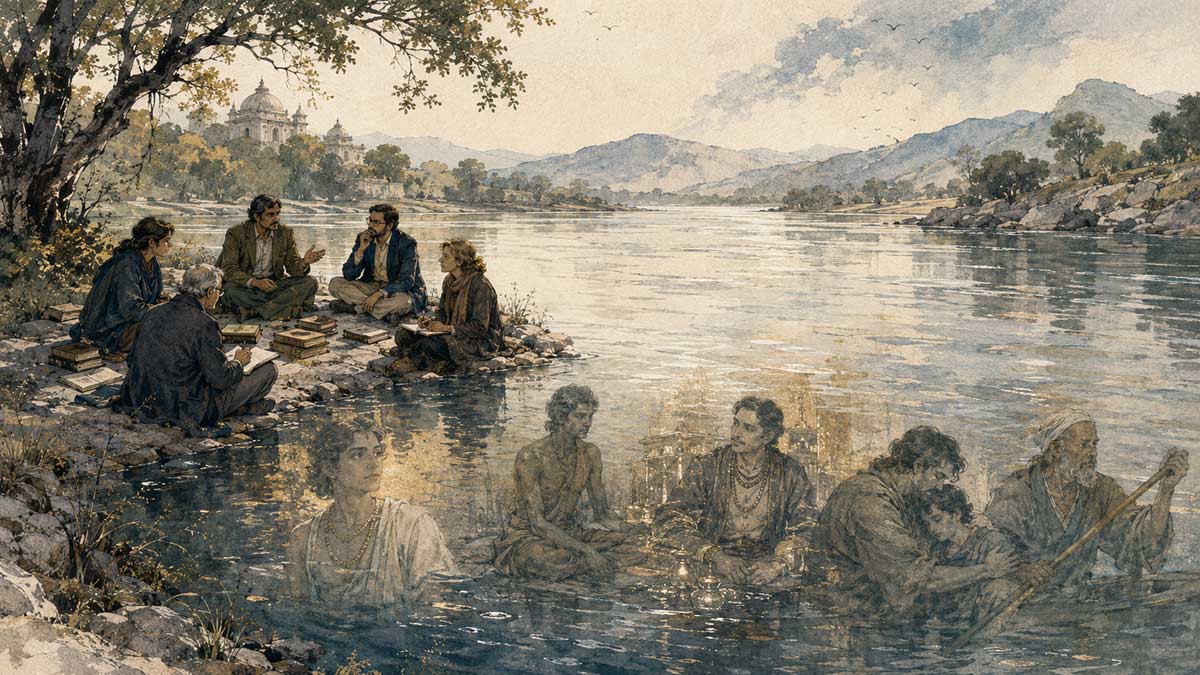
The river had become brighter now.
Sunlight moved across its surface in broken pieces.
The scholars had been speaking about Siddhartha’s pride, his need to reject, his attachment to independence.
Now the water beside them seemed almost too convenient.
Boulby noticed it first.
Boulby: We should be suspicious of symbols that solve everything.
The comparative religion scholar smiled.
Comparative Religion Scholar: Especially beautiful ones.
Ziolkowski: You think readers romanticize the river?
Boulby: Constantly.
“The river represents life.”
“The river represents time.”
“The river represents unity.”
All true, perhaps.
But too easy.
Indian Philosophy Scholar: Then let us make it difficult.
She turned toward the water.
Indian Philosophy Scholar: What changes in Siddhartha when he begins listening to the river?
Freedman: He stops organizing his life as a sequence of failures and corrections.
Boulby: Yes.
Earlier, every stage replaces another.
The Brahmin’s son must become the ascetic.
The ascetic must become the sensual man.
The sensual man must collapse.
The despairing man must become the ferryman.
Each identity seems to invalidate the previous one.
Comparative Religion Scholar: Until the river teaches him to hear them simultaneously.
Ziolkowski: That may be the first major function.
Not simply time.
The reconciliation of time.
Buddhist Scholar: I would be careful with “reconciliation.”
Boulby: Why?
Buddhist Scholar: Because it can sound sentimental.
As though every painful thing suddenly receives a beautiful explanation.
I think what changes is closer to perception.
The past does not disappear.
The future does not redeem it.
Siddhartha begins to experience his life without needing one moment to defeat another.
Freedman: That is better.
He no longer needs to say:
“That Siddhartha was mistaken, and this Siddhartha is wise.”
Ziolkowski: He can say:
“That was me too.”
Indian Philosophy Scholar: Which sounds simple until we think about how difficult it is.
Most people construct identity by exclusion.
“I am no longer that person.”
“I left that life behind.”
“I learned from that mistake.”
The river makes those divisions less secure.
Comparative Religion Scholar: Water is particularly suited to that.
It moves constantly and remains recognizable.
You cannot point to one piece of water and say, “There is the river.”
Yet the river persists.
Boulby: Siddhartha becomes something similar.
The child, ascetic, lover, merchant, father, ferryman—
none is the final authentic Siddhartha replacing all the others.
Freedman: Which challenges the very structure of the quest narrative.
A quest normally promises arrival.
The river complicates arrival.
Ziolkowski: Because wherever the river is, it is already going somewhere else.
Buddhist Scholar: And already came from somewhere else.
They watched the current for a moment.
Comparative Religion Scholar: This is where Hesse’s treatment of time becomes especially interesting.
Siddhartha eventually seems to perceive that time is not what ordinary consciousness thinks it is.
Past and future lose their absolute separation.
Everything somehow exists together.
Indian Philosophy Scholar: And that raises religious questions immediately.
Ziolkowski: You are thinking of nonduality?
Indian Philosophy Scholar: Among other things.
Readers often move very quickly from “all moments belong to one whole” to “this is Eastern nonduality.”
But again, we should resist collapsing traditions.
Comparative Religion Scholar: Still, the impulse is clearly toward unity.
Indian Philosophy Scholar: Yes.
The problem is naming the unity too quickly.
Boulby: Hesse himself seems less interested in precise metaphysical classification than in the emotional effect.
Freedman: Which is?
Boulby: Release from self-condemnation.
Freedman looked at him.
Boulby: Think about Siddhartha before the river.
He looks back on his worldly life with disgust.
He sees himself as corrupted.
The gambler.
The wealthy man.
The pleasure-seeker.
He wants distance from that person.
The river eventually allows him to stop treating that life as contamination.
Buddhist Scholar: That can be healing.
It can be dangerous too.
Everyone looked toward her.
Buddhist Scholar: If accepting your past means seeing it clearly, good.
If accepting your past becomes:
“It all had to happen. It was all part of the path.”
Then we may have a problem.
Ziolkowski: We reached this issue earlier.
Buddhist Scholar: Yes, but the river intensifies it.
Beautiful symbols can make moral questions disappear.
Freedman: Are you saying Hesse excuses Siddhartha?
Buddhist Scholar: I am saying readers sometimes do.
There is a difference.
Indian Philosophy Scholar: This is important.
Unity does not have to mean moral equivalence.
Comparative Religion Scholar: Exactly.
To say that greed and generosity occur within the same human life is not to say greed and generosity are ethically identical.
Boulby: But does the novel always make that distinction clear?
A pause.
Ziolkowski: Perhaps it does not want to.
Boulby: That is where I become uneasy.
Siddhartha hears the many voices of life until they merge into Om.
The murderer.
The lover.
The child.
The dying person.
The saint.
The sinner.
Everything belongs to the same totality.
A reader can experience that as profound compassion.
Or as a kind of moral flattening.
Indian Philosophy Scholar: Only if one mistakes metaphysical unity for ethical sameness.
Boulby: Readers do that all the time.
Buddhist Scholar: And spiritual language can help them.
“I accept everything.”
“It was meant to happen.”
“All paths are one.”
Those sentences can become ways of avoiding responsibility.
Freedman: Yet Siddhartha himself becomes more compassionate, not less.
Buddhist Scholar: Yes.
That is why I would defend the novel more than certain interpretations of it.
His vision of unity does not make him colder.
It makes him less judgmental.
Ziolkowski: Especially toward the so-called child people.
Freedman: That is one of the great changes.
Earlier, he regards ordinary attachment almost condescendingly.
People worry about money.
Children.
Status.
Love.
Loss.
He sees them as trapped.
Then his son breaks his heart.
Suddenly ordinary attachment no longer looks spiritually childish.
Comparative Religion Scholar: The river does not teach him indifference.
It teaches him participation.
Indian Philosophy Scholar: Good.
That is a crucial distinction.
Young Siddhartha wants freedom from life.
Older Siddhartha learns to belong to life.
Boulby: Which means the river may represent the collapse of spiritual hierarchy.
Ziolkowski: Explain.
Boulby: Early Siddhartha ranks experiences.
Asceticism appears higher than sensual life.
Spiritual seeking higher than commerce.
Detachment higher than attachment.
Then these hierarchies fail.
At the river, he begins to see that the worldly years were not outside his spiritual life.
Freedman: Which is very Hesse.
The rejected half must be integrated.
Boulby: Precisely.
The river says, in effect:
“You cannot become whole by amputating the parts of yourself you are ashamed of.”
Buddhist Scholar: That is psychologically compelling.
I am still not sure I would call it Buddhist.
Ziolkowski: You have been very consistent.
Buddhist Scholar: I am trying.
A little laughter moved through the group.
The comparative religion scholar leaned closer to the water.
Comparative Religion Scholar: We have spoken of the river as time and integration.
But there is another element.
Listening.
Vasudeva does not tell Siddhartha what the river means.
Freedman: That matters immensely.
Comparative Religion Scholar: He does not interpret it for him.
He says, in effect, listen.
That changes the whole epistemology of the novel.
Indian Philosophy Scholar: From acquisition to receptivity.
Boulby: Yes.
Siddhartha has spent years doing.
Fasting.
Thinking.
Trading.
Gambling.
Leaving.
Seeking.
The river requires something else.
He cannot force it to reveal itself.
Buddhist Scholar: That may be the first truly humble practice of his life.
Ziolkowski: Listening rather than mastering.
Freedman: And Vasudeva embodies that more than the river does.
Boulby: Interesting.
You think readers over-credit the river and under-credit Vasudeva?
Freedman: Absolutely.
The river without a listener is water.
Vasudeva models how to encounter it.
Indian Philosophy Scholar: Which makes him one of the most important teachers in the novel, precisely because he does not behave like Siddhartha’s earlier teachers.
Buddhist Scholar: He does not say, “Here is the doctrine of river consciousness.”
Ziolkowski: Thankfully.
Comparative Religion Scholar: He makes space.
That may be why Siddhartha can finally learn.
The earlier Siddhartha encounters teachings he can evaluate.
Vasudeva offers attention.
There is far less for Siddhartha’s intellect to resist.
Freedman: He cannot win an argument against silence.
Boulby: Or prove himself more independent than the river.
The Indian philosophy scholar smiled.
Indian Philosophy Scholar: Perhaps that is why it succeeds where teachers fail.
It has no ego for Siddhartha to oppose.
The group fell quiet.
The idea seemed to please everyone.
Then the Buddhist scholar interrupted.
Buddhist Scholar: I want to ruin the harmony.
Boulby: Please do.
Buddhist Scholar: We keep speaking as if Siddhartha finally learns to listen completely.
But what if he still hears what he needs to hear?
Ziolkowski: Meaning?
Buddhist Scholar: Humans are very good at turning nature into confirmation.
A river does not literally tell Siddhartha that time is an illusion.
Siddhartha interprets the river.
Comparative Religion Scholar: Of course.
Buddhist Scholar: Then the symbol contains a danger.
We can romanticize “listening” as though it were pure reception.
But interpretation is still happening.
Siddhartha brings his entire life to the river.
Boulby: That does not weaken the symbol.
Buddhist Scholar: No.
It makes it more interesting.
He is not receiving objective cosmic information.
He is finally able to perceive his life differently.
Freedman: So the river changes because Siddhartha changes.
Buddhist Scholar: Exactly.
Perhaps the river had always said the same thing.
Perhaps Siddhartha was finally capable of hearing it.
Ziolkowski: That is beautifully consistent with the novel’s view of wisdom.
The truth cannot simply be handed over.
The listener must become capable of recognizing it.
Indian Philosophy Scholar: Yet that still does not answer whether the river’s final message is ethically adequate.
Boulby: You want to return to morality.
Indian Philosophy Scholar: I do.
Suppose Siddhartha says:
“My greed, my neglect, my failures, my suffering—all belong.”
Fine.
Now suppose someone else says:
“You hurt me.”
What does the river tell him then?
The scholars became quieter.
Freedman answered first.
Freedman: Hopefully not, “You too are part of the whole.”
The Indian philosophy scholar smiled.
Indian Philosophy Scholar: Exactly.
That would be spiritually elegant and emotionally intolerable.
Buddhist Scholar: This is where acceptance must remain personal before it becomes universal.
I may accept that my mistakes belong to my life.
I cannot tell the person I harmed that their suffering was necessary for my development.
Ziolkowski: That is a very important distinction.
Boulby: And one Hesse leaves partly unresolved.
Comparative Religion Scholar: Perhaps intentionally.
The river’s perspective is total.
Human relationships are particular.
Those two perspectives do not always fit comfortably.
Indian Philosophy Scholar: Good.
That may be the real tension.
From the river’s perspective, everything flows into everything else.
From the perspective of the wounded person, one event may remain painfully singular.
Freedman: Which means wisdom may require moving between those perspectives rather than choosing one.
Buddhist Scholar: Yes.
Too much particularity and we become trapped in grievance.
Too much totality and we erase consequence.
Ziolkowski: Then perhaps the river is not the answer.
It is one necessary perspective.
The group considered that.
Boulby: I like that much better.
Comparative Religion Scholar: So the river teaches wholeness.
Other people teach accountability.
Indian Philosophy Scholar: Exactly.
And that is why the novel needs Kamala.
Govinda.
The son.
Vasudeva.
If the river were sufficient, the human relationships would be unnecessary.
Freedman: That takes us back to the question of whether readers over-spiritualize the book.
Boulby: Yes.
The river is memorable.
But Hesse does not place Siddhartha alone beside it forever.
Human beings keep returning.
Buddhist Scholar: Including the son, whose suffering resists easy absorption.
Ziolkowski: And Govinda, who still needs something Siddhartha’s words cannot give.
The comparative religion scholar looked thoughtful.
Comparative Religion Scholar: There is one more feature of the river we have not discussed enough.
Laughter.
Boulby: Yes.
The river laughs.
Comparative Religion Scholar: That laughter matters.
It undermines Siddhartha’s seriousness.
For much of his life, he treats spiritual seeking with enormous gravity.
The river’s laughter suggests that life exceeds his categories.
Freedman: He is not the center of existence.
Indian Philosophy Scholar: That may be one of the healthiest things the river teaches him.
Buddhist Scholar: Especially for a man with his particular form of ego.
Ziolkowski: The universe does not stop because Siddhartha is spiritually confused.
Boulby: The river keeps flowing through his enlightenment and his foolishness with equal indifference.
Comparative Religion Scholar: Yet not cold indifference.
More like cosmic amusement.
Freedman: Which may help him stop dramatizing every stage of his own development.
Indian Philosophy Scholar: That is interesting.
The river does not merely integrate his identities.
It de-centers them.
He hears countless voices.
His is only one.
The Buddhist scholar nodded.
Buddhist Scholar: That may be closer to something I can recognize.
Ziolkowski: Buddhist?
She smiled.
Buddhist Scholar: Let us not become reckless.
Everyone laughed.
The river moved faster near the rocks.
Boulby looked toward it.
Boulby: Then let me try to gather what we have.
The river is time.
But more than time.
It is continuity without fixed identity.
It is the coexistence of past and present.
It is a challenge to spiritual hierarchy.
It is a practice of listening.
It is a symbol of integration.
It can support compassion.
It can be misread as moral equivalence.
It de-centers Siddhartha.
And it gives him a way to stop hating the person he once was.
Freedman: That is already far better than “the river symbolizes life.”
Indian Philosophy Scholar: But I would add one more.
It forces us to ask where Hesse’s idea of unity comes from.
Ziolkowski: Which takes us back to religion.
Indian Philosophy Scholar: And culture.
Om.
Atman.
Samsara.
Buddha.
European mysticism.
Romantic ideas of nature.
Hesse’s own psychology.
The river gathers all of these just as it gathers the voices.
Comparative Religion Scholar: Which makes the symbol itself a kind of synthesis.
Buddhist Scholar: Or collage.
Boulby: You prefer the less flattering word.
Buddhist Scholar: Sometimes less flattering words are more precise.
Freedman smiled.
Freedman: Then perhaps the next question is unavoidable.
When Western readers encounter this river and call it “Eastern wisdom,” what exactly are they doing?
No one answered at first.
The Indian philosophy scholar watched the light move across the water.
Then she said quietly:
Indian Philosophy Scholar: Perhaps they are looking into India and seeing themselves.
Ziolkowski turned toward her.
Ziolkowski: Then we have reached our next problem.
Boulby: Did Hesse discover something in Indian thought—
Comparative Religion Scholar: —or did he create a spiritual India that Western individualists could recognize as home?
The river continued past them.
No one called it a symbol this time.
Topic 4 — Did Hesse Create an Eastern Spirituality for Western Individualists?
The sun had climbed higher.
The river no longer looked mystical.
In full daylight, it was simply water moving past stones, reeds, boats, and people.
That seemed appropriate.
The conversation had reached a point where beauty alone was no longer enough.
The Indian philosophy scholar looked across the group.
Indian Philosophy Scholar: We keep saying “India.”
I think we should ask whose India.
Ziolkowski nodded.
Ziolkowski: Hesse’s?
Indian Philosophy Scholar: Partly.
Historical India exists in the novel.
Religious traditions exist.
Ideas with long philosophical histories exist.
Yet another India exists too.
An India constructed inside the European imagination.
Freedman: A spiritual counter-image to Europe.
Indian Philosophy Scholar: Yes.
Europe becomes modernity.
Industry.
War.
Alienation.
Institutions.
Rationalism.
Then India becomes interiority.
Timelessness.
Wisdom.
Spiritual wholeness.
She paused.
Indian Philosophy Scholar: That contrast can be emotionally compelling.
It can distort both sides.
Boulby: Hesse was hardly alone in making that move.
Indian Philosophy Scholar: Certainly not.
That is what makes it historically interesting.
Comparative Religion Scholar: And dangerous.
A civilization becomes an answer to another civilization’s crisis.
Buddhist Scholar: Or a mirror.
Freedman: Perhaps both.
Ziolkowski looked toward the Indian philosophy scholar.
Ziolkowski: Would you say Siddhartha romanticizes India?
She thought for a moment.
Indian Philosophy Scholar: Yes.
But I would not stop there.
“Romanticizes” can become too easy an accusation.
Hesse’s engagement was serious.
He was genuinely drawn to Indian religious and philosophical traditions.
The question is what happens when genuine fascination meets literary need.
Boulby: The novelist selects what serves the book.
Indian Philosophy Scholar: Exactly.
And selection creates an India shaped partly by Hesse’s own hunger.
Freedman: Which hunger?
Indian Philosophy Scholar: Escape from fragmentation.
The desire for unity.
A spiritual vocabulary capable of answering a European crisis of self.
The possibility that life’s contradictions might belong to a larger whole.
She looked toward the river.
Indian Philosophy Scholar: Hesse did not go to India merely to find India.
He went there imaginatively to find something Europe seemed unable to give him.
The group grew quiet.
Freedman: That is central to Hesse’s biography.
The inherited European frameworks no longer felt sufficient.
Traditional religion did not satisfy him in a simple way.
Modern bourgeois life did not satisfy him.
Nationalism repelled him.
Psychological fragmentation haunted him.
He needed another vocabulary.
Ziolkowski: And India offered one.
Indian Philosophy Scholar: Or what he understood of India offered one.
That distinction matters.
The Buddhist scholar nodded.
Buddhist Scholar: Very much.
Readers sometimes speak as if Hesse discovered a complete body of “Eastern wisdom,” carried it home, and translated it into fiction.
That is far too clean.
Comparative Religion Scholar: He encountered texts, translations, intellectual traditions, family influences, European interpretations of Asian religion—
Boulby: —and his own imagination.
Comparative Religion Scholar: Yes.
Then he created something new.
Ziolkowski: Is that new thing necessarily illegitimate?
Indian Philosophy Scholar: No.
Literature would be impossible if writers could only reproduce traditions exactly.
My concern is not invention.
My concern is when readers mistake invention for representation.
Freedman: So Siddhartha can be a profound novel without being a reliable map of Indian religion.
Indian Philosophy Scholar: Absolutely.
Those claims do not compete.
Boulby smiled.
Boulby: We may have solved half the internet.
A little laughter moved through the group.
The reception historian, who had spoken very little so far, leaned forward.
Reception Historian: I think we should follow the book west.
Everyone turned.
Reception Historian: The novel becomes even more interesting once we stop asking only what Hesse put into it and start asking what later readers took out of it.
Ziolkowski: Especially American readers.
Reception Historian: Especially them.
There is a reason Siddhartha found such a receptive audience among young Western readers searching for spiritual freedom.
The book grants extraordinary dignity to the individual search.
You can leave home.
Reject authority.
Try asceticism.
Reject asceticism.
Meet a great religious teacher.
Walk away.
Enter sensual life.
Become wealthy.
Become disgusted.
Break down.
Begin again.
And none of those stages automatically disqualifies you from spiritual meaning.
Boulby: That is an intoxicating promise.
Reception Historian: It is.
Especially for young people being told that one wrong choice can define a life.
Freedman: The novel says wandering may belong to the path.
Reception Historian: Yes.
And that message became extraordinarily attractive in cultures already questioning inherited institutions.
Buddhist Scholar: Religion among them.
Reception Historian: Certainly.
A reader could receive Siddhartha as spiritual permission without joining anything.
No conversion required.
No church.
No monastery.
No permanent guru.
No formal creed.
Indian Philosophy Scholar: No community.
The reception historian looked toward her.
Reception Historian: That is the missing word, isn't it?
Indian Philosophy Scholar: I think so.
We praise Siddhartha’s freedom.
But he is remarkably unembedded.
Where is sustained community in his path?
Where are mutual obligations?
Where are people who have claims upon him that he cannot simply leave?
Freedman: His son eventually creates precisely that problem.
Indian Philosophy Scholar: Yes.
The son is one of the few relationships Siddhartha cannot comfortably place inside a temporary stage.
Buddhist Scholar: Which is why fatherhood wounds his philosophy so deeply.
A spiritual system centered on personal realization becomes much harder when another human being says:
“My needs do not exist for your awakening.”
The reception historian nodded.
Reception Historian: Western readers often admired Siddhartha as a model of authenticity.
But authenticity has a cost when elevated above every bond.
Ziolkowski: Are we becoming unfair to the novel again?
Indian Philosophy Scholar: Perhaps.
But productive unfairness can expose something.
Boulby: There is a larger question.
Does Hesse free spirituality from institutions?
Or does he relocate spiritual authority entirely inside the self?
Comparative Religion Scholar: That is the issue.
If institutional religion becomes suspect and private experience becomes final, who corrects the seeker?
Buddhist Scholar: A very unfashionable question.
Ziolkowski: And a necessary one.
Buddhist Scholar: Traditions are restrictive.
They can fail.
Teachers can abuse authority.
Communities can become rigid.
But traditions can correct us too.
A private seeker can become completely convinced by his own interpretation.
Indian Philosophy Scholar: And call that freedom.
Freedman: Siddhartha himself repeatedly does something close to this.
He trusts his dissatisfaction as evidence.
“This path no longer satisfies me, so I must leave.”
Boulby: Yet his dissatisfaction is often perceptive.
Freedman: Yes.
That is why Hesse makes the problem difficult.
Siddhartha’s inward authority is often right.
It is never guaranteed to be right.
Reception Historian: Modern readers may hear only the first part.
“Trust yourself.”
Buddhist Scholar: A very marketable teaching.
Boulby: We have reached consumer culture.
Reception Historian: We were always heading there.
The group smiled.
She continued.
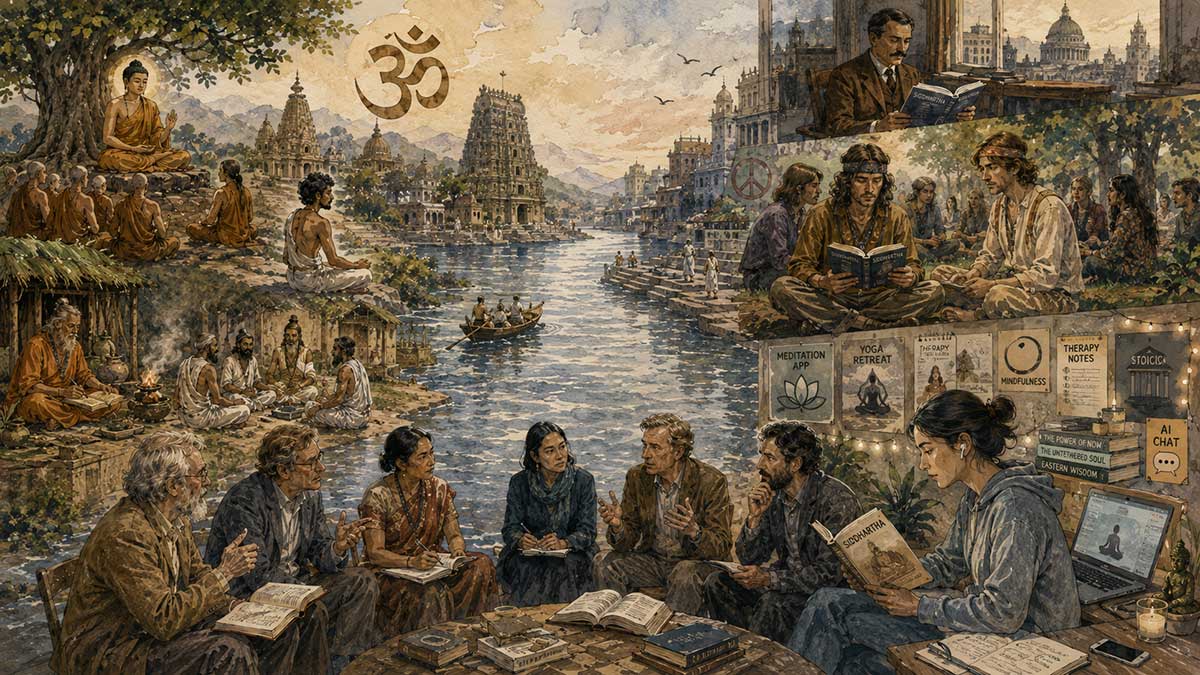
Reception Historian: Think about the modern spiritual seeker.
Meditation app.
Yoga retreat.
Therapy.
A podcast about Stoicism.
A Buddhist book.
A Christian contemplative practice.
Psychedelic retreat.
Breathwork.
Self-help.
An online teacher.
Perhaps an AI conversation at two in the morning.
A few scholars laughed.
Reception Historian: The person may be deeply sincere.
I am not mocking them.
But there is a recognizable pattern:
Take what speaks to me.
Leave what does not.
Move when the practice stops producing meaning.
Indian Philosophy Scholar: Spiritual self-curation.
Reception Historian: Exactly.
Boulby: Which makes Siddhartha look startlingly contemporary.
Comparative Religion Scholar: Yet there is one major difference.
Siddhartha pays enormous costs.
Reception Historian: Yes.
That distinction protects the novel from becoming a lifestyle brochure.
Siddhartha does not merely sample experiences.
He is broken by them.
Freedman: He does not visit worldly life for a weekend.
He becomes trapped in it.
Buddhist Scholar: He does not try asceticism casually either.
He pushes it to exhaustion.
Indian Philosophy Scholar: So perhaps calling him a spiritual consumer is too shallow.
Reception Historian: If taken literally, yes.
But the comparison still reveals something.
He recognizes no permanent external authority over his spiritual life.
He retains the right to leave every system.
That feature makes him familiar to modern readers.
Ziolkowski: Let us test the phrase.
Is Siddhartha a spiritual consumer?
Boulby: No.
Buddhist Scholar: Sometimes.
Indian Philosophy Scholar: Structurally, perhaps.
Morally, not quite.
Freedman: He is too committed to suffering for the analogy to hold completely.
The group laughed.
Reception Historian: I would say he is an ancestor of spiritual self-curation, not spiritual shopping.
Comparative Religion Scholar: Explain the difference.
Reception Historian: Shopping asks:
“What do I like?”
Siddhartha asks:
“What is true for me?”
Those questions can overlap, but they are not identical.
Indian Philosophy Scholar: Good.
Reception Historian: Yet the second question still places the self in a privileged position.
“My experience determines whether this teaching remains authoritative.”
Buddhist Scholar: Which is precisely where traditions might object.
Truth does not always become false when it stops satisfying you.
Ziolkowski: That deserves repeating.
Buddhist Scholar: A difficult teaching may remain true precisely when you dislike it.
A practice may feel dry.
A community may frustrate you.
A teacher may tell you something you do not want to hear.
Private authenticity can become a way of escaping correction.
Freedman: Siddhartha leaves the Samanas partly after recognizing their limitation.
Would you have told him to stay?
Buddhist Scholar: No.
Freedman: He leaves Gautama’s followers.
Should he have stayed?
Buddhist Scholar: Perhaps not.
Freedman: Then we keep returning to the same difficulty.
Buddhist Scholar: Yes.
The freedom to leave is necessary.
The belief that leaving is inherently profound is dangerous.
The Indian philosophy scholar nodded.
Indian Philosophy Scholar: That may be the distinction we need.
Boulby: Hesse does tend to make departures luminous.
Freedman: He does.
Boulby: The person who leaves receives narrative energy.
The person who remains can look static.
Indian Philosophy Scholar: Which is culturally significant.
Many religious traditions locate spiritual maturity inside remaining.
Remaining with a discipline.
A teacher.
A family.
A community.
A vow.
Comparative Religion Scholar: Siddhartha’s genius is departure.
Vasudeva’s genius is staying.
That silenced the group.
Ziolkowski smiled.
Ziolkowski: There is the counterweight.
Freedman: Yes.
Vasudeva may correct the whole novel simply by existing.
Boulby: He does not chase experiences.
He remains with the river.
Buddhist Scholar: And listens.
Indian Philosophy Scholar: Which suggests Hesse eventually becomes suspicious of endless seeking himself.
The seeker has to stop somewhere.
Reception Historian: That is interesting in relation to modern readers.
People often remember the freedom of Siddhartha’s wandering more strongly than the stillness that ends it.
Comparative Religion Scholar: Perhaps wandering is more glamorous.
Boulby: Much easier to market.
Buddhist Scholar: “Stay quietly with one practice for thirty years” makes a poor advertisement.
Laughter moved through the group.
Freedman looked toward the reception historian.
Freedman: Why did the book resonate so strongly with the counterculture?
Reception Historian: Several reasons converged.
Suspicion of established institutions.
Interest in Asian religions.
Search for personal authenticity.
Resistance to conventional career and family scripts.
Experimentation with consciousness.
A sense that Western material prosperity had failed to answer deeper questions.
Siddhartha offered a literary figure who could leave conventional structures without becoming spiritually empty.
Ziolkowski: He could reject society and still move toward meaning.
Reception Historian: Yes.
That was enormously attractive.
Indian Philosophy Scholar: Yet the paradox is that the book’s India becomes most influential when detached from India.
Reception Historian: Precisely.
Its global success partly depends on portability.
Readers can extract the seeker, the river, Om, personal experience, and spiritual freedom from their historical contexts.
Buddhist Scholar: Which returns us to your first question.
Whose India?
Indian Philosophy Scholar: Yes.
The India millions of readers encountered through Siddhartha may have been less a place than a spiritual possibility.
Freedman: Is that inherently wrong?
She shook her head.
Indian Philosophy Scholar: Not inherently.
Human beings have always imagined other cultures through their own needs.
The ethical task is noticing when we are doing it.
Comparative Religion Scholar: So a modern reader can love Siddhartha and still say:
“This is Hesse’s encounter with Indian traditions, not India explaining itself.”
Indian Philosophy Scholar: Exactly.
That single distinction creates much more honest reading.
Boulby turned toward the river.
Boulby: I want to return to the self.
If Siddhartha does not accept final authority from tradition, teacher, community, or institution, what finally has authority?
Buddhist Scholar: Experience.
Freedman: The integrated self.
Indian Philosophy Scholar: Or perhaps life itself.
Comparative Religion Scholar: The river, if we are being poetic.
Boulby smiled.
Boulby: We promised not to make it solve everything.
Ziolkowski: Then ask the harder question.
Boulby: Does Hesse make the self the final spiritual authority?
No one answered quickly.
Freedman spoke first.
Freedman: Early in the novel, yes.
Later, I think that becomes less clear.
Siddhartha starts by insisting:
“I must know for myself.”
He ends by listening to something larger than himself.
Buddhist Scholar: But he still interprets it through himself.
Indian Philosophy Scholar: True.
Yet the self he ends with is not the sovereign self he began with.
It has been broken by love, shame, grief, failure.
Comparative Religion Scholar: Perhaps authority shifts from individual preference to deep participation in life.
Ziolkowski: That is less catchy.
Comparative Religion Scholar: Most mature ideas are.
The reception historian smiled.
Reception Historian: The popular reading says:
“Follow your own path.”
The mature reading may be:
“Follow your path until you discover that it was never yours alone.”
The group became silent.
Even the river seemed quieter for a moment.
Freedman: That changes the entire book.
Reception Historian: It should.
Siddhartha receives from his father.
The Samanas.
Gautama.
Govinda.
Kamala.
Kamaswami.
His son.
Vasudeva.
The river.
He spends much of the novel insisting nobody can give him wisdom.
Yet his life is crowded with people without whom his wisdom would not exist.
Indian Philosophy Scholar: So the myth of self-creation collapses.
Buddhist Scholar: As it should.
Ziolkowski: Perhaps that is the novel’s hidden correction of Western individualism.
The self must discover.
But it does not discover alone.
Boulby: That would make Siddhartha less individualistic than its reputation.
Freedman: Or more maturely individualistic.
Indian Philosophy Scholar: I would accept that.
The person matters.
Experience matters.
Freedom matters.
But none exists outside relationship.
Comparative Religion Scholar: Which means Hesse may begin with the fantasy of the solitary seeker and end with interdependence, even if he never names it that way.
The Buddhist scholar looked interested.
Buddhist Scholar: Now that sounds closer to something Buddhism might recognize.
Ziolkowski smiled.
Ziolkowski: We have finally pleased you.
Buddhist Scholar: Briefly.
The group laughed.
Then the reception historian looked toward the others.
Reception Historian: There is still a problem.
Boulby: Of course there is.
Reception Historian: If every reader must discover the meaning personally—
if every tradition can only point—
if the individual cannot simply receive wisdom secondhand—
then what exactly are we doing here?
The group quieted.
She gestured toward the notebooks.
The books.
The entire discussion.
Reception Historian: We are scholars.
We teach.
Interpret.
Explain.
Contextualize.
Write books about Hesse.
We are spending hours trying to help readers understand a novel whose central character insists that wisdom cannot be taught.
Boulby smiled.
Boulby: I was hoping we could avoid that until lunch.
Buddhist Scholar: No chance.
Indian Philosophy Scholar: It may be the question the entire conversation has been moving toward.
Ziolkowski closed his notebook.
Ziolkowski: Then let us ask it without protection.
He looked around the group.
Ziolkowski: If wisdom cannot be taught—
why did Hesse write Siddhartha?
No one answered.
The river moved past them, carrying the question with it.
Topic 5 — If Wisdom Cannot Be Taught, Why Did Hesse Write This Book?
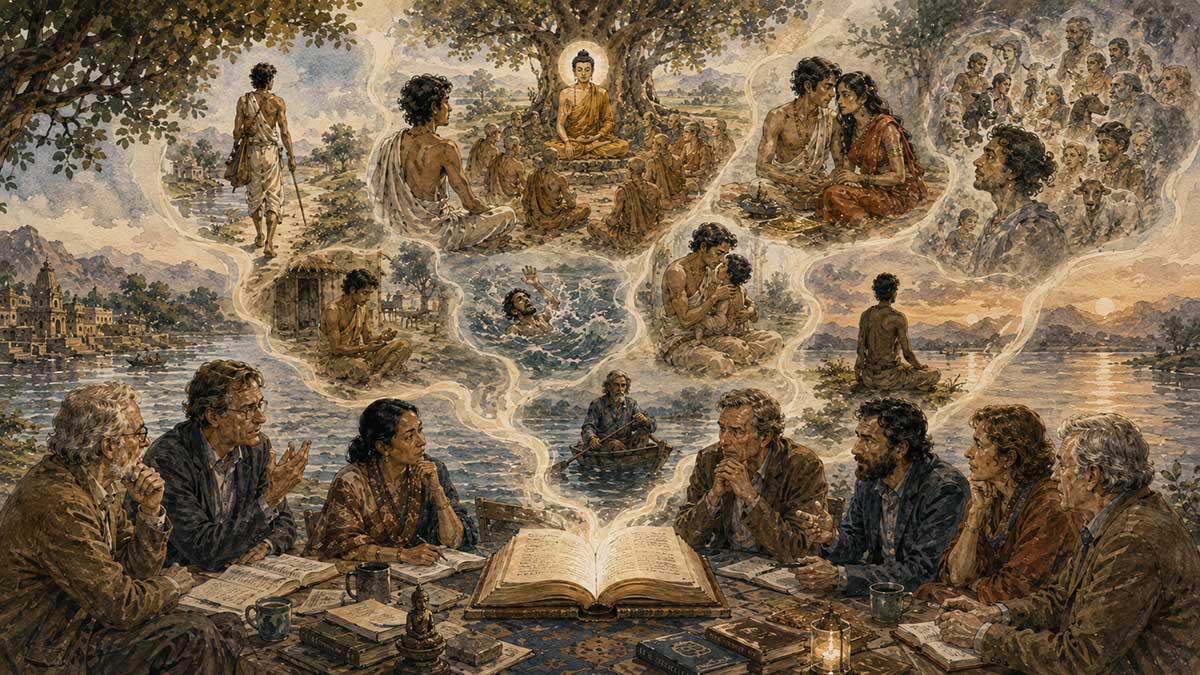
The question remained between them.
If wisdom cannot be taught, why did Hesse write Siddhartha?
No one reached for an answer immediately.
The river kept moving.
A boatman farther downstream pulled an oar through the water in a slow, repetitive rhythm.
Ziolkowski looked at the others.
Ziolkowski: We may have arrived at the contradiction.
Boulby: Or the solution.
Freedman: That depends on what we mean by teaching.
The Buddhist scholar nodded.
Buddhist Scholar: Exactly.
Siddhartha never says knowledge is useless.
He says wisdom cannot simply be transferred.
That is a very different claim.
Comparative Religion Scholar: Then perhaps the problem is our language.
We say “teach wisdom” as if wisdom were information.
Indian Philosophy Scholar: A formula.
A conclusion.
A sentence someone can memorize.
Buddhist Scholar: But traditions have long distinguished between hearing something and realizing it.
You can hear that all things are impermanent.
You can repeat it.
Teach it.
Write an examination on it.
Then someone you love dies.
Suddenly the sentence means something else.
The group went quiet.
Freedman: That may be the entire architecture of Siddhartha.
He repeatedly knows things before he becomes capable of living them.
Boulby: Yes.
He understands attachment intellectually long before his son leaves.
He understands the emptiness of desire before worldly life nearly consumes him.
He understands that doctrines have limits before he understands the limits of his own independence.
Ziolkowski: So perhaps wisdom is not unknown information.
It is known information becoming existentially real.
Buddhist Scholar: Very often.
Indian Philosophy Scholar: Which means a teacher may give language to something a person later experiences.
The language was not useless.
It simply was not the experience.
Comparative Religion Scholar: Then Siddhartha may have overstated his case.
Buddhist Scholar: Young Siddhartha certainly does.
He seems tempted by a binary:
Either the teacher can give me enlightenment, or the teacher cannot give me anything essential.
That is too crude.
Freedman: And perhaps Hesse knows it is crude.
If Hesse truly believed teaching were spiritually worthless, the novel would contain very strange evidence.
Everyone teaches Siddhartha something.
Boulby: Even the people he rejects.
Freedman: Especially them.
The Brahmins give him language.
The Samanas give him discipline.
Gautama gives him an encounter with achieved serenity.
Kamala gives him knowledge of desire.
Kamaswami gives him worldly experience.
His son gives him suffering.
Vasudeva gives him listening.
Indian Philosophy Scholar: Yet none of them can perform the final synthesis for him.
Ziolkowski: So perhaps the novel does not reject teaching.
It rejects substitution.
The Buddhist scholar smiled.
Buddhist Scholar: Yes.
A teacher cannot substitute for practice.
A doctrine cannot substitute for realization.
A description cannot substitute for living.
That does not make the teacher, doctrine, or description meaningless.
Boulby: Then why does Siddhartha speak so strongly about wisdom being incommunicable?
Comparative Religion Scholar: Perhaps Hesse is protecting something from reduction.
Boulby: What?
Comparative Religion Scholar: Lived reality.
The moment we put an experience into a sentence, we make it cleaner than it was.
We separate what life held together.
Good and evil.
Love and pain.
Failure and growth.
Past and present.
Words divide so that thought can function.
Life does not always respect those divisions.
Indian Philosophy Scholar: That fits Siddhartha’s late suspicion of language.
Ziolkowski: But Hesse is a writer.
Boulby: Exactly.
There is the delicious problem.
The man who distrusts words writes a novel made entirely of them.
Freedman: Which suggests that the novel itself must be doing something other than stating propositions.
The reception historian leaned forward.
Reception Historian: This may explain the book’s longevity better than anything else we have discussed.
People do not keep returning to Siddhartha simply because of its ideas.
Many of the ideas can be summarized in a page.
Ziolkowski: Painfully true for scholars.
Reception Historian: Yet a summary does not reproduce the experience of reading it.
The movement matters.
The repetition.
The leaving.
The exhaustion.
The sudden quiet by the river.
The reader spends time with Siddhartha’s restlessness before reaching his stillness.
Boulby: So form becomes part of the teaching.
Reception Historian: Yes.
Or perhaps we should say part of the transmission.
Buddhist Scholar: I prefer that.
Indian Philosophy Scholar: Literature does not hand us wisdom.
It can alter the conditions under which we encounter an idea.
Comparative Religion Scholar: That is beautifully put.
Indian Philosophy Scholar: A statement such as “your mistakes are part of your life” can sound trivial.
Then a novel makes you inhabit decades of mistakes, shame, desire, grief, and reconciliation.
The sentence changes.
Freedman: Because the reader has traveled emotionally before hearing it.
Ziolkowski: Then art may communicate indirectly what philosophy communicates directly.
Boulby: Or perhaps art allows contradiction to remain alive.
Philosophy often wants clarification.
Literature can let two opposing truths stand in the same room.
Buddhist Scholar: Which suits Siddhartha particularly well.
He needed to leave.
He hurt people by leaving.
His mistakes formed him.
His mistakes were still mistakes.
Teachers could not awaken him.
Teachers still mattered.
Desire failed him.
Desire still belonged to his life.
Comparative Religion Scholar: The novel’s wisdom may exist partly in refusing to resolve those tensions into a single rule.
Ziolkowski nodded slowly.
Ziolkowski: Which may be why simplistic readings feel wrong.
“Follow your own path.”
“Reject teachers.”
“Everything happens for a reason.”
“Go with the flow.”
Boulby grimaced.
Boulby: Please stop.
Everyone laughed.
Ziolkowski: Those sayings extract conclusions from a book that resists conclusions.
Indian Philosophy Scholar: Perhaps that is one of the dangers of turning literature into self-help.
Reception Historian: Yet people do it because they want something usable.
Buddhist Scholar: Understandably.
Human beings want directions.
Freedman: Siddhartha wants directions too at the beginning.
Then he discovers that every direction becomes inadequate.
Comparative Religion Scholar: But that cannot mean directions are useless.
A map is not a landscape.
One still may need a map.
Boulby: That sounds like the distinction we have been reaching for all morning.
Buddhist Scholar: A teacher points.
A student walks.
Ziolkowski: And perhaps a novel does something stranger.
Reception Historian: It lets you rehearse walking without pretending you have arrived.
The group became quiet.
That sentence seemed to satisfy them.
Then Boulby looked toward the Buddhist scholar.
Boulby: What about Govinda?
We have been saving him for this.
She nodded.
Buddhist Scholar: Yes.
The ending matters enormously.
Govinda asks Siddhartha for something he can understand.
A teaching.
An explanation.
Siddhartha tries.
But the words are paradoxical.
Wisdom cannot be communicated.
Truth becomes distorted in language.
Opposites belong together.
The world is perfect in every moment.
Govinda listens.
But he does not fully grasp it.
Indian Philosophy Scholar: Then comes the kiss.
Comparative Religion Scholar: And the vision.
Boulby: Which is one of the strangest moments in the novel.
Govinda sees countless forms.
Faces flowing into faces.
Birth.
Death.
Violence.
Tenderness.
Animals.
Human beings.
All of them transforming into one another.
Then he sees Siddhartha’s smile.
Freedman: Resembling Gautama’s.
Ziolkowski: Which completes a circle.
Siddhartha refused Buddha’s teaching.
At the end, Govinda perceives in Siddhartha something like what Siddhartha once perceived in Buddha.
Buddhist Scholar: And crucially, Govinda does not get there through an argument.
Boulby: Is Hesse saying mystical experience succeeds where language fails?
Comparative Religion Scholar: Perhaps.
Indian Philosophy Scholar: Or literature gives us a representation of such an experience.
We should be careful.
Govinda has the vision.
The reader reads words describing Govinda having the vision.
Ziolkowski: So Hesse cannot escape language after all.
Boulby: Exactly.
Which is why I think “wisdom cannot be communicated” cannot be the novel’s final literal position.
If it were, the ending would undermine itself.
Buddhist Scholar: Unless Hesse means communication is possible, but never complete.
Freedman: That feels right.
Buddhist Scholar: You can receive something.
You cannot receive the totality of another person’s realization.
There is always a remainder that must become yours through life.
Comparative Religion Scholar: That applies to love too.
Ziolkowski: Explain.
Comparative Religion Scholar: Someone can tell you what grief feels like.
Then you grieve.
Someone can describe being a parent.
Then you hold your child.
Someone can explain betrayal.
Then someone betrays you.
The earlier words were not false.
They were incomplete.
Indian Philosophy Scholar: Experience gives them weight.
Freedman: And sometimes destroys them.
One person’s wisdom may fail entirely in another person’s life.
Boulby: Which brings us back to the danger of imitation.
Reception Historian: And to the reason the book remains attractive.
Readers do not feel ordered to copy Siddhartha.
At its best, the novel almost warns against doing so.
Ziolkowski: Yet many readers want to become him.
Reception Historian: Of course.
Charismatic protagonists create that problem.
Buddhist Scholar: There is a hidden irony in wanting to imitate a character whose great principle is not to imitate.
The group laughed.
Indian Philosophy Scholar: Perhaps that is one misunderstanding worth correcting.
Siddhartha is not a manual saying:
“Do what Siddhartha did.”
Freedman: Absolutely not.
Imagine treating his life as a practical program.
Leave home.
Starve yourself.
Reject a Buddha.
Become wealthy.
Gamble.
Collapse.
Almost die.
Become a ferryman.
Boulby: Bestseller.
Reception Historian: Ten-week course.
More laughter.
Then Freedman became serious.
Freedman: The book works precisely because his path is irreducibly his.
A reader should not copy the events.
The reader should recognize the necessity of owning his or her experience.
Buddhist Scholar: But I want to challenge the word “owning.”
Freedman: Go ahead.
Buddhist Scholar: We have spoken so much about personal experience that I worry we are recreating the individualism we criticized earlier.
Wisdom is personal.
It is not necessarily private.
Indian Philosophy Scholar: Good distinction.
Buddhist Scholar: Many forms of wisdom emerge in relationship.
Teacher and student.
Parent and child.
Community.
Friendship.
Practice shared over years.
We should not let Siddhartha’s dramatic independence convince us that wisdom is manufactured alone inside the self.
Ziolkowski: The novel itself contradicts that idea.
Buddhist Scholar: Exactly.
Siddhartha’s wisdom contains other people.
He could not have become himself without them.
Comparative Religion Scholar: Then perhaps wisdom cannot be transferred, but it can be co-created.
The Buddhist scholar considered the phrase.
Buddhist Scholar: I would be careful, but yes, something close to that.
Indian Philosophy Scholar: No one can have your realization for you.
Yet other people shape what becomes possible for you to realize.
Freedman: That describes Hesse’s novel remarkably well.
Boulby: And perhaps reading itself.
A dead writer creates something.
A reader encounters it decades later.
Nothing is transferred intact.
Yet something happens between them.
The reception historian smiled.
Reception Historian: Which is why we are sitting here.
Ziolkowski looked toward the books beside them.
Ziolkowski: Then perhaps scholarship has a role too.
Boulby: I was wondering whether we still had jobs.
Indian Philosophy Scholar: Scholarship can prevent certain mistakes.
Historical ones.
Religious ones.
Cultural ones.
Buddhist Scholar: It can complicate readings that feel too easy.
Freedman: Biography can reveal what the fiction transforms.
Reception Historian: Reception history can show that books change as communities read them differently.
Comparative Religion Scholar: But none of that guarantees wisdom.
Ziolkowski smiled.
Ziolkowski: Humbling.
Buddhist Scholar: Useful.
A breeze moved across the water.
Pages in one of the open books lifted and settled again.
The reception historian looked around the group.
Reception Historian: I want to ask the final question now.
Not about Hesse.
About us.
Everyone became attentive.
Reception Historian: What is the one thing modern readers most misunderstand about Siddhartha?
Boulby answered first.
Boulby: That it is a collection of inspirational conclusions.
It is a novel of contradictions.
If you extract the conclusions and discard the contradictions, you have lost the book.
Buddhist Scholar: I would say:
It is not telling you that teachers are useless.
Siddhartha’s path depends on what he receives from others, including those he rejects.
Indian Philosophy Scholar: Mine would be:
It is not India explaining itself to the West.
It is Hesse creating a literary encounter with Indian traditions through his own history, needs, and imagination.
Readers should respect the difference.
Freedman: I would say:
Siddhartha is not admirable at every stage simply because he eventually becomes wise.
His spiritual development includes pride, blindness, selfishness, and failure.
That is part of why the novel remains human.
Comparative Religion Scholar: Mine is:
Unity does not mean that every action is equally good.
Seeing all of life as belonging to a whole need not erase moral responsibility.
Reception Historian: I would say:
The book is not permission to endlessly shop for experiences until something feels meaningful.
Siddhartha’s wandering has consequences.
His freedom costs him.
Ziolkowski listened to each answer.
Then someone asked:
Boulby: And you?
Ziolkowski looked at the river.
He took longer than the others.
Ziolkowski: Perhaps the greatest misunderstanding is believing that the book wants us to become Siddhartha.
No one spoke.
The Buddhist scholar tilted her head.
Buddhist Scholar: Then what does it want?
Ziolkowski smiled faintly.
Ziolkowski: I am not sure a novel wants anything so neatly.
But if I had to answer—
He looked at the people around him.
Ziolkowski: Perhaps it asks us to notice where we are living with answers we have never tested.
Where we are repeating someone else’s life.
Where we are rejecting something merely because it came from another person.
Where we are calling restlessness freedom.
Where we are calling fear wisdom.
Where we are confusing experience with truth.
The group remained silent.
Ziolkowski: Siddhartha’s path cannot become ours.
But his questions can disturb ours.
The Buddhist scholar nodded.
Buddhist Scholar: That is much better than imitation.
The Indian philosophy scholar looked toward the river.
Indian Philosophy Scholar: And better than pretending we learned nothing from him.
Freedman smiled.
Freedman: So wisdom can travel after all.
Boulby: Partly.
Comparative Religion Scholar: Unevenly.
Reception Historian: Through people who misunderstand it for a century.
A few people laughed.
The Buddhist scholar added:
Buddhist Scholar: Perhaps that is how most wisdom travels.
Imperfectly.
The laughter faded.
For a moment, nobody tried to interpret the silence.
Then Boulby looked toward the river one last time.
Boulby: There is something almost amusing about this.
We began by asking whether Siddhartha was Buddhist.
Then whether he was arrogant.
Then what the river meant.
Then whether Hesse had created a Western spirituality through Indian imagery.
And finally we asked whether wisdom can be taught.
Freedman: And?
Boulby: I am less certain about the book than when we began.
The Buddhist scholar smiled.
Buddhist Scholar: That may be progress.
Indian Philosophy Scholar: Or failure.
Ziolkowski: Must we choose?
They laughed again.
The boatman downstream pulled his ferry onto the bank.
People began stepping ashore.
Ordinary people carrying baskets, bundles, tools, children.
None of them seemed concerned with enlightenment.
The scholars watched them for a moment.
Then the reception historian spoke quietly.
Reception Historian: Perhaps that is another thing the book understands.
Everyone looked toward her.
Reception Historian: We spend years searching for a truth large enough to explain life.
Then life keeps arriving in particular people.
No one answered.
The river continued moving.
And the discussion ended without anyone claiming to possess its final meaning.
Final Thoughts
The scholar conversation leaves Siddhartha less tidy than many popular interpretations make it.
That is a strength.
The novel is not a simple Buddhist handbook.
It draws from several religious and philosophical traditions, filtered through Hesse’s own European background, psychological struggles, and literary imagination.
Siddhartha’s independence is inspiring, but it can become pride.
His rejection of teachers protects him from imitation, yet his life remains shaped by people who teach him constantly.
The river offers a vision of unity, time, and acceptance, yet unity should not erase responsibility.
And Hesse’s India can be spiritually moving without being mistaken for India speaking directly for itself.
Perhaps the book’s most lasting insight is not that we should reject teachers.
It is that no teacher can live our life for us.
Words can guide.
Traditions can shape.
Books can unsettle.
Relationships can transform.
But realization still has to become real within a life.
That is why Siddhartha continues to matter.
It does not hand the reader a final answer.
It creates enough tension that the reader may begin questioning which answers were ever truly their own.
Short Bios:
Theodore Ziolkowski — American literary scholar known for major work on Hermann Hesse and modern European literature. His scholarship helped place Hesse within broader literary, intellectual, and cultural contexts.
Ralph Freedman — Literary critic and biographer whose work on Hermann Hesse explored the connections between Hesse’s fiction, psychological life, personal crises, and spiritual development.
Mark Boulby — Scholar of German literature known for critical work on Hermann Hesse. His readings focus on literary structure, symbolism, character development, and the tensions running through Hesse’s fiction.
Eugene F. Timpe — Scholar associated with critical study of Hesse and Siddhartha, including the novel’s philosophical and religious dimensions.
Buddhist Studies Scholar — Represents scholarship grounded in Buddhist history, doctrine, practice, and interpretation, helping distinguish Hesse’s literary use of Buddhist ideas from Buddhist traditions themselves.
Indian Philosophy Scholar — Represents expertise in Indian religious and philosophical traditions, bringing attention to concepts such as Om, Atman, asceticism, liberation, and the risks of collapsing distinct traditions into a generic idea of “Eastern wisdom.”
Comparative Religion Scholar — Examines how Siddhartha blends religious ideas across traditions and how Hesse uses concepts such as unity, timelessness, sacred totality, and personal realization.
Reception Historian — Studies how books change through readership and cultural context, including the rise of Siddhartha among Western readers and its powerful appeal during periods of institutional distrust, spiritual experimentation, and countercultural searching.
Hermann Hesse — German-Swiss novelist, poet, and essayist awarded the Nobel Prize in Literature in 1946. Published in 1922, Siddhartha became one of his most influential works and remains widely read for its treatment of spiritual searching, identity, experience, and meaning.
Leave a Reply