
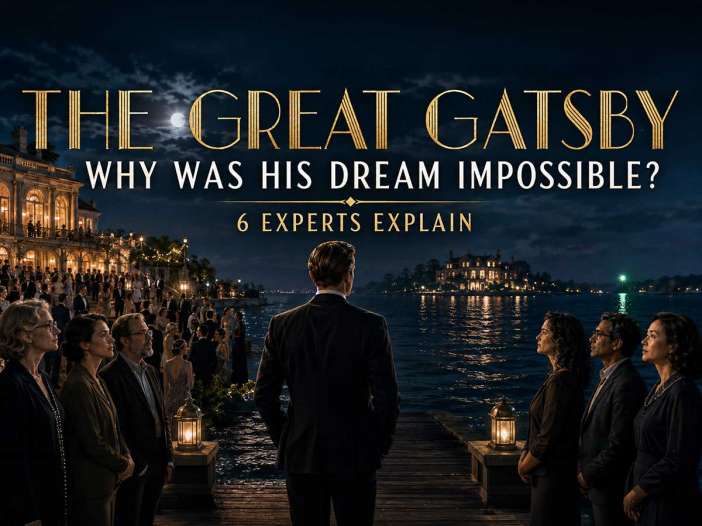
Introduction
The Great Gatsby is often remembered as a novel about wealth, parties, romance, and the American Dream.
But beneath all of that glamour is a more unsettling question:
What happens when the dream that gives your life meaning also prevents you from living the life you actually have?
Jay Gatsby spends years transforming James Gatz, a poor young man from North Dakota, into the mysterious millionaire who lives across the bay from Daisy Buchanan.
He acquires almost everything he once lacked.
Money.
A mansion.
Beautiful clothes.
Social visibility.
A new name.
Yet Gatsby still needs Daisy.
Not simply because he loves her.
Daisy has gradually come to represent many things at once: the woman Gatsby lost, the youth he cannot recover, the wealthy world he once stood outside, proof that his transformation succeeded, and the life he believes should have been his.
That is what makes Gatsby's dream both beautiful and dangerous.
In this imagined discussion, six scholars and thinkers examine Gatsby from very different directions: literary criticism, Fitzgerald scholarship, cultural history, psychology, social class, gender, and narration.
Their discussion moves through five questions:
- What actually makes Gatsby “great”?
- Did Gatsby love Daisy, and why couldn't he let her go?
- If Gatsby got rich, why could he never truly belong?
- Are Daisy and Myrtle really worse than Gatsby?
- What does the ending of The Great Gatsby really mean?
The conversation begins with Gatsby.
But it gradually becomes a conversation about us.
Why do we admire certain dreamers and judge others?
Why can reaching a goal fail to make us feel that we have arrived?
Why do we sometimes ask another person to prove that our life has meaning?
Why can the past remain more emotionally powerful than the present?
And what happens to the people standing between us and the green lights we spend our lives pursuing?
(Note: This is an imaginary conversation, a creative exploration of an idea, and not a real speech or event.)
Topic 1: What Actually Makes Gatsby “Great”?
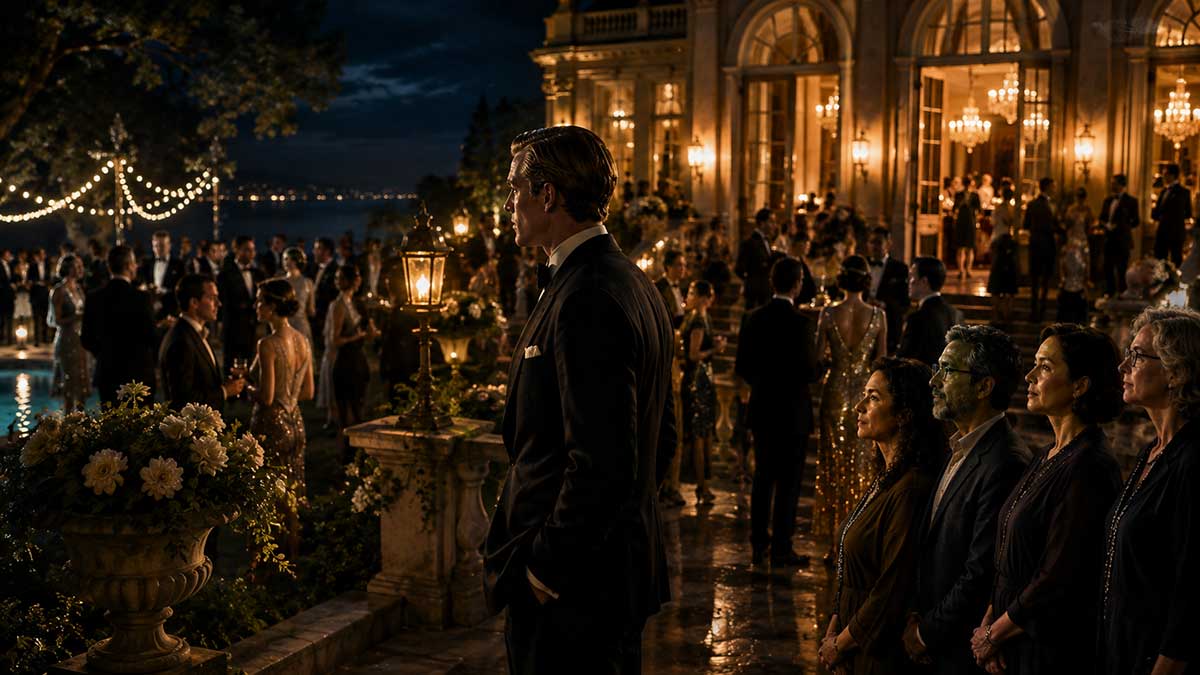
Before the scholars move into Gatsby’s love for Daisy, his obsession with the past, or the class system that keeps him outside East Egg, they begin with the question hidden in the novel’s title.
Jay Gatsby lies about his origins. His fortune is tied to criminal activity. He pursues a married woman. He constructs an elaborate identity and tries to make reality conform to a dream he has carried for years.
Yet Nick Carraway ends up admiring him more than almost anyone else in the novel.
So what could Fitzgerald possibly mean by calling him “great”?
The scholars begin with that apparently simple question. But as they talk, another question slowly emerges. Perhaps Gatsby’s greatness and Gatsby’s tragedy do not come from two different qualities. Perhaps they come from the very same part of him.
Maureen Corrigan: Every time I return to this novel, I come back to the title before I come back to the green light.
Kirk Curnutt: Because it sounds almost ridiculous when you think about it.
Maureen Corrigan: It does. The Great Gatsby. It sounds like a magician. A vaudeville performer. Someone who walks onto a stage with smoke behind him and promises to make something disappear.
Sarah Churchwell: Which is rather appropriate.
Maureen Corrigan: Very.
Sarah Churchwell: Gatsby’s greatest trick is making James Gatz disappear.
Shamus Khan: Does he succeed?
Sarah Churchwell: Publicly?
For a while.
Internally, I’m much less certain.
Krystine Batcho: I’m not sure James Gatz ever disappears at all.
Soh Yeun Kim: And perhaps that matters more than whether anyone at Gatsby’s parties believes his story.
Kirk Curnutt: Fitzgerald does something very clever there. We learn Gatsby’s invented biography, and then we learn that the biography is false. But the revelation doesn’t make Gatsby less interesting.
If anything, he becomes more interesting.
Maureen Corrigan: Yes. Usually when you expose a fraud, the person gets smaller.
Gatsby gets larger.
Shamus Khan: Why?
Maureen Corrigan: That’s exactly the question.
If Gatsby were simply a man pretending to be rich, we would forget him.
If he were simply a criminal who became wealthy, we would have plenty of other literary characters to compare him with.
What Fitzgerald gives Gatsby is this extraordinary emotional intensity.
He believes in the life he has invented.
Krystine Batcho: Perhaps more than anyone else does.
Sarah Churchwell: And that belief is deeply American.
Not necessarily the criminality. The self-creation.
The idea that the circumstances of your birth do not have to define the limits of your life.
James Gatz looks at the world he was born into and says, in effect, “No. That cannot be all there is.”
Shamus Khan: Which is admirable.
Sarah Churchwell: I think part of it is.
Soh Yeun Kim: I agree, but this is where readers sometimes move too quickly.
They see the poor young man refusing his circumstances, then they leap straight into admiration.
Maureen Corrigan: Because we love reinvention stories.
Soh Yeun Kim: Especially successful ones.
Shamus Khan: Gatsby appears successful.
Soh Yeun Kim: Exactly. Beautiful house. Beautiful clothes. Enormous parties. Cars. Servants. People whispering his name.
His self-invention has visible evidence.
Krystine Batcho: Yet I wonder whether Gatsby experiences any of those things as evidence.
Kirk Curnutt: What do you mean?
Krystine Batcho: If they were enough to convince him that he had successfully become Jay Gatsby, why does Daisy still matter so much?
Sarah Churchwell: That's interesting.
Krystine Batcho: He has already transformed his life before Daisy walks back into it.
James Gatz is gone as far as the outside world is concerned.
He has money.
He has status of a kind.
He has become the person who can throw a party and have half of New York arrive without invitation.
Yet none of that seems to settle the question for him.
Maureen Corrigan: So Daisy becomes the certificate?
Krystine Batcho: Perhaps.
Soh Yeun Kim: Or the witness.
Maureen Corrigan: I like that better.
Soh Yeun Kim: Gatsby can fool strangers.
He can fool party guests.
He can manufacture stories for Nick.
But Daisy knew the earlier Gatsby.
She knew the young officer before the mansion, before the yellow car, before the parties.
If she looks at him now and chooses him, perhaps that does something no fortune can do.
It tells Gatsby that the transformation was real.
Shamus Khan: But then Gatsby has a serious problem.
If another person must validate your identity, your identity is still dependent.
Krystine Batcho: Yes.
Sarah Churchwell: And this may be where his greatness starts becoming his vulnerability.
Kirk Curnutt: I want to stay with the word great for another minute.
Do we think Fitzgerald is using it sincerely?
Maureen Corrigan: Partly.
Sarah Churchwell: Partly ironically.
Shamus Khan: That sounds like the safe literary answer.
Maureen Corrigan: It does, doesn't it?
Shamus Khan: Then let me be difficult.
Suppose Gatsby had exactly the same emotional obsession, exactly the same fabricated biography, exactly the same longing for a woman he knew years earlier, but he had failed to become rich.
Suppose he lived in George Wilson’s garage.
Would Nick call him great?
Soh Yeun Kim: Probably not.
Sarah Churchwell: That's uncomfortable.
Shamus Khan: It should be.
We talk about Gatsby as though his longing is inherently beautiful.
But longing becomes more aesthetically impressive when it comes with a mansion.
Maureen Corrigan: Yes.
Soh Yeun Kim: And when the dreamer is male.
Kirk Curnutt: Myrtle.
Soh Yeun Kim: Myrtle.
She is trying to become someone else too.
She changes clothes when she enters the apartment.
She changes her manner.
She performs a higher-class version of herself.
She wants to escape the life into which she was born.
There is something structurally similar to Gatsby in that.
Sarah Churchwell: Yet readers rarely call Myrtle a magnificent dreamer.
Maureen Corrigan: No. She becomes vulgar.
Soh Yeun Kim: That's what interests me.
Gatsby wants someone else's wife and becomes romantic.
Myrtle wants someone else's husband and becomes tawdry.
Gatsby's conspicuous consumption becomes mysterious.
Myrtle's becomes embarrassing.
Gatsby's dissatisfaction with his origins becomes aspiration.
Myrtle's dissatisfaction becomes social climbing.
Kirk Curnutt: Fitzgerald himself gives them different treatment, though.
Soh Yeun Kim: Yes, and Nick gives them different treatment.
I'm not arguing that readers invented the difference out of nowhere.
I'm asking what that difference does to us.
Krystine Batcho: Perhaps Gatsby has one thing Myrtle does not.
Soh Yeun Kim: What?
Krystine Batcho: An almost limitless future orientation.
Myrtle wants another life.
Gatsby believes another life can be created almost completely.
There's a difference in scale.
Shamus Khan: Which returns us to greatness as magnitude.
Krystine Batcho: Maybe.
Think about what hope does psychologically.
A person who believes the future can be different can tolerate a great deal in the present.
That belief can produce resilience.
It can motivate enormous change.
James Gatz's refusal to accept his starting point is not automatically delusional.
In many circumstances, we would praise it.
Sarah Churchwell: Work harder. Become more. Don't let your past determine you.
Krystine Batcho: Exactly.
And Gatsby does.
That's what makes his later failure psychologically fascinating.
The quality that first frees him from one reality eventually makes it difficult for him to accept another.
Maureen Corrigan: Say more about that.
Krystine Batcho: Early Gatsby says, “My circumstances do not have to remain my circumstances.”
That is healthy enough.
Later Gatsby seems to say, “Reality itself must eventually become what I believed it would become.”
Those are very different statements.
Kirk Curnutt: One challenges circumstance.
The other challenges time.
Krystine Batcho: Yes.
Sarah Churchwell: And people.
Soh Yeun Kim: Especially Daisy.
Maureen Corrigan: So Gatsby’s defining gift is his refusal to accept limits.
That gets James Gatz out of North Dakota.
But eventually the same refusal cannot accept that Daisy changed.
Krystine Batcho: Right.
Shamus Khan: Then how do we know when admirable ambition becomes denial?
Krystine Batcho: That's difficult precisely because the language can sound identical.
“Don't give up.”
“Don't listen to people who tell you it can't be done.”
“Keep believing.”
Those phrases can describe persistence.
They can also describe refusal to accept evidence.
From the inside, both can feel like courage.
Maureen Corrigan: Which makes Gatsby dangerous to reduce to a lesson.
Sarah Churchwell: “Dream big, but not too big.”
Maureen Corrigan: Exactly. That's not Fitzgerald.
Kirk Curnutt: Nor is “Gatsby should simply have moved on.”
That makes the novel psychologically tiny.
Soh Yeun Kim: And it misses why Nick admires him.
Maureen Corrigan: Let's talk about Nick.
Why does he?
Nick knows Gatsby lies.
He knows Gatsby's business is questionable.
He knows Gatsby wants Daisy to leave her husband.
He sees the absurdities.
Yet when it matters, Nick takes Gatsby's side emotionally.
Kirk Curnutt: The famous compliment is important.
Nick separates Gatsby from the others.
Sarah Churchwell: Perhaps because Gatsby still believes that life can mean something.
Shamus Khan: Tom doesn't?
Sarah Churchwell: Tom believes things belong to him.
That's different.
Tom has wealth.
He has Daisy.
He has houses.
He has physical strength.
He has inherited legitimacy.
But there is something deadened about possession in Tom.
Gatsby's world is always charged with possibility.
Maureen Corrigan: That's beautifully put.
Tom owns.
Gatsby reaches.
Krystine Batcho: And reaching is emotionally attractive.
Soh Yeun Kim: Until you consider what he's reaching through.
Sarah Churchwell: Yes.
Soh Yeun Kim: I don't want us to admire the gesture so much that Daisy disappears.
Gatsby's reaching has a human object.
He doesn't simply want a better future.
He increasingly needs another person to behave according to his imagined future.
Maureen Corrigan: That may be where readers are protected by Nick.
Soh Yeun Kim: Protected?
Maureen Corrigan: Nick lets us experience Gatsby's longing from inside its beauty.
If Daisy narrated the story, Gatsby might feel very different.
Soh Yeun Kim: Much more demanding.
Kirk Curnutt: Perhaps frightening at moments.
Krystine Batcho: Particularly the demand that she say she never loved Tom.
Sarah Churchwell: We haven't reached Daisy yet.
Maureen Corrigan: No, but she keeps walking into the room.
Shamus Khan: She has to.
If Gatsby's greatness depends upon hope, we eventually have to ask what hope asks from the people around him.
Krystine Batcho: And whether his hope remains flexible.
Healthy hope usually adapts.
The goal may remain meaningful, but reality modifies the route.
Gatsby's hope becomes increasingly rigid.
Maureen Corrigan: Daisy cannot simply choose him now.
Krystine Batcho: Exactly.
If she said, “I loved Tom once, but I choose you now,” that should be enough for someone whose goal is a future with Daisy.
It isn't enough for Gatsby.
Kirk Curnutt: Because the intervening years matter.
Soh Yeun Kim: And he cannot allow them to matter.
Sarah Churchwell: Which means his dream isn't actually located in the future.
Maureen Corrigan: There it is.
Sarah Churchwell: Gatsby talks constantly through the language of tomorrow.
His whole identity points forward.
But emotionally, he's trying to return.
Krystine Batcho: That's a very important distinction.
A person can be future-oriented in behavior and past-oriented in purpose.
Shamus Khan: Gatsby builds tomorrow so he can recover yesterday.
Maureen Corrigan: Which may be the most Gatsby sentence we've said today.
Kirk Curnutt: And Fitzgerald knew the tension.
Gatsby creates himself through movement.
But the emotional destination stays fixed.
Soh Yeun Kim: Daisy stays fixed too.
At least in his mind.
Krystine Batcho: This is where memory becomes important.
Memory doesn't simply preserve people.
We rebuild memories.
We integrate them into who we are now.
Over five years, Gatsby isn't just keeping Daisy in storage.
He is living with a Daisy who exists inside his own developing story.
Maureen Corrigan: And that Daisy never argues with him.
Krystine Batcho: Precisely.
The remembered Daisy doesn't marry Tom in front of him every morning.
She doesn't raise a child.
She doesn't change.
She doesn't have inconvenient moods.
She doesn't tell Gatsby his memory is wrong.
She becomes psychologically stable in a way real people never are.
Soh Yeun Kim: So when the real Daisy returns, she has to compete with herself.
Krystine Batcho: Yes.
Sarah Churchwell: And she can't win.
Maureen Corrigan: Nobody could.
Shamus Khan: Then Gatsby's greatness becomes almost tragic in the classical sense.
The scale of the quality contains the mechanism of the fall.
Kirk Curnutt: I think that's closer.
Maureen Corrigan: So “great” doesn't have to mean admirable.
Kirk Curnutt: No.
Think about how we use the word in tragedy.
A great figure can have a great flaw.
A great ambition.
A great fall.
Magnitude matters.
Sarah Churchwell: Gatsby's imagination is enormous.
Krystine Batcho: His capacity for hope is enormous.
Shamus Khan: His need for validation is enormous.
Soh Yeun Kim: The role he asks Daisy to occupy is enormous.
Maureen Corrigan: His loneliness too.
Sarah Churchwell: That may be the part I find most haunting.
Look at the parties.
They are supposed to make Gatsby look socially triumphant.
But Gatsby is often almost separate from them.
People drink his alcohol.
Swim in his pool.
Dance in his garden.
Tell stories about whether he killed a man.
And Gatsby is watching the gate.
Kirk Curnutt: Waiting for Daisy.
Sarah Churchwell: Hundreds of people are physically close to him.
Emotionally, almost none are.
Shamus Khan: Which raises another uncomfortable question.
Did Gatsby actually want relationships with all those people?
Maureen Corrigan: Probably not.
Shamus Khan: Then perhaps the loneliness is partly constructed.
The crowd exists as a mechanism.
Soh Yeun Kim: A mechanism to attract Daisy.
Krystine Batcho: Or to produce the world in which Gatsby believes Daisy ought to appear.
Maureen Corrigan: That's interesting.
The mansion is almost a stage set.
Sarah Churchwell: Which takes us back to The Great Gatsby sounding like a stage name.
Maureen Corrigan: Exactly.
Gatsby builds the stage.
Gatsby builds the character.
Gatsby fills the theater.
And one particular person must arrive for the performance to be complete.
Soh Yeun Kim: But she isn't only the audience.
She's part of the script.
Maureen Corrigan: Yes.
Soh Yeun Kim: That's what bothers me.
Daisy is expected to walk onto the stage and speak the lines Gatsby has written for her.
Krystine Batcho: “I never loved Tom.”
Soh Yeun Kim: Right.
If she changes the line, Gatsby's whole production is threatened.
Shamus Khan: Then Gatsby isn't only directing himself.
Sarah Churchwell: No.
And self-invention becomes much more morally complicated when your identity requires other people to cooperate with your invention.
Kirk Curnutt: Yet I still resist reducing him to manipulation.
There is tenderness in Gatsby.
There is vulnerability.
There is almost boyish nervousness when Daisy comes to Nick's house.
Maureen Corrigan: That's critical.
He isn't cold.
Krystine Batcho: Nor calculating in the way Tom can be.
Soh Yeun Kim: Which is why the problem is painful.
Gatsby can genuinely love Daisy and still ask too much from her.
Sarah Churchwell: Those truths can coexist.
Maureen Corrigan: Perhaps that's the first thing we need to rescue from the popular argument.
People ask, “Did Gatsby love Daisy, or did Gatsby love the idea of Daisy?”
As though only one can be true.
Krystine Batcho: Human attachment is rarely that clean.
We love people partly through what they mean to us.
They become associated with periods of our lives, identities, hopes, losses.
That doesn't automatically make the love false.
Shamus Khan: Then where is Gatsby's mistake?
Krystine Batcho: Perhaps not in attaching meaning to Daisy.
Perhaps in requiring the living Daisy to carry every meaning he attached to her.
Soh Yeun Kim: Yes.
That's very different.
Maureen Corrigan: She has to be Daisy.
She has to be youth.
She has to be wealth.
She has to be success.
She has to be proof that he crossed the class boundary.
She has to be proof that James Gatz was right to become Gatsby.
She has to be proof that five years were not wasted.
Sarah Churchwell: No human being can do all of that.
Kirk Curnutt: And Gatsby doesn't know that yet.
Maureen Corrigan: Maybe that's why Nick's admiration survives.
Nick can see the impossibility.
Gatsby cannot.
Shamus Khan: Is ignorance great?
Maureen Corrigan: No.
But the ability to believe with that intensity can be moving even when we know the belief is impossible.
Krystine Batcho: Because we recognize a smaller version of it in ourselves.
Sarah Churchwell: The person who thinks, “When I get that job.”
Soh Yeun Kim: “When that person loves me.”
Shamus Khan: “When I have enough money.”
Kirk Curnutt: “When I finally become the person I was supposed to be.”
Krystine Batcho: Then everything will settle.
Maureen Corrigan: Yes.
That's Gatsby.
Not the mansion.
Not the bootlegging.
Not even Daisy.
That sentence.
Then everything will settle.
Sarah Churchwell: Except it never does.
Shamus Khan: Which is why I still wonder whether Gatsby's tragedy begins much earlier than Daisy.
Kirk Curnutt: Where?
Shamus Khan: Perhaps the first time James Gatz decides that the person he currently is cannot possibly be enough.
Krystine Batcho: That's powerful.
Sarah Churchwell: But I wouldn't condemn that impulse entirely.
For a poor young man with enormous ambition, dissatisfaction can be generative.
Shamus Khan: I agree.
I'm asking what happens when dissatisfaction becomes the permanent engine.
First James Gatz isn't enough.
Then becoming Gatsby isn't enough.
Then wealth isn't enough.
Then the mansion isn't enough.
Then Daisy's presence isn't enough.
Then Daisy choosing him isn't enough.
She must never have loved Tom.
Where does enough live?
Maureen Corrigan: Perhaps nowhere.
Soh Yeun Kim: Which means Daisy could never actually finish the job Gatsby gives her.
Krystine Batcho: No.
Even if she said exactly what he wanted, something else might eventually need repairing.
Kirk Curnutt: That's speculation.
Krystine Batcho: It is.
Kirk Curnutt: But reasonable speculation.
Sarah Churchwell: And it makes Gatsby's achievement sadder.
He might already have accomplished the most extraordinary part of his dream.
He escaped the identity he believed trapped him.
He built an entirely different life.
Yet he never seems able to stand inside that life and say, “This is real. I am here.”
Maureen Corrigan: Because he's always looking across the water.
Soh Yeun Kim: At Daisy.
Krystine Batcho: At the past.
Shamus Khan: At proof.
Kirk Curnutt: At whatever comes next.
Sarah Churchwell: Perhaps all four.
Maureen Corrigan: Then maybe that's what “great” finally does for me.
It doesn't tell me Gatsby is morally great.
It tells me not to look at him on an ordinary scale.
Everything has been enlarged.
The dream.
The performance.
The hope.
The self-deception.
The longing.
The loneliness.
Krystine Batcho: And the distance between what he has and what he believes he still needs.
Soh Yeun Kim: I would add one caution.
When we call all of that great, we must still remember the people standing inside the enlargement.
Daisy isn't a symbol to herself.
Myrtle isn't scenery.
George isn't scenery.
Gatsby's dream feels enormous partly because Nick lets it fill the frame.
There are other lives at the edges of that frame.
Maureen Corrigan: That's fair.
And we'll have to bring them in.
Kirk Curnutt: But perhaps not before we answer the question we just created.
Sarah Churchwell: Which one?
Kirk Curnutt: We started by asking what makes Gatsby great.
Somehow we've arrived at a man who has become rich, visible, admired, mysterious, almost mythic, yet still needs one woman from five years earlier to tell him that the entire construction was real.
Krystine Batcho: Which suggests that the thing he is reaching for isn't simply Daisy.
Maureen Corrigan: No.
Soh Yeun Kim: Daisy carries too much for that.
Shamus Khan: Then what is he trying to recover?
There was a pause.
Sarah Churchwell: Daisy, certainly.
Krystine Batcho: But perhaps also the young man who stood beside her before he knew what would be lost.
Kirk Curnutt: Before Tom.
Maureen Corrigan: Before five years.
Soh Yeun Kim: Before Daisy became someone Gatsby could no longer completely control inside his imagination.
Krystine Batcho: Before Gatsby's future became his past.
Maureen Corrigan: That's where I think we should stop.
Not with the verdict that Gatsby is great.
Not with the verdict that the title is ironic.
But with something stranger.
The quality Nick admires most in Gatsby may be the same quality that eventually makes reality unbearable to him.
He can believe beyond what is visible.
That ability creates Jay Gatsby.
Then it asks Daisy to become a memory.
It asks the present to erase five years.
And eventually it asks the future to return something that only exists behind him.
Sarah Churchwell: So maybe the next question isn't simply, “Did Gatsby love Daisy?”
Krystine Batcho: No.
Sarah Churchwell: Maybe it's this.
When Gatsby looked across the bay toward Daisy, how much of what he loved was actually waiting on the other shore?
Krystine Batcho: And how much of it existed only in memory?
Soh Yeun Kim: Or inside Gatsby himself.
Maureen Corrigan: Exactly.
And that is where the green light becomes much more dangerous than a symbol of hope.
Topic 2: Did Gatsby Love Daisy, and Why Couldn't He Let Her Go?
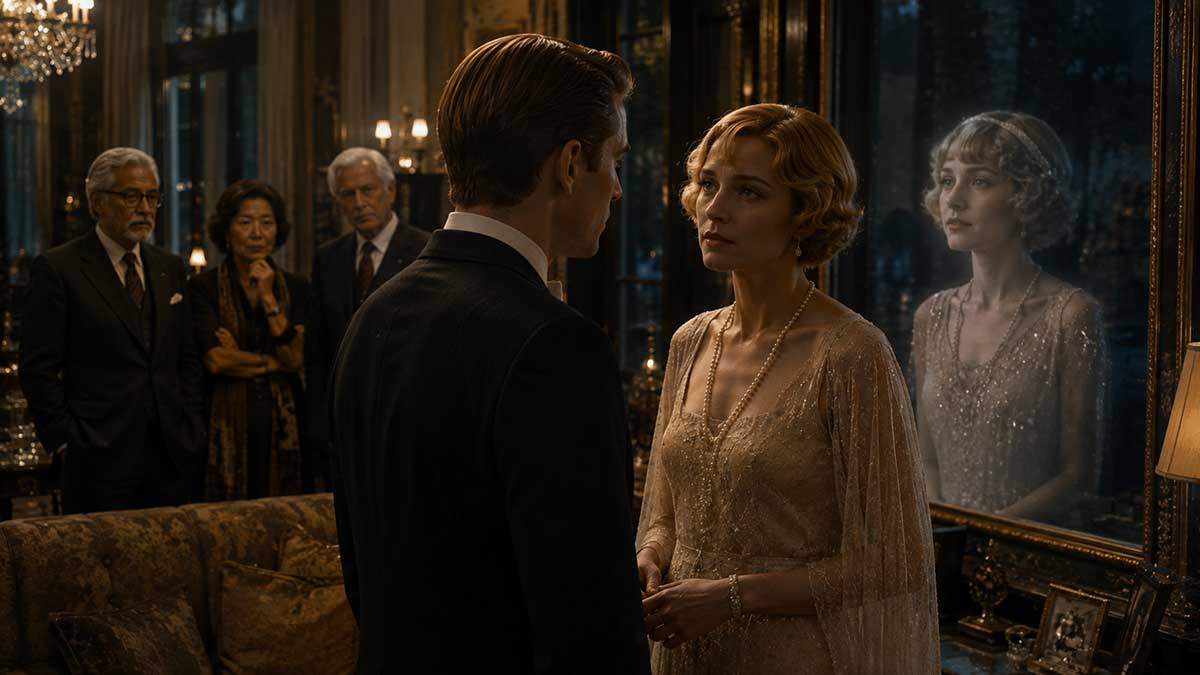
The first discussion left the scholars with a more difficult Gatsby than the romantic figure reaching across the bay.
His extraordinary capacity to believe helped James Gatz create Jay Gatsby. Yet Gatsby still seems to need Daisy to confirm that his transformation was real. She has become more than the woman he once loved. She is connected to youth, wealth, belonging, possibility, and the moment when Gatsby believed his entire future remained open.
This topic begins with one of the most common questions readers ask about the novel: Did Gatsby truly love Daisy?
But the scholars soon discover that this may be the wrong choice between two possibilities. Gatsby can genuinely love Daisy and still transform her into something no living person could ever successfully become.
Krystine Batcho: I've been thinking about the question Sarah asked at the end of our last discussion. When Gatsby looks across the bay, how much of what he wants is actually standing on the other side?
Maureen Corrigan: Daisy is there.
Krystine Batcho: Daisy is there.
But Gatsby's youth isn't.
Louisville isn't.
The young officer he once was isn't.
The moment before Daisy married Tom isn't.
The life Gatsby imagined they might have had isn't.
And yet all of those things seem to gather around Daisy.
Sarah Churchwell: Which is why I resist the popular argument that Gatsby either loves Daisy or loves what Daisy represents.
Maureen Corrigan: I do too.
Sarah Churchwell: Why can't he do both?
Soh Yeun Kim: Most people do both, to some degree.
Krystine Batcho: Of course. We don't experience people independently of our own histories.
Someone can remind you of being young.
Someone can represent safety.
Someone can become connected to a city, a period of life, a family, a sense of possibility.
Those associations don't prove that the relationship isn't real.
Shamus Khan: Then when does it become a problem?
Krystine Batcho: When the person can no longer change without threatening everything you've attached to them.
Maureen Corrigan: That's Gatsby.
Krystine Batcho: I think it increasingly becomes Gatsby.
Kirk Curnutt: We should remember that when Gatsby first knows Daisy, there are practical reasons she becomes so important to him.
She's beautiful. She's desirable. She's wealthy. Her house and social world represent something he has never possessed.
Fitzgerald makes the class dimension of Gatsby's attraction very difficult to separate from the romantic one.
Sarah Churchwell: Daisy is not simply a woman who happens to have money.
Her money is part of the experience of Daisy.
Maureen Corrigan: Gatsby hears it.
Sarah Churchwell: Yes.
Her voice is famously connected with money.
That doesn't mean Gatsby sits down and thinks, “I am going to fall in love with this woman because she is rich.”
Desire isn't usually that mechanical.
But Daisy's beauty, confidence, surroundings, social position, and apparent ease are intertwined.
Shamus Khan: And for someone like Gatsby, ease itself can be enormously attractive.
Soh Yeun Kim: What do you mean by ease?
Shamus Khan: The ease of someone who doesn't appear to be fighting for admission.
Gatsby is always becoming.
Daisy already belongs.
She doesn't need to construct the room around herself. She enters the room assuming it is hers.
For someone constantly managing his identity, that can look almost magical.
Krystine Batcho: So perhaps Gatsby doesn't merely desire Daisy's wealth.
He desires the feeling of not having to prove oneself that he associates with her.
Shamus Khan: Yes.
Maureen Corrigan: Except he spends the next five years proving himself to her.
Shamus Khan: That's the irony.
Sarah Churchwell: And once he does, he needs her acknowledgment.
Soh Yeun Kim: Which returns us to what we said earlier. Daisy becomes the witness.
Kirk Curnutt: But let's not lose the young Gatsby in all this analysis.
He loves her.
I think the novel wants us to believe that.
Maureen Corrigan: I agree.
Kirk Curnutt: There is a danger in becoming so sophisticated about symbols and class that we explain the feeling away.
Gatsby is emotionally overwhelmed by Daisy.
Soh Yeun Kim: I don't think anyone here disputes that.
My question is whether the Daisy he loves in 1922 is still primarily the woman in front of him.
Krystine Batcho: That's harder.
Maureen Corrigan: Much harder.
Sarah Churchwell: And perhaps the reunion gives us the answer.
Maureen Corrigan: The reunion is extraordinary because Gatsby has spent years imagining it, and then when it finally happens, he's terrified.
Krystine Batcho: Which makes perfect sense.
An imagined reunion is controllable.
A real reunion isn't.
Shamus Khan: Daisy can react incorrectly.
Krystine Batcho: Exactly.
Soh Yeun Kim: “Incorrectly” is a revealing word.
Shamus Khan: I meant from Gatsby's perspective.
Soh Yeun Kim: I know. That's why I like it.
Daisy can say the wrong thing.
Feel the wrong thing.
Remember something differently.
Fail to recognize some detail Gatsby has made sacred.
The remembered Daisy can't do any of that.
Maureen Corrigan: Memory is a remarkably cooperative lover.
Krystine Batcho: Until reality returns.
Kirk Curnutt: And reality does return.
It walks into Nick's house.
Sarah Churchwell: In the rain.
Maureen Corrigan: And Gatsby nearly falls apart.
Krystine Batcho: Think about what he's confronting psychologically.
For years Daisy has existed in a protected mental space.
She has been absent, which means Gatsby has had extraordinary freedom to develop the meaning of her.
Then suddenly she is physically present.
There is now an external Daisy capable of contradicting the internal Daisy.
Shamus Khan: Which one does Gatsby love?
Krystine Batcho: Again, I don't think we can separate them cleanly.
The tragedy may be that Gatsby can't separate them either.
Soh Yeun Kim: But Daisy can feel the difference.
Maureen Corrigan: Yes.
Soh Yeun Kim: That's what struck me in our character discussion.
From Gatsby's perspective, his five years of devotion prove the depth of his love.
From Daisy's perspective, those same five years may have made the expectations impossible.
Sarah Churchwell: Because she lived during them.
Soh Yeun Kim: Exactly.
Gatsby remembers Daisy.
Daisy has to live.
She marries.
She becomes a mother.
She experiences whatever her marriage with Tom contains, including betrayal and unhappiness.
She becomes a different person.
Then Gatsby arrives and essentially says: return to the point where my memory stopped.
Krystine Batcho: That's beautifully put.
Kirk Curnutt: And yet Gatsby would probably say his memory never stopped.
Soh Yeun Kim: His memory didn't.
Daisy did.
That's the difference.
Maureen Corrigan: That's very good.
Gatsby's Daisy remains emotionally continuous because Gatsby carries her continuously.
But Daisy's actual life has moved through events Gatsby did not share.
Sarah Churchwell: Including Tom.
Shamus Khan: Which brings us to the question I've always found revealing.
Why isn't it enough for Daisy to choose Gatsby now?
Maureen Corrigan: Exactly.
Shamus Khan: Suppose Daisy says, “I loved Tom once. I don't love him now. I choose you.”
For someone who wants a future with Daisy, that should be an extraordinary victory.
Krystine Batcho: It should.
Soh Yeun Kim: But Gatsby cannot accept it.
Kirk Curnutt: He needs her never to have loved Tom.
Sarah Churchwell: Why?
Maureen Corrigan: Because if she loved Tom, something happened while Gatsby was gone that Gatsby cannot recover.
Krystine Batcho: Yes.
And this is where the psychology of nostalgia becomes much more interesting than simply saying Gatsby misses the past.
Nostalgia normally contains an awareness of distance.
We know that what we're remembering is no longer completely available to us.
That's part of why nostalgia can be bittersweet.
Shamus Khan: Gatsby removes the bitter part.
Krystine Batcho: He tries to.
He wants the sweetness without the irreversibility.
Maureen Corrigan: That's a wonderful way to put it.
Krystine Batcho: He doesn't simply want to remember the past lovingly.
He wants the present to validate his preferred version of it.
And Daisy's admission that she loved Tom makes that impossible.
Sarah Churchwell: Because now those five years belong to history.
Krystine Batcho: Yes.
They cannot be treated as an interruption.
They contain real emotional events.
Soh Yeun Kim: And a child.
Maureen Corrigan: Pammy.
Soh Yeun Kim: I think Pammy matters enormously here.
She's easy to overlook because Gatsby almost seems to overlook her.
But Daisy's daughter is perhaps the most undeniable evidence that time happened.
Kirk Curnutt: Gatsby is visibly startled by her.
Soh Yeun Kim: How could he not be?
Pammy cannot be incorporated easily into the fantasy.
She's not a misunderstanding.
She's not a rumor.
She's not Tom's accusation.
She's a human being who exists because the five years Gatsby wants emotionally erased actually occurred.
Sarah Churchwell: That's devastating.
Shamus Khan: So Tom isn't Gatsby's greatest obstacle.
Krystine Batcho: No.
Maureen Corrigan: Time is.
Kirk Curnutt: I've always thought that.
Remove Tom from the novel at the Plaza Hotel and Gatsby's problem remains.
Sarah Churchwell: That's interesting. Let's actually test it.
Tom disappears.
Daisy is free.
What does Gatsby get?
Shamus Khan: Daisy in 1922.
Soh Yeun Kim: Not Daisy in Louisville.
Krystine Batcho: Exactly.
Maureen Corrigan: And that's the Daisy Gatsby isn't prepared to accept.
Kirk Curnutt: We should be careful. He certainly wants the woman standing before him.
Maureen Corrigan: Yes, but on conditions.
Soh Yeun Kim: That's the issue.
He says he wants Daisy.
But which parts of Daisy are permitted into the future?
Her love for Gatsby?
Yes.
Her memories of Gatsby?
Yes.
Her attraction to his house?
Yes.
Her history with Tom?
No.
Her admission that she once loved Tom?
No.
Her fear?
Not really.
Her uncertainty?
Certainly not.
Her daughter?
Where does Pammy fit?
Sarah Churchwell: She doesn't.
Soh Yeun Kim: That's what troubles me.
Gatsby's future with Daisy seems to require editing Daisy.
Krystine Batcho: Which may be what happens when the remembered person becomes too important to your identity.
Change in them can feel like a threat to continuity in you.
Shamus Khan: Explain that.
Krystine Batcho: Suppose a person becomes connected to a period when you felt most alive, most hopeful, most yourself.
Years pass.
You remember that person partly as a bridge to that version of yourself.
Then you meet them again.
They've changed.
If you accept their change, you may have to accept something else too:
the period they represent is truly over.
Maureen Corrigan: So Gatsby's refusal of Daisy's change may partly be a refusal of his own aging.
Krystine Batcho: Or of historical movement.
He wants continuity without loss.
Sarah Churchwell: Which nobody gets.
Krystine Batcho: Nobody.
Kirk Curnutt: That makes me think differently about “repeat the past.”
People quote that exchange because Gatsby sounds absurd.
Nick says you can't repeat the past.
Gatsby says of course you can.
Readers know Nick is right.
But Gatsby's response isn't stupid.
Maureen Corrigan: No. It's heartbreaking.
Kirk Curnutt: Exactly.
He's saying something emotionally recognizable.
Why shouldn't I get another chance?
Why should timing decide everything?
Why should the fact that I was poor then determine whether I can have the life I was supposed to have now?
Sarah Churchwell: And America has trained him to believe those obstacles can be overcome.
Shamus Khan: That's important.
If Gatsby has already overcome class origin, poverty, geography, identity, perhaps time looks like just another barrier.
Krystine Batcho: Yes.
Maureen Corrigan: That's fascinating.
Shamus Khan: Gatsby's life has taught him that reality is negotiable.
James Gatz wasn't permanent.
Poverty wasn't permanent.
Social obscurity wasn't permanent.
His name wasn't permanent.
Why should losing Daisy be permanent?
Sarah Churchwell: Exactly.
Kirk Curnutt: And that's why “You can't repeat the past” sounds almost like a challenge to him.
Krystine Batcho: His previous life rewards refusing limits.
Then he encounters the one limit ambition cannot negotiate.
Elapsed time.
Maureen Corrigan: There it is.
Soh Yeun Kim: But Daisy has to pay for his discovery.
Sarah Churchwell: Yes.
Soh Yeun Kim: That's what we have to keep returning to.
Gatsby's struggle with time is psychologically fascinating.
For Daisy, it becomes a demand.
He gave himself permission to change everything about James Gatz.
Then he returns expecting Daisy to preserve the emotional truth of a young woman she was five years earlier.
Shamus Khan: That's an extraordinary asymmetry.
Soh Yeun Kim: It is.
Gatsby gets reinvention.
Daisy gets preservation.
Maureen Corrigan: That's one of the strongest ways I've heard it put.
Krystine Batcho: And psychologically, it makes sense from Gatsby's perspective.
Not morally. Psychologically.
Daisy's stability is necessary to make his transformation meaningful.
Kirk Curnutt: Because she connects Gatsby to Gatz.
Krystine Batcho: Yes.
If Daisy remains the same and chooses him now, the story closes beautifully.
Poor young Gatsby loved Daisy.
He was separated from her because he lacked what he needed.
He transformed himself.
He returned.
She recognized him.
The original promise was fulfilled.
Sarah Churchwell: It's almost a fairy tale.
Maureen Corrigan: Exactly.
Krystine Batcho: But if Daisy changed, then Gatsby's story doesn't close.
It becomes life.
Messy.
Irreversible.
Full of things that happened without his permission.
Shamus Khan: Including Daisy loving Tom.
Soh Yeun Kim: Which is why her admission at the Plaza is so destructive.
She isn't simply choosing between two men.
She is refusing Gatsby's narrative of her own past.
Maureen Corrigan: Yes.
When Daisy says she loved Tom once too, she's claiming ownership of her own history.
Kirk Curnutt: And Gatsby cannot accommodate it.
Sarah Churchwell: Which means perhaps he wants control over the story almost as much as he wants Daisy.
Krystine Batcho: I wouldn't say consciously.
Sarah Churchwell: Neither would I.
But emotionally.
Soh Yeun Kim: He needs the story to have a particular shape.
Maureen Corrigan: Gatsby loves narratives with destinations.
James Gatz becomes Jay Gatsby.
Poor becomes rich.
Unknown becomes famous.
Separated lovers reunite.
The green light is reached.
Shamus Khan: And then what?
There was a brief silence.
Maureen Corrigan: That's the problem, isn't it?
Shamus Khan: That's what interests me.
Gatsby is extraordinarily detailed about reaching Daisy.
What does he imagine five years after he gets her?
Sarah Churchwell: Ordinary life.
Soh Yeun Kim: Which is precisely what his dream has almost no room for.
Krystine Batcho: Ordinary life requires flexibility.
The person disappoints you.
You disappoint them.
Plans change.
Someone gets sick.
A child needs attention.
Money doesn't solve something.
The person you love has a bad Tuesday.
Maureen Corrigan: Gatsby's dream is terrible at Tuesdays.
Kirk Curnutt: That's very good.
Maureen Corrigan: No, really. Gatsby can do moonlight.
He can do orchestras.
He can do shirts.
He can do green lights.
Can he do Tuesday morning?
Soh Yeun Kim: With Pammy at breakfast.
Shamus Khan: And Daisy irritated with him.
Sarah Churchwell: And no symbolic significance whatsoever.
Krystine Batcho: That's where an idealized relationship becomes an actual relationship.
Maureen Corrigan: And we don't know whether Gatsby can make that transition.
Kirk Curnutt: The novel never gives him the opportunity.
Soh Yeun Kim: True.
We shouldn't convict him for a marriage that never happens.
Maureen Corrigan: Fair.
Krystine Batcho: But his reaction to Daisy's complexity gives us reason to wonder.
Kirk Curnutt: Certainly.
Sarah Churchwell: I want to ask something else.
Why Daisy?
If Gatsby is really nostalgic for youth and possibility, why does all of it become concentrated in one person?
Krystine Batcho: Because memory often works through anchors.
People, places, objects, music, smells. They become condensed representations of much larger periods of life.
Daisy may function as an extraordinarily powerful autobiographical anchor.
When Gatsby thinks of Daisy, he doesn't retrieve only Daisy.
He retrieves a world.
Maureen Corrigan: Louisville.
Krystine Batcho: Louisville.
Youth.
Expectation.
Romantic possibility.
The version of himself who hadn't yet experienced losing her.
Perhaps the belief that everything important was still ahead.
Shamus Khan: So when Gatsby says he wants Daisy, he may be telling the truth.
Krystine Batcho: Completely.
He just may not understand how much else is contained inside the word “Daisy.”
Soh Yeun Kim: And Daisy can't possibly know all of it either.
Sarah Churchwell: Until she starts realizing what he's asking.
Maureen Corrigan: That's why I find the shirts scene so sad.
People sometimes ask why Daisy cries over the shirts as though there must be one coded answer.
Kirk Curnutt: There isn't.
Maureen Corrigan: No.
They're beautiful.
They're evidence of wealth.
They're evidence of what Gatsby became.
They may remind Daisy of what might have been.
They may overwhelm her.
Several things can be true at once.
Sarah Churchwell: And Gatsby sees the reaction.
Soh Yeun Kim: Which matters.
Sarah Churchwell: The house is speaking for him.
Look.
Look what I made.
Look what I became.
Shamus Khan: Look what you could have had.
Krystine Batcho: Look what our lost future might have looked like.
Maureen Corrigan: Yes.
And Daisy cries.
For a moment, the evidence seems to work.
Soh Yeun Kim: But notice the burden again.
The mansion isn't simply Gatsby's home.
It's an argument addressed to Daisy.
Sarah Churchwell: So are the parties.
Soh Yeun Kim: Exactly.
His entire environment becomes persuasive.
Kirk Curnutt: Yet Gatsby himself is incredibly vulnerable during the reunion.
That's why I keep resisting interpretations that make him too controlling.
He's almost helpless.
Soh Yeun Kim: I agree.
Control and vulnerability can coexist.
He isn't Tom.
Maureen Corrigan: Very important.
Soh Yeun Kim: Tom controls through dominance.
Gatsby tries to control through the perfection of a dream.
Those aren't the same thing.
Krystine Batcho: Gatsby may not experience himself as controlling at all.
He may experience himself as faithful.
Sarah Churchwell: That's excellent.
Krystine Batcho: From his perspective, he kept faith with the past.
He waited.
He became worthy.
He returned.
He didn't stop believing.
So when Daisy says reality was more complicated, Gatsby may experience that almost as a betrayal of something sacred.
Maureen Corrigan: Even though Daisy never agreed to preserve that sacred thing for five years.
Krystine Batcho: Precisely.
Shamus Khan: That's a powerful distinction.
Gatsby makes a promise in his own mind and then eventually expects Daisy to have kept it too.
Soh Yeun Kim: Without being present for the agreement.
Kirk Curnutt: Which makes his devotion both beautiful and unfair.
Maureen Corrigan: There we are again.
Two truths.
Sarah Churchwell: Gatsby seems to produce those everywhere.
Krystine Batcho: Perhaps because longing itself can contain two truths.
Something can have been genuinely beautiful.
And it can be genuinely over.
Maureen Corrigan: Gatsby cannot accept the second sentence.
Krystine Batcho: No.
And accepting that something is over does not mean saying it didn't matter.
That's the psychological challenge.
People sometimes cling to restoration because grieving feels like betrayal.
If I move forward, did it mean I didn't love enough?
If I allow this period to end, am I abandoning who I was?
Kirk Curnutt: Gatsby would understand that.
Sarah Churchwell: Very much.
Soh Yeun Kim: Then perhaps Daisy is trapped inside Gatsby's refusal to grieve.
Krystine Batcho: That's one way to see it.
Maureen Corrigan: That's much stronger than saying he simply can't let go.
Krystine Batcho: “Let go” can sound as though the goal is forgetting.
It isn't.
Healthy adaptation doesn't require erasing the past.
It requires allowing the past to remain past.
Shamus Khan: Gatsby can't do that.
Krystine Batcho: He doesn't seem able to.
Sarah Churchwell: Because if the past remains past, then what happens to the meaning of everything he built?
Maureen Corrigan: That's the question.
Kirk Curnutt: The mansion still exists.
Soh Yeun Kim: The money still exists.
Shamus Khan: Gatsby still exists.
Krystine Batcho: But does Gatsby know that?
There was another pause.
Sarah Churchwell: That's almost where we began.
Krystine Batcho: Yes.
If Daisy's return is necessary to prove Gatsby's transformation, then accepting the loss of Daisy may feel like accepting that the transformation failed.
Maureen Corrigan: Even though objectively it didn't.
Shamus Khan: Financially, certainly not.
Kirk Curnutt: Personally, he did create another life.
Soh Yeun Kim: Which means Daisy is being asked to answer a question Gatsby perhaps needs to answer himself.
Sarah Churchwell: Am I real?
Soh Yeun Kim: Yes.
Was it worth it?
Did I become enough?
Did losing my old life lead somewhere?
Did those five years mean something?
Maureen Corrigan: That's far more than “Do you love me?”
Krystine Batcho: Far more.
Kirk Curnutt: And no answer Daisy gives can actually settle all of it.
Shamus Khan: Even “I never loved Tom”?
Krystine Batcho: I don't think so.
It might satisfy the story for a while.
But Daisy cannot permanently stabilize Gatsby's identity.
No person can do that for another person.
Sarah Churchwell: Which makes me wonder whether Gatsby ever truly reaches the green light.
Even if Daisy leaves Tom.
Even if she says the correct words.
Even if she moves into Gatsby's mansion.
Would the light simply move?
Maureen Corrigan: That's frightening.
Shamus Khan: But plausible.
Soh Yeun Kim: Maybe Daisy understands something Gatsby doesn't when she hesitates.
Not consciously as a theory.
But she may feel the impossible size of what is being asked.
Kirk Curnutt: She certainly feels pressure at the Plaza.
Soh Yeun Kim: She's not being asked merely to choose a man.
She's being asked to make five years disappear.
Krystine Batcho: And no human being can return time.
Sarah Churchwell: No matter how much money is waiting across the bay.
Maureen Corrigan: So let's return to the question we started with.
Did Gatsby love Daisy?
Kirk Curnutt: Yes.
Sarah Churchwell: Yes.
Krystine Batcho: I believe so.
Soh Yeun Kim: Yes.
Shamus Khan: Yes.
Maureen Corrigan: I do too.
That's almost surprisingly unanimous.
Soh Yeun Kim: But that's not the end of the question.
Maureen Corrigan: No.
Soh Yeun Kim: Gatsby loving Daisy does not mean Gatsby sees Daisy completely.
Krystine Batcho: Nor does idealizing her mean his love is false.
Kirk Curnutt: That's the tension.
Sarah Churchwell: He loves a real woman who has become inseparable from an imagined world.
Shamus Khan: And the imagined world may eventually become more demanding than the real woman can survive inside.
Maureen Corrigan: Then perhaps the tragedy isn't that Gatsby loved an illusion instead of Daisy.
That's too simple.
Maybe he loved Daisy so deeply, for so long, and from such a distance that Daisy gradually became inseparable from everything he believed his life was supposed to become.
Krystine Batcho: And everything he believed his life had once been.
Soh Yeun Kim: Which means when Daisy finally stands in front of him, she arrives carrying five years of Gatsby's memory that she never lived.
Sarah Churchwell: That's an impossible luggage.
Kirk Curnutt: And perhaps that's why the reunion could never really return them to Louisville.
They were not two people returning to the same place.
They were two people arriving from different histories.
Krystine Batcho: Exactly.
Maureen Corrigan: Which makes Gatsby's most famous belief much sadder.
He thinks the past can be repeated because he has spent his entire adult life demonstrating that circumstances can be changed.
He changed his name.
Changed his class position.
Changed his appearance.
Changed his surroundings.
Changed the story other people heard about him.
Then he encountered the one thing that would not submit to reinvention.
Shamus Khan: Time.
Maureen Corrigan: Time.
Soh Yeun Kim: And another person's memory.
Krystine Batcho: Yes.
You can reconstruct your own past in memory.
You cannot require another person to remember it the same way.
Sarah Churchwell: Which may explain why Daisy's admission about Tom is so devastating.
She doesn't merely reject Gatsby's demand.
She introduces a competing memory.
Kirk Curnutt: A history Gatsby cannot control.
Maureen Corrigan: And suddenly the great Gatsby, the man who remade almost everything, discovers something he cannot remake.
Krystine Batcho: Something none of us can.
Maureen Corrigan: Perhaps that's why I don't want to tell Gatsby simply to “move on.”
It feels too easy.
Krystine Batcho: I agree.
The healthier alternative isn't forgetting Daisy.
It isn't declaring the dream foolish.
It isn't pretending Louisville meant nothing.
It is accepting that something can remain precious without remaining recoverable.
Soh Yeun Kim: And allowing Daisy to become someone beyond the person he remembers.
Shamus Khan: Which would mean Gatsby has to build a future he has never seen before.
Sarah Churchwell: Rather than a future designed to reproduce the past.
Kirk Curnutt: That's much harder.
Krystine Batcho: Of course.
The unknown future offers no memory to reassure us.
Maureen Corrigan: And Gatsby loves reassurance disguised as possibility.
Sarah Churchwell: There's another irony.
Gatsby appears to be the most future-oriented person in the novel.
Shamus Khan: Yet his destination is behind him.
Krystine Batcho: Yes.
Soh Yeun Kim: Daisy says something to us simply by being unable to become twenty-one again.
Maureen Corrigan: Then perhaps the question isn't finally, “Why couldn't Gatsby let Daisy go?”
Maybe it's:
What would Gatsby have had to let go of inside himself before he could love Daisy as she actually was?
Krystine Batcho: The belief that the lost years could be corrected.
Kirk Curnutt: The belief that Daisy's past belonged to his story.
Soh Yeun Kim: The belief that her love could certify his identity.
Sarah Churchwell: And perhaps the belief that becoming rich had carried him back to where he started.
Shamus Khan: Which it couldn't.
Maureen Corrigan: No.
Money could move Gatsby across the country.
It could put a mansion across the bay from Daisy.
It could bring hundreds of people into his garden.
It could make James Gatz nearly unrecognizable.
But it couldn't move him backward five years.
And that raises the question waiting underneath everything we've said.
Gatsby has achieved the transformation America supposedly promises.
He has become rich.
He has become visible.
He has become Jay Gatsby.
Yet when Tom looks at him, Gatsby is still an outsider.
Shamus Khan: Which means Gatsby is about to discover that changing yourself and being accepted as changed are not the same thing.
Sarah Churchwell: And that may be the cruelest promise in the whole novel.
Maureen Corrigan: Then that's where we go next.
Gatsby has done what America told him to do.
He rose.
So why is the door still closed?
Topic 3: If Gatsby Got Rich, Why Could He Never Truly Belong?
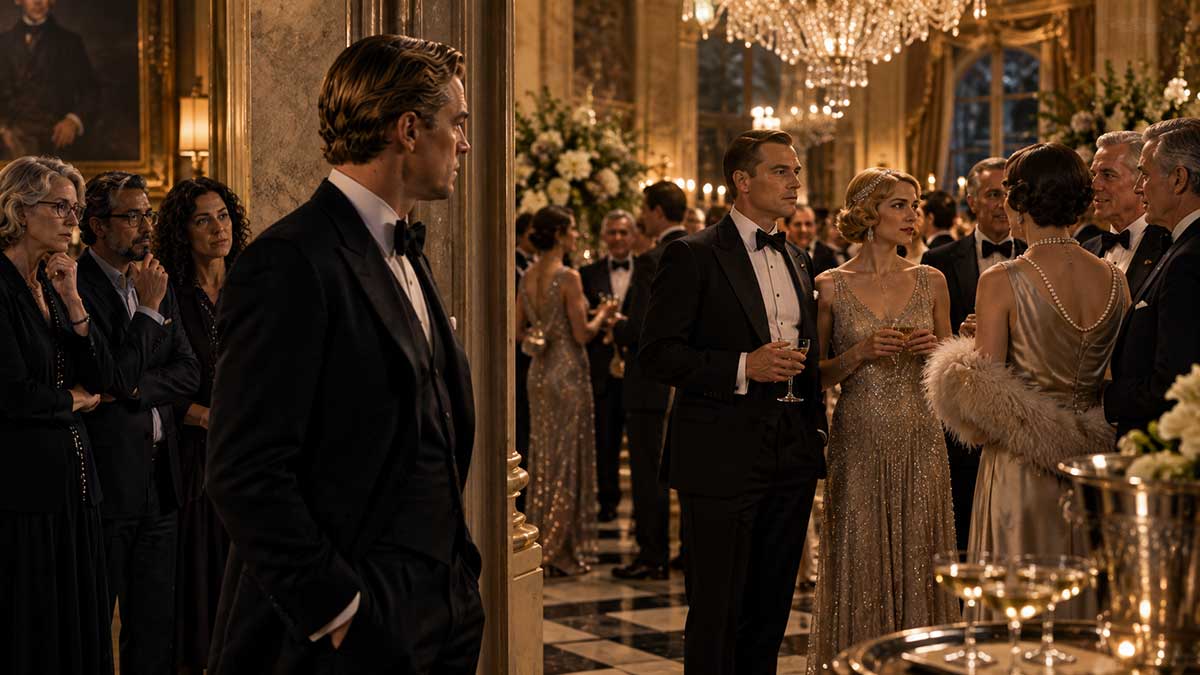
The first two discussions have uncovered an uncomfortable contradiction.
Gatsby succeeds.
James Gatz, the poor young man from North Dakota, becomes Jay Gatsby. He acquires the mansion, the clothes, the car, the parties, and the fortune that once separated him from Daisy's world.
Yet when Gatsby finally confronts Tom Buchanan, money does not make the two men equals.
Tom possesses something Gatsby cannot seem to purchase.
He belongs.
This discussion begins with the familiar distinction between old money and new money, but the scholars soon confront a harder question. If America tells people they can rise, what happens when someone reaches the top and discovers that the people already there have quietly changed the definition of success?
Shamus Khan: There's something from our last discussion I don't want to lose.
Gatsby does what America tells him to do.
Sarah Churchwell: He rises.
Shamus Khan: Spectacularly.
That's why I find it unsatisfying when Gatsby is described simply as a failed American Dream.
Failed at what?
He starts with almost nothing and becomes extraordinarily wealthy.
If the American Dream means material mobility, Gatsby has an argument that he succeeded.
Maureen Corrigan: Yet he feels like a failure.
Shamus Khan: Exactly.
Which suggests that money was never the final thing he wanted.
Kirk Curnutt: Daisy.
Shamus Khan: Yes, but I'm beginning to think Daisy and class are difficult to separate.
Sarah Churchwell: They are.
Gatsby doesn't fall in love with Daisy in a social vacuum.
She comes from a house, a family, a manner of living, an ease.
She's surrounded by signs that tell Gatsby she belongs to a world from which he has been excluded.
Krystine Batcho: Which means Daisy becomes connected not only with romantic longing but with arrival.
Shamus Khan: That's the word.
Arrival.
Gatsby spends his life moving.
Tom doesn't.
Tom begins where Gatsby is trying to arrive.
Soh Yeun Kim: And Daisy begins there too.
Shamus Khan: Yes.
That difference is enormous.
Gatsby has to demonstrate himself constantly.
Tom does not.
Maureen Corrigan: Gatsby's house demonstrates.
Shamus Khan: Exactly.
His car demonstrates.
His clothes demonstrate.
His parties demonstrate.
His stories about Oxford demonstrate.
His speech demonstrates.
His entire life is full of evidence.
Sarah Churchwell: Because evidence is required when belonging isn't assumed.
Kirk Curnutt: Tom doesn't need evidence.
Shamus Khan: That's privilege in one of its most interesting forms.
You don't have to explain why you're in the room.
Maureen Corrigan: Gatsby spends the novel explaining why he's in the room.
Shamus Khan: Or arranging the room so magnificently that nobody asks.
Sarah Churchwell: Until Tom does.
Shamus Khan: Until Tom does.
And Tom understands something Gatsby doesn't fully understand.
Money is not the only currency operating in that room.
Krystine Batcho: What are the others?
Shamus Khan: Family.
Education.
Networks.
Accent.
Taste.
Manners.
Institutions.
History.
Knowing which rules are spoken and which are never spoken.
Knowing what you don't have to display.
Most importantly, recognition from other people who already belong.
Soh Yeun Kim: So Gatsby can declare himself Gatsby.
But he can't declare himself old money.
Shamus Khan: Precisely.
Status requires other people to recognize the claim.
Sarah Churchwell: That's fascinating when you connect it with what we said about Daisy.
Gatsby can create himself.
But he repeatedly needs someone else to certify the creation.
Daisy romantically.
East Egg socially.
Krystine Batcho: In both cases the internal transformation depends upon external recognition.
Maureen Corrigan: And neither gives it to him completely.
Kirk Curnutt: Though Gatsby doesn't seem particularly interested in becoming friends with East Egg society.
Shamus Khan: I agree.
I don't think he wants club membership in the ordinary sense.
Sarah Churchwell: He wants something more specific.
Maureen Corrigan: Daisy.
Sarah Churchwell: Yes, but Daisy's choice would itself be a form of admission.
If Daisy Buchanan leaves Tom Buchanan for Jay Gatsby, what has happened symbolically?
The self-made outsider has displaced inherited privilege.
Shamus Khan: Exactly.
Daisy's choice would tell Gatsby something much larger than “this woman loves me.”
It would say:
You crossed the boundary.
Krystine Batcho: Which again gives Daisy an impossible amount of psychological work.
Soh Yeun Kim: And reduces her partly to a prize in a contest between two men.
Kirk Curnutt: The Plaza scene certainly moves in that direction.
Soh Yeun Kim: Listen to the structure of the argument.
Tom says Gatsby cannot have Daisy.
Gatsby says Daisy never loved Tom.
The men increasingly argue about Daisy's emotional history as though establishing ownership of it establishes ownership of her.
Maureen Corrigan: And Daisy begins collapsing under the pressure.
Soh Yeun Kim: Yes.
We often say Gatsby confronts Tom at the Plaza.
Daisy is the territory on which the confrontation takes place.
Sarah Churchwell: That's uncomfortable, but right.
Shamus Khan: And Tom has a weapon Gatsby doesn't.
Maureen Corrigan: Gatsby's criminal money.
Shamus Khan: More than that.
Tom can define Gatsby as illegitimate.
Sarah Churchwell: Yes.
Shamus Khan: That's the deeper weapon.
Tom doesn't merely say, “You're a criminal.”
He says, in effect, “You're not what you claim to be.”
And Tom has social authority to make that accusation stick.
Krystine Batcho: Why does Daisy accept Tom's authority?
Shamus Khan: Because status is social.
If enough people who belong agree that someone doesn't belong, wealth alone may not overcome it.
Sarah Churchwell: And Daisy has lived her entire life inside those codes.
She recognizes signals Gatsby may not fully recognize.
Maureen Corrigan: The pink suit.
Kirk Curnutt: Exactly.
Tom mocks Gatsby's clothing.
It seems petty.
But class contempt often operates through tiny signals.
Shamus Khan: Very tiny.
The fascinating thing about elite culture is that insiders frequently describe their judgments as natural.
“That isn't how one behaves.”
“That isn't tasteful.”
“That isn't quite right.”
Nobody needs to say, “We have created an exclusion system.”
The exclusion feels like common sense.
Soh Yeun Kim: Which means Gatsby can lose without ever being told the full rules.
Shamus Khan: Yes.
Sarah Churchwell: And the rules can move.
That's the part I find especially American.
The stated promise is money.
Work.
Rise.
Become successful.
Gatsby does.
Then the criterion becomes something he cannot acquire retrospectively.
Ancestry.
Maureen Corrigan: So the test changes after he passes it.
Sarah Churchwell: Exactly.
Kirk Curnutt: But we need to be fair to Fitzgerald's Gatsby.
He isn't simply an honest entrepreneur rejected by snobs.
His fortune is criminal.
Maureen Corrigan: Important.
Kirk Curnutt: We can't discuss Gatsby's exclusion as though Tom discovers he owns a chain of respectable hardware stores.
Shamus Khan: Absolutely.
Sarah Churchwell: But here's the interesting question.
Would legitimate money have solved the problem?
Kirk Curnutt: Probably not.
Shamus Khan: No.
Maureen Corrigan: I don't think so either.
Sarah Churchwell: Neither do I.
And that's why the criminality matters without completely explaining Tom's contempt.
Tom uses Gatsby's criminality as proof.
But he already despises Gatsby before the proof arrives.
Shamus Khan: Because Gatsby is violating a boundary.
Krystine Batcho: By wanting Daisy?
Shamus Khan: By behaving as though money has made him equivalent to Tom.
Soh Yeun Kim: That's much more threatening.
Shamus Khan: Yes.
Tom can tolerate people having money.
What he cannot tolerate is Gatsby claiming that money has erased the distinction between them.
Maureen Corrigan: So Tom's message is essentially: You can be rich. You cannot be me.
Shamus Khan: Exactly.
Sarah Churchwell: And Gatsby's whole life says: Why not?
There was a brief silence.
Krystine Batcho: That's very close to Gatsby's argument with time.
Maureen Corrigan: How?
Krystine Batcho: Gatsby keeps encountering categories other people treat as fixed.
Poor.
Rich.
James Gatz.
Jay Gatsby.
Past.
Future.
Inside.
Outside.
His instinct is always the same.
Why should that boundary be permanent?
Sarah Churchwell: That's excellent.
Krystine Batcho: And for much of his life, the instinct works.
So perhaps Gatsby isn't foolish for believing boundaries can move.
He has evidence.
Shamus Khan: But some boundaries are maintained collectively.
You cannot overcome them through individual will alone.
Krystine Batcho: Exactly.
Maureen Corrigan: Which gives us a different American Dream problem.
Maybe Gatsby's mistake isn't believing he can rise.
He does rise.
Maybe the mistake is believing individual achievement can dissolve every structure surrounding him.
Sarah Churchwell: Yes.
That's far more interesting than “money doesn't buy happiness.”
Maureen Corrigan: Much more.
Sarah Churchwell: The novel isn't giving us a greeting-card lesson about wealth.
It's showing us competing American stories.
One says:
You can make yourself.
Another says:
Birth still matters.
Gatsby believes the first.
Tom embodies the second.
Shamus Khan: And Tom wins.
Soh Yeun Kim: Does he?
Shamus Khan: Socially?
Yes.
Soh Yeun Kim: Nick doesn't let him win morally.
Shamus Khan: True.
Maureen Corrigan: That's important.
Tom keeps Daisy.
Gatsby dies.
Tom remains wealthy.
Tom leaves.
If we're measuring social outcomes, Tom wins overwhelmingly.
Yet the novel gives Gatsby the title.
Sarah Churchwell: Which may be Fitzgerald's revenge on Tom.
Kirk Curnutt: Literary immortality as class revenge?
Sarah Churchwell: I'm being slightly playful.
But think about it.
Tom's entire worldview depends upon his superiority being self-evident.
And almost nobody finishes the novel wanting to be Tom Buchanan.
Shamus Khan: Fair.
Krystine Batcho: Though plenty of people might want his security.
Soh Yeun Kim: Or Daisy's.
Maureen Corrigan: Which matters.
We shouldn't pretend the Buchanans' protection isn't attractive.
Sarah Churchwell: That's one reason the novel works.
The reader can condemn their carelessness and still recognize the appeal of never being financially afraid.
Shamus Khan: Security is one of the most underappreciated forms of wealth.
Gatsby has money.
But he doesn't have security.
His position has to be maintained.
His biography can be exposed.
His income depends upon questionable networks.
His social standing is unstable.
Tom's position is much harder to dislodge.
Krystine Batcho: So Gatsby becomes rich without becoming safe.
Shamus Khan: Exactly.
Maureen Corrigan: And Myrtle wants the same thing.
Soh Yeun Kim: There she is again.
Maureen Corrigan: She keeps appearing because the novel keeps asking us to compare people without announcing the comparison.
Myrtle doesn't simply want pretty dresses.
She wants distance from vulnerability.
Shamus Khan: Of course.
Soh Yeun Kim: She wants to stop being the woman above the garage.
Krystine Batcho: Just as Gatsby wanted to stop being James Gatz.
Sarah Churchwell: Which makes Myrtle and Gatsby parallel attempts at escape.
Kirk Curnutt: With very different resources.
Shamus Khan: And very different proximity to the top.
Gatsby manages to build a mansion across the water.
Myrtle gets an apartment Tom controls.
That distinction tells us a great deal.
Soh Yeun Kim: Including something about gender.
Gatsby's route upward is money.
Myrtle's route upward is a wealthy man.
Sarah Churchwell: Her available strategies are narrower.
Soh Yeun Kim: Yes.
And then readers judge her for using the route available to her.
Kirk Curnutt: Though Myrtle makes morally consequential choices too.
Soh Yeun Kim: Certainly.
Recognizing structural limits doesn't erase personal responsibility.
It gives us a fuller account of the person making the choice.
Maureen Corrigan: And George?
Shamus Khan: George is the person who makes the entire conversation about upward mobility uncomfortable.
Krystine Batcho: Why?
Shamus Khan: Because George barely gets to participate in it.
We talk about Gatsby reaching.
Myrtle reaching.
Tom defending.
Daisy retreating.
George is trying to keep the garage going.
His horizon is much smaller.
Sarah Churchwell: The Valley of Ashes matters here.
Shamus Khan: Very much.
Gatsby's wealth and Tom's wealth occupy beautiful spaces.
George lives among residue.
The geography makes hierarchy visible.
Maureen Corrigan: And everybody passes through George's world.
Sarah Churchwell: That's crucial.
Tom passes through.
Daisy passes through.
Gatsby's car passes through.
Nick passes through.
George stays.
Krystine Batcho: That's devastating.
Sarah Churchwell: The Valley of Ashes isn't merely a gloomy symbol between two glamorous places.
People live there.
That's what makes it morally important.
Soh Yeun Kim: Myrtle can see another life.
That's part of her suffering.
Shamus Khan: Yes.
Relative deprivation matters.
It isn't simply that you have little.
It's that another world is close enough to be visible.
Myrtle can encounter Tom.
She can enter Manhattan.
She can put on another dress.
For a few hours she can perform another life.
Then she returns.
Krystine Batcho: Which may make returning harder.
Shamus Khan: Often.
Maureen Corrigan: Gatsby solves that problem by refusing to return.
Sarah Churchwell: He creates a new home.
Shamus Khan: But even his new home tells the story.
West Egg.
Across the water.
Near.
Not there.
Kirk Curnutt: Geography becomes social distance.
Sarah Churchwell: Precisely.
Gatsby can see East Egg.
That's almost crueler than if it were hundreds of miles away.
Krystine Batcho: Like the green light itself.
Maureen Corrigan: Close enough to see.
Far enough to desire.
Shamus Khan: And that's how status often works.
The most powerful boundaries aren't always walls.
Sometimes they're invitations you don't receive.
Marriages that won't happen.
Schools your family didn't attend.
Names nobody recognizes.
Codes nobody teaches you because insiders learned them before they knew they were learning.
Soh Yeun Kim: Gatsby tries to learn them.
Shamus Khan: Yes.
And sometimes he gets them slightly wrong.
That's significant.
His display is excessive partly because he understands wealth from the outside.
Sarah Churchwell: Which is why Tom can sneer.
Maureen Corrigan: But isn't Tom's sneering itself ugly?
Shamus Khan: Completely.
I'm explaining how status works, not defending it.
Maureen Corrigan: I know.
I'm thinking about the reader again.
Gatsby's excess is beautiful to us because Fitzgerald makes it beautiful.
Tom experiences the same excess as evidence of inferiority.
Kirk Curnutt: The parties are a good example.
To Gatsby, they're possibility.
To Nick, they're dazzling and grotesque.
To Tom, they're vulgar.
Soh Yeun Kim: To Daisy too, eventually.
Sarah Churchwell: That's important.
Daisy doesn't simply fail Gatsby at the Plaza.
She reacts negatively to his world before that.
Soh Yeun Kim: Which Gatsby doesn't understand.
He assumes wealth speaks one universal language.
But Daisy can distinguish between his wealth and hers.
Shamus Khan: That's exactly how status groups operate.
Outsiders see equivalence.
Insiders see distinctions.
A mansion is not simply a mansion.
Clothes are not simply expensive clothes.
Education is not simply education.
Money doesn't erase symbolic boundaries.
Krystine Batcho: Then Gatsby has misunderstood what Daisy's world represents.
He thinks wealth is the key.
Shamus Khan: Yes.
But wealth is only one component.
Sarah Churchwell: And perhaps Daisy herself doesn't consciously know all the rules.
Shamus Khan: She doesn't need to.
That's another privilege of belonging.
The rules feel natural.
Soh Yeun Kim: Which makes her retreat to Tom psychologically interesting.
People sometimes say she chooses money.
But Gatsby has money.
Maureen Corrigan: Exactly.
Soh Yeun Kim: So she isn't choosing money over poverty.
She's choosing one kind of money over another.
Shamus Khan: More accurately, one social world over another.
Sarah Churchwell: One form of security.
Krystine Batcho: One familiar identity.
Kirk Curnutt: And perhaps one known life over an uncertain one.
Maureen Corrigan: That's much richer than “Daisy is materialistic.”
Soh Yeun Kim: Yes.
She may be materialistic.
But that doesn't explain the choice.
If money alone decided it, Gatsby could compete.
He cannot.
Sarah Churchwell: Which means Daisy understands the boundary Gatsby keeps trying to deny.
Shamus Khan: Yes.
Krystine Batcho: And perhaps that is part of why Gatsby needs her.
If someone born inside the boundary chooses him, she symbolically declares that it no longer matters.
Maureen Corrigan: So Daisy isn't simply behind the gate.
She can open it.
Shamus Khan: Gatsby thinks she can.
Soh Yeun Kim: Can she?
Shamus Khan: That's harder.
Sarah Churchwell: I'm not sure.
Suppose Daisy leaves Tom and marries Gatsby.
Does East Egg suddenly accept Gatsby?
Kirk Curnutt: Probably not.
Shamus Khan: No.
He might gain proximity.
He might gain legitimacy through marriage.
But the distinction wouldn't vanish.
Krystine Batcho: Then Gatsby is asking Daisy to do something she may not actually have the social authority to do.
Soh Yeun Kim: Another impossible task.
Maureen Corrigan: Poor Daisy is accumulating them.
Soh Yeun Kim: That's partly why I want us to keep seeing her as a person.
She is responsible for terrible choices later.
But Gatsby's dream assigns her enormous functions she never volunteered to perform.
Sarah Churchwell: Lover.
Witness.
Proof.
Social admission.
Restoration of the past.
Krystine Batcho: Validation of identity.
Shamus Khan: Victory over class.
Maureen Corrigan: That's too much for anybody.
Kirk Curnutt: Yet Gatsby doesn't see these as separate things.
That's essential.
To him they converge.
Daisy is where all these desires meet.
Sarah Churchwell: Which is why her voice being “full of money” matters so much.
It isn't simply a cynical statement that Gatsby wants a rich woman.
Daisy's voice carries an entire world.
Krystine Batcho: And perhaps the emotional promise that once he reaches that world, striving can stop.
Shamus Khan: Yes.
Maureen Corrigan: But can it?
Shamus Khan: That's the question I wanted to ask.
Suppose Gatsby gets everything.
Daisy leaves Tom.
They marry.
Gatsby somehow becomes socially tolerated.
What happens inside Gatsby?
Does he finally feel that he belongs?
Krystine Batcho: We can't know.
Kirk Curnutt: The novel doesn't tell us.
Krystine Batcho: But our earlier discussion gives reason to wonder.
Gatsby has repeatedly relocated “enough.”
Sarah Churchwell: James Gatz wasn't enough.
Maureen Corrigan: Poverty wasn't enough.
Shamus Khan: Becoming rich wasn't enough.
Soh Yeun Kim: Daisy loving him in the present wasn't enough.
Kirk Curnutt: She had to erase Tom from the past.
Krystine Batcho: Which suggests that the external goal may be carrying an internal question it cannot answer.
Maureen Corrigan: Am I enough?
Krystine Batcho: Perhaps.
Shamus Khan: That's where sociology and psychology meet in a very uncomfortable way.
We should never tell people class doesn't matter because they should simply feel good about themselves.
Class matters.
Money matters.
Security matters.
Opportunity matters.
Social exclusion is real.
Gatsby isn't imagining Tom's contempt.
Sarah Churchwell: Very important.
Shamus Khan: But solving an external inequality doesn't automatically solve an internal wound.
Both things can be true.
Krystine Batcho: Yes.
Soh Yeun Kim: And sometimes the external wound creates the internal one.
Shamus Khan: Absolutely.
Sarah Churchwell: Which makes the American Dream more complicated than either celebration or condemnation.
America's promise of self-creation genuinely liberates Gatsby.
Without it, James Gatz may never leave the life he rejects.
Kirk Curnutt: But the same culture gives him an image of success that may be impossible to finish.
Maureen Corrigan: Because there is always another shore.
Krystine Batcho: Another green light.
Shamus Khan: Another person whose recognition matters.
Sarah Churchwell: And another boundary.
Soh Yeun Kim: Which brings us to Tom.
We haven't talked enough about how frightened he is.
Maureen Corrigan: Frightened?
Soh Yeun Kim: Yes.
Tom behaves like the most secure man in the novel.
But he talks constantly about losing things.
His wife.
His racial hierarchy.
His social world.
His position.
Other groups rising.
Civilization collapsing.
For a man who supposedly owns everything, he sounds remarkably afraid.
Sarah Churchwell: That's one of the keys to Tom.
His racial rant near the beginning isn't an unrelated piece of ugliness Fitzgerald inserted simply to tell us Tom is unpleasant.
Tom is obsessed with hierarchy.
Shamus Khan: Because hierarchy gives him meaning.
Sarah Churchwell: Yes.
His position is valuable partly because other people occupy lower positions.
If boundaries become porous, superiority becomes less certain.
Kirk Curnutt: Gatsby becomes a personal version of that fear.
Sarah Churchwell: Precisely.
Gatsby is the man who wasn't supposed to cross over.
Maureen Corrigan: And he arrives for Tom's wife.
Shamus Khan: Which turns structural anxiety into intimate humiliation.
Soh Yeun Kim: But Tom himself crosses boundaries whenever he wants.
Sarah Churchwell: That's the hypocrisy.
Soh Yeun Kim: He goes to Myrtle.
He enters her world.
Uses her.
Brings her into the apartment.
But Myrtle cannot enter his world on equal terms.
Shamus Khan: Hierarchy often permits downward movement by the powerful more easily than upward movement by the excluded.
Maureen Corrigan: Tom can cross the boundary because his crossing doesn't threaten the boundary.
Shamus Khan: Exactly.
Myrtle crossing it would.
Gatsby crossing it would.
Krystine Batcho: That's extraordinary.
Tom can visit the world below him and remain Tom Buchanan.
Gatsby entering Tom's world threatens to change what “Tom Buchanan” means.
Sarah Churchwell: Yes.
Soh Yeun Kim: Which may explain why Tom's relationship with Myrtle doesn't undermine his class identity in his own mind.
But Daisy choosing Gatsby would.
Kirk Curnutt: Absolutely.
Maureen Corrigan: So Tom's outrage isn't simply sexual jealousy.
Sarah Churchwell: No.
It's also social insult.
Gatsby has behaved as though the hierarchy can be overturned.
Shamus Khan: And Tom responds by restoring the hierarchy.
He investigates Gatsby.
Names his criminal associations.
Mocks his claims.
Questions Oxford.
He takes the glamorous Jay Gatsby and pushes him back toward James Gatz.
Krystine Batcho: Which must strike Gatsby at the most vulnerable point imaginable.
Maureen Corrigan: Because Tom isn't merely saying, “You can't have Daisy.”
He's saying, “You never became who you thought you became.”
Krystine Batcho: Yes.
Soh Yeun Kim: And Daisy is sitting there listening.
Sarah Churchwell: The witness.
Soh Yeun Kim: Exactly.
The one person Gatsby needs to validate his transformation watches Tom dismantle it.
Kirk Curnutt: That makes the Plaza confrontation even more brutal.
Maureen Corrigan: It does.
Tom attacks Gatsby's biography.
Daisy retreats.
And those two events reinforce each other.
Shamus Khan: Gatsby loses both forms of recognition simultaneously.
Social recognition from the class he wants to challenge.
Personal recognition from the woman he wants to choose him.
Krystine Batcho: Which could make the collapse feel much larger than losing a romantic rivalry.
Sarah Churchwell: His whole constructed identity is being challenged.
Maureen Corrigan: Yet here's what I keep wondering.
Why did Gatsby want admission to a world populated by people like Tom?
Shamus Khan: That's a good question.
Soh Yeun Kim: Maybe he didn't see Tom when he imagined the world.
Sarah Churchwell: He saw Daisy.
Krystine Batcho: And possibility.
Kirk Curnutt: Beauty.
Maureen Corrigan: Exactly.
Perhaps Gatsby's dream depends upon confusing the appearance of the world with its moral character.
The houses are beautiful.
The clothes are beautiful.
Daisy is beautiful.
The lawns are beautiful.
The parties are beautiful.
But are the people inside that world living beautiful lives?
Sarah Churchwell: Not particularly.
Shamus Khan: Which means Gatsby may have climbed toward an image.
Krystine Batcho: Just as he did with Daisy.
Soh Yeun Kim: That's an important parallel.
He idealizes a person.
He idealizes a class.
Maureen Corrigan: And perhaps both disappoint him once he gets close enough.
Kirk Curnutt: Except Gatsby doesn't fully recognize the disappointment.
Sarah Churchwell: Nick does.
Maureen Corrigan: Nick always gets there afterward.
Shamus Khan: Gatsby's parties are interesting here too.
People from the supposedly sophisticated world come to his house, behave terribly, consume everything, gossip about him, and leave.
Gatsby may want their recognition, but Fitzgerald repeatedly shows us how little their recognition is worth.
Soh Yeun Kim: Which makes his need for it sadder.
Krystine Batcho: Very.
Sarah Churchwell: And then the funeral will make that painfully clear.
Maureen Corrigan: We'll get there.
Shamus Khan: But I think we're circling something important.
Maybe Gatsby's deepest class tragedy isn't that old money refuses to accept him.
Maybe it's that he accepts old money's authority to decide whether he is enough.
There was a pause.
Krystine Batcho: That's powerful.
Soh Yeun Kim: Very.
Sarah Churchwell: Yes.
Shamus Khan: Tom's rejection hurts because Gatsby believes Tom's world has the right to certify success.
Daisy's rejection hurts for the same reason.
He has placed the final judgment of Jay Gatsby in the hands of people born into the world James Gatz once admired from outside.
Maureen Corrigan: So even his rebellion remains dependent on them.
Shamus Khan: Exactly.
He challenges the hierarchy while accepting its definition of victory.
Kirk Curnutt: That's beautifully paradoxical.
Sarah Churchwell: And deeply American.
The outsider says, “I will prove I am as good as you.”
But hidden inside that statement is:
“You still get to define what good means.”
Krystine Batcho: Which means Gatsby's freedom is incomplete.
Soh Yeun Kim: Myrtle's too.
She doesn't invent a different idea of a good life.
She wants access to Tom's.
Maureen Corrigan: And George?
Shamus Khan: George barely gets enough space to dream.
That's why I don't want our discussion of aspiration to become too glamorous.
There are people for whom the question isn't “Will I be admitted to the elite?”
It's “Can I get through another month?”
Sarah Churchwell: Which is why the Valley of Ashes belongs between the Eggs and Manhattan.
Everyone's dreams pass through somebody else's reality.
Soh Yeun Kim: That's a line we should hold onto.
Maureen Corrigan: Yes.
Everyone's dreams pass through somebody else's reality.
And by the end, literally, Gatsby's car passes through Myrtle's.
Krystine Batcho: Which changes the meaning of aspiration entirely.
Shamus Khan: It does.
We began by asking why Gatsby couldn't belong after becoming rich.
Perhaps the answer is partly that belonging was never something he could buy alone.
But I think there's another answer now.
Maureen Corrigan: What?
Shamus Khan: Gatsby spends years trying to enter a world without asking whether that world deserves him.
Sarah Churchwell: Nick eventually asks.
Kirk Curnutt: And answers no.
Soh Yeun Kim: But Nick's answer comes too late.
Krystine Batcho: Gatsby still needs Daisy.
Maureen Corrigan: And Daisy still represents the world.
Shamus Khan: Exactly.
So Gatsby's class tragedy isn't simply exclusion.
It's misrecognition.
He mistakes admission for fulfillment.
Sarah Churchwell: Just as he may mistake recovering Daisy for recovering the past.
Krystine Batcho: The pattern is the same.
Maureen Corrigan: Say that again.
Krystine Batcho: Gatsby repeatedly gives an external object responsibility for completing an internal story.
Daisy.
Money.
Status.
The mansion.
The past.
Each one carries the promise:
When I reach this, everything before it will finally make sense.
Soh Yeun Kim: And each time, another condition appears.
Kirk Curnutt: Which may explain the green light better than any simple symbol definition.
Sarah Churchwell: The light must remain across the water.
Maureen Corrigan: Because once you reach one shore, you discover another.
Shamus Khan: Then perhaps the American Dream problem in Gatsby isn't simply that the ladder is unfair.
It is unfair.
But there's another problem.
What happens if you spend your entire life climbing a ladder whose top you never independently chose?
Sarah Churchwell: That's the question.
Soh Yeun Kim: Gatsby chooses the climb.
But did he choose the definition of arrival?
Krystine Batcho: Or inherit it from the people he envied?
Kirk Curnutt: Daisy's world.
Maureen Corrigan: And perhaps that's why Fitzgerald makes the distance across the bay so small.
Gatsby doesn't want another planet.
He wants to cross a narrow stretch of water.
He can see the house.
He can see the light.
He can almost touch the life.
Shamus Khan: Which makes exclusion more painful.
Sarah Churchwell: And aspiration more powerful.
Maureen Corrigan: But now I'm wondering whether we've been asking the wrong question.
We started with:
If Gatsby became rich, why couldn't he belong?
Perhaps the harder question is:
Why did Gatsby still need to belong?
Krystine Batcho: Because wealth changed his circumstances without completely changing how he experienced himself.
Shamus Khan: Because status requires recognition.
Sarah Churchwell: Because Daisy and her world had become his measure of arrival.
Kirk Curnutt: Because Jay Gatsby was created in response to a world James Gatz believed was better.
Soh Yeun Kim: And because nobody ever taught him that becoming someone new might include choosing a new definition of what counts as enough.
Maureen Corrigan: Then maybe Tom's greatest victory isn't keeping Gatsby outside.
Maybe it's convincing Gatsby that outside means failure.
There was silence around the table.
Sarah Churchwell: That's much darker.
Shamus Khan: And I think it's right.
Krystine Batcho: It connects beautifully with what we've been discovering.
Gatsby's tragedy keeps appearing at the point where another person's recognition becomes necessary.
Daisy must tell him the past was real.
Tom's class must tell him the transformation was legitimate.
Soh Yeun Kim: Nick is the only one who finally gives Gatsby a different kind of recognition.
Kirk Curnutt: “You're worth the whole damn bunch put together.”
Maureen Corrigan: Yes.
And Gatsby barely knows what to do with it.
Because it comes from the wrong judge.
Sarah Churchwell: That's heartbreaking.
Shamus Khan: Nick says, in effect, “You don't need their approval.”
But Gatsby has already built his entire dream around getting it.
Krystine Batcho: From Daisy most of all.
Maureen Corrigan: Which leaves us with another problem.
We've spent three discussions giving Gatsby extraordinary interpretive generosity.
We call his performance self-creation.
His obsession hope.
His class ambition aspiration.
His inability to let go nostalgia.
His lies become part of a tragic identity.
Soh Yeun Kim: I know where you're going.
Maureen Corrigan: Do we offer Daisy the same generosity?
Soh Yeun Kim: Usually not.
Maureen Corrigan: Myrtle?
Soh Yeun Kim: Almost never.
Sarah Churchwell: Then perhaps before we decide what Gatsby's exclusion means, we need to examine the judgments we've been making.
Shamus Khan: Including our own.
Soh Yeun Kim: Especially our own.
Because Gatsby isn't the only person in this novel trying to escape the life he was given.
He's simply the one whose dream Nick taught generations of readers to find beautiful.
Topic 4: Are Daisy and Myrtle Really Worse Than Gatsby?
The first three discussions have given Gatsby considerable generosity.
His lies became self-invention. His obsession became hope. His fixation on Daisy became nostalgia and grief. His pursuit of wealth became aspiration. His inability to enter Tom's world became evidence of a class system whose rules change when outsiders approach the door.
Much of that generosity is justified.
But it creates an uncomfortable question.
Do readers extend the same generosity to Daisy Buchanan and Myrtle Wilson?
Myrtle wants to escape the circumstances of her birth just as Gatsby does. Daisy seeks security in a world where women possess fewer independent routes to wealth and status. Both women make serious moral choices, and neither should be excused from them.
Yet Gatsby is remembered as a tragic dreamer.
Myrtle is often remembered as vulgar.
Daisy is frequently remembered as shallow, selfish, or cowardly.
The scholars now turn their attention away from Gatsby for a moment and toward something harder to examine: the judgments readers themselves bring into the novel, and the narrator who quietly helps create them.
Soh Yeun Kim: I want to start with something Maureen said at the end of our last discussion.
We've been very generous to Gatsby.
Maureen Corrigan: We have.
Soh Yeun Kim: And I don't mean that critically.
He deserves serious interpretation.
But listen to the vocabulary we've used.
Gatsby lies about himself, and we call it self-creation.
He wants someone else's wife, and we call it romantic longing.
He accumulates enormous wealth, and we call it aspiration.
He refuses to accept Daisy's past, and we call it nostalgia.
He constructs an entire life around obtaining her, and we talk about the extraordinary power of hope.
Now describe Myrtle Wilson.
Sarah Churchwell: Ambitious.
Soh Yeun Kim: Already we're being kinder than many readers.
Maureen Corrigan: Materialistic.
Kirk Curnutt: Dissatisfied.
Shamus Khan: Socially aspirational.
Soh Yeun Kim: Vulgar.
Maureen Corrigan: Yes.
That's the word that follows her everywhere.
Soh Yeun Kim: Why?
Kirk Curnutt: Some of it comes from Fitzgerald's presentation.
Soh Yeun Kim: Certainly.
Kirk Curnutt: Myrtle's performance in the apartment is deliberately exaggerated. Her manner changes. Her voice changes. Her behavior becomes affected.
Shamus Khan: But Gatsby's performance is also exaggerated.
Kirk Curnutt: Absolutely.
Shamus Khan: His house is enormous.
His car is enormous.
His parties are absurdly excessive.
His biography is invented.
His speech contains mannerisms he's consciously adopted.
If excess itself makes Myrtle vulgar, Gatsby should be the most vulgar person in the novel.
Maureen Corrigan: That's difficult to argue against.
Sarah Churchwell: Yet Gatsby's excess gets moonlight.
Myrtle's gets sweat.
Maureen Corrigan: That's beautifully put.
Soh Yeun Kim: Exactly.
One is aestheticized.
The other is exposed.
Krystine Batcho: Could part of the difference be that Gatsby's aspiration is tied to a larger imaginative project?
Myrtle seems to want consumption more directly.
Soh Yeun Kim: Perhaps.
But I want to question “seems.”
How much access do we have to Myrtle's interior life?
Krystine Batcho: Much less.
Soh Yeun Kim: Exactly.
We know Gatsby's dream because Nick becomes fascinated with Gatsby.
We are invited inside Gatsby's longing.
We get Gatsby's history.
We get his lost romance.
We get his childhood.
We get his transformation.
We get the green light.
What do we get for Myrtle?
An apartment.
A dress.
A dog.
A party.
An affair.
Then a body in the road.
Sarah Churchwell: That's stark.
Soh Yeun Kim: Myrtle doesn't get a green light.
That doesn't necessarily mean she didn't have one.
Maureen Corrigan: That's excellent.
Shamus Khan: And her dream isn't difficult to reconstruct.
She lives above a garage in the Valley of Ashes.
She is married to a man she no longer respects.
She sees wealthy people moving through her world on their way somewhere better.
Then Tom Buchanan arrives.
Krystine Batcho: And suddenly another life becomes imaginable.
Shamus Khan: Yes.
Sarah Churchwell: Which is very Gatsby-like.
Kirk Curnutt: Up to a point.
Soh Yeun Kim: Of course.
We don't need to make them identical.
But the similarity should disturb our usual categories.
Both look at the circumstances into which they have fallen and say:
This cannot be my whole life.
Maureen Corrigan: James Gatz says it.
Myrtle says it.
Soh Yeun Kim: Gatsby changes his clothes, voice, biography, surroundings.
Myrtle changes her dress, voice, behavior, surroundings.
Gatsby attaches his imagined future to Daisy.
Myrtle attaches hers to Tom.
Shamus Khan: And both choose someone whose class position represents more than romance.
Krystine Batcho: Then perhaps both are doing what we discussed with Gatsby and Daisy.
They love a person who has become connected to an imagined self.
Soh Yeun Kim: Exactly.
Yet we instinctively give Gatsby more psychological depth.
Kirk Curnutt: Some of that is unavoidable because he is the title character.
Soh Yeun Kim: Certainly.
I'm not accusing the novel of failing to give every character equal page space.
I'm asking what readers do with the inequality.
Maureen Corrigan: We mistake narrative attention for human importance.
There was a short pause.
Sarah Churchwell: That's uncomfortable.
Maureen Corrigan: It should be.
Gatsby receives extraordinary language.
So his longing feels extraordinary.
Myrtle receives much less sympathetic language.
So her longing feels smaller.
But the pain of wanting another life doesn't necessarily become smaller because Nick finds it less beautiful.
Krystine Batcho: That's an important distinction.
Shamus Khan: And Myrtle's class position makes her aspiration less aesthetically pleasing.
Gatsby has already escaped poverty by the time we meet him.
We see the finished product.
Myrtle is caught in the middle of trying to escape.
Trying to climb often looks awkward.
People imitate.
They overcorrect.
They display.
They get codes wrong.
Once someone has successfully crossed a boundary, later generations may reinterpret the same behaviors as charming eccentricities.
Sarah Churchwell: Gatsby's mansion is almost a monument to getting the codes wrong.
Shamus Khan: Yes.
Maureen Corrigan: Yet we love it.
Soh Yeun Kim: Because Fitzgerald makes us love the yearning behind it.
Kirk Curnutt: Nick does too.
Soh Yeun Kim: Which brings us to Nick.
Maureen Corrigan: I knew he wouldn't escape this topic.
Soh Yeun Kim: He shouldn't.
Nick begins by telling us that he is inclined to reserve judgment.
Then he spends the novel judging everyone.
Kirk Curnutt: That's part of the irony of his narration.
Soh Yeun Kim: Yes.
But readers sometimes remember his opening self-description more strongly than his actual behavior.
Nick judges Tom.
He judges Daisy.
He judges Jordan.
He judges Myrtle.
He judges Gatsby.
He judges the party guests.
He judges the East.
And eventually he judges himself.
Sarah Churchwell: Yet his judgments aren't equally harsh.
Soh Yeun Kim: Exactly.
He gives Gatsby interpretive mercy.
Krystine Batcho: What do you mean by interpretive mercy?
Soh Yeun Kim: When Gatsby behaves badly, Nick searches for the longing underneath the behavior.
That's interpretive mercy.
He asks what Gatsby hoped for.
What Gatsby lost.
What Gatsby imagined.
Why Gatsby became Gatsby.
He sees the wound beneath the performance.
Maureen Corrigan: And he doesn't always do that for Myrtle.
Soh Yeun Kim: No.
Or Daisy.
Sarah Churchwell: Though Nick does occasionally perceive Daisy's sadness.
Soh Yeun Kim: He does. That's why I don't want to turn Nick into a misogynistic cartoon.
He's far more complicated.
But the narrative sympathy isn't distributed evenly.
Shamus Khan: Is any narrator's sympathy distributed evenly?
Soh Yeun Kim: Probably not.
That's precisely why we should notice it.
Kirk Curnutt: I think we should distinguish unreliable from dishonest.
Soh Yeun Kim: Absolutely.
Nick doesn't have to be lying for his perspective to shape the novel.
Maureen Corrigan: That's important.
“Unreliable narrator” has become such an easy phrase that people sometimes think it means nothing Nick says can be trusted.
Kirk Curnutt: Which would make the novel impossible.
Nick is selective.
Emotionally involved.
Retrospective.
Contradictory.
Judgmental despite claiming restraint.
But that doesn't mean we simply invert everything he tells us.
Krystine Batcho: Memory itself makes narration selective.
Nick is telling us what happened after he already knows how everything ends.
That matters.
Sarah Churchwell: Gatsby is dead before Nick gives us Gatsby.
Krystine Batcho: Exactly.
Nick isn't merely recording events as they happen.
He is organizing memory after catastrophe.
That means later meaning can influence earlier recollection.
Maureen Corrigan: So Gatsby enters the novel already mourned.
Krystine Batcho: In a sense, yes.
Soh Yeun Kim: Myrtle enters it already judged.
Shamus Khan: That's a striking contrast.
Soh Yeun Kim: Gatsby's death makes Nick search backward for meaning.
Myrtle's death doesn't produce the same narrative project.
Sarah Churchwell: Which may explain why Gatsby becomes tragic and Myrtle remains tragic mostly in what happens to her.
Maureen Corrigan: Rather than in the full person she might have been.
Soh Yeun Kim: Exactly.
Krystine Batcho: Then let's try something.
Suppose Myrtle narrated the novel.
Maureen Corrigan: I've been waiting for this.
Krystine Batcho: What would Gatsby look like?
Shamus Khan: A rich man across the bay.
Sarah Churchwell: Perhaps someone she had heard rumors about.
Soh Yeun Kim: Maybe another person who escaped the kind of life she couldn't escape.
Maureen Corrigan: She might envy him.
Shamus Khan: Or resent him.
Kirk Curnutt: She might never meet him meaningfully.
Soh Yeun Kim: That's important too.
Gatsby is the center of Nick's world.
He may barely exist in Myrtle's.
Krystine Batcho: And what would Tom look like?
Soh Yeun Kim: The green light.
There was a pause.
Maureen Corrigan: Oh.
Sarah Churchwell: That's very good.
Soh Yeun Kim: Not literally.
But structurally.
Tom is the thing across the social distance that seems to promise another life.
Shamus Khan: Except Myrtle can physically reach him.
Soh Yeun Kim: Yes.
And that's where her tragedy becomes interesting.
She reaches her green light.
And discovers that reaching it doesn't mean possessing the world behind it.
Krystine Batcho: That's extraordinary.
Maureen Corrigan: Gatsby and Myrtle both reach the person they associate with another life.
Neither actually gets the life.
Sarah Churchwell: Daisy reunites with Gatsby but cannot restore Louisville.
Tom takes Myrtle to Manhattan but never makes her Mrs. Buchanan.
Shamus Khan: The person opens a temporary door.
The social world remains closed.
Soh Yeun Kim: Exactly.
Kirk Curnutt: But Myrtle's relationship with Tom is particularly brutal.
We shouldn't romanticize that parallel.
Sarah Churchwell: Certainly not.
Tom breaks her nose.
Maureen Corrigan: And that should remain shocking.
Soh Yeun Kim: Yes.
Myrtle's aspiration doesn't make her foolish enough to deserve violence.
Shamus Khan: Nor does her affair.
Krystine Batcho: Yet people sometimes unconsciously read what happens to characters as though the narrative is morally punishing them.
Maureen Corrigan: Myrtle wanted too much, so she dies.
Gatsby dreamed too much, so he dies.
Krystine Batcho: Exactly.
But consequences in life aren't always moral verdicts.
Sarah Churchwell: Fitzgerald makes that unmistakable by letting Tom and Daisy survive.
Shamus Khan: Yes.
If death were moral judgment in this novel, the distribution is very strange.
Soh Yeun Kim: Which brings us to Daisy.
Maureen Corrigan: The character readers most want to put on trial.
Soh Yeun Kim: And there is plenty to put on trial.
I don't want us to soften what she does.
She is driving when Myrtle dies.
She doesn't publicly take responsibility.
Gatsby remains outside protecting her.
Then she retreats with Tom and disappears.
Kirk Curnutt: Those are serious actions.
Soh Yeun Kim: Very.
But I want to ask why discussions of Daisy so often begin and end with “She's selfish.”
Sarah Churchwell: Because there's truth in it.
Soh Yeun Kim: Yes.
But truth can still be incomplete.
Tom is selfish too.
Gatsby can be selfish.
Myrtle can be selfish.
Nick can be self-protective.
Why does Daisy's selfishness so often become her entire identity?
Maureen Corrigan: Because she disappoints Gatsby.
Soh Yeun Kim: That's my suspicion.
Krystine Batcho: Meaning?
Soh Yeun Kim: Readers have invested emotionally in Gatsby's dream.
Daisy is the person who refuses to complete it.
So her failure feels personal.
Sarah Churchwell: She disappoints us because Gatsby taught us to expect something from her.
Soh Yeun Kim: Or Nick taught us.
Maureen Corrigan: Perhaps both.
Kirk Curnutt: But Daisy does encourage Gatsby.
Soh Yeun Kim: Absolutely.
She participates.
She isn't an innocent object carried around by men.
She makes choices.
She rekindles the relationship.
She allows Gatsby to hope.
She is responsible for her actions.
I'm arguing against simplification, not responsibility.
Krystine Batcho: This reminds me of something from psychology that is broader than Daisy.
People are often uncomfortable holding two truths about someone simultaneously.
We prefer coherent moral identities.
Victim.
Villain.
Hero.
Coward.
But a person can be constrained and still cause harm.
A person can love someone and still abandon them.
A person can be frightened and still make a morally terrible decision.
Sarah Churchwell: That's Daisy.
Krystine Batcho: It may be.
Soh Yeun Kim: And I think that's the Daisy worth discussing.
Not “poor Daisy, she had no choices.”
She did.
Not “evil Daisy destroyed Gatsby.”
That's too simple too.
Shamus Khan: What constraints do you think matter most?
Soh Yeun Kim: Start with 1922.
Daisy is a woman inside an extraordinarily wealthy social world.
Marriage isn't simply romance.
It is social position.
Economic security.
Reputation.
Family.
She has a daughter.
Leaving Tom for Gatsby is not equivalent to a modern unmarried person ending a relationship.
Sarah Churchwell: And Gatsby's money doesn't remove all the uncertainty.
Shamus Khan: Especially once Tom exposes where that money comes from.
Soh Yeun Kim: Exactly.
From Daisy's perspective, Gatsby's apparently solid world suddenly becomes unstable.
Maureen Corrigan: So her retreat isn't necessarily “Tom is richer.”
Shamus Khan: No.
Tom's wealth is safer.
That's different.
Sarah Churchwell: Inherited wealth is backed by family, history, institutions, social recognition.
Gatsby's fortune may disappear.
Tom's world feels permanent.
Krystine Batcho: And frightened people often retreat toward familiarity.
Soh Yeun Kim: Which doesn't make the retreat morally admirable.
Krystine Batcho: No.
It makes it psychologically legible.
Maureen Corrigan: That's a distinction we keep making for Gatsby.
Soh Yeun Kim: Exactly.
That's all I'm asking that we do for Daisy.
We don't excuse Gatsby when we explain him.
Why assume explaining Daisy means excusing her?
Kirk Curnutt: Fair.
Sarah Churchwell: And Daisy's famous comment about her daughter matters here.
Her hope that the girl will be a beautiful little fool.
Maureen Corrigan: One of the saddest lines in the novel.
Soh Yeun Kim: Because Daisy understands something.
She knows beauty has value in her world.
She knows ignorance might protect a woman from recognizing the conditions of that world.
That doesn't make Daisy a feminist heroine.
But it tells us she's not simply oblivious.
Krystine Batcho: Awareness without courage.
Soh Yeun Kim: Perhaps.
Or awareness without a model for another life.
Shamus Khan: That's important.
Gatsby has an ideology of self-invention available to him.
Does Daisy?
Sarah Churchwell: Not in the same form.
Shamus Khan: Gatsby can say, “I'll become someone else.”
Myrtle attempts it through Tom.
Daisy has already been trained to succeed inside the system.
Her strategy is different.
Maureen Corrigan: Survival through accommodation.
Soh Yeun Kim: And that becomes morally ugly when accommodation means other people absorb the cost.
Krystine Batcho: Myrtle most of all.
Soh Yeun Kim: Yes.
We cannot discuss Daisy's constraints so sympathetically that Myrtle disappears beneath the car again.
Sarah Churchwell: That's the moral center.
Maureen Corrigan: Daisy's fear is real.
Myrtle's death is more real.
Soh Yeun Kim: Exactly.
Shamus Khan: And this is where privilege becomes more than possession.
Daisy has something Myrtle doesn't have after catastrophe.
A place to retreat.
Krystine Batcho: Tom.
Shamus Khan: Tom, money, social protection, mobility.
She can leave.
Sarah Churchwell: Myrtle cannot leave the consequences.
Shamus Khan: Myrtle becomes the consequence.
There was a silence.
Maureen Corrigan: That's hard.
Soh Yeun Kim: It should be.
And it makes me uncomfortable when Daisy is treated as the only morally disappointing woman in the story.
Myrtle is dead.
Daisy is frightened.
Gatsby is waiting outside.
Tom is inside.
Who has the most freedom at that moment?
Shamus Khan: Tom.
Sarah Churchwell: By far.
Kirk Curnutt: And he survives everything.
Maureen Corrigan: Which is interesting because popular arguments about the novel so often become “Was Daisy worthy of Gatsby?”
Soh Yeun Kim: I dislike that question.
Krystine Batcho: Why?
Soh Yeun Kim: It treats Gatsby as the prize and Daisy as the applicant.
Why not ask whether Gatsby was worthy of Daisy?
Or whether Tom was?
Or whether any of these people were capable of giving each other what they needed?
Sarah Churchwell: Or whether “worthy” is useful at all.
Soh Yeun Kim: Exactly.
Love isn't a scholarship committee.
Maureen Corrigan: And Gatsby isn't morally superior simply because he suffers more beautifully.
Kirk Curnutt: That's a very important sentence.
Krystine Batcho: Suffering can make people sympathetic.
It doesn't automatically make them right.
Shamus Khan: Nor does surviving make someone guilty.
Though in Tom and Daisy's case, the way they survive matters.
Sarah Churchwell: We'll reach that in the ending.
Maureen Corrigan: I want to return to Myrtle once more before we leave her.
Why does her desire make readers uncomfortable?
Is it simply gender?
Shamus Khan: No.
Class taste matters enormously.
Myrtle wants the visible markers of a higher class.
People who already possess status often mock precisely that kind of wanting.
Sarah Churchwell: Because wanting exposes the hierarchy.
Shamus Khan: Yes.
An insider can own something casually.
An outsider wants it intensely.
That intensity gets labeled vulgar.
Krystine Batcho: Gatsby wants intensely too.
Shamus Khan: But Gatsby has acquired enough wealth to aestheticize his wanting.
Soh Yeun Kim: And he's a man.
Shamus Khan: Yes.
Maureen Corrigan: And Nick loves him.
Soh Yeun Kim: Yes.
Those three things matter together.
Kirk Curnutt: Yet Nick isn't entirely blind to Myrtle's humanity.
Soh Yeun Kim: No.
I want to keep saying that.
Nick is complicated.
That's why he's worth examining.
A completely prejudiced narrator would be less interesting.
Nick sometimes sees clearly and sometimes doesn't.
He judges others and then becomes uneasy with his own judgments.
Krystine Batcho: Which makes him human.
Maureen Corrigan: And makes us vulnerable to him.
Sarah Churchwell: What do you mean?
Maureen Corrigan: A narrator who says, “I am biased and I hate these people” is easy to resist.
Nick is intelligent.
Self-questioning.
Observant.
Often morally perceptive.
So when he gives us a judgment, we tend to accept it.
Soh Yeun Kim: Especially when Fitzgerald gives Nick beautiful language with which to deliver it.
Kirk Curnutt: Which raises a difficult question about the famous final moral judgment on Tom and Daisy.
Are they really careless?
Sarah Churchwell: Yes.
Maureen Corrigan: That was quick.
Sarah Churchwell: I didn't say the word explains everything.
But after Myrtle's death and Gatsby's death, they leave.
Their wealth absorbs the shock.
That is carelessness in a profound sense.
Soh Yeun Kim: I agree.
But notice something.
Nick's judgment of Daisy is one of the places where many readers stop asking questions.
Once she's “careless,” the case feels closed.
Krystine Batcho: Whereas Gatsby's flaws open questions.
Soh Yeun Kim: Exactly.
Gatsby lies.
We ask why.
Gatsby obsesses.
We ask why.
Gatsby invents himself.
We ask why.
Daisy retreats.
We say: careless.
Maureen Corrigan: That's very good.
Kirk Curnutt: Then let's ask why.
Why does Daisy retreat?
Krystine Batcho: Fear.
Shamus Khan: Security.
Sarah Churchwell: Class conditioning.
Soh Yeun Kim: Motherhood may matter.
Maureen Corrigan: Shame.
Kirk Curnutt: Confusion.
Krystine Batcho: Emotional overload.
Sarah Churchwell: Dependence on the familiar.
Soh Yeun Kim: And perhaps selfishness.
Maureen Corrigan: There it is.
Soh Yeun Kim: Yes.
Explanation doesn't require us to remove the ugliest answer.
She may simply choose herself when choosing herself harms other people.
Shamus Khan: Which Tom does repeatedly.
Sarah Churchwell: And has the resources to do successfully.
Krystine Batcho: Then perhaps the difference isn't that Daisy is uniquely selfish.
It's that her selfish choice occurs at a moment when the consequences for others are enormous.
Maureen Corrigan: And Gatsby loves her enough to help shield her.
Soh Yeun Kim: Which makes readers angrier.
Kirk Curnutt: Naturally.
Soh Yeun Kim: Naturally, yes.
But then ask what Gatsby is doing.
He is prepared to take responsibility for something Daisy did.
Krystine Batcho: Love.
Shamus Khan: Or idealization.
Sarah Churchwell: Or both.
Soh Yeun Kim: Exactly.
Yet once again Gatsby's morally questionable decision becomes evidence of devotion.
Daisy's fear becomes evidence of cowardice.
I'm not saying reverse the judgments.
I'm saying notice the asymmetry.
Maureen Corrigan: So what would symmetrical judgment look like?
Soh Yeun Kim: Interpretive mercy for everyone.
Moral absolution for no one.
There was a pause.
Krystine Batcho: I like that very much.
Sarah Churchwell: So do I.
Kirk Curnutt: Yes.
Shamus Khan: That's probably the standard we've been searching for.
Maureen Corrigan: Interpretive mercy for everyone. Moral absolution for no one.
Then let's try it.
Gatsby.
Krystine Batcho: A man whose extraordinary hope helps him transcend his beginnings and eventually makes accepting loss extraordinarily difficult.
Soh Yeun Kim: Who genuinely loves Daisy and places impossible demands on her.
Shamus Khan: Who challenges class hierarchy while still accepting its definition of success.
Maureen Corrigan: Daisy.
Soh Yeun Kim: A woman who recognizes some of the constraints of her world, seeks security inside them, experiences genuine feeling, becomes frightened, and eventually makes choices that leave other people carrying devastating consequences.
Sarah Churchwell: Myrtle.
Shamus Khan: A working-class woman who sees another life close enough to desire, attempts to cross a boundary through one of the few routes available to her, humiliates George in the process, participates in adultery, and is exploited by a much more powerful man.
Krystine Batcho: And dies before anyone bothers to ask what her green light was.
Maureen Corrigan: George.
Sarah Churchwell: A man trapped economically and emotionally, betrayed by his wife, manipulated at his most vulnerable, who then murders an innocent man.
Kirk Curnutt: Tom.
Shamus Khan: A man born into enormous privilege who uses wealth, gender, physical strength, and social status to dominate others, while being deeply anxious about losing the hierarchy that protects him.
Soh Yeun Kim: Nick.
Maureen Corrigan: A man who thinks he is standing outside the story until he discovers he has been choosing sides all along.
Krystine Batcho: That's quite a cast.
Sarah Churchwell: And much harder than heroes and villains.
Soh Yeun Kim: Which is exactly the point.
Maureen Corrigan: But something still bothers me.
If we apply interpretive mercy to everyone, do we risk making responsibility disappear?
Soh Yeun Kim: No.
I think we make responsibility more precise.
Understanding why Daisy retreats doesn't change the fact that she retreats.
Understanding why Gatsby cannot release the past doesn't make his demand fair.
Understanding Myrtle's desperation doesn't make her treatment of George kind.
Understanding George's devastation doesn't excuse murder.
Understanding Tom's insecurity doesn't excuse anything he does.
Krystine Batcho: Explanation tells us how a person reached a decision.
Judgment asks what the decision did.
Shamus Khan: And perhaps the novel requires both.
Sarah Churchwell: Especially when consequences are distributed so unevenly.
Maureen Corrigan: There it is again.
Consequences.
Shamus Khan: We keep arriving there.
Soh Yeun Kim: Because every dream we've discussed eventually enters somebody else's life.
Krystine Batcho: Gatsby's dream enters Daisy's.
Sarah Churchwell: Myrtle's enters George's.
Soh Yeun Kim: Tom's desires enter almost everyone's.
Maureen Corrigan: Daisy's need for safety enters Gatsby's and Myrtle's.
Kirk Curnutt: George's grief enters Gatsby's.
Shamus Khan: And Nick turns all of it into the story we inherit.
Maureen Corrigan: Then perhaps Nick isn't merely asking us to judge these people.
He's showing us how difficult judgment becomes once everybody's desires begin colliding.
Soh Yeun Kim: I would accept that.
But I still want readers to notice whose desires receive poetry.
Maureen Corrigan: Fair.
Krystine Batcho: And whose receive understanding.
Shamus Khan: And whose receive protection.
Sarah Churchwell: That's the one that matters next.
Kirk Curnutt: Protection?
Sarah Churchwell: Look at where we've ended.
Gatsby dreams.
Myrtle dreams.
George hopes.
Daisy wants security.
Tom wants possession and continuity.
Nick wants to believe he can observe without becoming implicated.
Everybody wants something.
But when those desires collide, the consequences are not shared equally.
Shamus Khan: No.
Sarah Churchwell: Myrtle dies.
George dies.
Gatsby dies.
Tom and Daisy leave.
Maureen Corrigan: And Nick goes home.
There was a longer silence.
Krystine Batcho: Then perhaps our next question isn't who was worst.
Soh Yeun Kim: No.
Krystine Batcho: It's who had to live with what everyone did.
Shamus Khan: Or who didn't have to.
Maureen Corrigan: That's even better.
We began this discussion asking whether readers judge Daisy and Myrtle more harshly than Gatsby.
I think the answer is sometimes yes.
But perhaps the more important discovery is that moral judgment alone cannot explain this novel.
The characters don't simply make choices.
Their choices fall onto other people.
And some people have enough money, status, distance, or narrative sympathy to step away from the wreckage.
Others become the wreckage.
Soh Yeun Kim: Which means “Who is the villain?” may be one of the least interesting questions we can ask.
Sarah Churchwell: Then what's the better one?
Soh Yeun Kim: Perhaps:
Who gets understood?
Krystine Batcho: Who gets forgiven?
Shamus Khan: Who gets protected?
Kirk Curnutt: Who gets remembered?
Maureen Corrigan: And who pays?
The room went quiet again.
They had spent four discussions examining Gatsby's dream.
Now, for the first time, the dream itself seemed almost less important than the trail it left behind.
Three people would soon be dead.
The people with the most money would survive.
The mansion that had once held hundreds would become nearly empty.
And the man Nick called great would discover, too late, that being seen by everyone was not the same thing as being known by anyone.
Maureen Corrigan: I think we're ready to talk about the ending.
Sarah Churchwell: Not just why Gatsby dies.
Shamus Khan: Why some people can leave after he does.
Soh Yeun Kim: And why almost nobody comes back for him.
Krystine Batcho: Then perhaps the final question is larger than the green light.
Maureen Corrigan: Much larger.
What does Fitzgerald show us once all the lights go out?
Topic 5: What Does the Ending of The Great Gatsby Really Mean?
By the time the scholars reach the final topic, the green light means something very different from what it meant at the beginning.
They have already discovered that Gatsby's greatness may come from the same capacity for belief that destroys him. His love for Daisy is real, yet Daisy carries far more than love. His wealth allows him to rise without granting him belonging. And the moral judgments readers make about Gatsby, Daisy, and Myrtle are shaped partly by whose longing receives sympathy, whose receives beautiful language, and whose consequences can be escaped.
Now the glamour disappears.
Myrtle is dead.
Gatsby is dead.
George Wilson is dead.
Daisy and Tom leave.
The parties stop.
The mansion becomes quiet.
And almost none of the people who once filled Gatsby's house come to his funeral.
The scholars begin with Gatsby's death. But the conversation soon moves beyond Gatsby, toward the question Fitzgerald saves for the final pages:
What happens when the dream ends, the crowd goes home, and we finally see what was left behind?
Maureen Corrigan: I keep thinking about the empty house.
Sarah Churchwell: More than the green light?
Maureen Corrigan: At this point, yes.
Everyone talks about the green light.
And rightly so.
But after Gatsby dies, I think the empty mansion becomes one of the most devastating images in the novel.
Krystine Batcho: Because it was once so full.
Maureen Corrigan: Exactly.
Think of what Fitzgerald makes us experience first.
Cars arriving.
Music.
Champagne.
People wandering through Gatsby's gardens.
People swimming in the pool.
People who don't know Gatsby discussing Gatsby.
People inventing stories about him.
Hundreds of people.
Then he dies.
And where are they?
Kirk Curnutt: Gone.
Maureen Corrigan: Almost all of them.
Shamus Khan: Which reveals what the parties actually created.
Soh Yeun Kim: Attention.
Shamus Khan: Yes.
Not necessarily relationships.
Attention.
Krystine Batcho: That's a painful distinction.
Maureen Corrigan: Gatsby may be one of the most visible people in the novel.
But visibility isn't intimacy.
Sarah Churchwell: And fame isn't community.
Soh Yeun Kim: Nor is being desired the same as being known.
Kirk Curnutt: Gatsby himself contributes to that distance.
We should remember that.
He cultivates mystery.
He invents his history.
He stands somewhat apart from his own parties.
Maureen Corrigan: Yes.
Kirk Curnutt: So when we say nobody really knew Gatsby, part of that was intentional.
Krystine Batcho: Perhaps intimacy threatened the identity he constructed.
Shamus Khan: Because people who get close might discover James Gatz.
Krystine Batcho: Exactly.
You can control an audience much more easily than you can control an intimate relationship.
An audience sees the version you present.
Someone close begins noticing contradictions.
Soh Yeun Kim: Daisy certainly does.
Maureen Corrigan: Which makes the funeral even sadder.
Gatsby built a life that could attract hundreds of people.
But when the performance ended, almost nobody had a relationship with the person underneath it.
Sarah Churchwell: His father comes.
Kirk Curnutt: Henry Gatz.
Sarah Churchwell: And that's one of the great ironies.
The man connected to the identity Gatsby spent his life escaping is one of the few people who comes when Jay Gatsby can no longer perform.
Krystine Batcho: That's extraordinary.
Maureen Corrigan: Yes.
Gatsby spends his life running from James Gatz.
Then death brings James Gatz's father to the mansion.
Shamus Khan: And his father is proud.
Kirk Curnutt: Very proud.
Krystine Batcho: Which raises a painful question.
Was Gatsby trying to obtain recognition from people who would never give it while overlooking recognition he already had?
Sarah Churchwell: That's difficult.
Maureen Corrigan: It is.
I don't want to sentimentalize his relationship with his father. We don't know enough.
But the contrast is unmistakable.
Gatsby wanted Daisy to say, “You became enough.”
He wanted the world across the bay to recognize him.
And his father arrives already amazed by what his son accomplished.
Shamus Khan: From Gatsby's perspective, though, Henry Gatz's recognition may not count.
Krystine Batcho: Which is precisely the tragedy.
Shamus Khan: Yes.
Status recognition only feels valuable when it comes from the group whose judgment you've accepted as authoritative.
Sarah Churchwell: Which takes us directly back to our third discussion.
Gatsby challenges East Egg but never stops allowing East Egg to define arrival.
Maureen Corrigan: And after his death, East Egg doesn't come.
Soh Yeun Kim: Daisy doesn't come.
There was a pause.
Maureen Corrigan: No.
Soh Yeun Kim: And that's the absence readers feel most strongly.
Krystine Batcho: Naturally.
Soh Yeun Kim: But after our previous discussion, I want to be careful about how we interpret it.
Daisy's absence is morally disturbing.
Yet I don't want the funeral to become one final opportunity to say, “See? Daisy never loved him.”
Sarah Churchwell: Good.
Soh Yeun Kim: People can love and still fail each other terribly.
Krystine Batcho: Very much so.
Soh Yeun Kim: Daisy's failure to appear tells us something about what she chooses after catastrophe.
It doesn't necessarily tell us everything she ever felt.
Maureen Corrigan: That's important.
Kirk Curnutt: She retreats into the marriage.
Shamus Khan: Into protection.
Sarah Churchwell: Into money.
Soh Yeun Kim: Into the familiar.
And in doing so, she leaves Gatsby exposed.
Maureen Corrigan: Which brings us to Nick's judgment.
Careless people.
Sarah Churchwell: Tom and Daisy smash things and creatures, then retreat into their money.
Shamus Khan: That may be one of the most important class observations in the novel.
Krystine Batcho: Why?
Shamus Khan: Because privilege is often discussed as what someone possesses.
Money.
Property.
Education.
Connections.
But the ending shows another form of privilege.
The ability to transfer consequences.
Sarah Churchwell: Yes.
Shamus Khan: Tom makes choices.
Daisy makes choices.
Those choices contribute to catastrophe.
But when catastrophe arrives, they have somewhere to go.
Money gives them distance.
Maureen Corrigan: Gatsby doesn't have that?
Shamus Khan: He has money.
But not the same kind of protection.
That's what makes the comparison so revealing.
Gatsby is wealthy enough to own the mansion.
He isn't secure enough to survive the collapse around it.
Sarah Churchwell: Tom's wealth is structural.
Gatsby's is personal.
Shamus Khan: Precisely.
Gatsby's fortune belongs to Gatsby.
Tom's position belongs to a whole system.
Kirk Curnutt: And Gatsby has already made himself vulnerable by staying behind.
Soh Yeun Kim: For Daisy.
Krystine Batcho: He waits outside her house.
Maureen Corrigan: That's one of the saddest images before his death.
Gatsby is outside.
Tom and Daisy are inside.
Sarah Churchwell: And Nick sees them together.
Maureen Corrigan: Yes.
Not romantic exactly.
Not happy necessarily.
But together.
Soh Yeun Kim: Sharing something Gatsby cannot enter.
Shamus Khan: History.
Sarah Churchwell: Marriage.
Krystine Batcho: Familiarity.
Soh Yeun Kim: A child.
Kirk Curnutt: Class.
Maureen Corrigan: And perhaps guilt.
Sarah Churchwell: That's interesting.
Maureen Corrigan: They have something Gatsby never understood.
Their relationship may be ugly in many ways, but it contains years Gatsby cannot erase.
Krystine Batcho: Again, time wins.
Kirk Curnutt: It always does.
Shamus Khan: And Gatsby remains outside believing he is protecting Daisy.
Soh Yeun Kim: Which is why I can't dismiss his love as merely selfish.
Maureen Corrigan: Nor can I.
Soh Yeun Kim: He is willing to take the blame.
He stays.
He watches.
Whatever else we've said about his idealization, something real is happening there.
Krystine Batcho: Yes.
Sarah Churchwell: But Daisy doesn't come outside.
Soh Yeun Kim: No.
And both truths remain.
Maureen Corrigan: Interpretive mercy for everyone.
Moral absolution for no one.
Soh Yeun Kim: Exactly.
Shamus Khan: Then Tom does something even more consequential.
He tells George that Gatsby owned the car.
Kirk Curnutt: Yes.
Maureen Corrigan: Which raises the question everyone asks eventually.
Who killed Gatsby?
Sarah Churchwell: George Wilson pulled the trigger.
Soh Yeun Kim: Daisy was driving the car that killed Myrtle.
Shamus Khan: Tom directed George toward Gatsby.
Krystine Batcho: Gatsby chose to protect Daisy.
Kirk Curnutt: And George acted from grief and false conclusions.
Maureen Corrigan: So who is responsible?
There was a silence.
Kirk Curnutt: George is responsible for the murder.
We shouldn't dissolve individual responsibility into a chain of circumstances.
Soh Yeun Kim: Agreed.
Shamus Khan: But a chain of circumstances still matters.
Kirk Curnutt: Certainly.
Sarah Churchwell: That's the novel's moral difficulty.
Everybody touches the catastrophe differently.
Nobody touches it equally.
Krystine Batcho: And some people know much less than others.
George doesn't know Daisy was driving.
He doesn't know the full relationship between Gatsby and Daisy.
He doesn't know Tom's motivations.
He's acting inside a false story.
Maureen Corrigan: A false story given to him by a powerful man.
Shamus Khan: Which matters.
Soh Yeun Kim: And Myrtle dies believing something too.
She sees the yellow car.
She runs toward it.
She too is acting inside an incomplete story.
Sarah Churchwell: Everyone is moving according to what they think the world means.
Krystine Batcho: That's very Gatsby.
Maureen Corrigan: Yes.
Except Gatsby gets the grandest dream.
George gets the deadliest misunderstanding.
Shamus Khan: And Tom gets to leave.
Sarah Churchwell: That's the distribution we can't ignore.
Gatsby dies.
Myrtle dies.
George dies.
Tom and Daisy leave town.
Soh Yeun Kim: Which is why the ending isn't merely tragic romance.
Sarah Churchwell: Not remotely.
Shamus Khan: Look at who absorbs the consequences.
A working-class woman.
Her economically struggling husband.
A newly wealthy outsider.
Then look at who survives with their position largely intact.
Old money.
Maureen Corrigan: That's almost too neat.
Shamus Khan: Except Fitzgerald makes it messy enough that it doesn't feel like a diagram.
The characters make real choices.
Gatsby isn't killed merely because he's new money.
Myrtle isn't killed merely because she's working class.
George doesn't die merely because he's poor.
But social position affects how vulnerable each person is when choices collide.
Krystine Batcho: And who has somewhere to retreat afterward.
Shamus Khan: Exactly.
Maureen Corrigan: Which makes “careless” much more interesting than “evil.”
Sarah Churchwell: I think so.
Kirk Curnutt: Explain.
Maureen Corrigan: If Tom were simply evil, the novel would be easier.
A villain does terrible things.
We condemn him.
Done.
But carelessness is frightening because it doesn't require someone to wake up intending catastrophe.
Krystine Batcho: That's true.
Maureen Corrigan: You can destroy another person's life simply by treating that life as less real than your own.
Soh Yeun Kim: That's where Daisy becomes morally implicated too.
Maureen Corrigan: Yes.
Not because she is a monster.
Because Myrtle's life becomes something she can leave behind.
Gatsby's life becomes something she can leave behind.
Shamus Khan: Wealth creates insulation.
Sarah Churchwell: And insulation can become moral distance.
Krystine Batcho: Which means empathy becomes less necessary for survival.
Shamus Khan: That's an interesting way to put it.
If your mistakes repeatedly land on other people, you may never have to develop the same relationship with consequences as someone who cannot escape them.
Soh Yeun Kim: Myrtle certainly can't escape Tom's carelessness.
Kirk Curnutt: Nor George.
Maureen Corrigan: Nor Gatsby.
Sarah Churchwell: And Nick eventually can't tolerate the East.
Krystine Batcho: He leaves.
Maureen Corrigan: Which is interesting.
We often forget Nick survives too.
Soh Yeun Kim: Yes.
Shamus Khan: But unlike Tom and Daisy, Nick appears changed by what happened.
Krystine Batcho: That's an important distinction.
Surviving isn't the moral problem.
Refusing to be altered by what your actions have done may be.
Sarah Churchwell: Tom and Daisy retreat.
Nick reflects.
Kirk Curnutt: And writes.
Maureen Corrigan: Or narrates, at least.
Soh Yeun Kim: Which gives Nick his own form of control.
He decides what everything meant.
Sarah Churchwell: Including Gatsby.
Soh Yeun Kim: Especially Gatsby.
Krystine Batcho: And perhaps that's Nick's response to trauma.
He organizes the experience into a story.
Maureen Corrigan: A story in which Gatsby becomes great.
Kirk Curnutt: Yes.
Shamus Khan: So Gatsby's greatness may partly be created after Gatsby can no longer participate in defining himself.
Soh Yeun Kim: Exactly.
Nick gives Gatsby something East Egg refused him.
Recognition.
Sarah Churchwell: That's beautiful.
Maureen Corrigan: It is.
Gatsby wanted Daisy to validate him.
He wanted her world to validate him.
Neither does.
Nick does.
Krystine Batcho: But only after Gatsby's dream has failed.
Maureen Corrigan: Yes.
Nick sees value in Gatsby that Gatsby himself couldn't use.
Shamus Khan: Because Gatsby wanted recognition from a different judge.
Sarah Churchwell: Which takes us back to Henry Gatz.
His father recognizes him.
Nick recognizes him.
Neither recognition is enough to save him.
Krystine Batcho: And perhaps that tells us something painful about the people whose approval we choose to value.
Soh Yeun Kim: Gatsby wasn't unloved by everyone.
He was fixated on being loved by someone particular.
Maureen Corrigan: That's true of many lives.
Krystine Batcho: Very.
You can receive affection from ten places and still organize your emotional life around the one place withholding it.
Shamus Khan: Status works similarly.
Recognition from outside the desired group often doesn't compensate for exclusion from inside it.
Sarah Churchwell: Gatsby's emotional life and social life mirror each other again.
Maureen Corrigan: Daisy and East Egg.
Krystine Batcho: Both stand across the water.
Soh Yeun Kim: Both are close enough to make Gatsby believe arrival is possible.
Kirk Curnutt: And neither can give him what he ultimately asks for.
Maureen Corrigan: Then Gatsby dies.
And something strange happens to the green light.
Sarah Churchwell: It gets larger.
Krystine Batcho: Yes.
Shamus Khan: What do you mean?
Sarah Churchwell: For most of the novel, we can say the green light is Daisy.
Not only Daisy, but Daisy is the immediate association.
By the ending, Fitzgerald expands it.
The light becomes connected to the future.
Then to earlier dreamers.
Then to America.
Then, perhaps, to something broadly human.
Kirk Curnutt: The novel keeps widening its lens.
Gatsby.
The mansion.
The bay.
Long Island.
The continent.
Human striving.
Maureen Corrigan: Which is why the ending feels much larger than Gatsby's death.
Krystine Batcho: And why nostalgia returns.
Sarah Churchwell: Yes.
Let's talk about that.
Krystine Batcho: Gatsby's problem is often described as living in the past.
But the final pages complicate that.
The past isn't simply Gatsby's pathology.
Everyone carries a past.
Cultures carry pasts.
Nations carry pasts.
Memory is part of identity.
The problem isn't remembering.
Maureen Corrigan: It's asking the future to reproduce the memory.
Krystine Batcho: Exactly.
There is a profound difference between saying:
“That mattered, and I carry it with me.”
and saying:
“That mattered, so my life cannot be meaningful unless I get it back.”
Soh Yeun Kim: Gatsby chooses the second.
Krystine Batcho: Increasingly.
Kirk Curnutt: Which makes the final movement backward and forward so important.
Sarah Churchwell: We keep trying to move ahead.
Yet we carry what came before.
Shamus Khan: Individuals and countries.
Sarah Churchwell: Yes.
America is itself built around stories of beginning again.
New World.
New life.
Self-made person.
Fresh start.
But history doesn't disappear simply because a culture declares itself new.
Maureen Corrigan: Just as James Gatz doesn't disappear when he becomes Gatsby.
Sarah Churchwell: Exactly.
Gatsby becomes a miniature version of the national contradiction.
Krystine Batcho: You can create a new future without becoming a person without a past.
Soh Yeun Kim: Gatsby thinks reinvention requires erasure.
Krystine Batcho: That's what makes him vulnerable.
A healthier identity can integrate earlier selves.
It doesn't have to destroy them.
Maureen Corrigan: So Jay Gatsby could have contained James Gatz.
Krystine Batcho: Yes.
Shamus Khan: But Gatsby seems ashamed of him.
Sarah Churchwell: Because the society he wants to enter has taught him that origin is disqualifying.
Soh Yeun Kim: Which means his self-rejection isn't purely personal.
Shamus Khan: No.
Class enters the psyche.
Krystine Batcho: As it often does.
Maureen Corrigan: Then maybe Gatsby's deepest mistake isn't that he remembers too much.
Maybe he cannot forgive the person he used to be.
There was a pause.
Krystine Batcho: That's possible.
Sarah Churchwell: James Gatz had to disappear for Gatsby's dream to work.
Kirk Curnutt: Yet Henry Gatz brings him back at the funeral.
Soh Yeun Kim: And nobody else is there.
Maureen Corrigan: That's extraordinary.
At the end, when all the performance is gone, the past Gatsby rejected is one of the few things that returns for him.
Krystine Batcho: Perhaps the past wasn't only chasing Gatsby.
Perhaps part of it was trying to love him.
Maureen Corrigan: That's almost unbearable.
Shamus Khan: And it raises the question of the green light again.
If Gatsby could stand at the shore one more time, knowing what happens, what should he do?
Sarah Churchwell: Stop reaching?
Kirk Curnutt: I'm not sure Fitzgerald would want that.
Maureen Corrigan: Neither am I.
Krystine Batcho: I wouldn't.
Soh Yeun Kim: Nor would I.
Shamus Khan: Why not?
Krystine Batcho: Because desire isn't the enemy.
Hope isn't the enemy.
Imagining another future isn't the enemy.
Those capacities helped Gatsby create possibilities that genuinely did not exist before.
Sarah Churchwell: And without them, the novel loses the very thing Nick admires.
Maureen Corrigan: So the answer can't be, “Don't dream.”
Kirk Curnutt: Certainly not.
Soh Yeun Kim: But perhaps it can be, “Look around before you reach.”
Shamus Khan: Around?
Soh Yeun Kim: Who is standing between you and the light?
Who is affected by your pursuit?
Who has become a symbol instead of a person?
Who is paying for your dream?
Sarah Churchwell: Myrtle.
Soh Yeun Kim: Yes.
George.
Daisy.
Gatsby himself.
Krystine Batcho: And who is standing beside you whom you're failing to see?
Maureen Corrigan: Nick.
Krystine Batcho: Perhaps.
His father.
Perhaps others.
Shamus Khan: Then the problem isn't the green light.
Krystine Batcho: No.
Shamus Khan: It's tunnel vision.
Maureen Corrigan: That's almost too modern a phrase, but yes.
Sarah Churchwell: Gatsby sees the light so intensely that everything between himself and the light loses definition.
Soh Yeun Kim: Daisy included.
Kirk Curnutt: Which is remarkable.
The person represented by the symbol eventually becomes less real than the symbol.
Krystine Batcho: That's what idealization can do.
Maureen Corrigan: And once Gatsby reaches Daisy, the light loses some of its enchantment.
Sarah Churchwell: Because distance was part of its power.
Shamus Khan: Which brings us to a question we haven't quite asked.
Do some dreams remain perfect only because we haven't reached them?
Krystine Batcho: Yes.
I think some do.
Maureen Corrigan: That's depressing.
Krystine Batcho: It doesn't have to be.
A dream is constructed without all the friction of reality.
A career imagined from afar has no boring Tuesday.
A relationship imagined from afar has no argument over breakfast.
A social world imagined from outside contains none of its disappointments.
The dream is coherent because life hasn't entered it yet.
Soh Yeun Kim: Daisy becomes less perfect when she becomes available.
Krystine Batcho: Because she becomes more real.
Maureen Corrigan: And Gatsby can't make that transition.
Krystine Batcho: Not fully.
Shamus Khan: The same is true of class.
East Egg looks different from Gatsby's lawn than it does once Tom starts speaking.
Sarah Churchwell: Exactly.
From across the water, it's light.
Up close, it's Tom Buchanan.
Maureen Corrigan: That's devastatingly concise.
Kirk Curnutt: And Fitzgerald keeps doing that.
He gives us beautiful surfaces, then takes us closer.
Sarah Churchwell: The mansion.
The parties.
Daisy.
Wealth.
America.
Soh Yeun Kim: And even Gatsby.
Maureen Corrigan: Yes.
The Great Gatsby.
Up close, he's James Gatz.
Krystine Batcho: Which shouldn't make him smaller.
Maureen Corrigan: No.
Perhaps that's Nick's final gift to him.
He learns who Gatsby really was and still finds something worth loving.
Soh Yeun Kim: That's different from Gatsby's love for Daisy.
Krystine Batcho: How?
Soh Yeun Kim: Gatsby struggles when the real Daisy contradicts the imagined Daisy.
Nick discovers the real Gatsby contradicts the invented Gatsby and becomes more attached to him.
There was a pause.
Sarah Churchwell: That's beautiful.
Kirk Curnutt: Yes.
Maureen Corrigan: I hadn't thought of it quite that way.
Soh Yeun Kim: Nick learns Gatsby is James Gatz.
Learns about the lies.
Learns about the criminality.
Sees the obsession.
Sees the impossibility.
And somehow the human being becomes more meaningful to him than the performance.
Krystine Batcho: That's almost the opposite movement.
Gatsby turns Daisy increasingly into a symbol.
Nick turns Gatsby increasingly from a symbol into a person.
Shamus Khan: And perhaps that's why Nick can finally grieve him.
Maureen Corrigan: Because you grieve a person, not a green light.
Sarah Churchwell: Then the funeral matters even more.
The crowds knew Gatsby the symbol.
Nick mourns the man.
Kirk Curnutt: Henry Gatz mourns the son.
Soh Yeun Kim: Daisy mourns him somewhere we cannot see, if she does.
Maureen Corrigan: And we're not allowed inside that silence.
Krystine Batcho: Which may be appropriate.
Shamus Khan: So what does the ending mean?
We've been talking for quite a while and haven't answered the question.
Maureen Corrigan: Maybe because it shouldn't have one answer.
Kirk Curnutt: It certainly doesn't.
Sarah Churchwell: But we can say what it doesn't mean.
It doesn't simply mean the American Dream is bad.
Krystine Batcho: It doesn't mean memory is bad.
Soh Yeun Kim: It doesn't mean Daisy ruined a good man's life.
Shamus Khan: It doesn't mean money alone caused everything.
Maureen Corrigan: And it certainly doesn't mean Gatsby should have stopped hoping.
Kirk Curnutt: Then what remains?
Krystine Batcho: Perhaps this:
We cannot live without imagining futures.
But futures become dangerous when their only acceptable purpose is to repair the past.
Sarah Churchwell: We cannot live without aspiration.
But aspiration becomes dangerous when we allow someone else's hierarchy to define arrival.
Soh Yeun Kim: We cannot love without attaching meaning to people.
But love becomes dangerous when the meaning becomes so large that the person can no longer change.
Shamus Khan: We cannot pursue our own lives without affecting others.
But privilege becomes dangerous when we stop noticing who absorbs the consequences of our pursuit.
Kirk Curnutt: And we cannot tell stories without perspective.
But perspective becomes dangerous when we mistake one person's beautiful language for the entire moral truth.
Maureen Corrigan: That's the novel.
Or part of it.
Sarah Churchwell: And the green light?
Maureen Corrigan: Still there.
Krystine Batcho: It should be.
Soh Yeun Kim: I think Gatsby would still reach.
Kirk Curnutt: Of course he would.
Shamus Khan: Then he learned nothing.
Krystine Batcho: Not necessarily.
Maybe the question isn't whether he reaches.
Maybe it's what he reaches for.
There was silence.
Sarah Churchwell: That's different.
Krystine Batcho: Very.
Gatsby's tragedy isn't simply that he wants something distant.
Human beings will always want things beyond the present.
Perhaps the tragedy is that he allows only one future to count.
Daisy.
The restored past.
Acceptance.
The life that should have happened.
Maureen Corrigan: So what would another kind of Gatsby do?
Krystine Batcho: Keep the capacity for hope.
Release the demand for restoration.
Soh Yeun Kim: Allow Daisy to be Daisy.
Shamus Khan: Allow Gatsby to be Gatsby without East Egg's permission.
Kirk Curnutt: Allow James Gatz to remain part of him.
Sarah Churchwell: Allow tomorrow to contain something he had never imagined.
Maureen Corrigan: That's the hardest one.
Krystine Batcho: Yes.
Because an unknown future is frightening.
The lost future feels safer.
We've already imagined it.
Sarah Churchwell: Gatsby knows exactly what his future is supposed to look like.
Krystine Batcho: And that certainty destroys his ability to discover another one.
Soh Yeun Kim: Which means the green light could remain beautiful without remaining Daisy.
Maureen Corrigan: Yes.
Kirk Curnutt: That's important.
Maureen Corrigan: I don't want to extinguish it.
I don't think Nick wants to extinguish it either.
For all his disappointment, Nick still gives Gatsby credit for believing.
Sarah Churchwell: Perhaps the light should change.
Krystine Batcho: That's what healthy hope does.
Shamus Khan: It moves?
Krystine Batcho: It adapts.
Soh Yeun Kim: Without demanding that everyone else move with it.
Maureen Corrigan: Then let me ask the question we planned to end with.
Suppose Gatsby could stand at the edge of the water one more time.
The parties are over.
He knows Daisy will not become the girl from Louisville again.
He knows Tom's world will never give him the recognition he wanted.
He knows Myrtle and George will pay terrible prices.
He knows his mansion will someday stand almost empty.
He knows that reaching the light will not return the years.
He knows all of it.
Should Gatsby stop reaching for the green light?
Kirk Curnutt: No.
Sarah Churchwell: No.
Soh Yeun Kim: Not if he can finally see the people around it.
Shamus Khan: Not if he chooses his own definition of arrival.
Krystine Batcho: Not if he allows the future to be something he has never lived before.
Maureen Corrigan: Then perhaps that's the final distinction.
There is a difference between carrying the past forward and asking the future to take us backward.
Gatsby never learns it.
Maybe that's why Nick's final image doesn't feel to me like simple hopelessness.
We struggle forward.
We carry memory.
We feel the pull behind us.
And still we move.
Krystine Batcho: Perhaps the goal was never to escape the current.
Sarah Churchwell: Or erase what came before.
Soh Yeun Kim: Perhaps it was to stop mistaking memory for destiny.
Shamus Khan: And stop letting someone else's shore tell us when we've arrived.
Kirk Curnutt: Gatsby couldn't do that.
Maureen Corrigan: No.
But perhaps we can.
Nobody spoke.
For a moment, the green light seemed to return to what it had been before Gatsby gave it Daisy's name.
A small light across dark water.
Something worth seeing.
Something worth moving toward.
But no longer a promise that the past would be waiting when we arrived.
Final Thoughts
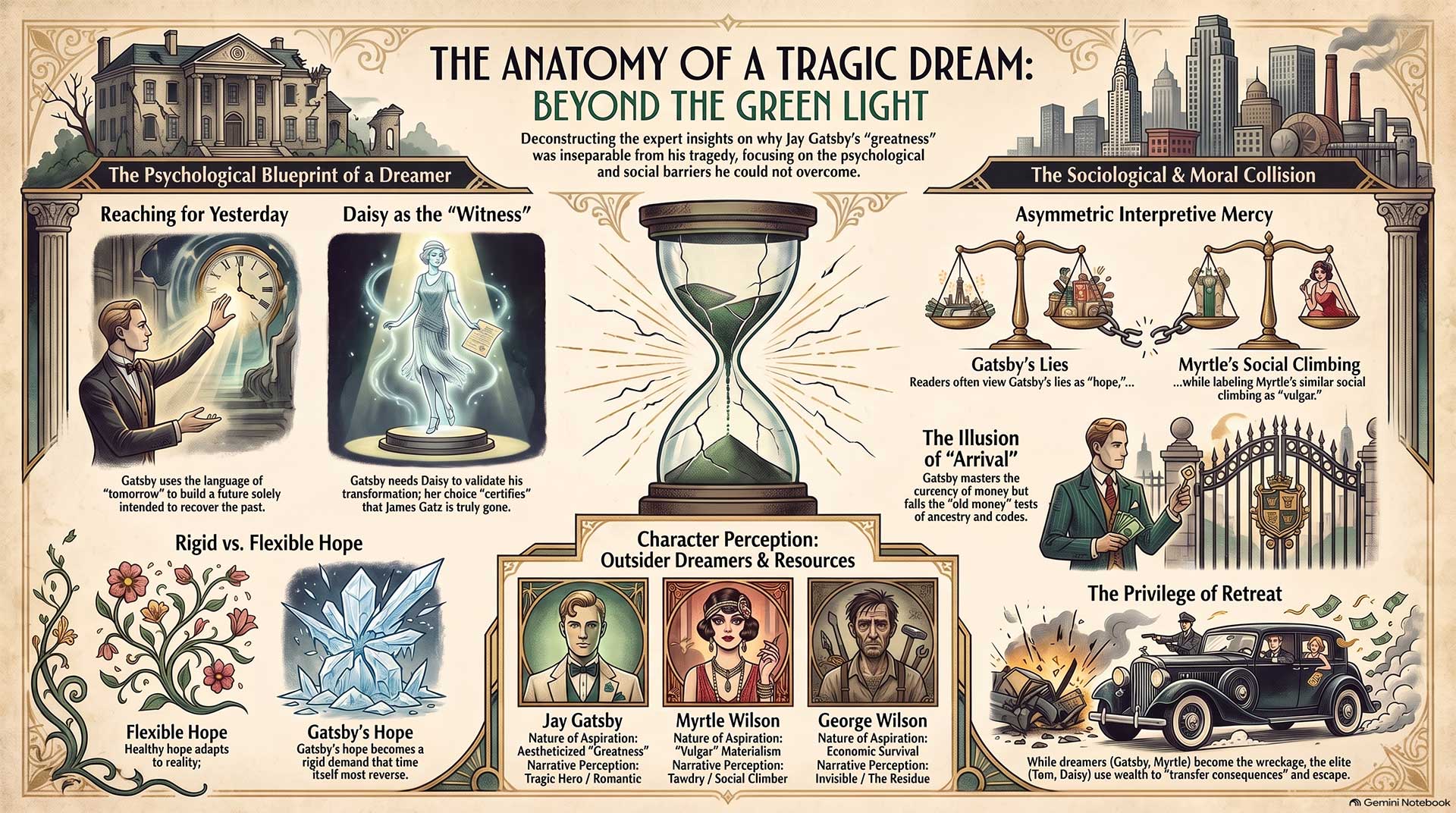
Perhaps Gatsby's tragedy is not that he dreamed too much. It is that he asked his dream to do too much.
Daisy had to become more than the woman he loved. She had to represent his youth, his lost years, the wealthy world he once stood outside, and proof that becoming Jay Gatsby had been worthwhile. This may explain why simply having Daisy again was never enough. Gatsby needed her to say she had never loved Tom because his true rival was not simply another man.
It was time.
The discussion also revealed something important about Gatsby's extraordinary reinvention. James Gatz really did become Jay Gatsby. He acquired wealth, visibility, confidence, and a new identity. Yet some part of him still needed Daisy and the world of old money to confirm that the transformation was real.
This makes his class tragedy deeper than simple exclusion. Tom and his world refuse to accept Gatsby, but Gatsby also gives that world the authority to decide whether he has succeeded.
Perhaps Tom's greatest victory is not keeping Gatsby outside.
It is convincing Gatsby that being outside means he has failed.
Our discussion of Daisy and Myrtle complicated the story further. Gatsby's longing is often described as romantic and magnificent, while Myrtle's attempt to escape her circumstances can appear vulgar or selfish. Yet both attach a hoped-for future to someone connected with a wealthier world.
Myrtle has a green light too.
And Daisy deserves a similarly careful reading. She makes morally serious choices and retreats from their consequences, yet she is also a woman living within the constraints of marriage, motherhood, gender, and class in 1922. Seeing those pressures does not erase her responsibility.
This led us to one of the most useful principles of the entire discussion:
Interpretive mercy for everyone. Moral absolution for no one.
Then Fitzgerald brings us to the empty mansion.
Hundreds of people came to Gatsby's parties. Almost nobody came when he died.
Perhaps Gatsby succeeded in creating an audience but never truly created a community. The people who finally recognize him most deeply are not the people whose recognition he spent his life pursuing. Nick mourns the man behind the performance. Henry Gatz mourns the son Gatsby tried to leave behind.
That raises another painful question:
Whose love did Gatsby decide counted?
The consequences are just as unequal.
Myrtle dies.
George dies.
Gatsby dies.
Tom and Daisy leave.
Their wealth does more than buy beautiful houses. It gives them the ability to retreat from destruction that other people must absorb.
Yet none of this means the green light should disappear.
Gatsby's hope is part of what makes him so difficult to dismiss. He believes that life can become larger than the circumstances into which we were born. There is something deeply human, and even beautiful, in that belief.
His mistake may be believing that the future is valuable only if it can restore the past.
There is a difference between saying:
That mattered, and I will carry it with me.
And saying:
That mattered, so my life cannot become meaningful unless I get it back.
Perhaps Gatsby never needed to stop reaching.
He needed to learn how to reach for something he had never possessed before.
A future that did not require Daisy to remain the woman he remembered.
A success that did not require Tom Buchanan's approval.
An identity that did not require James Gatz to disappear.
And a dream that allowed him to notice the people standing between him and the light.
The green light can remain.
Beautiful.
Distant.
Worth reaching toward.
But perhaps growing up means learning that the future does not have to take us back to yesterday.
It can take us somewhere we have never been.
Short Bios:
Sarah Churchwell is a scholar of American literature and culture whose work has explored F. Scott Fitzgerald, The Great Gatsby, American mythology, wealth, politics, and the changing meaning of the American Dream.
Maureen Corrigan is a literary critic, professor, and author of So We Read On: How The Great Gatsby Came to Be and Why It Endures, which examines the novel's continuing cultural and literary importance.
Kirk Curnutt is a Fitzgerald scholar and literary critic whose research provides historical and textual context for Fitzgerald's life, writing, and literary world.
Krystine Batcho is a psychologist known for research on nostalgia, memory, identity, attachment, and the ways people maintain emotional connections with their past.
Shamus Khan is a sociologist whose work examines elites, privilege, status, inequality, cultural codes, and the ways social belonging is created and maintained.
Soh Yeun Kim is a scholar whose work on The Great Gatsby examines gender, narration, Daisy, Jordan, Myrtle, and the ways readers' judgments of the novel's women can be shaped by Nick Carraway's perspective.
This is an imagined scholarly discussion created for literary exploration. The dialogue attributed to the participants is fictional and should not be interpreted as quotations or actual statements made by these scholars.
Leave a Reply