
Jay Gatsby spends five years building the life he believes will finally make him happy.
He becomes rich.
He buys the mansion.
He fills it with music, champagne, beautiful people, and extravagant parties.
He places himself across the water from the woman he has never stopped loving.
And eventually, after five years of waiting, Daisy walks back into his life.
The dream is finally standing in front of him.
And that is when it begins to fall apart.
Why?
Perhaps because Gatsby was never really chasing the future.
He was trying to use the future to get back to the past.
That is what makes F. Scott Fitzgerald's The Great Gatsby much more than a tragic love story.
It asks a question that still feels uncomfortably familiar:
What happens when the dream that gives our life meaning also prevents us from living the life we actually have?
Story: What Was Gatsby Really Chasing?
The story takes place in 1922.
America is changing quickly. The First World War is over. New fortunes are being made. New York seems filled with money, possibility, and excess.
Nick Carraway moves to Long Island and rents a modest house in West Egg.
Next door stands an enormous mansion belonging to a mysterious man named Jay Gatsby.
On weekends, Gatsby's estate comes alive.
Music.
Champagne.
Dancing.
Expensive cars.
Hundreds of guests.
Many were never invited.
Some don't even know what Gatsby looks like.
Everyone knows Gatsby's name.
Almost nobody knows Gatsby.
And Gatsby himself often seems strangely separate from the spectacle he created.
Because the parties are not really the point.
They are part of a message meant for one person.
Daisy Buchanan.
Daisy is Nick's cousin.
She lives across the bay in East Egg with her extremely wealthy husband, Tom Buchanan, and their young daughter.
Five years earlier, before Daisy married Tom, she and Gatsby had fallen in love.
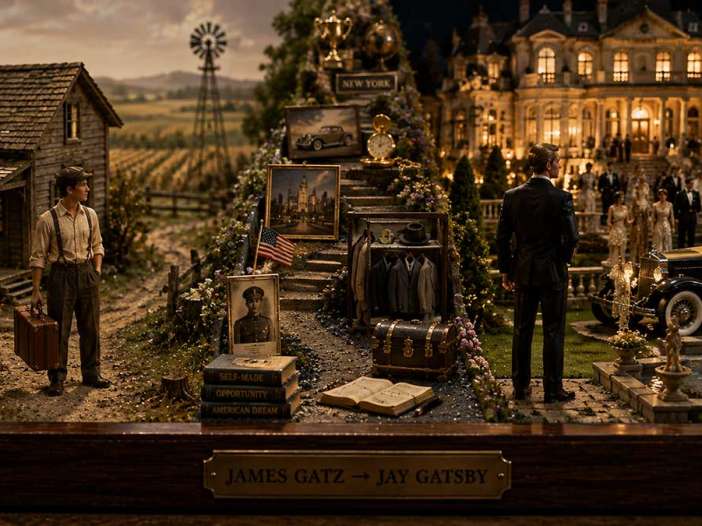
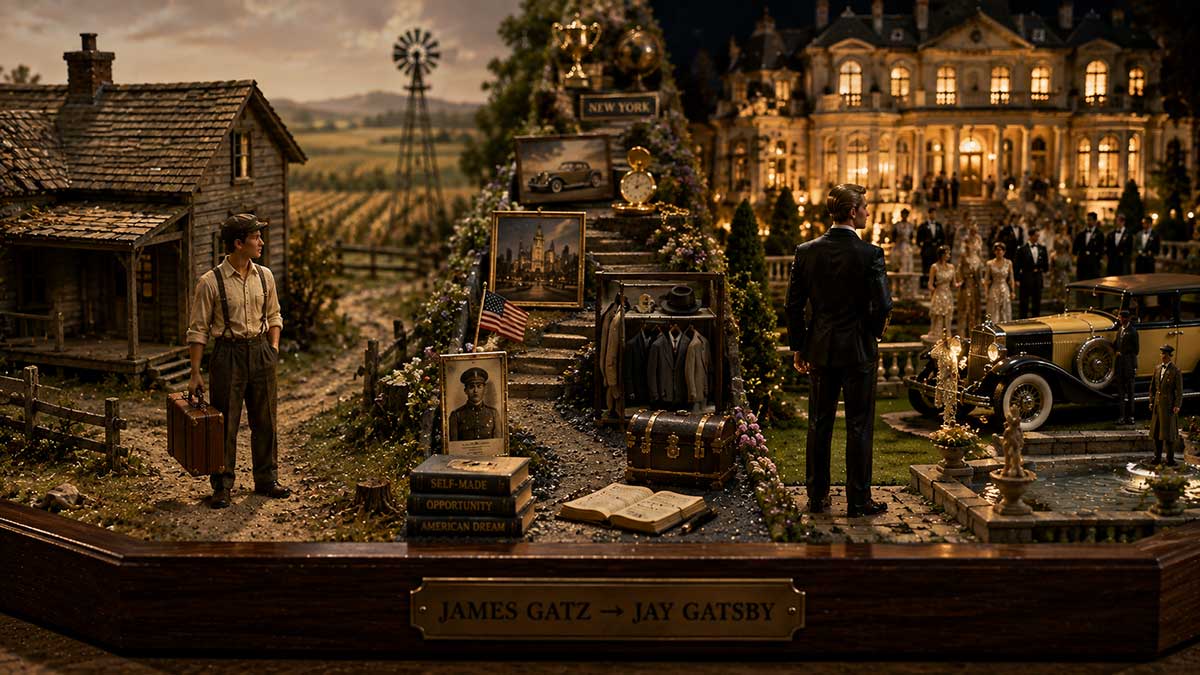
But Gatsby wasn't really Gatsby then.
He was James Gatz, the son of poor farmers.
He had neither the money nor the social position of Daisy's world.
War separated them.
Daisy eventually married Tom, a man who already possessed everything Gatsby lacked: wealth, family status, security, and unquestioned belonging.
Gatsby could have accepted that the relationship was over.
Instead, he rebuilt himself.
James Gatz became Jay Gatsby.
He acquired a fortune.
He bought an enormous mansion.
And he chose its location carefully.
Across the bay lived Daisy.
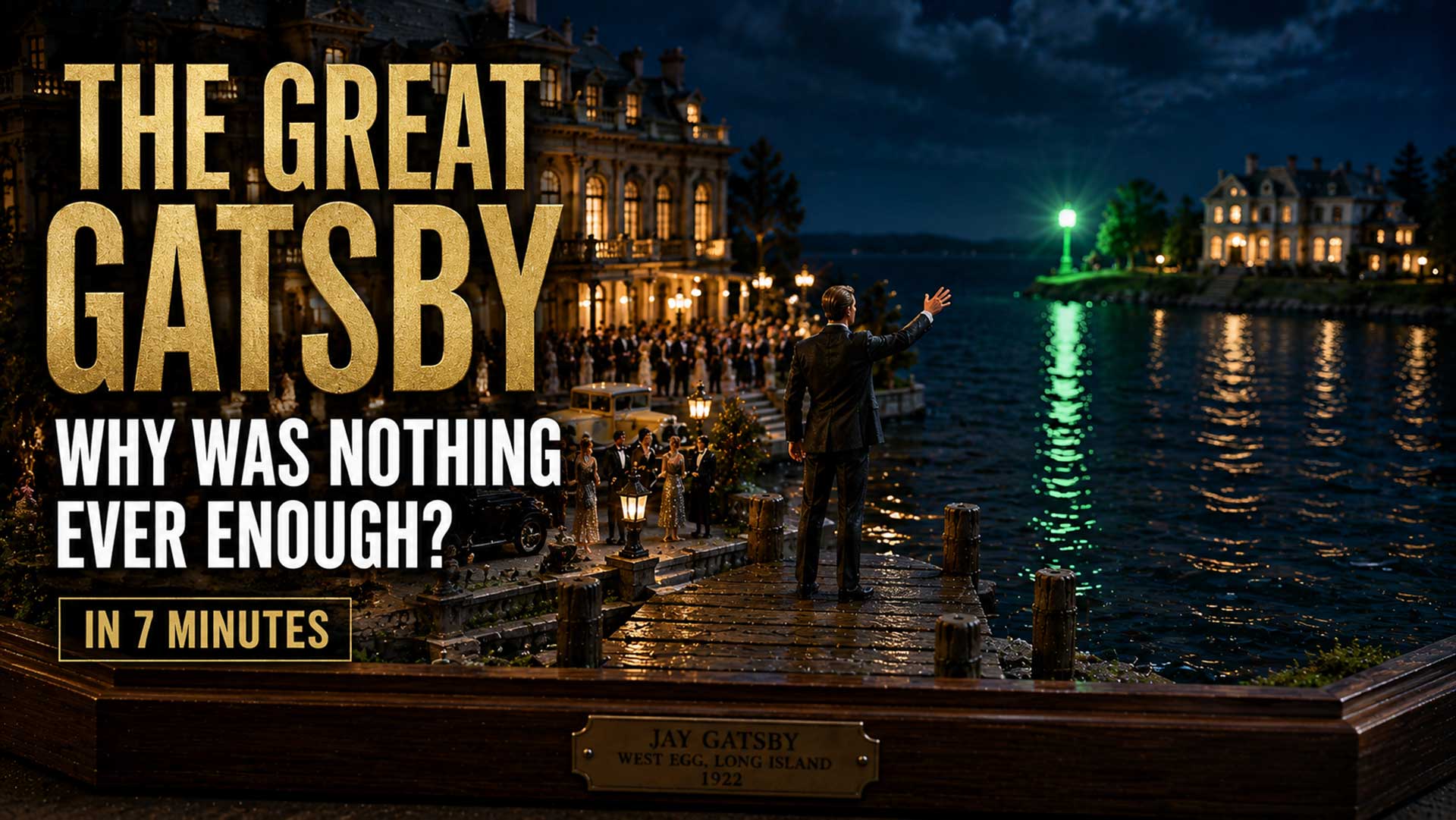
At night, Gatsby walks to the end of his dock and looks across the dark water.
Near Daisy's home, a tiny green light shines.
Gatsby reaches toward it.
The green light becomes one of the most famous symbols in American literature.
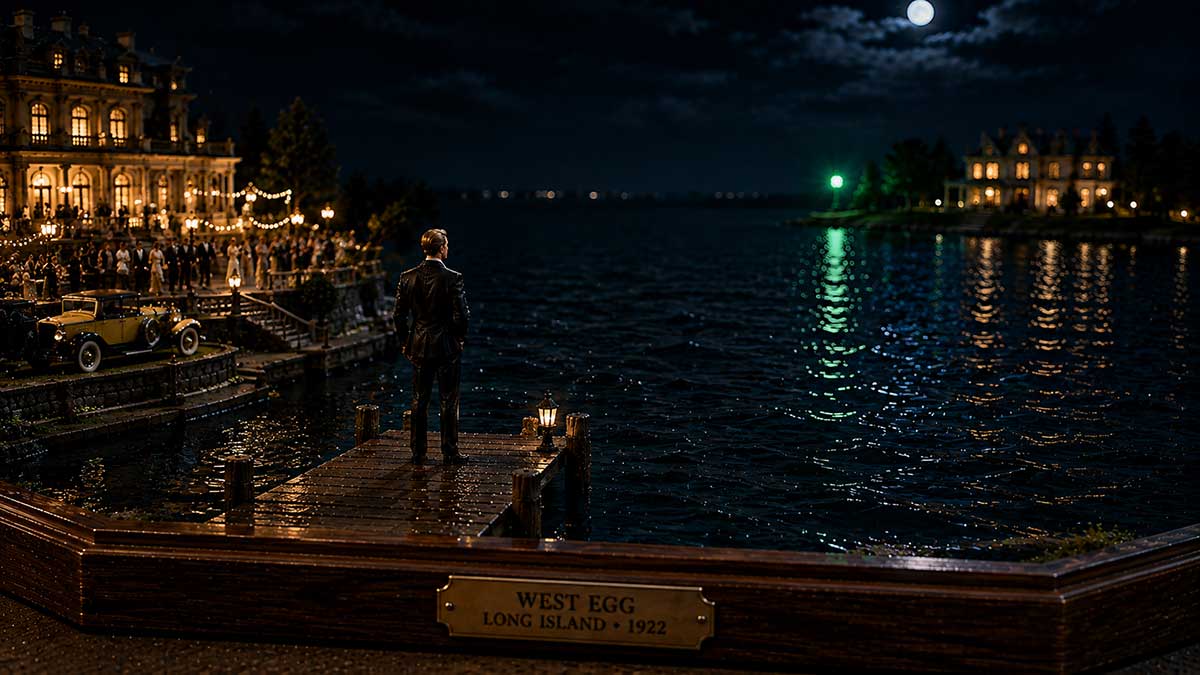
It is Daisy.
But it is more than Daisy.
It is the life Gatsby believes is waiting for him just a little farther away.
Then Nick helps Gatsby and Daisy meet again.
At first, Gatsby is almost painfully nervous.
Then the old feelings return.
Suddenly, the impossible seems possible.
Daisy is no longer just a light across the water.
She is standing in Gatsby's house.
But something strange happens.
Having Daisy back isn't enough.
Gatsby wants her to leave Tom.
Still not enough.
He wants Daisy to say she never loved Tom.
Why does that matter so much?
Because Gatsby doesn't simply want Daisy back.
He wants the five years without him to disappear.
Nick tells him that he cannot repeat the past.
Gatsby cannot accept it.
Of course the past can be repeated.
That belief has shaped his entire life.
But Daisy has lived those five years.
She has married.
She has become a mother.
She has loved, regretted, compromised, feared, and changed.
Gatsby gave himself five years to become a completely different man.
But he gave Daisy no permission to become a different woman.
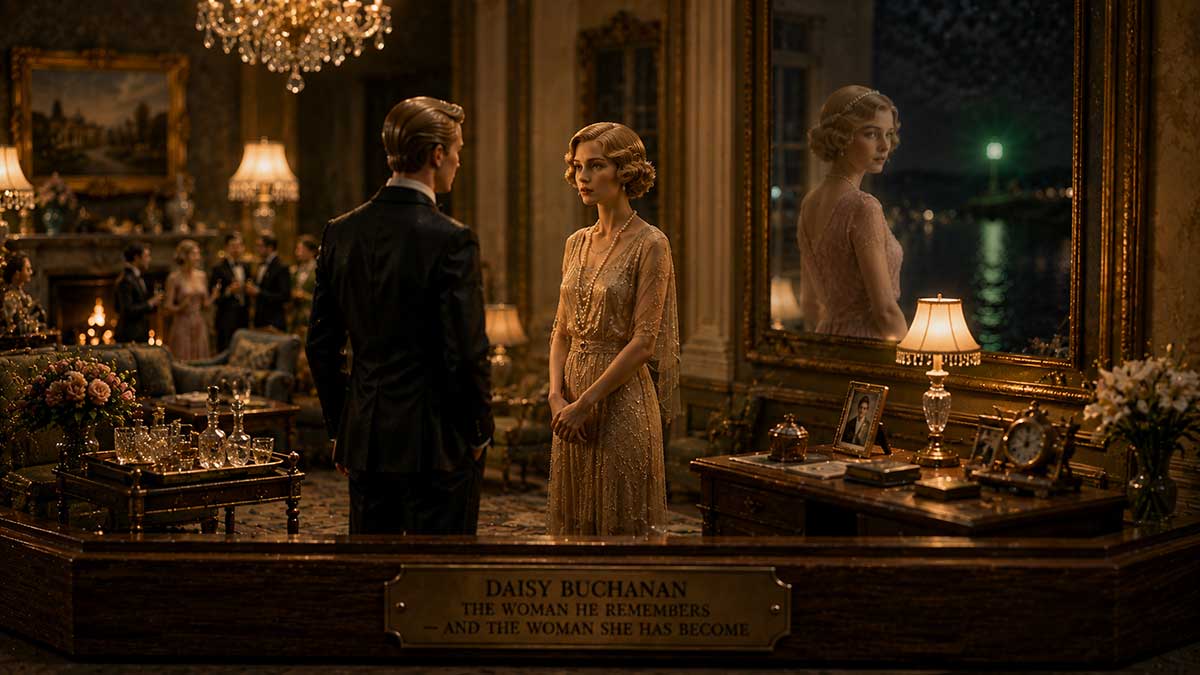
During a confrontation with Tom, Daisy cannot give Gatsby the perfect answer he needs.
She cannot say that she never loved her husband.
And Gatsby's dream begins to collapse.
Later, Daisy is driving Gatsby's car when she strikes and kills Tom's mistress, Myrtle Wilson.
Gatsby is prepared to take responsibility.
He waits outside Daisy's house to protect her.
But Daisy retreats toward Tom and the security of the world Gatsby has spent years trying to enter.
Myrtle's devastated husband, George Wilson, is led to believe Gatsby was responsible.
George shoots Gatsby and then takes his own life.
Then comes one of the quietest and most painful moments in the novel.
The mansion that once held hundreds of people becomes almost empty.
The music is gone.
The parties are over.
And almost nobody comes to Gatsby's funeral.
Gatsby succeeded in becoming visible to everyone.
But he was truly known by almost no one.
Meaning: Gatsby's Real Tragedy
Did Gatsby love Daisy?
Probably.
But Daisy gradually became much more than the woman Gatsby loved.
She became his youth.
His escape from poverty.
Wealth.
Beauty.
Belonging.
Success.
The years he had lost.
And proof that James Gatz had truly become Jay Gatsby.
That is an impossible amount of meaning to place on another human being.
A real person changes.
A memory doesn't have to.
The Daisy in Gatsby's mind can remain young, beautiful, and forever waiting for him.
The real Daisy cannot.
She hesitates.
She contradicts herself.
She becomes afraid.
She has made choices Gatsby doesn't like.
She has loved someone else.
She has become human.
And the real Daisy can never compete with Gatsby's remembered Daisy.
But there is another pattern hidden inside Gatsby's story.
Nothing ever becomes enough.
Being James Gatz isn't enough.
So he becomes Jay Gatsby.
That isn't enough.
So he becomes rich.
That isn't enough.
He buys the mansion.
Still not enough.
He brings Daisy back into his life.
Still not enough.
Daisy chooses him emotionally.
Even that isn't enough.
She must say she never loved Tom.
The finish line keeps moving.
And this may be one of the most modern things about Gatsby.
How often do we tell ourselves:
One more promotion.
One more achievement.
One more number.
One more house.
One more person choosing me.
Then I'll know I've made it.
Gatsby's story asks a frighteningly simple question:
Where does “enough” live?
His tragedy is connected to class too.
Gatsby really does reinvent himself.
That is part of what makes him compelling.
James Gatz refuses to believe that the circumstances of his birth should determine the limits of his life.
He rises.
He creates.
He becomes wealthy enough to live across the bay from some of America's most privileged families.
Then he discovers something painful.
Money and belonging are not the same thing.
Tom doesn't need to prove that he belongs to his world.
He was born inside it.
Gatsby can buy the mansion, the car, the clothes, and the parties.
But he cannot purchase a family history.
And perhaps Gatsby's deepest class tragedy isn't simply that Tom's world refuses to accept him.
It is that Gatsby accepts Tom's world as the judge of whether his life counts.
Which leaves us with another question:
What happens when we allow people we don't even admire to decide whether we are enough?
Me: What Is Your Green Light?
This is where The Great Gatsby stops being only a story about wealthy Americans in the 1920s.
Most of us have some version of Gatsby's green light.
Maybe yours is money.
A promotion.
A business.
A house.
Marriage.
Recognition.
A certain number in your bank account.
A certain number of followers.
Or maybe your green light isn't ahead of you.
Maybe it's behind you.
A relationship that ended.
A career you didn't choose.
A city you left.
A younger version of yourself.
A life you sometimes wonder whether you were supposed to have.
And somewhere beneath all of these dreams can hide the same sentence:
Once I get there, my real life will begin.
But perhaps we should ask something different.
If you finally reach your green light, what are you expecting it to prove?
That you're successful?
That you're lovable?
That your sacrifices were worth it?
That the people who underestimated you were wrong?
That you didn't waste your life?
That you finally became enough?
There is nothing wrong with wanting more from life.
Gatsby's ability to hope is part of what makes him moving.
The problem begins when a dream stops being something we want and becomes something that must justify everything that came before it.
There is a difference between saying:
“That mattered, and I will carry it with me.”
And saying:
“That mattered, so my life cannot become meaningful unless I get it back.”
Gatsby appears to spend his life moving forward.
But emotionally, he is moving backward.
He builds tomorrow so he can recover yesterday.
And then there is his funeral.
Hundreds came when Gatsby could give them music, alcohol, excitement, and spectacle.
Almost nobody came when there was nothing left to receive.
Yet a few people did care.
Nick stayed.
Gatsby's father came.
And that leaves us with a question Gatsby himself may never have seriously asked:
Whose love have we decided counts?
Sometimes we spend enormous parts of our lives trying to be recognized by people who barely see us.
And in doing so, we may overlook the people who already do.
That may be the saddest meaning of Gatsby's empty mansion.
He spent years looking across the water.
Maybe he needed to look around.
So perhaps Fitzgerald's green light should not be extinguished.
We need dreams.
We need hope.
We need things worth moving toward.
The question is what happens to us, and to the people around us, while we are reaching.
What is your green light?
And what is it costing you?
Are you moving toward a future you genuinely want?
Or are you asking the future to repair something in the past?
Are you building a life?
Or waiting for the moment when you believe your life will finally begin?
And as you look across the water at everything you still want...
who is standing beside you that you have stopped seeing?
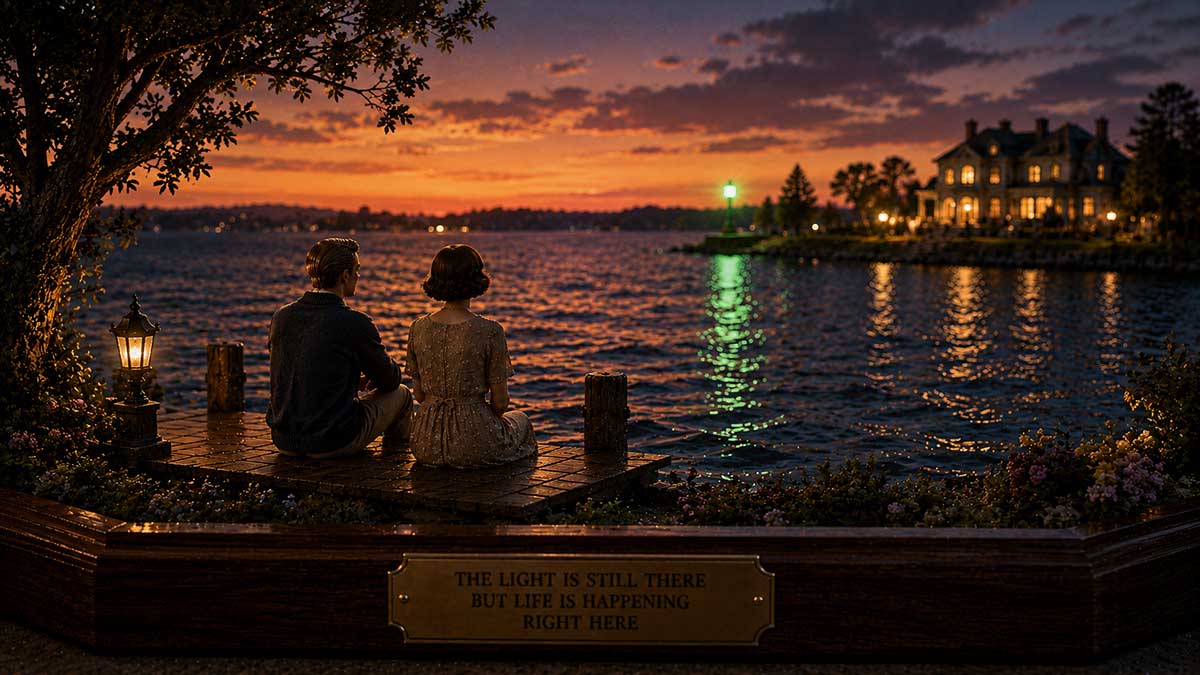
The green light can stay.
It can remain beautiful.
It can remain distant.
You can still reach for it.
Just don't forget to look around while you do.
Because your life is not waiting for you on the other side of the water.
It is already happening here.
Short Bios:
F. Scott Fitzgerald
American novelist and short-story writer born in 1896. Fitzgerald became one of the defining voices of the Jazz Age, writing about wealth, ambition, love, social status, and disappointment. The Great Gatsby, published in 1925, became his most celebrated novel.
Jay Gatsby
Born James Gatz, Gatsby rises from a poor background and creates a wealthy new identity for himself. His fortune, mansion, and extravagant parties are tied to his hope of recovering his relationship with Daisy and the past they once shared.
Daisy Buchanan
Gatsby's former love and Nick Carraway's cousin. Daisy is married to Tom Buchanan and has a young daughter. To Gatsby, she gradually represents far more than romantic love: youth, wealth, belonging, success, and the life he believes he lost.
Nick Carraway
The novel's narrator and Gatsby's neighbor in West Egg. Nick becomes both Gatsby's friend and witness, observing the glamour surrounding him as well as the loneliness hidden beneath it.
Tom Buchanan
Daisy's wealthy husband, born into the privileged world Gatsby desperately wants to enter. Tom represents inherited wealth, social security, entitlement, and the protection that comes with belonging to an established elite.
Myrtle Wilson
Tom's mistress and George Wilson's wife. Myrtle longs to escape her limited circumstances and enter a wealthier life. Her desire to cross social boundaries creates an important parallel with Gatsby's own ambitions.
George Wilson
Myrtle's husband and the owner of a struggling garage in the Valley of Ashes. After Myrtle's death, grief and misinformation draw him into the final tragedy that ends Gatsby's life.
Leave a Reply