
Introduction
The Great Gatsby is often remembered as a story about wealth, parties, romance, and the glittering excess of the Jazz Age.
But underneath the champagne, the enormous mansion, the yellow car, and the green light across the bay is a much more intimate tragedy.
Jay Gatsby spends years becoming the man he believes Daisy Buchanan should have chosen.
He changes his name.
Builds a fortune.
Creates an extraordinary public identity.
Buys a mansion across the water from Daisy's home.
Fills that mansion with hundreds of strangers.
And waits.
From the outside, Gatsby appears to be chasing the future.
Yet almost everything he does is aimed at recovering one lost moment from the past.
That contradiction became the heart of this imaginary conversation.
We brought together six characters whose lives collide around Gatsby's dream: Jay Gatsby, Daisy Buchanan, Nick Carraway, Tom Buchanan, Myrtle Wilson, and George Wilson.
They begin with what seems like the obvious question:
Did Gatsby truly love Daisy?
But the question becomes harder almost immediately.
Gatsby certainly loved her.
Yet Daisy was never only Daisy to him.
She became connected to nearly everything Gatsby wanted from life: beauty, wealth, social acceptance, escape from poverty, proof that James Gatz had successfully become Jay Gatsby, and the possibility that five lost years could somehow be recovered.
That is an impossible amount of meaning to place on one human being.
Daisy finally confronts him with a painful distinction.
Gatsby wants her to love him in the present, but he also wants her to declare that her life with Tom never truly mattered.
The marriage.
The years.
Her conflicting feelings.
Even the existence of her daughter.
Gatsby can accept almost anything except evidence that time moved forward without him.
This is why the conversation gradually stops being merely about romance.
It becomes a conversation about identity.
Was Jay Gatsby real?
Tom insists Gatsby will always be James Gatz, the poor son of farmers who tried to purchase entrance into a world where he did not belong.
Gatsby answers with one of the strongest arguments available to him:
Why should birth determine identity?
Tom inherited nearly everything that announces his importance.
Gatsby had to construct himself.
Yet Daisy exposes the painful contradiction inside Gatsby's reinvention.
Gatsby grants himself the right to change completely, but he does not grant Daisy the same right.
He can transform James Gatz into Jay Gatsby.
Daisy, however, is expected to remain the young woman he remembers from Louisville.
This leads into the class question.
Gatsby obtains extraordinary wealth.
Still, Tom refuses to consider him an equal.
The rules change the moment Gatsby reaches the door.
Money is suddenly insufficient.
Now background matters.
Family matters.
History matters.
Social legitimacy matters.
Gatsby discovers that he can acquire nearly every visible symbol of the upper class without acquiring the invisible permission to belong to it.
Myrtle recognizes the same structure from much farther down the social ladder.
She looks at Gatsby and realizes that their dreams are not completely different.
Gatsby looks toward Daisy and sees another life.
Myrtle looks toward Tom and sees another life.
Both try to cross class boundaries through a person connected to greater wealth and status.
Yet Gatsby's longing is often remembered as romantic and magnificent.
Myrtle's is often treated as embarrassing or vulgar.
Her presence forces Nick, and the reader, to confront that difference.
Then George introduces another question:
What does money mean to someone who does not have enough of it to turn wealth into symbolism?
To Gatsby, money means transformation.
To Myrtle, escape.
To Daisy, security.
To Tom, inherited authority.
To George, it may simply mean keeping the garage open another month.
The conversation reaches its emotional center when everyone returns to Gatsby's obsession with the past.
Gatsby believes that refusing to surrender is a form of hope.
And sometimes it is.
Human beings accomplish extraordinary things precisely because they refuse limitations other people consider permanent.
But Nick begins to see a distinction Gatsby cannot accept.
Returning to a person is possible.
Returning to a moment is not.
Daisy may have been able to begin something new with Gatsby.
But Gatsby does not really want something new.
He wants what they had before.
He wants Daisy before Tom.
Before her marriage.
Before motherhood.
Before five years of experience changed both of them.
Eventually Daisy realizes that Gatsby may be longing for something even deeper than her.
He may be longing for the young man he once was.
The young man who still felt that everything in life was ahead of him.
This becomes one of the most painful discoveries in the entire conversation.
Perhaps Gatsby was never simply trying to recover Daisy.
Perhaps he was trying to recover a version of himself.
And no amount of money could purchase that.
The final topic changes the moral direction of the discussion completely.
Everyone has spent four topics talking about dreams.
Now George asks:
Who paid for them?
Myrtle is dead.
Gatsby is dead.
George is dead.
Daisy was driving the car that killed Myrtle.
Gatsby planned to take responsibility.
Tom directed the devastated George toward Gatsby.
George killed Gatsby while believing something that was not true.
Nick watched much of the tragedy unfold while imagining himself largely as an observer.
And Tom and Daisy ultimately left.
At this point, the conversation can no longer treat dreams as purely private.
George offers perhaps the most important insight of the discussion:
Dreams have neighbors.
We often ask what we are willing to sacrifice for a dream.
Perhaps we should also ask what the dream is asking from other people.
Gatsby's dream asks Daisy to carry the meaning of his entire life.
Myrtle's dream wounds George.
Daisy's desire for safety leaves Gatsby exposed.
Tom's desire to possess without consequence damages nearly everyone around him.
George's grief and desperation destroy Gatsby.
Nick's fascination helps the reunion between Gatsby and Daisy happen.
No one stands completely outside the chain.
That does not mean everyone is equally responsible.
They clearly are not.
But it means the tragedy cannot be reduced to one villain and one victim.
By the end, even Gatsby begins to see the green light differently.
It still represents hope.
Hope itself is not condemned.
Neither is ambition.
Neither is the desire to become something more than the life into which we were born.
The problem begins when the light becomes so bright that we stop seeing the people standing between us and it.
That may be the deeper tragedy of The Great Gatsby.
Gatsby spends years believing his greatest challenge is reaching the green light.
Perhaps his greater challenge was learning how to see everything that was already around him.
(Note: This is an imaginary conversation, a creative exploration of an idea, and not a real speech or event.)
Topic 1: Did Gatsby Love Daisy, or the Dream He Built Around Her?
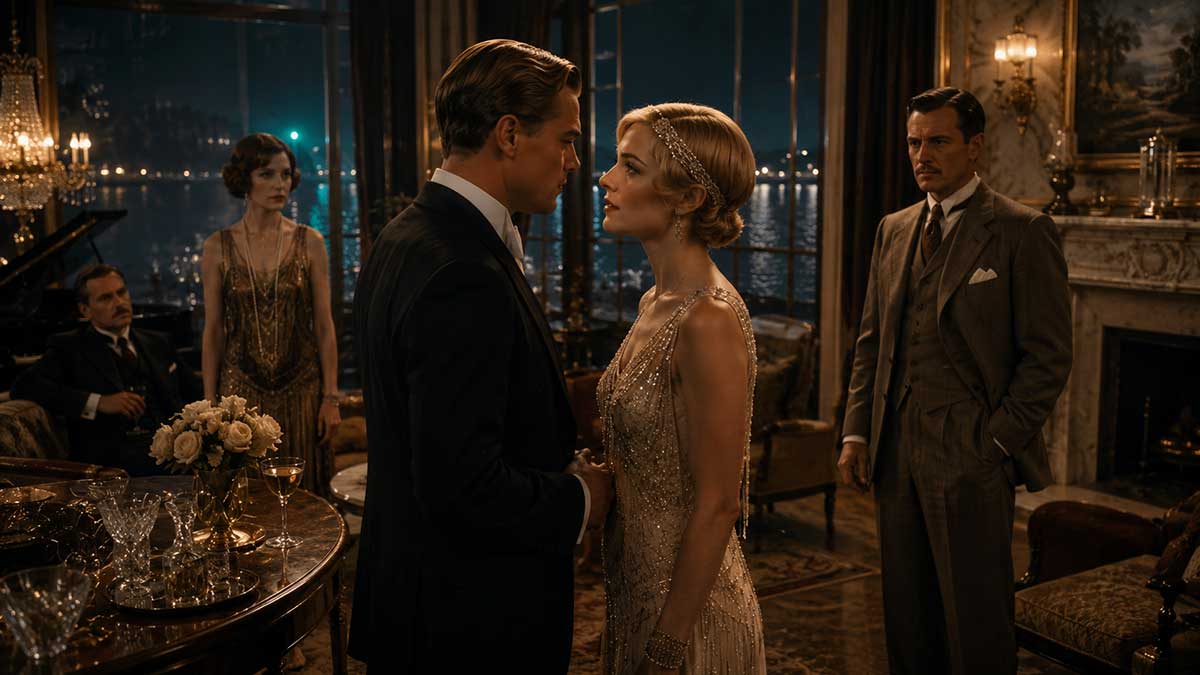
Nick Carraway: There is something I have wondered about for a long time, Gatsby. Perhaps I was too close to you then to ask it properly.
Gatsby: That sounds ominous, old sport.
Nick: You spent five years trying to get back to Daisy.
Gatsby: I wouldn't put it that way.
Nick: How would you put it?
Gatsby: I spent five years making myself ready for the life we should have had.
Daisy Buchanan: There.
Gatsby: There what?
Daisy: You did it already.
Gatsby: Did what?
Daisy: You said "the life we should have had." You didn't say "the life we might have now."
Gatsby looked at her.
Gatsby: What's the difference?
Daisy: Five years.
Gatsby: Five years don't change what happened between two people.
Daisy: Don't they?
Gatsby: Not if it was real.
Tom Buchanan: Good God.
Gatsby: Stay out of this, Tom.
Tom: You're sitting there telling my wife that five years of her life don't count because they interfere with a story you've been telling yourself.
Gatsby: I didn't say they didn't count.
Daisy: You asked me to say I never loved him.
Gatsby's expression tightened.
Gatsby: You knew what I meant.
Daisy: Yes.
She looked directly at him.
Daisy: That's what frightened me.
For once, Gatsby did not answer immediately.
Nick: What did you think he meant?
Daisy: He didn't want me simply to choose him.
He wanted me to correct everything.
The marriage.
The years.
The child.
Everything that had happened since Louisville.
Gatsby: Daisy, that's not fair.
Daisy: Isn't it?
Gatsby: I wanted the truth.
Daisy: Your truth.
Gatsby: Our truth.
Daisy: That's exactly the problem.
Myrtle gave a small laugh.
Everyone turned toward her.
Myrtle Wilson: Rich people have interesting problems.
Tom: Nobody asked you.
Myrtle: You certainly did often enough.
Tom's face hardened.
Nick: Myrtle.
Myrtle: What? We're supposed to sit here pretending this is some great mystery?
She looked at Gatsby.
Myrtle: You wanted her.
I wanted him.
She nodded toward Tom.
Myrtle: Neither of us was only wanting a person.
That silenced the room.
Gatsby studied her.
Gatsby: You don't know anything about Daisy and me.
Myrtle: Maybe not.
But I know something about looking at somebody and seeing a door.
George Wilson lowered his eyes.
George Wilson: Myrtle.
Myrtle: Don't.
She softened slightly.
Myrtle: I know what I did to you, George. I'm not pretending otherwise.
Then she looked back at Gatsby.
Myrtle: But when I looked at Tom, I didn't just see Tom.
I saw New York.
Nice rooms.
Clothes that hadn't been worn by somebody before me.
Restaurants where nobody knew where I came from.
People who didn't smell like gasoline all day.
I saw a different version of myself.
She leaned forward.
Myrtle: So tell me, Gatsby. When you looked at Daisy, did you only see Daisy?
Gatsby said nothing.
Tom: Of course he didn't.
Gatsby: You'd like that to be true.
Tom: Her money was half the attraction.
Gatsby: You don't know the first thing about what I felt.
Tom: I know men like you.
Gatsby smiled coldly.
Gatsby: No, Tom. You know men born like you. You've never had to know men like me.
Nick: Gatsby, answer Myrtle's question.
Gatsby turned toward him.
Nick: When you first met Daisy, what did you love?
Gatsby: Her.
Nick: What about her?
Gatsby: Everything.
Daisy: That's not an answer.
Gatsby looked almost hurt.
Gatsby: Your voice.
Daisy waited.
Gatsby: The way you looked at me. The way you could make a room feel different simply by entering it. The way everything around you seemed...
He stopped.
Myrtle: Expensive?
Tom laughed.
Daisy did not.
Gatsby's eyes remained on her.
Gatsby: Possible.
That changed the room.
Nick: Possible?
Gatsby: Yes.
He leaned forward.
Gatsby: You all talk about the money as though that's what I wanted.
You don't understand what it feels like to grow up knowing there is another kind of life somewhere and that you weren't born into it.
Tom shifted impatiently.
Gatsby: I knew what people saw when they looked at James Gatz.
Poor boy.
Farmer's son.
Nobody.
But I knew that wasn't all I was.
I knew it before anybody else did.
George: And Daisy proved it?
Gatsby looked at him.
George: Is that what you're saying?
Gatsby: No.
George: Sounds like it.
Gatsby: Daisy didn't make me Gatsby.
George: Maybe not.
George's voice remained quiet.
George: But maybe you needed her to tell you Gatsby was real.
Gatsby stared at him.
Nick noticed Daisy's expression change.
Not anger.
Recognition.
Daisy: Yes.
Gatsby: Daisy.
Daisy: That's what it felt like.
Gatsby: You know that isn't true.
Daisy: I know you loved me.
That stopped him.
Daisy: I have never said you didn't.
Her voice became quieter.
Daisy: But sometimes being loved by you felt like being asked to stand in front of everything you had built and say, "Yes, Jay. It was all worth it."
Gatsby looked wounded.
Gatsby: That's cruel.
Daisy: I'm not trying to be cruel.
Gatsby: You think the house was for you?
Daisy: Wasn't it?
No answer.
Daisy: The parties?
Gatsby looked away.
Daisy: The place across the bay?
Still nothing.
Daisy: The shirts?
Myrtle smiled faintly.
Daisy: Jay, you threw those shirts in front of me like evidence.
Gatsby: You cried.
Daisy: I did.
Gatsby: Then don't tell me they meant nothing.
Daisy: They didn't mean nothing.
She paused.
Daisy: That's why I cried.
Nick watched Gatsby closely.
Nick: What did they mean?
Daisy thought about it.
Daisy: They meant he had done it.
He had become rich.
He had built this extraordinary house.
He had crossed all that distance.
And suddenly I could see the life that might have happened if I had waited.
Gatsby leaned toward her.
Gatsby: It still could have happened.
Daisy shook her head.
Daisy: You see?
Gatsby: What?
Daisy: You always turn "might have" into "still can."
Nick: Gatsby, let me ask you something harder.
Suppose Daisy had come back to you.
Not the Daisy you remembered.
Daisy as she actually was.
A woman who had married Tom.
A woman who had once loved him.
A mother.
Someone who had changed.
Someone who could love you and still regret things.
Someone who could wake up angry with you.
Someone who might sometimes miss her old life.
Would you have wanted that Daisy?
Gatsby: Of course.
Daisy: No.
Gatsby turned sharply.
Gatsby: Don't tell me what I wanted.
Daisy: Then why couldn't I say I loved Tom once?
Gatsby: Because you didn't.
Daisy: Jay.
Gatsby: You didn't.
Daisy: I did.
The words seemed to strike him again, just as they had before.
Gatsby: You were confused.
Daisy: Perhaps I was.
Gatsby: You were frightened.
Daisy: I probably was.
Gatsby: You chose security.
Daisy: Yes.
Gatsby: Then that isn't love.
Daisy looked at him for a long moment.
Daisy: Why do you get to decide which of my feelings were real?
Gatsby opened his mouth.
Nothing came.
Daisy: That's what you never understood.
You loved me so much that sometimes there wasn't enough room left for me.
Silence.
Even Tom did not interrupt.
Daisy: There was Daisy in Louisville.
Daisy in your memory.
Daisy at the end of the green light.
Daisy in the house you bought.
Daisy in every party you gave.
Daisy in the future you imagined.
She touched her chest.
Daisy: And then there was me.
Myrtle's expression had changed completely.
Myrtle: That's a terrible thing, isn't it?
Daisy looked at her.
Myrtle: Being somebody else's way out.
George looked toward Myrtle.
She saw him looking.
Myrtle: I know.
George: Do you?
Myrtle: Yes.
George: I don't think you ever did.
Myrtle's face tightened.
George: You looked at Tom and saw your way out.
Then what was I?
Myrtle did not answer.
George: Something you had to get away from?
Myrtle: George...
George: That's what I mean.
He turned toward Gatsby.
George: Maybe that's what happens when you make another person your future.
They stop being a person.
They become a place you're trying to get to.
Gatsby looked at George differently now.
Gatsby: Is that what you think I did?
George: I don't know.
Gatsby: I loved her.
George: I believe you.
That answer surprised Gatsby.
George: Loving somebody doesn't mean you can't put things on them they were never supposed to carry.
The words hung there.
Tom: This is absurd. You're all making him sound noble.
Nick: Nobody said noble.
Tom: The man pursued another man's wife.
Daisy: You pursued another man's wife too.
Tom looked at her.
Myrtle looked almost amused.
Tom: That's different.
Myrtle: There it is.
Tom: Myrtle...
Myrtle: Go ahead. Explain it.
Tom hesitated.
Myrtle: Gatsby wanting Daisy is a great tragedy.
Me wanting you is vulgar.
You wanting me is apparently nothing at all.
Nick looked at Tom.
Nick: She's right.
Tom: Don't start pretending you're above any of this, Nick.
Nick: I'm not.
Tom: You watched everything.
Nick went quiet.
Tom: You helped Gatsby meet Daisy in your own house.
You knew what he wanted.
You stood there fascinated by the whole performance.
Then after it destroyed everyone, you decided which of us deserved your sympathy.
Nick's expression changed.
Daisy: He's right about that.
Nick: About what?
Daisy: You loved Gatsby's dream too.
Nick: I admired something in him.
Daisy: Yes.
Nick: His hope.
Daisy: You keep calling it hope when it's his.
She looked toward Myrtle.
Daisy: When it's hers, you call it something else.
Nick said nothing.
Myrtle nodded slowly.
Myrtle: That's what I've been saying.
Gatsby stood and walked toward the window.
For a while nobody spoke.
Then Gatsby said:
Gatsby: You're all talking as though dreaming about another life is some kind of sin.
George: It isn't.
Gatsby: Then what was I supposed to do? Accept that I'd lost her?
Nick: Maybe.
Gatsby turned.
Gatsby: Why?
Nick: Because she wasn't dead.
That caught everyone.
Nick: Daisy was still alive.
She was living a life.
You didn't lose her the way someone loses something that disappears.
You lost the future you thought you were going to have with her.
Gatsby: What's the difference?
Nick: Everything.
Gatsby stared at him.
Nick: One asks you to grieve.
The other tempts you to believe you can still make it happen exactly as you imagined.
Gatsby: And why shouldn't I?
Nick: Because another person has to live inside your dream.
Gatsby looked toward Daisy.
Myrtle: I have a question for him.
Gatsby: Go ahead.
Myrtle: If Daisy had been poor when you met her, would you still have loved her?
Tom smiled.
Gatsby: Yes.
Myrtle: That fast?
Gatsby: Because it's true.
Myrtle: Suppose she lived where I lived.
Above a garage.
No beautiful house.
No servants.
No family name.
No dresses from Europe.
No voice full of money.
Just Daisy.
Would you have looked at her and seen "possible"?
Gatsby's confidence faded slightly.
Gatsby: She would still have been Daisy.
Daisy: No, Jay.
Gatsby turned toward her.
Daisy: That's the part none of us likes admitting.
If I had grown up where Myrtle did, I wouldn't have been the same Daisy.
The confidence you loved.
The voice.
The way I entered rooms.
The assumption that the world would make space for me.
She looked toward Myrtle.
Daisy: Money helped make me.
Myrtle stared at her.
Daisy: Just as not having it helped make you.
Tom looked uncomfortable now.
Daisy: So perhaps Jay loved me.
And perhaps he loved what surrounded me.
Maybe those things were never completely separate.
Gatsby returned to his chair.
For once, he did not argue.
Nick: Daisy, did you love Gatsby?
Daisy: Yes.
Gatsby looked up.
Nick: Do you still?
Daisy took longer.
Daisy: Part of me probably always will.
Gatsby's face softened.
Then Daisy continued.
Daisy: But that doesn't mean I can become twenty years old again.
The softness disappeared.
Gatsby: I never asked you to become twenty.
Daisy: You asked me to say I never loved Tom.
Gatsby: That's different.
Daisy: No.
She shook her head.
Daisy: You wanted the road behind us to disappear so we could stand where we once stood.
Gatsby: We could have started again.
Daisy: Started again is not the same as gone back.
Gatsby looked toward Nick.
Gatsby: You agree with her, don't you?
Nick: Yes.
Gatsby: Of course.
Nick waited.
Gatsby: You always thought I couldn't repeat the past.
Nick: I still do.
Gatsby: Then perhaps you never understood me.
Nick: Perhaps.
Gatsby seemed surprised.
Nick: But perhaps you never understood what you were asking from Daisy either.
George had remained quiet for some time.
Now he spoke.
George: Mr. Gatsby.
Gatsby: Gatsby is fine.
George: If she'd come to you without saying it...
Gatsby: Saying what?
George: That she never loved Tom.
Gatsby watched him.
George: Suppose she said, "I loved him once. I love you now. I can't change what happened. But I'll come with you."
George paused.
George: Would you have taken her?
Gatsby: Yes.
Too quickly.
George noticed.
Everyone noticed.
George: Think about it.
Gatsby's eyes moved toward Daisy.
The room became very still.
This time Gatsby did think.
Five years seemed to pass through his expression.
The mansion.
The parties.
The green light.
Louisville.
The war.
Daisy's wedding.
Tom.
Pammy.
Everything Gatsby had spent years trying to rearrange.
Finally Daisy asked him herself.
Daisy: Would I have been enough?
Gatsby looked at her.
Daisy: Not the memory.
Not the girl you lost.
Not the proof that you won.
Not East Egg.
Not the money in my voice.
Not the five years you wanted returned.
Just me.
She waited.
Daisy: Would I have been enough?
Gatsby tried to answer.
Nothing came.
And for perhaps the first time, the silence between Gatsby and Daisy contained something his enormous dream never had.
The real woman.
The real man.
And five years that neither of them could make disappear.
Topic 2: Can We Really Become Someone New?
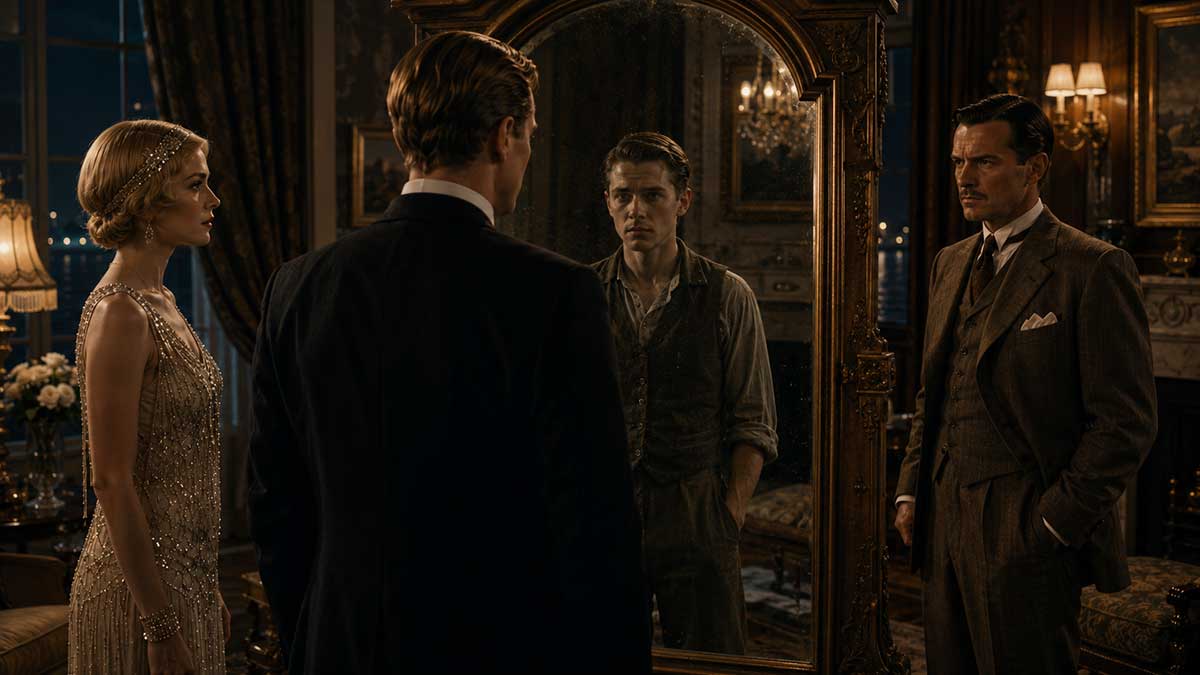
For a while, nobody spoke.
Gatsby had spent years answering questions about himself before anyone could ask them.
Oxford.
The war.
His family.
His money.
The enormous house.
The parties.
Each answer placed another piece into the man called Jay Gatsby.
Tom finally broke the silence.
Tom Buchanan: Or perhaps this whole thing is simpler than everyone wants to make it.
Gatsby looked at him.
Gatsby: I'm sure you'll tell us.
Tom: You're James Gatz.
The name landed differently from an insult.
Gatsby's expression changed.
Tom: That's where all of this starts, isn't it?
North Dakota. Poor farmers. No great inheritance. No distinguished family. Then one day James Gatz decides he doesn't like James Gatz very much, so he invents Jay Gatsby.
Gatsby: And?
Tom: And you can't invent your own history.
Gatsby: I didn't invent my history.
Tom: You spent half your life hiding it.
Gatsby: I refused to let it decide the other half.
Tom: Same thing.
Myrtle Wilson: No, it isn't.
Tom glanced at her.
Myrtle: He's right about that.
Tom: You would think so.
Myrtle: What is that supposed to mean?
Tom: You spent plenty of time pretending too.
Myrtle's eyes narrowed.
Myrtle: Pretending what?
Tom: That putting on an expensive dress made you belong in that apartment.
George lowered his eyes.
Myrtle stared at Tom.
Myrtle: And you liked me better in the dress.
Tom said nothing.
Myrtle: Funny how pretending only bothered you when I started believing it.
Gatsby smiled faintly.
Gatsby: Exactly.
Tom: Don't compare yourself to her.
Gatsby: Why not?
Tom hesitated.
It was a small hesitation, but everyone heard what it contained.
Nick Carraway: Go ahead, Tom.
Tom: Go ahead what?
Nick: Finish the sentence.
Tom leaned back.
Tom: Gatsby knows what I mean.
Gatsby: I do.
His voice had become calm.
Gatsby: You mean there are people who are allowed to become something more, and people who aren't.
Tom: That's not what I said.
Gatsby: You didn't need to.
Nick: Gatsby, when did James Gatz become Jay Gatsby?
Gatsby: Seventeen.
Nick: That precise?
Gatsby: Yes.
Nick: Why?
Gatsby thought for a moment.
Gatsby: Because I had known for years that the life around me wasn't going to be my life.
George Wilson: How'd you know?
Gatsby looked toward him.
Gatsby: I just did.
George: That's an easy answer.
Gatsby: It's the true one.
George: Maybe.
George rubbed his hands together.
George: I used to think Myrtle and me would get somewhere too.
Myrtle looked at him.
George: Garage wasn't supposed to be forever.
Nobody said anything.
George: You think I was born wanting to spend my life underneath other men's cars?
Gatsby: No.
George: Then what's different between you and me?
Gatsby considered it.
George: You looked at where you were born and said, "That's not me."
I looked around and said, "Maybe someday."
He gave a tired little smile.
George: You left.
I stayed.
Gatsby: That's the difference.
George: Is it?
Gatsby: You could have left too.
Myrtle turned sharply toward Gatsby.
Myrtle: Could he?
Gatsby: Everyone can leave somewhere.
Myrtle: That's something people say after they've managed to leave.
Gatsby looked at her.
Myrtle: You think wanting badly enough makes the door appear.
Gatsby: No. I think when the door doesn't appear, you make one.
Myrtle: With what?
Gatsby didn't answer.
Myrtle: Money?
Connections?
Luck?
Some rich man taking you onto his yacht?
Gatsby's face tightened.
Myrtle: I'm not insulting you. I'm asking.
You worked for what you got.
Fine.
But don't turn your life into a rule for everybody else's.
George looked at Myrtle with surprise.
Myrtle: Some people push on the door their whole lives.
It still doesn't open.
Tom: At least somebody is finally talking sense.
Myrtle: Don't get comfortable. You're next.
Nick almost smiled.
Myrtle: What exactly did you do to become Tom Buchanan?
Tom stared at her.
Tom: What kind of question is that?
Myrtle: Gatsby had to invent himself.
What did you have to do?
Tom: I didn't have to invent anything.
Myrtle: Exactly.
Gatsby leaned forward.
Gatsby: That's the whole point.
Tom: What is?
Gatsby: You think I'm artificial because I had to construct what you inherited.
Your clothes tell people who you are.
Your house tells them.
Your name tells them.
Your schools tell them.
Your friends tell them.
Before you enter a room, half the room has already decided you're somebody.
Tom's jaw tightened.
Gatsby: James Gatz entered a room and nobody decided anything except how quickly they could forget him.
So yes.
I learned how to speak.
How to dress.
How to move.
What to know.
Who to know.
I made Gatsby.
Tom: You made a costume.
Gatsby: And what are you wearing?
Tom stood.
Daisy Buchanan: Tom.
Tom: No. I'd like to hear this.
Gatsby: Take away the money.
The houses.
The horses.
The clubs.
The family name.
The people who answer your telephone because of who your father was.
Take away every advantage you never earned.
Gatsby looked directly at him.
Gatsby: Who are you?
Tom's face reddened.
Tom: Still Tom Buchanan.
Gatsby: Then perhaps you'd finally have the chance to find out.
Daisy had been watching Gatsby.
Daisy: Jay.
He turned.
Daisy: Did you hate James Gatz?
The question seemed to surprise him.
Gatsby: No.
Daisy: You never speak about him.
Gatsby: There's nothing to speak about.
Daisy: He was you.
Gatsby: He became me.
Daisy: That's not what I said.
Gatsby looked away.
Daisy: What was he ashamed of?
Gatsby: I wasn't ashamed.
Daisy: Jay.
Gatsby: I wasn't.
Daisy: Then why did I know so little about him?
Gatsby did not answer.
Daisy: You knew where I grew up.
You knew my family.
You knew my house.
You knew the people around me.
You remembered rooms we sat in.
Things I said.
What I wore.
You carried my past everywhere.
She paused.
Daisy: But you wanted yours buried.
Gatsby: My past wasn't important.
Nick: To whom?
Gatsby turned toward Nick.
Gatsby: What?
Nick: Who decided it wasn't important?
Gatsby: I did.
Nick: Then perhaps that's part of the problem.
Gatsby: Why?
Nick: You gave yourself the right to erase your past.
But you wouldn't give Daisy the right to keep hers.
Silence.
Daisy looked at Nick.
Then Gatsby.
Daisy: Yes.
Gatsby's eyes hardened.
Gatsby: That's different.
Daisy: Why?
Gatsby: Because I became what I was supposed to become.
Daisy: And who was I supposed to become?
Gatsby opened his mouth.
Daisy waited.
Daisy: The girl waiting for you?
No answer.
Daisy: You were allowed to transform yourself completely.
But I was supposed to remain exactly where you left me.
Gatsby stared at her.
Daisy: Do you see it?
He didn't answer.
Daisy: You gave yourself five years to become Jay Gatsby.
You gave me no permission to become anyone at all.
Myrtle leaned back.
Myrtle: That's good.
Daisy looked at her.
Myrtle: I mean it.
Daisy: You sound surprised.
Myrtle: Maybe I am.
Daisy: You thought I was stupid?
Myrtle: I thought you were comfortable.
Daisy smiled without amusement.
Daisy: People confuse those things.
Myrtle: People confuse being poor with being stupid too.
Their eyes met.
For perhaps the first time, there was no Tom between them.
Daisy: What did you want to become?
Myrtle laughed softly.
Myrtle: Somebody nobody felt sorry for.
George flinched.
Myrtle saw it.
Myrtle: I'm sorry.
George: Don't be.
Myrtle: George...
George: Say it.
Myrtle looked down.
Myrtle: I hated that garage.
I hated the dust.
I hated waiting for money.
I hated watching cars come through that cost more than everything we owned.
I hated seeing women sitting inside them who never had to think about whether their shoes would last another winter.
Her voice grew quieter.
Myrtle: And after a while, I started hating the woman I was there.
George looked at her.
Myrtle: That's the truth.
George: And Tom made you somebody else?
Myrtle looked toward Tom.
Myrtle: For a few hours at a time.
That answer hurt more than George expected.
Myrtle: I changed my dress.
Changed the way I talked.
Bought things.
Invited people over.
Walked around that apartment like it belonged to me.
She laughed bitterly.
Myrtle: I thought I was becoming somebody.
Then I'd go home.
The garage would still be there.
George would still be there.
And I'd still be me.
Gatsby: You gave up too soon.
Myrtle turned toward him.
Myrtle: Did I?
Gatsby: If you truly wanted another life...
Myrtle: I died trying to get one.
That stopped him.
Myrtle leaned toward Gatsby.
Myrtle: How much longer was I supposed to keep trying?
Nobody spoke.
Nick: Maybe we're talking about two different things.
Tom: Finally.
Nick: Not what you think.
Tom frowned.
Nick: There's changing your circumstances.
And there's trying to erase the person who lived through them.
Gatsby watched him.
Nick: Gatsby changed his circumstances magnificently.
But perhaps James Gatz remained unacceptable to Gatsby.
Gatsby: That's ridiculous.
Nick: Is it?
Gatsby: James Gatz was a beginning.
Nick: Then why couldn't anybody see him?
Gatsby: You're seeing him now.
Nick: Only because we know where to look.
Gatsby became quiet.
Nick: You told people your parents were wealthy and dead.
They weren't.
You created stories about Oxford.
Some true.
Some arranged carefully enough to produce a particular impression.
Why?
Gatsby: People believe what fits the man standing in front of them.
Nick: And what wouldn't have fit?
Gatsby: North Dakota.
Nick: Why not?
Gatsby: Because people like Tom would hear North Dakota before they heard anything else.
Tom smiled.
Tom: At least you understand something.
Gatsby turned toward him.
Gatsby: Yes.
I understand that you would have judged me before I opened my mouth.
Tom: Maybe I would have been right.
Gatsby: About what?
Tom: That you weren't one of us.
Gatsby smiled.
Not pleasantly.
Gatsby: There it is again.
George: Why did you want to be one of them?
Gatsby looked at him.
George: That's what I don't understand.
Gatsby: I didn't.
George: Sure looks like it.
Gatsby: I wanted Daisy.
George: Daisy was one of them.
Gatsby said nothing.
George: You built your house across from theirs.
You dressed like them.
Talked like them.
Wanted the girl from their side.
Gatsby: I wanted the life I chose.
George: Maybe.
George paused.
George: But did you choose it?
Or did you spend your whole life letting rich people tell you what success looked like?
That landed harder than Tom's insults.
Gatsby stared at George.
George: You hated being poor.
I understand that.
Myrtle understood it.
But somewhere along the way, maybe you started believing being rich meant being better.
Gatsby: I never believed that.
George: Then why wasn't James Gatz enough?
Gatsby looked away.
Daisy spoke softly.
Daisy: That's what I've been trying to ask.
Gatsby turned toward her.
Daisy: Perhaps you really did become Jay Gatsby.
I think you did.
Tom scoffed.
Daisy: Be quiet, Tom.
He stared at her.
Daisy continued.
Daisy: Jay Gatsby was real.
The courage was real.
The ambition.
The imagination.
The way you could make yourself believe tomorrow might become extraordinary.
Those things were real.
Gatsby's expression softened.
Daisy: But James was real too.
The poor boy.
The frightened boy.
The boy who wanted to walk into rooms without feeling that everyone could see where he came from.
Gatsby: I wasn't frightened.
Daisy smiled sadly.
Daisy: You still can't let him exist.
Gatsby looked at her.
Daisy: That's what makes me sad.
Gatsby: Why?
Daisy: Because perhaps James Gatz deserved the life you built too.
Not just Gatsby.
Nick watched Gatsby closely.
For all the stories Gatsby had told about himself, Nick had rarely seen him without one.
Nick: Maybe becoming someone new isn't the problem.
Gatsby: Then what is?
Nick: Believing the new person can only live if the old person disappears.
Gatsby considered this.
Nick: All of us change.
Daisy changed.
Myrtle tried to change.
George wanted his life to change.
I came East because I thought I might become someone different here.
Even Tom spends his life protecting a version of himself the world handed him.
Tom: Leave me out of your philosophy.
Nick: You're already in it.
Tom rolled his eyes.
Nick: Maybe identity isn't choosing between who we were and who we want to become.
Maybe we carry both.
Gatsby shook his head.
Gatsby: That's a very comfortable idea for someone who never had to escape himself.
Nick went silent.
That was fair.
Myrtle: I think Gatsby's right about one thing.
Everyone looked toward her.
Myrtle: Sometimes you do have to invent yourself.
Nobody else is going to do it for you.
She looked at Daisy.
Myrtle: Especially if the person everybody expects you to be is making you miserable.
Then she looked at Gatsby.
Myrtle: But maybe you can't build yourself entirely out of things you want other people to admire.
Gatsby: I didn't.
Myrtle: The mansion?
Gatsby: I liked it.
Myrtle: The car?
Gatsby: Yes.
Myrtle: The parties?
Gatsby hesitated.
Myrtle smiled.
Myrtle: You barely enjoyed your own parties.
Nick looked at Gatsby.
That was true.
Myrtle: Hundreds of people came to your house, and half the time you were standing somewhere watching the door.
Gatsby: I was waiting for Daisy.
Myrtle: Exactly.
She leaned forward.
Myrtle: You built a whole life you couldn't enjoy until one particular person saw it.
Gatsby's face changed.
Myrtle: That's not freedom.
Tom laughed.
Tom: Now we're getting somewhere.
Myrtle: You're still not safe.
Tom's smile vanished.
Myrtle: Gatsby built himself for Daisy.
Who did you build yourself for?
Tom: Nobody.
Myrtle: That's worse.
Tom: Why?
Myrtle: Because you never had to ask who you wanted to become.
You were handed everything and assumed the person who came with it must be worth something.
Tom stood again.
Tom: I've had enough of this.
George: Sit down.
Everyone turned.
Tom stared at George.
George's voice remained quiet.
George: You always got to leave when you'd had enough.
Maybe sit down this time.
For several seconds neither man moved.
Then Tom sat.
Gatsby looked at George.
Gatsby: You think I was wrong to leave where I came from?
George: No.
Gatsby: You think I should have stayed poor?
George: No.
Gatsby: Then what?
George thought about it.
George: I think maybe you won.
Gatsby frowned.
George: You became Gatsby.
You got the money.
The house.
People knew your name.
You did what you set out to do.
Gatsby: Then what's your point?
George: You won and still needed Daisy before you'd believe you'd won.
The room became quiet.
George: That's the part I don't understand.
Gatsby stared at him.
George: If becoming Gatsby was real, why did Daisy have to prove it?
No one rescued Gatsby from the question.
Not Nick.
Not Daisy.
Not even Gatsby himself.
After a long silence, Daisy spoke.
Daisy: Jay, who would you have been if you'd never met me?
Gatsby looked at her.
Gatsby: Gatsby.
Daisy: Are you sure?
He smiled slightly.
Gatsby: I had the name before you.
Daisy: I know.
Gatsby: I had the ambition before you.
Daisy: I know that too.
Gatsby: Then yes.
Daisy: What would you have wanted?
Gatsby stopped.
Daisy: Not money.
Not the house.
Not me.
What would Jay Gatsby have wanted if nobody were watching?
The question seemed almost unfair in its simplicity.
Gatsby looked around the room.
At Tom.
At Myrtle.
At George.
At Nick.
Finally Daisy.
For perhaps the first time, Jay Gatsby seemed unable to describe the future.
Nick: Maybe that's the question underneath all of this.
Gatsby: What is?
Nick: Whether we reinvent ourselves because we discover who we want to become...
Nick paused.
Nick: ...or because we're trying to become someone another person will finally recognize as worthy.
Gatsby looked at Daisy.
Then, unexpectedly, at George.
George: I don't think wanting more was your mistake.
Gatsby: What was?
George: Maybe you kept moving the place where "enough" was supposed to be.
Gatsby's expression tightened.
George: First you had to stop being James Gatz.
Then you had to become rich.
Then you needed the house.
Then Daisy had to see it.
Then Daisy had to choose you.
Then she had to say she never loved Tom.
George shook his head.
George: What came after that?
Gatsby had no answer.
Daisy watched him.
Daisy: That's what frightens me too.
Gatsby: There was nothing after that.
Daisy: There is always something after that.
Gatsby looked at her.
Daisy: That's what life is.
Not the moment when everything finally becomes perfect.
The morning afterward.
And the morning after that.
And all the ordinary days when nobody is standing across the water waiting to become a dream.
Gatsby's eyes dropped.
Myrtle broke the silence.
Myrtle: I still think he had the right to become Gatsby.
Nick: So do I.
Daisy: So do I.
George nodded.
Tom said nothing.
Myrtle: Maybe the sad part isn't that James Gatz invented Jay Gatsby.
She looked at Gatsby.
Myrtle: Maybe the sad part is that Jay Gatsby never learned he didn't need Daisy Buchanan's permission to be real.
Gatsby looked at Daisy.
For once, she did not look like the green light.
She did not look like East Egg.
She did not look like the future.
She was simply Daisy.
And perhaps for the first time, Gatsby had to face a possibility more frightening than losing her:
He might have already become the man he wanted to become years ago.
And never noticed.
Topic 3: If Gatsby Became Rich, Why Was He Still Not Accepted?
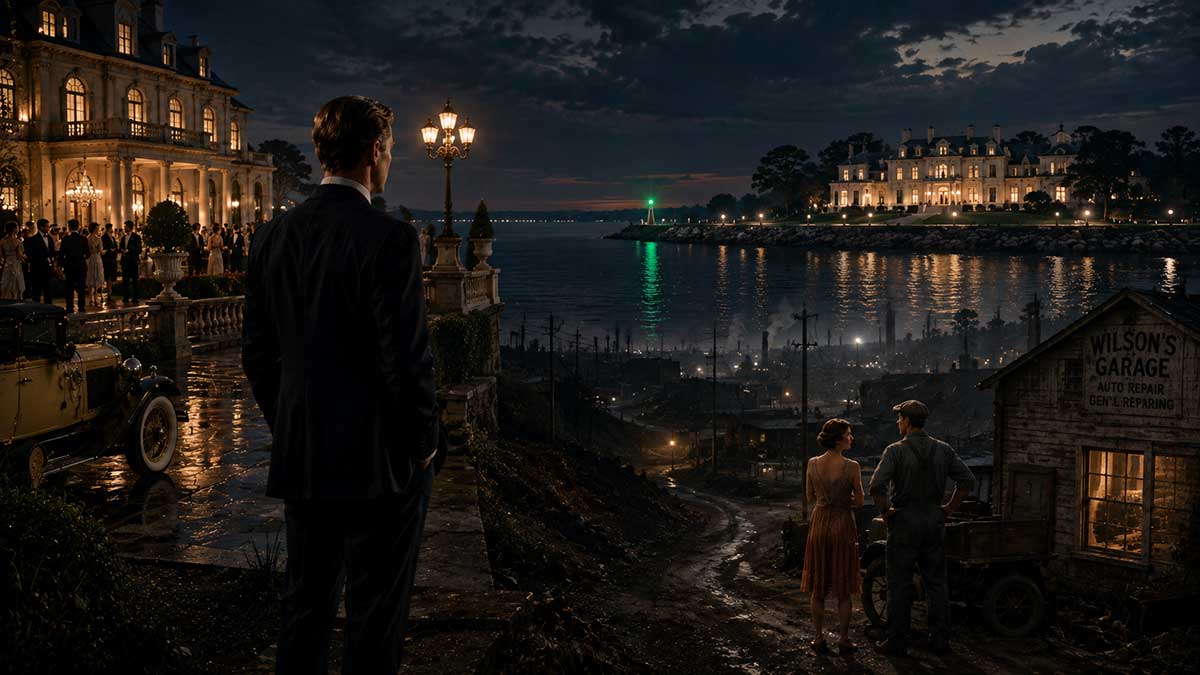
The room remained quiet after Myrtle's question.
Jay Gatsby had spent years believing he was becoming somebody.
Now George Wilson had suggested something Gatsby had perhaps never considered.
Maybe Gatsby had succeeded.
Maybe the problem was that success itself had never felt sufficient.
Tom Buchanan leaned back in his chair.
Tom Buchanan: There's a much simpler explanation.
Nick Carraway: I'm sure there is.
Tom: Gatsby could make all the money he wanted. That didn't make him one of us.
Gatsby looked up.
Gatsby: One of you.
Tom: Yes.
Gatsby: And what exactly is one of you?
Tom: You know perfectly well.
Gatsby: I'd like to hear you say it.
Tom glanced toward Daisy.
Tom: Background.
Family.
Education.
Standards.
Knowing how things are done.
Myrtle Wilson: Money.
Tom: It's more than money.
Myrtle: That's easy to say when you've always had it.
Tom: You think every man who suddenly gets rich belongs at the same table?
Gatsby: I think every man sitting at the table should be able to explain why he deserves the chair.
Tom smiled.
Tom: There. That's exactly what I mean.
Gatsby: What?
Tom: You think everything has to be earned.
Gatsby: Most things do.
Tom: No. Some things are inherited.
Gatsby: Money, certainly.
Tom's expression hardened.
Gatsby: What else did you inherit, Tom?
Your manners?
Your courage?
Your character?
Tom: At least I know where I came from.
Gatsby: You never had to escape it.
George had been listening.
George Wilson: Can I ask something?
Tom barely looked at him.
George: Suppose Gatsby did everything right.
Tom: He didn't.
George: Suppose he did.
Tom sighed.
George: Suppose he made his money honestly.
Bought the house.
Learned how to dress.
Went to the right schools.
Read the right books.
Knew the right people.
How many things would he have to do before you'd say he belonged?
Tom looked at him.
Tom: It doesn't work like that.
George nodded slowly.
George: That's what I thought.
Gatsby: Say it again.
Tom frowned.
Gatsby: "It doesn't work like that."
You couldn't have explained your whole world better.
Tom: Don't be dramatic.
Gatsby: I'm serious.
You tell people they can rise.
Work hard.
Make something of themselves.
Become successful.
Then when somebody actually reaches your door, suddenly success isn't enough.
Now it's family.
History.
Taste.
Connections.
Some invisible thing that only people already inside can recognize.
Tom: There are differences between people.
Myrtle: Yes.
She looked at him.
Myrtle: Some people make the rules.
Everybody else discovers them after they've already lost.
Nick: Tom, answer George's question.
Tom: Why?
Nick: Because I want to hear the answer too.
Tom: What question?
Nick: What could Gatsby have done to become acceptable to you?
Tom looked at Gatsby.
Then Daisy.
Tom: Nothing.
Gatsby smiled.
But there was no pleasure in it.
Gatsby: Thank you.
Tom: You wanted an honest answer.
Gatsby: I did.
Tom: You could have made ten times the money. Bought ten houses. Thrown bigger parties. It wouldn't change what you were.
Gatsby: James Gatz.
Tom: Exactly.
Gatsby: Then this was never about money.
Tom: Of course it wasn't.
Gatsby: Yet money is what lets you decide that.
Tom stared at him.
Gatsby: That's a remarkable arrangement.
Myrtle began laughing.
George looked at her.
George: What's funny?
Myrtle: Me.
Her laughter stopped.
Myrtle: I actually thought I could get there.
Daisy Buchanan: Get where?
Myrtle looked at her.
Myrtle: Where you are.
Daisy said nothing.
Myrtle: Not your house exactly.
Not your husband exactly.
She glanced at Tom.
Myrtle: Thank God for that.
Nick almost smiled.
Myrtle: But your life.
The way people move out of your way.
The way you walk into a store without wondering what anything costs.
The way you don't have to explain yourself.
The way nobody looks at your shoes and decides what kind of woman you are.
Daisy watched her.
Myrtle: I thought Tom was the way in.
Daisy: Was he?
Myrtle laughed once.
Myrtle: He rented me an apartment.
That's not the same as letting me into his world.
Tom shifted.
Myrtle: I could sleep with him.
I could drink his liquor.
Wear the clothes he bought.
Ride in his car.
But I couldn't become the woman he took home.
Silence.
Daisy looked at Tom.
Myrtle: Isn't that right?
Tom didn't answer.
Myrtle: I could be close enough to touch everything.
But I was never supposed to believe it belonged to me.
Gatsby studied Myrtle.
Gatsby: We're not the same.
Myrtle: There you go again.
Gatsby: Daisy loved me.
Myrtle: I'm not talking about love.
I'm talking about the door.
Gatsby became quiet.
Myrtle: You looked across the bay and saw Daisy.
I looked down the road and saw Tom.
You thought if Daisy chose you, you'd finally crossed over.
I thought if Tom chose me, I had.
Neither one of them did.
She looked toward Daisy.
Myrtle: And somehow everybody calls your dream romantic.
Mine gets called cheap.
Nick looked away.
Myrtle noticed.
Myrtle: Especially you.
Nick: Me?
Myrtle: Yes, you.
Nick: I barely knew you.
Myrtle: You knew enough to judge me.
Nick said nothing.
Myrtle: You described my clothes.
My apartment.
My voice.
The way I acted.
Everything about me seemed too much to you.
But when Gatsby filled a mansion with strangers and expensive things, you found something beautiful underneath it.
Nick looked at Gatsby.
Then Myrtle.
Nick: You're right.
Myrtle seemed almost disappointed by how quickly he admitted it.
Nick: I judged you differently.
Myrtle: Why?
Nick thought.
Nick: Maybe because Gatsby's longing looked like hope to me.
Myrtle: And mine?
Nick hesitated.
Myrtle: That's what I thought.
Daisy: Perhaps because Gatsby was a man.
Everyone looked toward her.
Tom: Oh, please.
Daisy: You don't think that matters?
Tom: Not everything is about that.
Daisy: Gatsby wants more than the life he was given, and he's ambitious.
Myrtle wants more, and she's vulgar.
Gatsby wants another man's wife, and he's romantic.
Myrtle wants another woman's husband, and she's immoral.
George: They were both wrong.
Daisy turned toward him.
George: Let's not make it prettier than it was.
Myrtle looked at her husband.
George: Gatsby wanting more doesn't excuse what he did.
Myrtle wanting more doesn't excuse what she did.
Tom wanting whatever he wants sure doesn't excuse him.
Tom scoffed.
George ignored him.
George: Maybe wanting a different life isn't wrong.
Maybe what matters is what you let yourself do to other people trying to get it.
That quieted everyone.
Gatsby: George, did you never want more?
George: Of course I did.
Gatsby: Then why didn't you leave?
George: We talked about that.
Gatsby: But I still don't understand.
George: Maybe that's because you think wanting something and being able to reach it are almost the same thing.
Gatsby frowned.
George: They aren't.
He looked around the room.
George: You people talk about money like it's something that tells you who somebody is.
To Tom, old money means you belong.
To Gatsby, new money means you escaped.
To Myrtle, money means a door.
To Daisy, money means you don't have to be afraid.
Daisy's expression changed.
George continued.
George: To me, money meant the garage stayed open another month.
Nobody interrupted.
George: That's all.
Not identity.
Not belonging.
Not some dream.
Rent.
Food.
Parts for a car.
Maybe enough left to take Myrtle somewhere one day.
He looked toward her.
George: I thought we were saving for a life too.
Myrtle lowered her eyes.
George: It just wasn't a life she wanted anymore.
Daisy spoke carefully.
Daisy: George, you said money means I don't have to be afraid.
George: Doesn't it?
She thought.
Daisy: It means I get to choose which fears reach me.
Nick looked at her.
Daisy: That's different.
Myrtle: Sounds pretty good.
Daisy: It is.
Myrtle seemed surprised.
Daisy: I'm not going to sit here and pretend it isn't.
I never worried about food.
I never worried about rent.
I never wondered where I would sleep.
When something went wrong, there was always somewhere else to go.
Nick watched her.
The last sentence carried more weight than the others.
Nick: Somewhere else to go.
Daisy looked at him.
She knew what he meant.
After Myrtle.
After Gatsby.
After everything.
Daisy: Yes.
Nick: That's what money finally gave you and Tom, wasn't it?
Tom stiffened.
Nick: Somewhere else to go.
Tom: We're talking about Gatsby's money, not mine.
Nick: They're connected.
Tom: How?
Nick: Gatsby thought money could get him into your world.
But perhaps the greatest privilege of your world wasn't owning things.
It was surviving consequences.
Tom's face hardened.
Tom: That's nonsense.
Nick: Is it?
Tom: Gatsby was a criminal.
Nick: Perhaps.
Tom: "Perhaps"?
Nick: I'm not defending how he made his money.
I'm asking what your money allowed you to do.
Tom said nothing.
Nick: You had an affair.
Tom: Careful.
Nick: You broke Myrtle's nose.
Myrtle looked at Tom.
Nick: You confronted Gatsby over Daisy while continuing your own affair.
You told George who owned the yellow car.
Then you and Daisy left.
Tom: Gatsby killed Myrtle.
Daisy: No.
Tom turned toward her.
The room changed.
Daisy's voice was almost a whisper.
Daisy: He didn't.
George stared at her.
Everyone knew.
But hearing her say it was different.
Daisy: I was driving.
George did not move.
Daisy: Gatsby said he'd take the blame.
George continued staring.
Daisy: I'm sorry.
George's expression remained unreadable.
George: Sorry.
Daisy's eyes filled.
George: That's a strange word.
Daisy: I know.
George: Do you?
Daisy: No.
She lowered her eyes.
Daisy: Probably not.
George looked toward Gatsby.
George: You were going to take the blame?
Gatsby: Yes.
George: Why?
Gatsby: I loved her.
George absorbed that.
George: Enough to go to prison?
Gatsby: If necessary.
George: Enough to die?
Gatsby did not answer.
George looked toward Daisy.
George: And you let him?
Daisy struggled.
Daisy: I was frightened.
George: Myrtle was frightened too.
Daisy closed her eyes.
George: I was frightened.
His voice did not rise.
George: Seems like fear works differently when you've got money.
Myrtle looked at Daisy for a long time.
Myrtle: Did you know it was me?
Daisy: Not then.
Myrtle: Would it matter?
Daisy looked at her.
Daisy: It should.
Myrtle: That's not what I asked.
Daisy could not answer.
Myrtle leaned back.
Myrtle: There it is.
Nick: What?
Myrtle: The whole thing.
She looked around the room.
Myrtle: Gatsby spent his life trying to get into Daisy's world.
I spent mine trying to get into Tom's.
Maybe we should've asked what kind of place we were trying so hard to enter.
Gatsby looked at her.
Myrtle: Because when things finally broke, they left.
She pointed gently toward Tom and Daisy.
Myrtle: We died.
George looked down.
Gatsby said nothing.
Tom: Don't put Gatsby on your side. He wasn't one of you.
Gatsby: Apparently I wasn't one of you either.
Tom: Exactly.
Gatsby laughed softly.
Gatsby: That's the first honest thing you've said.
Tom: You think dying makes you noble?
Gatsby: No.
Tom: You think wanting Daisy made you better than me?
Gatsby: No.
Tom looked surprised.
Gatsby: I think you and I wanted something very different.
Tom: You wanted my wife.
Gatsby: I wanted her to choose me.
Tom: Same thing.
Daisy: No.
Both men looked at her.
Daisy: It isn't.
Tom frowned.
Daisy: But neither of you asked enough about what I wanted.
That silenced them.
Nick: Gatsby, suppose Tom had welcomed you.
Gatsby looked at him.
Nick: Suppose East Egg had accepted you.
Suppose nobody cared where your money came from.
Suppose every club opened its doors.
Would that have mattered?
Gatsby: Not particularly.
Nick: I don't believe you.
Gatsby looked annoyed.
Nick: Your parties were full of people whose approval you claimed not to need.
Your house was built directly across from Daisy's.
Your clothes announced your success.
Your car announced it before you arrived.
You wanted to be seen.
Gatsby: Everybody wants to be seen.
Nick: Yes.
Nick paused.
Nick: But by whom?
Gatsby looked toward Daisy.
There was the answer.
Daisy: You didn't need East Egg to accept you.
Gatsby watched her.
Daisy: You needed me to.
Gatsby: Because I loved you.
Daisy: Yes.
She smiled sadly.
Daisy: And because I came from there.
Gatsby started to object.
Daisy: Jay, listen.
If I had chosen you, what would it have meant?
Gatsby: That you loved me.
Daisy: What else?
Gatsby: Nothing else.
Daisy: You're still doing it.
Gatsby looked away.
Daisy: It would have meant the poor boy won.
It would have meant the people who looked down on you were wrong.
It would have meant you crossed the bay.
It would have meant everything you built had worked.
Gatsby's voice became quieter.
Gatsby: Is that so terrible?
Daisy: No.
That surprised him.
Daisy: It's human.
She paused.
Daisy: But it's too much to ask one person to prove.
George looked toward Gatsby.
George: If she chose you, would you belong?
Gatsby remembered George asking this before.
This time he did not answer immediately.
Gatsby: I'd belong with her.
George: That's different.
Gatsby looked at him.
George: Maybe that's what you actually wanted.
Not East Egg.
Not their clubs.
Not Tom's approval.
Somewhere you didn't have to prove yourself anymore.
Gatsby's expression changed.
George: I understand that.
Gatsby: You do?
George looked toward Myrtle.
George: More than I'd like.
Myrtle's voice softened.
Myrtle: Maybe that's what I wanted too.
George looked at her.
Myrtle: Not Tom.
Not really.
Tom frowned.
Myrtle ignored him.
Myrtle: I wanted to walk into a room and not feel embarrassed about where I'd come from.
I wanted to stop counting pennies.
I wanted people to look at me and see somebody.
She looked at Gatsby.
Myrtle: Maybe you and I kept confusing being rich with being safe from shame.
Gatsby absorbed the words.
Myrtle: And people like Tom never understood it because nobody taught them to be ashamed of where they started.
Tom shook his head.
Tom: This is sentimental nonsense.
George: Maybe.
Tom looked at him.
George: Easy thing to say from the top.
Nick: Then perhaps there are three different things we're calling success.
Everyone looked toward him.
Nick: Having money.
Being accepted.
And believing you are worthy without either.
Gatsby's eyes narrowed slightly.
Nick: Tom was born with the first two.
Gatsby achieved the first and spent his life chasing the second.
Myrtle chased both through Tom.
George had almost neither.
Daisy inherited both but discovered they didn't necessarily make her happy.
Daisy: And you?
Nick stopped.
Myrtle: Yes, Nick.
Where do you put yourself?
Nick: Somewhere inconveniently between all of you.
Tom laughed.
Tom: Typical.
Nick: Probably.
Gatsby: And the third one?
Nick: What?
Gatsby: Believing you're worthy without money or acceptance.
Nick looked around the room.
Nobody seemed eager to claim it.
That itself was an answer.
After a while George spoke.
George: Maybe that's why the whole thing keeps moving.
Nick: What does?
George: Enough.
Gatsby looked at him.
George: You think if you make enough money, you'll feel different.
Then you make it.
Still don't feel different.
So maybe you need the right people to accept you.
Then maybe you need Daisy.
Then maybe Daisy has to say she never loved Tom.
George shook his head.
George: There's always one more thing standing between you and finally feeling like you made it.
Gatsby looked toward the window.
Gatsby: You make ambition sound like a disease.
George: No.
George's voice remained gentle.
George: I think wanting a better life is probably what keeps half the world getting out of bed.
He looked at Myrtle.
Then Gatsby.
George: I'm just wondering what happens when better never gets to become enough.
Daisy turned toward Gatsby.
Daisy: Jay, if I had chosen you, would the green light have disappeared?
Gatsby looked at her.
Gatsby: It wouldn't have mattered anymore.
Daisy: Exactly.
Gatsby: Because I'd have you.
Daisy: And then what would you reach for?
Gatsby smiled.
Gatsby: We'd have our life.
Daisy: Which life?
The question returned them instantly to where they had begun.
Daisy: The one we could actually have?
Or the one you believed we should have had?
Gatsby's smile faded.
Myrtle looked between them.
Myrtle: Maybe rich people aren't the only ones who keep people outside.
Nick: What do you mean?
Myrtle: Maybe dreams do it too.
They waited.
Myrtle: Gatsby built a perfect life in his head.
Perfect Daisy.
Perfect house.
Perfect ending.
Maybe real people couldn't get into that place either.
Daisy looked at her.
Gatsby said nothing.
Myrtle: Tom's world wouldn't let Gatsby in.
Myrtle paused.
Myrtle: But maybe Gatsby's dream wouldn't let reality in.
For once, Tom had nothing useful to add.
Nick looked toward Gatsby.
Nick: You crossed almost every distance a man could cross.
James Gatz to Jay Gatsby.
North Dakota to Long Island.
Poverty to wealth.
Nobody to somebody.
Gatsby looked at him.
Nick: Yet the distance across that little stretch of water remained.
Gatsby: Because Daisy was there.
Nick: Perhaps.
Nick paused.
Nick: Or because you needed there always to be somewhere else to reach.
Gatsby looked toward Daisy.
George looked toward Myrtle.
Myrtle looked toward the life she had once wanted.
Tom looked irritated by a conversation that no longer placed him at its center.
And Daisy looked at Gatsby with something that was neither rejection nor surrender.
Perhaps it was recognition.
Daisy: You did become somebody, Jay.
Gatsby looked at her.
Daisy: I wish you had known it before you needed me to prove it.
Nobody spoke.
Somewhere beyond them, Gatsby's imagined green light remained across the water.
But for the first time, the question was no longer whether Gatsby could reach it.
It was whether reaching it could ever have told him what he hoped to learn:
that he had finally become enough.
Topic 4: Why Did Gatsby Need the Past to Happen Again?

For a while, Gatsby said nothing.
Daisy's final words from the previous conversation remained between them.
I wish you had known it before you needed me to prove it.
Nick watched Gatsby carefully.
There was something almost cruel about what they were asking him to do.
For years Gatsby had survived by believing that the distance between himself and Daisy could be crossed.
Now they were asking whether the distance had ever really been across the bay at all.
Perhaps it had been across time.
Nick Carraway: Gatsby, I told you once that you couldn't repeat the past.
Gatsby looked at him.
Gatsby: I remember.
Nick: You thought I was wrong.
Gatsby: I still do.
Nick: Do you?
Gatsby: Of course.
Nick: Then tell me what you mean by repeating it.
Gatsby frowned.
Gatsby: Daisy and I were supposed to be together.
Daisy Buchanan: That's not an answer.
Gatsby: Why does everybody keep saying that?
Myrtle smiled faintly.
Myrtle Wilson: Maybe because you answer questions with dreams.
Gatsby ignored her.
Nick: Suppose Daisy had left Tom.
Gatsby: She should have.
Nick: Suppose she came to your house that night and said, "I'm coming with you."
Gatsby leaned forward.
Nick: Would that have been enough?
Gatsby: Yes.
Daisy: We've already discovered I'm not sure it would have been.
Gatsby turned toward her.
Daisy: You didn't simply want me to leave Tom.
You wanted me to say I had never loved him.
Gatsby: Because you hadn't.
Daisy closed her eyes for a moment.
Daisy: We're here again.
Gatsby: Because you keep changing what happened.
Daisy: No, Jay.
Her voice remained gentle.
Daisy: I'm refusing to let you change what happened.
Tom leaned back.
Tom Buchanan: This is what I've been saying all along.
Daisy: Don't.
Tom: What?
Daisy: Don't suddenly pretend you're defending my right to my own past.
Tom's expression changed.
Daisy: You don't care what I felt either.
You care that I was your wife.
Gatsby cared that I was supposed to be his.
She looked between them.
Daisy: Both of you keep arguing about my history as if one of you gets to own it.
Tom started to speak.
Daisy raised her hand.
Daisy: No.
Not this time.
She turned toward Gatsby.
Daisy: I loved you.
Gatsby's expression softened.
Daisy: And I loved Tom.
It hardened again.
Gatsby: You can't have loved both of us.
Daisy: Why?
Gatsby: Because...
He stopped.
Daisy: Because it ruins the story?
Silence.
Daisy: That's what you cannot forgive me for.
Not marrying Tom.
Not even staying with him.
You cannot forgive me for having a past that does not fit inside your memory.
George Wilson had been listening quietly.
George Wilson: Maybe memory's easier than people.
Gatsby looked toward him.
Gatsby: What does that mean?
George: Memory doesn't argue with you.
Nobody spoke.
George: Myrtle in my head can't tell me I remembered something wrong.
Can't tell me she was unhappy longer than I knew.
Can't tell me there were things she wanted that I never saw.
He looked at Myrtle.
George: The real Myrtle can.
Myrtle's expression softened.
George: Maybe that's why dead people get simpler after they're gone.
Myrtle: George...
George: I'm not saying better.
Just simpler.
He looked at Gatsby.
George: Maybe the Daisy you remembered was easier too.
Gatsby shook his head.
Gatsby: She was real.
George: I didn't say she wasn't.
Gatsby: Then what's your point?
George: Maybe she stopped being real the moment you stopped letting her change.
That struck Gatsby.
Gatsby: I knew Daisy.
Daisy: You knew me.
Gatsby: That's what I said.
Daisy: No.
She leaned forward.
Daisy: You knew me.
Past tense.
Gatsby stared at her.
Daisy: I knew you too.
A young officer.
Beautiful uniform.
No mansion.
No parties.
No yellow car.
No mysterious stories about where your money came from.
You were frightened of losing me.
I was frightened of waiting.
We were young.
Gatsby: We were in love.
Daisy: Yes.
Gatsby: Then why do you talk as if that disappeared?
Daisy: It didn't disappear.
She paused.
Daisy: It became part of what happened before.
Gatsby looked almost offended by the phrase.
Gatsby: "Before."
Daisy: Yes.
Gatsby: That's all it is to you?
Daisy: No.
That's what you still don't hear.
Something can matter terribly and still be over.
Myrtle looked at Daisy.
Myrtle: That's hard.
Daisy: Yes.
Myrtle: I don't think I ever learned that either.
George turned toward her.
Myrtle: I kept thinking the next thing would fix the last thing.
The apartment.
The clothes.
Tom.
New York.
Getting away.
She looked at George.
Myrtle: I didn't know how to say, "This life disappointed me, and I still have to decide what to do with the life that's left."
George's face changed.
George: You could've told me.
Myrtle: Would you have listened?
George started to answer.
Then stopped.
Myrtle: That's the trouble with looking backward.
Everybody thinks they know what they would have done.
Nick: Gatsby, what do you remember most about Louisville?
Gatsby looked at him suspiciously.
Gatsby: Why?
Nick: Just answer.
Gatsby thought.
Gatsby: Daisy's house.
Nick: What about it?
Gatsby: Everything seemed...
He stopped.
Nick: Possible?
Gatsby smiled slightly.
Gatsby: Yes.
Nick: Daisy?
Gatsby: Of course Daisy.
Nick: What else?
Gatsby's eyes moved somewhere beyond the room.
Gatsby: I was young.
Nobody said anything.
It was the first time Gatsby had mentioned himself rather than Daisy.
Nick: Go on.
Gatsby: The war hadn't...
He stopped again.
Nick: Hadn't what?
Gatsby: Nothing.
Nick: Gatsby.
Gatsby looked irritated.
Gatsby: Everything was ahead of me.
There it was.
Daisy heard it too.
Daisy: Jay.
He looked at her.
Daisy: Maybe that is what you wanted back.
Gatsby: You?
Daisy: No.
She shook her head.
Daisy: The feeling that everything was still ahead of you.
Gatsby stared at her.
Tom laughed.
Tom: Now this is getting ridiculous. The man wanted Daisy. There's no need to turn it into some grand theory about time.
Nick: Maybe Daisy is right.
Tom: Of course you think that.
Nick: Think about it.
Gatsby didn't merely want Daisy in the present.
He wanted the moment before everything went wrong.
Before Daisy married you.
Before Gatsby discovered money couldn't erase his origins.
Before the dream had been tested.
Tom: He lost.
Gatsby: I did not lose.
Tom smiled.
Tom: You died waiting outside my house.
The room froze.
Daisy turned toward Tom.
Daisy: That was cruel.
Tom: It's true.
Gatsby looked at him.
Gatsby: You think surviving means you won?
Tom's smile faded.
Gatsby: You think because you walked away, you won?
Tom: I'm here.
Gatsby: So is Daisy.
He looked toward her.
Gatsby: Ask her whether you won.
Tom did not.
Nick: Gatsby, what if the real opponent was never Tom?
Gatsby looked at him.
Gatsby: What are you talking about?
Nick: Suppose Tom disappeared completely.
Suppose there had been no confrontation at the Plaza.
No marriage standing between you.
No East Egg.
No social barrier.
What would still remain?
Gatsby: Nothing.
Daisy: Pammy.
Gatsby went quiet.
Daisy's voice softened.
Daisy: My daughter.
Gatsby looked uncomfortable.
Daisy: You hardly knew what to do with her when you saw her.
Gatsby: That's not fair.
Daisy: Why?
Gatsby: I wasn't expecting...
He stopped.
Daisy: Exactly.
She looked at him.
Daisy: You weren't expecting her.
Gatsby said nothing.
Daisy: But she existed whether you expected her or not.
She was born during those five years you wanted me to erase.
Gatsby looked away.
Daisy: You could ask me to leave Tom.
You could ask me to leave East Egg.
You could ask me to walk away from the house.
But you could not ask time to give me back as though nothing had happened.
She paused.
Daisy: My daughter was living proof that something had happened.
Myrtle looked toward Gatsby.
Myrtle: What would you have done with the girl?
Gatsby: I would have cared for her.
Myrtle: I'm sure you would.
Gatsby: Then why ask?
Myrtle: Because caring for Daisy's daughter isn't part of your dream when you talk about it.
Gatsby frowned.
Myrtle: You talk about Daisy.
The house.
The past.
Being together.
You never talk about being somebody's stepfather.
Nick watched Gatsby.
Myrtle: Dreams leave out inconvenient details.
Gatsby: That's unfair.
Myrtle: Maybe.
She shrugged.
Myrtle: Reality is unfair too.
It brings details.
George looked at Gatsby.
George: What would an ordinary Tuesday have looked like?
Gatsby: What?
George: You and Daisy.
After she came to you.
Gatsby: I don't understand.
George: Tuesday.
No party.
No green light.
No Tom.
No great reunion.
You wake up.
Breakfast.
Maybe Daisy's in a bad mood.
Maybe the kid's sick.
Maybe you've got business trouble.
Maybe Daisy misses somebody from East Egg.
What happens?
Gatsby stared at him.
George: That's the part after the dream.
Gatsby: We'd have been happy.
George: Every Tuesday?
Myrtle smiled.
Gatsby did not.
George: I'm not making fun of you.
I'm asking whether you wanted a life with her or the moment when she finally chose you.
Gatsby looked toward Daisy.
She was watching him carefully.
Daisy: What if I disappointed you?
Gatsby: You wouldn't.
Daisy smiled sadly.
Daisy: There.
Gatsby: What?
Daisy: That's not love talking.
Gatsby's face changed.
Gatsby: Don't tell me what love is.
Daisy: Then let me disappoint you.
Gatsby: What does that mean?
Daisy: Let me be selfish sometimes.
Let me be boring.
Let me regret things.
Let me miss people you don't like.
Let me love my daughter more than you on some days.
Let me wake up and not be beautiful.
Let me say something foolish.
Let me change my mind.
She looked directly at him.
Daisy: Let me be someone you did not invent.
Gatsby was silent.
Daisy: Could you have loved that woman?
Gatsby: Yes.
Daisy: Maybe.
She paused.
Daisy: But you never met her.
Nick felt something shift.
For years he had thought Gatsby's tragedy was that Daisy failed to live up to Gatsby's dream.
Now another possibility appeared.
Perhaps nobody could.
Nick: Gatsby, do you remember when Daisy came to your house?
Gatsby: Of course.
Nick: The green light had already changed.
Gatsby knew what he meant.
Nick: Before Daisy came back, that light meant almost everything.
You reached toward it.
Watched it.
Built your life across from it.
Then Daisy was standing beside you.
And suddenly it was just a light again.
Gatsby: Because I had Daisy.
Nick: Exactly.
Gatsby: Isn't that the point?
Nick: Perhaps.
Nick paused.
Nick: Or perhaps wanting something from far away gave it a perfection that possessing it could never keep.
Gatsby looked annoyed.
Gatsby: You're saying people shouldn't pursue what they want.
Nick: No.
Gatsby: That's what it sounds like.
Nick: I'm asking whether sometimes the distance itself becomes part of what we love.
George nodded slowly.
George: That's true.
Myrtle looked at him.
George: There were times I thought if we could just get enough money...
He stopped.
Myrtle: We'd be happy.
George: Yeah.
Myrtle: I thought if I could just leave...
George: Yeah.
They looked at each other.
For once, neither accused the other.
George: Maybe "someday" is easier than Tuesday.
Myrtle laughed softly.
Myrtle: That's probably the smartest thing you've said.
George almost smiled.
Tom: This is pathetic.
Daisy looked at him.
Tom: People want things. Sometimes they get them. Sometimes they don't.
You all sound like disappointment is some great philosophical discovery.
Daisy: Maybe that's because you always had enough replacements.
Tom stared at her.
Daisy: House disappoints you, buy another.
Town becomes boring, move.
Wife isn't enough, find a mistress.
Mistress becomes inconvenient, go home to your wife.
People like you don't have to learn how to lose.
Tom's face hardened.
Tom: I've lost things.
Daisy: Name one thing you couldn't replace.
Tom opened his mouth.
Nothing came.
Daisy nodded.
Daisy: That's what I thought.
Myrtle looked at Tom.
Myrtle: Was I replaceable?
Tom shifted.
Myrtle: Don't worry. I know the answer.
Tom: Myrtle...
Myrtle: That's the difference between you and Gatsby.
Tom looked toward her.
Myrtle: Gatsby couldn't let go of anything.
You could let go of almost anybody.
Gatsby watched Tom.
Myrtle: Maybe both of you were dangerous in opposite ways.
One man held on so tightly the past couldn't breathe.
The other dropped people the moment they became inconvenient.
No one challenged her.
Nick: Then perhaps the question isn't whether we should remember the past.
Gatsby: What is it?
Nick: What do we ask the past to do for us?
Gatsby waited.
Nick: We can remember it.
Learn from it.
Grieve it.
Love parts of it.
Carry people from it.
But you asked the past for something else.
Gatsby: What?
Nick: You asked it to become present again.
Gatsby: Why is that impossible?
Nick: Because you weren't the same man.
Daisy wasn't the same woman.
The world wasn't the same.
Gatsby: People can return to each other.
Nick: Yes.
Gatsby seemed surprised by the agreement.
Nick: But returning to a person is different from returning to a moment.
Daisy looked at Gatsby.
Daisy: We might have had something new.
Gatsby stared at her.
Gatsby: We could have had what we had.
Daisy: That's exactly it.
Gatsby: What?
Daisy: You didn't want something new.
The words hurt.
Daisy: Maybe we could have loved each other again.
Differently.
More honestly.
Without pretending you came from money.
Without pretending I never loved Tom.
Without pretending five years disappeared.
Gatsby's eyes stayed fixed on her.
Daisy: Maybe there was a future available to us.
She swallowed.
Daisy: But you wanted the past more.
Gatsby looked away.
For a long time, nobody spoke.
Then George asked something.
George: If you could go back, would you?
Gatsby turned.
George: Not change anything.
Actually go back.
Become that young man again.
Before the mansion.
Before the money.
Before everything.
Gatsby answered instantly.
Gatsby: Yes.
Then he stopped.
Everyone heard it.
Daisy looked at him.
George: You didn't ask whether Daisy was there.
Gatsby stared at George.
George continued gently.
George: Maybe that's what you've been trying to get back all along.
Not just her.
Yourself.
Gatsby's face changed.
Nick: The young man who still believed everything was ahead of him.
Gatsby looked at Nick.
Nick: Before life chose anything permanently.
Before Daisy married.
Before the war ended.
Before money became complicated.
Before you discovered that becoming Gatsby wouldn't make James Gatz disappear.
Gatsby: Stop.
Nick did.
Gatsby stood and walked away from them.
Nobody followed.
Eventually Gatsby spoke without turning around.
Gatsby: What's so wrong with wanting one perfect thing back?
Daisy answered.
Daisy: Nothing.
Gatsby turned.
There were tears in her eyes.
Daisy: Nothing at all.
That's why it's so painful.
She looked at him.
Daisy: We all want something back.
A person.
A place.
A version of ourselves.
A moment before something happened.
She paused.
Daisy: But wanting it back doesn't make it available.
Gatsby sat again.
His voice was quieter now.
Gatsby: Then what are you supposed to do with it?
Nobody answered immediately.
Perhaps that was the first truly honest question Gatsby had asked.
Finally George spoke.
George: Miss it.
Gatsby looked at him.
George: I don't know what else there is.
Myrtle looked toward George.
George: Miss it.
Be angry it's gone.
Wish you'd done things different.
Remember it wrong sometimes.
George's voice became softer.
George: But don't make somebody who's still alive spend the rest of their life trying to become what you lost.
Daisy lowered her eyes.
Gatsby said nothing.
Nick: Gatsby, perhaps I was wrong when I told you that you couldn't repeat the past.
Gatsby looked up.
Gatsby: What?
Nick: I said it too simply.
Everyone waited.
Nick: We repeat the past constantly.
We tell stories about it.
We revisit places.
We compare people to people we've lost.
We build our lives in response to things that happened years ago.
Sometimes we spend decades trying to answer a wound we received when we were young.
Gatsby listened.
Nick: The problem isn't that the past disappears.
It doesn't.
Gatsby: Then what is the problem?
Nick: It cannot return unchanged.
Gatsby's expression softened.
Nick: Neither can we.
Myrtle looked at Daisy.
Myrtle: Would you have gone with him?
Daisy seemed startled.
Myrtle: If he hadn't asked you to erase Tom.
If he hadn't asked you to become the old Daisy.
If Gatsby had said, "I know five years happened. I know you loved somebody else. I know you have a daughter. Come anyway."
Gatsby stared at Daisy.
Tom sat rigidly.
Myrtle: Would you have gone?
Daisy looked at Gatsby.
A long time passed.
Daisy: I don't know.
Gatsby's face fell.
Daisy: No, Jay.
Listen.
She reached toward him.
Daisy: That's the answer you never let me give.
I don't know.
Maybe.
Maybe not.
I was afraid.
I loved you.
I loved Tom once.
I loved my daughter.
I loved safety.
I wanted things that contradicted each other.
She looked at Gatsby.
Daisy: I was a person.
Not an answer.
Gatsby stared at her hand.
Then slowly took it.
Not triumphantly.
Not as if he had finally won.
Simply as one person touching another.
Nick watched them.
The green light had always been easier.
A light could remain perfect across the water.
A person could not.
A light did not have a contradictory past.
A light did not have a child.
A light did not become frightened.
A light did not say I don't know.
A light could carry every future Gatsby placed inside it.
Daisy could not.
No human being could.
After a while Gatsby looked at Nick.
Gatsby: So what are you saying?
Nick: I'm not sure anymore.
Gatsby almost smiled.
Nick: Maybe you weren't wrong to believe in the future.
Maybe you were wrong about where it was.
Gatsby frowned.
Nick: You kept looking across the bay.
But the future wasn't waiting at the end of Daisy's dock.
Gatsby: Where was it?
Nick looked at Daisy.
Then Gatsby.
Nick: Somewhere neither of you had been before.
Gatsby considered that.
Daisy: And you couldn't get there by going backward.
The words remained between them.
George looked toward the imaginary water beyond the room.
George: Funny thing about tomorrow.
Everyone turned toward him.
George: You can't remember it.
Gatsby looked at him.
George: Maybe that's why it's frightening.
The past already happened.
You can polish it.
Argue with it.
Tell yourself what it meant.
Tomorrow doesn't owe you any of that.
George paused.
George: You have to meet it without knowing what it's going to give you.
Gatsby's eyes lowered.
For most of his life, he had called himself a man of the future.
But perhaps George had finally exposed the contradiction.
Gatsby did not fear the future because he lacked hope.
He feared a future he could not control with memory.
Daisy squeezed Gatsby's hand once and released it.
Daisy: You asked me to come back to you.
Gatsby looked at her.
Daisy: Maybe you should have asked me to go somewhere with you.
He said nothing.
Daisy: Those aren't the same thing.
And for once, Gatsby did not argue.
Somewhere across the dark water, the green light still burned.
But it no longer seemed to say:
Come back.
Perhaps it had always been saying something Gatsby could not hear.
Go on.
Topic 5: Who Paid for Everybody Else’s Dreams?
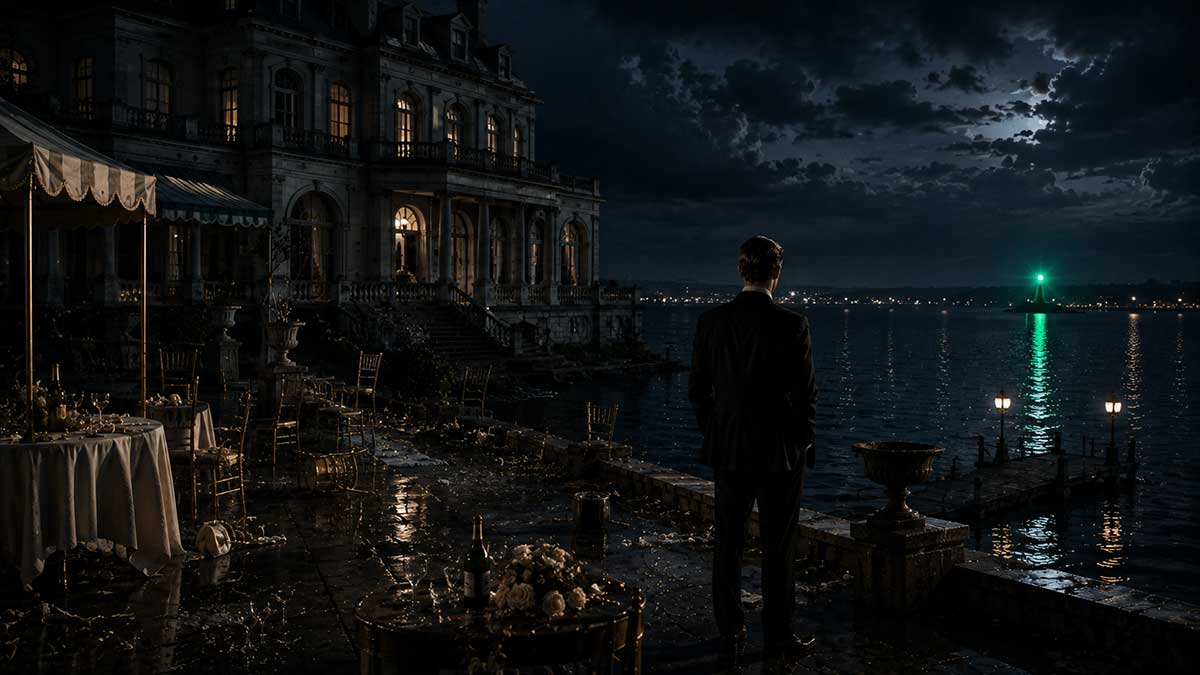
The green light still seemed to hover somewhere beyond them.
But after everything they had said, it no longer belonged only to Gatsby.
Myrtle had possessed her own green light.
George had too.
Perhaps Daisy had one.
Perhaps even Tom.
Each of them had wanted something.
Another person.
Another life.
Another identity.
Another chance.
Another version of the past.
Nick looked around the room.
Nick Carraway: We've spent a long time talking about dreams.
Myrtle Wilson: That's because Gatsby gets everybody talking about dreams.
Gatsby: Is that a criticism?
Myrtle: Not yet.
Nick: Maybe we've been asking the wrong question.
Gatsby: Which question?
Nick: Whether Gatsby's dream was beautiful.
Whether Myrtle's dream was possible.
Whether Daisy should have chosen Gatsby.
Whether people can reinvent themselves.
Whether the past can return.
Nick paused.
Nick: Maybe the final question is simpler.
Who paid for all of it?
Nobody answered.
George Wilson looked toward him.
George Wilson: Now we're getting somewhere.
Gatsby: Dreams don't kill people.
George looked at him.
George: No?
Gatsby: People make choices.
George: That's true.
Gatsby: Then blame the choices.
George: All right.
George turned toward Daisy.
George: You were driving.
The room changed instantly.
Daisy's face lost its color.
Daisy Buchanan: Yes.
George: Myrtle ran into the road.
Daisy: Yes.
George: You hit her.
Daisy swallowed.
Daisy: Yes.
Myrtle stared at Daisy.
There was no anger in her expression yet.
That made it worse.
George: Did you stop?
Daisy looked down.
Daisy: No.
George: Why?
Daisy: I panicked.
George: Why didn't you come back?
Daisy did not answer.
George: Why didn't you tell anyone?
Daisy: I was frightened.
George nodded slowly.
George: Everybody was frightened.
Daisy looked at him.
George: Myrtle was frightened.
I was frightened.
Gatsby was frightened.
Maybe even Tom was frightened.
His voice remained quiet.
George: But somehow your fear got to leave town.
Mine didn't.
Tom shifted forward.
Tom Buchanan: Daisy didn't mean to kill her.
George turned toward him.
George: Neither did the car.
Tom frowned.
George: Doesn't make Myrtle less dead.
Myrtle looked at George.
George: Intention matters.
I know that.
But there's something else that matters too.
What happened.
He looked at Daisy again.
George: You didn't mean to kill my wife.
But my wife died.
Daisy's eyes filled.
Daisy: I'm sorry.
George stared at her.
George: I know.
Daisy seemed surprised.
George: I believe you.
His voice softened.
George: That's what makes it hard.
Daisy looked at him.
George: If you were some monster, this would be easier.
If Gatsby were.
If Myrtle were.
If Tom were.
Tom gave him a look.
George ignored it.
George: Most people aren't monsters every minute of their lives.
They just make choices.
Then somebody else ends up living with them.
Myrtle finally spoke.
Myrtle: Did you know it was me?
Daisy looked at her.
Daisy: Not when it happened.
Myrtle: Did you know later?
Daisy: Yes.
Myrtle: What did you think?
Daisy's lips parted.
Nothing came.
Myrtle: That's what I want to know.
Not whether you were scared.
Not whether Gatsby told you he'd handle it.
When you found out the woman in the road was me...
She looked directly at Daisy.
Myrtle: What did you think?
Daisy's voice was barely audible.
Daisy: I thought everything was ruined.
Myrtle's expression changed.
Myrtle: Everything.
Daisy realized what she had said.
Daisy: No. I didn't mean...
Myrtle: You meant your life.
Daisy closed her eyes.
Myrtle: Your marriage.
Gatsby.
The scandal.
What Tom would do.
What people would say.
Daisy began crying.
Myrtle watched her.
Myrtle: Did you think about mine?
Daisy could not answer.
And Myrtle had her answer.
Gatsby leaned forward.
Gatsby: Leave her alone.
George turned toward him.
George: That's what you did, isn't it?
Gatsby: What?
George: Protected her.
Gatsby: Yes.
George: From me?
Gatsby: From what might happen.
George: You were going to say you were driving.
Gatsby: Yes.
George: Why?
Gatsby: Because I loved her.
George considered that.
George: There it is again.
Gatsby: What?
George: Love.
George looked around.
George: Seems like love excuses a lot in this room.
Gatsby's face hardened.
George: You loved Daisy, so you'd take the blame.
Myrtle loved Tom, so she betrayed me.
I loved Myrtle, so I...
His voice stopped.
Nobody moved.
George looked down at his hands.
George: So I killed you.
Gatsby looked at him.
The words were almost impossible to hear.
George: I killed you.
Gatsby stared at George.
Gatsby: You thought I killed Myrtle.
George: Yes.
Gatsby: You thought I was sleeping with her.
George: Yes.
Gatsby: Neither was true.
George: I know that now.
Gatsby: Tom told you the car was mine.
George looked toward Tom.
George: Yes.
Gatsby turned.
Gatsby: You sent him to me.
Tom: I told him the truth about the car.
Nick: You knew what condition he was in.
Tom: Gatsby owned the car.
Gatsby: Daisy was driving it.
Tom: I didn't know that.
Daisy looked sharply at him.
Daisy: Didn't you?
Tom hesitated.
That hesitation was enough.
Daisy: Tom.
Tom: I knew Gatsby was involved.
Nick: That's not the same thing.
Tom: He was involved in everything.
Nick: So you pointed a grieving man toward Gatsby.
Tom: Wilson deserved to know.
George stared at him.
George: Know what?
Tom turned.
George: You didn't tell me what happened.
You told me enough to make me go where you wanted me to go.
Tom: That's not true.
George: Then why didn't you come with me?
Tom said nothing.
George: Why didn't you call the police?
Silence.
George: Why didn't you tell me Daisy had been in the car?
Tom's face tightened.
George: You gave me a name.
Then you stepped away.
Nick watched Tom.
For years, Nick had remembered his final encounter with Tom.
He had remembered the disgust.
The refusal to shake his hand.
The realization that Tom and Daisy had retreated into their money.
Now Tom was sitting in front of the people who had not been able to retreat.
Nick: Tom, do you understand why I called you careless?
Tom: You thought you were morally superior to everybody.
Nick: Perhaps I did.
Tom: You were there too.
Nick: I know.
Tom: You helped Gatsby.
Nick: I know.
Tom: You watched Daisy and Gatsby meet.
Nick: Yes.
Tom: You went to the Plaza.
Nick: Yes.
Tom: You knew what was happening.
Nick: Yes.
Tom leaned back.
Tom: Then stop pretending you were outside it.
Nick nodded.
Nick: I'm not outside it anymore.
Tom seemed unprepared for that answer.
Nick: That's one of the things I've had to admit.
I liked watching Gatsby's dream.
I found it beautiful.
I helped him meet Daisy.
I watched the consequences gathering and told myself I was only observing.
Nick paused.
Nick: Perhaps observers make choices too.
Daisy looked at Nick.
Daisy: You wrote all of us into something.
Nick turned toward her.
Daisy: Gatsby became the great dreamer.
Tom became the brute.
I became careless.
Myrtle became desperate.
George became broken.
And you became the man who understood everything afterward.
Nick said nothing.
Daisy: Convenient.
Nick: Yes.
Daisy seemed surprised.
Nick: It was.
Daisy: Then why should we trust your version?
Nick thought for a long time.
Nick: You shouldn't completely.
Gatsby looked toward him.
Nick: I told the story as I understood it.
That doesn't mean I stood outside it.
Myrtle leaned forward.
Myrtle: Did you like Gatsby more than me?
Nick looked at her.
Nick: Yes.
Myrtle: Why?
Nick hesitated.
Nick: His hope moved me.
Myrtle: Mine didn't.
Nick: Not then.
Myrtle: Why?
Nick looked uncomfortable.
Myrtle: Because his mansion was prettier than my apartment?
Nick: Maybe partly.
Myrtle: Because he was a man?
Nick did not answer quickly enough.
Myrtle: Because his dream looked elegant?
Nick: Maybe all of that.
Myrtle nodded.
Myrtle: At least you can say it now.
Gatsby looked at Myrtle.
Gatsby: You keep comparing us.
Myrtle: Because nobody else did.
Gatsby: We weren't the same.
Myrtle: No.
She looked around.
Myrtle: You got farther.
Gatsby became quiet.
Myrtle: That's the difference everybody sees.
But I wonder if the deeper difference is that people liked the way you wanted.
Gatsby frowned.
Myrtle: You wanted beautifully.
The mansion.
The parties.
The green light.
Daisy.
It looked like poetry from far away.
She paused.
Myrtle: I wanted loudly.
Clothes.
Money.
Tom.
A better apartment.
I embarrassed people.
She looked at Nick.
Myrtle: Maybe that's why his wanting became tragedy and mine became vulgarity.
Nick lowered his eyes.
Myrtle: But we both looked at somebody from another class and thought:
If that person chooses me, maybe I become someone else.
She looked at Gatsby.
Myrtle: And both of us died before we learned whether that was true.
George turned toward Myrtle.
George: And what about me?
Myrtle's expression changed.
George: Where was I inside your dream?
Myrtle: George...
George: We keep talking about what Tom did to you.
What Daisy did.
What Gatsby wanted.
What rich people do.
George swallowed.
George: But you hurt me too.
Myrtle: I know.
George: Do you?
Myrtle: Yes.
George: You made me feel stupid.
Myrtle looked away.
George: Like I was too slow to understand my own life.
Like everybody else could see what my wife thought of me except me.
Myrtle: I'm sorry.
George: You wanted another life.
Maybe you had every right to.
His voice shook.
George: But I was still a person inside the life you were trying to escape.
Myrtle began crying.
George: That's what everybody keeps forgetting.
The people we leave behind don't disappear just because we're looking forward.
Gatsby absorbed those words.
Gatsby: Then what are you saying?
George looked at him.
George: Maybe dreams have neighbors.
Gatsby frowned.
George: Maybe that's the problem.
We talk about dreams like they're private.
My dream.
Your dream.
Myrtle's dream.
Daisy's dream.
But once you start chasing one, you move through other people's lives.
George looked around the room.
George: You can step on somebody.
Leave somebody.
Use somebody.
Ask somebody to become something they never agreed to become.
He paused.
George: Maybe you don't get to judge a dream only by how beautiful it looks to the person dreaming it.
Daisy wiped her eyes.
Daisy: Then mine was safety.
Everyone looked toward her.
Daisy: That's what I wanted.
Not some grand romance.
Not reinvention.
Safety.
Gatsby's expression changed.
Daisy: I chose Tom partly because he felt safe.
His money.
His family.
The certainty of it.
Then when everything collapsed, I chose safety again.
Gatsby: You chose him.
Daisy: Yes.
Gatsby: After everything.
Daisy: Yes.
Gatsby: And left me outside.
Daisy looked at him.
Daisy: Yes.
The honesty hurt more than an excuse.
Gatsby: Why?
Daisy struggled.
Daisy: Because going with you meant stepping into uncertainty.
Scandal.
Your businesses.
Leaving my marriage.
Taking my daughter.
Becoming somebody else.
And I was afraid.
Gatsby: So you let me wait outside your house.
Daisy closed her eyes.
Daisy: Yes.
Gatsby: You knew I was there.
Daisy: Yes.
Gatsby looked away.
Daisy: I failed you.
Gatsby looked back.
Daisy: I failed Myrtle too.
George stared at her.
Daisy: And then I left.
She looked toward Tom.
Daisy: We left.
Tom shifted.
Tom: What were we supposed to do? Stay and let everything destroy us?
Myrtle laughed through her tears.
Myrtle: There.
Tom looked at her.
Myrtle: That's the whole thing.
Tom: What?
Myrtle: You still think destruction is something that might have happened to you.
She pointed toward George.
Myrtle: Look at him.
Then Gatsby.
Myrtle: Look at him.
Then herself.
Myrtle: Look at me.
Her voice hardened.
Myrtle: It already happened.
You just weren't the one it happened to.
Nobody spoke.
Nick remembered the Buchanans' house.
The enormous rooms.
The lawn.
The breeze moving through curtains.
Everything light.
Everything protected.
Perhaps that was what money could purchase at its highest level.
Not happiness.
Not goodness.
Not love.
A buffer between action and consequence.
Nick: Gatsby, let me ask you the question George asked earlier.
Gatsby: Which one?
Nick: Was the dream worth what it cost?
Gatsby: No.
George looked at him.
Gatsby: Not if you mean Myrtle.
Not if you mean George.
Not if you mean my life.
George: That's not quite what I'm asking.
Gatsby: Then ask it.
George: When you were building it, did you ever think there might be a cost to somebody besides you?
Gatsby went quiet.
George: You thought you were risking yourself.
Your money.
Your reputation.
Your heart.
Gatsby: Yes.
George: Maybe that's how most people think about dreams.
He leaned forward.
George: We ask:
What am I willing to sacrifice?
George shook his head.
George: Maybe we should ask:
Who else am I asking to sacrifice something?
Gatsby stared at him.
Myrtle looked toward Tom.
Myrtle: I should have asked that.
George looked at her.
Myrtle: I thought I was risking myself.
My marriage.
My reputation.
I didn't think enough about what I was doing to George.
George: No.
Myrtle: I know.
She looked at him.
Myrtle: I'm sorry.
George nodded.
He did not forgive her.
He did not reject her apology.
It simply remained there.
Daisy spoke next.
Daisy: I should have asked it too.
Gatsby looked at her.
Daisy: I wanted to feel alive again.
I wanted you.
I wanted the feeling of being young.
I wanted to know that another life had been possible.
She paused.
Daisy: I didn't think enough about what would happen when those wants collided with the life I already had.
Tom stared at her.
Daisy: And when everything broke, I protected myself.
She looked at Gatsby.
Daisy: You paid for that.
Then Myrtle.
Daisy: So did you.
Then George.
Daisy: So did you.
Tom looked irritated.
Tom: This is turning into confession.
Nick: Maybe you should try it.
Tom: I don't owe you anything.
George: Maybe not him.
Tom looked toward George.
George: How about me?
Tom's expression changed.
George: You knew I was broken.
Tom: Your wife had been killed.
George: You knew I wasn't thinking straight.
Tom: I told you Gatsby owned the car.
George: Why?
Tom: Because he did.
George: Why did you want me to know?
Tom had no answer.
George waited.
George: Were you protecting Daisy?
Tom looked toward his wife.
George: Were you protecting yourself?
Still nothing.
George: Or did you know what I might do?
Tom: I didn't know.
George nodded.
George: Maybe.
Then he said quietly:
George: But you didn't mind finding out.
Tom looked away.
Gatsby watched Tom.
For years Gatsby had imagined Tom as the man standing between himself and Daisy.
Now Tom seemed smaller.
Not harmless.
Smaller.
Gatsby had spent years trying to defeat him.
Perhaps the true power of Tom Buchanan had never been that he was stronger than Gatsby.
It was that Tom could cause damage and remain standing afterward.
Gatsby: You won.
Tom looked toward him.
Tom: What?
Gatsby: Isn't that what you wanted?
Daisy stayed.
I died.
Your house remained.
Your money remained.
Your family name remained.
You walked away.
Gatsby looked at him.
Gatsby: You won.
Tom said nothing.
Gatsby: Does it feel like winning?
For the first time, Tom's certainty weakened.
Only slightly.
But enough.
Nick looked toward Gatsby.
Nick: Maybe that's why I preferred you.
Gatsby turned.
Nick: Not because you were innocent.
You weren't.
Not because everything you did was admirable.
It wasn't.
Not because your dream was wise.
It wasn't always.
Gatsby listened.
Nick: I preferred you because you still believed something mattered.
Tom scoffed.
Nick ignored him.
Nick: You believed a life could be built.
That a person could become more.
That tomorrow might contain something extraordinary.
Gatsby looked toward the imaginary green light.
Nick: You were wrong about many things.
But I could never despise the part of you that kept reaching.
Daisy: That's what you forgive him for.
Nick looked at her.
Daisy: Hope.
Nick: Maybe.
Daisy: And what do you forgive me for?
Nick stopped.
Daisy smiled sadly.
Daisy: Exactly.
Nick: Daisy...
Daisy: No.
It's fair.
You gave Gatsby's flaws a beautiful explanation.
You didn't always give mine one.
Nick absorbed that.
Nick: You're right.
Daisy seemed surprised.
Nick: But understanding why you were afraid doesn't erase what you did.
Daisy: I know.
Nick: Just as understanding Gatsby's hope doesn't erase what he did.
Daisy: Then perhaps that's fair.
Myrtle looked around the room.
Myrtle: Maybe nobody here needs to be turned into a villain.
Tom raised an eyebrow.
Myrtle: Don't look so relieved.
Nick smiled despite himself.
Myrtle: Maybe that's too easy anyway.
She looked toward George.
Myrtle: I hurt him.
Tom hurt me.
Daisy killed me.
Gatsby protected Daisy.
George killed Gatsby.
George closed his eyes.
Myrtle continued.
Myrtle: Tom helped send George toward Gatsby.
Daisy left.
Nick watched.
Nick winced.
Myrtle: Everybody touched somebody else's life.
She paused.
Myrtle: That's what makes it terrible.
George looked toward Gatsby.
George: I owe you something.
Gatsby waited.
George: I was wrong.
Gatsby: About what?
George: You.
Gatsby said nothing.
George: I thought you killed her.
I thought you were the man she was seeing.
I thought...
His voice weakened.
George: I wanted somebody to blame badly enough that I stopped asking whether I knew the truth.
Gatsby looked at him.
George: I'm sorry.
Gatsby did not answer immediately.
Then:
Gatsby: I understand.
George looked surprised.
Gatsby: I spent five years wanting something badly enough that I stopped asking what was true too.
Their eyes met.
For the first time, neither man stood above the other.
The room became quiet again.
Nick thought of Gatsby's mansion.
The orchestra.
Champagne.
Cars arriving.
Women laughing.
Men wandering through rooms belonging to someone they barely knew.
Hundreds of people.
Then the funeral.
Rain.
A few figures.
Empty space.
Nick: Gatsby.
Gatsby: Yes?
Nick: Do you know what I remember most clearly now?
Gatsby: What?
Nick: Your funeral.
Gatsby looked away.
Nick: I called people.
I tried to get them to come.
Men who had eaten your food.
Drunk your liquor.
Used your house.
People who spent entire evenings inventing stories about you.
Almost nobody came.
Gatsby's expression remained still.
Nick: You spent years making yourself visible.
Yet almost nobody knew you.
Myrtle: That's worse than being poor.
Gatsby looked at her.
Myrtle: I mean it.
At least George knew me.
George looked toward her.
Myrtle: Not perfectly.
But he knew when I was angry.
Knew what food I hated.
Knew when I was lying about being tired.
Knew what I looked like without nice clothes.
Her voice softened.
Myrtle: Maybe being known isn't glamorous.
Gatsby looked toward Daisy.
Myrtle: But maybe it's worth more than being watched.
Daisy: Did I know you, Jay?
Gatsby looked at her.
Neither seemed certain.
Daisy: I knew the young man.
Gatsby: And afterward?
Daisy hesitated.
Daisy: I knew what you wanted me to see.
Gatsby looked down.
Daisy: I'm sorry.
Gatsby: So am I.
Daisy: For what?
Gatsby thought.
Gatsby: For making you carry so much of it.
Daisy's eyes filled.
Daisy: The dream?
Gatsby: Yes.
He paused.
Gatsby: You were supposed to prove everything.
That I had become somebody.
That the years hadn't been wasted.
That I could cross the distance.
That what happened before could be repaired.
He looked at her.
Gatsby: That's too much to put on one person.
Daisy said nothing.
She simply nodded.
George looked toward Nick.
George: So what was the green light really?
Nick thought about it.
Nick: Daisy.
George: Only Daisy?
Nick: No.
Gatsby listened.
Nick: Tomorrow.
The life that hasn't happened yet.
The thing we believe will finally make everything before it make sense.
Myrtle nodded.
Myrtle: Everybody's got one, then.
Nick: Probably.
Myrtle: Even Tom?
Everyone looked toward him.
Tom appeared annoyed.
Daisy: Tom's green light is making sure nothing changes.
That silenced him.
Nick considered it.
Perhaps Daisy was right.
Gatsby dreamed of transformation.
Tom dreamed of preservation.
One reached endlessly forward.
The other built walls around what he already possessed.
Both dreams could hurt people.
George: Then maybe the light isn't the problem.
Nick looked toward him.
George: Maybe it's forgetting there's people between you and it.
Gatsby's eyes moved toward George.
George continued.
George: You look at something far away long enough, everything in between starts disappearing.
The people.
The choices.
What it costs.
He paused.
George: All you see is the light.
Gatsby stared toward the imagined bay.
For years he had believed greatness meant refusing to stop reaching.
Perhaps some part of him still believed it.
Perhaps Nick did too.
Hope itself was not the enemy.
Neither was ambition.
Neither was wanting another life.
The danger came when the dream became so bright that everyone standing between the dreamer and the light became difficult to see.
Nick: Gatsby, if you could do it again, would you still reach for the green light?
Everyone waited.
Gatsby thought for a long time.
Gatsby: Yes.
Daisy closed her eyes.
Then Gatsby continued.
Gatsby: But maybe I would look around first.
Daisy opened her eyes.
George watched him.
Myrtle smiled faintly.
Nick: At what?
Gatsby looked at all of them.
Gatsby: Who was standing beside me.
Nobody spoke for a while.
Then Daisy looked at Gatsby.
Daisy: And if the light led somewhere different from where you expected?
Gatsby considered the question.
Earlier, he would have known the answer.
He would have bent reality until it matched the dream.
Now he wasn't certain.
Gatsby: Maybe I'd have to let it.
Daisy nodded.
Nick looked around the room one final time.
Gatsby had wanted Daisy.
Daisy had wanted safety.
Myrtle had wanted escape.
George had wanted a life with Myrtle.
Tom had wanted possession without restriction.
Nick had wanted to believe he could observe everything without becoming responsible for any of it.
Each had possessed a dream.
Each had entered somebody else's life while pursuing it.
Some had paid with disappointment.
Some with loneliness.
Some with guilt.
Three of them had paid with their lives.
And two people with the greatest protection had simply left.
Perhaps that was the final lesson hidden beneath Gatsby's beautiful green light.
Dreams matter.
Hope matters.
The desire to become something more matters.
But no dream exists alone.
Every dream enters a world already filled with other people.
Gatsby looked toward Daisy.
Not the Daisy from Louisville.
Not the Daisy at the end of the dock.
Not the Daisy he had carried through five years of longing.
The woman sitting before him.
Flawed.
Frightened.
Responsible for terrible choices.
Still human.
For once, Gatsby did not ask her to become anything else.
Daisy looked back at him.
Then Myrtle spoke.
Myrtle: So was it worth it?
Gatsby turned.
Gatsby: What?
Myrtle: All of it.
Gatsby looked again toward the green light.
Gatsby: I don't know.
Myrtle nodded.
Myrtle: That's probably the first answer I believe completely.
George looked toward the distant light.
George: Maybe that's not the question anyway.
Nick: What is?
George thought for a moment.
Then he said:
George: Before you start running toward something you want...
He looked around the room.
At Myrtle.
At Gatsby.
At Daisy.
At Tom.
At Nick.
George: Maybe you ought to ask who might get run over on the way.
Nobody answered.
They didn't need to.
Far across the water, the green light remained.
Still beautiful.
Still distant.
Still worth looking toward.
But no longer innocent.
Final Thoughts
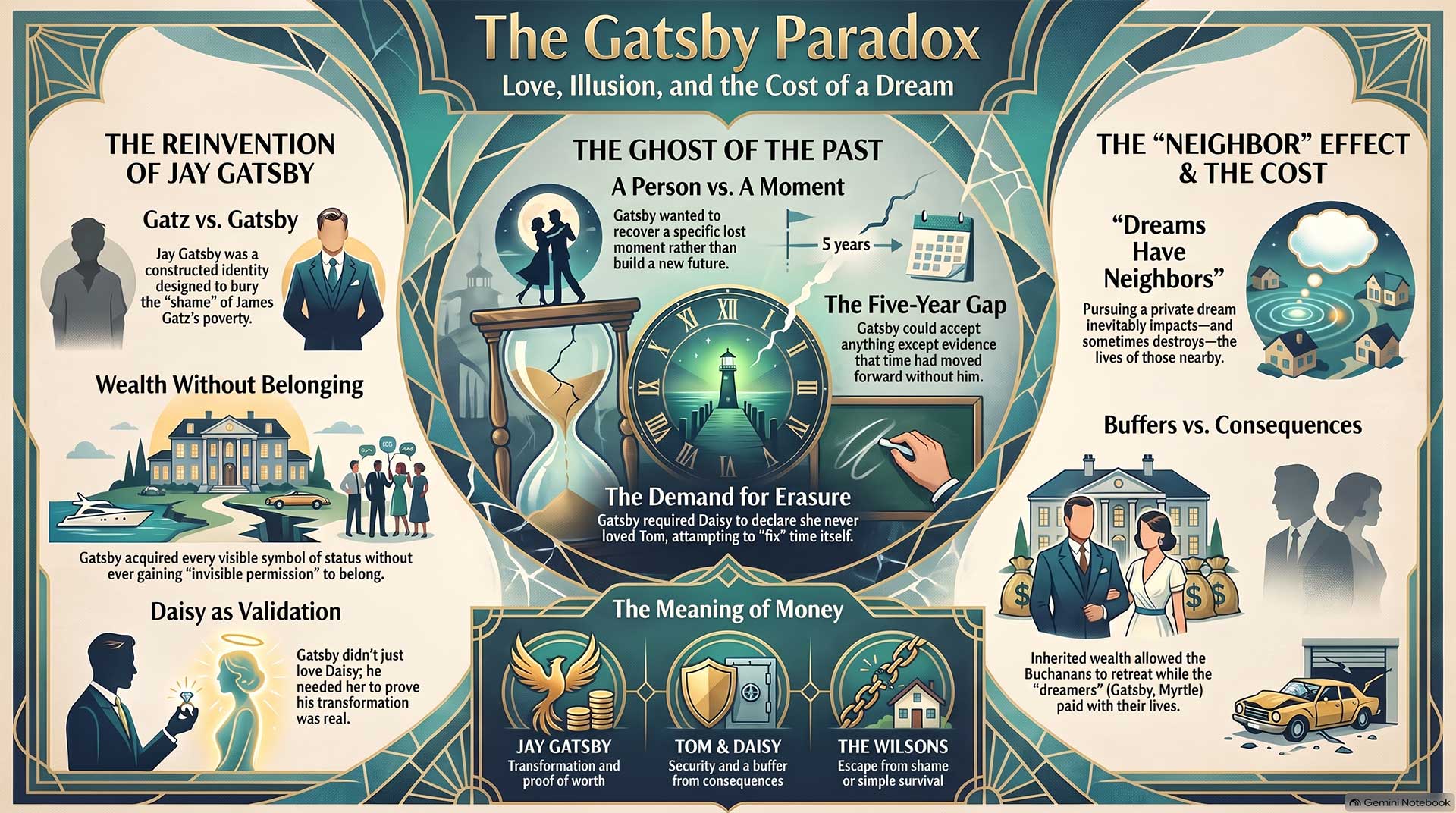
At the beginning of this conversation, Gatsby's tragedy seems easy to describe.
He loves Daisy.
She chooses Tom.
Gatsby dies.
But after hearing Gatsby, Daisy, Nick, Tom, Myrtle, and George confront one another, that explanation becomes far too small.
Gatsby's deepest tragedy may not be that Daisy rejects him.
It may be that he asks Daisy to perform a task no human being can perform.
She must become proof that his transformation succeeded.
Proof that poverty was defeated.
Proof that the parties and mansion mattered.
Proof that time did not really win.
Proof that the young James Gatz was right to believe a magnificent future waited for him.
And finally, proof that five years could be undone.
Daisy cannot do that.
Nobody could.
This does not make Gatsby's love false.
One of the more moving discoveries in the conversation is that genuine love and idealization can exist at the same time.
Gatsby can truly love Daisy while still turning her into something larger than a person.
Daisy can truly have loved Gatsby while still loving Tom at another point in her life.
George can truly love Myrtle while failing to fully see how trapped she feels.
Myrtle can desperately want another life while still causing terrible pain to George.
Human feelings do not become unreal merely because they contradict one another.
Gatsby has great difficulty accepting that.
His dream requires clarity.
Real people bring ambiguity.
Perhaps this is why the green light is easier for him than Daisy.
The green light never contradicts him.
It never changes its mind.
It never has a daughter.
It never remembers the past differently.
It never says, "I don't know."
Daisy does.
That makes her human.
The conversation also changes the meaning of Gatsby's famous reinvention.
James Gatz becoming Jay Gatsby is not necessarily fraudulent.
There is something admirable in Gatsby's refusal to let poverty define the limits of his life.
He possesses imagination, discipline, audacity, and an extraordinary capacity for hope.
The problem is not that he became Gatsby.
The problem may be that Gatsby never learned to believe his new identity was real without external confirmation.
He still needs Daisy to validate it.
George eventually asks the devastating question:
If becoming Gatsby truly succeeded, why did Daisy have to prove it?
That question reaches far beyond this novel.
How much of what we chase is really about the thing itself?
And how much is an attempt to finally feel worthy?
Money.
Recognition.
A relationship.
A title.
A house.
A certain kind of success.
Sometimes the achievement arrives and another requirement immediately appears.
Then another.
And another.
The place called "enough" keeps moving.
This is where The Great Gatsby becomes unexpectedly modern.
Gatsby has enormous attention.
People fill his home.
They consume his hospitality.
They gossip about him.
They want proximity to him.
Yet when he dies, almost nobody comes.
Gatsby was widely seen and barely known.
That may be one of the saddest contrasts in the entire novel.
Myrtle's observation in our fictional discussion turns that contrast around.
She had far less than Gatsby.
Yet George knew ordinary things about her.
Her moods.
Her habits.
The version of her that existed without performance.
There may be more intimacy in being imperfectly known than in being spectacularly watched.
The class discussion adds another layer.
Gatsby and Myrtle both try to rise.
Tom does not need to rise.
Daisy does not need to rise.
The people with inherited privilege can decide which kinds of ambition seem respectable and which do not.
Gatsby learns that wealth can purchase access without purchasing belonging.
Myrtle learns that intimacy with a wealthy man does not make her part of his world.
George barely has the luxury of turning money into identity at all.
Yet the novel does not simply argue that rich people are bad and poor people are good.
George commits the final murder.
Myrtle betrays her husband.
Gatsby builds his fortune through questionable means.
Nick participates while often imagining himself above the moral disorder.
Daisy makes catastrophic choices.
Tom behaves with cruelty and hypocrisy.
Everyone must eventually confront some form of responsibility.
Still, the consequences do not fall equally.
That matters.
Tom and Daisy possess the means to retreat.
Others do not.
Their wealth cannot prevent moral failure.
It can help prevent moral failure from destroying their own lives.
That may be one of Fitzgerald's darkest observations.
Yet I would not end this Imaginary Talk by treating the green light as a warning against dreaming.
That would betray something important about Gatsby.
Nick admires him for a reason.
Gatsby still believes life might hold something extraordinary.
He still reaches.
There is dignity in that impulse.
The challenge is learning how to reach without turning another person into the destination of our entire existence.
How to hope without demanding that reality reproduce our fantasy.
How to reinvent ourselves without hating the person we used to be.
How to remember without requiring the past to return.
How to pursue a better life without overlooking the lives our pursuit touches.
By the end of our conversation, Gatsby is asked whether he would still reach toward the green light if he could begin again.
He says yes.
I think that answer matters.
But then he adds something he never seemed to understand during his life:
Before reaching, perhaps he would look around and notice who was standing beside him.
That may be the version of Gatsby's dream worth preserving.
Not the belief that the past can be conquered.
Not the belief that another person can make us complete.
Not the belief that success will finally force the world to declare us worthy.
Something simpler.
The willingness to believe tomorrow can still contain meaning, without requiring tomorrow to repair yesterday.
Perhaps Gatsby did not need to stop dreaming.
Perhaps he needed a different relationship with the dream.
And perhaps the green light was never telling him to return to Daisy at all.
Perhaps it was asking him to do the one thing he could never quite bring himself to do:
Go somewhere he had never been before.
Short Bios:
Jay Gatsby
Born James Gatz to poor farmers in North Dakota, Gatsby rejects the circumstances of his birth and constructs a new identity. After falling in love with Daisy before leaving for World War I, he spends years building wealth and status in hopes of reuniting with her. His mansion, parties, and life in West Egg are closely connected to that dream. Gatsby embodies extraordinary hope, self-creation, idealization, and the dangerous desire to make the past return.
Daisy Buchanan
Daisy is Gatsby's former love, Nick Carraway's cousin, Tom Buchanan's wife, and the mother of a young daughter. Beautiful, charming, wealthy, and emotionally conflicted, she becomes much more than a romantic figure in Gatsby's imagination. Daisy represents love, security, social status, memory, and the limits reality places on Gatsby's dream. Her choices carry grave moral consequences, yet she is also burdened by Gatsby's demand that she erase the complexity of her own past.
Nick Carraway
Nick is the narrator of The Great Gatsby and Gatsby's neighbor in West Egg. A Midwesterner who moves East to work in the bond business, Nick becomes fascinated by Gatsby and eventually helps reunite him with Daisy. Although Nick presents himself as someone reluctant to judge others, his account contains strong moral judgments. His admiration for Gatsby's capacity for hope shapes how readers see nearly every character.
Tom Buchanan
Tom is Daisy's extremely wealthy husband, born into inherited privilege. Physically imposing, unfaithful, racist, controlling, and often cruel, he represents the security and authority of old money. Tom recognizes that Gatsby can acquire wealth without easily gaining the social legitimacy Tom inherited. His ability to cause harm and then retreat from its consequences makes him central to the novel's examination of privilege.
Myrtle Wilson
Myrtle is George Wilson's wife and Tom Buchanan's mistress. Living above a garage in the Valley of Ashes, she desperately wants to escape poverty and gain access to the wealthier world represented by Tom. Her longing parallels Gatsby's more closely than is often acknowledged. Both seek transformation, connect another person with a different life, and collide with class boundaries they cannot fully cross.
George Wilson
George owns a struggling garage in the Valley of Ashes and is Myrtle's husband. Exhausted, economically vulnerable, and increasingly devastated by the collapse of his marriage, George occupies a social world far removed from Gatsby's mansion and the Buchanans' East Egg home. After Myrtle's death, grief and misinformation lead him to kill Gatsby before taking his own life. In our imagined conversation, George becomes the character who repeatedly asks what other people's dreams cost those standing nearby.
Leave a Reply