
A Modern Story Inspired by The Sound and the Fury
Every family has a story they tell the world.
Then there is the story they tell themselves.
And somewhere between those two stories...
is the truth.
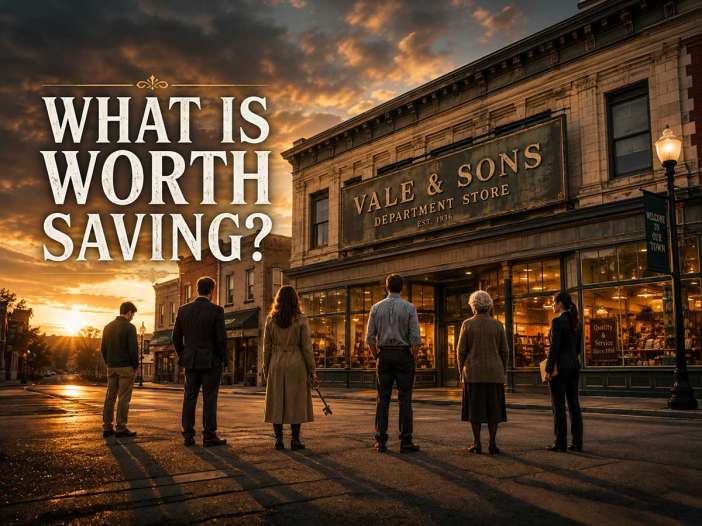
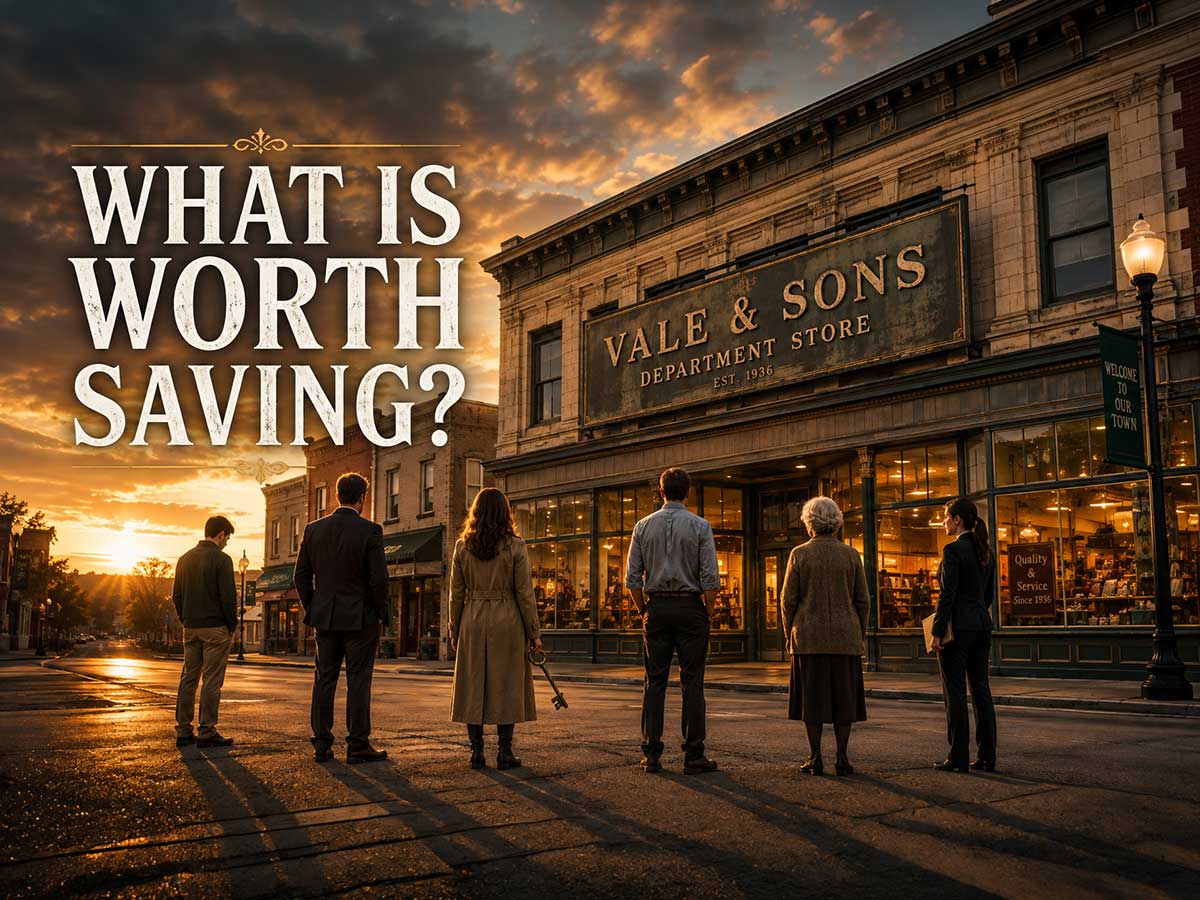
For nearly ninety years, Vale & Sons stood at the center of a small Midwestern town. Children bought their first school shoes there. Couples opened wedding registries there. Grandparents gathered for coffee at the lunch counter every Saturday morning. The building became more than a department store. It became part of people's lives.
Then, slowly, everything began to disappear.
Customers.
Employees.
Hope.
Finally, even the founder.
Now the remaining family has just seventy-two hours to decide whether the business should be saved, sold, or allowed to end.
Yet the real question isn't what will happen to the building.
It is what will happen to the people who have spent their entire lives protecting it.
One brother cannot let go of the past.
Another has sacrificed everything and grown bitter in the process.
A sister returns after eighteen years carrying a truth no one wanted to hear.
A quiet man remembers what everyone else has forgotten.
A lifelong employee has reached the moment when loyalty and honesty can no longer walk together.
And an outsider, sent to close a bankrupt company, discovers she has stepped into a family history far more complicated than any financial report could explain.
This story was inspired by the enduring questions raised in William Faulkner's The Sound and the Fury.
What happens when memory becomes heavier than love?
Can a family survive after the truth finally arrives?
Is preserving an institution the same as preserving the people who built it?
Most of all...
What is truly worth saving?
This is not a retelling of Faulkner's novel.
It is a new story carrying the same heartbeat into our own time.
Because families still misunderstand one another.
People still mistake silence for peace.
And every generation eventually discovers that healing rarely comes from returning to the past.
It comes from finally seeing it clearly.
Welcome to The Last Store on Main Street.
(Note: This is an imaginary conversation, a creative exploration of an idea, and not a real speech or event.)
Chapter 1 — The Doors Open One Last Time
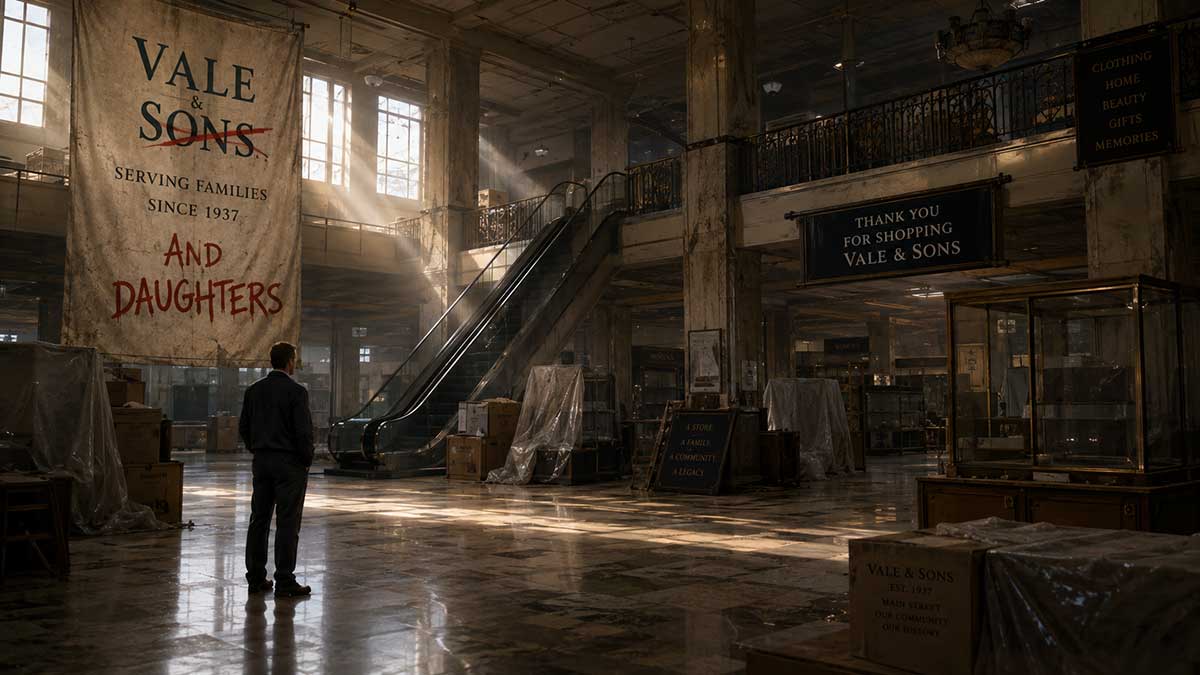
The old clock above the center atrium read 7:58 a.m.
It had been running two minutes slow for nearly fifteen years.
No one had ever bothered to fix it.
Eli Vale preferred it that way.
He stood just inside the front entrance, one hand resting against the cool brass handle, watching the empty parking lot through the tall glass doors. Every morning for more than twenty years, he had unlocked these doors at exactly eight o'clock. His father used to joke that customers trusted Eli more than the town's church bells.
Today there would be no customers.
The parking lot was almost empty.
Only a faded blue pickup, a black SUV, and a silver sedan interrupted the rows of cracked asphalt where hundreds of cars had once filled every space during Christmas shopping.
The automatic doors no longer opened.
Marcus had disconnected them after the electricity bill became impossible to justify.
Eli reached into his pocket and rubbed a small brass button he had carried since childhood.
Department 14.
Children's Shoes.
The numbers had long since worn smooth beneath his thumb.
He closed his eyes.
Floor wax.
Fresh leather.
Butter popcorn drifting from the snack counter.
Coffee brewing upstairs.
Someone laughing near cosmetics.
A little girl crying because her new shoes felt strange.
That was how the store was supposed to smell.
Now...
Cardboard.
Dust.
Old carpet.
The faint odor of rain leaking through a damaged section of the roof.
The building sounded wrong, too.
No escalators humming.
No shopping carts rattling.
No conversations rising toward the skylight.
Silence had its own sound.
Eli noticed every missing piece.
Behind him, footsteps echoed across the marble floor.
Marcus.
Without turning, Eli knew it was his older brother.
Left shoe first.
Always slightly heavier than the right.
Keys clipped to his belt.
Coffee in a paper cup.
No sugar.
Marcus stopped beside him.
"You've been here since six again."
Eli nodded.
"The lights in housewares are flickering."
"I know."
"The clock is still slow."
"I know."
"The roof drips near linens."
Marcus sighed.
"I know that too."
Neither spoke for several seconds.
Marcus looked across the empty sales floor.
Shelves stood half-empty.
Clearance signs hung crookedly.
Plastic covered the jewelry cases.
The grand piano that had welcomed shoppers for decades sat beneath a white sheet like a forgotten ghost.
He remembered Saturdays when children ran between displays while parents browsed winter coats. Christmas choirs had sung beneath the skylight. His father had shaken hands until closing time.
Now the echoes belonged only to memory.
Marcus finally spoke.
"Big day."
Eli looked toward the executive offices.
"Everyone comes."
"Yeah."
Marcus took another sip of coffee.
"Everyone."
At precisely eight o'clock, someone knocked on the locked glass doors.
A woman stood outside holding a leather portfolio and a slim laptop case.
Professional.
Calm.
Early thirties.
Dark blue suit.
Practical shoes.
Marcus unlocked the door.
"You must be Ms. Chen."
"Maya is fine."
She stepped inside and paused.
Not out of sentimentality.
Out of habit.
Every restructuring consultant learned to study a building before reading its balance sheet.
Buildings told stories that spreadsheets could not.
She noticed worn marble where thousands of customers had entered.
Handrails polished smooth by generations of hands.
A faded banner hanging from the balcony.
VALE & SONS
SERVING FAMILIES SINCE 1937
One word had been crossed out years ago with red spray paint.
SONS
Someone had written beside it in uneven letters.
AND DAUGHTERS.
No one had cleaned it off.
Maya looked up.
"Beautiful building."
Marcus gave a short laugh.
"Beautiful buildings can go bankrupt."
She smiled politely.
"I've learned that."
He led her toward the executive offices.
"Here's the short version."
He spoke without slowing.
"Six-point-eight million secured debt."
"Three million unsecured."
"Two lawsuits."
"Underfunded pensions."
"Three days before foreclosure proceedings begin."
"One surviving flagship location."
"Twenty-nine employees left."
"And a family that can't agree what day it is."
Maya made a note.
"You left out inventory."
Marcus almost smiled.
"You're going to fit in just fine."
A few minutes later, another car pulled into the lot.
A silver hybrid.
Daniel Vale stepped out carrying a long wrapped package.
He stood for a moment staring at the building.
The faded brick.
The old clock tower.
The enormous display windows now covered from the inside with brown paper.
He whispered almost to himself,
"They never repainted the west wall."
Marcus heard him.
"No."
"They should have."
"With what money?"
Daniel didn't answer.
Inside the wrapping was an old framed photograph.
Christmas.
Thousands of people lined Main Street.
Horse-drawn carriages.
Children waving.
Samuel Vale standing proudly beneath the store's lights.
Daniel carefully carried it inside like a museum curator transporting a masterpiece.
He stopped beneath the same balcony where the faded banner still hung.
"It used to matter," he said softly.
Marcus didn't look up from his paperwork.
"It mattered until Amazon learned how to ship socks."
Daniel frowned.
"That's not fair."
"No?"
"This place built this town."
Marcus looked directly at him.
"And nostalgia doesn't pay the electric bill."
Just before nine, Ruth Bell arrived carrying two large paper bags.
The smell reached Eli before she did.
Fresh biscuits.
Country ham.
Coffee.
Apple butter.
She had brought breakfast for decades.
Today was no exception.
She set the bags on the old customer service counter.
"If we're going to argue all day," she announced, "we might as well eat first."
Marcus kissed her cheek.
Daniel smiled genuinely for the first time that morning.
Eli immediately reached for one biscuit.
She handed him two.
"You've gotten thinner."
Marcus laughed.
"He says that every week."
"No," Ruth replied.
"I say you've gotten thinner every week."
She looked around the empty sales floor.
Her eyes lingered on the lunch counter where she'd started working at sixteen.
The stools were gone.
The coffee machines removed.
The grill dismantled.
She whispered,
"I still expect someone to ask for cherry pie."
No one answered.
At ten o'clock, the family attorney unfolded Samuel Vale's final will.
His voice echoed strangely through the vacant store.
"Before any sale, liquidation, restructuring, or transfer of ownership..."
He paused.
"...all four surviving children of Samuel Edward Vale must be physically present."
Marcus shifted impatiently.
Daniel folded his arms.
Eli stared at the floor.
"...and must hear together the complete financial accounting of Vale & Sons."
The attorney looked toward the entrance.
"We are waiting for one."
Almost on cue...
A car door closed outside.
Eli stood before anyone else moved.
His breathing changed.
He tilted his head slightly.
Not toward the parking lot.
Toward the air itself.
Marcus noticed.
"What is it?"
Eli whispered only one word.
"Cinnamon."
The front doors opened.
A woman stepped inside wearing a charcoal coat and carrying a single overnight bag.
She looked older.
More confident.
Yet somehow exactly the same.
Clara Vale stopped just inside the entrance.
No one moved.
Eighteen years of silence filled the space between them.
Daniel looked away first.
Marcus's jaw tightened.
Ruth's eyes glistened, though her expression remained guarded.
Only Eli walked forward.
Slowly.
Carefully.
He stood before his sister.
For several long seconds, he simply looked at her.
Then he smiled.
"The soap," he said quietly.
Clara's eyes immediately filled with tears.
"You remember."
Eli nodded.
"Cinnamon."
She laughed through the tears.
"I haven't worn that in years."
"You did today."
She looked down, almost surprised.
"I bought it yesterday."
Without another word, Eli reached toward the silver chain around her neck.
Hanging from it was a small brass key.
His fingers stopped just short of touching it.
His face changed.
He whispered four words that froze Clara where she stood.
"Office door."
A pause.
"Thursday night."
The color drained from her face.
Across the room, Marcus stiffened.
Ruth slowly lowered the coffee pot she had been holding.
Daniel frowned, confused.
Maya looked from one face to another.
No one spoke.
Some memories, it seemed, had been waiting eighteen years for the right person to walk back through the front door.
Chapter 2 — Four Versions of Clara
The first argument did not begin in the conference room.
It began in silence.
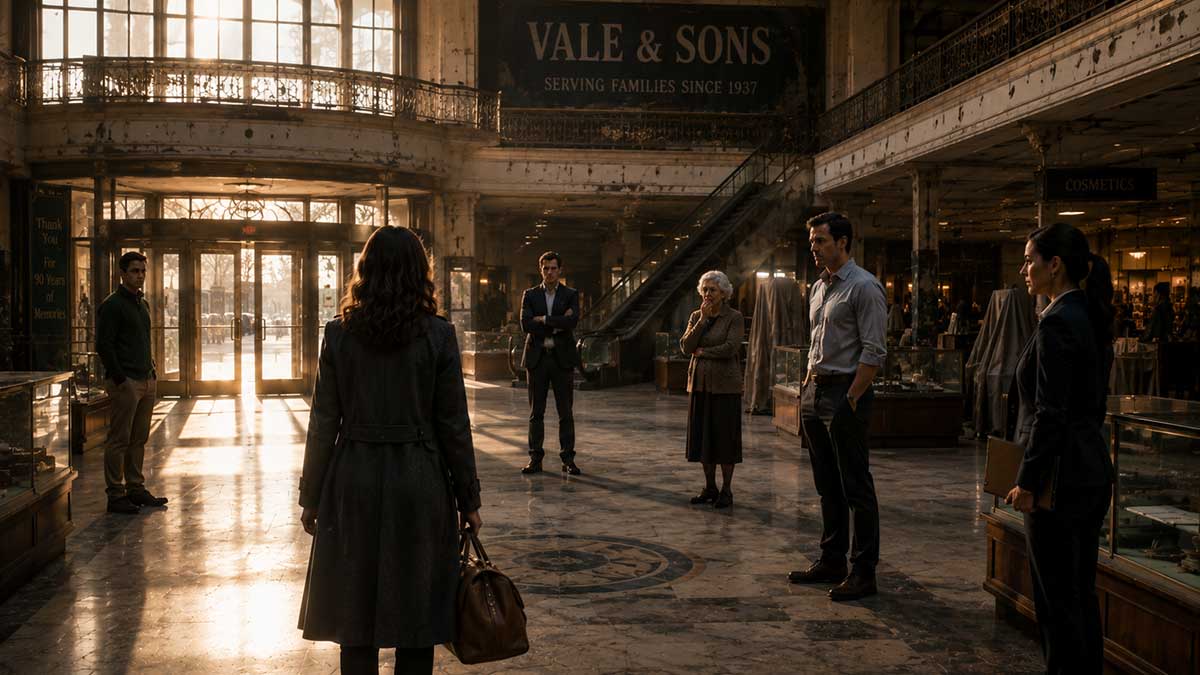
The family spread through the empty department store almost instinctively, each drifting toward the place that had once belonged to them.
Maya noticed it before anyone else.
No one had planned it.
No one had suggested it.
Yet every person had walked toward a different memory.
Almost as though the building itself had assigned them their roles.
She opened her notebook.
"Buildings preserve habits longer than families do."
Eli wandered toward Children's Shoes.
The shelves were bare except for a single display shoe that someone had forgotten to remove.
A tiny red sneaker.
Size four.
He sat on the old fitting bench.
His hand rested where Clara used to kneel.
She had always tied his shoes herself.
Not because he couldn't.
Because she knew he hated uneven knots.
One loop.
Pull.
Second loop.
Double knot on the left.
Always.
Clara quietly sat beside him.
Neither looked at the other.
"You still remember."
Eli nodded.
"You always tied the left one twice."
She smiled.
"You hated when they came loose."
"No."
He looked at her.
"I hated when you left."
The words landed softly.
More painful because they carried no accusation.
Only fact.
Clara looked away.
"I know."
After several moments Eli asked,
"Are you staying?"
She wanted to say yes.
Instead she answered honestly.
"I don't know."
He nodded as though uncertainty made perfect sense.
Across the store...
Daniel stood in the Bridal Department.
Dust covered the mirrors.
One mannequin still wore an ivory wedding dress yellowed with age.
He remembered bringing Clara here after high school graduation.
Their father had joked that one day he'd pay for the biggest wedding Main Street had ever seen.
Daniel laughed softly at the memory.
Clara entered behind him.
"I wondered where I'd find you."
He didn't turn.
"You always liked this floor."
"So did you."
He finally faced her.
"You know what people still remember?"
She waited.
"The newspapers."
"The investigation."
"The rumors."
"The family became a joke."
Clara remained calm.
"You really believe that's where everything started?"
"You took company money."
"I did."
"You disappeared."
"I did."
"You embarrassed Dad."
Clara walked closer.
"How many closing shifts did you work that year?"
Daniel blinked.
"What?"
"How many?"
"I was already teaching."
"Exactly."
"You left before anything happened."
"I left for my career."
"No."
She shook her head gently.
"You left before the weight arrived."
Daniel's face hardened.
"That's unfair."
"So was becoming the family historian after you stopped living its history."
Neither spoke again.
The silence hurt more than the argument.
Marcus remained inside the executive office.
He had spread financial reports across the conference table.
Loan documents.
Payroll records.
Property valuations.
Maya joined him carrying inventory files.
She looked around the room.
Family photographs lined one wall.
Every award Samuel Vale had ever received still hung neatly framed.
Community Leader of the Year.
Small Business Excellence Award.
Citizen of the Decade.
Marcus noticed her looking.
"He liked trophies."
"You didn't take them down."
"I've been busy trying to keep the roof from collapsing."
A knock.
Without waiting for permission, Clara opened the door.
Marcus didn't stand.
"You need something?"
"I'd like to look around."
"You already are."
"I mean this office."
"No."
She waited.
Marcus looked directly at her.
"You lost that privilege."
"I lost a privilege?"
"You took two hundred forty thousand dollars."
"I protected it."
"You stole it."
"I moved it."
"The bank didn't care what verb you used."
Clara looked toward the old mahogany desk.
"Dad still kept everything exactly the same."
Marcus answered quietly.
"No."
"He kept everything exactly the way he wanted people to remember it."
Clara took one step toward the desk.
Marcus stood immediately.
"Don't."
She met his eyes.
"You still tell the story that way."
Marcus didn't blink.
"There is only one way to tell a bank statement."
She studied him.
There was exhaustion beneath his anger.
More than exhaustion.
Loneliness.
She whispered,
"You've been carrying this by yourself."
Marcus looked away.
"You forfeited the right to notice."
Near the center of the first floor...
The old lunch counter remained.
Most of the stools had been sold.
The chrome edges had dulled.
The menu board still listed coffee at ninety-five cents.
Ruth sat alone with two cups already poured.
She had expected Clara.
Eventually Clara arrived.
Ruth pushed one cup toward her.
"You still take it black?"
"Yes."
Neither touched it.
Finally Ruth spoke.
"I've imagined this conversation for eighteen years."
"So have I."
"I thought I'd be angrier."
"You probably should be."
Ruth nodded.
"I was."
She folded her hands.
"Then time complicated things."
Clara stared at the empty grill.
"I never wanted to leave Eli."
"I know."
"I never wanted to leave you."
"I know."
"You don't sound convinced."
"I'm convinced."
Ruth looked into her coffee.
"I'm also convinced leaving still hurt the people you loved."
Clara closed her eyes.
"I couldn't stay."
"No."
"You couldn't."
Ruth looked toward the basement stairs.
"Do you remember the blue ledger?"
Clara's breathing changed.
"You still have it?"
Ruth didn't answer.
Instead she asked,
"If I show it to everyone..."
"...are you finally ready for what comes next?"
Clara looked across the empty store.
"I'm not afraid anymore."
Ruth smiled sadly.
"That worries me."
Throughout the morning Maya quietly observed.
The same woman.
Four completely different stories.
Eli remembered safety.
Daniel remembered disgrace.
Marcus remembered betrayal.
Ruth remembered fear.
She wrote another sentence inside her notebook.
"Families rarely argue about facts.
They argue about meanings."
Just before lunch Eli wandered behind the old counter.
He opened a forgotten cash drawer.
Inside lay faded receipts held together with a rusted paperclip.
One slipped onto the floor.
He picked it up.
Someone had written across the back in blue ink.
TRANSFER BEFORE AUDIT
He walked toward Ruth.
Before he could hand it to Maya...
Ruth gently took it.
Too quickly.
Their eyes met.
She quietly folded the paper into her apron pocket.
Maya noticed.
She said nothing.
Not yet.
As everyone gathered again, Clara stood in the middle of the sales floor.
She looked toward the portrait of her father hanging above the grand staircase.
Without taking her eyes from it, she spoke quietly.
"I didn't come back to be forgiven."
Everyone looked at her.
"I came back because he died..."
She paused.
"...before he could tell the truth."
The words settled over the empty store like dust finally finding the floor.
Chapter 3 — The Cost of Staying
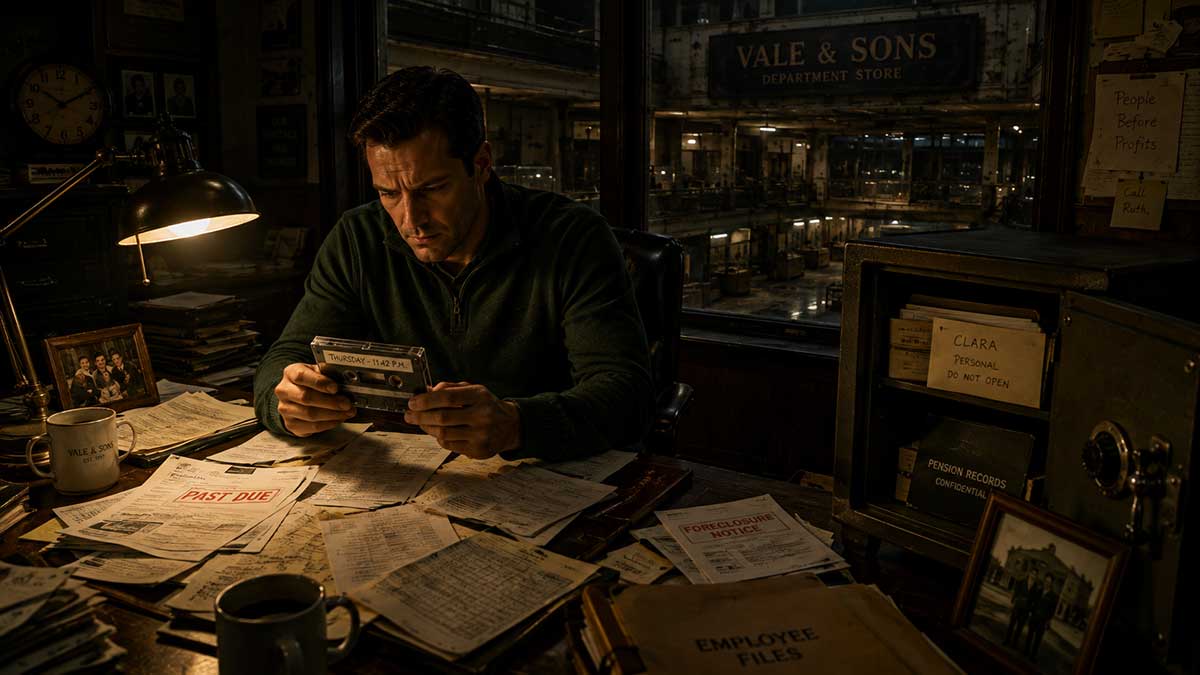
The executive office overlooked the entire first floor.
From Samuel Vale's desk, a person could once watch customers browsing nearly every department.
Now...
Marcus mostly watched contractors measuring walls for demolition.
Maya placed another stack of files on the conference table.
"This is everything?"
Marcus nodded.
"Everything that still exists."
She began reviewing payroll.
Vendor balances.
Utility bills.
Insurance claims.
Then she stopped.
"You haven't taken a salary in seven months."
"No."
"You mortgaged your house."
"Yes."
"You personally guaranteed two operating loans."
"Yes."
"You borrowed against your retirement."
Marcus nodded again.
"You make it sound dramatic."
"It is dramatic."
He shrugged.
"It was Tuesday."
For the first time since arriving, Maya stopped looking at Marcus as a difficult client.
She began seeing him as someone who had been drowning for a very long time.
"You could have filed for bankruptcy earlier."
"I could have."
"Why didn't you?"
He looked out across the empty sales floor.
"Every month I believed one more month might save it."
"The business?"
He answered almost without thinking.
"The family."
The room fell quiet.
Maya continued reading.
"There are personal transfers here."
Marcus nodded.
"Eli's apartment."
"Medical expenses."
"Transportation."
"Groceries."
"You've been paying those privately?"
"He worked here."
Marcus looked toward the stockroom.
"The store stopped being able to take care of him."
"So you did."
Marcus didn't answer.
The office door opened.
Daniel entered carrying architectural drawings.
"I've got an idea."
Marcus rubbed his forehead.
"That usually costs money."
"It could bring money."
Daniel spread the drawings across the table.
"We preserve the building."
"Historic landmark."
"Community nonprofit."
"Educational center."
"The department store becomes a living museum."
"Volunteer staff."
"Grant funding."
"Regional tourism."
His enthusiasm grew with every sentence.
"We could save the building."
Marcus looked at him for several moments.
Then quietly asked,
"Who's paying next month's heating bill?"
Daniel hesitated.
"We'd apply—"
"Who's writing the grant?"
"We could find—"
"Who's negotiating with suppliers?"
Silence.
Marcus continued.
"Who's explaining to retired employees why their pensions disappeared?"
Daniel's voice rose.
"There has to be another way besides selling everything!"
Marcus stood.
"There was."
"When?"
"Fifteen years ago."
Daniel stepped closer.
"You've lost faith."
Marcus looked exhausted rather than angry.
"No."
He spoke almost gently.
"Faith was your department."
A pause.
"Consequences were mine."
Daniel stared at him.
For the first time...
he realized his younger brother looked older than he did.
After Daniel left, Ruth quietly entered carrying fresh coffee.
She set one cup before Marcus.
"You shouldn't have said that."
Marcus smiled without humor.
"It wasn't true?"
"It was true."
She sat opposite him.
"Truth isn't always medicine."
Marcus leaned back.
"You think I wanted this?"
"I think you've wanted someone to notice."
He looked away.
"They all got to leave."
"Daniel became the respected professor."
"Clara disappeared."
"Dad became the local legend."
"Eli stayed Eli."
"And me?"
He laughed once.
"I became the man who said no."
Ruth folded her hands.
"You also became the man who never asked for help."
Marcus looked at her.
"I didn't have time."
"You made time to become angry."
Silence.
Finally Marcus whispered,
"I didn't know how to become anything else."
Ruth reached across the table.
Not to comfort him.
To steady him.
"You turned duty into a throne."
Marcus frowned.
"What?"
"You kept telling yourself only you could carry the burden."
She held his gaze.
"And after enough years..."
"...you stopped letting anyone else try."
Marcus lowered his eyes.
No defense came.
That afternoon Eli wandered into the office.
A fluorescent light buzzed loudly overhead.
He covered his ears.
Marcus noticed immediately.
Without interrupting the conversation, he climbed onto a chair and switched off the fixture.
The room became quieter.
Eli relaxed.
Marcus straightened the chair.
"You okay?"
Eli nodded.
"Better."
He smiled.
"Thank you."
Marcus smiled back.
The expression lasted only a second.
Yet Maya saw it.
It was the first completely unguarded moment she had witnessed.
Marcus wasn't incapable of tenderness.
He had simply buried it beneath responsibility.
Eli stood near the window.
Looking toward the old office door.
Very softly he whispered,
"Not Clara."
Marcus froze.
Eli continued.
"Not Clara."
Then:
"Keep the doors open."
Marcus's face drained of color.
"What did you say?"
Eli repeated the sentence exactly.
The same rhythm.
The same words.
Almost as if someone else had spoken through him years before.
Marcus walked slowly toward him.
"Who said that?"
Eli looked confused.
"Thursday."
Marcus closed his eyes.
Ruth looked down.
Maya watched both of them.
The silence between them answered more questions than any explanation could have.
Late that evening...
After everyone had gone to the hotel...
Marcus remained alone inside the executive office.
He locked the door.
Walked to the bookcase.
Removed an old accounting manual.
Pressed a hidden latch.
A narrow wall safe opened.
Inside lay only three things.
A sealed envelope in Clara's handwriting.
A bundle of pension records.
And an old cassette tape.
Across faded masking tape someone had written:
THURSDAY — 11:42 P.M.
Marcus picked it up.
His hand trembled.
He stared at it for a long time.
Then quietly placed it back inside the safe.
He wasn't ready.
Not yet.
Chapter 4 — The Blue Ledger
The basement smelled exactly the way old paper should.
Dust.
Cardboard.
Ink.
A trace of mildew from decades of Ohio summers.
Maya followed Ruth down a narrow concrete staircase beneath the old receiving dock.
A single pull chain switched on a row of dim bulbs.
Thousands of boxes filled metal shelves.
Christmas decorations.
Old employee uniforms.
Store catalogs dating back to the 1940s.
Payroll books tied with twine.
A town's history...
packed into cardboard.
Ruth walked with surprising confidence.
She never hesitated.
She stopped at the last shelf.
Reached behind three forgotten boxes labeled
CLEARANCE SIGNS
and pulled out a faded blue ledger.
The cover had almost turned gray.
She held it carefully.
Almost reverently.
"I've hidden this longer than I've hidden anything in my life."
Maya looked at the book.
"You knew I would eventually ask."
Ruth smiled.
"I've been waiting for someone who wanted answers more than victory."
They carried the ledger upstairs to the old accounting office.
Sunlight filtered through dusty blinds.
Ruth opened the first page.
Rows of handwritten figures filled every line.
Neat.
Precise.
Beautiful.
Maya quickly realized something.
"This isn't the official accounting system."
"No."
"It's Samuel's."
Ruth nodded.
"He trusted paper more than computers."
Page after page...
Transfers.
Supplier loans.
Payroll advances.
Deferred pension contributions.
Emergency operating accounts.
Everything balanced.
Until it didn't.
Maya suddenly stopped turning pages.
She stared at one entry.
Employee Pension Reserve
Transfer Authorized
She looked at the date.
Twenty-two years earlier.
Then another.
Then another.
Each transfer became larger.
Each repayment became smaller.
Her voice became almost a whisper.
"He used pension money..."
"...to keep the business alive."
Ruth slowly nodded.
"At first..."
"...he really believed he could put it back."
"And then?"
"The store never recovered."
Maya sat back.
She had seen fraud before.
This felt different.
Not because it was smaller.
Because it had begun with hope.
Then become desperation.
Then habit.
Then identity.
"What happened when Clara found out?"
Ruth closed the ledger.
For several moments she said nothing.
Finally...
"She was twenty-six."
"She had just started helping with corporate accounting."
"She found transfers that didn't belong."
"She thought it was a bookkeeping mistake."
"It wasn't."
The story came slowly.
Samuel admitted everything.
He begged Clara not to report him.
He insisted Christmas sales would save the company.
Then spring.
Then the new shopping center.
Then online sales.
Every season became one more promise.
Every promise required another transfer.
"He kept borrowing from tomorrow."
Ruth stared out the window.
"Eventually tomorrow arrived."
Maya frowned.
"So why did Clara move the money?"
"Because she stopped believing him."
Ruth's eyes became distant.
"She copied documents."
"She contacted an attorney."
"She opened a protected account."
Maya looked up.
"For herself?"
"No."
"For Eli."
The room became quiet.
Ruth continued.
"She believed the investigation would destroy the company."
"She thought Samuel might lose everything."
"And she knew..."
"...Eli wouldn't survive alone."
"So she moved enough money to guarantee his future."
Maya slowly understood.
"The famous theft..."
"...was never about greed."
Ruth shook her head.
"It was about protection."
"But why didn't anyone know?"
Ruth laughed sadly.
"Because Samuel was brilliant."
"He announced that Clara had stolen company money."
"The town believed him."
"The newspapers believed him."
"The bank believed him."
"And once enough people repeat a story..."
"...truth begins sounding like revision."
The office door opened.
Clara stood there.
She had heard the last sentence.
She looked at Ruth.
"You knew."
Ruth nodded.
"I knew enough."
"And you said nothing."
"I thought silence would save the employees."
"It saved his reputation."
Ruth accepted the blow.
"Yes."
Clara's voice trembled.
"I waited eighteen years..."
"...for someone to say I wasn't crazy."
Ruth quietly answered,
"I wasn't protecting Samuel."
"I was protecting everyone who still depended on the paycheck."
Clara's eyes filled.
"And what about me?"
Ruth's answer came almost immediately.
"I failed you."
The words surprised even herself.
"I failed Eli."
"I failed the workers."
"I kept telling myself I was buying time."
She looked toward the ledger.
"I think I was buying fear."
Maya closed the book.
"There isn't a legal path that keeps this hidden."
"No."
"There shouldn't be."
Ruth nodded.
"I know."
Before anyone could speak again...
a voice echoed down the hallway.
"Eli?"
No answer.
Marcus hurried past the doorway.
"Eli!"
The three women exchanged worried glances.
They followed the sound upstairs.
Inside the abandoned home electronics department...
Eli sat cross-legged on the floor.
Before him stood an old display cassette player.
The tape was already turning.
Marcus stopped cold.
"No."
His voice was barely audible.
"Eli..."
But it was too late.
Static crackled through the speaker.
Then...
Samuel Vale's unmistakable voice.
"You don't understand what's at stake."
Another voice.
Young.
Shaking.
Clara.
"I understand exactly what's at stake."
Silence.
Then...
The sentence that froze everyone.
"You stole from them."
Several seconds passed.
Samuel answered quietly.
Almost pleading.
"I borrowed time."
The tape clicked.
Stopped.
No one moved.
Finally Ruth whispered,
"That's what we kept calling it."
She looked around the room.
"When somebody else was paying."
Chapter 5 — Thursday Night
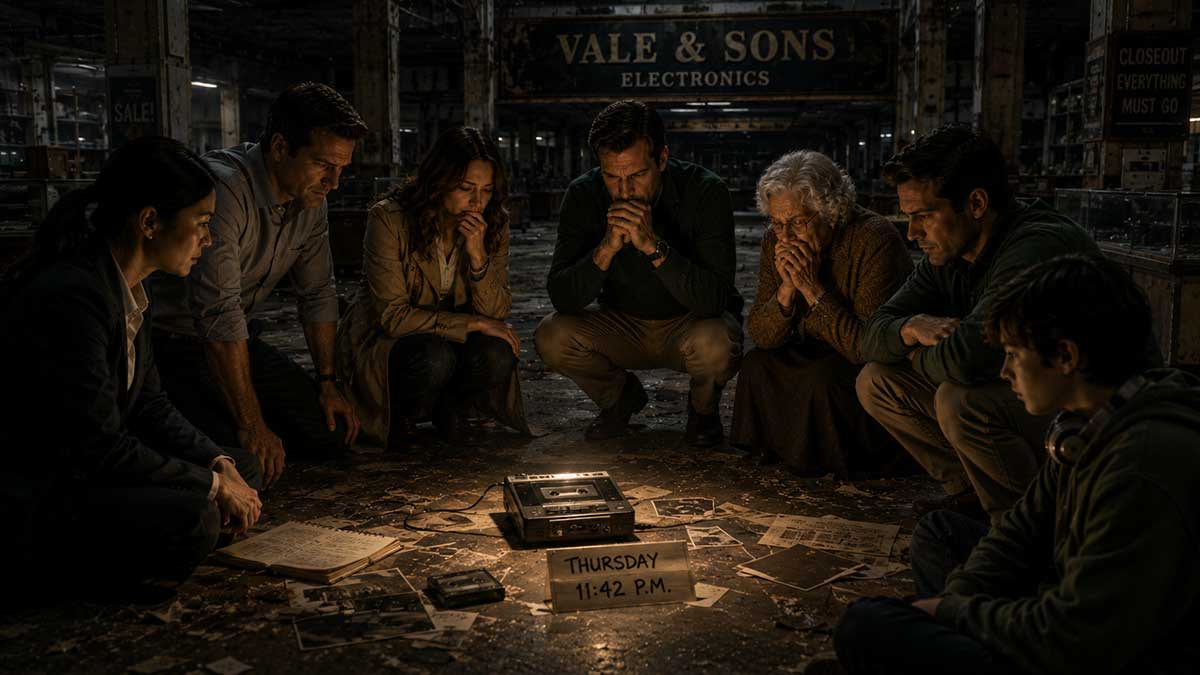
No one spoke for nearly a minute after the cassette stopped.
Even the old machine seemed to understand that silence deserved respect.
Marcus slowly removed the tape.
He held it as though it weighed far more than a few ounces.
"I should have destroyed this years ago."
Clara looked at him.
"Why didn't you?"
He answered honestly.
"Because part of me knew someone would eventually need to hear it."
That afternoon...
they gathered in the executive conference room.
Not as shareholders.
Not as siblings.
As witnesses.
Maya placed a digital recorder on the table.
"I'm not here to judge any of you."
"I'm here to understand what happened."
"No interruptions."
"No arguments."
"Just tell me where you were."
Clara spoke first.
"I found the pension transfers on a Tuesday."
"I thought someone had entered the wrong account."
"Dad laughed."
"He told me I'd understand when I got older."
She smiled bitterly.
"I was twenty-six."
The room remained still.
"He finally admitted everything."
"He said he only needed another Christmas."
"I told him Christmas had already come four times."
Daniel stared at the table.
"I never knew."
Marcus looked at him.
"I know."
"You should have told me."
Marcus nodded.
"I know."
"Why didn't you?"
Marcus looked toward the windows.
"Because Dad asked me one question."
"What?"
"He asked me..."
Marcus swallowed hard.
"...how many employees I was willing to put out of work to prove I was morally right."
The room fell silent.
"I couldn't answer."
Marcus continued.
"When Clara threatened to report him..."
"...I begged her to wait."
"I thought maybe we could sell property."
"Refinance."
"Merge."
"Something."
"I believed there had to be another way."
Clara looked at him.
"You didn't ask me to wait."
Marcus closed his eyes.
"I know."
"You begged me to protect him."
"I did."
"You chose him."
Marcus whispered,
"I chose the people who still needed paychecks."
Clara's voice softened.
"And I chose Eli."
She turned toward Maya.
"My father threatened to have Eli declared incompetent."
"He said if I reported him..."
"...the courts would believe he couldn't live independently."
Marcus looked stunned.
"He never told me that."
"No."
"He waited until you left the room."
The sentence landed like a stone.
For the first time...
Marcus realized he had never known the entire conversation.
Ruth quietly spoke.
"I heard them."
Everyone looked at her.
"Not all of it."
"But enough."
"I should have gone upstairs."
"I should have stopped it."
"I should have told the truth."
She folded her hands.
"Instead..."
"I kept serving coffee."
No one knew what to say.
Maya looked toward Eli.
"Eli..."
"Do you remember Thursday night?"
He nodded.
"What do you remember?"
He looked around the room.
Not frightened.
Simply searching.
Then he answered in the only way he knew.
"I was building towers."
Everyone smiled faintly.
He always built cardboard towers in the stockroom.
"I heard shouting."
"What happened then?"
"Dad said..."
He stopped.
His breathing changed.
Ruth quietly sat beside him.
"You don't have to hurry."
After a long pause...
Eli spoke again.
"Dad said..."
"'Keep the doors open.'"
Marcus slowly closed his eyes.
Eli continued.
"Clara said..."
"'People matter more than the building.'"
He looked at Marcus.
"You cried."
Marcus looked up sharply.
"No..."
Eli nodded.
"You cried."
"You were behind the office door."
"You didn't want anybody to see."
Marcus's composure finally broke.
For eighteen years...
everyone had assumed Marcus chose his father without hesitation.
No one had imagined the young man crying alone in the hallway because every choice meant betraying someone.
Daniel quietly asked,
"Then what happened?"
Eli smiled faintly.
"Clara hugged me."
Everyone looked at Clara.
"I didn't remember that."
Eli nodded.
"You said..."
He repeated her words exactly.
"'One day they'll tell the truth.'"
Clara covered her face.
She had forgotten saying it.
Eli never had.
Late that evening...
the six of them walked through the empty store together.
No one argued.
No one defended themselves.
The building seemed different.
Not happier.
Only quieter.
As they reached the center atrium, Marcus stopped beneath the old banner.
He looked at Clara.
"For eighteen years..."
"...I told myself I stayed because someone had to."
He laughed softly.
"The truth?"
"I stayed because I didn't know who I'd be if I left."
Clara stepped beside him.
"You weren't protecting the store."
"No."
"You were protecting Dad."
Marcus shook his head.
"No."
Another pause.
"I was protecting the version of myself that believed he could still fix everything."
No one answered.
Because everyone understood.
Above them...
the old clock continued ticking.
Still two minutes slow.
Still measuring time.
Yet somehow...
for the first time in years...
no one wished it would turn backward.
Chapter 6 — What Is Worth Saving
The sun rose quietly over Main Street.
For the first time in years, the display windows reflected more sky than merchandise.
Maya unlocked the front door before anyone else arrived.
She stood alone in the center aisle.
Yesterday she had seen a bankrupt department store.
Today she saw something different.
A place where thousands of first jobs had begun.
Where children had bought school shoes.
Where couples had opened wedding registries.
Where neighbors had met over coffee.
Where a family had slowly confused preserving a building with preserving one another.
She opened her laptop.
The cursor blinked beneath one line.
Recommendation:
She did not type.
Not yet.
By nine o'clock everyone had gathered in the executive conference room.
The bank representative joined by video.
The company's attorney sat quietly beside Maya.
No speeches.
No sentiment.
Only decisions.
The attorney began.
"Vale & Sons cannot continue operating in its current form."
Daniel lowered his head.
Even after everything he had learned, hearing the words spoken aloud hurt.
The attorney continued.
"The question is no longer whether the company survives."
"The question is what survives after the company."
Maya stood.
She placed three folders on the table.
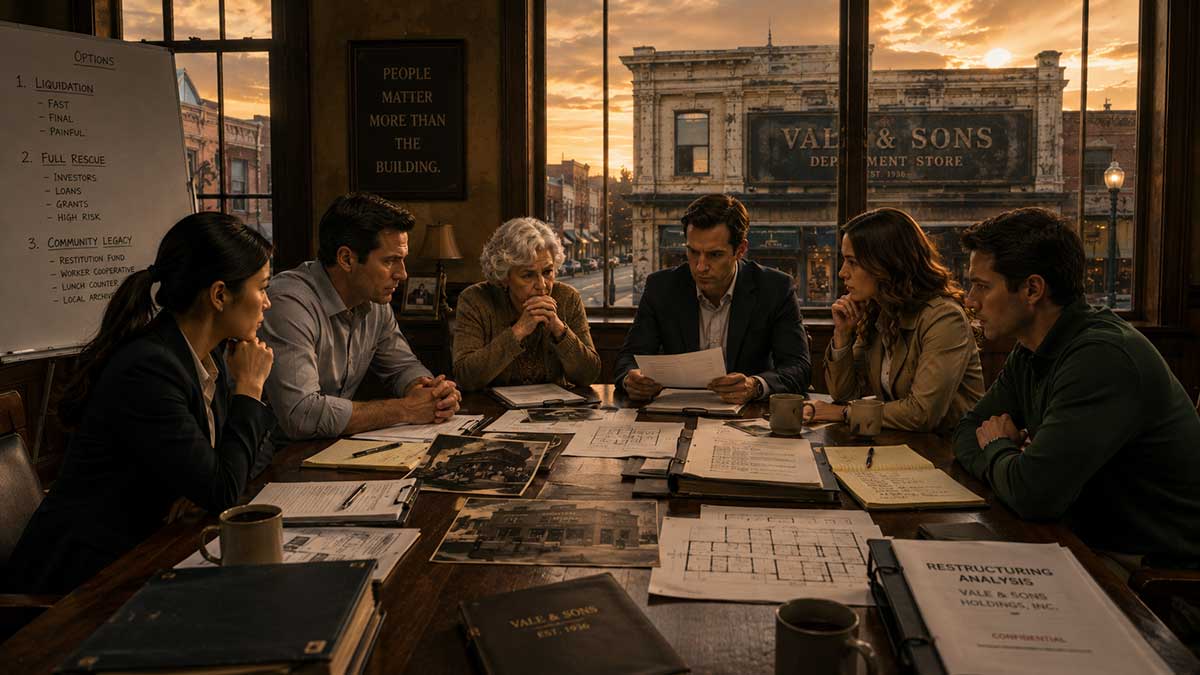
"I've prepared three restructuring options."
She opened the first.
Option One
Immediate liquidation.
Every asset sold.
Every employee terminated.
Every creditor paid in legal order.
Fast.
Efficient.
Final.
No one spoke.
She opened the second folder.
Option Two
Attempt full rescue.
New investors.
Additional loans.
Historic grants.
Community fundraising.
A chance.
A very small one.
Marcus didn't even look at it.
He knew the numbers.
Hope without capital was another way of borrowing time.
Maya opened the third folder.
She hesitated.
"I wrote this after yesterday."
Option Three
"The company ends."
"The building is sold."
"The debts are settled honestly."
"The pension fraud is voluntarily disclosed."
"The remaining assets establish an employee restitution fund."
"The original lunch counter, local archive, and community grocery become an independent worker-owned cooperative."
Silence.
Then she added,
"It won't preserve the company."
"It might preserve what the company once meant."
Daniel slowly looked up.
"The lunch counter?"
Maya nodded.
"I spent yesterday talking with former employees."
"They didn't remember profit margins."
"They remembered birthdays."
"First paychecks."
"Christmas breakfasts."
"The owner who carried groceries to elderly customers."
"The waitress who always knew their names."
She looked toward Ruth.
"They remembered her."
Ruth lowered her eyes.
Marcus studied the proposal.
"It won't make money."
"No."
"It isn't supposed to."
"What is it supposed to do?"
Maya answered,
"Tell the truth."
Daniel stood and walked to the conference room window.
He looked across Main Street.
The old movie theater had become apartments.
The hardware store was now a fitness center.
The pharmacy had disappeared years ago.
He whispered,
"I've been trying to save a photograph."
No one interrupted.
"I kept believing if the building survived..."
"...Dad would somehow survive too."
He turned toward Marcus.
"I'm sorry."
Marcus frowned.
"For what?"
"For leaving you alone with reality."
Marcus looked away.
"I never asked you to stay."
"No."
Daniel smiled sadly.
"You only spent eighteen years punishing me for not doing it."
Marcus almost argued.
Instead...
he laughed.
A tired laugh.
An honest one.
"I guess I did."
The brothers looked at one another.
Not as opponents.
As two men who had loved the same father in very different ways.
Clara quietly pushed one document across the table.
"The protected account."
Marcus looked confused.
She smiled.
"I never spent it."
He stared.
"The money?"
"It stayed invested."
"For Eli."
She handed Maya the statements.
"With interest..."
"...it's worth almost four hundred thousand dollars."
Everyone stared.
Marcus whispered,
"You kept it."
"I promised myself I would."
She looked toward Eli.
"It was never mine."
Eli smiled.
"I know."
He wasn't surprised.
He never had been.
The attorney adjusted his glasses.
"There is still one matter."
"The public statement."
Everyone understood.
The town would ask questions.
Reporters would come.
Former employees deserved answers.
Someone had to sign the confession.
Marcus reached for the paper.
"I'll do it."
Daniel stopped him.
"We'll all sign it."
Marcus looked surprised.
Clara nodded.
"So will I."
Ruth quietly spoke.
"I should sign too."
Maya shook her head gently.
"No."
Everyone looked at her.
"This isn't your confession."
Ruth smiled.
"Part of it is."
She folded her hands.
"I knew enough to speak sooner."
Clara reached across the table.
For the first time in eighteen years...
she took Ruth's hand.
"You don't have to carry everyone's burden anymore."
Ruth squeezed her fingers.
"I know."
Late that afternoon...
moving trucks arrived.
Shelves were dismantled.
Display cases disappeared.
The grand piano was rolled carefully through the front doors.
Employees hugged one another.
Some cried openly.
Others laughed through tears.
One elderly customer walked in carrying a faded charge card.
"I heard you were closing."
Marcus nodded.
The man looked around slowly.
"I bought my wife's engagement ring here."
He smiled.
"And our granddaughter's first bicycle."
He handed Marcus the old card.
"You can throw this away."
Marcus looked at it.
Instead...
he placed it inside the future archive box.
"No."
"I think we'll keep it."
Near sunset...
Eli wandered to the old lunch counter.
Workers had begun removing the stools.
He quietly stopped one of them.
"Not these."
The man looked toward Marcus.
Marcus nodded.
"Leave them."
"But they're scheduled—"
"Leave them."
The workers stepped away.
Eli sat on the first stool.
Then the second.
Then the third.
As if making sure each one was still there.
Finally he smiled.
"This stays."
Clara sat beside him.
"So do I."
For a while...
neither said anything.
Outside...
the giant VALE & SONS sign hung above Main Street.
A crane slowly lifted it away from the building.
People gathered on the sidewalks to watch.
Some took photographs.
Some wiped away tears.
Daniel watched beside Marcus.
"I thought this would feel like losing him."
Marcus looked at the empty brick wall.
"It does."
Daniel nodded.
"Strangely..."
"...it also feels like meeting him for the first time."
Marcus understood.
Their father had been both generous and deeply flawed.
A builder.
A dreamer.
A man whose fear of failure slowly became dishonesty.
Loving him no longer required pretending otherwise.
As darkness settled over the town, Maya returned to her laptop.
She deleted the sentence she had started that morning.
Then she wrote:
Recommendation Approved:
Liquidate the corporation.
Preserve the community.
Restore employee claims to the greatest extent possible.
Transfer the lunch counter and historical archive into an independent worker-owned cooperative.
Publicly disclose all historical financial misconduct.
No further concealment is recommended.
She read it once.
Closed the computer.
And smiled.
For the first time since arriving...
the report no longer felt like the end of a business.
It felt like the beginning of an honest story.
As everyone prepared to leave, Eli stood in the middle of the now-empty sales floor.
The silence returned.
Yet this time...
it sounded different.
He looked around one last time.
Then said quietly,
"The doors stayed open."
Marcus looked at him.
"They did?"
Eli nodded.
"They just opened somewhere else."
No one corrected him.
Because, perhaps for the first time in a very long while...
he was the one who understood exactly what had been saved.
Chapter 7 — The Doors We Leave Open
Three months later...
Main Street no longer looked abandoned.
It looked unfamiliar.
The giant VALE & SONS sign was gone.
For weeks, townspeople had slowed their cars almost instinctively, searching for something that was no longer there.
Now they noticed something else.
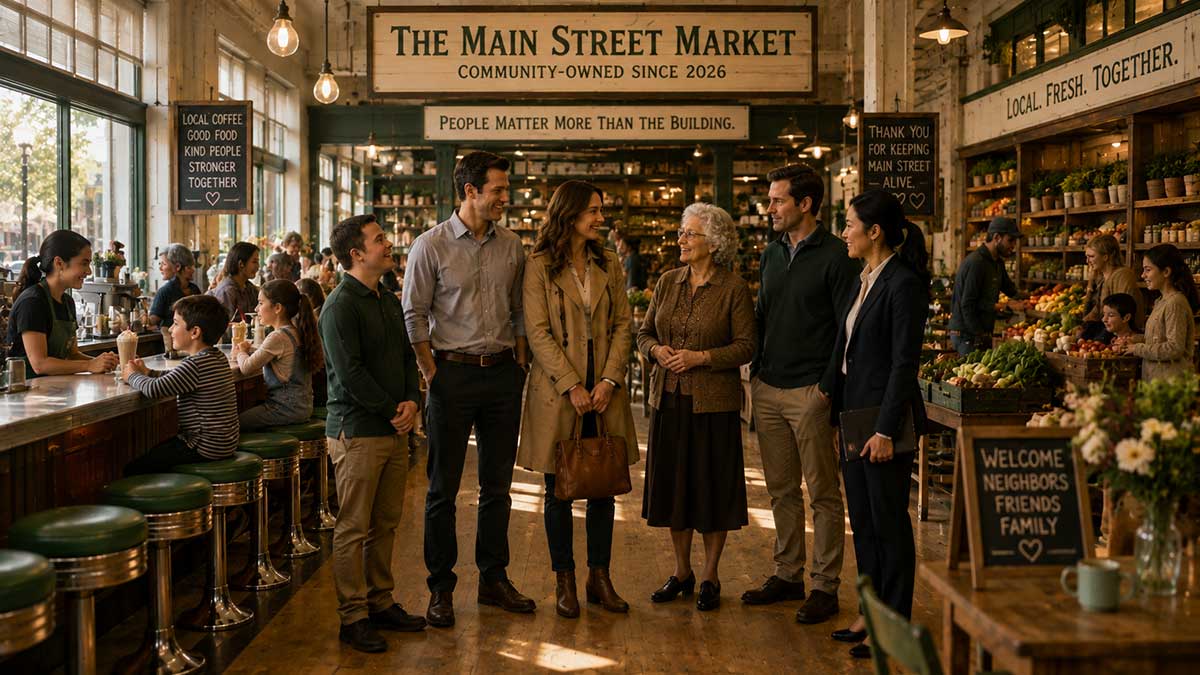
A much smaller wooden sign hung above the corner entrance.
THE MAIN STREET MARKET
Community-Owned Since 2026
No grand opening banners.
No television cameras.
Just fresh paint.
Open windows.
And the smell of coffee drifting onto the sidewalk.
The old department store was mostly gone.
Construction crews had transformed most of the building into offices, apartments, and community space.
Only one corner remained untouched.
The original lunch counter.
Part of Children's Shoes.
A small local grocery.
And a room simply called...
The Story Room.
Instead of merchandise, shelves now held photographs, employee name tags, old catalogs, Christmas parade programs, handwritten recipes from the lunch counter, children's letters to Santa, and the original brass cash register.
People came there not to buy history.
They came to remember it honestly.
Ruth unlocked the front door every morning.
Exactly at eight o'clock.
Unlike the old department store...
the new market had no executive offices.
No reserved parking spaces.
No portraits of founders.
Behind the register hung a single framed sentence.
"People matter more than the building."
No name appeared beneath it.
Everyone knew who had first spoken the words.
Business was modest.
Fresh bread.
Local vegetables.
Coffee.
A few groceries.
Nothing that would make anyone rich.
Everything that made neighbors stop and talk.
Children once again sat on the lunch counter stools after school.
Retired workers met for coffee every Thursday morning.
Someone started bringing a guitar on Friday evenings.
Without anyone planning it...
the place slowly became part of the town again.
Smaller.
Quieter.
More honest.
Daniel visited every Saturday.
He no longer carried old photographs hoping to restore the past.
Instead, he interviewed former employees.
He recorded their memories.
Not only the happy ones.
The layoffs.
The long hours.
The mistakes.
The friendships.
The kindness.
The disappointments.
One afternoon Maya found him labeling cassette tapes.
"What are you working on?"
Daniel smiled.
"A different kind of history."
"What changed?"
"I stopped trying to prove my father was great."
He carefully placed another tape inside its case.
"Now I'm trying to understand who he really was."
Marcus had taken a job managing operations for a regional nonprofit.
The work paid less.
He slept better.
Every Wednesday evening he stopped by the market after work.
Without anyone asking...
he repaired broken shelves.
Adjusted refrigerators.
Fixed leaking faucets.
He still solved problems.
Only now...
they stayed solved.
One evening Ruth handed him a cup of coffee.
"You look lighter."
Marcus laughed.
"I lost twenty years."
"No."
She smiled.
"You finally put them down."
Clara kept her design business in Chicago.
She never moved back permanently.
But every month she spent one long weekend in town.
She redesigned the Story Room herself.
Not as a museum.
As a conversation.
Visitors walked through photographs beside newspaper headlines.
Financial records beside family letters.
Employee memories beside company advertisements.
Nothing hid the truth.
Nothing erased the love.
A college student visiting from Columbus asked Clara,
"Weren't you afraid people would judge your family?"
Clara smiled gently.
"They already did."
She looked around the room.
"I just wanted them to judge the truth."
Maya returned once after the court officially closed the bankruptcy case.
She expected to stay fifteen minutes.
She remained almost three hours.
She watched neighbors greeting one another by name.
Children laughing over milkshakes.
Former employees telling stories they had never shared during depositions.
She realized something.
The spreadsheets had measured assets.
They had never measured belonging.
As she prepared to leave, Ruth handed her a small package.
Inside lay an old employee name tag.
MAYA CHEN
She laughed.
"I never worked here."
Ruth smiled.
"You helped save what mattered."
Eli still came every morning before opening.
The old stockroom no longer existed.
Instead, he organized produce.
Folded reusable shopping bags.
Lined up coffee mugs with perfect precision.
Customers quickly learned something.
If they couldn't find an item...
they asked Eli.
He never forgot where anything belonged.
Children especially liked him.
One little boy asked,
"Did this used to be a giant store?"
Eli nodded.
"Was it better?"
Eli thought for a long time.
Then quietly answered,
"It was bigger."
Another pause.
"This is warmer."
The boy accepted that answer without needing an explanation.
Late one autumn afternoon...
the six of them found themselves sitting together at the old lunch counter.
No meeting had been scheduled.
No crisis had called them there.
Someone simply made coffee.
Someone else baked pie.
One chair filled after another.
Outside...
people came and went through the front door.
No one paid much attention to the group quietly talking near the window.
Daniel looked around.
"Funny."
"What?"
Marcus asked.
"We spent our whole lives believing the department store held this family together."
Clara smiled.
"It never did."
Ruth nodded.
"We did."
Marcus looked toward Eli.
"And sometimes..."
"...we almost didn't."
Eli quietly stood.
Without saying anything, he walked to the old wall clock.
The same clock.
Still running.
Still two minutes slow.
Marcus laughed.
"You finally going to fix it?"
Eli studied the clock carefully.
Then smiled.
"No."
"Why not?"
Eli looked back at his family.
"It helped us arrive."
No one spoke.
Somehow...
the answer made perfect sense.
As evening settled over Main Street, customers slowly drifted home.
Ruth turned the sign in the window.
OPEN
became
CLOSED
She reached for the lock.
Then stopped.
She looked at Clara.
"You know..."
"When I was sixteen, I thought opening a store meant unlocking a door."
Clara smiled.
"And now?"
Ruth looked around the room.
At the laughter still lingering in the air.
At Eli wiping the counter.
At Marcus repairing a loose chair.
At Daniel interviewing an elderly customer.
At Maya helping stack coffee cups before leaving.
She softly answered,
"I think opening a place really means giving people somewhere they can tell the truth."
She switched off the lights.
Outside, the windows reflected the town.
Inside, they reflected six people who had finally stopped protecting a story...
and started protecting one another.
Above the quiet street, the little wooden sign moved gently in the evening breeze.
THE MAIN STREET MARKET
The old store had not survived.
The old family had not survived either.
Something better had.
Not perfect.
Not famous.
Not grand.
Just honest.
And perhaps...
that was what the founder had been searching for all along, even if he had lost his way before finding it.
The front door locked with a familiar click.
Tomorrow morning, someone would unlock it again.
Not because the past had returned.
Because hope always needs a door left open.
Final Thoughts
When William Faulkner wrote The Sound and the Fury, he gave us one of literature's most unforgettable families.
The Compsons were not destroyed by one terrible day.
They were slowly undone by memory without truth, love without understanding, pride without honesty, and silence that lasted far too long.
Nearly a century later, those same struggles continue to shape families around the world.
The buildings may look different.
The businesses may change.
Technology may transform our lives.
Yet the human heart still asks the same questions.
Why do we remember some moments and bury others?
How do good people slowly become strangers to one another?
Can sacrifice become resentment?
Can loyalty become fear?
Can forgiveness exist without truth?
The Vale family never found a way back to the past.
Neither do we.
That is not how healing works.
Healing begins when people stop protecting the stories that make them comfortable and begin protecting the people standing in front of them.
Daniel discovered that history should illuminate the past rather than imprison the present.
Marcus learned that carrying every burden alone eventually crushes both the burden and the one carrying it.
Clara reclaimed the right to tell her own story instead of living inside everyone else's version of it.
Eli reminded everyone that emotional truth often belongs to those we underestimate.
Ruth showed that compassion without honesty eventually becomes another form of silence.
Maya discovered that every balance sheet hides lives no spreadsheet can fully measure.
Together they found something the old department store never could sell.
A future built on truth.
The original company disappeared.
The old family story disappeared with it.
Yet something far more valuable remained.
A place where neighbors gathered.
A place where memories could be shared honestly.
A place where people mattered more than reputation.
Perhaps that is the deepest lesson Faulkner continues to offer every generation.
We do not become whole by recreating what once existed.
We become whole by carrying forward what was always worth keeping.
May we all have the courage to tell the truth before silence becomes inheritance.
And may every door we open lead not merely to another building...
but to another chance to understand one another.
Short Bios:
Eli Vale
The youngest of the Vale siblings, Eli has spent his adult life working quietly inside the family department store. His remarkable memory for voices, routines, and emotional details allows him to notice truths others overlook. Though often underestimated, Eli becomes the one person whose memories cannot be dismissed, helping his family finally confront what really happened.
Daniel Vale
A respected university historian, Daniel left his hometown years earlier believing he had escaped its limitations. He returns convinced the family business must be preserved, only to discover he has been protecting an idealized memory rather than the complicated reality. His journey becomes one of exchanging nostalgia for understanding.
Clara Vale
The missing daughter whose departure divided both the family and the town. For eighteen years she has carried the burden of being remembered through other people's stories. Returning home after her father's death, Clara finally claims her own voice and reveals the painful truth behind the scandal that defined her life.
Marcus Vale
The brother who stayed behind. As president of the failing company, Marcus sacrificed his finances, relationships, and peace of mind trying to save both the business and the family. His bitterness hides years of quiet responsibility, making him one of the story's most complex and deeply human figures.
Ruth Bell
A lifelong employee who began at the lunch counter as a teenager and eventually became the heart of the company. Ruth knows every family secret and every employee by name. Her greatest challenge is deciding whether true loyalty means protecting the family or finally telling the truth that could free them.
Maya Chen
A court-appointed restructuring consultant whose career has taught her to evaluate companies through numbers and legal documents. During three extraordinary days inside Vale & Sons, she discovers that every financial record carries a human story. By witnessing the family's struggle with honesty, Maya learns that some forms of value cannot be calculated.
Samuel Vale
Founder of Vale & Sons and the father whose vision transformed a small neighborhood store into the pride of an entire town. Charismatic, generous, and admired by the community, Samuel also made choices that slowly endangered both his company and his family. His legacy becomes a reminder that good intentions, when separated from truth, can still leave lasting wounds.
Leave a Reply