
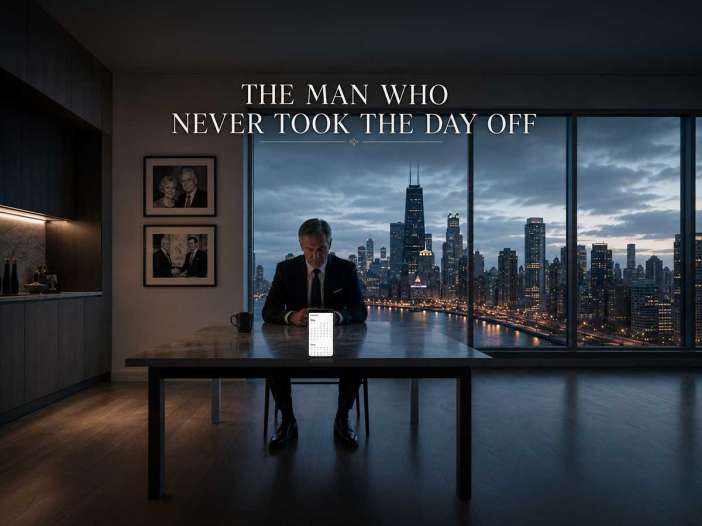
Introduction
What happens when being needed becomes the reason you never live your own life?
For thirty-eight years, Daniel Mercer has served billionaire businessman Richard Vale as his executive assistant, fixer, confidant, and most dependable employee.
Daniel misses dinners, relationships, vacations, and eventually his father’s final hours. Yet he never considers himself a victim. He believes his sacrifices prove that his life matters.
Then Richard dies.
Old company files begin revealing decisions Daniel helped carry out. A former employee forces him to confront the difference between following orders and accepting responsibility. The woman he once loved asks why he never asked her to stay. And a forgotten voicemail from his father changes the meaning of a night Daniel has spent twenty-six years explaining to himself.
Inspired by the central questions raised by Kazuo Ishiguro’s The Remains of the Day, The Man Who Never Took the Day Off asks a modern question:
What if the person who depended on you was never the one keeping you trapped—you were?
(Note: This is an imaginary conversation, a creative exploration of an idea, and not a real speech or event.)
Chapter 1 — The Funeral
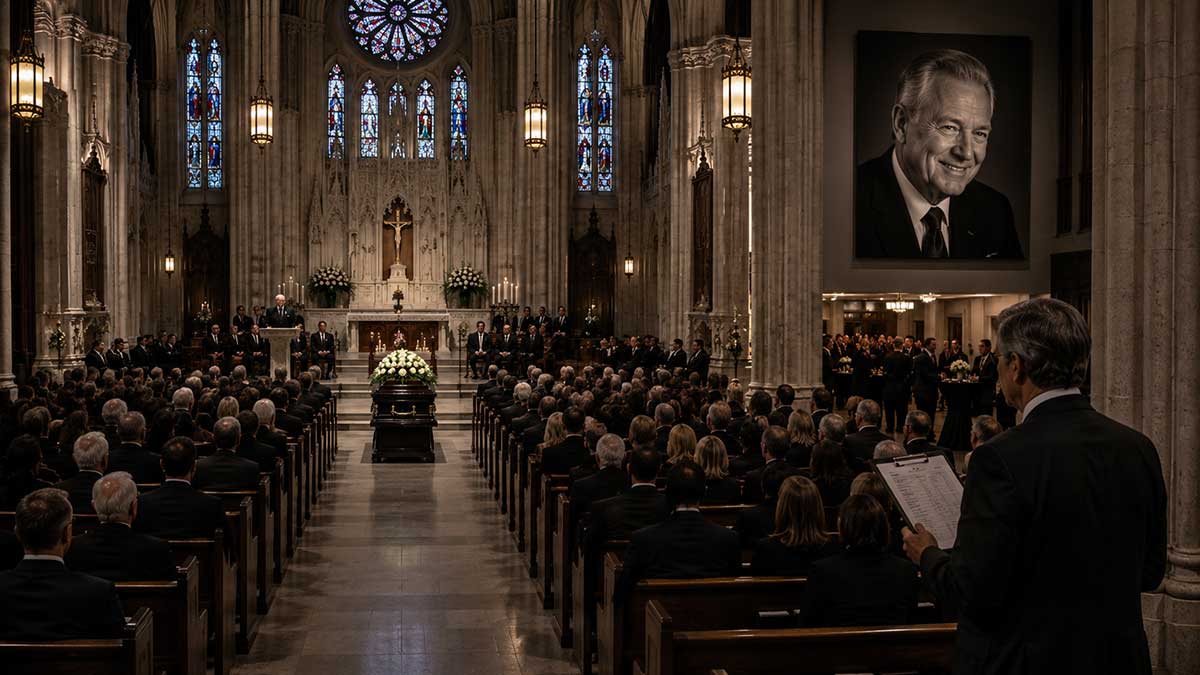
At seven fourteen on the morning of Richard Vale’s funeral, Daniel Mercer was standing in the vestibule of St. James Cathedral explaining to a television producer that Senator Reeves could not enter through the west doors.
“The family is using that entrance,” Daniel said.
The producer looked at the laminated credential hanging from his neck.
“We were told Senator Reeves would come through here.”
“You were told that yesterday.”
“Yes.”
“It changed at six twenty this morning.”
The producer stared at him.
Daniel gave him the new location.
“Delaware entrance. Mr. Feldman from security will meet your camera operator there at eight forty-five.”
The producer checked his phone.
“You’re sure?”
“Yes.”
Daniel was already walking away.
The cathedral smelled faintly of flowers and old stone. White arrangements lined the front steps of the sanctuary, tasteful enough that Richard would have approved of them, though he would have complained about the lilies.
“Funerals shouldn’t smell like funerals,” Richard had once said after attending the service of a competitor.
Daniel had remembered.
No lilies.
He found Richard’s daughter near the front pew arguing quietly with an usher about seating.
“Daniel.”
She sounded relieved.
“Claire.”
“My aunt is insisting she sits with us.”
Daniel looked at the seating card.
“I’ll take care of it.”
“Can you?”
“Yes.”
Claire touched his arm.
“I don’t know how you’re doing this today.”
Daniel looked toward the sanctuary.
Three hundred and eighty-two guests had confirmed. Twelve had added spouses after the deadline. The mayor’s security detail had requested an additional row. Richard’s former brother-in-law had arrived twenty minutes early and appeared to have been drinking.
There was still work to be done.
So Daniel said exactly that.
Claire gave him a tired smile.
“You sound like Dad.”
Daniel did not know whether she meant it kindly.
He moved her aunt two seats without anyone noticing.
At eight thirty-one, Richard Vale’s widow could not find her medication.
Daniel found it in the side pocket of her handbag.
At eight forty-seven, a flower arrangement from a governor Richard had publicly insulted arrived with the governor’s name spelled incorrectly.
Daniel had the card replaced.
At nine twelve, a retired executive approached him to complain that he had been seated behind someone who joined the company twenty-two years after he had.
Daniel moved no one.
At nine thirty-six, the organ began.
Only then did Daniel sit.
He had been assigned a place in the first row, at the far end, beside members of the Vale family.
He almost objected when Claire told him where she had put him.
“I’m staff,” he had said.
“You’re family enough.”
Daniel had not known what to do with that sentence.
Now he sat with his hands folded and watched six men carry Richard Vale down the aisle.
For thirty-eight years, Daniel had walked behind Richard.
Across airport terminals.
Through hotel kitchens.
Into boardrooms.
Down government corridors.
Past picket lines.
Through hospital wings bearing Richard’s name.
But never this slowly.
Richard’s coffin passed him.
Daniel lowered his eyes.
He felt something.
He could not have said what.
Grief, certainly.
But grief suggested an absence that had been understood.
Richard had been gone for nine days, and Daniel had spent all nine scheduling the absence.
The first call had come at 4:13 on a Sunday morning.
Claire.
Her father had collapsed at home.
By 4:27 Daniel had canceled Richard’s Monday flight to New York.
By 4:46 he had contacted the board chairman.
At 5:10 he had begun drafting the internal notification.
At 5:52 Richard Vale was pronounced dead.
Daniel had been working ever since.
There had not yet been time to decide what Richard’s death meant.
The first speaker was Richard’s pastor.
The second was the mayor.
The third was a former United States secretary of commerce.
They spoke of courage.
Vision.
Generosity.
Loyalty.
Risk.
Richard, they said, had transformed an old Midwestern manufacturing company into an international enterprise employing more than twenty thousand people.
He had funded a children’s hospital wing.
Created scholarships.
Saved a neighborhood arts center from closure.
Once, during a brutal winter, he had personally ordered hotel rooms for hundreds of stranded employees.
Daniel remembered making the reservations.
The former commerce secretary smiled from the pulpit.
“Richard Vale could see around corners.”
Laughter moved gently through the cathedral.
Daniel had heard the phrase before.
Richard himself occasionally used it.
Usually joking.
Usually after something worked.
Could see around corners.
Daniel looked at the coffin.
For some reason, the phrase irritated him.
He shifted in his seat.
Then immediately felt ashamed.
At twenty-six, Daniel Mercer had run through O’Hare Airport carrying two briefcases.
One was his.
One was Richard’s.
Richard, then thirty-four and already president of the family company, walked ten yards ahead without looking back.
Their flight to New York had started boarding.
“Mercer!”
“I’m coming.”
“You’re walking like you work for the government.”
Daniel laughed and ran harder.
They made the plane.
Richard dropped into first class, loosened his tie, and grinned.
“Keep up, Mercer.”
Daniel was breathing too hard to answer.
Richard looked out the window toward the airport lights.
“We’re going to build something that lasts.”
Daniel remembered the thrill of hearing the word we.
After the service, the reception filled the Vale Foundation ballroom.
Daniel stood near the rear wall with coffee he never drank.
People kept coming to him.
Former assistants.
Drivers.
Politicians.
Board members.
Employees who had not spoken to Richard in fifteen years but now had stories.
They all knew Daniel.
That surprised him sometimes.
He had spent nearly four decades trying to make himself unobtrusive, yet everyone remembered the man beside Richard Vale.
A retired board member named Thomas Hale embraced him.
Thomas had aged badly since Daniel last saw him. His shoulders had narrowed and his voice had become soft.
“Daniel.”
“Thomas.”
“I’m sorry.”
“Thank you.”
Thomas held his arm for a moment.
“God, what are you going to do now?”
Daniel smiled politely.
“There are estate matters. Foundation work. The board will need help with the transition.”
“No, no.”
Thomas shook his head.
“I mean after all that.”
Daniel did not understand.
Thomas looked across the ballroom toward Richard’s enormous black-and-white portrait.
“You gave that man your whole life.”
He smiled.
“You were the best thing that ever happened to him.”
Daniel knew how he was expected to receive this.
As praise.
So he did.
“That’s kind of you.”
“I mean it.”
Thomas squeezed his shoulder and moved away.
Daniel remained beside the wall.
You gave that man your whole life.
He looked again at Richard’s photograph.
The photographer had caught him laughing.
Richard had been sixty-three then, perhaps. Still thick-haired. Expensive blue suit. The relaxed confidence of a man who believed any room would eventually arrange itself around him.
Daniel had arranged many of those rooms.
His whole life.
The phrase was imprecise.
Thirty-eight years was not a whole life.
Daniel was sixty-four.
Statistically, there was quite a bit left.
He almost smiled at the absurdity of needing to correct Thomas Hale mentally.
Then he wondered why he was doing it.
He left the ballroom at eight thirteen.
At home, Daniel removed his jacket and hung it carefully.
His condominium overlooked the Chicago River from the twenty-seventh floor. Richard had once called it “a hotel room you bought by accident.”
Daniel had laughed.
The place contained almost nothing unnecessary.
A gray sofa.
Bookshelves.
Dining table for six, though Daniel could not remember the last time six people had sat there.
Two framed photographs.
His parents outside the bungalow where he grew up.
And Daniel shaking Richard Vale’s hand at the company’s fiftieth anniversary.
He poured sparkling water into a glass.
His phone showed seventeen unread messages.
He answered eleven.
Two could wait until morning.
Four needed no response.
Then he opened his calendar.
Tomorrow:
10:00 — Estate Counsel
2:00 — Archive Access
4:30 — Board Transition Call
Wednesday had only two appointments.
Thursday, one.
Friday was blank.
Daniel stared.
He swiped to the following week.
Three meetings.
The week after that had nothing.
He swiped again.
Nothing.
The white spaces seemed almost obscene.
For decades, Daniel’s calendar had looked like stained glass: blocks of blue, gray, red, and green compressed into nearly every waking hour.
Richard liked early flights.
Late dinners.
Emergency calls.
Last-minute changes.
He had once telephoned Daniel from Singapore at 2:17 in the morning Chicago time and said, without greeting:
“Are you awake?”
Daniel had answered:
“Yes.”
He had been asleep.
Now Daniel moved forward through empty weeks.
September.
October.
November.
He stopped.
The kitchen was completely silent.
For a strange moment, Daniel felt as though he had opened a door expecting a room and found open air.
He set the phone on the table.
At 11:47 p.m., it lit again.
A news alert.
Richard Vale remembered as Chicago visionary and philanthropist.
Daniel turned the phone face down.
He looked at the empty chair across from him.
Thomas Hale’s words returned.
You gave that man your whole life.
Daniel sat there longer than he intended.
He did not feel free.
He felt unnecessary.
Chapter 2 — The Files
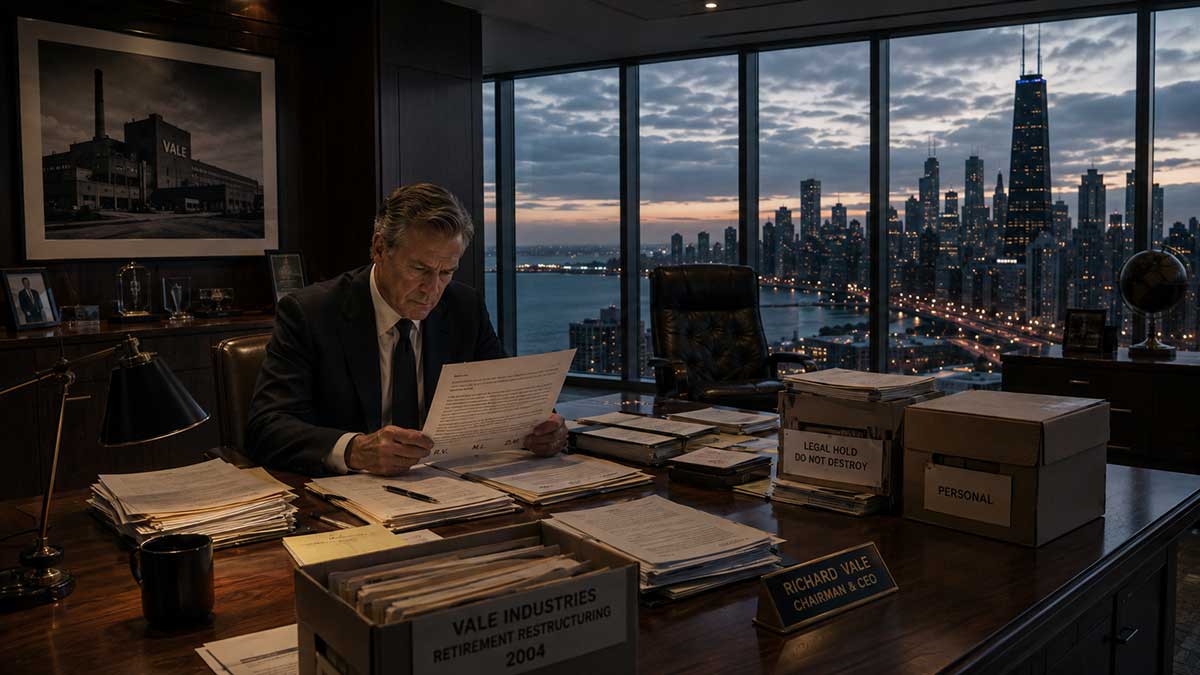
Richard Vale’s office was smaller without Richard Vale in it.
Daniel noticed this at 9:58 Monday morning and immediately disliked himself for noticing.
The room occupied the northeast corner of the forty-sixth floor of Vale Industries headquarters, with windows facing Lake Michigan and the Chicago skyline.
For nearly forty years, entering this office had meant entering Richard’s weather.
Some mornings exhilaration.
Some mornings fury.
Some mornings ten different subjects before Daniel had fully closed the door.
Now the desk was empty except for numbered evidence boxes.
Family photographs had been removed.
The bronze model of the company’s first factory was gone.
Even Richard’s ridiculous antique globe had disappeared.
Maya Patel stood near the windows reading an inventory sheet.
“Morning.”
“Good morning.”
Maya was forty-four, general counsel for Vale Industries, and among the few executives Daniel trusted instinctively.
She had the useful habit of speaking only when she had something to say.
“These boxes are cleared for foundation review,” she said. “Those three are legal hold. Don’t touch them without someone from my team.”
Daniel nodded.
“You want me to identify what’s personal?”
“And anything historically significant. Correspondence, deal notes, early company records.”
Maya looked around.
“You’ll recognize more of this than anyone.”
Daniel almost said Richard would have.
Instead:
“Probably.”
She studied him.
“You okay?”
“Yes.”
“Daniel.”
“I’m simply trying to understand the chronology.”
Maya gave him a look he could not interpret.
“Sometimes chronology is the easiest part.”
Then she left.
Daniel began with correspondence from 1998.
He worked methodically.
Foundation.
Personal.
Corporate.
Archive.
Legal review.
Discard.
Richard had kept far more paper than Daniel expected.
Notes on hotel stationery.
Airline napkins.
Printed emails.
Yellow legal pads covered in a handwriting only three people had ever been able to decipher, two of whom were dead.
At eleven thirty-five, Daniel found the retirement file.
He knew it before opening it.
Vale Employee Retirement Restructuring Initiative.
Daniel sat down.
The official explanation came back immediately.
Vale Industries had been attempting to acquire Hartwell Components, a deal that would expand manufacturing capacity and protect thousands of American jobs.
Cash reserves were tight.
The company temporarily restructured contributions to several employee programs.
There had been protests.
One lawsuit.
Bad press.
Richard had defended the decision publicly.
Daniel remembered the private conversation.
They were in the executive elevator.
Richard was fifty.
Daniel was forty-two.
“You’re getting calls from employees?” Richard asked.
“A number.”
“Send them to HR.”
“Some of them have been here thirty years.”
Richard looked at him.
“And?”
“They’re worried.”
“So am I.”
The elevator descended.
Daniel hesitated.
“Is it fair?”
Richard turned.
“Fair?”
“To change the retirement terms this late.”
Richard exhaled through his nose.
“Fair is what keeps the company alive.”
Daniel said nothing.
“You don't have the whole picture, Dan.”
“I understand.”
“Do you?”
“Yes.”
Richard watched him.
Then smiled.
“You trust me, don’t you?”
Daniel answered immediately.
“Yes.”
The doors opened.
That had been the end of it.
Now Daniel opened the first folder.
Actuarial warnings.
Internal projections.
Legal concerns.
He read slowly.
One memorandum warned that older employees could experience significant retirement losses if the restructuring continued beyond eighteen months.
Richard had underlined the paragraph.
Beside it, in blue ink, he had written:
Need this settled before press gets wind.
Daniel read it twice.
A second document showed the Hartwell acquisition would likely have survived without the restructuring, though Vale’s negotiating position would have weakened.
Daniel leaned back.
That was not how Richard had explained it.
He searched for another memo.
Then another.
He found himself working faster.
There had to be context.
There always was.
Richard had possessed information Daniel did not.
Market projections.
Board pressure.
Debt covenants.
Something.
At twelve forty-one, Daniel stopped searching.
He realized what he was doing.
He was looking for Richard’s defense.
At one fifteen, he found Leah Chen’s name.
The sight of it produced a physical sensation.
Not pain.
Something lower.
A tightening.
Leah had been thirty-six, maybe thirty-seven.
Director of financial planning.
Very good.
Too direct for Richard’s taste.
She had raised concerns about the retirement restructuring.
Daniel remembered the termination.
He remembered her face.
He remembered the sentence she had said to him.
He closed the folder.
Then opened it again.
Inside was an email from Richard to the chief financial officer.
Chen becoming a liability. Daniel can handle cleanup discreetly.
Daniel stared at the words.
Cleanup.
He did not remember seeing this email.
Below it was another message.
A board member had asked why Leah and two other employees were being removed.
Richard replied:
Mercer recommends swift personnel cleanup before Hartwell closes. I agree.
Daniel read the sentence three times.
He had never recommended it.
He had carried out the firings.
He had prepared the logistics.
Access termination.
Severance documents.
Security timing.
Communications language.
But the recommendation had been Richard’s.
Daniel remembered that clearly.
Or believed he did.
He stood and walked to the window.
Forty-six floors below, Chicago moved without him.
Cars.
Buses.
Tiny figures crossing streets.
Daniel pressed two fingers against the glass.
Perhaps Richard had simply been speaking loosely.
Perhaps Daniel had said something in a meeting that Richard interpreted as support.
Perhaps—
He stopped.
The instinct embarrassed him.
How many times had he completed Richard’s explanation before Richard provided one?
Maya returned at three twenty.
Daniel was still at the desk.
She looked at the folders around him.
“Find something?”
Daniel considered saying no.
Instead he handed her the email.
She read it.
Her expression barely changed.
“Did you recommend the terminations?”
“No.”
“Certain?”
“Yes.”
Maya sat across from him.
“Were you involved?”
“I implemented them.”
“That wasn’t my question.”
Daniel looked at her.
“Yes.”
Maya nodded.
“Do you remember why Chen was fired?”
“Richard believed she was undermining the acquisition.”
“Did you believe that?”
Daniel’s answer came automatically.
“I didn’t have the full picture.”
Silence.
Maya looked at him.
Not skeptically.
Not accusingly.
That made it worse.
Daniel heard his own sentence.
He had used it for decades.
Richard sees the whole picture.
I see my part.
Something about the words now sounded childish.
Maya placed the email on the desk.
“Legal will need this.”
“Of course.”
She stood.
At the door, she stopped.
“Daniel?”
“Yes?”
“You don’t have to figure out what all of it means today.”
He almost told her meaning was irrelevant.
The facts were what mattered.
Chronology.
Documentation.
Process.
Instead he said:
“I know.”
After she left, Daniel sat alone.
At six eleven, the office lights automatically shifted into evening mode.
He had not noticed the time.
There was no Richard to remind him they were late for dinner.
No plane.
No car downstairs.
No next meeting.
Daniel gathered his things.
Then he looked once more at the retirement file.
He took a copy of one memorandum and slipped it into his briefcase.
At home, he reheated soup and placed the memo beside the bowl.
He ate several spoonfuls.
Stopped.
Read the document again.
At the bottom of the page were three handwritten initials confirming that copies had been distributed.
R.V.
M.L.
D.M.
Daniel touched his initials with one finger.
For nearly forty years, whenever something went wrong, he had known exactly where the final authority rested.
Richard Vale.
Tonight, Richard was dead.
And the initials remaining on the page were Daniel’s.
Chapter 3 — The Woman Who Left
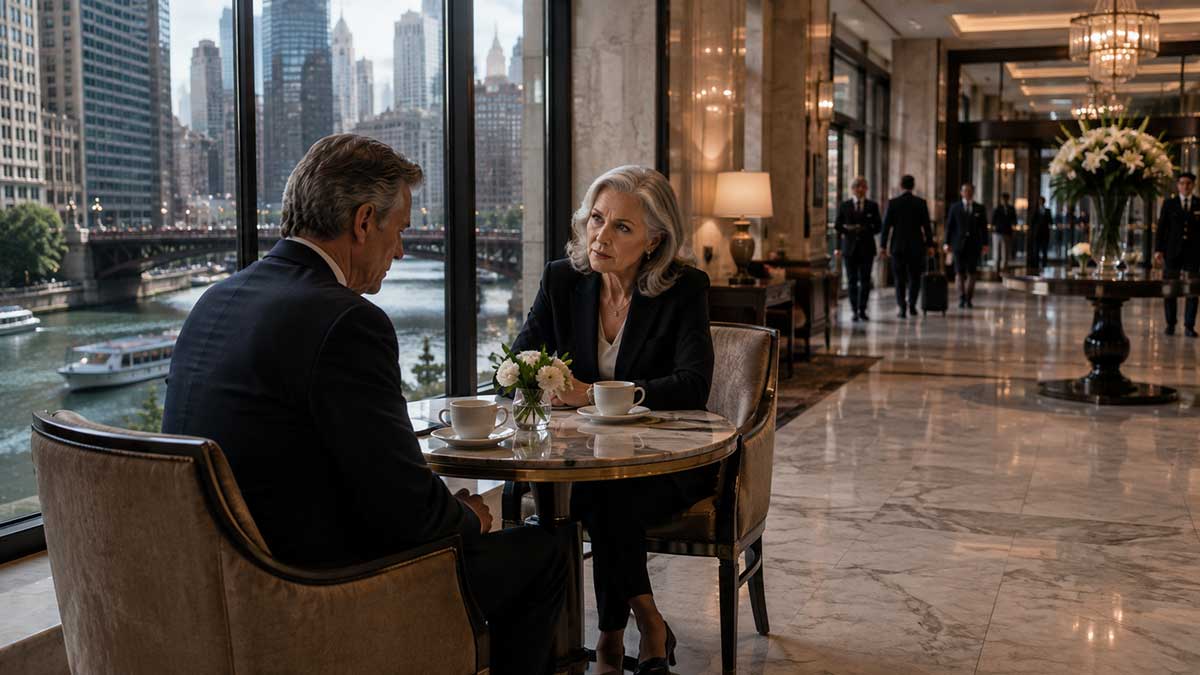
Daniel saw Evelyn Ross before she saw him.
She was standing near the windows of the Langham lobby, looking out at the river with one hand around a coffee cup.
For several seconds, Daniel did nothing.
Thirty-one years had passed since Boston.
He knew that number immediately.
He knew the year she left, the month she moved, the date of her farewell dinner, the hotel where Vale Industries had held it, and the name of the executive who had arrived forty minutes late and caused Richard to leave early.
Daniel remembered things that way.
Dates.
Places.
Sequence.
He had seen photographs of Evelyn over the years.
Foundation newsletters.
Company reunions.
A Christmas card once, long ago.
He knew she had married an architect named Peter Ross.
He knew they had a daughter.
He knew Peter had died four years earlier.
What he had not prepared for was how little the person standing by the window resembled a memory.
She had silver in her hair now.
Her face had softened.
She wore a dark blue coat over a cream blouse and was reading something on her phone with the same slight frown Daniel remembered from company press releases thirty years earlier.
Then she looked up.
Their eyes met.
Her expression changed first.
“Daniel.”
He walked over.
“Evelyn.”
She hugged him.
Daniel had expected a handshake.
The surprise made him stiff for half a second before he returned it.
When she stepped back, she examined him.
“You still look exactly like someone who has a meeting in seven minutes.”
Daniel glanced at his watch.
Evelyn laughed.
“Oh, God.”
“What?”
“You actually checked.”
“I was merely—”
“Checking the time.”
“Yes.”
“You haven’t changed.”
Daniel smiled.
“I have gray hair.”
“So do I. That doesn’t count.”
They found two chairs near the windows.
Daniel positioned himself automatically where he could see the lobby entrance.
Evelyn noticed.
“Are we expecting an attack?”
“I like knowing what is happening.”
“You always did.”
Daniel set his phone face down on the small table.
It vibrated less than a minute later.
He turned it over.
A message from Maya.
He read it.
Evelyn watched.
Then:
“He’s dead, Daniel.”
Daniel looked up.
She immediately softened.
“I’m sorry. That sounded cruel.”
“No.”
“He’s been your whole routine for almost forty years. I understand.”
Daniel put the phone away.
“I’m helping with estate matters.”
“Of course you are.”
“The company has archival work.”
“Of course it does.”
“And there are legal—”
Evelyn raised one hand.
“I didn’t come here to make fun of you.”
“I didn’t think you did.”
“Yes, you did.”
Daniel almost disagreed.
Then decided not to.
They spoke first about Richard.
That was easier.
Evelyn remembered him as exhausting, magnetic, occasionally generous, occasionally impossible.
Daniel defended him only twice.
Both times Evelyn noticed.
Neither time did she press.
They discussed former colleagues.
Who had retired.
Who had divorced.
Who had died.
Who had become unexpectedly wealthy.
Evelyn’s daughter, Hannah, lived in Lisbon with her husband and two children.
Daniel knew she had a daughter.
He did not know about Lisbon.
“You’re going there?”
“For six months.”
Daniel nodded.
“That sounds sensible.”
Evelyn looked at him.
“What?”
“Nothing.”
“What?”
“You still do that.”
“Do what?”
“Give approval as though you're signing a travel request.”
Daniel leaned back.
“I said it sounded sensible.”
“Exactly.”
She smiled.
“I leave next month.”
“For six months?”
“Maybe longer.”
“Longer?”
“I sold the house.”
Daniel stared at her.
“You sold it?”
“Yes.”
“Why?”
“Because I don’t need a four-bedroom house in Evanston to store memories in.”
Daniel looked down at his coffee.
“When did you decide?”
“Last year.”
“You didn’t mention it.”
“We haven’t spoken properly in eight years.”
“Yes.”
Evelyn waited.
Daniel realized the sentence required something else.
“I suppose there was no reason you would.”
“No.”
There was no bitterness in it.
That somehow made the distance between them more visible.
Evelyn stirred her coffee.
“Do you remember Boston?”
Daniel’s fingers stopped against the rim of his cup.
“Yes.”
“Of course you do.”
“I remember you received an offer from Prescott Communications.”
She smiled.
“You remember the company.”
“I remember most things.”
“I know.”
Daniel looked out the window.
Traffic moved slowly along Wacker Drive.
It had been September.
Evelyn had asked him to meet her at a small Italian restaurant after work.
She had arrived before him.
Daniel had been forty minutes late.
Richard’s flight from Dallas had changed.
Daniel remembered apologizing.
He remembered Evelyn saying it did not matter.
He remembered believing her.
“You said you had an offer,” Daniel said.
“I did.”
“A very good one.”
“Yes.”
“Vice president.”
“Senior vice president.”
Daniel looked at her.
She smiled.
“You don’t remember everything.”
“Apparently not.”
“You congratulated me.”
“It was a significant opportunity.”
“You gave me a detailed explanation of why Boston was becoming an important corporate market.”
Daniel almost laughed.
“That sounds unbearable.”
“It was.”
“I apologize.”
“Thirty-one years late, but accepted.”
They both smiled.
Then Evelyn’s expression changed.
“I told you I hadn’t decided.”
Daniel remembered.
“Yes.”
“I said I had ten days.”
“Yes.”
“And then I waited.”
Daniel said nothing.
“I kept thinking you were going to say something.”
“What?”
Evelyn looked at him.
Daniel knew immediately that he had asked the wrong question.
She did not rescue him.
“What did you want me to say?” he asked.
She laughed quietly.
“There you are.”
“What?”
“Still trying to make me write the script for you.”
Daniel looked away.
Evelyn leaned back.
“Did you want me to go?”
He answered too quickly.
“It was an excellent career opportunity.”
Her eyes closed for a moment.
When she opened them:
“Thirty-one years.”
Daniel said nothing.
“And you still answer the wrong question.”
“I thought—”
“No.”
She shook her head.
“No explanation yet.”
Daniel felt something tighten beneath his ribs.
Evelyn waited.
There was nowhere professional to go.
“No,” he said.
She looked at him.
“No, what?”
“I did not want you to go.”
Evelyn’s face did not change dramatically.
She simply nodded.
“I thought so.”
The words hurt more than surprise would have.
Daniel looked down.
“You never said anything.”
“You didn’t either.”
“I was the one leaving.”
Daniel understood the distinction.
He wished he did not.
“You could have asked me to stay,” Evelyn said.
“You had accepted the offer.”
“I had not accepted it yet.”
Daniel looked up.
“You hadn’t?”
“No.”
He searched his memory.
The farewell dinner.
The announcement.
The congratulations.
Richard telling everyone Boston was lucky to have her.
“You told the company—”
“After.”
Daniel felt suddenly foolish.
“I thought the decision had been made.”
“It had not.”
“Why didn’t you say so?”
Evelyn stared at him.
Then began laughing.
Daniel frowned.
“I’m sorry,” she said. “That is perhaps the most Daniel Mercer question imaginable.”
“I’m serious.”
“So am I.”
She leaned forward.
“I told you I had ten days.”
“Yes.”
“I told you I wasn’t sure.”
“Yes.”
“I asked what you thought.”
“You wanted my opinion about the job.”
“No.”
Daniel stopped.
Evelyn’s voice softened.
“I wanted to know whether there was anything in Chicago worth staying for.”
Daniel looked toward the window again.
He remembered that night differently now.
Her looking at him after dessert.
A pause he had interpreted as fatigue.
Her saying:
“Would you miss me?”
Daniel had answered:
“The company certainly will.”
He closed his eyes briefly.
“Oh.”
Evelyn watched him.
“You remember.”
“Yes.”
“Good.”
“I thought you were joking.”
“I know.”
Daniel rubbed his thumb against the edge of his cup.
“Would you have stayed?”
Evelyn considered.
“I don’t know.”
Daniel looked at her.
“You don’t?”
“No.”
She smiled faintly.
“I was thirty-one, Daniel. I wanted things too.”
“The job.”
“The job. A different city. A bigger life.”
She paused.
“But I wanted you to make it difficult.”
Daniel swallowed.
“And I didn’t.”
“No.”
“Would that have changed anything?”
“Maybe.”
“Maybe.”
“That’s all life gives you sometimes.”
Daniel nodded.
He disliked the word.
Maybe.
No timetable.
No certainty.
No outcome one could control.
“What happened after you left?” Daniel asked.
“You know what happened.”
“I know the facts.”
Evelyn looked at him carefully.
“That is not the same thing.”
He thought of Maya.
Sometimes chronology is the easiest part.
Evelyn continued.
“I hated Boston for the first year.”
Daniel did not know this.
“I almost came back.”
He looked at her.
“You did?”
“Yes.”
“Why didn’t you?”
She smiled.
“Because eventually I stopped waiting for Chicago to become something it had never promised to become.”
Daniel let the sentence settle.
“I met Peter two years later.”
“You were happy?”
“Yes.”
She did not hesitate.
Daniel was strangely grateful.
“We fought,” she said. “He annoyed me. I annoyed him. We raised a daughter who believed we were both hopeless. We traveled. He made terrible coffee for twenty-six years.”
She smiled at the memory.
“I loved him.”
Daniel nodded.
“I’m glad.”
“I know you are.”
She reached for her coat.
“I have to go to the foundation meeting.”
“I’ll walk you.”
“You don’t have to.”
“I know.”
That stopped them both.
Evelyn smiled.
“Well. Look at that.”
Daniel almost smiled too.
They crossed the lobby together.
Near the revolving doors, Evelyn stopped.
“Can I ask you one more thing?”
“Yes.”
“When was the last time you made a decision that wasn’t about what someone needed from you?”
Daniel opened his mouth.
Nothing came.
Evelyn waited.
He searched.
Vacation?
He had taken vacations, technically.
Usually Richard had insisted.
His condo?
Richard’s accountant had recommended the building.
His car?
Chosen because it was reliable and unobtrusive.
Dinner?
Meetings determined dinner.
Weekends?
Calls.
His clothes?
Professional necessity.
He looked at Evelyn.
“I don’t know.”
For the first time that day, she looked genuinely sad.
“That,” she said, “would frighten me more than Boston ever did.”
She hugged him again.
Then stepped into the revolving door.
Daniel watched her emerge onto the sidewalk and disappear into the afternoon crowd.
His phone vibrated.
He took it out.
A message from Maya.
Leah Chen had contacted the legal department.
She wanted to speak with him.
Daniel read the message twice.
Then, without quite knowing why, looked back at the empty chair where Evelyn had been sitting.
For thirty-one years, he had believed she left because Boston offered more.
For the first time, he wondered how many departures he had described as inevitable simply because he had never asked anyone to stay.
Chapter 4 — I Was Only Doing My Job
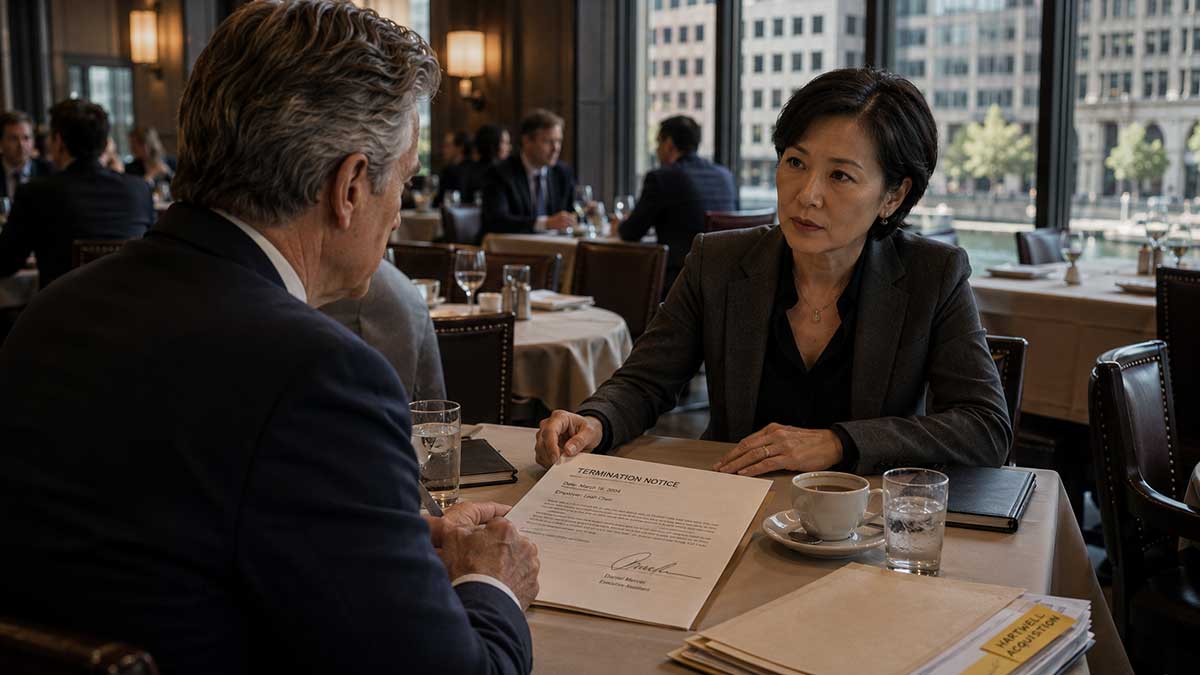
Leah Chen chose the restaurant.
Daniel understood why as soon as he arrived.
It was public.
Bright.
Busy.
Neutral.
No Vale building.
No private conference room.
No place where Daniel automatically possessed authority.
Leah sat near the rear window with a glass of water.
He recognized her instantly.
She was fifty-seven now.
Her hair was shorter.
She wore a charcoal jacket and no jewelry except a wedding ring.
Daniel noticed the ring.
Then remembered something about her husband.
He could not retrieve it.
“Leah.”
She stood.
“Daniel.”
They shook hands.
No embrace.
He sat opposite her.
“Thank you for meeting me.”
“I wasn’t sure you would.”
“Neither was I.”
That produced the faintest smile.
A waiter approached.
Daniel ordered coffee.
Leah ordered nothing.
“You know why I contacted you?”
“I assume it concerns the retirement restructuring.”
“It does.”
“And the investigation.”
“Yes.”
Daniel nodded.
“Vale Industries has instructed everyone to cooperate.”
Leah studied him.
“I didn’t ask what Vale Industries instructed.”
Daniel caught the distinction.
“No.”
“You really haven’t changed much.”
He thought of Evelyn.
“You’re the second person to tell me that this week.”
“Maybe listen to the third.”
Leah opened a folder.
She removed one page.
Daniel recognized it.
Her termination notice.
March 18, 2004.
His signature appeared at the bottom.
Daniel stared at it longer than necessary.
“You remember?”
“Yes.”
“I do too.”
“I imagine so.”
Her expression sharpened.
“That sentence.”
“What?”
“‘I imagine so.’”
Daniel looked at her.
“You still have a way of making something sound distant even when it happened directly between us.”
He said nothing.
Leah pushed the paper slightly closer.
“You fired me at eight twenty in the morning.”
Daniel remembered.
“Richard wanted it done before staff arrived.”
“Of course he did.”
The memory came with unpleasant clarity.
Leah entering Conference Room B carrying a laptop.
Daniel already seated.
Human Resources beside him.
Security waiting one floor below.
Leah looked from Daniel to the HR director.
“What’s this?”
Daniel gestured toward the chair.
“Please sit.”
She did not.
He delivered the prepared language.
Organizational realignment.
Loss of confidence.
Immediate termination.
Severance package.
Leah stared at him.
“This is about Hartwell.”
Daniel said:
“The decision has been made.”
“By Richard?”
Daniel did not answer.
“Did he tell you why?”
“This decision has been made above my level.”
Leah looked at him for several seconds.
Then:
“Then why are you the one standing here?”
Daniel had never forgotten it.
“You remember saying that,” Leah said now.
“Yes.”
“I thought you might.”
“I did not make the decision.”
The words came out before Daniel had decided to say them.
Leah leaned back.
There it was.
The sentence he had carried for twenty-two years.
He heard its weakness almost immediately.
“No,” Leah said.
“You didn’t.”
Daniel waited.
“You only made it real.”
He looked at her.
Leah continued calmly.
“Richard decided he wanted me gone. Someone had to revoke my access. Someone had to give HR the language. Someone had to tell security. Someone had to look at me and say the company no longer wanted me there.”
Daniel felt heat in his face.
“I followed instructions.”
“Yes.”
“I had responsibilities.”
“Yes.”
“There were thousands of employees whose livelihoods depended on that acquisition.”
“Yes.”
Daniel stopped.
Leah had agreed with everything.
It gave him nowhere to go.
“I did not know the full circumstances,” he said.
Leah almost smiled.
“That one.”
“What?”
“You used to say that constantly.”
“I said it when it was true.”
“Was it?”
Daniel frowned.
“I was not a member of the board.”
“No.”
“I was not chief financial officer.”
“No.”
“I did not have access to every relevant calculation.”
“No.”
“Then how could I presume—”
“Daniel.”
He stopped.
“Did you think firing me was right?”
The question was too simple.
He disliked it immediately.
“I thought Richard had information—”
“That is not what I asked.”
Daniel looked down.
Leah waited.
“No,” he said.
“You thought it was wrong?”
“I thought it was unnecessary.”
“That’s softer.”
Daniel looked at her.
“Yes.”
The word came harder.
“I thought it was wrong.”
Leah nodded.
“Thank you.”
Daniel shifted in his chair.
“What would you have had me do?”
Leah looked at him for a long moment.
“Twenty-two years later, you still want me to solve that for you?”
“I’m asking seriously.”
“So am I.”
“Resign?”
“Maybe.”
“Walk away from thirty years of work?”
“You had eighteen years then.”
Daniel paused.
She was right.
“Refuse the termination?”
“Maybe.”
“Richard would have had someone else do it.”
“Probably.”
“Then nothing would have changed.”
Leah looked at him.
“You would have.”
Daniel felt the sentence almost physically.
“You think symbolism would have helped you?”
“No.”
“Then what?”
“I think you would have known there was something you would not do.”
Daniel looked away.
The waiter brought his coffee.
He did not touch it.
Leah folded her hands.
“You want to know what happened after?”
Daniel looked back.
“I know you sued.”
“I’m not talking about the lawsuit.”
She took a breath.
“My husband had cancer.”
Daniel froze.
The fact returned.
Vaguely.
Something in the personnel file.
He had forgotten.
“He was in treatment when I was fired.”
“I didn’t know.”
“Yes, you did.”
Daniel stared at her.
“It was in my HR file.”
“I don’t remember.”
“That I believe.”
Daniel looked down.
“Our insurance ended at the end of the month.”
“I’m sorry.”
She shook her head.
“Don’t.”
Daniel looked up.
“Don’t what?”
“Make this about whether I forgive you.”
“I wasn’t.”
“Yes, you were.”
Her voice stayed calm.
“That apology gives you something to do. Then I either accept it and you feel relieved, or I reject it and become cruel.”
Daniel said nothing.
“I don’t need either role.”
“What do you want from me?” he asked.
“The truth.”
“I’m meeting with investigators.”
“I know.”
“They will have the documents.”
“They have documents.”
Leah leaned forward.
“They don’t have your mind.”
Daniel almost laughed.
“I’m not sure I do either.”
For the first time, Leah’s face softened.
“Maybe that’s why we’re here.”
She removed another page.
An internal memo.
Daniel recognized his initials.
“Did Richard discuss this with you before he fired us?”
“Yes.”
“What did you say?”
“I raised concerns.”
“What concerns?”
“Public reaction.”
Leah watched him.
“Only public reaction?”
Daniel thought.
The elevator.
Is it fair?
He had asked.
He remembered that much.
“I asked whether the restructuring was fair.”
“And?”
“Richard said fairness was keeping the company alive.”
“Did you believe him?”
“At the time?”
“Yes.”
Daniel hesitated.
“I chose to.”
Leah leaned back.
“That’s different.”
“Yes.”
They sat without speaking.
Then Leah said:
“You know what I used to think about you?”
“I suspect you’re going to tell me.”
“I thought you were one of the most decent people in that building.”
Daniel almost looked amused.
“That does not appear to have helped.”
“No.”
“It made it worse.”
He looked at her.
“I knew what Richard was. Everyone did.”
Daniel stiffened.
“You didn’t know him as well as you think.”
“Maybe.”
Leah accepted the correction.
“But I knew he wanted things.”
Deals.
Wins.
Control.
Recognition.
You were different.”
“How?”
“You were careful.”
“You listened.”
“You remembered people’s names.”
“You asked about their families.”
“You brought food to assistants stuck in late meetings.”
Daniel looked uncomfortable.
“I did not—”
“You did.”
She held his gaze.
“That is why the termination hurt.”
Daniel said nothing.
“I thought if something was clearly wrong, you would know where the line was.”
Daniel rubbed his forehead.
“I was doing my job.”
Leah nodded.
“There it is.”
He looked at her.
“That sentence has probably protected more people from themselves than any sentence in the English language.”
Daniel felt irritation rise.
“So no one should follow instructions?”
“I didn’t say that.”
“No institution can function if every employee treats every directive as an ethical referendum.”
“I agree.”
“Then where is the line?”
Leah looked at him.
“That is your job.”
Daniel stopped.
“Not Richard’s.”
“Not mine.”
“Yours.”
He stared at the termination notice.
His own signature.
“What if I get it wrong?”
Leah’s expression softened again.
“Then at least the mistake belongs to you.”
The sentence reminded him of something he could not place.
Something from the files.
Something Richard had said.
Something about trust.
Daniel looked down.
“I thought loyalty meant that I didn’t substitute my judgment for his.”
Leah said:
“And did he ever refuse to substitute his judgment for yours?”
Daniel almost smiled.
“No.”
“Interesting arrangement.”
For several minutes, neither spoke.
The restaurant filled around them.
Plates.
Glasses.
Laughter.
Ordinary lunches.
Daniel wondered how many times he had met Richard in restaurants like this and never once noticed the people at surrounding tables.
Leah closed her folder.
“The investigators are going to ask whether you knew there were concerns about the retirement plan.”
“I did.”
“They’re going to ask whether you knew employees had objected.”
“Yes.”
“They may ask why you carried out the firings.”
Daniel nodded.
“What will you say?”
He almost answered automatically.
Richard believed—
The board—
The acquisition—
The larger picture—
He stopped.
“I don’t know yet.”
Leah nodded.
“That may be more honest than what you used to say.”
She stood.
Daniel remained seated.
“Leah.”
She looked down at him.
“I am sorry.”
She studied his face.
Then nodded.
“I know.”
He waited for more.
There was none.
She picked up her folder.
At the door, Daniel called after her.
“Leah.”
She turned.
“When you asked why I was the one standing there…”
“Yes?”
“I’ve thought about that for years.”
Her face changed.
“And?”
Daniel looked at the old termination notice still on the table.
“I think I’m only beginning to understand the answer.”
Leah gave a small nod.
Then left.
Daniel sat alone.
His coffee had gone cold.
His phone vibrated.
An email from the Vale family attorney.
SUBJECT: INVESTIGATION — PROPOSED TALKING POINTS.
Daniel opened it.
The first line read:
“Mr. Mercer had no decision-making authority regarding the matters under review.”
Daniel stared at the sentence.
Once, it would have comforted him.
Now it looked incomplete.
He closed the email.
For years, Richard had said:
I need you to handle this.
Daniel had treated those words as a command that ended thought.
Now another possibility presented itself.
Perhaps that was the precise moment when thought should have begun.
Chapter 5 — The Day He Missed
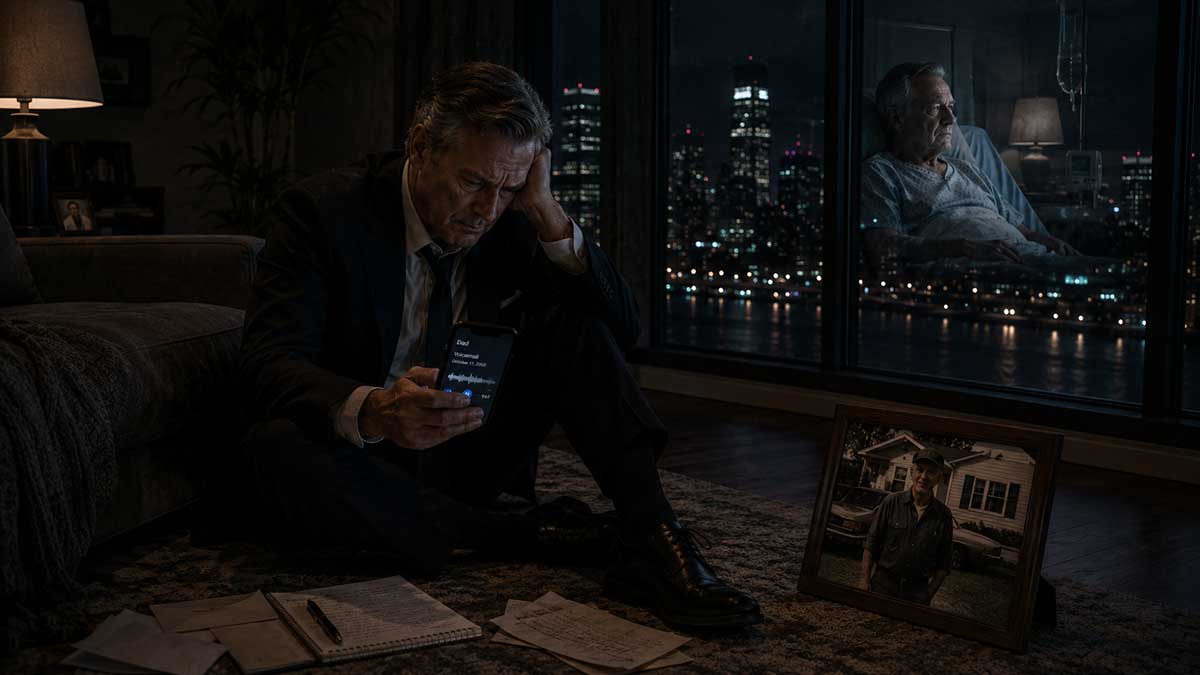
The voicemail had been waiting twenty-six years.
Daniel found it on a Wednesday afternoon in a folder labeled LEGACY MOBILE ARCHIVE.
A technician from legal had restored data from several of Richard Vale’s old phones, backup systems, and synchronized contact accounts. Most of it was useless.
Duplicate messages.
Old travel confirmations.
Voice notes Richard had made to himself.
One recording was dated October 17, 2000.
The number beneath it belonged to Daniel’s father.
Daniel recognized it immediately.
He stared at the screen.
The technician beside him said, “Want me to play it?”
“No.”
The answer came too quickly.
The technician nodded.
“Okay.”
Daniel looked again at the date.
October 17.
He knew that date too.
The Hartwell acquisition had not happened yet. That came years later.
This was the Northstar deal.
A manufacturing acquisition Richard had wanted badly.
The negotiations had gone wrong at the last minute.
Daniel had been at headquarters for almost twenty hours.
His father had been in the hospital.
Daniel remembered all of it.
At least he thought he did.
“Send me the file,” he said.
The technician did.
Daniel waited until he was alone.
Then he pressed play.
Static.
A small click.
His father’s voice.
“Danny?”
Daniel stopped the recording.
He sat back.
His throat had tightened before the second word.
He waited.
Then pressed play again.
“Danny? It’s Dad. Don’t rush. I know you’re busy.”
A pause.
“You call me when you can.”
Another pause.
“I’m proud of you.”
The recording ended.
That was all.
Twenty-three seconds.
Daniel stared at the screen.
He had expected something else.
He did not know what.
A goodbye.
A warning.
An accusation.
Something large enough to justify the weight he had given the memory.
Instead, his father had sounded tired.
Ordinary.
Kind.
Daniel played it again.
“Don’t rush.”
He stopped there.
Twenty-six years earlier, Daniel had been standing in Richard Vale’s office with a phone pressed to one ear and three legal pads open on the desk.
The Northstar acquisition had begun collapsing at seven in the evening.
A bank had changed terms.
Two board members were threatening to withdraw support.
Richard was furious.
Daniel’s sister Nora called at 8:14.
“Dad’s in the hospital.”
Daniel turned away from the room.
“What happened?”
“Chest pain.”
“How bad?”
“They’re doing tests.”
“Is he conscious?”
“Yes.”
“Put him on.”
“He’s sleeping.”
Daniel looked at Richard.
Richard was arguing with counsel.
“Tell him I’ll come as soon as this is finished.”
“Danny.”
“I can be there in an hour.”
“You’ve said that for three hours.”
Daniel lowered his voice.
“This is a major deal.”
“I know.”
“They need me here.”
There was silence.
Then Nora said, “Dad keeps asking if you’re coming.”
Daniel closed his eyes.
“Tell him soon.”
At 10:42, the deal was still not finished.
At 11:18, Nora called again.
Daniel did not answer.
At 11:37, she called again.
Richard was in the middle of a conference call with New York.
Daniel silenced the phone.
At 12:06, the bank agreed.
At 12:31, the board approved revised terms.
At 12:44, Richard opened a bottle of whiskey in his office.
Daniel looked at his phone.
Six missed calls.
The first one he returned was Nora.
She answered on the first ring.
Daniel knew immediately.
He did not remember exactly what she said.
He remembered sitting down.
He remembered Richard taking the phone from his hand.
He remembered staring at the carpet.
Later, Richard sat beside him.
Not as employer and assistant.
Almost as one man beside another.
He put a hand on Daniel’s shoulder.
“Your father would have been proud of you.”
Daniel had looked at him.
“You kept your head when most men would have fallen apart.”
Daniel remembered crying then.
Richard had stayed.
That mattered.
For years, that night lived in Daniel’s mind in a particular form.
He had failed to reach the hospital.
But his father would have understood.
His father admired hard work.
His father admired responsibility.
Richard had said so.
Richard understood these things.
Daniel had accepted the sentence almost as absolution.
Your father would have been proud.
Now Daniel sat alone with the voicemail.
Richard had never met Michael Mercer more than three or four times.
He had never sat at the kitchen table with him.
Never watched him repair a transmission in January with numb fingers.
Never heard him complain that restaurants charged too much for coffee.
Never seen him fall asleep in front of baseball games.
Richard did not know what Michael would have wanted that night.
Daniel did.
Or should have.
He called Nora.
She answered after several rings.
“Daniel?”
“Hi.”
“You okay?”
“Yes.”
A pause.
“You don’t sound okay.”
Daniel looked at the computer screen.
“I found a voicemail from Dad.”
Silence.
“What voicemail?”
“The night he died.”
Nora breathed in.
“Oh.”
“I had never heard it.”
“Are you sure?”
“Yes.”
“How did Richard have it?”
“Old phone synchronization, probably. I don’t know.”
“What did Dad say?”
Daniel looked at the waveform on the screen.
“He told me not to rush.”
Nora was silent.
“He said he knew I was busy.”
Still nothing.
“And he said he was proud of me.”
Nora made a sound Daniel could not place.
Not quite a laugh.
Not quite crying.
“That sounds like Dad.”
“Yes.”
Daniel waited.
Then:
“Was he waiting for me?”
Nora did not answer.
“Nora.”
“Yes.”
Daniel pressed his thumb against his forehead.
“How long?”
“I don’t know.”
“You do.”
She sighed.
“He kept looking at the door.”
Daniel closed his eyes.
“He asked the nurse what time it was several times.”
Daniel could see the room though he had never been there.
A hospital chair.
Dim hallway light.
His father waiting.
“He thought you were coming.”
Daniel said nothing.
Nora continued.
“I told him you were.”
“Did he believe you?”
“I think he wanted to.”
Daniel leaned forward, elbows on his knees.
“I should have left.”
“Yes.”
The simplicity of it hurt.
No reassurance.
No cruelty.
Just yes.
“I thought I had time.”
Nora’s voice softened.
“We all do.”
Daniel looked at the floor.
“I used to tell myself he would have wanted me to stay at work.”
Nora was quiet for a long moment.
“Dad was proud of your job.”
“I know.”
“He bragged about you constantly.”
Daniel smiled faintly.
“He told everyone at the shop you worked with billionaires and presidents.”
“I never worked with presidents.”
“You know Dad.”
Daniel almost laughed.
Then Nora said:
“But if you had walked into that hospital room, he would not have sent you back to work.”
Daniel’s face tightened.
“No.”
“He would have complained that you looked tired.”
“Yes.”
“He would have asked whether you ate.”
“Yes.”
“And then he would have wanted you to sit down.”
Daniel covered his eyes.
His sister waited.
“I’m sorry,” he said.
“For what?”
“For not being there.”
“That wasn’t something you did to me.”
“I left you alone with it.”
Nora was silent.
Then:
“Yes.”
Daniel swallowed.
“I’m sorry for that too.”
This time she said:
“Thank you.”
After the call, Daniel sat for nearly twenty minutes.
His phone began ringing.
BOARD TRANSITION CALL.
4:30.
He looked at the time.
4:32.
The call continued.
He had never missed a board call in thirty-eight years.
At 4:34 it stopped.
A minute later, Maya texted.
Everything okay?
Daniel looked at the message.
He typed:
Yes.
Then deleted it.
He typed:
No.
Deleted that too.
Finally:
I’ll call tomorrow.
He set the phone down.
The voicemail was still open.
Daniel played it one more time.
“Danny? It’s Dad. Don’t rush. I know you’re busy. You call me when you can. I’m proud of you.”
He listened to the silence after the message ended.
For decades, he had heard Richard’s voice attached to that night.
Your father would have been proud.
Now he heard his father’s actual voice.
And for the first time, Daniel understood the difference.
Richard’s sentence had not comforted him because Richard knew what Michael Mercer would have wanted.
It had comforted Daniel because Daniel desperately needed the decision to have been honorable.
He needed staying at work to mean something larger than staying at work.
He needed absence to become sacrifice.
He needed sacrifice to become dignity.
Otherwise, he had simply missed his father’s last night.
Daniel stood.
He took two steps toward the kitchen.
Then sat down on the floor beside the sofa.
Still wearing his suit.
Still wearing his shoes.
The phone vibrated again.
He ignored it.
For the first time in his adult life, Daniel Mercer let something remain unanswered.
Chapter 6 — What Did You Want?

Evelyn chose a small restaurant near Lake Michigan.
No private dining room.
No valet holding the door.
No corporate reservation.
Daniel arrived seventeen minutes early.
He noticed this and almost laughed.
Some habits apparently survived grief.
He sat near the window.
Beyond the glass, the lake was darkening beneath a pale evening sky.
When Evelyn arrived, she took one look at him and stopped.
“What happened?”
Daniel stood.
“My father.”
Her expression changed.
They sat.
Daniel did not begin with small talk.
That surprised both of them.
“I found his last voicemail.”
Evelyn placed her bag on the chair beside her.
“Oh, Daniel.”
“I had never heard it.”
“Do you want to tell me?”
He nodded.
So he did.
Not elegantly.
He told her about the Northstar deal.
Nora’s calls.
Richard.
The hospital.
The voicemail.
He told her that Richard had said his father would have been proud.
Then he said:
“He didn’t know my father.”
Evelyn said nothing.
Daniel looked toward the lake.
“I knew that.”
“Yes.”
“I mean I knew it then.”
“Yes.”
“But I still let the sentence become the truth.”
Evelyn folded her hands.
“Why?”
Daniel gave a short laugh.
“That appears to be the question everyone is asking me lately.”
He told her about the files.
The retirement restructuring.
Richard’s email.
Leah Chen.
The termination.
“I told her I was only doing my job.”
Evelyn winced.
“I know.”
“You know?”
“You said it about everything.”
Daniel looked at her.
“When?”
“For years.”
She began counting lightly on her fingers.
“You missed dinner because you were doing your job.”
“You canceled a weekend because you were doing your job.”
“You didn’t come to my birthday because you were doing your job.”
Daniel looked down.
“I forgot that.”
“I didn’t.”
“I’m sorry.”
Evelyn shrugged.
“I survived.”
He almost smiled.
A server came.
They ordered.
Neither looked closely at the menu.
When the server left, Evelyn studied him.
“Can I ask you something?”
“Yes.”
“Did you ever actually want the life you had?”
Daniel frowned.
“What do you mean?”
“I mean exactly that.”
“I had an extraordinary career.”
“That isn’t what I asked.”
“I worked with people most individuals never—”
“Daniel.”
He stopped.
She leaned slightly forward.
“I didn’t ask whether it was impressive.”
He stared at her.
“I asked whether you wanted it.”
Daniel looked out the window again.
Cars moved along Lake Shore Drive.
The question seemed badly constructed.
A life was not one thing.
You did not stand outside it beforehand with a checklist and select yes or no.
“I wanted the work.”
“All of it?”
“No.”
“What parts?”
Daniel thought.
“The beginning.”
Evelyn waited.
“When we were young. Everything felt possible.”
“Richard?”
“Yes.”
“He believed we were building something important.”
“And you believed him.”
“Yes.”
“Did you like being near that?”
Daniel smiled faintly.
“I loved it.”
There.
The admission felt clean.
Evelyn nodded.
“Good.”
Daniel looked surprised.
“You expected me to condemn it?”
“Perhaps.”
“I don’t.”
She sat back.
“You were good at what you did. You enjoyed being good at it. Richard gave you opportunities you never thought you’d have.”
“Yes.”
“None of that has to be false for the rest to be true.”
Daniel looked at her.
That sentence disturbed him in a different way.
He had grown accustomed to binary categories.
Right decision.
Wrong decision.
Good man.
Bad man.
Useful.
Useless.
Evelyn was offering no verdict.
“What did you want besides work?” she asked.
Daniel sighed.
“I don’t know.”
“Yes, you do.”
“No.”
“You’re afraid to answer.”
“I’m sixty-four years old, Evelyn. I hardly think—”
“There.”
“What?”
“You’re doing it.”
“Doing what?”
“Turning a feeling into an argument.”
Daniel looked irritated.
“I am trying to answer accurately.”
“No. You’re trying to answer safely.”
He looked away.
The server brought drinks.
Daniel waited until she left.
Then he said:
“I wanted to marry.”
Evelyn did not react.
He continued.
“I think.”
“You think?”
“I did.”
“Okay.”
“I wanted children.”
That surprised him as he said it.
Evelyn’s expression softened.
“Did you?”
“Yes.”
He looked toward the table.
“I used to picture a house.”
“What kind?”
Daniel almost smiled.
“Messy.”
Evelyn laughed.
“You?”
“I know.”
“What else?”
“A dog.”
“That I believe even less.”
Daniel smiled.
Then the smile disappeared.
“Sundays.”
She waited.
“I wanted Sundays where nobody could reach me.”
Evelyn said nothing.
“I wanted to travel somewhere and not know where Richard was.”
Another pause.
“I wanted to take my father fishing.”
His voice changed.
Evelyn reached across the table.
She did not take his hand.
She simply placed hers near it.
Daniel stared at the space between them.
“I wanted to tell Richard no.”
“When?”
“Many times.”
“Why didn’t you?”
“I don’t know.”
“Yes, you do.”
Daniel closed his eyes.
“He needed me.”
Evelyn waited.
Daniel opened his eyes.
“Richard needed me.”
“You’ve said that before.”
“He did.”
“I’m sure he did.”
Daniel looked at her.
She was not arguing.
That made the next thought harder.
“I think…”
He stopped.
Evelyn waited.
“I think I needed him to need me.”
The restaurant noise seemed to recede.
Evelyn said nothing.
Daniel repeated it.
“I needed him to need me.”
“Why?” she asked.
Daniel looked toward the window.
“Because then I knew what I was for.”
Evelyn’s face changed.
Daniel continued.
“If Richard called, I knew what to do.”
“If a meeting changed, I knew what to do.”
“If someone had to be fired, I knew what to do.”
“If there was a crisis, I knew what to do.”
He looked down.
“There was always an answer.”
“And if nobody needed you?”
Daniel looked at her.
“I don’t know.”
Evelyn nodded.
“That’s what I thought.”
Daniel leaned back.
“I don’t think Richard trapped me.”
Evelyn listened.
“He asked too much.”
“Yes.”
“He used loyalty.”
“Yes.”
“He sometimes treated my time as though it belonged to him.”
“Yes.”
Daniel looked at her.
“But I kept giving it.”
Evelyn’s eyes filled slightly.
“Yes.”
The word hurt more than accusation.
“You didn’t lose your life in one decision, Daniel.”
He looked at her.
“You kept postponing it.”
Daniel said nothing.
“One meeting.”
“One quarter.”
“One acquisition.”
“One crisis.”
“One more year.”
She leaned forward.
“There was always a reason why your life could begin later.”
Daniel’s throat tightened.
“I thought there would be time.”
“I know.”
“I was thirty.”
“I know.”
“Then forty.”
“Yes.”
“Then fifty.”
“Yes.”
Daniel laughed quietly.
“Sixty-four arrived rather quickly.”
Evelyn smiled sadly.
“It usually does.”
Their food arrived.
Neither touched it immediately.
Daniel stared at his plate.
“Did you ever think about us?”
Evelyn took a breath.
“Yes.”
“After Boston?”
“Yes.”
“How long?”
“I don’t know.”
“That’s not like you.”
She smiled.
“I learned not to catalog everything.”
Daniel almost smiled too.
“There were years when I wondered what would have happened.”
“And?”
“And then I stopped.”
Daniel nodded.
She watched him.
“I don’t mean that cruelly.”
“I know.”
“I had a life.”
“Yes.”
“I loved Peter.”
“I know.”
“I don’t want you taking my marriage and turning it into evidence that you lost something.”
Daniel looked up.
“What?”
“My life was not the wrong version of yours.”
He absorbed that.
“No.”
“Good.”
She continued.
“There might have been a life with you.”
“Yes.”
“There was a life with him.”
“Yes.”
“Both can matter.”
Daniel nodded slowly.
He looked at her.
“If I had asked you to stay?”
Evelyn sighed.
“You still want the alternate timeline.”
“Perhaps.”
“Maybe I would have stayed.”
Daniel waited.
“Maybe I would have gone anyway.”
He looked disappointed.
She smiled.
“Daniel, uncertainty is not a defect in the story.”
“It feels like one.”
“I know.”
She leaned closer.
“You spent your life wanting guarantees before making personal decisions.”
He looked at her.
“Love does not work like a board memo.”
“I am aware.”
“Are you?”
That drew a small laugh.
They ate.
For a while the conversation became ordinary.
Portugal.
Hannah.
Her grandchildren.
Daniel’s condo.
Nora.
A restaurant they used to go to that had closed years ago.
Then Evelyn checked the time.
“My car is coming in ten minutes.”
Daniel felt the old sensation.
Something ending.
He wanted to say something before the moment passed.
He recognized the sensation this time.
That alone felt new.
“Evelyn.”
“Yes?”
“I did love you.”
She became still.
Daniel continued before he could retreat.
“I should have said that thirty-one years ago.”
Her eyes filled.
“Yes.”
“I thought there would be another opportunity.”
“I know.”
“I thought if something mattered, it would somehow remain available.”
Evelyn looked at him.
“It doesn’t.”
“No.”
Outside, they walked toward the curb.
The air off the lake was cool.
Her car had not arrived yet.
Daniel put his hands in his coat pockets.
“What do I do now?”
Evelyn laughed gently.
“You’re asking me?”
“Yes.”
“No.”
Daniel looked at her.
“That may be the first useful answer I can give you.”
He smiled despite himself.
Evelyn became serious.
“You decide.”
“I’m not particularly practiced.”
“Then practice.”
“How?”
“One thing at a time.”
Her car turned the corner.
She looked at him.
“You still have to decide whether the rest of your life belongs to whoever asks first.”
Daniel nodded.
The car stopped.
Evelyn hugged him.
This time Daniel did not stiffen.
He held her.
Not as the woman he was finally going to reclaim.
Not as the answer to a story he had failed to live.
Simply as Evelyn.
Someone he had loved.
Someone who had loved him.
Someone whose life had continued.
She stepped back.
“Goodbye, Daniel.”
“For six months?”
She smiled.
“Maybe.”
He almost objected to the uncertainty.
Then smiled.
“Goodbye, Evelyn.”
She got into the car.
Daniel stood on the sidewalk until it disappeared.
His phone remained in his pocket.
He did not know the time.
He did not know what tomorrow required.
For several minutes, he stood beside Lake Michigan with no instruction, no schedule, and no person waiting for him to solve something.
The absence no longer felt entirely like emptiness.
For the first time, Daniel wondered whether it might be space.
Chapter 7 — Tuesday Morning

Daniel woke at 5:12 a.m.
No alarm.
His body had become one.
For several seconds, he lay still and listened to the apartment.
No phone ringing.
No car downstairs.
No message from Richard asking whether the airport had fog.
No email marked urgent.
He got up anyway.
Showered.
Shaved.
Put on a white shirt.
Dark trousers.
Jacket.
Tie.
Then stopped in front of the mirror.
The man looking back at him appeared ready for a meeting.
Daniel stared at him.
Slowly, he removed the tie.
Then the jacket.
He changed into an old navy sweater he had owned for at least fifteen years and rarely worn.
The act felt ridiculous.
It also felt strangely difficult.
At 5:47, he made coffee.
At 5:52, he opened the draft statement from the Vale family attorney.
The investigation had requested his testimony by noon.
The first paragraph read:
Mr. Mercer served in an administrative capacity and possessed no independent decision-making authority regarding the matters presently under review.
Daniel read it once.
Then again.
For most of his life, the sentence would have sounded accurate.
Comforting, almost.
No independent decision-making authority.
It placed him exactly where he had always preferred to stand.
Near the center of events.
Responsible for execution.
Never responsible for meaning.
He scrolled further.
Mr. Mercer reasonably relied upon senior management and appropriate subject-matter experts.
True.
Mr. Mercer had no reason to doubt the representations made to him at the time.
Daniel stopped.
That was not true.
He had doubted.
Not always.
Not loudly.
But enough.
He had asked whether the retirement restructuring was fair.
He had believed Leah’s firing was wrong.
He had known some instructions troubled him.
He simply decided his doubts did not count.
Daniel highlighted the entire statement.
Deleted it.
The blank document appeared.
He looked at the white screen.
For decades, blank space had frightened him.
A blank calendar.
A blank afternoon.
A question with no prepared answer.
Now he began typing.
I worked for Richard Vale for thirty-eight years.
He stopped.
Too personal.
He deleted the sentence.
Then typed:
I served as executive assistant and senior adviser to Richard Vale from 1988 until his death.
That was better.
He continued.
He wrote what he knew.
What he did not know.
What Richard told him.
What documents he saw.
What he suspected.
What he ignored.
He did not dramatize.
He did not accuse Richard of motives he could not prove.
He did not protect him either.
At 7:16, Daniel reached the section concerning Leah Chen.
He stopped typing.
Then wrote:
I did not make the original decision to terminate Ms. Chen. I did, however, carry out that decision after concluding privately that it was wrong.
He read it.
His hands felt cold.
He almost changed “wrong” to “unnecessary.”
Then remembered Leah.
That’s softer.
He left it.
He continued.
At 8:03, he reached the paragraph concerning his broader role.
The attorney’s version had absolved him completely.
Daniel wrote:
I did not make every decision described in this statement. I carried out some of them knowing I believed they were wrong. At the time, I treated that distinction as sufficient. I no longer do.
He stopped.
Read it again.
There was no legal elegance in the sentence.
Maya might hate it.
The family certainly would.
Richard would have called it naïve.
Daniel could almost hear him.
Dan, never volunteer your own rope.
Daniel smiled faintly.
Then typed the next sentence.
I often assumed that Mr. Vale possessed information that justified actions I questioned. In some cases, that assumption was correct. In others, I now know it was not. More importantly, I used that assumption to avoid making judgments that remained mine to make.
Daniel leaned back.
The room was brightening.
Chicago moved beyond the windows.
Traffic thickened.
People went to work.
Daniel looked at the clock.
8:17.
He read the statement from beginning to end.
Then attached the relevant documents.
His cursor hovered above SEND.
For thirty-eight years, Daniel had been very good at anticipating consequences.
What would Richard do?
What would the board do?
What would the press say?
What would investors think?
What would happen to the stock?
What would the family need?
Now every possible consequence arrived at once.
The family might accuse him of betrayal.
The company might distance itself.
Richard’s legacy might suffer.
Daniel’s own reputation might suffer.
There could be lawsuits.
Interviews.
Headlines.
Former colleagues might hate him.
For a moment, he wanted someone to tell him what to do.
Richard.
Maya.
Evelyn.
Leah.
His father.
Anyone.
No one did.
Daniel clicked SEND.
A small notification appeared.
Message sent.
That was all.
No thunder.
No release.
No instant transformation.
Just one decision.
His.
At 8:23, the phone rang.
Claire Vale.
Daniel watched her name appear.
His hand moved toward the phone automatically.
Then stopped.
He let it ring once.
Twice.
Three times.
He answered.
“Claire.”
“What did you send?”
Daniel looked out the window.
“My statement.”
“Dad’s attorneys say you changed everything.”
“Yes.”
“Why?”
Daniel considered the old answer.
Because legal required it.
Because the investigators asked.
Because circumstances changed.
Instead:
“Because it was accurate.”
Silence.
“You know what this could do.”
“Yes.”
“To Dad.”
“Yes.”
“To us.”
Daniel closed his eyes.
“Yes.”
Claire’s voice tightened.
“He trusted you.”
Daniel looked at the river below.
“I know.”
“And this is how you repay him?”
Daniel waited.
For years, the accusation would have broken something in him.
Loyalty.
Betrayal.
Debt.
Richard had trusted him.
Richard had changed his life.
Both were true.
“I’m not trying to repay him,” Daniel said.
“What does that mean?”
“It means I’m telling what happened.”
Claire said nothing.
Daniel continued.
“Your father did many good things.”
“I know that.”
“He did some things I should have questioned.”
“Daniel—”
“And I helped carry out some of them.”
Claire’s voice became softer.
“You’re blaming yourself now?”
“No.”
That surprised him.
He thought about it.
“No. I don’t think that’s what this is.”
“What is it?”
Daniel looked at the blank calendar on his phone.
“Responsibility.”
Claire exhaled.
“I can’t talk to you right now.”
“I understand.”
She ended the call.
Daniel set the phone down.
His heart was beating quickly.
He had no idea what would happen next.
He noticed that uncertainty did not kill him.
At 8:41, Maya called.
Daniel answered.
“I read it.”
“Yes.”
“You realize outside counsel is having a collective heart attack.”
“I assumed.”
Maya was silent for a moment.
“Did you write it yourself?”
“Yes.”
Another pause.
“It sounds like you.”
Daniel almost laughed.
“I’m not certain I know what that means.”
“It means there are no evasive verbs.”
Daniel smiled.
“Is that praise?”
“From a lawyer? Extremely.”
Daniel looked toward the kitchen.
“Maya.”
“Yes?”
“Did I create a legal problem?”
“You were going to have legal problems regardless.”
“That is reassuring.”
“I try.”
Then her voice changed.
“You did the right thing.”
Daniel looked down.
For some reason, the sentence made him uncomfortable.
“I don’t know that yet.”
Maya answered quietly.
“Fair.”
They hung up.
Daniel stood in the kitchen.
The statement was sent.
The calls could continue without him for a while.
He opened his calendar.
Nothing until Thursday afternoon.
His hand moved toward the screen.
He could schedule archive work.
Call estate counsel.
Organize Richard’s personal correspondence.
Create a document index.
There were always useful things available to anyone determined never to have an empty hour.
Daniel closed the calendar.
He walked into the living room.
On the bookshelf was the photograph of his parents.
Michael Mercer stood beside his wife near the front steps of their old bungalow.
His father wore a baseball cap.
Daniel picked up the frame.
Behind it was another photograph.
He had forgotten it was there.
Michael at Lake Geneva.
Late fifties perhaps.
Holding a fishing rod badly.
Smiling at whoever took the picture.
Daniel remembered the trip.
Or rather, the trip that never happened.
His father had called him one Saturday morning.
“Danny, come up next weekend.”
Daniel had been thirty-nine.
“Where?”
“Lake Geneva.”
“What for?”
“Fishing.”
“I don’t fish.”
“Neither do I.”
Daniel had laughed.
“I have quarterly meetings.”
“So the fish survive another week.”
“After the quarter closes.”
“Sure.”
They never went.
Daniel held the photograph.
After the quarter closes.
After the acquisition.
After the conference.
After Richard gets back.
After things calm down.
He looked toward the window.
Things had finally calmed down.
It had taken death to accomplish it.
At 9:26, Daniel put on shoes.
Not dress shoes.
An old pair of walking shoes.
He took his keys.
His phone.
Then returned to the kitchen.
He looked at the phone.
Turned off email notifications.
The silence that followed felt almost aggressive.
He put the phone in his pocket.
Then drove north.
The traffic leaving Chicago was heavier than he expected.
Daniel nearly turned around twice.
Both times he caught himself.
There was nowhere else he had to be.
That thought remained unfamiliar.
An hour later, the city disappeared behind him.
The road opened.
Fields.
Small towns.
Gas stations.
Low clouds.
Daniel drove without taking a call.
At 11:08, the family attorney called.
He ignored it.
At 11:19, an unknown number called.
Ignored.
At 11:34, Evelyn sent a message.
Thinking of you today.
Daniel smiled.
He did not answer immediately.
Not because he was withholding.
Because there was no emergency.
That distinction felt new.
Lake Geneva appeared shortly after noon.
Daniel parked near the water.
Families moved along the shoreline.
A retired couple ate sandwiches on a bench.
Three teenagers argued about where to take a photograph.
Nobody knew who Daniel Mercer was.
Nobody needed anything from him.
He walked into a small outdoor shop.
Fishing rods lined one wall.
Daniel stared at them.
A clerk in his twenties approached.
“Can I help you?”
“I need a fishing rod.”
“What kind?”
Daniel looked at the wall.
“I have no idea.”
The clerk smiled.
“Freshwater?”
“I assume so.”
“You fishing from shore?”
“Probably.”
“You know what you’re doing?”
Daniel looked at him.
For most of his adult life, Daniel had hated admitting ignorance.
Richard expected answers.
Executives expected answers.
Boards expected answers.
Everyone called Daniel when they did not know what to do.
He looked again at the rows of fishing rods.
“No.”
The clerk laughed.
“So you’ll learn.”
Daniel smiled.
“Yes.”
“I suppose I will.”
Twenty minutes later, Daniel sat near the water with a fishing rod he did not know how to use.
The clerk had explained the basics twice.
Daniel had forgotten half of them.
His first cast landed embarrassingly close to shore.
The second tangled.
On the third attempt, the line went farther.
Daniel sat down.
The lake moved gently under the afternoon light.
He thought of his father.
Not the hospital.
Not the voicemail.
Not what he had missed.
He remembered Michael laughing at a family barbecue.
Burning hamburgers.
Telling the same joke three times.
Falling asleep during the seventh inning.
There had been more to his father than the final night.
Daniel realized he had reduced him to regret.
Perhaps that was another kind of unfairness.
His phone vibrated in his pocket.
He removed it.
A message from Nora.
Heard you skipped the board call yesterday. End times?
Daniel laughed.
He typed:
At Lake Geneva.
Three dots appeared almost immediately.
What?
Fishing.
Long pause.
Then:
Do you know how?
Daniel looked at the rod.
Not remotely.
Nora sent back:
Dad would love this.
Daniel stared at the message.
For a moment, grief rose again.
But it was different now.
It did not demand that the past change.
Daniel typed:
I think so too.
He put the phone beside him.
Face down.
The afternoon moved slowly.
Daniel caught nothing.
He did not care.
At 2:46, he became aware that no one knew exactly where he was.
At 3:11, he realized he was hungry.
He bought a sandwich.
At 3:39, he sat again by the lake.
At 4:02, he stopped checking the time.
The sun lowered.
A child several yards away finally caught a small fish and shouted so loudly that half the shoreline applauded.
Daniel joined them.
He laughed.
The child’s father looked over.
Daniel nodded.
The father nodded back.
That was all.
No introduction.
No usefulness.
No role.
Near evening, Daniel packed the rod.
Before leaving, he stood beside the water.
He thought of Richard.
Not as saint.
Not as villain.
Richard Vale had been brilliant.
Generous.
Selfish.
Demanding.
Funny.
Manipulative.
Capable of enormous loyalty.
Capable of treating other people’s lives as extensions of his ambitions.
Daniel had loved him.
Daniel had enabled him.
Both could be true.
The thought no longer required a verdict.
He thought of Evelyn.
A life had been possible.
It had not happened.
Another life had happened for her.
It mattered.
He thought of Leah.
There had been a line.
He had crossed it.
Now he knew to look for the next one.
He thought of his father.
A man who had waited for him at a hospital door.
A man who had still said:
Don’t rush.
I’m proud of you.
Daniel looked at the lake.
For years, he had believed regret meant wanting another version of the past.
Now he wondered whether regret could mean something simpler.
Learning what not to surrender again.
His phone buzzed.
Calendar reminder.
BOARD ARCHIVE REVIEW — tomorrow, 9:00 a.m.
Daniel smiled.
He had forgotten to remove it.
He opened the calendar.
Deleted the reminder.
Then he added something.
Wednesday, 9:00 a.m.
Call Nora.
He looked at it.
For once, the calendar contained something no company had requested.
Something Richard had not scheduled.
Something Daniel wanted.
He saved it.
Then he stood by the water for another minute.
The day was almost gone.
Almost.
There was still light left.
Daniel turned away from the lake and began walking back to his car.
For the first time in thirty-eight years, he had taken the day off.
And nothing had fallen apart.
Final Thoughts
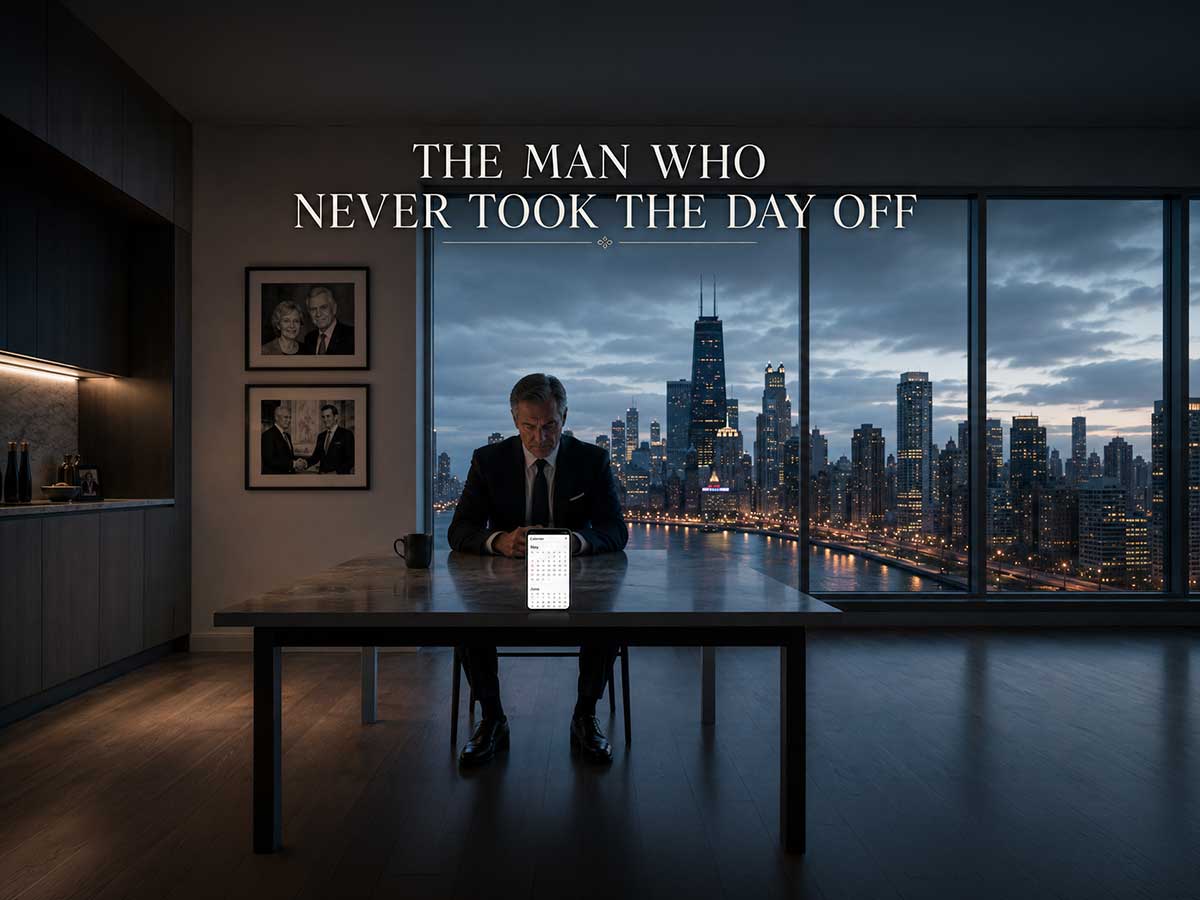
Daniel cannot recover the life he postponed.
He cannot return to his father’s hospital room.
He cannot become the man Evelyn might once have married.
He cannot erase what happened to Leah.
And telling the truth cannot transform thirty-eight years into something they were not.
But Daniel discovers something quieter.
The past may be fixed.
The remaining day is not.
His breakthrough comes when he admits:
“I think I needed him to need me.”
That realization changes the story. Richard demanded too much from Daniel, but Daniel found safety in being indispensable. If someone always needed him, he never had to answer the frightening question:
What do I want?
His first answer is remarkably small.
One Tuesday.
One fishing rod.
One unanswered phone call.
One day that belongs to him.
Perhaps changing a life does not always mean starting over.
Sometimes it means refusing to surrender the next day in the same way you surrendered the last one.
Short Bios:
Daniel Mercer — A 64-year-old executive assistant who has devoted thirty-eight years to Richard Vale and Vale Industries. His identity rests on usefulness, loyalty, and being indispensable until his employer’s death forces him to examine what those virtues have cost him.
Richard Vale — Billionaire founder of Vale Industries and Daniel’s longtime employer. Brilliant, charismatic, generous, demanding, and morally compromised, Richard becomes far more complicated after his death when Daniel discovers what existed behind the decisions he spent decades defending.
Evelyn Ross — Daniel’s former colleague and the woman he once loved but never asked to stay. Her return forces Daniel to confront the personal life he continually postponed and the difference between losing an opportunity and never choosing it.
Leah Chen — A former Vale Industries financial manager fired after challenging questionable company practices. Years later, she confronts Daniel with the moral responsibility hidden inside the phrase “I was only doing my job.”
Michael Mercer — Daniel’s late father, a hardworking mechanic whose final voicemail becomes one of the story’s emotional turning points. His simple words force Daniel to reconsider the meaning he assigned to missing his father’s final hours.
Nora Mercer — Daniel’s sister and one of the few people who remembers who Daniel was before Richard Vale became the center of his life. Her memories of their father help Daniel finally face the night he has spent decades rationalizing.
Leave a Reply