
Six Great Scholars. One Masterpiece. Nearly a Century of Questions
There are books people enjoy.
There are books people admire.
Then there are books that seem to become larger every generation.
The Sound and the Fury belongs to that final group.
Nearly one hundred years after its publication, scholars still return to it—not because they cannot explain it, but because each reading reveals something they had never seen before.
Why does Benjy's confusion feel so strangely authentic?
Why does Quentin's grief still feel painfully modern?
How can Caddy become the emotional center of a novel without ever telling her own story?
Why do so many readers finish the book believing Dilsey—not the Compsons—is the person they most admire?
And perhaps the greatest question of all...
Did William Faulkner simply write one remarkable novel...
or did he permanently change what a novel could become?
Tonight, six of the world's most respected Faulkner scholars gather around one table.
Not to lecture.
Not to debate.
But to think together.
To question one another.
To disagree with generosity.
To uncover why one difficult novel continues to shape readers, writers, and scholars across generations.
If Part One helped us feel the Compsons' heartbreak...
Part Two asks why that heartbreak still echoes nearly a century later.
Welcome to one of literature's greatest conversations.
(Note: This is an imaginary conversation, a creative exploration of an idea, and not a real speech or event.)
Topic 1 – Why Does This Novel Feel So Difficult—and Why Is That the Point?
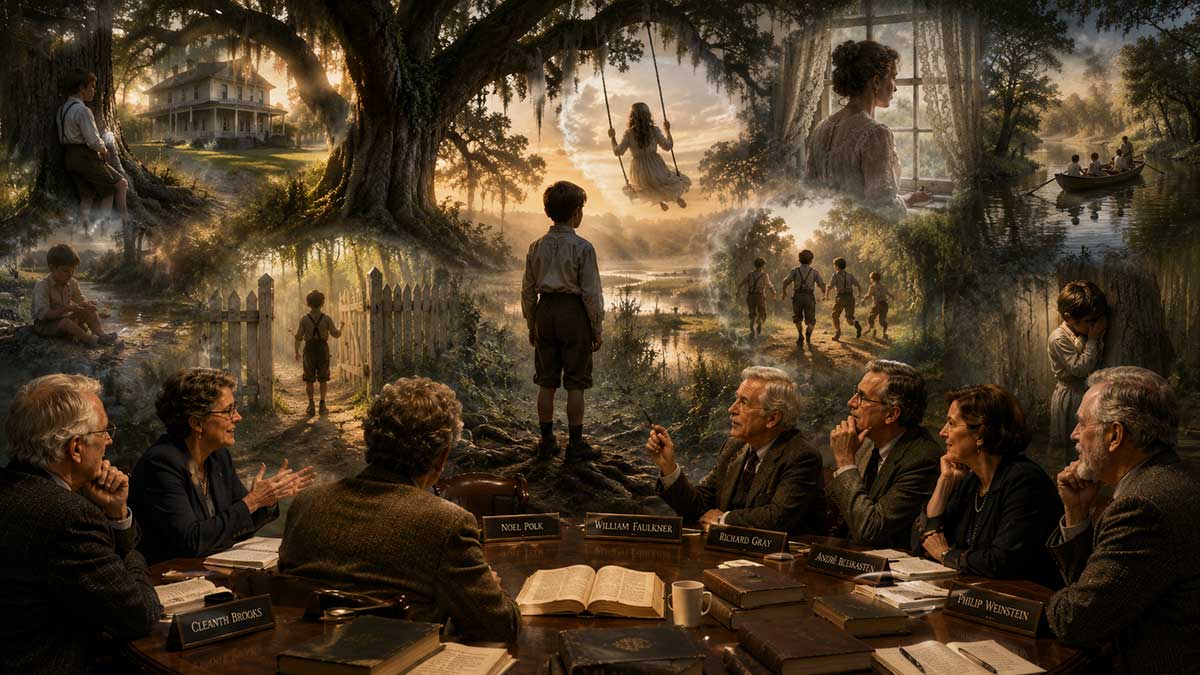
A quiet library.
Shelves of worn books stretch to the ceiling.
Rain taps softly against tall windows.
Six scholars sit around an oak table with coffee cups, notebooks, and a well-used copy of The Sound and the Fury lying open in the center.
No podium.
No audience.
Just friends who have spent decades thinking about the same novel.
Cleanth Brooks smiles as he opens the discussion.
Cleanth Brooks:
I have a confession.
For years, students would come to my office and say, "Professor, I don't understand The Sound and the Fury."
I'd ask them a question.
"Did Benjy confuse you?"
They'd say yes.
Then I'd ask,
"Didn't Benjy himself seem confused?"
They'd nod.
And I'd tell them,
"Then perhaps you've understood more than you realize."
The room chuckles.
Olga Vickery:
Exactly.
Readers assume confusion means failure.
Faulkner thought otherwise.
Benjy cannot organize experience into neat categories.
Past and present exist together.
His narration doesn't describe confusion.
It creates it.
That's a remarkable distinction.
Philip Weinstein:
I'd go even farther.
Modern neuroscience has caught up with Faulkner.
Memory isn't stored like books on a shelf.
It isn't chronological.
A smell.
A sound.
A familiar doorway.
They can collapse thirty years into three seconds.
Benjy experiences memory much the way many psychologists now describe traumatic memory.
Faulkner understood this decades before brain imaging existed.
Noel Polk:
And that's one reason I always tell readers not to rush.
People often approach this novel like a mystery they're supposed to solve.
Who's this?
When did that happen?
Where are we now?
Those questions matter...
but not first.
Your first job is simpler.
Sit beside Benjy.
See the world as he does.
Chronology can wait.
Experience can't.
Richard Gray:
That's an interesting word.
Experience.
I sometimes think readers arrive expecting a family saga.
Instead, Faulkner hands them consciousness itself.
He's asking something very unusual.
Not...
"What happened?"
But...
"What does living through this feel like?"
Those are completely different novels.
André Bleikasten:
Yes.
Most fiction represents reality.
Faulkner represents perception.
Reality reaches us only after consciousness has filtered it.
Benjy has one filter.
Quentin another.
Jason another.
None of them possesses reality.
Each possesses a way of seeing.
Brooks leans back.
Smiling.
Cleanth Brooks:
Which raises an uncomfortable question.
If every narrator is incomplete...
where does truth actually exist?
The room falls silent.
No one answers immediately.
Olga Vickery:
Perhaps...
between them.
She reaches toward the copy of the novel.
Olga Vickery:
Think of stained glass.
Each pane shows only one color.
Stand too close...
and you'll insist the window is blue.
Or red.
Or gold.
Only when you step back do you realize every fragment belonged to the same picture.
Benjy isn't wrong.
Quentin isn't wrong.
Jason isn't wrong.
They're simply unfinished.
Philip Weinstein:
That's beautifully put.
And I think readers make the same mistake with themselves.
We all believe our version of family history is the history.
Then we hear a sibling tell the same story.
Suddenly...
our certainty begins to crack.
Perhaps the Compsons aren't unusual at all.
Perhaps every family contains four different novels.
Everyone laughs.
Richard Gray:
That may be the best one-sentence summary of Faulkner I've ever heard.
Every family contains four different novels.
Noel Polk:
Six, if you count the parents.
Brooks:
Seven, if you count Dilsey.
Bleikasten:
And perhaps eight...
if you count the reader.
The scholars pause.
Several nod thoughtfully.
William Faulkner (appearing quietly at the doorway with a faint smile):
May I join you?
The room brightens immediately.
No one seems surprised.
Only delighted.
Brooks stands.
Cleanth Brooks:
We've been talking about your readers.
Perhaps we should ask the only person here who knows.
Why begin with Benjy?
Of all possible narrators...
why him?
Faulkner takes a seat.
He looks down at the old copy of his novel.
His fingers rest gently on its worn cover.
William Faulkner:
Because Benjy cannot lie.
Not intentionally.
He has no philosophy to defend.
No reputation to protect.
No argument to win.
He simply receives the world.
Most people spend their lives explaining experience.
Benjy only experiences it.
I trusted readers to feel before they understood.
Sometimes...
feeling is the beginning of understanding.
The room is quiet.
No one rushes to speak.
It is Bleikasten who finally breaks the silence.
André Bleikasten:
That may explain why the novel becomes easier the second time.
The first reading teaches us how to read.
The second reading lets us read.
Faulkner smiles.
William Faulkner:
That's very close.
People often ask me how to understand The Sound and the Fury.
I always think they're asking the wrong question.
Don't begin by trying to understand Benjy.
Begin by trusting him.
Understanding usually arrives later.
Trust must come first.
The rain outside grows softer.
The scholars sit quietly, each looking at the old novel resting in the middle of the table.
For a long moment, no one reaches to open it.
They no longer see it as a difficult book.
They see it as an invitation.
And perhaps...
that was Faulkner's intention all along.
Topic 2 – Time, Memory, and Why the Past Never Dies
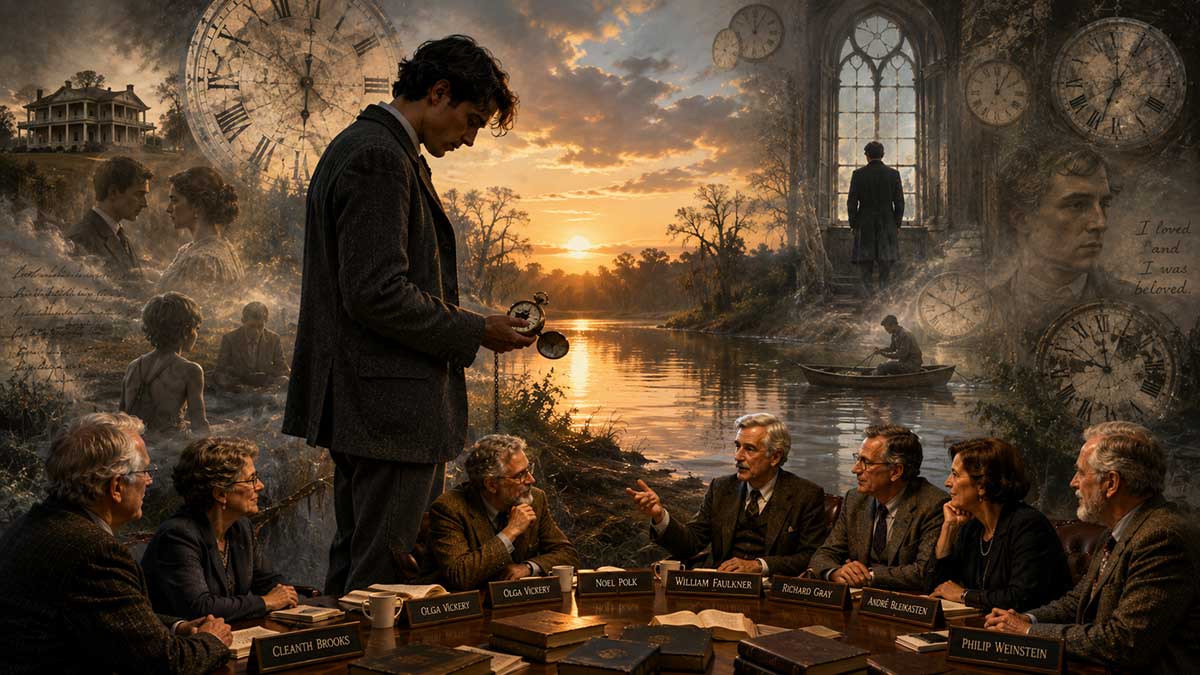
The rain has stopped.
Morning light filters through the tall library windows.
Someone has opened another pot of coffee.
The discussion has become more relaxed.
Books lie open across the table, though no one seems interested in quoting them anymore.
Instead, they are chasing an idea.
William Faulkner quietly turns an old pocket watch over in his hand.
He sets it on the table.
It ticks softly.
William Faulkner:
People often tell me this is a novel about time.
I've never been completely satisfied with that description.
I'd like to ask all of you something.
Is this truly a novel about time?
Or is it about our refusal to accept time?
No one answers immediately.
Then André Bleikasten reaches for the pocket watch.
He doesn't pick it up.
He simply watches it tick.
André Bleikasten:
I've always believed the clocks in your novel are almost ironic.
The clock insists time moves forward.
The human mind refuses.
The tragedy isn't time.
The tragedy is consciousness.
We cannot stop remembering.
Even when we desperately wish to.
Cleanth Brooks:
I agree.
Readers often say Quentin is obsessed with clocks.
I think that's only half true.
He's obsessed with defeating them.
Breaking his watch isn't an act of rebellion against machinery.
It's an act of desperation.
He's saying,
"If I destroy the clock...
perhaps I can stop losing what it measures."
Richard Gray:
And Quentin isn't only mourning his family.
He's mourning an entire civilization.
The South he inherited exists more in memory than reality.
That's why his grief feels almost historical.
His personal heartbreak and his cultural heartbreak become impossible to separate.
Philip Weinstein:
That's what fascinates me psychologically.
People rarely grieve only one thing.
Losses attach themselves to one another.
Someone loses a sister...
and suddenly they're mourning childhood.
Someone loses a home...
and suddenly they're mourning identity.
Trauma doesn't organize itself neatly.
It accumulates.
Quentin becomes buried beneath accumulated grief.
Olga Vickery:
Notice something else.
Benjy never mourns the way Quentin does.
The others look toward her.
Olga Vickery:
People often call Benjy trapped in the past.
I don't think he is.
Benjy doesn't revisit memory.
Memory revisits him.
Those are entirely different experiences.
He isn't choosing nostalgia.
He's responding to whatever enters his senses.
The scent of trees.
A gate opening.
A voice.
The past arrives uninvited.
Noel Polk:
That's exactly why readers become lost.
They're searching for chronological transitions.
Faulkner removes them.
Not to be difficult.
To imitate memory itself.
Think about your own life.
Has anyone here ever smelled a perfume that instantly carried you back thirty years?
Everyone smiles.
Richard Gray:
Fresh-cut grass.
Every spring.
Without fail.
I'm ten years old again before I realize what's happened.
Philip Weinstein:
For me...
it's an old hymn.
I hear the first few notes...
and suddenly I'm sitting beside my grandmother.
The remarkable thing is that the emotion arrives before the memory.
William Faulkner:
Exactly.
Emotion opens the door.
Memory walks through it.
Not the other way around.
The room falls thoughtfully silent.
Brooks leans forward.
Cleanth Brooks:
I'd like to challenge something, though.
We've been speaking about memory almost reverently.
Memory isn't always truthful.
Is it?
Bleikasten smiles.
He has clearly been waiting for someone to ask.
André Bleikasten:
No.
Memory is extraordinarily creative.
We imagine memory as an archive.
I think it's much closer to an artist.
Every recollection is a reconstruction.
Every return changes what we return to.
That's why each narrator creates a different Caddy.
They're not remembering the same woman.
They're remembering themselves through her.
The room grows animated.
Several scholars begin speaking at once.
Then they laugh.
Brooks gestures for Bleikasten to continue.
André Bleikasten:
Benjy remembers comfort.
Quentin remembers innocence.
Jason remembers betrayal.
None of them possesses Caddy.
Each possesses a relationship with Caddy.
That distinction changes the entire novel.
Olga Vickery:
I couldn't agree more.
I've often said Caddy becomes almost mythic.
She doesn't exist independently inside the novel.
She exists refracted through longing.
In that sense...
she resembles memory itself.
Impossible to grasp directly.
Only visible through those who carry her.
Faulkner slowly nods.
William Faulkner:
When readers ask,
"Who was the real Caddy?"
I sometimes want to answer,
"Which one?"
The room laughs softly.
Noel Polk:
That may frustrate readers.
They want certainty.
William Faulkner:
Do they have certainty in their own families?
The laughter fades.
No one answers.
Philip Weinstein:
That's a profound question.
Ask three siblings about their childhood.
You'll hear three entirely different histories.
Not because anyone is lying.
Because every child occupies a different emotional position within the same house.
Perhaps The Sound and the Fury isn't experimental at all.
Perhaps it's brutally realistic.
Richard Gray:
There's another irony.
People think the novel becomes universal because of its themes.
I think it becomes universal because of its structure.
Everyone has experienced a memory arriving without permission.
Everyone has replayed a conversation they wish had ended differently.
Everyone has discovered that the past isn't finished with them...
even when they're finished with it.
Faulkner looks again at the pocket watch.
He closes it gently.
The ticking stops.
William Faulkner:
May I offer one small correction?
The past is often described as something behind us.
I've never believed that.
The past isn't behind us.
It's inside us.
Sometimes quietly.
Sometimes loudly.
Sometimes beautifully.
Sometimes painfully.
But always...
inside.
No one speaks.
Outside, sunlight now fills the library.
The room feels brighter than before.
Not because the scholars have solved time.
But because they have stopped treating it as an enemy.
Brooks closes his notebook.
Cleanth Brooks:
Perhaps that's why readers return to this novel every decade or so.
Not because the book changes.
Because they do.
A twenty-year-old reads Quentin.
A forty-year-old begins to understand Jason.
A sixty-year-old finally notices Dilsey.
And one day...
almost without realizing it...
they discover they have become the reader the novel was patiently waiting for.
Topic 3 – Why Is Caddy the Center of a Novel She Never Narrates?
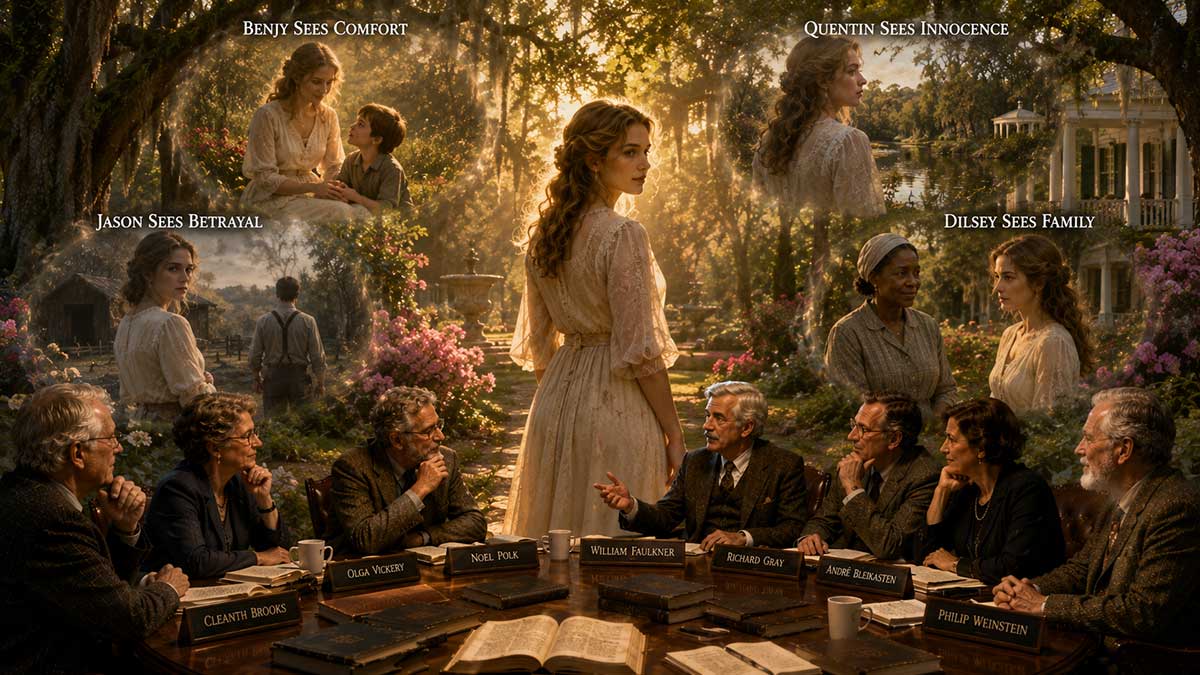
The coffee has grown cold.
No one notices.
The copy of The Sound and the Fury now lies open in the middle of the table.
Its pages have been marked by decades of notes.
William Faulkner slowly closes the book.
He rests his hand on the cover.
William Faulkner:
I'd like to ask all of you about the person who never speaks.
I've often found that readers are haunted by Caddy more than anyone else.
Curious, isn't it?
The character without a single chapter...
becomes the center of the novel.
Why?
Cleanth Brooks smiles.
Almost as if he'd been waiting his entire career for that question.
Cleanth Brooks:
Because absence is sometimes more powerful than presence.
Most novelists let us hear the protagonist explain themselves.
You never gave us that comfort.
Instead...
every narrator reveals more about themselves than about Caddy.
She's less a character than a mirror.
Olga Vickery:
I'd take that one step farther.
Caddy is the emotional gravity of the novel.
Planets don't orbit themselves.
Everything else moves around them.
Benjy.
Quentin.
Jason.
Even Dilsey.
Each life bends around Caddy's existence.
Yet gravity itself remains invisible.
Richard Gray:
That's a wonderful image.
I'd only add that Caddy also represents something much larger than herself.
For Quentin, she becomes the South before its fall.
For Jason, she becomes the explanation for his failures.
For Benjy, she becomes home itself.
Each of them transforms one woman into an entire world.
No real person could survive that weight.
Philip Weinstein:
Exactly.
That's what strikes me psychologically.
Nobody truly allows Caddy to be Caddy.
Every relationship becomes an act of projection.
Families do this all the time.
One child becomes...
"The responsible one."
Another...
"The difficult one."
Another...
"The successful one."
Eventually...
the labels become louder than the person.
When I reread the novel now, I often find myself asking...
Who was Caddy before everyone started needing her to symbolize something?
The room becomes very quiet.
Noel Polk slowly nods.
Noel Polk:
That's the heartbreaking question.
Readers spend years trying to reconstruct Caddy.
I've spent years with Faulkner's manuscripts, revisions, and notes.
You know what surprises me?
The more evidence we gather...
the more mysterious she becomes.
She's almost impossible to pin down.
Not because Faulkner failed to define her.
Because he refused to reduce her.
William Faulkner:
Yes.
Real people resist summaries.
Characters often don't.
I wanted Caddy to remain as unpredictable as someone you actually love.
Bleikasten leans forward.
His eyes brighten.
André Bleikasten:
May I suggest something a little radical?
Brooks smiles.
Cleanth Brooks:
You usually do.
Laughter circles the table.
André Bleikasten:
Perhaps Caddy doesn't need her own chapter.
Because she already exists inside every chapter.
Think about music.
Silence isn't the absence of music.
Silence shapes the music.
Without rests...
melody becomes noise.
Caddy functions almost like silence.
She gives form to every voice without becoming one herself.
The room falls still.
Even Brooks seems impressed.
Cleanth Brooks:
That's... remarkably beautiful.
I've never thought of her that way.
Richard Gray:
Neither have I.
And it explains something.
Readers often finish the novel feeling they've somehow met Caddy...
without ever hearing her speak.
Philip Weinstein:
May I challenge that slightly?
Bleikasten smiles.
André Bleikasten:
Please.
Philip Weinstein:
I don't think readers meet Caddy.
I think they mourn her.
There's a difference.
We spend four sections trying to assemble someone who has already disappeared.
That's how grief works.
When someone is gone...
we begin collecting fragments.
A photograph.
A sentence.
A habit.
A favorite song.
We convince ourselves those pieces equal the person.
Deep down...
we know they never can.
Perhaps every narrator is grieving a different Caddy.
No one speaks.
Faulkner slowly looks out the window.
William Faulkner:
You're closer than you know.
When we lose someone...
we don't lose one person.
We lose the version of them that existed only inside us.
Every relationship creates its own human being.
That's why one death produces many griefs.
Olga quietly closes her notebook.
Olga Vickery:
Then perhaps Caddy's silence is necessary.
If she spoke...
she'd interrupt everyone else's memories.
Readers would stop imagining.
The mystery would collapse.
Noel Polk:
And there's another practical effect.
Every reader creates a slightly different Caddy.
That's astonishing.
Most novels give us one heroine.
This novel gives us thousands.
Brooks chuckles.
Cleanth Brooks:
I've taught this book for decades.
I've asked students to describe Caddy.
The answers are never identical.
Sometimes I think every classroom invents its own Caddy.
Richard Gray:
Which may explain why she feels immortal.
She never becomes fixed.
She keeps changing with each generation.
Faulkner smiles quietly.
William Faulkner:
May I ask all of you one final question?
Do you think Caddy is the protagonist?
The scholars glance at one another.
No one rushes.
Finally, Brooks speaks.
Cleanth Brooks:
No.
The room waits.
Cleanth Brooks:
She's something rarer.
She's the center.
There's a difference.
A protagonist moves the story.
A center gives everyone else meaning.
Without Caddy...
Benjy is someone else.
Quentin is someone else.
Jason is someone else.
Even Dilsey's compassion reveals itself differently.
She's less the main character...
than the heart every other character unknowingly beats around.
Bleikasten nods slowly.
André Bleikasten:
Perhaps that's why readers never stop searching for her.
We're not really searching for Caddy.
We're searching for the missing center in our own lives.
The room grows quiet.
Outside, the afternoon sun slips through the library windows.
No one opens the novel again.
For a moment...
it feels as though Caddy herself has quietly passed through the room.
She never spoke.
Yet somehow...
everyone heard her.
Topic 4 – Is Dilsey the True Hero of the Novel?
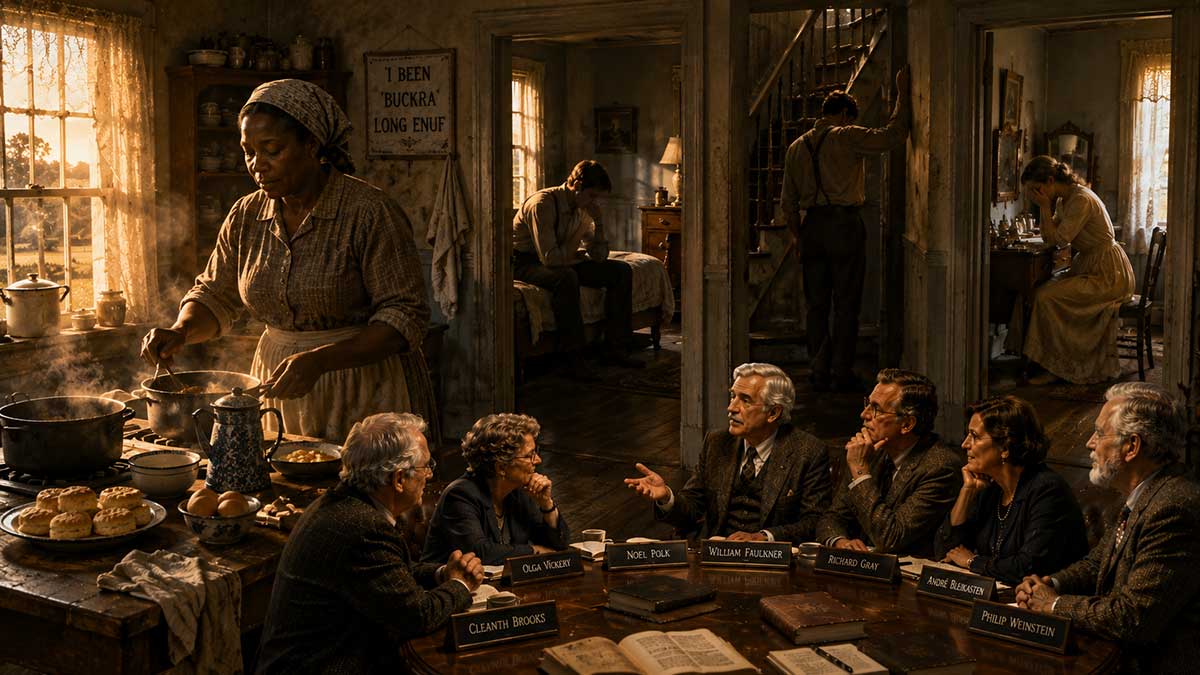
The afternoon light has begun to fade.
Someone lights a small lamp on the table.
The room grows quieter.
Earlier, the scholars spoke with excitement.
Now they speak with affection.
William Faulkner gently turns to the final pages of The Sound and the Fury.
He doesn't read them.
He simply rests his hand there.
William Faulkner:
I'd like to talk about someone who often receives the fewest pages...
yet leaves one of the deepest impressions.
Dilsey.
Many readers finish the novel and suddenly realize the strongest person wasn't a Compson at all.
Why?
Richard Gray answers first.
His voice is thoughtful.
Richard Gray:
Because Dilsey is the only person whose identity isn't collapsing.
Everyone else is fighting reality.
Dilsey lives inside it.
The Compsons keep asking,
"How do we stop losing?"
Dilsey quietly asks,
"How do we remain human after we've lost?"
Those are profoundly different questions.
Olga Vickery:
Exactly.
When I first studied this novel, I thought the center was Caddy.
Years later...
I began wondering whether the moral center had quietly shifted to Dilsey.
She doesn't speak the most beautiful language.
She doesn't possess the grandest ideas.
She simply continues loving people who have given her every reason to stop.
That is extraordinary.
Philip Weinstein:
And psychologically...
she's the healthiest person in the novel.
That surprises many readers.
They expect emotional health to mean happiness.
Dilsey isn't happy.
She's exhausted.
She grieves.
She watches people she loves destroy themselves.
Yet she never allows suffering to become her identity.
That's emotional maturity.
Cleanth Brooks:
I'd even say she accomplishes something none of the Compsons manage.
She accepts time.
Benjy cannot understand it.
Quentin tries to defeat it.
Jason resents it.
Dilsey walks with it.
She doesn't demand that life remain as it was.
She mourns...
then keeps going.
Faulkner smiles.
William Faulkner:
I've often thought readers overlook one small sentence.
"I've seed de first en de last."
People quote it.
Few pause long enough to consider it.
What does she actually mean?
The room falls silent.
André Bleikasten answers slowly.
André Bleikasten:
I don't think she's speaking only about the Compsons.
She's speaking about civilizations.
Worlds rise.
Worlds fall.
Families begin.
Families end.
Youth becomes age.
Joy becomes grief.
She has witnessed life's entire rhythm.
There's almost something biblical about that sentence.
Not triumphant.
Simply truthful.
Noel Polk nods.
Noel Polk:
I've spent years studying Faulkner's revisions.
One thing always strikes me.
You never rush Dilsey.
Her scenes breathe differently.
The pace slows.
Readers often don't notice that consciously.
They feel it.
It's as though the novel itself relaxes when she enters.
Faulkner smiles quietly.
William Faulkner:
Perhaps because she isn't trying to control life.
Only to live it faithfully.
Brooks leans forward.
Cleanth Brooks:
I'd like to raise something that has become a larger conversation over the years.
Many readers today ask whether Dilsey is idealized.
Whether she exists mainly to redeem the Compsons.
I don't think that's right.
What do the rest of you think?
Richard Gray answers immediately.
Richard Gray:
I think reducing her to a symbol actually diminishes her humanity.
Yes...
she carries enormous symbolic weight.
But she's also wonderfully practical.
She cooks.
She cleans.
She worries.
She gets tired.
She laughs.
She loses patience.
She's not merely goodness.
She's goodness lived through ordinary days.
That's much harder to write.
Philip Weinstein:
I agree.
Modern readers sometimes assume strength must be dramatic.
Dilsey reminds us strength often looks repetitive.
Getting up again.
Showing up again.
Refusing to let bitterness become your personality.
There's nothing glamorous about that.
Yet it's probably the hardest achievement in the novel.
Olga smiles.
Olga Vickery:
May I confess something?
Everyone looks at her.
Olga Vickery:
When I first read The Sound and the Fury as a young scholar...
Quentin fascinated me.
His language.
His intellect.
His tragedy.
Years later...
after raising children...
after losing people I loved...
after watching families struggle...
I found myself reading more slowly whenever Dilsey appeared.
She hadn't changed.
I had.
The room becomes very quiet.
Brooks nods gently.
Cleanth Brooks:
That's happened to me as well.
When we're young...
we admire brilliance.
As we grow older...
we begin admiring faithfulness.
Faulkner looks around the table.
His expression is thoughtful.
William Faulkner:
Isn't that interesting?
Readers often tell me Quentin is the unforgettable character.
Benjy is the unforgettable narrator.
Caddy is the unforgettable absence.
Jason is the unforgettable anger.
Yet when life becomes difficult...
many discover they most want to become Dilsey.
No one speaks.
The truth of it hangs in the room.
André Bleikasten finally breaks the silence.
André Bleikasten:
Perhaps that's because Dilsey answers the question the novel never asks directly.
How do we live after tragedy?
Not how do we avoid it.
Not how do we explain it.
How do we continue?
Only one person actually demonstrates an answer.
William Faulkner slowly closes the novel.
The sound echoes softly through the library.
William Faulkner:
I'd like to end with one final thought.
People often say The Sound and the Fury is a dark novel.
I've never entirely agreed.
Darkness is certainly present.
So is cruelty.
So is loss.
But if darkness were the final word...
I wouldn't have ended with Dilsey.
Hope in literature rarely arrives with fireworks.
Sometimes...
it arrives carrying breakfast into a quiet kitchen.
Sometimes...
it sits beside someone who's grieving.
Sometimes...
it simply refuses to leave when everyone else has.
Perhaps that is why Dilsey remains.
Not because she escapes suffering.
Because suffering never persuades her to surrender her compassion.
The scholars sit in silence.
No one feels the need to add another interpretation.
Some truths don't need another footnote.
They only need to be lived.
Topic 5 – Did William Faulkner Change the Novel Forever?
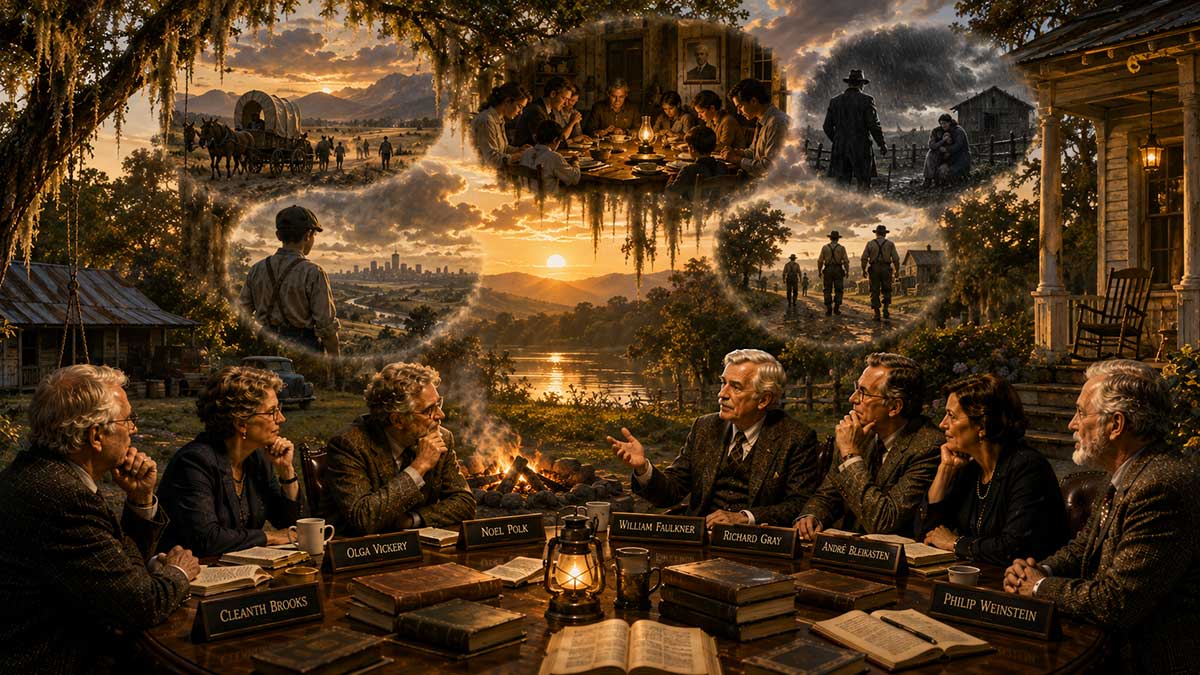
The library has become almost silent.
Outside, evening settles over the old campus.
The books remain open.
The coffee cups are nearly empty.
The discussion has lasted for hours.
No one has looked at the clock.
It somehow feels appropriate.
William Faulkner glances around the table.
He smiles.
William Faulkner:
We've spent today talking about one novel.
I'd like to finish with something larger.
Did The Sound and the Fury actually change literature?
Or do later generations simply enjoy saying it did?
The scholars laugh.
Cleanth Brooks answers first.
Cleanth Brooks:
I'll answer plainly.
Yes.
It changed the possibilities of the novel.
Not because no one had experimented before.
Joyce had.
Woolf had.
Proust certainly had.
What Faulkner accomplished was different.
He proved that emotional truth could determine structure.
Most novels ask,
"What's the best way to tell this story?"
Faulkner asked,
"What structure would grief itself choose?"
That was revolutionary.
André Bleikasten:
Beautifully said.
I've often believed Faulkner stopped treating consciousness as a window.
He made it the landscape.
Readers no longer stand outside the mind looking in.
They live inside it.
That's an extraordinary leap.
Philip Weinstein:
And it changed expectations forever.
After Faulkner, readers became willing to trust difficult novels.
Not because difficulty became fashionable.
Because difficulty could serve compassion.
His complexity wasn't decoration.
It was empathy.
The form itself teaches us how another human being experiences reality.
Richard Gray:
His influence stretches far beyond American literature.
When I teach Gabriel García Márquez...
I hear echoes of Yoknapatawpha.
When I read Toni Morrison...
I hear echoes of Quentin and Caddy.
Cormac McCarthy...
Jesmyn Ward...
Marilynne Robinson...
Even writers who sound nothing like Faulkner often inherit his courage.
He gave later authors permission to trust readers.
Noel Polk:
And perhaps more importantly...
he trusted rereading.
Most books reveal less the second time.
Faulkner's often reveal more.
Every return uncovers another layer.
That's extraordinarily rare.
Faulkner smiles.
William Faulkner:
You know...
publishers weren't always thrilled by that idea.
The room laughs.
William Faulkner:
They preferred books readers finished once.
I seemed determined to write books readers never finished with.
The laughter grows warmer.
Olga Vickery:
May I offer another thought?
Everyone nods.
Olga Vickery:
People often praise Faulkner's innovation.
Innovation is the wrong word.
Innovation eventually becomes outdated.
What survives is recognition.
Every generation recognizes itself inside these pages.
Not because the circumstances remain the same.
Because the emotional questions remain the same.
Who am I inside my family?
Can I escape childhood?
What happens when love becomes expectation?
How do memory and grief shape identity?
Those questions never become obsolete.
Philip Weinstein:
That's exactly why younger readers often discover new meanings.
Students today don't necessarily identify with the decline of the Old South.
But they understand fractured families.
Mental health.
Trauma.
Identity.
They read Faulkner through different experiences...
and somehow the novel still speaks.
That's the mark of a classic.
It grows without changing.
Brooks leans back.
He looks toward Faulkner.
Cleanth Brooks:
May I ask you something I've wanted to ask for years?
William Faulkner:
Of course.
Cleanth Brooks:
You've heard countless interpretations.
Some brilliant.
Some... imaginative.
Has anyone ever completely explained your novel?
Faulkner smiles for a long time before answering.
William Faulkner:
No.
The room laughs.
William Faulkner:
And I hope no one ever does.
The day a novel can be completely explained...
it has stopped living.
A living work keeps asking new questions.
Readers think they're interpreting the book.
Often...
the book is interpreting them.
Silence follows.
Not awkward.
Reflective.
Richard Gray:
That may be why the greatest classrooms never end with agreement.
They end with better questions.
André Bleikasten:
Exactly.
Literature isn't mathematics.
The goal isn't one correct answer.
The goal is richer perception.
After reading Faulkner...
we notice our own memories differently.
We listen to family stories differently.
We even hear silence differently.
A great novel changes perception long before it changes opinion.
Noel Polk closes his notebook.
Noel Polk:
I've spent decades studying every draft, every revision, every manuscript.
People sometimes ask whether all that scholarship has solved The Sound and the Fury.
My answer surprises them.
No.
It has made the mystery deeper.
Not smaller.
Every answer opened another door.
The scholars smile.
They all understand.
William Faulkner slowly stands.
He walks toward the tall library window.
Outside, the last light of day disappears.
He turns back toward the table.
William Faulkner:
Before we leave...
I'd like each of you to answer one final question.
Not as scholars.
As readers.
If someone had never opened The Sound and the Fury...
why should they?
Cleanth Brooks:
Because it teaches you that confusion can be the beginning of wisdom.
Olga Vickery:
Because it reminds you that every family contains mysteries no outsider can fully see.
Richard Gray:
Because history isn't something that happened long ago.
It's something we carry into every conversation.
Philip Weinstein:
Because it gives language to grief, memory, and identity long before psychology found its own vocabulary.
Noel Polk:
Because it's one of the very few novels that becomes larger every time you return to it.
Finally...
everyone looks toward André Bleikasten.
He smiles quietly.
André Bleikasten:
Because somewhere inside these pages...
every reader eventually meets themselves.
No one speaks.
The room grows still.
Faulkner closes the last remaining book.
William Faulkner:
When I accepted the Nobel Prize, I said that the writer's duty is to write about the human heart in conflict with itself.
People often quote that sentence.
Tonight...
I've realized something.
This novel was never only about the Compsons.
It was about every heart trying to make peace with time.
If these conversations have accomplished anything...
I hope they have removed one misunderstanding.
The Sound and the Fury is not a novel to conquer.
It is a novel to accompany.
You don't finish it once.
You return to it as you grow older.
And each visit feels like meeting an old friend who somehow knows more about your life than when you last met.
Perhaps that's why great literature never grows old.
It grows with us.
The library lights dim.
One by one, the scholars gather their books.
No one seems eager to leave.
There is a quiet understanding around the table.
They had begun the day discussing one of the world's most difficult novels.
They ended it discussing life itself.
And somehow...
that feels exactly as William Faulkner would have wanted.
Final Thoughts by William Faulkner
When I began writing The Sound and the Fury, I wasn't trying to create a masterpiece.
I wasn't trying to confuse readers.
I wasn't trying to invent a new literary technique.
I was trying to solve a problem.
How do you tell the truth about human experience when human experience itself refuses to move in straight lines?
Memory interrupts.
Love returns unexpectedly.
Regret arrives without warning.
One sound can awaken forty years.
One face can reopen an entire childhood.
If life itself unfolds this way...
why should a novel pretend otherwise?
Listening to these scholars today has been one of the great privileges an author could hope for.
Not because they agreed.
Quite the opposite.
They reminded me that literature remains alive only when thoughtful people continue asking thoughtful questions.
A finished interpretation is a strange thing.
It sounds satisfying.
But it leaves no room for tomorrow's reader.
The finest books continue changing because their readers continue changing.
That is why a student of twenty, a parent of forty, and a grandparent of seventy rarely read the same novel.
The pages remain identical.
The heart does not.
Today we spoke about Benjy's innocence.
Quentin's impossible longing.
Jason's bitterness.
Caddy's mysterious absence.
Dilsey's enduring grace.
Each represents something recognizable within ourselves.
There is a little Benjy in every memory we cannot explain.
A little Quentin in every moment we wish time had stopped.
A little Jason in every hurt we never fully released.
A little Caddy in every person asked to carry more than they should.
And, if we are fortunate...
a little Dilsey in every quiet act of kindness no one applauds.
People often ask what makes a classic.
I don't believe it is age.
Or difficulty.
Or reputation.
A classic is a work that continues asking questions after the world around it has changed.
It refuses to become outdated because the human heart refuses to become outdated.
Technology changes.
Politics changes.
Language changes.
Yet people still love imperfectly.
Still remember selectively.
Still search for home.
Still struggle to forgive.
Still wonder who they are becoming.
As long as those questions remain...
stories like this one will continue finding readers.
If these conversations have encouraged you to open The Sound and the Fury for the first time...
or to return to it after many years...
then they have accomplished something worthwhile.
Do not worry about understanding every page.
Read patiently.
Read honestly.
Allow the novel to meet you where your life is today.
One day you may discover what countless readers have discovered before you.
The greatest books rarely tell us what to think.
They quietly teach us how to see.
Thank you for joining this conversation.
May every great book you read become not merely something you finish...
but someone you continue meeting throughout your life.
Short Bios:
William Faulkner (1897–1962)
Nobel Prize laureate in Literature and one of the most influential novelists of the twentieth century, William Faulkner transformed modern fiction through nonlinear storytelling, stream of consciousness, and deeply psychological narratives. His fictional Yoknapatawpha County became one of literature's richest imagined worlds, influencing generations of writers from Gabriel García Márquez to Toni Morrison and beyond.
Cleanth Brooks (1906–1994)
One of America's most influential literary critics and a leading interpreter of William Faulkner. Brooks helped generations of readers appreciate the structure, symbolism, and moral depth of Faulkner's fiction, especially The Sound and the Fury and The Yoknapatawpha Country.
Olga W. Vickery (1922–2010)
A pioneering Faulkner scholar whose landmark study The Novels of William Faulkner helped establish modern interpretations of memory, myth, narrative structure, and character psychology in Faulkner's work. Her insights remain widely cited in literary scholarship.
Noel Polk (1940–2012)
Among the foremost textual scholars of William Faulkner, Polk devoted decades to editing, restoring, and studying Faulkner's manuscripts and published works. His scholarship clarified chronology, textual variations, and the evolution of Yoknapatawpha County.
Richard Gray (1947– )
An internationally respected scholar of American literature whose work connects Faulkner's fiction with Southern history, American identity, race, and cultural transformation. His writings have helped place Faulkner within broader literary and historical conversations.
André Bleikasten (1933–2009)
French literary critic and one of the world's most profound philosophical readers of Faulkner. His studies explored consciousness, language, time, perception, and existential questions, offering some of the deepest interpretations of The Sound and the Fury.
Philip Weinstein (1943–2021)
Renowned literary scholar whose work explored trauma, identity, family relationships, and psychological realism in modern fiction. His interpretations of Faulkner bridge literary criticism with contemporary psychology, helping modern readers connect emotionally with the novel's enduring themes.
Leave a Reply