
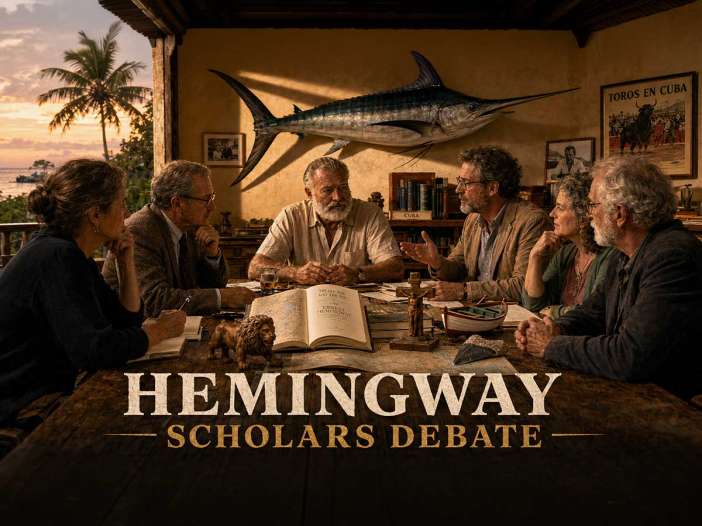
What if Santiago did not truly win, but needed to believe that he had?
Introduction by Ernest Hemingway
When I finished The Old Man and the Sea, I believed I had written the truest story I could.
Not the biggest.
Not the most complicated.
Simply the truest.
Years passed, and something curious happened.
Readers refused to leave the old fisherman alone.
Some saw Christianity.
Others saw Greek tragedy.
Some found psychology.
Others discovered ecology, masculinity, aging, art, or my own life hidden beneath the surface.
I sometimes protested.
I reminded people that the old man was an old man, the fish was a fish, and the sea was the sea.
What I wished to protect was not simplicity itself, but reality.
If a reader stops seeing the salt water because every wave has become a symbol, then something precious has been lost.
Yet time has taught me another lesson.
Living stories continue speaking after their authors have fallen silent.
Readers from different generations ask different questions because they carry different burdens.
A young reader asks whether Santiago is brave.
An older reader wonders whether he went too far.
A fisherman notices the currents.
A priest notices the wounds.
A philosopher notices the choices.
A son notices Manolin.
A teacher notices legacy.
None of these readers is entirely wrong.
This Imaginary Talk gathers scholars who have spent decades studying the novella from different directions.
Some challenge my assumptions.
Some challenge each other.
Several challenge me more than I expected.
I have discovered something worth admitting.
A writer does not lose his story when readers think deeply about it.
He loses it only when they stop asking questions.
So let us return to the sea once more.
Not to settle every debate.
But to discover why one old fisherman still refuses to leave us.
(Note: This is an imaginary conversation, a creative exploration of an idea, and not a real speech or event.)
Topic 1: Did Santiago Win, or Did He Need to Believe He Won?
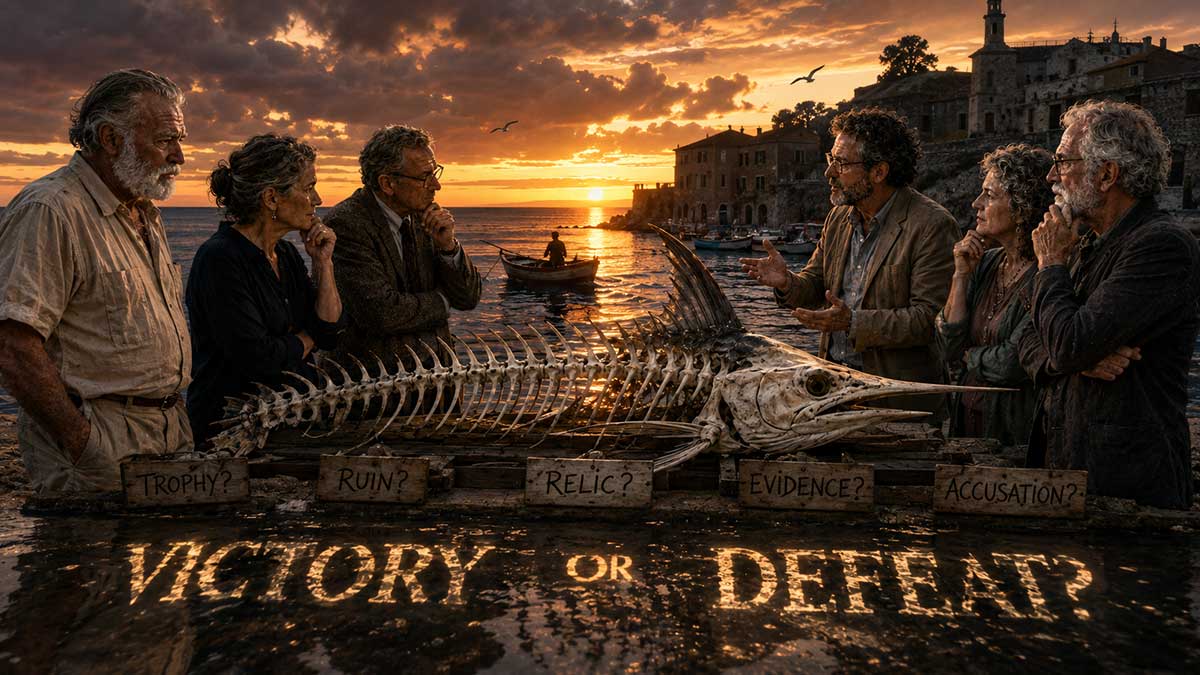
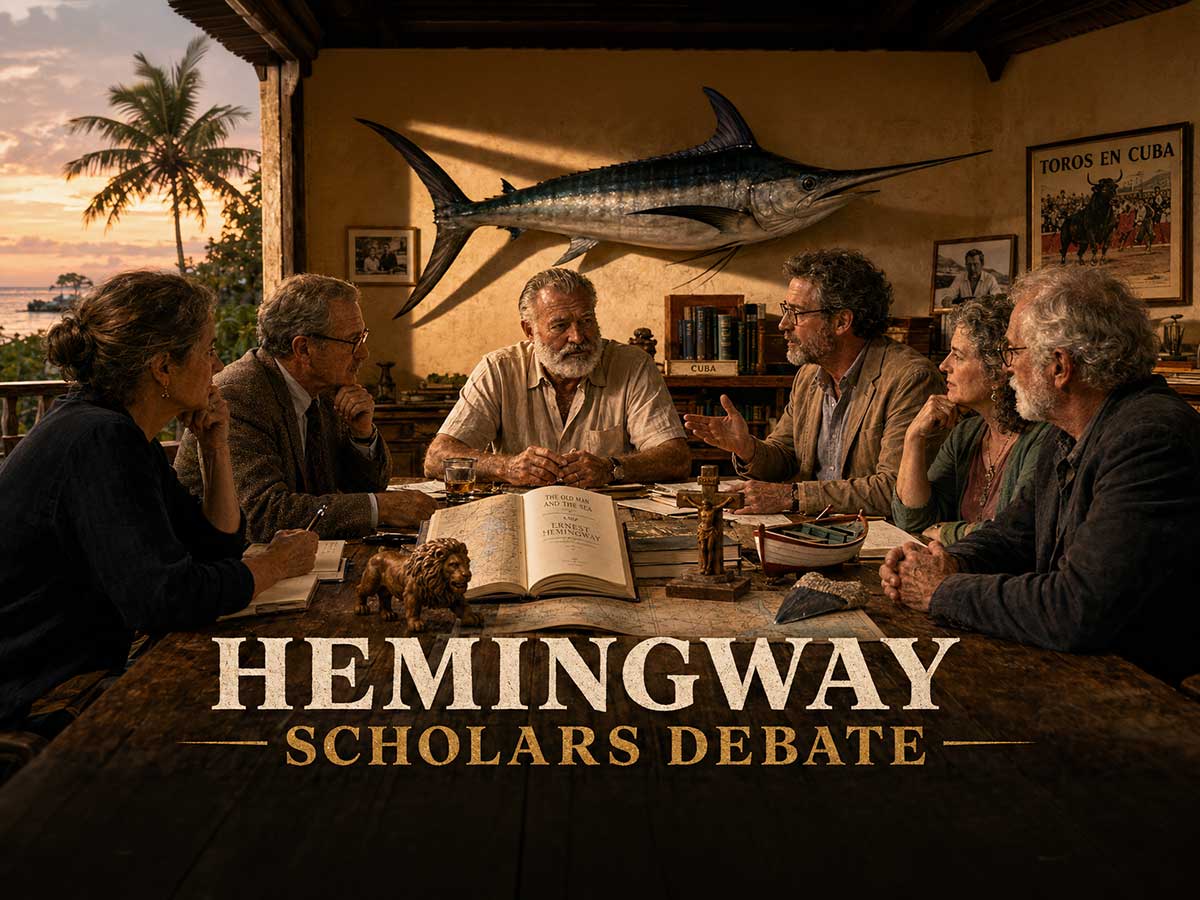
Finca Vigía is unusually quiet.
Late afternoon light falls across the writing table. A marked copy of The Old Man and the Sea lies open beside fishing charts, a baseball newspaper, a lion figurine, and a glass Hemingway has already refilled once.
On the wall, the marlin bill casts a long shadow.
Ernest Hemingway sits at the head of the table.
Susan Beegel is across from him.
Bickford Sylvester has filled the margins of his copy with notes.
Peter L. Hays rests one hand on a closed notebook.
Larry Grimes studies the small wooden crucifix near the window.
H. R. Stoneback looks past everyone, as though some older pilgrimage is taking place outside.
Nick Sasaki turns on the recorder.
Did Santiago win or lose?
Nick Sasaki
Let us begin with the question almost every reader asks after finishing the book.
Did Santiago win?
Or did he lose and then create a story that allowed him to live with the loss?
Hemingway leans back.
Ernest Hemingway
He caught the fish.
Susan Beegel
He returned with bones.
Ernest Hemingway
Bones prove there was a fish.
Susan Beegel
They prove there was once a fish.
They do not prove the voyage was wise.
Hemingway studies her for a moment.
Ernest Hemingway
You want wisdom from a fisherman who went fishing.
Susan Beegel
I want us to stop turning suffering into victory before asking who paid for it.
The marlin paid.
Santiago’s body paid.
Manolin paid when he found him broken.
The sea paid by becoming the stage upon which a man tested himself.
Hemingway’s expression hardens.
Ernest Hemingway
The sea does not send invoices.
Bickford Sylvester
No, but the text keeps records.
Hemingway looks toward him.
Bickford Sylvester
Santiago says he went out too far.
That admission matters.
He does not return congratulating himself.
He returns knowing that part of his suffering came from excess.
Nick
Then the ending is not a simple triumph?
Bickford Sylvester
Not remotely.
It is a victory crossed by self-knowledge.
Or a failure redeemed by it.
Perhaps both.
Peter L. Hays
That tension is why the story survives.
If Santiago were purely victorious, the book would become encouragement literature.
If he were purely defeated, it would become despair.
Hemingway leaves us between those positions.
The skeleton is both evidence and accusation.
Hemingway taps the table.
Ernest Hemingway
A good story should leave something moving after the last sentence.
Susan Beegel
It does.
The trouble is that readers often move too quickly from the skeleton to inspiration.
They see endurance and forget the killing.
They see dignity and forget pride.
They see courage and ignore consequence.
Larry Grimes
Yet consequence does not cancel dignity.
Susan Beegel
No.
But dignity does not erase consequence either.
Grimes nods.
Larry Grimes
Then perhaps victory here is not acquittal.
It is the refusal to let loss turn into spiritual collapse.
Nick
That sounds close to “destroyed but not defeated.”
Hemingway glances toward the open book.
What does “destroyed but not defeated” really mean?
Ernest Hemingway
It means what it says.
A man may be broken in body, stripped of proof, mocked by circumstance, and still refuse to surrender the center of himself.
Peter L. Hays
Yet readers often turn that line into a slogan.
The book is harsher.
Santiago is not untouched.
His hands are damaged.
His body is exhausted.
His fish is gone.
His judgment is wounded.
He does not float above failure.
He passes through it.
H. R. Stoneback
And returns carrying the mast.
That detail changes the emotional scale.
He does not return crowned.
He returns burdened.
The image is not celebration.
It is passage through suffering.
Susan Beegel
Which raises the danger.
Once we give suffering sacred meaning, we may begin admiring what should have been avoided.
Larry Grimes
Only if we confuse suffering with goodness.
The story does not say pain is good.
It asks whether a person can remain human inside it.
Susan Beegel
But Santiago chooses part of that pain.
He goes farther.
He refuses release.
He insists on bringing the marlin home.
Ernest Hemingway
Because he is a fisherman.
Susan Beegel
And because he needs the fish to say something about him.
Hemingway’s eyes narrow.
Ernest Hemingway
Everyone needs the work to say something.
Susan Beegel
That may be true.
It does not make every sacrifice wise.
Silence holds the room.
Nick looks toward Sylvester.
Nick
What does the text itself suggest?
Does Santiago believe he won?
Bickford Sylvester
He does not use the language of victory.
That is critical.
He speaks of being beaten.
He questions whether he went too far.
He returns to sleep, not celebration.
The villagers admire the skeleton, but Santiago is absent from that admiration.
Nick
So the people who call him victorious may be doing more interpretive work than Santiago himself.
Bickford Sylvester
Yes.
The reader wants to save him.
The novella is less eager.
Hemingway gives a short laugh.
Ernest Hemingway
Readers always want to rescue the wounded after the writer has finished with them.
Peter L. Hays
Perhaps writers do too.
Hemingway turns toward him.
Peter L. Hays
The lions return.
Manolin returns.
The promise of fishing together returns.
You denied Santiago material restoration, then gave him symbolic renewal.
Ernest Hemingway
I gave him sleep.
Peter L. Hays
And lions.
Ernest Hemingway
A man can dream.
Peter L. Hays
That is exactly the point.
The dream prevents the ending from closing entirely around defeat.
Hemingway says nothing.
Why does Santiago return with only the skeleton?
Nick
Why not let him bring back part of the flesh?
Why make the loss nearly complete?
Ernest Hemingway
Half a fish would make people calculate.
A skeleton makes them think.
Bickford Sylvester
It strips the result down to form.
The flesh could be sold, eaten, praised, weighed.
The skeleton cannot function as ordinary success.
It becomes record, remnant, outline.
H. R. Stoneback
Relic.
Beegel looks toward him.
Susan Beegel
That word carries danger too.
H. R. Stoneback
Of course.
A relic may inspire devotion or conceal violence.
Yet the skeleton stands in the village like the remains of a sacred encounter.
The people see size.
Manolin sees suffering.
Santiago sees cost.
Each witness receives a different truth.
Larry Grimes
The skeleton says that something happened which cannot be reduced to usefulness.
Nick
Then visible failure may still contain invisible meaning?
Larry Grimes
Yes, but we must be careful.
Meaning is not compensation.
It does not restore the marlin.
It does not heal Santiago’s hands.
It does not pay for the lost days.
Meaning does not reverse loss.
It keeps loss from becoming empty.
Susan Beegel’s expression softens slightly.
Susan Beegel
That distinction matters.
Ernest Hemingway
It matters more than most speeches people make about perseverance.
Peter L. Hays
The skeleton works because it resists one conclusion.
It is trophy and ruin.
Achievement and waste.
Proof and absence.
That doubleness is the ending.
Nick
Could the skeleton stand for art itself?
A writer struggles for years, creates something alive, and the public receives only the finished structure.
Hemingway looks amused.
Ernest Hemingway
Writers enjoy comparing themselves to fishermen.
Fishermen usually have better excuses.
Bickford Sylvester
Yet the comparison is present.
The finished work is what remains after experience has been cut away.
The reader sees bones arranged into form.
The living struggle is gone.
Hemingway
Now you are making the fish into a book.
Sylvester
You started it.
A brief smile crosses Hemingway’s face.
Is the ending hopeful, tragic, or both?
Nick
Manolin cries.
Santiago sleeps.
Tourists misunderstand the skeleton.
The boy promises they will fish together again.
What emotion should dominate the ending?
Peter L. Hays
Tenderness.
Not triumph.
Not despair.
Tenderness.
Larry Grimes
I would say grace.
Susan Beegel
I would say grief with a future attached.
Bickford Sylvester
I would say unresolved continuation.
H. R. Stoneback
Pilgrimage rarely ends at the place where the pilgrim collapses.
Someone carries the story onward.
Here, that person is Manolin.
Hemingway reaches for his glass.
Ernest Hemingway
You all use more words than the book.
Nick
That is why we invited scholars.
Ernest Hemingway
A mistake I have now identified.
The room laughs.
Nick
Mr. Hemingway, what would you call the ending?
He takes his time.
Ernest Hemingway
True.
The laughter stops.
Nick
Not hopeful?
Ernest Hemingway
Hopeful things can be false.
Tragic things can be false.
The ending is true because the old man is hurt, the fish is gone, the boy loves him, and morning will still come.
That is enough.
Susan Beegel
Yet the boy’s love changes the meaning.
Ernest Hemingway
Yes.
Susan Beegel
Then Santiago is not saved by personal toughness alone.
Ernest Hemingway
No one is.
The answer surprises the table.
Grimes leans forward.
Larry Grimes
That may be the most important admission of the afternoon.
Ernest Hemingway
Do not make it religious yet.
Larry Grimes
I was going to call it human.
Hemingway nods once.
Are readers protecting themselves from the fear that effort may lead to nothing?
Nick
Let me ask the hardest question.
Do readers need Santiago to have won because they are afraid of another possibility?
That effort, discipline, courage, and love may still end with almost nothing?
No one answers at once.
Outside, a bird crosses the orange sky.
Peter L. Hays
Yes.
Readers want moral arithmetic.
Effort should equal reward.
Courage should equal success.
Suffering should equal wisdom.
The novella refuses that equation.
Susan Beegel
And that refusal is one of its strongest features.
Santiago may deserve admiration.
The universe does not owe him compensation.
The sea does not become fair because he is brave.
Larry Grimes
Yet this is where dignity becomes more than consolation.
If goodness mattered only when rewarded, it would be a transaction.
H. R. Stoneback
Pilgrimage would become tourism.
Bickford Sylvester
Craft would become bookkeeping.
Ernest Hemingway
And fishing would become a market report.
Nick smiles, then turns serious again.
Nick
So what remains when effort does not produce the desired result?
Larry Grimes
Character.
Susan Beegel
Responsibility for what the effort cost.
Peter L. Hays
A story others may inherit.
Bickford Sylvester
Knowledge of one’s limits.
H. R. Stoneback
A path someone younger may continue.
Everyone looks toward Hemingway.
He studies the marlin bill on the wall.
Ernest Hemingway
The morning after.
Nick
What do you mean?
Ernest Hemingway
That is what remains.
You wake up.
The fish is gone.
The world has not apologized.
Your hands still hurt.
Then you decide whether to rise.
No one speaks.
The light across the room has faded.
Susan Beegel closes her notebook.
Susan Beegel
Then perhaps Santiago’s victory is not what happened at sea.
It is that he does not become smaller after returning.
Hemingway looks at her.
For once, he does not resist.
Ernest Hemingway
That is close.
Nick
Close to what?
Hemingway stands and walks toward the window.
Ernest Hemingway
Close to the truth.
He looks out across the Cuban hills.
The scholars remain seated behind him.
No final verdict has been reached.
Santiago won.
Santiago lost.
Santiago failed.
Santiago endured.
The skeleton allows every answer and forgives none of them.
On the table, the open book waits for the next argument.
Topic 2: Courage, Pride, or Self-Destruction?
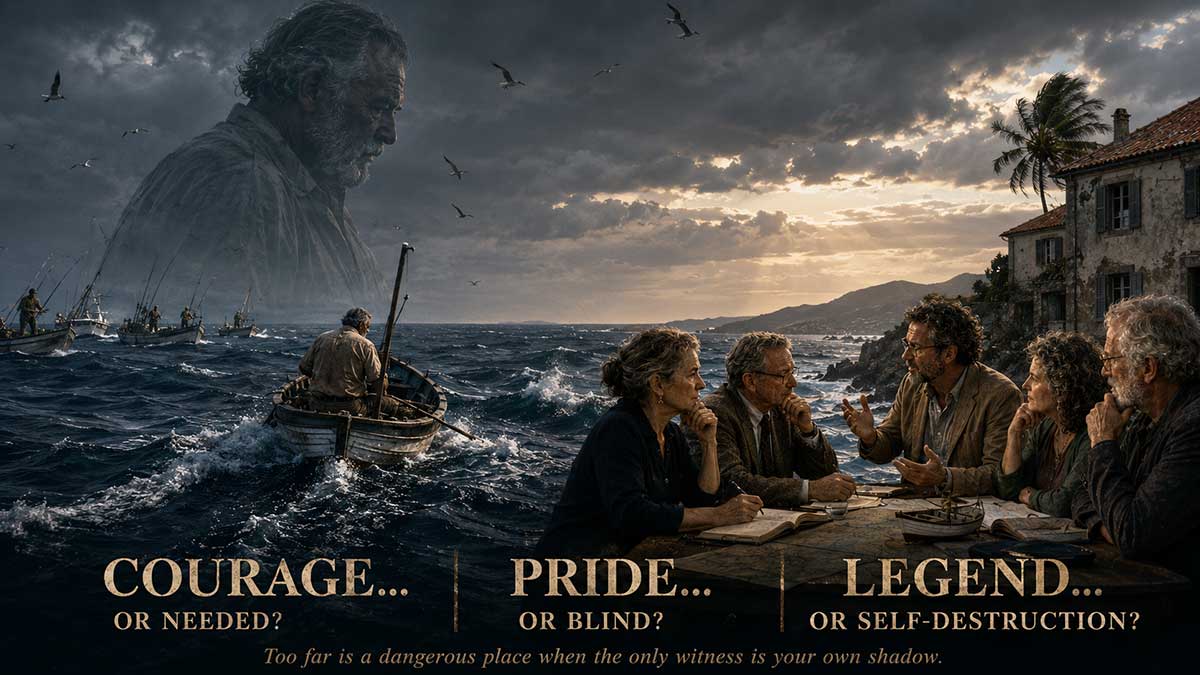
Morning sunlight pours through the open windows of Finca Vigía.
Coffee has replaced whiskey.
The scholars appear more comfortable challenging Hemingway now.
Hemingway notices it.
He may even enjoy it.
Nick glances around the table.
Nick Sasaki
Yesterday we asked whether Santiago won.
Today I want to ask something less comfortable.
Was Santiago courageous, or was he simply too proud to stop?
Hemingway smiles.
Ernest Hemingway
Good.
We are finally talking about the dangerous part of the book.
Is Santiago Truly a Hero?
Nick Sasaki
Every generation seems to call Santiago a hero.
Should we?
Ernest Hemingway
Yes.
Susan Beegel immediately shakes her head.
Susan Beegel
Not so quickly.
Hemingway laughs.
Ernest Hemingway
I knew you would say that.
Susan Beegel
Heroism should not make anyone immune to criticism.
Santiago inspires me.
He worries me too.
Nick Sasaki
Why?
Susan Beegel
He believes dignity requires proving himself.
That belief costs him nearly everything.
Readers can admire his courage without copying every decision he makes.
Peter Hays joins the discussion.
Peter L. Hays
Perhaps we should ask a different question.
Hero according to whom?
His village?
His apprentice?
The reader?
The sea?
Or himself?
Nick Sasaki
Can heroism depend upon the audience?
Peter L. Hays
Very often.
Greek heroes looked different from Christian heroes.
Modern heroes look different again.
Santiago belongs partly to all three traditions.
Larry Grimes quietly nods.
Larry Grimes
The Christian tradition often measures heroism through faithfulness rather than visible success.
Susan Beegel
Faithfulness to what?
That is the issue.
Faithfulness to craft?
To pride?
To responsibility?
Those are not always the same thing.
Hemingway points toward her.
Ernest Hemingway
Now you are asking the right question.
Does Pride Save Santiago or Destroy Him?
Nick Sasaki
Let us go directly there.
Is pride Santiago’s greatest strength, or his fatal flaw?
Bickford Sylvester opens his heavily annotated copy.
Bickford Sylvester
The answer is already inside the text.
Santiago admits that he went out too far.
That sentence deserves more attention than it usually receives.
Nick Sasaki
Why does it matter so much?
Bickford Sylvester
It is not the sea judging him.
It is not the sharks.
It is not the villagers.
He judges himself.
Hemingway slowly nods.
Ernest Hemingway
Exactly.
Readers keep arguing about Santiago.
He has already argued with himself.
Susan Beegel
Which means he recognizes that courage became excess.
Ernest Hemingway
Or excellence required excess.
Everyone turns toward him.
Nick Sasaki
What do you mean?
Ernest Hemingway
Nobody discovers a new ocean by remaining near the harbor.
Susan Beegel
True.
Every unnecessary expedition tells itself the same story.
Silence settles over the room.
Peter Hays smiles.
Peter L. Hays
Perhaps the difference appears only in hindsight.
Success makes boldness look visionary.
Failure makes the same decision look reckless.
Nick Sasaki
That sounds very modern.
Peter L. Hays
It is.
Entrepreneurs, scientists, artists, and explorers all face the same judgment.
We praise the survivor.
We question everyone else who made the same gamble.
Hemingway raises his coffee.
Ernest Hemingway
History edits courage.
Why Does Santiago Go Farther Than Everyone Else?
Nick Sasaki
Why does Santiago sail farther than the other fishermen?
Larry Grimes answers first.
Larry Grimes
Hope.
Susan Beegel
Need.
Peter L. Hays
Identity.
H. R. Stoneback
Calling.
Ernest Hemingway
Fishing.
Everyone laughs.
Nick Sasaki
Only Hemingway could reduce a philosophical debate to one word.
Ernest Hemingway
People often complicate ordinary life.
Good fishermen go where good fish live.
Susan Beegel
Santiago is seeking more than fish.
He is seeking confirmation.
Ernest Hemingway
Of course.
Every master eventually wonders whether he still deserves the title.
Nick pauses.
Nick Sasaki
That may explain why the story speaks so strongly to older readers.
Many people retire and quietly ask, “Was that really who I was?”
Hemingway nods.
Ernest Hemingway
Exactly.
The marlin becomes less important than the question.
Am I still capable?
Bickford Sylvester
Santiago’s identity has become inseparable from his work.
After eighty-four unsuccessful days, he does not ask whether fishing remains worthwhile.
He asks whether he remains a fisherman.
Susan Beegel
That is where vocation begins turning into danger.
When a person cannot separate the self from the work, failure becomes existential.
Ernest Hemingway
It often is existential.
Susan Beegel
That does not make the fusion healthy.
When Does Perseverance Become Destructive?
Nick Sasaki
Perseverance is celebrated everywhere.
Never quit.
Keep going.
Push harder.
Yet perseverance must have limits.
When does it become destructive?
Susan Beegel answers at once.
Susan Beegel
The moment purpose becomes identity.
The room becomes still.
Nick Sasaki
Explain that.
Susan Beegel
When failure threatens a project, it hurts.
When failure threatens identity, a person may sacrifice almost anything.
Relationships.
Health.
Nature.
Peace.
Sometimes truth itself.
Larry Grimes adds quietly:
Larry Grimes
Many religious figures struggled with the same temptation.
They confused sacrifice with holiness.
H. R. Stoneback
Pilgrims sometimes forget why they began walking.
The path becomes an idol.
Hemingway appears thoughtful rather than defensive.
Ernest Hemingway
Perhaps.
Everyone notices.
Nick Sasaki
That sounds close to agreement.
Ernest Hemingway
Age makes agreement less embarrassing.
The room laughs.
Peter L. Hays
There is another clue.
Santiago continues speaking to the marlin with respect.
Obsession has not completely consumed him.
If he stopped seeing the fish as a living being, then he would become truly dangerous.
Susan Beegel nods.
Susan Beegel
That is fair.
Respect restrains pride.
It does not remove it.
Bickford Sylvester
The story gives us no clean line where courage suddenly becomes self-destruction.
That uncertainty may be deliberate.
A person often crosses the line gradually, then recognizes it only after damage has been done.
Nick Sasaki
Much like Santiago’s admission that he went too far.
Bickford Sylvester
Yes.
The realization comes after the act, not before it.
Is Santiago Proving Himself to Others or to Himself?
Nick Sasaki
Who is Santiago truly trying to convince?
The villagers?
Manolin?
The sea?
God?
Or himself?
The room becomes unexpectedly quiet.
Larry Grimes answers first.
Larry Grimes
Himself.
Peter L. Hays
Mostly himself.
H. R. Stoneback
And perhaps God.
Susan Beegel thinks longer.
Susan Beegel
He is trying to recover an identity that has begun slipping away.
Old age often steals certainty before it steals strength.
Bickford Sylvester speaks carefully.
Bickford Sylvester
Notice something important.
Santiago never asks, “Who am I?”
He asks, in effect, “What kind of fisherman am I?”
Work has become the language through which he knows himself.
Nick turns toward Hemingway.
Nick Sasaki
Did writing become that language for you?
Hemingway smiles, though not proudly.
Ernest Hemingway
Long before I admitted it.
The scholars remain silent.
Ernest Hemingway
When readers praised a book, I felt alive.
When they criticized one, I wondered whether I still existed.
That is a dangerous way to live.
No one interrupts.
It is the most personal statement Hemingway has made all morning.
Susan Beegel
Then perhaps you understood Santiago better than anyone.
Hemingway shakes his head.
Ernest Hemingway
No.
I shared his weakness.
Larry Grimes
Does that make his struggle less heroic?
Ernest Hemingway
No.
It makes the heroism less clean.
Peter L. Hays
Perhaps that is why the story lasts.
Santiago is not courageous instead of proud.
He is courageous through pride, against pride, and sometimes because of pride.
Nick Sasaki
Then readers may be asking the wrong question.
Not whether Santiago is courageous or proud.
The harder question may be whether courage and pride can ever be completely separated.
Susan Beegel
They often wear the same face.
Bickford Sylvester
The difference may lie in what the struggle asks us to sacrifice.
Larry Grimes
And whether love survives the sacrifice.
H. R. Stoneback
And whether the traveler returns humbler than when he left.
Everyone looks toward Hemingway.
He watches a fishing boat leaving the harbor beyond the window.
Ernest Hemingway
Pride gets a man into deep water.
Courage keeps him there.
Wisdom tells him when he has gone too far.
Nick waits.
Nick Sasaki
Did Santiago possess that wisdom?
Hemingway continues watching the boat.
Ernest Hemingway
Too late.
The answer remains in the room.
Not as condemnation.
Not as praise.
As recognition.
Santiago was courageous.
Santiago was proud.
Santiago went too far.
All three statements remain true.
The question is no longer whether he was heroic.
The question is whether heroism without limits eventually begins consuming the person it was meant to reveal.
Topic 3: Hemingway Said There Were No Symbols. Should We Believe Him?
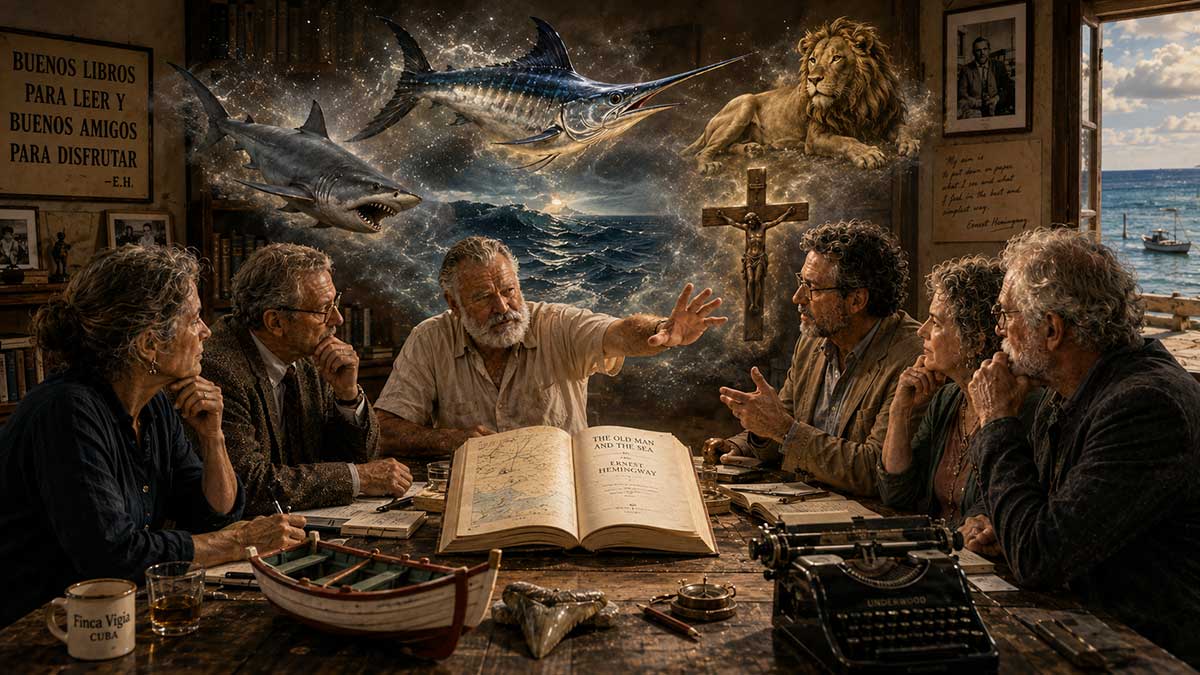
Rain falls softly over Finca Vigía.
The windows remain open.
The air smells of wet earth, tobacco, and old paper.
On the table, Bickford Sylvester has arranged several objects beside the open novella:
A carved lion.
A small model boat.
A shark’s tooth.
A photograph of the Gulf Stream.
A wooden crucifix.
Hemingway looks at the collection with open suspicion.
Ernest Hemingway
This is exactly how trouble begins.
Nick Sasaki
You recognize all of them.
Ernest Hemingway
I recognize objects.
Scholars recognize employment.
Susan Beegel laughs.
Peter Hays hides a smile behind his coffee cup.
Bickford Sylvester
You invited us.
Ernest Hemingway
I continue to regret that.
Nick looks around the table.
What does the marlin represent—if it represents anything?
Nick Sasaki
Let us begin with the most famous question.
What does the marlin represent?
Greatness?
Art?
Nature?
The perfect opponent?
Hemingway answers at once.
Ernest Hemingway
A marlin.
Susan Beegel
We expected that.
Ernest Hemingway
Then why ask?
Peter L. Hays
Because calling it a marlin does not end the discussion.
It begins it.
Hemingway leans back.
Ernest Hemingway
Explain without killing the fish.
Peter L. Hays
The marlin must first be physically convincing.
Its size, strength, movement, endurance, and beauty matter.
Once the reader believes in the fish, those qualities begin carrying emotional and philosophical meaning.
That does not turn the marlin into a code.
It means literal reality can become larger than itself.
Bickford Sylvester
The distinction matters.
The marlin is not one fixed symbol with one correct answer.
It gathers meanings through its relationship with Santiago.
It becomes worthy opposition.
Professional fulfillment.
Beauty.
Brotherhood.
Violence.
The cost of self-knowledge.
Ernest Hemingway
That is six fish already.
Bickford Sylvester
No.
One fish encountered from six directions.
Hemingway studies him.
Ernest Hemingway
Better.
Susan Beegel places one hand near the photograph of the sea.
Susan Beegel
The marlin is living nature before it becomes Santiago’s achievement.
Readers often begin with what the fish means to the fisherman.
I prefer to begin with what the fish is apart from him.
Free.
Powerful.
Unaware that a human being needs it to confirm his identity.
Nick
Then Santiago’s interpretation of the marlin may itself be part of the problem.
Susan Beegel
Yes.
He loves the fish.
He respects it.
He recognizes kinship.
Yet he still turns it into evidence about himself.
Ernest Hemingway
Human beings do that with nearly everything they love.
Susan Beegel
I agree.
That is why the detail deserves moral attention.
Hemingway looks surprised by the agreement.
Ernest Hemingway
You agree with me and still make it sound like criticism.
Susan Beegel
That is one of scholarship’s better uses.
The room laughs.
Are the sharks symbols, or merely hungry animals?
Nick picks up the shark’s tooth.
Nick
Readers have called the sharks death, time, critics, greed, envy, destruction, and the world’s habit of consuming achievement.
Are they any of those things?
Ernest Hemingway
They are sharks following blood.
Peter L. Hays
That answer remains true.
It is simply not exhaustive.
Ernest Hemingway
A shark should be enough.
Peter L. Hays
For the shark, perhaps.
Not for the reader.
Bickford Sylvester
Their sequence matters.
The first shark is powerful and worthy.
Later sharks become scavengers.
The destruction changes in character.
At first Santiago faces something formidable.
Later he faces repetition, depletion, and helplessness.
Nick
Which resembles how loss often works.
The first blow is dramatic.
What follows is gradual erosion.
Bickford Sylvester
Exactly.
The sharks remove the marlin piece by piece.
That allows readers to experience destruction as duration.
Susan Beegel
Yet we should resist turning the sharks into moral villains.
They do what predators do.
Santiago entered their ecosystem carrying blood through the water.
Ernest Hemingway
Thank you.
Susan Beegel
Do not celebrate yet.
Santiago calls them hateful because they consume what he considers his.
From another ecological perspective, they are simply eating.
Ernest Hemingway
A fisherman is permitted an opinion when sharks eat his catch.
Susan Beegel
Certainly.
The reader is permitted a wider view.
Larry Grimes, who has been quiet, turns the shark’s tooth over in his hand.
Larry Grimes
There is a spiritual temptation here.
We call whatever destroys our plans evil.
Sometimes it is evil.
Sometimes it is mortality.
Sometimes it is consequence.
Sometimes it is another creature trying to live.
H. R. Stoneback
Or the tax demanded by pilgrimage.
Every journey returns altered.
The pilgrim rarely brings home what he expected.
Hemingway looks at him.
Ernest Hemingway
You have turned sharks into tax collectors.
H. R. Stoneback
They have always had the temperament.
Hemingway laughs despite himself.
Is the sea a mother, lover, enemy, workplace, or mystery?
Susan Beegel moves the photograph of the Gulf Stream to the center of the table.
Susan Beegel
Now we arrive at the most revealing symbol.
Not the fish.
The sea.
Ernest Hemingway
The sea is larger than symbolism.
Susan Beegel
That is precisely why it generates so much meaning.
Santiago thinks of the sea as la mar.
Feminine.
Intimate.
Beautiful.
Unpredictable.
Some younger fishermen call it el mar, masculine, as though it were a rival or workplace.
That difference is not decorative.
It reveals how people imagine their relationship to nature.
Nick
What does Santiago’s feminine language suggest?
Susan Beegel
Affection.
Dependence.
Desire.
Kinship.
At times, possession.
His relationship with the sea is tender, but tenderness does not free it from masculine assumptions.
He loves the sea partly through a language that makes her beautiful, changeable, and available to him.
Hemingway’s expression tightens.
Ernest Hemingway
That was how certain fishermen spoke.
Susan Beegel
I believe you.
The fact that real fishermen used the language makes it more culturally meaningful, not less.
Peter L. Hays
This is where authorial intention becomes limited.
A writer can accurately reproduce speech without controlling every implication that speech carries.
Ernest Hemingway
So now I am guilty of accuracy.
Susan Beegel
Not guilty.
Responsible for what accuracy reveals.
Hemingway turns toward Nick.
Ernest Hemingway
Do all these conversations end with me on trial?
Nick
Only the interesting ones.
Bickford Sylvester points toward the page.
Bickford Sylvester
The sea refuses a single role.
It feeds Santiago.
Tests him.
Comforts him.
Threatens him.
Isolates him.
Connects him to birds, fish, stars, weather, memory, and Manolin.
It is workplace and mystery at once.
Larry Grimes
It may be the closest the novella comes to the divine.
Not because the sea is God.
Because it is immense, sustaining, beautiful, dangerous, and indifferent to human demands.
H. R. Stoneback
The pilgrim enters sacred space without possessing it.
That is Santiago’s deepest error and deepest wisdom.
He knows the sea exceeds him.
Yet for a few days, he behaves as though courage might negotiate with it.
Hemingway looks out the window at the rain.
Ernest Hemingway
That is what courage often tries.
Why does Santiago dream of lions?
Nick picks up the carved lion.
Nick
The novella begins and ends with Santiago dreaming of lions on African beaches.
Why lions?
Why not the marlin?
Why not Manolin?
Why not a younger version of himself?
Hemingway takes longer this time.
Ernest Hemingway
He saw lions when he was young.
Memory keeps what it chooses.
Peter L. Hays
Yet the placement gives the lions structural weight.
They are not random memories.
They frame the story.
Bickford Sylvester
The lions carry youth, vitality, play, beauty, and freedom from self-consciousness.
They are not fighting.
They are not hunting.
They are playing.
That is significant.
Nick
Santiago’s waking life is struggle.
His dream is play.
Bickford Sylvester
Yes.
He dreams not of conquest, but of life before everything became a test.
Susan Beegel nods.
Susan Beegel
The lions may represent an energy not based on domination.
They possess strength without needing to prove it.
That makes them a quiet counterpoint to Santiago’s voyage.
Hemingway studies the small carving.
Ernest Hemingway
That is better than most things written about them.
Susan Beegel
I will record the compliment.
Ernest Hemingway
Do not become dependent on it.
Stoneback lifts his eyes.
H. R. Stoneback
Lions carry biblical and mythic associations too.
Courage.
Kingship.
Danger.
Resurrection.
Yet Santiago’s lions remain distant and peaceful.
They belong to sacred memory rather than doctrine.
Larry Grimes
They may be grace in animal form.
Something given, not earned.
Santiago cannot catch them.
Cannot sell them.
Cannot prove himself through them.
He can only receive the dream.
The room grows quieter.
Nick
Then the final dream may mean his deepest self survives outside achievement.
Larry Grimes
Yes.
When the marlin is gone and the body is broken, something still plays on the shore.
Hemingway says nothing.
The rain grows heavier.
When an author denies symbolism, should readers obey?
Nick closes the book.
Nick
Now the central argument.
You resisted the claim that the novella was a symbolic puzzle.
Readers often repeat a statement attributed to you: the old man is an old man, the fish is a fish, the sharks are sharks.
Should we take that as the final word?
Ernest Hemingway
You should take it as protection against bad reading.
Peter L. Hays
What counts as bad reading?
Ernest Hemingway
When a reader stops seeing the fish because he is too busy seeing Christ, art, masculinity, death, capitalism, or his childhood.
Susan Beegel
That is fair.
Ernest Hemingway
Twice in one morning.
Something is wrong.
Susan Beegel
A reading becomes weak when it replaces the physical world rather than deepening it.
The marlin cannot cease being an animal.
The sea cannot become merely a mental state.
Bickford Sylvester
Yet your defense of literal reality does not cancel resonance.
A bell is a bell.
It still rings beyond itself.
Ernest Hemingway
That sounds like a scholar’s sentence.
Bickford Sylvester
I made no attempt to hide it.
Peter L. Hays
Authors do not own the final meaning of their works.
They shape the words.
Readers encounter those words through history, culture, memory, and other literature.
Meaning emerges from that encounter.
Ernest Hemingway
Then why bother asking the author anything?
Peter L. Hays
Because intention is evidence.
It is not a prison.
Hemingway considers this.
Ernest Hemingway
I dislike that sentence.
Peter L. Hays
Is it wrong?
Hemingway pauses.
Ernest Hemingway
No.
That is why I dislike it.
Nick smiles.
Nick
Could your denial of symbolism have been a rejection of simplistic allegory rather than layered meaning?
Hemingway reaches for his glass, remembers that it contains only water, and sets it down again.
Ernest Hemingway
I hated people telling readers that one thing equals another thing.
Fish equals art.
Sharks equal critics.
Sea equals life.
Then the student writes it down, passes the examination, and never smells salt water.
That is not reading.
It is bookkeeping.
Bickford Sylvester
Then we may agree.
The novella is not a locked box with five symbolic keys.
Susan Beegel
It is a living network of relationships.
Larry Grimes
A story can carry spiritual meaning without becoming a sermon.
H. R. Stoneback
A journey can echo pilgrimage without ceasing to be fishing.
Peter L. Hays
A lion can remain a lion and still gather memory, courage, play, and renewal.
Hemingway looks around the table.
Ernest Hemingway
You have all found elegant ways to disobey me.
Nick
Perhaps that is the tribute.
Hemingway gives him a skeptical look.
Nick
You made the physical world so convincing that readers keep discovering more life inside it.
The author watches the rain beyond the window.
For once, he appears less irritated than tired.
Ernest Hemingway
A writer wants the words to remain alive.
Living things are difficult to control.
No one speaks.
The statement changes the atmosphere.
Peter Hays opens his notebook again.
Peter L. Hays
Then perhaps we have our answer.
Readers should not obey the author blindly.
They should read responsibly.
Susan Beegel
Keep the fish alive.
Keep the sea alive.
Keep the ethical cost visible.
Bickford Sylvester
Attend to the words before announcing the theory.
Larry Grimes
Allow mystery to remain mystery.
H. R. Stoneback
And accept that literal journeys may carry sacred echoes.
Nick turns to Hemingway.
Nick
Your final rule?
Hemingway looks at the marlin bill mounted on the wall.
Its shadow stretches across the room.
Ernest Hemingway
Never interpret a symbol so completely that it stops breathing.
The rain begins to ease.
Light returns through the windows.
On the table, the lion, shark’s tooth, boat, crucifix, and photograph remain exactly what they were.
Objects.
Evidence.
Invitations.
No one agrees on one meaning.
That may be why the story continues to live.
Topic 4: Is Santiago a Christ Figure, a Pilgrim, or Simply a Suffering Man?
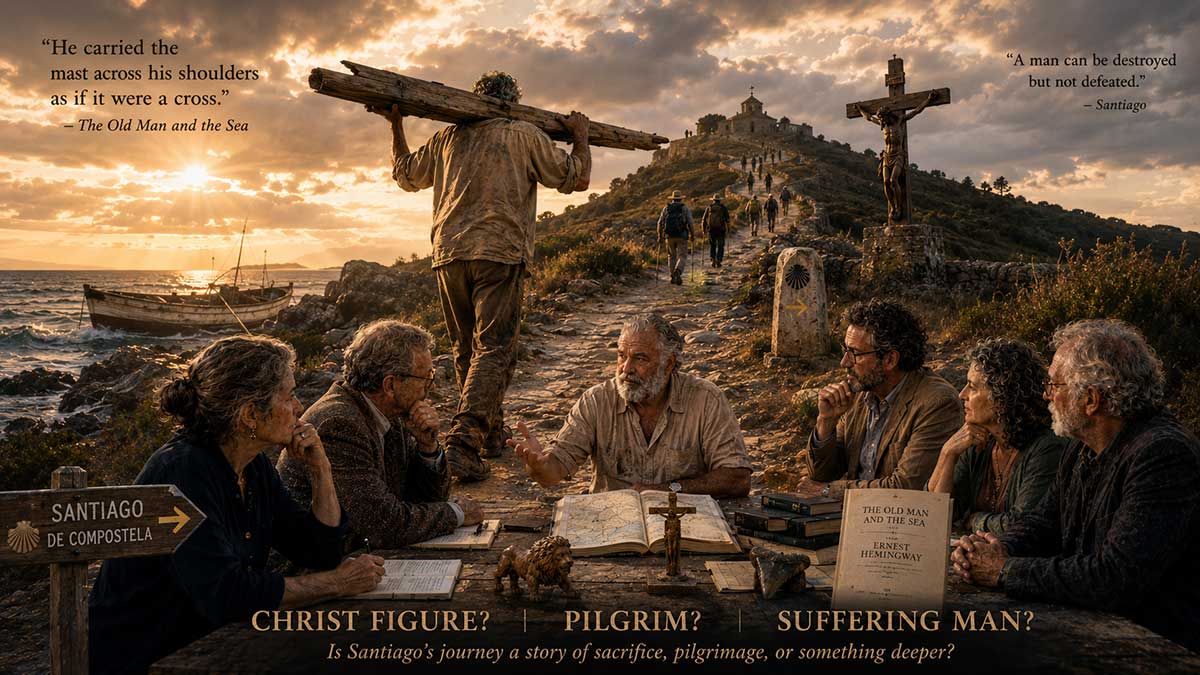
The rain has passed.
Finca Vigía smells of wet leaves and salt carried inland from the coast.
The small wooden crucifix remains at the center of the table.
Beside it lies the carved lion, the shark’s tooth, and the model fishing boat from the previous discussion.
H. R. Stoneback has placed an old map of pilgrimage routes across Spain beside the open novella.
A red line leads to Santiago de Compostela.
Hemingway stares at it.
Ernest Hemingway
You have turned my fishing story into a travel agency.
H. R. Stoneback
A pilgrimage office, perhaps.
Ernest Hemingway
That is worse.
Larry Grimes smiles.
Larry Grimes
You named him Santiago.
You gave him wounded hands.
You had him carry a mast up a hill.
Then you placed him face down on his bed with his arms extended.
You cannot act surprised that readers noticed.
Hemingway looks toward Nick.
Ernest Hemingway
I am beginning to suspect these people read the book.
Nick Sasaki
That was part of the invitation.
The table settles.
Nick turns toward the crucifix.
Is Santiago meant to resemble Christ?
Nick Sasaki
Let us begin plainly.
Is Santiago a Christ figure?
Larry Grimes
He carries unmistakable Christ imagery.
That does not mean he equals Christ.
Ernest Hemingway
Good.
At least we have avoided one bad sentence.
Larry Grimes
The distinction matters.
A Christ figure is often treated like a literary equation.
Wounded hands plus suffering plus burden-bearing equals Jesus.
That reduces both the character and the religious tradition.
Santiago is mortal, proud, mistaken, and limited.
His resemblance to Christ lies in the pattern of his suffering, not in moral perfection.
Peter L. Hays
The imagery works through echo.
Readers recognize familiar forms:
The injured hands.
The weight carried upon the shoulders.
The climb home.
The collapse.
The extended arms.
The suffering endured without hatred.
Yet Santiago never becomes a substitute savior.
He saves no nation.
He redeems no human sin.
He catches a fish and returns broken.
Ernest Hemingway
Thank you.
Susan Beegel
Yet even that description may be too narrow.
The Christian imagery changes how readers value his pain.
It gives physical suffering spiritual dignity.
That can deepen the story.
It can create danger too.
Nick
What danger?
Susan Beegel
Readers may begin admiring pain simply because it resembles sacred suffering.
They may forget that Santiago went too far by his own admission.
They may turn injury into proof of greatness.
Larry Grimes
Christianity does not teach that every wound is holy.
Susan Beegel
People often read it that way.
Larry Grimes
Then the failure belongs to the reading, not the faith.
Susan Beegel
Perhaps.
Yet literature participates in the images people inherit.
Hemingway looks between them.
Ernest Hemingway
You are both protecting different things.
Nick
What do you mean?
Ernest Hemingway
Larry is protecting suffering from meaninglessness.
Susan is protecting people from worshipping suffering.
Neither concern is foolish.
The room quiets.
Grimes nods slowly.
Larry Grimes
That is fair.
Susan Beegel
Yes.
Bickford Sylvester
The text itself supports both concerns.
Santiago treats pain as something to endure, not something to seek.
His suffering has meaning only inside his relation to the fish, the sea, his craft, and the boy.
Remove those relationships and the wounds become mere injury.
Nick
Then the Christian imagery does not sanctify pain by itself.
Bickford Sylvester
No.
It asks what kind of person emerges through pain.
What should readers make of the wounded hands, mast, and final posture?
Nick picks up the model boat.
Nick
Let us examine the details.
His hands are cut.
He carries the mast upon his shoulders.
He climbs to his shack.
He falls face down and sleeps with his arms extended.
Were these details consciously arranged?
Hemingway takes his time.
Ernest Hemingway
A writer notices shapes.
A man carrying a mast has a shape.
A man sleeping after great exhaustion has a shape.
If those shapes remind readers of something older, that may be useful.
Peter L. Hays
That sounds carefully evasive.
Ernest Hemingway
Careful evasion is still care.
H. R. Stoneback
The shapes matter whether planned in advance or discovered during composition.
Sacred traditions survive partly through repeated gestures.
Carrying.
Falling.
Wounding.
Waiting.
Returning.
The body remembers stories the mind may not name.
Nick
So Santiago’s body becomes part of the narrative language.
H. R. Stoneback
Exactly.
His body says what he does not.
He rarely explains his suffering.
The posture carries the meaning.
Larry Grimes
The wounded hands are especially important.
Hands represent skill, labor, touch, and identity.
Santiago knows the sea through his hands.
He earns his living through them.
He holds the line through them.
When they fail him, the crisis is deeper than pain.
His vocation itself appears wounded.
Susan Beegel
The hands bind him to the marlin too.
Both bodies are injured by the same struggle.
The line cuts Santiago.
The hook wounds the fish.
The image is relational.
No one suffers alone.
Ernest Hemingway
That is true of most violence.
Nick
Does carrying the mast make Santiago a burden-bearer?
Peter L. Hays
Yes, yet the burden is partly self-created.
That gives the image its tension.
Christ carries a burden for others.
Santiago carries the remains of his own chosen vocation.
The echo is real.
The difference is equally real.
Larry Grimes
A spiritual reading becomes richer when it preserves that difference.
Santiago does not reenact salvation.
He discovers humility after pride.
H. R. Stoneback
Which is why “pilgrim” may fit better than “Christ figure.”
Hemingway looks toward the map.
Ernest Hemingway
There it is.
We have reached Spain at last.
Does the name Santiago connect him to St. James and pilgrimage?
Stoneback places one finger on the map.
H. R. Stoneback
Santiago means Saint James.
The name carries centuries of pilgrimage, fishing traditions, apostolic memory, and sacred travel.
A reader does not need this background to feel the story.
Yet the name opens another path.
Nick
What path?
H. R. Stoneback
Santiago leaves the known shore.
He crosses into deep water.
He suffers bodily trials.
He confronts pride.
He returns stripped of the reward he expected.
He reaches home changed.
That is a pilgrimage pattern.
Ernest Hemingway
It is a fishing pattern too.
H. R. Stoneback
The two need not compete.
A pilgrimage is often ordinary movement given deeper attention.
Walking becomes searching.
Distance becomes testing.
Return becomes self-knowledge.
Fishing can carry the same structure.
Bickford Sylvester
The calendar and timing deepen that reading.
The references surrounding the voyage invite Holy Week associations.
They create a sacred rhythm beneath the visible action.
Ernest Hemingway
Beneath?
Bickford Sylvester
Yes.
Your method often places the greater pressure beneath the sentence.
Ernest Hemingway
You are using my iceberg against me.
Bickford Sylvester
It seemed available.
Hemingway smiles reluctantly.
Larry Grimes
St. James carries another connection.
He was a fisherman called into discipleship.
Santiago remains a fisherman, but his ordeal changes the meaning of his work.
He returns less certain of mastery.
More aware of dependence.
That movement from control to humility is spiritual.
Susan Beegel
Yet we should ask whether calling the voyage a pilgrimage softens the harm done to the marlin.
Sacred language can turn conquest into destiny.
H. R. Stoneback
A true pilgrimage does not guarantee innocence.
Pilgrims carry error with them.
They may reach the holy place and still misunderstand the journey.
Susan Beegel
Then Santiago’s failure belongs inside the pilgrimage.
H. R. Stoneback
Yes.
Perhaps it is the central lesson.
He sets out to prove he remains a great fisherman.
He returns knowing greatness does not grant ownership over consequence.
Nick
That feels less like conquest and more like confession.
Larry Grimes
Exactly.
Does a Christian reading deepen the story or romanticize needless suffering?
The afternoon light shifts across the table.
Hemingway looks at the crucifix for a long moment.
Nick
Let us confront the criticism directly.
Does reading Santiago through Christianity help us see more?
Or does it make needless suffering look noble?
Susan Beegel
It can do either.
A responsible reading asks what the imagery reveals.
An irresponsible reading praises every wound and ignores every warning.
Santiago says he went too far.
Any religious interpretation that erases that sentence has failed him.
Larry Grimes
Agreed.
Christian meaning does not come from pain alone.
It comes from love, humility, sacrifice, mercy, and transformation.
Santiago’s pain becomes spiritually interesting when it leads him to recognize limits.
Peter L. Hays
The question is not, “Did he suffer?”
The question is, “What did suffering teach him that success could not?”
Ernest Hemingway
That the sea does not care about his opinion of himself.
Bickford Sylvester
That he needs Manolin.
Susan Beegel
That respect for nature does not remove the consequences of domination.
Larry Grimes
That dignity and dependence can coexist.
H. R. Stoneback
That return matters more than possession.
Nick turns to Hemingway.
Nick
Did suffering teach you?
The author looks out through the open window.
For once, he does not answer with humor.
Ernest Hemingway
Sometimes.
Sometimes it only hurt.
The others remain silent.
Ernest Hemingway
People like to believe pain always produces wisdom.
It does not.
Pain can make a man cruel.
Afraid.
Small.
It can empty him without filling anything in return.
Larry Grimes
Then what makes Santiago different?
Ernest Hemingway
The boy.
Grimes looks toward him.
Ernest Hemingway
He has someone to return to.
Pain alone does not redeem him.
Love receives him after pain.
That is different.
No one speaks for several seconds.
Susan Beegel folds her hands.
Susan Beegel
That may be the strongest Christian reading offered here.
Ernest Hemingway
I was trying to avoid one.
Larry Grimes
You did poorly.
Hemingway laughs.
The tension breaks.
Is the voyage sacrifice, pilgrimage, penance, resurrection, or none of these?
Nick
One final question.
How should we name Santiago’s voyage?
Sacrifice?
Pilgrimage?
Penance?
Resurrection?
Or simply fishing?
Peter L. Hays
It moves through all those forms without settling into one.
Bickford Sylvester
It begins as professional action.
It becomes ordeal.
Then confession.
Then return.
Susan Beegel
It is kinship compromised by possession.
Love entangled with violence.
Larry Grimes
It is a spiritual trial in which the man loses the object and keeps the capacity to love.
H. R. Stoneback
It is pilgrimage.
Not a pilgrimage ending at a shrine.
A pilgrimage ending in dependence.
Ernest Hemingway
It is fishing.
Everyone looks at him.
He lifts one hand.
Ernest Hemingway
And perhaps fishing is enough to contain the rest.
Nick smiles.
Nick
That sounds less resistant than before.
Ernest Hemingway
I am tired.
The table laughs.
Then Hemingway reaches for the small crucifix.
He turns it once between his fingers.
Ernest Hemingway
People want to know whether Santiago resembles Christ.
Perhaps the better question is whether suffering leaves him capable of love.
If it does not, the resemblance means nothing.
Larry Grimes watches him closely.
Larry Grimes
And does it?
Ernest Hemingway
He wakes.
The boy is there.
They plan to fish again.
Yes.
It does.
Stoneback rolls up the pilgrimage map.
H. R. Stoneback
Then his return is not resurrection in the grand sense.
It is smaller.
More human.
Susan Beegel
He does not conquer death.
He accepts care.
Bickford Sylvester
He does not rise above dependence.
He enters it.
Peter L. Hays
And perhaps that is the final reversal.
The man who sailed alone discovers that dignity does not require remaining alone.
Hemingway places the crucifix back on the table.
The room has grown dim.
No one has proved Santiago is Christ.
No one has reduced him to an ordinary sufferer either.
He remains what the strongest literary figures often become:
A man carrying more meanings than he can explain.
Outside, the wet leaves shine beneath the returning sun.
Somewhere beyond the house, the sea continues its ancient movement.
Not blessing.
Not condemning.
Receiving every pilgrim who believes he is merely going fishing.
Topic 5: What Does the Novel Ask Us to Love—Man, Nature, Work, or Legacy?
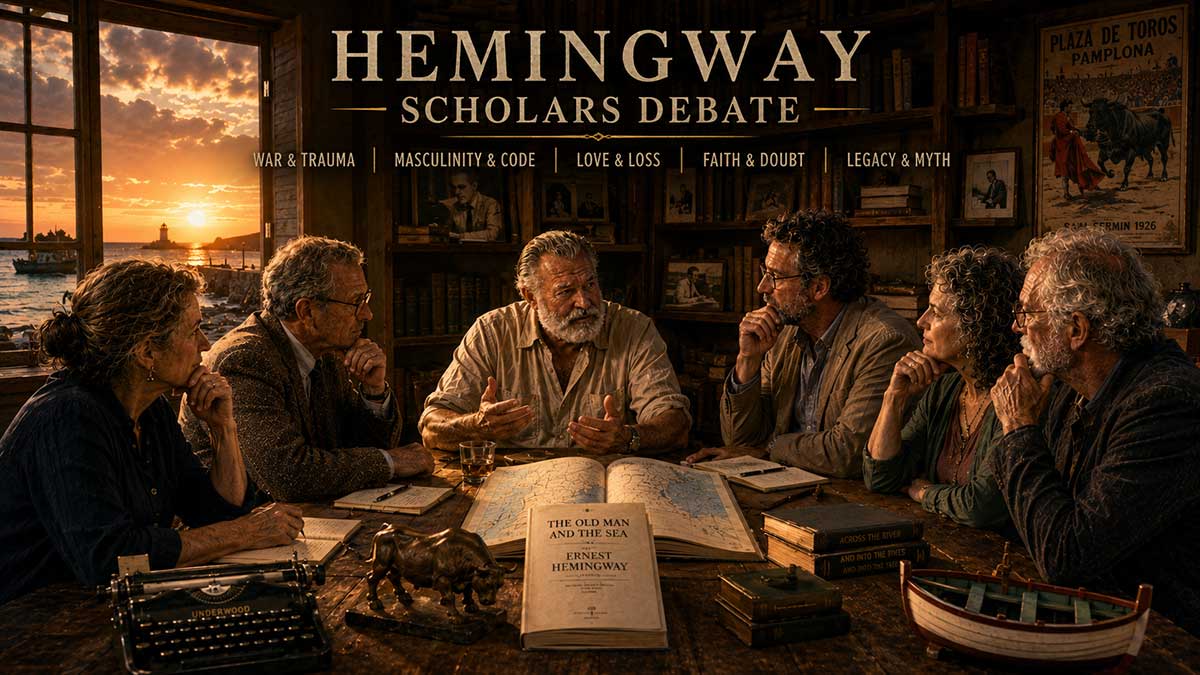
Evening returns to Finca Vigía.
The rain has washed the air clean.
Beyond the open windows, the Cuban hills darken under a violet sky. A lamp glows above the table. The marked copy of The Old Man and the Sea lies open beside the marlin photograph, carved lion, shark’s tooth, crucifix, and model boat.
Hemingway has stopped pretending he wants the objects removed.
Susan Beegel studies the photograph of the Gulf Stream.
Larry Grimes turns the small boat between his hands.
Bickford Sylvester rereads a passage in silence.
Peter L. Hays watches Hemingway.
H. R. Stoneback stands near the window, listening to distant birds settle into the trees.
Nick Sasaki looks around the table.
Nick Sasaki
We have discussed victory, pride, symbols, suffering, and pilgrimage.
I want to end with love.
Santiago loves the sea.
He loves the marlin.
He loves Manolin.
He loves fishing.
He loves baseball.
He may love his work more than his own safety.
What does this novel finally ask us to love?
Hemingway gives a short laugh.
Ernest Hemingway
You saved the most dangerous word for last.
How can Santiago love the marlin and still kill it?
Nick
Let us begin with the contradiction readers cannot escape.
Santiago calls the marlin his brother.
He admires its beauty and strength.
He apologizes to it.
Then he kills it.
What kind of love is that?
Susan Beegel answers first.
Susan Beegel
A compromised love.
Real, but compromised.
Santiago’s affection does not prevent him from placing his own need above the marlin’s life.
That is precisely why the relationship matters.
It reveals how people can feel kinship with nature and still participate in its destruction.
Ernest Hemingway
Human beings live by taking life.
Susan Beegel
Yes.
The moral question is not whether humans can remain pure.
They cannot.
The question is whether recognition changes conduct.
Santiago recognizes the marlin as magnificent, sentient, worthy, and free.
His recognition deepens the tragedy.
It does not erase it.
Larry Grimes
Love does not always prevent harm.
Sometimes love makes us more conscious of the harm we cause.
Nick
That sounds painful.
Larry Grimes
It should.
A painless morality is usually abstract.
Santiago does not kill an anonymous object.
He kills something he has come to know.
That knowledge turns the act into grief.
Peter L. Hays
The story never grants him the comfort of hatred.
That matters.
If the marlin were ugly, cruel, or contemptible, the killing would be easier for both Santiago and the reader.
Hemingway makes the fish beautiful.
Beauty removes the usual excuse.
Bickford Sylvester
The language of brotherhood intensifies the conflict.
Santiago’s struggle is not man against monster.
It is one form of life against another form of life, joined by endurance.
Ernest Hemingway
That was the point.
Susan Beegel
Part of the point.
Hemingway looks toward her.
Susan Beegel
Brotherhood can become sentimental if it does not change the balance of power.
Santiago calls the fish brother.
The hook remains in the fish’s mouth.
Ernest Hemingway
What would you have him do?
Release it?
Susan Beegel
Perhaps.
Ernest Hemingway
Then there is no story.
Susan Beegel
There may be another story.
The room stills.
Hemingway leans back.
Ernest Hemingway
Go on.
Susan Beegel
A man spends three days proving he can defeat greatness.
Then he discovers greatness need not become possession.
He cuts the line.
He returns without proof.
He must live with no one believing what he met.
That might test him more deeply than killing it.
Hemingway studies her.
Ernest Hemingway
That is not the story I wrote.
Susan Beegel
No.
It is the ethical possibility your story makes visible.
Peter Hays smiles faintly.
Peter L. Hays
A strong book produces roads it does not travel.
Hemingway reaches for his glass.
Ernest Hemingway
Scholars enjoy roads the writer was too sensible to take.
Nick
Would releasing the marlin have made Santiago less heroic?
Larry Grimes
It might have required another kind of courage.
The courage to accept an encounter without ownership.
H. R. Stoneback
Pilgrims often believe they must bring something back from the sacred place.
A relic.
A certificate.
A story.
A scar.
Perhaps the greater pilgrimage teaches them to return empty-handed.
Hemingway glances toward him.
Ernest Hemingway
He did return empty-handed.
H. R. Stoneback
Only after trying very hard not to.
Hemingway nods once.
He cannot dispute it.
Does the story show kinship with nature or domination over it?
Nick
Susan, your work has asked whether Santiago’s relationship with the sea expresses ecological kinship, masculine domination, or both.
Where do you land?
Susan Beegel
Both.
That is what gives the novella depth.
Santiago feels tenderness toward birds, turtles, dolphins, flying fish, the marlin, and the sea itself.
He pays attention.
He recognizes personalities and relationships within the natural world.
Yet he still believes skill and courage permit him to enter that world and take what he can master.
His intimacy with nature exists beside domination.
Ernest Hemingway
A fisherman who refuses to fish becomes something else.
Susan Beegel
Yes.
The story does not need Santiago to stop being a fisherman.
It needs the reader to notice what fishing means.
Bickford Sylvester
The text supports that tension.
Santiago never treats the sea as dead scenery.
Everything around him lives.
The bird tires.
The fish suffers.
The current carries.
The sharks feed.
The moon changes.
The human being is never alone at the center.
Peter L. Hays
That is one reason the story feels ancient.
It resembles cultures in which animals are opponents, kin, food, symbols, and spiritual presences at once.
Modern categories separate those roles.
The novella joins them again.
Larry Grimes
Santiago’s moral sensitivity lies in attention.
His moral failure may lie in believing attention grants permission.
Susan Beegel looks at him.
Susan Beegel
Yes.
That is very close to my reading.
Hemingway raises an eyebrow.
Ernest Hemingway
Three agreements in two days.
We may be losing discipline.
The table laughs.
Nick
Mr. Hemingway, did you see Santiago as living in harmony with nature?
Ernest Hemingway
Harmony is a word people use from comfortable rooms.
The sea gives and takes.
The fisherman gives and takes.
Nothing stays clean.
Santiago respects the terms.
He does not pretend the fish volunteered.
Susan Beegel
That honesty matters.
It is not innocence.
Ernest Hemingway
I never asked for innocence.
Peter L. Hays
Perhaps the novella asks for intimacy without illusion.
Nick
Meaning?
Peter L. Hays
Love nature.
Depend upon it.
Fear it.
Take from it when life requires.
Never pretend the taking is consequence-free.
H. R. Stoneback turns from the window.
H. R. Stoneback
The sacred is not always harmless.
The sea is holy partly because it exceeds human morality.
It receives birth, hunger, beauty, violence, and death without separating them.
Susan Beegel
Yet humans must separate them.
We are responsible for judgment.
The sea is not.
H. R. Stoneback
Agreed.
The sea does not absolve Santiago.
It places him before himself.
Who is Manolin: apprentice, son, caregiver, witness, or future?
Nick moves the model boat beside the lion figurine.
Nick
We have spoken often about Santiago and the marlin.
Yet the novella begins and ends with Manolin.
Who is he?
An apprentice?
A spiritual son?
A caregiver?
A witness?
The future?
Bickford Sylvester
All of those.
The relationship is the emotional structure holding the book together.
Without Manolin, Santiago’s ordeal risks becoming a private myth of masculine endurance.
The boy returns it to love.
Larry Grimes
Manolin receives Santiago before the village understands him.
That makes him more than a student.
He is witness.
He sees the old man’s wounds.
He cries.
He brings coffee.
He promises companionship.
He does not demand a lesson before offering care.
Susan Beegel
He reverses the hierarchy.
At first, Santiago teaches him how to fish.
By the end, Manolin teaches Santiago that dependence need not mean humiliation.
Nick
That is a major shift.
Susan Beegel
Yes.
Santiago’s idea of dignity has often rested on self-sufficiency.
Manolin’s love offers another dignity: being cared for without becoming smaller.
Hemingway looks down at the book.
Ernest Hemingway
The boy never thought he was small.
Peter L. Hays
That may be why the boy sees him most clearly.
Adults measure Santiago by results.
Manolin measures him through memory, loyalty, and knowledge of his craft.
H. R. Stoneback
He is the disciple who remains when the public has moved on.
Ernest Hemingway
Do not make him an apostle.
H. R. Stoneback
I said disciple.
Ernest Hemingway
That is how it starts.
The room laughs again.
Nick
Does Manolin inherit Santiago’s values?
Bickford Sylvester
Some of them.
Yet inheritance is never duplication.
He may inherit discipline, courage, attention, and respect for the sea.
He may reject isolation.
Larry Grimes
That would be true legacy.
Not copying the teacher’s wounds.
Receiving the wisdom without repeating every error.
Hemingway looks toward Grimes.
Ernest Hemingway
That is a hard thing for students to do.
Larry Grimes
It is harder for teachers to permit.
Hemingway smiles.
Ernest Hemingway
True.
Nick
Could Manolin become a better fisherman than Santiago?
Ernest Hemingway
I hope so.
The answer arrives quickly.
Everyone notices.
Nick
Why?
Ernest Hemingway
A teacher who needs the student to remain smaller has taught nothing.
Susan Beegel nods.
Susan Beegel
Then Santiago’s true achievement may be relational, not individual.
Ernest Hemingway
Perhaps.
Peter L. Hays
That “perhaps” has become more generous since Topic 1.
Ernest Hemingway
Fatigue weakens a man’s defenses.
Does Santiago redefine masculinity?
Nick
The book is often associated with endurance, physical suffering, toughness, and masculine pride.
Yet Santiago is tender.
He cries.
He speaks to birds.
He loves Manolin.
He admits fear and pain.
Does the novella revise masculinity, or preserve an older ideal?
Peter Hays answers first.
Peter L. Hays
It does both.
Santiago embodies an older masculine code:
Competence.
Self-command.
Physical endurance.
Silence under pain.
Professional honor.
Yet he refuses emotional emptiness.
He expresses affection without shame.
That complicates the code.
Susan Beegel
He is gentler than many popular images of Hemingway’s men.
He does not dominate through loudness.
He is not contemptuous of tenderness.
His strength includes care, admiration, and vulnerability.
Yet the narrative still treats solitary suffering as a major route to identity.
That deserves scrutiny.
Larry Grimes
His tenderness saves the masculinity from becoming brittle.
Susan Beegel
It softens it.
I am not certain it saves it.
Nick
What remains unresolved?
Susan Beegel
His need to prove himself through extremity.
His reluctance to accept limits.
His assumption that worth must be tested through pain.
Those remain recognizable masculine traps.
Hemingway folds his arms.
Ernest Hemingway
Pain tests everyone.
Susan Beegel
Life tests everyone.
Men are often taught to seek extra tests so they can feel real.
Hemingway’s expression changes.
The remark reaches him.
Ernest Hemingway
That is not entirely false.
Peter L. Hays
Santiago’s greatness may lie in carrying both traditions.
He is formed by hardness.
He survives through tenderness.
H. R. Stoneback
The boy is essential again.
Masculinity becomes generational rather than solitary.
The old man does not merely endure.
He teaches, receives love, and permits himself to be mourned.
Larry Grimes
To be loved after failure may require more humility than to suffer alone.
Nick
Mr. Hemingway, did you find it easier to write men in pain than men receiving care?
Hemingway looks directly at him.
No humor comes.
Ernest Hemingway
Yes.
Nick
Why?
Ernest Hemingway
Pain has rules.
Care does not.
The table becomes silent.
Ernest Hemingway
A man can meet pain with technique.
Breathe.
Endure.
Wait.
Care enters where technique fails.
You must trust someone.
That is harder.
Susan Beegel watches him with a softened expression.
Susan Beegel
Then Manolin may be more threatening to Santiago’s old identity than the marlin.
Hemingway almost smiles.
Ernest Hemingway
Perhaps more threatening to mine.
No one speaks for several seconds.
Why does this short story remain so widely read?
Night has settled outside.
The lamp above the table becomes the room’s only strong light.
Nick
Our final question.
Why does this brief story remain one of the most widely read and debated works of the twentieth century?
It has a simple plot.
Few characters.
Plain language.
No large social world.
Why does it endure?
Bickford Sylvester
Its simplicity is architectural, not empty.
Nearly every object and action carries several pressures at once.
The line is fishing gear and connection.
The hand is body and vocation.
The marlin is animal and worthy encounter.
The skeleton is result and absence.
The boy is love and future.
Peter L. Hays
It belongs to several traditions without becoming trapped by any one of them.
Adventure story.
Tragedy.
Fable.
Christian echo.
Nature writing.
Masculine ordeal.
Artistic parable.
Aging narrative.
Readers enter through different doors.
Larry Grimes
It confronts the problem every life eventually faces:
How do we live when effort does not guarantee reward?
That question does not age.
Susan Beegel
It remains open to moral challenge.
Readers can admire Santiago and question him at the same time.
A weaker book would force one response.
This one permits love without obedience.
H. R. Stoneback
It gives ordinary work sacred scale without removing its ordinariness.
A fisherman goes fishing.
A pilgrim crosses deep water.
Both statements remain true.
Nick turns toward Hemingway.
Nick
Why do you think it endured?
Hemingway looks at the objects spread across the table.
The fish.
The boat.
The tooth.
The crucifix.
The lion.
Then he looks at the open book.
Ernest Hemingway
It is about losing something you believed would prove your life mattered.
Everyone waits.
Ernest Hemingway
Most people know that feeling.
The answer changes the room.
Nick
And Manolin?
Ernest Hemingway
He is what keeps the loss from having the last word.
Larry Grimes
Love?
Ernest Hemingway
Yes.
Not love as decoration.
Love as return.
The boy comes back.
The old man wakes.
They plan another day.
That is the whole defense.
Susan Beegel reaches for the marlin photograph.
Susan Beegel
Then the novel does not ask us to love conquest.
Ernest Hemingway
No.
Susan Beegel
Does it ask us to love nature?
Ernest Hemingway
Yes, without pretending love makes us harmless.
Peter L. Hays
Work?
Ernest Hemingway
Yes, but not enough to sacrifice every human bond.
Larry Grimes
Suffering?
Ernest Hemingway
No.
Never suffering itself.
H. R. Stoneback
Legacy?
Hemingway looks toward the dark window.
Ernest Hemingway
Only if legacy means someone younger learns to sail farther without making every mistake you made.
Nick closes the recorder, then opens it again.
Nick
One final sentence.
What does The Old Man and the Sea ask us to love most?
The scholars look at one another.
No one rushes.
Susan Beegel speaks first.
Susan Beegel
Life beyond our ownership.
Bickford Sylvester
Craft practiced with full attention.
Peter L. Hays
Meaning that survives contradiction.
Larry Grimes
The person who returns to receive us after failure.
H. R. Stoneback
The road that strips pride and leaves humility.
They turn toward Hemingway.
He places one hand on the open page.
Ernest Hemingway
The thing that makes you rise the next morning without making you forget who waits for you at home.
No one tries to improve the sentence.
Outside, the hills have disappeared into darkness.
A moth circles the lamp.
The objects on the table cast overlapping shadows:
The marlin across the crucifix.
The boat across the lion.
The shark’s tooth across the open book.
Nothing stands alone.
Not man.
Not nature.
Not work.
Not suffering.
Not love.
The novella survives because it refuses to choose only one.
Santiago needs the sea.
The sea does not need Santiago.
The marlin changes him.
The sharks strip him.
Manolin receives him.
His work gives him identity.
Love gives him somewhere to return.
Hemingway closes the book.
For the first time, no one reopens it.
The conversation has reached its shore.
Final Thoughts by Ernest Hemingway
After listening to these conversations, I find myself thinking less about Santiago's catch and more about his return.
That surprises me.
When I wrote the novella, I wanted readers to respect craftsmanship, endurance, discipline, and the dignity of honest work.
Those things still matter.
But the scholars reminded me of something my own story quietly knew all along.
Santiago does not become fully himself on the sea.
He becomes fully himself when he allows Manolin to care for him.
There is courage in struggling alone.
There is another kind of courage in accepting love after the struggle is over.
That second courage is often harder.
Throughout these discussions, we disagreed about symbols, religion, ecology, pride, masculinity, and victory.
Those disagreements are healthy.
Literature should invite conversation rather than demand agreement.
A novel that answers every question rarely survives its own generation.
A novel that keeps producing better questions continues finding new readers.
If there is one lesson I would leave behind, it is this:
Great literature does not become timeless because it gives permanent answers. It becomes timeless because every generation discovers new questions inside the same pages.
Perhaps Santiago won.
Perhaps he lost.
Perhaps both statements remain true.
What matters is that his voyage still compels us to examine our own.
What is your marlin?
What have the sharks taken from you?
Who is your Manolin?
What dream still waits beyond the horizon?
Those questions belong to you now.
The sea has always been larger than one fisherman.
It is certainly larger than one writer.
I hope this conversation sends you back to the original novella with slower eyes, greater curiosity, and deeper gratitude—for stories that continue living long after the people who first told them are gone.
Short Bios:
Leave a Reply